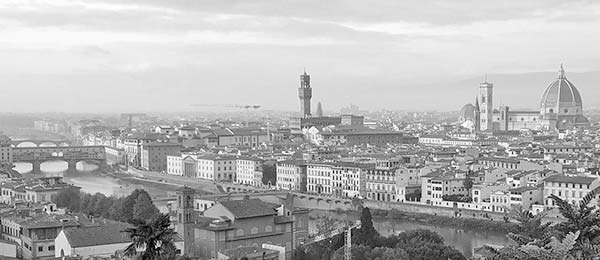
FLORENCE
Firenze
Map: Ghiberti’s “Gates of Paradise”
Map: Oltrarno, South of the Arno River
Map: Oltrarno Hotels & Restaurants
ON OR NEAR PIAZZA DELLA SIGNORIA
BETWEEN THE PALAZZO VECCHIO AND SANTA CROCE CHURCH
NEAR THE CHURCH OF SANTA MARIA NOVELLA
Florence, the home of the Renaissance and birthplace of our modern world, has the best Renaissance art in Europe. In a single day, you could look Michelangelo’s David in the eyes, fall under the seductive sway of Botticelli’s Birth of Venus, and climb the modern world’s first dome, which still dominates the skyline.
Get your bearings with a Renaissance walk. Florentine art goes beyond paintings and statues—enjoy the food, fashion, and street markets. You can lick Italy’s best gelato while enjoying some of Europe’s best people-watching.
PLANNING YOUR TIME
Florence deserves at least one well-organized day: see the Accademia (David), tour the Uffizi Gallery (Renaissance art), visit the Duomo Museum (original bronze Baptistery doors) or the underrated Bargello (best statues), and do my “Renaissance Walk” (described later in this chapter; to avoid heat and crowds, do this walk in the morning or late afternoon). Art lovers will want to chisel out another day of their itinerary for the many other Florentine cultural treasures. Shoppers and ice-cream lovers may need to do the same.
Use my strategies to avoid wasting hours in long lines. This is especially true for peak season (April-Oct), holidays and weekends, and for the big attractions—the Uffizi, Accademia, and Duomo complex. Make reservations well in advance for the first two (see “Advance Reservations and Sightseeing Passes,” here).
Orientation to Florence
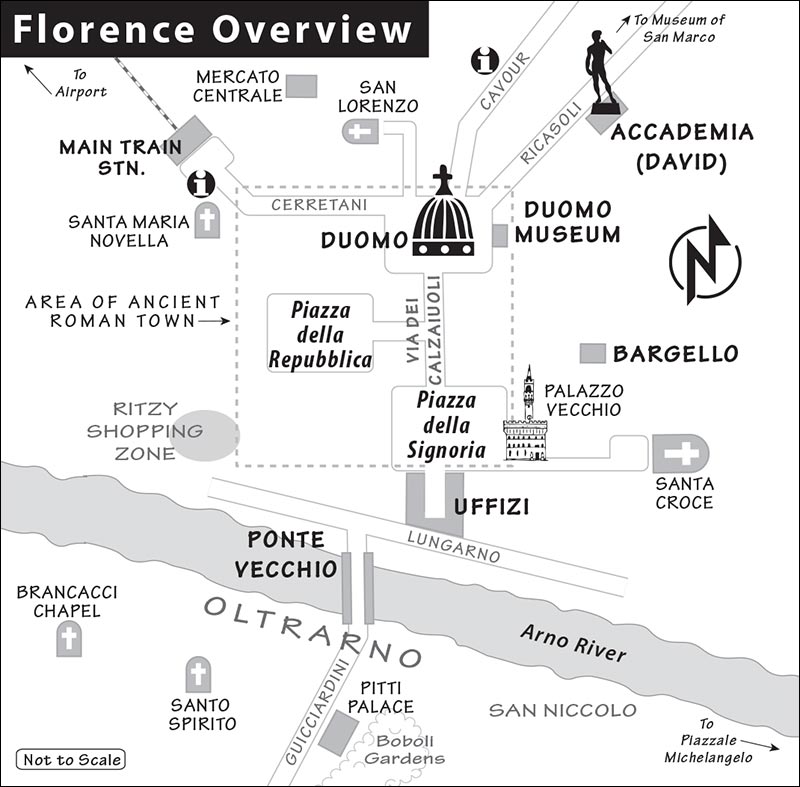
The highlights of Florence lie on the north bank of the Arno River. The main historical sights cluster around the venerable dome of the cathedral (Duomo). Everything is within a 20-minute walk of the train station, cathedral, or Ponte Vecchio (Old Bridge). The less famous but more characteristic Oltrarno area (south bank) is just over the bridge.
Though small, Florence is intense. Prepare for scorching summer heat, crowded narrow lanes and sidewalks, slick pickpockets, few WCs, steep prices, and long lines. But also prepare to celebrate the city that boldly led Europe out of the Middle Ages and into our humanistic modern world.
FLORENCE: A VERBAL MAP
For a big and touristy city, Florence (pop. 380,000) is remarkably compact and easy to navigate. Here’s a neighborhood-by-neighborhood rundown:
Historic Core: The Duomo—with its iconic, towering dome—is the visual, geographical, and historical center of Florence. A 10-minute walk away is the Palazzo Vecchio (City Hall), with its skyscraping medieval spire. Connecting these two landmarks is the north-south pedestrian street called Via dei Calzaiuoli. This central axis—Duomo to the Palazzo Vecchio to the Arno River—is the spine for Florentine sightseeing and the route of my self-guided Renaissance Walk. To the west of this axis is a glitzy shopping zone, and to the east is a characteristic web of narrow lanes.
Accademia/San Lorenzo (North of the Duomo): From the Duomo, Via Cavour runs north, bisecting the neighborhood. To the east lie the Accademia and the Museum of San Marco. The western part clusters around the Basilica of San Lorenzo, with its Medici Chapels. The area near San Lorenzo teems with tourists: There are the vendor stalls of San Lorenzo Market, the lively Mercato Centrale, and many hotels and trattorias.
Train Station/Santa Maria Novella (West of the Duomo): The area near the train station and Church of Santa Maria Novella has inexpensive hotels and characteristic eateries. Closer to the river (near Palazzo Strozzi) is a posh shopping zone.
Santa Croce (East of the Duomo): A 10-minute walk east from the Palazzo Vecchio leads to the Church of Santa Croce. Along the way is the Bargello sculpture museum. This neighborhood is congested with tourists by day and students partying by night. But the area stretching north and west from Santa Croce is increasingly authentic and workaday, offering a glimpse at untouristy Florence.
Oltrarno (South of the River): Literally the “Other Side of the Arno River,” this neighborhood reveals a Florence from a time before tourism. Many artisans still have workshops here and open their doors to passing visitors. The Oltrarno starts just across Ponte Vecchio (jammed with tourists and tackiness) and stretches south to the giant Pitti Palace and surrounding gardens (Boboli and Bardini). To the west is the rough-but-bohemian Piazza di Santo Spirito (with its namesake church) and the lavishly frescoed Brancacci Chapel. To the east of Pitti, perched high on the hill, is Piazzale Michelangelo, with Florence’s most popular viewpoint. Tucked between there and the river is the little San Niccolò neighborhood, with its lively bars and eateries.
TOURIST INFORMATION
The city TI’s main branch is across the square from the train station (Mon-Sat 9:00-19:00, Sun until 14:00; at the back corner of the Church of Santa Maria Novella at Piazza della Stazione 4; +39 055 212 245, www.feelflorence.it). Museum hours in Florence are constantly changing. Check the TI’s website or stop by and pick up a current timetable as you confirm your sightseeing plans.
A less crowded TI (covering both the city and the greater province of Florence) is a couple of blocks north of the Duomo, just past the Medici-Riccardi Palace (Mon-Fri 9:00-13:00, closed Sat-Sun, Via Cavour 1 red, +39 055 290 832). There’s also a TI booth at the airport.
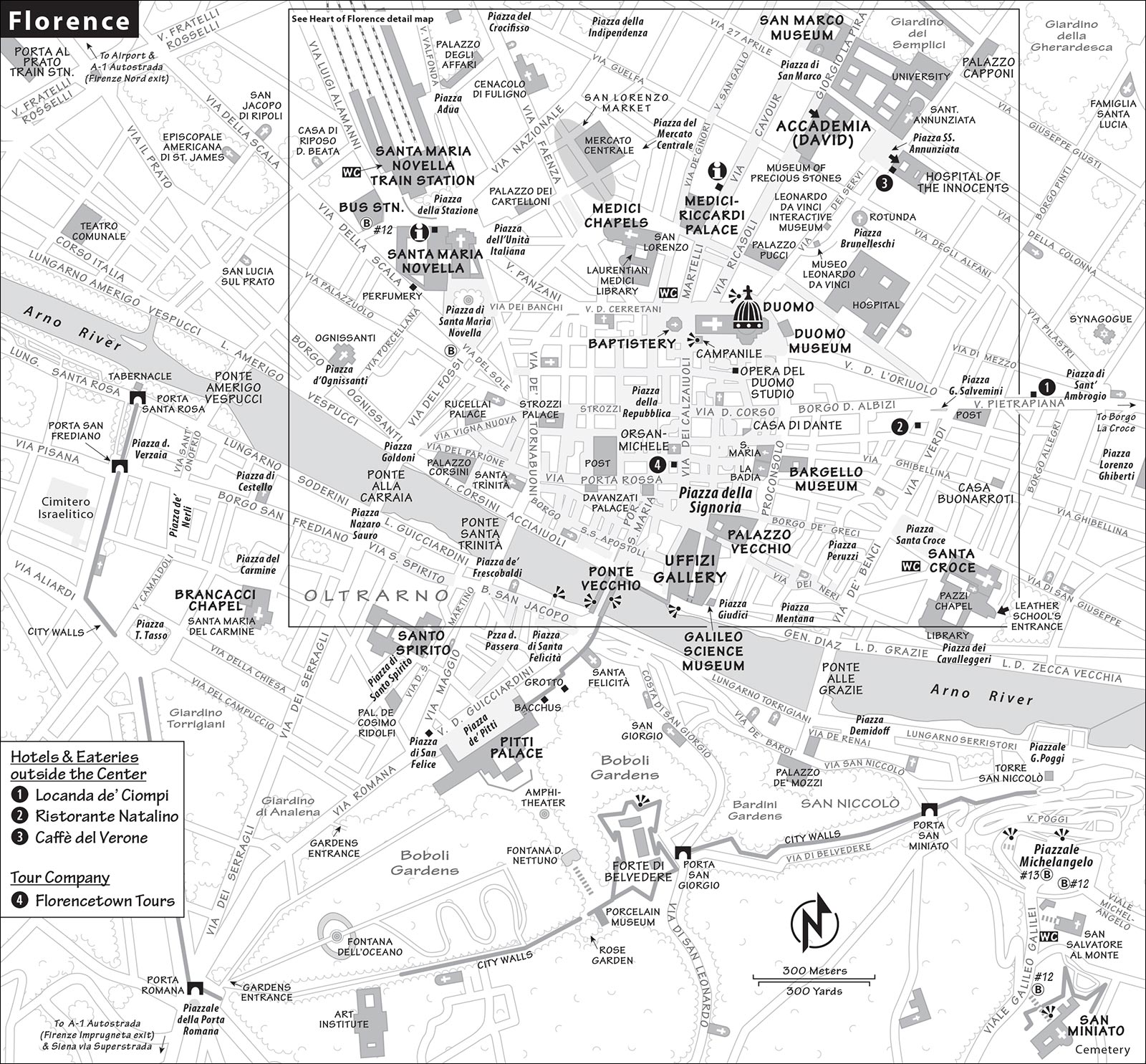
At any TI, you can pick up a city map. For goings-on around town, ask for a copy of The Florentine newspaper, which has great articles with cultural insights (in English, published monthly and updated online every other Thu at www.theflorentine.net).
ARRIVAL IN FLORENCE
For a rundown on Florence’s train, bus, and tram stations; airport; cruise ship arrival at the Livorno port; and information for drivers; see the “Florence Connections” section at the end of this chapter.
HELPFUL HINTS
Sightseeing Tips: Everyone—and I mean everyone—visiting Florence wants to see the Uffizi and the Accademia, and climb the Duomo’s dome. It’s flat out stupid to attempt a visit to any of these without a reservation. The process for making reservations is clearly explained under “Sights in Florence,” later.
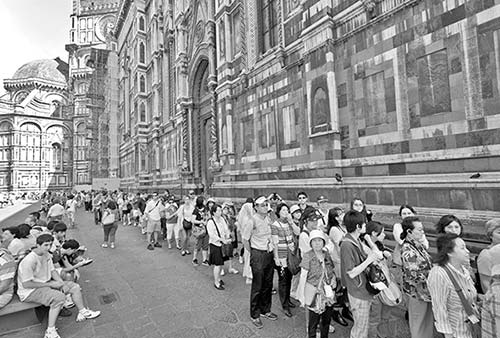
Closed Days: If you’re in Florene on a Monday, note that most major sights are closed, including the Accademia, Uffizi, and Pitti Palace. The Bargello is closed on the first, third, and fifth Mondays of each month, while the Museum of San Marco closes on the second and fourth Mondays.
Theft Alert: Florence has hardworking gangs of thieves who hang out near the train station, the station’s underpass (especially where the tunnel surfaces), around Mercato Centrale, and at major sights. American tourists are considered easy targets. Some thieves even dress like tourists to fool you. Any crowded bus likely holds at least one thief.
Medical Help: Medical Service Firenze provides 24/7 phone consults; they also do house calls in English or will see you at their walk-in clinic (clinic closed Sun—check website for hours, Via Roma 4, between the Duomo and Piazza della Repubblica, +39 055 475 411, www.medicalservice.firenze.it). The TI has a list of English-speaking doctors.
There are 24-hour pharmacies at the train station and near Palazzo Vecchio (at Via dei Calzaiuoli 7).
Visiting Churches: Modest dress is required in some churches, including the Duomo, Santa Maria Novella, Santa Croce, Santa Maria del Carmine/Brancacci Chapel, and the Medici Chapels. Be respectful of worshippers and the paintings; don’t use a flash. Many churches, though not the biggies I mention, close from 12:00 or 12:30 until 15:00 or 16:00.
Chill Out: Schedule several breaks into your sightseeing when you can sit, pause, cool off, and refresh yourself with a gelato or coffee. Carry a water bottle to refill at Florence’s twist-the-handle public fountains (around the corner from the “Piglet” at Mercato Nuovo, or in front of the Pitti Palace). Try the fontanello (dispenser of free cold water) on Piazza della Signoria, behind the statue of Neptune (on the left side of the Palazzo Vecchio).
Addresses: Florence has a confusing system for street addresses, with “red” numbers for businesses and “black” (sometimes blue) numbers for residences. Street signs are indeed red or black (though usually faded and hard to read); in print, addresses are indicated with “r” (as in Via Cavour 2r) or “n” (for black—nero, as in Via Cavour 25n). Red and black numbers are interspersed together on the same street; each set goes in roughly consecutive order, but their numbers bear no connection with each other.
Bookstores: For a good selection of brand-name guidebooks (including mine), try these: Paperback Exchange has the widest selection of English books, new and used (Mon-Sat 10:00-19:00, closed Sun, just south of the Duomo on Via delle Oche 4 red). RED (stands for “Read, Eat, Dream”), a flagship store for the Feltrinelli chain (the Italian Barnes & Noble) with a café and restaurant, has a small selection of English books (daily 9:00-20:00, on Piazza della Repubblica).
WCs: Public restrooms are scarce. Use them when you can, in any café or museum you patronize. Pay public WCs are typically €1. Convenient locations include: at the Baptistery ticket office (near the Duomo); near the entrance to the Church of Santa Maria Novella; inside the train station (near track 5 and in the food court); just down the street from Piazza Santa Croce (at Borgo Santa Croce 29 red); on Piazza Santo Spirito; and up near Piazzale Michelangelo.
Laundry: The Wash & Dry Lavarapido chain offers long hours and efficient, self-service launderettes at several locations (generally daily 7:30-23:00). These locations are close to recommended hotels: Via del Sole 29 red and Via della Scala 52 red (this location is a Speed Queen, between train station and river), and Via Ghibellina 143 red (Palazzo Vecchio). On the Oltrarno side, there’s one at Via dei Serragli 87 red (Santo Spirito area).
Bike Rental: I don’t recommend biking in the city as it’s so jam-packed with pedestrians. But if you must, Florence by Bike rents two-wheelers of all sizes (€12/day and up depending on type of bike, includes bike lock and helmet; Mon-Sat 9:00-13:00 & 15:30-19:30, Sun until 15:00, closed Sun Nov-March; a 15-minute walk north of the Duomo at Via San Zanobi 54 red, +39 055 488 992, www.florencebybike.it).
Travel Agencies: Travel agencies can be helpful for getting both domestic and international tickets and reservations. Convenient travel agencies in the town center are Intertravel Viaggi (Mon-Fri 9:00-12:00 & 14:00-17:00, closed Sat-Sun, south of Piazza della Repubblica at Via de Lamberti 39 red, +39 055 280 706) and Florentour (Mon-Fri 9:30-13:30, closed Sat-Sun, Via dei Servi 23 red, a block off the Duomo, +39 055 292 237). For locations of both, see the map on here.
GETTING AROUND FLORENCE
I organize my sightseeing geographically and do it all on foot. I think of Florence as a Renaissance treadmill—it requires a lot of walking. You likely won’t need public transit, except maybe to head up to Piazzale Michelangelo and San Miniato Church for the view. For major bus and tram stop locations, see the map on here.
By Bus
The city’s full-size buses don’t cover the old center well (the whole area around the Duomo is off-limits to motorized traffic). Pick up a map of transit routes at the bus station; you’ll also find routes online (www.at-bus.it/it/orari).
Buy bus tickets at tobacco shops (tabacchi), newsstands, or tram stops (€1.50/90 minutes). Be sure to validate your ticket in the machine on board (or risk a steep fine). Do this as you board, otherwise you’re cheating. Inspectors fine even innocent-looking tourists €50. You can sometimes buy a ticket on board, but you’ll pay more and may need exact change. Follow general bus etiquette: Board at front or rear doors, exit out the center.
Of the many bus lines, I find these to be of most value for seeing outlying sights:
Bus #12 goes from near Piazza d’Ognissanti, over the Carraia bridge to Porta Romana, then up to San Miniato Church and Piazzale Michelangelo (3/hour). Bus #13 makes the return trip down the hill.
Fun little minibuses (many of them electric—elettrico) wind through the tangled old center of town and up and down the river—just €1.50 gets you a 1.5-hour joyride. These buses, which run every 10 minutes from 7:00 to 21:00 (less frequent on Sun), are popular with sore-footed sightseers and eccentric local seniors. The minibuses also connect many major parking lots with the historic center (buy tickets from machines at lots).
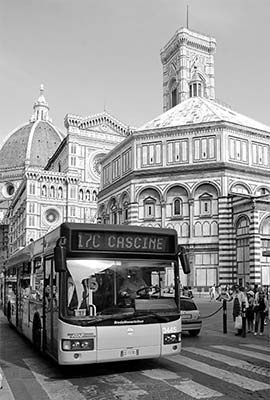
Bus #C1 stops behind the Palazzo Vecchio and Piazza Santa Croce, then heads north, passing near San Marco and the Accademia before heading up to Piazza Libertà. On its southbound route, this bus also stops near the train station, the Basilica of San Lorenzo, and the Duomo.
Bus #C2, if operating, twists through the congested old center from the train station, passing near Piazza della Repubblica and Piazza della Signoria to Piazza Beccaria.
Bus #C3 goes up and down the Arno River, with stops near Piazza Santa Croce, Ponte Vecchio, the Carraia bridge to the Oltrarno (including the Pitti Palace), and beyond.
Bus #C4 goes from near the Duomo to the train station, crosses the Carraia bridge, and cruises through the Oltrarno (passing the Pitti Palace) before heading into the San Niccolò neighborhood.
By Tram
The T1 and T2 tram lines are cheap, easy, and frequent. For travelers, they’re generally most useful for service between the airport (T2) or the big park-and-ride lots at Villa Costanza (T1) near the town of Scandicci to the train station (€1.50, 25 minutes; www.gestramvia.com). See “Florence Connections” at the end of this chapter for more details.
By Taxi
The minimum cost for a taxi ride is about €7 (more after 22:00 and on Sun); rides in the center of town should be charged as tariff #1. The flat rate for the airport is €22 plus €1 per bag if the driver puts them in the trunk (also more on nights and weekends). Taxi fares and supplements (e.g., €2 extra to call a cab rather than hail one) are clearly explained on signs in each taxi. Look for an official, regulated cab (white; marked with Taxi/Comune di Firenze, red fleur-de-lis, and one of the official phone numbers: 4390 or 4242). Before getting in a cab at a stand or on the street, ask for an approximate cost (“Più o meno, quanto costa?” pew oh MEH-noh, KWAHN-toh KOH-stah). If you can’t get a straight answer or the price is outrageous, wait for the next one. It can be hard to find a cab on the street, but they stop and sometimes wait in taxi ranks near the major tourist sights (marked by orange Taxi signs). To call one, dial +39 055 4390 or +39 055 4242 (or ask your waiter or hotelier to call for you). Uber does not operate in Florence.
Tours in Florence
For extra insight with a personal touch, consider the tour companies and individual Florentine guides listed here. Many tour companies (such as Florencetown) offer regularly scheduled group tours that anyone can sign up for. This is usually the cheapest option for individual travelers. But families and small groups can book a private guide for a similar price (since rates are hourly for any size of group).
Some tour companies offer bus excursions that go out to smaller towns in the Tuscan countryside. The most popular day trips are Siena, San Gimignano, Pisa, and into Chianti country for wine tasting. To see Florence itself, it’s clearly best on foot.
 To sightsee on your own, download my free audio tours that illuminate some of Florence’s top sights and neighborhoods (see here).
Walking Tours
Artviva
Artviva offers an intriguing variety of tours (guided by native English speakers). Popular choices include their small-group overview tour (“Original Florence” 3-hour town walk); and private tours, including “Florence in One Glorious Day,” which combines the town walk and tours of the Uffizi and Accademia (6 hours total). They also have standalone Uffizi and Accademia tours, cooking classes, art classes, food tours, tours around Tuscany and to the Cinque Terre, and more (RS%—10 percent discount with this book, use the password “reader”; +39 055 264 5033, www.artviva.com).
Florencetown
This company offers English-language tours and experiences on foot or by bike. Their most popular offerings are “Walk and Talk Florence” (€35, 2.5 hours, April-Oct daily at 10:00 and 15:00, basic stops including the Oltrarno) and “I Bike Florence” (€39; 3 hours on one-speed bike, 15-stop blitz of town’s top sights, helmets optional; in bad weather it goes as a walking tour). They also offer cooking classes and wine tours. Their booking office is at Piazza Mentana (see “Florence” map in this chapter); they also have a “Tourist Point” kiosk on Piazza della Repubblica, under the arches at the corner with Via Pellicceria (RS%, +39 055 281 103, www.florencetown.com).
Florentia
Top-notch private walking tours—geared for thoughtful, well-heeled travelers with longer-than-average attention spans—are led by Florentine scholars. The tours range from introductory city walks and museum visits to in-depth thematic walks, such as the Oltrarno, Jewish Florence, or the Medici dynasty; they also offer family-oriented tours (€250 and up, includes planning assistance by email, www.florentia.net).
Context Florence
This scholarly group of graduate students and professors leads small-group or private “walking seminars,” such as a 3.5-hour study of Michelangelo’s work and influence and a two-hour evening orientation stroll. See their website for pricing and other innovative offerings: Medici walk, family tours, private fresco workshop, and more (www.contexttravel.com).
Walks Inside Florence
Two art historians—Paola Barubiani and Francesco Calanca—and their 15 partners provide quality private tours at a discounted rate for my readers (RS%—€200/group for three-hour intro tour, up to 6 people). Their “Florence in a Day” tour gives you the essentials in four hours (€265/group, up to 6 people, museum admissions extra—they make the reservations so there’s no waiting in line). Other offerings are described on their website (e.g. shopping tour featuring select artisans, guided evening walk, and cruise excursions from the port of Livorno; +39 333 483 1431, www.walksinsideflorence.it).
Exclusive Connection
This smart, high-end, and well-connected agency offers an impressive list of services in Florence and around Italy, including specialized tours and museum bookings. Both Lucia Montuschi and Cora Ferroni have a passion for history, art, and culture, and love sharing it with visitors (+39 055 200 1586, www.exclusiveconnection.it).
Food Tours of Florence
Most tour companies (including Florencetown) offer food tours, as do countless food lovers who simply offer their services on various online-booking sites. Typically, tours last 3-4 hours and make 5-6 stops as you walk, munch, and learn with small groups of 6-8 people (a natural limit since hole-in-the-wall bakeries and wine bars are tiny). I enjoy Toni Mazzaglia’s Taste Florence Food Tours. A native of North Carolina, Toni’s been in Florence for 20 years, and does a fine tour in and around the Mercato Centrale ($109, RS%, most days at 10:00, 4 hours, 6 stops, www.tasteflorence.com).
Local Guides
Vanessa Garau is an enthusiastic young guide with good connections in the Oltrarno and an infectious love of Florence (half-day private tours for €180, +39 349 133 6894, garau.vanessa@gmail.com).
Alessandra Marchetti, a Florentine who has lived in the US, gives private walking tours of Florence and driving tours of Tuscany. Her passion is Michelangelo (from €60-85/hour, +39 347 386 9839, www.tuscanydriverguide.com, alessandramarchettitours@gmail.com).
Paola Migliorini and her partners offer museum tours, city walking tours, family tours, private cooking classes, wine tours, and Tuscan excursions by van—you can tailor tours as you like (€65/hour without car, €70/hour in a van for up to 8 passengers, minimum 3 hours, +39 347 657 2611, www.florencetour.com). They also do cruise excursions from the port of Livorno (€600/up to 4 people, €680/up to 6, €780/up to 8).
Elena Fulceri, specializing in art, history, and secret corners and gardens, is a delightful and engaging guide. She organizes tailor-made private tours, has good Oltrarno artisan connections, and enjoys family tours (from €60/hour for 2 people, +39 347 942 2054, www.florencewithflair.com [URL inactive]).
Renaissance Walk
Baptistery and Ghiberti’s Bronze Doors
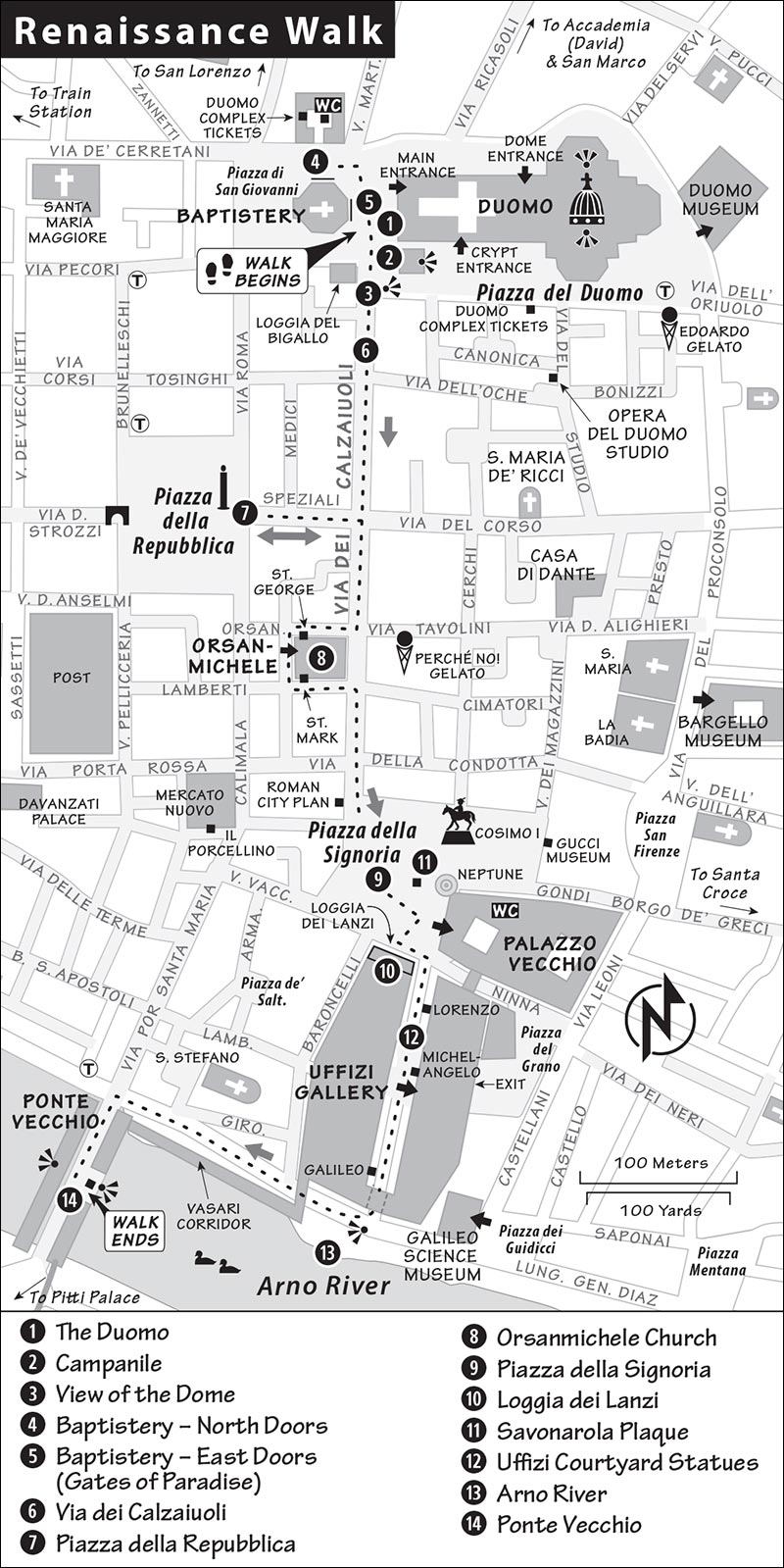
This great and rich city is easily covered on foot. We’ll start with the soaring church dome that stands as the proud symbol of the Renaissance spirit; just opposite, you’ll find the Baptistery doors that opened the Renaissance. We’ll then stroll down the city’s pedestrian-only main street to the Palazzo Vecchio and the Arno River. Along the way, we’ll pass elegant stores, lively eateries, and the parade of people that make up Florence today. For more details on many of the stops on this walk, see the individual listings under “Sights in Florence,” later.
Length of This Walk: The walk is less than a mile long. Allow two hours, including a visit to the interior of the Baptistery.
Tours: Download my free Renaissance Walk audio tour and I’ll personally give you this tour.
Services: Pay WCs are at the ticket office opposite the Baptistery. Keep an eye out for public twist-the-handle fountains along this route where you can refill your water bottle.
Background: The Renaissance—the “rebirth” of Greek and Roman culture that swept across Europe—started around 1400 and lasted about 150 years. In politics, the Renaissance meant democracy; in science, a renewed interest in exploring nature. The general mood was optimistic and “humanistic,” with a confidence in the power of the individual.
Renaissance art was a return to the realism and balance of Greek and Roman sculpture and architecture. Domes and round arches replaced Gothic spires and pointed arches. In painting and sculpture, Renaissance artists strove for realism. Merging art and science, they used mathematics, the laws of perspective, and direct observation of nature.
This was not an anti-Christian movement. Artists saw themselves as an extension of God’s creative powers. The Church even supported the Renaissance and commissioned many of its greatest works.
After 1,000 years of waiting, the embers of Europe’s classical heritage burst into flames right here in Florence.
 SELF-GUIDED WALK
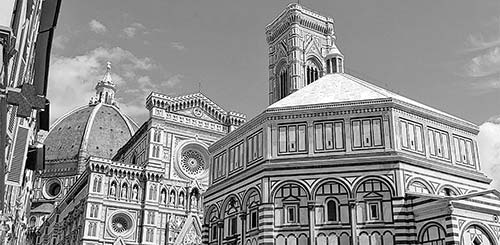
• The Duomo, the cathedral with the distinctive red dome, is the center of Florence and the orientation point for this walk. If you ever get lost, home’s the dome. Stroll around the piazza in front of the cathedral (the Duomo) and take in the sights. To the right of the Duomo rises its skyscraping bell tower (the Campanile) with its Renaissance statues. In front of the church is the Baptistery, an octagonal, green-and-white stone building that’s bigger than many churches.
1 The Duomo
Florence’s massive cathedral is the city’s geographical and spiritual heart. Its dome, visible from all over the city, inspired Florentines to do great things.
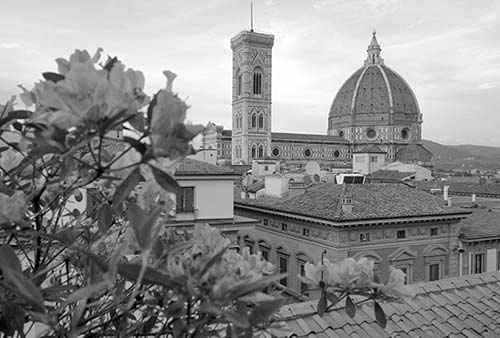
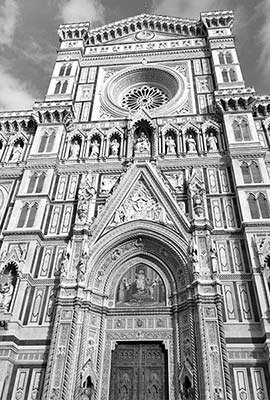
The church was begun in 1296, in the Gothic style. After generations of work, it was still unfinished. The facade was little more than bare brick, and it stood that way until it was completed in 1870 in the “Neo”-Gothic style. Its “retro” look captures the feel of the original medieval facade, with green, white, and pink marble sheets that cover the brick construction. You’ll see Gothic (pointed) arches and three stories decorated with mosaics and statues. This over-the-top facade is adored by many, while others call it “the cathedral in pajamas.” The Duomo is dedicated to the Virgin Mary. Find her statue right in the center—above the main doorway but below the round window.
We won’t go inside the church on this tour. It has a cavernous, bare interior with a few noteworthy sights. Entry is free, but there’s often a long wait unless you buy a pass that allows you to enter through the crypt.
• Now turn to the church’s bell tower, to the right.
2 Campanile (Giotto’s Tower)
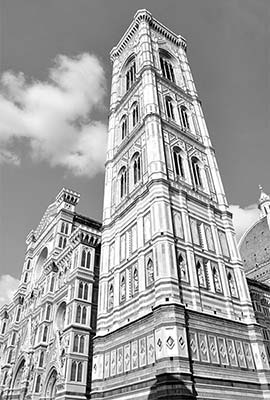
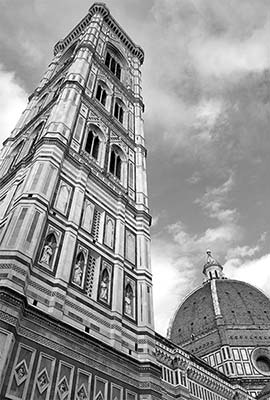
The 270-foot bell tower was begun in the 1300s by the great painter Giotto. As a forerunner of the Renaissance genius, Giotto excelled in many artistic fields, just as Michelangelo would do two centuries later. In his day, Giotto was called the ugliest man to ever walk the streets of Florence, but he designed what many call the most beautiful bell tower in all of Europe.
You can climb the Campanile for great views. It doesn’t require a reservation, just the Duomo’s Giotto Pass (see here for information about climbing the tower).
• Now take in the Duomo’s star attraction: the dome. The best viewing spot is just to the right of the facade, from the corner of the pedestrian-only Via dei Calzaiuoli.
3 View of Brunelleschi’s Dome
Though construction of the church began in 1296, by the 1400s there still was no suitable roof. (For a century, the old cathedral remained inside the new so people could still go to Mass.) City fathers intended to top the new church with a dome, but the technology to span the 140-foot-wide hole had yet to be invented. Non c’è problema. The brash Florentines knew that someday someone would come along who could handle the challenge. That man was Filippo Brunelleschi.
Brunelleschi had a plan. He would cap the church’s octagonal hole-in-the-roof with a round Roman-style dome. It would be a tall, self-supporting dome as grand as that of the ancient Pantheon—which he had studied.
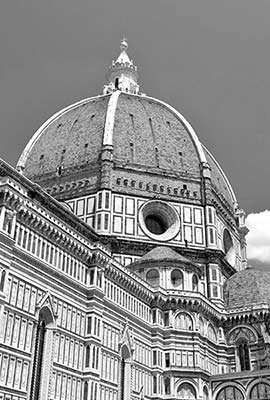
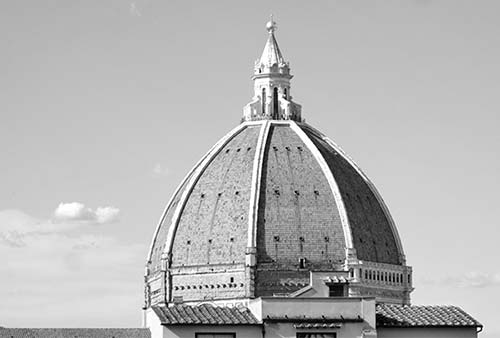
Brunelleschi used a dome within a dome. What you see is the outer shell, covered in terra-cotta tile. The inner dome is thicker and provides much of the structural support. The grand white skeletal ribs connect at the top, supporting each other in a way similar to a pointed arch. Hidden between them are interlocking bricks, laid in a herringbone pattern. Rather than being stacked horizontally, like traditional brickwork, the alternating vertical bricks act as “bookends.” The dome grew upward like an igloo, supporting itself as it proceeded from the base. When the ribs reached the top, Brunelleschi arched them in and fixed them in place with a decorative, nonstructural architectural cherry on top—the lantern. His dome, built in only 16 years, was the largest since ancient Rome’s Pantheon.
When completed in 1436, Brunelleschi’s dome was the wonder of the age. It became the model for many domes to follow, from St. Peter’s Basilica in Rome to the US Capitol. Michelangelo, setting out to construct the dome of St. Peter’s, drew inspiration from the dome of Florence. He said, “I’ll make its sister...bigger, but not more beautiful.”
You can climb the dome for Florence’s best views, but it requires a reservation and the Duomo’s Brunelleschi pass (for details, see here).
• Next up, the Baptistery. Step into the zone between the Duomo and the Baptistery that local tour guides call the “Piazza of Paradise.”
Baptistery and Ghiberti’s Bronze Doors
Built in the 11th century, atop Roman foundations, this is Florence’s oldest surviving buildings—a thousand years old. The Baptistery is known for its doors. Andrea Pisano created the oldest set (from the 1330s, on the south side). The most famous ones are the East Doors, which face the cathedral, but let’s start with the North Doors—around to the right, where tourists go in—which may be even more important. (Note that the original doors are in the Duomo Museum and well worth seeing.)
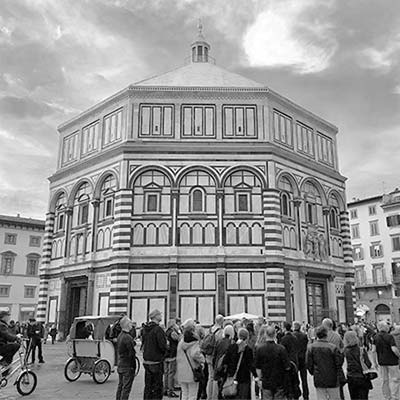
4 North Doors: Some say that these doors actually started the Renaissance. It was the year 1401, and Florence was holding a competition to find the best artist to make some doors for the Baptistery entrance. All the greats entered the contest, including Donatello and Brunelleschi. The winner was relatively unknown 24-year-old Lorenzo Ghiberti. Take a moment to appreciate the composition—impressive—but no background. On the left, eight feet up in the center with the turban, is the young artist Ghiberti.
For the next 25 years, he worked on these North Doors.
• Now return to the more famous doors facing the church—and see progress made in 25 years.
5 East Doors (Gates of Paradise): Ghiberti’s bronze panels for these doors added a whole new dimension to art—depth. Michelangelo said these doors were fit to be the “Gates of Paradise.” Here we see how the Renaissance masters merged art and science. Realism was in, and Renaissance artists used math, illusion, and dissection to create it.
Inside the Baptistery: The spacious interior, topped with an octagonal dome, features a fine example of pre-Renaissance mosaic art (1200s-1300s) in the Byzantine style. Workers from St. Mark’s in Venice came here to make the remarkable ceiling mosaics (of Venetian glass) in the late 1200s.
• Now head south, down the busy pedestrian-only street that runs from here toward the Arno River.
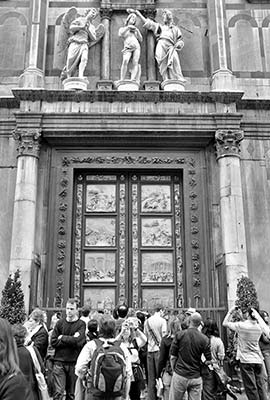
6 Via dei Calzaiuoli
Via dei Calzaiuoli (kahlts-ay-WOH-lee), the former “street of the stocking makers,” was part of the ancient Roman grid plan that became Florence. Around the year 1400, as the Renaissance was blooming, this street connected the religious center (where we are now) with the political center (where we’re heading), a five-minute walk away.
Since most vehicles were banned a few years back, this street has been transformed into a pleasant place to stroll, people-watch, window-shop, and wonder why American cities can’t become more pedestrian friendly.
• Continue down Via dei Calzaiuoli. Two blocks down from the Baptistery, turn right on Via degli Speziali toward the triumphal arch that marks...
7 Piazza della Repubblica
This large square sits on the site of the original Roman Forum. The lone column that still stands here—nicknamed the “belly button of Florence”—once marked the intersection of the two main Roman roads (Via Corso and Via Roma). If you look at a map of Florence today, you can make out the ghost of Rome in its streets: a rectangular grid-plan city center surrounded by a circular city wall.
In the 1860s, the square got its magnificent triumphal arch. It celebrated the unification of Italy. In fact, from 1865 to 1870, Florence became the capital of the newly united nation of Italy.
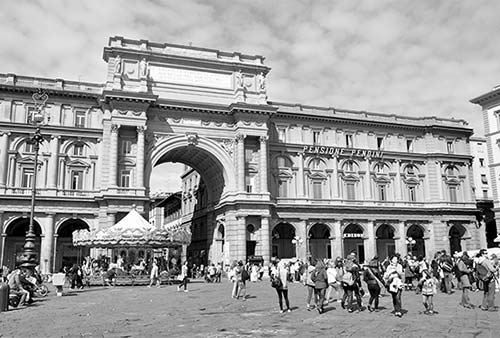
Venerable cafés and stores line the square. During the 19th century, intellectuals met in cafés here. Gilli, on the northeast corner, is a favorite for its grand atmosphere and tasty sweets (cheap if you stand at the bar, expensive to sit down). The much-loved drink called Negroni (gin, vermouth, bitter Campari, and a slice of orange) was named for a local count who popularized it here.
• Return to the main street and continue walking toward the river. A block farther, at the intersection with Via Orsanmichele, is the...
8 Orsanmichele Church
Originally, this was an open loggia (covered porch) with a huge grain warehouse upstairs. Then, as you can see, the arches of the loggia were artfully filled in (14th century) to make walls, and the building gained a new purpose—as a church.
The 14 niches in the exterior walls feature remarkable-in-their-day statues paid for by the city’s rising middle class of merchants and their 21 guilds. Florence in 1400 was a republic, a government working for the interests not of a king, but of these guilds, which commissioned statues as PR gestures.
• Circle the church exterior counterclockwise to enjoy the statues. Start on the church’s right side (along Via Orsanmichele).
In the third niche is Nanni di Banco’s Quattro Santi Coronati (c. 1415-1417). These four early Christians were sculptors martyred by the Roman emperor Diocletian because they refused to sculpt pagan gods. They seem to be contemplating the consequences of the fatal decision they’re about to make.
Just to the right of Banco’s saints is Donatello’s St. George: He’s alert, perched on the edge of his niche, scanning the horizon for dragons and announcing the new age with its new outlook. His knitted brow shows there’s a drama unfolding. Sure, he’s anxious, but he’s also self-assured. Comparing this Renaissance-style St. George to Quattro Santi Coronati, you can psychoanalyze the heady changes underway. This is humanism.
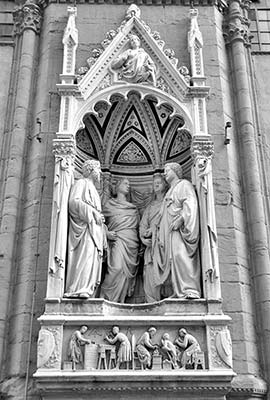
The back side of the church has three statues worth a look. St. Matthew, patron of bankers, and St. Stephen, patron of wool merchants (both by Ghiberti), are a reminder that banking and textiles were mainstays of the Florentine economy—and wealthy enough to actually pay for bronze statues rather than marble. Nanni di Banco’s St. Eligius, patron of metalworkers, shows workers shoeing a horse.
Around the corner, the first niche features Donatello’s St. Mark (1411-1413). The evangelist cradles his gospel in his strong, veined hand and gazes out, resting his weight on the right leg while bending the left. Though subtle, St. Mark’s twisting contrapposto pose was the first seen since antiquity. Eighty years after young Donatello carved this statue, a teenage Michelangelo Buonarroti stood here and marveled.
• Continue down the mall 50 more yards, to the huge and historic square...
9 Piazza della Signoria
What a view! This piazza—the main civic center of Florence—is dominated by the massive stone facade of the Palazzo Vecchio, with a tower that reaches for the sky. The square is dotted with statues. The stately Uffizi Gallery is nearby, and the marble greatness of old Florence litters the cobbles. Piazza della Signoria, with the feel of an open-air museum of statuary, still vibrates with the echoes of the city’s past—executions, riots, and great celebrations. There’s even Roman history: Look for the chart showing the ancient city (20 steps into the square on the right). Today, it’s a tourist’s world with pigeons, selfie sticks, horse buggies, and tired spouses.
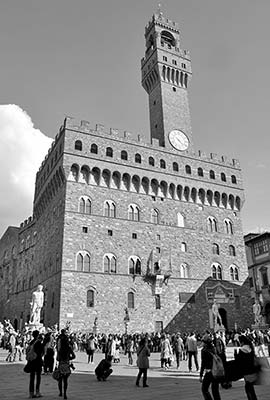
Before you towers the Palazzo Vecchio, the “old palace” and palatial Town Hall of the Medici—a fortress designed to contain riches and survive the many riots that went with local politics. The windows are just beyond the reach of angry stones, and the tower was a handy lookout post. Capping the tip of the tower is a lion weathervane. (Locals like to say “when the lion pees in the river, it’s going to rain.) Justice was doled out sternly on this square. Until 1873, Michelangelo’s David stood where you see the replica today. Step through the front door into the Palazzo Vecchio’s courtyard (free). This palace was Florence’s symbol of civic power. You’re surrounded by art for art’s sake—a cherub playing with a dolphin frivolously marks the courtyard’s center, and ornate stuccoes and frescoes decorate the walls and columns. Such luxury represented a big change 500 years ago.
For more on the palazzo and climbing its tower, see here.
• Back outside, check out the arcade of three arches filled with statues.
10 Loggia dei Lanzi
This loggia, once a forum for public debate, was perfect for a city that prided itself on its democratic traditions. But later, when the Medici figured that good art was more desirable than free speech, it was turned into an outdoor sculpture gallery.
Two statues in the front deserve a closer look. At the right end of the loggia, The Rape of the Sabine Women (c. 1583)—with its pulse-quickening rhythm of muscles—is from the restless Mannerist period. The sculptor, Giambologna, proved his mastery of the medium by sculpting three entangled bodies from one piece of marble.
Benvenuto Cellini’s Perseus (1545-1553), the loggia’s most noteworthy piece, shows the Greek hero who decapitated the snake-headed Medusa. Cellini, a notorious braggart, placed his name prominently across the sash on the front and amazingly, included a secret self-portrait on the back of Perseus’ head: His locks form the beard while the helmet frames the bushy brow and eyes.
• Cross the square to Bartolomeo Ammanati’s big fountain of Neptune. Near it, the guy on the horse is Cosimo I, the post-Renaissance Medici who commissioned the Uffizi. Find the round marble plaque on the ground 10 steps in front of the fountain.
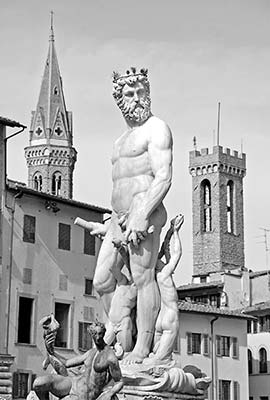
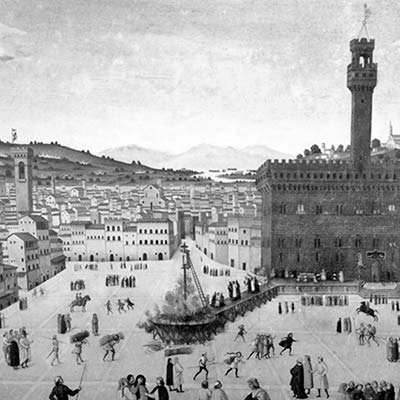
11 Savonarola Plaque
In the 1490s the Medici family was briefly thrown from power by an austere and charismatic monk named Savonarola, who made Florence a constitutional republic. He organized huge rallies lit by roaring bonfires here on the square where he preached. The devout brought their rich “vanities” (such as paintings, musical instruments, and playing cards) and threw them into the flames.
But not everyone wanted a return to the medieval past. Encouraged by the pope, the Florentines fought back and arrested Savonarola. For two days, they tortured him, and finally, on the very spot where Savonarola’s followers had built bonfires of vanities, the monk was burned, ending his theocracy. Then—after 18 years in exile—the Medici returned to power and the Renaissance picked up where it left off.
• Stay cool, we have 200 yards to go. Follow the gaze of the fake David into the courtyard of the two-tone horseshoe-shaped building.
12 Uffizi Courtyard Statues
The top floor of this building, known as the uffizi (offices) during Medici days, is filled with the greatest collection of Florentine painting anywhere. It’s one of Europe’s top four or five art galleries (see here for what you’ll find inside).
The courtyard is watched over by 19th-century statues of the great figures of the Renaissance: artists (Michelangelo, Giotto, Donatello, Leonardo), philosophers (Machiavelli), scientists (Galileo), poets (Dante and Petrarch), explorers (Vespucci), and the great patron of the Renaissance—Lorenzo “the Magnificent” de’ Medici.
• At the far end of the courtyard, pause at the 13 Arno River, with a magnificent view of the Ponte Vecchio, where we’ll finish this walk.
14 Ponte Vecchio
Since ancient times, a bridge has stood at this narrow spot in the Arno. When a flood washed away the old wooden bridge, this one was built in 1345, and is now called the Ponte Vecchio (Old Bridge).
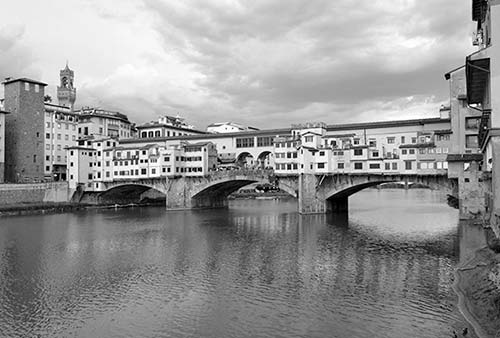
In times past, the bridge’s shops were inhabited by butchers and hide tanners—a natural fit, because they could empty their waste into the river below. In the 1500s, the Medici booted them out and installed gold- and silversmiths who tempt visitors to this day. Fittingly, a famous goldsmith is honored with a fine bust at the central point of the bridge—the sculptor Benvenuto (“Perseus”) Cellini.
Looking upstream and down, you have timeless views of the city. The neighborhood across the river, known as the Oltrarno, is more rustic and working-class. The other bridges are all modern replacements.
The Ponte Vecchio is a romantic spot in the evening. Street musicians play and lovers hold hands. The city of Florence—born in Roman times, flourishing in the medieval age, and blossoming in the Renaissance—remains a vibrant cultural capital.
• From the Duomo to the Arno, we’ve taken in sights from Florence’s medieval roots and Renaissance greats. After this introduction, several of the finest museums in Europe await your discovery—or perhaps it’s time for a nice espresso or gelato. Enjoy.
Sights in Florence
ADVANCE RESERVATIONS AND SIGHTSEEING PASSES
▲▲Duomo (Cattedrale di Santa Maria del Fiore)
▲▲▲Duomo Museum (Museo dell’Opera del Duomo)
Map: Ghiberti’s “Gates of Paradise”
▲▲▲Accademia (Galleria dell’Accademia)
▲▲Museum of San Marco (Museo di San Marco)
▲▲Medici Chapels (Cappelle Medicee)
▲Mercato Centrale (Central Market)
▲Medici-Riccardi Palace (Palazzo Medici-Riccardi)
BETWEEN THE DUOMO AND PIAZZA DELLA SIGNORIA
▲Mercato Nuovo (a.k.a. the Straw Market)
ON AND NEAR PIAZZA DELLA SIGNORIA
▲▲Galileo Science Museum (Museo Galilei)
▲▲▲Bargello (Museo Nazionale del Bargello)
▲Casa Buonarroti (Michelangelo’s House)
▲▲Church of Santa Maria Novella
THE OLTRARNO (SOUTH OF THE ARNO RIVER)
▲▲▲Pitti Palace
Map: Oltrarno, South of the Arno River
For general tips on sightseeing, see the Practicalities chapter. Remember to check the Florence TI’s website, www.feelflorence.it, for up-to-date hours for sights. Many museums have erratic hours (for example, closing on alternating Sundays and Mondays), and Florence—more than most cities—has a tendency to change these hours from season to season.
Avoid Free-Entry Crowds: For most of the year, state museums are free on the first Sunday of each month (no reservations are available). In Florence, this includes the Uffizi Gallery, Accademia (Michelangelo’s David), Pitti Palace and gardens, and the Bargello. Free days are actually bad news—they attract crowds, especially at the Uffizi and Accademia. Make a point to avoid these days.
ADVANCE RESERVATIONS AND SIGHTSEEING PASSES
While mobs of visitors line up for (literally) hours throughout the year to ogle David in the Accademia, tour the Uffizi Gallery, and climb the Duomo’s dome, the rest of the city is easy without reservations.
Consider reservations mandatory for the Uffizi and Accademia. For the Duomo complex (cathedral, cathedral crypt, dome, Baptistery, Campanile, and Duomo Museum), the easy answer is to enjoy the complex from the outside and only go into the magnificent museum (with one of three Duomo passes—described later—which you can generally buy at the entrance with no serious line). To climb the Duomo’s dome, you’ll need a pass and a reservation.
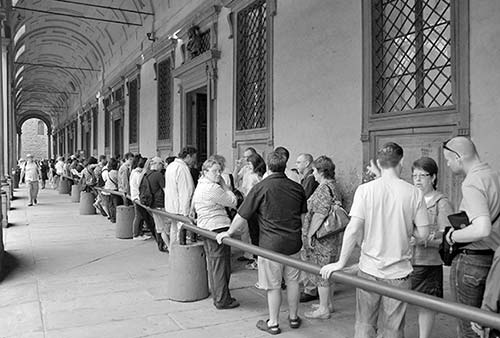
Uffizi and Accademia Tickets: To book your timed-entry tickets in advance for both museums, simply go to the official website at www.b-ticket.com/b-Ticket/uffizi and follow the prompts.
If there’s no availability at this site, you can try for-profit vendors such as Florence.net or Tickitaly.com, which may have time slots available, though you’ll pay about €5 more per ticket. Various private companies—including those listed on here—sell tours that include a reserved museum entry. If you’re booking a private guide well in advance, they are often happy to obtain tickets and reservations for your tour with them.
If you show up in Florence without reservations, Opera Your Preview is a handy little ticket office that can book for you in-person what most will just do online (Uffizi and Accademia only, €4/museum extra, daily 10:00-17:45, 50 yards before Ponte Vecchio on Via Por Santa Maria, www.operayourpreview.com).
The ticket office at the Orsanmichele Church is another place to make reservations for the Uffizi and Accademia (Mon-Sat 9:00-16:00, closed Sun).
Uffizi/Pitti Palace/Boboli Gardens Combo-Ticket: This pass, officially called “PassePartout,” is valid for five consecutive days and offers admission to these sights at a €12 savings (€38 March-Oct, €18 Nov-Feb, requires Uffizi reservation). Purchase the pass in advance at www.b-ticket.com/b-Ticket/uffizi.
Duomo Complex Tickets: See the next section.
THE DUOMO COMPLEX
Florence’s most distinctive monuments—the Duomo (cathedral), Baptistery, and Campanile—are gathered around the pedestrian-only Piazza del Duomo. Just behind the Duomo, the excellent Duomo Museum holds many of the original treasures from these monuments. The Duomo complex also includes the crypt beneath the cathedral and the dome climb.
Duomo Complex Tickets: Three passes (named for the artists Ghiberti, Giotto, and Brunelleschi) cover the various Duomo sights. The cathedral itself is free to enter, but has extremely long lines to get in. The only way to avoid these lines is to buy one of the passes: They all include the cathedral’s crypt, which has a separate entrance into the church with short lines.
The Duomo’s dome climb can only be done with a reservation, which you get when you buy the Brunelleschi Pass. The Campanile, the Baptistery, and the Duomo Museum—the most important of these sights—never have long lines but require a pass (which you can easily buy at the Duomo Museum door).
The easiest approach: View everything from the outside and only go into the Duomo Museum. For anything more than that, sort through these three passes (each good for 3 days):
Ghiberti Pass: €15; includes entrance to the cathedral via the crypt (shorter line, near the Campanile), the crypt in the church, the Baptistery, and the Duomo Museum (no timed reservations required, just establish the first day).
Giotto Pass: €20; includes everything in the Ghiberti Pass plus the Campanile (having this pass is the only way to go up the tower).
Brunelleschi Pass: €30; includes everything in the Giotto Pass, plus a timed entry to climb the Duomo’s dome (this is the only way to climb the dome). You’ll choose your time slot when you buy the pass.
Booking in Advance: To arrive in Florence with your Duomo complex pass already in hand, book online at www.museumflorence.com. You’ll get a bar code that you can print out or download to your phone to show at each automated entry.
Ticket Offices: While it’s easy to book your pass online, passes are also sold at three offices near the cathedral. The main ticket office faces the Campanile entrance (at #14 on the square, staffed counter; daily 8:00-19:00). There are also ticket counters in the Duomo Museum lobby and opposite the Baptistery (at #7). Some offices also have self-service machines (cash and credit card).
The Duomo, dome, Campanile, and Baptistery are also covered on my free Renaissance Walk audio tour.
▲▲Duomo (Cattedrale di Santa Maria del Fiore)
Florence’s Gothic cathedral has the third-longest nave in Christendom. The church’s noisy Neo-Gothic facade (from the 1870s) is covered with pink, green, and white Tuscan marble. The cathedral’s claim to artistic fame is Brunelleschi’s magnificent dome—the first Renaissance dome and the model for domes to follow. While viewing the Duomo from the outside is well worth ▲▲, the massive but empty-feeling interior is lucky to rate ▲—it doesn’t justify the massive crowds that line up to get inside. Much of the church’s great art is housed in the Duomo Museum behind the church.
Cost and Hours: Free to enter the cathedral, Duomo complex pass required for crypt; open Mon-Sat 10:15-16:45, closed Sun; open hours sometimes change due to religious functions, modest dress code enforced, +39 055 230 2885, www.museumflorence.com.
Mass: The church is open to all for Mass: English Mass on Sun at 17:00 and old-school Latin Mass with Gregorian chants on Sun at 10:30.
▲Climbing the Duomo’s Dome
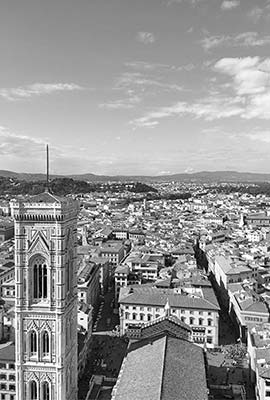
For a grand view into the cathedral from the base of the dome, a chance to see Brunelleschi’s “dome-within-a-dome” construction, and a glorious Florence view from the top, climb 463 steps up the dome. The claustrophobic one-way route takes you up narrow, steep staircases and walkways to the top—but it’s well worth the climb.
Cost and Hours: Covered by the Brunelleschi Pass (see earlier); Mon-Fri 8:15-19:30, Sat until 17:15, Sun 12:45-16:30.
Reservations: You must reserve your dome-climb entry when you purchase your pass. If possible, visit at sunset for a romantic experience. If you can’t get a reservation, consider buying the Giotto Pass and ascend the Campanile instead: It rarely has a line, is far less claustrophobic, and has a terrific view of the dome.
Getting In: Enter the dome climb from the north side of the church (get in line about 15 minutes before your reservation time).
Climbing the Dome: While waiting to enter at your reserved time, spend a few minutes studying the side-entrance door, called the Porta della Mandorla (“Almond Door”). Just above the delicately carved doorframe is a colorful Annunciation mosaic by Nanni di Banco, and above that, in a sculpted almond-shaped frame, the Madonna is borne up to heaven by angels. If you look up from here you’ll see an empty pedestal atop the transept. Michelangelo’s David was originally destined to adorn one of these.
The climb is long but there are small landings where you can pull over and take a breather. Halfway up, you’ll stroll on the walkway high above the altar where you can get a close-up of Vasari’s Last Judgment ceiling (especially the ghoulish lower portion, filled with scenes of eternal torment) and a vertigo-inducing view of the nave. After a few tight, winding staircases and a steep final climb, you’ll pop out of the hatch on the crowded terrace with a grand city view.
▲Campanile (Giotto’s Tower)
The 270-foot bell tower has 50-some fewer steps than the Duomo’s dome (but that’s still 414 steps—no elevator); offers a faster, less-intense climb (with typically short lines); and has a view of that magnificent dome to boot. On the way up, there are several intermediate levels where you can catch your breath and enjoy ever-higher views. The stairs narrow as you go, creating a mosh-pit bottleneck near the very top—but the views are worth the hassle. While the viewpoints are enclosed by cage-like bars, the gaps are big enough to snap great photos.
Cost and Hours: Covered by the Giotto Pass (see earlier); daily 8:15-19:45, last entry 40 minutes before closing.
▲Baptistery
Michelangelo said the bronze doors of this octagonal building facing the Duomo were fit to be the Gates of Paradise. Check out the gleaming copies of Lorenzo Ghiberti’s bronze doors (the originals are in the Duomo Museum). Making a breakthrough in perspective, Ghiberti used mathematical laws to create the illusion of receding distance on a basically flat surface.
The doors on the north side of the building (around to the right from the Gates of Paradise) were designed by Ghiberti when he was younger; he’d won the honor and opportunity by beating Brunelleschi in a competition (the rivals’ original entries are in the Bargello).
Inside, sit and savor the medieval mosaic ceiling, where it’s always Judgment Day and Jesus is giving the ultimate thumbs-up or thumbs-down.
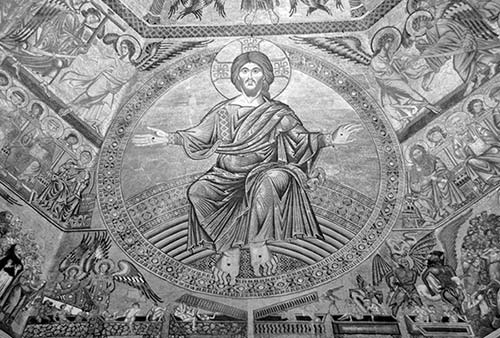
Cost and Hours: Covered by all three Duomo passes (see earlier); interior generally open daily 9:00-19:45. The (facsimile) bronze doors on the exterior are always viewable.
▲▲▲Duomo Museum (Museo dell’Opera del Duomo)
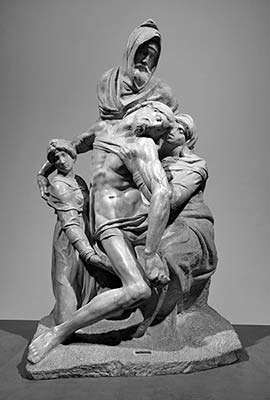
The often-overlooked but superbly presented cathedral museum is filled with some of the best sculpture of the Renaissance, including a late Michelangelo Pietà and statues from the original Baptistery facade. Remarkably, it’s almost never crowded. It also holds Brunelleschi’s models for his dome, Donatello’s emaciated Mary Magdalene and playful choir loft, and Ghiberti’s original bronze Gates of Paradise doors with all the panels (the ones on the Baptistery’s doors today are copies).
Cost and Hours: Covered by all three Duomo passes (see earlier); daily 9:00-19:45, closed first Tue of each month, last entry one hour before closing; one of the few museums in Florence open every Mon; behind the church at Via del Proconsolo 9, +39 055 230 2885, www.museumflorence.com.
Visiting the Museum: Begin with the model of the Duomo’s facade circa 1500, the era of Michelangelo (Room 4). Notice that only the lower third is faced with marble and statues; the rest was only bare brick. Church construction began in 1296, but after an initial burst of energy, petered out. The facade was meant to be a glorious showcase of great statues set into niches.
Now enter the Hall of Paradise (Sala del Paradiso, Room 6). On one wall, this room re-creates that lower third of the facade we saw on the model. The opposite wall re-creates the Baptistery facade. Both buildings were a showcase of the greatest art of Florence from roughly 1300 to 1600.
Start with the Duomo wall. Peruse the various statues, done by many different artists from different eras, and consider the church’s long evolution. The Duomo began life in early medieval times as a humble church overshadowed by the more prestigious Baptistery. By the 1200s, the church wasn’t big enough to contain the exuberant spirit of a city growing rich from the wool trade and banking. So Florence set out to rebuild it, intending to make the finest church of the age.
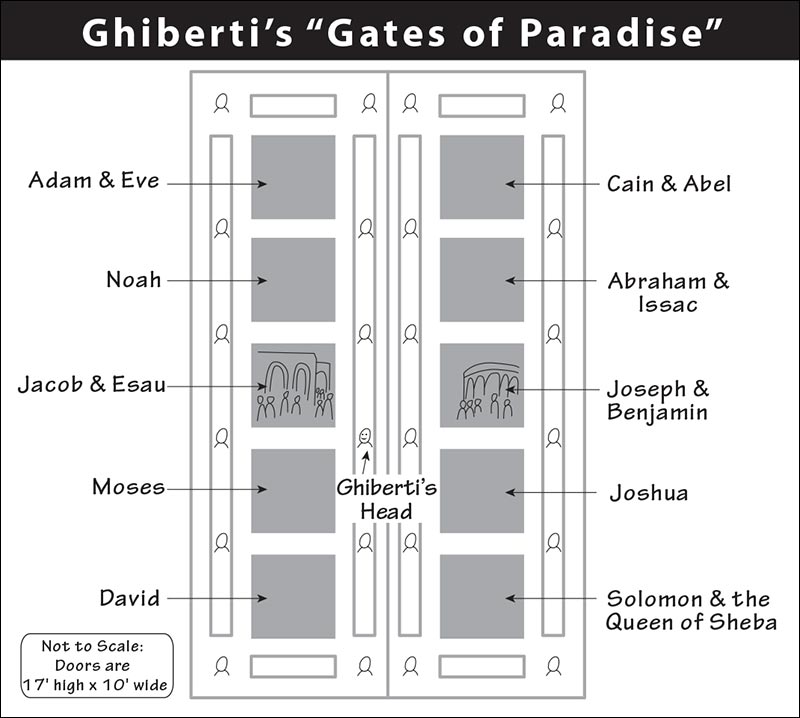
Facing the facade of the church, as they did in the Middle Ages, are the famous doors of the Baptistery. Here’s your chance to study the original panels. The oldest doors on the left are by Pisano (South Doors, c. 1330-1336). The original competition doors on the right are the first ones done by Ghiberti (North Doors, 1403-1424). And in the center are the Gates of Paradise by Ghiberti (East Doors, 1425-1452, see diagram on the next page).
These bronze “Gates of Paradise” revolutionized the way Renaissance people saw the world around them. They tell several Old Testament stories using perspective and realism as never before. Ghiberti poured his energy and creativity into these panels. That’s him in the center of the door frame, atop the second row of panels—the head on the left with the shiny male-pattern baldness.
Armed with new rules of perspective, Ghiberti rendered reality with a mathematical precision revolutionary for the time. To understand how these advances made visual space feel more real than ever before, take a closer look at the space created by the arches in the Jacob and Esau panel (left side, third from the top). At the center is the so-called vanishing point on the distant horizon, where all the arches and floor tiles converge. Those closest to us, at the bottom of the panel, are big and clearly defined. Distant figures are smaller, fuzzier, and higher up. Ghiberti has placed us as part of this casual crowd of holy people—some with their backs to us—milling around an arcade. Suddenly the world has acquired a whole new dimension—depth.
Also on the ground floor are rooms dedicated to the museum’s most famous statues. Donatello‘s Mary Magdalene (Santa Maria Maddalena, c. 1455), carved from white poplar and originally painted with realistic colors, is a Renaissance work of intense devotion (Room 8). The aging Michelangelo (1475-1564) designed his own tomb, with a Pietà (1547-1555) as the centerpiece (Room 10). Three mourners tend the broken body of the crucified Christ. We see Mary, his mother (the shadowy figure on our right); Mary Magdalene (on the left); and Nicodemus, the converted Pharisee, whose face is that of Michelangelo himself.
Upstairs, the first floor displays original statues and panels from the bell tower’s third story, where copies stand today, two marble choir lofts (cantorie; by Lucca della Robbia and Donatello) that once sat above the sacristy doors of the Duomo, and Brunelleschi’s model of the dome. Don’t miss the Terrazza Brunelleschiana on the third floor—an outdoor terrace with an up-close, rooftop view of the Duomo.
NORTH OF THE DUOMO
▲▲▲Accademia (Galleria dell’Accademia)
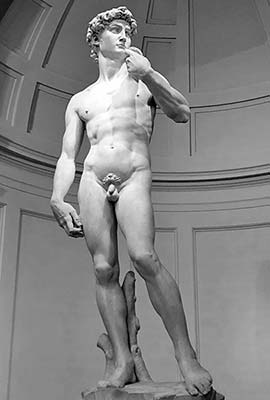
This museum houses Michelangelo’s David, the consummate Renaissance statue of the buff, biblical shepherd boy ready to take on the giant. This six-ton, 17-foot-tall symbol of divine victory over evil represents a new century and a whole new Renaissance outlook. This is the age of Columbus and classicism, Galileo and Gutenberg, Luther and Leonardo—of Florence and the Renaissance.
The Accademia also contains some of the master’s other works, including his powerful (unfinished) Prisoners and St. Matthew, as well as a Pietà (possibly by one of his disciples). You’ll also see some mildly interesting pre-Renaissance and Renaissance paintings, including a couple of Botticellis, the plaster model of Giambologna’s Rape of the Sabine Women, and a musical instrument collection with one of the very first-ever pianos (the pianoforte was invented here in Florence).
Cost and Hours: €12, additional €4 for recommended reservation; Tue-Sun 9:00-19:00, closed Mon, may stay open later in peak season; audioguide-€6, Via Ricasoli 60, +39 055 294 883; reservations: www.b-ticket.com/b-Ticket/uffizi, info: www.galleriaaccademiafirenze.it/en.
Visiting the Museum: In 1501, Michelangelo Buonarroti, a 26-year-old Florentine, was commissioned to carve a large-scale work for the Duomo. He was given a block of marble that other sculptors had rejected as too tall, shallow, and flawed to be of any value. But Michelangelo picked up his hammer and chisel, knocked a knot off what became David’s heart, and started to work.
The statue captures David as he’s sizing up his enemy. He stands relaxed but alert, leaning on one leg in a classical pose known as contrapposto. In his powerful left hand, he fondles the handle of the sling, ready to fling a stone at the giant. His gaze is steady—searching with intense concentration, but also with extreme confidence. Michelangelo has caught the precise moment when David is saying to himself, “I can take this guy.”
David is a symbol of Renaissance optimism. He’s no brute. He’s a civilized, thinking individual who can grapple with and overcome problems. He needs no armor, only his God-given physical strength and wits. Look at his right hand, with the raised veins and strong, relaxed fingers—many complained that it was too big and overdeveloped. But this is the hand of a man with the strength of God on his side. No mere boy could slay the giant. But David, powered by God, could...and did.
Renaissance Florentines could identify with David. Like him, they considered themselves God-blessed underdogs fighting their city-state rivals. In a deeper sense, they were civilized Renaissance people slaying the ugly giant of medieval superstition, pessimism, and oppression.
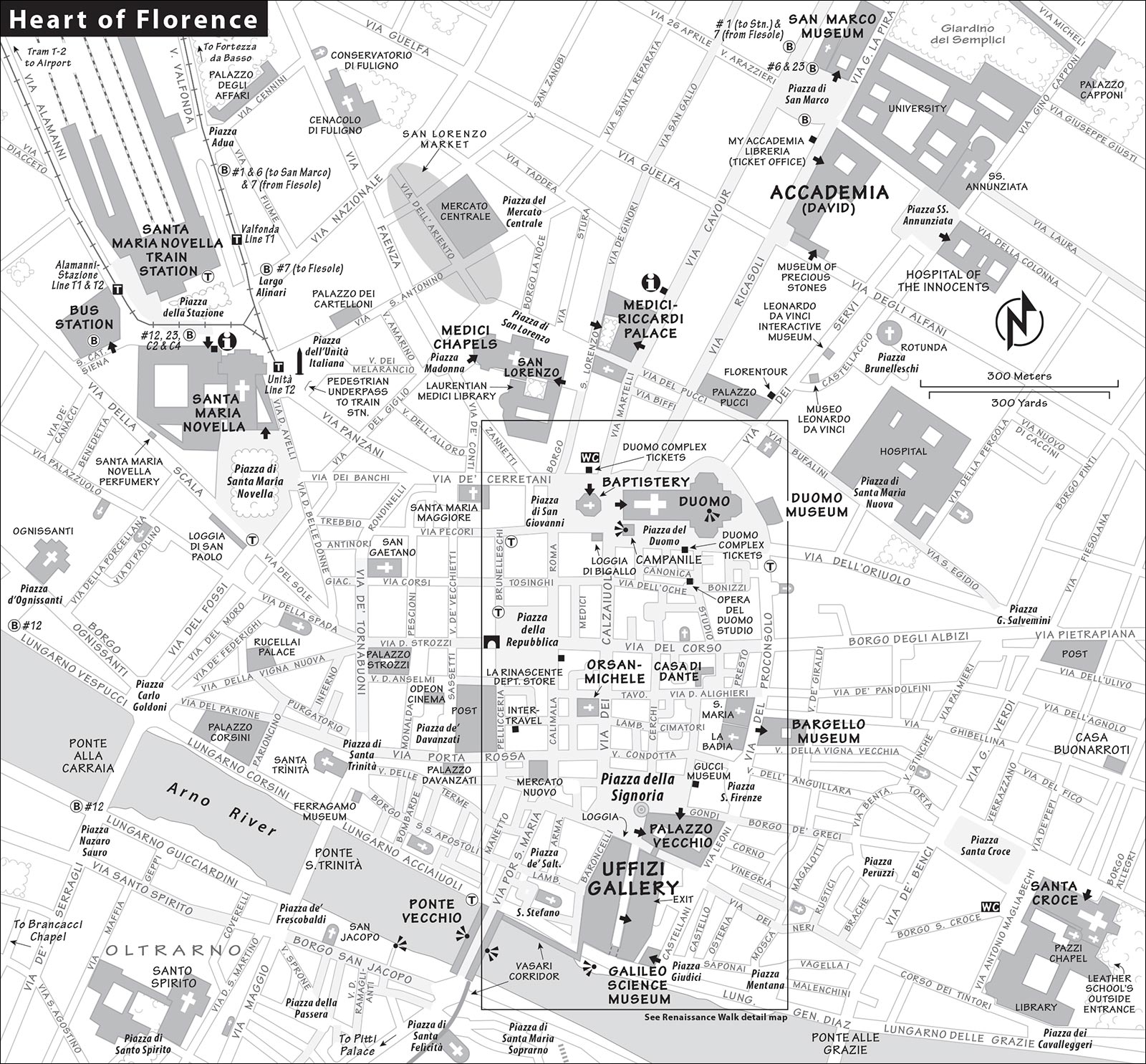
▲Piazza Santissima Annunziata
The most Renaissance square in Florence is tucked just a block behind the Accademia. It’s like an urban cloister (the image of the ideal city) from the 15th century, with three fine buildings—a convent church, a hospital, and an orphanage—ringing a fine equestrian statue of Ferdinand, a Medici grand duke of the then-independent state of Tuscany. Stand in the center and slowly spin, imagining being here in 1500 as you survey the only Renaissance square in Florence, with the towering Duomo down the street.
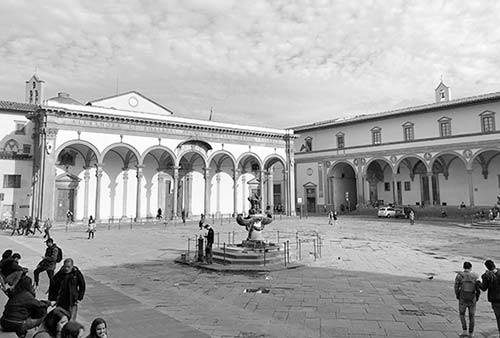
The 15th-century Santissima Annunziata church (with its patronage attribution to the Pucci brothers: Alexander and Roberto) is worth a peek. The welcoming cloister has early-16th-century frescoes by Andrea del Sarto, and the church’s interior is slathered in Baroque—rare in Florence.
Filippo Brunelleschi’s Hospital of the Innocents (Ospedale degli Innocenti), built in the 1420s, is considered the first Renaissance building. Its graceful arches and columns, with each set of columns forming a square, embody the quintessence of Renaissance harmony and typified the new aesthetic of calm balance and symmetry. It’s ornamented with terra-cotta medallions by Luca della Robbia—each showing a different way to wrap an infant (swaddled—meant to help babies grow straight, and practiced in Italy until about a century ago). Terra-cotta—made of glazed and painted clay—was a combination of painting and sculpture, durable and economic. For three generations, the Della Robbia family guarded the secret recipe and made their name by bringing this affordable art medium to Florence.
With its mission to care for the least among society (parentless or unwanted children), this hospital was also an important symbol of the increasingly humanistic and humanitarian outlook of Renaissance Florence. For four centuries (until 1875), orphans would be left at the “wheel of the innocents” (the small, barred window at the far left of the porch).
The Museum of the Innocents fills the hospital. A fine exhibit tells the story of these infants with artifacts that help you imagine what it was like living here. It also houses some fine art, including several iconic glazed terra-cotta medallions by the Della Robbia family (€8, Wed-Mon 11:00-18:00, closed Tue, audioguide-€3, +39 055 203 7301, www.museodeglinnocenti.it [URL inactive]).
Eating: $$ Caffè del Verone, on the museum’s top terrace, offers a nice, peaceful break with rooftop views.
▲▲Museum of San Marco (Museo di San Marco)
One block north of the Accademia, this 15th-century monastery houses the greatest collection anywhere of frescoes and paintings by the early Renaissance master Fra Angelico. The ground floor features the monk’s paintings, along with works by Fra Bartolomeo.
Upstairs are 43 cells decorated by Fra Angelico and his assistants. While the monk/painter was trained in the medieval religious style, he also learned and adopted Renaissance techniques and sensibilities, producing works that blended Christian symbols and Renaissance realism. Don’t miss the cell of Savonarola, the charismatic monk who rode in from the Christian right, threw out the Medici, turned Florence into a theocracy, sponsored “bonfires of the vanities” (burning books, paintings, and so on), and was finally burned himself when Florence decided to change channels.
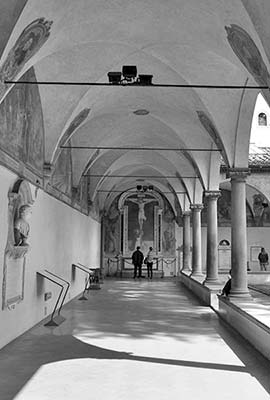
Cost and Hours: €8; Mon-Fri 8:15-14:00, Sat until 17:00, closed Sun; also closed second and fourth Mon of each month; reservations possible but unnecessary, on Piazza San Marco, +39 055 238 8608.
Basilica of San Lorenzo
The Basilica of San Lorenzo—on the site of the first Christian church in Florence—was built outside the Roman walls and consecrated in AD 393, then rebuilt in the early 1400s. That’s when Filippo Brunelleschi was hired to replace a Romanesque church that stood here. Brunelleschi designed the building, and Donatello worked on the bronze pulpits inside (among other things). Adjacent to the church is a cloister where you can visit the crypt (with the tombs of Cosimo the Elder and Donatello) and the Laurentian Medici Library, designed by Michelangelo. (The famed Medici Chapels, with Michelangelo’s tomb sculptures, are part of the church complex but have a separate ticket; see next listing.)
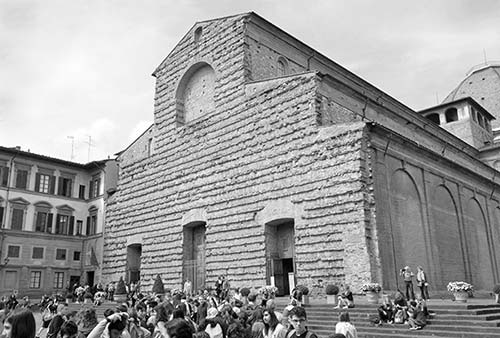
Cost and Hours: €9 for the church and crypt, buy ticket just inside cloister to the left of the facade; €4 for library only (purchase upstairs); church and crypt open Mon-Sat 9:30-17:30, closed Sun, shorter hours off-season; library Mon-Fri 10:00-13:30, closed Sat-Sun; Piazza di San Lorenzo, +39 055 214 042, basilica: www.sanlorenzofirenze.it, library: www.bmlonline.it.
▲▲Medici Chapels (Cappelle Medicee)
The burial site of the ruling Medici family in the Basilica of San Lorenzo includes the dusky crypt; the big, domed Chapel of Princes; and the magnificent New Sacristy, featuring architecture, tombs, and statues almost entirely by Michelangelo. The Medici made their money in textiles and banking, and patronized a dream team of Renaissance artists that put Florence on the cultural map. Michelangelo, who spent his teen years living with the Medici, was commissioned to create the family’s final tribute.
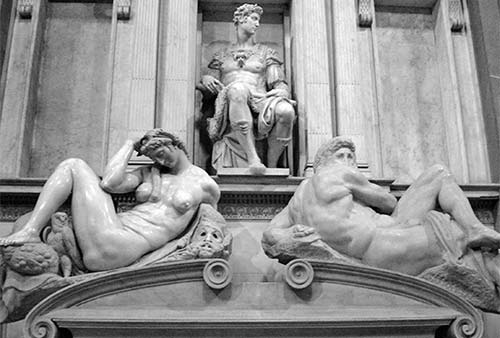
Cost and Hours: €9; Sat-Mon 8:15-13:50, Wed-Fri 13:15-18:50; closed Tue and first, third, and fifth Sun of each month; reservations possible but unnecessary, audioguide-€6, modest dress required, +39 055 294 886, www.bargellomusei.beniculturali.it [URL inactive].
▲San Lorenzo Market
Florence’s vast open-air market sprawls in the streets between the Duomo and the train station, with the highest concentration in the streets ringing Mercato Centrale (daily 9:00-19:00). More popular with tourists than locals, it’s a hodgepodge of vendors selling T-shirts, scarves, cheap souvenirs, and leather goods of varying quality. At stalls or shops, prices are soft—don’t be shy about bargaining.
▲Mercato Centrale (Central Market)
Florence’s giant iron-and-glass-covered central market was constructed around 1865 as part of the city remake during the unification of Italy, when Florence was, for a few years, the capital of the newly formed country. Stand back and see it as an Industrial Age triumph...a temple of commerce and good food. Then step in and explore the fragrant and picturesque wonderland of produce.
Downstairs, you’ll see parts of the cow (and bull) you’d never dream of eating (no, that’s not a turkey neck), enjoy free samples, watch pasta being made, and have your pick of plenty of fun eateries sloshing out cheap and tasty pasta to locals (Mon-Fri 7:00-14:00, Sat until 17:00, closed Sun).
Upstairs, the restored glass roof and steel rafters soar over a modern and extremely touristy food court (daily 10:00-24:00). For eating ideas downstairs, upstairs, and around the market, see “Eating in Florence,” later.
▲Medici-Riccardi Palace (Palazzo Medici-Riccardi)
Lorenzo the Magnificent’s home is worth a look for its art. The tiny Chapel of the Magi contains colorful Renaissance gems such as The Journey of the Magi frescoes by Benozzo Gozzoli. The former library has a Baroque ceiling fresco by Luca Giordano, a prolific artist from Naples known as “Fast Luke” (Luca fa presto) for his speedy workmanship. While the Medici originally occupied this 1444 house, in the 1700s it became home to the Riccardi family, who added the Baroque flourishes.
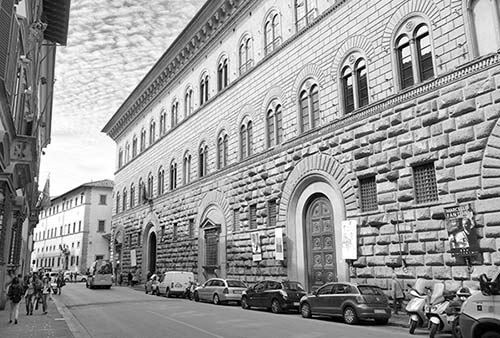
Cost and Hours: €10, Thu-Tue 9:00-19:00, closed Wed; ticket entrance is off the central courtyard, enter from Via Cavour 3 or sometimes from Via de’ Ginori 2; +39 055 276 0552, www.palazzomediciriccardi.it.
BETWEEN THE DUOMO AND PIAZZA DELLA SIGNORIA
▲Orsanmichele Church
In the ninth century, this loggia (covered courtyard) was a market used for selling grain (stored upstairs). Later, it was enclosed to make a church. Focus on the exterior, with its dynamic, statue-filled niches, some with accompanying symbols from the guilds that sponsored the art. For more on the statues, see here.
The interior (open only two days a week) has a glorious Gothic tabernacle (1359), which houses the painted wooden panel that depicts Madonna delle Grazie (1346). The iron bars spanning the vaults were the Italian Gothic answer to the French Gothic external buttresses. The rectangular holes in the piers were once grain chutes that connected to the upper floors. The museum upstairs displays most of the original statues from the niches outside the building, including ones by Ghiberti, Donatello, Brunelleschi, and others.
Cost and Hours: €4, includes museum; Tue and Sat 10:30-18:00, closed Sun-Mon and Wed-Fri; ticket office open Mon-Sat 9:00-16:00, closed Sun, books concert tickets (see next) as well as Uffizi and Accademia tickets; www.bargellomusei.beniculturali.it [URL inactive].
Evening Concerts: You can give special thanks if you’re in town when the church is hosting an evening concert (tickets sold on day of concert from door facing Via dei Calzaiuoli or, on Sun, from the doorway opposite the church entrance).
▲Mercato Nuovo (a.k.a. the Straw Market)
This market loggia is how Orsanmichele looked before it became a church. Originally a silk-and-straw market, Mercato Nuovo still functions as a rustic yet touristy market (at the intersection of Via Calimala and Via Porta Rossa; daily 9:00-18:30). Notice the circled X in the center, marking the spot where people landed after being hoisted up to the top and dropped as punishment for bankruptcy (easiest to find when the market is closed and the vendors disappear). You’ll also find Il Porcellino (a statue of a wild boar nicknamed “The Piglet”), which people rub and give coins to ensure their return to Florence. This new copy, while only a few years old, already has a polished snout. At the back corner, a wagon sells tripe (cow innards) sandwiches—a local favorite.
▲Piazza della Repubblica
Lined with venerable cafés and high-fashion stores, this square has been the center of Florence for millennia. In Roman times, it was a fort at the intersection of the two main roads (marked today by the square’s lone column). In 1571, Cosimo I de’ Medici had the area walled in and made into the Jewish ghetto. If you venture outside the piazza, you get a sense of what the old neighborhood was like—a tangle of narrow, winding lanes dotted with medieval towers. In the late 19th century, the area was razed to create this spacious square, with a huge triumphal arch celebrating the unification of Italy.
Today, people sip drinks at outdoor cafes, shop at the local La Rinascente department store, or enjoy a reasonably priced coffee on the store’s rooftop terrace, with great Duomo and city views.
For more about Piazza della Repubblica, see the “Renaissance Walk,” earlier.
▲Palazzo Davanzati
This five-story, late-medieval tower house offers a rare look at a noble dwelling built in the 14th century. Like other buildings of the age, the exterior is festooned with 14th-century horse-tethering rings made from iron, torch holders, and poles upon which to hang tapestries and fly flags. Inside, though the furnishings are pretty sparse, you’ll see richly painted walls, a long chute that functioned as a well, plenty of fireplaces, a lace display, and even an indoor “outhouse.” You can borrow English descriptions in each room.
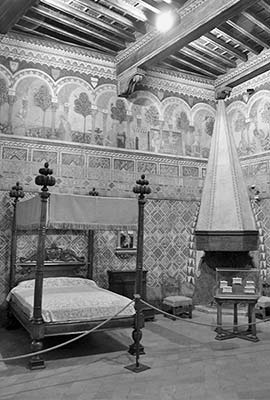
Cost and Hours: €6; Tue-Thu 8:45-13:30, Fri-Sun 13:45-18:30; closed Mon and first, third, and fifth Sun of each month; reservations possible but unnecessary; Via Porta Rossa 13, +39 055 238 8610, www.bargellomusei.beniculturali.it [URL inactive].
ON AND NEAR PIAZZA DELLA SIGNORIA
▲▲▲Uffizi Gallery
This greatest collection of Italian paintings anywhere features works by Giotto, Leonardo, Raphael, Caravaggio, Titian, and Michelangelo, and a roomful of Botticellis, including the Birth of Venus. Start with Giotto’s early stabs at Renaissance-style realism, then move on through the 3-D experimentation of the early 1400s to the real thing rendered by the likes of Botticelli and Leonardo. Finish off with Michelangelo and Raphael. Because only 600 visitors are allowed inside the building at any one time, there’s generally a very long wait. The good news: no Vatican-style mob scenes inside. The museum is nowhere near as big as it is great.
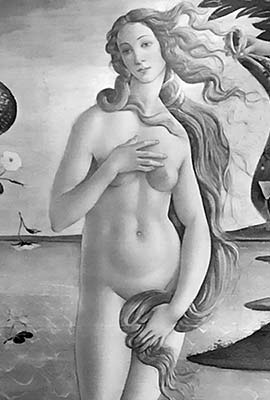
Cost and Hours: €20 plus €4 for recommended timed-entry reservation, cheaper in winter, covered by €38 Uffizi/Pitti Palace/Boboli Gardens “PassePartout” combo-ticket; open Tue-Sun 8:15-18:30, closed Mon, may stay open later in peak season, last entry one hour before closing; audioguide-€6, +39 055 294 883, reservations: www.b-ticket.com/b-Ticket/uffizi, info: www.uffizi.it.
Reservations Required: To skip the notoriously long ticket-buying lines, book your Uffizi entrance in advance online. You’ll be emailed a voucher that you’ll swap for an actual ticket 15 minutes before your visit at the reservation ticket office (across the courtyard from the museum entrance).
When to Go: While ridiculous, if you don’t have a reservation, try going 90 minutes before closing and see the museum in a rush.
Getting In: If you arrive with a reservation, go first to the courtyard door #3 to pick up your ticket (labeled Reservation Ticket Office). There you exchange your email voucher/confirmation number for a ticket. Tickets are available for pickup 15 minutes before your appointed time. Then, with ticket in hand, walk briskly across the courtyard to door #1. Get in the queue for “individuals,” not “groups.”
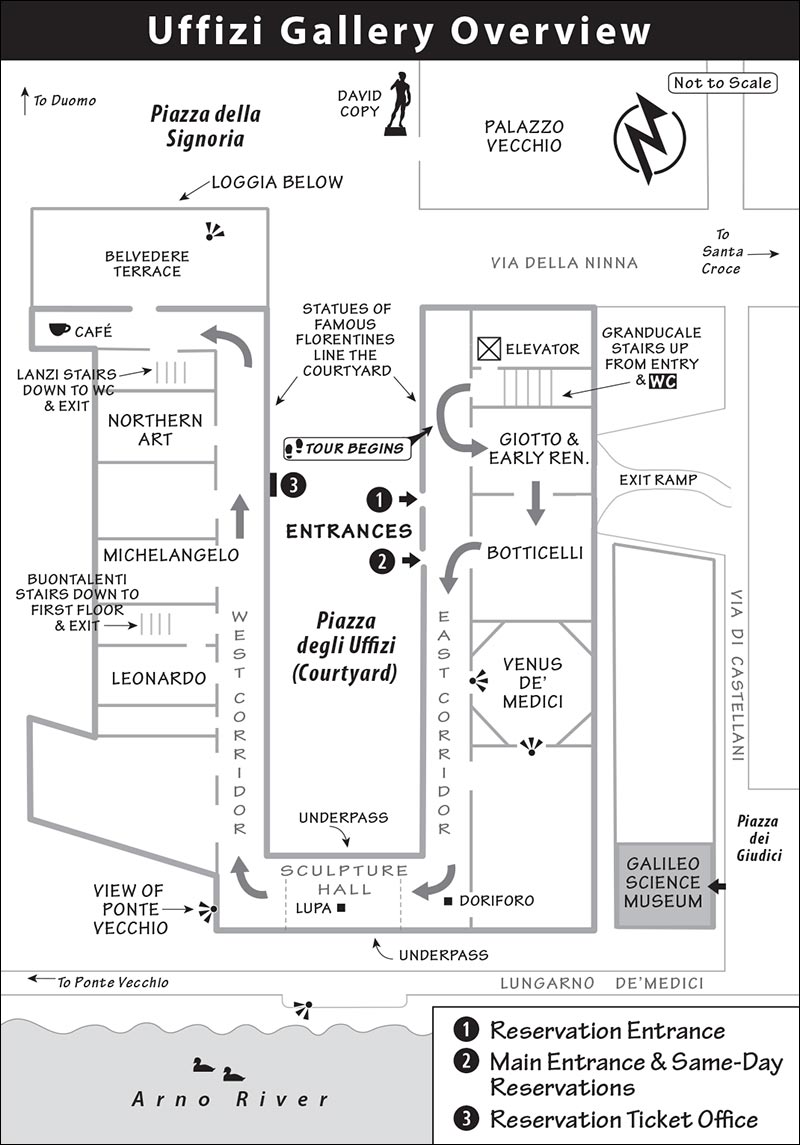
To buy a ticket on the spot, line up with everyone else at door #2, marked Main Entrance.
Renovation: The Uffizi recently completed a reorganization; pick up a map as you enter for the latest (some locations may vary from this tour).
Tours: The 2.5-hour audioguide costs €6. Or download my free Uffizi Gallery audio tour.
Visiting the Museum: The Uffizi is U-shaped, running around an exterior courtyard. The artwork we’ll see is up four long flights of stairs, on the top floor. The east wing contains Florentine paintings from medieval to Renaissance times. At the far end, you pass through a short hallway filled with the kind of ancient sculpture that inspired the Renaissance. The west wing has the Renaissance biggies—Leonardo, Michelangelo, and Raphael. Downstairs there are many more rooms of art, showing how the Florentine Renaissance morphed into Mannerism (Parmigianino), spread to Venice (Titian), and inspired the Baroque (Caravaggio).
Medieval (1200-1400): Three similar-looking Madonna-and-Bambinos—all painted within a few decades of each other, in about the year 1300—show baby steps in the march to Renaissance realism (Room 4). Duccio’s piece is the most medieval and two-dimensional. There’s no background, and the angels are just stacked one on top of the other, floating in the golden atmosphere. Cimabue mixes the iconic Byzantine style with budding Italian realism. Giotto creates a space and fills it. Like a set designer, he builds a three-dimensional “stage”—the canopied throne—then peoples it with real beings. The throne has angels in front, prophets behind, and a canopy over the top. But the real triumph here is Mary herself—big and monumental, like a Roman statue. Beneath her robe, she has a real live body, with knees and breasts that stick out at us. This three-dimensionality was revolutionary in its day, a taste of the Renaissance a century before it began.
Early Renaissance (mid-1400s): In the 1400s, painters worked out the problems of painting realistically, using mathematics to create the illusion of three-dimensionality. Paolo Uccello’s colorful Battle of San Romano is not so much a piece of art as an exercise in perspective (Room 9). The fallen horses and soldiers are experiments in “foreshortening”—creating the illusion of distance. Some of the figures are definitely A-plus material, like the fallen gray horse in the center. But some are more like B-minus work—the fallen soldier at the far right would be child-size if he stood up.
Uccello almost literally went crazy trying to master the three dimensions (thank God he was born before Einstein discovered one more).
We don’t need the wispy halo over the head of Fra Filippo’s Madonna and Child with Two Angels to tell us she’s holy—she radiates sweetness and light from her divine face (Room 9). Lippi painted idealized beauty, but his models were real flesh-and-blood human beings. You could look through all the thousands of paintings from the Middle Ages and not find anything so human as the mischievous face of one of Lippi’s little angel boys.
In medieval times, only saints and angels were worthy of being painted. In the humanistic Renaissance, however, even nonreligious folk like the husband and wife Federico da Montefeltro and Battista Sforza had their features preserved for posterity, in this case by Piero della Francesca (Room 9). Renaissance artists discovered the beauty in ordinary people and painted them, literally, warts and all.
The Renaissance (1450-1500): Florence in 1450 was in a Firenz-y of activity. There was a can-do spirit of optimism in the air, led by prosperous merchants and bankers and a strong middle class. Lorenzo de’ Medici, head of the powerful Medici family, epitomized this new humanistic spirit. He gathered Florence’s best and brightest around him for evening wine and discussions of great ideas. One of this circle was the painter Botticelli.
The Botticelli rooms (11-12) are filled with masterpieces and classical fleshiness. Botticelli’s Spring is the Renaissance in its first bloom, its “springtime” of innocence. Madonna is out, Venus is in. This is a return to the pre-Christian pagan world of classical Greece, where things of the flesh are not sinful. Botticelli emphasizes pristine beauty over gritty realism. The lines of the bodies have pleasing, S-like curves. The faces are idealized but have real human features. There’s a look of thoughtfulness and even melancholy in the faces—as though everyone knows that the innocence of spring will not last forever.
Birth of Venus is a masterpiece of Western art. This is the purest expression of Renaissance beauty. Venus’ naked body is not sensual, but innocent. Botticelli thought that physical beauty was a way of appreciating God.
Classical Sculpture: If the Renaissance was the foundation of the modern world, the foundation of the Renaissance was classical sculpture. Sculptors, painters, and poets alike turned for inspiration to these ancient Greek and Roman works as the epitome of balance, 3-D perspective, human anatomy, and beauty.
In the Tribune Room, the highlight is the Venus de’ Medici (first century BC), a Roman copy of the lost original by the great Greek sculptor Praxiteles. Balanced, harmonious, and serene, the statue embodies the attributes of Greece’s “Golden Age,” when balance was admired in every aspect of life.
The sculpture hall has 2,000-year-old Roman copies of 2,500-year-old Greek originals. The most impressive is the male nude, Doriforo (“spear carrier”), a Roman copy of the Greek original by Polykleitos. The purple statue in the center of the hall—headless and limbless—is the Roman “she-wolf” (Lupa, c. AD 120), the animal that raised Rome’s legendary founders.
High Renaissance (1500-1550): A scientist, architect, engineer, musician, and painter, Leonardo da Vinci (1452-1519) was a true Renaissance Man. He worked at his own pace rather than to please an employer, so he often left works unfinished.
In the Annunciation, the angel Gabriel has walked up to Mary, and now kneels on one knee like an ambassador, saluting her (Room 35). See how relaxed his other hand is, draped over his knee. Mary, who’s been reading, looks up with a gesture of surprise and curiosity. Leonardo constructs a beautifully landscaped “stage” and puts his characters in it. He’s taken a miraculous event—an angel appearing out of the blue—and presented it in a very human way.
Leonardo’s human insight is even more apparent in this unfinished Adoration of the Magi. The poor kings are amazed at the Christ Child—even afraid of him. This work is as agitated as the Annunciation is calm, giving us an idea of Leonardo’s range.
Don’t miss Michelangelo’s Holy Family (a.k.a Doni Tondo, Room 38), the only completed easel painting by the greatest sculptor in history. Florentine painters were sculptors with brushes; this shows it. Instead of a painting, it’s more like three clusters of statues with some clothes painted on.
Michelangelo was a Florentine—in fact, he was like an adopted son of the Medici, who recognized his talent—but much of his greatest work was done in Rome as part of the pope’s face-lift of the city. We can see here some of the techniques he used on the Sistine Chapel ceiling that revolutionized painting—monumental figures; dramatic angles (looking up Mary’s nose); accentuated, rippling muscles; and bright, clashing colors.
Nearby is Raphael’s Madonna of the Goldfinch, in which the artist brings Mary and bambino down from heaven and into the real world of trees, water, and sky. The two halves of the painting balance perfectly. Draw a line down the middle, through Mary’s nose and down through her knee. John the Baptist on the left is balanced by Jesus on the right. Even the trees in the background balance each other, left and right. These things help create the subconscious feelings of balance and order that reinforce the atmosphere of maternal security in this domestic scene—pure Renaissance.
More Art on the Lower Floor: For those willing to linger longer, the first floor is worth a look. It features work from after the Renaissance: Mannerism (such as Parmigianino), Venetian (Titian), Baroque (Caravaggio), and finally Flemish and Dutch (Rubens and Rembrandt). Before you head down, you may want to take advantage of the second floor’s fine café, open-air terrace, and WC. To reach the first floor, retrace your steps to the staircase between the Leonardo da Vinci and Michelangelo galleries and head down.
▲▲Palazzo Vecchio
This castle-like fortress with the 300-foot spire dominates Florence’s main square. In Renaissance times, it was the Town Hall, where citizens pioneered the once-radical notion of self-rule. Its official name—Palazzo della Signoria—refers to the elected members of the city council. In 1540, the tyrant Cosimo I made the building his personal palace, redecorating the interior in lavish style. Today the building functions once again as the Town Hall.
Entry to the ground-floor Michelozzo courtyard, with its arcade of intricately carved columns, is free, so even if you don’t go upstairs to the museum, you can step inside and feel the essence of the Medici. There’s also a fine little exhibit of scenes from old Florence (ground level in adjacent ticketing courtyard). Paying customers can see Cosimo’s (fairly) lavish royal apartments, decorated with (fairly) top-notch paintings and statues by Michelangelo and Donatello. The highlight is the Grand Hall (Salone dei Cinquecento), a 13,000-square-foot hall lined with huge frescoes and interesting statues.
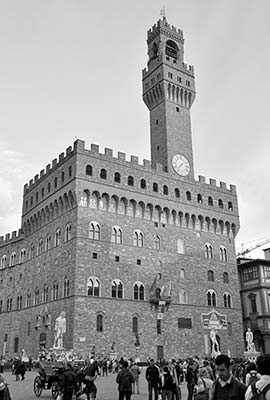
Across from the Palazzo, facing the square, is the Loggia dei Lanzi, where Renaissance Florentines once debated the issues of the day; a collection of Medici-approved sculptures now stand (or writhe) under its canopy, including Cellini’s bronze Perseus.
Cost and Hours: Michelozzo courtyard-free, museum and tower climb (418 steps)-€12.50 each, excavations-€4. Museum and excavations open daily 9:00-19:00 except Thu until 14:00, may stay open later in peak season; tower keeps shorter hours (last entry one hour before closing) and closed in bad weather; last tickets for all sights sold one hour before closing; videoguide-€5, Piazza della Signoria, +39 055 276 8224, http://bigliettimusei.comune.fi.it.
▲Ponte Vecchio
Florence’s most famous bridge has long been lined with shops. Originally these were butcher shops that used the river as a handy disposal system. Then, when the powerful and princely Medici built the Vasari Corridor over the bridge, the stinky meat market was replaced by more elegant gold-and-silver shops (some of which remain here to this day). The corridor, an elevated passageway above the bridge, was built so the Medici could commute comfortably between their Pitti Palace home and their Palazzo Vecchio offices (corridor may be closed for renovation when you visit). A statue of Benvenuto Cellini, the master goldsmith of the Renaissance, stands in the center of the bridge, ignored by the flood of tacky tourism.
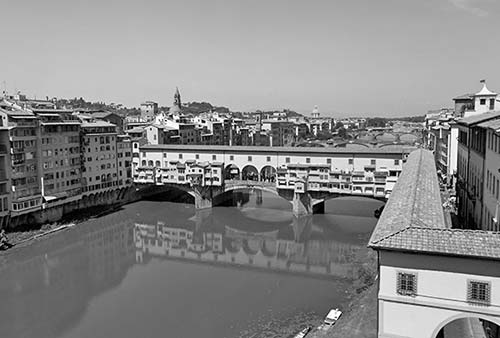
▲▲Galileo Science Museum (Museo Galilei)
When we think of the Florentine Renaissance, we think of visual arts: painting, mosaics, architecture, and sculpture. But when the visual arts declined in the 1600s (abused and co-opted by political powers), music and science flourished in Florence. The first opera was written here. And Florence hosted many scientific breakthroughs, as you’ll see in this fascinating collection of Renaissance and later clocks, telescopes, maps, and ingenious gadgets. Trace the technical innovations as modern science emerges from 1000 to 1900. Some of the most talked-about bottles in Florence are the ones here that contain Galileo’s fingers. Exhibits include various tools for gauging the world, from a compass and thermometer to Galileo’s telescopes. Other displays delve into pumps, medicine, and chemistry. It’s friendly, comfortably cool, never crowded, and just a block east of the Uffizi on the Arno River.
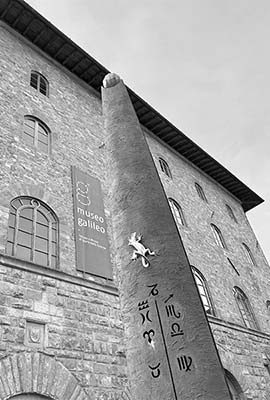
Cost and Hours: €10, daily 9:30-18:00 except Tue until 13:00, Piazza dei Giudici 1, +39 055 265 311, www.museogalileo.it.
EAST OF PIAZZA DELLA SIGNORIA
▲▲▲Bargello (Museo Nazionale del Bargello)
This underappreciated sculpture museum is in a former police station-turned-prison that looks like a mini-Palazzo Vecchio. The Renaissance began with sculpture and you can see the birth of this revolution of 3-D in the Bargello. It’s a small, uncrowded museum and a pleasant break from the intensity of the rest of Florence. You’ll see 150 years of great statues, spanning the history of Florence’s heyday.
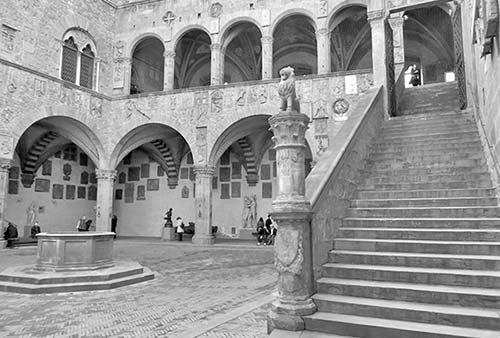
Highlights include Donatello’s very influential, painfully beautiful David (the first male nude to be sculpted in a thousand years), multiple works by Michelangelo, and rooms of Medici treasures. Moody Donatello, who embraced realism with his lifelike statues, set the personal and artistic style for many Renaissance artists to follow. The best pieces are in the ground-floor room at the foot of the outdoor staircase (with fine works by Michelangelo, Cellini, and Giambologna) and in the “Donatello room” directly above (including his two different Davids, plus Ghiberti and Brunelleschi’s dueling competition entries for the Baptistery doors—and yet another David by Verrocchio).
Cost and Hours: €9; usually daily 8:15-14:00—later for special exhibits; may close on second and fourth Sun and first, third, and fifth Mon of each month; last entry 50 minutes before closing; reservations possible but unnecessary, audioguide-€6; Via del Proconsolo 4, +39 055 238 8606, www.bargellomusei.beniculturali.it [URL inactive].
▲▲Santa Croce Church
This 14th-century Franciscan church, decorated with centuries of precious art, holds the tombs of great Florentines. The loud 19th-century Victorian Gothic facade faces a huge square ringed with tempting shops and littered with tired tourists. Escape into the church and admire its sheer height and spaciousness. Your ticket includes the Pazzi Chapel and a small museum; the complex also houses a leather school.
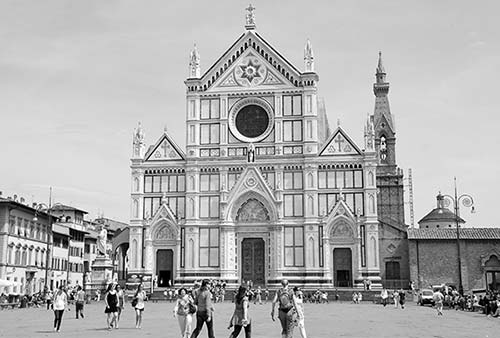
Cost and Hours: Church—€8; Mon-Sat 9:30-17:30, Sun from 12:30; multimedia guide-€4, modest dress required, 10-minute walk east of the Palazzo Vecchio along Borgo de’ Greci, +39 055 246 6105, www.santacroceopera.it. Leather school—free, use entry at the back of the church; Mon-Sat 10:00-18:00, closed Sun; https://leatherschool.biz.
Visiting the Church: On the left wall (as you face the altar) is the tomb of Galileo Galilei (1564-1642), the Pisan who lived his last years under house arrest near Florence. His crime? Defying the Church by saying that the earth revolved around the sun. His heretical remains were only allowed in the church long after his death.
Directly opposite (on the right wall) is the tomb of Michelangelo Buonarroti (1475-1564). Santa Croce was Michelangelo’s childhood church, as he grew up a block west of here. Farther up the nave is the tomb of Niccolò Machiavelli (1469-1527), a champion of democratic Florence and author of The Prince, a how-to manual on hardball politics—which later Medici rulers found instructive.
The first chapel to the right of the main altar features the famous Death of St. Francis fresco by Giotto. With simple but eloquent gestures, Francis’ brothers bid him a sad farewell. The Sacristy has Cimabue’s impressive Crucifixion (before 1288), a survivor of the devastating flood of 1966.
Exit the church nave between the Rossini and Machiavelli tombs to enter a delightful cloister. On the left is the small Brunelleschi-designed Pazzi Chapel, whose unity and harmony of design captures the Renaissance in miniature. Straight ahead is the church museum, with several rooms of paintings, statues, and altarpieces.
Around the back of the church is the leather school, founded after World War II to give war orphans a trade. It became the first shop in what is now a popular leather district. You can watch the leatherworking in action and browse the (very expensive) finished products for sale.
▲Casa Buonarroti (Michelangelo’s House)
A property once owned by Michelangelo, this house was built after the artist’s death by his grandnephew “Michelangelo the Younger,” who turned it into a little museum honoring his famous relative. The highlights—Michelangelo’s first sculptures and some sketches—are not must-sees in art-heavy Florence, but are appreciated by Michelangelo lovers. The place where Michelangelo actually grew up is only a few blocks from here, at 10 Via de’ Bentaccordi.
Cost and Hours: €8, Wed-Mon 10:00-16:30, closed Tue, Via Ghibellina 70, +39 055 241 752, www.casabuonarroti.it.
NEAR THE TRAIN STATION
▲▲Church of Santa Maria Novella
This 13th-century Dominican church is rich in art. Along with crucifixes by Giotto and Brunelleschi, it contains the textbook example of the early Renaissance mastery of perspective: The Trinity by Masaccio. The exquisite chapels trace art in Florence from medieval times to early Baroque. The outside of the church features a dash of Romanesque (horizontal stripes), Gothic (pointed arches), Renaissance (geometric shapes), and Baroque (scrolls). Step in and look down the 330-foot nave for a 14th-century optical illusion.
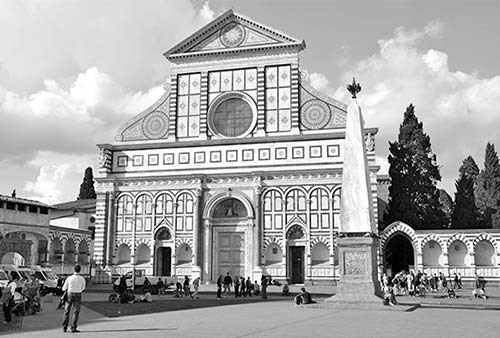
Next to the church are the cloisters and the museum, located in the old Dominican convent of Santa Maria Novella. The museum’s highlight is the breathtaking Spanish Chapel, with walls covered by a series of frescoes by Andrea di Bonaiuto.
Cost and Hours: Church and museum-€7.50; Mon-Thu and Sat 10:00-17:00, Fri from 11:00, Sun from 13:00; multimedia guide-€3, modest dress required; main entrance on Piazza Santa Maria Novella across from the train station; +39 055 219 257, www.smn.it.
THE OLTRARNO (SOUTH OF THE ARNO RIVER)
▲▲▲Pitti Palace
The imposing Pitti Palace, several blocks southwest of Ponte Vecchio, has many separate museums and two gardens. The main reason to visit is to see the Palatine Gallery, which houses a fine painting collection that picks up where the Uffizi leaves off, with High Renaissance. Lovers of Raphael’s Madonnas and Titian’s portraits will find some of the world’s best of each. If it’s a nice day, take a stroll in the Boboli Gardens, a rare and inviting patch of extensive green space within old Florence.
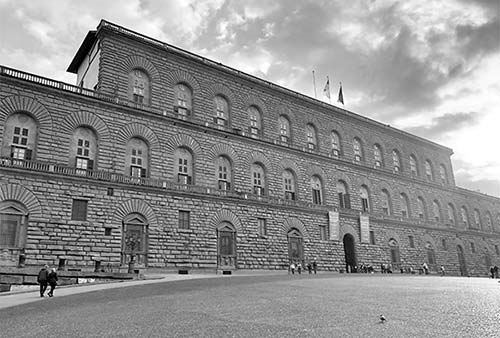
Cost and Hours: The €16 Pitti Palace ticket covers the Palatine Gallery, Royal Apartments, Treasury of the Grand Dukes (silver museum), Museum of Costume and Fashion, and Gallery of Modern Art; open Tue-Sun 8:15-18:50, closed Mon, last entry one hour before closing. The €10 Boboli Garden ticket covers the Boboli and Bardini Gardens as well as the Porcelain Museum located in the garden; open daily June-Aug 8:15-19:00, April-May and Sept-Oct until 18:30, Nov-March until 16:30; closed first and last Mon of each month, last entry one hour before closing. An €8 audioguide explains the sprawling palace (+39 055 238 8614, www.uffizi.it).
Visiting the Museum: In the Palatine Gallery you’ll walk through one palatial room after another, with walls sagging with masterpieces by 16th- and 17th-century masters, including Titian and Raphael. The Pitti’s Raphael collection is the second-biggest anywhere—the Vatican beats it by one. Use the information folders in each room to help find the featured paintings.
The collection is all on one floor. To see the highlights, walk straight down the spine through a dozen or so rooms. After the Palatine Gallery, the route flows naturally into the even more lavish rooms of the Royal Apartments. These 14 rooms (of which only a few are open at any one time) are where Florence’s aristocrats lived in the 18th and 19th centuries. Each room features the style of a particular time period. Here, you get a real feel for the splendor of the dukes’ world.
The rest of Pitti Palace is skippable, unless the various sights match your interests: the Gallery of Modern Art (second floor; Romantic, Neoclassical, and Impressionist works by 19th- and 20th-century Tuscan painters), Treasury of the Grand Dukes (ground and mezzanine floors; Medici treasures from jeweled crucifixes to gilded ostrich eggs), Museum of Costume and Fashion, Porcelain Museum, and Boboli and Bardini gardens (behind the palace; enter from Pitti Palace courtyard—be prepared to climb uphill).
▲▲Brancacci Chapel (Capella Brancacci)
In the Brancacci Chapel, Masaccio created a world in paint that looked like the world we inhabit. For the first time in a thousand years, Man and Nature were frozen for inspection. Masaccio’s painting techniques were copied by many Renaissance artists, and his people—sturdy, intelligent, and dignified, with expressions of understated astonishment—helped shape Renaissance men and women’s own self-images.
Half of the chapel’s frescoes are by Masaccio, and half by either Masolino or Filippino Lippi, who completed the chapel more than 50 years later. Although Masaccio is the star, the panels by his colleagues provide a good contrast in styles.
Cost and Hours: €10; Fri-Sat and Mon 10:00-17:00, Sun from 13:00, closed Tue-Thu, reservations required; videoguide-€3, knees and shoulders must be covered, in Church of Santa Maria del Carmine on Piazza del Carmine; to reserve call +39 055 276 8224 or +39 055 276 8558, or email cappellabrancacci@musefirenze.it; www.musefirenze.it.
▲Piazzale Michelangelo
Overlooking the city from across the river (look for the huge bronze statue of David), this square has a superb view of Florence and the stunning dome of the Duomo. It’s worth the 25-minute hike, taxi, or bus ride.
An inviting café (open seasonally) with great views is just below the overlook. The best photos are taken from the street immediately below the overlook. After dark, the square is packed with school kids licking ice cream and each other. About 200 yards beyond all the tour groups and teenagers is the stark, beautiful, crowd-free, Romanesque San Miniato Church (next listing). A WC is located just off the road, halfway between the two sights.
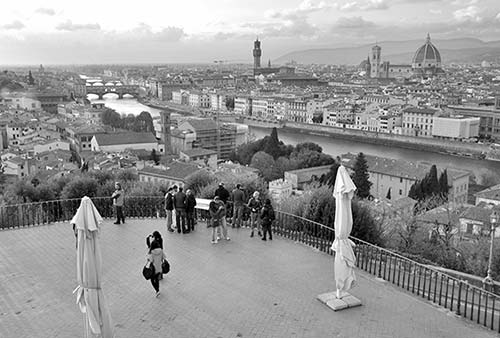
Getting There (and Back): While you can catch bus #12 (from near Piazza d’Ognissanti, can be a long ride) or a taxi up to the piazza, the walk up from the Oltrarno neighborhood of San Niccolò is popular—especially in the early evening—and not that challenging (see the map on here).
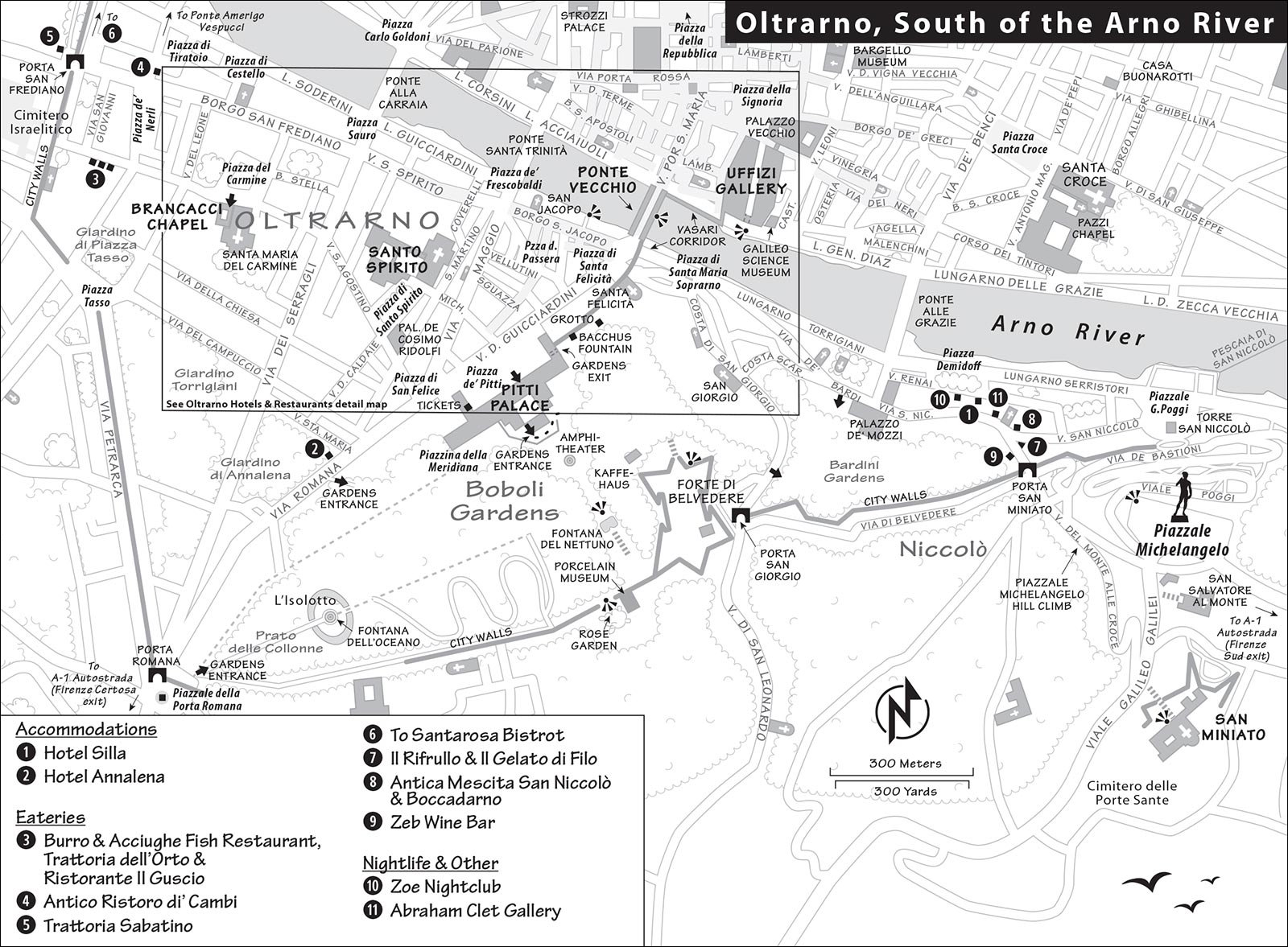
Start at the intersection of Via San Niccolò and Via San Miniato, just below Porta San Miniato (scope out the restaurants and bars here, as you’ll circle back to this spot in about an hour if you walk down). Point yourself uphill, head through the old gate, and continue until you reach a broad, terraced hill-climb to the left. Up top, Piazzale Michelangelo will be to your left, and San Miniato Church to your right.
When you’re ready to leave, the hike down is quick and enjoyable (or take bus #13). You can retrace your steps, or you can turn this walk into a loop: From the parking lot, take the ramp leading down toward Ponte Vecchio (near the replica David). At the bottom of the ramp, cross the street and continue down the pathway. You’ll cross one more street, then zigzag downhill toward the river. You are descending on the so-called Poggi ramps, developed in the late 19th century as a string of staircases, fountains, and grottos that embellishes (and stabilizes) the hillside. When you draw even with the big tower (Porta San Niccolò), turn left onto Via San Niccolò and make your way back to the group of lively cafés and restaurants where you started (for recommendations, see here).
▲▲San Miniato Church
According to legend, the martyred St. Minias—this church’s namesake—was beheaded on the banks of the Arno in AD 250. He picked up his head and walked here (this was before the #12 bus), where he died and was buried in what became the first Christian cemetery in Florence. In the 11th century, this church was built to house Minias’ remains.
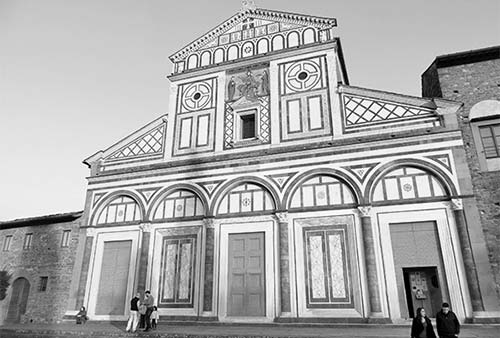
The church’s green-and-white marble facade (12th century) is classic Florentine Romanesque, one of the oldest in town. Inside you’ll find some wonderful 3-D paintings, a plush ceiling of glazed terra-cotta panels by Luca della Robbia, and an exquisite Renaissance chapel (on the left side of the nave). The highlight for me is the brilliantly preserved art in the sacristy (upstairs to right of altar, in the room on right) showing scenes from the life of St. Benedict (circa 1350, by a follower of Giotto). Drop €2 into the electronic panel in the corner to light the room for five minutes. The evening vesper service with the monks chanting in Latin offers a meditative worship experience—a peaceful way to end your visit.
Cost and Hours: Free, daily 9:30-13:00 & 15:00-19:00, closed sporadically for special occasions, +39 055 234 2731, www.sanminiatoalmonte.it.
Getting There: It’s about 200 yards above Piazzale Michelangelo. Follow the walking directions in the Piazzale Michelangelo listing earlier, or take bus #12 to the San Miniato al Monte stop (hop off and hike up the grand staircase); bus #13 takes you back down the hill.
Gregorian Chants: These are held Mon-Sat at 18:00 and 18:30, and Sun at 17:30—but as the schedule is subject to change, double-check with any TI, the church’s website, or call ahead.
Shopping in Florence
Florence may be one of Europe’s best shopping towns—it’s been known for its sense of style since the Medici days. Smaller stores are generally open about 9:00-13:00 and 15:30-19:30, usually closed on Sunday, often closed on Monday (or at least Monday morning), and sometimes closed for a couple of weeks around August 15. Bigger stores have similar hours, without the afternoon break.
For authentic, locally produced wares, look for shops displaying the Esercizi Storici Fiorentini seal, with a picture of the Palazzo Vecchio’s tower. At these city-endorsed “Historical Florentine Ventures,” you may pay a premium, but quality is assured (for a list of shops, see www.esercizistoricifiorentini.it).
Department Stores
Department store chains include the upscale La Rinascente (daily 10:00-20:30, on Piazza della Repubblica); and OVS, a discount clothing chain (daily 10:00-19:30, near train station at intersection of Via Panzani and Via del Giglio).
Best Shopping Areas
San Lorenzo Market: The market stalls between the Basilica of San Lorenzo and Mercato Centrale are no secret—this is ground zero for tourists seeking cheap, cut-rate souvenirs, lower-end leather, clothing, T-shirts, and handbags. It’s a fun area to browse and bargain (just hang onto your wallet—this is pickpocket central). You’ll find many of the stalls in the narrow streets around Mercato Centrale (daily 9:00-19:00, closed Mon in winter).
Upscale Boutique Streets: The entire area between the river and the cathedral is busy with inviting boutiques that show off ritzy Italian fashions. The highest concentration of shops is along Via dei Calzaiuoli, Via de’ Tornabuoni, and the streets in between (particularly around Piazza della Repubblica). For a fun and productive shopping stroll, trace a triangle from Via del Parione, Via della Vigna Nuova, and Via de’ Tornabuoni. You’ll get a good look at high fashion, one-of-a-kind boutiques, craft workshops, and collectibles.
Borgo Santi Apostoli: This narrow street, just one short block up from Ponte Vecchio, hosts boutiques, designer handbag shops, antique and art stores, and jewelers.
Via Pietrapiana and Borgo La Croce (Oltrarno): To get off the beaten path, head to the Oltrarno neighborhood, just a short walk across the river. You’ll find small artisan shops with handmade furniture, jewelry, leather shoes, and pottery. In unassuming workshops, craftsmen breathe new life into antique pieces and artworks using age-old techniques. Walk about 10 minutes northeast of Santa Croce, to the axis formed by Via Pietrapiana, Borgo La Croce, and Via Gioberti. This authentic-feeling area isn’t about artsy souvenirs, but about getting a glimpse at what Florentines buy for day-to-day life.
Sleeping in Florence
Most of my recommended hotels are grouped in central Florence. If arriving by train, you can either walk (usually around 10-20 minutes) or take a taxi (roughly €7-10) to reach most of my recommended accommodations. For some travelers, short-term, Airbnb-type rentals can be a good alternative; search for places in my recommended hotel neighborhoods.
Book any accommodations well in advance, especially if you’ll be traveling during peak season or if your trip coincides with a major holiday or festival (see the appendix). Note, though, that Florence can be busy any time of year.
Beware of Bugs: Florence is notorious for its mosquitoes. If your hotel lacks air-conditioning, request a fan and don’t open your windows, especially at night. Many hotels furnish a small plug-in bulb (zanzariere)—usually set in the ashtray—that helps keep the bloodsuckers at bay. If not, you can purchase one cheaply at any pharmacy.
NEAR THE DUOMO
$$$$ Palazzo Niccolini al Duomo, one of five elite Historic Residence Hotels in Florence, is run by the Niccolini di Camugliano family. The lounge (where tea and pastries are offered every afternoon) is palatial, but the six rooms and seven suites, while splendid, vary in size and are only worth the splurge for an up-close Duomo view. If you have the money and want a Florentine palace to call home, this can be a good bet (RS%, family rooms, elevator, air-con, pay parking—reserve ahead, Via dei Servi 2, +39 055 282 412, www.niccolinidomepalace.com, info@niccolinidomepalace.com).
$$$$ Hotel Duomo’s 24 rooms are modern and comfortable enough, but you’re paying for the location and the views—the Duomo looms like a monster outside the hotel’s windows. If staying here, you might as well spring the extra €20 or so for a “classic” room with a view (RS%, air-con, historic elevator, Piazza del Duomo 1, fourth floor, +39 055 219 922, www.hotelduomofirenze.it, info@hotelduomofirenze.it, Paolo, Gilvaneide, and Federico).
$$$ Soggiorno Battistero rents seven simple yet pristine rooms, most with great views, overlooking the Baptistery and the Duomo square. Request a view or a quieter room in the back when you book, but keep in mind there’s always some noise in the city center. It’s a minimalist place with no public spaces or full-time reception, but the location is great (RS%—use code “Rick_Steves_Discount,” air-con, elevator, Piazza San Giovanni 1, third floor, +39 055 295 143, www.soggiornobattistero.it, info@soggiornobattistero.it, Francesco).
$$$ Residenza Giotto B&B offers a well-priced chance to stay on Florence’s upscale shopping drag, Via Roma. Occupying the top floor of a 19th-century building, this place has six bright rooms (three with Duomo views) and a terrace with knockout views of the Duomo’s tower. Reception is generally open Mon-Sat 9:00-17:00 and Sun 9:00-13:00; let them know your arrival time in advance (RS%, air-con, elevator, Via Roma 6, +39 055 214 593, www.residenzagiotto.it, info@residenzagiotto.it).
$$ La Residenza del Proconsolo B&B has six older-feeling rooms a minute from the Duomo (three rooms have Duomo views). The place lacks public spaces, but the rooms are quite large and nice—perfect for eating breakfast, which is served in your room (extra cost for slightly larger “deluxe” with view, air-con, no elevator, Via del Proconsolo 18 black, +39 055 264 5657, www.proconsolo.com, info@proconsolo.com, Susie).
NORTH OF THE DUOMO
Near the Accademia
$$$$ Hotel Morandi alla Crocetta, a former convent, envelops you in a 16th-century cocoon. Located on a quiet street with 12 rooms, its period furnishings, squeaky clean parquet floors, and original frescoes (in the chapel bedroom) take you back a few centuries and up a few social classes. A few rooms come with lovely patios (family rooms, air-con, elevator, pay parking, a block off Piazza Santissima Annunziata at Via Laura 50, +39 055 234 4748, www.hotelmorandi.it, welcome@hotelmorandi.it, well-run by Rachele, Maurizio, Rolando, and Cristiano).
$$$ Residenza dei Pucci rents 13 pleasant rooms (each one different) spread over three floors (with no elevator). The appealing decor, a mix of traditional fabrics and aristocratic furniture, makes this place feel upscale for the price range (RS%—use code “RICK,” family rooms, no breakfast, confirm reception hours when you book, air-con, Via dei Pucci 9, +39 350 074 7676, www.residenzadeipucci.com, info@residenzadeipucci.com, Gaia and Pietro).
North of Mercato Centrale
After dark, this neighborhood can feel a little deserted, but I’ve never heard of anyone running into harm here. It’s a short walk from the train station and a stroll to all the sightseeing action. While workaday, it’s practical, with plenty of good budget restaurants and markets nearby.
$$$ Relais & Maison Grand Tour has eight cozy, eclectic, and thoughtfully appointed rooms on a nondescript street between the train station and the Accademia. The spacious suites and one three-bedroom apartment come with a garden ambience. Friendly Ulrike, from Germany, takes good care of her guests (RS%, family suites; includes breakfast voucher for the corner bar, for “green” rate, ask to skip breakfast and cleanings; air-con, Via Santa Reparata 21, +39 055 399 5223, www.florencegrandtour.com, info@florencegrandtour.com).
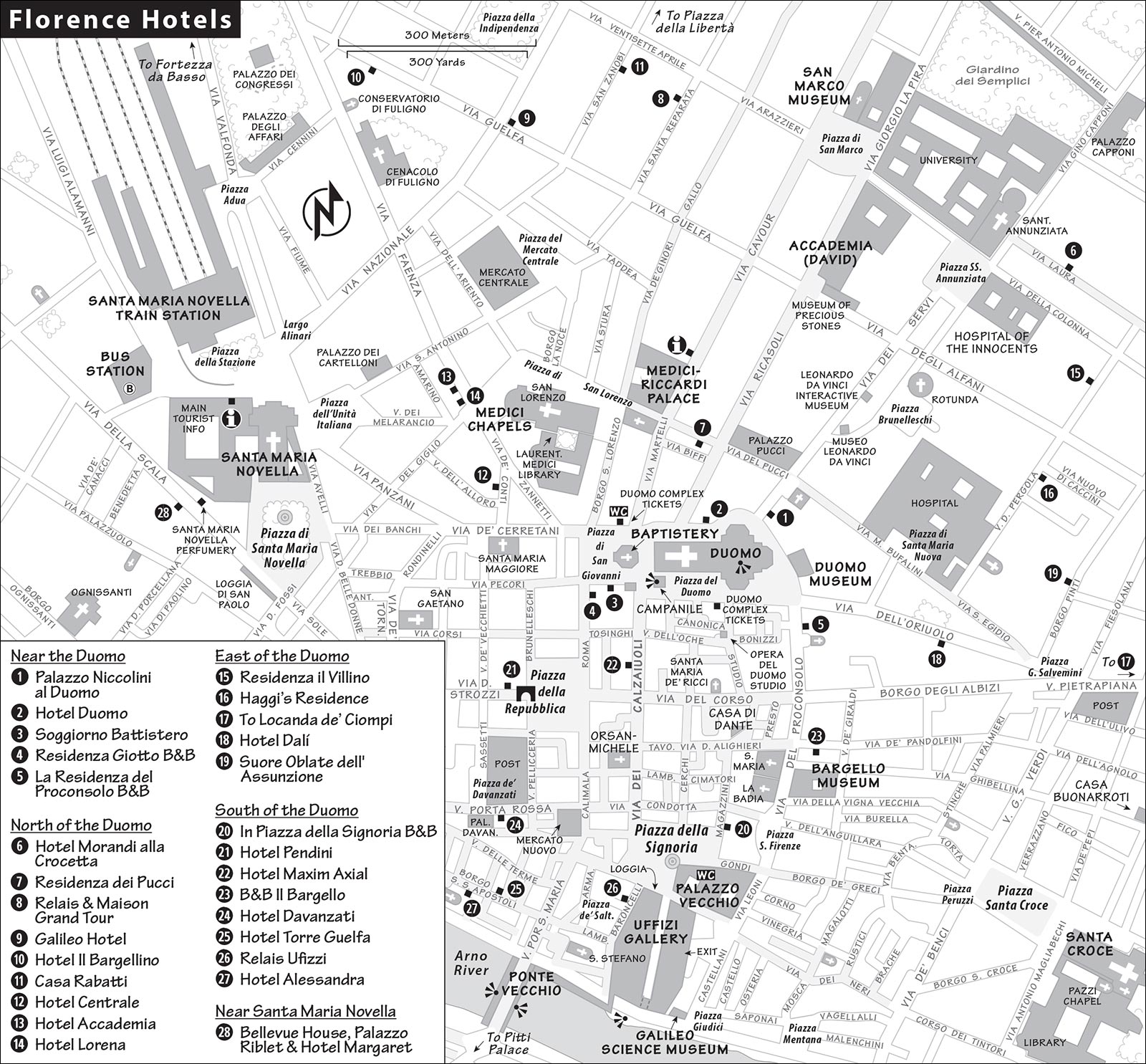
$$$ Galileo Hotel, located on a busy street, is a comfortable, old-school business hotel with 31 rooms and dated bathrooms (RS%, family rooms, quadruple-paned windows shut out street noise, air-con, elevator, Via Nazionale 22a, +39 055 496 645, www.galileohotel.it, info@galileohotel.it).
$$ Hotel Il Bargellino, run by Bostonian Carmel and her Italian husband Pino, is a good-value place with an old-time convivial atmosphere. In a residential neighborhood within walking distance of the center, the 10 summery rooms are decorated with funky antiques and Pino’s modern paintings. Guests enjoy relaxing and chatting on the big, breezy, momentum-slowing terrace adorned with plants and lemon shrubs (RS%, cheaper rooms with shared bath, no breakfast served but espresso machine available in rooms, some rooms have air-con, north of the train station at Via Guelfa 87, +39 055 238 2658, www.ilbargellino.com, carmel@ilbargellino.com).
$ Casa Rabatti, a great option for budget travelers, rents four simple and clean rooms (RS%, cheaper rooms with shared bath, family rooms, cash only but secure reservation with credit card, no breakfast, air-con, communal kitchen, 5 blocks from station at Via San Zanobi 48 black, +39 338 153 4159, www.casarabatti.it, info@casarabatti.it). Sergio also rents two modern $$ apartments with kitchenettes and access to a tranquil garden—ideal for longer stays.
Near the Medici Chapels
The mostly pedestrianized Via Faenza is the spine of this neighborhood, with lots of tourist services.
$$$$ Hotel Centrale is indeed central, just a short walk from the Duomo. The 35 spacious but overpriced rooms—with a tasteful mix of old and new decor—are over a businesslike conference center (air-con, elevator, Via dei Conti 3, check in at big front desk on ground floor, +39 055 215 761, www.hotelcentralefirenze.it, info@hotelcentralefirenze.it, Roberto).
$$$$ Hotel Accademia has 18 quiet rooms on a pedestrianized street in a convenient location. The modern, sizeable rooms cluster around a sunny courtyard (RS%, family rooms, air-con, no elevator, Via Faenza 7, +39 055 290 993, www.hotelaccademiafirenze.com, info@hotelaccademiafirenze.com, Tea and Francesca).
$ Hotel Lorena, just across from the Medici Chapels, has 19 simple, well-worn rooms (six with shared bathrooms) and a tiny lobby. Though it feels a little like a youth hostel, it’s well located, inexpensive, and run with care by the Galli family (air-con, elevator from first floor, Via Faenza 1, +39 055 282 785, www.hotellorena.com, info@hotellorena.com).
EAST OF THE DUOMO
While convenient to the sights and offering a good value, these places are mostly along nondescript urban streets, lacking the grit, charm, or glitz of some of my other recommended neighborhoods.
$$$ Residenza il Villino has 10 charming rooms and a picturesque, peaceful little courtyard. As it’s in a “little villa” (as the name implies) set back from the street, this is a quiet refuge from the bustle of Florence (RS%, family rooms, air-con, parking available, just north of Via degli Alfani at Via della Pergola 53, +39 055 200 1116, www.ilvillino.it, info@ilvillino.it, friendly Barbara).
$$$ Haggi’s Residence, once a convent and today part of the owner’s extensive home, is a classy B&B, with five chic, romantic, and spacious rooms, antique furnishings, and historic architectural touches (RS%, family room, air-con, closed Dec-Feb, Via della Pergola 42, +39 351 818 7488, www.pergola42.com, info@pergola42.com, suave Alex).
$$ Locanda de’ Ciompi, overlooking the inviting Piazza dei Ciompi in a lively neighborhood, is just right for travelers who want to feel like a part of the town. Mira and Francesco have five attractive rooms that are tidy, lovingly maintained, and a good value (RS%, cheaper room with private bath across the hall, includes breakfast at nearby bar, air-con, 8 blocks behind the Duomo at Via Pietrapiana 28 black—see “Florence” map on here, +39 055 263 8034, https://locandadeciompi.it, info@locandadeciompi.it).
$$ Hotel Dalí has 10 cheery, worn rooms in a nice location for a great price. Samanta and Marco, who run this guesthouse with a charming passion and idealism, are a delight to know (request one of the quiet and spacious rooms facing the courtyard when you book, cheaper rooms with shared bath available, nearby apartments sleep 2-6 people, no breakfast, fans but no air-con, elevator, free parking, 2 blocks behind the Duomo at Via dell’Oriuolo 17 on the second floor, +39 055 216 680, www.hoteldali.com, hoteldaliflorence@gmail.com).
$$ Suore Oblate dell’ Assunzione, run by the Oblate Sisters of the Assumption, is an institutional 42-room hotel in a Renaissance building with a dreamy garden, great public spaces, appropriately simple rooms, and a quiet, prayerful ambience (family rooms, single beds only, air-con, elevator, Borgo Pinti 15, +39 055 234 6291, www.oblate.it, info@oblate.it).
SOUTH OF THE DUOMO
Between the Duomo and Piazza della Signoria
Buried in the narrow, characteristic lanes in the very heart of town, these are the most central of my accommodation recommendations (and therefore a little overpriced). While this location is worth the extra cost for many, nearly every hotel in this chapter can be considered central given Florence’s walkable, essentially traffic-free core.
$$$$ In Piazza della Signoria B&B, in a stellar location overlooking Piazza della Signoria, is peaceful, refined, and homey. The service is friendly and efficient. The nine rooms are beautifully decorated; the priciest ones have genuine views of the square (from other rooms, views are peekaboo). Guests enjoy socializing at the big, shared breakfast table (RS%, 2 family apartments, air-con, tiny elevator, Via dei Magazzini 2, +39 055 239 9546, mobile +39 348 321 0565, www.inpiazzadellasignoria.com, info@inpiazzadellasignoria.com).
$$$$ Hotel Pendini, with three stars and 44 plush, flowery rooms, fills the top floor of a grand building overlooking Piazza della Repubblica. This place just feels classy; walking into the lobby is like stepping back in time. While pricey, this level of elegance makes it a good value for those looking to indulge (RS%, “deluxe” rooms come with square view and after-hours liveliness, family rooms, air-con, elevator, near the arch at Via Strozzi 2, +39 055 211 170, www.hotelpendini.it, info@hotelpendini.it).
$$$ Hotel Maxim Axial, well run by the Maoli family since 1981, has 39 straightforward rooms spread over three floors in a good location on the main pedestrian drag. Its painting-lined halls and cozy lounge have old Florentine charm. More expensive “comfort” and “deluxe” rooms are renovated and worth the splurge, but budget travelers can choose an “economy” room on the fourth floor—which is a walk-up from the third floor (RS%—use code “RICK,” family rooms, reception on third floor, air-con, elevator, Via dei Calzaiuoli 11, +39 055 217 474, www.hotelmaximaxial.com, info@hotelmaximaxial.com, Chiara).
$$ B&B Il Bargello is a home away from home, run by friendly and helpful Canadian expat Gabriella. Hike up three long flights (no elevator) to reach six traditional rooms. Gabriella offers a cozy living room, a communal kitchenette, and an inviting rooftop terrace with close-up views of Florence’s towers (RS%, fully equipped apartment across the hall sleeps up to six with one bathroom; air-con, 20 yards off Via Proconsolo at Via de’ Pandolfini 33 black, +39 055 215 330, mobile +39 339 175 3110, www.firenze-bedandbreakfast.it, info@firenze-bedandbreakfast.it).
Near Ponte Vecchio
This sleepy zone is handy to several sights and some fine shopping streets, though it’s accordingly pricey and lacks a neighborhood feel of its own.
$$$$ Hotel Davanzati, bright and shiny with artistic touches, has 26 cheerful rooms with all the comforts. The place is a family affair, thoughtfully run by friendly Tommaso, Riccardo, and their father Fabrizio, who offer tea time, drinks, and snacks each evening at their intimate happy hour, plus lots of other extras (RS%, family rooms, free on-demand videos—including my travel shows about Italy—on your room TV, air-con, 20 steep steps to the elevator, handy room fridges, next to Piazza Davanzati at Via Porta Rossa 5—easy to miss so watch for low-profile sign above the door, +39 055 286 666, www.hoteldavanzati.it, info@hoteldavanzati.it).
$$$$ Hotel Torre Guelfa has grand public spaces and is topped by a fun medieval tower with a panoramic rooftop terrace (72 stairs take you up—and back 720 years). Its 31 pricey rooms vary wildly in size and furnishings, but most come with the noise of the city center. Room 315, with a private terrace, is worth reserving several months in advance (RS%, family rooms, air-con, elevator, a couple of blocks northwest of Ponte Vecchio, Borgo SS. Apostoli 8, +39 055 239 6338, www.hoteltorreguelfa.com, info@hoteltorreguelfa.com, Niccolo).
$$$$ Relais Uffizi is a modern, upscale hotel offering 15 classy rooms tucked away down a tiny alley off Piazza della Signoria. The cocktail lounge has a huge window overlooking the action in the piazza—a unique view (family rooms, air-con, elevator; official address is Chiasso del Buco 16—from the square, go down tiny Chiasso de Baroncelli lane—right of the loggia—and after 50 yards turn right through the arch and look for entrance on your right; +39 055 267 6239, www.relaisuffizi.it, info@relaisuffizi.it).
$$$ Hotel Alessandra is a tranquil and sprawling place, occupying part of a 16th-century building with 30 big, old-school rooms with modern bathrooms and a tiny Arno-view terrace (family rooms, air-con, 30 steps to the elevator, Borgo SS. Apostoli 17, +39 055 283 438, www.hotelalessandra.com, info@hotelalessandra.com; Anna, son Andrea, and spunky Monti). Their annex across the street, Residenza Alessandra, is more contemporary and a good option for families or small groups (apartments sleep up to 4 people).
NEAR SANTA MARIA NOVELLA
These fine, charming little budget options are around the corner from Santa Maria Novella, near the train station.
$$ Bellevue House is a third-floor oasis of tranquility, with six spacious, old-fashioned rooms flanking a long, mellow-yellow lobby. It’s a peaceful home away from home, thoughtfully run by the Michel family (RS%, family rooms, no breakfast, air-con, elevator, Via della Scala 21, +39 055 260 8932, www.bellevuehouse.it, info@bellevuehouse.it; Luciano, Susan, and Alessandro). On a lower floor, their other property, $$ Palazzo Riblet, offers three upscale rooms (one with a private terrace) with frescoes and elegant furnishings (+39 055 260 8932, www.palazzoriblet.it, info@palazzoriblet.it).
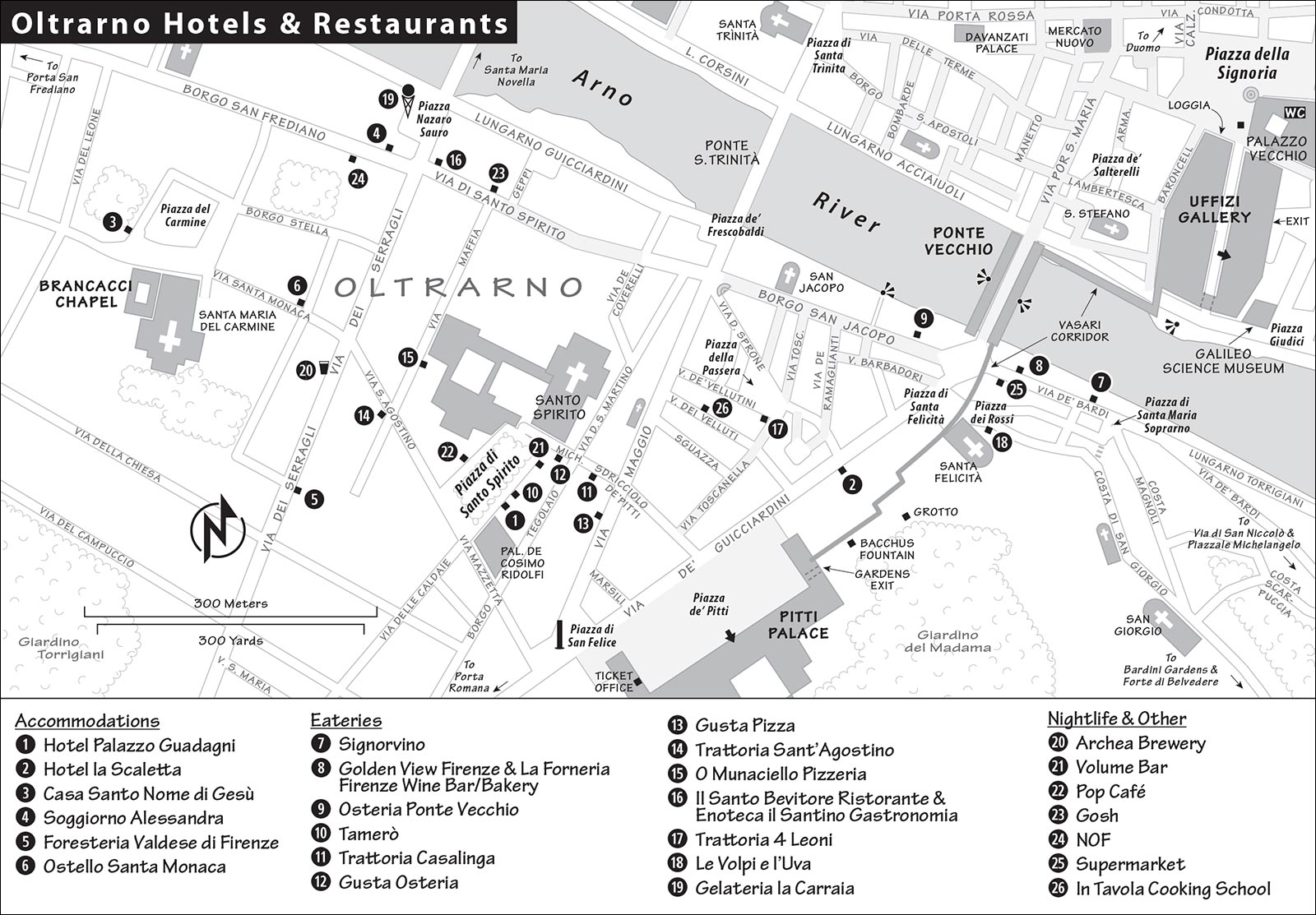
$$ Hotel Margaret offers seven tidy, simple rooms but no public lounge or breakfast (RS%, some cheaper rooms with shower but toilet down the hall, air-con, Via della Scala 25, +39 055 210 138, www.hotel-margaret.it [URL inactive], info@hotel-margaret.it; Francesco and Graziano).
THE OLTRARNO
$$$$ Hotel Palazzo Guadagni, perched high above Piazza Santo Spirito, is a romantic, Grand Tour retreat from modern Florence. The 15 refined rooms are spacious, with antique furnishings and frescoes. While the ample, chandeliered public spaces are pleasant, the highlight is the panoramic wrap-around loggia/terrace with comfy, stay-awhile seating and lovely views (family rooms, air-con, elevator, Piazza Santo Spirito 9, +39 055 265 8376, www.palazzoguadagni.com, info@palazzoguadagni.com).
$$$$ Hotel la Scaletta has 36 pricey, sleek rooms hiding in a convoluted floor plan. Their fabulous rooftop terrace overlooks the Boboli Gardens and is a nice place for a drink (RS% when you pay with cash, family rooms, breakfast extra, air-con, elevator, Via de’ Guicciardini 13, +39 055 283 028, www.hotellascaletta.it, info@hotellascaletta.it, Sara).
$$$ Hotel Silla is a classic three-star hotel with 36 cheery rooms. Rooms with river views are modern and sleek, while rooms along the back are more spacious and classic. The breezy terrace faces the Arno River, overlooking a small park near the San Niccolò neighborhood. There’s free coffee and tea for guests in the late afternoon. The surroundings can be a bit noisy (RS%—use promo code “RICK,” air-con, elevator, self-service washing machine, Via dei Renai 5, for location see map on here, +39 055 234 2888, www.hotelsilla.it, hotelsilla@hotelsilla.it; Laura, Chiara, Massimo, Ravin, Stefano, and Salvo).
$$ Hotel Annalena, on the third floor of a faded palazzo, is a bit tatty with small bathrooms, but it’s in a quiet location near the Pitti Palace. Many of its 19 tidy rooms (some with terraces) overlook a private park next door (family rooms, bar/lounge, air-con, no elevator, laundry service, opposite the side entrance to the Boboli Gardens at Via Romana 34, for location see map on here, +39 055 222 402, www.annalenahotel.com, reception@annalenahotel.com).
$$ Casa Santo Nome di Gesù is a grand convent whose sisters—Franciscan Missionaries of Mary—are thankful to rent 24 simple but spacious rooms to tourists. Staying in this 15th-century palace, you’ll be immersed in the tranquil atmosphere created by a huge, peaceful garden, generous and prayerful public spaces, and smiling nuns. It’s a good value and understandably popular—it’s best to reserve a couple of months in advance (family rooms, air-con, elevator, memorable breakfast room, Piazza del Carmine 21, +39 055 213 856, www.fmmfirenze.it, info@fmmfirenze.it).
$ Soggiorno Alessandra has four bright and comfy rooms, all with en suite bathrooms. Because of its double-paned windows, you’ll hardly notice the traffic noise (family rooms, includes basic breakfast in room, air-con, no elevator; there’s no formal reception, so let them know what time you’ll arrive; just past the Carraia Bridge at Via Borgo San Frediano 6, +39 055 290 424, www.soggiornoalessandra.it, info@soggiornoalessandra.it, Alessandra).
$ Foresteria Valdese di Firenze, with 40 clean and functional rooms, is located in a 17th-century palace overlooking a beautiful garden courtyard. The complex also houses the Instituto Gould, which helps socially disadvantaged kids, and proceeds raised from renting rooms help fund that important work (extra for quieter garden rooms, air-con, elevator reaches most rooms, family rooms, breakfast extra, Via dei Serragli 49, +39 055 212 576, www.firenzeforesteria.it, info@firenzeforesteria.it). The reception desk closes at lunchtime—confirm hours before you arrive. After-hours check-in is possible with advance notice.
Hostel: ¢ Ostello Santa Monaca is a well-run, institutional-feeling hostel a long block east of the Brancacci Chapel. As clean as its guests, it attracts a young backpacking crowd (2:00 in the morning curfew, air-con, bike rental, pay laundry, Via Santa Monaca 6, +39 055 268 338, www.ostellosantamonaca.com, info@ostellosantamonaca.com).
Eating in Florence
The old center of Florence is dominated by tourism. Locals still keep restaurants busy at lunch, but with the city’s many Airbnb guests and city-center traffic restrictions, the hometown clientele tends to retreat away from downtown in the evening. This makes it tough to find a “nontouristy” place for dinner. Still, the competition is fierce, and you’ll find plenty of fine options and good values even in the tourist zone. For the best experience and better quality meals, hike to places further out and across the river in the Oltrarno.
EATING TIPS
The sightseer’s reality is to eat a quick and simple lunch and spend more time and money at a well-chosen and more memorable restaurant for dinner. Keep lunch fast and simple at one of Florence’s countless sandwich shops and stands, pizzerias, or self-service cafeterias.
You’ll find a unique range of sandwich options. In addition to the basic panino (usually on a baguette), crostini (open-faced, toasted baguette), and semel (big, puffy roll), you’ll see places advertising schiaccata (sandwich made with a “squashed,” focaccia-like bread). Florence is also peppered with carts selling tripe sandwiches—a prized local specialty.
Picnicking is easy. You can picnic your way through Mercato Centrale, near the Basilica of San Lorenzo. You’ll also find good supermercati throughout the city. I like the classy Sapori & Dintorni markets (run by Conad), with branches near the Duomo (Borgo San Lorenzo 15 red) and just over Ponte Vecchio in the Oltrarno (Via de Bardi 45). Carrefour Express is another handy grocery chain (there’s one around the corner from the Duomo Museum at Via dell’Oriuolo 66).
Reservations Recommended: Florence is so crowded that reservations are smart for any serious dinner. Most restauranteurs speak English and are used to tourists. It’s quick and easy to call ahead and book a table. Without reservations, have dinner early or very late.
MERCATO CENTRALE AND NEARBY
In Mercato Centrale
Florence’s Industrial Age steel-and-glass Mercato Centrale (Central Market) is a fun-to-explore edible wonderland of vendors selling meat, fish, produce, and other staples to a mostly local clientele, plus some lunch-only food counters.
$ Ground Floor: The market zone, with lots of raw ingredients and a few humble food counters, is open only through lunchtime (Mon-Fri 7:00-14:00, Sat until 17:00, closed Sun). Buy a picnic of fresh mozzarella cheese, olives, fruit, and crunchy bread to munch on the steps of the nearby Basilica of San Lorenzo. Merchants are often happy to give samples. The fancy deli, Perini, is famous for its quality products and enticing displays. The adjacent Pasta Perini stand is good for a quick bowl of pasta. For a simple sit-down meal, head for the venerable Nerbone in the Market. It’s generally mobbed by shoppers and workers who crowd up to the bar to grab inexpensive plates, then find a stool at cramped shared tables nearby (lunch menu served Mon-Sat 12:00-14:00, cash only, on the side closest to the Basilica of San Lorenzo). Its less-famous sisters, nearby, have better seating and fewer crowds.
$$ Upstairs: The upper floor is a touristy and jam-packed food court (daily 10:00-24:00) with counters selling pizza, pasta, fish, meat, salumi, lampredotto, wine, and so on. Buy what you like at any counter and grab a table (drinks will be brought to your table). Even if you’re not eating, it’s fun to explore the many options. While the food court can be a zoo at lunch, it’s often more relaxed at dinnertime.
Near Mercato Centrale
A huge array of eateries is within a couple of blocks of the market. Each has its own distinct vibe, so scout around to find your favorite.
$ Casa del Vino, Florence’s oldest operating wine shop, is a crowded little bar offering an unforgettable stand-up lunch experience with a selection of wine by the glass from 20 different bottles (prices are chalked onto each opened bottle behind the cashier). Owner Gianni, a sommelier whose family has run the Casa for 70 years, is a class act. Pair a glass of wine with a sandwich, crostini, or €7 “Tuscany appetizer plate” of meat and cheese for a great little lunch. During busy times, it’s a mob scene—you’ll munch and sip standing outside amongst workers on a lunch break. But early or late you can actually connect with Gianni (Mon-Thu 10:00-15:30, Fri-Sat until 20:00; closed Sun year-round, Sat in summer, and Aug; Via dell’Ariento 16 red, +39 055 215 609).
$$ Pepò, a colorful and charmingly unpretentious space, is tucked just around the corner from the touristy glitz on Piazza del Mercato Centrale. The short menu offers simple but well-prepared Florentine classics such as ribollita and pollo alla cacciatora—chicken cacciatore (daily 12:00-14:30 & 19:00-22:30, Via Rosina 4 red, +39 055 283 259).
$$$ Trattoria da Garibaldi is a big, practical place serving traditional Tuscan dishes and pizzas with a sprawling interior and delightful tables on the square (daily 11:00-23:00, Piazza del Marcato Centrale 38 red, +39 055 212 267).
$$ Trattoria Sergio Gozzi is your classic neighborhood lunch-only place, serving hearty, traditional Florentine fare to market-goers since 1915—long before the tourist crush of today. The handwritten menu is limited and changes daily, and service can be hectic, but it’s understandably a local favorite (Mon-Sat 12:00-15:00, closed Sun, Piazza di San Lorenzo 8, +39 055 281 941).
$$ Trattoria la Burrasca is a rustic time-warp, where a dozen rickety tables cluster under a single vault. Elio and his staff offer a traditional menu featuring fine steak and good-value seasonal specials—both Sicilian and Tuscan (Tue-Sat 12:00-15:00 & 19:00-22:30, closed Sun-Mon, Via Panicale 6, north corner of Mercato Centrale, +39 055 215 827).
$ Simbiosi Organic Pizza and Lovely Food is a happy little pizzeria under a medieval vault with a young crew, open fire, and healthy, organic energy (daily 18:30-23:00, good salads, craft beer, Via de’ Ginori 56 red, +39 055 064 0115). Their similarly named pasta sister is next door at #58.
$$ Trattoria lo Stracotto is an inviting eatery with a modern interior and good outdoor seating, where you’ll enjoy good-value, standard Tuscan dishes in the shadow of the Medici Chapels (daily 12:00-15:00 & 18:00-22:30, Piazza di Madonna degli Aldobrandini 17, +39 055 230 2062, Francesco).
$$$ Ristorante Cafaggi fills a bright yet low-energy space on a drab street between the Accademia and Mercato Centrale. With a vaguely 1950s vibe, the place emphasizes their generations-old passion for Florentine food, serving up ribollita (hearty Tuscan soup), osso buco, and tripe. It’s been family-run since 1922 (Mon-Sat 12:30-15:00 & 19:00-22:00, closed Sun and several weeks in Aug, Via Guelfa 35 red, +39 055 294 989).
$$$ Trattoria la Gratella, near my recommended hotels north of the center, serves solid Tuscan cuisine to a mostly local crowd. The crowded front room gives way to a sprawling interior and an outdoor courtyard, full of diners grilling their own bistecca alla fiorentina on mini barbeques at the table (daily 12:00-15:00 & 19:00-23:00, Via Guelfa 81 red, +39 055 211 292).
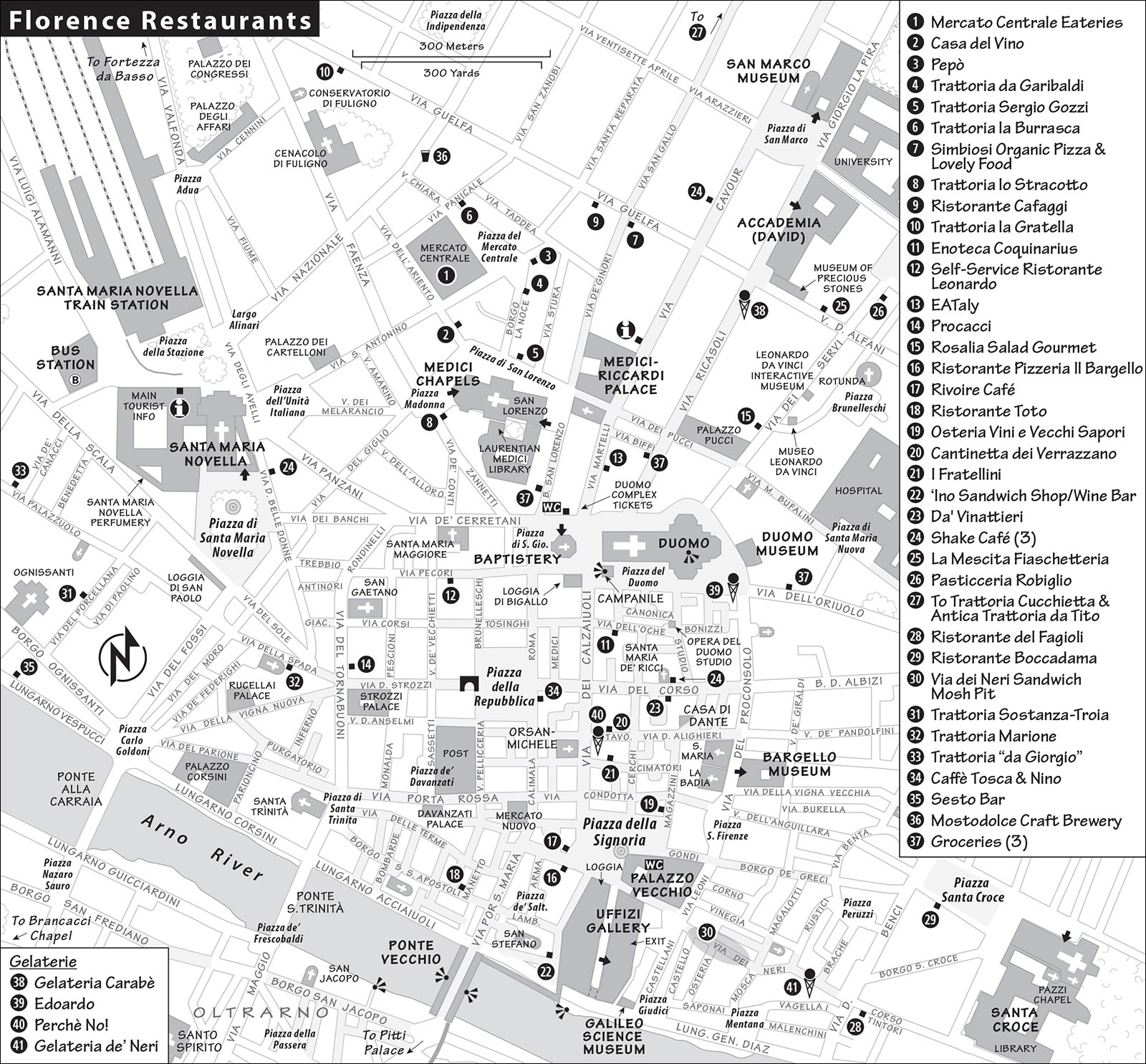
AROUND THE DUOMO
$$ Enoteca Coquinarius feels as welcoming as someone’s cool and spacious living room or library. It’s a relaxed, hip place with a slow-food ethic, tasty salads and pastas, and a nice selection of wines by the glass (daily 12:00-15:30 & 19:00-22:30, a few steps from the Duomo workshop at Via delle Oche 11 red, +39 055 230 2153).
$$$ Ristorante Natalino is worth the short walk for a memorable dinner. It’s a family-run fixture in its neighborhood with outdoor seating on a characteristic corner. The place is known for its homemade pasta, bistecca alla fiorentina, and classic Tuscan dishes (daily 12:00-14:30 & 19:00-22:30, Borgo degli Albizi 17 red, for location see the “Florence” map on here, +39 055 289 404).
$ Self-Service Ristorante Leonardo is a quick, cheap, air-conditioned, and handy cafeteria just a block from the Duomo. While it’s no-frills and stuck in the 1970s, the food is better than many table-service eateries in this part of town. Stefano and Luciano run the place with enthusiasm and free pitchers of tap water (lots of vegetables, daily 11:45-14:45 & 18:45-21:45, upstairs at Via Pecori 11, +39 055 284 446).
$$ EATaly, a slick, modern space a half-block from the Duomo, is an outpost of a chain of foodie mini malls located in big Italian cities (as well as in a few major US cities). Along with a grocery store for top-end Italian ingredients, plenty of edible gifts, and kitchen gadgets, it has a bright, modern dining area in the back serving pastas, pizzas, salads, and secondi to tourists (daily 10:00-22:30, Via de’ Martelli 22 red, +39 055 015 3601).
$$$ Procacci, right on Florence’s most genteel boutique-browsing street, is upscale and posh. This wine-and-cocktail bar, with a swanky, 1885 atmosphere, specializes in pungent truffle-scented ingredients: cheap mini panini and €20 sampler plates of salumi and cheeses. They have a small lunch menu of pasta, salads, and sandwiches. There’s no dinner menu, but their tiny sandwiches are always available. Paired with an €8 glass of wine, a bite here makes an elegant light meal (daily 10:00-21:00, Via Tornabuoni 64 red, +39 055 211 656).
$ Rosalia Salad Gourmet is a quick, build-your-own-salad spot behind the Duomo. Eat in or take out a salad bowl, veggie wrap, smoothie, or fresh fruit juice (daily 8:00-20:00, Via dei Servi 37, +39 320 706 9331).
ON OR NEAR PIAZZA DELLA SIGNORIA
Piazza della Signoria, the scenic square facing the Palazzo Vecchio, is ringed by beautifully situated yet touristy eateries serving overpriced, forgettable food with an unforgettable view.
$$$ Ristorante Pizzeria il Bargello is a good choice if you want to eat outdoors on Florence’s main square with a view of the Palazzo Vecchio. It’s a happy, family-run place with good salads, pastas, and pizzas (Tue-Sun 11:30-22:30, closed Mon, Piazza della Signoria 4 red, +39 055 214 071, Mimmo).
$$$ Rivoire Café is famous for its fancy desserts and thick hot chocolate (€7). A bowl of pasta or a salad—when enjoyed at the best view tables on the square—can be a worthwhile experience. Their delightful bar is perfectly affordable, and drinks often come with fine aperitivo munchies (daily 8:00-24:00, +39 055 214 412).
$$ Ristorante Toto is a simple, fun, traditional eatery with a spacious dining hall serving classic Tuscan plates at decent prices. The focus is on steak, homemade pasta, and pizza (Thu-Tue 12:00-15:00 & 19:00-22:00, closed Wed, indoor seating only, tucked away two blocks from the Ponte Vecchio at Borgo SS. Apostoli 6 red, +39 055 212 096).
$$ Osteria Vini e Vecchi Sapori is a colorful eatery—tight, tiny, and with attitude. They serve Tuscan food—like pappardelle with duck—from a fun, accessible menu of delicious pastas and secondi. For dessert, Tommaso promises a free Vin Santo and cantucci for readers with this book (Mon-Sat seatings at 12:30, 14:00, 19:30, and 21:30; closed Sun, call ahead to reserve; Via dei Magazzini 3 red, +39 055 293 045, run by Mario while wife Rosanna cooks and son Tommaso serves).
Favorite Sandwiches near Piazza della Signoria
$$ Cantinetta dei Verrazzano is an elegant wine bar serving delightful sandwich plates. Their selezione Verrazzano is a plate of four little crostini featuring breads, cheeses, and meats from the Chianti region. The tagliere di focacce, a sampler of mini focaccia sandwiches, is also fun. Add a glass of Chianti to either of these dishes to make a fine, light meal. Office workers pop in for a quick lunch, and it’s traditional to share tables. You can eat cheaper at the bar (or at the tiny stools facing it). Simply step to the back and point to a hot focacce sandwich, order a drink at the bar, and enjoy the action while you munch (Mon-Sat 8:00-15:30, closed Sun, no reservations, off Via dei Calzaiuoli, at Via dei Tavolini 18 red, +39 055 268 590).
$ I Fratellini is a literal hole-in-the-wall stand-up joint where the “little brothers” have served peasants two dozen types of sandwiches and a fine selection of wine at great prices (see list on wall) since 1875. Join the local crowd to order, then sit on a nearby curb to eat, placing your glass on the wall rack as you leave. Be adventurous with the menu (order by number: perhaps #22, cured lard aged in Carrara marble; or #19, spicy boar salami). It’s worth ordering the most expensive wine they’re selling by the glass (daily 12:00-18:00, open later on weekends, 20 yards in front of Orsanmichele Church on Via dei Cimatori, +39 055 239 6096).
$ ‘Ino Sandwich Shop/Wine Bar is a mod little spot (on a back alley between the Uffizi and Ponte Vecchio) where Alessandro and his staff serve creative sandwiches and glasses of their house wine. You’ll munch your meal while perched on a tiny, uncomfortable stool—and be glad you did. The sandwiches—arguably the best and among the most expensive in town—are easily splittable (daily 12:00-16:00, immediately behind Uffizi Gallery courtyard on Ponte Vecchio side, at Via dei Georgofili 7 red, +39 055 214 154).
$ Tripe Sandwiches in Dante’s Neighborhood: Another literal hole-in-the-wall with a tiny bar next door, Da’ Vinattieri sells traditional schiaccata sandwiches, plus trippa (tripe) and lampredotto (stomach). While it’s a hit with locals, ordering here takes an adventurous spirit (daily 11:30-19:00, next to Casa di Dante at Via Santa Margherita 4 red, +39 392 734 5773). The best place to enjoy your sandwich while people-watching is nearby on Piazza della Signoria.
NEAR THE ACCADEMIA
There are piles of cheap and practical eateries (serving pizza, sandwiches, and salads to eat in or take out) on the boring streets near David. Hungry tourists looking for a quick lunch can survey a line of economical options a block away on Piazza di San Marco and around the corner from that along Via Cavour. If picnicking, head over to the traffic-free Piazza Santissima Annunziata—the first Renaissance square in Florence, with a fountain for washing fruit and plenty of stony places to sit.
$ Shake Café, great for a quick and healthy lunch, is a modern salad bar on busy Via Cavour with spacious and inviting courtyard seating. Along with tasty salads, the menu includes veggie bowls, wraps, smoothies, and fancy juices (daily 7:00-19:00, Via Cavour 67 red). Other handy Shake locations are on Piazza Santa Maria Novella and between the Duomo and Bargello at Via del Corso 28.
$ La Mescita Fiaschetteria is a characteristic hole-in-the-wall where, since 1919, locals have been enjoying a simple menu of pastas, traditional Tuscan soups, and the daily secondi with tasty, cheap house wine. The place can either be mobbed by students or a peaceful time warp, depending on when you stop by. Mirco and Alessio are gregarious to the point of being a bit pushy...order carefully and check your bill. They serve a nice Vin Santo and cantucci dessert (daily 11:30-15:30, Via degli Alfani 70 red, +39 338 992 2640).
$$ Pasticceria Robiglio is a classy local fixture with a stately and calm dining area and a few shaded tables on the sidewalk. They have a small lunch-only menu of salads and daily pasta and secondi specials. It’s good any time for a coffee and one of their pretty pastries—famous among Florentines (café open daily 7:30-20:00, lunch served 12:00-16:00, a block toward the Duomo off Piazza Santissima Annunziata at Via dei Servi 112 red, +39 055 212 784).
Memorable Dining North of the Center
These places are away from the tourists and offer perhaps the most authentic of all. The first is a 10-minute taxi ride north of the center, and the second is just a few blocks’ walk from David.
$$$ Trattoria Cucchietta is your chance for a modern, totally local dining experience. It’s a hard-working family affair with a youthful and passionate team and a small, enticing menu filled with creative Tuscan temptations. Venturing out here, you risk having the best meal of your trip (Mon-Sat 12:00-14:30 & 19:30-22:30, closed Sun, reservations strongly recommended, 10-minute taxi ride north of the center at Via Firenzuola 15 red, +39 055 578 889, http://cucchietta.it).
$$$ Antica Trattoria da Tito, a 10-minute hike from the Accademia along Via San Gallo, is a fun-loving food party. Come here for a memorable meal with a local crowd and smart-aleck service inspired by the lovable boss, Bobo. The food is hearty and rustic, the ingredients are fresh, and there’s lots of wine and no pretense. It’s a noisy playground of Tuscan cuisine. Their €18 antipasti sampler plate (cold cuts, cheeses, a few veggies, and bruschetta) is plenty for two. Dinner is served in four seatings: 19:30 (more sanity), 20:30, 21:30, and 22:15 (less sanity; daily 12:30-15:00 & 19:00-23:00, reservations recommended, Via San Gallo 112 red, +39 055 472 475, http://trattoriadatito.business.site).
BETWEEN THE PALAZZO VECCHIO AND SANTA CROCE CHURCH
$$ Ristorante del Fagioli is an enthusiastically run eatery where you can sense the heritage, from the wood-paneled dining room to the daily specials chalked on a board. Maurizio commands the kitchen while family members Antonio and Simone keep the throngs of loyal customers returning. The cuisine: home-style bread-soups, hearty steaks, and other Florentine classics. Don’t worry—while fagioli means “beans,” that’s the family name, not the extent of the menu (Mon-Fri 12:30-14:30 & 19:30-22:30, closed Sat-Sun, cash only, reserve for dinner, a block north of the Alle Grazie bridge at Corso dei Tintori 47 red, +39 055 244 285).
$$$ Ristorante Boccadama is a fun place with great tables on Piazza di Santa Croce. The menu focuses on meat and traditional dishes. For dessert, Giorgio and Marco offer a free Vin Santo and cantucci to readers with this book (daily 12:00-23:00 & 18:00-23:00, Piazza Santa Croce 25 red, +39 055 243 640).
$ The Via dei Neri Sandwich Mosh Pit: Via dei Neri has become a human traffic jam of people munching hearty and cheap sandwiches in the street. These low-end sandwich shops are the trend all over town, but the craze originated here at #65, All’Antico Vinaio. Just walking down this street—a sandwich ghetto—is an experience.
NEAR THE CHURCH OF SANTA MARIA NOVELLA
$$$ Trattoria Sostanza-Troia, characteristic and well established, is famous for its steaks and its pollo al burro (chicken in butter). Whirling ceiling fans and walls strewn with old photos evoke earlier times, while the artichoke pie (tortino di carciofi) and Max (who insists on no changes) reminds locals of Grandma’s cooking. Crowded, with just eight shared tables, a small menu, and grumpy service, the place feels like a simple bistro. Reservations are essential for their two dinner seatings: 19:30 and 21:00 (cash only, open Mon-Sat, closed Sun, lunch served 12:30-14:00, Via del Porcellana 25 red, +39 055 212 691).
$$ Trattoria Marione serves home-cooked-style meals to a mixed group of tourists and Florentines crowding very tight tables beneath hanging ham hocks. The ambience is happy and a bit frantic—no reservations, so arrive early. You come here for the character...not for fine cuisine (daily 12:00-16:00 & 19:00-23:00, Via della Spada 27 red, +39 055 214 756).
$$ Trattoria “da Giorgio” is a rustic family-style diner on a sketchy street serving up simple home cooking to happy locals and tourists alike. Their €15 three-course lunch fixed-price meal, including a drink, is a great value (€20 at dinner). This place is completely without pretense—head here for a taste of working-class Florence (no reservations, Mon-Sat 12:00-14:30 & 19:00-22:00, closed Sun, Via Palazzuolo 100 red, +39 055 284 302, Silvano).
$ Shake Café, another outpost of this handy chain, is a healthy salad bar with seating on Piazza Santa Maria Novella. It’s good for a quick lunch, with a menu of veggie bowls, wraps, smoothies, and juices (daily 7:00-20:00, two blocks in front of the train station at Via degli Avelli 2 red).
Italy’s ice cream is famed—and many believe the best is in Florence. But beware of scams at touristy joints on busy streets that turn a simple request for a cone into a €10 “tourist special” rip-off. To avoid this, survey the size options and specify what you want—for example, un cono da tre euro (a €3 cone). A rule of thumb: Stay away from places with heaping mounds of brightly (artificially) colored gelato. For more gelato tips, see the “Eating” section of the Practicalities chapter. The following places are a cut above the norm and open long hours daily.
Near the Accademia: A Sicilian choice on a tourist thoroughfare, Gelateria Carabè is particularly famous for its pistachio and its luscious granite—Italian ices made with fresh fruit. A cremolata is a granita with a dollop of gelato (almond and pistachio work well together). From the Accademia, it’s a block toward the Duomo (at Via Ricasoli 60 red).
Near the Duomo: A favorite, Edoardo features organic ingredients and tasty handmade cones (facing the southwest corner of the Duomo at Piazza del Duomo 45 red).
Near Orsanmichele Church: This shop’s name, Perchè No!, translates to “Why not!”—good advice when it comes to gelato. It feels touristy but serves one of the widest range of flavors around, and the quality’s top notch (just off the busy main pedestrian drag, Via dei Calzaiuoli, at Via dei Tavolini 19).
Near the Church of Santa Croce: Florentines flock to Gelateria de’ Neri, with an enticingly wide array of flavors (Via dei Neri 9 red).
Just Across the Carraia Bridge: On the Oltrarno side of the bridge, Gelateria la Carraia is a hit with locals (Piazza Nazario Sauro 25 red—see the map on here).
HIDDEN ROOFTOP CAFÉ TERRACES
If you’re willing to pay extra to enjoy a drink surrounded by splendid Florentine views, head to one of these rooftop terraces:
$$ Caffè Tosca & Nino is on the rooftop of La Rinascente department store overlooking Piazza della Repubblica. While the place is a tight and plain little perch, its handful of tables comes with commanding views of the Duomo, which looms gloriously on the horizon (daily 9:00-24:00; coffee drinks, pastas, salads, and light bites; +39 055 493 3468).
$$$$ Sesto is a dressy bar and restaurant designed for dressy people on a partially covered terrace atop the luxurious Westin Hotel. While their Mediterranean cuisine and cocktails are pricey, it all comes with amazing city views. To turn your spendy drink into a light dinner, come during their aperitivo happy hour (18:00-21:00) when, for €30, your drink includes a little gourmet buffet of six tapas, giving you something to nibble as you enjoy the sunset (daily 12:00-24:00, reservations required, Piazza Ognissanti 3, +39 055 27151, www.sestoonarno.com).
$$ Caffè del Verone is perched on the rooftop terrace of the Hospital of the Innocents on Piazza Santissima Annunziata. It offers a nice, peaceful atmosphere for a coffee break with rooftop view (no ticket required, just catch the elevator by the museum entrance, Wed-Mon 16:00-20:00, open later on weekends, closed Tue, Piazza Santissima Annunziata 13, for location see the “Florence” map on here, +39 345 167 8267).
THE OLTRARNO
In general, dining in the Oltrarno, south of the Arno River, offers a more authentic experience. While it’s just a few minutes’ walk beyond Ponte Vecchio, this area sees far fewer tourists than the other side of the river. You may even find that Florentines outnumber tourists.
Dining or Drinking with a Ponte Vecchio View
For locations, see the “Oltrarno Hotels and Restaurants” map on here.
$$$ Signorvino is a bright and modern enoteca (wine shop) with a simple restaurant that has a rare terrace literally over the Arno River, with Ponte Vecchio views. Though it lacks historic charm with its stark-white IKEA vibe, it’s a fun-loving place with a passion for quality Italian ingredients. They serve regional dishes and plates of fine meats and cheeses to pair with a wonderful array of wines by the glass, allowing you to drink and eat your way merrily across Italy (food served 12:00-22:30, call to reserve for river-view seating, Via dei Bardi 46 red, +39 055 286 258, www.signorvino.com).
$$$$ Golden View Firenze is two-in-one: a classy restaurant and a simpler wine bar/bakery, both overlooking the Ponte Vecchio and Arno River. The restaurant’s white, minimalist interior is a dramatic contrast to atmospheric old Florence. Reservations for window tables are essential. Mixing their fine wine and river views makes for a wonderful evening (long hours daily, 50 yards east of Ponte Vecchio at Via dei Bardi 58, +39 055 214 502, https://goldenview.it, run by Paolo and Tommaso). Tommaso’s new venture, La Forneria Firenze, is a combo wine bar/bakery with gourmet focaccia. The philosophy here is that top-quality fundamentals like bread, cheese, meat, and wine can amount to fine dining, especially if it comes with a view of the Ponte Vecchio.
$ Osteria Ponte Vecchio is a tiny place—little more than a bar—serving basic drinks, panini, pasta, and microwaved snacks with a couple of amazing tables on the river (daily 10:00-23:00, off-season until 20:00, a block downstream from Ponte Vecchio at Via Borgo San Jacopo 16 red, Giacomo).
On or near Piazza di Santo Spirito
Piazza di Santo Spirito is a thriving neighborhood square in the heart of the Oltrarno, with a collection of fun $$ eateries and rustic bars. Several bars offer aperitivo buffets with their drinks during happy hour (generally 18:00-20:00). For locations, see the map on here. Later in the evening, the area becomes a club scene, filled with foreign students and young locals.
$$ Tamerò is an artsy pasta bar—a kind of “ruin pub” in an old auto mechanic’s shop—serving Sardinian-Tuscan dishes (daily 12:00-late, Piazza Santo Spirito 11 red, +39 055 282 596).
$$ Trattoria Casalinga was here long before any of the others. It’s an inexpensive standby with bustling aproned waiters. Florentines (who enjoy the tripe and tongue) and tourists (who opt for ribollita, anything with ragù sauce, and easier to swallow Tuscan favorites) both pack the place and leave full and happy. Their street-side tables are fun, but the old-time trattoria action is inside (Mon-Sat 12:00-14:30 & 19:00-22:00, closed Sun and Aug, just off Piazza di Santo Spirito, near the church at Via de’ Michelozzi 9 red, +39 055 218 624, www.trattorialacasalinga.it, Andrea and Paolo).
$$ Gusta Osteria, just around the corner from the piazza, serves big salads and predictable Tuscan fare at playful, cozy indoor seating or at outdoor tables (Tue-Sun 12:00-23:00, closed Mon, Via de’ Michelozzi 13 red, +39 055 285 033).
$ Gusta Pizza is a jam-packed, touristy, cheap, sloppy, and fun neighborhood pizzeria (Tue-Sun 11:30-15:30 & 19:00-23:30, closed Mon, two blocks off Piazza di Santo Spirito at Via Maggio 46 red, +39 055 285 068).
$$ Trattoria Sant’Agostino, a block away from the Piazza di Santo Spirito action, is charming and more relaxed with comfortable seating. It’s a good place for local favorites, soups, and the Roman noodle dish pici cacio e pepe (daily 12:00-23:00, Via Sant’Agostino 23 red, +39 055 281 995).
$ O Munaciello Pizzeria is where Italian kids dream of going on their birthday. Named after a ghost of Neapolitan folklore, it’s a kitschy, sprawling, family-friendly festival of happy eating. The menu is fun, there’s a youthful energy, and the Naples-style pizza is a hit (daily 12:30-15:00 & 19:00-24:00, Via Maffia 31 red, +39 055 287 198).
Night Spots: Piazza di Santo Spirito is lined with popular bars and restaurants. Volume caters to a younger crowd with a living-room atmosphere (daily 8:30-24:00, Piazza di Santo Spirito 5 red). On the opposite side of the square, Pop Café feels trendy, though it’s plastic-plate simple (daily 8:00-late, Piazza di Santo Spirito 18). A bit farther from the square, Gosh bar mixes up craft cocktails and herb-infused drinks with flair (daily until 24:00, Via Santo Spirito 46 red). NOF is a late-night hangout with live music ranging from rock to jazz (Mon-Sat 18:30-late, Borgo San Frediano 17 red).
Beyond Piazza del Carmine, away from Tourists
While Piazza di Santo Spirito is well known by tourists, a short walk beyond it gets you completely away from the tourist scene. These neighboring restaurants (on quiet Via dell’Orto, each with sidewalk tables) are worth the five-minute walk beyond Piazza del Carmine. For locations, see the “Oltrarno, South of the Arno River” map on here.
$$$ Burro & Acciughe Fish Restaurant (“butter and anchovies”) is a minimalist place packed with locals enjoying fresh seafood. With just 35 seats in a long, narrow setting, it oozes quality (Tue-Sun 19:30-24:00, closed Mon, Via dell’Orto 35 red, +39 055 045 7286).
$$ Trattoria dell’Orto is a classic Florentine trattoria filled with Florentines enjoying steaks, grilled dishes, and quintessential local fare. It has a boisterous vibe and an inviting covered outdoor terrace in back (Wed-Mon 12:00-15:00 & 19:30-23:30, closed Tue, Via dell’Orto 35a, +39 055 224 148).
$$$ Ristorante il Guscio is another very local place with a more romantic feel, an enticing menu, and quality wine (Mon-Sat 12:00-15:00 & 19:30-23:00, closed Sun, Via dell’Orto 49, +39 055 224 421).
Dining near the Oltrarno
These trendy spots are closer to the river and more formal. Reservations are a good idea in the evening. For locations see the map on here.
$$$ Il Santo Bevitore Ristorante, lit like a Rembrandt painting and unusually spacious, serves creative, modern Tuscan cuisine at dressy tables. They’re enthusiastic about matching quality produce from the area with the right wine (daily 12:30-14:30 & 19:30-23:00, good wine list by the glass or bottle, acoustics can make it noisy inside, Via di Santo Spirito 64 red, +39 055 211 264, www.ilsantobevitore.com).
$$ Enoteca il Santino Gastronomia, Il Santo Bevitore’s tiny wine bar next door, feels like the perfect after-work hangout for foodies who’d like a glass of wine and a light bite. Tight, cozy, and atmospheric, it can be impossibly intimidating if you’re shy, so come early before the crowds. There’s a prominent bar, where you can assemble an €8-12 tagliere of local cheeses and salumi. They also have a few affordable hot dishes. The food and the wine are locally sourced from small producers (daily 12:30-23:00, Via di Santo Spirito 60 red, no reservations, +39 055 230 2820).
$$$ Trattoria 4 Leoni creates the quintessential Oltrarno dinner scene, and is understandably popular with tourists. The Tuscan-style food is made with an innovative twist and an appreciation for vegetables. Their steak and fiocchetti pasta are big hits. You’ll enjoy the fun energy and characteristic seating, both outside on the colorful square and inside (daily 12:00-24:00; midway between Ponte Vecchio and Piazza di Santo Spirito, on Piazza della Passera at Via de’ Vellutini 1; +39 055 218 562, www.4leoni.com).
$$$ Antico Ristoro di’ Cambi is thick with Tuscan traditions, rustic touches, T-bone steaks, and a bustling beer-hall energy. The glass case filled with red chunks of Chianina beef makes clear the house specialty (for the famous bistecca alla fiorentina it’s €50/kilo). Before you order, they’ll show you the cut and tell you the weight (1.2 kilos is the typical serving for two; 800 grams is the smallest two can split). Unless you insist otherwise, the steak comes nearly uncooked (as it’s air-dried for 21 days, it’s not really raw, just very tasty and tender). Sit inside the convivial woody interior or outside on the square (Mon-Sat 12:00-14:30 & 18:00-22:30, closed Sun, Via Sant’Onofrio 1 red, one block south of Ponte Amerigo Vespucci, see map on here, +39 055 217 134, www.anticoristorodicambi.it [URL inactive], run by Stefano).
Casual Oltrarno Neighborhood Eateries
$$ Le Volpi e l’Uva, a wine bar just steps from Ponte Vecchio, has a limited menu of affettati (cold cuts), cheese, and crostone (hearty bruschetta)—a nice spot for a light lunch (Mon-Sat 12:00-21:00, closed Sun, 65 yards south of Ponte Vecchio—walk through Piazza Santa Felicità to Piazza dei Rossi 1, +39 055 239 8132).
$ Trattoria Sabatino, the farthest away of my Oltrarno listings (and not touristy), is a spacious, brightly lit mess hall. It’s changed little since it opened in 1956. It’s disturbingly cheap, with family character and a simple menu—a super place to watch locals munch, especially since you’ll likely be sharing a table. It’s a 15-minute walk from Ponte Vecchio (Mon-Fri 12:00-14:30 & 19:15-22:00, closed Sat-Sun, no reservations, just outside Porta San Frediano, Via Pisana 2 red, see map on here, +39 055 225 955, little English spoken).
Below are a few of your many choices. Do some homework online and book well ahead.
In Tavola: This cooking school in the heart of the Oltrarno features trained, English-speaking Italian chefs who quickly demonstrate each step before setting you loose. You’ll work in a functional kitchen, then sit down to eat in the cozy wine cellar (RS%, classes range from €55-129/person, ideally book well ahead but you can try calling last-minute, between the Pitti Palace and Brancacci Chapel at Via dei Velluti 20 red, +39 055 217 672, www.intavola.org, Fabrizio).
Artviva: The Artviva walking-tour company offers a wide range of hands-on cooking, pasta, and pastry classes, as well as unique foodie experiences such as truffle hunting (from €60/person, see listing on here).
Florencetown: This walking-tour company offers a five-hour experience that starts with a trip to Mercato Centrale, then settles in to their kitchen for a cooking lesson (from €99/person, also 3-hour pizza- and gelato-making class for €69/person, see listing on here).
$$ Santarosa Bistrot is part of a city government project to redevelop the public gardens along the city wall and the river. It’s a trendy, youthful, and family-friendly spot. The creative and modern menu has a dash of Naples. Offerings include salads, pastas, bar food, and cocktails (Tue-Sun 10:00-18:00, closed Mon, fills a garden just behind Trattoria Sabatino at Lungarno di Santa Rosa, see map on here, +39 055 230 9057).
San Niccolò Neighborhood
The charming little Via San Niccolò—just over Ponte alle Grazie—is the heart of the San Niccolò neighborhood and a fun place to get away from the tourist mobs (for locations, see the map on here).
This is groovy Italy, with a convivial neighborhood pizzeria, happening little restaurants, trendy cocktail bars, and a good gelateria (Il Gelato di Filo, at Via San Miniato 5 red). Street-art lovers enjoy popping into the gallery of Abraham Clet, the artist who stealthily and humorously alters street signs around town (daily 10:30-19:30, 50 meters from my recommended eateries at Via dell’Olmo 8 red). For those looking to dine, several good eateries anchor the square:
$$ Il Rifrullo, creatively run by Filippo and his young and hard-working team, is a rollicking cocktail bar with a sprawling, breezy terrace out back. They serve a fun lunch menu and delightful gourmet platters of cold cuts (tagliere) any time of day (daily until late, Via San Niccolò 55 red, +39 055 234 2621).
$$ Antica Mescita San Niccolò, with traditional decor but a modern approach, feels like the grandkids took over Nonno’s trattoria. Technically a wine bar, they also serve up Tuscan standbys (like soups and stews). There’s delightful seating outside and in (daily 12:00-23:00, Via San Niccolò 60 red, +39 055 234 2836).
$$ Boccadarno, next door at #56 red, is run by brother-and-sister team Gerardo and Carlotta. The service is friendly, and the menu is all about fish. Eat in the light, bright interior or at an outdoor table (Tue-Sat 18:00-23:30, closed Sun, +39 055 386 0860).
$$$ Zeb is tight and mod, and Michelin rated for its gourmet plates. A minimalist wine-bar/deli, it’s just one long counter with two dozen seats. Although the name stands for zuppe e bolliti (“soup and boiled meats”), they dish up all types of well-executed and elegantly presented Italian dishes. Portions are large and fun to share, served up by charming Mama Guiseppina and her son Alberto (Mon-Tue and Thu-Sat 12:00-15:30 & 19:30-22:30, closed Sun and Wed, reservations recommended, Via San Miniato 2 red, +39 055 234 2864, www.zebgastronomia.com).
Nightlife: To rub elbows with the locals, head toward tiny Piazza Demidoff (cross the bridge east of Ponte Vecchio and turn left, about a 10-minute walk). Zoe has outdoor seating (opens Mon-Sat at 9:00, Sun at 18:00, Via dei Renai 13 red+39 055 243 111).
Florence Connections
Florence is Tuscany’s transportation hub, with fine train, bus, and plane connections to virtually anywhere in Italy. The city has several train stations, a bus station (next to the main train station), and an airport (and Pisa’s airport is nearby). Livorno, on the coast west of Florence, is a major cruise-ship port.
BY TRAIN
Florence’s main train station is called Santa Maria Novella (Firenze S.M.N. on schedules and signs). Florence also has two suburban train stations: Firenze Rifredi and Firenze Campo di Marte. Some trains don’t stop at the main station—confirm that you’re heading for S.M.N., or you may overshoot the city. (The other stations are a short taxi ride from the center.)
As at any busy train station, be on guard: Don’t trust “porters” who want to help you find your train or carry your bags (they’re not official), and politely decline offers of help using the ticket machines by anyone other than uniformed staff. For general information on train travel in Italy—including ticket-buying options—see the Practicalities chapter.
Santa Maria Novella Station
To orient yourself to the station, stand with your back to the tracks. Look left to see the green cross of a 24-hour pharmacy (farmacia) and the exit to the taxi queue. Baggage storage (deposito bagagli) is also to the left, halfway down track 16 (long hours daily, passport required). Fast-food outlets are along track 16. Directly ahead of you is the main hall (salone biglietti), where you can buy train and bus tickets. Pay WCs are to the right, near the head of track 5.
To reach the TI, walk away from the tracks and exit the station; it’s straight across the square, 100 yards away, by the stone church.
Buying Tickets: For travel within Italy, it’s quick and easy to buy tickets online; with the Trenitalia app, you can even purchase them minutes before the train departs. If you buy tickets at the station, take advantage of the ticket (biglietti) machines that display schedules and issue tickets. For most international tickets, you’ll need to go to a Trenitalia ticket window (in the main hall).
For Trenitalia information, use window #18 or #19 (take a number). For Italo tickets and information, use window #10 or #11, or visit their main office, opposite track 5, near the exit.
To buy city bus tickets, head to the bus station next door (and ask for a transit map while you’re there).
Eating: $ VyTA, across from track 13, has good sandwiches, snacks, and pastries. $ Tentazioni Café, near track 5, offers drinks, salads, and other goodies. A Carrefour Express, next to the bus station, is the closest supermarket (daily until 21:00).
Services: Feltrinelli has English-language books and magazines and a café (across from track 14) while a modern shopping gallery with clothing stores and another café is down the escalator, across from tracks 11-12.
Getting to the Duomo and City Center
The Duomo and town center are to your left (with your back to the tracks). Out the doorway to the left, you’ll find city buses and the taxi stand. Taxis cost about €8 to the Duomo. Buses generally don’t cover the center well and probably aren’t the best way to reach your hotel (walking could be faster). To walk into town (10-15 minutes), exit the station straight ahead (with your back to the tracks), through the main hall, and head straight across the square outside (toward the Church of Santa Maria Novella). On the far side of the square, keep left and head down the main Via dei Panzani, which leads directly to the Duomo.
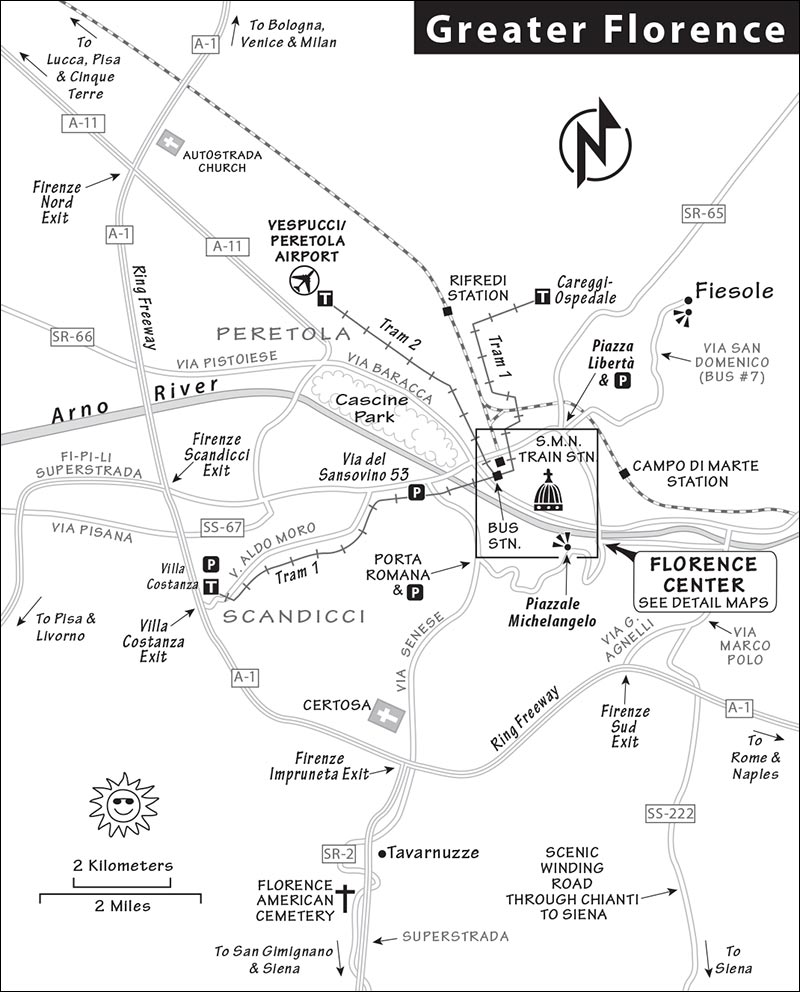
Train Connections
The following connections are for Trenitalia unless noted.
From Florence by Train to: Pisa (2/hour, 45-75 minutes), Lucca (2/hour, 1.5 hours), Siena (direct trains hourly, 1.5 hours; bus is better because Siena’s train station is far from the center), Camucia-Cortona (hourly, 1.5 hours), Livorno (hourly, 1.5 hours, some change in Pisa), La Spezia (for the Cinque Terre, 5/day direct, 2.5 hours, otherwise nearly hourly with change in Pisa), Milan (hourly, 2 hours; Italo: 2/hour, 2 hours), Venice (hourly, 2-3 hours, may transfer in Bologna, often crowded—reserve ahead; Italo: 4/day, 2 hours, reservations required), Assisi (7/day direct, 2-3 hours), Orvieto (hourly, 2 hours, some with change in Campo di Marte or Rifredi Station), Rome (2-3/hour, 1.5 hours, most require seat reservations; Italo: 2/hour, 1.5 hours), Naples (at least hourly, 3 hours; Italo: hourly, 3 hours).
BY BUS
The bus station, operated by Autolinee Toscane, is 50 yards southwest of the train station, near the T1 tram stop. Its hard-to-find entrance is located just off the main square, on Via Santa Caterina da Siena; pedestrians enter through the same portal the buses do. The station is little more than a big, old-school lot with numbered stalls, a ticket office, and a snack bar. Schedules for regional trips are posted, and monitors show imminent departures. It’s best to buy tickets in the station or at machines, as they aren’t always sold aboard the bus. Bus info: +39 800 373 760 (daily 6:30-20:00), www.at-bus.it.
Getting to the Train Station and City Center: Exit the station through the main door and turn left along the busy street. The train station is on your left, while downtown Florence is straight ahead and a bit to the right.
Bus Connections
From Florence by Bus to: San Gimignano (hourly, fewer on Sun, 1.5-2 hours, change in Poggibonsi), Siena (roughly 2/hour—fewer off-season, 1.5-hour rapida/via superstrada buses are fastest, avoid the slower ordinaria buses, in Siena get off at Piazza Gramsci or Via Tozzi, www.tiemmespa.it), Volterra (4/day Mon-Sat, 1/day Sun, 2 hours, change in Colle di Val d’Elsa; or faster train to Pontedera-Casciana Terme and then transfer to bus #500 to Volterra, 7/day, fewer on Sun, 1.5 hours), Montepulciano (1-2/day, 2 hours, LFI bus, www.lfi.it; or train to Chiusi, then bus to Montepulciano).
BY PRIVATE CAR
Zipping to nearby towns by private car service can be a comfortable option. Florence-based Transfer Chauffeur Service has a fleet of modern vehicles with drivers who can whisk you through the Tuscan countryside for around the same price as a cab (+39 338 862 3129, www.transfercs.com, welcome@transfercs.com, Marco). Prestige Rent also has friendly, English-speaking drivers and offers similar services (office at Via della Saggina 98, +39 055 286 059, www.prestigerent.com, usa@prestigerent.com, Saverio).
BY CAR
Renting a car at the Florence airport, with easy access to the autostrada, is the best option. There’s also a rental office located on the T1 tram line (Sansovino stop) that’s far enough from the historic core to make driving out of the city doable.
Don’t even attempt driving into the city center. The autostrada has several exits for Florence. Get off at the Nord, Scandicci, Impruneta, or Sud exits and follow signs toward—but not into—the Centro. Park on the outskirts—see the next section—and take a bus, tram, or taxi in.
Florence’s traffic-reduction system is complicated and confusing even to locals. Every car passing into the “limited traffic zone” (Zona Traffico Limitato, or ZTL) is photographed; those without a permit can expect a €100 ticket in the mail. If you have a reservation at a hotel within the ZTL area—and it has parking—ask in advance if they can get you permission to enter town.
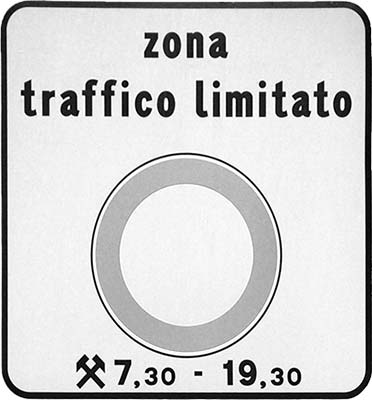
Another potentially expensive mistake drivers make in Florence is using the lanes designated for buses only (usually marked with yellow stripes). Driving in these lanes can also result in a ticket in the mail. Pay careful attention to signs.
Parking in Florence
The city center is ringed with big, efficient parking lots (signposted with a big P). From these, you can ride into the center (via taxi, bus, or possibly tram). Check www.fipark.com for details on parking lots, availability, and prices. From the freeway, follow the signs to Centro, then Stadio, then P.
The huge park-and-ride lot called Villa Costanza, just outside the town of Scandicci (south of Florence), has its own dedicated freeway off-ramp (just north of Impruneta) and is the terminus for the T1 tram line that zips smart drivers downtown (€1.50, departing every five minutes). Just look for it as you approach Florence on the autostrada (see the “Greater Florence” map on here).
BY PLANE
Amerigo Vespucci Airport, also called Peretola Airport, is about five miles northwest of the city (code: FLR, www.aeroporto.firenze.it). On the ground floor, you’ll find a TI, café, and ATMs.
Getting Between the Airport and City Center
The T2 tram (to the left as you exit the arrivals hall) runs every five minutes from the airport to near the train station (Alamanni Stazione, across from the station) and Piazza dell’Unità (one stop beyond the station, slightly closer to downtown) in about 20 minutes (runs 5:00-24:00, €1.50, buy ticket from machine on platform, cash or credit card, validate onboard, good for 90 minutes and transferable to bus lines, www.gestramvia.com).
Shuttle buses (to the far right as you exit the arrivals hall) connect the airport with Florence’s train and bus stations (2/hour until 22:00, 1/hour until 00:30, 30 minutes, runs 5:00-00:30, €6 one-way—buy ticket on board, €10 round-trip—buy ticket inside airport). If you’re changing to a different intercity bus in Florence (for instance, one bound for Siena), stay on the bus through the first stop (at the train station); it will continue on to the bus station nearby.
Official taxi companies have fixed rates for the 20- to 30-minute ride between the airport and downtown: €22 during the day (6:00-22:00), €25.30 at night, and €24 on Sunday. Be sure to use an official taxi (white, marked with Taxi/Comune di Firenze and a red fleur-de-lis).
The airport’s rental-car offices share one big parking lot at Via Palagio degli Spini that’s a three-minute drive away (shuttle bus departs directly outside the arrivals door).
BY CRUISE SHIP
Cruise ships dock in the coastal town of Livorno, about 60 miles west of Florence. The most seamless way to reach Florence from the port is to catch a transfer-only shuttle-bus; they guarantee you’ll make it back to your ship in plenty of time (+39 058 6188 8623, www.tuscanybus.com). On your own, you can take a train to Florence (hourly, 1.5 hours). Taxis are pricey, but sharing a minibus taxi with other cruisers can bring the round-trip cost down. For more details, see my Rick Steves Mediterranean Cruise Ports guidebook.