ROME
DEALING WITH (AND AVOIDING) PROBLEMS
Map: Rome’s Public Transportation
Map: Capitoline Hill & Piazza Venezia
Map: Borghese Gallery—Ground Floor
Map: Hotels & Restaurants near Ancient Rome
Map: Hotels in the Pantheon Neighborhood
Map: Hotels & Restaurants near Vatican City
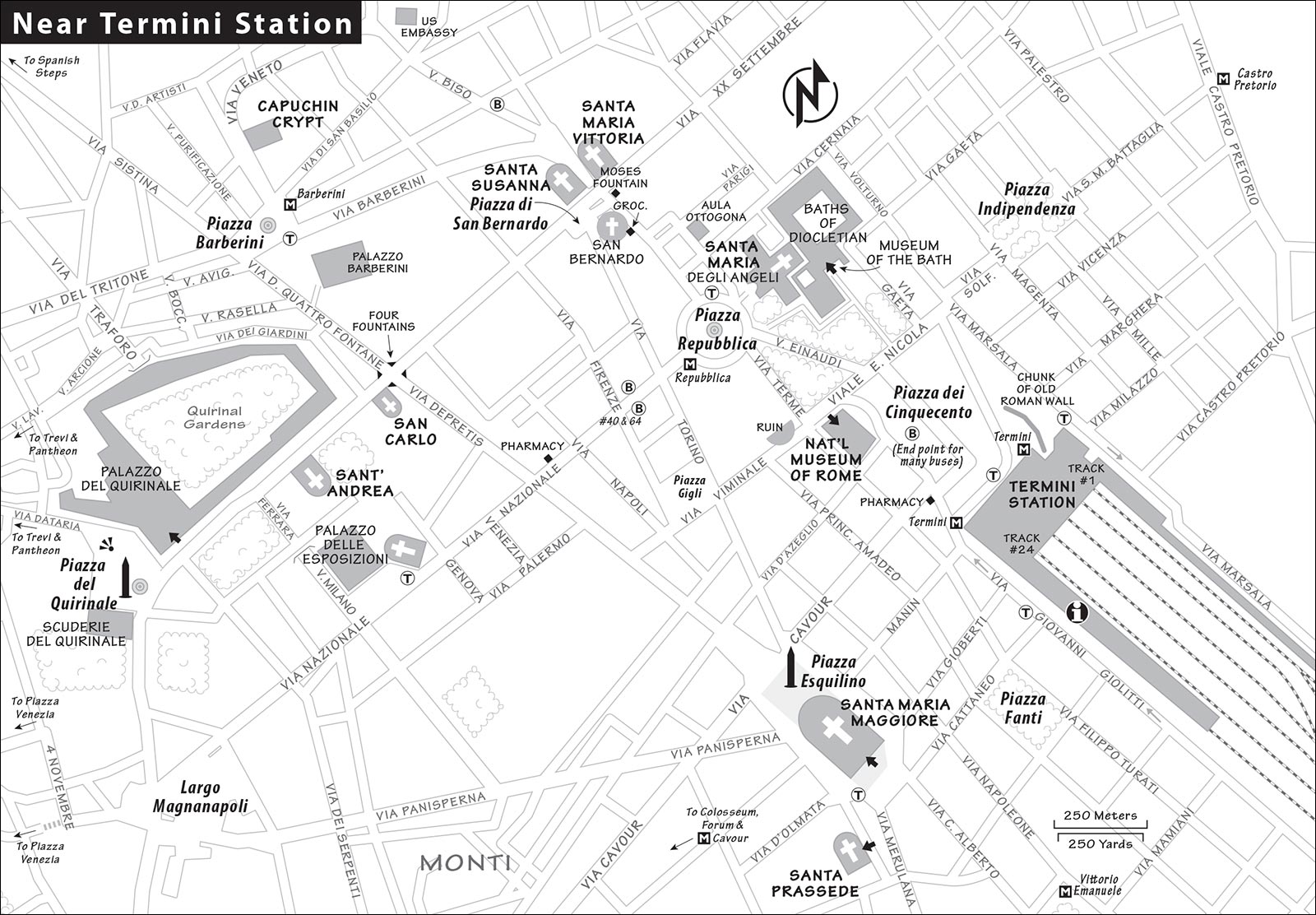
Map: Hotels near Termini Station
Map: Hotels & Restaurants in Trastevere
ANCIENT ROME: NEAR THE COLOSSEUM AND FORUM
Map: Restaurants in the Pantheon Neighborhood
Map: Restaurants near Termini Station
Rome is magnificent and overwhelming at the same time. It’s a showcase of Western civilization, with astonishingly ancient sights and a modern vibrancy. Rome is Italy’s political capital, the spiritual capital of a billion Roman Catholics, and an open-air museum of the evocative remains of the capital of what was the greatest empire in the history of humanity.
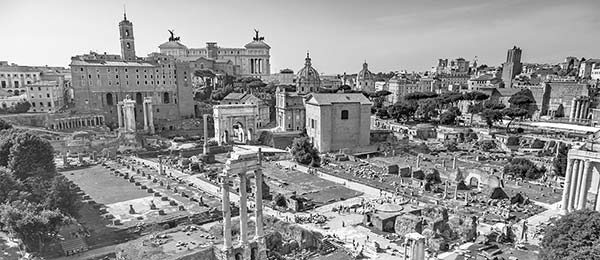
As you peel through Rome’s fascinating and jumbled layers, you’ll find the marble ruins of ancient times, tangled streets of the medieval world, early Christian churches, grand Renaissance buildings and statues, Baroque fountains and church facades, 19th-century apartments, 21st-century traffic, and nearly three million people. And then, of course, there are Rome’s stupendous sights.
Visit St. Peter’s, the greatest church on earth, and scale Michelangelo’s 448-foot-tall dome. Learn something about eternity at the huge Vatican Museums, where the story of creation is as bright as when Michelangelo first painted it in the restored Sistine Chapel. Ramble among the rabble and rubble, doing what I call the Caesar Shuffle through ancient Rome’s Colosseum and Forum, mentally resurrecting those tumble-down stones. Peer into the eyes of Roman busts at the National Museum of Rome, and savor Bernini’s lifelike sculptures at the sumptuous Borghese Gallery. Wander through the surrounding Villa Borghese Gardens, Rome’s biggest public park.
When the museums close and the crowds thin, Rome relaxes. The city, so monumental by day, becomes intimate and approachable. Its neighborhoods feel more like villages, and its famous squares become places to simply hang out. Early in the evening, join the promenade—called the passeggiata—up and down the main streets. After a sociable stroll, take a break for an aperitivo—a before-dinner drink.
Rome can be romantic...but hard on the unprepared. If you’re careless, you could get pickpocketed. And if you have the wrong attitude, you’ll be frustrated by the kind of chaos that only an Italian can understand. On a previous visit, my cabbie struggled with the traffic and said, “Roma chaos.” I responded, “Bella chaos.” He agreed.
Make it easy on yourself. If you choose a comfortable hotel for a refuge, pace yourself, enjoy a siesta during midday heat, organize your sightseeing (reserving ahead as needed), and take sensible precautions to protect your valuables, you’ll love Rome. Soon you’ll be the one at the Trevi Fountain throwing in a coin to ensure your return.
PLANNING YOUR TIME
Rome is wonderful, but it’s huge and exhausting. On a first-time visit, many travelers find that Rome is best done quickly—Italy is more charming elsewhere. But whether you’re here for a day or a week, you won’t be able to see everything, so don’t try—you’ll keep coming back to Rome. Note major sights where advance reservations are smart or a free Rick Steves audio tour is available.
Rome in a Day: Some people actually “do” Rome in a day. Crazy as that sounds, if all you have is a day, it’s one of the most exciting days Europe has to offer. Start at 9:00 at the Colosseum. Then explore the Forum (skip the Palatine Hill), hike over Capitoline Hill, and cap your Caesar Shuffle with a Pantheon visit. After a quick lunch, taxi to the Vatican Museums, then head to St. Peter’s Basilica (open until 19:00 April-Sept). Taxi to Campo de’ Fiori for dinner, then finish your day lacing together the famous floodlit spots (following my Heart of Rome Walk).
Rome in Two to Three Days: On the first day, do my Caesar Shuffle from the Colosseum to the Roman Forum, then over Capitoline Hill (visiting the Capitoline Museums), and on to the Pantheon. After a siesta, add some sightseeing to suit your interest. In the evening enjoy a sound-and-light show at the Imperial Forums and/or a colorful stroll in Trastevere or the Monti district. On the second day, see Vatican City (St. Peter’s, dome climb, Vatican Museums). Have dinner near the atmospheric Campo de’ Fiori, and then walk to the Trevi Fountain and Spanish Steps (following my Heart of Rome Walk). With a third day, add the Borghese Gallery and more sights.
Orientation to Rome
Today’s Rome sprawls over about 500 square miles, but the city center within the ancient Aurelian Wall is all you need to know—and that’s only four square miles. The old core, with most of the tourist sights, sits inside a diamond formed by Termini train station (in the east), the Vatican (west), Villa Borghese Gardens (north), and the Colosseum (south). The Tiber River snakes through the diamond from north to south. At the center of the diamond is Piazza Venezia, a busy square and traffic hub.
ROME BY NEIGHBORHOOD
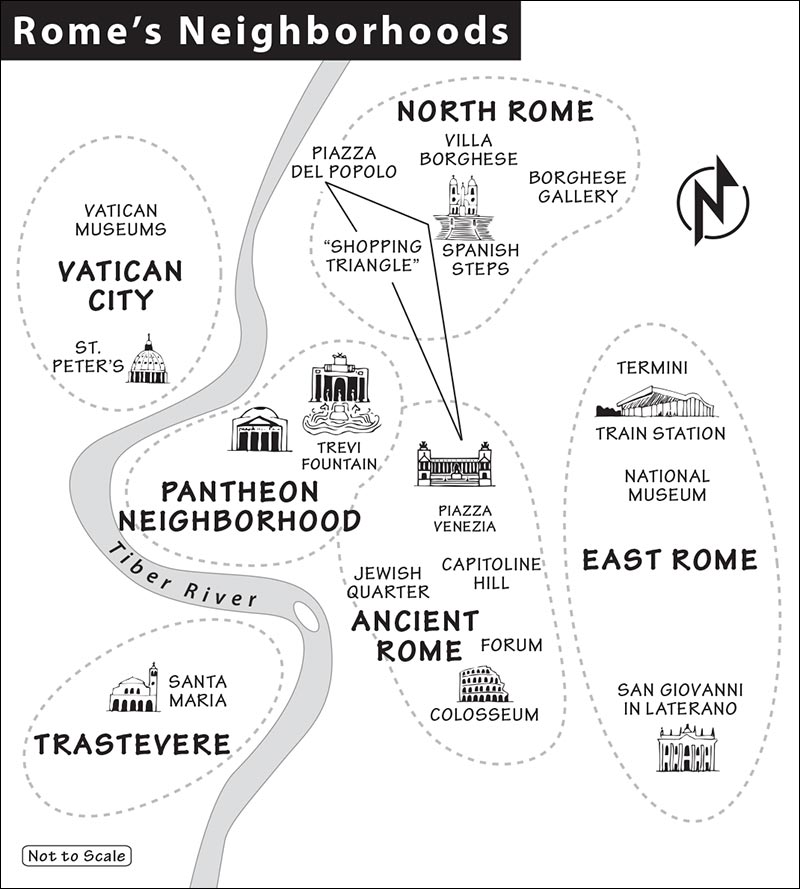
Think of Rome as a collection of neighborhoods, huddling around major landmarks, and it becomes manageable.
Ancient Rome: In ancient times, this was home to the grandest buildings of a city of a million people. Today, the best of the classical sights stand in a line from the Colosseum (huge stadium) to the ruined Roman Forum (main square and marketplace) over Capitoline Hill to the Pantheon (Roman temple turned into a church). Just north of this area, between Via Nazionale and Via Cavour, is the atmospheric and trendy Monti district.
Pantheon Neighborhood: The Pantheon anchors the neighborhood I like to call the Heart of Rome, which includes the atmospheric squares of Campo de’ Fiori and Piazza Navona, the dramatic Trevi Fountain, and several historic churches.
Vatican City: Located west of the Tiber River, this is a compact world of its own, with two great, massive sights: St. Peter’s Basilica and the Vatican Museums.
North Rome: This modern, classy area hosts the celebrated Spanish Steps, an elegant grid of trendy shopping streets (between the main drag—Via del Corso—and the Spanish Steps), and the Borghese Gallery (gorgeous Bernini sculptures) set within the fun-on-a-sunny-day Villa Borghese Gardens.
East Rome: This neighborhood around Termini Station boasts the stunning National Museum of Rome (ancient Roman sculpture) and includes Piazza della Repubblica, many recommended hotels, and convenient public-transportation connections.
Trastevere: This colorful, wrong-side-of-the-river neighborhood has a village feel. Its red pastel buildings are draped with green ivy, Vespas rule the streets, and locals frequent mom-and-pop cafés. Trastevere is the city at its crustiest...and perhaps most “Roman.”
TOURIST INFORMATION
Small city-run tourist information offices scattered around town sell sightseeing passes and maps (typically open daily 9:00-19:00, shorter hours off-season possible). You’ll find them at both airports (Fiumicino Terminal 3 and Ciampino); Termini train station (at the far end of the concourse that runs along track 24—either loop around outside or cut through the department store); directly across from the Forum entrance on Via dei Fori Imperiali; between the Pantheon and Trevi Fountain on Via Minghetti; and near Castel Sant’Angelo (toward the Vatican from the castle).
Rome also has several smaller quasi-TIs, combined with public pay WCs, called (and I am not making this up) P.Stops. You’ll find them on Piazza di Spagna near the Spanish Steps, in Trastevere at Piazza Sidney Sonnino, and across from the Basilica of San Giovanni Laterano near the Holy Stairs (generally daily 10:00-18:00, some until 20:00, https://pstop.it).
The TI’s website is www.turismoroma.it, but a better site for practical information is www.060608.it. That’s also the number for Rome’s call center—the best source of up-to-date tourist information, with English speakers on staff (answered daily 9:00-19:00, +39 06 0608, press 2 for English).
Your hotel will have a freebie map; you’ll find better-quality ones at bookstores than at newsstands. See “Getting Around Rome,” later, for recommended public transport maps.
An English-language website, www.wantedinrome.com, is oriented to those staying longer in Rome and provides insight into news, events, and daily life in the city.
ARRIVAL IN ROME
For a rundown of Rome’s train stations and airports, see the “Rome Connections” section at the end of this chapter.
HELPFUL HINTS
Sightseeing Tips: Despite the huge crowds inundating Rome, you’ll only find lines a problem at St. Peter’s Basilica (go early or late to minimize) and Vatican Museums (easy to avoid by booking in advance online). Tickets for the Colosseum, the Roman Forum, and Palatine Hill must be reserved in advance (no on-site sales), and for the Colosseum, you must book a specific entrance time. The exquisite Borghese Gallery also requires a timed-entry ticket purchased in advance. The Pantheon often has a long line that moves fast, but on weekends you’ll likely need to book ahead to enter. For any sight, be sure that you’re booking on the official website (listed in this book), rather than a third-party scalper site.
Even with a reservation, the above sights can be very crowded. If that’s not for you, remember that Rome has many other historical treasures, such as the Capitoline Museums and the Baths of Caracalla, with fewer to no crowds.
The Roma Pass, which you’ll see advertised, is only worthwhile if you want a public transit pass (covers 2 or 3 days of transit, entry to 1 or 2 sights, and discounts at others—but you’ll still need reservations for the Colosseum and Borghese Gallery).
Closed Days: If you’re in Rome on a Sunday, note that the Vatican Museums are closed (except for last Sun of the month, when it’s free and even more crowded). The Borghese Gallery is closed on Mondays, and St. Peter’s Basilica may be closed on Wednesday mornings for a papal audience.
Decorum: Rome enforces strict laws to protect its historical treasures. Be respectful. Don’t climb on ruins, picnic at (or on) ancient or historic sights, or dip your hand in the Trevi Fountain—fines can be expensive.
Bookstores: Borri Books, a large chain store at Termini station, sells English-language books (open daily). A few small, independent bookstores have a more personal touch: The Anglo-American Bookshop has great art and history sections (closed Sun, a few blocks south of Spanish Steps at Via della Vite 102—see map on here, +39 06 679 5222). In Trastevere, the Almost Corner Bookshop stocks an extensive Italian-interest section (Via del Moro 45—see map on here, +39 06 583 6942, Dermot from Ireland), and the Open Door Bookshop carries the only used books in English in town (Via della Lungaretta 23—see map on here, +39 06 589 6478).
Laundry: Coin launderettes are common in Rome. Your hotelier can direct you to the closest one (or search on Google Maps for “laundry”).
Best Views: You have good choices: from the rooftop of the Victor Emmanuel Monument (take the Rome from the Sky elevator to the top); from the top of the dome of St. Peter’s Basilica; and from the top of Castel Sant’Angelo. One of the best views of the Roman Forum is from the Farnese Gardens viewpoint on Palatine Hill. Another is on Capitoline Hill—from two free overlooks plus the Tabularium (underground galleries) that is part of the Capitoline Museums.
Best Hangouts: The city’s most atmospheric squares are Campo de’ Fiori and Piazza Navona, interesting day and night. For monuments, it’s the Trevi Fountain. The Monti neighborhood, near the Roman Forum, is a popular gathering spot in the evening (particularly Piazza della Madonna dei Monti) and a delight to explore any time of day. And the Via dei Fori Imperiali—from the Victor Emmanuel Monument to the Colosseum—is an enticing place to stroll and daydream about ancient Rome.
DEALING WITH (AND AVOIDING) PROBLEMS
Theft Alert: While violent crime is rare in the city center, petty theft is rampant. Always use your money belt. If you carry a backpack, never leave it unattended and try to keep it attached to your body in some way (even when you’re seated for a meal).
Be particularly on guard in crowds and wear your day pack in front, especially when boarding and leaving buses and subways. You’ll find less crowding and commotion—and less risk—waiting for the end cars of a subway rather than the middle cars. Thieves are particularly thick on the Metro and the crowded, made-for-tourists buses #40 and #64.
Thieves strike when you’re distracted. Don’t trust “kind” strangers or be deceived by appearance: Sneaky thieves may pose as businessmen or tourists, moms with babies, or gangs of children. If a random stranger says, “I like your shoes!”...they likely are about to hit you up for some scam.
Scams abound: Always be clear about what paper money you’re giving someone, demand clear and itemized bills, and count your change. Don’t give your wallet to self-proclaimed “police” who stop you on the street, warn you about counterfeit (or drug) money, and ask to see your cash.
Reporting Losses: To report lost or stolen items, file a police report (at Termini station, with polizia at track 11 or with carabinieri at track 20; offices are also at Piazza Venezia and at the corner of Via Nazionale and Via Genova). For information on how to replace a passport or report lost or stolen credit cards, see here.
Pedestrian Safety: Your main safety concern in Rome is crossing streets. Use caution. Some streets have pedestrian-crossing signals (red means stop—or jaywalk carefully; green means go...also carefully; and yellow means go...extremely carefully, as cars may be whipping around the corner). But just as often, multilane streets have crosswalks with no signals at all. And even when there are traffic lights, they are provisional: Scooters don’t always stop at red lights, and even cars exercise what drivers call the “logical option” of not stopping if they see no oncoming traffic.
Follow locals like a shadow when you cross a street (or spend a good part of your visit stranded on curbs). When you do cross alone, find a gap in the traffic and walk with confidence while making eye contact with approaching drivers—they won’t hit you as long as they can tell where you intend to go.
Staying/Getting Healthy: The siesta is a key to survival in summertime Rome. Lie down and contemplate the extraordinary power of gravity in the Eternal City. I drink lots of cold, refreshing water from Rome’s many drinking fountains (the Forum has three) which are handy for refilling your bottle and staying hydrated.
Every neighborhood has a pharmacy (marked by a green cross); your hotel can help you find the nearest one (or search for “pharmacy” on Google Maps). Bigger pharmacies that stay open late (generally from 7:30 until 22:00 or 23:00) cluster around Termini station: There’s one inside the station itself (along northeast side, enter from Via Marsala, +39 06 474 5421); another south of the station, at the corner of Via Cavour (shorter hours, Piazza dei Cinquecento 51, +39 06 488 0019, see map on here); and Farmacia Piram, several blocks down from Piazza della Repubblica (Via Nazionale 228, +39 06 488 4437). In the Pantheon neighborhood, Farmacia Senato is between Piazza Navona and the Pantheon (Corso del Rinascimento 50—see map on here).
Embassies and hotels can recommend English-speaking doctors. Consider MEDline, a 24-hour private home-medical service; doctors speak English and make calls at hotels for about €150 (+39 06 808 0995, https://users.libero.it/medline). Another 24-hour private clinic that makes house calls is International Medical Center ‘84, Via Firenze 47, +39 06 488 2371, https://imc84.com. Anyone is entitled to emergency treatment at public hospitals. The hospital closest to Termini station is Policlinico Umberto I (entrance for emergency treatment at Viale del Policlinico 155, translators available, Metro: Policlinico).
Rome is doing its best to cope with an ever-increasing number of visitors, but especially in peak season you’ll encounter lines, crowds, and exasperating changes to ticketing and tour procedures. These tips will help you use your time and money efficiently, making the Eternal City seem less eternal and more entertaining.
Skip the Colosseum: While it sounds like a sacrilege, a visit to the interior of the Colosseum may not be worth suffering through the mob scene. Half the thrill of the Colosseum is seeing it from outside (free and easy at any time).
Advance Tickets and Reservations: Some sights require advance booking, while at others it’s necessary to avoid long lines. For specifics, see here and sight listings.
Forum/Palatine Hill: These two sights share an admission ticket. Unless you buy a Full Experience ticket (see here), you must see them together on a single visit (don’t exit the Forum and try to reenter at Palatine Hill).
Roma Pass: I’d skip this pass; it’s little more than a glorified transit pass that includes entrance to one or two sights and discounts to others.
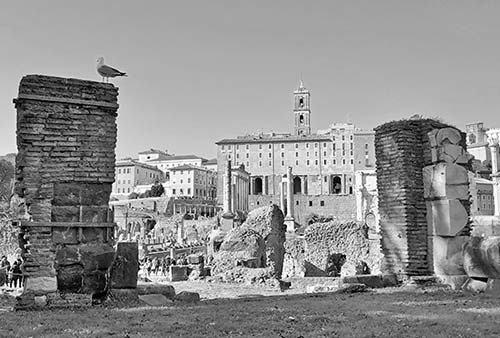
Sights with Fewer Crowds: Can’t get reservations to the main sights (or just can’t stand crowds)? Rome has many magnificent attractions without the hordes. Try the Baths of Caracalla, National Museum of Rome, or Trajan’s Market. Even in peak season, you’ll often be all alone with the wonders of the ancient world, wondering, “Where is everyone?”
Check Sight Hours: Rome’s sights have notoriously variable hours from season to season. It’s smart to check each sight’s website in advance. On holidays, expect shorter hours or closures.
Churches: Many churches, which have divine art and free entry, open early (around 7:00-7:30), close for lunch (roughly 12:00-15:30), and close late (about 19:00). Kamikaze tourists maximize their sightseeing hours by visiting churches before 9:00 or late in the day; during the siesta, they see major sights that stay open all day (St. Peter’s, Colosseum, Forum, Capitoline Museums, Pantheon, and National Museum of Rome). Dress modestly for churches.
Picnic Discreetly: Public drinking and eating are not allowed at major sights. To avoid a fine, choose an empty piazza or a park for your picnic.
Morning Magic: When I want to reconnect with the city, I walk through the historical center before Rome wakes up. In the early morning, I’ve never met more than six people at the Trevi Fountain, and Rome shows its calm, majestic face. It’s a great way to get energized for the day ahead.
Miscellaneous Tips: I carry a water bottle and refill it at Rome’s many public drinking spouts. Because public restrooms are scarce, use WCs at museums, restaurants, and bars.
GETTING AROUND ROME
You can see a lot of Rome on foot, and I’ve grouped your sightseeing into walkable neighborhoods. Make it a point to visit sights in a logical order.
To connect sights beyond walking distance, you can ride the Metro or a city bus, or take a taxi. As Rome is a great taxi town (most rides cost €8-12), especially for couples and families, I’d rely more on taxis than public transit.
To find the city’s many small streets and alleys, map apps work better than paper maps; Google Maps is excellent for navigation by foot, and has up-to-date public transit info (see below).
Public Transportation
Rome’s public transportation system is cheap and efficient, but also confusing and crowded. The three Metro lines are relatively sane and straightforward, but serve a limited area. Buses are more chaotic—there are no posted timetables or maps, and stop names are announced only in the newest vehicles. But they run frequently and go everywhere. If you’re in town for more than a day or two, mastering a couple key bus routes serving your neighborhood is worth the effort and will make you feel like a Roman.
Maps and Route Planning: The website www.atac.roma.it has a journey planner in English that will help you sort through the thicket of routes, as well as downloadable network maps. Google Maps works well for transit route planning around Rome; if you’re online, it offers updated, fairly accurate estimates of wait times for the next bus, and how long it’ll take to get to your destination in current traffic.
There’s no official paper map of the system, but Edizioni Lozzi produces a frequently updated “Roma Metro Bus” map (at bookstores), which includes a booklet with details on all bus routes. For information by phone, call ATAC at +39 06 57003.
Buying Tickets
All public transportation uses the same ticket. It costs €1.50 and is valid for one Metro ride—including transfers underground—plus unlimited city buses and trams during a 100-minute period. Passes good on buses and the Metro are sold in increments of 24 hours (€7), 48 hours (€12.50), 72 hours (€18), and one week (€24—about the cost of three taxi rides).
You can purchase tickets and passes from machines at Metro stations and a few major bus stops, and from some newsstands and tobacco shops (tabacchi, marked by a black-and-white T sign). Tickets are not sold on board. It’s smart to stock up on tickets early—that way you don’t have to run around searching for an open tobacco shop when you spot your bus approaching.
Validate your ticket by sticking it in the Metro turnstile (magnetic strip-side up, arrow-side first) or in the machine when you board the bus (magnetic-strip-side down, arrow-side first)—watch others and imitate. It’ll return your ticket with your expiration time printed. To get through a Metro turnstile with a transit pass, tap the card against the turnstile’s sensor. On buses and trams, you need to validate your pass only on your first time using it.
If you need help from a real person, ATAC runs a small ticket office at Termini station. Follow signs for Metro Linea B, then ATAC ticket office (daily until 20:00).
By Metro
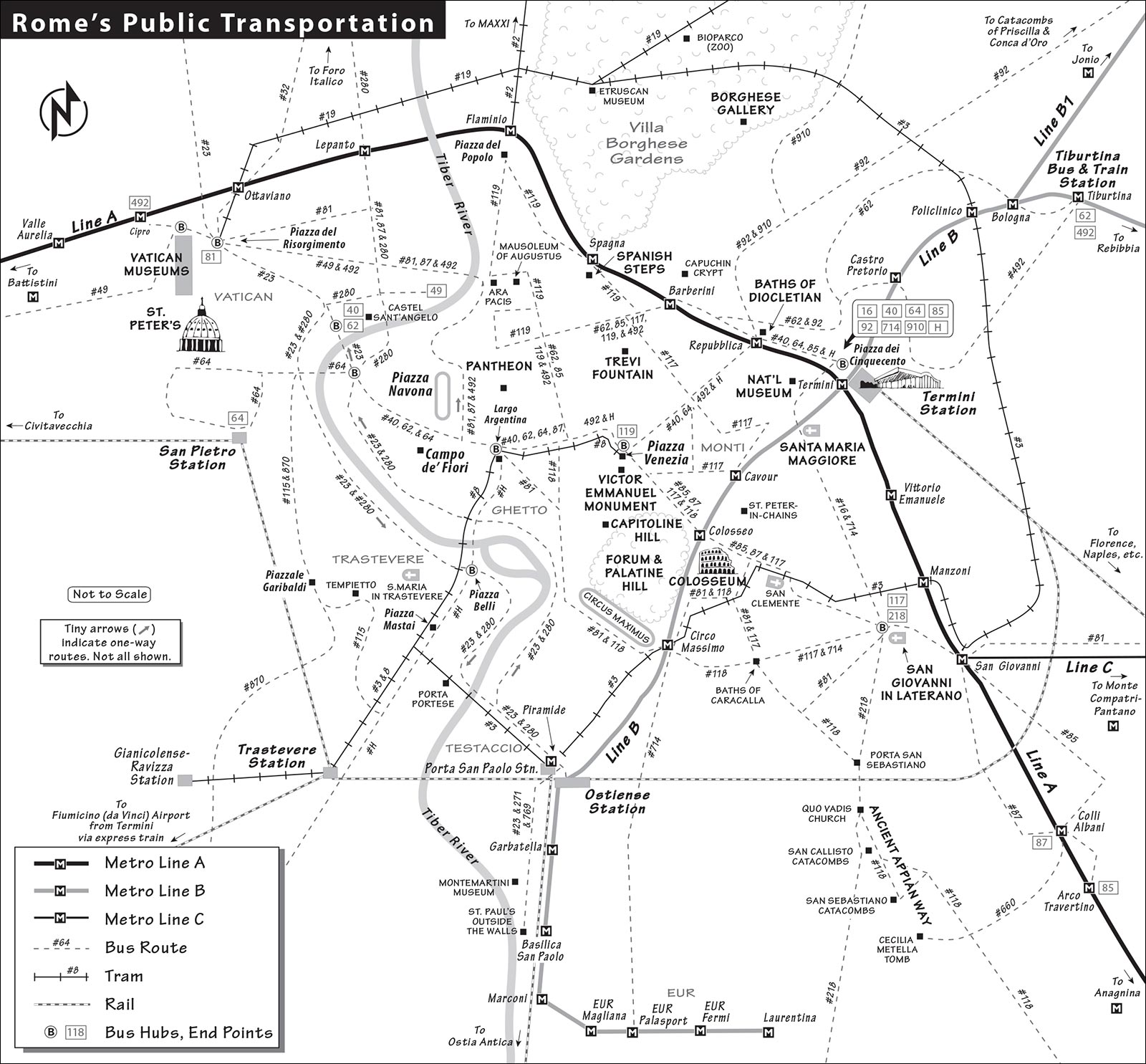
The Roman subway system (Metropolitana, or “Metro”) is simple, clean, cheap, and fast. The two lines you need to know—A and B—intersect at Termini station. Line A serves the Vatican area, Piazza del Popolo, Spanish Steps/Villa Borghese, Baths of Diocletian, Termini station, and San Giovanni in Laterano. Line B connects the Tiburtina train and bus stations with Termini and the Colosseum and Forum/Palatine Hill, and Testaccio trains run less frequently, so allow a bit more time to complete your journey. The Metro runs from 5:30 to 23:30 (Fri-Sat until 1:30 in the morning; note line A may close around 21:00 while it undergoes repairs).
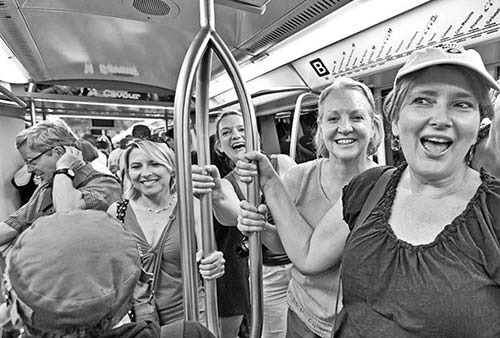
Within Metro stations, signage is limited and not very intuitive, and electronic signs are often broken. So, before descending, be clear on which line you’ll take and which direction you’re headed (i.e., the end station of your line). The subway’s first and last compartments are generally the least crowded, and the least likely to harbor pickpockets.
By Bus
The Metro is handy, but it won’t get you everywhere—you often have to take the bus (or tram). Bus routes are listed at each stop. Route and system maps aren’t posted, but with some knowledge of major stops, you can wing it without one (for help, see “Maps and Route Planning,” earlier). Rome’s few tram lines function for all intents and purposes identically to buses.
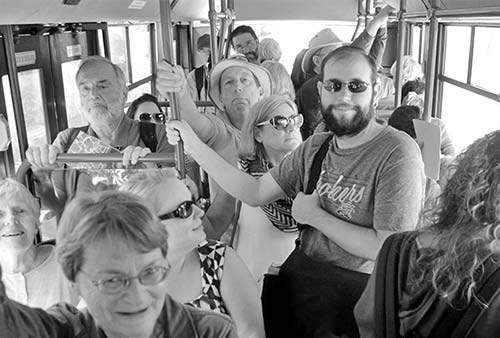
Buses—especially the touristy #40 and #64—are havens for thieves and pickpockets. These two lines can be nose-to-armpit crowded during peak times...and while you’re sniffing that guy’s pit, his other hand could be busily rifling through your pockets. Assume any commotion is a thief-created distraction. If one bus is packed, there’s likely a second one on its tail with far fewer crowds and thieves. Or read the signs posted at stops to see if a different, less crowded bus route can get you to or near your destination.
On buses, tickets must be inserted in the yellow box with the digital readout (magnetic-strip-side down, arrow-side first; be sure to retrieve your ticket after it’s spit out). Do this as you board, otherwise you’re cheating. Inspectors fine even innocent-looking tourists €55. You don’t need to validate a ticket or pass on the bus if you’ve already validated it elsewhere in the transit system. Bus etiquette (not always followed) is to board at the front or rear doors and exit at the middle.
Regular bus lines start running at about 5:30, and during the day major routes run every 10-15 minutes. After 23:30 (and sometimes earlier) and on Sundays, buses are less frequent. Night buses are marked with an N and an owl symbol on the bus-stop signs. Frustratingly, the exact frequency of various bus routes is difficult to predict (and not printed at bus stops). At major stops, an electronic board shows the number of minutes until the next buses arrive; otherwise, use your phone to check Google Maps or the ATAC journey planner.
These are the most important bus routes for tourists:
Bus #64: This bus cuts across the city, linking Termini station with the Vatican, stopping at Piazza della Repubblica (sights), Via Nazionale (recommended hotels), Piazza Venezia (near Forum), Largo Argentina (near Pantheon and Campo de’ Fiori), St. Peter’s Basilica (get off just past the tunnel), and San Pietro station. Ride it for a city overview and to watch pickpockets in action. The #64 can get horribly crowded.
Bus #40: This express bus, which mostly follows the #64 route (but ends near the Castel Sant’Angelo on the Vatican side of the river), is especially helpful—fewer stops and (somewhat) fewer crowds.
The following routes conveniently connect Trastevere with other parts of Rome:
Bus #H: This express bus, linking Termini station and Trastevere, makes a stop near Piazza Repubblica and at the bottom of Via Nazionale (for Trastevere, get off at Sonnino/S. Gallicano, just after crossing the Tiber River). It doesn’t run on Sundays.
Tram #8: This tram connects Piazza Venezia and Largo Argentina with Trastevere (get off at Piazza Belli, just over the river) and runs further to the Trastevere train station.
Bus #23: This bus links the Vatican with Trastevere and Testaccio, stopping at the Vatican Museums (nearest stop is on Via Leone IV), Castel Sant’Angelo (Sforza Pallavicini), Trastevere (Lungotevere de Cenci/Arenula, on opposite side of Ponte Garibaldi), Porta Portese (Sunday flea market at Emporio stop), Piramide (Ostiense stop; Metro and gateway to Testaccio), and all the way south to St. Paul’s Outside the Walls. Bus #280 follows much the same route from Trastevere to Piramide.
Other useful routes include:
Bus #49: Piazza Cavour/Castel Sant’Angelo, Piazza Risorgimento (Vatican), and Vatican Museums.
Bus #81: San Giovanni in Laterano, Largo Argentina, and Piazza Risorgimento (Vatican).
Buses #85 and #87: Piazza Navona (#87 only), Pantheon, Via del Corso (#85 only), Piazza Venezia, Forum, Colosseum, San Clemente, and San Giovanni in Laterano.
Bus #492: Travels east-west across the city, connecting Tiburtina (train and bus stations), Largo Santa Susanna (near Piazza della Repubblica), Piazza Barberini, Piazza Venezia, Largo Argentina (near Pantheon and Campo de’ Fiori), Piazza Cavour (Castel Sant’Angelo), and Piazza Risorgimento (St. Peter’s Basilica and Vatican).
Tram #3: Zips from the Colosseum to San Giovanni in Laterano (and onward to Valle Giulia) in one direction, and to Piramide/Testaccio (and onward to Trastevere, though a 15-minute walk from the touristic heart) in the other.
Elettrico Minibuses: Cute electric minibuses take circular routes past major sights and are great for transport or simple joyriding (though they’re so small, it can be hard to find a seat). They run Mon-Sat only, 7:05-20:15. Elettrico #117 connects San Giovanni in Laterano, Colosseo, Via Cavour, Via Nazionale, and Trevi Fountain. Elettrico #119 connects Piazza Venezia, Via del Corso, Trevi Fountain, Piazza di Spagna, Piazza del Popolo, and Piazza Augusto Imperatore.
By Taxi
I use taxis in Rome more often than in other cities. They’re reasonable and useful for efficient sightseeing in this big, hot metropolis. Three or four companions with more money than time should taxi almost everywhere. Taxis start at €3, then charge about €1.50 per kilometer (surcharges: €1.50 on Sun, €3.50 for nighttime hours of 22:00-6:00, one regular suitcase or bag rides free, tip by rounding up—€1 or so). Sample fares: Termini area to Vatican-€15; Termini area to Colosseum-€8; Termini area to the Borghese Gallery-€10; Colosseum to Trastevere-€12 (or look up your route at www.worldtaximeter.com).
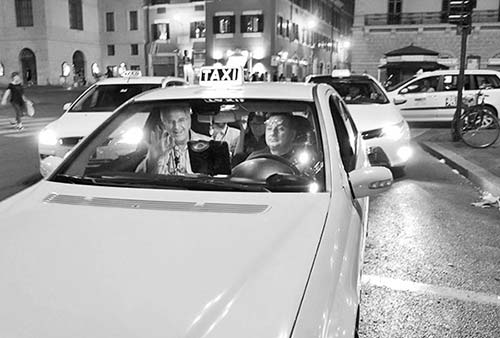
Calling a Cab: You can always hail a cab on the street. But Romans generally walk to the nearest taxi stand (many are marked on this book’s maps) or ask a passerby or a clerk in a shop, “Dov’è una fermata dei taxi?” (doh-VEH OO-nah fehr-MAH-tah DEH-ee TAHK-see). Easiest of all, have your hotel or restaurant call a taxi for you. (It’s routine for Romans to ask the restaurant to call a taxi when they’re ready to go.) The meter starts when the call is received. To call a cab on your own, dial +39 06 3570, +39 06 4994, or +39 06 6645, or use the official city taxi line, +39 06 0609.
You can also use the Free Now app, which orders an official white taxi at regular taxi rates, with the convenience of paying via the app.
Avoid Scams: Beware of corrupt taxis. First, only use official Rome taxis. They’re white, with a taxi sign on the roof and a maroon logo on the door that reads Roma Capitale.
When you get in, make sure the meter (tassametro) is turned on (you’ll see the meter either on the dashboard or up by the rearview mirror). If the meter isn’t on, get out and find another cab. Check that the meter is reset to the basic drop charge (should be around €3, or around €5 if you phoned for the taxi). You’ll rarely pay more than €12-15 for a ride in town. Keep an eye on the fare on the meter as you near your destination; some cabbies turn the meter off instantly when they stop and tell you a higher price.
By law, every cab must display a multilingual official price chart—usually on the back of the seat in front of you. If the fare doesn’t seem right, point to the chart and ask the cabbie to explain it.
At the train station or airport, avoid hustlers conning naive visitors into unmarked, rip-off “express taxis” (for tips on taking a taxi from the airport, see here). If you encounter problems with a taxi, making a show of writing down the taxi number (to file a complaint) can motivate a driver to quickly settle the matter.
Taxi Alternative: Uber works in Rome as it does in the US, but only at the more expensive Uber Black level.
Tours in Rome
 To sightsee on your own, download my free audio tours, including my Heart of Rome, Jewish Ghetto, and Trastevere neighborhood walks, and my tours of the Pantheon, Colosseum, Roman Forum, St. Peter’s Basilica, Vatican Museums, and Sistine Chapel.
ON FOOT
You can either hire a local to serve as your personal guide, or sign up for a group tour with a tour company, joining up to 50 fellow travelers. Private guides are good but pricey (around €180 for a three-hour tour). Tour companies are cheaper (€30/person), but quality and organization are unreliable. If you do hire a private Italian guide, consider inviting others from your hotel to join you and split the cost. This ends up costing about the same per person as going on a scheduled tour from one of the walking-tour companies listed below—and you’ll likely get a better guide.
Local Guides
I’ve worked with and enjoyed each of these licensed independent local guides. They’re native Italians, speak excellent English, and enjoy tailoring tours to your interests. Prices (roughly €60/hour) flex with the day, season, and demand. Arrange your date and price by email. Carla Zaia (carlaromeguide@gmail.com); Cristina Giannicchi (+39 338 111 4573, www.crisromanguide.com, crisgiannicchi@gmail.com); Sara Magister (a.magister@iol.it); Giovanna Terzulli (gioterzulli@gmail.com); Alessandra Mazzoccoli (www.romeandabout.com, alemazzoccoli@gmail.com); and Massimiliano Canneto (a Catholic guide with a Vatican forte, but does all of Rome, massicanneto@gmail.com).
Francesca Caruso, who works almost full-time with my tours when in Rome, has contributed generously to this book (www.francescacaruso.com, francescainroma@gmail.com); she offers private tours for €300/half-day. Popular with my readers, Francesca understandably books up quickly; if she’s busy, she’ll recommend one of her colleagues. At her website you can listen to the many interviews I’ve enjoyed with Francesca on my public radio program.
Walking-Tour Companies
Rome has many highly competitive tour companies, each offering a series of themed walks through various slices of the city. Three-hour guided walks generally cost €25-30 per person. Guides are usually native English speakers, often American expats. Before your trip, spend some time on these companies’ websites to get to know your options, as each company has a particular teaching and guiding personality. Some are highbrow and more expensive. Others are less scholarly. It’s sometimes required, and always smart, to book a spot in advance (easy online).
These companies are each well established, creative, and competitive. Each offers a 10 percent discount with most online bookings for Rick Steves travelers.
Walks of Italy (RS%—enter “RICKWALKSROME,” US +1 888 683 8670, +39 06 9480 4888, www.walksofitaly.com).
Europe Odyssey (RS%, +39 06 8854 2416, mobile +39 388 121 5318, www.europeodyssey.com, Rahul).
Through Eternity (RS%—look for “Group Tours Rome” and enter “RICKSTEVES,” US tel. +1 800 267 7581, www.througheternity.com, office@througheternity.com, Rob).
The Roman Guy (RS%—enter “ricksteves,” ask about e-bike tours, US tel. +1 888 290 5595, theromanguy.com, Sean Finelli).
Miles & Miles Private Tours, described under “Car & Minibus Tours,” below, also offers walking tours (www.milesandmiles.net). They are a great value, especially if a car is used.
Car and Minibus Tours
Miles & Miles Private Tours offers tours with good English-speaking Italian driver/guides and fine air-conditioned cars and minibuses. Their basic line-up for groups of up to eight people includes a five-hour “History and Fun” tour (a fine first day by car with a broad overview and a chance to get out when you like, €350), “Squares and Fountains” (three-hour walking tour starting at Piazza Farnese, €250), and day trips from Rome into Umbria, including Civita di Bagnoregio (9 hours with hotel pickup, €600). They also provide walking tours, shore excursions (from Civitavecchia and other ports), and unguided long-distance transportation; if traveling with a small group or a family from Rome to Florence, the Amalfi Coast, or elsewhere, consider paying extra for this convenience (RS%—mention Rick Steves when booking direct, then show this book; +39 331 466 4900, www.milesandmiles.net, info@milesandmiles.net).
ON WHEELS
Hop-On, Hop-Off Bus Tours
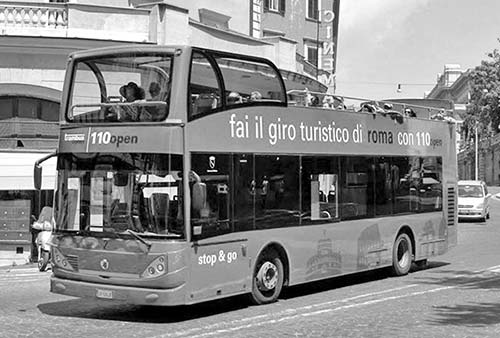
Several different agencies run hop-on, hop-off, double-decker bus tours around Rome. These tours make the same 90-minute, eight-stop loop through the traffic-congested town center with about four pickups at each stop per hour. Buses provide an easy way to see the city from above the congestion (choose open or with canopy), but you’ll likely feel trapped rather than entertained. The lazy recorded narration does little more than identify the sightseeing icons you drive by and misses the opportunity to fill the time with worthwhile information. You can join one (and pay as you board; usually around €20) at any stop; Termini station and Piazza Venezia are handy hubs.
Car and Driver Service
Autoservizi Monti Concezio, run by gentle, capable, and English-speaking Ezio (pronounced Etz-io), offers private cars or minibuses with driver/guides (car-€40/hour, minibus-€45/hour, 3-hour minimum for city sightseeing, transfers between cities are more expensive, +39 335 636 5907 or +39 349 674 5643, info@tourservicemonti.it).
Walks in Rome
Take a refreshing early evening walk (Dolce Vita Stroll) and enjoy the thriving local scene, best at night (Heart of Rome Walk).
DOLCE VITA STROLL
All over the Mediterranean world, people are out strolling in the early evening in a ritual known in Italy as the passeggiata, worth ▲▲ (see the sidebar on here). Rome’s passeggiata is both elegant (with chic people enjoying fancy window shopping in the grid of streets around the Spanish Steps) and a little crude (with young people on the prowl). The major sights along this walk are covered later in this section.
Romans’ favorite place for a chic evening stroll is along Via del Corso. Join in as you walk from Piazza del Popolo (Metro: Flaminio) down a wonderfully traffic-free section of Via del Corso, and up Via Condotti to the Spanish Steps. Historians can continue to Capitoline Hill. Although busy at any hour, this area really attracts crowds from around 17:00 to 19:00 each evening (Fri and Sat are best), except on Sunday, when it occurs earlier in the afternoon. Leave before 18:00 if you plan to visit the Ara Pacis (Altar of Peace, last entry at 18:30).
As you stroll, you’ll see shoppers, flirts, and people watchers filling this neighborhood of some of Rome’s most fashionable stores. The most elegance survives in the grid of streets between Via del Corso and the Spanish Steps. If you get hungry during your stroll, see “Eating in Rome,” later, for neighborhood wine bars and restaurants.
 Self-Guided Walk: To reach Piazza del Popolo, where the stroll starts, take Metro line A to Flaminio and walk south to the square. Delightfully car-free, Piazza del Popolo is marked by an obelisk that was brought to Rome by Augustus after he conquered Egypt. (It used to stand in the Circus Maximus.) In medieval times, this area was just inside Rome’s main entry.
If starting your stroll early enough, the Baroque church of Santa Maria del Popolo is worth popping into (next to gate in old wall on north side of square). Inside, look for Raphael’s Chigi Chapel (second on left as you face the main altar) and two paintings by Caravaggio (in the Cerasi Chapel, left of altar).
From Piazza del Popolo, stroll down Via del Corso. While many Italians shop online or at the mall these days, and the elegance of this street has been replaced by international chains targeting local teens, this remains a fine place to feel the pulse of Rome at twilight.
Historians can side-trip right down Via Pontefici past the fascist architecture to see the massive, round-brick Mausoleum of Augustus, ringed with cypress trees. This long-neglected sight, honoring Rome’s first emperor, has finally been restored and is newly open to visitors (€5, Tue-Sun 9:00-19:00, closed Mon, shorter hours in winter, book online far in advance at www.mausoleodiaugusto.it). Beyond it, next to the river, is Augustus’ Ara Pacis, enclosed within a protective glass-walled museum (described later). From the mausoleum, walk down Via Tomacelli to return to Via del Corso and the 21st century.
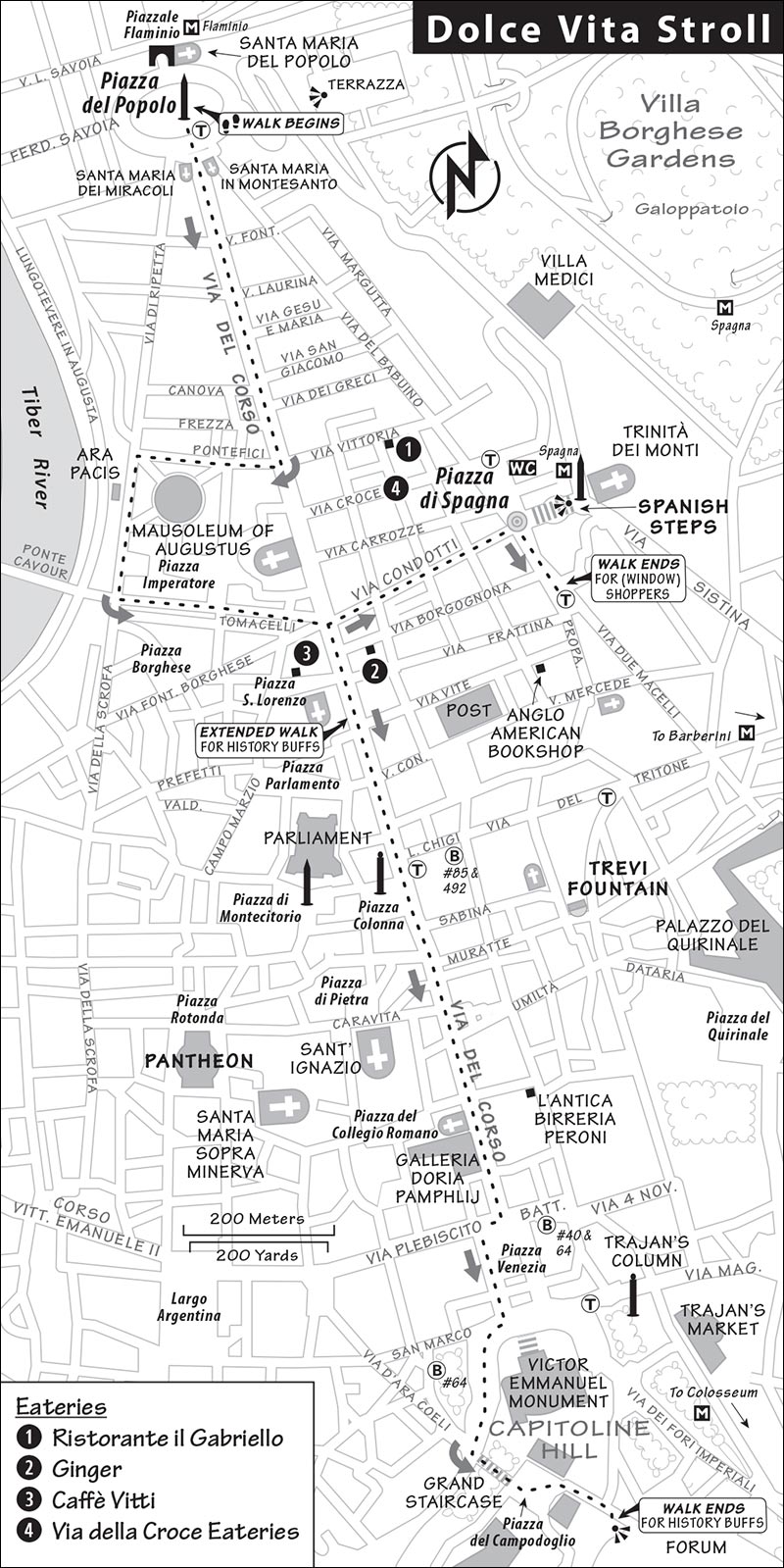
From Via del Corso, window shoppers should take a left down Via Condotti to join the parade to the Spanish Steps, passing big-name boutiques. The streets that parallel Via Condotti to the south (Borgognona and Frattina) are also elegant and filled with high-end shops. A few streets to the north hides the narrow Via Margutta, filled with pricey artisan and antique shops.
History Buffs: Another option is to ignore Via Condotti and forget the Spanish Steps. Stay on Via del Corso, which has been straight since Roman times, and walk a half-mile down to the Victor Emmanuel Monument. Climb Michelangelo’s stairway to his glorious (especially when floodlit) square atop Capitoline Hill. Stand on the balcony (just past the mayor’s palace on the right), which overlooks the Forum. As the horizon reddens and cats prowl the unclaimed rubble of ancient Rome, it’s one of the finest views in the city.
HEART OF ROME WALK
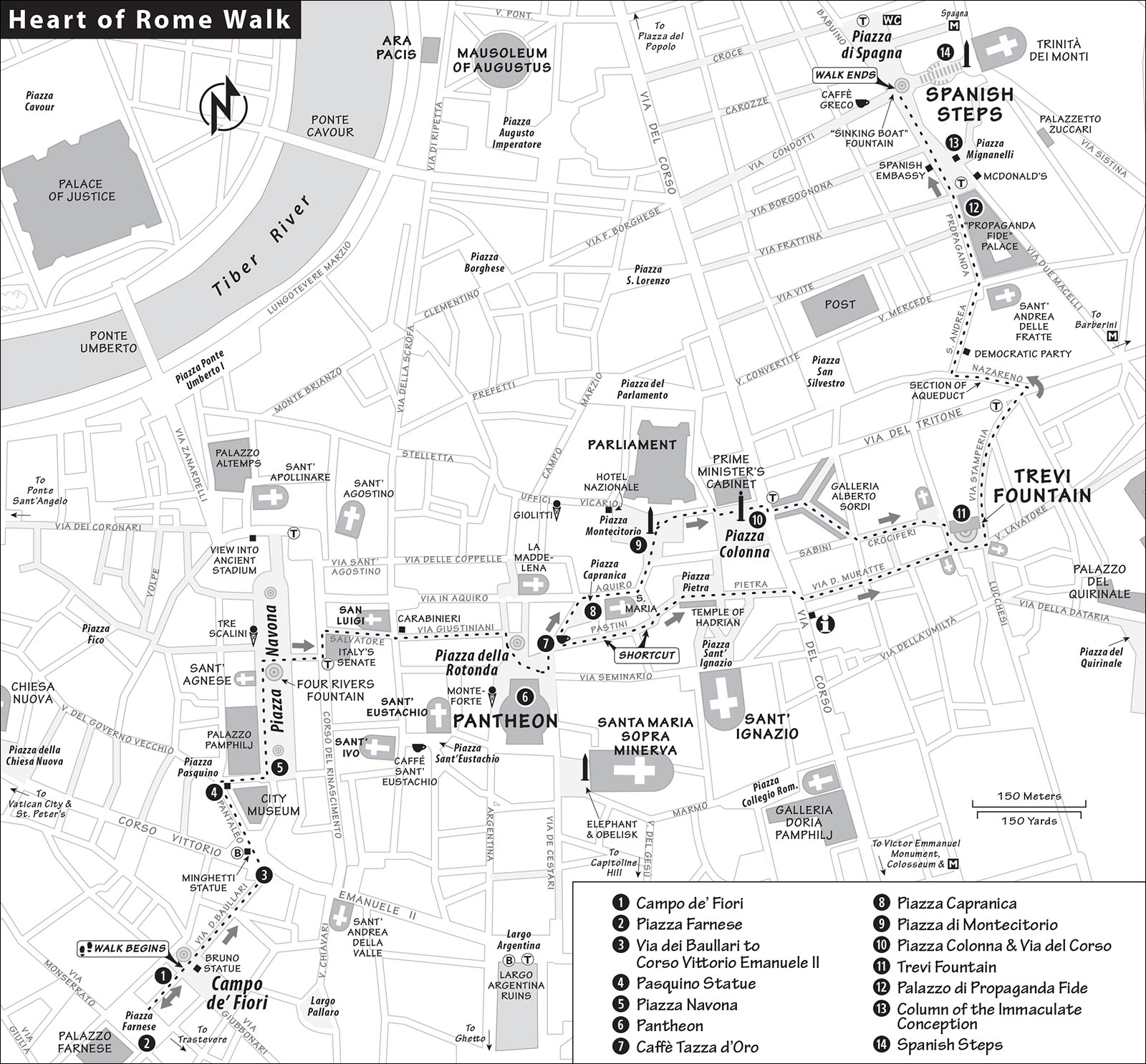
Rome’s most colorful neighborhood features narrow lanes, intimate piazzas, fanciful fountains, and some of Europe’s best people-watching. During the day, this walk—worth ▲▲▲—shows off the colorful Campo de’ Fiori market and trendy fashion boutiques as it meanders past major monuments such as the Pantheon and the Spanish Steps.
But the sunset brings unexpected magic. A stroll in the cool of the evening is made memorable by the romance of the Eternal City at its best. Sit so close to a bubbling fountain that traffic noise evaporates. Jostle with kids to see the gelato flavors. Watch lovers straddling more than the bench. Jaywalk past carabinieri in bullet-proof vests. And marvel at the ramshackle elegance that softens this brutal city for those who were born here and can’t imagine living anywhere else. These are the flavors of Rome, best enjoyed after dark.
This walk is equally pleasant in reverse order. You could ride the Metro to the Spanish Steps and finish at Campo de’ Fiori, near many recommended restaurants.
Getting There: Kick off this walk in one of Rome’s most colorful spots, Campo de’ Fiori. It’s a few blocks west of Largo Argentina, a major transportation hub. Buses #40, #64, and #492, and tram #8 stop at Largo Argentina and/or along Corso Vittorio Emanuele II (a long block northwest of Campo de’ Fiori). A taxi from Termini station costs about €14.
Length of This Walk: Allow one to three hours for this mile-long walk, depending on whether you linger and tour the Pantheon. To lengthen this walk, continue from the Spanish Steps to Piazza del Popolo.
Tours: Download my free Heart of Rome Walk audio tour.
Self-Guided Walk
1 Campo de’ Fiori: In the morning, this bohemian piazza hosts a fruit-and-vegetable market. In the evening, the cafés and restaurants that line the square predominate. On weekend nights, beer-drinking young people (mostly American students) pack the medieval square, transforming it into a vast Roman street party.
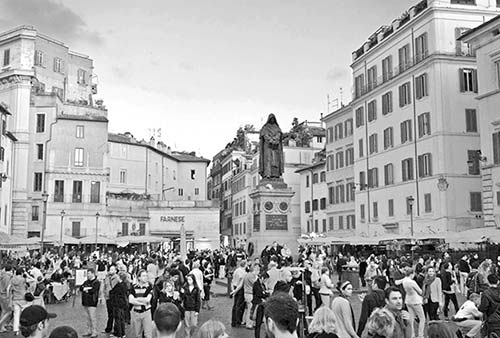
With the neighborhood feel of Campo de’ Fiori, it’s hard to believe you’re in a major capital city of nearly three million people. Rome has no skyscrapers, no central business district, and no obvious downtown. It’s more a collection of urban villages, like this square. Romans jealously guard their laidback lifestyle, and nowhere is it clearer than in Campo de’ Fiori.
In ancient times, it was a pleasant meadow—literally a campo de’ fiori, or “field of flowers.” Then the Romans built a massive entertainment complex, the Theater of Pompey, right next to it. The complex covered several city blocks, stretching from here to Largo Argentina (and including the spot where Julius Caesar was stabbed to death).
In medieval times, Christian pilgrims passed through the campo on their way to the Vatican, and a thriving market developed. As popes modernized the city in Renaissance and Baroque times, this square kept its local flavor.
Today’s Romans live amid the eclectic heritage of their ancestors. For example, at the east end of the square (behind the statue of the heretic Bruno), see how the ramshackle apartments are built right into the older parts. Find the pinkish-beige brick building, midway up, and the two white columns incorporated into it. Those ancient columns were once part of that Theater of Pompey.
Lording over the center of the square is the statue of Giordano Bruno, an intellectual who was burned on this spot in 1600. The pedestal shows scenes from Bruno’s trial and execution, and an inscription translates, “And the flames rose up.” The statue, facing a Vatican administration building, was erected in 1889, a time when the new state of Italy and the Vatican were feuding. Vatican officials protested the heretic in their midst, but they were overruled by angry neighborhood locals. This district is still known for its free spirit and antiauthoritarian demonstrations.
The square is surrounded by fun eateries, and is great for people-watching. Bruno faces the bustling Forno (in the left corner of the square), where takeout pizza bianca is sold hot from the oven.
• If Bruno did a hop, step, and jump forward, then turned left, in a block he’d reach...
2 Piazza Farnese: While the higgledy-piggledy Campo de’ Fiori feels free and easy, the 16th-century Renaissance Piazza Farnese, named for the family whose palace dominates it, seems to stress order. The Farnese family was nouveau riche and needed to make a statement. They hired Michelangelo to help design their palace. He created the jutting roofline (the cornice), and made the window in the very center a little wider than the others. This gave the whole facade a pleasant symmetry and focused attention on the balcony, from where Farnese nobles gave speeches.
Note the flags over the entrance and the security presence. The palazzo now houses the French embassy. The twin fountains decorating the square date from the third century and were made with repurposed stone tubs from the ancient Baths of Caracalla. Rome is famous for its fountains. In times past, they were functional, providing neighborhoods with a water supply. These particular fountains are fed by an ancient aqueduct, the Acqua Vergine. It’s the same source that feeds the Trevi Fountain and others that we’ll see along this walk. After 2,000 years, the aqueduct is still bringing the water of life into the city.
• Walk back to Campo de’ Fiori, cross the square, and continue a couple of blocks down...
3 Via dei Baullari to Corso Vittorio Emanuele II: As you slalom through the crowds, notice the crush of cheap cafés, bars, and restaurants—the center of medieval Rome is morphing into a playground for tourists, students, and locals visiting from the suburbs. High rents are driving families out and changing the character of this district. That’s why the Campo de’ Fiori market increasingly sells more gifty edibles than basic fruits and vegetables.
After a couple of blocks, you reach the busy boulevard, Corso Vittorio Emanuele II. In Rome, any road big enough to have city buses like this is post-unification: constructed after 1870. Look left and right down the street—the facades are mostly 19th-century neo-Renaissance, built after this main thoroughfare sliced through the city. Traffic in much of central Rome is limited to city buses, taxis, motorbikes, “dark cars” (limos and town cars of VIPs), delivery vans, residents, and disabled people with permits (a.k.a. friends of politicians). This is one of the increasingly rare streets where any vehicle is welcome.
• Cross Corso Vittorio Emanuele II, and enter a square with a statue of Marco Minghetti, an early Italian prime minister. Angle left at the statue, walking along the left side of the skippable City Museum of Rome, down Via di San Pantaleo. A block down, at the corner, over your right shoulder you’ll find a beat-up old statue.
4 Pasquino: Pasquino—a third-century-BC statue that was discovered near here—is one of Rome’s “talking statues.” For 500 years, this statue has served as a kind of community billboard, allowing people to complain anonymously when it might be dangerous to speak up. And, to this day, you’ll see the board next to old Pasquino strewn with political posters, strike announcements, and grumbling graffiti. The statue looks worn down by centuries of bitching.
• Facing Pasquino, turn left and head up Via di Pasquino. You’ll soon emerge into a place where all the layers of Rome are on display: ancient, medieval, Baroque, and contemporary.
5 Piazza Navona: This long, oblong square is dotted with fountains, busy with outdoor cafés, lined with palazzos and churches, and thronged with happy visitors. By its shape you might guess that this square started out as a racetrack, part of the training grounds built here by Emperor Domitian around AD 80. That was the same year the Colosseum opened: Rome was at its peak.
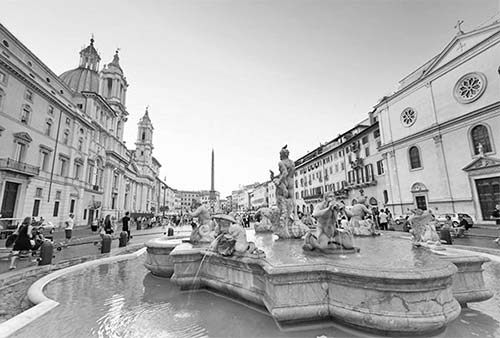
But much of what we see today came in the 1600s, when the whole place got a major renovation. At the time, the popes were trying to put some big scandals behind them, and beautification projects like this were a peace offering to the public.
Three Baroque fountains decorate the piazza. The first fountain, at the southern end, features a Moor wrestling with a dolphin. In 17th-century Rome, Moors (North Africans) represented all that was exotic and mysterious. In the fountain at the northern (far) end, Neptune slays a giant octopus.
The most famous fountain, though, is in the center: the Four Rivers Fountain by Gian Lorenzo Bernini, the man who in the mid-1600s remade Rome in the Baroque style. It’s topped with an Egyptian-style obelisk—another of the themes we’ll see along this walk. Obelisks were popular with Roman emperors because Egyptian society saw its rulers as divine—an idea Roman rulers liked to promote.
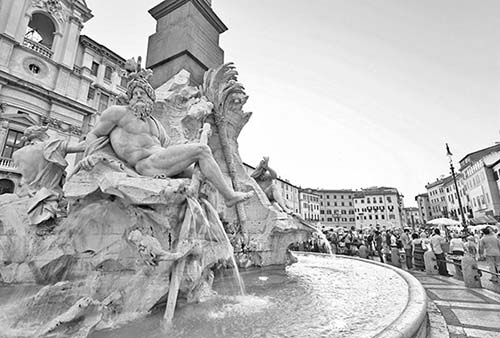
Get close to admire Bernini’s four enormous statues at the base. As the water of the world gushes everywhere, these four burly river gods represent the four quarters of the world.
Piazza Navona is Rome’s most interesting night scene, with street music, artists, fire-eaters, local Casanovas, gelato, and outdoor cafés that are worthy of a splurge if you’ve got time to sit and enjoy Italy’s human river.
• Leave Piazza Navona directly across from Tre Scalini (famous for its tartufo, a rich, chocolate gelato concoction), and go east down Corsia Agonale, past rose peddlers and palm readers. Ahead of you (across the busy street) stands the stately Palazzo Madama, where the Italian Senate meets. (Hence, security is high.) Jog left around this building, and follow the brown Pantheon sign straight down Via del Salvatore.
After a block, you’ll pass (on your left) the Church of San Luigi dei Francesi, with its très French decor and precious Caravaggio paintings. If it’s open, pop in. Otherwise, continue along, following the crowd to...
6 The Pantheon: Perhaps the most magnificent building surviving from ancient Rome is this temple to the “pantheon” (literally, all the gods). The 40-foot, single-piece granite columns of the Pantheon’s entrance show the scale the ancient Romans built on. The columns support a triangular Greek-style roof with an inscription that proclaims, “M. Agrippa built this.” In fact, the present structure was built (fecit) by Emperor Hadrian (AD 120), who gave credit to the builder of an earlier temple. This impressive entranceway gives no clue that the greatest wonder of the building is inside—a domed room that inspired later domes, including Michelangelo’s St. Peter’s and Brunelleschi’s Duomo in Florence.
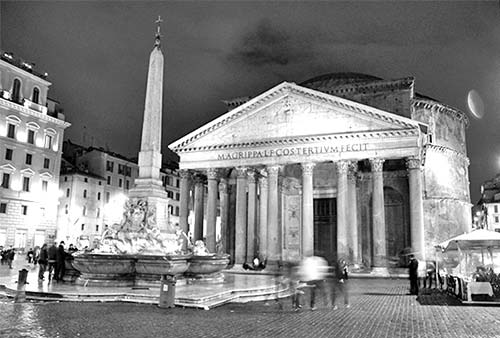
If the Pantheon is open, pop in for a look around (for details on the interior, see here). Afterward, consider detouring to several interesting churches nearby (see here).
If the Pantheon is closed, just stand for a while under the portico, which is romantically floodlit and moonlit at night.
• To continue this walk, with your back to the Pantheon, veer to the right, uphill toward the yellow sign on Via Orfani that reads Casa del Caffè—you’ve reached the...
7 Caffè Tazza d’Oro: This is one of Rome’s top coffee shops, dating back to the days when this area was licensed to roast coffee beans. Locals come here for a shot of espresso or, when it’s hot, a refreshing granita di caffè con panna (coffee and crushed ice with whipped cream).
• From here, our walk continues past some interesting landmarks to the Trevi Fountain. To get there more directly, you could opt to take a shortcut by bearing right at the coffee shop onto Via de’ Pastini, which leads through Piazza di Pietra (with some surviving chunks of the Temple of Hadrian), then across busy Via del Corso, where it becomes the touristy, pedestrianized Via delle Muratte and heads straight for the fountain.
To stick with me for the slightly longer version, bear left at the coffee shop and continue up Via degli Orfani to the next square...
8 Piazza Capranica: This square is home to the big, plain Florentine-Renaissance-style Palazzo Capranica (directly opposite as you enter the square). Its stubby tower was once much taller, but when a stronger government arrived, the nobles were all ordered to shorten their towers. Like so many of Rome’s churches, the church on the square—Santa Maria in Aquiro—is older than its Baroque-era facade. Notice the circular little shrine on the street corner (between the palace and the apartment building). For centuries, worshipful spots like this have made pilgrims (and, today, tourists) feel welcome.
• Leave the piazza to the right of the palazzo, heading down Via in Aquiro. The street jogs to the left and into a square called...
9 Piazza di Montecitorio: This square, home to Italy’s Parliament, is marked by an Egyptian obelisk from the sixth century BC. It adorned a temple in Egypt for half a millennium before Emperor Augustus brought it to Rome as a trophy proclaiming his victory over Mark Antony and Cleopatra. Made of red granite, the obelisk stands 70 feet tall—or well over 100 feet when you include the base.
In Augustus’ day, the obelisk acted as a sundial and calendar, aligned to cast a shadow across the solarium altar on the emperor’s birthday. Today, the obelisk still functions as a sundial. Follow the zodiac markings in the pavement to the square’s next big sight—the Italian Parliament. This impressive building is where the legislature’s lower chamber (the equivalent of the US House of Representatives) attempts to govern the nation.
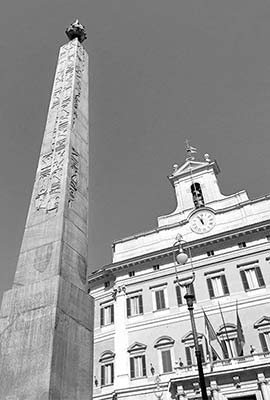
• One block to your right is Piazza Colonna, where we’re heading next—unless you like gelato. A one-block detour to the left (past Hotel Nazionale) brings you to a famous Roman gelateria, Giolitti.
10 Piazza Colonna and Via del Corso: The square features a massive column that has stood here since the second century AD. The column’s shaft is 12 feet across, almost 100 feet tall, and stands on a 30-foot base, which rests on a platform. It’s a particularly imposing-looking column because it doesn’t taper at the top. The whole thing is carved from the finest white marble in the world, from Carrara—the favorite quarry of the ancient Romans and of Michelangelo.
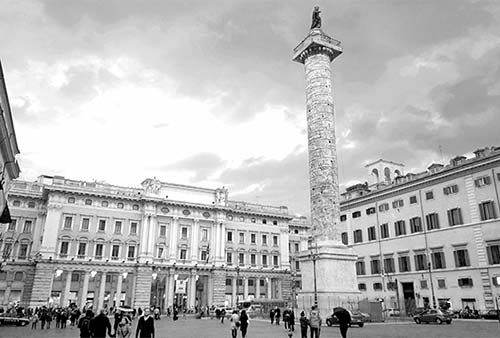
This isn’t a single piece of marble. It’s 28 cylindrical blocks stacked atop each other like a pile of 10-ton checkers. A carved frieze winds from the bottom to the top, telling the story of Emperor Marcus Aurelius heroically battling barbarians around AD 170.
Beyond Piazza Colonna runs noisy Via del Corso, Rome’s main north-south boulevard. In ancient times, this was the Via Flaminia, the highway that stretched from the Roman Forum to the Adriatic coast. For 2,000 years, all travelers from northern Europe first entered Rome and headed downtown on this street. In the Middle Ages, the street brought pilgrims to the Vatican.
The street was renamed “corso” for a famous medieval horse race that took place here during the crazy Carnevale season leading up to Lent. In 1854, Via del Corso became one of Rome’s first gas-lit streets. It still hosts some of the city’s most chic stores. Every evening, the pedestrian-only stretch of the Corso is packed with people on parade, taking to the streets for their passeggiata.
Before crossing the street, look left (to the obelisk marking Piazza del Popolo—the ancient north gate of the city) and right (to the Victor Emmanuel Monument).
• Cross Via del Corso to enter a big palatial building with columns, the Galleria Alberto Sordi shopping mall. To the left are convenient WCs. Go to the right and exit out the back. (If you’re here after 21:00, when the mall is closed, circle around the right side of the Galleria on Via dei Sabini.) At any time, be on guard for pickpockets, who thrive in the nearby Trevi Fountain crowds. Once out the back, the tourist kitsch builds as you head up Via de Crociferi to the roar of the water, lights, and people at the...
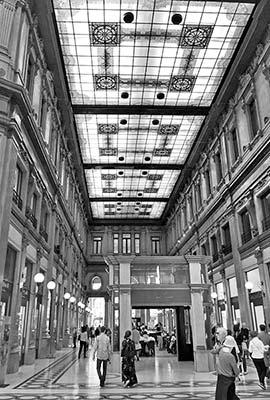
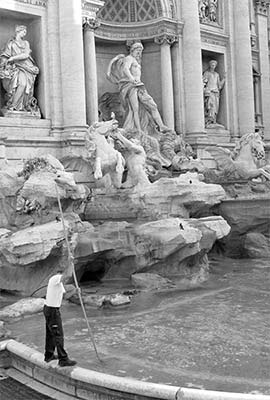
11 Trevi Fountain: The Trevi Fountain is the ultimate showcase for Rome’s love affair with water.
Architect Nicola Salvi conceived this liquid Baroque avalanche in 1762, cleverly incorporating the palace behind the fountain as a theatrical backdrop. Centerstage is the enormous figure known simply as the “Ocean.” He symbolizes water in every form. The statue stands in his shell-shaped chariot, surfing through his wet dream. Water gushes from 24 spouts and tumbles over 30 different kinds of plants. Winged horses represent cresting waves. They’re led by Tritons who blow on their conch shells. Drammatico!
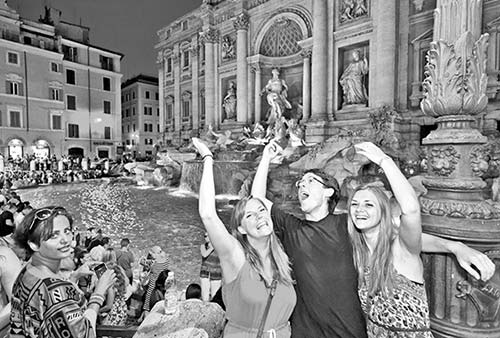
The square that faces the fountain has a lively atmosphere. The magic is enhanced by the fact that no streets directly approach it. You can hear the excitement as you draw near, and then—bam!—you’re there. Enjoy the scene. Romantics toss a coin over their shoulder into the fountain. Legend says it will assure your return to Rome. Every year I go through this tourist ritual...and so far it’s working.
• Facing the Trevi Fountain, walk along its right side up Via della Stamperia. Cross busy Via del Tritone. At the McDonald’s, angle left as you continue about 30 yards up Via del Nazareno to #9, where you’ll pass a fence on the left, with an exposed bit of that ancient Acqua Vergine aqueduct. At the T-intersection ahead, turn right on Via Sant’Andrea delle Fratte. After you cross another street, the street you’re on becomes Via di Propaganda. Up ahead, you’ll pass alongside the...
12 Palazzo di Propaganda Fide: At #1, on the right, the white-and-yellow entrance marks the palace from which the Catholic Church “propagated,” or spread, its message to the world. Back in the 1600s, this “Propaganda Palace” was the headquarters of the Catholic Church’s P.R. department—a priority after the Reformation. The building was designed by that dynamic Baroque duo, Bernini and Borromini (with his concave lines). It flies the yellow-and-white flag signifying that it is still owned by the Vatican.
• The street opens up into a long piazza. You’re approaching the Spanish Steps. But first, pause at the...
13 Column of the Immaculate Conception: Atop a tall column stands a bronze statue of Mary. She wears a diadem of stars for a halo, and stands on a crescent moon atop a globe of the earth, which is crushing a satanic serpent.
Picture the festive scene here every December 8, the feast day of the Immaculate Conception. The pope attends, the fire department brings out a ladder truck, and fresh flowers are placed high on Mary’s statue. (You may see wilted remains of a flower wreath in Mary’s hand.) This is the traditional event that kicks off Rome’s Christmas season—the locals all go home and decorate their trees on this December day.
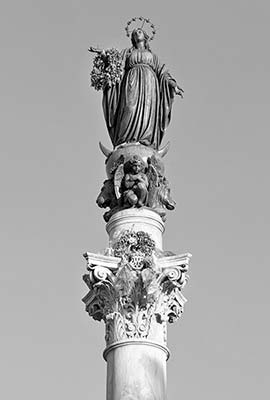
To Mary’s immediate left stands the Spanish embassy to the Vatican. Rome has double the embassies of a normal capital because here countries need two: one to Italy and one to the Vatican. And because of this 300-year-old embassy, the square and its famous steps are called “Spanish.”
• Just 100 yards past Mary, you reach the climax of our walk, the...
14 Spanish Steps: The wide, curving staircase is one of Rome’s iconic sights. Its 138 steps lead sharply up from Piazza di Spagna. Partway up, the steps fan out around a central terrace, forming a butterfly shape. The design culminates at the top in an obelisk framed between two Baroque church towers.
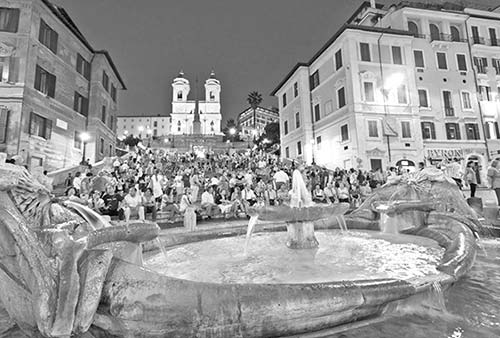
For decades the steps were a favorite Roman hangout (see photo), but recently the city banned anyone from sitting on them. You can walk up and down the steps, but if you sit, you’ll face a €250 fine.
At the foot of the steps is the aptly named Sinking Boat Fountain. It was built by Gian Lorenzo Bernini’s father, Pietro. This fountain is powered by that same Acqua Vergine aqueduct. Because the water pressure here is low, the water can’t shoot high in the air. So Bernini designed the fountain to be low key—a sinking boat filled with water.
The piazza is a thriving scene both day and night. From here you can window-shop along Via Condotti, which stretches away from the steps. But before you head off, take a final 360-degree spin of the piazza. It features many of the themes we’ve enjoyed on this walk—fountains, obelisks, public spaces, statues, and gelato. Most of all, it’s a glimpse at today’s Rome—a city where friends and families live much the same kind of life as their ancient cousins.
• Our walk is finished. To reach the top of the steps sweat-free, take the free elevator just inside the Spagna Metro stop (to the left, as you face the steps; elevator closes at 23:30). You’ll find a pay WC in the middle of the square just beyond the fountain. And in the opposite direction, the nearby McDonald’s (as you face the Spanish Steps, go right one block) is big and lavish, with a handy WC. When you’re ready to leave, you can zip home on the Metro (usually open until 23:30) or grab a taxi at the north or south ends of the piazza.
Sights in Rome
Baths of Caracalla (Terme di Caracalla)
▲▲▲Capitoline Museums (Musei Capitolini)
Map: Capitoline Hill & Piazza Venezia
▲Mamertine Prison (Carcer Tullianum Museum)
▲The Roman House at Palazzo Valentini (Le Domus Romane di Palazzo Valentini)
▲▲St. Peter-in-Chains Church (San Pietro in Vincoli)
▲▲▲Pantheon
▲▲▲St. Peter’s Basilica (Basilica San Pietro)
▲▲▲Vatican Museums (Musei Vaticani)
▲▲▲Borghese Gallery (Galleria Borghese)
Map: Borghese Gallery—Ground Floor
▲Museo dell’Ara Pacis (Museum of the Altar of Peace)
▲▲Catacombs of Priscilla (Catacombe di Priscilla)
▲▲▲National Museum of Rome (Museo Nazionale Romano Palazzo Massimo alle Terme)
▲Baths of Diocletian/Church of Santa Maria degli Angeli (Terme di Diocleziano/Basilica S. Maria degli Angeli)
▲Church of Santa Maria della Vittoria
I’ve clustered Rome’s sights into walkable neighborhoods. Save transit time by grouping your sightseeing according to location. For example, in one great day you can start at the Colosseum, then go to the Forum, then Capitoline Hill, and from there either to the Pantheon or back to the Colosseum (by way of additional ruins along Via dei Fori Imperiali).
A in the listing means the walk or tour is also available as a free audio tour (via my Rick Steves Audio Europe app—see here).
For general tips on sightseeing, see the Practicalities chapter. Rome’s good city-run information website, www.060608.it, lists current opening hours.
Reserve Ahead: Most sights in Rome—even small ones—allow prebooking online. At a few key sights, reservations are either required or highly recommended: the Colosseum (combo-ticket with the Roman Forum and Palatine Hill), Borghese Gallery, Vatican Museums (with the Sistine Chapel), and on weekends, the Pantheon. See listings for details on booking.
Beware of Scalper Sites: Before purchasing tickets online, make sure that you are on the sight’s official website. Sometimes scalper websites come up first when you do an online search, and they might even have the word “official” on the page. Make sure you use the legitimate official website, listed in this book, when booking tickets online. If the prices are significantly higher than what I list here, you’re probably on a third-party site.
Avoid Free-Entry Crowds: State museums in Italy are free to enter once or twice a month, usually on a Sunday, and the Vatican Museums are free on the last Sunday of the month. Free days are actually bad news—they attract crowds. In peak season, I’d check websites in advance and make a point to avoid their free days. Rome’s state museums include the Colosseum, Roman Forum, Palatine Hill, Borghese Gallery, National Museum of Rome, Castel Sant’Angelo, and Baths of Caracalla. Note that sights that require reservations still need to be prebooked on free days.
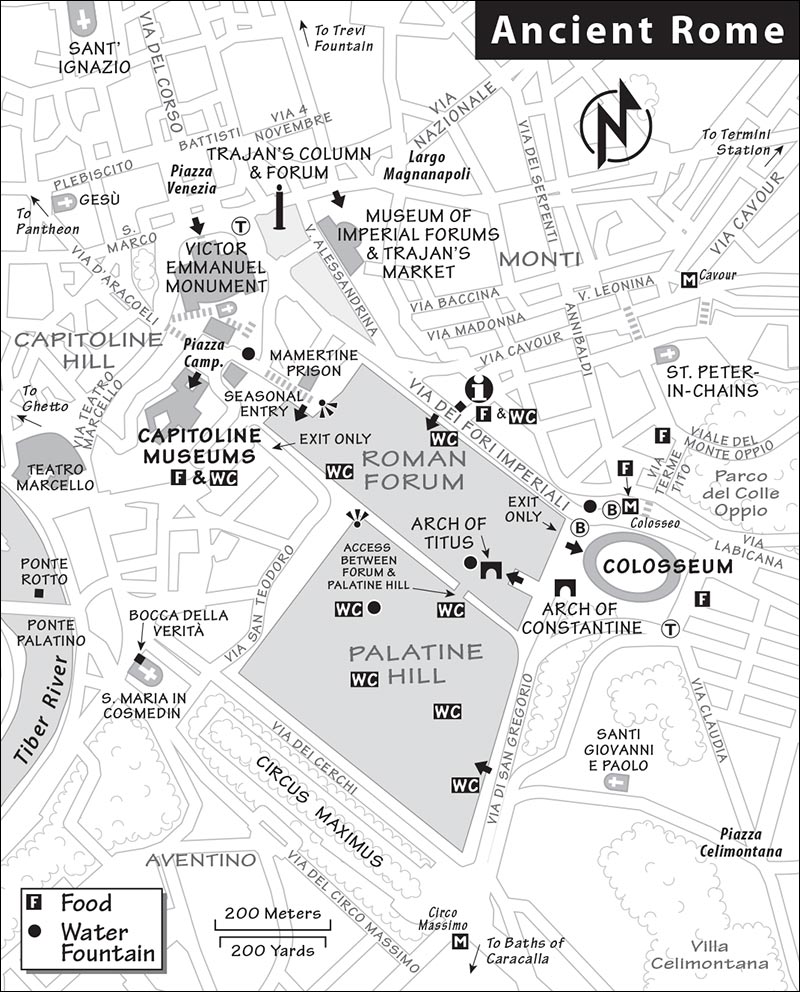
ANCIENT ROME
The core of ancient Rome, where the grandest monuments were built, is between the Colosseum and Capitoline Hill. Among the ancient forums, a few modern sights have popped up. I’ve listed these sights generally from south to north, starting with the biggies—the Colosseum and Forum—and continuing up to Capitoline Hill and Piazza Venezia. As a pleasant conclusion to your busy day, consider my relaxing self-guided walk back south along the broad, parklike main drag—Via dei Fori Imperiali—with some enticing detours to nearby sights (described in the “Imperial Forums” listing, later).
ANCIENT CORE
▲▲▲Colosseum (Colosseo)
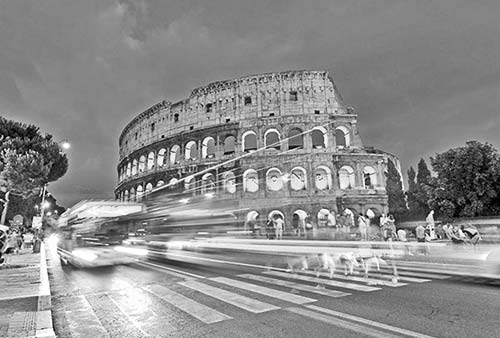
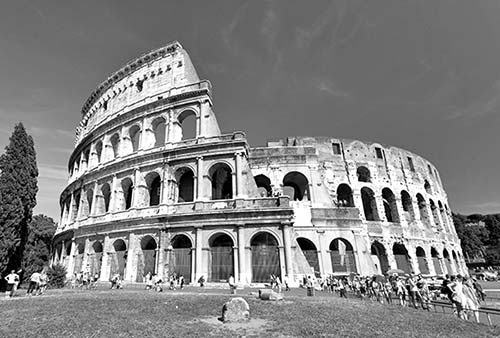
This 2,000-year-old building is the classic example of Roman engineering. Used as a venue for entertaining the masses, this colossal, functional stadium is one of Europe’s most recognizable landmarks. Whether you’re playing gladiator or simply marveling at the remarkable ancient design and construction, the Colosseum gets a unanimous thumbs-up.
Cost: €18 combo-ticket covers the Colosseum and the Roman Forum/Palatine Hill and is valid for 24 hours. Buy it online well in advance to get a timed-entry reservation for the Colosseum. Do not show up without a reserved entry. A Full Experience ticket costs €24, is valid for two consecutive days, and covers the Colosseum, Palatine Hill/Roman Forum, and some minor sights at these archaeological areas, plus access to the Colosseum’s arena floor.
Hours: Daily 9:00 until one hour before sunset—April-Aug until 19:15, Sept until 19:00, Oct until 18:30, off-season closes as early as 16:30; last entry one hour before closing, audioguide-€5.50, Metro: Colosseo.
Information: Call center: +39 06 3996 7700 (English spoken, daily 10:00-15:00), www.parcocolosseo.it [URL inactive].
Mandatory Advance Ticketing: Tickets must be reserved in advance (no on-site sales), and for the Colosseum, you must book a specific entrance time (even for those with free tickets, such as kids 17 and under). Book online at Coopculture.it (select English, and click on “Ticketing”; you’ll be emailed a ticket/QR code to use at entry). You can also book by phone (see call center details above, under “Information”).
If you want to join an official English-language tour, it’s best to book it in advance with your admission, as these typically sell out.
Although it’s possible to make a same-day reservation, don’t wait too long to book. Spaces are limited and can sell out. If the time slot you want is unavailable, try booking a different type of ticket (such as one that includes an audioguide or a tour).
When to Go: Try to get an early-morning or late-afternoon time slot. At midday, the Colosseum can be so crowded that even reservation holders can face long waits. Generally, crowds are thinner in the afternoon (especially after 16:00 in summer).
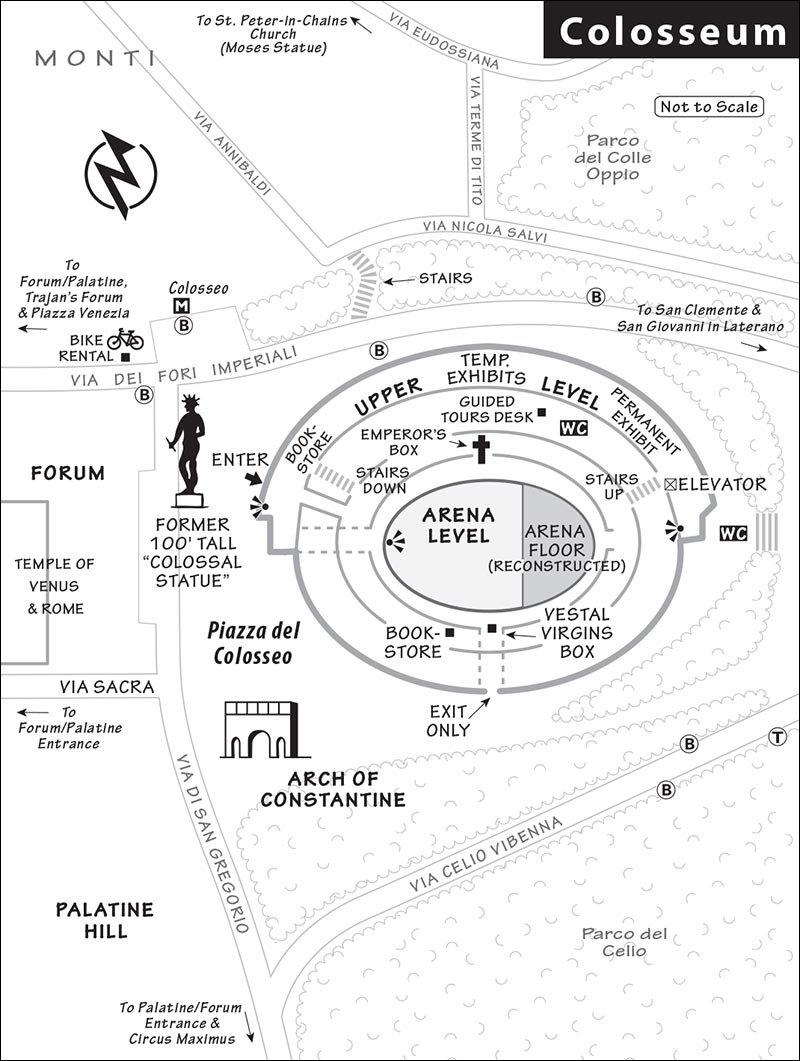
Getting There: The Colosseo Metro stop on line B is just across the street from the monument. Buses #51, #75, #85, #87, and #118 stop along Via dei Fori Imperiali near the Colosseum entrance (buses don’t run on this street on Sun but still stop nearby), one of the Forum/Palatine Hill entrances, and Piazza Venezia. Tram #3 stops behind the Colosseum.
Getting In: There’s a single entry point (across from the Forum), where you’ll need to show your ticket/QR code to get inside. Be sure to arrive 15 minutes before your appointed time.
Tours: My free Colosseum audio tour, covering much the same information as provided here, is just the right amount of detail for a casual visitor.
For more in-depth commentary, stop at the Guided Tours desk, which you’ll find inside the turnstiles. You can choose between a fact-filled audioguide (€5.50/1 hour) or a handheld videoguide that senses where you are in the site and plays related clips (€6/50 minutes) but can be hard to see in bright sunlight. Official guided tours in English depart regularly (€10), but these usually sell out—book in advance with your admission.
Private guides stand outside the Colosseum looking for business (€25-30/2-hour tour of the Colosseum, Forum, and Palatine Hill). If booking a private guide on the spot, make sure that your tour will start right away and that the ticket you receive covers all three sights: the Colosseum, Forum, and Palatine Hill.
Length of This Tour: Allow an hour. If you’re short on time, you can see the entire interior from a single viewpoint.
Baggage: Small bags are no problem. Larger bags and backpacks are not allowed, and there is no bag check. Spray cans and glass bottles are prohibited.
Restoration: The arena is being cleaned from top to bottom, given permanent lighting, and outfitted with new shops and services. These ongoing renovations may affect your visit.
Services: A WC (often crowded) is inside the Colosseum, and there are also water fountains.
Background: Built when the Roman Empire was at its peak in AD 80, the Colosseum represents Rome at its grandest. The Flavian Amphitheater (the Colosseum’s real name) was an arena for gladiator contests and public spectacles. When killing became a spectator sport, the Romans wanted to share the fun with as many people as possible, so they stuck two semicircular theaters together to create a freestanding amphitheater, the largest in the empire.
The sheer size of the Colosseum is impressive, even in our era of mega-stadiums. With four oversized stories, it’s 160 feet high, nearly a third of a mile around, and makes an oval-shaped footprint that covers six acres.
Imagine the Colosseum in its glory days. The whole thing was a brilliant white, highlighted with brightly painted trim. Monumental statues of Greek and Roman gods (Zeus, Venus, Hercules), also in bright colors, stood in the arches of the middle two stories. The top of the structure was studded with wooden beams sticking straight up, to hold a canvas awning that shaded the spectators inside.
The stadium could accommodate 50,000 roaring fans (that’s 100,000 thumbs). As Romans arrived for the games, they’d be greeted outside by a huge bronze statue of the emperor Nero—100 feet tall, gleaming in the sunlight—standing where the cypress trees stand today, between the Colosseum and the Metro stop.
Visiting the Colosseum: Once past the turnstiles, signs direct you to the official visitors’ route; depending on current policies, you may be expected to stick to this, or you may be able to explore in whatever order you like. Even if you aren’t required to, following the official route ensures you will see everything. (If following signs, you want the “long route,” which includes the upstairs—with the best views.)
As you pass into the interior, imagine being an ancient spectator arriving for the games. Fans could pour in through ground-floor entrances; there were 76 numbered ones in addition to the emperor’s private entrance on the north side. Your ticket (likely a pottery shard) was marked with your entrance, section, row, and seat number. You’d pass by concession stands selling fast food and souvenirs, such as wine glasses with the names of famous gladiators. A hallway leading to the seats was called a vomitorium. At exit time, the Colosseum would “vomit” out its contents, giving us the English word. It’s estimated that a capacity crowd could enter and exit in just 15 minutes.
The games took place in this oval-shaped arena, 280 feet long by 165 feet wide. When you look down into the arena, you’re seeing the underground passages beneath the playing surface (which can be visited only on a private tour). The arena was originally covered with a wooden floor, then sprinkled with sand (arena in Latin). The bit of reconstructed floor gives you an accurate sense of the original arena level and the subterranean warren where animals and prisoners were held. As in modern stadiums, the spectators ringed the playing area in bleacher seats that slanted up from the arena floor. Around you are the big brick masses that supported the tiers of seats.
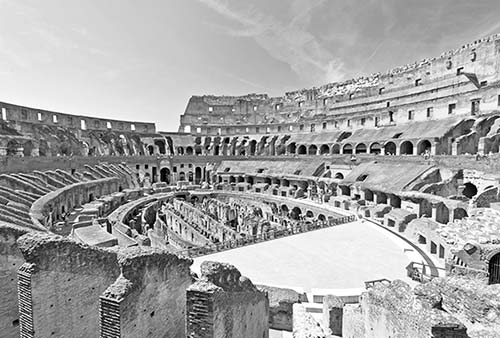
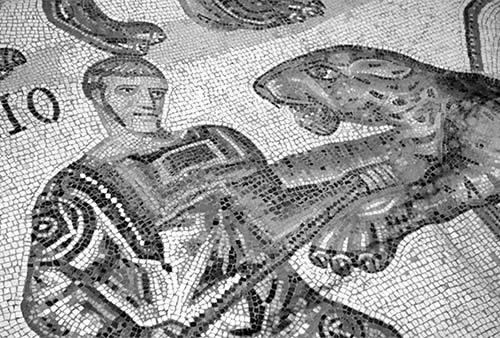
The games pitted men against men, men against beasts, and beasts against beasts. The program began in the morning with a few warm-up acts. First came the animals, things like watching dogs bloody themselves attacking porcupines. At lunchtime came Act Two. This is when criminals and POWs were executed, often in creative ways. They might be thrown to the lions—naked and unarmed. Or they were dressed up like classical heroes and forced to star in a play featuring their own death.
Finally, in the afternoon, came the main event: the gladiators. Trumpets would blare, drums would pound, and the gladiators would enter the arena from the west end, parade around to the music, and pause at the south side. There, they’d acknowledge the Vestal Virgins sitting in their special box seats on the 50-yard line. (They got season tickets as a reward for their unique contribution to Roman society—chastity.) After a nod to the Virgins, the gladiators continued on to the emperor’s box. There, they’d raise their weapons, salute, and shout Ave, Caesar!—“Hail Caesar! We who are about to die salute you!” (Though some scholars doubt they actually said that.)
In an age without a hint of a newsreel, it was hard for local Romans to visualize and appreciate the faraway conquests of their empire. The Colosseum spectacles were a way to bring home the environments, animals, and people of these conquered lands, parade them before the public, and make them real. Imagine never having seen an actual lion, and suddenly one jumps out to chase a prisoner in the arena. Seeing the king of beasts slain by a gladiator reminded the masses of man’s triumph over nature.
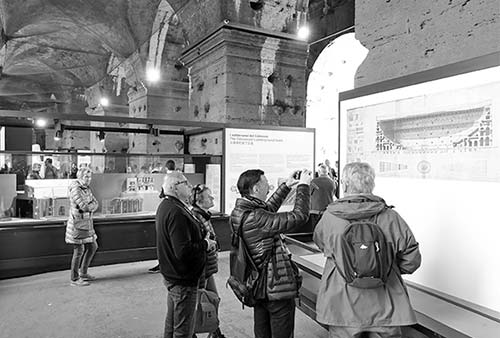
Don’t miss the permanent exhibit, with lots of ancient artifacts found on-site, architectural illustrations, and fascinating reconstruction models (all well described in English). You’ll learn about pullies and hoists, ancient pastimes, and Roman seating hierarchy. The huge, cutaway model of the intact Colosseum is worth lingering over.
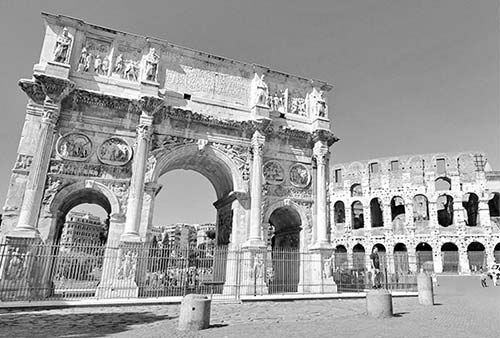
▲Arch of Constantine
This well-preserved arch, which stands between the Colosseum and the Forum, commemorates a military coup and, more important, the acceptance of Christianity by the Roman Empire. When the ambitious Emperor Constantine (who had a vision that he’d win under the sign of the cross) defeated his rival Maxentius in AD 312, Constantine became sole emperor of the Roman Empire and legalized Christianity. The arch is free to see—always open and viewable.
Roman Forum and Palatine Hill
Though I’ve covered them separately, the Forum and Palatine Hill are organized as a single sight with one admission. You’ll need to see both sights in a single visit.
Cost and Hours: €18 combo-ticket includes the Colosseum and Palatine Hill (must buy in advance; you’ll also prebook an entry time for the Colosseum). A €24 Full Experience ticket adds some smaller sights (which may have shorter hours and random closed days) and is valid for two days. Same hours as Colosseum, audioguide-€5, Metro: Colosseo, +39 06 3996 7700, information: www.parcocolosseo.it [URL inactive], tickets: www.coopculture.it.
▲▲▲Roman Forum (Foro Romano)
This is ancient Rome’s birthplace and civic center, and the common ground between Rome’s famous seven hills. As just about anything important that happened in ancient Rome happened here, it’s arguably the most important piece of real estate in Western civilization. While only a few fragments of that glorious past remain, history seekers find plenty to ignite their imaginations amid the half-broken columns and arches.
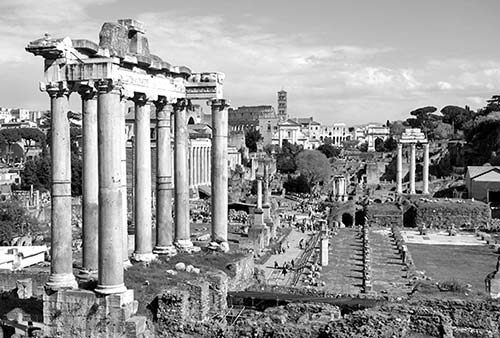
Getting In: There are three main entrances to the Forum/Palatine Hill sight: 1) from the Colosseum (the most crowded)—nearest the Arch of Titus, where my guided walk starts; 2) from Via dei Fori Imperiali; and 3) from Via di San Gregorio—at the south end of Palatine Hill, which is least crowded. At busy times, turnstiles farther up Via dei Fori Imperiali, near the Arch of Septimius Severus, are sometimes open.
Tours: Download my free Roman Forum audio tour, which offers a concise introduction to the sight. Audioguides or a downloadable app may be available to further decipher the rubble.
Services: The information center, located across from the Via dei Fori Imperiali entrance, has a bookshop, small café, food stand, and WCs (daily 9:30-19:00). Bookstalls nearby sell a variety of colorful books with plastic overlays that restore the ruins (prices negotiable).
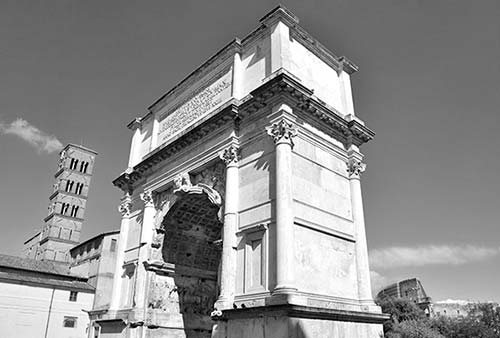
Self-Guided Tour: As you begin this Forum tour, see things with “period eyes.” We imagine the structures in ancient Rome as mostly white, but ornate buildings and monuments like the Arch of Titus were originally more colorful. Through the ages, builders scavenged stone from the Forum, and the finest stone—the colored marble—was cannibalized first. If any was left, it was generally the white stone. Statues that filled the niches were vividly painted, but the organic paint rotted away as statues lay buried for centuries. Lettering was inset bronze and eyes were inset ivory. Even seemingly intact structures, like the Arch of Titus, have been reassembled. Notice the columns are half smooth and half fluted. The fluted halves are original; the smooth parts are reconstructions—intentionally not trying to fake the original.
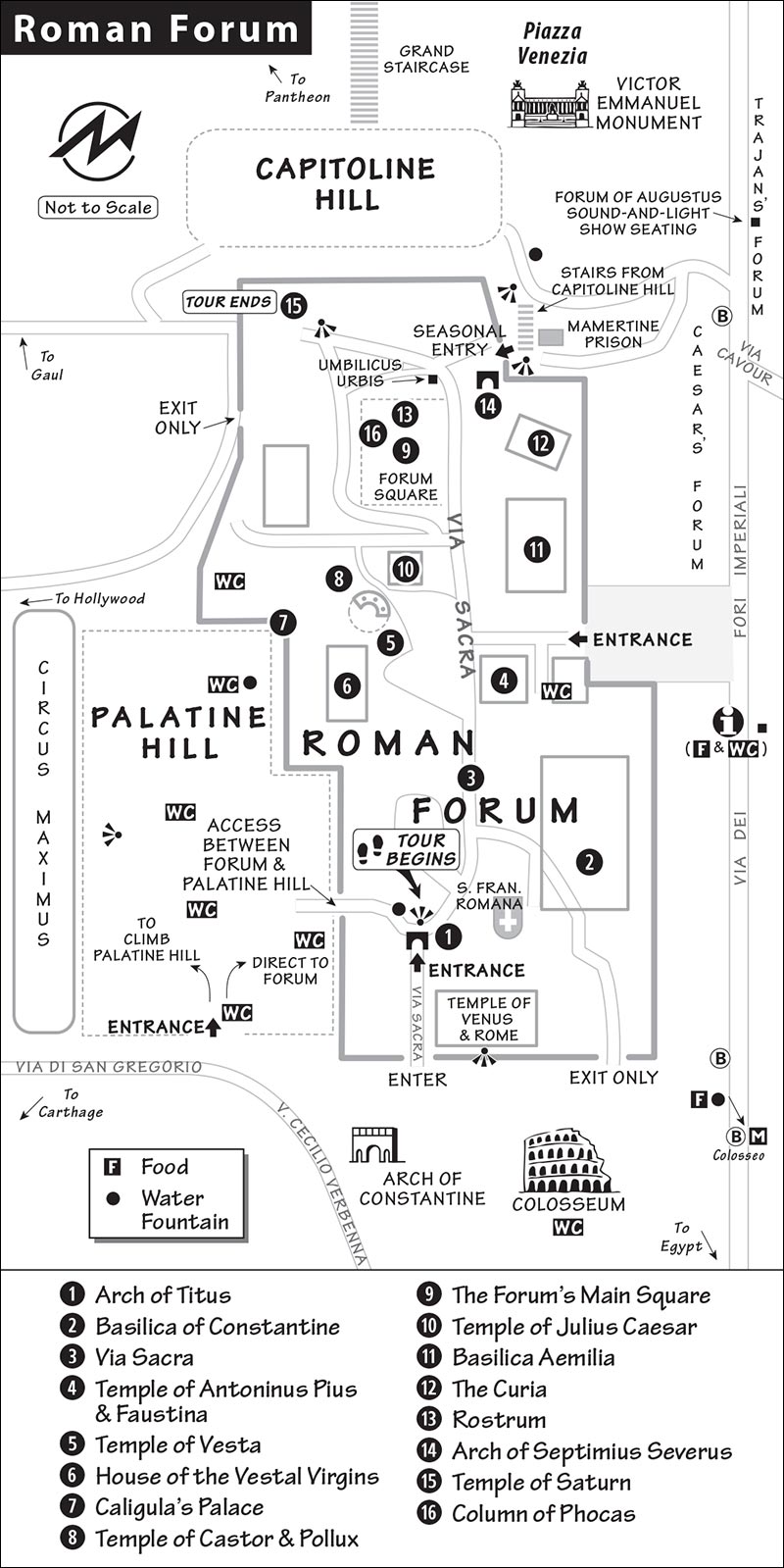
• Start at the Arch of Titus, which rises above the rubble on the Colosseum end of the Forum.
1 Arch of Titus (Arco di Tito): The Arch of Titus commemorated the Roman victory over the province of Judaea (Israel) in AD 70. The Romans had a reputation as benevolent conquerors who tolerated local customs and rulers. All they required was allegiance to the empire, shown by worshipping the emperor as a god. No problem for most conquered people, who already had half a dozen gods on their prayer lists anyway. But Israelites believed in only one god, and it wasn’t the emperor. Israel revolted. After a short but bitter war, the Romans defeated the rebels, took Jerusalem, destroyed their temple (leaving only a fragment of one wall’s foundation—today’s revered “Wailing Wall”), and brought home 50,000 Jewish slaves...who were forced to build this arch (and the Colosseum).
• Walk down Via Sacra into the Forum. Imagine Roman sandals on these original basalt stones—the oldest street you’ll ever walk. Many of the stones under your feet were walked on by Caesar Augustus 2,000 years ago. After about 50 yards, turn right and follow a path uphill to the three huge arches of the...
2 Basilica of Constantine (Basilica Maxentius): Yes, these are big arches. But they represent only one-third of the original Basilica of Constantine, a mammoth hall of justice. The arches were matched by a similar set along the Via Sacra side (only a few squat brick piers remain). Between them ran the central hall, which was spanned by a roof 130 feet high—about 55 feet higher than the side arches you see. (The stub of brick you see sticking up began an arch that once spanned the central hall.) The hall itself was as long as a football field, lavishly furnished (with colorful inlaid marble, a gilded bronze ceiling, and statues), and filled with strolling Romans. At the far (west) end was an enormous marble statue of Emperor Constantine on a throne. (Pieces of this statue, including a hand the size of a man, are on display in Rome’s Capitoline Museums.)
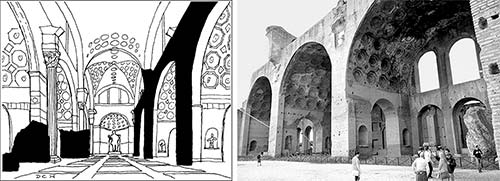
This “basilica” was not a church but a Roman hall of justice. In a society that was as legal-minded as America is today, you needed a lot of lawyers—and a big place to put them. Citizens came here to work out matters like inheritances and building permits, or to sue somebody.
• Now backtrack downhill and stroll deeper into the Forum, turning right along the...
3 Via Sacra: Stroll through the trees, down this main drag of the ancient city. Imagine being an out-of-town visitor during Rome’s heyday—maybe from Gaul (modern France) or Londinium (modern London). You know a little Latin, but nothing would have prepared you for the bustle of Rome—a city of a million people, by far the biggest in Europe. This street would be swarming with tribunes, slaves, and courtesans. Chariots whizzed by. Wooden stalls lined the roads, where merchants peddled their goods.
On your right, you’ll pass a building with a green door still swinging on its fourth-century hinges—the original bronze door to a temple that survived because it became a church shortly after the fall of Rome. This ancient temple is still in use, sometimes hosting modern exhibits. No wonder they call Rome the Eternal City.
• Just past the ancient temple, 10 huge columns stand in front of a much newer-looking church. This colonnade was part of the...
4 Temple of Antoninus Pius and Faustina: The Senate built this temple to honor Emperor Antoninus Pius (AD 138-161) and his deified wife, Faustina. (The lintel’s inscription calls them “divo” and “divae.”) The 50-foot-tall Corinthian (leafy) columns must have been awe-inspiring to out-of-towners who grew up in thatched huts. Although the temple has been inhabited by a church, you can still see the basic layout—a staircase led to a shaded porch (the columns), which admitted you to the main building (now a church), where the statue of the god sat.
Picture a Roman priest climbing these steps to make an offering to the god inside. And imagine these columns with gilded capitals, supporting brightly painted statues in a triangular pediment, and the whole building capped with a gleaming bronze roof. The stately gray rubble of today’s Forum is a faded black-and-white photograph of a 3-D Technicolor era.
The building is a microcosm of many changes that occurred after Rome fell. In medieval times, the temple was pillaged. Note the diagonal cuts high on the marble columns—a failed attempt by scavengers to cut through the pillars to pull them down for their precious stone. (They tried using vinegar and rope to cut the marble...but because vinegar also eats through rope, they abandoned the attempt.) In 1550, a church was housed inside the ancient temple. The green door shows the street level at the time of Michelangelo. The long staircase was underground until excavated in the 1800s.
• With your back to the colonnade, walk straight ahead—jogging a bit to the right to stay on the path. The path leads to two sights associated with Rome’s Vestal Virgins. Head for the three short columns connected by a wall, all that’s left of the...
5 Temple of Vesta: This is perhaps Rome’s most sacred spot. Notice that the temple remains are curved. Originally, this temple was circular, like a glorified farmer’s hut—the kind Rome’s first families lived in. Although we think of the Romans as decadent, in fact they prided themselves on their family values. People venerated their parents, grandparents, and ancestors, even keeping small statues of them in sacred shrines in their homes. This temple represented those family values on a large scale; its fire symbolized the “hearth” of the extended family that was Rome. As long as the sacred flame burned, Rome would stand. The flame was tended by six priestesses known as the Vestal Virgins.
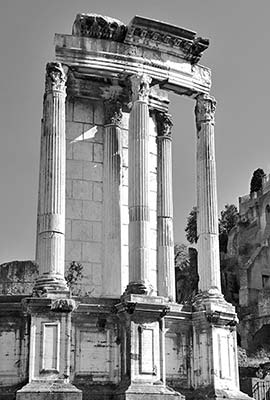
• Backtrack a few steps up the path, behind the Temple of Vesta. You’ll find a few stairs that lead up to a big, enclosed field with two rectangular brick pools (just below the hill). This was the courtyard of the...
6 House of the Vestal Virgins: The Vestal Virgins lived in a two-story building surrounding a long central courtyard with two pools at one end. Rows of statues depicting leading Vestal Virgins flanked the courtyard. This place was the model—both architecturally and sexually—for medieval convents and monasteries.
Chosen from noble families before they reached the age of 10, the six Vestal Virgins each served a 30-year term. Honored and revered by the Romans, the Vestals even had their own box seats opposite the emperor in the Colosseum. The statues that line the courtyard honor dutiful Vestals.
Their sacred duty was to be ceremonial homemakers, tending the temple-home of the goddess Vesta. They brought water from a sacred spring, cooked sacred food, polished the ritual silverware, and—most importantly—made sure the hearth fire never went out.
As the name implies, a Vestal took a vow of chastity. If she served her term faithfully—abstaining for 30 years—she was given a huge dowry and allowed to marry. But if they found any Virgin who wasn’t, she was strapped to a funeral car, paraded through the streets of the Forum, taken to a crypt, given a loaf of bread and a lamp...and buried alive. Many Vestals suffered the latter fate.
• Looming just beyond this field is Palatine Hill—the corner of which may have been...
7 Caligula’s Palace (Palace of Tiberius): Emperor Caligula (ruled AD 37-41) had a huge palace on Palatine Hill overlooking the Forum. It actually sprawled down the hill into the Forum (some supporting arches remain in the hillside).
Caligula was not a nice person. He tortured enemies, stole senators’ wives, and parked his chariot in handicap spaces. But Rome’s luxury-loving emperors only added to the glory of the Forum, with each one trying to make his mark on history.
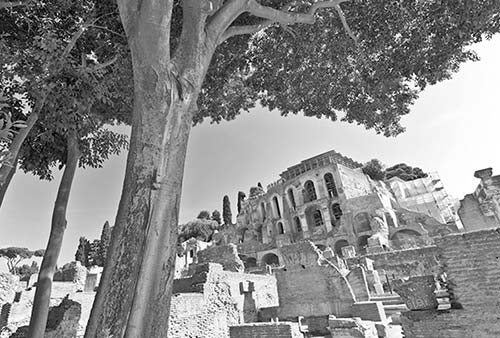
• Return to the three short columns of the Temple of Vesta. Just downhill, you can’t miss three very tall columns just beyond.
8 Temple of Castor and Pollux: These three columns—all that remain of a once-prestigious temple—have become the most photographed sight in the Forum. The temple was one of the city’s oldest, built in the fifth century BC. It commemorated the Roman victory over the Tarquin, the notorious Etruscan king who once oppressed them. After the battle, the legendary twin brothers Castor and Pollux watered their horses here, at the Sacred Spring of Juturna (which has been excavated nearby). As a symbol of Rome’s self-governing republic, the temple was often used as a meeting place of senators, and its front steps served as a podium for free speech.
• Just beyond, the path spills into a flat, open area that stretches before you. This was the center of the ancient Forum.
9 The Forum’s Main Square: The original Forum, or main square, was this flat patch about the size of a football field, stretching to the foot of Capitoline Hill. Surrounding it were temples, law courts, government buildings, and triumphal arches.
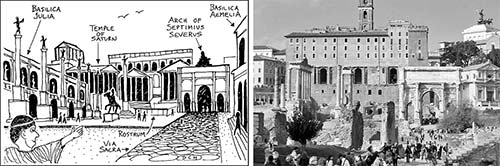
Rome was born right here. According to legend, twin brothers Romulus (Rome) and Remus were orphaned in infancy and raised by a she-wolf on top of Palatine Hill. Growing up, they found it hard to get dates. So they and their cohorts attacked the nearby Sabine tribe and kidnapped their women. After they made peace, this marshy valley became the meeting place and then the trading center for the scattered tribes on the surrounding hillsides.
Ancient Rome’s population exceeded one million, more than any city until London and Paris in the 19th century. All those Roman masses lived in tiny apartments as we would live in tents at a campsite, basically just to sleep. The public space—their Forum, today’s piazza—is where they did their living. Consider how, to this day, the piazza is still such an important part of any Italian town. Since Roman times, the piazza has reflected and accommodated the gregarious and outgoing nature of the Italian people.
The Forum is now rubble, but imagine it in its prime: blindingly brilliant marble buildings with 40-foot-high columns and shining metal roofs; rows of statues painted in realistic colors; processional chariots rattling down Via Sacra. Mentally replace tourists in T-shirts with tribunes in togas. Imagine the buildings towering and the people buzzing around you while an orator gives a rabble-rousing speech from the Rostrum. If things still look like just a pile of rocks, at least tell yourself, “But Julius Caesar once leaned against these rocks.”
• And speaking of Julius Caesar, at the near end of the main square (the end closest to the Colosseum) find the foundations of a temple now sheltered by a peaked wood-and-metal roof.
10 Temple of Julius Caesar (Tempio del Divo Giulio, or Ara di Cesare): On March 15, in 44 BC, Julius Caesar (100-44 BC) was stabbed 23 times by political conspirators. After his assassination, Caesar’s body was cremated on this spot (under the metal roof). Afterward, this temple was built to honor him. Peek behind the wall into the small apse area, where a mound of dirt usually has fresh flowers—given to remember the man who, more than any other, personified the greatness of Rome.
Although he was popular with the masses, not everyone liked Caesar’s urban design or his politics. When he assumed dictatorial powers, he was ambushed and stabbed to death by a conspiracy of senators, including his adopted son, Brutus (“Et tu, Brute?”).
The funeral was held here, facing the main square. The citizens gathered, and speeches were made. Mark Antony stood up to say (in Shakespeare’s words), “Friends, Romans, countrymen, lend me your ears. I come to bury Caesar, not to praise him.” When Caesar’s body was burned, his adoring fans threw anything at hand on the fire, requiring the fire department to come put it out. Later, Emperor Augustus dedicated this temple in his name, making Caesar the first Roman to become a god.
• Continue past the Temple of Julius Caesar, to the open area between the columns of the Temple of Antoninus Pius and Faustina (which we passed earlier) and the boxy brick building (the Curia). You can view these ruins of the Basilica Aemilia from a ramp next to the Temple of Antoninus Pius and Faustina, or (if the path is open) walk among them.
11 Basilica Aemilia: Notice the layout. This was a long, rectangular building. The stubby columns all in a row form one long, central hall flanked by two side aisles. Medieval Christians required a larger meeting hall for their worship services than Roman temples provided, so they used the spacious Roman basilica as the model for their churches. Cathedrals from France to Spain to England, from Romanesque to Gothic to Renaissance, all have the same basic floor plan as a Roman basilica.
• Now head for the big, well-preserved brick building with the triangular roof—the Curia. It’s just to the right of the big triumphal arch at the foot of Capitoline Hill. While often closed, the building is impressive even from outside.
12 The Curia (Senate House): The Curia was the most important political building in the Forum. Since the birth of the republic, this was the site of Rome’s official center of government. Three hundred senators, elected by the citizens of Rome, donned their togas, tucked their scrolls under their arms, and climbed the steps into this great hall. Inside, they gave speeches, debated policy, and created the laws of the land. They sat with their backs to the walls, surrounding the big hall on three sides, in three rows of seats. At the far end sat the Senate president—and later, the emperor—on his podium. The vast room still echoes with stirring speeches and passionate debates.
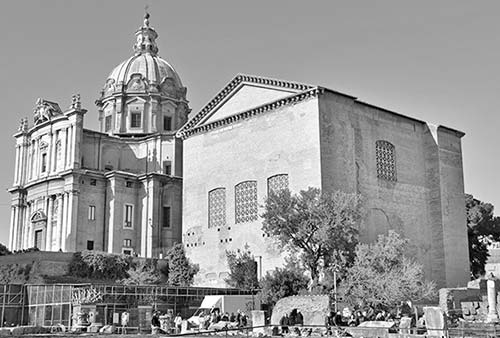
The present Curia building dates from AD 283, when it replaced an earlier Senate building. It’s so well preserved because it was used as a church since early Christian times. In the 1930s, it was restored as a historic site.
• Go back down the Senate steps and find the 10-foot-high wall just to the left of the big arch, marked...
13 Rostrum: Nowhere was Roman freedom of speech more apparent than at this “Speaker’s Corner.” The Rostrum was a raised platform, 10 feet high and 80 feet long, decorated with statues, columns, and the prows of ships.
On a stage like this, Rome’s orators, great and small, tried to draw a crowd and sway public opinion. Picture the backdrop these speakers would have had—a mountain of marble buildings piling up on Capitoline Hill. Mark Antony rose to offer Caesar the laurel-leaf crown of kingship, which Caesar publicly (and hypocritically) refused—while privately becoming a dictator. Men such as Cicero—a contemporary of Julius Caesar—railed against the corruption and decadence that came with the city’s newfound wealth. (Cicero paid the price: he was executed, and his head and hands were nailed to the Rostrum.)
In later years, when emperors ruled, it took real daring to speak out against the powers-that-be. Rome’s democratic spirit was increasingly squelched. Eventually, the emperor and the army—not the Senate and the citizens—held ultimate power, and Rome’s vast empire began to rot from within.
• In front of the Rostrum are trees bearing fruits that were sacred to the ancient Romans: olives (provided food, oil for light, and preservatives), figs (tasty), and wine grapes (made a popular export product). Now turn your attention to the big arch to the right of the Rostrum, the...
Remember that Rome lasted 1,000 years—500 years of growth, 200 years of peak power, and 300 years of gradual decay. The fall had many causes, among them the barbarians who pecked away at Rome’s borders. Christians blamed the fall on moral decay. Pagans blamed it on Christians. Socialists blamed it on a shallow economy based on the spoils of war. (Republicans blamed it on Democrats.)
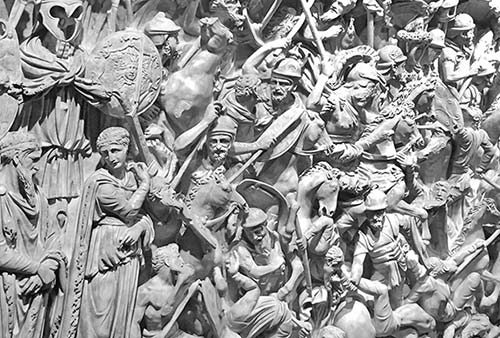
Whatever the reasons, the far-flung empire could no longer keep its grip on conquered lands, and it pulled back. Barbarian tribes from Germany and Asia attacked the Italian peninsula and even looted Rome itself in AD 410, leveling many of the buildings in the Forum. In 476, when the last emperor checked out and switched off the lights, Europe plunged into centuries of ignorance, poverty, and weak government—the Dark Ages.
But Rome lived on in the Catholic Church. Christianity was the state religion of Rome’s last generations. Emperors became popes (both called themselves “Pontifex Maximus”), senators became bishops, orators became priests, and basilicas became churches. The glory of Rome remains eternal.
14 Arch of Septimius Severus: In imperial times, the Rostrum’s voices of democracy would have been dwarfed by images of the empire, such as the huge six-story-high Arch of Septimius Severus (AD 203). The reliefs commemorate the African-born emperor’s battles in Mesopotamia. Near ground level, see soldiers marching captured barbarians back to Rome for the victory parade. More and more, Rome’s economy was based on slave power and foreign booty rather than on domestic production. And despite efficient rule by emperors like Severus, Rome’s empire began to crumble under the weight of its own corruption, disease, and decaying infrastructure.
• As we near the end of Rome’s history, we’re also nearing the end of our tour. Our next stop is the Temple of Saturn. You can see it from here—it’s the eight big columns just up the slope of Capitol Hill. Or you could make your way to it for a closer look.
15 Temple of Saturn: These columns framed the entrance to the Forum’s oldest temple (497 BC). Inside was a humble, very old wooden statue of the god Saturn. The statue’s claim to fame was its pedestal, which held the gold bars, coins, and jewels of Rome’s state treasury, the booty collected by conquering generals.
Even older than the Temple of Saturn is the Umbilicus Urbis, which stands nearby (next to the Arch of Septimius Severus). A humble brick ruin marks this historic “Navel of the City.” The spot was considered the center of the cosmos, and all distances in the empire were measured from here.
• Now turn your attention from the Temple of Saturn, one of the Forum’s first buildings, to one of its last monuments. Find a lone, tall column standing in the Forum in front of the Rostrum. It’s fluted and topped with a leafy Corinthian capital. This is the...
16 Column of Phocas: This is the Forum’s last monument (AD 608), a gift from the powerful Byzantine Empire to a fallen empire—Rome. Given to commemorate the pagan Pantheon’s becoming a Christian church, it was a symbolic last nail in ancient Rome’s coffin. After Rome’s 1,000-year reign, the city was looted by Vandals, the population of a million-plus shrank to about 10,000, and the once-grand city center—the Forum—was abandoned, slowly covered up by centuries of silt and dirt. In the 1700s, an English historian named Edward Gibbon overlooked this spot from Capitoline Hill. Hearing Christian monks singing at these pagan ruins, he looked out at the few columns poking up from the ground, pondered the decline and fall of the Roman Empire, and thought, “Hmm, that’s a catchy title...”
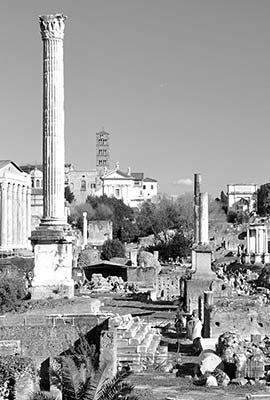
• Your tour is over. If you want to see Palatine Hill, don’t leave the Forum complex; you won’t be allowed back in without a new ticket. Instead, return to the Arch of Titus.
If you’d rather exit the Forum, refer to your map for possible exit locations. If heading for Capitoline Hill, your best escape is likely on the west side (behind #16 on the Roman Forum map in this chapter).
▲Palatine Hill (Monte Palatino)
Palatine Hill is nearly empty of tourists, but it’s jam-packed with history—“the huts of Romulus,” the huge Imperial Palace, a view of the Circus Maximus—but only the barest skeleton of rubble is left to tell the story.
We get our word “palace” from this hill, where the emperors chose to live. It was once so filled with palaces that later emperors had to build out. (Looking up at it from the Forum, you see the substructure that supported these long-gone palaces.) The Palatine Museum contains statues and frescoes that help you imagine the luxury of the imperial Palatine. From the pleasant garden, you’ll get an overview of the Forum. On the far side, unless excavations are blocking the viewpoint, look down into an emperor’s private stadium and then beyond at the grassy Circus Maximus, once a chariot course. Imagine the cheers, jeers, and furious betting.
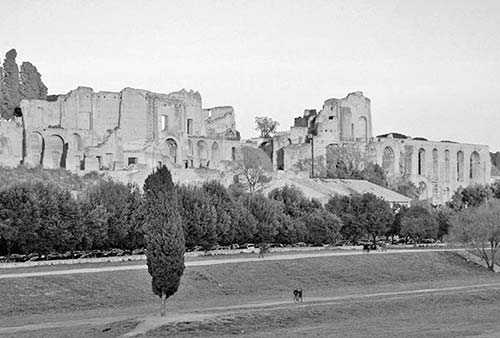
While many tourists consider Palatine Hill just extra credit after the Forum, it offers insight into the greatness of Rome that’s well worth the effort. (And, if you’re visiting the Colosseum or Forum, you’ve got a ticket whether you like it or not.)
Cost and Hours: Covered by same tickets and open same hours as Roman Forum, listed earlier.
Getting In: There are three entrances to the combined Palatine/Forum sight; see the map on here. The easiest for our tour is the entrance on Via di San Gregorio, 150 yards from the Colosseum. Upon entering, follow the path to the left as it winds to the top (stairs partway along offer a shortcut). Alternatively, if you sightsee the Forum first, you’ll walk up from the Arch of Titus to Palatine Hill.
Expect Changes: Parts of Palatine Hill are often closed off due to ongoing archaeological work.
South of the Ancient Core
Baths of Caracalla (Terme di Caracalla)
Inaugurated by Emperor Caracalla in AD 216, this massive bath complex—supplied by its own branch of an aqueduct—could accommodate 1,600 visitors at a time. Today it’s just a shell—a huge shell—with all of its sculptures and most of its mosaics moved to museums.
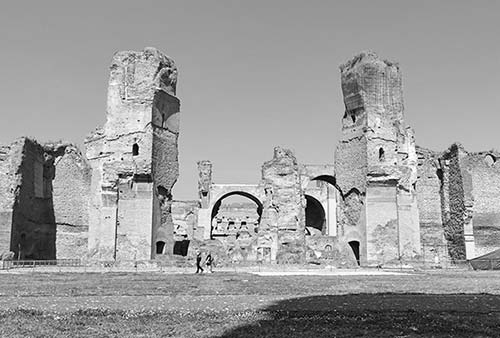
This sight is dramatic in part because nothing was built around or on top of it. It’s stood here, in ruins, for 1,500 years. You’ll see a two-story roofless brick building surrounded by a garden, bordered by ruined walls. The two large rooms at either end of the building were used for exercise. In between the exercise rooms was a pool flanked by two small mosaic-floored dressing rooms.
Cost and Hours: €8; open Mon 9:00-14:00, Tue-Sun 9:00 until one hour before sunset: April-Aug until 19:15, Sept until 19:00, Oct until 18:30, off-season closes as early as 16:30; last entry one hour before closing, audioguide-€5, good €8 guidebook, Metro: Circo Massimo, then a 5-minute walk south along Via delle Terme di Caracalla; +39 06 3996 7700, www.coopculture.it.
Capitoline Hill
Of Rome’s famous seven hills, this is the smallest, tallest, and most famous—home of the ancient Temple of Jupiter and the center of city government for 2,500 years. There are several ways to get to the top of Capitoline Hill. If you’re coming from the north (from Piazza Venezia), take Michelangelo’s impressive stairway to the right of the big, white Victor Emmanuel Monument. Coming from the southeast (the Roman Forum), take the steep staircase near the Arch of Septimius Severus. From near Trajan’s Forum along Via dei Fori Imperiali, take the winding road. All three converge at the top, in the square called Campidoglio (kahm-pee-DOHL-yoh).
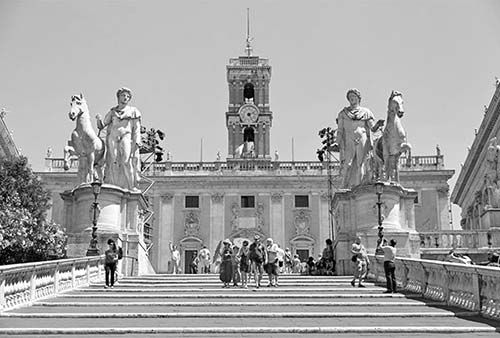
▲Piazza del Campidoglio
This square atop the hill, once the religious and political center of ancient Rome, is still the home of the city’s government. In the 1530s, the pope called on Michelangelo to reestablish this square as a grand center. Michelangelo placed the ancient equestrian statue of Marcus Aurelius as its focal point—very effective. (The original statue is now in the adjacent museum.) The twin buildings on either side are the Capitoline Museums. Behind the replica of the statue is the mayoral palace (Palazzo Senatorio).
Michelangelo intended that people approach the square from his grand stairway off Piazza Venezia. From the top of the stairway, you see the new Renaissance face of Rome, with its back to the Forum. Michelangelo gave the buildings the “giant order”—huge pilasters make the existing two-story buildings feel one-storied and more harmonious with the new square. Notice how the statues atop these buildings welcome you and then draw you in.
The terraces just downhill (past either side of the mayor’s palace) offer grand views of the Forum. To the left of the mayor’s palace is a copy of the famous she-wolf statue on a column. Farther down is il nasone (“the big nose”), a refreshing water fountain (see photo). Block the spout with your fingers, and water spurts up for drinking. Romans joke that a cheap Roman boy takes his date out for a drink at il nasone.
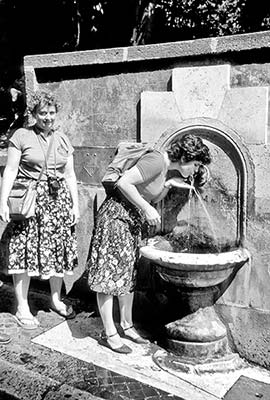
▲▲▲Capitoline Museums (Musei Capitolini)
Some of ancient Rome’s most famous statues and art are housed in the two palaces (Palazzo dei Conservatori and Palazzo Nuovo) that flank the equestrian statue in the Campidoglio. They’re connected by an underground passage that leads to the Tabularium, an ancient building with a panoramic overlook of the Forum.
Cost and Hours: €15, daily 9:30-19:30, last entry one hour before closing, videoguide-€7, good children’s audioguide-€5, +39 06 0608, www.museicapitolini.org.
Visiting the Museum: You’ll enter at the Palazzo dei Conservatori (on your right as you face the equestrian statue), cross underneath the square (beneath the Palazzo Senatorio, the mayoral palace, not open to public), and exit from the Palazzo Nuovo (on your left). This enjoyable museum complex claims to be the world’s oldest, founded in 1471 when a pope gave ancient statues to the citizens of Rome. Many of the museum’s statues have gone on to become instantly recognizable cultural icons, including the 13th-century Capitoline She-Wolf (the little statues of Romulus and Remus were added in the Renaissance). Don’t miss the Boy Extracting a Thorn and the enchanting Commodus as Hercules. Behind Commodus is a statue of his dad, Marcus Aurelius, on a horse. The only surviving equestrian statue of a Roman emperor, this was the original centerpiece of the square (where a copy stands today). Christians in the Dark Ages thought that the statue’s hand was raised in blessing, which probably led to their misidentifying him as Constantine, the first Christian emperor. While most pagan statues were destroyed by Christians, “Constantine” was spared.
The museum’s second-floor café, Caffè Capitolino, has a splendid patio offering city views. It’s lovely at sunset (public entrance for those without a museum ticket off Piazzale Caffarelli and through door #4).
The Tabularium, built in the first century BC, once held the archives of ancient Rome. (The word Tabularium comes from “tablet,” on which Romans wrote their laws.) You won’t see any tablets, but you’ll get a stunning view of the Forum from the windows.
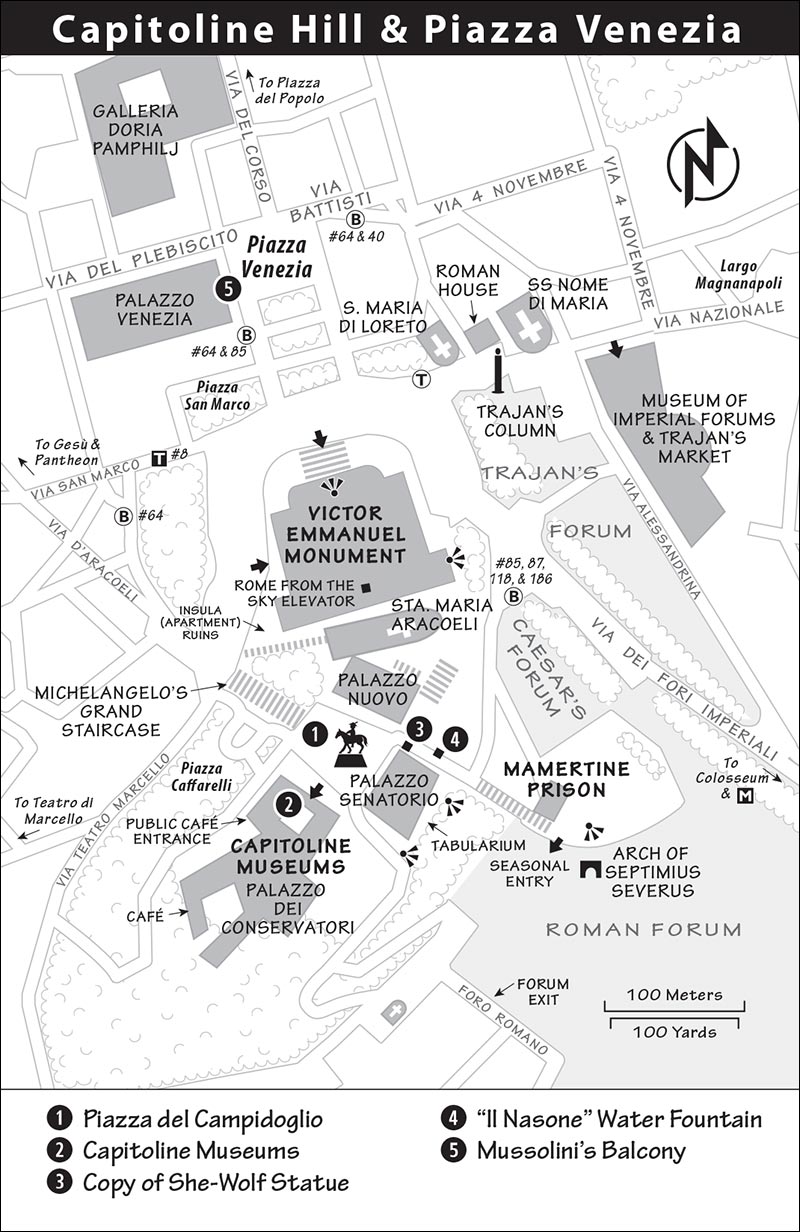
The Palazzo Nuovo houses mostly portrait busts of forgotten emperors. But it also has two must-see statues: the Dying Gaul and the Capitoline Venus (both on the first floor up).
▲Mamertine Prison (Carcer Tullianum Museum)
This 2,500-year-old cistern-like prison on Capitoline Hill is where, according to Christian tradition, the Romans imprisoned Saints Peter and Paul. Today it’s a small but impressive archaeological site using the latest technology to illustrate what you might unearth when digging in Rome: a pagan sacred site, an ancient Roman prison, an early Christian pilgrimage destination, or a medieval church. After learning the context using the included videoguide, and browsing artifacts (including the skeletons of those executed with their hands still tied behind their backs), you can walk to the bottom of this dank cistern under an original Roman stone roof—marvel at its engineering. Amid fat rats and rotting corpses, unfortunate prisoners of the emperor awaited slow deaths here. It’s said that a miraculous fountain sprang up inside so Peter could convert and baptize his jailers, who were also subsequently martyred. This pricey sight is a good value for pilgrims and antiquities wonks.
Cost and Hours: €10, includes videoguide, €24 combo-ticket includes Colosseum and Roman Forum/Palatine Hill, daily 9:00-17:00, may stay open later in summer, Clivo Argentario 1, +39 06 698 961.
Piazza Venezia
This vast square, dominated by the big, white Victor Emmanuel Monument, is a major transportation hub and the focal point of modern Rome. With your back to the monument (you’ll get the best views from the terrace by the guards and eternal flame), look down Via del Corso, the city’s axis, surrounded by Rome’s classiest shopping district. In the 1930s, Benito Mussolini whipped up Italy’s nationalistic fervor from a balcony above the square (it’s the less-grand building on the left). Mussolini lied to his people, mixing fear and patriotism to push his country to the extreme right and embroil the Italians in expensive and regrettable wars. In 1945, they shot Mussolini and hung him from a meat hook in Milan.
With your back still to the monument, circle around the left side to reach two staircases leading up Capitoline Hill. One is Michelangelo’s grand staircase up to the Campidoglio. The steeper of the two leads to Santa Maria in Aracoeli, a good example of the earliest style of Christian church. The contrast between this climb-on-your-knees ramp to God’s house and Michelangelo’s elegant stairs illustrates the changes Renaissance humanism brought civilization.
▲Victor Emmanuel Monument
This oversized monument to Italy’s first king, built to celebrate the 50th anniversary of the country’s unification in 1861, was part of Italy’s push to overcome the new country’s strong regionalism and create a national identity. Today, the monument is appreciated for the views it provides over the city (especially from the top of its pricey elevator), and it also holds a humble museum for Italian patriots.
The scale of the monument is over the top: 200 feet high, 500 feet wide. The 43-foot-long statue of the king on his high horse is one of the biggest equestrian statues in the world. The king’s moustache forms an arc five feet long, and a person could sit within the horse’s hoof. At the base of this statue, Italy’s Tomb of the Unknown Soldier (flanked by Italian flags and armed guards) is watched over by the goddess Roma (with the gold mosaic background). With its gleaming white sheen (from a recent scrubbing) and enormous scale, the monument provides a vivid sense of what Ancient Rome looked like at its peak—imagine the Forum filled with shiny, grandiose buildings like this one.
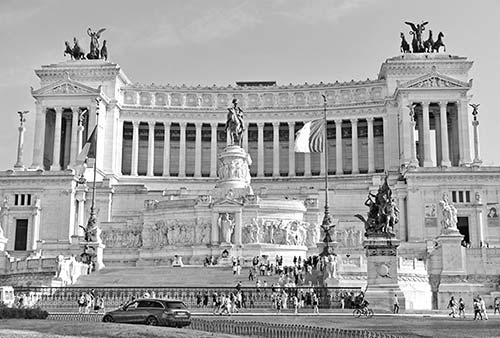
Cost and Hours: Free to climb stairs of monument, €12 to ride Rome from the Sky elevator and enter Risorgimento Museum (access to museum limited to small groups entering twice hourly, www.risorgimento.it). Open daily 9:30-19:30, last elevator ticket sold 45 minutes before closing, a few WCs scattered throughout, +39 06 0608, https://vive.beniculturali.it.
Jewish Quarter
From the 16th through the 19th century, Rome’s Jewish population was forced to live in a cramped ghetto at an often-flooded bend of the Tiber River. While the medieval Jewish ghetto is long gone, this area—between Capitoline Hill and the Campo de’ Fiori—is still home to Rome’s synagogue and fragments of its Jewish heritage.
The Imperial Forums
Though the original Roman Forum is the main attraction for today’s tourists, there are several more ancient forums nearby, known collectively as “The Imperial Forums.” The forums stretch in a line along Via dei Fori Imperiali, from Piazza Venezia to the Colosseum. The boulevard was built by the dictator Benito Mussolini in the 1930s—supposedly so he could look out his office window on Piazza Venezia and see the Colosseum, creating a military parade ground and a visual link between the glories of the imperial past with what he thought would be Italy’s glorious imperial future. Today, the once-noisy boulevard is a pleasant walk, since it is closed to private vehicles—and, on Sundays, to all traffic.
The ruins are out in the open, never crowded, and free to look down on from street level at any time, any day.
For an overview of the archaeological area, take this walk from Piazza Venezia down Via dei Fori Imperiali to the end of the Imperial Forums.
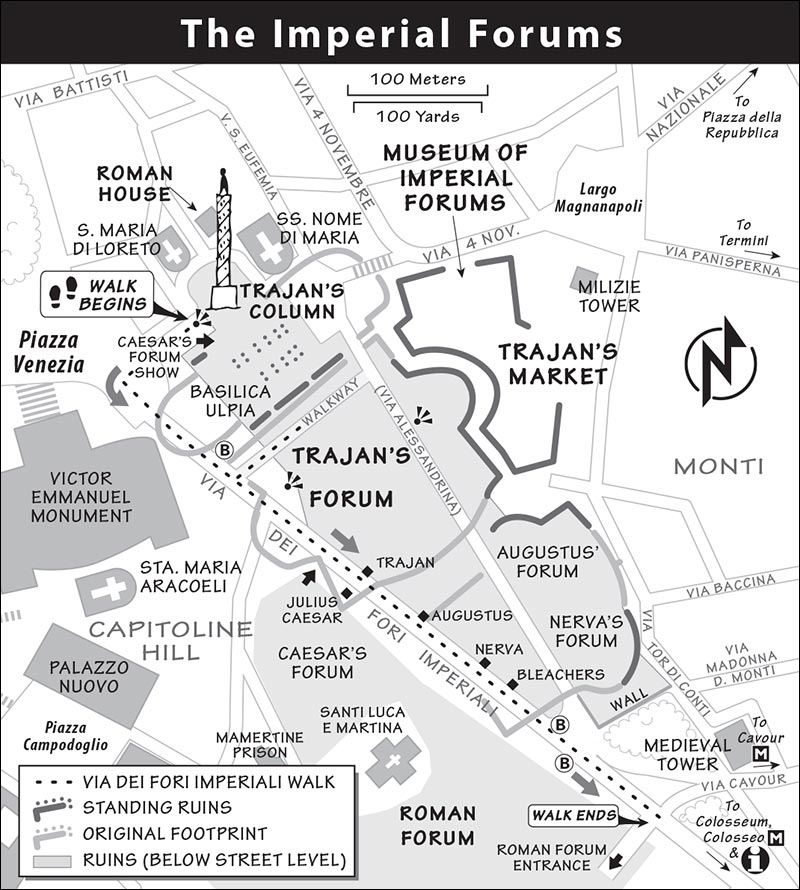
Self-Guided Walk: Start at Trajan’s Column, the colossal pillar that stands alongside Piazza Venezia.
Trajan’s Column: The world’s grandest column from antiquity (rated ▲▲) anchors the first of the forums we’ll see—Trajan’s Forum. The 140-foot column is decorated with a spiral relief of 2,500 figures trumpeting the emperor’s exploits. It has stood for centuries as a symbol of a truly cosmopolitan civilization. At one point, the ashes of Trajan and his wife were held in the base, and the sun glinted off a polished bronze statue of Trajan at the top. Since the 1500s, St. Peter has been on top. (Where’s the original bronze statue of Trajan? Spaghetti pots.) Built as a stack of 17 marble doughnuts, the column is hollow (note the small window slots) with a spiral staircase inside, leading up to the balcony.
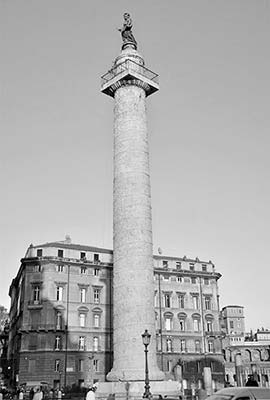
The relief unfolds like a scroll, telling the story of Rome’s last and greatest foreign conquest, Trajan’s defeat of Dacia (modern-day Romania). Originally, the entire story was painted in bright colors. If you were to unwind the scroll, it would stretch over two football fields—it’s far longer than the frieze around the Parthenon in Athens.
• Now, start heading toward the Colosseum, walking along the left side of Via dei Fori Imperiali. You’re walking alongside...
Trajan’s Forum: The dozen-plus gray columns mark one of the grandest structures in Trajan’s Forum—the Basilica Ulpia, the largest law court of its day. Nearby stood two libraries that contained the world’s knowledge in Greek and Latin. (The internet of the day, contained in two big buildings.)
Rome peaked under Emperor Trajan (ruled AD 98-117), when the empire stretched from England to the Sahara, from Spain to the Fertile Crescent. A triumphant Trajan returned to Rome with his booty and shook it all over the city. Most was spent on this forum, complete with temples, law courts, and the monumental column trumpeting his exploits. To build his forum, Trajan cut away a ridge that once connected the Quirinal and Capitoline hills, creating this valley. This was the largest forum ever, and its opulence astounded even jaded Romans. Looking at this, you can only think that for every grand monument here, there was untold hardship and suffering in the Barbarian world.
• Most astounding of all was Trajan’s Market. That’s the big, semicircular brick structure nestled into the cutaway curve of Quirinal Hill. If you want a closer look, a pedestrian pathway leads you right up among the ruins.
Trajan’s Market: This structure was part shopping mall, part warehouse, and part administration building and/or government offices. For now the conventional wisdom holds that at ground level, the 13 tall (shallow) arches housed shops selling fresh fruit, vegetables, and flowers to people who passed by on the street. The 26 arched windows (above) lit a covered walkway lined with shops that sold wine and olive oil. On the roof (now lined with a metal railing) ran a street that likely held still more shops and offices, making about 150 in all. Shoppers could browse through goods from every corner of Rome’s vast empire—exotic fruits from Africa, spices from Asia, and fish-and-chips from Londinium.
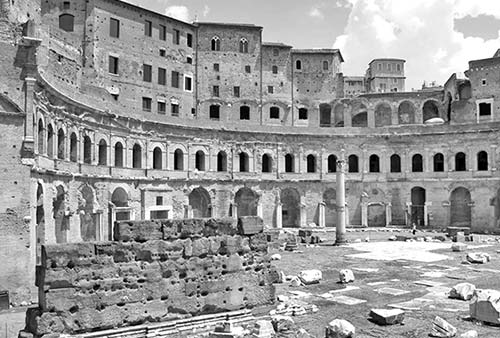
Above the semicircle, the upper floors of the complex housed bureaucrats in charge of a crucial element of city life: doling out free grain to unemployed citizens, who lived off the wealth plundered from distant lands. Better to pacify them than risk a riot. Above the offices, at the very top, rises a (leaning) tower added in the Middle Ages.
• Return to the main street and continue toward the Colosseum for about 100 more yards.
You’re still walking alongside Trajan’s Forum, but the ruins you see in this section are from the medieval era. These are the foundations of the old neighborhood that was built atop the ancient city. In modern times, that neighborhood was cleared out to build the new boulevard.
You’ll soon reach a bronze statue of Trajan himself. Though the likeness is ancient, this bronze statue is not. It was erected by the dictator Benito Mussolini when he had the modern boulevard built. Notice the date on the pedestal—Anno XI. That would be “the 11th year of the Fascist Renovation of Italy”—i.e., 1933.
Across the street is a similar statue of Julius Caesar. It marks the first of these imperial forums, Caesar’s Forum, built by Julius in 46 BC as an extension of the Roman Forum. Near Julius stand the three remaining columns of his forum’s Temple of Venus—the patron goddess of the Julian family.
• Continue along (down the left side). As Trajan’s Forum narrows to an end, you reach a statue of Emperor Augustus that indicates...
The Forums of Augustus and Nerva: The statue captures Emperor Augustus in his famous hailing-a-cab pose (a copy of the original, which you can see at the Vatican Museums). In fact, this is his “commander talking to his people” pose. Behind him was the Forum of Augustus. It separated fancy “downtown Rome” from the workaday world beyond.
Farther along is a statue of Emperor Nerva, trying but failing to have the commanding presence of Augustus. Behind Nerva, you can get a closer look at his forum.
• You’ve reached the end of the Imperial Forums. You’re at the intersection of Via dei Fori Imperiali and busy Via Cavour. Nearby is the colorful neighborhood of Monti, with fun eateries. A few blocks up busy Via Cavour is the Cavour Metro stop. From there, you could turn right to find St. Peter-in-Chains Church. Across Via dei Fori Imperiali is an entrance to the Roman Forum; 100 yards farther down Via dei Fori Imperiali (on the left) is a TI with a handy café and WC.
Near the Imperial Forums
Several worthwhile sights sit north of Via dei Fori Imperiali from the Roman Forum—and offer a break from the crowds. If you’ll be here in the evening, consider taking in a sound-and-light show (see here).
▲The Roman House at Palazzo Valentini (Le Domus Romane di Palazzo Valentini)
For a quality (air-conditioned) experience, duck into this underground series of ancient spaces at the base of Trajan’s Column. The 50-minute tour with good English narration and evocative lighting features scant remains of an elegant ancient Roman house and bath. The highlight is a small theater where you’ll learn the entire story depicted by the 2,600 figures that parade around the 650-foot relief carved onto Trajan’s Column.
Cost and Hours: €12; Wed-Mon 10:00-19:00, closed Tue, last entry one hour before closing, may have shorter hours off-season; departures hourly but not all in English—check online, limited group sizes—reservations smart (€1.50 fee), +39 06 2276 1280, www.palazzovalentini.it.
▲▲St. Peter-in-Chains Church (San Pietro in Vincoli)
A church was first built on this spot in the fifth century, to house the chains that once restrained St. Peter. Today’s church, restored in the 15th century, is famous for its Michelangelo statue of Moses, intended for the (unfinished) tomb of Pope Julius II. Check out the chains under the high altar, then focus on mighty Moses. (Note this isn’t the famous St. Peter’s—that’s in Vatican City.)
Pope Julius II commissioned Michelangelo to build a massive tomb, with 48 huge statues, topped with a grand statue of this egomaniacal pope. The pope had planned to have his tomb placed in the center of St. Peter’s Basilica. When Julius died, the work had barely begun, and no one had the money or necessary commitment to Julius to finish the project.
In 1542, some of the remnants of the tomb project were brought to St. Peter-in-Chains and pieced together by Michelangelo’s assistants. Some of the best statues ended up elsewhere, such as the Prisoners in Florence and the Slaves in the Louvre. Moses and the Louvre’s Slaves are the only statues Michelangelo personally completed for the project. Flanking Moses are the Old Testament sister-wives of Jacob, Leah (to our right) and Rachel, both begun by Michelangelo but probably finished by pupils.
The powerful statue of Moses—mature Michelangelo—is worth studying. Moses has received the Ten Commandments. As he holds the stone tablets, his eyes show a man determined to stop his tribe from worshipping the golden calf and idols...a man determined to win salvation for the people of Israel. Why the horns? Centuries ago, the Hebrew word for “rays” was mistranslated as “horns.”
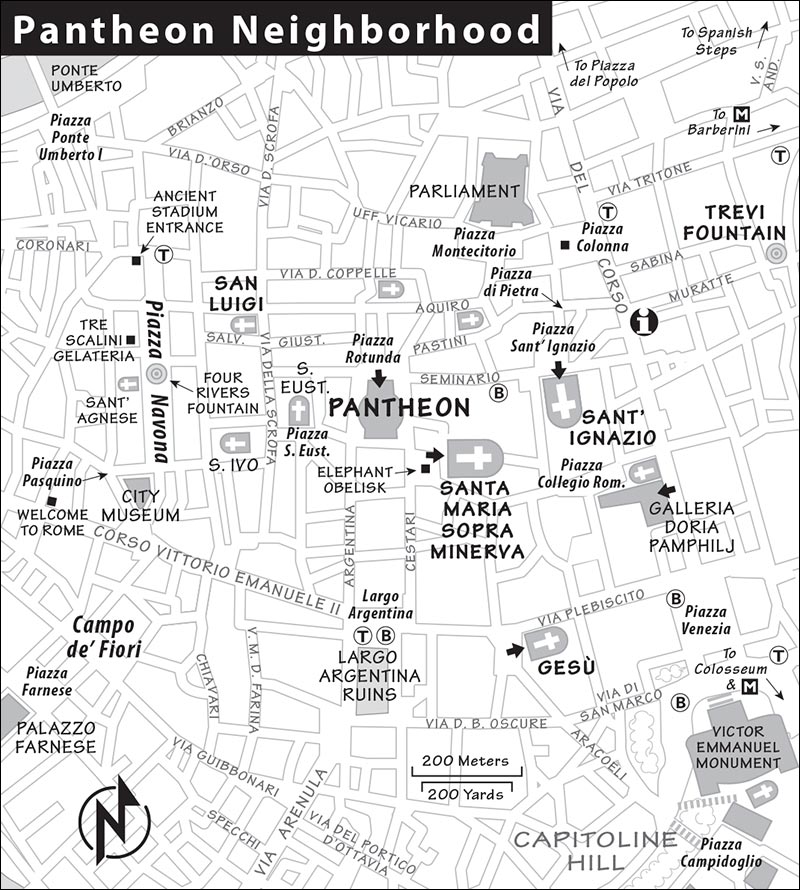
Cost and Hours: Free, daily 7:15-12:30 & 15:00-19:00, Oct-March until 18:00, modest dress required; the church is a 10-minute uphill walk from the Colosseum, or a shorter, simpler walk (but with more steps) from the Cavour Metro stop; +39 06 9784 4950.
PANTHEON NEIGHBORHOOD
Besides being home to ancient sites and historic churches, the area around the Pantheon is another part of Rome with an urban village feel. Wander narrow streets, sample the many shops and eateries, and gather with the locals in squares marked by bubbling fountains.
Exploring this area is especially nice in the evening, when restaurants bustle and streets are jammed with foot traffic. For a self-guided walk in this neighborhood from Campo de’ Fiori to the Trevi Fountain (and ending at the Spanish Steps), see my “Heart of Rome Walk,” earlier.
▲▲▲Pantheon
For the greatest look at the splendor of Rome, antiquity’s best-preserved interior is a must. Built two millennia ago, this influential domed temple served as the model for Michelangelo’s dome of St. Peter’s and many others.
Cost and Hours: Free, daily 9:00-19:00, closed for Mass Sat at 17:00 and Sun at 10:30; reservations may be required on weekends—book at http://pantheon.cultura.gov.it, +39 06 6830 0230, www.pantheonroma.com.
When to Go: Avoid midday, when the Pantheon is packed. If you show up right when it opens, you’ll have it all to yourself.
Dress Code: Short shorts and bare shoulders are not allowed.
Tours: The Pantheon offers an audioguide (through an app) and guided tours; neither is worth the high price. Instead, download my free Pantheon audio tour.
Visiting the Pantheon: The Pantheon was a Roman temple dedicated to all (pan) of the gods (theos). The original temple was built in 27 BC by Emperor Augustus’ son-in-law, Marcus Agrippa. In fact, the inscription below the triangular pediment proclaims (in Latin), “Marcus Agrippa, son of Lucio, three times consul, made this.” But after a couple of fires, the structure we see today was completely rebuilt by Emperor Hadrian around AD 120. After the fall of Rome, the Pantheon became a Christian church (from “all the gods” to “all the martyrs”), which saved it from architectural cannibalism and ensured its upkeep through the Dark Ages.
The dome is what makes this building unique—and perhaps the most influential architectural design in art history. The Pantheon’s dome was the model for the Florence cathedral dome, which launched the Renaissance, and for Michelangelo’s dome of St. Peter’s, which capped it all off. Even the US Capitol in Washington, DC, was inspired by this dome.
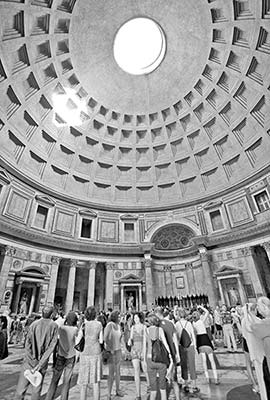
Wander into the portico with its forest of 16 enormous columns. They’re 40 feet tall and 15 feet around, made of red-and-gray granite. Whereas many ancient columns are a stack of cylindrical drums, these columns are each a single piece of stone. Imagine how impressive this portico was in its heyday, when the ceiling was covered with shiny bronze plating. Check out the giant doorway—it’s considered original. The doors are 23 feet tall and made of bronze. The magnificent, soaring dome, the largest made until the Renaissance, is set on a circular base. The mathematical perfection of this dome-on-a-base design is a testament to Roman engineering; it’s as high as it is wide—142 feet. To picture it, imagine a basketball wedged inside a wastebasket so that it just touches bottom.
The dome is made from concrete, a Roman invention. It gets lighter and thinner as it reaches the top. The base of the dome is 23 feet thick and made from heavy concrete mixed with travertine, while near the top, it’s less than five feet thick and made with a lighter volcanic rock (pumice) mixed in. Note the square indentations in the surface of the dome. This coffered ceiling reduces the weight of the dome without compromising strength. The walls are strengthened by brick relieving arches (“blind” arches)—visible in the exposed brickwork in a few of the interior niches and easy to see from outside.
Both Brunelleschi and Michelangelo studied this dome before building their own, in Florence and the Vatican, respectively. (The grandiose vision for St. Peter’s Basilica was to place the dome of the Pantheon atop the Forum’s Basilica of Constantine.)
At the top, the oculus is the building’s only light source. It’s completely open and almost 30 feet across. The 1,800-year-old floor—with 80 percent of its original stones surviving—has holes in it and slants toward the edges to let rainwater drain. Although some of the floor’s marble has been replaced, the design—alternating circles and squares—is original.
While its ancient statuary is long gone, today the Pantheon’s interior holds decorative sculptures and the tombs of important people from more recent centuries. The artist Raphael (1483-1520) lies in a stone coffin to the left of the main altar, in a lighted glass niche.
In his will, Raphael asked to be buried in the Pantheon, and he himself commissioned the Madonna and Child statue above his tomb. City fathers were glad to honor the man who’d done so much to beautify Rome with paintings, frescoes, and tapestries (which you can see in today’s Vatican Museums and elsewhere). Facing each other across the rotunda are the tombs of modern Italy’s first two kings, members of the House of Savoy: Victor Emmanuel II and Umberto I. Beneath Umberto’s tomb lies that of his queen (and first cousin), Margherita.
▲▲Churches near the Pantheon
The following churches are free to visit; modest dress is recommended. The Church of San Luigi dei Francesi has a magnificent chapel with paintings by Caravaggio (free, Mon-Sat 9:30-12:45 & 14:30-18:30, Sun from 11:30, between Pantheon and north end of Piazza Navona, www.saintlouis-rome.net). The only Gothic church in Rome is the Church of Santa Maria sopra Minerva, with a little-known Michelangelo statue, Christ Bearing the Cross (free, daily 9:00-12:00 & 16:00-19:00; on a little square behind the Pantheon, to the east, www.santamariasopraminerva.it). The Church of Sant’Ignazio, several blocks east of the Pantheon, is a riot of Baroque illusions with a false dome (free, daily 9:00-19:00, www.chiesasantignazio.it). A few blocks away, across Corso Vittorio Emanuele, is the rich and Baroque Gesù Church, headquarters of the Jesuits in Rome (free, generally Mon-Sat 7:30-12:30 & 17:00-19:30, Sun 9:00-12:30 & 17:00-20:00, interesting daily ceremony at 17:30, www.chiesadelgesu.org).
▲Trevi Fountain
The bubbly Baroque fountain, worth ▲▲ by night, is a minor sight to art scholars...but a major nighttime gathering spot for teens on the make and tourists tossing coins. Those coins are collected daily to feed Rome’s poor. For more on the fountain, see here.
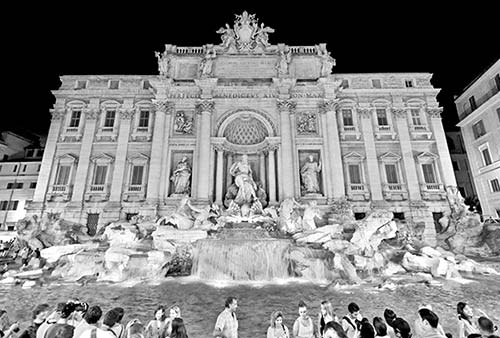
VATICAN CITY
Vatican City, the world’s smallest country, contains St. Peter’s Basilica (with Michelangelo’s exquisite Pietà) and the Vatican Museums (with Michelangelo’s Sistine Chapel). The shop (with info/ticket desk), just to the left of St. Peter’s Basilica as you’re facing it, can answer questions (www.vaticanstate.va).
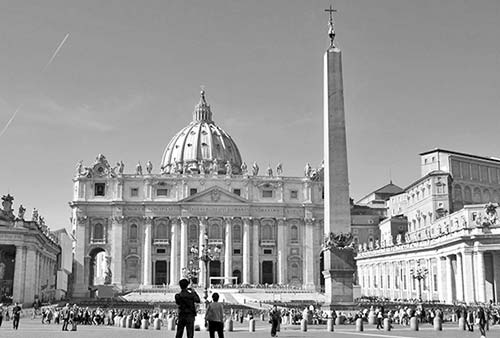
Planning Your Time: Consider the following time estimates while planning your visit. At a brisk pace, seeing St. Peter’s Square takes 15 minutes; the basilica interior requires an hour (plus the line to get inside); the dome climb is an hour; and the museums take at least 2.5 hours. The entrances to St. Peter’s and the Vatican Museums are a 15-minute walk apart (follow the outside of the Vatican wall, which links the two sights). From the Sistine Chapel—in the deepest recesses of the Vatican Museums—to the entrance of St. Peter’s is about 30 minutes). The nearest Metro stop—Ottaviano—still involves a 10-minute walk to either sight. Budget time for lunch and walking.
When to Go: The basilica’s security line tends to be shorter before 9:30 and late in the day, especially after 16:00 (just as sunbeams begin working their magic on the altar). The basilica is closed (and the square is jammed) on Wednesday mornings during the papal audience, until roughly 13:00.
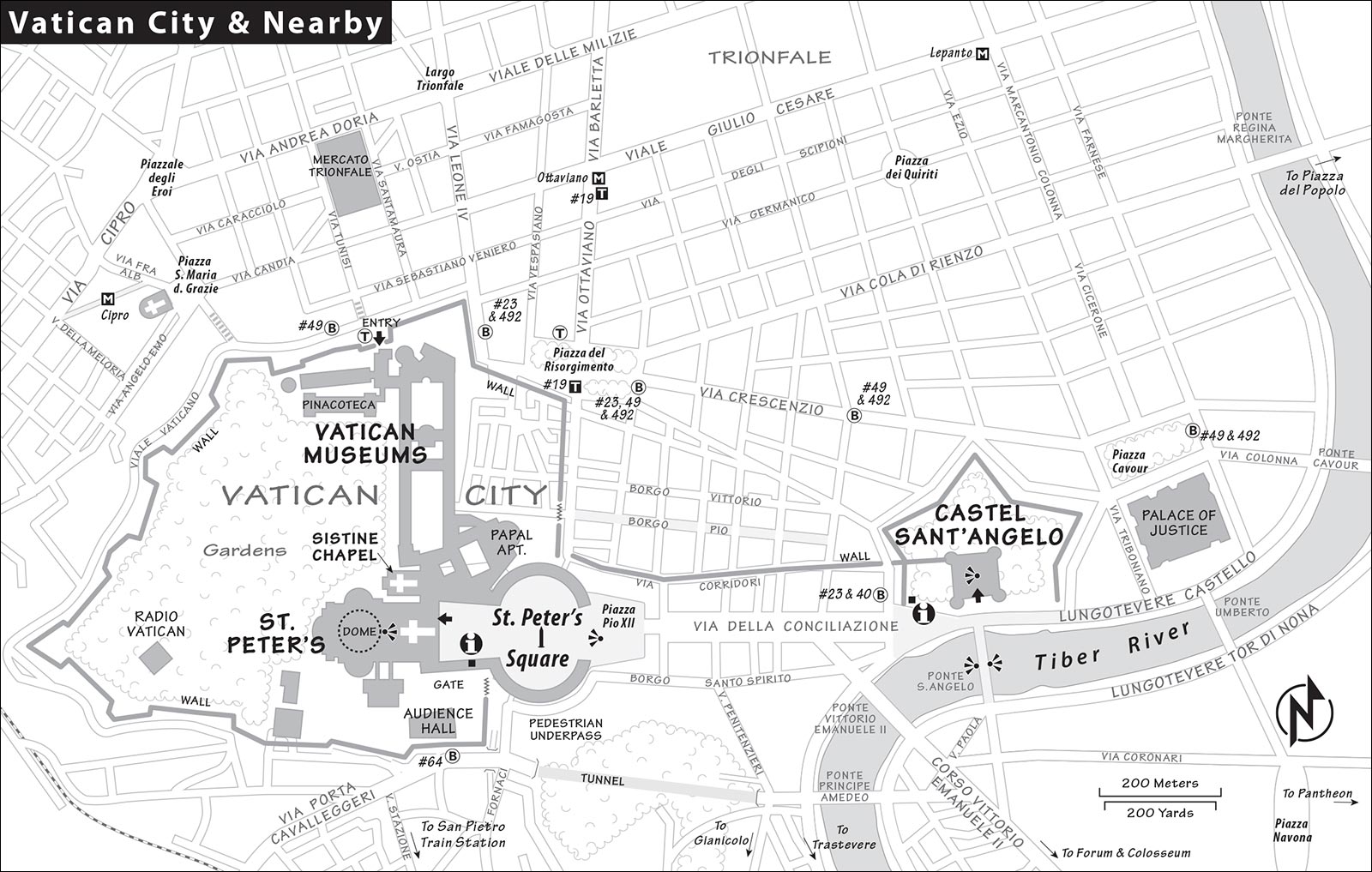
At the Vatican Museums, crowds are generally lighter on weekdays after 14:00 (the later, the better) and on Wednesday mornings, when most tourists are at St. Peter’s attending the papal audience. The worst days are Saturdays, the last Sunday of the month (a free-entry day), Mondays, rainy days, and any day before or after a holiday closure.
St. Peter’s Square
St. Peter’s Square, with its ring of columns, symbolizes the arms of the church welcoming everyone—believers and nonbelievers—in its motherly embrace. It was designed a century after Michelangelo by the Baroque architect Gian Lorenzo Bernini, who did much of the work that we’ll see inside. Numbers first: 284 columns, 56 feet high, in stern Doric style. Topping them are Bernini’s 140 favorite saints, each 10 feet tall. The “square” itself is actually elliptical, 660 by 500 feet (roughly the same dimensions as the Colosseum). Though large, it’s designed like a saucer, a little higher around the edges, so that even when full of crowds (as it often is), it allows those on the periphery to see above the throngs.
The obelisk in the center is 90 feet of solid granite weighing more than 300 tons. It once stood about 100 yards from its current location, in the center of the circus course (to the left of where St. Peter’s is today). Think for a second about how much history this monument has seen. Originally erected in Egypt more than 2,000 years ago, it witnessed the fall of the pharaohs to the Greeks and then to the Romans. Then the emperor Caligula plundered the obelisk and relocated it to imperial Rome, where it stood impassively watching the slaughter of Christians at the racecourse and the torture of Protestants by the Inquisition (in the yellow-and-rust-colored building just outside the square, to the left of the church). Today, it watches over the church, a reminder that each civilization builds on the previous ones. The puny cross on top reminds us that Christian culture has cast but a thin veneer over our pagan origins.
▲▲▲St. Peter’s Basilica (Basilica San Pietro)
There is no doubt: This is the richest and grandest church on earth. To call it vast is like calling Einstein smart. Plaques on the floor show you where other, smaller churches would end if they were placed inside. The ornamental cherubs would dwarf a large man. Birds roost inside, and thousands of people wander about, heads craned heavenward, hardly noticing each other. Don’t miss Michelangelo’s Pietà (behind bulletproof glass) to the right of the entrance. Bernini’s altar work and twisting, towering canopy are brilliant.
Cost and Hours: Free, daily 7:00-19:00, Oct-March until 18:30. The church closes on Wednesday mornings during papal audiences (until roughly 13:00). Masses occur daily throughout the day. Info: +39 06 6988 2019, www.vaticanstate.va.
Getting There: Take the Metro to Ottaviano, then walk 10 minutes south on Via Ottaviano. The #40 express bus drops off at Piazza Pio, next to Castel Sant’Angelo—a 10-minute walk from St. Peter’s. The more crowded bus #64, beloved by pickpockets, stops just outside St. Peter’s Square to the south (get off the bus after it crosses the Tiber, at the first stop past the tunnel; backtrack toward the tunnel and turn left when you see the rows of columns; the return bus stop is adjacent to the tunnel). Bus #492 heads through the center of town, stopping at Largo Argentina, and gets you near Piazza Risorgimento (get off when you see the Vatican walls). A few other handy buses (see here) get you to the general Vatican area. A taxi from Termini train station costs about €15.
Church Services: Mass, generally in Italian, is said varyingly in the south (left) transept, the Blessed Sacrament Chapel (on right side of nave), or at the main altar. Confirm times on the signboard as you enter. Typical schedule: Mon-Sat at 8:30, 9:00, 10:00, 11:00, 12:00, and at 17:00 (in Latin, at the main altar); Sun and holidays at 9:00, 10:30 (in Latin), 12:30, 13:00, 16:00, 17:00 (vespers), and 18:00.
Tours: Download my free St. Peter’s Basilica audio tour. You can “rent” an audioguide (€5 for the church, €15 adds the dome), but you’ll probably be told to download their app onto your phone and activate it with a code. At the same desk, ask about guided tours of the basilica, which leave sporadically.
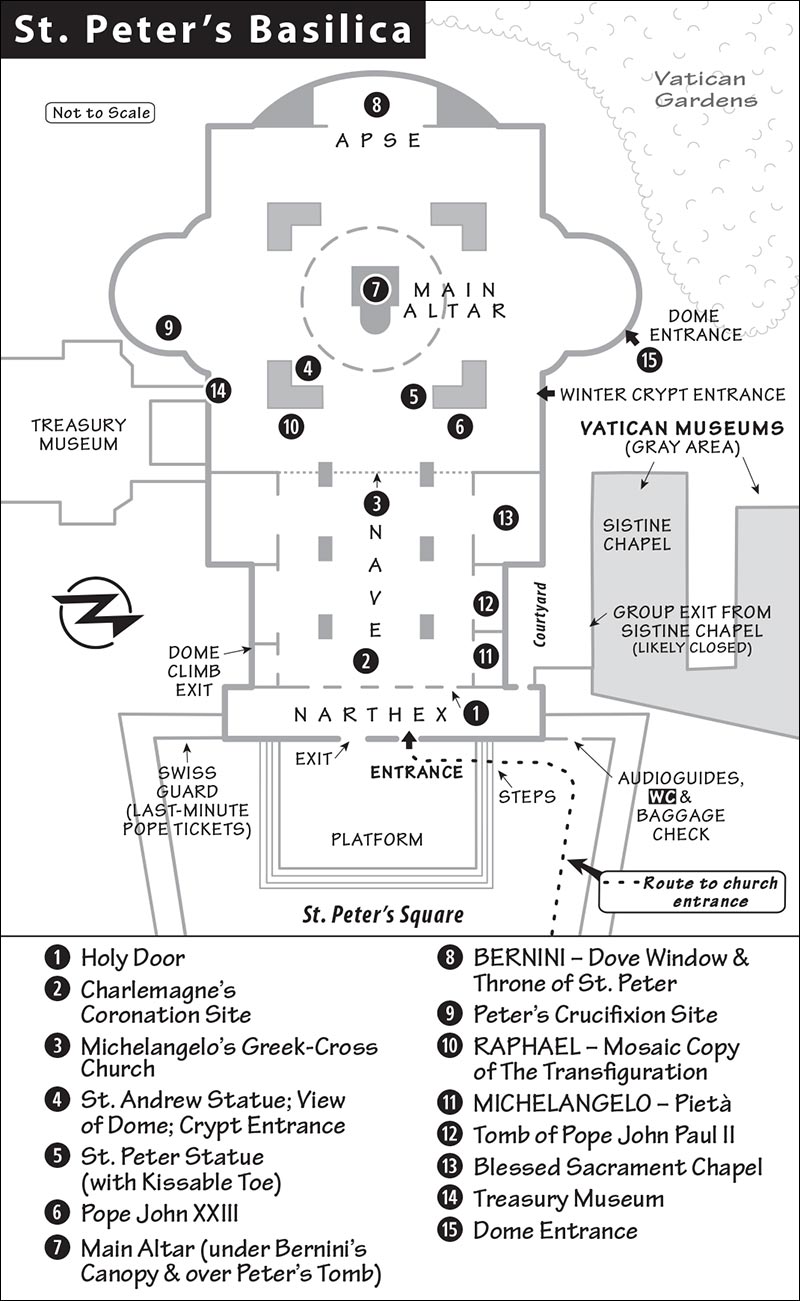
To see St. Peter’s original grave, you can take a Scavi (excavations) tour into the Necropolis under the basilica (€13, 1.5 hours, ages 15 and up only). Book at least two months in advance by email (scavi@fsp.va) for the fastest reply; go to www.scavi.va (select “Excavations Office”) for details. No response means they’re booked.
Dome Climb: You can take an elevator or climb 231 stairs to the roof, then climb another 323 steps to the top of the dome. The entry to the elevator is just outside the north (right) side of the basilica—look for signs to the cupola. If you’re climbing the dome without your travel partner, confirm with the staff where you’ll exit before you split up (€10 for elevator to roof, then take stairs; €8 to climb stairs all the way, allow an hour to go up and down, daily 7:00-17:00, last entry one hour before closing if you take the stairs the whole way).
Baggage Check: The free bag check (mandatory for bags larger than a purse or day pack) is inside security, but outside the basilica (to the right as you face the entrance).
Vatican Museums Tickets: The shop on St. Peter’s Square (on the left as you face the basilica—see “Visitor Information,” earlier) has a ticket/info desk that can help you book same-day, timed-entry tickets for the Vatican Museums. While they essentially have access to the same tickets that you can book online, if you show up without a reservation, stopping by this desk before making the hike over to the museums could save you time in line. (For other ticketing options, see “Vatican Museums,” later.)
Services: WCs are on both sides of St. Peter’s Square (by the shop and just outside security), near the baggage check down the steps by the church entrance, and on the roof.
Self-Guided Tour
To sample the basilica’s highlights, follow these points:
The narthex (portico) is itself bigger than most churches. Its huge white columns date from the first church (fourth century). Five famous bronze doors lead into the church. Made from the melted-down bronze of the original door of Old St. Peter’s, the central door was the first Renaissance work in Rome (c. 1450). It’s only opened on special occasions.
The far-right entrance is the 1 Holy Door, opened only during Holy Years (and special “Jubilee” years designated by the pope). On Christmas Eve every 25 years, the pope knocks three times with a silver hammer and the door opens, welcoming pilgrims to pass through.
Looking down the nave, we get a sense of the splendor of ancient Rome that was carried on by the Catholic Church. The floor plan, with a central aisle (nave) flanked by two side aisles, is based on that of ancient Roman basilicas—large halls built to accommodate business and legal meetings. In fact, many of the stones used to build St. Peter’s were scavenged from the ruined law courts of ancient Rome.
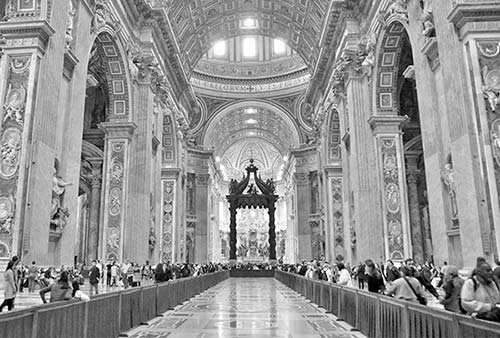
On the floor near the central doorway is a round slab of porphyry stone in the maroon color of ancient Roman officialdom. This is the spot where, on Christmas night in AD 800, the king of the Franks 2 Charlemagne was crowned Holy Roman Emperor.
Stand at the very back of the nave and survey the heavenly expanse. It’s a riot of marble, gold, stucco, mosaics, columns of stone, and pillars of light. As the symbol of global Catholicism, this church is appropriately big. Size before beauty: The golden window at the far end is two football fields away. The dove in the golden window has the wingspan of a 747 (OK, maybe not quite, but it is big). The church covers six acres. The babies at the base of the pillars along the main hall (the nave) are adult-size. The lettering in the gold band along the top of the pillars is seven feet high. Really. The church has a capacity of 60,000 standing worshippers (or 1,200 tour groups).
• Now, walk straight up the center of the nave toward the altar.
Michelangelo was 71 when asked to take over the church project and cap it with a dome. He agreed, intending to put the dome over Donato Bramante’s original 3 Greek-cross floor plan. In optimistic Renaissance times, this symmetrical arrangement symbolized perfection—the orderliness of the created world and the goodness of man (who was created in God’s image). But Michelangelo was a Renaissance Man in Counter-Reformation times. The Church, struggling against Protestants and its own corruption, opted for a plan designed to impress the world with its grandeur—the Latin cross of the Crucifixion, with its nave extended to accommodate the grand religious spectacles of the Baroque period.
Park yourself in front of the 4 statue of St. Andrew to the left of the altar, the guy holding an X-shaped cross. (Note that the entrance to the crypt is usually here; in winter it’s by the dome entrance.) Like Andrew, gaze up into the dome, and also like him, gasp.
The dome soars higher than a football field on end, 448 feet from the floor of the cathedral to the top of the lantern. It glows with light from its windows, the blue-and-gold mosaics creating a cool, solemn atmosphere. In this majestic vision of heaven (not painted by Michelangelo), we see (above the windows) Jesus, Mary, and a ring of saints, rings of more angels above them, and, way up in the ozone, God the Father (a blur of blue and red, unless you have binoculars).
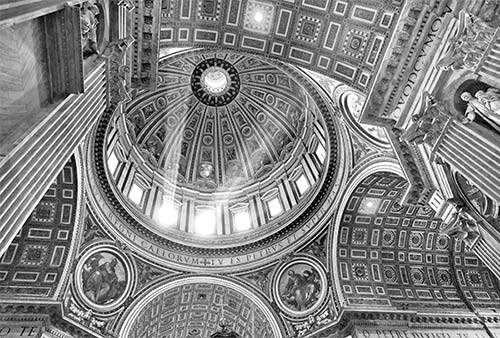
Look closely at the niche. If you line up the cross on the altar with the dove in the window, you’ll notice that the niche below the cross is just off-center compared with the rest of the church. Why? Because Michelangelo built the church around the traditional location of the tomb, not the actual location—about two feet away—discovered by modern archaeology.
Back in the nave—on the right side, roughly facing the crypt entrance—sits a bronze 5 statue of St. Peter under a canopy. This is one of a handful of pieces of art that were in the earlier church. In one hand he holds keys, the symbol of the authority given him by Christ, while with the other hand he blesses us. His big right toe has been worn smooth by the lips of pilgrims and foot fetishists. If the statue is accessible, stand in line and kiss it, or, to avoid foot-and-mouth disease, touch your hand to your lips, then rub the toe. This is simply an act of reverence with no legend attached, though you can make one up if you like.
• Circle to the right around the statue of Peter to find the lighted glass niche.
6 Pope John XXIII, whose papacy lasted from 1958 to 1963, is nicknamed “the good pope.” He is best known for initiating the landmark Vatican II Council (1962-1965) that instituted major reforms, bringing the Church into the modern age. In 2000, during the beatification process (a stop on the way to sainthood), Church authorities checked his body, and it was surprisingly fresh. So they moved it upstairs, put it behind glass, and now old Catholics who remember him fondly enjoy another stop on their St. Peter’s visit. Pope John was canonized in 2014.
Sitting over St. Peter’s tomb, the 7 main altar (the white marble slab with cross and candlesticks) beneath the dome and canopy is used only when the pope himself says Mass. He sometimes conducts the Sunday morning service when he’s in town, a sight worth seeing.
The tiny altar would be lost in this enormous church if it weren’t for Gian Lorenzo Bernini’s seven-story bronze canopy (God’s “four-poster bed”), which “extends” the altar upward and reduces the perceived distance between floor and ceiling. The corkscrew columns echo the marble ones that surrounded the altar/tomb in Old St. Peter’s. Some of the bronze used here was taken and melted down from the ancient Pantheon.
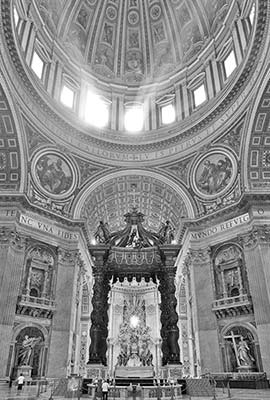
Bernini (1598-1680), the Michelangelo of the Baroque era, is the man most responsible for the interior decoration of the church. His 8 dove window shines above the smaller front altar used for everyday services. The Holy Spirit, in the form of a six-foot-high dove, pours sunlight onto the faithful through the alabaster windows, turning into artificial rays of gold and reflecting off swirling gold clouds, angels, and winged babies. During a service, real sunlight passes through real clouds of incense, mingling with Bernini’s sculpture.
Beneath the dove is the centerpiece of this structure, the so-called Throne of St. Peter, an oak chair built in medieval times for a king. Subsequently, it was encrusted with tradition and encased in bronze by Bernini as a symbol of papal authority. In the apse, Mass is said daily for pilgrims, tourists, and Roman citizens alike.
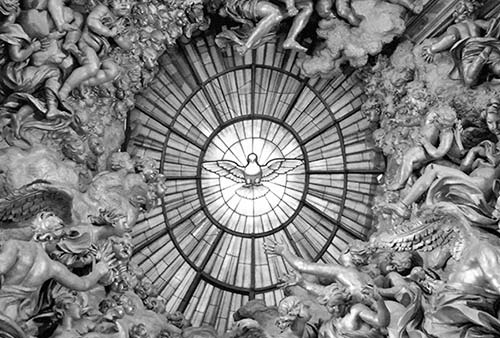
• To the left of the main altar is the south transept. It may be roped off for worship, but anyone can step past the guard if you say you’re there “for prayer.” At the far end, left side, find the dark “painting” of St. Peter crucified upside down.
This marks (according to tradition) 9 Peter’s crucifixion site. Peter had come to the world’s greatest city to preach Jesus’ message of love to the pagan, often hostile Romans. During the reign of Emperor Nero, he was arrested and brought to Nero’s Circus so all of Rome could witness his execution. When the authorities told Peter he was to be crucified just like his Lord, Peter said, essentially, “I’m not worthy” and insisted they nail him on the cross upside down.
Around the corner on the right (heading back toward the central nave), pause at the mosaic copy of Raphael’s epic painting of 10 The Transfiguration. The original is now beautifully displayed in the Pinacoteca of the Vatican Museums. This and all the other “paintings” in the church are actually mosaic copies made from thousands of colored chips the size of your little fingernail. Because smoke and humidity would damage real paintings, since the 1700s church officials have replaced the paintings with mosaics (a.k.a. the “art of eternity”) produced by the Vatican Mosaic Studio.
• Back near the entrance of the church, in the far corner, behind bulletproof glass, is the sculpture everyone has come to see, the Pietà.
Michelangelo was 24 years old when he completed this 11 pietà—a representation of Mary with the body of Christ taken from the cross. It was his first major commission, done for Holy Year 1500.
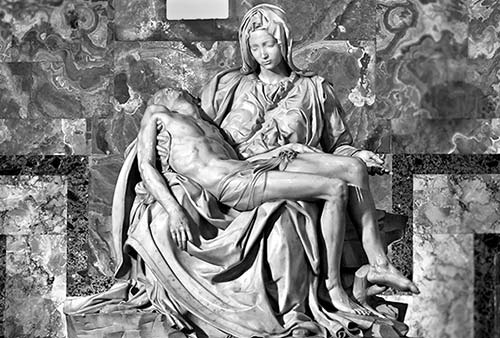
Michelangelo, with his total mastery of the real world, captures the sadness of the moment. Mary cradles her crucified son in her lap. Christ’s lifeless right arm drooping down lets us know how heavy this corpse is. Mary looks at her dead son with sad tenderness. Her left hand turns upward, asking, “How could they do this to you?”
• In the chapel to the left is the 12 Tomb of Pope John Paul II.
John Paul II (1920-2005) was one of the most beloved popes of recent times. During his papacy (1978-2005), he was the highly visible face of the Catholic Church as it labored to stay relevant in an increasingly secular world. The first non-Italian pope in four centuries, he oversaw the fall of communism in his native Poland. He survived an assassination attempt, and he publicly endured his slow decline from Parkinson’s disease with great stoicism.
When John Paul II died in 2005, hundreds of thousands lined up outside the church, waiting up to 24 hours to pay their respects. He was sainted in April 2014, just nine years after his death. St. John Paul II lies beneath a painting of the steadfast St. Sebastian, his favorite saint.
You’re welcome to step through the metalwork gates into the 13 Blessed Sacrament Chapel (Capella di Santissimo Sacramento), an oasis of peace reserved for prayer and meditation (on right side of church, about midway to the altar). Mass is sometimes said here.
The 14 Treasury Museum (Museo-Tesoro), on the left side of the nave near the altar, contains the room-size tomb of Sixtus IV by Antonio Pollaiuolo, a big pair of Roman pincers used to torture Christians, an original corkscrew column from Old St. Peter’s, and assorted jewels, papal robes, and golden reliquaries—a marked contrast to the poverty of early Christians.
The foundation of Old St. Peter’s, the Crypt (Grotte/Tombe), contains tombs of popes and memorial chapels. In summer, the crypt entrance is usually beside the statue of St. Andrew, to the left of the main altar (near #4 on the map); in winter, it’s by the dome entrance. Stairs lead you down to the floor level of the previous church, where you’ll pass the sepulcher of Peter. This lighted niche with an icon is not Peter’s actual tomb, but part of a shrine that stands atop Peter’s tomb. Nearby is the chapel where Pope John Paul II was buried before being moved upstairs in 2011. Continue your one-way visit until it spills you out, usually near the cloakroom, or possibly outside. (Save this for last.)
To cap your visit with the best view of Rome, head to the 15 dome entrance along the right (north) side of the church. The line begins to form out front, at the church’s right door (as you face the church). Look for cupola signs.
There are two levels: the rooftop of the church and the very top of the dome. Climb or take an elevator to the first level, on the church roof just above the facade. From the roof, you can also go inside the gallery ringing the interior of the dome and look down inside the church. Notice the dusty top of Bernini’s seven-story-tall canopy far below. Study the mosaics up close—and those huge letters! It’s worth the elevator ride for this view alone.
From this level, continue all the way up to the top of the dome. The staircase actually winds between the outer shell and the inner one. It’s a sweaty, crowded, claustrophobic 15-minute, 323-step climb, but worth it. Admire the arms of Bernini’s colonnade encircling St. Peter’s Square. Find the big, white Victor Emmanuel Monument, with the two statues on top; and the Pantheon, with its large, light, shallow dome. The large rectangular building to the left of the obelisk is the Vatican Museums complex, stuffed with art. Look down into the square at the tiny pilgrims buzzing like electrons around the nucleus of Catholicism.
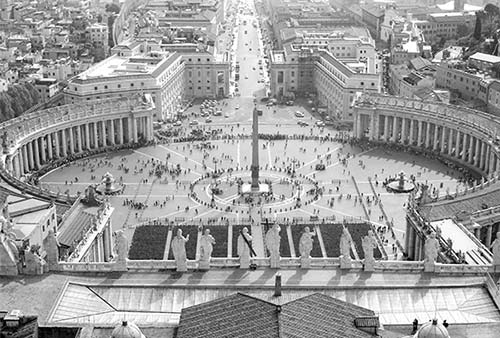
▲▲▲Vatican Museums (Musei Vaticani)
The four miles of displays in this immense museum complex—from ancient statues to Christian frescoes to modern paintings—culminate in the Raphael Rooms and Michelangelo’s glorious Sistine Chapel.
Cost and Hours: €21 for timed-entry ticket (book in advance to avoid long lines), €12 for age 6-18, prices include €4 online reservation fee, free for kids 5 and under, free on the last Sun of each month (when it’s very crowded). Open Mon-Sat 9:00-18:00 (Fri-Sat until 22:30 late April-Oct), closed Sun—except last Sun of month, when it’s open 9:00-14:00; last entry is generally two hours before closing, and staff start ushering you out about 30 minutes before closing.
Closed Days: The museums are closed on many holidays (mainly religious ones); check the current hours and calendar on the museum website.
The tiny independent country of Vatican City is contained entirely within Rome. (Its 100 acres could fit eight times over in New York’s Central Park.) The Vatican has its own postal system, armed guards, beautiful gardens, helipad, mini train station, and radio station (KPOP). It also has two huge sights: St. Peter’s Basilica and the Vatican Museums. Politically powerful, the Vatican is the religious capital of 1.3 billion Roman Catholics. If you’re not a Catholic, become one for your visit.
The pope is both the religious and secular leader of Vatican City. For centuries, the Vatican was the capital of the Papal States, and locals referred to the pontiff as “King Pope.” Because of the Vatican’s territorial ambitions, it didn’t always have good relations with Italy. Even though modern Italy was created in 1870, the Holy See didn’t recognize it as a country until 1929.
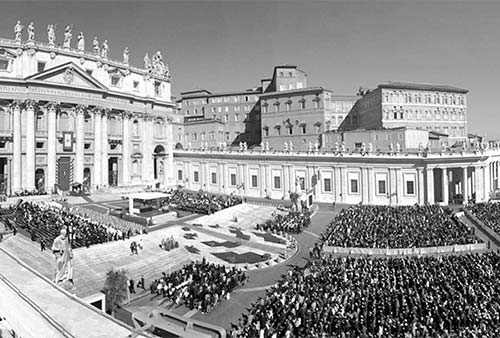
Vatican Gardens: To walk through the manicured Vatican Gardens (with views over Rome and a good look at St. Peter’s dome), book a guided tour several days in advance at www.museivaticani.va (€39, about 3 hours, daily except Wed and Sun, includes entry to Vatican Museums; tours usually start at 9:00 or 11:00 at Vatican Museums tour desk). Same-day tickets are occasionally available (ask at the ticket/info desk inside the shop in St. Peter’s Square). A 45-minute open-bus tour through the gardens is offered in good weather (€37, includes audioguide and entry to Vatican Museums).
General Audience Tickets: For the Wednesday audience at 9:30, a (free) ticket gets you closer to the papal action (though anyone can enjoy a look via jumbo-screens). Reserve tickets (available a month or two in advance) by sending a request by mail or fax (access the form at Vatican.va [URL inactive]—select “Prefecture of the Papal Household” at the bottom of the page). You’ll then pick up the tickets at St. Peter’s Square before the audience (available Tue 15:00-19:00 and Wed from 7:30; usually under Bernini’s colonnade).
Another option is to email the Bishops’ Office for US Visitors to the Vatican three months to three weeks prior to your requested date; you’ll pick up tickets the afternoon before your visit (www.pnac.org, visitorsoffice@pnac.org).
Finally, starting the Monday before the audience, Swiss Guards hand out tickets from their station near the basilica exit (see the “St. Peter’s Square” map in this chapter). Don’t go through security—just march up, ask nicely, and say “danke.” While this is perhaps easiest, I’d reserve in advance to guarantee a ticket.
General Audience Tips: Dress modestly (shoulders covered, no short shorts or tank tops—long pants or knee-length skirts are safest) and arrive early to clear security (no big bags). To get a seat (much less a good one), be there a couple of hours early—there are far fewer seats than ticket holders. If you just want to see the pope, get a good photo, and don’t mind standing, you can show up later (though still at least 30 minutes early) and take your place in the standing-room section in the back half of the square. The entire event, including prayers, singing, and blessings, lasts about 1.5 hours. The service gets underway as the Popemobile appears, winding through the adoring crowd (the best places—seated or standing—are near the cloth-covered wooden fences that line the Popemobile route). Around 10:00, the Pope’s multilingual message begins (you can leave at any time).
Information: +39 06 6988 4676, www.museivaticani.va.
Advance Reservations: You’re crazy to come without a reservation. The Vatican Museums can be extremely crowded, with waits of up to two hours just to buy tickets. Bypass these long lines by reserving an entry time at their website. For sights covered by my self-guided tour, select the ticket called “Vatican Museums and Sistine Chapel.” You’ll receive a QR code via email; show the code to get a paper ticket when you arrive. (You can also print out the attached voucher—but you’ll still have to swap it for a paper ticket.) For strategies on when to book your visit for the Vatican Museums (and how to fit it in with your St. Peter’s sightseeing), see here.
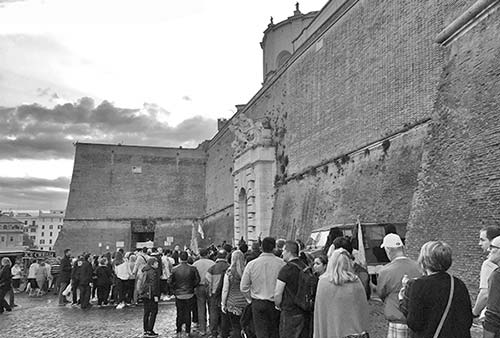
Same-Day Tickets: If you didn’t book tickets in advance, you have a few options. First, try booking a ticket on your phone, using the Vatican website listed above, to see if there are any day-of slots. Or you can visit the shop on St. Peter’s Square (see details under “Vatican City,” earlier). The Opera Romana Pellegrinaggi (a.k.a., Roma Cristiana), a private pilgrimage tour company, sells same-day tickets (€30, entrances almost hourly, office in front of St. Peter’s Square, Piazza Pio XII 9, +39 06 698 961, www.operaromanapellegrinaggi.org).
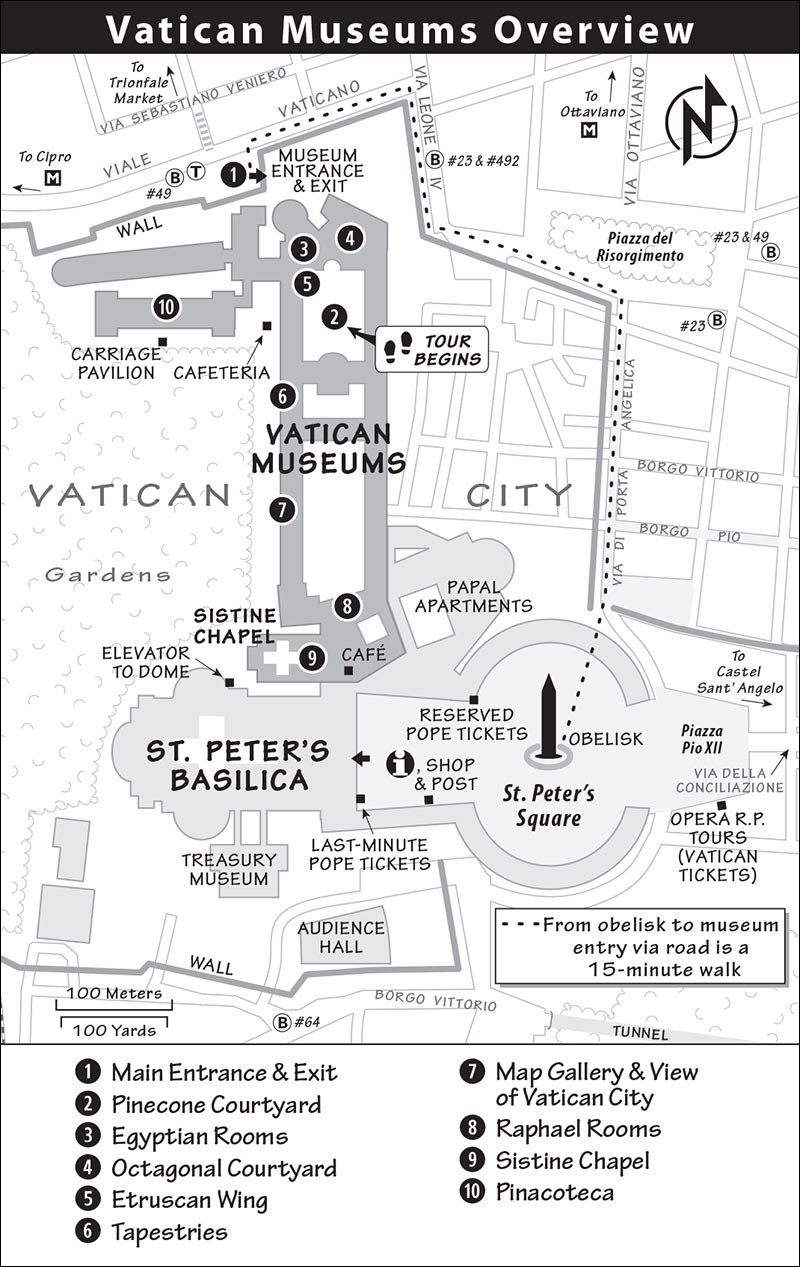
Hawkers peddling skip-the-line access swarm the Vatican area, offering guided tours—but museum staff advise against accepting their offers (while legitimate, the tour caliber is often low—use them only as a last resort to get in).
Dress Code: While modest dress (no shorts, above-knee skirts, or bare shoulders) is technically required throughout the Vatican Museums, this dress code is most strictly enforced inside the Sistine Chapel.
Getting There: The Ottaviano Metro stop is a 10-minute walk from the entrance. Bus #49 from Piazza Cavour/Castel Sant’Angelo stops at Piazza Risorgimento and continues right to the entrance. Bus #23 from Trastevere hugs the west bank of the Tiber and stops on Via Leone IV, just downhill from the entrance. Bus #492 heads from the city center past Piazza Risorgimento and the Vatican walls, and stops on Via Leone IV. Bus #64 stops on the other side of St. Peter’s Square, a 15- to 20-minute walk (facing the church from the obelisk, take a right through the colonnade and follow the Vatican wall). Or take a taxi from the city center—they are reasonable (hop in and say, “moo-ZAY-ee vah-tee-KAH-nee”).
Getting In: Approaching the exterior entrance (the big white door), you’ll see three lines: individuals without reservations (far left), individuals with reservations (usually shorter and faster), and groups (on the right). Make sure you get in the correct entry line. All visitors must pass through a metal detector (no pocketknives allowed).
With a reservation, the guard will scan your QR code and let you enter via the reserved ticket-holder line. Inside, after the security check, go to any window on the left to show your QR code and pick up your ticket, then go up the steps and enter the museum. (Or, you can skip the ticket-window line by going upstairs and processing your QR code on a machine.)
Without a reservation, enter via the far-left line. Once you clear security, go upstairs to buy your ticket.
Tours: A €7 audioguide is available at the top of the spiral ramp/escalator and can be prepaid when you book tickets online. Confirm the drop-off location when renting. Download my free Vatican Museums and Sistine Chapel audio tours. The Vatican offers guided tours in English that are easy to book on their website (€34, includes admission; show your QR code to a guard to the right of the entrance, then once inside go to the Guided Tours desk in lobby, up a few stairs). For private tour companies and guides, see here.
Services: The museum’s “checkroom” (to the right after security) takes only bigger bags, not day bags. The post office, with stamps that make collectors drool, is upstairs. WCs are mainly at the entrance/exit, plus a few scattered within the collection.
Self-Guided Tour
Our tour starts in the large open-air “Pinecone Courtyard.” This vast space sums up the Vatican’s vast collection: Pinecone—ancient, a 2,000 year-old offering to Isis. Bronze sphere—modern, created in 1990. And the courtyard around it—Renaissance, designed by Bramante.
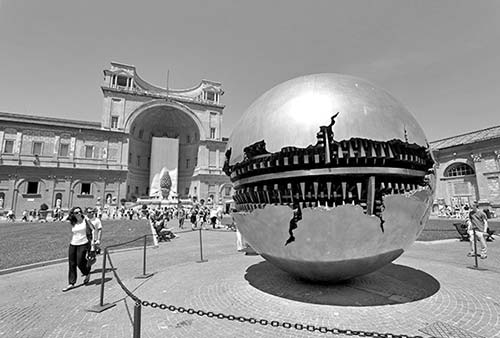
We’ll begin our museum visit as civilization did, in Egypt and Mesopotamia. Backtrack inside and up the stairs to the right to find linen-wrapped mummies, stiff statues, and early writing on clay tablets. (Occasionally, the stairs up to Egypt are closed off, and crowds are routed through the courtyard to a door to the right of the pine cone. If so, just follow the masses until you reach the Octagonal Courtyard with the Apollo Belvedere and Laocoön figures. Tour the museum from there to the “Sarcophagi,” where you’ll find the entrance to the Egyptian rooms.)
After a stop at a view balcony, make your way to the Octagonal Courtyard, decorated with some of the best Greek and Roman statues in captivity. The Apollo Belvedere is a Roman copy (2nd century AD) of a Hellenistic original that followed the style of the great Greek sculptor Praxiteles. It fully captures the beauty of the human form. The anatomy is perfect, his pose is natural. Instead of standing at attention, face-forward with his arms at his sides (Egyptian-style), Apollo is on the move, coming to rest with his weight on one leg.
Laocoön was sculpted some four centuries after the golden age (5th-4th century BC), after the scales of “balance” had been tipped. Whereas Apollo is a balance between stillness and motion, this is textbook Hellenism...unbridled motion. Apollo is serene, graceful, and godlike, while Laocoön is powerful, emotional, and gritty. The figures (carved from four blocks of marble pieced together seamlessly) are powerful, not light and graceful. The poses are as twisted as possible, accentuating every rippling muscle and bulging vein.
The centerpiece of the next hall is the Belvedere Torso (just a 2,000-year-old torso, but one that had a great impact on the art of Michelangelo). Finishing off the classical statuary are two fine fourth-century porphyry sarcophagi. These royal purple tombs were made (though not used) for the Roman emperor Constantine’s mother (Helena, on left) and daughter (Constanza, on right).
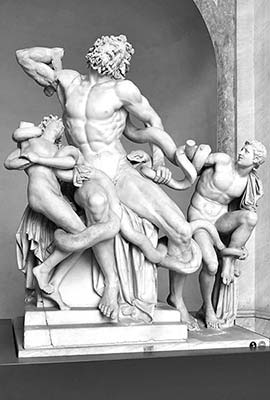
Overachievers may first choose to pop into the Etruscan Wing—labeled Museo Gregoriano Etrusco. Otherwise, after long halls of tapestries, old maps, broken penises, and fig leaves, you’ll come to what most people are looking for: the Raphael Rooms and Michelangelo’s Sistine Chapel.
Raphael Rooms: The highlight of the Raphael Rooms, frescoed by Raphael and his assistants, is the restored School of Athens. It is remarkable for its blatant pre-Christian classical orientation, especially considering it originally wallpapered the apartments of Pope Julius II. Raphael honors the great pre-Christian thinkers—Aristotle, Plato, and company—who are portrayed as the leading artists of Raphael’s day. There’s Leonardo da Vinci, whom Raphael worshipped, in the role of Plato. Michelangelo broods in the foreground, added later. When Raphael snuck a peek at the Sistine Chapel, he decided that his arch-competitor was so good that he had to put their personal differences aside and include him in this tribute to the artists of his generation. And the “school” building is actually an early version of St. Peter’s Basilica (under construction at the time).
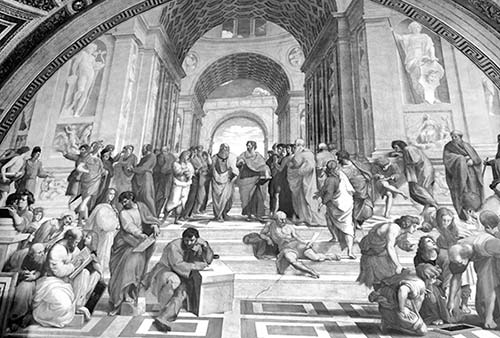
Sistine Chapel: Next is the brilliantly restored Sistine Chapel. This is the pope’s personal chapel and also the place where, upon the death of the ruling pope, a new pope is elected.
The Sistine Chapel is famous for Michelangelo’s pictorial culmination of the Renaissance, showing the story of creation, with a powerful God weaving in and out of each scene through that busy first week. This is an optimistic and positive expression of the High Renaissance and a stirring example of the artistic and theological maturity of the 33-year-old Michelangelo, who spent four years on this work.
The ceiling shows the history of the world before the birth of Jesus. We see God creating the world, creating man and woman, destroying the earth by flood, and so on. God himself, in his purple robe, actually appears in the first five scenes. Along the sides (where the ceiling starts to curve), we see the Old Testament prophets and pagan Greek prophetesses who foretold the coming of Christ. Dividing these scenes and figures are fake niches (a painted 3-D illusion) decorated with nude statue-like figures with symbolic meaning.
In the central panel of the Creation of Adam, God and man take center stage in this Renaissance version of creation. Adam, newly formed in the image of God, lounges dreamily in perfect naked innocence. God, with his entourage, swoops in with a swirl of activity (which—with a little imagination—looks like a cross-section of a human brain...quite a strong humanist statement). Their reaching hands are the center of this work. Adam’s is limp and passive; God’s is strong and forceful, his finger twitching upward with energy. Here is the very moment of creation, as God passes the spark of life to man, the crowning work of his creation.
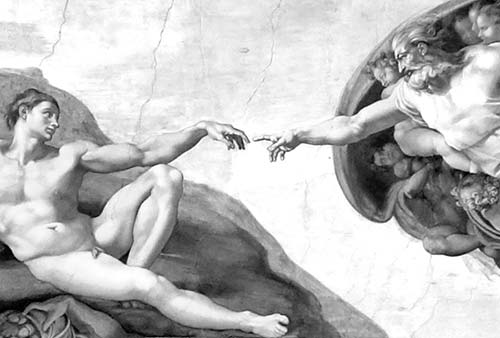
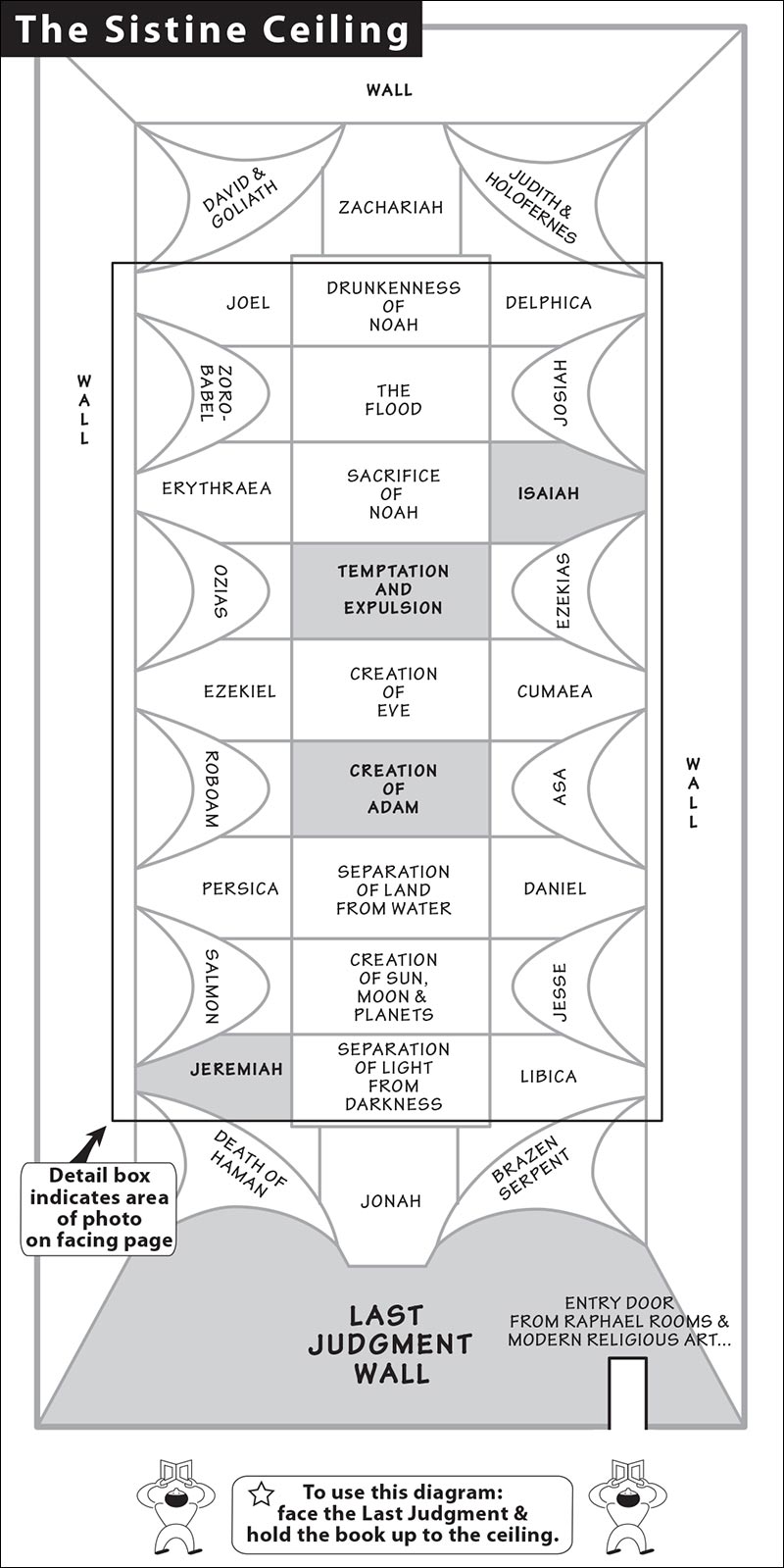
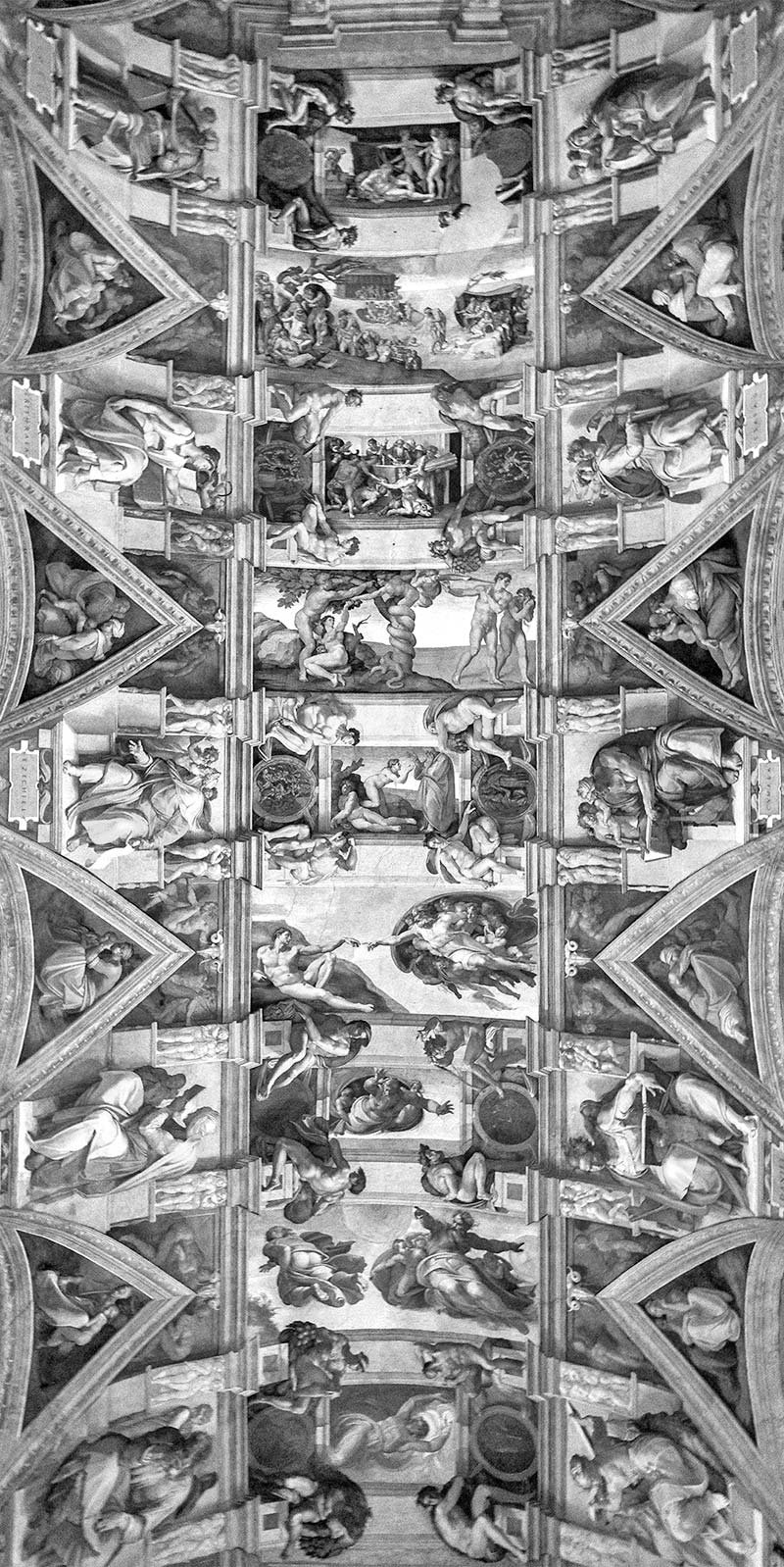
This is the spirit of the Renaissance. God is not a terrifying giant reaching down to puny and helpless man from way on high. Here they are on an equal plane, divided only by the diagonal bit of sky. God’s billowing robe and the patch of green upon which Adam is lying balance each other. They are like two pieces of a jigsaw puzzle, or two long-separated continents, or like the yin and yang symbols finally coming together—uniting, complementing each other, creating wholeness. God and man work together in the divine process of creation.
When the ceiling was finished and revealed to the public, it simply blew ’em away. It both caps the Renaissance and turns it in a new direction. In perfect Renaissance spirit, it mixes Old Testament prophets with classical figures. But the style is more dramatic, shocking, and emotional than the balanced Renaissance works before it. This is a very personal work—the Gospel according to Michelangelo—but its themes and subject matter are universal. Many art scholars contend that the Sistine ceiling is the single greatest work of art by any one human being.
Later, after the Reformation wars had begun and after the Catholic army of Spain had sacked the Vatican, the reeling Church began to fight back. As part of its Counter-Reformation, a much older Michelangelo was commissioned to paint the Last Judgment (behind the altar).
It’s Judgment Day, and Christ—the powerful figure in the center, raising his arm to spank the wicked—has come to find out who’s naughty and who’s nice. Beneath him, a band of angels blows its trumpets Dizzy Gillespie-style, giving a wake-up call to the sleeping dead. The dead at lower left leave their graves and prepare to be judged. The righteous, on Christ’s right hand (the left side of the picture), are carried up to the glories of heaven. The wicked on the other side are hurled down to hell, where demons wait to torture them. Charon, from the underworld of Greek mythology, waits below to ferry the souls of the damned to hell.
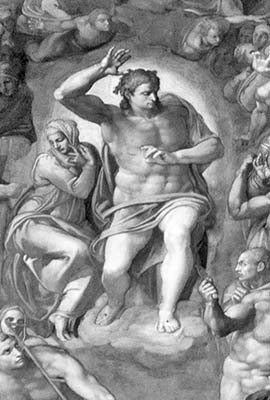
When The Last Judgment was unveiled to the public in 1541, it caused a sensation. The pope is said to have dropped to his knees and cried, “Lord, charge me not with my sins when thou shalt come on the Day of Judgment.”
And it changed the course of art. The complex composition, with more than 300 figures swirling around the figure of Christ, went far beyond traditional Renaissance balance. The twisted figures shown from every imaginable angle challenged other painters to try and top this master of 3-D illusion. And the sheer terror and drama of the scene was a striking contrast to the placid optimism of, say, Raphael’s School of Athens. Michelangelo had Baroque-en all the rules of the Renaissance, signaling a new era of art.
Exiting the Vatican Museums: To return to the museum’s main entrance/exit, leave the Sistine through the side door next to the screen (on the left, with your back to the altar). You’ll soon find yourself facing the Long March back to the museum’s entrance (about 15 minutes away) and the Pinacoteca. Along this corridor (located one floor below the long corridor that you walked to get here), you’ll see some of the wealth amassed by the popes, mostly gifts from royalty. The elaborately decorated library that branches off to the right contains rare manuscripts. The corridor eventually sends you looping through various shops and food courts (keep following signs for exit) until you spill out onto a lawn.
As you leave, enjoy one last view of the Vatican grounds and Michelangelo’s magnificent dome. Then go in peace.
▲Castel Sant’Angelo
Built in ancient times as a tomb for the emperor Hadrian, used through the Middle Ages as a castle, prison, and place of last refuge for popes under attack, and today a museum, this giant pile of ancient bricks is packed with history. The structure itself is striking, the opulent papal rooms are dramatic (and cool inside during the summer), and the views up top are some of the best in Rome.
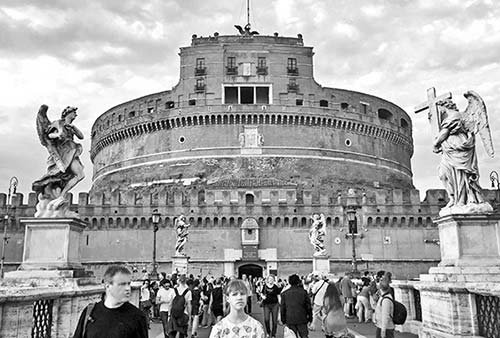
Cost and Hours: €12, more with special exhibits, Tue-Sun 9:00-19:30, closed Mon, last entry one hour before closing, near Vatican City, 10-minute walk from St. Peter’s Square at Lungotevere Castello 50, Metro: Lepanto or bus #40 or #64, café, +39 06 681 9111, www.castelsantangelo.beniculturali.it [URL inactive].
Visiting the Castle: Ancient Rome allowed no tombs within its walls, so Emperor Hadrian grabbed the most commanding position across the river and built this towering tomb. In the year 590, the archangel Michael appeared above the mausoleum to signal the end of a plague. The tomb became a fortified palace, renamed for the “holy angel.” Castel Sant’Angelo spent the Dark Ages as a fortress and prison, but was connected to the Vatican via an elevated corridor in the 13th century (since Rome was repeatedly plundered by invaders, Castel Sant’Angelo was a handy place of last refuge for popes). In anticipation of long sieges, rooms were decorated with papal splendor.
A one-way route circulates visitors through the medieval and then the ancient parts of the monument. After the ticket booth, head upstairs to the rampart with its four bastions (named for the evangelists: Matthew, Mark, Luke, and John). Then climb a ramp and cross a bridge that traverses the sacred chamber in the center. Next, you reach a sunny courtyard with a 16th-century statue of St. Michael. Climbing to another rampart, you’ll find the armory and later enter medieval rooms built for the pope. The papal library was painted by followers of Raphael. Eventually you reach the rooftop terrace with the statue of the Archangel Michael sheathing his sword—and one of the best views anywhere of Rome and St. Peter’s Basilica.
NORTH ROME
▲Villa Borghese Gardens
Rome’s somewhat scruffy three-square-mile “Central Park” is great for its quiet shaded paths and for people-watching plenty of modern-day Romeos and Juliets. The best entrance is at the head of Via Veneto (Metro: Barberini, then 10-minute walk up Via Veneto and through the old Roman wall at Porta Pinciana, or catch a cab to Via Veneto—Porta Pinciana). There you’ll find a cluster of buildings with a café, a kiddie arcade, and bike rental (€4/hour, includes lock to allow sightseeing stops). Rent a bike or, for romantics, a pedaled rickshaw (risciò, €12/hour). Follow signs to discover the park’s cafés, fountains, statues, lake, and prime picnic spots. Some sights require paid admission, including the Borghese Gallery, Rome’s zoo, and the National Gallery of Modern Art (19th-century art).
You can also enter the gardens from the top of the Spanish Steps (facing the church, turn left and walk down the road 200 yards beyond Villa Medici, then angle right on the small pathway into the gardens), and from Piazza del Popolo (in the northeast corner of the piazza, stairs lead to the gardens via a terrace with grand views out to St. Peter’s Basilica—bikes and Segways can be rented nearby).
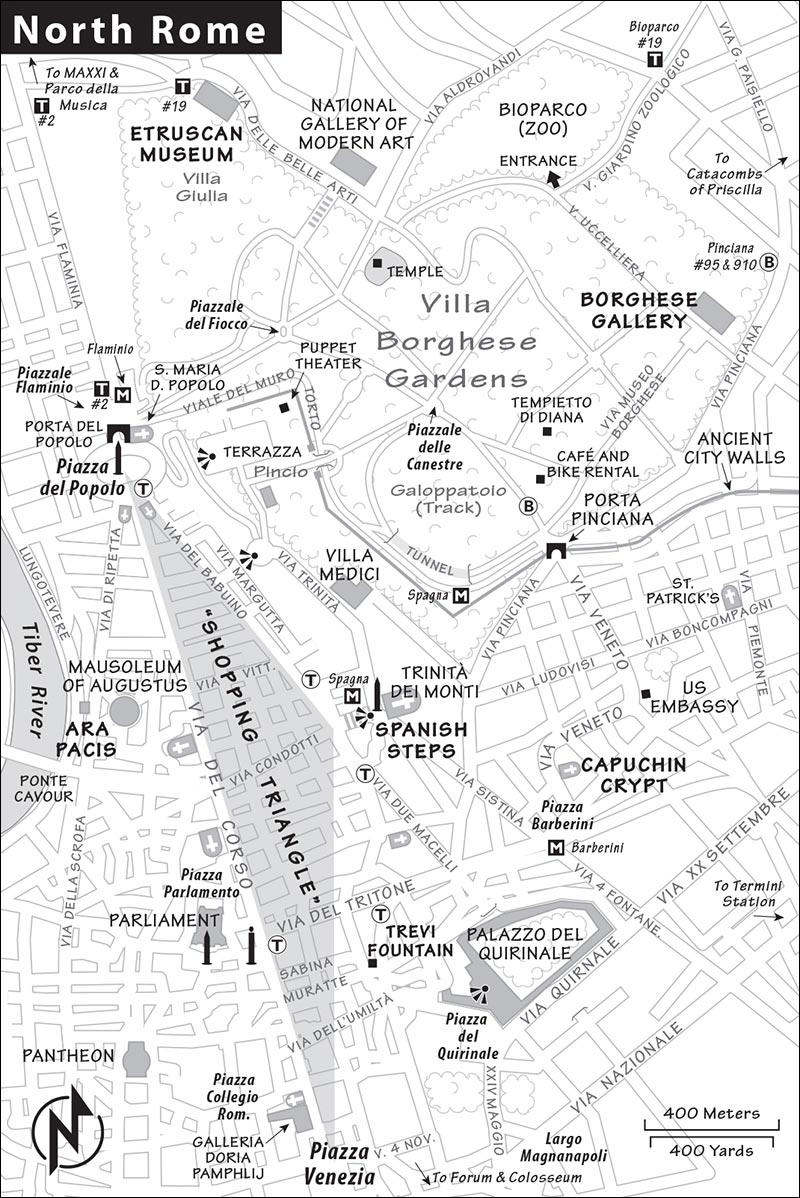
▲▲▲Borghese Gallery (Galleria Borghese)
This plush museum, filling a cardinal’s mansion in the park, offers one of Europe’s most sumptuous art experiences. You’ll enjoy a collection of world-class Baroque sculpture, including Bernini’s David and his excited statue of Apollo chasing Daphne, as well as paintings by Caravaggio, Raphael, Titian, and Rubens. The museum’s mandatory reservation system keeps crowds to a manageable size.
Cost and Hours: €17, Tue-Sun 9:00-19:00, closed Mon. The museum may be open late one night per week—check online.
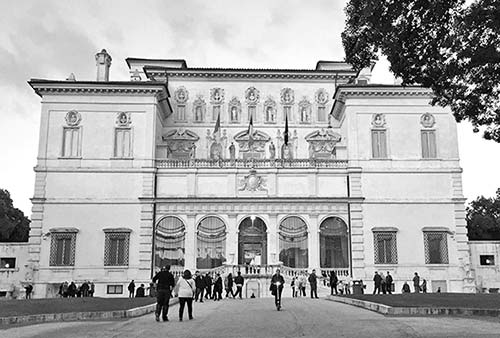
Information: +39 06 32810 (tickets and information), www.galleriaborghese.it.
Advance Reservations Required: Reservations are mandatory. As slots can book up, it’s better to reserve sooner rather than later. It’s easiest to book online at www.tosc.it; after booking you’ll be emailed a voucher with a bar code that lets you enter at your appointed time. You can also reserve with a real person over the telephone (+39 06 32810, press 2 for English, phones answered Mon-Fri 9:00-18:00, Sat 9:00-13:00, closed Sat in Aug and Sun year-round).
Getting In: You can get into the Borghese starting 10 minutes before your appointed time, but you may need to wait in a short line to enter (arriving late could result in forfeiting your reservation). For crowd control, they may direct you to start either on the ground floor (where this tour begins), or in the Pinacoteca on the upper floor. This tour works equally well in either order.
Getting There: The museum, at Piazzale del Museo Borghese 5, is set idyllically but inconveniently in the vast Villa Borghese Gardens. A taxi drops you along Via Pinciana, 100 yards from the museum. (Tell the cabbie you want “Galleria Borghese,” not “Villa Borghese.”) To go by public transit, take bus #910 from Termini train station/Piazza della Repubblica to the Puccini stop, walk to the park, turn left, and use the first park entrance (but note that #910 runs back to Termini by a different, less convenient route). Bus #53 runs to the Via Pinciana stop from Largo Chigi (not far from Trevi Fountain) and the Barberini Metro station. You can also go by foot (20 minutes) from the Barberini Metro stop: Walk 10 minutes up Via Veneto, enter the park, and turn right, following signs another 10 minutes to the Borghese Gallery.
Tours: Guided English tours may be available (€8; book this along with your entry reservation). Or consider the museum’s excellent 1.5-hour audioguide (€5), which covers more than this tour.
Length of This Tour: This tour takes about an hour, but the Borghese rewards lingerers. With less time, focus on the ground-floor sculptures, especially Bernini.
Services: Baggage check is free, mandatory, and strictly enforced. Even small purses must be checked. There’s a WC in the staircase between the two floors.
Budget most of your time for the more interesting ground floor, but set aside 30 minutes for the paintings of the Pinacoteca upstairs (highlights are marked by the audioguide icons). It’s hard to believe that a family of cardinals and popes would display so many works with secular and sensual—even erotic—themes. But the Borgheses felt that all forms of human expression, including pagan myths and physical passion, glorified God.
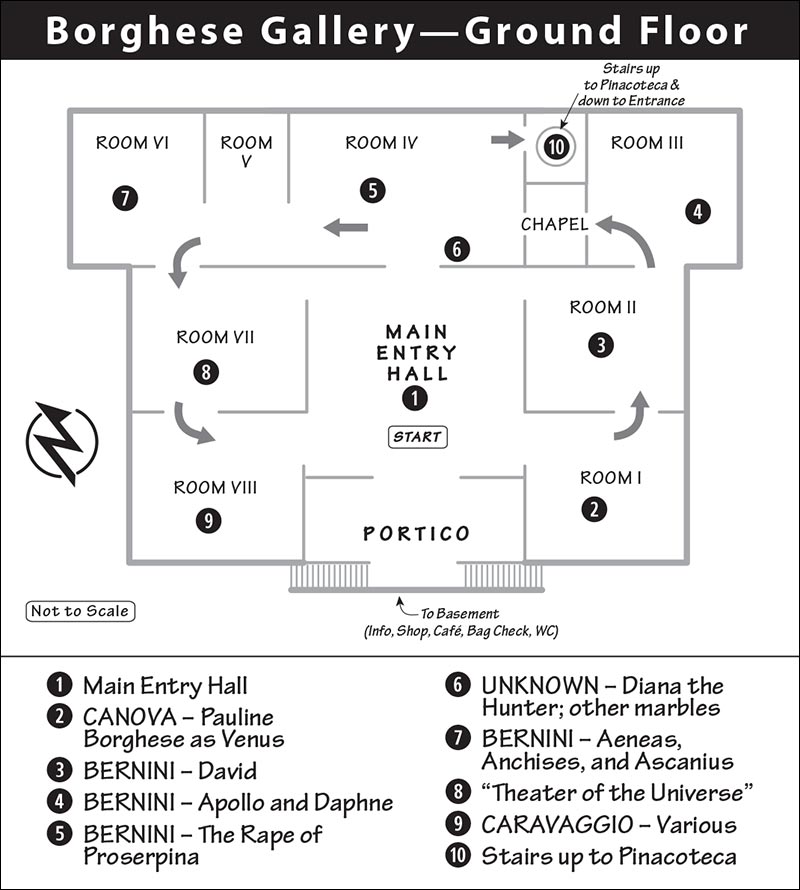
The essence of the collection is the connection of the Renaissance with the classical world. As you enter, notice the second-century Roman reliefs with Michelangelo-designed panels above either end of the portico. The villa was built in the early 17th century by the great art collector Cardinal Scipione Borghese, who wanted to prove that the glories of ancient Rome were matched by the Renaissance.
In the main entry hall, high up on the wall, is a thrilling first-century Greek sculpture of a horse falling. The Renaissance-era rider was added by Pietro Bernini, father of the famous Gian Lorenzo Bernini.
Each room seems to feature a Baroque masterpiece. In Room I is Pauline Borghese as Venus, for which Napoleon’s sister went the full monty for the sculptor Canova, scandalizing Europe. With the famous nose of her conqueror brother, she strikes the pose of Venus as conqueror of men’s hearts. Notice the contrasting textures that Canova (1757-1822) gets out of the pure white marble. The mythological pose, the Roman couch, the ancient hairdo, and the calm harmony make Pauline the epitome of the Neoclassical style.
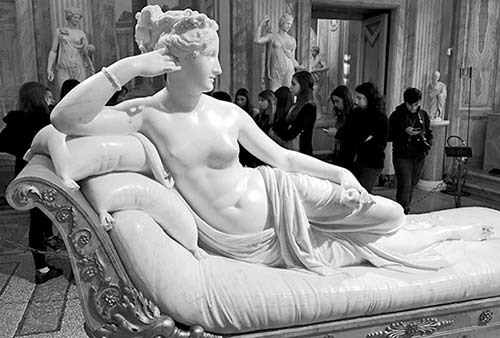
In Room II, Gian Lorenzo Bernini’s David twists around to put a big rock in his sling. He purses his lips, knits his brow, and winds his body like a spring as his eyes lock onto the target: Goliath, who’s somewhere behind us, putting us right in the line of fire. Compared with Michelangelo’s David, this is unvarnished realism—an unbalanced pose, bulging veins, unflattering face, and armpit hair. Michelangelo’s David thinks, whereas Bernini’s acts. Bernini slays the pretty-boy Davids of the Renaissance and prepares to invent Baroque.
The best one of all is in Room III: Bernini’s Apollo and Daphne. It’s the perfect Baroque subject—capturing a thrilling, action-filled moment. In the mythological story, Apollo—made stupid by Cupid’s arrow of love—chases after Daphne, who has been turned off by the “arrow of disgust.” Just as he’s about to catch her, she calls to her father to save her. Magically, her fingers begin to sprout leaves, her toes become roots, her skin turns to bark, and she transforms into a tree. Frustrated Apollo will end up with a handful of leaves. Walk slowly around the statue. It’s more air than stone.
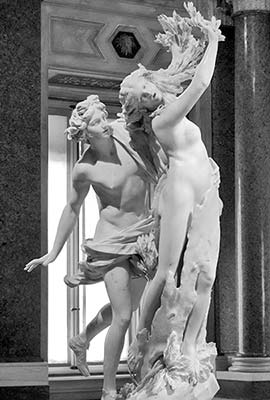
But don’t stop here. In Room IV, admire Bernini’s The Rape of Proserpina, proof that even at the age of 24 the sculptor was the master of marble. The statues in the niches are classical originals. Diana the Hunter is a rare Greek original, with every limb and finger intact. Over in Room VI, Bernini’s first major work for Cardinal Borghese—Aeneas, Anchises, and Ascanius—reveals the then-20-year-old sculptor’s astonishing aptitude for portraying human flesh, though the statue lacks the Baroque energy of his more mature work. And in Room VIII is a fabulous collection of paintings by Caravaggio, who brought Christian saints down to earth with gritty realism.
Upstairs, in the Pinacoteca (Painting Gallery), are busts and paintings by Bernini, as well as paintings by Raphael, Titian, Correggio, and Domenichino.
▲▲Museo dell’Ara Pacis (Museum of the Altar of Peace)
On January 30, 9 BC, soon-to-be-emperor Augustus led a procession of priests up the steps and into this newly built “Altar of Peace.” They sacrificed an animal on the altar and poured an offering of wine, thanking the gods for helping Augustus pacify barbarians abroad and rivals at home. This marked the dawn of the Pax Romana (c. AD 1-200), a golden age of good living, stability, dominance, and peace (pax). The Ara Pacis (AH-rah PAH-chees) hosted annual sacrifices by the emperor until the area was flooded by the Tiber River. For an idea of how high the water could get, find the measure (idrometro) scaling the right side of the church closest to the entrance. Buried under silt, it was abandoned and forgotten until the 16th century, when various parts were discovered and excavated. Mussolini gathered the altar’s scattered parts and reconstructed them in a building here in 1938. Today, the Altar of Peace stands in a pavilion designed by American architect Richard Meier (opened 2006).
Cost and Hours: €10.50, more with special exhibits, tightwads can look in through huge windows for free, daily 9:30-19:30, last entry one hour before closing, videoguide-€7, a long block west of Via del Corso on Via di Ara Pacis, on the east bank of the Tiber near Ponte Cavour, Metro: Spagna plus a 10-minute walk down Via dei Condotti, +39 06 0608, www.arapacis.it.
▲▲Catacombs of Priscilla (Catacombe di Priscilla)
While most tourists and nearly all tour groups go out to the Appian Way to see the famous catacombs of San Sebastiano and San Callisto (7.5 miles south of downtown, easiest by taxi), the Catacombs of Priscilla are more central, less commercialized, and less crowded—they just feel more intimate, as catacombs should. You enter from a convent and explore the result of 250 years of tunneling that occurred from the second to the fifth centuries. Visits are by 30-minute guided tour only (English-language tours go whenever a small group gathers—generally every 20 minutes or so). You’ll see a few thousand of the 40,000 niches carved here, along with some beautiful frescoes, including what is considered the first depiction of Mary nursing the Baby Jesus.
Cost and Hours: €8.50, €5.50 for kids 7-15, free for kids 6 and under, Fri-Sun 9:00-12:00 & 14:00-17:00, closed Mon-Thu but may be open during busy times, closed one random month a year—check website or call first, Via Salaria 430, +39 06 8620 6272, www.catacombepriscilla.com.
Getting There: The catacombs are on the northeast edge of the city but well served by direct buses (30 minutes from Termini or 40 minutes from Piazza Venezia) or a €15 taxi ride. From Termini, take bus #92 or #310 from Piazza Cinquecento or Metro B1 (direction: Jonio) to Libia or Sant’Agnese/Annibaliano stop. From Piazza Venezia, along Via del Corso or Via Barberini, take bus #63 or #83. Tell the driver “Piazza Crati” and “kah-tah-KOHM-bay” and you’ll be let off near Piazza Crati (at the Nemorense/Crati stop). From there, walk through the little market in Piazza Crati, then down Via di Priscilla (about 5 minutes). The entrance is in the orange building on the left at the top of the hill.