VOLTERRA & SAN GIMIGNANO
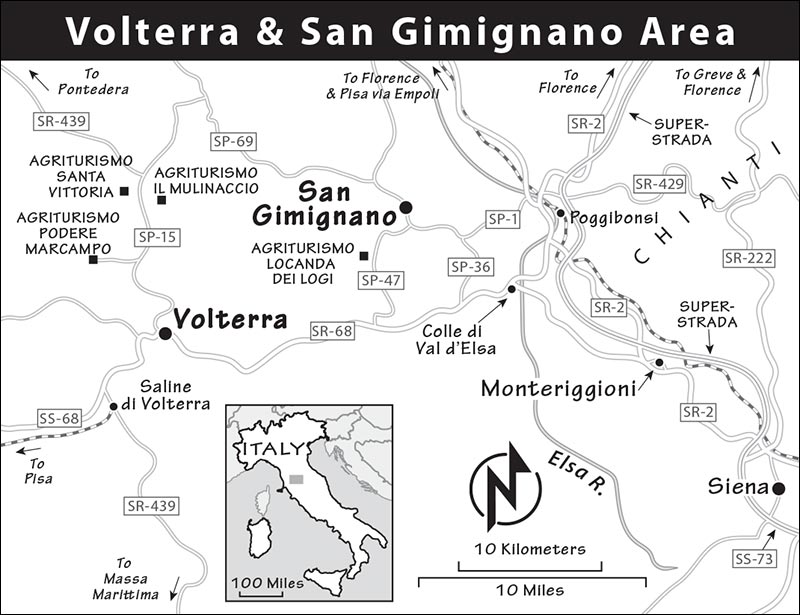
Map: Volterra & San Gimignano Area
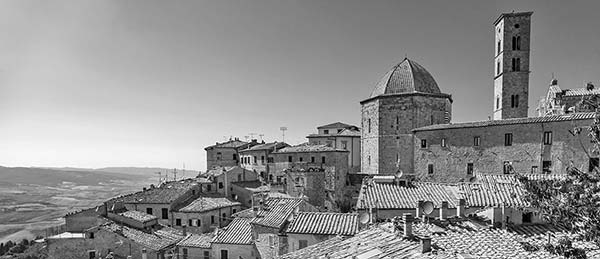
This fine duo of hill towns—perhaps Italy’s most underrated and most overrated, respectively—sits just a half-hour drive apart in the middle of the triangle formed by Florence, Siena, and Pisa. San Gimignano is the region’s glamour girl, getting all the fawning attention from passing tour buses. And a quick stroll through its core, in the shadows of its 14 surviving medieval towers, is a delight. But once you’ve seen it, you’ve seen it...and that’s when you head for Volterra. Volterra isn’t as eye-catching as San Gimignano, but it has unmistakable authenticity and surprising depth, richly rewarding travelers adventurous enough to break out of the San Gimignano rut. With its many engaging museums, Volterra offers the best sightseeing of all of Italy’s small hill towns.
GETTING THERE
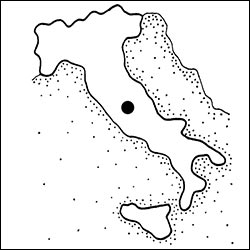
These towns work best for drivers, who can easily reach both in one go. Volterra is farther off the main Florence-Siena road, but it’s near the main coastal highway connecting the north (Pisa, Lucca, and Cinque Terre) and south (Montalcino/Montepulciano and Rome). It’s a little more than an hour’s drive from Pisa or Florence.
If you’re relying on public transportation, both towns are reachable—to a point. Visiting either one by bus from Florence or Siena requires a longer-than-it-should-be trek, often with a change (in Colle di Val d’Elsa for Volterra, in Poggibonsi for San Gimignano). Volterra can also be reached by a train-and-bus combination from La Spezia, Pisa, or Florence (transfer to a bus in Pontedera). See each town’s “Connections” section for details.
San Gimignano is better connected, but Volterra merits the additional effort. Note that while these towns are only about a 30-minute drive apart, they’re poorly connected to each other by public transit.
PLANNING YOUR TIME
Volterra and San Gimignano are a handy yin-and-yang pair. Ideally, you’ll overnight in one town and visit the other either as a side trip or en route. Sleeping in Volterra lets you really settle into a charming burg with good restaurants, but it forces you to visit San Gimignano during the day, when it’s busiest. Sleeping in San Gimignano lets you enjoy that gorgeous town when it’s relatively quiet, but some visitors find it too quiet. Ultimately I’d aim to sleep in Volterra, and try to visit San Gimignano as early or late in the day as is practical to avoid crowds. Those with a car may choose to stay in the countryside between the two, visiting Volterra during the day and dining in San Gimignano at night.
Volterra
Encircled by impressive walls and topped with a grand fortress, Volterra perches high above the rich farmland surrounding it. More than 2,000 years ago, Volterra was an important Etruscan city, and much larger than we see today. Greek-trained Etruscan artists worked here, leaving a significant stash of art, particularly cinerary urns. Eventually Volterra was absorbed into the Roman Empire, and for centuries it was an independent city-state. Volterra fought bitterly against the Florentines, but like many Tuscan towns, it lost in the end and was given a Medici fortress atop the city to “protect” its citizens.
Unlike other famous towns in Tuscany, Volterra feels neither cutesy nor touristy...but real, vibrant, and almost oblivious to the allure of the tourist dollar. Millennia past its prime, Volterra seems to have settled into a well-worn groove; locals are resistant to change. At a town meeting about whether to run high-speed internet cable to the town, a local grumbled, “The Etruscans didn’t need it—why do we?” This stubbornness helps make Volterra a refreshing change of pace from its more aggressively commercial neighbors. Volterra also boasts some interesting sights, from an ancient Roman theater, to a finely decorated Pisan Romanesque cathedral, to an excellent museum of Etruscan artifacts. And most evenings, charming Annie and Claudia give a delightful, one-hour guided town walk sure to help you appreciate their city (see “Tours in Volterra,” later). All in all, Volterra is my favorite small town in Tuscany.
Orientation to Volterra
Compact and walkable, Volterra (pop. 10,000—6,000 inside the old wall) stretches out from the pleasant Piazza dei Priori to the old city gates and beyond. Be ready for some steep walking: While the spine of the city from the main square to the Etruscan Museum is fairly level, nearly everything else involves a climb.
TOURIST INFORMATION
The helpful TI is on the main square, at Piazza dei Priori 20 (daily 10:00-13:00 & 14:00-18:00, shorter hours off-season, +39 0588 87257, www.volterratur.it). They have bus schedules, a city map, and plenty of suggestions to keep you busy. Check the TI website for details on frequent summer festivals and concerts. Ignore the private travel agency, disguised as a TI, in the opposite corner of the piazza.
ARRIVAL IN VOLTERRA
By Public Transport: Buses stop at Piazza Martiri della Libertà in the town center. Train travelers can reach the town with a short bus ride from Pontedera, which has the nearest train station.
By Car: From Pisa, take the highway known as FI-PI-LI (for “Firenze-Pisa-Livorno”) in the direction of Florence, exiting at Pontedera to follow the scenic country road SR-439 toward Ponsacco and on to Volterra. From Florence, leave the city to the south to reach SR-2 toward Siena. Exit just past Poggibonsi onto SR-68 toward Colle di Val d’Elsa, passing the road to San Gimignano on the way to Volterra.
Don’t drive into the town center; it’s prohibited except for locals (and you’ll get a huge fine). It’s easiest to simply wind to the top where the road ends at Piazza Martiri della Libertà. (Halfway up the hill, there’s a confusing hard right—don’t take it; keep going straight uphill under the wall.) Immediately before the Piazza Martiri bus roundabout is the entry to Parcheggio La Dogana underground garage (€2/hour, €15/day, keep ticket and pay as you leave) that’s within a few blocks of nearly all my recommended hotels and sights.
If the main garage is full, the police may direct you to other pay lots that ring the town walls (try the handy-but-small lot facing the Roman Theater and Porta Fiorentina gate). You can also pay to park outside the walls in any street spot marked with blue lines. Behind town, a lot named Docciola is free, but it requires a steep climb from the Porta di Docciola gate up into town.
If you’re staying in town, check with your hotel about the best parking options.
HELPFUL HINTS
Volterra Card: This €15 card covers all the main sights—except for the Palazzo Viti (valid 72 hours, buy at TI or any covered sight). If traveling with kids, ask about the family card, an especially good deal (€24 for 1-2 adults and kids under 18).
Market Day: The market is on Saturday morning near the Roman Theater (8:00-13:00; Nov-March it moves to Piazza dei Priori). The TI hands out a list of other market days in the area.
Laundry: The handy self-service Lavanderia Azzurra is just off the main square (daily 7:00-22:00, Via Roma 7, +39 0588 80030). Their next-door dry-cleaning shop also provides wash-and-dry services that usually take about 24 hours (closed Sun).
Tours in Volterra
▲▲Guided Volterra Walk
Annie Adair and her colleague Claudia Meucci offer a great one-hour, English-only introductory walking tour of Volterra for €10. The walk touches on Volterra’s Etruscan, Roman, and medieval history, as well as the contemporary cultural scene (daily April-Oct, rain or shine Mon, Wed, and Fri at 12:30, Tue, Thu, Sat, and Sun at 18:00; meet in front of alabaster shop on Piazza Martiri della Libertà, no need to reserve; www.volterrawalkingtour.com or www.tuscantour.com, info@volterrawalkingtour.com). There’s no better way to spend €10 and one hour in this city. I mean it. Don’t miss this beautiful experience.
Local Guides
American Annie Adair is an excellent guide for private, in-depth tours of Volterra (€180/half-day). Her husband Francesco, an easygoing sommelier and wine critic, and his team lead a Wine Tasting 101 crash course in sampling Tuscan wines (€60/hour per group, plus cost of wine). Annie and Francesco also offer excursions to a honey farm, alabaster quarry, and winery, or a more wine-focused trip to Montalcino or the heart of Chianti (about €450/day for 2-4 people, larger groups possible, +39 347 143 5004, www.tuscantour.com, info@tuscantour.com).
Sights in Volterra
▲Etruscan Arch (Porta all’Arco)
“Artisan Lane” (Via Porta all’Arco)
Pinacoteca and Alabaster Museum (Pinacoteca e Ecomuseo dell’Alabastro)
▲Alabaster Showroom and Workshop
▲▲Etruscan Museum (Museo Etrusco Guarnacci)
Medici Fortress and Archaeological Park (Fortezza Medicea and Parco Archeologico)
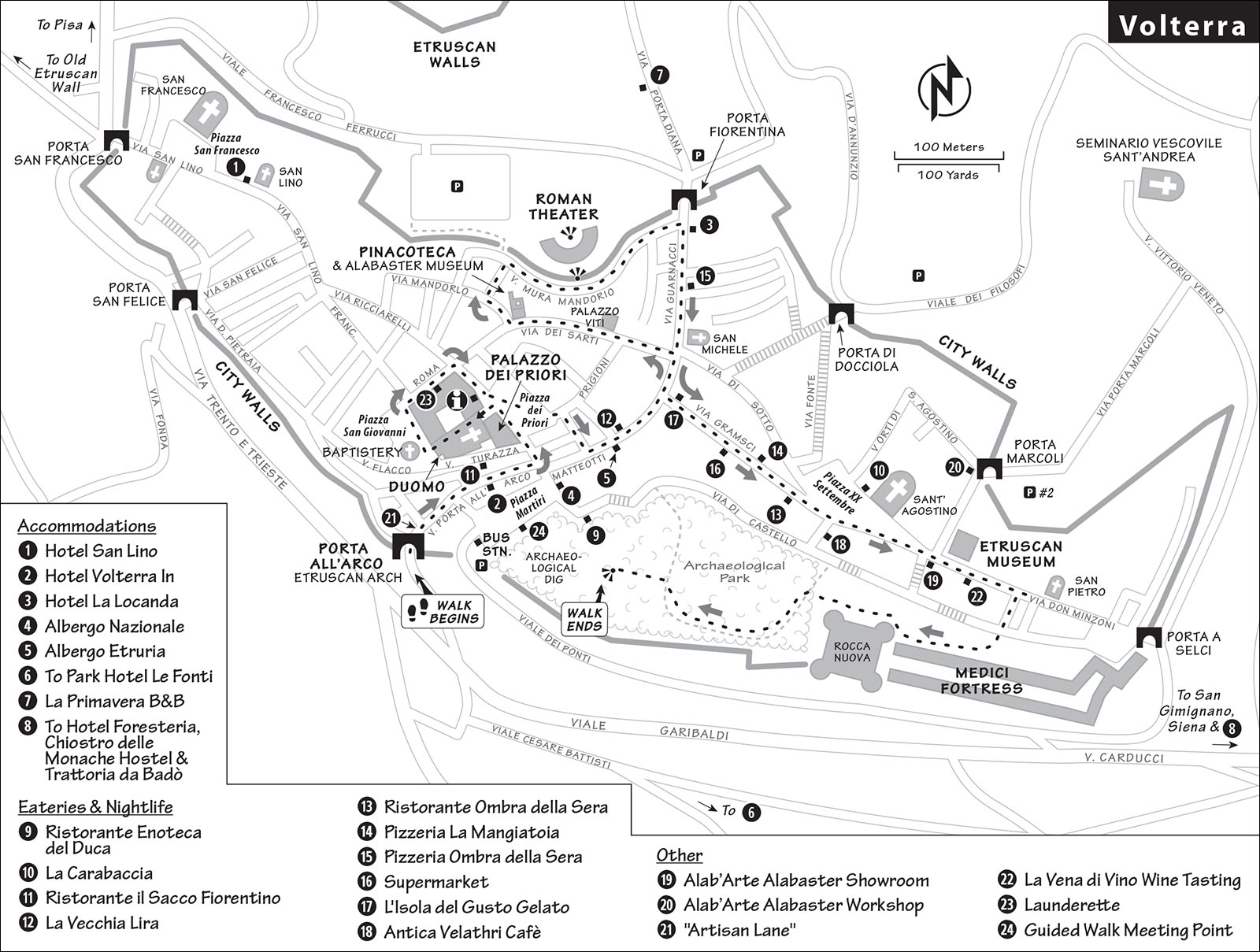
I’ve linked these sights with handy walking directions.
• Begin at the Etruscan Arch at the bottom of Via Porta all’Arco (about 4 blocks below the main square, Piazza dei Priori).
▲Etruscan Arch (Porta all’Arco)
Volterra’s renowned Etruscan arch was built of massive stones in the fourth century BC. The original city wall was four miles around—twice the size of today’s wall. Imagine: This city had 20,000 people four centuries before Christ. Volterra was a key trading center and one of 12 leading towns in the confederation of Etruria. The three seriously eroded heads, dating from the first century BC, show what happens when you leave something outside for 2,000 years. The newer stones are part of the 13th-century city wall, which incorporated parts of the much older Etruscan wall.
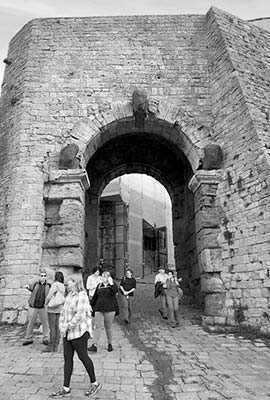
A plaque just outside remembers June 30, 1944. That night, Nazi forces were planning to blow up the arch to slow the Allied advance. To save their treasured landmark, Volterrans ripped up the stones that pave Via Porta all’Arco, plugged up the gate, and managed to convince the Nazi commander that there was no need to blow up the arch. Today, all the paving stones are back in their places, and like silent heroes, they welcome you through the oldest standing gate into Volterra. Locals claim this as the oldest surviving rounded arch of the Etruscan age; some experts believe this is where the Romans got the idea for using a keystone in their arches.
• Go through the arch and head up Via Porta all’Arco, which I like to call...
“Artisan Lane” (Via Porta all’Arco)
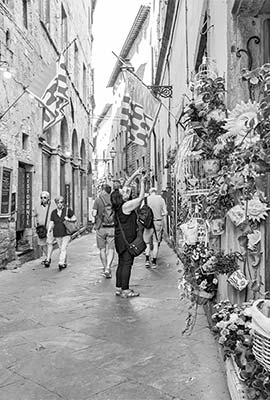
This steep and atmospheric lane is lined with interesting shops featuring the work of artisans and producers. Because of its alabaster heritage, Volterra developed a tradition of craftsmanship and artistry, and today you’ll find a rich variety of handiwork (shops generally open Mon-Sat 10:00-13:00 & 16:00-19:00, closed Sun).
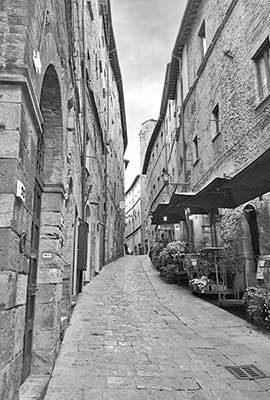
From the Etruscan Arch, browse your way up the hill, checking out these shops and items (listed from bottom to top): alabaster shop (#45); book bindery and papery (#26); jewelry (#25); etchings (#23); and bronze work (#6).
• Reaching the top of Via Porta all’Arco, turn left and walk a few steps into Volterra’s main square, Piazza dei Priori. It’s dominated by the...
Palazzo dei Priori
Volterra’s City Hall, built about 1200, claims to be the oldest of any Tuscan city-state. It clearly inspired the more famous Palazzo Vecchio in Florence. Town halls like this are emblematic of the era of powerful city-states. They were architectural exclamation points declaring that, around here, no pope or emperor called the shots. Towns such as Volterra were truly city-states—proudly independent and relatively democratic. They had their own armies, taxes, and even weights and measures. Notice the horizontal “cane” cut into the City Hall wall (10 yards to the right of the door). For a thousand years, this square hosted a market, and the “cane” was the local yardstick.
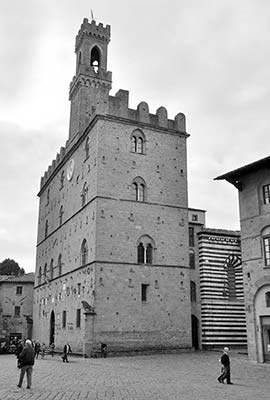
Cost and Hours: €8, includes council chambers and tower climb, daily 9:00-19:00, Nov-mid-March until 16:30, tower closed in bad weather.
• As you face the City Hall, find the little back door in the black-and-white striped wall (to the right), which leads into Volterra’s cathedral.
Duomo
This church is not as elaborate as its cousin in Pisa, but it is a beautiful example of the Pisan Romanesque style. The simple 13th-century facade conceals a more intricate interior (rebuilt in the late 16th and 19th centuries), with a central nave flanked by monolithic stucco columns painted to imitate pink granite and topped by a gilded, coffered ceiling. Just past the pulpit on the right (at the Rosary Chapel), check out the Annunciation, painted in 1497 by Mariotto Albertinelli and Fra Bartolomeo (both were students of Fra Angelico). The two, friends since childhood, delicately give worshippers a way to see Mary “conceived by the Holy Spirit.” Note the vibrant colors, exaggerated perspective, and Mary’s contrapposto pose—all attributes of the Renaissance.
Cost and Hours: €7 includes the Duomo, baptistery, and skippable old hospital where you buy your ticket, Mon-Sat 10:00-18:00, Sun from 13:30, shorter hours off-season.
• Exit the cathedral through its “front” door and go right, circling all the way around the block to return to Piazza dei Priori. Exit the far end of the square; after one short block, you’re standing at the head (on the left) of...
▲Via Matteotti
The town’s main drag, named after the popular Socialist leader Giacomo Matteotti (killed by the fascists in 1924), provides a good cultural scavenger hunt.
At #1, on the left, is a typical Italian bank security door. (Step in and say, “Beam me up, Scotty.”) Back outside, stand at the corner and look up and all around. Find the medieval griffin torch-holder—symbol of Volterra, looking down Via Matteotti—and imagine it holding a flaming torch. The pharmacy kitty-corner sports the symbol of its medieval guild. Across the street from the bank, #2 is the base of what was a San Gimignano-style fortified Tuscan tower. Look up and imagine heavy beams cantilevered out, supporting extra wooden rooms and balconies crowding out over the street. Throughout Tuscany, today’s stark and stony old building fronts once supported a tangle of wooden extensions.
As you head down Via Matteotti, notice how the doors show centuries of refitting work. Doors that once led to these extra rooms are now partially bricked up to make windows. Contemplate urban density in the 14th century, before the plague thinned out the population. Be careful: A wild boar (a local delicacy) awaits you at #10.
At #12, on the right, notice the line of doorbells: This typical palace, once the home of a single rich family, is now occupied by many middle-class families. After the social revolution in the 18th century and the rise of the middle class, former palaces were condominium-ized. Even so, the original family still lives here—apartment #1 is the home of Count Guidi.
On the right at #16, pop into the alabaster showroom. Alabaster, quarried nearby, has long been a big industry here. Volterra alabaster—softer and more translucent than marble—was sliced thin to serve as windows for Italy’s medieval churches.
At #19, the recommended La Vecchia Lira is a lively restaurant. The Bar L’Incontro across the street is a favorite for breakfast and pastries; in the summer, they sell homemade gelato, while in the winter they make chocolates. In the evening, it’s a bustling local spot for a drink.
Across the way, side-trip 10 steps up Vicolo delle Prigioni to the fun Panificio Rosetti bakery. They’re happy to sell small quantities if you want to try the local Cantuccini (almond biscotti) or another treat.
Continue on Via Matteotti to the end of the block. Notice the bit of Etruscan wall artfully used to display more alabaster art (at #51).
Locals gather early each evening at Osteria dei Poeti (#57) for some of the best cocktails in town (served with free munchies). The cinema is across the street. Movies in Italy are rarely in their original language; Italians are used to getting their movies dubbed into Italian. To bring some culture to this little town, they also show live broadcasts of operas and concerts (advertised in the window).
Another Tuscan tower on the corner (#66) marks the end of the street. This noble house had a ground floor with no interior access to the safe upper floors. Rope ladders were used to get upstairs. The tiny door was wide enough to let in your skinny friends...but definitely not anyone wearing armor and carrying big weapons.
Across the little square stands the ancient Church of St. Michael. After long years of barbarian chaos, the Germanic Langobards moved in from the north in the sixth century and asserted law and order in places like Volterra. That generally included building a Christian church over the old Roman forum to symbolically claim and tame the center of town. The church standing here today is Romanesque, dating from the 12th century.
Around the right side, find the crude little guy and the smiling octopus under its eaves—they’ve been making faces at the passing crowds for 800 years.
• When you reach the little piazzetta with a Romanesque church, turn left down Via dei Sarti. Our next stop—Palazzo Viti—is halfway down the block. But if you want to linger on the square for a bit, drop in for a glass of wine at Enoteca Scali (at Via Guarnacci 3), where friendly Massimo and Patrizia sell a vast selection of wines and local delicacies in an inviting atmosphere.
▲Palazzo Viti
Palazzo Viti takes you behind the rustic, heavy stone walls of the city to see how the wealthy lived—in this case, rich from the 19th-century alabaster trade. This time warp is popular with Italian movie directors. With 12 rooms on one floor open to the public, Palazzo Viti feels remarkably lived in—because it is. Behind the ropes you’ll see intimate family photos. You may well find Signora Viti herself selling admission tickets.
Cost and Hours: €5, Mon-Fri 10:30-17:00, Sat-Sun 10:00-17:30, by appointment only Nov-March, ask for an English brochure, Via dei Sarti 41, +39 0588 84047, www.palazzoviti.it, info@palazzoviti.it.
Visiting the Palazzo: The elegant interior is compact and well described. You’ll climb up a stately staircase, buy your ticket, and head into the grand ballroom. From here, you’ll tour the blue-hued dining room (with slice-of-life Chinese scenes painted on rice paper); the salon of battles (with warfare paintings on the walls); and the long hall of temporary exhibits. Looping back, you’ll see the porcelain hall (decorated with priceless plates) and the inviting library (notice the delicate lamp with a finely carved lampshade).
The Brachettone Salon is named for the local artist responsible for the small sketch of near-nudes hanging just left of the door into the next room. Brachettone (from brache, “pants”) is the nickname for the hometown 16th-century artist Daniele da Volterra, who owns the dubious distinction of having painted all those wispy loincloths over the genitalia of Michelangelo’s figures in the Last Judgment at the Sistine Chapel. (In this drawing, notice a similar aversion to showing the full monty...though everything-but is fair game.) On the table, notice the family wedding photo with Pope John Paul II presiding. In the red room, a portrait of Giuseppe Viti (looking like Pavarotti) hangs next to the exit door. He’s the man who purchased the place in 1850. Your visit ends with bedrooms and a dressing room.
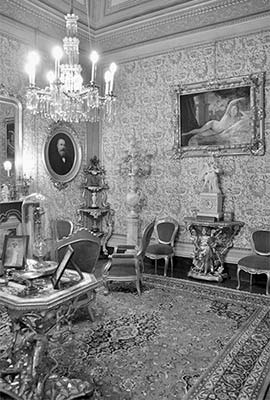
Your Palazzo Viti ticket sometimes gets you a fine little cheese, salumi, and wine tasting, typically in high season. As you leave the palace, climb down into the cool cellar (used as a disco on some weekends), where you can pop into a Roman cistern, marvel at an Etruscan well, and enjoy a friendly sit-down snack.
• A block past Palazzo Viti, also on Via dei Sarti, is the...
Pinacoteca and Alabaster Museum (Pinacoteca e Ecomuseo dell’Alabastro)
The Pinacoteca fills a 15th-century palace with fine paintings that feel more Florentine than Sienese—a reminder of whose domain this town was in. You’ll see a stunning altarpiece by Taddeo di Bartolo, once displayed in the original residence. You’ll also find roomfuls of gilded altarpieces and saintly statues, as well as a trio of striking High Renaissance altar paintings by Signorelli, Fiorentino, and Ghirlandaio.
The adjoining Alabaster Museum gives a fascinating overview of the local alabaster industry, past and present.
Cost and Hours: €8, daily 9:00-19:00, Nov-mid-March until 16:30, Via dei Sarti 1, +39 0588 87580.
• Exiting the building, circle right along the side of the museum into the tunnel-like Passo del Gualduccio passage; then turn right and walk along the wall, enjoying views of the...
Roman Theater (Teatro Romano)
With the fine aerial view from the city wall promenade, there’s no reason to pay to enter this well-preserved, first-century theater (although it is covered by the Volterra Card). The 13th-century wall that you’re standing on divided the theater from the town center...so, naturally, the theater became the town dump. Over time, the theater was forgotten—covered in the garbage of Volterra. It was rediscovered in the 1950s and excavated.
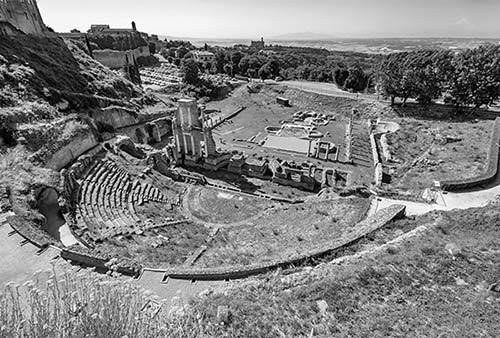
The stage wall (immediately in front of the theater seats) was standard Roman design—with three levels from which actors would appear: one level for mortals, one for heroes, and the top one for gods. Parts of two levels still stand. Gods leaped out onto the third level for the last time around the third century AD, which is when the town began to use the theater stones to build fancy baths instead. You can see the scant remains of the baths behind the theater, including the little round sauna in the far corner with brick supports that raise the heated floor.
From this vantage point, you can trace Volterra’s vast Etruscan wall. Find the church in the distance, on the left, and notice the stones just below. They are from the Etruscan wall that followed the ridge into the valley and defined Volterra in the fourth century BC.
• From the theater viewpoint, continue along the wall downhill to the T-intersection (the old gate, Porta Fiorentina, with fine wooden medieval doors, is on your left). Turn right, making your way uphill on Via Guarnacci, which becomes Via Matteotti. A block up Via Matteotti, you can’t miss the wide, pedestrianized shopping street called Via Gramsci. Follow this up to Piazza XX Settembre, walk through that leafy square, and continue uphill on Via Don Minzoni. At #18, you’ll find an…
▲Alabaster Showroom and Workshop
For a fun peek into the art of alabaster, visit the Alab’Arte showroom, featuring the work of Roberto Chiti and Giorgio Finazzo. Lighting shows off the translucent quality of the stone and the expertise of these artists, who are delighted to share their work with visitors. If they’re not in the showroom, the duo might be found at their nearby workshop (just down the narrow lane, Via Porta Marcoli, which runs next to the Etruscan Museum), where everything—including Roberto and Giorgio—is covered in a fine white dust. This is not a touristy guided visit, but something far more special: the chance to see busy artisans practicing their craft.
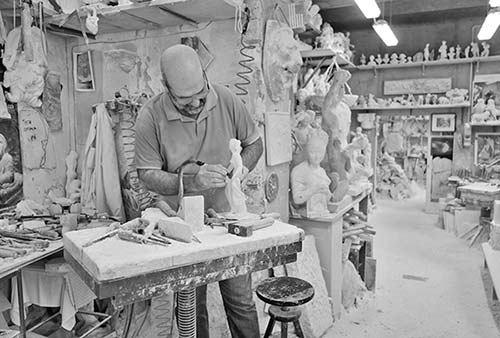
Cost and Hours: Free, showroom—daily 10:00-13:00 & 15:00-19:00, closes at 17:30 in off-season, closed Nov-Feb, Via Don Minzoni 18; workshop—Mon-Sat 10:00-12:30 & 15:00-19:00, closed Sun, if showroom is closed ask in the workshop, Via Orti Sant’Agostino 28, www.alabarte.com.
• Next pay a visit to the...
▲▲Etruscan Museum (Museo Etrusco Guarnacci)
Filled top to bottom with rare Etruscan artifacts, this museum—founded in 1732 (one of Italy’s first public museums and among the oldest in Europe)—makes it easy to appreciate how advanced this pre-Roman culture was.
Cost and Hours: €8, daily 9:00-19:00, Nov-mid-March 10:00-16:30, Via Don Minzoni 15, +39 0588 86347, www.volterratur.it/en/poi/guarnacci-etruscan-museum.
Visiting the Museum: To see the exhibits in chronological order, take the elevator or stairs to the top floor and make your way down. Otherwise, start on the ground floor with some beautiful Etruscan urns and an inviting public garden out back.
The ground-floor collection starts with an introduction to the Etruscans and the history of the excavations carried out in this area. Filling the rest of the ground floor is a vast collection of stone Etruscan cinerary urns (seventh-first century BC). Etruscan urns have two parts: The box on the bottom contained the cremated remains (with elaborately carved panels), while the lid was decorated with a sculpture of the deceased. The carved bas-relief scenes and motifs decorating the urns are a prized catalog of Etruscan life and activities.
First pay attention to the people on top. While contemporaries of the Greeks, the Etruscans were more libertine. Their religion was less demanding, and their women were a respected part of both the social and public spheres. Women and men alike are depicted lounging on Etruscan urns. While they seem to be just hanging out, the lounging dead were actually offering the gods a banquet—in order to gain the Etruscan equivalent of salvation. Etruscans really did lounge like this in front of a table, but this banquet had eternal consequences. The dearly departed are often depicted holding blank wax tablets (symbolizing blank new lives in the next world). Men hold containers that would generally be used at banquets, including libation cups for offering wine to the gods. The women are finely dressed, sometimes holding a pomegranate (symbolizing fertility) or a mirror. Look at the faces and imagine the lives they lived.
Now tune into the reliefs carved into the fronts of the boxes. The motifs vary widely, from floral patterns to mystical animals (such as a Starbucks-like mermaid) to parades of magistrates. Some show journeys on horseback—appropriate for someone leaving this world and entering the next. Some show the fabled horseback-and-carriage ride to the underworld, where the dead are greeted by Charun, an underworld demon, with his hammer and pointy ears.
While the finer urns are carved of alabaster, most are made of limestone. Originally they were colorfully painted. Many lids are mismatched—casualties of reckless 18th- and 19th-century archaeological digs.
Head upstairs to the first floor. You’ll enter a room with a circular mosaic in the floor (a Roman original, found in Volterra and transplanted here). To the left of the stairs, explore more Etruscan treasures in a series of rooms filled with urns depicting Greek myths and the voyage of Ulysses. A large room displays statues and inscriptions from the city’s Roman Theater.
To the right of the stairs, fans of Alberto Giacometti will be amazed at how the tall, skinny figure called The Evening Shadow (L’Ombra della Sera, third century BC) looks just like the modern Swiss sculptor’s work—but 2,500 years older. This is an example of the ex-voto bronze statues that the Etruscans created in thanks to the gods. With his supremely lanky frame, distinctive wavy hairdo, and inscrutable smirk, this Etruscan lad captures the illusion of a shadow stretching long, late in the day. Admire the sheer artistry and modernity of the statue.
The museum’s other top piece is the Urn of the Spouses (Urna degli Sposi, first century BC). It’s unique for various reasons, including its material (it’s in terra-cotta—relatively rare for these urns) and its depiction of two people rather than one. Looking at this elderly couple, it’s easy to imagine the long life they spent together and their desire to pass eternity lounging with each other at a banquet for the gods.
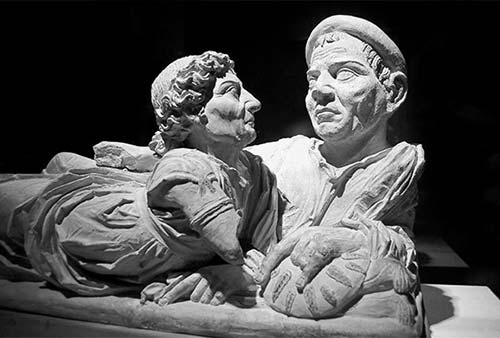
Other highlights include locally produced black-glazed pottery and painted kraters (vases with handles used for mixing water and wine), ex-voto water-bearer statues, bronze hand mirrors, exquisite golden jewelry that would still be fashionable today, a battle helmet ominously dented at the left temple, and hundreds of ancient coins.
The top floor features pieces from the Bronze Age and the early Etruscan period, including some impressive jewelry, the first examples of Etruscan writing, and the funeral dowry (artifacts that the dead would pack along and be buried with) of a warrior with his impressive helmet and remarkable double-spouted military flask for wine and water. Don’t miss the re-created tomb, with several neatly aligned urns, a shattered eggshell, and more funeral dowries—including mirrors, coins, hardware for vases, votive statues, pots, pans, and jewelry.
• After your museum visit, duck across the street to the...
▲La Vena di Vino Wine Tasting
La Vena di Vino, just across from the Etruscan Museum, is a fun enoteca where Bruno and Lucio have devoted themselves to the wonders of wine and share it with a fun-loving passion. Each day they open six or eight bottles, serve your choice by the glass, and pair it with characteristic munchies amid unusual decor (the place is strewn with bras). Hang out here with the local characters. According to Bruno, a Brunello is just right with wild boar and a Super Tuscan is perfect for meditation. Volterra can be quiet late at night, but this place is full of action (Wed-Mon 11:30-24:00, closed Tue, Nov-Feb open Fri-Sat only, Via Don Minzoni 30, +39 0588 81491, www.lavenadivino.com).
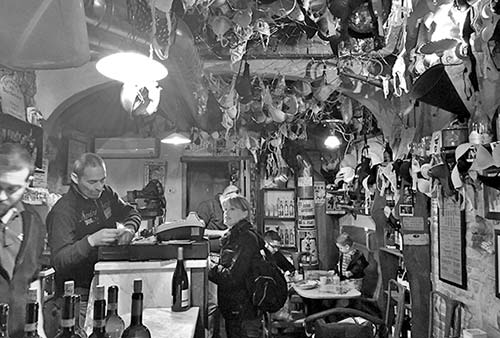
• Volterra’s final sight is perched atop the hill just above the wine bar. Climb up one of the lanes nearby, then walk (to the right) along the formidable wall to find the park.
Medici Fortress and Archaeological Park (Fortezza Medicea and Parco Archeologico)
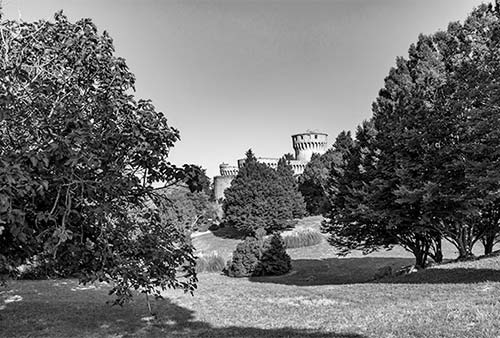
The archaeological park marks what was the acropolis of Volterra from 1500 BC until AD 1472, when Florence conquered the pesky city. The Florentines burned Volterra’s political and historic center, turning it into a grassy commons and building the adjacent Medici Fortress. The old fortress—a symbol of Florentine dominance—now keeps people in rather than out. It’s a maximum-security prison housing only about 120 special prisoners.
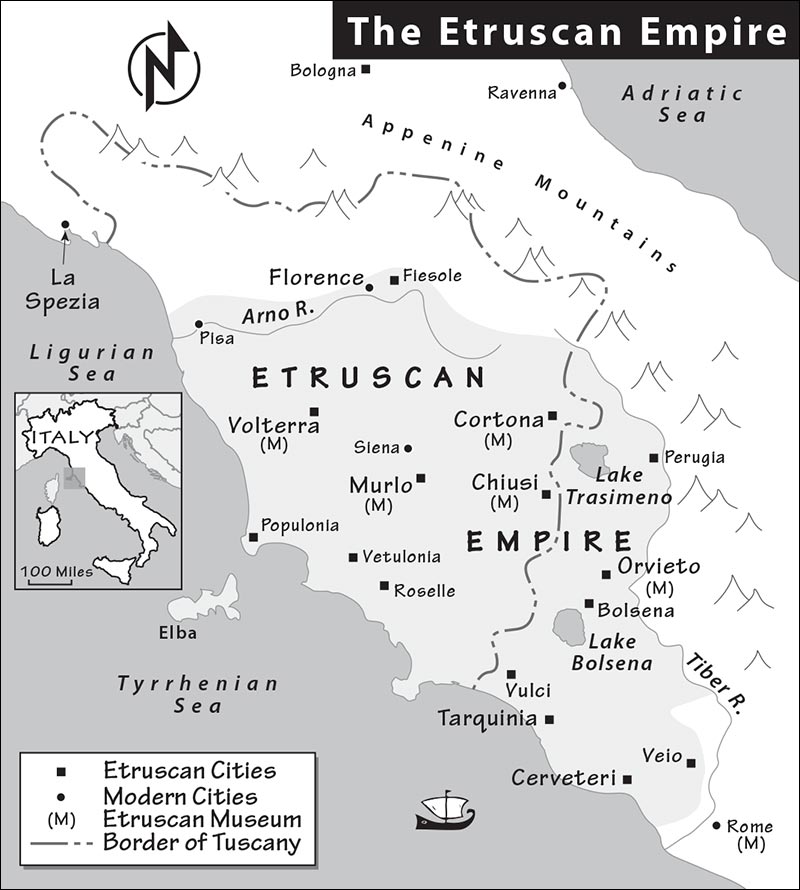
Around 550 BC—just before the golden age of Greece—the Etruscan people of central Italy had their own golden age. Though their origins are unclear, the Etruscans’ mix of Greek-style art with Roman-style customs helped lay a civilized foundation for the rise of the Roman Empire. As you travel through Italy—particularly in Tuscany (from “Etruscan”)—you’ll find traces of this long-lost people.
Etruscan tombs and artifacts are still being discovered, often by farmers in the countryside.
The Etruscans were established in central Italy by the early seventh century BC, when a number of settlements sprouted up in sparsely populated Tuscany and Umbria, including today’s hill towns of Cortona, Chiusi, and Volterra. Possibly immigrants from Turkey, but more likely local farmers who moved to the city, they became sailors, traders, and craftsmen, and welcomed new ideas from Greece.
More technologically advanced than their neighbors, the Etruscans mined iron ore, smelting and exporting it around the Mediterranean. They drained and irrigated large tracts of land, creating the fertile farmland of central Italy’s breadbasket. With their disciplined army, warships, merchant vessels, and (from the Greek perspective) pirate galleys, they ruled central Italy and the major ports along the Tyrrhenian Sea. For nearly two centuries (c. 700-500 BC), much of Italy lived in peace and prosperity under the Etruscan sun.
Judging from the frescoes and many luxury items that have survived, the Etruscans enjoyed the good life: They look healthy and vibrant as they play flutes, dance with birds, or play party games. Etruscan artists celebrated individual people, showing their wrinkles, crooked noses, silly smiles, and funny haircuts.
Scholars today have deciphered the Etruscans’ Greek-style alphabet and some individual words, but they have yet to fully understand their language, which is unlike any other in Europe. Much of what we know of the Etruscans comes from their tombs. The tomb was a home in the hereafter, complete with the deceased’s belongings. The urn might have a statue on the lid of the deceased at a banquet—lying across a dining couch, spooning with his wife, smiles on their faces, living the good life for all eternity.
Seven decades of wars with the Greeks (545-474 BC) disrupted their trade routes and drained the Etruscan League, just as a new Mediterranean power was emerging: Rome. In 509 BC, the Romans overthrew their Etruscan king, and Rome expanded, capturing Etruscan cities one by one (the last in 264 BC). Etruscan resisters were killed, the survivors intermarried with Romans, and their kids grew up speaking Latin. By Julius Caesar’s time, the only remnants of Etruscan culture were its priests, who became Rome’s professional soothsayers. Interestingly, the Etruscan prophets had foreseen their own demise, having predicted that Etruscan civilization would last 10 centuries.
But Etruscan culture lived on in Roman religion (pantheon of gods, household gods, and divination rituals), art (realism), lifestyle (the banquet), and in a taste for Greek styles—the mix that became our “Western civilization.”
Rome: Traces of original Etruscan engineering projects (e.g., Circus Maximus), Vatican Museum artifacts, and Villa Giulia Museum, with the famous “husband and wife sarcophagus.”
Orvieto: Archaeological Museum (coins, dinnerware, and a sarcophagus), necropolis, and underground tunnels and caves.
Volterra: Etruscan gate (Porta all’Arco, from fourth century BC) and Etruscan Museum (urns, pottery, and devotional figures).
The park sprawling next to the fortress (toward the town center) is a rare, grassy meadow at the top of a rustic hill town—a favorite place for locals to relax and picnic on a sunny day. Nearby are the scant remains of the acropolis, which can be viewed through the fence for free, or entered for a fee. Of more interest to antiquities enthusiasts is the acropolis’ first-century Roman cistern. You can descend 40 tight spiral steps to stand in a chamber that once held about 250,000 gallons of water, enough to provide for more than a thousand people. While not huge, it provides a good look at Roman engineering and reminds you just how important a supply of water was to the survival of a hill town.
Cost and Hours: Park—free, open until 20:00 in peak of summer, shorter hours off-season; acropolis and cistern—€8, daily 10:30-17:30, shorter hours off-season.
Evening Scene
Passeggiata: As they have for generations, Volterrans young and old stroll during the cool of the early evening. The main cruising is along Via Gramsci and Via Matteotti to the main square, Piazza dei Priori.
Aperitivo: Each evening several bars put out little buffet spreads free with a drink to attract a crowd. Bars popular for their aperitivo include VolaTerra (Via Turazza 5, next to City Hall), L’Incontro (Via Matteotti 19), and Bar dei Poeti (across from the cinema, Via Matteotti 57). And the gang at La Vena di Vino (described under “Sights in Volterra”) always seems ready for a good time.
Antica Velathri Cafè: Venture just a bit off the beaten path, between Piazza XX Settembre and the park, to Antica Velathri Cafè for a drink in the evening (or a light meal any time of the day). Pietro makes creative cocktails and good conversation while his mama makes the pastries (Tue-Sun 9:30-24:00, closed Mon, Via Ormanni 3, +39 0588 190 0121).
Sleeping in Volterra
Volterra has plenty of places offering a good night’s sleep at a fair price. Lodgings outside the old town are generally a bit cheaper (and easier for drivers). But keep in mind that some of these places involve not just walking, but steep walking.
INSIDE THE OLD TOWN
$$$ Hotel San Lino fills a former convent with 40 modern rooms, all named for the nuns who lived in them. It’s at the sleepy lower end of town—close to the Porta San Francesco gate, and about a five-minute uphill walk to the main drag. Although it’s within the town walls, it doesn’t feel like it: The hotel has a fine swimming pool and view terrace and is the only in-town option that’s convenient for drivers, who can reserve pay parking in advance (RS%, family rooms, air-con, elevator, closed Nov-Feb, Via San Lino 26, +39 0588 85250, www.hotelsanlino.com, info@hotelsanlino.com).
$$$ Hotel Volterra In is fresh, tasteful, and in a central yet quiet location. Marco rents 10 bright and spacious rooms with thoughtful, upscale touches and a hearty buffet breakfast (RS%, air-con, elevator, Via Porta all’Arco 41, +39 0588 86820, www.hotelvolterrain.it, info@hotelvolterrain.it).
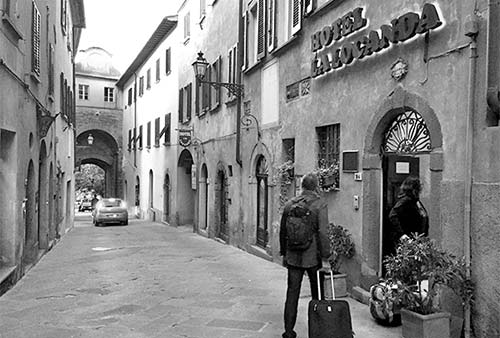
$$ Hotel La Locanda feels stately and old-fashioned. This well-located place (just inside Porta Fiorentina, near the Roman Theater and parking lot) rents 18 rooms with flowery decor and modern comforts (RS%, family rooms, air-con, elevator, Via Guarnacci 24, +39 058 881 547, www.hotel-lalocanda.com, staff@hotel-lalocanda.com, Irina, Oksana, and Monica).
$$ Albergo Nazionale, with 36 big and overpriced rooms, is popular with school groups, and steps from the bus stop. It’s a nicely located last resort if you have your heart set on sleeping in the old town (RS%, family rooms, elevator, Via dei Marchesi 11, +39 058 807 0681, www.allegroitalia.it, infonazionale@allegroitalia.it).
$ Albergo Etruria is a family-run hotel on Volterra’s main drag. They offer a good location, a peaceful rooftop garden, and 19 frilly rooms (RS%, family rooms, air-con, Via Matteotti 32, +39 0588 87377, www.albergoetruria.it, info@albergoetruria.it, Paola, Daniele, and Sveva).
JUST OUTSIDE THE OLD TOWN
These accommodations are within a 5- to 20-minute walk of the city walls.
$$$ Park Hotel Le Fonti, a dull and steep 15-minute walk downhill from Porta all’Arco, can’t decide whether it’s a business hotel or a resort. The spacious, imposing building, old and stately, has 64 modern, comfortable rooms, half with views. While generally overpriced, it can be a good value if you manage to snag a deal. In addition to the swimming pool, guests can use its small spa (pay more for a view or a balcony, elevator, on-site restaurant, wine bar, free parking, Via di Fontecorrenti 2, +39 0588 85219, www.parkhotellefonti.com, info@parkhotellefonti.com).
$ La Primavera B&B feels like a British B&B transplanted to Tuscany. It’s a great value just a few minutes’ walk outside Porta Fiorentina (near the Roman Theater). Silvia rents five charming, neat-as-a-pin rooms that share a cutesy-country lounge. The house is set back from the road in a pleasant courtyard and with a garden to lounge in. With free parking and a short walk to the old town, this is a handy option for drivers (RS%, fans but no air-con, closed Nov-Feb, Via Porta Diana 15, +39 0588 87295, mobile +39 328 865 0390, www.affittacamere-laprimavera.com, info@affittacamere-laprimavera.com).
$ Hotel Foresteria, near Chiostro delle Monache (see next) and run by the same organization, has 35 big, utilitarian, new-feeling rooms with decent prices but the same location woes as the hostel; it’s worth considering for a family with a car and a tight budget (family rooms, air-con, elevator, restaurant, free parking, Borgo San Lazzaro, +39 0588 80050, www.foresteriavolterra.com, info@foresteriavolterra.com).
¢ Chiostro delle Monache, Volterra’s youth hostel, fills a wing of the restored Convent of San Girolamo. It’s modern, spacious, and very institutional, with lots of services and a tranquil cloister. Unfortunately, it’s about a 20-minute hike from town, in a boring area near deserted hospital buildings (private rooms available and include breakfast, family rooms, reception closed 13:00-15:00 and after 19:00, elevator, restaurant, free parking, kids’ playroom; Via dell Teatro 4, look for hospital sign from main Volterra-San Gimignano road; +39 0588 86613, www.chiostrodellemonache.com [URL inactive], info@chiostrodellemonache.it).
IN THE COUNTRYSIDE NEAR VOLTERRA
Charming farmhouse accommodations dot the countryside surrounding Volterra, and for drivers, these can be a good value and a fun experience. Some properties offer swimming pools, cooking classes, and more. For locations, see the map on here.
$$ Podere Marcampo is an agriturismo set in the dramatic landscape surrounding Volterra. Run by Genuino (owner of the recommended Ristorante Enoteca del Duca), his wife Ivana, and their English-speaking daughter Claudia, this peaceful spot has three dark but well-appointed rooms and three apartments, plus a swimming pool with panoramic views. Genuino and Claudia produce their Sangiovese and award-winning Merlot on site; you can tour where the wine is made and then sample it in their view tasting room. Cooking classes are available for guests and nonguests (breakfast included for Rick Steves readers, air-con, free self-service laundry, about two miles north of Volterra on the road to Pisa, +39 0588 85393, Claudia’s mobile +39 328 174 4605, www.poderemarcampo.com, info@agriturismo-marcampo.com).
$$ Agriturismo il Mulinaccio is a welcoming, family-friendly farm about a five-minute drive down a dirt road outside Volterra. Hardworking Alessio and his family rent four spacious apartments and four bed-and-breakfast rooms, all with a cozy style. They also offer dinner, truffle hunts, cooking classes, wine tastings, and a spa/wellness center (air-con, pool, Via Vicinale di Pretenzano 49, +39 338 149 8432, www.agriturismoilmulinaccio.it, info@agriturismoilmulinaccio.it).
$$ Agriturismo Santa Vittoria sits on the top of a hill, with commanding views into the Volterra countryside. Their four bright apartments, decorated with funky art, have access to a cliffside pool. The popular restaurant serves up hearty dishes from their farm, served at view tables. Call ahead to confirm they are open (weeklong stays preferred in summer, breakfast extra, Localita Molino d’Era, hotel +39 348 561 3670, restaurant +39 348 561 3670, www.agriturismosantavittoria.com, info@agriturismosantavittoria.com, Katuscia).
Eating in Volterra
Menus feature a Volterran take on regional dishes. Zuppa alla Volterrana is a fresh vegetable-and-bread soup. Torta di ceci, also known as cecina, is a savory crêpe-like garbanzo-bean flatbread that’s served at pizzerias. Those with more adventurous palates dive into trippa (tripe stew, the traditional breakfast of the alabaster carvers). Fegatelli are meatballs made with liver.
$$$$ Ristorante Enoteca del Duca, serving well-presented and creative Tuscan cuisine, offers the best elegant meal in town. You can dine under a medieval arch with walls lined with wine bottles, in a sedate, high-ceilinged dining room (with an Etruscan statuette at each table), in their little enoteca (wine cellar), or in their terraced garden in summer. The friendly staff take good care of diners. The fine wine list includes Genuino and Claudia’s own highly regarded Merlot and Sangiovese. The spacious seating, dressy clientele, and calm atmosphere make this a good choice for a romantic splurge. Their €70 food-sampler fixed-price meal comes with a free glass of wine for diners with this book (Wed-Mon 12:30-14:45 & 19:30-21:45, closed Tue, reservations smart, near City Hall at Via di Castello 2, +39 0588 81510, www.enoteca-delduca-ristorante.it).
$$ La Carabaccia is unique: It feels like a local family invited you over for a dinner of classic Tuscan comfort food that’s rarely seen on restaurant menus. They serve only two pastas and two secondi on any given day (listed on the chalkboard by the door), in addition to quality cheese and cold-cut plates. Committed to tradition, on Fridays they serve only fish. They also have fun, family-friendly outdoor seating on a traffic-free piazza (Tue-Sat 12:30-14:30 & 19:30-22:00, Sun 12:30-14:30, closed Mon, reservations smart, Piazza XX Settembre 4, +39 0588 86239, Patrizia and daughters Sara and Ilaria).
$$ Ristorante il Sacco Fiorentino is a family-run local favorite for traditional cuisine and seasonal specials. While mostly indoors, the restaurant has a few nice tables on a peaceful street (Thu-Tue 12:00-15:00 & 19:00-22:00, closed Wed, Via Giusto Turazza 13, +39 0588 88537, Cristina).
$$ Trattoria da Badò, a 10-minute hike out of town, is popular with a local crowd for its cucina tipica Volterrana. Giacomo and family offer a rustic atmosphere and serve food with no pretense—“the way you wish your mamma cooks.” Reserve before you go, as it’s often full, especially on weekends (Thu-Tue 12:30-14:30 & 19:30-22:00, closed Wed, Borgo San Lazzero 9—along the main road toward San Gimignano, near the turnoff for the old hospital, +39 0588 80402, www.trattoriadabado.com).
$$ La Vecchia Lira, bright and cheery, is a classy eatery that’s a hit with locals looking for fresh fare and a focus on gluten-free and vegetarian options (Fri-Wed 12:00-14:30 & 19:00-22:00, closed Thu, Via Matteotti 19, +39 0588 86180, Massimo).
$$ Ristorante Ombra della Sera is another good fine-dining option for elegant Tuscan cuisine and truffle dishes. While they have a dressy interior, I’d eat here to be on the street and part of the passeggiata action (Tue-Sun 12:00-15:00 & 19:00-22:00, closed Mon and mid-Nov-mid-March, Via Gramsci 70, +39 0588 86663, Massimo and Cinzia).
$$ Pizzeria La Mangiatoia is a fun and convivial place with a Tuscan-cowboy interior and picnic tables outside amid a family-friendly street scene. Enjoy pizzas, huge salads, and kebabs at a table or to go (Thu-Tue 11:00-23:00, closed Wed, Via Gramsci 35, +39 0588 85695).
$ Pizzeria Ombra della Sera dishes out what local kids consider the best pizza in town (Tue-Sun 12:00-15:00 & 19:00-22:00, closed Mon and mid-Nov-mid-March, Via Guarnacci 16, +39 0588 85274).
Picnic: You can assemble a picnic at the few grocery stores around town and eat in the breezy archaeological park. The most convenient supermarket is Punto Simply at Via Gramsci 12 (Mon-Sat 7:30-13:00 & 16:00-20:00, Sun 8:30-13:00).
Gelato: Of the many ice-cream shops in the center, I’ve found L’Isola del Gusto to be reliably high quality, with flavors limited to what’s in season (daily, closed Nov-Feb, Via Gramsci 3, cheery Giorgia will make you feel happy).
Volterra Connections
By Bus: In Volterra, buses come and go from Piazza Martiri della Libertà (buy tickets at the tobacco shop right on the piazza or on board). Most connections are through Colle di Val d’Elsa (“koh-leh” for short), a workaday town in the valley (4/day Mon-Sat, 1/day Sun, 50 minutes); for Pisa, you’ll change in Pontedera or Saline di Volterra. Ask at the TI for schedules or check www.at-bus.it.
From Volterra, you can ride the bus to these destinations: Florence (4/day Mon-Sat, 1/day Sun, 2 hours, change in Colle di Val d’Elsa), Siena (4/day Mon-Sat, no buses on Sun, 2 hours, change in Colle di Val d’Elsa), San Gimignano (4/day Mon-Sat, 1/day Sun, 2 hours, change in Colle di Val d’Elsa, one connection also requires change in Poggibonsi), Pisa (9/day, fewer on Sun, 2 hours, change in Pontedera).
By Train: The nearest train station is in Saline di Volterra, a 15-minute bus ride away (7/day, 2/day Sun); however, trains from Saline run only to the coast, not to the major bus destinations listed here. It’s better to take a bus from Volterra to Pontedera (8/day, 1 on Sun, 1.5 hours), where you can catch a train to Florence, Pisa, or La Spezia (convenient for the Cinque Terre).
By Private Transfer: For those with more money than time, or for travel on tricky Sundays and holidays, a private transfer to or from Volterra is the most efficient option. Roberto Bechi and his drivers can take up to eight people in their comfortable vans (€165 to Siena, €185 to Florence, for reservations call +39 320 147 6590 or Roberto’s mobile +39 328 425 5648, www.toursbyroberto.com, toursbyroberto@gmail.com.
San Gimignano
The epitome of a Tuscan hill town, with 14 medieval towers still standing (out of an original 72), San Gimignano (sahn jee-meen-YAH-noh) is a perfectly preserved tourist trap. There are no important interiors to sightsee, and the town feels greedy and packed with crass commercialism. The locals seem spoiled by the easy money of tourism, and most of the rustic is faux. But San Gimignano is so easy to reach and so visually striking that it remains a good stop, especially if you can sidestep some of the hordes. The town is an ideal place to go against the touristic flow—arrive late in the day, enjoy it at twilight, then take off in the morning before the deluge begins. (Or day-trip here from Volterra—a 30-minute drive away—and visit early or late.)
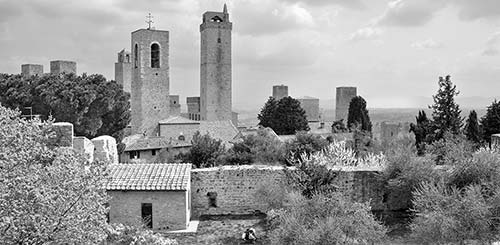
In the 13th century—back in the days of Romeo and Juliet—feuding noble families ran the hill towns. They’d periodically battle things out from the protection of their respective family towers. Pointy skylines like San Gimignano’s were the norm in medieval Tuscany.
San Gimignano’s cuisine is mostly what you might find in Siena—typical Tuscan home cooking. Cinghiale (cheen-gee-AH-lay, boar) is served in almost every way: stews, soups, cutlets, and, my favorite, salumi. The area is well known for producing some of the best saffron in Italy; you’ll find the spice for sale in shops and as a flavoring in meals at finer restaurants. Although Tuscany is normally a red-wine region, the most famous Tuscan white wine comes from here: the inexpensive, light, and fruity Vernaccia di San Gimignano.
Orientation to San Gimignano
While the basic ▲▲▲ sight here is the town of San Gimignano itself (pop. 7,800, just 2,000 of whom live within the walls), there are a few worthwhile stops. The wall circles an amazingly preserved stony town, once on the Via Francigena pilgrimage route to Rome. The road, which cuts through the middle of San Gimignano, is named for St. Matthew in the north of town (Via San Matteo) and St. John in the south (Via San Giovanni). The town is centered on two delightful squares—Piazza del Duomo and Piazza della Cisterna—where you find the town well, City Hall, and cathedral (along with most of the tourists).
TOURIST INFORMATION
The helpful TI, in the old center on Piazza del Duomo, sells bus tickets to Siena and Florence (daily 10:00-13:00 & 15:00-19:00, Nov-Feb 10:00-13:00 & 14:00-18:00, +39 0577 940 008, www.sangimignano.com). They offer occasional countryside tours and a guided city tour (€15, April-Oct Mon, Wed, Fri-Sat at 11:00 and 16:00, Sun at 11:00).
ARRIVAL IN SAN GIMIGNANO
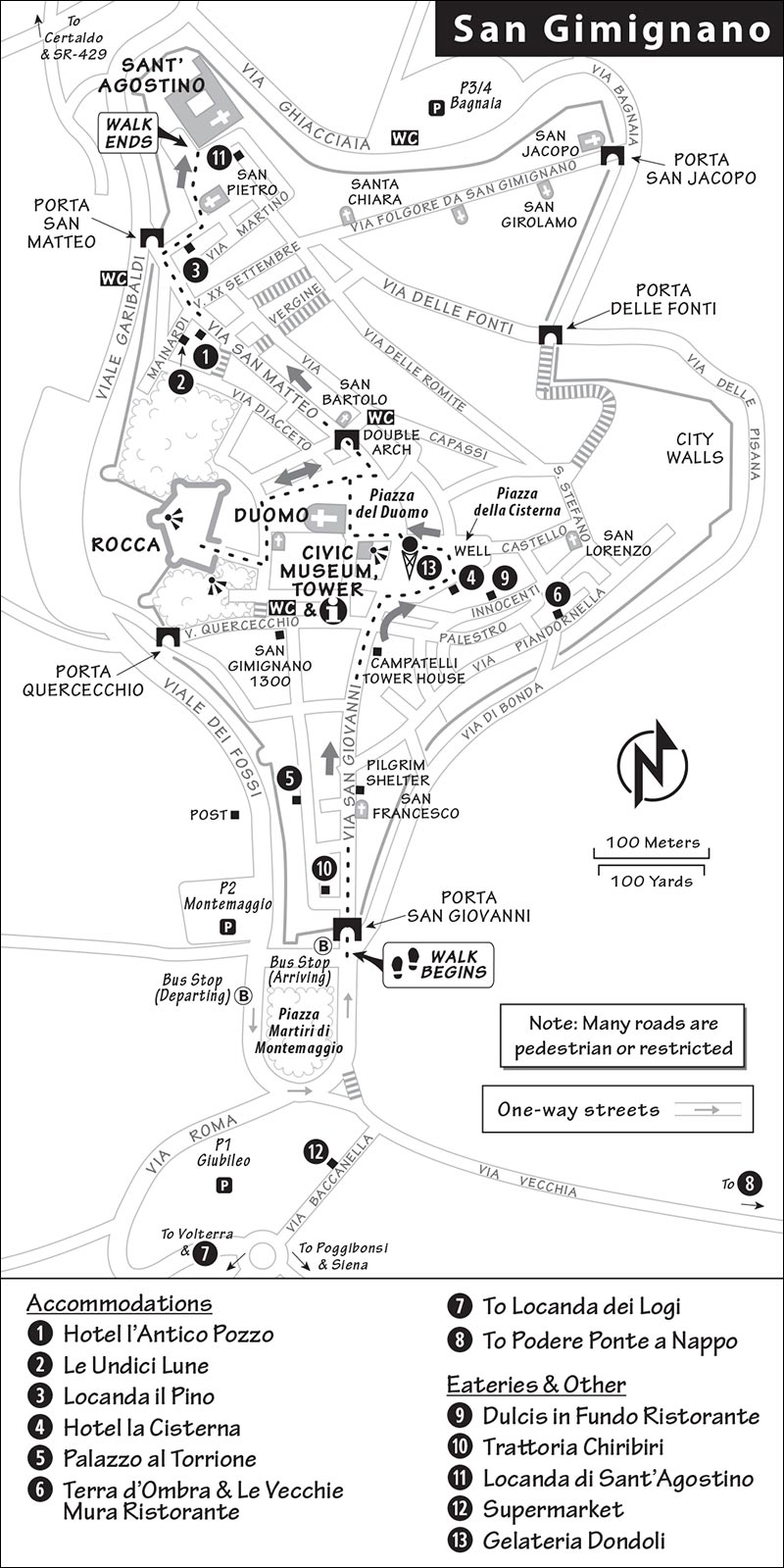
The bus stops at the main town gate, Porta San Giovanni. There’s no baggage storage in town.
You can’t drive within the walled town; drive past the “ZTL” red circle and you’ll get socked with a big fine. Three numbered pay lots are a short walk outside the walls (and connected to town by a shuttle bus in summer; see below): The handiest is Parcheggio Montemaggio (P2), at the bottom of town near the bus stop, just outside Porta San Giovanni (€2/hour, €15/day). Least expensive but a steeper walk into town is the lot below the roundabout and Co-op supermarket, Parcheggio Giubileo (P1; €1.50/hour, €6/day). And at the north end of town, by Porta San Jacopo, is Parcheggio Bagnaia (P3/P4, €2/hour, €15/day). Note that some lots—including the one directly in front of Co-op and the one just outside Porta San Matteo—are designated for locals and have a one-hour limit for tourists.
HELPFUL HINTS
Market Day: Thursday is market day on Piazza del Duomo and Piazza delle Erbe (8:00-13:00), but for local merchants, every day is a sales frenzy.
Services: A public WC is just off Piazza della Cisterna; you’ll also find WCs at the Rocca fortress, near San Bartolo church, just outside Porta San Matteo, and at the Parcheggio Bagnaia parking lot.
Shuttle Bus: A little electric shuttle bus does its laps about hourly all day from Porta San Giovanni to Piazza della Cisterna to Porta San Matteo. Route #1 runs back and forth through town; route #2—which runs only in summer—connects the parking lots to the town center (€1.20 one-way). When pedestrian congestion in the town center is greatest (Sat afternoons, all day Sun, and May-Sept), the bus runs along the road skirting the outside of town.
San Gimignano Walk
This quick self-guided walking tour takes you across town, from the bus stop at Porta San Giovanni through the town’s main squares to the Duomo, and on to the Sant’Agostino Church.
• Start at the Porta San Giovanni gate at the bottom (south) end of town.
Porta San Giovanni
San Gimignano lies about 25 miles from both Siena and Florence, a day’s trek for pilgrims en route to those cities, and on a naturally fortified hilltop that encouraged settlement. The town’s walls were built in the 13th century, and gates like this helped regulate who came and went. Today, modern posts keep out all but service and emergency vehicles. The small square just outside the gate features a memorial to the town’s WWII dead. Follow the pilgrims’ route (and flood of modern tourists) through the gate and up the main drag.
About 100 yards up, where the street widens, look right to see a pilgrims’ shelter (12th century, Pisan Romanesque). The eight-pointed Maltese cross on the facade of the church indicates that it was built by the Knights of Malta, whose early mission (before they became Crusaders) was to provide care for sick and poor pilgrims. It was one of 11 such shelters in town. Today, only the wall of the shelter remains, and the surviving interior of the church houses yet one more shop selling gifty edibles.
• Carry on past all manner of shops, up to the top of Via San Giovanni. Look up at the formidable inner wall, built 200 years before today’s outer wall. Just beyond that is the central Piazza della Cisterna. Sit on the steps of the well.
Piazza della Cisterna
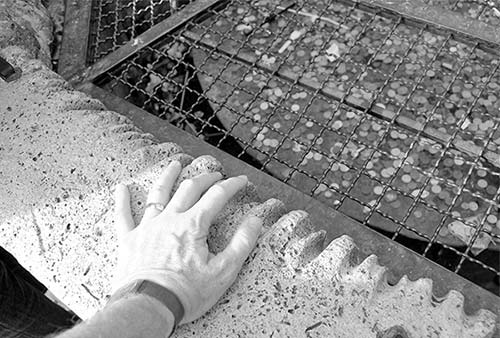
The piazza is named for the cistern that is served by the old well standing in the center of this square. A clever system of pipes drained rainwater from the nearby rooftops into the underground cistern. This square has been the center of the town since the ninth century. Turn in a slow circle and observe the commotion of rustic yet proud facades crowding in a tight huddle around the well. Imagine this square in pilgrimage times, lined by inns and taverns for the town’s guests. Now finger the grooves in the lip of the well and imagine generations of women and children fetching water. Each Thursday morning, the square fills with a market—as it has for more than a thousand years.
• Notice San Gimignano’s famous towers.
The Towers
Of the original 72 towers, only 14 survive (and one can be climbed—at the City Hall). Some of the original towers were just empty, chimney-like structures built to boost noble egos, while others were actually the forts of wealthy families.
Before effective city walls were developed, rich people needed to fortify and protect their homes themselves. These towers provided a handy refuge when ruffians and rival city-states were sacking the town. If under attack, tower owners would set fire to the external wooden staircase, leaving the sole entrance unreachable a story up; inside, fleeing nobles pulled up behind them the ladders that connected each level, leaving invaders no way to reach the stronghold at the tower’s top. These towers became a standard part of medieval skylines. Even after town walls were built, the towers continued to rise—now to fortify noble families feuding within a town (Montague and Capulet-style).
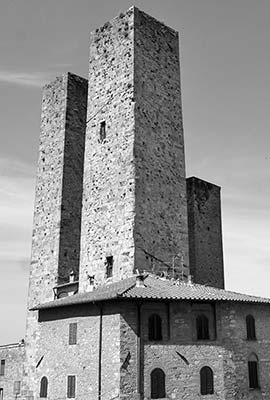
In the 14th century, San Gimignano’s good times turned very bad. At the start of that century, about 13,000 people lived within the walls. But in 1348, a six-month plague decimated the population, leaving the once-mighty town with barely 4,000 survivors. Once fiercely independent, now crushed and demoralized, San Gimignano came under Florence’s control and was forced to tear down most of its towers. (The Banca CR Firenze building occupies the remains of one such toppled tower.) And, to add insult to injury, Florence redirected the vital trade route away from San Gimignano. The town never recovered, and poverty left it in an architectural time warp. That well-preserved 14th-century cityscape, ironically, is responsible for the town’s prosperity today.
• From the well, walk 30 yards uphill to the adjoining square with the cathedral.
Piazza del Duomo
Stand at the base of the stairs in front of the church. Since before there was gelato, people have lounged on these steps. Take a 360-degree spin clockwise: The cathedral’s 12th-century facade is plain-Jane Romanesque—finished even though it doesn’t look it. To the right, the two Salvucci Towers date from the 13th century. (Locals claim that the architect who designed New York City’s Twin Towers was inspired by these). The towers are empty shells, built by the wealthy Salvucci family simply to show off. At that time, no one was allowed a vanity tower higher than the City Hall’s 170 feet. So the Salvuccis built two 130-foot towers—totaling 260 feet of stony ego trip.
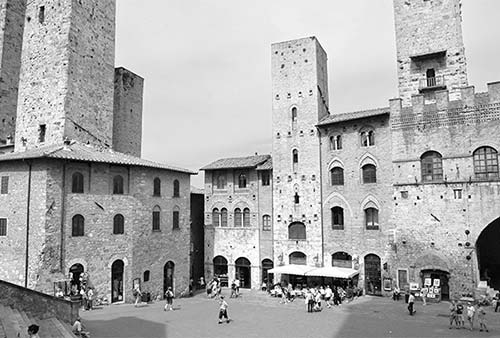
The stubby tower next to the Salvucci Towers is the Merchant’s Tower. Imagine this in use: ground-floor shop, warehouse upstairs (see the functional shipping door), living quarters, and finally the kitchen on the top (for fire-safety reasons). The holes in the walls held beams that supported wooden balconies and exterior staircases. The tower has heavy stone on the first floor, then cheaper and lighter brick for the upper stories.
Opposite the church stands the first City Hall, with its 170-foot tower, nicknamed “the bad news tower.” While the church got to ring its bells in good times, these bells were for battles and fires. The tower’s arched public space hosted a textile market back when cloth was the foundation of San Gimignano’s booming economy.
Next is the super-size “new” City Hall with its 200-foot tower (the only one in town open to the public; for visiting info, see the Civic Museum and Tower listing, later). The climbing lion is the symbol of the city. The coats of arms of the city’s leading families have been ripped down or disfigured. In medieval times locals would have blamed witches or ghosts. For the last two centuries, they’ve blamed Napoleon instead.
Between the City Hall and the cathedral, a statue of St. Gimignano presides over all the hubbub. The fourth-century bishop protected the village from rampaging barbarians—and is now the city’s patron saint. (To enter the cathedral, walk under that statue.)
• You’ll also see the...
Duomo (Duomo di San Gimignano/La Collegiata)
The nave of San Gimignano’s Romanesque cathedral is lined with frescoes that tell the stories of the Bible—Old Testament on the left and New Testament on the right. Painted by masters of the 14th-century Sienese school, the frescoes are a classic use of teaching through art, with parallel themes aligned: Creation faces the Annunciation, the birth of Adam is opposite the Nativity, and—farther forward—the suffering of Job faces the agony of Jesus. Many scenes are portrayed with a 14th-century “slice of life” setting to help lay townspeople relate to Jesus.
To the right of the altar, the St. Fina Chapel honors the devout, 13th-century local girl who brought forth many miracles on her death. Her tomb is beautifully frescoed with scenes from her life by Domenico Ghirlandaio (famed as Michelangelo’s teacher). The altar sits atop Fina’s skeleton, and its centerpiece is a reliquary that contains her skull (€5, includes dry audioguide; April-Oct Mon-Fri 10:00-19:30, Sat until 17:00, Sun 12:30-19:30; shorter hours off-season; buy ticket and enter from courtyard around left side, www.duomosangimignano.it).
• From the church, hike uphill (passing the church on your left) following signs to Rocca e Parco di Montestaffoli. Keep walking until you enter a peaceful hilltop park and olive grove, set within the shell of a 14th-century fortress the Medici of Florence built to protect this town from Siena.
Hilltop Views at the Rocca
On the far side, 33 steps take you to the top of a little tower (free) for the best views of San Gimignano’s skyline; the far end of town and the Sant’Agostino Church (where this walk ends); and a commanding 360-degree view of the Tuscan countryside. San Gimignano is surrounded by olives, grapes, cypress trees, and—in the Middle Ages—lots of wild dangers. Back then, farmers lived inside the walls and were thankful for the protection.
• Return to the bottom of Piazza del Duomo, turn left, and continue your walk, cutting under the double arch (from the town’s first wall).
In around 1200, this wall defined the end of town. The Church of San Bartolo stood just outside the wall (on the right). The Maltese cross over the door indicates that it likely served as a hostel for pilgrims. As you continue down Via San Matteo, notice that the crowds have dropped by at least half. Enjoy the breathing room as you pass a fascinating array of stone facades from the 13th and 14th centuries—now a happy cancan of wine shops and galleries.
• Reaching the gateway at the end of town, follow signs to the right to find...
Sant’Agostino Church
This tranquil church, at the far end of town (built by the Augustinians who arrived in 1260), has fewer crowds and more soul. Behind the altar, a lovely fresco cycle by Benozzo Gozzoli (who painted the exquisite Chapel of the Magi in the Medici-Riccardi Palace in Florence) tells of the life of St. Augustine, a North African monk who preached simplicity (pay a few coins for light). The kind, English-speaking friars (often from Britain and the US) are happy to tell you about the frescoes and their way of life. Pace the peaceful cloister before heading back into the tourist mobs (free, April-Oct daily 10:00-12:00 & 15:00-19:00, shorter hours off-season; Sunday Mass in English at 11:00).
Sights in San Gimignano
▲Civic Museum and Tower (Musei Civici and Torre Grossa)
This small, entertaining museum, consisting of three unfurnished rooms, is inside the City Hall (Palazzo Comunale). The main reason to visit is to scale the tower, which offers sweeping views over San Gimignano and the countryside.
Cost and Hours: €9 includes museum and tower; daily 10:00-19:30, Oct-March 11:00-17:30, Piazza del Duomo, +39 0577 990 312, www.sangimignanomusei.it.
Visiting the Museum: You’ll enter the complex through a delightful stony courtyard (to the left as you face the Duomo). Climb up to the loggia to buy your ticket.
The main room (across from the ticket desk), called the Sala del Consiglio (a.k.a. Dante Hall, recalling his visit in 1300), is covered in festive frescoes, including the Maestà by Lippo Memmi (from 1317). This virtual copy of Simone Martini’s Maestà in Siena proves that Memmi didn’t have quite the same talent as his famous brother-in-law. The art gives you a peek at how people dressed, lived, worked, and warred back in the 14th century.
Upstairs, the Pinacoteca displays a classy little painting collection of mostly altarpieces. The highlight is a 1422 altarpiece by Taddeo di Bartolo honoring St. Gimignano (far end of last room). You can see the saint, with the town—bristling with towers—in his hands, surrounded by events from his life.
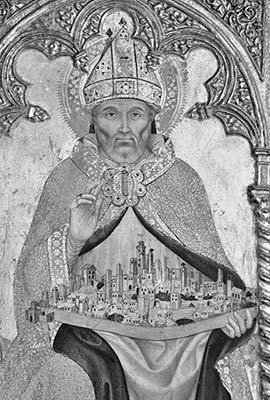
Before going back downstairs, be sure to stop by the Mayor’s Room (Camera del Podestà, across the stairwell from the Pinacoteca). Frescoed in 1310, it offers an intimate and candid peek into the 14th century. As you enter, look right up in the corner to find a young man ready to experience the world. He hits his parents up for a bag of money and is on his way. Suddenly (above the window), he’s in trouble, entrapped by two prostitutes, who lead him into a tent where he loses his money, is turned out, and is beaten. Above the door, from left to right, you see a parade of better choices: marriage, the cradle of love, the bride led to the groom’s house, and newlyweds bathing together and retiring happily to their bed.
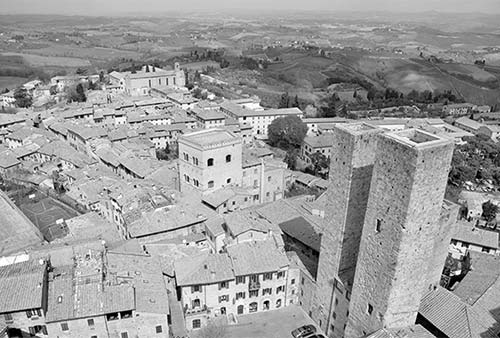
The highlight for most visitors is a chance to climb the Tower (entrance halfway down the stairs from the Pinacoteca). The city’s tallest tower, 200 feet and 218 steps up, rewards those who climb it with a commanding view. See if you can count the town’s 14 towers. It’s a sturdy, modern staircase most of the way, but the last stretch is a steep, ladder-like climb.
▲Campatelli Tower House (Torre e Casa Campatelli)
The Campatelli family, wealthy landowners from Florence, bought an age-old tower and adjacent properties in the 19th century and turned them into a palatial residence. They lived here until 2005, when the last of the family donated it to a nonprofit organization that protects heritage buildings and gardens, which opened it to the public. The house contains family belongings and tells the story of upper-class life in Tuscany, but the highlights are an audiovisual presentation on the history of the city and the chance to peer up through the tower, with a cutaway staircase and floor, to see how the towers in San Gimignano were built.
Cost and Hours: €7, Tue-Sun 10:30-19:00, closed Mon, shorter hours Oct-Feb, Via San Giovanni 15, +39 0577 941 419, www.fondoambiente.it/luoghi/beni-fai.
San Gimignano 1300
Artists and brothers Michelangelo and Raffaello Rubino share an interesting attraction in their workshop: a painstakingly rendered 1:100 scale clay model of San Gimignano at the turn of the 14th century. Step through a shop selling their art to enjoy the model. You can see the 72 original “tower houses,” and marvel at how unchanged the street plan remains today. You’ll peek into cross-sections of buildings, view scenes of medieval life both within and outside the city walls, and watch a video about the making of the model.
Cost and Hours: Free, donations appreciated, daily 10:00-18:00, Dec-April until 17:00, on a quiet street a block over from the main square at Via Costarella 3, +39 327 439 5965, www.sangimignano1300.com.
Sleeping in San Gimignano
Although the town is a zoo during the daytime, locals outnumber tourists when evening comes, and San Gimignano becomes mellow and enjoyable.
NEAR PORTA SAN MATTEO, AT THE QUIET END OF TOWN
If arriving by bus, save yourself a crosstown walk to these accommodations by asking for the Porta San Matteo stop. Drivers can park at the less-crowded Bagnaia lots (P3 and P4), and walk around to Porta San Matteo.
$$$ Hotel l’Antico Pozzo is an elegantly restored, 15th-century townhouse with 18 tranquil, comfortable rooms, a peaceful interior courtyard terrace, and an elite air (RS%—use code RICK, family rooms, air-con, elevator, Via San Matteo 87, +39 0577 942 014, www.anticopozzo.com [URL inactive], info@anticopozzo.com; Emanuele, Elisabetta, and Mariangela).
$$ Le Undici Lune (“The 11 Moons”) is situated in a tight but characteristic circa-1300 townhouse with steep stairs at the tranquil end of town. Its seven rooms are colorfully decorated (air-con, Via Mainardi 9, +39 328 053 5922, https://leundicilunesangimignano.it, info@leundicilune.it, Vincenzo).
$ Locanda il Pino has just seven rooms and a big living room. It’s plain but clean and quiet. Run by English-speaking Elena and her family, it sits above their elegant restaurant just inside Porta San Matteo (fans, Via Cellolese 4, +39 0577 907 003, www.locandailpino.it, locandailpino@gmail.com).
NEAR THE MAIN SQUARE, AT THE BUSY END OF TOWN
$$ Hotel la Cisterna, right on Piazza della Cisterna, feels old and stately. Its 48 rooms range from old-fashioned to more modern. It’s worth paying extra for the contemporary rooms with panoramic views (RS%, family rooms, air-con, elevator, good restaurant with great view, closed Jan-Feb, Piazza della Cisterna 23, +39 0577 940 328, www.hotelcisterna.it, info@hotelcisterna.it, Alessio and Paola).
$$ Palazzo al Torrione, on an untrampled side street just inside Porta San Giovanni, is quiet and handy. Their 10 modern rooms, some with countryside views and terraces, are spacious and tastefully appointed (RS%, family rooms, breakfast extra, air-con, inside and left of gate at Via Berignano 76; +39 0577 940 375, www.palazzoaltorrione.com, info@palazzoaltorrione.com, Vanna).
$ Terra d’Ombra offers three good rooms above the recommended Le Vecchie Mura Ristorante, along a rustic lane just below the main square (no breakfast, air-con, Via Piandornella 15, +39 366 106 0631, www.terradombra.net, terradombra2022@gmail.com, Bagnai family).
IN THE COUNTRYSIDE
$$$$ Locanda dei Logi, in the tiny borgo of San Donato—eight minutes from San Gimignano—houses six ultramodern luxury rooms within a cluster of medieval buildings. Each room is elegantly designed, and all look out over the property’s vineyard. Wine lovers can combine an overnight and a tasting of their top-notch wines in their cantina (wine tastings available by appointment, lunch and dinner on request, air-con, plunge pool, Localita San Donato 1, +39 392 506 8229, www.locandadeilogi.it, info@locandadeilogi.it).
$$ Podere Ponte a Nappo, run by enterprising Carla Rossi and her English-speaking sons Francesco and Andrea, has six basic rooms and two apartments in a kid-friendly farmhouse boasting fine San Gimignano views. Located a mile below town, it can be reached by foot in about 20 minutes if you don’t have a car. A picnic dinner lounging on their comfy garden furniture next to the big swimming pool as the sun sets is good Tuscan living (RS%—use code “RickSteves,” onsite restaurant and cooking classes, air-con, free parking, +39 0577 907 282, mobile +39 349 882 1565, www.accommodation-sangimignano.com, info@rossicarla.it). About 100 yards below the monument square at Porta San Giovanni, find tiny Via Baccanella/Via Vecchia and drive downhill. They also rent a dozen rooms and apartments on the main square in town.
Eating in San Gimignano
My first two listings cling to quiet, rustic lanes overlooking the Tuscan hills; the rest are buried deep in the old center.
$$$ Dulcis in Fundo Ristorante, small and family-run, proudly serves modest portions of “revisited” Tuscan cuisine (with a modern twist and gourmet presentation) in a jazzy ambience. This enlightened place uses top-quality ingredients, many of which come from their own farm (Thu-Tue 12:30-14:30 & 19:15-21:45, closed Wed and Nov-Feb, Vicolo degli Innocenti 21, +39 0577 941 919, Cristina).
$$ Le Vecchie Mura Ristorante is welcoming, with good service, great prices, tasty if unexceptional home cooking, and the ultimate view. It’s romantic indoors or out. They have a dressy, modern interior where you can dine with a view of the busy stainless-steel kitchen under rustic vaults, but the main reason to come is for the incredible cliffside garden terrace. To reserve a cliffside table, call or drop by: Ask for “front view” (open only for dinner 18:00-22:00 and lunch some weekends, closed Tue, reservations smart, Via Piandornella 15, +39 0577 940 270, Bagnai family).
$ Trattoria Chiribiri, just inside Porta San Giovanni, serves homemade pastas and desserts at good prices. While its petite size and tight seating make it hot in the summer, it’s a good budget option—and as such, it’s in all the guidebooks (daily 11:00-23:00, Piazza della Madonna 1, +39 0577 941 948, Roberto and Maurizio).
$ Locanda di Sant’Agostino spills out onto the peaceful square, facing Sant’Agostino Church. It’s homey and cheerful, serving lunch and dinner daily—big portions of basic food in a restful setting. Dripping with wheat stalks and atmosphere on the inside, it has shady on-the-square seating outside (Thu-Tue 11:00-16:00 & 18:30-23:00, closed Wed, closed Jan-Feb, Piazza Sant’Agostino 15, +39 0577 943 141, Genziana and sons).
Near Porta San Matteo: Just inside Porta San Matteo is a variety of handy and inviting good-value restaurants, bars, cafés, and gelato shops.
Picnics: The big, modern Co-op supermarket sells all you need for a nice spread (Mon-Sat 8:00-20:00, closed Sun, at parking lot below Porta San Giovanni). Or browse the little shops guarded by boar heads within the town walls; they sell pricey boar meat (cinghiale). Pick up 100 grams (about a quarter pound) of boar, cheese, bread, and wine and enjoy a picnic in the garden at the Rocca or the park outside Porta San Giovanni.
Gelato: To cap the evening and sweeten your late-night city stroll, stop by Gelateria Dondoli on Piazza della Cisterna (at #4, daily 9:00-23:00, until 19:00 in winter, +39 0577 942 244, Dondoli family). Charismatic Sergio also offers hands-on gelato-making classes in his kitchen down the street (www.gelateriadondoli.com).
San Gimignano Connections
Bus tickets are sold at the bar just inside the town gate or at the TI. Many connections require a change at Poggibonsi (poh-jee-BOHN-see), which has the nearest train station. Note that the bus connection to Volterra is four times as long as the drive; if you’re desperate to get there faster, you can pay about €70 for a taxi.
From San Gimignano by Bus to: Florence (hourly, fewer on Sun, 1.5-2 hours, change in Poggibonsi), Siena (8/day direct, on Sun must change in Poggibonsi, 1.5 hours), Volterra (4/day Mon-Sat; 1/day Sun—in the late afternoon and usually crowded—with no return to San Gimignano; 2 hours, change in Colle di Val d’Elsa, one connection also requires change in Poggibonsi).
By Car: San Gimignano is an easy 45-minute drive from Florence (take the A-1 exit marked Firenze Imprugneta, then a right past tollbooth following Siena per 4 corsie sign; exit the freeway at Poggibonsi Nord). From San Gimignano, it’s a scenic and windy half-hour drive to Volterra.