SIENA
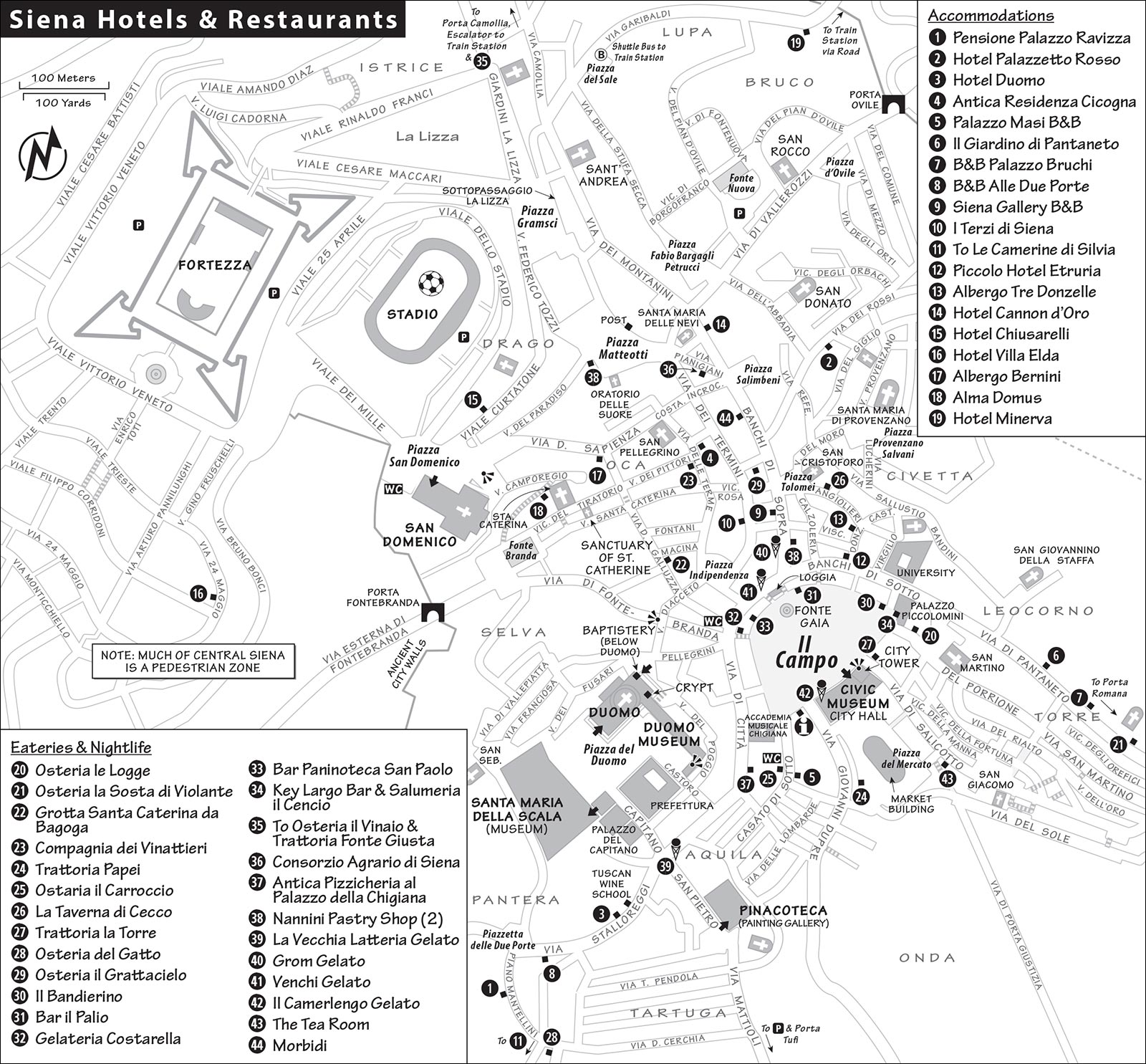
Map: Siena Hotels & Restaurants
DINING WITH LOCALS, AWAY FROM THE CENTER
Siena was medieval Florence’s archrival. And while Florence ultimately won the battle for political and economic superiority, Siena still competes for the tourists. Sure, Florence has the heavyweight sights. But Siena seems to be every Italy connoisseur’s favorite town.
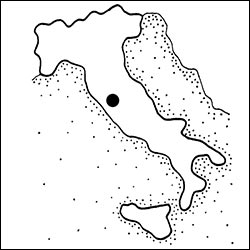
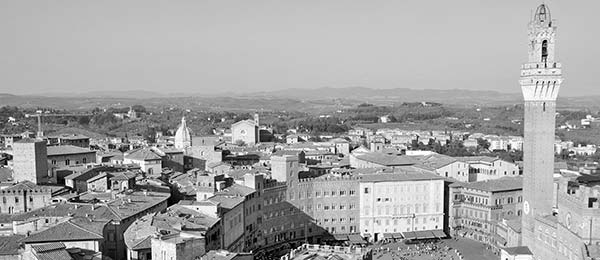
Situated atop three hills, Siena qualifies as Italy’s ultimate “hill town.” Its thriving historic center, with movie-set lanes cascading every which way, offers Italy’s best medieval city experience. Most people visit Siena, just 35 miles south of Florence, as a day trip, but it’s best experienced at twilight. While Florence has the blockbuster museums, Siena has an easy-to-enjoy soul: Courtyards sport flower-decked wells, alleys dead-end at rooftop views, and today, even with all the tourists, a strong local spirit pervades.
For those who dream of a Fiat-free Italy, Siena is a haven. Pedestrians rule in the old center of town, as the only drivers allowed are residents and cabbies. Nurse a drink on the stunning main square, Il Campo. Wander narrow streets, tether an imaginary horse to the old metal rings, be stirred by colorful flags. Take time to savor the first European city to eliminate automobile traffic from its main square (1966) and then, just to be silly, wonder what would happen if they did it in your hometown.
PLANNING YOUR TIME
On a quick trip, consider spending two nights in Siena (or three nights with a whole-day side trip into Florence). Whatever you do, be sure to enjoy a sleepy medieval evening in Siena. The next morning, you can see the city’s major sights in half a day.
Orientation to Siena
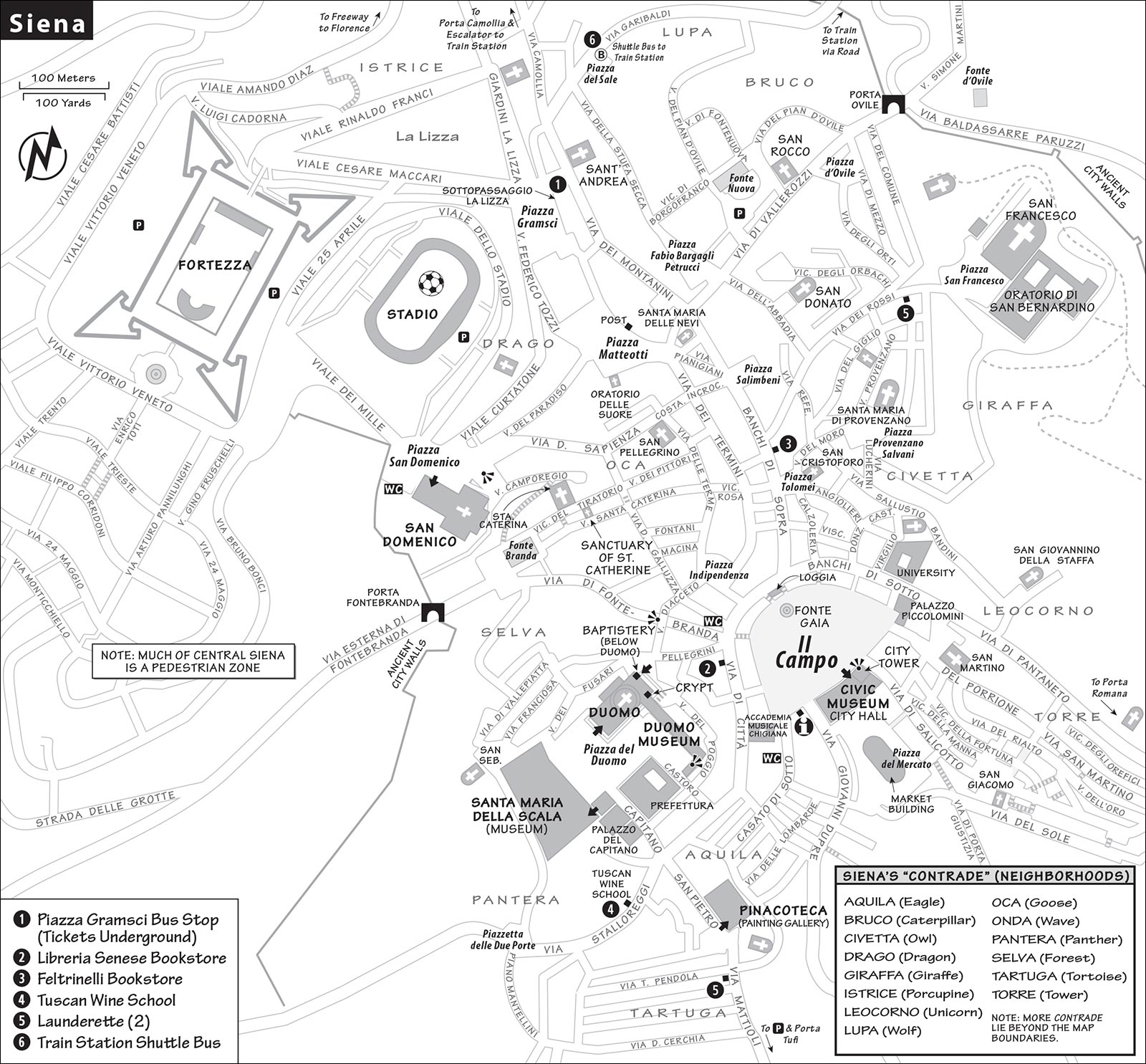
Siena lounges atop a ridge, stretching its three legs out from Il Campo. This pedestrianized main square is the historic meeting point of Siena’s neighborhoods.
Just about everything is within a 10-minute walk of the square. Navigate by three major landmarks (Il Campo, Duomo, and Basilica of San Domenico), following the excellent system of street-corner signs. The typical visitor sticks to the Il Campo-San Domenico axis. But make it a point to stray from this main artery to find a corner of town to yourself. Sienese streets go in anything but a straight line, so it’s easy to get lost—but equally easy to get found.
Siena’s individual attractions come in two main clusters: Il Campo (Civic Museum and City Tower) and the cathedral (Duomo Museum, with its surprise viewpoint; and Santa Maria della Scala, a hospital-turned-museum, just across the street). Roughly between them is the Pinacoteca, for medieval art lovers. Check off some or all these sights, and then you’re free to wander.
TOURIST INFORMATION
The TI is right on Il Campo (daily 9:00-18:00, Il Campo 7, +39 0577 292 222, www.terresiena.it). At busy times, there may be other TI outposts near the Duomo and at Piazza Gramsci, where some buses arrive.
ARRIVAL IN SIENA
By Train
Siena’s small train station is at the base of the hill, on the edge of town. It has a bar/tobacco shop, an Autolinee Toscane intercity bus office (Mon-Fri 7:15-19:30, Sat until 17:45, Sun 9:00-12:15 & 14:30-18:30), and a newsstand (which sells tickets for other buses, including city buses). A shopping mall with a supermarket is across the plaza facing the station. WCs are on track 1, past the pharmacy.
Getting from the Train Station to the City Center: To reach central Siena, you can ride a long series of escalators (free, slow); hop a city bus (cheap, somewhat faster); or take a taxi (fastest and most expensive). For two or more traveling together, the taxi is your best value (€10 to the center, taxi stand just outside station, +39 0577 49222).
By Escalator or City Bus: To reach either the bus or the escalators, head for the shopping mall across the square (far left corner as you leave—look for the bull’s-eye). The first of a series of escalators climbs through the mall up into the town. From the top of the escalators, it’s a 20-minute walk to the town center: Turn left, walk about five minutes to the Porta Camollia gate, then follow Via Camollia into town.
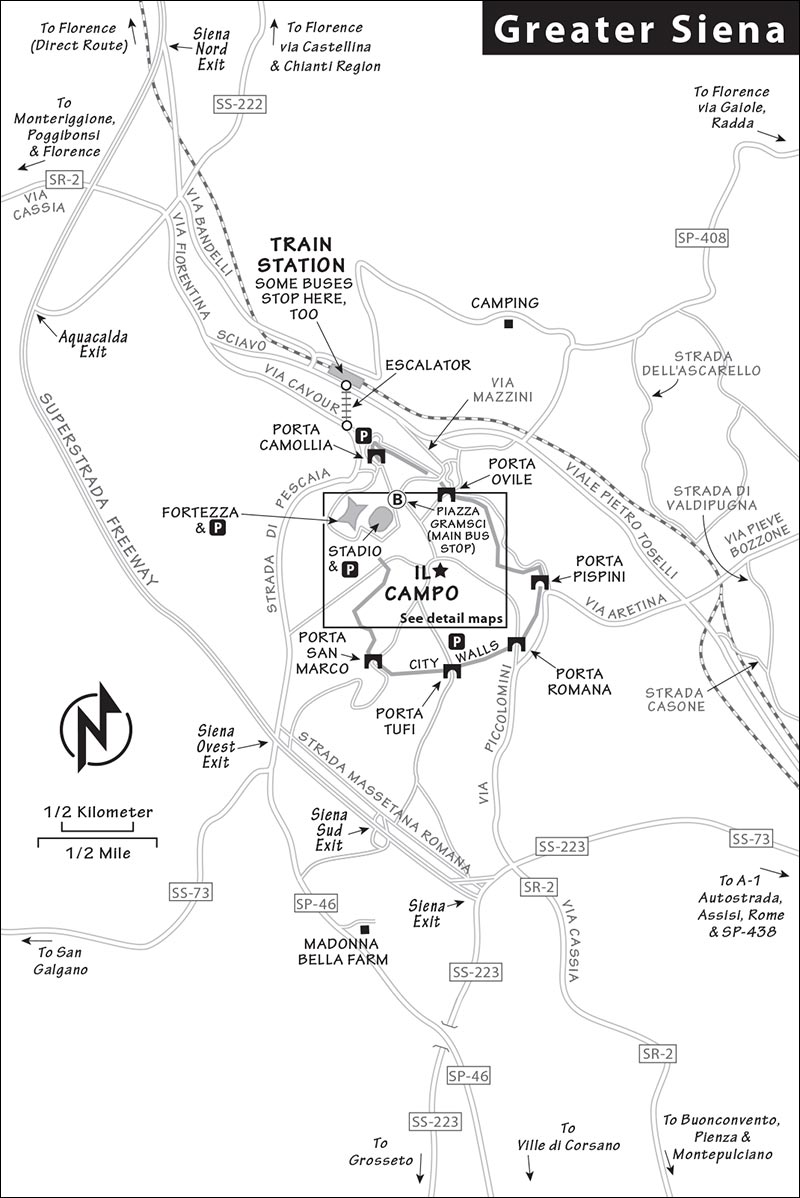
To ride the city bus, head to the bus stop below the mall (catch the down elevator from inside the mall’s first glass door, on immediate right). All buses (big and small) go to Piazza del Sale or Piazza Gramsci (within a block of each other—see “By Bus,” below). Buy your €1.50 bus ticket from the train station newsstand or at the machines by the bus stop; before boarding, confirm that the bus is going to the center—ask “Centro?” (CHEHN-troh).
Returning to the Train Station from the City Center: Catch a small shuttle bus directly to the station from Piazza del Sale, or take a big city bus from Piazza Gramsci. Look for Ferrovia or Stazione on schedules and marked on the bus, and confirm with the driver that the bus is going to the stazione (staht-see-OH-nay).
It’s a joy to downshift to the more peaceful pace of Italy’s small cities...and even smaller hill towns. I’ve covered my favorites in this book.
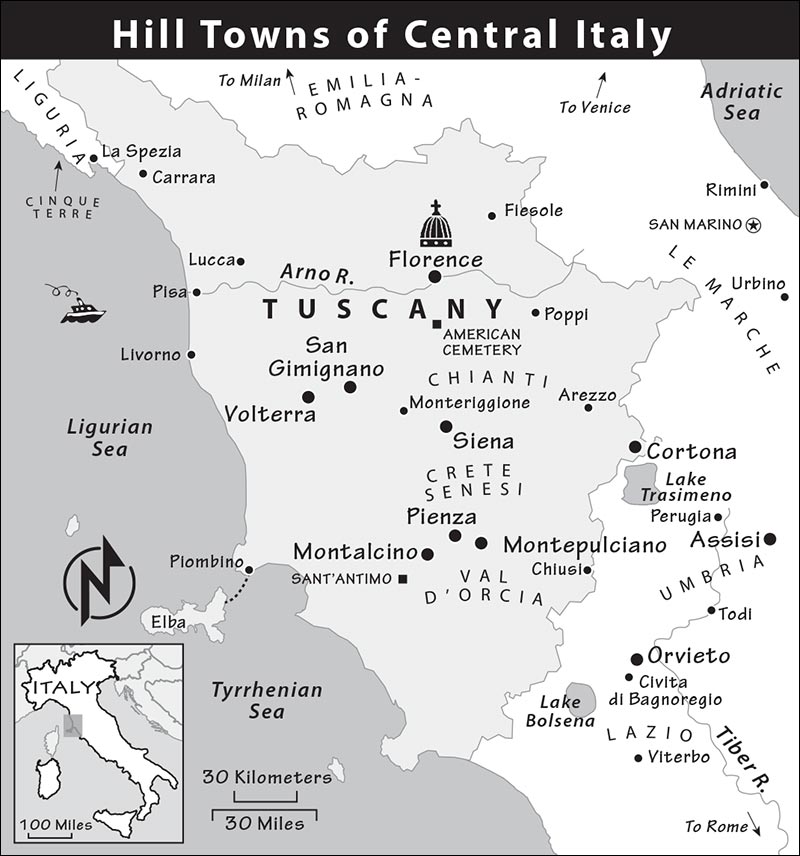
Siena, Pisa, and Lucca are in a category of their own, with more artistic and historic sights. Siena is the ultimate (and biggest) hill town, with an unrivaled spirit any visitor can enjoy. Like a medieval stage set, its pedestrian-friendly old town is surrounded by its fortified wall. Siena’s stunning main square—the gently tilted red-brick Campo—is the city’s proud centerpiece. As Tuscany’s hub, Siena is well connected by bus to Florence (also handy by train) and the surrounding hill towns.
Pisa’s iconic Leaning Tower draws flocks of tourists, but this midsize city also offers plenty of history and beautiful architecture, along with a thriving student scene. Lesser-known and smaller, charming Lucca is a “flat hill town” with winding streets ringed by a well-preserved Renaissance wall, perfect for circling on a bike. Both lie an hour or so west of Florence and are easily reached by train or bus.
But how in Dante’s name does one choose from among Tuscany’s hundreds of small hill towns? The one(s) you visit will depend on your interests, time, and mode of transportation.
Volterra—with its rustic vitality—is a beautifully preserved jewel. Its out-of-the-way location keeps this town from being trampled by tourist crowds, and its Etruscan history makes for compelling sightseeing. With 14 surviving medieval towers, walled San Gimignano is a classic. But because it’s easy to visit from Florence—about 1.5 hours by bus—midday crowds can overwhelm its charms (it’s an evocative delight early and late in the day). Both Volterra and San Gimignano work best for drivers but can be reached by public transportation.
South of Siena, in the region I call the “Heart of Tuscany,” drivers have their pick of hill towns. Ridge-hugging Montepulciano’s medieval cityscape resembles a miniature Florence. With several historic wine cellars and easy access to wine country, it attracts wine aficionados, as does Montalcino, itself a happy gauntlet of wine shops and art galleries. Fans of architecture and urban design appreciate little Pienza’s well-planned streets and squares. All three towns are covered in the Heart of Tuscany chapter.
By Bus or Train: Buses are often the only public-transportation choice to get between small hill towns. Train stations are likely to be in the valley below the town center, connected by a local bus.
By Car: Exploring Tuscany and its hill towns by car can be a great experience. Wait to pick up your car until the last sizable town you visit (or at the nearest airport to avoid big-city traffic), and carry a good, detailed road map in addition to a mapping app. Freeways (such as the toll autostrada and the non-toll superstrada) are the fastest way to connect two points, but smaller roads, including the super-scenic SS-222, connecting Florence and Siena, are more rewarding.
Some towns don’t allow visitors to drive or park in the city center. Be alert for “ZTL” (Zona Traffico Limitato) signs, indicating no cars allowed. Leave your car outside the walls and walk into town. Lots are usually free and plentiful outside city walls (and sometimes linked to the town center by elevators or escalators). For more driving and parking tips, see the Practicalities chapter.
For a relaxing break from big-city Italy, settle down in an agriturismo—a farmhouse that rents out rooms to travelers (usually for a minimum of a week in high season). These rural B&Bs—almost by definition in the middle of nowhere—provide a good home base from which to find the magic of Italy’s hill towns. Many provide memorable meals from locally sourced ingredients. I’ve listed several good options in the following four chapters. For more information, see “Agriturismi” in the Practicalities chapter.
By Bus
Siena is a pleasant 90-minute express bus ride from Florence (for more on buses, see “Siena Connections,” later). Most buses from Florence and other cities arrive in Siena at Piazza Gramsci (or the adjacent Via Tozzi), a few blocks north of the city center. (Some buses only go to the train station; others go first to the train station, then continue to Piazza Gramsci—to confirm, ask your driver, “pee-aht-sah GRAHM-shee?”)
Downstairs, in the concrete underpass beneath Piazza Gramsci, you’ll find ticket offices and pay WCs. If day-tripping, confirm your departure from timetables posted at the platform where you disembark or at the ticket counters downstairs. Late-afternoon buses back to Florence can fill up, so arrive at least 15 minutes early.
From Piazza Gramsci, it’s an easy walk into the town center—just head in the opposite direction of the tree-filled park.
By Florence-Siena Taxi
Taxis make the trip from Florence to Siena—hotel to hotel—in about an hour for around €140. (Prices can be soft. Ask a couple of cabbies for their best price. Clearly agree on a price from the start.) If debating the value of this splurge, consider that a couple will spend roughly €40 for two taxi transfers and two train tickets, and the luxury of a hotel-to-hotel cab ride saves you about an hour.
By Car
Siena is not a good place to drive. Park in a big lot or garage and walk into town. For more on where to park legally—and how to avoid a big fine by driving into the restricted “ZTL” zone—see “Driving” in the Practicalities chapter.
Drivers coming from the autostrada take the Siena Ovest exit and follow signs for Centro, then Stadio (stadium). The soccer-ball signs take you to the stadium lot (Parcheggio Stadio, pay when you leave) near Piazza Gramsci and the huge, bare-brick Basilica of San Domenico. The Fortezza lot is also nearby.
Another good option is the underground Santa Caterina garage (you’ll see signs on the way to the stadium lot). From the garage, hike 150 yards uphill through a gate to an escalator on the right, which carries you up into the city. Take a left at the top onto Siena’s main street.
If you’re staying in the south end of town, try the Il Campo lot, near Porta Tufi.
Yet another option is the Leonardo garage, near the Porta Camollia; they offer a “valet” service where they’ll meet you at the garage, drive you into town with your bags, then park your car for you (€25/day, arrange in advance, Via Bettino Ricasoli 29, +39 389 577 5886, www.parcheggiosiena.it).
You can park for free in the lot west of the Fortezza, in white-striped spots south of the Fortezza, and overnight in most city lots (20:00-8:00).
HELPFUL HINTS
Combo-Tickets: Siena often experiments with different combo-tickets. The Opa Si Pass covers the Duomo-related sights (see “Duomo and Related Sights,” later); the other pass offers various combinations of city sights, including the Civic Museum, City Tower, Santa Maria della Scala, and Pinacoteca (see listing for City Hall and Civic Museum, later).
Market: Every Wednesday morning a market of clothes, knickknacks, and food sprawls between the Fortezza and Piazza Gramsci along Viale Cesare Maccari and the adjacent Viale XXV Aprile.
Bookstores: For books and magazines in English, try Libreria Senese (daily, Via di Città 62) and the Feltrinelli bookstore (closed Sun, Via Banchi di Sopra 52).
Cooking Classes: At Fonte Giusta Cooking School, you’ll prepare a meal under the instruction of a local chef—and then eat it (€80-120, 2-3 hours, Via Camollia 78, call +39 0577 40506 or email info@trattoriafontegiusta.com for schedule and details, www.scuoladicucinafontegiusta.com).
Laundry: Try Lavanderia San Pietro (daily 8:00-21:00, not far from the Duomo at Via San Pietro 70) or Lavanderia Waterland (daily 7:00-21:00, north of Il Campo near Porta San Francesco at Via dei Rossi 94).
Tours in Siena
 To sightsee on your own, download my free Siena City Walk audio tour.
LOCAL GUIDES
Federica Olla leads walking tours of Siena with a knack for creative teaching (€55/hour, minimum 2 hours, +39 338 133 9525, www.ollaeventi.com, info@ollaeventi.com).
Anna Piperato, an expert on Palio culture, leads walking tours in Siena—including a visit to her contrada, Lupa—and environs (€60/hour, special treat for Rick Steves readers, +39 333 682 9336, www.sienaitalytours.com, anna@sienaitalytours.com).
Stefania Fabrizi is another good Siena guide (+39 338 640 7796, stefaniafabriziguide@gmail.com).
ON FOOT
Walking Tours
A changing lineup of companies offer basic, affordable walking tours of the old town, often including the Duomo. A two-hour tour runs about €20 (€5 extra to enter the Duomo); some are only in English, while others are in both English and Italian. Some of these are operated by the TI (get details there), while others are offered by a private company called Siena Tourism (https://sienatourism.com).
Siena City Walks by Roberto
Roberto and his guides offer private three-hour Siena walking tours (€180 for up to 8 people, admissions extra) or joinable group tours (€45/person, admissions extra, minimum 4 people; book online or call +39 320 147 6590, www.toursbyroberto.com, toursbyroberto@gmail.com).
OTHER TOURS
Tuscany Minibus Tours by Roberto
Roberto Bechi and his guides lead off-the-beaten-path, full-day minibus tours of the countryside surrounding Siena (€110/person, up to eight passengers, pickup at hotel). The first participants to book choose one of seven itineraries—then others join until the van fills (see website for tour options, RS%-10 percent discount, entry fees extra; also offers multiday tours, booking +39 320 147 6590, Roberto +39 328 425 5648, www.toursbyroberto.com, toursbyroberto@gmail.com). See later listing for Roberto’s farm tours; he also provides private van connections to Volterra—see the Volterra & San Gimignano chapter.
Wine Tasting
The Tuscan Wine School offers two foodie experiences in English. The midday food tour features tastings (focaccia, cured meats, truffles, gelato) at vendors around town (€60); the afternoon wine-appreciation classes, held in a classroom, let you taste a variety of Tuscan wines paired with small bites (€45). For details and to book, check their website or stop by their office (RS%-20 percent discount, Via di Stalloreggi 26, 30 yards from Hotel Duomo, +39 0577 221 704, mobile +39 333 722 9716, www.tuscanwineschool.com, tuscanwineschool@gmail.com, Georgia and Milo).
Farm Visit
Madonna Bella, a farm co-owned by local guide Roberto Bechi, sits just a few minutes outside Siena. Monica welcomes visitors to stop in, enjoy the views, visit the farm, take part in wine and olive-oil tastings, and learn how olive oil and pasta are made. Book ahead to enjoy a food/wine pairing that anyone would consider an abundant lunch. They also offer cooking classes and can arrange a taxi from and to central Siena for about €15 each way (Strada del Tesoro 25—just outside Siena on road SP-46, +39 393 858 2981, www.madonnabella.com).
Siena City Walk
This short self-guided walk laces together Siena’s most important sights. If you do the walk without entering the sights, it works great at night when the city is peaceful.
This walk is also available as a free Rick Steves audio tour.
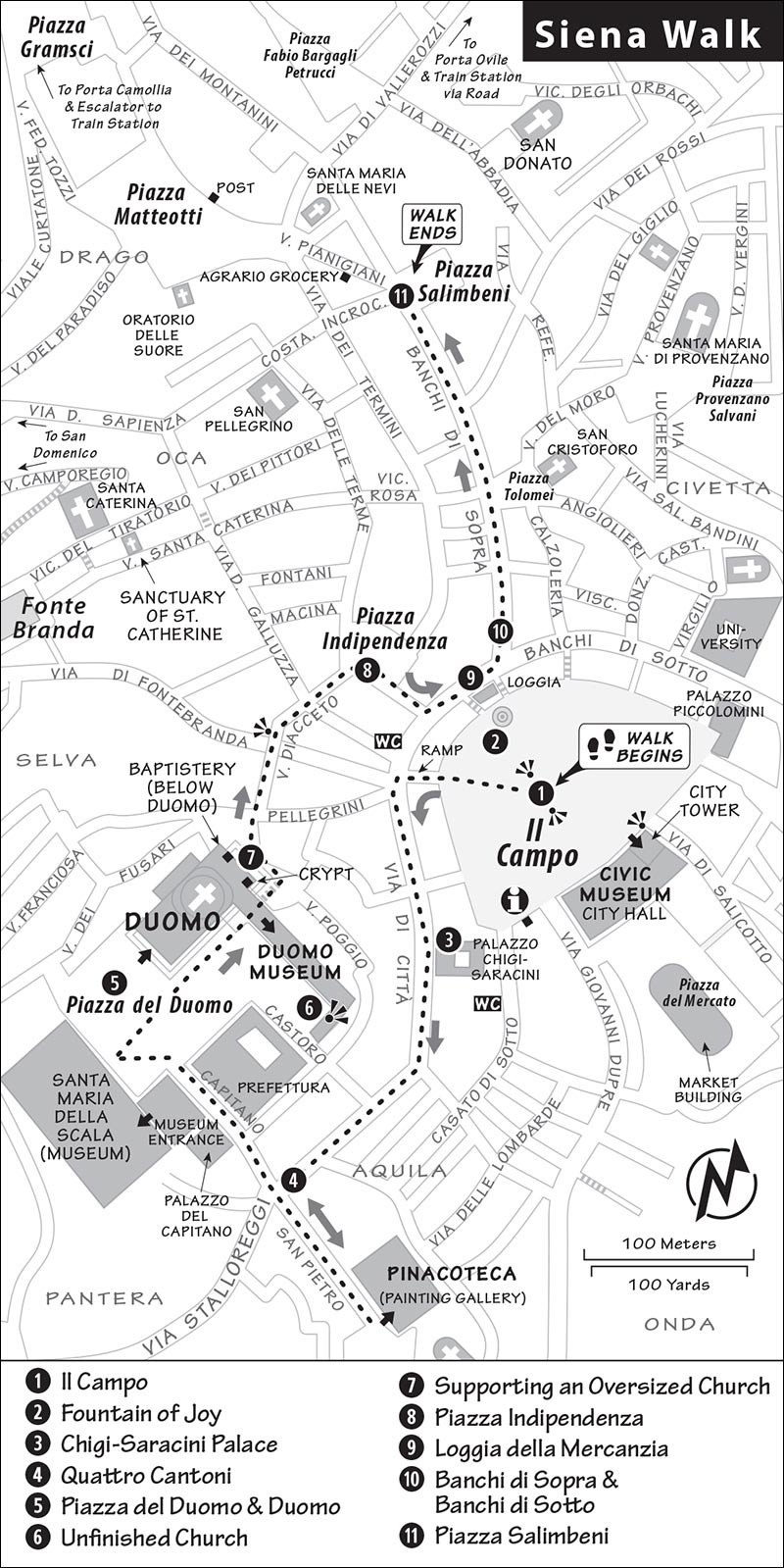
• Start in the center of the main square, Il Campo, standing just below the fountain.
1 Il Campo
This square is the heart of Siena, both geographically and metaphorically—and it’s worth ▲▲▲. First laid out in the 12th century, today Il Campo (officially the Piazza del Campo) is the only town square I’ve seen where people stretch out as if at the beach. However, if you start eating—well, now you’re “picnicking,” which is not allowed—you could be fined. At the flat end of its clamshell shape is City Hall, where you can tour the Civic Museum and climb the City Tower. From there the square fans out as if to create an amphitheater. All eyes are on Il Campo twice each summer, when it hosts the famous Palio horse races (see sidebar on here).
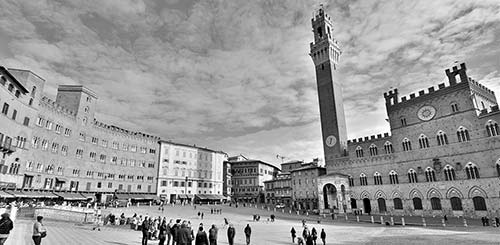
Originally, this area was just a field (campo) outside the city walls (which encircled the cathedral). Bits of those original walls, which curved against today’s square, can be seen above the pharmacy (the black and white stones, third story up, to the right as you face City Hall). In the 1200s, with the advent of the Sienese republic, the city expanded. Il Campo became its marketplace and the historic junction of Siena’s various competing contrade (neighborhood districts). The square and its buildings are the color of the soil on which they stand—a color known to artists and Crayola users as “burnt sienna.”
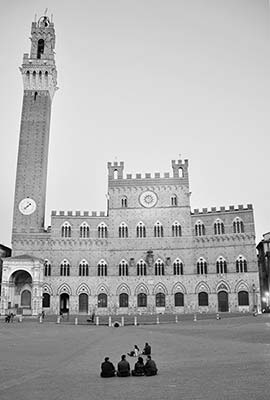
City Hall (Palazzo Pubblico), with its looming tower, dominates the square. In medieval Siena, this was the center of the city, and the whole focus of Il Campo still flows down to it.
The City Tower was built around 1340. At 330 feet, it’s one of Italy’s tallest secular towers. Medieval Siena was a proud republic, and this tower stands like an exclamation point—an architectural declaration of independence from papacy and empire. The tower’s Italian nickname, Torre del Mangia, comes from a hedonistic bell ringer who consumed his earnings like a glutton consumes food. (His chewed-up statue is just inside City Hall’s courtyard, to the left as you enter.)
The open chapel at the base of the tower was built as thanks to the Virgin Mary for ending the Black Death of 1348 (after it killed more than a third of the population). Siena rededicated itself to the Virgin in 2022, to implore her help in weathering another plague—Covid-19. These days, the chapel is where Palio contestants are blessed (and where EMTs stand by during the race).
You can visit the Civic Museum inside City Hall and climb the tower (see here).
• Now turn around and take a closer look at the fountain in the top center of the square.
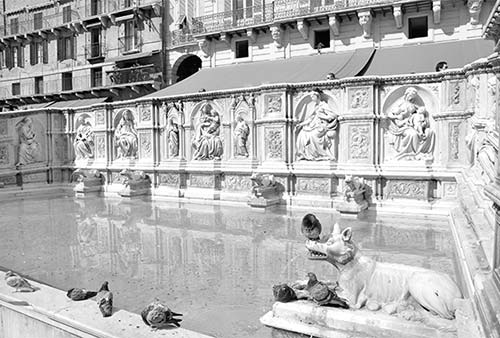
2 Fountain of Joy (Fonte Gaia)
This fountain—a copy of an early-15th-century work by Jacopo della Quercia—marks the square’s high point. The joy is all about how the Sienese republic blessed its people with water. Find Lady Justice with her scales and sword (right of center), overseeing the free distribution of water to all. The Fountain of Joy still reminds locals that life in Siena is good. The relief panel on the far left shows God creating Adam by helping him to his feet. It’s said that this reclining Adam (carved a century before Michelangelo’s day) influenced Michelangelo when he painted his Sistine Chapel ceiling. The fountain’s original statuary is exhibited at Santa Maria della Scala (see here).
• Leave Il Campo uphill on the widest ramp (with your back to the tower, it’s at 10 o’clock). After a few steps you reach Via di Città. Turn left and walk 100 yards uphill toward the imposing white palace with brick crenellations on top.
Halfway to the palace, at the first corner, notice small plaques on the first level of the building facades—these mark the boundary of a neighborhood, or contrada. If the flags are flying, they reinforce the point. You are stepping from the contrada of the Forest (Selva) into the contrada of the Eagle (Aquila).
Notice also the once mighty and foreboding medieval tower house (on the Il Campo side). Towers once soared all around town, but they’re now truncated and no longer add to the skyline—look for their bases as you walk the city.
• On the left, you reach the big curving facade of the...
3 Chigi-Saracini Palace (Palazzo Chigi-Saracini)
This old fortified noble palace is today home to a prestigious music academy, the Accademia Musicale Chigiana. If open, step into the courtyard with its photogenic well (powerful medieval families enjoyed direct connections to the city’s underground network of aqueducts). The walls of the loggia are decorated with the busts of Chigi-Saracini patriarchs, and the vaults are painted in the Grotesque style popular during the Renaissance. What look like pigeonholes in the other walls are actually for scaffolding, for both construction and ongoing maintenance.
Head into the shop/café, which sprawls into a mild museum with old musical instruments, portraits of classical composers, pictures of old Siena, and a chance to watch classical concert videos. In July and August, students may be presenting concerts around town—ask (www.chigiana.it [URL inactive]).
• Walk uphill to the next major intersection.
4 Quattro Cantoni
The intersection known as Quattro Cantoni (Four Corners) offers a delightful perch from which to study the city. The modern column (from 1996) with a Carrara marble she-wolf marks one of the three hills on which the city is built. You are still in the Eagle district (see the fountain and the corner plaque)—but beware. Just one block up the street, a ready-to-pounce panther—from the rival neighboring district—awaits.
Only the very rich could afford stone residences. The fancy facades here hide their economical brick construction behind a stucco veneer. The stone tower on this corner had only one door—30 feet above street level and reached by ladder, which could be pulled up as necessary. Within a few doors, you’ll find a classy bar, an elegant grocery store, and a gelateria.
Take a little side trip, venturing up Via San Pietro. Interesting stops (mostly on the left) include the window with Palio video clips playing (at #1), Simon and Paula’s art shop with delightful Palio and contrade knickknacks (#5), a weaver’s shop (#7), the recommended La Vecchia Latteria gelateria (on the right, at #10), an art gallery (#11), and four enticing little osterias. At the end of the block you’ll reach the best medieval art collection in town, the Pinacoteca (for a self-guided tour of its interior, see here).
• Return to the Four Corners and carry on straight up Via del Capitano, passing another massive Chigi family palace (on the left, at #1). Up next, at the end of the street, is the...
5 Piazza del Duomo and the Duomo
The pair of she-wolves atop columns flanking the cathedral’s facade says it all: The church was built and paid for not by the pope but by the people and the republic of Siena.
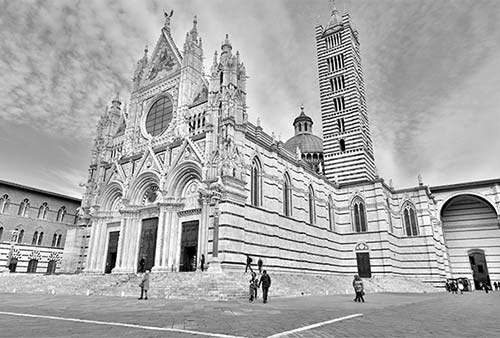
This 13th-century Gothic cathedral, with its striped bell tower—Siena’s ultimate tribute to the Virgin Mary—is heaped with statues, plastered with frescoes, and paved with art.
The current structure dates back to 1215, with the major decoration done during Siena’s heyday (1250-1350). The lower story, by Giovanni Pisano (who worked from 1284 to 1297), features remnants of the fading Romanesque style (round arches over the doors), topped with the pointed arches of the new Gothic style that was seeping in from France. The upper half, in full-blown frilly Gothic, was designed and built a century later.
The six-story bell tower (c. 1315) looks even taller, thanks to an optical illusion: The white marble stripes get narrower toward the top, making the upper part seem farther away.
The interior is a Renaissance riot of striped columns, remarkably intricate inlaid-marble floors, a Michelangelo statue, evocative Bernini sculptures, and the amazing Piccolomini Library. (If you want to enter now, you’ll need a ticket—the ticket office moves around, but it’s most likely around the left side of the Duomo’s entrance; for a self-guided tour of the interior, see here.
Facing the cathedral is Santa Maria della Scala, a huge building that housed pilgrims and, until the 1990s, was used as a hospital. Its labyrinthine 12th-century cellars—carved from sandstone and finished with brick—go down several floors and, during medieval times, stored supplies for the hospital upstairs. Today, the exhibit-filled hospital and cellars can be a welcome refuge from the hot streets (for more on this sight, see here).
• Walk along the right side of the church toward its rear end. This is part of what was once intended to be an extension of the Duomo.
6 Unfinished Church
Grand as Siena’s cathedral is, it’s actually the rump of a failed vision. After rival republic Florence began its grand cathedral (1296), proud Siena planned to build an even bigger one, the biggest in all Christendom.
Look at the unfinished wall with see-through windows (circa 1330). Just imagine the audacity of this vision: Today’s cathedral would have been just a transept. Worshippers would have entered the church through the unfinished wall. (Look way up at the highest part of the wall. That viewpoint is accessible from inside the Duomo Museum.) Some of the nave’s dark-green-and-white-striped columns were built, but the space between them is now partially filled in with brick. White stones in the pavement mark where a row of pillars would have been.
But this grand vision underestimated the complexity of constructing such a building without enough land. That, coupled with the devastating effects of the 1348 plague, killed the city’s ability and will to finish the project. Many Sienese saw the Black Death as a sign from God, punishing them for their pride. They canceled their plans and humbly faded into the background of Tuscan history.
• On your left is the entrance to the Duomo Museum, housing the church’s art (see here). To continue our walk, exit the piazza through the doorway in the wall abutting the back end of the church. After a few steps, pause at the top of the marble stairs leading down.
7 Supporting an Oversized Church
From here you can see how the church sticks out, high above the lower street level. Because there wasn’t enough flat ground, builders propped up the overhanging edge with the church’s subterranean features—the Crypt and Baptistery. (Both are worth entering and included in the Opa Si Pass; see here.)
• Descend the stairs, nicknamed “The Steps of St. Catherine,” as she would have climbed them each day on her walk from home to the Santa Maria della Scala Hospital where she worked. Below the Baptistery, jog right, then immediately left, through a tunnel down Via di Diacceto. Just ahead, pause on the bridge (originally a drawbridge) to enjoy a beautiful view (to the left) of the towering brick Dominican church in the distance. Then continue straight up the lane until you reach the next big square.
8 Piazza Indipendenza
This square celebrates the creation of a unified Italy (1861) with a 19th-century loggia sporting busts of the first two Italian kings. Stacking history on history, the neo-Renaissance loggia is backed by a Gothic palace and an older medieval tower.
• Head right, downhill one block (on Via delle Terme), back to the grand Via di Città, and take a few steps to the left to see another, fancier loggia.
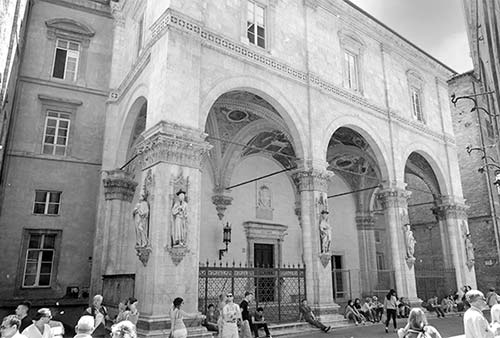
9 Loggia della Mercanzia
This Gothic-Renaissance loggia was built about 1420 as a kind of headquarters for the union of merchants. Siena’s nobility purchased the loggia, and eventually it became the clubhouse of the local elites. To this day, it’s a private, ritzy, and notoriously out-of-step-with-the-times men’s club. The “Gli Uniti” above the door is a “let’s stick together” declaration.
Siena’s 17 historic neighborhoods, or contrade—each with a parish church, well or fountain, and square—still play an active role in the life of the city. Each is represented by a mascot (porcupine, unicorn, wolf, etc.) and unique colors worn proudly by residents.
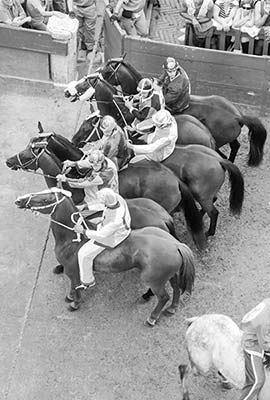
Contrada pride is evident year-round in Siena’s parades and colorful banners, lamps, and wall plaques. If you hear the thunder of distant drumming, run to it for some medieval action—there’s a good chance it’ll feature flag throwers. Buy a scarf in contrada colors, and join in the merriment of these lively neighborhood festivals. (But be careful where you wear them...you don’t want to stumble naively into a rival contrada’s celebration.)
Contrade rivalries are most visible twice a year—on July 2 and August 16—during the city’s world-famous horse race, the Palio di Siena. Ten of the 17 neighborhoods compete (chosen by rotation and lot), hurling themselves with medieval abandon into several days of trial races and traditional revelry. Jockeys—usually from out of town—are considered hired guns, no better than mercenaries. Locals boast about which contrada will win...and lose. Betting on the outcome is strictly forbidden...officially. Despite the shady behind-the-scenes dealing, on the big day the horses are taken into their contrada’s church to be blessed. (“Go and return victorious,” says the priest.) It’s considered a sign of luck if a horse leaves droppings in the church.
On the evening of the race, Il Campo is stuffed to the brim with locals and tourists. Dirt is brought in and packed down to create the track’s surface, while mattresses pad the walls of surrounding buildings. The most treacherous spots are the sharp corners, where many a rider has bitten the dust.
Picture the scene: Ten snorting horses and their nervous riders line up near the pharmacy (on the west side of the square) to await the starting signal. Then they race like crazy while spectators wave the scarves of their neighborhoods.
Every possible vantage point and perch is packed with people straining to see the action. One lap around the course is about a quarter of a mile; three laps make a full circuit. In this no-holds-barred race—which lasts just over a minute—a horse can win even without its rider (jockeys ride precariously without saddles and often fall off the horses’ sweaty backs).
When the winner crosses the line, 1/17th of Siena—the prevailing neighborhood—goes berserk. Winners receive a palio (banner)—painted by a Sienese artist in July and an international artist in August, and always featuring the Virgin Mary (the race is dedicated to her). But the true prizes are proving that your contrada is numero uno, and mocking your losing rivals.
All over town, sketches and posters depict the Palio. This is not some folkloric event—it’s a real medieval moment. If you’re packed onto the square with 15,000 people, all hungry for victory, you may not see much, but you’ll feel it. Bleacher and balcony seats are expensive, but it’s free to join the masses in the square. Go with an empty bladder (as there are no WCs) and be prepared to surrender any sense of personal space.
While the actual Palio packs the city, you can more easily see the horse-race trials—called prove—on any of the three days before the main event (usually at 9:00 and after 19:00, bleacher seats may be available; the calmest, most accessible prova is the final one—9:00 on the morning of the race—since nobody wants to risk injury so close to the real thing). Good sources for more information include IlPalio.org and ComitatoAmiciDelPalio.it.
• Next to the loggia, steep steps lead down to Il Campo, but we’ll go left and uphill on Via Banchi di Sopra. Pause at the fork in the road, which separates...
10 Banchi di Sopra and Banchi di Sotto
These main drags are named “upper row of banks” and “lower row of banks.” They were once lined with market tables (banchi), and vendors paid rent to the city for a table’s position along the street. If the owner of a banco neglected to pay up, thugs came along and literally broke (rotto) his table. It is from this practice—banco rotto, broken table—that we get the English word “bankrupt.”
In medieval times, these streets were part of the Via Francigena, the main thoroughfare (busy with pilgrims, merchants, and crusaders) linking Rome with northern Europe. Today, strollers—out each evening for their passeggiata—fill Via Banchi di Sopra. Join the crowd, strolling past Siena’s finest shops.
A block or so farther up the street, Piazza Tolomei faces the imposing Tolomei family palace (now an imposing bank). This is a center for the Owl contrada. The column in the square, topped by the she-wolf, marks another of Siena’s three hills.
• Continue on Banchi di Sopra to Piazza Salimbeni. This gets my vote for Siena’s finest stretch of palaces.
11 Piazza Salimbeni
Piazza Salimbeni is dominated by Monte dei Paschi, the head office of a bank founded in 1472. It’s amazing to think this bank has been in business on this square for over 500 years. Originally Monte dei Paschi was a kind of community bank for common people. The statue in the center of the square honors Sallustio Antonio Bandini, a reformer who helped develop a system that let people secure firm title to their land.
Directly across from Piazza Salimbeni, the steep little lane called Costa dell’Incrociata leads straight (down and then up) to the Basilica of San Domenico (it’s worth the hike; see here). Also nearby (behind the cute green newsstand) is the most elegant grocery store in town, Consorzio Agrario di Siena (see here).
• With this walk under your belt, you’ve got the lay of the land. The city is ready for further exploration—the sights associated with City Hall and the Duomo are all just a few minutes away. Enjoy delving deeper into Siena.
Sights in Siena
▲▲City Hall (Palazzo Pubblico) and Civic Museum (Museo Civico)
▲City Tower (Torre del Mangia)
▲▲Duomo Museum and Viewpoint (Museo dell’Opera e Panorama)
▲Baptistery of San Giovanni (Battistero di San Giovanni)
Basilica of San Domenico (Basilica di San Domenico)
Sanctuary of St. Catherine (Santuario di Santa Caterina)
IL CAMPO AND NEARBY
The gorgeous red-brick square known as Il Campo—worth ▲▲▲—is the best in Italy (for more on the square itself, see here). It’s also home to City Hall (with the Civic Museum and City Tower) and other sights.
▲▲City Hall (Palazzo Pubblico) and Civic Museum (Museo Civico)
Siena’s fine Gothic City Hall is still the seat of city government. With its proud tower, this building symbolizes a republic independent from the pope and the Holy Roman Emperor. It also represents a rising secular society, one that appeared first in Tuscany in late medieval times, then spread throughout Europe as humanism took hold during the Renaissance.
City Hall has a fine and manageable museum on its top floor. You’ll see the large assembly hall where democracy was forged, adorned with some of Siena’s most historic frescoes. There’s memorabilia from the birth of the nation of Italy. The highlight is a room of medieval-era frescoes depicting fascinating examples of governance—good and bad. (Note that these frescoes are undergoing an extensive renovation and may be covered up.) Strolling the halls, you’ll get a glimpse into the city-as-utopia, when this proud town understandably considered itself the vanguard of Western civilization.
Cost and Hours: Museum-€10 by itself (cheaper if frescoes are covered), or €15 with City Tower; also covered by other combo-tickets that include Santa Maria della Scala and/or the Pinacoteca (up to €25 for everything); look for small ticket window straight ahead as you enter City Hall courtyard; open daily 10:00-19:00, Nov-Feb until 18:00, last entry 45 minutes before closing; +39 0577 292 232, www.comune.siena.it.
Visiting the Museum: Start in the Sala del Risorgimento, with dramatic scenes of the 19th-century unification of Italy. Make your way to the chapel, where the city’s governors and bureaucrats prayed, then enter the Sala del Mappamondo. On one end of the room is the beautiful Maestà (Enthroned Virgin, 1315), by Siena’s great Simone Martini (c. 1280-1344). This is a groundbreaking work. It’s Siena’s first fresco showing a Madonna not in a faraway, gold-leaf heaven, but under the blue sky of a real space that we inhabit.
On the opposite end of the room is the famous Equestrian Portrait of Guidoriccio da Fogliano (1330; traditionally attributed to Simone Martini), which depicts a mercenary commander surveying the siege fort, with the catapult that helped Siena win.
Next is the Sala della Pace, where the Council of Nine, who ruled Siena from 1287 to 1355, met. They were surrounded by a fascinating fresco series showing the Effects of Good and Bad Government, by Ambrogio Lorenzetti (1337-1340). (Unfortunately, these frescoes may be covered for restoration during your visit.)
Notice the better-preserved fresco (on the long wall to the right) depicting the beneficial effects of good government. Compare the whistle-while-you-work happiness against the crime, devastation, and societal mayhem of a community ruled by politicians with more typical values.
You can cap your visit by climbing the stairs to a grand view of the city and its surroundings. (For a less impressive view, you could skip the stairs and simply peek behind the curtains in the Sala della Pace.)
▲City Tower (Torre del Mangia)
The tower’s nearly 400 steps get pretty skinny at the top, but the reward is a grand view. For more on the tower, see here.
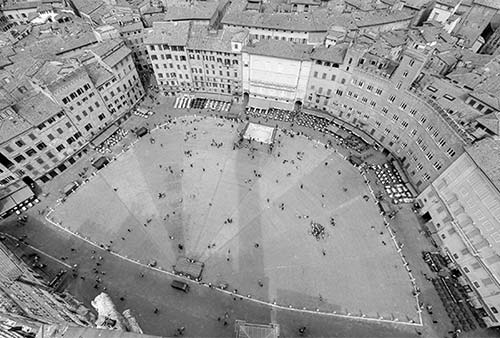
Cost and Hours: €10, €15 combo-ticket with Civic Museum, also included in various combo-tickets with Santa Maria della Scala and/or the Pinacoteca, daily 10:00-19:00, Nov-Feb until 16:00, closed in rain, last entry one hour before closing, free and mandatory bag check.
Crowd Alert: Admission is limited to 50 people at a time. Wait at the bottom of the stairs for the green Avanti light. Try to avoid midday crowds (up to an hour wait at peak times).
▲Pinacoteca
If you’re into medieval art, you should enjoy this quiet, uncrowded, colorful museum—though it has no spectacular highlights. The museum (officially the Pinacoteca Nazionale di Siena) walks you through Siena’s art chronologically, from the 12th through the 16th century, when a revolution in realism was percolating in Tuscany.
Cost and Hours: €8, Mon and Fri-Sun 8:30-13:30, Tue-Thu 14:00-19:00, closed two Sundays a month; from Il Campo, walk out Via di Città and go left on Via San Pietro to #29; +39 0577 281 161, www.pinacotecanazionale.siena.it.
Visiting the Museum: In general, the collection lets you follow the evolution of painting styles from Byzantine to Gothic, then to International Gothic, and finally to Renaissance.
Long after Florentine art went realistic, the Sienese embraced a timeless, otherworldly style glittering with lots of gold. But Sienese art features more than just paintings. In this city of proud craftsmen, the gilding and carpentry of the frames almost compete with the actual paintings. The exquisite attention to detail gives a glimpse into the wealth of the 13th and 14th centuries, Siena’s golden age. The woven silk and gold clothing you’ll see was worn by the very people who once walked these halls, when this was a private mansion (appreciate the colonnaded courtyard).
The core of the collection is on the second floor, in Rooms 1-19. Works by Duccio di Buoninsegna (who created the Maestà in the Duomo Museum) feature groundbreaking innovations that are subtle: less gold-leaf background, fewer gold creases in robes, translucent garments, inlaid-marble thrones, and a more human Mary and Jesus. Notice that the Madonna-and-Bambino pose is eerily identical in each version.
In St. Augustine of Siena, Duccio’s assistant Simone Martini portrays the saint’s life in realistic Sienese streets, buildings, and landscapes. In each panel, the saint pops out at the oddest (difficult to draw) angles to save the day. (Simone Martini also did the Maestà and possibly the Guidoriccio frescoes in the Civic Museum.)
Also look for religious works by the hometown Lorenzetti brothers (Ambrogio is best known for the secular masterpiece Effects of Good and Bad Government, in the Civic Museum).
Two famous small wooden panels, Città sul Mare (City by the Sea) and Castello in Riva al Lago (Castle on the Lakeshore), feature a strange, medieval-landscape Cubism. Notice the weird, melancholic light that captures the sense of the Dark Ages.
Several colorful rooms on the first floor are dedicated to Domenico Beccafumi (1486-1551), who designed many of the Duomo’s inlaid pavement panels. With strong bodies, twisting poses, and dramatic gestures, Beccafumi’s works epitomize the Mannerist style of the High Renaissance.
DUOMO AND RELATED SIGHTS
Siena’s monumental cathedral complex encompasses the Duomo, Duomo Museum (and its panoramic terrace), Baptistery, and Crypt.
Ticket Options and Hours
The Duomo’s various sights are covered by a confusing variety of tickets. Here are your basic choices:
Duomo Interior (including the Piccolomini Library): €5 most of the year; €8 when floor panels are uncovered (typically July and mid-Aug-mid-Oct).
Opa Si Pass: €13; €15 when floor panels are uncovered. Covers Duomo interior, Duomo Museum (with original Duomo art, plus a fantastic viewpoint over Siena), the Crypt (frescoes), and the Baptistery (with a fine baptismal font).
Porta del Cielo (“Gate of Heaven”) Pass: €20, covers everything in the Opa Si Pass and adds an escorted visit up to the cathedral’s dome and rooftop (described later). It’s wise to reserve this pass—see “Crowd-Beating Tips,” below.
Hours: The Duomo is open Mon-Sat 10:00-19:00, Sun 13:30-17:30; Nov-March daily until 17:00. The associated sights keep similar hours (but if arriving late in the day, confirm closing times to plan your visit strategically). The Porta del Cielo roof visits are offered daily, Nov-March on weekends only with some closures.
Information: +39 0577 286 300, www.operaduomo.siena.it.
Getting Tickets: As of this writing, the ticket office for Duomo sights is on the left side of the Duomo, as you face it. However, ticket options and sales points get reconfigured frequently. Expect changes, and when in doubt, ask uniformed staff for help.
Crowd-Beating Tips: Crowds peak midmorning in high season; early, late, or lunchtime visits can be less busy. If you anticipate crowds, you can prebook at www.operaduomo.siena.it (€2 booking fee/ticket; click “Booking Online” to be redirected to official ticket-booking site). Prebook Porta del Cielo cathedral roof visits; slots fill up.
▲▲▲Duomo (Duomo di Siena)
Siena’s 13th-century cathedral and striped bell tower are one of the most illustrious examples of Romanesque-Gothic style in Italy. This ornate but surprisingly secular shrine to the Virgin Mary is slathered with colorful art inside and out, from inlaid-marble floors to stained-glass windows. The cathedral’s interior showcases the work of the greatest sculptors of successive eras—Pisano, Donatello, Michelangelo, and Bernini—and the Piccolomini Library features a series of 15th-century frescoes chronicling the adventures of Siena’s philanderer-turned-pope, Aeneas Piccolomini.
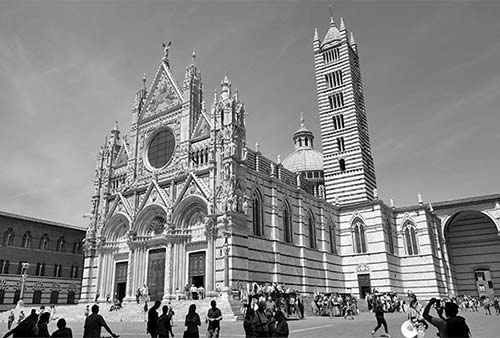
Cost and Hours: See “Ticket Options and Hours,” earlier.
Dress Code: Modest dress is required, but stylish paper ponchos are provided for the inappropriately clothed.
Church Services: Worshippers attending Mass can enter the church free; use the entrance on the right side of the building, set farther back from the main one (Mon-Sat at 10:00; Sun at 8:00, 11:00, 12:15, and 18:30). When the fragile floor panels are uncovered in July and mid-Aug-mid-Oct, Mass is held elsewhere or in a side chapel.
Tours: There may be a downloadable app or a rentable audioguide (ask on-site)—but the information covered here is plenty for a casual visit.
 Self-Guided Tour: Grab a spot on a stone bench opposite the entry to take in this architectural festival of green, white, pink, and gold. The Duomo sits atop Siena’s highest point, with one of the most extravagant facades in all of Europe. Like a medieval altarpiece, the facade is divided into sections, each frame filled with patriarchs and prophets, studded with roaring gargoyles, and topped with prickly pinnacles (for more about the facade, see here).
• Step inside, putting yourself in the mindset of a pilgrim as you take in this trove of religious art.
Nave: The heads of 171 popes—who reigned from the time of St. Peter to the 12th century—peer down from above, looking over the fine inlaid art on the floor. With a forest of striped columns, a coffered dome, a large stained-glass window at the far end (it’s a copy—the original is viewable up close in the Duomo Museum), and an art gallery’s worth of early Renaissance art, this is one busy interior. If you look closely at the popes, you’ll see the same four faces repeated over and over.
For almost two centuries (1373-1547), 40 artists paved the marble floor with scenes from the Old Testament, allegories, and intricate patterns. The series starts near the entrance with historical allegories; the larger, more elaborate scenes surrounding the altar are mostly stories from the Old Testament. Many of the floor panels are roped off and covered to prevent further wear and tear. But typically in July and from mid-August through October, the cathedral uncovers them and holds Mass elsewhere. The second pavement panel from the entrance depicts Siena as a she-wolf. The proud city of Siena is the center of the Italian universe, orbited by such lesser lights as Roma, Florentia (Florence), and Pisa.
The fourth pavement panel from the entrance is the Fortune Panel, with Lady Luck (lower right) arriving on earth, where she teeters back and forth on a ball and a tipsy boat. The lesson? Fortune is an unstable foundation for life. On the right wall hangs a dim painting of St. Catherine (fourth from entrance). Siena’s homegrown saint had a vision in which she mystically married Christ.
• On the opposite wall is a marble altarpiece decorated with statues.
Piccolomini Altar: This was commissioned by the Sienese-born Pope Pius III (born Francesco Piccolomini) but was never used. The altar is most interesting for its statues: one by Michelangelo and three by his students. Michelangelo was originally contracted to do 15 statues, but another sculptor had started the marble blocks, and Michelangelo’s heart was never in the project. He personally finished the figure of St. Paul (lower right, clearly more interesting than the bland, bored saints above him).
• Now grab a seat under the dome. The dome sits on a 12-sided base, but its “coffered” ceiling is a painted illusion.
Duccio’s Stained-Glass Rose Window: At the far end of the church, high up above the altar, is the rose window, a kaleidoscope of colors and intricate designs. The window is dedicated to the Virgin Mary, as is the church and the city itself. This is a copy of the original window made about 1287-1290 (described on here).
• Closer to you, on the left side of the nave, is a stone podium sitting atop columns. This is...
Pisano’s Pulpit: The octagonal Carrara marble pulpit (1268) rests on the backs of lions, symbols of Christianity triumphant. Like the lions, the Church eats its catch (devouring paganism) and nurses its cubs. The seven relief panels tell the life of Christ in rich detail. The pulpit is the work of Nicola Pisano (c. 1220-1278), the “Giotto of sculpture,” whose revival of classical forms (columns, sarcophagus-like relief panels) signaled the coming Renaissance. His son Giovanni (c. 1240-1319) carved many of the panels, mixing his dad’s classicism and realism with the decorative detail and curvy lines of French Gothic.
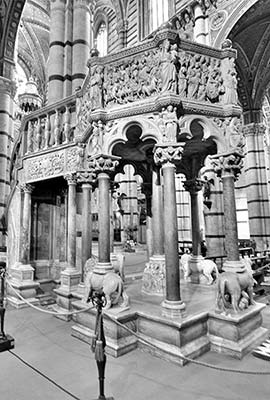
• A few steps to the left of the pulpit (in the left transept), find a panel in the floor, the...
Slaughter of the Innocents Pavement Panel: Herod (left), sitting enthroned amid Renaissance arches, orders the massacre of all babies to prevent the coming of the promised Messiah. It’s a chaotic scene of angry soldiers, grieving mothers, and dead babies, reminding locals that a republic ruled by a tyrant will always experience misery.
• Nearby in the left transept is a small chapel with a well-known statue.
Donatello’s St. John the Baptist: The rugged saint in his famous rags stands in a quiet chapel. Donatello, the aging Florentine sculptor, whose style was now considered passé in Florence, came here to build bronze doors for the church (similar to Ghiberti’s in Florence). Donatello didn’t complete the door project, but he did finish this bronze statue (1457).
• Cross the church. Directly opposite find the Chigi Chapel (with its ironwork entrance), also known as the...
Chapel of the Madonna del Voto: To understand why Bernini is considered the greatest Baroque sculptor, step into this sumptuous chapel (designed in the early 1660s for Fabio Chigi, a.k.a. Pope Alexander VII). Move up to the altar and look back at the two Bernini statues that frame the doorway: Mary Magdalene in a state of spiritual ecstasy and St. Jerome playing the crucifix like a violinist lost in heavenly music.
The painting over the altar is the Madonna del Voto, a Madonna and Child adorned with a real crown of gold and jewels (painted by a Sienese master in the mid-13th century). In typical medieval fashion, the scene is set in the golden light of heaven. Mary has the almond eyes, long fingers, and golden folds in her robe that are found in orthodox icons of the time. Still, this Mary tilts her head and looks out sympathetically, ready to listen to the prayers of the faithful. This is the Mary to whom the Palio is dedicated, dear to the hearts of the Sienese.
In thanks, they give offerings of silver hearts and medallions, many of which now hang on the walls to the right and left as you exit the chapel.
• Cross back to the other side of the church. Next to the altar, look for the door to the...
Piccolomini Library: Brilliantly frescoed, the library captures the exuberant, optimistic spirit of the 1400s, when humanism and the Renaissance were born. The never-restored frescoes look nearly as vivid now as the day they were finished 550 years ago. The painter Pinturicchio (c. 1454-1513) was hired to celebrate the life of one of Siena’s hometown boys—a man many call “the first humanist,” Aeneas Piccolomini (1405-1464), who became Pope Pius II. (Pius II fans can visit his birthplace, Pienza—which was named for him—described in the Heart of Tuscany chapter.) Each of the 10 scenes is framed with an arch, as if Pinturicchio were opening a window onto the spacious 3-D world we inhabit.
The library also contains intricately decorated, illuminated music scores and a statue (a Roman copy of a Greek original) of the Three Graces, who almost seem to dance to the beat. The oddly huge sheepskin sheets of music are from the days before individual hymnals—they had to be big so that many singers could read the music from a distance. Appreciate the fine painted decorations on the music—the gold-leaf highlights, the blue tones from expensive ultramarine (made from precious lapis lazuli), and the miniature figures. All of this exquisite detail was lovingly crafted by Benedictine monks for the glory of God.
• Our tour is finished. But to truly appreciate the grandeur of the Duomo, exit the church and make a U-turn to the left, walking alongside the church to Piazza Jacopo della Quercia. Had the massive church Siena envisioned been built, the nave would be where the piazza is today. Look through the unfinished entrance facade, note blue sky where the stained-glass windows would have been, and ponder the struggles, triumphs, and failures of the human spirit. (For more on the unfinished church, see here.)
▲▲Duomo Museum and Viewpoint (Museo dell’Opera e Panorama)
Siena’s most enjoyable museum, housing the cathedral’s art, is located in the skeleton of the Duomo’s grand but unfinished extension (to the right as you face the cathedral’s main facade). Stand eye-to-eye with the saints and angels who once languished, unknown, in the church’s upper reaches (where copies are found today).
Cost and Hours: See “Ticket Options and Hours,” earlier.
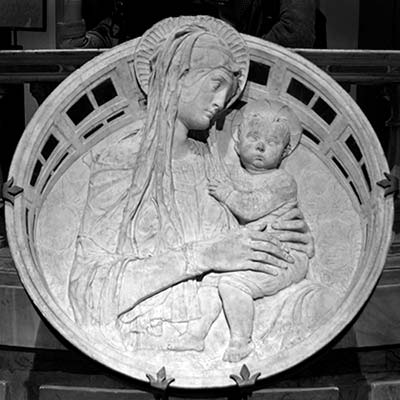
Self-Guided Tour: Start on the ground floor, which houses the church’s original statues, mainly from the facade and exterior. After descending a few steps, turn your back on the hall of statues and wrought-iron gate. You’re now face-to-face with Donatello’s Madonna and Child (c. 1458). In this round, carved relief, a slender and tender Mary gazes down at her chubby-cheeked baby. Her sad eyes say that she knows the eventual fate of her son.
At the opposite end of the room is Duccio’s Stained-Glass Window (c. 1287-1290). This splendid original window was installed for centuries above and behind the Duomo’s altar. Now the church has a copy, and art lovers can enjoy a close-up look at this masterpiece. The rose window—20 feet across—is dedicated (like the church and the city itself) to the Virgin Mary.
The work is by Siena’s most famous artist, Duccio di Buoninsegna (c. 1255-1319). Duccio combined elements from rigid Byzantine icons (Mary’s almond-shaped bubble, called a mandorla, and the full-frontal saints that flank her) with a budding sense of 3-D realism (the throne turned at a three-quarter angle to simulate depth, with angels behind).
Upstairs awaits a private audience with Duccio’s Maestà (Enthroned Virgin, 1311). The panels in this room were once part of the Duomo’s main altarpiece. Grab a seat and study one of the great pieces of medieval art. Although the former altarpiece was disassembled (and the frame was lost), most of the pieces are displayed here, with the front side (Maestà, with Mary and saints; pronounced my-STAH) at one end of the room and the back side (26 Passion panels) at the other.
Maestà was revolutionary for the time in its sheer size and opulence, and in Duccio’s budding realism, which broke standard conventions. Duccio, at the height of his powers, used every innovative arrow in his quiver. He replaced the standard gold-leaf background (symbolizing heaven) with a gold, intricately patterned curtain draped over the throne. Mary’s blue robe opens to reveal her body, and the curve of her knee suggests real anatomy beneath the robe. Baby Jesus wears a delicately transparent garment. Their faces are modeled with light—a patchwork of bright flesh and shadowy valleys, as if lit from the left (a technique Duccio likely learned from his contemporary Giotto during a visit to Florence).
The Passion of Christ: The flip side of the altarpiece featured these 26 smaller panels showing colorful scenes from the Passion of Christ.
• Our museum tour is done, but the finale of your visit—to the top of the unfinished Duomo facade—is yet to come. After corkscrewing up 140 narrow steps, you’ll reach the...
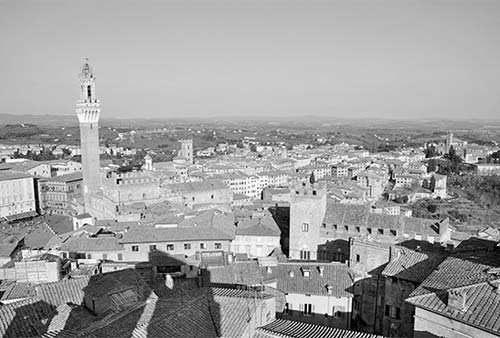
Panorama del Facciatone: Standing on the wall from this high point in the city, you’re rewarded with a stunning view of Siena...and an interesting perspective. Look toward the Duomo and remember this: To outdo Florence, Siena had planned to enlarge this cathedral by turning it into a transept and constructing an enormous nave. You’re standing on top of what would have been the new entrance facade. Columns would have stood where you see the rows of white stones in the pavement below. Had the church been completed, you’d be looking straight down the nave toward the altar.
▲Baptistery of San Giovanni (Battistero di San Giovanni)
This richly adorned and quietly tucked-away cave of art is worth a look for its cool tranquility and exquisite art, including an ornately painted vaulted ceiling. The highlight is the baptismal font created in the 1420s by a host of early Renaissance all-stars from marble, bronze, and enamel. The overall design was by Jacopo (“Fountain of Joy”) della Quercia. On the base, the first bronze panel you encounter was done by Lorenzo (“Gates of Paradise”) Ghiberti. To the right, the tiny bronze statues of Lady Faith and (farther right) the Angel of Hope were done by the great Donatello. Also on the right side, Donatello made the bronze panel depicting John the Baptist’s severed head being brought in on a platter, set in a 3-D banquet hall of receding arches. With this font, we’re witnessing the start of the Renaissance.
Cost and Hours: See “Ticket Options and Hours,” earlier; located at the back end of the Duomo, all the way down the stairs.
Crypt (Cripta)
The cathedral “crypt” is archaeologically important. The site of a small 12th-century Romanesque church, it was filled in with dirt a century after its creation to provide a foundation for the huge church that sits atop it today. Recently excavated (with modern metal supports from the 1990s), the several rediscovered rooms show off what are likely the oldest frescoes in town (well described in English).
Cost and Hours: See “Ticket Options and Hours,” earlier; located at the back end of the Duomo, partway down the stairs.
Porto del Cielo (“Gate of Heaven”) Cathedral Roof Visit
To make a 30-minute escorted (but not guided) visit to the dome’s cupola and roof, buy the Porto del Cielo combo-ticket (reservation recommended; see “Ticket Options and Hours,” earlier). You’ll climb 79 steps to see restored rooms with impressive inlaid floors and get a close-up look at the cupola. You’ll also walk briefly outside on the rooftop for a breathtaking view.
Other Cathedral-Area Sights
▲Santa Maria della Scala
This museum, opposite the Duomo, operated for centuries as a hospital, foundling home (orphanage), and pilgrim lodging. Many of those activities are visible in the 15th-century frescoes of its main hall, the Pellegrinaio. Today, the hospital and its cellars are filled with fascinating exhibits (well described in English).
Cost and Hours: €9; various combo-tickets also include Civic Museum, City Tower, and/or Pinacoteca; daily 10:00-19:00, Thu until 22:00; mid-Oct-mid-March Mon and Wed-Fri 10:00-17:00, Sat-Sun until 19:00, closed Tue; on Piazza del Duomo opposite the cathedral, +39 0577 534 571, www.santamariadellascala.com.
Visiting the Museum: It’s easy to get lost in this gigantic complex, so stay focused on the main attractions—the fancily frescoed Pellegrinaio Hall (ground floor) and the Fountain of Joy statues (one floor down). Then explore the lower floors.
From the entrance, turn right to enter what was until the 1970s Siena’s main hospital. Enter the first room on your right, the Sacristy, which displays some powerful relics preserved in golden and silver reliquaries. You may see a drop of Jesus’ blood in a vial (sangue di Christo), a nail from Jesus’ cross (sacro chiodo), a piece of the Virgin’s robe (beata Vergine), and lots of saints’ bones. They’re encased in reliquaries that befit the preciousness of these sacred bits and saintly pieces. Some of the oldest are Byzantine reliquaries made of gold, silver, and precious stones.
Continue down the hallway (browsing exhibits in side rooms) until you reach the sumptuously frescoed Pellegrinaio Hall. This was a reception hall for visiting pilgrims before being converted into a hospital room, lined with beds for the sick. The frescoes (mostly by Domenico di Bartolo, c. 1440) show medieval Siena’s innovative health care and social welfare system in action.
Now head downstairs, following signs to Fonte Gaia. These are the original statues from the Fountain of Joy (Fonte Gaia), Siena’s landmark fountain on Il Campo. Jacopo della Quercia’s early-15th-century masterpiece began crumbling, so in the 19th century, it was dismantled and plaster casts were made. (These casts formed the replica that graces Il Campo today.) Here you’ll see the badly eroded original statues and relief panels, paired alongside their casts (labeled “calco”).
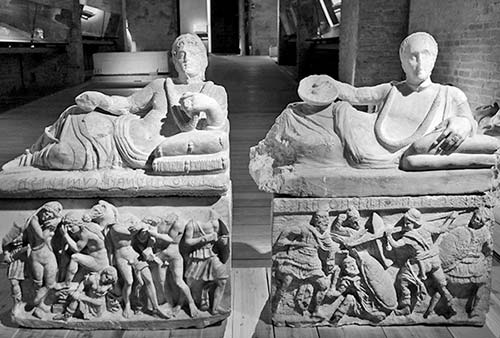
In the second basement, under the groin vaults of the Archaeological Museum (Museo Archeologico), you’re alone with piles of ancient stuff, from Bronze Age axes to Roman pottery. The highlight is a group of Etruscan artifacts excavated from tombs dating from the seventh to second century before Christ—the Etruscan heyday. You’ll see their coins, figurines, and terra-cotta funeral urns for ashes (often designed with a standard body but a personalized head). The sarcophagi show the deceased reclining atop the lid, a reminder of their lofty social status.
SAN DOMENICO AREA
Basilica of San Domenico (Basilica di San Domenico)
This huge brick church is worth a quick look. Spacious and plain (except for the colorful flags of the city’s 17 contrade), the Gothic interior fits the austere philosophy of the Dominicans and invites meditation on the thoughts and deeds of St. Catherine. Halfway up the nave on the right, find a copper bust of St. Catherine (for four centuries it contained her skull), a small case housing her thumb, and her little flagellation whip. In the chapel, surrounded with candles, you’ll see Catherine’s head (a clay mask around her skull with her actual teeth showing through) atop the altar.
Cost and Hours: Free, daily 7:00-18:30, shorter hours off-season, www.basilicacateriniana.com.
▲Sanctuary of St. Catherine (Santuario di Santa Caterina)
Step into the cool and peaceful site of Catherine’s home. Siena remembers its favorite hometown gal, a simple, unschooled but mystically devout soul who helped convince the pope to return to Rome from France, where the papacy had moved in 1309. Pilgrims have visited this place since 1464, and architects and artists have greatly embellished what was probably once a humble home (her family worked as wool dyers). You’ll see paintings throughout showing scenes from her life.
Cost and Hours: Free, daily 9:00-18:00 but chapel closes 12:30-15:00, a few downhill blocks toward the center from San Domenico—follow signs to Santuario di Santa Caterina—at Costa di Sant’Antonio 6, +39 0577 288 175.
Sleeping in Siena
Finding a room in Siena is tough during Easter or the Palio (July 2 and Aug 16). Many hotels won’t take reservations until the end of May for the Palio, and even then they might require a four-night stay. If tranquility is important to you, ask for a room that’s off the street, or consider staying outside the center.
BIGGER HOTELS IN THE CENTER
$$$ Pensione Palazzo Ravizza is elegant, friendly, and beautifully appointed, with 40 rooms and an aristocratic feel. Guests enjoy a peaceful garden set on a dramatic bluff, along with a Steinway in the upper lounge (RS%, family rooms, rooms in back overlook countryside, air-con, elevator, free parking, Via Piano dei Mantellini 34, +39 0577 280 462, www.palazzoravizza.it, bureau@palazzoravizza.it).
$$$ Hotel Palazzetto Rosso is a boutique hotel that fills a stunningly restored, 13th-century, red tower house down a side street from the main drag. The French owners have adorned the nine rooms with modern, colorful, minimalist style for a quirky combination of new and old (lavish “design” suites, no air-con but innovative floor-cooling system, elevator, Via dei Rossi 38, +39 0577 236 197, www.palazzettorosso.com, info@palazzettorosso.com).
$$$ Hotel Duomo is dated but well located, with 20 spacious but overpriced rooms (many with Duomo views—request when booking) and a picnic-friendly roof terrace (family rooms, air-con, elevator with some stairs, expensive pay parking; Via di Stalloreggi 38, +39 0577 289 088, www.hotelduomo.it, booking@hotelduomo.it, Alessandro).
B&BS IN THE CENTER
$$ Antica Residenza Cicogna is a seven-room guesthouse with a homey elegance and an ideal location. It’s warmly run by charming Elisa (who named this family property for her grandmother) and her friend Ilaria, who set out biscotti, Vin Santo, and tea for their guests in the afternoon. With artfully frescoed walls and ceilings, this is remarkably genteel for the price (air-con, no elevator, Via delle Terme 76, +39 0577 285 613, mobile +39 347 007 2888, www.anticaresidenzacicogna.it, info@anticaresidenzacicogna.it).
$$ Palazzo Masi B&B, run by friendly Alizzardo and Daniela, is just below Il Campo. They rent six pleasant, spacious, antique-furnished rooms with shared common areas on the second and third floors of a restored 13th-century building (RS%—use code “RICK,” cheaper rooms with shared bath, no elevator; breakfast provided on Il Campo; from City Hall, walk 50 yards down Casato di Sotto to #29; +39 349 600 9155, www.palazzomasi.com, info@palazzomasi.it).
$$ Il Giardino di Pantaneto, down a less-touristed street not far from Il Campo, rents 12 fresh, smartly designed rooms—many with views over a garden for slightly higher prices (family rooms, air-con, elevator, Via Pantaneto 77, +39 0577 574 910, mobile +39 335 630 6949, www.ilgiardinodipantaneto.com, info@ilgiardinodipantaneto.com).
$$ B&B Palazzo Bruchi, a bit farther down the same street, is another charming spot with four rooms overlooking a fine little courtyard, garden, and the countryside (air-con, Via Pantaneto 105, +39 351 927 7340, www.palazzobruchi.it, booking@palazzobruchi.it).
$$ B&B Alle Due Porte is a charming little establishment renting three big rooms with sweet furniture under medieval beams. The shared breakfast room is delightful (air-con, Via di Stalloreggi 51, +39 351 835 1819, www.sienatur.it, alledueportesiena@gmail.com, Mariangela).
$$ Siena Gallery B&B, run by kindhearted Elisabetta and Fabio, is tucked onto the fourth floor of a relatively modern building, offering four contemporary-yet-simple rooms (air-con, elevator, Via Banchi di Sopra 31, enter at Galleria Odeon—look for green pharmacy sign, +39 334 3997 8694, www.sienagallery.it, info@sienagallery.it).
$$ I Terzi di Siena, run by the same family as Siena Gallery B&B, houses six rooms in an 11th-century building. It’s absent an elevator but full of humble charm and noteworthy views (air-con, Via dei Termini 13, +39 339 669 9143, www.terzidisiena.it, info@terzidisiena.it).
$ Le Camerine di Silvia, a romantic hideaway perched near a grassy olive grove, rents five simple rooms in a converted 16th-century building. A small terrace with fruit trees and a private hedged garden lends itself to contemplation (cash only, view room on request, breakfast on request, fans, free parking nearby, Via Bastianini 1—ring bell marked “Conti,” +39 338 761 5052 or +39 339 123 7687, www.lecamerinedisilvia.com, info@lecamerinedisilvia.com, Conti family).
SIMPLE PLACES IN THE CENTER
$$ Piccolo Hotel Etruria, with 20 rooms, is well located, very close to Il Campo (RS%, family rooms, breakfast extra, air-con May-Oct only, elevator, at Via delle Donzelle 3, +39 0577 288 088, www.hoteletruria.com, info@hoteletruria.com, friendly Leopoldo and Lucrezia). They also rent apartments nearby.
$ Albergo Tre Donzelle, run by the same family as Piccolo Hotel Etruria, has 20 homey rooms that may be the best value in the center. Il Campo, a block away, is your terrace (RS%, cheaper rooms with shared bath, family rooms, breakfast extra, fans, no elevator; with your back to the tower, head away from Il Campo toward 2 o’clock to Via delle Donzelle 5; +39 0577 270 390, www.tredonzelle.com, info@tredonzelle.com).
$ Hotel Cannon d’Oro, a few blocks up Banchi di Sopra, is a bland, labyrinthine slumbermill renting 30 institutional rooms (RS%, family rooms, fans, elevator with some stairs, Via dei Montanini 28, +39 0577 44321, www.cannondoro.com, info@cannondoro.com, Tommaso and Rodrigo).
NEAR BASILICA OF SAN DOMENICO
$$$ Hotel Chiusarelli, with a mix of 48 classic and modern rooms in a beautiful, frescoed Neoclassical villa, is just outside the medieval town center on a busy street—ask for a quieter room in back when you reserve (RS%, family rooms, air-con, limited free parking, across from San Domenico at Viale Curtatone 15, +39 0577 280 562, www.chiusarelli.com, info@chiusarelli.com).
$$$ Hotel Villa Elda rents 11 bright and light rooms in a recently renovated villa. It’s classy, stately, and run with a stylish charm (view rooms extra, air-con, no elevator, garden and view terrace, closed Nov-March, Viale Ventiquattro Maggio 10, +39 0577 247 927, www.villaeldasiena.it, info@villaeldasiena.it).
$$ Albergo Bernini makes you part of a Sienese family in a modest, clean home with 10 traditional rooms. Giovanni, charming wife Daniela, and their daughters welcome you to their spectacular view terrace—a great spot for a glass of wine or a picnic (cheaper rooms with shared bath, family rooms, breakfast extra, fans, on the main Il Campo-San Domenico drag at Via della Sapienza 15, +39 0577 289 047, mobile +39 339 112 4113, www.albergobernini.com, info@albergobernini.com).
$ Alma Domus is a church-run hotel and a great value, featuring 49 tidy, streamlined rooms with quaint balconies, some fantastic views (ask for a room con vista), stately public rooms, and a pleasant atmosphere—though nearby church bells can be a drawback (family rooms, air-con, elevator; from San Domenico, walk downhill toward the view with the church on your right, turn left down Via Camporegio, make a U-turn down the brick steps to Via Camporegio 37; +39 0577 44177, www.hotelalmadomus.it, info@hotelalmadomus.it, Luigi).
FARTHER FROM THE CENTER
$$ Hotel Minerva is your big, impersonal, plain, efficient option. It’s got zero personality and mediocre views, but offers predictable business-class comfort in its 56 rooms. It works best for those with cars—its pay parking is reasonable, and it’s a 15-minute walk from the action (RS%, view rooms extra, air-con, elevator, just inside Porta Ovile at the north end of town at Via Garibaldi 72, +39 0577 284 474, www.albergominerva.it, info@albergominerva.it).
Eating in Siena
Sienese restaurants are a great value by Florence, Venice, or Rome standards. For pasta, a good option is pici (PEE-chee), a thick Sienese spaghetti that seems to be at the top of every menu. Reservations are wise for dinner.
IN THE OLD TOWN
Fine Dining
$$$$ Osteria le Logge caters to a fancy crowd and offers pricey Tuscan favorites with a gourmet twist, made with seasonal local ingredients. Inside you’ll enjoy a gorgeous living-room setting, and outside there’s fine seating on a pedestrian street. I find dining inside on the ground floor most romantic (Mon-Sat 12:00-15:00 & 19:00-23:00, closed Sun, two blocks off Il Campo at Via del Porrione 33, +39 0577 48013, www.osterialelogge.it, Mirko).
$$ Osteria la Sosta di Violante, beyond the tourist zone, is the best fine-dining value of my listings. You’ll share this dreamy little spot with smart locals. For over 20 years, chefs Duccio and Enrico have offered artfully executed food with no pretense—they make sure diners feel right at home. Order with a sense of adventure. Diners with this book cap their meal with complimentary Vin Santo and contucci (great indoor and outdoor seating, Mon-Sat 12:30-15:00 & 19:00-23:00, closed Sun, walk down Via Banchi di Sotto to Via Pantaneto 115, +39 0577 43774).
$$$ Grotta Santa Caterina da Bagoga, tucked down a less-touristed lane below Il Campo, offers an all-around memorable experience. The cook (whose nickname, Bagoga, means “apricot” in the dialect of his native Montalcino) cultivates a menu that’s traditional yet creative. The shareable misto Bagoga mixed-appetizer plate kicks off the meal nicely. The cave-like interior oozes with atmosphere; there are also some benches lining the stony lane outside (Tue-Sat 12:00-15:00 & 19:00-22:00, Sun 12:00-15:00 only, closed Mon, Via della Galluzza 26, +39 0577 282 208, www.ristorantebagoga.it).
$$$ Compagnia dei Vinattieri, a good bet for wine lovers, serves Tuscan dishes with a creative touch. In this dressy and sedate place, you can enjoy a romantic meal under graceful brick arches. The menu is small and accessible. Owner Marco is happy to take you down to the marvelous wine cellar (leave this book on the table for a complimentary aperitivo or digestivo, daily 12:30-15:00 & 19:30-23:00, Via delle Terme 79, +39 0577 236 568, www.vinattieri.net).
Traditional and Rustic Places
$$ Trattoria Papei is a sprawling place with festive outdoor seating under a big tent and a high-energy interior. It has a casual, rollicking family atmosphere and friendly servers dishing out generous portions of rib-stickin’ Tuscan specialties and grilled meats (daily 12:00-15:00 & 19:00-22:30, on the market square behind City Hall at Piazza del Mercato 6, +39 0577 280 894; Amedeo and Eduardo).
$$ Osteria il Carroccio, artsy and convivial, seats guests in a characteristic but tight dining room. They serve traditional “slow food” with innovative flair at affordable prices. To maintain their quality, they have only 35 seats and don’t turn the tables—reserve ahead. They give complimentary Vin Santo and contucci with this book (Thu-Tue 12:15-15:00 & 19:15-22:00, closed Wed, Casato di Sotto 32, +39 0577 41165).
$$ La Taverna di Cecco is a cozy, comfortable little eatery on a quiet back lane where grandma Olga cooks, and earnest Luca and Gianni serve. The place settings feel like nana’s finest, and the few tables outside are inviting as well. They offer a simple menu of traditional Sienese favorites along with hearty salads (daily 12:00-16:00 & 19:00-23:00, Via Cecco Angiolieri 19, +39 0577 288 518).
$$ Trattoria la Torre is an unfussy family-run casalinga (home-cooking) place, popular for its homemade pasta. Its open kitchen and 10 tables are packed under one medieval brick arch. Service is brisk and casual—the only menu is posted outside because they like to explain your options individually—and the food is simple but good. Though located just under the City Tower, it feels more like a local hangout than a tourist trap (Fri-Wed 12:00-15:00 & 19:00-22:00, closed Thu, steps below Il Campo at Via di Salicotto 7, +39 0577 287 548, Marco).
$ Osteria del Gatto is a classic neighborhood fixture thriving with townspeople and powered by a passion for good Sienese cuisine. Friendly Marco Coradeschi and his staff cook and serve daily specials with attitude. As it’s so small and popular, it can get loud (Mon-Sat 12:30-15:00 & 19:30-22:00, closed Sun, 10-minute walk from Il Campo at Via San Marco 8, look for La Vecchia Osteria sign, +39 0577 287 133).
$ Osteria il Grattacielo is a funky hole-in-the-wall with a tight yet homey interior and three big tables under a tunnel-like arch outside. Luca, who’s clearly found his niche in life, has no menu and just one solid house wine. You’ll eat what he’s cooking. Lunch is a mixed plate from the bar (be bold and point) or pasta (€10, includes wine). Dinner is three courses—antipasto bar, pasta, and a secondi—€20 for Rick Steves readers; €3 extra adds a Vin Santo-and-cookies finale (Mon-Sat 12:00-15:00 & 19:30-21:30, Sun 12:00-15:00 only, Via dei Pontani 8, +39 331 742 2835).
ON IL CAMPO
If you choose to dine on perhaps the finest town square in Italy, you’ll pay a premium, meet waiters who don’t need to hustle, and eat mediocre food. And yet, I recommend it. Survey the scene during your sightseeing day and reserve a table at the place that suits you. (All places listed are open daily for long hours.)
Dining and Drinks on the Square
$$$ Il Bandierino, with an angled view of City Hall, has solid food and no cover but a 20 percent service charge (Piazza del Campo 64, +39 0577 275 894).
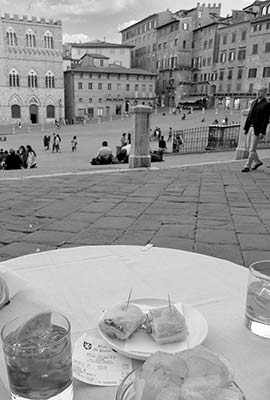
$$$ Bar il Palio is the best bar on Il Campo for a before- or after-dinner drink: It has straightforward prices, no cover, and a fine view (Piazza del Campo 47, +39 0577 282 055).
Drinks or Snacks Overlooking Il Campo
These places (all open daily until late) have skinny balconies with benches overlooking the main square for their customers.
$ Gelateria Costarella, on the corner of Via di Città and Costarella dei Barbieri, is a modern cocktail/gelato bar with a great little balcony over Il Campo—which is open to anyone ordering off their pricier menu (Via di Città 33).
$ Bar Paninoteca San Paolo has a youthful English-pub ambience and a row of stools overlooking the square. They have dozens of hearty sandwiches, big salads, and several beers on tap—it’s not traditional Italian, but it’s quick, filling, and available all day (order and pay at the counter, under the arch on Vicolo di San Paolo, +39 0577 226 622).
$ Key Largo Bar has a nondescript interior, but two long, upper-story benches in the corner offer a wonderful secret perch. Buy your drink or snack at the bar, climb upstairs, and open the ancient door (no cover and no extra charge to sit on the balcony). Enjoy stretching out, and try to imagine how, during the Palio, three layers of spectators cram into this space—notice the iron railing used to plaster the top row of sardines up against the wall. Suddenly you’re picturing Palio ponies zipping wildly around the square’s notoriously dangerous corner (closed Mon, on the corner at Via Rinaldini 17, +39 0577 236 339).
$ Salumeria il Cencio is a simple rustic sandwich shop with a tiny balcony upstairs (enter through back), where, for the takeout price, you can munch your humble meal (daily, near Key Largo Bar at the corner of Il Campo and Via del Porrione, +39 0577 283 007).
DINING WITH LOCALS, AWAY FROM THE CENTER
A pleasant 15-minute stroll north of Il Campo, Via Camollia—a continuation of the chic Via Banchi di Sopra and Via dei Montanini shopping streets—offers good eating options.
$$ Osteria il Vinaio—also called Bobbe e Davide for its owners—is my favorite in this area, at #167. Festooned with neighborhood memorabilia on the walls, it’s an informal place—bright and fun—offering simple dishes at good prices from an inviting menu (Mon-Sat 19:00-22:00, closed Sun, +39 0577 49615).
$$ Trattoria Fonte Giusta, at #102, is a big, family-friendly eatery known for its grilled meat dishes (plenty of streetside tables, daily 12:00-23:00, +39 0577 40506).
EATING CHEAPLY IN THE CENTER
Consorzio Agrario di Siena gourmet market is a great place to assemble a cheap yet top-quality meal (salad and smoothie bar at the front, bakery/pizzeria at the back). Take a stool at the excellent pizzeria in the rear, or find a spot on the big comfy stone bench across the way on Piazza Salimbeni (Mon-Sat 8:00-20:00, Sun from 9:30, just off Piazza Matteotti, facing Piazza Salimbeni at Via Pianigiani 9).
DESSERTS AND TREATS
Siena’s claim to caloric fame is its panforte, a rich, chewy concoction of nuts, honey, and candied fruits that impresses even fruitcake haters. There are a few varieties: Margherita, dusted in powdered sugar, is fruitier, while panpepato has a spicy, peppery crust. Locals also enjoy chewy, super-sweet, white macaroon-and-almond cookies called ricciarelli.
Nannini is the top-end, classic café and pastry shop every grandmother has fond memories of. It’s ideally located in the center of the evening strolling scene a few blocks off Il Campo. For a special dessert or a sweet treat any time of day, stop by. The local specialties are around back at the far end of the bar (Mon-Sat 7:30-21:00, Sun until 19:00, aperitivo happy hour 18:00 until closing, Banchi di Sopra 24). There’s also a branch at Piazza Matteotti 15.
Siena Connections
Siena has sparse train connections but is a handy hub for buses to the hill towns. For most, Florence is the gateway to Siena. The bus and train take about the same amount of time, but Siena’s bus station is more convenient and central than its train station.
BY TRAIN
Siena’s train station is at the edge of town. For details on getting between the town center and the station, see here.
From Siena by Train to: Florence (direct trains hourly, 1.5 hours), Pisa (2/hour, 1.5 hours, most change at Empoli), Lucca (approximately hourly, requires change either in Florence or in Pisa and Empoli, 2.5-3 hours), Assisi (10/day, about 4 hours, most involve 2 changes, bus is faster), Rome (1-2/hour, 3-4 hours, 1 change), Orvieto (12/day, 2.5 hours, change in Chiusi). Train info: Trenitalia.com.
BY BUS
Siena’s intercity buses are operated by two companies. For each one, buses may use the handy-to-downtown stop at Piazza Gramsci (sometimes labeled Via Tozzi on schedules), or they may stop at the more distant train station (when possible, opt for Piazza Gramsci). The fastest buses are marked rapida.
Autolinee Toscane (AT) Buses: This company serves destinations throughout Tuscany (for timetables, see www.at-bus.it). Buy tickets at an Autolinee Toscane office, either inside the train station or in the underground passageway beneath Piazza Gramsci—look for stairwells, or take the elevator near the bus stops. You can also buy tickets from machines. Destinations include Florence (roughly 2/hour—fewer off-season, take the 1.5-hour rapida/via superstrada bus—ordinaria buses take longer; tickets available at tobacco shops/tabacchi; generally leaves from Piazza Gramsci as well as train station), San Gimignano (8/day direct, on Sun must change in Poggibonsi, 1.5 hours, from Piazza Gramsci), Volterra (4/day Mon-Sat, no buses on Sun, 2 hours, change in Colle di Val d’Elsa, leaves from Piazza Gramsci), Montepulciano (6-7/day, none on Sun, 1.5 hours, from train station), Pienza (6/day, none on Sun, 1.5 hours, from train station), Montalcino (6/day Mon-Sat, 4/day Sun, 1.5 hours, from train station or Piazza del Sale).
Flixbus Buses: This company serves destinations beyond Tuscany. Tickets can only be booked on their website (https://global.flixbus.com; you’ll be emailed a QR code that you’ll show as you board). Destinations include Rome (13/day, 3 hours, arrives at Rome’s Tiburtina station on Metro line B with easy connections to the central Termini train station), Naples (6/day direct, 5.5 hours, one overnight bus), Milan (6-8/day direct, 5-7 hours, arrives at Milan’s Lampugnano Metro station for the red line 1), Assisi (3/day direct, 2 hours, departs from Siena train station). To reach the town center of Pisa, the train is better (described earlier).