NEAR VENICE
Padua • Vicenza • Verona
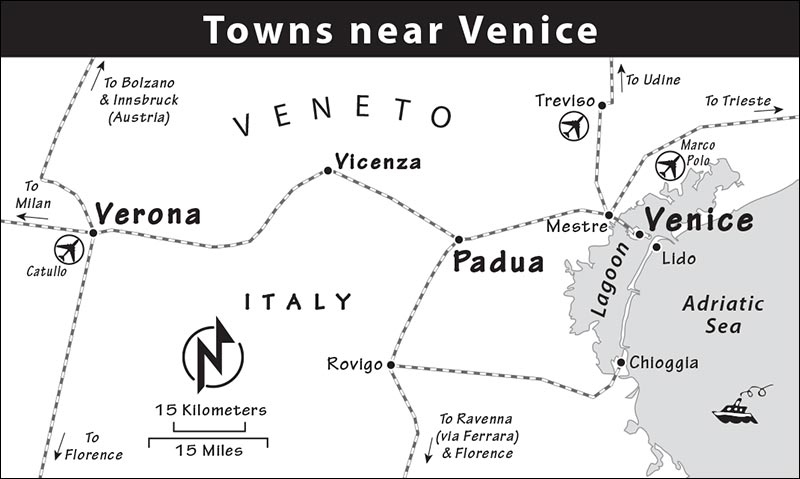
Venice is just one of many towns in the Italian region of Veneto (VEHN-eh-toh), but few visitors venture off the lagoon. That’s a shame, as there’s much to see within a very short hop of Venice. The trip from Venice westward to Milan is a route strewn with temptations: the Dolomite peaks, Italy’s famous lakes, and—closer to Venice—the important and worthwhile towns of Padua, Vicenza, and Verona.
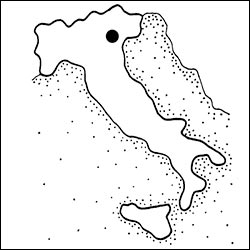
If you can’t make it to all three, pick the one that interests you most. Art lovers will want to head to Padua to see Giotto’s celebrated Scrovegni Chapel. History buffs should see Verona’s impressive Roman ruins. Verona is also the pick for star-crossed lovers retracing Romeo and Juliet’s steps. Architecture fans could consider a quick stop in Palladio-designed Vicenza, located about halfway between Padua and Verona.
If you’re Padua-bound, remember that you need to reserve ahead to see the Scrovegni Chapel. Don’t bother visiting Vicenza on a Monday, when many of the top sights are closed; in Verona, the Roman Arena is open only in the afternoon on Mondays.
Spending a day at one of these towns as a side trip from Venice or town-hopping between Venice and Milan is exciting and efficient. Padua, Verona, and Vicenza are on the same train line. Connected by at least two trains per hour, they’re easy to visit.
Train Tip: When day-tripping here, look on the Trenitalia schedule for economical RV trains, which are nearly as fast as the more expensive Freccia trains.
Padua
This easily appreciated city is a fine destination on its own and a convenient base for day trips all around the region. Nicknamed “the brain of Veneto,” Padua (Padova in Italian) is home to the prestigious university (founded in 1222) that hosted Galileo, Copernicus, Dante, and Petrarch. Pilgrims know Padua as the home of the Basilica of St. Anthony, where the reverent assemble to touch his tomb and ogle his remarkably intact lower jaw, tongue, and vocal cords. And lovers of early Renaissance art come here to make a pilgrimage of their own: to gaze at the remarkable frescoes by Giotto in the Scrovegni Chapel. But despite the fact that Padua’s museums and churches hold their own in Italy’s artistic big league, its hotels are reasonably priced, and the city doesn’t feel touristy. Padua’s old town center is elegantly arcaded, filled with students, and sprinkled with surprises, including some of Italy’s most inviting squares for lingering over an aperitivo as the sun slowly dips low in the sky.
From Padua, architecture fans can ride by train (20-30 minutes) to Vicenza and its celebrated Palladian buildings. And Venice is just a half-hour away in the other direction.
PLANNING YOUR TIME: PADUA IN A DAY
Day-trippers can do a quick but enjoyable blitz of Padua—including a visit to the Scrovegni Chapel—in as little as six hours. Trains from Venice are cheap, take 30 minutes, and run frequently. Once in Padua, everything is a 10-minute walk or a quick tram ride apart.
To see Giotto’s Scrovegni Chapel, you need to make a reservation; your entry time will dictate the order of your sightseeing (see “Reservations” on here). When planning your day, also consider these factors: The station has a reliable baggage-check desk; the open-air markets are vibrant in the morning; student life is best at the university late in the day; and the Basilica of St. Anthony is open all day, but the reliquary chapel closes midday.
Ideally, I’d do it this way: 9:00—market action and sightseeing in town center, 11:00—Basilica of St. Anthony, 13:00—lunch, 15:00—Scrovegni Chapel tour. Then, cap off your day with a spritz on the main square.
Orientation to Padua
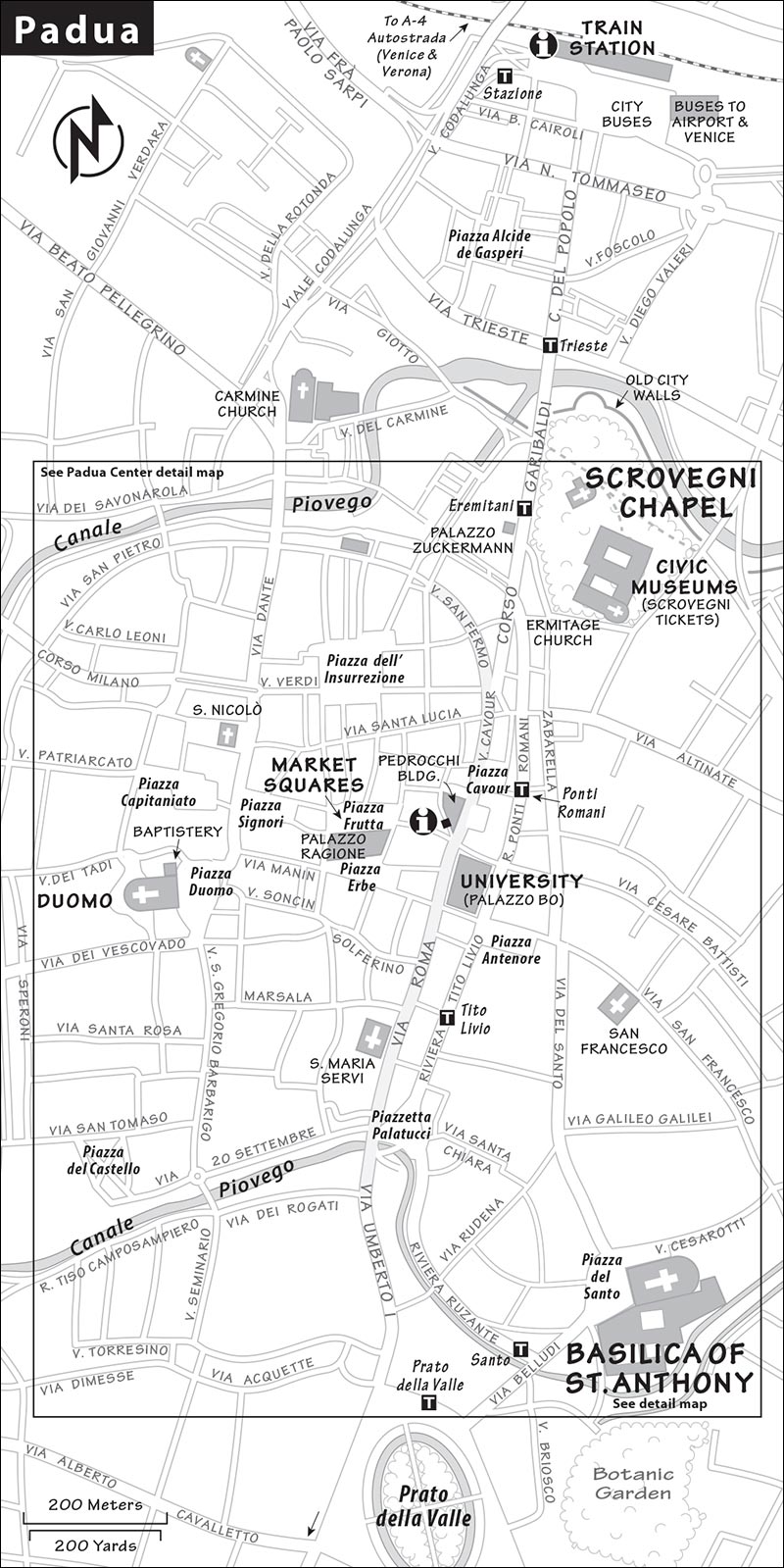
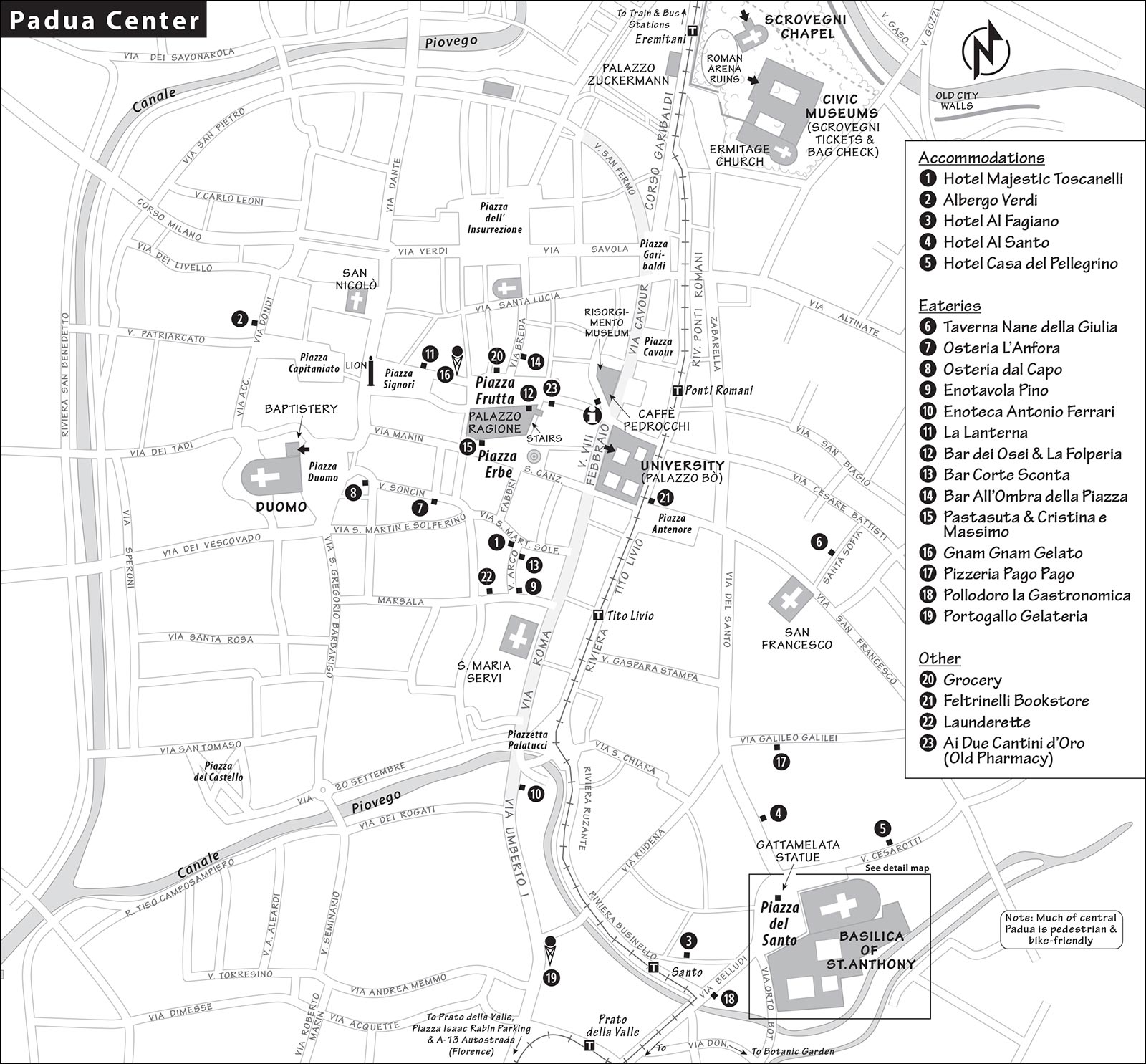
Padua’s main tourist sights lie on a north-south axis through the heart of the city, from the train station to Scrovegni Chapel to the market squares (the center of town) to the Basilica of St. Anthony. It’s roughly a 10-minute walk between each of these sights, or about 30 minutes from end to end. Padua’s wonderful single tram line makes lacing things together quick and easy (see “Getting Around Padua,” later).
TOURIST INFORMATION
Padua has two TIs: in the center (in the alley behind Caffè Pedrocchi at Vicolo Cappellatto Pedrocchi 9, Mon-Sat 9:00-19:00, Sun 10:00-16:00) and at the train station (same hours, +39 049 520 7415, www.turismopadova.it). A seasonal TI kiosk sometimes sets up in the piazza in front of the Basilica of St. Anthony.
Sightseeing Card: The Urbs Picta Card includes entry to eight sights—including the recommended Scrovegni Chapel, Palazzo della Ragione, the Baptistery of the Duomo, and the Oratory of San Giorgio—plus unlimited tram rides (€28/48 hours, €35/72 hours; buy at either TI, the Scrovegni Chapel, or online at the chapel website, where you can make a chapel reservation—www.cappelladegliscrovegni.it).
ARRIVAL IN PADUA
By Train: The efficient station is a user-friendly shopping mall, including a Despar supermarket (long hours daily). Along track 1, on the far right as you face the tracks, are pay WCs and baggage storage (daily 6:30-20:00).
To get downtown, simply hop on Padua’s handy tram (for ticket info, see “Getting Around Padua,” later). Leaving the station, the tram stop is 100 yards to the right at the foot of the bridge (direction: Capolinea Sud). Note that thieves like this tram when it comes to picking tourists’ pockets. A taxi into town (a good option after dark) costs about €12-15.
By Bus: Buses arrive at platforms 100 yards east of the train station. Buses for Venice’s Piazzale Roma and Marco Polo Airport use these platforms. (Buses directly in front of the station are in-city only.)
By Car: Padua has a smart park-and-ride system near each end of the tram line, providing cheap parking and convenient access to town using the tram. The north lot is at the Pontevigodarzere stop, the south lot at the Capolinea Guizza stop. At either lot, buy parking tickets from machines or at the nearby café (€1 for all day and free overnight).
For more costly parking closer to town, try Padova Centro Park (near the train station and the Scrovegni Chapel, €16/24 hours) or Piazza Isaac Rabin (near Prato della Valle, €18/24 hours).
HELPFUL HINTS
Pronunciation: You say Padua (PAD-joo-wah), they say Padova (PAH-doh-vah). The city’s top sight, Scrovegni Chapel, is pronounced skroh-VEHN-yee.
Bookstore: Feltrinelli, with books in English, is one block from the main university building (daily 9:00-19:30, Via San Francesco 7, +39 199 151 173).
Launderette: Self-service Lavami is central, tiny, and modern with English instructions on flip cards (daily 7:00-21:15, Via Marsala 22 near intersection with Via dell’Arco, +39 049 876 4532).
Local Guide: Charming and helpful Cristina Pernechèle is a great teacher who is passionate about her hometown (€150/half-day, mobile +39 338 495 5453, cristina@pernechele.eu). If she’s booked, she can suggest other good local guides.
GETTING AROUND PADUA
Ignore the city buses; pretend there is only the tram and rely on it. There’s just one line, which efficiently and without stress connects everything you care about.
With an Urbs Picta Card (see “Sightseeing Card,” earlier) you get unlimited tram use; just show the card upon request. Otherwise, pay onboard by tapping your contactless credit card at the reader at mid-tram, or buy tickets from shops inside the train station or from the low brown rectangular booth in front of the station (with machines and a staffed window) and validate on board. The €1.30 single ticket is good for 75 minutes (€3.80 biglietto giornaliero good for one calendar day; departs every 8 minutes during the day Mon-Sat, every 20 minutes evenings and Sun). There are ticket machines at some stops, but they sell only single tickets and don’t give change. The rubber-wheeled trams run on a single rail.
Before boarding, note the tram direction on posted schedules and above the front window (Pontevigodarzere is northbound, Capolinea Sud is southbound). Stops that matter to tourists include Stazione FS (train and bus stations), Eremitani (Scrovegni Chapel), Ponti Romani (old town center, market squares, university), Tito Livio (ghetto, old town center, Hotel Majestic Toscanelli), and Santo (Basilica of St. Anthony and neighborhood hotels).
Padua’s hop-on, hop-off tour buses are not worth the time or money.
Sights in Padua
▲Baptistery of the Duomo (Battistero del Duomo)
SCROVEGNI CHAPEL AND CIVIC MUSEUMS
▲▲▲Scrovegni Chapel (Cappella degli Scrovegni)
Civic Museums (Musei Civici agli Eremitani)
▲▲▲Basilica of St. Anthony (Basilica di Sant’Antonio)
▲Botanic Garden (Orto Botanico)
IN THE CENTER
Padua’s two main sights, the Scrovegni Chapel and the Basilica of St. Anthony, are, respectively, at the north and south ends of the city center. But Padua’s atmospheric, cobbled core—with bustling markets, vibrant student life, and inviting sun- and café-speckled piazzas—is its own ▲▲▲ attraction. You could simply stroll the area aimlessly or seek out some of the following spots.
▲▲Market Squares
The market squares Piazza delle Erbe and Piazza della Frutta, separated by the stately Palazzo della Ragione, are busy each morning and all day Saturday (Mon-Fri roughly 8:00-13:00, Sat 8:00-19:00 but a bit quieter in the afternoon, closed Sun). Second only to the produce market in Italy’s gastronomic capital of Bologna, this market has been renowned for centuries for its selection of fresh herbs, fruits, and vegetables. The presentation is an art in itself. As you wander, appreciate the local passion for good food: Residents can tell the month by the seasonal selections, and merchants share recipe tips with shoppers.
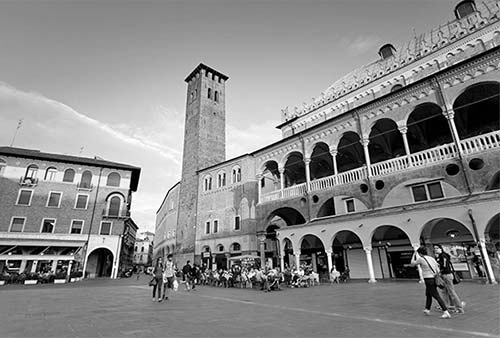
Don’t miss the indoor market zone on the ground floor of the Palazzo della Ragione. Browsing through this H-shaped arcade—where you’ll find butchers, salumerie (delicatessens), cheese shops, bakeries, and fishmongers—is a sensuous experience. For centuries, this was a market for luxury items (furs, fine fabrics, silver, and gold—notice the decorative iron gates used to lock it up each evening). Then, the devastating 1797 fall of the Venetian Republic to the French marked the end of good times, and with no market for luxury items, the arcade was used to sell perishables—meat and cheese—out of the sun.
The Renaissance building with the flags overlooking Piazza delle Erbe is the Palazzo del Podestà. On the wing to the right, notice the 1930s-era panel celebrating Mussolini’s pathetic little empire—Libya, Albania, Somalia, and Ethiopia. Immediately south of Piazza delle Erbe is the former Jewish quarter, a charming zone of arcaded lanes. Padua has some 15 miles of such lanes protected from sun and rain, giving the city an extra boost of elegance.
Students gather in these squares after the markets have closed, spilling out of colorful bars and cafés, drinks in hand (see sidebar). Bars and food stalls offer plenty of refreshments and fun food. Pizza by the slice is dirt-cheap.
On Piazza della Frutta, look for the recommended sandwich stand, Bar dei Osei, and a neighboring squid stand that sets up in the late afternoon (see “Eating in Padua,” later). Just a few steps away from these is a classic old pharmacy that dates to 1841: The licorice-perfumed Ai Due Cantini d’Oro, which stocks retail items like it did before World War II, sells odd foods and specialty items for every dietary need (closed Mon, Piazza della Frutta 46).
▲Palazzo della Ragione
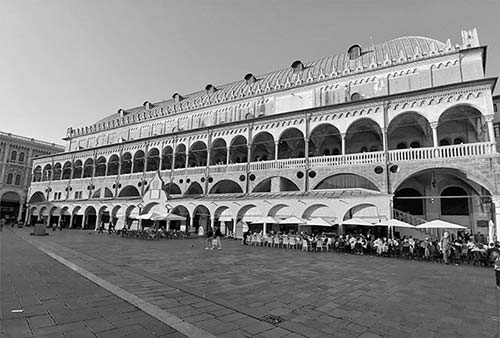
Looming over Padua’s two big central market squares (Piazza delle Erbe and Piazza della Frutta), this grand 13th-century palazzo—commonly called il Salone (the great hall)—once held the medieval law courts.
Cost and Hours: €7; Tue-Sun 9:00-19:00, Nov-Jan until 18:00, closed Mon year-round; Ponti Romani tram stop, +39 049 820 5006, www.padovacultura.it.
Visiting the Palazzo: Facing the palazzo from Piazza delle Erbe, climb the grand staircase on the building’s far right side, buy your ticket, and go to the loggia overlooking Piazza delle Erbe. Enjoy the view and the fine vaulting that was painted in the 1300s to celebrate the wealth of the independent Paduan city-state (one of many little states in “the land of a thousand bell towers” that ultimately formed Italy).
Step into the great hall and take it all in. This huge hall—265 feet by 90 feet—was at one time adorned with frescoes by Giotto and his workshop. After a fire in 1420 destroyed Giotto’s work, the walls were repainted with 333 frescoes depicting the signs of the zodiac, labors of the month, symbols representing characteristics of people born under each sign, and, finally, figures of the 12 apostles and favorite saints. Depicting a range of occupations, pursuits, and interests, the frescoes provide rare glimpses into contemporary European life in the early 15th century—from tanners stretching hides to aristocrats playing lawn tennis.
Each early evening, before dinner, students enliven Padua by enjoying a convivial drink in their favorite places. Piazza dei Signori is trendier, with people of all ages, while the scene on Piazza delle Erbe is more bohemian and alternative. Or you could sit in front of the university, nurse your drink, and watch the graduates get roasted with their crazy gangs of friends.
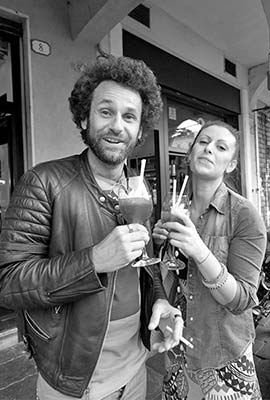
The drink of choice is a spritz, an aperitif generally made with Campari (a red liqueur infused with bitter herbs), white wine or prosecco, and sparkling water, and garnished with a blood-orange wedge. Another version is a sweeter and lighter spritz made with Aperol (an orange-flavored liqueur), which has a lower alcohol content and is not as bitter as the heavier Campari spritz. Padovans brag that Aperol was created here in 1919.
Grab a table and be part of the scene. This is a classic opportunity to enjoy a real discussion with smart, English-speaking students who see tourists not as pests, but as interesting people from far away. For an instant conversation starter, ask about the current political situation in Italy, the right-wing party’s policy on immigrants, or the cultural differences between Italy’s North and South. A question they might ask you: “What the hell is the electoral college?”
The enormous hull-shaped roof you see overhead was installed after the fire, and the partitions that once divided the space were removed, creating what was the largest vaulted room in 15th-century Europe.
As big as the hall is, it is almost dwarfed at one end by a gigantic, very anatomically correct wooden horse. It’s said to be a copy of the bronze equestrian statue by Donatello that stands outside the Basilica of St. Anthony (see here).
At the other end of the hall, find the black “Stone of Shame,” on which debtors sat in punishment during the Middle Ages. St. Anthony reportedly introduced this public humiliation in 1230 as a compassionate alternative to prison. Instead of doing jail time, debtors sat upon this stone, surrendered their possessions, and denounced themselves publicly before being exiled from the city.
Also in the hall is a contemporary Foucault pendulum that demonstrates the rotation of the earth (well described in English).
Piazza dei Signori
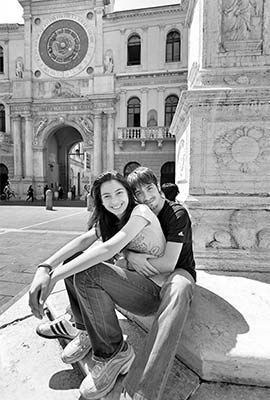
Just a block away from Palazzo della Ragione, this square is a busy clothing market in the morning and the most popular gathering place in the evening for students out for a drink. The Palazzo del Capitanio closes off one end of the square, where a circa-1344 clock decorates a tower dedicated to its upkeep. It took three floors of the tower to house the clock mechanism, and the clock caretaker lived on the remaining two floors.
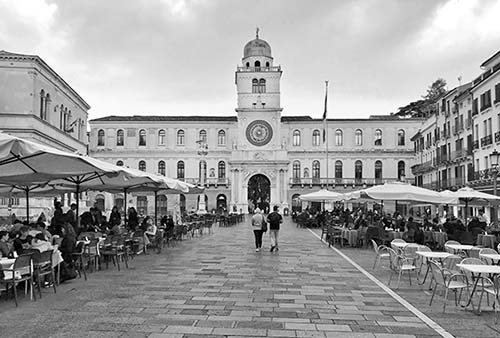
Sitting atop a column near the tower, the aggressive lion with unfurled wings, symbol of Venice and St. Mark, is a reminder that Padua was dominated by the Venetian Republic for nearly 400 years (1405-1797).
▲Caffè Pedrocchi
The white-columned, Neoclassical Pedrocchi building is much more than just a café on the ground floor. A complex of meeting rooms and entertainment venues, it stirs the Italian soul (or the patriotic Italian soul, at least). Built in 1831 during the period of Austrian rule, Caffè Pedrocchi was inaugurated for the fourth Italian Congress of Scientists, which convened during the mid-19th century to stir up nationalistic fervor as Italy struggled to unite as a single country. In 1848, this symbol of patriotic hope was the target (no surprise) of those repressing a student uprising that was being plotted here. (For more on the story of Italy’s unification, visit the upstairs Museum of the Risorgimento; see the next listing.)
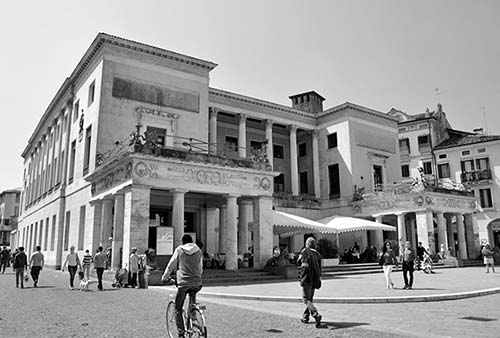
Cost and Hours: Café interior free, daily 8:00-23:00, across from Via VIII Febbraio near Ponti Romani tram stop, +39 049 878 1231, www.caffepedrocchi.it.
Visiting the Café: Each of the café’s three dining rooms is decorated and furnished in a different color (denoted by the hue of velvet on the chairs): red, white, or green—representing the colors of the Italian flag. In the outer, unheated Sala Verde (Green Room), people are welcome to sit and relax without ordering anything or having to pay. This is where Italian gentlemen read their newspapers and gather with friends to chat about the old days. In the Sala Rossa (Red Room), the clock over the bar is flanked by marble reliefs of morning and night, a reminder that, back in the 19th century, the room was open 24 hours a day. In the rooms on either side of the bar, maps of the hemispheres with south up top reflect the unconventional spirit of the place. In the Sala Bianca (White Room), where a student revolutionary in that ill-fated 1848 uprising was killed, you can see a bullet hole in the wall (framed in tarnished silver).
The menu offers teahouse fare, including sandwiches and ice-cream sundaes, a variety of breakfast combos, and the writer Stendhal’s beloved zabaglione, a creamy custard made with Marsala wine. A shiny new bar in the center of the building has a pastry counter and serves sandwiches at outdoor tables. Remember that in Italy, you can order a basic coffee standing up at the bar of any place, no matter how fancy, and pay the same low, government-regulated price.
Museum of the Risorgimento
This small museum (above Caffè Pedrocchi) traces Padua’s role in Italian history, from the downfall of the Venetian Republic (1797) to the founding of the Republic of Italy (1946). Exhibits include uniforms, medals, weaponry, old artillery, and fascist propaganda posters—but without English descriptions, this museum is of most interest to passionate students of Italian history.
Cost and Hours: €4; Tue-Sun 9:30-12:30 & 15:30-18:00, closed Mon; enter up staircase on the side of café farthest from Piazza Cavour, +39 049 878 1231.
▲University of Padua
The main building of this prestigious university, known as Palazzo Bo, is just down the street from Caffè Pedrocchi. Founded in 1222, it’s one of the first, greatest, and most progressive universities in Europe. Back when the Church controlled university curricula, a group of professors and students broke free from the University of Bologna to create this liberal school, which would be independent of Catholic constraints and accessible to people of other faiths.
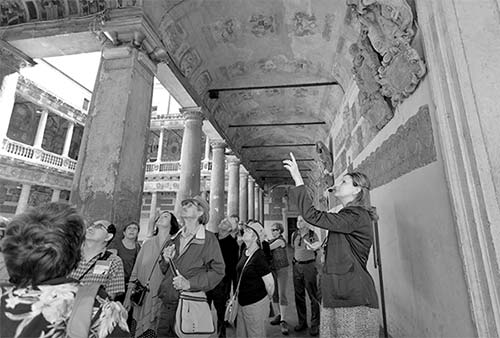
A haven for free thought, the university attracted intellectuals from all over Europe, including the great astronomer Copernicus, who realized here that the universe didn’t revolve around him. And Galileo—notorious for disagreeing with the Church’s views on science—called his 18 years on the faculty here the best of his life.
Anyone can stroll through its two courtyards for free. Tours are given in English several times a day for a deeper look at Palazzo Bo and the famed Anatomy Theater.
Cost and Hours: Grounds—free, closed Sun; University and Anatomy Theater tour—€7 (English tours Mon-Sat generally at 12:00, 14:30, and 16:30, fewer tours off-season, no tours on Sun, maximum 25 people per tour); Via VIII Febbraio 7 (Ponti Romani tram stop), +39 049 827 3939, www.unipd.it/en/guidedtours. Confirm tour times and availability online or by phone, or stop by the ticket desk (in passage between two courtyards).
Visiting the Courtyards on Your Own: You can poke into two of the university’s courtyards on any day but Sunday. Find the entrance on Via VIII Febbraio under the “Gymnasium” inscription (30 yards from Caffè Pedrocchi, facing City Hall). You’ll pop into a 16th-century courtyard, the school’s historic core. It’s littered with the coats of arms of important faculty and leaders of the university over the ages. Classrooms, which open onto the square, are still used. Today, students gather here, surrounded by memories of illustrious alumni, including the first woman in the world to receive a university degree (in 1678).
A passageway leads from here to an adjacent second courtyard, dating from c. 1938 (the New Courtyard). The relief in Fascist style above the arches celebrates the fighting spirit of students of the Paduan goliardia—nowadays something akin to a fraternity—which got its start with the 1848 student revolt against Austrian occupation. Off this courtyard, notice the richly decorated stairway, frescoed in the 1930s with themes celebrating art, science, and the pursuit of knowledge.
The tiny Da Mario Bar, tucked into a corner of the second courtyard, displays photos and artifacts of goliardia rituals and university life (run by octogenerian Mario, famed for his strong spritzes, open Mon-Fri only).
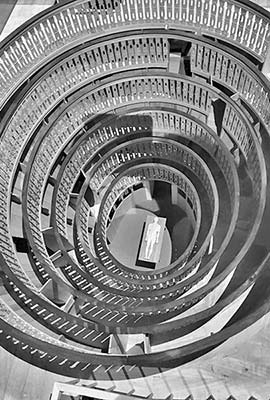
University and Anatomy Theater Tour: Students give 45-minute tours of the university that include a look at Europe’s first great Anatomy Theater (from 1595). Despite the Church’s strict ban on autopsies, more than 300 students would pack this theater to watch professors dissect human cadavers (the bodies of criminals from another town). This had to be done in a “don’t ask, don’t tell” kind of way, because the Roman Catholic Church only started allowing the teaching of anatomy through dissection in the late 1800s.
With 60,000 students, Padua’s university always seems to be hosting graduation ceremonies. There’s a constant trickle of happy grads and their friends and families celebrating the big event.
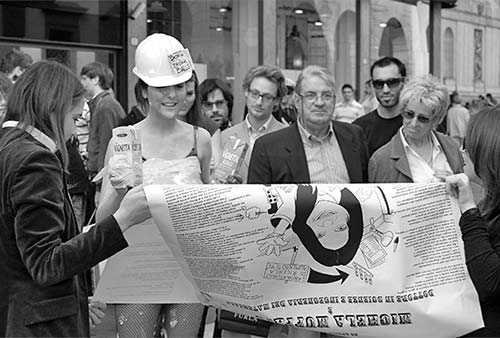
During the school year, every 20 minutes or so, a student steps into a formal room (upstairs, above the university courtyard) to officially meet with the leading professors of his or her faculty. When they’re finished, the students are given a green laurel wreath. They pose for ceremonial group photos and family snapshots. It’s a sweet scene. Then, craziness takes over.
The new graduates replace their somber clothing with raunchy outfits, as gangs of friends gather around them on Via VIII Febbraio, the street in front of the university. The roast begins. The gang rolls out a giant butcher-paper poster with a generally obscene caricature of the student and a litany of This Is Your Life photos and stories. The new grad, subject to various embarrassing pranks, reads the funny statements out loud. The poster is then taped to the university wall for all to see. (Find the plastic panels to the right of the main entry, facing Via VIII Febbraio. Graduation posters are allowed to stay there for 24 hours. The panels are emptied each morning, but by nighttime a new set of posters is affixed to the plastic shields.)
During the roast, the friends sing the catchy but obscene local university anthem, reminding their newly esteemed friend not to get too huffy: Dottore, dottore, dottore del buso del cul. Vaffancul, vaffancul (loosely translated: “Doctor, doctor. You’re just a doctor of the a-hole...go f-off, go f-off”). After you’ve heard this song (with its fanfare and oom-pah-pah catchiness) and have seen all the good-natured fun, you can’t stop singing it.
The crazy show is usually staged late in the afternoon. Outdoor café tables afford great seats to enjoy the spectacle.
▲Baptistery of the Duomo (Battistero del Duomo)
This richly frescoed little building (next to Padua’s skippable Duomo) was once the private chapel of Padua’s ruling family, the Carraresi. In the 1370s, they hired Florentine artist Giusto de’ Menabuoi to do a little interior redecoration. Later, in 1405, Venice conquered Padua and deposed the Carraresi; the building was turned into a baptistery, but the original decorations survived.
Cost and Hours: €4, Mon 13:30-18:00, Tue-Sun 10:00-13:30 & 14:00-18:00, on Piazza Duomo.
Visiting the Baptistery: The Carraresis intended their private chapel to be a family mausoleum, and accordingly summoned the artist Giusto to create a fresco cycle fitting to that purpose. Almighty Christ, the Pantocrator, is in majesty in the cupola, while approachable Mary and the multitude of saints and angels provide the devout with access to God. In the drum below are scenes from Genesis, including the creation of Eve, who is dramatically being pulled by God from Adam’s side. From those scenes of Creation, a narrative cycle of Old and New Testament scenes spills across the walls. The four evangelists (Matthew, Mark, Luke, and John) with their books and symbols fill the corners. A vivid Crucifixion scene faces a gorgeous Annunciation. And the altar niche features a dim, blue-toned, literal Apocalypse from the book of Revelation.
The Baptistery was created 70 years after Giotto, and it seems relatively conservative compared to Giotto’s Scrovegni Chapel. But even if tentative, Giusto clearly picked up some lessons from Giotto about vivid color, handling perspective, and creating fully formed human figures.
SCROVEGNI CHAPEL AND CIVIC MUSEUMS
Wallpapered with Giotto’s beautifully preserved cycle of nearly 40 frescoes, the glorious Scrovegni Chapel holds scenes depicting the lives of Jesus and Mary. You must make reservations in advance to see the chapel. To protect the paintings from excess humidity, only 25 people are allowed in the chapel at a time. Every 20 minutes, a new group is admitted for a 15-minute video presentation in an anteroom, followed by 15 minutes in the chapel.
The chapel is within the Eremitani museum complex (at Piazza Eremitani 8), which also includes Padua’s Civic Museums (collections of archaeological, medieval, and modern art). With a Scrovegni Chapel ticket you can also visit those museums.
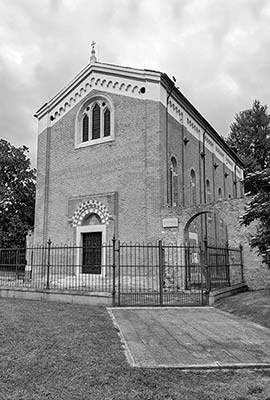
Cost and Hours: €14, covers the Scrovegni Chapel and Civic Museums. Reserve a timed-entry slot when you buy your ticket—see “Reservations,” below. The chapel is open daily 9:00-19:00; the museums are open Tue-Sun 9:00-19:00, closed Mon. Special evening visits to the chapel are available in peak season (see below).
Although details of his life are extremely sketchy, we know that the 12-year-old shepherd Giotto was discovered painting pictures of his father’s sheep on rock slabs. He grew to become the wealthiest and most famous painter of his day. His achievement is especially remarkable because painters at that time weren’t considered anything more than craftsmen—and weren’t expected to be innovators.
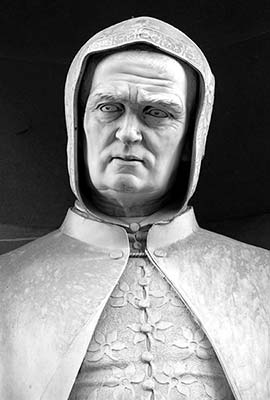
After making a name for himself by painting frescoes of the life of St. Francis in Assisi, the Florentine tackled the Scrovegni Chapel (c. 1303-1305). At age 35, he was at the height of his powers. His scenes were more realistic and human than anything that had been done for a thousand years. Giotto didn’t learn technique by dissecting corpses or studying the mathematics of 3-D perspective; he had innate talent. And his personality shines through in the humanity of his art.
The Scrovegni frescoes break ground by introducing nature—rocks, trees, animals—as a backdrop for religious scenes. Giotto’s people, with their voluminous, deeply creased robes, are as sturdy and massive as Greek statues, throwbacks to the Byzantine icon art of the Middle Ages. But these figures exude stage presence. Their gestures are simple but expressive: A head tilted down says dejection, an arm flung out indicates grief, clasped hands indicate hope. Giotto created his figures not just by drawing outlines and filling them in with single colors; he filled the outlines in with subtle patchworks of lighter and darker shades, and in doing so pioneered modern modeling techniques. Giotto’s storytelling style is straightforward, and anyone with knowledge of the episodes of Jesus’ life can read the chapel like a comic book.
The Scrovegni represents a turning point in European art and culture—away from scenes of heaven and toward a more down-to-earth, human-centered view.
Information: +39 049 201 0020, www.cappelladegliscrovegni.it.
Reservations Required: To enter the chapel, you must make a reservation at least 24 hours in advance (same-day reservations are not possible). Demand is high, so reserve the day and time you want well in advance online (or by phone). Remember that you can get the Urbs Picta Card, which includes the Scrovegni plus other Padua sights and the tram. Buy the card from the chapel website and make your chapel reservation at the same time.
Unfortunate souls arriving in Padua without a Scrovegni reservation can sometimes buy a same-day ticket at the chapel ticket office, but don’t count on it.
Evening Visit: Special 20-minute evening visits to the chapel are available for €8 (April-Oct daily 19:00-22:00). To book this online, choose “Giotto Under the Stars.”
Helpful Hint: If you packed binoculars, bring them along for a better—and more comfortable—view of the uppermost frescoes.
Getting There: From either the town center or the train station, it’s a 10-minute walk, or a quick tram ride to the Eremitani stop.
Getting In: The entrance to the chapel is through the Eremitani building, where you’ll find the ticket office and the free and mandatory bag check. Though you’re instructed to pick up your tickets at the ticket office one hour before your visit, in practice, 30 minutes is enough to weather any commotion at the desk. Present your confirmation number at the ticket desk, pick up your ticket, and check any bags or purses.
While waiting for your reserved time, read the chapel description below, since you’ll only have a short time in the chapel itself.
From the ticket office, you’ll be directed outside to a path to the chapel, passing some ruins of Roman Padua along the way. Be at the chapel doors at least five minutes before your scheduled visit. If you’re even a minute late, you’ll forfeit your time slot.
At your appointed time, you first enter an anteroom to watch an instructive 15-minute video (with English subtitles) and to establish humidity levels before continuing into the chapel. Although you have only a short visit inside the chapel, it’s divine. You’re inside a Giotto time capsule, looking back at an artist ahead of his time.
▲▲▲Scrovegni Chapel (Cappella degli Scrovegni)
Painted by Giotto and his assistants from 1303 to 1305, this work makes it clear: Europe was breaking out of the Middle Ages. A sign of the Renaissance to come, Giotto shifted the focus from heaven to earth, placing real people in real scenes, expressing real human emotions. These frescoes were radical for their 3-D nature, lively colors, light sources, emotion, and humanism.
The chapel was built out of guilt for white-collar crimes. Reginaldo degli Scrovegni charged sky-high interest rates at a time when the Church forbade the practice. He even caught the attention of Dante, who placed him in one of the levels of hell in his Inferno. When Reginaldo died, the Church denied him a Christian burial. His son Enrico tried to buy forgiveness for his father’s sins by building this superb chapel. After seeing Giotto’s frescoes for the Franciscan monks of St. Anthony, Enrico knew he’d found the right artist to decorate the interior (and, he hoped, to save his father’s soul). The Scrovegni residence once stood next to the chapel, but it was torn down in 1824.
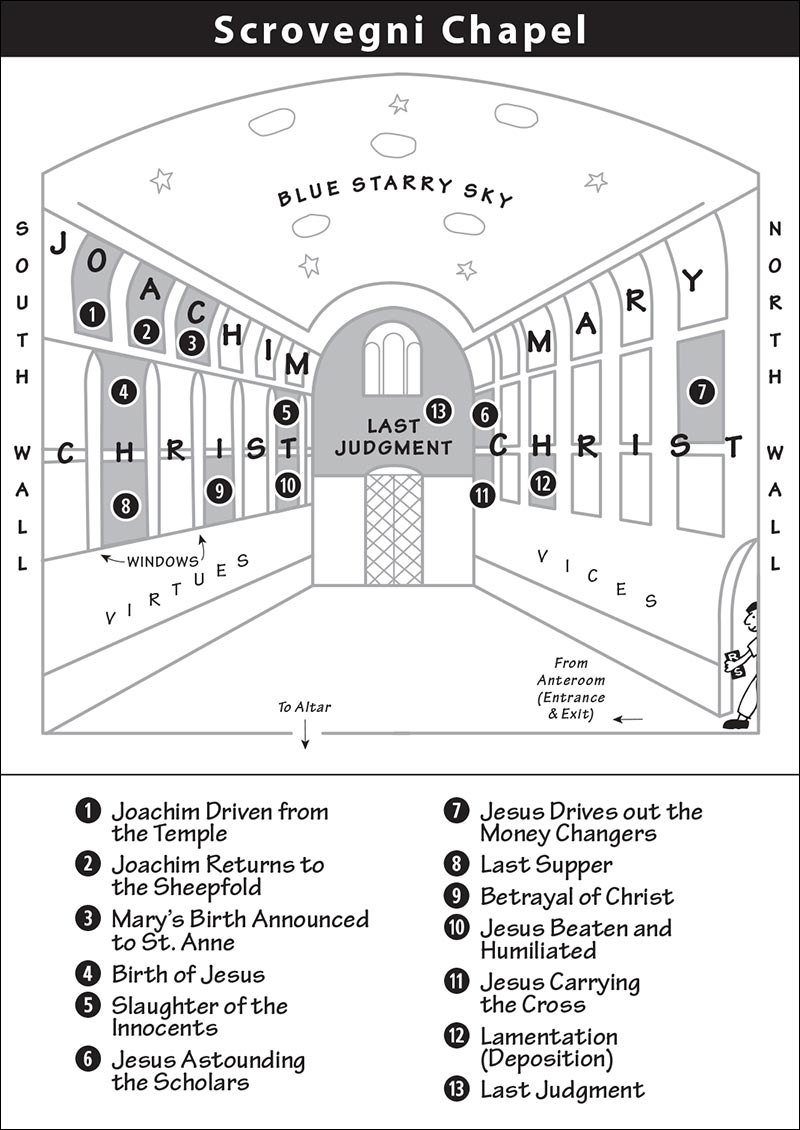
Giotto’s Frescoes: Giotto painted the entire chapel in 200 working days over two years, but you’ll get only 15 minutes to see it.
As you enter the long, narrow chapel, look straight to the far end—the rear wall is covered with Giotto’s big Last Judgment. Christ in a bubble is flanked by crowds of saints and by scenes of heaven and hell. This is the final, climactic scene of the story told in the chapel’s 38 panels—the three-generation history of Jesus, his mother Mary, and Mary’s parents.
The story begins with Jesus’ grandparents, on the long south wall (with the windows) in the upper-left corner. 1 In the first frame, a priest scolds the man who will be Mary’s father (Joachim, with the halo) and kicks him out of the temple for the sin of being childless. 2 In the next panel to the right, Joachim returns dejectedly to his sheep farm. 3 Meanwhile (next panel), his wife is in the bedroom, hearing the miraculous news that their prayers have been answered—she’ll give birth to Mary, the mother of Jesus.
From this humble start, the story of Mary and Jesus spirals clockwise around the chapel, from top to bottom. The top row (both south and north walls) covers Mary’s birth and life.
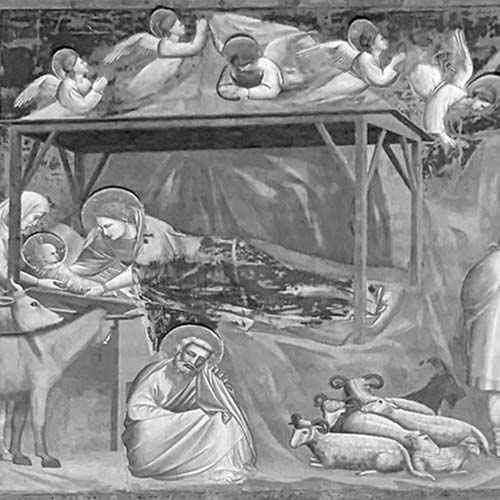
Jesus enters the picture in the middle row of the south (windowed) wall. 4 The first frame shows his birth in a shedlike manger. In the next frame, the Magi arrive and kneel to kiss his little toes. Then the child is presented in the tiny temple. Fearing danger, the family gets on a horse and flees to Egypt. 5 Meanwhile, back home, all the baby boys are slaughtered in an attempt to prevent the coming of the Messiah (Slaughter of the Innocents).
Spinning clockwise to the opposite (north) wall, you see (in a badly damaged fresco) 6 the child Jesus astounding scholars with his wisdom. Next, Jesus is baptized by John the Baptist. His first miracle, at a wedding, is turning jars of water into wine. Next, he raises a mummy-like Lazarus from the dead. Riding a donkey, he enters Jerusalem triumphantly. 7 In the temple, he drives out the wicked money changers.
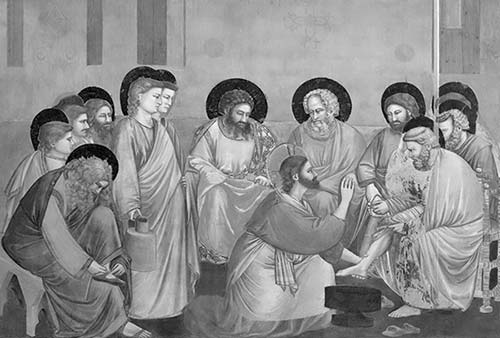
Turning again to the south wall (bottom row), we see scenes from Jesus’ final days. 8 In the first frame, he and his followers gather at a table for a Last Supper. Next, Jesus kneels humbly to wash their feet. 9 He is betrayed with a kiss and arrested. Jesus is tried. 10 Then he is beaten and humiliated.
11 Finally (north wall, bottom row), he is forced to carry his own cross, crucified, and prepared for burial, while his followers mourn (12 Lamentation). Then he is resurrected and ascends to heaven, leaving his disciples to carry on.
13 The whole story concludes on the rear wall, where Jesus reigns at the Last Judgment. The long south wall (ground level) features the Virtues that lead to heaven, while the north wall has the (always more interesting) Vices. And all this unfolds beneath the blue, starry sky overhead on the ceiling.
Some panels deserve a closer look:
Joachim Returns to the Sheepfold (south wall, upper left, second panel): Though difficult to appreciate from ground level, this oft-reproduced scene is groundbreaking. Giotto—a former shepherd himself—uses nature as a stage, setting the scene in front of a backdrop of real-life mountains and adding down-home details like Joachim’s jumping dog, frozen in midair.
Betrayal of Christ, a.k.a. Il Bacio, “The Kiss” (south wall, bottom row, center panel): Amid the crowded chaos of Jesus’ arrest, Giotto skillfully creates a focus upon the central action, where Judas ensnares Jesus in his yellow robe (the color symbolizing envy), establishes meaningful eye contact, and kisses him.
Lamentation, a.k.a. Deposition (north wall, bottom row, middle): Jesus has been crucified, and his followers weep and wail over the lifeless body. John the Evangelist spreads his arms wide and shrieks, his cries echoed by anguished angels above. Each face is a study in grief. Giotto emphasizes these saints’ human vulnerability.
Last Judgment (big west wall): Christ in the center is a glorious vision, but the real action is in hell (lower right). Satan is a Minotaur-headed ogre munching on sinners. Around him, demons give sinners their just desserts in a scene right out of Dante...who was Giotto’s friend and fellow Florentine. Front and center is Enrico Scrovegni, in a violet robe (the color symbolizing penitence), donating the chapel to the Church in exchange for forgiveness of his father’s sins.
Before the guard scoots you out, take a look at the actual altar. Though Enrico’s father’s tomb is lost, Enrico Scrovegni himself is in the tomb at the altar. The three statues are by Giovanni Pisano—Mary (in the center) supports Baby Jesus on her hip with a perfectly natural, maternal S-shape. She’s flanked by anonymous deacons.
Nearby: Between the museum and the chapel are the scant remains of Roman Padua. The remnants are from the wall of an arena (with a reconstructed grand entry gate) and include nicely fitting pipes that once channeled water so that the arena could be flooded for special spectacles.
Civic Museums (Musei Civici agli Eremitani)
The former Augustinian monastery of the Eremitani friars now houses Padua’s Civic Museums: archaeology on the ground floor and paintings upstairs in the Pinacoteca (all included with your Scrovegni Chapel ticket).
Archaeology Museum: Filling the ground floor around the monastery’s courtyards is an impressive collection of ancient statues and artifacts—Egyptian, Venetian, and Roman. Sadly, there are no English descriptions.
Pinacoteca: The entire upper floor of the building is the home of the Pinacoteca (picture gallery). The collection has 13th- to 18th-century paintings by Titian, Tintoretto, Giorgione, Tiepolo, Veronese, Bellini, Canova, and other Veneto artists. But the highlight is the chance to study two masterpieces that affirm Giotto’s greatness. The first is a remarkable crucifix, which originally hung in the Scrovegni Chapel between the Scrovegni family’s private zone and the public’s worshipping zone. If you kneel on the floor and look up, the body really pops. Nearby, and also by Giotto, is L’Eterno Padre (The Eternal Father), which originally occupied a high arch in the chapel. Both works, painted on wood, are fragile and kept here for conservation purposes. (If you can’t locate these pieces, ask for “La Croce di Giotto?”—lah KROH-cheh dee JOH-toh.)
Rest of the Civic Museums: When it’s open, the multimedia room in the basement (take the stairs down from the smaller cloister) contains several exhibits that give more meaning to the Scrovegni Chapel frescoes; there’s also a 15-minute video in a small theater. Across the busy street is the Palazzo Zuckermann, with a commotion of applied and decorative arts (clothing, furniture, and ceramics) from the Venetian Republic (1600s and 1700s) and a collection of 19th-century coins and local Impressionist paintings.
THE BASILICA AND NEARBY
▲▲▲Basilica of St. Anthony (Basilica di Sant’Antonio)
Friar Anthony of Padua, “Christ’s perfect follower and a tireless preacher of the Gospel,” is buried here. Construction of this impressive Romanesque/Gothic church (with its Byzantine-style domes) started immediately after St. Anthony’s death in 1231. As a mark of his universal appeal and importance in the medieval Church, he was sainted within a year of his death. Speedy. And for nearly 800 years, his remains and this glorious church have attracted pilgrims to Padua.
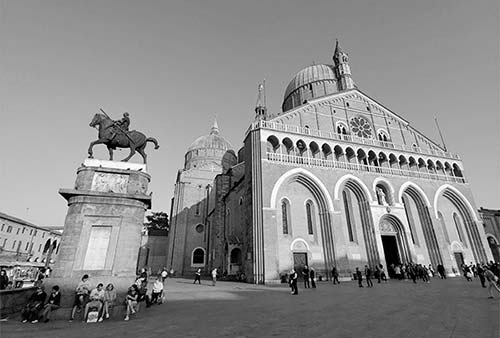
Cost and Hours: The basilica is free and open daily 6:15-19:00 (closes earlier off-season). The Chapel of the Reliquaries is also free and open daily 9:00-12:00 & 14:30-18:30. The nearest tram stop is Santo.
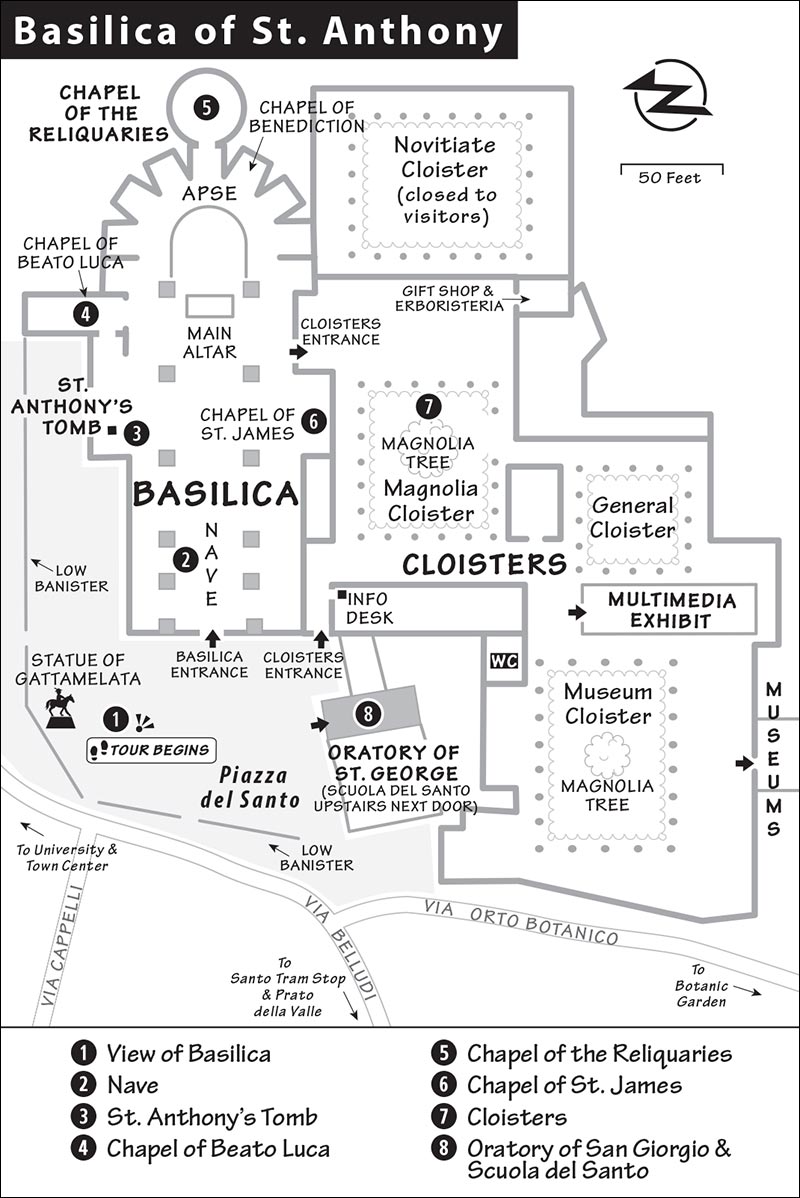
Information: +39 049 822 5652, www.santantonio.org. There’s an information office just inside the cloister entrance, where you can rent a €3 audioguide to the basilica and buy tickets to the other basilica sights (see next).
Other Basilica Sights: A €7 combo-ticket gets you into a cluster of basilica museums—the Antonian Museum (basilica masterpieces), a Donatello exhibit, the Museum of Popular Devotion (votive offerings left by the faithful), the Oratory of San Giorgio, and the Scuola del Santo (the last two are on the piazza in front of the church). These sights are generally open Tue-Sun 9:00-13:00 & 14:00-18:00, closed Mon. Tickets are sold at the info desk at the cloisters and at the museum entries.
Dress Code: A modest dress code is enforced.
Church Services: Mass is generally celebrated several times each morning (the last at 11:00), as well as at 17:00 and 18:00. Confirm the current schedule at the basilica’s website.
Shops: There’s a typical souvenir shop stocked with holy cards and religious statuaries and a more interesting erboristeria selling herbal remedies and a selection of botanical aperitivos.
 Self-Guided Tour
1 View of Basilica: Stand outside to view the basilica’s red-brick facade. St. Anthony looks down and blesses all. He holds a book, a symbol of all the knowledge he had accumulated as a quiet monk before starting his preaching career.
A golden angel—the weathervane atop the spire—points her trumpet into the wind. Guarding the church is Donatello’s life-size equestrian statue of the Venetian mercenary general, Gattamelata. Though it may look like any other man-on-a-horse statue, this life-size equestrian was the first such statue cast from bronze in a thousand years and became the model for subsequent equestrian statues of generals and kings for centuries to come.
The church is technically outside Italy. When you pass the banisters that mark its property line, you’re passing into Vatican territory.
• Enter the basilica and grab a pew in the center of the nave. Let your eyes adjust.
2 Nave: Sit and appreciate the space. Gaze past the crowds and through the incense haze to Donatello’s glorious crucifix rising from the altar, and realize that this is one of the most important pilgrimage sites in Christendom. Along with the crucifix, Donatello’s bronze statues—Mary with Padua’s six favorite saints—grace the high altar. Late in his career, the great Florentine sculptor spent more than a decade in Padua (1444-1455), creating the altar and Gattamelata.
• Head to the left side of the nave to find the gleaming marble masterpiece that is the focus of the visiting pilgrims—the tomb of St. Anthony.
3 St. Anthony’s Tomb: Pilgrims file slowly through this side chapel around the tomb, so focused on the saint that they hardly notice the nine fine marble reliefs. (You can easily skirt around the side of this group for a closer look at each panel.) These Renaissance masterpieces were carved during the 16th century and show scenes and miracles from the life of the saint. As you enjoy each scene, notice the Renaissance mastery of realism and 3-D perspective and the intricate frames, which celebrate life with a burst of exuberance. Note also the vivid faces with their powerful emotions.
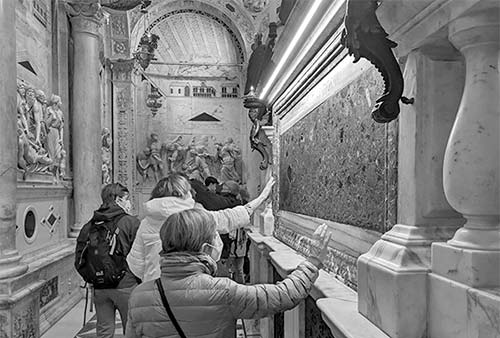
Stand in the corner for a moment, observing the passionate devotion that pilgrims and Paduans alike have for Anthony. Touching his tomb or kneeling in prayer, the faithful believe Anthony is their protector—a confidant and intercessor for the poor. And they believe he works miracles. Believers leave offerings, votives, and written prayers to ask for help or to give thanks for miracles they believe Anthony has performed. By putting their hands on his tomb while saying silent prayers, pilgrims show devotion to Anthony and feel the saint’s presence.
Popular Anthony is the patron saint of dozens of things: orphans, pregnant women, infertile women, and glassblowers. Most pilgrims ask for his help in his role as the “finder of things”—from lost car keys to a life companion. You’ll see dozens of photos posted on his tomb in prayer or as thanks, including many of fervently wished-for newborns.
Before leaving, pause to appreciate how the entire chapel is an integrated artistic wonder.
• Leave the chapel and step into the oldest part of the church. This is the...
4 Chapel of Beato Luca: This chapel, decorated with beautiful frescoes by Giusto de’ Menabuoi, is dedicated to Luca Belludi, a disciple of St. Anthony. The 13th-century altar preserves his remains. To the left of the altar, note the fine view of medieval Padua, with this church outside the wall (finished by 1300 and looking like it does today). Below the cityscape, in a circa-1380 fresco, Anthony on his cloud promises he’ll watch over Padua.
• Continue your circuit of the church by going behind the altar into the apse. You’ll pass the Polish chapel with its ornate bronze gate and a painting of St. John Paul II (canonized in 2014). Next up is the often-crowded...
5 Chapel of the Reliquaries: The most prized relic is in the glass case at center stage—Anthony’s tongue. When Anthony’s remains were exhumed 32 years after his death (in 1263), his body had decayed to dust, but his tongue was found miraculously unspoiled and red in color. How appropriate for the great preacher who, full of the Spirit, couldn’t stop talking about God.
Entering the chapel, join the parade of pilgrims working their way clockwise around the chapel and up the stairs. First, on the left, look for the red, triangular vestment in which Anthony’s body was wrapped. Next is his rough-hewn wood coffin. Then, up the stairs, is his pillow—a comfy rock (chest level in first glass case). The center display case contains (top to bottom) the saint’s lower jaw with all his teeth impressively intact (il mento, located about 8 feet high), his uncorrupted tongue (lingua, at about eye level), and, finally, his vocal chords (apparato vocale, at about waist level) discovered intact when his remains were examined in 1981. In the last display case, a fragment of the True Cross (la croce) is held in a precious cross-shaped reliquary. You’ll also pass St. Anthony’s holy, and holey, tunic (tonaca). Pilgrims stop at a desk to pick up a small card with a tiny piece of blessed cloth that touched Anthony’s tongue.
Above the relics, decorating the cornice, is the Glorification of St. Anthony. In this Baroque fantasy—made in 1691 of carved marble and stucco—a cloud of angels and giddy putti tumble to the left and right in jubilation as they play their Baroque-era musical instruments to celebrate Anthony’s arrival in heaven.
• Leaving this relic chapel, turn left to the Chapel of Benediction. Here, a priest is waiting to bless anyone who wishes to be blessed.
Next, past the sacristy (where you can peek in at priests preparing for Mass), is a door leading to the cloisters. But before heading out, walk just beyond this passage to the...
6 Chapel of St. James: Exactly opposite the tomb of St. Anthony, this chapel features an exquisite 14th-century fresco by Altichiero da Zevio. Study the vivid commotion around the Crucifixion, clearly inspired by Giotto (this was created 70 years after the Scrovegni Chapel). The faces are real—right off the streets of 14th-century Padua. From this chapel, look across the nave and appreciate how Anthony’s massive tomb is so beautifully integrated into the church architecturally.
• Next, exit out into the cloisters. From the right side of the nave as you face the altar, follow signs to chiostro.
7 Cloisters: Of the four cloisters at the basilica, you can wander in three. The main cloister is dominated by an exceptionally old magnolia tree, planted in 1810 (the magnolia was exotic for Europe when it was imported from America in 1760). Also in the cloister are the graves of the most illustrious Paduans, such as Gabriel Fallopius, the scientist who gave his name to his discovery, the Fallopian tube. When Napoleon decreed that graves should be moved out of cities, this once grave-covered courtyard was cleared of tombstones. But the bodies were left in the ground, perhaps contributing to the magnolia tree’s fecundity. Today the tree remains an explosion of life.
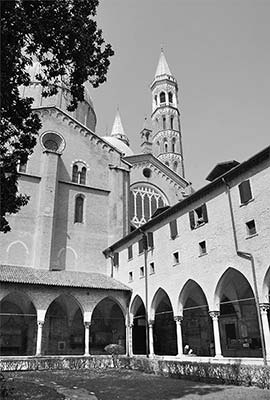
In another cloister, you may be able to enter a multimedia exhibit about the life of St. Anthony and the Franciscan mission (free, a slow and evangelical 20 minutes).
In the next cloister over, you’ll find the entrance to the Antonian Museum, a Donatello exhibit, and the Museum of Popular Devotion (all covered by combo-ticket). The latter is filled with votives and folk art recounting miracles attributed to Anthony. The abbreviation PGR that you’ll see on many votives stands for per grazia ricevuta—for answered prayers.
8 Other Basilica Sights: The small but sumptuous Oratory of San Giorgio faces the little square in front of the basilica. Built as a mausoleum for the noble Lupi family, but now a consecrated church, the oratory is filled with vivid, circa-1370 frescoes showing scenes from the life of Christ and the patron saints of the Lupis: St. George, St. Lucia, and St. Catherine. Because many lovers credit St. Anthony with finding them their partners—and this is the closest place to St. Anthony where you can be married—it’s popular for weddings.
Next door and upstairs is the skippable (and often closed) Scuola del Santo (a.k.a. La Scoletta), the former meeting hall of the Confraternity of Anthony. It has frescoes and paintings of the life of St. Anthony by various artists—including some by Titian.
Near the Basilica
Piazza Prato della Valle
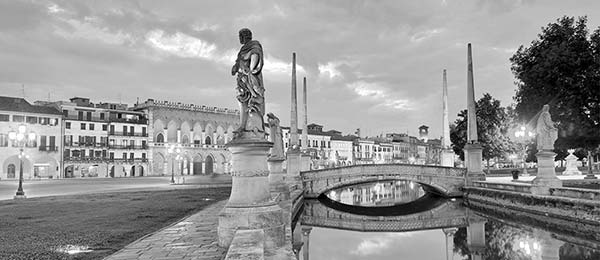
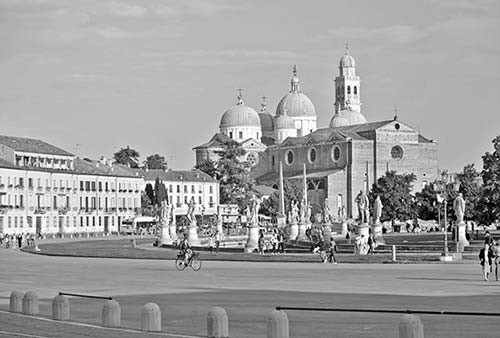
This pleasant, 400-yard-long, oval piazza (150 yards southwest of the basilica, down Via Beato Luca Belludi) is actually an artificial island surrounded by a canal. Once the site of a Roman theater and later Anthony’s preaching grounds, the grassy square is lively with fountains, walkways, and dozens of statues of Padua’s eminent citizens. It’s also an active market scene: fruit and vegetables (Mon-Fri morning); clothing, shoes, and household goods (Sat all day); and antiques (third Sun all day). This place is often busy with special events and festivals.
▲Botanic Garden (Orto Botanico)
Green thumbs, science fans, and anyone who wants a break from art or religious sights will appreciate this historic botanical garden, which contains the university’s vast collection of rare plants. Founded in 1545 for the cultivation and study of medicinal plants, it’s the world’s oldest existing academic botanical garden. Because of the Venetian Republic’s vast reach through trade and commerce, and the university’s renown, exotic plants from all over the world made their way to Padua. It’s believed that the first potato, sesame, lilac, and sunflower in Europe were planted in this city.
Cost and Hours: €10; Tue-Sun 10:00-19:00, closes earlier off-season, closed Mon, last entry one hour before closing; the garden’s free app is best suited to plant and science buffs; entrance 150 yards south of Basilica of St. Anthony—with your back to the facade, take a hard left; Santo tram stop, +39 049 201 0222, www.ortobotanicopd.it.
Visiting the Garden: The botanical garden’s original 16th-century square-within-a-circle configuration remains intact. Inside its circular wall, the garden is filled with elegant, geometrical plant beds. Wandering the paths, visitors can also admire a 340-year-old oriental plane tree, a magnolia that’s only 10 years younger than the United States, and the garden’s oldest specimen—a St. Peter’s dwarf palm that was planted in 1585, and inspired Goethe to write his essay on the “Metamorphosis of Plants.”
From the south end of the enclosed garden, find the path over a footbridge that leads to the striking and enormous Biodiversity Garden. The five greenhouse biomes take you on a journey through the world’s major climate zones. Panels provide superb English descriptions of the environments and offer insight into how plant life has influenced the development of humankind—and vice versa.
Sleeping in Padua
Rooms in Padua’s hotels are more spacious and a better value than those in Venice. I’ve listed hotels in the center and near the basilica. All are reachable from the station by tram; only Albergo Verdi is more than a five-minute walk from the nearest tram stop.
IN THE CENTER
$$ Hotel Majestic Toscanelli, an old-fashioned family-run hotel with 34 nicely furnished rooms, owns a perfect location right in the town center—buried in the characteristic ghetto with wonderful cobbled ambience. At night, this area is popular with noisy students; request a quiet room on the back side (RS%, some suites available, air-con, elevator, lounge bar, pay parking, Via dell’Arco 2, Tito Livio tram stop, +39 049 663 244, www.toscanelli.com, majestic@toscanelli.com, Mario Morosi and family). From the tram stop, follow the passageway next to #26, then jog left down Via Marsala and turn right on Via dell’Arco.
$ Albergo Verdi, an Ikea-esque little place, is crammed into an old building on a small back street beyond Piazza dei Signori. While public spaces are tight, the 14 rooms are simple and sufficient (air-con, tiny elevator, Via Dondi dall’Orologio 7, Ponti Romani tram stop, +39 049 836 4163, www.albergoverdipadova.it, info@albergoverdipadova.it). From Piazza dei Signori, walk through the arch under the clock tower and go to the far end of Piazza del Capitaniato; the hotel is on the side street to your right.
NEAR THE BASILICA OF ST. ANTHONY
Santo is the nearest tram stop for the following hotels.
$$ Hotel Al Fagiano feels like an art gallery with eclectic creative touches everywhere. They rent 37 bright and cheery rooms, each uniquely decorated with Rossella Fagiano’s creations (RS%, air-con, elevator, pay parking, 50 yards from the Santo tram stop at Via Antonio Locatelli 45, +39 049 875 0073, www.alfagiano.com, info@alfagiano.com; Anita, Rossella, and Amato).
$ Hotel Al Santo, run with charm by Valentina and Antonio, offers 15 spacious rooms with essential comforts on two floors above their restaurant, a few steps from the basilica. Given the warm welcome and pleasant location, it’s a fine value (family rooms, double-paned windows, quieter rooms off street, some rooms with basilica views, air-con, elevator, pay parking, Via del Santo 147, +39 049 875 2131, www.alsanto.it, alsanto@alsanto.it).
$ Hotel Casa del Pellegrino, with 147 spotless, cheap, bare rooms and straight pricing, is owned by the friars of St. Anthony. It’s home to the pilgrims who come to pay homage to the saint in the basilica next door. Any visitor to Padua is welcome, making it popular with professors and students. Some rooms with basilica views also come with more noise—both from the street and, starting at 6:00 in the morning, the church bells; other rooms are in the hotel’s modern wing (cheaper rooms with shared bath, family rooms, ask for a room off the street, breakfast extra, air-con, elevator, pay parking, Via Melchiorre Cesarotti 21, +39 049 823 9711, www.casadelpellegrino.com, info@casadelpellegrino.com).
Eating in Padua
The university population means cheap, good food abounds. My recommended restaurants are all centrally located in the historic core. You’d think there would be fine dining on the charming market squares, but they’re dominated by takeout pizza, casual bars, and, after dark, students. La Lanterna, at the neighboring Piazza dei Signori, is the best on-square option—but they only offer functional Italian classics. The atmospheric ghetto neighborhood (just off the market squares) thrives after dark with a lively bar scene.
If you want a fun multistop meal of bar food capped with some fine gelato, string together my recommendations under “Cheap Eats and Bars with Tapas in the Center.”
DINING NEAR THE CENTER
$$$ Taverna Nane della Giulia, warm and inviting, serves generous portions of well-made Venetian-style cuisine at fair prices (Wed-Sun 12:00-15:00 & 19:00-24:00, closed Mon-Tue, reservations recommended for dinner, Via Santa Sofia 1, +39 049 660 742).
$$ Osteria L’Anfora is a colorful if chaotic place serving classic dishes in an informal, fun-loving space. Don’t be put off by the woody, ruffian decor, the squat toilet, and the fact that it’s a popular hangout for a premeal drink. They take food seriously and serve it at good prices, and the fun energy and commotion add to the dining experience (meals served Mon-Sat 12:30-15:00 & 19:30-22:30, bar open 9:00-24:00, closed Sun, reservations smart for dinner, Via dei Soncin 13, +39 049 656 629).
$ Osteria dal Capo is a tight and jumbled little bistro with chandeliers and white tablecloths serving classic Veneto meat and fish dishes, home-cooking style (Mon-Sat 12:00-14:30 & 19:00-24:00, closed Sun, inside only, reserve for dinner, Via degli Obizzi 2, +39 049 663 105, www.osteriadalcapo.it).
$$ Enotavola Pino (enotavola means “wine table”) is, in the front, a hip wine bar where owner/chef Pino offers scores of wines by the glass—each with a little plate of mortadella. The back is a bright fish-only restaurant with a busy, open kitchen and spacious seating. If you like the energy in the wine bar, you can order from the menu there, too (daily 12:30-14:30 & 19:30-23:00, Via dell’Arco 37, +39 049 876 2385).
$$$ Enoteca Antonio Ferrari is a top-end wine bar serving quality meat-and-cheese boards to a hungry local crowd. It’s pricey but a good value and feels bright and youthful (daily, Via Umberto 1, +39 049 666 375).
CHEAP EATS AND BARS WITH TAPAS IN THE CENTER
$ Pizza on Piazza dei Signori: Though La Lanterna has a forgettable interior and a predictable menu of pizzas, pastas, and secondi, its prime location provides a rare-in-Padua chance to sit in a grand square under the stars, surrounded by great architecture. Locals know it as the first pizzeria in town (Fri-Wed 12:00-15:00 & 18:00-24:00, closed Thu, Piazza dei Signori 39, +39 049 660 770, www.lalanternapadova.it).
$ Squid, Porchetta, and Spritz on Piazza della Frutta: Just a simple sandwich place, Bar dei Osei has some of the best outdoor seats in town. While Paduans love their delicate tramezzini—white-bread sandwiches with crusts cut off, I’d choose their porchetta—savory roasted pork sandwiches. Wines are listed on the board (Mon-Sat 7:00-21:00, closed Sun, Piazza della Frutta 1, +39 049 875 9606). In the evenings, just a few feet away, La Folperia squid stand sells boiled and spiced plates of squid by weight—indicate small (€6) or big (€12) and request bread (pane). Crowd your way up to the bar, and Massimiliano and Barbara will take care of you (Mon-Sat 17:00-20:30, closed Sun). Even with a plate of La Folperia seafood, you’re welcome to grab a Bar dei Osei table and order a drink from the roaming server.
$ Cicchetti Bars Popular with Students: Surrounding Palazzo della Ragione you’ll find lots of atmospheric bars jammed with students marked by the glowing orange glasses of spritz. These bars also serve little €1 and €2 bites (mostly fried gut bombs and enticing open-face sandwiches). While the tapas aren’t advertised, the walls are scribbled with the various wines, vermouths, and cocktails for sale. Two classy holes-in-the-wall are particularly atmospheric (each about a block off the market squares): Bar Corte Sconta (across the street from the recommended Hotel Majestic Toscanelli, at Via dell’Arco 9) and Bar All’Ombra della Piazza (100 yards off Piazza della Frutta, down the tiny Via Pietro D’Abano at #16).
$ Pasta and Vegetarian on Piazza della Erbe: Pastasuta is a minimalist little pasta joint tucked away in the Palazzo della Ragione arcade (Piazza delle Erbe side). Choose your pasta and sauce combo or enjoy prepared options from their little tavola fredda. Seating is limited, but all of their dishes can be packed to go. Just say, “Per portare via, per favore” (Mon-Sat generally 9:00-15:00 & 17:00-20:00, closed Mon and Wed evenings and all day Sun). Cristina e Massimo, just a few doors down from Pastasuta, serves seasonal and creative vegetarian dishes, from fancy salads to muffins to tarts (Mon-Sat 7:00-20:00, closed Sun).
Gelato: For your best dessert in the market square area, enjoy a high-end gelato at Gnam Gnam (that means “yum yum”) on Piazza dei Signori.
NEAR THE BASILICA OF ST. ANTHONY
$ Pizzeria Pago Pago dishes up wood-fired Neapolitan pizzas (a local favorite) and daily specials depending on what’s in season. They also have good salads, non-pizza dishes, and beer on tap in a bright and high-energy dining area (Wed-Mon 12:00-14:00 & 19:00-24:00, closed Tue; 2 blocks from basilica, up Via del Santo and right onto Via Galileo Galilei to #59; +39 049 665 558, Gaetano and Modesto).
$ Pollodoro la Gastronomica, my pick of the takeout delis near the basilica, sells roast chicken, pastas, pizza, and veggies. They’ll also make sandwiches (Wed-Mon 9:00-14:00, closed Tue, 100 yards from basilica at Via Belludi 34, +39 049 663 718).
Gelato: Portogallo Gelateria is considered the best gelateria in town, with amazing and creative flavors (Via Umberto 1).
Padua Connections
Unless otherwise specified, the following connections are for Trenitalia.
From Padua by Train to: Venice (4/hour, 30 minutes; Italo: about hourly, 30 minutes), Vicenza (at least 3/hour, fewer on weekends, 15-25 minutes), Milan (2-3/hour, 2-3 hours; Italo 7/day, 2 hours), Verona (3/hour, 40-90 minutes), Florence (10/day direct, 2 hours, require reservations; otherwise 3 or more hours with connections).
By Bus to: Venice’s Marco Polo Airport (65 minutes, €8.50 from ticket windows, €10 on board, roughly hourly at :25 past the hour from 6:25 to 21:25, leaves from platform 11 at Padua’s bus station, next to the train station; recheck times at www.fsbusitalia.it).
Vicenza
To many architects, Vicenza (vee-CHEHN-zah) is a pilgrimage site. Entire streets look like the back of a nickel. This is the city of Andrea Palladio (1508-1580), the 16th-century Renaissance architect who defined the Palladian style that is now so influential in countless British country homes. But as grandiose as Vicenza’s Palladian facades may feel, there is little marble here because the city lacked the wealth to build with much more than painted wood and plaster.
If you’re an architecture buff, Vicenza merits a quick day trip on any day but Monday, when major sights are closed. If you’re packing light, it’s an easy stop, located on the same train line as Padua, Verona, and Venice. However, there’s no bag storage at the train station; though in a pinch, the TI is willing to store bags for you while you walk around town.
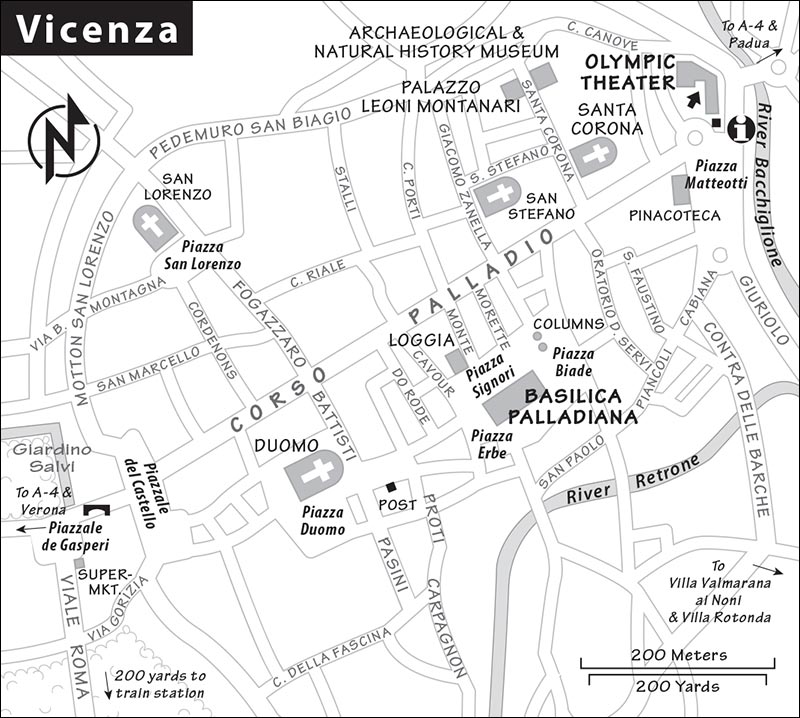
Tourist Information: The TI is next to the Olympic Theater at Piazza Matteotti 12 (daily 9:00-13:30 & 14:00-17:30, +39 0444 320 854, www.vicenzae.org). Ask for the free brochure on Palladio’s buildings. Architecture fans appreciate the booklet titled Vicenza and the Villas of Andrea Palladio.
Arrival in Vicenza: From the train station, I’d head straight for the most distant sight, the Olympic Theater (with the TI next door) and then see other sights on the way back. Go straight out the train station’s front door and use the crosswalk on the right side of the roundabout. From here, it’s a five-minute walk straight ahead up wide Viale Roma to the Eurospar supermarket at the bottom of Corso Palladio; turn right through the gate, and then it’s a good 10 minutes more down the Corso to the Olympic Theater.
A taxi from the station costs about €8. Drivers can park in one of the cheap parking lots (Parcheggio Bassano and Parcheggio Cricoli) and catch a free shuttle bus to the center.
Sights in Vicenza
Helpful bilingual signs in front of Palladio’s buildings explain their history. Arrows around town point you to his major works.
Sightseeing Passes: All the sights mentioned (except the villas outside town) are covered by the Vicenza Card (€20, good for 8 days, sold at the TI and Palazzo Leoni Montanari Galleries). The 4 Museums Card lets you choose any four sights (€15).
▲▲Olympic Theater (Teatro Olimpico)
Palladio’s last work, one of his greatest, shouldn’t be missed. This indoor theater is a wood-and-stucco festival of classical columns, statues, and an oh-wow stage bursting with perspective tricks. When you step back outside, take another look at the town’s main drag—named after Palladio. It’s the same main street you saw on the stage of his theater.
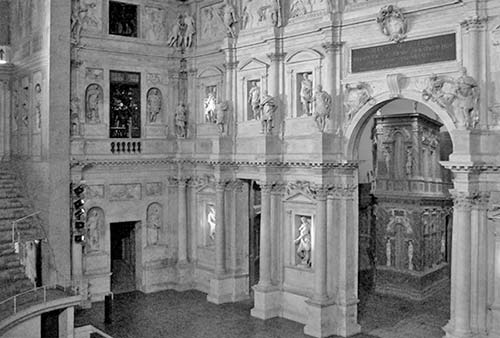
Cost and Hours: €11; Tue-Sun 10:00-18:00 (9:00-17:00 in winter), closed Mon, very occasionally closed when theater is in use; audioguide available, entrance to left of TI at Piazza Matteotti 11, info +39 0444 222 800, tickets +39 044 496 4380, www.teatrolimpicovicenza.it.
▲Church of Santa Corona (Chiesa di Santa Corona)
A block from the Olympic Theater, this “Church of the Holy Crown” was built in the 13th century to house a thorn from the Crown of Thorns, given to the bishop of Vicenza by the French king Louis IX. The church has two artistic highlights: Paolo Veronese’s Adoration of the Magi (1573) and Giovanni Bellini’s fine Baptism of Christ (c. 1502).
Cost and Hours: Free, Tue-Sun 10:00-18:00 (9:00-17:00 in winter), closed Mon, Contrà Santa Corona 2, +39 0444 323 644.
Archaeological and Natural History Museum (Museo Naturalistico Archeologico)
Located next door to the Church of Santa Corona, this museum’s ground floor features Roman antiquities (mosaics, statues, and artifacts excavated from Rome’s Baths of Caracalla, plus swords) and a barbarian warrior skeleton complete with sword and helmet. Prehistoric scraps are upstairs. Look for English description sheets near exhibit entryways throughout.
Cost and Hours: €5, Tue-Sun 9:00-17:00, closed Mon, Contrà Santa Corona 4, +39 0444 222 815, www.museicivicivicenza.it.
Palazzo Leoni Montanari Galleries (Gallerie di Palazzo Leoni Montanari)
Across the street from the Church of Santa Corona, this small museum is a palatial riot of Baroque, with cherub-cluttered ceilings jumbled like a preschool in heaven. A quick stroll shows off Venetian paintings and a floor of Russian icons.
Cost and Hours: €8.50, Tue-Sun 10:00-18:00, closed Mon, Contrà Santa Corona 25, +39 800 578 875, www.palazzomontanari.com.
Piazza dei Signori
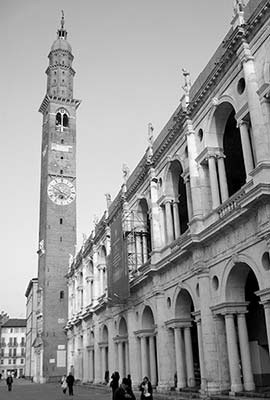
Vicenza’s main square has been the center of town ever since it was the site of the ancient Roman forum. The commanding Basilica Palladiana, with its 270-foot-tall, 13th-century tower, dominates the square. This was once the meeting place for local big shots. It was young Palladio’s proposal to redo Vicenza’s dilapidated Gothic palace of justice in the Neo-Greek style that established him as the city’s favorite architect. The rest of Palladio’s career was a one-man construction boom. The basilica hosts special exhibitions that sometimes involve a fee, but you can often pop in for a free look.
Villas on the Outskirts of Vicenza
Vicenza is surrounded by dreamy Venetian villas. When Venice’s commercial trading empire receded in the 1500s, the city redirected its economic agenda to agribusiness, which led to the construction of lavish country villas, such as Villa la Rotonda, the inspiration for Thomas Jefferson’s Monticello (www.villalarotonda.it), and Villa Valmarana ai Nani (www.villavalmarana.com). Located southeast of the town center, both houses are furnished with period pieces (closed Mon). Pick up the free brochure on Palladio’s villas from the TI if you plan to visit.
Vicenza Connections
From Vicenza by Train to: Venice (Trenitalia: 2/hour, 45 minutes; Italo: 7/day, 45 minutes), Padua (at least 2/hour, 15-25 minutes), Verona (2/hour, 30-40 minutes), Milan (1-2/hour, 2 hours).
Verona
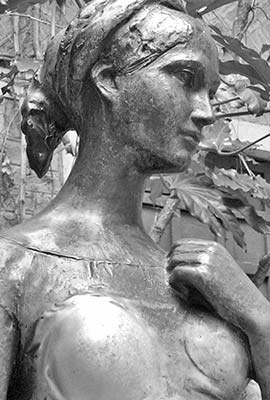
Romeo and Juliet made Verona a household word. Alas, a visit here has nothing to do with those two star-crossed lovers. You can pay to visit the house that falsely claims to be Juliet’s (with an almost believable balcony and a courtyard swarming with tour groups), join in the tradition of rubbing the breast of Juliet’s statue to help find a lover (or to pick up the sweat of someone who can’t), and even make a pilgrimage to what isn’t “La Tomba di Giulietta.”
Fiction aside, Verona has been an important crossroads for 2,000 years and is, therefore, packed with genuine history. R&J fans will take some solace in the fact that two real feuding families, the Montecchi and the Cappellos, were the models for Shakespeare’s Montagues and Capulets. And, if R&J had existed and were alive today, they would still recognize much of their “hometown.”
Verona’s main attractions are its wealth of Roman ruins; the remnants of its 13th- and 14th-century political and cultural boom brought about by its leading family, the Scaligeri; its 21st-century, pedestrian-only ambience; and its world-class summer opera festival. After Venice’s festival of tourism, the Veneto region’s second city is a cool and welcome sip of pure Italy, where dumpsters are painted by schoolchildren as class projects and public spaces are primarily the domain of locals, not tourists. If you like Italy but don’t need blockbuster sights, this town is a joy.
Orientation to Verona
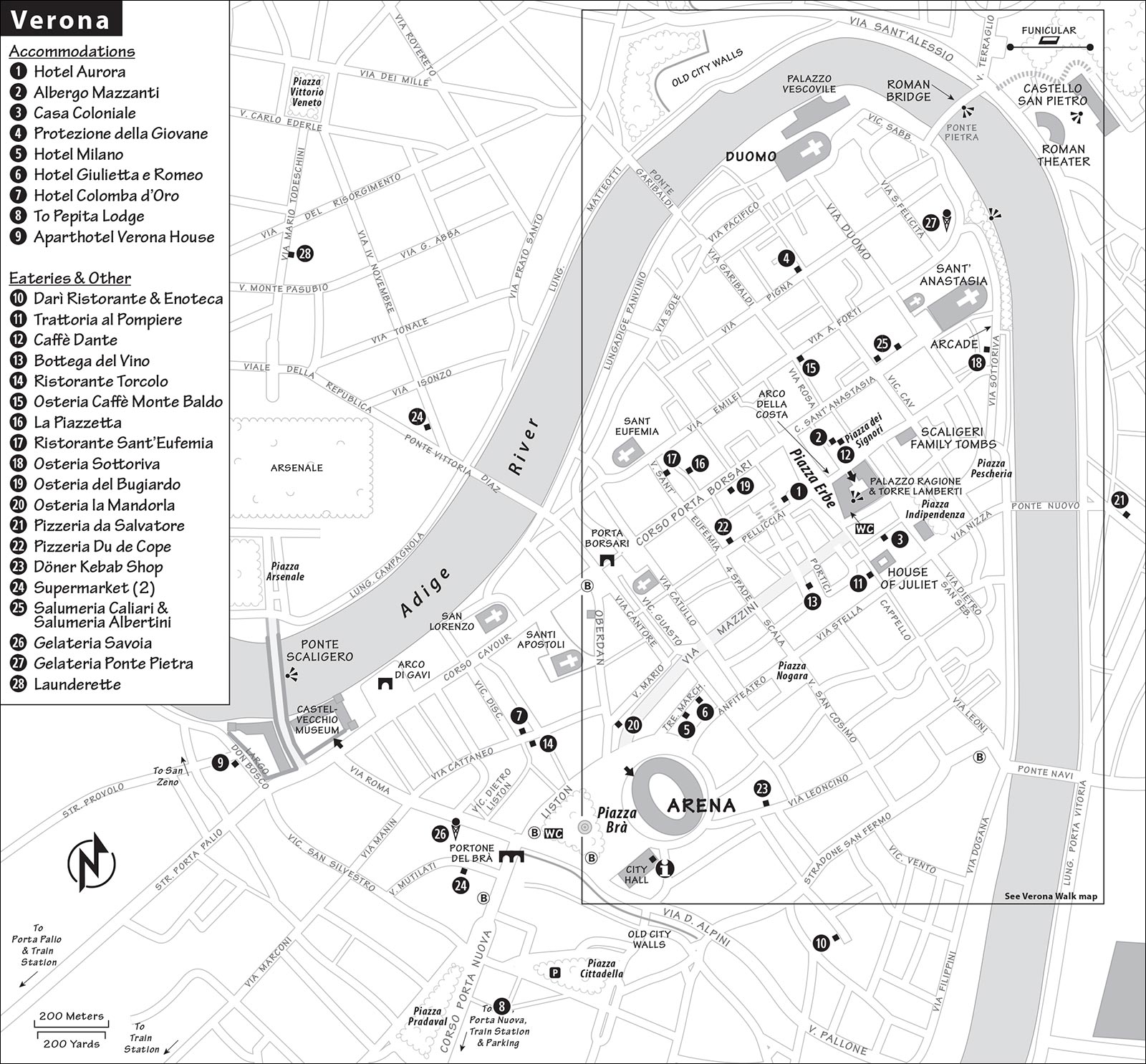
Verona’s old town fills an easy-to-defend bend in the River Adige. The vibrant and enjoyable core of Verona lies along Via Mazzini between Piazza Brà (pronounced “bra”) and Piazza Erbe, Verona’s market square since Roman times. Each evening the two main streets from Piazza Brà to Piazza Erbe, Via Mazzini and Corso Porta Borsari, are enlivened by a wonderful passeggiata...bustling with a slow and elegant parade of strollers. For a good day trip to Verona, take my self-guided walk, beginning with a visit to the Roman Arena.
TOURIST INFORMATION
Verona’s helpful TI is located inside Verona’s City Hall (Palazzo Barbieri). The entrance is just off Piazza Brà, around the corner at Via Leoncino 61 (Mon-Sat 9:00-19:00, Sun 10:00-18:00, shorter hours off-season, +39 045 806 8680, www.turismoverona.eu). If you’re staying the night, ask the TI about concerts.
Sightseeing Passes: The Verona Card covers city transportation and entry to all recommended Verona sights. The card can save day-trippers quite a bit if you’re intent on blitzing the city’s sights (€20/24 hours, €25/48 hours, sold at TI and at participating sights).
The €8 Church Card, sold at four churches that require admission (San Zeno, Duomo, Sant’Anastasia, and San Fermo, normally €4 each), pays for itself if you visit two (www.chieseverona.it).
Walking Tours: The TI organizes 90-minute tours in English (€12/person, April-Dec Sat-Sun at 11:00). Tours meet inside the TI and stroll all the way through the old town (confirm schedule, no reservation necessary).
ARRIVAL IN VERONA
By Train: Verona’s main train station is called Verona Porta Nuova. In the main hall, you’ll find pay WCs and a baggage-check office (daily 8:00-20:00). Buses and taxis are immediately outside.
Avoid the boring 20-minute walk from the station to the center. Buses are cheap, easy, and leave every few minutes (although taxis are smart after sundown). Buy a ticket from the tobacco shop inside the station or from machines at the bus bays (€1.30/90 minutes, €2 from on-board machine, €4 day pass valid until midnight, www.atv.verona.it). Leaving the station, angle right across the street to the bus stalls; helpful signs indicate which bus to take for your destination.
Buses for Piazza Brà (near the Roman Arena) and San Fermo (near the Ponte Navi bridge) depart from platform B1 (#11, #12, #13, #51, and #52 run Mon-Sat until 20:00; #90, #92, and #98 run after 20:00 and all day Sun). For Porta Borsari (ancient city main gate), use platform D2 (#21, #22, #23, #24, #41, and #61 run Mon-Sat; #93, #94, and #95 run evenings and Sundays). If in doubt, confirm that your bus is headed to the city center by asking, “Per il centro?” (pehr eel CHEN-troh). Validate your ticket by stamping it in the machine on the bus.
If getting off at Piazza Brà, you’ll see the can’t-miss-it Roman Arena (bus stops in front of the big, yellow Neoclassical City Hall, where you’ll find the TI—see earlier). You can catch return buses to the station from another bus stop on Piazza Brà, near the WCs.
Taxis pick up only at taxi stands (at Piazza Brà, Piazza Erbe, and the train station) and cost €10-12 for the quick ride between the train station and the center of town (€2 more on Sundays and after 22:00, €1/big bag).
By Car: The old town center (where nearly all my recommended hotels are located) is closed to traffic. Your hotel can get you permission to drive in—ask when you book. Otherwise your license plate will be photographed, and an expensive ticket might be waiting in the mail when you get home.
Drivers will find reasonably priced parking in well-marked lots and garages just outside the center. The underground Cittadella garage, at Piazza Cittadella (a block off Piazza Brà), is huge, convenient, and easy to find (€3/hour, €18/24 hours). The Città di Nimes/Parking Stazione lot is near the wall, a five-minute walk from the train station (€1.50/2 hours, €7/day). Street parking is limited to two hours and costs €1/hour (spaces marked with blue lines, buy ticket at a tobacco shop or ticket machine, place ticket on dashboard; some hotels can give you a free street-parking permit—ask).
By Plane: Verona’s airport (known as Catullo or Verona-Villafranca) is 12 miles southwest of the city (code: VRN, +39 045 809 5666, www.aeroportoverona.it). Efficient AeroBus shuttles connect the airport with the train station (€6, valid for 75 minutes on AeroBus and city buses, buy tickets on board or at tobacco shop, 3/hour, 15 minutes).
HELPFUL HINTS
Sightseeing Schedules: Most sights (except churches) are closed on Monday mornings and typically open after lunchtime. The churches are closed Sun morning to sightseers.
Arena Opera Festival: From mid-June through early September, Verona’s opera festival brings the city to life, with 15,000 music fans filling the Roman Arena for almost nightly performances (cheap upper-level seats—€30-40, day-of-show tickets often available). The city is packed and festive—restaurants have set seatings for dinner, and hotels jack up their prices. Book tickets through the official box office (online at www.arena.it [URL inactive] or call +39 +39 045 800 5151; during opera season, box office open daily 10:00-17:45, or until 21:00 on performance days; Via Dietro Anfiteatro 6B).
Laundry: The closest self-service laundry is a 20-minute walk from the Arena, over the Ponte Nevi bridge (daily 7:30-22:30, Via XX Settembre 92).
Private Guides: Three enthusiastic Verona guides give private tours of the town and region tailored to specific interests—villas, wine tasting, and so on. They are Marina Menegoi (€125/2 hours, €265/5 hours, mobile +39 328 958 1108, www.marinamenegoi.com, mmenegoi@gmail.com), Valeria Biasi (€150/2 hours, €375/5 hours, mobile +39 348 903 4238, www.veronatours.com, valeria@veronatours.com), and Franklin Baumgarten (€125/2 hours, €265/5 hours, mobile +39 347 566 6765, franklin_baumgarten@web.de).
Verona Walk
4 Porta Borsari and Corso Porta Borsari
9 Tombs of the Scaligeri Family
11 Basilica of Sant’Anastasia (Basilica di Sant’Anastasia)
12 Ponte Pietra and River View
13 Duomo Complex (Complessa del Duomo)
This walk covers the essential sights in the town core, starting at Piazza Brà and ending at the cathedral. Allow two hours (including the tower climb and some dawdling).
1 Piazza Brà
If you’re wondering about the name, it comes from the local dialect and means “big open space.” A generation ago this piazza was noisy with cars. Now it’s open and people friendly—it’s become the community family room and natural festival grounds.
Grab a bench near the central fountain called “The Alps.” This was a gift from Verona’s sister city Munich, which is just over the mountains to the north. You’ll see in the middle of the fountain the symbols of the two cities separated by the Alps, carved out of pink marble from this region. In general, Verona has a bit of an alpine feel; historically it was the place where people rested and prepared before crossing the mountains, and to this day it’s the place where the main west-east, Milan-Venice train line meets the north-south line up to Bolzano, the Dolomites, and Austria.
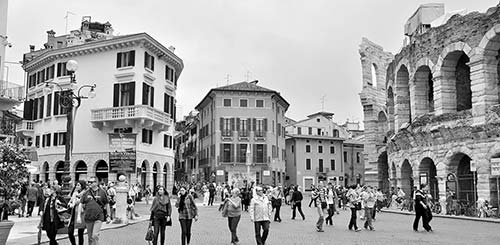
The ancient arena looming over the piazza is a reminder that the city’s history goes back to Roman times. On this walk, we’ll meander across what was the ancient city, from the arena on this side to the theater across the river.
With the fall of Rome in the fifth century, Verona became a favored capital of barbarian kings. In the Middle Ages, noble families had to choose sides in the civil struggles between emperors (Ghibellines) and popes (Guelphs). During this time (1200s), the town bristled with several hundred San Gimignano-type towers, built by different families to symbolize their power. When the Scaligeri family rose to power here in the 14th century, they established stability on their terms and made the other noble families lop off their proud towers—only the Scaligeri were allowed to keep theirs. To add insult to injury, the Scaligeri paved the city’s roads with bricks from the other families’ toppled towers. But interfamily feuds made it impossible for the Scaligeri to maintain a stable government, and in 1405 the town essentially gave itself to Venice, which ruled Verona until Napoleon stopped by in 1796. During the 19th century, a tug-of-war between France and Austria actually divided the city for a time, with the river marking the border of each country’s domain. Eventually Verona, like Venice, fell into Austrian hands.
Reminders of Austrian rule remain: The huge, yellow Neoclassical City Hall facing Piazza Brà (look for the flags) was built by the Austrians to serve as their 19th-century military headquarters (the TI is in this building; enter around the corner on Via Leoncino). Their former arsenal stands just across the river, and an Austrian fortress caps the hill looking over the city. But the big equestrian statue is of Italy’s first king, Victor Emmanuel II, celebrating Italian independence and unity, which was won in the 1860s. The statue of a modern soldier striking a David pose, with a machine gun instead of a sling over his shoulder, honors Verona’s war dead.
Apart from all its history, Piazza Brà is about strolling—the evening passeggiata is a kind of national sport in Italy. The broad, shiny sidewalk (named “Liston” after a Venetian promenade; note the fine, Venetian-style marble pavement slabs) was built by 17th-century Venetians, who made it big and wide so that promenading socialites could see and be seen in all their finery.
2 Roman Arena
The Romans built this stadium outside their town walls, just as modern stadiums are usually located outside downtown districts. With 72 aisles, this elliptical, 466-by-400-foot amphitheater is the third largest in Italy (and it was originally 50 percent taller). Most of the stone you see is original. Dating from the first century AD, it looks great in its pink marble. Over the centuries, crowds of up to 25,000 spectators have cheered Roman gladiator battles, medieval executions, rock concerts, and modern plays, all taking advantage of the arena’s famous acoustics. This is also where the popular opera festival is held every summer. Started in 1913, the festival has run continuously ever since, except for brief breaks during both World Wars, when the arena was used as a bomb shelter. While there’s little to see inside except the impressive stonework, it’s memorable to visit a Roman arena that is still a thriving concert venue. If you climb to the top, you’ll enjoy great city views.
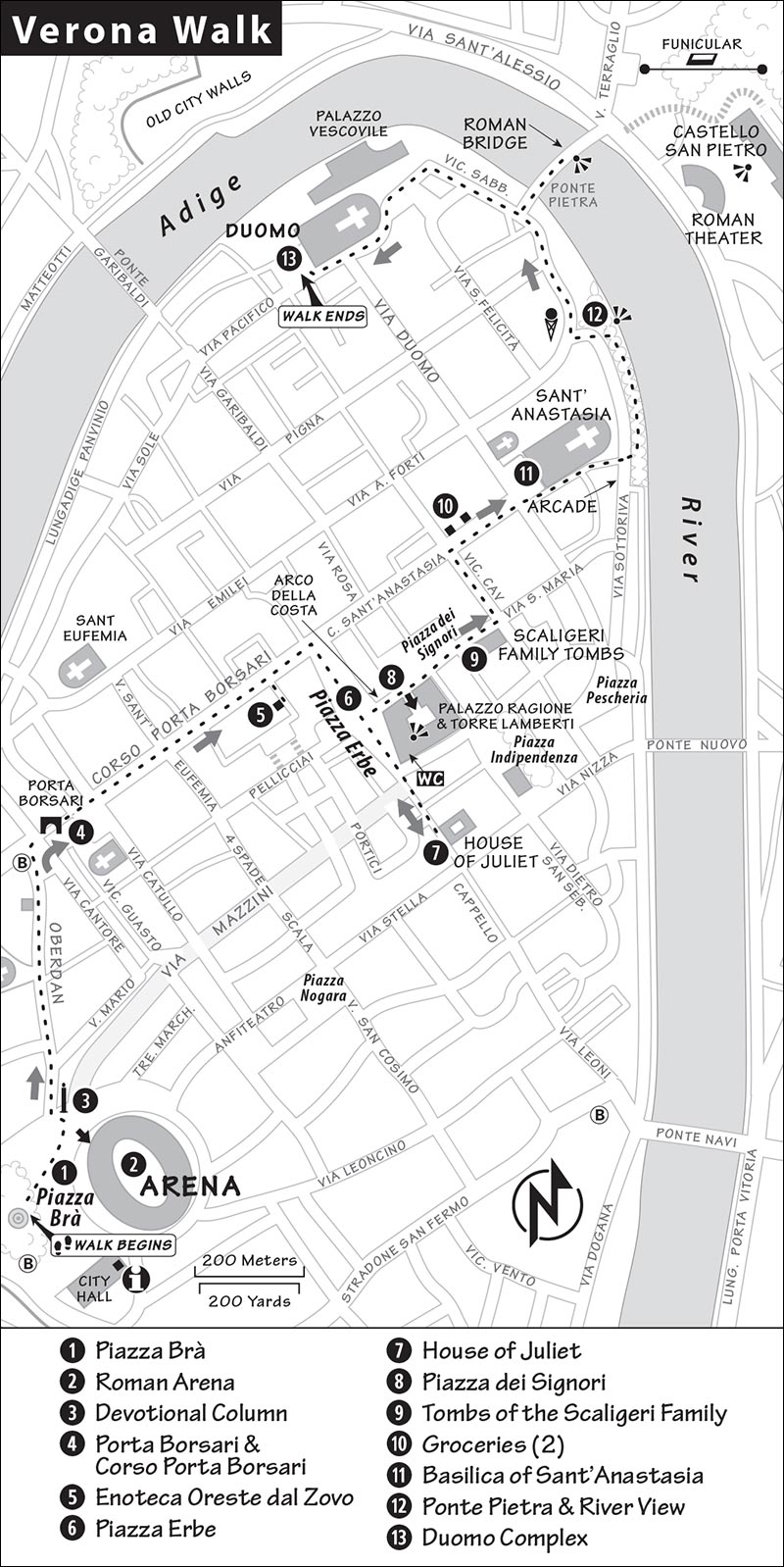
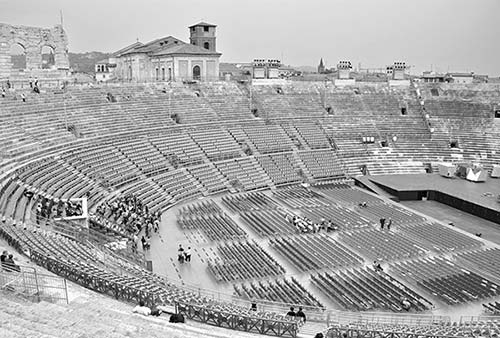
The gladiators posing with tourists out front are mostly from Albania and part of a local gang; they’re notorious for overcharging for photos. While they’re a nuisance, the police say it’s better that they’re scamming a living here than finding even more disreputable ways to get by.
Cost and Hours: €10, don’t bother with the combo-ticket that includes the unimpressive Maffei Museum; Tue-Sun 8:30-19:30, Mon from 13:30, closes earlier—likely around 16:00—during summer opera season, last entry one hour before closing; WC near entry, +39 045 800 3204.
• As you exit the arena, look to your right. Where the street splits you’ll see the...
3 Devotional Column
In the Middle Ages, this column blessed a marketplace held here. Ten yards in front of it, a bronze plaque in the sidewalk shows the Roman city plan—a town of 20,000 placed strategically in the bend of the river, which provided protection on three sides. A wall enclosed the peninsula. The center of the grid was the forum, today’s Piazza Erbe. (Look down Via Mazzini, the busy main pedestrian drag—the bell tower in the distance marks Piazza Erbe.)
• After viewing the bronze plaque, turn with your back to the arena and head down Via Oberdan (bearing left at the fork). Continue a couple of blocks (passing a derelict fascist-era theater, the Astra, set back from the street on the left, at #13) until you see an ancient gate to your right.
4 Porta Borsari and Corso Porta Borsari
You’re standing before the main entrance to Roman Verona; back then, this gate functioned as a tollbooth (borsari means purse, referring to the collection of tolls that once took place here). Carved into the rock below the spiral, fluted columns (which parents nickname “tortiglioni”—a pasta kids can relate to), is a tribute to the emperor who restored this gate. Outside the adjacent Caffè Rialto, the stone pillar on the curb is from a tomb: In Roman times, the roads outside the walls were lined with tombstones, because burials were not allowed within the town itself. Turn around, look down Corso Cavour, and imagine it in Roman times, leading away from the city gate and lined with tombs. Step into the café. A glass panel in the floor shows the original Roman foundations and pavement stones.
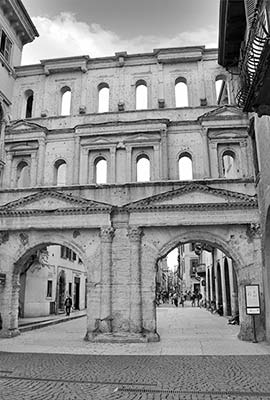
Back outside, cross under the Roman gate and head into the ancient city. Walk down Corso Porta Borsari, the Roman main drag, toward what was the forum. Make it a scavenger hunt. As you walk, discover bits of the town’s illustrious past—chips of Roman columns, medieval reliefs, fine old facades, fossils in marble—as well as its elegant present of fancy shops, in a setting that prioritizes pedestrians over cars. On the right, you’ll pass the recommended Osteria del Bugiardo, a popular wine bar and a good place to take a break and hang out with Verona’s young and trendy.
• Between Corso Porta Borsari 13 and 15, detour right down Vicolo San Marco in Foro, following the Pozzo dell’Amore sign. Twenty yards ahead on your right, you’ll find...
5 Enoteca Oreste dal Zovo
This funky wine and grappa bar has been run by Oreste like an old-style enoteca for decades. Browse and sample and clown around with Oreste. This historic enoteca was once the private chapel of the archbishop of Verona. Traces of the past hide between the bottles—ask Beverly (Oreste’s Chicagoan wife) to tell you the story (wines by the glass with light snacks, Vicolo San Marco in Foro 7, +39 045 803 4369).
• Return to Corso Porta Borsari and continue one block until you hit a big square.
6 Piazza Erbe
This bustling market square is a photographer’s delight. Its pastel buildings corral the fountains, pigeons, and people who have congregated here since Roman times, when this was a forum. Notice the Venetian lion hovering above the square atop a column, reminding locals of the conquest of 1405. Wander into the market, to the fountain in the middle. A fountain has bubbled here for 2,000 years. The original Roman statue lost its head and arms. After a sculptor added a new head and arms, the statue became Verona’s Madonna. She holds a small banner that reads, roughly, “The city of Verona deserves respect and justice.” During medieval times, the stone canopy in the center of the square (past the fountain) held the scales where merchants measured the weight of goods they bought and sold, such as silk and wool.
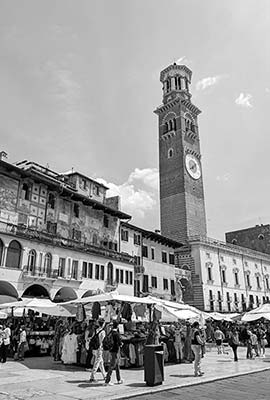
If you were standing here in the Middle Ages, you would have been surrounded by proud noble-family towers. Medieval nobles showed off with towers. Renaissance nobles showed off with finely painted facades on their palaces. Find remnants of the 16th-century days when Verona was nicknamed “the painted city.”
Locals like to start their evening with an aperitivo here. Each bar caters to a different market segment. Survey the scene and, if or when the time is right, choose the terrace that suits you and join in the ritual. It’s simple: Grab a spot, adjust your seat for the best view, and order a spritz to drink (€4 with a plate of olives and chips).
• At the far end of Piazza Erbe is a market column featuring St. Zeno, the patron of Verona, who looks at the crazy crowds flushing into the city’s silly claim to touristic fame: the House of Juliet (100 yards down Via Cappello to #23, on the left—just follow the crowds). Side-trip there now (but watch your wallet—it’s a pickpocket’s haven).
7 House of Juliet
The tiny, admittedly romantic courtyard is a spectacle: Tourists from all over the world pose on the balcony, while those hoping for love wait their turn to polish Juliet’s bronze breast. Residents marvel that each year, about 1,600 Japanese tour groups break their Venice-Milan ride for an hour-long stop in Verona just to see this courtyard (courtyard free, gates open roughly 8:30-19:30 or longer; €6 to enter nine-room “museum,” open Tue-Sun 9:00-19:00, closed Mon). It’s fun to stand in the corner and observe the scene, knowing that all this commotion was started by a clever tour guide in the early 1970s as a way to attract visitors to Verona.
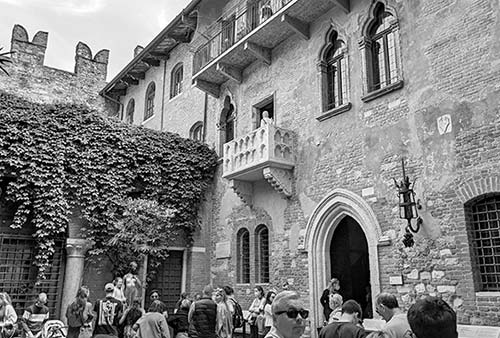
The courtyard walls are regularly filled with amorous graffiti that gets painted over just as regularly. The wall of padlocks is a gimmick enabling lovers to blow money in an attempt to prove that their hearts are thoroughly locked up. (The shop that sells the locks also sells pens to write on them.) The red mailbox is for love letters to Juliet. There’s actually a Juliet Club that reviews these—and all the letters mailed from around the world to “Juliet, Verona, Italy.” Each year, the club awards the author of the sweetest letter a free vacation to Verona.
Even those who milk their living out of this sight freely admit that no documentation has been discovered to prove the truth of the legend—but no documentation has disproved it either. The “museum,” which displays art inspired by the love story, plus costumes and the bed from Franco Zeffirelli’s film Romeo and Juliet, is certainly not worth the entry fee.
Was there ever a real Juliet Capulet? You just walked down Via Cappello, the street of the cap makers. Above the courtyard entry (looking out) is a coat of arms featuring a hat—representing a family that made hats and which would be named, logically, Capulet.
The public’s interest in a fictional Romeo and Juliet—or at least Juliet—is a sign that there’s a hunger for a Juliet in our world. Observing the mobs clamoring to polish her breast or blow kisses from her bogus balcony, I try to appreciate what she means to people, and to psychoanalyze what she provides to those who come to Verona specifically for this: the message that love will prevail. In love, you can lose, and still be a winner. Juliet is brave, tragic, honest, outspoken, timeless, and passionate. She’s a mover and a shaker, a dreamer and a fighter. In a way, this is a pagan temple where the spirit of Juliet gives people something to believe in...or maybe it’s just a bunch of baloney appreciated by a simple-minded crowd.
• Return to Piazza Erbe. From the middle of the piazza, head right on Via della Costa and into the big square.
8 Piazza dei Signori
Literally the “Lords’ Square,” this is Verona’s sitting room, quieter and more harmonious than Piazza Erbe. The buildings—which span five centuries—define the square and are all linked by arches. From one arch dangles a whale’s rib. It was likely a souvenir brought home by a traveling merchant from a trip to the Orient, reminding the townspeople that there was a big world out there. The long portico on the left is inspired by a building in Florence: Brunelleschi’s Hospital of the Innocents, considered the first Renaissance building.
Locals call the square Piazza Dante for the statue of the Italian poet Dante Alighieri that dominates it. Dante—always pensive, never smiling—seems to wonder why the tourists choose Juliet over him. Dante was expelled from Florence when that city sided with the pope (who didn’t appreciate Dante’s writing) and banished its greatest poet. Verona and its ruling Scaligeri family, however, were at odds with the pope (siding instead with the Holy Roman Emperor), and granted Dante asylum.
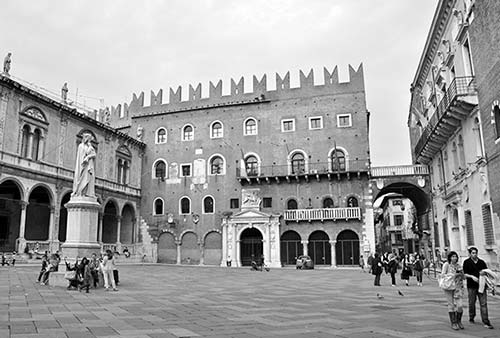
With the whale’s rib behind you, you’re facing the brick, crenellated, 14th-century Scaligeri residence. Behind Dante is the yellowish, 15th-century Venetian Renaissance-style Portico of the Counsel. At Dante’s two o’clock is the 12th-century Romanesque Palazzo della Ragione.
Looking back the way you came, follow the white toilette signs into the courtyard of the Palazzo della Ragione. The impressive stairway is the only surviving Renaissance staircase in Verona. Within the palazzo you can visit the Gallery of Modern Art (skippable) and climb the 12th-century Torre dei Lamberti for a grand city view. The elevator saves you 243 steps—but you’ll still need to walk up 46 more to get to the tower’s first viewing platform (€6 ticket covers tower and Gallery of Modern Art, no individual tower tickets sold; Mon-Fri 10:00-18:00, Sat-Sun 11:00-19:00; ticket office next to staircase, +39 045 927 3027, www.torredeilamberti.it).
• Exit the courtyard the way you entered and turn right, continuing downhill. Within a block, you’ll find the...
9 Tombs of the Scaligeri Family
These exotic and veritable 14th-century Gothic tombs, with their fine, original, wrought-iron protective fencing, evoke the age when one family ruled Verona. The Scaligeri were to Verona what the Medici were to Florence. These were powerful people. They changed the law so that they could be buried within the town. They forbade the building of any noble family’s new towers but their own. And, by building tombs atop pillars, they arranged to be looked up to, even in death.
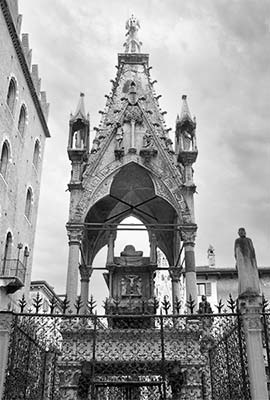
• Continue 15 yards to the next corner and take the first left on Vicolo Cavalletto. At the first corner, turn right along Corso Sant’Anastasia toward the big, unfinished brick facade of Verona’s largest church. For a fragrant and potentially tasty diversion, pop into 10 two classic grocery stores: Salumeria Caliari (at #33) and Salumeria Albertini (#41).
11 Basilica of Sant’Anastasia (Basilica di Sant’Anastasia)
This church, the biggest in Verona, was built from the late 13th century through the 15th century. Although the facade was never finished (the builders ran out of steam), the interior was—and still is—brilliant. Step inside to see the delightful way this region’s medieval churches were painted. Note the grimacing hunchbacks holding basins of holy water on their backs (near main entrance at base of columns). And don’t miss Pisanello’s fresco of St. George and the Princess of Trebizond (1438; at the tip of the arch, high above chapel to right of altar). Once colorful, it has oxidized over time to its current monochrome state. For a closer look at its wonderful detail, check out the images on the monitor below the fresco. Ask for the English brochure, which describes the story of the church.
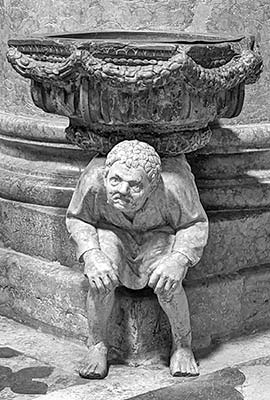
Cost and Hours: €4; Mon-Fri 10:00-18:00, Sat from 9:30, Sun 13:00-18:00, shorter hours in winter; www.chieseverona.it.
• As you leave, from the steps make two quick lefts to walk along the right side of the church to Via Sottoriva. To the right, the Sottoriva arcade was once busy with colorful wine bars and osterie, some of which still exist (see “Eating in Verona,” later). But for now, head to the left on Via Sottoriva. In a block, you’ll reach a small riverfront area with stone benches that usually have a few modern-day Romeos and Juliets gazing at each other rather than at the view. Belly up to the river view.
12 Ponte Pietra and River View
The white stones of the Ponte Pietra footbridge are from the original Roman bridge that stood here. After the bridge was bombed in World War II, the Veronese fished the marble chunks out of the river to rebuild it. From here, you can see across the river to the Roman Theater, built into the hillside behind the green hedge (see “Sights in Verona,” later). Way above the theater (behind the cypress trees) is the fortress, Castello San Pietro. The nearby funicular can take you there.
The wide spot in the river here was called the “Millers’ Widening,” where boats stopped and unloaded grain to be milled. Water wheels once lined the river and powered medieval Verona, employing technology imported from the Holy Land by 10th-century Crusaders.
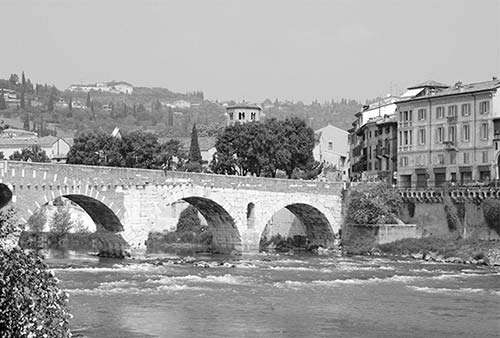
Continue up the river toward the bridge. Walk to its high point and enjoy the view.
• From the bridge, look back 200 yards at the tall white spire...that’s where you’re heading. Walk back off the bridge, then turn right, keeping an eye on the left for the steeple of the...
13 Duomo Complex (Complessa del Duomo)
Verona’s duomo is more than a single building; it’s a complex with the church, a baptistery, and the archaeological remains of much older churches. Early Christian basilicas have stood on this site at least as long ago as the fourth century. After a damaging earthquake in 1117, church fathers enlarged and patched things up, creating the duomo you see today.
Cost and Hours: €4, Mon-Fri 11:00-17:00, Sat until 15:30, Sun 13:30-17:30, shorter hours off-season, www.chieseverona.it.
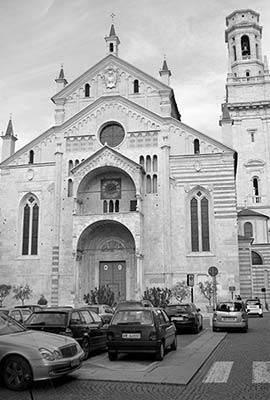
Visiting the Church: Before entering, note the fine Romanesque double porch at the entry and the figural carvings on its facade.
Now step inside, ask for the leaflet that explains the church’s highlights, and head to the last chapel on the left, with Titian’s Assumption of the Virgin (c. 1530). Mary calmly rides a cloud—direction up—to the shock and bewilderment of the crowd below. Notice a handful of tombs embedded in the walls about 15 feet above floor level—an unusual feature. (Generally, tombs are found in the floor of the church or in crypts below.)
Now head up the aisle to the last door on the left (left of high altar), where you’ll find the ruins of an older church. These are the 10th-century foundations of the Church of St. Elena, turned intriguingly into a modern-day chapel featuring exposed fourth-century mosaic floors from the Roman church that originally stood here.
From there, pass through the little open-air courtyard into the adjacent baptistery, with its clean Romanesque lines, hanging 14th-century crucifix, and fine octagonal font, carved from a single block of marble. Circle around it to identify the eight biblical scenes on its panels (go counterclockwise, starting with the panel just to the right of center): Annunciation; Visitation of Mary to Elizbeth and the Nativity, with animals licking Baby Jesus and giving him a barnyard welcome; announcement to shepherds of Jesus’ birth, with their flock stacked on one side; the Three Kings giving their gifts to Baby Jesus; Herod commanding that all male infants be killed; Slaughter of the Innocents; flight into Egypt; and finally, facing the entry door, John the Baptist baptizing Christ.
Finally, after leaving the church, circle around its left side (as you face the main facade) to find the peaceful Romanesque cloister (chiostro), with mosaics from a fifth-century Christian church exposed below the walk.
Sights in Verona
Several of Verona’s main sights, including the Roman Arena, Church of Sant’Anastasia, and Duomo, are covered in my Verona Walk.
▲▲Evening Passeggiata
For me, the highlight of Verona is the passeggiata (stroll)—especially in the evening. Make a big circle from Piazza Brà through the old town on Via Mazzini (one of Europe’s many “first” pedestrian-only streets) to the colorful Piazza Erbe, and then back down Corso Porta Borsari to Piazza Brà. This is a small town, where people know each other, and they’re all out on parade. Like peacocks, the young and nubile spread their wings. The classy shop windows are integral to the passeggiata as, for many of the ladies, shopping is a sport. Their never-finished wardrobes are considered a work in progress, and this is when they gather ideas. If you’re going to complement your stroll with a stop in a café or bar, the best plan is to enjoy a spritz drink—not on Piazza Brà, but on Piazza Erbe (the oldest and most elegant bars are on the end farthest from Juliet’s balcony).
▲Castelvecchio Museum (Museo di Castelvecchio)
Verona’s powerful Scaligeri family built this castle (c. 1356) as both a residence and a fortress. The huge, crenellated castle, located west of Piazza Brà and the Roman Arena, has two parts: the family palace and the quarters for their private army (separated, for the nervous family’s security, by a fortified wall and an internal moat). Today, it houses the city’s enjoyable art museum, with an interesting but not overwhelming collection of sculpture and paintings from medieval times through the 18th century. An added bonus is access to the castle ramparts, with good city views.
Cost and Hours: €6, Tue-Sun 10:00-18:00, closed Mon, Corso Castelvecchio 2, +39 045 806 2611, www.museodicastelvecchio.comune.verona.it. Info sheets are available throughout, but the €4 audioguide is still worthwhile.
Visiting the Castle: From the ticket desk, you’ll enter the ground-floor galleries, reserved for Romanesque and medieval sculptures from the Verona area. Religious statues were Verona’s medieval forte, and some of the surprisingly expressive examples here, such as the Crucifixion ensemble in Room 4, still show signs of once-bright paint.
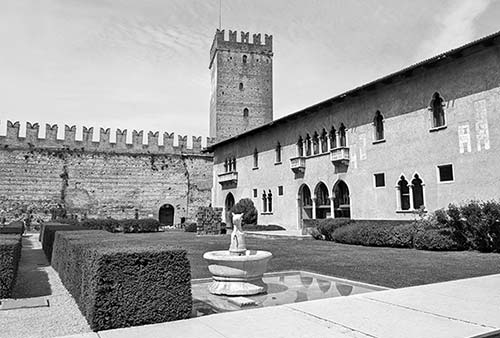
From the sculpture galleries, you’ll cross to the next wing and head upstairs to walk through two floors of paintings from the 13th through 18th century. Paolo Veronese, the city’s greatest artist, is represented, as are Mantegna, Titian, Tiepolo, Tintoretto, and others. Here in the residential part of the castle, several rooms show traces of decorative frescoes and walls painted with colorful geometric designs.
Before you exit, you’ll also pass by a small armory collection. En route, watch for stairs that let you roam the ramparts with fine views of the city, river, and Ponte Scaligero. Kids (and kids at heart) enjoy scrambling across the delightfully crenellated parapets. Verona was an independent city-state from 1176 to 1387. Then came a long period of subjugation under other powers which, in more modern times, included the Austrians. From the ramparts you can see remnants of Austrian rule: the arsenal across the river and the castle atop the distant hill.
Nearby: Next to Castelvecchio, the picturesque red-brick bridge called Ponte Scaligero—fortified and crenellated, as if a continuation of the castle—is free, open to the public, and fun to stroll across. Destroyed by the Germans in World War II, it was rebuilt in the 1950s using many of its original bricks, which were dredged out of the river. Today it’s a favorite for wedding-day photos.
OUTSIDE THE CITY CENTER
▲Basilica of San Zeno (Basilica di San Zeno)
This church, a 15-minute walk upriver beyond Castelvecchio, is dedicated to the patron saint of Verona, whose remains are buried in the crypt under the main altar. In addition to being a fine example of Italian Romanesque, the basilica features Mantegna’s San Zeno Triptych (c. 1459) with its marvelous perspective, peaceful double-columned cloisters, and a set of 11th-century doors covered with 48 bronze panels. Nicknamed “the poor man’s Bible,” the panels illustrate episodes from St. Zeno’s life and Old and New Testament stories—a sort of graphic novel for a medieval “reader.” Facing the altar, on the walls of the right-side aisle, you can see frescoes painted on top of other frescoes and graffiti dating from the 1300s. These were done by people who fled into the church in times of war or flooding and scratched prayers into the walls. Druidic-looking runes are actually decorated letters typical of the Gothic period, like those in illuminated manuscripts.
Cost and Hours: €4; Mon-Sat 9:30-18:00, Sun from 13:00, shorter hours off-season; on Piazza San Zeno, www.chieseverona.it.
Roman Theater (Teatro Romano)
Dating from about the time of Christ, this ancient theater—located across the Roman Bridge, north of the city center—was discovered in the 19th century and restored. Admission includes the Roman Museum, located high in the building above the theater (reach it via elevator—start at the stage and walk up the middle set of stairs, then continue straight on the path through the bushes).
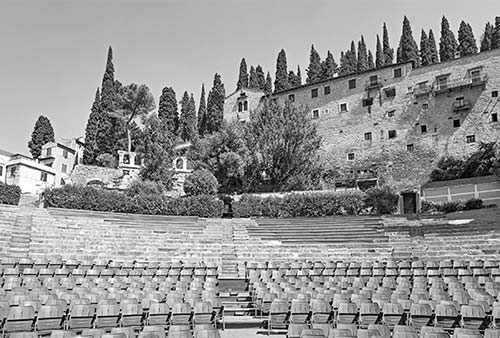
The museum displays a model of the theater, a small chapel, and Roman artifacts, including mosaic floors, busts and other statuary, clay and bronze votive figures, and architectural fragments. There’s not much to see. Unless you’ve never seen a Roman ruin, I’d skip it.
Cost and Hours: €4.50; Tue-Sun 10:00-18:00, closed Mon, last entry one hour before closing; theater located across the river near Ponte Pietra footbridge, +39 045 800 0360. From mid-June through August, the theater stages Shakespeare plays—only a little more difficult to understand in Italian than in Elizabethan English.
Giusti Garden (Giardino Giusti)
You’ll see this picturesque Renaissance-style garden capping the steep hilltop just across the Roman Bridge at the northern edge of the city. It’s a little oasis with manicured box hedges, towering cypress trees, a maze, and a city view from the top of its hill. For most people, however, it’s not worth the hike, time, or money.
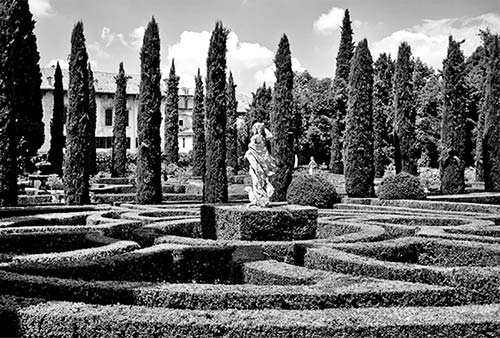
Cost and Hours: €10, daily 10:00-19:00, until 18:00 in winter, across the river, beyond Ponte Nuovo, at Via Giardino Giusti 2, www.giardinogiusti.com.
Sleeping in Verona
Hotel prices soar from mid-June through early September (opera season), in early April (during the Vinitaly wine festival), and during big trade fairs or major holidays. Unless your goal is opera, consider coming outside the summer months. For hotel locations, see the “Verona” map, earlier.
NEAR PIAZZA ERBE
$$$ Hotel Aurora, at the corner of Piazza Erbe and Via Pelliciai, has friendly family management, attention to detail, a welcoming terrace with wonderful piazza views, and 18 straightforward rooms (family rooms, air-con, elevator, Piazzetta XIV Novembre 2, +39 045 594 717, www.hotelaurora.biz, info@hotelaurora.biz, Riccardo).
$$$ Albergo Mazzanti, tucked onto a quiet street behind Piazza Erbe, has a great central location. Its 16 classically furnished rooms, spread over two floors of an ancient building, are a good value (air-con, elevator, Mazzanti 6, +39 045 591 690, www.albergomazzanti.it, info@albergomazzanti.it).
$$ Casa Coloniale is just a stone’s throw from Piazza Erbe. The four rooms all have balcony views and are simply but brightly furnished. Energetic owner Lucca runs the nearby Caffè Coloniale (Piazza Viviani Francesco 12), where breakfast is provided, along with B&B check-in after 15:00 (air-con, no elevator, Via Cairoli 6, +39 393 940 8687, mobile +39 337 472 737, www.casa-coloniale.com, info@casa-coloniale.com).
¢ Protezione della Giovane, run by an association that houses poor women, also rents rooms and dorm beds to female tourists (and their children, up to age 12 for boys). Buried deep in the old town and up several flights of stairs, this place offers 10 cheap beds in a clean, institutional, and peaceful setting (women only, no breakfast, 23:00 curfew, reception open 9:00-20:00, Wi-Fi in common areas, Via Pigna 7, +39 045 596 880, www.protezionedellagiovane.it, info@protezionedellagiovane.it).
NEAR PIAZZA BRÀ
You’ll find several options in the quiet streets just off Piazza Brà. From the square, white or yellow signs point you to the hotels. Most of these are big, fairly impersonal business-class places. Albergo Arena and Pepita Lodge are a little farther out, but still within a short walk to Piazza Brà.
$$$$ Hotel Milano is an arty hotel with 56 rooms. The lobby and fancier rooms are tricked out in black and chrome. It has a wonderful terrace and hot tub overlooking the Roman Arena (air-con, elevator, pay parking in garage, Vicolo Tre Marchetti 11, +39 045 596 011, www.hotelmilano-vr.it, info@hotelmilano-vr.it).
$$$ Hotel Giulietta e Romeo is on a quiet side street 100 yards behind the Roman Arena. It’s stylish and well-managed; 10 of its 37 ultra-modern rooms have balconies (air-con, elevator, loaner bikes, fitness room, pay parking in garage or ask for free street-parking permit, Vicolo Tre Marchetti 3, +39 045 800 3554, www.hotelgr.it, info@hotelgr.it).
$$$ Hotel Colomba d’Oro is a sprawling place with old-school elegance, renting 50 spacious rooms with Baroque flourishes. It has generous public spaces, including a peaceful courtyard, and overlooks a quiet and central street (air-con, elevator to every other floor, stairs between the rest, Via C. Cattaneo 10, +39 045 595 300, www.colombahotel.com, info@colombahotel.com).
$$$ Pepita Lodge is convenient for train travelers and a 10-minute walk from Piazza Brà. The artful and spacious rooms have a calm, contemporary, clean-lines vibe. Breakfast is provided across the street at a pasticceria (family rooms, air-con, elevator, pay parking, Corso Porta Nuova 103, reception at #99B, +39 045 800 1393, www.pepitalodge.it, info@pepitalodge.it).
$$ Aparthotel Verona House is a good option if you want hotel amenities and residential comfort. The 23 apartments are swanky and stylish (some can fit up to eight people). The bright, spacious breakfast room has great views onto Castelvecchio and doubles as an honor bar in the afternoon and evening (air-con, elevator, pay parking, loaner bikes, Stradone Provolo 3, +39 045 205 0366, www.veronahouse.com, info@hotels2go.it).
Eating in Verona
Every restaurant listed here is within a 10-minute walk of the others. They’re mostly small and intimate and found along side streets. It’s tempting to grab a table next to the passeggiata action along Piazza Brà, but you’ll be sacrificing service, value, and quality for your view of the floodlit Roman Arena and Verona on parade (perhaps a fair trade-off). Restaurants on the piazza tend to charge a cover and service fee, making even pizza a pricey choice. For restaurant locations, see the Verona map, earlier.
FINE DINING
$$$$ Darì Ristorante & Enoteca, run by longtime Verona restaurateurs Corinna and Giuliano, has a lovely setting inside and out and beautifully presented food (Wed-Mon 12:00-15:00 & 18:30-22:30, closed Tue, Vicolo Cieco San Pietro Incarnario 5, +39 045 595 022, www.ristorantedari.com).
$$ Trattoria al Pompiere bustles with old-school waiters weaving among its tight tables and walls plastered with photos of big shots from the area. Marco and his gang serve regional classics as well as gourmet meat and cheese antipasti from their larger-than-life back counter. Reservations are wise (Mon-Sat 12:40-14:00 & 19:40-22:30, closed Sun; halfway between Piazza Erbe and Juliet’s courtyard—head down narrow side street next to Via Cappello 8 to Vicolo Regina d’Ungheria 5; +39 045 803 0537, www.alpompiere.com).
$$$ Caffè Dante is a high-end place with a 19th-century pedigree and elegant service on the coziest and classiest square in town. You can enjoy a memorable meal of classic Veneto cuisine either at romantic tables on the square or inside. If you want to dress up and enjoy a slow, romantic, memorable meal, this can be a good value. The kitchen has limited hours, but the café is open throughout the day (Tue-Sun 12:00-15:00 & 18:00-23:00, closed Mon, closed Sun afternoon off-season; Piazza dei Signori 2, +39 045 800 0083, www.caffedante.it).
$$$ Bottega del Vino is pricey, venerable, and a bit pretentious. Under a high ceiling and walls of wine bottles, brisk, black-vested waiters match traditional dishes (polenta, duck, game) with glasses of fine wine. Choose from 50 open bottles. The waitstaff, ambience, and food have deep roots in local culture. I like their front room best. Reservations are smart for dinner (good daily specials, daily 11:00-23:00—kitchen closed 14:30-19:00, bar open later, off Via Mazzini at Via Scudo di Francia 3, +39 045 800 4535, www.bottegavini.it).
MODERATE RESTAURANTS
$$ Ristorante Torcolo, dressy but not stuffy, is a family restaurant, with mom (Paola) running the kitchen, and father and son (Roberto and Luca) supervising the dining room. Their accessible menu covers all the classics but with modern twists, and the wine list is extensive. Eat in their dining hall or on the courtyard outside (daily 12:30-14:30 & 19:00-22:30, dinner from 17:00 in opera season, just behind the Piazza Brà scene on a quiet street, Via Carlo Cattaneo 11, +39 045 803 3730).
$$ Osteria Caffè Monte Baldo has cafè-style bites plus a full menu with dishes typical of Verona like risotto all’Amarone for two or cacio e pepe alla veronese (with truffles). Or just pop into this cozy, rustic spot for a drink and snack on some tartine (open daily 11:00-15:00 & 18:00-23:00, Via Rosa 12, +39 045 803 0579). Their sister eatery, La Piazzetta, offers a similar menu in a relaxed environment with terrace seating (daily 12:00-15:00 & 19:00-22:30, Corte San Giovanni in Foro 4/A, +39 045 591 099).
$$ Ristorante Sant’Eufemia, on a quiet side street near Piazza Erbe, offers excellent homemade pasta and typical Veronese cuisine at reasonable prices. The outdoor area, under twinkling fairy lights, is especially inviting (Tue-Sun 12:30-15:00 & 19:30-22:00, closed Mon, Corticella San Giovanni in Foro 7, +39 045 800 6865).
EATING IN OSTERIE (OLD BARS)
Wandering around the old town, you’ll see plenty of Verona’s thriving little watering holes. These traditional old bars focus more on wine than food, but most serve memorable and affordable plates. Menus are simple and rustic—sometimes just bar munchies and the daily pasta. Service is relaxed and the clientele is young and local. For drinks it’s mostly wine or water—fine wines are served by the glass, with bottles open and prices listed on blackboards. (I saw one sign suggesting that patrons “don’t drive too much to drink.”)
$$ Osteria Sottoriva survives from an era when Verona’s river served as the town thoroughfare, and business deals could be made over a glass of wine at rustic riverside eateries. Located in a fine old covered arcade (the portico of Via Sottoriva), with both cozy indoor and outdoor seating, Sottoriva serves simple Veneto fare that changes seasonally and with the owner’s whim (daily 11:00-15:00 & 18:00-22:30—but open all day long in summer, closed Wed in winter, behind the Church of Sant’Anastasia at Via Sottoriva 9, +39 045 801 4323).
$ Osteria del Bugiardo is usually jammed with a happy crowd that spills out into the pedestrian-filled Corso Porta Borsari. They have a buffet of little sandwiches, can whip up a plate of top-quality cheeses, and serve a short list of pastas. They showcase their own Buglioni wines and are proud to tell you more about them (daily 11:00-24:00, in the old center at Corso Porta Borsari 17a, +39 045 591 869).
$$ Osteria la Mandorla hides behind its vintage Vini—Liquori/Giovanni Zampieri sign with a tiny bar and a few tables. It’s been stoking conviviality with good wine since 1937. This place is passionate about organic wines, slow food, and craft beers. They don’t serve much food—just some bar munchies and a nice antipasti plate. Locals go for horse’s balls (polpettine di cavallo), which are procured from the butcher down the street (daily 11:00-14:00 & 17:00-late except closed Mon for lunch, a few steps off Piazza Brà and next to Via Mazzini at Via Alberto Mario 23, +39 045 597 053). You’re welcome to play foosball downstairs on what Italians call the calcio balilla (“the little boy soldiers of Mussolini”).
PIZZA, CHEAP EATS, AND SWEETS
$ Pizzeria da Salvatore, Verona’s first pizzeria, opened in 1963, when pizza was considered a foreign food...from Naples. They serve the best pizza in town, and a visit here offers a nice excuse to stroll across the river into a part of town with no tourists. It’s family-friendly, not fancy or romantic, and you’ll squeeze into a tight row of tiny tables, rubbing elbows with your neighbors. While it’s not quite Naples, it’s justifiably popular—come early, or plan to leave your name on the list and wait awhile (Tue-Sat 12:30-14:30 & 19:00-23:00, Sun 19:00-23:00 only, closed Mon, closed Sun in July, no reservations, across Ponte Nuovo to Piazza San Tomaso 6, +39 045 803 0366).
$ Pizzeria Du de Cope is a colorful, high-energy, informal place that buzzes with smartly attired young waiters and locals who keep coming back for the pizza (daily 12:00-14:30 & 19:00-23:00, flamboyant desserts, families welcome, no reservations, at Galleria Pelliciai 10, +39 045 595 562).
$ Döner kebab shops all over town serve hearty, cheap kebabs to munch on from a stool or to take out. Piadine (pita-bread) kebabs are worth the €5, and the super-sized kebabs can fill a couple on a very tight budget for a total of €8. The best kebabs, according to local assessments, are behind the Roman Arena at Via Leoncino 44. There’s another good place on the other side of Piazza Brà at Via Teatro Filarmonico 6b. The benches in the center of Piazza Brà are handy for a scenic place to munch your cheap meal.
Groceries: The PAM supermarket chain has two locations (both generally open 8:00-21:00 with shorter hours on Sun). One is just outside the historic gate on Piazza Brà (exit Piazza Brà through the gate and take the first right to Via dei Mutilati 3). The other one is across the Adige River, beyond Ponte Vittoria (Via IV Novembre 6A). Near the Church of Sant’Anastasia are two classic grocery stores, Salumeria Caliari and Salumeria Albertini (as mentioned in the town walk, earlier).
Gelato: The venerable Gelateria Savoia has been in business since 1939. It’s in an arcade just off Piazza Brà, marked by a crowd licking their specialty semifreddo of bitter-almond amaretto, cream, and cookie (just off Piazza Brà at Via Roma 1b). Near the foot of the Ponte Pietra bridge, Gelateria Ponte Pietra prides itself on using fine ingredients. Besides gelato, they serve Sicilian granite and milkshakes (Via Ponte Pietra 13).
Verona Connections
Every hour, at least two trains connect Verona with Venice, Padua, and Vicenza. Choose one of the cheaper regional trains (R or RV) instead of the faster Italo or Frecce express trains, which get you there slightly sooner but cost much more. Unless otherwise specified, the following connections are for Trenitalia.
From Verona by Train to: Venice (1.5-2 hours, Trenitalia: 2/hour, Italo: 7/day), Padua (2/hour, 40-80 minutes), Vicenza (2/hour, 30-60 minutes), Florence (about hourly, 1.5 hours direct or 2.5 hours with transfer in Bologna; Italo: 4/day, 1.5 hours), Bologna (hourly, 1.5 hours), Milan (2/hour, 1.5-2 hours; Italo: 7/day, 1.5 hours), Rome (at least hourly, 4-5 hours, often with transfer in Padua or Bologna, also 1 night train, 8 hours, with change in Padua; Italo: 4/day, 3.5 hours), and Bolzano (2/hour, 1.5 hours).