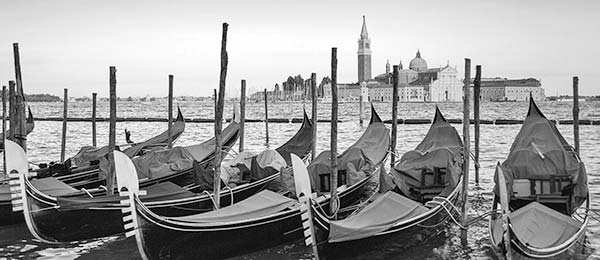
VENICE
Venezia
Map: Hotels & Restaurants near St. Mark’s Square
Map: Hotels & Restaurants near the Rialto Bridge
Map: Hotels & Restaurants near Accademia Bridge
Map: Hotels & Restaurants near the Rialto Bridge
SPLURGING ON A WATER (OR OTHERWISE GREAT) VIEW
Soak all day in this puddle of elegant decay. Venice is Europe’s best-preserved big city. This car-free urban wonderland of a hundred islands—laced together by 400 bridges and 2,000 alleys—survives on the artificial respirator of tourism.
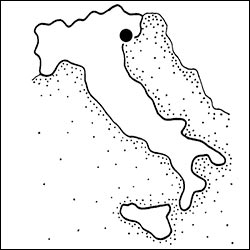
Born in a lagoon 1,500 years ago as a refuge from barbarians, Venice is overloaded with tourists and is slowly sinking (not because of the tourists). In the Middle Ages, the Venetians became Europe’s clever middlemen for East-West trade and created a great trading empire. By smuggling in the bones of St. Mark (San Marco) in AD 828, Venice gained religious importance as well. With the discovery of America and new trading routes to the Orient, Venetian power ebbed. But as Venice fell, her appetite for decadence grew. Through the 17th and 18th centuries, Venice partied on the wealth accumulated through earlier centuries as a trading power.
Today, Venice is home to fewer than 51,000 people in its old city, down from about twice that number just three decades ago. While there are about 270,000 people in greater Venice (counting the mainland, not counting tourists), the old town has a small-town feel, and locals seem to know everyone.
Venice is expensive for residents as well as tourists because everything must be shipped in and hand-trucked to its final destination. I find that the best way to enjoy Venice is to succumb to its charms, accept that prices are higher than on the mainland, and blow through a little money. It’s a unique place that’s worth paying a premium to fully experience.
Escape the Rialto-San Marco tourist zone and savor the town early and late, without the hordes of vacationers day-tripping in from cruise ships and nearby beach resorts. A 10-minute walk from the madness puts you in an idyllic Venice that few tourists see.
PLANNING YOUR TIME
Venice is worth at least two nights and one busy day on even the speediest tour. Sleep in the old center to experience Venice at its best: early and late. On the night you arrive, walk or boat to the train station and then, aboard an empty vaporetto, take my self-guided Grand Canal Cruise to St. Mark’s Square (it’s less crowded and more romantic at night). The next day, do the major sights on St. Mark’s Square (the square itself, Doge’s Palace, and St. Mark’s Basilica), enjoy the action at the Rialto Bridge and Rialto Market, see the Frari Church for art, and wander the back streets of the Dorsoduro district to the Accademia Bridge and back to St. Mark’s Square. Enjoy an evening gondola ride and then a drink with the orchestras on St. Mark’s Square. Remember that Venice’s greatest sight is the city itself. It’s a medieval cookie jar, and nobody’s looking. Make time to simply wander.
Orientation to Venice
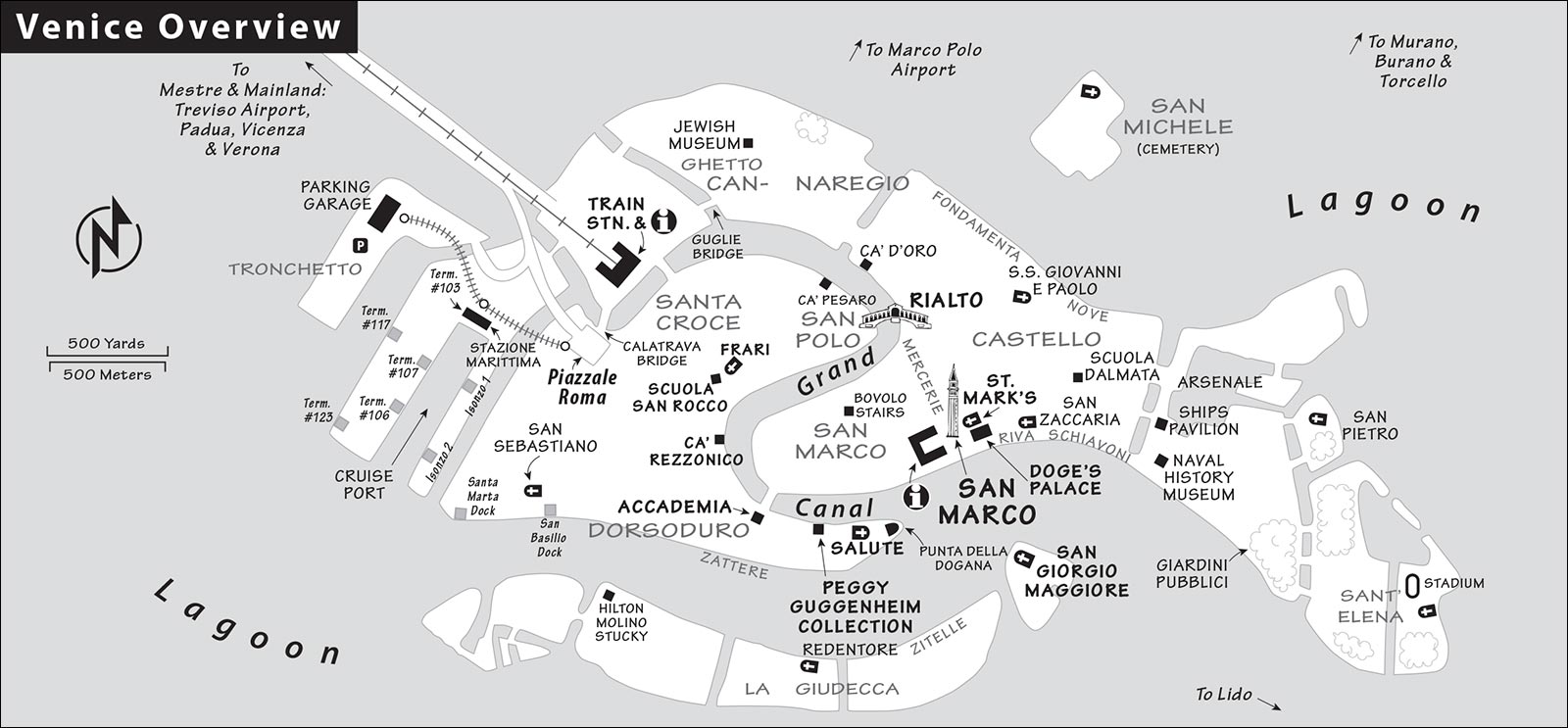
The island city of Venice is shaped like a fish. Its major thoroughfares are canals. The Grand Canal winds through the middle of the fish, starting at the mouth where all the people and food enter, passing under the Rialto Bridge, and ending at St. Mark’s Square (Piazza San Marco). Park your 21st-century perspective at the mouth and let Venice swallow you whole.
VENICE: A VERBAL MAP
Venice is a carless kaleidoscope of people, bridges, and odorless canals. It’s made up of more than a hundred small islands—but for simplicity, I refer to the whole shebang as “the island.”
Venice has six districts known as sestieri: San Marco (from St. Mark’s Square to the Accademia Bridge), Castello (the area east of St. Mark’s Square—the “tail” of the fish), Dorsoduro (the “belly,” on the far side the Accademia Bridge), Cannaregio (between the train station and the Rialto Bridge), San Polo (west of the Rialto Bridge), and Santa Croce (the “eye” of the fish, across the canal from the train station).
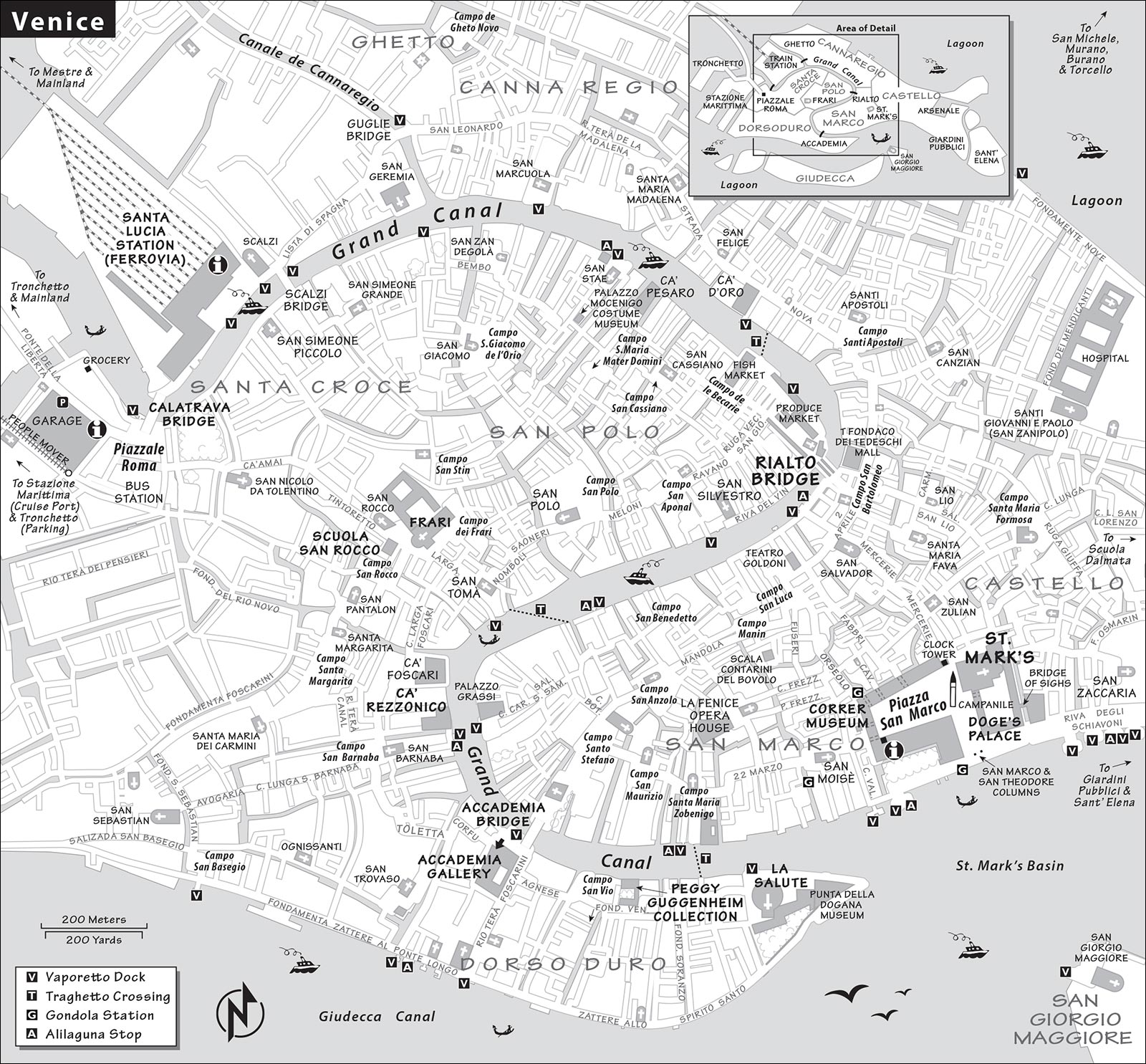
The easiest way to navigate is by landmarks. Many street corners have a sign pointing you to (per) the nearest major landmark, such as San Marco, Accademia, Rialto, and Ferrovia (train station). Obedient visitors stick to the main thoroughfares as directed by these signs…and miss the charm of back-street Venice.
Beyond the city’s core lie several other islands, including San Giorgio (with great views of Venice), Giudecca (more views), San Michele (old cemetery), Murano (famous for glass), Burano (lacemaking), Torcello (old church), and Lido (with Venice’s beach).
TOURIST INFORMATION
With this chapter, a free city map from your hotel, and the events schedule on the TI’s website, there’s little need to make an in-person visit to a Venice TI. That’s fortunate, because although the city’s TIs try to help, they’re understaffed and have few materials to hand out. To check or confirm something, visit VeneziaUnica.it; this website can be more helpful than the actual TI office. Other useful websites are VisitMuve.it (city-run museums in Venice), UnOspiteDiVenezia.it/en (sights and events), VeniceExplorer.com [URL inactive] (mapping), and VeniceForVisitors.com (general travel advice). If you must visit a TI, you’ll find offices at St. Mark’s Square (#71B, in the far-left corner with your back to the basilica), Marco Polo airport (arrivals area), Piazzale Roma (at the Autorimessa Comunale parking garage), and the train station (across from track 2).
Be wary of the travel agencies or special information services that masquerade as TIs but serve fancy hotels and tour companies. They’re in the business of selling things you don’t need.
Maps: Of all places, Venice demands a good map. Hotels give away freebies. TIs and some vaporetto ticket booths sell decent maps—but you can find a wider range at bookshops, newsstands, and postcard stands. Getting a map that shows all the tiny alleys may be the best money you spend in Venice. But know you’ll still spend some time “exploring” (read: lost). Many just rely on Google Maps and do fine.
ARRIVAL IN VENICE
For a rundown on Venice’s train station, bus station, airport, and cruise terminal, and tips for drivers, see the “Venice Connections” section later in this chapter.
HELPFUL HINTS
Sightseeing Tips: Venice offers plenty of sightseeing passes, but only a few are worth the money. For more on passes and other sightseeing advice, see here.
Day-Tripper Tax: Beginning in January 2023, Venice plans to charge day-trippers a tourism fee (ranging from €3 to €10) to enter the city center. Check the TI website for the latest.
Theft Alert: The dark, late-night streets of Venice are generally safe. Even so, pickpockets (often elegantly dressed) work all the extremely crowded areas: main streets, docks, and vaporetti. Be particularly careful at St. Mark’s Basilica, near the Accademia or Rialto bridges (especially if you’re preoccupied with taking photos), or on a tightly packed vaporetto.
A handy polizia station is on the right side of St. Mark’s Square as you face the basilica (at #63, near Caffè Florian). To call the police, dial 112. The Venice TI handles complaints (www.veneziaunica.it, under “Contacts”) about local crooks, including gondoliers, restaurants, and hotel rip-offs.
Medical Help: Venice’s Santi Giovanni e Paolo hospital (+39 041 889 7908) is a 10-minute walk from both the Rialto and San Marco neighborhoods, located behind the big church of the same name on Fondamenta dei Mendicanti (toward Fondamente Nove). You can take vaporetto #4.1 from San Zaccaria, or #5.2 from the train station or Piazzale Roma, to the Ospedale stop. There’s also a first-aid station staffed by English-speaking doctors on St. Mark’s Square, on the right-hand side as you face the basilica (at #63 next to Caffé Florian—same address as polizia station, daily 8:00-20:00, +39 041 2960 784).
Behave in Venice: Remember that Venice is a community of about 50,000 people who welcome visitors but feel violated when tourists don’t respect the city they love. The vast majority of visitors are day-trippers stampeding in, seeing the famous stuff, and stampeding out. Venetians ask that a few simple rules are followed: Dress decently, don’t swim in the canals, don’t litter, stay on the right as you walk, and treat things as if they are both historic and fragile...because they are.
Dress Modestly: When visiting St. Mark’s Basilica or other major churches, men, women, and even children must cover their shoulders and knees. Remove hats when entering a church.
Picnics: Picnicking is illegal anywhere on St. Mark’s Square, and offenders can be fined. The only place nearby for a legal picnic is in Giardinetti Reali, the small bench-filled park along the waterfront west of the Piazzetta near St. Mark’s Square. Elsewhere in Venice, picnicking is no problem.
Bookstores: In keeping with its literary heritage, Venice has classy and inviting bookstores. The small Studium, a block behind St. Mark’s Basilica, has a carefully chosen selection of new English books, including my guidebooks (Mon-Sat 9:30-19:30, shorter hours Sun, on Calle de la Canonica at #337—see map on here, +39 041 522 2382, www.libreriastudium.eu).
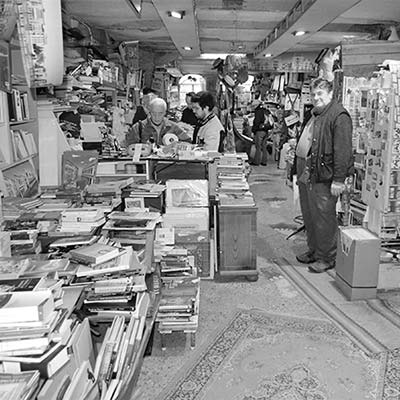
Used-bookstore lovers will appreciate the funky Acqua Alta (“high water”) bookstore, whose quirky owner Luigi has prepared for the next flood by displaying his wares in a selection of vessels, including bathtubs and a gondola. Look for the “book stairs” in his back garden (daily 9:00-19:30, large and classically disorganized selection includes prints of Venice, just beyond Campo Santa Maria Formosa on Lunga Santa Maria Formosa, Castello 5176—see map on here, +39 041 296 0841). For a solid selection of used books in English, visit Libreria Marco Polo on Campo Santa Margherita (Tue-Sat 11:00-13:00 & 15:00-19:00, closed Sun-Mon, Dorsoduro 2915, +39 041 822 4843).
Public Toilets: Handy pay WCs are near major landmarks, including St. Mark’s Square (behind the Correr Museum and at the waterfront park, Giardinetti Reali), behind St. Mark’s Basilica (just off Campo Santi Filippo e Giacomo), Rialto, and the Accademia Bridge. Or use free toilets at any museum you’re visiting, or any tables-and-chairs café you’re eating in.
Laundry: Across the Grand Canal from the train station is the coin-operated Orange Self-Service Lavanderia (daily 7:30-23:00, on Ramo de le Chioverete, Santa Croce 665a—see map on here, mobile +39 346 972 5446).
These laundry places are near St. Mark’s Square (see here for locations): Self-service Effe Erre is off Campo Santa Maria Formosa (daily 6:30-23:30, on Ruga Giuffa, Castello 4826, mobile +39 340 712 5290). Lavanderia Gabriella offers full-service laundry, a few streets north of St. Mark’s Square (drop off Mon-Fri 8:30-12:30, closed Sat-Sun; pick up 2 hours later or next working day, on Rio Terà de le Colonne, San Marco 985, +39 041 522 1758, friendly Elisabetta).
Water: I carry a water bottle to refill at public fountains. Venetians pride themselves on having pure, safe, and tasty tap water piped in from the foothills of the Italian Alps. You can actually see the mountains from Venice’s bell towers on crisp, clear winter days.
Pigeon Poop: If your head is bombed by a pigeon, resist the initial response to wipe it off immediately—it’ll just smear into your hair. Wait until it dries, and it should flake off cleanly. But if the poop splatters on your clothes, wipe it off immediately to avoid a stain.
GETTING AROUND VENICE
Venice is small. You can walk across it, from head to tail, in about an hour. Nearly all of your sightseeing is within a 20-minute walk of the Rialto Bridge or St. Mark’s Square.
On Foot
The city’s “streets” are narrow pedestrian walkways connecting its docks, squares, bridges, and courtyards. To navigate, look for signs on street corners pointing you to (per) the nearest major landmark. The first landmarks you’ll get to know are San Marco (St. Mark’s Square), Rialto (the bridge), Accademia (another bridge), Ferrovia (literally “railroad,” meaning the train station), and Piazzale Roma (the bus station). Determine whether your destination is in the direction of a major, signposted landmark, then follow the signs through the maze.
As you get more comfortable with the city, dare to disobey these signs, avoid the posted routes, and make your own discoveries. While 80 percent of Venice is, in fact, not touristy, 80 percent of tourists never notice. Escape the crowds and explore on foot. Walk and walk to the far reaches of the town.
Don’t worry about getting lost—in fact, get as lost as possible. When it comes time to find your way, just follow the arrows on building corners or simply ask a local, “Dov’è San Marco?” (“Where is St. Mark’s?”) Most Venetians speak some English. If you’re lost, refer to a map, or pop into a hotel and ask for their business card—it probably comes with a map and a prominent “You are here.”
Some helpful terminology: Campo means square, a campiello is a small square, calle (pronounced “KAH-lay” with an “L” sound) means “street,” and ponte is a bridge. A fondamenta is the embankment along a canal or the lagoon. A rio terà is a street that was once a canal and has been filled in. A sotoportego is a covered passageway. Salizzada literally means a paved area (usually a wide street). The abbreviations S. and SS. mean “saint” and “saints,” respectively. Don’t get hung up on the exact spelling of street and square names, which may sometimes appear in Venetian dialect (which uses de la, novo, and vechio) and other times in standard Italian (which uses della, nuovo, and vecchio).
For centuries, Venice got along without any official street names or numbering. Navigating was by landmarks alone (“the fourth alley after the fruit stand closest to the canal”). But when Austria took over in 1798, it imposed the sometimes-confusing system that’s still used today.
The Austrians picked a starting point in each sestiere (district) and assigned numbers to each house. In the San Marco sestiere, for example, numbering started at the Doge’s Palace (San Marco 1) and kept going to the last house (San Marco 5562). To the ongoing chagrin of tourists, official addresses still contain just the district name and house number, but no street. That’s fine for the postman, but for the sake of others, many businesses and individuals now add a street name.
By Vaporetto
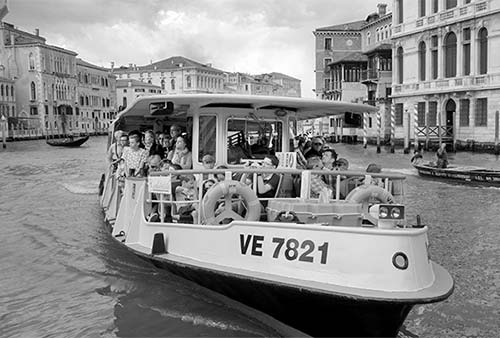
Venice’s public transit system, run by a company called ACTV, is a fleet of motorized bus-boats called vaporetti. They work like city buses except that they never get a flat, the stops are docks, and if you jump off between stops, you might drown. For the same prices, you can purchase tickets and passes at docks and from ACTV affiliate VèneziaUnica (ACTV—+39 041 2424, www.actv.it; VèneziaUnica—www.veneziaunica.it).
Tickets and Passes
Individual Vaporetto Tickets: A single ticket costs €7.50 (kids under 6 travel free). Tickets are good for 75 minutes of one-way travel; you can hop on and off at stops and change boats during that time. It’s smart to keep your receipt (in case you’re checked and your ticket is faulty).
Vaporetto Passes: Because single tickets are pricey, passes pay for themselves in a hurry. You can buy a pass for unlimited use of vaporetti: €21/24 hours, €30/48 hours, €40/72 hours, €60/7-day pass (the clock starts ticking the first time you use it). Think through your Venice itinerary before you step up to the ticket booth to pay for your first vaporetto trip. The 48-hour pass pays for itself with five rides (for example: to your hotel on your arrival, on a Grand Canal joyride, into the lagoon and back, to the train station...and that spur-of-the-moment moonlight cruise). It’s fun to be able to hop on and off spontaneously and avoid long ticket lines. Some smaller and outlying stops are unstaffed—another reason to buy a pass.
Travelers between ages 6-29 can get a 72-hour pass for €28 if they also buy a Rolling Venice discount card for €6 (see here).
Passes are also valid on some of ACTV’s mainland buses, including bus #2 to Mestre (but not the #5 to the airport nor the airport buses run by ATVO, a separate company).
Buying and Validating Tickets and Passes: Purchase tickets and passes from the machines at most stops (English-language option, credit cards accepted), from ticket windows (at larger stops), or from the VèneziaUnica offices at the train station, bus station, and Tronchetto parking lot.
Before you board, validate your ticket or pass by touching it to the small white pad on the dock until you hear a pinging sound (you need to touch the pass each time you board a boat). The machine readout shows how long your ticket is valid—and inspectors do come by now and then to check tickets. If you’re unable to purchase a ticket before boarding, seek out the conductor immediately to buy a single ticket (or risk a hefty fine).
Important Vaporetto Lines
For most travelers, only a few vaporetto lines matter.
Line #1 leaves every 10 minutes or so and goes up and down the Grand Canal, between the “mouth” of the fish at one end and St. Mark’s Square at the other. Making every stop along the way, it takes 45 minutes to complete the full route.
Line #2 runs between Piazzale Roma (bus station) and San Marco/San Zaccaria via Giudecca (35 minutes); the companion line #2/ goes from Piazzale Roma to Ferrovia (train station) and Rialto via the Grand Canal (10 minutes). From late May to mid-September, line #2 also runs an express route up and down the Grand Canal, between Piazzale Roma and San Marco/San Zaccaria (35 minutes).
Take time to study the maps at docks before you board. Some boats run on circular routes, in one direction only (for example, lines #5.1 and #5.2).
To clear up any confusion, ask a ticket seller or conductor for help (sometimes they’re stationed on the dock to help confused tourists). Get a copy of the most current ACTV map and timetable (in English and Italian, download from www.actv.it, theoretically free at ticket booths but often unavailable), or consult the maps online. System maps are posted at stops. The easy-to-use CheBateo? app can help you figure out routes and schedules.
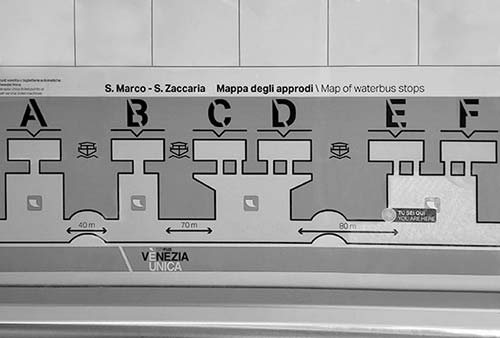
Several vaporetti leave from the San Zaccaria docks, located 150 yards east of St. Mark’s Square. The five docks are spaced about 70 yards apart, with seven different berths, lettered A to F. Check the big electronic board (next to the C/D dock), which indicates the departure time, line number, destination, and berth letter of upcoming vaporetti. Once you’ve figured out which boat you want, go to that berth and hop on.
Line #1: This vaporetto goes up the Grand Canal, making all the stops, including both San Marco stops, Rialto, Ferrovia (train station), and Piazzale Roma—but it does not go as far as Tronchetto (dock E). In the other direction, it goes from San Zaccaria to Arsenale and Giardini before ending on the Lido (dock F).
Line #2: This vaporetto zips over to San Giorgio Maggiore, the island church across from St. Mark’s Square. From there, it continues on to stops on the island of Giudecca, the parking lot at Tronchetto, and then down the Grand Canal as far as Piazzale Roma (dock B). In summer, line #2 also runs up the Grand Canal to Rialto, Ferrovia, and Piazzale Roma (dock E).
Line #4.1: This boat goes to San Michele (cemetery) and Murano (45 minutes, dock D).
Line #7: This is the express boat to Murano (25 minutes, dock D).
Hilton Molino Stucky Shuttle Boat: This boat takes even nonguests to the Hilton Hotel on Giudecca, with its popular view bar (20-minute ride, 2-3/hour, dock B-1).
Lines #5.1 and #5.2: These are the circulare (cheer-koo-LAH-ray) lines, making a loop around the perimeter of the island, with a stop at the Lido—perfect if you just like riding boats. Line #5.1 goes counterclockwise, and #5.2 goes clockwise. Both run less frequently in the evenings (#5.1 leaves from dock F, #5.2 from dock C).
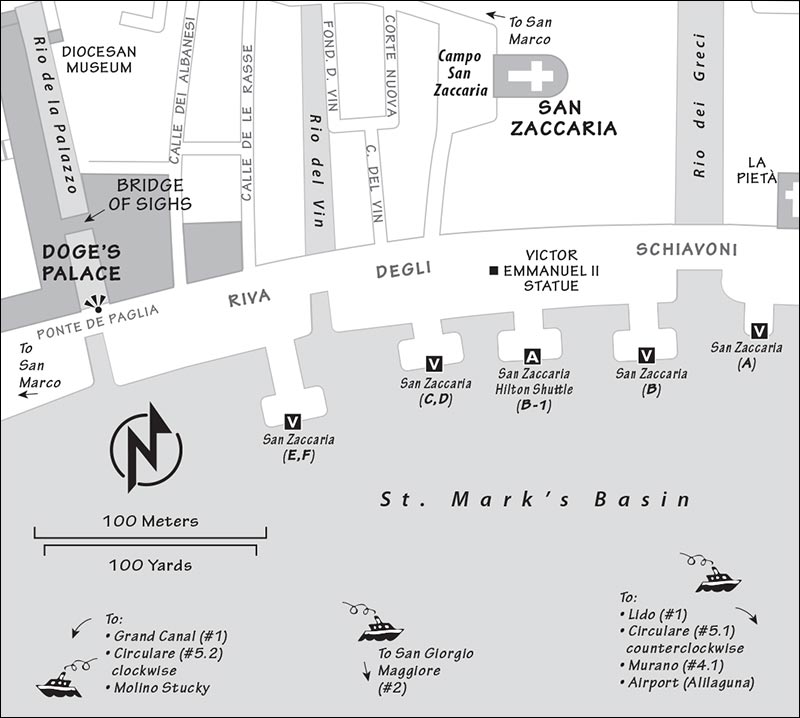
Alilaguna Shuttle Boat: This runs to and from the airport (dock B-1).
Boarding and Riding
Once you know which line you want, you need to find the right departure platform (many stops have more than one). At these larger stops, check the electronic departure board to see which boats are coming next, when, where they’re going, and from which platform they leave (for example, “Line 2 to San Marco, from platform B”). At smaller stops without electronic displays, signs on each platform show the vaporetto lines that stop there and the direction they are headed. Once you find your platform, be aware that other boats may also be leaving from the same platform. When the boat arrives, confirm the direction posted on the bow (“Line 2, San Marco”). To double-check, ask the conductor when you board (“San Marco?”).
You’ll notice at some big stops that there are two entries—one for tourists and one for locals (a reasonable way to protect locals from the frustrating mobs of visitors that flood their city in peak times). Sometimes boats arrive and can’t accommodate everyone in line...leaving you to wait ten minutes until the next vaporetto.
Crowd-Beating Tips
For fun, take my self-guided Grand Canal Cruise. But be warned: Grand Canal vaporetti can be absolutely jam-packed, especially during the tourist rush hour (during mornings heading in from Piazzale Roma, and in evenings heading out to Piazzale Roma). Riding at night, with nearly empty boats and chandelier-lit palace interiors viewable from the Grand Canal, can be a highlight of your Venetian experience.
Venice has battled rising water levels since the fifth century. But today, the water seems to be winning. Several factors, both natural and man-made, cause Venice to flood dozens of times a year—usually from October until late winter—a phenomenon called the acqua alta.
On my last trip I asked a Venetian how much the city is sinking. He said, “Less than the sea is rising.” Venice sits atop sediments deposited at the ancient mouth of the Po River, which are still compacting and settling. Early industrial projects, such as offshore piers and the railroad bridge to the mainland, affected the sea floor and tidal cycles in ways that made the city more vulnerable to flooding. Twentieth-century industry worsened things by pumping massive amounts of groundwater out of the aquifer beneath the lagoon for nearly 50 years before the government stopped the practice in the 1970s. In the last century, Venice has sunk by about nine inches.
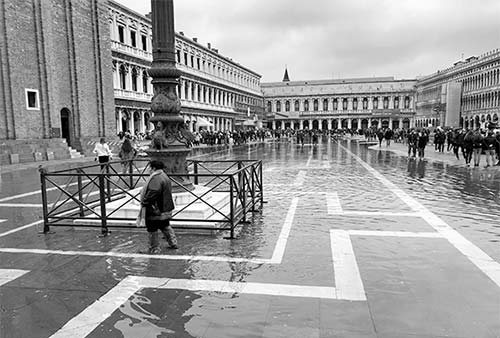
Meanwhile, the waters around Venice are rising, a phenomenon that’s especially apparent in winter. The highest so far was in November of 1966, when a huge storm (the same one that famously flooded Florence) raised Venice’s water level to more than six feet above the norm. The notorious acqua alta happens when an unusually high tide combines with strong sirocco winds and a storm. Although tides are minuscule in the Mediterranean, the narrow, shallow Adriatic Sea has about a three-foot tidal range. When a storm—an area of low pressure—travels over a body of water, it pulls the surface of the water up into a dome. As strong sirocco winds from Africa blow storms north up the Adriatic, they push this high water ahead of the front, causing a surging storm tide. Add to that the worldwide sea-level rise that’s resulted from recent climate change (melting ice caps, thermal expansion of the water, more frequent and more powerful storms) and it makes a high sea that much higher.
If the acqua alta appears during your visit, you’ll see the first puddles in the center of paved squares, pooling around the limestone grates at the square’s lowest point. These grates cover cisterns that long held Venice’s only source of drinking water. That’s right: Surrounded by the lagoon and beset by constant flooding, this city had no natural source of fresh water. For centuries, residents carried water from the mainland with much effort and risk. In the ninth century, they devised a way to collect rainwater by using paved, cleverly sloped squares as catchment systems, with limestone filters covering underground clay tubs. Venice’s population grew markedly once citizens were able to access fresh water by simply dropping buckets down into these “wells.” Hundreds of cisterns provided the city with drinking water up until 1884, when an aqueduct was built (paralleling the railroad bridge) to bring in water from nearby mountains. Now the wells are capped, the clay tubs are rotted out, and rain drains from squares into the lagoon—or up from it, as the case may be.
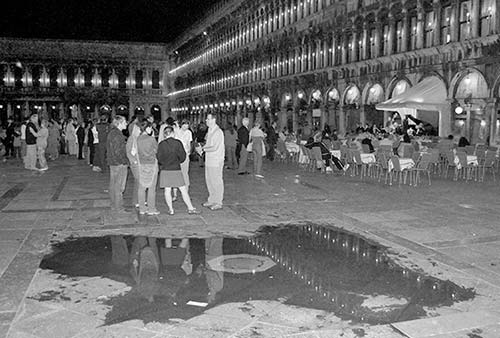
So, what is Venice doing about the flooding? After the 1966 flood, officials knew something had to be done, but it took about four decades to come up with a solution. In 2003, a consortium of engineering firms finally began construction on the MOSE Project. Named for the acronym of its Italian name, Modulo Sperimentale Elettromeccanico, it’s also a nod to Moses and his (albeit temporary) mastery over the sea. But, in good Italian fashion, greedy government officials couldn’t resist the opportunity for personal enrichment, and a corruption scandal stranded the entire project for years.
But finally, in 2020, the system had a promising trial. When high tides reached exceptional peaks, the retractable underwater gates (installed at the three inlets where the sea meets Venice’s lagoon) successfully shut out the Adriatic. But with seas rising faster than engineers anticipated, how long MOSE can protect Venice’s treasures is an open question.
By Traghetto
Only four bridges cross the Grand Canal, but traghetti (shuttle gondolas) ferry locals and in-the-know tourists across the Grand Canal at three additional locations (see the map on here). Just step in, hand the gondolier €2, and enjoy the ride—standing or sitting. Some traghetti are seasonal, some stop running as early as 12:30, and all stop by 18:00. Traghetti are not covered by any transit pass.
By Water Taxi
Venetian taxis, like speedboat limos, hang out at busy points along the Grand Canal. Prices are regulated and fixed by destination (for example, the 20-minute trip from the train station to San Marco costs €70). Despite regulation, prices can be soft; negotiate and settle on the price or rate before stepping in. For travelers with lots of luggage or small groups who can split the cost, taxi boat rides can be a worthwhile and time-saving convenience—and skipping across the lagoon in a classic wooden motorboat is a cool indulgence. For about €120 an hour, you can have a private, unguided taxi-boat tour. You may find more competitive rates if you prebook through the Consorzio Motoscafi water taxi association (prices good for groups of up to 4, one bag/person, extra passengers-€10 each, maximum 9 people, extra fees for late night and extra bags, +39 041 522 2303, www.motoscafivenezia.it). For info on taking a water taxi to/from the airport, see here.
By Gondola
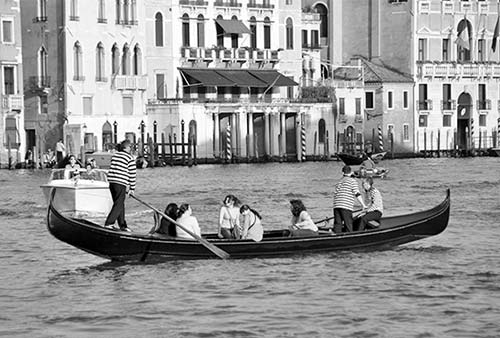
If you’re interested in hiring a gondolier for your own private cruise, see here. But note that gondolas are not in business to be a floating Uber service. They only make loop tours.
Tours in Venice
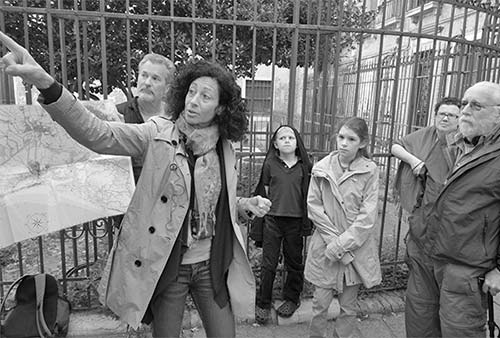
Local guides and tour companies offer plenty of walking tours that cater to a variety of interests.
 To sightsee on your own, download my series of free audio tours that illuminate some of Venice’s top sights and neighborhoods (see the sidebar on here for details).
Avventure Bellissime Venice Tours
This company offers several small-group, English-only tours, including a basic two-hour St. Mark’s Square introduction that includes skip-the-line tickets to the basilica (€39, includes church entry, Mon-Sat at 11:00, 20 people maximum), an hour-long boat tour of the Grand Canal (€55, Mon-Sat at 10:00, 10 people maximum), and mainland excursions (RS%—10 percent discount on some tours, contact them before booking for a promo code; details at www.tours-italy.com, +39 041 970 499, info@tours-italy.com).
Alessandro’s Classic Venice Bars Backstreets Tours
Alessandro Schezzini is a connoisseur of Venetian bacari—classic old bars serving wine and traditional cicchetti snacks. He organizes two-hour Venetian bar tours (€40/person, most nights at 17:30) that include sampling cicchetti with wines at three bacari. (If you think of this tour as a light dinner with a local friend, it’s a particularly good value.) Tours depart almost daily in season when six or more sign up. They meet 50 yards north of the Rialto Bridge under the big clock on Campo San Giacomo. (Book via email, alessandro@schezzini.it, or by phone at 335-530-9024; www.schezzini.it.)
Venicescapes
Michael Broderick’s private, themed tours of Venice are intellectually demanding and engrossing for history buffs. Michael, a passionate teacher, has spent 30 years living and studying in Venice. He’s an instinctive “dot connector”: His tours intertwine history, art, politics, economics, culture, and religion (various 4- to 6-hour itineraries, 2 people-€280-320 or the USD equivalent, €60/person after that, admissions and transport extra, +39 041 850 5742, mobile +39 349 479 7406, www.venicescapes.org, info@venicescapes.org).
Local Guides
Plenty of licensed, trained guides are available (figure on €75/hour with a 2-hour minimum). I’ve enjoyed working with the following guides and groups:
Walks Inside Venice is enthusiastic about teaching (€280/3 hours per group of up to 6, RS%; Roberta: mobile +39 347 253 0560; Sara: mobile +39 335 522 9714; www.walksinsidevenice.com, info@walksinsidevenice.com). Along with their four-hour “Grand Tour,” they do Ghetto and Plague tours.
Elisabetta Morelli and Corine Govi, who run 2Guides4Venice, are informative and reliable (Elisabetta: mobile +39 328 753 5220, elisabettamorelli61@gmail.com; Corine: mobile +39 347 966 8346, corinegovi@gmail.com; www.2guides4venice.com).
Venice with a Guide, a co-op of eight good Venetian guides, offers a range of tours (€75/hour, www.venicewithaguide.com).
BestVeniceGuides.it offers a smartly organized online catalog of about 100 local guides, with information to help you pick the right guide for you. Note that Italy allows all licensed guides to lead tours anywhere in the country, so it behooves the thoughtful traveler to book a Venetian guide for the best Venetian experience (family-friendly guides, shared group tours available, most guides about €75/hour, www.bestveniceguides.it).
Grand Canal Cruise
Take a joyride and introduce yourself to Venice by boat, an experience worth ▲▲▲. Cruise the Canal Grande on vaporetto line #1 all the way to St. Mark’s Square, starting at the train station (Ferrovia) or the bus station (Piazzale Roma, where you’re more likely to find an empty seat). Consider topping it off with my self-guided tour of St. Mark’s Basilica (later, under “Sights in Venice”).
If it’s your first trip down the Grand Canal, you might want to stow this book and just take it all in—Venice is a barrage on the senses that hardly needs narration. On the other hand, these notes give the cruise meaning and help orient you to this great city.
To help you enjoy the visual parade of canal wonders, the tour is organized by boat stop. I’ll point out both what you can see from the current stop, and what to look forward to as you cruise to the next stop.
You can break up the tour by hopping on and off at various sights—but remember, a single-fare vaporetto ticket is good for just 75 minutes of one-way travel (passes let you hop on and off all day).
Which Boat? This tour is designed to be done on the slow boat #1—any other boat skips too many stops.
Tours: Download my free Grand Canal Cruise audio tour.
Length of This Tour: Allow 45 minutes.
Seating Strategies: As the vaporetti can be jammed, strategize about where to sit—then, when the boat pulls up, make a beeline for your preference. You’re more likely to find an empty seat if you catch the vaporetto at Piazzale Roma—the stop before Ferrovia (a five-minute walk away).
A few remaining older vaporetti have seats in the bow (in front of the captain’s bridge), the perfect vantage point for spotting sights left, right, and forward. With a standard boat and normal crowds, I’d head for the open-air section in the stern and grab the middle seat. While views directly ahead are obliterated by the boat’s cabin, you’ll have a good view of my described sights on both sides of the boat. If it’s not crowded, you can hang out in the middle (loading zone) and bop from side to side (especially easy after dark). Your worst option is sitting inside and trying to look out the window.
OVERVIEW
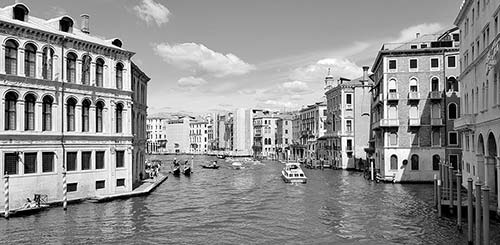
The Grand Canal is Venice’s “Main Street.” At more than two miles long, nearly 150 feet wide, and nearly 15 feet deep, it’s the city’s largest canal, lined with its most impressive palaces. It’s the remnant of a river that once spilled from the mainland into the Adriatic. The sediment it carried formed barrier islands that cut Venice off from the sea, forming a lagoon.
Venice was built on the marshy islands of the former delta, sitting on wood pilings driven nearly 15 feet into the clay (alder was the preferred wood). About 25 miles of canals drain the city, dumping like streams into the Grand Canal. Technically, Venice has only three canals: Grand, Giudecca, and Cannaregio. The 45 small waterways that dump into the Grand Canal are referred to as rivers (e.g., Rio Novo).
Venice is a city of palaces, dating from the days when the city was the world’s richest. The most lavish palaces formed a grand architectural cancan along the Grand Canal. Once frescoed in reds and blues, with black-and-white borders and gold-leaf trim, they made Venice a city of dazzling color. This cruise is the only way to truly appreciate the palaces, approaching them at water level, where their main entrances were located. Today, strict laws prohibit any changes in these buildings, so while landowners gnash their teeth, we can enjoy Europe’s best-preserved medieval/Renaissance city—slowly rotting. Many of the grand buildings are now vacant. Others harbor chandeliered elegance above mossy, empty (often flooded) ground floors.
 SELF-GUIDED CRUISE
This tour starts at the Ferrovia vaporetto stop (at Santa Lucia train station). The #1 boat to San Marco generally leaves from dock E (far to the right).
1 Ferrovia: This site has been the gateway into Venice since 1860, when the first train station was built. The Santa Lucia station, one of the few modern buildings in town, was built in 1954. The “F.S.” logo above the entry stands for “Ferrovie dello Stato,” the Italian state railway system. Consider that before the causeway was built in the mid-1800s, Venice was an island with no road or train access and no water system. With the causeway the city got a train line, an aqueduct, and a highway.
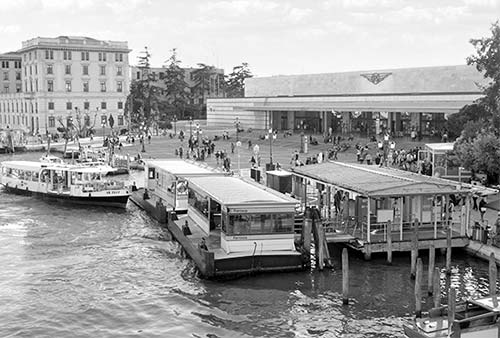
More than 20,000 people a day commute in from the mainland, making this the busiest part of Venice during rush hour. The nearby Calatrava Bridge, spanning the Grand Canal between the train station and Piazzale Roma upstream, was built in 2008 to alleviate some of the congestion.
2 Riva de Biasio: Venice’s main thoroughfare is busy with all kinds of boats: taxis, police boats, garbage boats, ambulances, construction cranes, and even brown-and-white UPS boats. Somehow they all manage to share the canal in relative peace.
About 25 yards past the Riva de Biasio stop, look left down the broad Cannaregio Canal to see what was the Jewish Ghetto. The twin, pale-pink, six-story “skyscrapers”—the tallest buildings you’ll see at this end of the canal—are reminders of how densely populated the world’s original ghetto was. Set aside as the local Jewish quarter in 1516, this area became extremely crowded. This urban island developed into one of the most closely knit business and cultural quarters of all the Jewish communities in Italy, and gave us our word “ghetto” (from geto, the copper foundry located here).
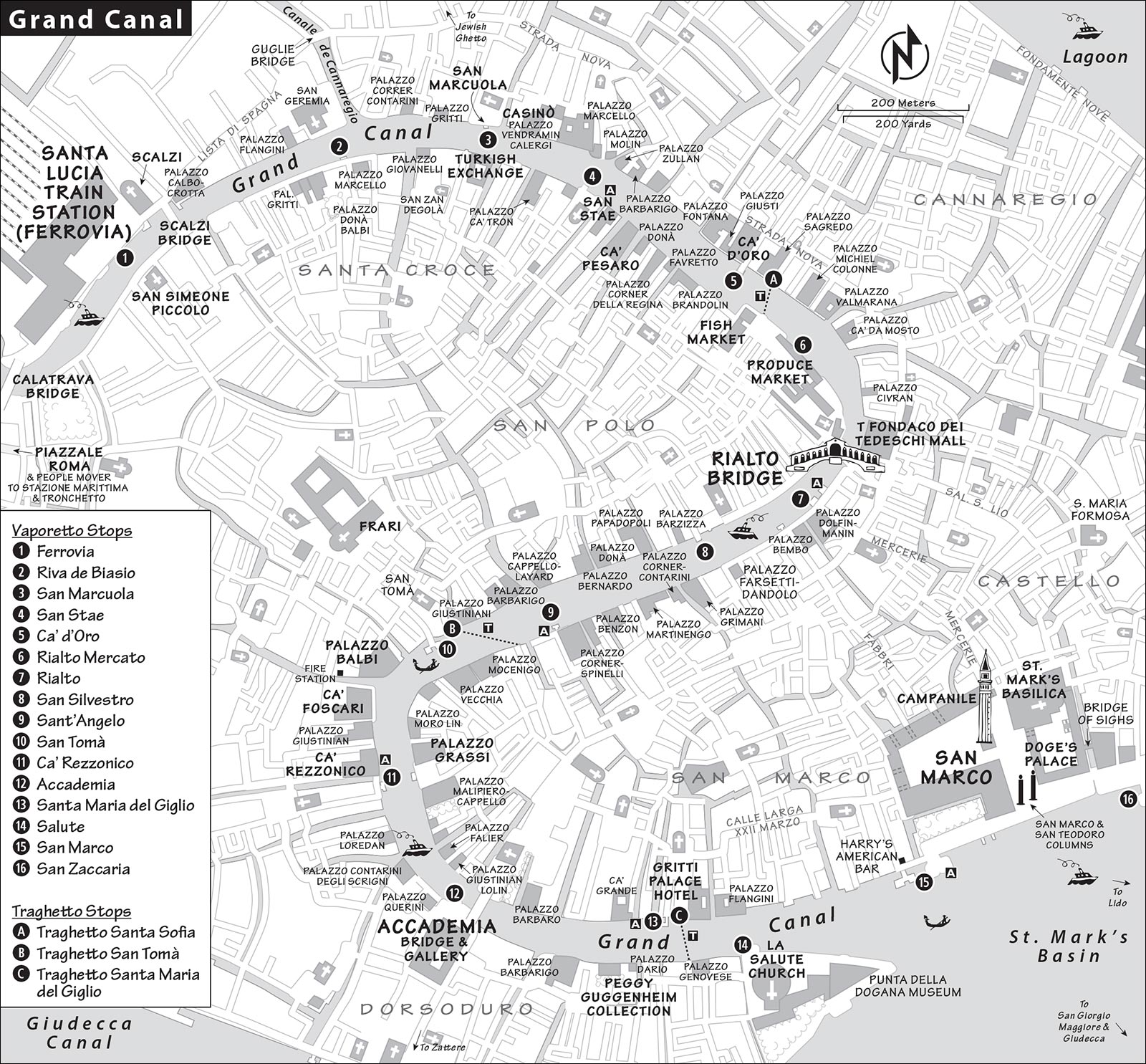
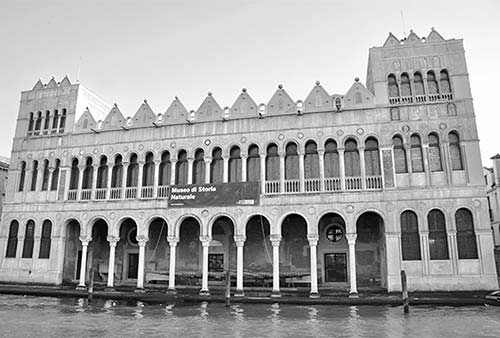
3 San Marcuola: At this stop, facing a tiny square just ahead, stands the unfinished Church of San Marcuola, one of only five churches fronting the Grand Canal. Centuries ago, this canal was a commercial drag of expensive real estate in high demand by wealthy merchants. About 20 yards ahead on the right (across the Grand Canal) stands the stately gray Turkish Exchange (Fondaco dei Turchi), one of the oldest houses in Venice. Its horseshoe arches and roofline of triangles and dingle balls are reminders of its Byzantine heritage. Turkish traders in turbans docked here, unloaded their goods into the warehouse on the bottom story, then went upstairs for a home-style meal and a place to sleep. Venice in the 1500s was very cosmopolitan, welcoming every religion and ethnicity, so long as they carried cash. (Today the building contains the city’s Museum of Natural History—and Venice’s only dinosaur skeleton.)
Just 100 yards ahead on the left (the tallest building with the red canopy), Venice’s Casinò is housed in the palace where German composer Richard (The Ring) Wagner died in 1883. See his distinct, strong-jawed profile in the white plaque on the brick wall. In the 1700s, Venice was Europe’s Vegas, with casinos and prostitutes everywhere. Casinòs (“little houses” in Venetian dialect) have long provided Italians with a handy escape from daily life. Today they’re run by the state to keep Mafia influence at bay. Notice the fancy front porch, rolling out the red carpet for high rollers arriving by taxi or hotel boat. Across the canal, the plain brick 15th-century building was a granary. Now it’s a grade school.
4 San Stae: The San Stae Church sports a delightful Baroque facade. Opposite the San Stae stop is a little canal opening—on the second building to the right of that opening, look for the peeling plaster that once made up frescoes (you can barely distinguish the scant remains of little angels on the lower floors). Imagine the facades of the Grand Canal at their finest. Most of them would have been covered in frescoes by the best artists of the day. As colorful as the city is today, it’s still only a faded, sepia-toned remnant of a long-gone era, a time of lavishly decorated, brilliantly colored palaces.
Just ahead (on the right, with blue posts) is the ornate white facade of Ca’ Pesaro (which houses the International Gallery of Modern Art). “Ca’” is short for casa (house).
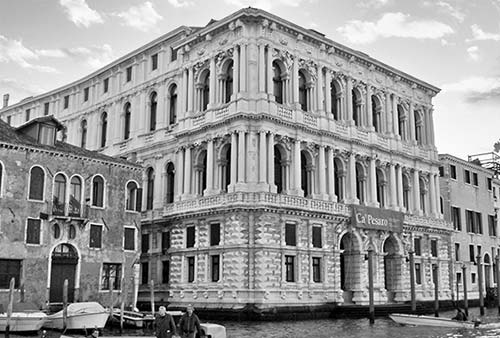
In this city of masks, notice how the rich marble facades along the Grand Canal mask what are generally just simple, no-nonsense brick buildings. Most merchants enjoyed showing off. However, being smart businessmen, they only decorated the sides of the buildings that would be seen and appreciated. But look back as you pass Ca’ Pesaro. It’s the only building you’ll see with a fine side facade. Ahead (about 100 yards on the left) is Ca’ d’Oro, with its glorious triple-decker medieval arcade (just before the next stop).
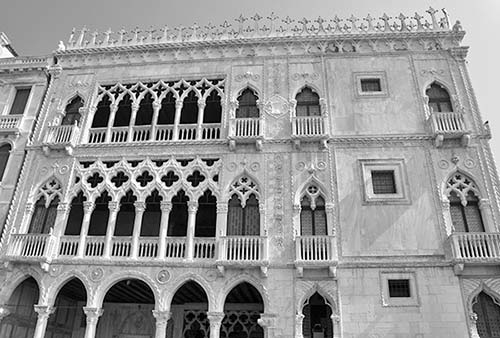
5 Ca’ d’Oro: The lacy Ca’ d’Oro (House of Gold) is the best example of Venetian Gothic architecture on the canal. Although a simple brick construction, its facade is one of the city’s finest. Its three stories offer different variations on balcony design, topped with a spiny white roofline. Venetian Gothic mixes traditional Gothic (pointed arches and round medallions stamped with a four-leaf clover) with Byzantine styles (tall, narrow arches atop thin columns), filled in with Islamic frills. Like all the palaces, this was originally painted and gilded to make it even more glorious than it is now. Today the Ca’ d’Oro is an art gallery.
Look at the Venetian chorus line of palaces in front of the boat. On the right is the arcade of the covered fish market, with the open-air produce market just beyond. It bustles in the morning but is quiet the rest of the day. This is a great scene to wander through—even though European Union hygiene standards have made it cleaner and less colorful than it once was.
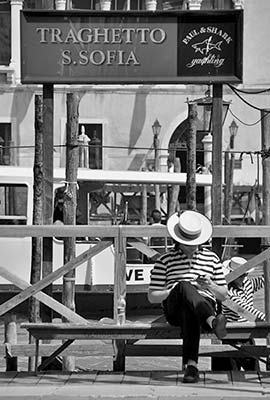
Find the traghetto gondola ferrying shoppers—standing like Washington crossing the Delaware—back and forth. While once much more numerable, today only three traghetto crossings survive along the Grand Canal, each one marked by a classy low-key green-and-black sign. Piloting a traghetto isn’t the normal day job of these gondoliers. As a public service, all gondoliers are obliged to row a traghetto a few days a month. Make a point to use them. At €2 a ride, traghetti offer the cheapest gondola ride in Venice (but at this price, don’t expect them to sing to you).
6 Rialto Mercato: This stop serves the busy market. The long, official-looking building at the stop is the Venice courthouse. Directly ahead (on the left), is the former trading center for German merchants, built in the 16th century. Later the central post office, it’s now a T Fondaco dei Tedeschi, a luxury shopping mall with great rooftop views. Rising above it is the tip of the Campanile (bell tower), crowned by its golden-angel weathervane at St. Mark’s Square, where this tour will end.
You’ll cruise by some trendy and beautifully situated wine bars on the right, but look ahead as you round the corner and see the impressive Rialto Bridge come into view.
A major landmark, the Rialto Bridge is lined with shops and tourists. Constructed in 1588, it’s the third bridge built on this spot. Until the 1850s, this was the only bridge crossing the Grand Canal. With a span of 160 feet and foundations stretching 650 feet on either side, the Rialto was an impressive engineering feat in its day. Earlier bridges here could open to let big ships in, but not this one. By the time it was completed in the 16th century, Venetian trading power was ebbing. After that, much of the Grand Canal was closed to shipping and became a canal of palaces.
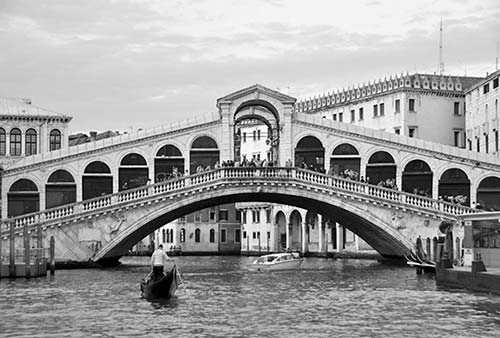
When gondoliers pass under the fat arch of the Rialto Bridge, they take full advantage of its acoustics: “Volare, oh, oh...”
7 Rialto: A separate town in the early days of Venice, Rialto has always been the commercial district, while San Marco was the religious and governmental center. Today, a winding street called the Mercerie connects the two, providing travelers with human traffic jams and a mesmerizing gauntlet of shopping temptations. This is one of the only stretches of the historic Grand Canal with landings upon which you can walk. Boats unloaded the city’s basic necessities here: oil, wine, charcoal, iron. Today, the quay is lined with tourist-trap restaurants.
Venice’s sleek, black, graceful gondolas are a symbol of the city. With about 500 gondoliers joyriding amid the churning vaporetti, there’s a lot of congestion on the Grand Canal. Pay attention—this is where most of the gondola and vaporetto accidents take place. While the Rialto is the highlight of many gondola rides, gondoliers understandably prefer the quieter small canals. Watch your vaporetto driver curse the better-paid gondoliers.
Ahead 100 yards on the left, two gray-colored palaces stand side by side (City Hall and the mayor’s office). Their horseshoe-shaped, arched windows are similar and their stories are the same height, lining up to create the effect of one long balcony.
8 San Silvestro: We now enter a long stretch of important merchants’ palaces, each with proud and different facades. Because ships couldn’t navigate beyond the Rialto Bridge, the biggest palaces—with the major shipping needs—line this last stretch of the navigable Grand Canal.
Palaces like these were multifunctional: ground floor for the warehouse, offices and showrooms upstairs, and living quarters above, on the “noble floors” (with big windows to allow in maximum light). Servants lived and worked on the very top floors (with the smallest windows). For fire-safety reasons, kitchens were also located on the top floors. Peek into the noble floors to catch a glimpse of their still-glorious chandeliers of Murano glass.
The Palazzo Grimani (across from the San Silvestro dock) sports a heavy white Roman-style facade—a reminder that the Grimani family included a cardinal and had strong Roman connections.
The Palazzo Papadopoli, with the two obelisks on its roof (50 yards beyond the San Silvestro stop on the right, with the blue posts), is the very fancy Aman Hotel where George and Amal Clooney were married in 2014.
9 Sant’Angelo: Notice how many buildings have a foundation of waterproof white stone (pietra d’Istria) upon which the bricks sit high and dry. Many canal-level floors are abandoned as the rising water level takes its toll.
The posts—historically painted gaily with the equivalent of family coats of arms—don’t rot underwater. But the wood at the waterline, where it’s exposed to oxygen, does. On the smallest canals, little “no motorboats” signs indicate that these canals are for gondolas only (no motorized craft, 5 kph speed limit, no wake).
10 San Tomà: Fifty yards ahead, on the right side (with twin obelisks on the rooftop) stands Palazzo Balbi, the palace of an early-17th-century captain general of the sea. This palace, like so many in the city, flies three flags: Italy (green-white-red), the European Union (blue with ring of stars), and Venice (a lion on a field of red and gold). Today it houses the administrative headquarters of the regional government.
Just past the admiral’s palace, look immediately to the right, down a side canal. On the right side of that canal, before the bridge, see the traffic light and the fire station (the 1930s Mussolini-era building with four arches hiding fireboats parked and ready to go).
The impressive Ca’ Foscari, with a classic Venetian facade (on the corner, across from the fire station), dominates the bend in the canal. This is the main building of the University of Venice, which has about 25,000 students. Notice the elegant lamp on the corner—needed in the old days to light this intersection.
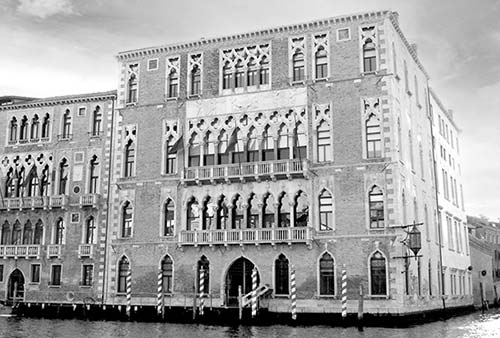
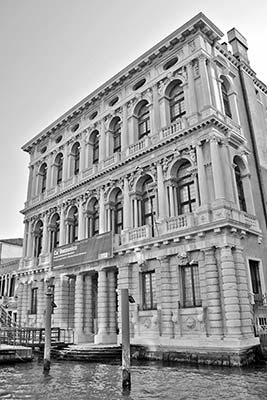
The grand, heavy, white Ca’ Rezzonico, just before the stop of the same name, houses the Museum of 18th-Century Venice. Across the canal is the cleaner and leaner Palazzo Grassi, the last major palace built on the canal, erected in the late 1700s. It was purchased by a French tycoon and now displays part of Punta della Dogana’s contemporary art collection.
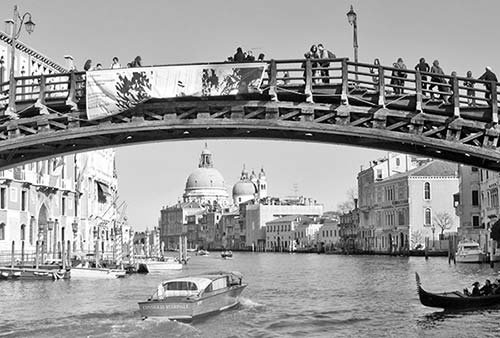
11 Ca’ Rezzonico: Up ahead, the Accademia Bridge leads over the Grand Canal to the Accademia Gallery (right side), filled with the best Venetian paintings. There was no bridge here until 1854, when a cast-iron one was built. It was replaced with this wooden bridge in 1933. While meant to be temporary, it still stands today, nearly a century later.
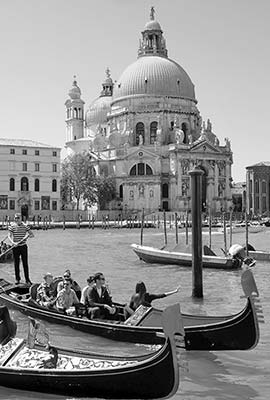
12 Accademia: From here, look through the graceful bridge and way ahead to enjoy a classic view of La Salute Church, topped by a crown-shaped dome supported by scrolls. This Church of St. Mary of Good Health was built to ask God to deliver Venetians from the devastating plague of 1630 (which had killed about a third of the city’s population).
The low, white building among greenery (100 yards ahead, on the right, between the Accademia Bridge and the church) is the Peggy Guggenheim Collection. The American heiress “retired” here, sprucing up a palace that had been abandoned in mid-construction. Peggy willed the city her fine collection of modern art.
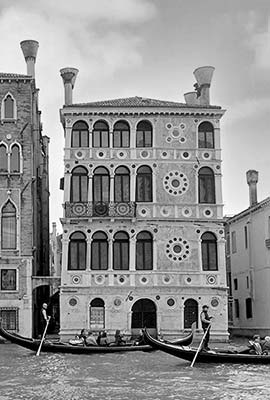
Two doors past the Guggenheim, Palazzo Dario has a great set of characteristic funnel-shaped chimneys. These forced embers through a loop-the-loop channel until they were dead—required in the days when stone palaces were surrounded by humble wooden buildings, and a live spark could make a merchant’s workforce homeless. Three doors later is the Salviati building, which once served as a glassworks. Its fine Art Nouveau mosaic, done in the early 20th century, features Venice as a queen being appreciated by the big shots of society.
13 Santa Maria del Giglio: Back on the left stands the fancy Gritti Palace hotel. Hemingway and Woody Allen both stayed here.
Take a deep whiff of Venice. What’s all this nonsense about stinky canals? All I smell is my shirt. By the way, how’s your captain? Smooth dockings?
14 Salute: The huge La Salute Church towers overhead as if squirted from a can of Catholic Reddi-wip.
As the Grand Canal opens up into the lagoon, the last building on the right with the golden ball is the 17th-century Customs House, which now houses the Punta della Dogana contemporary art museum. Its two bronze Atlases hold a statue of Fortune riding the ball. Arriving ships stopped here to pay their tolls.
15 San Marco: Up ahead on the left, the green pointed tip of the Campanile marks St. Mark’s Square, the political and religious center of Venice...and the final destination of this tour. You could get off at the San Marco stop and go straight to St. Mark’s Square. But I’m staying on the boat for one more stop, just past St. Mark’s Square (it’s a quick walk back).
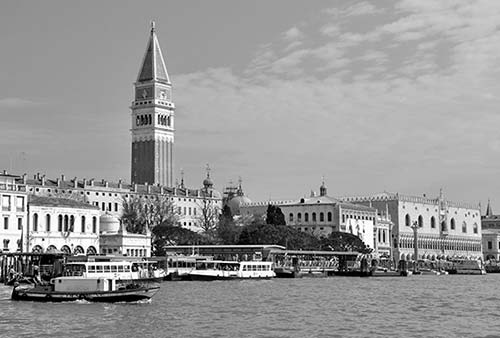
Survey the lagoon. Opposite St. Mark’s Square, across the water, the ghostly white church with the pointy bell tower is San Giorgio Maggiore, with great views of Venice. Next to it is the residential island Giudecca, stretching from close to San Giorgio Maggiore past the Venice youth hostel (with a nice view, directly across) to the Hilton Hotel (good nighttime view, far right end of island).
Still on board? If you are, as we leave the San Marco stop look left and prepare for a drive-by view of St. Mark’s Square. First comes the bold white facade of the old mint (in front of the bell tower) marked by a tiny cupola yet as sturdy as Fort Knox, where Venice’s golden ducat, the “dollar” of the Venetian Republic, was made. Next door is the library, its facade just three windows wide. Then comes the city’s ceremonial front door: twin columns topped by St. Theodore standing on a crocodile and the winged lion of St. Mark, who’ve welcomed visitors since the 15th century. Between the columns, catch a glimpse of two giant figures atop the Clock Tower—they’ve been whacking their clappers every hour since 1499. The domes of St. Mark’s Basilica are soon eclipsed by the lacy facade of the Doge’s Palace. Next you’ll see many gondolas with their green breakwater buoys, the Bridge of Sighs (leading from the palace to the prison—check out the maximum-security bars), and finally the grand harborside promenade—the Riva.
Follow the Riva with your eye, past elegant hotels to the green area in the distance. This is the largest of Venice’s few parks, which hosts the annual Biennale festival. Much farther in the distance is the Lido, the island with Venice’s beach. Its sand and casinos are tempting, though given its car traffic, it lacks the medieval charm of Venice.
16 San Zaccaria: OK, you’re at your last stop. Quick—muscle your way off this boat! (If you don’t, you’ll eventually end up at the Lido.)
At San Zaccaria, you’re right in the thick of the action. A number of other vaporetti depart from here (see here). Otherwise, it’s a short walk back along the Riva to St. Mark’s Square. Ahoy!
Sights in Venice
▲▲▲St. Mark’s Square (Piazza San Marco)
▲▲▲St. Mark’s Basilica (Basilica di San Marco)
▲▲▲Doge’s Palace (Palazzo Ducale)
ACROSS THE LAGOON FROM ST. MARK’S SQUARE
▲Island and Church of San Giorgio Maggiore
▲▲Accademia (Galleria dell’Accademia)
▲La Salute Church (Santa Maria della Salute)
▲▲Ca’ Rezzonico (Museum of 18th-Century Venice)
▲T Fondaco dei Tedeschi View Terrace
▲▲Frari Church (Basilica di Santa Maria Gloriosa dei Frari)
Venice’s greatest sight is the city itself. As well as seeing world-class museums and buildings, make time to wander narrow lanes, linger over a meal, or enjoy evening magic on St. Mark’s Square. One of Venice’s most delightful experiences—a gondola ride, worth ▲▲▲—is covered later, under “Experiences in Venice.”
When you see a in a listing, it means the sight is covered in a free audio tour (via my Rick Steves Audio Europe app—see here).
SIGHTSEEING STRATEGIES
Avoiding Lines and Crowds
Venice is inundated with cruise-ship passengers and tours from mainland hotels daily from 10:00 to about 16:00. Major sights are busiest in the late morning, making this a smart time to explore the back lanes. Sights that have crowd problems get even more packed when it rains.
Three sights are often plagued by long lines: Saint Mark’s Basilica, the Doge’s Palace, and the Campanile bell tower—and the only way to be sure to avoid a wait is to book a timed-entry ticket online in advance. You may also save time by booking ahead for the Accademia. For the rest of Venice’s sights, you should be fine just dropping by at any time.
If you didn’t buy ahead, and are confronted by a long line for the Doge’s Palace, purchase your ticket at the Correr Museum across St. Mark’s Square. And for the Campanile bell tower, remember that you can skip it entirely if you’re going to the similar San Giorgio Maggiore bell tower—which actually offers a better view.
Sightseeing Passes
Venice offers a dizzying array of combo-tickets and sightseeing passes. Note that many of the most visit-worthy sights in town (the Accademia, Peggy Guggenheim Collection, Scuola San Rocco, Campanile, and St. Mark’s Basilica—and its sights within that charge admission) are not covered by any pass.
Museum Pass: Busy sightseers may find value in this pass, which covers the Doge’s Palace, Correr Museum, Ca’ Rezzonico (Museum of 18th-Century Venice); Palazzo Mocenigo Costume Museum; Casa Goldoni (home of the Italian playwright); Ca’ Pesaro (modern art); Museum of Natural History in the Santa Croce district; the Glass Museum on the island of Murano; and the Lace Museum on the island of Burano. At €35 (€18 for youth and seniors), this pass is an obvious value if you plan to see the Doge’s Palace, Correr Museum, and one or two of the other covered museums. Buy it at any participating museum or via their websites (www.visitmuve.it).
Rolling Venice: If you’re under 30, this €6 youth pass offers free admission and/or discounts at dozens of sights and shops, but its best deal is for transit. It lets you buy a 72-hour transit pass for a discounted €28 (sold at TIs, vaporetto ticket offices, and VèneziaUnica shops).
SAN MARCO DISTRICT
▲▲▲St. Mark’s Square (Piazza San Marco)
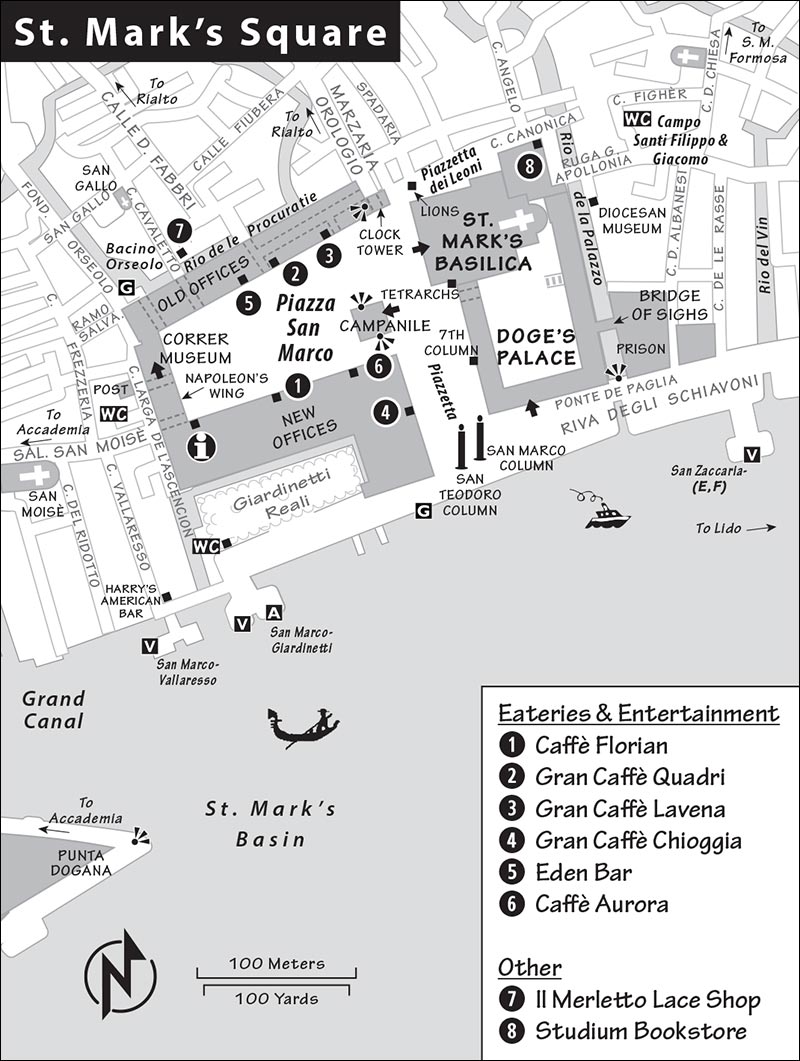
This grand square is surrounded by splashy, historic buildings and sights: St. Mark’s Basilica, the Doge’s Palace, the Campanile bell tower, the Clock Tower, and the Correr Museum. The square is filled with music, lovers, pigeons, and tourists by day, and is your private rendezvous with the Venetian past late at night, when Europe’s most magnificent dance floor is the romantic place to be.
For a slow and pricey evening thrill, invest €15 or so (including service and cover charge for the music) for a drink at one of the elegant cafés with the dueling orchestras (see “Cafés on St. Mark’s Square” sidebar, later). For an unmatched experience that offers the best people-watching, it’s worth the splurge.
For more on the square, the Clock Tower, the Campanile, and other sights on the square, download my free St. Mark’s Square audio tour.
Visiting the Square: St. Mark’s Basilica dominates the square with its Eastern-style onion domes and glowing mosaics. Mark Twain said it looked like “a vast warty bug taking a meditative walk.” (I say it looks like tiara-wearing ladybugs copulating.) To the right of the basilica is its 325-foot-tall Campanile. Behind the Campanile, you can catch a glimpse of the pale pink Doge’s Palace. Lining the square are the former government offices (procuratie) that administered the Venetian empire’s vast network of trading outposts, which stretched all the way to Turkey.
With your back to the church, survey one of Europe’s great urban spaces, and the only square in Venice to merit the title “Piazza.” Nearly two football fields long, it’s surrounded by the offices of the republic. On the right are the “old offices” (16th-century Renaissance). At left are the “new offices” (17th-century High Renaissance). Napoleon called the piazza “the most beautiful drawing room in Europe,” and added to the intimacy by building the final wing, opposite the basilica, that encloses the square.
The arcade ringing the square provides an elegant promenade—complete with drapes to provide relief from the sun.
Imagine this square full of water. That happens every so often at very high tides (acqua alta), a reminder that Venice and the sea are intertwined. (Now, as one sinks and the other rises, they are more intertwined than ever.)
Watch out for pigeon speckle. Venetians don’t like pigeons, but they do like seagulls—because they eat pigeons. In 2008, Venice outlawed the feeding of pigeons. But tourists—eager for a pigeon-clad photo op—still haven’t gotten that message.
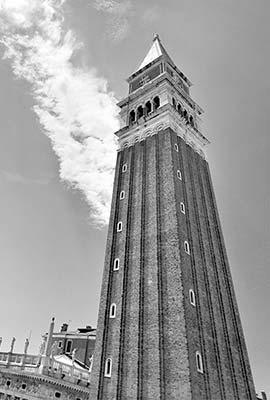
Campanile: The original Campanile (bell tower) was an observation tower and a marvel of medieval and Renaissance architecture until 1902, when it toppled into the center of the piazza. It had groaned ominously the night before, sending people scurrying from the cafés. The next morning...crash! The golden angel on top landed right at the basilica’s front door, standing up.
The Campanile was rebuilt 10 years later complete with its golden archangel Gabriel, who always faces the breeze. You can ride an elevator to the top for one of the best views of Venice (though it can be crowded at peak times; see details later).
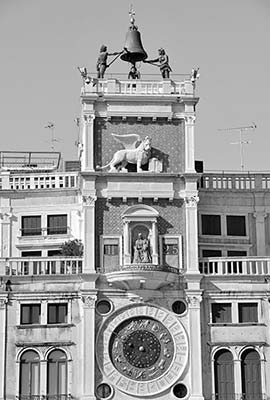
Clock Tower: Built during the Renaissance in 1496, the Clock Tower (Torre dell’Orologio) marks the entry to the main shopping drag, called the Mercerie (or “Marzarie,” in Venetian dialect), which connects St. Mark’s Square with the Rialto Bridge. From the piazza, you can see the bronze men (identified as Moors) swing their huge clappers at the top of each hour. In the 17th century, one of them knocked an unsuspecting worker off the top and to his death—probably the first ever killing by a robot. Notice one of the world’s first “digital” clocks on the tower facing the square (with dramatic flips every five minutes).
You can go inside the Clock Tower with a prebooked 45-minute guided tour that takes you close to the clock’s innards and out to a terrace with good views over the square and city rooftops (€13 combo-ticket includes Correr Museum—where the tour starts—as well as the National Archaeological Museum and the Monumental Rooms of the Biblioteca Marciana; reservations required; tours in English Mon at 11:00, Tue-Wed at 14:00, Fri and Sun at 11:00 and 14:00; no kids under age 6; +39 848 082 000, http://torreorologio.visitmuve.it).
Piazzetta and Doge’s Palace: The small square between the basilica and the water is the Piazzetta. This “Little Square” is framed by the Doge’s Palace on the left, the library on the right, and the waterfront of the lagoon. In former days, the Piazzetta was closed to the public for a few hours a day so that government officials and bigwigs could gather in the sun to strike shady deals.
The pale pink Doge’s Palace is the epitome of the style known as Venetian Gothic. Columns support traditional, pointed Gothic arches, but with a Venetian flair—they’re curved to a point, ornamented with a trefoil (three-leaf clover), and topped with a round medallion of a quatrefoil (four-leaf clover). The pattern is found on buildings all over Venice and on the formerly Venetian-controlled Croatian coast, but nowhere else in the world (except Las Vegas).
The two large 12th-century columns near the water were (like so much else) looted from Constantinople. Mark’s winged lion sits on top of one. The lion’s body (nearly 15 feet long) predates the wings and is more than 2,000 years old. The other column holds St. Theodore (battling a crocodile), the former patron saint who was replaced by Mark. I guess stabbing crocs in the back isn’t classy enough for an upwardly mobile world power. After public ridicule, criminals were executed by being hung from these columns in the hope that the public could learn its lessons vicariously.
▲▲▲St. Mark’s Basilica (Basilica di San Marco)
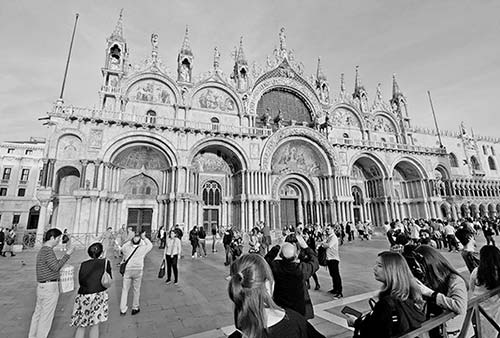
Built in the 11th century to replace an earlier church, this basilica’s distinctly Eastern-style architecture underlines Venice’s connection with Byzantium (which protected it from the ambition of Charlemagne and his Holy Roman Empire). It’s decorated with booty from returning sea captains—a kind of architectural Venetian trophy chest. The interior glows mysteriously with gold mosaics and colored marble. Since about AD 830, the saint’s bones have been housed on this site. The San Marco Museum within holds the original bronze horses (copies of these overlook the square), and a balcony offering a remarkable view over St. Mark’s Square.
Cost and Hours: Basilica entry is €3, though if you reserve a timed-entry ticket online in advance (€6), you can skip the line. Once inside, you can add on any of three separate exhibits within the church (or buy ahead online): Treasury-€5, Golden Altarpiece-€5, and San Marco Museum-€7. Church and all exhibits open Mon-Sat 9:30-17:00, Sun 14:00-17:00 (Sun until 16:30 Nov-Easter), +39 041 270 8311, www.basilicasanmarco.it.
Reservations Recommended: There’s almost always a long line to get into St. Mark’s. By far the smartest workaround is to reserve an entry time online in advance, which lets you bypass the general admission line for a separate entrance. A limited number of line-skipping spots are available each day, so if you’re visiting during busy times, book ahead by several days at least.
If you arrive without a reservation, you can head to the “line-skipping” entrance and scan the posted QR code. If there are time slots available—either immediately or for later that day—you can buy a ticket on your mobile phone on the spot.
For shorter lines and fewer crowds in general, visit early or late.
Prayers and Services: Worshippers may enter the church daily 8:00-19:30 using the Porta dei Fiori door on the north (left) side (Mass times are listed on the basilica website).
Baggage Check: The church will not let you in with a bag. On the north (left) side of the church, you’ll find automated storage lockers (€3).
Photographers, Take Note: The interior is brilliantly lit Mon-Sat 11:30-12:45. After that, many of the mosaics are in shadow.
Tours: Free, hour-long English tours (heavy on the mosaics’ religious symbolism) may be offered, typically at 11:00 (check website for current schedule). Audioguides (€5) are on sale as you enter.
Download my free St. Mark’s Basilica audio tour.
Self-Guided Tour
Start outside in the square, far enough back to take in the whole facade. It’s a riot of domes, columns, and statues, completely unlike the towering Gothic churches of northern Europe or the heavy Baroque of much of the rest of Italy. Inside is a decor of mosaics, colored marbles, and oriental treasures that’s rarely seen elsewhere. The Christian symbolism is unfamiliar to Western eyes, done in the style of Byzantine icons and even Islamic designs. Older than most of Europe’s churches, St. Mark’s feels like a remnant of a lost world.
The church is encrusted with materials looted from buildings throughout the Venetian empire. Their prize booty was the four bronze horses that adorn the balcony, stolen from Constantinople during the Fourth Crusade (these are copies); the atrium you’re about to enter was added on to the church as their pedestal. Later, it was decorated with a mishmash of plundered columns. The architectural style of St. Mark’s has been called “Early Ransack.”
Now zero in on the details.
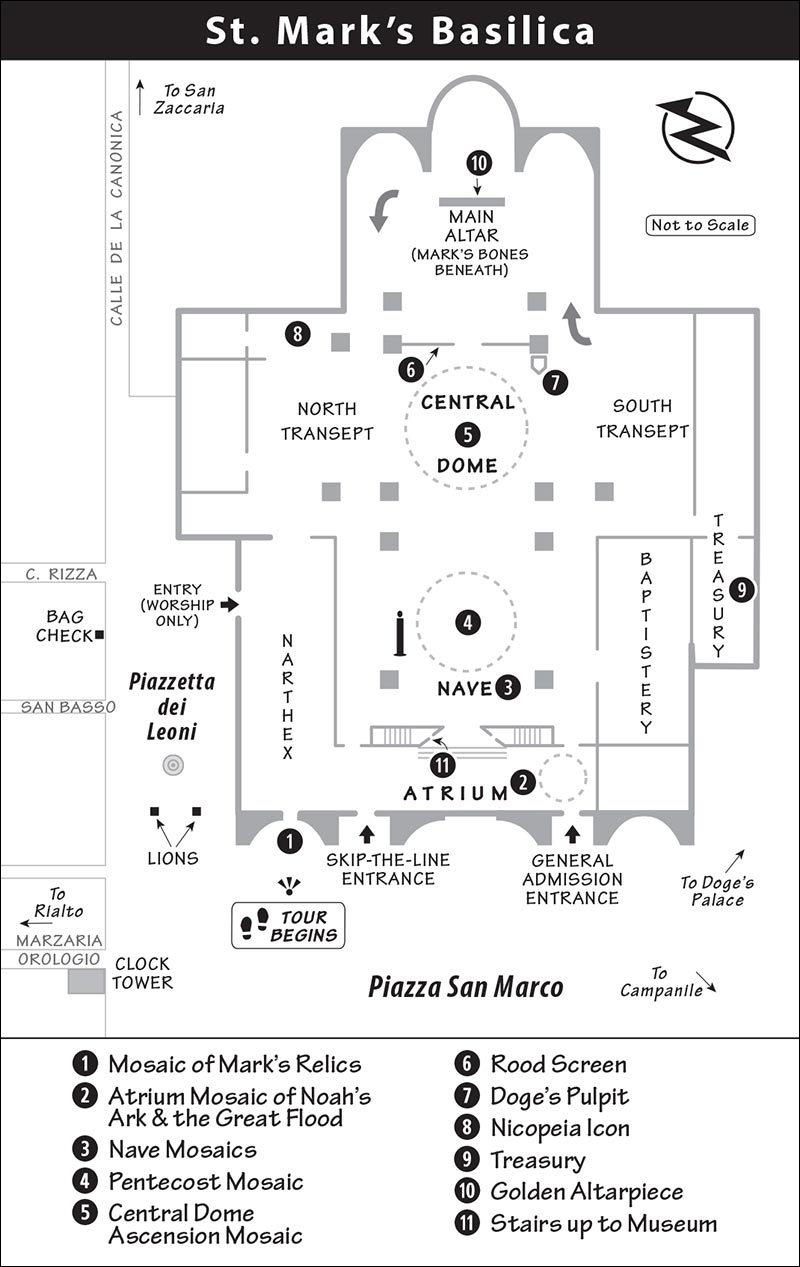
1 Exterior—Mosaic of Mark’s Relics: The mosaic over the far left door shows two men (in the center, with crooked staffs) entering the church bearing a coffin with the body of St. Mark.
Eight centuries after Mark’s death, his holy body was in Muslim-occupied Alexandria, Egypt. In AD 829, two visiting Venetian merchants “rescued” the body from the “infidels” and spirited it away to Venice.
• Enter the atrium of the basilica and find a place to view its ceiling mosaics. Start by finding a golden arch overhead with scenes of Noah’s Ark. (Note that, depending on where the current entrance and exit are, you may have a better chance to study these fine atrium mosaics on your way out.)
2 Atrium Mosaic of Noah’s Ark and the Great Flood: Of all the famous mosaics of St. Mark’s, this Flood scene is one of the oldest (13th century) and finest. The scenes show Noah and his sons sawing logs to build the Ark. Below that are scenes of Noah putting all species of animals into the Ark, two by two. Then the Flood hits in full force, drowning the wicked. Noah sends out a dove twice to see whether there’s any dry land where he can dock. He finds it, leaves the Ark with a gorgeous rainbow overhead, and offers a sacrifice of thanks to God.
• Climb a few steps, and into the church. Just inside the door, step out of the flow and survey the church.
3 The Nave—Mosaics Above and Below: These golden mosaics are in the Byzantine style, though many were designed by artists from the Italian Renaissance and later. The often-overlooked lower walls are covered with green-, yellow-, purple-, and rose-colored marble slabs, cut to expose the grain, and laid out in geometric patterns. Even the floor is mosaic, with mostly geometrical designs. It rolls like the sea. Venice is sinking and shifting, creating these cresting waves of stone.
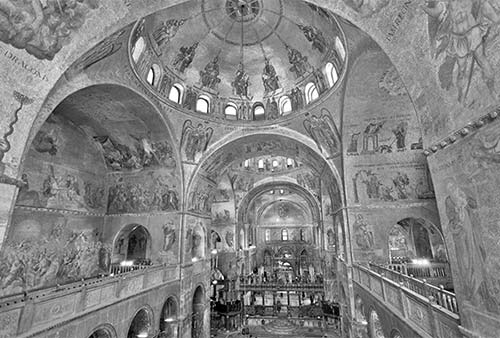
• Find the chandelier in the nave (in the shape of a cathedral space station), and run your eyes up the support chain to the dome above. This has one of the church’s greatest mosaics.
4 Pentecost Mosaic: In a golden heaven, the dove of the Holy Spirit shoots out a pinwheel of spiritual lasers, igniting tongues of fire on the heads of the 12 apostles below, giving them the ability to speak other languages without a Rick Steves phrase book. You’d think they’d be amazed, but their expressions are as solemn as...icons. One of the oldest mosaics in the church (c. 1125), it has distinct “Byzantine” features: a gold background and apostles with halos, solemn faces, almond eyes, delicate blessing hands, and rumpled robes, all facing forward.
• Shuffle along with the crowds up to the center of the church.
5 Central Dome Ascension Mosaic: Here at the center of the church, notice the layout: the church has four equal arms, each topped with a dome, radiating out to form a Greek cross (+). The symmetrical floor plan symbolizes perfection, rather than the more common Latin cross of the Crucifixion (emphasizing man’s sinfulness).
Now gape upward into the central dome, the very heart of the church. Christ—having lived his miraculous life and having been crucified for man’s sins—ascends into the starry sky on a rainbow. In Byzantine churches, the window-lit dome represented heaven, while the dark church below represented earth—a microcosm of the hierarchical universe.
Under the Ascension Dome: Look around at the church’s furnishings and imagine a service here. The 6 rood screen (like the iconostasis in a Greek church), topped with 14 saints, separates the congregation from the high altar, heightening the “mystery” of the Mass. The 7 pulpit (the purple one on the right) was reserved for the doge, who led prayers and made important announcements.
• In the north transept (left of the altar), is an area usually reserved for prayer. The worshippers are facing a big stone canopy, which houses a small painting of the Virgin Mary.
8 Nicopeia (North Transept): Venetians then and now pray to a painted wooden icon of Mary and Baby Jesus known as Nicopeia, or Our Lady of Victory. For centuries, Nicopeia was venerated by the Byzantines, who asked Mary to protect them in battle. When Venetian Crusaders captured it, the icon came to protect Venice.
Additional Sights: The 9 Treasury (Tesoro) and 10 Golden Altarpiece (Pala d’Oro) are the easiest ways to see the glories of the Byzantine Empire outside of Istanbul or Ravenna. The treasury (may be closed for restoration) is a beautiful collection of chalices, reliquaries, and jewels, most of them stolen from Constantinople. As you view these treasures, remember that some are nearly 2,000 years old. Beneath the high altar lies the body of St. Mark (“Marce”) and the Golden Altarpiece, made of 250 blue-backed enamels with religious scenes, all set in a gold frame and studded with 15 hefty rubies, 300 emeralds, 1,500 pearls, and assorted sapphires, amethysts, and topaz.
Upstairs, don’t miss the wonderful 11 San Marco Museum (Museo di San Marco). It’s well worth the price to see an up-close mosaic exhibition, more religious objects that once adorned the church, a fine view of the church interior from above, a view of the square from the balcony with bronze horses, and (inside, in their own room) the original horses. Signs at the back of the church, just before the exit, direct you to the museum entrance.
▲▲▲Doge’s Palace (Palazzo Ducale)
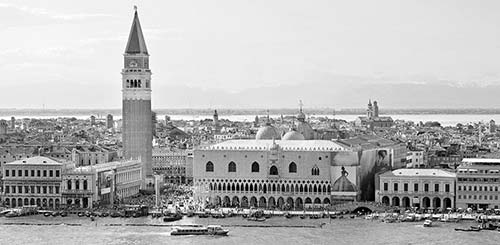
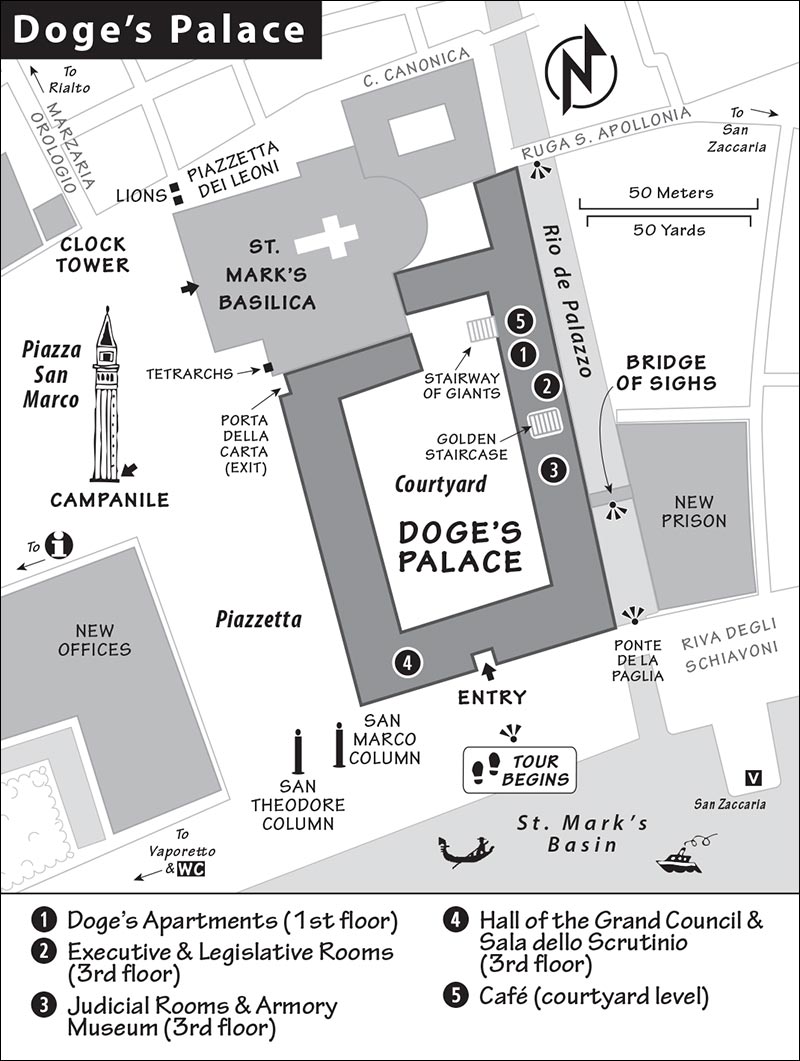
The seat of the Venetian government and home of its ruling duke (doge), this was the most powerful half-acre in Europe for 400 years. The Doge’s Palace was built to show off the power and wealth of the Republic. The doge lived with his family on the first floor up, near the halls of power. From his once-lavish (now sparse) quarters, you’ll follow a one-way tour through the public rooms of the top floor, finishing with the Bridge of Sighs and the prison. The place is wallpapered with masterpieces by Veronese and Tintoretto.
Cost and Hours: €25 combo-ticket includes Correr Museum, €1 fee for online reservation (timed-entry), €13 for youth and seniors, also covered by Museum Pass; daily 9:00-18:00, off-season until 17:00, last entry one hour before closing; café, next to St. Mark’s Basilica, just off St. Mark’s Square, vaporetto stops: San Marco or San Zaccaria, +39 041 271 5911, http://palazzoducale.visitmuve.it.
Avoiding Lines: There are three lanes for entering the Doge’s Palace: for those with a ticket or a pass, for those without a ticket, and for those booked on a Secret Itineraries tour. To enter directly through the turnstile without a wait, buy your ticket online in advance or from the uncrowded Correr Museum across the square.
Tours: The fine Secret Itineraries Tour follows the doge’s footsteps through rooms not included in the general admission ticket. Though the tour skips the palace’s main hall, you’re welcome to visit it afterward on your own. Three 75-minute English-language tours run each morning. Reserve ahead, as tours can fill up several weeks in advance—although you can try just showing up at the information desk (€28, includes Doge’s Palace admission but not Correr Museum, €15 with combo-ticket; reserve at http://palazzoducale.visitmuve.it, €1 fee). Don’t confuse this with the Doge’s Hidden Treasures Tour, which isn’t worth its cost.
The audioguide is dry but informative (€5, 1.5 hours).
Visiting the Doge’s Palace: You’ll see the restored facades from the courtyard. Notice a grand staircase (with nearly naked Moses and Paul Newman at the top). Even the most powerful visitors climbed this to meet the doge. This was the beginning of an architectural power trip.
In the Senate Hall, the 120 senators met, debated, and passed laws. Tintoretto’s large Triumph of Venice on the ceiling (central painting, best viewed from the top) is an allegory of the city in all her glory. Lady Venice is up in heaven with the Greek gods, while barbaric lesser nations swirl up to give her gifts and tribute.
The Armory—a dazzling display originally assembled to intimidate potential adversaries—shows remnants of the military might that the empire employed to keep the East-West trade lines open (and the local economy booming).
The giant Hall of the Grand Council (175 feet by 80 feet, capacity 2,600) is where the entire nobility met to elect the senate and doge. It took a room this size to contain the grandeur of the Most Serene Republic. Ringing the top of the room are portraits of the first 76 doges (in chronological order). The one at the far end that’s blacked out (in the left corner) is the notorious Doge Marin Falier, who opposed the will of the Grand Council in 1355. He was tried for treason, beheaded, and airbrushed from history.
On the wall over the doge’s throne is Tintoretto’s monsterpiece, Paradise, the largest painted canvas in Venice. Christ and Mary are surrounded by a heavenly host of 500 saints. The painting leaves you feeling that you get to heaven not by being a good Christian, but by being a good Venetian.
Cross the covered Bridge of Sighs over the canal to the prisons. Circle the cells. Notice the carvings made by prisoners—from olden days up until the 1920s—on some of the stone windowsills of the cells, especially in the far corner of the building.
Cross back over the Bridge of Sighs, pausing to look through the marble-trellised windows at all of the tourists.
More Sights on the Square
▲▲Correr Museum (Museo Correr)
This uncrowded museum gives you a good overview of Venetian history and art. The doge memorabilia, armor, banners, statues (by Canova), and paintings (by the Bellini family and others) re-create the festive days of the Venetian Republic. And it’s all accompanied—throughout the museum—by English descriptions and views of St. Mark’s Square. But the Correr Museum has one more thing to offer, and that’s a quiet refuge—an elegant Neoclassical space—in which to rise above St. Mark’s Square when the piazza is too hot, too rainy, or too overrun with tourists.
Cost and Hours: €25 combo-ticket includes Doge’s Palace, €13 for youth and seniors, also covered by Museum Pass; daily 10:00-19:00, Nov-March 10:30-17:00; free and mandatory bag check, elegant café, enter at far end of square directly opposite basilica, +39 041 240 5211, http://correr.visitmuve.it.
▲Campanile (Campanile di San Marco)
This dramatic bell tower replaced a shorter tower, part of the original fortress that guarded the entry of the Grand Canal. That tower crumbled into a pile of bricks in 1902, 800 years after it was built. Ride the elevator 325 feet to the top of the bell tower for one of the best views in Venice (especially at sunset). For an ear-shattering experience, be on top when the bells ring. The gilt-wooden statue of archangel Gabriel at the top always faces into the wind. Beat the crowds and enjoy the crisp morning air at 9:00 or the cool evening breeze at 18:00.
Cost and Hours: €10 on-site, where you’ll wait in line; €12 timed-entry ticket lets you skip the line (buy online in advance or use the posted QR code at the entrance to book on the spot); daily roughly 9:30-20:45, shorter hours off-season; may close during bad weather, www.basilicasanmarco.it.
Behind St. Mark’s Basilica
▲Bridge of Sighs
This much-photographed bridge connects the Doge’s Palace with the prison. Travelers popularized this bridge in the Romantic 19th century. Supposedly, a condemned man would be led over this bridge on his way to the prison, take one last look at the glory of Venice, and sigh. Though overhyped, the Bridge of Sighs is undeniably tingle-worthy—especially after dark, when the crowds have dispersed and it’s just you and floodlit Venice. In the middle of the day, however, being immersed in the pandemonium of global tourism (and selfie sticks) can be a fascinating experience in itself.
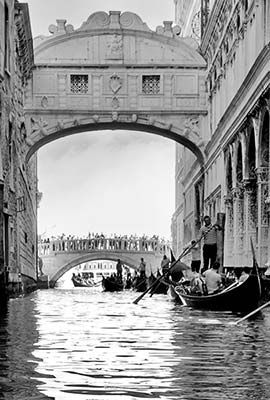
Getting There: The Bridge of Sighs is around the corner from the Doge’s Palace. Walk toward the waterfront, turn left along the water, and look up the first canal on your left. You can walk across the bridge (from the inside) only by visiting the Doge’s Palace.
Church of San Zaccaria
This historic church is home to a sometimes-waterlogged crypt, a Bellini altarpiece, a Tintoretto painting, and the final resting place of St. Zechariah, the father of John the Baptist.
Cost and Hours: Free, €3 to enter the crypt and choir chapel, €1 coin to light up Bellini’s altarpiece; Mon-Sat 10:00-12:00 & 16:00-18:00, Sun 16:00-18:00 only; two canals behind St. Mark’s Basilica.
ACROSS THE LAGOON FROM ST. MARK’S SQUARE
▲Island and Church of San Giorgio Maggiore
This is the dreamy church-topped island you can see from the waterfront by St. Mark’s Square. The striking 16th-century church, designed by Andrea Palladio with his trademark classical touch, features art by Tintoretto, a bell tower, and unforgettable views of Venice.
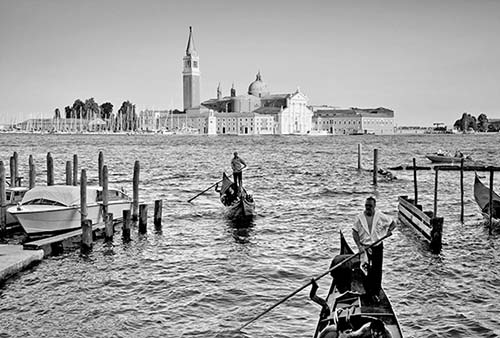
San Giorgio was the church of a Benedictine monastery, whose monks lived a simple lifestyle and cared for the poor. The church, with a facade like a Greek temple, feels so striking because it just doesn’t fit with old-school Venice. Palladio made no concessions to the Byzantine legacy of Venice that you see across the water at the Doge’s Palace. In keeping with Palladio’s classical sensitivity, the interior decor is all in harmony (compared to the relative visual chaos of, say, the Frari Church). The monks hired Tintoretto (a common-man’s painter) to create the Last Supper that hangs to the right of the altar and worked closely with him to hone the message that all are welcome—saints, servants, beggars, sinners—into the Christian faith.
The bell tower here has unobstructed views in all directions and is less crowded than the Campanile at St. Mark’s.
Cost and Hours: Church—free, open daily 9:00-19:00, Nov-March 8:30-18:00; bell tower elevator—€8, runs daily 10:00-18:00 (in off-season, may close for lunch 13:00-14:00), does not run during Sun services; +39 041 522 7827.
Getting There: To reach the island from St. Mark’s Square, take the one-stop, five-minute ride on vaporetto line #2 from San Zaccaria (runs every 12 minutes from dock B, direction: Piazzale Roma). Remember that one vaporetto ticket is good for 75 minutes of one-way travel, allowing for a quick and free visit here on the way to somewhere else.
In Venice’s heyday, it was said that the freedoms a gentleman could experience here went far beyond what any true gentleman would actually care to indulge in. But one extravagance all could enjoy was the ritual of publicly consuming coffee: showing off with an affordable luxury, doing something trendy, while sharing the ideas of the Enlightenment.
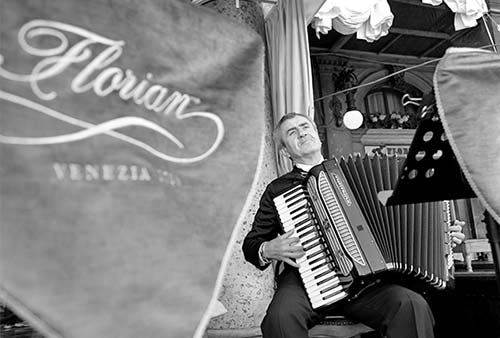
Exotic coffee was made to order for the fancy café scene. Traders introduced coffee, called the “wine of Islam,” from the Middle East (the plant is native to Ethiopia). The first coffeehouses opened in the 17th century, and by 1750 there were dozens of cafés lining Piazza San Marco and 200 operating in Venice.
Today, several fine old cafés survive and still line the square. Those with live music feature similar food, prices, and a three- to five-piece combo playing a selection of classical and pop hits, from Brahms to “Bésame Mucho.”
You can wander around the square listening to the different orchestras, or take a seat at a café. At any place with live music, it’s perfectly acceptable to nurse a cappuccino for an hour—you’re paying for the music with the cover charge. Or you can sip your coffee at the bar at a nearly normal price. The prices are clearly posted. If you sit outside and get just an espresso (your cheapest option), expect to pay €12.50-€6.50 for the coffee and a €6 cover charge when the orchestra is playing (which is most of the day). Service is included (no need to tip).
For locations of the following cafés, see the “St. Mark’s Square” map, earlier.
Caffè Florian (on the right as you face the church) is the most famous Venetian café and was one of the first places in Europe to serve coffee (daily 9:00-24:00, shorter hours in winter, www.caffeflorian.com). It was originally named “Triumphant Venice” (Venezia Trionfante). But under French occupation, in the early 19th century, that politically incorrect name was changed.
The Florian has been a popular spot for a discreet rendezvous in Venice since 1720. Each room has a historic or artistic theme. For example the “Room of the Illustrious Men” (inside, far right) features portraits of great Venetians from Marco Polo to Titian. The outside tables are the main action, but do walk inside through the richly decorated old-time rooms where Casanova, Lord Byron, Charles Dickens, and Woody Allen have all paid too much for a drink. The café’s orchestra—the most serious on the square—plays daily from 10:00 to 24:00. Each hour comes with a musical theme (operetta, Latin, Romantic, jazz, Venetian, and so on—you can ask for the program).
Gran Caffè Quadri, opposite the Florian and established in 1780, has another illustrious roster of famous clientele.
Gran Caffè Lavena, near the Clock Tower, is less storied—although it dates from 1750 and counts composer Richard Wagner as a former regular—so it’s less intimidating than the more formal cafés here. It was the hangout of gondoliers and lantern bearers for local bigwigs. Drop in to check out its dazzling but politically incorrect chandelier.
Gran Caffè Chioggia, on the Piazzetta facing the Doge’s Palace, has no cover and one or two musicians playing—usually a pianist (€7 cocktails, music from 10:30 to 23:00—jazz after 21:00).
Eden Bar and Caffè Aurora are less expensive and don’t have live music.
DORSODURO DISTRICT
▲▲Accademia (Galleria dell’Accademia)
Venice’s top art museum, packed with highlights of the Venetian Renaissance, features paintings by the Bellini family, Titian, Tintoretto, Veronese, Tiepolo, Giorgione, and Canaletto. It’s just over the wooden Accademia Bridge from the San Marco action.
Cost and Hours: €12, €14 for timed-entry ticket that allows you to skip the line (buy online in advance); Tue-Sun 8:15-19:15, Mon until 14:00, last entry one hour before closing; dull audioguide-€6, vaporetto: Accademia, +39 041 524 3354, www.gallerieaccademia.it.
Visiting the Accademia: The Accademia offers a good overview of painters whose works you’ll see all over town. Venetian art is underrated and, I think, misunderstood. It’s nowhere near as famous today as the work of the florescent Florentines, but—with historical slices of Venice, ravishing nudes, and very human Madonnas—it’s livelier, more colorful, and simply more fun. The Venetian love of luxury shines through in this collection, which starts in the Middle Ages and runs to the 1700s. Look for grand canvases of colorful, spacious settings, peopled with happy locals in extravagant clothes having a great time.
Medieval highlights include elaborate altarpieces and golden-haloed Madonnas, all painted at a time when realism, depth of field, and emotion were considered beside the point. Medieval Venetians, with their close ties to the East, borrowed techniques such as gold-leafing, frontal poses, and “iconic” faces from the religious icons of Byzantium (modern-day Istanbul).
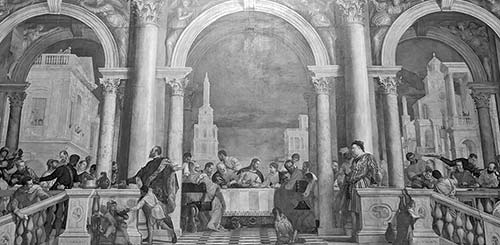
Among early masterpieces of the Renaissance is Mantegna’s studly St. George (Room 4). As the Renaissance reaches its heights, so do the paintings, such as Titian’s magnificent Presentation of the Virgin (Room 24). It’s a religious scene, yes, but it’s really just an excuse to display secular splendor (Titian was the most famous painter of his day—perhaps even more famous than Michelangelo). Veronese’s sumptuous Feast in the House of Levi (Room 10), pictured above, also has an ostensibly religious theme (in the middle, find Jesus eating his final meal)—but it’s outdone by the luxury and optimism of Renaissance Venice. Life was a good thing and beauty was to be enjoyed. (Veronese was hauled before the Inquisition for painting such a bawdy Last Supper...so he fine-tuned the title.)
End your tour in the largest room in the museum, Room 23. This giant hall is the upper half of an old Gothic church. The nave was divided under Napoleon’s rule, and this became the fine arts academy—the Accademia.
▲▲Peggy Guggenheim Collection
The popular museum of far-out art, housed in the American heiress’ former retirement palazzo, offers one of Europe’s best reviews of the art of the first half of the 20th century. Stroll through styles represented by artists whom Peggy knew personally—Cubism (Picasso, Braque), Surrealism (Dalí, Ernst), Futurism (Boccioni), American Abstract Expressionism (Pollock), and a sprinkling of Klee, Calder, and Chagall.
Cost and Hours: €16; Wed-Mon 10:00-18:00, closed Tue; audioguide-€7, pricey café, 5-minute walk from the Accademia Bridge, vaporetto: Accademia or Salute, +39 041 240 5411, www.guggenheim-venice.it.
▲La Salute Church (Santa Maria della Salute)
This impressive church, a prime example of Venetian Baroque, was built and dedicated to the Virgin Mary by grateful survivors of the 1630 plague. Ornate and gleaming white, with a huge, crown-shaped dome, the landmark church dominates the skyline where the Grand Canal meets the lagoon. A number of minor works by Titian and a Tintoretto are kept in the church’s sacristy. The dome of La Salute, newly opened to visitors, makes for a breathtaking viewpoint.
Cost and Hours: Church-free, sacristy-€6, dome visit-€8—book ahead online; church open daily 9:00-12:00 & 15:00-17:30; sacristy open Tue 14:00-15:30 & 16:40-17:30, Wed-Sat 10:00-12:30 & 14:00-17:30, Sun 10:00-10:30 & 14:00-17:30, closed Mon; dome visits available Wed-Sun 10:00-17:00; 10-minute walk from Accademia Bridge, vaporetto: Salute, www.basilicasalutevenezia.it/la-basilica [URL inactive].
▲Punta della Dogana
Housed in the former Customs House at the end of the Grand Canal, this museum features cutting-edge 21st-century art in spacious rooms. This isn’t Picasso and Matisse, or even Pollock and Warhol—those guys are ancient history. But if you’re into newer contemporary artists, the museum is world class. The displays change completely about every year, drawn from the museum’s large collection—so large it also fills Palazzo Grassi, farther up the Grand Canal.
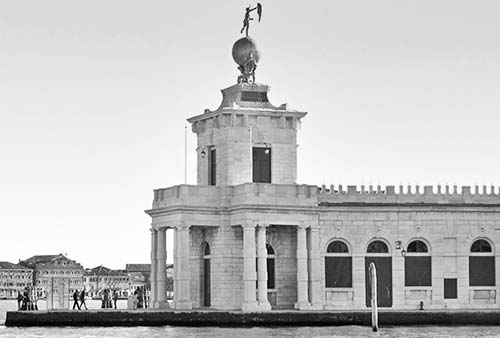
Cost and Hours: €20 (varies depending on exhibit); Wed-Mon 10:00-19:00, closed Tue, last entry one hour before closing; small café, +39 041-200-1057, www.palazzograssi.it.
Getting There: Punta della Dogana is near La Salute Church (vaporetto: Salute). Palazzo Grassi is a bit upstream, on the east side of the Grand Canal (vaporetto: San Samuele).
▲▲Ca’ Rezzonico (Museum of 18th-Century Venice)
Venice in the 1700s was the playground for Europe’s aristocrats, including the wealthy Rezzonico (ret-ZON-ee-koh) family, who owned this palace. Today, the Ca’ Rezzonico (a.k.a. the Museo del Settecento Veneziano) contains furniture, decoration, and artwork from the period. This grand home on the Grand Canal is the best place in town to experience the luxurious, decadent spirit of Venice in the Settecento (the 1700s).
The first floor has palatial rooms decorated with period furniture and ceiling frescoes by G. B. Tiepolo. On the second floor, paintings by Canaletto, Guardi, G. D. Tiepolo, Longhi, and others bring the era to life. (The third-floor painting gallery—which is skippable—shows lots of flesh in lots of rooms.)
Cost and Hours: €10, €1 fee to reserve online; Wed-Mon 10:00-18:00, Nov-March until 17:00, closed Tue year-round; ticket office closes one hour before museum, audioguide-€4, café on the Grand Canal, vaporetto: Ca’ Rezzonico, +39 041 241 0100, http://carezzonico.visitmuve.it.
SAN POLO DISTRICT
▲▲▲Rialto Bridge
One of the world’s most famous bridges, this distinctive and dramatic stone structure crosses the Grand Canal with a single confident span. Designed in 1588 by architect Antonio da Ponte, it took only five years to complete. The arcades along the top of the bridge help reinforce the structure...and offer some enjoyable shopping diversions, as does the Rialto Market nearby (produce market closed Sun, fish market closed Sun-Mon).
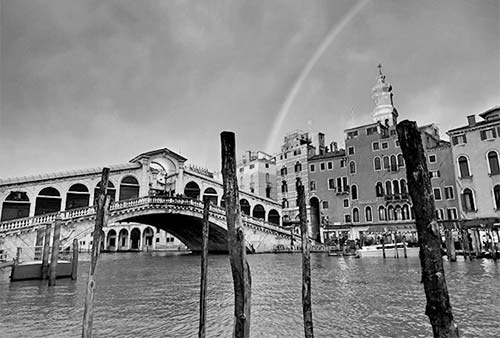
▲T Fondaco dei Tedeschi View Terrace
In the Middle Ages, Venice was the world’s trading center, hosting scores of nationalities, each with its own caravanserai-like center. The most famous, just off the Rialto Bridge, was once the home of Tedeschi (the Italian word for “German”) traders. Later, the building served as the main post office of Venice before being purchased by a global conglomerate and turned into a luxury mall catering to travelers from China and cruise ships.
The mall’s top-floor terrace offers a unique perspective over the roofs of Venice and an unforgettable view of the big bend in the Grand Canal. Four times an hour, 70 people are allowed onto the roof for 15 minutes. As you ride the red-carpet elevator to the top floor, notice how the old architectural bones of the structure survive.
Cost and Hours: The terrace is free but access requires a reservation (15-minute timeslots, book online at www.dfs.com/en/info/t-fondaco-rooftop-terrace [URL inactive]; walk-ins are welcome if there’s space, but no guarantees). Terrace open daily 10:30-18:30, June-Aug until 20:15; east side of Rialto Bridge, +39 041 314 2000.
▲▲Frari Church (Basilica di Santa Maria Gloriosa dei Frari)
My favorite art experience in Venice is seeing art in the setting for which it was designed—as it is at the Frari Church. The Franciscan “Church of the Brothers” and the art that decorates it are warmed by the spirit of St. Francis. It features the work of three great Renaissance masters: Donatello, Giovanni Bellini, and Titian—each showing worshippers the glory of God in human terms.
Cost and Hours: €5; Mon-Thu 9:00-19:30, Fri until 23:00, Sat until 18:00, Sun 13:00-18:00, shorter hours off-season; modest dress recommended, on Campo dei Frari, near San Tomà vaporetto and traghetto stops, +39 041 272 8611, www.basilicadeifrari.it.
Tours: You can rent an audioguide for €2, or download my free Frari Church audio tour.
Visiting the Church: The church was built by the Franciscan order and consecrated in 1492. It’s filled with fine tombs, as many great Venetians chose to be buried here. And its high-quality altarpieces make the church a kind of mini museum of sacred art. The Franciscan love of all of creation—Nature and Humanity—later inspired Renaissance painters to capture the beauty of the physical world and human emotions, showing worshippers the glory of God in human terms.
Enter the church and enjoy the view down the long nave toward the altar. The carved-marble choir, in the center of the nave, allowed friars to hold smaller, more intimate services. As worshippers entered the church and looked down the long nave to the altar, they were greeted by Titian’s glorious painted altarpiece—then, as now, framed by the arch of the choir entrance.
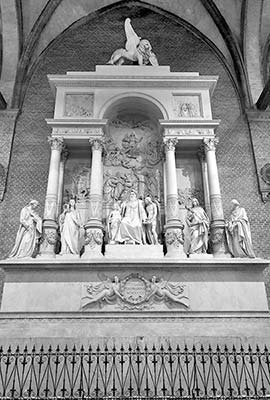
Glowing red and gold like a stained-glass window over the high altar, Titian’s Assumption of the Virgin sets a tone of exuberant beauty. Titian the Venetian—a student of Bellini—painted steadily for 60 years (you’ll see a lot of his art). As stunned apostles look up past the swirl of arms and legs, the complex composition of this painting draws you to the radiant face of the once-dying, now-triumphant Mary as she joins God in heaven. Titian died of the plague in 1576 and is buried in the sacristy of the Frari.
In Donatello’s wood statue of St. John the Baptist (in the first chapel to the right of the high altar), the prophet of the desert—emaciated from his breakfast of bugs ’n’ honey and dressed in animal skins—announces the coming of the Messiah. Donatello was a Florentine working at the dawn of the Renaissance.
Bellini’s Madonna and Child with Saints and Angels painting (in the sacristy—the next room farther to the right) came later, done by a Venetian in a more Venetian style—soft focus without Donatello’s harsh realism. While Renaissance humanism demanded Madonnas and saints that were accessible and human, Bellini places them in a physical setting so beautiful that it creates its own mood of serene holiness. The genius of Bellini, perhaps the greatest Venetian painter, is obvious in the pristine clarity, rich colors (notice Mary’s clothing), believable depth, and reassuring calm of this three-paneled altarpiece.
Venice’s population (fewer than 51,000 in the historic city) is half what it was just 30 years ago, and people are leaving at a rate of a thousand a year. Of those who stay, 25 percent are 65 or older.
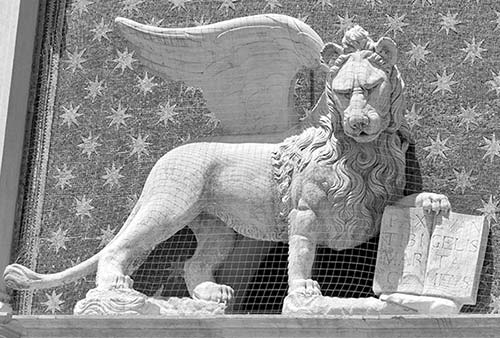
Sad, yes, but imagine raising a family here: Apartments are small, high up, and expensive. Humidity and occasional flooding make basic maintenance a pain. Home-improvement projects require navigating miles of red tape, and you must follow regulations intended to preserve the historical ambience. Everything is expensive because it has to be shipped in from the mainland. You can easily get glass and tourist trinkets, but it’s hard to find groceries or get your shoes fixed. Running basic errands involves lots of walking and stairs—imagine crossing over arched bridges while pushing a child in a stroller and carrying a day’s worth of groceries.
With millions of visitors a year (150,000 a day at peak times), on any given day Venetians are likely outnumbered by tourists. Despite government efforts to subsidize rents and build cheap housing, the city is losing its residents. The economy itself is thriving, thanks to tourist dollars and rich foreigners buying second homes. But the culture is dying.
Greedy residents could sink Venice long before the sea swallows it up. Locals happily rent apartments to tourists a few times a month rather than affordably to local families, and shopkeepers sell trinkets to tourists before pots and pans to the local population. Even the most hopeful city planners worry that in a few decades Venice will not be a city at all, but a museum, a cultural theme park, a decaying Disneyland for adults.
Feel comfortable to discreetly freeload off passing tours. For many, these three pieces of art make a visit to the Accademia Gallery unnecessary (or they may whet your appetite for more). Before leaving, check out the Neoclassical pyramid-shaped Canova monument flanking the nave just inside the main entrance and (opposite that) the grandiose tomb of Titian. Compare the carved marble Assumption behind Titian’s tombstone portrait with the painted original above the high altar.
▲▲Scuola San Rocco
Sometimes called “Tintoretto’s Sistine Chapel,” this lavish meeting hall (next to the Frari Church) has some 50 large, colorful Tintoretto paintings plastered to the walls and ceilings. The best paintings are upstairs in the grand Chapter Room and, especially, in an adjacent smaller room, with Tintoretto’s Crucifixion. View the neck-breaking splendor with the mirrors available in the Chapter Room.
Cost and Hours: €10, daily 9:30-17:30, +39 041 523 4864, www.scuolagrandesanrocco.org.
VENICE’S LAGOON
With more time, venture to some nearby islands in Venice’s lagoon. While still touristy, they offer an escape from the crowds, a chance to get out on a boat, and some enjoyable diversions for fans of glassmaking, lace, and sunbathing.
Lagoon Tour
The islands of San Michele (cemetery), Murano (glass), Burano (lace), and Torcello (oldest church in Venice)—each worth ▲—make a good, varied, and long day trip that you can do on your own.
The Plan: You can travel to any of the four islands by vaporetto. Since single vaporetto tickets are only valid for 75 minutes of one-way travel, getting a vaporetto pass for a lagoon excursion makes more sense (for details on tickets and passes, see here). Confirm vaporetto times at www.actv.it.
Start your journey at the Fondamente Nove vaporetto stop, on Venice’s north shore (the “back” of the fish). Fondamente Nove is a pleasant 15-minute walk from Rialto or St. Mark’s. Alternatively, you could reach Fondamente Nove by vaporetto: From San Zaccaria (near St. Mark’s), take the #4.1 (35 minutes). From the train or bus station, take #4.2 (30 minutes).
From Fondamente Nove, take the #4.1 or #4.2 vaporetto for Murano (about every 10 minutes). On the way, get off at the Cimitero stop on the island of San Michele to see the cemetery (6-minute ride). Continue on to Murano, arriving at the Murano-Colonna stop (3-minute ride). Sightsee Murano as you make your way to the Murano-Faro stop, where you board vaporetto #12 for the trip to Burano (30-40 minutes).
From Burano, you can side-trip to Torcello on the #9 vaporetto shuttle (4/hour, 5-minute ride). To return to Venice from Burano, take vaporetto #12 all the way back to Fondamente Nove (45 minutes). For a longer, more scenic return past even more lagoon islands, take the #14 from Burano to the San Zaccaria dock near St. Mark’s Square (70 minutes).
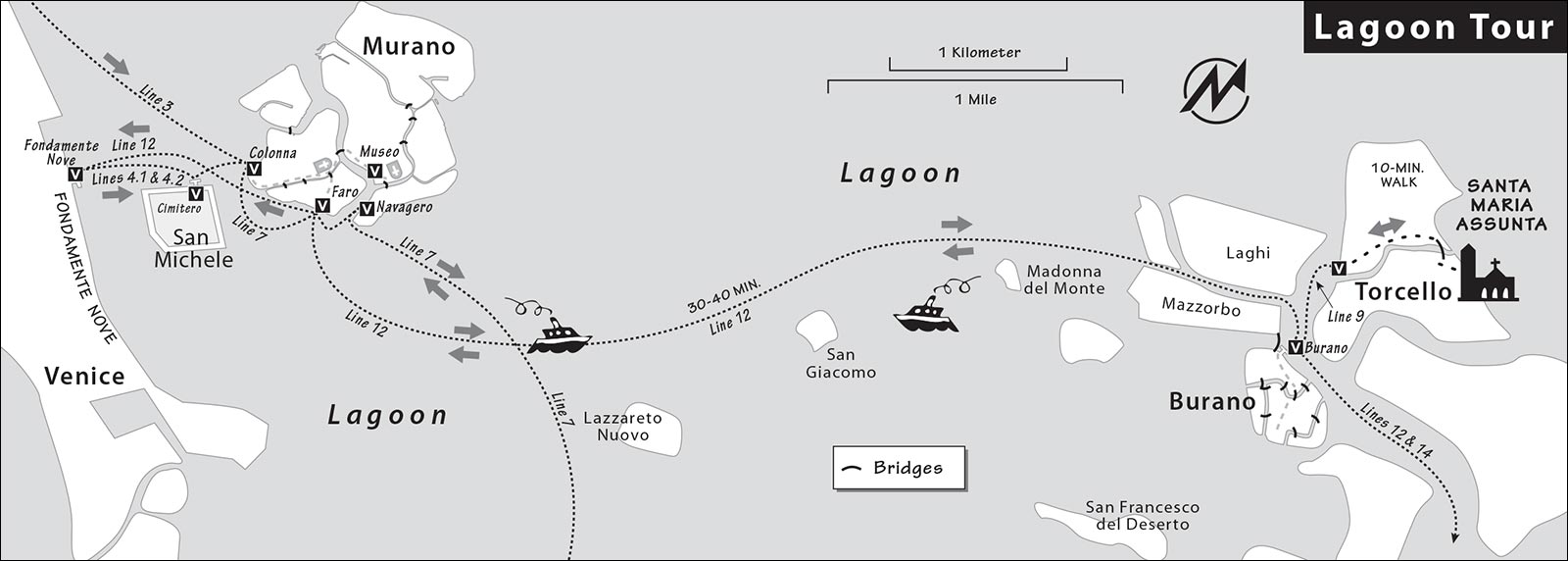
Note that during summer, slightly faster express vaporetti go directly to Murano-Colonna (if you’re OK with skipping the cemetery on San Michele): From San Zaccaria, catch the #7, or from the train/bus stations catch the #3.
San Michele (a.k.a. Cimitero): This island is the final resting place of Venetians and a few foreign VIPs, from poet Ezra Pound to composer Igor Stravinsky. It’s also full of flowers, trees, scurrying lizards, and birdsong, and has an intriguing chapel (cemetery open daily 7:30-18:00, Oct-March until 16:30).
Murano: Famous for its glassmaking, this island is home to several glass factories and the Glass Museum. From the Colonna vaporetto stop, skip the glass shops in front of you, walk to the right, and wander up the street along the canal, Fondamenta dei Vetrai (Glassmakers’ Embankment). The Faro district of Murano, on the other side of the canal, is packed with factories (fabriche) and their furnaces (fornaci). You’ll pass dozens more glass shops along the canal. Early along this promenade, at #47, is the high-class Venini shop, with glass that’s a cut above much of what else is on offer here, and with an interior showing off the ultimate in modern Venetian glass design (closed Sun). Murano’s inviting ▲ Glass Museum (Museo del Vetro) traces the history of this delicate art and is the best place to see real Murano glass (€10, covered by Museum Pass; daily 10:30-18:30, Nov-March until 16:30; +39 041 739 586, http://museovetro.visitmuve.it).
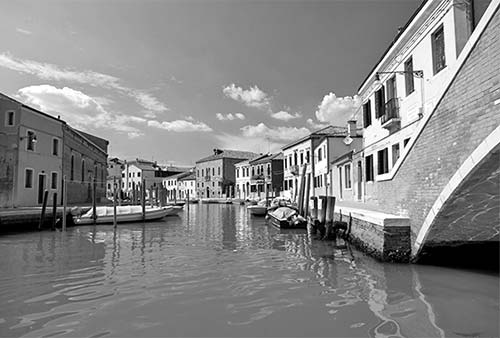
Burano: This island’s claim to fame is lacemaking, and (along with countless lace shops) it offers a delightful pastel village alternative to big, bustling Venice. The tight main drag is packed with tourists and lined with shops, some of which sell Burano’s locally produced white wine. Its Lace Museum (Museo del Merletto di Burano) shows the island’s lace heritage (€5, covered by Museum Pass; Tue-Sun 10:00-16:00, closed Mon; +39 041 730 034, http://museomerletto.visitmuve.it). The museum also runs a lace shop, Il Merletto, just off St. Mark’s Square (open daily, San Marco 95—see the map on here).
Torcello: The birthplace of Venice, this island is where the first mainland refugees settled, escaping the barbarian hordes. Yet today, it’s the least-developed island (pop. 20) in the most natural state, marshy and shrub-covered. Come here to escape the crowds and relax—the island will not demand much of you. There are a few cafés with leafy outdoor seating, and those interested in church art can view Santa Maria Assunta Church. The oldest church in the Venetian lagoon (built in 639; reconstructed in 1008), it sports some impressive Venetian-Byzantine mosaics, a climbable bell tower (may be closed for renovation when you visit), and a modest museum of Roman sculpture and medieval sculpture and manuscripts (15-minute walk from the dock, church-€6, museum-€4; church open daily 10:30-17:30, Nov-Feb 10:00-17:00, museum closed Mon year-round; museum +39 041 730 761).
Lido Beach
Venice’s nearest beach is the Lido, across the lagoon on an island connected to the mainland (which means car traffic). The sandy beach is pleasant, family-friendly, and good for swimming. You can rent an umbrella, buy beach gear at the shop, get food at the self-service café, or have a drink at the bar. Everything is affordable and in the same building (vaporetto: Lido S.M.E., walk 10 minutes on Gran Viale S. Maria Elisabetta to beach entry).
Experiences in Venice
Gondola Rides
Riding a gondola is simple, expensive, and one of the great experiences in Europe. Gondoliers hanging out all over town are eager to have you hop in for a ride. While this is a rip-off for some, it’s a traditional must for romantics.
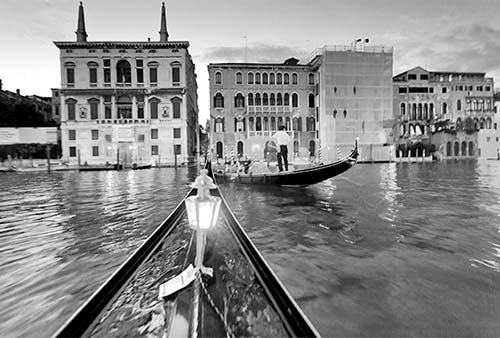
The price for a gondola starts at €80 for a 30-minute ride during the day. You can divide the cost—and the romance—among up to five people per boat, but only two get the love seat. Prices jump to €100 after 19:00—when it’s most romantic and relaxing. Adding a singer and an accordionist will cost an additional €120. If you value budget over romance, you can save money by recruiting fellow travelers to split a gondola. Prices are standard and and set by the gondoliers’ association. Routes are a loop, and gondoliers generally charge extra to drop you any place other than where you started.
Dozens of gondola stations (servizio gondole) are set up along canals all over town. Because your gondolier might offer narration or conversation during your ride, talk with several and choose one you like. You’re welcome to review the map and discuss the route. Doing so is also a good way to see if you enjoy the gondolier’s personality and language skills. Establish the price, route, and duration of the trip before boarding, enjoy your ride, and pay only when you’re finished. While prices are pretty firm, you might find them softer during the day. Most gondoliers honor the official prices, but a few might try to scam you out of some extra euros, particularly by insisting on a tip. (While not required or even expected, if your gondolier does the full 35 minutes and entertains you en route, a 5-10 percent tip is appreciated; if he’s surly or rushes through the trip, skip it.)
If you’ve hired musicians and want to hear a Venetian song (un canto Veneziano), try requesting “Venezia La Luna e Tu.” Asking to hear “O Sole Mio” (which comes from Naples) is like asking a Chicago lounge singer to sing “Swanee River.”
Glide through nighttime Venice with your head on someone’s shoulder. Follow the moon as it sails past otherwise unseen buildings. Silhouettes gaze down from bridges while window glitter spills onto the black water. You’re anonymous in the city of masks, as the rhythmic thrust of your striped-shirted gondolier turns old crows into songbirds. This is extremely relaxing (and, I think, worth the extra cost to experience at night). Suggestion: Put the camera down and make it a point for you and your partner to enjoy a threesome with Venice. Women, beware...while gondoliers can be extremely charming, locals say that anyone who falls for one of these Venetian Romeos “has slices of ham over her eyes.”
Gondola Alternatives: For cheap water thrills during the day, stick to a one-minute shuttle ride on a Grand Canal traghetto. At night, vaporetti are nearly empty, and it’s a great time to cruise the Grand Canal on the slow boat #1 (labeled N after 23:30). Or hang out on a bridge along the gondola route and wave at fellow romantics.
Festivals
Venice’s most famous festival is Carnevale, the celebration Americans call Mardi Gras (February; www.carnevale.venezia.it [URL inactive]). In Carnevale’s heyday—the 1600s and 1700s—you could do pretty much anything with anybody from any social class if you were wearing a mask. These days, tourists and Venetians—from kids to businessmen—gather for parades, parties, and masquerade balls. In drawing such big crowds, Carnevale has nearly been a victim of its own success, driving away many Venetians (who skip out on the craziness to go skiing in the Dolomites). Unless you’re interested in joining the fun, any other day this time of year will be much less chaotic—and less expensive.
Every year, the city hosts the Venice Biennale International Art Exhibition, a world-class contemporary fair alternating between art one year (the main event) and architecture the next (much smaller). The exhibition spreads over the Arsenale and Giardini Pubblici park. When the Biennale focuses on visual art, representatives from 80-plus nations offer the latest in contemporary art forms: video, digital art, performance art, and photography, along with painting and sculpture (take vaporetto #1 or, in summer, #2 to Giardini-Biennale; for details and an events calendar, see www.labiennale.org). The actual exhibition usually runs from April through November, but other events loosely connected with the Biennale—film, dance, theater—are held throughout the year (starting as early as February) in various venues on the island.
Shopping in Venice
Venice has more than its share of ticky-tacky souvenir stores hawking goofy knickknacks and knock-off glassware. But artisanal shops with genuine Murano glass, Burano lace, and Carnevale masks have a long history in the city, and the determined shopper can seek out the real thing. If you press beyond the crowded alleyways around San Marco, you’ll discover many small, authentic boutiques and perhaps meet the designers behind the wares.
SHOPPING NEIGHBORHOODS
St. Mark’s Square and Nearby: The streets closest to St. Mark’s Square, and those along the Mercerie (the route between St. Mark’s and the Rialto Bridge), are the most-trafficked, the highest-rent, and the highest-priced in town. This is where you’ll see all of the big international names.
West of St. Mark’s, toward the Accademia Bridge, is more elegant and exclusive, with high-fashion shops along Calle Vallaresso. As you get closer to the Accademia Bridge (around Campo Santo Stefano and Salizzada San Samuele), you’ll find more characteristic and affordable textile shops, art boutiques, and galleries.
Dorsoduro: Across the Accademia Bridge, the area immediately around the Accademia and Peggy Guggenheim Collection is touristy but does have some worthwhile places selling glass art and jewelry. In the opposite direction, a 10-minute walk past the Accademia, is Campo San Barnaba, a lower-rent neighborhood that attracts innovative, less-established artisans; this is a great place to window-shop.
Rialto Bridge and Nearby: Right by the bridge, Venice’s historic market area is a cancan of shopping opportunities. Many of the products here are edible, but there are lots of hole-in-the-wall jewelry and trinket stores on the bridge, under the arcades to the north, and on the Ruga (the street running from the Rialto toward Campo San Polo and the Frari Church). Near the Rialto end of this stretch is the luxury shopping mall T Fondaco dei Tedeschi.
VENETIAN GLASS
Some visitors feel that because they’re in Venice, they ought to buy glass. Remember that you can buy fine glass back home, too (Venice stopped forbidding its glassblowers from leaving the republic a few centuries ago)—and under less time pressure.
Avoid the cheap glass you’ll see in touristy shops: Most of it is imported from China or Mexico. Genuine, high-end Venetian glass comes with the signature of the artist etched directly into the glass, along with a number if it’s a limited-edition piece (for example, 14/30—number 14 of a total of 30 pieces made).
Shops will ship your purchase home for you, but you’re likely to pay as much or more for the shipping as you are for the item(s), and you may have to pay duty on larger purchases. Make sure the shop insures its merchandise (assicurazione), or you’re out of luck if it breaks.
If you’re serious about glass, visit the island of Murano, its glass museum, and its many shops—you’ll find greater variety on the island.
Nightlife in Venice
You must experience Venice after dark. The city is quieter at night, as many tour groups (not mine) stay in the cheaper hotels of Mestre on the mainland, and the masses of day-trippers return to their beach resorts and cruise ships.
Venice has a busy schedule of events, church concerts, festivals, and entertainment. Check at the TI or the TI’s website (www.veneziaunica.it) for listings. The free monthly Un Ospite di Venezia lists all the latest happenings in English (free at fancy hotels, or download a copy at www.unospitedivenezia.it).
Baroque Concerts
Venice is a city of the powdered-wig Baroque era. For about €30, you can take your pick of traditional Vivaldi concerts in churches throughout town. Homegrown Vivaldi is as ubiquitous here as Strauss is in Vienna and Mozart is in Salzburg. In fact, you’ll find frilly young Vivaldis hawking concert tickets on many corners. Most shows start at 20:30 and generally last 1.5 hours. You’ll see posters in hotels all over town (hotels sell tickets at face value).
Tickets for Baroque concerts in Venice can usually be bought the same day as the concert, so don’t bother with websites that sell tickets with a surcharge. The general rule of thumb: Musicians in wigs and tights offer better spectacle; musicians in black-and-white suits are better performers.
The Interpreti Veneziani orchestra, considered the best group in town, generally performs 1.5-hour concerts nightly at 21:00 inside the sumptuous San Vidal Church (€36, church ticket booth open daily 9:30-21:00 or buy online, north end of Accademia Bridge, +39 041 277 0561, www.interpretiveneziani.com).
Other Performances
Venice’s most famous theaters are La Fenice (grand old opera house, box office +39 041 2424), Teatro Goldoni (mostly Italian live theater), and Teatro Fondamenta Nuove (theater, music, and dance).
Musica a Palazzo is a unique evening of opera at a Venetian palace on the Grand Canal. You’ll spend about 45 delightful minutes in each of three sumptuous rooms (about 2.25 hours total) as seven musicians (generally three instruments and four singers) perform. With these kinds of surroundings, and under Tiepolo frescoes, you’ll be glad you dressed up. As there are only 70 seats, you must book by phone or online in advance, then pay cash at the door (€85, nightly at 20:30, Palazzo Barbarigo Minotto, Fondamenta Duodo o Barbarigo, vaporetto: Santa Maria del Giglio, San Marco 2504, mobile +39 340 971 7272, www.musicapalazzo.com).
St. Mark’s Square
For tourists, St. Mark’s Square is the highlight, with lantern light and live music echoing from the cafés. Just being here after dark is a thrill, as dueling café orchestras entertain. The ultimate Venetian music scene is at the venerable Caffè Florian. But Gran Caffè Chioggia (facing the Doge’s Palace) doesn’t charge extra for music and has good jazz nightly (see the sidebar on here). Every night, enthusiastic musicians play the same songs, creating the same irresistible magic. Hang out for free behind the tables (allowing you to move easily on to the next orchestra when the musicians take a break), or spring for a seat and enjoy a fun and gorgeously set concert. If you sit a while, expect to pay €15 and up (for a drink and the cover charge for music)—money well spent. Dancing on the square is free—and encouraged.
Several venerable cafés and bars on the square serve expensive drinks outside but cheap drinks inside at the bar. The scene in a bar like Gran Caffè Lavena (despite its questionable chandelier) can be great. You’ll hear people talking about the famous Harry’s American Bar, which sells overpriced food and American cocktails to dressy tourists near the San Marco-Vallaresso vaporetto stop. But it’s a rip-off...and the last place Hemingway would drink today. It’s far cheaper to get a drink at any of the hole-in-the-wall bars just off St. Mark’s Square; you can get a bottle of beer or even prosecco-to-go in a plastic cup.
Wherever you end up, streetlamp halos, live music, floodlit history, and a ceiling of stars make St. Mark’s magic at midnight.
Sleeping in Venice
I’ve listed rooms in these areas: St. Mark’s bustle, the Rialto action, the quiet Dorsoduro area behind the Accademia art museum, and near the train station. For drivers, I’ve included a few hotels in Mestre, on the mainland.
Addresses: Hotels in Venice can be tricky to locate. Remember that Venice has six districts: San Marco, Castello, Cannaregio, San Polo, Santa Croce, and Dorsoduro. For much of its history, Venice has given addresses as simply the district name and a house number (such as “Castello 4647”). The Venice Explorer website (https://venicexplorer.com/venice-map [URL inactive]) works well for pinpointing addresses given this way (as well as conventional address).
To help your wayfinding, the listings below include the street name, district name, and house number (along with any useful landmarks).
Hotel Tips: I rank accommodations from $ budget to $$$$ splurge. For the best deal, contact my family-run places directly by phone or email. When you book direct, the owner avoids a commission and may be able to offer a discount. Book well in advance for peak season or if your trip coincides with a major holiday or festival (see the appendix).
As many hotels in central Venice are in historic buildings, rooms tend to be small and stairs are often plentiful. Unless noted, these listings do not have an elevator. For some travelers, short-term, Airbnb-type rentals can be a good alternative; search for places in my recommended hotel neighborhoods.
For more details on reservations, short-term rentals, and more, see the “Sleeping” section in the Practicalities chapter.
NEAR ST. MARK’S SQUARE
To get here from the train station or Piazzale Roma bus station, ride the slow vaporetto #1 to San Zaccaria; in summer you can ride the fast #2 (which also leaves from Tronchetto parking lot) to San Marco. If you take #1, consider using your ride to follow my tour of the Grand Canal (earlier in this chapter). To make sure your boat stops at your stop, confirm that your boat goes “per” your destination (for example, “per San Zaccaria?”).
East of St. Mark’s Square
Located near the Bridge of Sighs, just off the Riva degli Schiavoni waterfront promenade, these places rub drainpipes with Venice’s most palatial five-star hotels.
$$$$ Hotel Campiello, lacy and bright, was once part of a 19th-century convent. Ideally located 50 yards off the waterfront on a tiny square, its 16 rooms offer a tranquil, friendly refuge for travelers who appreciate comfort and professional service (RS%, air-con, elevator, just steps from the San Zaccaria vaporetto stop, on Campiello del Vin at Castello 4647; +39 041 520 5764, www.hcampiello.it, campiello@hcampiello.it; family-run for four generations, currently by Thomas, Nicoletta, and Monica). They also rent three modern, upscale, and quiet family apartments for up to six people, under rustic timbers just steps away from the hotel.
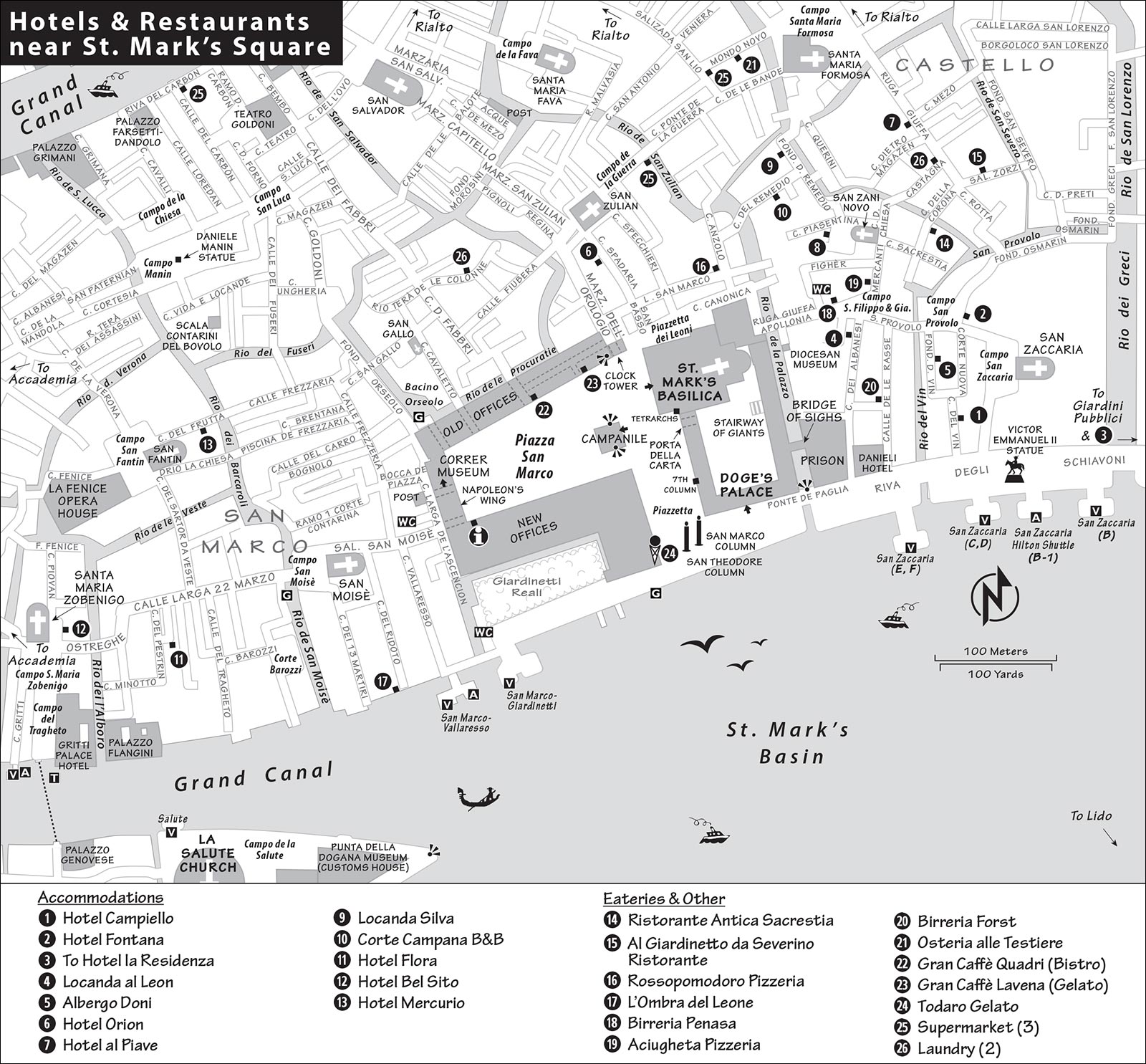
$$$$ Hotel Fontana, two bridges behind St. Mark’s Square, is a pleasant family-run place with 15 sparse but classic-feeling rooms overlooking a lively square (RS%, several rooms with terraces, family rooms, breakfast on terrace in good weather, air-con, elevator, closed Jan, on Campo San Provolo at Castello 4701, +39 041 522 0533, www.hotelfontana.it, info@hotelfontana.it, cousins Diego and Gabriele).
$$$$ Hotel la Residenza is a grand old palace facing a peaceful square. It has 16 rooms on three levels (with no elevator) and a huge, luxurious lounge. This is a good value for romantics—you’ll feel like you’re in the Doge’s Palace after hours (2-night minimum on weekends, air-con; from the Riva degli Schiavone, go down Calle del Dose to Campo Bandiera e Moro at Castello 3608; +39 041 528 5315, www.venicelaresidenza.com, info@venicelaresidenza.com, Valentina).
$$$$ Locanda al Leon, which feels a little like a medieval tower house, is conscientiously run and rents 12 rooms just off Campo Santi Filippo e Giacomo (RS%, some view rooms, family rooms, air-con, one- and two-bedroom apartments, on Campo Santi Filippo e Giacomo at Castello 4270; +39 041 277 0393, www.hotelalleon.com, leon@hotelalleon.com, Giuliano and Marcella). They run two annexes: B&B Ca’ Marcella, just down the street, has three newer, classy, and spacious rooms for the same rates (check in at main hotel); Ca’ San Marco, overlooking a quiet canal, has six additional rooms.
$$ Albergo Doni, situated along a quiet canal, is dark and quiet. This time-warp—with creaky floors and 13 well-worn, once-classy rooms—is run by friendly Tessa and her two brothers, Barnaba and (now “retired”) Italian stallion Nikos (RS%, cheaper rooms with shared bath, family rooms, ceiling fans, a few rooms have air-con, Wi-Fi in common areas, on Fondamenta del Vin at Castello 4656, +39 348 511 1007, albergodoni@hotmail.it). The hotel also has three nice overflow apartments (www.leoncinivenezia.it).
North of St. Mark’s Square
$$$$ Hotel Orion rents 21 simple, welcoming, pricey rooms in the center of the action (you’re paying a premium for the location). Steep stairs (there’s no elevator) take you from the bustling street into a peaceful world high above (RS%, air-con; from San Zulian Church it’s just a few steps down Calle Spadaria, San Marco 700a; +39 041 522 3053, www.hotelorion.it, info@hotelorion.it).
$$$ Hotel al Piave, with 25 rooms above a bright, tight lobby and breakfast room, is comfortable and cheery, and you’ll enjoy the neighborhood (RS%, family rooms, lots of narrow stairs, air-con, on Ruga Giuffa at Castello 4838, +39 041 528 5174, www.hotelalpiave.com, info@hotelalpiave.com; family-run by Mirella, Paolo, Ilaria, and Federico).
$$$ Locanda Casa Querini rents six bright, high-ceilinged rooms on a quiet square tucked away behind St. Mark’s. You can enjoy your breakfast or a sunny happy-hour picnic sitting at their tables right on the sleepy little square (RS%, family rooms, in-room fridges, air-con, on Campo San Zaninovo/Giovanni Novo at Castello 4388, +39 041 241 1294, www.locandaquerini.com, info@locandaquerini.com; Patrizia and Caterina).
$$$ Locanda Silva is a well-located hotel with a functional 1960s feel and a small terrace. It rents 23 simple rooms with small bathrooms (RS%, a few cheaper rooms with shared bathrooms, closed Dec-Jan, family rooms, air-con, lots of stairs, on Fondamenta del Remedio at Castello 4423, +39 041 522 7643, www.locandasilva.it, info@locandasilva.it; Sandra and Katia).
$$ Corte Campana B&B, run by enthusiastic and helpful Riccardo and his Californian wife Grace, rents three quiet, spacious, characteristic rooms in a homey flat just behind St. Mark’s Square. For one room, the private bath is down the hall (cash only, 2-3 night minimum, family rooms, air-con, elevator, on Calle del Remedio at Castello 4410, +39 041 523 3603, mobile +39 389 272 6500, www.cortecampana.com, info@cortecampana.com).
Near Campo Santa Maria Formosa
A bit farther north of the options listed above, these are in the quiet, somewhat less touristy Castello area, beyond the inviting Campo Santa Maria Formosa (for locations, see the map on here).
$$$ Locanda la Corte is perfumed with elegance without being snooty. Its 12 attractive, high-ceilinged, wood-beamed rooms—Venetian-style, done in earthy pastels—circle a small, sun-drenched courtyard and a ground-level restaurant (RS%, family rooms, air-con, on Calle Bressana at Castello 6317, +39 041 241 1300, www.locandalacorte.it, info@locandalacorte.it).
$$ Alloggi Barbaria, a good budget choice, rents eight simple, characterless rooms on one floor around a bright but institutional-feeling common area. Beyond Campo San Zanipolo/Santi Giovanni e Paolo, it’s a fair walk from the action, but in a pleasant residential neighborhood. The Ospedale vaporetto stop is two minutes away on foot, with no steps (RS%, family rooms, limited continental breakfast, air-con in summer, Wi-Fi in common areas, on Calle de le Capucine at Castello 6573, +39 041 522 2750, www.alloggibarbaria.it, info@alloggibarbaria.it, friendly Fausto). You can reach the Ospedale stop on vaporetto #5.2 from the train or bus stations, or via the Alilaguna blue line from the airport.
West of St. Mark’s Square
These more expensive hotels are solid choices in a more elegant neighborhood.
$$$$ Hotel Flora sits buried in a sea of fancy designer boutiques and elegant hotels almost on the Grand Canal. It’s formal, with uniformed staff and grand public spaces, yet the 40 rooms have a homey warmth and the garden oasis is a sanctuary for well-heeled, foot-weary guests (air-con, elevator, great family-size apartment, on Calle Bergamaschi at San Marco 2283a, +39 041 520 5844, www.hotelflora.it, info@hotelflora.it).
$$$$ Hotel Bel Sito offers pleasing Old World character, 34 smallish rooms, generous public spaces, a peaceful courtyard, a private water taxi dock, and a picturesque location facing a church on a small square between St. Mark’s Square and the Accademia (RS%, some view rooms, air-con, elevator; near Santa Maria del Giglio vaporetto stop—line #1, on Campo Santa Maria Zobenigo/del Giglio at San Marco 2517; +39 041 522 3365, www.hotelbelsitovenezia.it, info@hotelbelsitovenezia.it, graceful Rossella).
$$$$ Hotel Mercurio, a lesser value a block from La Fenice Opera House, offers 29 peaceful, comfortable rooms (some view rooms, family rooms, air-con, lots of stairs, on Calle del Fruttariol at San Marco 1848, +39 041 522 0947, www.hotelmercurio.com, info@hotelmercurio.com).
NEAR THE RIALTO BRIDGE
These places are on opposite sides of the Grand Canal, within a short walk of the Rialto Bridge. Express vaporetto #2 brings you to the Rialto quickly from the train station, the Piazzale Roma bus station, and the parking-lot island of Tronchetto, but you’ll need to take the “local” vaporetto #1 to reach the minor stops closer to the last two listings. To locate the following hotels, see the map on here.
$$$$ Hotel al Ponte Antico, in a restored 14th-century building, is exquisite, professional, and small. With nine plush rooms, a velvety royal living/breakfast room, and its own dock for water taxi arrivals, it’s perfect for a romantic anniversary. Because its wonderful terrace overlooks the Grand Canal, Rialto Bridge, and market action, its rooms without a canal view may be a better value (air-con; 100 yards from Rialto Bridge on Calle dell’Aseo, Cannaregio 5768, use Rialto vaporetto stop; +39 041 241 1944, www.alponteantico.com, info@alponteantico.com; Matteo makes you feel like royalty).
$$$ Pensione Guerrato, right above the colorful Rialto produce market and just two minutes from the Rialto Bridge, is run by friendly, creative, and hardworking Roberto, Piero, Monica, and Matilde. Their 800-year-old building—with 22 spacious, charming rooms—is simple, airy, and wonderfully characteristic. It’s a great value considering the location and charm (RS%, cheaper rooms with shared bath, family rooms, air-con; take vaporetto #1 to Rialto Mercato stop to save walk over bridge—from the boat, go through the passageway, turn right onto Casaria, then take the second left to Calle drio la Scimia, San Polo 240a; +39 041 528 5927, www.hotelguerrato.com, info@hotelguerrato.com). My tour groups book this place for 60 nights each year. Sorry. The Guerrato also rents family apartments in the old center (great for groups of 4-8).
$$$ Hotel al Ponte Mocenigo is off the beaten path—a 10-minute walk northwest of the Rialto Bridge—but it’s lovely and a great value. This 16th-century Venetian palazzo has a garden terrace and 15 comfy, beautifully appointed, and tranquil rooms (RS%, air-con; take vaporetto #1 to San Stae stop, then head inland along the right side of the church on Salizada San Stae to Santa Croce 1985; +39 041 524 4797, www.alpontemocenigo.com, info@alpontemocenigo.com, Sandro and Valter).
NEAR THE ACCADEMIA BRIDGE
In Dorsoduro
As you step over the Accademia Bridge, the commotion of touristy Venice is soon replaced by a sleepy village laced with canals. This quiet area, next to the best Venetian painting museum in town, is a 15-minute walk from the Rialto or St. Mark’s Square. In summer, the fast vaporetto #2 to the Accademia stop is the typical way to get here from the train station, Piazzale Roma bus station, or St. Mark’s Square. For hotels near the Zattere stop, vaporetto #5.1 or the Alilaguna boat from the airport are good options.
$$$$ Pensione Accademia fills the 17th-century Villa Maravege like a Bellini painting. Its 27 comfortable, elegant rooms gild the lily. You’ll feel aristocratic gliding through its grand public spaces and lounging in its wistful, breezy gardens (family rooms, air-con, no elevator but most rooms on ground floor or one floor up, on Fondamenta Bollani at Dorsoduro 1058, +39 041 521 0188, www.pensioneaccademia.it [URL inactive], info@pensioneaccademia.it).
$$$$ Hotel la Calcina, the home of English writer John Ruskin in 1876, maintains a 19th-century formality. It comes with three-star comforts in a professional yet intimate package. Its 25 tasteful rooms are squeaky clean, with nice wood furniture, hardwood floors, and a peaceful waterside setting facing Giudecca Island (some view rooms, air-con, no elevator and lots of stairs, rooftop terrace, buffet breakfast outdoors in good weather on platform over lagoon, near Zattere vaporetto stop at south end of Rio de San Vio at Dorsoduro 780, +39 041 520 6466, www.lacalcina.com, info@lacalcina.com).
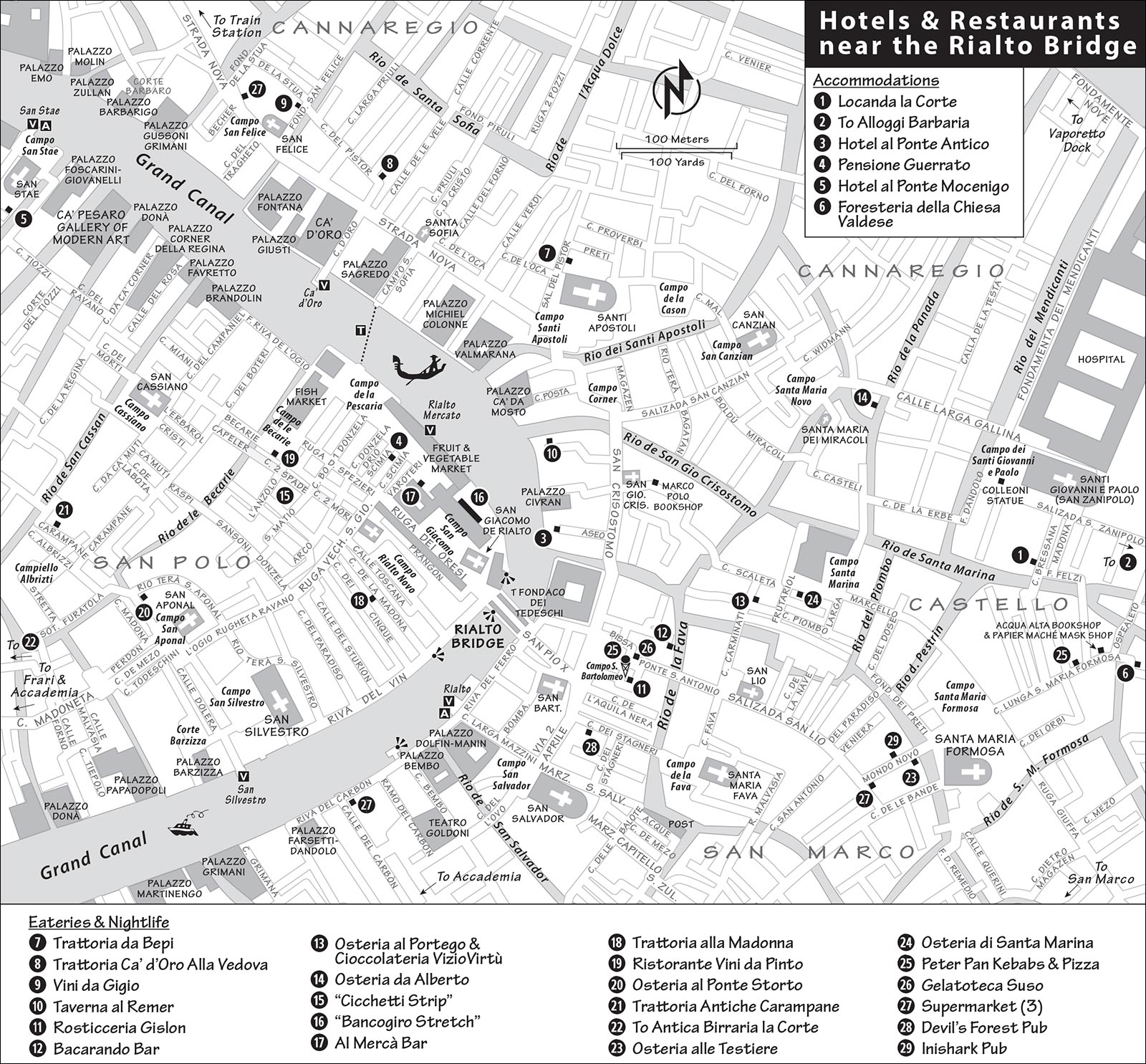
$$$$ Hotel Galleria has nine old-fashioned and velvety rooms, half with views of the Grand Canal. Some rooms are quite narrow, but you can open your window to watch boats pass by at any time. It’s run with a family feel by Luciano and Lucio (one cheaper room with detached private bath, breakfast voucher for Foscarini café downstairs, ceiling fans; 30 yards from Accademia art museum, right near the bridge on Rio Terà A. Foscarini at Dorsoduro 878a; +39 041 523 2489, www.hotelgalleria.it, info@hotelgalleria.it).
$$$$ Hotel Belle Arti, with a stiff, serious staff, lacks personality but has a grand entry, an inviting garden terrace, and 67 heavily decorated rooms (air-con, elevator, 100 yards behind Accademia art museum on Rio Terà A. Foscarini at Dorsoduro 912a, +39 041 522 6230, www.hotelbellearti.com, info@hotelbellearti.com).
$$$$ Don Orione Religious Guest House is a big cultural center dedicated to the work of a local man who became a saint in modern times. With 80 rooms filling an old monastery, it feels cookie-cutter institutional (like a modern retreat center), but is also classy, clean, peaceful, and strictly run. It’s beautifully located, comfortable, and supports a fine cause: Profits go to mission work in the developing world (family rooms, groups welcome, air-con, elevator, on Rio Terà A. Foscarini, Dorsoduro 909a, +39 041 522 4077, www.donorione-venezia.it, info@donorione-venezia.it).
$$$$ Ca’ San Trovaso rents six pleasant rooms in a little three-floor, formerly residential building. The location is peaceful, on a small, out-of-the-way canal (RS%, some view rooms, breakfast voucher for nearby café, tiny roof terrace, apartments available with 3-night minimum; near Zattere vaporetto stop, off Fondamenta de le Romite at Dorsoduro 1350; +39 041 241 2215, mobile +39 349 125 3890, www.casantrovaso.com, info@casantrovaso.com, Anna and Alessandra).
$$ Casa di Sara, a colorfully decorated B&B, is hidden in a leafy courtyard in a humble back-street area overlooking a canal. Their four quiet rooms and tiny roof terrace offer the maximum in privacy (air-con, along Fondamenta de le Romite at Dorsoduro 1330, mobile +39 342 596 3563, www.casadisara.com [URL inactive], info@casadisara.com, Emanuele).
North of the Accademia Bridge
These places are between the Accademia Bridge and St. Mark’s Square, near Campo Santo Stefano.
$$$$ Novecento Hotel rents nine plush rooms on three floors, complemented by a big, welcoming lounge, an elegant living room, and a small breakfast garden. This boutique hotel, with helpful staff, is nicely located in a quiet location (air-con, lots of stairs, on Calle del Dose, off Campo San Maurizio at San Marco 2684, +39 041 241 3765, www.novecento.biz, info@novecento.biz).
$$$$ Foresteria Levi, run by a foundation that promotes research on Venetian music, offers 32 quiet, institutional yet comfortable and spacious rooms—some are loft quads, a good deal for families (air-con, elevator, on Calle Giustinian at San Marco 2893, +39 041 277 0542, www.foresterialevi.it, info@foresterialevi.it). From the base of the Accademia Bridge, it’s just over the tiny Ponte Giustinian.
$$$$ Domus Ciliota is a big, efficient, and sparkling-clean place—well-run, well-located, church-owned, and plainly furnished—with 30 dorm-like rooms and a peaceful courtyard. If you want comfort with no stress and don’t need much character, this is a fine value. During the school year, half the rooms are used by students (air-con, elevator; just off Campo Santo Stefano at Calle delle Muneghe, San Marco 2976; +39 041 520 4888, www.ciliota.it, info@ciliota.it).
$$$ Hotel San Samuele rents 10 tidy rooms in an old residence near Campo Santo Stefano. Antique furniture and restored original floors give this place a homey feel. It’s in a great locale, and the rooms with shared bath can be a good deal (RS%, no breakfast, fans, plenty of stairs, on Salizada San Samuele at San Marco 3358, +39 041 520 5165, www.hotelsansamuele.com, info@hotelsansamuele.com, Judith).
ON THE MAINLAND, IN MESTRE
Drivers may want to stay on the mainland, in Mestre. It’s easy to get between Mestre and Venice. From the big Mestre station, trains depart about every 10 minutes, zipping to Venice’s Santa Lucia station in about 10 minutes.
$$ Hotel Tritone, a high-rise Best Western hotel with 60 rooms varying in decor from business to mod, has the most convenient location, facing Mestre’s train station (air-con, elevator, pay parking; leaving the station, cross the street, turn right, and walk to the end of the block to find Viale Stazione 16, +39 041 538 3125, www.hoteltritonevenice.com, info@hoteltritonevenice.com).
$$ Hotel Paris is a few doors down from the station and worth considering if you can get a deal. It has 18 small, modern, modestly stylish rooms (air-con, on-site parking, Via Venezia 11, +39 041 926 037, www.hotelparis.it, info@hotelparis.it).
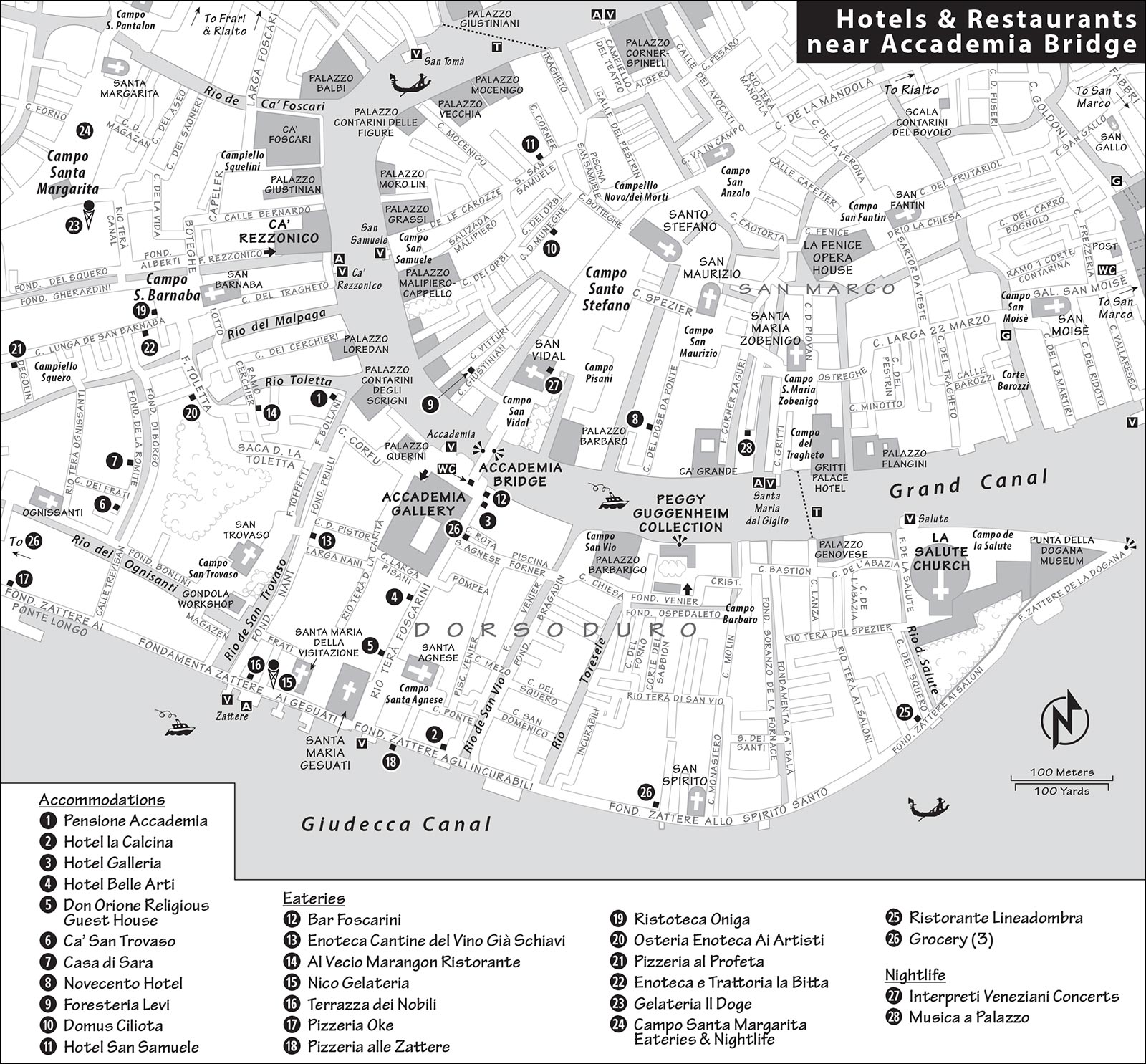
Eating in Venice
The hard fact is that Venice is slowly becoming one big tourist attraction. As its population shrinks and the cost of business rises, eateries are forced to accommodate the changing market. To make matters worse, that market is increasingly day-trippers looking for low-end snacks and bar food like pizzas and sandwiches. In frustration, many of my favorite restauranteurs have sold in recent years, making it harder and harder to find places with both soul and ethics. For a special meal, Venetians (and savvy travelers) will venture far away from the center to distant corners of the lagoon.
Having said that, there are still good places, and (just like Disneyland) you have plenty of choices. The best values are no secret, so if you have your heart set on a particular place, make a reservation. Without a reservation, you may get lucky if you’re at the door right when a place opens—but don’t count on it. Eating early gives you fewer crowds and fewer Italians; eating later is more crowded and with fewer tourists. When considering prices, gird yourself for a 50 percent “charm tax”...you’re eating in Venice! Enjoy.
EATING TIPS
Venetians often eat a snack—cicchetti or panini—while standing at a bar. (You’ll usually pay more if you sit.) Unique to Venice, cicchetti bars specialize in finger foods and appetizers that combine to make a speedy and tasty meal. Cicchetti (the Venetian version of tapas) were designed as a quick meal for working people. The selection and ambience are best Monday through Saturday for lunch or early dinner (see “The Stand-Up Progressive Venetian Pub-Crawl Dinner” sidebar, later).
Sandwiches are sold fast and cheaply at bars everywhere (order a panini, piadini, or tramezzini). You can eat your sandwich at the bar or take it with you.
A favorite Italian tradition is the aperitivo (predinner drink). The dominant aperitivo among Venetians is the spritz (white wine, soda, and ice with a liquor of your choice). When you order, you’ll be asked if you’d like your spritz con Campari (bitter) or con Aperol (sweeter).
NEAR THE RIALTO BRIDGE
North of the Bridge
These four places are serious restaurants located in Cannaregio. The first three are just steps off the Strada Nova, the main drag in the district; the last, Taverna al Remer, is closer to the Rialto Bridge. Consider reservations necessary at each.
$$$ Trattoria da Bepi, bright and paneled in knotty pine, feels like a classic, where Loris carries on his mother’s passion for good, traditional Venetian cuisine and the freshest of ingredients. Like anywhere, be sure you understand the menu and your bill here. There’s good seating inside and out (Fri-Wed 12:00-15:00 & 19:00-22:00, closed Thu; half a block off Campo Santi Apostoli on Salizada Pistor, Cannaregio 4550; +39 041 528 5031, www.dabepi.it).
$$ Trattoria Ca’ d’Oro Alla Vedova is a venerable place respected for its traditional Venetian cuisine. It’s compact yet romantic, with a tiny cicchetti bar at the door, where regulars sip and munch, and dressy tables in tight quarters beyond (Fri-Wed 11:00-14:30 & 18:30-22:30, closed Thu; from the Ca’ d’Oro vaporetto stop, follow the small lane right across Strada Nova to Calle del Pistor, Cannaregio 3912; +39 041 528 5324).
$$$$ Vini da Gigio, a more expensive option, has a traditional Venetian menu and a classy but welcoming setting that’s a pleasant mix of traditional and contemporary (Wed-Sun 12:00-14:30 & 19:00-22:30, closed Mon-Tue; 4 blocks from Ca’ d’Oro vaporetto stop on Fondamenta San Felice, behind the church on Campo San Felice; Cannaregio 3628a, +39 041 528 5140, www.vinidagigio.com).
$$$$ Taverna al Remer hides out down a narrow alley with its own little courtyard on the Grand Canal, 100 meters from the Rialto Bridge. Their Venetian mixed-fish appetizer plate is a hit. You’ll dine romantically by candlelight under brick vaults and old timbers, often with live mellow jazz serenading you. While Yuli, the owner, advertises “art food, drink, and charm,” locals would call it fake charm for tourists (Wed-Mon 12:00-14:30 & 19:00-22:30, closed Tue; find it down the unmarked lane between Burger King and Bacaro Bar, near the Church of San Giovanni Crisostomo, Cannaregio 5701; +39 041 52 8789, https://tavernaremer.com).
East of the Rialto Bridge
The next few places hide away in the twisty lanes between the Rialto Bridge and Campo Santa Maria Formosa. Osteria da Alberto is a tad farther north of the others.
$$ Rosticceria Gislon is an institution in its neighborhood—a tavola calda (buffet line of cooked food) in a bright and practical diner setting with salads, fried mozzarella, pastas, seafood and more, all at good prices (from Campo San Bartolomeo, look for the neon green “Rosticceria” sign and head through the passageway to Calle de la Bissa, San Marco 5424a, +39 041 522 3569).
$$ Cicchetti near Campo San Bartolomeo: Three fun and tiny cicchetti bars cluster within ten meters of each other (all are open daily). If the statue on Campo San Bartolomeo turned around, walked to the far right-hand corner, and explored the back lanes there, he’d find them in this order: Osteria I Rusteghi is more than your rough cicchetti bar. It’s an enoteca gastronomica—a wine bar that pairs fine dishes with fine wines. It has a serious list of good wines by the glass and a jazzy interior on its own tiny, tranquil square (Corte dei Tentor 5513, +39 338 760 6034). Modern little Bar SEPA attracts a young crowd and sells good cicchetti, clearly priced. Push past the crowd of smokers at the door to find space at a stand-up barrel inside—no table seating here (on Calle della Bissa). Bacarando Bar is old school, with clearly marked and priced little dishes at the counter and two floors of table seating (Corte dell’Orso 5495).
$$ Osteria al Portego is a small and popular neighborhood eatery near Campo San Lio. Carlo serves good meals, bargain-priced house wine, and excellent €1-4 cicchetti—best enjoyed around 18:00 (picked over by 21:00). The cicchetti here can make a great meal, but consider sitting down for a dinner from their blackboard-fresh menu. Their six tables are reserved for those ordering from the menu; reserve ahead if you want a table (daily 11:30-15:00 & 17:30-22:00, on Calle de la Malvasia at Castello 6015, +39 041 522 9038, www.osteriaalportego.org, Federica). From Campo San Bartolomeo, continue over a bridge to Campo San Lio, turn left, and follow Calle Carminati straight 50 yards over another bridge.
$$ Osteria da Alberto, near Campo Santa Maria Novo, is one of my standbys, with locals at lunch and tourists at dinner. They offer excellent daily specials: seafood, pastas, and a good house wine in a woody and characteristic interior. It’s smart to reserve at night—I’d request a table in front in “the first room” (daily 12:00-15:00 & 18:30-22:00; on Calle Larga Giacinto Gallina, midway between Campo Santi Apostoli and Campo San Zanipolo/Santi Giovanni e Paolo, and next to Ponte de la Panada bridge at Calle Larga Giacinto Gallina, Cannaregio 5401; +39 041 523 8153, www.osteriadaalberto.it, run by Graziano and Giovanni).
Rialto Market Area
The north end of the Rialto Bridge is thriving with places to eat and drink. As with market neighborhoods anywhere, you’ll find lots of holes-in-the-wall with a line on the freshest of ingredients and catering to local shoppers needing a quick, affordable bite. This area is crowded by day, nearly empty early in the evening, and packed with young Venetians and tourists later.
My listings include a stretch of dark and rustic pubs serving cicchetti (Venetian tapas), a strip of trendy places fronting the Grand Canal, a few little places on the market, and a couple of “normal” restaurants serving solid pasta, pizza, and secondi.
The Cicchetti Strip: Four Venetian Tapas Bars
The 100-yard-long stretch starting two blocks inland from the Rialto Market (along Sotoportego dei Do Mori and Calle de le Do Spade) has long been a favorite among Venetian cicchetti enthusiasts for its bar munchies, wine by the glass, and fun stand-up conviviality. These $ places serve food all day, but the spread is best at around noon (generally open daily 12:00-15:00 & 18:00-20:00 or 21:00). Each place offers a fine bar-and-stools scene, and a couple can be treated like a restaurant—order from their rustic menu and grab a table. Scout these places in advance to help decide which ambience is right for the experience you have in mind. Then pick one, dig in, and drink up.
At each place, look for the list of snacks and wine by the glass at the bar or on the wall. For a simple €1 glass of house wine, ask for an “ombra.” Better wine costs around €3, and cicchetti cost €2. They get unworkably crowded later in the evening.
Bar all’Arco is a bustling one-room joint serving mostly crostini—small open-faced sandwiches (Thu-Tue 10:00-14:30, closed Wed, Campo San Polo 436; Francesco, Anna, Matteo).
Cantina Do Mori serves a forest of little edibles on toothpicks and francobolli (a spicy selection of tiny, mayo-soaked sandwiches nicknamed “stamps”). Go here to be abused in a fine atmosphere—the frowns are part of the shtick—and be aware that prices can add up quickly (Mon-Sat 8:00-19:30, closed Sun, can be shoulder-to-shoulder, on Calle Do Mori at San Polo 430).
Osteria ai Storti, with a cool photo of the market in 1909, is more of a sit-down place (tables inside and on street). Study his cute little menu. Alessandro serves a selection of €2 fried little gut bombs and enjoys helping educate travelers (around corner from Cantina Do Mori on Calle San Matio, San Polo 819).
Cantina Do Spade is run by Francesco, who clearly lists the cicchetti (mostly deep fried) and wines of the day. It’s also good for sit-down restaurant-style meals (30 yards from Osteria ai Storti down Calle de le Do Spade at San Polo 860, +39 041 521 0583).
The Bancogiro Stretch: Five Places Overlooking the Grand Canal
Just past the Rialto Bridge, between Campo San Giacomo and the Grand Canal, this strip of popular places in a recently renovated old building has some of the best canalside seating in Venice. I call this the “Bancogiro Stretch” (the restaurants front a former banking building called Bancogiro).
Each place has a unique character and formula. Unless otherwise noted, all are open daily and serve drinks, cicchetti, and somewhat pricey sit-down meals. While you can get a drink anytime, dinner is typically served only after 19:00 or 19:30. During meals, they charge more and limit table seating to those ordering full lunches or dinners; but between mealtimes you can enjoy a drink or a snack at fine prices. After dinner hours, the Bancogiro Stretch—especially in the surrounding alleys that house low-rent bars—becomes a youthful and trendy nightspot. Before or after dinner, this strip is one of the best places in town for a spritz.
A fine Venetian dinner is a pub crawl (giro d’ombra)—a tradition unique to Venice, where no cars means easy crawling. (Giro means stroll, and ombra—slang for a glass of wine—means shade, from the old days when a portable wine bar scooted with the shadow of the Campanile bell tower across St. Mark’s Square.)
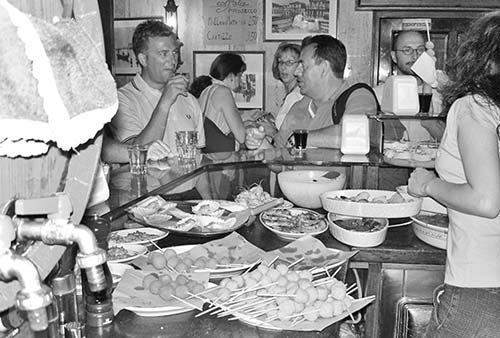
Venice’s residential back streets hide plenty of characteristic bars (bacari), with countless trays of interesting toothpick munchies (cicchetti) and blackboards listing the wines that are uncorked and served by the glass. This is a great way to mingle and have fun with the Venetians. Bars don’t stay open very late, and the cicchetti selection is best early, so go at lunch or start your evening by 18:00. Many bars are closed on Sunday. For a stress-free pub crawl, consider taking a tour with the charming Alessandro Schezzini (see here) or connect with one of the many “food tour guides” offering such Venetian pub crawls on one of the many online booking services.
Cicchetti bars have a social stand-up zone and a cozy gaggle of tables where you can generally sit down with your cicchetti or order from a simple menu. In some of the more popular places, the crowds happily spill out into the street. Food generally costs the same whether you stand or sit. Bars are often clustered together, making the “pub crawl” approach very workable.
Look for a place that’s more “bar” than “restaurant.” Lately many are getting lazy and offering only little open-face sandwiches and fried items. I much prefer a wider selection with fewer gut-bombs and less bread. Make sure they have cicchetti on display. Bar-hopping Venetians enjoy an aperitivo, a before-dinner drink. Sip your drink and make the scene while standing at the bar. Next, order a cicchetto or two by pointing. Chill some more, while munching and sipping. Then order another one or two. Find a stool or table nearby where you can sit (but don’t sit at tables with tablecloths—those are for diners). Pay when you’re ready to leave. If you’ve crawled enough, most of my recommended bars make a fine one-stop, sit-down dinner.
While you can order a mixed cicchetti plate, Venetians prefer going one-by-one...sipping their wine and trying this...then give me one of those...and so on. Try deep-fried mozzarella cheese, gorgonzola, calamari, artichoke hearts, and anything ugly on a toothpick. Crostini (small, toasted bread with a topping) are popular, as are marinated seafood, olives, and prosciutto with melon. Meat and fish (pesce; PESH-ay) munchies can be expensive; veggies (verdure) are cheap, at about €3 for a meal-sized plate. In many places, there’s a set price per food item (for example, €2). To get a plate of assorted appetizers for €8 (or more, depending on how hungry you are), ask for “Un piatto classico di cicchetti misti da €8” (oon pee-AH-toh KLAH-see-koh dee chee-KET-tee MEE-stee dah OH-toh eh-OO-roh). Bread sticks (grissini) are free for the asking.
For drinks, start with an aperitivo: Order a Bellini, a spritz con Aperol, or a prosecco, and draw approving looks from the natives. Enjoy the house wines with the food. An ombra (“shadow”) is a small glass of wine often offered with cicchetti. An ombra rosso (red) or ombra bianco (white), or a small beer (birrino), costs about €1. The house keg wine is cheap—€1 per glass, about €4 per liter. Vin bon, Venetian for fine wine, may run you from €2 to €6 per little glass. There are usually several fine wines uncorked and available by the glass. A good last drink is fragolino, the local sweet wine—bianco or rosso. It often comes with a little cookie (biscotto) for dipping.
Here’s the rundown (in the order you’ll reach them from the Rialto Bridge): $$$ Bar Naranzaria serves Italian dishes at the best prices, open-faced sandwiches, and wines by the glass (closed Mon). $$ Caffè Vergnano is your cheapest option during mealtimes (pasta, salads, pizza, vegetarian dishes, and a busy microwave oven; long hours daily). $$$ Osteria al Pesador has a more extensive menu with a friendly staff serving local specialties (also seating upstairs; open daily). $$$ Osteria Bancogiro has a more sophisticated menu and the best reputation for dinner, a passion for the best cheese, and good cicchetti options at the bar. They offer fine dining upstairs (nice cheese plate, closed Mon, reservations smart, +39 041 523 2061, www.osteriabancogiro.it).
$ Al Mercà Bar (“At the Market”), a few steps away and off the canal, is a lively little nook with a happy crowd, where law-office workers have lunch and young locals gather in the evening for drinks (quality wine by the glass) and little snacks (€2 mini-sandwiches). The price list is clear, and the youthful crowd seems to enjoy connecting with curious tourists (stand at bar or in square—there are no tables and no interior, Mon-Sat 10:00-14:30 & 18:00-21:00, closed Sun, on Campo Bella Vienna, San Polo 213).
Restaurants near the Rialto Market
$$$ Trattoria alla Madonna is an old-school favorite frequented by retired locals who appreciate its traditional dishes (mostly seafood), formal waiters, white tablecloths, relaxing old-Venetian atmosphere, and fair prices. It’s big and spacious for Venice, with high ceilings (inside dining only, lunch from 12:00, dinner from 19:00, closed Wed; on a quiet lane two blocks from the Rialto Bridge, Calle della Madonna, San Polo 594; +39 041 522 3824).
$$ Ristorante Vini da Pinto is a tourist-friendly eatery facing the fish market, with a large menu and relaxing outdoor seating and a dressy, spacious interior. Owner Giorgio visits the market each morning to select the day’s best catch. Enjoy the lunch-only, fixed-price, three-course seafood meal for €18, including a pasta, seafood sampler plate, and veggies. Grander versions cost €25. Dinner à la carte can range from simple and inexpensive to a delightful splurge. Rick Steves readers receive a welcoming prosecco and a farewell limoncello and homemade cookie (daily 11:00-23:00, Campo de le Becarie, San Polo 367a, +39 041 522 4599). If dining outside, be careful to sit at a da Pinto table.
$$ Osteria al Ponte Storto, a little place on a quiet canalside corner a block off the main drag, is worth seeking out for its good-value fish dishes and peaceful location. Their small, hand-written menu changes with the daily specials. Rather than a romantic place, it feels like the corner favorite of the neighborhood (Mon-Sat 12:00-15:00 & 18:00-21:45, closed Sun, down Calle Bianca from San Aponal church, San Polo 1278, reservations smart, +39 041 528 2144).
Between the Rialto Bridge and Frari Church
$$$$ Trattoria Antiche Carampane is a dressy, family-run place with an open kitchen and a local following. They have a passion for fish (and make a point: no pizza) and serve traditional Venetian dishes with a fresh twist that change with the season. It’s small—there are just 30 seats with six tables on the street (Tue-Sat 12:45-14:30 & 19:30-22:30, closed Sun-Mon, reservations necessary, Rio Tera delle Carampane, San Polo 1911, +39 041 524 0165, www.antichecarampane.com, Francesco).
$$ Antica Birraria la Corte is an everyday eatery on the delightful Campo San Polo. Popular for its huge array of pizza—and smaller selection of hearty salads, pasta, and secondi—it fills the far side of this cozy, family-filled square. Although the interior is sprawling and modern, it’s a joy to eat on the square, where metal tables teeter on the cobbles, the wind plays with the paper mats, and children run free (daily 12:00-15:00 & 18:00-22:30, on Campo San Polo at #2168, +39 041 275 0570).
NEAR ST. MARK’S SQUARE
Other than the first place, a more serious restaurant, the other eateries listed here are cheap-and-cheery options convenient to your sightseeing. For locations, see the map on here.
$$$$ Ristorante Antica Sacrestia is a classic restaurant where the owner, Pino, takes a hands-on approach to greeting guests. His staff serves creative fixed-price meals (€37, €52, or €80), a humdrum menù del giorno, and wonderful pizzas. You can also order à la carte; their antipasto spread looks like a lagoon aquarium spread out on a plate. My readers are welcome to a free sgroppino (lemon vodka after-dinner drink) upon request (Tue-Sun 11:30-15:00 & 18:00-23:00, closed Mon, behind San Zaninovo/Giovanni Novo Church on Calle Corona, Castello 4463, +39 041 523 0749, www.anticasacrestia.it). There’s no wine by the glass. Order carefully. Pizza is your only budget escape.
$$$ Al Giardinetto da Severino Ristorante serves traditional Venetian fare (proudly no pizza) with a homey-dressy vibe and white-tablecloth elegance inside, and a big, peaceful garden filled with tables out back. The waitstaff works to provide a memorable and romantic dining experience, rare at this price (Fri-Wed 12:00-15:00 & 19:00-22:00, closed Thu, reservations smart, off Ruga Giuffa on Salizada Zorzi, Castello 4928, +39 041 528 5332, www.algiardinetto.it).
$$ Rossopomodoro Pizzeria is a big, fun, and practical pizzeria offering top quality, good prices, and a very handy location. They cook Naples-style pizzas in their wood oven and also offer a selection of hearty salads and pastas (long hours daily, Calle Larga San Marco 404, +39 041 243 8949).
$$$ L’Ombra del Leone is a big, modern, and classy bar (with attached restaurant), but its best feature is an elegant outdoor terrace right on the Grand Canal. Be sure to request the reasonably priced bar menu of salads and sandwiches (the restaurant menu is excellent but pricey). This spot is a hive of waterfront activity and popular with water taxi captains. Find the terrace at the very end of Calle Ridotto, past the Biennale archway (long hours daily, in Ca’ Giustinian—the Biennale offices, behind San Moisè Church at Sestiere San Marco 1364, +39 041 241 3519).
A Quick Lunch Behind St. Mark’s Basilica
The best place for a reasonable value so close to the epicenter of tourism is a couple blocks behind the basilica on or near Campo Santi Filippo e Giacomo. As you enter the square from St. Mark’s, on the left you’ll first find Birreria Penasa and, a few steps beyond, Aciugheta; for Birreria Forst, continue a half-block beyond the square to Calle de le Rasse.
$ Birreria Penasa is a fast and practical place slamming out slate plates with cheap toasted sandwiches and beer. While you can sit and chose from the menu, I’d go inside to the bar and point to what looks good. Tables are set up like theater seating, so you can enjoy watching the parade of tourists shuffle by (daily 7:00-24:00, Campo Santi Filippo e Giacomo, +39 041 523 7202).
$$ Aciugheta Pizzeria is a handy place for lunch or a casual dinner with great outdoor and indoor seating. They take quality seriously when it comes to their pizzas and cicchetti (see the display under glass at the bar). Inside seating can be an oasis of quiet. And tables outside give you a great perch from the corner of the lively square (daily 12:00-24:00, Campo Santi Filippo e Giacomo, +39 041 522 4292).
$ Birreria Forst, halfway down Calle de le Rasse at #4540, serves busy local workers a selection of meaty sandwiches with tasty sauce on wheat bread, or made-to-order sandwiches. Order at the bar and grab a place at a rustic wooden table in their busy little dining room (daily 9:30-23:00, air-con, +39 041 523 0557).
Fine Dining North of St. Mark’s Square, near Campo Santa Maria Formosa
Two Michelin-rated restaurants are near Campo Santa Maria Formosa. Each is romantic, expensive, requires a reservation, and is a rare and fine value for a gourmet experience.
$$$$ Osteria alle Testiere is my favorite dining splurge in Venice. Hugely respected, Luca and his staff are dedicated to quality, serving up creative, artfully presented market-fresh seafood (there’s no meat on the menu), homemade pastas, and fine wine in what the chef calls a “Venetian Nouvelle” style. With only 22 seats, it’s tight and homey, with the focus on food and service. They have daily specials, 10 wines by the glass, and one agenda: a great dining experience. This is a good spot to let loose and trust your host. They book up far in advance for lunch (12:00-15:00) and their two dinner seatings: 19:00 and 21:30 (reserve via email or website, plan on spending €75 for dinner, closed Sun-Mon; just off Campo Santa Maria Formosa at Calle del Mondo Novo, Castello 5801; +39 041 522 7220, www.osterialletestiere.it, info@osterialletestiere.it).
$$$$ Osteria di Santa Marina is the spot for a dressy meal among locals. It features creative gourmet Venetian cuisine, both traditional and innovative. More spacious than most Venetian places, the place has comfortable seating on the square and a fine dining room inside filled with character (€30 mains, €65 tasting menu; Tue-Sat 12:30-14:30 & 19:30-23:00, closed Sun-Mon; northwest of Campo Santa Maria Formosa near Campo Santa Marina, off Calle del Frutariol at Castello 5911; +39 041 528 5239). For location, see the “Hotels & Restaurants near the Rialto Bridge” map on here.
DORSODURO
The following recommendations are within a 10-minute walk of the Accademia Bridge (for locations, see the map on here). This area, called Dorsoduro, is great for restaurants and well worth the walk from the more touristy Rialto and San Marco areas. The first listings, near the Accademia, are best for lunch. The places in Zattere overlook the Giudecca Canal. Best for dinner are the restaurants near Campo San Barnaba. Last are a handful of pizzerias and cicchetti bars on Campo Santa Margarita. My top Dorsoduro listing, Ristorante Lineadombra, is described later in “Splurging on a Water (or Otherwise Great) View.”
Near the Accademia Bridge
$$ Bar Foscarini, next to the Accademia Bridge and Galleria, offers edible pizzas and panini in a memorable Grand Canal-view setting. The food is forgettable and drinks are pricey. But you’re paying a premium for this premium location. On each visit to Venice, I grab a pizza lunch here while I ponder the Grand Canal bustle. They also serve breakfast (daily 8:00-23:00, Nov-April until 20:30, on Rio Terà A. Foscarini at Dorsoduro 878c, +39 041 522 7281).
$ Enoteca Cantine del Vino Già Schiavi, with a wonderfully characteristic cicchetti-bar ambience, is much loved for its inexpensive cicchetti, sandwiches (order from list on board), and wine. You’re welcome to enjoy your wine and finger food at the bar, in the back room surrounded by wine bottles, or out on the sidewalk (specify “fuori” to sit outside and they’ll provide plastic cups; don’t sit on the bridge). This is primarily a wine shop with great prices for bottles to go (Mon-Sat 8:30-20:30, closed Sun, 100 yards from Accademia art museum on San Trovaso canal; facing the Accademia, take a right and then a forced left at the canal to the second bridge—it’s on Fondamenta Nani at Dorsoduro 992; +39 041 523 0034; they have no WC).
$$$ Al Vecio Marangon Ristorante glows like a dream come true on its corner tucked away about 100 yards west of the Accademia. This stylishly rustic restaurant serves cicchetti-style dishes and pastas within its picturesque interior (with extremely tight seating) or at a line of outdoor tables. Consider their splittable piatto di cicchetti misti, a sampler of sardines, octopus, codfish, and seafood salad. As they take no reservations, arrive early or be prepared to wait (daily 12:00-22:00, on Calle de la Toletta at Dorsoduro 1210, +39 041 277 8554).
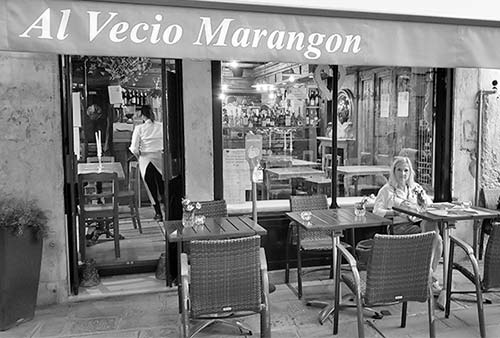
Zattere
The far south side of Dorsoduro has the Fondamenta Zattere, a wide promenade along the Giudecca canal that has a special charm on warm summer evenings. I’d come here not for the food, but to dine on the canal. Each of these places has a big terrace literally on the water. And nearby is the popular Nico Gelateria (with floating seating on the canal).
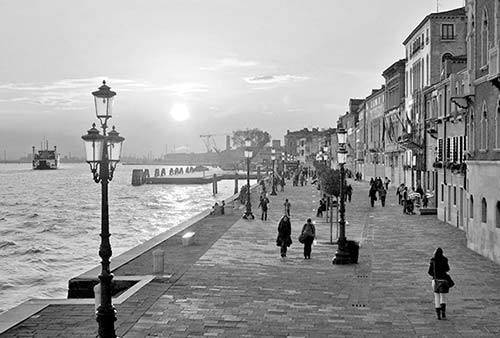
$$$ Terrazza dei Nobili takes full advantage of the warm, romantic evening sun. They serve regional specialties (especially fish) and pizza at tolerable prices. The breezy and beautiful seaside seating comes with formal service and the rumble of vaporetti from the nearby stop (daily 12:00-24:00; at the Zattere vaporetto stop on the Fondamenta, Dorsoduro 924; +39 041 520 6895).
$$ Pizzeria Oke is playful, with casual tables on the embankment and a sprawling pizza-parlor interior. It’s a hit with young Venetians for its fun atmosphere. While the energy and food are great, be careful to understand the bill—and be warned that dishes presented as free may end up on your check (daily 11:30-23:00, a couple hundred yards from the Zattere vaporetto stop on the Fondamenta, Dorsoduro 1414, +39 041 520 6601).
$$ Pizzeria alle Zattere, where you can enjoy your pizza on a floating dining barge, is next to the Zattere vaporetto stop (Wed-Mon 12:00-22:00, closed Tue, on the Fondamenta at Dorsoduro 791a, +39 041 520 4224).
On or near Campo San Barnaba
This small square is a delight—especially in the evening. As these places are within a few steps of each other—and the energy and atmosphere can vary—I like to survey the options before choosing a place for lunch. But, in the evening, you’re smart to reserve in advance.
$$ Ristoteca Oniga has an eclectic yet cozy interior and great tables on the square. The menu has a few vegetarian and meat dishes but focuses on fresh fish and other sea creatures, highlighted by their specialty, bucintoro—a pan full of mussels, clams, prawns, calamari, and spaghetti—prepared for two at a premium price (daily 12:00-14:30 & 19:00-22:30, reservations smart, Campo San Barnaba, Dorsoduro 2852, +39 041 522 4410, www.oniga.it).
$$ Osteria Enoteca Ai Artisti serves well-presented quality dishes, with seating within its tight little wine-snob interior or at a few petite, romantic canal-side tables. They serve good wines by the glass. When reserving, make sure they know your preference—a table on the canal or inside (great pasta, cheese plates, and fish; Tue-Sat 12:45-14:30 & 19:00-22:00, closed Sun-Mon; Fondamenta de la Toletta, Dorsoduro 1169a, +39 041 523 8944, www.enotecaartisti.com, Vicenzo and chef Francesca).
$ Pizzeria al Profeta is a casual place popular with tourists for great pizza. Its sprawling interior seems to stoke conviviality, as does its leafy garden with spacious seating out back (daily 12:00-14:30 & 19:00-22:30; from Campo San Barnaba, it’s a long walk down Calle Lunga San Barnaba to #2671; +39 041 523 7466, run by hard-working Simone).
$$ Enoteca e Trattoria la Bitta is dark and woody, with a homey bistro feel and tight indoor seating. They serve beautifully presented, traditional Venetian food with—proudly—no fish. Their helpful wait staff and handwritten daily menu are focused on local ingredients (including rabbit) and a “slow food” ethic. They do two dinner seatings (19:00 and 21:00) and require reservations (dinner only, closed Sun, just off Campo San Barnaba on Calle Lunga San Barnaba, Dorsoduro 2753a, +39 041 523 0531, Debora and Marcellino).
On Campo Santa Margarita
For a fresh, youthful neighborhood vibe away from the tourist crowds and cutesy Venice, hike out to Campo Santa Margarita, where you’ll find a multigenerational, slice-of-life scene by day and a trendy college-bar scene after dark. The square is ringed by bakeries, pubs, pizzerias, and fruit stands offering options for everything from picnics to finer dining. If slumming, a picnic or takeout pizza on this square (with fine benches and trees) is great. The area gets a little sketchy late at night. For the best gelato on the square, find Gelateria Il Doge.
$$ Osteria alla Bifora, a former butcher shop, serves creative plates of mixed cold cuts in their candlelit woody interior and at tables on the square. While it’s almost only cold platters, the presentation is elegant and pairs delightfully with their wine. For rustic cicchetti plates ranging from sardines, anchovies, and cod to platters of fine salamis and cheeses, this is a good choice with a fun-loving energy (daily 12:00-24:00, #2930, +39 041 523 6119, Franco and Mirella).
$$$ Osteria Do Torri, delightfully situated with tables overlooking the action, is your best bet for standard Venetian dishes on the square (daily, #3408, +39 041 522 0686).
$ Campo Santa Margarita’s hole-in-the-wall cicchetti bars (on the square and just off it) serve drinks and cicchetti plates to local eaters with a contagious love of life.
SPLURGING ON A WATER (OR OTHERWISE GREAT) VIEW
$$$$ Ristorante Lineadombra, immediately behind La Salute Church, has commanding Giudecca Canal views from their big floating terrace and a spacious, modern, and dressy interior. This Michelin-rated place is a gourmet treat, with gorgeously presented dishes that are local and modern at the same time. Each dish is a memory, and even though plates are pricey, you are welcome to share. The appetizers especially are big and are happily served on two smaller plates. Reserve ahead and choose seating inside or on their terrace. Service is friendly yet professional (daily 12:00-15:00 & 19:00-22:00, closed Tue off-season; a short walk behind La Salute Church from the Salute vaporetto stop, Fondamenta Zattere, Dorsoduro 19; +39 041 241 1881, www.ristorantelineadombra.com).
$$$$ Ristorante Algiubagiò, on Fondamente Nove—handy to the docks for the islands of Murano and Burano—is a good place to eat as you look over the northern lagoon. The name joins the names of the four owners—Alberto, Giulio, Barbara, and Giovanna—who strive to impress visitors with quality, creative Venetian cuisine made with the best ingredients. Reserve a waterside table or sit in their classy cantina dining room (daily 12:00-15:00 & 19:00-22:30, between the two sets of vaporetto docks on Fondamente Nove, Cannaregio 5039—see map on here, +39 041 523 6084, www.algiubagio.net).
$$ Ristorante Pizzeria da Alvise, also on Fondamente Nove, is a popular place for traditional dishes and pizza with tables on a terrace with a lagoon view (Tue-Sun 12:00-14:00 & 19:00-22:00, closed Mon, Fondamente Nove 5045c—see map on here, +39 041 520 1515).
$$$$ Gran Caffè Quadri on Piazza San Marco is the place to go if you insist on dining fine on Venice’s main square. Upstairs is their Michelin-star Quadri restaurant, but their Quadrino bistro, also dressy and a bit pretentious, shares the same kitchen, with a more traditional and accessible menu, and prices that won’t completely ruin your appetite. While its 15 tables are all inside, the orchestra is just out the window (Wed-Sun 12:00-15:00 & 19:00-22:30, closed Mon-Tue, reservations smart, San Marco 121—see map on here, +39 041 522 2105, www.alajmo.it/grancaffe-quadri).
On Giudecca Island: A short vaporetto ride from San Marco or Dorsoduro takes you away from the crowds to the more peaceful and residential Giudecca Island. Between the Giudecca Palanca and Redentore stops, you’ll find several canalside dining options. Stroll the embankment and take your pick. The friendly service at $$ Bar La Palanca attracts a happy crowd (lunch until 14:30, closed Sun, no dinner served, at Giudecca 448). $$$ Osteria Ae Botti is white-tablecloth fancy inside, but has a row of tables hugging the embankment outside (closed Tue, Giudecca 609). $$ Trattoria Al Redentore serves up average pizza and pasta, but arguably has the best Venice views (daily, Giudecca 205b).
PICNICS AND SWEETS
Picnicking
You’re legally forbidden from picnicking anywhere on or near St. Mark’s Square except for Giardinetti Reali, the waterfront park near the San Marco vaporetto docks. Though it’s legal to eat outdoors elsewhere around town, you may be besieged by pigeons who are, in turn, besieged by aggressive seagulls.
Venice has one main produce market and several convenient supermarkets:
Outdoor Market near the Rialto Bridge: Assemble a fun picnic at the fruit and vegetable market that sprawls for a few blocks to the north of the Rialto Bridge (best Mon-Sat 8:00-13:00, liveliest in the morning, closed Sun). The adjacent fish market is wonderfully slimy (closed Sun-Mon). Side lanes in this area are speckled with fine hole-in-the-wall munchie bars, bakeries, and cheese shops. The recommended Al Mercà Bar is ideal for a few little sandwiches to go (see listing on here). The Rialto Mercato vaporetto stop is convenient to both.
Produce Stands: Many larger squares have a produce stand. To find the one nearest St. Mark’s Square, face St. Mark’s Basilica, then walk along its left side, heading east down Calle de la Canonica. Cross the bridge and turn left at Campo Santi Filippo e Giacomo.
Fast and Cheap Eats around Campo Santa Maria Formosa: The veggie stand on Campo Santa Maria Formosa is a fixture. And for döner kebabs and pizza to go, head down Calle Lunga Santa Maria Formosa to $ Peter Pan at #6249 (daily 11:30-23:00, Castello—see map on here).
Supermarket near St. Mark’s Square: A handy Co-op supermarket is between St. Mark’s and Campo Santa Maria Formosa, on the corner of Salizada San Lio and Calle del Mondo Novo at Castello 5817. It has a deli counter and a great selection of picnic supplies, including packaged salads and fresh sandwiches (daily 8:30-22:00).
Other Supermarkets: The largest supermarket in town is the Co-op at Piazzale Roma, next to the vaporetto stop at Santa Croce 505. It’s an easy walk from the train station, as is a smaller Co-op on Campo San Felice (along the Strada Nova between the train station and Rialto area, Cannaregio 3660). There’s a Despar grocery a few steps from San Zulian church (3-minute walk from St. Mark’s at Calle al Ponte de la Guerra 514). Just beyond the Rialto vaporetto stop is another handy Co-op (facing the Grand Canal at Riva del Carbon 4173). All are open long hours daily.
In Dorsoduro, just around the corner from the Accademia, a tiny Crai grocery has all the basics and some takeaway food (daily, Rio Terrà Foscarini 879a). There are two Conad supermarkets on the Zattere embankment—at the west end, at #1492, by the San Basilio vaporetto stop, and on the east end, at #417, near the Santo Spirito vaporetto stop.
Good Gelato and Chocolate Spots
Venice isn’t known for its quality gelato but you’ll still find good gelaterie in every neighborhood, typically offering one-scoop cones for about €2 (€1 per extra scoop). The words artigianale or produzione propria indicate that a shop makes its own gelato, although sometimes from powder or paste bases (avoid brightly colored gelato or places that have overflowing tubs). The following places are all open long hours daily.
St. Mark’s Side of the Rialto Bridge: A gourmet gelato shop, Gelatoteca Suso, serves delectable flavors in bowls you can eat (next to Campo San Bartolomeo on Calle de la Bissa, San Marco 5453a—see map on here).
St. Mark’s Square: Both Gran Caffè Lavena at #134 and Gelateria al Todaro (on the corner of the Piazzetta at #3, near the water just under the crocodile-topped column) won’t win any awards, but they are convenient if you want something to lick while enjoying the San Marco orchestras. For locations, see the map on here.
Near Campo Santa Maria Formosa: Cioccolateria VizioVirtù (Vice and Virtue) is a hit with chocolate lovers. Across from the recommended Osteria al Portego, it’s a modern lab of deliciousness with fine gelato as a bonus (closed Mon, Calle del Forner, Castello 5988—see map on here).
Venice Connections
A two-mile-long causeway (with highway and train lines) connects Venice to the mainland. Mestre, the sprawling mainland section of Venice, has fewer crowds, cheaper hotels, and plenty of inexpensive parking lots, but zero charm. Don’t stop in Mestre unless you’re changing trains, parking your car, or sleeping there.
BY TRAIN
All trains to “Venice” stop at Venezia Mestre (on the mainland). Most continue on to Santa Lucia Station (a.k.a. Venezia S.L.) on the island of Venice itself. If your train only stops at Mestre, you’ll need to buy a €1.40 Mestre-Santa Lucia ticket and validate it before hopping any nonexpress, regional train (with an R or RV prefix) for the short ride across the causeway to Venice (10/hour, 10 minutes).
The Santa Lucia train station plops you right into the old town on the Grand Canal, an easy vaporetto ride or fascinating 45-minute walk (with a number of bridges and steps) to St. Mark’s Square.
The station has baggage storage (€19/24 hours, daily 6:00-23:00, no lockers, along track 1). Pay WCs are at track 1 and in the back of the big bar/cafeteria area inside the station (in front of track 3). You’ll find the TI across from track 2. If the station TI is crowded when you arrive, visit the TI at St. Mark’s Square instead.
If you need to confirm your departure plan, there are banks of user-friendly ticket machines all around the station (covering Italian destinations only). They take euros and credit cards, display schedules, and issue tickets.
Getting from the Train Station to Central Venice
The Ferrovia vaporetto docks are right outside the station’s front door. There are five docks (A, B, C, D, and E), each serving different boats. Dock assignments can change with the season, so check the electronic signboards near the ticket windows to see which boats are leaving when and from which dock. Most tourists want the fast boats #2 or #2/ down the Grand Canal to Rialto (generally from dock B; #2/ goes only as far as Rialto; #2 continues to San Marco late May-mid-Sept) or the slow boat #1 down the Grand Canal, making every stop all the way to Rialto and San Marco (usually dock E).
Buy a ticket before you board—but before buying a single-ride ticket, consider getting a transit pass (see here). If ticket-window lines at the docks are too long, use the nearby self-service machines (English-language option, credit cards accepted) or buy from the TI inside the station. Find your dock and validate your ticket/pass by touching it to the circular pad; the gates will open to let you onto the dock. Because docks serve multiple lines, before you hop on the vaporetto, confirm with the conductor that this particular boat is going to your stop (“per Rialto?”).
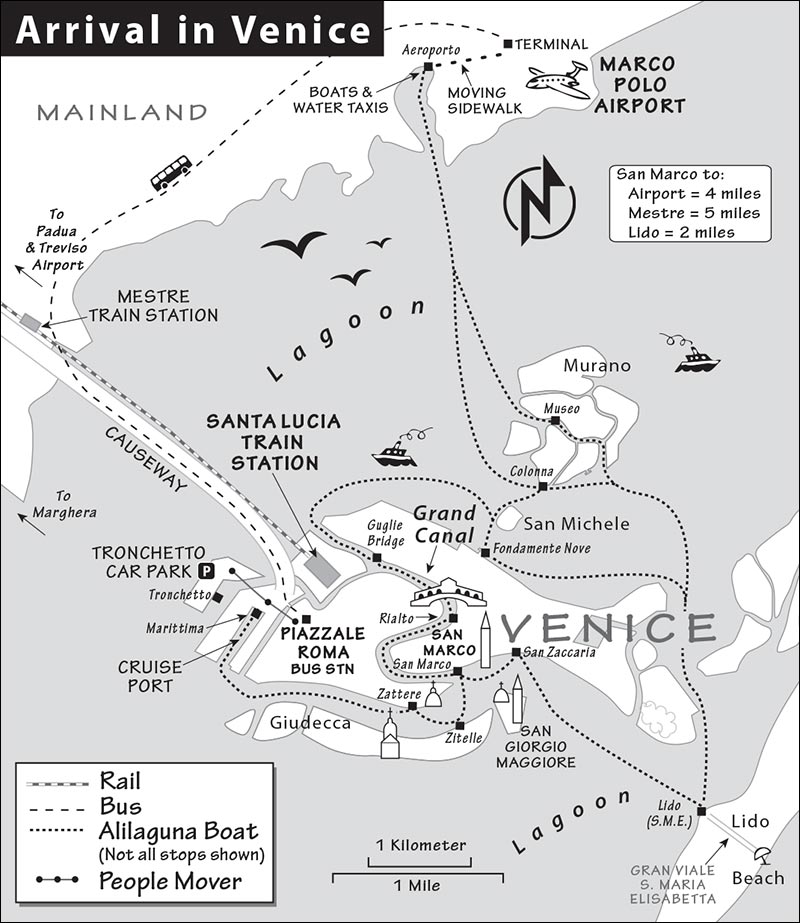
A water taxi from the train station to central Venice costs about €70-80 (the taxi dock is to the left of the vaporetto docks).
It’s a pleasant 25-minute walk from the train station to hotels in the Rialto area (head over the big train-station bridge and follow Rialto signs).
Train Connections
Destinations in Italy: Padua (30 minutes, Trenitalia: 4/hour, Italo: about hourly), Vicenza (45 minutes, Trenitalia: 2/hour, Italo: 7/day), Verona (1.5-2 hours, Trenitalia: 2/hour, Italo: 7/day), Ravenna (1-2/hour, 3 hours, transfer in Ferrara or Bologna), Florence (Trenitalia: hourly direct, 2 hours, often crowded—reserve ahead; Italo: 7/day, 2 hours, reservations required), Bolzano (about hourly, 3 hours, transfer in Verona), Milan (Trenitalia: 1-2/hour, some direct, 2.5-3 hours; Italo: every 2 hours, 2.5 hours), Cinque Terre/Monterosso (at least hourly, 6 hours, 1-3 changes), Rome (Trenitalia: hourly, 4 hours; direct night train, 7.5 hours, reserve ahead; Italo: 4/day, 4 hours, reservations required), Naples (Trenitalia: almost hourly, 5.5 hours, some change in Bologna or Rome, reserve ahead; Italo: 5/day, 5.5 hours, reservations required), Brindisi (8/day, 9 or more hours, change in Rome or Bologna).
International Destinations: Interlaken (4/day, 6 hours with 2 changes), Munich (1/day direct, 7 hours, more with change in Verona), Innsbruck (1/day direct, 5 hours, more with change in Verona), Salzburg (4/day, 6.5 hours with change in Villach), Paris (2/day, 11 hours, change in Turin), Geneva (1/day direct, more with change in Milan, 7-8 hours), Vienna (2/day direct, 8 hours; direct night train, 11 hours), Ljubljana (2/day, 5 hours, train to Trieste, then bus or train to Ljubljana). To Ljubljana, there’s also a direct DRD bus from Mestre (1/day, 3 hours, www.drd.si) and a private shuttle service (www.goopti.com).
BY BUS
Venice’s “bus station” is at Piazzale Roma, an open-air parking lot located at the head of the Grand Canal. The square itself is a jumble of different operators, platforms, and crosswalks over busy lanes of traffic. But bus stops are well signed.
The ticket windows for ACTV (including #5 to Marco Polo Airport) are in a building near the modern Calatrava Bridge and the vaporetto stop. The ATVO ticket office (express buses to Marco Polo and Treviso airports and to Padua) is at #497g in the big, white building, on the right side of the square as you face away from the canal (office open daily 7:00-20:00). There’s a small TI located in the Autorimessa Comunale parking structure (across the street from the ACTV ticket windows and up the stairs next to the corner snack bar).
Piazzale Roma also has two big parking garages and the People Mover monorail (€1.50, links to the cruise port and then the parking-lot island of Tronchetto). A baggage-storage office is next to the monorail at #497m (€7/24 hours, daily 7:00-20:00, www.trasbagagli.it [URL inactive]).
Getting from Piazzale Roma to Central Venice
Find the vaporetto docks (just left of the modern bridge) and take boat #1 down the Grand Canal to reach the Rialto, Accademia, or San Marco (St. Mark’s Square) stops; the faster #2 and #2/ travel only as far as the Rialto (except in summer, when line #2 goes all the way to San Marco).
Electronic boards direct you to the dock you want. Before buying a single-ride vaporetto ticket, consider getting a transit pass (see here). If your hotel is near here or near the train station, you can get there on foot.
BY CAR
The freeway (monitored by speed cameras) dead-ends after crossing the causeway to Venice. At the end of the road you have two parking-garage choices: Tronchetto or Piazzale Roma. As you drive into the city, signboards with green and red lights indicate which lots are full.
Parking at Tronchetto
This big five-story garage is a bit farther out, but it’s cheaper than the garages at Piazzale Roma, well connected by vaporetto, and with 3,000 spaces, most likely to have a spot (€3-5/hour, €22/24 hours, +39 041 520 7555, www.veniceparking.it [URL inactive]).
From the garage, cross the street to the brick building and go right to the vaporetto dock (not well-signed, look for ACTV). At the dock, catch vaporetto #2 in one of two directions: via the Grand Canal as far as Piazzale Roma (10 minutes), where you can transfer to line #2/ (express to the train station and Rialto) or line #1 for other Grand Canal destinations; or via Giudecca to San Marco/San Zaccaria (30 minutes).
Don’t be waylaid by aggressive water-taxi boatmen. They charge €100 to take you where the vaporetto will for €7.50. Also avoid travel agencies masquerading as TIs; deal only with the ticket booth at the vaporetto dock or the VèneziaUnica public transport office. If you’re going to buy a local transit pass, do it now.
If you’re staying near the bus or train station, you can take the €1.50 People Mover monorail, which brings you from Tronchetto to the bus bays at Piazzale Roma (3-minute trip, buy tickets with cash or credit card from machine). From there, it’s a five-minute walk across the modern Calatrava Bridge to the train station.
Parking at Piazzale Roma
The two garages here are more convenient but more expensive and likelier to be full (but you can reserve ahead online). Both face the busy Piazzale Roma, where the road ends. The big white Autorimessa Comunale building is a city garage (at the end of the bridge before you get to the piazza, €26/24 hours, +39 041 272 7211, www.avmspa.it). In a back corner of the square is the private and much more expensive Garage San Marco (€45/24 hours, +39 041 523 2213, www.garagesanmarco.it). Avoid the Parcheggio Sant’Andrea (expensive short-term parking only).
BY PLANE
Marco Polo Airport
Venice’s surprisingly large, modern airport is on the mainland shore of the lagoon, six miles north of the city (code: VCE, +39 041 260 9260, www.veniceairport.it). There’s one sleek terminal, with a TI (daily 9:00-20:00), car-rental agencies, ATMs, a bank, and plenty of shops and eateries.
Getting Between the Airport and Venice
You can get between the airport and central Venice in any of four ways: by Alilaguna boat, water taxi, airport bus, or land taxi.
| Type | Speed | Cost | Notes |
| Alilaguna boat | Slow | Moderate | No transfer |
| Water taxi | Fast | Expensive | No transfer |
| Airport bus to Piazzale Roma | Medium | Cheap | Transfer to vaporetto |
| Land taxi to Piazzale Roma | Medium | Moderate | Transfer to vaporetto |
Alilaguna boats reach most of this chapter’s recommended hotels very simply, with no changes. Hotels near the train station, however, are better served by the bus to Piazzale Roma.
Both Alilaguna boats and water taxis leave from the airport’s boat dock, a 15-minute walk from the terminal. To get there, follow signs along a sleek series of (indoor) moving sidewalks.
When flying out of Venice, allow plenty of time to get to the airport. From your hotel to the airport can take two hours. Alilaguna boats are small and can fill up. In an emergency, you can always hop in a water taxi and get to the airport in 30 minutes.
Alilaguna Airport Boats
These boats make the scenic journey across the lagoon, shuttling passengers between the airport and the island of Venice (€15, €27 round-trip, €1 more if bought on boat, includes 1 suitcase and 1 piece of hand luggage, additional bags-€3 each, roughly 2/hour, 1-1.5-hour trip depending on destination). Alilaguna boats are not covered by city transit passes, but use the same docks and ticket windows as the regular vaporetti. You can buy Alilaguna tickets online for a slight discount, but it does not ensure a reservation as you must still exchange the voucher for a ticket (www.alilaguna.it or www.venicelink.com).
Three key Alilaguna lines reach St. Mark’s Square. From the airport, the orange line (linea arancio) runs down the Grand Canal, reaching Guglie (handy for Cannaregio hotels, 45 minutes), Rialto (1 hour), and San Marco (1.25 hours). The blue line (linea blu) heads first to Fondamente Nove (40 minutes), then loops around to San Zaccaria and San Marco (about 1.5 hours) before continuing to Zattere and the cruise terminal (almost 2 hours). In high season, if it’s running, the red line (linea rossa) runs to St. Mark’s in just over an hour (may be suspended—check online). It circumnavigates Murano and then runs parallel to the blue line, ending at the cruise terminal.
For a full schedule, see www.alilaguna.it, visit the TI, call +39 041 240 1701, ask your hotelier, or scan the schedules posted at the docks.
From the Airport to Venice: Buy Alilaguna tickets at the information desk in the arrivals area or the ticket windows at the docks. Any ticket seller can tell you which line to catch to get to your destination. Blue- and orange-line boats from the airport run roughly twice an hour and go all day (until about midnight); red goes once an hour (may not be running when you visit, but typically runs 9:40-18:40; check online). Ask your hotelier (when you reserve your room) which stop in Venice is best.
From Venice to the Airport: Ask your hotelier which dock and which line is best. Blue-line boats start leaving Venice as early as 3:50 in the morning. Scope out the dock and buy your ticket in advance to avoid last-minute stress. Get there 10 minutes early to assure yourself a seat.
Water Taxis
Luxury taxi speedboats zip directly between the airport and the closest dock to your hotel, getting you within steps of your destination in about 30 minutes. The official price is €130 for up to four people; add €10 for every extra person (9-passenger limit). You may get a higher quote—politely talk it down. A taxi can be a smart investment for small groups and those with an early departure.
From the airport, arrange your ride at the water-taxi desk or with the boat captains at the dock. From Venice, book your taxi trip the day before your departure, either through your hotel or directly with the Consorzio Motoscafi water taxi association (Mon-Fri call +39 041 240 6712, Sat-Sun call +39 041 522 2303, www.motoscafivenezia.it).
Airport Shuttle Buses
Buses between the airport and Venice are fast, frequent, and cheap. They drop you at Venice’s bus station, at the square called Piazzale Roma. From there, you can catch a vaporetto down the Grand Canal—convenient for hotels near the Rialto Bridge and St. Mark’s Square. If you’re staying near the train station, you can walk from Piazzale Roma to your hotel.
Two bus companies serve this route: ACTV and ATVO. ATVO buses take 20 minutes and go nonstop. ACTV buses make a few stops en route and take slightly longer (30 minutes), but you get a discount if you buy a Venice vaporetto pass at the same time (see here). The service is equally good (either bus: €8 one-way, €15 round-trip; ACTV bus with transit-pass discount: €6 one-way, €12 round-trip; runs about 5:00-24:00, 2/hour, drops to 1/hour early and late, check schedules at www.atvo.it or www.actv.it).
From the Airport to Venice: Buses leave from just outside the arrivals terminal. Buy tickets from the TI, the ticket desk in the terminal, the kiosk near baggage claim, or ticket machines. ATVO tickets are not valid on ACTV buses and vice versa. Double-check the destination; you want Piazzale Roma. If taking ACTV, you want bus #5.
From Venice to the Airport: At Piazzale Roma, buy your ticket from the ACTV windows (in the building by the bridge) or the ATVO office (at #497g) before heading out to the platforms (although sometimes an attendant sells tickets near the buses). The newsstand in the center of the lot also sells tickets.
Land Taxi or Private Minivan
It takes about 20 minutes to drive from the airport to Piazzale Roma or the cruise port. A land taxi can do the trip for about €50. To reserve a private minivan, contact Treviso Car Service (minivan—€60, seats up to 8; car—€50, seats up to 3; mobile +39 338 204 4390 or +39 333 411 2840, www.trevisocarservice.com).
Treviso Airport
Several budget airlines use Treviso Airport, 12 miles northwest of Venice (code: TSF, +39 042 231 5111, www.trevisoairport.it). The fastest option into Venice is on the Barzi express bus, which gets you to the Tronchetto parking lot (convenient if taking vaporetto line #2) in just 40 minutes (€12, buy tickets on board, every 1-2 hours, www.barziservice.com). From Tronchetto, hop on a vaporetto, or take the People Mover monorail to Piazzale Roma for €1.50. ATVO buses are a bit more frequent and drop you right at Piazzale Roma (saving you the People Mover ride), but take nearly twice as long (€12 one-way, €22 round-trip, about 2/hour, 70 minutes, www.atvo.it; buy tickets at the ATVO desk in the airport and stamp them on the bus). Treviso Car Service offers minivan service to Piazzale Roma (minivan—€75, seats up to 8; car—€65, seats up to 3; for contact info, see listing earlier).
BY CRUISE SHIP
As of 2022, large ships dock at the commercial Marghera port outside of Venice, or at ports in Trieste or Ravenna, and transfer passengers by bus to Venice’s Stazione Marittima, at the west end of town. (Some smaller cruise ships dock directly at Stazione Marittima.) From Stazione Marittima, if it’s running, the most direct way to reach St. Mark’s Square is to take the Alilaguna red line (www.alilaguna.it). Otherwise, walk five minutes to the People Mover monorail for a three-minutes ride to Piazzale Roma, then hop on a vaporetto. Or, take an expensive water taxi ride (at least €70-80).
For more details, see my Rick Steves Mediterranean Cruise Ports guidebook.