ITALY
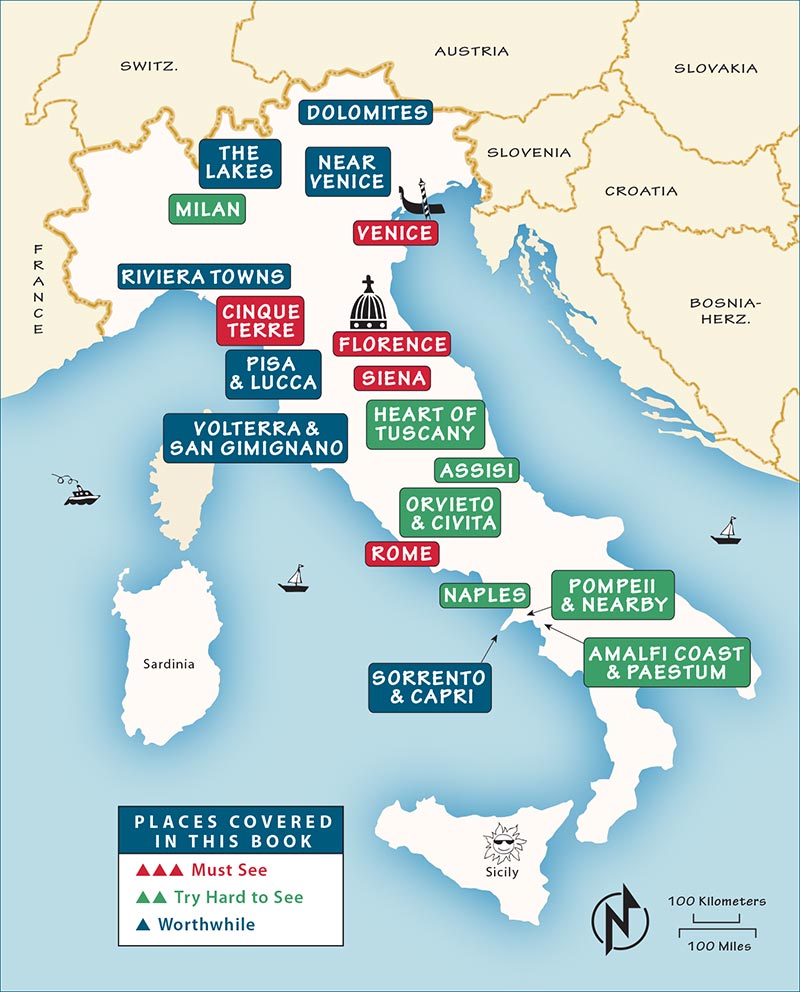
Map: PLACES COVERED IN THIS BOOK
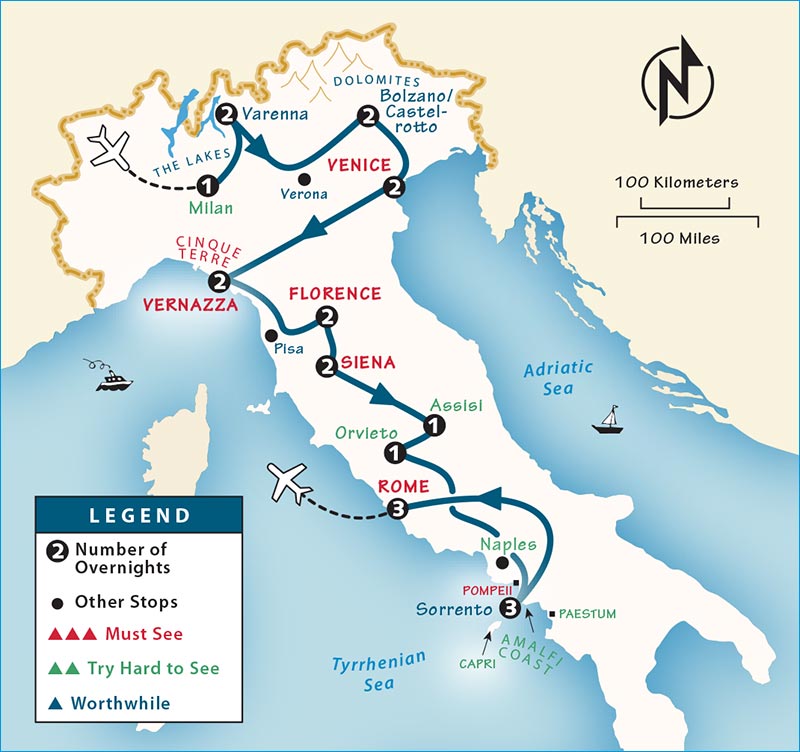
Map: Italy’s Best Three-Week Trip by Public Transportation
Bell’Italia! Italy has Europe’s richest, craziest culture—bubbling with emotion, traffic jams, strikes, rallies, religious holidays, crowds, and irate ranters shaking their fists at each other one minute and walking arm-in-arm the next. Promise yourself to relax and accept it all as a package deal—the exquisite and the exasperating. If you take Italy on its own terms, you’ll experience a cultural keelhauling that actually feels good.
After all, Italy is the cradle of European civilization—established by the Roman Empire and carried on by the Roman Catholic Church. As you explore Italy, you’ll stand face-to-face with some of the world’s most iconic images from this 2,000-year history: Rome’s ancient Colosseum and playful Trevi Fountain, Pisa’s Leaning Tower, Florence’s Renaissance masterpieces (Michelangelo’s David and Botticelli’s Venus), and the island city of elegant decay—Venice.
Beyond these famous cities, there’s even more: German-flavored Alps, timeless hill towns, peaceful lakes lined with 19th-century villas, the business center of Milan, and Mediterranean beaches. Italy is reasonably small and laced with train lines and freeways, so you’re never more than a half-day’s journey from any of these places.
Wherever you go, Italy’s top sights are its people. They’re outgoing and social. They have an endearing habit of speaking Italian to foreigners, even if they know you don’t speak their language—and it somehow works. If a local starts chattering at you in Italian, don’t resist. Go with it. You might understand more than you’d expect.
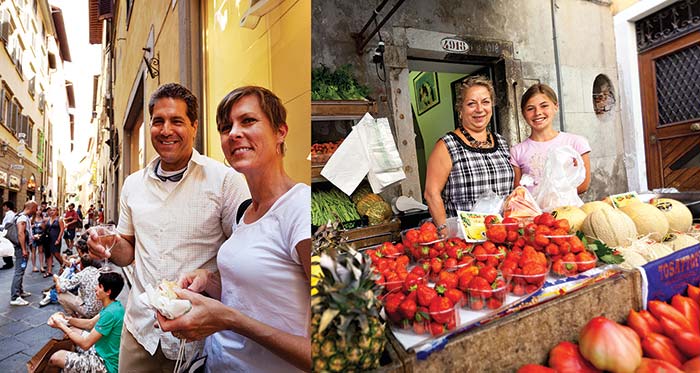
Interact with the people you meet—in the streets and in the shops.
Italian food is a cut above. If America’s specialty is fast food, Italy’s is slow food—bought daily, prepared with love, and enjoyed convivially. Three-hour restaurant meals are common; dinner is the evening’s entertainment. To “eat and run” is seen as a lost opportunity. Wine complements the meal; Italy is the world’s number-one wine producer (just ahead of France). For just a quick sandwich or a coffee, Italians stop by a bar. The bars aren’t taverns, but cafés…good for a light meal anytime, with all ages welcome.
Early evening is the time for the ritual promenade—called the passeggiata—up and down main street. Shoppers, people watchers, families, and young flirts on the prowl stroll and spread their wings like peacocks. You might hear sweet whispers of bella (pretty) and bello (handsome). You can be a spectator, sipping a drink at a sidewalk table, or better yet, join the promenade, with a gelato in hand.
As you stroll, it’s fun to window-shop. While no longer a cheap country, Italy remains a hit with shoppers for glassware and Carnevale masks in Venice; gold, silver, leather, and prints in Florence; and high fashion in Rome and Milan.
Italy’s biggest business is tourism—the country is considered the world’s fifth-most-visited tourist destination.
Italian cuisine is sightseeing for your palate. The recipe: Start with fresh ingredients and talented cooks, mix in the owner’s personality, and add a happy restaurant crowd. Eating in Italy is a joy you can’t get anywhere else. Be adventurous, and try the regional specialties and culinary customs. You can eat well, even on a budget.
In Florence and the hill towns of Tuscany, enjoy hearty farmer’s food: grilled meats, beans, fresh herbs, and high-quality seasonal vegetables. Popular dishes are ribollita, a savory bean-and-bread soup, and bistecca alla fiorentina, a grilled T-bone steak. Forage through Florence’s gourmet food hall. For light fare, try an enoteca (wine bar), where appetizers and salads are paired with fine wine. For dessert, decide for yourself if Florence really does have Italy’s most flavorful gelato.
Venetian cuisine features catch-of-the-day fish and shellfish, risotto, polenta, and some exotic choices. Nero di seppia is squid in its own black ink, served over pasta. Tourists are drawn to the pricey, romantic, canalside eateries. (Hint: Pizza is the least expensive item on the menu.) But I prefer to dine on the cheap, dropping into atmospheric cicchetti bars to munch bite-size appetizers that add up to a fun, tasty meal. Try both!
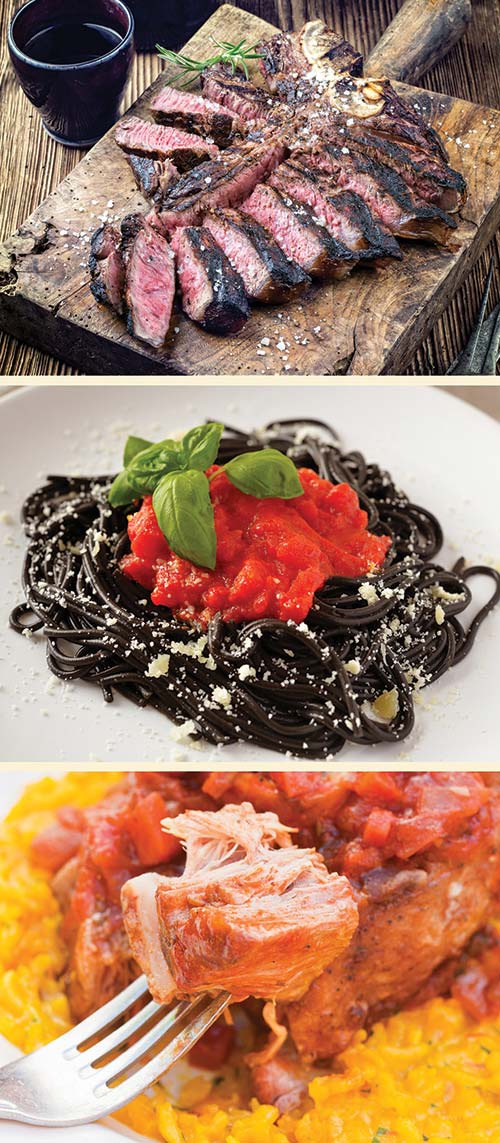
Take your taste buds for a spin, from Florence’s bistecca alla fiorentina (grilled steak) and Venice’s nero di seppia (inky squid over pasta) to this popular pairing in Milan: risotto alla milanese and ossobuco (saffron risotto with veal).
Trendsetting Milan claims to have created the aperitivo happy hour—a drink with free appetizers—that’s catching on elsewhere in Italy. In stylish Milan, even the deli food is photogenic. The most famous dish is risotto alla milanese paired with ossobuco (saffron risotto with veal shank). The Lake District features whitefish on the menu with sublime views included in the cost. In the mountainous Dolomites, the hearty cuisine is Germanic, with pork, game, potatoes, dumplings, and strudel. Passersby will wish you a “Guten Appetit!”
In coastal regions such as the Cinque Terre, Riviera, and Amalfi Coast, seafood is the specialty (add pesto and focaccia for the Cinque Terre). For that quintessential beach experience, settle in at a waterfront café on a sunny day. Sample antipasti frutti di mare—a plate of mixed “fruits of the sea”—with a glass of wine as the Mediterranean shimmers before you.
Roman cuisine, strongly flavored and unpretentious, features meats, fish, some fried foods, and fresh vegetables. Numerous food-and-wine- tasting tours, offering an insider’s look, can fill you in and fill you up. Roman specialties are spaghetti alla carbonara (with an egg-and-bacon sauce created here) and saltimbocca alla romana (“jump in the mouth” veal). Dine at a sidewalk café with the rust-colored facades of Rome as your backdrop.
Italians say the best pizza is in Naples, its birthplace. The soft, chewy crust is topped with mozzarella and tomato sauce, and baked in a wood-burning oven. At a Neapolitan pizzeria, pizza is often the only thing on the menu.
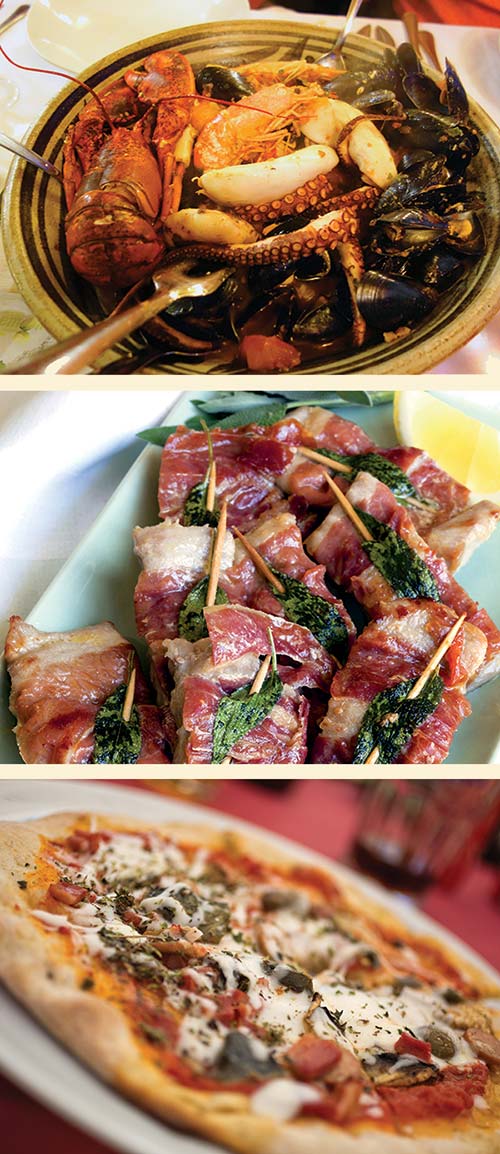
In coastal towns, seafood is always on the menu. When in Rome, eat what the Romans eat: saltimbocca alla romana (veal with prosciutto). Pizza is best in its hometown, Naples.
For an affordable splurge anywhere in Italy, have a glass of wine or cup of coffee in an elegant café or on a classic square. If you sip your pricey drink slowly in a prime people-watching zone, it’s an excellent value. Raise a toast: La vita è bella! Life is good.
Culturally, there are two Italys: The North tends to be industrial, aggressive, and “time is money” in its outlook (though Venice is a world apart). The South is hotter and more crowded, poor, relaxed, farm-oriented, and traditional; families usually live in the same house for many generations. Loyalties are to family, city, region, soccer team, and country—in that order.
Italians are obsessed with soccer (called il calcio). Star players are treated like movie stars, and fans are passionate. On big game nights, bars are packed with fans watching TV screens. After a loss, they drown their sorrows. After a victory, they celebrate by driving through the streets honking horns and waving team flags.
Home of the Vatican, Italy is still mostly Catholic. Although Italians will crowd into St. Peter’s Square with rock-concert energy to catch a glimpse of “il Papa,” they’re not particularly devout. They baptize their kids at the local church (there’s one every few blocks), but generally don’t attend church regularly and hold modern opinions on social issues, often in conflict with strict Catholic dogma. Italy is now the land of legalized abortion, a low birth rate, nudity on TV, socialist politics, and a society whose common language is decidedly secular. The true dominant religion is life: motor scooters, fashion, girl-watching, boy-watching, good coffee, good wine, and il dolce far niente (the sweetness of doing nothing).
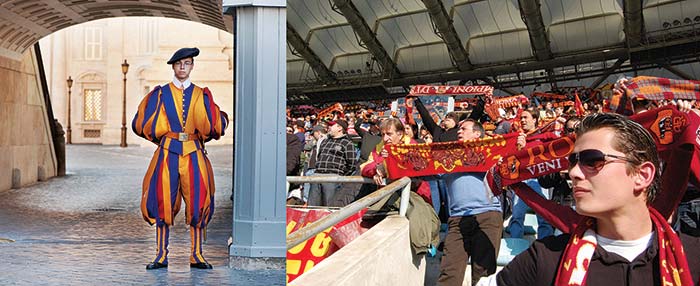
Vatican City hires Swiss guards who wear colorful uniforms; soccer games draw devout crowds.
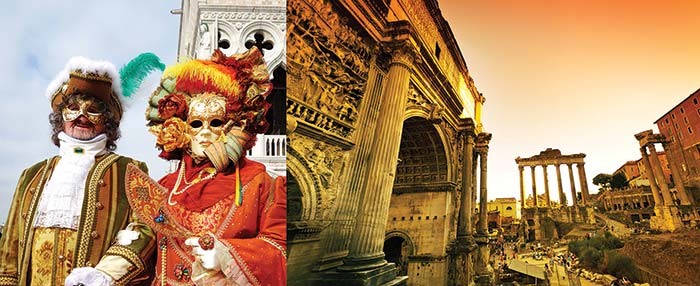
Venice’s Carnevale is celebrated with masks, costumes, and revelry; imagine Roman life 2,000 years ago.
Italians are stylish. They strive to project a positive image in manner and dress—a concept they call la bella figura. They’d rather miss their bus than get sweaty and mussed-up rushing to catch it. And no matter how hot it gets, Italian men wear long pants—not shorts (except at the beach).
Traditions remain important. On festival days, locals still dress up in medieval or fanciful garb to celebrate Carnevale (Venice), play soccer (Florence), or race horses (Siena). Traditional ways are carried on by choice. Italians are wary of the dangers of a fast-paced global lifestyle. Their history is long, and they’re secure in their place in the world.
Zero in on Italy’s fine points, and don’t dwell on the problems (just call them “cultural experiences”). Savor your cappuccino, dangle your feet over a canal (if it smells, breathe through your mouth), and imagine what it was like centuries ago. Ramble through the rabble and rubble of Rome and mentally resurrect those ancient stones. Sit silently on a hill-town belvedere and get chummy with the winds of the past. Write a poem over a glass of local wine in a sun-splashed, wave-dashed Riviera village. Italy is for romantics.
Italy’s Top Destinations
Mamma mia! There’s so much to see in Italy and so little time. This overview categorizes the country’s top destinations into must-see places (to help first-time travelers plan their trip) and worth-it places (for those with extra time or special interests). I’ve also suggested a minimum number of days to allow per destination.
MUST-SEE DESTINATIONS
Italy’s major cities are Rome, Florence, and Venice. Each has a distinctly different flavor, from ancient Roman to Renaissance art to a romantic island. If you have just two weeks for your first Italian trip, include these cities, add the coastal Cinque Terre and the town of Siena, and you’ll get an unforgettable introduction to the best (if most touristy stops) that Italy has to offer. Here they are, listed north to south, as they appear in this book:
▲▲▲Venice (allow 1-2 days)
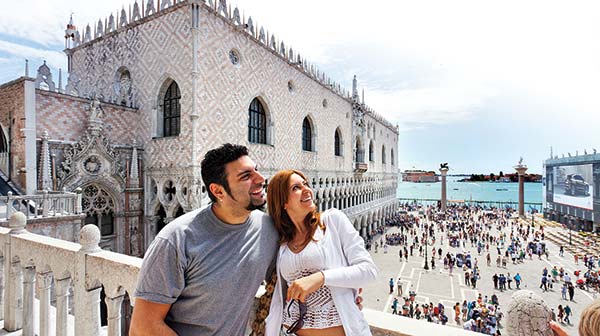
Venice is Italy’s dreamy island city, powerful in medieval times and famous today for St. Mark’s Basilica, the Grand Canal, and singing gondoliers. Idling on St. Mark’s Square—best at night while the orchestras play—is one of Italy’s grand experiences.
▲▲▲Cinque Terre (2-3 days)
The lovely Cinque Terre is a string of five idyllic Riviera hamlets tucked along a rugged coastline, connected by scenic hiking trails and boats, and dotted with beaches. The region is revered by hardy hikers, sun worshippers, and photographers.
▲▲▲Florence (1-2 days)
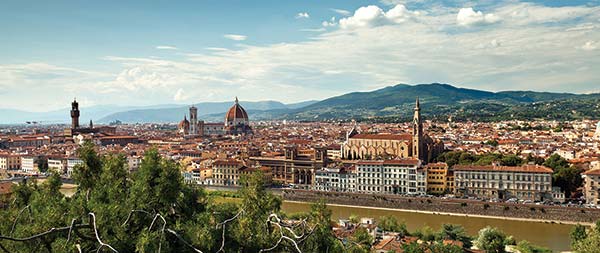
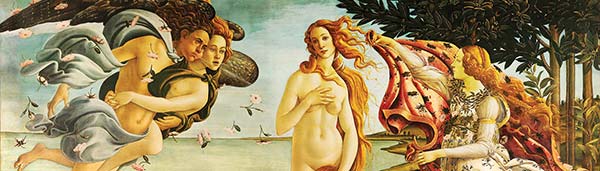
If you love art, you’ll enjoy Florence. This surprisingly compact city, which Michelangelo called home, was the cradle of the Renaissance. You’ll marvel at the Uffizi Gallery’s priceless paintings (starring Botticelli’s ethereal Birth of Venus, shown above), Brunelleschi’s dome-topped cathedral, and Michelangelo’s David. And anyone can appreciate Italy’s best gelato.
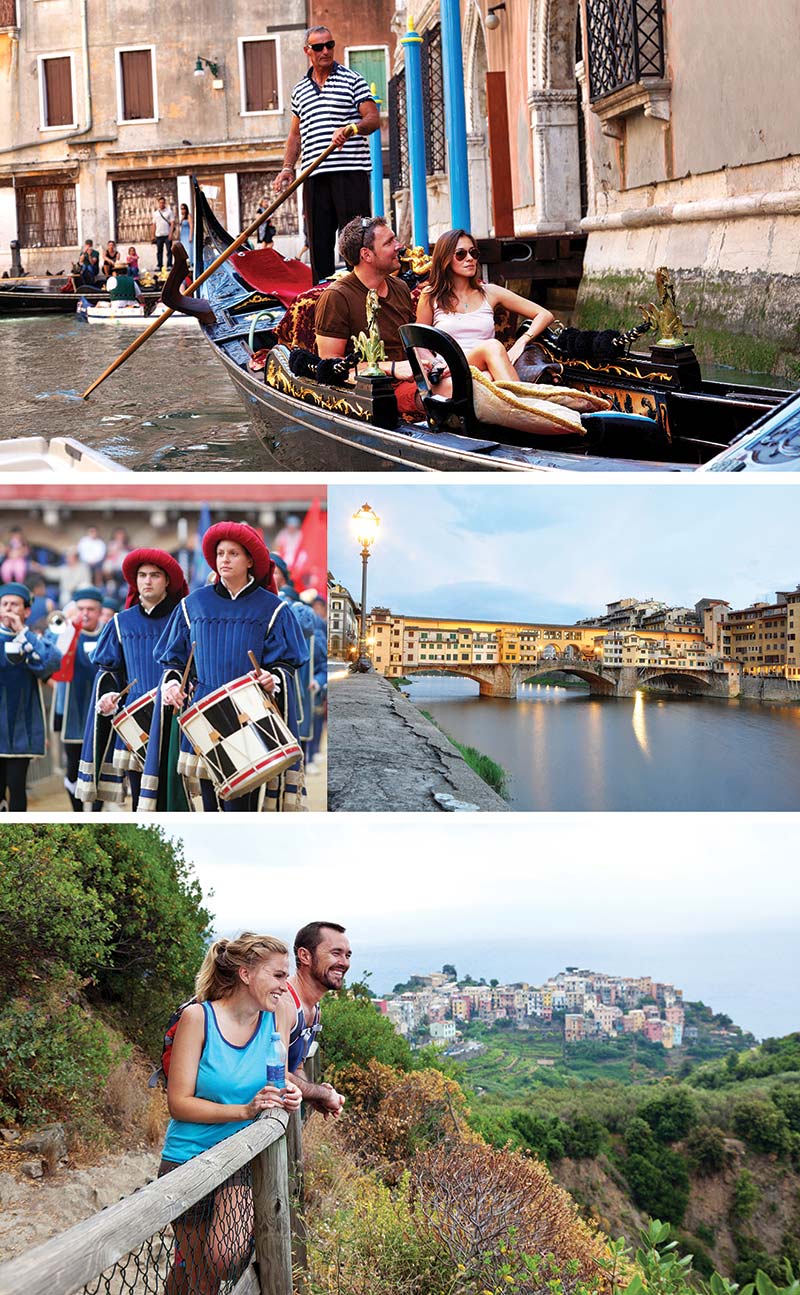
Gliding through Venice; Florence’s shop-lined Ponte Vecchio; enjoying views on a Cinque Terre hike; a parade in Siena
▲▲▲Siena (1 day)
Nearby Siena is Florence’s smaller and (some say) more appealing Tuscan rival, with its magnificent Il Campo square, striking striped cathedral, and medieval pageantry, spurred by its Palio horse race. On any night, if you hear the low throb of drumming signaling a parade in a proud neighborhood—seek it out!
▲▲▲Rome (2-3 days)
Rome is Italy’s capital, the sprawling Eternal City, studded with impressive Roman ruins: the Forum, Colosseum, and Pantheon. It’s home to Vatican City and the astonishing Sistine Chapel. Wandering through Rome’s floodlit-fountain squares at night, happening upon the Trevi Fountain...you won’t be the only romantic tossing in a coin with a wish to return.
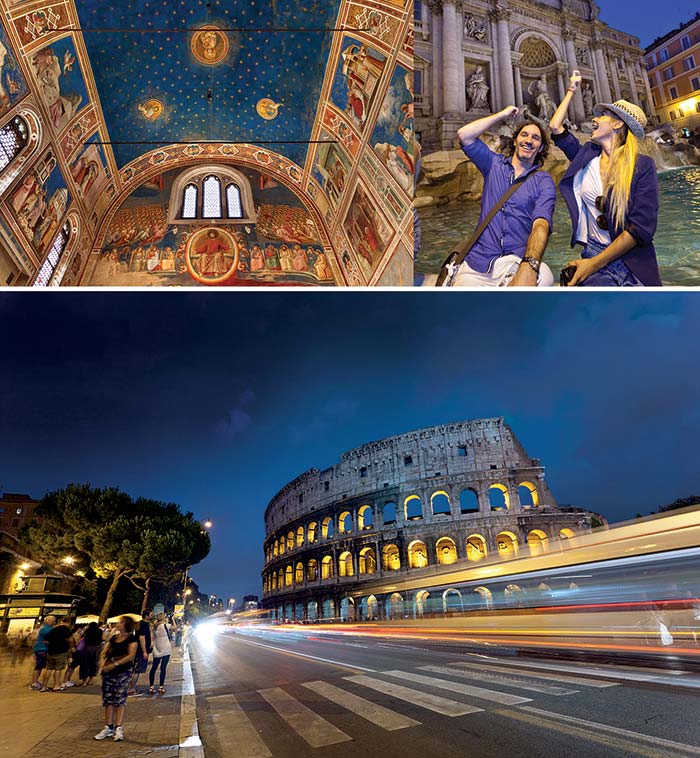
Padua’s Scrovegni Chapel; Rome’s Trevi Fountain; the Colosseum at night
WORTH-IT DESTINATIONS
You can weave any of these destinations—rated ▲ or ▲▲—into your itinerary. It’s easy to add some destinations based on proximity (if you’re going to Florence, Pisa is next door), but some out-of-the-way places can merit the journey, depending on your time and interests.
▲▲Milan (1 day)
Many travelers arrive in Milan in northern Italy. With three airports, it’s a major transit hub. This powerhouse city of commerce and fashion boasts the prestigious La Scala opera house, pink-marble Duomo, and Leonardo’s Last Supper.
▲The Lakes (1 day)
For a lakeside stop just an hour from Milan (as a day trip or overnight), consider the Lakes—ideally the quaint village of Varenna on Lake Como, where you can cruise the lake, wander, sunbathe, and dine al fresco. If relaxation is on your agenda, so is Lake Como. Another popular stop is Lake Maggiore and the town of Stresa, where tourists come to see manicured islands and elegant villas.
▲Near Venice (1 day)
Near Venice are several intriguing towns: Padua, known for Giotto’s gloriously frescoed Scrovegni Chapel; little Vicenza for its Palladian architecture; and Verona for its ancient Roman amphitheater and Romeo and Juliet sights. Each town is an easy, quick stop on the main train line between Venice and Milan.
▲The Dolomites (1-2 days)
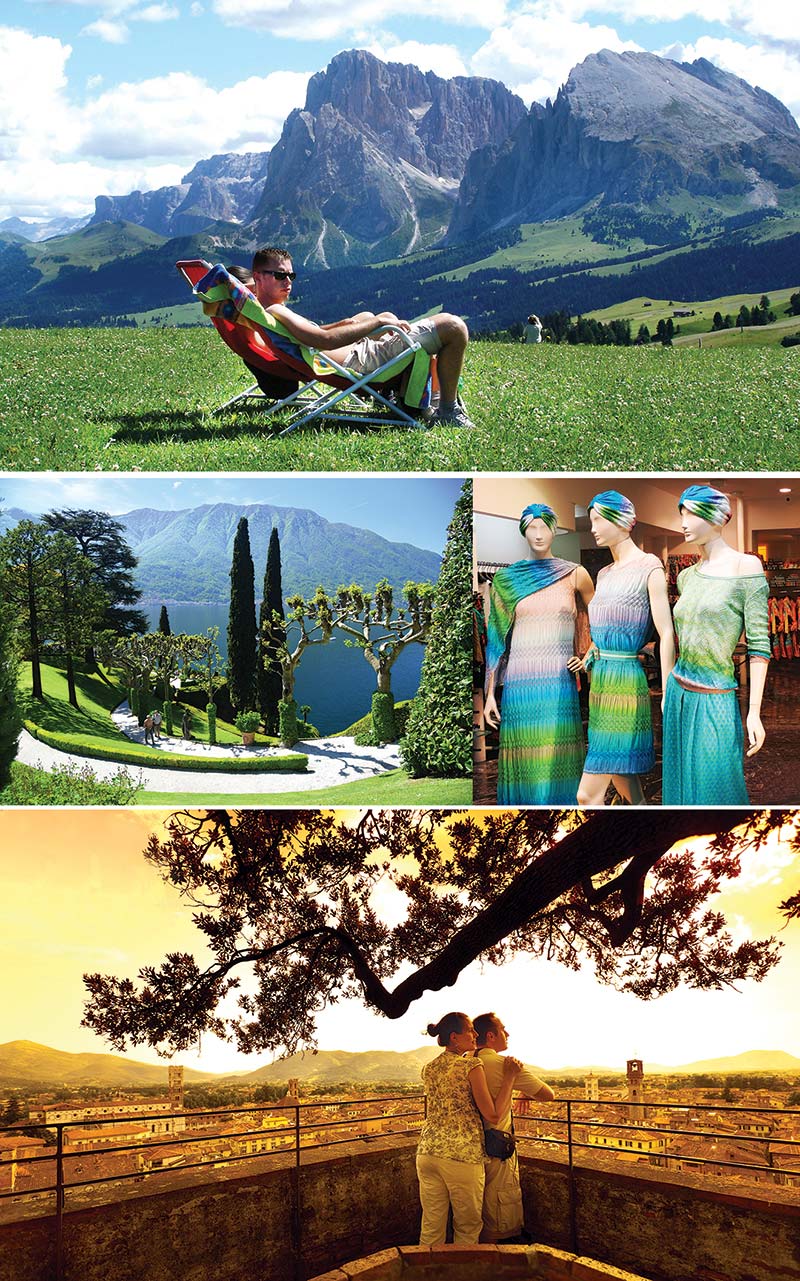
The Dolomites are Italy’s mighty Alps, featuring Bolzano, home of Ötzi the Iceman; the charming village of Castelrotto; and Alpe di Siusi, a vast alpine meadow laced with lifts and hiking trails. Near Austria, the region is sausage-and-sauerkraut Germanic and can be time-consuming to reach, but if the weather’s good, hikers will be in paradise.
▲Riviera Towns (1 day)
You’re near Riviera Towns when you’re in the Cinque Terre. The coastal towns are little Levanto, double-beached Sestri Levante, the larger Santa Margherita Ligure, gem-like Portofino, and resorty Porto Venere. Choose one—or more!
▲Pisa and Lucca (1.5 days)
These towns make two good stops or day trips from Florence. Pisa has the iconic Leaning Tower, set in the stunning Field of Miracles. The pleasant town of Lucca, a delight for window-shoppers, has an inviting old center, encircled by a wide medieval wall you can stroll or bike.
▲Volterra and San Gimignano (1.5 days)
In Tuscany, these villages are tempting: Volterra is vibrant and rustically real, while multitowered San Gimignano is more photogenic and touristy.
▲▲Heart of Tuscany (1-3 days)
Italy’s many hill towns, as sleepy as if they’ve been caught napping, are popular for good reason. From Florence or Siena, several hill towns are within striking range by public transportation. Those with a car can discover far more. Wine lovers savor a cluster of picturesque, wine-soaked villages amid rolling hills in the Heart of Tuscany: mellow Montepulciano, Renaissance Pienza, and Brunello-fueled Montalcino.
▲▲Assisi (1 day)
Perched on a hilltop, Assisi is the hometown of St. Francis, with a divinely Giotto-decorated basilica dedicated to the humble saint who extolled the virtues of love and simplicity. Assisi is located between Florence and Rome, but will always feel off the beaten track.
▲▲Orvieto and Civita (1 day)
Near Rome, Orvieto offers more hill-town adventures, featuring classic views, Classico wine, and an ornate cathedral, plus nearby Civita di Bagnoregio, a pint-sized hill town reachable only by a narrow, steep bridge.
▲▲Naples (half-day)
A swing south from Rome, from Naples to Paestum, gives you the best of southern Italy. Naples, a good stop en route to the genteel home base of Sorrento, is a gritty port city with nonstop street life and a top archaeological museum starring the treasures from ancient Pompeii.
▲▲Pompeii and Nearby (half-day)
South of Naples are the ruins of famous Pompeii (worth ▲▲▲) and smaller Herculaneum, with their nemesis, Mount Vesuvius, looming on the horizon. The ancient sites are an easy stop between Naples and Sorrento; of the two, Pompeii is better.
▲Sorrento and Capri (1.5 days)
Sorrento is a seaside resort port—a well-located home base for the many sights in the region, including the jet-set island getaway of Capri (worth ▲▲) with its eerie Blue Grotto, just a short cruise away. Also nearby is the...
▲▲Amalfi Coast and Paestum (1-2 days)
From Sorrento, you can travel the cliff-hanging road along the Amalfi Coast, overlooking the sparkling Mediterranean, to visit villages spilling down to beaches.
South of the Amalfi Coast is a site so ancient it predates most Roman sites—Paestum, crowned with well-preserved Greek temples from a time this storied land was Magna Graecia, or Great Greece.
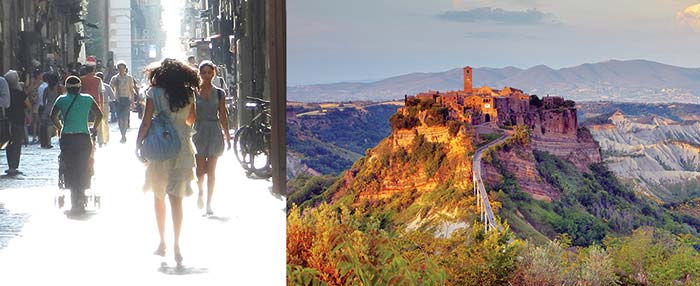
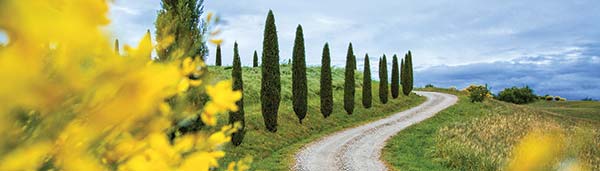
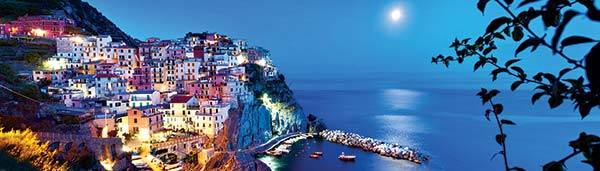
Naples’ vibrant street life; the hilltop perch of Civita di Bagnoregio; Cinque Terre’s Manarola at night (opposite)
Planning Your Trip
To plan your trip, you’ll need to design your itinerary—choosing where and when to go, how you’ll travel, and how many days to spend at each destination. For my best general advice on sightseeing, accommodations, restaurants, and more, see the Practicalities chapter.
DESIGNING AN ITINERARY
As you read this book and learn your options...
Choose your top destinations.
My recommended itinerary (see the sidebar on the next page) gives you an idea of how much you can reasonably see in 21 days, but you can adapt it to fit your own interests and time frame. If you like Renaissance art, linger longer in Florence. Exploring Italy’s hill towns could soak up a week. For mountains, make tracks to the Dolomites. And if you’ve always wanted to ascend Pisa’s Leaning Tower, now’s the time for the climb.
Decide when to go.
Italy’s best travel months are May, June, September, and October. They’re also the busiest and most expensive times to visit (with the north remaining busy straight through the summer). Crowds aside, these months combine the convenience of peak season with pleasant weather.
The heat in July and August can be grueling, particularly in the south, where temperatures hit the 90s. Fortunately most midrange hotels come with air-conditioning. August is also when many Italians take their summer vacations; big cities tend to be quiet (with discounted hotel prices), but beach and mountain resorts are jammed (with higher hotel prices).
| Day | Plan | Sleep |
| 1 | Arrive in Milan | Milan |
| 2 | Milan to Lake Como | Varenna |
| 3 | Lake Como | Varenna |
| 4 | To Dolomites via Verona | Bolzano/Castelrotto |
| 5 | Dolomites | Bolzano/Castelrotto |
| 6 | To Venice | Venice |
| 7 | Venice | Venice |
| 8 | To the Cinque Terre | Vernazza |
| 9 | Cinque Terre | Vernazza |
| 10 | To Florence via Pisa | Florence |
| 11 | Florence | Florence |
| 12 | Florence, late to Siena | Siena |
| 13 | Siena | Siena |
| 14 | To Assisi | Assisi |
| 15 | To Orvieto and Civita | Orvieto |
| 16 | To Sorrento via Naples | Sorrento |
| 17 | Capri | Sorrento |
| 18 | Amalfi Coast | Sorrento |
| 19 | Morning to Rome via Pompeii | Rome |
| 20 | Rome | Rome |
| 21 | Rome | Rome |
| 22 | Fly home |
Notes: If you have less time, drop the out-of-the-way Dolomites or save the Amalfi Coast for another trip. With extra time, add a day to sight-filled Florence or Rome, or slow down in the countryside with more hill towns (check public transportation options first—not all towns are well-served).
Adding a Car: Tour most of Italy by train, then use a car to explore a region or two (even if it means backtracking a few hours by train or car). These stops are easier by train than by car: Venice, the Cinque Terre, Florence, Rome, and the cluster south of Rome (Naples, Pompeii, Sorrento, Capri, and the Amalfi Coast). Drivers will find a car most helpful for exploring the hill-town region. Major car-rental agencies have offices in many towns.
Winter offers cooler temperatures and fewer tourists, except on major holidays. Expect shorter hours for sights and fewer activities. Beach towns are nearly shut down and battered by waves; skip the Cinque Terre and Amalfi Coast.
For weather specifics, see the climate chart in the appendix.
Connect the dots.
Link your destinations into a logical route. Determine which cities you’ll fly into and out of. Begin your search for transatlantic flights at Kayak.com.
Decide if you’ll travel by car or public transportation, or a combination. A car is particularly helpful for exploring the hill-town region (where public transportation can be sparse), but is useless in big cities (park it). Trains are faster and more expensive than buses (which don’t run as often on Sundays).
To determine approximate travel times between destinations, study the driving map in the Practicalities chapter or check Google Maps; visit Trenitalia.it for train schedules. Compare the cost of any long train ride in Europe with a budget flight; check Skyscanner.com for intra-European flights.
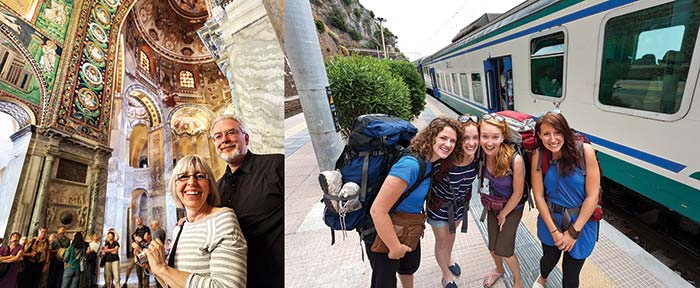
Savor Italy’s astonishing cathedrals and the joys of sharing your journey with friends. Happy travels!
Write out a day-by-day itinerary.
Figure out how many destinations you can comfortably fit in your time frame. Don’t overdo it—few travelers wish they’d hurried more. Allow enough days per stop (see estimates in “Italy’s Top Destinations,” earlier). Minimize one-night stands. It can be worth taking a late-afternoon drive or train ride to settle into a town for two consecutive nights—and gain a full uninterrupted day for sightseeing. Include sufficient time for transportation; whether you travel by train or car, it’ll take you a half-day to get between most destinations.
Staying in a home base (like Florence or Sorrento) and making day trips can be more time-efficient than changing locations and hotels.
Take sight closures into account. Avoid visiting a town on the one day a week its must-see sights are closed. Check if any holidays or festivals fall during your trip—these attract crowds and can close sights (for the latest, visit Italy’s tourist website, www.italia.it). Note major sights where advance reservations are smart or a free Rick Steves audio tour is available.
Give yourself some slack. Every trip, and every traveler, needs downtime for doing laundry, picnic shopping, people-watching, and so on. Pace yourself. Assume you will return.
Run a reality check on your dream trip. You’ll have major transportation costs in addition to daily expenses.
Flight: A round-trip flight from the US to Milan or Rome costs about $900-1,500, depending on where you fly from and when.
Public Transportation: For a three-week trip, allow $550 for buses and second-class trains ($750 for first class). You’ll usually save money buying train tickets in Italy, rather than buying a rail pass before you leave home. In some cases, a short flight can be cheaper than taking the train.
Car Rental: Allow roughly $300-500 per week, not including tolls, gas, parking, and insurance (theft insurance is mandatory in Italy).
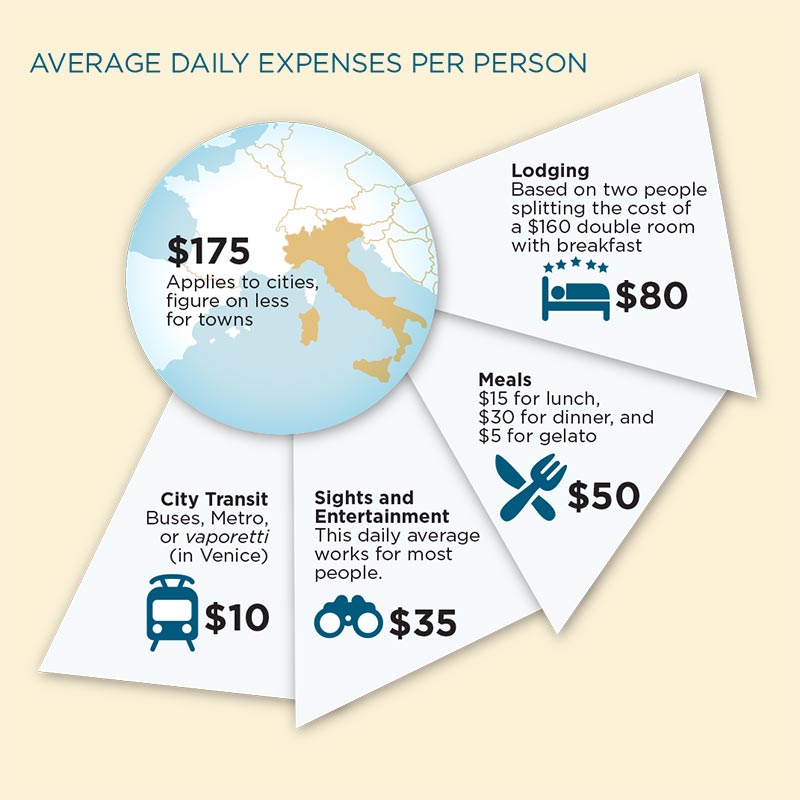
To cut your daily expenses, take advantage of the deals you’ll find throughout Italy and mentioned in this book.
City transit passes (for multiple rides or all-day usage) decrease your cost per ride.
Avid sightseers buy combo-tickets or passes that cover multiple museums. If a town doesn’t offer deals, visit only the sights you most want to see, and seek out free sights and experiences (people-watching counts).
Some businesses—especially hotels and walking-tour companies—offer discounts to my readers (look for the RS% symbol in the listings in this book).
Reserve your rooms directly with the hotel. Some hotels offer discounts if you pay in cash and/or stay three or more nights (check online or ask). Rooms can cost less in spring and fall (May, June, Sept, and Oct). And even seniors can sleep cheaply in hostels (most have private rooms) for about $30 per person. Or check Airbnb-type sites for deals.
It’s no hardship to eat inexpensively in Italy. You can get tasty, affordable meals at delis, bars, takeout pizza shops, street food joints, and Italian restaurants, too. Cultivate the art of picnicking (but avoid it at major sights).
When you splurge, choose an experience you’ll always remember, such as a food tour or a gondola ride. Minimize souvenir shopping; focus instead on collecting wonderful memories.
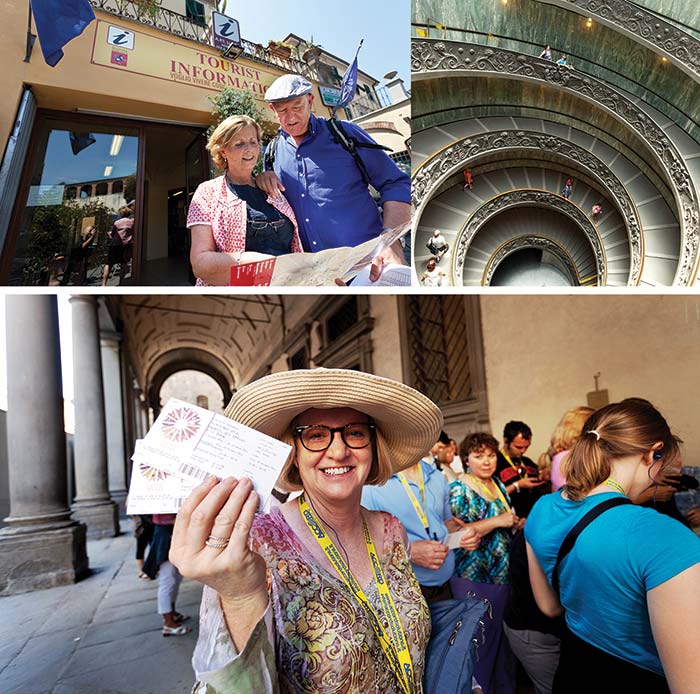
Tourist information help; stairs at Vatican Museums; the joy of advance tickets
BEFORE YOU GO
You’ll have a smoother trip if you tackle a few things ahead of time. For more details on these topics, see the Practicalities chapter and RickSteves.com, which has helpful travel-tip articles and videos.
Make sure your travel documents are valid. If your passport is due to expire within six months of your ticketed date of return, you need to renew it. Allow six weeks or more to renew or get a passport (www.travel.state.gov). Check for current Covid entry requirements, such as proof of vaccination or a negative Covid-19 test result.
Arrange your transportation. Book your international flights. Overall, Kayak.com is the best place to start searching for flights. Figure out your transportation options. It’s worth thinking about buying essential train tickets online in advance, getting a rail pass, renting a car, or booking cheap European flights. (You can wing it once you’re there, but it may cost more.) Drivers: Consider bringing an International Driving Permit (sold at AAA offices in the US, www.aaa.com) along with your license.
Book rooms well in advance, especially if your trip falls during peak season or any major holidays or festivals.
Reserve ahead for key sights. Make reservations or buy tickets in advance for major sights. In Venice, it’s smart to book ahead for St. Mark’s Basilica, the Doge’s Palace, and the Campanile bell tower. For Padua, book well in advance for Giotto’s Scrovegni Chapel. For Milan, reserve weeks ahead for Leonardo’s Last Supper. In Florence, reserve ahead for the Uffizi Gallery (Renaissance paintings), Accademia (Michelangelo’s David), and to climb the cathedral dome (mandatory). For Pisa, you can book a time to climb the Leaning Tower. In Rome, reservations are essential for the Borghese Gallery (Bernini sculptures), Vatican Museums (Sistine Chapel), the Colosseum, and the Roman Forum.
Consider travel insurance. Compare the cost of insurance to the cost of your potential loss. Check whether your existing insurance (health, homeowners, or renters) covers you and your possessions overseas.
Call your bank. Alert your bank that you’ll be using your debit and credit cards in Europe. Ask about transaction fees, and, if you don’t already have one, get a “contactless” credit card (request your card PIN too). You don’t need to bring euros for your trip; you can withdraw euros from cash machines in Europe.
Use your smartphone smartly. Sign up for an international service plan to reduce your costs, or rely on Wi-Fi in Europe instead. Download any useful apps you’ll want on the road, such as maps, translators, transit schedules, and Rick Steves Audio Europe (see sidebar).
Pack light. You’ll walk with your luggage more than you think. I travel for weeks with a single carry-on bag and a day pack. Use the packing checklist in the appendix as a guide.
Travel smarter with these free, fun resources:
Rick Steves Classroom Europe, a powerful tool for teachers, is also useful for travelers. This video library contains about 500 short clips excerpted from my public television series. Enjoy these videos as you sort through options for your trip and to better understand what you’ll see in Europe. Check it out at Classroom.RickSteves.com (just enter a topic to find everything I’ve filmed on a subject).

Rick Steves Audio Europe, a free app, makes it easy to download my audio tours and listen to them offline as you travel. For this book (look for the  ), these audio tours cover sights and neighborhoods in Venice, Milan, Florence, Siena, Assisi, Rome, Naples, and Pompeii. The app also offers interviews (organized by country) from my public radio show with experts from Europe and around the globe. Find it in your app store or at RickSteves.com/AudioEurope [URL inactive].
Travel Smart
Many people think Italy is a chaotic mess and any attempt at efficient travel is futile. This is dead wrong—and costly, in terms of time and money. Italy, which seems as orderly as spilled spaghetti, actually functions quite well. If you have a positive attitude, equip yourself with good information (this book), and expect to travel smart, you will.
Read—and reread—this book. To have an “A” trip, be an “A” student. Note opening hours of sights, closed days, crowd-beating tips, and whether reservations are required or advisable. Check the latest at RickSteves.com/update.
Be your own tour guide. As you travel, get up-to-date info on sights, reserve tickets and tours, reconfirm hotels and travel arrangements, and check transit connections. Visit local tourist information offices (TIs). Upon arrival in a new town, lay the groundwork for a smooth departure; confirm the train, bus, or road you’ll take when you leave.
Outsmart thieves. Pickpockets abound in crowded places where tourists congregate. Treat commotions as smokescreens for theft. Keep your cash, credit cards, and passport secure in a money belt tucked under your clothes; carry only a day’s spending money in your front pocket or wallet. Don’t set valuable items down on counters or café tabletops, where they can be quickly stolen or easily forgotten.
Minimize potential loss. Keep expensive gear to a minimum. Bring copies or take photos of important documents (passport and cards) to aid in replacement if they’re lost or stolen. Back up photos and files frequently.
Beat the summer heat. If you wilt easily, choose a hotel with air-conditioning, start your day early, take a midday siesta, and resume your sightseeing later. Churches offer a cool haven (though dress modestly—no bare shoulders or shorts). Take frequent gelato breaks. Join the passeggiata, when locals stroll in the cool of the evening.
Guard your time and energy. Taking a taxi or Uber can be a good value if it saves you a long wait for a cheap bus or an exhausting walk across town. To avoid long lines, follow my crowd-beating tips, such as making advance reservations, or sightseeing early or late. Buy combo-tickets at less-visited sights to get quickly into popular sights.
Be flexible. Even if you have a well-planned itinerary, expect changes, strikes, closures, sore feet, bad weather, and so on. Your Plan B could turn out to be even better.
Attempt the language. Many Italians—especially in the tourist trade and in cities—speak English, but if you learn some Italian, even just a few pleasantries, you’ll get more smiles and make more friends. Apps such as Google Translate work for on-the-go translation help, but you can get a head start by practicing the survival phrases near the end of this book.
Connect with the culture. Interacting with locals carbonates your experience. Enjoy the friendliness of the Italian people. Ask questions; most locals are happy to point you in their idea of the right direction. Set up your own quest for the best piazza, bell tower, or gelato. When an opportunity pops up, make it a habit to say “yes.”
Italy...here you come!