ICELAND: PAST & PRESENT
THE ICELANDIC COMMONWEALTH (900-1300)
INDEPENDENCE AND MODERNIZATION (1900-2000)
THE 21ST CENTURY AND ICELAND TODAY
On the far northern fringe of Europe, surrounded by the open Atlantic, Iceland has an epic history that’s been shaped by the sea. Here’s a brief overview.
PREHISTORY
As the North American and Eurasian tectonic plates pulled apart, lava welled up between them. Over many millions of years of eruptions, Iceland was formed. Eruptions continue today in the middle of the island, along a belt running roughly north to south and southwest. This belt, which passes close to (but not through) Reykjavík, contains Iceland’s active volcanoes, as well as its hot springs and geothermal energy sources. The older lava has been pulled east and northwest by the spreading plates, meaning the western and eastern fjords are volcano-free (good) but also have little or no underground hot water for heating (bad). The sea’s waves have eroded the rock to form steep cliffs in some parts of the island, while in others, glaciers flowing down from the Highlands have carved deep valleys and fjords.
For most of human history, Iceland was uninhabited. Egypt, Greece, and Rome rose and fell, but the only creatures here were birds, fish, foxes, and an occasional confused polar bear who drifted over on an iceberg from Greenland.
Sights
• Climbable volcano craters: Grábrók (Reykholt Valley); Kerið (Golden Circle); Saxhóll (Snæfellsnes)
• Volcano Museum (Westman Islands)
• Volcano House (Reykjavík)
• Vatnajökull Glacier, southeast Iceland (the country’s biggest glacier)
• Glacier walks: Sólheimajökull and Skaftafell (southeast Iceland), Snæfellsjökull (Snæfellsnes)
• North American/Eurasian tectonic plates (Þingvellir)
THE SETTLEMENT AGE (700-900)
During the Viking Age, Celtic monks and Scandinavian seafarers began to explore the North Atlantic. But no one knows exactly how, when, or where the first settlers arrived in Iceland.
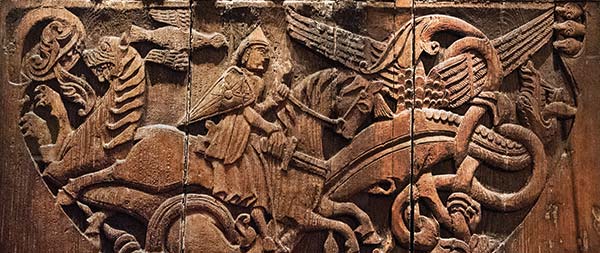
Much of what we know about Iceland’s Settlement Age history and people comes primarily from the sagas. These prose narratives, written during Iceland’s medieval age, are filled with tales of bloody feuds and vendettas, geological history, and extensive family genealogies (see the sidebar on here).
The sagas say that Ingólfur Árnarson was the first permanent settler in Iceland, at today’s Reykjavík, around AD 874. But archaeologists have found evidence of settlement dating much earlier than that. Whoever came first, these settlers grew in number around the middle of the ninth century. Influenced by political events in Norway and Ireland, a mix of people from both lands brought their livestock and took up permanent residence in Iceland.
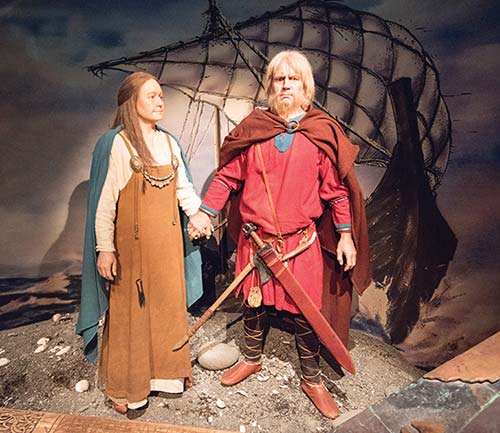
Settlement Age Iceland had no towns; everyone lived on farms. The newcomers appreciated Iceland’s abundant fresh water and grazing land for sheep. It was a challenging existence, but early Icelanders tamed the land and made it their own.
Sights
• Settlement Exhibition (Reykjavík)
• Settlement Center (Borgarnes)
THE ICELANDIC COMMONWEALTH (900-1300)
The early settlers established a primitive government, in which several dozen local chieftains (goðar) held power. Beginning around AD 930, an island-wide assembly—the Alþingi—convened once a year, at Þingvellir. Iceland’s Alþingi is sometimes described as “the world’s oldest parliament,” but the commonwealth period was no modern democracy. Society was stratified, with property owners on top, tenant farmers a step down, then landless laborers at the bottom.
Official Name: The Republic of Iceland (Lýðveldið Ísland), but locals just say “Ísland” (EES-lond).
Size: 39,682 square miles, a little larger than Maine. With about 370,000 people, Iceland is one of the least-populated countries in Europe.
Geography: Iceland is oval-shaped, with three peninsulas extending from the west side. The coastal regions are green and grassy. The interior uplands are mostly wasteland—cold and snowy in winter—with glaciers and swift-flowing rivers. Throughout the island, trees are sparse.
Latitude and Longitude: Between 63˚ and 66˚N and 13˚ and 25˚W (similar latitude to Fairbanks, Alaska). The island is located between the Greenland Sea, the Norwegian Sea, and the open North Atlantic Ocean.
Biggest Cities and Towns: More than half the population resides in or around Reykjavík (the capital, with about 140,000 people). Other “cities” include Akureyri (in North Iceland, pop. 18,200), Keflavík (15,900, including its sister town of Njarðvík), and Selfoss (7,000).
Economy: The gross domestic product is about $25.6 billion, and the GDP per capita is around $69,000. The major moneymakers for Iceland are tourism, fishing (40 percent of exports), and hydropower (from dams that generate electricity used for metal smelting). Iceland’s unemployment hovers around 4 percent. About 2 percent of Icelanders work in agriculture, 4 percent in fishing and fish processing, 1 percent in metal processing, 15 percent in other industries, and 78 percent in services.
Government: The prime minister is the chief executive, and typically the head of the leading vote-getting party. The president has a mostly ceremonial role, but helps to form parliamentary coalitions and can refer legislation to a referendum. There are 63 legislators in the single-house parliament (the Alþingi), who sit for four years unless early elections are called.
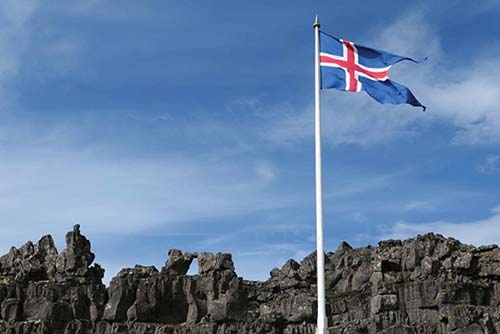
Flag: The flag is a red-and-white Scandinavian cross on a blue field. Blue represents the skies, white represents glaciers and ice, and red represents volcanic fire.
The Average Icelander: The average Icelander will live 83 years, has two children, and goes through 18 pounds of coffee beans per year. Over two-thirds of Icelanders are registered members of the state-supported Lutheran church. Legend has it that 1 in 10 Icelanders will publish a book.
Iceland maintained a diplomatic and trading relationship with Norway, whose King Ólafur Tryggvason (r. 995-1000) tried to introduce Christianity to his subjects and sent missionaries to Iceland, who failed in Christianizing the entire island. To nudge the Icelanders further, the king detained some Icelandic traders. This kicked off a furious debate at the assembly in Þingvellir in the year AD 1000. The assembly chose to convert rather than engage in a devastating trade war with Norway, and the entire country accepted Christianity in one fell swoop. (For more on the legend surrounding this mass conversion, see here.) Privately, however, some Icelanders continued to follow Old Norse paganism. To this day, many Icelanders have two given names—one with Christian roots, and the other a traditional Norse one.
All told, there were about 4,000 farms in Iceland during this period. The weather was warmer then, allowing grain to grow. The settlers were pastoralists, living off their animals’ meat, milk, and wool. They kept cattle, sheep, and pigs, and used horses for transport and herding. They also did some fishing at certain times of the year.
Chieftains from different families and parts of Iceland warred inconclusively for control of the country for decades. They finally resolved their differences by swearing allegiance to the king of Norway. In 1262, at the annual assembly in Þingvellir, Icelanders agreed to what became known as the “Old Covenant”—unilaterally declaring themselves to be subjects of Norway. The esteemed Alþingi was reduced from a primitive parliament to, essentially, an appeals court.
The country’s early history, passed down orally over the centuries, was first written down around the end of this period, in the 12th through 14th century. While these “sagas”—a series of tales mixing historical fact and fanciful legend—can’t be taken as literal history, they are a deeply ingrained facet of Icelandic national identity (see the sidebar on here).
Sights
• Saga Museum (Reykjavík)
• Snorri’s Saga exhibition (Reykholt)
• Law Rock (site of chieftains’ annual meetings, Þingvellir)
MEDIEVAL TIMES (1300-1600)
Although Iceland was part of Norway, it retained its own laws, and local officials were nearly all Icelanders. Norway, preoccupied by its relations with Sweden and Denmark, showed little interest in Iceland. In 1397, Norway joined with Sweden and Denmark in the Kalmar Union; Sweden left the union in the 1520s, and meanwhile, Norway effectively became a dependency of Denmark. Thus, Iceland started answering to faraway Copenhagen.
During the 1300s, Icelanders began to export fish and set up fishing stations on the coast, from where they served the strong European market for dried cod. But Icelanders were not allowed to live permanently on the coast. Icelandic law required any landless person to live on a farm, for one-year periods starting each May. The farmer had to provide food and shelter in return for labor, and if the farmer sent the laborer fishing in the spring, he got all the catch. Landless laborers were not allowed to marry. This system, called the vistarband, persisted until the 1890s.
In the 1400s and 1500s, English and German merchants began to fish in Icelandic waters and trade with Icelanders, and they tried to set up permanent settlements on the Icelandic coast. But they were kicked out by the Danish government, which slowly began to see Iceland as an economic asset.
Around 1540, the Protestant Reformation reached Iceland by royal decree. The only real resistance came from the bishop of the northern diocese at Hólar, Jón Arason, who saw the Lutheran faith as an unwelcome Danish imposition. He was captured, brought to Skálholt, and executed.
It was during these centuries that the mainland Scandinavian languages developed away from Old Norse, while Icelanders’ speech remained the same. By the end of this period, mainlanders could no longer understand Icelandic—and Icelanders felt themselves more and more separate.
Sights
• National Museum of Iceland (Reykjavík)
DANISH MONOPOLY (1600-1800)
In 1602, King Christian IV of Denmark decreed that only a few specific merchants from Copenhagen and nearby towns would be allowed to trade with Iceland. Twenty harbors around the Icelandic coast were set up as trading points, where these merchants would come each summer to sell grain, timber, fine cloth, and other goods in return for Icelandic fish and woolens.
During these years, Iceland had about 50,000 people—the number rising and falling with famines and epidemics. Iceland still had no towns and no schools. Up until the 1700s, Reykjavík was just a large farm. But in the mid-1700s, Skúli Magnússon, a high-level Icelandic official, got support from Denmark to set up a textile manufacturing business in Reykjavík. A row of workers’ houses was built in what is now downtown Reykjavík, and although Skúli’s enterprise failed, it was enough to seed settlement at what became Iceland’s capital.
In 1783, a huge eruption started along a fissure running southwest from Vatnajökull glacier. The ash from the eruption was loaded with toxic gases and blocked the summer sunlight. Livestock died and famine struck the land, killing one-fifth of the population. One positive consequence of the eruption was a loosening of the Danish trade monopoly in 1787. Now any Dane (not just certain merchants with a license) could trade with Iceland. As part of these reforms, the Danish crown selected six Icelandic harbors, including Reykjavík, as official trading locations. That same year, Reykjavík received “town” status, and emerged as the logical seat of Iceland’s government (the annual Alþingi gathering).
Sights
• National Museum of Iceland (Reykjavík)
A NATION EMERGES (1800-1900)
In the 19th century, Icelanders redefined their relationship with Denmark. They wanted to have control over their own affairs, though within the Danish realm. They also wanted the freedom to trade with whomever they wanted—not just Danes—and at whatever price the market would bear. The leader of the fight for these reforms was Jón Sigurðsson, an Icelandic scholar who lived in Copenhagen (now honored by a statue facing Iceland’s parliament). Through persistence, Icelanders reached both goals in the 1840s and 1850s. In 1874, the king of Denmark approved a written constitution for Iceland. Icelanders thus gained much more autonomy than their neighbors in the Faroe Islands and Greenland, which are still part of Denmark today.
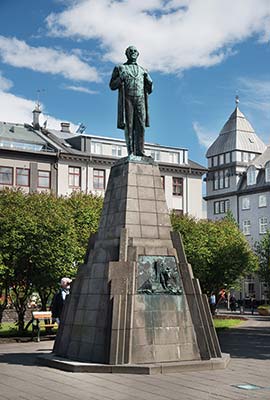
Fishing technology improved, and by the 1870s, Icelanders exported more fish (particularly herring) than agricultural products. Defying age-old custom, Icelanders began to settle along the coast and gather into towns, where some built wood-frame homes with corrugated iron roofs.
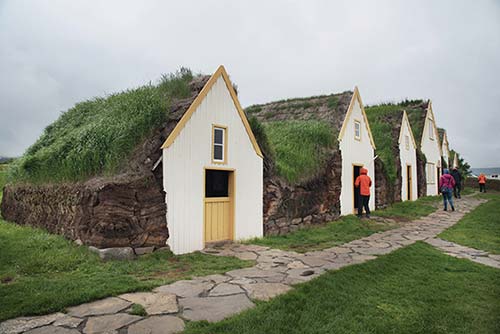
But Iceland remained very poor. As the 19th century drew to a close, most Icelanders still lived in houses made with thick turf walls and a grassy sod roof. In the late 1800s and early 1900s, about 20,000 Icelanders seeking more opportunity emigrated to North America.
In the 1880s, Icelandic farmers banded together in cooperatives to challenge the Danish merchants who dominated Icelandic commerce. Together, they had enough negotiating power to buy consumer goods and sell wool and lamb abroad on better terms than before. Up until about 1990, many of Iceland’s shops still belonged to farmers cooperatives.
Sights
• Sod Houses: Árbær Open-Air Museum (outside Reykjavík); Skógar Folk Museum (South Coast); Glaumbær Museum (Skagafjörður)
• Herring Era Museum (Siglufjörður, Tröllaskagi Peninsula)
• Icelandic Emigration Center (Hofsós)
INDEPENDENCE AND MODERNIZATION (1900-2000)
In 1902, the first boat motor came to Iceland—and within a couple of decades, the fishing industry was revolutionized. The country kept urbanizing, and by the 1930s, two-thirds of Icelanders lived in towns (including one-third in Reykjavík). But while the country slowly modernized, it remained poor. Roads were few and bad. Housing in towns was cramped, chilly, and heated with coal. The Great Depression hit hard, and at the outbreak of World War II, Iceland was one of the poorest parts of northern Europe.
Icelanders continued to chip away at Danish control. They created their own flag and currency, and developed their own political parties. In 1918, they negotiated a 25-year agreement to become a separate state under the Danish crown.
Iceland didn’t participate actively in World War II. But defense agreements with the Allies left the country with improved roads, bridges, and other infrastructure. For example, the Allies built Keflavík Airport and an adjoining base, which American troops ran until 2006.
In 1943, Iceland declared its complete independence. After the war, Iceland joined NATO (in 1949). The US base at Keflavík provided income and employment to Icelanders and influenced Iceland culturally.
Following World War II, strategically useful Iceland benefitted greatly from the generous support of the Marshall Plan—still cited by locals as a turning point in the modernization of Icelandic society. In fact, per capita, Icelanders received more aid from the US than any other European country.
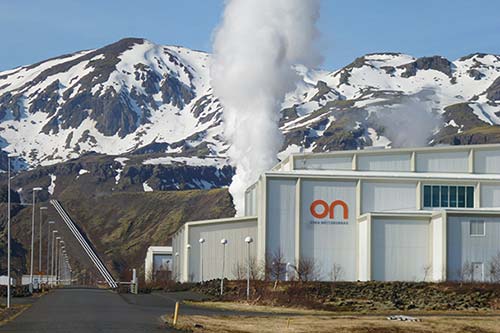
Icelanders had begun tapping geothermal sources for home heating with hot water in the 1930s. Slowly, coal disappeared as a fuel, and by the 1960s, all of Reykjavík was heated with water piped from underground sources in the countryside. Meanwhile, rivers were dammed for power generation. Today, 99 percent of Iceland’s electrical energy is generated from renewable geothermal or hydroelectric sources.
Icelanders maintained close ties to the Nordic countries through the 20th century. By the 1990s, Denmark, Sweden, and Finland had chosen to join the European Union. Iceland and Norway stayed out of the EU—but they did join the European Economic Area (EEA), a looser alliance that makes Iceland subject to most EU regulations, but keeps local control over fishing, agriculture, and customs policy.
Sights
• Seltún Geothermal Field (Reykjanes Peninsula)
• Hellisheiði Power Plant (Golden Circle)
• Geysir Geothermal Field (Golden Circle)
THE 21ST CENTURY AND ICELAND TODAY
In the first two decades of the 2000s, it seemed like Iceland—so long ignored by the rest of the world—was constantly in the international news: First came its financial boom-and-bust cycle, culminating in the 2008 crisis; then the eruption of Eyjafjallajökull in 2010, which left European air travelers cursing this remote island; and most recently its unprecedented tourism boom and vivid examples of climate change.
Starting around 2000, Iceland privatized its publicly owned banks. But the banks, without enough assets to cover their debts, collapsed in 2008 in history’s biggest banking crisis on record—a cold shower for the entire country. The Icelandic króna crashed in value, and many people lost their jobs, savings, and homes. Some bankers received brief prison terms.
Iceland is the most sparsely populated country in Europe, with about eight people per square mile. And yet, it has a seat in the United Nations, ambassadors, a flag, its own currency, and a president—who governs only about 340,000 people, but nevertheless hobnobs with the likes of Justin Trudeau and Joe Biden.
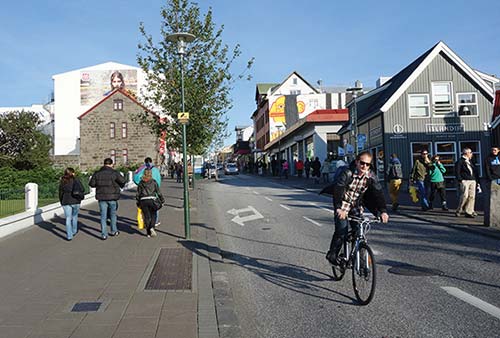
Icelanders are sensitive to this irony. They know their nation’s small size can bring them disproportionate (and some would say undeserved) prominence on the world stage. Consider that Icelanders get their own Eurovision contestant, while similar-sized communities in Norway compete for the privilege.
In some ways, Nordic Iceland is the most “Scandinavian” country, where the Old Norse language survives best, and where historical narratives were first written down. In other ways, Iceland is the least Scandinavian—physically and linguistically distinct from the others, considerably influenced by American culture, and the least progressive in its education, health, and welfare systems.
Icelanders frequently criticize themselves as kærulaus (a word which means careless, inconsiderate, or flippant). Kærulaus suggests that there are no rules; and even when there are rules, no one knows them; even when people know the rules, they don’t follow them; when people break the rules, no one cares; and if anyone tries to enforce the rules, they will be laughed at. This doesn’t apply in all situations (and doesn’t mean you can start driving off-road or stealing from your hotel), but it does provide a sense of the country’s opportunistic, frontier mentality.
Icelanders often project an image of unity and Mayberry-like innocence, and visitors sometimes come away with an idealized picture of the country, focusing on things like renewable energy and the low crime rate. But if you take the time to read and understand Iceland’s complex political, social, and environmental issues, you’ll find that the country is as contentious and competitive as any other.
One impressive thing about Icelanders is how gracefully they have handled the enormous influx of tourism to their sparsely populated homeland. Of course, there are grumbles and thoughtful criticism—including the worry that so many people passing through could spoil what’s so special about this island. Few countries could manage such a drastic spike in tourism as well as Iceland has. One way or another...þetta reddast (“It’ll work out”).
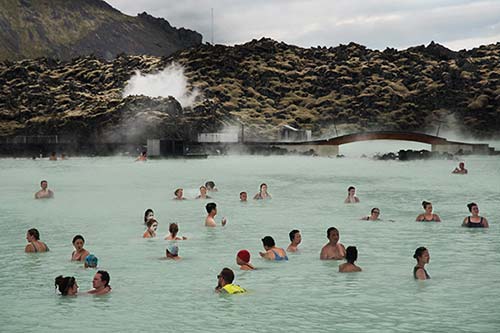
Tourism was a saving grace. A relatively minor piece of Iceland’s economy for many decades, tourism in 2015 surpassed fishing as the country’s top industry. In 2016, for the first time, the number of Americans visiting Iceland topped the country’s population. Icelanders scrambled to deal with the huge demand, improving infrastructure and considering limits on access to its fragile natural sights.
Iceland lags behind mainland Scandinavia in indicators such as educational achievement, press freedom, government transparency, and health care. It’s difficult to attract international businesses, and many educated Icelanders leave for jobs in Europe’s big urban centers.
Some politicians say the way forward is to lower the cost of living, improve schools and health care, raise public-sector salaries for jobs like teaching and nursing, and make shopping easier. The vision is to make living in Iceland as appealing as living in Norway or Denmark.
Visitors often assume that the country’s high prices are due to transport costs or the small size of the market. But it has more to do with weak competition, protectionism, inefficient businesses, and government efforts to keep the Icelandic króna stable. Local retailers have successfully lobbied to make it hard for Icelanders to order from online retailers like Amazon. Many frustrated Icelanders fly abroad to shop, bringing home clothes, toys, and electronics in their suitcases.
There are also unresolved political issues. Iceland’s voting system overrepresents rural interests in parliament, and farmers have used their disproportionate power to lobby for import restrictions that inflate the price of meat and dairy products.
Since the banking mania ended, Icelanders have realized that what they once thought of as “keeping wealth in the family” or “helping out friends and political allies” could also be described as “corruption.” Some would like Iceland to become a full member of the European Union, seeing regulation from Brussels as a professional, stabilizing influence on a small country that has limited local expertise.
Perhaps the most controversial issue for Icelanders today is control over natural resources. The Icelandic fishing “quota” (the right to harvest fish from the sea) is in the hands of private investors. Similarly, profits from Iceland’s energy surplus go largely to multinational companies who buy electricity at cut-rate prices. Many Icelanders believe that more of this wealth should be channeled to the public good, and that investing in health and education would finally bring the country’s standard of living up to mainland levels.
Environmentally, Icelanders struggle with the effects of hundreds of years of soil erosion and deforestation. The government has worked to increase forest cover and reseed barren land (see the “A Treeless Landscape” sidebar, earlier). Another perennial environmental debate is whether to build more dams. The most recent hydroelectric power station, completed in 2007, required five dams in two rivers, leaving just three remaining undammed rivers in the country (for more, see the sidebar on here).
Iceland’s government is taking climate change seriously; the country aims to be carbon neutral by 2040. The effect of climate change is especially obvious by the toll it is taking on Iceland’s glaciers. In 2019, Icelandic politicians and activists held a “funeral” for the once thriving Okjökull glacier in western Iceland, now reduced to a patch of “dead,” unmoving ice. Scientists predict that in 200 years, all of the country’s glaciers will be gone.
Despite the unique challenges this remote island grapples with, one thing remains steady: Iceland’s ability to impress its many visitors. Against all odds, this plucky little country is prosperous, known and respected around the world, and enjoying its status as a favorite transcontinental layover.