ICELAND
Map: PLACES COVERED IN THIS BOOK
Iceland’s Best Short Trips by Car
Iceland’s Best 10-Day Road Trip
Rick’s Audio Tours and Free Video Clips
Iceland, the land of the midnight sun and the northern lights, is equally famous for its magnificent glaciers and active volcanoes. Magma bubbling up between tectonic plates formed this rugged island, leaving it stranded halfway between North America and Europe. Until recently a poor Nordic backwater, today it’s one of Europe’s most expensive countries. Over the last decade, Iceland has vaulted from obscurity to become a can’t-miss destination for curious travelers.
With its stunning natural wonders, down-to-earth people, and unique attractions, this little island exceeds the lofty expectations of its many visitors. Most people’s single biggest regret after visiting Iceland? They tried to squeeze it into just a day or two, instead of investing the time to see more of its striking landscape.
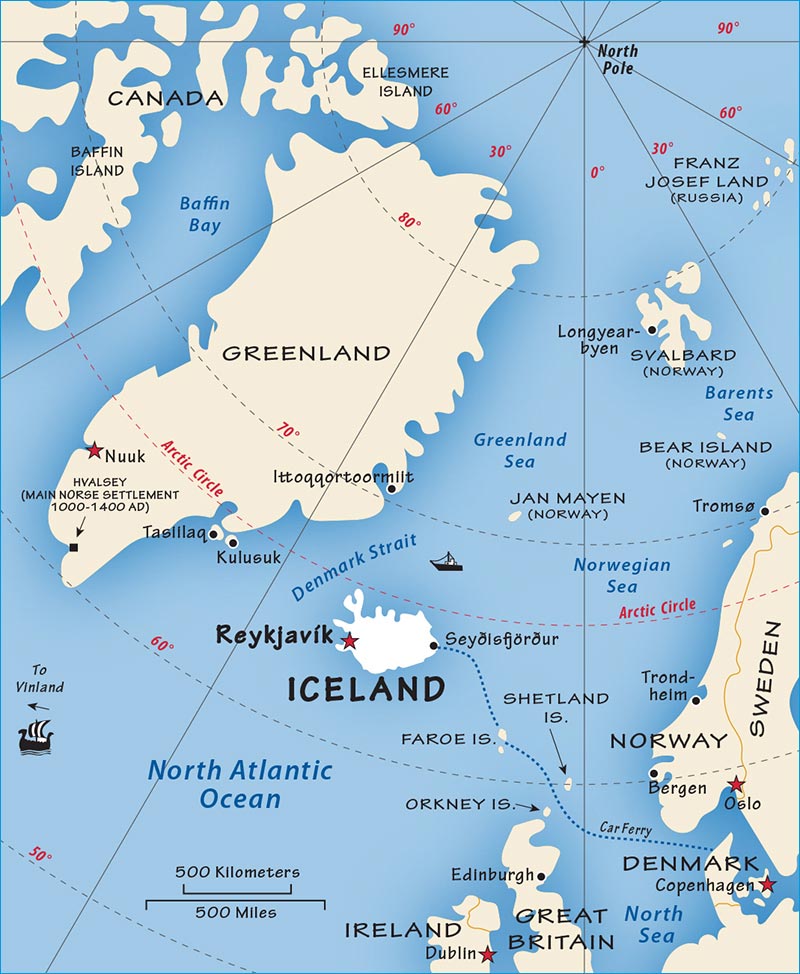
Iceland floats alone where the North Atlantic and Arctic oceans meet, just a smidge below the Arctic Circle. Its closest neighbors are Greenland, to the northwest, and the Faroe Islands, to the southeast. The remote island was largely uninhabited until the ninth century, when, at the height of the Viking Age, it was settled by farmers looking for a good place to graze their sheep. It remained a land of isolated farms for about a millennium. Up until the late 1800s, Iceland had no towns aside from Reykjavík. If you stay in the countryside today, you can get close to the agrarian Iceland that existed for centuries. Some farms have a storied history, going back hundreds of years.
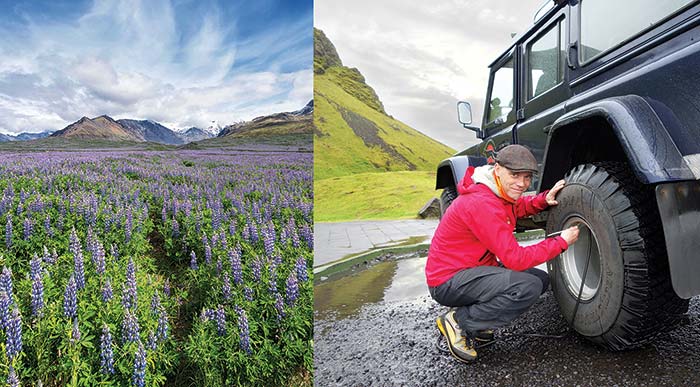
Fields of lupine in Iceland’s southeast corner; a monster truck gets you into the interior Highlands.
Social movements that sparked upheaval elsewhere—Christianizing, Reformation, independence—arrived in Iceland with strangely little fuss. The country’s Viking Age roots and its historic connections to Norway and Denmark give it an unmistakably Nordic aura, while the long-time presence of an American naval air base developed Iceland’s affinity for all things Yankee. Today, Iceland feels like it has one foot in Europe, and the other in America.
About 300 miles across, Iceland is roughly the size of Kentucky and smaller than the island of Great Britain. More than half of the country is uninhabited tundra (in the interior Highlands). Almost all of its 370,000 residents live near the coastline, and well over half of all Icelanders reside in the capital region of Reykjavík, on the southwest coast.
For the traveler, Reykjavík is the natural jumping-off point for exploring Iceland’s dramatic countryside. It’s an easy hop from Reykjavík to the inland Golden Circle route, studded with natural and historic attractions (from geysers to thundering waterfalls), or south to the famous Blue Lagoon thermal baths (on the Reykjanes Peninsula, near Keflavík Airport). Two hours away, the South Coast offers glaciers, black sand beaches, little farms, and soaring mountains.
An hour’s drive north of Reykjavík is the fjord-wrapped town of Borgarnes and the pastoral Reykholt Valley (with premium thermal baths and a tourable volcanic lava tube). Just beyond that, Snæfellsnes offers a representative sample of Icelandic landscapes—fjords, scree slopes, lava rock, waterfalls, and a glacier—in a compact, easy-to-navigate peninsula. And out at Iceland’s northwest fringe are the Westfjords: a chain of jagged, sparsely populated inlets with far fewer tourists.
The country’s name is “Ice-land,” but that’s only part of the story. This little island features a stunning diversity of landscapes—from frigid glaciers to boiling geysers, and from towering mountains to dreamy fjords. That’s why, for most visitors, Iceland’s raw, awe-inspiring nature is its biggest draw.
Iceland, which plugs the gap between the North American and Eurasian tectonic plates, was formed long ago by volcanoes (eldfjöll, “fire mountains”)—and regular eruptions continue. The best known include those at Surtsey (1963), which added a new island off Iceland’s South Coast, and on Heimaey (1973), which increased the size of that little island by a square mile. In 2010, the infamous Eyjafjallajökull volcano blew a column of ash four miles into the atmosphere that drifted east to Europe, halting air travel.
Odds are you won’t witness an eruption during your visit; Iceland weathers about one every four years. Even so, it’s impossible to come to Iceland without experiencing its volcanic landscapes: For starters, Keflavík Airport sits on a petrified lava flow. Things just get more interesting from there, from trapped-in-time sheets of lava, to giant burst bubbles of molten rock, to craters holding vibrantly colored (and still steaming) lakes.
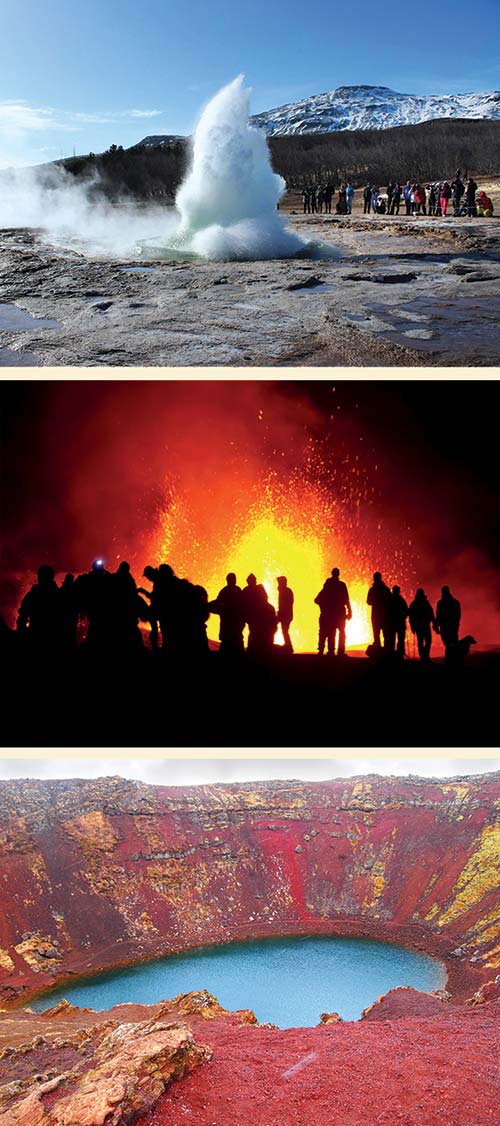
Evidence of Iceland’s powerful natural forces: exploding geysers, gushing magma, and volcanic craters
Iceland’s highest volcanic peaks are capped by glaciers (jöklar, singular jökull)—frozen seas of ice. Glaciers cover about 10 percent of the country, mostly along the south and southeast coasts, and in the unpopulated Highlands in the island’s center. All of them are melting; scientists predict Iceland’s glaciers will largely disappear within the next two centuries.
For now, at Sólheimajökull, you can walk up and touch a glacier; at Jökulsárlón and Fjallsárlón, you can ride a boat on a glacier lagoon, circling bobbing icebergs calved off from an icy tongue; at various places, you can hike or snowmobile across the top of a glacier, or enter an ice cave within one.
After nearly 1,200 years of taming their volatile island, Icelanders have harnessed geothermal energy in ways both practical (to heat their homes and generate electricity) and hedonistic. To literally immerse yourself in Iceland’s volcanic landscape, visit one (or, better yet, several) of its naturally occurring thermal baths.
Free hot springs and pools dot the island, attracting Icelanders year-round. Some are easy to reach by car, while others require a bit of a hike—but your reward is a long soak in toasty water surrounded by an incredible landscape. For a less rugged experience, visit a municipal swimming pool—with water naturally heated to around 100°F—or go to one of Iceland’s well-advertised premium baths (such as the Blue Lagoon, Sky Lagoon, Hvammsvík Hot Springs, or Geosea).
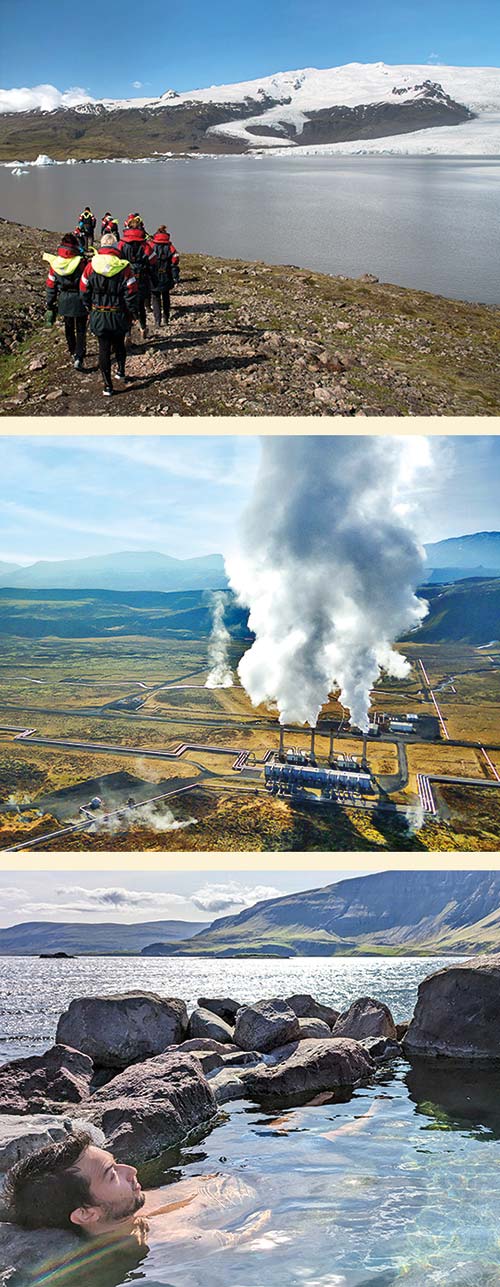
Hike to a glacier’s edge; visit a geothermal plant; soak in a thermal bath.
Iceland’s landscape is dramatic, yet it’s also accessible. For inspiration on the many ways to connect with the country’s natural wonders, see the Icelandic Experiences chapter. Enjoy!
But the ultimate Icelandic thrill is an 800-mile road trip, circling the entire island on the Ring Road (highway 1). Give the Ring Road enough time, and it’ll give you charming waterfront towns (Siglufjörður, Húsavík, and Seyðisfjörður), a pint-sized second city (Akureyri), simmering volcanic landscapes (near Mývatn), jagged fjords (the Eastfjords), and glaciers and glacier lagoons (on the southeast coast).
Iceland has a rich folklore and a strong connection between its heritage and its landscape. It seems every rock has a thousand-year-old name and a legend to go with it. With cinematic scenery and abundant opportunities to experience nature in its rawest form, Iceland makes everyone feel outdoorsy. Snowmobile across a glacier. Zip over the waves on an inflatable boat while scanning for breaching whales or soaring puffins. Go for a ride on an Icelandic horse, hoping to feel the rhythm of its elusive “fifth gait.” Scuba or snorkel in a tectonic rift flooded with crystal-clear glacial water. Hike from hut to hut, tracing the path of lava from a slumbering volcano.
For a quintessentially Icelandic experience, be sure to soak in one of the country’s spring-fed thermal baths. The spa-like Blue Lagoon—with milky blue water filling a volcanic reservoir—is the most famous (and expensive) of the premium baths, though the nearby Sky Lagoon and the fjordside Hvammsvík Hot Springs also appeal. For the budget-minded, every village has its own municipal swimming pool filled with piping-hot water. Adventurers can find plenty of free and hidden opportunities for an al fresco soak in the hot springs that dot the countryside.
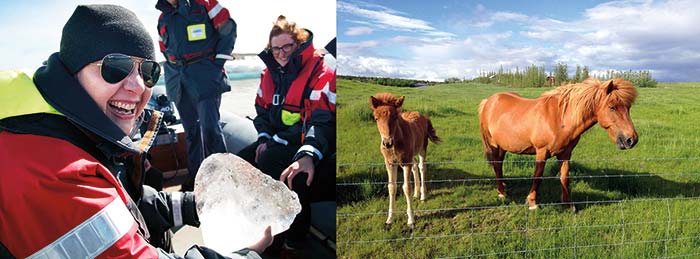
Boat ride in Fjallsárlón’s glacier lagoon on the southeast coast; small and strong Icelandic horses
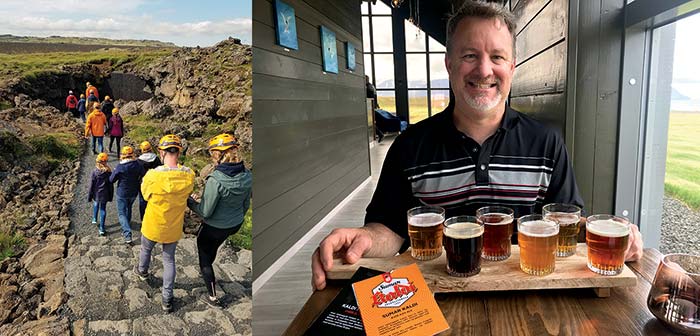
Raufarhólshellir lava tube; beer-tasting flight near Dalvik
Iceland’s natural splendors are what attract most visitors, but Icelanders are also worth getting to know. They have a gentle spirit and a can-do frontier attitude. They’re also whip-smart (Icelandic scholars were the first to write down the legends and histories of the early Scandinavian people—collectively called “the sagas”). Enjoy meeting the easygoing Icelanders; in this little country, everyone’s on a first-name basis.
Two often-repeated Icelandic phrases offer insight into the local psyche: kærulaus (loosely, “careless”) describes the flexible, improvisational, sometimes inconsiderate way Icelanders move through life. And an Icelander facing an unexpected challenge might mutter, “Þetta reddast” (“It’ll work out”)...and in this mellow land, it usually does (with some major exceptions, like Iceland’s economic crash in 2008).
Iceland has a rich cuisine scene. Trendy restaurants are enthusiastically organic—literally wallpapered with fish skin and serving gourmet delights on slabs of rock or rustic little planks. There are few places with fresher seafood: haddock, cod, arctic char, halibut, and the delectable humar (langoustine). The rolling, green countryside teems with free-range sheep grazing on grass that seasons a tender and delicious meat. Vegetables are grown in hothouses, and a warming climate has allowed more farming of grains (barley, wheat, and rye). Soup is an Icelandic staple, and every grandma has her own secret recipe for kjötsúpa (lamb soup). And Icelandic skyr—a yogurt-like dairy food that’s been around since Viking times—is now commonly available in American groceries.
Iceland is also famous for its notorious “hardship foods”: an entire boiled sheep’s head (svið), jerky-like dried cod snacks (harðfiskur), and the notorious hákarl—chewy, ammonia-tinged fermented shark. Locals scarcely eat these anymore, of course, but tourists do...usually on a dare.
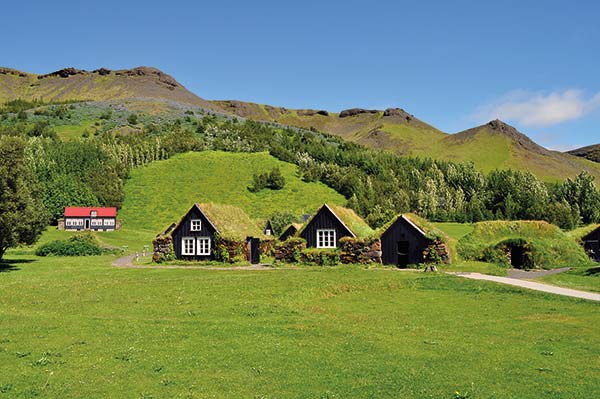
Summer or winter, be prepared to bundle up (pack gloves, a fleece hat, sturdy boots, and a waterproof jacket). While conditions overall are surprisingly moderate for the latitude, frosty temperatures and bone-chilling wind can happen at any time of year. Icelanders use the term gluggaveður (“window weather”) to describe weather that’s pleasant to look at—from indoors. Blustery days arrive frequently, especially in winter, when strong low-pressure systems roll in and whip high winds across the whole island. It’s not just a little unpleasant to be outside in high winds—you literally may not be able to walk or open your car door.
Typically, two or three days of cloudy, drizzly skies alternate with two or three days of relatively sunny weather. The cloudy periods lengthen in winter, the sunny periods in summer. It rains often in Reykjavík, but pouring rain is infrequent. Lightning is rare enough to make the evening news.
Few places, especially one so remote and cold, have become so popular, so quickly. But Iceland’s striking glaciers, craggy peaks, and steamy geysers—and the visible impacts of climate change—make this destination attractive to the inquisitive and the adventurous. Whether or not you can pronounce the names on its map, Iceland is a rewarding place to travel.
Iceland’s Top Destinations
It’s a small country, but there’s a lot to see in Iceland. This overview categorizes the country’s top destinations into must-see places (to help first-time travelers plan their trip) and worth-it places (for those with additional time). I’ve also suggested a minimum number of days to allow per destination.
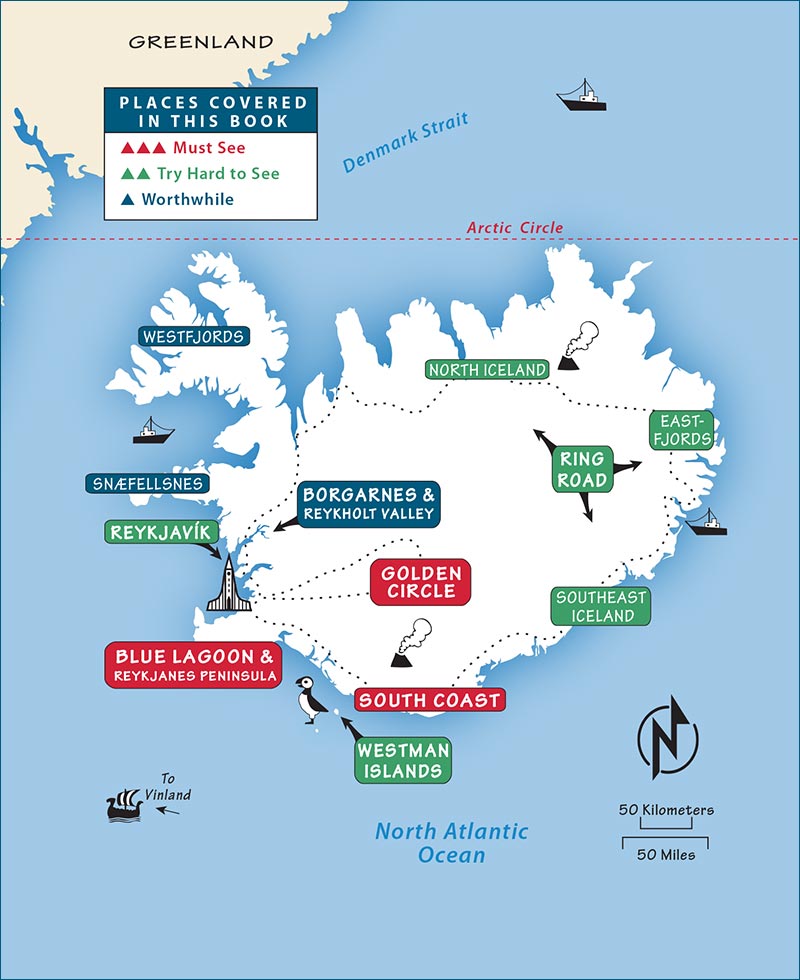
MUST-SEE DESTINATIONS
Iceland’s capital, Reykjavík, is the natural hub for any visit, with an excellent assortment of accommodations, restaurants, shops, and nightlife. Reykjavík easily has enough sights to fill a day or two, but with limited time, I’d spend my evenings in Reykjavík and my days in the countryside at these top choices:
▲▲▲Blue Lagoon (half-day)
This top-end thermal bathing complex, tucked in a volcanic landscape a 45-minute drive south of Reykjavík (and near Keflavík Airport), is relaxing and memorable, and a delightful toe-in-the-water dip into Iceland’s thermal bathing culture.
▲▲▲Golden Circle (1 day)
Iceland’s quintessential day trip is deservedly popular. You’ll loop through eye-popping terrain, with stops at Þingvellir (site of Iceland’s earliest clan gatherings, situated along a jagged tectonic fissure); Geysir (a steamy field that’s home to the world’s original “geyser”); and Gullfoss (a thundering waterfall). Along the way, you can tiptoe around the rim of a volcanic crater, visit Iceland’s medieval religious center, and take your pick of thermal bath experiences.
▲▲▲South Coast (1 day)
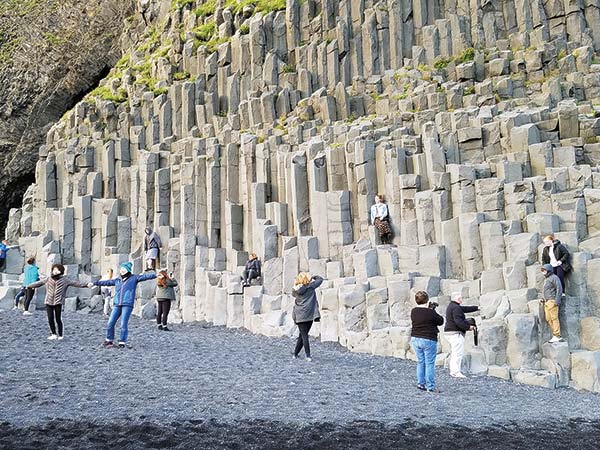
This dramatic shoreline, shaped by volcanoes and glaciers, rivals the Golden Circle as Reykjavík’s top day trip. You’ll see spectacular waterfalls tumble over high cliffs, touch the tongue of a glacier, stroll along a black sand beach, and learn about the majestic power of volcanoes. Nearby, avid hikers can make the Þórsmörk nature reserve (nestled between three glaciers) a ▲▲ full day on its own.
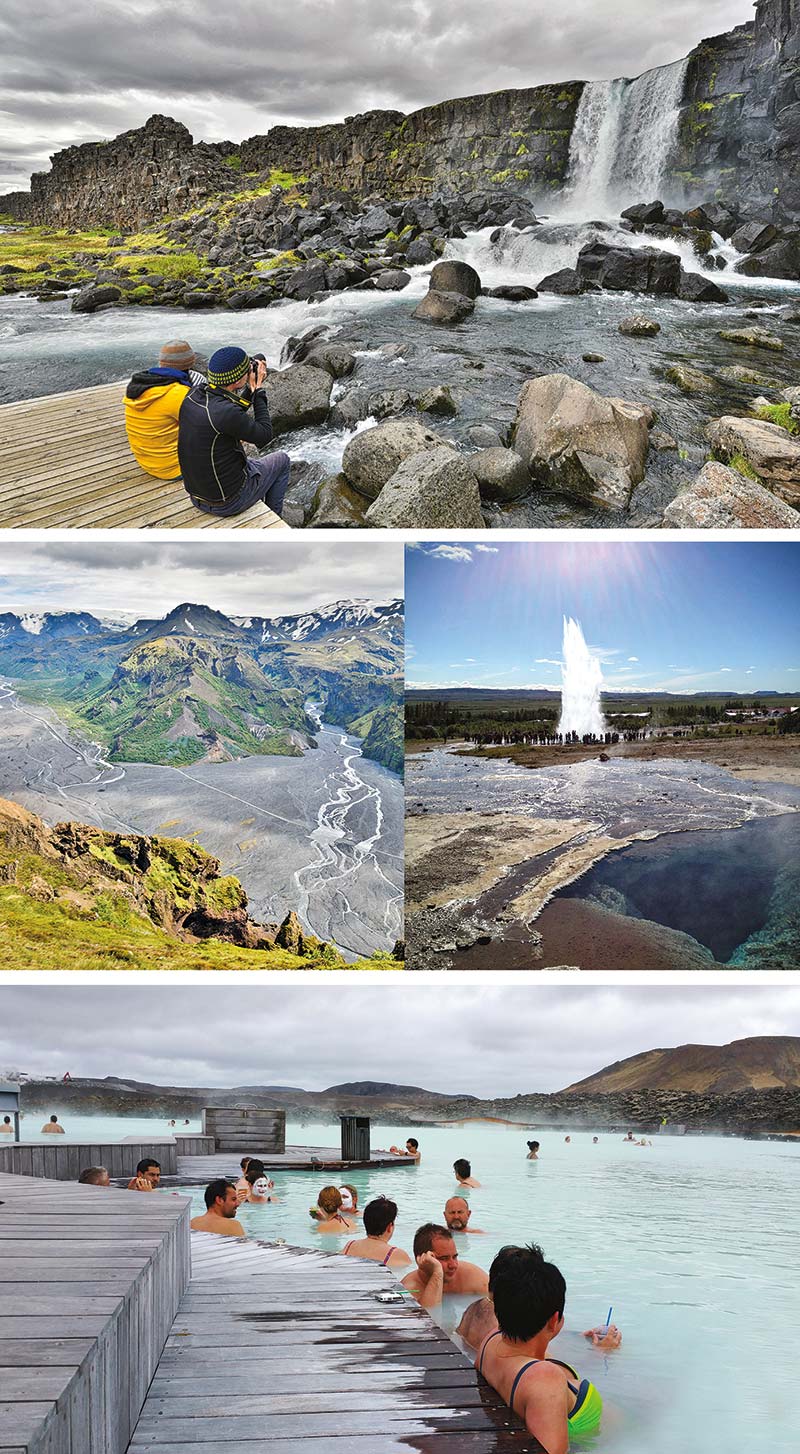
Basalt columns at Reynisfjara (opposite); waterfall at Þingvellir; Geysir, on the Golden Circle; Blue Lagoon; Þórsmörk wilderness

WORTH-IT DESTINATIONS
On a longer visit, these stops—rated ▲ or ▲▲—deserve consideration. All are within easy day-tripping distance of Reykjavík—except the Westfjords and the Ring Road, each of which demands several days.
▲▲Reykjavík (1-2 days)
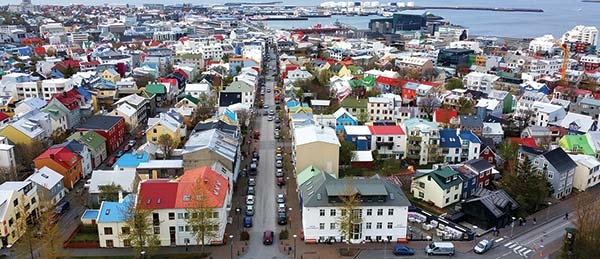
An ideal home base for a visit of any length, Reykjavík is a worthwhile sightseeing destination in its own right. Its colorful, pedestrian-friendly downtown has fine museums, a stroll-worthy harbor, and a dozen thermal swimming pools, perfect for a rejuvenating soak among Icelanders. The capital’s restaurants are surprisingly good, and its nightlife scene is legendary.
▲▲Westman Islands (1 day)
Reachable by a short ferry ride, this little chain of 15 islands merits the effort. On Heimaey (the only inhabited island), you’ll find towering seabird cliffs and the world’s largest puffin colony (in summer), a busy fishing harbor, two volcanoes (plus an excellent volcano museum), and lots of small-town charm.
▲▲Ring Road (5-10 days)
To really delve into Iceland, circle the island’s perimeter on highway 1. It’s a demanding drive (the entire circuit is 800 miles), but the scenic payoff is huge: breathtaking waterfalls and remote fjords, majestic mountains, volcanic cones and craters, otherworldly lava formations, rich birdlife, geothermal springs and geysers, glaciers, black sand beaches, and windswept coastlines.
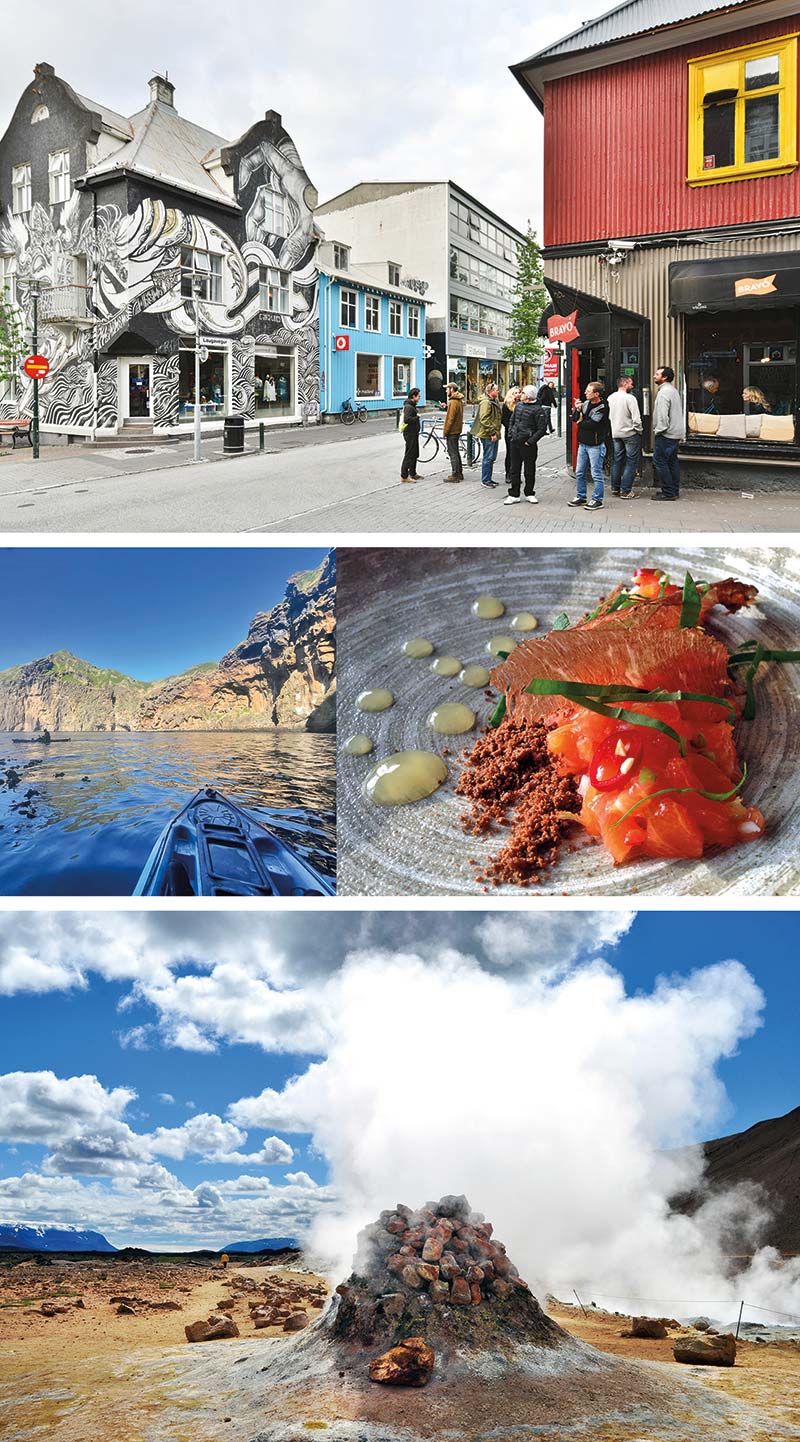
Colorful, quirky Reykjavík; high-end New Icelandic cuisine; a fumarole (steam vent) near Mývatn, on the Ring Road; kayaking in the Westman Islands
▲Borgarnes and Reykholt Valley (1 day)
This West Iceland area’s subtle charms include the dramatically set town of Borgarnes (with a fine exhibit on Iceland’s settlement and sagas) and the gentle Reykholt Valley, with lovely waterfalls, prolific hot springs, and a tourable lava tube, plus a traditional goat farm, premium thermal baths, and an important religious site. Nearby is the hikeable Grábrók volcanic crater.
▲Snæfellsnes (1-2 days)
This peninsula, two hours north of Reykjavík, offers an “Iceland in a nutshell” loop, encompassing coastal scenery, bridal-veil waterfalls, chunky lava-rock landscapes, quirky museums, black sand beaches, fjordside fishing towns, a lava tube, its very own glacier, and more. While doable as a (long) day trip, it’s worth an overnight to settle in.
▲Westfjords (2-3 days)
For those wanting a remote, rugged corner of Iceland all their own—but who don’t have a full week for a Ring Road drive—the Westfjords are a splendid compromise. Here a sawtooth coastline is peppered with few towns but ample stunning scenery and a poignant sense of the lonesome Icelandic frontier. You’ll also find Iceland’s finest bird cliffs (Látrabjarg) and one of its best waterfalls (Dynjandi).
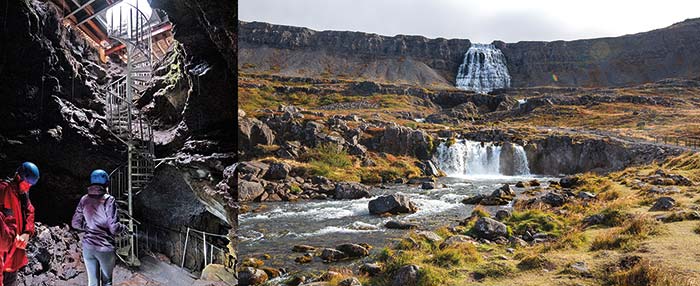
Vatnshellir Cave on the Snæfellsnes Peninsula; Dynjandi waterfall in the Westfjords
Planning Your Trip
To plan your trip, you’ll need to design your itinerary—choosing where and when to go, how you’ll travel, and how many days to spend at each destination. For general advice on sightseeing, accommodations, restaurants, and more, see the Practicalities chapter.
DESIGNING AN ITINERARY
As you read this book and learn your options...
Choose your top destinations.
My recommended itineraries in this chapter give you an idea of how to spend your time in Iceland—whether you’ve got one day or ten. Most visitors focus on the great outdoors: volcanic landscapes, waterfalls, thermal springs, and so on. Reykjavík is the natural home base, and on a very short visit, you can simply overnight there, spending your days side-tripping to nearby attractions (see the Beyond Reykjavík chapter for advice).
Decide when to go.
Your Icelandic experience will vary drastically depending on the time of year. Summer really is the best time to go—even if everyone else is there with you. From June through August, days are long and the weather is at its best (though it’s still unpredictable). The country bustles with sightseeing attractions open and in full swing. At these northern latitudes, from about June 1 to July 15, the sun dips below the horizon for only a few hours, and it never really gets dark. Icelanders take full advantage of these days of “midnight sun,” and so should you. In July and early August, temperatures can climb into the 60s and might break 70 (even if the wind chill keeps things brisk). Icelanders take time off and Europeans arrive for camping vacations. After mid-August, it rapidly gets colder and darker, kids go back to school, and things quiet down.
Iceland rewards a visit of any length. I’ve outlined two basic itineraries here: a whirlwind 24-hour visit and a more relaxed five-day stay (both can be modified for longer visits). For additional multiday itineraries, see the Beyond Reykjavík chapter. For suggested Ring Road itineraries, see here and the Ring Road chapter. For any itinerary, consider these factors:
Time of Year: These itineraries assume you’ll visit in summer, when daylight is virtually endless and roads are clear. In the off-season, you’ll want to stay closer to the capital.
Blue Lagoon Scheduling: The Blue Lagoon is located between Reykjavík and Keflavík Airport, so it’s easy to combine a soak with your flight. These plans assume you’ll arrive in the morning and stop at the Blue Lagoon on your way into town. But it works equally well to visit the Blue Lagoon on your departure day if you have a late flight. Whenever you go, reserve the Blue Lagoon in advance.
Westman Islands Weather: Ferries to the Westman Islands are weather-dependent, so have a Plan B ready. Don’t schedule a return from the islands on the same day as an onward flight from Iceland; give yourself at least a one-night buffer.
Without a Car: Base in Reykjavík and book day-trip excursions to your choice of the Golden Circle, Snæfellsnes, Blue Lagoon, South Coast, Westman Islands, or Þórsmörk. It’s possible to fly from Reykjavík to Akureyri, a hub for tours in the north (Mývatn, Siglufjörður, whale watching) or to Höfn, near the glacier lagoons. See the Beyond Reykjavík chapter for more day-tripping details.
Iceland in 24 Hours
If one day is all you have in Iceland, here’s how to pack it all in.
| Morning: | Arrive, pick up car, head straight to Blue Lagoon and soak. |
| Midday: | Drive into Reykjavík for lunch and a few hours of browsing, then check into your hotel. |
| Afternoon: | Set out for Golden Circle loop trip—hitting just the highlights. |
| Evening: | Dinner in Golden Circle country. |
| Late: | Collapse at your hotel and sleep for a few hours. Fly out the next morning. |
With 48 hours: Add a day trip to the South Coast.
With 72 hours: Add a day trip to Snæfellsnes, or spend more time exploring Reykjavík.
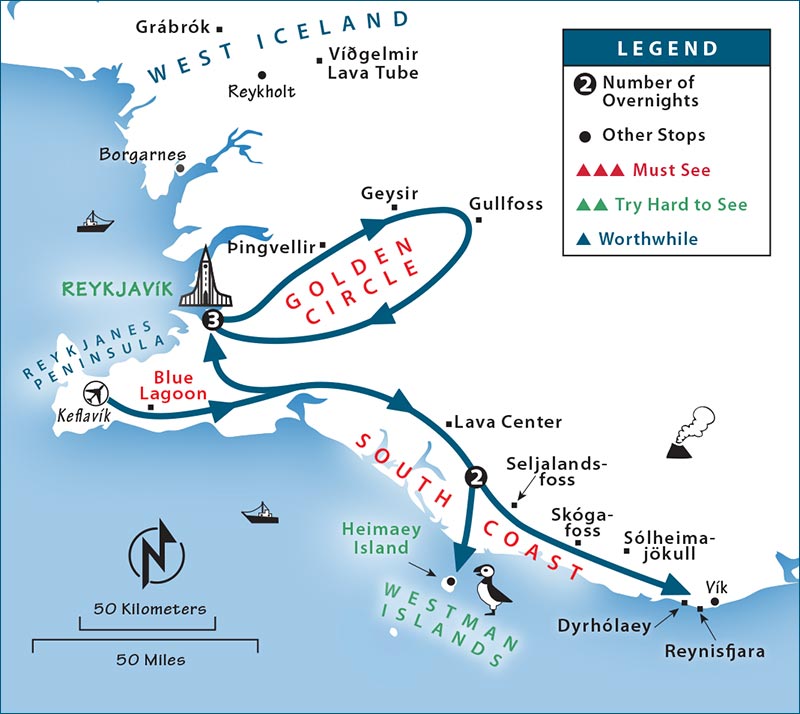
Iceland in 5 Days
| Day | Plan | Sleep |
| 1 | Arrive, pick up car, go to Blue Lagoon, then head to South Coast | South Coast |
| 2 | Westman Islands day trip | South Coast |
| 3 | South Coast sights, to Reykjavík | Reykjavík |
| 4 | Golden Circle | Reykjavík |
| 5 | Reykjavík (or excursions: whale watching, horseback riding, glacier hikes) | Reykjavík |
| 6 | Drop off car and fly out |
With 4 days: Spend less time in Reykjavík—see it in the two evenings, and on your morning of departure.
6 days: See the South Coast on Day 2, then overnight on the Westman Islands (Day 3) before heading to Reykjavík.
7 days: Head to Snæfellsnes, ideally overnight, or as a day trip.
8 days: Add another day in Reykjavík (and/or more excursions).
9 days: Day-trip from Reykjavík to Borgarnes and the Reykholt Valley, or spend some time here on the way up to Snæfellsnes. With more time, see my 10-day itinerary on the next page.
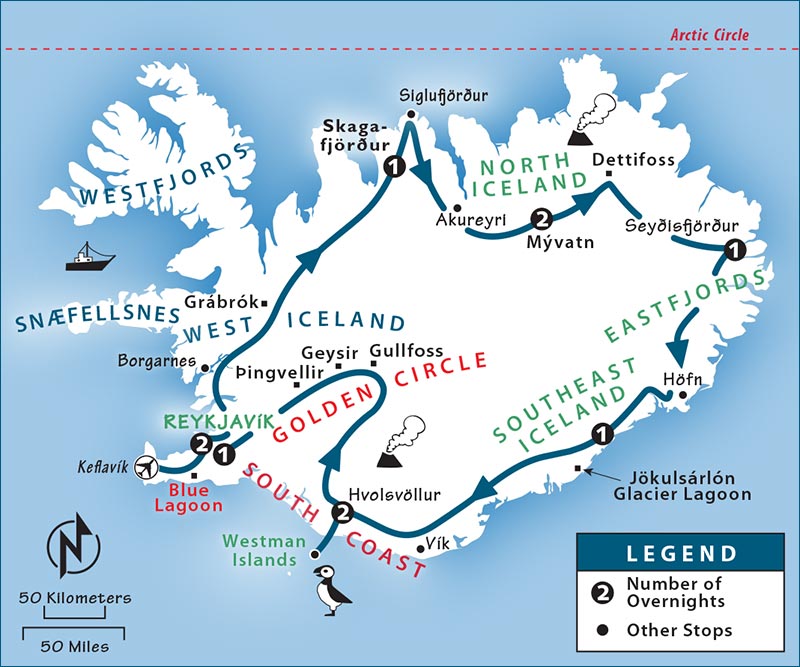
With enough time, it’s possible to see Reykjavík, drive the entire Ring Road route, including the South Coast, side-trip to the Westman Islands, and hit the Golden Circle highlights. The 10-day itinerary outlined here assumes you’ve rented a car (or campervan) and sets a fast pace, with several long driving days (and one-night stands) in a row. The more time you can devote to the Ring, the more relaxed and rewarding your circuit will be.
| Day | Plan | Sleep |
| 1 | Arrive, pick up car, go to Blue Lagoon on the way into Reykjavík | Reykjavík |
| 2 | Reykjavík | Reykjavík |
| 3 | Begin Ring Road: To Borgarnes, then Skagafjörður | Skagafjörður area |
| 4 | Drive the Tröllaskagi Peninsula (stopping in Siglufjörður and Akureyri), evening to Mývatn lake area | Mývatn |
| 5 | Mývatn area and Húsavík port town | Mývatn |
| 6 | To the Eastfjords (taking in Dettifoss falls or Stuðlagil canyon) | Seyðisfjörður |
| 7 | Drive the Eastfjords to the southeast (Vatnajökull area) | Höfn, Jökulsárlón, or Skaftafell area |
| 8 | South Coast sights | South Coast |
| 9 | Westman Islands day trip | South Coast |
| 10 | Golden Circle highlights en route to Reykjavík | Reykjavík |
| 11 | Drop off car and fly out |
With 9 days: Spend only one night in Mývatn (and skip Húsavík). Or make Borgarnes your first overnight, and blitz Reykjavík and the Blue Lagoon at the end of your trip.
11 days: Add a Snæfellsnes detour, a day in Reykjavík, or overnight in Akureyri.
12-14 days: Add an excursion: Þórsmörk or Skaftafell hike, glacier visit, volcano tour, or whale watching.
Westfjords alternative: If you don’t have this much time to spare but still want a taste of remote Iceland, consider a few days in the Westfjords; for a recommended itinerary, see here.
May and September lack the vitality of summer but offer occasional good weather and minimal crowds. But in these months, snow and extreme weather can disrupt your plans, particularly on higher-elevation roads, and remote areas are inaccessible. April and October see harsher weather, with a good chance of snow and slippery roads anywhere outside Reykjavík.
Days are short from mid-October to mid-February—the sun rises after 11:00 all December—and dusk will draw the shades on your sightseeing well before dinner. You can still enjoy a stopover in Reykjavík, though, where music and film events liven up the darkness, and Christmastime activities offer a warm experience at a frosty time. Outside the city, roads ice over, and sights and accommodations are closed or have reduced hours. Bus trips to the nearby Golden Circle and South Coast are typically still possible (leave winter driving to the pros). Driving the Ring Road in winter is inadvisable at best, and impossible at worst.
One benefit of a winter visit is the chance to view the elusive northern lights, though whether you’ll actually see them is unpredictable. For weather specifics, see the climate chart in the appendix.
Connect the dots.
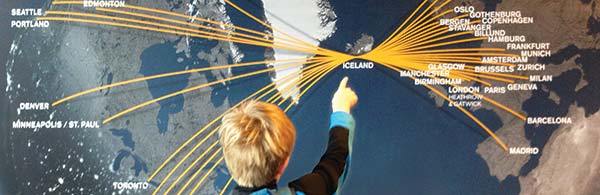
Many people drop into Iceland on the way to or from Europe; Icelandair typically allows a layover of up to several days for only a small charge.
Decide if you’ll travel by car or rely on excursions, or a combination. A car or campervan rental is expensive but offers maximum flexibility for side-tripping and exploring the countryside (for more on vehicle rentals, see the Practicalities chapter). Excursion trips make the island accessible to nondrivers but are pricey, too—skipping the car rental doesn’t necessarily save a lot of money.
To determine approximate travel times between destinations, study the driving map in the Practicalities chapter. Major roads are good, but back roads are often unpaved. Be sure to tune into the peculiarities of Icelandic driving, including how to traverse city roundabouts, one-lane bridges, and tunnels (for Icelandic driving tips, see here). Google Maps can help you navigate throughout Iceland, with only occasional blind spots; it’s still wise to supplement with printed maps if you’ll be leaving well-traveled areas.
Write out a day-by-day itinerary.
Figure out how many destinations you can comfortably fit in your time frame. If you’re energetic, you can take advantage of long summer days to cram in the maximum.
When planning, allow enough time, and don’t spend it all in Reykjavík. On a short visit, make Reykjavík your base, then devote your days to the nearby Golden Circle or South Coast. In summer you’ll still have hours of evening sunlight by which to enjoy Reykjavík even after side-tripping.
On a longer visit, decide whether you’ll do everything as side trips from Reykjavík or divide your trip into multiple overnights (sleeping on the South Coast mixes in a little variety, and overlaps conveniently with the Golden Circle, Westman Islands, and Þórsmörk). The Ring Road is a long, one-way trip...plan on lots of one-night stays. (To break it up, consider lingering in Mývatn in the north, or near the glaciers in the southeast.)
Check if any holidays or festivals fall during your trip—these attract crowds and can close sights (for the latest, see www.visiticeland.com). If traveling outside of summer (Sept-May), be aware of potential weather-related road closures. Many sights and services in the countryside may be closed, and those in Reykjavík have reduced hours.
Give yourself some slack. Every trip—and every traveler—needs downtime for doing laundry, picnic shopping, people-watching, and so on. Pace yourself. Assume you will return.

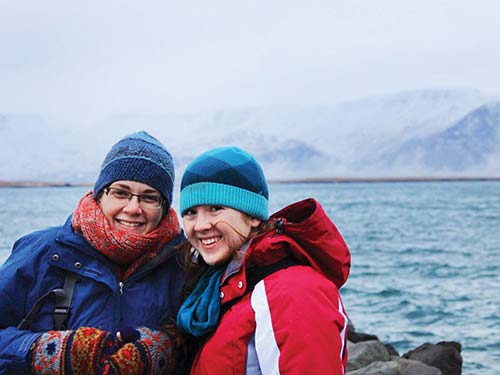
Icelanders are easygoing and creative. Horns or not–you’ll want a warm hat.
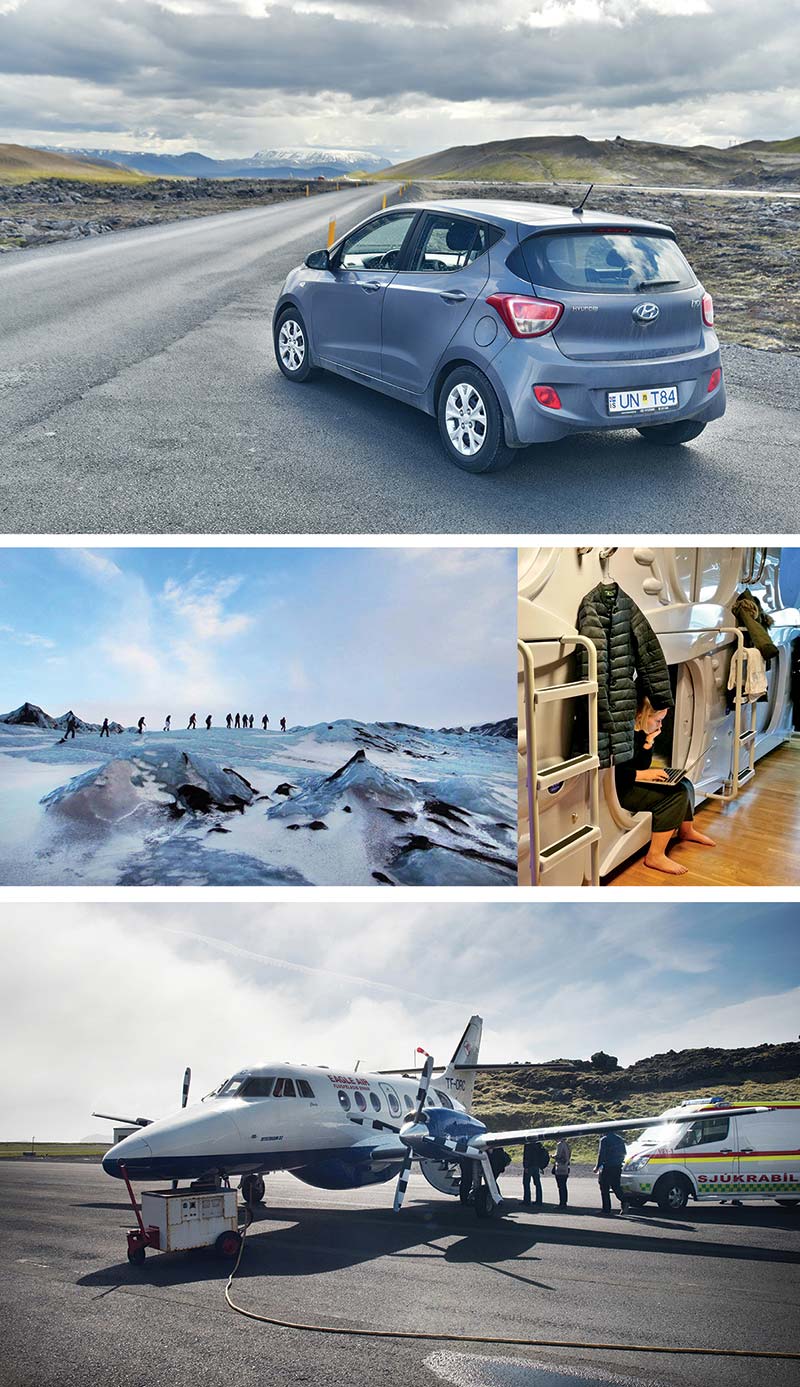
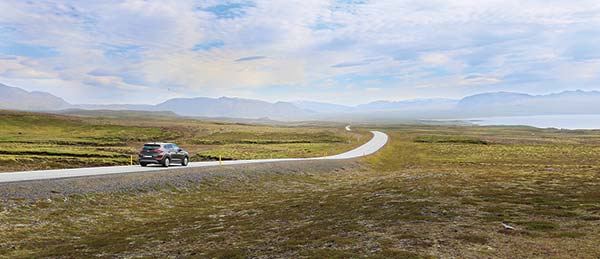
Two-wheel drive is just right for the Ring Road in summer; budget accommodations; short-hop flights within Iceland can save driving time; glacier walk
Run a reality check on your dream trip. You’ll have major transportation costs in addition to daily expenses.
Flight: A round-trip flight from the US to Keflavík Airport costs about $900-2,000, depending on where you fly from and when.
Local Transportation: For a six-day trip using excursion buses and one intra-Iceland flight, allow $800 per person.
Car Rental: Allow $750-1,000 per week (booked well in advance; more for four-wheel drive), not including tolls, gas, parking, and insurance.
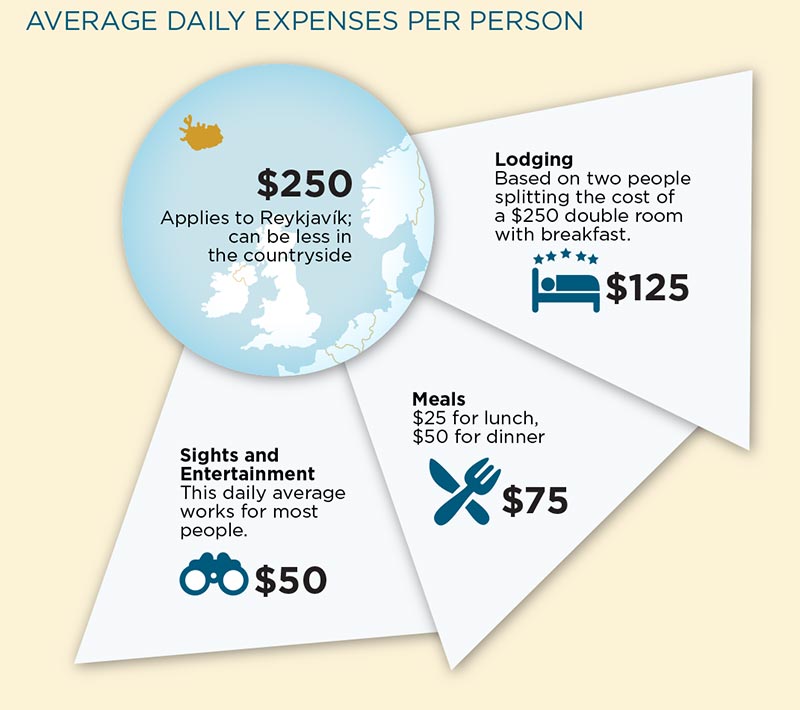
Iceland is one of Europe’s most expensive destinations. Here are some strategies for keeping costs down.
Consider Airbnb. Airbnb and similar sites rent properties that are typically cheaper than hotels. And if you’re willing to forego hotel services (like a reception desk and daily cleaning), you’ll get more space and amenities for your money. Airbnb can also get you into local neighborhoods; sleeping in a Reykjavík suburban home is both cheaper and more Icelandic than a touristy downtown hotel.
“Go” down the hall. Iceland’s characteristic guesthouses typically offer basic rooms with a shared bathroom, which cost much less than rooms with en suite bathrooms.
Have a big lunch and a small dinner. Even the fanciest restaurants offer good-value lunch specials in the $25-30 range. Enjoy a sit-down meal for lunch, then picnic or grab cheap takeout for dinner.
Picnic. Cultivate the art of picnicking in atmospheric settings. Seek out Iceland’s discount supermarket chains (Krónan and Bónus) and use them to stock up. Consider bringing a few staples from home: In a place where a basic takeaway coffee costs $8 a cup, packing some single-serving instant coffee lets you caffeinate cheaply.
Know what’s included. Don’t feel obligated to purchase a drink. Icelandic restaurants happily provide diners with a free carafe of tap water (just ask). If you’ve paid for unlimited soup and bread, don’t be shy about going back for seconds. And if someone offers you free coffee, take it! Since Iceland has a no tipping culture and taxes are included, you’ll pay exactly the price you see on the menu.
Economize on alcohol. Alcohol is priced at a premium, particularly in bars and restaurants. Stock up at the airport duty-free store on arrival—with the lowest prices in Iceland—or at government-run liquor stores (called Vínbúðin). If you’re going to a bar, go during happy hour.
Skip the Blue Lagoon. While famous and a highlight for many visitors, the Blue Lagoon costs many times more than Iceland’s municipal thermal pools...which are also a more authentic experience. Reykjavík alone has more than a dozen municipal pools with water just as hot as the Blue Lagoon’s. If visiting several pools, invest in a shareable multivisit card.
Sightsee selectively. Icelandic museums are typically very good, but expensive ($15-45). If you’ll be sightseeing a lot and hitting the thermal pools in the capital, consider a Reykjavík City Card. Fortunately, many of Iceland’s best attractions—its natural wonders—are free.
Splurge where it counts. When you do splurge, choose an experience you’ll always remember: If you’re a naturalist, invest in a whale-watching tour; if you like to eat, take a culinary walk or dine out at a top-end restaurant; if you’re an adventurer, spelunk through a lava tube or hike across a glacier. Minimize souvenir shopping—most shops sell things that are extremely expensive, produced outside Iceland, or both. (Plus, how will you get it all home?) Focus instead on collecting wonderful memories.
BEFORE YOU GO
You’ll have a smoother trip if you tackle a few things ahead of time. For more details on these topics, see the Practicalities chapter and RickSteves.com, which has helpful travel-tip articles and videos.
Make sure your travel documents are valid. If your passport expires within six months of your return date, you need to renew it (allow 12-plus weeks). Be aware of entry requirements; you may need to register with the European Travel Information and Authorization System (ETIAS; quick and easy process, https://travel-europe.europa.eu/etias_en). Get passport and country-specific travel info at Travel.State.gov.
Arrange your transportation. Book your international flights; overall, Google Flights is the best place to start. If you plan to rent a car or campervan, do it well in advance, and read up on the unique hazards of driving in Iceland. It’s worth booking cheap domestic Iceland flights in advance. If you’ll be taking your car on the ferry to the Westman Islands, book well in advance (even walk-ons should book ahead in summer).
Book rooms well in advance. Reserve your rooms as soon as you’ve pinned down your travel dates, particularly for smaller locations around the Ring Road where options are limited.
Book ahead for premium spas and other experiences. At many spas, the farther in advance you book, the cheaper your ticket will be. Make reservations at least several days in advance for the Blue Lagoon and Sky Lagoon near Reykjavík, and a couple days ahead for Hvammsvík Hot Springs (between Reykjavík and Borgarnes), Krauma thermal bath (Reykholt Valley), Forest Lagoon (Akureyri), and Geosea (Husavík).
It’s also smart to book a glacial lagoon boat in Jökulsárlón in advance. With the exception of specialized experiences like ice caving or glacier hiking, other excursions can usually be booked a few days beforehand.
Consider travel insurance. Compare the cost of insurance to the cost of your potential loss. Understand what protections your credit card might offer and whether your existing insurance (health, homeowners, or renters) covers you and your possessions overseas.
Manage your money. Tap-to-pay, contactless cards are widely accepted and simple to use. You may need your credit card’s PIN for some purchases—request it if you don’t have one. Alert your bank that you’ll be using credit cards in Europe. You don’t need krónur for your trip—you can make it through any trip in Iceland with only credit cards.
Use your smartphone smartly. Sign up for an international service plan, or rely on Wi-Fi instead. Download any apps you’ll want to access on the road, such as maps, translators, road conditions, weather forecasts, and Rick Steves Audio Europe (see sidebar).
Pack light. I travel for weeks with a single carry-on bag and a day pack. Use the packing checklist in the appendix as a guide.
The Rick Steves Audio Europe app makes it easy to download audio content to enhance your trip. Use the app to listen to audio tours of Europe’s top sights, plus my public radio show interviews with travel experts from around the globe. Scan the QR code to find it in your app store, or visit RickSteves.com/AudioEurope.


Rick Steves Classroom Europe, a powerful tool for teachers, is also useful for travelers. This video library contains about 600 short clips excerpted from my public television series. Enjoy these videos as you sort through options for your trip and to better understand what you’ll see in Europe. Check it out at Classroom.RickSteves.com.

Travel Smart
Iceland is famously spectacular, and it’s hard to have a bad time here. But it’s easy to underestimate the changeable weather, blow through too much money, or waste time by not making a good plan. If you equip yourself with good information (this book) and expect to travel smart, you will.
Read—and reread—this book. To have an “A” trip, be an “A” student. Note opening hours of sights, closed days, crowd-beating tips, and whether reservations are required or advisable. Check the latest at RickSteves.com/update.
Be your own tour guide. As you travel, get up-to-date info on sights, reserve tickets and tours, reconfirm hotels and travel arrangements, and check weather forecasts. Upon arrival in a new town, lay the groundwork for a smooth departure; confirm the road conditions and route to your next destination.
Outsmart thieves. While theft is rare in Iceland, some pickpockets are arriving with the tourist crowds. Keep your backup credit cards and passport secure in a money belt tucked under your clothes; carry one credit card in a wallet in your front pocket or day bag. Don’t set down valuable items on counters or café tabletops, where they can be quickly stolen or easily forgotten.
Minimize potential loss. Keep expensive gear to a minimum. Bring copies or take photos of important documents (passport and cards) to aid in replacement if they’re lost or stolen. Back up photos and devices to the cloud as you travel.
Be flexible. Even with a well-planned itinerary, expect changes, closures, howling winds, sore feet, and so on. Your Plan B could turn out to be even better.
Attempt the language. Most Icelanders—especially in the tourist trade—speak English, but if you learn some Icelandic, even just a few pleasantries, you’ll get more smiles and make more friends. Apps such as Google Translate work for on-the-go translation help, but you can get a head start by practicing the survival phrases near the end of this book.
Connect with the culture. Interacting with locals carbonates your experience. Enjoy the friendliness of the Icelandic people. Ask questions; most locals are happy to point you in their idea of the right direction. Set up your own quest for the best fish-of-the-day, volcanic crater, thermal swimming pool, or mountain pass. When an opportunity pops up, make it a habit to say “yes.”
Iceland...here you come!