REYKJAVÍK
Experiences in and near Reykjavík
Map: Reykjavík Hotels & Restaurants Outside the Center
Map: Reykjavík Center Restaurants
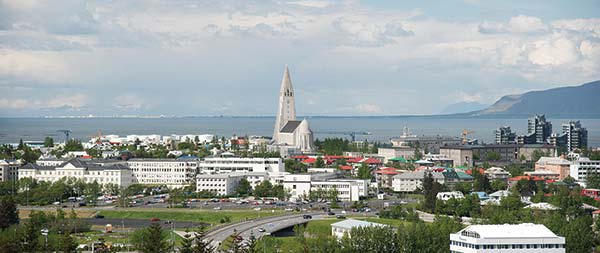
Reykjavík, the tiny capital of a remote island nation, is unexpectedly cosmopolitan, with an artistic, bohemian flair. It lacks world-class sights, yet manages to surprise and delight even those who use the city mostly as a home base for exploring Iceland’s natural wonders.
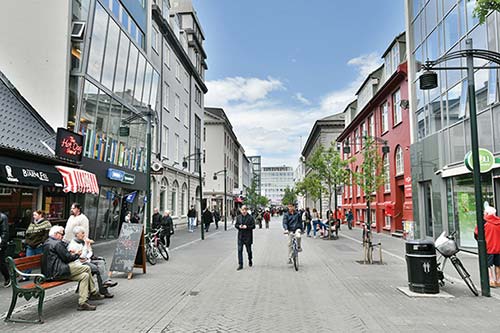
The city’s downtown streets are lined with creative restaurants, quirky art galleries, rollicking bars serving everything from craft beer to designer cocktails, and shops selling stuffed puffins, local knitwear, and Gore-Tex parkas.
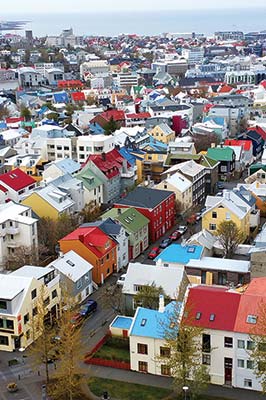
Reykjavík is a colorful enclave in a stark landscape: It seems every wall serves as a canvas for a vibrant street-art mural, and each corner is occupied by a cozy, art-strewn, stay-awhile café. In the old town center, colorful timber-frame houses clad in corrugated metal sheets huddle together amid a sprinkling of landmarks—such as the striking Hallgrímskirkja church, which crowns the town’s highest point.
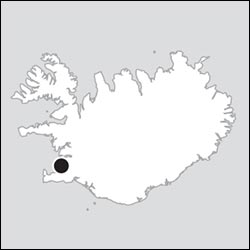
Like the rest of the country, Reykjavík has old roots. Viking Age farmers settled here in the ninth century. Until the 1750s, this area remained nothing more than a sprawling farm. As towns started to form in Iceland, Reykjavík emerged as the country’s capital. Today, the capital region is a small city, home to two out of every three Icelanders—a population similar to that of Berkeley, California, or Fargo, North Dakota. The northernmost capital city on earth—which straddles the European and American hemispheres—feels more New World than Old.
With the recent tourism boom, these days Icelanders tend to work, live, and shop in the suburbs, but come into town for the great restaurants and nightlife. Visitors find just about everything they need in a small, walkable zone. You can take in the vibe of this pithy city in a leisurely two-hour stroll, and it’s an enjoyable place to simply hang out. While museums aren’t a priority here, those seeking sights can easily fill a day or two.
Step into Hallgrímskirkja’s serene interior. Learn about this little nation’s proud history at the National Museum and the Maritime Museum, and about the city’s humble Viking Age roots at the Settlement Exhibition—built around the surviving walls of a 10th-century longhouse. Art lovers can visit a half-dozen galleries highlighting Icelandic artists (early-20th-century sculptor Einar Jónsson is tops). Naturalists can go on a whale-watching cruise or ride a ferry to an island. Modern architecture fans can ogle the award-winning Harpa concert hall, then walk along the shoreline to the iconic Sun Voyager sculpture.
Or head out to the suburbs to see the Pearl, the domed building designed to check off many Icelandic targets in one go—with exhibits on whales, puffins, glaciers, volcanoes, and the northern lights, plus panoramic city views.
Plenty of family-friendly activities—open-air museum, zoo, botanic garden—are just beyond the city center. To recharge, the capital area has plenty of relaxing—and very local—thermal swimming pools.
But don’t focus too much on Reykjavík. Instead, use the city as a springboard for Iceland’s glorious countryside sights, taking advantage of its accommodations, great restaurants, and lively nightlife. Even on a longer visit, drivers may prefer sleeping at a distance, dropping into town only for occasional sightseeing, strolling, and dining. To save money and have a more local experience, consider sleeping in suburban Reykjavík—which has fewer hotels, but ample Airbnb options.
PLANNING YOUR TIME
On a short visit, savor Reykjavík’s strolling ambience in the morning and evening, maybe drop into one or two sights early or late, and use your precious daytime hours to tour sights in the countryside (see the Beyond Reykjavík chapter for an overview of your options). My self-guided Reykjavík Walk offers a helpful town orientation (and crash course on Iceland) that can be done at any time of day or night.
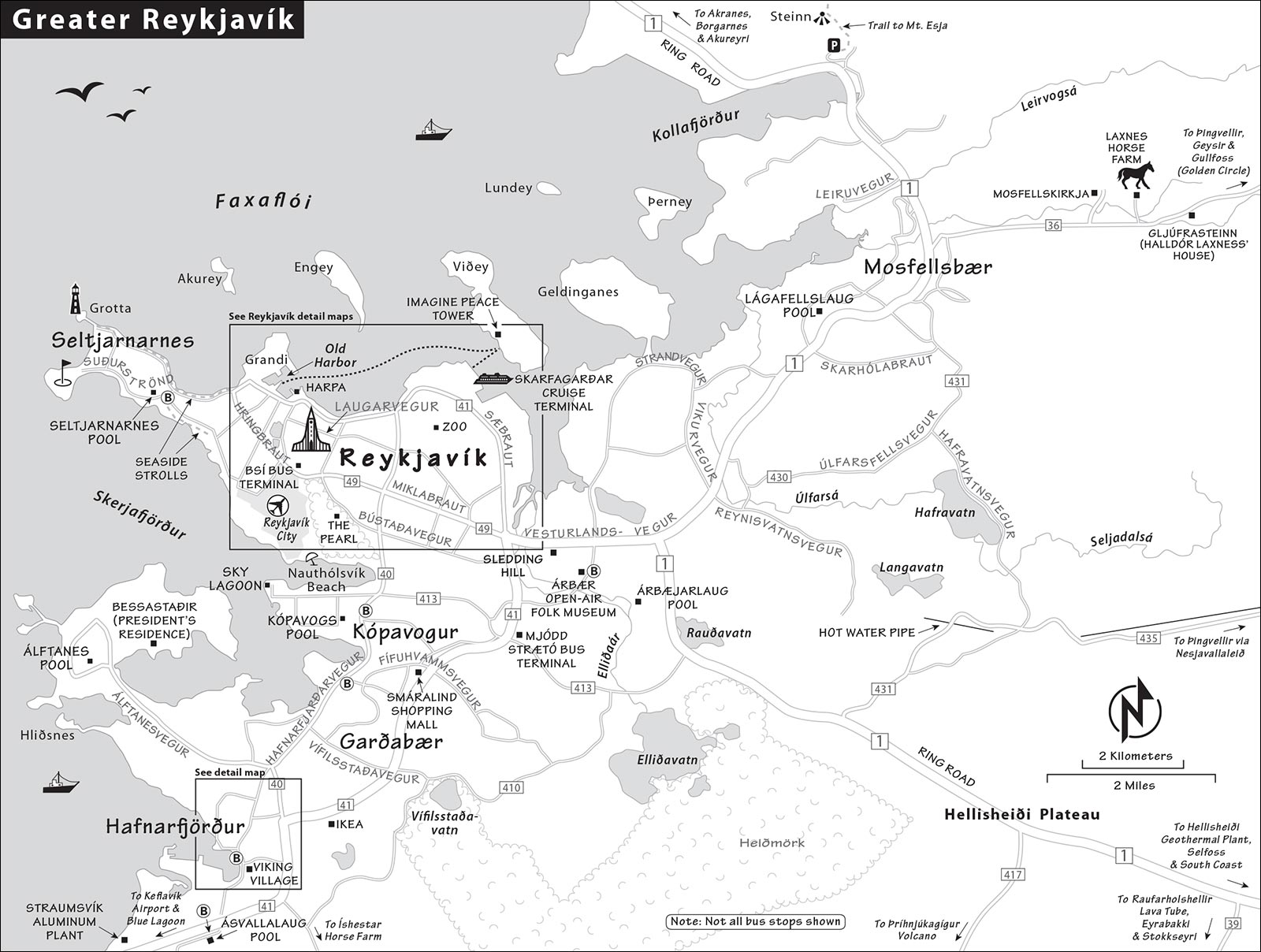
On a longer trip—or in winter (when countryside options are limited)—Reykjavík warrants more time. The following schedule is designed to fill two full days in town. With less time, mix and match from these options. My plan ignores weather—in practice, let the weather dictate your itinerary.
Day 1: Start with my self-guided walk around downtown, and ride up the tower of Hallgrímskirkja church. Find a nice lunch in the Laugavegur/Skólavörðustígur area. Walk down to the Sun Voyager sculpture for a photo op, then follow the shoreline to the Harpa concert hall (peek in the lobby, and stop by the box office to survey entertainment options). Follow the moored boats around to the Old Harbor, where you can comparison-shop whale watching and other boat tours for tomorrow. Then continue along the harbor to the Grandi area, where you can drop into your choice of sights: Whales of Iceland, Saga Museum, Maritime Museum, Aurora Reykjavík, FlyOver Iceland, or the Lava Show (the latter two should be booked online in advance). Return to the downtown area for dinner and after-hours strolling. Before or after dinner, unwind with the Icelanders in one of Reykjavík’s thermal swimming pools.
Day 2: Begin your day at the Settlement Exhibition. If that exhibit whets your appetite for Icelandic history, take a walk along the Pond (the city’s little lake) to the National Museum. After lunch, take your pick of activities: boat trip (either whale or puffin watching, or simply a ride out to peaceful Viðey Island); suburban sights, including the Pearl (with its many high-tech exhibits, and a grand city view), the sights in Laugardalur (botanic garden, zoo), and/or Árbær Open-Air Museum; or explore the city’s many art museums. Consider another dip in a thermal pool before enjoying an evening food tour or dinner in the center.
If you’re in town on a weekend, squeeze in a visit to the Kolaportið flea market, just off the Old Harbor.
Orientation to Reykjavík
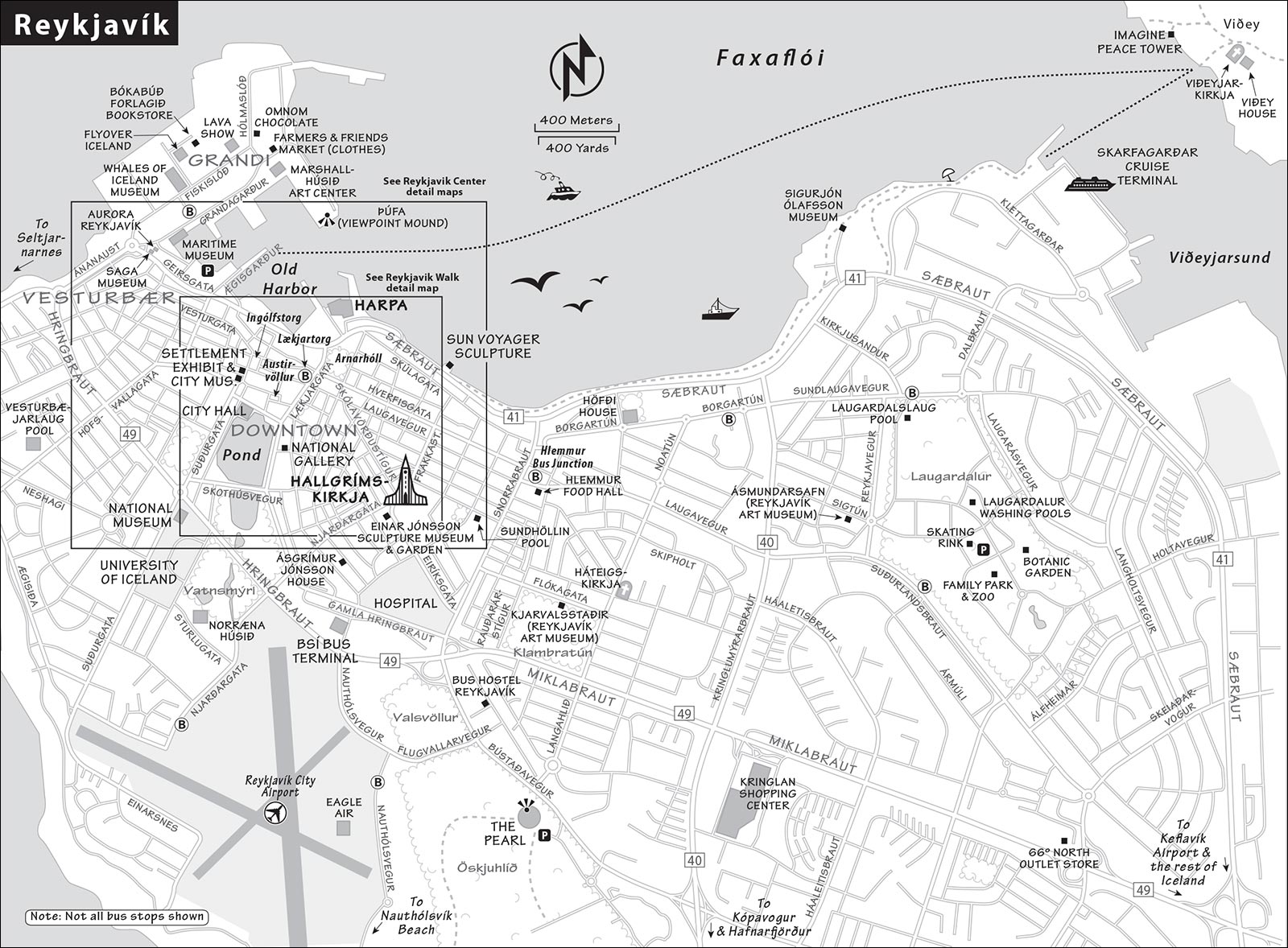
Reykjavík’s population is about 140,000, but the entire capital region stretches to about 216,000. The compact core of Reykjavík radiates out from the main walking street, which changes names from Austurstræti to Bankastræti to Laugavegur as it cuts through the city. You can walk from one end of downtown Reykjavík (Ingólfstorg square) to the other (the bus junction Hlemmur) in about 20 minutes. Just northwest of downtown is the mostly postindustrial Old Harbor zone, with excursion boats, salty restaurants, and several worthwhile sights.
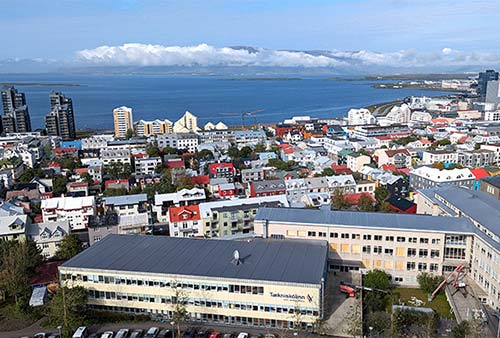
Greater Reykjavík is made up of several towns. Hafnarfjörður (Harbor Fjord), to the south, has its own history, harbor, and downtown core (I recommend some places to sleep and eat in this area). Kópavogur and Garðabær, between Reykjavík and Hafnarfjörður, are 20th-century suburbs. Mosfellsbær, once a rural farming district along the road running north from Reykjavík, has turned into a sizable town of its own. And Seltjarnarnes is a posh enclave at the end of the Reykjavík peninsula. While I haven’t recommended specific hotels or restaurants in these neighborhoods (except in Hafnarfjörður), finding an Airbnb in one of these areas can provide a more affordable home base.
TOURIST INFORMATION
Reykjavík has two tourist information offices (TIs) called What’s On, located a few blocks apart along the main east-west tourist axis (for locations, see the Reykjavík Walk map). Each offers mostly the same services, including baggage storage, excursions, and tour bookings. You’ll find offices at Laugavegur 54 (daily 9:00-20:00) and Laugavegur 5 (daily 8:30-21:00, both TIs open shorter hours in winter, +354 551 3600, www.whatson.is). Before traveling beyond Reykjavík, visit SafeTravel.is for updated information on driving, road conditions, and weather.
The TI’s free and helpful monthly entertainment guide, What’s On, is distributed at their offices and at hotels.
Alternatively, Visit Reykjavík, the city-run TI, offers info online at www.visitreykjavik.is.
The Reykjavík Grapevine, a free informative English-language magazine and website, provides a roundup of sightseeing hours, music listings, restaurant reviews, and fun insights into local life (www.grapevine.is).
Sightseeing Pass: The Reykjavík City Card may make sense for busy museum sightseers on a longer stay, but is not worth it for a short visit. It covers bus transport, city-run museums, Reykjavík swimming pools, and some other attractions, and offers discounts for other Reykjavík sights, shops, and tours (24 hours-4,600 ISK, 48 hours-6,400 ISK, 72 hours-7,890 ISK; sold at participating museums, TIs, hotels and hostels, and at City Hall; www.citycard.is).
ARRIVAL IN REYKJAVÍK
International flights use Keflavík Airport, a 45-minute drive from downtown Reykjavík (the Reykjavík City Airport is for domestic flights). For information on getting between Keflavík and downtown Reykjavík, and for getting to other destinations around Iceland, see “Reykjavík Connections,” near the end of this chapter.
HELPFUL HINTS
Book Ahead: Of the sights and activities in Reykjavík, only the Sky Lagoon thermal bath, the Lava Show, and FlyOver Iceland film should be booked in advance. Reserving ahead for any restaurant on your must-dine list is also smart.
Money: You’ll use credit cards far more than cash in Iceland. If you do want a little cash, some big banks downtown have ATMs. The Landsbankinn at Austurstræti 11 is convenient and along my self-guided walk. Other standalone ATMs scattered around the tourist zone (especially those marked Euronet) offer worse exchange rates, but can work in a pinch.
Pharmacy: Downtown pharmacies are at Hafnarstræti 19 (Mon-Fri 9:00-18:00, Sat 11:00-16:00, closed Sun, +354 552 4045, www.lyfja.is) and Laugavegur 53b (Mon-Sat 10:00-18:00, closed Sun, +354 414 4646, http://islandsapotek.business.site). For a pharmacy with longer hours, try Lyfja Granda in Grandi at Fiskislóð 3 (+354 512 3770) or, farther out, the Lyfja at Smáratorg 1, near the Smáralind shopping mall (+354 564 5600).
Laundry: Úðafoss is a handy full-service laundry. They promise same-day wash/dry/fold service if you drop off before 11:00, otherwise it’s next-day service (Mon-Fri 8:00-17:00, Sat 10:00-13:00, closed Sun, just off Laugavegur at Vitastígur 13—see the “Reykjavík Center Hotels” map on here, +354 551 2301). The downtown Laundromat Café has four self-serve washers and dryers in its basement (long hours daily, Austurstræti 9—see the “Reykjavík Center Restaurants” map on here, +354 771 9660). It’s also a popular comfort-food restaurant (described later in this chapter)—turning your chore into a fun night out.
Baggage Storage: Both What’s On TIs offer baggage storage for a fee—just be sure to note the closing time. Or look for baggage storage lockers at the Vesturgata parking garage, Traðarkot parking garage, and the BSÍ bus terminal (see www.luggagelockers.is).
Bike Rental: For quality bikes, Reykjavík Bike Tours rents from its location by the pier in the Old Harbor (daily in summer, in winter by appointment; Hlésgata 1, +354 694 8956, www.icelandbike.com). They also run private tours (see “Tours in Reykjavík,” later).
GETTING AROUND
By Car
North Americans will feel at home in Reykjavík, as it’s largely a car city. If you’ll be renting a car to explore the countryside, you may want to keep it for part of your time in Reykjavík. Several important sights are outside of downtown (where parking is generally free and easy).
That said, you don’t need a car to enjoy your visit. And if you’re staying in the center and visiting only downtown sights, a car can be a headache. If you plan to have your own wheels in town, consider looking for accommodations with free parking a little outside the center.
Parking: Downtown, on-street parking is metered (Mon-Fri 9:00-18:00, Sat 10:00-16:00; free outside these times). Pay with credit cards, Apple Pay, or coins at machines (look for the white-and-blue “P” sign). You can also pay through the Parka or EasyPark app (which also allows you to extend your parking time—or cancel your prepaid parking time early for a refund). In either case, you’ll punch in your license-plate number (no need for a receipt in the windshield). Parking in the P1 zone is the most expensive; parking in P2 through P4 costs about half as much. You can prepay for several hours (until paid parking becomes free), so even if overnighting in the center, you don’t have to worry about returning to feed the meter.
Street parking is usually not too hard to find during the day, but can be limited in the evenings (when many visitors and locals come into town for dinner); plan on extra time to park. A lot of street parking is scattered around the city center, but read signs carefully to ensure you’re legal. One good place to look is along Garðastræti and its side streets, just a couple of blocks above Ingólfstorg. You’ll find a few central, small lots in the following spots: on Kirkjutorg, just behind the Lutheran Cathedral and parliament; just uphill and around the corner from the Settlement Exhibition on Túngata; and by the harbor, just below Ingólfstorg on the street called Grófin. You can also park for free on the street behind Hallgrímskirkja church or near the BSÍ bus terminal. A free parking lot is along Eiríksgata at the top of the hill by Hallgrímskirkja church, but it’s often full. There’s also plenty of free parking in the Grandi box-store zone to the far side of the Old Harbor.
There are also several small public parking garages downtown (check locations and rates at www.bilastaedasjodur.is/#bilahusin). The following are open daily 7:00-24:00. The Traðarkot garage at Hverfisgata 20 is the best option and close to the end point of my Reykjavík Walk. Closer in, but typically full on weekdays, are the Kolaport garage, near the Harpa concert hall at Kalkofnsvegur 1, and the Ráðhúsið garage, underneath City Hall at Tjarnargata 11.
By Public Transportation
Greater Reykjavík has a decent bus (strætó) system. In this late-rising city, buses run from about 6:30 on weekdays, 7:30 on Saturdays, and 9:30 on Sundays, with last departures between 23:00 and 24:00. Service is sparse on evenings and weekends, when most buses only run every half-hour. All buses have Wi-Fi.
Bus routes intersect at several key points, notably Hlemmur, at the eastern end of Laugavegur, Reykjavík’s downtown shopping street; Lækjartorg, at the western end of Laugavegur; Mjódd, in the eastern Reykjavík suburbs; and Fjörður, in the town of Hafnarfjörður. The English journey planner at Straeto.is makes using the system easy and recognizes addresses without Icelandic characters (you can omit all the accent marks and use th, d, and ae instead of þ, ð, and æ). To get help from a live person, call +354 540 2700.
Bus Fares and Payment: A single ride costs 570 ISK; there are also day passes (2,300 ISK/1 day, 5,200 ISK/3 days) and a 10-ride pass (called “Klapp ten,” 5,700 ISK) that’s useful only if you’ll be taking lots of buses. The 10-ride pass is not shareable between travelers, as you can only scan the card’s barcode once every 75 minutes.
It’s easiest to use the Klappið app to pay for rides as you go (to avoid having to carry exact change for bus fare). Even without an Icelandic phone number, you can use the app by tapping “anonymous login” on the app’s home screen. Enter your credit-card details to buy bus tickets. Your ticket is a QR code, which you’ll activate (just before boarding) and then scan on the bus as you board. The app also has a real-time route planner (but it’s a good idea to cross-check your route on Google Maps).
If not using the app, physical bus tickets are sold at the centrally located 10-11 convenience store (at Austurstræti 17), the information desks at the Kringlan and Smáralind shopping malls, and the Mjódd bus junction. Bus drivers (for now, at least) accept krónur (exact change only) for fares onboard. If you’re traveling on a single ticket and need to transfer, ask the driver for a free transfer slip.
Buses are also covered by the Reykjavík City Card (described earlier).
By Taxi
Icelanders usually order taxis by phone, but there are a few taxi stands downtown and at major transportation hubs. The two long-established companies are Hreyfill (+354 588 5522, www.hreyfill.is) and BSR (+354 561 0000, www.taxireykjavik.is). In general, taxis are expensive—even a short ride in Reykjavík costs around 2,500 ISK—so use them only when there’s no better option (cabbies expect payment by credit card but not a tip). It can be tricky to get a taxi, especially in rainy or unpleasant weather, so leave yourself plenty of time, or ask a nearby business to call you a cab. Both taxi companies offer flat rates to Keflavík Airport. For early-morning rides, call the evening before to reserve.
Ride services such as Uber and Lyft don’t operate in Reykjavík. The local Hopp app (for scooter rental) is rolling out a ride-request feature that may be operating by the time you visit.
Tours in Reykjavík
While you’ll see bus tours advertised in Reykjavík, I wouldn’t take one. The city is easy and enjoyable by foot and lends itself to walking tours.
Walking Tours
CityWalk is a group of young, fun-loving locals who give chatty two-hour walks of the town center at least three times a day (in season). The cost: whatever you think it’s worth. Tours start in front of the parliament building. While my self-guided town walk covers more standard information on essentially the same route, these walks fill the time with fun local insights (small-group and private tours available, +354 787 7779, www.citywalk.is, citywalk@citywalk.is).
Funky Iceland runs a variety of tours with an irreverent spirit, including a Funky History Walk that includes lunch (6,990 ISK, 2.5 hours, daily at 14:00, may also run at 10:00 or 17:00) and a Funky Food and Beer Walk (15,000 ISK, includes 5 craft beers and 5 food stops, 3 hours, nightly at 17:00). Get details, learn about their other tours, and book ahead on their website (private tours available, +354 868 1223, www.funkyiceland.is, hello@funkyiceland.is).
Food Tours
To learn more about Icelandic cuisine and cooking—from traditional dishes to modern interpretations—you can take a 3-4-hour guided walk with stops at a half-dozen local eateries. Show up with an appetite, as it amounts to a big mobile feast.
Wake Up Reykjavík Food Tour (www.wakeupreykjavik.com) and Your Friend in Reykjavík each offer good food tours for around 15,500 ISK. Your Friend in Reykjavík’s tour mixes local history, fun, and classic traditional dishes (smoked puffin, lamb soup, hot dog, shark, whale, skyr; daily at 11:30, 13:00, 14:00, and 17:00, RS%—use code “RICKSTEVES” for 10 percent discount, 2-12 people, +354 655 4040, www.yourfriendinreykjavik.com). Funky Iceland, listed above, does a similar food tour.
Bike Tours
Reykjavík Bike Tours offers private, 2.5-hour tours that start on the Old Harbor pier and circuit through downtown, hitting sights and neighborhoods (as far as the other side of the peninsula). Customized to your interests, it’s a nice (if pricey) way to get to know more of the city than the downtown core (39,000 ISK/2 people, 45,000 ISK/4 people, tours run mid-May-Oct, Hlésgata 1, +354 694 8956, www.icelandbike.com, bike@icelandbike.com, Stefan Valsson).
Private Guides
Saga Líf Friðriksdóttir, who runs Viking Women (see below), is a charming and knowledgeable guide who offers private walking tours of the city (about 16,100 ISK/person for half-day city tour, www.vikingwomen.is, info@vikingwomen.is). If she’s booked, she may refer you to one of her capable colleagues.
City Walks and Reykjavík Bike Tours (see earlier listings) also offer private walks.
Women’s Tours around Iceland
Viking Women, run by Saga (listed above), is a tour company offering a variety of multiday, women-only itineraries around Iceland—ranging from ambitious hiking trips to wellness retreats (custom trips also possible for all genders, www.vikingwomen.is).
Reykjavík Walk
1 Ingólfstorg (Ingólfur’s Square)
2 Vesturgata, Reykjavík’s Original Shoreline
3 Mjóstræti, Back-Streets Reykjavík
4 Aðalstræti, Reykjavík’s First Street
5 Reykjavík City Hall (Ráðhús Reykjavíkur)
7 Austurvöllur, Iceland’s Parliament Square
8 Austurstræti, Reykjavík’s Main Street
10 Bankastræti/Laugavegur, More of Reykjavík’s Main Drag
12 Hallgrímskirkja Lutheran Church
14 Einar Jónsson Sculpture Garden
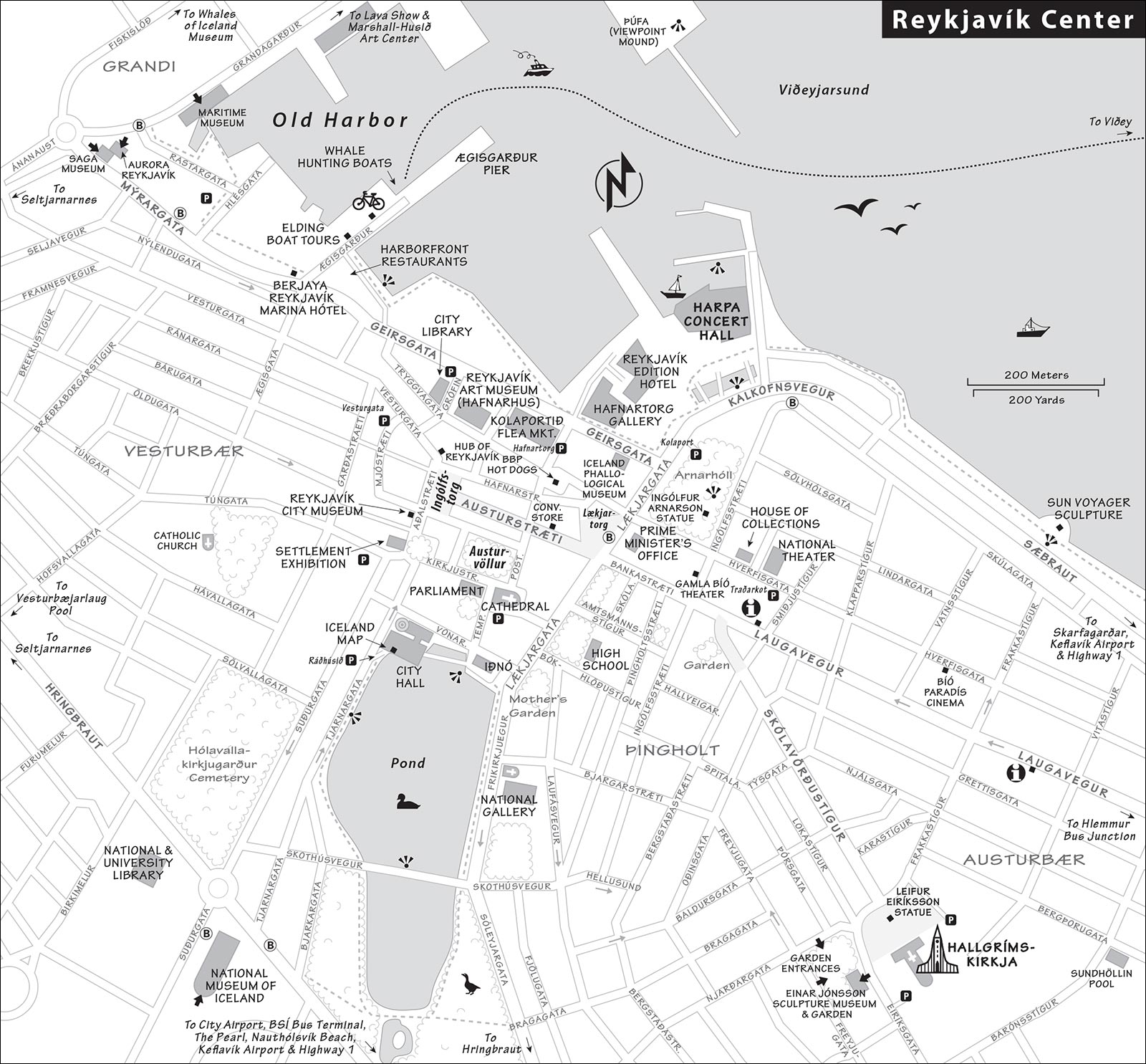
This self-guided walk, rated ▲▲▲, introduces the highlights of downtown Reykjavík, as well as some slices of local life, in about one and a half to two hours. While a few indoor sights may be closed early or late, the walk can be done at any time—allowing you to fit it in before or after your day trips. The walk starts at one of Reykjavík’s central squares, Ingólfstorg, and finishes at Hallgrímskirkja, the big, landmark church on the hill. As Reykjavík is likely your first stop in Iceland, I’ve designed this walk as a crash course not only for the city, but for the whole country—introducing you to names, customs, stories, and themes that will come in handy from here to the Eastfjords.
• Begin on the modern, sunken square called...
1 Ingólfstorg (Ingólfur’s Square)
While this somewhat uninspiring square isn’t much to look at, it packs a lot of history and myth—and it’s a central gathering place for local events and festivities. Ingólfstorg is named for Ingólfur Arnarson who—according to the Icelandic sagas—settled at Reykjavík in 874. You can think of him as Iceland’s version of the Pilgrims.
In the middle of the square, look for the two nondescript stone pillars (one of them marked 874). These recall the much-told legend about Ingólfur: As he sighted the southeast coast of Iceland, he followed an old Scandinavian custom and threw the two carved wooden pillars from his “high seat” (belonging to the head of the household) overboard—vowing to establish his farm wherever they washed ashore. In the meantime, he set up a temporary settlement on the South Coast and sent two of his slaves on a scavenger hunt all over the island. Three years later (in 874), they discovered the pillars here. Ingólfur called this place Reykjavík, meaning “Smoky Bay”—likely for the thermal vapor he saw venting nearby.
While the details of this story are a mix of fact and legend (see the “Sagas of the Icelanders 101” sidebar in this chapter), archaeologists confirm that the original Reykjavík farm was just a few steps from where you’re standing. And for most of its history, Reykjavík remained nothing more than a farm—set between the sea and a pond a few hundred yards inland (we’ll go there in a few minutes). But in the 18th century, Reykjavík gradually emerged as the country’s dominant town and the logical seat of Iceland’s government.
Ingólfstorg was not an open space until 1944, when a big hotel that used to stand here burned down. The lot was left vacant and became a seedy hangout where Reykjavík teens would drink, smoke, and do other things they didn’t want their parents to know about. Locals called it Hallærisplan (which means, roughly, “Messed-Up Square”). Only in 1993 was it cleaned up, redesigned, and respectably renamed.
Today, this square is designed for skateboarders, and you’ll see everyone from motorcycle clubs to young families enjoying themselves here on a nice day. The square hosts regular outdoor concerts and performances in summer. For important soccer matches, a big screen is erected on the square for lively watch parties. In winter, the square is transformed into an ice-skating rink. Lining Ingólfstorg are cafés, takeout joints, and ice-cream shops (Icelanders love a decadent bragðarefur—a giant cup of soft serve with various mix-ins).
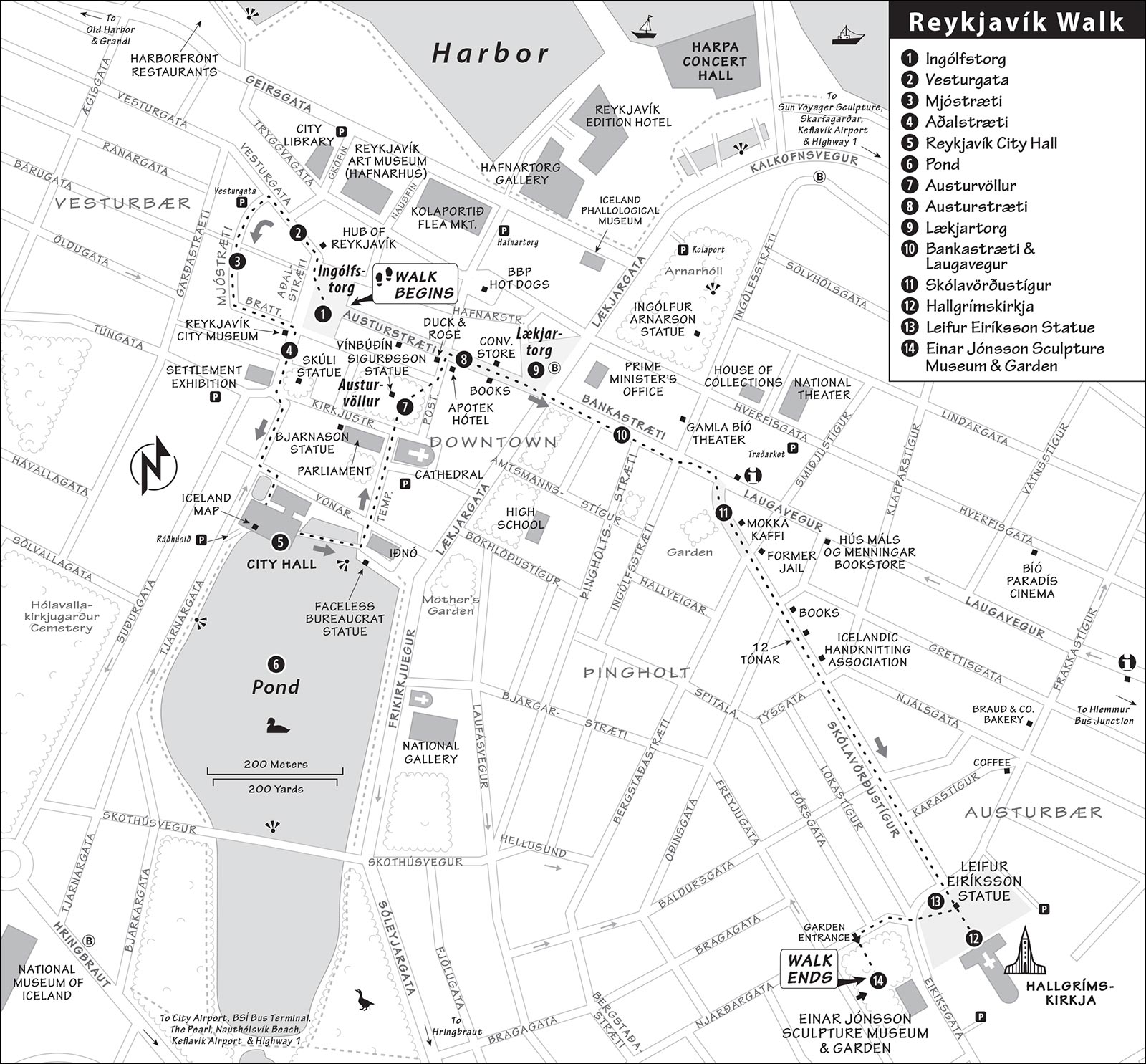
The big, glass-fronted, eight-story building that dominates the square represents the latest chapter in Reykjavík’s story: its recent tourism boom. Long the headquarters of Iceland’s biggest newspaper, those offices recently moved out to the suburbs, and the building is now a hotel. A generation ago, downtown Reykjavík was mostly offices, government institutions, cheap housing, and lots of students. But with the flood of tourism over the last decade, most of these have been replaced by hotels, bars, restaurants, shops, and tour operators; the number of Icelanders who actually live downtown has dropped sharply.
• Let’s take a little loop through the back streets. Facing that big building, angle to the right and walk to the end of the square. The diagonal street leaving the square is...
2 Vesturgata, Reykjavík’s Original Shoreline
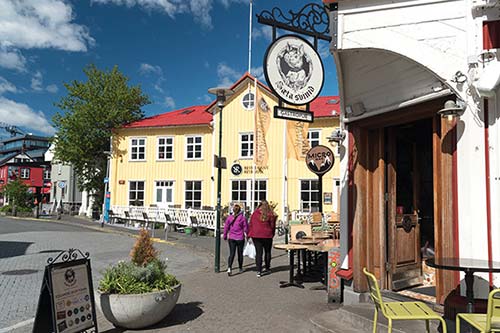
This lovely lane (literally “West Street”) is lined with colorful buildings from the early 20th century. The yellow building (today being converted into another food hall) was once the base of the town pier, back when the waterfront came all the way up to this point. The entry to the pier ran under the building’s tower (beneath the round window). In 1874, when the king of Denmark visited Iceland, his fleet anchored in the harbor, and he came ashore on a little boat right here. Around 1910, land reclamation created the modern harborfront zone, just beyond the yellow building. Today, this so-called Old Harbor area has some appealing sights (see here).
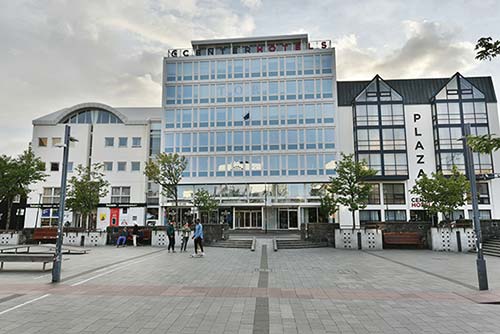
In the sidewalk immediately in front of the yellow building, notice the brass plaque marking the “hub of Reykjavík”—both the symbolic gateway to the city and the spot from where the city’s address numbers radiate.
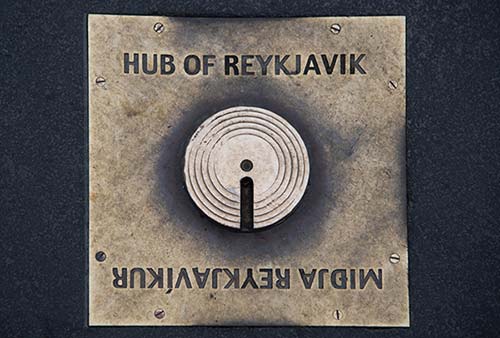
Around the left side of the yellow building, you can spot faint remains of the original wharf, and a little tidal pool that’s still connected underground to the harbor (for a better look, cross partway over the little footbridge and look down). Several recommended restaurants are on or near this square (see “Eating in Reykjavík,” later).
• Now continue along Vesturgata. Just after the bright red building on the left corner, turn left onto...
3 Mjóstræti, Back-Streets Reykjavík
Even in the bustling downtown of Iceland’s capital, you’re never more than a block or two away from a sleepy residential area. Stroll a couple of blocks along Mjóstræti (Narrow Street), appreciating some slices of Reykjavík life.
As you walk along Mjóstræti, notice, by a bench, one of Reykjavík’s distinctive fire hydrants—painted in garish, McDonald’s-esque red and yellow. Residents embrace these cheery hydrants, some embellished with faces, as a sort of local symbol.
Moving on, you’ll see houses sided with vertical corrugated metal (usually steel, galvanized with zinc). Since the late 19th century, corrugated metal sheets have been widely used for siding and roofing in Iceland. Many cover and protect older wooden walls. Wood, which needed to be imported on this treeless island, didn’t do well when exposed to the harsh weather. Corrugated metal, meanwhile, stands up well to the punishing wind and sideways rain, doesn’t burn, is easy to maintain, is cheap and easy to transport to Iceland, and can dress up renovated old houses as well as new ones. Concrete is another popular building material here (durable and economical). With either material, many locals prefer to use brightly saturated hues, perhaps to help cheer them through the gloomy winters. Around town, you may also notice a few houses with boring gray metal: Newer siding needs to weather for a few years to get rough enough for primer and paint to adhere.
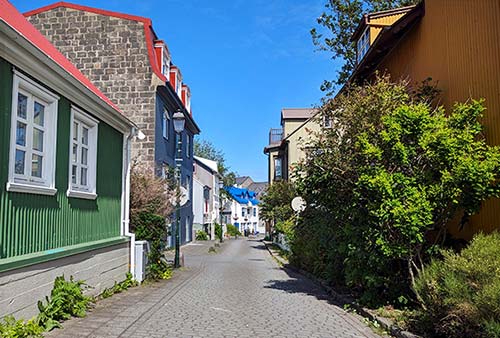
As you stroll, notice lots of propped-open windows. Icelanders mostly heat their homes with geothermal hot water—harnessing the substantial natural power of their volcanic island. Ninety percent of buildings in Iceland are heated geothermally. There are radiators in every room, but typically no central thermostat. Heating costs are low, so when things get too warm or stuffy indoors, Icelanders just open the window to create a cross-breeze. For tourists, opening a window also helps vent the sulfur smell that accompanies the city’s scalding-hot tap water, which is piped in directly from boreholes in the countryside. (Residents are used to the smell and don’t even notice.)
Another way Icelanders use all that hot water is to heat swimming pools. Every Iceland town has a municipal thermal pool complex where locals swim laps, relax, and socialize—particularly appealing in the cold and dreary winter months. These basically feel like your hometown swimming pool...except the water is delightfully warm-to-hot year-round. Tourists are welcome to join in the fun, and many find it the most local-feeling experience they have in Iceland. (For more about visiting pools, see “Experiences in and near Reykjavík,” later.)
Any cats roaming around? Reykjavík has a relaxed, small-town vibe, and people tend to let their cats wander free by day. Some neighborhood cats have even become local celebrities. Watch for clever little cat doors built into windows and doors. You won’t see many dogs, though; until 1984 they were banned in the city for health reasons, and condo owners still need permission from their neighbors to keep a dog.
• After another block, Mjóstræti dead-ends into someone’s driveway. Turn left on Brattagata and head downhill. You’ll pop out back at the bottom of Ingólfstorg square, on...
4 Aðalstræti, Reykjavík’s First Street
While today it feels more like an alley, this “Main Street” (as its name means) was Reykjavík’s first thoroughfare.
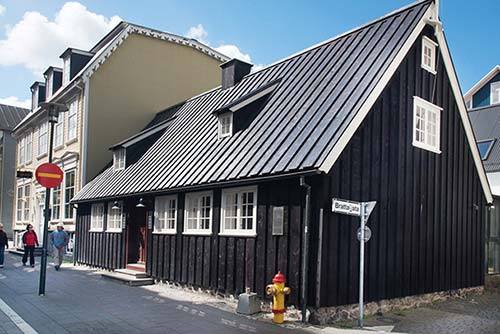
The one-story black house on your right (at Aðalstræti 10, now part of the Reykjavík City Museum, described later under “Sights in Reykjavík”) was originally built around 1760 for the textile industry. The current version is a complete rebuild (only the location of the walls is original), but faithful to the original style. The hand pump across the street (under the arcade) is a reminder that, until 1910, locals used pumps like this one as their sole source of drinking water.
Turn right down Aðalstræti. A few doors down on the right is the Hótel Reykjavík Centrum. When this hotel was built in 2001, workers unearthed the ruins of a 10th-century Scandinavian longhouse—part of the original Reykjavík farm. Today it’s the excellent Settlement Exhibition, where you can step down into the cellar and walk around the ancient structure (described later, under “Sights in Reykjavík”).
Opposite the hotel, a statue of Skúli Magnússon stands in a small square with a few trees. Skúli was an Enlightenment-era entrepreneur whose enterprises seeded the settlement of Reykjavík in the mid-1700s—finally transforming it from a farm into a real town, and setting the stage for its eventual capital status. While Ingólfur may have settled in Reykjavík, Skúli put it on the map. The little square was the village cemetery until 1838.
• Directly in front of Skúli is a lane called Tjarnargata (between two yellow houses). Follow this for a long block to Vonarstræti, where you’ll see, on your left, a large, modern concrete building with a curved roof and a mossy pond in front. This is the...
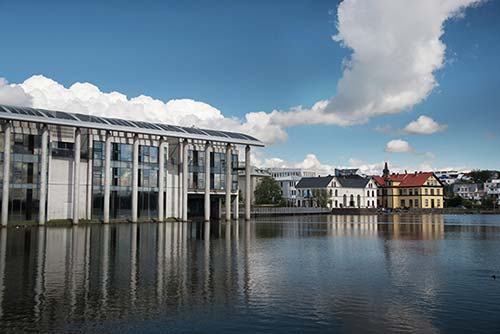
5 Reykjavík City Hall (Ráðhús Reykjavíkur)
Enter the blocky, curved-roofed, concrete-and-glass building using the door at the inner corner of the fountain (Mon-Fri 8:00-18:00, Sat from 10:00, Sun from 12:00, free WCs). The city council meets upstairs, but most city offices are outside the center, and this “City Hall” is more of a ceremonial hall for the city’s residents. Its ground-floor space, normally open to the public, is rented out for concerts, exhibitions, and other cultural events.
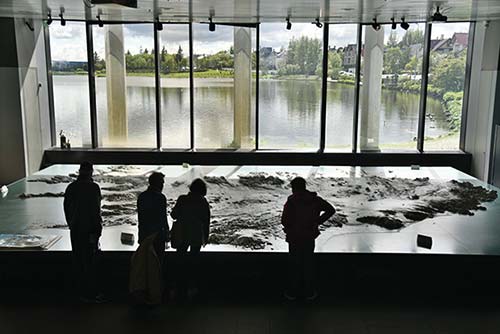
A huge wooden relief map of Iceland is usually displayed in front of the large windows overlooking the little lake known as the Pond. The towns on the map are not labeled, but it’s easy to find Reykjavík and the Reykjanes Peninsula: Look for the airport. Pick out the island’s major landforms: Fjords ruffle the coastline in the northwest (the Westfjords), the east coast (the Eastfjords), and the far north (Skagafjörður and Eyjafjörður, flanking the mountainous Tröllaskagi—“Troll Peninsula”). Glacier-covered volcanic peaks loom ominously above the South Coast, while the desolate Highlands cover the middle of the country. Trace your own route through Iceland; spotting the roads and towns around the country is absorbing. Topographic maps help you identify fjords, mountains, and rivers.
• Exit the building to the left from where you entered, and walk across the pedestrian bridge that runs along...
6 The Pond (Tjörnin)
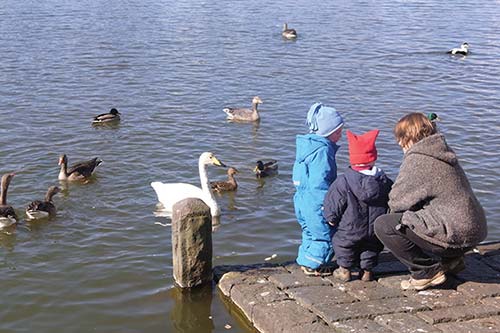
This miniature lake feels just right for this small capital of a small country. On sunny days, parents bring small children to feed the ducks and swans that live in the Pond. In the winter, when temperatures drop to a safe range, snow on the Pond is cleared away to make a skating rink. It’s a pleasant one-mile walk all the way around.
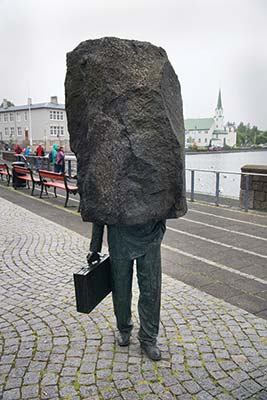
At the far end of the pedestrian bridge, you’re greeted by a quirky statue of a faceless bureaucrat. The period building next to him is Iðnó, Reykjavík’s old theater, which now houses a café and cultural space for weddings, concerts, and events (and is said to be haunted).
Gaze out to the far end of the Pond, where you’ll see some of the University of Iceland buildings (that’s the science center with the curved glass roof). The country’s oldest and largest university, with a total enrollment of around 16,000, was founded in 1911. Before that, students had to go abroad for college (mostly to Denmark)...a reminder of just how recently this country came into its own.
Farther right, rising a couple of stories above the rooftops, is the brown tower of the recommended National Museum, where a thoughtfully explained collection of artifacts tells the story of Iceland (described under “Sights in Reykjavík”). Along the right side of the Pond are fine homes built by wealthy families a century ago.
On the left of the Pond is the historic Free Church of Reykjavík, a Lutheran congregation that broke from the state church over a difference in social issues.
• Standing next to the “faceless bureaucrat,” turn your back to the Pond, cross the street, and walk straight up Templarasund. You’ll arrive at a lovely little park with a big statue in the middle. Stand by the statue and get oriented to...
7 Austurvöllur, Iceland’s Parliament Square
Translated roughly as “Eastern Field,” Austurvöllur is the political center of this small country. With your back to the statue, the big, stone building facing the square is Iceland’s parliament, the Alþingi (pronounced, roughly, “all-thingy”). While Icelanders like to call the Alþingi the “world’s oldest parliament,” this is an exaggeration. The Alþingi that met at Þingvellir in the centuries after settlement was very different from a modern democratic parliament. From about 1400 to 1800, it was an appeals court, not a legislature. Then there were 45 years when the Alþingi didn’t meet at all. It was reestablished in Reykjavík, in a totally new and different form, in 1845. In 1874, Iceland received a constitution that gave the Alþingi real decision-making power—even though Iceland remained fully part of Denmark.
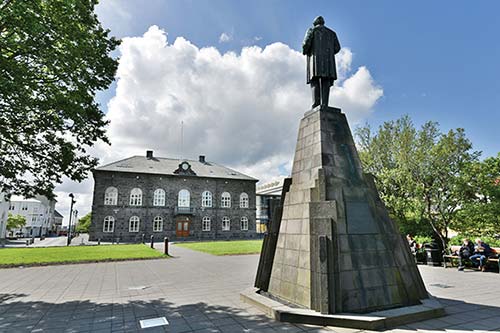
On the building’s gable, notice the crowned 9, which represents King Christian IX (the Danish ruler in 1881, when the building was erected). Engraved over four of the upstairs windows of the Alþingi, notice the mythical “four protectors of Iceland”—dragon, eagle, giant, and bull—which also appear on Iceland’s coat of arms and many Icelandic coins. (As if to drive home Iceland’s closeness to the sea, the flipsides of the coins feature cod, dolphins, crab, and lumpfish.) Imagine Iceland when this was built, in 1881, its people so excited to have at least some self-rule. One of the poorest countries in 19th-century Europe, it’s said that this single building cost a third of the entire country’s national income.
There are no public tours of the Alþingi, but if parliament is in session visitors are welcome to sit in the gallery (confirm session times at www.althingi.is—typically Mon and Wed at 15:00, Tue at 13:30, and Thu at 10:30). The gallery entrance is around the back of the building, by a fine little walled garden that’s open to the public.
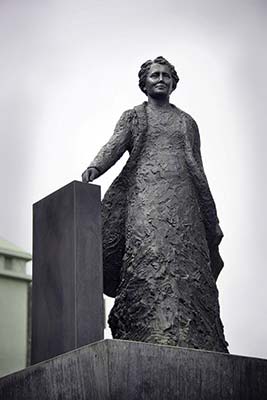
At the right end of the Alþingi, notice the statue of a strong woman on a pillar: Ingibjörg H. Bjarnason (1867-1941), who was elected Iceland’s first female member of parliament in 1922. Iceland has an impressive tradition of honoring women’s rights. On October 24, 1975, 90 percent of Icelandic women went on strike to drive home their importance to society. The country ground to a halt. (Icelandic men—who very quickly learned their lesson—gave the protest the tongue-in-cheek nickname “The Long Friday,” which is also what Icelanders call Good Friday.) In 1980, Iceland became the first modern, democratic nation to elect a female head of state, when single mother Vigdís Finnbogadóttir became president. She served for four terms (16 years) and remains a beloved figure today.
Facing the Bjarnason statue, at the corner of the park, notice the chunk of rock split in half by The Black Cone. This monument to civil disobedience was placed here in 2012—when memories of the 2008-2009 protests blaming the government for the country’s financial disaster were still fresh and, for some, painful.
Now turn your attention to the statue on the pillar in the middle of the square: Jón Sigurðsson (1811-1879) was the 19th-century scholar and politician who successfully advocated for Iceland’s increased autonomy under the Danish crown. Jón spent most of his life in Denmark, where he politely but forcefully pressed the case for freer trade and a constitution that would reduce the king’s power. At the time, many other Europeans were agitating for the same kinds of things, and often took up arms. But Icelanders achieved their goals without firing a shot—thanks largely to the articulate persistence of this one man. The parliament building was finished just a couple of years after Jón’s death. In Jón’s honor, his birthday—June 17—became Iceland’s National Day.
Look around the square. Early each summer new turf is laid and flower beds are filled in preparation for National Day ceremonies and speeches. But it was quite a different scene in the winter of 2008-2009: Thousands of Icelanders gathered here to demand the government’s resignation in the wake of the country’s financial collapse. Protesters banged pots and pans with wooden spoons, and pelted politicians with eggs and tomatoes (hence the protest’s nicknames, the “Kitchenware Revolution” and the “Pots and Pans Revolution”). New elections were called, and the prime minister was censured for failing in his responsibilities. Ólafur Þór Hauksson—a small-town cop who became the unyielding special prosecutor for financial crimes—emerged as something of an international folk hero. A good number of bankers were tried, convicted, and in a few cases jailed for their role in the crisis.
Then, in spring 2016, thousands came to this square again after it was revealed that Iceland’s then-prime minister had kept some of his considerable family wealth in an offshore account in Panama. Again, new elections were called.
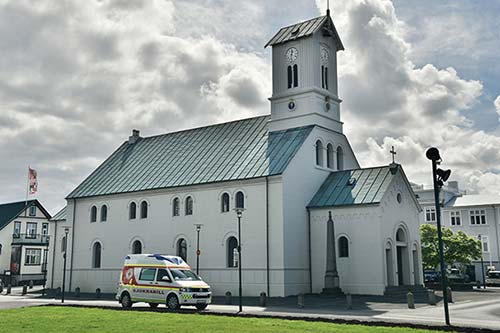
To the left of the Alþingi is Reykjavík’s Lutheran Cathedral (Dómkirkjan; generally Mon-Fri 10:00-14:00, closed Sat-Sun except for services, occasional concerts—look for posters, www.domkirkjan.is). Surprisingly small, it was built in the 1790s and expanded in the 1840s. The city now has larger churches, but the cathedral is still regularly used for weddings, funerals, and the opening of parliament. If you go inside, you’ll find a beautifully tranquil interior, with an upstairs gallery and finely painted ceiling. The centerpiece—directly in front of the main altar—is a marble baptismal font by renowned 19th-century Danish sculptor Bertel Thorvaldsen, whose father was Icelandic.
• Exit the square behind Jón Sigurðsson’s left shoulder, and go one short block up the street called Pósthússtræti (Post Office Street). Pause at the intersection with Austurstræti (Eastern Street), in front of Apotek Hótel and its restaurant.
8 Austurstræti, Reykjavík’s Main Street
Reykjavík’s main drag begins about a block to your left (at Ingólfstorg, where we started our walk) and continues about a mile to your right, changing names as it runs through town.
Looking straight ahead, on your right is the red former post office building (now the recommended Pósthús Food Hall & Bar; see “Eating in Reykjavík,” later). Across the street on the left, the old-meets-new building is Landsbankinn, founded as Iceland’s national bank in 1886. It was privatized around 2000, failed spectacularly in 2008, and then continued operations under a slightly altered name. Past that, at the end of the block, you’ll see a white, boxy building that houses the Kolaportið flea market on weekends—a fun browse, even for nonshoppers (see here).
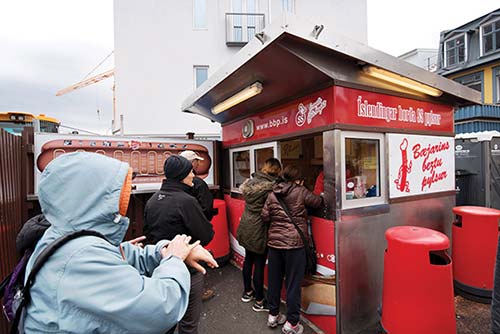
Tucked away kitty-corner from the flea market (just down this street and on the right, a block away but not quite visible from here) is Reykjavík’s most famous hot-dog stand. (You can side trip there now, or come back later.) It’s been serving weenies to an enthusiastic local following since 1937. In 2004, Bill Clinton was in Reykjavík to speak at a UNICEF event. When the proprietor of this stand offered him a free frankfurter, Clinton—a notorious connoisseur of junk food—couldn’t say no. Camera shutters clicked...and suddenly, eating at Bæjarins Beztu Pylsur—“The City’s Best Sausages”—became the thing to do when visiting Reykjavík. Now people stand in long lines to shell out 690 ISK for what is, by any honest assessment, a fairly average weenie.
Back on Austurstræti, look up at the Art Deco-style facade of the Apotek Hótel. This was designed by Guðjón Samúelsson, Iceland’s best-known 20th-century architect, who’s responsible for many of the major landmarks around town—including his masterpiece church, Hallgrímskirkja.
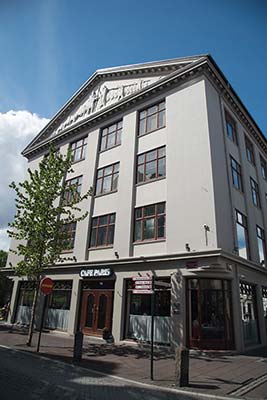
Facing the hotel, across the street, is Duck & Rose, an Italian/French restaurant. Look up at the relief on the pediment-like gable, from the 1920s, which shows an imagined scene from the settlement of the country: An established settler—standing in front of his pack animals—shakes hands with a new arrival, whose crew is taking down the mast of his longship. While you may sometimes hear the word “Viking” used to describe those early Icelandic settlers, that’s not quite right. They were contemporaries (and actually relatives) of the Vikings, but had a different modus operandi: Rather than pillage, plunder, and rape, the first Icelanders were mostly farmers in search of good grazing land.
Now look up the street past Duck & Rose (back toward Ingólfstorg). On the left side of the street (next to the English pub), notice Vínbúðin—one of the unobtrusive state-run liquor stores. Only weak beer can be bought at supermarkets; every other kind of alcohol can be purchased only here. While nationalized liquor stores are fairly standard in Nordic countries, Iceland has at times taken a particularly hard line against alcohol. From 1915 all the way until 1989—in an attempt to curtail everyone’s favorite, cheap “gateway drug”—beer with an alcohol content over 2.25 percent was illegal. Icelanders compensated by mixing spirits—which were, oddly, perfectly legal—with light beer, creating a super-alcoholic faux-brew. Today, as if making up for lost time, Iceland has a vibrant craft beer culture (see recommendations, including many within a few steps of this walk, on here). Also look for the Icelandic firewater called brennivín. In another anti-alcohol crusade, originally the brennivín bottle came with a health warning in the form of a black skull. While that’s long gone, today the drink still carries the tongue-in-cheek nickname “Black Death” (svartidauði). The only cheap way to try the interesting array of local beers is to buy them here—a fun, affordable cultural experience. Single cans and bottles cost about 300 ISK each.
From Pósthússtræti, turn right and walk up Austurstræti. After a few steps, on your right, look for one of the city center’s three main bookstores (this one is run by Eymundsson—Iceland’s answer to Barnes & Noble). Books are clearly valued here: A high percentage of Icelanders are published authors, and every Icelandic living room has shelves of books on display. Books also play a key role in Christmas gift exchanges: The Iceland publishers’ association mails a catalog of the year’s new releases each fall, just in time for holiday shopping lists.
• Across the street from the bookstore is a 10-11 convenience store, useful for bus tickets or a bus pass (or to grab one of those ubiquitous Icelandic hot dogs). At the end of the street, you’ll emerge into a square fronting a busy street. Stop here to survey the scene.
9 Lækjartorg (Creek Square)
This square and the adjacent, busy street (Lækjargata) are named for a creek (lækur) that ran from the Pond (to your right) down to the sea (to your left) in Reykjavík’s early days. It still flows, but was buried in an underground culvert more than a century ago.
Traditionally, Icelanders’ last names were patronymics, formed from the father’s name plus “son” or “dóttir.” So if you meet a man named Gunnar Magnússon, you know his father’s name was Magnús. If Gunnar has a son Jón, he’ll be named Jón Gunnarsson. A daughter María will be María Gunnarsdóttir. Get it? (This system was the norm all over Scandinavia until just a few hundred years ago.) Women keep their name at marriage.
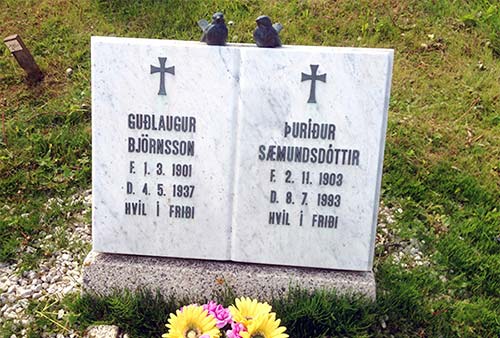
Around 1900, fashions changed, and Icelanders started to assume family names and pass them down from generation to generation, like in the US. Then the pendulum swung back: In 1925, family names were banned as un-Icelandic, but people who had already taken one were allowed to keep it. (You may run into a few of these today.) Things went so far that for a few decades, immigrants who wanted to take up Icelandic citizenship had to abandon their foreign surname and choose an Icelandic patronymic (this requirement was abolished only in the 1980s). Today, with immigration rising, and many marriages between Icelandics and immigrants, family names are on the increase in Iceland again.
These days, Icelanders can choose to form their children’s last name from either parent’s first name. So, if Gunnar and Katrín have a son, they could give him the last name Katrínarson. But the country’s Personal Names Committee still controls what first names parents can give their children (from a list of 3,500 authorized names). Parents can also submit new names to the committee for approval. While this seems oppressive, it’s largely a grammatical concern—to ensure that names will work within the structure of the Icelandic language. Recently, politicians have moved to abolish the committee. Stay tuned.
All Icelanders address each other by first names, which may seem strangely informal. But in Icelandic, using a person’s full first name actually has a ceremonial ring to it. Most Icelanders go by a nickname among family and friends, so Magnús’s old schoolmates probably call him “Maggi.” But strangers wouldn’t dare call him anything less than Magnús. There’s no real equivalent of “Mr.” or “Ms.” in Icelandic.
It’s traditional for Icelandic parents to reveal their children’s names only when the child is christened (usually a few weeks after birth, but the law lets them wait for up to six months). Many parents choose the name before the birth, but still follow custom and keep it a secret. Others appreciate the chance to get to know their child before deciding. In the meantime, parents use nicknames for their baby, like “The Short One.”
What children do get within minutes of birth is a 10-digit identification number, based on their birth date, which follows them through life. This number, called the kennitala, is almost like an alternative name, and Icelanders use it very openly and casually to identify themselves to schools, banks, or the power company. Anyone can look up anyone else’s ID number and address. This shocks Americans, who are used to keeping their Social Security number secret. Despite—or perhaps because of—this openness, identity theft in Iceland is practically unknown.
By the way, many Icelandic first names are comically hard for tourists to pronounce, something locals have fun with. (And locals in the tourist trade generally have an easy-to-remember nickname.)
Look across the street at the white stone building with the five upstairs windows. As Reykjavík grew in the mid-1700s, the first building constructed of materials more permanent than turf or timber was not a church or palace but a prison, built across the creek from the village center. Today it’s the office of Iceland’s prime minister. The no parking sign out front indicates the spot reserved for the prime minister.
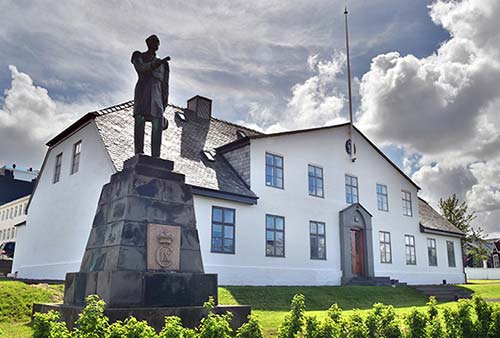
But no matter how high you rise in Icelandic society, you’re called by your first name—so President Guðni Jóhannesson is known to Icelanders simply as “Guðni.” That’s why, in this book, I’m on a first-name basis even with big-name historic Icelanders. This isn’t necessarily because Icelanders are more casual than the norm—it’s because of the unique way they form their last names. (For more on this tradition, see the “Icelandic Names” sidebar, above.)
Flanking the prime minister’s office are two streets: Bankastræti (on the right) runs uphill for a couple of blocks, and then changes its name to Laugavegur. This has long been the main downtown shopping street; we’ll head up this way soon. Hverfisgata (on the left), a more heavily trafficked commercial street, is where city buses run on their way between the two main bus stops downtown: Lækjartorg (where you’re standing) and Hlemmur (just under a mile to the east).
On the hill to the left of Hverfisgata are many government offices, including Iceland’s supreme court, ministry of finance, and central bank.
Cross the busy street. Before you head straight uphill on Bankastræti, look back on your left by the harbor. The dark, glassy, boxy building is called Harpa—Reykjavík’s concert hall and conference center. Don’t trek out to Harpa now; at the end of this walk, you can head to Harpa to enter the hall’s futuristic lobby for a good look at its multicolored windows.
• Now, walk uphill on Bankastræti (passing the prime minister’s office on your left).
10 Bankastræti/Laugavegur, More of Reykjavík’s Main Drag
By the end of the 19th century, Reykjavík had expanded, and most people lived on this side of the town’s little creek. This stretch became the city’s main shopping and business street. Today, most locals shop at malls and in the suburbs, and services along Laugavegur are geared toward tourists.
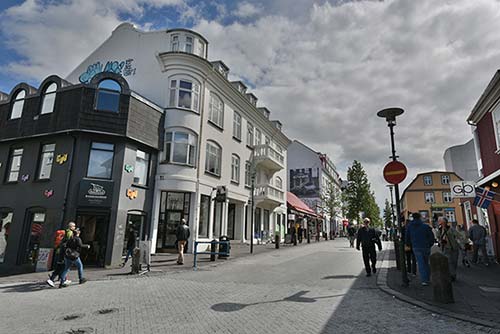
A half-block up on your left, notice another old stone building (marked with the Stella sign). This was Iceland’s first bank building, built in 1882, which gave Bankastræti its name.
Continuing up Bankastræti, notice the moveable traffic barriers (including some shaped like bicycles). In the summer, some stretches of this street are closed to cars to promote strolling.
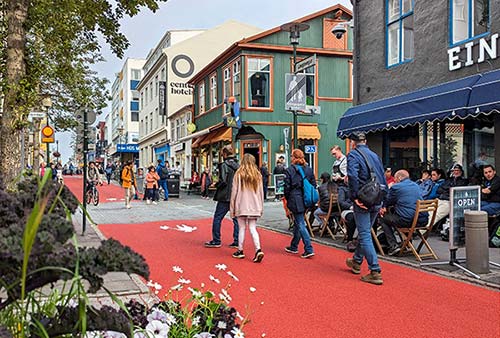
Keep your eye out—both along this main strip, and in the residential side streets—for big street-art murals. This isn’t eyesore graffiti, but quite the opposite: Locals have found that if you supply a blank canvas, it’ll be tagged. But if you decorate it yourself, taggers leave it alone. So government and private property owners commission murals like these. Many of the most renowned Icelandic street artists are women. The back lanes are even more highly decorated than the main streets we’re seeing on this walk—be sure to explore later.
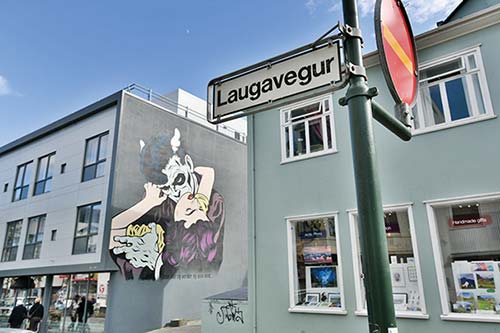
After two short blocks, pause at the lively intersection where Skólavörðustígur splits off to the right (dead-ending at Hallgrímskirkja, crowning the bluff). This is also where Bankastræti becomes fully pedestrianized and changes names to Laugavegur (roughly LOY-ga-VEH-grr, Hot Springs Road)—once the walking route for those going to do their laundry in the Laugardalur hot springs east of downtown. We won’t walk the length of Laugavegur right now, but you’ll certainly find plenty of excuses to explore it while you’re in town—many of the city’s best restaurants, shops, and bars are on or within a few steps of this street. About 10 minutes’ walk away, at Laugavegur’s far end, is Hlemmur, the main city bus junction (with a small but trendy food hall). While the entire drag is commercialized, the farther you go up Laugavegur, the less it feels like a tourist circus.
• From here, dogleg right and head uphill on the rainbow-painted street toward the distant church steeple. This is...
11 Skólavörðustígur Street
This street (SKO-la-vur-thu-STEE-grr, “School Cairn Lane”) leads up to Hallgrímskirkja church. The street got its name from a pile of rocks that Reykjavík schoolchildren set up long ago atop the hill, near where the church is now. Like Laugavegur, this street is lined with cafés, restaurants, and bookstores. As it’s a bit less congested, and capped with a lovely church steeple, this street is a favorite place to stroll in Reykjavík.
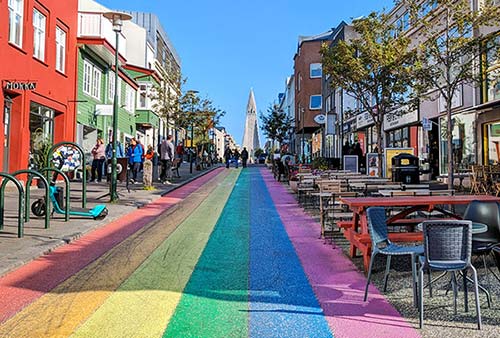
More recently, the street’s been dubbed “Rainbow Street,” for the exuberant mural painted here at its bottom end. Originally, it was painted as a temporary decoration to celebrate Pride Month. But locals loved the way it enlivened the city—and celebrated their society’s emphasis on equality and human rights—so now it’s a permanent fixture.
As you follow the rainbow up Skólavörðustígur, keep an eye out for a tiny gap and gate between the buildings. Discreetly admire the private little garden facing a bright red house—a tranquil parallel world to the bustle just a few steps away. Many downtown blocks have an interior garden, shared among the surrounding houses. Sometimes, like here, little houses are tucked behind other houses. This was a good way to increase the capacity of your lot in this city of chronic housing shortages (and loosely enforced building regulations).
Back on Skólavörðustígur, continue a block uphill. A few steps up on the left is a café called Mokka Kaffi. The first place in town to do fancy Italian-style coffee (since 1958), it’s long been a writers’ hangout and retains its old atmosphere. Farther up on the left, you’ll see another old stone building. It looks a bit like the one-time prison we saw earlier (the prime minister’s office). This is another former jail, built in 1874, that remained in use until summer 2016. Run your fingers over the chunky, volcanic rock in the building’s facade.
Just past the jail, also on the left, the boxy three-story building at #11 was a bank, until the financial crisis, and now houses a branch of the Eymundsson bookstore chain.
While the lower end of the street is dominated by big, glitzy shops (like the venerable Rammagerðin handicraft shop and Hekla clothing store), as you continue uphill the shops become smaller, more characteristic boutiques. Ceramic and jewelry shops—often with a small workshop in the back—are popular along here. At #15 (on the left), 12 Tónar is Reykjavík’s most beloved music store, specializing in Icelandic tunes. Browsers can listen in their sampling lounge and enjoy a free cup of coffee. A few doors up at #19 (with the red metal balcony) is the Handknitting Association of Iceland’s shop, a co-op where you can browse expensive but top-quality handmade Icelandic sweaters and other woolens. For more recommendations, see “Shopping in Reykjavík,” later.
• The final couple of blocks on the street are increasingly residential. It’s fun to explore the side streets in this neighborhood, where you’ll find more corrugated metal siding, propped-open windows, street art, hidden gardens, and cats. But for now, continue straight uphill until you run right into...
12 Hallgrímskirkja Lutheran Church
After Reykjavík’s Catholic minority built their church atop the hill west of downtown in 1929, Lutheran state church leaders felt they needed to keep up. They hired the same well-known architect, Guðjón Samúelsson, and commissioned him to build a taller, bigger response on the higher hill to the east of downtown. His distinctive Hallgrímskirkja (HAHTL-greems-KEER-kyah) was designed in the 1930s, with construction beginning in 1945, but was not completed until the 1980s. On New Year’s Eve, this square is where locals gather to watch fireworks.
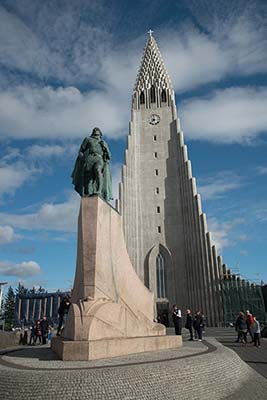
The basalt-column motif soaring skyward on the facade recalls Iceland’s volcanic origins—and evokes the cliffs you’ll see around the country. In the winter, as you look up from Skólavörðustígur, light shining out through the windows makes the top of the 250-foot tower glow like a giant jack-o’-lantern.
Guðjón Samúelsson (1887-1950)—an Icelander who trained in Denmark—was Iceland’s most influential architect. Arriving back home after finishing his studies in 1919, he was hired as the government’s in-house building designer—a plum post that he kept until his death. These were good years for architects, as Iceland urbanized and the availability of concrete opened up new design possibilities. Guðjón’s favored aesthetic was the functionalist style typical of the 1920s and 1930s. He attempted to forge a distinctly Icelandic architectural style...and, because he designed so many buildings here, you might say he succeeded. In Reykjavík alone, he designed this church, the main university building, the original National Hospital building, the National Theater, the Sundhöllin swimming pool, the Apotek Hótel we saw earlier, and the Hótel Borg across the square from the parliament building.
Hallgrímskirkja is named for the 17th-century Icelandic poet Hallgrímur Pétursson, who wrote a well-known series of 50 hymns retelling the story of the Passion of Christ.
This is a good time to visit the interior of the church and maybe climb the tower. For details on both, see the listing on here of “Sights in Reykjavík.”
• Prominently displayed in front of the church is a...
13 Leifur Eiríksson Statue
Known as Leif Erikson (c. 970-1020) to Americans, this Viking Age explorer was—if we can trust the sagas—the first European to set foot on the American continent. The sagas weave a colorful tale of Leifur’s outlaw-family lineage and his clan’s explorations. His grandfather, Þorvaldur Ásvaldsson, was exiled from Norway to Iceland, and his father, Eiríkur Þorvaldsson (Erik the Red), was in turn exiled from Iceland—establishing the first settlements on Greenland. Leifur carried on farther west, seeking a mysterious land that had been spotted by another Nordic sailor when he was blown off course.
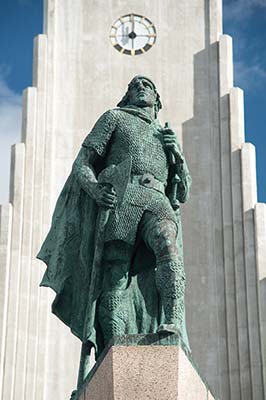
Around five centuries before Christopher Columbus, Leifur and his crew landed in the New World, very possibly at L’Anse aux Meadows, in today’s Newfoundland, where there are ruins of a Viking Age complex. Norsemen may have established more settlements in this area—which they called Vínland (meaning either “Land of Wine” or “Land of Meadows”) for its relatively lush climate—but if so, they did not last. On his way home, according to the sagas, Leifur rescued the crew of another ship that had been stranded on a small island, and after that he was dubbed “Leifur heppni” (Leif the Lucky). The US government donated this statue to mark the Alþingi’s 1,000th anniversary in 1930. The inscription delicately acknowledges Leifur as the “discoverer of Vínland”—but not of America.
If it’s summertime, in the park flanking Leif the Lucky, look for three types of flowers that grow abundantly in this otherwise inhospitable land: the vivid purple Nootka lupine (from Alaska, introduced to Iceland in the mid-20th century to combat erosion); bright yellow European gorse, an alpine shrub with a pungent herbal fragrance in the early summer; and...dandelions. All three are considered weeds in much of the world, but most Icelanders don’t remove them. As one local explained, “We’re just happy when anything grows here.”
• We’ll finish our walk with one more hidden sight. With the church at your back, turn left and head toward the bunker-like mansion. You’ll curl around the right side of this building, passing a fun little metal cutout that lines up perfectly with the jagged roofline of the church—turn around and try it. Just past the cutout, watch for a gate on the left and enter the...
14 Einar Jónsson Sculpture Garden
Of Iceland’s notable artists, Einar Jónsson (1874-1954) was one of the first and most significant. After studying in Copenhagen and Rome, Einar made his name working in big European capitals. But, like so many Icelanders, after half a lifetime of living abroad he felt drawn back to his homeland. Einar struck a deal with the Alþingi (much like the sculptor Gustav Vigeland did in Oslo): If they built him a mansion and studio, he’d move back to Reykjavík and bequeath all that he produced to the city. He designed and built this house back when this was a naked, largely uninhabited hilltop (not even the church was built yet), seeding what has become a desirable neighborhood.
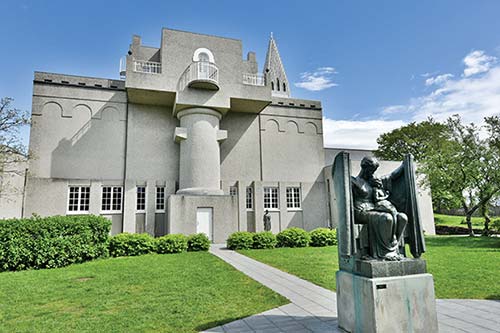
Linger over the 26 bronze works in the sculpture garden (free to enter, open late). Einar’s statues—with universal human themes—are taut with tension and angst. Einar was a fearful man, yet also very spiritual; his work suggests glimmers of hope in frightening times. You’ll see motifs from Norse mythology and references to Iceland’s “hidden people” (elves and the like). The men are mighty warriors, and the women (whose faces are modeled after Einar’s wife, Anna) are protectors. Einar and Anna lived in a small, cozy, wood-paneled penthouse apartment at the top of the building’s tower. To learn more about Einar, see some plaster originals of his works, and walk through his apartment, you can pay to enter the building (today the Einar Jónsson Sculpture Museum—described on here, entrance facing the church).
• Our walk is over. Both of the big downtown shopping streets—Skólavörðustígur and Laugavegur—are lined with eating options. To quickly get to Laugavegur, head down Frakkastígur, which runs to the left as you face the church; on your way you’ll pass several recommended places to take a break—including top-end coffee shop Reykjavík Roasters and the “destination” bakery Brauð & Co.
You can even follow Frakkastígur all the way to the waterfront and the city’s iconic Sun Voyager sculpture. From there, it’s an easy five-minute walk (with the water on your right) to the Harpa concert hall.
Sights in Reykjavík
Near Parliament and Laugavegur
Seaside Strolls on the Seltjarnarnes Peninsula
In Laugardalur, East of Downtown
In addition to its fine state- and city-run museums, Reykjavík has an assortment of pricey private museums (including Whales of Iceland, the Saga Museum, Aurora Reykjavík, and the Phallological Museum). You might expect these to be tourist traps, but (while expensive) they’re thoughtfully presented.
DOWNTOWN REYKJAVÍK
Near Parliament and Laugavegur
These sights are all within a short walk of the city’s main artery. They’re listed roughly from west to east.
▲▲The Settlement Exhibition (Landnámssýningin) and Reykjavík City Museum
During downtown construction work in 2001, archaeologists discovered the remains of a 10th-century longhouse from the original Reykjavík farmstead. These ruins were carefully preserved, and a small, modern, well-presented museum was built around them. This is the most accessible (and most central) place in Reykjavík to learn about Iceland’s earliest history. It’s two sights in one: First you’ll explore the underground ruins, then you’ll learn about the evolution of the city in the adjacent museum.
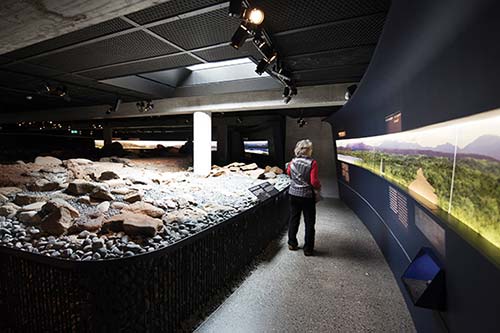
Some of the oldest building remains here were covered by tephra material from a volcanic eruption; carbon dating has narrowed the time of the eruption to AD 871...give or take a couple of years. (That’s why you see “Reykjavík 871±2” around town.) The Settlement Exhibition lets you see what’s left of the old Viking Age house, surrounded by modern, well-presented exhibits. From here you’ll continue underground and up into the Reykjavík City Museum, in a reconstruction of the oldest house in town at Aðalstræti 10. Though you can also enter the sight from Aðalstræti 10, it’s best to start at the Settlement Exhibition to experience Reykjavík’s story chronologically.
Cost and Hours: 2,650 ISK includes both sights, covered by Reykjavík City Card, free for kids 17 and younger, daily 10:00-17:00, Aðalstræti 16, +354 411 6370, https://reykjavikcitymuseum.is/the-settlement-exhibition. Admission includes a guided 45-minute tour in English—worth planning your visit around (Mon-Fri at 11:00, no tours on weekends).
Visiting the Museums: You’ll descend to cellar level and walk around the stone-and-turf wall that survives from the 65-by-26-foot longhouse. A circle of high-tech exhibits on the surrounding walls explains the site. You’ll learn how Scandinavians first settled the Reykjavík area a little before a volcanic eruption around AD 871. This house dates from around 930 and may have belonged to the grandson of Reykjavík’s semi-legendary founder, Ingólfur Arnarson (famous for throwing carved pillars overboard to select a building site). The house of a fairly prosperous farmer, it held an extended family of about 10 people. It had a sod roof and a big hearth in the middle. The house was abandoned after only a few decades—around AD 1000—perhaps due to damage from a spring that still runs beneath it.
Exhibits explain the area’s landscape, flora, and fauna in that era, suggesting why it was an attractive place to establish a farm. You’ll see items excavated here: a spindle whorl with runic inscriptions, and primitive tools such as keys, fishhooks, arrowheads, and ax heads. A model and a virtual, interactive reconstruction of the longhouse further illustrate the lifestyles of these earliest Icelanders.
Next you’ll continue down a brightly lit hallway into the Reykjavík City Museum and its “Reykjavík...the Story Continues” exhibit. As you ascend through three floors of exhibits inside Aðalstræti 10—the site of the oldest house in Reykjavík—you’ll learn about the city’s development: from establishing its identity in the 1700s, to city planning in the 1900s, to life in present-day Iceland. On the main floor of Aðalstræti 10, rooms are decorated like a grocery store and bishop’s bureau as an example of the building’s various uses over the centuries.
▲Kolaportið Flea Market
Reykjavík’s flea market, open only on weekends, takes up the ground floor of the old customs building. While you’ll see plenty of tourists, the market is still aimed largely at locals. It’s fun to rummage through the stalls of used books and music, antiques, clothing (including knockoff Icelandic sweaters), and collectibles. Best of all for food-curious visitors, this is the easiest place in town to sample (or buy) some of Iceland’s more unusual tastes, such as fermented shark.
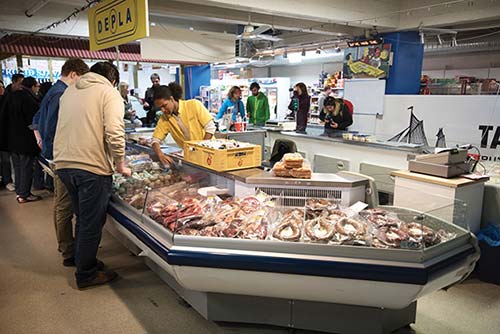
Cost and Hours: Free entry, open Sat-Sun 11:00-17:00, closed Mon-Fri, closed or varying hours on major holiday weekends, Tryggvagata 19, +354 562 5030, www.kolaportid.is.
Visiting the Market: Browse the main area of the market, with its many stalls selling old records, antiques, practical everyday clothing, and—of course—Icelandic sweaters. The big windows on the harbor side of the building help the space feel connected to the city’s maritime past (with café tables positioned so you can look out the windows).
The highlight is the concise food section tucked at the opposite end of the building. It serves as a crash course in Icelandic eats, with several stalls offering free samples. Look for the different kinds of smoked fish: silungur is trout, bleikja is arctic char, and lax is salmon. If you’re a bit bolder, there’s harðfiskur (air-dried, skinless white fish that’s been pounded flat—eaten as a snack with butter), crunchy fish chips, or dried seaweed (which might be labeled hollustusnakk—“health snack”). One stand hands out tiny, jiggling cubes of fermented shark, hákarl, on a toothpick (for more on fermented shark, see here).
Also look for other unusual Icelandic eats: horsemeat and horse sausage, and in summer, seabird eggs (typically from guillemots or other svartfuglar—birds in the auk family, which also includes puffins and murres). Look in the freezers for cod (þorskur), haddock (ýsa), and plaice (rauðspretta), which are all Icelandic, as well as Asian imports such as pangasius (a farmed fish), mussels, and squid. To cleanse your palate, grab some samples at the bakery counter. Consider picking up a brick of the delicious, dense, and sweet dark bread that’s steam-baked by burying it underground in thermal zones—called rúgbrauð (rye bread). Also look for a candy stand that lets you taste-test a few varieties of chocolate-covered licorice.
Icelandic Phallological Museum (Hið Íslenzka Reðasafn)
This gimmicky museum is a one-floor collection of preserved animal penises that can be seen in 15 minutes, plus various depictions of phalluses in art. While the exhibit takes itself seriously (the gift shop does not), it’s impossible to describe (or visit) without juvenile jokes, so here goes: You’ll see more wieners than you can shake a stick at—preserved, pickled peckers floating in jars of yellow liquid. You’ll see a seal’s schlong, a wolf’s wang, a zebra’s zipper trout, a fox’s frankfurter, a giraffe’s gherkin, a dog’s dong, a badger’s baloney pony, a squirrel’s schwanz, a coyote’s crankshaft, a horse’s hardware, a reindeer’s rod, and lots of whale willies. If you can’t get through this description without giggling, maybe you should visit. If you’re about to set down this book and write me an angry letter...don’t.
Cost and Hours: 2,750 ISK, daily 10:00-19:00, Kalkofnsvegur 2, +354 561 6663, www.phallus.is.
▲▲Laugavegur, Reykjavík’s Main Drag
The city’s main walking street is a delight to stroll—particularly its eastern, fully pedestrianized stretch, Laugavegur. While far from “local” (you’ll rarely spot an Icelander here who doesn’t work in the tourist trade), it’s enjoyable to wander and browse, with characteristic old houses, vivid street art, tempting cafés and bars, and—yes—plenty of touristy puffin shops. Many visitors wind up doing several laps up and down Laugavegur, picking out new details with each pass. I’ve described a short stretch of Laugavegur on my self-guided Reykjavík Walk, and listed several businesses along here in the Eating, Shopping, and Nightlife sections.
Hallgrímskirkja Area
This hilltop zone is marked by the prominent tower of Reykjavík’s landmark church.
▲▲Hallgrímskirkja Lutheran Church
Reykjavík’s most recognizable icon is the stairstep gable of this fine, modern church, designed in the 1930s by state architect Guðjón Samúelsson. It boasts a sleek interior and a tower with grand views. For more on the church, including details on the history, exterior, and architect, see here of my Reykjavík Walk. In the summer, there are regular performances on its booming organ (see “Entertainment in Reykjavík,” later). For a fine photo op, view the church from atop the steps of the Einar Jónsson Sculpture Museum across the street.
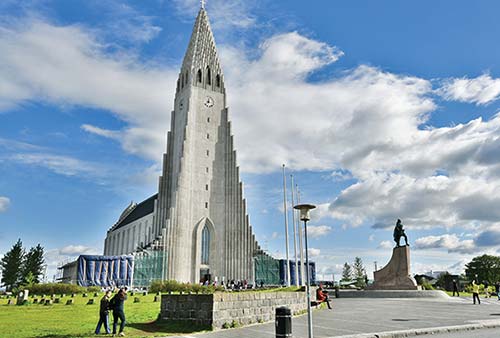
Cost and Hours: Church—free, daily 9:00-20:00, off-season until 17:00, closed to visitors during services; tower—1,300 ISK, 200 ISK for kids ages 7-16, daily 9:00-19:45, off-season until 16:30, closed Sun 10:30-12:15; church sometimes closes for special events; English services the last Sun of the month at 14:00. Hallgrímstorg 1, +354 510 1000, www.hallgrimskirkja.is.
Visiting the Church: Strolling down the church’s dramatically austere nave, you’re immersed in a sleek space culminating in classically Gothic pointed arches—with virtually no adornments. The glass is clear, not stained, and the main altar is a simple table. Notice how the ends of the pews echo the stair-step steeple outside.
Turn around and face the massive organ, which was “crowdfunded” in 1991; people paid to sponsor individual pipes. (To the right of the door you came in, notice the collection box shaped like an organ pipe—donations for the instrument’s upkeep.) The church is a popular venue for organ and choral concerts (look for posters, and see here). If the organist is practicing (most likely in the morning), sit down and enjoy a little musical break.
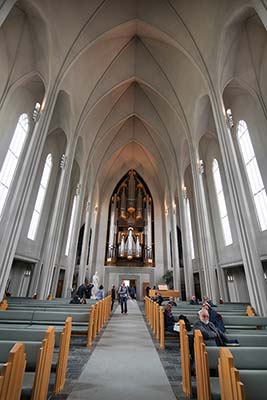
Notice that the pews are reversible—the seat backs can be flipped over to face the organ. Not only is this in keeping with Lutheranism—where the most important aspects of worship are the sermon (pulpit) and the music (organ)—but it’s also very practical. In smaller towns, you can’t have both a church and a concert hall—so one building does double duty.
Tower: Before leaving, consider riding the elevator (plus 33 steps) to the top of the 250-foot-tall tower, with commanding views. If there’s a long line for the small elevator, consider coming back in the evening.
A six-person elevator takes you up to the belfry, where you can look down on the city’s colorful roofs amid the clang of the church bells (which ring every 15 minutes). Straight ahead, look down over the rooftops lining Skólavörðustígur street, which stretches toward the harbor. In the distance, if it’s clear, you may see the snow-capped Snæfellsjökull peak at the end of the Snæfellsnes Peninsula, 50 miles away. The closer mountain, looming to the right, is the 3,000-foot Mount Esja, a popular destination for local hikers. And to the right, the island you see is Viðey, reachable on an easy cruise (see here). Ponder that well over half of Iceland’s population lives in view of this church.
▲▲Einar Jónsson Sculpture Museum and Garden (Listasafn Einars Jónssonar)
The former home of gifted sculptor Einar Jónsson (1874-1954)—facing Hallgrímskirkja church—has a free sculpture garden out back (described on here of my Reykjavík Walk, earlier). For a more intimate look at the artist, tour the museum (entrance at the front, facing the church). Inside, you’ll see his home, and several large- and small-scale plaster casts for Einar bronzes that decorate the city.
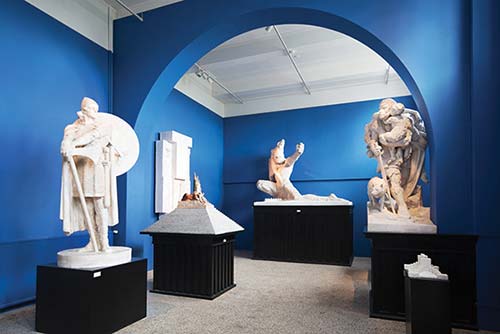
Cost and Hours: 1,500 ISK, free for kids under 18, Tue-Sun 12:00-17:00, closed Mon, English-language brochure available, Hallgrímstorg 3, +354 551 3797, www.lej.is.
Visiting the Museum: Stepping into the grand entry hall, immediately on your right is Outlaws (Útlagar, 1901). This breakthrough work, completed while Einar was a student in Denmark, is one of his trademark pieces. It depicts a convicted man who takes his wife’s lifeless body to a cemetery before escaping with his child to live in the Highlands. (As many original Icelandic settlers were themselves outlaws—exiled from Norway—this theme is particularly poignant.) Just beyond that, Dawn (Dögun, 1906) illustrates a scene from an Icelandic folk tale, in which a girl tricks a troll by keeping him talking until the sun rises. He sweeps her up in his arm at the very moment the sun freezes him in stone, and he shakes his fist defiantly.
Head downstairs and circle through a series of colored rooms. In the orange room, straight ahead, is Protection (1934), in which a maternal throne cradles a relaxed child. To the right is the red room, where the striking Rest (Hvíld, 1935) is an eerie, oversized bust of a young man whose face is half-covered by reptilian basalt columns. Beneath his chin stands a sculptor leaning against a giant hammer, taking a break. This recalls the notion (dating back to Michelangelo) that the sculpture already exists within the stone; it’s the artist’s job to chip away and reveal it. Immediately to the right, The Spell Broken (Úr Álögum, 1927) shows a St. George-like knight—protectively cradling a woman—slaying a dragon by driving his sword through its head. Up on a windowsill (and positioned facing sideways) is the museum’s lone self-portrait of the artist. In the green room, the evocative Remorse (Samviskubit, 1947) shows a man tormented by tiny, conscience-like beings. One holds his eyes open, the other recites a litany of wrongdoings in his ear, and both ensure he can’t escape whatever’s wracking him with guilt.
For a peek at the life of the artist himself, climb the tight spiral staircase to the top floor to see the intimate apartment that Einar and his wife Anna shared—a cozy, human-scale contrast to the beefy building and Einar’s dynamic works.
Outside, explore the sculpture garden, where you’ll recognize bronze versions of some of the pieces you saw inside. As you face the back of the building, your view is dominated by another version of Protection. Around the right side of the building is a small mound. Einar buried pieces he wasn’t satisfied with in this location, and the museum has chosen to leave them where they are. However, as they are planning to build a new, modern entrance area here, they may soon do some excavating after all.
Beyond the Pond
▲▲National Museum of Iceland (Þjóðminjasafnið)
A humble island nation of isolated farms—built mostly of wood—doesn’t leave behind a lot of fancy artifacts. But this thoughtful, manageable museum does a beautiful job of showing off the best of what has survived, and ties it all together with insightful descriptions. You’ll see lots of wood-carved scraps, some finely crafted items imported from Scandinavia (and a precious few from Iceland), abundant church art, reconstructions of a rustic farmhouse (baðstofa) and a typical open boat, and a gathering of items from the 20th century that helps bring Iceland’s story up to the present day. The collection is well laid out and strikes just the right balance, presenting enough information to satisfy those with a reasonable attention span. There’s also a pleasant café and a classy gift shop.
Cost and Hours: 2,500 ISK, covered by Reykjavík City Card; daily 10:00-17:00, closed Mon in off-season; Suðurgata 41, +354 530 2200, www.thjodminjasafn.is.
Getting There: The museum is on the University of Iceland campus at the far end of the Pond, a pleasant 10-minute walk from City Hall along Tjarnargata; you can also take bus #1, #3, #6, or #12 to the Háskóli Íslands stop. If walking between the harbor area and the museum, you can shortcut along Garðastræti and through Hólavallakirkjugarður, the city’s oldest cemetery.
Visiting the Museum: The permanent exhibit fills the two long floors upstairs, telling the story of Iceland. The exhibit is loosely chronological and well explained in English. For more information, you can scan the QR code to access the good, free audioguide on your phone.
From the ticket desk, head upstairs. Near the beginning of this hall, watch for the tiny figure—the size of a chess piece—that could either be Jesus Christ or Þór (Thor), god of thunder. (Is that a hammer or a cross he’s holding?) This suggests the transition from pagan Norse beliefs to Christianity, which was made official in the year 1000.
Farther along, you’ll see a scant few objects from the Settlement Age, including candle holders, pots and pans, rusty fishhooks, and gorgeous, oversized brass “dome brooches.” Much of this floor is dominated by medieval church art; the darkened room in the center displays vestments, statues, altar tapestries, and bells that were all imported from Europe—a reminder that early Icelanders were hardworking frontier farmers who had to order their luxury goods from “back east.” Two locally made exceptions are wooden panels from a c. 1100 Judgment Day painting, and a carved crucifix from c. 1200. Nearby, examine the exquisite wood-carved door from the church in Valþjófsstaður (in eastern Iceland), illustrating the story of a knight who slew a dragon to save a lion. Like many precious Icelandic objects, this door was taken to Denmark for safekeeping; the Danish government returned it in the 1930s, as part of a gift to Iceland in honor of the millennial celebration of the Alþingi.
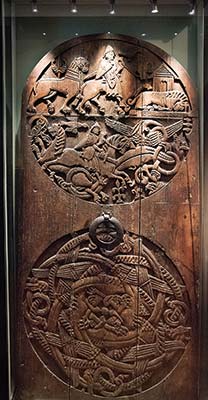
Near the end of this floor, look for Guðbrandur’s Bible—the first-ever Bible in Icelandic (1584). The Protestant Reformation, which began in Europe, also spread to Iceland, and to this day, the majority of Icelanders are Lutheran.
The exhibit continues upstairs, covering the 17th century through the present. Near the start of this hall is a drinking horn painstakingly carved with Bible scenes (1598). This is a rare item done not by an anonymous craftsperson, but by a known artist: Brynjólfur Jónsson, who also did the exquisite whalebone carvings nearby (look for them on the left side of the room). Following the Reformation, the Danish king also headed the Lutheran Church of Iceland, giving him tremendous power. While absolute rule by the king limited his subjects’ freedom, it spurred efficiency and economic progress. Exhibits explain how, in 1703, Iceland conducted the world’s first census that recorded every person’s name (allowing us to know with precision that, in that year, Iceland was home to 50,358 people—99 percent of them farmers and farm workers).
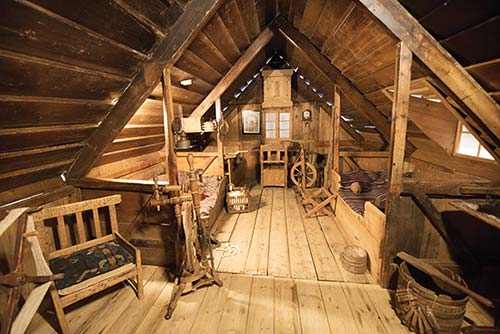
Other exhibits explain how Danes maintained a monopoly on trade in Iceland. Starting around 1750, first the Enlightenment and then the wave of nationalism and democracy that swept Europe also reached these shores—with diverse effects, from the reconstitution of the Alþingi in 1845, to the creation of an Icelandic national costume by a local artist in 1860 (Sigurður Guðmundsson’s skautbúningur). Meanwhile, the humble people of Iceland toiled along on chilly, smelly farms in the countryside—peer inside a typical baðstofa (farmhouse) living room. They also lived off the sea—fishing from basic, small, open rowing/sailing boats, like the one on display, all the way up to the advent of motorized vessels. Nearby, notice the gnarly-looking harpoons (with retractable barbs). These were used to hunt not whales, but sharks, which were prized for their liver oil (a lucrative export—used in oil lamps across Europe).
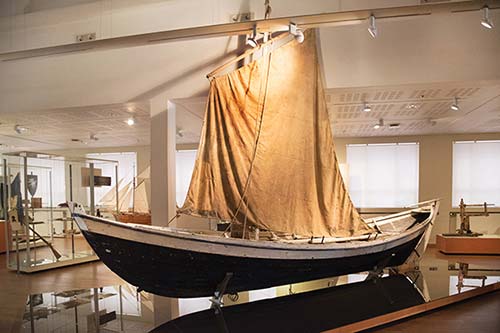
Soon Iceland was primed for self-rule, and you’ll see the desk of the man who worked hardest to make it happen: Jón Sigurðsson, who loudly agitated in Copenhagen for a national constitution and an end to the trade monopoly. Nearby, look for “The Blue and White”—an early, unofficial Icelandic flag (missing the current red cross). In 1913, a young Icelander flew the flag from his small boat in Reykjavík harbor, until a Danish coast guard ship seized the “unauthorized” colors. Furious Icelanders demanded that the issue be resolved, and it eventually caught the attention of the Danish king—who agreed that Iceland deserved its own banner. Viewing tests from a distance showed that the blue-and-white flag was too easy to confuse with Sweden’s, so the red cross was added. The flag was made official in 1915. Iceland became a sovereign state in 1918, and a fully independent republic in 1944.
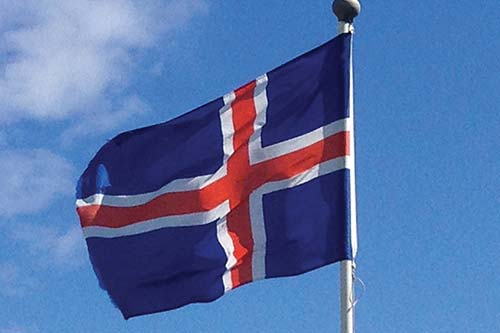
The exhibit finishes with a look at modern Iceland. Look for the giant, white trawl wire cutters—a weapon used in the “Cod Wars” between Iceland and the UK (1958-1976), when the two countries squabbled over fishing rights (rather than torpedoing each other, they cut fishing nets). The pacifistic, practical Icelanders enjoy pointing out that this was the only real “war” in their history, and involved no actual bloodshed. Finally, an airport conveyor belt displays various trappings of modern Icelandic life.
REYKJAVÍK’S ART MUSEUMS
This small community has a busy arts scene, and the museums described next proudly show off Iceland’s 20th-century artists. Iceland’s artistic tradition goes back only a century or so; most Icelandic artists (even today) traveled abroad to get a solid education. Personally, I wouldn’t dedicate much time here: These museums have a hard time competing with all the nearby natural beauty and interesting history.
National Gallery of Iceland (Listasafn Íslands)
The National Gallery has three branches, all covered by a 2,200 ISK combo-ticket and the Reykjavík City Card (+354 515 9600, www.listasafn.is).
National Gallery Main Branch: Located near the Pond, the main branch features four enjoyable gallery spaces showing off a continually changing selection of pieces from their permanent collection of mainly modern Icelandic artists. They also have a few rotating international pieces (daily 10:00-17:00, closed Mon off-season, café, Fríkirkjuvegur 7).
Ásgrímur Jónsson House (Home of an Artist): This museum highlights a rotating selection of works by this early 20th-century painter who specialized in Impressionistic landscapes of his homeland, dynamic illustrations of folklore and landscapes, and some later Expressionistic Munch-like pieces (daily 13:00-17:00; in his former home at Bergstaðastræti 74—a few blocks southeast of the main branch and Pond).
House of Collections (Safnahúsið): Built in 1909 to house Iceland’s National Museum and later home to the National Library, today this stately building holds the downtown branch of the National Gallery. Though the museum recently changed its name and its exhibits, most locals still know and refer to it as the Culture House. It hosts a collection of modern art—paintings, sculptures, and installations—by mostly Icelandic artists (a notable exception is a painting by Norwegian painter Edvard Munch). Each of the four floors is arranged by theme and is designed to be interactive and kid-friendly (daily 10:00-17:00, closed Mon off-season, located downtown at Hverfisgata 15).
Sigurjón Ólafsson Museum
This museum showcases the heavily stylized, sometimes abstract works of this mid-20th-century sculptor, who studied under both Einar Jónsson and Ásgrímur Jónsson.
Cost and Hours: 1,000 ISK, June-mid-Sept Tue-Sun 13:00-17:00, closed Mon, off-season Sat-Sun 13:00-17:00, closed weekdays; northeast of downtown near the Skarfagarðar cruise terminal, at Laugarnestangi 17, www.lso.is.
Reykjavík Art Museum (Listasafn Reykjavíkur)
This institution has three branches, each with changing exhibits focusing on modern art (for the latest lineup, see their website). The Hafnarhus main branch, right downtown and near the Kolaportið flea market at Tryggvagata 17, has an eclectic range of temporary exhibits, and sometimes highlights works by Pop artist Erró—Iceland’s answer to Roy Lichtenstein. The Kjarvalsstaðir branch exhibits some works by idiosyncratic modern painter Jóhannes Sveinsson Kjarval, who blended Icelandic landscapes with abstract and surreal flourishes (10-minute walk south of the Hlemmur bus junction, in the Klambratún park at Flókagata 24). And the Ásmundarsafn branch, in the eastern neighborhood of Laugardalur, highlights work by the mid-20th-century, mostly abstract, Miró-like sculptor Ásmundur Sveinsson, displayed in his architecturally striking former home (on Sigtún, near the corner of Reykjavegur).
Cost and Hours: All three museums are covered by a 2,150-ISK ticket for 24 hours or by the Reykjavík City Card, and are open daily 10:00-17:00. The main branch stays open until 22:00 on Thu, and Ásmundarsafn has shorter hours off-season (13:00-17:00; www.artmuseum.is).
ALONG THE WATERFRONT
These sights are spread along a lengthy stretch of the city waterfront. I’ve listed them roughly from east to west.
Just Below the Main Drag
These sights are just downhill from Bankastræti/Laugavegur streets.
▲Sun Voyager (Sólfar)
This popular outdoor stainless-steel sculpture is shaped like an old Viking boat, pointing northwest in the direction of the setting sun in summer. This ode to the sun is a good place to watch the sea, take a selfie, and ponder the promise of undiscovered territory that brought Scandinavians to Iceland more than a thousand years ago—and the impulses that pushed them farther west, to Greenland and Canada. The sculpture, by Icelandic artist Jón Gunnar Árnason, is a few blocks along the shore past Harpa, at the base of Frakkastígur street, about a five-minute walk below Laugavegur; drivers on the westbound waterfront highway will find a pullout right at the sculpture.
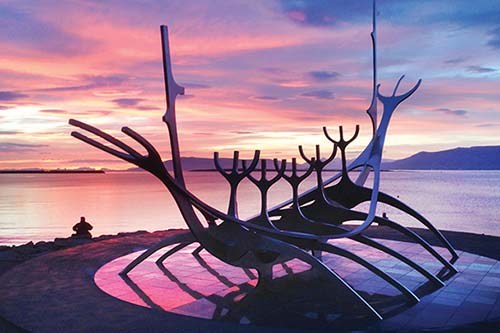
▲▲Harpa Concert Hall
This cutting-edge performing arts and conference center almost feels too big for such a small city. That’s because the ambitious building was conceived during Iceland’s banking mania. When the crash came in 2008, construction had already begun. (Some cynics proposed that it be left half-built, as a monument to the greed and excess of unbridled capitalism.) By the time Harpa was opened in 2011, the hall was hemorrhaging money and was kept alive thanks only to huge subsidies (which some Icelanders felt would be better spent elsewhere). Despite the woes, Reykjavík wound up with a fine performance space, and the city is growing into it. In 2013, the building (designed by the Danish Henning Larsen firm) won the EU’s prestigious Mies van der Rohe Award—achieving the goal of putting Iceland on the world architectural map. And the area around the concert hall is being transformed into a massive, ritzy residential and commercial quarter—including a new hotel (The Reykjavík Edition), apartments, a high-end shopping area called Hafnartorg Gallery, and a stylish, low-light underground food hall.
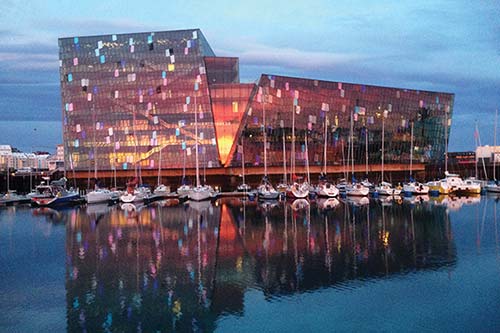
Cost and Hours: Lobby free to enter, lobby and box office open daily 10:00-18:00 (open later for performances); café and shops, pay WC (free to ticket-holders), +354 528 5050, www.harpa.is.
Tours: In summer, a 45-minute guided tour for 4,900 ISK runs at 11:00 and 13:00.
Visiting the Hall: Harpa’s honeycombed facade, designed by Danish-born Icelandic artist Ólafur Elíasson, is the most-loved part of the building: In summer the windowpanes reflect the light in patterns, and in winter they’re illuminated in pretty colors. The choice of location parrots the harborside opera house cliché that started in Sydney. Photographers find lots of great angles to shoot here. Don’t miss the view from the far end of the pier that extends to the right of the building; from there, the facade is reflected in the harbor along with sailboats.
Harpa is something of a community hub and a vital cultural center, bustling with a constant flow of locals and visitors. Step inside, where you’ll be bathed in the light of those many windows. If you attend a performance (see options under “Entertainment in Reykjavík,” later) or take a tour, you can peek into Eldborg, the main hall, where the dominant materials are black concrete and red wood—evoking the volcanic eruptions that have shaped Iceland.
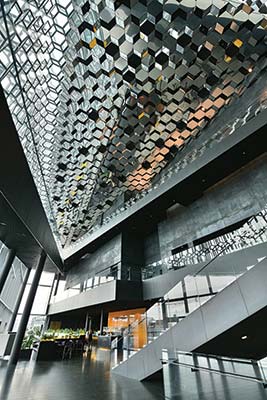
Two floors down from the box office, an abstract digital art installation, called Circuleight, is projected on four walls. The interactive experience is inspired by Icelandic nature and reacts to spectators’ movements within the room; it’s all accompanied by soothing music (2,900 ISK, every half-hour daily 11:00-18:00, last show at 17:30, 25 minutes).
Old Harbor Area
Reykjavík’s Old Harbor—about a 10-minute walk west of Harpa—isn’t a creaky, shiplap time capsule, but an industrial-feeling port. Tucked around the busy berths and piers are a few seafood restaurants, kiosks selling boat trips, and (at the far end) a smattering of museums. To get here, walk out from downtown (10 minutes), or take bus #14 to the Mýrargata stop.
▲Exploring the Harbor
To get your bearings at the harbor, stand on the seaward side of the turquoise-colored sheds (which house some recommended restaurants) and face the bobbing boats. This “old” harbor was built only in the 1910s, on reclaimed land. (For much of its history—back when Reykjavík was a farm, then a small town—there was good anchorage, but no real harbor.) Today, heavy traffic has moved to the newer container terminal farther along the peninsula. The harbor serves a mixture of excursion boats, small craft, the coast guard (notice the hulking gray ships with red-and-blue trim), and a few fishing trawlers that bring their catch to processing plants. A single small cruise ship can also moor in the harbor (larger ones use the cruise terminal farther out of town).
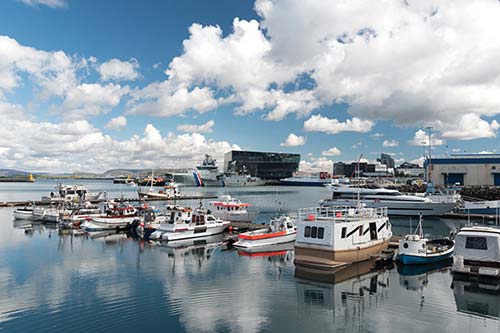
On your left is the Ægisgarður pier, lined with ticket offices for several whale-watching tours (described next), as well as bike tours. On your right, across the harbor, you can see the angular, glass facade of the Harpa concert hall. And the dramatic mountain rising up straight ahead is Esja—six miles away and 3,000 feet high.
Stroll out to the end of the Ægisgarður pier to comparison-shop excursion boats, and to get a good look at the hodgepodge of vessels that call this harbor home. At the far end (on the left), you’ll see part of Iceland’s whale-hunting fleet moored (look for the black-and-white boats called Hvalur 8 and Hvalur 9)—an odd juxtaposition with the whale-watching industry all around you.
Back at the base of the pier, in front of Berjaya Reykjavík Marina Hótel, is a slip where boats are hauled up to be painted (one of the remaining vestiges of the maritime industry here). To extend your visit to the nearby Grandi area—with several sightseeing attractions and eateries—simply follow the footpath between the harborfront and the hotel. For more on this area, see “Grandi,” later.
Whale Watching and Other Boat Trips
Whale watching out in Faxaflói bay is a popular Reykjavík activity. While it can be enjoyable to get out on the water—and catching a glimpse of a whale is undoubtedly exciting—it’s a substantial investment of time and money, particularly given that you may see nothing at all. Before deciding to go on a whale-watching cruise, read the description on here. As an alternative to a pricey whale-focused trip, consider a faster and cheaper boat trip—such as to the island of Viðey (see later). And if you want to be assured of seeing “whales”—very up-close—you may prefer a visit to the Whales of Iceland exhibit, a short walk away (described under “Grandi,” later). If you’re traveling around Iceland, be aware there are also whale-watching opportunities in the north, in the Akureyri area and in Húsavík (both covered in The Ring Road chapter).
The many boat-tour companies with ticket booths along the Old Harbor’s Ægisgarður pier offer much the same experience. For the latest prices, schedules, and details, check each company’s website, look for brochures locally, or stop by the sales kiosks. The most established outfit is Elding (described later); others include Whale Safari (www.whalesafari.is), Reykjavík Sailors (https://reykjaviksailors.is), and Special Tours (www.specialtours.is). While Elding is typically the most all-around reliable choice, check the latest online reviews to survey the pros and cons of each one. For comparison’s sake, I’ve outlined Elding’s offerings here. Prices are typically a bit cheaper if you prebook directly online, where you’ll usually find special offers.
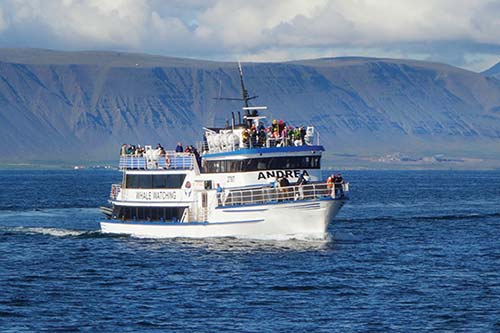
Whale Watching: The classic whale-watching trip is three hours and runs daily all year, weather permitting (from 6/day mid-June-Aug to 1/day Dec-Jan; adults 13,000 ISK, children 7-15 pay half-price, children under 7 free; Ægisgarður 5c, +354 519 5000, www.elding.is). You’ll pay more for a “premium” option on a “RIB”—a rigid inflatable boat that also includes a high-speed zip across the waves. You’ll be issued a warm coverall and goggles for this two-hour thrill ride (22,000 ISK, April-Oct only).
Other Boat Trips: Elding and their competitors also run other seasonal boat trips. The puffin-watching cruise (May-mid-Aug only) is shorter (1 hour) and cheaper (7,400 ISK adults) than whale watching. Cheaper still is Elding’s 20-minute ferry service to Viðey Island (2,100 ISK round-trip, 2/day, June-Aug only; for more on what to do on the island, see here). In the early winter (early Oct-early Dec), when the Imagine Peace Tower on Viðey Island is illuminated, Elding offers a two-hour excursion out to the island for a closer look (13,000 ISK). Anglers enjoy the sea-angling trips (3 hours trying your luck catching cod, haddock, mackerel, and catfish, with an on-board grill party at the end, May-late Sept only, 16,400 ISK). And in the dark months, you can take a two-hour, late-evening cruise in hopes of viewing the northern lights from the water (13,000 ISK, Sept-mid-April at 21:00 or 22:00).
Grandi
The long, broad peninsula that juts out beyond the far end of the Old Harbor is an up-and-coming district called Grandi. This former sandbar, built up with landfill, is an odd assortment: A spread-out strip of old warehouses and new big-box stores, but with a lively little waterfront zone (along Grandagarður) where you’ll find some excellent eateries, and several sights (which I’ve listed in the order you’ll approach them, if walking from the Old Harbor). At the far tip of the peninsula—a 15-minute walk or short drive away—is a trendy little cultural zone, anchored by the Marshall-húsið art center.
As with tales of Beowulf, King Arthur, and Robin Hood, scholars don’t know how much of the Icelandic sagas are historically based and how much are fictionalized. But all agree that the sagas are an essential resource for understanding both Iceland’s history and the cultural heritage it shares with mainland Scandinavia.
Icelanders have strong narrative traditions. Before they had a written language, legends and laws were passed down orally. With Christianity around AD 1000 came the Latin alphabet, which Icelandic scribes used to document their history, writing mostly in their own language.
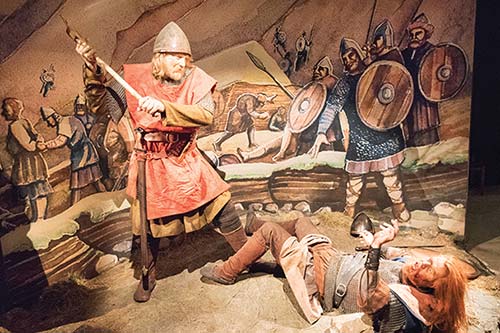
These historical narratives, known collectively as “the sagas,” were written on precious vellum (calfskin) mainly in the 13th and 14th centuries. It was the Icelanders who first wrote down the dynamic stories of the early Norsemen—from myths of Norse gods like Óðinn (Odin) and Þórr (Thor) to early histories of Scandinavian warriors and kings. Like the epic poems of the ancient Greeks, the sagas provide a cultural foundation for the Nordic people, stretching all the way through history to the present.
Here’s a simplified overview of some of the most famous or influential sagas and other early writings:
The Book of Settlements (Landnámabók)—not strictly a “saga”—documents the earliest ninth- and tenth-century settlers in Iceland. This chronicle tells the story of Hrafna-Flóki (the Raven) Vilgerðarson, who followed a bird to Iceland after he’d been blown off course on his way to the Faroe Islands; and the story of Ingólfur Arnarson, who threw two carved pillars overboard and built his settlement where they washed up (Reykjavík). Remarkably, the Book of Settlements lists more than 400 different families, where each one settled, their family tree, and vivid stories of what they encountered here.
The much shorter Book of Icelanders (Íslendingabók), written by Ari fróði (the Wise) Þorgilsson in the early 12th century, gives a concise summary of the history of Iceland up to Ari’s own time, including the establishment of the Icelandic Commonwealth and the conversion to Christianity.
The Saga of Erik the Red (Eiríks saga rauða) and the Saga of the Greenlanders (Grænlendinga saga), known together as “the Vínland sagas,” tell of how Eiríkur rauði (the Red) Þorvaldsson (950-c. 1003)—banished from Norway, then Iceland—founded a Norse settlement in Greenland; and how his son, Leifur heppni (the Lucky) Eiríksson, explored what we now know as North America.
Egill’s Saga (Egils saga Skallagrímssonar) tells the story of Egill Skallagrímsson (c. 904-c. 995). Egill is a fascinatingly complex figure: Swarthy and ugly, he was both a fearsome champion warrior and a tender-souled poet. When he was just seven years old, after losing a game, a furious Egill buried his ax in the head of his opponent—claiming his first of many victims.
And yet, Egill composed his first poem at the tender age of three, and went on to author some of the loveliest verse in Icelandic literature (after two of his children died, Egill composed the heartbreaking “Lament for My Sons”). Egill’s Saga tells of his tortured relationship with his equally short-tempered father, Skalla-Grímur (Grímur the Bald); his friendship and rivalry with his dashing brother, Þórólfr; his relationship with his foster sister, turned-sister-in-law, turned wife, Ásgerður; his run-ins with the powerful witch Gunnhildur; and his clashes with his nemesis, King Harald Fairhair of Norway.
Njál’s Saga (Brennu-Njáls saga) tells the story of wise Njáll Þorgeirsson and his best friend, the gallant Gunnar Hámundarson. Things take a tragic turn—as they always do in the sagas—as early Iceland’s penchant for escalating blood feuds spirals out of control, culminating in several tragic deaths. (Spoiler: The protagonist is also known as Brennu-Njáll—“Burning Njáll.”)
Icelanders also recorded mythic histories much older than the settlement of Iceland. Völsunga Saga, which may have roots in the fifth-century conquests of Attila the Hun, is a sprawling, epic tale of the Völsung clan, including Sigurðr Fáfnisbani (Slayer of the dragon Fáfnir), which has inspired artists from Richard Wagner to J. R. R. Tolkien. The two Eddas—the anonymous Poetic Edda and Snorri Sturluson’s Prose Edda—contain ancient poetry that records the myths of the Germanic pagan religion.
Snorri Sturluson (1179-1241)—who also wrote Heimskringla, the history of the Norwegian kings—was himself a dynamic figure whose life is described in Sturlunga Saga.
For a hefty (and I mean hefty) sample of some of the better-known sagas, pick up The Sagas of the Icelanders, a good, brick-like English translation edited by Robert Kellogg. If you’re headed to Snæfellsnes, see the sidebar in the Snæfellsnes Peninsula chapter for the many sagas specific to that area.
Saga Museum
The Saga Museum focuses on the stories of the early Norsemen who turned Iceland’s wilderness into a European community (even the National Museum covers the sagas only tangentially). This place does a valiant job of telescoping the sagas into an educational 35 minutes. The included audioguide takes you on a 17-stop tour of Iceland’s Settlement Age, through various mannequin scenes—each one rooted in textual evidence from the sagas. While the audioguide is academic enough that it might bore younger or less interested visitors, a treat for kids of all ages awaits at the end: a chance to dress up in Viking garb for a photo.
Cost and Hours: 3,600 ISK, 1,000 ISK for kids 6-12, includes audioguide, daily 10:00-17:00, Grandagarður 2, +354 511 1517, www.sagamuseum.is.
▲Aurora Reykjavík: The Northern Lights Center
Many visitors come to Iceland and spend lots of time and money failing to see the northern lights. But this little museum offers a sure-fire, no-risk solution.
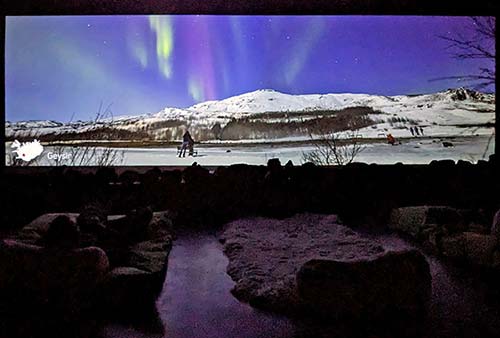
Cost and Hours: 2,900 ISK, daily 9:00-21:00, Grandagarður 2, +354 780 4500, www.aurorareykjavik.is.
Visiting the Center: With your audioguide (scan a QR code using the free Wi-Fi), you’ll walk through some sparse exhibits—including one on legends and superstitions that attempted to explain these once-mysterious dancing lights—and you’ll learn about the science of the phenomenon. The main attraction is a lounge-like theater playing a soothing 38-minute widescreen film on a loop, featuring time-lapse footage of the aurora borealis from various points around Iceland.
In the gift shop, enjoy a free coffee, then slip on a pair of virtual-reality goggles and spin around in a chair, tracking the lights as they flutter through the sky. (For more on the northern lights, and how to see them yourself, see the Icelandic Experiences chapter.) Note: If you’re heading out to the Pearl, consider spending less to watch the excellent 20-minute Áróra planetarium show there instead (described later).
Reykjavík Maritime Museum (Sjóminjasafnið í Reykjavík)
This exhibit covers Reykjavík’s connection to the sea, tracing its history from remote farm to bustling capital—partly thanks to its role as a fishing, shipping, and maritime center. The first floor is filled with temporary exhibits; head upstairs for the permanent displays. You’ll see plenty of well-described artifacts telling the story of the seafood industry and the evolution of the harbor, models of fishing vessels, and vintage fish-processing machinery. You’ll learn why stockfish (naturally dried in the cold Reykjavík wind) was so important on early voyages, how boats gradually evolved from rowing and sailing to industrial trawlers, and how radios and navigational technology improved over time. Interactive elements liven up the exhibits.
Cost and Hours: 2,150 ISK, daily 10:00-17:00, Grandagarður 8, +354 411 6300, www.borgarsogusafn.is [URL inactive].
▲Whales of Iceland
Tucked unassumingly in a box-store zone a five-minute walk beyond the cluster of museums at the start of Grandi, this attraction fills a cavernous warehouse with life-size models hanging from the ceiling of the whales found in the waters around Iceland. The models are impressively detailed, bathed in a shimmering blue light, and painted on Styrofoam. While this is very expensive considering the brief amount of time most visitors spend here, it’s legitimately educational and scratches your Icelandic-whale itch.
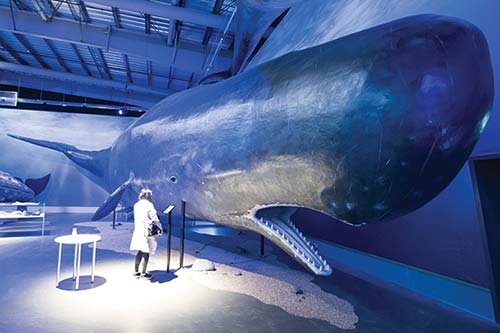
Cost and Hours: 3,900 ISK, 1,950 ISK for kids ages 7-15, free for kids under 7, includes audioguide and guided tours—daily at 11:00 and 15:00, open daily 10:00-17:00, Fiskislóð 23, +354 571 0077, www.whalesoficeland.is.
Getting There: From the Maritime Museum and recommended Grandi restaurants along Grandagarður, walk to the end of the first long, white-and-turquoise warehouse building with eateries and boutiques, then turn left on Grunnslóð (unmarked), and you’ll see the museum ahead—one long block away. You can also take bus #14 to the Grunnslóð stop, or drive (free parking right in front).
Visiting the Museum: Scan the posted QR code to access the included audioguide (or pick up a physical audioguide at the front desk). As you walk one species at a time, enjoy the serious 30-minute education on these amazing creatures.
Begin with the smaller marine mammals: dolphin, narwhal, orca. Then step into a vast space to ogle the majestic giants: pilot whale, humpback whale, sei whale, bowhead whale, minke whale (the one you’ll see on local menus—fittingly suspended above the museum café), Moby Dick-style sperm whale, and the largest specimen, the blue whale—which can grow up to 110 feet long and (they say) has a tongue as big as an elephant. The on-site theater runs a fascinating documentary about the effects of sound pollution on whales (1 hour, 4 shows/day).
▲FlyOver Iceland
A block beyond Whales of Iceland, this attraction offers a thrilling virtual flight over stunning Icelandic scenery. You’ll be strapped into a flight simulator, then lifted off your feet toward a big wraparound screen, where you’ll have the sensation of soaring over Iceland’s volcanoes, coastline, farmlands, and islands. You’ll be spritzed by “clouds” and smell the flowers and the sulfur. (It’s very similar to the popular “Soarin’” attraction at Walt Disney theme parks.) The whole experience lasts about 30 minutes, including 20 minutes of setup and a nine-minute “flight.” While it’s quite expensive—and the multimedia intros that precede the ride are gimmicky and lack substance—the scenery shown is breathtaking. It’s worthwhile if you won’t make it out of Reykjavík to see much of this country’s natural beauty for yourself. (If you’re prone to motion sickness, skip it.)
Cost and Hours: 5,800 ISK, cheaper online, book in advance, 3,800 ISK for kids 12 and under, daily 9:30-19:00 (last show at 18:45), Fiskislóð 43, +354 527 6700, www.flyovericeland.com.
▲▲Lava Show
This is a fun and safe way to see real, flowing lava up close without leaving Reykjavík, and is a must-do for anyone interested in volcanology. The show was started by an Icelandic couple, Júlíus and Ragnhildur, who were inspired by the 2010 eruption of Eyjafjallajökull and wanted to share the fascinating science of Iceland’s volcanic activity with visitors. They use basalt from the Katla volcano eruption of 1918—heating it to 2,000°F molten lava.
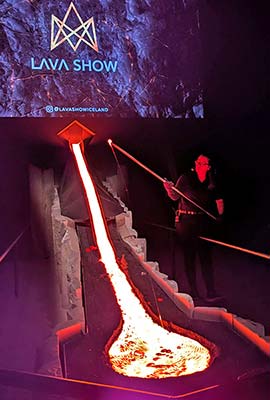
Cost and Hours: 5,900 ISK, 3,500 ISK for kids 2-12, “premium” experience (9,900 ISK, adults only) includes a drink, access to upstairs lounge, balcony seats, and backstage tour of the furnace; daily 9:00-21:00, shows every 2 hours from 10:00 until 20:00, off-season shows at 12:00, 14:00, 16:00, and 18:00 only; full bar; Fiskislóð 73, +354 553 0005, www.lavashow.com. They also run a Lava Show in Vík, on Iceland’s South Coast (see here).
The Show: The 50-minute demonstration takes place in a 115-seat showroom (that gets very warm). For the best view, sit as close to the front as possible. You’ll watch a short introductory film about Iceland’s geology and volcanic activity, then don protective glasses before a river of glowing lava flows down a steel chute into the showroom. The enthusiastic hosts share their wealth of knowledge—from lava’s molecular composition to volcanic impacts on Iceland—while poking at and playing with the mesmerizing lava as it cools. At the end, the staff are happy to answer questions. Consider attending the last show of the day, when it’s less crowded and you have a better chance of sitting close to the action.
Marshall-húsið Art Center
Filling a converted fish factory at the far tip of the pier (and of interest mainly to art lovers with a car), this arts center hosts several galleries. The big draw is the gallery of Ólafur Elíasson, the renowned Icelandic artist who was born in Denmark and keeps a (private) studio upstairs here. Ólafur—who helped design Reykjavík’s Harpa concert hall—specializes in large-scale, multimedia pieces that combine technical precision with intangible elements like light, water, wind, temperature, and movement. The building also has two other artist-run gallery spaces of avant-garde works (The Living Art Museum, www.nylo.is; and Kling & Bang, www.this.is/klingogbang) and $$$ La Primavera, an appealing café/restaurant facing the harbor (open for lunch Tue-Fri and dinner Thu-Sat, closed Sun-Mon, +354 519 7766).
Cost and Hours: All galleries are free, Wed-Sun 12:00-18:00, closed Mon-Tue, Grandagarður 20, bus #14 to Grandi stop, https://marshallhusid.is.
Nearby: This far tip of Grandi has attracted some trendy businesses. Across the street in a nondescript warehouse zone, you’ll find the flagship store of the Farmers Market brand—called Farmers & Friends—with expensive Icelandic fashion (open daily, www.farmersmarket.is; city-center branch described later, under “Shopping in Reykjavík”), and Omnom, a boutique chocolate factory with a small storefront selling chocolate and ice cream (daily, www.omnomchocolate.com).
Þúfa Viewpoint Mound
At the far, far tip of the Grandi pier, at the end of a long row of warehouses, you’ll see an odd sight: a perfectly hemispherical, sod-covered mound with a tiny shed up top. This art installation, called Þúfa (Tussock), evokes the humble, earthen heritage of the Icelanders. A spiral ramp leads to the top, where you can peer between the slats in the humble, tiny shed to see dangling hunks of cod—recalling the industry that helped Reykjavík grow from a farm to a town to a capital city. Views looking back on the harbor and Harpa are enjoyable.
OUTSIDE THE CENTER
You’ll need a car, a bus, or a boat to reach the sights in this section. Driving is quick and a breeze, and parking is free and easy at all these sights.
Just South of Downtown
▲▲The Pearl (Perlan)
This attraction, housed in the city’s former water-storage tanks, ticks off several sightseeing boxes at once: a fine view of the city skyline, engaging high-tech exhibits extolling Iceland’s abundant natural wonders, and a top-floor café, also with a sweeping view. Seemingly designed to keep tourists happy in bad weather, it’s well done and worth the short drive. While pricey, a visit here is a great primer before you head out to the Golden Circle or Ring Road—or a satisfying substitute if you’re only visiting Reykjavík.
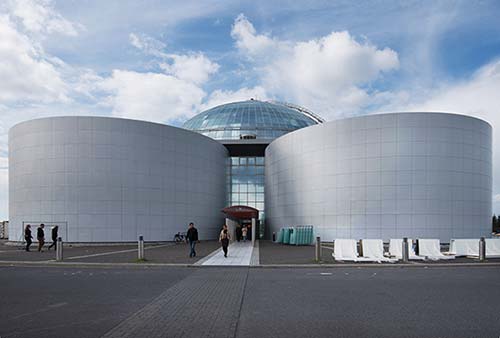
Cost and Hours: 4,990 ISK (2,990 ISK for kids 6-15) includes all exhibits, 1,990 ISK just to access the view deck and café; daily 9:00-22:00, last entry one hour before closing, www.perlan.is.
Getting There: For drivers, the Pearl is 100 yards off highway 40, the main drag into town; there’s a big, free parking lot. If you’re without a car, take city bus #18 (two stops from Hlemmur) or the hop-on, hop-off bus.
Visiting the Pearl: Next to the main entrance, the 20-minute Áróra planetarium show explains the northern lights with a sweeping after-dark tour of Icelandic landmarks. With eye-popping visual effects and a mix of science and folklore, it offers a fine introduction to the aurora borealis for summertime visitors (or disappointed wintertime cloudy-day visitors) who won’t have the chance to see it in person. This usually runs on the hour and the half-hour, but confirm at the desk; if you have time to kill, check out the other exhibits, then circle back.
In the basement is the Volcano Show—a mesmerizing, 15-minute film of volcanic eruptions.
On the main floor, the Wonders of Iceland exhibit features a variety of informative displays about Iceland’s unique environment. The curators have cleverly designed interactive displays to satisfy your curiosity about this volatile island. The volcano exhibit vividly teaches about Iceland’s cracked-eggshell pastiche of tectonic plates. In the atrium stands a towering re-creation of the Látrabjarg seabird wall of the Westfjords; aim the binoculars to learn about the many species that call Iceland home. Nearby is a small whale-watching exhibit and the entrance to the ice cave—an artificial, 300-foot-long cave made of actual ice, designed to teach chilly visitors how glaciers hold clues to a thousand years of history (such as stripes of ash from various volcanic eruptions). At 15°F, the ice cave is a frigid highlight for many. One display shows off the final chunk of ice from the Okjökull—a once-great glacier that receded into oblivion in 2014.
Climbing up through the ice cave—and exiting on the next floor up—you reach an exhibit on glaciers, with a 180-degree immersive video screen that lets you “stand on top” of Iceland’s biggest glacier, plus time-lapse videos of the world’s great glaciers receding. Also on this floor is a detailed exhibit about aquatic creatures that live in Iceland’s seas and rivers.
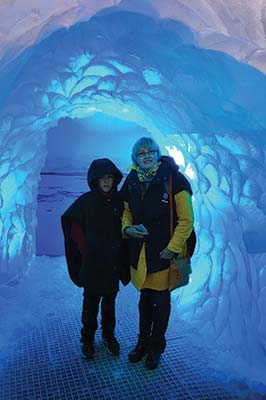
Climb or ride the elevator to the top floor (5) for the dome and the view. Here you’ll find a $ café with some basic food, and a sit-down $$ restaurant—both under the soaring dome.
One floor down (4) is the door to an outdoor deck with a 360-degree panorama of the city and surrounding countryside, well explained by orientation tables. From here, Reykjavík lines up on its hilltop around the spire of the Hallgrímskirkja church, while in the opposite direction, you’ll see the downtown airport that connects the capital to far-flung Icelandic outposts.
Nearby: Around the Pearl is the forested Öskjuhlíð hill, with walking paths, WWII ruins (signboards explain them), many rabbits, the temple for Iceland’s revived pagan religion (the “first Norse temple built here in a thousand years,” www.asatru.is), and a large cemetery (Fossvogskirkjugarður).
Seaside Strolls on the Seltjarnarnes Peninsula
For a break from sightseeing (if the weather’s nice), join the locals for a seaside stroll on the Seltjarnarnes peninsula (see the “Greater Reykjavík” map at the beginning of this chapter).
Stroll to Grótta Island Lighthouse
With good weather and plenty of time, it’s worth strolling the long seafront path (the “Sculpture and Shore Walk”) from downtown out to the Grottá lighthouse on the northern part of the Seltjarnarnes peninsula. It’s a flat, breezy 1- to 1.5-hour walk from downtown (or you could drive 10 minutes out to the lighthouse, park there, and walk as far as you like back toward the city). You’ll enjoy views of Faxaflói bay, Mount Esja (the looming ridge in the distance), and on a clear day, the Snæfellsnes Peninsula. The area surrounding the lighthouse, teeming with several species of seabirds, is part of a nature reserve and bird sanctuary. During bird nesting season (mid-May-July), access to the lighthouse is closed, but most of the path leading up to it remains open. In winter, the lighthouse is an excellent and convenient place to view the northern lights.
Southern Peninsula Stroll
You can also walk along the paths on the south side of the peninsula. There are plenty of diversions and good places for a picnic, especially at low tide, when you can walk down onto the rocks and sand. Start near the streets called Ægisíða and Faxaskjól (take bus #11).
Northeast of Downtown
▲Viðey Island
On a nice day, spend an afternoon enjoying the views of the sea and the mountains from this island a few hundred yards offshore. It’s a relaxing escape from the crowds in the city, though it takes a little work to reach. But, it gets you into the Icelandic outdoors inexpensively and without a trip out of town. Viðey’s rich bird life is readily evident—watch your step—and bird-watchers may spot golden plovers, godwits, snipe, greylag geese, and oystercatchers. The island also has an interesting history dating back to the 10th century. An Augustine monastery stood on Viðey during the Middle Ages, and during the early to mid-20th century, the island was home to a bustling port.
Getting There: You have two options for reaching Viðey (schedules below). From the Old Harbor in the city center, Elding runs a direct but infrequent 20-minute ferry in summer. Or—for a more frequent and much shorter connection—go to the Skarfagarðar ferry dock, right next to Reykjavík’s cruise-ship terminal, where a small passenger ferry makes a five-minute crossing to the island (take bus #16 from the Hlemmur bus junction—look for the stop hidden behind the white building with the red, peaked roof—and ride six stops to Skarfagarðar). Drivers park for free by the Skarfagarðar dock. Grab a free island map on board the ferry.
Either ferry is 2,100 ISK round-trip and is covered by the Reykjavík City Card. You have the option of cruising to the island from one harbor and returning to another, if you wish. Ferries from the Old Harbor leave daily June-Aug at 11:50 and 14:50 (none off-season); the last return from the island is at 18:30. Hourly ferries from Skarfagarðar leave mid-May-Aug daily 10:15-17:15, with the last return at 18:30 (in off-season this ferry runs Sat-Sun only at 13:15, 14:15, and 15:15, last return from island at 16:30). Ferry info +354 519 5000, www.elding.is.
Visiting the Island: Above the island’s dock, the large, restored house from the 1750s is the oldest in the capital area. It was originally built for Iceland’s Danish governor, but he chose to live in Reykjavík instead. Inside is a modest $ café, a free exhibit about the island, and a free WC. Next door, look into the small, traditional church, which is almost as old (from the 1760s).
From where you land, you can stroll to either end of the island in about 25 minutes. To the left, the west part of the island is empty grassland except for a series of columnar basalt statues by American sculptor Richard Serra. To the right, the road through the east part of the island leads to an abandoned village that, in the 1920s, had a port almost as important as Reykjavík’s. You can enter the old village school (its last class was in 1941) to view a photo exhibit on the island’s history—and use the WC.
A five-minute walk to the left of the café is the Imagine Peace Tower—paid for by Yoko Ono, the widow of John Lennon (free entry). The cylindrical white pedestal, inscribed with “Imagine Peace” in several languages, launches a powerful vertical pillar of light each year from October 9, Lennon’s birthday, until December 8, the date he died (www.imaginepeacetower.com).
In Laugardalur, East of Downtown
Though modest by international standards, the Laugardalur (LOY-gar-DA-lurr) valley makes a pleasant outing on a nice day and lets you hang out with Icelandic families and their kids. You pay to enter the zoo and amusement area (the adjacent botanic garden is free). A lovely café in the gardens serves meals, and there’s also an indoor ice rink. Nearby are the big, excellent Laugardalslaug swimming pool (described later, under the “Thermal Swimming Pools” section) and the Reykjavík Art Museum’s Ásmundarsafn branch (see listing, earlier).
Getting There: Take bus #2, #5, #15, or #17 to the Laugardalshöll stop and walk 10 minutes downhill to the parking lot and entrance.
Family Park and Zoo (Fjölskyldu-og Húsdýragarðurinn)
The park and zoo combines animal exhibits, amusement-park rides, and a giant playground area. You’ll see Icelandic farm animals—pigs, cows, horses, sheep—plus a seal pool, birds, reindeer, and rabbits. The website lists feeding times (click on “Program”). The park is open all year, but in winter it’s a bit desolate, especially on weekdays, and most rides are closed. If you’re hungry, you can grab a meal at the nondescript café, or stop by one of the hot-dog or ice-cream stands and enjoy a picnic at the outdoor tables.
Cost and Hours: 1,500 ISK, covered by Reykjavík City Card, less for kids, includes rides; daily 10:00-18:00 except Wed until 20:00, off-season daily until 17:00; free parking, Múlavegur 2, +354 411-5900, www.mu.is (that’s the Icelandic word for “moo”).
Botanic Garden (Grasagarður)
Next to the Family Park and Zoo, the city-run botanic garden showcases local trees, herbs, flowers, and other plants in a well-manicured setting. Dotted with ponds and small white bridges, it’s a soothing place for a stroll. And in the center of the garden (turn right at the fountain/sculpture) is the excellent $$ Flóran café (described later, under “Eating in Reykjavík”), which makes a visit worthwhile even on a rainy day.
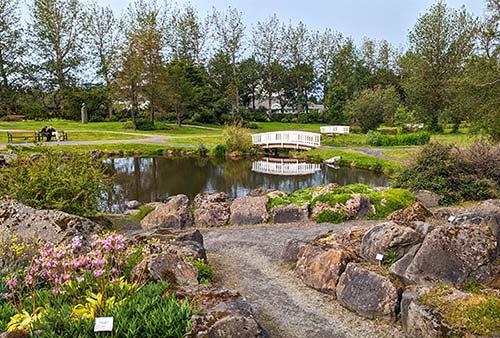
Cost and Hours: Free, daily 10:00-22:00, off-season until 15:00, +354 411 8650, www.grasagardur.is.
Nearby: Follow the parkland a few minutes from the gardens (past the ponds and bridges, and beyond the gate at the north end of the gardens) to an open grassy area with a statue of a woman doing laundry. Here you can see the remains of the Laugardalur Washing Pools, washing troughs and channels where city residents used to do their laundry in hot spring water, all the way up to the 1970s. Outdoor posters tell the story and give you a feel for how fast the country has modernized.
Ice Rink (Skautahöllin)
Next to the parking lot for the zoo and gardens is the city’s indoor ice rink with public skating most afternoons—a useful bad-weather option (entry including skate rental—1,500 ISK, less for kids; closes for several weeks in summer, confirm current hours on website; Múlavegur 1, +354 588 9705, www.skautaholl.is).
FARTHER EAST OF REYKJAVÍK
The Árbær Open-Air Museum is just on the outskirts of town, while the Halldór Laxness House is farther east, roughly on the way to or from the Golden Circle loop. If you’re efficient, you may be able to squeeze one of these into your Golden Circle day trip. Or you can consider these as easy side-trips from the capital—each is about a 30-minute drive from downtown.
▲Árbær Open-Air Museum (Árbæjarsafn)
Reykjavík’s open-air museum is a modest collection of old buildings and farm animals—meant to help visitors envision Icelandic life in the 1800s. Homes hold period furnishings and reward those with the patience to poke around and ask questions; while everything is described in English, exhibits seem designed for Icelandic families. At the far edge of the property, the four attached houses (one with a sod roof) are the only ones that were originally located here; walking through them, you can see how each successive generation added its own wing. The museum grounds—tucked next to a subdivision, with a highway rumbling along the horizon—are underwhelming, especially if you’ve visited the lush open-air museums elsewhere in northern Europe. But the exhibits compensate.
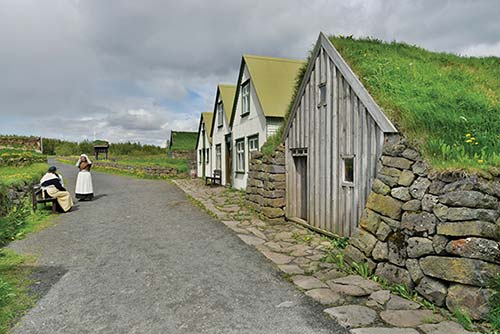
Try to time your visit to coincide with the 13:00 hour-long guided tour (included in admission). In the weeks before Christmas, the museum offers festive activities on Sundays (check their website).
Cost and Hours: 2,150 ISK, covered by Reykjavík City Card, free for kids under 17; daily 10:00-17:00, Sept-May 13:00-17:00; café (waffles and snacks) open June-Aug daily 11:00-17:00; Kistuhylur 4, +354 411 6304, www.borgarsogusafn.is [URL inactive].
Getting There: The museum is at the end of the street called Kistuhylur, just off busy highway 49. The easiest bus connection from downtown is #16 from Hlemmur to the Strengur/Laxakvísl stop.
Nearby: Very close to the open-air museum is one of the capital region’s best neighborhood swimming pools, Árbæjarlaug (described later, under “Thermal Swimming Pools”). If you’re considering trying this Icelandic custom, bring your swimsuit and go for a dip after your museum visit.
Halldór Laxness House (Gljúfrasteinn)
Iceland’s most famous author, Nobel Prize winner Halldór Laxness (1902-1998), lived in a house called Gljúfrasteinn (Canyonstone). The house has been preserved as a museum; an audioguide explains each room. The backyard borders on a rushing stream.
Cost and Hours: 1,200 ISK, daily 10:00-17:00; shorter hours off-season and closed Mon; Nov-March closed Sat-Mon; +354 586 8066, www.gljufrasteinn.is.
Getting There: It’s one of the last houses on the right as you drive up the Mosfellsdalur valley on highway 36, about 25 minutes from downtown Reykjavík. You can easily combine Laxness’s house with a visit to Þingvellir, but doing the house plus the whole Golden Circle in a day is too much.
Background: Born in Reykjavík, Halldór Guðjónsson was the eldest son of parents who started life poor. His father worked in road construction, and bought a farm at Laxnes in Mosfellsdalur when Halldór was three. Halldór grew up in the valley and started to write as a teenager. Like many Icelanders of his time, he took a surname (based on the farm where he grew up) instead of using his traditional patronymic. In the 1920s and 1930s he traveled in Europe and America, and converted to Catholicism. In 1945, he settled at Gljúfrasteinn, close to where he grew up, with his second wife. Here he lived comfortably, but not lavishly.
Over his lifetime, Laxness wrote more than a dozen novels, some brilliant...and others barely readable. Independent People (in Icelandic, Sjálfstætt fólk) is the best known. He also wrote short stories, plays, poetry, travel books, memoirs, and other nonfiction. In his writing, Laxness concerned himself strongly with social justice and the struggles of working people. Icelanders on the political right forbade their children to read his books, and cringed when he received the Nobel Prize; those on the political left loved him and felt he told the truth. In the end, no one could deny that he was a gifted writer and a person of insight and compassion.
Experiences in and near Reykjavík
For info on horseback riding and volcano underground tours near Reykjavík, see the Icelandic Experiences chapter.
▲▲▲Thermal Swimming Pools
The vast majority of tourists head straight for the Blue Lagoon, but never consider diving into Iceland’s many thermal swimming pools. That’s a shame, because—while they lack the atmospheric lava-rock landscape and opaque water—these pools are more authentic and local...and they’re much cheaper. They offer a relaxing way to unwind from a busy day of sightseeing, and warm you up in cold weather. You can still visit the Blue Lagoon, but consider complementing it with a swim in a community pool.
There are more than a dozen pools to choose from in the greater Reykjavík area, each one run by the local municipality. The more recently built pools in the suburbs are typically more spacious, with more elaborate waterslides and at least one weatherproof indoor pool—making them well worth a short drive or bus ride. Of the ones I list below, only the first two are within walking distance of downtown. (If doing day trips by car, swing by a pool for a relaxing dip at the end of a long day.) Any Icelander you ask will have a favorite pool and can rattle off its advantages and disadvantages.
How to Visit: As they’re designed for Icelanders, these pools do come with some special etiquette. Read the “Thermal Waters” section on here, and you’ll have a smooth, comfortable visit.
Cost: Pools in Reykjavík charge 1,210 ISK (free for seniors ages 67 or older). The pools in Seltjarnarnes and Hafnarfjörður provide the same experience for a little less—1,100 ISK. In Reykjavík, a shareable 10-entry ticket costs 4,650 ISK, which saves money with only five entries (for example, a couple visiting three times). These are adult rates—kids get in for less. You can bring your own towel, or rent one for 600 ISK; swimsuits are also available for rent or sale.
Hours: On weekdays, most swimming pools in the capital area open from 6:30 until 22:00. On weekends, pools open a little later (around 8:00 or 9:00)—confirm hours at www.reykjavik.is/en/swimming-pools. Note that most pools close on national holidays. Pools are most crowded after work and school, in the late afternoon; during the day, it’s mostly kids and retirees.
▲▲Sundhöllin
Reykjavík’s oldest swimming pool—designed by state architect Guðjón Samúelsson in 1937—is the only one within the downtown zone. Parts of the complex retain a classic, antique feel, though the newer outdoor section feels modern and engaging. For nondrivers, the central location makes it an easy choice for sampling a thermal pool. From the windows by the ticket desk, look down over the outdoor section, with city sprawl beyond. From here, the old-fashioned, tiled men’s changing rooms are to the left along with a couple of hot pools and a sauna. To the right are both women’s changing rooms and additional ones for men, and a variety of pools to choose from. The two sections—indoor and outdoor—are connected by a staircase or elevator (Barónsstígur 45a, 5-minute walk from Hlemmur bus junction or Hallgrímskirkja, for location see the “Reykjavík Center” map on here, limited free street parking in front, +354 411 5350).
▲Vesturbæjarlaug
This compact 1960s-era pool, in a somewhat posh neighborhood near the university, is a good all-around choice for those staying downtown (20-minute walk, or take bus #11, #13, or #15). It’s close enough to the center to catch a few tourists, but has a predominantly neighborhood feel. It’s outdoor-only, with a small lap pool, a wading area, hot pots, a steam room, and a sauna (corner of Hofsvallagata and Melhagi, see the “Reykjavík” map on here, free parking in front or on the street nearby, +354 411 5150).
Nearby: The burger/hot-dog stand immediately in front of the pool is a local favorite. For something classier, the recommended Kaffihús Vesturbæjar café is across the street. And next door is a branch of the delicious Brauð & Co bakery. After your soak and meal, you can explore the neighborhood—a mellow coastal walk is just a couple of blocks away.
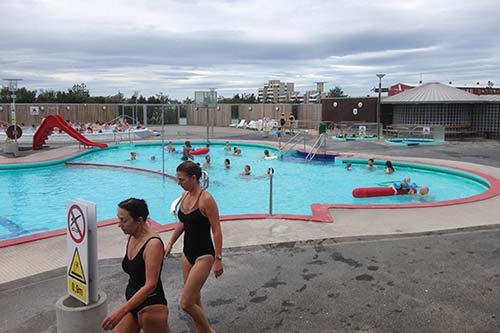
▲▲Árbæjarlaug
Farther from the center, this complex wins for nicest modern design (from the 1990s)—and may be the most appealing all-around choice. A soaring glass dome covers its small indoor section, from which you can swim right outside to an interconnected series of pools, including a lap pool, a large warm pool with bubbles and waterfalls, a modest water slide, several hot pools, and a steam bath. While there’s a lot of variety, it’s compact and manageable, and looks out over a wooded valley with the sprawl of Reykjavík on the horizon (Fylkisvegur 9, see the “Greater Reykjavík” map on here, +354 411 5200). It’s a 20-minute drive from downtown, or take bus #5 to the Fylkisvegur stop. Árbæjarlaug is just off highway 1—convenient for those coming back from Golden Circle or South Coast day trips. It’s also handy to combine with a visit to the nearby Árbær Open-Air Museum.
Other Pools
Also consider these ▲ pools:
Laugardalslaug: The country’s largest pool is a bit industrial-feeling and long in the tooth, but it’s big enough to offer a wide variety of entertaining options. As you step out of the locker room, the left side is all business (including a pool of seawater that’s pumped in from the coastline) and the right side is all fun (with a thrilling waterslide tower). A short bus ride east of the center, Laugardalslaug is next to the official Reykjavík youth hostel and sports complex. It’s a good option if you’re staying nearby, if you want to go swimming late on a weekend evening, or on major holidays like Christmas or New Year’s Day, when it’s typically the only pool open (Sundlaugavegur 30, see the “Reykjavík” map on here, bus #14 to Laugardalslaug stop, big free parking lot on Reykjavegur just before the pool complex, +354 411 5100).
Sundlaug Seltjarnarnes: This small, cozy residential pool is frequented mainly by locals (10-minute drive or bus ride from the center on #11, or a 40-minute walk). It’s outdoor-only, and has easy parking, nice views, a modest water slide, and a cozy wading and lounging area (on Suðurströnd in Seltjarnarnes, see the “Greater Reykjavík” map on here, bus #11 to Íþróttamiðstöð Seltjarnarness stop, +354 561 1551, www.seltjarnarnes.is).
Ásvallalaug: The best indoor pool in the capital area, and arguably the best family pool overall, is on the outskirts of Hafnarfjörður (the bedroom community south of Reykjavík, which you’ll drive through on the way in from the airport). From downtown Reykjavík, it’s a 20-minute drive or a long 45 minutes by direct city bus. Opened in 2008, it has a full-size lap pool, a large wading pool, a large and shallow family pool, a good water slide, and hot pools; the only outdoor facilities are two small hot pools. It’s a great bad-weather destination (Ásvellir 2, Hafnarfjörður, see the “Greater Reykjavík” map on here, bus #1 to Ásvallalaug stop, big parking lot, +354 512 4050, www.hafnarfjordur.is). You could stop in downtown Hafnarfjörður to eat afterward (see recommendations later in this chapter), or drive to the cheap cafeteria at Ikea, which is on the way back to Reykjavík.
Nauthólsvík Heated Beach
Nauthólsvík, maintained by the city of Reykjavík, is an artificial beach (ylströnd) in a sheltered part of the shoreline, where you can bathe in an area heated with excess geothermal water from the city’s heating system. This can be fun on a nice summer day, although you’ll find better facilities and services at the regular pools (free, possible charge for changing facilities; daily 10:00-19:00, limited hours and 740 ISK charge mid-Aug-mid-May, off Nauthólsvegur, see the “Greater Reykjavík” map on here, bus #5 to Nauthóll/HR stop, free parking, or walk from here to the Pearl, +354 411 5330, www.nautholsvik.is).
▲▲Sky Lagoon
Located at the tip of the Kópavogur peninsula, just south of downtown, this thermal bath is slightly cheaper and closer to Reykjavík than the Blue Lagoon. You’ll soak in crystal-clear water in a gigantic, rock-enclosed infinity pool looking out over the sea. But unlike the Blue Lagoon, this is an entirely artificial construction—the rocks were brought here from elsewhere, and the turf structure enveloping the pool was built only recently. The Sky Lagoon also provides a more authentically Icelandic experience; locals enjoy coming here—often by bike—for drinks and a soak on evenings and weekends.
The optional “Seven-Step Ritual” includes a sauna, steam, and some exfoliation. Though pricey, Sky Lagoon offers an enjoyable and memorable experience that avoids the longer journey, crowds, and expense of the Blue Lagoon. Given the ease of getting here from the city center, this could be a handy pre- or post-dinner activity.
Cost: 12,990 ISK for basic “Pure” experience (shared locker room); 16,490 ISK for “Sky” experience (private changing cabin); 9,990 ISK for “Pure Lite” budget alternative (lagoon access without “Seven-Step Ritual”); all prices may be less at off-peak times. It’s wise to prebook your time slot at www.skylagoon.com.
Hours: July-Aug daily 9:00-23:00; Sept Sun-Fri 11:00-23:00, Sat from 10:00; Oct-June Tue-Thu 12:00-22:00, Fri-Mon from 10:00. Last entry is two hours before closing.
Getting There: It’s about a 15-minute drive from downtown: Get on highway 40 going south, take the exit signed Kópavogur N, and drive through the suburban and then industrial part of the peninsula until you reach its far end. Parking is free. From the parking lot, you have a nice view across to the domestic airport, the Hallgrímskirkja, and the Pearl perched on a wooded slope. A taxi from Reykjavík to Sky Lagoon costs about 3,900 ISK. It’s doable but tedious by bus (ask locally for details). For location, see the “Greater Reykjavík” map on here.
Shuttle Service: Sky Lagoon sells package deals (run by Reykjavík Excursions) that include entry to the lagoon, plus bus service to and from the BSÍ bus terminal (11,000-16,000 ISK, check website for details).
Visiting the Sky Lagoon: Upon entering the dreamy lagoon, you’ll wade through a rocky canyon before turning a bend and watching the sea open up before you. Belly up to the infinity wall and gaze out at the surf and surrounding hills. At the right end is a thundering waterfall; on the left side, tucked back under a rock ledge and facing a warmer lagoon, is the bar, selling pricey beer and cocktails.
At the left end of the pool, you may see people bobbing in line for the “Seven-Step Ritual.” The ritual entails a dip into a cold plunge pool, followed by a silent sauna with a giant window (the largest in Iceland) overlooking the sea. Next you’ll stand under a cool mist, smear an oily exfoliating salt scrub on yourself, and sit in the steam room. Finally you’ll wash off before heading back to the main lagoon.
Shopping in Reykjavík
While you’ll find plenty of shopping opportunities, don’t expect any bargains: Iceland has almost no manufacturing industry of its own, so many items are imported and quite expensive. My shopping advice emphasizes items that are produced or at least designed in Iceland.
Store Hours: Most shops are open at least Mon-Fri 10:00-18:00; on Saturdays, many close earlier. Sundays are unpredictable—larger or tourist-oriented shops remain open, while others close. In general, touristy shops on the main shopping streets downtown (Laugavegur and Skólavörðustígur) have longer hours in the evening and on Sundays.
WHERE TO SHOP
The main drag, Laugavegur, features dozens of stores that run the gamut from gaudy “puffin shops” to high-end craft and design boutiques; a few highlights are mentioned in the next section.
Leave time to browse Skólavörðustígur, the charming street leading up from Laugavegur to Hallgrímskirkja. It’s lined with more authentic-feeling small boutiques. I’ve listed some of my favorites in the next section, but here’s a quick rundown: Near the bottom are large branches of Rammagerðin (top-end souvenirs), and Eymundsson (books). Farther up—especially around the intersection with Týsgata—you’ll find an enticing assortment of one-off boutiques, including the 12 Tónar record shop and the Handknitting Association of Iceland.
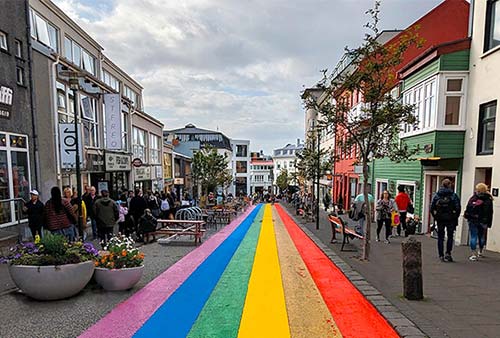
Jewelry is a popular item along here, including at Orrifin (with funky style, at #43) and Fríða (#18). This street also specializes in ceramicists; look for Stígur (a collective showcasing the work of several artists, at #17B) and Kaolin (at #5). Many of these stores have their own little workshops attached, where you can watch artisans at work.
WHAT TO BUY
Sweaters and Other Icelandic Fashion
At the top of many shopping lists is a handmade Icelandic wool sweater (lopapeysa). Knitting is a major pastime in this nation where sheep outnumber people, and where hobbies get you through the dreary winter months. The heavy wool, appreciated by aficionados, comes from the hardy sheep you see grazing around the countryside. Icelandic designs—often with classy one- or two-tone diamond patterns radiating from the neck—are both timeless and stylish. (While they look very traditional, these designs originated only in the 1950s.) A good, handmade sweater starts at around $200; they tend to be bulky, so you’ll need room in your luggage.
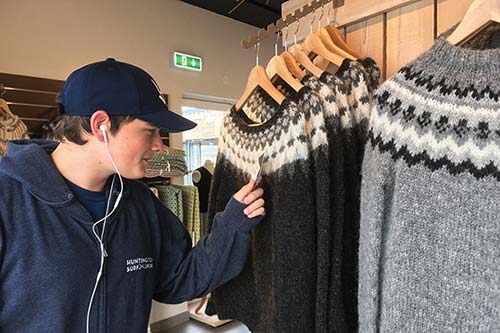
Classic Sweaters: The best place for a traditional sweater (as well as other knitwear and yarn) is the cozy little Handknitting Association of Iceland (Handprjónasambandið) shop; browse their website before you go (Mon-Fri 9:00-19:00, Sat until 17:00, Sun 10:00-16:00, Skólavörðustígur 19, +354 552 1890, www.handknitted.is).
Secondhand Sweaters: For a quality sweater at a lower price (closer to $120), consider buying secondhand. For a big, well-stocked vintage clothing shop, stop by Spúútnik on the main drag (Laugavegur 28) or their second location, Fatamarkaður (at the Hlemmur bus junction, Laugavegur 126). Or, to support a good cause while you shop, the Red Cross charity shop has three very central locations (at Laugavegur 12B, Laugavegur 116, and Borgartún 7). Note that these places line up conveniently—allowing you to comparison-shop easily in about a 10-minute stroll along Laugavegur. You’ll find plenty of sweaters at the Kolaportið flea market—but don’t expect top quality there (Sat-Sun only, see listing on here).
Stylish Sweaters (and Other Fashion): Icelandic designers enjoy updating traditional sweater designs. Farmers & Friends has a full range of fashionable Farmers Market-brand clothes, including sweaters (www.farmersmarket.is). Their downtown outpost is at Laugavegur 37, while their flagship store is at the far end of the Old Harbor’s Grandi pier (near the Marshall-húsið arts center) at Hólmaslóð 2.
Other Clothes: 66°North, Iceland’s best-known outerwear brand, is the place to buy waterproof shells and puffy vests. Two convenient locations are right on the main drag (Laugavegur 17 and Bankastræti 5). There’s another outpost at the upscale shopping area near the Harpa concert hall (at Bryggjugata 7). For a better deal, drivers can head to their suburban outlet store with deep discounts—typically about half off (buried in the back of the Skeifan shopping zone, Mon-Fri 9:00-18:00, Sat from 10:00, Sun from 12:00, Faxafen 12, see the “Reykjavík” map on here, bus #5 to Mörkin stop, +354 535 6676, www.66north.is).
Icelandic Souvenirs
Visitors enjoy browsing for keepsakes emblazoned with the Icelandic flag, or an outline of the country. Other popular items include cheesy Viking-themed trinkets, and plush puffins, whales, and polar bears (they don’t live in Iceland, but every now and then, a stray bear drifts across from Greenland on an iceberg). Laugavegur and adjoining streets seem to specialize in tacky souvenir outlets; most of what you’ll find is overpriced and made in China. Here are a few better options for more authentically Icelandic souvenirs.
Icelandic candy is unusual and hard to get outside of Iceland, but easily found at discount grocery stores (Bónus and Krónan), which are generally cheaper and have a better selection than the duty-free airport shops. Cooks on your shopping list might enjoy some of the wide variety of flavored Icelandic sea salts (including birch-smoked, seaweed, black lava, and arctic thyme). The gift shop at the National Museum is a little more sophisticated than the norm (see listing in “Sights in Reykjavík”).

Rammagerðin, a venerable, high-end boutique, offers extremely expensive but good-quality Icelandic handcrafts and design (www.rammagerdin.is). The main branch—with a row of stuffed birds (including puffins) looking out the window—is in the heart of the main shopping zone at Skólavörðustígur 12; other branches are just up the street at Skólavörðustígur 7, near the Harpa concert hall at Austurbakki 2, and at the airport (Iceland Gift Store).
Iceland, like other Nordic countries, has a knack for clean, eye-pleasing design. Check out Epal Icelandic Design (Laugavegur 70) and Hjarta Reykjavíkur (The Heart of Reykjavík), with colorful artwork of the city’s cute houses (Laugavegur 12b).
Bookstores
Some English-language books on Iceland are available much more cheaply back home; others are hard to find outside the country.
There are several downtown branches of Eymundsson, Iceland’s answer to Barnes & Noble, including ones at Austurstræti 18, Skólavörðustígur 11, and Laugavegur 77 (check hours at www.penninn.is).
The Bókabúð Forlagið bookstore is in the Grandi neighborhood beyond the Old Harbor (Mon-Fri 10:00-18:00, Sat 11:00-17:00, Sun 12:00-16:00, Fiskislóð 39, +354 575 5636, www.forlagid.is).
Hús Máls og Menningar is a beautiful bookstore selling mostly Icelandic books (new and used), with a small section of English titles (daily 13:00-late, Laugavegur 18, https://husmalsogmenningar.is). The place becomes a fun live-music venue at night (see “Other Performances,” later).
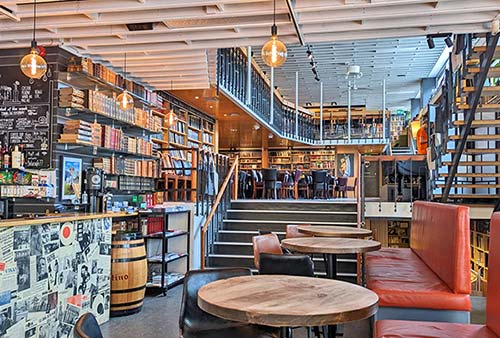
Other Ideas
12 Tónar, downtown at Skólavörðustígur 15, is a local institution. Their shop specializes in Icelandic music, and they run their own label—making this a beloved outpost for indie music lovers. You’re welcome to listen to whatever you like over a free cup of coffee (Mon 10:00-18:00, Tue-Sat 10:00-late, Sun 12:00-18:00, +354 511 5656, www.12tonar.is).
Greater Reykjavík’s two big shopping malls (Kringlan and Smáralind) are convenient for drivers and give you a nontouristy look at Icelandic commercial life.
Entertainment in Reykjavík
PERFORMANCES AT HARPA
Iceland’s cutting-edge arts center (described earlier, under “Sights in Reykjavík”) has several venues, big and small, that offer entertainment options every night of the year. Two serious musical ensembles are based at Harpa: the Iceland Symphony Orchestra (Sinfóníuhljómsveit Íslands, http://en.sinfonia.is) and the Icelandic Opera (Íslenska Óperan, http://opera.is). Both regularly perform in the 1,800-seat main hall, called Eldborg. Harpa’s smaller halls (200-1,100 seats) host many types of performances. Check the schedule for a chance to combine a show with a visit to the most architecturally exciting building in Iceland (box office open daily 10:00-18:00, often later during performances, http://en.harpa.is [URL inactive]).
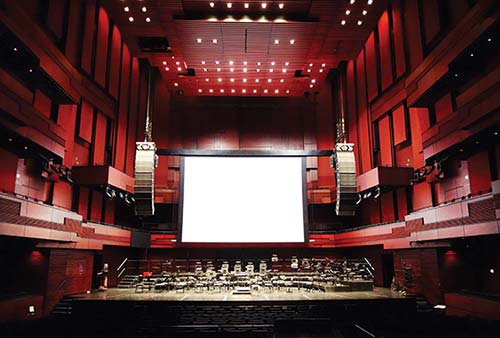
Among the shows at Harpa are likely to be the following tourist-oriented options (all designed for an English-speaking audience). While these may change, each one has been running for several years (though sometimes only in summer). All are entertaining and (aside from the first and last) designed to give visitors insights into Icelandic culture.
Sunday Classics is a daytime concert offering a 30-minute presentation of some “greatest hits” of classical music (Mozart, Beethoven, etc.) performed by a smaller ensemble from the symphony. It’s an affordable way to experience Harpa without investing too much time and money...but there’s very little Icelandic about it (4,400 ISK, usually at 12:30, http://en.harpa.is [URL inactive]).
Pearls of Icelandic Song presents a collection of traditional tunes sung by operatically trained soloists with piano accompaniment. The formal presentation of these informal songs may not be to everyone’s taste, but it’s authentically Icelandic (4,900-5,500 ISK, usually at 18:00 in the main hall, www.pearls.is).
Icelandic Sagas: The Greatest Hits is a frenetic two-person show that attempts to compress centuries of deep and complex Icelandic heritage into 75 minutes, with plenty of humor and costume changes. Though more entertaining than educational, you’ll come away with a somewhat better appreciation for Iceland’s history (5,500 ISK, usually at 19:30 in the Northern Lights Hall, www.icelandicsagas.com).
How to Become Icelandic in 60 Minutes is a breezy, irreverent, and sometimes naughty one-man comedy show that’s a 15-step lesson on what it takes to live like a local on the “biggest little island in the world” (5,500 ISK, usually at 19:00 in the smaller Kaldalón, www.h2become.com).
Múlinn Jazz Club hosts weekly jazz performances in an intimate setting (3,900 ISK, typically Wed and Fri at 20:00, www.facebook.com/mulinnjazzclub).
OTHER PERFORMANCES
You can locate the following venues on the “Reykjavík Walk” map on here.
Hús Máls og Menningar, a two-story bookstore and café by day, morphs into a bar and music venue by night. The house band, the Honky Tonks, plays pop and rock covers every night at 20:00 (Fri-Sat at 20:30), when locals and tourists alike funnel in from the main tourist drag for a lively time, surrounded by walls of Icelandic books (Laugavegur 18, https://husmalsogmenningar.is).
The Gamla Bíó theater—a classic old cinema in the heart of town—hosts a variety of performances, and its recommended rooftop bar—Petersen Svítan—is a fine venue for a before- or after-show drink (Ingólfsstræti 2a, www.gamlabio.is).
Various churches around Reykjavík present low-key concerts. The big, landmark Hallgrímskirkja offers concerts (mainly on their huge organ) about four times weekly in summer (late June-late Aug, as part of the “International Organ Summer”), and sporadically at other times of year (www.hallgrimskirkja.is). And the cathedral—the modest building next to the parliament, downtown—hosts occasional concerts in its intimate, lovely space (www.domkirkjan.is).
Bíó Paradís, a beloved art-house cinema just off the main drag downtown, shows international films in their original language with Icelandic subtitles, as well as Icelandic films with English subtitles. Locals kick off weekend revelry at their throwback film series every Friday night—camp classics, ’80s and ’90s movies, interactive screenings (like the Rocky Horror Picture Show), and so on. Their bar/café is a popular hangout. The movie lets out just as things get rolling outside (Hverfisgata 54, +354 412 7711, www.bioparadis.is).
NIGHTLIFE
Reykjavík is renowned for its crazy nightlife. Just go downtown any Friday or Saturday night and hit your choice of bars and clubs. Typically, Icelanders come here only on weekends. Many young Icelanders drink at home first (less expensive) before heading downtown between 23:00 and midnight. Higher-end drinking places—hotel cocktail bars, craft-beer specialists, and the like—tend to close on the “early” side...which, in Reykjavík, means midnight on weeknights and 1:00 in the morning on weekends. Harder-partying places stay open until 3:00 or later.
I’ve recommended some well-established watering holes (for locations, see the “Reykjavík Center Restaurants” map, later)—but this scene changes quickly. For a more timely take, pick up the latest issue of the Reykjavík Grapevine (or read it online at www.grapevine.is) to find what’s in, what’s on, and which bands or DJs are playing where. The Grapevine also publishes a list of best happy hours—good to know about in this pricey city.
If you want company, go on a guided pub crawl such as the one offered by Your Friend in Reykjavík (11,200 ISK, daily at 18:00 and 20:00, https://yourfriendinreykjavik.com).
Upscale Cocktails
These options are for those who’d prefer a more sophisticated scene, and don’t mind investing in a pricey (2,000-2,500 ISK) but well-crafted cocktail in a memorable setting.
Sophisticated Art Deco Vibe: Right in the heart of town, Apotek fills the ground floor of a landmark hotel by renowned architect Guðjón Samúelsson. This stuffy place loves to brag about its many “best cocktails” awards and generous happy-hour deals. More sedate than the rowdy party scene all around it, this is a popular choice for a genteel drink. They also serve a full menu of food—including a decent lunch special—but better restaurants are nearby; come for the drinks and the ambience (daily, Austurstræti 16).
Rooftop Bars: To reach Petersen Svítan (The Petersen Suite), you’ll slip through a side door next to the classic Gamla Bíó theater, then ride the elevator up to a rooftop deck. You can sit in the Old World interior, but the main draw is the large outdoor area, overlooking city rooftops—a delight on warm evenings. Don’t miss the spiral stairs up to an even higher deck (daily, happy hour deals, Ingólfsstræti 2a).
The recommended Loft Hostel runs a convivial rooftop bar perched above the Bankastræti action, with a city-view deck that’s as much a draw for locals as visitors (daily, happy hour deals, Bankastræti 7, take elevator to the fourth floor).
By the Harbor: Slippbarinn is one of the best places in town for quality, creative cocktails. The menu is vividly described and fun to peruse, with a few mainstays and lots of seasonal concoctions. A mellow hangout by day, at night it’s a big, boisterous, and colorful party. It sprawls through the spacious, creative, industrial-mod lobby of the Berjaya Reykjavík Marina Hótel, right along the harborfront, facing the namesake dry dock (daily, also serves food, occasional DJs, Mýrargata 2).
Craft Beer
Iceland has a burgeoning craft beer scene, including high-end bars where you can focus on sampling local brews. While some proudly feature Icelandic beer, most acknowledge the limits of local brewers and make a point to also offer a carefully curated range of imports. Most craft-beer bars have several taps and a chalkboard listing what’s on today. Figure on paying 1,000-1,800 ISK for a pint. Most places have a long happy hour with a selection of discounted beers.
Skúli Craft Bar, named for the statue of the original Reykjavík developer on the downtown square it faces, has a great section of Icelandic craft beers. The prices are high, but the pub-like space feels inviting and attracts a few locals along with the tourists. They also have pleasant outdoor tables on the square (daily, happy hour until 19:00, Aðalstræti 9, +354 519 6455).
MicroBar fills a straightforward cellar with happy drinkers (mostly tourists, thanks to its main-drag location) enjoying an even wider selection of microbrews. They specialize in Icelandic beers—with 14 on tap, and more than 100 in bottles—and is a rare place that offers beer sampler boards; this being Iceland, you’ll pay dearly for each sip (daily, Vesturgata 2, +354 865 8389).
Ægir is a local microbrewery pouring its high-quality, inventive beers right in the middle of the tourist action on Laugavegur, making this an easy spot to dip into for a quick pint. It’s below street level (enter below the Holy Cow clothing shop) in a rustic cellar with a laid-back vibe and friendly staff (limited Mexican food menu, daily, Laugavegur 2, +354 552 7872).
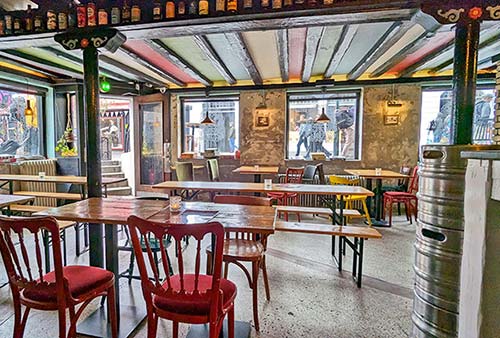
Ölstofa Kormáks og Skjaldar (Kormákur and Skjöldur’s Tavern) is a nice hybrid of the beer-geek places mentioned earlier. Because it’s tucked away from Laugavegur, it feels more local, with a Cheers vibe and a table often filled with regulars. While they do have taps and bottles from local brewers, their draft selection is limited; visit for the atmosphere, not a deep dive into Icelandic brews (daily, Vegamótastíg 4, +354 552 4687).
Lively Late-Night Bars
These places really get rolling late at night on weekends (though you’re welcome to stop by earlier in the evening, when they can already be quite crowded on weekends). Come for Reykjavík’s famous social weekend experience, not the drinks.
Kaffibarinn is a classic dive bar right in the center. It’s an institution that still attracts a largely Icelandic clientele. (My Icelandic friend tells me, “Every local in Reykjavík has been here.”) Filling an old house, it can feel crowded and gets pretty wild on weekends; for a mellower visit, check it out on a weeknight (daily, good happy-hour deals before 20:00, live DJ at prime times, Bergstaðastræti 1, +354 551 1588).
Right along the busiest stretch of Laugavegur, you can’t miss Lebowski Bar, with neon lights, a Dude-Walter-and-Donny bowling theme, 16 versions of white Russians...and, one would assume, owners very nervous that the Coen Brothers’ legal team will catch on. It’s rowdy and popular with young Americans (daily, Laugavegur 20b, +354 552 2300).
A block from Ingólfstorg toward the harbor is a cluster of raucous, hole-in-the-wall bars for late-night revelry. Paloma is a late-late-late-night weekend option with a dance floor and a vaguely nautical vibe; it’s bigger than most, so it feels less claustrophobic (Naustin 1, above The Dubliner). And The Dubliner is the city’s most central Irish pub (daily, Naustin 1, below Paloma).
Sleeping in Reykjavík
Reykjavík is an expensive place to spend the night. With its spike in tourism, the city is bursting at the seams, demand is soaring, and lots of new places are opening up (or old places expanding) each year—some of them great, others not.
I’ve focused my listings on relatively established hotels offering good value. Given how pricey Reykjavík’s hotels are (especially in the center), I’d also give guesthouses and private rentals (such as on Airbnb) a serious look; youth hostels are especially good for solo travelers. Real hotels are very expensive, especially in the center and in summer. Guesthouses (figure $230-250 a night) and Airbnb ($150-200 a night) give you more value for your money and a more local experience.
Whatever you do, book any accommodations well in advance, as the best places sell out early for the peak summer months, or if your trip coincides with a major holiday.
If a place has the option of a shared bathroom, I’ve noted that in the listing; opting for a shared bath often knocks down the price considerably.
Without a car, stay downtown. It’s more convenient for restaurants, nightlife, much of the worthwhile sightseeing, and bus-excursion pickups (though if noise is an issue, request a quiet room, as it can get loud on weekend nights). With a rental car, it can make better sense to stay outside the downtown core—where lodgings cost less and parking is easy. There are fewer hotels and guesthouses in the suburbs, but Airbnb and other rentals are abundant.
For car travelers, the outlying community of Hafnarfjörður is a nice compromise. It has its own little downtown core, quaint old houses, free parking, and less noise and traffic than Reykjavík. It’s strategically situated for those driving to and from the airport, the Golden Circle, the Blue Lagoon, and the South Coast (for recommendations in this area, see the end of this chapter).
City buses run to every corner of the metropolitan area, although some parts are a long ride (with a transfer) from downtown. When scoping out a place to stay, check bus access by plugging the address into the journey planner at www.straeto.is and seeing how long it takes to get to the main downtown stops (Lækjartorg and Hlemmur).
I rank accommodations from $ budget to $$$$ splurge. To get the best deal, contact small hotels and guesthouses directly by phone or email. If you go direct, the owner avoids a roughly 20 percent commission and may be able to offer you a discount. For more information and tips on hotel rates and deals, making reservations, finding a short-term rental, and chain hotels, see the Practicalities chapter.
Airbnb and Other Rental Sites: In Reykjavík, Airbnb and other short-term rentals can be a much better value than hotels. The bottom line: Iceland is expensive, and staying in nontraditional accommodations can have the single biggest impact on your travel budget.
Airbnb lists plenty of options in the downtown core, and is handy for finding less-expensive suburban accommodations (easier for drivers), while providing a more authentic look at Icelandic life. A search for “Reykjavík” may turn up some of these, but for more options, search for the name of the separate town: Hafnarfjörður, Garðabær, Kópavogur, Mosfellsbær, or Seltjarnarnes.
EXPENSIVE DOWNTOWN HOTELS
If you’re going to spend a lot of money, you might as well do it with class. These hotels each offer something special.
$$$$ The Reykjavík Residence Hotel rents out studios, suites, and apartments in eight buildings located within minutes of each other along or near Hverfisgata (a block off Laugavegur). The most notable building, next to the National Theater, was once a private home built in 1912 by a local bigwig who later became prime minister. When the king of Denmark visited in 1926, this is where he stayed. It’s been converted into 10 top-end suites, each with a kitchenette. For the best value, ask for an “economy studio,” which costs the least, comes with a kitchenette, and is more spacious than most standard doubles you’ll find in Reykjavík (breakfast extra, laundry service, Hverfisgata 60, +354 561 1200, www.reykjavikresidence.is, info@rrhotel.is).
$$$$ Kvosin Downtown Hotel, across the street from parliament and the cathedral in a building from 1900, has 24 big suites with full kitchenettes and fine art on the walls (breakfast extra, Kirkjutorg 4, +354 571 4460, www.kvosinhotel.is, desk@kvosinhotel.is).
$$$$ Hótel Reykjavík Centrum boasts a great location, in view of the parliament, in a modernized building with a period facade and 89 rooms. The Settlement Exhibition on Reykjavík’s early history is in the basement, centered on archaeological ruins found when the hotel was built in 2001 (excellent breakfast extra, Aðalstræti 16, +354 514 6000, www.hotelcentrum.is [URL inactive], info@hotelcentrum.is).
$$$ Hótel Óðinsvé, with 50 modern, stylish rooms and 29 apartments across a few nearby buildings, sits in a pleasant residential area a short walk from the lively Skólavörðustígur shopping and dining street (breakfast extra, Þórsgötu 1, recommended Snaps Bistro on-site, +354 511 6200, www.hotelodinsve.is, reception@odinsve.is).
$$$ Berjaya Reykjavík Marina Hótel is at the Old Harbor in a long, skinny building that spent many years as the harbor’s ship-painting facility. Some rooms are small, but there’s plenty of natural light, and some rooms have views of the harbor. The lobby and adjacent lounges are stylish and welcoming. The hotel is also home to the recommended Slippbarinn cocktail bar (family rooms, breakfast extra, Mýrargata 2, +354 560 8002, www.icelandahotelollectionbyberjaya.com [URL inactive], marina@icehotels.is).
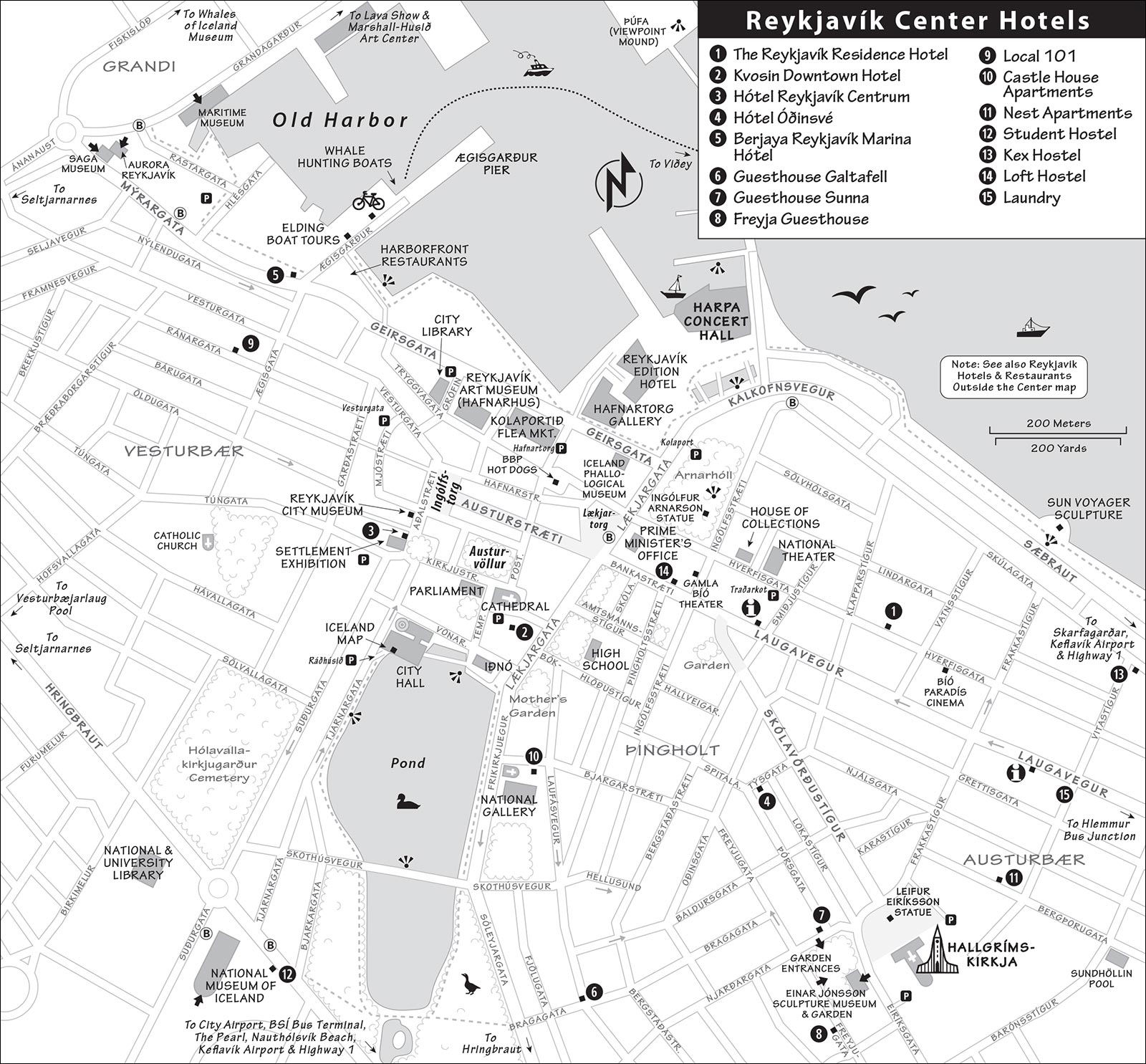
GUESTHOUSES AND SMALL HOTELS
These smaller, less expensive properties are generally in converted residential buildings without elevators. Most of these listings give you the option of sharing a bathroom, which brings down the price substantially. When comparing prices, remember to factor in breakfast and parking costs.
$$$ Guesthouse Galtafell rents five remodeled rooms and four apartments on a quiet street in a handsome neighborhood close to the Pond—and is a convenient five-minute walk from both downtown and the BSÍ bus terminal. One of Iceland’s richest merchants and fishing magnates built this attractive house with its crenellated roof in 1916. Lovely host Thorey makes you feel right at home (no breakfast, free parking, Laufásvegur 46, +354 699 2525, www.galtafell.com, info@galtafell.com).
$$$ Guesthouse Sunna, just down the street from the big Hallgrímskirkja church, is big and feels more like a hotel than a guesthouse. It offers a range of rooms with shared or private bath (some rooms are up several big flights of stairs). There’s limited free parking in their courtyard (apartments, breakfast extra, Þórsgata 26 at the corner of Njarðargata, +354 511 5570, www.sunna.is, sunna@sunna.is).
$$$ Freyja Guesthouse is a delightful family-run place on a quiet street in the shadow of Hallgrímskirkja. Rooms are modern and stylish, most with shared bathrooms, and the comfortable, bright attic lounge offers views of the church (family suite, breakfast extra—voucher for café next door, shared kitchens, free bike rental for guests, Freyjugata 39, +354 615 9555, www.freyjaguesthouse.com, reception@freyjaguesthouse.com, friendly Eydis and her family).
$$$ Snorri’s Guesthouse is slightly farther afield, with 12 comfortable rooms (some quite small) a few long blocks behind the church. It’s on a busy street, but rooms are quiet, and there’s plenty of free parking nearby. Breakfast is served in a quaint dining area downstairs by the garden (some rooms with shared bathroom, mini-fridges, contactless check-in, Snorrabraut 61, see the “Reykjavík Hotels & Restaurants Outside the Center” map on here, +354 552 0598, www.snorrisguesthouse.com, snorrisguest@gmail.com).
$$ Local 101 is a small hotel ideally located on a quiet but central street near the Old Harbor. Its freshly renovated rooms are crisp and minimalist, and all have private bathrooms. The owners, Canadian David and French-Icelandic Alma, are easygoing and welcoming (Ránargata 4a, +354 426 8101, www.local101.is, local101@local101.is).
APARTMENTS
These apartments are good for a longer stay, or if you want your own kitchen.
$$ Castle House Apartments rents well-appointed, mostly one-bedroom apartments with kitchenettes next to the National Gallery (Skálholtsstígur 2a, book on Booking.com). They also have cheaper studio apartments dubbed Northern Comfort in a lesser location at Skipholt 15, a bit outside downtown (no children, pay on-street parking, +354 511 2166, https://nca.is, 4@4.is, easier to book on Booking.com, see the “Reykjavík Hotels & Restaurants Outside the Center” map on here).
$$ Nest Apartments rents three units in a three-story building in a quiet spot not far from Laugavegur. The basement is generously called the “ground” floor (2-night minimum, cheaper if you stay a week, pay on-street parking, Bergþórugata 15, +354 893 0280, www.nestapartments.is, nest@nestapartments.is).
HOSTELS
Because there are so few affordable options in this pricey city, staying in a private room in a hostel is a reliable way to sleep for cheap without sacrificing location. These places are comfortable, clean, and well maintained.
$-$$ Student Hostel is a trendy and affordable hostel for all ages in the summer, and a student dormitory during the winter. It’s just beyond the Pond, near the National Museum of Iceland. Rooms are small and institutional, but the building is huge, and public spaces are welcoming. All rooms are private with twin beds (about half with private bathroom and half with shared bathroom). Guests get a discount at the university cafeteria/café nearby (no breakfast, shared kitchens, Hringbraut 29, +354 510 2828, www.studenthostel.is, info@studenthostel.is).
¢ Kex Hostel (“Cookie”)—filling an old cookie factory with a depressing exterior—is a popular choice for backpackers. While a bit pricey, it’s big, close to downtown, and has a popular café that’s frequented even by nonguests (private rooms, apartments, lots of stairs, shared kitchens, pay on-street parking, Skúlagata 28, a 7-minute walk from the Hlemmur bus junction, +354 561 6060, www.kexhostel.is, kexhostel@kexhostel.is).
“Official” HI Hostels: These two ¢ listings belong to the Hostelling International network (www.hostel.is). Dalur Hostel is a 45-minute walk or easy bus ride from downtown, conveniently next to the Laugardalslaug swimming pool and close to the Family Park and Zoo (private rooms available, bike rental, playground, free parking, Sundlaugavegur 34—see the “Reykjavík Hotels & Restaurants Outside the Center” map on here, bus #14 to Laugarásvegur stop, +354 553 8110, dalur@hostel.is). Loft Hostel is more urban, occupying a couple of floors in a downtown building just uphill from the prime minister’s office (recommended rooftop bar, elevator, Bankastræti 7, near the Lækjartorg bus stop, +354 553 8140, loft@hostel.is).
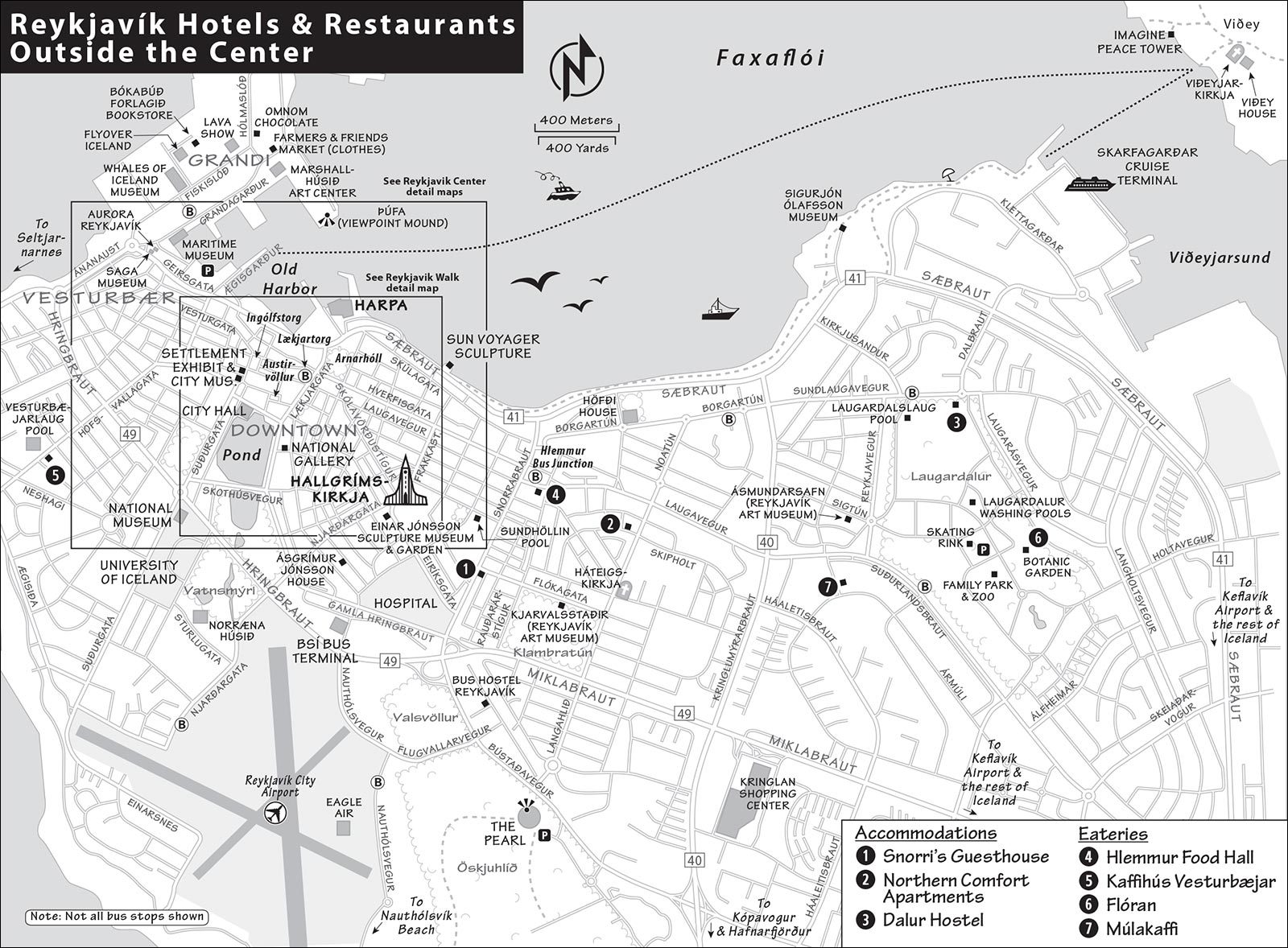
HOTELS NEAR THE AIRPORT
It usually makes better sense to stay in Reykjavík (even when arriving or departing at odd hours). Still, given the 45-minute distance between the city and the airport, staying out here does make arrival and departure easier. Hotels and Airbnb lodgings in Keflavík and Njarðvík, the towns near the airport, are also a bit cheaper than in Reykjavík. But basing yourself out here makes for a much longer drive to the sights on your full days in Iceland, and drastically reduces your choice of bus tours if you’re not using your own wheels. A taxi from the airport into Keflavík town can cost as much as 6,500 ISK, so figure that into your budget. For locations, see the “Keflavík Airport Area” map near the end of this chapter.
$$$ Airport Hotel Aurora, a hundred yards from the terminal, is the only hotel right at the airport, with 72 rooms. It’s undistinguished but gets the job done; has family rooms, free parking, and a restaurant...and starts serving breakfast at 5:00. Prices are less expensive than downtown Reykjavík hotels, but still pricey by international standards (Blikavöllur 2, Keflavík, +354 595 1900, www.hotelairport.is, reception@hotelairport.is).
$$$ Hótel Keflavík, near the harbor in the center of the town of Keflavík, also offers breakfast from 5:00 and free transport to (but not from) the airport. They have in-house laundry that even nonguests can use. If you arrive on an early-morning transatlantic flight and get a rental car, you could have breakfast here and watch the town wake up (Vatnsnesvegi 12, Keflavík, +354 420 7000, www.kef.is, stay@kef.is).
Eating in Reykjavík
You’ll dine well here—but you’ll have to strategize to not empty your wallet. My best budget tip is to have your main meal at lunch: If you stick to free drinking water (that’s the accepted default), you can come away from a near-gourmet seafood lunch downtown only about $25 poorer. Then, for dinner, save by picnicking, having a light meal at a café, grabbing a cheap takeout or fast-food meal, or finding a restaurant that doesn’t increase its prices in the evening—they do exist. For more on cheap eats, see the “Budget Bites” sidebar in this section.
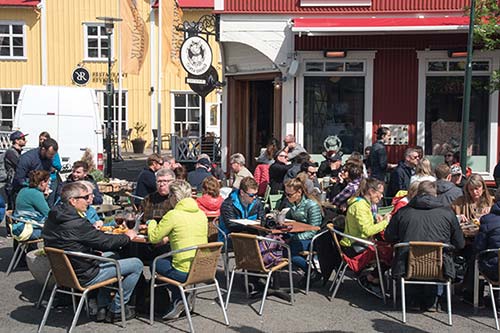
I rank restaurants from $ budget to $$$$ splurge, based on average main-course dinner prices. That said, you get what you pay for—in my experience, a $50 dinner is substantially better than a basic $30 dinner.
In this city with so much high-quality cuisine, it’s worth splurging for a memorable meal; you’ll be glad you did. Consider a fixed-price, multicourse dinner (9,000-12,000 ISK). For more advice on eating in Reykjavík, including ordering, tipping, and Icelandic cuisine, see the “Eating” section of the Practicalities chapter.
DOWNTOWN RESTAURANTS
Many of Reykjavík’s restaurants—from mom-and-pops to swanky splurges—serve weekday lunch specials for about 3,500 ISK (this may be a fixed “fish of the day,” but sometimes you can choose among several options). Some places close for lunch on weekends—or, if open, have a pricier menu. Fancier restaurants become more expensive (sometimes much more expensive) at dinnertime.
Given the large tourist crowds, virtually any downtown restaurant (particularly in the $$$ or $$$$ price range) can book up during the busy summer months. In peak season, it’s always smart to book ahead; in shoulder season, it’s a good idea on weekends.
Fine Dining in Central Reykjavík
These are my favorite places for a classy splurge in the town center. Make reservations if you’re going for dinner. Some of these are open for a more affordable lunch.
$$$$ Dill is one of Iceland’s finest restaurants (and its only Michelin-star recipient). They serve up high-end, New Nordic-inspired dishes at prices that aren’t drastically higher than many other “upper-midrange” places in this pricey town. They often book up weeks or months ahead—reserve as early as possible (Wed-Sat dinner only, closed Sun-Tue, Laugavegur 59, second floor—above Bónus supermarket, +354 552 1522, www.dillrestaurant.is).
$$$$ Grillmarkaðurinn (The Grill Market), tucked down an alley off lively Austrurstræti, is a swanky splurge in a rustic-mod, two-story setting with big split-log counters. The architecture, furnishings, and food sing a chorus of Iceland; the action at their busy charcoal grill mixes with the smart clientele to create a winning conviviality. Creative dishes allow curious travelers to sample traditional Icelandic “novelty foods” (think puffin, whale, and horse) in a modern, palatable way. The service is helpful and without pretense (enticing tasting menus worth the high price, daily, Lækjargata 2a, +354 571 7777, www.grillmarkadurinn.is).
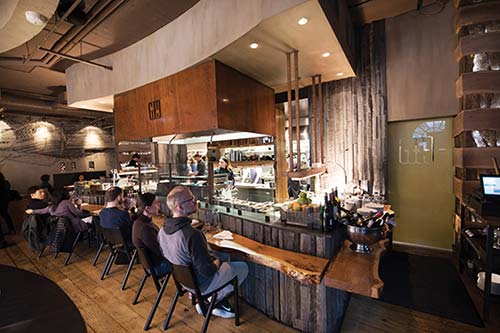
$$$$ Fiskmarkaðurinn (The Fish Market)—with the same owners as above—is a stylish adventure in Icelandic-Asian fusion cuisine, with inventive and artful takes on traditional fare such as fish, shellfish, minke whale, and lamb. Or, venture something from their selection of sushi. The upstairs and downstairs dining rooms, in an elegant old wooden building, ooze a subtly Asian ambience and have an attentive staff. This is justifiably a hot spot with locals and travelers, so reservations are smart (daily, dinner only, Aðalstræti 12, +354 578 8877, www.fiskmarkadurinn.is).
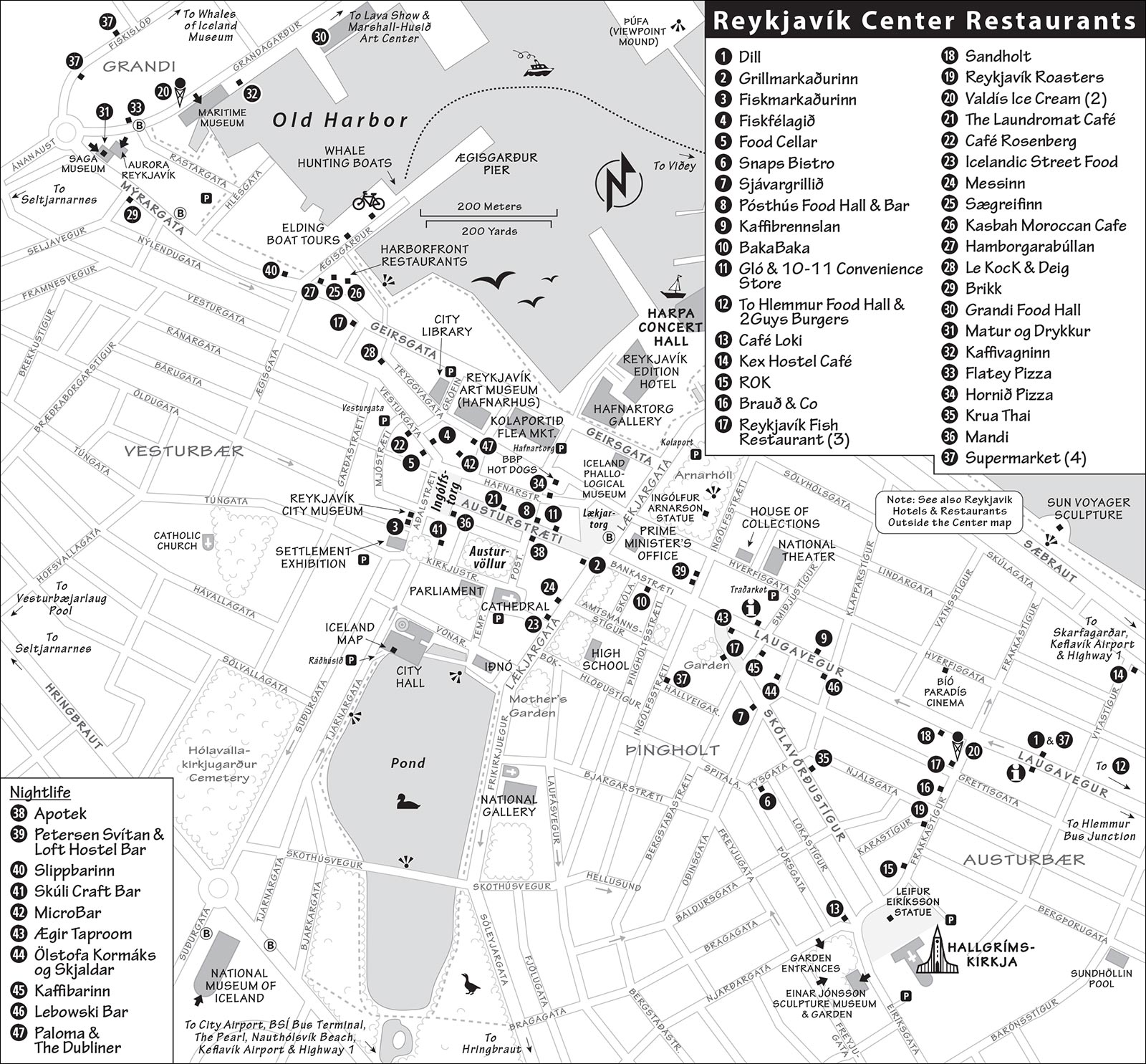
$$$ Fiskfélagið (The Fish Company) is a classy splurge, elegantly filling the dark, stony cellar of a historic house and serving beautifully presented dishes. This is a rare place with outdoor seating for the occasional day when it’s warm enough to enjoy. Their French-trained chefs meld a variety of cuisines—including Mediterranean and Asian—with a respect for Icelandic ingredients and traditions (Mon-Fri lunch and dinner, Sat-Sun dinner only, Vesturgata 2a, +354 552 5300, www.fiskfelagid.is).
$$$ Food Cellar (Matarkjallarinn) manages to be one of Reykjavík’s most popular restaurants despite being in a nearly windowless cellar. It’s nicely decorated and feels more contemporary than its neighbor Fiskfélagið—with live piano adding to the romance each evening. They serve Icelandic and international dishes (good-value fixed-priced meals and daily fish combo, Mon-Fri lunch and dinner, Sat-Sun dinner only, Aðalstræti 2, enter from Vesturgata, +354 558 0000, www.matarkjallarinn.is [URL inactive]).
$$$ Snaps Bistro is Parisian-posh, with a menu of mostly French-inspired dishes. The lively, sophisticated, glassed-in setting is just far enough off the main drag to attract locals alongside tourists. Their 3,180-ISK fish-of-the-day lunch special is filling and artfully prepared. They accept reservations only until 18:30, and it’s busy at dinner—reserve to eat early, or plan to wait a bit (jazz club downstairs, daily, Þórsgata 1, in the recommended Hótel Óðinsvé, +354 511 6677, www.snaps.is).
$$$$ Sjávargrillið (The Seafood Grill) is a respected seafood house with a corner location right along Skólavörðustígur where Chef Gústav Axel Gunnlaugsson grills up delicious fish, lobster, and lamb. They have a nice selection of lighter main courses and sushi for smaller appetites...and budgets. The cozy, tight interior is decorated with Icelandic driftwood gathered during Chef Gústav’s culinary travels (blowout fixed-price dinners, daily, Skólavörðustígur 14, +354 571 1100, www.sjavargrillid.is).
Simpler Meals in the Center
$$ Pósthús Food Hall & Bar is a buzzing foodie zone of several trendy—and reasonably priced—restaurants in the former post office building. Order at your preferred counter (sushi, Italian, cocktails, burgers, dumplings, and more), then grab a tight little table among the locals. Each corner of the food hall offers a different atmosphere; the downstairs dining area is quieter and cozier (daily, Pósthússtræti 5, www.posthusfoodhall.is).
$ Kaffibrennslan, a creaky café and bar owning a prime spot on Laugavegur, offers a tasty selection of sandwiches, baked goods, coffee drinks, Icelandic beer, and wine. Eat in or grab a seat on their streetside patio or greenhouse for prime people-watching (long hours Mon-Fri, Sat 9:00-13:00, Sun 9:00-21:00, Laugavegur 21, +354 511 5888).
$$ BakaBaka, filling a classic old building on the main shopping street, is tempting for its delicious, fresh-baked sourdough bread (with soup or toppings) plus pastries. You can grab something to go at the counter, eat on the patio picnic tables, or enjoy table service in the cozy interior (long hours Tue-Sun, closes at 17:00 on Mon, Bankastræti 2, +354 551 4430).
$ Gló, a local vegan favorite, is a smart choice for a quick, inexpensive, healthy meal in the center. It’s a basic space with hardly any seating along the main street (Mon-Fri 10:00-18:00, Sat-Sun until 16:00, Austurstræti 17).
$$ Hlemmur Food Hall (Hlemmur Mathöll)—with 10 trendy eateries filling a former bus depot—is worth the short walk to the end of Laugavegur. You’ll find a variety of food stands and a smørrebrød-and-aquavit bar. Anchoring the scene is the Skál! cocktail bar serving small plates of delicately prepared modern Scandinavian fare (a good choice if you just can’t decide). There’s ample shared seating, or pull up a stool at one of the bars. It feels urban and urbane, yet affordable and easy (long hours daily, at the Hlemmur bus junction, Laugavegur 107, see the “Reykjavík Hotels & Restaurants Outside the Center” map on here, www.hlemmurmatholl.is). Across the street (back toward the main drag), 2Guys Burgers is a mellow dive bar serving good burgers from a window in the back, with free arcade games while you wait (daily, Laugavegur 105, +354 790 2323).
$$ Café Loki is a welcoming place serving simple Icelandic dishes at reasonable prices, right across the street from Hallgrímskirkja. Sit at one of their outdoor tables or in the upstairs dining room for in-your-face views of the church (long hours daily, reservations smart, Lokastígur 28, +354 466 2828, https://loki.is).
$$ Kex Hostel runs a big café open to all, serving breakfast, reasonably priced bar food, plus beer, wine, and cocktails in an ex-industrial space with lots of seating and a water view (daily, close to Hlemmur and the Sun Voyager sculpture at Skúlagata 28, +354 561 6060).
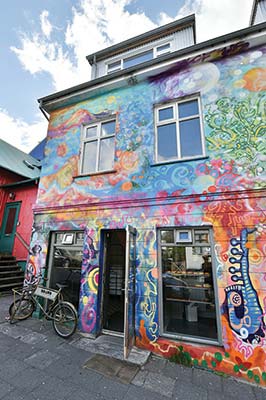
Frakkastígur Street
For a small-plates lunch or dinner, or a pastry-and-coffee break, head to hip Frakkastígur street. Between Hallgrímskirkja and Laugavegur you’ll find some of Reykjavík’s most appealing little eateries separated by a grungy but colorful square, with my favorite fish-and-chips joint close by.
$$$ ROK, filling a black house with a grass roof across from Hallgrímskirkja, is an upscale, lively joint buzzing with energy. The small, stylish plates (featuring fish, meat, and vegetarian options) are affordable for lunch but aren’t a good value at dinnertime, when prices are higher. Dine in the two-story, wood-beamed interior or out on the cozy patio with a church view (lunch specials, daily, reservations smart, Frakkastígur 26A, +354 544 4443, www.rokrestaurant.is).
$ Brauð & Co (Bread & Co.) is an artisanal bakery with a storefront slathered with a wild graffiti mural. Inside, the pastry chefs work like clockwork—churning out hot-from-the-oven cinnamon rolls (snúðar), danish (vínarbrauð), croissants, sourdough loaves, and seasonal pastries. While the to-go pastries are the hot item (literally), they also sell simple sandwiches and have two stools at the window. If you get takeaway, there’s a little green space with benches up the street, just below the church (daily 6:30-17:00, Frakkastígur 16, +354 776 0553). Understandably popular, this bakery is expanding with additional locations, including one on the way out of town at Laugavegur 180.
$ Reykjavík Fish Restaurant feels like a fish restaurant in Reykjavík should—rustic with a cool young staff, cranking out basket after basket of fresh fish. It’s a tough choice: the best fish-and-chips or plokkari (also known as plokkfiskur)—a traditional hash of shredded cod, potato, and onion (daily, Frakkastígur 12, +354 578 5656). You’ll find two other locations in town: one on the nearby shopping street (at Skólavörðustígur 8) and another by the Old Harbor (at Tryggvagata 8).
$$ Sandholt, around the corner on Laugavegur, is a busy, upscale-feeling bakery. At the front counter they offer a tantalizing selection of truffles and candies. Pick up a sandwich or pastry to go, or get a table in the back, where they serve a menu of breakfast and light meals (daily 7:00-18:00, Laugavegur 36, +354 551 3524).
Coffee: Reykjavík Roasters is the city’s best, top-end gourmet coffee shop chain, where each grind of beans is weighed to ensure a perfect pull. Flip through their vintage record collection while you wait, or just hang out in the bohemian-chic interior (Mon-Fri 8:00-17:30, Sat-Sun until 17:00, intersection of Frakkastígur and Kárastígur, +354 517 5535).
Ice Cream: Valdís, set back from the street just down from the Reykjavík Fish Restaurant, slings fresh ice-cream flavors by the scoop (daily, Frakkastígur 10). There’s another location near the museums in Grandi (see listing, later).
Near Ingólfstorg
$$ The Laundromat Café is more café than launderette, and a handy place to enjoy comfort food (burgers, sandwiches, and fish) whether or not your laundry is spinning downstairs. The open-feeling space—decorated with photos of launderettes around the world, big maps, and a bookshelf bar—is understandably popular with travelers. There’s also a children’s play area in the basement (daily, shorter hours on Sun, Austurstræti 9, +354 771 9660).
$$ Café Rosenberg is a rustic place with a warm living-room vibe that caters to coffee drinkers playing chess or cards. Overlooking a colorful (and touristy) slice of Reykjavík, it’s a tempting and central place to escape the drizzle for a soup or sandwich (daily, Vesturgata 3, +354 546 1842).
$$ Icelandic Street Food is a convivial café serving up simple soups (usually fish soup, spicy tomato, and lamb soup) and “Fisherman’s favorite” (traditional fish hash) at reasonable prices. Their bread bowls are huge and filling, and they offer refills of certain soups (free waffles, daily, Lækjargata 8, +354 772 8663).
$$ Messinn, in a bright space on busy Lækjargata, has a pleasant, woody, Westfjords ambience. It features an appealing menu of fish and seafood, including “fish pans” served in sizzling skillets. You’re welcome to share a larger size fish pan, making a budget meal for two (weekday lunch specials, daily, reservations smart, Lækjargata 6b, +354 546 0095, www.messinn.com).
IN THE HARBOR AREA
These eateries are a short walk north of downtown.
$ Sægreifinn (The Sea Baron) is a local institution beloved for its affordable lobster soup. A few decades back, commercial fisherman Kjartan Halldórsson began cooking out of his boathouse by request. His reputation grew, and his little fish joint became a harborfront fixture. Kjartan passed away, but one of his employees now runs the place, keeping the same easygoing, keep-it-simple spirit. (A wax statue of Kjartan is under the stairs in the back dining room.) This is the place to sample minke whale or fermented shark, if you dare. Line up at the register, order your soup and/or seafood skewers, then find a seat at a shared table in the sprawling interior (squeeze past the bar to find more tables). There’s a children’s play area and outdoor seating with a windbreak in the back (daily, Geirsgata 8, +354 553 1500).
$$ Kasbah Moroccan Cafe brings a slice of North Africa to the North Atlantic, serving traditional Moroccan fare such as briouat (stuffed pastries), tagine (slow-cooked meats and vegetables), couscous, tangia (stew), bastilla (meat pie), and tea. Dine in the comfy, atmospheric interior or out on the patio (closed Mon, Geirsgata 7B, +354 588 8484).
Burgers: $ Hamborgarabúllan is a grungy little 1950s-style, street-corner hamburger joint, with a clutter of stools and service set to classic rock (daily, Geirsgata 1, +354 511 1888). Nearby $$ Le KocK is a funky, pricier place that regularly wins local “best burger” awards (daily until late, live jazz on Mon, Tryggvagata 12); attached to that is Deig bakery, with excellent bagel sandwiches and doughnuts (daily until 16:00).
At the Far End of the Harbor, in Grandi
The peninsula called Grandi—which defines the far (western) end of the harbor area—has sprouted some good eateries that are worth the extra walk from the center.
$$ Brikk is a sleek, no-frills café serving daily soups, pastries, and excellent fresh, sliced bread with various homemade spreads. This spot makes for a cheap and easy lunch before or after museum-hopping at Grandi (Mon-Fri 8:00-16:00, Sat-Sun from 9:00, Mýrargata 31, +354 565 1665). There’s another location in Hafnarfjörður (see “Eating in Hafnarfjörður,” at the end of this chapter).
$ Grandi Food Hall (Grandi Mathöll) is a foodie zone filling a former fisherman’s hall (Sjávarklasinn, “Ocean Cluster House”) with eight small bars and restaurants. It’s youthful and creative, very local, and family-friendly, with shared tables and big windows overlooking the harbor. It’s easy to find something for any taste here. You could go for traditional Icelandic, fish-and-chips, or choose from one of the several international choices—including Korean, Italian, and Indonesian (daily 11:00-21:00, Grandagarður 16, +354 787 6200, www.grandimatholl.is). Hiding down a hallway is a lounge where you can peek into the actual fish processing floor where the day’s catch is sorted and sold; you can even watch the fish auction take place every weekday at 13:00.
$$$ Matur og Drykkur (Food and Drink), with a casual, rustic bistro ambience inside the Saga Museum, prides itself on time-tested recipes that others might dismiss as old-fashioned. Here, chefs update those traditional ingredients (such as barley and seaweed) for high-end, modern tastes—worth a splurge for curious foodies. The fixed-price, multicourse menu changes seasonally, but you may find “halibut” soup (not made with halibut—which is illegal, for complicated reasons), cod cheek (more delicious than you’d imagine), or arctic char smoked over burning sheep’s dung (ditto). It’s wise to reserve (Wed-Sun dinner only, closed Mon-Tue, Grandagarður 2, +354 571 8877, www.maturogdrykkur.is).
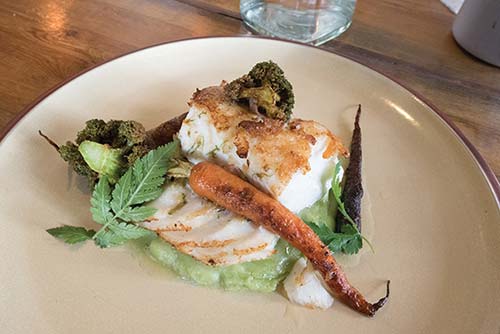
$$ Kaffivagninn (The Coffee Cart), perched on a pier overlooking bobbing boats, feels like a salty diner. The understated nautical decor is charming, and its seaward glassed-in patio is tempting on a sunny day. The main dishes are Icelandic home-cooking classics like fish balls and plokkfiskur (fish stew), plus a rotation of fish of the day; on weekdays, soup and coffee are included with lunch (daily, Grandagarður 10, +354 551 5932, www.kaffivagninn.is).
Pizza: $$ Flatey fires up delicious, Neapolitan-style pizzas in a trendy modern atmosphere. This place is a tasty and affordable alternative to the many expensive seafood places in town (daily, Grandagarður 11, +354 588 2666). Another location is at the Hlemmur Food Hall.
Ice Cream: Valdís is a local favorite offering creative flavors. The name is a pun—it’s a woman’s first name, but can also be read as “Power Ice Cream” (daily, Grandagarður 21; another location, listed earlier, is on Frakkastígur street).
OUTSIDE DOWNTOWN
These places are best for drivers (all have free parking) but can also be reached by bus. For locations, see the “Reykjavík Hotels & Restaurants Outside the Center” map on here.
In Vesturbær, West of Downtown
$$ Kaffihús Vesturbæjar, an inviting neighborhood café-bistro across the street from the Vesturbæjarlaug swimming pool, is the kind of place that makes you want to hang out and pretend you live here. They serve good lunches (hearty salads and soups) and dinners from a small menu chalked on the board. Choose a table, then order at the counter—but don’t come if you’re in a hurry (long hours daily, at Melhaga 20 at corner of Hófsvallagata, walk or take bus #11 to Melaskóli or #15 to Vesturgarður, +354 551 0623, www.kaffihusvesturbaejar.is).
Near the Botanic Garden
$$ Flóran, the relaxing café inside Reykjavík’s botanic garden, serves brunch, open-face “bruschetta” sandwiches, and meal-sized salads. Eat outdoors on a nice day, or in the warm, greenhouse-like interior. They grow some of their own vegetables and herbs (daily 10:00-22:00 in summer, early May and Sept until 18:00, closed Oct-April; take bus #2, #5, #15, or #17 to the Laugardalshöll stop and walk 10 minutes downhill to the parking lot and garden entrance; +354 553 8872).
$ Múlakaffi, only open through lunch, serves old-style Icelandic cuisine with all the polish of a 1970s school lunchroom. You can stuff yourself for about 2,800 ISK. Choose a main dish at the counter—it might be fish cakes, cod cheeks, or pasta with meat sauce—then help yourself to as much soup, salad, and coffee as you like (daily dishes are listed at www.mulakaffi.is). This place has been here—in a commercial zone amid office blocks and strip malls—for decades. You’ll see tradespeople here on a midday break and older men who meet to chat and read the papers (Mon-Fri 8:00-14:00, closed Sat-Sun, Hallarmúli 1, bus #2, #5, #15, or #17 to Nordica stop, +354 553 7737).
Reykjavík Connections
BY PLANE
Keflavík Airport
Keflavík Airport (KEP-la-VEEK, code: KEF, www.kefairport.is) is Iceland’s only real international airport and the center of Icelandair’s hub-and-spoke operation that carries thousands of passengers a day between North America and Europe. Keflavík is a particularly reliable airport thanks to its star-shaped design; it originated as a US military airbase in World War II, and its various runways allow planes to land against any wind.)
The airport’s status as a transfer point gives Icelanders a much broader range of flight options than they would otherwise have in this small country. During summer months, the airport gets very crowded.
Arrival and departure areas are both on the ground floor, on opposite sides of the main terminal building. You’ll find a café and a convenience store, car-rental offices, a tax-refund desk (facing the car-rental desks), and ATMs, but no TI. A bank/exchange desk (Arion) is located inside, after security, where you can change any leftover Icelandic crowns when you leave the country—they’re hard to exchange outside Iceland (bank open daily 4:30-20:00).
If you’re flying Icelandair or another budget carrier, onboard meals are measly and overpriced; it’s better to buy something ahead to bring on the plane.
Nearby Gas Stations: When returning a rental car be aware that the airport has only a couple of teeny self-serve pumps hidden near the car-rental return. It’s smarter to fill up at the handy ÓB gas station just outside the airport entrance, on the corner of Aðalgata and highway 41 (self-service, accepts US credit cards with chip). Or fill up in downtown Keflavík.
Breakfast Near the Airport: Many flights from the US arrive early in the morning. Hótel Keflavík, near the harbor in the town of Keflavík, offers a buffet open to nonguests (no reservations needed, daily 5:00-10:00, Vatnsnesvegi 12, +354 420 7000).
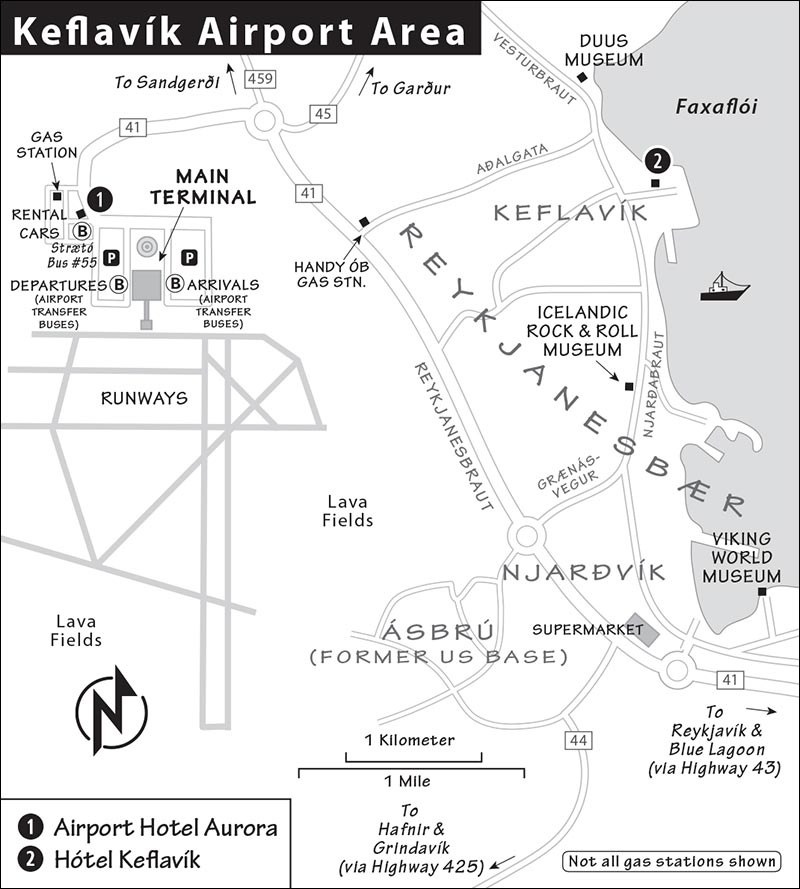
Getting Between Reykjavík and Keflavík Airport
The airport is about a 45-minute drive from downtown Reykjavík (30 minutes from Hafnarfjörður). (For details on renting a car, see the Practicalities chapter.) Without a rental car, your options are private airport buses, a door-to-door shuttle service, taxis, or an infrequent public bus.
Don’t worry about making an early flight: The whole transport system is designed for people to get from Reykjavík with plenty of time to make a 7:00 or 8:00 departure. Buses, shuttles, and taxis are ready to go by 3:00 or 4:00 in the morning.
By Private Airport Bus: Two companies, Flybus and Airport Direct, run buses between Reykjavík and the airport. Buses run whenever there are flights, even at odd hours. From the airport, buses typically depart when full, which can mean a wait. From Reykjavík, buses depart according to a schedule that varies depending on the flight density. These buses can make good financial sense for solo travelers and for families, as children ride free or at a sizable discount (but compare against the price of a taxi—see “By Taxi,” later).
Flybus runs between the airport and the company’s terminal in Reykjavík (called BSÍ, at Vatnsmýrarvegur 10, about a 15-minute walk from downtown, +354 580 5400, www.flybus.is). Airport Direct buses (run by Gray Line) go to and from their “Reykjavík Terminal” at the Bus Hostel Reykjavík (Skógarhlíð 10, about 30 minutes of walking from downtown, +354 497 8000, www.airportdirect.is). Both offer additional transfers to your hotel/Airbnb (see below).
Both companies have desks in the airport arrivals hall where you can buy tickets (about 3,900 ISK); you can also book and pay in advance online. A round-trip ticket (around 7,000 ISK) is sometimes a little cheaper than two one-ways. You can buy discounted Flybus tickets from flight attendants aboard Icelandair flights.
Transfer Ticket (or “Hotel Connection”): For an extra 1,000 ISK (each way) you can get a transfer from the not-so-central airport bus drop-off point to your hotel (or a nearby stop). This usually involves an additional bus trip (possibly on a minibus) from the bus company’s terminal/transfer point to a drop-off point close to your hotel or Airbnb. The transfer procedures can be confusing (and you’ll need to carry your luggage from one bus to the other). If you’re staying in an Airbnb, select a nearby hotel or bus stop as your pickup and drop-off point.
Stopping in Hafnarfjörður: En route between Reykjavík and the airport, both companies’ buses can stop on request at the bus shelter across from the Hótel Viking in downtown Hafnarfjörður (at Strandgata 55). If you need to be picked up there, pay in advance and reconfirm with the company, as buses bypass this stop if there are no requests.
By Private Shuttle: A more expensive option is Back to Iceland Travel’s private door-to-door minibus service (or to the bus stop nearest your accommodation) for 18,000 ISK (up to 4 passengers). You can tack on a visit to the Blue Lagoon for an extra 12,000 ISK—lagoon admission not included (+354 846 3837, www.btitravel.is).
By Taxi: Reykjavík’s two main taxi companies both offer fixed-price service to and from the airport for about 20,000-23,000 ISK. If you reserve in advance, they’ll wait for you at the airport with a sign. When reserving, tell them your destination and ask their advice; if your starting or ending point is in the southern part of the capital area (for example, in Hafnarfjörður), using the meter may be cheaper than the fixed rates. Contact Hreyfill (+354 588 5522, www.hreyfill.is) and BSR (+354 561 0000, www.taxireykjavik.is).
By Public Bus: Strætó, the public bus company, runs buses (#55) between downtown Reykjavík and Keflavík Airport every 1-2 hours, taking about 70 minutes. At some times of the day and on weekends, they run only between the airport and the Fjörður stop in Hafnarfjörður, where you change to bus #1. The public bus is meant more for commuters than for international travelers and goes infrequently, but it’s the cheapest way into town and has space for luggage. As it’s considered a long-distance route, you can pay the bus driver with a credit card (2,280 ISK one-way; connecting city buses are free if you ask the driver for a transfer slip). For schedules, see www.straeto.is (enter the airport as “KEF” in the journey planner).
The Strætó bus stop is out in the open air along row A of the car-rental lot. To find it, walk out from the arrivals side of the terminal under the roofed walkway, then hang a left and look for the tiny “S” sign (it’s not signposted from inside the arrivals hall).
Reykjavík City Airport
Reykjavík’s domestic airport (code: RKV) is just south of downtown. While the runways are long enough to land an Icelandair 757, the airport is only used for smaller planes flying domestic routes and to the Faroe Islands and east Greenland. Check-in at the pint-sized terminals feels informal; arriving even an hour early feels like overkill, and there’s no security checkpoint for domestic flights.
It’s important to know that the airport has two terminals on opposite sides of the runway. If you go to the wrong terminal, you’ll have to take a taxi to get to the other (you can’t walk). Icelandair uses the larger main terminal on the west side of the runways (take bus #15 to the Reykjavíkurflugvöllur stop). If you’re flying on Eagle Air, you’ll go from a separate, smaller terminal on the east side of the runways (take bus #5 to the Nauthólsvegur stop; the terminal is behind the Berjaya Reykjavík Natura Hotel and the control tower). Parking is free at both terminals.
To make an early-morning domestic flight, before buses start running, call a taxi (reserve the night before; see the taxi recommendations earlier, under Keflavík Airport). Figure about 3,000 ISK for a taxi between downtown and either terminal (or between terminals).
BY BUS
Reykjavík has several bus stations. Buses run by Reykjavík Excursions, including their excursion buses and the scheduled FlyBus to the airport, use the old BSÍ bus terminal at Vatnsmýrarvegur 10. The most direct way to get there is to walk from downtown to the bus terminal (about 15 minutes). Or, take bus #1, #3, #5, or #6 to the Gamla Hringbraut stop. A few tour companies, including TREX, also use BSÍ for their scheduled and excursion buses.
Long-distance buses run by Strætó, Iceland’s public bus service, depart from the Mjódd bus terminal in the eastern Reykjavík suburbs. It’s next to a small indoor shopping mall, also called Mjódd (MEE-ohd). Many city bus routes stop at Mjódd, including #2, #3, #4, #11, #12, #17, #21, and #24 (ask driver for a free transfer ticket).
Strætó’s downtown city bus junction at Hlemmur doesn’t serve long-distance routes, but is a good place to catch a bus to the long-distance terminal at Mjódd.
BY CRUISE SHIP
Cruise ships frequently stop here in summer. The cruise terminal is at Skarfagarðar, a five-minute drive east of downtown; by bus, take #16 to the Klettagarðar/Skarfagarðar stop. Smaller cruise ships occasionally use a berth in the Old Harbor, just steps from downtown.
Hafnarfjörður
If you’re renting a car and using Reykjavík as a base for day trips to sights in the countryside, you may find it easier to stay outside downtown in the southern suburb of Hafnarfjörður (HAHP-nar-FYUR-thur)—a reasonably short drive south of the city. While calling this area “charming” is a stretch, it does get you into a car-friendly zone away from the crowds (parking is easy) and gives you a glimpse of an authentic Icelandic neighborhood, with restaurants and services in walking distance. And it’s strategically located between downtown Reykjavík and points south: the airport, the Blue Lagoon, and the Golden Circle and South Coast.
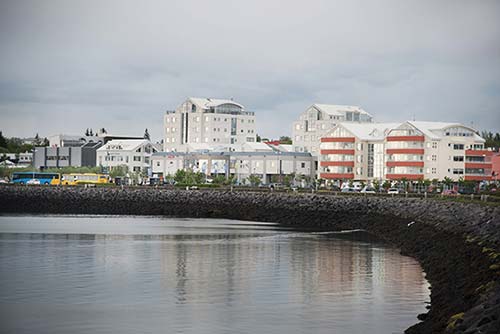
Getting There: It’s a 15-minute drive from downtown Reykjavík or a 30-minute ride on bus #1; airport buses stop in the center, but don’t offer door-to-door pickup.
If you stay here and drive the Golden Circle or South Coast day trips, Breiðholtsbraut (highway 413) is a useful shortcut from Reykjanesbraut (highway 41) over to highway 1 in the direction of Selfoss. Your GPS or map app will guide you; otherwise, from highway 41, follow the signs for highway 413 toward highway 1.
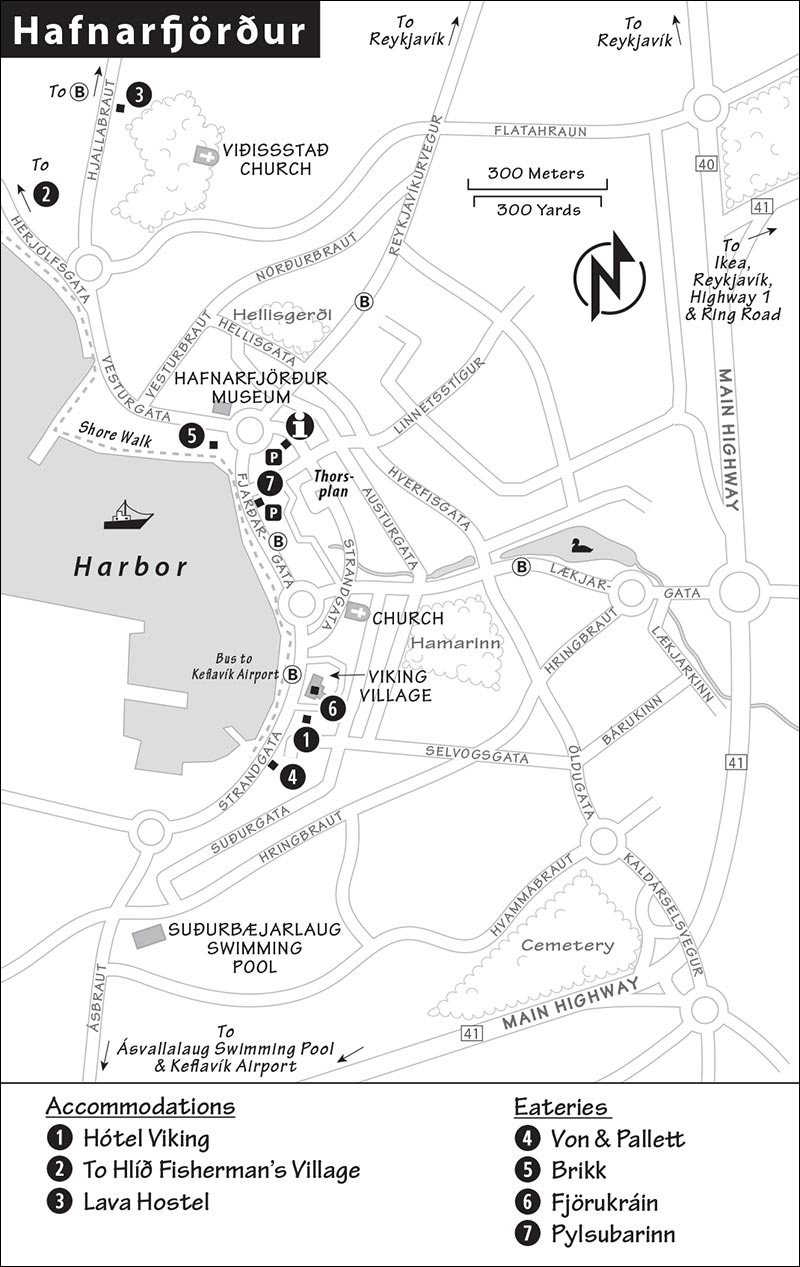
SLEEPING IN HAFNARFJÖRÐUR
While I’ve listed a traditional hotel and hostel, you’ll often get a better value via Airbnb. Before booking anything with a Hafnarfjörður address, check a map to make sure it’s near downtown, rather than in the industrial zone to the east.
$$ Hótel Viking, part of the cheesy Viking-themed Fjörukráin restaurant complex, has Viking-esque common areas, but most of its 55 rooms are straightforward, on the small side, and full of heavily varnished wooden furniture; some feel a bit tired. They also have cabins that sleep up to six (some with bunk beds, some with double beds, plus private baths)—potentially cost-effective for families or small groups. There’s a free sauna and hot pots, and the airport bus stops nearby (Strandgata 55, +354 565 1213, www.fjorukrain.is, booking@vikingvillage.is).
Their nicer annex, called $$$ Hlíð Fisherman’s Village, is a little compound of woody, upscale, waterfront cabins on a rustic, sparsely populated point just north of Hafnarfjörður (a 15-minute drive from the main hotel; 20 minutes from downtown Reykjavík). It feels remote, yet is still close to the city (www.fishermansvillage.is).
¢ Lava Hostel, a 15-minute walk north of town (or take bus #19), is smaller and more intimate than the hostels in Reykjavík. This nonprofit hostel raises funds for the local Boy Scout troop; they also manage the adjacent campsite. As the name suggests, it’s set in an old lava flow (private rooms, family room, shared bathrooms, free parking, closed mid-Sept-mid-May, Hjallabraut 51, +354 565 0900, www.lavahostel.is, info@lavahostel.is).
EATING IN HAFNARFJÖRÐUR
I wouldn’t go out of my way to eat a meal in this bedroom community, but—if you’re sleeping in Hafnarfjörður or passing through—it can be easier to grab a bite here than to look for parking downtown.
$$ Von (Hope) is the top choice. This small, ambitious restaurant serves modern fish and meat dishes and is proud of their seafood and ox cheek. Local office workers come for the good-value weekday lunch specials, listed on the chalkboard as you enter (reservations recommended for dinner, Tue lunch only, Wed-Fri lunch and dinner, Sat dinner only, closed Sun-Mon, Strandgata 75, along the water at the south end of downtown, past the fake stave church, +354 583 6000, www.vonmathus.is).
$ Pallett, next door to Von, is a quirky café that feels like an antique shop. It’s run by an Icelandic-British couple who serve great coffee, affordable soups and sandwiches, and traditional English scones (Tue-Fri 8:00-17:00, Sat from 10:00, Sun from 11:00, closed Mon, Strandgata 75, +354 571 4144).
$$ Brikk serves delicious pastries and soups on the waterfront in the center of town. Their fresh bread and “salad” spreads make for a filling and affordable lunch (Mon-Fri 8:00-16:00, Sat-Sun from 9:00, Norðurbakki 1b, +354 565 1665).
$$$ Fjörukráin (The Waterside Tavern) is a Viking-themed dinner-only restaurant, often busy with groups (you can’t miss it—look for the Norwegian stave-church-like roof). It’s kitschy and the prices are high for what you get, but the interior is a work of art and there’s occasional live Viking-style entertainment, so a visit can be fun (daily, dinner only, Strandgata 55, +354 565 1213).
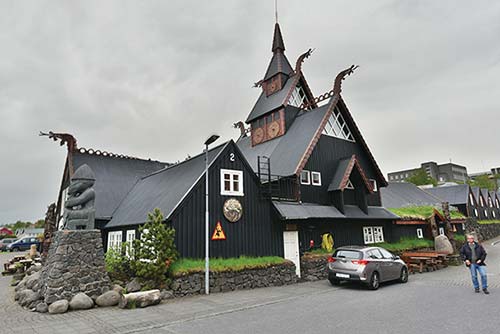
$ Pylsubarinn is a quick and easy streetside joint slinging cheap Icelandic hot dogs, burgers, and fish-and-chips (outdoor tables, daily, just off the big parking lot on Fjarðargata, +354 554 4600).