ICELANDIC EXPERIENCES
Map: Iceland’s Tectonic Plates
Volcano Museums and Experiences
Iceland is a small land that packs in a lot of experiences. From gazing into a volcanic crater lake to descending into the underground magma chamber of a dormant volcano, from exploring glaciers and geysers to luxuriating in an outdoor pool filled with earth-warmed water, Iceland offers adventures and activities that you can’t easily do anywhere else.
Many of these experiences require going through a tour operator (I’ve listed some established outfits). A good one-stop resource is Guide to Iceland, an online platform where you can book tours, accommodations, and transport (www.guidetoiceland.is; no additional commission and will match a better price if you find one). They work with many, but not all, tour providers in Iceland, so it’s smart to expand your research to include other resources (for instance, the “Things to Do” reviews on TripAdvisor can offer a helpful roundup of tour companies).
Note that while Reykjavík is generally a good home base, many excursions head to more distant destinations involving higher prices and long hours in a bus. Consider booking tours that are closer to where you’re staying, even if it means home-basing outside of Reykjavík. For example, if you’re interested in glacier activities, consider spending a night or two on the South Coast or in southeast Iceland.
As you join the hordes of international visitors who treat Iceland as a newly discovered playground, do so considerately. Respect the land. The nature on display may seem raw and powerful, but it’s also extremely fragile. Nobody yet knows precisely what long-term impact the recent influx of tourism will have on this special place. To be part of a sustainable long-term prosperity, treat Iceland as a precious treasure...because that’s what it is.
Several times a year, Iceland is captivated by a full-scale land and helicopter search for travelers sucked out to sea by a wave, separated from their snowmobile tour group, or lost in the wilderness. In Iceland, nature can threaten your very survival. To encourage safe travel, Iceland operates the SafeTravel.is website and app, with detailed advice and up-to-the-minute alerts. For help in English, dial 112, the national emergency number.
Travel smart and keep the following risks in mind. For specific driving hazards, see here.
Wind: The signature feature of Icelandic weather is wind. Icelanders have a higher standard for what qualifies as “windy.” If you think it’s windy, it’s just a mild breeze to them. If they say it’s windy, it’s probably a genuine storm. Even in summer, you’ll likely encounter winds that are uncomfortable or dangerous to walk or drive in. Once, while I stood on a rock to snap a photo, a freakish gust nearly blew me into the sea. Always check the forecast at the Icelandic weather service (https://en.vedur.is). If it’s windy and icy at the same time, take extra care. Car-rental agencies offer insurance supplements for “wind damage and sandstorms.”
Slips and Falls: In winter, Reykjavík’s sidewalks generally aren’t cleared or salted, and are very slippery and icy. Falls are common. Paths in the countryside ice over, too. Cautious travelers visiting from December through February can pack a pair of ice cleats to strap over their shoes.
Exposure and Getting Lost: When traveling in less inhabited parts of the country, be prepared for the unexpected. Your car could break down or run out of gas, or you could take a wrong turn. Travel with extra clothing (even summer days can turn cold and windy, especially at higher elevations) and keep your phone charged (bring a portable charger; reception is good all around the Ring Road). Carry a paper map as a backup. Before heading into wilderness areas, upload your itinerary to SafeTravel.is.
Sneaker Waves: Iceland’s South Coast has some very dangerous beaches with strong waves that regularly pull unsuspecting tourists out to sea. Those breathtaking black sand beaches can suddenly become dangerous. Obey all signs and stay much farther from the water than you think is safe.
Trail Hazards: There are very few ropes, guardrails, or warning signs in Iceland—but if you see any, take them seriously. Step carefully, and watch out for loose stones, crevices, and sharp lava rocks.
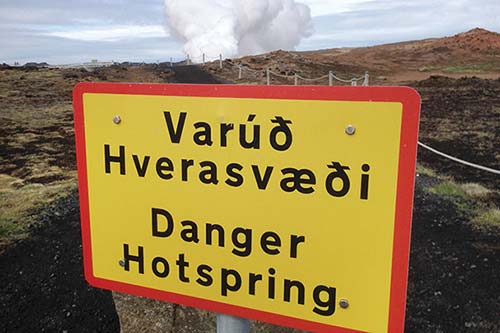
Scalding Thermal Water: The water in Iceland’s geothermally active areas can be boiling hot, and the danger is often unmarked. Every year or two a tourist falls in and gets severely burned, typically in a less-visited geothermal area without ropes or walkways.
Avalanches: Icelanders have taken this danger more seriously since 1995, when two avalanches in the Westfjords killed 34 people. Wintertime travelers may encounter avalanche warnings in any settled area close to a steep mountain slope.
Volcanoes: On average, a volcano erupts in Iceland every four years. Some eruptions can be viewed from a safe distance, but others melt glaciers, let loose streams of boiling lava, give off poisonous gases, or spew ash and boulders that will damage you or your car. Volcanic eruptions and their consequences can and regularly do interfere with travel plans. The Icelandic weather service posts regular updates on eruptions (and earthquakes).
Angry Birds: While not life-threatening, angry birds can be a nuisance. In late spring and early summer, Arctic terns (kríur) will dive-bomb your head if you get too close to their breeding grounds. Obey any closure signs near major nesting areas.
Glaciers
More than 10 percent of Iceland’s surface is covered with glaciers (jökull)—mainly along the southern coastline and in the desolate interior. Glaciers are most accessible at their tongues, where a slow-motion river of ice flows down a valley.
Below are several glacier-related experiences you can do on your own. For more options, join a guided excursion. If you won’t be venturing beyond Reykjavík, the Pearl natural history museum has a simulated ice cave and displays that focus on Iceland’s glacial geology.
Glacier Sightseeing
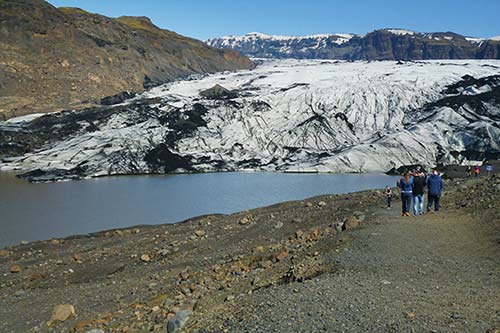
There are several accessible glacier tongues along Iceland’s southern coast, from near Skógar in the west to near Höfn in the east. If traveling on your own, you can hike close to the tongue of a glacier in two places: at the Skaftafell wilderness area, where you can walk to a branch of Iceland’s largest glacier, Vatnajökull (see here); or at Sólheimajökull, along the southern coast closer to Reykjavík (here).
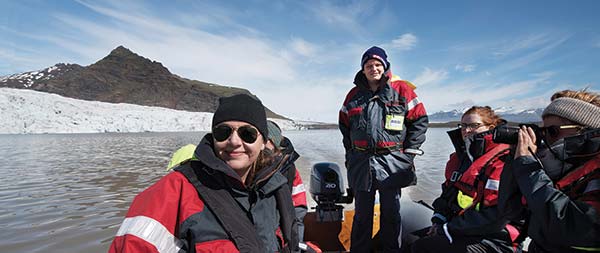
In southeast Iceland, Jökulsárlón and Fjallsárlón are two glacier lagoons within minutes of each other, where a glacier tongue terminates in a beautiful pool of water, and icebergs calve off and float around. At either, you can pull over to view the lagoon, or take a boat or kayak trip between bobbing icebergs. Near Jökulsárlón is another enchanting glacial sight, Diamond Beach, where chunks of shimmering ice from the nearby lagoon sometimes wash up on a black sand beach. This is a grand look at the final stage of the very long, very slow journey of glacial ice to the open ocean. (For more on these sights, see here.)
Guided Glacier Tours
For more extreme glacier adventures, you’ll need to go with a guided tour.
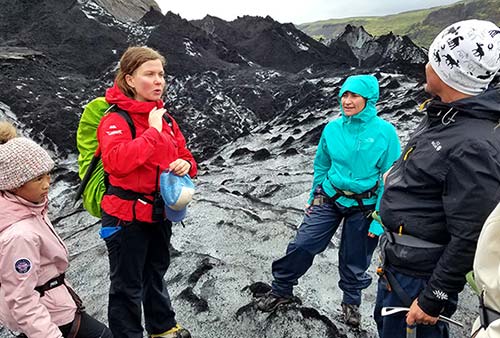
Glacier Walks: Equipped with cold-weather gear, crampons, and ice axes, you and your group will be tied together for an amble across the ice. The most popular places for this are Sólheimajökull and Skaftafell in southeast Iceland, and Snæfellsjökull on the Snæfellsnes Peninsula. Companies offering glacier walks include Reykjavík Excursions and Gray Line as well as smaller, more specialized operators Icelandic Mountain Guides (www.mountainguides.is), Arctic Adventures (www.adventures.is), Troll Expeditions (www.troll.is), and Glacier Journey (www.glacierjourney.is).
Snowmobiling: Mountaineers of Iceland offers a variety of snowmobile trips across Langjökull, near the Golden Circle ($250-450, www.mountaineers.is; or try Glacier Journey). At the Snæfellsjökull glacier (at the tip of the Snæfellsnes Peninsula), you can join a snowcat tour (essentially a big van on tank treads; for details, see here).
Ice Caves: Visitors can explore three ice caves burrowed into glaciers ($200-300, 3-4 hours). Into the Glacier takes visitors to an artificial cave in Langjökull—the only ice cave open year-round (www.intotheglacier.is; see here). The glacier atop the Katla volcano in southern Iceland has a natural cave that’s open from June to December—but it’s melting quickly, so could close soon (tours depart from Vík; try Katlatrack, www.katlatrack.is). In winter (Nov-March), Vatnajökull has a natural cave that you can explore with a tour that departs from the Jökulsárlón glacier lagoon (companies include Arctic Adventures, Icelandic Mountain Guides, and Glacier Journey; you’ll pay more for pickup in Reykjavík).
Volcanoes
Travelers come to Iceland hoping for a glimpse of a volcano. When the volcano called Eyjafjallajökull spewed ash into the atmosphere in 2010—bringing European air travel to a halt—it grabbed the imagination of many.
In reality, the odds that a volcano will be erupting during your visit are low. When eruptions do happen, they tend to be short-lived. Once an eruption site is deemed safe, authorities may designate some long-distance trails that hardy adventurers can safely hike for a better look at flowing lava. But the chances that you’ll be able to pull over your car for an “easy” look at a river of molten rock are slim.
Even when there are no active eruptions, a variety of volcanic sights make it easy and engaging to learn more about the island’s unique geology.
Volcanic Landscapes
Much of Iceland is plainly shaped by volcanic activity, and lava landscapes are common. Here are a few of the most dramatic and accessible.
Westman Islands: This archipelago, just off the South Coast, is the most interesting volcano-related sight in Iceland, and a pilgrimage for those with serious interest. The Westman Islands have seen some of Iceland’s most spectacular volcanic activity in recent times. First, from 1963 to 1967, the islet of Surtsey literally rose from the Atlantic Ocean; while it can’t be visited, on a clear day you can see the islet from the main island, Heimaey. Then, in 1973, the town of Vestmannaeyjar was rudely awoken in the middle of the night by a surprise eruption on the adjacent hillside. Residents were evacuated, and the flowing lava gradually swallowed the eastern part of the town. Today, streets dead-end at steep walls of volcanic rock, and a few lucky houses are surrounded on three sides by jagged cliffs. The still-warm crater hovers above it all. The Volcano Museum in town is literally built around a house buried by lava—letting you peek into a family home forever trapped in rock.
Reykjanes Peninsula: As you’ll see as you fly into Iceland, the area around Keflavík Airport is covered with jagged lava fields. One of Iceland’s most recent eruptions took place at Fagradalsfjall, just a few miles due east of the Blue Lagoon; smoke, ash, and even the glow of lava could be seen from as far away as the capital. Closer to Reykjavík, the suburb of Hafnarfjörður is nicknamed the “Town in the Lava” because it sits on a lava flow.
Iceland is one of the most volcanically active places in the world. Volcanic eruptions, ejecting liquid lava, gas, ash, cinders, and/or solid rock (the biggest rocks are sometimes called “volcanic bombs”), can last from a couple of days to several years.
The Reykjanes Peninsula has seen some of Iceland’s more recent eruptions, with Fagradalsfjall erupting in 2021 and 2022, and—even closer to Reykjavík—Litli-Hrútur hill in 2023. Grímsvötn, a hard-to-reach volcano under the Vatnajökull glacier (in southeast Iceland), has been one of Iceland’s most active; it last erupted in 2011. Bárðarbunga, another volcano under the same glacier, began rumbling awake as recently as 2014-2015. The more famous eruption at Eyjafjallajökull, on the South Coast, made news in 2010—costing airlines more than $1 billion in disruptions. Other well-known Icelandic volcanoes include Hekla (once nicknamed the “Gateway to Hell”), Krafla, Askja, and Katla, whose proximity to coastal hamlets makes it especially dangerous (Katla erupts about once a century—the last time in 1918—so many think it’s due). You can see the status of Iceland’s volcanoes at https://icelandicvolcanos.is/index.html.
Of the roughly 130 volcanoes in Iceland, the most common type is the stratovolcano—the classic cone-shaped peak with explosive eruptions that form a crater in the very top (such as Hekla and Katla). There are also a few dormant shield volcanoes—with low-profile, wide-spreading lava flows (one called Skjaldbreiður is near the Golden Circle). Eruptions from fissure vents (long cracks in the earth’s crust) are also common in Iceland, such as the 2014 Holuhraun eruption or the destructive Laki eruptions in the 1780s.
Iceland’s entire surface is made of volcanic rock, most of it basalt—the igneous rock that forms when lava cools. Iceland’s towering cliffs and jagged islands and skerries are all made of basalt. When basalt cools in particular ways, it forms the hexagonal rock columns that you see at Reynisfjara (on the South Coast), near Dettifoss and Stuðlagil (in the north), and many other places.
At the lake Mývatn, in the north, you can see pseudocraters (also called rootless cones), which form after lava flows over a pond or marsh. The water beneath the lava boils and a giant bubble breaks through the lava, leaving a crater-like depression.
New lava is shiny and oily-looking, while old lava loses its gleam. Old lava fields—recognizable by their unique, bumpy appearance—are often covered with a fuzzy layer of Icelandic moss.
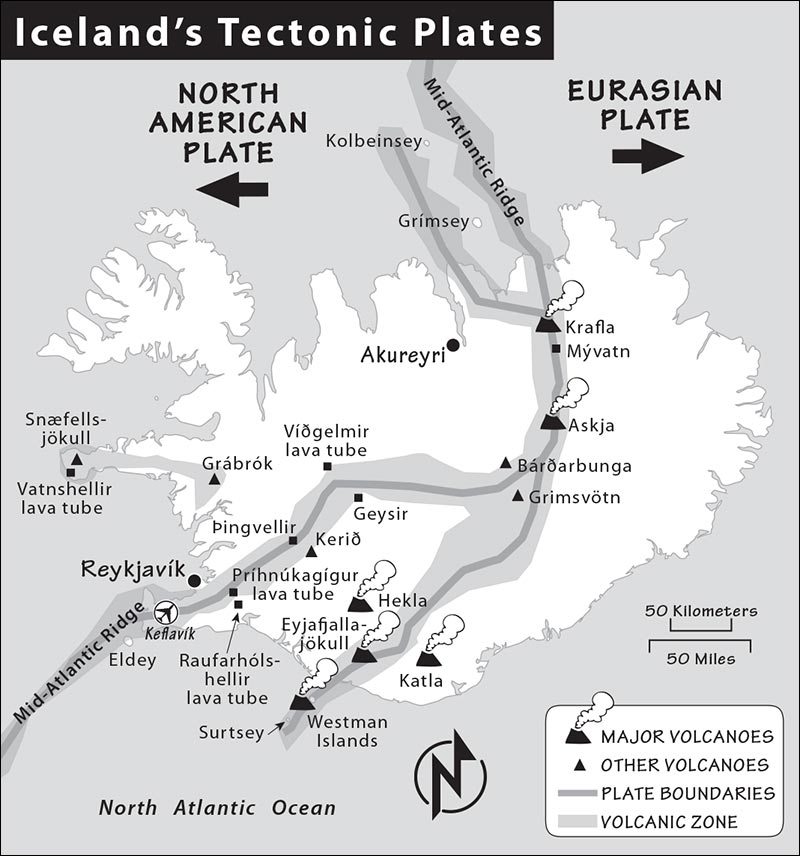
So why does Iceland have so many volcanoes? Iceland is located on the long, mostly underwater Mid-Atlantic Ridge—the meeting point of the Eurasian and North American tectonic plates. As the two tectonic plates move apart, magma from the earth’s mantle rises to the surface (we start calling it “lava” when it erupts). Iceland is located on a mantle plume, where magma is especially close to the surface, which explains why land formed here and not elsewhere along the tectonic ridge.
Mývatn: This northern lake is ringed by a variety of otherworldly features, from the pseudocraters at Skútustaðir (where giant bubbles of steam burst through molten rock) to the jagged formations along the lake’s eastern shore, at Dimmuborgir, and at the huge, climbable Hverfjall ash crater. See the “North Iceland” section of the Ring Road chapter.
South Coast: All along the South Coast, you’ll pass plenty of volcanoes—but you may not realize it, since they’re dormant and covered by thick glaciers. The most famous, under Eyjafjallajökull, blew its top in 2010. Several other large glaciers, such as Mýrdalsjökull and Vatnajökull, have volcanoes underneath. For a hike with the best views of glacier-topped volcanoes, head to Þórsmörk, where a huff up to the Valahnúkur viewpoint affords you panoramas over three volcanoes.
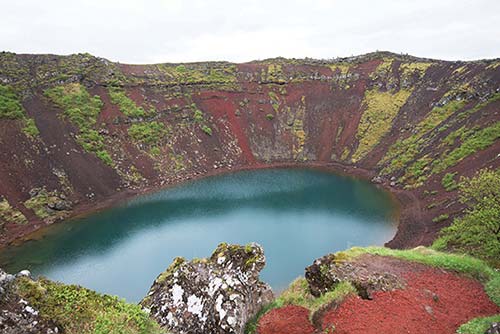
Climbable Craters: Several craters around Iceland invite you to climb up onto their rims for spectacular views. One of the finest, Grábrók, is alongside the Ring Road, just before the pass to the north. Kerið, along the Golden Circle route, requires almost no climbing and has a lovely lake inside. On the Snæfellsnes Peninsula, Saxhóll crater has a staircase to the top. Near Mývatn, in the north, you can hike to the top of Hverfjall or drive just over the mountains and up the Katla Valley to reach Víti (“Hell”), a rugged crater encircling a deep-blue lake.
Volcano Museums and Experiences
To learn more about volcanoes, visit one of these sights (for details, see the listings in their chapters).
Westman Islands: Iceland’s best explanation of volcanic activity is here, at the Volcano Museum.
South Coast: The high-tech Lava Center in Hvolsvöllur is both entertaining and educational. The Katla Visitor Center has exhibits about the Fimmvörðuháls and Eyjafjallajökull eruptions.
Reykjavík: At the Pearl, visitors feel and hear the power of volcanoes and earthquakes in the Wonders of Iceland exhibit. And at the Lava Show, you’ll see real molten lava flow, drip, pop, and cool, while learning about the science behind it.
Volcano Underground Tours
Iceland offers several opportunities for subterranean volcanic exploration. While pricey, they’re definitely memorable experiences and worth at least ▲▲ for those wanting an up-close look. The first two tours listed here can be done as excursions from Reykjavík.
Þríhnúkagígur (Inside the Volcano Tour)
At this cinder cone in the Bláfjöll mountains southeast of Reykjavík, you can descend into the magma chamber of a dormant volcano that erupted about 4,000 years ago. When the magma drained out, it left a cavity so big that it could contain the Statue of Liberty. The first explorer entered in 1972. Today, visitors ride a lift through the opening at the volcano’s top and 400 feet down into the vast chamber. At the bottom you’re free to wander around a rocky floor that’s the size of three basketball courts.
Cost and Hours: 47,000 ISK, includes lunch and shuttle transfer from Reykjavík hotel (it’s not cheaper to drive yourself), tours run several times a day mid-May-Oct, 5-6 hours, 20-person max, +354 519 5609, book ahead at www.insidethevolcano.com. Wear sturdy shoes and bring extra layers for the chilly chamber.
Visiting the Volcano: The tour starts at a ski lodge a half-hour from Reykjavík (take their shuttle from town or drive there yourself) with a brisk 45-minute hike to the “base camp” hut at the foot of the volcano. Along the way your guide points out features of the otherworldly volcanic terrain. At base camp you’ll get a briefing on the journey and be fitted with a hard hat and a harness (for safety when boarding the lift). From here a lift operator will take you to the top of the cone, help you board the open lift (eight people max), and—down you go.
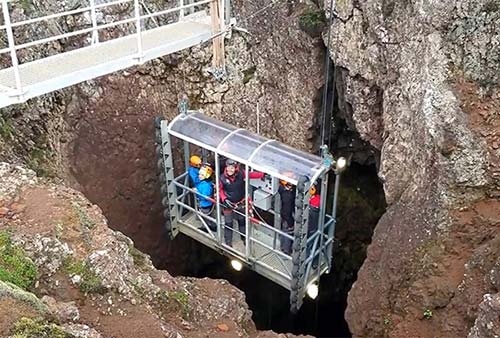
During the seven-minute descent, your lift operator stops to describe the fascinating features of the illuminated chamber walls. At the bottom, you have about 30 minutes to explore. No more than 16 people are on the floor at one time, so it’s an intimate experience.
Once back outside, you’ll head down to base camp for an included lunch, and then hike back to the lodge.
Raufarhólshellir (Lava Tunnel Tour)
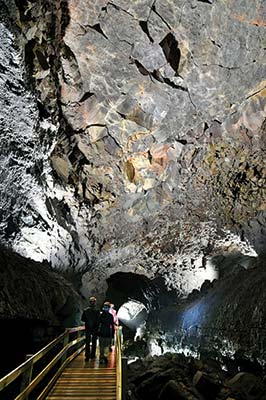
The fourth-longest known lava tube in Iceland, Raufarhólshellir was created 5,000 years ago during a lava flow that extended to the South Coast and Reykjavík. The tube formed as the flowing river of molten rock began crusting over, causing the lava to burrow deeper. When the eruption ceased, the lava drained out, leaving behind an extensive tunnel covered in colorful formations. In 2017, the tunnel was closed to the public and converted into a private attraction—infuriating local spelunkers, as well as partyers who were trashing the place.
Icelanders love going to their local swimming pools, which are heated with natural thermal water (in fact, the word for Saturday literally translates to “bathing day”). These aren’t elaborate water parks, but more like municipal swimming pools back home. (Not so long ago, it was common for Icelanders to live in apartments with no shower or bathtub—instead, they had an annual pass for the pool and went daily.)
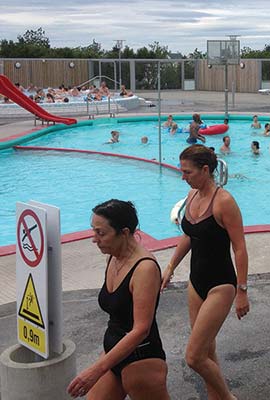
Of course, the big draw of Icelandic pools is the naturally steamy water, which is pumped right out of the ground. Even the lap pools stay at a warm temperature (around 29°C/85°F), while smaller “hot pots” are in the 38°C/100°F range. Facilities can be indoors, outdoors, or both. Very windy or cold weather makes indoor bathing attractive. But there’s something cozy about submerging yourself in hot water while the wind ruffles your hair and snowflakes settle on your nose.
Iceland’s public bathing culture has its own set of customs, which locals take seriously. At the pool, Icelanders usually just talk to their companions and generally leave others alone, but everyone is polite and helpful. Things can be quiet through the morning and midday hours (mainly stay-at-home parents and younger kids) but get busier in the afternoon and evening. At some times of day, groups of local “regulars” (often senior citizens) may seem to take over one of the hot pots, but you’re welcome to squeeze in, too.
Phones and cameras are strictly prohibited in dressing rooms, but are generally OK in pool areas. You’ll quickly get the hang of the system. Just follow these steps.
Bring a swimsuit and towel (rentals are available but expensive). Also bring any other gear you need: bathing cap, goggles, flip-flops (although most Icelanders don’t bother with them), or a bag of water toys for children. There’s no need to bring soap or shampoo—there are liquid soap dispensers in the showers.
Pay. Typical admission to a basic municipal pool is about 1,200 ISK. Most towns have a shareable 10-visit discount card, which can save money with as few as five adult entries. At some pools, you’ll be issued a locker key or an electronic wristband (latter available at more modern, upscale places) that will open a locker; at others, keys are in the locks.
Change. Changing rooms are sex-segregated. Young children may go with a parent of either sex. Before entering the locker area, take off your shoes (there are usually shoe racks just before the locker rooms). Find an available locker, disrobe, and lock your clothes inside. Leave easily tarnished jewelry and glasses or other delicate lenses in your locker (minerals in some baths might damage them). Carry your swimsuit and towel with you to the shower area.
Shower. Store your towel in a cubbyhole and keep your swimsuit handy. Soap down and shower, slip on your swimsuit, and head for the pool area. Yes, you’re expected to shower naked; it’s a required sanitary issue. (Some newer places have stalls for bashful foreigners.)
Swim and soak. Typically, people start out in the warm pools (usually a lap pool for swimmers, a shallower pool for recreation, and a wading pool for kids; these are typically around 29°C/85°F). Then they finish off with a soak in the hot tubs or a visit to the sauna. Each tub is marked in Celsius, and you’ll quickly find your own comfort range (the top temp is usually 44°C/111°F.) Drink water even if you’re not thirsty—when you’re in 100-degree water, dehydration can sneak up on you.
Finish up. When you’re done, shower again. Many pools have a centrifuge to wick the water out of your suit. Get dressed, but don’t put your shoes on until you leave the locker room. Return keys or wristbands to the counter (in some places, you must deposit them in a turnstile to exit the locker room).
Refuel. Most pools have tables and chairs in the entry hall where you can eat a packed lunch or snack, and newer places have full-fledged cafés.
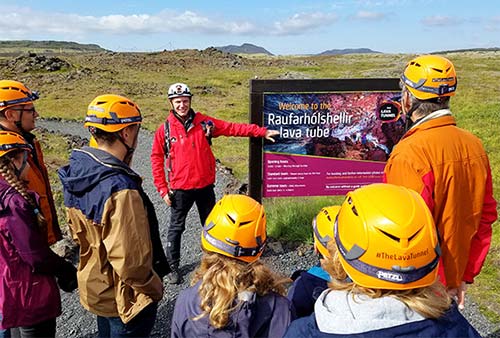
Cost and Hours: Basic one-hour tour costs 7,400 ISK (12,500 ISK with Reykjavík bus transfer); “Adventure” tour costs 21,900 ISK (more with transfer), lasts 3-4 hours, and goes deeper into the tunnel. Tours run year-round and depart daily every hour between 9:00 and 17:00—best to book ahead, 30-person max, +354 760 1000, www.thelavatunnel.is. Bring warm clothing—the temperature in the tunnel is 38 degrees.
Visiting the Tunnel: The tour starts at the visitors center about 40 minutes from downtown Reykjavík (take their shuttle or drive there yourself), roughly on the way to the South Coast. There you’ll meet your guide and receive a hard hat.
After a quick briefing, you’ll enter the tunnel, passing beneath several “skylights” where the tunnel’s ceiling had completely collapsed. Then, it’s into the intact lava tube, which is as big as a railroad tunnel in most places. There’s some uneven ground, but the route is mostly easygoing on boardwalk and stairs. Subtle lighting brings out the tube’s variety of colors. At the turnaround point, you’ll have the chance—if the group is willing—to experience a few minutes of total darkness when the guide shuts off the lights.
Other Volcanic Caves
Víðgelmir (“The Cave” tour): Located in West Iceland, this cave is newer than Raufarhólshellir (about 1,000 years old) and more extensive, but also more remote (about a 2-hour drive north of Reykjavík, or an hour east of Borgarnes). With a guide, you can walk about a half-mile into a lava tube (for details, see here).
Vatnshellir: This lava tube, near the tip of Snæfellsnes Peninsula in the national park, is similar to but less impressive than the ones mentioned above; still, if you’re going to Snæfellsnes, it’s convenient and satisfying (for details, see here).
Thermal Waters
Iceland’s volcanic activity goes hand-in-hand with naturally heated water—which Icelanders have cleverly harnessed for thermal baths and as sources of electricity and heat.
Thermal Baths and Pools
Iceland has a wide range of options for enjoying its relaxing (and, yes, slightly stinky) thermal waters. The heavily advertised “premium” baths cater primarily to international visitors and are rarely frequented by Icelanders—who know that you can bathe in equally luxuriant 100°F water for a fraction of the price at one of the country’s many thermal swimming pools.
Touristy Premium Baths
The most famous high-end thermal bath is the Blue Lagoon near Keflavík Airport. A more recent competitor, Sky Lagoon, even closer to Reykjavík, fills a rocky canyon with an infinity pool and a seven-step ritual spa experience.
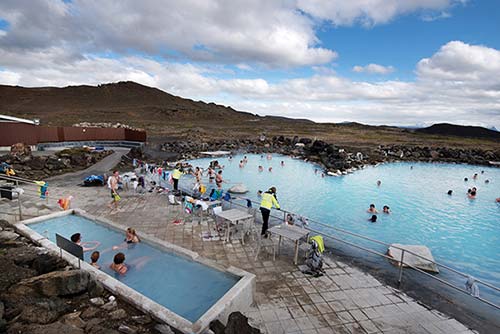
Two other options, less plush but still relatively close to Reykjavík (on the Golden Circle loop), are Fontana, on the thermal lake of Laugarvatn, and the rustic Secret Lagoon, at Flúðir.
If you’re doing the Ring Road, you’ll pass near several other appealing options. Perhaps the best is the “poor man’s Blue Lagoon” at Mývatn Nature Baths. Smaller, more upscale baths include Hvammsvík Hot Springs (south of Borgarnes), Krauma at Deildartunguhver (west of Borgarnes), Forest Lagoon in Akureyri, and Geosea in Húsavík (north of Mývatn).
Swimming Pools
Every community of even a few hundred people seems to have scraped together the funds for their own well-maintained pool complex, often with a (warm) lap pool and at least one or two smaller hot pools (called “hot pots”). Many have a wide variety of pools, saunas and steam rooms, and colorful waterslides for kids. Besides being affordable, these pools (sundlaug) provide a pleasantly authentic Icelandic experience, allowing you to rub elbows with locals who come home from work or school, grab a towel, and head to the pool. Icelanders see their swimming pools as great social equalizers: Teachers, truck drivers, politicians, grocery store clerks, business leaders, and the unemployed all don swimsuits and simmer in the same hot water.
I’ve listed pools in the Reykjavík area and throughout the country—including in Borg, right along the Golden Circle; in a remote corner of the Reykholt Valley, at Húsafell; in Patreksfjörður, in the Westfjords; in tiny Hofsós, just off the Ring Road, with an infinity pool overlooking a fjord; and in Iceland’s second city, Akureyri.
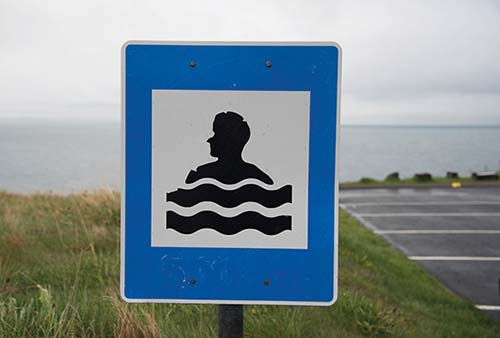
For a list of Iceland’s thermal pools and to check hours, try https://sundlaugar.is or look on municipal websites (it’s wise to confirm opening hours before making a trek to a distant pool). Or, anywhere you go, you can simply keep a lookout for the international “pool” symbol—a swimmer’s head poking out above waves. Even though the clientele is mostly Icelandic, visitors are welcome (just follow the rules—see sidebar).
Natural Thermal Springs
Iceland has a few opportunities to (carefully) bathe in natural thermal springs. Above the town of Hveragerði, about an hour from Reykjavík and on the Golden Circle route, you can hike an hour to soak in the warm, rushing thermal river of Reykjadalur (see here). The tepid Seljavallalaug pool is tucked into the side of a mountain, about a 20-minute hike from the South Coast road. In the Westfjords, you’ll find a thermal spring near the town of Tálknafjörður, and another on a remote road along the Reykjafjörður between Bíldudalur and the Dynjandi waterfall (see the Westfjords chapter). In the Highlands, Landmannalaugar has a famous natural thermal area, which takes quite some effort to reach (described later, under “Other Outdoor Experiences”).
Some natural springs are far too hot to bathe in (the burn unit of Reykjavík’s hospital sees its share of tourists after being scalded). Watch your step, keep on marked trails, and bathe only in designated hot springs.
Thermal Sights
Wandering through a steaming, bubbling, colorful, otherworldly thermal landscape is a uniquely Icelandic treat. For such a small island, Iceland has a remarkable variety of such locations. Just watch your step—always stay on marked trails, as a thin crust can cover a boiling-hot reservoir—and be ready for some intense sulfur smells.
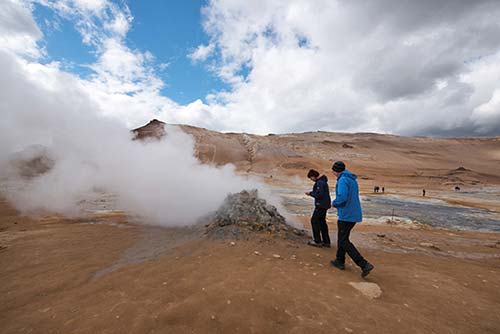
The most visited geothermal attraction is the Geysir area, on the Golden Circle. You’ll watch a geyser spurt high into the air, but it’s crowded. For more interesting and varied thermal landscapes, consider the following options.
Perhaps the best thermal area is at Námafjall, just over the hills from Mývatn, in North Iceland. Much closer to Reykjavík, the Seltún geothermal area on the Reykjanes Peninsula is quite striking. “Honorable mentions” go to the sputtering shore of Laugarvatn lake, along the Golden Circle route; the bubbling spring at Deildartunguhver, in the Reykholt Valley; the small but engaging Hveradalir area on the Hellisheiði plateau (conveniently included on the South Coast and Golden Circle day-trip routes); and the steaming valley of Reykjadalur, above the town of Hveragerði (just off the Golden Circle).
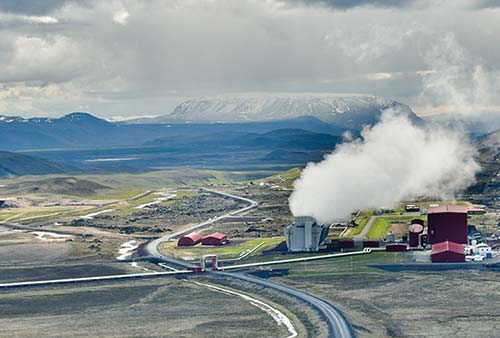
To see how Iceland has harnessed the substantial power of its thermal waters, stop by a geothermal plant. Hellisheiðarvirkjun sits amid a lunar landscape just outside Reykjavík, on the way to the Golden Circle and South Coast day trips, and boasts Iceland’s most extensive visitors center about its geothermal energy industry. Krafla, with a modest information center, fills a dramatic valley in the north, near Mývatn.
Whales, Birds & Horses
Whale Watching
Many come to Iceland hoping to catch a glimpse of the elusive whales of the North Atlantic. The waters here are home to 23 different varieties of gentle giants. On a typical whale-watching trip, you’re most likely to see white-beaked dolphins, harbor porpoises, and mid-sized minke whales. With luck, you may spot a breaching humpback whale (often seen from northern ports such as Húsavík and Akureyri) or a black-and-white orca. On very rare occasions, some get a glimpse of one of the two biggest mammals on the planet: the blue whale or the fin whale.
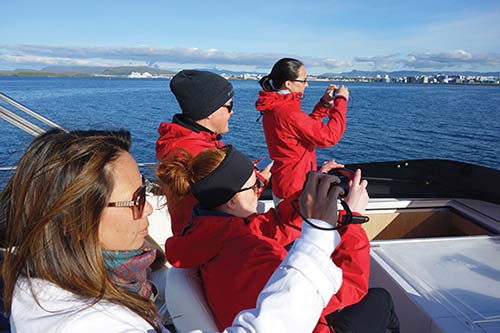
Whale-watching trips generally last 3-4 hours and cost about 13,000 ISK (twice that much for smaller tours in RIBs, described later). Icelanders say that the best place to whale-watch is in the north, in the tiny town of Húsavík or Iceland’s second city of Akureyri (described in the Ring Road chapter). But if you don’t have time, you can take whale-watching tours in Reykjavík. (Or, at the very least, stop by the Whales of Iceland exhibit near Reykjavík’s harbor; all described in the Reykjavík chapter).
Be aware that most whale sightings will be from a distance. Multiple boats often converge on the same whale, taking turns getting closer. Also, boats are only allowed to get so close with their engine on; at a certain distance they must drift, and you can only hope that the whales get curious and come to you.
When to Go: Don’t book whale-watching trips too far in advance. It’s better to track the weather and choose a summer day that’s as sunny and windless as possible; like you, whales and dolphins enjoy nice weather and are most likely to surface then. The best months are May through August, when whales are attracted to the small creatures feeding near the sun-warmed surface of the water. It’s best to avoid whale watching in winter (Nov-Feb) and in windy weather, when seas can be rough, seasickness can get bad, and it’s unlikely you’ll see much wildlife. At any time of year, dress warmly.
Types of Boats: Most companies use fairly large boats with a comfy, heated, indoor seating area and a simple on-board café. (Húsavík has a fleet of appealing wooden boats, formerly used for fishing, that have been repurposed for whale watching.) In bad weather, some companies offer coveralls for those who want to be on deck the entire time. There’s typically a naturalist guide on board, who describes the types of whales in Iceland and points out wildlife.
Some outfits offer whale-watching trips in RIBs (rigid inflatable boats; sometimes billed as a “premium” trip). These small, open boats zip across the water in search of whales and offer no indoor cover (all passengers get coveralls). In bad weather, the trip can be pretty miserable. In good weather, you get two fun experiences in one: a high-speed RIB trip, plus whale watching.
Birds and Birding
Birders find plenty of seabird species to get excited about in Iceland. Bird watching is best from late April to early June, though you’ll find bird-watching tours year-round (visit local TIs for specifics). Látrabjarg in the Westfjords is famous for its bird cliffs, where you’ll find an estimated million birds along with sweeping views (see here). The Westman Islands are also known for their abundant bird populations in summer, including puffins. Lake Mývatn is celebrated among birders for its large and varied population of waterfowl (as opposed to seabirds). Near Mývatn, head north to Sigurgeir’s Bird Museum for a one-stop look at taxidermied examples of all Icelandic bird species (see here).
Puffins
Adorable, chubby little puffins—with their black-and-white markings and cartoonish beaks—are fun to watch. They usually arrive in Iceland in April/May, then take off again at summer’s end—making the window for seeing them quite short. (For more on puffins, see the sidebar.)
The biggest puffin populations (about one million) are in the Westman Islands; along the South Coast (particularly around the Dyrhólaey promontory, and farther east, at Ingólfshöfði cape); in the northeast an hour beyond Egilsstaðir in the tiny coastal village of Borgarfjörður Eystri; and along the Westfjords (at Látrabjarg, Hornbjarg, Hornstrandir, and Breiðafjörður). The islet called Lundey (“Puffin Island”)—with a relatively small population of about 20,000 puffins—is a handy destination for a puffin cruise from downtown Reykjavík’s Old Harbor.
Other Birds
Along with puffins, the auk family includes the guillemot, the murre, and the razorbill (all of which have a black body and white belly, but lack that cute orange beak). Arctic terns are sleek flyers—gray on top, white on bottom, with a black crown and a reddish beak. They’re notorious for aggressively dive-bombing tourists who wander too close to their nests. Arctic terns have the longest migration in the animal kingdom: They spend their summers in the Arctic...and then, come fall, fly to the “southern summer” in the Antarctic (over its life, an Arctic tern might fly as many as 1.5 million miles). Rounding out the flock are seagull-like fulmars and kittiwakes.
Iceland’s unofficial mascot is the Atlantic puffin (Fratercula arctica)—that adorably stout, tuxedo-clad seabird with a too-big orange beak and beady black eyes. Some 10 million puffins summer in Iceland—the largest population of any country on earth.
Members of the auk family, puffins live most of their lives on the open Atlantic, coming to land only to breed. They fly north to Iceland in April/May and lay their eggs (usually by June). During the summer months, the birds live in burrows in grassy headlands; quiet hillsides teem with subterranean puffins. (If you get too close, you may hear the puffin “growling” from below ground.) Puffins mate for life and typically lay just one egg each year, which the male and female take turns caring for. A baby puffin—called a puffling—usually leaves the nest by mid-August. Puffins return to the ocean by early September.
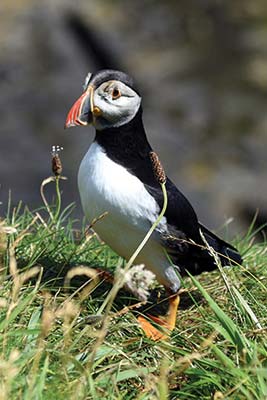
To feed their pufflings, puffins plunge as deep as 200 feet below the sea’s surface to catch sand eels, herring, and other small fish. Their compact bodies, stubby wings, oil-sealed plumage, and webbed feet are ideal for navigating underwater. Famously, puffins can stuff several small fish into their beaks at once, thanks to their agile tongues and uniquely hinged beaks. This evolutionary trick lets puffins stock up before returning to the nest.
To take off in flight, stocky, tiny-winged puffins either beat their wings like crazy or essentially hurl themselves off a cliff. Once aloft, they flap their wings furiously—up to 400 times per minute—to stay airborne. Coming in for a smooth landing on a rocky cliff is a challenge: They choose a spot, swoop in at top speed, then flutter their wings madly to brake as they touch down. At the last moment, the puffin either sticks the landing or, more often than not, bails out and does another big circle on the currents before trying again...and again. (Locals like to joke, “Puffins are bad at flying, and even worse at landing.”)
Each August, the puffins head south at night, following the moon. On the Westman Islands, pufflings are often distracted by the town lights and crash-land on streets and rooftops. It’s a tradition for local children to collect and help release them into the wild to try again.
In addition to seeing puffins along the summer coastline, you may occasionally see them on restaurant menus. With abundant numbers (though they are declining), puffins aren’t protected. Considered a delicacy by some Icelanders, puffin tastes like salty, smoked chicken...but cuter.
Iceland’s native eider ducks produce a fluffy down that’s very useful in this frigid climate. You may also see oystercatchers and golden plovers, shorebirds welcomed in Iceland as harbingers of spring.
Icelandic Horses
Icelandic horses are small, strong, and docile, and descend from the ponies originally brought to Iceland in the Settlement Age. (Viking Age settlers carefully selected only the strongest horses for the journey—small enough to fit on their ships, but capable of working hard once in Iceland.) The Alþingi (parliament) stopped horse imports to the island altogether in 982—so every Icelandic horse you see is a purebred. Today, there are about 80,000 horses on the island.
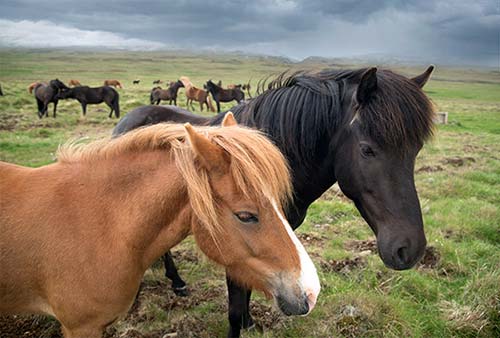
Icelandic horses are renowned for their unique gaits: In addition to the typical walk, trot, and gallop, Icelandic horses employ the tölt, which is fast and extremely smooth, and the skeið, a high-speed “flying pace.” This “five-gaited” status is their claim to fame.
Horseback Riding
Horseback riding is big business, and dozens of farms all over Iceland offer rides for travelers, including a cluster just outside Reykjavík.
Near Reykjavík: From Reykjavík, the experience takes about a half-day, including travel time and 1.5-2 hours on horseback (about 16,000-22,000 ISK, includes helmet and riding gear, some tours come with lunch). Browse and book on company websites: Íslenski Hesturinn (The Icelandic Horse, +354 434 7979, http://islenskihesturinn.is), Viking Horses (+354 660 9590, www.vikinghorses.is), Laxnes (+354 566 6179, www.laxnes.is), and Íshestar (+354 555 7000, www.ishestar.is).
Elsewhere in Iceland: Options include some in dramatic surroundings, including in the broad valley of Skagafjörður, through the glacial rivulets of Þórsmörk, along the beaches of the South Coast, and so on (see www.guidetoiceland.com for tour options).
Other Horse Sights
For just a glimpse of an Icelandic horse, watch for roadside paddocks all around the island. Or head to the Reykjavík Family Park and Zoo (see here), ideally at feeding time. On weekends, the zoo lets little kids trot around the horse paddock, accompanied by a keeper.
Hiking
Iceland is a wonderland for hikers, whether you’re taking an easy stroll from your car to a waterfall or embarking on a grueling but dramatic multiday trek. Before heading out on a challenging hike, make sure you have proper equipment, water, maps, and advice from an experienced local. Be aware of current weather conditions—and don’t underestimate the impact of Iceland’s howling winds and bone-chilling (even in summer) temperatures. Read “The Many Ways Iceland Can Kill You” sidebar (earlier in this chapter).
Easy Hikes
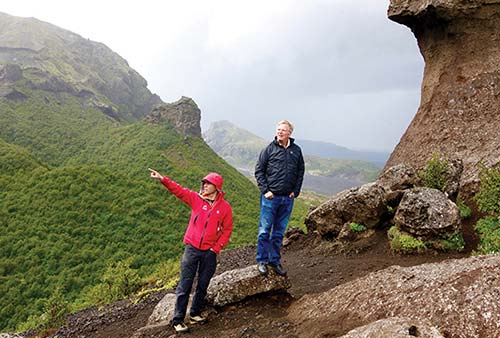
Throughout this book, I’ve focused on easy hikes that offer a big reward for minimal effort—mainly starting from a parking lot and looping through an accessible slice of Icelandic scenery. More details on each of these are given in the individual chapters. Some of my favorite easy hikes include the loop through Þingvellir along the Golden Circle route; the hikes up to the South Coast glaciers at Sólheimajökull and Skaftafell; the hike up to the lighthouse at Dyrhólaey promontory, on the South Coast; and walking up to Eldfell volcano on the Westman Islands.
Along the Ring Road, you’ll find enjoyable options around Mývatn lake—including the pseudocraters at Skútustaðir, the forested peninsula at Höfði, and the lava pillars at Dimmuborgir. Other Mývatn hikes include the Námafjall thermal field and adjacent hill-climb just over the mountains from the lake, and the hike out to the volcanic cone at Leirhnjúkur. Also consider the crater hikes described in the “Volcanoes” section, earlier.
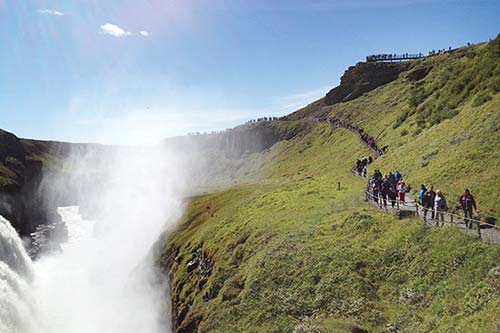
Each of the great waterfalls I’ve described in Iceland comes with a hike—some short, some long—and often an opportunity to climb up to a higher vantage point: Gullfoss on the Golden Circle, Seljalandsfoss (and its neighbor Gljúfrabúi) on the South Coast, Skógafoss on the South Coast, Hraunfossar and Barnafoss in the Reykholt Valley, Dynjandi in the Westfjords, and along the Ring Road—Goðafoss and Dettifoss in the north, Hengifoss in the east, and Svartifoss in the southeast.
Serious Hikes
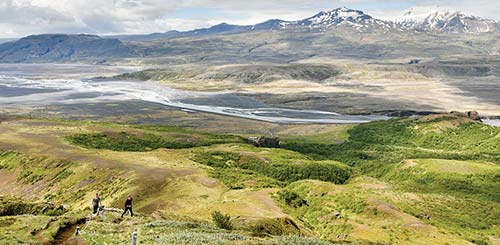
For serious hikers, Iceland offers dozens of premier hiking destinations—many in the Highlands and inaccessible with a standard car. To reach the most dramatic trails, you’ll need to rent a high-clearance four-wheel-drive vehicle or travel in a specially equipped excursion bus.
Perhaps the best combination of quality hiking and accessibility is Þórsmörk, a volcanic landscape with glorious mountain, valley, and canyon walks; the moderately challenging hike up to Valahnúkur is spectacular. Þórsmörk is a short detour from the South Coast, but most people get there via excursion bus from Reykjavík (5 hours each way; for more on Þórsmörk, see the South Coast section). More remote is Landmannalaugar, in the Highlands, with lots of good hiking (described later, under “Other Outdoor Experiences”).
Both Þórsmörk and Landmannalaugar are key stops along a variety of popular multiday hikes (with overnights in staffed huts) that traverse the glacial landscape of the south. The popular Laugavegur route takes three to five days (34 miles over challenging terrain) and connects Þórsmörk and Landmannalaugar. Another favorite is the two-day, 14-mile Fimmvörðuháls hike, from Þórsmörk south, over the saddle between Eyjafjallajökull and Mýrdalsjökull, to Skógar on the South Coast—right over the site of the first stage of the 2010 Eyjafjallajökull eruption.
For something closer to the capital, you could ascend Esja—the big, long ridge that looms just north of Reykjavík. The most popular hike here is the four-mile round-trip to Steinn (“The Stone”), with an elevation gain of 650 feet.
For details on these destinations and good overall information about hiking, see the websites of FÍ (the Iceland Touring Association, www.fi.is) and NAT (Nordic Adventure Travel, www.nat.is). Companies offering guided hikes in Iceland include Icelandic Mountain Guides (www.mountainguides.is) and Trek Iceland (www.trek.is).
Other Outdoor Experiences
Land Tours
To reach spectacular scenery without the climb, you can choose from a variety of wheeled tours. Tours by mountain bike, by ATV, or by Super Jeep (a monster 4x4 vehicle that can go just about anywhere) give you access to some of Iceland’s more remote areas.
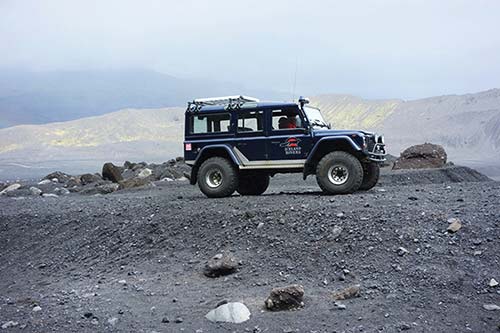
Landmannalaugar: This area, 120 miles east of Reykjavík in the Highlands, offers a vivid mountainous landscape striped with volcanic hues. Sitting on the edge of a petrified lava field formed during a 1477 eruption, it features natural thermal pools and excellent hiking trails. You could trek to the crater lake called Ljótipollur (“Ugly Puddle”); huff your way up the extremely colorful Brennisteinsalda, with high-altitude views and an optional detour to the Stórihver thermal area near the top; or opt for an easier walk to the big lake called Frostastaðavatn.
To reach Landmannalaugar, you’ll need to rent a 4x4 vehicle, or—better—join a guided excursion (only in summer, around 25,000 ISK, offered by various outfits, includes pickup and drop-off in Reykjavík). You can also take a bus operated by Reykjavík Excursions (www.re.is/highland-bus) or Trex (www.trex.is). Much of the route is on difficult-to-traverse, gravel-and-rock roads (about 4.5 hours one-way). While you can get a glimpse of the area in a very long day trip from Reykjavík, serious hikers overnight at the Landmannalaugar hut/campground.
Water Activities
Various companies offer rafting and kayaking tours, either in the canyon just below Gullfoss (the thundering waterfall on the Golden Circle); in North Iceland on two rivers that drain the Hofsjökull glacier, south of Sauðárkrókur in the Skagafjörður region; and on the South Coast in the Jökulsárlón glacier lagoon. Companies include Arctic Adventures (www.adventures.is) and Viking Rafting (www.vikingrafting.is).
For divers, scuba diving or snorkeling at Silfra—a fissure flooded with crystal-clear glacial water, at Þingvellir on the Golden Circle—is a highlight (see the Golden Circle chapter).
Northern Lights
The northern lights are a magical, occasional, serendipitous sight on clear, crisp nights in Iceland from about the end of August to the middle of April. You can’t really plan to see the northern lights—they don’t always appear and, when they do, are often obscured by cloud cover. While often visible in Reykjavík, the northern lights stand out better the farther you are from light pollution. All things being equal, spending a night or two in a more remote area could increase your chances.
The dreamy northern lights images that you see are done using long exposures and sometimes Photoshop (tweaking the aurora colors to a Kermit-the-Frog green). What you’ll actually see will probably be closer to the color of a Thai green curry—more coconut milk than Kermit.
Whether you’ll see the lights or not is mostly out of your control. I suggest planning your trip as if you won’t see them and considering it a bonus if you do. The tips below can help improve your odds.
Come during aurora season. Visit Iceland in aurora season (from a little before the fall equinox to a little after the spring equinox). Some say that September/October and February/March are the best months.
Maximize your chances. On any clear, dark night, go outside and scan the sky every half hour or so up until bedtime. You can follow the aurora and cloud-cover forecast on the Icelandic weather service’s English-language website (https://en.vedur.is; click on “Weather forecast,” then “Aurora forecast”). The American aurora forecasts at www.swpc.noaa.gov also cover Iceland.
See the lights without a car. If you’re staying in Reykjavík and you don’t have a car, consider taking a northern lights bus tour (7,700-13,600 ISK). Tours only run when conditions look good. You’ll leave town at 21:00 or 22:00 and get back about four hours later. Read a few reviews before you go, and remember that even if the forecast is good, you may see nothing at all. (If so, the bus company will likely give you a voucher for another night—not helpful on a short visit.) For some, the trip is a nice chance to snuggle up with a travel partner on a bus and listen to an entertaining tour guide who serves hot cocoa. For others, it’s a disappointing few hours of yawning and wishing they’d turned in early.
The northern lights arc across Iceland’s wintery sky, primarily in shades of green. The lights are caused by charged particles from the sun that collide with the earth’s upper atmosphere and cause it to glow. The earth’s magnetic field deflects most of these particles (which, if they hit the earth’s surface, would cause catastrophic radiation), but near the poles, where the field is weakest, some can seep through, creating the northern lights. They are strongest along a ring-shaped band that crosses Iceland, Greenland, northern Canada, Alaska, Russia, and northern Scandinavia, and diminish as you move farther north toward the magnetic pole. Their intensity varies with the sunspot cycle; the last solar maximum was in 2014, and the next is expected in late 2024-2025.
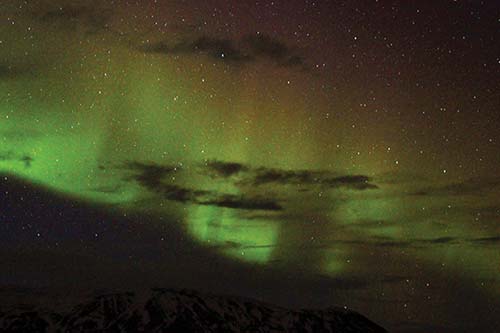
While Iceland is relatively easy to get to and a good place to see the northern lights, it’s not the best because of its frequently cloudy weather. So if your goal is to see the lights, choose a destination with more reliably clear winter weather and located closer to the center of the band, such as the northern parts of Norway, Finland, and Sweden.
See the lights with a car. If you’re staying in Reykjavík and have a car, you could put together your own northern lights tour by driving out into the suburbs or a little way into the countryside. Þingvellir (see the Golden Circle chapter) and Kleifarvatn (see the Blue Lagoon & Reykjanes Peninsula chapter) are plenty dark and within a 45-minute drive of town. Within greater Reykjavík, drive out to the end of Seltjarnarnes (to the parking area facing the little island called Grótta) or to the tip of Álftanes (by Bessastaðir, the presidential residence), where city lights are a little dimmer.
“See the lights” without actually seeing the lights. Two museums in Reykjavík offer the chance to “see” the aurora and learn the science behind it: the 20-minute Áróra planetarium show at the Pearl, and Aurora Reykjavík, near the harbor in Grandi (for detailed descriptions of these exhibits, see the Reykjavík chapter). While nowhere near as thrilling as seeing the real thing, they’re visual and informative.