APPENDIX
Holidays and Festivals
This list includes selected festivals plus national holidays observed in Iceland. Many sights and banks close on national holidays—keep this in mind when planning your itinerary. Before planning a trip around a festival, verify the dates with the festival website, the national tourist office (www.visiticeland.com), or my “Upcoming Holidays and Festivals in Iceland” web page at RickSteves.com/europe/iceland/festivals.
| Jan 1 | New Year’s Day |
| Jan 6 | 13th Day of Christmas (bonfires, fireworks) |
| Mid-Jan-mid-Feb | Þorri (Old Norse midwinter celebration) |
| Feb/March | Carnival Week (special foods, costumes): starts March 3 in 2025; Feb 16 in 2026 |
| March/April | Easter: April 20, 2025; April 5, 2026 |
| March/April | Aldrei Fór Ég Suður music festival in Ísafjörður, Westfjords (Easter weekend, www.aldrei.is) |
| Late April | Old Norse first day of summer (parades, sports), celebrated on the first Thu after April 18 |
| May 1 | Labor Day |
| May | Ascension Day: May 29, 2025; May 14, 2026 |
| May/June | Whitsunday and Whit Monday: June 8-9, 2025; May 24-25, 2026 |
| Early June | Seaman’s Day, Reykjavík (first Sun, www.hatidhafsins.is) |
| Early June | Viking Festival in Hafnarfjörður (www.fjorukrain.is) |
| June 17 | Icelandic National Day (parades, theater) |
| Early July | Goslok festival in Vestmannaeyjar (commemorates end of 1973 volcanic eruption): weekend following July 3 |
| Early July | Icelandic horse convention (even years only, www.landsmot.is) |
| Early Aug | Commerce Day, a.k.a. “Shop Workers’ Day Off” (first Mon) |
| Early Aug | Þjóðhátíð National Festival in Herjólfsdalur, Westman Islands (first weekend; fireworks, bonfires, and singing; www.dalurinn.is) |
| Late Aug | Culture Night in Reykjavík (free admission to museums; www.menningarnott.is) |
| Sept | Réttir—sheep roundups in the countryside |
| Late Sept-early Oct | Reykjavík International Film Festival (www.riff.is) |
| Oct 9-Dec 8 | Lighting of Imagine Peace Tower, Viðey Island, Reykjavík (www.imaginepeacetower.com) |
| Late Oct-early Nov | Iceland Airwaves music festival, Reykjavík (www.icelandairwaves.is) |
| Dec 23 | St. Þorlákur’s Day (Christmas shopping, evening strolling, traditional meals of skate) |
| Dec 24-26 | Christmas holiday |
| Dec 31 | New Year’s Eve (bonfires and fireworks) |
Books and Films
To learn more about Iceland past and present, check out a few of these books or films. Some of these books may be difficult to access outside Iceland, though you may find used copies at online retailers.
Nonfiction
Bringing Down the Banking System (Guðrún Johnsen, 2013). A finance scholar and banking regulator explains Iceland’s colossal 2008 bank failure in layman’s terms.
Does Anyone Actually Eat This? (Nanna Rögnvaldardóttir, 2014). Iceland’s best-known food writer reviews the country’s food traditions.
Exploring Iceland’s Geology (Snæbjörn Guðmundsson, 2016). This concise guide explains the geology behind 50 of Iceland’s most popular natural sights.
The Far Traveler: Voyages of a Viking Woman (Nancy Marie Brown, 2008). Brown uses archaeological and scientific evidence to examine the Icelandic saga of Gudrid (Guðríður) the Far-Traveler. Related books by the same author include Song of the Vikings: Snorri and the Making of Norse Myth (2014) and Ivory Vikings: The Mystery of the Most Famous Chessmen in the World and the Woman Who Made Them (2016).
The History of Iceland (Gunnar Karlsson, 2000). This well-written general history of the country also comes in a condensed version, called A Brief History of Iceland.
How Iceland Changed the World (Egill Bjarnason, 2021). This is a breezy take on Iceland’s role in pivotal events ranging from the French Revolution to the Apollo moon landing.
Iceland’s Secret: The Untold Story of the World’s Biggest Con (Jared Bibler, 2021). Bibler provides an accessible recap of Iceland’s 2008 financial crisis.
The Indian (Jón Gnarr, 2015). Iceland’s best-known comic actor—and recent mayor of Reykjavík—recalls his childhood, during which he was bullied and sent to a boarding school. Two sequels, The Outlaw and The Pirate, carry on his story.
Lake Mývatn: People and Places (Björg Árnadóttir, 2015). This is a friendly introduction to the popular Lake Mývatn region.
The Little Book of the Icelanders (Alda Sigmundsdóttir, 2012). An Icelander returns home after living in America and explains Icelandic culture with a critical and sometimes cynical eye.
Names for the Sea (Sarah Moss, 2013). A British academic writes about the year she spent in Iceland with her husband and kids.
The Ring of Seasons (Terry Lacy, 2000). An American and long-term Iceland resident describes an idealized year in the life of an Icelandic family.
Ripples from Iceland (Amalia Líndal, 1962). In 1949, a young woman from Boston marries an Icelandic student, moves to Reykjavík, and starts a family.
Viking Age Iceland (Jesse Byock, 2001). Byock provides a good introduction to the society and politics of Iceland in its earliest years, from settlement through the 13th century.
Wasteland with Words: A Social History of Iceland (Sigurður Gylfi Magnússon, 2010). This book focuses on 1870 to 1940, when Iceland grew from a shivering, impoverished colony to a land on the brink of prosperity and independence.
The Windows of Brimnes (Bill Holm, 2007). Minnesotan writer and poet Bill Holm, who spent several summers in a cottage in Skagafjörður near the home of his ancestors, reflects on the differences between Iceland and the US.
Fiction
Angels of the Universe (Einar Már Guðmundsson, 1993). An intelligent young man descends into mental illness in 1960s Reykjavík.
The Blue Fox (Sjón, 2003). In this short, poetically written fable a 19th-century Lutheran pastor hunts an arctic fox.
Burial Rites (Hannah Kent, 2013). Kent writes a fictionalized account of the final months of Agnes Magnúsdóttir, whose 1830 beheading (for taking part in a murder) was the last time the death penalty was used in Iceland.
Frozen Assets (Quentin Bates, 2011). This book is one in a series of gripping crime novels starring Gunnhildur “Gunna” Gísladóttir—a shrewd policewoman who, in the course of a murder investigation, uncovers corruption at the highest levels.
Heaven and Hell (Jón Kalman Stefánsson, 2015). Stefánsson, a poet, brings his lyrical prose to this novel of a fishing accident and a young boy’s search for meaning in remote Iceland in the early 20th century.
Independent People (Halldór Laxness, 1934). Nobel Prize-winning Laxness’ best novel tells the story of Bjartur, a farm laborer who jumps at the rare chance to have his own farm. In his single-minded quest to take charge of his destiny, he destroys everyone around him.
The Sagas of the Icelanders (edited by Robert Kellogg, 2001). These classic stories, still fresh after 800 years, are set appealingly amid the Icelandic landscape.
Film and TV
These films and shows are generally available for streaming in the US. You may also catch them on your Icelandair flight to or from Reykjavík.
101 Reykjavík (2000). This comedy is set in downtown Reykjavík in the 1990s—before tourism took over, back when it was still bohemian. Hlynur lives with his mother and is having problems committing to his girlfriend. He winds up involved with Lola, who is his mother’s friend—in fact, more than her friend.
Devil’s Island (1996). This film highlights the adventures of a lower-class Reykjavík family living in abandoned WWII barracks. It includes gangs, an Elvis soundtrack, and a main character aptly named Baddi.
Eurovision Song Contest: The Story of Fire Saga (2020). In this feel-good parody of the real-life music contest, Will Ferrell plays Lars Erickssong, a native of small-town Húsavík whose dream is to win Eurovision with his long-time partner Sigrit, played by Rachel McAdams.
The Icelandic Dream (2000). Tóti tries everything he can to get ahead, but keeps messing up. This dark, realist, somewhat-amateurish comedy explores class differences in Reykjavík and the effects of the former American military presence.
Life in a Fishbowl (2014; Icelandic title: Vonarstræti). Three lives intersect during Iceland’s financial collapse: an alcoholic writer, a young unmarried mother who has turned to prostitution, and a morally compromised banking executive.
Mr. Bjarnfreðarson (2009). This black comedy stars Jón Gnarr as a sadistic misfit, damaged for life by his mother’s left-wing activism and trying to regroup after serving prison time for an “accidental” murder.
No Such Thing (2001). This bizarre American-Icelandic indie film, with its Beauty and the Beast theme, stars Sarah Polley as a journalist who tries to tame the beast—who incidentally killed her fiancé.
Nói the Albino (2003). In this portrait of small-town adolescence, Nói lives with his grandmother and alcoholic father in the Westfjords, and falls for a girl at the local gas station.
Puffling (2023). In this short documentary, teenage girls in the Westman Islands make it their mission to rescue baby puffins still learning how to fly.
Remote Control (1992; Icelandic title: Sódóma Reykjavík). Axel goes in search of his mother’s lost TV remote and gets mixed up with a gang of mobsters. This low-budget comedy with a hard-rock soundtrack has been called Iceland’s equivalent of The Big Lebowski.
The Seagull’s Laughter (2001). In the 1950s, shapely Freyja returns to Iceland from America, where she has been living with her soldier husband, and stirs up all kinds of trouble.
Trapped (2016; Icelandic title: Ófærð). As the car ferry from the Faroe Islands arrives one day, a body is found floating in the fjord. The pass is snowed in, so none of the passengers can leave town, and investigators from Reykjavík can’t arrive. Whodunit?
When the Raven Flies (1984). An Irish boy travels to Iceland to take revenge on Vikings who killed his parents.
Conversions and Climate
Numbers and Stumblers
• Europeans write a few of their numbers differently than we do. 1 =  , 4 =
, 4 =  , 7 =
, 7 =  .
.
• In Europe, dates appear as day/month, so Christmas is 25/12.
• Commas are decimal points and decimals commas. A dollar and a half is $1,50, one thousand is 1.000, and there are 5.280 feet in a mile.
• When counting with fingers, start with your thumb. If you hold up your first finger to request one item, you’ll probably get two.
• On escalators and moving sidewalks, Europeans keep the left “lane” open for passing. Keep to the right.
Metric Conversions
A kilogram equals 1,000 grams (about 2.2 pounds). One hundred grams (a common unit at markets) is about a quarter-pound. One liter is about a quart, or almost four to a gallon.
A kilometer is six-tenths of a mile. To convert kilometers to miles, cut the kilometers in half and add back 10 percent of the original (120 km: 60 + 12 = 72 miles). One meter is 39 inches—just over a yard.
| 1 foot = 0.3 meter | 1 square yard = 0.8 square meter |
| 1 yard = 0.9 meter | 1 square mile = 2.6 square kilometers |
| 1 mile = 1.6 kilometers | 1 ounce = 28 grams |
| 1 centimeter = 0.4 inch | 1 quart = 0.95 liter |
| 1 meter = 39.4 inches | 1 kilogram = 2.2 pounds |
| 1 kilometer = 0.62 mile | 32°F = 0°C |
Iceland’s Climate
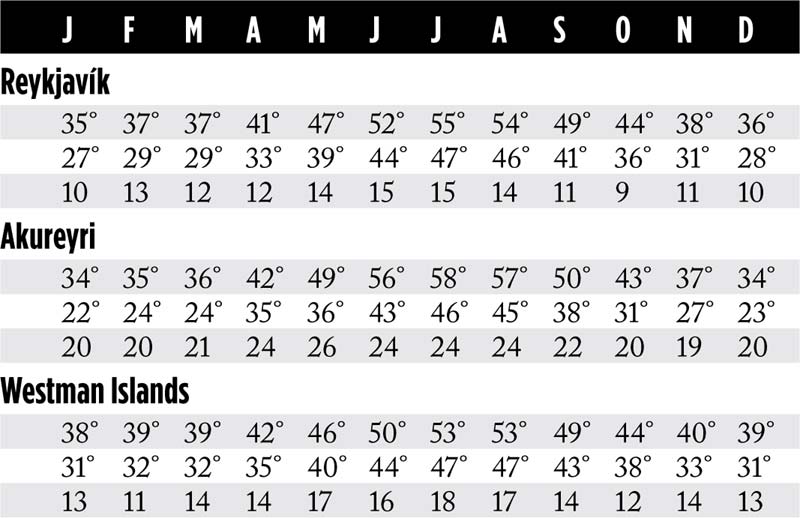
First line, average daily high; second line, average daily low; third line, average days without rain. For more detailed weather statistics for destinations in this book, check Iceland’s English-language website http://en.vedur.is, and for both Iceland and the rest of the world, Wunderground.com.
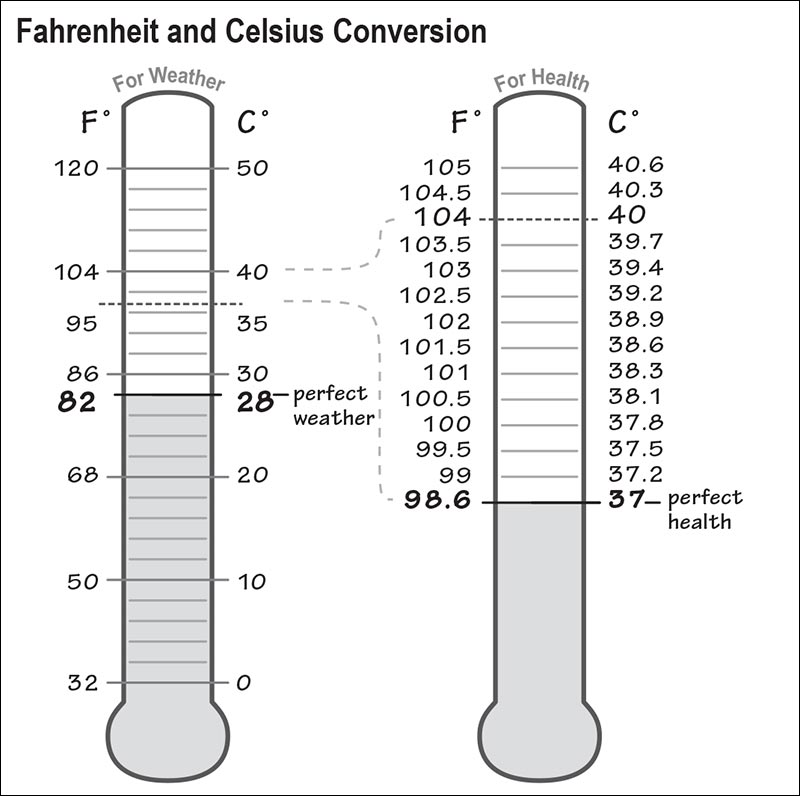
Europe takes its temperature using the Celsius scale, while we opt for Fahrenheit. For a rough conversion from Celsius to Fahrenheit, double the number and add 30. For weather, remember that 28°C is 82°F—perfect. For health, 37°C is just right. At a launderette, 30°C is cold, 40°C is warm (usually the default setting), 60°C is hot, and 95°C is boiling. Your air-conditioner should be set at about 20°C.
Whether you’re traveling for five days or five weeks, you won’t need more than this. Pack light to enjoy the sweet freedom of true mobility.
 5 shirts
2 pairs pants
5 pairs underwear & socks
Waterproof shoes
Sweater or warm layer
Rainproof/windproof jacket with hood
Fleece hat, gloves
Swimsuit & swim accessories (eyeglass strap, bathing cap, or goggles; small towel)
Sleepwear/loungewear
Debit card(s)
Credit card(s)
Hard cash ($100-200)
Money belt
Passport
Other required ID: Vaccine card, entry visa, etc.
Driver’s license, student ID, hostel card, etc.
Tickets & confirmations: flights, hotels, trains, rail pass, car rental, sight entries
Photocopies of important documents
Insurance details
Guidebooks & maps
Basics: soap, shampoo, toothbrush, toothpaste, floss, deodorant, sunscreen, brush/comb, etc.
Medicines & vitamins
First-aid kit
Glasses/contacts
Face masks & hand sanitizer
Sunglasses (esp. if driving)
Sewing kit
Packet of tissues (for WC)
Eye mask (for sleeping)
Earplugs
Mobile phone
Camera & related gear
Tablet/ebook reader/laptop
Headphones/earbuds
Chargers & batteries
Phone car charger & mount (or GPS device)
Plug adapters
Day pack
Sealable plastic baggies
Laundry supplies: soap, laundry bag, clothesline
Small umbrella
Travel alarm/watch
Notepad & pen
Journal
Second pair of shoes
Travel hairdryer
Water bottle
Fold-up tote bag
Small flashlight
Mini binoculars
Inflatable pillow/neck rest
Tiny lock
Insect head net (if visiting Mývatn area)
Strap-on ice cleats (winter only)
Icelandic Survival Phrases
Icelandic has some unique letters, most notably ð (the voiced “th” sound in “breathe,” represented by “th”) and Þ (the unvoiced “th” sound in “breath,” also represented by “th”). The letter á sounds like “ow” (rhymes with “now”). The long i sound, such as in the word “light,” is represented in the phonetics by “ī.”
| Hello. (formal) | Góðan daginn. goh-thahn dī-ihn |
| Hi. / Bye. (informal) | Hæ. / Bæ. hī / bī (as in English) |
| Do you speak English? | Talarðu ensku? tahl-ar-thoo ehn-skoo |
| Yes. / No. | Já / Nei. yow / nay |
| I (don’t) understand. | Ég skil (ekki). yehkh skeel (eh-kee) |
| Please. / Thank you. | Vinsamlegast. / Takk. vin-sahm-lay-gahst / tahk |
| Excuse me. | Fyrirgefðu. fih-ree-gehv-thoo |
| No problem. | Ekkert mál. ehk-kert mowl |
| Super. | Fínt. feent |
| OK. | Allt í lagi. ahlt ee lah-yee |
| Goodbye. (more formal) | Bless. bless |
| one / two | einn / tveir ayt / tvayr |
| three / four | þrír / fjórir threer / fyoh-rir |
| five / six | fimm / sex fim / sex |
| seven / eight | sjö / átta syur / owt-tah |
| nine / ten | níu / tíu nee-oo / tee-oo |
| hundred | hundrað hoon-drahth |
| thousand | þúsund thoo-sund |
| How much is it? | Hvað kostar þetta? kvahth kohs-tar theht-tah |
| Is it free? | Er þetta ókeypis? ayr theht-tah oh-kay-pis |
| Is it included? | Er þetta innifalið? ayr theht-tah een-nee-fah-lith |
| local currency: (Icelandic) crowns | (íslenskar) krónur (ee-slehn-skar) kroh-nur |
| Where is...? | Hvar er...? kvar ayr |
| ...the toilet | ....klósettið kloh-seht-tith |
| men | karlar kahrt-lar |
| women | konur koh-noor |
| left / right | vinstri / hægri vin-stree / hī-grih |
| straight | beint baynt |
| opening hours | opnunartími ohp-noo-nar-tee-mih |
| At what time? | Hvenær? kver-nī |
| Just a moment. | Augnablik. oog-nah-bleek |
| now / soon / later | núna / bráðum / seinna noo-nah / brow-thoom / sayt-nah |
| today / tomorrow | í dag / á morgun ee dahkh / ow mor-goon |
| breakfast / lunch / dinner | morgunmat / hádegismatur / kvöldmatur mor-goon-maht / how-tays-mah-tur / kvewld-mah-tur |
| water / coffee | vatn / kaffi vah / kah-feh |
| beer / wine | bjór / vín byor / veen |
| Cheers! | skál skahl |
| The bill, please. | Reikninginn, takk. rayk-nin-gin tahk |