SANTORINI
Σαντορίνη; a.k.a. Thira (Θηρα)
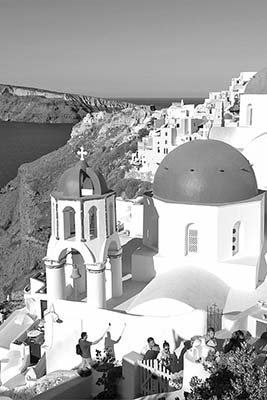
Scenic, seismic Santorini is one of the world’s most dramatic islands: a flooded caldera (a collapsed volcanic crater) with a long, steep, colorfully striped arc of cliffs, thrusting up a thousand feet above sea level. Sometimes called “The Devil’s Isle,” this unique place has captured visitors’ imaginations for millennia and might have partly inspired tales of Atlantis. But the otherworldly appeal of Santorini (sahn-toh-REE-nee) doesn’t end with its setting. Perched along the ridgeline is a gaggle of perfectly placed whitewashed villages punctuated with azure domes that make this, undeniably, one of Greece’s most scenic spots. If this place didn’t exist, some fantasy painter would have to conjure it up.
The main town, Fira (Φηρα, FEE-rah)—with Santorini’s handiest services and best museum—is equal parts functional and scenic. But the village of Oia (Οια, EE-ah), on the northern tip of the island—with its chalk-white houses and vivid domes—is even more dramatic. Oia is the place you imagine first when you think “Santorini.” Strolling through Oia is like spinning a postcard rack—it’s tempting to see the town entirely through your camera’s viewfinder. A complete visit to the island involves spending time in both towns (though Fira is, for several reasons, the more practical home base).
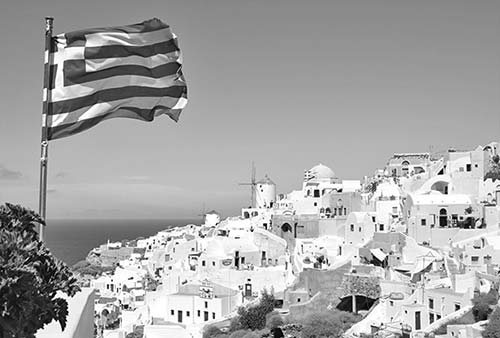
Santorini deserves more time than one-town islands Mykonos and Hydra. Besides the towns Fira and Oia, the rest of the island is also entertaining and fascinating—with charming villages, countryside wineries, ancient sites, unusual beaches, and a never-ending supply of stunning viewpoints (a boat trip in the caldera is a fun way to savor the area). In general, Santorini invites explorers to linger; even with several days, you won’t run out of ways to enjoy yourself.
Santorini is hugely popular and can be very crowded in high season (roughly July-Sept, peaking mid-July-Aug). And it’s expensive. I’ve done my best to find good-value accommodations and restaurants, but on a Greece-wide scale, they’re still budget-busters. People coming to Santorini on a tight budget may find themselves eating lots of picnics and takeout souvlaki, and seeking accommodations with no views. Arriving via cruise ship helps control costs, even if it provides only a fleeting glimpse—but locals grumble that discount cruise lines and Airbnb attract a less wealthy clientele, who contribute less to the local economy.
They have reason to be concerned—tourism has helped make Santorini relatively affluent. It’s one of the few places in Greece where young people don’t have to move away to find satisfying work. Fortunately, it’s not difficult to break away from the main tourist rut and discover some scenic lanes of your own. In both Fira and Oia, the cliffside streets are strewn with countless cafés, all of them touting “sunset views”...the end of the day is a main attraction here.
SANTORINI OVERVIEW
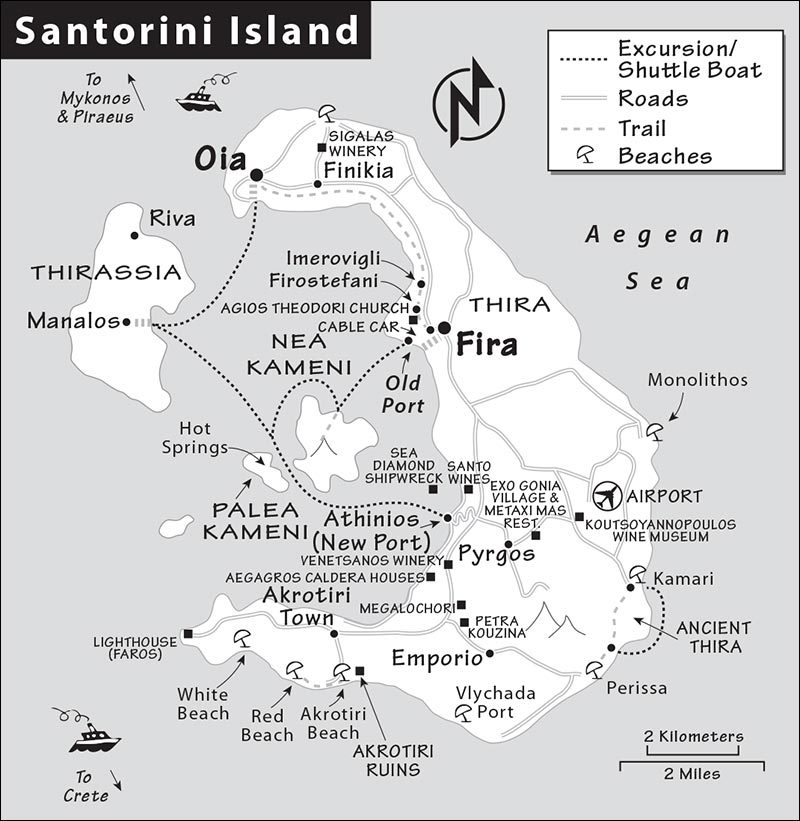
The five islands that make up the Santorini archipelago are known to Greeks as Thira (Θηρα, THEE-rah). Most of the settlement is on the 15-mile-long main island, also called Thira. But most travelers call it Santorini (from the Venetian “Santa Irini,” after an early Christian cathedral here)—and I do, too. The west side of Santorini (the caldera) is a sheer drop-off, while the east side (the former volcano’s base) tapers more gradually to the water.
This archipelago’s permanent population is officially around 15,000, but it nearly doubles with seasonal workers in the summer. Visitors to Santorini number in the millions annually. Recently, the local government has taken steps to limit the number of cruise day-trippers on the island.
The primary tourist towns perch atop cliffs on the steep western side of Santorini: Fira is the island’s capital and transportation hub, but the main attraction is Oia, a village six miles to the northwest. Sprawling north from Fira, along the road toward Oia, are the even higher, hill-capping villages of Imerovigli and Firostefani. The relatively level east and south areas have the ancient sites, most of the wineries, and the best beaches.
PLANNING YOUR TIME
For a speedy visit, Santorini deserves at least two nights and a full day divided between Oia and Fira. But if you have another day or two (or longer) to spare, Santorini has plenty more to offer. Three or four nights is ideal.
If your time on Santorini is short, make a beeline (by bus or taxi) to Oia to get your fill of classic Santorini views. Then, as the midday Oia cruise crowds begin to peak, return to Fira for a little sightseeing—follow my self-guided Fira Walk, then tour the Museum of Prehistoric Thira. Be sure to catch the sunset from somewhere along the caldera ridge (see sidebar, later).
On a longer visit, rent a car or ride a bus or taxi to other points on the island, or take a boat trip in the caldera.
Don’t rely on the opening hours for museums and archaeological sites given in this book; they can change at the whims of the government and the Greek economy. Check locally before planning your day.
Choosing a Home Base: Most travelers find Fira to be the handiest place to overnight. Centrally located for exploring the island, Fira has the best transportation connections. It’s plenty scenic and has the best variety of accommodations, restaurants, and services. Wealthy romantics hang their hat in Oia—but it has some drawbacks. Oia feels remote (to get just about anywhere on the island, you first have to drive, taxi, or bus 25 minutes to Fira), is extraordinarily expensive (even by Santorini standards), and is unbearably crowded around sunset...when your “private” terrace could suddenly be just steps below packs of shutterbugs. You could also look for accommodations in the smaller villages of Firostefani or Imerovigli, which adjoin Fira to the north and also have fantastic views. If you’ll have a car and want to settle into island life away from the crowds, it can be somewhat cheaper to find a countryside villa on the quieter eastern side of the island.
Watching the sunset from the caldera ridge is a ▲▲▲ experience that’s worth planning ahead for. Find out what time the sun sets, and where (it gradually moves from north to south over the course of the summer).
Oia is the most famous place to enjoy the Santorini sunset. During July and August it provides unobstructed views, and all that whitewash beautifully captures the swirling colors of the sky. Be warned that sunset watching in Oia is hardly a unique brainstorm—and as the shadows get long, the town’s narrow streets become a tedious human traffic jam. Seriously—just before sunset, you can barely walk anywhere in the old center. If you are determined to experience an Oia sunset, arrive very early—an hour or more in peak season—and immediately stake out a spot at the prime vantage point: at or near the ruined castle at the tip of town. But, to be honest, many travelers find it simply not worth the headaches involved.
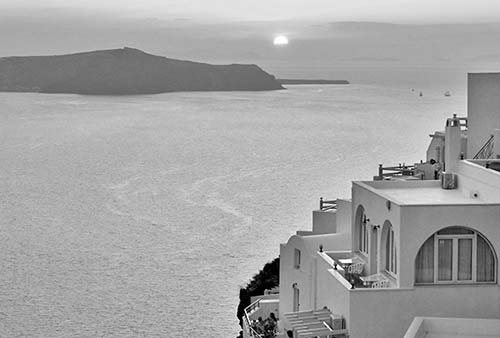
Fira is arguably just as good for enjoying the sunset, and the crowds are less concentrated. Unlike Oia, Fira affords a view over the entire caldera rather than looking out to sea (so the sun sets over land, not just water). If your hotel doesn’t offer a caldera-view perch, scout a bar or restaurant during the day, and reserve a table for sunset time. If you’re improvising, simply belly up to the whitewashed wall (along with every other tourist in town) along the terrace in front of the Orthodox Cathedral.
And don’t forget the many other places on the island for sunset viewing—basically anywhere facing the caldera will work. Ask locals for tips. The villages of Firostefani and Imerovigli, just above Fira, are smaller (less crowded) and even higher up. Some of my recommended wineries on the southern part of the island (especially Venetsanos and Santo) boast spectacular sunset views, as does Selene restaurant in the village of Pyrgos. And if you’re taking a cruise in the caldera, choosing one timed to coincide with sunset kills two sightseeing birds with one stone.
Remember: If you hope to watch the sunset from a particular café or winery, be sure to specifically reserve a sunset-view table well in advance.
ARRIVAL ON SANTORINI
By Boat
Boats arrive in one of two places on Santorini: Ferries from Athens and the other islands arrive at the New Port at Athinios, about five miles south of Fira; cruise ships usually tender passengers to the Old Port, directly below Fira.
By Ferry at the New Port (Athinios): The Athinios port is a hive of activity, with ferries and cruise-ship tenders coming and going, and a row of cafés and car-rental offices facing the busy embankment. From here, a serpentine road twists up the hill. A taxi into Fira runs about €30 (more to Oia or other towns). Buses meet arriving boats to bring passengers into Fira, where you can connect to other points on the island. Going by bus is much cheaper but can take longer, as they wait to fill up before departing (there are many buses in this chaotic area—look for one marked Local Bus). As these buses can be very crowded in peak season, don’t dawdle. You may also be accosted by transfer companies offering shared shuttle-bus rides into town (€40/2 people).
Visible from the road above Athinios, the ringed-off area in the bay just below the switchbacks is the site of the Sea Diamond shipwreck—a cruise ship that sank here in 2007; all but two of the 1,195 passengers were rescued. The ship rests in 450 feet of water. Concerned that it’s polluting the bay, islanders are hoping to pull it up.
For boat connections from Athinios, see “Santorini Connections” at the end of this chapter.
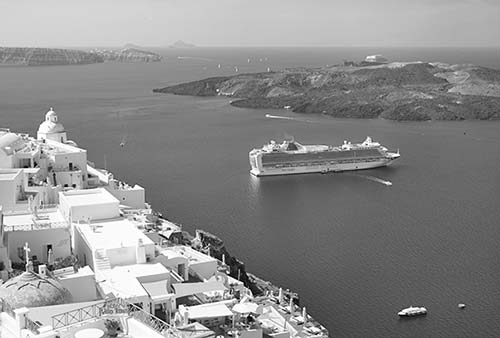
By Cruise Ship: Cruise ships anchor in the caldera below Fira. Passengers taking excursions get the first tenders, which go to the New Port at Athinios (described earlier) and are met by tour buses; after your excursion, the bus will likely drop you off in Fira (for info on returning to your ship, see later). Independent day-trippers are tendered to the Old Port directly below Fira.
Situated on an edgy stack of tectonic plates, Santorini was created by volcanic activity that lasted more than two million years. The island was once a neatly circular “shield volcano,” with a gentle slope that was built up gradually, over a series of volcanic eruptions.
The first major eruption of Santorini took place around 21,000 years ago. The middle of the volcano collapsed and filled with about a hundred feet of water—creating the caldera we see today. For millennia, it was a mostly intact, ring-shaped island—with just a small opening at one end, and a small island in the middle...a perfect natural harbor. The island prospered as a trade port. Experts believe that the island in the middle of the ring may have been the site of a thriving city (the one that, later, may have partly inspired tales of Atlantis). It went by two names: Strongili, meaning “Circular”; and Kalliste, meaning “Beautiful.”
But then came the famous “Minoan Eruption” around 1630 BC—one of the largest in human history. It blew out 24 cubic miles of volcanic material, at least four times the amount ejected by the 1883 explosion of Krakatoa in today’s Indonesia. The eruption displaced enough seawater to send a tsunami screaming south toward Crete, less than 70 miles away. Archaeologists think that the tsunami (and perhaps earthquakes near the same time) caused severe hardship, eventually leading to the downfall of the Minoan civilization.
Before the full-scale eruption, the volcano likely warned Santorini’s inhabitants with a major earthquake and an initial small eruption. No human skeletons and few valuable items from that time have been found here, suggesting that islanders were able to pack up and evacuate. Good thing. Soon afterward, large amounts of ash and pumice blasted out of the crater, and superheated pyroclastic flows swept down the island’s slopes. Several walls of the ring collapsed; the island in the middle disappeared; and the caldera became much deeper—filled with more than a thousand feet of water. That’s when the island took on the sunken crater shape that visitors see today.
Santorini’s volcano isn’t done. Two little islets emerged from the bay quite recently, by geological standards. Palea Kameni (“Old Burnt Island”) rose from the deep in 197 BC, leaving islanders awestruck. They credited the sea god Poseidon and built a temple here, which was later destroyed in further eruptions. Then, in AD 1707, Nea Kameni (“New Burnt Island”) appeared beside its older brother. Both Kameni islets grew even more in the 1860s. To this day, these islets sometimes sputter and steam, and earthquakes still wrack the entire archipelago (including a devastating one in 1956). The last small eruption (on Nea Kameni) was in 1950. Today, the geothermal springs on Palea Kameni are a popular tourist attraction.
Although the Minoan Eruption devastated the island, it also left behind a unique ecosystem and agricultural tradition (see the “Island Cuisine in a Desert” sidebar, later). And, starting in the 19th century and ramping up in the early 20th century, the volcanic soil was also the basis for a local industry: The upper layer of pumice and volcanic ash was quarried, pulverized, and mixed with lime to create a very strong concrete (produced until recently in the blocky, abandoned building on the cliff at the southern edge of Fira). Santorini is the country’s sole source of this material. But with the rise of tourism in the 1970s and 1980s, civic leaders realized that Santorini’s pristine nature would be better in the long run than gaping quarries, most of which have halted production.
From Fira’s Old Port, there are three ways to reach the town center on the cliff above: Take a cable car, hike up, or ride a donkey. The cable car is the easiest option (€6 each way, more for luggage, daily 7:00-22:00, every 20 minutes, more frequent with demand, 3-minute ride to the top). However, the cable car is small (maximum 36 people/trip)—so you might be in for a long wait if you arrive on a big ship. Hiking up the 588 steep steps is demanding, and you’ll share them with fragrant, messy donkeys. You can pay €10 to ride partway up on a donkey, but the stench and the bumpy ride make this far less romantic than it sounds. And the donkeys don’t take you all the way up, leaving you a steep uphill hike of around 100 steps at the end. The cable car and donkey trail converge up top, and that point is also the start of my self-guided Fira Walk.
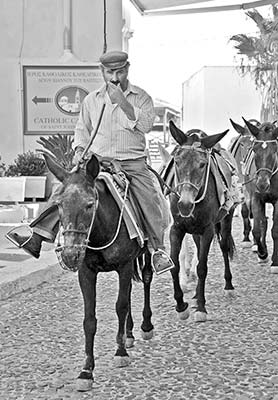
To return to the Old Port, you can take the cable car, ride a donkey, or walk down. Note that the line for the cable car can get comically long, snaking through town, as the ship’s departure nears.
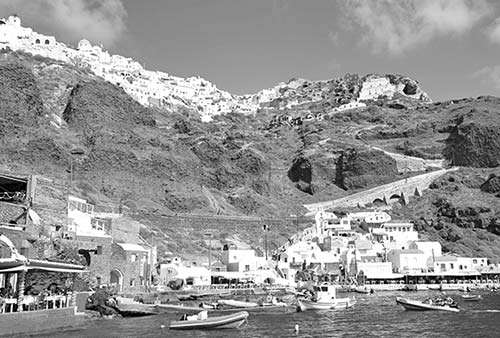
If, on arrival, you want to head from Fira’s Old Port directly to Oia, shop around once on shore for local transport. A typical package, costing around €30, includes a fast boat from the Old Port to Ammoudi (Oia’s port), a bus ride up the hill to Oia, several hours to explore Oia and have lunch, then a 30-minute bus ride back to Fira Town.
By Plane
Santorini’s sleek, modern airport sits along the flat area on the east (back) side of the island, about four miles from Fira (code: JTR, +30 2286 028 405; www.santorini-airport.com). It’s about a 15-minute ride into Fira, either by taxi (around €25, cash only) or bus (around €2, roughly hourly—coordinated to meet some but not all flights).
GETTING AROUND SANTORINI
By Bus: Fira is the bus hub for the island. The bus “station” (really just a parking lot) is a block below the main street, near the south end of town (just downhill from the Orthodox cathedral and Museum of Prehistoric Thira). Schedules are posted at the kiosk at the bottom end of the lot; buy tickets from the driver (cash only). Despite the chaotic scene, buses are generally clean, much cheaper than taxis, and run on time. Buses can be extremely crowded, especially in peak season—get there early to improve your odds of claiming a seat. For bus connections, see “Fira Connections,” later.
By Taxi: The main taxi stand is just uphill and around the corner from Fira’s bus station, along the main street. There’s often a line of people waiting for taxis, particularly when cruise ships have just arrived. If you need to head to the port or airport in the morning, book a taxi the night before through your hotel. You can also try calling for a taxi (+30 2286 022 555 or +30 2286 023 951). Distances on the island are short, but prices are high (and can be slippery): Figure €30 to Oia, Athinios port, or Perissa; €25 to Kamari’s beaches or the airport; and €35 to Akrotiri. Given these prices, it’s tempting for those exploring the island to simply rent their own car (typically cheaper than two or three taxi rides)—see next.
By Car: If ever there’s a Greek island where it’s nice to have a car, Santorini’s the one. Taxis are expensive, buses are crowded, and many outlying sights and viewpoints are well worth the trip. Driving around Santorini is reasonably straightforward. Roads are winding but wide (enough), drivers are aggressive but not reckless (drive defensively), towns are well-signposted, and parking is usually free (although spots can be hard to find). Traffic, however, can be a big problem at certain times of day and in peak season.
Offices renting cars, scooters, and ATVs abound in Fira (clustering at the northern end of town, along the main street), in Oia (at the entrance to town), and at the New Port and airport. Or ask your hotel—they likely have a partnership with a company that can make things easy. A small manual-transmission car with basic insurance runs around €45-60 for 24 hours; you’ll pay more for an automatic, better insurance, and during the July and August high season. You can usually rent a car on the spot, but it’s smart to book ahead in July and August.
Renting an ATV is popular on Santorini...but I wouldn’t. This island is hillier and more congested than most. Local hospitals report that, on a busy day in the summer, they treat as many as 25 injuries from ATV-related accidents. No matter how defensively you drive, you’re sharing the roads with dangerous ATV novices. I’d spring a few more euros for the relative safety of a car.
By Guided Tour: Kostas and his select team of guides at Santorini Private Tours do an excellent job of giving meaning to your Santorini visit. They offer a variety of excursions, including “highlights” tours around the island (up to 4 people-€390/4.5 hours, €480/6 hours including Akrotiri), food and wine tours, and cooking classes. The guides work with both cruise passengers and independent travelers. Review the options and contact them through their website (www.santorini-private-guide.com).
Fira
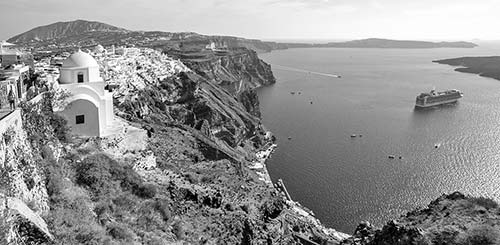
The island’s main town, Fira, is a practical hub with an extraordinary setting. Sit at a cliff-clinging café terrace, sip an iced coffee, and watch thousands of cruise-ship passengers flood into town each morning (on the cable car and donkey trail), then recede in the afternoon. This built-in business has made Fira a bit greedy; its main streets (including the aptly named “Gold Street”) are lined with aggressive jewelry salespeople and restaurants with great views, high prices, and low quality.
But if you can ignore the tackiness in this part of town, you’ll discover that Fira has a charm of its own—particularly in the cozy labyrinth of streets that burrow between its main traffic street and the cliff edge, and on the steep switchback lanes that zigzag down the side of the cliff toward the caldera. Fira is also home to a pair of cathedrals (Orthodox and Catholic) and the island’s top museum (the excellent Museum of Prehistoric Thira).
Remember that Fira is not the setting of all those famous Santorini photos—those are taken in Oia.
Orientation to Fira
The core of Fira is squeezed between the cliff and the busy, not particularly charming main road through town, called 25 Martou. Most places of interest to visitors are in the cluster of narrow streets between here and the caldera. Even where street names exist, locals ignore them. Making navigation even more confusing, it’s a very vertical town—especially along the cliff. Use a map, and don’t be afraid to ask for directions.
Fira—and the island—has no real TI. For help, ask at your hotel, local travel agencies, or other businesses.
HELPFUL HINTS
Combo-Ticket: A €15 combo-ticket covers the ancient sites of Akrotiri (€12) and Ancient Thira (€6) outside of Fira, as well as the recommended Museum of Prehistoric Thira in Fira (€6)—a good value if you see all three. (Both Akrotiri and Ancient Thira often close unexpectedly, so confirm in town that they’re open before you buy.)
Laundry: Most launderettes in town offer drop-off service for around €17 (generally closed Sun; ask at your hotel for the nearest location). Penguin offers full-service in about three hours (Mon-Sat 9:00-20:00, Sun until 17:00, on 25 Martou toward Oia side, +30 2286 023 908).
Grocery Store: Sizeable Sklavenitis (Σκλαβενιτης) is at the south end of town on the main road (Mon-Fri 8:00-21:00, Sat until 20:00, closed Sun).
Ferry Tickets: Three travel agencies are along Fira’s main road and sell a variety of ferry tickets (and some can print your tickets, if needed): Dakoutros Travel, Nomikos Travel, and Pelican Travel.
Travel Blog: For helpful, enjoyably lowbrow local travel information, see www.santorinidave.com.
Fira Walk
This self-guided orientation walk introduces you to Santorini and its main town. It can be done in about an hour; allow more time for sightseeing, photo stops, and hiking to better views. Be warned that this walk traverses the main streets, which can be jammed with tourists; it can be much more relaxing in late afternoon, or even after dark. Begin where most cruise passengers do: at the cable car station near the top of town. (The cable car is easy to find from anywhere in Fira—just look for the blue signs.)
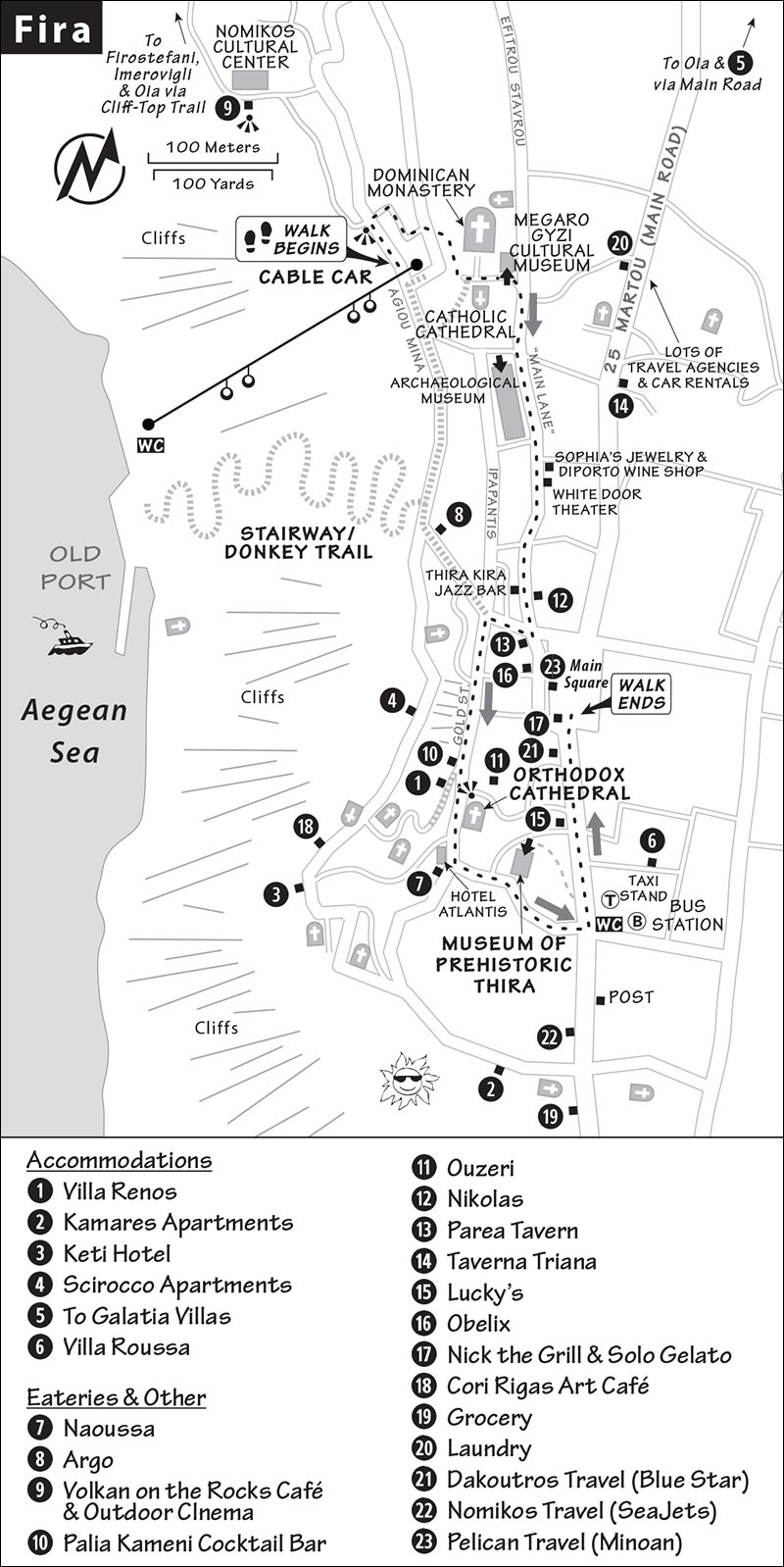
• With the cable car station at your back, turn right—yes, away from town—and follow the cobbled path as it curves up and to the right, toward the cliff, between scenic restaurants. Pause along the wall in front of Zafora Restaurant for a...
Big Orientation View of Santorini
You’re looking at the glorious cliff-draping town of Fira—the capital of the archipelago known internationally as Santorini and locally as Thira. This town is improbably perched along the lip of a flooded volcanic caldera—Spanish for “cauldron.” And, like a cauldron indeed, Santorini bubbled over and blew its top about 3,600 years ago, obliterating what had been a tidy, ring-shaped archipelago with a busy island town in the middle (see the “When Santorini Blew Its Top” sidebar, earlier).
The crescent-shaped island you’re on is called Thira. The next-biggest island—the smaller crescent facing Thira across the caldera—is called Thirasia. Its little port town, Manolas, is connected to the spine of the island by a rugged donkey path. The two chunky islands in the middle of the caldera are called Nea (“New”) Kameni and Palea (“Old”) Kameni—both of which remain volcanically active.
Historically, Santorini has experienced volcanic activity about every 75 years, most recently in the mid-1950s. Do the math...and keep your eyes peeled for steam venting.
Scanning the cliffs, notice the horizontal stripes of black, gray, and red—indicating where the original volcanic island was formed by a series of eruptions, each one building on the previous one, like the rings of a tree. The edge of the caldera was sheared off cleanly by an eruption 21,000 years ago, creating this cross-section of the striations—a unique opportunity to see eons of geology in one glance.
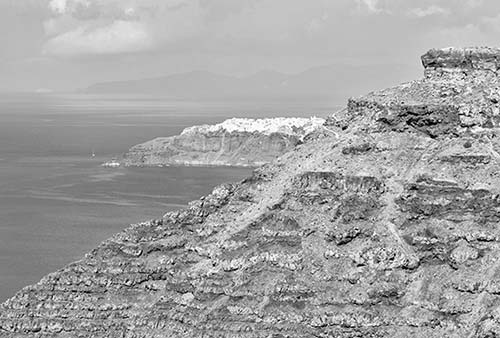
Now look down below, where a stepped donkey path twists all the way to the Old Port of Fira. You can pay €10 for the ride (almost all the way) up or down. While this seems like a tourist gimmick, beasts of burden have been hauling cargo from the port up to the cliff-capping towns for centuries. In recent years, more progressive islanders have formed the Santorini Animal Welfare Association (SAWA) to educate the traditional donkey wranglers to treat their animals more humanely. If the cable car is totally jammed—and it usually is—you can hike down this path...but step carefully to avoid the donkey droppings.
Continue uphill past the restaurant, hiking up to better and better views. Go at least as far as the Da Costa restaurant (a 5-minute climb) and pause there. But if you have energy and want to (somewhat) escape even more crowds, you can hike all the way up to the boxy, orange Nomikos Cultural Center, which caps the trail’s summit. You could continue another 10 minutes past that to the village of Firostefani with its classic blue-domed Agios Theodori Church (or even carry on a few hours farther for the rugged, unforgettably scenic—and unforgettably strenuous—hike all the way to Oia).
• After checking the views, meet me back here at Da Costa restaurant. With your back to the water, the lane just right of its terrace leads to...
Venetian Upper Fira
In addition to the native Greeks, people from Venice (whom locals call “Franks”) have also left their mark on Santorini. While Venetians have always passed through as merchants, they took notice of this archipelago after the Fourth Crusade (early 13th century)—when Byzantium was sacked and its sprawling empire fell apart, opening the door to foreign influence. Santorini was ideally located at a crossroads of the sea trade between the heart of Europe and the Middle East. Venetians also appreciated the protection its steep cliffs provided: Any would-be invader would need to stage an essentially vertical invasion. Venice fortified the island with a chain of five fortresses, including one in Imerovigli, steeply uphill from here; one in Oia; and one perched along the saddle of land to the south, just above Akrotiri. The name “Santorini” (which locals still don’t entirely embrace) comes from the long-gone Venetian church of Santa Irini.
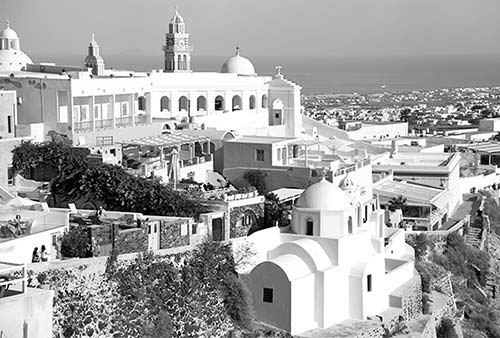
Venetian influence persists here to this day. While only a small percentage of locals are Catholic, the Catholic Church—in many ways the descendant of those original Venetian overlords—still owns lots of property. In general, beige and blocky Upper Fira—above this path—is Catholic, while the blue-and-white warren of cave houses in Lower Fira is Orthodox (including the huge, squat, blinding-white dome of the Greek Orthodox Cathedral, which you can see across the caldera).
Savor this view once more, then head up the lane next to Da Costa restaurant, hiking up the steps past the Art of the Loom gallery. The stairs dead-end at the (usually closed) doorway of the Church of the Immaculate Conception—one of many Catholic churches built in this area in the late 18th and early 19th centuries.
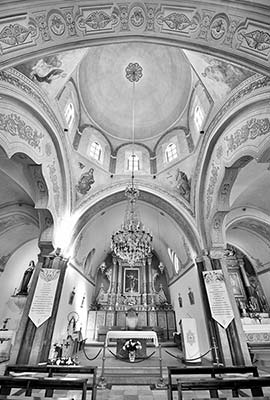
Turn right and follow the cobbled path to the well-marked Catholic Cathedral—a.k.a. the Cathedral of St. John the Baptist. This was built in 1823, heavily damaged (like much of Santorini) by the 1956 earthquake, and reopened in 1975. Step through the gate into the courtyard, and continue inside the church itself (open long hours daily). While firmly Catholic, architecturally this feels like an eclectic hybrid of Catholic and Orthodox—with muted colors, a big chandelier, and Moorish-style arches flanking the main altar. Remember the details, which you can compare to the interior of the Orthodox Cathedral later on this walk.
Back outside, retrace your steps to the cobbled lane, where you’ll turn right and head downhill, toward town. A few steps down, the wide cobbled street on your left leads to yet another Catholic institution—the Dominican Monastery—and good views back on the cathedral’s dome and steeple. A complex of Catholic buildings sprawl from here uphill, all the way to the next town, Firostefani.
A few more steps down, displayed next to the door on the left (marked Art and Iron Studio), is a gnarled vine, twisted into a circular basket shape. This is how Santorini vintners cultivate their wine, to maximize retention of moisture. This door opens into a sweet little courtyard garden.
Finally, just below that—at the base of the stepped lane—is the entrance to the Megaro Gyzi Museum, which fills the mansion of a local parishioner who willed this property to the Church (described later, under “Sights in Fira”).
• Just below the museum, turn right onto Fira’s...
“Main Lane” (Erythrou Stavrou Street)
Locals ignore street names, but they think of this drag as the “Main Lane” of their little burg. (“Main Street,” which carries car traffic, is lower down—we’ll end our walk there.) One of the town’s top shopping gauntlets, this lane is lined with all manner of tacky souvenir stands, posters and postcards, linens, natural sponges, seashells, and a surprising abundance of “fish pedicure” places.
Walk down the Main Lane. After about a block, on the square on the right (toward the cable car station where we began), is the entrance to the Archaeological Museum of Thira. For years, it offered only dusty cases crammed with sparsely described jugs, statues, and other artifacts from ancient Thira—but after a major renovation, the museum should be refreshed and reopen by the time you visit. Either way, unless you have time to kill I recommend skipping it and saving your energy for the excellent Museum of Prehistoric Thira, which has far older and more interesting Minoan pieces from Akrotiri and is right at the end of this walk.
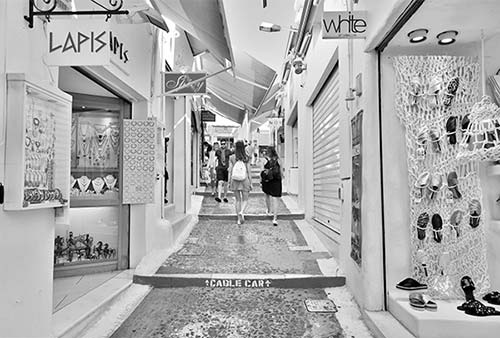
Continuing past the museum on Main Lane, keep straight at the fork. You’ll pass Sophia’s jewelry shop, one of many in Santorini that display the local jewelry: Finely detailed and inspired by Byzantine pieces, they feature intricate beading and filigree. Greek Orthodox priests wear simple golden cuffs for important worship services, but bishops’ cuffs are more elaborately detailed—offering inspiration for some of these frilly designs. Do a little window shopping and appreciate the fine craftsmanship.
Just past Sophia’s is one of two entrances to the Diporto (“two doors”) shop, which sells local products and offers tastings of Santorini’s wines in the hope you’ll buy a bottle (for more on local wines, see the “Santorini Wines” sidebar).
Carry along the narrow Main Lane. After a long block, on your left is the entrance to The White Door Theater, which puts on a fun “village Greek wedding” folk show each night (described later, under “Nightlife in Fira”). On the next block, Nikolas (on the left) is a classic taverna and one of my recommended restaurants.
• Soon the Main Lane dead-ends at the stairs to a taverna. Turn right here and walk up the blue-painted steps. This street hits a T-intersection with the street called...
“Gold Street”
Before we head left down Santorini’s most touristy strip, take a few steps to the right. Signs point downhill to the Old Port. Notice that each of the steps from here on down is painted with a number—it’s exactly 588 steps to the water. If you have strong knees, returning to your cruise-ship tender down these stairs could be more appealing than joining the looooong line for the cable car that snakes through the streets of Fira shortly before call time. For now, you could head down to step #568 for some nice views over town.
From the top of the stairs, with the caldera to your back, turn right, take a deep breath, and plunge down tourist-crammed Gold Street. There was a time when the majority of vendors along here actually did specialize in golden jewelry. But many of the storefronts have been taken over by tacky souvenirs, ice cream parlors, resort wear, and other, less genteel goods.
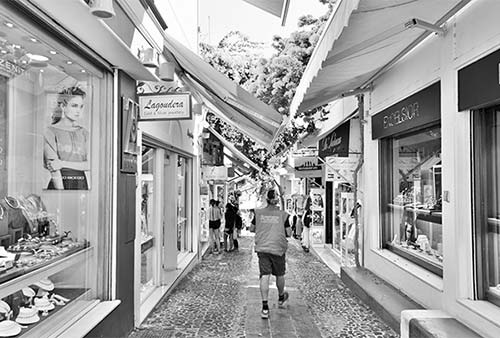
Just after Classico, on the right, peer down into the ruins of a traditional Santorini cave house that collapsed after the 1956 earthquake. Rainwater was collected in the terrace out front, and the cave part of the home is under your feet. For more on this traditional style of architecture, see “Santorini’s Cave Houses,” later.
• Make short work of this strip, until you pop out at the wide-open and gorgeous viewpoint I like to call...
“Orthodox Cathedral Terrace”
This is where Fira opens up and really lets you breathe in some grand vistas. Lining the white wall, a half-dozen floating doorways lead down steep staircases to hotels and restaurants with big views. (For a better-value meal, without the views, Ouzeri restaurant is just before the cathedral, set back from the square on the left.)
Step up to the white wall and look down over the labyrinth of cave houses that are draped over the cliffs here. The lanes connecting these houses are far less crowded than the ones we’ve braved so far and come with smashing views—they’re a delight to explore. Many of these are hotels, but some turn their breakfast terraces into cafés; exploring this area to find your favorite perch for a cup of coffee is a fun activity (I particularly like the Cori Rigas Art Café, along the lower cliffside lane—follow the stairs down at Palia Kameni Bar). The whole area is anchored, at the top of the hill, by the big, boxy Hotel Atlantis, which feels like it’s keeping the steep warren of lanes from simply sliding down into the caldera. The steep lanes around the far side of the Atlantis are even quieter—it’s surprisingly easy to escape most of the tourist crush.
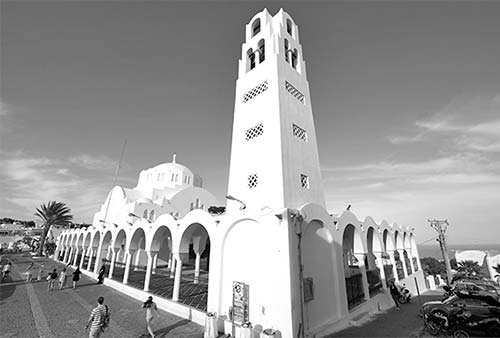
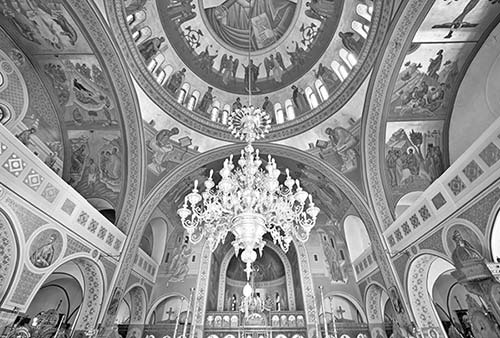
The main feature of this terrace is the looming Orthodox Cathedral of Candelmas (Panagia Ypapantis). This modern cathedral, which caps Fira like a white crown, has a grandly painted interior that offers a beautiful taste of the Greek Orthodox faith (free entry, open long hours daily except may close at midday). Stepping inside, appreciate the typical Greek-cross floor plan (with four equal-length arms). Flanking the entry aisle are framed icons, which some visitors reverently kiss as they enter. Farther in is the grand, golden chandelier, with a giant ostrich egg dangling from its base. Representing the body of the Church, the egg is a common symbol in Orthodox churches. The writing on the chandelier is not Greek but Cyrillic—this was a gift from the Russian patriarch (the head of the Russian Orthodox Church) to commemorate Russia’s links to Santorini through the trade of a local wine used for Communion. Directly below the chandelier is a double-headed Byzantine eagle. Beyond that is the wooden iconostasis, with shimmering icons of saints. Looking up, notice the balcony overhead. Traditionally, women would worship there, while men stood on the main floor. But today, everyone fills the main hall, women on the left, men on the right. You can step through the side door into the tranquil, fenced courtyard that surrounds the cathedral, with the grave of a local bishop.
• You could finish your walk here if you’re in a rush or want to explore the meandering terraces below. Or stick with me to get a glimpse of workaday Fira and the town’s top museum.
Back outside, walk to the far end of the cathedral, and hook left between it and Hotel Atlantis. Heading downhill, you’ll run into the back of the wavy-roofed Museum of Prehistoric Thira—the town’s top sight. But to get inside, you’ll have to circle around to the gate on its lower side: First jog right, then hook left, to walk along...
Fira’s Main Street (25 Martou)
While it’s not much to look at, this drag is the main artery of Fira—where the fantasyland at the cusp of the caldera meets the real world of humble island Greece.
Walk along Main Street, watching on your left for the gate to enter the excellent Museum of Prehistoric Thira, with a wonderful collection of artifacts (ceramics, frescoes, and a tiny golden ibex) from the Minoan-era settlement at Akrotiri. If you visit one museum on Santorini, make it this one (described later).
Now let’s get practical: Across the street from the museum gate is the town’s main taxi stand, where cabs fan out to the distant corners of the island. Nearby is a public WC. And around the corner is the bus station.
With the museum to your back, turn left and continue one more block—passing some cheap eats (including recommended Lucky’s Souvlaki)—to where the traffic-free zone begins. This is Fira’s “Main Square,” crammed with tourist services that cater not to high-roller Gold Street shoppers but to mere mortals and budget backpackers. You’ll find lots of cheap-and-cheery eateries, ice cream stands, takeaway coffee, greasy souvlaki, and more. This is a good place to regroup, refresh, and stock up before continuing your explorations of Santorini.
• Our orientation walk is finished. To reach other parts of the island, backtrack one block to the taxi stand and bus station. Or, rent a car or scooter at one of the rental places lining Main Street just past Main Square. To head toward the Old Port for a cruise tender, turn left up the street at the end of Main Square to return to the start of Gold Street with those 588 steps (the cable car is about a 10-minute walk to the right, along Main Lane).
Sights in Fira
OLD TOWN
▲Megaro Gyzi Museum
Hiding in the alleys behind the Catholic cathedral, this modest local history museum celebrates Santorini life. It fills the 18th-century home of a prominent local resident, who willed it to the Catholic Church.
Cost and Hours: €3, Mon-Sat 10:00-16:00—may close later in peak season, closed Sun and Nov-April, +30 2286 023 077, www.gyzimegaron.gr.
Visiting the Museum: On the right as you enter, look for the map illustrating how the island has grown and shrunk with volcanic eruptions across the eons. Also in this main hall are evocative etchings of traditional Santorini lifestyles, and copies of old documents—some in Greek, others in Italian, still others in Arabic, emphasizing Santorini’s status as a crossroads of civilizations (use the nearby laminated English handout to learn more).
In the room to the left, find the 1870 clipping from a London newspaper article about “Santorin” and, next to it, an engraving of a smoldering islet in the caldera. Nearby are photographs of the town from the early to mid–20th century (including scenes before and after the devastating 1956 earthquake), and samples of the various types of volcanic rock found on the island (some embedded with flash-fossilized palms and pistachio leaves).
Upstairs, you’ll find a humble painting gallery with still lifes and landscapes donated by local families.
▲▲Museum of Prehistoric Thira
While no competition for Greece’s top archaeological exhibits, this little museum is Santorini’s best, presenting items found in the prehistoric city buried under ash near Akrotiri. A visit is particularly worthwhile if you plan to see the excavated ruins of that city at the southern end of the island (described under “More Sights on Santorini,” later). That settlement was the largest city outside Crete in the Minoan-era world, dating back to the earliest documented civilization in the Aegean (third to second millennium BC)—ancient even to the ancients. The people who lived here fled before Santorini blew its top (likely around 1630 BC—see the sidebar, earlier), leaving behind intriguing artifacts of a civilization that disappeared from the earth not long after. Most of those artifacts have been moved off-site, either to this museum or to the biggies in Athens.
Everything in this manageable museum is described in English and well-presented in modern, air-conditioned comfort.
Cost and Hours: €6, covered by €15 combo-ticket; Wed-Mon 8:30-15:30, closed Tue; entrance across from taxi stand on the main drag, +30 2286 025 405, http://odysseus.culture.gr.
Visiting the Museum: Enter the gate below the museum, head up the stairs to buy your ticket in the freestanding white building, then hook left to the entrance. Inside, everything is displayed in one big room, which you’ll visit counterclockwise.
Section C: Turning right from the entrance, look for the Early Cycladic figures and vessels, dating from 2700 to 2300 BC. The stiff figurines, with their arms crossed, perplex archaeologists, who speculate that they might represent the Mother Goddess worshipped here.
Section D: Next, the model of the Akrotiri site puts the items in context. Most of the museum’s pieces date from the Late Cycladic Period (mid-17th century BC), when Akrotiri peaked just before its residents fled the erupting volcano. Although they took valuable items (such as jewelry) with them, they left behind easily replaceable everyday objects and, of course, immovable items such as wall frescoes. These left-behind items form the core of the collection.
Section D1: This section displays an intriguing assortment: Primitive cooking pots, clay ovens, and barbeque grills, along with bronze vases, daggers, tongs, and fishing hooks, offer clues to the Aegean lifestyle. The Thirans were traders rather than warriors, so many items reflect their relatively comfortable lifestyle, connection with the wider world, and consumer society. One plaster cast shows the shape left by a (now-deteriorated) three-legged wooden table that could have passed for Baroque from the 17th century AD—but it’s from the 17th century BC.
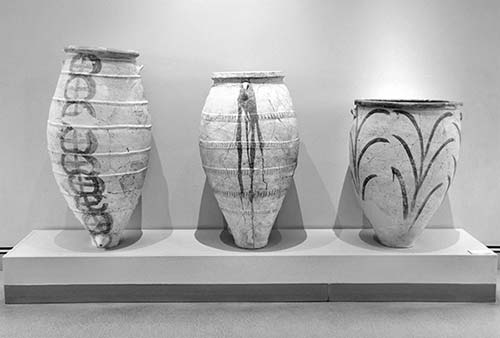
Section D2: Each of the three large containers in this section is marked differently to suggest its contents—for example, a vessel that held water was decorated with reeds (aquatic plants). In the nearby case, the stack of metal weights illustrates the evolution of standardization during early trading.
Wall Frescoes: The museum’s highlights are several vibrantly colorful, two-dimensional wall frescoes. Local artists likely executed these wall paintings, but their naturalistic style was surely influenced by the wider Minoan culture. In keeping with the style of Crete (the home of the Minoans), men appear brown, and the women, white. (If you’ve been to the National Archaeological Museum in Athens, you might recognize this style of fresco from that museum’s collection, which includes wall paintings of antelopes, swallows, and young men boxing, all from this same Akrotiri site.)
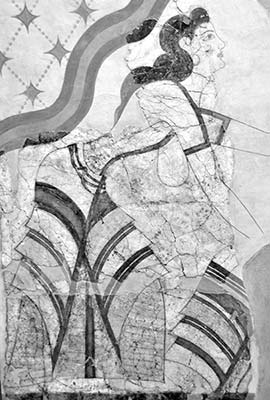
The wall frescoes from the House of the Ladies (section D3.5) show finely dressed women. In one, an older woman leans over and appears to be touching the arm of another (now-missing) woman and holding a dress in her right hand.
Near the House of the Ladies frescoes, notice the vessels (such as beautiful vases decorated with dolphins and lilies), which give us a glimpse of everyday life back then. Look for the ritual vessel shaped like a boar’s head. In section D7.2, you’ll see a fragment of another wall fresco showing blue monkeys. Because monkeys are not indigenous to Greece, these images offer more evidence that the Cycladic and Minoan people traveled far and wide and interacted with foreign cultures.
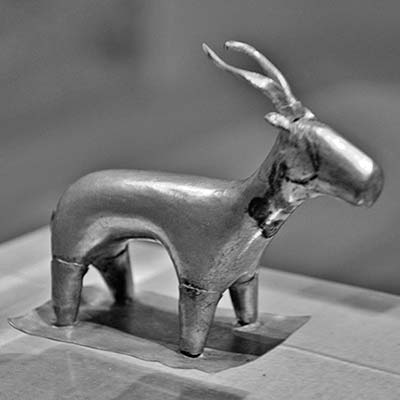
In a display case near the monkeys is an exquisite miniature golden ibex—one of the few items of great value that were left behind by fleeing islanders. Notice the delicate artistry on the skinny, twisted horns. Head downstairs for additional, impressive wall paintings; check out the youths holding fish (quite a catch).
OUTSIDE OF TOWN
▲▲▲Hike to Oia
With a few hours to spare, you can venture out on one of Greece’s most scenic hikes. While the main road connecting Fira to Oia is drab and dusty, a wonderful cliff-top trail links the two towns, offering fantastic views most of the way. It’s about 5 miles (plan on at least 4 hours one-way), quite strenuous (with lots of ups and downs), and offers little or no shade in hot weather—so don’t attempt it unless you’re in good shape and have the right gear (good shoes, water, food, sun protection). Get an early start. You can catch a bus or taxi back to Fira when you’re done.
From Fira, head north through the adjoining villages of Firostefani (where you can see the church, described next) and cliff-capping Imerovigli, then continue along the lip of the caldera. You’ll briefly walk along the shoulder of a busy, narrow road, along the skinny spine of the island, with Aegean views on both sides. Then you’ll hike steeply up, up, up and over the bluff, then down into Oia. (Donkeys are standing by for the steepest part of the climb, for those who’d rather catch a lift.)
▲▲Agios Theodori Church in Firostefani
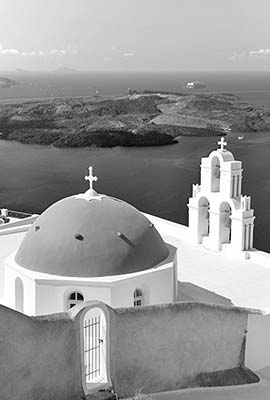
This Catholic church—a steep 20-minute uphill hike from the center of Fira, on the trail to Oia, in the village of Firostefani—is quintessential Santorini: With a vivid blue dome, bright-yellow bell tower, and breathtaking caldera backdrop, it’s perennially ready for its close-up. This is the only classic Santorini dome where you can snap a photo of the church with only water behind it—no other buildings or townscapes—making it a magnet for photographers. Inside is a precious icon of the Virgin Mary, brought here from Russia in 1570.
Nightlife in Fira
Folk Theater
The White Door Theater puts on a faux Greek wedding in an open-air courtyard, with traditional music and dance and, of course, plate breaking. The audience, acting as guests at the wedding, is invited to participate. While this sounds tacky, it goes beyond clichés with a thoughtfully researched, well-presented program rooted in a deep respect for authentic Greek village customs. The organizers explain that, while every other major event in Greek village life (holidays, funerals) was religious and more introspective, a traditional wedding was the one time people could cut loose and fully enjoy themselves (€65 includes tapas dinner and wine, runs May-Oct nightly at 21:00 or 21:30, 2 hours, +30 2286 021 770, www.whitedoorsantorini.com).
Outdoor Cinema
In summer, Volkan on the Rocks Open Air Cinema often shows crowd-pleasing classics (Mamma Mia!, My Big Fat Greek Wedding, and so on) on a small outdoor screen perched over the caldera (€20, includes a snack, June-Oct most nights at 21:00 but subject to change—call ahead or check online before making the trip, +30 2286 028 360, www.volkanontherocks.com).
Nightclubs
Fira is busy after hours. A popular venue is Kira Thira Jazz Bar, with good music and an artsy vibe (nightly from 20:00). For a hard-partying nightclub—open late and packed with young people—try Enigma or Koo Club (open nightly from 21:00). Both are buried deep in the town center.
Sleeping in Fira
Fira is the handier home base, but some prefer romantic Oia. All the accommodations I list have air-conditioning. Note that rates on this popular island skyrocket from July through September. While sticker shock is epidemic here, keep in mind that the spectacular views are one of the main reasons you came. Therefore, splurging on a caldera view is, in a sense, a good value at just about any price.
PLACES WITH CALDERA VIEWS
These accommodations all feature fantastic views and have peaceful terraces where you can watch the sunset. Most of these places spill down the cliffs from town and involve lots of stairs and steep climbs. For less climbing, try Kamares Apartments (a couple of minutes south of the Old Town, with parking right out front and a few stairs once you enter) or Villa Renos (some stairs, but fewer than most). Note that taxis can only take you to the top of the hill; you’ll have to walk from there.
$$$$ Villa Renos, just below the Orthodox Cathedral, has nine well-appointed rooms. It’s traditional (rather than trendy) and well-kept, with an inviting terrace cocktail bar and several small swimming/soaking pools. It’s well-run by Vassilis Matekas, who used to live in Rhode Island (great homemade breakfast that changes daily, follow the stairs down at Palia Kameni Bar, +30 2286 022 369, www.villarenos.com, hrenos@otenet.gr).
$$$$ Kamares Apartments surround a dreamy oasis of white-on-white stucco, with eight canava-style rooms, most with their own hot tub, in a traditional cave home that’s been in the family for generations. The service is warm and attentive, and the location—at the very south end of town—is sheltered from some of central Fira’s nightlife noise. There’s handy parking right in front—a rarity for places with a view (family rooms available, +30 2268 028 110, www.kamares-apartments.gr, info@kamares-apartments.gr).
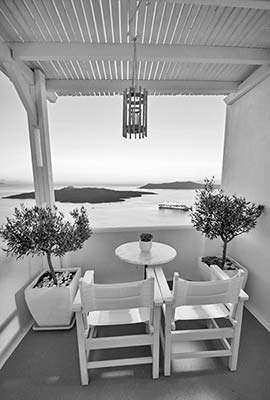
$$$$ Keti Hotel is another appealing place with ten cave rooms and stupendous views. Rather than luxury, it offers stark-white, clean comfort, and the doubles are good value for this location. There’s a small pool and a warm welcome from friendly Yiannis; the hotel is named after his mother (facing the caldera below the Orthodox Cathedral, +30 2286 022 324, www.hotelketi.gr, info@hotelketi.gr).
$$$$ Scirocco Apartments, run by a Greek-German couple (Eleftherios and Anja Sirigos and their daughters), rents eight straightforward, old-fashioned, but reasonably priced rooms for the location, some of them “cave houses” burrowed right into the cliffside. All rooms enjoy either a private or shared terrace and the swimming pool on the lowest level (breakfast extra, closed Nov-March, located facing the caldera below the Orthodox Cathedral, +30 2286 022 855 or +30 2286 024 811, www.scirocco-santorini.com, info@scirocco-santorini.com). For drivers, they also rent seven rooms in the countryside on the far side of the island.
CHEAPER OPTIONS WITHOUT CALDERA VIEWS
If you’re willing to give something up—view, luxury, and/or in-town convenience—you’ll pay lower rates. But lower your expectations: On Santorini, €150 buys a lot less comfort than it does in Athens.
Close to Town: $$ Galatia Villas is calm and out of the way of Fira’s stifling crowds, with 18 tasteful rooms—including some studios—plus a small swimming pool. Technically in Kontorhori, the next village over, it’s about a 10-minute walk to Fira’s action along a busy road (+30 2286 024 524, www.galatiavillas.gr, info@galatiavillas.gr).
In Town: $$$ Villa Roussa offers 12 simple but comfortable, more affordable rooms tucked in a dreary modern building overlooking a parking lot, behind the taxi stand and bus station. Some rooms have balconies, but not caldera views—which are a short walk away, over the ridge (no breakfast, +30 2286 023 220, www.villaroussa.gr, villaroussa@gmail.com, Peter Pelekanos).
Eating in Fira
You’ll pay dearly to dine with a caldera view. I’ve focused my listings on simpler tavernas with great food at better prices but less-thrilling vistas. Takeout fast-food options (grabbing a souvlaki to eat on a stool or to go) help keep costs down. Drivers note: One of my favorite places to eat on the island is Metaxi Mas, about a 15-minute drive into the countryside; for details, see here.
WITH A CALDERA VIEW
Santorini specializes in pricey restaurants with terraces facing the caldera—especially popular around sunset (reserve ahead). You’ll basically pay double, and likely compromise on quality, to eat with a caldera view—but for a memorable meal, it could still be worth it. Many Fira caldera-view restaurants are interchangeable, but the ones noted below distinguish themselves in one way or another.
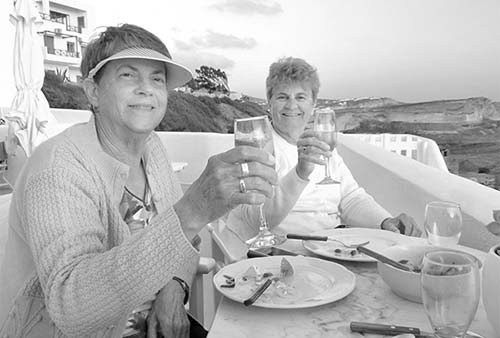
Below the Orthodox Cathedral: $$$$ Naoussa is a family-friendly place that churns out big plates of sloppy Greek cooking, served on its cozy and unpretentious terrace. While pricey, it’s near the bottom end of this price range and more affordable than other caldera-view eateries (daily 12:00-24:00, tucked below the big and boxy Atlantis Hotel, +30 2286 024 869).
Near the Cable Car: $$$$ Argo, also along the cliffs, serves traditional Greek food, and specializes in fish—at predictably high prices. While quite expensive, it has friendly local service and somewhat better food than its competitors. Reserve ahead for the upper deck, with the best caldera views (daily 12:00-24:00, along the donkey path just below Gold Street, +30 2286 022 594, www.argo-restaurant-santorini.com).
Microbrews at the Top of Town, above the Catholic Cathedral: Some of the most sweeping views over Santorini can be found from the high-altitude trail toward Oia, about a five-minute hike up past the Catholic Cathedral. At the crest of the trail, just under the orange cultural center, $$$ Volkan on the Rocks Café is an inviting, low-key spot. They produce their own craft beer (“filtered with volcanic rocks”), as well as pricey tropical cocktails and basic meze. The lower terrace, dubbed Volkan Gardens, serves drinks only from 18:00 and is a great place to reserve for the sunset (daily 9:00-24:00, +30 2286 028 360, www.volkanontherocks.com).
Cocktails with a View: Palia Kameni Cocktail Bar (Παλιά Καμένη), with an elaborately decorated “floating doorway” just in front of the Orthodox Cathedral, has cascading terraces with magnificent caldera views, a sophisticated vibe, and a tempting menu of good—if extremely expensive—cocktails (no food, Mon-Sat 10:00-late, Sun from 17:00, reserve a few weeks ahead for sunset table, +30 2286 022 430, www.paliakameni.com).
IN THE OLD TOWN
The Old Town streets teem with better-value eateries...still expensive by Greek standards, but far more affordable than caldera-view spots.
$$$ Ouzeri (Το Ουζερι) is a big, popular, finely oiled machine of a restaurant churning out good traditional food with efficient service at the top of a shopping mall smack in the center. Their outside tables come with distant sea views—albeit ones looking east, rather than into the caldera. That means it doesn’t work well at sunset (unless you’re trying to avoid the crowds), but it’s great for lunch or after dark. Try some of their local specialties, such as meatballs in an ouzo sauce and the tomatokeftedes starter—fried tomatoes with onions and herbs. They also have several vegetarian options (daily 12:00-23:00, head up the stairs next to Orthodox Cathedral, +30 2286 021 566, www.toouzerisantorini.com).
$$$ Nikolas oozes a family-run taverna vibe, with one big room crammed with tables overseen by a shrine-like photo of the namesake patriarch. Today his granddaughter Eleni runs the place, and while it’s not quite what it used to be, they keep things traditional: stick-to-your-ribs Greek classics, specializing in casseroles and other oven-baked meals. There’s no outdoor seating, but this is a good choice in bad weather or after sunset. It can get crowded—book ahead or be prepared to wait (daily 15:00-23:00, +30 2286 036 422).
$$ Parea Tavern is right in the thick of the tacky tourist tangle but wins plaudits for reliable quality. Its roof terrace (no sunset views) fills up quickly, so get there early or book ahead (daily 13:00-22:00, +30 2286 025 444, www.parearestaurant.gr).
$$ Taverna Triana, a bit out of the bustle, is unassuming; it looks like a dozen other, similar restaurants. What distinguishes it are its better-than-average takes on the Greek standards at fair prices. Hosts Spyros and Chai work hard to keep customers satisfied (daily 11:00-23:00, reservations smart, +30 2286 024 005, www.trianasantorini.com).
Souvlaki: The local favorites for $ souvlaki are the hole-in-the-wall Lucky’s, the glitzy Obelix for its sizable menu (summer only), and Nick the Grill for its handy people-watching location right on the main square.
Ice Cream: There’s lots of overpriced, garishly colored goop in Fira, but Solo Gelato does real-deal artisanal stuff (near recommended Nick the Grill, daily 8:00-24:00, +30 2286 036 335).
Fira Connections
From Fira by Bus to: Oia (2-3/hour, 30-40 minutes), Athinios/New Port (nearly hourly—coordinated to meet boats, 20-45 minutes; for boat connections from Athinios, see “Santorini Connections” at the end of this chapter), airport (roughly hourly—coordinated to meet most flights, 15 minutes), Kamari and its nearby beaches (2-3/hour, 10 minutes), Akrotiri with its archaeological site and nearby red-sand beach (1-2/hour, 30 minutes), and Perissa with its black-sand beaches and access to the Ancient Thira archaeological site (2-3/hour, 30 minutes). A ride to virtually anywhere on the island costs about €2-3. Check schedules at the kiosk at the downhill edge of the lot and buy tickets from the driver. Bus information: +30 2286 025 404, www.ktel-santorini.gr.
Oia
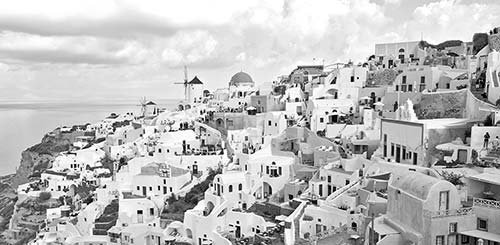
Oia (pronounced EE-ah, not OY-ah; sometimes spelled “Ia” in English) is the classic, too-pretty-to-be-true place you imagine when someone says “Greek islands.” This idyllic ensemble of whitewashed houses and blue domes is delicately draped over a steep slope at the top of a cliff. And in their wisdom, the locals have positioned their town just right for enjoying a sunset over the caldera. On a blue-sky day, there’s no better place in Greece to go on a photo safari. Shoot the classic, blue-domed postcard views, but also wander around to find your own angle on the town. If you can’t snap a postcard-quality photo here, it’s time to retire your camera.
Oia wasn’t always this alluring. In fact, half a century ago it was in ruins—devastated by an earthquake on July 9, 1956. When rebuilding, natives seized the opportunity to make their town even more picture-perfect than before—and it paid off. Though far from undiscovered, Oia is the kind of place that you don’t mind sharing with boatloads of tourists. And if you break away from its main streets, you can find narrow, winding lanes that take you far from the crowds. This becomes more difficult at sunset, when what feels like every tourist on Santorini jams its tight streets (for strategies, see “Santorini Sunsets” sidebar, earlier). On the other hand, Oia is a delight in the early morning (before around 11:00)—before cruise excursions make their way to the town.
GETTING THERE
From Fira (the island’s transport hub), it’s about 7.5 miles north to Oia. You can take the bus (see “Fira Connections,” earlier) or a taxi (€30 one-way), hike (several hours, see “Hike to Oia,” earlier), or drive (see next).
Route Tips for Drivers: In normal traffic, it’s about a 25-minute drive from Fira to Oia. The most scenic—and congested—route heads straight north out of Fira on the old road, passing the villages of Firostefani (consider pulling over and walking a few minutes for the classic Firostefani church view—see here) and Imerovigli, then driving along the spine of the island to Oia. The new road, lower down and closer to the island’s east coast, is the speedier way to connect the towns (avoiding traffic on the narrow road up top). Consider taking the new road into Oia and the old (more scenic) road out (you’ll be routed that direction departing Oia anyway).
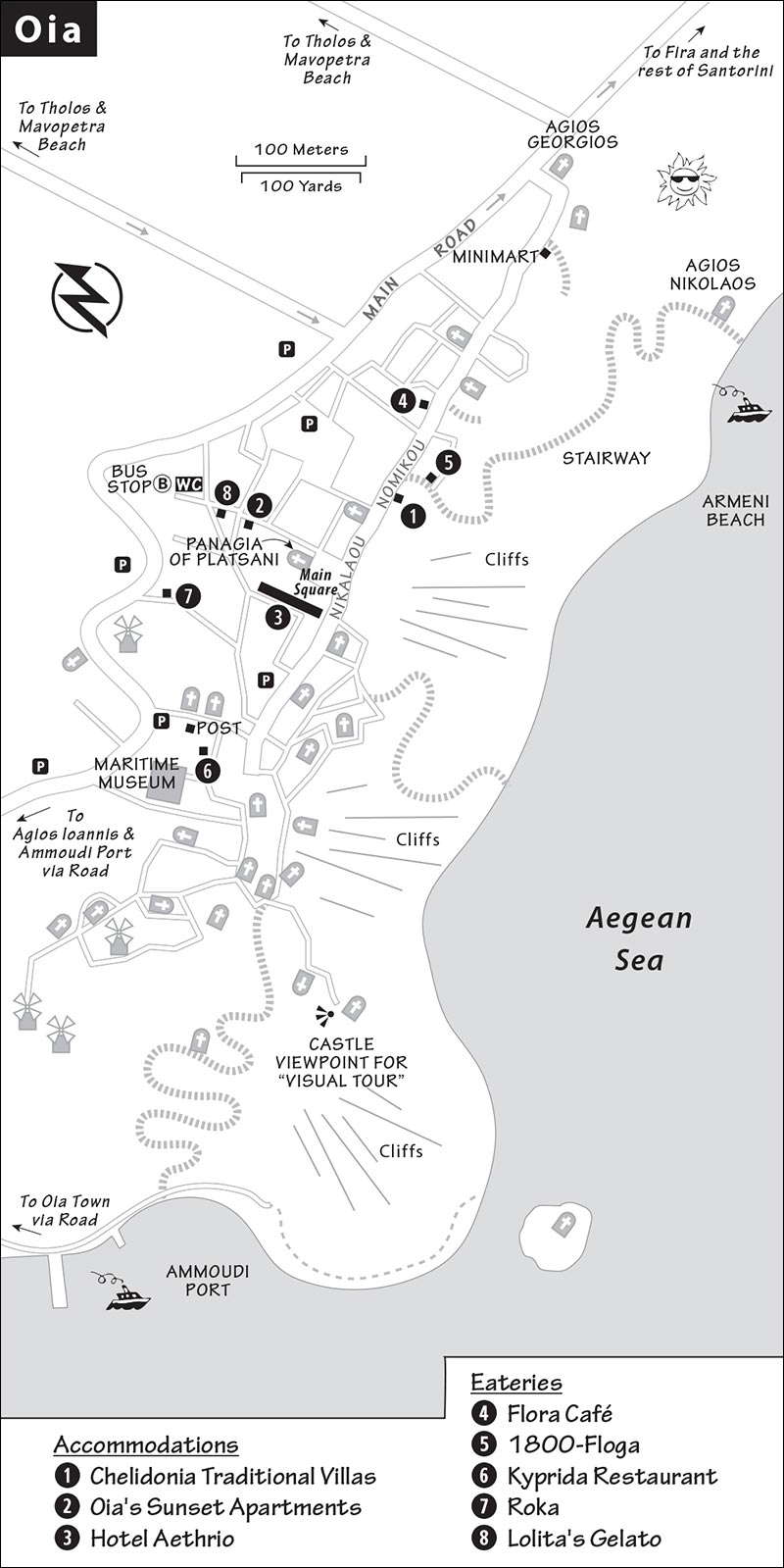
If you’re coming on the upper (old) road, as you approach Oia, you’ll be routed down a long, one-way detour along the back side of the island, and then back up again, popping out just below the main part of town. A few parking lots are in this area, but they’re often full. First, try turning right toward the port of Ammoudi; while you’re still in Oia (before descending to the port), keep an eye out for parking lots that allow quick access to the scenic tip of town. If you find nothing available, go back the way you came, and continue along the one-way main road (past where you entered town) toward Fira, keeping a close eye out for additional parking lots. But don’t go too far, or you’ll have to loop all the way around again. (If you’re here for sunset and want to enable a quick escape, it can make sense to park at the Fira end of town regardless—increasing walking but reducing traffic jams to leave town.) Some scattered spaces may be free, but most lots charge a small fee—carefully check for signs before leaving your car.
Orientation to Oia
Oia lines up along its cliff. The main pedestrian drag, which traces the rim of the cliff, is called Nikolaou Nomikou. Oia’s steep seaward side is smothered with accommodations and restaurants, while the flat landward side is more functional. The town is effectively traffic-free except for the main road, which runs along the back of town, passing the town bus stop and parking lots. From here, it’s a few short, nondescript blocks toward the cliff and its million-dollar views.
Sights in Oia
▲▲▲Visual Tour of Oia
You can see most of Oia with a sweep of the head from a prime vantage point: its ruined castle, at the very tip of town. Make your way there and follow this visual tour for an orientation to this picturesque little burg.
• With your back to the water, face the homes and domes of Oia, and think of its history.
Oia’s Skyline: While today it’s a posh resort, in its heyday Oia was the island’s most prosperous town, located at the point where arriving ships first reached Santorini. Scan the distinctive townscape: The large, boxy buildings at the top of town were the homes of the wealthy sea captains (one of which is now a museum—see later). And the humble, whitewashed cave houses on the slopes below housed their crew, stevedores, and other laborers. These people couldn’t afford to build a big, fancy house...so they dug one (see the sidebar). While the cave houses were once the poorest dwellings in town, today only millionaires can afford to own them (and virtually all of them are rented out as very pricey accommodations). The few residents who live in Oia can’t afford to have a view. Most “locals” live in humble villages a 10- to 20-minute drive from the caldera.
On Santorini, you’ll see a unique type of building...and maybe even sleep in one: the cave house (yposkafa). In addition to serving as residences or hotels, these structures house churches, canavas (wine-pressing rooms), and other establishments.
Cave houses were originally dug into the soft volcanic rock by poor workers who couldn’t afford to build a freestanding house. High on the cliffs, they also provided security against invaders. The top of the cave is a rounded arch, rather than flat, to provide more durability in case of earthquakes. People would live and cook near the cave’s front, and sleep in the back. Often the house includes a small aboveground structure; after the Venetians began to fortify the island in the 13th century—providing more safety to islanders—these became more common.
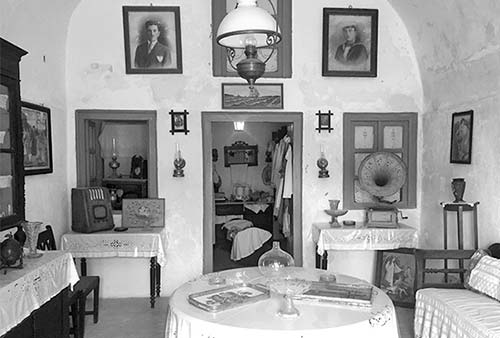
Between the inner and outer walls is a layer of pumice insulation—lighter than other types of stone, and very effective for keeping the interiors warm in winter and cool in summer. These days, new construction looks similar but uses a synthetic Styrofoam instead of pumice. A thinner layer of Styrofoam is needed, allowing them to carve out larger interiors without violating building codes by raising the roof.
For the trim (thresholds and windowsills), look for a porous, reddish, volcanic rock; while this is often plastered over and painted, it looks sharp in its natural state.
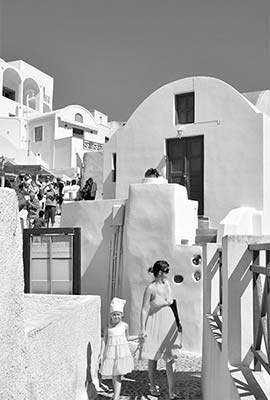
And why all the whitewash? For one thing, white reflects (rather than absorbs) the powerful heat of the sun. White is the color of the mineral lime mixed with water, which makes a good antiseptic (islanders used it to paint their houses, so it would naturally disinfect the rainwater that was collected on rooftops). Later, white evolved into an aesthetic choice...and a patriotic one: During the 400-year Ottoman occupation, Greeks were not allowed to fly their blue-and-white flag. But here in Oia—with its white houses, blue domes, blue sea and sky, and white clouds—the whole village was one big defiant banner for Greece. The blue-and-white color scheme also resembles the “evil eye,” believed to fend off bad spirits.
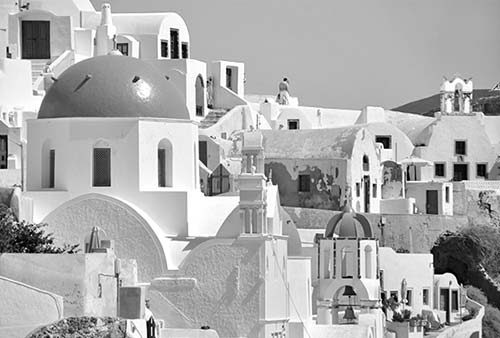
By the way, much of the Oia you see today dates back only about 60 years. Santorini is famous for its 17th-century BC eruption. But a much more recent disaster also did its part to shape the island: In the middle of the night in July 1956, a 7.7-magnitude earthquake struck the nearby island of Amorgos, followed by a tsunami. Two-thirds of the island’s buildings collapsed, forcing locals to rebuild. Oia was particularly hard-hit. Today, some locals reason that perhaps this was a blessing in disguise, as it jolted notoriously conservative Santorini out of its old-fashioned ways, setting the groundwork for the tourist onslaught that was to come.
• You’re standing on the site of...
Oia’s “Castle”: This stubby tower is all that remains of the Castle of Agios Nikolaos—one of the original five fortresses that the occupying Venetians built to defend against pirate invasions. The complex still belongs to the Catholic Church, which has decided to keep it a ruin. And, with its 360-degree views, it’s the prime location for watching the sunset. (If you’d like to do that, you’ll need to stake out a space here well before—an hour or more—and defend it jealously.) So, why is Oia so famous for its sunset? In 1982, Daryl Hannah and Peter Gallagher frolicked here in the romantic comedy Summer Lovers, featuring idyllic Oia (then a ghost town) and its glorious sunset. While virtually nobody remembers the movie, the buzz it created around Oia’s sunset has taken on a life of its own. (For more sunset tips, see the “Santorini Sunsets” sidebar.)
• Nearby, about 250 steps lead steeply down (immediately below town) to the port of...
Ammoudi: Historically, this was one of the island’s main ports. Despite its desolate landscape, Santorini produced valuable exports that helped make it wealthy—most notably the sweet wine Vinsanto, which was used for Communion in Orthodox churches in Russia and southeastern Europe. In exchange, locals imported wood (on this virtually unforested island, timber was a major status symbol), barrels, kerosene, and wheat and rye for the wealthy (the poor ate barley). Goods would be loaded onto donkeys to be hauled to or from the port. Imagine the steady trade—Greek grapes for Russian wood—that kept this remote island tethered to the outside world for centuries, right up until the Bolshevik Revolution of the early 20th century shut down Russian Orthodox churches and shot down Santorini’s main source of export revenue. To compensate, Santorini’s traders shifted to extracting and exporting pumice, a desirable building material. This remained a big export until the 1980s; you can see an (ugly) quarry at the right end of Thirasia, across the caldera; another abandoned one is just south of Fira.
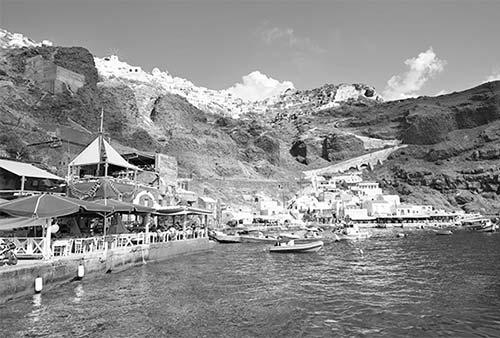
• Now that you’re oriented, enjoy...
The Rest of Oia: There’s not much to see or do here, other than enjoy the commanding views. Near the castle, notice several windmills—taking advantage of the predictably blustery Cycladic winds. As you explore—particularly in the part of town toward Fira—you’ll notice you’re walking on paving stones made of marble, which is not indigenous to a volcanic island. The marble came to Santorini in the form of ballast, weighing down too-light ships returning from Russia after delivering their heavy loads of Vinsanto. If you’re determined to do some sightseeing, dip into the Naval Maritime Museum, described next.
Naval Maritime Museum
Every Greek island seems to have its own maritime museum, and Oia hosts Santorini’s. With two floors of old nautical objects and basic English labels, the collection includes roomfuls of old ship paintings, letters and documents, model ships, and well-endowed mastheads. It’s nothing to jump ship for unless you’re a sailor or need a place to get out of the sun.
Cost and Hours: €5, hours can be unpredictable but generally open Wed-Mon 10:00-14:00 & 17:00-20:00, until 19:00 in shoulder season, closed Tue and Nov-March, well-signposted a block off the main cliff-top drag, +30 2286 071 156.
Sleeping in Oia
WITH A CALDERA VIEW
Several places rent out appealing “cave houses” just down from the main cliff-side road. They range from smaller rooms or studios for two people, to larger units sleeping four or more. Though expensive, a cave-house stay is an unforgettable experience. Of the many options, my recommendation is owned and run by locals.
$$$$ At Chelidonia Traditional Villas, friendly Greek-Austrian couple Triantaphyllos and Erika Pitsikali rent 13 traditional apartments surrounded by burgeoning bougainvillea and burrowed into the cliff face right in the heart of town. Triantaphyllos grew up in one of these houses, bought the others from his grandparents and cousins, and renovated them himself, retaining as much as he could of the original (large) footprint. Promising “panorama and privacy,” this place lets you be a temporary troglodyte (includes breakfast, +30 2286 071 287, www.chelidonia.com, contact@chelidonia.com).
IN TOWN
It’s certainly cheaper to sleep in the town center, a short walk from caldera views—but in this pricey village, you’re still paying dearly for basic lodgings.
$$$$ Oia’s Sunset Apartments, on a busy little lane at the back of town (near the bus stop), is a tight little compound with 15 relatively well-priced apartments sharing a swimming pool. While a bit loosely run, it’s one of the more affordable and reliable options in town (breakfast extra, minimal soundproofing, +30 2286 071 420, www.oiasunset.com, info@oiasunset.com).
$$$$ Hotel Aethrio is a lovely little complex tucked deep in town (no caldera views). It feels like its own little village, with three entrances, 19 rooms scattered through several buildings, a swimming pool, a sunset deck, and even its own little church. While somewhat spartan for this swanky town, it’s well-located and reasonably priced, and the grounds are inviting (+30 2286 071 040, www.aethrio.gr, info@aethrio.gr).
Eating in Oia
Oia must be the most expensive place to dine in all of Greece. Places with no view are plenty pricey—and ones with a view are even more so. Reservations at any place are wise for dinner; there’s a big rush just before the sunset (for caldera-view places) and immediately after the sunset (for non-caldera-view places).
FACING THE CALDERA
The cliffside places are pretty interchangeable, but if you can’t make up your mind, consider one of these (but skip the hard-to-miss Kastro restaurant, with disappointing food at terrible prices).
$$$ Flora Café is a relatively affordable alternative to the budget-busting places along the cliff, with a straightforward menu of pizzas, pastas, salads, and meat dishes. Set along the main drag (at the Fira end of town), it’s essentially a classy snack bar with a pleasantly casual setting and friendly service (daily 9:00-24:00, +30 2286 071 424, Flora).
$$$$ 1800-Floga is a scenic splurge dishing up traditional Greek food with a modern spin. It’s a few steps below the main drag at the Fira end of town, with dramatic caldera views—albeit not of the sunset (daily specials, daily 12:00-24:00, +30 2286 071 152).
BURIED IN TOWN, WITH DISTANT SEA VIEWS
$$$$ Kyprida Restaurant, serving traditional Cypriot cuisine, is reasonably priced by Oia standards. It’s set a couple of blocks back from the cliff edge, but its top terrace still has a fine sunset view (daily 12:00-24:00, live music on Wed nights, closed Nov-March, +30 2286 071 976, www.kyprida.gr).
$$$$ Roka (Ρóκα) is a humble little kafeneio/ouzeri (coffee-and-ouzo taverna serving traditional dishes) but with Oia prices, tucked deep in the heart of town. It has seating on the colorful courtyard, a cozy interior, and a terrace with views over the back of the island (daily 12:30-23:00, +30 2286 071 896, www.roka.gr).
Ice Cream: Facing the bus-stop bustle, Lolita’s Gelato has a loyal following for pricey, top-end ice cream (Mon-Sat 10:30-24:00, sometimes closed Sun, +30 2286 071 279).
More Sights on Santorini
Santorini has many worthwhile sights outside Fira and Oia, doable by bus or taxi but best by car. These include a string of beaches along its eastern side, two major archaeological sites, a lighthouse on a bluff, wineries, and boat trips around the caldera. A day or two on Santorini with a car is a delight.
▲▲BOAT TRIPS IN THE CALDERA
A variety of boat trips are designed to take tourists out into the caldera for stunning views back on the village-topped cliffs. Many of these sail from the Old Port below Fira, some depart from Ammoudi below Oia, and some can pick you up at your hotel.
A popular option takes you out to the active volcanic islets in the middle of the caldera: the crater on Nea Kameni, where you can hike up to the crater (exciting if you’ve never climbed around a lava field before); and Palea Kameni, known mostly for its shallow, muddy, tepid “hot” springs that’s loaded with bobbing tourists. While this sounds intriguing, for most, the highlight is simply the views—not the activities on the islands themselves. Some boat trips also include a two-hour visit to Thirasia, the sleepy island across the caldera from Thira (with not much to see once on land). Sunset is, quite deservedly, a popular time to do these trips; cruises know where to position their passengers to be sure to see the sun swallowed up by the Aegean.
The basic choice is a crowded tour boat, which can cost anywhere from €25 for a 2.5-hour tour to Nea Kameni, to €40 for a five-hour sunset tour. Travel agencies all over Santorini advertise basically interchangeable options. Just drop into one, peruse your options, and book.
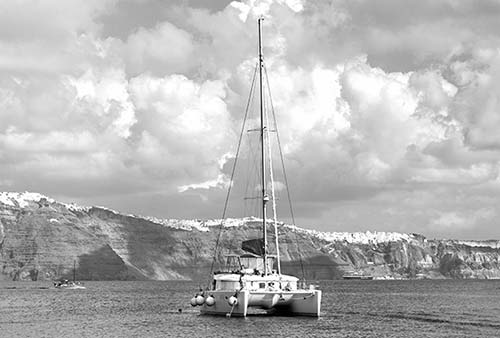
For something more exclusive and expensive, catamaran cruises are a worthwhile splurge (book ahead; these typically include a transfer from your hotel to the boat). You’ll pay much more (€150-200/person for similar itineraries to those described above) but enjoy a far more relaxed and exclusive experience—with unlimited drinks and only a couple dozen people on a small, sail-masted catamaran...plenty of room to spread out and relax. I had a memorable evening out on the sunset cruise with Caldera Yachting, which included pick-up and drop-off at my hotel, an excellent dinner, a top-notch and attentive crew, opportunities to swim from the catamaran, and enough caldera views to fill up my camera, all for €180 per person (www.calderayachting.gr).
BEACHES
Beaches aren’t Santorini’s forte. Because most towns (including Fira and Oia) cap cliffs high above the water, it’s a hassle to reach an inviting spot for a dip—and they’re not quite as idyllic as beaches on other islands (such as Mykonos). Perhaps the most satisfying way to go for a swim is from a boat tour in the caldera; many of these drop anchor and invite passengers to dive in from the boat deck.
If you’re spending time in Oia, the easiest option is to hike or drive steeply down to the pint-sized port of Ammoudi, at the base of the cliffs immediately below the pinnacle of town. This is a busy working port with a few fish restaurants and just enough opportunities to get into the water. Drivers be warned that the road tethering Ammoudi to Oia is tight and extremely congested; parking is limited, so you’ll likely have to squeeze in along the side of the road and hike partway. Another little cove—called Armeni—is just around the corner, facing the caldera below Oia, and accessible only by a very steep hike (or by yacht).
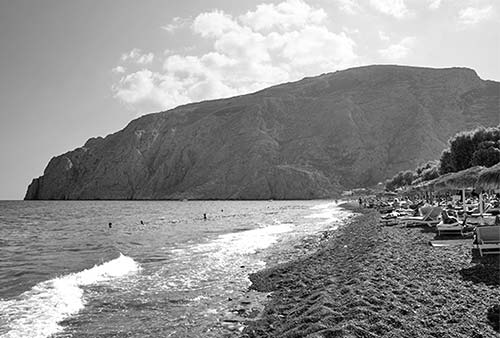
By car or bus, you can reach some beaches with unusual volcanic compositions. Two black-sand beaches flank the steep mountain, capped by Ancient Thira, at the southeastern corner of the island: near Kamari (tidy and more upscale-feeling) and Perissa (more popular with backpackers). While pleasant, these are less exotic than they sound—the black “sand” is quite coarse, and the general vibe is a typical Greek-island beach. While these beaches look close together as the crow flies, they’re separated by a mountain—it’s a half-hour drive, challenging three-hour hike, or 15-minute taxi-boat ride between them.
Along the southern arc of the island, there are some famous volcanically colorful beaches near Akrotiri (facing away from the caldera). White Beach, with a backdrop of chalky cliffs, is accessible exclusively by boat. Red Beach, given its distinctive color by iron deposits, can be reached by a quite demanding hike over loose rocks and around the bluff (from the bay near the Akrotiri archaeological site, described later). Officially this is not a beach designated for swimming, and locals warn not to underestimate the danger of this hike, which is susceptible to rockslides. As this is quite close to the Akrotiri site, it’s an optional add-on for hardy hikers.
▲WINERIES
Santorini, one of Greece’s most high-profile wine producers, has a dozen or so wineries open to the public. If visiting during the harvest (around mid-Aug), you may even find a winery that lets you stomp some grapes. While you’ll pay for tastings, and bottles are quite expensive (typically starting around €25), it’s fascinating to learn about the way wine is cultivated here (see the sidebar). These places are all within about a 10-minute drive of each other, in the island’s interior, roughly on the way from Fira to Kamari, Perissa, or the airport. For a meal in the area, don’t miss the excellent Metaxi Mas, listed at the end of this section. See the Santorini Island map for locations.
Santo is the best-known option, just up the road from the New Port, on the road between Fira and Akrotiri. It’s a cooperative working with all the island’s wineries—the biggest operation like this in the Cyclades. Established in 1947, it produces 500,000 bottles a year, 70 percent of which are consumed in Greece. Despite the cruise-ship tour crowds that descend on this place (it can be mobbed), Santo offers a good opportunity to taste Santorini’s wine while enjoying great views (if coming for sunset, call ahead to reserve a scenic table). Tastings are pricey but serious, giving you a substantial sampling of Santorini’s wines (€40/6 tastes with light food pairings, €42/10 tastes focused on just the wine, daily 9:00-22:00, June-Aug until 23:00, shorter hours off-season and closed on Mon Dec-Feb). They also offer 25-minute tours of their production facility (€10/person, 25 minutes, call in the morning at 9:30 to check English tour schedule; +30 2286 022 596, www.santowines.gr).
Venetsanos, more boutique and rustic, is just a five-minute drive away and enjoys even grander views. The founder, George Venetsanos, was a real pioneer when he built this winery in 1947, using a system of interconnected equipment to turn grapes into wine, then flowing the final product from fermentation tanks through a series of pipes that ran down the hillside and straight into barrels on ships docked at the port. To see some of the original equipment and walk through the winery’s tunnels, request a tour (€12, 40 minutes). Or you can pay €26 for four tastings, served to you either on the terrace with gorgeous caldera views or in the tasting room. It’s best to call a day ahead and tell them you’re coming. You can also reserve a table for drinks at sunset (daily 11:00-22:00, +30 2286 021 100, www.venetsanoswinery.com).
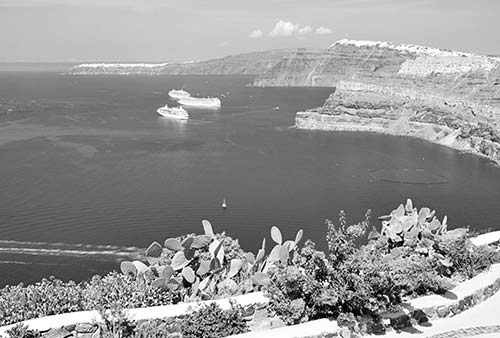
Koutsoyannopoulos is another well-established winery, which also operates a “Cave Wine Museum.” The included audioguide tells the history of the winery (which dates back to 1880); explains how grapes have been grown, transferred, and crushed through the years; and discusses the challenges facing wine producers on this hot, dry island. With its cheesy sets and fake figures, the museum is a bit old-school, though it is interesting to see the equipment that was used back in the day. Allow about an hour for the full experience (€15, includes audioguide and four tastings, daily 9:00-19:00, off-season until 17:00, last entry one hour before closing, +30 2286 031 322, www.santoriniwinemuseum.com).
Argyros, in the valley just outside of Kamari, lacks grand caldera views but makes up for it with its sleek, picturesque estate, tucked amid rolling vineyards. You can sample their wines in the modern tasting room, or call ahead to arrange a tour of the vineyards and production line (€15 tasting includes three whites and one Vinsantos with a small plate of snacks; €40 for 1.5-hour tour and tasting). While classy, Argyros has less pretense and feels a bit younger, fresher, and more personal than the others listed here (Mon-Sat 10:00-20:00, Sun from 11:00, +30 2286 031 489, www.estateargyros.com).
Beer Tasting: If your tastes skew to hops rather than grapes, stop in at Santorini Brewing Company. In their small production facility, they offer tastes of the beers they brew on-site and sell bottles to go. Their beers are also sold all over the island. As this is an easy walk down the road from Argyros, groups with a mix of beer and wine lovers can divide and conquer (Mon-Sat 12:00-17:00, shorter hours Oct-April, closed Sun year-round, in Mesa Gonia about 1.5 miles out of Kamari, +30 2286 030 268, www.santorinibrewingcompany.gr).
Near Oia: For people staying in Oia, Sigalas is a good nearby winery (+30 2286 071 644, www.sigalas-wine.com).
Eating near the Wineries: My favorite countryside eatery on Santorini—well worth a special trip—is $$$ Metaxi Mas (Μεταξύ Μας), in the village of Exo Gonia, less than a 10-minute drive from most recommended wineries. Park in the big lot by the town church, then hike over the ridge into town, and you’ll spot it on your right. They have ample outdoor seating, a relaxed vibe, and top-quality traditional Santorini and Greek cuisine prepared with modern techniques. Foodies love it—reserve ahead. Their outdoor terrace—across the street—comes with big views over the island and sea but lacks shade. If going for lunch, note its unusually late opening time (daily 14:30-23:00, +30 2286 031 323, www.santorini-metaximas.gr).
ANCIENT SITES
If you’re hitting multiple archaeological sites on the island, invest in the great-value €14 combo-ticket, which covers Akrotiri, Ancient Thira, and the Museum of Prehistoric Thira in Fira. Both Akrotiri and Ancient Thira have a history of unexpected closures, so carefully confirm in town that they’re open before you set out.
▲Akrotiri Archaeological Site
Just before Santorini’s massive c. 1630 BC eruption, its inhabitants fled the island, leaving behind a city that was soon buried (and preserved) in ash—much like Pompeii, but 1,700 years earlier. (Consider this: The Minoan-era civilization that lived here was as ancient to the Romans as the Romans are to us; many scholars think this may have been what started the legend of Atlantis.) That city, near the modern-day town of Akrotiri, is still being excavated, with more than 30 buildings now viewable in a well-designed structure that makes it easy to explore the ruins; look for the helpful video that imagines what a high-class home might have looked like. Keep in mind that only 3 percent of the site has been unearthed—this city was huge. Visitors explore the excavation site on elevated ramps. These let you climb around and through the streets of the prehistoric city, where careful observers can pick out sidewalks, underground sewage systems, and some ceramic vases left behind. However, the most interesting items discovered here—wonderful wall frescoes, fancy furniture, painted ceramics—are on display elsewhere, mainly at Fira’s Museum of Prehistoric Thira (see “Sights in Fira,” earlier) and the National Archaeological Museum in Athens.
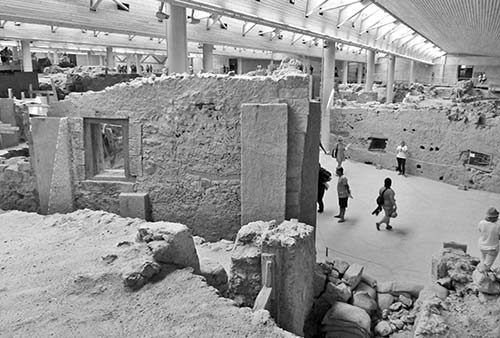
Cost and Hours: €12, €6 off-season, covered by €15 combo-ticket; Mon, Wed, Thu 8:30-15:30, Tue and Fri-Sun 8:00-20:00; Nov-March Tue-Sun 8:00-15:00, closed Mon; one-hour guided tours-€12, private guide-€120; +30 2286 081 939, http://odysseus.culture.gr.
Getting There: Without a car, Akrotiri is reachable by frequent buses from Fira (2/hour, 30 minutes, around €2) or taxi (about €25).
Eating: For some of the freshest seafood on the island, try $$$ The Dolphins on Akrotiri Beach, a delightful family-run fish tavern with sheltered tables on a pier and more seating along the water (daily 12:00-23:00, +30 2286 081 151; mom and sons run the place, dad fishes). To reach it, exit straight out the Akrotiri ruins, crossing the street and continuing uphill toward the left. After a few minutes you’ll see signs for the restaurant on your left.
Nearby: The treacherous trail to the famous Red Beach is near Akrotiri (described earlier). The lighthouse at Faros, at the southwest tip of the island, has amazing views (and is also a good place to watch the sunset at certain times of year).
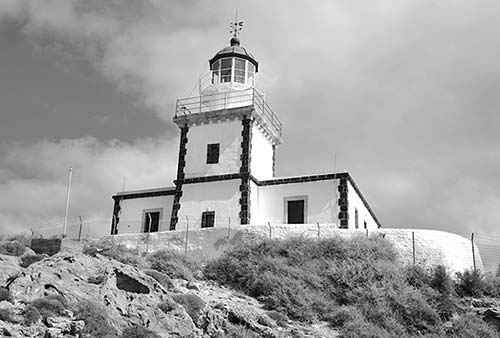
Ancient Thira
Dramatically situated on a mountaintop between Perissa and Kamari, this site dates from a more recent civilization. It was settled post-volcano by Dorians from Sparta, likely in the ninth century BC, and continued to thrive through the Hellenistic, Roman, and Byzantine periods. This place is less distinctive than the Akrotiri site and might only interest archaeology completists. If you’ve toured other Greek ruins from this era—in Athens, Delphi, Olympia, Epidavros, and so on—you’ll see nothing new here. However, the setting could hardly be more spectacular.
Cost and Hours: €6, covered by €15 combo-ticket; Thu-Tue 8:30-15:30, closed Wed, shorter hours off-season; +30 2286 023 217, http://odysseus.culture.gr.
Getting There: Besides driving or taxi, you can take a bus to Kamari, then either walk 30 minutes or catch an hourly minibus excursion from the TI in that town. Hardy hikers can also huff up from Perissa on a very twisty serpentine path.
OTHER VILLAGES
Santorini is dotted with charming and characteristic villages, most of them easily accessible by local bus from Fira. With more time—and a rental car—consider exploring more off the beaten track. These two worthwhile options are near the recommended sights listed earlier.
Megalochori
Reachable by any local bus heading to Perissa (1-2/hour), Megalochori doesn’t have sea views, but is a delight to stroll—you’ll share the cobbled streets with more residents than tourists. Wander through the lanes of artisan workshops and original cave houses and enjoy.
For more official sightseeing, consider visiting the casually intimate Gavalas Winery, one of the oldest on Santorini (daily 10:00-19:00, tastings from €15, small snacks available, www.gavalaswines.gr), or attending a “history of sound” concert at the Symposion cultural center, where you’ll experience Homeric spoken word, Greek bagpipes, and other ancient instrumental music (performances generally Tue-Sun at 13:00 and some evenings—check website for schedule; center open Tue-Sun 10:00-20:00, closed Mon; +30 2286 085 374, www.symposionsantorini.com; attached café serves wine, beer, and light food).
$$$ Petrino restaurant, on the main square, is popular with locals, and the Alisachni artists collective and wine bar is a good place to settle in.
Above town, $$$$ Aegagros Caldera Houses is a pleasant sleeping option with its own garden restaurant (5-minute drive from Venetsanos Winery, +30 2286 025 493, www.aegagros.eu), while slightly inland Petra Kouzina welcomes travelers into a traditional cave home for a cooking experience with locals (€120/4-hour class, daily at 11:00 and 17:00, +30 6981 076 655, www.petrakouzina.com [URL inactive]).
Pyrgos
Close to Fira, and near the recommended Metaxi Mas restaurant, the village of Pyrgos (sometimes written as Pirgos on local maps and schedules) is a good alternative to Oia and Fira for watching the sun set over Santorini. Hourly buses from Fira stop in Pyrgos (direction: Perissa; note not all Perissa-bound buses stop in Pyrgos—double-check with the driver).
There are several good eating options in town, including the meze-style $$$ Kantouni Taverna (daily 9:00-23:30, +30 2286 033 474) and $$$ Agaze, which also has a boutique selling Greek treats (daily 9:00-24:00, +30 2286 031 003).
Santorini Connections
The New Port (Athinios) is a 20-minute bus ride from Fira, and buses can be very crowded in summer—allow enough time to make your connection. For ferry office locations in Fira, see “Helpful Hints” on here. The frequency and durations listed below are approximate; schedules can change from season to season, and sailings can be canceled on short notice—confirm everything locally. For information on finding current schedules and booking tickets, see here.
By Boat from the New Port: Santorini is connected daily to Piraeus in Athens (4-5/day in high season, 5 hours via fast boat, 8 hours by slow boat; off-season likely 1 slow boat daily), Mykonos (generally 2-4/day in high season, none in winter, 2-3 hours, 1-2 stops en route), and other Cycladic Islands, as well as to Crete (1-2/day in high season, 2.5 hours).