ACROPOLIS MUSEUM TOUR
Μουσείο Ακρόπολης
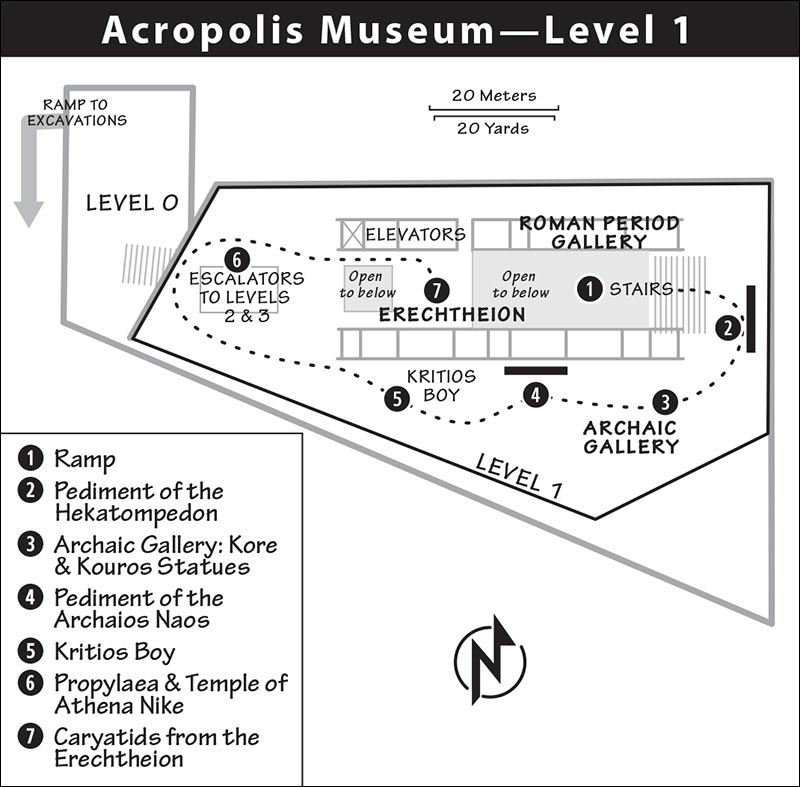
1 The Ramp
2 Pediment of the Hekatompedon
3 Archaic Gallery: Kore and Kouros Statues
4 Pediment of the Archaios Naos
6 Propylaea and Temple of Athena Nike
7 Caryatids from the Erechtheion
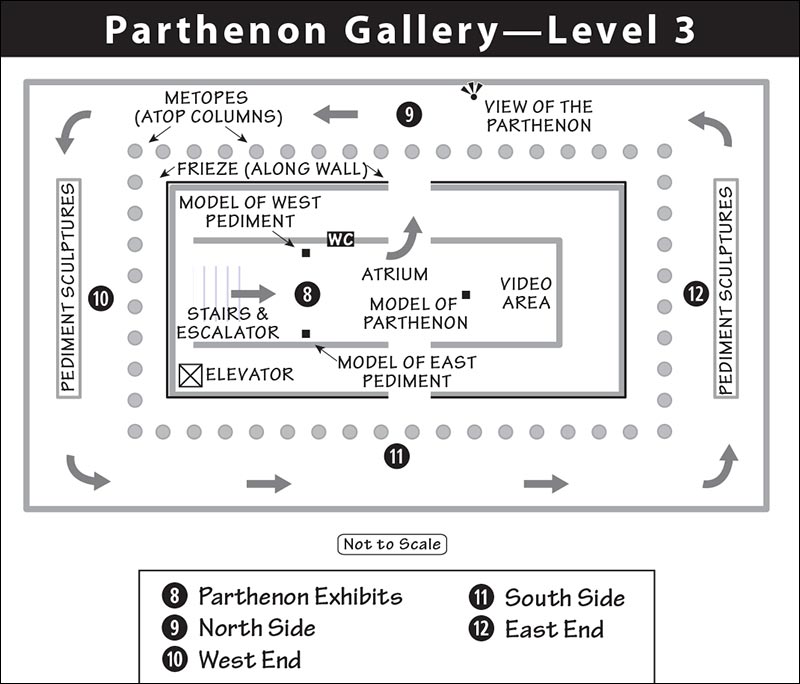
Map: Parthenon Gallery—Level 3
10 West End
11 South Side
12 East End
Athens’ Acropolis Museum is a custom-built showcase for sculptures from the Acropolis, starring its greatest temple, the Parthenon.
We’ll start with broken fragments from the Acropolis’ earliest temples, then focus on the great works of the Acropolis’ glory years—roughly 500 to 400 BC. These sculptures are surprisingly lively, dramatic, and realistic. We’ll see graceful maidens bearing gifts, superheroes battling monsters, and stately robed women who doubled as temple columns. Finally, on the top floor, is the museum’s star attraction: an entire floor dedicated to the Parthenon’s sculptures, laid out in the exact dimensions of the Parthenon itself.
Be aware that many statues here—though original and very historic—are pretty ruined and less impressive than, say, the Parthenon sculptures (“Elgin Marbles”) in London’s British Museum. But the Acropolis Museum more than makes up for that with high-quality copies, its Parthenon-replica layout, and nifty modern displays that bring the ruins to life.
The museum is a sort of 21st-century Trojan horse, intended to pressure the British to return the Parthenon sculptures. For years, the Brits claimed that Greece couldn’t give those ancient treasures a suitable home. But now Athens can proudly say, “Oh really?”
The museum works equally well either before you visit the Acropolis (to help you visualize the ruins you’ll see) or afterward (to see the statues close-up after you’ve seen where they once stood). There’s a convenient entrance/exit that connects the two sights. (And this book’s description of the Acropolis might help you as you tour the Acropolis Museum—see the previous chapter.)
With its striking exterior and irreplaceable Acropolis statues, the Acropolis Museum is a bold symbol of today’s Athens.
Orientation
Cost: €10, €5 off-season. You can buy tickets on the museum website to avoid the ticket-buying line (but not the security line).
Hours: Mon 9:00-16:00, Tue-Thu and Sat-Sun until 20:00, Fri until 22:00; Nov-March Mon-Thu 9:00-17:00, Fri until 22:00, Sat-Sun until 20:00.
Information: +30 210 900 0900, www.theacropolismuseum.gr.
Getting There: It’s the gigantic, can’t-miss-it modern building—the main entrance faces the south side of the Acropolis from across the broad Dionysiou Areopagitou pedestrian drag. The museum is next to the Akropoli Metro stop on Makrigianni, a street lined with restaurants.
Visitor Information: Pick up a free map (in Greek) at the information desk when you enter. Museum guards can answer questions, and a 13-minute video plays continuously in the upper atrium (level 3). The bookstore sells The Short Guide (well worth €3).
Baggage Check: There’s a free bag check at the counter near the turnstiles at the base of the ramp (required for big bags).
Length of This Tour: Allow 1.5 hours.
Services: Wheelchairs and strollers are available. A gift shop is on the ground floor and level 2 has a bookstore.
Eating: Choose from the ground-floor café or the restaurant on level 2. Since the menu is the same and pricey in both places, you may as well enjoy the smashing Acropolis views from the restaurant upstairs. You can even visit the restaurant without a museum ticket—just request a guest pass at the ticket desk. For a fast and cheap bite, I like the souvlaki joint 100 yards away at the Akropoli metro station entry.
Starring: Greek national pride, a helpful overview of the Acropolis’ history, marble masterpieces from one of the most influential archaeological sites in human history—and high hopes that more will eventually join the collection.
The Tour Begins
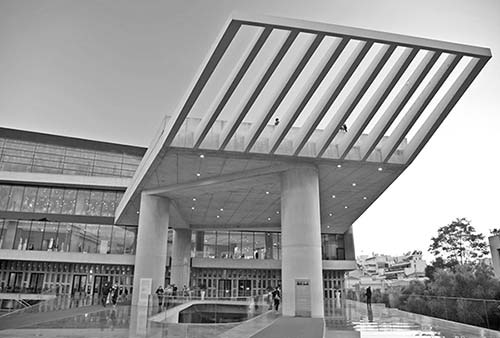
The eye-catching, glassy building—designed by Swiss-born, New York-based architect Bernard Tschumi—gives a postmodern jolt to Athens’ concrete cityscape. Its lower level is aligned with ancient foundations beneath it, while the top floor sits askew, mirroring the nearby Parthenon. The glass walls allow visitors to enjoy the artifacts inside while gazing out at the Acropolis itself.
• Enter on the ground floor (level 0) and buy your ticket.
LEVEL 0
Browse a few introductory displays (about the Acropolis’ evolution from 1200 BC to AD 1500) and look through the glass floor at the sixth-century BC excavation site—two-story houses and even evidence of plumbing. Then stow your coat and bag and go through the turnstiles onto a wide ramp.
1 The Ramp
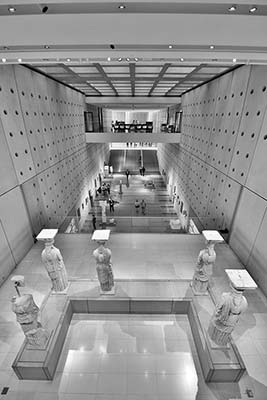
Look through the ramp’s glass floor at more of the ancient ruins excavated beneath the museum. These were houses and shops of a once-lively neighborhood here at the base of the Acropolis (the excavation is included with your ticket and is worth a quick look at the end of your visit—look for an access ramp at the museum entrance). As no one actually lived on top of the Acropolis, which was reserved for the temples of the gods, ancient Athenians settled either down here or over by the Agora. The artifacts you see here, found on the hill’s slopes, symbolize the transition from the everyday world below to the sacred realm above.
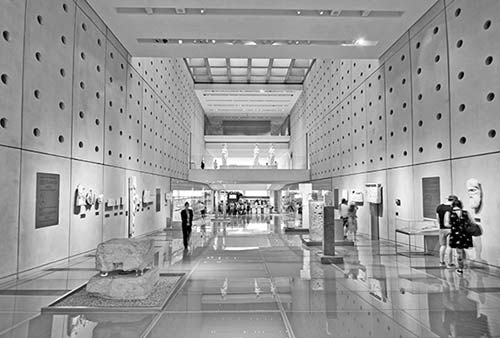
Case #5 (on the left), with ancient vases painted with wedding scenes, makes it clear that the Acropolis was a popular place to get married.
Case #6 (on the left) showcases vases and figurines used as offerings; as Athenians ascended the hill to worship the gods, they brought these objects to bribe the gods to answer their prayers.
They might stop at the Sanctuary of Dionysus (also described on the left), which had a theater built into the slope of the Acropolis just uphill from today’s museum. Devotees of Dionysus would drink wine while watching performers sing ecstatic songs or recite poems.
The square stone treasure box (offering box; just before the stairs, on the right) is where worshippers of Aphrodite would drop in a silver drachma to ensure a good love life.
• Let’s ascend to the sacred realm of the gods. Climb the stairs at the end of the ramp. Straight ahead is a collection of statues in a triangular frame.
LEVEL 1
This floor has statues from the Acropolis’ first temples, a century before the Parthenon. The Acropolis has two layers of history: before the Persian sacking in 480 BC (Archaic) and after (golden age or Classical). The Archaic statues survived because they were buried under later Acropolis buildings before being excavated in the 1800s. Today you’ll see no Archaic-period construction on the Acropolis...only the Classical remains of what was rebuilt after 480 BC.
2 Pediment of the Hekatompedon
This triangular set of statues adorned the entrance to the first great temple on the Acropolis (from 570 BC). It was called the Hekatompedon (“100-foot-long”) for its legendary size. The temple was dedicated to Athena, the patron of the city of Athens, and it stood in the Acropolis’ prime location—right where the Parthenon is today.
On the far left, bearded Hercules wrestles with the dragon-tailed sea monster Triton (still colorful with sixth-century BC paint). In the (very damaged) center, two lions kill a bull. To the right is a three-headed demon with a snake tail. These dapper, bearded gentle-demons hold objects representing the elements of wind, water, and fire—perhaps symbolizing the struggle of man versus nature. On display nearby (behind and to the right) is another Hekatompedon statue—a mama lion feasting on a bull.
These statues are the first of many we’ll see featuring battles: between animals, men, monsters, and gods. The Greeks loved “the contest,” because it was through struggle that wisdom was forged. In Greek myths, even the gods battled each other as they strove to create order out of chaos.
• Let’s see more non-Parthenon statues. Turn right (past the feasting lion) and enter a gallery flooded with daylight and columns spanning the room.
3 Archaic Gallery: Kore and Kouros Statues
These statues were gifts to the gods, to decorate the gods’ homes atop the Acropolis—that is, their temples.
Browse around. The horses and riders were likely donated by rich benefactors to thank the gods for letting them win the local horse races. The robed women with long braids (kore) hold objects representing the gifts they bring to the gods. The naked men (kouros) may represent athletes, or gods, or a deceased ancestor. What they all have in common is that they’re stiff and unrealistic, standing at attention with generic faces and mysterious smiles.
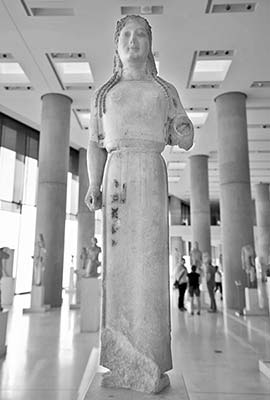
This was the style of the Archaic era (c. 700-480 BC) that preceded the Greek golden age: Men are generally naked (showing off buff and toned bodies); the bearded dudes are adults, and boys are beardless; and women are modestly clothed, with braided hair and pleated robes—essentially columns with breasts. Though these statues were once painted (some still show traces), they are a far cry from the lively golden age wonders we’ll see from the Parthenon.
• Of all the statues on the Acropolis, the most important were of the goddess most dear to Athenians—Athena. Halfway down the gallery, on the right, find a large statue of Athena, a robed woman carrying a snake. She’s one statue of several in the triangular...
4 Pediment of the Archaios Naos
Athena, dressed in an ankle-length cloak, strides forward, brandishing a snake as she attacks a giant, who sprawls backward onto his bum. In this “Battle of the Gods and Giants,” it was Athena, the goddess of wisdom, who wielded rational thought to overcome brute force.
And thanks to Athena, the city of Athens came to dominate its Greek neighbors. In gratitude, the Athenians began building a grand new temple to Athena to replace the Hekatompedon. These statues decorated the entrance.
But then came the event that changed Greece’s history forever. When the Persians invaded Greece for the second time (in 480 BC), they looted Athens and burned the Acropolis’ temples to the ground. It was a horrible tragedy, but it left the hilltop a blank canvas. And when Athens rebounded, they were determined to rebuild the Acropolis better than ever as a symbol of rebirth. The centerpiece would be a brand-new temple to Athena—the Parthenon.
• Continue another 20 steps to the middle of the room, where the 5 Kritios Boy (c. 480 BC) seems to be stepping gracefully from Archaic stiffness into Greece’s golden age. From this point on, we’ll be viewing artifacts from those golden age buildings you can actually see today atop the Acropolis—the Propylaea, Erechtheion, and Parthenon.
Continue to the end of the hall and circle clockwise around the escalators. Find displays featuring the Propylaea, the grand entrance to the newly rebuilt Acropolis.
6 Propylaea and Temple of Athena Nike
The model of the Propylaea shows how this entrance gate once looked—a grand, steep staircase that led the visitor up, up, up, and then through majestic columns, to emerge atop the Acropolis. (Tourists go through the same gate today.)
As you climbed, you’d pass by the Temple of Athena Nike (the empty platform standing just in front, on the right side), built to honor the fierce goddess who brought Athens Nike (Victory). Ruins from that temple are displayed a few steps to the left of the model. (Everything described in the next two paragraphs is within 10 yards of this model.)
This U-shaped set of reliefs (c. 410 BC) formed the balustrade ringing the temple. See how naturally the winged goddess Nike goes about her business: adjusting her sandal, leading a bull to sacrifice, ascending a staircase, and so on. (By the way, Nike survived the destruction of pagan images in the Christian era because they mistook winged Nikes for angels.)
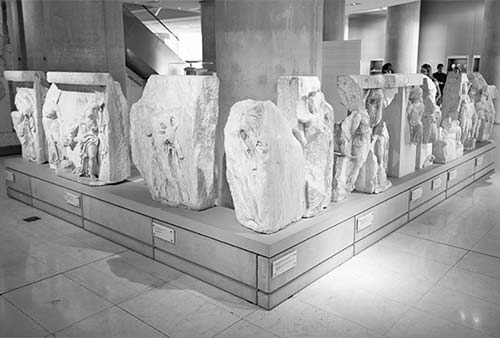
Displayed nearby (in glass cases in the wall) are more chunks of the Temple of Athena Nike. You’ll see toes gripping rocks, windblown robes, and realistically twisted bodies—exuberant, life-filled carvings signaling Athens’ emergence from the Persian War.
• Near the Propylaea model (on this level, behind the escalator) is something you won’t want to miss. Standing all on their own, as if starring in their own revue on a beautifully lit stage, are the...
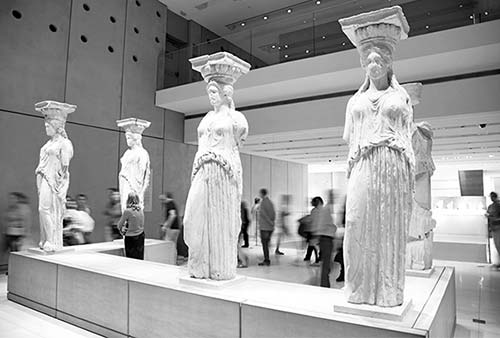
7 Caryatids from the Erechtheion
Here stand five of the original six lady-columns that once supported the roof of the prestigious Erechtheion temple. (The six on the Acropolis today are copies; the other original is in London’s British Museum.) While the Parthenon was the Acropolis’ showstopper, the cute little Erechtheion (see the model back near the escalators) was actually Athens’ holiest temple, as it marked the exact spot where legend says Athens was born.
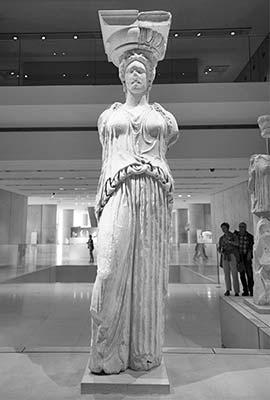
These remarkable lady-columns wear robes pleated like fluted columns. Their hair is braided behind them. Eyes straight forward, they step out gracefully, swaying their hips naturally while balancing the crossbeams atop their heads. The six statues form a harmonious ensemble, yet each is unique. They were the finishing touch on the architect Mnesicles’ final temple, and they sum up the balance and serenity of the golden age.
Despite their elegant appearance, these sculptures were structurally functional. Each has a column for legs, a capital-like hat, and buttressing locks of hair. The Caryatids were modeled on the famously upright women of Karyai, near Sparta, and now any female statue used as a column is called a “caryatid.”
Time and the elements have ravaged these maidens. As recently as the 17th century (see the engravings), they had fragile arms holding ritual bowls for libations. Until the 1950s (before modern smog), their worn-down faces had crisp noses and mouths. In a half-century of Industrial Age pollution, they experienced more destruction than in the previous 2,000 years. But their future looks brighter now that they’ve been brought indoors out of the acidic air, cleaned up with a laser, and safely preserved for future generations. (For more on the Caryatids in their original location, see here.)
• Now let’s head upstairs for the grand finale—the Parthenon sculptures.
Ride the escalators up. Pause on level 2 to take note of the restaurant and terrace with grand Acropolis views. If you need a break, this level has a peaceful and cushy lounge. Then continue up the escalators to the top floor.
LEVEL 3: THE PARTHENON
This floor features the collection of Parthenon structures, laid out the way they were on the original Parthenon. In fact, this floor has roughly the same dimensions as the Parthenon—228 feet long and 101 feet wide. The escalators deposit you “inside” this virtual Parthenon, in the temple’s cella—the inner sanctum.
• Start by getting acquainted with the Parthenon through the exhibits here in the cella.
8 Parthenon Exhibits
The video in the small theater reconstructs the Parthenon before your eyes, letting you see where today’s puzzle pieces fit into the overall structure. It also covers the Parthenon’s 2,500-year history—including a not-so-subtle jab at how Lord Elgin got the marbles and made off with them to England.
The model of the Parthenon in its prime also shows the surviving sculptures in their original locations. Learn the terminology: The triangular ensemble over the two ends are the pediment sculptures. Beneath that is a row of relief panels running around the building, called the metopes. There was another similar row of relief panels, called the frieze, located under the eaves above the inner row of columns (but unfortunately this model lacks the detail to show it; see the diagram on here).
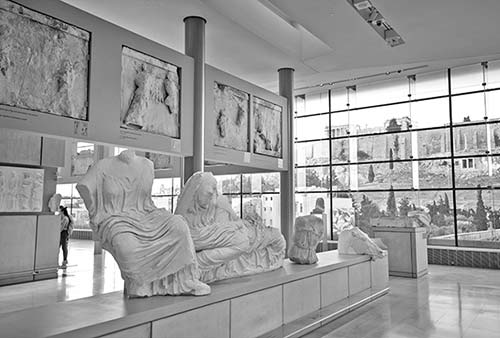
The model of the east pediment (the one to the left as you face the escalator) shows the statues you’d see above the Parthenon’s main entrance. In the center, at the very peak of the triangle, a tiny winged angel (Nike) is about to place the olive wreath of victory on Athena (carrying a shield). This was the crowning moment of the legendary event that put Athens on the map—the birth of Athena. Zeus (seated on his throne) allowed Athena, the goddess of wisdom, to rise from his brain fully grown and fully armed to inaugurate the golden age of Athens. The other gods at this Olympian banquet—naked men and clothed women—are astounded by Athena’s sudden appearance and recoil in amazement.
The drama and realism of these statues was incredible. Find powerful Poseidon (seated to the right with his trident), Apollo (with his lyre), and Aphrodite (reclining farther right). At the far left, Helios’ four horses bring the sunrise, while four more (far right) bring sunset. Next to the sunrise horses (on the left), find Dionysus, just kicking back and chilling with another cup of wine. Try to remember how impressive these sculptures were in their prime, because—as you’ll soon see—what remains today is mostly just fragments.
The model of the west pediment (on the opposite wall) shows Athena (with spear, shield, and spiky crown) competing with Poseidon for Athens’ favor by giving gifts to the city. Athena won by presenting an olive tree (behind the two of them), which sprouted next to the Parthenon. A big, heavenly audience looks on. Had Poseidon bested Athena, you’d be in Poseidonia today instead of Athens.
Above the escalator, you may want to grab a stool and watch the 10-minute video to learn about the 1801 plundering of the Acropolis by Lord Elgin and the English—the story of the sculptures formerly known as the “Elgin Marbles.”
• Now let’s go see the actual sculptures—the pediments, metopes, and frieze—that once decorated the exterior of the Parthenon. We’ll tour the floor counterclockwise. Facing the big video screen, turn left and enter the huge outer gallery that rings the cella. (You’ll be in the north gallery.) Step up to the window for a stunning view of the Parthenon—the temple that these sculptures once adorned. Now turn around and take in what remains.
Parthenon Sculptures
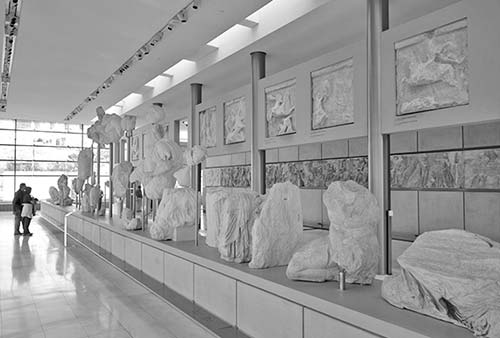
This floor is cleverly designed to re-create the dimensions of the Parthenon. The stainless-steel columns mark the location of each marble column. The relief panels you see once ringed the Parthenon. The metopes (displayed higher up) formed a continuous band around the Parthenon’s exterior. The frieze (mounted lower) also ran around the Parthenon’s exterior, but inside the columned arcade. In their heyday, all these panels were originally painted in realistic colors.
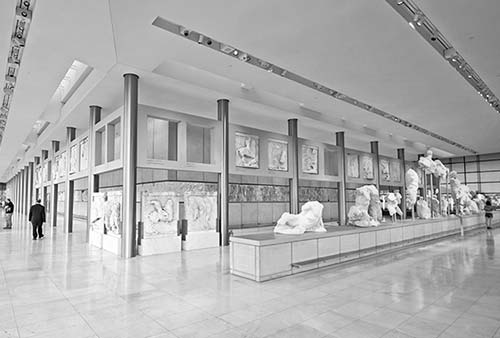
The darker-brown panels are originals. The white plaster ones are copies of the originals in other museums, mainly the British Museum. Even with copies, you’ll notice there are a few gaps here and there, because some pieces have been lost forever and scholars don’t know what was represented there.
We’re lucky the Parthenon sculptures have survived as well as they did. First, they were exposed to 2,000 years of the elements. Then, in 1687, the Parthenon was accidentally blasted to smithereens during a battle with the Ottomans. In 1801, Lord Elgin took the best of the shattered pieces back to London. Today, of the original marble frieze, the museum owns only 32 feet. These panels were already so acid-worn that Lord Elgin didn’t bother taking them.
Despite all the damage, keep this in mind as you tour the floor: Everything we know about the statues that adorned that great temple has been re-created in this one perfect space.
• Remember, we’ll be touring the floor counterclockwise, starting here on the...
9 North Side
Start with the museum’s highlight—a life-size replica of the 525-foot frieze that once wrapped all the way around the outside of the Parthenon. It depicts the big parade of the Great Panathenaic Festival held every four years, when citizens climbed up the Acropolis to the Parthenon to celebrate the birth of their city.
The parade is in full swing. Chariots lumber in. Parade marshals stand by, supervising the affair. Men lead animals such as lambs and oxen to be sacrificed to the gods. At the heart of the procession are elegant maidens dressed in pleated robes. They shuffle along, carrying gifts for the gods on their shoulders, such as incense burners and jars of wine to pour out an offering. (There was one more gift for the gods that was the whole purpose of the parade—we’ll come to that at the end.)
All the participants are heading in the same direction—uphill. Notice how, although the horses gallop and rear back spiritedly, the men’s gazes remain steady and form a harmonious line around the Parthenon.
Now turn to the metopes (higher and closer). Though pretty worn, these depict scenes of epic Greek contests—men battling monsters, gods battling giants, and superheroes of legend. Remember, the Greeks loved competition of all sorts, as it reflected the dynamic built into the cosmos. The panels on this side of the Parthenon depicted the epic struggles of the Trojan War. Find the lovely Helen who started it all, the brave Greek warrior Odysseus who wandered at war’s end, and the hero on the losing team, Aeneas (five panels).
• Head counterclockwise around the floor, turning the corner to the Parthenon’s...
10 West End
The sculptures here once decorated one of the Parthenon’s two entrances. This was the temple’s back door (though it’s the iconic view that greets today’s visitors).
The triangular pediment that once sat over the entrance (but which is now displayed on the ground) is pretty fragmentary and hard to make out. It once showed Athena in the center competing with Poseidon for Athens’ affection (described earlier, under “Parthenon Exhibits”).
The metopes are also pretty weathered (but at least they’re originals). They depict another evenly matched contest—this time between Greek men and the legendary Amazons (on horseback).
The frieze picks up where we left off—the Panathenaic parade. Here, we have some of the museum’s best scenes: Muscular horses with bulging veins are posed in every which way. Their riders’ cloaks billow in the breeze as they gallop up the Acropolis. Some panels have holes drilled in them, where gleaming bronze reins were fitted to heighten the festive look. In the middle of the parade, one guy has to buck the one-way flow, stopping to tie his shoe. Climb the little platform for a close-up view of the best-preserved panel.
• Turn the corner to the other long side.
11 South Side
The metopes here are some of the museum’s finest. This is the legendary battle between men (the Lapiths) and half-horse centaurs. Follow the story, working right-to-left (starting at the far end of the hall): The centaurs have crashed a party (first three panels) to carry off the pleated-robed Lapith women. The Lapith men fight back (next six panels), but it’s clear the centaurs are winning. Note the high-quality original metope (displayed on the ground for closer inspection—southwest corner) where a centaur has a man in a headlock and reaches back, hoping to deliver the final blow. But the Lapiths rally (final two panels) and start to get the upper hand. For the Greeks, this contest symbolized how rational men had to constantly do battle to control their animalistic urges.
Now turn to the frieze, which seems to be picking up steam as we build to the parade’s climax. It’s a true celebration involving all of Athens: men on horseback, musicians, animals, priests, and dignitaries, all joining together on this festive anniversary of the birth of their great city. They’re all headed to the Parthenon to present gifts to Athena.
• The parade congregated around the Parthenon’s entrance. Let’s join them there. Continue around the bend to the east end, with some of the Parthenon’s most famous statues.
12 East End
These sculptures adorned the Parthenon’s main entrance. Take a seat and see how the sculptures—pediment, frieze, and metopes—all culminate thematically here.
The metopes (though heavily damaged) illustrated the most primary myth in the Greek world: when the Olympian gods defeated the brutish Giants, thus creating the world of mortal men.
The pediment depicted the most important myth for the Athenians: the birth of Athena. (It’s heavily damaged, with many gaps. Mentally fill them in with the model we saw in the entrance hallway on this floor, earlier.) The peak of the triangle (now missing) once showed Athena springing from Zeus’ head while the other gods reacted in astonishment. Of the pieces and copies here, you can make out Dionysus (reclining on the left), Aphrodite (lounging on the right), and the chess-set horse heads. The other figure is Hebe, the cupbearer of the gods, who seems to be hurrying to give Dionysus a refill.
For the Athenians, the most important of the gods was Athena, and the Panathenaic parade was all about honoring her.
And so, the frieze depicts the culmination of the Panathenaic parade: when they arrive at the Parthenon and present their gifts. The most precious gift was a new robe (the peplos), woven by Athens’ young girls. Find the robe in the central panel, where a man and a girl neatly fold the robe for presentation. Nearby, the gods look on approvingly, seated on their thrones. Athena, to the right, turns her back, apparently bored with the tiresome annual ritual.
In real life, the parade would congregate at the Parthenon entrance. Then a few chosen citizens would enter the temple and head to the inner sanctum (cella), where there was a 40-foot-tall wooden statue of Athena. They’d present the new robe to her, giving her thanks. Athena must have been pleased, as she made Athens the greatest city the Western world has known.
• Finish your tour by strolling around the gallery again, reviewing the art, gazing out the windows, and taking a moment to...
Ponder the Parthenon
There’s the Parthenon itself, perched on the adjacent hilltop. Let the museum disappear around you, leaving you to enjoy the art and the temple it once decorated. The Parthenon is one of the most influential works humankind has ever created. For 2,500 years it’s inspired generations of architects, sculptors, painters, engineers, and visitors from around the globe. Here in the Acropolis Museum, you can experience the power of this cultural landmark. The people of Athens relish the Acropolis Museum. They grow taller with every visit, knowing that Greece finally has a suitable place to preserve and share the best of its artistic heritage.
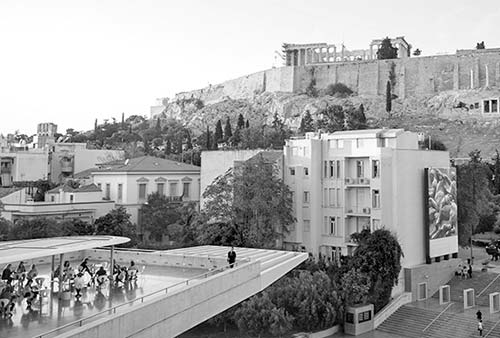
• On your way down, stop by the restaurant on level 2 for its exterior terrace and the awesome view of the Acropolis, and consider touring the ancient excavations beneath the museum—accessed via a ramp back at the museum entrance (scan your ticket for entry).