ATHENS CONNECTIONS
ELEFTHERIOS VENIZELOS INTERNATIONAL AIRPORT
Athens is the transportation hub for all of Greece. Because the tourist core of Athens is so compact, and with good public transportation, don’t rent a car until you are ready to leave the city—you absolutely do not want to drive in Athens traffic. If you’re venturing to landlocked destinations beyond Athens, the best option for the rest of your trip is to travel by car. Buses can get you just about anywhere for a reasonable fare, but connections to remote areas can be long and complicated, and straightforward schedule information is hard to come by (note that most of my recommended sights beyond Athens do not have train service). Boats and planes work well for reaching the islands.
For a map of Athens transit, see the back of this book. For specifics on transportation beyond Athens, see the “Connections” sections in each of the destination chapters in this book. And for general information on transportation by plane, boat, bus, and car, see the Practicalities chapter.
By Plane
ELEFTHERIOS VENIZELOS INTERNATIONAL AIRPORT
Athens’ airport is at Spata, 17 miles east of downtown (airport code: ATH, +30 210 353 0000—press 2 for English, www.aia.gr). This slick, user-friendly airport has two sections: B gates (serving European/Schengen countries—no passport control) and A gates (serving other destinations, including the US). Both sections feed into the same main terminal building (with a common baggage claim, ATMs, shops, car-rental counters, information desks, and additional services). On floor 2 (above entrance/exit #3) is a mini museum of Greek artifacts dug up from the area around the airport.
Getting from the Airport to Downtown
Your best route into the city depends on where you want to go: If you’re headed to Syntagma Square, the bus is generally better (cheapest, frequent, and scenic—but slow). For Monastiraki, Psyrri, or the Makrigianni area south of the Plaka, the Metro is more direct—and isn’t susceptible to traffic jams. Electronic boards in the baggage and arrivals halls show upcoming bus and train departures.
By Bus: Buses wait outside exit #5. Express bus #X95 costs €5.50 and operates 24 hours daily between the airport and Syntagma Square (3-5/hour, roughly 1 hour depending on traffic; +30 210 820 2900, www.oasa.gr). The downtown bus stop is on Othonos street, along the side of Syntagma Square; get off after the bus takes a 180-degree turn around a big square filled with palm trees.
By Metro: Line 3/blue zips you downtown in 45 minutes for €9 (2/hour, direction: Dimotiko Theatro, daily 6:30-23:30; €18 for 2 people, €27 for 3, half-price for people under 18 or over 65, ticket good for 90 minutes on other Athens transit; the €20 three-day tourist ticket, which includes round-trip airport transfer by Metro or bus as well as unlimited in-city travel on all public transit, is only worthwhile if you plan on returning to the airport within 72 hours).
To reach the Metro from the airport arrivals hall, go through exit #3, cross the street, go up the escalator, and cross the skybridge to the rail terminal. Buy tickets at the machines or ticket window, and follow signs down to the platforms. In downtown Athens, this train stops at Syntagma (where you can transfer to line 2/red) and Monastiraki (transfer to line 1/green).
To return to the airport by Metro, you can catch a train from Syntagma (2/hour, 5:30-24:00). Keep in mind that some Metro trains terminate at Doukissis Plakentias. If so, just hop off and wait—another train that continues to the airport should come along soon.
By Taxi or Uber: A well-marked taxi stand outside exit #3 offers fixed-price transfers that include all fees and tolls (€40 to central Athens, covers up to 4 people, fare increases to €55 or more between 24:00 and 5:00). If you are comfortable using Uber back home, you can also use it in Athens to get to and from the airport. In Athens, Uber operates as UberTaxi. You’ll book your ride through the app, but a taxi will pick you up. Rates to and from the airport are fixed, so Uber won’t save you money on this route. I use it for the convenience and familiarity.
By Car Service: A variety of private services offer airport transfers for approximately the same cost as a taxi, but often with a nicer car and more personal and professional service. Most hotels have a service they like to work with, or you can book on your own (reserve at least a day before). Or consider one of the private drivers listed on here.
Getting from the Airport to Other Transit Points
To reach the port of Piraeus, you can take express bus #X96 (€6, runs 24 hours daily, 2-4/hour, 1-1.5 hours depending on traffic; leaves from outside airport exit #5, stops at Piraeus’ Karaiskaki Square, then at the Metro station; +30 210 820 2900, www.oasa.gr). Or, take Metro line 3/blue from the airport to the port (€9, 55 minutes). A taxi from the airport to the port costs about €50.
Express bus #X93 goes directly to bus terminals A and B (same price and frequency as #X96, above).
By Boat
ATHENS’ PORT: PIRAEUS
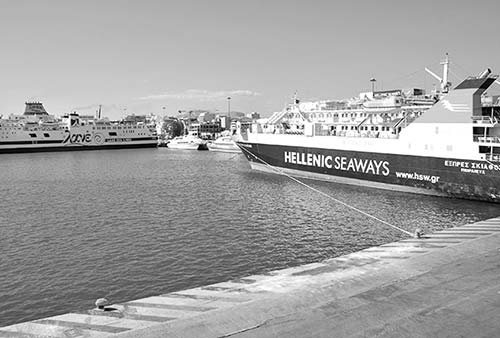
Piraeus, a city six miles southwest of central Athens, has been the port of Athens since ancient times. Today it’s also the main port for services to the Greek islands, making it the busiest passenger port in the Mediterranean. While the port is vast, most of it is used for ferry traffic; all cruise ships moor at one end.
Orientation to Piraeus
All ferries, hydrofoils, catamarans, and cruise ships use Piraeus’ Great Harbor (Megas Limin). To the east are two smaller harbors used for private yachts: Limin Zeas and the picturesque Mikrolimano, or “Small Harbor.”
The Great Harbor area is ringed by busy streets. At the northeast corner is the hub of most activity: the Metro station, housed inside a big yellow Neoclassical building with white trim (sometimes labeled “Electric Railway Station” on maps). Trainspotters with time to kill can visit the free and good little electric-railway museum inside. Next door to the Metro station is the suburban train station. Just south of the Metro station is Karaiskaki Square, which juts out into the harbor. Cheap eateries, flophouse hotels, and dozens of travel agencies round out the dreary scene. The port does have several grungy waiting areas and WCs (between gates E5 and E6, and between E8 and E9), but trust me, killing several hours in Piraeus waiting for a ferry is a traveler’s hell you’d prefer to avoid.
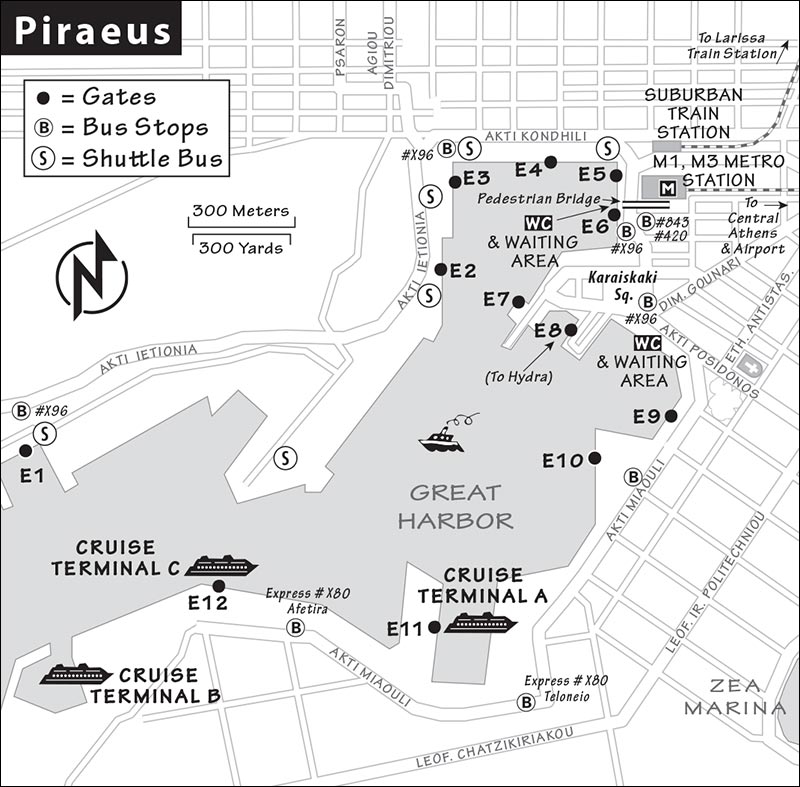
Gates: Twelve “gates” (docks) wrap around the harbor for about three miles, numbered in clockwise order. Big electronic display boards show gate numbers and times for upcoming departures. Gate assignments depend on both the destination and the company operating the line, but you can generally expect the following:
These departure gates could change—carefully check your ticket for the gate number, and ask a local if you’re unsure.
Information: Official tourist information is in short supply here, although temporary TI kiosks may pop up near the cruise terminals when ships arrive. Your best sources of information are the many travel agencies scattered around the area; all have a line on current boats, where they leave from, and how to get tickets. The port police, with several offices clearly marked in English, can be helpful (+30 210 451 1001). You can also call the Piraeus Port Authority’s cruise and ferry terminal line at +30 210 455 0110. The port authority website is www.olp.gr.
Baggage Storage: You can leave bags at an office about 50 yards south of the Metro station. Look for the Baggage Locker sign on the main harbor road, nearest the cross street Kapodistriou (daily 6:00-22:00).
Getting from Piraeus to the Islands
For the lowdown on Greece’s ferry network, including tips on looking up schedules and buying tickets, see here of the Practicalities chapter. Know ahead of time from which gate your ferry leaves.
Arriving at the Piraeus Metro station, you’ll step out into a little square. Head for the busy road, cross at the crosswalk, and enter the port area. Straight ahead are gates E6 and E7. Gates with higher numbers are to your left; those with lower numbers are to your right. (For example, Hydra-bound boats usually depart from gate E8, to your left on the far end of the tree-filled park toward gate E9.) If your boat leaves from gates E1 or E2 on the north side of the port, look for a free shuttle bus just inside the port gate at E5.
From Piraeus by Boat to: Hydra (6-8/day June-Sept, 4/day Oct-May, 1.5-2 hours), Mykonos (3-4/day in high season, 2.5 hours via fast boat, 5.5 hours on slow boat; off-season likely 1 slow boat daily), Santorini (4-5/day in high season, 5 hours via fast boat, 8 hours by slow boat; off-season likely 1 slow boat daily). The frequency and durations listed here are approximate; schedules can change from season to season, and sailings can be canceled on short notice—confirm everything locally. See here of the Practicalities chapter for tips on finding the most up-to-date schedules.
Getting from Piraeus Ferry Terminals to Athens
By Train: Metro line 1/green conveniently links Piraeus with downtown Athens (€1.20, good for 90 minutes including transfers, departs about every 10-15 minutes between 6:00 and 24:00). The Metro station is in a big, yellow Neoclassical building near gate E6. Buy your ticket from a machine, validate it, and hop on the train. In about 20 minutes, the Metro reaches the city-center Monastiraki stop, near the Plaka and many recommended hotels and sights. (For Syntagma, Akropoli, and Syngrou-Fix Metro stops, ride one more stop to Omonia to transfer to line 2/red.) Warning: The Metro line between Piraeus and downtown Athens teems with pickpockets—watch your valuables and wear a money belt.
A suburban train also connects Piraeus’ train station with Athens, but there’s no reason to take it (less frequent, more transfers).
By Taxi: A taxi between Piraeus and downtown Athens should cost about €20, and can take anywhere from 20-40 minutes, depending on traffic and on your starting/ending point at Piraeus. Uber works well, and is often cheaper. The app works as it does at home, but instead of a nondescript car, you’ll get a taxi.
By Bus to Bus Terminal A (Kifissou): For long-distance buses to the Peloponnese, you’ll need to connect through Athens. To reach Athens’ Bus Terminal A (Kifissou), take bus #420 (2-3/hour, catch bus at stop across the street from Gate E6).
Getting from Piraeus Cruise Terminals to Athens
Piraeus has three cruise terminals at two different docks. The main terminal—Terminal A (“Miaoulis”)—is at dock E11. Farther out, dock E12 has two terminal buildings: Terminal B (“Themistocles”) and Terminal C (“Alkimos”). For more details, see my Rick Steves Mediterranean Cruise Ports guidebook.
Getting to Athens: You can either hire a taxi (these wait outside the cruise terminals; €25 is a fair fare to downtown), summon an Uber (see “By Taxi or Uber,” earlier), or arrange in advance for a private car and driver (try one of my recommended drivers listed on here).
If you don’t want to hire a taxi or driver, the easiest option is to pay for an all-day hop-on, hop-off bus tour, which stops at all the major sights in Athens (€16-25; for more info on the various hop-on, hop-off companies, see here). Catch these from outside each cruise terminal.
For a cheaper, public-transit option, express bus #X80 is most direct. This designed-for-cruisers route takes you from outside the cruise terminals into Athens, stopping at Dionysiou Areopagitou (near the Acropolis Museum) and Syntagma Square (2/hour when cruise ships are in town, 1 hour). Or you can do a bus-plus-Metro combo: Ride local bus #843 to the Piraeus Metro station (bus stop: Stathmos ISAP/ΣΤΑΘΜΌΣ Η.Σ.Α.Π.), then hop the Metro (line 1/green) into downtown Athens. For any bus, you’ll need to buy a ticket before you board—either at a newsstand kiosk or at a small ticket kiosk (usually located near a stop), and remember to scan it once you’ve boarded. For Terminal A, use bus stop Teloneio (ΤΕΛΩΝΕΙΟ); for Terminals B and C, it’s Afetira (ΑΦΕΤΗΡΊΑ).
Getting from Piraeus to the Airport
From Piraeus, you can reach the airport by taxi (around €50), Metro line 3/blue (€9, 55 minutes), or by bus #X96, which goes directly to the airport (€6, runs 24 hours daily, 2-4/hour depending on time of day, 1-1.5 hours depending on traffic). In Piraeus, bus #X96 stops directly in front of the Metro station (Stathmos ISAP/ΣΤΑΘΜΌΣ Η.Σ.Α.Π. stop), and along the top of Karaiskaki Square (Plateia Karaiskaki/ΠΛ. ΚΑΡΑΙΣΚΆΚΗ stop, between gates E7 and E8).
By Bus
Athens has two major intercity bus stations—both far from downtown, and neither conveniently reached by Metro. Buses serving the south, including the Peloponnese, use the bus station called Kifissou, or “Terminal A.” Most buses serving the north, including Delphi, use the station called Liossion, or “Terminal B.”
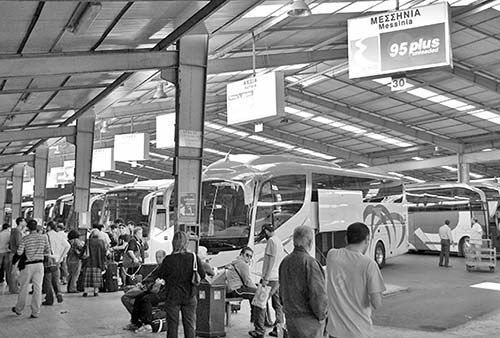
Although most destinations in this book are served by at least one daily direct bus from Athens, connecting between destinations outside of Athens can involve several changes. All Greek buses are operated by KTEΛ (KTEL) but there’s no useful general website or phone number (each region has its own website for its own schedules; some are better than others). For example, for bus service to destinations like Nafplio and Epidavros, check the schedules and general bus information at www.ktelargolida.gr.
TERMINAL A (KIFISSOU)
This bus station is about three miles northwest of the city center. Getting here on public transit is a pain involving a Metro-plus-bus connection (Metro to Omonia then bus #051) or a bus-plus-longish-walk (bus #12 from Syntagma Square to the Papathanasiou/ΠΑΠΑΘΑΝΑΣΙΟΥ stop, then 10 minutes by foot). It’s easier to take a taxi (pay no more than €15 from central Athens). Buses from here head to southwest Greece.
In the station’s vast ticket hall (follow signs to EKΔOTHPIA), the counters are divided by which region they serve; if you aren’t sure which one you need, ask at the information desk near the main door. Beyond the ticket hall are a cafeteria, a restaurant, and a supermarket, and the door out to the buses. This immense bus barn is crammed with well-labeled bus stalls, which are organized—like the ticket windows—by region. Taxis wait out in front of the ticket hall, as well as under the canopy between the ticket hall and the bus stalls (Terminal A info +30 210 512 4910).
There’s also a ticket office for Terminal A a couple of blocks from Omonia Square at 59 Sokratous street—much closer to the city center (see map on here, look for EKΔOTHPIA sign; Mon-Fri 7:00-17:00, Sat 7:30-15:30, closed Sun, +30 210 523 7889).
By Bus from Terminal A to: Nafplio (roughly hourly direct, 2.5 hours), Epidavros (2-3/day, 2.5 hours), Mycenae (go to Nafplio first, then 2-3/day, none on Sun, 45 minutes), Olympia (8/day, 5.5 hours, change in Pyrgos), Monemvasia (4-5/day, 6 hours), Kardamyli (1/day direct, more with change in Kalamata, 5-6 hours).
TERMINAL B (LIOSSION)
Smaller, more manageable, and a bit closer to the city center, Liossion (lee-oh-SEE-yohn) is in northwest Athens, a 15-minute, €8 taxi ride from the Plaka. You can also take the Metro to Attiki and then take any bus going north on Liossion street about a mile to Praktoria. Buses from here head northwest (Terminal B info +30 210 831 7186).
By Bus from Terminal B to: Delphi (4-5/day, 3 hours).
By Train
Greek trains are of limited usefulness to travelers sticking to the destinations described in this book. That may change, as the Greek train system has recently been privatized; however, it remains unclear when service will be expanded.
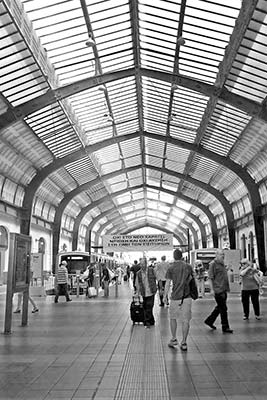
Though essentially useless if connecting south, trains do serve areas north of Athens well (such as Thessaloniki). If you do take the train from Athens, you’ll most likely use Larissa Station, just north of downtown (on Metro line 2/red). For now, the few trains are operated by Greek Railways (www.hellenictrain.gr). For more extensive travels beyond Greece, you can study your options at www.ricksteves.com/rail.
By Car
RENTING A CAR
Syngrou avenue is Athens’ “rental-car lane,” with all the established, predictable big companies (and piles of little ones) competing for your business. Syngrou is an easy walk from the Plaka and recommended hotels in Makrigianni and Koukaki. Budget travelers can often negotiate deals by checking with a few rental places and haggling. Or consider local company Swift/Escape, run by Elias, who can help you drive out of central Athens to avoid the stress of city-center driving (one-day rental: €40-60 depending on size of car; three-day rental: from €118 for compact; extra charge to drop car outside of Athens; open Mon-Sat 9:00-19:00, until 17:00 in winter, open Sun and after hours by request; at 43 Syngrou avenue, +30 210 924 7006 or +30 693 667 4476, www.greektravel.com/swift, elimano95@gmail.com).
ROUTE TIPS FOR DRIVERS
Avoid driving in Athens as much as possible—traffic is stressful, and parking is a headache. Before you leave Athens, get detailed directions from your rental agency on how to get back to their office and drop off your car.
Here’s your strategy for getting out of the city: If you’re heading north, such as to Delphi, aim for expressway 1 northbound (toward Lamia; see specific directions on here). To head for the Peloponnese, go westbound on expressway 6, which feeds into expressway 8 to Corinth (the gateway to the Peloponnese). The handy E-75 expressway (a.k.a. Kifissou avenue), which runs north-south just west of downtown Athens, offers an easy connection to either of these.
Assuming you pick up your car on or near Syngrou avenue, and traffic isn’t that heavy, the best bet (with the fewest traffic lights and turns) is usually to simply head south on Syngrou. As you approach the water, the road forks; follow signs toward Piraeus on the left. After the merge, get into the right lane and be ready to hop on E-75 northbound. Then watch for your exit: for the Peloponnese, keep left toward Korinthos (Corinth) and merge onto expressway 8; for Delphi, continue straight north to expressway 1.