OLYMPIA
Αρχαία Ολυµπία
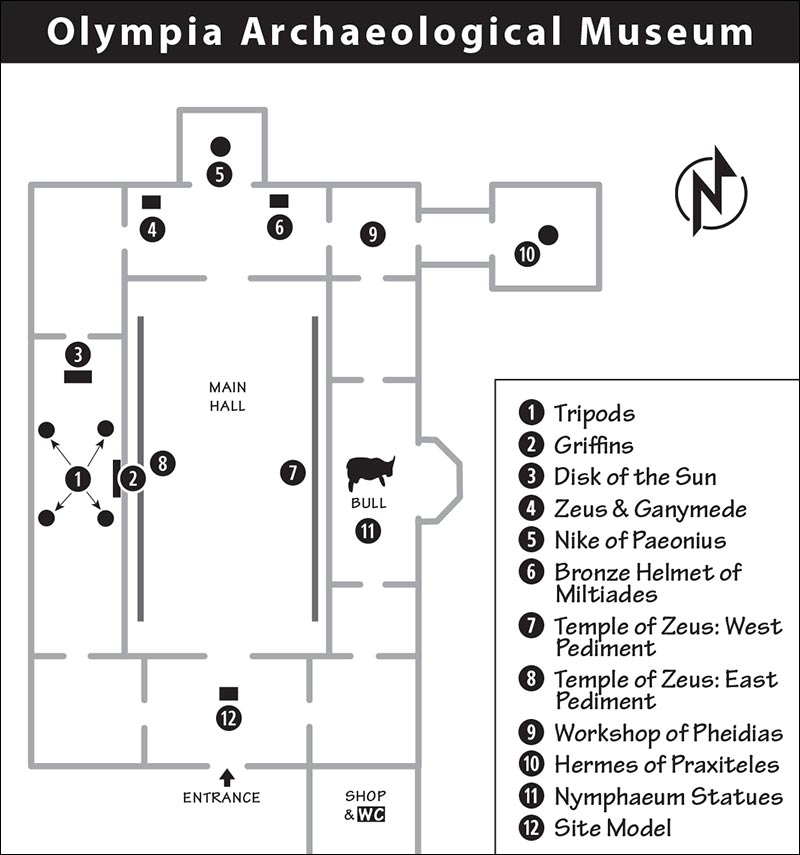
Map: Olympia Archaeological Museum
A visit to Olympia—most famous as the site of the original Olympic Games—offers one of your best opportunities for a hands-on experience with antiquity. Take your mark at the original starting line in the 2,500-year-old Olympic Stadium. Visit the Temple of Zeus, former site of a gigantic statue of Zeus that was one of the Seven Wonders of the Ancient World. Ponder the temple’s once-majestic columns—toppled like towers of checkers by an earthquake—which are as evocative as anything from ancient times. Take a close look at the Archaeological Museum’s gold-medal-quality statues and artifacts. And don’t forget to step back and enjoy the setting itself. Despite the crowds that pour through here, Olympia remains a magical place, with ruins nestled among lush, shady groves of pine trees.
The modern-day town of Olympia (pop. 13,000) is a tidy, pleasant, working-class community catering to the needs of the thousands of tourists who flock here year-round to visit the site. For drivers, a day and single overnight are enough time here; for those using public transportation, limited bus connections might require a two-night stay.
Patra (sometimes spelled Patras), the port for boats bringing travelers to Greece from Italy, is described at the end of this chapter.
Orientation to Olympia
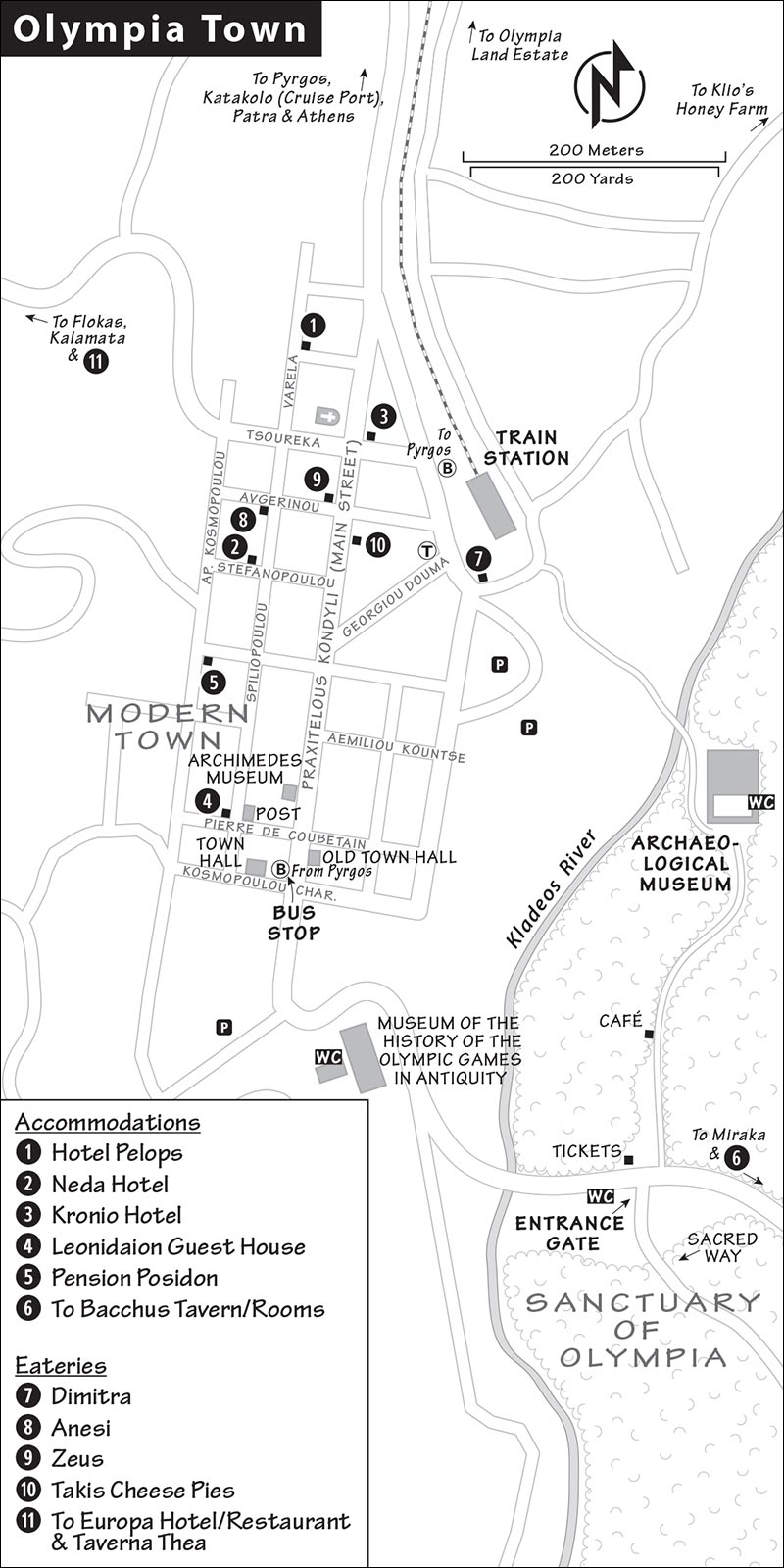
The Sanctuary of Olympia sits in the fertile valley of the Alphios River in the western Peloponnese, 12 miles southeast of the regional capital of Pyrgos. The archaeological site curves along the southeastern edge of the tidy modern village of Archaia (Ancient) Olympia. The town’s layout is basically a low-lying, easy-to-manage grid, five streets wide by eight streets long. The main road (called Praxitelous Kondyli) runs from Pyrgos in the north and leads right into a parking lot (and bus stop) at the south end of town. From here the museum and site are due east, over the Kladeos River.
Tourist Information: There’s no TI, but your hotelier should be able to answer most questions. You can also check local guide Niki Vlachou’s Olympia Travel Guide website, which contains updated information on sights—opening times, entry fees, discounts, etc.—and a detailed interactive area map (www.olympiatravelguide.com). She’ll also answer questions from my readers free of charge (see her listing below, under “Helpful Hints”).
ARRIVAL IN OLYMPIA
For driving directions into and out of Olympia, as well as options for reaching Olympia from the cruise-ship port of Katakolo, see “Olympia Connections,” later.
By Bus: The bus drops you off just before the retail strip on the main street, a quick walk from the well-signed sights.
By Car: Parking is free and easy. It’s fine to park on the streets in town. The best parking lots are near the Archaeological Museum, behind the main road next to the train station (see “Olympia Town” map). Avoid the bus lot near the Museum of the History of the Olympic Games in Antiquity, where you may get a ticket.
HELPFUL HINTS
Services: Olympia’s main street has wide sidewalks, countless gift shops, and ample hotels, eateries, minimarkets, ATMs, and other tourist services.
Taxis: There’s a taxi stand in town a block off the main street on the shady, angled side street called Georgiou Douma (+30 2624 022 555).
Local Guide: Unlike many other popular ancient sites, the Sanctuary of Olympia is not surrounded by hopeful guides-for-hire. Consider making advance reservations with fantastic local guide Niki Vlachou (reasonable and negotiable rates; in addition to guiding at Olympia, Niki can arrange transportation, wine tastings, olive-press visits, cooking classes, and meals in local homes; +30 697 242 6085, www.olympictours.gr, niki@olympictours.gr).
Sights in Olympia
▲▲▲THE SANCTUARY OF OLYMPIA AND ARCHAEOLOGICAL MUSEUM
Sanctuary of Olympia (The Site)
9 Bases of Zanes and Row of Treasuries
10 Krypti
11 Stadium
12 Metroon and the Altar of Zeus
13 Nymphaeum
16 Philippeion
Map: Olympia Archaeological Museum
▲▲Museum of the History of the Olympic Games in Antiquity
There are two main parts to your Olympia visit: the Sanctuary of Olympia archaeological site and the Archaeological Museum. With time and interest, a quick stop at the smaller Museum of the History of the Olympic Games in Antiquity is worthwhile.
▲▲▲THE SANCTUARY OF OLYMPIA AND ARCHAEOLOGICAL MUSEUM
Olympia was the mecca of ancient Greek religion—the location of its greatest sanctuary and one of its most important places of worship. In those times, people didn’t live here: The sanctuary was set aside as a monastery and pilgrimage site; the nearest city was 30 miles away. Ancient Greeks came here only every four years, during the religious festival that featured the Olympic Games. The heart of the sanctuary was a sacred enclosure called the Altis—a walled-off, rectangular area that housed two big temples, multiple altars, and statues to the gods.
Whereas Delphi served as a pilgrimage destination mostly for groups of wealthy men on a particular mission, every four years Olympia drew 40,000 ordinary dudes (men only) for a Panhellenic party: the Olympic Games.
Cost: A €12 combo-ticket (€6 off-season) covers the archaeological site, the Archaeological Museum, and the Museum of the History of the Olympic Games in Antiquity.
Hours: Generally daily 8:00-20:00, Sept until 19:00, Oct until 18:00, Nov-March 8:00-15:00. Schedules vary by season and can change without warning, so confirm these times locally.
Information: +30 2624 022 742, http://odysseus.culture.gr. The free, excellent, and interactive visual/audio online guide at http://olympiacommongrounds.gr helps bring the sanctuary to life.
Getting There: If staying in Olympia, it’s an easy five-minute walk from the town center to either the Sanctuary of Olympia or the Archaeological Museum. If arriving by car, park for free near the Archaeological Museum at one of two small lots at the east edge of town, south of the train station (see “Olympia Town” map, earlier; don’t park near the Museum of the History of the Olympic Games in Antiquity, where you may get a ticket). To reach the museum and site from the parking lots, follow the path away from town, walking several hundred yards and crossing the Kladeos River. Up the stairs is the museum. For the archaeological site, take the path opposite the museum entry.
Planning Your Time: I recommend walking the archaeological site first, then touring the Archaeological Museum to reconstruct what you’ve seen. If you’re passing the Archaeological Museum en route to the site anyway, you can buy your combo-ticket at the museum. Allow 1.5 hours for the site, and an hour for the Archaeological Museum.
Try to visit in the early morning or late afternoon (though the site can be very hot in the afternoon). These sights are most crowded between 10:00 and 13:00 (especially the Archaeological Museum). Off-season, it’s best to visit the site and museum in the morning in case they close in the afternoon.
If arriving late in the day, you can use your combo-ticket to tour one place in the late afternoon and the other parts the next morning (one entry per place).
If you have all day for sightseeing, first hit the small Museum of the History of the Olympic Games in Antiquity, which provides background on the ancient games that’ll help enliven your visit to the site (allow about a half-hour for this museum).
Services: There are WCs near the archaeological site (follow the signs). The museum has a shop and WCs (outside, to the right as you face the entrance), but no café or food (no food is allowed inside the site, though you can—and should—bring a water bottle). There’s a café with snacks and sandwiches midway on the path between the site and the museum. The kiosk next to the ticket booth at the site sells guidebooks to the site and museum.
Sanctuary of Olympia (The Site)
This center of ancient Greek religion dedicated to Zeus hosted the Olympic Games for more than a thousand years (c. 776 BC-AD 393). As you wander among these sporting arenas, temples, and statues, contemplate how the 100-meter dash was much more than a mere running race to the people of this civilization: It was a spiritual exercise that unified Greeks and expressed the most cherished values of Western civilization.
 Self-Guided Tour
Buy your tickets at the booth, use the WCs across the way if you need to, then head to the entrance gate. Inside, walk straight ahead (passing an orientation board) down into the ancient world of Olympia. This main path is called the Sacred Way.
• As you walk into the site, look to your left (through the trees) to catch glimpses of...
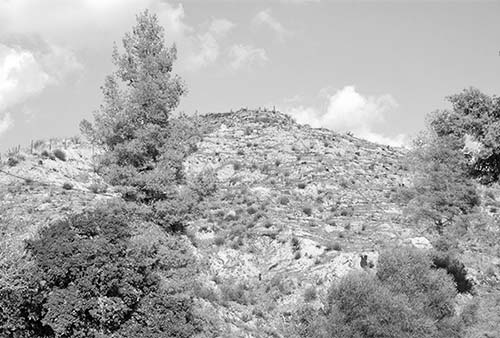
1 Kronos Hill
This hill was sacred to the ancient Greeks, who believed it to be the birthplace of Zeus—and the place where, as a clever baby, he escaped his father, Kronos, who’d tried to eat him. Zeus later overthrew Kronos and went on to lead the pantheon of gods. (Other versions of the myth place this event on Mt. Olympus, in northern Greece, where the gods eventually made their home.)
• The Sacred Way leads down into a wide field scattered with ruins. To the left of the path was an enclosed area filled with various temples and altars; to the right were buildings for the athletes, who trained and lived in a complex of buildings similar to today’s Olympic Village.
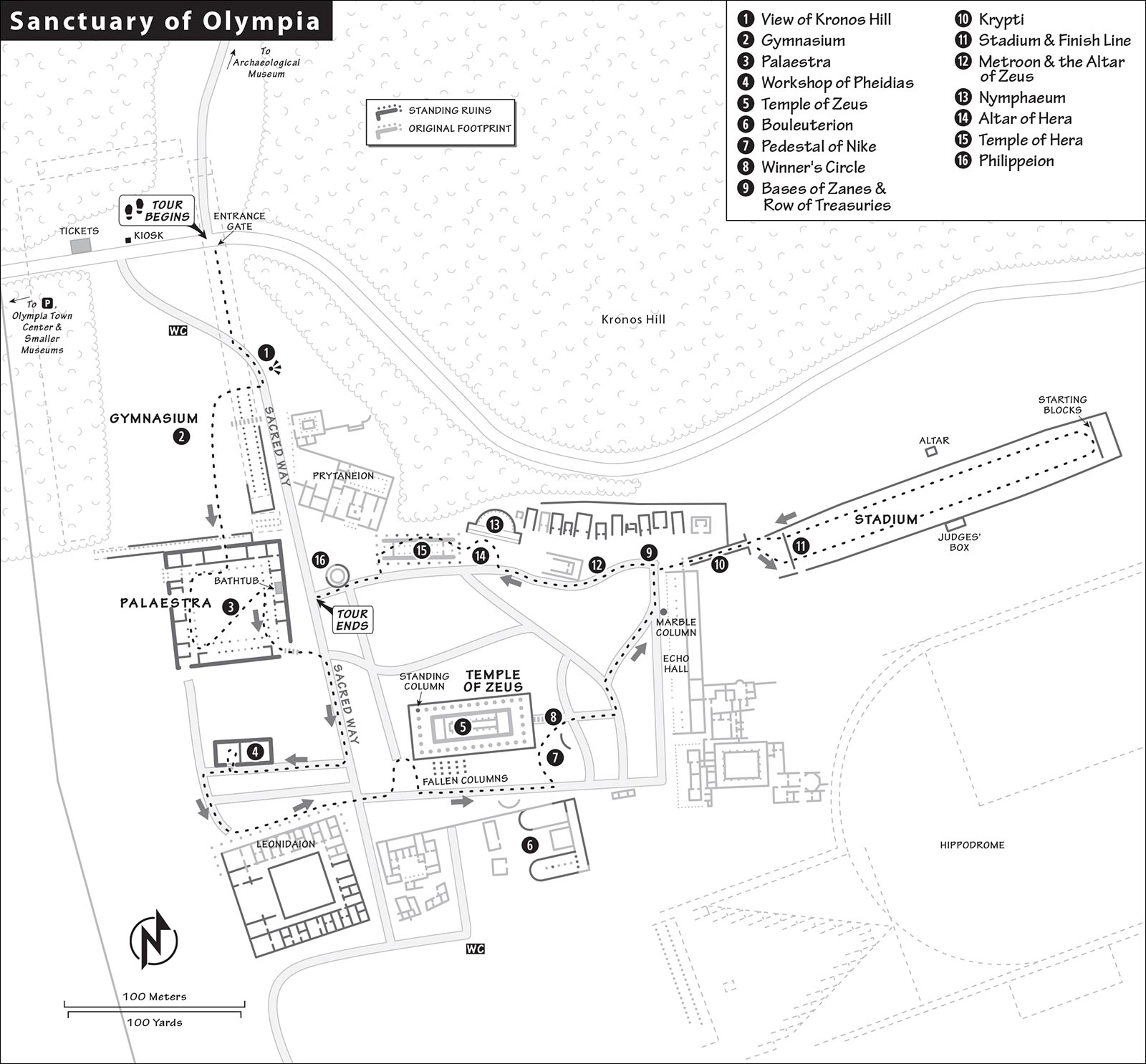
Head to the right along the small path just before the two long rows of stubby columns. They mark the eastern edge of what was once the...
2 Gymnasium
This was the largest building in the whole sanctuary, built in the fourth century BC. The truncated Doric columns once supported a covered arcade, one of four arcades that surrounded a big rectangular courtyard. Here athletes trained for events such as the sprint, discus throw, and javelin throw. The courtyard (about the size of six football fields, side-by-side along the Sacred Way) matched the length of the Olympic Stadium, so athletes could practice in a space akin to the one in which they would compete.
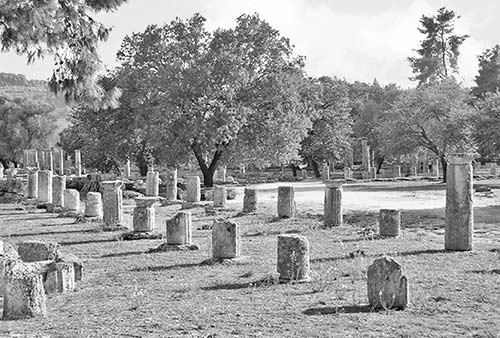
Because ancient Greeks believed that training the male body was as important as training the mind, sports were a big part of every boy’s education. Moreover, athletic training doubled as military training (a key element in citizenship)—so most towns had a gymnasium. The word “gymnasium” comes from the Greek gymnos (naked), which is how athletes trained and competed. Even today, the term “gymnasium” is used in many European countries (including Greece) to describe what Americans call high school.
Athletes arrived in a nearby town a month early for the Games in order to practice and size up the competition. The Games were open to any freeborn Greek male (men and boys competed separately), but a good share of competitors were from aristocratic homes. Athletes trained hard. Beginning in childhood, they were given special diets and training regimens, often subsidized by their city. Many became professionals, touring the circuit of major festivals.
• At the far end of the gymnasium ruins, a small set of stairs leads down to a square space ringed by twin rows of taller, more intact columns. This is the...
3 Palaestra
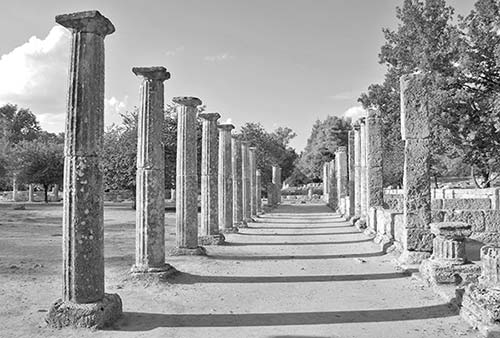
Adjoining the gymnasium was this smaller but similar “wrestling school” (built around 300 BC). This square courtyard (216 feet on each side—about one acre), also surrounded by arcades, was used by athletes to train for smaller-scale events: wrestling, boxing, long jump (performed while carrying weights, to build strength), and pankration, a kind of ancient “ultimate fighting” with only two rules: no biting and no eye-gouging.
The Olympic Games were athletic contests held every four years as a way of honoring Zeus, the king of the gods. They were the culmination of a pilgrimage, as Greeks gathered to worship Zeus, the Games’ patron.
The exact origins of the Games are lost to time, but they likely grew from a local religious festival first held at the Sanctuary of Olympia in about 1150 BC. According to one legend, the festival was founded by Pelops, namesake of the Peloponnese; a rival legend credits Hercules. Sporting events became part of the festivities. A harmonious, healthy body was a “temple” that celebrated its creator by performing at its peak.
The first Olympic Games at which results were recorded are traditionally dated at 776 BC. The Games grew rapidly, attracting athletes from throughout the Greek world to compete in an ever-growing number of events (eventually taking up to five days). They reached their height of popularity around 400 BC. Of the four major Greek games (including those at Delphi, Corinth, and Nemea), Olympia was the first, biggest, and most prestigious.
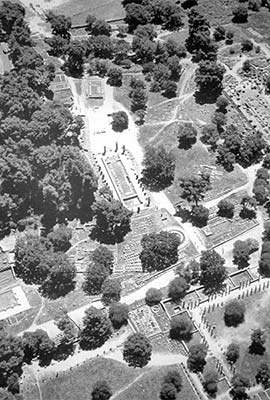
Besides honoring Zeus and providing entertainment, the Games served a political purpose: to develop a Panhellenic (“all-Greek”) identity among scattered city-states and far-flung colonies. Every four years, wars between bickering Greeks were halted with a one-month “sacred truce” so that athletes and fans could travel safely to Olympia. Leading citizens from all corners would assemble here, including many second- and third-generation Greeks who’d grown up in colonies in Italy, France, or Africa. Olympia was geographically central, and for the length of the festivities, it was the symbolic heart of Greece.
This went on for 1,169 years, finally concluding in AD 393. Olympia today lives on in the spirit of the modern Olympic Games, revived in Athens in 1896. Every other year, athletes from around the world gather and compete in contests that challenge the human spirit and, it’s hoped, foster a sense of common experience. Whether we’re cheering on an American swimmer, a Chinese gymnast, or a Jamaican sprinter to go faster, longer, and better than any human has before, the Games bring the world together for a few weeks, much as they united the Greek world in this tranquil pine grove so many centuries ago.
Picture athletes in the courtyard working out. They were always naked, except for a layer of olive oil and dust for a bit of protection against scrapes and the sun. Sometimes they exercised in time with a flute player to coordinate their movements and to keep up the pace. Trainers and spectators could watch from the shade of the colonnades. Notice that the columns are smooth (missing their fluting) on the lower part of the inside face. This way, when it rained, athletes could exercise under the arcade (or take a breather by leaning up against a column) without scraping themselves on the grooves.
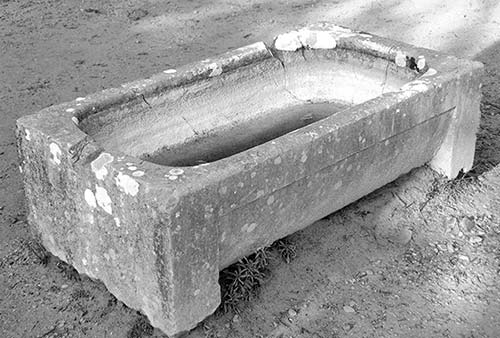
In the area nearest the Sacred Way, notice the benches where athletes were taught and people gathered for conversation. You can still see the bathtubs that athletes used to wash off their oil-dust coating. (They also used a stick-like tool to scrape off the oily grime.)
Besides being training facilities, palaestrae (found in almost every city) were also a kind of health club where men gathered to chat.
• Exit the palaestra on the left to continue down the Sacred Way, then take the next right. Climb the stairs at the far end, and peek into the ruined brick building that was once the...
4 Workshop of Pheidias
In this building, the great sculptor Pheidias (c. 490-430 BC) created the 40-foot statue of Zeus (c. 435 BC) that once stood in the Temple of Zeus across the street (for details on how he constructed it, see the sidebar). The workshop was built with the same dimensions as the temple’s cella (inner room) so that Pheidias could create the statue with the setting in mind. Pheidias arrived here having recently completed his other masterpiece, the colossal Athena Parthenos for the Parthenon in Athens. According to ancient accounts, his colossal Zeus outdid even that great work.
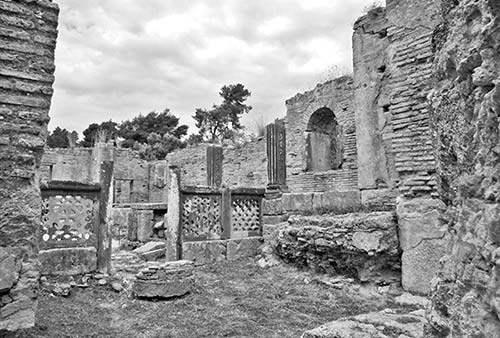
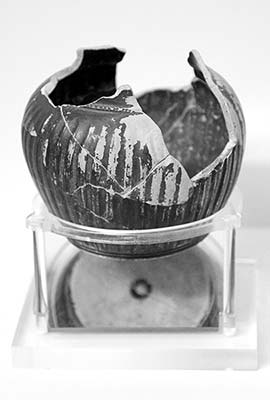
How do we know this building was Pheidias’ place? Because archaeologists found sculptors’ tools and molds for pouring metals, as well as a cup with Pheidias’ name on it (all now displayed in the museum). After the last ancient Games were held, this workshop was turned into a Christian church (fourth century AD—notice the semicircular part at the end facing east, which was added as an altar; see “Olympia’s Legacy,” later).
• Head out of the workshop, then loop around back and to the left, past a large, open, rubble-strewn field (to the right) with dozens of thigh-high Ionic capitals. This was the site of the massive Leonidaion, a luxury, four-star hotel—boasting 145 rooms, private baths, and a central pool—built in the fourth century BC to house dignitaries and famous athletes during the Games.
Cross the Sacred Way, head up the ramp/stairs, then veer left toward Olympia’s main sight, marked by a single standing column.
5 Temple of Zeus
The center of ancient Olympia—both physically and symbolically—was the massive temple dedicated to Zeus, king of the gods and patron of the Games. It was the first of the golden age temples, one of the biggest (not much smaller than the Parthenon) and the purest example of the Doric style.
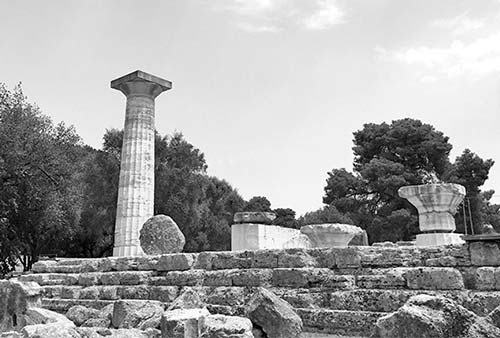
The temple was built in the fifth century BC (470-455 BC), stood for a thousand years, and then crumbled into the evocative ruin we see today, still lying where it fell in the sixth century AD.
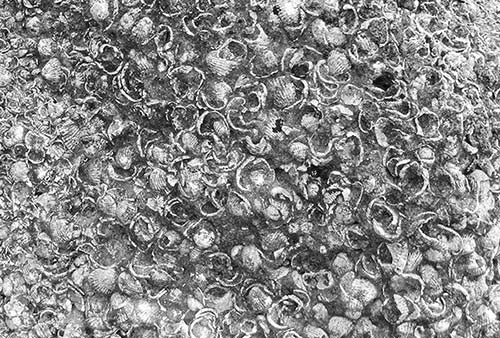
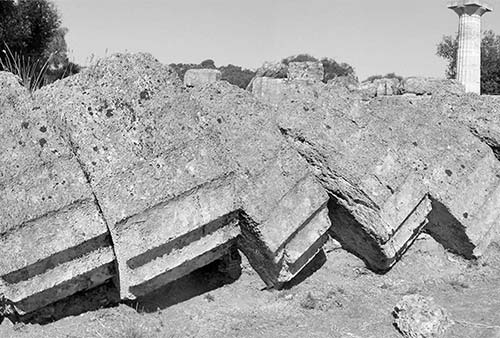
Stand in front of the rubble field strewn with big gray blocks, two-ton column drums, and fallen 12-ton capitals. They’re made not of marble but of cheaper local limestone. Look closely and you can see the seashell fossils in this porous (and not terribly durable) sedimentary rock. Most of the temple was made of limestone, then covered with a marble-powder stucco to make it glisten as brightly as if it were made of pure marble. The pediments and some other decorations were made of expensive white marble from the isle of Paros.
Imagine yourself as a visitor to the Temple of Zeus in ancient times. You’d enter from the east end (the end opposite the Sacred Way). Peering to the far side of the temple, you’d see the monumental statue of Zeus sitting 40 feet high on a golden throne. The statue gleamed gold and white, with colored highlights. In his right hand Zeus held a winged statue of Nike (goddess of victory), and in his left hand was a scepter topped with an eagle. Zeus completely filled the space. His head almost touched the ceiling (which was higher than the exterior columns), and his arms almost touched the sides, making the colossal statue appear even bigger. A cistern of olive oil on the temple floor reflected golden hues onto the statue.
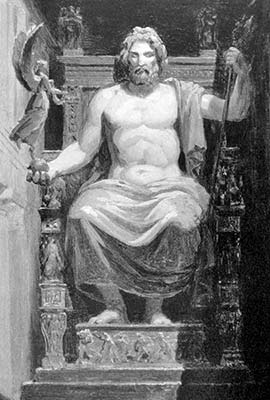
Pheidias made the statue with a core of wood. He covered that with plates of ivory (soaked, carved, and worked into shape) to make Zeus’ skin and 500 pounds of gold plates for the clothes and the throne. (Such statues, when decorated with gold and ivory—as many religious statues in ancient Greece were—are called “chryselephantine.”) Pheidias’ assistants painted the throne with scenes of the gods.
The statue was considered by ancient people as one of the Seven Wonders—a list of tourist musts that also included the Colossus of Rhodes and the pyramids of Egypt. We know the general outlines of the statue because it appeared on coins of the day.
We also know that the statue stood for 900 years, but no one knows what became of it. It may have been melted down by Christians or destroyed in the earthquakes that toppled the temple. Others think the pieces were carried off to Constantinople and accidentally burned in that city’s catastrophic fire of AD 476.
An olive tree near the temple’s southwest corner (to your left) marks the spot of the original tree (planted by Hercules, legends say) from which the winners’ wreaths were made. Then as now, olives were vital to Greece, providing food, preservatives, fuel, perfumes...and lubrication for athletes.
You’re standing near the back (west) end of the temple, near its most sacred part: the cella, where Pheidias’ statue of Zeus stood. The interior of the temple is closed indefinitely; to get a good look you’ll have to head back to the path that runs along what was once the south porch of the temple—the side facing away from Kronos Hill.
As you walk around the temple, try to reconstruct it in your mind. It was huge—about half an acre—and stood six stories tall. The lone standing column is actually a reconstruction (of original pieces, cleaned and restacked), but it gives you a sense of the scale: It’s 34 feet tall, 7 feet thick, and weighs 9 tons. This was one of 34 massive Doric columns that surrounded the temple: 6 on each end and 13 along the sides (making this a typical peripteral/peristyle temple, like Athens’ Parthenon and Temple of Hephaistos in the Ancient Agora).
The columns originally supported a triangular pediment at each end (now in the Archaeological Museum), carved with scenes of the battle of the Lapiths and centaurs (west end) and Pelops and the chariot race (east end, which was the main entrance).
Along the south side of the temple, you’ll see five huge fallen columns, with their drums lined up in a row like dominos. To the right of the path (across from the fallen columns) are the ruins of the 6 Bouleuterion, the council chamber where, by stepping on castrated bulls’ balls, athletes took an oath not to cheat. As this was a religious event, and because physical training was a part of moral education, the oaths and personal honor were held sacred.
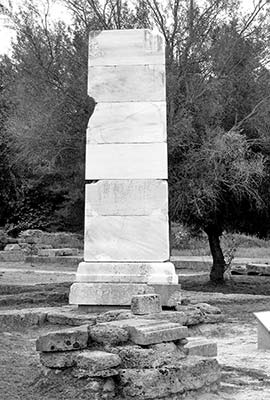
Continue down the path to the front (east) end of the temple and duck off the path to the left to find the 29-foot-tall, white-marble, triangular 7 Pedestal of Nike. It’s missing its top, but it once held a famous statue (now in the museum) of the goddess Nike, the personification of victory.
She looked down upon the 8 Winner’s Circle, here at the main entrance to the temple, where Olympic victors were announced and crowned. As thousands gathered in the courtyard below, priests called the name of the winner, who scaled the steps to the cheers of the crowd. The winner was crowned with a wreath of olive (not laurel) branches, awarded a statue in his honor—and nothing more. There were no awards for second and third place and no gold, silver, or bronze medals—those are inventions of the modern Olympics. However, winners were usually showered with gifts and perks from their proud hometowns: free food for life, tax exemptions, theater tickets, naming rights for gymnasiums, statues, pictures on ancient Wheaties boxes, and so on.
In the courtyard you can see pedestals that once held statues of winners, who were considered to be demigods. The inscriptions listed the winner’s name, the date, the event won, his hometown, and the names of his proud parents.
With the main entrance of the Temple of Zeus at your back, walk toward the tall marble column off to your left. This column was built in 270 BC to honor Egyptian King Ptolemy II, the son of one of Alexander the Great’s generals. After an eight-year modern-day restoration, the column now reaches its original height, allowing visitors to better visualize the scale of Olympia’s monuments. It stands in front of the ruins of the Echo Hall, a long gallery where winners were announced as if into a microphone—the sound echoed seven times.
• From the column, walk toward the low wall at the base of Kronos Hill. The foot of the hill is lined with a row of pedestals, called the...
9 Bases of Zanes and Row of Treasuries
These 16 pedestals once held bronze statues of Zeus (plural “Zanes”). At the ancient Olympic Games, as at the modern ones, it was an honor just to compete and there was no shame in not finishing first. Quitters and cheaters were another story. The Zeus statues that once lined this path were paid for with fines levied on cheaters, whose names and ill deeds were inscribed in the bases. As people entered the stadium (to the right), they’d spit on the names on the bases. Offenses ranged from doping (using forbidden herbs) or bribing opponents, to failing to train in advance of the Games or quitting out of cowardice. Drinking animal blood—the Red Bull of the day—was forbidden. Official urine tasters tested for this ancient equivalent of steroids.
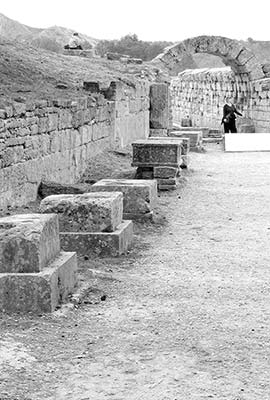
Just behind the statues (and a few feet higher in elevation) is a terrace that once held a row of treasuries. These small buildings housed expensive offerings to the gods. Many were sponsored by colonies as a way for Greeks living abroad to stay in touch with their cultural roots.
• Turn right and pass under the arch of the...
10 Krypti
As you enter the stadium through this tunnel, imagine yourself as an athlete who has trained for years and traveled for days, carrying the hopes of your hometown on your shoulders...and now finally about to compete. Built around 300 BC, this tunnel once had a vaulted ceiling; along the walls are niches that functioned as equipment lockers. Just like today’s NFL players, Olympia’s athletes psyched themselves up for the big contest by shouting as they ran through this tunnel, then emerging into the stadium to the roar of the crowd.
• On your mark, get set, go. Follow the Krypti as it leads into the...
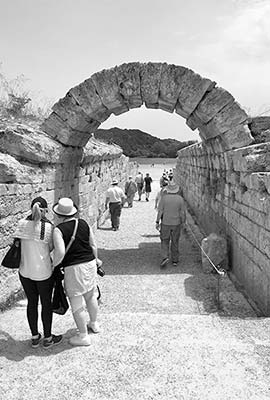
11 Stadium
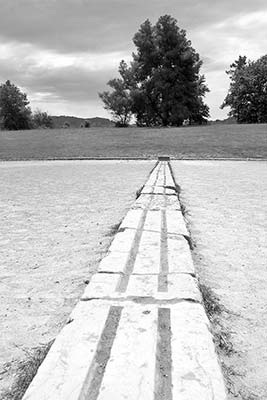
Line up on that original marble-paved starting line from the ancient Olympic Games and imagine the scene. The place was filled with 45,000 spectators—men, boys, and girls—who sat on the man-made banks on either side of the track. One lone adult woman was allowed in: a priestess of the goddess Demeter Chamyne, whose altar rose above the sea of testosterone from the north (left) bank (still visible today).
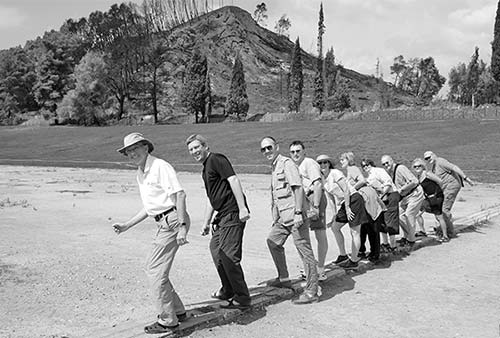
The stadium (built in the fifth century BC) held no seats except those for the judges, who sat in a special box (visible on the south bank, to your right). The Hellanodikai (Judges of the Greeks) kept things on track. Elected from local noble families and carefully trained over 10 months for just a few days of Games, these referees were widely respected for their impartiality.
The stadium track is 192 meters (640 feet) from start to finish line. The Greek word stadion literally means a course that is 600 traditional Olympic feet long, supposedly first marked out by Hercules. The line at the near (west) end marked the finish, where all races ended. (Some started at this end as well, depending on how many laps in the race, but most started at the far end.) The racers ran straight up and back on a clay surface, not around the track. There were 20 starting blocks (all still visible today), each with two grooves—one for each foot (athletes competed barefoot). Wooden starting gates (similar to those used in horse races today) made sure no one could jump the gun.
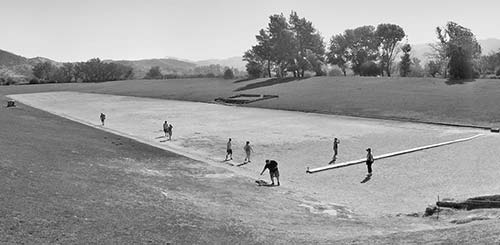
The first Games featured just one event, a sprint race over one length of the stadium, or one stadion. Imagine running this distance in 19.3 seconds, as Usain Bolt of Jamaica did at the 2012 Olympic Games. Over time, more events were added. There were races of two stadia (that is, up and back, like today’s 400-meter event), 24 stadia (similar to today’s 5K race), and a race in which athletes competed in full armor, including shields.
At the height of the Games (c. 400 BC), there were 13 events held over five days, most here in the stadium. Besides footraces, you’d see events such as the discus, javelin, boxing, wrestling, long jump, pankration (a wrestling/boxing/martial arts mix), and the pentathlon. (The decathlon is a modern invention.) During the 2004 Games in Athens, the shot-put competition was held in this stadium. South of the stadium was the hippodrome, or horse-racing track, where riding and chariot races took place.
Compare this stadium and the events held here with the gladiatorial contests in ancient Rome several centuries later: In the far more massive Colosseum, the sensationalistic events weren’t about honor, athletic glory, or shared humanity, but a bloody fight to the death, staged to remind the citizens of the power of the state. Good thing it’s the Greek games we now emulate.
• Backtrack through the tunnel and continue straight past the pedestals for the Zeus statues. You’ll bump into some rectangular foundations, the ruins of the...
12 Metroon and the Altar of Zeus
The Metroon (mid-fourth century BC) was a temple dedicated to the mother of the gods, Rhea (also known as Cybele). The site also honored the mother-goddess of the earth, worshipped as Gaia.
Somewhere near here once stood the Altar of Zeus, though no one knows exactly where—nothing remains today. At this altar the ancient Olympians slaughtered and burned animals in sacrifice to Zeus on a daily basis. For special festivals, they’d sacrifice 100 cattle (a “hecatomb”), cook them on the altar, throw offerings into the flames, and feast on the flesh, leaving a pile of ashes 25 feet high.
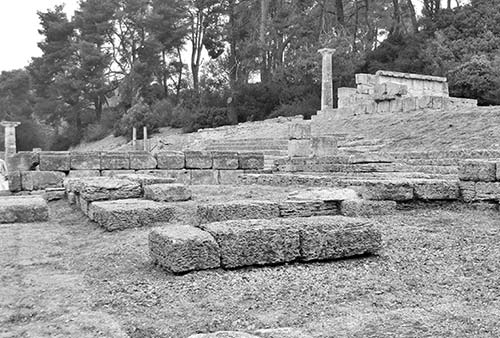
In the middle of the wide path, under an olive tree, is a sunken apse. It’s the foundation of a 3,000-year-old house—more than 1,000 years older than the ancient ruins we’ve seen elsewhere—and more evidence that this site was important long before the Olympic Games and the golden age of ancient Greece.
• To the right are the ruins of a semicircular structure built into the hillside, the...
13 Nymphaeum
This was once a spectacular curved fountain lined with two tiers of statues of emperors, some of which are now in the Archaeological Museum. The fountain provided an oasis in the heat and functioned as an aqueduct, channeling water throughout the Sanctuary of Olympia. It was built toward the end of the sanctuary’s life (around AD 150) by the wealthy Roman Herodes Atticus (who also financed construction of the famous theater at the base of the Acropolis in Athens—the Odeon of Herodes Atticus).
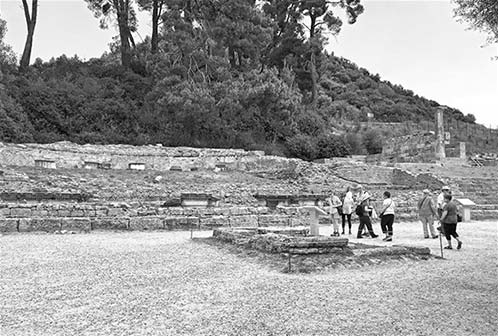
When the Romans conquered Greece in the second century BC, they became fans of Greek culture, including the Olympics. The Romans repaired neglected buildings and built new structures such as this one. But they also changed (some say perverted) the nature of the Games, transforming them from a Greek religious ritual to a secular Roman spectacle. Rome opened the Games to any citizen of the empire, broadening their appeal at the cost of their Greekness.
Rome’s notorious Emperor Nero—a big fan of the Olympics—attended the Games in the mid–first century AD. He built a villa nearby, started music contests associated with the Games, and entered the competition as a charioteer. But when he fell off his chariot, Nero ordered the race stopped and proclaimed himself the winner.
• Directly in front of the Nymphaeum are the rectangular foundations of what was once the...
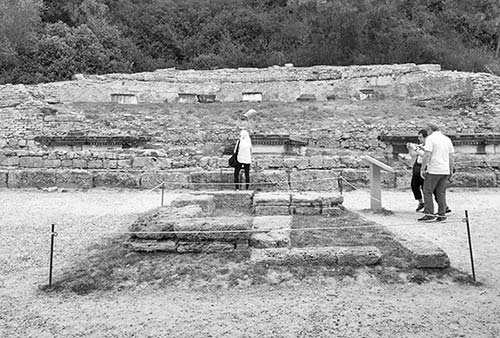
14 Altar of Hera
These humble foundations provide a bridge across millennia, linking the original Olympics to today’s modern Games. Since 1936, this has been where athletes light the ceremonial Olympic torch (for both the summer and winter Games). A few months before the modern Games begin, local women dress up in priestess garb and solemnly proceed here from the Temple of Hera. A curved, cauldron-shaped mirror is used to focus the rays of the sun, igniting a flame. The women then carry the flame into the stadium, where runners light a torch and begin the long relay to the next city to host the Games, wherever in the world that may be.
• Fifteen yards farther along are the four standing Doric columns that mark the well-preserved...
15 Temple of Hera
First built in 650 BC, this is the oldest structure on the site and one of Greece’s first monumental temples. The temple originally honored both Hera and her husband Zeus, before the Temple of Zeus was built.
The temple was long but not tall, giving it an intimate feel. Its length-to-width ratio (and number of columns: 6 on the short sides, 16 on the long ones) is 3:8, which was considered particularly harmonious and aesthetically pleasing, as well as astronomically significant (the ancients synchronized the lunar and solar calendars by making the year three months longer every eight years).
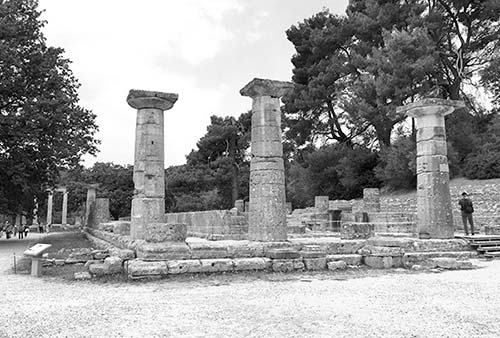
The temple was originally made of wood. Over time, the wooden columns were replaced with stone columns, resulting in a virtual catalog of the various periods of the Doric style. The columns are made from the same shell-bearing limestone as most of the site’s buildings, also originally covered in marble stucco.
Inside, a large statue of Hera once sat on a throne with Zeus standing beside her. Hera’s priestesses wove a new dress for the statue every four years. The temple also housed a famous statue of Hermes and was topped with the Disk of the Sun (both are now in the museum).
Although women did not compete in the Olympics, unmarried women did compete in the Heraean Games, dedicated to Hera. The Heraean Games were also held here every four years, though not in the same years as the Olympics. Wearing dresses that left one shoulder and breast exposed, the young women raced on foot (running five-sixths of a stadion, or 160 meters/525 feet). Like the men, the winners received olive wreaths and fame, as well as a painted portrait displayed on a column of the Temple of Hera.
• Walking out the back of Hera’s temple, you’ll reach our last stop: a round temple with three reconstructed Ionic columns. This was the...
16 Philippeion
The construction of the Philippeion marked a new era in Greece: the Hellenistic era. (Compare these gracefully slender Ionic columns to the earlier, stouter Doric columns of the Temple of Hera—in the centuries between when they were built, Greek ideals of proportion had shifted away from sturdiness and strength to a preference for elegant beauty.)
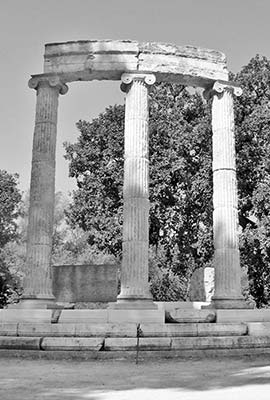
Philip of Macedon built this monument to mark his triumph over the Greeks. The Macedonians spoke Greek and had many similar customs, but they were a kingdom (not a democracy), and the Greeks viewed them as foreigners. Philip conquered Greece around 340 BC, thus uniting the country—by force—while bringing its Classical Age to an end.
The temple—the first major building visitors saw upon entering the sacred site—originally had 18 Ionic columns of limestone and marble stucco (though today it appears dark, as the gleaming stucco is long gone). Inside stood statues of Philip and his family, including his son, the man who would bring Greece to its next phase of glory: Alexander the Great.
Just north of the Philippeion, bordering the Sacred Way and difficult to make out, are the scant remains of the Prytaneion, the building that once housed the eternal Olympic flame.
Olympia’s Legacy
After the Classical Age, the Games continued, but not in their original form. First came Alexander and a new era of more secular values. Next came the Romans, who preserved the Games but also commercialized them and opened them up to non-Greeks. The Games went from being a somber celebration of Hellenic culture to being a bombastic spectacle. The lofty ideals for which the games were once known had evaporated—along with their prestige. As Rome/Greece’s infrastructure decayed, so did the Games. A series of third-century earthquakes and the turmoil of the Herulian invasion (in AD 267) kept the crowds away. As Greece became Christian, the pagan sanctuary became politically incorrect.
The last ancient Games (the 293rd) were held in AD 393. A year later, they were abolished by the ultra-Christian emperor Theodosius I as part of a general purge of pagan festivals. The final blow was delivered in 426, when Theodosius II ordered the temples set ablaze. The remaining buildings were adopted by a small early Christian community, that turned Pheidias’ workshop into their church. They were forced to abandon the area after it was hit by a combination of earthquakes (in 522 and 551) and catastrophic floods and mudslides. Over the centuries, two rivers proceeded to bury the area under 25 feet of silt, thus preserving the remaining buildings until archaeologists started excavations in 1875. They finally finished digging everything out in 1972.
• The Archaeological Museum is 200 yards to the north and well-signed.
Archaeological Museum
Many of Olympia’s greatest works of art and artifacts have been removed from the site and are now displayed, and well-described in English, in this compact and manageable museum.
Self-Guided Tour: The museum has a prescribed route to follow for your visit. This tour takes you past the highlights, but there’s much more to see if you have time.
• From the ticket desk, go left through the first room with pre-historic artifacts, then straight into the larger, longer room. Amid a mishmash collection of helmets, shields, and other armor, you’ll see several...
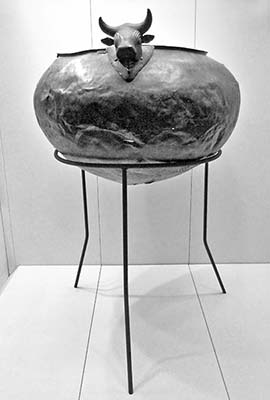
1 Tripods: These cauldrons-with-legs were used as gifts to the gods and to victorious athletes. For religious rituals, tripods were used to pour liquid libations, to hold sacred objects, or to burn incense or sacrificial offerings. As ceremonial gifts to the gods, tripods were placed atop and around temples. And as gifts to athletes, they were a source of valuable bronze (which could easily be melted down into some other form), making for a nice “cash” prize.
• Along the right wall is an assortment of cool-looking...
2 Griffins: Because Greeks considered the lion the king of the beasts, and the eagle the top bird, the half-lion-half-eagle griffin was a popular symbol of power for the ancient Greeks, even if no such animal actually existed.
• At the end of this hall you’ll find the...
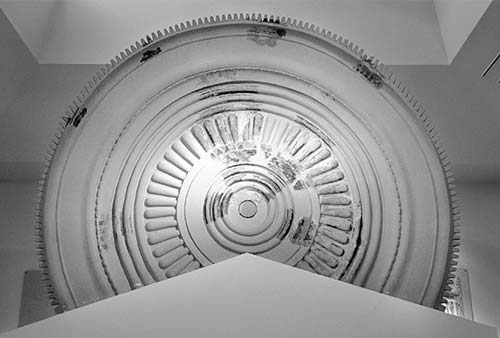
3 Disk of the Sun: This terra-cotta disk—seven-and-a-half feet across and once painted in bright colors—was the central roof decoration (called an acroterion) that perched atop the peak of the roof of the Temple of Hera. It stood as a sun- or star-like icon meant to ward off bad juju and symbolize Hera’s shining glory.
• Go past the sun disk and into the next room, which features large, decorated terra-cotta pediments—a reminder that these temples were not the plain-white marble we imagine them today. Make a right into another long room. On your left as you enter, have a look at the...
4 Statue of Zeus Carrying Off Ganymede: See Zeus’ sly look as he carries off the beautiful Trojan boy Ganymede to be his cup-bearer and lover. The terra-cotta statue was likely an acroterion (rooftop decoration) placed atop one of the treasury houses.
• Just ahead on your left you’ll see a statue rising and floating on her pedestal. She’s the...
5 Nike of Paeonius: This statue of Victory (c. 421 BC) once stood atop the triangular Pedestal of Nike next to the Temple of Zeus. Victory holds her billowing robe in her outstretched left hand and a palm leaf in her right as she floats down from Mt. Olympus to proclaim the triumph of the Messenians (the Greek-speaking people from southwest Peloponnese) over Sparta.
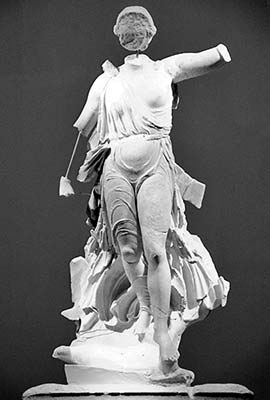
The statue, made of flawless pure-white marble from the island of Paros, is the work of the Greek sculptor Paeonius. It was damaged in the earthquakes of AD 522 and 551, and today, Nike’s wings are completely missing. But they once stretched behind and above her, making the statue 10 feet tall. (She’s about seven feet today.) With its triangular base, the whole monument to Victory would have been an imposing 36 feet tall, rising above the courtyard where Olympic winners were crowned.
• In the glass case to the right as you face Nike are two bronze helmets. The battered green one (#2) is the...
6 Bronze Helmet of Miltiades: In September of 490 BC, a huge force of invading Persians faced off against the outnumbered Greeks on the flat plain of Marathon, north of Athens. Although most of the Athenian generals wanted to wait for reinforcements, Miltiades convinced them to attack. The Greeks sprinted across the plain, into the very heart of the Persians—a bold move that surprised and routed the enemy. According to legend, a runner carried the good news to Athens. He raced 26.2 miles from Marathon to Athens, announced “Hurray, we won!”...and dropped dead on the spot.
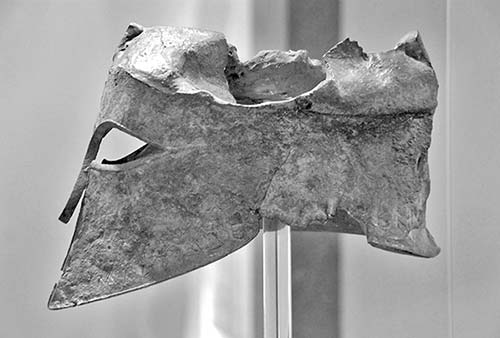
The legend inspired the 26.2-mile race called the marathon—but the marathon was not an Olympic event in ancient times. It was a creation for the first modern Games, revived in Athens in 1896.
• Next, the route takes you into the museum’s largest hall. On the left wall are...
7 Statues from the West Pediment of the Temple of Zeus: These statues fit snugly into the 85-foot-long pediment that stood over the back side of the temple (facing the Sacred Way). Study the scene depicting the battle of the Lapiths and centaurs: The centaurs have crashed a human wedding party in order to carry off the women. See one dramatic scene of a woman and her horse-man abductor just left of center. The Lapith men fight back. In the center, a 10-foot-tall Apollo stands calmly looking on. Fresh from their victory in the Persian Wars, the Greeks were particularly fond of any symbol of their struggles they had waged.
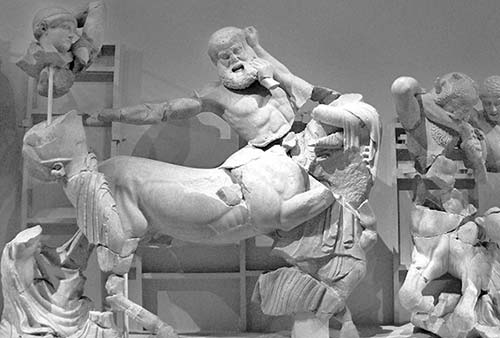
The statues from the West Pediment are gorgeous examples of the height of golden age sculpture: Notice the harmony of the poses and how they capture motion at the perfect moment without seeming melodramatic. The bodies, clearly visible under clothing, convey all the action, while the faces (in the statues that still have them) are stoic.
• On the opposite side of the hall are...
8 Statues from the East Pediment of the Temple of Zeus: Olympic victors stood beneath this pediment—the temple’s main entrance—as they received their olive wreaths. The statues tell the story of King Pelops, the legendary founder of the Games. A 10-foot-tall Zeus in the center is flanked by two competing chariot teams. Pelops (at Zeus’ left hand, with the fragmented legs) prepares to race King Oenomaus (at Zeus’ right) for the hand of the king’s daughter Hippodamia (standing beside Pelops). The king, aware of a prophecy predicting that he would be murdered by his son-in-law, killed 13 previous suitors after defeating them in chariot races. But Pelops wins this race by sabotaging the king’s wheels (that may be what the crouching figure is up to behind the king’s chariot), causing the king to be dragged to his death by his horses (just like that chariot race in Ben-Hur). Pelops becomes king and goes on to unify the Peloponnesian people with a festival: the Olympic Games.
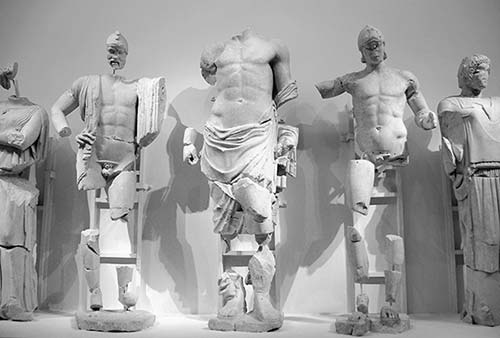
As some of the first sculpture of the golden age (made after the Persian invasion of 480 BC), these figures show the realism and relaxed poses of the new age (note that they’re missing those telltale Archaic-era smiles). But they are still done in the Severe style—the sculptural counterpart to stoic Doric architecture—with impassive faces and understated emotion, quite different from the exuberant West Pediment, made years later. Still, notice how refined the technique is—the horses, for example, effectively convey depth and movement. But seen from the side, it’s striking how flat the sculpture really is.
• Retrace your steps into the hall with the Nike statue, then make a right into the next room with the Zeus statue painting...
9 Workshop of Pheidias Room: The poster shows Pheidias’ great statue of Zeus, and a model reconstructs the workshop where he created it. In the display case directly to the left as you enter, find exhibit #10, the clay cup of Pheidias. The inscription on the bottom (hence the mirror) reads, “I belong to Pheidias.” The adjacent case holds clay molds that were likely used for making the folds of Zeus’ robe. The case in the opposite corner contains lead and bronze tools used by ancient sculptors to make the statues we’ve seen all day.
• The room hiding behind the Zeus poster contains...
10 Hermes of Praxiteles: This seven-foot-tall statue (340-330 BC), discovered in the Temple of Hera, is possibly a rare original by the great sculptor Praxiteles. Although little is known of this fourth-century sculptor, Praxiteles was recognized in his day as the master of realistic anatomy and the first to sculpt nude women. If this statue looks familiar, that’s because his works influenced generations of Greek and Roman sculptors, who made countless copies.
Hermes leans against a tree trunk, relaxed. He carries a baby—the recently orphaned Dionysus—who reaches for a (missing) object that Hermes is distracting him with. Experts guess the child was probably groping for a bunch of grapes, which would have hinted at Dionysus’ future role as the debauched god of wine and hedonism.
Circle the statue counterclockwise and watch Hermes’ face take on the many shades of thoughtfulness. From the front he appears serene. From the right (toward the baby), he seems sad. But from the left (toward his outstretched arm), there’s the hint of a smile. (And from the back, nice cheeks!)
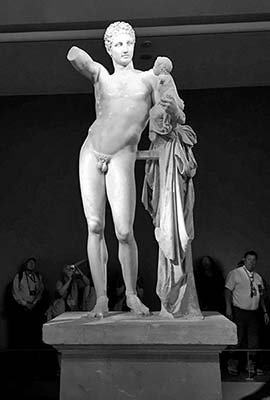
The statue has some of Praxiteles’ textbook features. The body has the distinctive S-curve of Classical sculpture (head tilted one way, torso the other, legs another). Hermes rests his arm on the tree stump, over which his robe is draped. And the figure is interesting from all angles, not just the front. Praxiteles could make hard, white, translucent marble appear as supple, sensual, and sexual as human flesh.
• Return to the Pheidias room, then make a left, continuing until you come to a statue of a bull, from the Roman-era Nymphaeum fountain.
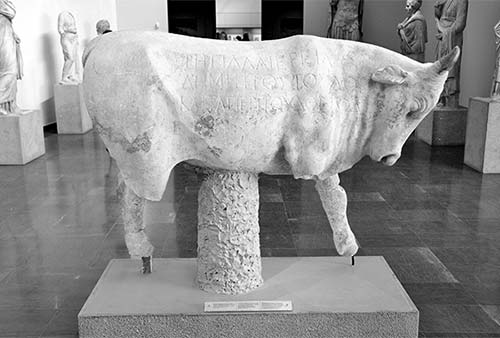
11 Nymphaeum Statues: The grand semicircular fountain near the Temple of Hera had two tiers of statues, including Roman emperors and the family of the statue’s benefactor, Herodes Atticus. Here you can see some of the surviving statues, as well as a bull (in the center of the room) that stood in the middle of the fountain. The bull’s inscriptions explain the fountain’s origins. Compared to the energetic statues we just saw from the west pediment of the Temple of Zeus, these stately statues are static and lackluster.
The next (smaller) room holds more Roman-era statues, from the Metroon and the Temple of Hera.
• The route leads back to the main entrance foyer, where to the right you’ll find an interesting...
12 Model of the Site, Reconstructed: This model shows Olympia as it appeared at the height of its glory. You can see the original placement of some of the artifacts we just viewed in the museum: On the Temple of Zeus, notice the pediments, topped with statues and tripods. Southeast of the temple is the Pedestal of Nike, supporting the statue of Nike. Find Pheidias’ workshop and the Temple of Hera, topped with the Disk of the Sun.
• With that, you’ve seen the core of Olympia’s archaeological collection. For more on the Games themselves, consider checking out the Museum of the History of the Olympic Games in Antiquity.
OTHER SIGHTS IN OLYMPIA
▲▲Museum of the History of the Olympic Games in Antiquity
Most people are familiar with the modern-day Olympics, but the games played by those early Olympians were a very different operation. Perched on a low hill across the river from the Sanctuary of Olympia archaeological site (above the south parking lot), this collection offers a handy “Ancient Olympics 101” lesson that helps bring the events to life and nicely complements the other attractions in Olympia. If you can spare the 30-45 minutes it takes to see this museum, stop here first to get your imagination in gear before seeing the ancient site.
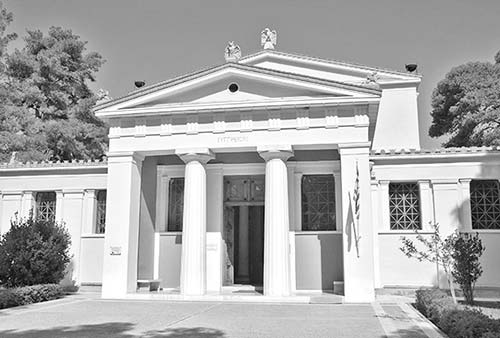
The rooms around the perimeter of the building tell the story of the original Games. You’ll learn about the various religious elements of the celebration and how women participated in sports, see the awards and honors for the victors, and admire a beautiful mosaic floor (c. AD 200) depicting some of the events. The main central hall focuses on the athletic contests themselves, displaying ancient discuses, javelin heads, halters (weights used in the long jump), and large shields that were carried by fully armor-clad runners in some particularly exhausting footraces.
Cost and Hours: Covered by Sanctuary of Olympia combo-ticket; daily 8:00-20:00; Nov-March Mon 10:00-17:00, Tue-Sun 8:00-15:00; WCs outside building.
Archimedes Museum
Located on the main drag in Olympia town, the Archimedes Museum is most appealing to engineering nuts, but its interactive exhibits can be fun for anyone. This museum shows off replicas of ancient Greek technologies such as the Archimedes screw, the crane used to build the Parthenon, the Antikythera mechanism (ancient computer thought to have been used in astronomy), and the pantograph (the original photocopier). The models (and museum) were created by mechanical engineer and author Konstantinos Kotsanas, who has dedicated his life to understanding and recreating ancient Greek technology.
Cost and Hours: Free, donations accepted, daily 9:30-20:30, off-season until 15:30, +30 693 183 1530, https://archimedesmuseum.gr.
Olympia Land Estate
Five minutes outside town, the Liarommatis family runs a small winery and olive grove welcoming visitors for a tour and tasting. After a short introduction to the farm—25 acres of olive trees and 100 acres of vineyards—and explanation of the harvest, you’ll see the modern winery, learn about the production process, and visit the farmhouse for a relaxed-yet-informative tasting paired with light snacks. By the end, you’ll be surprised to discover how easy it is to master the names of each Greek grape.
Cost and Hours: €15, Mon-Sat 10:00-15:00, closed Sun, in the village of Koskina, friendly Amanda speaks English, +30 2624 023 021, www.olympiagi.gr. Drop-ins are welcome but may need to wait for a tour to begin; to reserve a tour time, call ahead or make a reservation on their website.
Klio’s Honey Farm
What makes this rustic and low-key sight worth visiting is the enthusiasm of its proprietor, Klio. A veteran professional beekeeper, she’ll charm you with her presentation on the history and intricacies of raising bees. Getting there is fun, too: After a 15-minute walk from the center of town on a dirt road past clucking chickens, you’ll find the little farm that belongs to Klio’s grandmother. Enjoy Klio’s stories and try some local treats, including fresh-from-the-hives honey. You may even get to meet some more members of this friendly Greek family.
Cost and Hours: €10 for an hour-long visit; Mon-Sat 10:30-18:00, closed Sun, reduced hours off-season; best to call ahead, +30 6977 714 530, www.klioshoneyfarm.com.
Sleeping in Olympia
Olympia’s impressive archaeological site and museum—and the town’s inconvenient location far from other attractions—make spending the night here almost obligatory. Fortunately, there are enough good options to make it worthwhile, including one real gem (Hotel Pelops). If you have a car, consider sleeping above Olympia in the more charming village of Miraka.
IN OLYMPIA
For locations, see the “Olympia Town” map, earlier.
$$ Hotel Pelops is Olympia’s top option, with 18 comfortable rooms—try this place first. Run by the warm, welcoming Spiliopoulos clan—father Theodoros, Aussie mom Suzanna, and children Alkis, Kris, and Sally—the hotel oozes hospitality. They’re generous with travel advice and include free tea and coffee in each room. On the wall of the breakfast room, look for the four Olympic torches that family members have carried in the official relay: Tokyo 1964, Mexico City 1968, Athens 2004, and Rio 2016 (elevator, cooking classes extra—arrange well in advance, Varela 2, +30 2624 022 543, www.hotelpelops.gr, hotelpelops@gmail.com).
$$ Neda Hotel has 44 rooms that are a bit overpriced and in need of modernization. But there are two reasons to consider staying here: It’s the only place in town with a swimming pool (decent size, surrounded by chaises, café tables, and a small bar), and its top-floor dining room, where the buffet breakfast is served, has outdoor seating and lovely views of Olympia (elevator, Karamanli 1, +30 2624 022 563, www.hotelneda.gr, info@hotelneda.gr, Tyligadas family).
$ Kronio Hotel, run by friendly Panagiotis Asteris, rents 24 straightforward rooms along the main street; most have balconies and bathtubs (elevator, Tsoureka 1, +30 2624 022 188, www.hotelkronio.gr, hotelkronio@hotmail.com).
$ Leonidaion Guest House leans trendy, with a minimalist aesthetic and old-school-cool terrazzo floors. Most of the seven rooms have balconies, and the top-floor suite enjoys a sweeping view over the countryside. Owner Damiano is an excellent ambassador for this part of Greece (corner of Spiliopoulou and Pierre De Coubertin, +30 2624 023 507, www.leonidaion.gr, info@leonidaion.gr).
¢ Pension Posidon is a good budget option, with 10 simple but clean rooms in a homey, flower-bedecked house just two blocks above the main street (most rooms have balconies, breakfast extra, rooftop patio, Stefanopoulou 9, +30 2624 022 567, mobile +30 697 321 6726, www.pensionposidon.gr, info@pensionposidon.gr, Liagouras family).
NEAR OLYMPIA, IN MIRAKA
The village of Miraka, which sits on a hill above Olympia, is the site of the ancient settlement of Pissa (Archea Pissa/Αρχαια Πισα). Today it offers an authentic-feeling Old-World village experience and a scenic perch with fine views over the olive groves in the valley below.
$$ Bacchus Tavern (also a recommended restaurant) rents 11 modern, comfortable rooms in a traditional village a 10-minute drive above Olympia. This is a luxurious-feeling retreat from the drabness of modern Olympia (family rooms, apartment, inviting terrace and swimming pool, +30 2624 022 298, mobile +30 693 714 4800, www.bacchustavern.gr, bacchuspension@gmail.com, Kostas and Achilleas).
Getting There: From Olympia’s town center, take the main road out of town toward Pyrgos, then turn right toward Tripoli and twist uphill on the modern highway. After the fourth tunnel, exit to the left and curve around to reach Miraka. Bacchus Tavern is on the right as you enter town (look for the parking lot).
Eating in Olympia
Because its restaurants cater to one-nighters, Olympia has no interest in creating return visitors—making its in-town cuisine scene pretty dismal. For something more special, it’s worth the drive (or taxi ride) to one of the more interesting places in the hills above town. See the “Olympia Town” map, earlier, for locations.
IN THE TOWN CENTER
The shady, angled side street called Georgiou Douma is lined with touristy places serving mediocre food—but if you’re attracted to the area’s convenient location and leafy scene, try $$$$ Dimitra (ΔΗΜΗΤΡΑ), close to the train station. It’s higher-end, Greek-meets-international fusion and a better bet than most of the places along this strip (open daily for dinner, weekends only off-season, +30 2624 029 183).
$$ Anesi, located just outside the tourist zone, has zero atmosphere but is the local favorite for grilled meat (open daily for lunch and dinner, closed Nov-Dec, one block off main street at corner of Avgerinou and Spiliopoulou, +30 2624 022 644).
$ Zeus is a popular café-bar and does reliable lighter meals or a grab-and-go lunch (daily 8:00-24:00, on the corner of the main street and Avgerinou, +30 2624 023 913).
$ Fresh Cheese Pies: Takis opens at 7:00 and closes when he runs out of his freshly baked pies, made with handmade dough and various fillings (along the main street, look for the sign that says Homemade).
IN THE HILLS ABOVE OLYMPIA
The area’s best dining experiences are up in the hills above town, where locals head to enjoy the food and views. The two places to the west are a five-minute ride out of town—you could walk to either of these (20-30 minutes each way), but I’d drive or spring for a taxi. Bacchus, to the east, is far beyond walking distance.
West of Town
$$$ Europa Hotel’s elegant garden restaurant on the hills overlooking Olympia is a 20-minute uphill hike or a 5-minute drive/taxi ride (it’s well-signed; from middle of town, follow the small road behind Hotel Hercules). Brothers Nikos and Alkis practice their culinary art on fresh products from the hotel’s farm. The “farm dish” consists of layers of Talagani cheese and roasted vegetables—a refreshing break from traditional Greek salad; the grilled meats and fish are savory and satisfying. Drink in the magnificent terrace dotted with olive trees, rose bushes, and grapevine arbors—in the fall, some of those grapes might come to your table as dessert (open daily for dinner starting at 19:00, 1 Drouva, +30 2624 022 650).
$$ Taverna Thea (Θεα), a few more minutes farther into the hills, is a homier (and cheaper) alternative to dining at the Europa Hotel. Greek Andreas and Swedish Erika proudly serve a standard menu plus some regional specialties to happy locals, who usually gather in the garden terrace after dark, and in-the-know tourists who enjoy the balcony views earlier in the evening (fresh fish specialties; Mon-Sat 19:00-24:00, Sun from 13:00; +30 2624 023 264). From the middle of town, follow signs to Europa Hotel (listed above); near the top of the hill, take the fork to the right, following Krestena, Floka, and/or theatre/Θεατρο signs, then stay on the same road as it crests the hill, while looking for the Ταβερνα sign on the left, across the street from the taverna itself.
East of Town
$$$ Bacchus Tavern, with a striking setting and pleasant decor that mingles new and old, is the best eatery in the area. The Zapantis family is proud of their traditional, homemade Greek cuisine with creative flair. Olympians favor their lamb baked in oregano and olive oil. Ask owner Kostas how he once used water from the swimming pool to save his tavern from wildfires (affordable fixed-price meals, good vegetarian options, daily 12:30-24:00, Fri-Sun only in Jan-Feb, +30 2624 022 298). For driving directions, see the Bacchus Tavern hotel listing, earlier.
Olympia Connections
BY BUS
For all connections, you’ll transfer first in Pyrgos to the west (about hourly Mon-Fri, 7/day Sat-Sun, last bus leaves Olympia at 22:15, 35 minutes).
From Pyrgos you can connect to Athens (7-8/day, 4.5 hours), Patra (up to 7/day, 2 hours, some onward connections to Delphi), Kalamata (1-2/day, 2.5 hours, onward connections to Kardamyli, Sparta, and Monemvasia), and Tripoli (2-3/day, 3 hours, some onward connections to Nafplio). For the Pyrgos bus station, call +30 2621 020 600. For schedules, see the KTEL website for this region (www.ktelileias.gr; click “Εισιτήρια Online” for schedules in English).
BY CRUISE SHIP
Cruise ships stop at the village of Katakolo (kah-TAH-koh-loh), about 18 miles west of Olympia. Along the waterfront is a pedestrian promenade with several restaurants. This is a good place to try seafood and spend time before reboarding your ship.
Getting to Olympia from Katakolo
By Big Bus: Big bus tours run from Katakolo’s main street to Olympia (€10-15 round-trip; ask how much time you’ll have in Olympia—it’s generally between 1.5 and 3 hours, and you’ll want at least 2). The agency that runs the bus understands how much you don’t want to miss your boat—and all but guarantees you won’t. But note that you may have to wait up to 30 minutes in Katakolo until they collect enough passengers to make the trip worthwhile.
By Tour: Olympic Traveller offers various packages combining round-trip transport to Olympia with a 2.5-hour guided tour of the site and museum, likely with recommended local guide Niki Vlachou (€70-110/person, groups never larger than 25, +30 697 320 1213, www.olympictraveller.com, info@olympictraveller.com). For €30 you can skip the guided tour in Olympia, but enjoy a narrated ride, quick pick-up times (they won’t dally at the port waiting for the bus to fill up), and guaranteed on-time return to your cruise ship.
By Taxi: Taxis descend upon the dock, hoping to pick up passengers; round-trip fare for a two-hour visit costs €120 (talk to a few drivers to find a good match). For the best prices and service, book in advance. Consider Takis Tsaparas (+30 694 543 4913, www.taxikatakolon.gr).
By Rental Car: There’s only one game in town if you want to rent a car: Dias Travel Agency (from €45/day plus gas, best to book ahead, +30 2621 041 727, www.rentacarkatakolo.gr). The route to Olympia is an easy 30-minute drive that bypasses any towns; ask the rental agent for directions.
By Train: While there is train service between Katakolo and Olympia, it’s unpredictable—use one of the more reliable options above instead.
Wine Tasting and a Beach: If you don’t want to visit Olympia, one option is to ride the hop-on, hop-off tourist train, which stops at Mercouri winery and at rocky Agioas Andreas Beach, where you’ll find a few restaurant/beach bars. Catch it in Katakolo in the square next to the church at the end of the promenade (€8, roughly every 40 minutes, last train 2 hours before cruise ships leave, Katakolo Train Tours, +30 694 777 8842).
ROUTE TIPS FOR DRIVERS
Olympia is situated in the hilly interior of the Peloponnese, connected to the outside world by one main highway, called E-55. You can take this west to Pyrgos (30 minutes), where E-55 forks: Take it north to Patra (2 hours from Olympia) and Delphi (4 hours from Olympia—see Delphi’s “Route Tips for Drivers” on here); or south to Kalamata (2 hours) and on to Kardamyli (2.5 hours from Olympia). Or, from Olympia, you can take E-55 east on its twisty route to Tripoli (2 hours), then get on the major E-65/A-7 expressway to zip to Nafplio (3.5 hours from Olympia) or Athens (4 hours from Olympia).
Patra
The big port city of Patra (Πάτρα, sometimes spelled Patras in English, pop. 170,000) is many visitors’ first taste of Greece, as it’s the hub for boats arriving from Italy (and from the Ionian Islands, such as Corfu). While it’s not a place to linger, Patra has rejuvenated its main thoroughfare to become a fairly enjoyable place to spend a little time waiting for your boat or bus.
Patra sprawls along its harborfront, which is traced by the busy road called Othonos Amalias. The city’s transit points line up along here (from north to south, as you’ll reach them with the sea on your right): the North Port Terminal for some local ferries, a ragtag main bus station, the low-profile train station, and the South Port Terminal where ferries from Italy dock. See www.patrasinfo.com for more information on the town.
Visiting Patra: Patra has several enjoyable pedestrian zones that bustle with a lively, engaging chaos you’ll find only in a Mediterranean port town. Stretching west from the bus station, the pedestrianized Riga Fereou (two blocks inland from Othonos Amalias) is where locals spend their time eating, drinking coffee, and shopping. Riga Fereou intersects with another pedestrian zone, called Agiou Nikolaou. Both streets are lined with al fresco cafés, restaurants, and shops—and are fine places to feel the pulse of urban Greece.
Patra has several worthwhile sights. The archaeological museum, housed in a modern building on the north side of town, displays artifacts from the city and surrounding area, and focuses on themes of private life, public life, and cemeteries (about 1.5 miles from city center—best to take a taxi or drive, +30 2613 616 100). The town castle, built by the Emperor Justinian in the sixth century, is reachable from a staircase at the top of Agiou Nikolaou (+30 2610 623 390). Near the castle, the impressively restored ancient odeon (theater) dates from Roman times (+30 2610 276 207). And along the waterfront, south of the main transit zone, the vast Church of Agios Andreas is the city’s mitropolis (like a cathedral). You’ll also find decent public beaches northeast of the marina.
Sleeping in Patra: If you’re stuck here overnight, these options are handy: $$ Maison Grecque (boutique hotel in a historic family mansion, 25is Martiou 116, +30 2610 241 212, www.mghotels.gr) or $ Galaxy City Center (more generically business-style, Agiou Nikolaou 9, +30 2610 275 981, www.galaxyhotel.com.gr).
Patra Connections: You can sail by boat from Patra to several towns in Italy, including Bari, Ancona, Brindisi, and Venice; many boats stop at the Greek island of Corfu en route (check Superfast Ferries—www.superfast.com, Grimaldi Lines—www.grimaldi-lines.com [URL inactive], Minoan Lines—www.minoan.gr, and ANEK Lines—www.anek.gr). Buses connect Patra directly to Athens and Pyrgos (with onward connections to Olympia); see www.patrasinfo.com for more information.