NAFPLIO
Ναύπλιο
Map: Nafplio Hotels & Restaurants
CHEAP GYRO PITA AND SOUVLAKI JOINTS
The charming Peloponnesian port town of Nafplio is small, cozy, and strollable. Elegant Nafplio is a must-see on any Greek visit because of its historical importance, its accessibility from Athens (an easy 2.5-hour drive or bus ride), and its handy location as a home base for touring the ancient sites of Epidavros and Mycenae (each a short drive away and described in the next two chapters). Nafplio has great pensions, appealing restaurants, fine beaches, a thriving evening scene, and a good balance of real life and tourist convenience.
Nafplio is understandably proud of its special footnotes in Greek history. Thanks to its highly strategic position—nestled under cliffs at the apex of a vast bay—it changed hands between the Ottomans and the Venetians time and again. But Nafplio ultimately distinguished itself in the 1820s by becoming the first capital of a newly independent Greece, headed by President Ioannis Kapodistrias. Although those glory days have faded, the town retains a certain genteel panache.
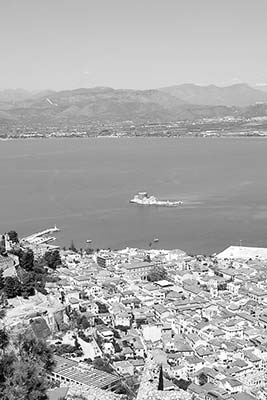
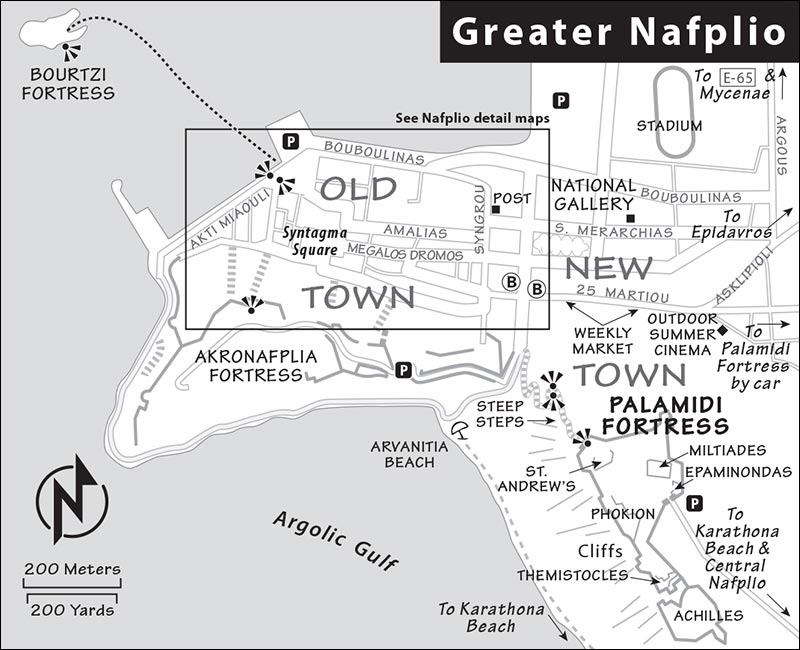
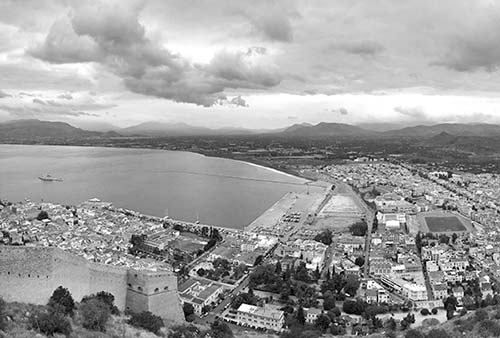
Owing to its prestigious past, Nafplio’s harbor is guarded by three castles: one on a small island (Bourtzi), another just above the Old Town (ancient Akronafplia), and a third capping a tall cliff above the city (Palamidi Fortress). All three are wonderfully floodlit at night. If you’re not up for the climb to Palamidi, explore Nafplio’s narrow and atmospheric back streets, lined with elegant Venetian houses and Neoclassical mansions, and dip into its likeable museums.
PLANNING YOUR TIME
Nafplio is light on sightseeing opportunities, but heavy on ambience. Two nights and one day is more than enough time to enjoy everything the town has to offer. With one full day in Nafplio, get an early start and do the arduous hike up to the Palamidi Fortress in the morning, when the pathway is mostly shaded, and before the worst heat of the day (to save time and sweat, you can also drive or taxi there). Then get your bearings in the Old Town by following my self-guided walk, and visit any museums that appeal to you. In the afternoon, hit the beach.
Nafplio also serves as an ideal launch pad for visiting two of the Peloponnese’s best ancient sites (each about a 30-minute drive and covered in the next two chapters): the best-preserved ancient theater anywhere, at Epidavros; and the older-than-old hilltop fortress of Mycenae. It’s worth adding a day to your Nafplio stay to fit these in. If you have a car, you can see both (and drive up to the Palamidi Fortress) in a full day; for an even more efficient plan, consider squeezing them in on your way into or out of town (for example, notice that Mycenae is between Nafplio and the major E-65 expressway to the north). These sites are also reachable by bus. While it may be possible to do them both by bus on the same day, for a more relaxed approach consider two full days in Nafplio, spending a half-day at each site, and two half-days in town.
Orientation to Nafplio
Because everything of interest is concentrated in the peninsular Old Town, Nafplio feels smaller than its population of 15,000. The mostly traffic-free Old Town is squeezed between the hilltop Akronafplia fortress and the broad seafront walkways of Bouboulinas and Akti Miaouli; the core of this area has atmospherically tight pedestrian lanes bursting with restaurants and shops. Syntagma Square (Plateia Syntagmatos) is the centerpiece of the Old Town. From here, traffic-free Vasileos Konstantinou—called “Big Street” (Megalos Dromos) by locals—runs east to Syngrou street, which separates the Old Town from the New Town. The tranquil upper part of the Old Town, with some of my favorite accommodations, is connected by stepped lanes.
TOURIST INFORMATION
Nafplio’s TI is just inside Town Hall, on Town Hall Square (Mon-Fri 9:00-15:00, Sun 9:00-12:00, closed Sat, +30 2752 024 444). Check locally to confirm opening hours for sights and museums in this chapter. If side-tripping out to Epidavros or Mycenae in the off-season, call ahead to double-check opening times.
Note that the town’s name can be spelled in a number of ways in English: Nafplio, Nauplio, Navplio, Naufplio, Nauvplio, and so on—and all these variations may also appear with an “n” at the end (Nafplion, etc.).
ARRIVAL IN NAFPLIO
By Car: Parking is free, easy, and central along the port, which runs in front of the Old Town (look for the big lots). If you’re staying higher up, ask your hotel about more convenient parking (for example, near the abandoned Hotel Xenia on the road up to the Akronafplia fortress).
By Bus: The main bus station and KTEL bus-company office (KTEΛ in Greek) are conveniently located on Syngrou street, right where the Old Town meets the New; from here all my recommended accommodations are within a 10-minute walk. Buy tickets for local trips (including Mycenae and Epidavros) directly from the driver. For long-distance buses—to Athens, for example—buy your ticket in the office. Note some buses also arrive and depart from a second stop, just around the corner on Plapouta street (ask in the office which stop your bus will use).
HELPFUL HINTS
Market Days: A market featuring local products like honey, wine, and olives takes over the street called 25 Martiou on Wednesdays and Saturdays until 14:00.
Festivals: Nafplio hosts a classical music festival in late June with a mix of Greek and international performers playing at the Palamidi Fortress and the St. Spyridon and St. George churches (details at TI). The town is also a good base for seeing drama and music performances at the famous Theater of Epidavros during the Athens & Epidavros Festival (weekends in July-Aug; see here). The local bus company operates special buses to the festival.
Bookstores: For local guidebooks, maps, and more, check Nafplia Bookstore, where they also sell English paperbacks and stamps (long hours daily, 25 Terzaki street, +30 2752 024 682). On Syntagma Square, next to the National Bank building, Odyssey sells a few maps, guidebooks, and English books stuffed between rows of toys and tacky souvenirs (long hours daily, tel. +30 2752 0-23 430).
Travel Agency and Car Rental: Conveniently located near the bus station, Stavropoulos Tours can help you book flights and boat tickets to anywhere in Greece (handy for trips within the Aegean Islands or to Hydra) and provides bus information (Mon-Sat 9:00-14:00 & 18:00-21:30, closed Sun, 24 Plapouta street, +30 2752 025 915, mobile +30 694 454 5691, www.stavropoulostours.gr, helpful Theodore). Several car-rental places are nearby (across from the Land Gate on Syngrou street).
Hop-On, Hop-Off Bus: Nafplio City Tour operates both a little tourist train and an open-top bus that zip around town. Their main advantage is a cheap way to get to Palamidi Fortress if you don’t want to hoof it (departs from the square called Friends of the Greeks/Plateia Filellino, roughly hourly April-Sept, weekends only off-season; €4 for the train, €8 for the bus; +30 210 417 6144, www.nafpliocitytour.gr).
Local Guide: Charming Nafplio native Patty Staikou enjoys sharing her town and nearby ancient sites Epidavros, Mycenae, Nemea, and others (about €60/hour, can meet you at the sites, mobile +30 697 778 3315, staipatt@yahoo.gr).
Nafplio Walk
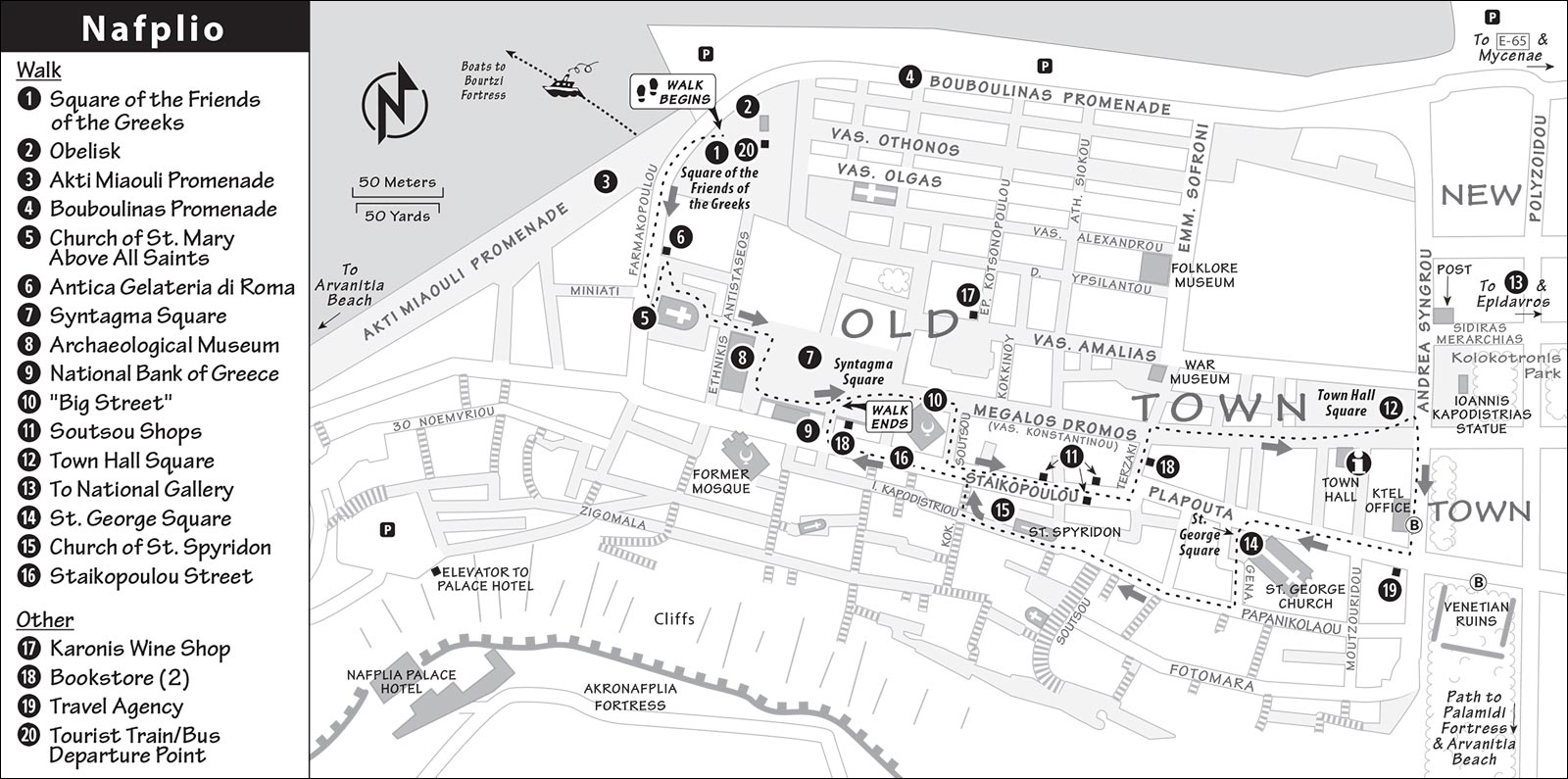
This self-guided walk, which takes about 1.5 hours, will give you a feel for Nafplio’s pleasant Old Town.
• We’ll begin on the harborfront square opposite the fortified island, marked by a sturdy obelisk.
1 Square of the Friends of the Greeks (Plateia Filellinon)
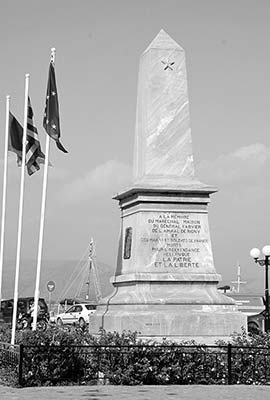
This space is named for the French soldiers who died while fighting for Greek independence in 1821. On the memorial 2 obelisk, a Classical-style medallion shows brothers in arms: Hellas and Gallia (Greeks and French). On the other side is the French inscription.
You might see a cruise ship docked here on the waterfront. The port was deepened a few years back to accommodate a busy cruise industry (bigger ships, however, still drop anchor around the bend).
Plenty of Nafplio bars, cafés, restaurants, and tavernas face the harbor. The embankment called 3 Akti Miaouli promenades to the left with a long line of sedate al fresco tables. (These places are mostly worth it for the view.) The promenade becomes a scenic shoreline path that continues all the way around the point to Arvanitia Beach, where a road returns to town up and over the saddle between the two fortresses.
The 4 Bouboulinas promenade heads in the other direction (to the right, as you face the water)—first passing fish tavernas and then a string of bars.
From the harbor, you can also see the three Venetian forts of Nafplio and another across the bay. The mighty little fortress island just offshore, called Bourtzi, was built during the first Venetian occupation (15th century) to protect the harbor. Most of what you see today is an 18th-century reconstruction from the second Venetian occupation. A shuttle boat departs from here to visit the island. It’s a fun little trip, but there’s little to see beyond a pleasant city view.
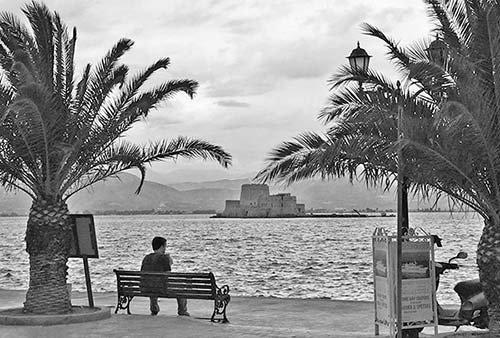
Capping the hill high above is the Palamidi Fortress (highest, to the left). Locals claim that the Palamidi Fortress, built in just three years (1711-1714), is the best-preserved Venetian fort in the Mediterranean. It can be reached by climbing nearly a thousand stone stairs...or by paying for a taxi. (I taxi up and walk down.) The view is rewarding, but the building itself is a bulky, impressive, empty shell. Below the Palamidi Fortress and to the right is Nafplio’s ancient acropolis, the Akronafplia fortress, built upon the remains of an ancient fort. The big stones at the base of its wall date from the third century BC. (For more on visiting Bourtzi, Palamidi, and Akronafplia, see “Nafplio’s Three Venetian Fortresses,” later.)
Across the bay, dramatically capping a hill beyond the island fort of Bourtzi, is a fourth Venetian fort. This 300-year-old fort was built upon the ancient Acropolis of Argos (which dates from the Mycenaean Age, about 1500 BC).
With all this defensive investment, you can imagine how much Venice valued this strategic city as a trade and naval station. Today, locals still call the bay Porto Catena. That’s Italian for “Chain Port,” as chains once were strung from the island fort to the mainland in order to control ship traffic.
• With your back to the water, walk up the street to the right of Hotel Grande Bretagne (Farmakopoulou). After a block, on the first corner (left), is a popular gelateria. Resist temptation for just a minute and first head across the small square to the...
5 Church of St. Mary Above All Saints
This church has a proud history: It originally dates from the 15th century; today’s building is from the 18th century; and just a few years ago, they peeled back, then reapplied, all the plaster. The priest at this church is particularly active, keeping it open late into the evening (long after many other Nafplio churches have closed). Outside the door he posts a daily message—a thought to ponder or a suggested prayer.
Step inside—it’s generally open. The flat ceiling with the painted Trinity in three circular panels shows a Venetian influence—most Greek Orthodox churches of this period are domed. The more typical iconostasis, a wall of Greek Orthodox icons, separates worshippers from priests. As is standard in Greek churches, the icon in the center changes with the season. In the front left corner you might find Q-tips and little plastic baggies for taking home priest-blessed oil. (“If you believe, then it heals.”) A glass case in the same corner shows off relics (mostly bones of saints) and little treasures (such as the Ostrich Egg, painted in Russia and symbolic of the Resurrection). There are a few more museum cases on the right. If you’re so moved, drop in a coin for a candle (near the entry) and light up a prayer. Notice the heavy-duty venting for the busy candle trays and the icon above the candles featuring the saint-protected city of Nafplio.
The mural just outside the church (on the wall, to the right of the door as you leave) is something of a nationalistic history of Greece in a nutshell. Follow it, starting with Adam and Eve to the golden age of ancient Greece (featuring Socrates, Plato, Aristotle, and others), the founding of Christianity and the Greek church, the building of the monasteries at Meteora, the Ottoman occupation (see the Greek priest being hanged by a Turk), independence (with a banner that says “democracy” in Greek), World Wars I and II (find the Nazi with a gun and a Greek resistance hero mightily perched on a rock), and finally, the Greek version of heaven, which looks like Meteora.
6 Antica Gelateria di Roma
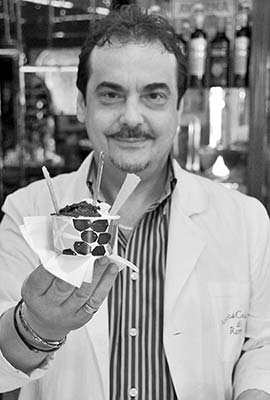
Greece has great honey-dripping desserts, but nobody does ice cream like the Italians. This recommended ice-cream parlor is run by Marcello and family, who offer a taste of Italy: gelato, fruit-based sorbetto, and other treats such as biscotti, limoncello, and cappuccino (and air-conditioning). This popular, fun-loving place is one holdover from the Venetian occupation that no local will complain about.
• Gelato in hand, exit Marcello’s; go left behind the church and into the big square.
7 Syntagma Square (Plateia Syntagmatos)
Like the main square in Athens, Nafplio’s central plaza is dubbed “Constitution Square,” celebrating the 1843 document that established a constitutional monarchy for Greece. Nafplio was one of the first towns liberated from the Ottoman Turks (1822) and became the new country’s first capital. The square is a delightful mix of architectural styles, revealing the many layers of local history.

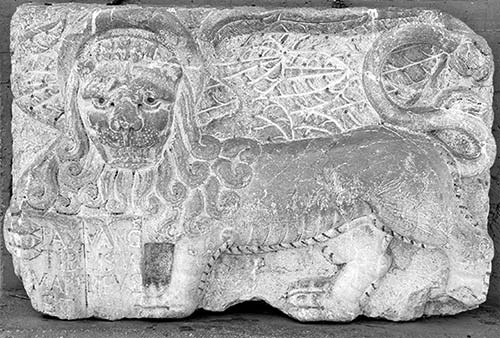
Survey this scene in a counterclockwise spin-tour, starting on your immediate right. The big building flying the Greek flag was originally the Venetian arsenal. Of course, wherever Venice ruled, you’ll find its symbol: the winged lion of its patron saint, Mark (over the door). The building is stout with heavily barred windows because it once stored gunpowder and weapons. Today it houses the town’s 8 Archaeological Museum (described later, under “Sights in Nafplio”).
Just to the left of the museum is a domed former mosque. In 1825, with the Muslim Ottomans expelled, this building was taken over and renovated to house independent Greece’s first parliament. (Now it serves as a conference center.)
The big 9 National Bank of Greece hearkens back to the very earliest Greek civilizations, with its dark-red columns that taper toward the base, as if they were tree trunks stood on their heads (shaped and painted just like the ones in the circa-1500 BC Minoan palaces on Crete). In front of the bank stands another Venetian winged lion from the old fortress. The second former mosque fronting this square (see red-tile domes at the far end) was converted after independence into Greece’s first primary school; today it’s a gallery and theater. To the left, look up past the popular cafés and restaurants to appreciate the square’s series of stately Neoclassical buildings. The square is a popular hangout for parents enjoying coffee while their kids run wild—future soccer stars-in-training.
• Head across the square and walk down the pedestrian street (opposite the side you entered).
10 The “Big Street” (Megalos Dromos)
Nafplio’s main drag, connecting the main square with Town Hall Square, is named for King Constantine (Vasileos Konstantinou). Locals know it as Megalos Dromos (Big Street).
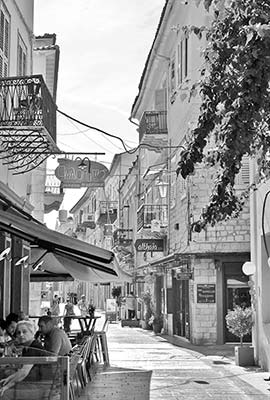
The town is something of a shoppers’ paradise—many streets are crammed with shops selling everything from the usual tacky tourist trinkets to expensive jewelry, all aimed at the fat wallets of Athenian weekenders. This is a fine scene in the early evening when everyone’s out strolling.
• Turn right at the first corner up the narrow alley (Soutsou), then turn left onto touristy Staikopoulou. At the end of the next block, a trio of shops are worth browsing.
11 Soutsou Shops
The Worry Bead shop on the left (at #25) features a remarkable selection. The cheapest, synthetic sets cost about €8; the priciest, which can cost hundreds of euros, are antique or made of amber (for more information on worry beads, see here). The Komboloï Museum upstairs shows off a few small rooms of the owner’s vast worry-bead collection, while a handful of English labels explain how variations on worry beads are used by many different faiths (€2, generally open 9:30-20:00). A few doors farther down (at #29) you’ll find the artisan Olive Tree shop (look for the Ελιά sign), where father-and-son duo Thomas and Lefteris are hard at work creating handmade olive-wood crafts (generally daily 10:30-23:00). Finally, across the street (at #52) is a sandal-maker’s shop (Σανδαλοποιείο, daily 10:00-23:00). This is the place to buy traditional Greek sandals—or to simply appreciate the country’s number one fashion staple.
• At the next intersection, turn left and walk one block back down to the “Big Street.” Turn right onto Megalos Dromos and follow it until you emerge into...
12 Town Hall Square
A statue marks the one-time location of the palace of King Otto (Oθωn), the first head of state of post-Ottoman Greece. The great powers—England, France, and Russia—insisted that the newly independent Greeks have a monarchy, so Otto was imported from Bavaria. He wasn’t here for long, though: An enthusiastic student of classical history, Otto was charmed by the idea of reviving the greatness of ancient Athens and moved the capital to Athens after just one year. (The palace that once stood here burned down in 1929.)
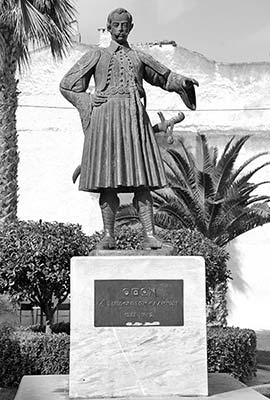
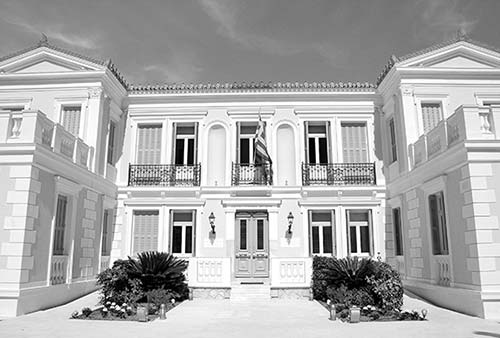
Otto, looking plenty regal, gazes toward the New Town. Fifty yards in front of Otto (on the right) is the Neoclassical first high school of Greece—today’s Town Hall, and home to the TI. The monument in front celebrates a local hero from the war against the Ottomans. Until recently this square was named Three Admirals Square—remembering those three great European powers that helped the Greeks overthrow their Ottoman rulers in the 1820s.
• At the far end of Town Hall Square, you hit the busy...
Syngrou Street and the New Town
This thoroughfare (sometimes spelled Siggrou or Syggrou) separates the Old Town from the New. Out of respect for the three-story-tall Old Town, no new building is allowed to exceed that height—even in the New Town.
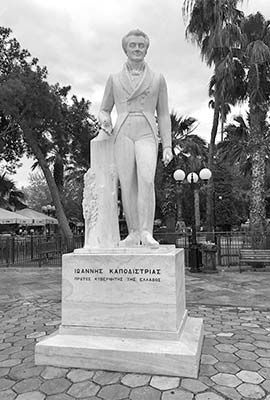
In the square across the street, a statue honors Ioannis Kapodistrias, the president of Greece’s short-lived republic (back when Nafplio was the capital). He faces the Old Town...and Otto, who stepped in when the president’s reign was cut tragically short. (We’ll get the whole story later.)
Just behind Kapodistrias is the family-friendly Kolokotronis Park. For a cheap and fast meal, consider grabbing a bite at one of the gyro and souvlaki eateries surrounding the park (order and pay at the bar, then find a bench in the park). Goody’s (on the left, by the post office) is a branch of the popular Greek hamburger chain.
A few minutes’ walk straight ahead, past the end of the park, is the 13 National Gallery, which shows off evocative artwork from the Greek War of Independence (described later, under “Sights in Nafplio”).
Facing Ioannis, head south (right) on Syngrou street. The commotion at the end of the block surrounds Nafplio’s tiny but busy bus station.
At the next corner we’ll turn right. But first, just behind the row of buses, you’ll see the ruined remains of Nafplio’s Land Gate, part of the city’s 18th-century Venetian fortifications. Take a little loop from here through the gate and study the amazing Venetian stone defensive work around and above you.
• Return to the corner, and head back into the Old Town on Plapouta street. Walk to...
14 St. George Square
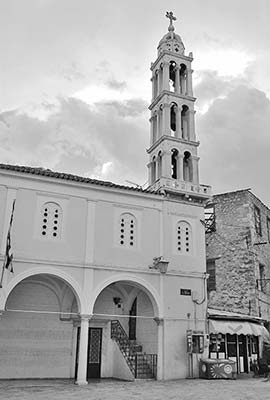
The focal point of the square, Nafplio’s mitropolis (equivalent to a Catholic cathedral), is dedicated to St. George and was the neighborhood church for King Otto (whose palace was once on Town Hall Square, which we walked through earlier). Step into the church’s dark interior (noticing the clever double-hinge system that prevents the doors from slamming) to see a gigantic chandelier hovering overhead.
Back outside, surveying St. George Square, you get a feel for an old Nafplio neighborhood. Like most of the Old Town, well-worn Neoclassical buildings date from the boom that followed the city’s rise to prominence when it was Greece’s first capital. During the 1820s and 1830s, Nafplio became a haven to refugees from other lands still threatened by the Ottomans.
• Walk a block slightly uphill (toward the fortress) and turn right on Papanikolaou street.
Upper Streets of the Old Town
Strolling this quiet lane, note that the Neoclassical grid-planned town is to your right, while the higgledy-piggledy Ottoman town climbs the hillside (with winding and evocative lanes and stepped alleys) on your left. Consider as you walk how Greece’s struggling economy leaves so many buildings with such potential in abandoned shambles.
Straight ahead (100 yards away) stands the white bell tower marking the 15 Church of St. Spyridon and its square. Facing the square (on the left, hiding in a niche in the wall, near the steps) is the first of several 18th-century Turkish fountains you’ll see. When the Ottomans controlled Greece, they still used the Arabic script you see here, rather than the Latin alphabet used for modern Turkish. This panel names the guy who paid for the fountain, and tells when he had it built (1734-1735) and why (to provide water for his horses). Other fountains have similar tributes, verses from the Quran, or jaunty greetings.
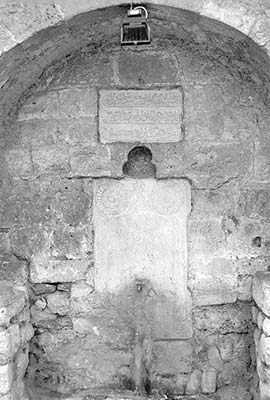
Continue straight along the side of the church to another Ottoman fountain (on the left)—with its characteristic decor of cypress trees and flowers.
Between here and the door of the church (on the right) is the spot marking the rough equivalent—to the Greeks—of Ford’s Theater (where Lincoln was assassinated). A plaque on the wall commemorates the story: Ioannis Kapodistrias was elected the first president of independent Greece in 1828. But just three years later, in 1831, he was shot and stabbed in this spot by Mani landowners who feared his promises of land reform. This led to chaos, less democratic idealism, and the arrival of Greece’s imported Bavarian royalty (King Otto, whom we met earlier).
If it’s open, pop into the church to see a painting (at the back) depicting the assassination. Across from the church is a collapsing hamam, a Turkish bath from the 18th century.
• At the next corner (Kokkinou street), turn right and climb down the slippery marble steps to Staikopoulou street (where we saw the Soutsou shops, earlier). This time we’ll take it left, back to Syntagma Square.
16 Staikopoulou Street
This bustling pedestrian drag is lined with grill restaurants (the harborfront is better for fish) and their happy hustlers, and another fine Ottoman fountain (on the right after a block).
A couple of blocks down, head right and back into Syntagma Square. Find the tiny black cube in the center and sit on it. Apart from being a handy meeting point for the town’s kids and a stand for the community Christmas tree, it means absolutely nothing.
• Our walk is over. From here you can enjoy the rest of the city. In addition to the museums we’ve already passed, a few more sights—including a folklore museum and a war museum—are within a few blocks. Adventurers may want to head to any of Nafplio’s Venetian forts. Or, if you’re ready to relax, hit the beach.
Sights in Nafplio
▲Nafplio Archaeological Museum
▲National Gallery (Alexandros Soutzos Museum, Nafplio Annex)
Papantoniou Museum of Peloponnese Folklore
NAFPLIO’S THREE VENETIAN FORTRESSES
Wine Tasting at the Karonis Wine Shop
▲▲▲Epidavros
▲▲▲Mycenae
MUSEUMS
▲Nafplio Archaeological Museum
Nafplio’s top museum is small but gives a concise overview of prehistoric Greece and the Mycenaean civilization. Visit here for a great warm-up before you go to Mycenae.
Cost and Hours: €6, includes lengthy audioguide; generally Wed-Mon 8:30-15:30, closed Tue; at the bottom of Syntagma Square, +30 2752 027 502, http://odysseus.culture.gr.
Visiting the Museum: The museum occupies the top two floors of the grand Venetian arsenal on the main square.
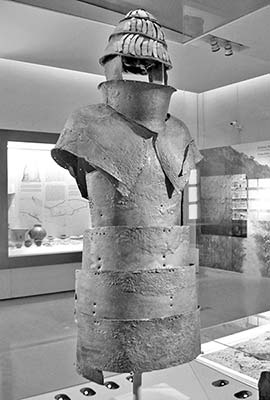
The little collection (starting on the ground floor, well-described in English) was excavated from nearby tombs. While nothing here is from Mycenae itself, many of the artifacts date from the same late Bronze Age (c. 1500 BC)—a reminder that the region is rich in late Bronze Age sites. The display runs in chronological order, with Stone Age tools suddenly giving way to a dolphin fresco inspired by the Minoan civilization on Crete. Eye-catching jewelry includes a bull-shaped crystal bead (look for the magnifying glass inside a glass case) and strings of gold beads.
The star of the museum stands in the center: the “Dendra Panoply,” a 15th-century BC suit of bronze armor that was discovered in a Mycenaean chamber tomb. Also found at the site (and displayed here) is a helmet made from boar tusks. Experts consider this the oldest surviving suit of armor in all of Europe.
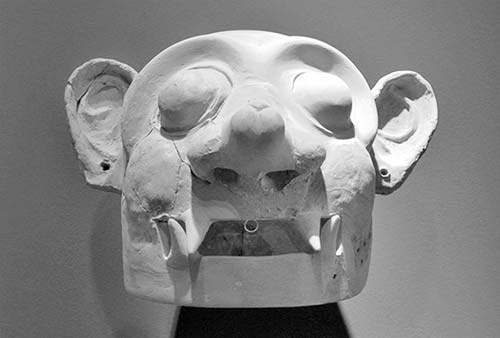
The second floor displays artifacts from the Age of Homer to the Roman occupation. Particularly striking are the ceremonial terra-cotta masks along one wall. Dating from the seventh century BC, these likely were designed to scare off evil spirits. Check out the display of rare glasswork from the first century AD—somehow these pieces have survived two millennia without getting smashed.
▲National Gallery (Alexandros Soutzos Museum, Nafplio Annex)
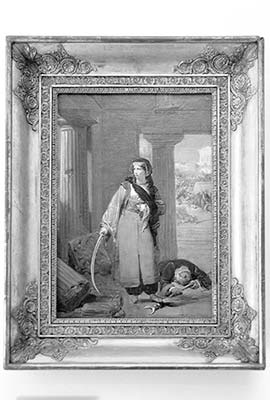
Housed in a grandly restored Neoclassical mansion, this museum’s permanent collection, displayed upstairs, is devoted to Romantic artwork (mostly paintings) stemming from the inspirational Greek War of Independence (1821-1829), which led to Nafplio’s status as the first capital of independent Greece. The small, manageable collection is arranged thematically. The English descriptions here are worth reading, as they explain the historical underpinnings for the art, illuminating common themes such as the dying hero, naval battles, and the hardships of war. The art itself might not be technically masterful, but the patriotism shimmering beneath it is stirring even to non-Greeks.
Cost and Hours: €5, free on Mon; open Mon and Wed-Sat 10:00-15:00, Wed and Fri also 17:00-20:00, Sun 10:00-14:00, closed Tue; a 5-minute walk into the New Town from the post office along a major road called Sidiras Merarchias, at #23, +30 2752 021 915, http://odysseus.culture.gr.
Papantoniou Museum of Peloponnese Folklore
Dedicated to Peloponnesian culture, this modern exhibit fills two floors with clothing, furniture, and jewelry that trace the cultural history of Nafplio and the surrounding region. While not particularly engaging, the interesting collection—which ranges from colorful and traditional costumes, to stiff urban suits, to formal gowns, to looms and spinning wheels—is well-displayed.
Cost and Hours: €5, Mon-Sat 9:00-14:30, Sun 9:30-15:00, fun gift shop with Greek crafts, Vasileos Alexandrou 1, +30 2752 028 379, www.pli.gr.
War Museum (Nafplio Branch)
This small exhibit, operated and staffed by the Greek armed forces, is best left to ardent Greek patriots and military buffs; for most others it’s not worth the small admission fee. It displays old illustrations and photos of various conflicts (some providing a peek into Nafplio’s past cityscape), plus weapons and uniforms (with some English descriptions) housed in what was Greece’s first military school. The top floor, dedicated to the modern era, displays WWII-era political cartoons from the Greek perspective.
Cost and Hours: €3, daily 9:00-19:00, off-season until 17:00 and closed Mon, on Amalias, +30 2752 025 591.
NAFPLIO’S THREE VENETIAN FORTRESSES
In the days when Venice was the economic ruler of Europe (15th-18th centuries), the Venetians fortified Nafplio with a trio of stout fortresses. These attempted—but ultimately failed—to fend off Ottoman invasion. Conquered by the Ottomans in 1715, Nafplio remained in Turkish hands until the Greeks retook the city in 1822. Today all three parts of the Venetian fortifications are open to visitors (with nothing to see but stones and views). These are listed in order from lowest to highest.
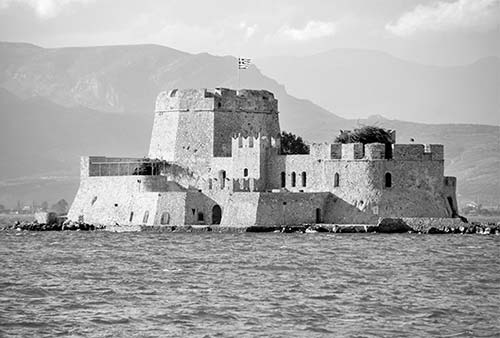
Bourtzi
This heavily fortified island—just offshore from Nafplio’s waterfront—offers a pleasant vantage point (pictured above), offering fine views back on the city. Locals are working to build a museum chronicling the island’s interesting history, from Ottoman origins and Venetian expansions to its roles as an active fort during the Greek revolution and a grand 1930s hotel. But until it’s complete, there’s not much to do here.
Cost and Hours: Boats depart from the bottom of the square called Friends of the Greeks/Plateia Filellinon, €5 round-trip, won’t run with fewer than four people, schedule can be sporadic—check sign on promenade for next departure, once on island it’s free to enter the fortress, +30 697 201 5296.
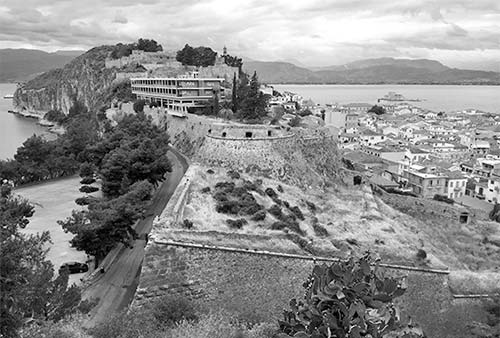
Akronafplia
Nafplio’s ancient acropolis, capping the low hill just behind the Old Town, is fairly easy to reach (a manageable but sometimes-steep 10- to 15-minute uphill hike—from the Old Town, just find your way up on any of a number of narrow stepped lanes, then bear left to reach the main road that leads up into the eastern end of the fortress). The earliest surviving parts of this fortress date back to the third century BC, but the Venetians brought it up to then-modern standards in the 15th century. Up top, there’s little to see aside from a few ruins (free to enter and explore anytime). The top of the parklike hill is flanked by two hotels: At the east end (toward Palamidi) stands the deserted and decaying Hotel Xenia; and at the west end (below a little heliport at the end of the road), the top-of-the-top Nafplia Palace hotel entices you to enjoy a drink from its terrace café. You can avoid the hike up by riding the elevator from the top of the Old Town to this hotel (see “Nafplio Walk” map).
▲▲Palamidi Fortress
This imposing hilltop fortress, built by the Venetians between 1711 and 1714, is the best-preserved of its kind in Greece. Palamidi towers over the Old Town, protected to the west by steep cliffs that plunge 650 feet to the sea. From its highest ramparts, you can spot several Aegean islands and look deep into the mountainous interior of the Peloponnesian Peninsula.
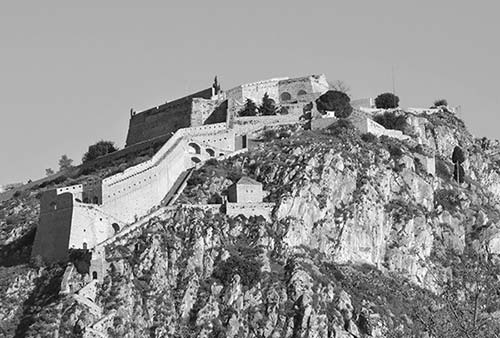
Cost and Hours: €8, €4 off-season, daily 8:30-sunset (or earlier), +30 2752 028 036.
Getting There: You can reach the fortress the old-fashioned way: by climbing the looooong flight of 999 steps that leads up from the road to Akronafplia fortress (near the top end of Polyzoidou street and the bus stop, just outside the Old Town). The toughest part of the climb is the heat; bring water, wear good shoes, and go first thing in the morning, when the path is mostly in shade. (If you get a late start, do the Palamidi hike in the early evening, though call first to confirm the closing time.)
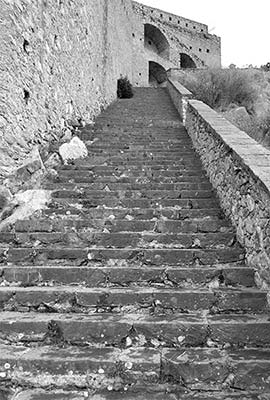
To avoid the climb, you can catch a taxi to the top for about €10 one-way (and perhaps take the steps down). Or check if the hop-on, hop-off bus or tourist train are running (see “Helpful Hints,” earlier). If you have a car, you can drive to the top and park for free: Follow signs east of town for the beach at Karathona/Καραθωνα, and after ascending the hill, watch for the turnoff on the right up to Palamidi/Παλαµηδη.
Services: WCs are just outside St. Andrew’s Bastion, near the ticket kiosk for hill climbers, and in the parking lot.
Visiting the Fortress: The fortress is actually a collection of fortresses or bastions within its exterior walls. Notice how the various bastions could defend themselves against each other if attackers breached the outer walls or one of the bastions was taken. You can navigate by following the handy signs and info posts you’ll see throughout. St. Andrew’s Bastion is the main bastion to visit. I’d study this one and then just explore the other bastions with a sense of fun and wonder.
St. Andrew’s Bastion (Agios Andreas) is the best preserved and offers great views over the rooftops of old Nafplio. Inside, find the small church. Behind it, under the first archway, is a tiny entrance leading to the cell of the miserable little Kolokotronis Prison (you’ll need to crouch and scramble to get inside). While untrue, Greeks love the legend that the Greek hero Theodoros Kolokotronis was imprisoned here by his political opponents after playing a key role in liberating Greece from Ottoman rule. Back outside, scamper up the giant vaults, which form an angled approach up to the ramparts. Imagine that the entire vault structure functioned as a cistern. Enjoy the views.
ACTIVITIES
Beaches
When ready for some beach time or a swim you have three good choices in and near Nafplio (all free, with easy parking and showers): Arvanitia (in town), Karathona (2 miles away via a scenic walk), and Tolo (6 miles away, with good bus connections).
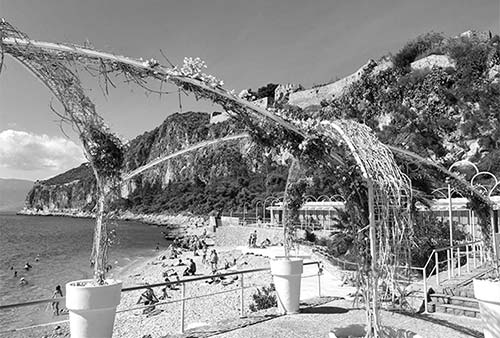
Arvanitia Beach, on the backside of the peninsula, is a 10-minute walk from the Old Town (walk over the saddle between the two forts or along the pedestrian path leading from the Old Town and around the peninsula). It’s a small, pebbly beach with clear, deep water. Crowded in summer, it’s popular with the young crowd and has a bar and a free open-air gym workout zone in the parking lot.
Karathona Beach is for more serious beach-going. This half-mile-long sandy beach with shallow water is popular with families, dotted with beachfront tavernas, and lined with palm trees. From Nafplio’s Arvanitia Beach you can walk there in 45 minutes along an unpaved seafront lane.
Tolo Beach, the best beach of all with nice sand and shallow water, is farther away (6 miles from Nafplio, hourly buses from bus station). You’ll find plenty of services (hotels, restaurants, rental paddle boats, and a small town of shops and cafés). While at Tolo, consider visiting the nearby ancient site at Asini, less than a mile away on a rocky promontory jutting into the sea. There isn’t much left of the 3,000-year-old acropolis, but interpretive panels do a good job of explaining its history, and the setting is impressive.
Walking
One of the great delights of a Nafplio visit is taking a stroll along the waterfront. Locals are understandably proud of their tree-lined, peaceful, and scenic walking and jogging lane that circles the peninsula from the town center to Arvanitia Beach and Karathona Beach. The first part (to Arvanitia Beach) is a stone-paved path; after that you’ll follow an unpaved trail. Start on the promenade nearest the island fort and walk out onto the spit, and then continue around the peninsula to Arvanitia Beach. For a longer walk, continue another two miles from Arvanitia to Karathona Beach, passing beneath the Palamidi Fortress on the way. While you can circle back to the town center from Karathona Beach via the New Town, most people prefer to retrace their steps along the waterfront. Energetic walkers can also make a loop to Karathona via the Palamidi Fortress.
Wine Tasting at the Karonis Wine Shop
Dimitri Karonis specializes in Greek wines and ouzo, and gives serious wine shoppers an informative wine tasting (Καρωνη, Mon-Sat 8:30-14:00 & 18:00-21:30, also most Sun 12:00-14:00 & 18:45-21:30 in summer; closed Sun off-season; near Syntagma Square at Amalias 5, call or email ahead to arrange a more in-depth tasting for €10-12, +30 2752 024 446, karonisd@otenet.gr).
SIGHTS NEAR NAFPLIO
These ancient attractions are both within a half-hour drive of Nafplio (in different directions) and covered in the next two chapters. If you have time to do only one, go for Mycenae; it has more to see.
▲▲▲Epidavros
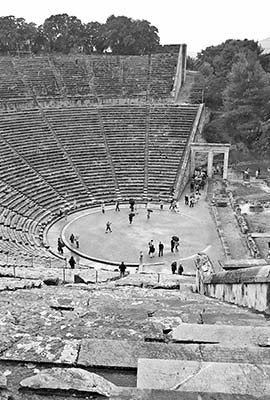
This ancient site, 23 miles (by car) east of Nafplio, has an underwhelming museum, forgettable ruins...and the most magnificent theater of the ancient world. It was built nearly 2,500 years ago to seat 15,000. Today it’s kept busy reviving the greatest plays of antiquity. You can catch musical and dramatic performances here in summer. Try to see Epidavros either early or late in the day; the theater’s marvelous acoustics are best enjoyed in near-solitude.
▲▲▲Mycenae
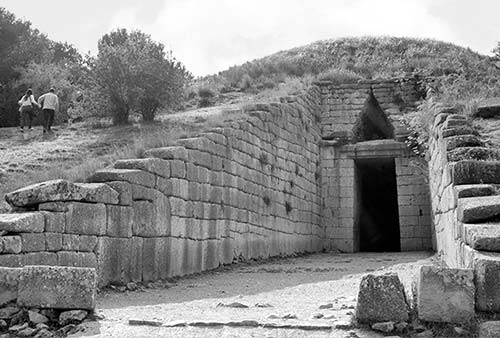
This was the capital of the Mycenaeans, who won the Trojan War and dominated Greece 1,000 years before the Acropolis and other golden age Greek sights. The Classical Greeks marveled at the huge stones and workmanship of the Mycenaean ruins. Visitors today can still gape at the Lion Gate; peer into a cool, ancient cistern; and explore the giant tholos tomb called the Treasury of Atreus. The tomb, built in the 15th century BC, is like a huge underground igloo, with a vast subterranean dome of cleverly arranged stones.
Nightlife in Nafplio
Nafplio enjoys a thriving after-hours scene with several nightlife microclimates—the age of the clientele varies every few blocks. I enjoy simply joining the evening strolling scene at all these places. For the best sunset stroll, head down the promenade Akti Miaouli and then out on the spit to the tiny lighthouse. Poke around to find the café or bar that appeals to you most for a pre- or post-dinner drink. Note that there are no true dance clubs in Nafplio, which has a strict noise ordinance: no loud music in the Old Town after 23:00. (Instead, huge seasonal outdoor clubs sprout along the roads leading out of town.) A few zones to consider:
Akti Miaouli Promenade: The upper crust enjoys the cafés lining the promenade Akti Miaouli. Prices are higher, but the water views (with the illuminated island fortress) could be worth the expense. At its farthest southern end is a lively playground and a fun, youthful place for drinks. This promenade leads to the breakwater spit and then to the path leading both romantically and scenically around the peninsula.
Bouboulinas Promenade and Beyond: Beyond the fish restaurants are several café/bars—once the place to be seen, they now provide a peaceful setting for a drink. A block beyond the Bouboulinas promenade is a stretch of teen-friendly fast-food places, described later under “Eating in Nafplio.”
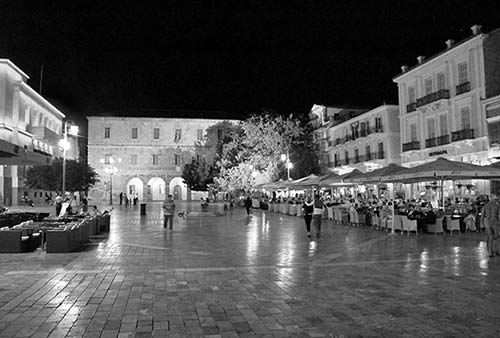
Syntagma Square and Nearby: People of all ages seem to enjoy the floodlit marble drawing-room vibe of Syntagma Square. Cafés and restaurants with ample, atmospheric al fresco seating surround a relaxed open area with people at play. From Syntagma, the neighboring streets are home to several popular café/bars. To find them, just follow the noise.
Arvanitia Beach: Blublanc Beach Bar comes out of hibernation every summer at Arvanitia Beach, transforming it from a popular swimming spot by day into a dance party at night (May-Sept, +30 2752 096 031).
Cinema: The local cinema (at Kolokotronis Park) plays movies in their original languages with Greek subtitles. In summer, the theater moves nearby (continue walking along 25 Martiou for 10 minutes) into the open air.
Sleeping in Nafplio
Nafplio enjoys an abundance of excellent accommodations. Because this is a chic getaway for wealthy Athenians, many of the best beds are in well-run, boutique-ish little pensions. (Some of the smaller pensions are run by skeleton staff, so don’t expect 24-hour reception; let them know what time you’ll arrive so they can greet you.) The many options allow hotel seekers to be picky.
It’s boom or bust in Nafplio. At the busiest times (June, July, especially Aug, and weekends year-round), hotels are full and prices go up; outside these times, hoteliers are lean and hungry, and rates become soft. Don’t be afraid to ask for a deal, especially if you’re staying more than a couple of nights. If your hotel doesn’t include breakfast, most cafés in town sell a basic breakfast for €7-8.
Most of these accommodations are uphill from the heart of the Old Town. The good news: They provide fresh breezes, have almost no mosquitoes, and offer a quiet retreat from the bustling old center. The bad news: You’ll climb a few flights of stairs to reach your room.
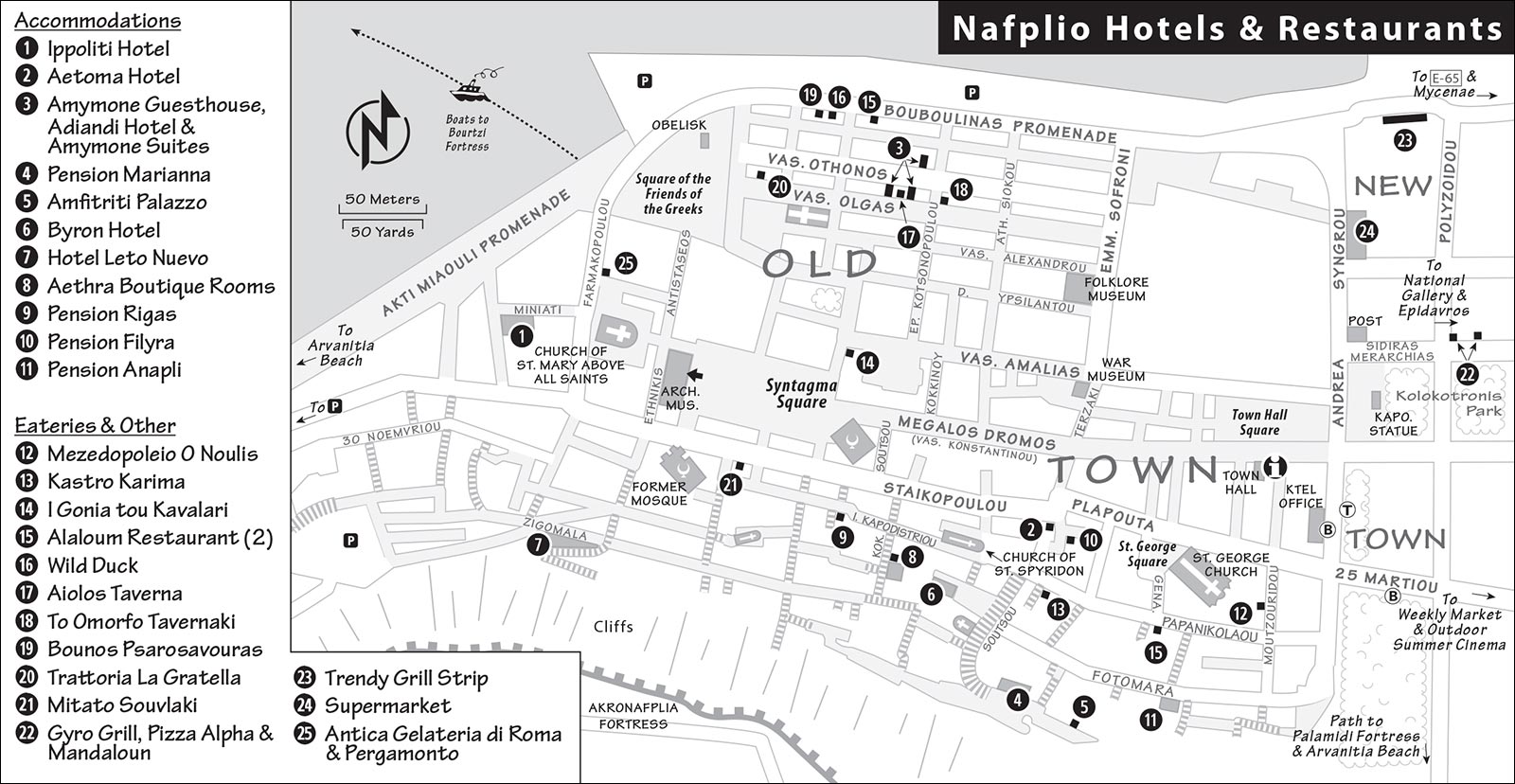
$$$$ Ippoliti Hotel (Ιππολύτι) is a classy business-hotel splurge, with 19 elegantly decorated, hardwood-floor rooms with antique touches. In summer, breakfast is served on the patio beside the small swimming pool (elevator, small gym, near the waterfront at Ilia Miniati 9, at corner with Aristidou, +30 2752 096 088, http://ippoliti.gr, ippoliti@ippoliti.gr).
$$$ Aetoma Hotel is a family-run gem offering five individually styled rooms with high ceilings, balconies, and lots of natural light in the house where owner Panagiota was born. She and her son, Akis, now invite travelers to share in the history of their home (Spiridonos 2, +30 2752 027 373, www.aetoma.gr, stay@aetoma.gr).
$$$ Amymone Guesthouse (Αµυµώνη), and the slightly more expensive Adiandi Hotel (Αδιάντη) and Amymone Suites, are a trio of super-stylish, trendy boutique hotels a few doors apart along one of Nafplio’s most inviting restaurant lanes. The guesthouse and hotel boast anything-but-cookie-cutter rooms, all with different color schemes and decor. At the suites, rooms are breezy-chic with natural woods and reclaimed furnishings. The very central location can come with more noise than my other listings, and each building has lots of stairs with no elevator. All three share an owner and the same phone number (+30 2752 022 073) but have independent websites (Amymone Guesthouse, 9 rooms, Othonos 39, www.amymone.gr, info@amymone.gr; Adiandi Hotel, 7 rooms, Othonos 31, www.hotel-adiandi.com, info@hotel-adiandi.com; Amymone Suites, 7 rooms, Othonos 18, www.amymone-suites.gr, info@amymone-suites.gr).
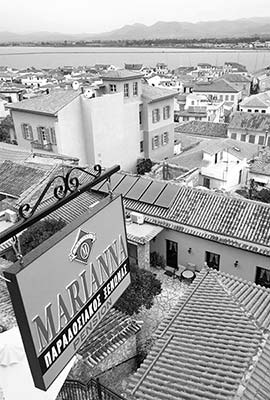
$$$ Pension Marianna is my choice for the most welcoming place in town. The friendly Zotos brothers—Petros, Panos, and Takis—offer genuine hospitality, fair rates, and comfortable rooms in their stony little paradise. It’s scenically situated just under the lower Akronafplia wall, well worth the steep climb up the stairs from the Old Town. The 26 rooms—some with views and/or little balconies—are scattered throughout several levels. Atop it all is an airy terrace where you can enjoy breakfast made with organic products from their nearby farm (RS%, breakfast extra, family rooms, no elevator, Potamianou 9, +30 2752 024 256, www.hotelmarianna.gr, info@hotelmarianna.gr). Park above town at the giant, abandoned Hotel Xenia at the Akronafplia fortress and walk a few steps down.
$$ Amfitriti Palazzo’s seven plush rooms, highest up, have balconies with sweeping views and fun classy-mod decor, with some rooms built right into the rock (family room, top of the hill—just under the old wall, +30 2752 096 250, www.amfitriti-pension.gr, info@amfitriti-pension.gr, Aggeliki and family).
$$ Byron Hotel is a traditional, family-run standby with 18 simple, older-feeling rooms (some with views) in a scenic setting up some stairs above the Old Town (Platonos 2, +30 2752 022 351, www.byronhotel.gr, byronhotel@otenet.gr, Aris).
$$ Hotel Leto Nuevo is partway up the slopes of the Akronafplia fortress. Its 18 boutiquish rooms all have sea views and either a bathtub or rain shower; ask about elusive and popular room #121, which is higher up (discount without breakfast, Zigomala 28, +30 2752 028 093, www.letohotelnafplio.gr, scale707@gmail.com, Sofia and her son Vasilis).
$$ Aethra Boutique Rooms has 10 rooms with contemporary style in a renovated old mansion, higher up along some stairs (lovely garden area, rooftop view terrace, corner of Zigomala and Kokkinou, +30 2752 025 253, www.aethra.gr, info@aethra.gr, Katia and Litsa).
$$ Pension Rigas is a gem with six cozy, charmingly rustic rooms in a refurbished old building with exposed stone and beams, hardwood floors, high ceilings, and lots of character. Its comfy lobby and small patio area provide a convivial space for guests to share travel stories (Kapodistriou 8, +30 2752 023 611, https://pensionrigas.inn.fan, rigaspension@hotmail.com, run by friendly Australian Lena).
$ Pension Filyra (Φιλύρα) has six tastefully and colorfully decorated rooms at a nice price in a few buildings in the heart of the Old Town (no breakfast, Aggelou Terzaki 29, +30 2752 096 096, www.pensionfilyra.gr, pensionfilyra@gmail.com, Rania).
$ Pension Anapli is on the budget end, but cute, with nine colorful, dressed-up rooms with iron-frame beds (Fotomara 21, +30 2752 024 585, www.pensionanapli.gr, info@pensionanapli.gr).
Eating in Nafplio
Nafplio is bursting with tempting eateries. Because most cater to Athenians on weekend breaks and aim to please repeat customers, prices can be a bit high. In two high-profile restaurant zones—the tavernas along Staikopoulou street (just above Syntagma Square) and the fish restaurants on Bouboulinas street (along the waterfront)—waiters compete desperately for the passing tourist trade. While I’d avoid the places on Staikopoulou, if you want seafood, the Bouboulinas fish joints are the best in town. I’ve focused most of my coverage on the tight pedestrian lanes between these two areas, toward the water from Syntagma Square, where values are good and ambience is excellent. Several places offer live traditional Greek music (generally weekends in summer after 20:30 or 21:00; get details from your hotel).
RESTAURANTS
$$$ Mezedopoleio O Noulis (O Νουλησ)—run by Noulis, the man with the mighty moustache shown on the sign—serves up an inviting range of meze (appetizers). Three or four meze constitute a tasty meal for two people. This authentic-feeling place offers a rare chance to sample saganaki flambé (fried cheese flambéed with Metaxa brandy). As Noulis is temperamental and likes to do it all himself, don’t come here if you’re in a hurry (Mon-Sat 13:00-15:00 & 19:00-23:00, closed Sun; Oct-mid-May Tue-Sun 13:00-16:00, closed Mon; no reservations, Moutzouridou 22, +30 2752 025 541).
$$$ Kastro Karima, on a quiet street near the Church of St. Spyridon, serves simple but tasty dishes at reasonable prices, including a variety of traditional spreads. Choose between sidewalk tables or the stony-chic interior (Tue-Sun 13:00-24:00, closed Mon, Papanikolaou 32, +30 2752 025 279).
$$ I Gonia tou Kavalari (Η Γωνια του Καβαλαρη, “Kavalari’s Corner”), nestled behind Syntagma Square, is an easygoing rustic eatery with live music twice a week and a tempting tapas-style menu of inexpensive meze (Tue-Sun 12:00-late, closed Mon, Amalias 2, +30 2752 500 180).
$$$ Alaloum Restaurant (Αλαλούμ) serves big portions of Greek and Mediterranean dishes, including a famous “mother-in-law’s salad.” Sharing is encouraged (sit inside or out, Wed-Mon 12:00-24:00, closed Tue and for two weeks in June, Papanikolaou 42, +30 2752 028 213). A second location at Bouboulinas 63 serves the same menu with a different view (daily 12:00-late).
$$$$ Wild Duck, on the fishy Bouboulinas drag, is more creative than your average taverna. Call it “Mediterranean with Greek influences,” featuring pasta, risotto, seafood, and meat, plus interesting combinations like octopus served with hummus (Mon-Fri 17:00-23:30, Sat-Sun from 9:00, Bouboulinas 67, +30 2752 028 562).
Tavernas on Olgas Street: The lane called Olgas, tucked away in a grid of streets just two blocks up from the waterfront, is filled with charming, family-run tavernas serving Greek classics to happy tourists. At any of these, you can choose between a cozy, rustic interior or outdoor tables. Window-shop along here and consider these two good options: $$ Aiolos (good mixed-grill platters, drunken chicken, saganaki, and sousamotiro—fried cheese with sesame seeds, Olgas 30, +30 2752 026 828) or $$ To Omorfo Tavernaki (Το Όμορφο Ταβερνάκι), literally “The Beautiful Little Tavern” (traditional home-style Greek dishes, Kotsonopoulou 1, +30 2752 025 944, Tsioli family).
$$$ Fish Restaurants on Bouboulinas: As you stroll the harborfront, you’ll soon come upon the fishy aromas and aggressive come-ons of the town’s best seafood eateries (all open daily, roughly 12:00-24:00). Wherever you choose to dine, part of the fun is the strolling scene. Seafood here is typically priced by the kilogram or half-kilogram (figure about 300-400 grams for a typical portion—around €20-30 for a seafood entrée, or about €10-20 for a meat dish). Bounos Psarosavouras gets a thumbs-up from locals for its consistent quality (daily 12:00-24:00, Bouboulinas 77, +30 2752 027 704).
Italian: Your best bet if you’re craving Italian, $$$ Trattoria La Gratella serves tasty and reasonably priced pizza, pasta, and secondi with a bright and modern interior and nice outdoor tables (June-Nov daily 13:00-24:00, Olgas 44, +30 2752 028 350).
CHEAP GYRO PITA AND SOUVLAKI JOINTS
Each of these places serves souvlaki and gyro pita sandwiches and more for a quick, inexpensive meal. You can sit inside or out on the sidewalk, or get takeaway.
$$ Mitato Souvlaki is an inviting little joint that does both meat and veggie gyros, just steps off the main square (daily 11:00-23:00, off Syntagma Square behind National Bank building at Staikopoulou 14, +30 2752 021 159).
Dining in Kolokotronis Park: Several cheap family- and student-style diners line the park (along Sidiras Merarchias street, just beyond Town Hall Square), all with noisy indoor seating and peaceful options in the park. $ Gyro Grill offers perhaps the cheapest hot dinner in town. $$ Pizza Alpha and $ Mandaloun (good Lebanese) are a few doors down.
“Trendy Grill Strip”: This thriving strip of eateries is where high-school kids take their dates (facing the harbor and parking, just east of the Bouboulinas promenade). Along with $$ Trendy—the busiest souvlaki joint in town—$$ Pizza Scuola is popular.
Picnics: The supermarket at the corner of Syngrou and Flessa, between the post office and the “Trendy Grill Strip,” is the most convenient of several supermarkets in town (Mon-Fri 8:00-21:00, Sat until 20:00, closed Sun).
DESSERT
Antica Gelateria di Roma is known for its mouthwatering array of gelati (dairy-based ice cream) and sorbetti (fruit-based sorbet) made fresh on the premises daily by Italian gelato master Marcello Raffo, his wife Monica, and his sister Claudia. The Raffos also offer other Italian snacks and drinks (daily 9:00-late, Farmakopoulou 3, at corner with Kominou, +30 2752 023 520).
Pergamonto (Περγαμοντο), next door to the gelateria, does fresh-from-the-deep-fryer loukoumades (Greek doughnuts), with a range of toppings. I say go traditional, with honey or cinnamon and sugar (generally daily 15:00-24:00, Komninou 1, +30 2752 024 570).
Nafplio Connections
BY BUS
The tiny KTEL bus station is convenient and central, and has schedules in English. Their website has an English option and sells tickets (www.ktelargolida.gr). While the ticket agent can give information, confirm your plans (and transfers) with your driver or other passengers.
Direct buses go to Athens (nearly hourly, 2.5 hours), Epidavros (2-3/day, 1/day late on Sun, possibly 1/day Oct-April, 45 minutes), and Mycenae (1-2/day, none Sun, 45 minutes). For details see those chapters.
Journeys to other Peloponnesian destinations likely require a change in Tripoli and multiple transfers; get an early start and be prepared for frustrations and delays: Tripoli (2/day, 1.5 hours), Monemvasia (may be possible from Tripoli—check locally; generally 1/day, 4.5 hours), Olympia (2/day, 5 hours, change in Tripoli). For these destinations, check carefully in person with an agent at the KTEL office, or the nearby Stavropoulos travel agency (see “Helpful Hints,” earlier in this chapter).
BY TAXI
To cut some time off the trip to the ancient sites, you can take a taxi to Mycenae or Epidavros (€70 round-trip for either one, with one-hour wait; bargain hard for the best price).
BY BOAT
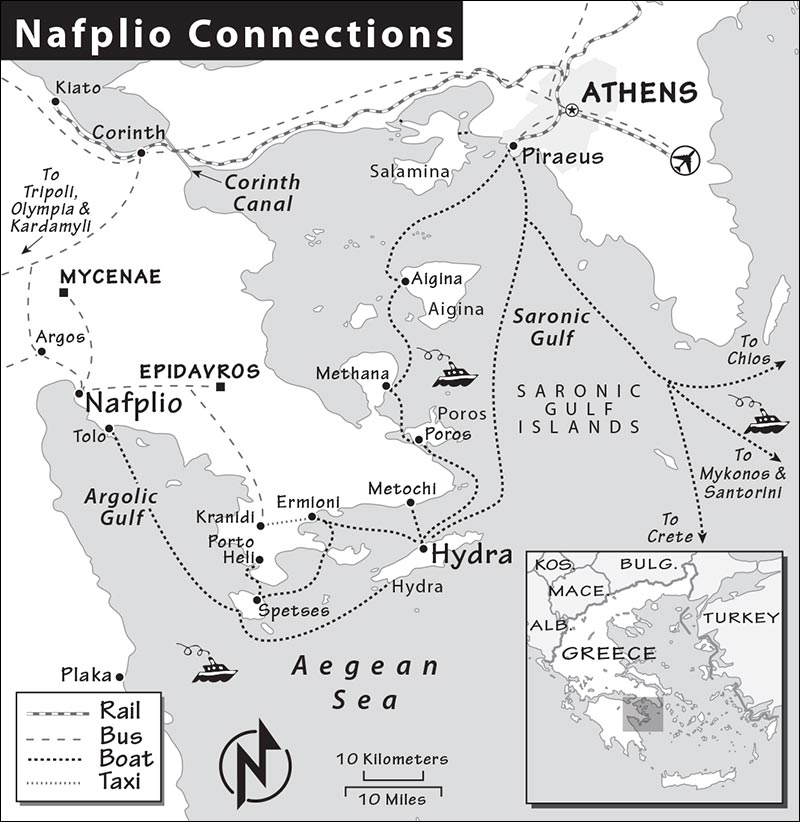
To reach long-distance boats connecting to Hydra and the other islands in the nearby Saronic Gulf, you’ll first need to get to the ports of Tolo, Ermioni, or Metochi. For specifics on ferry connections from these ports to Hydra, see here.
Getting to the Ports: Infrequent excursion boats (2-3/week April-Oct) to Hydra operated by Pegasus Tours leave from the port at Tolo, a short drive or bus ride (20 minutes) from Nafplio. These boats usually leave fairly early in the morning; Pegasus runs a bus from Nafplio to the port, or you’ll need to take a taxi (€30 one-way).
Hellenic Seaways ferries leave from farther away in Ermioni (a.k.a. Hermioni), about 1.5 hours southeast of Nafplio. Buses that are supposedly going to Ermioni usually go instead to Kranidi, a larger town about six miles from Ermioni’s port (2/day Mon-Fri, Sat-Sun may be 1/day in summer, 2 hours; this Nafplio-Kranidi bus connection may require a transfer at the town of Ligourio—pay careful attention so as not to miss the change). From Kranidi, it’s about a €20 taxi ride to the dock at Ermioni (try to split the fare with other Ermioni-bound travelers).
Passenger ferries leave from even farther away in Metochi, which is best reached by car (allow 2 hours).
ROUTE TIPS FOR DRIVERS
Nafplio is a quick and easy drive from Athens—about 2 hours, much of it on toll highways. (When asked about the poor little road connecting the city to the toll highway, locals explain it’s intentional...to keep the Athenians out.) To reach Monemvasia from Nafplio (3-4 hours), it’s fastest to use the A-71 toll road between Megalopoli and Sparta (Sparti on road signs). If you’re not in a hurry, consider taking the scenic route described on here.