MYKONOS
Μυκονος
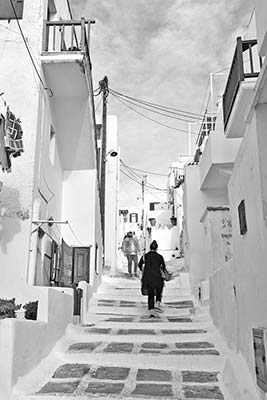
At its heart, Mykonos (MEE-koh-nohs) is the very picture of the perfect Greek island town: a seafront village crouched behind a sandy harbor, thickly layered with blinding white stucco, bright blue trim, and purple bougainvillea. (Thank goodness for all that color; otherwise, this island—one of Greece’s driest—would be various shades of dull brown.) On a ridge over town stretches a trademark row of windmills, overlooking a tidy embankment so pretty they call it “Little Venice.”
Mykonos’ Old Town seems made for exploring. Each picture-perfect lane is slathered with a thick layer of stucco, giving the place a marshmallow-village vibe. All that white is the perfect contrast to the bright blue sky and the vivid trim. Sometimes described as “Cubist” for its irregular jostle of angular rooflines, Mykonos’ townscape is a photographer’s delight. Enjoy getting lost, then found again.
While Mykonos was once a sleepy, backwater fishing village, those days are a faint memory. Today’s Mykonos is easily one of the most expensive, most exclusive places in Greece. Prices are stunningly high here, and the island is crammed through the summer season (especially in August). As one of the Mediterranean’s premier party destinations, the entire Old Town throbs with a cacophony of nightclub beats well into the wee hours. This is fun if you’re seeking late-night activity...but otherwise, it can be miserable. If you’re seeking a peaceful getaway, time your visit for shoulder season—May or October—when suitable beach weather is still likely, but the town is less crowded, less noisy (except on weekends), and less expensive. On October 1, hotels drop their prices in half. And in winter (around Nov-March), the island essentially shuts down, as many restaurants and hotels close for the season.
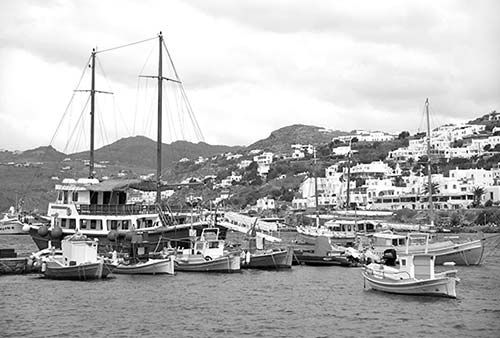
Whenever you visit, find ways to enjoy the traditional soul of Mykonos. If you grow tired of fashionistas and high-end boutiques, climb just a block or two in either direction from the core of town, and you’ll enter more-authentic neighborhoods relatively untrampled by tourism. Fishermen still hang out on the benches by the harbor, wearing their traditional caps (Mykonian men are famous among Greeks for their baldness).
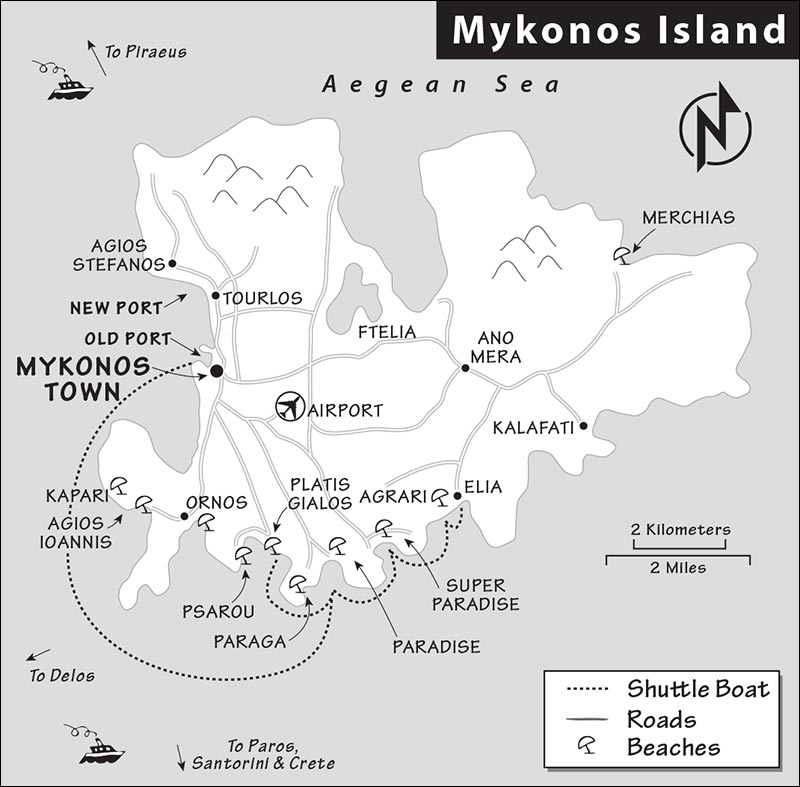
The island’s arid but idyllic terrain, with lots of hidden coves, is a favorite backdrop for filmmakers (Shirley Valentine, Mamma Mia!, The Bourne Identity, Before Midnight). A string of inviting beaches lines up on the sandy, pebbly coves along the jagged south coast—each with a personality of its own, and all reachable by a cheap and easy bus ride from town.
For armchair historians, the highlight here is a 30-minute boat trip to the island of Delos—one of the Greek islands’ top sites, with the remains of important ancient temples honoring the birthplace of the twin gods Apollo and Artemis. Delos was a pilgrimage site for believers who came from all over to worship this “birthplace of light.” Judging by the present-day sun worshippers who scramble for the best patch of sand on Mykonos each summer, things haven’t changed much.
PLANNING YOUR TIME
Mykonos merits at least a full day and two overnights; more time lets you squeeze in more beaches. To avoid crowds, consider visiting outside of peak season.
On a short visit, begin with my self-guided town walk to get your bearings. Historians will want to finish the walk in time to side-trip to Delos (easy 30-minute boat trip each way, figure 3-4 hours round-trip), while vacationers can hop a bus to one of Mykonos’ beaches in the afternoon. Dip into any museums that interest you, or enjoy the sunset from a beach or while sipping a cocktail near the Little Venice zone, then have a late dinner.
Orientation to Mykonos
Mykonos’ main town is called Chora (or Hora, Xώρα; roughly “village”), but it’s often referred to as “Mykonos town.”
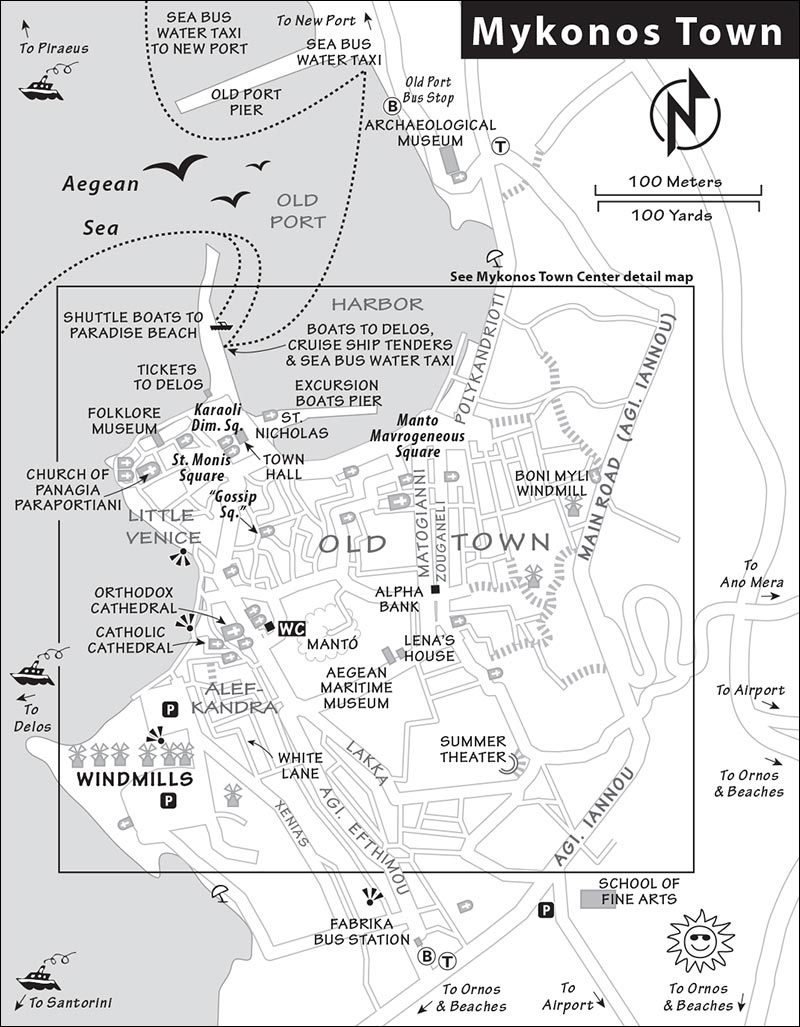
Mykonos town is the main point of entry for the island. The Old Town clusters around the south end of the Old Port—the harbor area bookended by two piers. To the north is the Old Port pier and bus stop, and to the southwest is the pier for boats to Delos and the Sea Bus to the New Port, where most ferries and cruise ships arrive. Squeezed between the harbor and the main road (passing above town on the gentle hill) is the Old Town’s tight maze of whitewashed lanes.
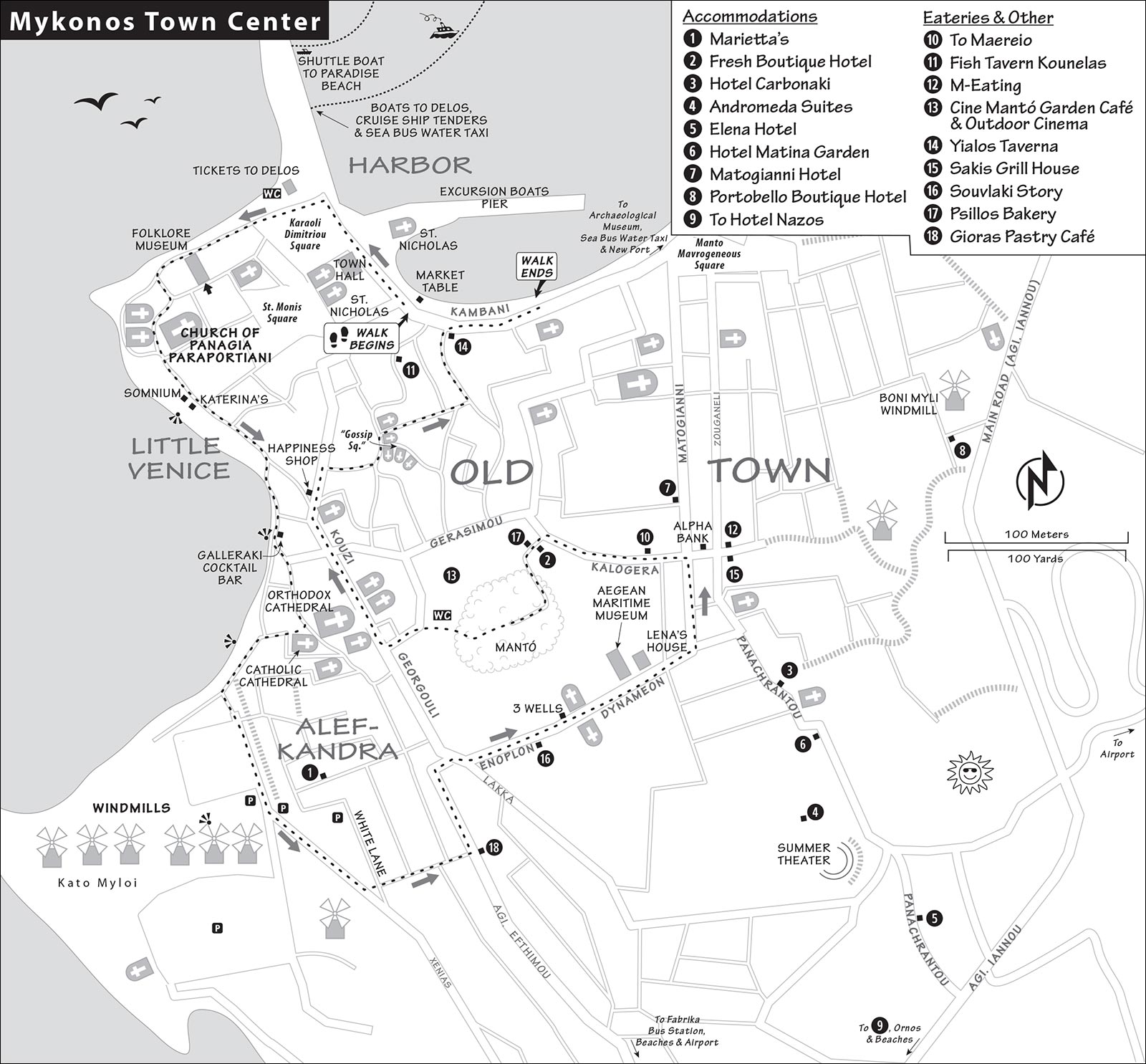
To get your bearings, look at a map and notice that three “main” roads (barely wide enough for a moped) form a U-shaped circuit facing the harbor: Kouzi Georgouli, Enoplon Dinameon, and Matogianni. While some streets have names, others don’t, and in any case, locals never use them—they just know where things are. If you can’t find something, ask.
You’ll find travel agencies, ATMs, launderettes with drop-off service, minimarkets, pharmacies, and other helpful services scattered around the Old Town. For the highest concentration of services (and tattoo parlors), head for the area around the Fabrika bus station.
Tourist Information: Mykonos doesn’t have a TI. Hoteliers, travel agents, and other friendly locals can answer basic questions. Look for town maps, or consult www.mykonos.gr, the island’s official website.
Private Guide: Excellent certified local guide Antonis Pothitos enjoys introducing visitors to the hidden nooks and crannies of Mykonos. In addition to town walks and tours of the Delos archaeological site, he enjoys leading a 2.5-hour “Food on Foot” walk with tasting stops (4-person minimum, contact Antonis for prices, +30 693 660 6640, www.delosguide.com, antonis@homemail.com).
ARRIVAL ON MYKONOS
At the port and airport, sign-toting hotel representatives wait to transfer guests into town. To make it easy, ask your hotel in advance about this option.
By Boat: Most travelers coming by boat arrive at the New Port, a mile north of the Old Town, at the far end of the bay. (This serves ships from Piraeus and Santorini, as well as many cruise ships.) You have several options for getting to the Old Town: Easy and pleasant, the Mykonos Sea Bus runs between the New Port and Mykonos town (may stop at the Old Port pier en route; €2, 1-2/hour, runs 7:00-23:00, +30 2289 028 603, www.mykonos-seabus.gr). By land, you can take a taxi (€20-25 one-way) or ride a public bus to the Old Port bus stop (2/hour, €1.80). Cruisers may be offered a shuttle bus. In a pinch, you could walk for 25 dreary minutes along the coast into town (turn right, follow the water, and just keep going—you can see the gaggle of white houses across the bay).
A few smaller, passenger-only ferries from other islands dock at the Old Port Pier—just a five-minute walk from the Old Town harborfront. And if your cruise ship is tendered, you’ll disembark at the pier at the opposite end of the harbor (where boats to Delos come and go). Just walk down the pier and you’re at the harbor (there’s a public WC on the right, along the water).
By Plane: Mykonos is well connected by air to Athens, as well as to many other European cities (airport code: JMK, +30 2289 022 327). The small airport sits just two miles outside town, easily connected by a short but pricey taxi ride (€15-20). Infrequent public buses are worthwhile only if a bus happens to be there when you arrive; ask the driver when the bus is departing. If leaving by air, note that there are separate check-in terminals for international departures (on the right) and domestic flights (on the left); both use the same arrivals area.
GETTING AROUND MYKONOS
Mykonos is a fun and easy island to explore. For bus station/stops and taxi stand locations, see the “Mykonos Town” map, earlier.
By Bus: Mykonos’ bus network easily connects travelers to the island’s many fine beaches (and is much cheaper than going by taxi). And because this is a party island, buses run late into the night in peak season. Schedules are posted at stops and in most hotel reception areas; tickets cost around €2—buy from the driver or (in Mykonos town) at the ticket kiosk at the Fabrika bus station (www.mykonosbus.com).
In town, the Fabrika bus station (serving beaches on the south side of the island) is a 10-minute walk up from the harbor, just under the main ring road. The Old Port stop (serving the eastern half of the island) is at the northeast edge of the Old Town, along the pier below the Archaeological Museum (look for the clearly marked ramp along the beach near the old harbor).
By Taxi: There are only about 30 cabs for the entire island, and they are extremely expensive (with fixed rather than metered prices). No cars are allowed in Mykonos town, so you’ll wait for a taxi at one of two places: the stand behind the large building labeled Remezzo (behind the Archaeological Museum at the north end of town), or at the Fabrika bus stop (see above).
By Boat: Efficient water taxis shuttle beachgoers along the coast of the island. While most depart from outside Mykonos town, a direct boat departs from the Old Port to Paradise beach (€10, 2/hour, see “Beaches,” later).
By Motorized Scooter or All-Terrain Vehicle (ATV): If I were renting a scooter or an ATV on a Greek isle, I’d do it on Mykonos—where the roads are not too heavily trafficked (you’ll pass more fellow scooters and ATVs than cars), and an appealing variety of idyllic beaches are a short ride away. Travel agencies all over town rent both types of wheels for reasonable all-day rates (€30-50/day for a scooter or an ATV, some places may charge €7-10/day extra for insurance, rates depend on time of year). Two people can ride one machine, and both should ask for helmets.
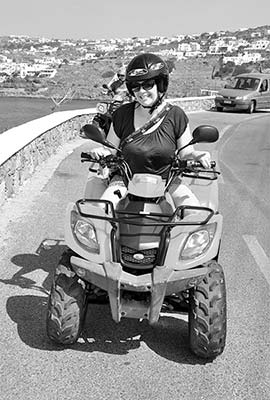
Once on the road, be especially careful when turning: Tourists are notorious for renting a scooter or an ATV, overestimating their abilities, and denting someone’s fender...or worse. That said, and keeping in mind the inherent risks, this can be an affordable, efficient, and memorably fun way to connect distant beaches. On a slow-moving ATV, figure 15-20 minutes from Mykonos town to most of the beaches I list (Super Paradise is the farthest). Find rental details under “Getting to the Beaches,” later.
By Car: You can rent a car for as little as €40 per day; look for car-rental signs at several agencies around town—especially near the Fabrika bus station—and negotiate a good bargain if you’re here outside peak season. The island is less satisfying to explore by car than Santorini—it’s basically similar beaches and remote villages.
Mykonos Walk
The core of town is literally a maze, designed by Mykonians centuries ago to discourage would-be invaders from finding their way. That tactic also works on today’s tourists. But I can think of few places where getting lost is so enjoyable.
This self-guided walk is designed to orient you to Mykonos’ main landmarks in about 1.5 hours. Even if you follow my directions to a T and use my map, be prepared to get lost from time to time. But with this walk under your belt, the town becomes more manageable.
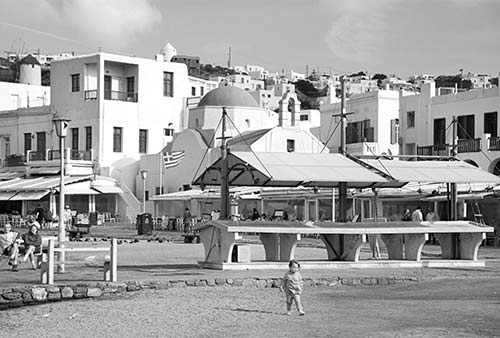
• Our walk begins at the harbor, in the heart of Mykonos. If you’re arriving on a cruise-ship tender, you’ll land right here; if you’re coming from elsewhere on the island, you can’t miss this sandy centerpiece of town. Position yourself near the marble fish-washing table/market stalls, right along the harbor, near the blue-domed church at the pier.
Old Town Harbor
Mykonians describe this delightful swath of land as their “downtown.” Unlike many other Greek island towns—which have built up bulky concrete embankments—Mykonos has kept its traditional waterfront, where the cobbles taper into a sandy beach, preserving the Mykonians’ connection to the Aegean. Glancing offshore, you’ll see humble fishing boats bobbing in the foreground, with 2,000-passenger cruise ships looming in the distance.
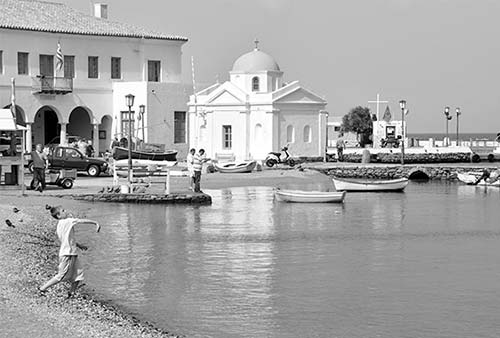
A row of cafés and restaurants lines the harborfront, including the recommended Yialos (Γιαλός; near the red-domed church). You’re most likely to catch a few Mykonians (or in-the-know expats) hanging out here in the morning. Pull up a rustic table, nurse an iced coffee, and watch the tide of tourists wash over village life. Mykonians appreciate cafés like these that stay open through the winter to cater to natives (since most businesses close up shop after cruise season ends). At the marble table by the beach, fisherfolk sort and clean their catch each morning (while stray cats gather below). Nearby, old-timers and kids alike toss fishing lines into the water.
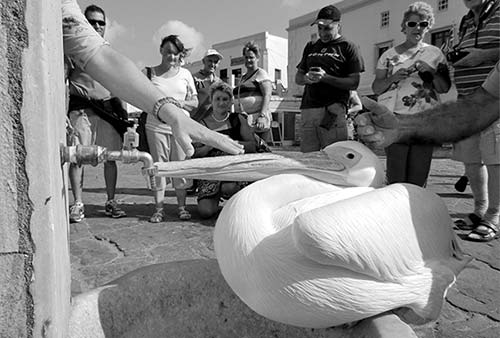
You may even see one of the resident pelicans—Petros, Nikolas, or Irini. Ever since a local fisherman found an ailing pelican and nursed it back to health a half-century ago, these odd birds have been the town’s mascots. They hang out at the harbor, or you may see them elsewhere in town, as well—always surrounded by an entourage of paparazzi tourists.
At the far end of this sandy harbor (which we’ll visit later) is the piazza known as Manto Square. This is marked by a bust of Manto Mavrogenous (1796-1848), a heroine of the Greek War of Independence. A wealthy aristocrat of Mykonian heritage, she spent her fortune supplying Greek forces in a battle against their Ottoman rulers. Mavrogenous—who, despite her contributions, was denied a Greek pension—ended her life destitute on the island of Paros, never regretting the sacrifices she made for Greece’s freedom. Today locals still celebrate her brave spirit. Just beyond the square is the town’s small, free, mostly sandy beach—but with far better options nearby, it’s nothing to get excited about.
• Turn with the water on your right, and walk about 50 yards to the little, blue-domed...
Church of St. Nicholas (Agios Nikolakis)
This is one of an estimated 90 small churches that dot the Old Town of Mykonos (with hundreds more scattered all over the island). Why so many? First, while these belong to the Greek Orthodox Church, each one was built by, and is still maintained by, a private local family—usually to honor a namesake saint. Having a chapel is a matter of familial pride. On that saint’s feast day, the family invites a priest to preside over a service here, followed by a big party to which the entire community is invited. (On the day of a popular saint, many families host dueling parties.) Chapels were often built to give thanks for the safe return of a relative—and in this seafaring town, it was often necessary.
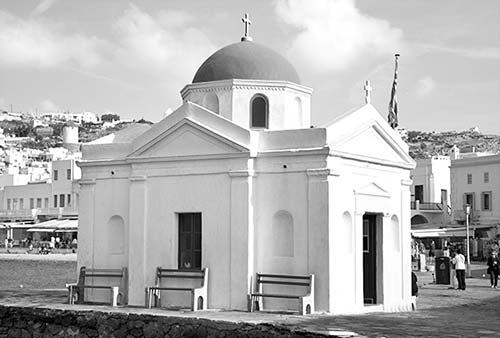
This harborfront location—which was originally on its own little island, connected by a bridge—makes sense for St. Nicholas, the patron saint of sailors and fishermen. In fact, St. Nicholas is so important that there are two churches dedicated to him in the same area: This one is officially “St. Nicholas of the Chain”—named for the chain that was once pulled across the mouth of the harbor from here in times of enemy threat. And the red-domed church just around the harbor is “St. Nicholas of the Wind,” since it faces into the prevailing northerly winds.
Step inside this votive chapel to see a container of lit candles. Many local fishermen still light a candle here each morning before heading out to sea. Originally, each chapel also served as a family mausoleum, where departed relatives were interred. This unhygienic practice ended in the 18th century, when Mykonos established a cemetery just outside town. But a loophole allows locals to dig up a loved one’s remains five years after burial and reinter them in the family chapel. Notice the plaques on the walls and floor marking the final resting places of several Mykonians. The one on the left wall just inside the door is significant: It marks the remains of Captain Petros I. Drakopolos, who—the plaque explains—was executed by Germans during the Nazi occupation in September 1944. (This local hero is the namesake of the first pelican mascot of Mykonos.)
• Head back outside.
Town Hall and Delos Pier
The big, boxy building facing St. Nicholas is the Town Hall (labeled in Greek and English), with the only red terra-cotta roof on the island. This was built in 1780, during a brief period of Russian occupation, when Czarina Catherine the Great sent a governor to rule over the island. (St. Nicholas was built at the same time.) The building’s few marble pillars are most likely scavenged from the ancient ruins on the nearby isle of Delos, as is the well-worn marble bench under its porch. In general, anytime you see irregular bits and pieces of marble incorporated into Mykonos buildings (thresholds, window sills, and so on), they probably came from Delos.
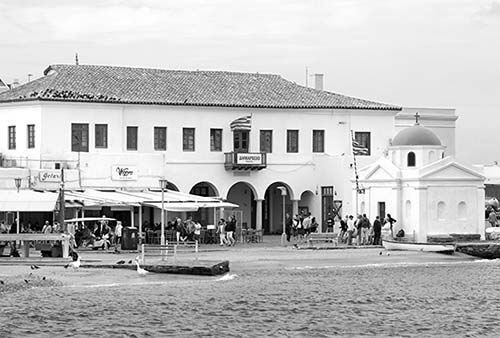
Now walk with the harbor on your right. Soon you’ll spot the ticket kiosk for boat trips to the ancient site at Delos (more on that in a moment). Just behind that is the town dumpster and trash compactor—convenient for shipping garbage to the mainland. And just after that you’ll see some handy pay WCs.
Continue along the embankment. Straight ahead, on the horizon, is the isle of Delos—said to be the birthplace of the god Apollo, and home of one of the ancient world’s most important sites. In antiquity, this was a busy commercial port and financial center, and today it contains some fascinating ruins. Nearby, you will likely also see a cruise ship, which is fitting. In the early days of cruising—the 1920s—ships came to this area for the ruins at uninhabited Delos, and then made a pit stop on Mykonos—which slowly became a tourist destination in its own right. The town’s popularity boomed in the 1950s, when celebrities discovered its allure; and again in the 1980s, when it became a mecca for gay tourists; and again in the 2000s, with the surge in cruising. Today Mykonos is arguably Greece’s most popular island.
• Reaching the end of the embankment, hook left and walk uphill to the top of the little bluff. You are in the heart of the...
Old Venetian Quarter
This strategic spit of land, with visibility over the water in three directions, has always been an important point in Mykonos—in ancient times, this was the site of its acropolis. Like many other Greek islands, Mykonos fell under Venetian rule after the Fourth Crusade (early 13th century). The Venetians fortified this point, enclosing the entire peninsula with a stout fortress that contained some 4,000 people. While that fortress is long gone, soon we’ll walk through tight lanes that make it easy to imagine those crowded conditions.
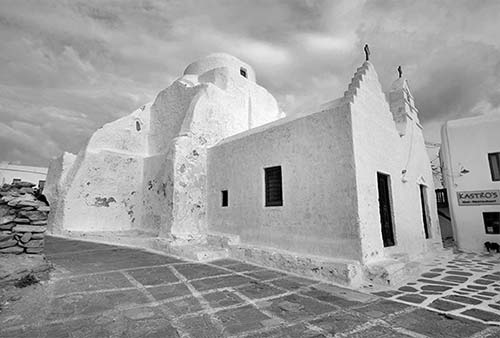
But first, turn your attention to the giant melting-marshmallow building on your right—the Church of Panagia Paraportiani. This striking architectural oddity is actually a hodgepodge of five small chapels draped together in a thick layer of whitewashed stucco. The four chapels at the base are interconnected; the chapel on top is separate and gives its name to the entire complex: “Panagia” refers to St. Mary—who, according to Byzantine tradition, was often the guardian at the entrance to a town—and “Paraportiani” marks the secondary (para) gate (port) in the Venetian fortress complex. While the interior is usually closed, you may occasionally find one of the chapels open, the small space filled with the rich aroma of incense.
Now head down the tight lane just behind the church, turning left at the sign for Kastro’s Bar-Restaurant. The houses on the right side of this street belonged to local sea captains. Here in the fickle Aegean, seafarers might be part-time merchants and traders, and part-time pirates, depending on the tenor of the times. These houses were actually the fortified outer seawall of the Venetian fortress.
A few doors down on the right, peek into the Somnium shop, which sells upscale medieval kitsch and offers a peek at an authentic old house interior. Notice the walls are made of heavy local granite and mica stone, with wooden beams mixed in. This wood—imported from the mainland to this nearly treeless island—gave some flex to buildings and thus made them earthquake resistant. The window at the far (seaward) end was added later; originally this was a solid chunk of the city wall, and the only opening was a small passage at the base that allowed the captain to come and go more easily.
The house next to Somnium, Katerina’s, is named for the first female sea captain from Mykonos, Katerinas Xidaki (you can see old photos of her just inside the door...and may see her in the flesh hanging out inside).
Continue downhill on this narrow lane, keeping right at the fork. You’ll pass a row of shops, bars, and restaurants. Peek through the ones on the right to see the windows overlooking the water.
When you reach the busy little intersection, turn right toward the water. When you reach the water, turn left and walk along the bar tables perched just above the seawall. At the end of this row, look back along the waterline for a wonderful view of the area called “Little Venice” (Mikri Venetia). You’ll see how the formerly fortified seawall is today punctuated with windows and brightly painted wooden balconies. The name, inspired by the builders of that original wall, conjures comparisons with the many fine palazzos that rise up from Venice’s Grand Canal. Looking the other way, you’ll enjoy fine views of the town’s trademark windmills (we’re heading up there soon). This scenic stretch is a favorite vantage for enjoying the sunset over a pricey cocktail; pick a spot to reserve for tonight.
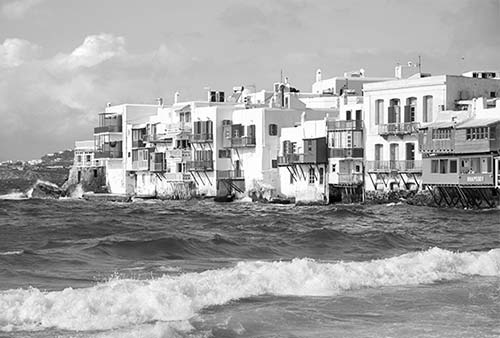
• Turn with your back to the water and, facing Galleraki Cocktail Bar, walk up past the remaining few café tables, then turn right down the little lane. Follow this until you pop out at a tiny square with a big bell tower.
Alefkandra Neighborhood
The church on your left, with the square bell tower, is Mykonos’ Greek Orthodox cathedral (or “metropolitan” church). And straight ahead of you is the side of the local Catholic cathedral. Jog to the right, around to the front door of the Catholic church (facing the water). While the Venetians left their mark with their fortress, their cultural legacy is minimal. This small chapel was built by the only Catholic family on Mykonos—and so, as the only Catholic church, it’s the default cathedral. Services are posted to the left of the door; a priest who serves the surrounding islands (especially Tinos, with a much larger Catholic population) comes here periodically to worship. Step inside to see the architectural mix of Catholic (with depictions of the Virgin Mary) and Orthodox (the candle reservoir).
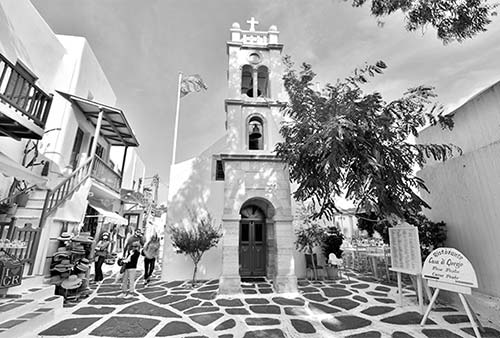
Continue past the Catholic church toward the water. The small, dry channel here was once a gushing stream. It gave the Alefkandra neighborhood its name: lefkos means “whiten,” and this stream was where locals would launder—or whiten—their textiles. Follow this channel to the waterfront, where again you enjoy views to Little Venice (right) and the windmills (left).
• Now turn left and climb up to those windmills. You can either use the ramp (step over the parking barrier) or the grand, white staircase—where celebrities of the 1950s and 1960s famously posed, with the iconic windmills in the background, helping to put Mykonos on the map.
Windmills
Mykonos is infamously windy, and Mykonians have special names for the different winds that blow through: “the bell ringer,” “the chair thrower,” and “the unseater of horsemen.” Today, locals are most concerned when the wind is bad enough to prevent cruise ships from docking or the Delos excursion boats from running.
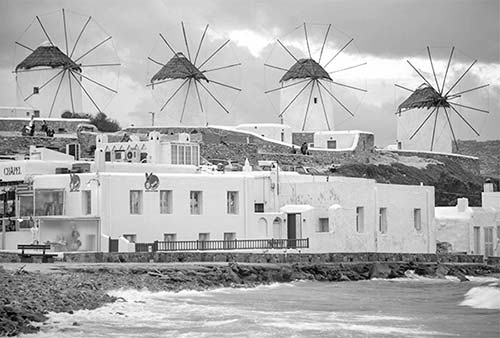
This ridge—called Kato Myloi—is perfectly positioned to catch both northerly and southerly winds—which, combined, blow nine days out of ten. You’ll see six intact windmills, one of which was reconstructed relatively recently. As in many Greek island towns, Mykonos’ old-fashioned windmills harnessed this natural power in order to grind grain to supply its ships. Notice how the windmills are strategically located over the water, making it easy to load up ships. Traditionally, the windmills were owned not by individuals but by little committees made up of five different factions: priests, merchants, millers, bankers, and carpenters. While there’s nothing to see inside these buildings, they make for a fine photo op and offer great views over town. If you’d like to enter a windmill, you’ll need to head to the opposite (east) end of the Old Town, where the Boni Myli windmill is sometimes open to visitors (ask at the Folklore Museum).
• When you’re done exploring the windmills, continue up the path through the middle of the adjacent parking lot (with the mills on your right). After the base of the final, armless windmill—now a short-term rental—turn left down the narrow, unmarked street. Let’s explore...
Backstreets Below the Windmills
Walk downhill on this sleepy lane, through a rare corner of Mykonos that’s still predominantly residential; locals really live here (as you can tell from the laundry drying). The first side street on the left is particularly evocative, offering a rare glimpse of Mykonos before it was glitzy.
The maze of meandering, skinny lanes helped buffer the howling winds...and discouraged pirates and invaders. As you explore here, tune in to the details of Mykonos’ unique architecture: Houses and public space (sidewalks and curbs) blend with little concern about who owns what. Everything is painted a blinding white, including the seams between the paving stones. Today this is decorative, but originally it was practical: By painting the lanes with lime, a natural disinfectant, locals offset the unhygienic living conditions (people living on top of each other and emptying their chamber pots in the streets). And the rooftops were painted with lime, too—they collected precious rainwater, which was carried through a network of gutters to cisterns down below. (Fresh water is hard to come by on an arid island.) Houses generally had the kitchen and living room on the main floor, a couple of bedrooms upstairs, and a tiny toilet under the stairs (exploring town, look for a few surviving under-the-stairs doors today—now mostly used for storage). Today those staircases and trim are painted bright, cheery colors, giving Mykonos its distinctive look.
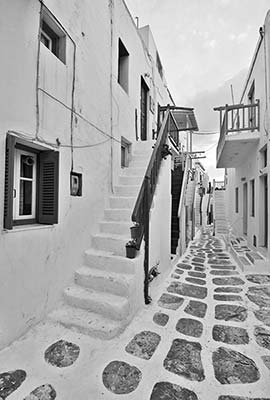
Continue down the lane until you reach a T-intersection. Across the street and three steps to the right is the recommended Gioras Pastry Café, an old-fashioned cellar bakery selling sweet and savory pastries. For 500-some years, they used a wood oven and mainly baked breads for locals; today they focus on tourist-friendly pastries but maintain their charming and historic interior.
• From the bakery, head downhill on the lane, past several shops. At the intersection, head right along one of the town’s most bustling streets, Enoplon Dinameon.
Enoplon Dinameon and Matogianni Streets
Strolling the lane called Enoplon Dinameon, you’ll pass a school on the right. Then (just after Louis Vuitton on the left) look for three old wells. These were the town’s main source of drinking water until the arrival of modern plumbing in the 1950s—and, as such, this was the place to see and be seen, to gossip, and to court. It was said that if a visitor was offered water from the three wells, they were really respected by a Mykonian.
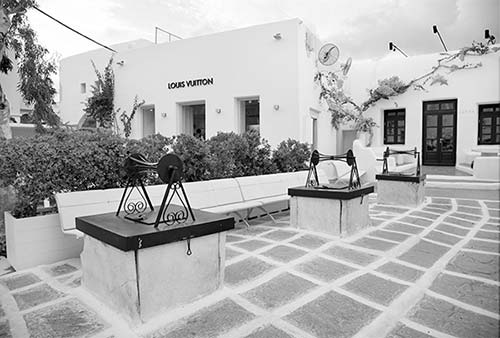
Continue past the wells, between two churches. On the left you’ll see the Maritime Museum, with a well-presented exhibit about Mykonos’ seafaring history, and Lena’s House, offering an evenings-only glimpse into a traditional old home (both described under “Sights in Mykonos”).
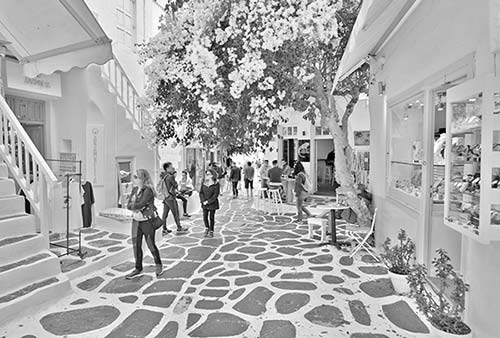
Keep going on Enoplon Dinameon as the colors—and crowds—crescendo, and you pass under a brilliant purple bougainvillea. (Good luck dodging all the impromptu photo shoots.) After dark, the clientele from the bars and cafés in this area all merge into one big, open-air cocktail party under purple petals. Soon you’ll come to the wide cross street called Matogianni, nicknamed the “Catwalk of Mykonos” for its lineup of top-end boutiques. Turn left here and appreciate the traditional-architecture-meets-modern-couture vibe. After just one block, you’ll run into Alpha Bank.
• From here, continuing straight past the bank leads you down to the harbor. But if you’re up for more exploring, stay with me a few more minutes for a look at some back lanes that many visitors miss.
Backstreets to the Harbor
Stick with me, now: At Alpha Bank, turn left, passing the recommended To Maereio restaurant (on your right). The street curves a bit; then, turn left immediately past Fresh Boutique Hotel. On this little lane, the red-doored house on the right is the recommended Psillos bakery, where locals buy sweet and savory pies. Continuing past the bakery, bear left with the street at Terra Maria Hotel, and watch on your right for the low-profile door to Mantó Garden Café/Cine Mantó. Step inside to a peaceful, verdant world unto itself—called the “public garden”—sheltered from the wind, filled with giant cacti and pomegranate trees, and cooled by a goldfish pond. Locals appreciate its calm, natural atmosphere—and public WCs (outside the garden near the theater entrance). Consider a drink or light meal at the café, then walk to the far end of the garden, where you’ll find the screen and chairs for the delightful open-air movie theater. Exit the far end of the complex, near the theater. (If this part is closed for some reason, backtrack past the bakery, then make four successive lefts. I’ll meet you there.)
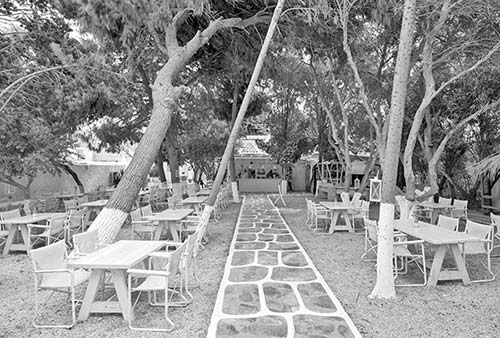
Outside the garden gate is a little square with a big tree. Keep Gucci on your left and head up that lane. You’ll pass the back end of the Greek Orthodox cathedral we saw earlier. Continue straight through this mazelike area, bearing right where the street widens. Head a couple of short blocks down this shop-lined lane. At the Happiness shop, bear right at the fork, then take the next right, up the narrow alley. Wind your way around, taking a left at the next T-intersection and continuing another 25 steps. Suddenly you find yourself alone with Mykonos, at a little square with five churches and three trees. Known locally as “Gossip Square” (for the way the churches seem to be gathering to swap local news), this forgotten slice of old Mykonos is entirely surrounded by today’s trendy bustle.
Exit this square to the left of the three red-doored churches. From here, I’ll let you find your own way down to the harbor—because you couldn’t possibly follow my directions anyway. The general idea is to bear right, then listen for the surf, the horns of the ships, or the howl of the northerly wind. (KOUNELAS signs, to the recommended fish tavern just off the harbor, are helpful.) Enjoy getting lost in the maze, likely having some lanes to yourself.
• You’ll wind up more or less where we started, at the harbor. Your walk is finished, and you’ve seen a good slice of Mykonos. Circle back to any museums you’d like to see, or consider heading around the right side of the harbor for a look at the Archaeological Museum. Or, if you have time and the seas are calm, take a boat out to Delos (described later in this chapter).
Sights in Mykonos
MUSEUMS
Mykonos Archaeological Museum
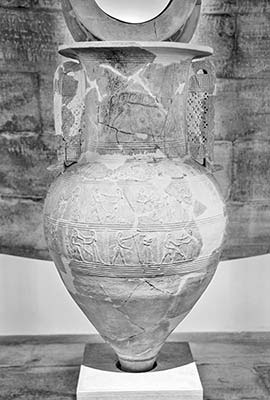
This small museum, just uphill from the Old Port, displays artifacts found on the nearby island of Rheneia, which the Athenians reserved as a burial isle for Delos in order to keep that sacred isle pure. Though the temporary exhibits can be engaging, you may find most of what’s here pretty dull—vases, jewelry, and statue fragments—with limited English descriptions. One item, however, makes a visit worth considering: a large vase (in room just beyond entry, dead center along the back wall) clearly showing the Trojan Horse filled with Greek soldiers sporting gleeful archaic smiles, and cartoon-like panels telling the story of the massacre that followed when they jumped out. Dating from roughly 670 BC, it’s the oldest depiction of the Trojan Horse ever found. It was found right here on Mykonos, discovered in 1961 by a (surely very surprised) farmer who’d set out to dig a well. Out back you’ll find a courtyard ringed with intricately carved stone grave markers.
Cost and Hours: €4, Wed-Mon 9:00-16:00, closed Tue, possibly shorter hours Nov-March, +30 2289 022 325.
Aegean Maritime Museum
This tight but endearing collection traces the story of the local mercantile shipping industry. A desert isle of history in a sea of wealthy tourism, this little place takes its subject very seriously. In its three rooms you’ll find amphora jugs, model ships, portraits of great sailors, and more. The tranquil garden in back displays the actual, original lighthouse from the island’s Cape Armenistis, as well as replicas of ancient sailors’ gravestones. The good English descriptions offer a fine history lesson for those willing to read them.
Cost and Hours: €4, daily 10:30-13:00 & 18:30-21:00, closed Nov-March, Enoplon Dinameon 10, +30 2289 022 700.
Lena’s House
This little museum (affiliated with the Mykonos Folklore Museum) shows part of a typical middle-class Mykonian house dating from the late 19th century, complete with original furnishings and artwork.
Cost and Hours: €2, Mon-Sat 18:30-21:30, Sun 19:00-21:00, closed Oct-March, Enoplon Dinameon, +30 2289 022 390.
Mykonos Folklore Museum
Housed in a typically Cycladic former sea captain’s residence just up the bluff from the harbor, this museum is deceptively sprawling. Pick up a laminated info card after entering (next to the donation box). Exploring the interior, you’ll peruse a random mix of traditional folk items from around the island, as well as a typical kitchen and bedroom. In the basement are fragments of the Venetian castle that once stood here, discovered only in the 1970s.
Cost and Hours: €2, Mon-Sat 10:30-14:30, closed Oct-March and Sun year-round, +30 2289 022 591.
BEACHES
Mykonos’ beaches rival those of any Greek island. Each beach seems to specialize in a different niche: family-friendly or party; straight, gay, or mixed; nude or clothed; and so on. (Even “family-friendly” beaches can have topless sunbathers.) Get local advice to find the one that suits your beach-bum preferences, or choose from the options below.
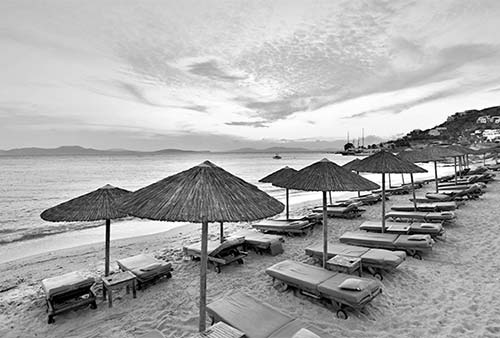
All these beaches have beach bars or restaurants that rent comfortable lounge chairs with umbrellas out on the sand (around €20-40 for two chairs that share an umbrella; can be much pricier at exclusive beaches). Just take a seat—someone will come by to collect money. The bars usually sell cocktails and typical Greek-island meals. You can often order from your beach chair, but heading inside can be a welcome escape from the sun. Be warned that in peak season (July and especially Aug), all beaches are very crowded, and it can be difficult to find an available seat.
Getting to the Beaches: The beaches I’ve recommended are all on the south coast of the island and listed here roughly in order, from west to east, as you would approach them from Mykonos town. All are within a 10- to 20-minute drive from town.
Throughout the season, buses run to major beaches twice hourly during the day, usually leaving from the Fabrika stop in town at :00 and :30 past each hour; most rides cost around €2. Confirm the schedule at the little ticket kiosk, then find the bus marked with your destination and hop on. As buses can be crowded at prime times, it can be smart to line up early to ensure getting a seat.
A taxi to the beach from town will run €20-30; some of the farther beaches can go up to €35. There are rarely taxis standing by at beaches; when you’re ready to leave, call for one (+30 2289 022 400 or 22890-23700) or ask a taverna to call for you (if you’ve paid for chair rental or drinks, they’re generally happy to do this). You may be charged a few extra euros for calling rather than hailing a taxi.
To explore a variety of beaches in one day, you can connect some of the major beaches—Platis Gialos, Paraga, Paradise, Super Paradise, Agrari, and Elia—by regular shuttle boat (€15 round-trip for one hop; €20 for an all-day hop-on, hop-off ticket, +30 2289 023 995). Note that these run between the beaches, starting with Platis Gialos, but do not include Mykonos town. A separate boat connects Mykonos town to Paradise beach (€10, 2/hour, departs from the same pier as Delos boats).
▲Agios Ioannis
Pronounced AY-yohs yoh-AH-nees, this appealingly remote patch of pebbly sand, tucked behind a hill, feels like a castaway isle. You’ll enjoy views across to the important isle of Delos. From Mykonos town, go to Ornos, then head toward Kapari; on your way down the hill, turn off on the left at the low-profile beach signs (one directs you to ΠΥΛΗ, one of the restaurants on the beach); this is also where buses stop, a short but steep hike above the beach. You’ll drop down this road to an idyllic Robinson Crusoe spot. The two main restaurants here are the trendy, pretentious Hippy Fish (where the film Shirley Valentine was filmed), and the nice but more accessible Pili (ΠΥΛΗ); both rent chairs and have full food and drink menus.
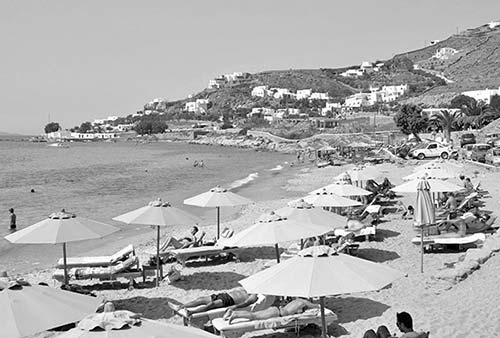
For the even more secluded Kapari beach, continue down the road past the Agios Ioannis turnoff, then swing right at the white church.
Ornos
This easy-to-get-to, family-friendly beach is right in the middle of the sizeable town of Ornos. It’s one of the more functional beaches of those I list (and has better lounge-chair values). Although it’s in a built-up area, the whole place has an unpretentious charm.
Psarou and Platis Gialos
These two beaches are along the next cove east of Ornos. The main landmark here is Platis Gialos, a crowded, densely developed stretch of beach just below the main bus stop. You’ll find a row of beach hotels, plenty of beach-chair rentals, and an array of other water activities—but it can feel a little claustrophobic (the far end from the bus stop/parking is less jammed).
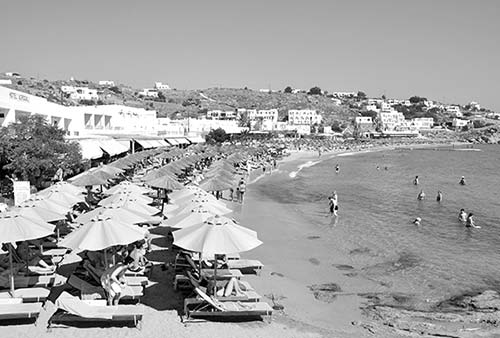
I prefer to walk 10 minutes to the less developed Psarou (psah-ROO)—head back up the way the bus came, and watch on your left (through a little parking lot) for a fine trail that leads above the waterline down to an idyllic cove. (You can also get off the bus a stop early, but from there it’s a steep hike down—along rocky, uneven steps—to the beach.) Psarou, one of the most sheltered beaches on the island, is a broad, sandy stretch with luxury yachts moored just offshore. It has an exclusive reputation, thanks to the big, fancy Mykonos Blu beach hotel and the top-end Nammos restaurant (which charges an exorbitant fee for its chair rentals). But right in the middle is the more affordable Cavo Psarou, a humbler beach bar with chair rentals priced within reach of mere mortals. This beach is relatively uncrowded, and the sand is fine—making it my favorite place for a day at the beach.
Paraga
Sometimes spelled Paranga, this stretch of coast squeezes beach chairs, bars, and high-end resorts into a compact cove, bookended at the western head by a small sandy-soft beach (free) beneath the fancy Scorpios luxury resort (where €140 will get you the cheapest cabana for four people, and there’s a good chance you’ll spot a celebrity) and to the east by a pebbly shore with a footpath to Paradise (15 minutes). Here at the eastern end is a handy hostel—an affordable option with mixed dorms, prefab tents, and private bungalows, all with free airport transfer (www.paragabeachhostel.com [URL inactive]). In between, the SantAnna club is a hit with the 30-something crowd for its poolside lounge chairs (starting at €100).
Paradise and Super Paradise
Mykonos’ famous “meat-market” party beaches are a magnet for young people in the Aegean, and more of a destination than the other beaches listed here. While a bit too rowdy for my taste, they’re a little calmer in the shoulder season.
Located at the southern tip of the island, Paradise (a.k.a. Kalamopodi) is presided over by hotels that run party-oriented bars for young beachgoers—perfect if you want to dance in the sand all night with like-minded backpackers from around the world. By day, it’s less crowded and more accessible, but still comes with thumping music. As you approach, the last stretch is through thick, high grasses, giving the place an air of secrecy; then you’ll pass long rows of lockers before popping out at the party.
The next cove over hosts Super Paradise (Plintri) beach, which has eclipsed the original as the premier party beach on the island. Super Paradise tries to be a bit more elegant than plain old Paradise—rather than grungy backpackers, it skews slightly older, with posh thirtysomethings.
Nightlife in Mykonos
Covering the fast-changing lineup of trendy clubs is beyond the scope of this book. But here is a pair of enjoyable evening activities.
Cocktails at Sunset: The Little Venice embankment is lined with cocktail bars and cafés, crowded every night with throngs of visitors enjoying the island’s best spot to watch the sunset—one of the highlights of visiting Mykonos. Plan on cocktails in the €15-20 range, with wine or beer around €10—and there may be a steep cover charge. While it’s fun to window shop your options here before settling in at your pick, reputable choices include Scarpa, Galleraki, and Caprice.
Open-Air Cinema: In summer, locals and vacationers sit back and enjoy the movies under the palm trees at Cine Mantó, in a lovely public garden smack in the middle of town (€9, films shown in original language—usually English, June-Sept only, usually two showings a night—check signs around town for times, +30 2289 026 165, www.cinemanto.gr). You can combine this with a dinner from the adjoining, recommended café/grill for an affordable-for-Mykonos meal.
Sleeping in Mykonos
Mykonos is an extremely expensive place to overnight—especially from mid-June to mid-September (peaking in mid-July through August). During these premium times, even “budget” hotels dramatically increase their rates...which means you should lower your value-for-money expectations. If you can come outside this busy period, you can save more than half; it’s worth comparison shopping in shoulder season to find the best deal. If you do come in peak season, book as far ahead as possible—most of the smaller hotels get filled up with repeat customers.
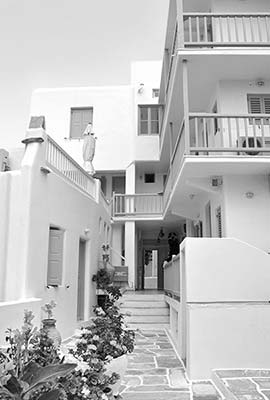
In this party town, nighttime noise—dance clubs, people carousing in the streets, and so on—is epidemic; plan to wear earplugs, and if you’re a light sleeper, try requesting a hotel’s quietest room. I’ve tried to recommend places on streets that are less raucous than the norm, but they’re also very central, so no promises.
IN THE OLD TOWN
$$$$ Marietta’s rents four sea-breezy rooms on a quaint street near Little Venice. Rooms vary in size, but all have a balcony and/or views of the ocean or the windmills. Run by Marietta herself, the place can be hard to find: Look for the sign in the door (no breakfast, Mpaoumi street, +30 6945 225 390, www.mariettas-mykonos.com, info@mariettas.gr).
$$$$ Fresh Boutique Hotel is buried deep in the heart of Mykonos. Its 10 rooms, some with balconies, are thoroughly modern. While it has hardly any public spaces, its sleek garden restaurant (which can be noisy) serves as an ersatz lounge. With dramatic price drops outside peak season, this can be a particularly good value in slow times (breakfast extra, closed Nov-March, N. Kalogera 31, +30 2289 024 670, www.hotelfreshmykonos.com, info@hotelfreshmykonos.com).
$$$$ Hotel Carbonaki, loosely run by the welcoming Rousounelos family, rents 21 fine but faded rooms around an oasis courtyard with a hot tub. It’s conveniently located a few steps above the busiest downtown streets (breakfast extra, closed Nov-Feb, Panachrantou 23, +30 2289 024 124, www.carbonaki.gr, info@carbonaki.gr, Theodore and Evi).
$$$$ Andromeda Suites feels like a little village set around its own quiet pool. The 17 units range from doubles to full-size apartments. They’re slightly worn, but a decent value, and all come with a kitchenette (no breakfast, Lakka Square, +30 2289 024 712, www.andromeda-mykonos.gr, info@andromeda-mykonos.com, Jeannette and George).
$$$$ Elena Hotel, even higher up than Carbonaki (and therefore a bit more peaceful), has 32 modern rooms, helpful staff, and a pleasant veranda lounge/breakfast area with a bit of a sea view (Rochari street, +30 2289 023 457, www.elenamykonos.gr, info@elenamykonos.gr).
$$$$ Hotel Matina Garden is charming. Humble but nicely maintained, it’s been family-run since 1958 (now in its third generation), with rooms surrounding a tranquil garden near the top end of town. Their 12 “hotel” rooms are priced similarly to other midrange hotels in town, but they also have seven cheaper “pension” rooms with shared bathrooms (Fournakia 3, +30 2289 022 387, www.hotelmatina-mykonos.com, info@hotelmatina-mykonos.com).
$$$$ Matogianni Hotel, with 33 rooms facing a garden in the heart of town (plus a handful under the street level), keeps its prices reasonable while offering a sense of contemporary style unusual for this price range. It has an on-site café and a long, pleasant front porch filled with wicker chairs (breakfast extra, closed Nov-Feb, Matogianni street, +30 2289 022 217, www.matogianni.gr, info@matogianni.gr).
HIGHER UP
These places get you up above the rooftops of Mykonos. This helps cut down on party noise but, as they’re closer to the main road around town, can come with some traffic noise.
$$$$ Portobello Boutique Hotel is the place for well-heeled mountain goats. Perched high above town near the windmill museum (a steep 5-minute walk down, or 10-minute walk up), it has 17 rooms—some with spectacular views for higher rates—plus a popular sunset-view bar. It feels modern, fresh, and tidy (+30 2289 023 240, www.portobello-hotel.gr, info@portobello-hotel.gr).
$$$$ Hotel Nazos is up a steep street, but you’re rewarded with sweeping vistas from the veranda and a warm welcome from brother-and-sister team George and Sofia. The 21 rooms are modest, but most have views and/or balconies. Stay here if you’ll happily trade a hike for a low-key, family-run hideaway (breakfast extra, closed Nov-March, near the School of Fine Arts, +30 2289 0226 626, www.hotelnazos.com, info@hotelnazos.com).
Eating in Mykonos
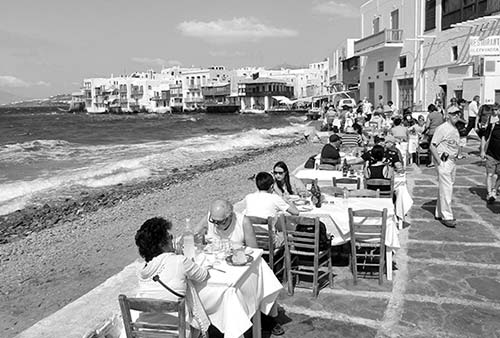
The twisting streets of the Old Town are lined with tourist-oriented restaurants. You won’t find good value here—Mykonos is expensive. Simply choose the spot with the menu and ambience that appeal to you: The harborfront has the workaday action, while the places in Little Venice are more romantic—especially at sunset. A few steps inland, tucked in the town’s winding back lanes, are countless charming restaurants filling hidden gardens under trellises of bougainvillea, some with tables out on a busy pedestrian lane. Take mental notes as you explore by day, then come back to the place that most appeals.
PRICEY DINNER RESTAURANTS
These places are open only for dinner.
$$$$ At To Maereio (Τό Μαερειό), in-the-know diners choose from a small but reasonably priced, inventive menu that includes some Mykonian specialties and plenty of meat options. The seating is almost entirely indoors. Out front you’ll often see a long line of hopeful diners—arrive early, or be prepared to wait (daily from 19:00, Kalogera 16, +30 2289 028 825).
$$$$ Fish Tavern Kounelas, buried a few winding streets off the harbor, feels friendly and unpretentious. They offer a warm welcome, tight and atmospheric outdoor seating, a nondescript interior, and a typical taverna menu focusing on fish and seafood. Notice the little grill right out on the tiny alley where they prepare your fish (daily from 18:30, near St. Monis Square—look for blue-and-white KOUNELAS signs, +30 2289 028 220).
$$$$ M-Eating serves up high-end, creatively presented, modern Mediterranean cuisine with a homegrown influence. Most diners vie for their outdoor covered terrace seating; you may have better luck snagging one of the few small tables inside. Among Mykonos’ posh eateries, this one distinguishes itself by delivering quality food and polished service. As it’s popular, book ahead (daily from 19:00, 10 Kalogera, +30 2289 078 550, www.m-eating.gr).
MIDRANGE LOCAL OPTIONS
While these centrally located places are welcoming to tourists, they’re popular with value-seeking locals and expats, too.
$$$ Cine Mantó Garden Café, filling a beautiful oasis-garden in the heart of Mykonos, is best known as an outdoor movie venue (see “Nightlife in Mykonos,” earlier). But the café here—with outdoor tables under palm trees—is open all day long, and it’s an ideal respite from the busy town for a drink or light meal (daily 9:00-24:00, +30 2289 026 165, www.cinemanto.gr).
Lowbrow Tavernas on the Harbor: Mykonos’ harborfront has a cluster of simple tavernas that draw locals with relatively good prices and enjoyable water views (provided the wind doesn’t blast you away). $$$ Yialos (Γιαλός), near the red-domed church, is a decent place for a straightforward meal (open long hours daily). Even if you’re not up for a full meal, consider enjoying a freddo cappuccino or frappé from this comfortable perch, which offers some of Mykonos’ best people-watching (and, sometimes, cat- and pelican-watching).
CHEAP EATS AND EASY LUNCHES
It’s difficult to have a sit-down meal in Mykonos without dropping at least €20 per person. Here are some less expensive alternatives.
Souvlaki: A variety of $$ souvlaki stands are scattered around town. Most cater to tourists, and Mykonos lacks a stellar souvlaki joint. But relatively reliable, central choices include the classic Sakis Grill House (Kalogera 7) and the slightly more upscale Souvlaki Story (multiple locations, including one at Enoplon Dinameon 37).
Bakeries: Locals still shop at Psillos, a family-run hole-in-the-wall where they bake everything on site. Grab something from the bins of breads, cookies, and other items lining the wall, or try a cheap meat or cheese pie. It offers a bit of affordability and local flavor in the center of this pricey, touristy town (daily until 19:00, near the Fresh Boutique Hotel on Klaous street). Gioras Pastry Café, filling a traditional cellar on a quiet street below the windmills, also has savory and sweet pastries, and atmospheric indoor seating. It’s run by a husband-and-wife team: George does the baking and Cloe is happy to help you pick out a treat (May-Oct daily 8:30-15:00, 16:00-late, Efthiniou street, +30 2289 027 784).
Mykonos Connections
BY BOAT
All bigger boats and car ferries leave from the New Port, about a mile north of town (see “Arrival on Mykonos,” earlier, for information on getting there from Mykonos town). That includes most boats to Piraeus and Santorini—be sure to check locally to confirm from which port your ferry is departing. The frequency and durations listed below are approximate; schedules can change from season to season, and sailings can be canceled on short notice—confirm everything locally. For information on finding current schedules and booking tickets, see here of the Practicalities chapter.
To Piraeus: Generally 3-4/day in high season (2.5 hours via fast boat, 5.5 hours on slow boat). Off-season (Nov-mid-March) there is likely one slow boat daily (confirm, especially Jan-March).
To Santorini: Generally 2-4/day in high season, none in winter, 2-3 hours, 1-2 stops en route.
Delos
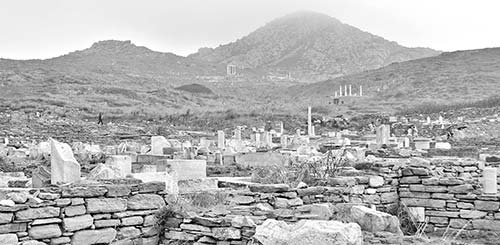
As popular as Mykonos is today, it was just another island centuries ago. The main attraction was the island next door, Delos, worth ▲. In antiquity, Delos lived several lives: as one of the Mediterranean’s most important religious sites, as the “Fort Knox” of Greek city-states, and as a busy commercial port for the ancient world. Its importance ranked right up there with Athens, Delphi, or Olympia. Today the island is a ghost town—but because no modern buildings were ever erected here, these ruins are nearly undisturbed. Highlights of your visit include some much-photographed lion statues (the Lion Terrace), some nice floor mosaics, the view from Mount Kynthos, and a windswept setting pockmarked with foundations that hint at Delos’ rich history.
GETTING THERE
Delos is a 30-minute boat ride from Mykonos. Boats depart from the pier extending straight out from the Old Town; buy the €22 round-trip ticket at the kiosk at the base of the pier (generally departing Mykonos at 9:00, 10:00, and 11:30; returning from Delos at 12:00, 13:30, and 15:00). You can take any boat back. There may also be a late-afternoon boat from Mykonos (around 17:00) that returns in the early evening (around 19:30; times differ outside peak season). Times can change depending on weather, cruise-ship arrivals and departures, and other factors, so check locally.
ORIENTATION TO DELOS
Cost and Hours: €8 for the archaeological site, €12 for site and museum (museum may be closed for renovation when you visit), open April-Oct daily from the arrival of the first boat to the departure of the last one, closed Nov-March, +30 2289 022 259, http://odysseus.culture.gr.
Planning Your Time: Most visitors find that two hours on the island is plenty to wander the site; add more time if you want to climb Mount Kynthos, or if the museum is open.
Tours: Local guides meet arriving boats (€10 for a 1- to 1.5-hour tour—you’ll need more time to actually hike around the site and see the museum). Travel agencies in Mykonos town sell package excursions to Delos that include the boat, museum entry, and a guided tour (overpriced at roughly €60, though these tours last longer than those offered by on-site guides).
Services: If the museum is open, a nearby café sells coffee, juice, and basic snacks. WCs are located behind the café and near the site entrance/ticket booth.
Be Prepared: Delos has virtually no shade and minimal services. Wear good shoes, and bring sun protection and plenty of water.
 SELF-GUIDED TOUR
• From the boat dock, walk to the entrance, buy your ticket, pick up the helpful included map, and enter the gate.
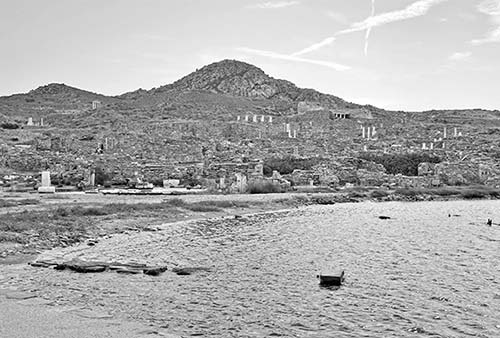
Pause and survey the site. The commercial harbor was to your right, and the sacred harbor to your left. Ahead and to the right are the foundations of shops and homes that constituted one of the Aegean’s finest cities in Hellenistic times. Standing above those ruins is Mount Kynthos, its hillsides littered with temple remains. The Agora of the Competaliasts—one of the main squares in town—is straight ahead (with the museum building poking up behind). The religious area (with the temples of Apollo) is ahead and to the left, at the end of the Sacred Way. And far to the left was the Sacred Lake (now a patch of trees), overlooked by the famous Terrace of the Lions.
• Start by wandering through the long rows of foundations on your right. You can circle back to these at the end, or poke around now.
1 Residential and Commercial District
Most of the remains here were either homes or shops. In the second century BC (when Delos was a bustling commercial port), you could buy just about anything from one of the many shops, and the elaborate homes of wealthy merchants and shippers covered the hillsides above. Delos was considered the most important commercial center in the known world. (One of its primary commodities was human beings—it was a major center in the ancient slave trade.) The city was cosmopolitan, with 30,000 residents and distinct ethnic groups, each with its own linguistic and cultural neighborhood (Greeks, Syrians, Beirutis, Italians, and so on). Remains of these same neighborhoods can still be seen today.
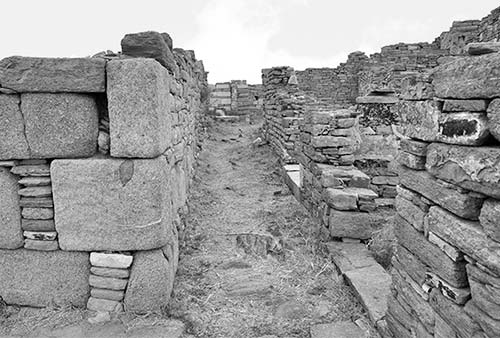
Poke into some of the house foundations. Homes were generally organized around a central courtyard above a giant cistern. Look for fragments of elaborate mosaic floors (intact portions are on display inside the museum), as well as marble structures that once decorated the place. The city even had a surprisingly advanced sewer system. Because wood was rare on the arid Cycladic Islands, most buildings were constructed from dry-stone walls; wood was a status symbol, used only by the wealthiest to show off. Delos had some of the biggest homes of ancient Greece in part because residents could build big here without fear of the devastating earthquakes that plagued other locations in the islands. The Greeks attributed this to divine intervention, while modern seismologists have found that Delos sits away from major fault lines.
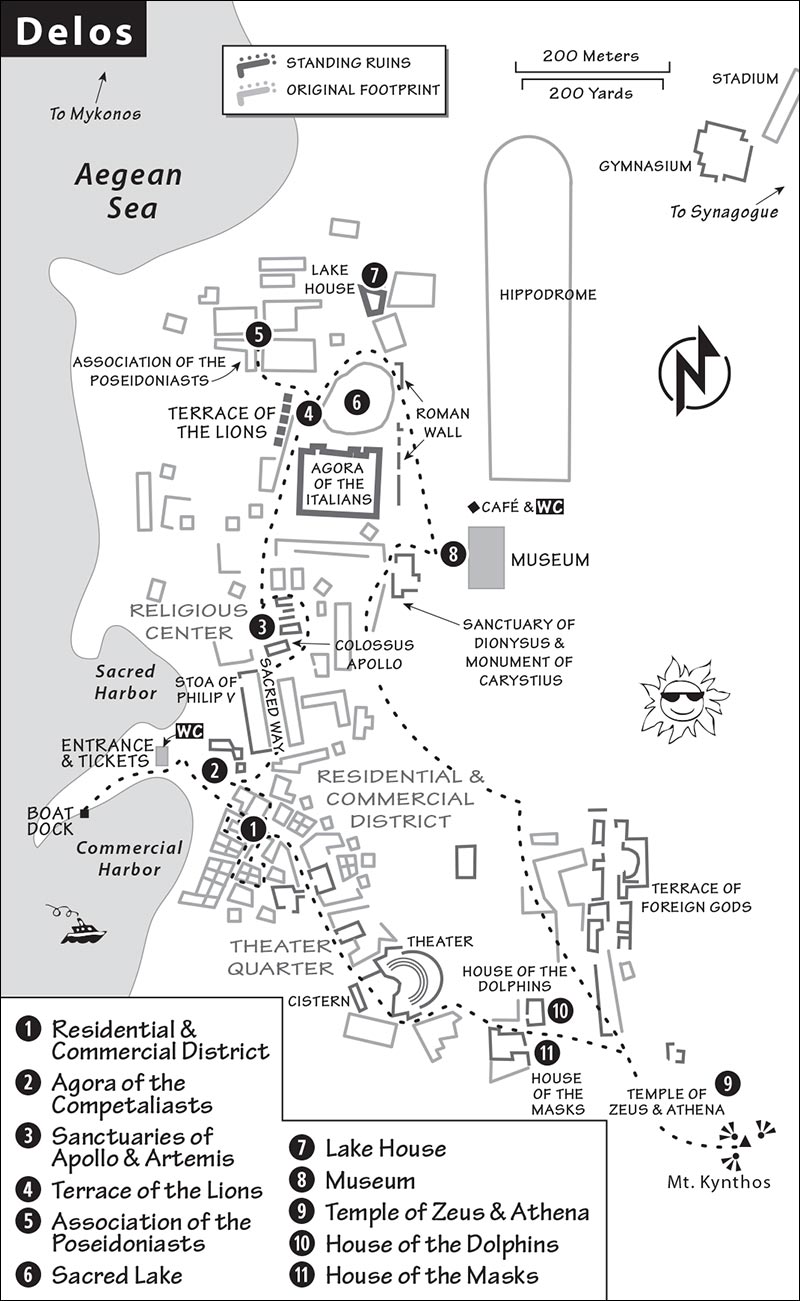
• Now head toward the agora that’s near the ticket building.
2 Agora of the Competaliasts
This was the main market square of the Roman merchants who worshipped the deities called lares compitales, who kept watch over the crossroads. This is not the agora, but one of many agoras (marketplaces) on Delos—a reminder that several different communities coexisted in this cosmopolitan trading city.
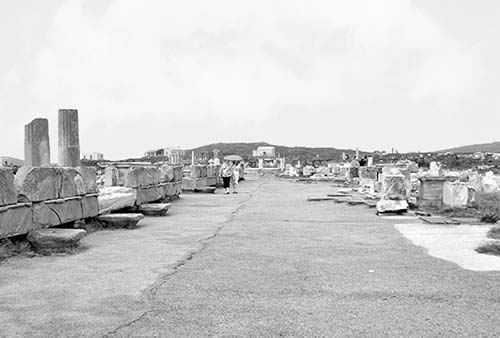
• Just above the upper-left corner of this agora, the Sacred Way leads off to the left. Follow the same path ancient pilgrims walked as they approached the Sanctuary of Apollo (look for the blue arrows to guide you). Along the left side of the road runs the long ledge of the pediment (with recognizable triglyphs) from the Stoa of Philip V (what we see here as the “bottom” actually ran along the top of the building). At the end of the Sacred Way is the...
Religious Center
Both the 3 Sanctuary of Apollo and, beyond that, the Sanctuary of Artemis consisted of several temples and other ceremonial buildings. In its day, Apollo’s sanctuary had three large, stern Doric temples lined with columns. The biggest temple was nearly 100 feet long. The nearby Porinos Naos served as the treasury of the Delian League. Other treasuries once held untold riches—offerings to the gods brought by devout pilgrims.
• Follow the route to the right, then left, then left again around the Sanctuary of Apollo. Before heading off to the right down the main path, pause at the giant marble pedestal that once held the...
Colossus Apollo Statue
The 35-foot statue (seventh century BC, labeled Colossus of the Naxians) was a gift from the people of the nearby island of Naxos, and was carved from a single block of marble. It’s long gone now, but a few bits of its fingers are on display in the museum.
• Continue down the path, beyond the Sanctuary. You’ll pass more ruined temples and the foundations that surround the spacious Agora of the Italians (on the right) on the way to the...
4 Terrace of the Lions
This row of five lion statues is the main, iconic image of this site. These are replicas, but five of the original marble statues (seventh century BC) are in the museum. One of the originals was stolen by the Venetians, “repaired” with an awkwardly too-big head, and still stands in front of Venice’s Arsenal building.
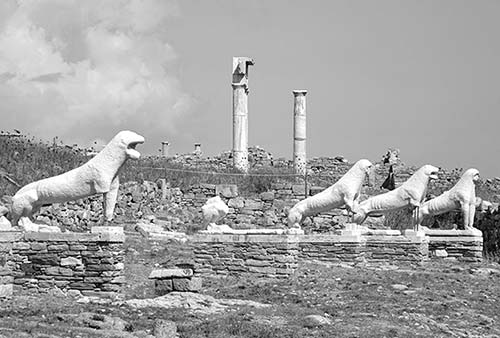
• Northwest of the lions, up a small hill, are four columns marking the 5 Association of the Poseidoniasts, the religious and commercial center for a guild of ship owners and merchants from Berytus (modern Beirut), in ancient Syria. Below the columns is what was once the...
6 Sacred Lake
This was supposedly the source of Zeus’ seed. When Leto was about to give birth to Zeus’ children (according to the Homeric Hymn to Apollo), she cried out: “Delos, if you would be willing to be the abode of my son Apollo and make him a rich temple, your people will be well-fed by strangers bringing offerings. For truly your own soil is not rich.” (French archaeologists drained the lake to prevent the spread of bacterial disease.)
• Walk around the Sacred Lake. At the top, stop by the 7 Lake House, providing a glimpse of a second-century BC Delian home. Now head up toward the museum. Just before the museum, a path detours to the left far into the distance. You can follow it to find the remains of a gymnasium, a stadium, and a Jewish synagogue.
Olympics-style games were held at Delos’ stadium every five years. Like the more famous games at Olympia and Delphi, these were essentially religious festivals to the gods, particularly Dionysus. Pilgrims from across the Greek world gathered to celebrate with sports, song contests, theatrical performances, and general merrymaking.
Make your way to the...
8 Museum
The museum is undergoing renovation and may not be open when you visit. When it reopens, exhibits may be shuffled around (and may differ from what’s described here). But in general, the collection includes statuary, vases, and other items. Look for a model of the site in its heyday. Most of the site’s best pieces are in the National Archaeological Museum in Athens, but a few highlights remain here, including a beautifully carved stone table, five of the original marble lions, the fingers of Colossus Apollo, and—perhaps the best part—several bits of striking floor mosaics.
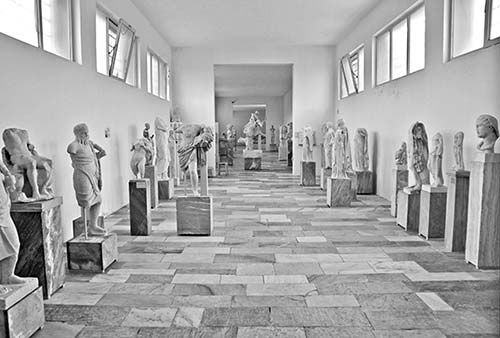
For more body parts of other gods, exit the museum, then veer slightly left down a short downhill path to stand in front of the Monument of Carystius (once part of the Sanctuary of Dionysus), with its large (broken-off) penis-on-a-pillar statues.
• Past the museum, the path splits. If you stay right you’ll wind back to the start. Or you can go left, which starts a hike up the hill toward more remains of houses and temples all the way up to Mount Kynthos (allow about 45 minutes).
Mount Kynthos
At 370 feet, the island’s highest point feels even taller on a hot day. To ancient Greeks, this conical peak looked like the spot from which Poseidon had pulled this mysterious isle up from the deep. Up here are the remains of the 9 Temple of Zeus and Athena. As you observe the chain of islands dramatically swirling around Delos, you can understand why most experts believe that the Cycladic Islands got their name from the way they circle (or cycle around) this oh-so-important islet.
• Head back downhill, toward the theater and harbor. On your way down you’ll pass the 10 House of the Dolphins, with mosaics of cupids riding dolphins, and the 11 House of the Masks, with a beautiful mosaic of a tambourine-playing Dionysus riding a leopard. As you return to the boat, you’ll see the remains of a giant cistern and the 5,500-seat theater...starring a 360-degree view of the Cycladic Islands.