EPIDAVROS
Επιδαυρος
Theater of Epidavros (c. 300 BC)
Nestled in a leafy valley some 20 miles east of Nafplio, Epidavros was once the most famous healing center in the ancient Greek world. It was like an ancient Lourdes, a place of hope where the sick came to be treated by doctor-priests acting on behalf of Asklepios, the god of medicine.
The site began as a temple to Apollo, god of light, who was worshipped here in Mycenaean times. By the fourth century BC, Apollo had been replaced by his son, Asklepios (who was said to have been born here). Because pilgrims prayed to Asklepios for health, a sanctuary was needed, with a temple, altars, and statues to the gods. The sanctuary reached the height of its popularity in the fourth and third centuries BC, when it boasted medical facilities, housing for the sick, mineral baths, a stadium for athletic competitions, and a theater.
These days the famous theater is Epidavros’ star attraction. It’s the finest and best-preserved of all of Greece’s ancient theaters—and that’s saying something in a country with 132 of them. Epidavros also has some (far) less interesting sights. The once-great sanctuary is now little more than a lonely field of rubble. The small Archaeological Museum displays a few crumbled fragments of statuary. But the theater alone makes Epidavros worth the side trip.
GETTING THERE
By Car: From Nafplio it’s a 30-minute drive to the east, along winding roads. There’s plenty of free parking at the site.
Head east out of Nafplio, and watch for, then follow signs pointing to Ancient Theater. If you’re connecting Epidavros and Mycenae (see next chapter; allow an hour), you can avoid driving all the way back into Nafplio by watching for signs to either site.
Be aware that names on signs can vary. Confusingly, many locations in this area carry the name Epidavros/Επιδαυρος. Don’t be distracted by signs to Nea (“New”) Epidavros/Νεα Επιδαυρος, or Palea (“Old”) Epidavros/Παλαιά Επιδαυρος, which will route you to a modern coastal town far from the theater. Also be aware that Epidavros can be spelled “Epidaurus” in English.
By Bus: From Nafplio, buses run to Epidavros (Mon-Sat 2-3/day—buses usually leave Nafplio around 10:30, 12:30, and 14:30; 1/day late on Sun; possibly 1/day Oct-April; 45 minutes). Return buses from Epidavros to Nafplio typically leave in the afternoon (Mon-Sat 2-3/day, last bus usually around 18:00; 1/day late on Sun). Confirm bus schedules locally.
In summer, it may be possible to see both Epidavros and Mycenae in one long day from Nafplio by bus: Take the 9:30 bus from Nafplio to Mycenae, spend about 90 minutes at the site, and return to Nafplio on the 12:00 bus; then catch the 14:30 bus to Epidavros, tour the site, and return to Nafplio on the last bus, arriving back in the city in the early evening. (This wouldn’t work on Sun, when there are no buses to Mycenae.) Taking the bus to Epidavros first and then to Mycenae doesn’t work (it gives you less than an hour at Epidavros and only 30 minutes at Mycenae).
From Athens, buses head to Nafplio, then continue on to Epidavros (2-3/day, 2.5 hours, may require transfer in Nafplio—ask when you buy your ticket).
By Taxi: You can get to Epidavros by taxi from Nafplio (€70 round-trip with one-hour wait).
ORIENTATION TO EPIDAVROS
Cost: €12 (€6 off-season) includes the theater, the Archaeological Museum, and the rest of the Sanctuary of Epidavros archaeological site.
Hours: Daily May-Oct 8:00-20:00 (in theory), off-season until 17:00. +30 2753 022 009, http://odysseus.culture.gr. Off-season and during holidays, sights can close suddenly: Check locally before planning your day.
Length of This Tour: Unfortunately, Epidavros is not really “on the way” to anything else. Budget two to three hours for the round-trip excursion from Nafplio. You can see the entire site in an hour, but it’s delightful to linger at the theater.
Services: There’s not much here. A simple café/restaurant is along the lane between the parking and ticket office, and food shacks in the parking lot sell slushies and snacks. WCs are near the parking lot, and more are near the museum.
Performances: The theater is still used today for performances on summer weekends during the annual Athens & Epidavros Festival (generally July-Aug Fri-Sat at around 21:00; ideally buy tickets the day before, schedule at www.aefestival.gr). Special buses run from Athens and Nafplio on performance nights.
Starring: The most intact (and most spectacularly situated) theater from ancient Greece.
 SELF-GUIDED TOUR
From the parking lot, follow signs up the lane to the ticket desk. Buy your ticket and enter. The theater, sanctuary, and museum are all a couple minutes’ walk from one another. The stunning theater is 90 percent of the experience: Climb the seats, take some photos, try out the acoustics—and that’s it. Then zip through the little museum and wander the grounds beyond.
• From the entry gate, go straight and climb the stairs on the right up to the theater. Enter the theater, stand in the center of the circular “orchestra,” and take it all in. (I’ve marked your spot with a weathered marble stump, where fellow theatergoers might be posing, singing, or speaking.)
Theater of Epidavros (c. 300 BC)
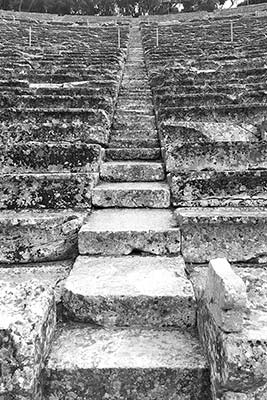
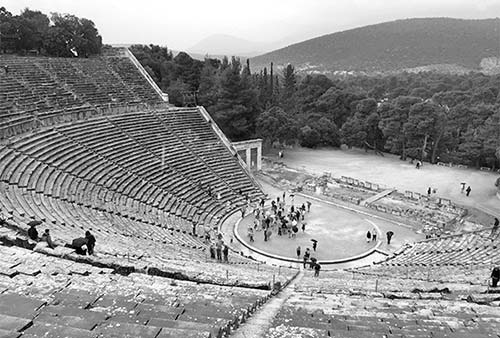
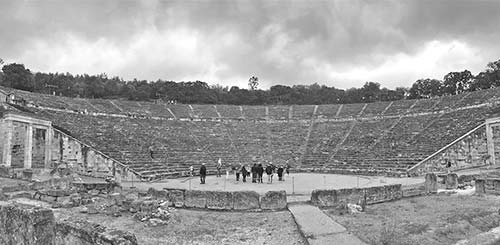
This magnificent sight is built into the side of a tree-covered hill. The perfect symmetry of its two tiers of seating stands as a tribute to Greek mathematics. It’s easy to locate the main elements of a typical Greek theater: the round orchestra, the smaller stage area (skene), and the seating (kavea).
The audience sat in the bleacher-like seats (made of limestone blocks) that were set into the hillside, wrapping partially around the performers. Together, the lower rows and 21 upper rows (added by the Romans, c. 50 BC) seated up to 15,000. The spectators looked down on the orchestra, a circular area 70 feet across where the group of actors known as the chorus sang and danced. Behind the orchestra are the rectangular foundations of the skene (which is often covered with a modern stage). The skene had a raised stage where actors performed, a back wall for scenery, dressing rooms in the back, and various doorways and ramps where actors could make dramatic entrances and exits. The skene was not very tall, so spectators in the upper seats could look over it during the performance, taking in the view of the valley below.
The ancient acoustical engineering is remarkable. The acoustics are superb—from the orchestra, whisper to your partner on the top row. (The center stone marks where an altar to Dionysus, the god of wine and theater, once stood.)
Picture a typical performance of a Greek tragedy here at this theater. Before the show began, spectators filed in the same way tourists do today, through the passageway between the seating and the skene. The performance began with a sober monologue by a lone actor, setting the scene. Next, the chorus members entered in a solemn parade, singing as they took their place in the orchestra circle. Then the story unfolded through dialogue on the stage, interspersed with songs by the chorus members. At play’s end, the chorus sang a song summing up the moral of the play, then paraded out the way they came.
The chorus—a group of three to 50 singers—was a key part of Greek plays. They commented on the action through songs, accompanied by flute or lyre (small harp), and danced around in the orchestra (literally, “dancing space”).
For about seven centuries (c. 300 BC-AD 400), the theater at Epidavros hosted song contests and plays, until the Christian Emperor Theodosius II closed the sanctuary in the fifth century. Over time, the theater became buried in dirt, preserving it until it was unearthed in almost original condition in 1881. Today it is once again a working theater.
Even if you’re not here for one of the theater’s official performances, you can still enjoy the show: Tourists often take turns performing monologues, reciting poems, or just clapping to try out the acoustics. If there’s an actor inside you, speak up. Try reciting any of the ancient Greek passages presented in the sidebar.
The Greeks invented modern theater, and many plays written 2,500 years ago are still performed today.
In prehistoric times, songs, poems, and rituals were performed to honor Dionysus, the god of wine and revelry. By the sixth century BC, these fertility rites developed into song competitions between choruses of men who sang hymns about Dionysus, heroes, and gods. The contests were held at religious festivals as a form of worship.
Later, Athenian playwrights (such as Thespis, the first “thespian”) introduced spoken monologues that alternated with the chorus’ songs. Over time, these monologues became dialogues between several actors that became as important as the chorus. Plays evolved from Dionysian hymns to stories of Dionysus to stories of all sorts—myths of gods and heroes, and comedies about contemporary events. By the golden age (c. 450-400 BC), Athens was the center of theater’s prime, premiering plays by Sophocles, Euripides, and Aristophanes.
Greek plays fall into three categories. Tragedies, the oldest and most prestigious, feature gods and legends—and usually end with the hero dying. Comedies are satires about contemporary people and events. “Satyr plays” spoof the seriousness of tragedies—for example, Oedipus with a massive strap-on phallus.
Greek drama, like Greek art and philosophy, put human beings at center stage. The theaters were built into hillsides, giving the audience a glimpse of human emotions against the awesome backdrop of nature. The plays showed mortals wrestling with how to find their place in a cosmos ruled by the gods and Fate.
When you’ve finished your turn on stage, climb the stairs to the seats to join the spectators. From up here can you fully appreciate the incredible acoustics—not to mention the remarkable scale and intactness of the place. No matter how high you climb, you can hear every word of the naturally amplified performances down below...all while enjoying the backdrop of sweeping mountains and olive groves.
• Walk down the stairs across from the theater to find the...
Archaeological Museum
The exhibits in this dusty little old-school museum come with English descriptions. The first room (of three) displays various steles (inscribed stone tablets). Some of these document successful cases where patients were healed here by the god Asklepios. Others are rules governing the hospital. The only people to be excluded from the sanctuary were the terminally ill and pregnant women (both were considered too high-risk—their deaths would sully the sanctuary’s reputation). The room also holds a case displaying some medical instruments that’ll make you glad you were born after the invention of anesthetics. (You can see small pots for measuring dosages.)
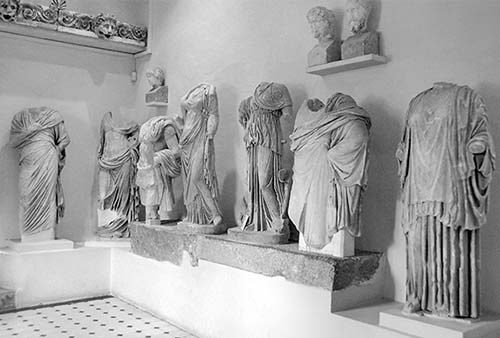
The second room has many (headless) statues of gods who were invoked in the healing process—most of them textbook examples of that wonderfully relaxed contrapposto (S-shaped) stance that was revived centuries later by Renaissance sculptors (find the statue striking the sassiest pose). The columns and cornice on display were part of the sanctuary’s impressive entryway (propylaea).
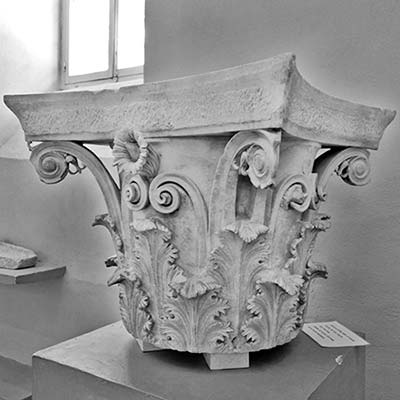
The star of the final room is an extremely well-preserved capital from a Corinthian column. The builders of the temple buried it on the site, perhaps as an offering to the gods. Archaeologists who dug it up in the 19th century were astonished at its condition; it may have been the prototype for all the capitals in the temple complex. The room also displays two replicas of small, square reliefs (left wall) showing the god Asklepios on his throne. Asklepios is often depicted as a kindly, bearded man, carrying a staff with a snake wound around it, the forerunner of today’s medical symbol.
• Outside, follow the path up the stairs to the left as you leave the museum (and only WC within the site) to the sprawling field of ruins called the...
Sanctuary of Epidavros
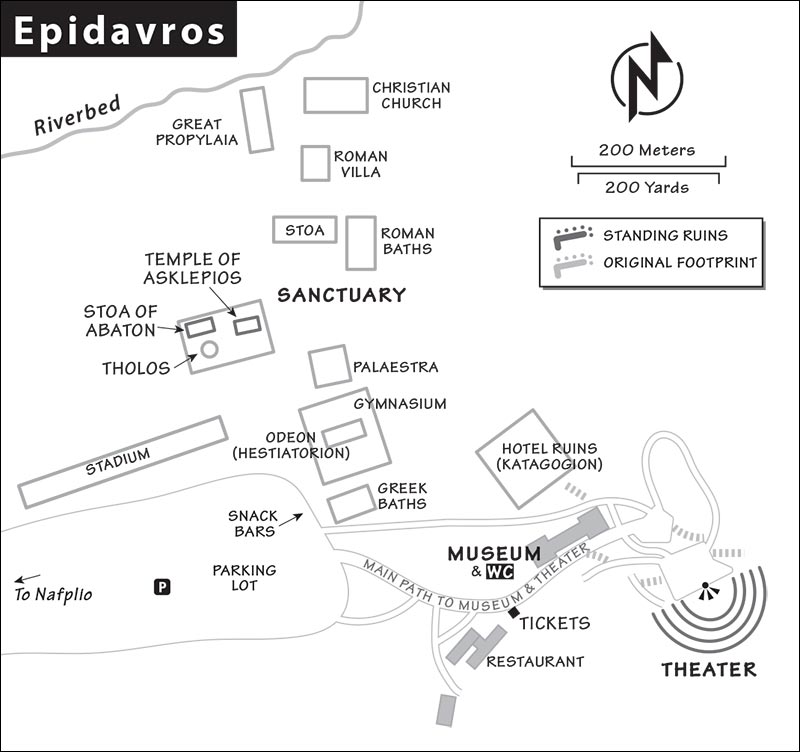
While Epidavros’ theater is stunning, the ruins of the sanctuary itself (in a huge open field between the theater and parking lot) are a distant also-ran compared with those at other great ancient sites, such as Delphi and Olympia. The various ruins are well-described in English, but precious little survives—orient yourself using one of the numerous maps and wander. Walking from the museum to the far end of the site, you’ll first pass the hotel overlooking the ruins (at the top of the short staircase). Continuing along the path are the baths, dining hall, stadium, circular temple, dormitory, and foundations of the Temple of Asklepios—in that order.
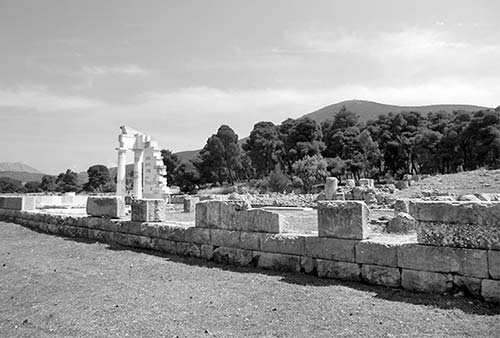
Considering that the sanctuary was a kind of healing resort with a mix of doctors and priests to serve the visitors or patients, it needed a hotel (katagogion). Only the footprint of a 160-room, luxury two-floor spa hotel survives. You can see the stone foundations (the wood-and-tile superstructure is long gone) and thresholds with hinge holes.
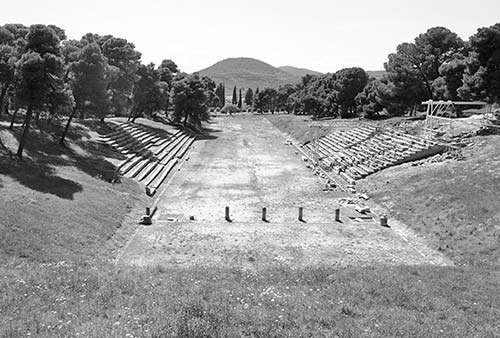
Logically there would be a bathhouse and restaurant (hestiatorion) for so many important guests. The scant remains of those are seen next. Beyond them stretches a fine stadium. Every four years, Epidavros’ 6,000-seat stadium was used for the Festival of Asklepios (similar to other ancient Greek athletic competitions).
Archaeologists are reconstructing one important building beyond the stadium—the circular building, or tholos, had a labyrinth in its basement. Some believe the sick would go here to meditate with snakes. Exactly why and what happened is still a mystery.
The sick would then spend the night in the stoa of Abaton (the large dormitory building just beyond the tholos). Here they would likely pray for a miracle while meditating on the experience they had with the snakes. Perhaps they hoped to be visited in a dream by Asklepios, who could give them the secret to their cure. Stories of the miracles people experienced here spread far and wide, making Epidavros very popular.
Like a square memorial, just to the right is the covered foundation of the Temple of Asklepios—the center of this sacred complex.
When you’ve had enough, retrace your steps past the museum to find the exit.