PSYRRI & CENTRAL MARKET WALK
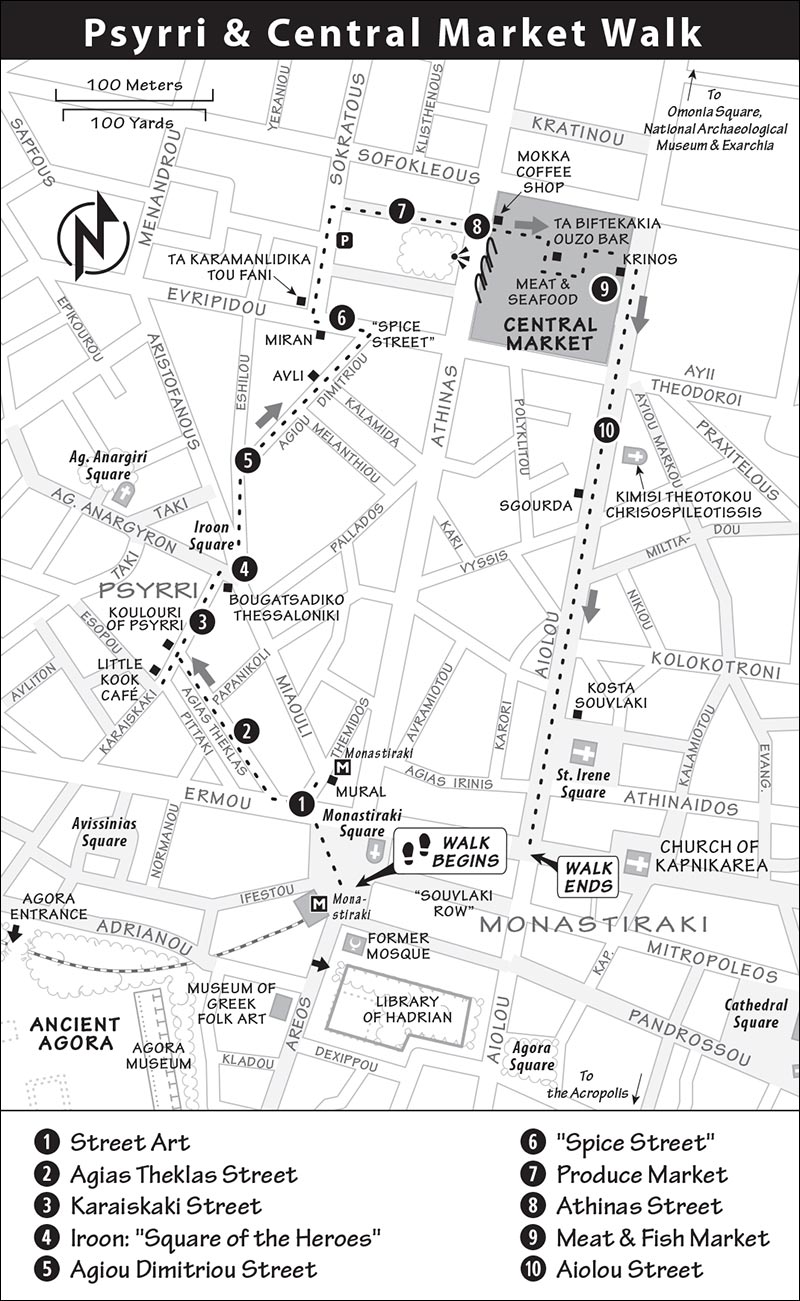
Map: Psyrri & Central Market Walk
4 Iroon: “Square of the Heroes”
Until recently, the Psyrri neighborhood was a grimy area of workshops and cottage industries—a hotbed of poets, musicians, revolutionaries, and troublemakers. Now it’s one of central Athens’ trendiest areas. Cosmetically, it still isn’t the prettiest place—it’s filled with pungent odors, crumbling buildings, and graffiti. But if you take time to explore, you’ll find Psyrri (psee-REE) is a great place to simply hang out.
On our walk, we’ll see this neighborhood in transition. There are traditional bakeries and craftspeople from the neighborhood’s past. But we’ll also find cutting-edge art galleries, excellent restaurants, creative boutiques, fun tavernas, and a welcoming atmosphere. Our walk culminates at the huge Central Market, home to spice vendors, truck farmers, butchers, and locals shopping for the evening meal.
The walk starts on Athens’ central square, Monastiraki, and ends on a pleasant pedestrian street that’s a straight shot back to the center, near the starting point. This stroll is light on history, but heavy on local life and sampling Athenian goodies. It’s a nice change of pace from this book’s heavy-hitting historical walks.
Orientation
Length of This Walk: Allow just over an hour—more if you stop for snacks and meals.
When to Go: Ideally, do the walk on an empty stomach, around lunchtime, when the market is thriving and you have plenty of room to fill up on snacks. Note that the Central Market shuts down around 15:00 and is closed all day Sunday, and a couple of the coffee shops and bakeries mentioned in this walk close around 17:00. The walk can also be interesting in the early evening, just as the nightlife scene is livening up.
Getting There: The walk begins at Monastiraki Square, with its own Metro stop (and at the end of my “Athens City Walk”).
Street Art: We’ll see some impressive street art on this walk; for a more in-depth look at this art form, consider Alternative Athens’ street-art tour (see here).
Starring: Funky graffiti, fragrant market stalls, and delectable Athenian snacks.
The Walk Begins
PSYRRI
Begin on Monastiraki Square. While this is a hub both for transit and high-power sightseeing, we’re going to turn our back on those and...explore.
• With the Acropolis and the yellow Metro station behind you, set your sights on the A for Athens hotel. Cross busy Ermou street and head up the lane on the left side of the hotel (the street is labeled Μιαουλη/Miaouli). Walk one short block up this street, to the Y-intersection. Stand on the stairs to your right (at a Metro entrance) and take in the buildings around you. You’ve plunged into a world of wild graffiti, also known as...
1 Street Art
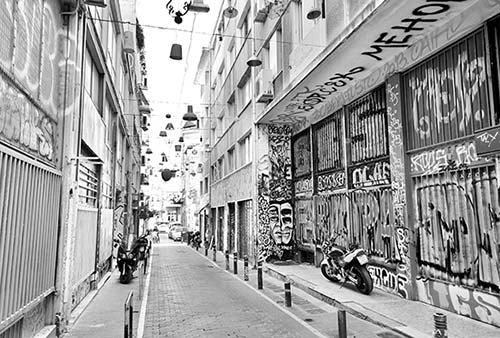
The graffiti around you—some artistic, some ugly and crude—is the perfect introduction to this gentrifying neighborhood.
Let’s be honest: Athens is not the most architecturally stimulating city, and many buildings are run down. This street of ugly concrete buildings looks like Psyrri 20 years ago, when many Athenians welcomed the colorful graffiti as a kind of urban beautification. For the 2004 Olympics, the city commissioned street artists to aid in dressing up the city. That move helped employ local artists and spur this neighborhood’s renewal. Since then, graffiti has become something of a tradition. Artists use these blank walls as a canvas to express their frustrations and dreams.
A fine example of high-class street art is on the wall above the elevator at the top of the stairs, next to the Metro entrance.
This abstract mural—titled Colorful Warrior—was done by one of Athens’ most respected street artists, Vangelis Choursoglou (who goes by the street name “Woozy”). Woozy’s portfolio includes murals in London, Nicaragua, and Shenzhen, China. In Athens, city authorities grant permits to certain artists, like Woozy. Unauthorized graffiti is officially illegal, but artists are rarely charged, and most do their work clandestinely, late at night.
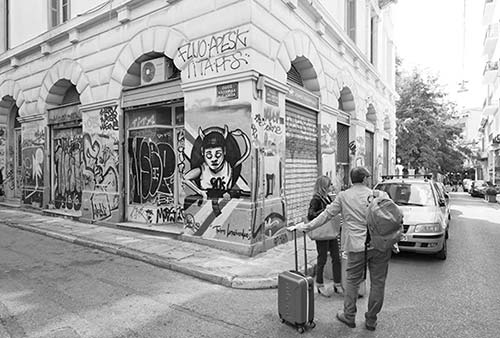
This walk passes lots of street art—everything from basic tagging by vandals, to slogans from rival soccer fans, to beautiful murals. Much of it was created by alumni of the Athens School of Fine Arts.
• Backtrack to busy Ermou street. Turn right, walk one block, then angle right up Agias Theklas street.
2 Agias Theklas
Humble Psyrri has always been the home of hardworking craftspeople and small factories (in contrast to central business hub Syntagma and the touristy Plaka). As you stroll into the heart of the neighborhood, notice the architectural mix: once-attractive historic buildings—some run-down, some lovingly restored—and eyesore midcentury concrete for which there’s little hope. You can see why graffiti might be considered an improvement.
Continuing along this street, look for slices of local life: little hardware stores overflowing into the streets and grocery stores catering to the neighborhood. With its hip cachet and proximity to downtown, Psyrri is becoming a hotspot for Airbnb rentals. Locals worry that it’s only a matter of time before long-time shops (and colorful resident characters) are priced out. Stay tuned.
Two-thirds of the way down the block, a cramped little parking lot on the right makes the perfect “canvas” for an ever-changing series of big, wild paintings.
It was in an apartment on this street where English poet Lord Byron stayed in 1810. Back then, Psyrri was a hotbed of revolutionaries like Byron fighting for Greek independence. That nonconformist atmosphere still lives on in Psyrri today. Byron resided at the home of the Makri family, where he befriended their 12-year-old daughter—who inspired him to pen the poem, “Maid of Athens, ere we part / Give, oh give me back my heart!”
• Continue to the T-intersection with...
3 Karaiskaki Street
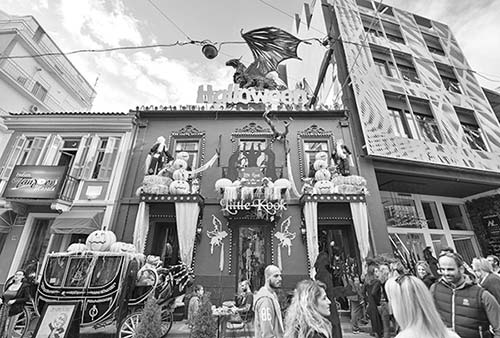
Detour a half-block left to the Little Kook café (can’t miss it, at #17—it looks like a candy store vomited), which captures the creative spirit of today’s Psyrri. This fairy tale-themed coffee and tea house sprawls through several surrounding buildings. Ogle the café’s creative window displays, which change with the seasons: During autumn, they have Halloween-themed decor; in December, it’s Christmas; in summers past they’ve had a circus theme. A giant dragon perches on top of the main building guarding his territory below. Around the corner, Pittaki Lane is equally colorful and photo-op perfect. You could pause here for a break in the Kook’s fanciful interior, with elaborate, multitiered cakes to match...or continue the walk (more tempting and more authentically Athenian snacks await). Pace yourself.
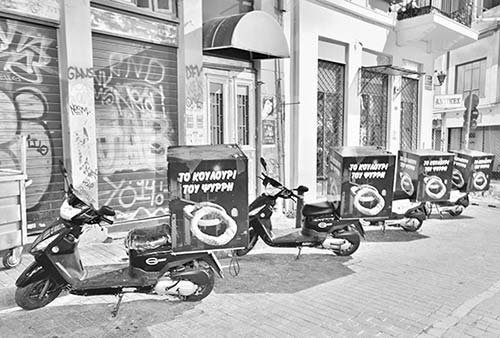
Head back up the way you came on Karaiskaki. On the left is Koulouri of Psyrri (marked Kουλουρι Tου Ψυρρη). Koulouri are the little sesame-encrusted dough rings sold cheaply at carts all over Athens. This bakery supplies most of those carts (notice the row of delivery scooters parked out front). Step into the shop and buy one—you won’t find any fresher. Two rings cost about a euro, and they have a cooler of drinks.
Athenians eat koulouri a variety of ways: plain, as a sandwich, or dipped in honey (honey + sesame = a taste kind of like peanut butter). The name comes from the Greek word for “zero” (inspired by its shape). Koulouri date back to early Christian times but were introduced in Athens in the 1920s, when the Greco-Turkish War brought a million Greek refugees from Turkey to Athens, along with their beloved koulouri and other foods we’ll encounter on our walk.
• Continue up Karaiskaki street another block, where you emerge into Psyrri’s main square.
4 Iroon: “Square of the Heroes”
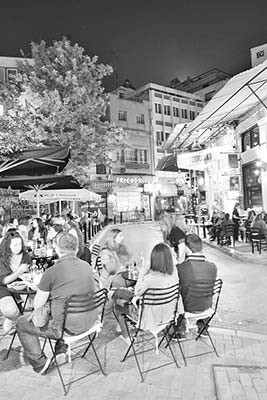
This lively square—filled with al fresco café tables and tourists—is entertaining day and night. The space is called “Square of the Heroes” for the Greek freedom fighters who settled here in the 1830s following independence from the Ottomans. The streets nearby are named for Greek heroes. And the name Psyrri itself comes from an early resident named Psiris, who built a church here in what’s now the epicenter of the neighborhood named for him.
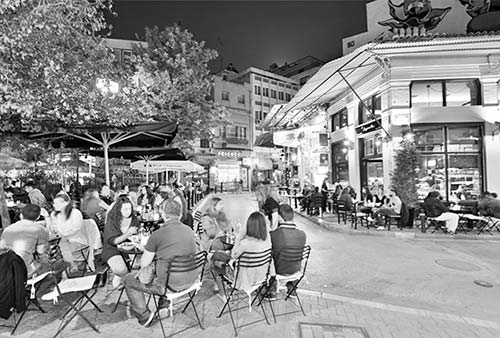
The square gives a sense of how much this genteel neighborhood has changed over the years...and how much it hasn’t. It began life in Ottoman times (1700s) as a typical neighborhood of twisting narrow lanes. Even today, as you can see, Psyrri’s streets spin off from this central square at all angles, like wings on a pinwheel. The neighborhood’s central location attracted diplomats, aristocrats, scholars from the nearby university, immigrants from the isle of Naxos, and, after the War of Independence, those aforementioned “heroes.”
After independence, as Athens expanded and modernized into grid-plan neighborhoods like Syntagma, Psyrri remained quiet and residential. Meanwhile, the local mafia moved in. These strong-arm Koutsavakides—who wore long moustaches, pointed boots, and walked with an exaggerated limp—took over Psyrri. Residents who could afford to fled elsewhere, and by the time the government cracked down, Psyrri was a slum. It remained that way—the humble home of sandal makers and factory workers—until the late 1990s.
That’s when artists, designers, and alternative-lifestyle enthusiasts discovered Psyrri, taking advantage of its cheap rents and marvelous location. For the 2004 Olympics, Psyrri was targeted for redevelopment, with rezoning laws designed to lure restaurants and nightclubs. Gentrification quickly followed, and now Psyrri is back where it was two centuries ago: one of the city’s most in-demand areas.
Look up, to where a giant mural laughs down over this leafy square. One of the neighborhood’s first (from 2004), this is the work of Alexandros Vasmoulakis, another respected Athenian street artist.
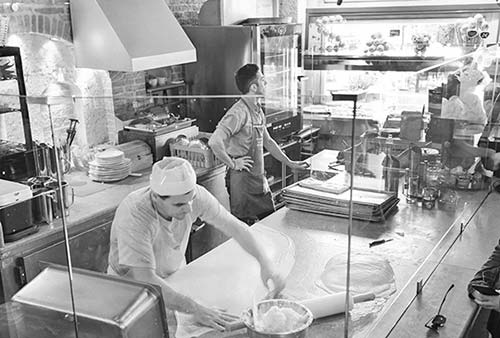
Ready for another snack? At the bottom of the square (on the right) Bougatsadiko Thessaloniki (labeled Μπουγατσάδικο) specializes in a delicate pastry called bougatsa. Step inside to see if a baker is at work: They roll out a sheet of super-elastic dough, then pull, prod, and toss it like an oversized pizza crust until it’s as thin as the skin of a balloon. Then the baker folds it over several times, fills it with custard, and pops it in the oven. Ask for a portion at the counter—it’s especially good when it’s hot. Bougatsa is a specialty of the northern city of Thessaloniki—so this shop’s name is a mark of quality.
• To continue our walk, exit the square at the upper-right corner. (For a full meal in this area, see my recommendations on here). Pass under the leafy canopy. At the fork just after that, bear right, up...
5 Agiou Dimitriou Street
Enjoy this quieter, more local-feeling part of Psyrri. The painfully hip atmosphere is slowly mellowing to workaday.
On the left, at #12, is a little hole-in-the-wall shop selling distractions for Greek men: worry beads, pocketknives, shaving gear, pipes, and dice and backgammon boards. Right next to that is the easy-to-miss door (marked αυλή) leading to the recommended Avli restaurant. Hidden in a courtyard, its name is simply, “Courtyard.” This is a good, untouristy alternative to many Psyrri tavernas.
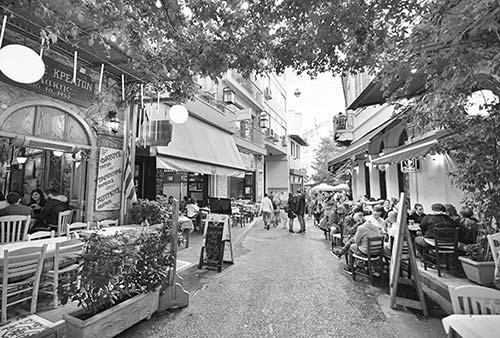
Farther along, humble storefronts sell textiles and fake flowers, and a few little “everything” shops spill out into the street. Your transition from trendy Psyrri to the real world is nearly complete. Carry on.
• At the end of Agiou Dimitriou street you run directly into a city-block-sized complex of buildings housing vendors—all part of the...
Central Market
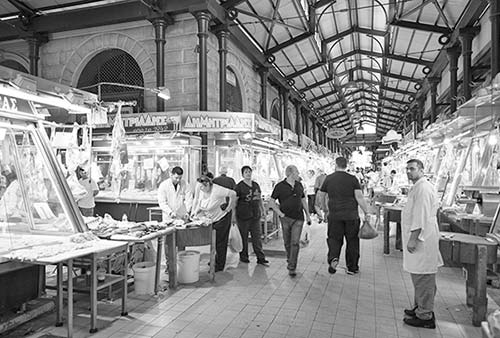
Athens’ Central Market (Varvakios Agora/Βαρβάκειος Αγορά) isn’t cute or idyllic, like a small-town French halles, and it’s not a tourist trap, like Barcelona’s La Boqueria. The Central Market is refreshingly real: a thriving marketplace where workaday Athenians stock up on ingredients. A walk through the market is a treat for all the senses—sights, smells, and sounds. This walk will help you navigate and appreciate its many parts. I’ll also point out some distinctively local restaurants and treats to enjoy while you’re here.
• Let’s start by circling the Market’s perimeter clockwise, taking in some of the vendors along the way. Turn left onto Evripidou street, which is also known as...
6 Spice Street
Different parts of the Central Market specialize in different products. As you can tell from the first whiff, Evripidou is all about spices. You’ll pass three spice shops in row. Step into the first one at #37 (Χατζηγεωργίου) and inhale. Intoxicating!
These spice sellers are the great-great-grandchildren of those ethnic-Greek refugees from the Greco-Turkish war of the 1920s, who arrived bringing a pungent whiff of exotic Istanbul bazaars.
Check out the variety of products. You’ll see bushels of rice, grains, nuts, and dried fruits. Keep an eye out for bunches of partially dried flowering herbs tied up with string—this is Greek mountain tea, an herbal mixture revered for its healing properties. You’ll also see classic Greek oregano, thyme, basil, and the precious Greek red saffron.
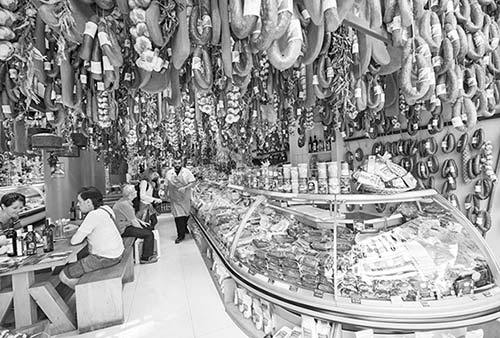
Walk a few doors down and stop at the venerable Miran deli. Display cases and café tables (often used by food tours) sit under hanging salamis and other meats. The big slabs coated in bright-red spices are pastourma, a salted-and-dried meat with a powerful rub of paprika, cumin, fenugreek, garlic, and other spices. You might already know it by its English name—pastrami. But here, the pastrami meat is commonly camel—another aspect of Middle Eastern cuisine that caught on in 1920s Athens. (By the way, you’re walking on sidewalks broken by grooves intended to help visually-impaired people. I’ve encountered grooved sidewalks like these across Europe but have yet to see someone use them—making them a well-meaning but expensive waste of money.)
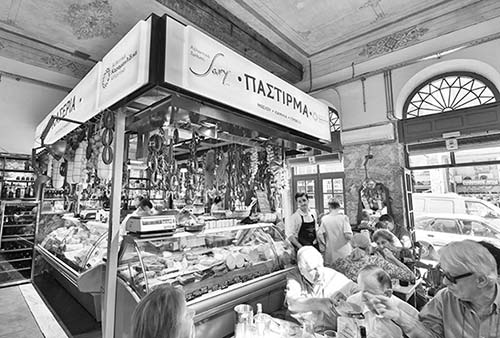
Diagonal from Miran (ahead, at the opposite corner) is another deli, called Ta Karamanlidika tou Fani (Τα Καραμανλίδικα του Φάνη), serving some explosively flavorful pastourma dishes. It’s also a full-service restaurant—recommended for lunch or dinner.
Greek delis, Turkish spices, and even a few Asian groceries...it’s a reminder that Athens remains, as it always has been, a cultural melting pot.
• Take a right here (at the deli/restaurant), onto Sokratous street. Head up the street about 100 yards, past more shops and a parking-garage entrance. Turn right into an open square recently remodeled to house fruit and vegetable vendors. This is the Central Market’s...
7 Produce Market
Known as Anoikti Agora (Open Market), this is part of the largest open-air market in Greece. It’s a festive scene (even if it’s unceremoniously wedged next to a big parking garage). This strip explodes with fresh fruits and veggies—whatever’s in season.
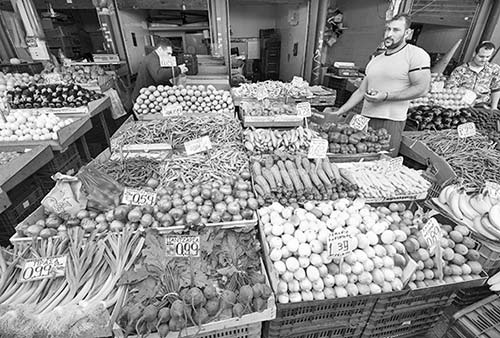
You’ll also encounter pet shops, pots and pans, heaps of nuts and dried fruits, and a dozen different kinds of olives and feta sold from the barrel. And you’ll see bushels of legumes—lentils, chickpeas, beans, and so on. Legumes are a staple of Greek cooking, the traditional source of vegetable protein in a hardscrabble land. In fact, Greece’s national dish is not souvlaki, Greek salad (horiatiki), or baklava, but a bean soup called fasolada.
• At the end of the produce market, you’ll reach busy...
8 Athinas Street
One of the main thoroughfares of central Athens, this street connects Monastiraki (a 10-minute walk to your right) with the transportation hub called Omonia (10 minutes to the left). Directly across the street is the yellow, Neoclassical entrance to the covered part of the Central Market. Before crossing, pause to orient yourself: The facade heralds the covered market built in the 19th century to accommodate the city’s growth spurt and to clear out vendors from archaeological sites. The fish section is in the middle (under the three open arches), while meat can be found for sale all around. Halfway through the covered market, dead ahead on the left, is a row of small restaurants (open long after the bars close since their tripe soup is considered good medicine for sobering up). We’ll enter, explore, and leave on the opposite side. But first, I need a coffee.
A few steps to the left of the market entrance is the recommended Mokka Coffee Shop (at Athinas 44, with a coffee-bean retail outlet next door).
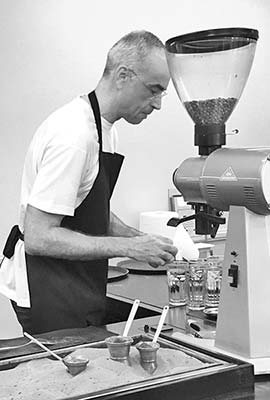
Regarded as one of Athens’ best, this coffee house offers both espresso-style lattes and macchiatos and more traditional Greek coffee—an unfiltered preparation that’s similar to Turkish coffee (but milder, as the beans are roasted at a lower temperature). This is listed on the menu as “ibrik single” or “ibrik double”—named for the little copper pitcher they prepare it in. (While ibrik is the old Arabic word, modern Greeks call this a briki.)
Take a seat (near the cashier and a tray of hot sand) and the waiter will come by. If you order an ibrik, tell them how much sugar you want, as that’s part of the preparation. First, they put the very fine grounds, cold water, and sugar into the briki. Then they nestle the briki into the hot sand to heat it. Greeks know a quality coffee by the rich, velvety, light-brown foam that forms at the top.
When your coffee arrives, here’s the technique: Pour it from the little pitcher into your cup. Then wait a few minutes to let the grounds settle to the bottom. Then sip it slowly to avoid the highly caffeinated “mud” at the bottom. Greeks claim that because it’s unfiltered, more healthy nutrients stay in your brew, compared to filtered coffee.
While you sip, think of the way that simple rituals—like drinking coffee—can become cultural cornerstones. Traditionally the coffee house was where Greek men would gather to gossip and grouse, while clacking their worry beads and playing backgammon. Meanwhile, women would invite each other over for coffee in their homes. Then they’d swirl the leftover grounds around in the cup and read fortunes. Many Greeks worry about the loss of these cultural institutions that were once sacred. Which reminds me of one more bit of etiquette here at Mokka—don’t mention Starbucks.
• Now that you can’t sit still, you might as well explore the adjacent...
9 Meat and Fish Market
Opened in 1886, the Central Market’s meat and fish hall is a vivid parade of proteins. Vegetarians may want to skip this part.
Take a few steps up the main corridor into the gut of the market. Counters are piled high with beef, pork, chicken, lamb, and goat. Notice the livestock proudly pictured on the signs above some of the stalls. Little delivery scooters nudge their way past pedestrians.
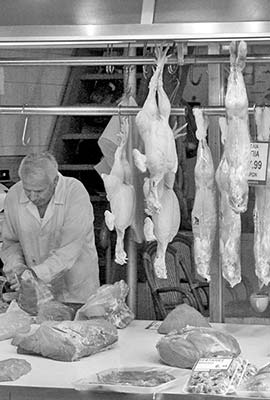
About halfway up this main drag (on the right, high up) is the sign for Δημοτική Ψαραγορά (Municipal Fish Market). Turn right up this little lane. On your left is the recommended Ta Biftekakia Ouzo Bar—a great spot to sample another Greek specialty, the anise-flavored liquor ouzo. (It’s marked by a big red A and the sign Μπυρα-Ουζο-Τσιπουρο, advertising the holy triumvirate of cheap Greek booze: beer, ouzo, and grappa-like tsipouro brandy.) Kostas sells cheap glasses of ouzo and little plates of bar snacks to enjoy while observing the market bustle.
Just beyond is the fish market. Watch your step here—the floors are wet and slippery. Turn left and make your way past the display tables, piled high with big fish (red mullet, sea bream, sea bass), small fish (sardines, anchovies, smelt), fish steaks (mostly from swordfish, tuna, or bonito), mussels, shrimp, Mediterranean lobster (clawless), squid (calamari), the similar cuttlefish, and octopus.
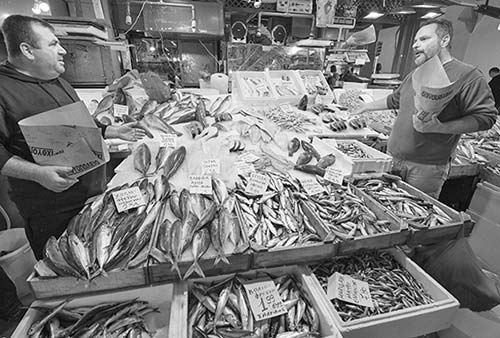
The waters of the Aegean are overfished, and supply struggles to meet demand—especially in the tourist season. Much of the seafood served in Greek restaurants is frozen and imported. If you see kat or just a k on a menu, it means frozen (katepsygmenos). When Athenians want fresh, they head to tavernas in the seafront suburbs, such as Piraeus (and, farther out, Anavyssos).
At the end of the first stretch of fish, jog right a bit to return to the meat market. In the passage, you’ll pass displays showcasing the “fifth quarter” of hard-to-sell meat: hooves, tripe, liver, and other organs. You may also see barrels of snails—a cheap source of protein during times of hardship, when locals developed a taste for the little critters that persists today. Venture left past all the guts. Popping out of the market, turn right and right again onto the pedestrian mall, Aiolou street. (Doughnuts are about 30 yards ahead on the right.)
10 Aiolou Street
Quieter than the parallel Athinas drag, Aiolou is emerging as one of downtown Athens’ most appealing streets. From here, we’ll stroll 10 minutes gently downhill to Ermou street and back to Monastiraki where we started.
For a fun treat, stop by Krinos Greek Donuts (Κρίνος, at #87), a venerable shop where locals have been indulging their sweet tooth since 1923. Step inside for a plate of loukoumades—piping-hot doughnuts, fresh out of the industrial fryer. The English menus at the tables explain your options. The classic: drizzled with syrup, walnuts, and cinnamon. Order at the counter in back to eat in, or at the window on the street to take your doughnuts to go. (A single order is six doughnuts—enough for two. Eating in is better as you can slop up all the sweet sauce.)
Continue down Aiolou street as the Psyrri neighborhood gives way to Monastiraki. This pleasant, pedestrianized street bustles with interesting stores, designer coffee shops, occasional street musicians, and lots of lunch-focused restaurants for busy urbanites. A block down on the left is the petite, gorgeously restored Kimisi Theotokou Chrisospileotissis church, with icon and candle kiosks out front (just before the larger church of Agia Paraskevi). It’s free to step into the beautiful, serene interior.
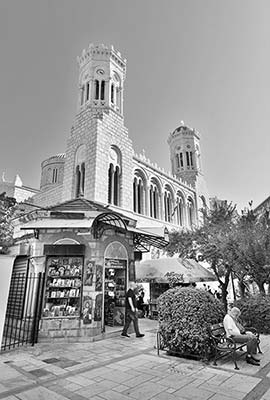
Farther along, on the right, just before the intersection with Vyssis street, you’ll pass the Sgourda dishware company (outfitting Athenian homes since 1870). Continue straight, down the middle lane, through the odd-angled intersection. The next block has some quick-and-cheap lunch spots (see the Eating in Athens chapter).
Farther downhill are more trendy eateries and the little square of St. Irene—the epicenter of hip, young locals, day or night (plus the recommended Kosta souvlaki stand). The square used to be known as the square of the flower vendors; these days only one remains open, and it’s still loyally frequented by Athenians.
• We’re on the final stretch. Hitting Ermou street, you’re back in the heart of Athens. Monastiraki Square, where we began our walk, is a block to the right. Cathedral Square is one block past Ermou and a couple of blocks to the left, on Mitropoleos. And the Acropolis is straight up. Enjoy!