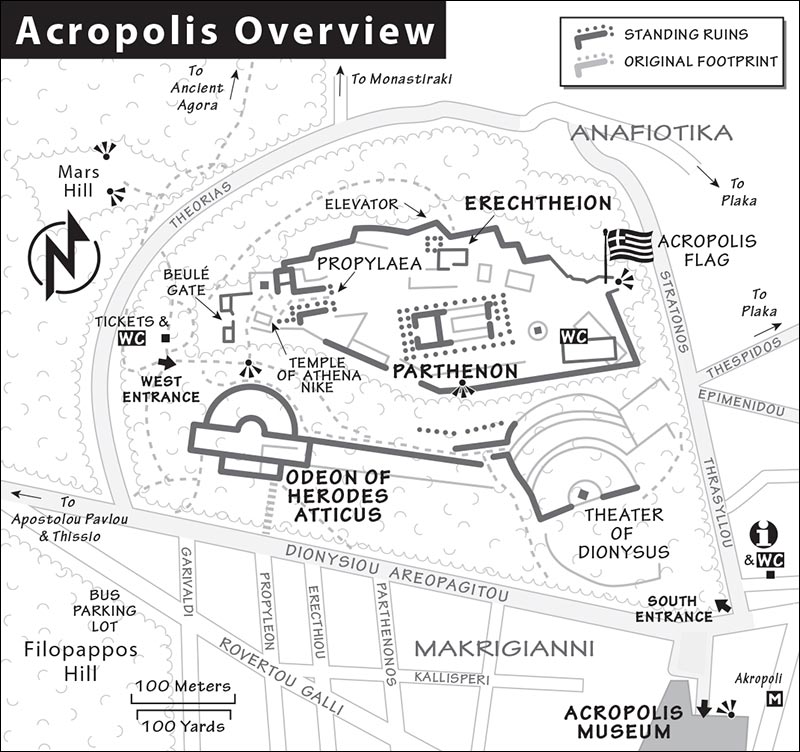
ACROPOLIS TOUR
Ακρόπολη
1 View of the Odeon of Herodes Atticus
6 Passing Through the Propylaea
11 North Side
13 Erechtheion: Porch of the Caryatids
Even in this age of superlatives, it’s hard to overstate the historic and artistic importance of the Acropolis. Crowned by the mighty Parthenon, the Acropolis (“high city”) rises above the sprawl of modern Athens, a lasting testament to ancient Athens’ glorious golden age in the fifth century BC.
On this tour we’ll hike up through the Propylaea gate, ogle the famous Caryatid statues at the Erechtheion, and admire the perfect proportions of the Parthenon. Climbing Acropolis Hill and rambling its ruins, you’ll feel like you’ve journeyed back in time to the birthplace of Western civilization. And it all comes with breathtaking, as-far-as-the-eye-can-see views over the rooftops of Athens—one of Europe’s most sprawling cities.
Orientation
Cost: €20 for Acropolis-only ticket; €30 for Acropolis combo-ticket, which covers Athens’ other major ancient sites (see here). In the off-season (Nov-March), it’s €10 for the Acropolis-only ticket and free the first Sun of each month. If you buy your combo-ticket elsewhere, you can bypass the ticket booth here.
Hours: Daily 8:00-20:00, Oct until 18:00, Nov-March until 17:00. Be aware that hours are subject to change; check locally before planning your day.
Information: +30 210 321 4172, for general info search “Acropolis” at http://odysseus.culture.gr, for online tickets go to www.etickets.tap.gr.
Crowd-Beating Tips: The place is miserably packed with tour groups from 10:00 to about 12:30 (when you could wait up to 45 minutes to buy a ticket from a ticket booth). On some days, as many as 6,000 cruise passengers converge on the Acropolis in a single morning. Buying a ticket online, at another sight, or at ticket machines may save ticket-buying time, but it doesn’t ensure a speedy entry: The worst lines are caused by the bottleneck of people trying to squeeze into the site through the Propylaea gate.
You have two good options: To avoid both crowds and heat, come in the cool morning hours, right when it opens. You’ll be leaving just as everyone else is pouring in. Otherwise, I like to visit late in the day—as the sun goes down, the white Parthenon stone gleams a creamy golden brown, and what had been a tourist war zone is suddenly peaceful. Once I showed up late and had the place to myself in the cool of early evening.
Strategies for Your Visit: The Acropolis has two entrances; both work well, but you’ll see different things on the way in, depending on which one you use.
The west entrance (where this tour begins) is near Mars Hill (to the right as you face the Acropolis from the Plaka). To get there from the Plaka, just fix your eyes on the Acropolis, start walking uphill veering right, and find the roads that funnel you there. To reach the west entrance from south of the Acropolis, head up the path that splits off from Dionysiou Areopagitou street.
The south entrance, at the base of the Acropolis and next to the Acropolis Museum, can be less crowded (near Metro: Akropoli). From this entrance, you’ll climb a steep-but-shady tree-lined path and pick up our tour at the first stop. You can see the Theater of Dionysus (described near the end of this chapter) on the way up, and Mars Hill (listed in the Sights in Athens chapter) at the end of the visit.
If you want to visit the Acropolis Museum afterward, consider this plan: Start at the west entrance, climb Mars Hill, then tour the Acropolis. On your way out, follow the path to the south entrance, stopping at the Theater of Dionysus. The Acropolis Museum entrance is across the street from the south entrance gate.
Note that there’s no way to reach the Acropolis without a lot of climbing (though wheelchair users can take an elevator—see later). Figure a 10- to 20-minute hike from the base of the Acropolis up to the hilltop archaeological site.
Visitor Information: Supplement the tour in this chapter with the free information brochure (ask for it when you buy your ticket at a ticket booth) and info plaques posted throughout.
Tours: For a live guide, consider making advance arrangements with one of my recommended local guides (see here). You can hire your own tour guide at the entrance, but I wouldn’t—the guides here tend to be rude and overpriced.
 Download my free Acropolis audio tour. This sight is particularly suited to an audio tour, as it allows your eyes to enjoy the wonders of the Acropolis while your ears learn its story.
Length of This Tour: Allow two hours. Visitors with more time can precede this tour with the Ancient Agora Tour (see the previous chapter).
Baggage Check: Backpacks are allowed; baby strollers are not. There’s a checkroom just below the west ticket booth near Mars Hill.
Services: There are WCs up to the right from the west ticket booths, and more WCs and drinking fountains atop the Acropolis in the former museum building (behind the Parthenon). Picnicking is not allowed on the premises.
Also near the west ticket booths are a drinking fountain and machines selling cheap bottles of cold water.
Flanking the south entrance are cafés, shops, and newsstands selling food, water, and souvenirs; the Athens TI is also nearby, with good information and free WCs.
Wheelchair Accessibility: People with wheelchairs can take the elevator that ascends the Acropolis (from the west ticket booth, go around the left side of the hilltop).
Plan Ahead: Wear sensible shoes—Acropolis paths are steep and uneven. In summer, it gets very hot on top, so take a hat, sunscreen, sunglasses, and a bottle of water.
Starring: The Parthenon and other monuments from the golden age, plus great views of Athens and beyond.
BACKGROUND
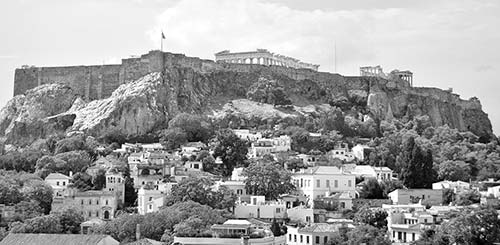
The Acropolis has been the heart of Athens since the beginning of recorded time. This limestone plateau, faced with sheer, 100-foot cliffs and fed by permanent springs, was a natural fortress. The Mycenaeans (c. 1400 BC) ruled the area from their palace on this hilltop, and Athena—the patron goddess of the city—was worshipped here from around 800 BC on.
But everything changed in 480 BC when Persia invaded Greece for the second time. As the Persians approached, the Athenians evacuated the city, abandoning it to be looted and vandalized. All the temples atop the Acropolis were burned to the ground. The Athenians fought back at sea, winning an improbable naval victory at the Battle of Salamis. The Persians were driven out of Greece, and Athens found itself suddenly victorious. Cash poured into Athens from the other Greek city-states, which were eager to be allied with the winning side.
By 450 BC, Athens was at the peak of its power and the treasury was flush with money...but in the city center, the Acropolis still lay empty, a vast blank canvas. Athens’ leader at the time, Pericles, was ambitious and farsighted. He funneled Athens’ newfound wealth into a massive rebuilding program. Led by the visionary architect/sculptor Pheidias (490-430 BC), the Athenians transformed the Acropolis into a complex of supersized, ornate temples worthy of the city’s protector, Athena.
The four major monuments—the Parthenon, Erechtheion, Propylaea, and Temple of Athena Nike—were built as a coherent ensemble (c. 450-400 BC). Unlike most ancient sites, which have layer upon layer of ruins from different periods, the Acropolis we see today was started and finished within two generations—a snapshot of the golden age set in stone.
The Tour Begins
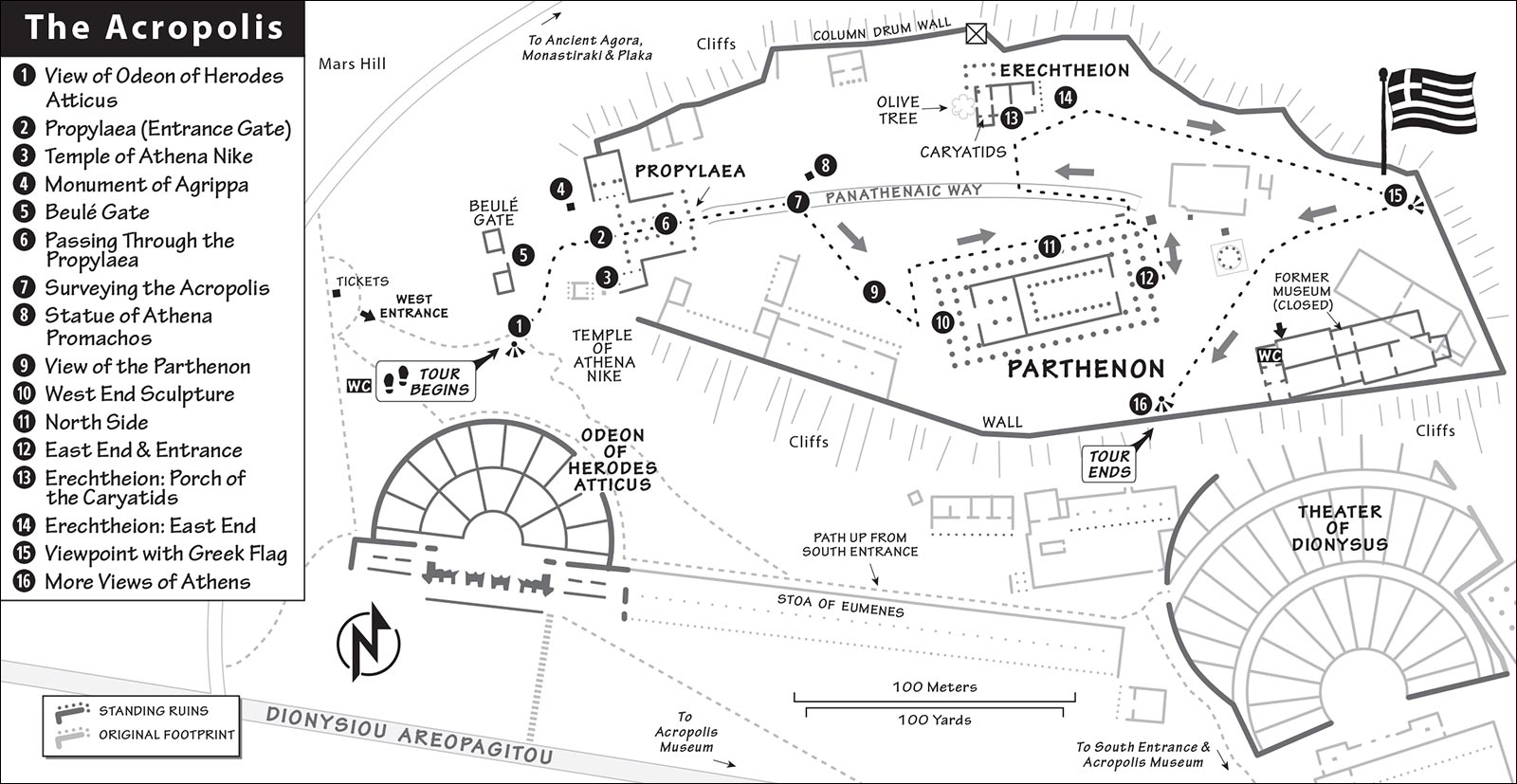
• Our route starts at the west entrance, near Mars Hill. (If you enter via the south entrance, just follow the path up, where you’ll join this tour at the first stop—you can see Mars Hill after the visit.)
Before entering, check out the huge, craggy boulder of Mars Hill (a.k.a. Areopagus), just downhill (toward the Agora) from the ticket booth. Consider climbing this rock for great views of the Acropolis’ ancient entry gate, the Propylaea, and the Ancient Agora. Mars Hill’s bare, polished rock is extremely slippery—a metal staircase to the left helps somewhat. (For more on Mars Hill and its role in Christian history, see here.)
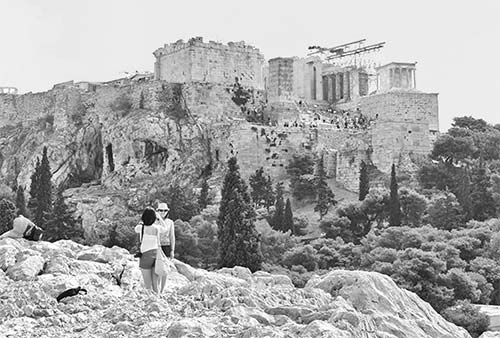
Before you show your ticket and enter the Acropolis site, make sure you have everything you’ll need for your visit. Once inside, there are no services except WCs and water fountains.
• Enter the site and start climbing the paths that wind up the hill, following signs on this one-way tourist route (bearing to the right). Before you reach the summit, peel off to the right for a...
1 View of the Odeon of Herodes Atticus
This large, 5,000-seat amphitheater built during the Roman era is still used today for performances. From this perch you get a good look at the stage setup. The three-quarter-circle floor was the stage. There, musicians and actors performed in the Greek style. Rising behind it are the overgrown remnants of a raised stage and a stage wall for the backdrop (which were not used in traditional Greek theater, but were common for Roman-style spectacles). Originally, the theater had a wood-and-tile roof as well.
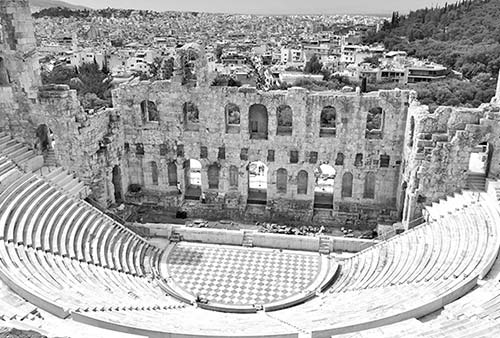
The odeon was built in 161 AD by Herodes Atticus, a wealthy landowner, in memory of his wife. Herodes was a Greek with Roman citizenship. He was a legendary orator and a friend of Emperor Hadrian. This amphitheater is the most famous of the many impressive buildings Herodes financed around the country. Greeks know it’s technically an odeon, namely a theater used mainly for songs (“odes”) rather than drama.
In the 1950s, the ruined theater was reconstructed. Now on many summer nights it hosts music, dance, and theatrical performances under the stars.
• Back on the path, bear left and continue uphill to the grand entrance gate of the Acropolis: the Propylaea. Stand at the foot of the (very) steep marble staircase, facing up toward the big Doric columns.
As you face the Propylaea, to your left is a tall, grayish stone pedestal with nothing on it: the Monument of Agrippa. On your right, atop the wall, is the Temple of Athena Nike. Behind you stands a doorway in a wall, known as the Beulé Gate.
2 Propylaea
The entrance to the Acropolis couldn’t be through just any old gate; it had to be the grandest gate ever built. Ancient visitors would stand here, catching their breath before the final push to the summit, and admire these gleaming columns and steep steps that almost fill your field of vision. Imagine the psychological impact this awe-inspiring, colonnaded entryway to the sacred rock must have had on ancient Athenians.
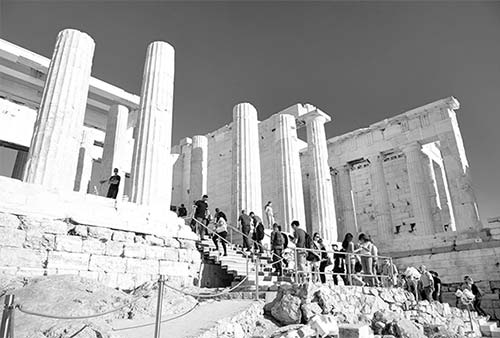
The Propylaea (pro-PEE-leh-ah) is U-shaped, with a large central hallway (the six Doric columns), flanked by side wings that reach out to embrace the visitor. The central building looked like a mini Parthenon, with Doric columns topped by a triangular pediment. Originally, the Propylaea was painted bright colors.
The left wing of the Propylaea was the Pinakotheke, or “painting gallery.” In ancient times this space contained artwork and housed visiting dignitaries and VIPs.
The buildings of the Acropolis were all constructed within about a 50-year span, and they were intended to complement one another. The Propylaea was built in five short years (437-432 BC, by Mnesicles). Both buildings are Doric (with Ionic touches) and are aligned east-west, with columns of similar width-to-height ratios. In other words, the Propylaea welcomed the visitor with an appropriately grand first taste of the Acropolis they were about to enter.
• Before ascending, notice the monuments flanking the entryway. To the right of the Propylaea, look up high atop the block wall to find the...
3 Temple of Athena Nike
This little temple—nearly square, 11 feet tall, with four columns at both ends—had delightful proportions. Where the Parthenon and Propylaea are sturdy Doric, this temple pioneered the Ionic style in Athens, with elegant scroll-topped columns. The Temple of Athena Nike (NEEK-ee) was started a few years after the Propylaea was finished (c. 427-421/415 BC). It was designed by Callicrates, one of the architects of the Parthenon.
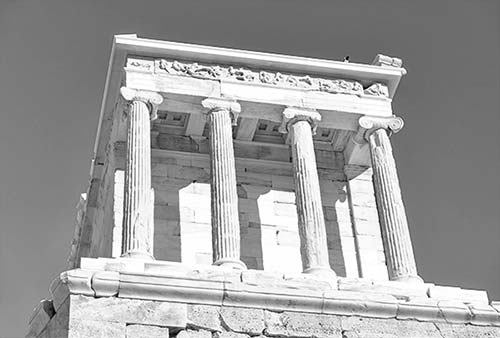
The Acropolis was mainly dedicated to the goddess Athena, patron of the city. At this temple, she was worshipped for bringing the Athenians victory (“Nike”). A statue of Athena inside the temple celebrated the turning-point victory over the Persians at the Battle of Plataea in 479 BC. It was also meant to help ensure future victory over the Spartans in the ongoing Peloponnesian War. The statue was never given wings, because Athenians wanted Athena to stay and protect their city—hence the place became known as the Temple of Wingless Athena.
• To the left (as you face the Propylaea) is a gray-stone pedestal, the...
4 Monument of Agrippa
The pedestal—even without anything on it—reaches as high as the Temple of Athena Nike. It’s 25 feet tall, made of gray marble with yellow veins. Several statues have graced this prime location. Originally, it held a bronze statue of a four-horse chariot. The driver was the race champion at the Olympic Games held in 178 BC.
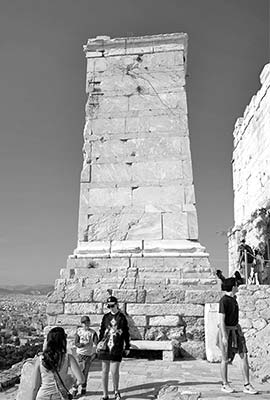
Over the centuries, this pedestal has supported many egos. Each ruler of Athens wanted to put his mark on the mighty Acropolis. When Rome occupied the city, Marc Antony placed a statue of himself and his girlfriend Cleopatra atop the pedestal. After their defeat, the Roman general Agrippa (son-in-law of Augustus) replaced it with a statue of himself (in 27 BC).
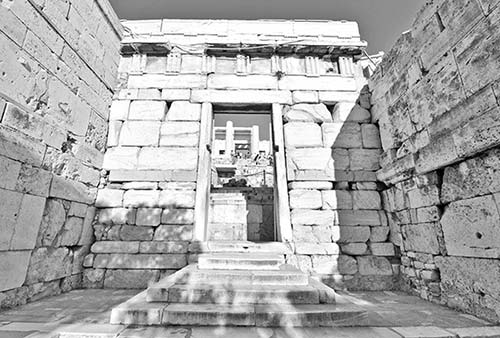
It was the Romans who expanded the Propylaea by building the structure at the base of the stairs—the 5 Beulé Gate. This ceremonial doorway became the official entrance to the Acropolis, making the Propylaea entry even grander.
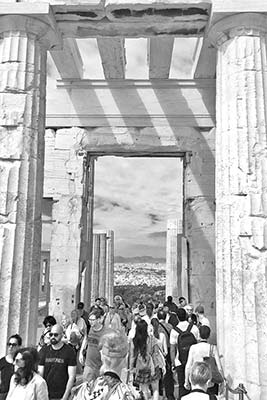
• Climb the steps (or today’s switchback ramps for visitors). Partway up, try to pull off to one side—out of the steady tourist torrent—to take a closer look inside the Propylaea.
6 Passing Through the Propylaea
Imagine being part of the grand parade of the Great Panathenaic Festival, held every four years. The procession started a mile away, at Athens’ city gate, then passed through the Agora, up past Mars Hill, and through the Propylaea. Men on horseback, musicians, dignitaries, and maidens carrying gifts for the gods all ascended these stairs. In those days, there was a ramp in the middle of the staircase, which narrowed as they ascended, funneling them into the central passageway. There were five doorways into the Propylaea, one between each of the six columns.
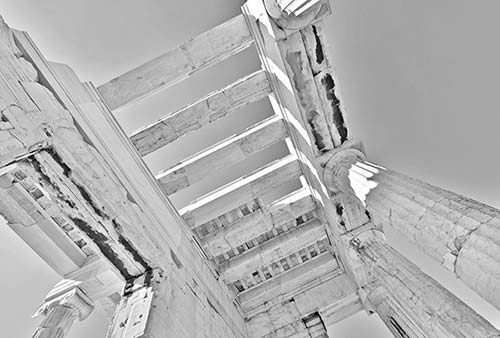
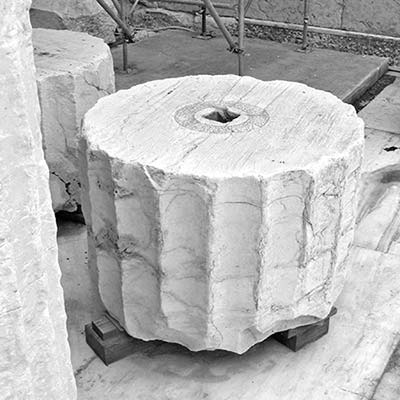
The Propylaea passageway had a roof. The marble-tile ceiling, now partially restored, was painted sky blue and studded with stars. Floral designs decorated other parts of the building. The interior columns are Ionic, a bit thinner than the Doric columns of the exterior. You’ll pass by some big column drums with square holes in the center, where iron pins once held the drums in place. Greek columns were not usually made from a single piece of stone, but from sections—“column drums”—stacked on top of one another.
• The Propylaea and its monuments are certainly impressive. But this is just the opening act. Pass through the Propylaea. As you emerge out the other end, you’re on top of the Acropolis. There it is—the Parthenon! Just like in the books (except for the scaffolding). Pause and take it all in.
7 Surveying the Acropolis
The “Acropolis rock” is a mostly flat limestone ridge covering seven acres, scattered with ruins. There’s the Parthenon ahead to the right. To the left of that, with the six lady-columns (Caryatids), is the Erechtheion. The Panathenaic Way ran between them. The processional street and the buildings were aligned east-west, like the hill.
Ancient visitors standing here would have come face-to-face with an imposing statue of Athena, 30 feet tall, carrying a shield and a spear. This 8 statue of Athena Promachos once stood between the Propylaea and the Erechtheion. Today there’s just a field of rubble, with the statue’s former location marked by three stones forming a low wall.
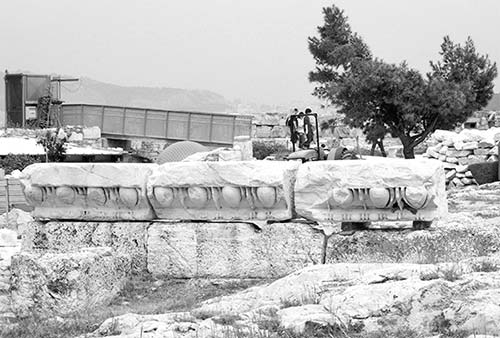
The Athena Promachos was one of three well-known statues of Athena on the Acropolis. As the patron goddess of the city, Athena was worshipped for her wisdom, her purity, and her strength. Here she appeared in “strength” mode, as a “Frontline Soldier” (promachos), armed and ready for battle. The bronze statue was cast by Pheidias, the man in charge of the overall design of the Acropolis. It was so tall that the shining tip of Athena’s spear was visible from ships at sea, 30 miles away. The statue was taken to Constantinople in ancient times and was most likely destroyed in the Middle Ages.
• Move a little closer for the classic view of the world’s most famous temple. If you’re tired, I’ve installed a handy white marble bench for you to take a load off while you take in the...
9 View of the Parthenon
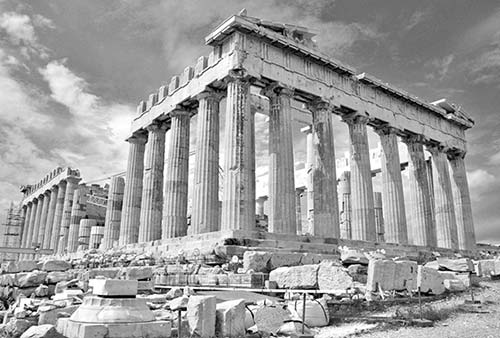
The Parthenon is the hill’s showstopper—the finest temple in the ancient world, standing on the highest point of the Acropolis, 490 feet above sea level. The Parthenon is now largely in ruins, partly from the ravages of time, but mostly from a freak accident in 1687 (see the “After the Golden Age” sidebar, later).
Imagine how awesome the Parthenon must have looked when it was completed nearly 2,500 years ago. It’s the largest Doric temple in Greece—228 feet long and 101 feet wide. Its footprint covers more than 23,000 square feet.
At each end were eight fluted Doric columns. Along each side were 17 columns, for a total of 46. In addition, there were 23 inner columns in the Doric style, plus 4 in the Ionic style.
The outer columns are 34 feet high and 6 feet in diameter. In its heyday, the temple was decorated with statues and carved reliefs, all painted in vivid colors. It’s considered Greece’s greatest Doric temple (though not its purest textbook example because it incorporates Ionic columns and sculpture).
The Parthenon served the cult of Athena the Virgin, with a statue of the goddess inside. It also served as the Fort Knox-like treasury of Athens. The west end is the classic view that greets visitors—but the building’s main entrance was at the other end.
This awe-inspiring temple was completed in less than a decade—from around 450 to 440 BC. The sculptural decoration took a few more years. The project’s overall “look” was supervised by the master sculptor-architect Pheidias. The construction was handled by well-known architects Ictinus and Callicrates. The two main sculptors were Agoracritos and Alcamenes.
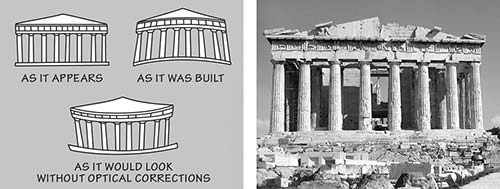
It’s big, sure. But what makes the Parthenon truly exceptional is that the architects used a whole bagful of optical illusions to give the building an ever-so-subtle feeling of balance, strength, and harmonious beauty.
For example, look at the temple’s steps. Architects know that a long, flat baseline on a building looks to the human eye like it’s sagging, and that parallel columns appear to bend away from each other. To create a building that looked harmonious, the Parthenon’s ancient architects compensated. The base of the Parthenon actually arches several inches upward in the middle to counteract the “sagging” illusion.
Now check out the columns. They tilt ever so slightly inward (one of the reasons why the Parthenon has withstood earthquakes so well). If you extended the columns upward several miles, they’d eventually touch. Also, the corner columns are thicker than the rest to make them appear the same size. And all of the columns bulge imperceptibly halfway up, giving the subconscious impression of stout, barrel-chested men bearing the weight of the roof. For a building that seems at first to be all about right angles, the Parthenon is amazingly short on straight lines. (For more on Greek columns, see here.)
All these clever refinements form a powerful subconscious impression on the viewer that brings an otherwise-boring architectural box to life. It’s amazing to think that all this was planned and implemented in stone so long ago. (For more on Greek temples, see here.)
10 West End Sculpture
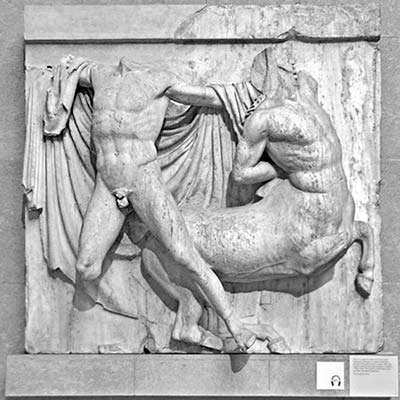
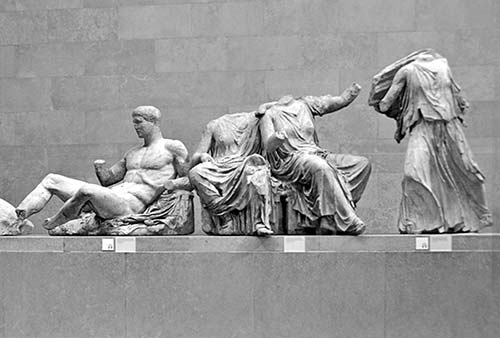
The statues and carved reliefs that once decorated the Parthenon are now mostly eroded or missing. The cream of the crop, sometimes called the “Elgin Marbles,” are in the British Museum in London. (For details, see the “After the Golden Age” sidebar, later.) A few pieces are in Athens’ Acropolis Museum.
But try to imagine this grand temple in its prime. Originally, the Parthenon’s sculptures were all painted in bright colors, and the building looked much livelier than today’s stately gray ruin.
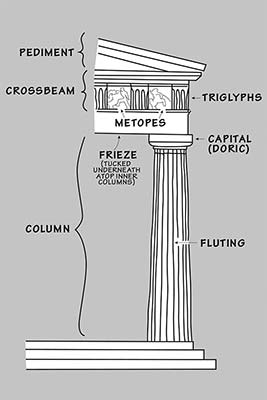
Look up at the crossbeam atop the eight columns, decorated with panels of relief carvings called metopes. These depict Athenians battling that legendary race of female warriors, the Amazons. Originally there were 92 Doric-style metopes in high relief, mostly designed by Pheidias himself.
The crossbeams once supported a triangular pediment (now gone). This area was once filled in with statues, showing Athena with her olive tree competing with Poseidon and his trident to be Athens’ patron god. Today just one statue remains (and it’s a reconstruction).
Move closer and look between the eight columns. Inside, there’s another row of eight columns, supporting a covered entrance porch. Look up above the inner columns. Decorating those crossbeams are more relief carvings—the “frieze.” Originally, a 525-foot-long frieze of panels circled the entire building. It showed the Panathenaic parade—women, men on horseback, musicians, sacrificial animals being led to the slaughter—while the gods looked on.
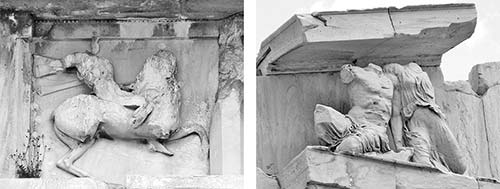
If you’re having trouble envisioning all this, you can see many of these sculptures in the flesh at the Acropolis Museum, at the base of the hill. The museum was built to house Greece’s collection...and to try to entice the rest back from museums around the world.
• Continue along the long left (north) side of the Parthenon.
11 North Side
This view of the Parthenon gives you a glimpse into how the temple was constructed.
Look between the columns—you can see remnants of the interior walls. These were built with thousands of rectangular blocks. The temple interior consisted of an entry hall and a cella. The cella was the inner sanctum, where Athena was worshipped. The roof was made of wooden beams—now long gone. The roof tiles were made of ultra-white, translucent marble from the island of Paros, so the interior actually glowed.
Now concentrate on the columns that surround the Parthenon. These formed an open-air porch around the inner sanctum. The columns are in the Doric style—stout, lightly fluted, with no base. The capitals on top of the columns are simple, consisting of a plate topped with a square slab. The capitals alone weigh 12 tons.
The Parthenon’s builders used only the very finest materials. The white Pentelic marble came from Mount Pentelikon, 10 miles away. Unlike the grand structures of the Egyptians (pyramids) and the Romans (Colosseum), the Parthenon was built not by enslaved people but by free men who drew a salary (though it’s possible that slaves worked at the quarries).
The Parthenon was constructed from 100,000 tons of marble. Imagine the engineering problems of quarrying and transporting all that stone. Most likely the column drums (5-10 tons each) were cut at the quarry and rolled here. To hoist the drums in place, the builders used four-poster cranes (and Greek mathematics), centering the drums with a cedar peg in the middle. The drums were held together by metal pins that were coated in lead to prevent corrosion, then fitted into a square hole cut in the center of the drum.
Remember that the Parthenon is intentionally off-kilter in places for aesthetic effect. Each piece was sized and cut for a specific location. The Parthenon’s stones are so well-crafted that they fit together within a fraction of an inch. The total cost to build the Parthenon (in today’s money) has been estimated at more than a billion dollars.
• If you see cranes and scaffolding here, it’s part of a heroic effort to shore up the structure against the ravages of pollution (see the sidebar). Continue on to the...
12 East End and Entrance
This end was the original entrance to the temple. Over the doorway, the triangular pediment depicted the central event in Athenian history—the birth of Athena, their patron goddess. Today, the pediment barely survives, and the original statues of the gods are partly in the British Museum. Originally, the gods were gathered at a banquet (see a copy of the reclining Dionysus at the far left—looking so drunk he’s afraid to come down). Zeus got a headache and asked Hephaistos to relieve it. As the other gods looked on in astonishment, Hephaistos split Zeus’ head open, and—at the peak of the pediment—out rose Athena. The now-missing statues were surprisingly realistic and three-dimensional, with perfect anatomy and bulging muscles showing through transparent robes.
Imagine this spot during the age of Pericles and Socrates, on the big day—the Panathenaic Festival:
The Parthenon is gleaming white, adorned with painted statues. It sits on a grassy field. The parade gathers here at the entrance. Musicians play flutes, girls dance, and riders rein in their restless steeds. On open-air altars, the priests make an offering to Athena—100 oxen, the ultimate sacrificial gift to the gods.
A select few are allowed to go inside. They proceed up the steps, through the majestic columns, and into the cella. It’s cavernous—100 feet long, 60 feet wide, and four stories tall, with a pool in the middle. At the far end of the room towers an enormous 40-foot tall statue of Athena Parthenos (Athena the Virgin), wearing a soldier’s helmet, with a shield by her side. Athena’s left hand holds a spear. Her other hand has a small statue of Nike—she literally holds Victory in the palm of her hand.
The scaffolding, cranes, and modern construction materials you see here are part of an ongoing renovation project. The challenge is to save what’s left of the Parthenon from the modern menaces of acid rain and pollution, which have already caused irreversible damage. Funded by Greece and the EU, the project began in 1976, which means that they’ve been at it more than four times as long as it took to build the Parthenon in the first place.
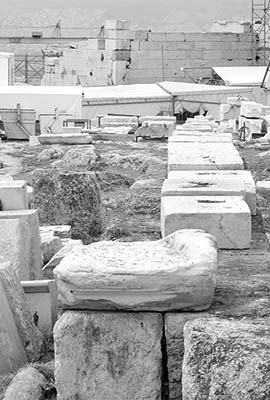
The project first involves cataloging every single stone of the Parthenon—blocks, drums, capitals, bits of rock, and pieces lying on the ground or in museums around the world. Next, archaeologists hope to put it back together, like a giant 70,000-piece jigsaw puzzle. Along the way, they’re fixing previous restorations that were either inaccurate or problematic. For example, earlier restorers used uncoated iron and steel rods to hold things together. As weather fluctuations caused the metal to expand, the stone was damaged. This time around, restorers are using titanium rods.
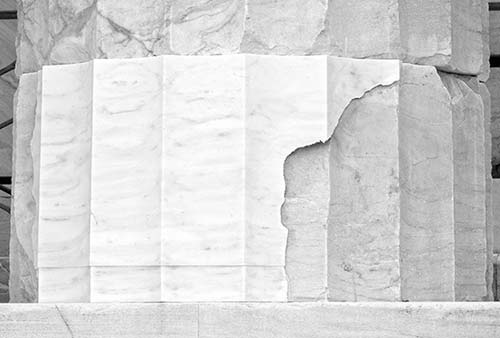
Whenever possible, the restorers use original materials. But you’ll also see big blocks of new marble lying on the ground—freshly cut from the same Pentelic quarries that supplied the original stone. The new marble is being used to replace damaged and missing pieces. Many of the columns have light-colored “patches” where the restorers have installed the new stone, cut to fit exactly. Though it looks much whiter, in time the newly cut marble will age to match the rest of the Parthenon.
When complete, the renovated Parthenon won’t look like a fully restored building—just a shored-up version of the ruin we see today. If you want to see what the Parthenon temple looked like in its heyday, there’s a full-scale replica open to visitors...in Nashville, Tennessee.
The statue was the work of the master Pheidias himself (c. 440 BC). It was made of wood, then plated with ivory for skin and a ton of gold for her garments. No one knows exactly when or how the statue vanished.
During the Panathenaic parade, the citizens of Athens would approach the statue of Athena and present the goddess with a newly woven robe. In return, Athena would ensure the continuing success of the great city of Athens.
• Our next stop is the Erechtheion, the temple across the street. (But perhaps most important right now is the modern brown-brick building nearby, with WCs and a drinking fountain.)
Approach the Erechtheion. Start by enjoying the porch supported by six statues.
13 Erechtheion: Porch of the Caryatids
Though overshadowed by the more impressive Parthenon, the Erechtheion was perhaps more prestigious. It stood on one of the oldest sites on the hill, where the Mycenaeans had built their palace centuries before. (Those huge ruined stones scattered in front of the Erechtheion are all that’s left of the Mycenaean palace.)
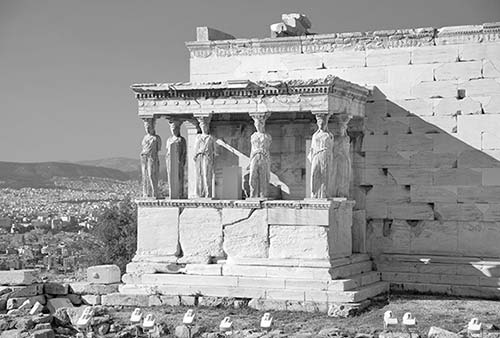
The temple’s most famous feature is the Porch of the Caryatids. An inspired piece of architecture, this balcony has six beautiful maidens functioning as columns that support the roof. Each of the lady-columns has a base beneath her feet, pleated robes as the fluting, a fruit-basket hat as the capital, and—in the back—locks of hair as buttresses. Both feminine and functional, they pose gracefully, exposing a hint of leg. The Caryatids were modeled on and named after the women of Karyai, near Sparta, famous for their upright posture and noble character. (These are faithful copies of the originals. Five of the originals are on display in the Acropolis Museum.)
Near the porch—below and to the left—notice the olive tree. Greece has 140 million of these trees. Though this particular tree is not ancient, there’s been an olive tree on this spot for thousands of years. It marks the sacred place where, according to legend, Athena first planted one. Olive trees have been called “the gift of Athena to Athens.”
• Let’s view the Erechtheion from a different angle. Walk to the right, to the east end of the structure. Find a spot where you can look through the six columns and get a sense of what the temple was like inside.
14 Erechtheion: East End
This unique, two-story temple fits nicely into the slope of the hill. The east end (with the six Ionic columns) was the upper-level entrance. The lower entrance was on the north side (to your right, 10 feet lower), where you can see six more Ionic columns. By the way, it’s those columns that are the “face of the Acropolis” that Athenians see from the Plaka below.
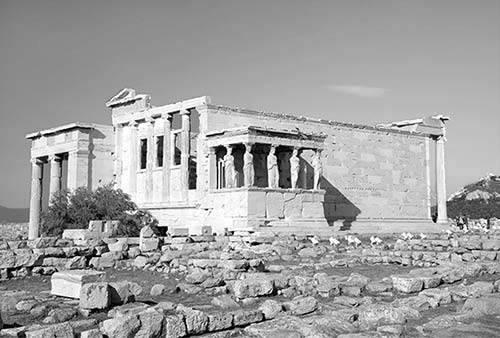
The Erechtheion was constructed around 410 BC. The architect, Mnesicles, was the same man who did the Propylaea. Whereas the Propylaea and the Parthenon are both sturdy Doric style, the Erechtheion is elegant Ionic. The columns are thinner, more deeply fluted, and topped with a scroll-like capital. In its day, the Erechtheion was a stunning building of white Pentelic marble, with black trim and painted columns.
Now look inside the temple. You can make out that the inner worship hall, the cella, is divided in two by walls (more on that in a minute). The Erechtheion also once held a life-size statue of Athena made of olive wood depicting her as Athena Polias, Protector of the City. Dating from about 900 BC, this statue was much older and more venerable than either of Pheidias’ colossal statues. It supposedly dropped from the sky as a gift from Athena herself. It was so revered that, when the Persians invaded, Pericles took the statue for safekeeping as the Athenians evacuated their city.
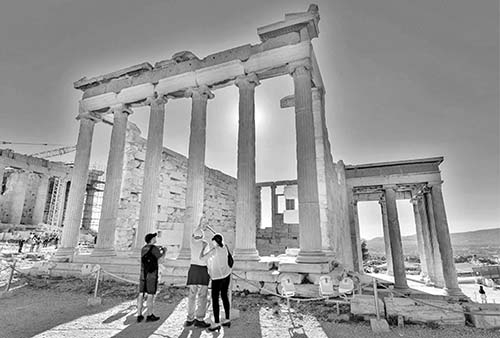
The Erechtheion is supposedly the spot where Athena and Poseidon fought it out for naming rights to the city. Poseidon threw his trident, which opened a gash in the earth to bring forth the gift of water. It left a diagonal crack still visible in the pavement of the lower, north entrance. (Cynics say it was lightning.) Athena won the contest by stabbing a rock with her spear. This sprouted the blessed olive tree that stood near the Porch of the Caryatids. The twin cellas of the Erechtheion allowed the worship of both gods—Athena and Poseidon. They’re side by side to show that they were still friends.
• Look to the right (beyond the Plaka-facing porch). The modern elevator carries people with limited mobility up to the Acropolis. The north wall of the Acropolis has a retaining wall built from column drums from remains of a half-finished temple destroyed when Persia invaded in 480 BC. The Athenians rebuilt as fast as they could with the scattered material to fortify the city against Sparta.
Turn 180 degrees and walk to the far end of the Acropolis. There you’ll find an observation platform with a giant Greek flag.
15 Viewpoint with Greek Flag
The Greek flag’s blue-and-white stripes symbolize the nine syllables of the Greek phrase for “Freedom or Death.” That phrase took on new meaning when the Nazis entered Athens in April 1941. According to an oft-repeated (but unverified) story, the Nazis confronted a Greek soldier who was guarding this flag and ordered him to remove it. He calmly took it down, wrapped himself in it—and jumped to his death. A month later, two heroic teenagers, Manolis Glezos and Apostolos Santas, scaled the wall, took down the Nazi flag, and raised the Greek flag. This was one of the first well-known acts of resistance against the Nazis, and the boys’ bravery is honored by a plaque near the base of the steps. To this day, Greeks can see this flag from just about anywhere in Athens and think of their hard-won independence.
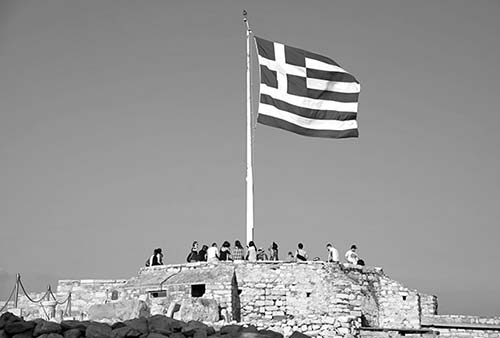
From this observation deck, you have a great view of Athens. The Ancient Agora spreads below the Acropolis, and the sprawl of modern Athens whitewashes the surrounding hills. In 1830, the population of Athens’ core was about 5,000. By 1900, it was 600,000, and during the 1920s, with the influx of Greeks from Turkey, the population surged to 1.5 million. The city’s expansion could barely keep up with its exploding population. With the boom times in the 1950s and 1980s, the city grew to nearly four million. Pan around. From this perch you’re looking at the homes of one out of every three Greeks.
Looking down on the Plaka, find (looking left to right) the Ancient Agora, with its Temple of Hephaistos. Next comes the Roman Forum (the four columns) with its round, white, domed Temple of the Winds monument. The Anafiotika neighborhood clings to the Acropolis hillside directly below us. About eight blocks beyond that, find the dome of the cathedral.
Classical: The Parthenon and the rest of the Acropolis buildings survived through classical times largely intact, despite Herulian looting (AD 267). As the Roman Empire declined, precious items were carried off, including the 40-foot Athena statue from the Parthenon.
Christian: The Christian emperor Theodosius II (Theodosius the Great) labored to outlaw pagan worship and to close temples and other religious sites. After nearly a thousand years as Athena’s temple, the Parthenon became a Christian church (fifth century AD). It remained Christian for the next thousand years, first as the Byzantine Orthodox Church of Holy Wisdom, then as Mother Mary of Athens (11th century), and at the end as a Roman Catholic cathedral of Notre Dame (dedicated to Mary in 1205 by Frankish Crusaders). Throughout medieval times it was an important stop on the pilgrimage circuit.
The Parthenon’s exterior was preserved after its conversion to a church, but pagan sculptures and decorations were removed (or renamed), and the interior was decorated with colorful Christian frescoes. The west end of the building became the main entrance, and the interior was reconfigured with an apse at the east end.
Muslim: In 1456, the Turks arrived and converted the Parthenon into a mosque, adding a minaret. The Propylaea gateway was used as a palace for the Turkish ruler of Athens. The Turks had no respect for the sacred history of the Acropolis—they even tore down stones just to get the lead clamps that held them in place in order to make bullets. (The exasperated Greeks even offered them bullets to stop destroying the temple.) The Turks also used the Parthenon to store gunpowder, unfortunately leading to the greatest catastrophe in the Acropolis’ long history. It happened in...
1687: A Venetian army laid siege to the Acropolis. The Venetians didn’t care about ancient architecture. As far as they were concerned, it was a lucky hit of mortar fire that triggered the massive explosion that ripped the center out of the Parthenon, rattled the Propylaea and the other buildings, and wiped out the Turkish defenders. Pieces of the Parthenon lay scattered on the ground, many of them gathered up as souvenirs by soldiers.
Lord Elgin: In 1801, Lord Elgin, the British ambassador to the Ottomans in Constantinople, got “permission” from the sultan to gather sculptures from the Parthenon, buy them from locals, and even saw them off the building (Greeks scoff at the idea that “permission” granted by an occupying power should carry any weight). He carted half of them to London, where the marbles (formerly known as the “Elgin Marbles”) are displayed in the British Museum to this day, despite repeated requests for their return. Although a few original frieze, metope, and pediment carvings still adorn the Parthenon, most of the sculptures are on display in museums, including the nearby Acropolis Museum.
From Independence to the Present: In the 19th century, newly independent Greece tore down the Parthenon’s minaret and the other post-Classical buildings atop the Acropolis, turning it into an archaeological zone. Since then the site has been excavated and has undergone several renovations. Today, the Acropolis strikes wonder in the hearts of visitors, just as it has for centuries.
Farther in the distance, Lykavittos Hill, Athens’ highest point, is crowned with the Chapel of St. George (and an expensive view restaurant; cable car up the hill). Looking still farther in the distance, you’ll see lighter-colored bits on the mountains behind—these are Pentelic quarries, the source of the marble used to build (and now restore) the monuments of the Acropolis.
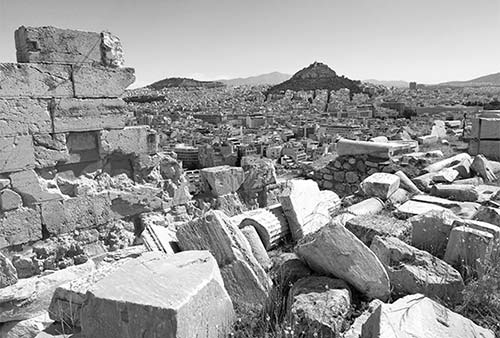
As you continue panning to the right, you’ll spot the beige Neoclassical Parliament building, marking Syntagma Square; the National Garden is behind and to the right of it. In the garden is the yellow Zappeion, an exhibition hall. The green area in the far distance contains the 60,000-seat, marble Panathenaic Stadium—an ancient venue (on the site where golden age Athens held its games), which was rehabbed in 1896 to help revive the modern Olympics.
• Complete your visual tour of Athens at the south edge of the Acropolis. To reach the viewpoint, walk back toward the Parthenon, going past it to the left to the cliff-top wall.
16 More Views of Athens
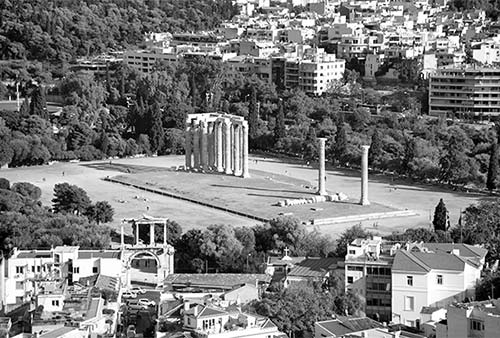
Look to the left. In the near distance are the huge columns of the Temple of Olympian Zeus. Begun in the sixth century BC, it wasn’t finished until the time of the Roman emperor Hadrian, 700 years later. It was the biggest temple in all of Greece, with 104 Corinthian pillars housing a 40-foot seated statue of Zeus, a replica of the famous one created by Pheidias in Olympia. This area was part of Hadrian’s “new Athens,” a planned community in his day, complete with the triumphal Arch of Hadrian near the temple.
The Theater of Dionysus, with its illustrious history, lies in ruins at your feet. It’s fair to say that this is where our culture’s great tradition of theater was born. During Athens’ golden age, Sophocles and others watched their plays performed here. Originally just grass with a circular dirt area as the stage, the theater was eventually expanded, and stone seating added, to accommodate 17,000 patrons in about 330 BC, during the time of Alexander the Great. During Roman times, a raised stage was added, and the theater was connected to the Odeon of Herodes Atticus by a long, covered stoa, creating an ensemble of inviting venues. Today, plans are afoot to restore the theater to its former greatness. It’s free to visit the theater with your Acropolis ticket (it’s accessible only from inside the Acropolis site—see the end of the tour for directions).
Beyond the theater is the wonderful Acropolis Museum, a black-and-gray modern glass building with three rectangular floors stacked at irregular angles atop each other. The top floor, which houses replicas and some originals of the Parthenon’s art, is angled to match the orientation of that great temple.
Looking right, you see Filopappos Hill—the green, tree-dotted hill topped with a marble funerary monument to a popular Roman senator, Philopappos, who died in the early second century. This hill is where the Venetians launched the infamous mortar attack of 1687 that destroyed the Parthenon. Today, a theater here hosts popular folk-dancing performances (described in the Nightlife in Athens chapter).
Farther in the distance, you get a glimpse of the turquoise waters of the Aegean (the only island visible is Aegina). While the Persians were burning the Acropolis to the ground, the Athenians watched from their ships as they prepared to defeat their foes in the history-changing Battle of Salamis. In the distance, far to the right, is the port of Piraeus. Today Piraeus is the main departure point for boats to the islands, but it’s also the ancient port from which Athenian ships sailed and returned with the wealth that made this city so great.
• Our tour is finished. Enjoy a few final moments with the Acropolis before you leave.
The Acropolis exits are back the way you came—through the Propylaea. From here, you can exit either on the west side (go through the Beulé Gate) or to the south (go back toward the Odeon of Herodes Atticus, turn left, and walk downhill along the path).
Exit from the west side if you want to visit Mars Hill on the way out. Or passing Mars Hill, you can head to the Plaka and Ancient Agora (follow the roads winding downhill) or the Acropolis Museum (turn left on the pedestrian boulevard, walk down to Dionysiou Areopagitou street, and turn left).
To reach the Theater of Dionysus, head toward the south entrance. You’ll reach the theater and eventually the south entrance, with the Acropolis Museum across the street.