ANCIENT AGORA TOUR
Αρχαία Αγορά
1 The Panathenaic Way—the Agora in its Prime
7 Tholos
13 Church of the Holy Apostles
While the Acropolis was the ceremonial showpiece, the Agora was the real heart of ancient Athens. For some 800 years (c. 600 BC-AD 300), it was the place where people came to shop, businessmen struck deals, laws were passed, worshippers venerated the gods, and theaters hummed with nightlife.
Agora means “gathering place,” but you could call this space by any of the names we typically give to the busiest part of a city—downtown, main square, forum, piazza, marketplace, commons, and so on. It was a lively place where the pace never let up—much like modern Athens.
Little survives from the Classical-era Agora. Other than one very well-preserved temple and a rebuilt stoa, it’s a field of humble ruins. But that makes it a quiet, uncrowded spot to wander and get a feel for the ancients. Nestled in the shadow of the Acropolis, it’s an ideal prelude to your visit there.
Orientation
Cost: €10, covered by €30 Acropolis combo-ticket (which you can buy here; see sidebar on here).
Hours: Daily 8:00-20:00, Oct until 18:00, Nov-March until 17:00. The Agora Museum inside generally has the same hours.
Information: +30 210 321 0180, http://odysseus.culture.gr.
Getting There: From the Monastiraki Metro stop, walk a block south (uphill, toward the Acropolis). Turn right on Adrianou street, and follow the pedestrian-only, café-lined street along the railroad tracks for about 200 yards. The Agora entrance is on your left, across from a small, yellow church. The entrance can be hard to spot: It’s where a path crosses over the railroad tracks (look for a small, pale-yellow sign that says Ministry of Culture—Ancient Agora).
Visitor Information: Panels with printed descriptions of the ruins are scattered helpfully throughout the site.
Tours:  Download my free Ancient Agora audio tour.
Length of this Tour: Allow 1.5 hours.
Services: Water fountains are at the entrance and inside the Stoa of Attalos. The only WCs on the site are inside the Stoa of Attalos, at its northernmost end.
Eating: Picnicking is not allowed in the Agora. Loads of cafés and tavernas line busy Adrianou street near the entrance, and more good eateries front the Apostolou Pavlou pedestrian walkway that hems in the western edge of the Agora, in the district called Thissio.
Starring: A well-preserved temple, a rebuilt stoa with a nice museum, some monumental statues, and the ruins of the civilization that built the Western world.
The Tour Begins
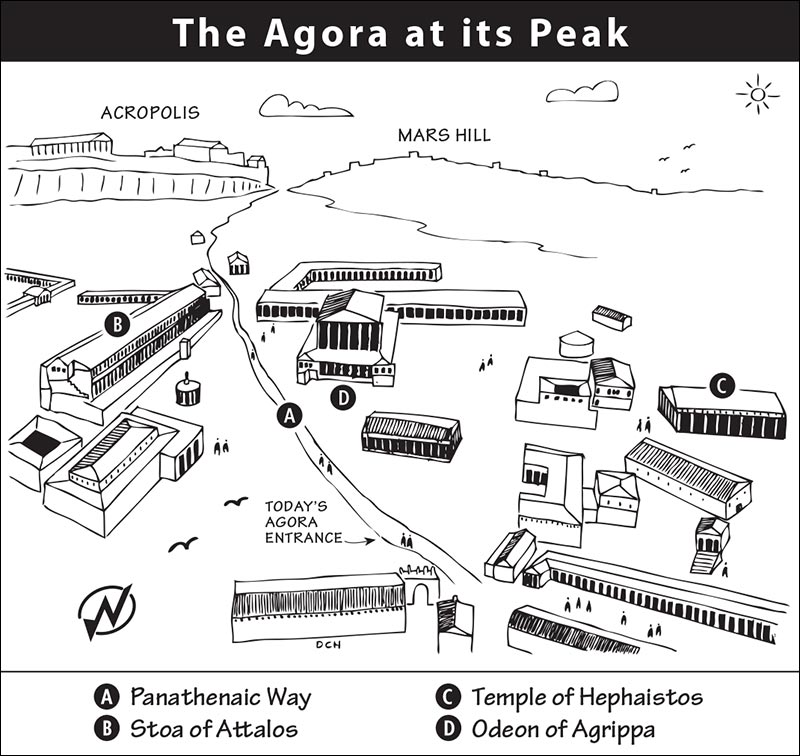
Entering the site from Adrianou street, belly up to the illustration at the top of the ramp that shows the Athenian Agora at the peak of its size. Face the Acropolis (to the south) and look out over the expanse of ruins and trees. This overgrown field was once the center of Athenian life.
Get oriented. You’re standing near #26 on the illustration. At your feet runs the Panathenaic Way (#21), the Agora’s main street, then and now. The long column-lined building to the left is the reconstructed Stoa of Attalos (#13). To your right (though likely obscured by trees) is the Temple of Hephaistos (#20). Directly ahead of you (through more trees) are the remains of the Odeon of Agrippa (#12).
In the distance, the Agora’s far end is bordered by hills. From left to right are the Acropolis (#1), the Areopagus (“Hill of Ares,” or Mars Hill, #2), and Pnyx Hill (#3).
The place where you’re standing was near the Altar of the Twelve Gods, which was once considered the geographical center of Athens, from which distances were measured. You’ve arrived at ground zero of ancient Athens.
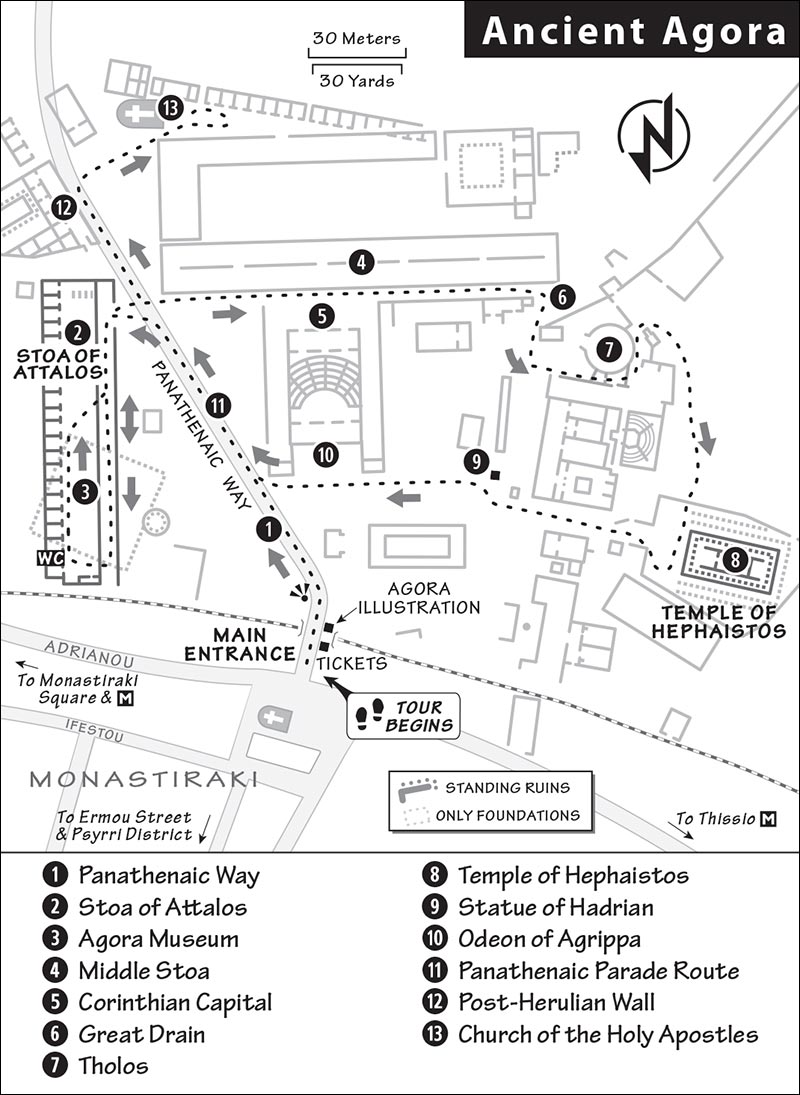
On this self-guided walk, we’ll go up the Panathenaic Way to the Stoa of Attalos, turn right and cross the Agora to the Temple of Hephaistos, then return to the Odeon. We’ll end by heading up the Panathenaic Way again toward the Acropolis.
• Walk to the bottom of the ramp at your left to the path that was once Athens’ main street. Find a shady spot to ponder ancient Athenian life in its heyday.
1 The Panathenaic Way—the Agora in its Prime
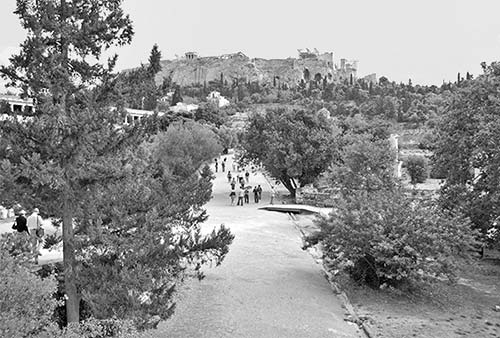
Imagine walking through the Agora along its main drag in ancient times.
On your left stood the Stoa of Attalos, which looked much like this modern reconstruction today. On your right was the Agora’s main square, surrounded by gleaming, white-marble buildings. Everywhere you looked there were temples, government buildings, and theaters, all fronted with columns and topped with red-tile roofs. The place was studded with trees and dotted with statues, fountains, and altars. The streets were lined with wooden market stalls where merchants sold produce, pottery, and trinkets.
The Agora buzzed with people, day and night. Imagine men and women dressed in their simple tunics—men’s tunics extending to their knees and women’s to their ankles. They came to shop—to buy groceries, clothes, painted plates and pitchers, or to get their wagon wheel fixed. If you needed a zoning permit for your business, you came to the courthouse. Worshippers gave offerings to the gods at any number of temples and altars. At night, people came for plays and concerts. The tavernas rocked.
The Panathenaic Way started at the main city gate, cut diagonally through the Agora’s main square, and wound its way up to the Acropolis—two-thirds of a mile in all. This was the city’s main north-south road, and here in the Agora it intersected with the main east-west road to the busy port of Piraeus. Though some stretches were paved, most of it (then as now) was just packed gravel.
All roads led to the Agora. This was the place for speeches, political announcements, celebrations, and demonstrations. On holidays, the parade ran right up this street. At any time, this was the place to be—to run into eccentric characters like Socrates or Diogenes, or just to hang out with friends. In short, this was the buzzing center of the city of Athens, population 100,000.
• Now turn your attention to the long, colonnaded building on your left. The entrance is at the far (south) end. Step onto its shaded porch, look down the long rows of columns, and admire the...
2 Stoa of Attalos
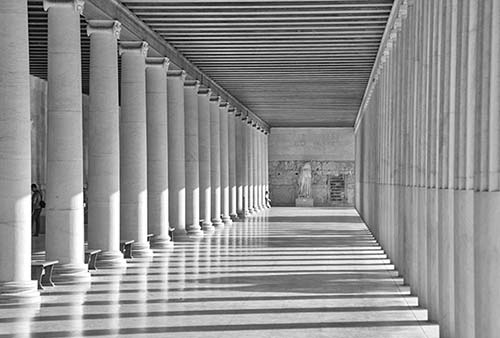
This stoa was an ancient shopping mall. Covered walkways like this protected shoppers from the sun and the rain. The ground floor once had about 20 shops—today, those rooms hold the museum. Upstairs were offices, which today house the American School.
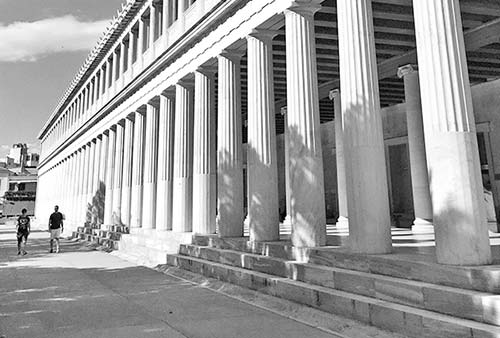
The stoa was originally built around 150 BC by King Attalos II of Pergamon (in modern-day Turkey). Though he was not a Greek, Attalos was—like so many other ancient people—fascinated by Greek culture. This building was his way of saying thanks for the education he’d received in Athens. The original structure is long gone, but the building that stands today is a faithful reconstruction, built in the 1950s by the American School of Classical Studies, which helped excavate the Agora.
This stoa is typical of many others in ancient Athens. It stands two stories tall and was made of white Pentelic marble, the same as the Parthenon. The covered porch is about 400 feet long. It’s lined with one row of 45 Doric columns (the outer layer) and another row of 22 Ionic columns—a typical mixing of styles.
Like the malls of our generation, the stoa was also a social magnet. Imagine ancient Greeks—their hard labor being done by enslaved people—lounging here, just enjoying the shade of the portico.
The statues on display in the arcade once populated the Agora—gods, heroes, athletes, and ceremonial stele. For example, on the wall near the fifth Ionic column, find the impressive sculpted head of a bearded man with a full head of hair. This Head of a Triton (c. 150 AD) once decorated the Odeon of Agrippa, which we’ll see later.
• About halfway down the arcade you’ll find the entrance to the Agora Museum (included with your ticket).
3 Agora Museum
The Agora itself is mostly ruins, but the excellent little museum displays some choice rubble that helps bring the place back to life. Start in the corner, with a photo from 1952 showing this spot before the stoa was reconstructed—just a long platform.
This long hall is laid out chronologically, letting you trace the history of the Agora through artifacts (mainly pottery) found here. Follow the collection by the numbers found in the display cases’ upper-right corner. The cases are rather confusingly labeled but easy to find.
• The first cases chart the rise of the Agora from a tiny settlement to the center of enlightened golden age Athens.
Case #1 (center of the room): This reclining female figure dates from the Agora’s first inhabitants, way back around 4,000 BC, who found a home in this rectangular-shaped valley in the protective shadow of the Acropolis.
#8 (right wall): These tomb offerings came from the next settlers: the Mycenaeans (c. 1600-1200 BC), who built atop the Acropolis and used the Agora as a cemetery.
#9 (right): This handsome vase (with its intricate patterns, symmetrical designs, and stick figures) is, not surprisingly, from the Geometric period (1100-700 BC). Its presence indicates that the Agora now had permanent residents and pottery workshops.
#3 (center): As Athens grew, the pottery got more sophisticated, depicting increasingly realistic humans and animals. During this Archaic era (700-480 BC) the Agora expanded, got its first monumental buildings, and hosted its first Panathenaic parade.
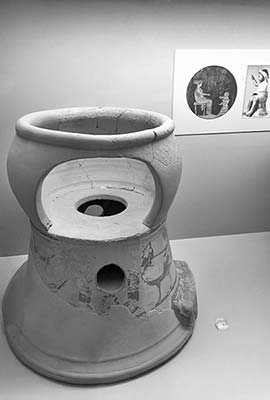
#26 (right): Yes, it’s just what it looks like—a baby’s commode. It dates from the time when the Agora was still largely a residential neighborhood, rather than the all-commercial “downtown” it would become.
#4 (center): This bust of Nike (which means Victory) celebrates Athens’ triumph over Persia, when it rebuilt the Agora, ushered in the golden age (roughly 450-400 BC), and established a flourishing democracy.
• The next several displays are devoted to one of Athens’ greatest inventions—democracy.
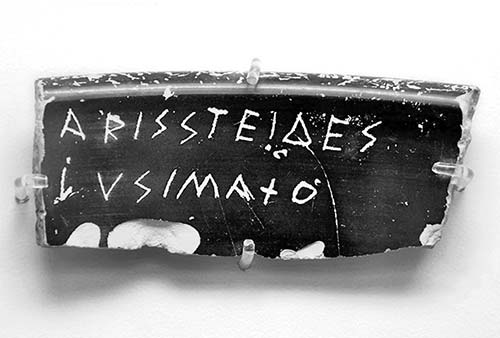
#30 (right): The pottery shards with names painted on them were voter ballots (called ostrakon) used to vote out—or ostracize—corrupt tyrants. On the two shards, #37 and #17, read the Greek names—Themistocles and Aristides (ΘEMIΣΘOKLEΣ NEOKLEOΣ and ARIΣΣTEIΔEΣ). During the golden age, these men were famous rivals, in both politics and romance. Both served Athens honorably and both were also exiled in political power struggles.
#31 (right): This contraption is an early voting machine called the kleroterion. It was used to select city council members. It was done randomly, to make sure each citizen fulfilled their civic duty—kind of like jury duty. Citizens put their name in the slots, then black and white balls went into the tube (on the left) to randomly select who would serve. Now look below the machine—you’ll see actual bronze ballots from the fourth century.
#32 (right): The klepsydra (“water thief”) was a water clock used to time speeches at council meetings. It took six minutes for the 1.7 gallons to drain out. A gifted orator truly was good to the last drop...but not a second longer.
#67 (left): The bronze shield was captured from defeated Spartans in the tide-turning Battle of Sphacteria, which gave Athens the upper hand in the Peloponnesian War. The victory was only temporary, and Athens drained itself in those wars with Sparta.
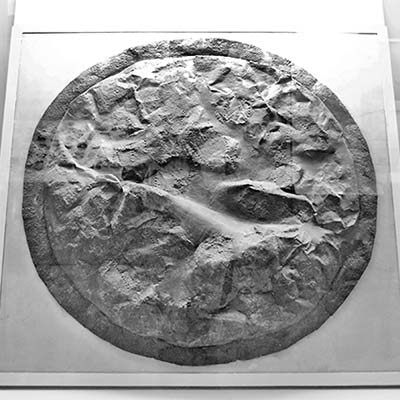
Just to the left of case #67 is the “Stele of Democracy.” A relief carving shows Lady Democracy crowning a man representing the Athenian people. The inscription proclaims that all tyranny is outlawed. Note the monument’s date: from around 336 BC, the year Alexander the Great took control of Greece and began spreading Greek culture throughout the known world.
• The final exhibits date from the Agora’s later years, when it was the center of a large, multicultural, cosmopolitan Hellenistic world.
#66 (left): These marble “herm” heads of prominent men stood atop columns that were placed at major intersections. They warded off evil spirits and were signposts, with the latest news and directions attached.
#34 and #35 (right): Pottery was a popular export product for the sea-trading Greeks. The sophisticated Athenians set the trends—from black figures painted on a red background (case #34) to red on black (case #35).
#5 (center): In the middle of the room is a case of coins. These drachms and tetradrachms feature Athena with her helmet. In golden age times, a drachm was roughly a day’s wage. The ancients put coins like these in the mouth of a deceased person as payment to carry the soul safely across the River Styx. Coin #7, a four-drachm piece, features the owl as on Greece’s €1 coin today.
#60-61 (left) and #42 (right): What are these objects? It’s exactly what you think—ancient barbecue grills. Those long-ago people weren’t really so different from you and me.
#58 and #56 (left): These sculpture heads date from the Agora’s next great era, the Romans. The Romans loved Greek culture and expanded the Agora, leaving many of the ruins seen today. As these busts show, the Romans were more honest than the Greeks when it came to portraying people with less-than-ideal features.
#55 (far end): After the decline of Rome, the Agora suffered, but—as these fine, intricately patterned pieces of Byzantine pottery attest—it still shone on. Athens remained an important regional capital in the enlightened Byzantine Empire ruled from Constantinople (modern-day Istanbul). The Agora was a vital neighborhood of Athens until 1204, when invading Venetians sacked and looted it, and the Agora was abandoned...leaving all these artifacts in the rubble, waiting for archaeologists to retrieve them and build this museum.
• Exit this room and turn right into the arcade for a WC and water fountain. To reach the stoa’s upper floor (with a few more exhibits, statues, and Agora views), turn left and to go the end of the arcade, where you’ll find the stairway leading up to the second level.
From here in the open-air upper stoa, you have great views down into the Agora and across to the Temple of Hephaistos. Along the wall you’ll find a changing exhibit, and hiding behind it, storage cases with shelf upon shelf of pottery shards, all of them dug up right here in the Agora. The models show the Agora from various eras, helping you mentally resurrect the rubble and comprehend the changes that occurred over the centuries. Halfway down the hall, focus on the model of the Agora at its peak of grandeur, under the Romans, in the second century AD. It was sure something. Find the Stoa of Attalos on one side, the Temple of Hephaistos on the other, and the Odeon of Agrippa in between. Now find the long, low building behind the odeon. This was another stoa—the Middle Stoa. That’s where we’re headed next.
• Go back downstairs, return to the spot where we first entered, and head across the Panathenaic Way. Continue straight (west) along the lane and across the middle of the Agora. You’re walking alongside the vast ruins (on your left) of what once was the...
Think of all the people, famous and not, who’ve walked the very paths you do. It’s where they shopped and schmoozed. Where they invented democracy. Citizens gathered here by the thousands to listen to speeches and cast votes to ostracize their tyrants. The Agora is where the earliest plays were performed—originally in the open air—as the Greeks pioneered modern theater.
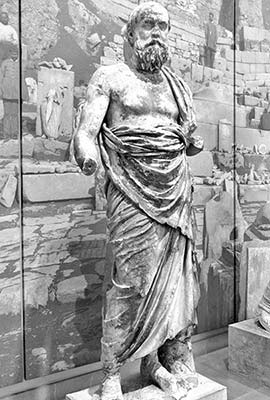
The roving philosopher Socrates (469-399 BC) spent much of his life simply hanging out in the Agora, questioning passersby, and urging people to “know thyself.” Socrates discussed the meaning of piety, as recorded by Plato in the dialogue called the Euthyphro. “The lover of inquiry,” said Socrates, “must follow his beloved wherever it may lead him.” Shortly after, Socrates was tried and condemned to death here for “corrupting the youth”...by encouraging them to question Athenian piety.
Plato, Socrates’ disciple and chronicler of his words, spent time teaching in the Agora, as did Plato’s disciple Aristotle. (Their schools—Plato’s Academy and Aristotle’s Lyceum—were located elsewhere in Athens.)
The great statesman Pericles—whose Funeral Oration over the Greek dead from the first year of the Peloponnesian War is a famous expression of Athenian ideals—must have spent time here, since he oversaw the rebuilding program after the Persian invasion.
When Athens triumphed over Sparta in one battle during the Peloponnesian War (425 BC), General Cleon displayed the shields of captured prisoners in the Agora. This action mocked the Spartans for their surrender, since brave Spartans were always supposed to die with their shields on.
Diogenes the Cynic lived as a homeless person in the Agora and shocked the Athenians with his anti-materialist and free lifestyle. He lived in a wooden tub (in disregard for material comfort), masturbated openly (to prove how simply one’s desires could be satisfied), and wandered the Agora with a lighted lamp in daylight (looking for one honest man in the corrupt city). According to legend, Alexander the Great was intrigued by this humble philosopher who shunned materialism. One day he stood before him and said, “Diogenes, I will give you whatever you want. What would you like?” History’s first hippie looked at the most powerful man on earth and replied, “Please get out of my sunshine.”
The playwright Aristophanes set scenes in the Agora, the tragedian Sophocles spent time here, and many classic Greek plays got their big debut here at the “Broadway” of ancient Greece.
The Apostle Paul stopped in Athens on his way to Corinth in AD 49 (Acts 17:17). He debated with the pagan philosophers in the “marketplace”—likely the Agora. And he decried the Athenians’ altars to pagan gods when he preached from Mars Hill, overlooking the Agora.
In short, the Agora was always at the heart of every key point in Greek history. Here the Athenians mobilized to confront the onslaught of the Persians. It’s where they greeted the coming of Alexander the Great and tolerated the conquering Romans. As Athens declined, the Athenians faced off here against invaders, from the Herulians to the Slavs. And even as the Agora slowly fell into ruin, for centuries thereafter, every famous European who visited Athens made a point to tour the Agora and ponder these inspiring ruins.
4 Middle Stoa
This long set of ruins—about 500 feet long by 60 feet wide—stretches clear across the Agora. It served as a big mall of shops and offices for busy Athens. It looked something like the reconstructed Stoa of Attalos that we just saw, except this was only one story tall. You can probably make out two long lines of stubby column fragments from the columns that supported the roof. You’ll also find a few stone steps, and the reddish-colored blocks (near the far end) from the foundation.
Remember that, during the golden age, this central part of the Agora was just an open field, a “gathering place.” But as Athens grew and expanded, so did its commercial center. The Middle Stoa (180 BC) was one of several grand buildings that began to fill the space. Eventually it became jam-packed with big marble buildings—the maze of ruins you see today.
• Midway down the lane (near the wooden section of the path), you’ll come across a huge capital of a column.
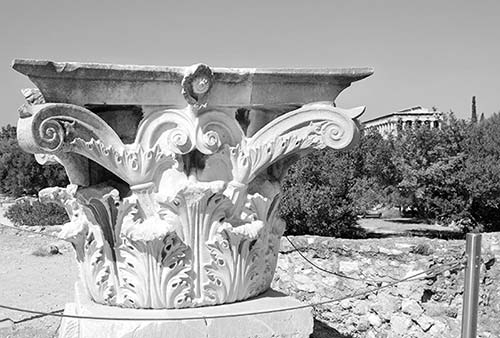
5 Corinthian Capital
This capital once stood here atop a colossal column. Carved in the fourth century BC, this is one of the earliest examples of the style known as Corinthian. The Corinthian order featured slender, fluted columns topped with leafy capitals like this. The style was actually rarely used by Greeks, but it became wildly popular with the Romans. When the Romans occupied Athens, they incorporated older Greek capitals like this one into their massive theater. You can see the ruins of that theater (Odeon of Agrippa) as you look toward the Agora entrance.
• But we’re getting ahead of ourselves. Continue westward across the Agora. Near the end of the Middle Stoa, you’ll see a gray wellhead—still in its original spot and worn by the grooves of ropes.
Just beyond the well to the right, you’ll spy a round platform—the tholos. Make your way there—after passing the wooden bridge and turning left, you’ll cross over a ditch that was once part of the...
6 Great Drain
This ditch was part of Athens’ impressive waterworks system. It was dug in the fifth century BC and still functions today. The ditch captures rainwater runoff from the southern hills and channels it through the Agora. At this point, two main collection ditches meet and join. If you look closely, you can see exposed parts of the stone-lined ditch. The well we just saw was also part of this water system.
From here you have good views of the Acropolis. The towering but empty pedestal of the Monument of Agrippa (on the hill’s right end) marks the entrance to the Acropolis. To the left of that is the Erechtheion temple. To the right of the Acropolis is craggy Mars Hill, where the Apostle Paul famously preached. The long ridgeline farther to the right is Pnyx Hill. This wide, gentle slope is where Athenian citizens gathered by the thousands to debate policy when the Agora was too small.
• But the real center of Greek democracy is just a few steps away. It’s that round footprint with a stubby column in its center. This is the...
7 Tholos
This rotunda-shaped building housed Athens’ rulers. It was built around 465 BC, right at the dawn of the golden age and of Athenian democracy. About 60 feet across, this round structure was originally ringed with six Ionic columns and topped with a cone-shaped roof.
The tholos was the center of Athenian government. It was the headquarters, offices, and meeting hall for the city’s 50 ministers. They also lived and ate here, since the law required that at least a third of these ministers be on the premises at all times. The tholos housed the official weights and measures. By law, any shopper in the Agora could stop in here and use these to check whether a butcher or tailor was shortchanging them.
The 50 ministers were selected from the 500 ministers who met next door in the bouleuterion (council house). They, in turn, were elected by the foundation of Athenian democracy—the thousands of free adult male citizens.
The tholos was also a kind of temple to democratic rule. The altar in the middle—where the broken column is now—once held a flame that was always kept burning. This represented the hearth of the extended “family” that was Athens.
• Our next stop is the big temple atop the ridge. To reach it, climb the stairs to the left and go through the trees, pausing along the way at a viewpoint with a chart. (This is an ideal spot to take a seat, view the entire Agora, and read the sidebar on “The Agora in Action.”) Then continue to the...
8 Temple of Hephaistos
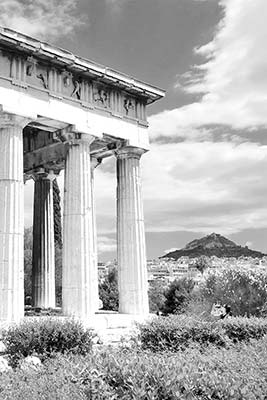
One of the best preserved and most typical of all Greek temples, this is textbook golden age architecture. Started in 450 BC—just before the Parthenon—it was built at Athens’ peak as part of the massive reconstruction of the Agora after invading Persians destroyed the city (480 BC). But the temple wasn’t completed and dedicated until 415 BC, as work stalled when the Greeks started erecting the great buildings of the Acropolis.
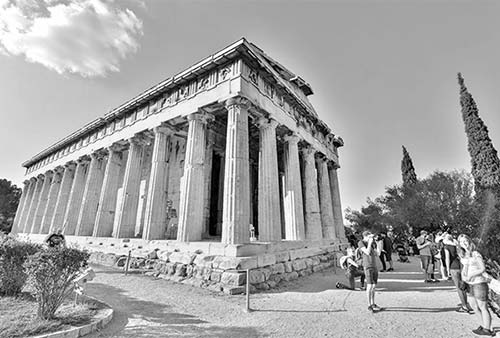
This is a classic peristyle temple (like the Parthenon), meaning that the building is surrounded by columns. Also like the Parthenon, it’s made of Pentelic marble in the Doric style, part of Pericles’ vision of harking back to Athens’ austere, solid roots. But the Temple of Hephaistos is only about half the size of the grand Parthenon and has fewer carvings.
Priests would enter from here at the Agora-facing entrance, through the six columns, beneath the covered portico (note the coffered ceiling), and into an alcove ringed by three walls (called the pronaos or “pre-temple”) before reaching the central hall (cella). There they’d worship a large bronze statue of Hephaistos, the blacksmith god, and one of Athena, patroness of Athens and of arts and crafts. According to legend, Hephaistos hit on Athena, she spurned him, he spilled his semen on the ground...and Athens was born. Appropriately, the temple of these crafty gods was originally surrounded by metalworking and pottery workshops.
The carved reliefs are typical of the Greek love of the “contest,” depicting legendary battles between heroes, animals, gods, and mythological beasts. The metopes above the outer entrance show 10 scenes from the Labors of Hercules. They’re interspersed with panels of three vertical lines, meant to imitate the humble-but-virtuous look of early Greek dwellings made of wood.
Looking between the six columns, you’ll see the inner frieze, with its scenes of Theseus battling Athens’ oppressors. (The great mythological hero would eventually slay the bull-headed Minotaur.) These decorations led Athenians to mistakenly believe that the temple once held the remains of Theseus—and to this day, they call it the Theseion.
Take a few steps to the right to view the temple’s long side. Like most temples, it was built atop a platform. The temple has six columns on each end and 13 on the long sides (counting the corners twice). The columns are Doric—with no base and a simple capital—though these columns are fluted (with vertical stripes), which is not as common. The columns were made by stacking seven column drums. The four carvings (metopes) above the columns also depict Theseus’ battles. The rest of the metopes are blank—possibly because they were never finished, but maybe because they once held painted frescoes.
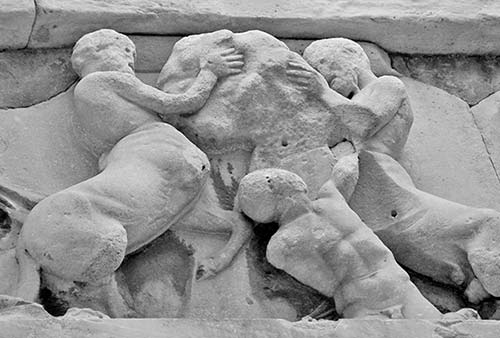
If you venture to the temple’s rear entrance, you’ll find a fine frieze of the mythological battle when centaurs crashed a wedding of the mortal Lapith tribe. On the temple’s other long side, you can make out bullet holes on the crossbeam, a painful reminder of Greece’s 1940s civil war.
The temple is remarkably well preserved. It remained an important place of worship when the Romans arrived, was converted into a church (and given a roof) in the Christian era, and even stayed open under the Muslim Ottomans.
• We now turn to sights from the Roman period—perhaps the greatest era of the Agora’s history. Wind your way down the hill (northeast) to the middle of the Agora and find the headless...
9 Statue of Hadrian
The Roman Emperor Hadrian ruled Athens around 120 AD, when Rome was at its peak and Athens was a vital part of the Europe-wide empire. The statue shows Hadrian wearing the typical Roman military uniform, complete with a breastplate and leather skirt. Where Hadrian’s belly button would be, find the tiny insignia on the armor. It shows Romulus and Remus, the legendary founders of Rome being suckled by the she-wolf who raised them. Now look who’s standing atop the she-wolf—it’s Athena.
This symbolized Hadrian’s vision—that by conquering Greece, Rome actually saved and supported that great civilization. Hadrian was a true Grecophile and great benefactor of Athens. In fact, if this statue still had its head, you’d see that Hadrian was the first Roman emperor to wear a Greek-style beard. Hadrian was nicknamed Graecula (“The Little Greek”) for his love of Greek philosophy, literature, and the handsome teenager Antinous.
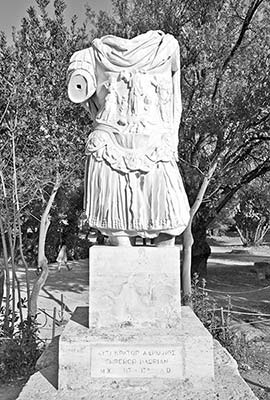
Hadrian personally traveled to Athens, where he financed major construction projects. If you walk through Athens, you can still see remains of Hadrian’s Arch, the Library of Hadrian, the Temple of Olympian Zeus, and an entire planned neighborhood called Hadrianopolis. Athens’ main street through the Plaka is called Adrianou—“Hadrian’s” street.
• It was under Roman rule that the Agora got one of its best-known structures. Continue on, heading straight down the lane (to the left of Hadrian), and you’ll pass three giants on four pedestals, which once guarded the...
10 Odeon of Agrippa
The Odeon of Agrippa was an ancient theater and concert venue. It was once fronted by a line of six colossal statues, which functioned as columns. Of these, only three survive, along with an empty pedestal. The head of a fourth statue is preserved in the Stoa of Attalos—we saw that earlier. Of the statues that remain here, two are meant to be Tritons, with fish tails, while the other monster has the tail of a snake.
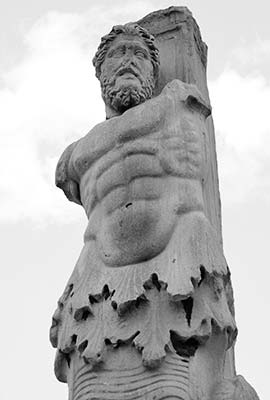
The odeon was the centerpiece of the Agora during the Roman era. A plaque explains the history of this building: If you recall, during the golden age, the center of the Agora was nothing but open space. But when the Romans conquered, they started filling it in with monumental buildings. The odeon was first built under Caesar Augustus (15 BC). It was a popular place, both for the theater-loving Greeks and their Greek-culture-loving Roman masters.
The theater stood two stories tall and was built into the natural slope of the hill. Originally, the main entrance was on the opposite side, near the Middle Stoa (which we saw earlier). Patrons would enter through monumental columns with Corinthian capitals. As they entered from that end, they were at the top row, looking down at the stage, ringed with 20 rows of seats. The place could seat a thousand spectators. Overhead, the glorious roof spanned 82 feet, with no internal support columns. In its heyday, Athenians might have enjoyed lute concerts, poetry readings, and plays by Aristophanes, Euripides, and Sophocles. The less-sophisticated Romans probably flocked here for more lowbrow entertainment.
The giant statues came later. Around 150 AD, the theater’s roof collapsed. By now, the center of Athens was moving away from the Agora, and there were already larger theaters elsewhere. So the odeon was rebuilt as a smaller lecture hall of only 500 seats. The entrance was moved to this end, with the six colossal statues standing guard.
• Continue to the main road, where you’ll see we’ve made a loop. Turn right and head toward the Acropolis, walking once again on the Panathenaic Way. This street was on the...
11 Panathenaic Parade Route
Even as the importance of the Agora declined in later years, the Panathenaic Way remained Athens’ traditional main street. From earliest memory, Greeks had trod this path whenever they entered Athens on their way to the holy Acropolis to worship the gods. And whenever Athenians had big events, this was naturally the parade route.
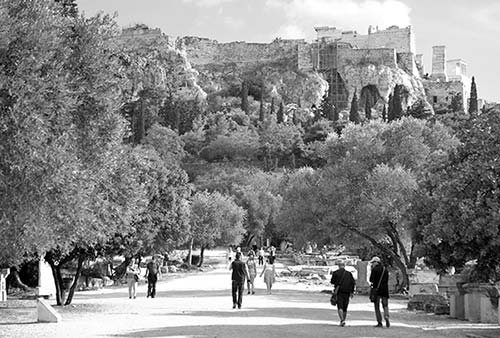
Every year in the middle of summer, the city hosted the Panathenaic Festival (a grander version, the Great Panathenaic Festival, happened every four years). This celebrated the birthday of the goddess Athena and, therefore, of the city itself. The crowning event was when the Athenians marched up to the Acropolis to give honor to the statue of Athena atop the hill.
The parade started at the city’s main gate (located near today’s Keramikos Metro stop). Thousands participated—old and young, men and women, soldiers and poets. They banged on tambourines and danced in the streets. Some rode on horseback, others walked. The Panathenaic Way was lined with bleachers full of spectators. At the heart of the parade was a float on wheels, carrying the ceremonial wool robe specially woven as a gift for Athena. The parade wound its way through the Agora and up the Acropolis, where the new dress was presented to Athena.
For nearly 800 years, glorious events like this graced the Agora. But Athens’ glory days were coming to an end.
• Continue up the Panathenaic Way, past the Stoa of Attalos. Along the left-hand side of the Panathenaic Way are several crude walls and column fragments.
12 Post-Herulian Wall
This wall marks the beginning of the end of Classical Athens.
In AD 267, the Herulians (a Germanic people) sailed down from the Black Sea and utterly devastated Athens. The crumbling Roman Empire was helpless to protect its provinces. The Herulians burned most of the Agora’s buildings to the ground, including the Odeon of Agrippa, leaving the place in ashes.
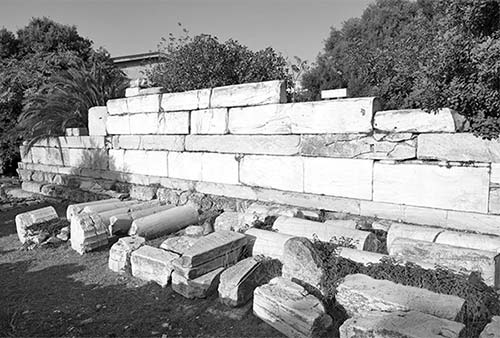
As soon as the Herulians left, the surviving Athenians began hastily throwing up this wall to keep future invaders at bay. They used anything they could find: rocks, broken columns, statues, frieze fragments, you name it—all thrown together without mortar. They cobbled together a wall 30 feet high and 10 feet thick. Archaeologists recognize pieces scavenged from destroyed buildings, such as the Stoa of Attalos and the Odeon of Agrippa.
Despite this wall, the Agora never really recovered. A few major buildings were rebuilt, notably a university to preserve the knowledge of Socrates, Plato, Aristotle, and company. But the last great Roman Emperor, Justinian, closed that pagan school in AD 529.
Then came more invasions, mainly the Slavs in 580 AD. Athens dwindled, and its few residents settled in other parts of the city. By 700, the Agora had become a virtual ghost town, now located outside the city walls, exposed to bandits and invaders. It was cannibalized by the Athenians themselves as a quarry for precut stones—it’s no wonder so little survives today.
• After the invaders came...the Christians. On the right is the...
13 Church of the Holy Apostles
This charming little church with the lantern-like dome marks the Agora’s revival. It was built around the year 1000, while Athens was under the protection of the Byzantine Empire, ruled from Constantinople. Athens slowly recovered from centuries of invasions and neglect. Like many Christian churches of the period, this one was built atop the ruins of a pagan religious site. In ancient times, this had been a nymphaeum, or temple atop a sacred spring. The new church commemorated St. Paul, who likely converted pagans to Christianity here in the Agora.
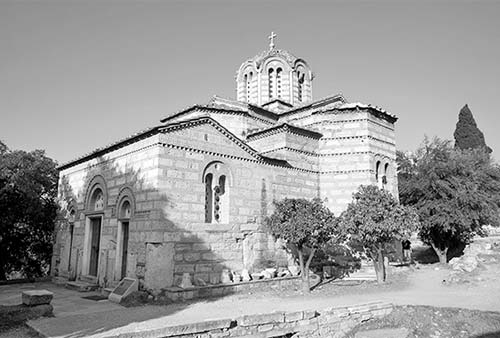
This early church was the prototype for later Athenian churches. It has a central dome, with four equal arms radiating out, forming a Greek cross. The windows have the tall horseshoe-shaped arches typical of the Byzantine style. The church was built of large, rectangular blocks of ashlar stone.
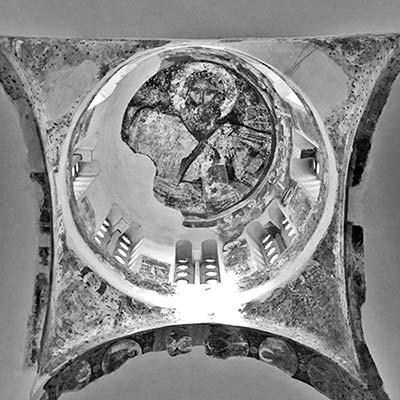
Circle around to the entrance (with its jutting entrance hall that unfortunately spoils the original four equal arms). If it’s open, pop in; notice that the windows are in flower and diamond shapes. The church contains some interesting 18th-century frescoes in the Byzantine style and an icon on the altar. The marble altar screen has some pieces missing, leaving wide-open spaces—these frames once held icons. Now stand in the center of the church and look up. At the top of the dome is Christ Pantocrator (“All Powerful”). Images like this must have given Athenians a sense of security in troubled times, knowing their god was overseeing everything.
• End your tour by looking back over the Agora and modern Athens.
Legacy of the Agora
When Athens came under the control of the Ottomans in the 15th century, the Agora experienced something of a revival. Under the Muslims, Christian churches like the Holy Apostles were tolerated...but taxed. (The decorative pattern of bricks ringing the eaves, shaped like Arabic letters, were added under an Ottoman-era renovation.)
By the 18th century, the Agora had become a flourishing residential district of houses and churches. In the early 20th century, outdoor movies were shown in the Agora.
Then in the 1930s, Greece got serious about preserving its classical heritage. They forced everyone out and demolished everything, except the historic Church of the Holy Apostles, and excavations began.
As the ancient Agora has become a museum, its former city-center functions have moved elsewhere in Athens. The government center is now at Syntagma Square. The marketplace is Athens’ Central Market. Nightlife has shifted to the Plaka, Psyrri, and elsewhere. Monastiraki Square has become one of the new urban hubs. And what’s replaced the Panathenaic Way as the city’s main arterial? I guess that would be the Metro system.
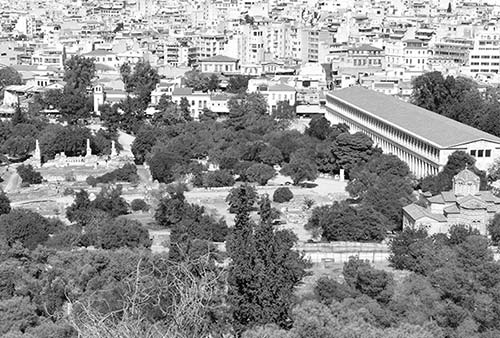
Looking out from this vantage point, realize that the city of Athens has been continuously inhabited for nearly 3,000 years. It was this city that set the tone for all Western civilization to follow. And the cradle of it all was this small patch of land where the people of Athens gathered—the Agora.