ATHENS CITY WALK
From Syntagma Square to Monastiraki Square
1 Syntagma Square (Plateia Syntagmatos)
2 Tomb of the Unknown Soldier and the Evzone Guards
PART 2: THE GREEK ORTHODOX CHURCH
PART 3: ATHENS’ “OLD TOWN” (THE PLAKA AND ANAFIOTIKA)
11 Arch of Hadrian and Temple of Olympian Zeus
12 Lysicrates Monument and Square
14 Anafiotika
15 Roman Forum and Tower of the Winds
16 Agora Square (Plateia Agoras)
19 Monastiraki Square Spin-Tour
Athens is a bustling metropolis of nearly four million people, home to one out of every three Greeks. While the city seems to sprawl endlessly as a concrete mess, the heart and soul of Athens is engaging and refreshingly compact. This walk takes you through the striking contrasts of the city center—from chaotic, traffic-clogged urban zones, to sleepy streets with bearded priests shopping for a new robe or chalice, to peaceful, barely-wide-enough-for-a-donkey back lanes that twist their way up toward the Acropolis.
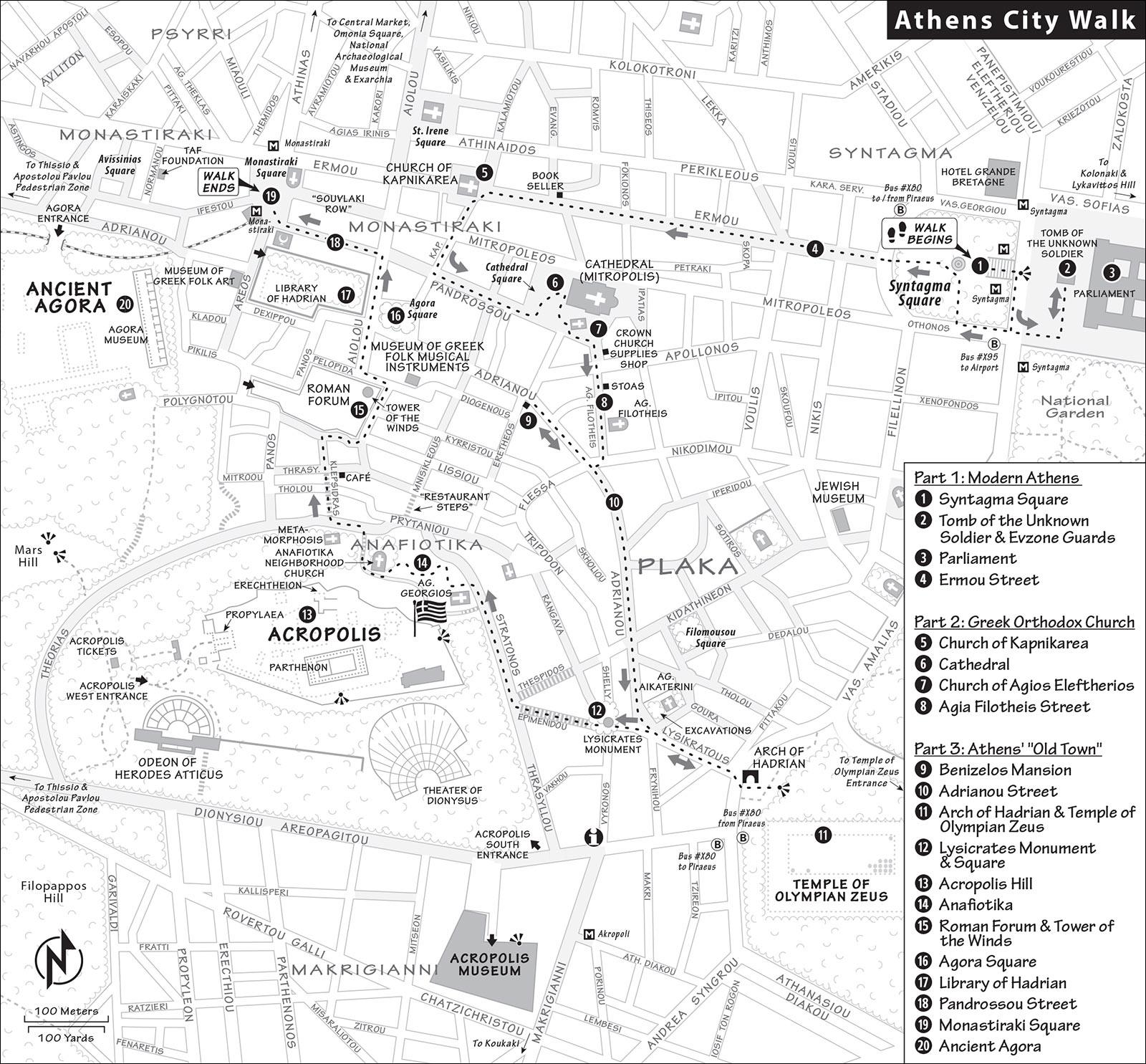
The walk begins at Syntagma Square, meanders through the fascinating old Plaka district, and finishes at lively Monastiraki Square (near the Ancient Agora, markets, good restaurants, and a handy Metro stop). This sightseeing spine will help you get a once-over-lightly look at Athens, which you can use as a springboard for diving into the city’s various colorful sights and neighborhoods.
Along the way, we’ll weave through the rich tapestry of Athens’ 2,500-year story—from the grandiose ruins of the ancient world, to mysteriously medieval Orthodox churches, to the lively places where today’s Athenians go about their timeless existence.
Orientation
Length of This Walk: Allow plenty of time. This three-part walk takes two hours without stops or detours. But if you explore and dip into sights here and there—pausing to ponder a dimly lit Orthodox church, or doing some window (or actual) shopping—it can enjoyably eat up a half-day or more. This walk is also easy to break up—stop after Part 2 and return for Part 3 later.
When to Go: Do this walk early in your visit, as it can help you get your bearings in this potentially confusing city. Morning is best, since many churches close for an afternoon break, and other sights—including the Acropolis—are too crowded to enjoy by midmorning.
Getting There: The walk begins at Syntagma Square, just northeast of the Plaka tourist zone. It’s a short walk from my recommended Plaka hotels; if you’re staying away from the city center, get here by taxi or Metro (stop: Syntagma).
Churches: Athens’ churches are free but keep irregular hours—generally daily 8:30-13:30 and some evenings (17:00-19:30). If you want to buy candles at churches (as the locals do), be sure to have a few small coins.
Cathedral: Free, likely open daily 8:00-19:00, closed 13:00-16:30 off-season.
Temple of Olympian Zeus: €8, covered by Acropolis combo-ticket (see sidebar on here); daily 8:00-20:00, Oct until 18:00, Nov-March until 15:00.
Roman Forum: €8, covered by Acropolis combo-ticket, daily 8:00-20:00, until 15:00 off-season.
Library of Hadrian: €6, covered by Acropolis combo-ticket, daily 8:00-20:00, shorter hours off-season.
Tours:  Download my free Athens City Walk audio tour.
Dress Code: To enter churches, a modest dress code—no bare shoulders or shorts—is encouraged.
Starring: Athens’ top squares, churches, and Roman ruins, connected by bustling urban streets that are alternately choked with cars and mopeds, or thronged by pedestrians, vendors...and fellow tourists.
The Walk Begins
This lengthy walk has three parts: The first introduces modern Athens, centered on Syntagma Square and the Ermou shopping street. The second part focuses on Athens’ Greek Orthodox faith, with visits to three interesting churches. And the third part is a wander through the old core of Athens, including the charming-but-touristy Plaka, the mellow Greek-village-on-a-hillside of Anafiotika, and some impressive ancient monuments. In a sense, we’ll be walking back in time—from bustling modern Athens, through its mystical medieval period, to the place where the city was born: the Acropolis.
PART 1: MODERN ATHENS
This first part of the walk lets you feel the pulse of a modern capital.
• Start at Syntagma Square. From the leafy park at the center of the square, climb to the top of the stairs and stand across the street from the big Greek Parliament building.
1 Syntagma Square (Plateia Syntagmatos)
Here in Syntagma Square (SEEN-dag-mah) you’re in the heart of this great capital, and in many ways the heart of the entire Greek nation. Here is where the nation is governed. It’s where citizens gather for angry demonstrations and national celebrations—the “Times Square” of Greece. Surrounding the square are posh hotels, major banks, and the Greek Parliament. Around the edges, the streets are choked with buses, cars, taxis, and mopeds. And in the fountain-dotted square, Athenians go about their business: hustling off to work, handing out leaflets, feeding pigeons, listening to street musicians, or just enjoying a park bench in the shade.

From here, sightseeing options spin off through the city like spokes on a wheel. Face the Parliament building (east) and get oriented. To the left is the head of Vasilissis Sofias avenue, lined with embassies and museums, including the Benaki Museum of Greek History and Culture, Museum of Cycladic Art, Byzantine and Christian Museum, National War Museum, and National Gallery. This boulevard leads to the ritzy Kolonaki quarter, with its high-end shopping promenades and funicular up to the top of Lykavittos Hill.
Extending behind and to the right of the Parliament building is the National Garden, Athens’ “Central Park.” Here you’ll find the Zappeion mansion-turned-conference-hall (with a fine summer outdoor cinema nearby) and, beyond the greenery, the evocative, ancient Panathenaic Stadium.
This area is also one of Athens’ prime transit hubs, with many bus stops and the city’s busiest Metro station beneath your feet.
Behind you, at the west end of the square, stretches the traffic-free shopping street called Ermou, which heads to the Plaka neighborhood and Monastiraki Square. (We’ll be heading that way soon.)
Syntagma Square is a breezy oasis, shaded with a variety of trees: cypress, plane, palm, orange, and laurel. Breathe deeply and ponder the fact that until 1990, Athens was the most polluted city in Europe. People advertising facial creams would put a mannequin outside on the street for three hours and film it turning black. The message: You need our cream.
But over the last few decades, Athens has worked hard to clean up its act. Traffic is now restricted in the city center. Check out the license plates of passenger cars. Only cars with even-numbered license plates are allowed in on certain days of the week—those with odd numbers are allowed on the other days. The rich get around it by owning two cars. The city has instituted other green policies—more pedestrian zones, better public transit, and cleaner heating fuel. Thanks to this, 21st-century Athens is a much more livable place.
While the Acropolis and the Agora were the heart of ancient Athens, Syntagma has been the city center for the last two centuries. Whenever the Greek people have needed to speak their mind, they’ve gathered here to do it. For that part of Athens’ story, turn your attention to our next stop—the Parliament.
• Using the crosswalk (one on either side of Syntagma Square), cross the busy street. Directly in front of the Parliament you’ll see the...
2 Tomb of the Unknown Soldier and the Evzone Guards
In the nation that invented democracy, nothing epitomizes its modern struggle for self-rule so much as this spot.
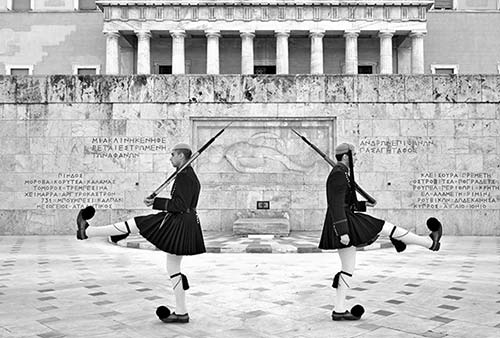
Here you’ll find Greece’s Tomb of the Unknown Soldier, guarded by the fancifully dressed evzone guards. The tomb itself is simple—a marble slab marked only with a cross. Carved into the wall above is an image of a fallen warrior from ancient times, with helmet and shield. On either side are the names of great battles in Greek history since 1821. (They’re in the Greek alphabet, but I can make out a few—let’s see, Cyprus, Korea, Crete.)
The much-photographed evzone, clad in traditional pleated kilts, white britches, and shoes with pom-poms, are soldiers from an elite infantry unit of the Greek army. They may look goofy to a non-Greek, but their families are very proud.
The soldiers do a ceremonial changing of the guard at five minutes before the top of each hour. There’s also a less elaborate crossing on the half-hour. During the ceremonies, they march with a slow-motion, high-stepping gait to their new positions. Once there, they stand ramrod straight, just begging for some clown to pose at their side. Try getting one to smile. (“Hey, Demetrios. Nice pom-poms.”) A full changing-of-the-guard ceremony, complete with marching band, takes place most Sundays at 11:00.
The guards remind Greeks of the crucial moment when modern Greece was born. The year was 1821. After nearly four centuries under the thumb of the Ottoman Turks, the Greeks rose up. They were led by ragtag bands of mountain guerrilla fighters. Their uniforms were modeled after ancient warriors, complete with Mycenaean pom-poms. Today’s evzone guards proudly wear the same outfit. In fact, their winter skirts have exactly 400 pleats...one for each year of Ottoman occupation (and don’t you forget it).
The Greek War of Independence became a kind of cause célèbre throughout Europe. Even the English poet Lord Byron donned a uniform like this and died fighting for Greek freedom. Finally, in 1829, the rebels drove the Ottomans out. However, no sooner had they driven out the Ottomans, when they got...an Otto.
• For the rest of the story, take a step back for a view of the...
3 Parliament
Although this grand building now houses Greek democracy, it began life as a palace for an authoritarian king. After Greece gained its independence, the first government was so weak (with a capital in far-off Nafplio) that Europe’s powers-that-be installed an outsider to rule as king.
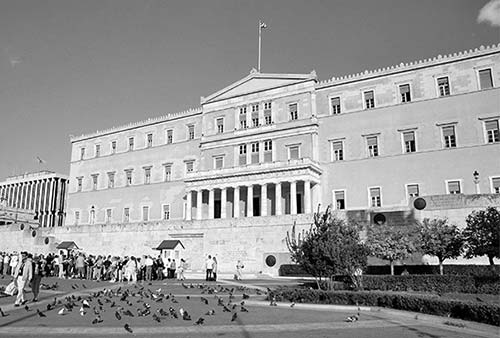
In 1832, Prince Otto of Bavaria, just 17 years old, became King Otto of Greece. He moved the capital to Athens and built himself a magnificent royal palace—today’s Parliament building.
However, the Greeks, having just freed themselves from Ottoman rule, chafed under this dictatorial Bavarian monarch. On September 3, 1843, angry rioters gathered in the square to protest. Wisely, King Otto stepped onto the balcony of this building, quieted the mob, and gave them exactly what they wanted—a democratic constitution. Modern Athens was born, and the square was dubbed “Syntagma”—the Greek word for constitution.
It was King Otto who shaped the look of modern Athens. His architects (imported from Bavaria) created a grand European capital in the Neoclassical style. Broad new boulevards were blasted through, punctuated with vast squares like Syntagma. Otto revived elements from the classical world—things like the Greek columns and triangular pediments you see on the Parliament building.
This set the tone for buildings like the opulent Hotel Grande Bretagne (to the right as you face Syntagma Square). All over town, you’ll see pastel-colored buildings highlighted in white trim. The rectangular windows, flanked by white Greek half-columns, are fronted by balconies, and topped with cornices. Many of the buildings themselves are also framed at the top with cornices. As you continue this walk, you’ll see a few surviving Neoclassical buildings, as well as modern buildings mimicking their geometric symmetry.
Today, the Parliament building is where 300 elected representatives tend to the business of state for the Greek nation. (Or, as more cynical locals would say, tend to the business of setting themselves up for cushy, post-political lives.)
• One of the grandest of Otto’s new streets was the one that spilled directly out the bottom of Syntagma Square. And that’s where we’re headed next—Ermou street.
To get there, cross back to Syntagma Square and head to the bottom of the square where you’ll find the start of the traffic-free boulevard called...
4 Ermou Street
This pedestrian mall called Ermou (air-MOO) is the modern city’s main axis. As you stroll, you’ll see a mix of modern and traditional, global and local.
There are lots of international clothing chain stores—some well-known in America, others more local, some housed in elegant Neoclassical mansions with ironwork balconies. Talented street performers provide an entertaining soundtrack. All of Athens walks along here: businesspeople buying a daily paper, teenagers cruising the mall, hawkers selling lottery tickets, Orthodox priests stroking their beards. You’ll see old men twirling worry beads and young activists gathering signatures. Street vendors sweep up their illegal wares and scurry off when they see the police. You may even see a few 20th-century relics, like pay telephones.
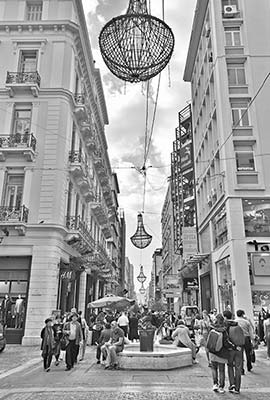
Keep an eye out for people selling local snacks—including pretzel-like sesame rings (called koulouri) and roasted ears of corn. At #13 (two blocks down on the left) is Gregory’s, the popular “Greek Starbucks” coffee chain with its distinctive green logo.
As you continue down Ermou street, think of how much Athens has changed in the last two centuries. In 1800, this neighborhood was a run-down village of dirt alleyways. Then streets like Ermou were bulldozed through as part of the city’s revival. But the turbulent 20th century turned the once-chic street into all that was once so terrible about Athens: ugly modern buildings, tacky neon signs, double-parked trucks, and noisy traffic. When Ermou was first pedestrianized in 2000, merchants were upset. Now they love the ambience of this people-friendly shopping zone.
In the fourth century AD, the Roman Empire split in half, dividing Europe down the middle. Over the centuries, Western Christians gravitated toward the pope in Rome as their spiritual head, while Easterners turned to the patriarch in Constantinople (Istanbul). Each group developed slightly different beliefs and ways of worship. In 1054, the Great Schism between the pope and the patriarch made that division between Roman Catholicism and Eastern Orthodox official.
Orthodox Christian—whose name in Greek means “right faith” (orthos dogma)—claim to follow the earliest Christian practices. The church is less hierarchical, so rather than having one all-powerful pope and headquarters (like the Vatican), there are about a dozen regional branches—Greek Orthodox, Russian Orthodox, Serbian Orthodox, and so on. The Greek constitution recognizes Orthodox Christianity as the “prevailing” religion of Greece. The archbishop of Athens is Greece’s “pope.”
Orthodox churches have their own worship rituals. As you enter any Greek Orthodox church, you can join in the standard routine: Drop a coin in the wooden box, pick up a candle, say a prayer, light the candle, and place it in the candelabra. Make the sign of the cross and kiss the icon.
Rather than a table-like altar, Orthodox churches come with an altar screen (the iconostasis) covered with curtains. A typical iconostasis has four icons, or pictures of saints: Jesus and John the Baptist to the right, Mary and a local saint to the left.
This iconostasis divides the lay community from the priests—the material world from the spiritual one. Following Old Testament Judeo-Christian tradition, the Bible is kept on the altar behind the iconostasis. The spiritual heavy lifting takes place behind the iconostasis, where the priests symbolically turn bread and wine into the body and blood of Jesus. Then they open the doors or curtains and serve the Eucharist to their faithful flock—spooning the wine from a chalice while holding a cloth under each chin so as not to drop any on the floor.
The church has few pews. Worshippers stand through the service as a sign of respect (though some older parishioners sit on the seats along the walls). Traditionally, women stand on the left side, men on the right (equal distance from the altar, to represent that all are equal before God).
The Orthodox faith tends to use a Greek cross, with four equal arms (like a plus sign), which focuses on God’s perfection. The longer Latin cross used by Catholics more literally evokes the Crucifixion, emphasizing Jesus’ death and sacrifice. This also extends to the floor plans of church buildings: Many Orthodox churches have Greek-cross floor plans rather than the elongated nave-and-transept designs that are common in Western Europe.
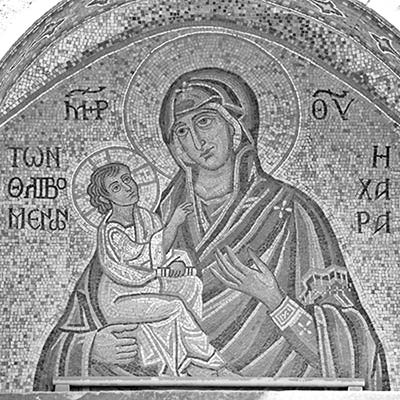
Orthodox icons (golden paintings of saints) are not intended to be lifelike. Packed with intricate symbolism and often cast against a shimmering golden background, they’re meant to remind viewers of the metaphysical nature of Jesus and the saints rather than their physical form, which is considered irrelevant. You’ll almost never see statues, which are thought to overemphasize the physical world—and, to Orthodox people, feel a little too close to the forbidden worship of graven images.
Most Eastern Orthodox churches have at least one mosaic or painting of Christ in a standard pose—as Pantocrator, a Greek word meaning “All Powerful.” The image, so familiar to Orthodox Christians, shows Christ as King of the Universe, facing directly out, with penetrating eyes. Behind his head is a halo divided by a cross—a symbol for the Crucifixion, hinting of the Resurrection and salvation that follow.
Orthodox services generally involve lots of chanting—a dialogue between the priest and the congregation. The church is filled with the evocative aroma of incense, heightening the ambience. While Catholic and Protestant services tend to be more about teaching religious tenets, Orthodox services are about creating a religious experience. Each of these ritual elements does its part to help the worshipper transcend the physical world and enter into communion with the spiritual one.
About a block before the church up ahead, look for the little book wagon carrying on a long tradition (probably on the right). They sell colorful, old-fashioned books, including alphabet books (labeled Aλφabhtapio, alphabetario), which have been reprinted for nostalgic older Greeks. The English word “alphabet” comes from the first two Greek letters (alpha, beta).
• Ermou street leads straight to our next stop—a little brick church stranded in the middle of the road amid all this commercial bustle. You can’t miss it.
PART 2: THE GREEK ORTHODOX CHURCH
This part of our walk introduces you to the Orthodox faith of Greece, including stops at three different churches. The first of our churches is one of Athens’ oldest—from medieval times, when Greece was part of the Byzantine Empire (AD 323-1453).
5 Church of Kapnikarea
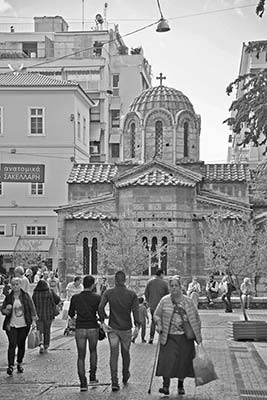
Built around the year 1000, this is a classic Orthodox church in the Byzantine style. It’s square and topped with a central dome—quite different from Western churches that are long and narrow—with windows of slender columns supporting tall arches. The walls are made of brick and mortar, with large blocks scavenged from earlier buildings incorporated into it.
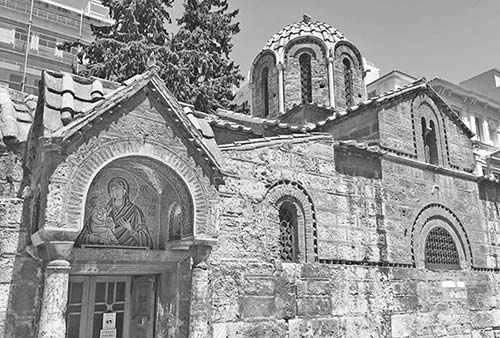
Make your way to the entrance. Over the door is a mosaic of Mary and baby Jesus on a gold background. Though modern, this maintains the traditional rigid style of so many icons.
Inside the Church: If the church is open, step inside. You’re welcome to visit, as long as you’re modestly dressed, keep your voice low, and don’t take photos.
In the narrow entryway, notice the bank of candles, and observe the standard routine. Worshippers light candles, place them in the candelabra, make the sign of the cross, and (traditionally, at least) kiss the icon—you might even see lipstick smudges on the protective glass. The icon gets changed with a different saint according to the church calendar. Also notice the candle-recycling box on the ground behind the candelabra.
Explore deeper into the main part of the church. Find the typical Orthodox features: The nave is basically square and symmetrical, with four equal arms radiating out from the dome. The decoration includes frescoes on the walls, icons here and there, a wooden pulpit, a few hanging lamps, and a handful of chairs (in Greek Orthodox tradition, worshippers stand—women on the left side, men on the right).
The focus of the church is the white-marble partition—the iconostasis. During the service, the priest goes through the iconostasis’ doorway, into the inner sanctum, to prepare the eucharist. Notice the four typical icons: Jesus and John the Baptist to the right of the door, and Mary-and-babe to the left, along with a local saint.
Now, look up into the central dome. Looking back at you from heaven is Jesus, as Pantocrator (“All Powerful”). He surveys the universe with his penetrating gaze, raises his hand, and gives it his blessing.
• From this humble chapel, let’s head to the most important church in the Greek Orthodox world. Walk toward the Acropolis, slightly downhill on Kapnikareas street (to the left as you come down Ermou street). After two blocks turn left on traffic-free Pandrossou street, which leads to the...
6 Cathedral (Mitropolis)
This is the “Greek Vatican”—the home church of the archbishop who presides over the country’s 10 million Orthodox Christians. It’s the city’s cathedral, or (in Greek), its “metropolitan” church. It’s probably flying the blue-and-white Greek flag, because it’s the national church.
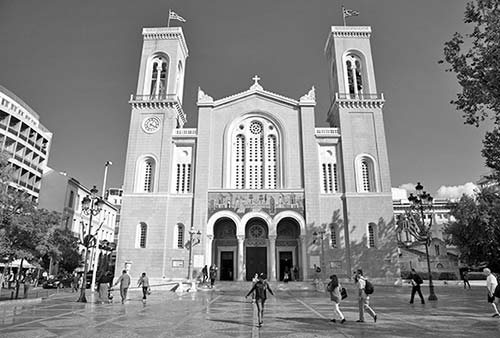
Though the structure is relatively modern (built in 1842), it has many typical Byzantine-style features, like tall windows, horseshoe arches, and a glittering mosaic of the Annunciation.
Inside the Church: You’ll find the same features found in all Orthodox churches but on a grander scale, including candles at the entrance, iconostasis with four icons, Pantocrator in the dome, and so on. Notice the balconies. In past times, this was where women worshipped. But in 1954, Greek women got the vote, and now they worship alongside the men.
On Cathedral Square: Out front stands a statue of a man with a staff, giving a blessing. This is the honored Archbishop Damaskinos (1891-1949), who presided here in the early 20th century. During the Nazi occupation of Greece, he was one of the rare Christian leaders who spoke out on behalf of persecuted Jews. The Nazis threatened to put Damaskinos before a firing squad. The feisty archbishop joked that they should hang him instead, in good Orthodox tradition. After the war, he served as Greece’s caretaker prime minister, helping bring stability to the war-torn country. Athens’ Jewish community erected this statue as a show of thanks.
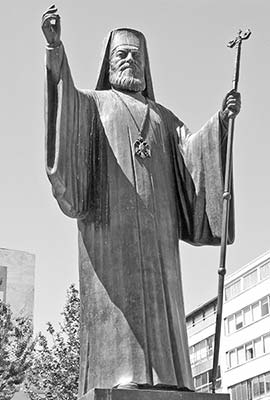
The statue depicts many typical Orthodox features. Damaskinos wears the distinctive hat of an Orthodox archbishop—a kind of fez with cloth hanging down the sides. He carries a staff and blesses with his right hand. Look closely at the hand—he’s touching his thumb to his ring finger. This is the traditional Orthodox sign of the cross. The gesture forms the letters of the alphabet that spell out the Greek name of Jesus. Try it yourself. Touch your thumb to the tip of your ring finger. Now, your pinkie forms the letter I; your slightly crossed index and middle fingers are an X; and your thumb and ring finger make a double-C. These four letters—I, C, X, C—are short for...Jesus Christ. Very clever. So, if you were an Orthodox priest, you’d hold your fingers like this and wave your arm three times, tracing the shape of a cross, and chanting “the Father, the Son, and the Holy Spirit.”
Notice Damaskinos’ necklace. It’s the double-headed eagle of the Byzantine Empire, when Orthodoxy became the state religion. The two heads demonstrated how the Byzantine emperor ruled both East and West, as well as both the secular and the spiritual worlds. The Byzantine Empire ruled parts of the Eastern Mediterranean for a thousand years, with Athens as one of its premier cities. But then everything changed.
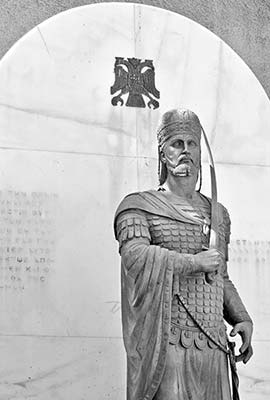
For that, find the statue at the far end of the square—behind Damaskino to the left, farthest from the cathedral. The statue of a warrior holding a sword is Emperor Constantine XI, the final ruler of that great Byzantine Empire. In 1453, Emperor Constantine was toppled from power and the great city of Constantinople was conquered by the Ottoman Turks. Almost overnight, Muslims controlled Athens, and Orthodox Christians had to lay low for the next four centuries.
• That’s when our next stop came into play in Athens’ long history. Head for the small church along the right side of the cathedral. It’s the...
7 Church of Agios Eleftherios
When the Ottomans took control, they evicted Athens’ archbishops from their previous cathedral—the Parthenon, which at that time was used as a church. With the Parthenon now a mosque, the archbishop moved here, to this humble church with a venerable history.
Built in the 12th and 13th centuries, it’s dedicated to a popular saint (agios). The little church is still referred to as “the old cathedral,” since it actually was once the cathedral. (If you go inside, you’ll find a mostly bare space with features we’ve seen before: iconostasis, icons, Pantocrator, and so on.)
Check out the facade. The church is a jigsaw puzzle of reused stones scavenged from earlier monuments, some of them extremely old. Over the door, the lintel has crosses, lions, and rosettes. A little higher up is a row of carved panels featuring more crosses, griffins and eagles, sphinxes, eagles eating snakes, and ancient floral designs. These date from the second century AD. They were once part of a calendar of pagan Athenian festivals that stood in the Ancient Agora. Even higher, there’s a frieze from before the time of Christ, depicting toga-clad men in an ancient parade.
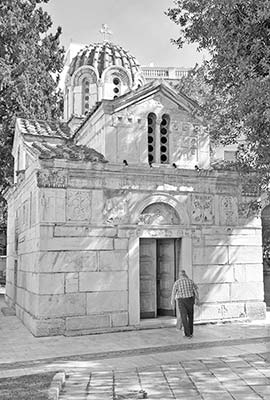
Notice the wide variety of crosses. The Maltese cross has four V-shaped arms. It was popular with Crusaders who passed through here on their way to Jerusalem. The Latin cross has a long base and shorter crossbar, symbolic of the Crucifixion. The one with two crossbars is the Patriarchal Cross, popular with archbishops. The Greek cross has four equal arms, symbolic of God’s perfection.
Circle the church (counterclockwise) to find more ancient stones and symbols, both Christian and pagan. You’ll find more crosses, geometrical patterns, an eagle carrying off a rabbit, a lion chomping on a gazelle, Christ chained to a column, Grecian urns, an anchor cross (symbolizing security), and a couple of robed saints. There are even old tombstones.
This combination of pagan and Christian elements testifies to Athens’ long history, incorporating diverse cultural traditions.
• We’re at ground zero of the Greek Orthodox faith. Let’s check out a few nearby sights that show off the Orthodox church of today.
Make your way directly behind the Church of Agios Eleftherios, where there’s a row of shops. These shops are along a street called...
8 Agia Filotheis Street
This neighborhood is a hive of activity for Orthodox clerics. It’s home to many stores selling all kinds of religious objects. The Orthodox religion comes with its own unique religious paraphernalia, from robes to incense burners, candelabras to icons. Crown Church Supplies (at #5) is a family-run business that’s been tailoring robes for Orthodox priests since 1907.
Turn right and explore more of Agia Filotheis street. Cross Apollonos street and go another 30 yards to #15 Agia Filotheis street, on the left. Explore these stoas (mini malls) with several workshops of local artisans who make religious objects. You may see painters at work creating or restoring icons. Or tailors fashioning bishops’ robes. Or metalworkers creating gold lamps and chalices exquisitely worked in elaborate repoussé design.
In this neighborhood, keep an eye out for Orthodox priests. They dress all in black, wear beards, and don those fez-like hats. While they look like celibate monks, most are husbands and fathers. Married priests are welcome, as long as they marry before becoming priests. They’re generally well-educated pillars of the community, serving as counselors and spiritual guides to the cosmopolitan populace.
A little farther along (on the left) is the cute little Church of Agia Filotheis, named for one of the patron saints of Athens. This garden church is a popular place for weddings. A few steps farther (at #19, on the left) is an impressive marble building with a golden double eagle on the facade and busts of bishops out front. Note the heightened security. This is the official residence of the archbishop of Athens.
• At this point, our walk focuses on...
PART 3: ATHENS’ “OLD TOWN” (THE PLAKA AND ANAFIOTIKA)
This part of our walk explores the atmospheric twisty lanes of old Athens. Before the city grew into a modern metropolis, it consisted of ramshackle homes huddling at the base of Acropolis hill. Here we’ll find some of Athens’ oldest monuments, dating back to ancient times. These days, the neighborhood called the Plaka is both atmospheric and very touristy.
• Continue up Agia Filotheis street a few more yards until you reach a tight five-way intersection. Make a hard right, slightly downhill on Adrianou street (labeled Αδριανού). After about 100 yards, where Adrianou meets Apollonos street (Απολλωνς), on the left you’ll find the...
9 Benizelos Mansion
Other than the marble columns and tumbled stone blocks of antiquity, and the Neoclassical palaces of the 19th century, not much from the rest of Athens’ history remains visible. A few churches like those we just saw, a repurposed Ottoman mosque or two...and this house, which belonged to the Benizelos family and was built in the 18th century. If it’s open (sporadic, but generally Tue-Thu 10:00-13:00, Sun until 16:00), pop into the courtyard. (If it’s closed, you can look through the windows on the street-facing wall.)
The house is an example of a konaki, a style of residence once common across Greece. The ground floor, constructed of stone, was for storing grain, wine, and olive oil; there was even a medieval olive press here. The upper floor, with refined woodwork, was where people lived. In the middle of the arcaded hallway is the elegant main sitting room, and on either side are two rooms accessed through a wooden partition screen: one for summer, and one for winter (with a fireplace).
Behind the house there’s another, larger courtyard. The property was once much bigger, and included a garden and a few other buildings. These were luxury digs in the day: Only the richest families lived like this, and this mansion is the only one of its kind left in town.
• Now head back the way you came on Adrianou, uphill and into the scrum of souvenir stands and tourists.
10 Adrianou Street
Touristy Adrianou street is the main pedestrian drag of the Plaka, cutting through the neighborhood. We’ll walk about 200 yards up to where it dead ends. As you walk, you’ll be running the full gauntlet of Greek souvenirs—sea sponges, olive oil, icons, carpets, jewelry, sandals, cheap Greek statues, and tacky T-shirts that say “Got Ouzo?” There are also plenty of cafés seemingly designed for tired tourists.
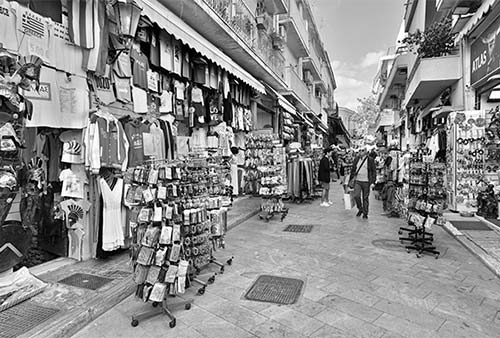
And what’s with all the worry beads for sale? They range from cheap glass beads to authentic hand-cut amber. Greeks traditionally fondle and twirl these strings of beads. Worry beads may be based on religious beads used to keep track of prayers, like Catholics use the rosary or Muslims use prayer beads. But today’s worry beads have no religious overtones—they’re used to relieve anxiety and get focused. Traditionally, only men used worry beads, but they’re becoming increasingly popular among Greek women.
• Window-shop your way gently uphill until you reach the T-intersection with Lysikratous street.
We now turn our attention to some of Athens’ oldest monuments, from the ancient days when it was one of the greatest cities on earth. (To get in an ancient mood, check out the excavation site amid the trees nearby, showing the level of the street 2,000 years ago.)
Looking left, down Lysikratous street, you can see our next stop—the Arch of Hadrian. (If your fuel gauge is running low, you could skip the Arch of Hadrian and the Temple of Olympian Zeus, and jump ahead to the Lysicrates Monument, which is just a few steps to your right.)
• To continue the walk, head down Lysikratous street, cross busy Vasilissis Amalias avenue (crosswalk nearby), and approach the...
11 Arch of Hadrian and Temple of Olympian Zeus
In 146 BC, Athens came under the control of the growing Roman Empire. But the Romans—who loved Greek culture, architecture, and statues—only made the city greater. Athens’ best benefactor was the great Grecophile Emperor Hadrian (or, as he was known in Greece, Adrianou). He built an enormous planned neighborhood known as—what else?—Hadrianopolis.
The Arch of Hadrian—a classic triumphal arch in the Roman style—marked the entrance to the emperor’s planned community. The arch was once brilliant white, made of the same Pentelic marble as the Parthenon. It’s now stained by exhaust from some of Athens’ worst traffic. The arch is topped with Corinthian columns, with their leafy capitals. Corinthian was the Greek style preferred by the Romans. Hadrian built the arch in 132 AD to mark the line between Greek Athens and the new Roman city. An inscription on the west side (facing Vasilissis Amalias) reads, “This is Athens, ancient city of Theseus.” The opposite frieze says, “This is the city of Hadrian, and not of Theseus.” This arch must have been a big deal for Hadrian, as the emperor himself came here to celebrate the inauguration.
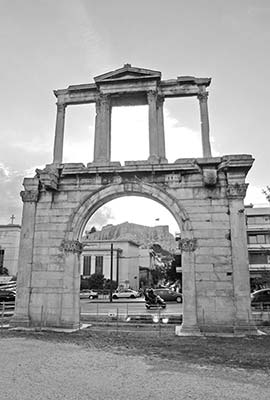
Now look past the arch to see the huge—and I mean huge—Corinthian columns. These are all that remain of the Temple of Olympian Zeus (entrance is a 5-minute walk to the left, circling the fence clockwise—but you can see basically everything from here). This was the largest temple in ancient Greece and took almost 700 years to complete. It was begun in the sixth century BC by the Greeks, then lay abandoned, half-built, for centuries. Finally, Hadrian finished the job in 131 AD.
Did I mention the temple was huge? Those Corinthian columns are a towering 56 feet high. Compare that with the 34-foot-high columns of the puny Parthenon. The finished temple was 360 feet long by 145 feet wide. It was the size of a football field, or more than twice the square footage of the Parthenon.
The Temple of Olympian Zeus had 104 columns—two rows of 20 columns on each of the long sides and three rows of eight columns along each end. Only 15 columns remain standing. The fallen column you see—like a tipped-over stack of bottle caps—was knocked over by a storm in 1852. This over-the-top temple was dedicated to Zeus, who lived on Mount Olympus. The temple contained two enormous statues: one of the ruler of the gods—Zeus—and an equally colossal statue of the ruler of the Greeks...Hadrian.
• Let’s delve even deeper into Athens’ past, as we make our way to the Acropolis.
Backtrack up Lysikratous street to where we were earlier, at the T-intersection. Just uphill from that intersection, Lysikratous street spills out into a small, leafy square with the Acropolis rising above it. In the square is a round, white monument.
12 Lysicrates Monument and Square
The elegant marble Lysicrates monument has Corinthian columns that support a dome topped with a (rather damaged) statue. Check out the frieze around the top portion. You may be able to see that it represents Dionysus turning pirates into dolphins.
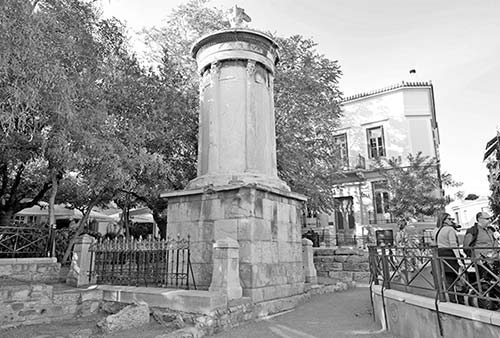
The monument is the sole survivor of many such monuments that once lined this street. This was the ancient “Street of the Tripods,” so-called because the monuments came with bronze tripods alongside. These three-legged stands (like those you’ll see in the museums) held trophies—things like ornamental vases and cauldrons. Here on this street, the ancient “Oscars” were awarded to winners of theatrical competitions staged at the nearby Theater of Dionysus. The Lysicrates Monument honors one of the winners—the winning choral team from the year 334 BC. Excavations around the monument have uncovered the foundations of other monuments, which are now reburied under a layer of red sand, awaiting further study.
Now stroll the square itself. Shaded by trees, this is a pleasant place to take a break before we climb the hill. Have a coffee at one of the café tables, or try a frappé—an iced coffee with foam. Or you can grab a cold drink from a store and sit for free on the benches under the trees.
• When you’re ready to move on, find the Epimenidou staircase on the left side of the square, and start climbing. At the top of the stairs, the street leads left to the south entrance gate and Acropolis Museum, but for now we’ll turn right to continue around the lower flanks of...
13 Acropolis Hill
As you walk (past olive trees), you’re treading the same paths followed by humans since the beginning of recorded time. From cave dwellers to modern man, Athenians have lived on, around, or in the shadow of this hill. The Acropolis—or “high city”—has been the heart of Athens since the Neolithic era, around 7000 BC. The sheer plateau was a natural fortress—faced with 100-foot cliffs, and fed by permanent springs.
Acropolis hill is a limestone ridge that’s flat on top. Its footprint covers seven acres. The Mycenaeans built the first palaces on top (around 1400 BC), and their Greek descendants built temples to their patron goddess Athena (around 800 BC). When the Persians destroyed all of the Acropolis’ temples (480 BC), it left a blank canvas. The resilient Greeks built the Parthenon, ushering in the golden age. And for 2,500 years, the grand structures atop this hill have inspired the Western world.
• At the small Church of St. George of the Rock (Agios Georgios), there’s a fork in the road. Go uphill, along the left fork. You’ll soon be immersed in a maze of tiny, whitewashed houses. This charming “village” is the neighborhood called...
14 Anafiotika
As you enter the narrow lanes, don’t worry about getting lost. Just keep following signs that point to Acropolis—even if the path seems impossibly narrow. You’ll eventually emerge on the other side.
The tiny homes cling to the hillside, built into and around the Acropolis’ craggy outcroppings. This neighborhood of Anafiotika was built by people from the tiny Cycladic island of Anafi, who came to Athens looking for work after Greece gained its independence from the Ottomans. (Many stoneworkers and builders hired to construct the modern city of Athens built these higgledy-piggledy residences after-hours.) Some descendants of the original islanders still live here in Anafiotika (“little Anafi”). Posters of Anafi still hang here and there, evoking the sandy beaches of the ancestral home island. But it’s slowly becoming a place for wealthy locals to keep an “island cottage” right here in the city.
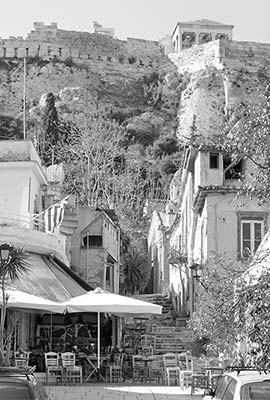
Keep heading generally left and uphill, following Acropolis signs when you see them. Weave through narrow paths, lined with flowers and dotted with cats, dozing peacefully in the sunshine or slithering luxuriously past your legs. In this delightful spot, nestled beneath the walls of the Acropolis, the big city seems a world away. Notice the male fig trees—they’re the ones with no fruit, so they keep away flies and mosquitoes. Smell the chicken-manure fertilizer, peek into delicate little yards, and enjoy the blue doors and maroon shutters. It’s a transplanted Cycladic Island world.
As you gaze out over the rooftops of modern Athens below, keep an eye out for views of Lykavittos Hill, the cone-shaped mound in the distance. It’s the highest hill in Athens, topped with a tiny white church at just over 900 feet above sea level. By comparison, the Acropolis is only 490 feet tall. The Lykavittos summit, which can be reached by a funicular, has a restaurant and view terrace. Although it looms high over the cityscape, Lykavittos Hill will always be overshadowed by the hill you’re climbing now.
From the Acropolis—Athens’ oldest sight—our walk starts making its way back to the modern world.
• Follow the Acropolis signs, through the narrow walkways, until you emerge from the maze of houses at a T-intersection with a wider, cobbled lane. Turn right (downhill) and continue on the cobbled lane past the neighborhood church tucked around the corner to the right. After 50 yards, turn left on a wider road (Theorias), and walk toward the small stone Church of the Metamorphosis. (Note: To reach the Acropolis main entrance from here, you would continue along this road as it bends left around the hill. For now, though, let’s continue our walk.)
Just before the church (near the sign for the Athens University History Museum), turn right down the steep, narrow staircase called Klepsidras. Go 100 yards down the stairs (past cute homes, interesting graffiti, the free little museum, and the recommended Klepsidra Café), until the staircase dead-ends at a railing overlooking some ruins.
15 Roman Forum and Tower of the Winds
The rows of columns framing this rectangular former piazza were built by the Romans. The Romans loved the city of Athens and made it even more beautiful. This square was the commercial center, or forum, of Roman Athens. The columns supported a covered porch providing shade for shoppers browsing the many stores fronting the square. Picture this place filled with Roman bureaucrats and Greek locals. The forum—or open-air piazza—was a feature found in every city Rome conquered. Here, it was dotted with Greek-style buildings and statues. Like Americans in Paris, Romans relished living in sophisticated Athens, sprinkling their Latin conversations with Greek phrases as they discussed the plays of Sophocles and Aristophanes. It’s possible to enter the Roman Forum for a closer look at the rubble—the entrance is on the west end—but you can see just about everything from here (for more on what’s inside, see here).
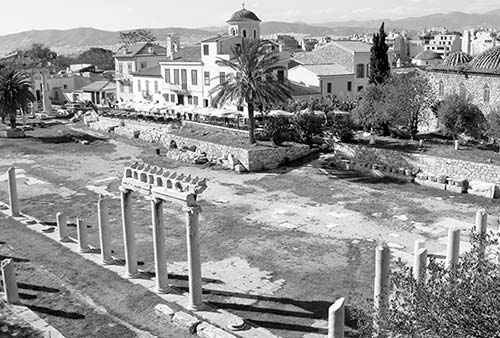
Now, take a few steps to the right for a closer look at the octagonal, domed Tower of the Winds. Built in the first century BC, this building was an ingenious combination of clock, weather station, and guide to the planets. The tower was once capped with a weathervane in the form of a bronze Triton—half-man, half-fish. Bronze rods (no longer visible) protruded from the walls and acted as sundials to indicate the time. And when the sun wasn’t shining, people told time using the tower’s sophisticated water clock inside, powered by water piped in from springs on the Acropolis. Much later, under Ottoman rule, dervishes used the tower as a place for their whirling worship and prayer.
Look closely at the tower’s carved reliefs. They depict the traditional eight winds of the world as winged angels, who fly in, bringing the weather. Find the weather-angel holding the curved rudder of a ship—he’s the wind who brings good sailing weather. The next relief (to the right) shows an angel turning an urn upside down, spilling out rain.
To see more reliefs, circle the Tower counterclockwise, as we make our way downhill to our next destination. As you turn the corner, find the old bearded man wrapping his cloak up tight against the cold weather. On the Tower’s right side is an angel with a robe full of fruit, bringing the abundance of summer. Next (as you continue circling counterclockwise), an angel with a round shield is about to dump out hailstones. Finally (at the downhill side of the Tower), find the north wind, wearing a heavy robe and blowing on a conch shell to usher in winter.
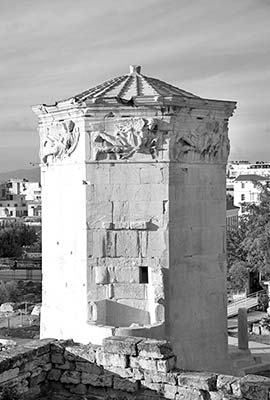
From this vantage point, you can look through the fence into the Roman Forum. Find some rectangular ruins surrounded by a wider rectangular ditch—the ancient forum’s public restroom.
• By now you should be at the downhill side of the Tower of the Winds. Facing the Tower, turn 180 degrees, and find the start of narrow Aiolou (Aioλoy) street. Head downhill on Aiolou street one block, where it opens up into the leafy, restaurant-filled...
16 Agora Square (Plateia Agoras)
This square is the touristy center of the Plaka. Starting from here, you have your choice of restaurants, where you can dine with Brits on holiday or have a beer with a group of Aussies. The Plaka can be both atmospheric and crassly touristic. Its streets are lined with souvenirs, tacky tavernas, a smattering of small museums, ancient ruins, and exhausted tourists. The narrow, winding streets can be confusing at first, but you can’t get too lost with a monument the size of the Acropolis looming overhead. Think of the Plaka as Athens with training wheels for tourists, then dare to explore beyond it.
On the left side of the square you’ll see the second-century AD ruins of the 17 Library of Hadrian, built by that Greek-loving Roman emperor, Hadrian, for the good of his beloved Athens. Four lone columns sit atop apse-like foundations. The ruins around it are all that’s left of a big rectangular complex that once boasted 100 marble columns. It was a huge cultural center, with a library, lecture halls, garden, and art gallery. Notice how the excavated stones rest neatly in stacks awaiting funding for reconstruction.
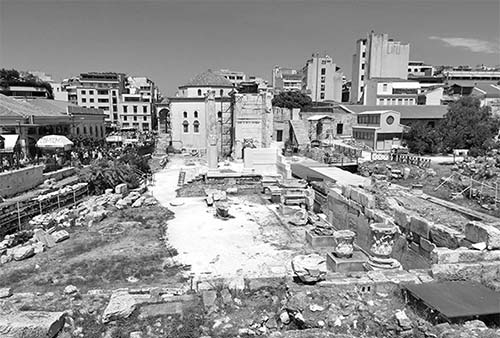
• We’re on the home stretch now. Continue downhill alongside the ruins one block, and turn left onto 18 Pandrossou street—a narrow lane choked with souvenir shops. Expert pickpockets work this crowded lane—be careful. Wade through the knee-deep tacky tourist souvenirs. Several shops supply fans of the “Round Goddess”—a.k.a. soccer—with t-shirts and jerseys. Continue until you spill out into Monastiraki Square.
19 Monastiraki Square Spin-Tour
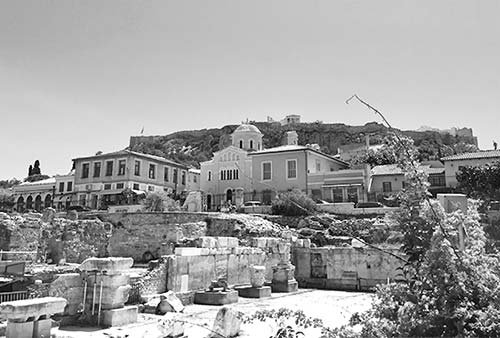
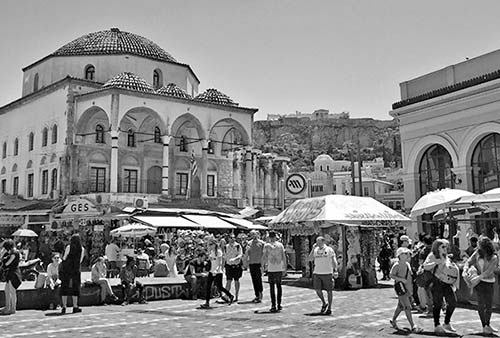
We’ve made it from Syntagma Square—the center of urban Athens—to the city’s other main square, Monastiraki Square, the gateway to the touristy Old Town. To get oriented to Monastiraki Square, stand in the center, face the small church with the cross on top (which is north), and pan clockwise.
The name Monastiraki (“Little Monastery”) refers to this square, the surrounding neighborhood, the flea-market action nearby...and the cute Church of the Virgin in the square’s center (12th-century Byzantine, mostly restored with a much more modern bell tower).
Beyond the church (straight ahead from the end of the square), Athinas street veers left to the Central Market, Omonia Square, and (after about a mile) the National Archaeological Museum.
Just to the right (behind the little church) is the head of Ermou street—the bustling shopping drag we walked down earlier. If you turned right and walked straight up Ermou, you’d be back at Syntagma Square in 10 minutes.
Next (on the right, in front of the little church) comes Mitropoleos street—Athens’ “Souvlaki Row.” Clogged with outdoor tables, this atmospheric lane is home to a string of restaurants that serve sausage-shaped, skewered meat—grilled up spicy and tasty. The place on the corner—Bairaktaris (Mπaϊpaktaphσ)—is the best known, its walls lined with photos of famous politicians and artists who come here for souvlaki and pose with the owner. But the other joint here—Taverna Thanasis—has a better reputation for their souvlaki (and prices). You can sit at the tables, or, for a really cheap meal, order a souvlaki to go. (For details, see the Eating in Athens chapter.) A few blocks farther down Mitropoleos is the cathedral we visited earlier.
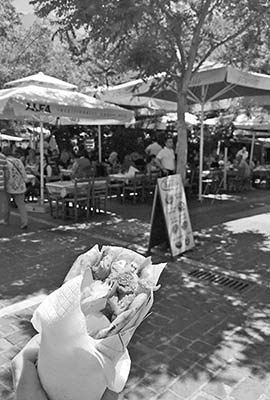
Continue spinning clockwise. Just past Pandrossou street (where you entered the square), you’ll see a former mosque (look for the Arabic script under the portico and over the wooden door). Known as the Tzami (from the Turkish word for “mosque”), this was a place of worship when Athens was under Ottoman rule (15th-19th centuries).
To the right of the mosque, behind the fence along Areos street, you might glimpse some huge Corinthian columns. This is the opposite end of the Library of Hadrian complex we saw earlier. Areos street stretches up toward the Acropolis. If you were to walk a block up this street, then turn right on Adrianou, you’d reach the 20 Ancient Agora—one of Athens’ top ancient attractions ( see the Ancient Agora Tour chapter and my free Agora audio tour). Beyond the Agora are the delightful Thissio neighborhood and ancient Keramikos Cemetery.
As you continue panning clockwise, next comes the pretty yellow building that houses the Monastiraki Metro station. This was Athens’ original, 19th-century train station—Neoclassical with a dash of Byzantium. This bustling Metro stop is now the intersection of two lines: the old line 1 (green, with connections to the port of Piraeus, the Thissio neighborhood, and Victoria—near the National Archaeological Museum) and the modern line 3 (blue, with connections to Syntagma Square and the airport). Excavations for the station revealed an ancient aqueduct, which confined Athens’ Eridanos River to a canal. The river had been a main axis of the town since the eighth century BC. In the second century AD, Hadrian and his engineers put a roof over it, turning it into a more efficient sewer. Inside (ticket required), you can still see an exposed bit of ancient Athens—Roman brick and classic Roman engineering—and a cool mural showing the treasure trove archaeologists uncovered with the excavations. The stands in front of the station sell seasonal fruit and are popular with commuters.
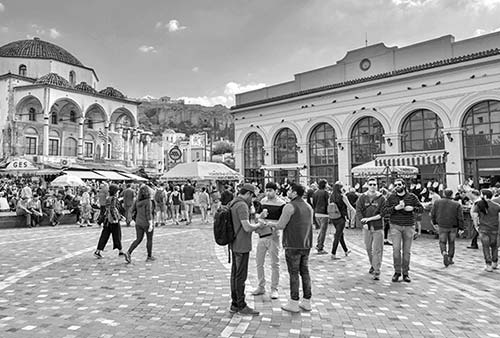
Just right of the station, Ifestou street leads downhill into the flea market (antiques, jewelry, cheap clothing, and so on). If locals need a screw for an old lamp, they know they’ll find it here.
Keep panning clockwise. Just beyond busy Ermou street (behind the A for Athens hotel—which has a rooftop bar popular for its views) is the happening 21 Psyrri district. For years a run-down slum, this zone is being gentrified by twentysomethings with a grungy sense of style. Packed with cutting-edge bars, boutique hotels, restaurants, cafés, and nightclubs, it may seem foreboding and ramshackle, but it’s actually fun to explore. Wander through by day to get your bearings, then head back at night when it’s buzzing with activity.
This walk has taken us through 2,500 years of Athens’ history—though in reverse order. We started in modern Athens, at Syntagma Square and Ermou street. Next, we saw medieval Athens—Orthodox churches and the winding streets of the Plaka. Then, we saw ancient ruins—both Greek and Roman. And, we’ve ended on a bustling square where Athens—both old and new—comes together. Explore and enjoy this global capital—the springboard of so much Western civilization, and the place that more than one in three Greeks call home.
• Our walk is over. If you’ve worked up an appetite, savor a spicy souvlaki on “Souvlaki Row” or eat your way through the local and colorful Psyrri neighborhood. My Psyrri and Central Market Walk begins right here.