SIGHTS IN ATHENS
▲▲▲Acropolis
▲▲“Acropolis Loop” (a.k.a. Dionysiou Areopagitou and Apostolou Pavlou)
▲▲▲Ancient Agora: Athens’ Market
THE PLAKA, MONASTIRAKI, AND SYNTAGMA
Between the Plaka and Monastiraki Square
▲Roman Forum (a.k.a. “Roman Agora”) and Tower of the Winds
Museum of Greek Folk Musical Instruments
▲Syntagma Square (Plateia Syntagmatos)
▲Panathenaic (a.k.a. “Olympic”) Stadium
▲▲Psyrri
▲▲▲National Archaeological Museum
THE KOLONAKI MUSEUM STRIP, EAST OF SYNTAGMA SQUARE
▲▲Benaki Museum of Greek History and Culture
▲▲Byzantine and Christian Museum
Athens offers numerous world-class museums and ancient sites. If you’re feeling a bit pressured about your Athens sightseeing priorities, consider this: Of all the archaeological sites here, only the Acropolis and the Agora matter. Of all the museums, the National Museum of Archaeology and the Acropolis Museum are the most important (if a bit redundant). Of the remaining museums, those in the Kolonaki district (Benaki Museum of Greek History and Culture, Museum of Cycladic Art, Byzantine and Christian Museum, and National Gallery) are the best, depending on your interests. Beyond these turnstile sights, take my two walks (Athens City Walk and Psyrri and Central Market Walk), and you’ll get an “A” and have time for recess.
I’ve arranged Athens’ sights in this chapter by neighborhood for handy sightseeing. You’ll notice that some of Athens’ most important sights have the shortest listings and are marked with a  . That’s because they are covered in much more detail in one of my self-guided walks or tours. A
  means the walk or tour is available as a free audio tour (via my Rick Steves Audio Europe app—see here). Some walks and tours are available in both formats—take your pick.
For general tips on sightseeing, see the Practicalities chapter. Be aware that hours at some sights may vary from those listed in this book. Check locally before planning your day.
ACROPOLIS AND NEARBY
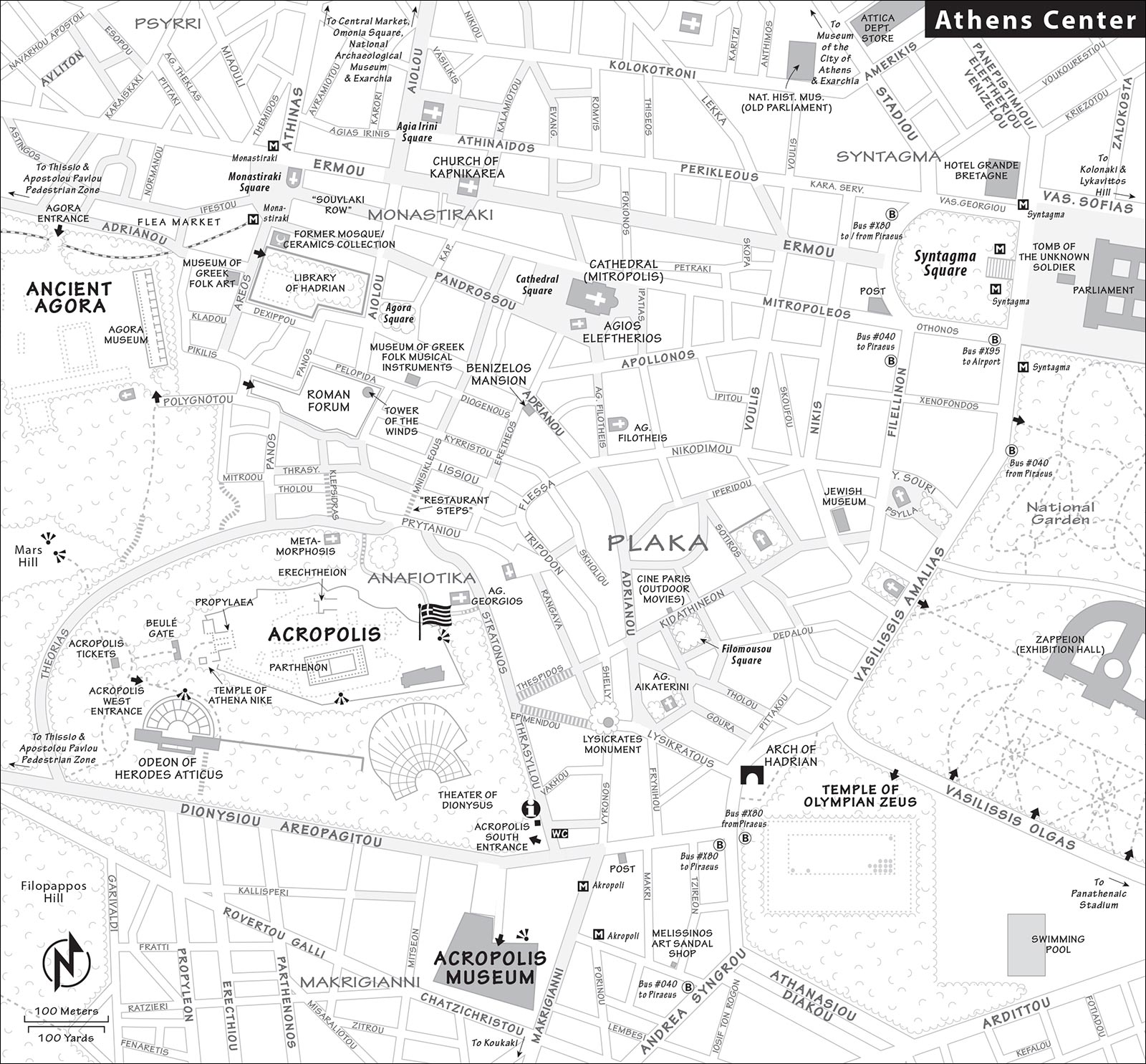
A broad pedestrian boulevard that I call the “Acropolis Loop” strings together the Acropolis (and Theater of Dionysus), Mars Hill, Acropolis Museum, and the Ancient Agora. A pair of other ancient sites (Arch of Hadrian and Temple of Olympian Zeus) are within a few minutes’ walk of the Acropolis Museum.
▲▲▲Acropolis
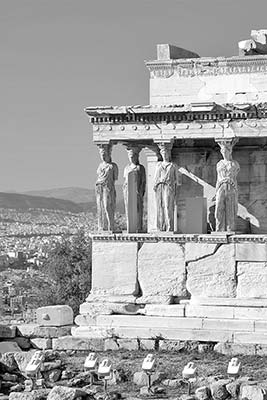
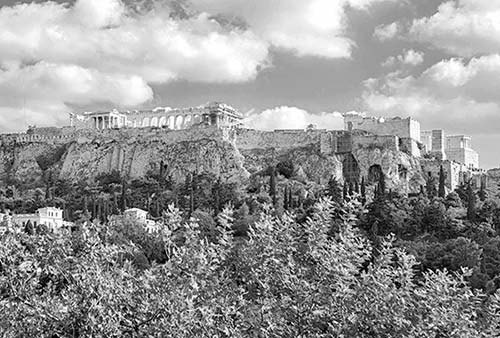
Arguably the most important ancient site in the Western world, the Acropolis (which means “high city” in Greek) rises gleaming like a beacon above the sprawl of modern Athens. This is where, circa 450 BC, the Athenian ruler Pericles spared no expense in transforming a site laid waste by an earlier war with Persia into a complex of lavishly decorated temples to honor the city’s patron goddess, Athena. The mighty Parthenon, the most famous temple on the planet, and three other major monuments built during this golden age—the Erechtheion, Propylaea, and Temple of Athena Nike—survive in remarkably good condition given the battering they’ve taken over the centuries. Ongoing restoration work means that you’ll likely see some scaffolding—but even that can’t detract from the greatness of this place.
Your Acropolis ticket also includes access to the scant remains of the Theater of Dionysus, scattered southeast of the Acropolis, just above the Dionysiou Areopagitou walkway (and only possible to visit in conjunction with your Acropolis entrance).
Cost and Hours: €20, €10 off-season (Nov-March), covered by Acropolis combo-ticket; daily 8:00-20:00, Oct until 18:00, Nov-March until 17:00; two entries: main entrance at western end of the Acropolis—if you’re at the Ancient Agora in the Plaka, signs point uphill, and the often less-crowded south entrance, at the base of the Acropolis next to the Acropolis Museum; +30 210 321 4172, info: search “Acropolis” at http://odysseus.culture.gr, tickets: www.etickets.tap.gr.
See the Acropolis Tour chapter or download my free audio tour.
▲▲“Acropolis Loop” (a.k.a. Dionysiou Areopagitou and Apostolou Pavlou)
Strolling this wide, well-manicured, delightfully traffic-free pedestrian boulevard bordering the Acropolis to the south and west is a delight. It’s composed of two streets with tongue-twisting names—Dionysiou Areopagitou and Apostolou Pavlou (think of them as Dionysus Street and Apostle Paul’s Street); for simplicity, I refer to them collectively as the “Acropolis Loop.” One of the city’s many big upgrades from hosting the 2004 Olympics, this walkway immediately became a favorite local hangout, with vendors, al fresco cafés, and frequent special events enlivening its cobbles.
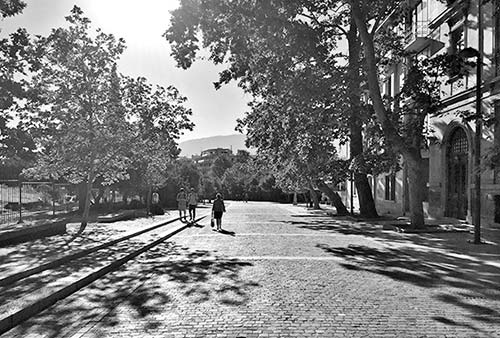
Dionysiou Areopagitou, wide and touristy, starts from the Acropolis Museum and runs along the southern base of the Acropolis. It was named for Dionysus the Areopagite, first bishop and patron saint of Athens and a member of the ancient Roman-era senate that met atop Mars Hill (described next). The other section, Apostolou Pavlou—quieter, narrower, and tree-lined—curls around the western end of the Acropolis and the Ancient Agora. It feels more local and has the best concentration of outdoor eateries. When the pollution and racket of Athens start to wear you down, take a walk here; in the early evening especially, with the Acropolis glowing above you, there’s magic to be had. This section was named for the Apostle Paul, who presented himself before Dionysus the Areopagite at Mars Hill.
Where Apostolou Pavlou meets the Thissio Metro stop (see the “Athens Overview” map on here), you can head west on Ermou—a similarly enjoyable pedestrianized boulevard—to reach Keramikos Cemetery. If you head east on Ermou (with traffic), you’ll come to Syntagma Square. Or, if you want to encircle the base of the Acropolis, head east on Adrianou, the pedestrian street you’ll hit just before the Thissio Metro stop, and stroll through the Plaka on your way back to Dionysiou Areopagitou.
▲Mars Hill (Areopagus)
The knobby, windswept hill crawling with tourists in front of the Acropolis is Mars Hill, also known as Areopagus (from Areios Pagos, “Ares Hill,” referring to the Greek version of Mars). While the views from the Acropolis are more striking, rugged Mars Hill (near the Acropolis’ main entrance, at the western end) makes a pleasant perch. As you’re climbing Mars Hill, be warned: The stone stairs (and the top of the rock) have been polished to a slippery shine by history, and can be treacherous even when dry. Watch your step and use the metal staircase.
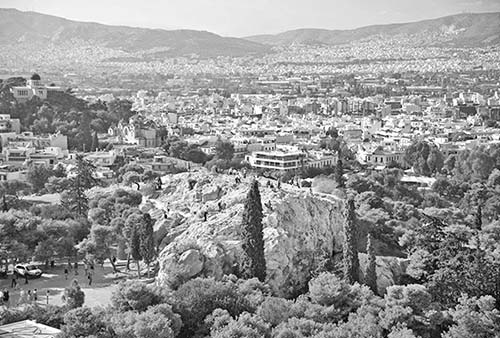
This hill has an interesting history. After Rome conquered Athens in 86 BC, the Roman overlords wisely decided to extend citizenship to any free man born here. (The feisty Greeks were less likely to rise up against a state that had made them citizens.) Whereas Rome called the shots on major issues, minor matters of local governance were determined on this hill by a gathering of leaders. During this time, the Apostle Paul—the first great Christian missionary and author of about half of the New Testament—preached to the Athenians here on Mars Hill. Paul looked out over the Agora and started talking about an altar he’d seen—presumably in the Agora (though archaeologists can’t confirm)—to the “Unknown God.” (A plaque embedded in the rock near the stairs contains the Greek text of Paul’s speech.) Although the Athenians were famously open-minded, Paul encountered a skeptical audience and only netted a couple of converts (including Dionysus the Areopagite—the namesake of the pedestrian drag behind the Acropolis). Paul moved on to Corinth, where he enjoyed a better reception.
▲▲▲Acropolis Museum
This museum is a modern-day temple to the Acropolis. Located at the foot of Athens’ famous ancient hill, it contains relics from the Acropolis, including statues of young men and women, gods and goddesses, reliefs that once adorned the hilltop temples, and five of the six original Caryatids (lady-columns) that once held up the roof of the Erechtheion temple. But the highlight is a life-size re-creation of the frieze that once wound all the way around the outside of the Parthenon, blending original pieces with copies of panels housed in the British Museum and other collections. Completed in 2009, the stunning glass building is a work of art in itself. The top floor sits slightly askew, like a graduation cap, mimicking the orientation of the Parthenon. The glass walls are designed not only to flood the place with natural light, but also to disappear into the background so that the architecture plays second fiddle to the real stars: the statuary and the views of the Acropolis.
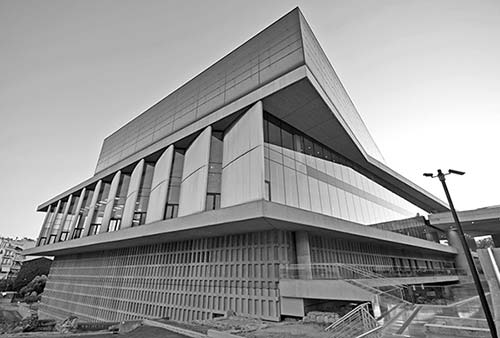
Cost and Hours: €10, €5 off-season (you can buy tickets on the museum website to avoid the ticket-buying line, but not the security line); Mon 9:00-16:00, Tue-Thu and Sat-Sun until 20:00, Fri until 22:00; Nov-March Mon-Thu 9:00-17:00, Fri until 22:00, Sat-Sun until 20:00. The museum faces the south side of the Acropolis from across the broad Dionysiou Areopagitou pedestrian drag, and is right at the Akropoli Metro stop; +30 210 900 0900, www.theacropolismuseum.gr.
See the Acropolis Museum Tour chapter.
▲Arch of Hadrian
This stoic triumphal arch stands at the edge of the new suburb of ancient Athens built by the Roman Emperor Hadrian in the second century AD. Now it overlooks a busy highway at the edge of the tourist zone (just a few steps up Dionysiou Areopagitou from the Acropolis Museum).
For more on the Arch of Hadrian, see here of the Athens City Walk chapter.
▲▲Temple of Olympian Zeus
Started by an overambitious tyrant in the sixth century BC, this giant temple (behind the Arch of Hadrian) was not completed until Hadrian took over seven centuries later. Now 15 of the original 104 Corinthian columns stand evocatively over a ruined base in a field. You can get a good view of the temple ruins for free by peeking through the fence by the Arch of Hadrian, but if you have the Acropolis combo-ticket, consider dropping in for a closer look.
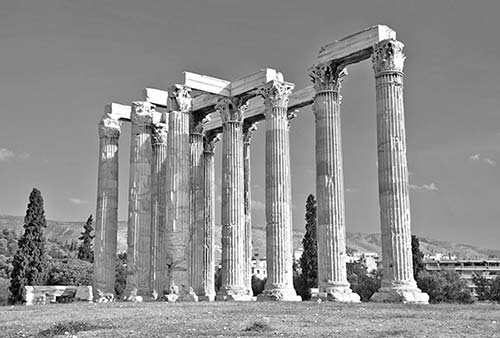
Cost and Hours: €8, covered by Acropolis combo-ticket; daily 8:00-20:00, Oct until 18:00, Nov-March until 15:00; Vasilissis Olgas 1, Metro: Akropoli; +30 210 922 6330, http://odysseus.culture.gr.
For more about the temple, see here of the Athens City Walk chapter.
ANCIENT AGORA AND BEYOND
These sights are listed in geographic order, starting with the Agora and fanning out from there (mostly to the west—see the “Athens Overview” map on here). You can walk to the cemetery and the Gazi district via the wide, pedestrianized Ermou street.
▲▲▲Ancient Agora: Athens’ Market
If the Acropolis was golden age Athens’ “uptown,” then the Ancient Agora was “downtown.” Although literally and figuratively overshadowed by the impressive Acropolis, the Agora was for eight centuries the true meeting place of the city—a hive of commerce, politics, and everyday bustle. Everybody who was anybody in ancient Athens spent time here, from Socrates and Plato to a visiting missionary named Paul. Built upon, forgotten, and ignored for centuries, the Agora was excavated in the 1930s. Now it’s a center of archaeological study and one of the city’s top tourist attractions. A visit here lets you ponder its sparse remains, wander through a modest museum in a rebuilt stoa (the Agora Museum), admire its beautifully preserved Temple of Hephaistos, and imagine sharing this hallowed space with the great minds of the ancient world.
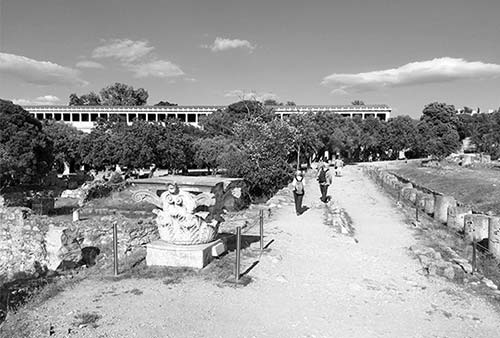
Cost and Hours: €10, covered by Acropolis combo-ticket; daily 8:00-20:00, Oct until 18:00, Nov-March until 17:00; Agora Museum generally has the same hours; main entrance on Adrianou—from the Monastiraki Metro stop, walk a block south (uphill, toward the Acropolis); +30 210 321 0180, info: search “Agora” at http://odysseus.culture.gr, tickets: www.etickets.tap.gr.
See the Ancient Agora Tour chapter or download my free audio tour.
▲Thissio
This pleasant zone, around the far side of the Acropolis (just follow the main pedestrian drag), has a relaxed vibe and a thriving passel of cafés and restaurants with Acropolis views, plus an appealing open-air cinema (see Nightlife in Athens). If you stroll around the “Acropolis Loop,” you’ll wander right past Thissio. Consider stopping off for a meal, a drink, or just to poke around.
Benaki Museum of Islamic Art
Sometimes it seems the Greeks would rather just forget the Ottoman chapter of their past...but when you’re talking about nearly 400 years, that’s difficult to do. If you’re intrigued by what Greeks consider a low point in their history, pay a visit to this branch of the Benaki Museum (listing for main branch, Benaki Museum of Greek History and Culture, appears later in this chapter). The 8,000-piece collection, displayed in two renovated Neoclassical buildings, includes beautifully painted ceramics, a rare 14th-century astrolabe, and part of a marble room from a 17th-century Cairo mansion.
Cost and Hours: €9; Thu-Sun 10:00-18:00, closed Mon-Wed; northeast of Keramikos Cemetery at Agion Asomaton 22, at the corner with Dipilou, Metro: Thissio, +30 210 325 1311, www.benaki.gr.
Keramikos Cemetery
Named for the ceramics workshops that used to surround it, this is a vast place to wander among marble tombstones from the seventh century BC onward. While the sprawling cemetery provides more exercise than excitement—and requires a good imagination to take on much meaning—the small, modern museum is a delight. With a wealth of artifacts found right here, it explains the evolution of ancient burial rituals one age at a time.
Cost and Hours: €8, covered by Acropolis combo-ticket; daily 8:00-20:00, Oct until 18:00, Nov-March until 15:00 and closed Mon; Ermou 148, Metro stops: Thissio or Keramikos, +30 210 346 3552.
THE PLAKA, MONASTIRAKI, AND SYNTAGMA
The following sights are scattered around the center of Athens, within the roughly triangular area formed by the Plaka, Monastiraki, and Syntagma neighborhoods.
Most of these sights are covered in more detail in the Athens City Walk chapter.
Between the Plaka and Monastiraki Square
▲▲Anafiotika
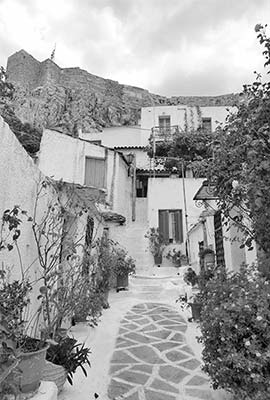
Clinging to the northern slope of the Acropolis (just above the Plaka), this improbable Greek-island-on-a-hillside feels a world apart from the endless sprawl of concrete and moped-choked streets that stretch from its base. You could call it a well-established squatter community settled in a national archaeological site. For a break from the big city, escape here for an enjoyable stroll.
▲Roman Forum (a.k.a. “Roman Agora”) and Tower of the Winds
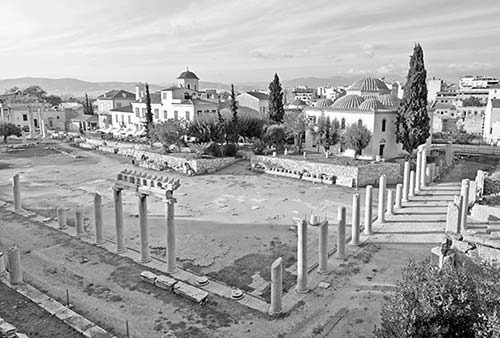
After the Romans conquered Athens in 86 BC, they quickly filled in the original Agora with monumental buildings. Then, they expanded 100 yards east to build their own version of an agora—an open space or forum—where people came to do business. Today it’s a pile of ruins, watched over by the marvelously intact Tower of the Winds. Panels circling the top of the tower depict the eight winds that shape Athenian weather. You can see virtually the entire site for free from the hillside (see description on here). But going inside yields a closer look (the entry gate is at the west end near the tallest standing colonnade).
Cost and Hours: €8, covered by Acropolis combo-ticket; daily 8:00-20:00, until 15:00 off-season; corner of Pelopida and Aiolou streets, Metro: Monastiraki, +30 210 324 5220.
Visiting the Roman Forum: You’ll enter through four colossal Doric columns, part of a gateway built by Emperor Augustus (c. 11 BC). The inscription in Greek says it was generously financed by his adoptive father, Julius Caesar, and dedicated to Athens’ favorite goddess, Athena. You’ll emerge into a vast open-air courtyard where Romans and Athenians gathered to shop and schmooze. The courtyard was surrounded by rows of columns, creating a shaded arcade housing businesses. On the right side was a bubbling fountain.
The 40-foot-tall, octagonal Tower of the Winds was an observatory, with a weathervane on top, sundials on its sides, and a clock powered by water within. Inside is a big round (and still-not-fully-understood) stone in the pavement with markings like a clock dial. The holes indicate that some device was mounted on top—perhaps a set of metal gears. As water flowed down from the Acropolis it was channeled into the narrow groove you see here. The water powered the gears, which turned the hands of the clock to show the time of day. Additional hands (turning at much slower speeds) could show the day of the year, the month of the zodiac, and so on.
To the right of the Tower of the Winds is a gray-stone-paved area with broken columns—all that remains of the Agora’s other monumental entrance. The two arches nearby may have marked the offices of the market’s quality-control inspectors. To the left of the Tower is a rectangular area surrounded by a ditch. It has a surviving stone bench with two toilet-seat holes in it, making it clear what this once was: the Agora’s public restroom.
Library of Hadrian
About a block from the Roman Forum, down Aiolou street (enter at the four Doric columns), is an area of Roman ruins containing what’s left of the Library of Hadrian (erected AD 131-132). Like at the Roman Forum, you can essentially see it all from outside. Notice the round Roman arch, standing proudly in the center as if to remind all that Greece was incapable of constructing something like this, and therefore could never be as grand as Rome. Wandering the grounds, you can view the scant remains of the only Roman mosaic floor I’ve seen in Athens, but little more.
Cost and Hours: €6, covered by Acropolis combo-ticket; daily 8:00-20:00, shorter hours off-season; across from Agora Square, Metro: Monastiraki, +30 210 324 5220.
Museum of Greek Folk Musical Instruments
If you’re interested in things musical, this museum is cute and cheap to enter. On its three floors, you can listen to recordings of different instruments and styles of music, and examine instruments dating from the 18th century to today. The main floor shows off drums, flutes, and bagpipes. Upstairs are stringed instruments—fiddles, violins, mandolins, and so on. And downstairs are bells, the boards hammered by Orthodox priests to announce worship services, and other percussion instruments. Throughout, photos, video clips, and paintings illustrate the instruments being played.
Cost and Hours: €3; Wed-Mon 8:30-15:30, closed Tue; near Roman Forum at Diogenous 1, Metro: Monastiraki, +30 210 325 0198.
Churches in the Center
▲Church of Kapnikarea
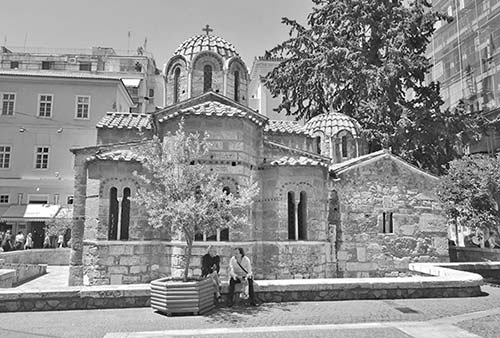
Sitting unassumingly in the middle of Ermou street, this small 11th-century Byzantine church offers a convenient look at the Greek Orthodox faith.
Cost and Hours: Free, likely open daily 8:30-13:30 plus Tue and Thu-Fri 17:00-19:30.
Cathedral (Mitropolis)
Dating from the mid-19th century, this is the big head church of Athens—and therefore of all of Greece. The cathedral, with a beautifully restored interior, is the centerpiece of a reverent neighborhood, with a pair of statues out front honoring great heroes of the Church; surrounding streets lined with religious-paraphernalia shops (and black-cloaked, long-bearded priests); and the cute little Church of Agios Eleftherios (described next).
Cost and Hours: Free, likely open daily 8:00-19:00, closed 13:00-16:30 off-season, Plateia Mitropoleos.
▲Church of Agios Eleftherios
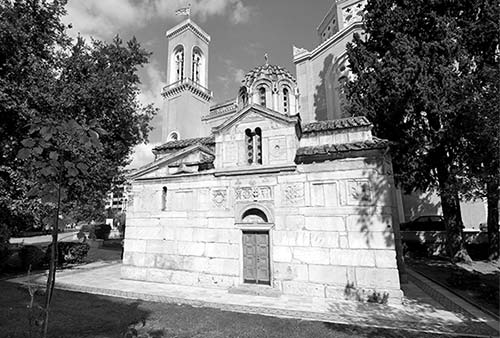
This tiny church, huddled in the shadow of the cathedral, has a delightful hodgepodge of ancient and early Christian monuments embedded in its facade. Like so many Byzantine churches, it was partly built (in the late 12th century) with fragments of earlier buildings, monuments, and even tombstones...a hodgepodge of millennia-old bits and pieces.
Cost and Hours: Free, likely open daily 8:30-13:30 & 17:00-19:30, Plateia Mitropoleos.
Benizelos Mansion
Two blocks south of the cathedral, this reconstructed mansion is noteworthy because it’s the only surviving house of its type from the 18th century left in Athens, and one of the few anywhere in southern Greece. It’s typical of the konaki-type house built throughout the Ottoman Empire at the time, with a high wall for privacy, courtyards, and an upper floor where people lived. A few panels in English describe how the different rooms were used, but this sleepy sight is interesting mostly for its unique glimpse into Athens’ Ottoman period.
Cost and Hours: Free; hours sporadic but likely Tue-Thu 10:00-13:00, Sun until 16:00, closed Mon and Fri-Sat; Adrianou 96, +30 21 0324 8861, https://archontiko-mpenizelon.gr.
Syntagma Square and Nearby
▲Syntagma Square (Plateia Syntagmatos)
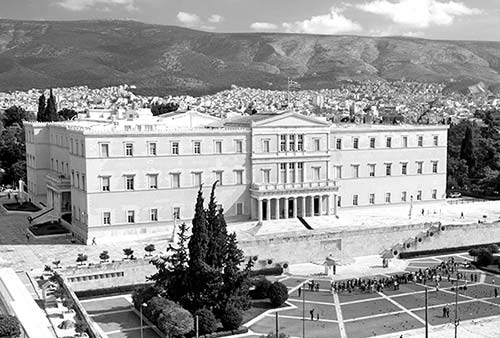
The “Times Square” of Athens is named for Greece’s historic 1843 constitution, prompted by demonstrations right on this square. A major transit hub, the square is watched over by Neoclassical masterpieces such as the Hotel Grande Bretagne and the Parliament building.
Parliament
The former palace of King Otto is now a house of democracy. In front, colorfully costumed evzone guards stand at attention at the Tomb of the Unknown Soldier and periodically do a ceremonial changing of the guard to the delight of tourists (guards change five minutes before the top of each hour, less elaborate crossing of the guard around :25 after, full ceremony with marching band Sundays at 11:00—get there early as they may start a bit before 11:00).
▲Ermou Street
This pedestrianized thoroughfare, connecting Syntagma Square with Monastiraki (and on to Thissio and Keramikos Cemetery), is packed with international chain stores. It’s enjoyable for people-watching and is refreshingly traffic-free in an otherwise congested area.
Jewish Museum of Greece
Many Jewish communities trace their roots back to medieval Spain’s Sephardic diaspora and, before that, to classical Greece. (Before the Nazis invaded, Greece had 78,000 Jews; more than 85 percent of them perished in the Holocaust.) This interesting collection of more than 8,000 Jewish artifacts—thoughtfully displayed on four floors of a modern building—traces the history of Greek Jews since the second century BC. Downstairs from the entry, you can visit a replica synagogue with worship items. Then spiral up through the split-level space (borrowing English descriptions in each room) to see exhibits on Jewish holidays, history, Zionism, the Nazi occupation and Holocaust, and traditional dress—all laced with the personal stories of Greek Jews.
Cost and Hours: €6; Mon-Fri 9:00-14:30, Sun 10:00-14:00, closed Sat; Nikis 39, at the corner with Kidathineon—ring bell to get inside; Metro: Syntagma, +30 210 322 5582, www.jewishmuseum.gr.
SOUTHEAST OF SYNTAGMA
The busy avenue called Vasilissis Amalias rumbles south of Syntagma Square, where you’ll find the following sights. Note that the Arch of Hadrian and the Temple of Olympian Zeus (both described earlier) are just south of the National Garden and Zappeion.
National Garden
Extending south from the parliament, the National Garden is a wonderfully cool retreat from the traffic-clogged streets of central Athens. Covering an area of around 40 acres, it was planted in 1839 as the palace garden, created for the pleasure of Queen Amalia. Opened to the public in 1923, the garden has many pleasant paths, a café, WCs, scattered picturesque ancient columns, a playground, and several zoo-type exhibits of animals.
Cost and Hours: Free, open daily from dawn to dusk.
Zappeion
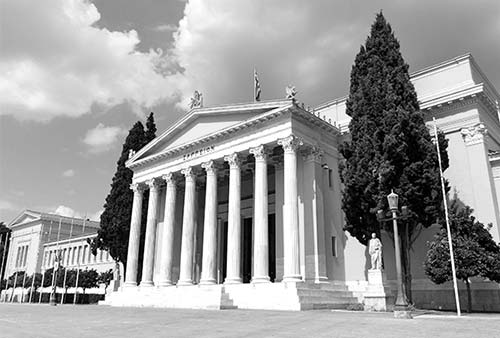
At the southern end of the National Garden stands the grand mansion called the Zappeion, surrounded by formal gardens of its own. To most Athenians, the Zappeion is best known as the site of the outdoor Aegli Cinema in summer (behind the building, on the right as you face the colonnaded main entry; for details, see the Nightlife in Athens chapter). But the building is more than just a backdrop. During Ottoman rule, much of the Greek elite, intelligentsia, and aristocracy fled the country. They returned after independence and built grand mansions such as this. Finished in 1888, it was designed by the Danish architect Theophilus Hansen, who was known (along with his brother Christian) for his Neoclassical designs. The financing was provided by the Zappas brothers, Evangelos and Konstantinos, two of the prime movers in the campaign to revive the Olympic Games. This mansion housed the International Olympic Committee during the first modern Olympics in 1896 and served as a media center during the 2004 Olympics. Today the Zappeion is a conference and exhibition center.
Cost and Hours: Gardens free and always open, building only open during exhibitions for a fee; Vasilissis Amalias, Metro: Akropoli or Evangelismos.
▲Panathenaic (a.k.a. “Olympic”) Stadium
In your travels through Greece, you may see several ruined ancient stadiums (including the ones in Olympia and Delphi). Here’s your chance to see one intact.
Cost and Hours: €10, includes audioguide; daily 8:00-19:00, Nov-Feb until 17:00; kiosk near the entrance sells Olympic memorabilia; southeast of the Zappeion off Vasileos Konstantinou, Metro: Akropoli or Evangelismos, +30 210 752 2985, www.panathenaicstadium.gr.
Visiting the Stadium: Enter the stadium, take a seat, and look around to appreciate its rich history and gleaming marble.
This place has many names. Officially it’s the Panathenaic Stadium, built in the fourth century BC to host the Panathenaic Games. Sometimes it’s referred to as the Roman Stadium, because it was rebuilt by the great Roman benefactor Herodes Atticus in the second century AD, using the same prized Pentelic marble that was used in the Parthenon. This magnificent material gives the place its most popular name: Kalimarmaro (“Beautiful Marble”) Stadium.
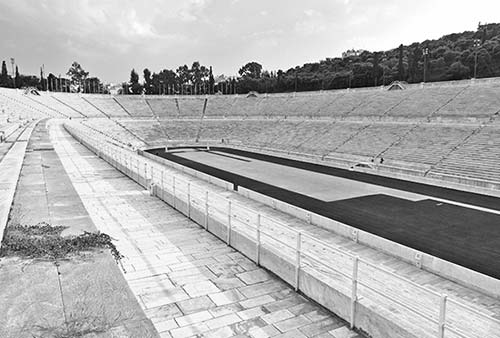
The stadium was restored to its Roman condition in preparation for the first modern Olympics in 1896. It saw Olympic action again in 2004. Today, it’s occasionally used for ceremonies and concerts. As in ancient times, around 50,000 spectators fill the stadium for big events.
Take a lap around the track, pose on the podium, and visit the modest permanent exhibit, showcasing the various torches, vintage posters, and other memorabilia commemorating the modern games. Head to the top row for a commanding view of the Acropolis and Parthenon.
NORTH OF THE CENTER
Several worthwhile sights are north of the Athens central core.
Above Monastiraki Square
Athinas street leads north from Monastiraki Square to Omonia Square (see the “Athens Overview” map on here). Walking this grand street offers a great chance to feel the pulse of modern workaday Athens, with shops tumbling onto broad sidewalks, striking squares, nine-to-fivers out having a smoke, and lots of urban energy. This area is covered in delicious detail in the Psyrri and Central Market Walk chapter.
Farther up Athinas street, past Omonia Square, is the superb National Archaeological Museum.
▲▲Psyrri
This funky district, just north of the Ancient Agora, offers a real-world alternative to the tourist-clogged, artificial-feeling Plaka. While parts are outwardly grungy and run-down, Psyrri has blossomed with a fun range of eateries, cafés, and clubs, with everything from dives to exclusive dance halls to crank-’em-out chain restaurants (for recommendations on where to eat, see the Eating in Athens chapter). It’s especially lively at night.
▲Central Market
Take a vibrant, fragrant stroll through the modern-day version of the Ancient Agora. It’s a living, breathing, and smelly barrage on all the senses. You’ll see dripping-fresh meat, livestock in all stages of dismemberment, still-wriggling fish, exotic nuts, and sticky figs. It may not be Europe’s most charming market, but it offers a lively contrast to Athens’ ancient sites. The entire market square is a delight to explore, with a dizzying variety of great street food and a carnival of people-watching (open Mon-Sat 7:00-15:00, closed Sun, on Athinas between Sofokleous and Evripidou, between Metro stops Omonia and Monastiraki).
▲▲▲National Archaeological Museum
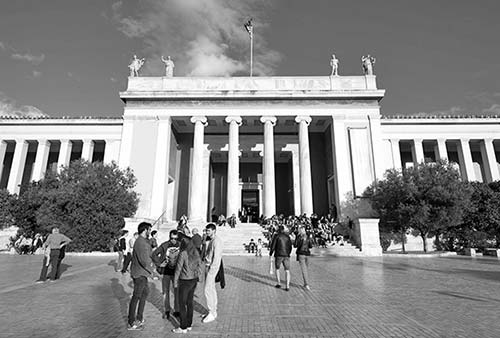
This museum is the single best place on earth to see ancient Greek artifacts. Strolling through the chronologically displayed collection—from 7000 BC to AD 500—is like watching a time-lapse movie of the evolution of art. You’ll go from the stylized figurines of the Cycladic Islands, to the golden artifacts of the Mycenaeans (including the so-called Mask of Agamemnon), to the stiff, stoic kouros statues of the Archaic age. Then, with the arrival of the Severe style (epitomized by the Artemision Bronze), the art loosens up and comes to life. As Greece enters the Classical Period, the Bronze Statue of a Youth is balanced and lifelike. The dramatic Artemision Jockey hints at the unbridled exuberance of Hellenism, which is taken to its extreme in the Statue of a Fighting Gaul. Rounding out the collection are Roman statuary, colorful wall paintings from Thira (today’s Santorini), room upon room of ceramics, and what may be the world’s first computer (known as the Antikythera mechanism, some 2,000 years old).
Cost and Hours: €12, €6 off-season, €15 combo-ticket includes Byzantine and Christian Museum; Wed-Mon 8:00-20:00, Nov-March 8:30-15:30, Tue 13:00-20:00 year-round; 28 Oktovriou (a.k.a. Patission) #44—see here for transit options; +30 213 214 4800, www.namuseum.gr.
See the National Archaeological Museum Tour chapter or download my free audio tour.
Exarchia
For an edgier taste of Athens, explore Exarchia—long the heart and soul of Athens’ feisty love of freedom and its non-conformist spirit. Wedged between the National Technical University, Omonia Square, and Lykavittos Hill, Exarchia is populated mostly by students and counterculture idealists. The neighborhood, slathered in graffiti, is defiant, artsy, and vibrant.
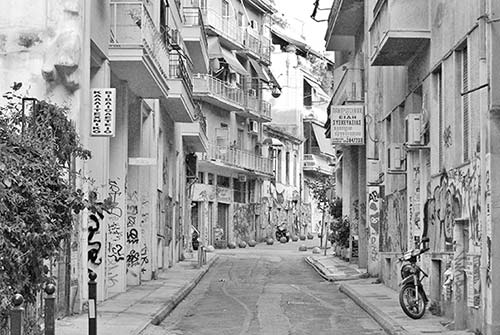
The handiest way to visit Exarchia is to take a taxi to its central Exarchia Square and explore on foot (or book a walking tour focusing on the district’s boisterous street art; see the listing for Alternative Athens on here). You might ask your cabbie for a 10-minute impromptu graffiti tour of the neighborhood before jumping out at the square.
Exarchia Square feels like the community hub—find its centerpiece, a circa-1920 statue of cupids that’s generally covered in spray paint. Youth activities and political banners contribute to the folk/artsy/radical vibe. Next, walk uphill and then to the right. The Art Deco “Blue Apartment” flat (top corner of the square) was a Modernist mecca in the 1920s—the heartbeat of this scene where only dead fish go with the flow. At the top end of the square, pop into the Vox Occupied Community Center (an art center, bar, and open-air theater). Then, just wander the nearby streets. Because of the cheap rent and abundance of students (three universities are nearby), the streets are lined with cafés, bars, art centers, and bookstores. Each evening, Exarchia is a thriving festival of alternative lifestyles. And, if there’s a demonstration happening down at Syntagma Square, it’s just a quick scooter ride away.
North of Syntagma Square
Just a few blocks up from Syntagma Square and the traffic-free Ermou street thoroughfare are more museums, including the National Historical Museum (in the Old Parliament building), the Numismatic Museum (coins), and this place:
▲Museum of the City of Athens
Housed in the former residence of King Otto and Queen Amalia (where they lived from 1836 to 1843), this museum combines an elegant interior with a charming overview of Athens beyond ancient times. Come here if you want to learn more about the 19th- and early-20th-century history of the city.
Cost and Hours: €5; Mon and Wed-Fri 9:00-16:00, Sat-Sun 10:00-15:00, closed Tue; Paparigopoulou 5, Metro: Panepistimio, +30 210 323 1397, www.athenscitymuseum.gr. The recommended Black Duck Garden bar/restaurant shares the museum’s courtyard, but is independently run (see listing on here).
Visiting the Museum: The ground floor has two highlights. In the first room (to the right as you enter) is a giant panoramic late-17th-century painting of Louis XIV’s ambassador and his party with Athens in the background. The work shows a small village occupied by Ottomans (with prickly minarets rising from the rooftops), before the Parthenon was partially destroyed (it’s the only painting depicting an intact Athens and Parthenon).
In the next room, a large model shows Athens circa 1842, just as it was emerging as the capital of Greece. A touchscreen computer lets you choose various locations on the model, read more about those sights, virtually circle around them, and watch videos.
Upstairs are lavishly decorated rooms and exhibits that emphasize King Otto’s role in the fledgling Greek state following the Ottoman defeat. Throughout the place you’ll see idyllic paintings of Athens as it was a century and a half ago: a red-roofed village at the foot of the Acropolis populated by Greek shepherds in traditional costume. Stepping back outside into the smog and noise after your visit, you’ll wish you had a time machine.
THE KOLONAKI MUSEUM STRIP, EAST OF SYNTAGMA SQUARE
The district called Kolonaki, once the terrain of high-society bigwigs eager to live close to the Royal Palace (now the parliament), is today’s diplomatic quarter. Lining the major boulevard called Vasilissis Sofias are many embassies, a thriving scene with high-end shops, and some of Athens’ top museums. These are listed in the order you’d reach them, heading east from the parliament (see the “Athens Overview” map on here).
▲▲Benaki Museum of Greek History and Culture
This exquisite collection takes you on a fascinating walk through the ages. And, as it’s housed in a gorgeous Neoclassical mansion, it gives a peek at how Athens’ upper crust lived a century ago. The mind-boggling array of artifacts—which could keep a museum lover busy for hours—is crammed into 36 galleries on four floors, covering seemingly every era of history: antiquity, Byzantine, Ottoman, and modern. The private collection nicely complements the many state-run museums in town. Each item is labeled in English, and it’s all air-conditioned. The Benaki gift shop is a fine place to buy jewelry (replicas of museum pieces).
Cost and Hours: €12; Wed-Mon 10:00-18:00 except Thu until 23:30, Sun until 16:00, closed Tue; classy terrace café where some of today’s high society hang out, across from back corner of National Garden at Koumbari 1, Metro: Syntagma, +30 210 367 1000, www.benaki.gr.
Visiting the Museum: The first exhibit (on the ground floor, rooms 1-12) kicks things off by saying, “Around 7000 BC, the greatest ‘revolution’ in human experience took place: the change from the hunting-and-gathering economy of the Paleolithic Age to the farming economy of the Neolithic Age...” You’ll see fine painted vases, gold wreaths of myrtle leaves worn on heads 2,300 years ago, and evocative Byzantine icons and jewelry. Look for Byzantine icon art, including two pieces by Domenikos Theotokopoulos before he became El Greco (in a glass case in the center of Room 11).
Upstairs (from room 12), the first floor picks up where most Athens museums leave off: the period of Ottoman and Venetian occupation. Here you’ll find traditional costumes, furniture, household items, farm implements, and entire rooms finely carved from wood and lovingly transplanted from Northern Greece. In Rooms 22 and 23, a fascinating exhibit shows Greece through the eyes of foreign visitors, who came here in the 18th and 19th centuries (back when Athens was still a village, spiny with Ottoman minarets) to see the same ruins you’re enjoying today.
Climb up through smaller rooms (from room 25) to the enticing terrace café and exhibit hall (which may have temporary exhibits). On the top floor, Romantic art finally brings you into the 20th century.
▲▲Museum of Cycladic Art
This modern, cozy, and enjoyable museum shows off the largest exhibit of Cycladic art anywhere, collected by one of Greece’s richest shipping families (the Goulandris clan). You can see Cycladic art elsewhere in Athens (such as in the National Archaeological Museum), but it’s displayed and described most invitingly here. While the first floor up is all Cycladic, there are four floors—each with a fine exhibit. Note that the museum’s entrance is a few steps up the side street (Neophytou Douka). A pleasant café is near the gift shop on the ground floor.
Cost and Hours: €12; Wed-Mon 10:00-17:00 except Thu until 20:00, Sun from 11:00, closed Tue; Neophytou Douka 4, Metro: Evangelismos, +30 210 722 8321, www.cycladic.gr.
Visiting the Museum: You’ll climb the same marble staircase from the first to the fourth floor as the exhibit unfolds one floor at a time.
The first floor focuses on art from the Cycladic Islands, which surround the isle of Delos, off the coast southeast of Athens. The Aegean city-states here—predating Athens’ golden age by 2,000 years—were populated by a mysterious people who left no written record. But they did leave behind an ample collection of fertility figurines. These come in different sizes but follow the same general pattern: skinny, standing ramrod-straight, with large alien-like heads. Some have exaggerated breasts and hips, giving them a violin-like silhouette. Others (likely symbolizing pregnancy) appear to be clutching their midsections with both arms. These items give an insight into the matriarchal cultures of the Cycladic Islands. With their astonishing simplicity, the figurines appear almost abstract, as if Modigliani or Picasso had sculpted them.
While that first floor is the headliner, don’t miss three more floors of exhibits upstairs: ancient Greek art, Cypriot antiquities, and scenes from daily life in antiquity. The highlight—for some, even better than the Cycladic art itself—is the engrossing top-floor exhibit that explains ancient Greek lifestyles. With the help of artistic renderings, this exhibit displays the collection in use. Artifacts, engaging illustrations, and vivid English descriptions resurrect a fun cross-section of the fascinating and sometimes bizarre practices of the ancients: weddings, athletics, agora culture, warfare, and various female- and male-only activities (such as the male-bonding/dining ritual called the symposium). Listen for the music that accompanies the exhibit—historians’ best guess at what the ancients listened to. A 12-minute movie at the end dramatizes events in the life of “Leon,” a fictional young man of ancient Greece. Another movie (on a monitor to the left) demonstrates burial rituals (for the dearly departed Leon), many of which are still practiced by Orthodox Christians in Greece today.
▲▲Byzantine and Christian Museum
This excellent museum displays key artifacts from the Byzantine era—the 1,000-year period (c. AD 330-1453) that came after Greece’s ancient glory days. While the rest of Europe fragmented into fiefdoms, Byzantium ruled large swaths of the eastern Mediterranean, with Athens as a key city. And, as the empire’s dominant language and culture were Greek, today’s Greeks proudly consider the Byzantine Empire “theirs.” In this museum, you’ll see bits of 2,000-year-old rubble, medieval tableware, exquisite gold religious objects, and lots and lots of icons. The museum’s handy café/restaurant is on a breezy terrace overlooking a park.
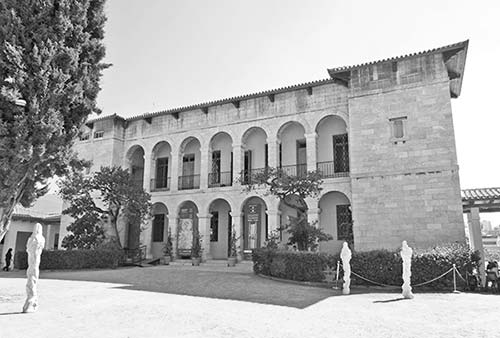
Cost and Hours: €8, €15 combo-ticket includes National Archaeological Museum; daily 8:00-20:00 except Tue from 13:00; Vasilissis Sofias 22, Metro: Evangelismos, +30 213 213 9517, www.byzantinemuseum.gr.
Self-Guided Tour: In the peaceful courtyard, buy your ticket in the building straight ahead, then enter the permanent collection in the building to the left. The museum’s layout can be confusing, as the “rooms” flow into each other without clear divisions. Use my tour to get a thematic overview, then browse freely among the many interesting and beautiful objects.
The first few rooms show how the Byzantine Empire grew from its Roman roots.
Entryway: Three maps show snapshots of the Byzantine world: First (AD 337-565), it was huge, when it was synonymous with the Roman Empire. When Rome fell, its eastern half (called Byzantium) carried on as the largest realm in Europe (1056). By the end of the Byzantine era (1453), the empire was smaller still, with only two major cities—Constantinople and Athens.
• Now step into Room I.1.
Rooms I.1-4: The statuettes and reliefs in Room I.1 show how pagan Rome became Christian Byzantium. A pagan shepherd became the Bible’s “Good Shepherd;” the myth of Orpheus with his lyre symbolized the goodness of Creation; and ancient philosophers became wise Jesus.
Continue down the first set of stairs into Room I.2. In secular life, ancient Roman knowhow continued on into medieval times, with high-quality Byzantine jewelry, ceramics, glassware, coins, and good luck charms (eulogiai). Descend the next steps to Room I.3 to find column fragments and a mosaic floor (depicting animals and ancient laurel wreaths) that suggest how the same structural elements of the Roman basilica (or assembly hall) evolved into the Christian basilica (or church).
In Room I.4, stone fragments like these, from ruined ancient temples, were recycled to build Christian churches, while the Parthenon was repurposed as Athens’ cathedral.
• Descend the final staircase to a series of rooms on medieval Byzantium (c. AD 500-1200), starting in...
Room II.2: With the fall of Rome, the Byzantine world (as the museum plaque says) entered an “Age of Crisis,” marked by invaders from the north and east sweeping across Europe. The few broken stone fragments displayed here attest to how little art survived.
• To the left is the section called...
Room II.1: While Western Europe struggled to pick up the pieces after Rome fell, the Byzantine world was held together by strong emperors and the “eastern pope,” the Orthodox patriarch. See their symbols of authority: chain-mail armor, the long scroll of a patriarchal decree, coins with imperial insignia, and signet rings.
• Continue ahead into the large Room II.3.
Rooms II.3-II.9: In II.3 and II.4, you’ll see how the Christian faith in Eastern Europe was evolving into what we now call Orthodox, with its distinct imagery and rituals. On display are uniquely Orthodox painted icons: of Mary-and-the-Babe, Jesus-as-Pantocrator (“All Powerful”), and a double-sided icon that was paraded atop a pole during services. Byzantines preferred to depict their saints as stiff, stylized figures on gold backgrounds, to avoid worshipping the “graven images” prohibited in the Bible. Orthodox Christians also developed the altar screen (iconostasis) that shielded the church’s inner sanctum (see the interestingly carved marble slabs from such a screen).
The room to the right (II.5) shows how Athenian churches (such as the well-known Church of Kapnikarea—described in the next chapter) developed their own unique style, featuring wall frescoes like these, and topped with a Pantocrator in the dome (like the one at the end of the room).
Breeze quickly through Rooms II.6-9, with artifacts from Byzantium’s declining years (c. 1200-1400). By the 13th century, Venetian merchants (the “Latins”) were asserting their power in the Byzantine trading empire. Still, the cities of Constantinople and Athens remained more civilized than parts of the medieval west, as attested by the collection of finely worked carved reliefs and ceramics. Byzantine painting techniques were spreading west, and Byzantine knowledge was passed along in illuminated manuscripts and books.
• Now enter a large hall with lots of big colorful icons.
Rooms IV.1-4: Browse Room IV.1-2 to its far left end. The paintings are bigger, brighter, and more realistic, with hints of 3-D background. There are dramatic, heart-racing scenes of saints slaying dragons and chariots of fire. Unlike the stiff, flat icons of an earlier age, now saints pose with the relaxed gravitas of ancient statues. It’s clear that, with the arrival of the Venetians, there was cross-pollination between Byzantine icon-makers (in Crete, Ionia, and Athens) and the budding Renaissance painters of Italy.
Then, overnight, the Byzantine Empire came to an end. Make a U-turn to the right at the far end of the hall, into Room IV.3. In 1453, the Ottoman Turks conquered Constantinople, and went on to capture most of the territory that once belonged to Byzantium. In Greece, Christians (called Romioi) carried on their faith under Islamic rule (1453-1832). They developed the rich worship regalia still used today—icons, miters, silver vessels, and gold-embroidered vestments.
In the far left corner, step into the darkened Room IV.4. The printed book helped shape a common Greek identity (“the New Hellenism”), spurring the desire to be free of Ottoman rule and create the modern democratic nation of Greece.
• Finally, return back upstairs to...
Room IV.5: The final displays bring Byzantium up to modern times, mainly in its legacy to religious art. The flat simplified techniques of Byzantine art have even influenced modern abstract painters—a timeless style that’s, well, iconic.
National War Museum
This imposing three-story museum is a living lecture on Greek warfare, from Alexander the Great to today. The overtly patriotic exhibit, old-school and staffed by soldiers, stirs the souls of Greeks and history buffs.
Cost and Hours: €6; Tue-Sun 9:00-19:00, closed Mon; Rizari 2 at Vasilissis Sofias, Metro: Evangelismos, +30 210 725 2975, www.warmuseum.gr.
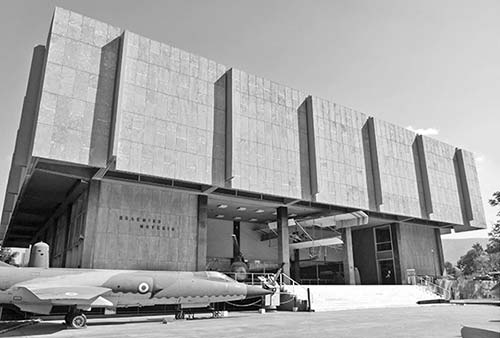
Visiting the Museum: Start by riding the elevator upstairs to the first floor. Here you’ll get a quick chronological review of Greek military history, including replicas of ancient artifacts you’ll see for real in other museums—fine history lessons in early war technology. On display are maps of various campaigns, and models of fortified towns you may see later in your travels through Greece (like Monemvasia and Mystras), plus amazing video clips of World War I that help visually reconstruct the story.
The mezzanine level focuses on the Greek experience in the 20th century, including World War II (Nazi occupation, resistance, and liberation), and Cyprus. Back on the ground floor you’ll parade past military uniforms, browse an armory of old weapons, and (outside) ogle modern military machines—tanks, fighter jets, and more (visible from the street, even when the museum is closed).
▲▲National Gallery
Athens’ striking and newly renovated National Gallery is to Greece what the Orsay Museum is to France: a gathering of the great art of this nation’s top artists from about 1850 until today.
The finest of Greek paintings are beautifully displayed and described in chronological order on three floors, connected by a central marble staircase. Walking through the ages—from Conservative/Realist to Impressionist and into the 20th century—you’ll notice artistic trends spreading from Western Europe to Greece, but with a 20-year delay. The exhibits are well described in English throughout, with a focus on the dance between Western Europe and Greece. (While you’ll likely not recognize a single name, it seems many of the great Greek artists studied in Paris.) The cultural challenge: for Greece to be part of the West yet remain true to its own heritage. While there is a bottom floor dedicated to a few works by the European masters, the reason to visit this gallery is to enjoy the best collection of Greek paintings anywhere.
Cost and Hours: €10; Wed-Mon 10:00-18:00, closed Tue; just beyond the National War Museum at Vasileos Konstantinou 50—a 10-minute walk behind the Parliament; Metro: Evangelismos, +30 214 408 6201, www.nationalgallery.gr.