APPENDIX
Holidays and Festivals
This list includes selected festivals in major cities, plus national holidays observed throughout Greece. Many sights and banks close on national holidays—keep this in mind when planning your itinerary. Before planning a trip around a festival, verify the dates with the festival website, the Greek tourist office (www.visitgreece.gr), or my “Upcoming Holidays and Festivals in Greece” web page at RickSteves.com/europe/greece/festivals.
Books and Films
To learn more about Greece past and present, check out a few of these books and films.
Nonfiction
Alexander the Great (Paul Anthony Cartledge, 2004). Alexander’s legacy comes to life in this engaging history.
Apology (Plato, 390 BC). This is a classic for a reason, opening up a window into the Greek mind and soul.
The Cambridge Illustrated History of Ancient Greece (Paul Anthony Cartledge, 1997). Offered in large format, Cartledge’s history is packed with gorgeous illustrations.
Colossus of Maroussi (Henry Miller, 1941). Miller tells a sometimes-graphic account of his down-and-out sojourn in Greece in the late 1930s.
A Concise History of Greece (Richard Clogg, 1986). For an overview of the 18th century to modern times, this history is surprisingly succinct.
Dinner with Persephone (Patricia Storace, 1996). This book is more than a memoir about living in Athens—it’s one writer’s critical look at modern Greek culture and family life.
Eleni (Nicholas Gage, 1983). Gage tells the riveting account of his quest to uncover the truth behind his mother’s assassination during Greece’s civil war.
The Greeks (H. D. F. Kitto, 1951). Considered the standard text on ancient Greece by a leading scholar, this decades-old work is still quite accessible.
The Greek Way (Edith Hamilton, 1930). Hamilton introduces the world of ancient Greece to the 20th century.
Inside Hitler’s Greece (Mark Mazower, 1993). This shocking account of the Nazi occupation of Greece details the background for the country’s civil war.
Lives (Plutarch, 100 AD). Written at the start of the second century, Lives is an epic attempt to chronicle the ancient world through biography.
Mani: Travels in the Southern Peloponnese (Patrick Leigh Fermor, 1958). This is the definitive book on the “forgotten” side of the peninsula.
Mediterranean in the Ancient World (Fernand Braudel, 1972). Braudel gives a marvelous overview of the ancient Mediterranean.
Mythology (Edith Hamilton, 1942). Along with The Greek Way, this is a must-read tome on classic myths and cultures.
The Nature of Alexander (Mary Renault, 1975). This biography from a famous novelist provides insight on Alexander the Great.
The Parthenon Enigma (Joan Breton Connelly, 2014). Connelly uses the temple’s dramatic frieze—depicting, she says, human sacrifice—to go deep into the history of the Acropolis.
Persian Fire (Tom Holland, 2005). Holland offers an excellent history of the fifth-century BC Persian conflict.
Republic (Plato, 380 BC). In this classic, Plato captures the words of Socrates from Golden Age times.
Sailing the Wine-Dark Sea: Why the Greeks Matter (Thomas Cahill, 2003). Cahill astutely probes the relevance of ancient Greek culture to today’s world.
The Spartans (Paul Anthony Cartledge, 2002). This history chronicles the rise and fall of the Spartan warriors.
The Summer of My Greek Taverna (Tom Stone, 2002). An American expat recounts his experiences in Greece while running a bar on the island of Patmos.
A Traveller’s History of Greece (Timothy Boatswain and Colin Nicolson, 1990). This compact, well-written account covers the earliest times to the present.
Fiction
Corelli’s Mandolin (Louis de Bernières, 1993). This novel about ill-fated lovers on a war-torn Greek island was made into a 2001 film starring Nicolas Cage and Penélope Cruz.
Deeper Shade of Blue (Paul Johnston, 2002). Detective Alex Mavros leaves Athens for the island of Trigono to find a missing woman.
Fire from Heaven (Mary Renault, 1969). The most renowned author of historical novels about Greece offers the dramatic story of Alexander the Great.
The Frogs (Aristophanes, c. 405 BC). One of 11 surviving comic plays by the great playwright, it tells the story of Dionysus’ journey to Hades to bring Euripides back from the dead.
Gates of Fire (Steven Pressfield, 1998). Pressfield re-creates the Battle of Thermopylae, where 300 Spartans held back the Persian army—for a while.
The Iliad/The Odyssey (Homer, 850 BC). This classic epic follows the hero Odysseus through the Trojan War and his return home.
The King Must Die (Mary Renault, 1958). Renault reimagines the Theseus legend in this exciting tale.
The Last Temptation of Christ (Nikos Kazantzakis, 1953). Kazantzakis’ literary reinterpretation of the Gospels is hailed internationally as a masterpiece.
Little Infamies (Panos Karnezis, 1903). This fine collection of short stories looks at the lives of Greek villagers with magical realism.
The Magus (John Fowles, 1965). An Englishman plays psychological games with a wealthy recluse on a Greek island.
Middlesex (Jeffrey Eugenides, 2002). An American author of Greek descent explores the Greek immigrant experience in the US, as well as sexual identity.
Oedipus the King (Sophocles, c. 429 BC). The most famous of the poet Sophocles’ plays along with Antigone, this classic Greek tragedy surrounds the prophecy that Oedipus will kill his father and marry his mother.
Stealing Athena (Karen Essex, 2008). The Parthenon plays a pivotal role in the lives of Pericles’ mistress, Aspasia, and Lord Elgin’s wife, Mary.
Uncle Petros and Goldbach’s Conjecture (Apostolos Doxiadis, 1992). A Greek genius is obsessed with trying to prove one of mathematics’ great theories.
The Walled Orchard (Tom Holt, 1990). Amusing and well-researched, this novel is the pseudo-autobiography of comic playwright Eupolis.
Zorba the Greek (Nikos Kazantzakis, 1946). A wily old rogue teaches life’s lessons to a withdrawn intellectual.
TV and Film
300 (2006). Based on a graphic novel, this is a highly fictional and stylized account of the Battle of Thermopylae.
300: Rise of an Empire (2014). Also based on a graphic novel, this movie tells the tale of the final naval battle of Salamis after Thermopylae.
Alexander (2004). Colin Farrell plays the military genius who conquered the known world.
Boy on a Dolphin (1957). A beautiful sponge diver on Hydra, played by Sophia Loren, becomes aware of her cultural heritage.
Clash of the Titans (1981). Featuring an all-star cast including Laurence Olivier, Claire Bloom, and Maggie Smith, this adaptation of the Perseus myth is a classic.
The Guns of Navarone (1961). A team of English commandos tries to take out an impregnable WWII German artillery battery on a Greek island. Based on the 1957 novel by Alistair MacLean.
Mamma Mia! (2008). Filmed in the mainland region of Pelion and on the islands of Skiathos and Skopelos, this musical uses ABBA songs to tell the story of a young woman trying to find her father.
My Big Fat Greek Wedding (2002). Hilarity ensues when a Greek-American woman tries to plan her wedding while contending with her large and boisterous family (also a 2016 sequel, My Big Fat Greek Wedding 2).
My Family and Other Animals (2005). This film follows the adventures of an English family that relocated to Greece in 1939.
My Life in Ruins (2009). This romantic comedy stars Nia Vardalos as a struggling tour guide leading her group of misfit tourists.
Never on Sunday (1960). Melina Mercouri stars as a Greek prostitute who is pursued by an American scholar with classical ideals.
Secrets of the Parthenon (2008). This NOVA episode, available on www.pbs.org, documents the restoration of the Parthenon.
Shirley Valentine (1989). A middle-aged housewife sets off on a Greek-island holiday with a girlfriend to shake up her monotonous life.
Stella (1955). A young Greek woman must decide between falling in love and retaining her freedom.
The Trojan Women (1971). Euripides’ classic tragedy of Troy’s female aristocracy in chains features Katharine Hepburn, Vanessa Redgrave, and Irene Pappas.
Troy (2004). Brad Pitt stars as the petulant warrior Achilles in this adaptation of Homer’s epic.
Z (1969). This thriller follows the assassination of a crusading politician—and the rise of the Greek junta—in the 1960s.
Books and Films for Kids
Ancient Civilizations: Greece (Eva Bargallo I Chaves, 2004). Kids can brush up on ancient Greece, including history, art, government, and mythology.
Ancient Greece! 40 Hands-On Activities to Experience This Wondrous Age (Avery Hart and Paul Mantell, 1999). With this book, learn how to make traditional foods, build a model temple, and put on a play.
Greece (Changing Face of...) (Tasmin Osler, 2003). This nonfiction book weaves first-person accounts from modern Greeks with a summary of today’s challenges.
Greece in Spectacular Cross-Section (Stephen Biesty, 2006). Kids and grown-ups alike will enjoy these cut-away diagrams re-creating ancient sites.
Hercules (1997). This animated Disney film is loosely based on the hero of Greek legend, Hercules, son of Zeus.
If I Were a Kid in Ancient Greece (Cricket Media, 2012). Kids can put themselves in the sandals of a young Grecian in this fun series.
Percy Jackson and the Olympians (Rick Riordan, 2005). A young boy learns that he is the son of a Greek god in this clever and amusing young-adult series. Two Percy Jackson films bring the books to life (2010 and 2013).
The Random House Book of Greek Myths (Joan D. Vinge, 1999). Greek gods and goddesses are highlighted in this illustrated primer on Greek mythology.
This Is Greece (Miroslav Sasek, 1966). Reissued in 2009, Sasek’s classic picture book captures the essence of ancient and modern Greece.
Conversions and Climate
Numbers and Stumblers
• Europeans write a few of their numbers differently than we do. 1 =  , 4 =
, 4 =  , 7 =
, 7 =  .
.
• In Europe, dates appear as day/month/year, so Christmas 2025 is 25/12/25.
• Commas are decimal points and decimals are commas. A dollar and a half is $1,50, one thousand is 1.000, and there are 5.280 feet in a mile.
• When counting with fingers, start with your thumb. If you hold up your first finger to request one item, you’ll probably get two.
• What Americans call the second floor of a building is the first floor in Europe.
• On escalators and moving sidewalks, Europeans keep the left “lane” open for passing. Keep to the right.
Metric Conversions
A kilogram equals 1,000 grams (about 2.2 pounds). One hundred grams (a common unit at markets) is about a quarter-pound. One liter is about a quart, or almost four to a gallon.
A kilometer is six-tenths of a mile. To convert kilometers to miles, cut the kilometers in half and add back 10 percent of the original (120 km: 60 + 12 = 72 miles). One meter is 39 inches—just over a yard.
| 1 foot = 0.3 meter | 1 square yard = 0.8 square meter |
| 1 yard = 0.9 meter | 1 square mile = 2.6 square kilometers |
| 1 mile = 1.6 kilometers | 1 ounce = 28 grams |
| 1 centimeter = 0.4 inch | 1 quart = 0.95 liter |
| 1 meter = 39.4 inches | 1 kilogram = 2.2 pounds |
| 1 kilometer = 0.62 mile | 32°F = 0°C |
Clothing Sizes
When shopping for clothing, use these US-to-European comparisons as general guidelines (but note that no conversion is perfect).
Women: For pants and dresses, add 30 in Greece (US 10 = Greece 40). For blouses and sweaters, add 8 for most of Europe (US 32 = European 40). For shoes, add 30-31 (US 7 = European 37/38).
Men: For shirts, multiply by 2 and add about 8 (US 15 = European 38). For jackets and suits, add 10. For shoes, add 32-34.
Children: Clothing is sized by height—in centimeters (2.5 cm = 1 inch), so a US size 8 roughly equates to 132-140. For shoes up to size 13, add 16-18, and for sizes 1 and up, add 30-32.
Athens’ Climate
First line, average daily high; second line, average daily low; third line, average days without rain. For more detailed weather statistics for destinations in this book (as well as the rest of the world), check Wunderground.com.

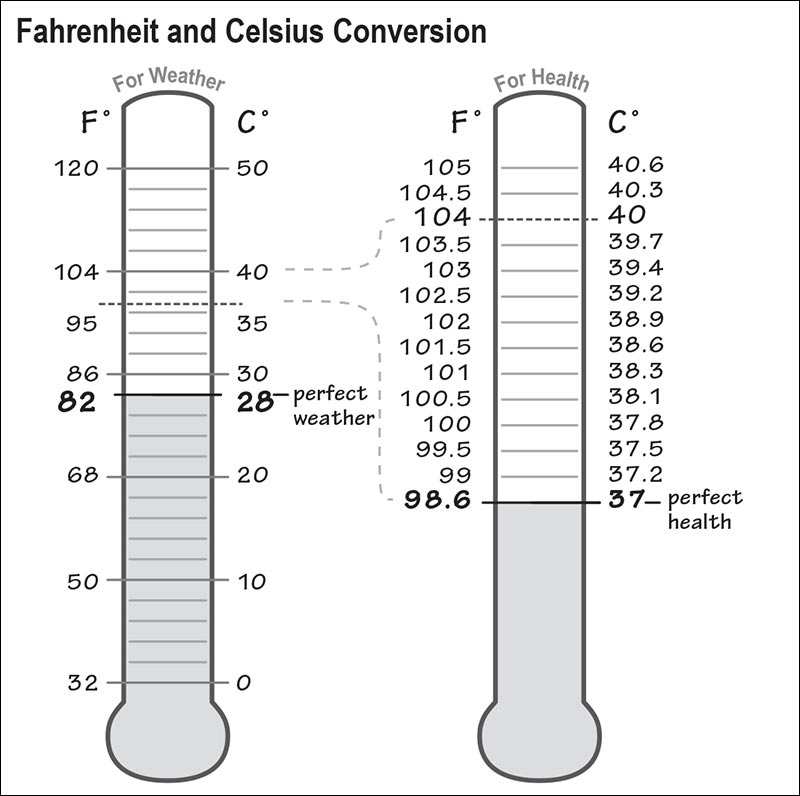
Europe takes its temperature using the Celsius scale, while we opt for Fahrenheit. For a rough conversion from Celsius to Fahrenheit, double the number and add 30. For weather, remember that 28°C is 82°F—perfect. For health, 37°C is just right. At a launderette, 30°C is cold, 40°C is warm (usually the default setting), 60°C is hot, and 95°C is boiling. Your air-conditioner should be set at about 20°C.
Whether you’re traveling for five days or five weeks, you won’t need more than this. Pack light to enjoy the sweet freedom of true mobility.
 5 shirts: long- & short-sleeve
2 pairs pants (or skirts/capris)
1 pair shorts
5 pairs underwear & socks
1 pair walking shoes
Sweater or warm layer
Rainproof jacket with hood
Tie, scarf, belt, and/or hat
Swimsuit
Sleepwear/loungewear
Debit card(s)
Credit card(s)
Hard cash (US $100-200)
Money belt
Passport
Other required ID: Vaccine card/Covid test, entry visa, etc.
Driver’s license, student ID, hostel card, etc.
Tickets & confirmations: flights, hotels, trains, rail pass, car rental, sight entries
Photocopies of important documents
Insurance details
Guidebooks & maps
Mobile phone
Camera & related gear
Tablet/ebook reader/laptop
Headphones/earbuds
Chargers & batteries
Phone car charger & mount (or GPS device)
Plug adapters
Basics: soap, shampoo, toothbrush, toothpaste, floss, deodorant, sunscreen, brush/comb, etc.
Medicines & vitamins
First-aid kit
Glasses/contacts/sunglasses
Face masks & hand sanitizer
Sewing kit
Packet of tissues (for WC)
Earplugs
Daypack
Sealable plastic baggies
Laundry supplies: soap, laundry bag, clothesline, spot remover
Small umbrella
Travel alarm/watch
Notepad & pen
Journal
Second pair of shoes (flip-flops, sandals, tennis shoes, boots)
Travel hairdryer
Picnic supplies
Disinfecting wipes
Water bottle
Fold-up tote bag
Small flashlight
Mini binoculars
Small towel or washcloth
Inflatable pillow/neck rest
Tiny lock
Address list (to mail postcards)
Extra passport photos
Greek Survival Phrases
Knowing a few phrases of Greek can help if you’re traveling off the beaten path. Just learning the pleasantries (such as please and thank you) will improve your connections with locals, even in the bigger cities.
Because Greek words can be transliterated differently in English, I’ve also included the Greek spellings. Note that in Greek, a semicolon is used the same way we use a question mark.