DURHAM & NORTHEAST ENGLAND
Durham • Beamish Museum • Hadrian’s Wall • Holy Island and Bamburgh Castle
Sleeping and Eating near Hadrian’s Wall
Holy Island and Bamburgh Castle
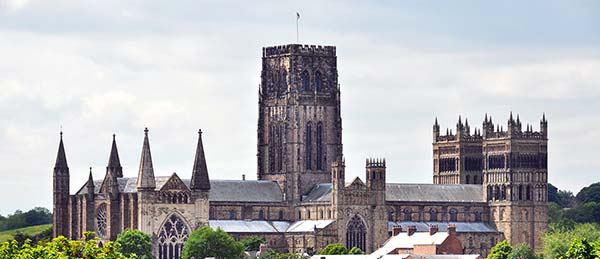
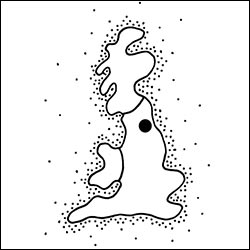
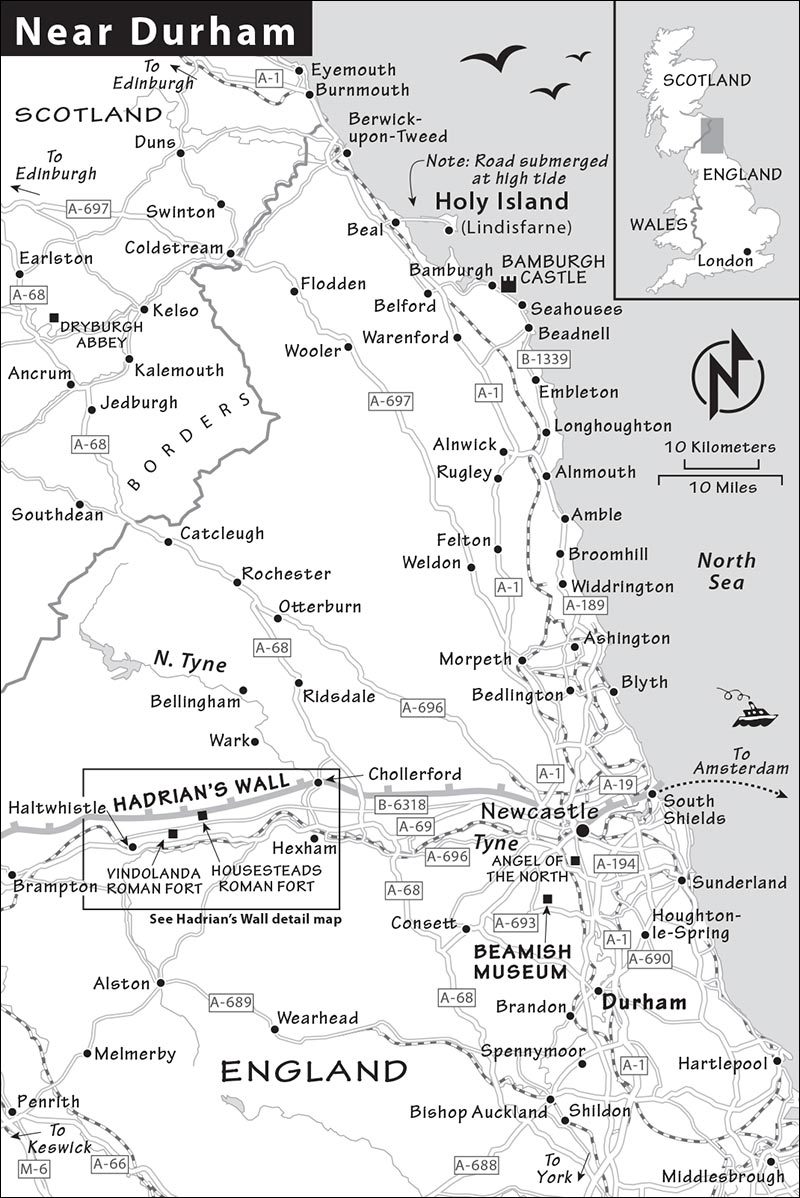
Northeast England harbors some of the country’s best historical sights. Go for a ramble at Hadrian’s Wall, the northwest frontier of the Roman Empire 2,000 years ago, when Britain was a colony. Make a pilgrimage to Holy Island, where Christianity gained its first toehold in Britain. Marvel at England’s greatest Norman church—Durham’s cathedral—and enjoy an evensong service there. At the excellent Beamish Museum, travel back in time to the 19th and 20th centuries.
PLANNING YOUR TIME
For train travelers, Durham is the most convenient overnight stop in this region. But it can be problematic to see en route to another destination as there’s limited baggage storage in Durham: Either stay overnight, check a baggage storage website like Stasher.com, or do Durham as a day trip from York. If you like Roman ruins, visit Hadrian’s Wall (tricky but doable by public transportation). The Beamish Museum is an easy day trip from Durham (less than an hour by bus).
By car, you can easily visit everything in this chapter. Spend a night in Durham and a night near Hadrian’s Wall, stopping at the Beamish Museum on your way to Hadrian’s Wall.
For the best quick visit to Durham, arrive by midafternoon, in time to tour the cathedral and enjoy the evensong service. Sleep in Durham. Visit Beamish the next morning before continuing to your next destination.
Durham
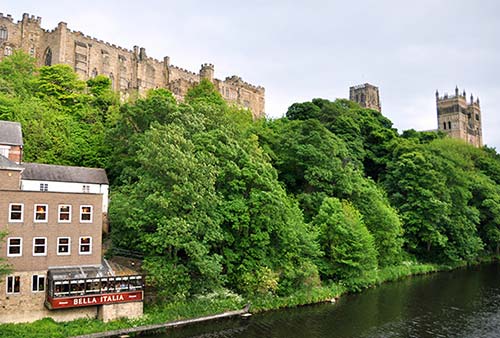
Without its cathedral, Durham would hardly be noticed. But this magnificently situated structure is hard to miss (even if you’re zooming by on the train). Seemingly happy to go nowhere, Durham sits along the tight curve of its river, snug below its castle and famous church. It has a medieval, cobbled atmosphere and a scraggly peasant’s indoor market just off the main square. Durham is home to England’s third-oldest university, with a student vibe jostling against its lingering working-class mining-town feel. Enjoy Durham’s youthful liveliness and small-town warmth—especially on sunny days, when most everyone is out licking ice-cream cones.
Orientation to Durham
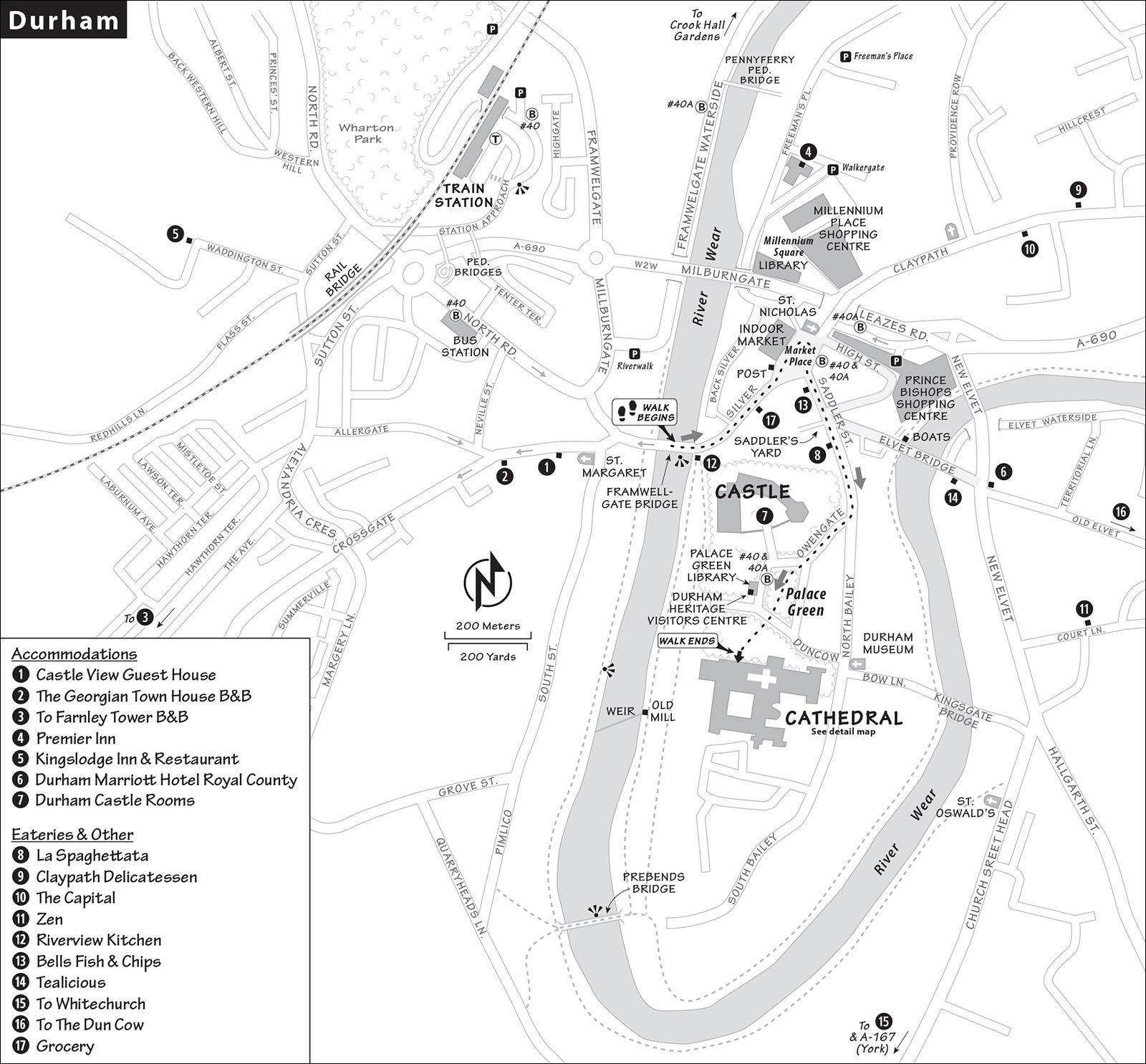
As it has for a thousand years, tidy little Durham (pop. 57,000) clusters everything safely under its castle, within the protective hairpin bend of the River Wear. Because of the town’s hilly topography, going just about anywhere involves a lot of up and down...and back up again. The main spine through the middle of town (Framwellgate Bridge, Silver Street, and Market Place) is level to moderately steep, but walking in any direction from that area involves some serious uphill climbing. Take advantage of the handy Cathedral Bus to avoid the tiring elevation changes—especially up to the cathedral and castle area, or to the train station (perched high on a separate hill).
TOURIST INFORMATION
Durham does not have a physical TI, but the town does maintain a call center and a useful website (calls answered Mon-Fri 9:00-17:00, +44 3000 262 626, www.thisisdurham.com, visitor@thisisdurham.com).
During peak season, volunteer Durham Pointers staff a tourist information cart in Market Place near the equestrian statue. They hand out free maps of the city and offer unbiased advice on Durham attractions—tell them Rick Steves sent you (Easter-early Oct Mon-Fri 9:30-15:30, Sat 10:00-14:30, Sun 11:00-15:00, +44 7582 332 621, www.durhampointers.co.uk).
Though not an official TI, the Durham World Heritage Site Visitor Centre in the Palace Green Library can offer some guidance, including a short video on the town. They also sell tickets to tour the castle (center open daily 10:00-17:00, +44 1913 343 805, www.durhamworldheritagesite.com).
ARRIVAL IN DURHAM
By Train: From the train station, the fastest and easiest way to reach the cathedral is to hop on the Cathedral Bus (see “Getting Around Durham,” later).
To walk into town, exit the station and follow the road curving to the right downhill (you’ll see the bus station down to the left). Take the second pedestrian turnoff (within sight of the railway bridge), which leads almost immediately over a bridge above busy road A-690. Cross the pedestrian bridge and take North Road into town to reach hotels, the river, and the cathedral (you can begin my self-guided walk at Framwellgate Bridge).
By Car: Drivers simply surrender to the wonderful 400-space Prince Bishops Shopping Centre pay parking lot (coming from the A-1/M-1 exit, you’ll run right into it at the roundabout at the base of the old town). An elevator deposits you in the heart of Durham (closed midnight-6:00, a short block from Market Place, +44 1913 750 416, www.princebishops.co.uk).
HELPFUL HINTS
Markets: The main square, Market Place, has an indoor market (generally Mon-Sat 9:00-16:30, closed Sun) and hosts outdoor markets (Sat retail market generally 9:00-16:00, farmers market third Thu 9:00-15:30; +44 1913 846 153, www.durhammarkets.co.uk).
Tours: Each Saturday at 14:00 in peak season, Blue Badge guides offer 1.5-hour city walking tours (£4, meet at Durham World Heritage Site Visitor Centre, confirm schedule with TI call center, +44 3000 262 626).
Former history teacher Peter Carney offers tours of medieval Durham and Durham Cathedral as well as tours around Hadrian’s Wall (see listing under “Getting Around Hadrian’s Wall” on here).
GETTING AROUND DURHAM
The convenient Cathedral Bus makes short work of Durham’s hills. Bus #40 runs between the train station and the cathedral, stopping at the bus station, Market Place, and Palace Green (£1 all-day ticket, 3/hour daily about 9:00-17:00; +44 1913 725 386, www.durham.gov.uk/cathedralbus). Bus #40A stops at Framwellgate Waterside, Market Place, and Palace Green but not the train or bus station (2/hour daily about 10:00-15:45). Confirm the route when you board.
Taxis zip tired tourists to their B&Bs or back up to the train station (about £5 from city center, wait on west side of Framwellgate Bridge at the bottom of North Road or on the east side of Elvet Bridge). If you need to call a taxi, try Polly’s Taxis, +44 7910 179 397.
Durham Walk
• Begin this self-guided walk at Framwellgate Bridge (down in the center of town, halfway between the train station and the cathedral).
Framwellgate Bridge was a wonder when it was built in the 12th century—much longer than the river is wide and higher than seemingly necessary. It was designed to connect stretches of solid high ground and to avoid steep descents toward the marshy river. Note how elegantly today’s Silver Street (which leads toward town) slopes into the Framwellgate Bridge. Until the 1970s, this people-friendly lane was congested with traffic and buses.
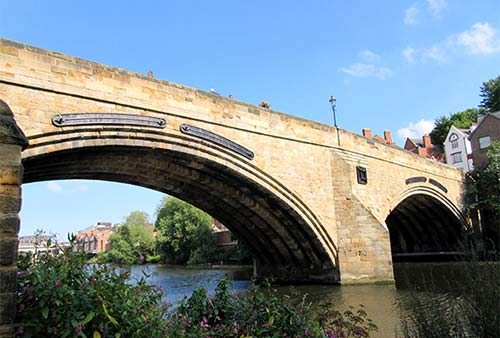
• Follow Silver Street up the hill to the town’s main square.
Durham’s Market Place retains the same plotting the prince-bishop gave it when he moved villagers here in about 1100 (see “Durham’s Early Years” sidebar, later). Each long and skinny plot of land was the same width (about eight yards), maximizing the number of shops that could have a piece of the Market Place action. Find today’s distinctly narrow buildings (facing the Town Hall, there’s one behind you and one to your right) that still fit the 900-year-old plan. The widths of the other buildings fronting the square are multiples of that original shop width.
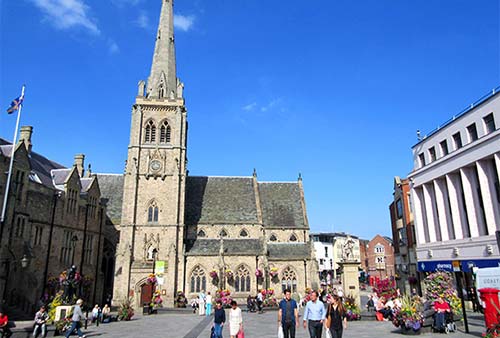
Examine the square’s statues. Coal has long been the basis of this region’s economy. The statue of Neptune was part of an ill-fated attempt by a coal baron to bribe the townsfolk into embracing a canal project that would make the shipment of his coal more efficient. The statue of the fancy guy on the horse is of Charles Stewart Vane, the third Marquess of Londonderry, an Irish aristocrat and a general in Wellington’s army who married a local coal heiress. A clever and aggressive businessman, he managed to create a vast business empire by controlling every link in the coal business chain—mines, railroads, boats, harbors, and so on.
In the 1850s throughout England, towns were moving their markets off squares and into industrial age iron-and-glass halls. Durham was no exception, and today its funky 19th-century indoor market (closed Sun; faces Market Place) is a delight to explore. There are also outdoor markets here on Saturdays and the third Thursday of each month.
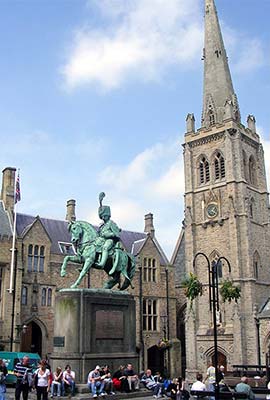
Do you enjoy the sparse traffic in Durham’s old town? It was the first city in England to institute a congestion fee. When a driver enters the town Monday through Saturday between 10:00 and 16:00, a camera snaps a photo of the car’s license plate, and by 18:00 that day the driver must pay a £2 fee or face a £50 fine. Locals brag that London’s similar congestion fee was inspired by Durham’s success.
• Head up the hill on Saddler Street toward the cathedral, stopping where you reach the chunk of wall at the top of a stairway. On the left, you’ll see a bridge.
A 12th-century construction, Elvet Bridge led to a town market over the river. Even today, the bridge leads to an unusually wide road—once swollen to accommodate market action. Shops lined one side of Elvet Bridge in the 12th century, as they do today. An alley separated the bridge from the buildings on the left. When the bridge was widened, it met the upper stories of the buildings on the left, which became “street level.”
Now look at the chunk of wall by the top of the stairs—a reminder of a once-formidable fortification. The Scots, living just 50 miles from here, were on the rampage in the 14th century. After their victory at Bannockburn in 1314, they pushed farther south and actually burned part of Durham. Wary of this new threat, Durham built thick city walls. As people settled within the walls, the population density soared. Soon, open lanes were covered by residences and became tunnels (called “vennels”). A classic vennel leads to Saddlers Yard, a fine little 16th-century courtyard (opposite the wall, look for the yellow Vennels Café sign). While the vennels are picturesque today, centuries ago they were Dickensian nightmares—the filthiest of hovels.
• Continue up Saddler Street. Just before the fork at the top of the street, duck through the blue door next to the Georgian Window sign. You’ll see a bit of the medieval wall incorporated into the brickwork of a newer building and a turret from an earlier wall. Back on Saddler Street, you can see the ghost of the old wall (picture it standing exactly the width of the building now housing the Salvation Army). Veer right at Owengate as you continue uphill to the Palace Green.
The Palace Green was the site of the original 11th-century Saxon town, filling this green between the castle and an earlier church. Later, the town made way for 12th-century Durham’s defenses, which now enclose the green. With the threat presented by raiders and invaders, it’s no wonder people found comfort in a spot like this.
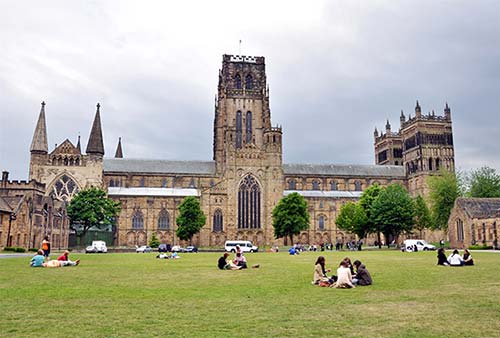
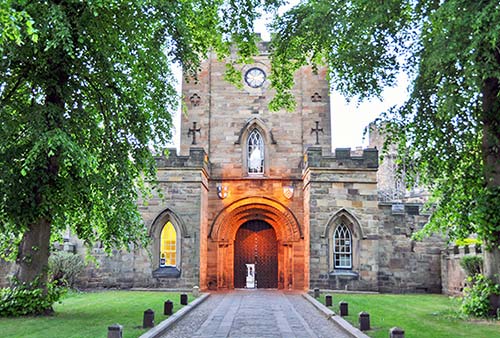
The castle still stands—as it has for a thousand years—on its motte (man-made mound). The castle is accessible with a 45-minute guided tour, which includes the courtyard, kitchens, great hall, and chapel (£5, open most days when school is in session—but schedule varies so call ahead or check online, buy tickets online or at Durham World Heritage Site Visitor Centre in the Palace Green Library, +44 1913 342 932, www.dur.ac.uk/durham.castle).
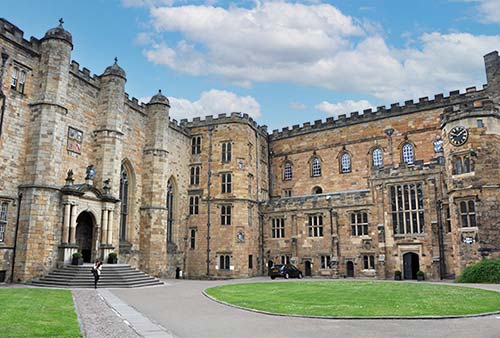
Like Oxford and Cambridge, Durham University is a collection of colleges scattered throughout the town, and even this castle is now part of the school. Look into the old courtyard from the castle gate. It traces the very first and smallest bailey (protected area). As future bishops expanded the castle, they left their coats of arms as a way of “signing” the wing they built. Because the Norman kings appointed prince-bishops here to rule this part of their realm, Durham was the seat of power for much of northern England. The bishops had their own army and even minted their own coins.
• Turning your back to the castle and facing the cathedral, on the right is the university’s Palace Green Library.
The Palace Green Library has a free Museum of Archaeology that chronicles 10,000 years of human history on the site of Durham. It also hosts temporary exhibits throughout the building, usually free. Pop in or check online for current exhibits (may be a charge for traveling exhibits; daily 10:00-17:00, Palace Green, +44 1913 342 932, www.durham.ac.uk/things-to-do).
• This walk ends at Durham’s stunning cathedral, described next.
Sights in Durham
DURHAM CATHEDRAL
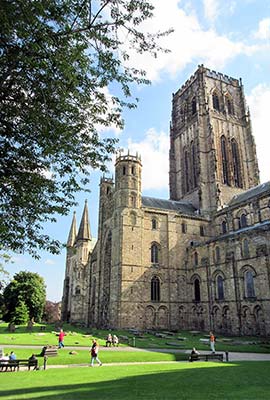
Built to house the much-venerated bones of St. Cuthbert from Lindisfarne, Durham Cathedral, worth ▲▲▲, offers the best look at Norman architecture in England. (“Norman” is British for “Romanesque.”) For a thousand years, this cradle of English Christianity has been praising God.
To really experience the cathedral, attend an evensong service. It’s a spiritual Oz, as the choristers (12 men and as many as 48 girls and boys) sing psalms—a red-and-white-robed pillow of praise, raised up by the powerful pipe organ. If you’re lucky and the service goes well, the organist will run a spiritual musical victory lap as the congregation breaks up.
Cost: Cathedral—free, donation suggested; tower climb—£7.50; cathedral museum—£7.50.
Hours: The cathedral is open to visitors Mon-Sat 10:00-16:00, Sun from 12:00, sometimes closes for special services, opens daily at 8:00 for worship and prayer. Access is limited for a few days in June, when the cathedral is used for graduation ceremonies (check online).
Information: +44 1913 387 178, www.durhamcathedral.co.uk.
Visitor Services: A shop, café, and WC are tucked away in the cloister.
Evensong: Arrive early and ask to be seated in the choir (Tue-Sat at 17:15, Sun at 15:30, 1 hour; visiting choirs sometimes sing on Mon and nearly always fill in when cathedral choir is off on school break mid-July-Aug; +44 1913 387 178). For more on evensong, see here.
Organ Recitals: August through mid-September, noted organists play most Wednesday evenings (£12, 19:30, advance tickets available on the cathedral website under “Calendar”).
Tours: Regular tours run Monday through Saturday. If one is already in session, you’re welcome to join (£7.50; tours at 10:30, 11:30, and 13:30; fewer in winter, call or check website to confirm schedule).
Tower Climb: The view from the tower will cost you 325 steps. Only 35 people can go up at the top of each hour—book online in advance in high season (Mon-Sat 10:00-15:00, sometimes open Sun outside of services; closed during services, events, and bad weather; must be at least 8 years old; enter through south transept).
Cathedral Museum: This collection of the church’s rare artifacts is housed in the former monks’ quarters Mon-Sat 10:00-16:00, closed Sun).
 Self-Guided Tour
Begin your visit outside the cathedral. From the Palace Green, notice how this fortress of God stands boldly opposite the Norman keep of Durham’s fortress of man.
Look closely: The exterior of this awe-inspiring cathedral has a serious skin problem. In the 1770s, as the stone was crumbling, they crudely peeled it back a few inches. The scrape marks give the cathedral a bad complexion to this day. For proof of this odd “restoration,” study the masonry 10 yards to the right of the door. The L-shaped stones in the corner would normally never be found in a church like this—they only became L-shaped when the surface was cut back.
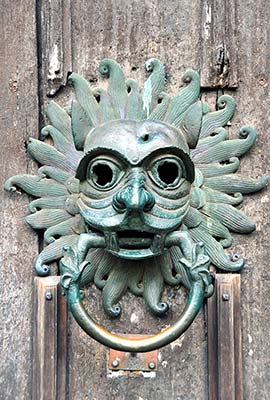
At the cathedral door, check out the big, bronze, lion-faced knocker (this is a replica of the 12th-century original, which is in the Cathedral Museum). The knocker was used by criminals seeking sanctuary (read the explanation).
As you enter, look immediately up to your right at the 1 modern window (Daily Bread) with its aerial view of the Last Supper. This window was given to the church by a local department store. The shapes of the apostles represent worlds and persons of every kind, from the shadowy Judas to the brightness of Jesus. This window is a good reminder that the cathedral remains a living part of the community.
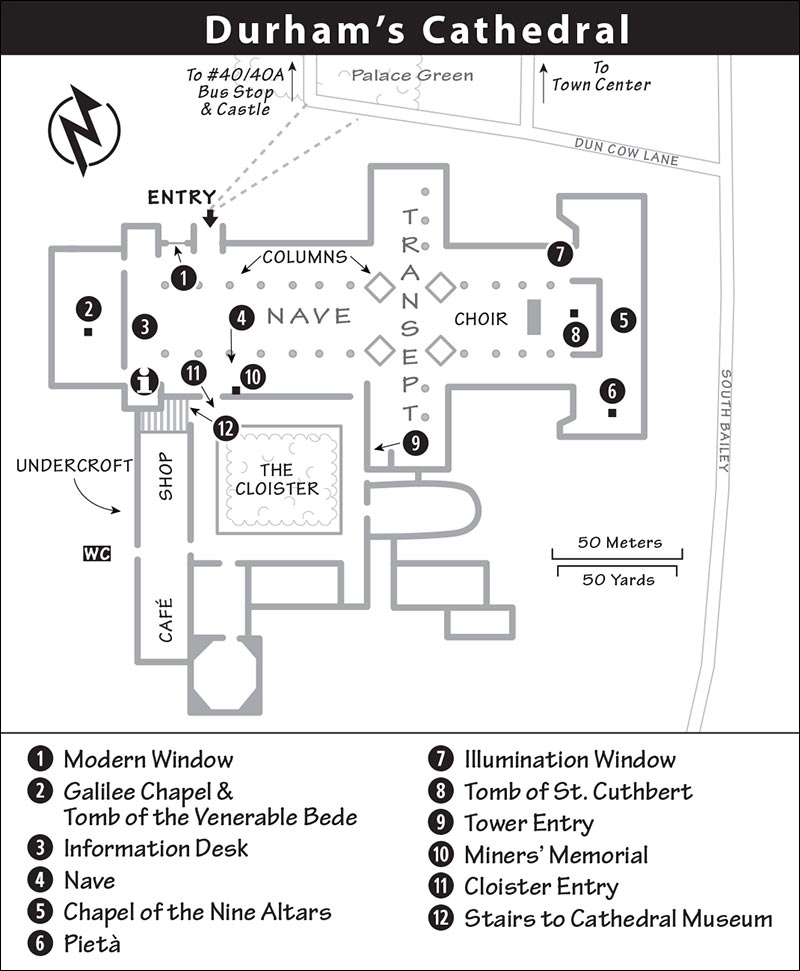
Head to the back of the nave and enter the 2 Galilee Chapel (late Norman, from 1175). Find the smaller altar just to the left of the main altar. The paintings of St. Cuthbert and St. Oswald (seventh-century king of Northumbria) on the side walls of the niche are rare examples of Romanesque (Norman) paintings. Facing this altar, look above to your right to see more faint paintings on the upper walls above the columns. On the right side of the chapel, the upraised tomb topped with a black slab contains the remains of the Venerable Bede, an eighth-century Christian scholar who wrote the first history of England. We know this because the Latin reads, “In this tomb are the bones of the Venerable Bede.”
Exiting the chapel, you’ll pass the handy 3 information desk, which sells tickets for guided tours, the tower climb, and the museum.
Now head into the center of the church. Spanning the 4 nave, the black marble strip on the floor was as close to the altar as women were allowed in the days when this was a Benedictine church (until 1540). Sit down (ignoring the black line) and let the fine proportions of England’s best Norman nave—and arguably Europe’s best Romanesque nave—stir you. All the frilly woodwork and stonework were added in later centuries.
The architecture of the nave is particularly harmonious because it was built in a mere 40 years (1093-1133). The round arches and zigzag-carved decorations are textbook Norman. The church was also proto-Gothic, built by well-traveled French masons and architects who knew the latest innovations from Europe. Its stone and ribbed roof, pointed arches, and flying buttresses were revolutionary in England. Notice the clean lines and simplicity. It’s not as cluttered as other churches for several reasons: For centuries—out of respect for St. Cuthbert—no one else was buried here. During Reformation times, sumptuous Catholic decor was removed. Subsequent fires and wars destroyed what Protestants didn’t.
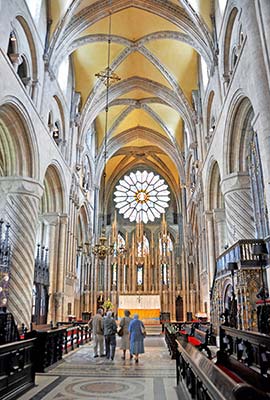
Stroll down the nave to the center, under the highest bell tower in Europe (218 feet). Gaze up. The ropes turn wheels upon which bells are mounted. If you’re stirred by the cheery ringing of church bells, tune in to the cathedral on Sunday (14:30-15:30) or every other Thursday (19:30-21:00 practice, trained bell ringers welcome, https://durhamringers.org), when the resounding notes tumble merrily through the entire town.
Continuing east (all medieval churches faced east), enter the choir. Monks worshipped many times a day, and the choir in the center of the church provided a cozy place to gather in this vast, dark, and chilly building. Mass has been said daily here in the heart of the cathedral for 900 years. The fancy wooden benches are from the 17th century. Behind the altar is the delicately carved Neville Screen from 1380 (made of Normandy stone in London, shipped to Newcastle by sea, then brought here by wagon). Until the Reformation, the niches contained statues of 107 saints. Exit the choir from the far-right side (south). Look for the stained-glass Millennium Window (to your right) that commemorated the church’s 1,000th anniversary in 1995. The colorful scenes depict England’s history, from coal miners to cows to computers.
Step down behind the high altar into the east end of the church, which contains the 13th-century 5 Chapel of the Nine Altars. Built later than the rest of the church, this is Gothic—taller, lighter, and relatively more extravagant than the Norman nave—but look up to see if you can spot an error in the symmetry. On the right, see the powerful modern 6 pietà made of driftwood, with brass accents by local sculptor Fenwick Lawson.
Walk through the chapel to the north end where you will find an 7 illumination window to your left. Designed by the glass artist Mel Howse, the window is a memorial to Sara Pilkington, a Durham University student who tragically died from a cardiac-related condition in 2012. The window casts vibrant colors onto the 8 tomb of St. Cuthbert. Climb a few steps up to enter.
An inspirational leader of the early Christian Church in north England, St. Cuthbert lived in the Lindisfarne monastery (100 miles north of Durham, today called Holy Island and described later in this chapter). He died in 687. Eleven years later, his body was exhumed and found to be miraculously preserved. This stoked the popularity of his shrine, and pilgrims came in growing numbers. When Vikings raided Lindisfarne in 875, the monks fled with his body (and the famous illuminated Lindisfarne Gospels, now in the British Library in London). In 995, after 120 years of roaming, the monks settled in Durham on an easy-to-defend tight bend in the River Wear. This cathedral was built over Cuthbert’s tomb.
Throughout the Middle Ages, a shrine stood here and was visited by countless pilgrims. In 1539, during the Reformation—whose proponents advocated focusing on God rather than saints—the shrine was destroyed. But pilgrims still come, especially on St. Cuthbert’s feast day (March 20).
Continue through the chapel and exit down the stairs. Walk down the south transept (to your left) to the 9 tower entry (tower described earlier), as well as an astronomical clock and the Chapel of the Durham Light Infantry, a regiment of the British Army (1881-1968). The old flags and banners hanging above were actually carried into battle. On the right-hand side over the black door, look for a banner for the Durham Miners Association, one of many miners associations that existed—and still exist—in Durham today.
Return along the left side of the nave toward the entrance. Across from the entry is the door to the cloister. Along the wall by the cloister door, notice the 10 memorial honoring coal miners who died, and those who “work in darkness and danger in those pits today.” (This message is a bit dated since Durham’s coal mines closed in the 1980s.) The nearby book of remembrance lists mine victims. As an ecclesiastical center, a major university town, and a gritty, blue-collar coal-mining town, Durham’s population has long been a complicated mix: priests, academics, and the working class.
Exit the church into the Gothic 11 cloister. Act like a monk and make a clockwise circuit of the cloister (made briefly famous in a scene from the film Harry Potter and the Sorcerer’s Stone in which Harry walks with his owl through a snowy courtyard). This area provides a fine view back up to the church towers.
If you are visiting the 12 cathedral museum, head upstairs to the Monks’ Dormitory, a long, impressive room that stretches out under an original 14th-century timber roof. Formerly the monks’ sleeping quarters, the room now holds artifacts from the cathedral treasury and monks’ library. At the far end of the hall you’ll find a door leading to the Collections Gallery. The double set of glass doors allows the cathedral to display more of its treasures in a climate-controlled environment—sometimes including a copy of the Magna Carta from 1216—as well as items from the Norman/medieval period (when the monks of Durham busily copied manuscripts), the Reformation, and the 17th century. The exhibit continues through the cloister’s Great Kitchen, where relics from St. Cuthbert’s tomb are on view—his coffin, vestments, and cross—and ends in the undercroft.
MORE SIGHTS IN DURHAM
There’s little to see in Durham beyond its cathedral, but it’s a pleasant place to go for a stroll and enjoy the riverside setting.
Durham Museum
Situated in the old Church of St. Mary-le-Bow near the cathedral, this modest, somewhat hokey little museum does its best to illuminate the city’s history and its people, but it’s worthwhile only on a rainy day. The exhibits, which are scattered willy-nilly throughout the old nave, include a reconstructed Victorian-era prison cell and a look at Durham industries past and present, especially coal mining (in Victorian times, the river was literally black from coal). You’ll see a model of what the Market Place looked like in the 1830s, and a 19th-century “death chair,” which carried sick boys to the sanitorium (usually a one-way trip). In the garden on the side of the church are two modern sculptures by local artist Fenwick Lawson, whose work is also in the cathedral.
Cost and Hours: £5; April-Oct Wed-Sun 11:00-16:30, closed Mon-Tue and Nov-March; corner of North Bailey and Bow Lane, +44 1913 845 589, www.durhammuseum.co.uk.
Riverside Path
For a 20-minute woodsy escape with views of the cathedral, walk south on Durham’s riverside path from busy Framwellgate Bridge to sleepy Prebends Bridge. Benches and grassy areas make this a perfect place for a picnic.
Boat Cruise and Rental
Hop on the Prince Bishop for a relaxing one-hour narrated cruise of the river that nearly surrounds Durham (£12, April-Oct; for schedule, call 24-hour info line at +44 1913 869 525 or go down to the dock at Browns Boat House at Elvet Bridge, just east of old town). Sailings vary based on weather and tides. For some exercise with the scenery, you can rent a rowboat at the same pier (£10/hour per person, £10 deposit required, mid-March-Sept daily 10:00-17:00, +44 1913 863 779).
Crook Hall Gardens
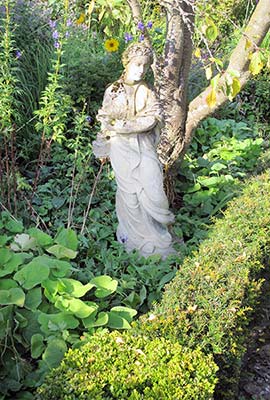
While most English gardens are in the countryside, Crook Hall is only a 10-minute walk from the city center, making it a convenient sight for travelers without a car. Formerly family-owned, it was recently taken over by the National Trust. It has all the elements you’d expect in a classic English garden—walled “secret” gardens, a maze, a moat pool, and topiary hedges. A map and witty signs take you on a self-guided tour. The medieval hall is the only building open to visitors.
Cost and Hours: £8, March-Oct daily 10:00-17:00, Fri-Sun only off-season, café open same hours; pay parking; from the city center, walk across the river and head north along the riverside path—it’s on Frankland Lane, just past the Radisson Blu Hotel; +44 1913 831 832, www.nationaltrust.org.uk/crook-hall-gardens.
Sleeping in Durham
Close-in pickings are slim in Durham, as are B&Bs. Because much of the housing is rented to students, there are only a couple of B&Bs. Otherwise, there are a few hotels within easy walking distance of the town center. During graduation (typically the last two weeks of June), everything is booked well in advance, and prices increase dramatically. Rooms can be tight on weekends any time of year.
BED-AND-BREAKFASTS
$$$ Castle View Guest House rents five airy, restful rooms in a well-located, nearly 300-year-old guesthouse next door to a little church. If it’s sunny, guests relax in the Eden-like backyard. Located on a charming cobbled street, it’s just above Silver Street and the Framwellgate Bridge—take the stairs just after the church (free street-parking permit, 4 Crossgate, +44 1913 868 852, www.castle-view.co.uk, info@castle-view.co.uk, Anne).
$$ The Georgian Town House B&B, just a few doors down from Castle View Guest House, is beautifully decorated. Friendly owner Jane rents two en suite rooms in her own home (sometimes a third family room is available—ask). Her daughter Lucy runs the popular pancake restaurant downstairs (which also serves as the breakfast room for guests) in a cozy space that used to be Jane’s garage (minimum 2-night stay encouraged, free street-parking permit, +44 1913 868 070, www.thegeorgiantownhousedurham.co.uk, thegeorgiantownhouse@yahoo.com).
$$ Farnley Tower, in a restored 19th-century mansion now feted with wildly colorful decor, has 17 large rooms. On a quiet street at the top of a hill, it’s a 15-minute hike up from the town center. Because of its size, you won’t get the same personal touch as other B&Bs, but it’s a solid option if you don’t mind some walking (some rooms with cathedral views, family room, easy free parking, inviting yard, The Avenue—hike up this steep street and look for the sign on the right, +44 1913 750 011, www.farnley-tower.co.uk, enquiries@farnley-tower.co.uk, Raj and Roopal Naik and hard-working Amy). The Naiks also run the inventive Indian restaurant in the same building (B&B guests receive a discount).
HOTELS
When the B&Bs are full, resort to a hotel, even a bigger chain hotel, such as the Marriott (listed below) or the centrally located Premier Inn (on Freeman’s Place).
$$$ Kingslodge Inn & Restaurant is a comfortable 23-room place with charming terraces, an attached restaurant and pub, and a handy location. Situated in a pleasantly wooded setting, it’s convenient for train travelers (family rooms, free parking, Waddington Street, Flass Vale, +44 1913 709 977, www.inncollectiongroup.com/kingslodge-inn, enquiries@kingslodgeinn.co.uk).
$$$ Durham Marriott Hotel Royal County scatters its 150 posh, four-star but slightly scruffy rooms among several buildings sprawling across the river from the city center (breakfast extra, fitness room, elevator, restaurant, terrace bar, pay parking, Old Elvet, +44 1913 866 821, www.marriott.co.uk).
STUDENT HOUSING OPEN TO ANYONE
$$ Durham Castle, a student residence on the castle grounds facing the cathedral, rents rooms during the summer break (generally July-Sept). Request a room in the stylish main building, which is more appealing than the modern dorm rooms (includes breakfast in an elegant dining hall, Palace Green, +44 800 289 970, www.durham.ac.uk—search “Bed and Breakfast”—event@durham.ac.uk). Note that the same office also rents rooms in other university buildings, but most are far less convenient to the city center—make sure to request the Durham Castle location when booking.
Eating in Durham
Durham is a university town with plenty of lively, inexpensive eateries. Stroll down North Road, across Framwellgate Bridge, up through Market Place, and up Saddler Street, and consider the options suggested below. Some of the better choices are a short walk from this main artery.
$$ La Spaghettata serves decent Italian food in a lively, festive setting. The hard-working staff serves pasta, pizza, and daily specials to hungry locals and tourists—but come for the atmosphere more than the cuisine (daily for dinner, Fri-Sun also open for lunch, 66 Saddler Street, +44 1913 839 290).
$ Claypath Delicatessen is worth the five-minute uphill walk above Market Place for lunch. Not just any old deli, this place assembles fresh ingredients and homemade bread into tasty sandwiches, salads, sampler platters, and more. They pride themselves on their killer espresso. While carryout is possible, most people eat in the casual, comfortable café setting or out back on the terrace (Tue-Sat 11:00-16:00, closed Sun-Mon; from Market Place, cross the bridge and walk up Claypath to #57; +44 1913 407 209).
$$ The Capital, on the same stretch of road as Claypath Deli, has well-executed Indian food in a contemporary setting (daily for dinner, 69 Claypath, +44 1913 868 803).
$$$ Zen is a modern, dark-wood place serving curries, noodles, fried rice, and other Asian fare. It’s popular with students (especially on weekends), so it’s best to book a table or go early and sit in the bar. The cozy bamboo dining tent out front has a street-market feel (daily, Court Lane, +44 1913 849 588, www.zendurham.co.uk).
$$ Riverview Kitchen has a friendly staff and tables overlooking the river. They serve a wide variety of burgers, sandwiches, pancakes, salads, cakes, and more (daily breakfast and lunch, 21 Silver Street, +44 1913 845 777).
$ Bells is a standby for carryout fish-and-chips just off Market Place toward the cathedral. I’d skip their fancier dining room (daily, lunch only on Sun, 11 Market Place, +44 1913 848 974).
$ Tealicious is run by mother-and-daughter team Alison and Jenny, who bake homemade cakes and scones for their all-day tea. They also offer fresh soups and sandwiches. Look for a tall, skinny teahouse at the end of Elvet Bridge (Wed-Sat until 16:00, closed Sun-Tue, 88 Elvet Bridge, +44 1913 401 393).
Across the Elvet Bridge: Two good options are within a short walk of the Elvet Bridge (just east of the old town).
$$ Whitechurch is as versatile as it gets—it’s great for coffee and a pastry, a pint on their back patio, a tasty and creative lunch, or an elegant dinner. The decor feels posh-pub chic and the atmosphere is relaxed (café and bar daily 10:00-22:00; food served Sun-Tue until 16:00, Wed-Sat until 20:00, dinner reservations recommended; 29 Church Street Head—from the Elvet Bridge, turn right on New Elvet, then bear right on Church Street Head; +44 1913 868 897, www.whitechurchdurham.com).
$ The Dun Cow is popular with locals and good for beer and ales. There’s a cozy “snug bar” up front and a more spacious lounge in the back. Read the legend behind the pub’s name on the wall along the outside corridor. More sedate than the student-oriented places in the town center, this pub serves only snacks and light meals—come here to drink and nibble, not to feast (daily; from the Elvet Bridge, walk five minutes straight ahead to Old Elvet 37; +44 1913 869 219).
Supermarket: Look for Tesco Express in the old town, just off Market Place (Mon-Sat long hours, Sun until 17:00). You can picnic on Market Place, or on the benches and grass outside the cathedral entrance (but not on the Palace Green, unless the park police have gone home).
Durham Connections
From Durham by Train to: York (4/hour, 50 minutes), Keswick/Lake District (train to Penrith—hourly, 3 hours, 1-2 transfers, then bus to Keswick), London (hourly direct, 3 hours, more with transfers), Hadrian’s Wall (take train to Newcastle—4/hour, 20 minutes, then a train/bus or train/taxi combination to Hadrian’s Wall—see “Getting Around Hadrian’s Wall,” later in this chapter), Edinburgh (hourly direct, 2 hours, more with changes, less frequent in winter). Train info: +44 3457 484 950, NationalRail.co.uk.
ROUTE TIPS FOR DRIVERS
As you head north from Durham on the A-1 motorway (beyond the junction for the Beamish Museum, described next), you’ll pass a famous bit of public art: the Angel of the North, a modern, rusted-metal angel standing 65 feet tall with a wingspan of 175 feet (wider than a Boeing 757). While initially controversial when it was erected in 1998, it has since become synonymous with Northeast England and is a beloved local fixture.
Beamish Museum
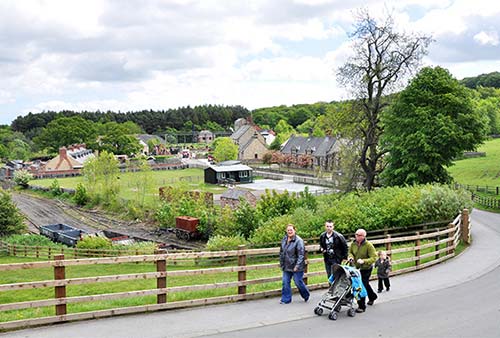
This huge, 300-acre open-air museum, which re-creates life in northeast England during the 19th and 20th centuries, is England’s best museum of its type. To truly appreciate it, you should set aside three to four hours to explore its five sections: Pit Village (a coal-mining settlement with an actual mine); 1900s Town (an early 20th-century street lined with actual shops); Pockerley Old Hall (the manor house of a “gentleman farmer”); 1940s Farm (a preserved farm and farmhouse); and the newest section, 1950s Town (still under development). This isn’t a wax museum. If you touch the exhibits, they may smack you. The attendants who happily explain everything at each stop make your visit worth ▲▲▲.
GETTING THERE
By car, the museum is five minutes off the A-1/M-1 motorway (one exit north of Durham at Chester-le-Street/Junction 63, well signposted; it’s a 12-mile, 25-minute drive northwest of Durham). You’ll find free parking in the hills leading down to the main entrance.
Getting to Beamish from Durham by bus is an uncomplicated affair. Catch bus #X12, #21, #X21, or #50 from the Durham bus station (3-4/hour, 25 minutes) and transfer at Chester-le-Street to bus #8 or #28, which take you right to the museum entrance (2/hour Mon-Sat, hourly Sun, 15 minutes, leaves from South Burns Stand L at the central bus kiosk, +44 1914 205 050, www.traveline.info). Show your bus ticket for a museum discount.
ORIENTATION TO BEAMISH MUSEUM
Cost and Hours: £21; children (5-16)-£12, under 5-free; daily 10:00-17:00; March Wed-Sun until 16:00, closed Mon-Tue; closed Nov-Feb, last entry one hour before closing, +44 1913 704 000, www.beamish.org.uk.
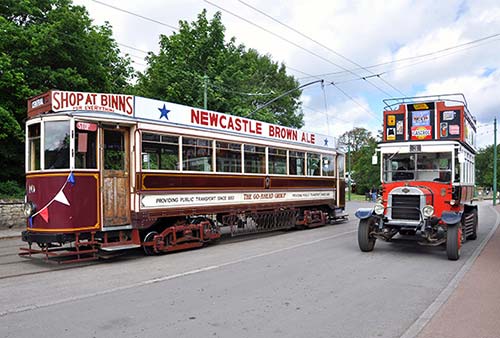
Getting Around the Museum: Pick up a free map at the entry to help navigate the five zones; while some are side-by-side, others are up to a 15-minute walk apart. Vintage trams and cool, circa-1910 double-decker buses shuttle visitors around the grounds, and their attendants are helpful and knowledgeable. Signs on the trams advertise a variety of 19th-century products, from “Borax, for washing everything” to “Murton’s Reliable Travelling Trunks.”
Eating: Several eateries are scattered around Beamish, including a pub and tearooms (in 1900s Town), two fish-and-chips stands (in the Pit Village and the 1950s terrace), and various cafeterias and snack stands. Or bring a picnic.
VISITING THE MUSEUM
I’ve described the five areas in counterclockwise order from the entrance.
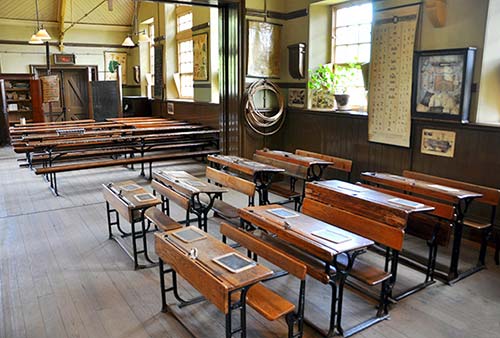
From the entrance building, bear left along the road, then watch for the turnoff on the right to the Pit Village & Colliery. This is a company town built around a coal mine, with a schoolhouse, a Methodist chapel, and a row of miners’ homes with long, skinny pea-patch gardens out front. Poke into some of the homes to see their modest interiors. In the school, explore the different classrooms and look for the interesting poster with instructions for avoiding consumption (a.k.a. tuberculosis, a huge public-health crisis back then).
Next, cross to the adjacent colliery (coal mine), where you can take a fascinating 20-minute tour into the drift mine (may be claustrophobic for some, but it doesn’t go far—if you don’t like it, you can turn back; check in at the “lamp cabin”—tours depart when enough people gather, generally every 5-10 minutes). Your guide will tell you stories about beams collapsing, gas exploding, and flooding; after that cheerful speech, you’ll don a hard hat as you’re led into the mine.
Notice in the lamp cabin how each lamp has a number. Miners arriving for work would yell out their number and be given a lamp and two tokens—one brass, one zinc—with that number. A “bankman” would collect each miner’s zinc token as he entered the mine, returning it to the number board in the lamp cabin. When the miner exited at the end of the day, he would hang his brass token over the zinc one, signifying he’d safely left the mine. You’ll also see a sign discouraging spitting. Miners would salivate a lot, primarily because of tuberculosis, but also from chewing tobacco.
Nearby (across the tram tracks) is the fascinating mine elevator, where you can see the actual steam-powered winding engine used to operate it. A “winderman” may be there to demonstrate how he skillfully eases both coal and miners up and down the tight mine shaft. This delicate, high-stakes job was one of the most sought-after at the entire colliery—passed down from father to son—and the winderman had to stay in this building for his entire shift (the seat of his chair flips up to reveal a built-in WC).
A path leads through the woods to Georgian-era Pockerley, which has two parts. First you’ll see the Waggonway, a big barn filled with steam engines, including the re-created, first-ever passenger train from 1825. (Occasionally this train takes modern-day visitors for a spin on 1825 tracks—a hit with railway buffs.)
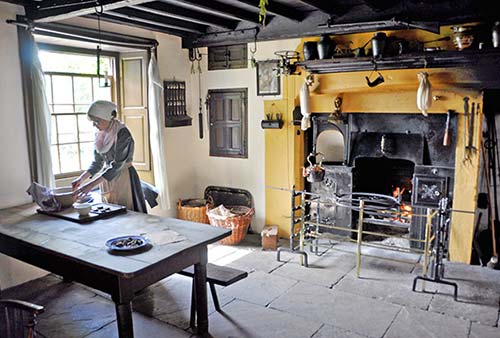
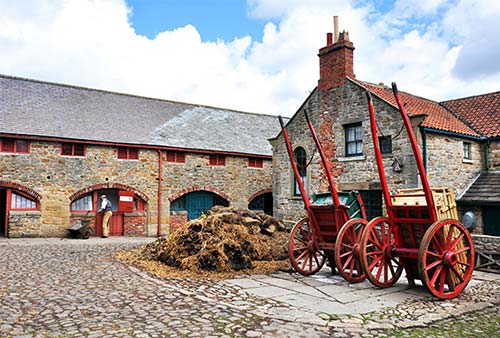
Then, walk back and climb the hill to Pockerley Old Hall, the manor house of a gentleman farmer and his family. The house dates from the 1820s, and—along with the farmhouse described later—is Beamish’s only vintage building still on its original site (other buildings at Beamish were relocated from elsewhere and reconstructed here). While not extremely wealthy, the farmer who lived here owned large tracts of land and could afford to hire help to farm it for him. This rustic home is no palace, but it was comfortable for the period. Costumed docents in the kitchen sometimes bake delicious cookies from old recipes...and hand out samples.
The small garden terrace out front provides beautiful views across the pastures. From the garden, turn left and locate the narrow stairs up to the “old house.” Actually under the same roof as the gentleman farmer’s home, this space consists of a few small rooms that were rented by some of the higher-up workers to shelter their entire families of up to 15 children (young boys worked on the farm, while girls were married off early). While the parents had their own bedroom, the children all slept in the loft up above (notice the ladder in the hall).
From the manor house, hop on a vintage tram or bus or walk 10 minutes to 1950s Town (parts of which may still be under construction), where the buildings include a replica of a local welfare hall and community center (there’s also a playground and mini golf course). Visit the clinic tucked in the back where you may find a midwife, who would offer advice to new parents and do pediatric check-ups. Next, move into the assembly hall to experience card games, dances, and crafts. Farther on, you’ll see several mid-century businesses, including a hair salon, ice cream parlor, and fish-and-chips shop—all of which are fully operational.
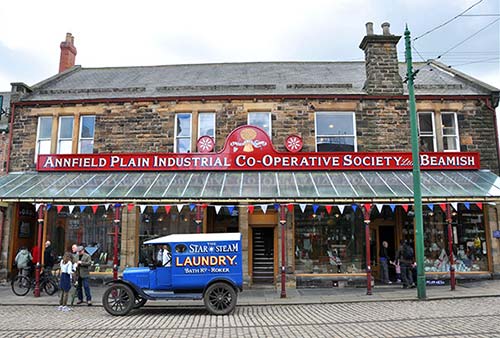
From here, a short walk takes you back to the Edwardian era in 1900s Town (c. 1913). This bustling street features several working shops and other buildings that are a delight to explore. In the Masonic Hall at the beginning of the town, ogle the grand high-ceilinged meeting room. Farther on, check out the fun, old metal signs inside the garage. Across the street, poke into the courtyard to find the stables, which are full of carriages (and sometimes horses). The heavenly-smelling candy store sells old-timey sweets and has a workshop in back with trays of free samples. The newsagent sells stationery, cards, and old toys, while in the grocery, you can see old packaging and the scales used for weighing out products. Other buildings include a clothing store, a working pub (The Sun Inn; don’t expect 1913 prices), Barclays Bank, and a hardware store featuring a variety of “toilet sets” (not what you think).
For lunch, try the Tea Rooms cafeteria (upstairs); or, if the weather is good, picnic in the grassy park with the gazebo next to the tram stop. The row of townhouses includes both homes and offices (if the dentist is in, chat with him to hear some harrowing stories about pre-Novocain tooth extraction). At the circa-1913 railway station at the far end of 1900s Town, you can stand on the bridge over the tracks to watch old steam engines go back and forth—along with a carousel of “steam gallopers.”
Finally, walk or ride a tram or bus to 1940s Farm. (This is the least interesting section—if you’re running short on time, it’s skippable.) Here you’ll get to experience a petting zoo and see a “horse gin” (a.k.a. “gin gan”)—where a horse walking in a circle turned a crank on a gear to amplify its “horsepower,” helping to replace human hand labor. Near the cafeteria, you can cross a busy road to the old farmhouse, still on its original site, where attendants sometimes bake goodies on a coal fire.
Hadrian’s Wall
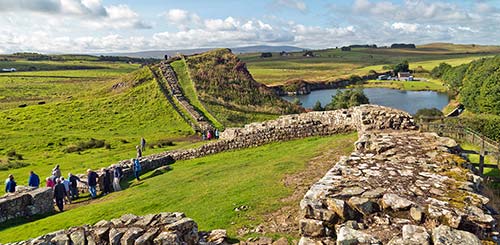
Cutting across the width of the isle of Britain, this ruined Roman wall is one of England’s most thought-provoking sights. Once a towering 20-foot-tall fortification, these days “Hadrian’s Shelf,” as some cynics call it, is only about three feet wide and three to six feet high. (The conveniently precut stones of the wall were carried away by peasants during the post-Rome Dark Ages and now form the foundations of many local churches, farmhouses, and other structures.) In most places, what’s left of the wall has been covered over by centuries of sod, making it effectively disappear into the landscape. But for those intrigued by Roman history, Hadrian’s Wall provides a fine excuse to take your imagination for a stroll. These are the most impressive Roman ruins in Britain. Pretend you’re a legionnaire on patrol in dangerous and distant Britannia, at the empire’s northernmost frontier...with nothing but this wall protecting you from the terrifying, bloodthirsty Picts just to the north.
Today, several restored chunks of the wall, ruined forts, and museums thrill history buffs. While a dozen Roman sights cling along the wall’s route, I’ve focused my coverage on an easily digestible six-mile stretch right in the middle, where you’ll find the best museums and some of the most enjoyable-to-hike stretches of the wall. Three top sights are worth visiting: From east to west, Housesteads Roman Fort shows you where the Romans lived; Vindolanda’s museum shows you how they lived; and the Roman Army Museum explains the empire-wide military organization that brought them here. If you plan to visit all three, the Roman Army Museum is an ideal place to start, as it sets the stage for what you’re about to see; it’s also next to the Walltown Visitor Centre, where you can get your bearings for the region.
A breeze for drivers, this area can also be seen fairly easily in summer by bus for those good at studying timetables (see “Getting Around Hadrian’s Wall,” later).
Hadrian’s Wall is in vogue as a destination for multiday hikes through the pastoral English countryside. The Hadrian’s Wall National Trail runs 84 miles, following the wall’s route from coast to coast (for details, go to www.nationaltrail.co.uk/HadriansWall). Through-hikers (mostly British) can walk the wall’s entire length in four to ten days. You’ll see them bobbing along the ridgeline, drying out their socks in your B&B’s mudroom, and recharging at local pubs in the evening. For those with less time, the brief ridge walk next to the wall from Steel Rigg to Sycamore Gap to Housesteads Roman Fort gives you a perfect taste of the scenery and history.
Orientation to Hadrian’s Wall
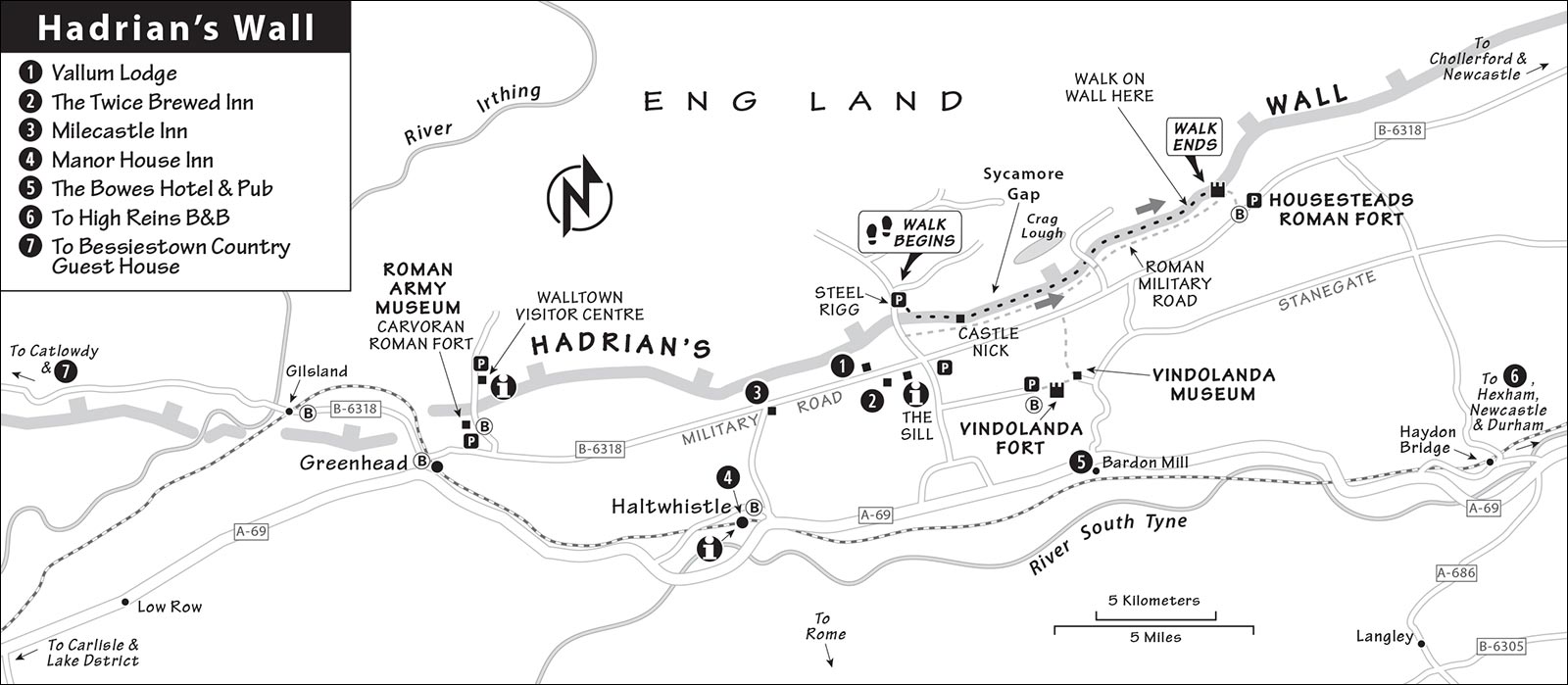
The area described in this section is roughly between the midsize towns of Bardon Mill and Haltwhistle, which are located along the busy A-69 highway. Each town has a train station and some handy B&Bs, restaurants, and services. However, to get right up close to the wall, you’ll need to head a couple of miles north to the adjacent villages of Once Brewed and Twice Brewed (along the B-6318 road).
TOURIST INFORMATION
For an overview of your options, visit the helpful website at HadriansWallCountry.co.uk.
Portions of the wall are in Northumberland National Park. The Walltown Visitor Centre lies along the Hadrian’s Wall bus #AD122 route and has information on the area, including walking guides to the wall (April-Sept daily 10:00-17:00, closed Oct-March, just off the B-6318 next to the Roman Army Museum, follow signs to Walltown Country Park, pay parking, +44 1434 344 396, www.northumberlandnationalpark.org.uk).
Visitor information may also be found at The Sill National Landscape Discovery Centre, next to the recommended Twice Brewed Inn and about a half-mile from the Steel Rigg trailhead. The Sill, with its unique grassland roof, features interactive exhibits about the surrounding landscape and includes an 86-bed hostel, a local crafts shop, and a café (daily 10:00-16:00, pay parking, served by bus #AD122, on the B-6318 near Bardon Mill, +44 1434 341 200, www.thesill.org.uk).
The helpful TI in Haltwhistle, a block from the train station inside the library, has a good selection of maps and schedule information for Hadrian’s Wall bus #AD122 (Mon-Fri 10:00-13:00 & 13:30-16:30, Sat 10:00-13:00, closed Sun, The Library, Westgate, +44 1434 321 863, www.visitnorthumberland.com).
GETTING AROUND HADRIAN’S WALL
Hadrian’s Wall is anchored by the big cities of Newcastle to the east and Carlisle to the west. Driving is the most convenient way to see Hadrian’s Wall. If you’re coming by train, consider renting a car for the day at either Newcastle or Carlisle; otherwise, you’ll need to rely on trains and a bus to connect the sights, hire taxis, or book a private guide with a car. If you’re just passing through for the day using public transportation, it’s challenging to stop and see more than just one or two of the sights—study the schedules carefully and prioritize. Nondrivers who want to see everything—or even hike part of the wall—will need to stay one or two nights along the bus route.
By Car
Zip to this “best of Hadrian’s Wall” zone on the speedy A-69; when you get close, head a few miles north and follow the B-6318, which parallels the wall and passes several viewpoints, minor sights, and “severe dips.” (These road signs add a lot to a photo portrait.) Buy a good local map to help you explore this interesting area more easily and thoroughly. Official Hadrian’s Wall parking lots (including at the Walltown Visitor Centre, the Sill, Housesteads Roman Fort, and the trailhead at Steel Rigg) have pay machines.
Without a Car
To reach the Roman sights without a car, take the made-for-tourists Hadrian’s Wall bus #AD122 (named for the year the wall was built). Essential resources for navigating the wall by public transit include the Hadrian’s Wall Map, the bus #AD122 schedule, and a local train timetable for the Tyne Valley Railway—all available at local visitors centers and train stations (also see www.hadrianswallcountry.co.uk).
By Bus: Bus #AD122 connects the Roman sights (and several recommended accommodations) with train stations in Haltwhistle and Hexham (from £2/ride—buy on board, or £12.50 unlimited Day Rover ticket—buy online; 5/day; +44 1434 205 050, www.gonortheast.co.uk/ad122). If you’re coming from Carlisle or Newcastle, you’ll need to take the train to Haltwhistle or Hexham and pick up the bus there.
By Train: The Tyne Valley Railway runs parallel to and a few miles south of the wall much more frequently than the bus. While the train stops at stations in larger towns—including (west to east) Carlisle, Haltwhistle, Hexham, and Newcastle—it doesn’t take you near the actual Roman sights. To reach them, you can catch bus #AD122 (described above) at Hexham or Haltwhistle (train runs hourly; Carlisle to Haltwhistle—30 minutes; Haltwhistle to Hexham—20 minutes; Hexham to Newcastle—40 minutes; www.northernrail.org [URL inactive]).
In about AD 122, during the reign of Emperor Hadrian, the Romans began constructing this great stone wall. Stretching 73 miles coast to coast across the narrowest stretch of northern England, it was built and defended by some 20,000 troops. Not just a wall, it was a military complex with forts, ditches, settlements, and roads. At every mile of the wall, a castle guarded a gate, and two turrets stood between each castle. The milecastles are numbered (80 covering 73 miles, because a Roman mile was shorter than our mile).
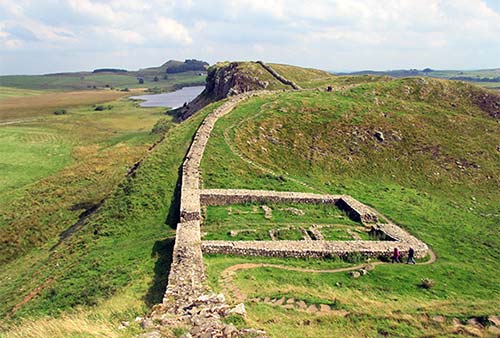
In cross-section, Hadrian’s Wall consisted of a stone wall—around 15 to 20 feet tall—with a ditch on either side. The flat-bottomed ditch on the south side of the wall, called the vallum, was flanked by earthen ramparts and likely demarcated the no-man’s-land beyond, which civilians were not allowed to pass. Between the vallum and the wall ran a service road called the Military Way. Another less-elaborate ditch ran along the north side of the wall. In some areas—including the region that I describe—the wall was built upon a volcanic ridgeline that provided a natural fortification.
The wall’s actual purpose is still debated. While Rome ruled Britain for 400 years, it never quite ruled its people. The wall may have been used for any number of reasons: to protect Roman Britain from invading Pict tribes from the north (or at least cut down on pesky border raids); to monitor the movement of people as a show of Roman strength and superiority; or to simply give an otherwise bored army something to do. (Emperors understood that nothing was more dangerous than a bored army.) Or perhaps the wall represented Hadrian’s tacit admission that the empire had reached its maximum extent; Hadrian was known for consolidating his territory, in some cases giving up chunks of land that had been conquered by his predecessor, Trajan, to create an easier-to-defend (if slightly smaller) empire. His philosophy of “defense before expansion” is embodied by the impressive wall that still bears his name.
By Taxi: These Haltwhistle-based taxi companies can help you connect the dots: Sproul (+44 7712 321 064) or Diamond (+44 7597 641 222). It costs about £14 one-way from Haltwhistle to Housesteads Roman Fort (arrange for return pickup or have museum staff call a taxi). Note that on school days, taxis are busy shuttling rural kids to and from class in the morning (about 8:00-10:00) and afternoon (about 14:30-16:30), so you may have to wait.
By Private Tour: Peter Carney, a former history teacher who waxes eloquently on all things Roman, offers tours with his car and also leads guided walks around Hadrian’s Wall, including the Roman Army Museum, Vindolanda, and Housesteads. He is happy to customize the tour to suit your time frame and interests (£225/day for up to 4 people, £165/half-day, does not include museum admission, £125 extra for pick-up at Carlisle or Durham, £100 extra at Newcastle train station, +44 7585 139 016, www.hadrianswall-walk.com, petercarney@hadrianswall-walk.com). Peter also offers tours in Durham.
Baggage Storage: If you’re day-tripping, you can store your luggage in Newcastle at the bus station, which is part of the Eldon Square Shopping Center, a five-minute walk north of the train station (https://eldonsquare.co.uk/our-stores). In Carlisle try a web-based service such as Stasher.com. If you want to walk the wall, a baggage-courier service can send your luggage ahead to your next B&B in the area (about £10/bag; contact Hadrian’s Haul, +44 7799 828 282, https://hadriansbags.co.uk).
Sights at Hadrian’s Wall
▲▲Hiking the Wall
It’s enjoyable to hike along the wall speaking Latin, even if only for a little while. Note that park rangers forbid anyone from actually walking on top of the wall, except along a very short stretch at Housesteads. On the following hike, you’ll walk alongside the wall.
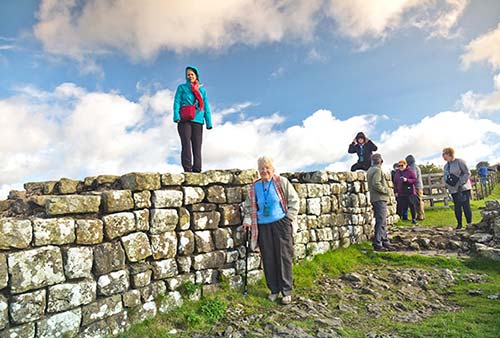
For a good, craggy, three-mile, one-way, up-and-down walk along the wall, hike between Steel Rigg and Housesteads Roman Fort. For a shorter hike, begin at Steel Rigg (where there’s a pay parking lot) and walk a mile to Sycamore Gap, then back again (described next; the Sill and Walltown visitors centers hand out a free description of this walk). These hikes are moderately strenuous and are best for those in good shape. You’ll need sturdy shoes and a windbreaker to comfortably overcome the often-blustery environment. As you would while driving in Britain, stay on the left side of the path when you meet other hikers.
To reach the trailhead for the short hike from Steel Rigg to Sycamore Gap, take the little road off the B-6318 near the Twice Brewed Inn and park in the lot on the right at the crest of the hill. Walk through the gate to the shoulder-high stretch of wall, go to the left, and follow the wall running steeply down the valley below you. Ahead of you are dramatic cliffs, creating a natural boundary made to order for this Roman fortification. Walk down the steep slope into the valley, then back up the other side (watch your footing on the stone stairs). Following the wall, you’ll do a similar up-and-down routine three more times, like a slow-motion human roller coaster.
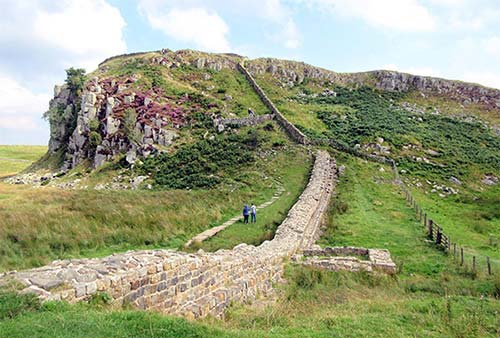
In the second gap is one of the best-preserved milecastles, #39 (called Castle Nick because it sits in a nick in a crag). Each milecastle controlled a gate, and the gates meant income since the Roman Empire would take a cut every time goods passed through them. That may explain why Hadrian wanted so many gates, even when there were rugged hills and cliffs in the way.
Soon after Castle Nick, you’ll reach the third gap, called Sycamore Gap for the large symmetrical tree that once stood there. The tree was much loved by locals and tourists alike. Sadly, vandals cut it down in 2023, leaving it resting on the ancient wall. Though it’s uncertain what will happen to the remains, discussions are underway about preserving it in some way.
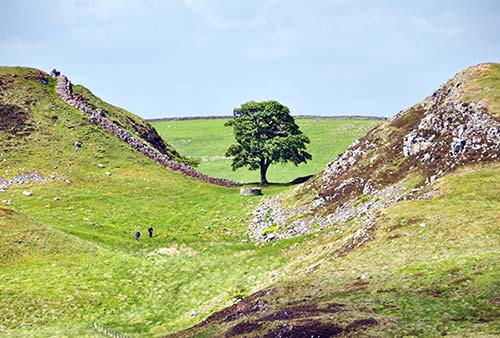
From here you can either hike back the way you came or walk down a short stretch toward the main road to find a less strenuous path, which skirts lower down on the ridge (rather than following the wall up and down). The lower path leads back to the base of the Steel Rigg hill, where you can huff back up to your car.
If you continue on to Housesteads, you’ll pass a traditional Northumbrian sheep farm, windswept lakes, and more ups and downs. The farther you go, the fewer people you’ll encounter, making this hike even more magical. As you close in on Housesteads, you’ll be able to actually walk on top of the wall.
▲▲Housesteads Roman Fort
With its respectable museum, powerful scenery, and the best-preserved segment of the wall, this is your best single stop at Hadrian’s Wall. It requires a steep hike up from the parking lot, but once there it’s just you, the bleating sheep, and memories of ancient Rome.
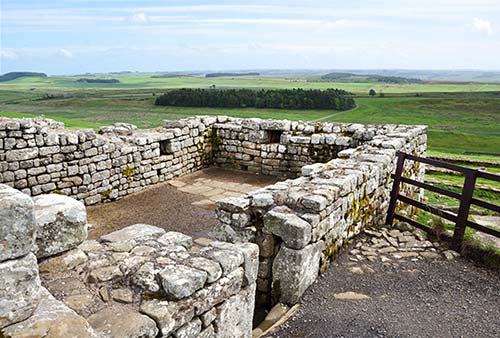
Cost and Hours: £10 for site and museum, discount with bus ticket; daily 10:00-17:00, Nov-March until 16:00, last entry 45 minutes before closing; pay parking, bus #AD122 stops here; museum +44 1434 344 363, info +44 3703 331 181, www.english-heritage.org.uk/housesteads.
Visitor Services: The parking lot has WCs and a snack bar. You’ll find the visitor center and gift shop up the hill in the museum.
Visiting the Museum and Fort: From the parking lot, you’ll hike about a half-mile uphill to the fort. At the top of the hill, buy your ticket in the museum (on the left) and breeze through it before touring the site. While smaller and housing fewer artifacts than the museum at Vindolanda, it’s interesting nonetheless. Look for the giant Victory statue, which once adorned the fort’s East Gate; her foot is stepping on a globe, serving as an intimidating reminder to outsiders of the Romans’ success in battle. A good seven-minute film shows how Housesteads (known back then as Vercovicium) would have operated.
Artifacts offer more insights into those who lived here. A cooking pot from Frisia (Northern Holland) indicates the presence of women, showing that soldiers came with their families in tow. A tweezer, probe, spoons, and votive foot (that would have been offered to the gods in exchange for a cure for a foot ailment) reveal the type of medical care you could expect. And a weighted die and a coin mold—perhaps used to make counterfeit money—show what may have been the less-than-savory side of life at the fort.
After exploring the museum, head out to the sprawling ruins of the fort. Interpretive signs and illustrations explain what you’re seeing. All Roman forts were the same rectangular shape and design, containing a commander’s headquarters, barracks, and latrines (Housesteads has the best-preserved Roman toilets found anywhere—look for them at the lower-right corner, smartly downwind). This fort also had a hospital, granary, and a bakery where the soldiers would bake bread and cook meals. The fort was built right up to the wall, which runs along its upper end.
Even if you’re not a hiker, take some time to walk the wall here. (This is the one place along the wall where you’re actually allowed to get up and walk on top of it for a photo op.) Visually trace the wall to the left to see how it disappears into a bank of overgrown turf. Game of Thrones fans may enjoy visualizing how author George R. R. Martin was inspired by Hadrian’s Wall to create the famous ice wall in his books.
▲▲Vindolanda Fort and Museum
This large Roman fort (which predates the wall by 40 years) and museum are just south of the wall. Although Housesteads has better ruins and the wall, Vindolanda has an impressive museum, packed with artifacts that reveal intimate details of Roman life.
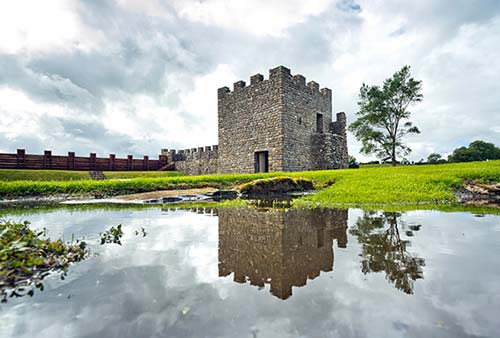
Vindolanda has two entrances, east and west; use the west main entrance for easy access. To get there, follow the signs to Vindolanda from the A-69 or the B-6318. (If you see a steep hill from the parking lot, you are at the east entrance.)
Cost and Hours: £12.50, £16 combo-ticket includes Roman Army Museum, discount with bus ticket; daily 9:30-17:00, last entry one hour before closing; free parking with entry, bus #AD122 stops here, café; +44 1434 344 277, www.vindolanda.com.
Visitor Information: A free map and low-cost guidebook are available at the entrance.
Tours: Free guided tours are offered April through October (daily at 11:00 and 13:00, June-Aug also Sat-Sun 10:00 and 12:00, call or check website to confirm).
Archaeological Dig: The Vindolanda site is an active dig—from Easter through September, you’ll see the excavation work in progress (usually Mon-Fri, weather permitting). Much of the work is done by volunteers, including armchair archaeologists from the US.
Visiting the Site and Museum: After entering, stop at the model of the entire site as it was in Roman times (c. AD 213-276). Notice that the site had two parts: the fort itself, and the vicus (town) just outside that helped to supply it.
Head out to the site, walking through 500 yards of grassy parkland decorated by the foundation stones of the Roman fort and a full-size replica chunk of the wall. Over the course of 400 years, at least nine forts were built on this spot. The Romans, by lazily sealing the foundations from each successive fort, left modern-day archaeologists with a 20-foot-deep treasure trove of remarkably well-preserved artifacts: keys, coins, brooches, scales, pottery, glass, tools, leather shoes, bits of cloth, and even a wig. Many of these are now displayed in the museum, well described in English, German, French, and...Latin.
At the far side of the site, pass through the pleasant riverside garden area on the way to the museum. The well-presented museum pairs actual artifacts with insightful explanations—such as a collection of Roman shoes with a description about what each one tells us about its wearer (including women and children). The weapons (including arrowheads and spearheads) and fragments of armor are a reminder that Vindolanda was an important outpost on Rome’s northern boundary—look for the Scottish skull stuck on a pike to discourage rebellion.
Thanks to Vindolanda’s boggy grounds, trash tossed away by the Romans was preserved in an airless environment. You’ll see the world’s largest collection of Roman leather; tools that were used for building and expanding the fort; locks and keys (the fort had a password that changed daily—jotting it on a Post-It note wasn’t allowed); a large coin collection; items imported here from the far corners of the vast empire (such as fragments of French pottery and amphora jugs from the Mediterranean); beauty aids such as combs, tools for applying makeup, and hairpins; and religious pillars and steles.
But the museum’s main attraction is its collection of writing tablets. A good video explains how these impressively well-preserved examples of early-Roman cursive were discovered here in 1973. Displays show some of the actual letters—written on thin pieces of wood—alongside the translations. These letters bring Romans to life in a way that ruins alone can’t. The most famous piece (described but not displayed here) is the first known example of a woman writing to a woman (an invitation to a birthday party). A large interactive screen lets you choose and read tablets selected by Robin Birley, a British archaeologist and former leader of the excavations.
A separate room hosts the Wooden Underworld gallery. Although the Romans built in stone, many of their everyday personal objects were made of wood, and this gallery hosts a collection of 2,000 items. See if you can find the wooden toilet seat and the toy sword.
Finally, you’ll pass through an exhibit about the history of the excavations, including a case featuring the latest discoveries, on your way to the shop and cafeteria.
▲▲Roman Army Museum
This museum, a few miles farther west at Greenhead (near the site of the Carvoran Roman fort), has interactive exhibits illustrating the structure of the Roman army that built and monitored this wall, with a focus on the everyday lifestyles of the Roman soldiers stationed here. Bombastic displays, life-size figures, and several different films—but few actual artifacts—make this entertaining museum a good complement to the archaeological emphasis of Vindolanda.
Cost and Hours: £8, £16 combo-ticket includes Vindolanda, discount with bus ticket; daily 10:00-17:00, shorter hours off-season—check website; free parking with entry, bus #AD122 stops here, +44 1434 344 277; www.vindolanda.com.
Visiting the Museum: In the first room, a video explains the complicated structure of the Roman army—legions, cohorts, centuries, and so on. While a “legionnaire” was a Roman citizen, an “auxiliary” was a noncitizen specialist recruited for their unique skills (such as horsemen and archers). A video of an army-recruiting officer delivers an “Uncle Caesar wants YOU!” speech to prospective soldiers. A timeline traces the history of the Roman Empire, especially as it related to the British Isles.
The good 20-minute Edge of Empire 3-D movie offers an evocative look at what life was like for a Roman soldier marking time on the wall, and digital models show reconstructions of the wall and forts. In the exhibit on weapons, shields, and armor (mostly replicas), you’ll learn how Roman soldiers trained with lead-filled wooden swords, so that when they went into battle, their metal swords felt light by comparison. Another exhibit explains the story of Hadrian. The man behind the wall stopped the expansion of the Roman Empire, declaring that the age of conquest was over.
Sleeping and Eating near Hadrian’s Wall
If you want to spend the night near Hadrian’s Wall, set your sights on the area of Once Brewed and Twice Brewed, with a few overnight options, a good pub, and easy access to the most important sights. I’ve also listed other accommodations scattered around the region.
IN AND NEAR ONCE BREWED AND TWICE BREWED
Although the use of these two names can be slightly confusing, they simply describe a handful of houses that sit at the base of the ridge along the B-6318. Many locals just refer to the area as “The Sill.” The Twice Brewed Inn and Milecastle Inn are reachable with Hadrian’s Wall bus #AD122. Bus drivers can drop you off at Vallum Lodge by request (but they won’t pick you up).
$$ Vallum Lodge is a cushy, comfortable, nicely renovated base situated near the vallum (the ditch that forms part of the fortification a half-mile from the wall itself). Its six cheery rooms are all on the ground floor, along with a guest lounge, and a separate guesthouse called the Snug has one bedroom and a kitchen. It’s just up the road from The Twice Brewed Inn—a handy dinner option (pay laundry service, Military Road, +44 1434 344 248, www.vallum-lodge.co.uk, stay@vallum-lodge.co.uk, Samantha).
$$ The Twice Brewed Inn, two miles west of Housesteads and a half-mile from the wall, rents 19 basic, workable rooms, all en-suite (Military Road, +44 1434 344 534, www.twicebrewedinn.co.uk, info@twicebrewedinn.co.uk). The inn’s friendly $$ brewpub serves as the community gathering place and is a hangout for hikers and the archaeologists digging at the nearby sites. It serves real ales and large portions of good pub grub (vegetarian options, fancier restaurant in back with same menu—reservations recommended; long hours daily). They also have a distillery and a planetarium—the Hadrian’s Wall area has received a Dark Sky Park designation.
West of Once/Twice Brewed: Hungry national park rangers say the $$ Milecastle Inn offers the best dinner around. You can order food (including all sorts of exotic game) at the counter and sit in the pub or take a seat in the table-service area or the “snug” up front. Make sure to finish off with their sticky toffee pudding with custard (daily, smart to reserve in summer, North Road, +44 1434 341 248, www.milecastle-inn.co.uk).
IN HALTWHISTLE
The larger town of Haltwhistle has a train station, along with stops for Hadrian’s Wall bus #AD122 (at the train station and a few blocks east, at Market Place). It also has a helpful TI (see “Tourist Information,” earlier), a launderette, several eateries, and a welcoming inn.
$$ Manor House Inn, right in the center of the town that calls itself the “Centre of Britain,” is a family-run place with 10 comfortable rooms. There’s a cozy medieval lodge-feeling restaurant downstairs and a beer garden out back (family room, two apartments also available in the courtyard, free parking, +44 1434 322 588, www.manorhousehaltwhistle.com, welcome@manorhousehaltwhistle.com).
IN BARDON MILL
$$ The Bowes Hotel, with its friendly staff, is a hotel in name only—it’s run with B&B-like care by cheerful Ian and Sar. Just a two-minute walk from the train station, it has six attractive, shipshape rooms. The $$ pub downstairs has a good selection of ales and serves food daily from 12:00 (family room, +44 1434 344 237, www.theboweshotel.uk, ian@theboweshotel.uk).
NEAR HEXHAM
$ High Reins offers six rooms in a stone house built by a shipping tycoon in the 1920s. The rooms are cushy and comfortable—there’s a cozy feeling all over the place (lounge, 1 mile south of train station on the western outskirts of Hexham, Leazes Lane, +44 1434 603 590, www.highreins.uk, bookings@highreins.uk, Jan and Peter Walton). They also rent an apartment in the town center.
NEAR CARLISLE
$$ Bessiestown Country Guest House, located far northwest of the Hadrian sights, is convenient for drivers connecting the Lake District and Scotland. It’s a quiet and soothing stop in the middle of sheep pastures, with four bedrooms in the main house, a pair of two-bedroom apartments, and a honeymoon suite in the former stables. One apartment is on the ground floor, with an accessible bathroom (discount with 3-night stay; in Catlowdy, midway between Gretna Green and Hadrian’s Wall, a 30-minute drive north of Carlisle; +44 1228 577 219, www.bessiestown.co.uk, info@bessiestown.co.uk, gracious Margaret and Jack Sisson).
Holy Island and Bamburgh Castle
This remote area is worthwhile only for those with a car. It’s out of the way for most itineraries—unless you’re driving between Durham and Edinburgh on the A-1 highway, in which case Holy Island and Bamburgh Castle (and the Beamish Museum, described earlier) are easy stop-offs.
Holy Island
Twelve hundred years ago, this “Holy Island”—then known as Lindisfarne—was Christianity’s tenuous toehold on England. In the AD 680s, Holy Island was the home and original burial ground of St. Cuthbert (he’s now in Durham). We know it as the source of the magnificent Lindisfarne Gospels (AD 698; now in London’s British Library), decorated by monks with some of the finest art from Europe’s “Dark Ages.” By the ninth century, Viking raids forced the monks to take shelter in Durham, but they returned centuries later to reestablish a church on this holy site.
Today Holy Island—worth ▲▲—makes a pleasant stop for modern-day pilgrims: You’ll cross a causeway to a quiet town with a striking castle and the ruins of an evocative priory that was originally founded in 635.
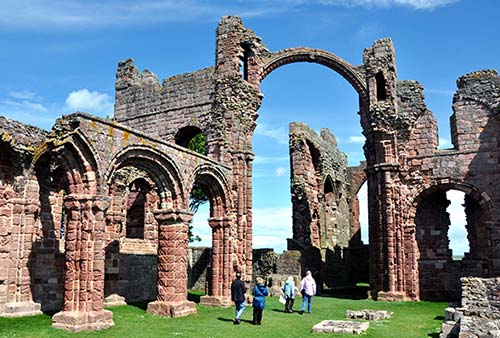
GETTING TO HOLY ISLAND
Holy Island is reached by a two-mile causeway that’s cut off twice a day by high tides. Safe crossing times are posted at each end of the causeway (and at www.lindisfarne.org.uk). Once on the island, signs direct you to a well-marked, mandatory pay parking lot at the entrance to town.
It’s also possible to reach Holy Island by public transit, but it’s not worth the effort unless you’re a determined pilgrim. From Newcastle, take a train to Berwick-upon-Tweed, then catch Borders bus #477 (2/day July-Aug Mon-Sat, none Sun; limited schedule other months, primarily Wed and Sat, carefully confirm complete connection before you head out, +44 1896 754 350, www.bordersbuses.co.uk). Or call Woody’s Taxis to arrange a shuttle from Berwick-upon-Tweed (book in advance, +44 1289 547 009, www.berwickupontweedtaxis.co.uk).
GETTING AROUND HOLY ISLAND
From the parking lot, it’s an easy 10-minute walk into town and to the priory; the castle is about a 20-minute walk away. A convenient shuttle bus makes a circuit from the parking lot to the village green (next to the priory entrance), then out to the castle, and back again (£2, 2/hour, runs only when castle is open).
Sights on Holy Island
The three main attractions on Holy Island are the ruins of the old priory, the lookout tower, and the castle outside of town. The town itself is a charming little community of about 150 residents.
Holy Island Town
The town has B&Bs and cafés catering to tourists, a tiny post office, a fire station (with no firefighters—they’re helicoptered in when the need arises), a six-student schoolhouse, and a tiny winery offering free tastes of their Lindisfarne mead. There’s no official TI, but the Lindisfarne Centre—with a well-presented, kid-friendly history exhibit—acts as an unofficial information point and is proudly staffed by native Holy Islanders (£4 to tour the exhibit, daily April-Oct 10:00-16:00, open sporadically Nov-March, Marygate, +44 1289 389 004, www.lindisfarne.org.uk).
Lindisfarne Priory
The priory has an evocative field of ruined church walls and a tiny but instructive museum. (A priory—run by a prior rather than an abbot—is similar to an abbey but smaller.)
Cost and Hours: £10, includes both museum and priory ruins, advance booking recommended; generally May-Oct daily 10:00-17:00, shorter hours off-season, hours can change from day to day—confirm on website; low-cost guidebook available, +44 1289 389 200, www.english-heritage.org.uk/lindisfarne.
Visiting the Priory: In the museum, you’ll see exhibits about Holy Island’s Anglo-Saxon culture, from stonework to manuscripts—including the famous Lindisfarne Gospels. The gospel text was in Latin, the language of scholars ever since the Roman Empire, but the illustrations—with elaborate tracery and interwoven decoration—are a mix of Irish, classical, and even Byzantine forms. These gospels are a reminder that Christianity almost didn’t make it in Europe. After the fall of Rome (which had established Christianity as the empire’s official religion), much of Europe reverted to its pagan ways. In that chaotic era, Lindisfarne—an obscure monastery of Irish monks on a remote island—was one of the few beacons of light, tending the embers of civilization through the long night of the Dark Ages.
You can visit the adjacent church and churchyard without paying, but you need a ticket to get into the actual priory ruins. The Lindisfarne monks fled the island in AD 875 to escape Viking raids. They made their way to Durham and built a cathedral to hold the tomb of St. Cuthbert (see “Sights in Durham,” earlier). Centuries later, in 1082, the monks returned to Holy Island to reestablish the priory and build a fine church in Norman (Romanesque) style. They fended off invasions by Picts and Scots throughout the 14th century and fortified the great church. But when Henry VIII “dissolved” (destroyed) the monasteries in the 1530s, the priory was one of his victims. The forgotten ruins were later excavated in the 1850s as an important example of early English (Anglo-Saxon) history.
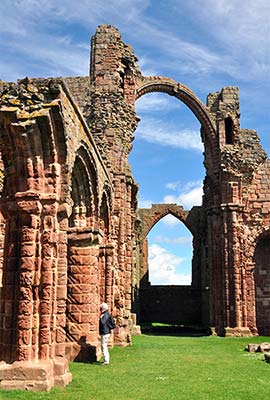
As you walk through this site, you’re stepping on several layers of history: a ruined Norman church sitting on the ruins of an earlier Anglo-Saxon one (where Cuthbert served as bishop), next to the still-standing Parish Church of St. Mary’s, where Holy Islanders worship today. The priory ruins are well explained by posted plaques and floor plans that help resurrect the rubble.
Lookout Tower
Situated on the “Heugh” (a stone ridge protecting the eastern harbor), this former coast guard tower has been turned into a 360-degree viewpoint open to the public. Climb up and enjoy the view. On a clear day you can see Bamburgh Castle in the distance. Notice the two stone obelisks in the water; these served as early 19th-century navigation beacons. To get to the tower from the priory entrance, head toward The Crown and Anchor pub and follow the small path to the right.
Lindisfarne Castle
Faintly visible from the priory ruins, the dramatically situated Lindisfarne Castle is enticing from afar. It makes for a fine photo op, but there’s little of interest inside. Built in 1549—many centuries after the heyday of Cuthbert and the monks—the castle never really saw much action, and it was converted into a holiday home for an aristocratic publisher in the early 1900s. If you do visit, you’ll wander through sparsely furnished rooms and stroll out onto the upper battery—an outdoor terrace with views of the priory ruins.
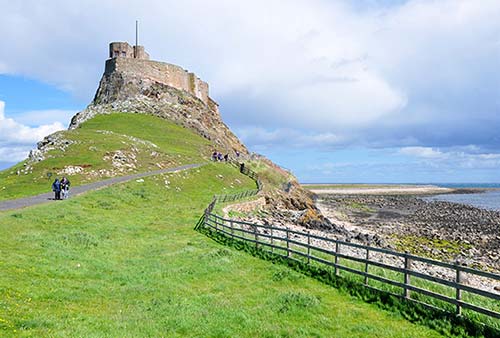
Cost and Hours: £8.50, advance booking recommended; Mon-Thu and Sat-Sun generally 10:00-17:00, closed Fri; closed Nov-mid-March; hours depend on tides—confirm on website or at the National Trust shop on Marygate in town before heading out, +44 1289 389 244, www.nationaltrust.org.uk/lindisfarne.
Bamburgh Castle
About 10 miles south of Holy Island, this grand castle—worth ▲—dominates the Northumbrian countryside and overlooks Britain’s loveliest beach. Bamburgh (BOMB-ruh) was bought and passionately refurbished by Lord William George Armstrong, a wealthy industrialist, in the 1890s. While it’s one of England’s most dramatic castles from the outside, the interior (a 19th-century rebuild) lacks soul, barely cracking the country’s top 10. But if you’re passing by or visiting nearby Holy Island, Bamburgh may be worth a stop.
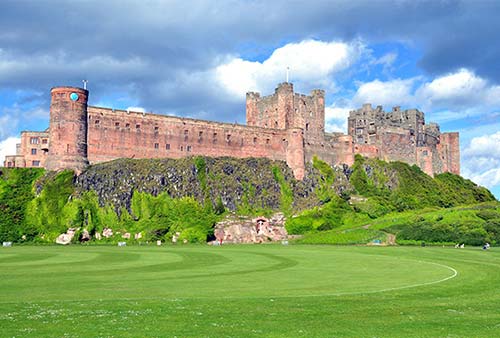
Cost and Hours: £15.50 includes staterooms and grounds; daily mid-Feb-Oct 10:00-17:00, winter until 16:00, last entry one hour before closing; audioguide and guidebook available, pay parking, also reachable by public transportation—consult Traveline.info for specifics, +44 1668 214 208, www.bamburghcastle.com.
Visiting the Castle: Bamburgh’s main attraction is its staterooms; as you explore the rest of the grounds, you’ll also have the chance to see several smaller exhibits. If arriving late in the day, go directly to the staterooms, which may close early. There’s virtually no information inside the castle, aside from a few docents; to give meaning to your visit, either rent the inexpensive audioguide (with two hours of commentary) or buy the guidebook.
The staterooms feel lived-in because they still are—with Armstrong family portraits and aristocratic-yet-homey knickknacks hanging everywhere. You’ll enter through the medieval kitchen, with its three giant fireplaces, and work your way through smaller storage rooms to the King’s Hall, with a fantastic teak ceiling and a J. M. W. Turner painting. At the far end of the great hall is a smaller (but still grand) alcove separated by an archway, which could be sealed off by gigantic folding doors. Continuing through the stairwell, notice the private apartment signs.
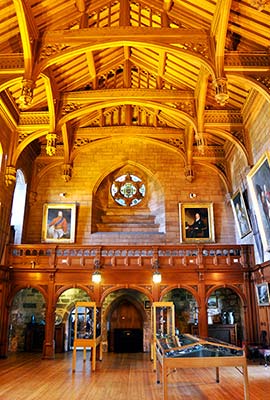
The armory once had a very different purpose—you can still see the apse of what was once a chapel. In the keep is a 145-foot-deep Anglo-Saxon well. The scullery (a medieval utility room) includes a long row of sinks and an alcove where they make fresh fudge. You’ll wind up in the gift shop; before leaving, check out the archaeology room, with exhibits about the castle’s history; and the dungeon, with cheesy mannequins being tortured.
Exploring the grounds, you can enjoy fine views over the sea and beach and get a good look at the stout 12th-century keep that’s the castle’s centerpiece. In the former stables is an art gallery displaying works by local artists. The Armstrong and Aviation Artefacts Museum features the inventions of the family that has owned the castle through modern times. Lord William George Armstrong (1810-1900) was an engineer, scientist, and businessman who perfected hydraulic machinery and revolutionized gun making. His company later became Armstrong Whitworth, a pioneer in British aviation. You’ll see several of his inventions, along with exhibits on planes, cars, shipbuilding, and more. While the museum is fun for aviation-history buffs, it may be dull to others.
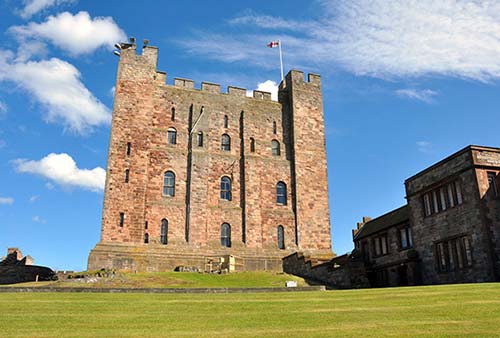
Nearby: The village of Bamburgh is pleasant enough, with tourist-oriented cafés and fine views over a manicured cricket pitch of the looming castle. Better yet, go for a walk on the beach: Crisscrossed by walking paths, rolling dunes lead to a vast sandy beach and lots of families on holiday.