CORNWALL
Penzance • St. Ives • Penwith Peninsula • East Cornwall
Peninsula Sights near Penzance
Set on a rocky peninsula at the southwest tip of England, Cornwall has a Celtic vibe. Its rugged scenery and wild, uncultivated appeal make you feel as if you’re approaching the end of the world (and many natives would say it’s exactly that). Harboring the remnants of an endangered Celtic culture (Cornish), an extinct tin-mining industry, and a gaggle of visit-worthy sights, this is one of England’s most popular holiday regions—especially among the English.
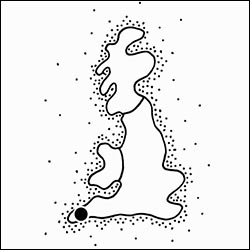
Cornwall, as part of the “Celtic crescent” that nearly circles England, developed apart from the rest of the country, with its own Cornish language, which thrived for centuries (see “Cornish History” sidebar, later). Fishing, shipping, and smuggling predominated here for hundreds of years, but in the 18th century, tin mining became the major industry. The 20th century dealt a double blow to Cornwall: The local pilchard fishery became depleted, and cheap Asian and South American tin put an end to mining. Today’s predominant trade is tourism.
But visitors flock here for good reason. The area is packed with ancient sites, adorable villages, and historic monuments, and the climate is unusually mild—making it perfect for gardening, walking, basking on the beach, and generally enjoying life. The region also exerts a pull on fans of British culture—the hit BBC series Poldark is set here, and the longtime favorite Doc Martin is set in Port Isaac.
Venture to quaint seaside villages, a dramatic theater, a telegraph museum, a dead tin mine, the scant remains of an Iron Age village, and a thought-provoking stone circle. Cry “Land Ho!” at Land’s End, and consider going by plane, helicopter, or ferry to the castaway Isles of Scilly. Farther northeast, the castle of a king named Arthur tickles travelers’ imaginations, the harbor towns of Padstow and Port Isaac offer a taste of workaday (but still cute) Cornwall, and unusual gardens near Falmouth thrill those with green thumbs.
PLANNING YOUR TIME
Given that it takes so long to get to this edge of the world from the heart of England (figure a good half-day each way by car or train, not counting sightseeing stops), it makes sense to give yourself enough time here. Spending three nights and two days allows you to slow down, see all the sights, and get a better feel for Cornish culture. Most of the noteworthy sights and villages wrap around the Penwith Peninsula, so you can line them up and see them on a handy circular route by car or bus. With less time, a two-night stay based in Penzance, with one solid day rambling around the peninsula, offers a suitable first taste.
Set yourself up in a home base and spend most of your time venturing out on day trips. Romantic St. Ives has an artsy beach-bum ambience and is crowded with British holidaymakers in summer. Penzance, another option, is a working-class shipping port with a weather-beaten, workaday bustle, enthusiastic and welcoming natives, and many appealing eateries. Penzance’s relative lack of touristic charm is actually an asset: It’s much easier to drive into and out of, has better public-transportation connections, and enjoys a fine array of quality accommodations.
The attractions farther east—Tintagel Castle, the coastal towns, and the gardens—are ideal for breaking up the long journey to or from Cornwall.
GETTING TO CORNWALL
By Car: To reach Penzance, figure about six hours from London, four hours from Bath or Salisbury, or two hours from Dartmoor. From London, the M-3 motorway speeds you as far as Exeter, where you’ll pick up the A-30 the rest of the way. If you’re driving from Bristol or Bath, take the M-5 and consider a more scenic, less trafficked route: Partway down the M-5 from Bristol, near Tiverton, turn onto the A-361 (a.k.a. the North Devon Link Road), which you can follow through North Devon before hopping on the A-39, which parallels the coastline (getting you close to Tintagel Castle, Port Isaac, and Padstow), rejoining the A-30 35 miles east of Penzance.
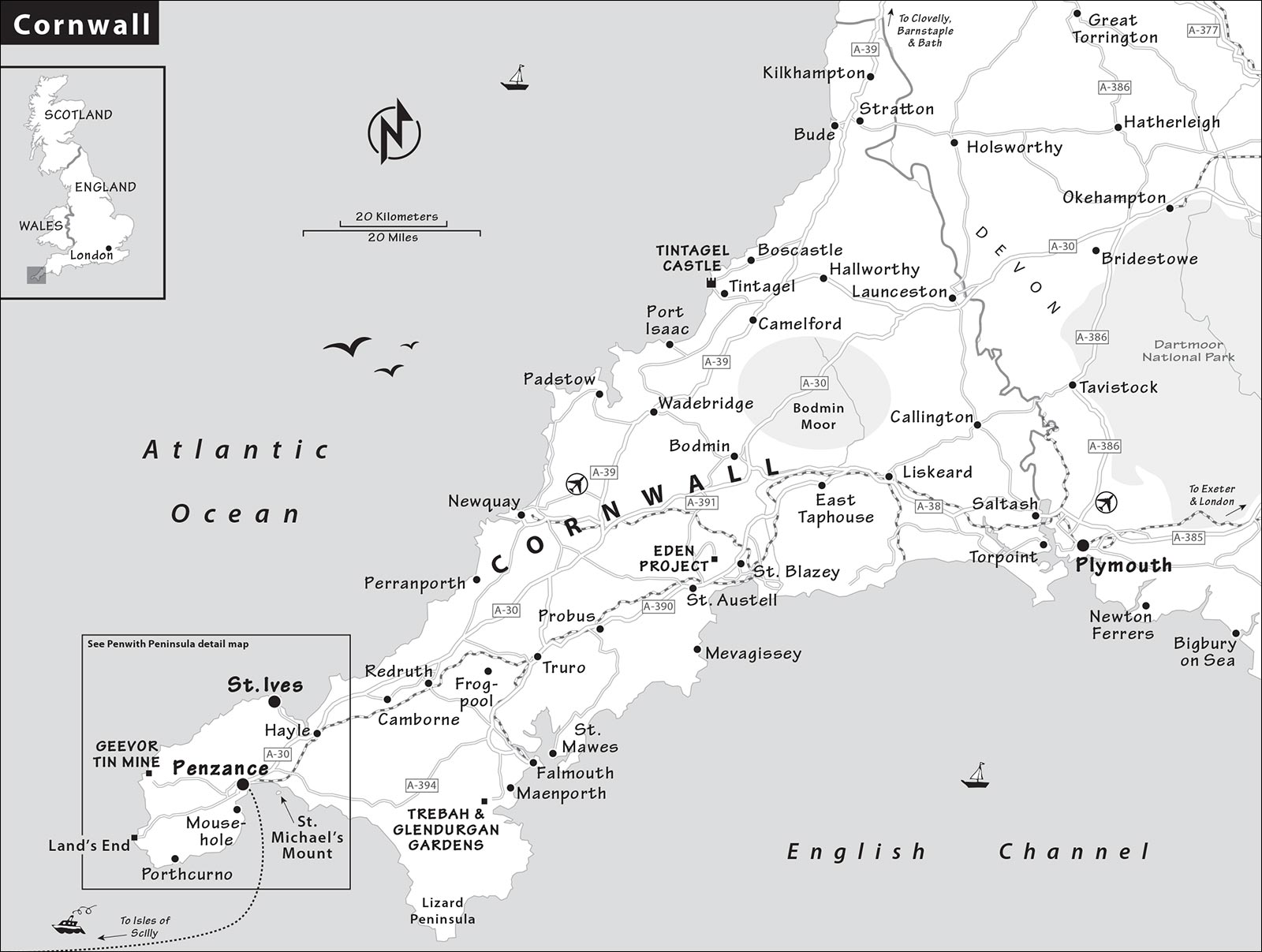
By Train: Train travelers arrive in Cornwall at Penzance, the most central and largest city on the coast (see “Penzance Connections,” later).
By Plane: Cornwall’s main airport is Newquay-Cornwall International (code: NQY, www.cornwallairportnewquay.com), 5 miles from Newquay and 35 miles northeast of Penzance. A few rental car agencies operate at or near the airport. Public-transportation connections into Penzance are limited; it’s easiest to spring for a taxi (Newquay-based Coastline Travel, about £100, +44 1637 860 006, www.coastlinetravel.co.uk).
GETTING AROUND CORNWALL
This region is most satisfying by car, which allows you to pack a lot into each day. It’s challenging but doable by public transportation, though you’ll have to be selective.
By Car
Locals like to say, “Welcome to Cornwall, your car is not as wide as you think.” You’ll be navigating extremely narrow roads when you explore this corner of England.
A coastal road—B-3315 south of Penzance, and B-3306 to the west and north—links almost all the best sights. Driving in Cornwall is generally easy, but parking is not, especially in summer, so it’s a good idea to get an early start. Small villages often have tiny parking lots near the water and larger ones outside town; you’ll do best to seek out pay lots rather than scrounging for free parking (keep a pile of coins in your car). Main roads (such as the A-30 and the A-38) can get very congested, especially on Bank Holiday weekends and in August, so allow extra time. Narrow, twisty Cornish lanes crisscross the spine of the peninsula, and can save time if the main routes are crowded—but you’ll need a good map and navigator.
By Public Transportation
Note that most of these public-transit routes run less frequently off-season (mid-Sept-April).
By Bus: It’s slow but possible to reach most Cornwall sights by bus (see “Penwith Peninsula by Bus” on here for a recommended bus-trip day plan). Some double-deckers go topless May through September. Most regional buses are run by First Bus (sometimes going by the name “First Kernow”), which sells passes that cover Penzance, St. Ives, Land’s End, and the surrounding area (£7/1 day, £25/week, pay on board or download their app; +44 345 602 0121, www.firstbus.co.uk/cornwall). First Bus also operates a handful of summer hop-on, hop-off buses—including the Land’s End Coaster and Mousehole shuttle—that cover far-flung destinations (www.firstbus.co.uk/adventures-bus [URL inactive]). Another pass, called the Ride Cornwall Ranger, costs £18 for a full day of travel on all trains and most buses in Cornwall (www.nationalrail.co.uk).
Useful Bus Routes: The hop-on, hop-off Land’s End Coaster connects Penzance with Land’s End, reaching destinations along the southern edge of the Penwith Peninsula (hourly Mon-Sat, 6/day Sun). It’s about 10 minutes to Newlyn, 45 minutes to Porthcurno (stops near the Museum of Global Communications and a steep uphill climb to the Minack Theatre), and 1 hour to Land’s End. Heading the opposite direction, this route connects Penzance to Marazion (near St. Michael’s Mount) and St. Ives (hourly, 15 minutes to Marazion, 60 minutes to St. Ives).
First Bus #17 and Go Bus #16 connect Penzance and St. Ives (#17: 2/hour, 35 minutes; #16: hourly, 40 minutes).
First Bus #U4 stops at Marazion from Penzance (hourly, 15 minutes).
The handy Mousehole shuttle bus connects Penzance with Newlyn and Mousehole (2/hour, 10 minutes to Newlyn, 20 minutes to Mousehole).
By Train: A scenic (read: slow) rail line connects Penzance and St. Ives, mostly running along the coast (roughly hourly with transfer in St. Erth, 30-60 minutes; +44 345 748 4950, www.nationalrail.co.uk).
By Guided Tour
To maximize your time and the number of sights you can see, consider a guided tour. Tim Uff offers a fine mix of expertise and teaching, enjoyable company, and great driving (£350-400/day for up to 8 people, +44 7969 281 805, www.tourcornwall.com). Cornwall Discovery offers a “Far West” tour that covers St. Ives, mining country, Land’s End, and more on the Penwith Peninsula (£350-400/day for up to 6 people, +44 7877 303 749, www.cornwalldiscovery.co.uk).
Penzance
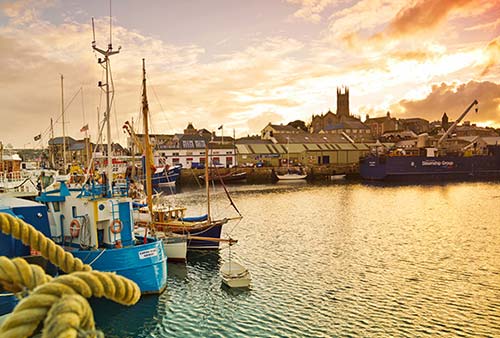
Sure enough, Penzance had its share of pirates. Strategically situated near the very tip of Britain, the town was an ideal spot for pirates to hijack and plunder ships returning from the New World with untold treasures. But today’s Penzance is less of a rough-and-tumble smuggler’s cove and more of a blue-collar transportation hub. Penzance can’t compete with the artsy vibe of St. Ives or the jewel-box quality of nearby Mousehole, but it’s cornered the market on functionality: Well-located B&Bs, good restaurants, train and bus stations, and easy parking make Penzance the most practical home base for exploring the Cornish coast. And its bustling main street, picturesque waterfront setting, and agreeable natives make it an enjoyable place to “come home to” at the end of a busy sightseeing day.
Orientation to Penzance
Penzance, with about 20,000 people, is situated on a small peninsula. The eastern part of the peninsula has the harbor and the train and bus stations. The southern part has a broad and inviting promenade, with most of the town’s B&Bs nearby. Climbing uphill from the water are the busy Market Jew Street (derived from the Cornish Marghas Yow, meaning “Thursday Market”) and the atmospheric, restaurant-lined Chapel Street. The hill is capped by the spire of the Church of St. Mary and the grandly domed Market House, now a bank.
TOURIST INFORMATION
The Welcome to West Cornwall Centre is located between the train and bus stations. They are generous with information on the surrounding region and also sell National Express long-distance bus tickets (Mon-Fri 10:00-16:00, Sat until 14:00, closed Sun, shorter hours off-season; Station Approach, +44 1736 335 530, www.lovepenzance.co.uk).
HELPFUL HINTS
Festivals and Events: The annual Golowan (Midsummer) Festival engulfs Penzance for 10 days in mid to late June. Things get especially rowdy on Mazey Day, the last Saturday of the festival, with colorful parades and well-lubricated crowds (www.golowanfestival.org). From late May through early September, Penlee Park hosts an open-air theater with music, plays, and more (www.penleeparktheatre.com).
Baggage Storage: You can pay to stow your luggage with RideOn E-Bikes, a 10-minute walk from the bus and train stations (daily 8:00-17:00, tucked into Trinity Yard just up from the Dolphin Tavern, Quay Street, +44 1736 888 777).
Laundry: Penzance’s big waterfront casino, along the promenade past the Regent Terrace B&Bs, has a little launderette tucked around the right side (daily 8:00-19:30, +44 1736 330 055). Next to the train station, Suds & Surf is another good option (daily 9:00-20:00, 4 East Terrace, +44 1736 364 815). Both offer self- and full-service.
Taxis: Cabs line up at the train station. Or you can call Anytime Taxis (+44 1736 888 888) or Stones Taxi (+44 1736 363 400) for the £5-6 fare to my recommended Regent Terrace accommodations.
Boat Tours: The two- to four-hour catamaran sailing trips run by Marine Discovery are a fun way to sample the beautiful Cornish coast, with a chance to see seals, dolphins, ocean sunfish, porpoises, seabirds, and even whales (£30-55, less for kids—though some tours have age restrictions, depart from either Albert Pier or South Pier depending on tides, best to reserve at least 3 weeks ahead during July-Aug, +44 7749 277 110, www.marinediscovery.co.uk, info@marinediscovery.co.uk).
Swimming Pool: Take a dip next to the sea in the enormous outdoor saltwater Jubilee Pool—a locally treasured example of the Art Deco lidos that enjoyed a heyday in 1930s England. They also have a geothermal pool (main pool-£6, geothermal pool-£11.75, reservations recommended, June-Sept Tue-Sun 10:00-18:00—until 20:00 in Aug, closed Mon, check website for hours rest of year, café, +44 1736 369 224, www.jubileepool.co.uk).
Sights in Penzance
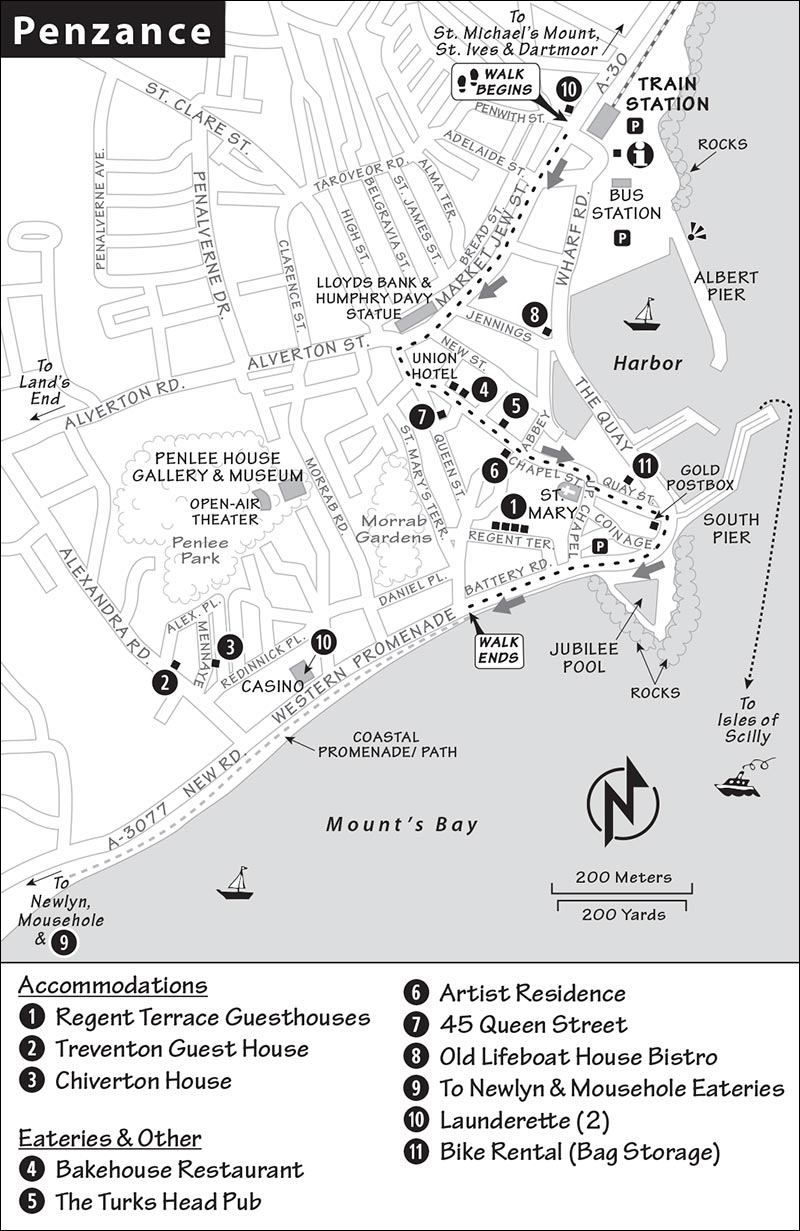
Penzance Town Orientation Walk
Penzance has kept a little of its rough-and-real edge, as you would expect of a fishing and mining port, but tourism keeps this town alive. The core of the town is pretty simple.
Market Jew Street: From the train station, head up this main street, which has a workaday feel. The facades, fine in the Victorian age, are a bit shabby now, and the number of charity shops is indicative of a town in decline (low rents). The area’s traditional fishing industry is going the way of the mining industry before it. Slowly, new shops and restaurants, benefiting from the visitors who use Penzance as a home base, are creating a renewed energy (especially along Chapel and High streets). And, thanks to helicopter service from the Isles of Scilly, 2,500 islanders fly in just to shop.
At the top of Market Jew Street stands a towering statue of Humphry Davy. This Cornish chemist invented a lamp that put the canary in the mine shaft out of business and saved a lot of miners. Behind him, the towering Lloyd’s Bank building looks stony and reliable.
Chapel Street: Just past the bank, take a left on The Greenmarket, and then veer left at the fork onto Chapel Street. On the left, the now-scruffy Union Hotel was one of England’s great coaching inns until the train arrived in 1859. It was here in 1805 that Britons first heard of their country’s victory over Napoleon’s fleet at the Battle of Trafalgar and the death of Admiral Nelson. The Nelson Bar, inside, has a fine collection of Nelson prints. Just across the street is the delightfully quirky Egyptian House, commissioned by a local around 1835 (the flamboyant style was popularized after Napoleon’s victories in North Africa). See if you can spot the royal coats of arms of George III and William IV among the sphinxes.
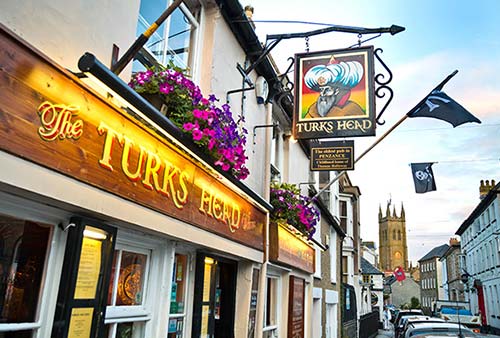
Continue downhill past recommended eateries and pubs: Bakehouse, The Turks Head, and Artist Residence.
Quay Street: Head to the church at the bottom of the road, veer left onto Quay Street (Dolphin Tavern sign is at end of street), and continue downhill until, just before the harbor, you strike gold—a gold postbox. London hosted the 2012 Summer Olympics and celebrated each gold medalist by painting a postbox gold in the winner’s hometown (rowing champ Helen Glover is from Penzance).
South Pier and Promenade: Ahead is the South Pier (and embarkation point for the ferry to the Isles of Scilly—described later, under “Peninsula Sights near Penzance”). Across the bay (to the left) is the island St. Michael’s Mount (see “Peninsula Sights near Penzance,” later). Turn right, walk past the huge Art Deco 1935 public Jubilee Pool, which fills with the tide each day, and reach the waterfront promenade leading to the fishing port of Newlyn, a half-hour’s stroll ahead. And now you’ve seen Penzance.
▲Penlee House Gallery and Museum
Filling a Victorian house in Penlee Park, the gallery hosts a fine collection from painters of the local Newlyn School. These Post-Impressionists, attracted to Cornwall in the late 1800s by the quality of light and the low cost of living, painted seascapes, portraits, and scenes of daily life. You’ll enjoy bucolic, perfectly lit scenes from Cornwall’s rocky coast and pasture-striped countryside. The ground floor shows off rotating exhibits, often from the museum’s permanent collection. The upstairs has a modest museum about Penzance’s prehistoric and more recent history.
Cost and Hours: £6; Mon-Sat 10:00-17:00, Nov-March until 16:30, closed Sun year-round; café with inviting garden terrace, Morrab Road, +44 1736 363 625, www.penleehouse.org.uk.
Waterfront Stroll to Newlyn and Mousehole
A broad pedestrian promenade follows the coast around Mount’s Bay, from Penzance to Newlyn—perfect for an early morning or after-dinner stroll (about 30 minutes one-way). From Newlyn, a coastal footpath extends farther to Mousehole (another 30-minute walk; for more on these towns, see here). These days, any fishing that happens goes out of Newlyn.
Sleeping in Penzance
GUESTHOUSES ON REGENT TERRACE
Set just a block off the seashore, the upmarket guesthouses on this street are central and convenient. Rooms in front usually have views of the sea, while those in back overlook a churchyard. All offer free parking. Drivers should ask their hotelier for precise directions to the narrow and easy-to-miss Regent Terrace. Most places on this street require a three-night minimum stay in peak season.
$$ Warwick House has seven fine rooms, sea views, a cozy lounge, and hosts happy to answer your questions (#17, +44 1736 363 881, www.warwickhousepenzance.co.uk, enquiry@warwickhousepenzance.co.uk, possible self-catering apartment, Garrin and Alison).
$$ Chy-an-Mor Guest House (“House of Sea”) has eight elegantly designed rooms that match the house’s traditional Victorian style. The owners enthusiastically share the fascinating history of the house, which began as the vicar’s residence (no children under 10, closed Nov-mid-March, at #15, +44 1736 363 441, www.chyanmor.co.uk, reception@chyanmor.co.uk, Louise and Richard).
$$ Blue Seas Hotel has eight simple, modern, cheerfully colorful rooms and serves a widely varied breakfast (closed mid-Dec-Feb, at #13, +44 1736 364 744, www.blueseashotel-penzance.co.uk, info@blueseashotel-penzance.co.uk, Arnaud and Fiona).
$$ Lombard House Hotel, a lesser value, offers old-school chandeliered Georgian townhouse atmosphere. The eight basic rooms lack character, but most have sea views; the two top-floor attic rooms are cozy (no breakfast, closed Oct-March, at #16, +44 1736 364 897, www.lombardhousehotel.com, rita.kruge@lombardhousehotel.com; Rita, Tom, and Phil).
NEAR ALEXANDRA ROAD
$$ Treventon Guest House occupies a Victorian home with six well-appointed rooms and a relaxed “stay-awhile” atmosphere. Check out the original mosaic floor in the entrance way (family rooms, continental breakfast—no “full English”; Alexandra Place, +44 1736 332 730, www.treventon.co.uk, reception@treventon.co.uk, Bernard).
$ Chiverton House is a stone Victorian home with six smallish rooms packed with wood furnishings (no children under 12, 9 Mennaye Road, +44 1736 332 733, www.chivertonhousebedandbreakfast.co.uk, alan.waller@sky.com, Alan and Sally).
Eating in Penzance
Wherever you eat, check the daily specials lists—most pubs serve fresh local fish and crab. Most of these listings are on or near Chapel Street.
$$$ Bakehouse Restaurant tries to keep things simple, featuring Cornish cuisine that highlights quality ingredients. The service is sharp and cheerful, the acoustics are noisy, and the decor is modern (good vegetarian options, steaks, Mon-Sat dinner only, closed Sun, on Chapel Street, set back on a little courtyard called Old Bakehouse Lane, +44 1736 331 331).
$$ The Turks Head, the oldest pub in Penzance, is a dark, low-beamed gem. Serving basic pub grub and local ales, this is a popular spot—book ahead or arrive early. There are dining rooms in the back and downstairs, and a small terrace out back, but the pub in front is best for rubbing elbows with locals (daily, 49 Chapel Street, near intersection with Abbey Street, +44 1736 363 093, www.turksheadpenzance.co.uk).
$$ Artist Residence is a modern-meets-traditional restaurant and smokehouse, focusing on fresh Cornish produce as well as local craft beers and wines. The interior balances rustic and modern, but on a nice day the garden is best. Open for breakfast, lunch, and dinner, this place offers good options from light snacks to heavy meals (long hours daily, 20 Chapel Street, +44 1736 339 414).
$$ 45 Queen Street enlivens a quiet courtyard just off Chapel Street, serving seasonal, shareable plates and local line-caught fish. The bright, airy space is reminiscent of a garden greenhouse and has big, sometimes communal, tables (order at the bar, Wed-Sat from 10:00, closed Sun-Tue, 45 Queen Street, www.45queenst.com).
Along the Waterfront: $$ Old Lifeboat House Bistro offers the town’s best-value waterfront meals, prepared with creativity and pride. Housed in a mid-1880s granite building—a former lifeboat station, complete with turret and bell—the bistro has comfy indoor and outdoor seating. They also offer nice lunch and coffee options on weekends (Mon-Thu dinner only, Fri-Sun lunch and dinner, Wharf Road near Jennings Street, +44 1736 369 409).
IN NEWLYN
These restaurants are in nearby Newlyn, a pleasant 30-minute walk from Penzance.
$$$$ Mackerel Sky Seafood Bar offers a fun and creative menu featuring fresh local fish. The service is friendly, there’s no pretense, and the tasty dishes are artfully presented (daily, no reservations, The Bridge, New Road, +44 1736 444 444). If you can’t get a table, try their other location, The Seafood Shack, three doors down (same menu and hours).
$$$$ Argoe focuses on sustainability, utilizing lesser-known species of fish and local produce on a menu that changes daily. Both the woodside patio and breezy dining room offer a stylish, easygoing ambience. They add £1 to the bill to support the local Fisherman’s Mission charity (reservations smart, good vegetarian options, Tue-Wed lunch only, Thu-Sat lunch and dinner, closed Sun-Mon, on Penlee Harbor, +44 1736 362 455, www.argoenewlyn.co.uk).
IN MOUSEHOLE
If you happen to be in Mousehole at mealtime, these two restaurants are worth checking out.
$$$ The Old Coast Guard is a good place to stop for drinks, lunch, or dinner with its beautiful gardens and homey restaurant overlooking the water (daily, £45 3-course dinner, The Parade, next to the parking lot, +44 1736 731 222, www.oldcoastguardhotel.co.uk). They also have 15 $$$ hotel rooms.
$$ 2 Fore Street, in a pleasing setting just up from the harbor, has a beachy decor to match its bistro menu—try the crab soufflé (daily, 2 Fore Street, +44 1736 731 164, www.2forestreet.co.uk).
Penzance Connections
From Penzance by Train to: London’s Paddington Station (about hourly, 5-6 hours, possible transfer in Plymouth or Newton Abbot), Salisbury (about hourly, 5-6 hours, 1-2 transfers), Bath (1-2/hour, 4.5-5 hours, 1-2 transfers), Edinburgh (every 1-2 hours, 10-17 hours, 1 direct, most transfer), York (hourly, 8-10 hours, 1 direct, most transfer in Plymouth), Exeter (hourly, 3 hours, possible transfer in Plymouth). Train info: +44 345 748 4950, NationalRail.co.uk.
By Bus to: Exeter (4-7/day, 3.5-6 hours, possible transfer in Plymouth), Brighton (5-6/day, 12-13 hours, transfers in Plymouth, Heathrow, or London), Portsmouth (4-5/day, 12-13 hours, transfer in Plymouth, Heathrow, or London), London (6/day direct, 9 hours, overnight available). Bus info: +44 871 781 8181, NationalExpress.com.
St. Ives
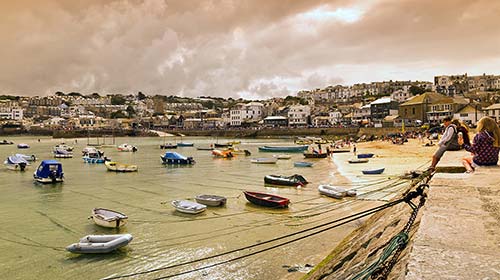
Picturesque St. Ives is the closest thing to a Riviera resort in the region. With golden light reflecting off the aquamarine waves and twisty lanes, St. Ives began to attract artists in the early 20th century. The potter Bernard Leach practiced his craft here, as did sculptor Barbara Hepworth, and both have museums in town—as do dozens of other lesser-known artists. London’s Tate Gallery also has a branch here, which seems a bit too big-league for a little-league town. An annual music and arts festival keeps things humming in September (www.stivesseptemberfestival.co.uk).
St. Ives is a zoo in peak times—absolutely mobbed by British families walking their dogs and endlessly licking ice-cream cones. While it’s undeniably charming (especially before 10:00, when the day-tripping masses arrive), St. Ives sometimes feels like the worst of both worlds: overrun seaside resort meets pretentious artist enclave. Still, it’s worth seeing—quickly.
Orientation to St. Ives
About half the size of Penzance, with 11,000 people, St. Ives occupies a few steep bits of land between sandy beaches. The town clusters around its sandy harbor, with a bulbous spit of land just beyond called The Island. From the quaint waterfront old town, newer development sprawls uphill toward the main road.
Thanks to its warren of convoluted lanes, small St. Ives can be challenging to navigate. The town’s two main drags are Fore Street (lined with tourist shops and good budget eateries) and Wharf Road (a pedestrian boardwalk tracing the harbor, lined with recommended restaurants). Porthmeor Beach, on the northern, sea-facing side of St. Ives, is a 10-minute walk from the harbor (from Fore Street, cut inland across the head at The Digey Street).
Tourist Information: The TI, located in the library on Gabriel Street, sells town maps (Mon-Sat 9:30-16:00, Sun 10:00-15:00, shorter hours and closed Sun off-season, +44 1736 796 297, www.stives-cornwall.co.uk).
ARRIVAL IN ST. IVES
By Car: St. Ives is a pain for drivers—parking is scarce and distant from town, and those who venture into the center find its streets congested with slow-moving pedestrians. As you approach town, you’ll reach a roundabout with a “do not enter” sign (9:00-16:00, except for permitted vehicles). While this isn’t usually enforced, driving past here is challenging enough that it’s preferable to park at one of the outlying pay lots (all with similar prices). The main option is the huge Trenwith car park above town, near the Leisure Centre—turn right just before the roundabout. From this lot, it’s a steep downhill walk or easy £1.50 shuttle ride into town (drops off and picks up a half-block down from the movie theater). You can also turn left at the roundabout and loop around to the Barnoon pay lot just above the Tate St. Ives and Porthmeor Beach (the handiest lot if the Tate is your goal, but still a steep hike above the town center and harbor).
Yet another option—which lets you avoid driving in town entirely—is to leave your car at the park-and-ride lot at St. Erth on the way to St. Ives (affordable long-term parking, see map on here for location), then ride the train from there into town.
By Train or Bus: If you are day-tripping from Penzance, the bus is your best option (see here). The train station and the bus station are both conveniently located near the waterfront; just exit and walk with the sea on your right into the heart of town.
Sights in St. Ives
Tate St. Ives
St. Ives proudly hosts a branch of the prestigious London art museum. The modern building is big and impressive; the ever-changing exhibits focus on the acclaimed artists who chose Cornwall as a home base (Hepworth, Gabo, Moss, Heron) and modern works by local and international artists.
Cost and Hours: £10.50, ask about art talk, daily 10:00-17:20, Nov-Feb until 16:20 and closed Mon, Porthmeor Beach, +44 1736 796 226, www.tate.org.uk/visit/tate-st-ives [URL inactive].
▲Barbara Hepworth Museum and Sculpture Garden
Barbara Hepworth (1903-1975) was a leading Modernist artist whose abstract sculptures rank among the most celebrated of the 20th century. She lived much of her life in St. Ives, and Trewyn Studio, her home and workshop, is a small museum, offering a chance to learn a bit about the artist and see her works. These curvaceous, undulating sculptures drew inspiration from (if didn’t quite resemble), the sea, wind, clouds, sand, and light of St. Ives. While a few are inside, most of the pieces (many positioned by Hepworth herself) are in the linger-worthy garden. While exploring, peek into her studio, with its dusty smocks and rusty chisels.
Cost and Hours: £8, same hours and contact info as the Tate St. Ives, at the corner of Ayr Lane and Barnoon Hill.
Leach Pottery Museum
This museum celebrates Bernard Leach, considered one of the founders of the mid-20th-century British studio-pottery movement. You’ll walk through his studio, with its heavy-duty kilns, then tour a collection of works by Leach and his associates, as well as pieces by leading contemporary potters. The complex also includes an active workshop where potters still work (you may catch a glimpse of them in action through a glass door).
Cost and Hours: £8, March-Oct Mon-Sat 10:00-17:00, Sun 11:00-16:00, Nov-Feb closed Sun-Mon, last entry one hour before closing, Higher Stennack/B-3306, +44 1736 799 703, www.leachpottery.com.
Getting There: The studio is well marked from the upper outskirts of St. Ives, on the road into town. It’s a 15-minute walk from Royal Square in the center of town. Or, park at the Trenwith car park (described earlier); the studio is a six-minute uphill walk from there (disabled parking only at the studio, but you may find street parking nearby).
Stroll the Town
Besides gallery-hopping, the best way to enjoy St. Ives is by taking an ice-cream cone on a waterfront stroll. The slate-tile-clad High Street and pleasant waterfront have plenty of shops and ice-cream stands—though you’ll have to squeeze through the crowds. Boats departing from the harbor can take you on trips around the cliffs and to the coves, a good way to appreciate why the Cornish coast was so popular with bootleggers and pirates. After shops close down for the evening, around 17:00, all the action moves to the harborfront.
Hit the Beach
Surrounded by sandy beaches, St. Ives is popular with Brits on a “bucket-and-spade” holiday. In addition to the sandy central harbor—home to boats as well as swimmers—you’ll find family-friendly Porthminster Beach (west) and surfer-friendly Porthmeor Beach (east). Tiny, secluded Porthgwidden Beach—hiding between the rocks under the high peninsula called The Island—is worth the hike.
If you enjoy water sports, find your inner dude by taking lessons from St. Ives Surf School on Porthmeor Beach. Choose between surfing, kayaking, and stand-up paddleboarding (£45/person includes equipment, equipment rentals available, daily 9:30-17:30, +44 1736 793 938, www.stivessurfschool.co.uk).
Sleeping in St. Ives
The town’s charm wears thin with the hordes of tourists in high season, but the evenings are quiet enough to consider staying over. The first two options are in tight, twisty old buildings—climbing to your room can feel like spiraling up through a ship’s hull.
$$$$ Pedn Olva Hotel on Porthminster Beach is a boutique splurge. Each of the 30 rooms comes with the comforts of a luxury hotel and a view over the harbor or ocean (Porthminster Beach, +44 1736 796 222, http://pednolva.co.uk, pednolva@staustellbrewery.co.uk).
$$ Cornerways rents six rooms (two overlook the harbor) with lots of grays, blacks, and exposed beams. It’s got a smooth nautical-meets-contemporary vibe (1 Bethesda Place, +44 1736 796 706, mobile +44 7815 796 706, www.cornerwaysstives.co.uk, chris@cornerwaysstives.co.uk).
$$ The Anchorage has three cozy rooms and claustrophobic ceilings in a central location (may require multiple-night stay, 5 Bunkers Hill, +44 1736 797 135, www.anchoragestives.co.uk, info@anchoragestives.co.uk).
Eating in St. Ives
Along the Harborfront: The main drag along the harbor has plenty of dining options—though most are tourist traps. Peruse the menus and views, and choose your favorite. $$$ Cintra Seafood Bar has prime real estate with harborside tables and a breezy indoor dining room. Their menu is a create-your-own-adventure of sophisticated shareable plates featuring light, fresh seafood options (try the crab nachos, daily, The Wharf, +44 1736 798 899). $$ The Rum & Crab Shack serves about 150 types of rum as well as local crab delivered fresh each morning, but the “shack” is a misnomer—it’s an appealingly modern space, with big windows looking out over the harbor (daily, The Wharf, +44 1736 796 353). $$ Harbour Fish & Chips, next to the lifeboat station, fills with families after a day on the beach. The menu includes all the standard chippy dishes with dine-in or takeaway service (daily, The Wharf, +44 1736 799 295).
Above Porthmeor Beach: For the best beach views in town—away from the worst of the tacky tourism—head to the $$$ Porthmeor Beach Café, across the street from the Tate St. Ives. Classy but casual, its outdoor or enclosed seating overlooks Cornwall’s most popular surfing beach (May-Oct long hours daily, +44 1736 793 366).
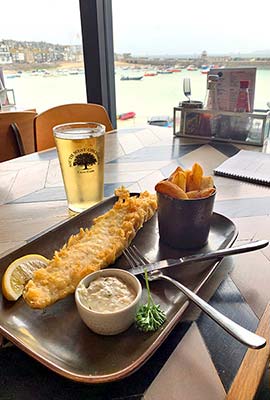
$ Pasties on Fore Street: It’s hard to choose among the many Cornish pasty shops along here; I suggest following your nose to the best-looking option.
Gastropub: $$ The Queens Hotel is an appealingly scruffy-mod gastropub with a pinch of hipster and a whisper of indifferent service. Their well-priced fare appears on a handwritten chalkboard menu that changes regularly (daily, straight up High Street from the harbor, +44 1736 796 468).
And for Dessert: You’ll see places hawking “Cornish Ice Cream”—the frozen version of clotted cream, which means it’s richer and creamier than the norm. For something deliciously different, try the lavender and honey flavor.
St. Ives Connections
The bus is more practical than the train for most connections. The Land’s End Coaster connects to Penzance via Marazion (St. Michael’s Mount) and to Land’s End via Geevor Tin Mine and Sennen Cove. First Bus #17 and Go Bus #16 run between St. Ives and Penzance. For details, see here.
All train connections from St. Ives go through St. Erth, where you’ll switch from the cute little St. Ives Bay Line to the main line to Penzance (see “Penzance Connections,” earlier).
Penwith Peninsula
Cornwall’s Penwith Peninsula, at its western tip, is a pincushion of worthwhile stops. Literally meaning “headland,” Penwith is rugged, rocky, and windblown, with well-preserved bits of traditional Cornish culture and some of Britain’s most ancient sites, to boot.
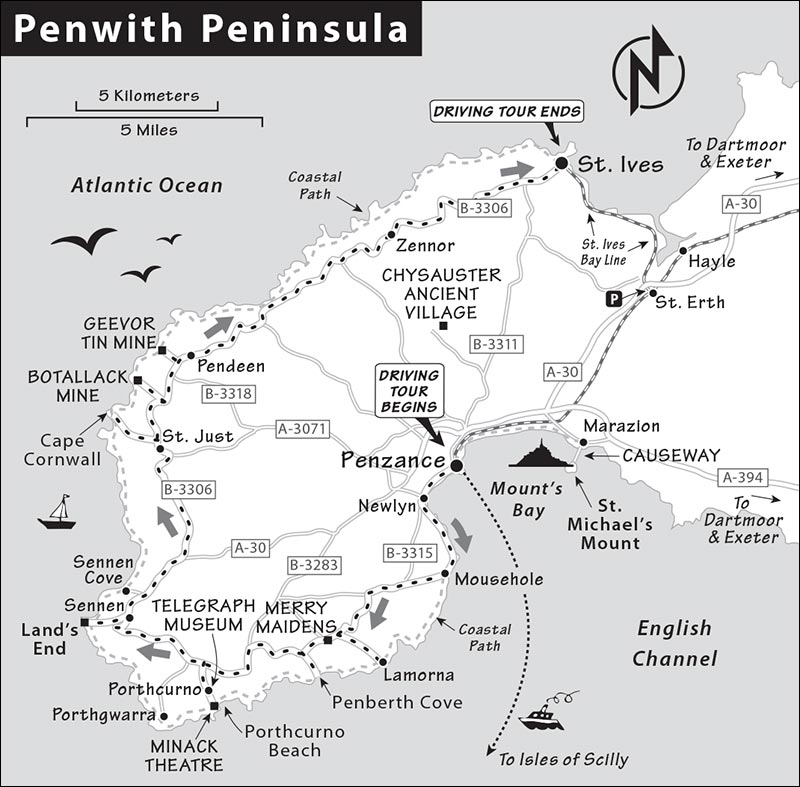
The first few destinations are easily accessible from Penzance, including the worthwhile St. Michael’s Mount (east of—and visible from—Penzance), Chysauster Ancient Village (a few miles from Penzance, but only doable by car), and the Isles of Scilly (three-hour boat ride from Penzance, or a short plane or helicopter ride from Land’s End or Penzance). For those with a car, my Penzance to St. Ives Drive connects most of the highlights of the peninsula. You’ll head west from Penzance, passing tiny port towns, prehistoric stone circles, a seaside theater, Land’s End, historical tin mines, and miles of ruggedly beautiful coastline. (Many of these same sights are accessible by bus; see here for a recommended itinerary.)
Hikers: If you have a hankering for a long hike in England, make it the Penwith Peninsula segment of the South West Coast Path. Distances are manageable, and you can coordinate with the local bus service to make a variety of walks fit your time and energy constraints. Inquire locally for information on taking advantage of the beloved coastal path (see sidebar).
Peninsula Sights near Penzance
▲▲St. Michael’s Mount
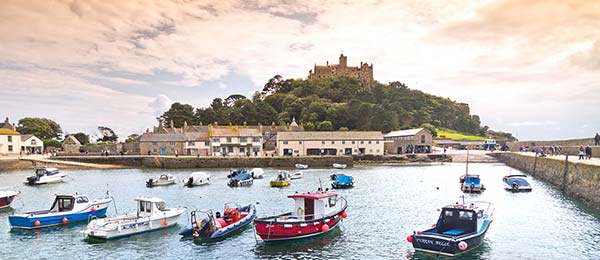
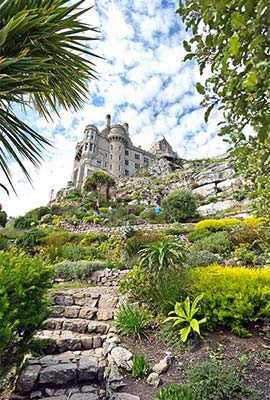
This dramatic rock island has been inhabited for 1,500 years. Originally a Benedictine monastery (the property of the same monks who lived at the abbey-island Mont St-Michel in Normandy), it was later turned into a fortified castle, and eventually a stately home (belonging to the St. Aubyn family, who still run it today in partnership with the National Trust). If the tide is out, a pedestrian causeway connects the island to the town of Marazion. Otherwise, a short ride in a motorboat will bring you up to the picturesque vest-pocket harbor just below the castle’s lower gates. From there, a steep, uneven, rocky path curves its way up to the castle entrance.
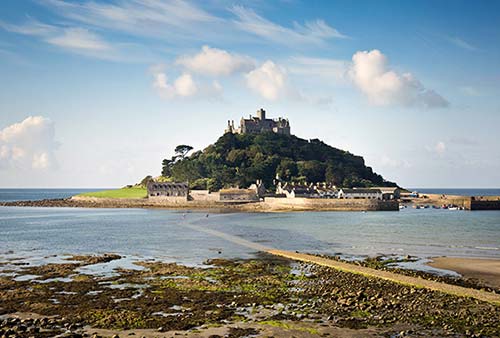
Cost and Hours: Castle-£15, garden-£11; April-Sept tickets must be booked online in advance. Castle open Sun-Fri 9:30-17:00, closed Sat year-round and in winter except for tours; garden open May-Aug Mon-Fri 9:30-17:00, closed off-season, +44 1736 710 507, ferry and tide info +44 1736 710 265, www.stmichaelsmount.co.uk.
Getting There: Buses #U4 and the Land’s End Coaster run from Penzance to Marazion; drivers can park in either of two waterfront lots in Marazion. From there, it depends on the tide: At low tide (about four hours per day), you can walk about a quarter-mile across the cobbled causeway to the island. At other times, you’ll need to catch the boat (£2.80 one-way, book online in advance with your entrance ticket, April-Oct only, 10 minutes, you’ll be directed to one of two possible boarding sites, all near the causeway). Return boat tickets can be purchased on the island.
Eating: For a convenient and good lunch option, try the mount’s café, or, for a cup of tea, stop at the island’s Harbour Loft. In Marazion, locals recommend Tudor’s Fish and Chips as a classic chippy with fun ice cream flavors (Mon-Fri lunch and dinner, Sat dinner only, closed Sun). For a meal with an unforgettable view, Shutters Restaurant or Craby’s Beachside Café, both inside the Godolphin B&B, can’t be beat. Shutters serves afternoon tea (£24, daily).
Visiting St. Michael’s Mount: Most of England’s castles are now owned by the state or by charities. The Great Depression bankrupted many noble English families, who were forced to sell off family estates and heirlooms. St. Michael’s Mount is one of the few open to the public that has remained associated with the same family since the Middle Ages. Family portraits, some quite recent, adorn the walls.
From the gated entry area, you can enter the garden that curls most of the way around the base of the castle, with many tropical plants, a few prehistoric standing stones, and grand views. There’s also a modest collection of Newlyn School paintings inside the Steward’s House and a small exhibit on the castle, gardens, and the island’s residents at the Barge House (both free to visit).
The highlight is the castle itself, which you’ll reach by hiking steeply upward. The interior is surprisingly petite. You’ll pass through an envy-inducing sea-view study and see some historic paintings of the place before entering the magnificent Chevy Chase Room. Originally the refectory of the monastery that once operated here, it’s named for the circa 1620 frieze that decorates the room, illustrating scenes from a beloved medieval ballad. Notice the royal coat of arms high above the fireplace, installed in 1660 when Charles II was restored to the throne. The royal lion of England holds one side while Scotland’s unicorn secures the other; on the shield itself is the harp of Ireland (Wales, with its own principality, is absent). On the opposite wall is the St. Aubyn family’s own coat of arms, dating from 1659.
From there, proceed into the smoking room, where men nursed cigars after dinner, Downton Abbey-style. Hanging in front of the window is a weather gauge, filled with liquid that changes color as barometric conditions change. In the small frame is some nobleman’s prized souvenir: a tiny blue scrap from the jacket that Napoleon wore at Waterloo.
Step out onto the breathtaking view terrace (among the newest parts of the castle, it was built to take full advantage of this hilltop’s scenic setting). Peer down to see the garden that wraps around the island—and keep an eye out for mysterious prehistoric standing stones.
Looping around to the landward side of the castle, you’ll enter the chapel, built as the core of that medieval monastery in the 12th century. Bernard du Bec, the same abbot responsible for France’s Mont St-Michel, rebuilt the chapel after an earthquake in the 13th.
The genteel Blue Drawing Room has a vastly different style from what you’ve seen up to now. Ogling this room, it’s easy to imagine the resident family hanging out here after-hours. (The painting over the fireplace flips around to reveal a flat-screen TV.) Passing through the map room (with historic maps of this place) and going down the stairs (peer over the banister to parts of the castle reserved for the residents), you’ll reach a small exhibit about the island’s history and prehistory, including a portion of the Bronze Age hoard discovered in 2009 by the assistant head gardener. Nearby, a small room displays weapons collected by the family through the centuries and a full samurai warrior suit of armor from a 1906 mission to award the emperor of Japan with the coveted Order of the Garter, England’s highest honor.
Before heading back down to the base of the mountain, look out to sea and ponder this: Locals claim that Jesus Christ visited Cornwall during his teen years. Supposedly he landed here at St. Michael’s Mount, then traveled up to Glastonbury (near Bath). While this might seem patently bogus, locals persuasively insist that it could have happened: Joseph of Arimathea, who was a wealthy disciple of Jesus, was also a metal trader. He might have brought Jesus to this metal-rich peninsula on a business trip. All that we know of Jesus’ life between his adolescence and age 30 is that he traveled in the “wilderness”...which Britain (and most of Europe) certainly was at that time.
Chysauster Ancient Village
Two millennia ago, the granite village of Chysauster (chih-ZOY-ster) was created high up on a windswept hillside of the Cornish moors. Today, anyone with an interest in prehistory will find it well worth the short drive from Penzance and quarter-mile uphill walk from the parking lot. While many such settlements are scattered around the Penwith Peninsula, Chysauster is relatively easy to find on your own and well set up for visitors.
Cost and Hours: £9.50; daily 10:00-17:00, Oct until 16:00, closed Nov-March; +44 7831 757 934, www.english-heritage.org.uk/chysauster.
Getting There: The site is accessible only by car. It hides on backcountry roads a few miles north of Penzance: Leave town on the B-3311 (the back road to St. Ives); about 1.5 miles outside town, at Badgers Cross, turn left, following signs for Trezelah and Newmill. Follow that road for about a mile, watching for the parking lot (and WC building) on the left. Park and walk across the road, where a gravel trail leads you up through a field to the ticket kiosk.
Visiting Chysauster: For defensive reasons, the earliest settlements in Cornwall sat upon hilltops like this one. (Scanning the horizon virtually anywhere on the Penwith Peninsula, you’ll notice that the summit of each hill is capped with the scant remains of an old house or fortress.) As life became more civilized and peaceful, people gradually moved down into valleys, and eventually to the coast—abandoning the difficult life at places like Chysauster.
This enigmatic ancient site encompasses nine cloverleaf-shaped homesteads, each one with circular rooms huddled around a central courtyard for protection and comfort. While the buildings were once roofed (most likely either with thatch or turf), it’s unclear whether the central courtyard was also covered.
Information boards let you explore and understand each building and imagine how villages like this developed. From the first information board, bear right to #7, then do a counterclockwise loop to see the others. The viewing platform at #6 allows you to take in the entire village at once. Linger in the two best-preserved houses, #6 and #4. The smaller rooms were used for storage, possibly for game (the people who lived here were hunter-gatherers); the larger rooms were dwellings. A unique feature of this community was an underground passage called a fogou, which may have been used for storage or as a place of refuge (one hides out about 135 yards southeast of house #7).
Isles of Scilly
Just off the coast of Cornwall, this group of islands (pronounced “silly”), with a population of 2,500, sits right in the path of the Gulf Stream. The warm (or at least warmer) climate is perfect for growing a wide variety of exotic plants, so the islands boast a few gardens to visit. An excursion here takes the better part of a day.
Getting There: There are three ways to reach the islands. You can take a slow boat Scillonian III from Penzance (£35 same-day round-trip, £76 one-way, about 3 hours each way, sporadic schedule but generally departs daily at 9:15 in summer from the Penzance harbor, no Sun boats April-June and Sept-Nov, no boats at all Dec-March). Your second option is a plane from the Land’s End airport (£127 same-day round-trip, £122 one-way, 20-minute flight). The plane and boat are both run by Isles of Scilly Travel (possible to fly over and sail back, +44 845 710 5555, www.islesofscilly-travel.co.uk). Or, you can take a helicopter from Penzance (£94.50 same-day round-trip, 20-min flight, +44 1736 780 828, https://penzancehelicopters.co.uk).
Penwith Peninsula Joyride
For me, exploring the Penwith Peninsula on a sunny day is the highlight of Cornwall and worth ▲▲. You’ll see more by car, but I’ve also given directions to do the same general route by public bus (see here). This driving route loops around the Penwith Peninsula clockwise, starting in Penzance and ending in St. Ives.
PENZANCE TO ST. IVES DRIVE
Though distances are short (the entire drive is less than 45 miles), plan on a full day to explore the region. The views are unforgettable: hidden coves, sweeping moorland, high hedges, and vast seascapes. The friendly people you’ll meet all along the way just add to this ultimate Cornish day out. During peak summer season, be prepared for traffic, parking competition, and crowds.
• Starting in Penzance, head south along Battery Road/Western Promenade for less than a mile to get to...
Newlyn
Newlyn is all about the fishing industry, with a hundred working boats and a busy fish market early each morning. Most of southwest England’s fish comes from Cornwall, and most of Cornwall’s fish is processed here in Newlyn.
Stop and survey the rugged little harbor. It’s designed to handle the 20-foot tides. While the rough stones on the breakwater date from the 15th century, most of the harbor is 18th-century vintage. In the 19th century, trade here centered on tin and pilchards (sardines). Newlyn is still home to one of the largest fishing fleets in the country.
• A short drive farther along the coast takes you to Mousehole. For a quick look at the little port, park in the lot on the Penzance side of Mousehole and walk in.
Mousehole
Adorable little Mousehole (MOW-zle) is famous for smuggling, for fishing, and for being the last place where the pre-Roman language of Cornish was spoken. (A plaque on a wall marks the home of Dolly Pentreath, one of the last native Cornish speakers, who died in 1777.) If you’re here at lunch or dinner time, consider the recommended The Old Coast Guard or 2 Fore restaurants (see “Eating in Penzance,” earlier).
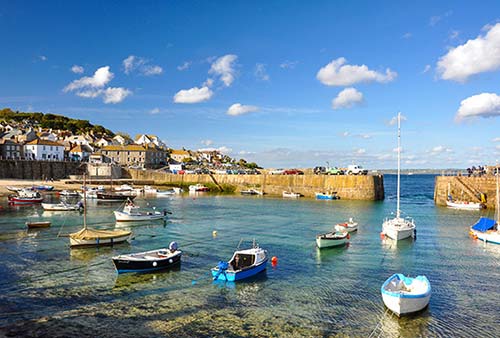
The old wooden town was destroyed by a barrage of cannonballs from the Spanish Armada in 1595. (Spanish cannonballs decorate town gardens to this day.) Today’s stone town was rebuilt in the 17th century. The harbor has a tiny mouth to protect it from the wild sea (yes, like a mouse hole). Due to dramatic tides, the boats here are designed to be stranded in the mud—with either two keels or side supports so they stay upright until the water returns with the next high tide. At the Ship Inn Pub, the historic Fitzroy Barometer is embedded in the stone wall. This weather forecasting tool from 1854 saved many ships by predicting storms.
The colorful Mousehole Shop (on a nearby corner) is a fun spot for books and souvenirs. (The Mousehole Cat is a delightful children’s book that tells and illustrates the legends of the town.) The ice cream shop next door is a convenient option to try the Cornish take on the dessert.
Mousehole has a few whitewashed homes, harkening back to Victorian times when the entire town would have been gleaming white. The lime wash helped waterproof the stone walls and was a good insulator. The beachside path from Newlyn makes an excellent 30-minute stroll (described on here).
At the parking lot is the inviting Rock Pool Café, with a shabby-chic vibe and a dramatic coastal setting. Just below it is a Victorian rock pool carved a century ago for kids to enjoy the sea life deposited there with each high tide. Chasing crabs and darting blennies (tiny fish able to survive in the air) is great fun.
Looking to the jagged ridge of rocks poking up from the deep just beyond the seawall, imagine how Mousehole (like many such Cornish towns) once specialized in a sort of reverse-piracy called “wrecking.” During the rugged days of the late 18th century, townsfolk would place false lighthouse beacons high above town, misleading approaching ships into believing there was safe passage—and luring them right toward these hidden rocks. The ships would wreck, and the less scrupulous residents of Mousehole would rush out to salvage what they could.
• Follow signs marked Outbound Traffic to make your way out of Mousehole and away from the coast. As you wind along this rural road, you’ll find yourself dwarfed by centuries-old...
Hedges
These are an iconic feature of Cornwall, and while they may look soft like a bush, they are hard as rock (keep that in mind if you need to make room for an oncoming bus). Dating back many generations (some say millennia), Cornish hedges (they aren’t called “hedgerow” or “wall” here) have stone frames (farmers cleaned up their fields by stacking rocks), are filled with earth, and then often overgrown with vegetation. The hedges produce a succession of bloom, from primroses and violets to bluebells and pink campions—contributing to the “garden of England” feel of Cornwall. These roadside bouquets are more than pretty; they fight erosion.
• Approaching Paul, the next hamlet up the road from Mousehole, turn left directly after the stony church. Continue on this road until its end at the B-3315, then turn left (west) toward Land’s End. For a fun side trip, take the lane on the left after about two miles to...
Lamorna Cove
About a mile down the tiny lane is the tough, tiny, and evocative Lamorna Cove, which was first used for smuggling contraband and then for the granite trade. Drive delicately past the café to the parking lot at the water’s edge. Imagine the work involved in quarrying and shipping granite stones from here. Much of granite used in the massive embankment of the River Thames in London was cut in Cornwall and shipped from this cove. There are fine walks in either direction from here (including the South West Coast Path, which runs through here—see the sidebar, earlier).
Driving back to the main road, you’ll pass the Lamorna Wink Pub, named for the winking code smugglers used when there was contraband for sale or a customs man was in town. Shortly after the pub, a tiny lane splits off to the right and goes down into a tangled Tolkien wonderland for adventurous drivers.
• Back on the main road (B-3315), turn left and continue for almost a mile until you see a sign and a small parking pullout on the left for...
Merry Maidens Stone Circle
In ancient times, stone circles had some sort of significant purpose, perhaps as a site for religious ceremonies, as a community meeting place, or, most famously, as a celestial calendar. The Merry Maidens Stone Circle, easy to reach by car, is far simpler than the famous circles at Stonehenge and Avebury. Still, it’s evidence that the Penwith Peninsula was inhabited in the Neolithic Age (roughly 2000 BC or earlier).
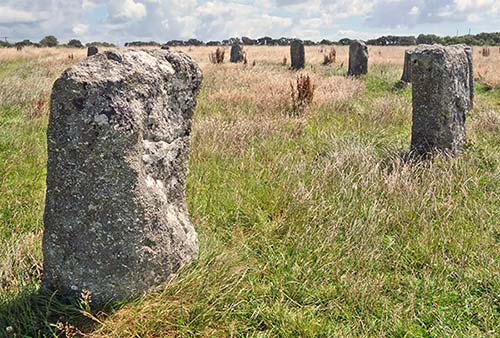
The story behind the name, most likely concocted in the Middle Ages, goes like this: A group of village women decided to go into the fields on Saturday night for some merriment and dancing. They lost track of time and danced into the Sabbath—neither remembering it nor keeping it holy. This displeased God, who turned the women to stone to serve as a warning to others.
This is just one of the staggering number of prehistoric monuments, settlements, and artifacts that still lie just beneath the surface of Cornwall. Penwith Peninsula is like an open-air archaeological museum dotted with stony souvenirs of prehistoric civilizations. About a hundred yards past the Merry Maidens is a burial mound, likely the tomb of a local chief dating from at least 2000 BC (left side of the road with a pullout and info plaque).
At an intersection about a half-mile beyond the Merry Maidens, a weathered Celtic cross stands on the left side of the road. From the sixth to the 10th century, Celtic pilgrims traveled from Ireland through Wales and Cornwall to Galicia to visit Santiago de Compostela. And all along the route were Celtic crosses like this marking the way.
• From the Merry Maidens, continue on the B-3315 west for three miles (following it left at the T-intersection, where a sign points you toward Land’s End).
Find a tiny road on the left with a sign for Penberth, which leads to another secret cove. This is Penberth Cove, an old pilchard fishing port where the capstan still hauls a few tough little boats up the cobbled landing. Notice the evocative skid marks in the stones, grooves worn by generations of hard fishing. Back on the main road, drive another mile, then turn left to reach...
Porthcurno
The little hamlet of Porthcurno can be packed with visitors for three reasons: the nicest beach in Cornwall, the famous Minack Theatre, and a fascinating telegraph museum. You can park for free by the theater (while visiting it) or pay to park near the beach and museum; from here a steep lane leads to the theater.
Porthcurno Beach, just outside town, is a secluded oasis of translucent blue water and soft sand cradled by striking granite cliffs. A great spot for a picnic and swim, the beach is a favorite of locals and visitors, as well as hikers on the South West Coast Path, which runs through the heathland up above.
▲Minack Theatre
This open-air theater—with 700 seats carved from the rock—has the most spectacular setting of any theater in England. The gorgeously landscaped theater is set in a rocky cliff with a terrace stage perched hundreds of feet over the sea. Imagine watching The Tempest with only the sunset and crashing waves for a background. While seeing a play is the best experience (tickets are inexpensive and can be booked online), you can also simply visit the garden-like setting and enjoy the wonderful story of Rowena Cade, the amazing woman who created it (but you must book an entry time in advance). A small exhibit on the history of the Minack includes a 10-minute video about Cade, a visionary theater lover who persevered to build this place. There’s also a cliff-hanging coffeehouse and café (accessible only with admission).
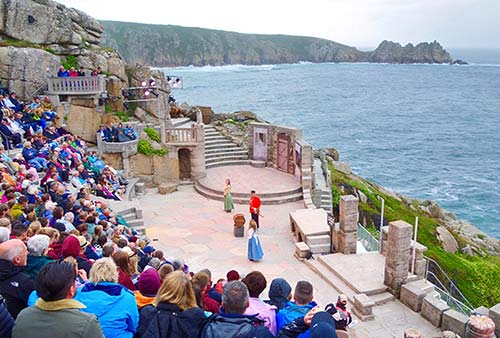
If you’re lucky enough to be here at lunchtime on a sunny day, get a Cornish pasty and a bottle of elderflower pressé (a local herbal drink), and grab a grassy seat in a quiet corner at the high end of the theater for a dreamy picnic. You’ll be entertained by gannet birds diving for a fresh fish lunch. (They hit the water at 70 mph.) You may even see a school of dolphins.
Cost and Hours: £10—book online in advance; theater generally open daily 10:00-17:00, off-season Wed-Sun 10:00-16:00 and closed Mon-Tue; also closes for sporadic daytime events—call ahead or check their website, +44 1736 810 181, www.minack.com.
Performances: Shows cost £10-35 and are generally mid-April-mid-Sept, usually at 19:30 or 20:00. Bring a blanket and dress appropriately, as you’ll be sitting on the grass, and plays are rarely cancelled because of weather.
PK Porthcurno Museum of Global Communications
In the 1920s, Porthcurno was the largest telegraph station in the world. At its peak, 180,000 miles of cable came together here. Imagine the importance of the telegraph: While it took six weeks to get a message from England to India in 1869, it took only nine minutes after the telegraph cable was laid from Porthcurno to India a year later. By the time World War II broke out, 14 cables tethered this village to the rest of the world. In 1940, defensive tunnels were built to protect the telegraph station and cables from the Nazis—who were then just 80 miles away in France.
Today, those tunnels and an adjacent building house a fascinating museum, tracing the history of the Victorian internet. The museum explains how underwater cables were made possible thanks to a new insulating material (a resin from a Malaysian tree called gutta-percha), how the cables were even more heavily armored in shallower water (where they could be damaged by the anchors of passing ships), and how ruptured cables were repaired in the briny deep. Ask about the worthwhile presentation about underwater telegraphy (usually 3/day starting at 11:30), which helps bring the place to life. The tunnels are furnished as they would have been during wartime, when they protected England’s very precious connection to the world. You can put on a helmet and escape via the stairs to the lookout high above.
Cost and Hours: £10; daily 10:00-17:00, shorter hours and closed Thu-Fri in Nov-March, last entry one hour before closing; above the main parking lot in Porthcurno—look for big white building marked Museum, +44 1736 810 966, https://pkporthcurno.com.
• Once you’re done touring Porthcurno, hop back in your car and backtrack to the B-3315, then turn left and drive three miles to...
Land’s End
The westernmost point in all of England should seem like a desolate, rugged place. In reality, it’s a tacky tourist trap where greedy businesses have chewed up whatever small bit of charm or authenticity this place might once have had. As you approach, you’ll see endless signs bragging “the last”...everything: inn, hotel, refreshment stand, postal box, and so on. Come here only if you want to be able to say you’ve been to Land’s End. You can get here directly from Penzance on the A-30 if you’re not following this driving tour.
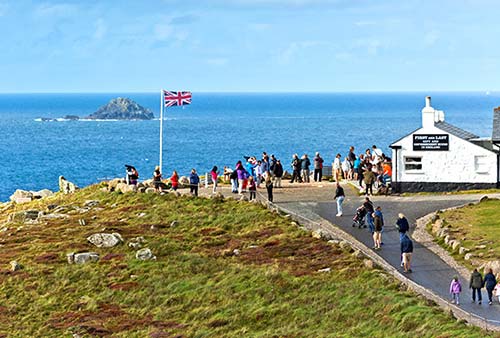
If you do visit, you’ll walk straight from the parking lot through the low-budget theme park (stop at your own risk) out to the viewpoint. This was once considered the end of the civilized world, the last (or first) thing to be seen by departing (or arriving) ships. After gazing at the sea and guessing how far away from home you are, find out how close you were by checking your hometown at the picture stand on the right. For a fee, they’ll take your photo with a personalized signpost and mail it to you.
• Head back inland and veer left (north) on the A-30. After about 2.5 miles, turn left on the B-3306, following signs to St. Just, the westernmost town in England, which used to support this area’s tin-mining industry.
In St. Just, follow the main street, lined with old workers’ cottages, to the market square, where you can get authentic Cornish pasties at K&D McFadden Butchers (closed Sun, 11 Market Square, +44 1736 788 136). Take the next left after the square, by the clock tower, and follow this road toward the coast until it ends at...
Cape Cornwall: “The Connoisseur’s Land’s End”
At this bluff with a memorial chimney capping it, you’ll feel like you’re at the end of England, all while escaping the commercialism of Land’s End. Cape Cornwall offers a fine little walk and a strong memory. Pay to park, and for the most peaceful and evocative approach, go through the gate and across a grassy field to visit the ruins of the tiny sixth-century church of St. Helen’s Oratory. Imagine a Celtic monk living here with just an altar, a fireplace, and a bed, dedicating his life to God. The trail then leads to the memorial capping the bluff. Just inland is a tin-mine captain’s mansion, and in the distance is Land’s End. Enjoy the perch.
The ground here is honeycombed with mine tunnels. Since ancient times, this has been a center of tin mining. Mix tin and copper, and you get bronze—great for weapons. (Around here, the Bronze Age was from 4000 BC to 800 BC.) Like West Virginia or North Wales, this area, reliant on mining in the industrial age, has had a tough time in the information age. Today all the working mines are closed (the last one was shuttered in 1999), with just a few open for tourists. Despite its bodice-ripping and soap-opera feuding, the BBC show Poldark, set in late-18th-century Cornwall, gives a sense of the region’s mining past.
• From the center of St. Just, continue north on the B-3306 for almost a mile, then veer left at the road with a sign for Botallack. Follow this road to the coast to find the...
Crown Mines of Botallack
This evocative coastal area is dotted with 19th-century industrial-age ruins. In their 1860s heyday, the tin mines here employed more than 500 people. The desolate engine houses once pumped water out so the mines could reach a half-mile down and a half-mile out to sea—today they invite hikers and photographers. You’ll find free parking, a small information center about mining culture, and dramatic walks.
• Continue along the coastal road for remarkable scenery and a peek at the historical Levant mine (with a working beam engine), then follow the road inland. At the T-intersection with the B-3306, turn left and go a quarter-mile to the...
▲Geevor Tin Mine
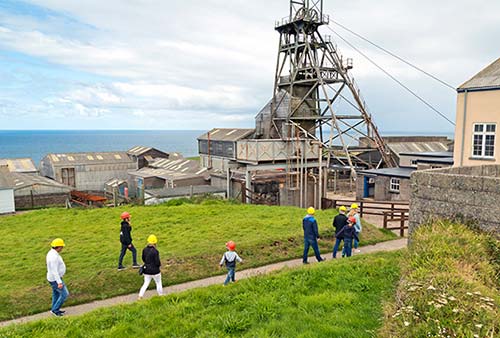
Once 2,100 feet deep and extending a half-mile under the ocean, the Geevor Mine closed in 1990. Tin mining here collapsed in the 1980s, and Margaret Thatcher ended subsidies that were keeping it afloat—effectively prompting the closure of the mine (and earning lots of Cornish enemies). Geevor represents the last hurrah not only of Cornish tin mining, but, in a sense, of Britain’s industrial age. Today, considered virtually a shrine by the local community, it’s been converted into a museum, exhibiting most of its original buildings and machinery. Exploring the remnants of this defunct industry, you’ll gain an appreciation for the simple, difficult life of miners. This unique look at tin mining is fascinating—and worth ▲▲▲ to those interested in engineering.
Cost and Hours: £19, Sun-Fri 9:00-17:00, shorter hours and closed Fri off-season, closed Sat year-round, last entry one hour before closing; self-guided “free flow” visits, wear good shoes, pick up free map at entry; café; +44 1736 788 662, www.geevor.com.
Getting There from Penzance: If you’re driving here directly from Penzance, take the A-30 Penzance bypass, then the A-3071 toward St. Just and follow the brown Historic Mining Area signs. Take the right fork on the B-3318 to Pendeen, turn left at the crossroads to drive through Pendeen, and turn right at the Geevor entrance. You can also get here on First Bus #18 (2/hour; 40 minutes) or the Land’s End Coaster (40 minutes). Check schedules at www.FirstBus.co.uk/cornwall.
Eating near the Mine: You can get hot, authentic, delicious Cornish pasties on the main square of the humble town of St. Just, at K&D McFadden Butchers (described earlier).
Visiting the Mine: Put on your hard hat and wander through the entrance building, keeping an eye out for a giant model (just before the exit) that once helped engineers keep track of the network of shafts—making it clear how extensive the mining industry was here. Then head outside, where you’ll walk from shed to shed to see the various parts of the day-to-day workings of the mine.
The modern, well-presented Hard Rock Museum features exhibits for all ages about mining and the rocks that harbor valuable ores. On the ground floor, you’ll find an extensive exhibit about geology (including a 220-pound chunk of tin-embedded stone), display cases with items the miners took down into the shafts with them, and a very loud simulation of what it was like inside the mine shafts (press the button for sound effects). The Geevor Voices film (about 20 minutes) uses interviews and news clips to tell the story of the mine’s operation, closure, and conversion to a museum. Upstairs are hands-on exhibits about the tin-making process, and a timeline of the mine’s history.
The Dry is where the miners showered, changed, and dried their uniforms between shifts. Though it closed more than three decades ago, it feels as though the miners could show up at any time to clock in. Enjoy the old time-punch clock, the fun stickers on the miners’ lockers, and graffiti showing their sense of humor (such as the Ear Protection Must Be Worn sign posted next to the toilets).
In The Mill, you’ll see how a vast warehouse of “shaking tables”—like giant machines panning for gold—separated the miners’ haul into its useable parts.
The finale is a 30-minute underground tour of an 18th-century mine (which predates the more recent mine that the current buildings supported). The mines—narrow and low (you’ll be hunched for most of the tour, and claustrophobes will be miserable)—give you a sense of the difficult life of miners and the perilous conditions under which they worked. During very busy times in summer, you’ll explore this area at your own pace, with docents posted throughout to answer questions.
• Back in your car, as you exit Geevor Tin Mine, turn left onto the B-3306. Enjoy the final stretch, the...
Scenic Drive to St. Ives
For simple Cornwall beauty, drive the north shore of the Penwith Peninsula. In the 10 miles between Geevor Tin Mine and St. Ives, the little B-3306 is simply a joy as you ride through mining towns, farm hamlets, and pastoral fields. The winding hedge walls, built before motor traffic, make the road not quite two lanes wide. Hearty white-belted Galloway cows ignore the views, smokestacks mark old mines, and stony barns are just going through another century.
• Our drive is over. Spend some time exploring St. Ives before heading back to Penzance along the B-3311.
Cornwall’s history is tied to its tin-mining industry. While Cornwall has always been known for its metal deposits, a major tin boom began here in the mid-1700s, as new steam-engine pumps allowed tin to be mined below the water table. The industry peaked 200 years ago, when tin was in demand and Cornwall was the Silicon Valley of Britain.
Miners would climb down into the narrow shafts and use a hammer and a long bit to slowly drive deep, skinny holes into a vein of tin. Then they’d insert sticks of dynamite. Before safety fuses were invented, quills from bird feathers were used as fuses, so miners setting off gunpowder never knew how much time they had to reach safety before the explosion.
Deadly cave-ins were frequent. These were supposedly caused by mischievous Tommyknockers, Cornish pixies similar to leprechauns. But these mysterious creatures might simply have been a creation of the oxygen-starved imaginations of exhausted miners.
Mines employed the notorious “company store” system, where workers were paid in tokens that could only be redeemed at the store run by the mine (which always worked to the company’s advantage). To save money, miners made their own “hardhats.” They’d take a felt hat and harden it by dipping it alternately in hot tree resin and soil. Then they’d stick a candle on the brim for light while they worked. Since miners had to buy their own candles (from the company store, of course), they’d extinguish them during their pitch-black lunch break to make them last longer.
After working all morning underground, Cornish tin miners looked forward to their traditional lunch of a pasty (PASS-tee). Basically a beef stew wrapped in a pastry crust, pasties had a thick, crimped edge that miners could grab with dirty hands. Because wheat flour was expensive, early miners skimped by using barley wheat—making for a very tough package. Leftover chunks of dough were often dropped into the mineshaft to appease the Tommyknockers.

Originally a pasty would be filled half with stew, and the rest with jam or apples. Nowadays there’s a nice variety of flavors, like lamb and mint, but the full-meal deal is rare. The British government won trademark protection from the European Union for the Cornish pasty, and the rule still stands post-Brexit. That means the term “Cornish pasty” can only be applied to those pasties made in Cornwall using traditional techniques and recipes (www.cornishpastyassociation.co.uk). Look for pasties all over Cornwall (and throughout Britain). One of the best places is K&D McFadden Butchers in St. Just, near the Geevor Tin Mine.
Other than savory pasties, the crumbling smokestacks that dot the landscape today are the only remnants of Cornwall’s now-dead tin-mining industry, which couldn’t compete with cheap tin from Asia and South America. The ground underfoot is still honeycombed with forgotten tin mines. Older Cornish natives can still remember being in their houses and hearing the miners working underground.
PENWITH PENINSULA BY BUS
If driving takes the joy out of a joyride for you, you can still visit many of the sights described in the Penzance to St. Ives Drive by bus. My recommended itinerary makes the best use of your time, but only works in summer, when First Bus operates their hop-on, hop-off bus service.
Be aware that some stops require walking up steep hills. Confirm bus schedules ahead of time, be selective about where you get off (as it’s generally an hour between buses), and get an early start. For the best value, get a bus day pass (see here for pass and schedule information). See “Scenic Drive to St. Ives,” earlier, for sight descriptions.
Penzance to Porthcurno: From Penzance, take the clockwise Land’s End Coaster bus in the direction of Land’s End to Porthcurno (45 minutes). On the way to Porthcurno, you’ll see Merry Maidens Stone Circle from the left side of the bus. At Porthcurno, the bus exits the main road and eventually loops in front of the Museum of Global Communications—get off at this stop.
Porthcurno: Visit the Minack Theatre first. From the bus, head to the main street (The Valley) and walk uphill 10 minutes, passing the Porthcurno Beach Café. Follow signs for Minack Theatre. After your theater visit (book tickets in advance), walk back down the hill, visit the Museum of Global Communications or Porthcurno Beach, and catch the next bus to Land’s End (20 minutes).
Land’s End/Sennen Cove: Skip the town in favor of a 30-minute, 1.5-mile coastal hike to Sennen Cove. After getting off at the Land’s End bus stop, walk toward the coast and veer right to reach the First and Last House. Continue north, with the water on your left. Along the way you’ll enjoy great views, misleading Maen Castle signs (the “castle” is just a few rocks), a shipwreck, and a lookout house. Eventually the path drops you into the small beach community of Sennen Cove, with a large beach and a few cafés along the water. After your visit, head to the bus stop on Cove Hill Road across from Smart Surf School to catch the bus toward St. Ives to the tin mine (30 minutes).
Geevor Tin Mine: This stop can be difficult to identify; ask the driver to point it out. Walk about six minutes from the stop down to the mine.
St. Ives: After touring the mine, continue on toward St. Ives (55 minutes). Relax and take in the views as the bus winds around the north side of the peninsula. Once you arrive in St. Ives, you can either jump off and explore, or stay on the bus to return to Penzance.
Back to Penzance: On the way back to Penzance, the bus stops at Marazion near St. Michael’s Mount. Get off to visit the sight, or continue back to Penzance.
East Cornwall
These destinations are a bit farther from Penzance, and closer to Dartmoor National Park. I’ve listed them from farthest to nearest to Penzance. Consider visiting them in this order as you head south, approaching the tip of Cornwall.
▲Tintagel Castle
Wild, rocky, remote, and romantic, Tintagel (tin-TAD-jell) is as dramatic as a castle can be. The real King Arthur—if he actually existed—was supposedly born here and ruled his lands from this rocky point. While the popular tales of Camelot are flights of fantasy, they may be based on a real person. Even though there’s no physical record of King Arthur, the verbal tradition is strong enough that experts think a fifth- or sixth-century ruler by that name probably lived in this area, possibly basing himself in modern Camelford (which might be where “Camelot” comes from). Regardless of whether Arthur is fact or fiction, windblown Tintagel Castle is striking. Though overpriced, it’s one of England’s more rewarding ruined-castle experiences. And, as a bonus, you get to enjoy a spectacularly scenic stretch of Cornish coastline. Bring a picnic to have lunch with a view, or eat at the on-site café.

Cost and Hours: £23, cheaper at off-peak times; daily 10:00-18:00, shorter hours off-season and closed some days in Nov-March, last entry one hour before closing.
Advance Tickets Recommended: Buy a timed-entry ticket in advance online at their website to ensure entry. A limited number of same-day tickets are sold on-site, but they can sell out.
Information: +44 1840 770 328, www.english-heritage.org.uk/tintagel.
Getting There: The castle clings to the coast below the tacky town of Tintagel. If you’re arriving by car, look for Tintagel signs from the A-39 as it passes through Camelford. Once you enter the village of Tintagel, take your pick of parking lots. Walk along the main street following black castle signs, then hike down the steep road to the entrance (allow at least 20 minutes). Or hop the Land Rover shuttle (small fee), which runs continuously between the top of the trail and the ticket office down at sea level (only worth it if you want to use the restroom or visit the shop, as you still have to climb up to the entrance).
Visitor Information: Pick up the brochure that guides you to points of interest around the site. For the full story, invest in the £5 illustrated guidebook.
Visiting the Castle: Entering the castle compound, you’ll find yourself in the gatehouse courtyard. Ahead, a footbridge crosses the chasm between the main part of the castle on the island (actually a rocky peninsula attached by a narrow spit) and the mainland (where you’re standing now). The mainland and island were once joined by a natural land bridge, which collapsed in the 15th or 16th century. Until 2019, visitors had to climb more than 100 steps to reach the cliff-top ruins. The modern steel footbridge re-creates the historic path (and the dramatic viewpoint), once again joining the divided castle sights.
From the bridge, look down to the right to see the holes in the cliff below the ruins. One of these is supposedly Merlin’s cave. (If the tide is out, you can climb down to explore the famous wizard’s former home...and ponder how he managed to keep the carpet dry and prevent seals from climbing on the furniture.) Looking up to the rock-top castle, appreciate its naturally fortified, easily defensible position. Note the narrow and difficult approach to this hunk of land, and you can understand why Tintagel—meaning “fortress with narrow entrance”—is aptly named.
As you cross the footbridge, you’ll see the original Victorian-era back-door entrance and staircase down to the beach below. Straight ahead is the island courtyard, with castle remnants dating from the Middle Ages. Rather than belonging to Arthur (who would have lived centuries earlier), these structures were built for the brother of a 13th-century king. Notice that the walls are made of stacked sheets of slate, which was mined on this site for many years.
This was an important center in the century after Rome abandoned Britain, a fact that lends credence to the hunch that a mighty King Arthur ruled from here. Arthur was first linked to this place in the 12th century, after the castle had been abandoned for six centuries. Geoffrey of Monmouth’s not entirely factual 1136 tome, The History of the Kings of Britain, popularized the idea that Arthur had been conceived here. King Henry III’s little brother, Richard, Earl of Cornwall, bought the castle in 1233 due to its association with Arthur and had it rebuilt. Another boost in its fame came in the Victorian age, when many notable writers and artists came here for inspiration.
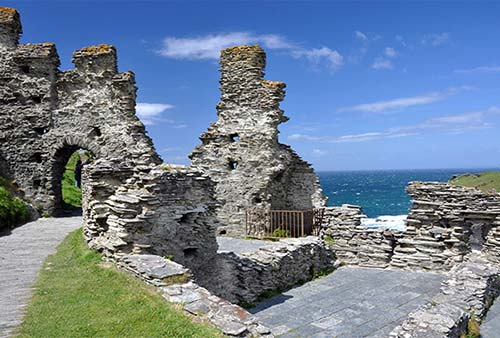
Continue through another evocative doorway, proceed straight along the cliff, and hike up to the viewpoint platform. All around you—including directly below—you’ll see the foundations of ruined houses, which date from around the time when Arthur most likely lived (the fifth century AD). Here archaeologists have found remains of items from as far away as North Africa and the Eastern Mediterranean—evidence of the wealth and status of this castle’s owner.
At the top of the island, the 360-degree views are spectacular. Circling around the site, you’ll come across several interesting features. In the walled area in the center—called the garden—medieval residents could relax and entertain visitors in summer. Just beyond that, the well was the source of water in the Middle Ages, and remains today’s last resort in case of fire. The 11th-century chapel is recognizable for the altar at its far end. If you have time, linger up here. The craggy peaks across the tops of the cliffs make a perfect windblown picnic spot.
Tintagel Town
With just a couple of streets around the trailhead to the castle, this tacky town feels made for tourism. On my first visit I had a beer at the Excali Bar and kept looking for a menu with “the sword in the scone.” The Tintagel Visitor Centre, at the first parking lot you come to, has a helpful info desk run by volunteers, a worthwhile history exhibit, and a WC (daily 10:00-14:00, +44 1840 250 010). There are two overpriced “historic” sights in town: The 1380 Old Post Office looks every bit its age (£6.50, 4 unimpressive rooms), and King Arthur’s Great Halls boasts a Hall of Chivalry with pre-Raphaelite stained-glass windows and lots of romantic Knights-of-the-Round-Table-themed paintings (closed Nov-Feb and Mon, at the roundabout).
Villages South of Tintagel
If you have some time between the Penwith Peninsula and Tintagel, consider stopping at one or both of these seafront villages.
Padstow
A little Cornish fishing port with a big culinary reputation, Padstow is the home of Michelin-starred chef Rick Stein and several of his fish restaurants. Although largely unknown stateside, this celebrity chef (who has hosted several cooking and travel series for BBC television) is famous in Britain and has singlehandedly upped the culinary standards of Cornwall. Some people even call the town “Padstein.”
Getting There: Padstow sits on a large estuary about 45 miles northeast of Penzance (roughly on the way to Tintagel Castle). From the main A-30 road, exit at the A-39 and follow Padstow signs for 12 miles (turning off onto the B-3274 about halfway there; total trip from the A-30 is about 20 minutes one-way). Entering town, follow P signs to the large pay lot along the wharf, a short walk from the harbor and town center. If that’s full, there’s another lot behind the Tesco back at the top of the town.
Visiting Padstow: Ideal for a lunchtime stopover, Padstow is still a working seaport, where local fisherman can sometimes be seen bringing in their daily catch. Happy dogs, and even happier seagulls, enjoy the seaside town’s laid-back ambiance. If you’re lucky, you may even encounter a local sea shanty group performing on the little square at the harbor. Tourists now browse the art galleries and enjoy their ice-cream cones, but the town has managed to retain a little of its gritty charm—particularly in the streets behind the harborfront.
Rick Stein’s simply named $$$$ Seafood Restaurant, the flagship of his culinary empire, may be worth planning a meal around for curious foodies—but be sure to reserve ahead (daily, between the parking lot and the harbor, +44 1841 532 700; for details, see www.rickstein.com).
Scattered throughout the town are several less-upscale Rick Stein eateries, including a café and a French bistro. A large building along the wharf (near the parking lot) houses a group of Rick Stein attractions—a cookery school, a deli, a seafood bar, and an expensive but very tasty fish-and-chips stand (if there’s a long line for a table, look for the separate door for takeaway). Behind the parking lot, at the west end of the wharf, is the tourable National Lobster Hatchery (£7.50, daily 10:00-17:00, can close later in summer and earlier in winter, see website for exact times, www.nationallobsterhatchery.co.uk).
Port Isaac
While Port Isaac is a beautiful workaday fishing village tucked in a deep gash of rock just down the coast from Tintagel, it is trampled by devotees of Doc Martin, the popular British television series that was set and filmed here. It might as well be called Port Wenn—its fictional name in Doc Martin. Driving in from the A-389 or B-3267 highways, you’ll see two big parking lots above town before the Co-op. Or you can follow blue P signs to the triple-tiered pay parking lot with grand Atlantic Ocean panoramas (including distant views of Tintagel). Then hike back along the main road and climb steeply down into town, pausing periodically to enjoy the views of the deep gorge that protects the town’s harbor. On the way into town, you’ll pass Doc Martin’s old schoolhouse, now cleverly converted into a pub and hotel. (The small cottage where the good doctor resides is across the harbor from the schoolhouse.) Notice how boats are tethered by extremely long lines to the harbor; thanks to the dramatic tides, they’re forced to gently beach themselves on sandbars at low tide.
▲Eden Project
The Eden Project is an ambitious and futuristic work in progress—a theme park of global gardening with an environmental conscience. Exotic plants from all over the world are showcased in two giant biomes, reputedly the largest greenhouses in the world. The displays focus on sustainable farming and eco-conscious planting, but the most interesting thing here is the sheer audacity of the idea. If you’re looking for a quaint English cottage garden, this isn’t it. Rather than a flowery look at England’s past, this “global garden” gives you a sense of how the shrinking of the world will affect us in the future.
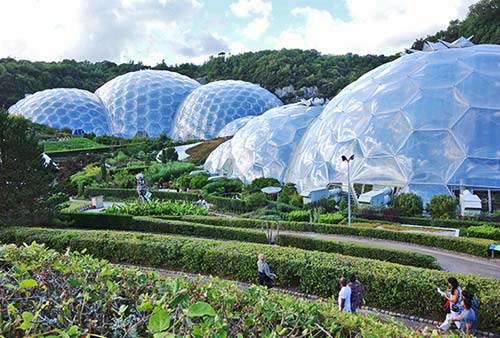
Cost and Hours: £40, cheaper at off-peak times, smart to book online in advance; free tour app, daily 9:30-18:00, Nov-March generally 10:00-16:00, last entry 1.5 hours before closing. The domes can close as early as 16:00 for private events and off-season—check online or call first to confirm closing time, cafés, located near the town of St. Austell, +44 1726 811 972, www.edenproject.com.
Getting There: Drivers will find the Eden Project well-signposted from both the A-30 and the A-39—you’ll be directed to the A-391 and follow signs from there. Park at one of the many outlying lots, note your parking lot’s fruity symbol, then walk down into the Project (or take the free shuttle bus). By public transit, first take the train to St. Austell, then take bus #101 (hourly, +44 871 200 2233, www.firstbus.co.uk/cornwall) or taxi 20-30 minutes.
Visiting the Eden Project: While the site is multifaceted, it is dominated by two big biomes—the Rainforest and the Mediterranean. Zigzag down into the pit and work your way through the various exhibits, including the enormous, hot, and hazy Rainforest Biome (you can seek relief in an air-conditioned hut about halfway through); the smaller and more arid Mediterranean Biome; an eatery-filled walkway connecting them called The Link; The Core, with educational exhibits; and lots of gardens. An elevator from The Core makes it easier to get back up to the visitors center when you’re done. Kid-oriented programs, rock and pop concerts, and other special events run throughout the year. Thrill seekers can pay extra to zipline over the biomes or ride a giant swing—see the website for all the hair-raising details.
Gardens near Falmouth
Cornwall has many wonderful gardens, some with subtropical varieties of plants that thrive in this mild climate (www.greatgardensofcornwall.co.uk). The two gardens listed here are a few miles apart on the same backcountry road, just south of Falmouth.
Getting There: If you’re driving, take the A-39 or the A-394 into Falmouth until you see brown-and-white Garden signs—track these closely for four miles through the countryside to the gardens (Glendurgan is the better signed of the two). If you’re without a car, take bus #35 from Falmouth toward Helston (45-70 minutes, www.firstbus.co.uk/cornwall).
▲Trebah Garden
The “Garden of Dreams” at Trebah (TREE-bah), set on 26 acres that bunny-hop down a ravine to the beach below, is a lush and tropical spectacle that makes for an unexpected treat. While most of England suffers from chilly arctic air, the Cornish peninsula is bathed in warmer air from the Gulf Stream—making average temperatures here much milder (the sea here never drops below 50°F). Palms, succulents, bamboo, large azaleas, giant rhubarbs, and the prehistoric-looking gunnera might make you think that you’re in the tropics (or wish that you were). The garden’s exoticism impresses even nongardeners. While garden lovers wander in ecstasy, history buffs can ponder the fact that the beach below was used by some US troops in World War II to launch the D-Day attack on Omaha Beach.
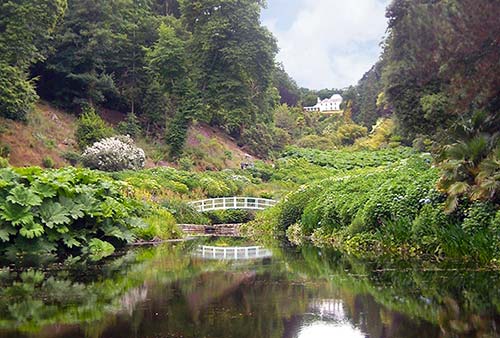
Cost and Hours: £15, daily 9:30-17:00, until dusk in winter, last entry one hour before closing; colorful year-round but flowers are best late March and April, café, +44 1326 252 200, www.trebahgarden.co.uk.
Glendurgan Garden
Just up the road from Trebah, Glendurgan has a smaller collection of tropical plants mingled with more traditional English garden fare. Similarly set in a broad basin angled to the sea, Glendurgan is bigger but less striking than its neighbor. However, it comes with an extensive, kid-friendly hedge maze (about waist-high—but still entertaining—for an adult), built by the former owner to amuse his 12 children. Gardeners may appreciate its good orchids and its small “Holy Bank” of biblical-themed plants. And, down at the seashore is the picturesque fishing hamlet of Durgan—preserved in its entirety by the National Trust.
Cost and Hours: £11; Tue-Sun 10:30-17:00, closed Mon except in Aug, closed Nov-mid-Feb; best in spring, fee for worthwhile map/guide, pay parking, café, +44 1326 252 020, www.nationaltrust.org.uk.
Sleeping near the Gardens: To maximize your time exploring the gardens, consider spending the night in or near salty Falmouth, a tidy harbor town nestled near the Tudor fortress of Pendennis Castle.
$$$ The Greenbank hotel is right on the water with a seagull’s-eye view of the many boats moored in the Fal estuary. Look near the hotel lobby for displays about Kenneth Grahame, who wrote parts of The Wind in the Willows while staying here (Harbourside, +44 1326 312 440, www.greenbank-hotel.co.uk, reception@greenbank-hotel.co.uk).
$ Cornwall Plus rents double rooms with private bath at the joint campus of the University of Exeter and Falmouth University, located five miles from Falmouth along the A-39. The dorm rooms are only available July-August, when the college kids are on summer break (also rents apartments and cottages, café, grocery, launderette, Treliever Road, Penryn, +44 1326 259 155, www.cornwall-plus.co.uk, booking@fxplus.ac.uk).