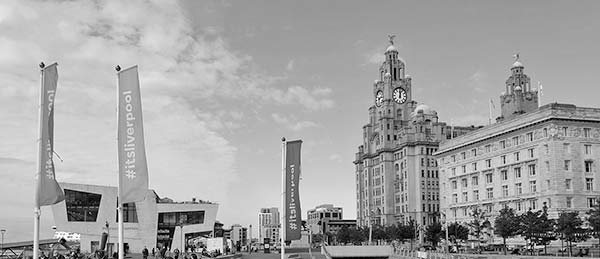
LIVERPOOL
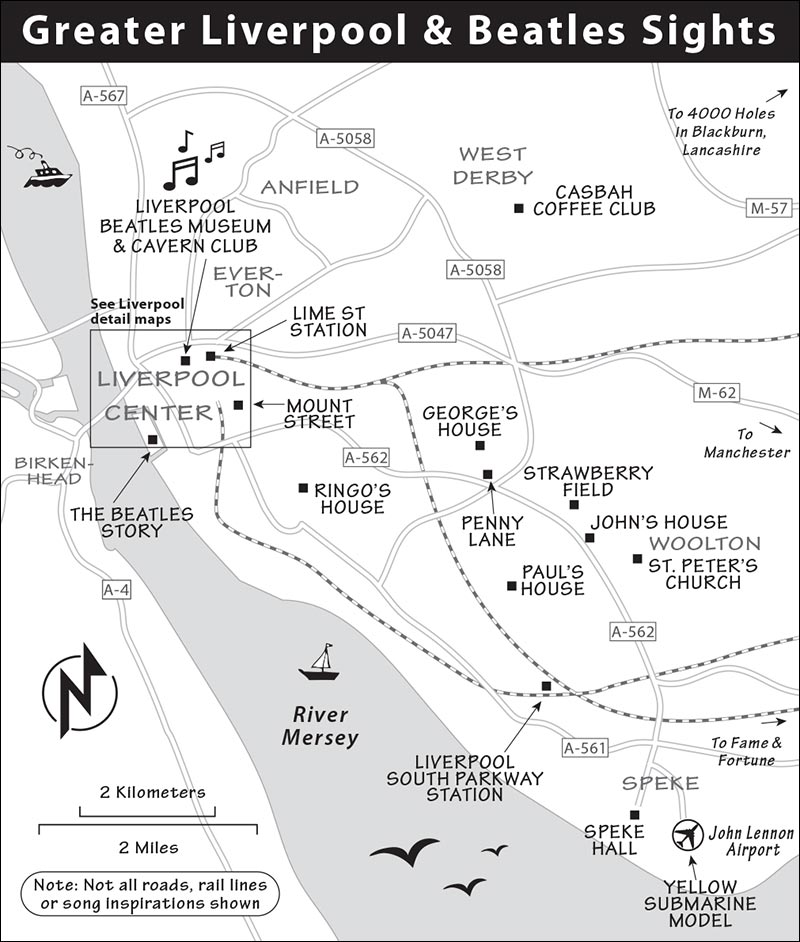
Map: Greater Liverpool & Beatles Sights
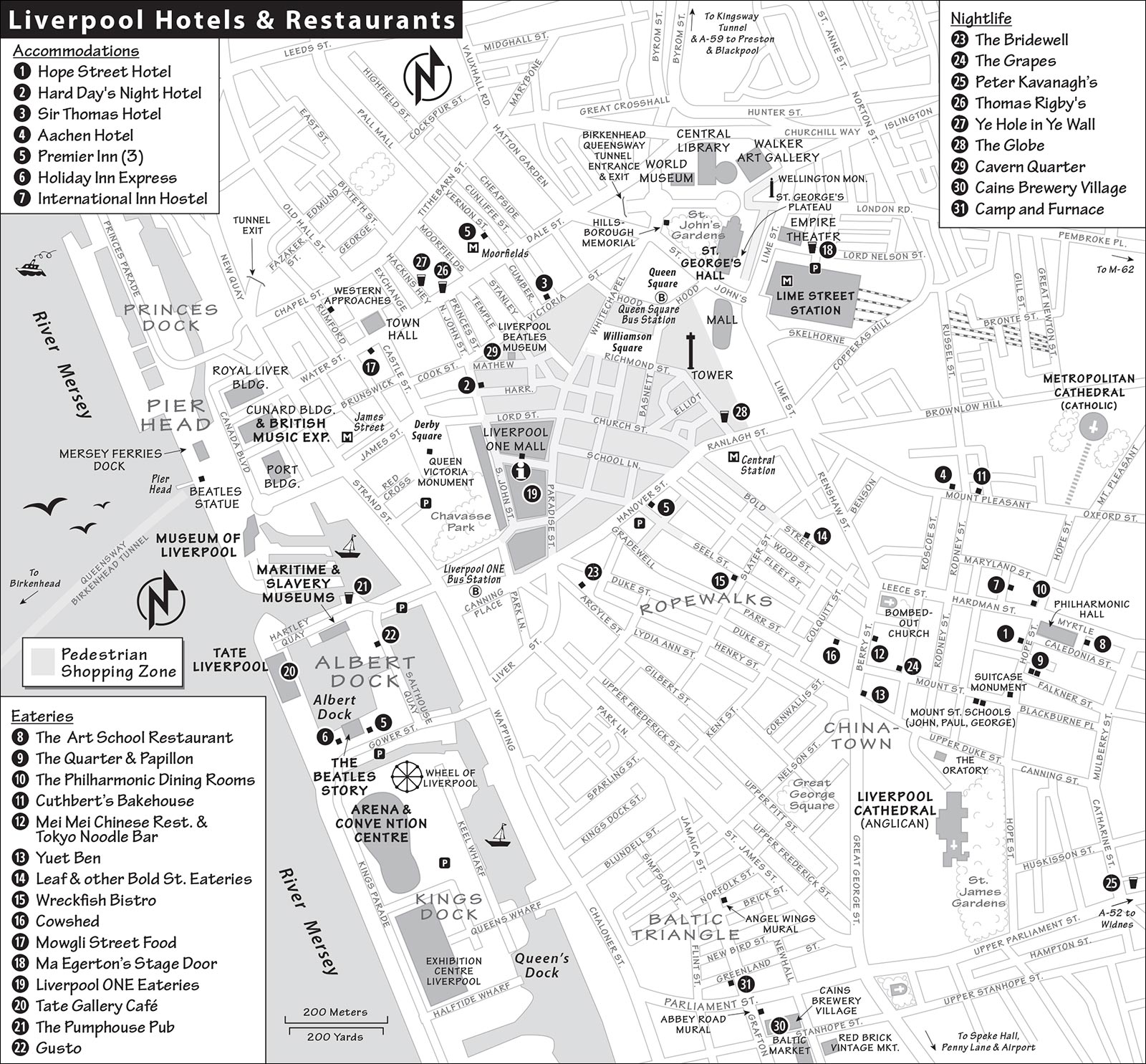
Map: Liverpool Hotels & Restaurants
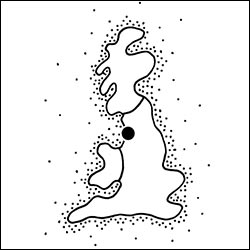
Wedged between serene North Wales and the even-more-serene Lake District, Liverpool provides an opportunity to sample the “real” England. It’s the best look at urban England outside of London.
Beatles fans flock to Liverpool to learn about the Fab Four’s early days, but the city has much more to offer—most notably, a wealth of excellent free museums, a pair of striking cathedrals, a dramatic skyline mingling old red-brick maritime buildings and glassy new skyscrapers, and—most of all—the charm of the Liverpudlians.
Sitting at the mouth of the River Mersey in the metropolitan county of Merseyside, Liverpool has long been a major shipping center. Its port played a key role in several centuries of world history—as a point in the triangular-trade route for African slaves, a gateway for millions of New World-bound European emigrants, and a staging ground for the British Navy’s Battle of the Atlantic against Nazi U-boats. But Liverpool was devastated physically by WWII bombs, and then economically by the advent of container shipping in the 1960s. Liverpudlians looked on helplessly as postwar recovery resources were steered elsewhere.
Despite the pride and attention garnered in the 1960s by a certain quartet of favorite sons, Liverpool continued to decline through the 1970s and ’80s. The Toxteth Riots of 1981, sparked by the city’s dizzyingly high unemployment, brought worldwide attention to Liverpool’s troubles.
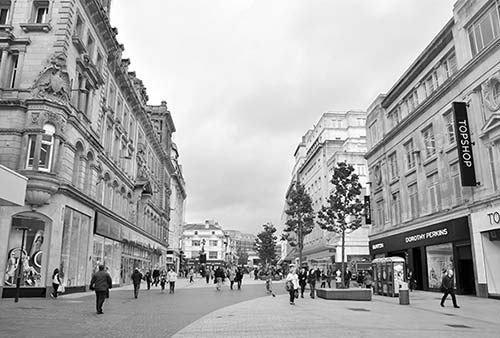
In the early 2000s, things started looking up. The city’s status as the 2008 European Capital of Culture spurred a cultural renaissance, with major gentrification, EU funding, and development of the Liverpool ONE commercial complex in the once bombed-out center. Today, lively pedestrian zones, trendy restaurants, and a thriving arts scene make Liverpool a fun place to visit. The city has long since shed its depressed industrial vibe. And, with some 50,000 students attending three universities in town, Liverpool is also a youthful city, with a pub or nightclub (many hopping with live music) on seemingly every corner.
Nicknamed “Scousers” (after a traditional seafarers’ stew), the people of Liverpool have a reputation for being relaxed, easygoing, and welcoming to visitors. The Scouse dialect comes with a distinctive lilt and quick wit—think of the Beatles’ familiar accents, and all their famously sarcastic off-the-cuff remarks, and you get the picture. Many Liverpudlians attribute these qualities to the Celtic influence here: Liverpool is a melting pot of not only English culture, but also loads of Irish and Welsh, as well as arrivals from all over Europe and beyond (Liverpool’s diverse population includes many of African descent and the oldest Chinese community in Britain). Liverpudlians are also famous for their passion for football (soccer), and the Liverpool FC team—as locals will be quick to tell you—is one of England’s best. And, along with the city, scouse stew is on the rise as well—you’ll see it on menus all over town.
PLANNING YOUR TIME
Liverpool can easily fill a day of sightseeing. For the quickest visit, focus your time around the Albert Dock area, home to The Beatles Story, Merseyside Maritime and Slavery Museums, Tate Gallery (for contemporary art lovers), Museum of Liverpool, and the British Music Experience. If time allows, consider a Beatles bus tour (departs from the Albert Dock).
A full day buys you time either to delve into the rest of the city (the lively urban core, the cathedrals, the Western Approaches WWII museum, and the Walker Art Gallery near the train station), to binge on more Beatles sights (the Liverpool Beatles Museum or the boyhood homes of John and Paul), or a bit of both.
If you’re here just for the Beatles, you can easily fill a day with Fab Four sights. Start your morning in the Albert Dock area visiting The Beatles Story and/or the British Music Experience, then take a Beatles bus tour from the Albert Dock to the other Beatles sights in town, winding up at the Cavern Quarter to tour the Liverpool Beatles Museum and enjoy a Beatles cover band in the reconstructed Cavern Club. Or, if you are interested in touring the inside of John’s and Paul’s childhood homes (bus tours only stop outside), head to the Lime Street Station after lunch and take a 15-minute train ride to the South Parkway Station, where a National Trust minibus will pick you up (must be reserved well in advance; see listing later under “Sights in Liverpool”). Drivers could flip this itinerary and tour John’s and Paul’s homes in the morning.
International Beatleweek, celebrated in late August, is a very busy time in Liverpool, with lots of live musical performances.
Orientation to Liverpool
With nearly a half-million people, Liverpool is Britain’s fifth-biggest city. But for visitors, most points of interest are concentrated in the generally pedestrian-friendly downtown. You can walk from one end of this zone to the other in a half hour. Since interesting sights and colorful neighborhoods are scattered throughout this area, it’s enjoyable to connect your sightseeing on foot. (Beatles sights, however, are spread far and wide—it’s most efficient to connect them with a tour; see “Tours in Liverpool,” later.)
ARRIVAL IN LIVERPOOL
By Train: The main Lime Street train station has eateries, shops, car rentals, and pay baggage storage (Mon-Sat 7:00-23:00, Sun from 8:00, +44 151 909 3697, www.left-baggage.co.uk).
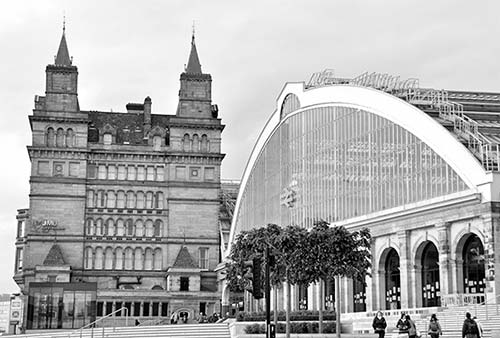
Getting to the Albert Dock: From Lime Street Station to the Albert Dock is about a 20-minute walk or a quick trip by train or taxi.
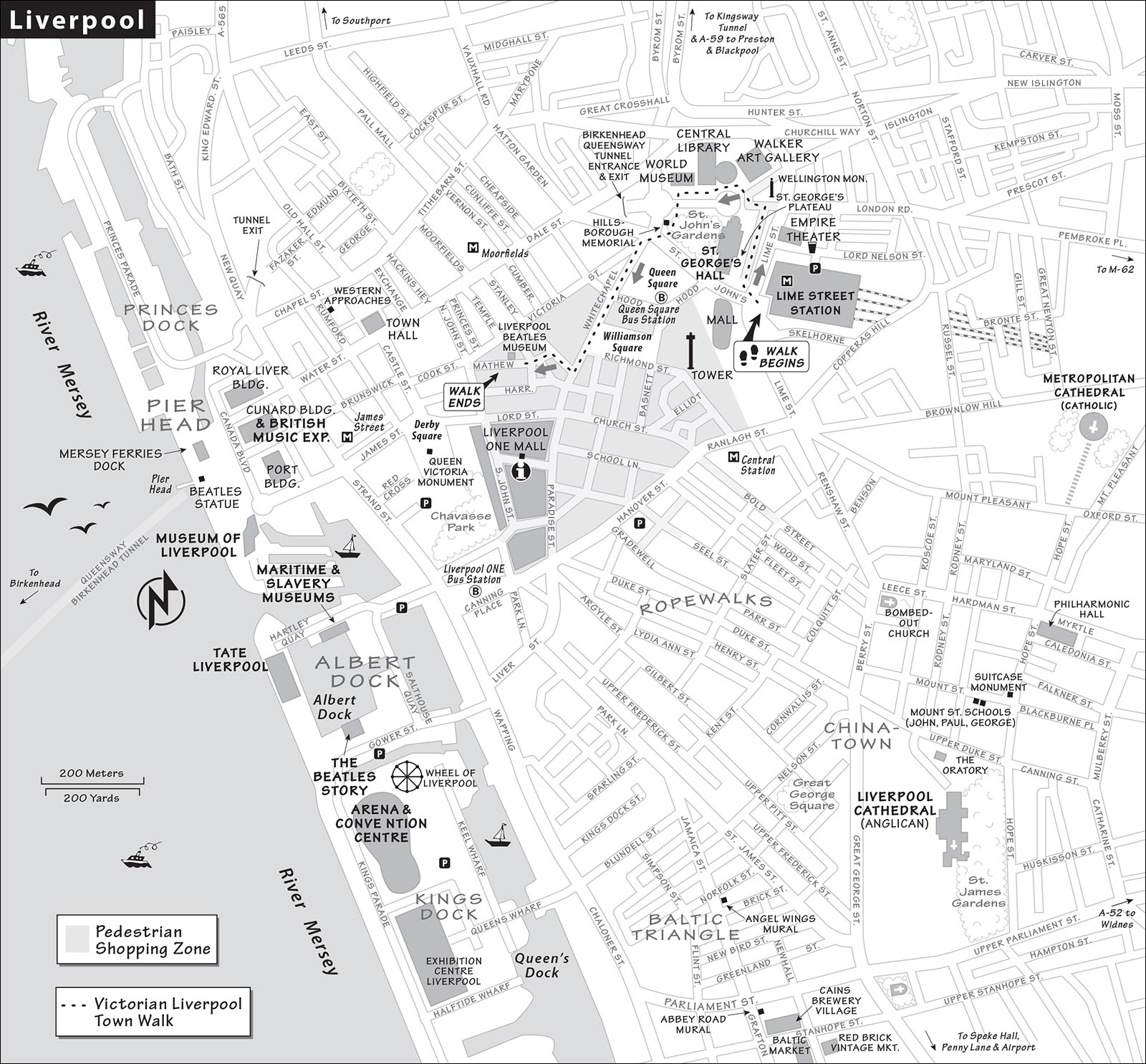
To walk, exit straight out the front door. On your right, you’ll see the giant Neoclassical St. George’s Hall; the Walker Art Gallery is just beyond it. To reach the Albert Dock, go straight ahead across the street, then head down the hill between St. George’s Hall (on your right) and the big blob-shaped mall (on your left). Turn left onto Whitechapel Street and walk straight ahead all the way until you see the big red-brick warehouses of Albert Dock.
You can also take a train from Lime Street Station to James Street Station, then walk about five minutes to the Albert Dock (£2.40, buy ticket at station or online at www.thetrainline.com). A taxi from Lime Street Station to the Albert Dock costs about £8. Taxis wait outside the side doors of the station.
Getting to Mathew Street: To head straight from Lime Street Station to the center of Beatlemania, walk downhill with St. George’s Hall on your right, turn left on Whitechapel, and then, shortly after entering the pedestrian zone, jog right on Stanley Street. Look for Mathew Street on the left. Or, get a better taste of the city by following my self-guided Victorian Liverpool Town Walk (see here).
By Bus: Buses arrive at the Liverpool ONE station (a five-minute walk from the Albert Dock) or the Queen Square station (a five-minute walk from the Lime Street train station).
By Plane: Liverpool John Lennon Airport (code: LPL, www.liverpoolairport.com) is about eight miles southeast of downtown, along the river. Buses run regularly between the airport and Liverpool ONE bus station. Bus #500 is quickest (2/hour, 35 minutes, pay driver).
By Car: Most drivers approach Liverpool on the M-62 motorway, which dies at the edge of town. Just follow signs to City Centre and Waterfront, then brown signs to Albert Dock, where you’ll find a huge pay parking lot (as well as two smaller ones). There are three bigger central garages at the Liverpool ONE commercial complex. If coming from Wales, take the toll tunnel under the River Mersey and follow signs for Albert Dock.
HELPFUL HINTS
Book Ahead: Buy tickets online in advance for these Beatles-related sights and tours: Lennon’s and McCartney’s homes, the Magical Mystery bus tour, the Beatles Famous Walking Tour of Liverpool, The Beatles Story, and Casbah Coffee Club.
Tourist Information: You’ll find Liverpool’s helpful TI within the Liverpool ONE mall (Mon-Sat 9:30-17:30, Sun 10:30-17:00, 5 Wall Street, +44 151 351 0300, www.visitliverpool.com).
Tours in Liverpool
Private Guides
To tailor a visit to your schedule and interests (Beatles or otherwise), Jackie Spencer is at your service (up to 5 people in her chauffeur-driven minivan—£380, 4 hours, longer tours available; also leads walking tours—£130, up to 10 people; pick up at your hotel or train station, +44 799 076 1478, www.jackiespencerbeatleguide.com, jackie@beatleguide.com).
Paul Beesley, a local guide who runs the Liverpool Tour Guide Service with the help of others, is also a good source for private guiding (rates for private tours start at £135, +44 151 374 2374, www.ltgs.co.uk, office@ltgs.co.uk).
Hop-On, Hop-Off Buses
Two different hop-on, hop-off bus tours cruise around town, both with live guides, offering a quick way to get an overview of the major sights. Both run daily generally 10:00-16:00 (2-4/hour depending on season); tickets are valid for 24 hours and can be purchased from the driver or online. Liverpool City Sights has the red buses (£12, 14 stops, +44 151 298 1253, https://liverpoolcitysights.com) and City Explorer Liverpool has the yellow buses (£12, £22.50 combo-ticket with Mersey Ferries river tour, 11 stops, +44 151 933 2324, https://cityexplorerliverpool.co.uk). Both companies also offer tours (with live guides) of the key Beatles sights with brief stops for photos (see next).
Beatles Sights
To see as many Beatles-related sights as possible in a short time, bus tours are the way to go; or try a walking tour that ties Beatles and city history together.
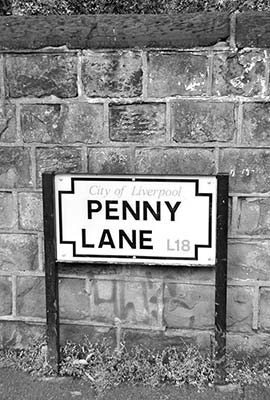
Liverpool City Sights and City Explorer Liverpool both offer 90-minute Beatles tours with live guides, music, and two stops for photos. Tours depart from the Albert Dock and drive by the houses where the Fab Four grew up (exteriors only), places they performed, and spots made famous by the lyrics of their hits (“Penny Lane,” “Strawberry Fields,” the Eleanor Rigby graveyard at St. Peter’s Church, and so on). Even lukewarm fans will enjoy the commentary and seeing the shelter on the roundabout, the barber who shaves another customer, and the banker who never wears a mack in the pouring rain (combo-tickets available with hop-on, hop-off routes, £15-22, buy tickets online or at Albert Dock stop, see websites for options and schedules, https://liverpoolcitysights.com, https://beatlescityexplorer.co.uk).
For a slightly longer tour (two hours) with more stops, Beatles fans can board the psychedelically painted Magical Mystery Tour bus. The tour ends at the Cavern Club and includes general admission when the club charges a cover (£20, 5/day, fewer off-season, +44 151 703 9100, www.cavernclub.org). As these tours often fill up, it’s wise to book ahead.
The Beatles Famous Walking Tour of Liverpool is an engaging and informative exploration of the entwined histories of Liverpool and the Beatles. Thoughtful, personable guides connect you to the city and its four famous native sons through stories, old photos of places along the way, historical context, and musical insights (£17, daily at 10:30 and 14:00, book online in advance, departs from near Liverpool ONE, +44 7476 349 173, www.liverpoolfamouswalkingtours.com).
Ferry Cruise
Mersey Ferries offers cruises with recorded commentary that depart from the Pier Head ferry terminal, a 10-minute walk north of the Albert Dock. The 50-minute cruise makes a brief stop at the Seacombe ferry terminal on the other side of the river (a second stop may be added by the time you visit), but there’s little reason to disembark, as city views are just as good from the boat (£12 round-trip, £22.50 combo-ticket with City Explorer hop-on, hop-off bus, leaves Pier Head at top of hour, daily 10:00-16:00, Sat-Sun until 18:00 in April-Oct, café, WCs onboard, +44 151 330 1003, www.merseyferries.co.uk).
Sights in Liverpool
▲Merseyside Maritime Museum and International Slavery Museum
Map: Greater Liverpool & Beatles Sights
At Pier Head, North of the Albert Dock
▲Western Approaches WWII Museum
Other Sights in the City Center
Ropewalks District, Chinatown, and a Bombed-Out Church
▲Metropolitan Cathedral of Christ the King (Catholic)
▲▲Liverpool Cathedral (Anglican)
ON THE WATERFRONT
In its day, Liverpool was England’s greatest seaport. It was along here, in front of the Cunard Building, that great ships embarked for America. For millions of people in the 19th century, this was their last stop before a new life in the New World.
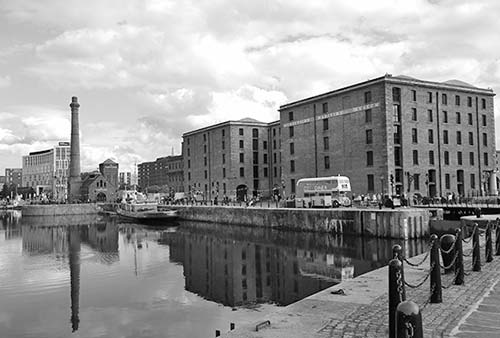
But trade declined after 1890, as the port wasn’t deep enough for the big new ships. The advent of mega container ships in the 1960s put the final nail in the port’s coffin, and by 1972 the central port was closed entirely.
Today, it’s once again full of energy and a busy hub of harbor traffic: the harbor tour boat, ferries to Belfast and the Isle of Man, and just beyond, in a tented structure, the Liverpool cruise port (each year about a hundred ships stop here).
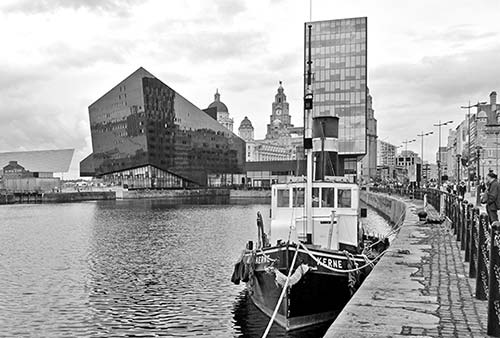
The waterfront is now a venue for some of the city’s top attractions and continues to be a focus of the city’s rejuvenation efforts. Three zones interest tourists (from south to north): the Kings Dock, with Liverpool’s futuristic arena, conference center, and adjacent Ferris wheel; the red-brick Albert Dock complex, with some of the city’s top museums and lively restaurants and nightlife; and Pier Head, with the Museum of Liverpool, ferries across the River Mersey, and buildings both old/stately and new/glassy.
At the Albert Dock
Opened in 1846 by Prince Albert and enclosing seven acres of water, the Albert Dock is surrounded by five-story brick warehouses. A half-dozen trendy eateries are lined up here, protected from the rain by arcades and padded by lots of shopping mall-type distractions. There’s plenty of pay parking.
Note that a planned Waterfront Transformation Project may cause temporary closures of the Tate and the Maritime and Slavery Museums.
▲▲The Beatles Story
The Beatles continue to be a big attraction in Liverpool. This exhibit—while a bit pricey for its size—is well done. The story’s a fascinating one, and even an avid fan will pick up some new information.
Cost and Hours: £19, book time slot online in advance to guarantee entry, includes multimedia guide; daily 9:00-17:00, Nov-March 10:00-16:00; +44 151 709 1969, www.beatlesstory.com.
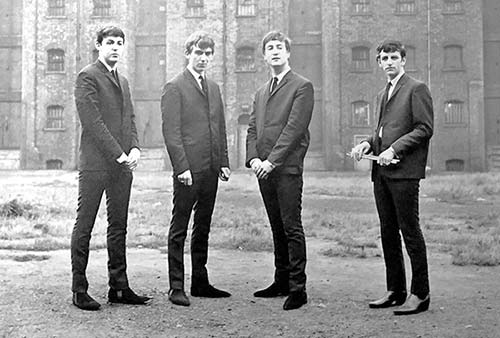
Visiting the Museum: Start with a chronological stroll through the evolution of the Beatles, focusing on their Liverpool years: meeting as schoolboys, performing at (and helping decorate) the Casbah Coffee Club, making a name for themselves in Hamburg’s red light district, meeting their manager Brian Epstein, and the advent of worldwide Beatlemania (with some help from Ed Sullivan). There are many artifacts (from George Harrison’s first boyhood guitar to John Lennon’s last piano), as well as large dioramas celebrating landmarks in Beatles lore (a reconstruction of the Cavern Club, a life-size re-creation of the Sgt. Pepper album cover, and a walk-through yellow submarine). The last rooms trace the members’ solo careers, including a replica of the white room John used while writing “Imagine.” A separate room shows the history of the Beatles in India, where they practiced transcendental meditation (along with singer Donovan, actress Mia Farrow, and the Beach Boys’ Mike Love) and worked on songs for The White Album. Rounding out the exhibits are a Discovery Zone for kids and (of course) The Fab4 Store, with an impressive pile of Beatles buyables.
The great multimedia guide, narrated by Julia Baird (John Lennon’s little sister), captures the Beatles’ charm and cheekiness in a way the stiff wax mannequins can’t. You’ll hear clips of interviews from the actual participants in the Beatles’ story—their families, friends, and collaborators. Cynthia Lennon, John’s first wife, still marvels at the manic power of Beatlemania, while producer George Martin explains why he wanted their original drummer dumped for Ringo.
The exhibits remind listeners of all that made the group earth-shattering—and even a little edgy—at the time. For example, performing before the Queen Mother, John Lennon famously quips: “Will the people in the cheaper seats clap your hands? And the rest of you, if you’ll just rattle your jewelry.”
▲Merseyside Maritime Museum and International Slavery Museum
These museums tell the story of Liverpool, once the second city of the British Empire. The third floor covers slavery, while the first, second, and basement handle other maritime topics.
Cost and Hours: Free, donation suggested, July-Aug daily 10:00-17:00, otherwise Tue-Sun 10:00-17:00, Oct-March until 16:00, closed Mon, café, +44 151 478 4499, www.liverpoolmuseums.org.uk.
Background: Liverpool’s port prospered in the 18th century as one corner of a commerce triangle with Africa and America. British shippers profited greatly through exploitation: About 1.5 million enslaved African people were taken to the Americas on Liverpool’s ships (that’s 10 percent of all African slaves). From Liverpool, the British exported manufactured goods to Africa in exchange for enslaved Africans; the slaves were then shipped to the Americas, where they were traded for raw material (cotton, sugar, and tobacco), and the goods were then brought back to Britain. While the merchants on all three sides made money, the big profit came home to England (which enjoyed substantial income from customs, duties, and a thriving smugglers’ market). As Britain’s economy boomed, so did Liverpool’s.
After participation in the slave trade was outlawed in Britain in the early 1800s, Liverpool kept its port busy as a transfer point for emigrants. If your ancestors came from Scandinavia, Ukraine, or Ireland, they likely left Europe from this port. Between 1830 and 1930, nine million emigrants sailed from Liverpool to find their dreams in the New World.
Visiting the Museums: Begin by riding the elevator up to floor 3—we’ll work our way back down.
The four members of the most iconic rock-and-roll band of all time spent their formative years in the bombed-out shell of post-WWII Liverpool. The city is a pilgrimage site for Beatlemaniacs, but even those with just a passing interest in the Fab Four will likely find themselves humming their favorite tunes around town. Most Beatles sights in Liverpool relate to their early days, before psychedelia, transcendental meditation, Yoko, and solo careers. The sights are spread out, so the easiest way to connect them is by tour (see “Tours in Liverpool,” earlier).
All four Beatles were born in Liverpool, and any tour of town glides by their childhood homes: John Lennon lived at “Mendips,” Paul McCartney at 20 Forthlin Road, George Harrison at 12 Arnold Grove, and Ringo Starr (a.k.a. Richard Starkey) at 10 Admiral Grove.
Behind John’s house is a wooded area called Strawberry Field (he added the “s” for the song), which surrounded a Victorian mansion used as an orphanage. John enjoyed sneaking into the trees around the mansion to play. Today, the grounds feature a visitors center where fans can enjoy video footage, photos, and exhibits about John Lennon and his connection to Strawberry Field.
In the mid-1950s, skiffle music (American-inspired rockabilly/folk) swept through Liverpool. As a teenager, John formed a skiffle band called the Quarrymen. Paul met John when he saw the Quarrymen on July 6, 1957, at St. Peter’s Church in the suburb of Woolton. Trading tunes after the show, they quickly identified each other as musical soulmates. Paul was impressed by John’s improvising skills, and John was impressed when Paul borrowed a guitar, tuned it effortlessly, and played a note-perfect rendition of Eddie Cochran’s “Twenty Flight Rock.” What they shared was an interest in writing and performing original songs—uncommon at the time. Before long, Paul had joined the band.
The boys went to school on Mount Street in the center of Liverpool. Sixteen-year-old John and his friend Stuart Sutcliffe attended the Liverpool College of Art, and Paul and his pal George Harrison, one and two years younger, respectively, went to Liverpool Institute High School for Boys next door. When Paul introduced George to John as a possible new band member, John dismissed him as being too young...until he heard George play. He immediately became the lead guitarist.
The boys rode the bus together to school—waiting at a bus stop in the Penny Lane neighborhood. Later they wrote a nostalgic song about the things they would observe while waiting there: the shelter by the roundabout, the barbershop, and the fireman with his clean machine.
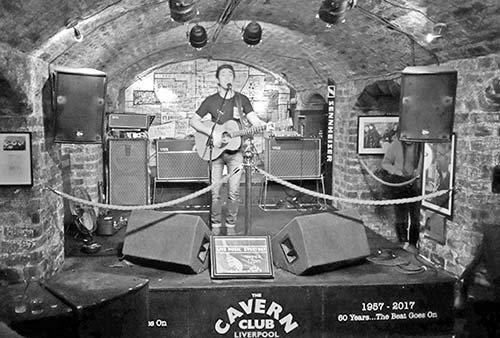
By 1960, the group had officially become the Beatles: John Lennon, Paul McCartney, George Harrison, and. . .Pete Best and Stu Sutcliffe. The quintet gradually built a name for themselves in Liverpool’s Merseybeat scene, performing at local clubs. While the famous Cavern Club is gone (the one you see advertised is a reconstruction), the original Casbah Coffee Club still exists and is open for tours (£20, opening times vary, 8 Haymans Green, 3.5 miles northwest of downtown in Pete Best’s former basement, prebook by calling +44 787 201 7473 or online at www.petebest.com).
The group went to Hamburg, Germany, to cut their teeth in the thriving music scene there. They wound up performing as the backing band for Tony Sheridan’s single “My Bonny.” Promoter Brian Epstein took note, and signed the act. His shrewd management would propel the Beatles to superstardom.
John’s friend Stu, who performed with the group in Hamburg, left to pursue his own artistic interests. Pete Best, the band’s original drummer, was replaced with Ringo Starr. John later said, “Pete Best was a great drummer, but Ringo was a Beatle.”
On floor 3, three galleries make up the International Slavery Museum. First is a description of life in West Africa, which re-creates traditional domestic architecture and displays actual artifacts. Then comes a harrowing exhibit about enslavement and the Middle Passage (as the voyage to the Americas was called). The tools of the enslavers—chains, muzzles, and a branding iron—convey some of the horror of the slave trade. The exhibits don’t shy away from how Liverpool profited from slavery; you can turn local street signs around to find out how they were named after slave traders—even Penny Lane has slavery connections. Finally, the museum examines the legacy of slavery—both the persistence of racism in contemporary society and the substantial positive impact that people of African descent have had on European and American cultures. Walls of photos celebrate important people of African descent, and a music station lets you sample songs from a variety of African-influenced genres.
Continue down the stairs to the Maritime Museum, on floor 2. This celebrates Liverpool’s shipbuilding heritage and displays actual ship components, model boats, and a gallery of nautical paintings. Part of that heritage is covered in an extensive exhibit on the Titanic. The shipping line and its captain were based in Liverpool, and 89 of the crew members who died were from the city. The informative panels allow you to follow real people as they set off on the voyage and debunk many Titanic myths (no one ever said it was unsinkable).
Also on this floor, three exhibits overlap: Carrying Passengers covers Liverpool as a passenger port and gives an overview of passenger traffic in Britain today. Carrying Cargos focuses on cargo ships, imports and exports, and has an impressive figurehead from the HMS Hastings. Life of a Seafarer depicts life aboard ship, from leisure activities to diets and living conditions. From the early 1900s to the 1960s, most merchant fleet sailors came from towns like Liverpool.
A last section is dedicated to the MV Derbyshire, an oil tanker that disappeared in the South China Sea in 1980. The wreck was eventually found in 1994.
Floor 1 shows footage and artifacts from another maritime disaster—the 1915 sinking of the Lusitania, which was torpedoed by a German U-boat. She sank off the coast of Ireland in under 20 minutes; 1,191 people died in the tragedy, including 405 crew members from Liverpool. The attack on an unarmed passenger ship sparked riots in Liverpool and almost thrust the US into World War I. Also on this floor, an extensive exhibit traces the Battle of the Atlantic (during World War II, Nazi U-boats attacked merchant ships bringing supplies to Britain). You’ll see how crew members lived aboard merchant ships.
Make your way to the basement, where exhibits describe the tremendous wave of emigration through Liverpool’s port. And the Seized! exhibit looks at the legal and illegal movement of goods through that same port, including thought-provoking displays on customs, taxation, and smuggling.
Tate Liverpool
This prestigious gallery of modern art is near the Maritime Museum. It won’t entertain you as well as its London sister, the Tate Modern, but if you’re into modern art, any Tate’s great. Its two airy floors dedicated to the rotating collection of statues and paintings from the 20th century are free; the top and ground floors are devoted to special exhibits. The Tate also has an inexpensive recommended café.
Cost and Hours: Free, donation suggested, £10-15 for special exhibits, daily 10:00-17:50, +44 151 702 7400, www.tate.org.uk/visit/tate-liverpool.
At Pier Head, North of the Albert Dock
A five-minute walk across the bridge north of the Albert Dock takes you to the Pier Head area, with a popular statue of the Beatles on the harborfront and the sights listed next.
▲▲Museum of Liverpool
This museum, in the blocky white building just across the bridge north of the Albert Dock, does a good job of fulfilling its goal to “capture Liverpool’s vibrant character and demonstrate the city’s unique contribution to the world.” The museum is full of interesting items, fun interactive displays (great for kids), and fascinating facts that bring a whole new depth to your Liverpool experience.
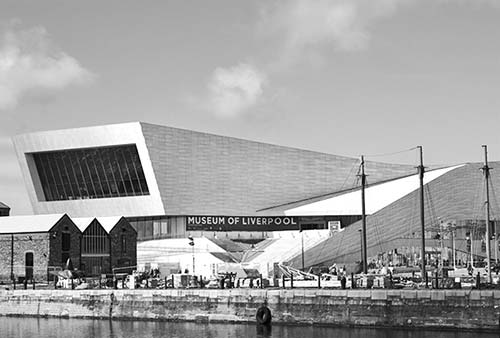
Cost and Hours: Free, donation suggested, Tue-Sun 10:00-17:00, closed Mon, July-Aug open daily, café, Mann Island, Pier Head, +44 151 478 4545, www.liverpoolmuseums.org.uk.
Visiting the Museum: If you have kids ages six and under, stop by the information desk to ask about the hands-on Little Liverpool exhibit on the ground floor.
Ground Floor: On this level, The Great Port details the story of Liverpool’s defining industry and how it developed through the Industrial Revolution. On display is an 1838 steam locomotive that was originally built for the Liverpool and Manchester Railway.
First Floor: Don’t miss the Liverpool Overhead Railway exhibit, which features the only surviving car from this 19th-century elevated railway. On a big screen, you can watch 1897 movie footage shot from the train line. Also on this floor is the History Detectives exhibit, which covers Liverpool’s archaeology and history, including the story of the Liverpool Blitz (bombings by the German Luftwaffe in 1940-41). A separate military exhibit displays medals, combat gear, guns, and uniforms.
A newly expanded exhibit called Global City may be open by the time you visit. It explores Liverpool’s connections to the rest of the world, including historical associations with imperialism and colonialism.
Second Floor: If you’re short on time, spend most of it here. The People’s Republic exhibit examines what it means to be a Liverpudlian (a.k.a. “Scouser”) and covers everything from housing and health issues to military and religious topics. As industrialized Liverpool has long been a hotbed of the labor movement, exhibits here also detail the political side of the city, including child labor issues and women’s suffrage.
One fascinating display is the re-creation of Liverpool’s 19th-century court housing, which consisted of a series of tiny dwellings bunched around a narrow courtyard. With more than 60 people sharing two toilets, this was some of the most overcrowded and unsanitary housing in Britain at the time.
On the other side of the floor, the Wondrous Place exhibit celebrates the cultural and sporting side of Liverpool. Music is the big focus here, with plenty of fun interactive stops that include quizzes, a karaoke booth, and listening stations featuring artists with ties to Liverpool (from Elvis Costello to Echo & the Bunnymen). And, of course, you’ll see plenty of Beatlemania, including their famous suits, the original stage from St. Peter’s Church (where John Lennon was performing the first time Paul McCartney laid eyes on him; located in the theater), and a 20-minute film on the band (runs on the hour and half-hour). A section on TV and movies highlights Liverpool as an increasingly popular filming location for series like Outlander and Peaky Blinders.
The Three Graces
Three towering buildings near the Museum of Liverpool, remnants of a time of great seafaring prosperity, are known collectively as Liverpool’s Three Graces: the domed Port of Liverpool Building (which strains to evoke memories of St. Paul’s Cathedral in London); the relatively dull and boxy Cunard Building (now hosting the British Music Experience, described next); and the 1911 double-clock-towered Royal Liver Building (pronounced LIE-ver, Britain’s first skyscraper—322 feet tall with spires topped by the city’s mythical mascots, the “Liver birds”).
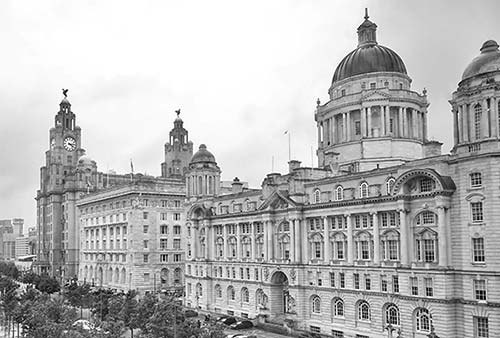
▲▲British Music Experience
This museum, located in the Cunard Building at Pier Head, goes beyond Liverpool’s Beatlemania, immersing visitors in the history of British music of all genres from 1945 until today. The multimedia exhibits include costumes, instruments, recordings, and memorabilia from artists and bands such as David Bowie, Queen, Amy Winehouse, Elton John, and Adele, plus the chance to play professional-grade instruments. You could easily spend hours here, but plan for at least 90 minutes.
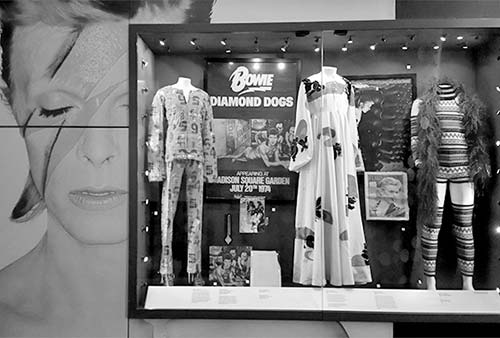
Cost and Hours: £17—buy online in advance to guarantee entry time, daily 10:00-17:00, Sept and Nov-March closed Mon-Tue, last entry one hour before closing, café; +44 151 519 0915, www.britishmusicexperience.com.
Visiting the Museum: The museum is one big room with a stage and screen dominating a central space (dedicated to temporary exhibitions), flanked by eight zones covering different eras. Music videos and holographic performances by famous artists play on the stage. Eight smaller screens hang from the ceiling on both sides. Starting on the right side as you enter, you can work your way around the hall chronologically from 1945 (when, with the help of pop music culture, children began freeing themselves from being “little adults who dressed and acted like their parents”). Each section features interesting facts about well-known artists, billboard art, costumes, instruments, and interactive tables and screens offering more information. Timelines place the music in historical context, describing its relation to the politics and culture of each decade.
The first two sections (1945-1962, covering jazz, skiffle, and rock-and-roll, and 1962-1966, covering R&B, Merseybeat, and the Beatles) give excellent explanations of the origin of these music genres and how the UK and US music scenes influenced each other. Next up, the 1966-1970 section foregrounds Jimi Hendrix; the 1970-1975 area moves into glam rock, the Who, and Led Zeppelin.
The other side of the hall covers music since 1975, starting with punk, funk, and electro, and continuing through the shift to online listening, music during Covid, TV talent shows, and TikTok. An interactive display delves into music careers, with real professionals (personal assistant, manager, stylist, voice coach, etc.) sharing their stories.
The final section is a studio where you can exercise your musical skills: receive interactive instruction (through headphones) on instruments, or learn (and then record on video) dance moves that have been popular over the decades.
DOWNTOWN
Away from the waterfront, you find Liverpool’s workaday commercial center stretching east up to the train station and Walker Art Gallery and south past the massive Liverpool ONE shopping and residential complex. Beyond that complex is the Ropewalks District. Uphill from there you’ll find the cathedral neighborhood, with the Catholic cathedral to the left and Chinatown and the Anglican cathedral to the right. The older part of downtown stretches from the huge Queen Victoria monument near Liverpool ONE up Castle Street to the Liverpool Town Hall.
Victorian Liverpool Town Walk
If you’re arriving at Lime Street Station, here’s a stately way to get into the city center (and the heart of Beatlemania on Mathew Street). Along the way, the only sight of real importance is the Walker Gallery (free and well worth a look; see listing, later). But the walk gives you a feel for the grand side of 19th-century Liverpool.
St. George’s Hall is the big, temple-like Neoclassical building facing the station. It originally contained courts and a concert hall; now it’s a venue for conferences, civic events, and the performing arts. Between the hall and train station is St. George’s Plateau, a gathering place for the community, with equestrian statues of Prince Albert and a youthful Queen Victoria that flank a somber memorial to the World Wars.
When John Lennon was shot, 25,000 gathered here for a candlelight vigil...probably recalling the last live Beatles performance, in December 1965, in the Empire Theatre across the street. Take a look up Lord Nelson Street to the right of the theater to spot the recommended Ma Egerton’s Stage Door pub, where many an artist went for a pint (and many still do) after their performances.
The towering monumental column honors the Duke of Wellington, who beat Napoleon at the Battle of Waterloo in 1815. Behind him and just to the left is the Walker Art Gallery, which is like a mini version of London’s National Gallery.
Now turn left and work your way downhill. The Neoclassical building adjacent to the Walker Gallery is the Central Library, containing a modern atrium (free) and, upstairs, the impressive Victorian Picton Reading Room. Find the plaque on the library wall noting that William Brown, who this street was named after, enriched himself from the slave trade. It’s part of Liverpool’s attempt to confront its past as a key player in the brutal triangular trade—involving raw materials, goods, and enslaved humans—with Africa and the Americas.
The next grand building houses the World Museum, a catchall family museum with five floors of kid-oriented exhibits. You’ll see dinosaurs, an aquarium, artifacts from the ancient world, a planetarium, and a theater (free, Tue-Sun 10:00-17:00, closed Mon, shorter hours off-season).
Continue strolling downhill along St. John’s Gardens (across the street). Filled with statues, it celebrates influential politicians and philanthropists from the late Victorian and Edwardian eras.
At the foot of the park, find a round bronze memorial to the Hillsborough Stadium tragedy, when 96 local fans (most of them quite young) were crushed during a 1989 soccer game in Sheffield, two hours east of Liverpool. That tragedy led to a big change in how stadium seating is built in Britain.
The gaping tunnel below is the mouth of the Birkenhead Queensway Tunnel, the first road under the River Mersey. Statues of King George V and Queen Mary, who presided over its grand opening in 1934, stand on either side.
From here, head downhill to the left on Whitechapel for about six blocks. A block into the pedestrian zone you’ll have entered the heart of Liverpool’s commercial center. At Stanley Street go right, then turn left onto Mathew Street—historic for Beatles fans—and the end of this walk. Lined with bars and souvenir shops, it’s super-touristy by day and sloppy and rowdy at night, often overrun with stag and hen parties on weekends (see listing, later).
▲Walker Art Gallery
Liverpool’s main art gallery offers an enjoyable walk through an easy-to-digest collection of European paintings, sculpture, and decorative arts. There’s no audioguide, but works are well explained by posted descriptions, and helpful docents are standing by.
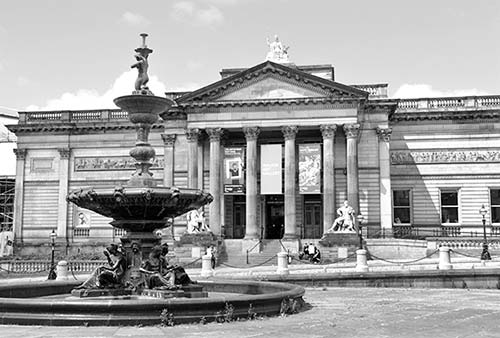
Cost and Hours: Free, donation suggested, Tue-Sun 10:00-17:00, closed Mon, William Brown Street, +44 151 478 4199, www.liverpoolmuseums.org.uk.
Visiting the Museum: The ground floor has an information desk, café, children’s area, small decorative arts collection (with a fine selection of 18th-century fashion), and sculpture gallery focusing on 19th-century British Neoclassical works. The sculpture gallery has many works by John Gibson, a Welshman who grew up in Liverpool and later studied under the Italian master Antonio Canova. Gibson’s Tinted Venus (in the case in the middle) was considered scandalous to Victorian mores because of the nude sculpture’s lifelike pinkish tint.
Upstairs is a compact 15-room painting gallery. For a general chronological spin, from the top of the stairs head straight back through four rooms to find Room 1.
Room 1 (actually two adjoining rooms) displays medieval and Renaissance works, including a famous Nicholas Hilliard portrait of Queen Elizabeth I (nicknamed “The Pelican,” for her brooch) and a well-known royal portrait of Henry VIII by Hans Holbein. In the glass jewelry case, find the “Kingmaker” ring belonging to Richard Neville, Earl of Warwick—who played an outsize role in crowning and deposing monarchs during the Wars of the Roses.
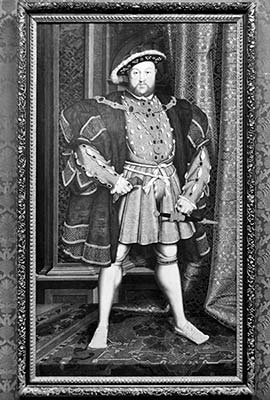
Room 2 (Renaissance) is dominated by a large Flemish tapestry on the theme of “fortitude,” brimming with graphic scenes of violence. A large Murillo painting of Mary keeps her eyes on you as you cross the room. Also in this room are Christ and the Woman of Samaria, attributed to Michelangelo, and works by Veronese and Titian.
Room 3 (Baroque) features a Rembrandt self-portrait, as well as Rubens’ expressive Virgin and Child with St. John the Baptist. Also look for the small painting of a mother with her baby’s head in her lap, resembling a pietà. Silentium was painted by Lavinia Fontana (1552-1614), likely the first woman painter in Europe to establish a workshop.
Room 4 shows a rotating selection of prints and drawings, including sketches by Guido Reni and Antonio Cesari, Rubens drawings, and Dürer prints. You may see a self-portrait by Elisabetta Sirani (1638-1665), an influential painter of the Italian Baroque who took charge of her father’s workshop, established a school, and died tragically young.
Room 5 focuses on 18th-century English painting, including canvases by Gainsborough and Hogarth (find the painting of the great actor David Garrick in the role of Richard III), and lots of horses by George Stubbs.
Rooms 6-8 showcase a delightful array of Pre-Raphaelite works, among them Millais’ evocative portrait of Isabella (Room 6). You’ll find some Turners (a mushy landscape and a more sharp-focus Linlithgow Castle) in Room 7 (Victorian Narrative Painting), as well as Gustave Doré’s touching Flower Sellers of London. In Room 8, covering 19th-century painting, Rossetti’s sensual (and very large) Dante’s Dream overwhelms.
Rooms 9 and 10 make the transition to the 20th century and Impressionism, showing works by Degas, Matisse, Sargent, and Pissaro, while modern British art is displayed in Rooms 11-15.
▲Western Approaches WWII Museum
“If one were to choose a building where the Second World War was won, the White House or the Admiralty Rooms in London might be a possibility, or one might very well choose Derby House in Liverpool.” This was the assessment of journalist David Fairbanks White in his respected account of the Battle of the Atlantic, Bitter Ocean. In 1941, in a large bunker below the Derby House office building (between Town Hall and Pier Head), a top-secret command center was established to protect convoys of ships carrying vital supplies from attack by German U-boats. This “Western Approaches Command,” staffed largely by members of the Women’s Royal Navy Service (known as Wrens) and the Women’s Auxiliary Air Force (WAAFs), became the nerve center where day-to-day strategy in the Battle of the Atlantic was plotted. A visit to this restored bunker, both a fascinating time capsule and a poignant memorial, is worth ▲▲▲ for anyone interested in World War II.
Cost and Hours: £13.50 (credit cards only), daily 10:00-18:00, last entry one hour before closing, 1 Rumford Street, +44 151 227 2008, https://liverpoolwarmuseum.co.uk.
Visiting the Museum: After buying your ticket (issued as a replica of an actual entry permit), you’ll be directed to a winding concrete stairwell, where you immediately enter the world of the bunker. Signs on stark walls emphasize the high stakes: “Loose lips sink ships,” “Careless talk costs lives”...and simply, “Silence.”
Below, a vast warren of carefully preserved rooms immerses visitors in the story of this critical operation. After walking through a replica of a 1940s street (where a small screen plays harrowing news reports of Liverpool bombings), you can watch a short informational video, then continue through rooms containing old teleprinter machines and radios, a telephone exchange, and tactical equipment such as war games. Historic photos complete the picture, showing the people who worked with the equipment you see.
This is a hands-on museum: You can try out equipment and clothing, sit at desks to peruse documents and letters, and lift phone receivers to hear stories told by veterans and others involved in the war effort. You’ll see the tiny rooms where people slept, as well as the office of Admiral Sir Max Horton (who is memorialized in the Liverpool Cathedral). Exhibits on the convoys, the young women who became Wrens or WAAFs, life in the Merchant Navy, and the operation of the Western Approaches Command are all very well explained.
At the center of the bunker is the impressive Operations Room, where an enormous wall map tracked the positions of ships, planes, and U-boats. Here the strategy was plotted for the Battle of the Atlantic. Go up the stairs to find target maps of Liverpool used by the German Luftwaffe—wrenching to look at, considering Liverpool was the most bombed area in England after London.
The final room plays short films with footage of sea battles, rescues, and the funeral of Royal Navy Captain Johnnie Walker (“the U-boat killer”).
Mathew Street
The narrow, bar-lined Mathew Street, right in the heart of downtown, is ground zero for Beatles fans. The Beatles frequently performed in their early days at the original Cavern Club, deep in a cellar along this street. While that’s long gone, a mock-up of the historic nightspot (built with many of the original bricks) lives on a few doors down. Still billed as “the Cavern Club,” this noisy bar is worth a visit to see the reconstructed cellar that’s often filled by Beatles cover bands. While it’s just a touristy pub draped in memorabilia, dropping by in the afternoon for a live Beatles tribute act in the Cavern Club somehow just feels right. You’ll have Beatles songs stuck in your head all day (£5, £7.50 day pass, open daily 11:00-24:00; live music daily from 11:15 until late evening; +44 151 236 9091, www.cavernclub.org).
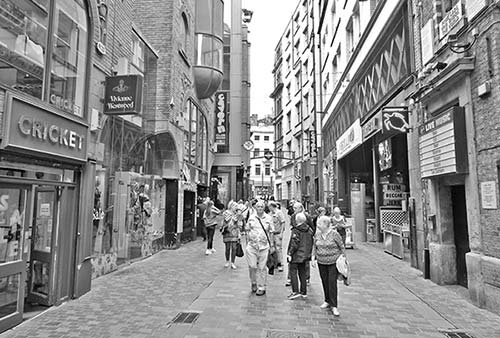
Across the street and run by the same owners, the Cavern Pub lacks its sibling’s troglodyte aura, but makes up for it with walls lined with old photos and memorabilia from the Beatles and other bands who’ve performed here. Like the Cavern Club, the pub features frequent performances by Beatles cover bands and other acts (no cover, daily 12:00-24:00, +44 151 236 4041).
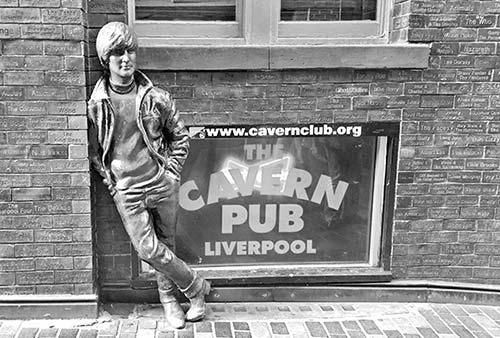
Out front is the Cavern’s Wall of Fame, with a too-cool-for-school bronze John Lennon leaning up against a wall of bricks engraved with the names of musical acts that have graced the Cavern stage. Adjacent, notice the 58 number-one singles from 1953 to 2018 by Liverpool bands.
At the corner is the recommended Hard Day’s Night Hotel, decorated inside and out to honor the Fab Four. Notice the statues of John, Paul, George, and Ringo on the second-story corners, and the Beatles gift shop (one of many in town) on the ground floor.
▲Liverpool Beatles Museum
For diehard Beatles fans this self-proclaimed “world’s most authentic Beatles museum” is a must-see (worth ▲▲▲—but if you’re just a casual fan, The Beatles Experience at the Albert Dock is better). This fascinating-to-Beatles-fans collection is spread chronologically over three floors with detailed, thoughtful descriptions. Neil Aspinall, a roadie-hoarder, collected this memorabilia during the early years as if he knew the Beatles would make history. Filled with a trove of artifacts (letters, clothing, photos, and so on), each floor covers an era: before they were famous, the touring years, and the studio/psychedelic years. Beatle-geek staffers are standing by to tell stories and answer questions. It’s strong on pre-Ringo days, because Neil was “a kind of stepfather” to Pete Best (the original drummer)...it’s complicated.
Cost and Hours: £17, £1 audioguide provides comprehensive but dry narration read by a computer-generated voice, RS%—Roag Best (the owner and half-brother of Pete) promises 20 percent off with this book; daily 10:00-18:00, last entry one hour before closing, 50 yards from the Cavern Club at 23 Mathew Street, +44 151 236 1337, https://liverpoolbeatlesmuseum.com.
Other Sights in the City Center
Castle Street
One of the historic streets of Liverpool, Castle Street connected its medieval castle with its Town Hall. Today the Town Hall stands bold, the street is lined with bars and restaurants filling up the former offices of 19th-century banks, and the castle is long gone—replaced with a grand memorial to Queen Victoria. The monument seems fitting, as the street is a parade of Victorian grandeur. Beyond Victoria (who somehow survived WWII bombing) is a zone that was obliterated by the bombing raids but today hums with life.
Liverpool ONE
This sprawling shopping/residential/entertainment complex, opened in 2008, covers 42 acres. Liverpool was slow to rebuild after World War II, and this vast, once-derelict stretch of the city center symbolized the decades-long funk. But in the early 2000s, with the help of EU money to kickstart development, the city started its rejuvenation with this huge project.
Liverpool ONE insists it is not a mall. It’s designed as a modern complex with three stories of shops and an actual street plan so that it feels part of the neighboring zones. You can walk from the train station to the Albert Dock crossing only two streets with traffic thanks to Liverpool ONE. It has residential floors above the commercial floors, so it’s also vibrant at night. With a world of famous-brand stores and restaurants, and lots of energy, the complex is worth a look. (Liverpool, with its trade heritage and successful Liverpool ONE development thanks to the EU, was one of the most anti-Brexit cities in the UK during the 2016 vote.)
Ropewalks District, Chinatown, and a Bombed-Out Church
Any big old-time port needed lots of rope, and that industry required long, straight lanes. Those long lanes now make up a happening zone of colorful, independent shops and restaurants. While the Ropewalks District sprawls several blocks wide, Bold Street is the most lively and fun place to explore. And close by is Liverpool’s Chinatown, the oldest such neighborhood in Europe, with the biggest Chinese arch.
Today, the gateway to both the Ropewalks District and Chinatown is marked by the bombed-out remnants of St. Luke’s. In 1941, Nazi bombing raids gutted this fine Neo-Gothic church, which was left in ruins as a memorial to those killed.
Baltic Triangle
This area, just a short walk south from the Albert Dock, is an up-and-coming, shabby-chic zone with street art, boutique shops, mod bars, trendy eateries, and an edgy night scene. The action fans out from Jamaica Street, which turns into Grafton.
Paul Curtis (“Liverpool’s Banksy”) and other local artists have decorated the Baltic Triangle with creative murals. Look for Curtis’ fun-loving Angel Wings (at Jamaica and Norfolk streets) and Abbey Road (at Grafton and Parliament streets, painted for the 50th anniversary of that album). At the intersection of Jamaica and Jordan is a mural of Liverpool’s soccer coach Jürgen Klopp, a native of Germany who’s made Liverpool a top contender in England’s Premier League. New murals are continually being created, so it’s fun to wander and look.
The Abbey Road mural on Grafton Street also marks Cains Brewery Village, a complex with retail, offices, bars, and a surprisingly good secondhand mall called Red Brick Vintage Market (70 Stanhope Street). For food, head to the Baltic Market, a warehouse full of alternative pop-up eateries that has done a lot to put the neighborhood on the map (closed Mon-Tue and Wed-Thu afternoons, 107 Stanhope Street).
CATHEDRALS NEIGHBORHOOD
Liverpool has not one but two notable cathedrals—one Anglican, the other Catholic. (As the Spinners song puts it, “If you want a cathedral, we’ve got one to spare.”) Both are huge, architecturally significant, and well worth visiting. Near the eastern edge of downtown, they’re connected by a 10-minute, half-mile walk on pleasant Hope Street, which is lined with theaters and good restaurants.
Liverpudlians enjoy pointing out that they have not only the world’s only Catholic cathedral designed by a Protestant architect, but also the only Protestant one designed by a Catholic. With its large Irish-immigrant population, Liverpool suffered from tension between its Catholic and Protestant communities for much of its history. But during the city’s darkest stretch of the depressed 1970s, the bishops of each church—Anglican Bishop David Sheppard and Catholic Archbishop Derek Worlock—came together and worked hard to reconcile the two communities for the betterment of Liverpool. (Liverpudlians nicknamed this dynamic duo “fish and chips” because they were “always together, and always in the newspaper.”) It worked: Liverpool is a bold new cultural center, and relations between the two faiths remain healthy here. Join in this ecumenical spirit by visiting and appreciating the lively energy of both churches.
▲Metropolitan Cathedral of Christ the King (Catholic)
This daringly modern building, a cone topped with a crowned cylinder, seems almost out of place in its workaday Liverpool neighborhood. But the cathedral you see today bears no resemblance to Sir Edwin Lutyens’ original 1930s plans for a stately Neo-Byzantine cathedral, which was to take 200 years to build and rival St. Peter’s Basilica in Vatican City. (Lutyens was desperate to one-up the grandiose plans of Sir Giles Gilbert Scott, who was building the Anglican Cathedral down the street.) The crypt for the ambitious church was excavated in the 1930s, but World War II (during which the crypt was used as an air-raid shelter) stalled progress for decades. In the 1960s, the plans were scaled back, and this smaller (but still impressive) house of worship was completed in 1967.
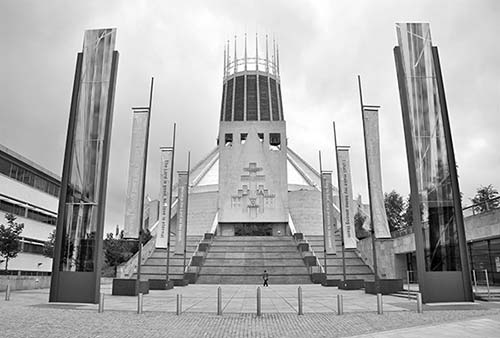
Cost and Hours: Cathedral-free entry but donations accepted, audioguide-£5, crypt-£5, audioguide plus crypt-£8; daily 8:00-18:00—but after 17:00 (during Mass), you won’t be able to walk around, crypt open Mon-Sat 10:00-16:00, closed Sun; inviting café, Mount Pleasant, +44 151 709 9222, www.liverpoolmetrocathedral.org.uk. They also offer guided tours for a suggested donation of £5; prebook by emailing enquiries@metcathedral.org.uk or check at the desk to see if a guide is available.
Visiting the Cathedral: On the stepped plaza in front of the church, you’ll see the entrance to the cathedral’s visitors center and café (on your right). You’re standing on a big concrete slab that provides a roof to the massive Lutyens Crypt underfoot. The existing cathedral occupies only a small part of the would-be cathedral’s footprint. Because of the cathedral’s tent-like appearance and ties to the local Irish community, some Liverpudlians dubbed it “Paddy’s Wigwam.”
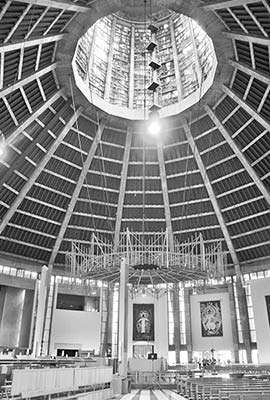
Climb up the stairs to the main doors, step inside, and let your eyes adjust to this magnificent, dimly lit space. Unlike a typical nave-plus-transept cross-shaped church, this cathedral has a round footprint, with seating for a congregation of 3,000 surrounding the white marble altar. Like a theater in the round, it was designed to involve worshippers in the service. Suspended above the altar is a stylized crown of thorns.
Spinning off from the round central sanctuary are 13 smaller chapels, many of them representing stages of Jesus’ life. Also keep an eye out for the 14 exquisite bronze Stations of the Cross by local artist Sean Rice (on the wall).
The massive Lutyens Crypt (named for the ambitious original architect)—the only part of the originally planned cathedral to be completed—has huge vaults and vast halls lined with six million bricks. The crypt contains a chapel—with windows by Lutyens—that’s still used for Sunday Mass, the tombs of three archbishops, a treasury, and an exhibit about the cathedral’s construction.
Hope Street
The street connecting the cathedrals is the main artery of Liverpool’s “uptown,” a lively and fun-to-explore district loaded with dining and entertainment options. At the intersection with Mount Street is a monument consisting of concrete suitcases (explained by a nearby info plaque); just down this street is John’s art school and Paul and George’s high school—with the four grand columns.
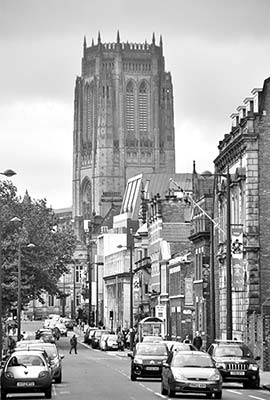
This street is home to the Liverpool Philharmonic and its namesake pub, the Philharmonic Dining Rooms. Kitty-corner from the Philharmonic, it must be the most flamboyantly Victorian pub in town. It’s amazingly elaborate, the pink-marble urinals are downright genteel, and the cozy sitting areas on the ground floor will entice you to sip a pint. John Lennon said that his biggest regret about fame was “not being able to go to the Phil for a drink.” And, if you saw Paul McCartney on The Late Late Show doing host James Corden’s “Carpool Karaoke,” this was the site for Paul’s surprise live concert (at the corner of Hope and Hardman streets, see the listing in “Eating in Liverpool,” later).
▲▲Liverpool Cathedral (Anglican)
The largest cathedral in Great Britain, this gigantic house of worship hovers at the south end of downtown. Tour its cavernous interior and consider scaling its tower.
Cost and Hours: Free, donation suggested, Mon-Sat 10:00-18:00, Sun from 12:00; tower climb-£7 (2 elevators and 108 steps, buy ticket in gift shop), Mon-Sat 10:00-17:00, Sun 12:00-16:00 (may change depending on bell-ringing schedule); café, St. James Mount, +44 151 709 6271, www.liverpoolcathedral.org.uk.
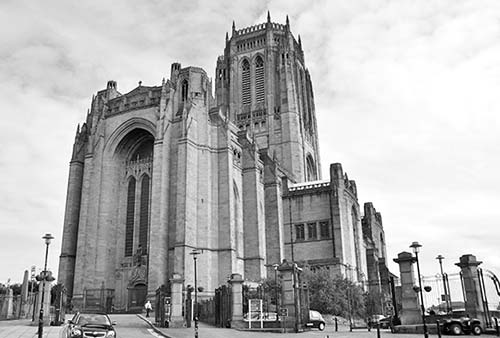
Visiting the Cathedral: Over the main door is a modern Risen Christ statue by Elisabeth Frink. Liverpudlians, not thrilled with the featureless statue and always quick with a joke, have dubbed it “Frinkenstein.”
Stepping inside, pick up a floor plan at the information desk, go into the main hall, and take in the size of the place. When Liverpool was officially designated a “city” (seat of a bishop), they wanted to build a huge house of worship as a symbol of Liverpudlian pride. Built in bold Neo-Gothic style (like London’s Parliament), it seems to trumpet with modern bombast the importance of this city on the Mersey. Though construction began in 1904, it was interrupted by the tumultuous events of the 20th century and not completed until 1978.
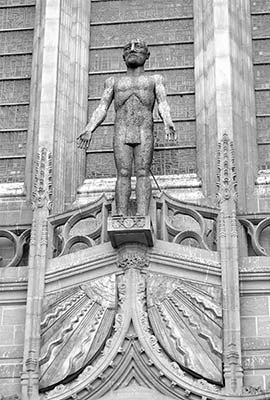
Go to the big circular tile in the floor at the very center of the cathedral, under the highest part of the ceiling. This is a plaque for the building’s architect, Sir Giles Gilbert Scott (1880-1960). While the church you’re surrounded by may seem like his biggest legacy, he also designed an icon that’s synonymous with Britain: the classic red telephone box. (There’s one on display at the entrance to the tower climb.) Scott was a very young architect and received the commission with the agreement that he work closely under the wing of his more established mentor, George Bodley. These two architects’ visions clashed, and Bodley usually won...until he died early in the planning stages, leaving Scott to pursue his own muse.
Take a counterclockwise spin around the church interior. Head up the right aisle until you find the “Whispering Arch.” As its name suggests, it has remarkable acoustics, carrying voices from one end to the other. Try it.
Behind the arch, find the memorial to Admiral Sir Max Horton, who was in charge of the Western Approaches Command in Liverpool from 1942 to 1945. During the Second World War, “Western Approaches” referred to the area of the Atlantic just west of the British Isles. When vital ship convoys came under increasing attack from German U-boats during the Battle of the Atlantic, Liverpool became a crucial strategic command center to protect them, and ultimately prevailed (see museum listing, earlier).
Just past the Whispering Arch, you’ll find a wooden model of the original plan for the cathedral, a screen with rotating 3-D drawings illustrating the cathedral’s construction, and an interesting display of tools used for the fine finish work inside—including the highly detailed sandstone carvings that flank parts of the nave.
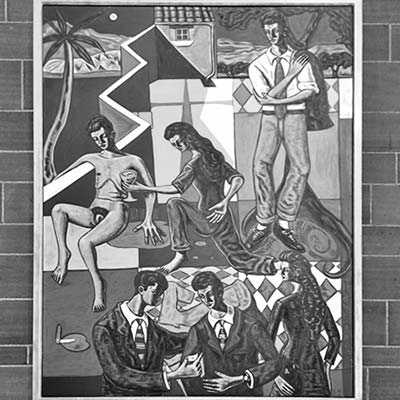
Continuing down the church, notice the very colorful, modern painting of The Good Samaritan (by Adrian Wiszniewski, 1995), high above on the right. The naked crime victim (who has been stabbed in his side, like the Crucifixion wound of Jesus) has been ignored by the well-dressed yuppies in the foreground, but the female Samaritan is finally taking notice. The canvas is packed with symbolism (for example, the Swiss Army knife, in a pool of blood in the left foreground, is open in the 3 o’clock position—the time that Jesus was crucified). This contemporary work of art demonstrates that this is a new, living church. But the congregation has its limits. This painting used to hang closer to the front of the church, but now they’ve moved it here, to a lower profile spot.
Proceeding to the corner, you’ll reach the entrance to the oldest part of the church (1910): the Lady Chapel, with stained-glass windows celebrating important women. (Sadly, the original windows were destroyed in World War II; these are replicas.)
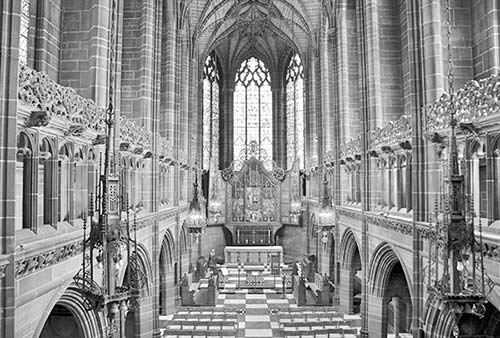
Back up in the main part of the church, continue behind the main altar to the Education Centre, with a fun, sped-up video showing all the daily work it takes to make this cathedral run.
Circling around the far corner of the church, you’ll pass the children’s chapel and chapterhouse, and then pass under another modern Wiszniewski painting (The House Built on Rock). Across from that painting, go into the choir to get a good look at the Last Supper altarpiece above the main altar.
Continuing back up the aisle, you’ll come to the war memorial transept. At its entrance is a book listing Liverpudlians lost in war. Battle flags fly high on the wall above.
One of the consoles for the cathedral organ often sits near this transept. Like the cathedral itself, the organ is the largest in the UK, with more than 10,000 pipes. Look up to see the many sizes distributed around the nave.
After passing the café, you’ll wind up at the gift shop, where you can buy a ticket to climb to the top of the tower.
Outside, between the cathedral’s main entrance and the old ancient-Greek-style chapel, is a tombstone-lined pathway leading down into St. James Garden—once a sandstone quarry, then a spooky cemetery, and now a peaceful green space much appreciated by the community.
AWAY FROM THE CENTER
▲Lennon and McCartney Homes
John’s and Paul’s boyhood homes are now owned by the National Trust and have both been restored to how they looked during the lads’ 1950s childhoods. While some Beatles bus tours stop here for photo ops, only the National Trust minibus tour gets you inside the homes. This isn’t Graceland—you won’t find an over-the-top rock-and-roll extravaganza here. But for die-hard Beatles fans who want to get a glimpse into the time and place that created these musical masterminds, the National Trust tour is worth ▲▲▲.
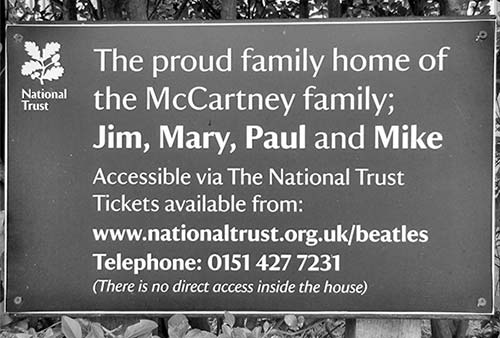
Famous musicians who perform in Liverpool often make the pilgrimage to these homes—Bob Dylan turned up on one tour disguised in a hoodie—and Paul himself occasionally drops by. Ask the guides about recent memorable visitors.
Because the houses are in residential neighborhoods—and still share walls with neighbors—the National Trust runs only a few tours per day, limited to 15 or so Beatlemaniacs each.
Cost: £36, £42 includes a guidebook.
Reservations: Advance booking is required. Book online or by phone as soon as you know your Liverpool plans (+44 344 249 1895, www.nationaltrust.org.uk/beatles).
Visitor Information: Tours run daily March-Nov (no tours Dec-Feb); there are two morning tours (at 10:05 and 10:45) and two in the afternoon (at 14:05 and 14:45). If you don’t have a car, the afternoon tours are easiest.
Morning tours depart from Speke Hall, a National Trust property near the airport. Drivers can park for free. It’s a bit of a hassle to get to Speke Hall by public transit. You can take a train from Lime Street Station to South Parkway Station (£4.15, 15 minutes) and then catch an Uber or a taxi from there. By bus the journey is even longer (see next).
Afternoon tours depart from Liverpool South Parkway train station (also near the airport), bus stand 2. This station is reachable by a 15-minute train ride from Lime Street or a 30-minute bus ride (or longer, depending on traffic) from the Liverpool ONE bus station (buses #80, #80A, #82, and #86). Note that there is no baggage storage at the South Parkway Station, and large bags are not allowed on the tour. Drivers can look for free parking on side streets near the South Parkway Station, but allow extra time.
The entire tour takes about two hours.
Visiting the Homes: A minibus takes you to the homes of John and Paul, with about 45 minutes inside each (no photos allowed inside either home). Each home has a guide who gives an entertaining, insightful-to-fans talk that lasts about 30 minutes. You then have 10-15 minutes to wander through the house on your own. Ask lots of questions if their spiel peters out early—these docents are a wealth of information.
Mendips (John Lennon’s Home): Even though he sang about being a working-class hero, John grew up in the suburbs of Liverpool, surrounded by doctors, lawyers, and—beyond the back fence—Strawberry Field.
This was the home of John’s Aunt Mimi, who raised him in this house from the time he was five years old and once told him, “A guitar’s all right, John, but you’ll never earn a living by it.” (John later bought Mimi a country cottage and gave her a plaque etched with those fateful words—which she kept ever after above her TV.) John moved out at age 23, but his first wife, Cynthia, bunked here for a while when John made his famous first trip to America. Yoko Ono bought the house in 2002 and gave it as a gift to the National Trust (generating controversy among the neighbors).
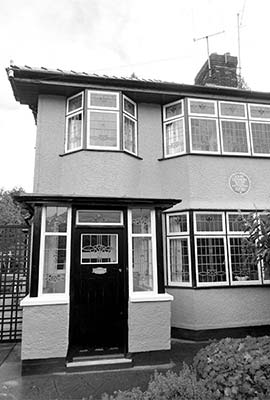
The 1930s house, named after a range of hills in southwestern England (at a time when houses here did not have numbers), has been lovingly restored to be the tidy, well-kept place Mimi would have recognized (down to dishtowels hanging in the kitchen). It’s a lucky quirk of fate that the house’s interior remained mostly unchanged after John’s family left: The bachelor who owned it decades after them didn’t upgrade much, so even the light switches are true to the time.
It’s fun to picture John as a boy drawing and imagining at his dining room table. His bedroom, with an Elvis poster and his favorite boyhood books, offers tantalizing hints at his later musical genius. Sing a song to yourself in the enclosed porch—John and Paul did this when they wanted an echo-chamber effect.
20 Forthlin Road (Paul McCartney’s Home): In comparison to Aunt Mimi’s house, the home where Paul grew up is simpler, much less “posh,” and even a little ratty around the edges. Michael, Paul’s brother, wanted it that way—their mother, Mary (famously mentioned in “Let It Be”), died when the boys were young. It’s been intentionally scuffed up around the edges to preserve the historical accuracy. Notice the differences—Paul has said that John’s house was vastly different and more clearly middle class; at Mendips, there were books on the bookshelves—but Paul’s father had an upright piano. He also rigged up wires and headphones that connected the bedrooms of Paul and his brother Michael to the living room radio so they could listen to rock-and-roll on Radio Luxembourg.
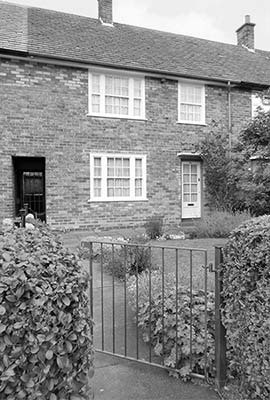
More than a hundred Beatles songs were written in this house (including “I Saw Her Standing There”) on days Paul and John skipped school. The sensitive, slice-of-life photos from Michael make the family feel almost present. Ask your guide how Paul would sneak into the house late at night without waking up his dad.
The National Trust continues to look for ways to complete an accurate restoration. Work is underway to scrape paint off the wall in the upstairs bathroom, where the four young Beatles allegedly scribbled during practice sessions.
Nightlife in Liverpool
Liverpool hops after hours, especially on weekends. If you’re out after dinner, here are a few suggestions.
Ropewalks and Nearby
A particularly lively zone is the area called Ropewalks, just east of the downtown shopping district and Albert Dock. It’s filled with pubs, nightclubs, and lounges—some of them rough around the edges, others posh and sleek. While this area primarily attracts a college-age crowd, it’s still worth a stroll, and has a few eateries worth considering (see “Eating in Liverpool” for recommendations).
The Bridewell bar fills a circa-1850 police station with a lively pub atmosphere and a beer garden. Inside, past the bar, several jail cells have been converted into cozy seating areas (1 Campbell Square).
The Grapes, an artsy pub between Hope Street and Ropewalks, has a cracking atmosphere with a hard-working staff and a good selection of ales and cocktails. Upstairs is a cozy outdoor terrace (60 Roscoe Street).
Peter Kavanagh’s, near the Anglican Cathedral, is worth the trek. It’s a proper pub with no food but plenty of good ales, cocktails, and friendly locals. The interior is richly decorated with memorabilia from its various owners. Enjoy a pint on the outside terrace or in the comfy leather seating inside. There’s live music Saturday evenings (6 Egerton Street).
Downtown
The pubs listed here are best for serious drinkers and beer aficionados—the food is an afterthought.
Thomas Rigby’s has hard-used wooden floors in the taproom that spill out into a rollicking garden courtyard. Its atmosphere is laid back, and chances are good you’ll meet locals, especially after work hours (23 Dale Street).
Ye Hole in Ye Wall, around the corner and much more sedate, brags that it’s Liverpool’s oldest pub, from 1726. Notice the men’s room on the ground floor—the women’s room, required by law to be added in the 1970s, is upstairs (just off Dale Street on Hackins Hey).
The Globe, a few blocks over, right in the heart of downtown and surrounded by modern megamalls, is a tight, cozy, local-feeling pub with five real ales and sloping floors (17 Cases Street).
The Cavern Quarter, with the Cavern Club and neighboring music bars, covers a one-block stretch of Mathew Street. Filled with Beatles bars and Beatles memories, it’s packed with curious tourists by day and gets rowdier after dark—especially with hen and stag parties on weekend nights. You can always drink and dance to cover bands playing Beatles classics on Mathew Street.
The Baltic Triangle
Cains Brewery Village on Stanhope Street is home to various pubs, including the Brewery Tap (Victorian), the Tank Room (edgy), and Punch Tarmey’s (Irish—with live music on weekends, www.punchtarmeys.co.uk).
At the corner of Jamaica and Greenland streets is the popular Camp and Furnace, a cultural hub hosting events such as quizzes, singalongs, concerts, night markets, and a Beatles disco (67 Greenland Street, +44 151 708 2890, https://campandfurnace.com).
Sleeping in Liverpool
Your best budget options in this thriving city are the boring, predictable, and central chain hotels—though I’ve listed a couple of more colorful options also worth considering. Many hotels, including the ones listed below, charge more on weekends (particularly Sat), especially when the Liverpool FC soccer team plays a home game. Rates shoot up even higher two weekends a year: during the Grand National horse race (long weekend in April), and during Beatleweek in late August—avoid these times if you can.
$$ Hope Street Hotel is a class act that sets the bar for Liverpool’s hotels. Located across from the Philharmonic on Hope Street (midway between the cathedrals, in a fun dining neighborhood), this stylish and contemporary hotel has 149 luxurious rooms with lots of hardwood, exposed brick, and elegant little extras. Downstairs is a spa with a pool (costs extra). The hotel also has two restaurants, one fancy and one less so (breakfast extra—book ahead, elevator, pay parking, 40 Hope Street, +44 151 709 3000, www.hopestreethotel.co.uk, sleep@hopestreethotel.co.uk).
$$ Hard Day’s Night Hotel is ideal for Beatles pilgrims. Located in a carefully restored old building smack in the heart of the Cavern Quarter, its contemporary decor is purely Beatles, from its public spaces (lobby, lounge, bar, restaurant) to its 110 rooms, each with a different original Beatles portrait by New York artist Shannon. There’s often live music in the afternoons in the lobby bar—and it’s not all Beatles covers. What could have been a tacky travesty is instead tasteful, with a largely black-and-white color scheme and subtle nods to the Fab Four (some rates include breakfast; elevator, internet-enabled TVs with music playlists, pay parking, Central Building, North John Street, +44 151 236 1964, www.harddaysnighthotel.com, enquiries@harddaysnighthotel.com).
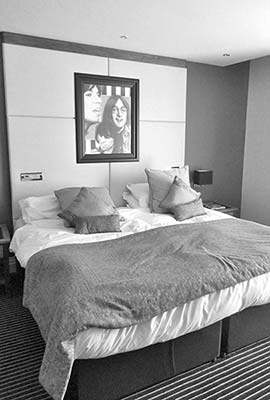
$$ Sir Thomas Hotel is a centrally located hotel that was once a bank. The lobby has been redone in a trendy style, and the 39 rooms are comfortable. As windows are thin and it’s a busy neighborhood, ask for a quieter room (some rates include breakfast, elevator, pay parking, 10-minute walk from station, 24 Sir Thomas Street at the corner of Victoria Street, +44 151 236 1366, https://thesirthomas.co.uk, reservations@thesirthomas.co.uk).
$ Aachen Hotel is a family-run hotel with 15 modern, straightforward rooms in an old Georgian townhouse. It’s situated on a pleasant street just uphill from the heart of downtown (a few rooms have shared baths, 89 Mount Pleasant, +44 151 709 3477, no website—use www.booking.com, aachenhotel@btconnect.com).
Other Chain Hotels: At the Albert Dock, you’ll find a Premier Inn and Holiday Inn Express. Premier Inn has several other central branches, including downtown on Vernon Street and near the Liverpool ONE commercial complex on Hanover Street.
¢ Hostel: Run by the daughter of the Beatles’ first manager, International Inn Hostel rents 100 budget beds in a former Victorian warehouse (game room/TV lounge, 24-hour reception, 4 South Hunter Street, +44 151 709 8135, www.internationalinn.co.uk, info@internationalinn.co.uk). From Lime Street Station, the hostel is an easy 15-minute walk; if taking a taxi, tell them it’s on South Hunter Street near Hardman Street.
Eating in Liverpool
Liverpool has an exciting and quickly evolving culinary scene. As a rollicking, youthful city, it’s a magnet for creative chefs as well as upscale chain restaurants.
ON AND NEAR HOPE STREET
Hope Street, which connects the two cathedrals, is also home to a lively restaurant scene.
Classic Eateries
$$$$ The Art School Restaurant fills the Lantern Room of a former Victorian home for destitute children with what is now a spacious and elegant dining hall. The service is formal, and the food is beautifully presented. Dressy, elegant, and a block behind the Philharmonic Hall, it’s a hit with the concert crowd. Chef Paul Askew is French trained but passionately modern English in the kitchen. The early fixed-price meal (£45 for three courses, served at lunch and 17:00-18:15, Sat lunch only) is affordable—the regular fixed-price offering (£85) and the enticing tasting menu (£110) are splurges (closed Sun-Mon, reservations smart, a block off Hope Street, behind the big concert hall at 1 Sugnall Street, +44 151 230 8600, https://theartschoolrestaurant.co.uk). They also offer an afternoon tea (£26.50, Tue-Sat 14:00-16:00).
$$ The Quarter serves up Mediterranean food at rustic tables that sprawl through several connected houses, with a few tables spilling onto the sidewalk with views of the Hope Street neighborhood—particularly nice when sunny. It’s youthful and cozy, serving pasta, pizza, and boards of meats and cheeses meant to be shared. They also offer breakfast and have carryout coffee, homemade cakes, and sandwiches in their attached deli (long hours daily, deli open 12:00-15:00 only, 7 Falkner Street, +44 151 707 1965).
$$ Papillon, next door, fills the space that was once John, Paul, and George’s fish-and-chips shop (they went to school down the street). It’s cheerful and modern, with pastel colors and exposed brick, and offers a simple but satisfying menu of sandwiches and burgers, pizzas, a delicious savory vegan pie—and yes, fish-and-chips (daily, 31 Hope Street, +44 7706 848 821).
$$ The Philharmonic Dining Rooms, kitty-corner from the Philharmonic Hall, is actually a pub—but what a pub. This place wins the atmosphere award for its old-time elegance. The bar is a work of art, and the three sitting areas on the ground floor (including the giant hall) are enticing places to tip back a pint. While it’s primarily a drinking pub, I’d eat here for the atmosphere. The restaurant seating is upstairs, but the ambience is on the ground floor (food served daily 11:00-21:00, bar open until late, corner of Hope and Hardman streets, +44 151 707 2837).
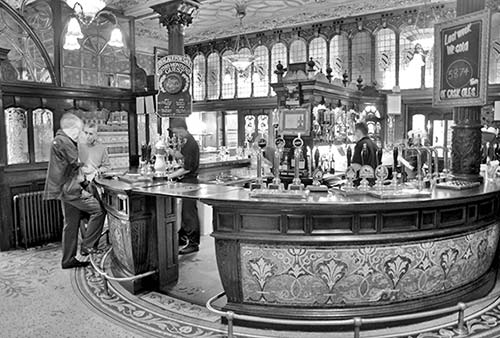
$$ Cuthbert’s Bakehouse is a charming café and teahouse located two blocks from the Liverpool Science Park. This is your best bet for an afternoon tea (£25, Wed-Sun 12:00-14:00 & 14:30-16:30, reserve your time slot in advance by phone or email; veggie, vegan, and gluten-free versions available). They serve brunch and lunch 9:30-15:00. They also have an impressive range of tasty homemade cakes and sweets; check out their specialty—red velvet cake (Tue 9:30-16:00, Wed-Sat 9:30-17:00, Sun 11:00-17:00, closed Mon; 103 Mount Pleasant, +44 151 706 0894, https://cuthbertsbakehouse.co.uk, info@cuthbertsbakehouse.co.uk).
Asian Cuisine
A few blocks southwest of Hope Street is Liverpool’s thriving Chinatown neighborhood, marked by a big Chinese arch. Lots of enticing options for Asian cuisine line up along Berry Street in front of the arch and Cornwallis Street behind it.
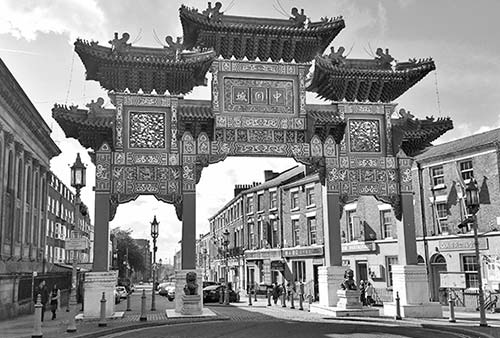
$$ Mei Mei Chinese Restaurant serves Cantonese to an enthusiastic local Chinese clientele. It’s dressy, with a big enticing menu and a hardworking staff (daily, 9 Berry Street, +44 151 707 2888).
$$ Yuet Ben is one of Liverpool’s most established Chinese restaurants (Wed-Sun 17:00-21:00, closed Mon-Tue, facing the arch at 1 Upper Duke Street, +44 151 709 5772).
$ Tokyo Noodle Bar is a cheap and simple diner featuring tasty noodle and rice dishes (Cantonese, Japanese, Malaysian, and so on) with service that’s fast and furious (daily, 7 Berry Street, +44 151 708 6286).
ROPEWALKS
While primarily a nightlife zone, this gentrified area (between the pedestrian Liverpool ONE and the Hope Street neighborhood) also has a smattering of unique restaurants. Focus on Bold Street, lined with fun eateries.
$$ Leaf, with a wonderful energy, is my favorite on the street. Like Liverpool, it’s a little bit of everything—sharing dishes, fresh bakery items, salads, vegetarian plates, soups, sandwiches, fun cocktails, and lots of tea—all driven by the simple philosophy: Where there’s tea, there’s hope. It’s a chaotic, industrial-minimalist space with noisy acoustics. Grab a table and then order at the counter (daily, 65 Bold Street, +44 151 707 7747).
Other Bold Street Eateries: Along with trendy tapas, Middle Eastern, and Italian restaurants, look for these $ places: The Cat Café (where you can actually munch and sip with a cuddly cat—closed Tue, book ahead online or you might need to wait, #10 at the bottom of the street, https://catcafe.co.uk), Johnny English for traditional fish-and-chips (at #62), and the wildly popular Mowgli Street Food (at #69 next to Leaf, also a downtown location).
$$$ Wreckfish Bistro is dynamic and friendly with an open kitchen and a small, woody, and romantic dining area serving modern British cuisine. Despite its name, the menu is not particularly fishy. The food, while unpretentious, is beautiful in its fresh simplicity (open Mon-Sat for lunch and dinner, Sat-Sun breakfast as well, Sun closes at 17:00, reservations smart, corner of Slater and Seel streets, +44 151 707 1960, www.wreckfish.co).
$$ Cowshed does char-grilled steaks and ice-cold cocktails in a rustic townhouse with three inviting rooms (two upstairs and one down). The service is refreshingly efficient (Mon-Fri 16:00-22:00, Sat-Sun from 12:00, reservations smart, 104 Seel Street, +44 151 708 7580, www.cowshedliverpool.co.uk).
DOWNTOWN
$ Mowgli Street Food, a phenom with locations throughout the UK, hustles delicious traditional Indian dishes on little tin plates. Eat family-style, enjoying two or three plates per person. While it’s trendy and set in an elegant location across from Town Hall, the prices are great—and the service is fun. Reservations are smart for parties of more than two (daily, 3 Water Street, +44 151 236 6366, www.mowglistreetfood.com). They have a second location in the Ropewalks District, on Bold Street.
$ Ma Egerton’s Stage Door is an enjoyable pub tucked away next to Lime Street Station. In addition to good ales, this place serves well-priced pizzas and a tasty homemade beef scouse (a traditional stew). With its proximity to the Empire Theatre’s stage door, the pub has been frequented by artists such as Tom Jones, Frank Sinatra, the Rolling Stones, and, of course, the Beatles (daily 11:00-late, 9 Pudsey Street, +44 151 345 3525).
Liverpool ONE: This huge modern shopping center, right in the heart of town, is filled with British chain restaurants. The upper terrace level has a row of popular chains, all with outdoor seating.
AT THE ALBERT DOCK
The eateries at the Albert Dock aren’t high cuisine, but they’re handy to your sightseeing. A slew of trendy restaurants come alive with club energy at night, but are sedate and pleasant in the afternoon and early evening. For lunch near the sights, consider the $ Tate Gallery café (daily 10:00-17:45). $ The Pumphouse Pub, with the tall brick chimney overlooking Canning Dock at the north edge of Albert Dock, is a touristy place for pub grub with a noisy interior and great harborside tables outside (daily, +44 151 709 2367). $$ Gusto is a chain restaurant with a fancy and spacious interior, serving a wide selection of pasta, pizzas, steaks, and fish. The best seats on a warm day are on the back side overlooking the Albert Dock (daily, Edward Pavilion, +44 151 708 6969).
Liverpool Connections
Note that many connections from Liverpool transfer at the Wigan North Western Station, which is on a major north-south train line.
From Liverpool by Train to: Blackpool (4-5/day direct, 1.5 hours; hourly with change in Wigan and/or Preston), Keswick/Lake District (train to Penrith—2/hour with change in Wigan or Lancaster, 2.5 hours; then bus to Keswick), York (hourly direct, 2 hours), Manchester airport (hourly direct, 1.25 hours), Edinburgh (at least 2/hour, 4 hours, most change in Preston, Wigan, or York), Glasgow (1-2/hour, 4 hours, change in Preston and possibly elsewhere), London’s Euston Station (3/hour, 2.5 hours, more with changes), Crewe (3/hour, 45 minutes), Chester (4/hour, 45 minutes). Train info: +44 345 748 4950, www.nationalrail.co.uk.
From Liverpool by Bus to Manchester’s Airport: Buses leave from Liverpool ONE bus station (National Express bus every 90 minutes, 1 hour, www.nationalexpress.com; Megabus 3-4/day, 1.25 hours, https://uk.megabus.com).
By Ferry to Dublin, Republic of Ireland: P&O Irish Sea Ferries runs a car ferry only—no foot passengers (up to 5/day, 8.5-hour trip, prices vary widely—roughly £150 for car and 2 passengers, overnight ferry includes berth and meals—roughly £290, 20-minute drive north of the city center at Liverpool Freeport—Gladstone dock, check in 1-2 hours before departure, +44 1304 448 888, www.poferries.com). Those without cars can take a ferry to Dublin via the Isle of Man (runs mid-June-Aug, www.steam-packet.com), or ride the train to North Wales and catch the Dublin ferry from Holyhead (www.stenaline.co.uk or www.irishferries.com).
By Ferry to Belfast, Northern Ireland: Ferries sail from nearby Birkenhead roughly twice a day (8.5 hours, fares vary widely, +44 344 770 7070, www.stenaline.co.uk). Birkenhead’s dock is a 15-minute walk from Hamilton Square Station on Merseyrail’s Wirral Line.