WARWICK & COVENTRY
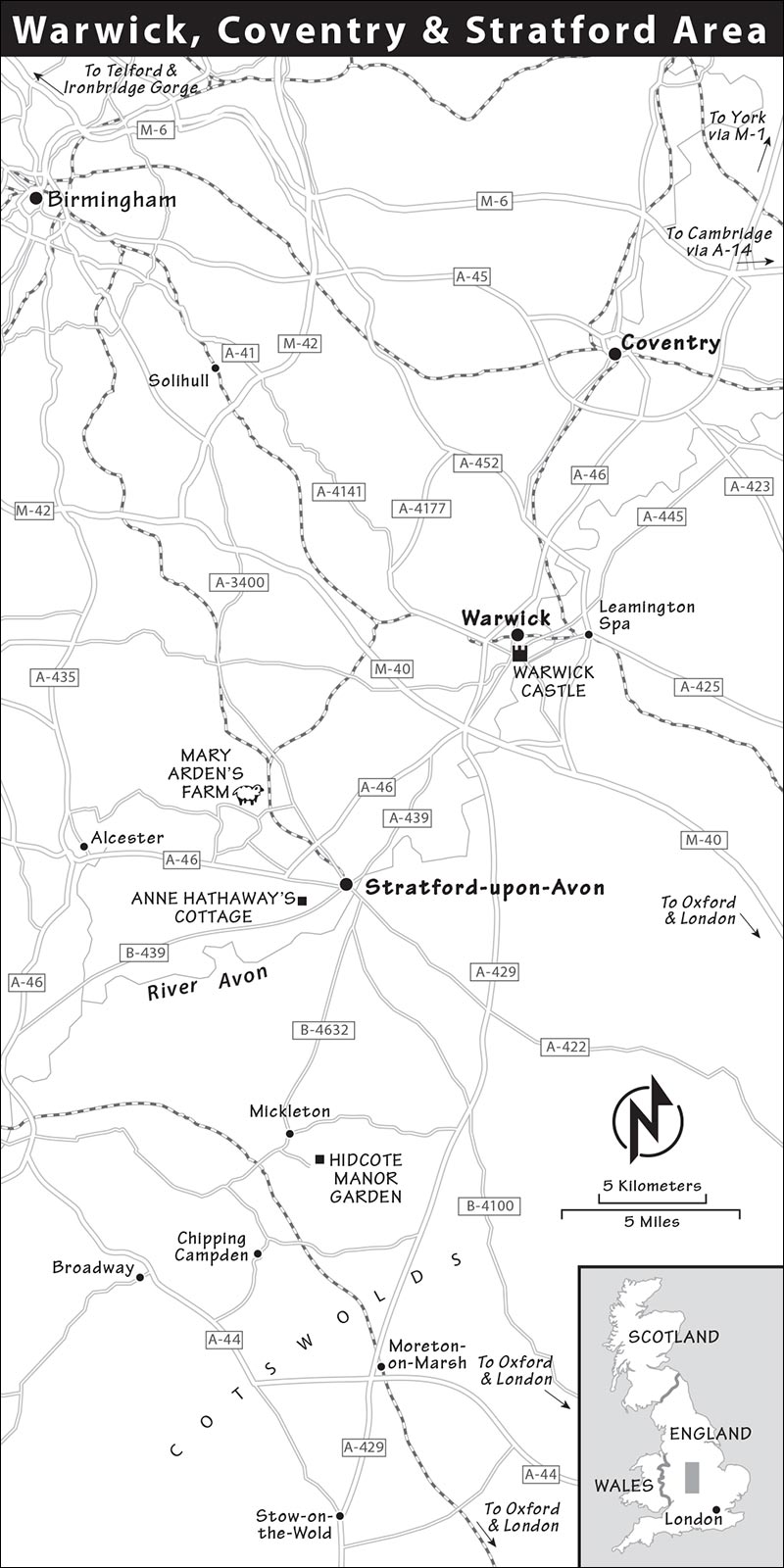
Map: Warwick, Coventry & Stratford Area
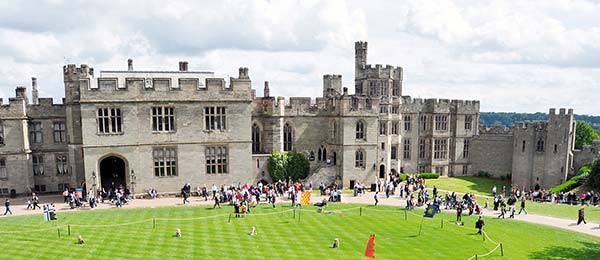
Just north of Stratford, you’ll find England’s single most spectacular castle: Warwick. This medieval masterpiece, which has been turned into a virtual theme park, is extremely touristy—but it’s also historic and fun and may well be Britain’s most kid-friendly experience. The town of Warwick, huddled protectively against the castle walls, is a half-timbered delight—enjoyable for a lunch or dinner, or even for an overnight.

A bit farther north sits the decidedly not cute city of Coventry—a blue-collar burg that was notoriously obliterated by the Nazi Luftwaffe in World War II. While today’s Coventry, having been rebuilt modern and drab, offers little charm, it does feature one of Britain’s most poignant WWII sights: the charred husk of its once-grand cathedral, now left as a monument, with the inspiring new cathedral just next door. A few other intriguing museums round out Coventry’s appeal.
PLANNING YOUR TIME
Warwick and Coventry are both ideal on-the-way destinations—lash them onto your itinerary as you head north from Stratford. Warwick Castle deserves at least three hours for a quick visit, but it can be an all-day outing for families. Coventry’s cathedral can be seen quickly—in about an hour, if that’s all the time you have—though the city’s other sights could fill an additional couple of hours. If you’re prioritizing, Warwick is (for most) the better stop, with its grand castle and charming town; Coventry is worthwhile primarily for its iconic cathedral ruins and for the chance to see a real, struggling, industrial Midlands city.
Warwick and Coventry are both reachable by public transportation, but easier for drivers. For tips on splicing Warwick and/or Coventry into your northbound drive out of Stratford, see that chapter’s “Planning Your Time” on here and “Route Tips for Drivers” on here.
Warwick
The pleasant town of Warwick (WAR-ick) is home to England’s finest medieval castle, which dominates the banks of the River Avon just upstream from Stratford. The castle is impressive in itself, but its lineup of theme park-type experiences makes it particularly entertaining, especially for kids. The castle-related attractions, while pricey, offer something for everyone, and on a sunny day, the grounds are a treat to explore.
Meanwhile, Warwick town—with a fine market square and some good eateries—goes about its business almost oblivious to the busloads of tourists passing through. While handy for an overnight, Warwick offers relatively little to see beyond its castle.
Orientation to Warwick
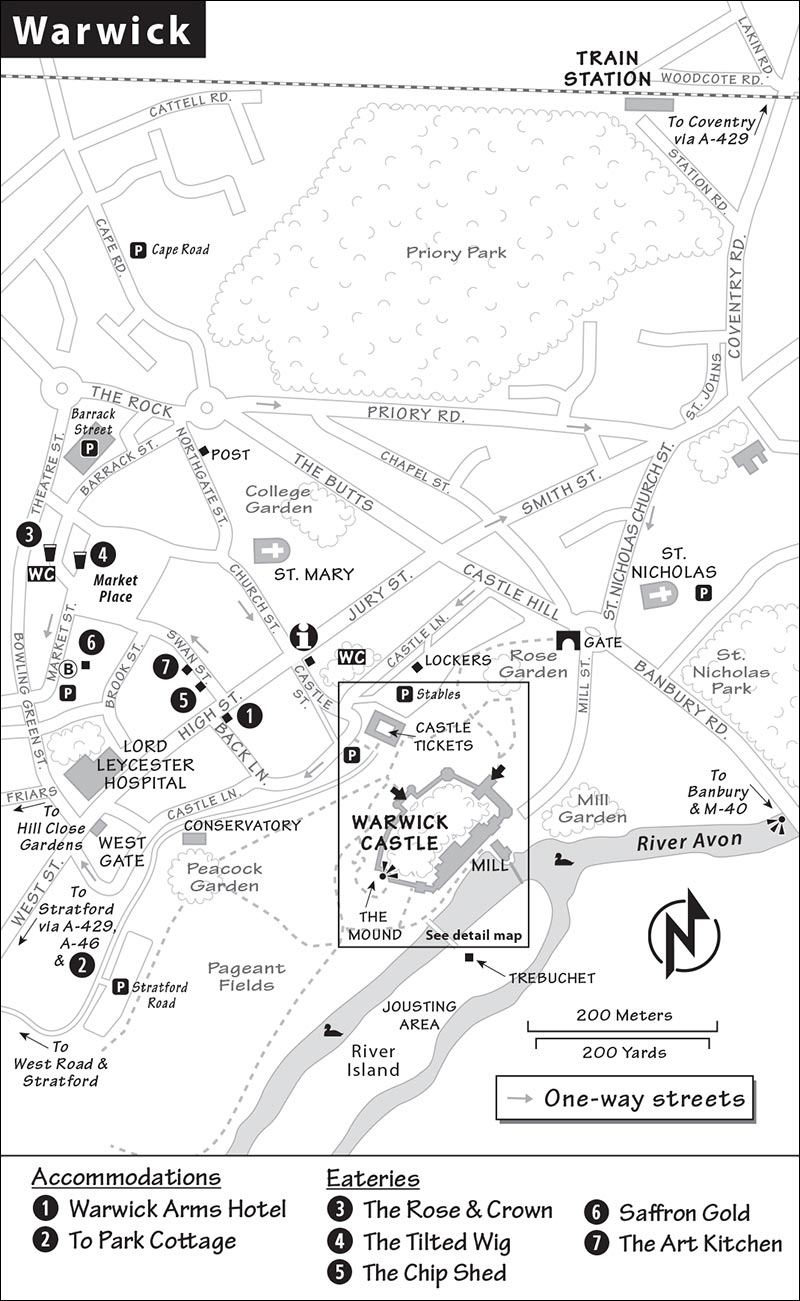
With about 30,000 people, Warwick is small and manageable. The castle and old town center sit side by side, with the train station about a mile to the north. From the castle’s main gate, a lane leads into the old town center a block away, where you’ll find the TI, plenty of eateries, and a few minor sights.
TOURIST INFORMATION
Warwick’s TI sells ticket vouchers to Warwick Castle for a reduced rate—saving you £8 over buying them at the castle. The voucher needs to be printed out for castle admission—ask TI staff to do it (Mon-Fri 9:30-16:30, Sat from 10:00, Sun 10:00-16:00 except closed Sun mid-Dec-Easter, The Court House, Jury Street, +44 1926 492 212, www.visitwarwick.co.uk, info@visitwarwick.co.uk).
In the TI basement you’ll find the Warwickshire Yeomanry Museum, which tells the story of this English cavalry regiment formed in 1794. Volunteer guides, most of them Army veterans, together with an extensive collection of uniforms and weapons, make this a worthwhile stop for history buffs (Sat-Sun 10:00-16:00, closed Mon-Fri and Nov, www.warwickshire-yeomanry-museum.co.uk).
ARRIVAL IN WARWICK
By Train: Warwick has two train stations; you want the one called simply “Warwick” (Warwick Parkway Station is farther from the castle). There are no luggage lockers at the station, but day-trippers can use the lockers near the castle (£2, coins or bills, at the entrance to the Stables Car Park; if lockers are all taken—or out of order—try asking at the castle info desk).
A taxi from the station to the castle or town center costs about £8 (the minimum local fare). It’s a 15-minute, one-mile walk from the station to the castle or town center: Exit straight ahead down the street, then bear right onto Coventry Road. Following signs for the castle, at the traffic light, turn right onto St. John’s Road. At the three-way fork, take Smith Street (the middle fork), soon called Jury Street (which eventually becomes Warwick’s High Street). After a long block, the TI appears on your left, with the main castle gate just beyond (up Castle Street). To reach the market square and restaurants from the TI, go one more block on High Street and turn right.
By Car: The main Stratford-Coventry road cuts right through Warwick. Coming from Stratford (8 miles to the south), you’ll hit two castle parking lots first (use the Warwick Castle app or buy token from machines at the castle entrance, 10-15-minute walk to the castle). Two other lots are closer to the castle: the Castle Lane Car Park is small but worth checking to see if space is available (credit card only); if it’s full, head for the more expensive Stables Car Park just off Castle Lane (£10 for any amount of time, credit card or coins). For cheaper options you’ll find plenty of other lots throughout Warwick (Cape Road lot is free Sat-Sun). There is street parking in the town center, but often with a two-hour maximum—not enough time to fully experience the castle.
Services: Public WCs are at the TI and on Market Square (next to the recommended Rose and Crown pub).
Sights in Warwick
▲▲WARWICK CASTLE
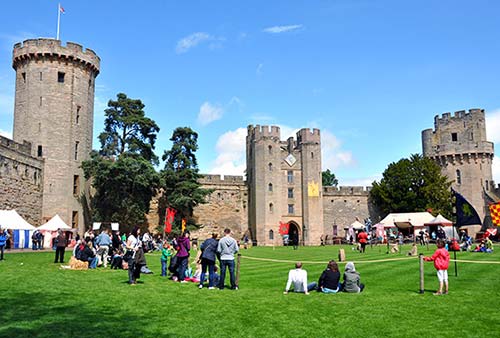
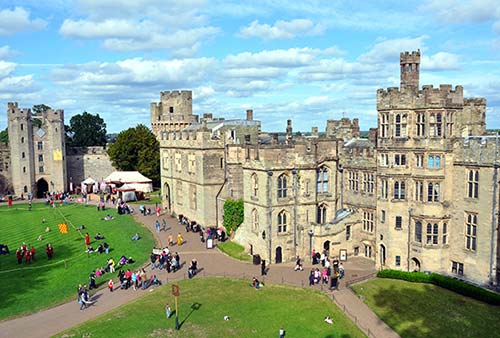
Almost too groomed and organized, this castle gives its crowds of visitors a decent value for the stiff entry fee. The cash-poor but enterprising Earl of Warwick hired the folks at Merlin Entertainments (which owns many other big-name British attractions) to wring maximum tourist dollars out of his castle. They’ve made the place entertaining indeed, and packed it with lively exhibits...but also watered down the history, and added several layers of gift shops, overpriced concessions, and nickel-and-dime add-ons. The greedy feel of the place can be a little annoying, considering the already-steep admission. But—especially for kids—there just isn’t a better medieval castle experience in England. With a lush, green, grassy moat and fairy-tale fortifications, Warwick Castle will entertain you from dungeon to lookout.
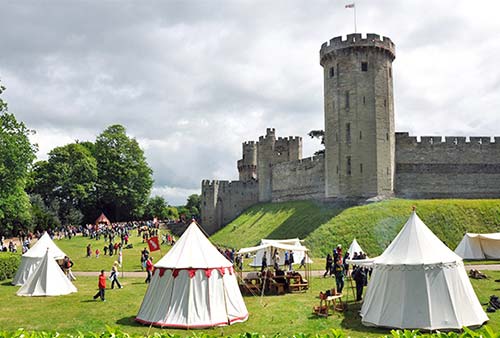
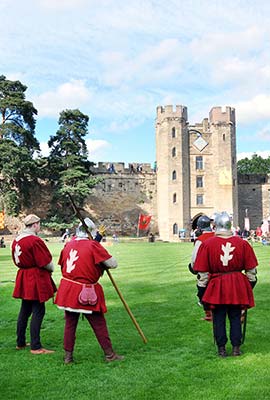
The castle is a 14th- and 15th-century fortified shell, holding an 18th- and 19th-century royal residence, surrounded by another one of “Capability” Brown’s dandy landscape jobs (like at Blenheim Palace). You can tour the sumptuous staterooms, climb the towers and ramparts for the views, stroll through themed exhibits populated by aristocratic wax figures, explore the sprawling grounds and gardens, and—best of all—interact with costumed docents who explain the place and perform fantastic demonstrations of medieval weapons and other skills.
Cost: Steep £21-39 entry fee (price varies, see discount information below); entrance includes gardens and most castle attractions except the gory Castle Dungeon (£8 extra).
Hours: Daily 10:00-16:00, sometimes until 17:00 in summer.
Information: Recorded info +44 871 265 2000, or call +44 1926 495 421 daily 9:00-16:00, www.warwick-castle.com, enquiries@warwick-castle.com.
Discounts: Booking online can be considerably cheaper than buying onsite (discounts vary; see website for details). Or buy your ticket at the TI in Warwick or Stratford for similar savings (about £8) while supporting a local business. Be sure to ask the TI to print the ticket for you. Once at the castle, present it to the castle ticket office. English Heritage members get a 50 percent discount at the door.
Visitor Information: Download the helpful Warwick Castle App to buy discounted entry tickets and pay for parking at the Stratford Road parking lots. The app also includes a map of the area, showing sights and start times of various activities.
The guidebook (purchase at ticket office) guides you through the state rooms in souvenir-booklet form. If you tour the castle without the booklet’s help, pick the brains of the earnest and talkative docents.
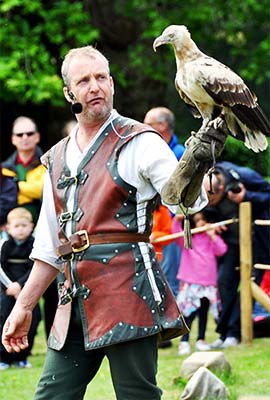
Demonstrations and Events: It’s the well-presented demos and other events that make this castle particularly worthwhile. These can include jousting competitions, archers showing off their longbow skills, sword fights, jester acts, falconry shows, and demonstrations of the trebuchet (like a catapult) and ballista (a type of giant slingshot). They’re offered year-round, but most frequently in summer and on weekends and school holidays. Ask for the schedule at the entrance, or find updated times posted in front of the Great Hall or on the Warwick Castle app.
Eating at the Castle: Consider bringing your own picnic to enjoy at the gorgeous grounds. Otherwise you’re left with overpriced concessions stands scattered around the castle (some marked on the map you get with your ticket), all serving variations on the same mass-produced food. Inside, $$ The Undercroft has pizza, pasta, and salads (located in basement of palace). $$ The Conservatory offers nobles-in-training a chance to sip tea and nibble on sandwiches with views of the peacock garden and pageant field. Fortunately, just 100 yards from the castle turnstiles—through a tiny gate in the wall—is Warwick town’s workaday commercial district, with several better (and better-value) lunch options. It’s worth the walk (see “Eating in Warwick,” later), but be sure to get your hand stamped at the turnstiles before leaving so you can return after lunch.
 Self-Guided Tour
Buy your ticket (or show your voucher or online ticket) and head through the turnstile into the moat area, where you’ll get your first view of the dramatic castle. In good weather, this lawn-like zone is filled with tents populated by costumed docents demonstrating everyday medieval lifestyles.
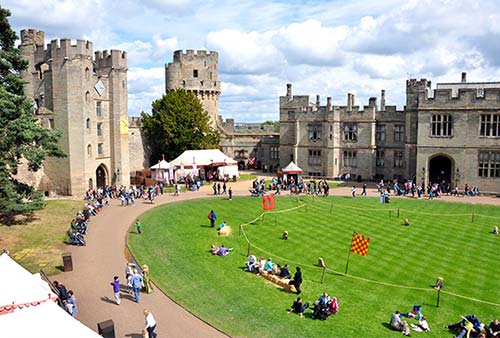
From the moat, two entrance gateways lead to the castle’s 1 inner courtyard; look for signs for where to enter each gate. Within these mighty walls, there’s something for every taste.
The main attractions are in the largest buildings along the side of the courtyard: the Great Hall, five lavish staterooms, and the chapel. Progressing through these rooms, you’ll see how the castle complex evolved over the centuries, from the militarized Middle Ages to civilized Victorian times, from a formidable defensive fortress to a genteel manor home.
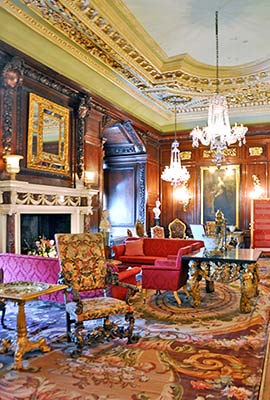
Enter through the cavernous 2 Great Hall, decorated with suits of equestrian armor. Adjoining the Great Hall is the state dining room, with portraits of English kings and princes. Then follow the one-way route through the 3 staterooms, keeping ever more esteemed company as you go—the rooms closest to the center of the complex were the most exclusive, reserved only for those especially close to the Earl of Warwick. You’ll pass through a series of three drawing rooms (abbreviated from “withdrawing,” from a time when these provided a retreat into a more intimate area after a to-do in the larger, more public rooms): first, one decorated in a deep burgundy; then the cedar drawing room, with intricately carved wood paneling, a Waterford crystal chandelier, and a Carrara marble fireplace; and the green drawing room, with a beautiful painted coffered ceiling and wax figures of Henry VIII and his six wives. The sumptuous Queen Anne Room was decorated in preparation for a planned 1704 visit by the monarch (unfortunately, Queen Anne never came—she got wind that one of her ladies-in-waiting, with whom she was fiercely competitive, was also coming, so she canceled at the last minute). Finally comes the blue boudoir, an oversized closet decorated in blue silk wallpaper. The portrait of King Henry VIII over the fireplace faces a clock once owned by Marie-Antoinette.
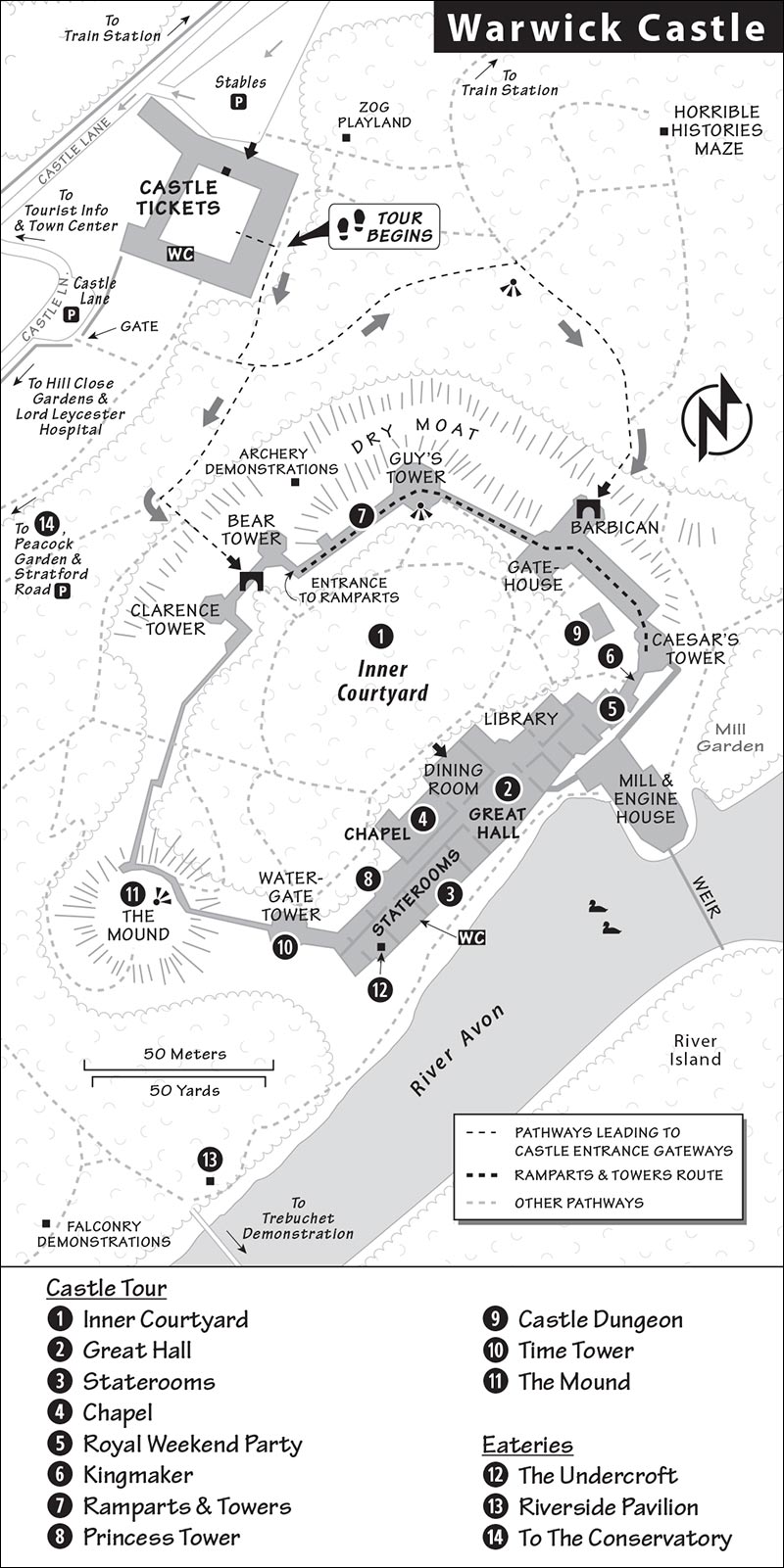
On your way back toward the Great Hall, you’ll pass the earl’s private 4 chapel. The earl’s family worshipped in the pews in front of the stone screen, while the servants would stand behind it. Notice the ornate wood-carved relief depicting a scene of the Greeks fighting the Amazons, based on a painting by Peter Paul Rubens. The organ in the back of the chapel was powered by a hand-pumped bellows.
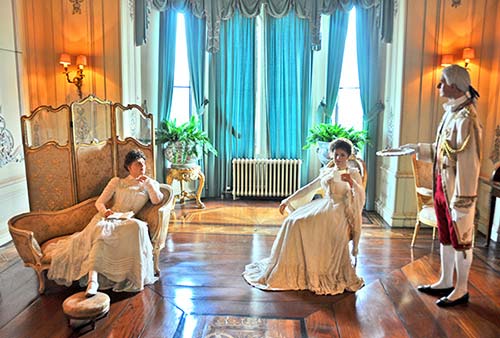
Back in the Great Hall, head into the 5 Royal Weekend Party exhibit on the far side. Here you can explore staterooms staged as they appeared in 1898, but with an added narrative element: The philandering Daisy Maynard Greville, Countess of Warwick—considered the most beautiful woman in Victorian England—is throwing a party, and big-name aristocrats are in attendance, including a young Winston Churchill. Among the guests is the Prince of Wales (the future King Edward VII), with whom Daisy had a long-time affair. Gossipy “servants” clue you in on who’s flirting with whom. The rooms are populated by eerily convincing Madame Tussauds-style wax figures, and posted information and soundtracks loosely narrate the scandal.
Back out in the courtyard, to the left of the staterooms, is the entrance to the less-impressive 6 Kingmaker exhibit. Set in 1471, it uses mannequins, sound effects, and smells to show how medieval townsfolk prepared for battle—from the blacksmiths and armory, to the wardrobe, to the final rallying cry, with costumed docents standing by.
You can climb up onto the 7 ramparts and towers—a one-way, no-return route that leads you from the Bear Tower to the top of Guy’s Tower, and up and down Caesar’s Tower (on very tight spiral stairs), leaving you at a fun perch from which to fire your imaginary longbow. The halls and stairs can be very crowded with young kids, and—as the signs warn—it takes 530 steep steps (up and down) to follow the whole route; claustrophobes may want to skip it.
The 8 Princess Tower offers children the chance to dress up as princesses and princes for a photo op. While it’s included in the castle ticket, you must first sign up for a 15-minute time slot at the info tent in the middle of the courtyard, near the staterooms.
Another pricey and skippable add-on attraction can also be entered from the courtyard (if you didn’t buy a combo-ticket, you can buy individual tickets at the information tent near the staterooms). The 9 Castle Dungeon, a gory, tacky knock-off of the London Dungeon, features a series of costumed hosts who entertain and spook visitors on a 50-minute tour. And the 10 Time Tower features a 15-minute multimedia presentation covering 1,100 years of castle history.
The bulge of land at the west end of the courtyard, called 11 The Mound, is where the original Norman castle of 1068 stood. Under this “motte,” the wooden stockade (the “bailey”) defined the courtyard in the way the castle walls do today. You can climb up to the top for a view down into the castle courtyard (do this last, since you can exit down the other side, toward the riverbank).
Outside of the inner courtyard area are additional diversions. Surrounding everything is a lush, peacock-patrolled, picnic-perfect park, complete with a Victorian rose garden. The castle grounds are often enlivened by a knight in shining armor on a horse or a merry band of musical jesters. The grassy moat area is typically filled with costumed characters and demonstrations, including archery and falconry.
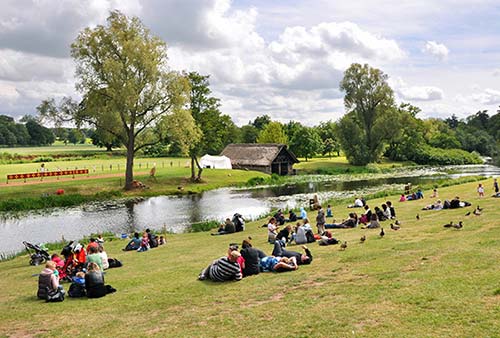
Near the entrance to the complex are the Zog Playland, featuring the children’s book dragon, Zog, medieval-themed slides and climbing areas, and the Horrible Histories Maze, which includes six “history zones” that cover the Vikings through World War I. Down by the river is a bridge across to River Island, and—tucked around the back of the castle—a restored mill and engine house, with an exhibit that explains how the castle was electrified in 1894.
MORE SIGHTS IN WARWICK
While Warwick has a few attractions beyond the castle, most are not that exciting.
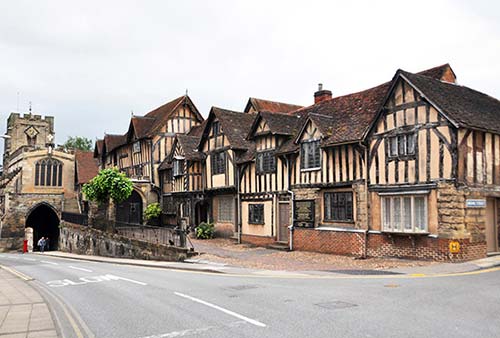
The most photogenic building in town (aside from the castle) is Lord Leycester Hospital, a gaggle of adjoining 14th-century half-timbered houses next to the southern gate of High Street. Converted into a “hospital” (rest home for the elderly or ill) in 1571, it has a chapel, great hall, maze of old rooms, and pretty garden (overpriced at £11; borrow self-guided tour brochure at entry; Tue-Sun 10:00-17:00, until 16:00 in winter, closed Jan-Feb, closed Mon year-round except Bank Holidays, last entry one hour before closing, guided tours available; 60 High Street, +44 1926 491 422, www.lordleycester.com).
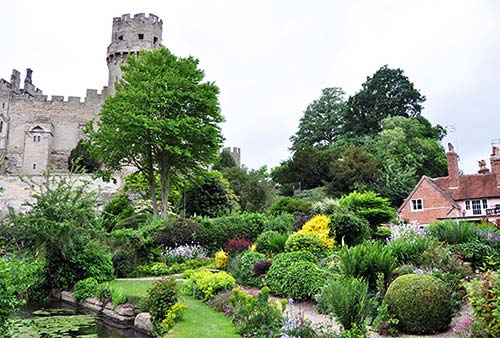
Garden fans will find three good ones in Warwick. Most appealing is the Mill Garden, down the quaint and half-timbered Mill Street; this small garden, which adjoins the castle property, has fantastic views of the River Avon and castle (£3, proceeds go to charity, daily 9:00-18:00, closed Nov-March, 55 Mill Street, +44 1926 492 877). Hill Close Gardens, at the other end of town near the racecourse, has 16 small Victorian garden plots (£5, daily 11:00-17:00, Nov-March until 16:00 and closed Sun-Mon, Bread and Meat Close, +44 1926 493 339, www.hillclosegardens.com). The Master’s Garden at Lord Leycester Hospital (described earlier) rounds out your options.
Sleeping in Warwick
If the following accommodations are full, several B&Bs line Emscote Road (A-445) northeast of the city center, about a mile from the castle.
$$ Warwick Arms Hotel, in the middle of the action on High Street, offers 40 modern rooms in a 300-year-old house. Narrow halls, wobbly floors, and creaking stairs add character to this charming, family-owned former coaching inn (family rooms, free parking, bar and restaurant, no elevator, 17 High Street, +44 1926 492 759, www.warwickarmshotel.com, reception@warwickarmshotel.com).
$$ Park Cottage fills a creaky 1521 half-timbered house (once the castle dairy) with four rooms and teddy-on-the-beddy touches. It’s on the main road at the opposite end of town from the train station (near the racecourse and castle entrance). Two cottages with fully equipped kitchens are available behind the house (family room possible, free parking, 113 West Street/A-429, +44 1926 410 319, www.parkcottagewarwick.co.uk, janet@parkcottagewarwick.co.uk, Stuart and Janet).
Eating in Warwick
All of these are on or within a short stroll of Market Place.
$$$ The Rose and Crown is a popular gastropub serving English food with a modern twist. Enjoy the cozy but not claustrophobic interior—order food at the bar or dine in the table-service area—or sit outside (food served long hours daily, open late for drinks, 30 Market Place, +44 1926 411 117).
$$$ The Tilted Wig does freshly prepared pub food in a rustic-chic setting on Market Place with indoor and outdoor seating (long hours daily, 11 Market Place, +44 1926 400 110).
$$ The Chip Shed serves up excellent fish-and-chips, homemade pies, and large battered sausages half a block up from High Street. Everything is made fresh in-house. It’s takeaway in the front; a spacious restaurant at the back offers the same menu at slightly higher prices (daily, Swan Street, +44 1926 498 014).
$$ Saffron Gold is a well-regarded Indian restaurant serving tasty meals in an upscale setting with good service (Tue-Sun for dinner only, closed Mon, just a block off Market Square but tricky to find—in drab Westgate House building near the Marks & Spencer, on Westgate Close, +44 1926 402 061).
$$$ The Art Kitchen, right on the main pedestrian shopping street, is a mod Thai bistro surrounding a bar (daily seatings at 18:00 and 21:00, takeaway available, 7 Swan Street, +44 1926 494 303).
Warwick Connections
Warwick is on the train line between Birmingham’s Moor Street Station and London’s Marylebone Station; most other connections require a change in the adjacent town of Leamington Spa.
From Warwick by Train to: Leamington Spa (about 3/hour, 10 minutes), Stratford-upon-Avon (8/day, 30 minutes, more with transfer in Birmingham—buses are better, see later), Coventry (about 2/hour, 30-40 minutes, transfer in Leamington Spa), Oxford (1-2/hour, 1 hour, transfer in Leamington Spa), London’s Marylebone Station (1-2/hour direct, 1.5 hours, more with transfers in Leamington Spa). Train info: +44 345 748 4950, NationalRail.co.uk.
By Bus to: Stratford-upon-Avon (hourly, 30 minutes, bus #X16, also slower #X18), Coventry (2-3/hour, 1 hour, bus #X17, also slower #X18, www.stagecoachbus.com).
Coventry
Coventry was bombed to smithereens in 1940 by the Nazi Luftwaffe (air force). From that point on, the German phrase for “to really blast the heck out of a place” was (roughly) “to coventrate” it. But Coventry rose from its ashes, and its message to our world is one of forgiveness, reconciliation, and the importance of peace.
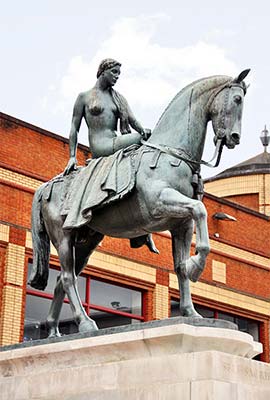
Before it was infamous as a victim of World War II, Coventry had an illustrious history. According to legend, Coventry’s most famous hometown girl, Lady Godiva, rode bareback and bare-naked through the town in the 11th century to convince her stubborn husband to lower taxes. You’ll see her bronze statue on the market square a block from the cathedral, and a fun exhibit about her in the Herbert Art Gallery and Museum.
The cloth trade made Coventry one of England’s leading cities in the Middle Ages. Its fortunes rose and fell over time, and by the 20th century it had become a major industrial center—first as Britain’s main bicycle manufacturer, later as its top car-making city, and eventually as a major center of armaments and aircraft assembly (making it a key target for the Luftwaffe bombers). The city was utterly devastated by the Blitz; aside from the human toll, its greatest loss was its proud and famous Cathedral of St. Michael (now called Coventry Cathedral), which burned to the ground—the only English cathedral destroyed by the Nazis. Tellingly, Coventry’s sister cities include two other places synonymous with horrific WWII destruction: Dresden, Germany, and Volgograd (formerly Stalingrad), Russia.
Today’s Coventry isn’t pretty. While many other WWII-damaged English towns were rebuilt quaint and cobbled, Coventry is all characterless modern concrete. But its cathedral—combining the still bombed-out shell of the old building, and a highly symbolic, starkly modern new one—is poignant and inspiring, and its other museums are quite good (and most are free). While I wouldn’t go out of my way to visit Coventry, if you’re passing by, consider stopping off to browse through a bit of normal, everyday, urban England.
Orientation to Coventry
Coventry is a big city—with about 365,000 people—but everything of interest to visitors is in the small central core, which is bound by a busy ring road. You can walk from one end of the ring to the other in about 15 minutes. The train station (with the TI outside) is just south of the ring; the cathedral, St. Mary’s Guildhall, and Herbert Art Gallery and Museum are in the northeastern part of the ring; and the Transport Museum is about a 10-minute walk northwest of the cathedral.
TOURIST INFORMATION
The main TI is located next to the train station (Mon-Fri 10:00-17:00, Sat until 17:30, Sun 11:00-16:00, Station Square, +44 2476 977 001, www.visitcoventry.co.uk). A smaller branch TI is at the Pool Meadow Bus Station (Sat-Sun 11:00-16:00, limited hours on weekdays).
ARRIVAL IN COVENTRY
If you’re passing through Coventry by public transportation, baggage storage could be a problem—there’s none at the train station, but you can use a baggage-storage website such as NannyBag.com or Stasher.com to find storage nearby. The Transport Museum has lockers for use during a visit there.
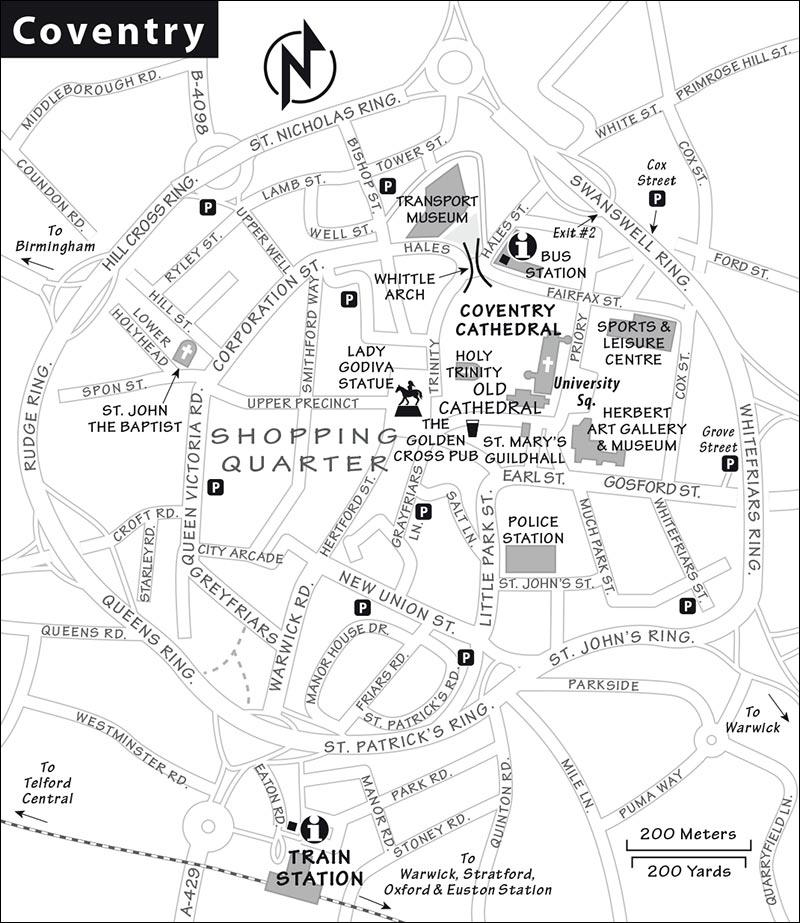
By Train: From the train station (which sits just outside the ring road), it’s about a 15-minute walk to the cathedral. Exit straight ahead and follow signs along the pedestrian route for the cathedral through the modern shopping district. The cathedral is the taller of the two pointy spires.
By Car: Use the pay parking lot on Cox Street (just off Fairfax Street, coins only, £4/3 hours), near the cathedral. From the ring road, take junction (exit) 2. The parking lot is basically under the ring road, across from the Coventry Sports and Leisure Centre, and is a five-minute walk to the cathedral (turn left at the bus station and you’ll see it ahead on your right).
Sights in Coventry
▲▲COVENTRY CATHEDRAL (CATHEDRAL OF ST. MICHAEL)
The symbol of Coventry is the bombed-out hulk of its old Cathedral of St. Michael, with the huge new one adjoining it. This inspiring complex welcomes visitors.
Cost and Hours: The ruins of the old cathedral are free to enter, though you’ll pay to climb the tower and tour the small WWII museum (see later). Entering the new cathedral is also free, but consider making a donation to this worthwhile cause (both the ruins and new cathedral open Mon-Sat 10:00-16:00, Sun 12:00-15:30). To see the church in action, attend a service or afternoon evensong (check website for times). Free weekly organ recitals are held in the summer months (Mon at 12:30).
Information: +44 2476 521 200, www.coventrycathedral.org.uk.
Tours: Guided tours are available of the ruins and the new cathedral (£10/person, book online at least four weeks in advance).
Tower Climb: You can walk 181 steps up to the top of the tower for views over the cathedral complex and city (£5, must be 8 or older, Sat 11:00-15:00, closed in bad weather and during some special events, confirm hours online).
Blitz Experience: Several rooms at the altar end of the old cathedral have been turned into a small “Blitz” museum. Volunteers tell the story of how Coventry endured and was shaped by the destruction of World War II (by donation, generally Sat 11:00-15:00, confirm hours online).
Self-Guided Tour
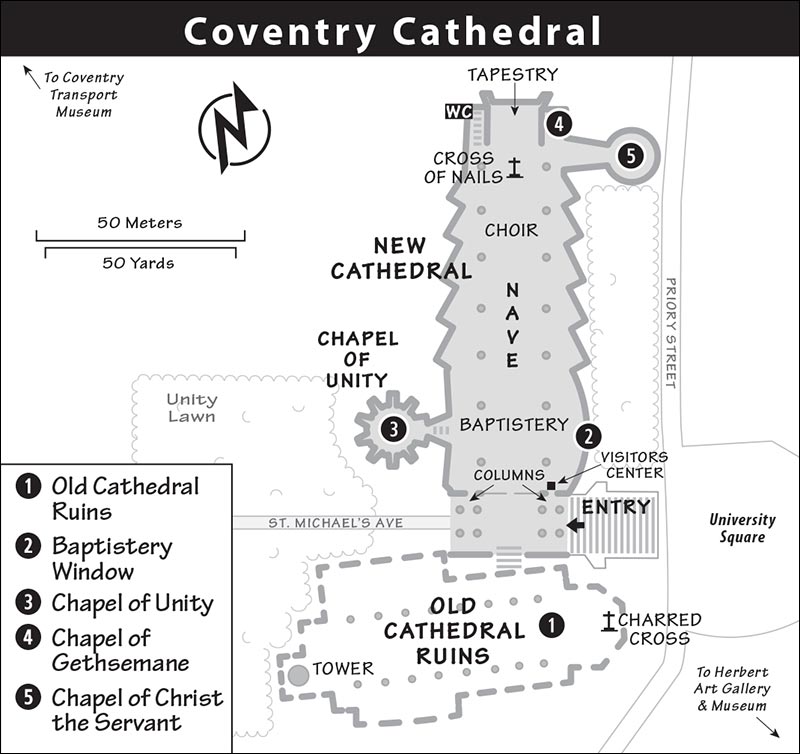
A visit to the cathedral complex has two parts: First explore the ruins of the original building, then head into the new cathedral. You can pick up the free Guide to the Ruined Cathedral pamphlet at the TI; the new cathedral also hands out a floor plan that includes both the old and new churches.
Old Cathedral Ruins: Coventry’s grand Perpendicular Gothic cathedral was the second to stand on this spot (built 1373-1460). Its towering 303-foot-tall steeple—the third-highest in England—was a symbol for the city. On the night of November 14, 1940, Nazi Luftwaffe bombers filled the skies above Coventry. They dropped incendiary devices (firebombs) to light up the ground so they could see their targets. One of these hit the roof of the cathedral, which was quickly consumed in flames. (The tower survived.) Today the footprint and surviving walls stand as a testament to the travesty of war.
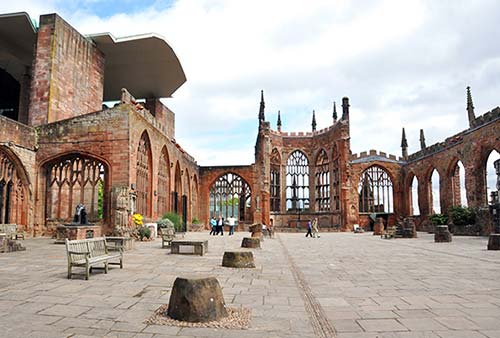
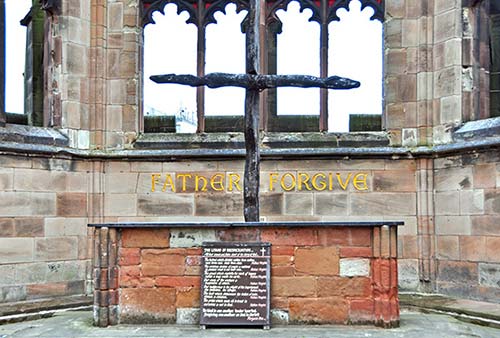
At the apse of the ruined structure (far end from tower) is a replica of the charred cross; the original is inside the new cathedral. While surveying the wreckage after the bombing, workers found these beams lying on the ground in the shape of a cross—so they lashed them together and erected it here. The message “Father Forgive” (spoken by Christ on the cross) makes it clear that this is a symbol not of anger, but of reconciliation. The Coventry Litany of Reconciliation asks forgiveness for the seven deadly sins. It is said daily at 12:00, sometimes in these ruins.
Various monuments are scattered around the ruins. Directly to the left of the charred cross is the bronze memorial to an early 20th-century bishop. In a chilling bit of irony, there’s a swastika on his headband—dating from a time when this was just a good-luck symbol, before it was appropriated by Hitler and painted on the planes that destroyed this place. Closer to the tower, you’ll see the modern Ecce Homo sculpture (depicting Christ before Pilate) and a reconciliation monument, showing two people embracing across a gulf.
Before going inside the new cathedral building, head out to the plaza just beyond the complex and look back at it: old and new cathedrals, set perpendicular to each other, creating a continuous ensemble of worship. The large sculpture on the side of the new cathedral depicts St. Michael triumphing over the devil, as foretold by the Book of Revelation.
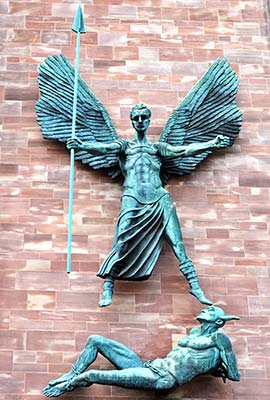
The cathedral’s visitors center is to the right; in this undercroft is a museum about the history of all three cathedrals that have stood on this site, with artifacts from each one. (Also notice, to your left, the glassy entrance to the Herbert Art Gallery and Museum—a good post-cathedral stop, described later.)
• Now head into the new cathedral interior. If the main door (up the stairs) is open, head inside; otherwise, enter through the visitors center.
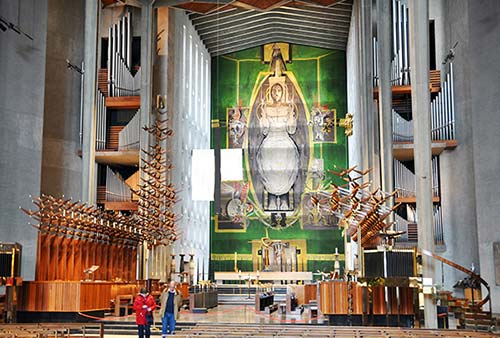
New Cathedral: By the morning after the cathedral burned, the people of Coventry had already decided to rebuild it. Architect Basil Spence won the contest to design this reimagining of the important church: The ruined old cathedral represents death and sacrifice, while the new structure—part of the same continuum—represents resurrection. While at first the cold, gray walls inside the building make it feel gloomy and uninspired—almost (perhaps appropriately) like a giant bomb shelter—its highly symbolic design reveals itself to those who take the time to explore it.
Stand at the top of the main nave, on the giant letters that create a gathering area for the congregation. In the center of the nave near these letters, look for the maple leaf embedded in the floor—a thank-you to Canadians whose donations helped fund this building. Looking down the nave, notice that the cathedral follows the same basic traditional layout of much older churches (long nave, choir area, high altar and apse at the far end) but features decidedly modern designs and decorations.
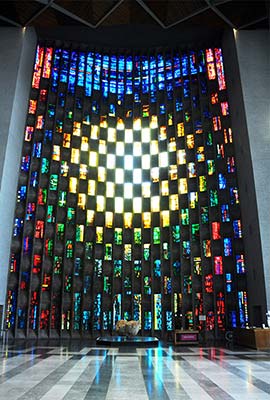
Turn right to take in the gigantic and gorgeous stained-glass window of the baptistery—a starburst with intensely warm colors at the center, cool colors at the perimeter. Beneath this is the baptismal font, which is carved into a chunk of rock from the hills near Bethlehem. Looking down the nave, notice that otherwise, the cathedral has relatively little stained glass...from here, at least.
Across the nave from the baptistery, walk up the stairs into the Chapel of Unity. With its circular shape and floor mosaics depicting the five continents, this chapel preaches understanding among all Christian faiths—an ecumenism that echoes the cathedral’s mission of reconciliation.
Back out in the main nave, walk down the central aisle. Notice the well-worn copper coins embedded in the floor. Dating from 1962 (when the cathedral was consecrated), these help choir members keep a straight line as they process into the church.
Pause in front of the choir, with its modern, dramatically prickly canopy, designed to evoke Jesus’ crown of thorns—or possibly birds in flight. The Christmas tree-shaped tower marks the seat of the bishop.
The green artwork that fills the far wall is not a fresco but a 74-foot-by-38-foot tapestry that depicts Jesus in a Byzantine Pantocrator (“creator of all”) pose, surrounded by symbols of the Four Evangelists. Notice the faint outline of a small human being standing protected between Jesus’ feet.
Turn around and look back down the nave. Remember how stained glass seemed in short supply from the far end of the church? From this direction, you can clearly see how the sawtooth-shaped design allows for row after row of colorful glass to be seen by worshippers as they return to their seats after taking communion. At the far end, notice that instead of a wall sealing off the church, there’s a giant glass window—to emphasize the connection between this new cathedral and the old one just outside. Both buildings also use the same local red sandstone. This is intended to be one big, unified space.
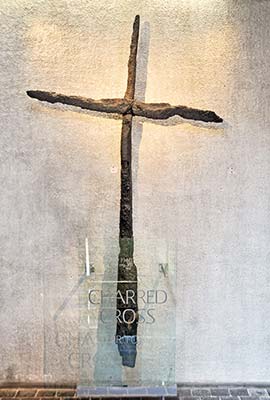
Now circle around the left side of the choir to the back-left corner of the church, where stairs lead down to WCs and the church museum. Hanging at the top of the stairwell is the original charred cross that was found in the ruins of the cathedral after the bombing, shown on here.
Now cross toward the other side of the church. Right in the middle, you’ll pass a misshapen cross above the main altar; in its center is a smaller cross consisting of three nails from the medieval church, which were also found in the wreckage. This “cross of nails” has become a symbol worldwide for postwar reconciliation. Several such crosses have been made, many of them given to other cities that were devastated by the war; one stands above the high altar of the rebuilt Frauenkirche in Dresden, Germany. (You can buy a small replica of the cross of nails in the cathedral shop, across from the main door.)
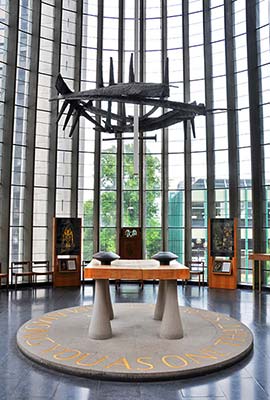
Continue to the far side of the church. You’ll pass the Chapel of Gethsemane, with a crown of thorns-shaped screen around the window. Beyond that, walk down the hallway and into the Chapel of Christ the Servant. The clear (rather than stained-glass) windows remind worshippers to extend their faith and stewardship outside the walls of this building. Also displayed here are fragments of the old cathedral’s original stained-glass windows.
NEAR THE CATHEDRAL
▲Herbert Art Gallery and Museum
This expanded, impressive museum complex and cultural center combines town history exhibits and art collections. Since it’s free and directly behind the cathedral, it’s well worth dropping in if you have some time to spare. As there are several exhibits—both permanent and temporary—be sure to explore the entire building (ask for a floor plan).
Cost and Hours: Free, Mon-Sat 10:00-16:00, Sun from 12:00, Jordan Well, +44 24 7623 7521, www.theherbert.org.
Visiting the Museum: Near the entrance is the History Gallery, with enjoyable interactive exhibits that trace the city’s story from its beginnings to the Blitz to today. You’ll see actual artifacts from the Blitz and hear locals describe living through it. Beyond the information desk are small exhibits on peace and reconciliation (Coventry has understandably become a very pacifist city), and the small but entertaining Discover Godiva exhibit, which examines the legend (and possible fact) of Lady Godiva. Her husband, Earl Leofric, increased taxes dramatically on his subjects. She pleaded with him for a tax cut, and he agreed—provided that she ride naked through town on horseback. A fun animated video shows how the legend evolved, with each generation of storytellers adding their own flourishes. One popular version says that the townspeople respectfully averted their eyes, except for one “Peeping Tom”—who was struck blind for his voyeurism. You’ll also see paintings of the Lady, clips from movies about her, and companies that have appropriated her as a mascot. Upstairs is the museum’s modest but enjoyable gallery of sculpture, Old Masters, modern and contemporary artwork, and temporary exhibits.

▲St. Mary’s Guildhall
The story of this fine half-timbered building, sitting next to the cathedral and originally built for the merchant guild of St. Mary, is rooted in the fascinating history of England’s often-overlooked King Henry VI (r. 1422-1461). Afflicted with what today would be diagnosed as catatonic schizophrenia, Henry seemed to his medieval subjects to exist between our world and another—he’d drift into a trance and be unreachable for days or weeks at a time, then emerge reporting the vibrant visions he’d had. During the Wars of the Roses, Henry briefly moved the capital of England to Coventry, creating a special bond with the city. After his death, Henry’s corpse reportedly bled in front of observers, leading them to conclude that he was miraculous.
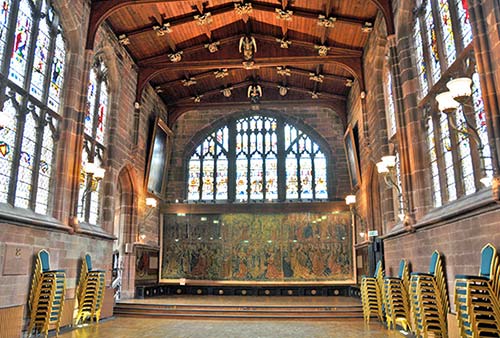
A cult of followers sprang up around Henry, centered here in Coventry. People began to pray for divine intervention from the man they came to call “Saint Henry.” One young girl, who had been crushed under a wagon wheel, was miraculously healed when her mother prayed to Henry. (The pope sent delegates to verify some 300 reported miracles, and his half-nephew Henry VII unsuccessfully petitioned to have him canonized.) The local businessmen’s guilds of Coventry built this fine hall to venerate their favorite king and unofficial saint.
Cost and Hours: £10.80, generally daily 10:00-16:00, may close for events and off-season, confirm hours online, +44 2476 430 545, www.stmarysguildhall.co.uk.
Visiting the Hall: While it’s fun and a bit spooky to explore the maze of tight old rooms, the highlight here is the great hall. The semicircular stained-glass window traces Henry VI’s royal lineage—that’s him in the center, flanked by his supposed ancestors, William the Conqueror, King Arthur, and the Roman emperor Constantine (notice that Constantine’s cross is bigger than the others’—his mother, St. Helen, supposedly discovered Jesus’ “true cross”). Below the window is a remarkable, if faded, 14th-century tapestry that also honors Henry (ask the attendants to briefly turn on the light to see it better). More than 500 years old, this tapestry is still in situ—in the location for which it was intended. The hall is staffed by knowledgeable attendants who love to explain its history. If you dare, also ask them about the constant ghost sightings in this building—so frequent they’ve become routine. Inexpensive handouts offer more details on the hall’s history.
▲Coventry Transport Museum
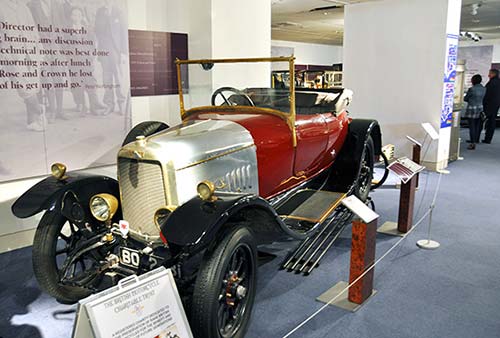
A 10-minute walk from the cathedral, this good museum pays homage to Coventry’s car-making heritage. For much of the 20th century, Coventry was the main auto production center of Britain, and in the 1950s and 1960s, more than a third of the city’s population built cars. For car lovers, it’s worth ▲▲.
Cost and Hours: £15.50, cheaper online, pay lockers for use only while on the premises; daily 10:00-17:00, last entry at 15:00; +44 24 7623 4270, www.transport-museum.com.
Visiting the Museum: On two floors of a sprawling modern building, you can see the first, fastest, and most famous cars that came from this “British Detroit.” The museum also shows off a collection of tractors, bicycles, motorcycles, and tanks...if it had wheels, they made it here.
The exhibit focuses on local production (Daimler, Standard, Triumph, and others), but a few famous non-Coventry cars are also included, such as Monty’s staff car—a Humber Super Snipe—and a 1949 Land Rover. The collection also has the oldest surviving Standard car—the Roi de Beiges from 1907. Aside from the cars, you’ll find interesting displays on how various modes of transportation changed the way people lived.
Eating in Coventry
$$ The Golden Cross serves tasty pub grub and a wide selection of ales in a Tudor-style house just a half-block west of the cathedral ruins (daily, open late for drinks, 8 Hay Lane, +44 2476 551 855).
Coventry Connections
From Coventry by Train to: Warwick (hourly, 30 minutes, change in Leamington Spa), Stratford-upon-Avon (at least hourly, 1.5 hours, change in Leamington Spa or Birmingham), Oxford (hourly, 50 minutes), London’s Euston Station (4/hour, 1 hour), Telford Central (near Ironbridge Gorge; 2/hour, 1.5 hours, transfer in Birmingham), Moreton-in-Marsh (hourly, 2 hours, transfer in Oxford). Train info: +44 345 748 4950, NationalRail.co.uk.