OXFORD
Oxford • Blenheim Palace
ORIENTATION TO BLENHEIM PALACE
Oxford, founded in the seventh century and home to the oldest university in the English-speaking world, originated as a simple trade crossroads at an ox ford...a convenient place for Anglo-Saxons to cross the river with their oxen. (Back then you could row to London from Oxford...in just five days.)
This humble town gained fame when the University of Oxford took root here. Ever since the first homework was assigned in 1167, its stellar graduates have influenced Western civilization. Its alumni include 27 British prime ministers, more than 60 Nobel Prize winners, well-known writers and actors, and even 11 saints.
Today’s Oxford is a lively, globally minded city of 170,000. It’s part university (with 60 percent of students from overseas), part industry (cranking out fashionable Mini cars and renowned craft beers), and part bedroom community for Londoners (with relatively affordable housing and an easy hour-long commute). Although you may see stodgy professors in their traditional black robes, this is a fun college town—with a quarter of the population between 18 and 23—filled with shopping, cheap eats, pranks, and rowdy, rollicking pubs.
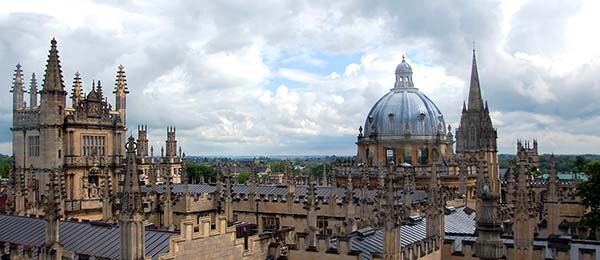
For tourists, Oxford offers a pleasant town center plus historic colleges with literary connections. Never bombed in World War II, Oxford retains its rich honey-colored Cotswold limestone buildings. Many colleges allow visitors (for a small admission fee) to stroll their grounds and go inside a few historic buildings. Step off the busy, urban-feeling High Street into the hushed sanctuary of a grassy college quad. Stroll the garden where Lewis Carroll dreamed up his adventures for Alice, pop in to the dining hall that inspired the one where Harry Potter eats, or wander past the pub where J. R. R. Tolkien first spoke about hobbits.
Just half an hour outside of town is magnificent Blenheim Palace (described at the end of this chapter), England’s finest countryside estate and the birthplace of Winston Churchill.
PLANNING YOUR TIME
Oxford is a convenient stop for people visiting the Cotswolds, Blenheim Palace, Stratford-upon-Avon, and Bath. In a single busy day, you could see the essential Oxford: my self-guided walk, Christ Church College, and the Ashmolean Museum.
Oxford’s colleges are generally open to visitors, but each has its own visiting hours (which can be unpredictable). Your plans may be affected by whether school is in session (more atmospheric, though some sights may be closed to visitors) or on vacation (less lively but easier access). There are three terms: Michaelmas (Oct-Dec), Hilary (Jan-March), and Trinity (April-June). Summer sees an influx of foreign students on short-term programs, along with tour groups and Harry Potter fans, making the season a less stately time to visit.
Orientation to Oxford
While a typical American-style university has one self-contained campus with a town nearby, Oxford (like Cambridge) has colleges and buildings scattered throughout town. Roughly speaking, the university clusters around the building called the Radcliffe Camera, while the town’s commercial center is near the Carfax Tower.
The main arteries are the north-south Cornmarket/St. Aldate’s, and the east-west Queen Street/High Street. At the intersection of these streets stands the stubby, 14th-century Carfax Tower (named for the French carrefour, or “crossroads”)—the historic birthplace of the town. From here, pedestrianized Cornmarket—essentially an outdoor mall lined with shops and chain restaurants—heads north, where it intersects with another pedestrian zone at George Street/Broad Street.
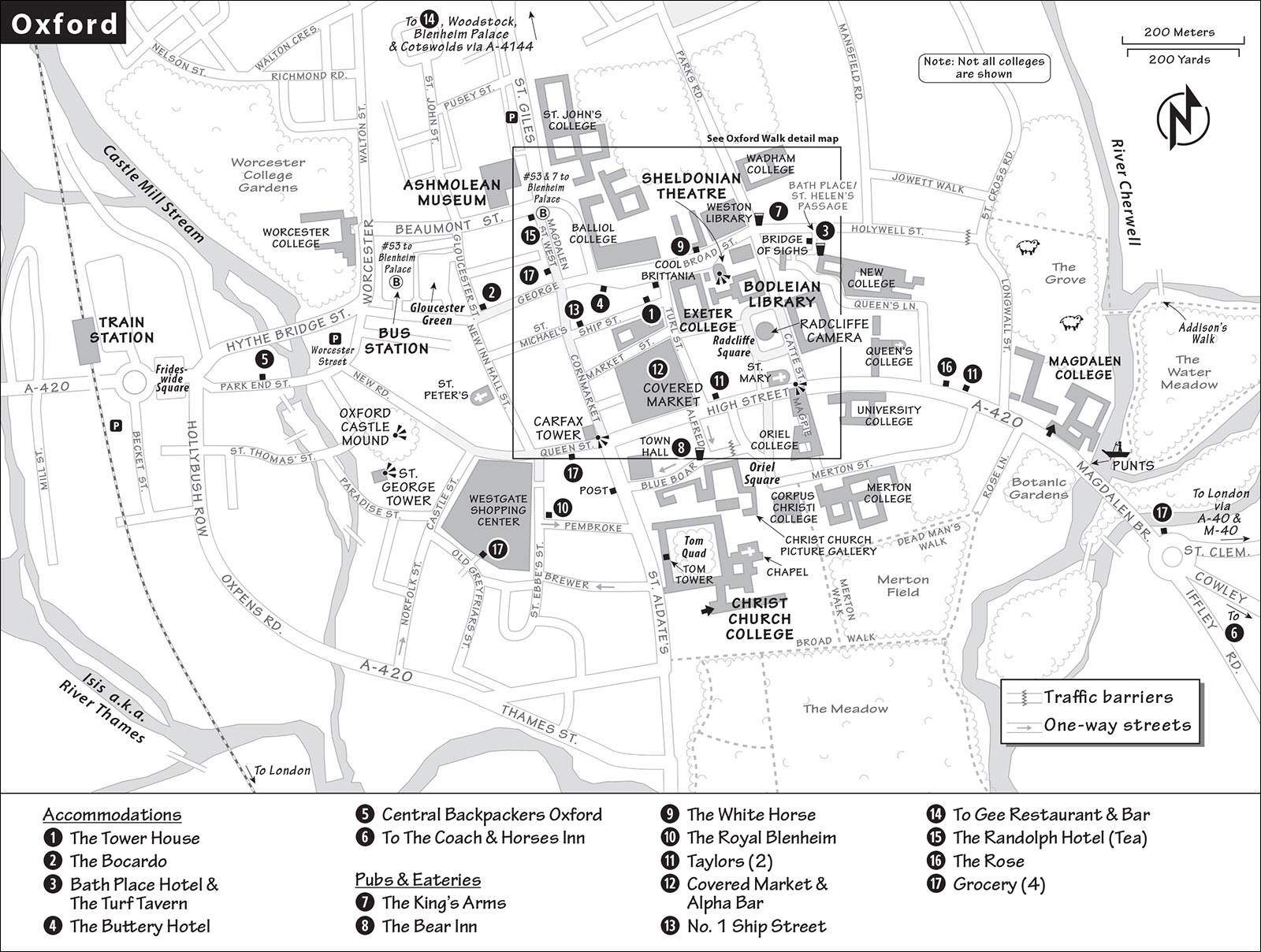
The sightseer’s Oxford is walkable and compact, and many streets are pedestrian-only. It’s easy to get a feel for workaday Oxford, where knowledge is the town business—and procrastinating over a pint is the students’ main hobby.
TOURIST INFORMATION
Oxford does not have a physical TI office, but you can find information online at the Experience Oxfordshire website (www.experienceoxfordshire.org).
ARRIVAL IN OXFORD
From the train station, the city center is a 10-minute walk (exit straight ahead and follow the signs). A taxi costs around £8—but because of many one-way streets, it may not be direct. The “tourism centre” desk in the train station is just a sales outlet for skippable bus tours. There are no lockers at the station, but day-trippers can leave their luggage at the Central Backpackers Oxford hostel 400 yards in front of the train station toward the town center (see listing later, under “Sleeping in Oxford”).
The bus station, a bit closer to downtown at Gloucester Green, is a five-minute walk from the heart of Oxford: Turn left onto George Street and follow it straight into town (no lockers at station—leave your bags at the hostel mentioned above).
Drivers day-tripping into Oxford have several options. The cheapest is to use one of the outlying park-and-ride lots, which are about a 10-minute shuttle-bus ride from the town center. There are some pay parking lots closer to the center (including a handy one between the train station and downtown), but they’re more expensive. There’s also time-limited street parking north of the Ashmolean Museum, on St. Giles Street).
HELPFUL HINTS
Bookstore: One of the world’s largest bookstores, Blackwell’s started as a 12-foot-square shop in 1879 (Mon-Sat 9:00-19:00, Sun 11:00-17:00, coffee shop upstairs, WC on top floor, 48 Broad Street, +44 1865 792 792).
Local Guide: William Underhill is a good Oxford-educated private guide (£60/hour, +44 7802 328 956, williamunderhill@gmail.com).
Best Views: At the University Church of St. Mary the Virgin, climb the 127 narrow, twisting stairs of the 13th-century bell tower for views of Oxford’s many spires and colleges. For an easier climb, skip up the 99 steps of Carfax Tower (£3, daily 10:00-17:00, March and Oct until 16:00, Nov-Feb until 15:00). Also consider the tower of the Sheldonian Theatre. The views from Oxford Castle’s tower are underwhelming and only accessible if you pay to join the tour. (For more on the church and theater, see my “Oxford Walk”; for castle details, see “Sights in Oxford.”)
Oxford in Film and TV: Fans of the Harry Potter movies will find a lot of familiar scenes in Oxford. Christ Church College’s atmospheric dining hall inspired the film sets used for Hogwarts’ Great Hall. In the films, Christ Church’s cloisters and Bodley Tower staircase were used as settings for several scenes. The Divinity School was the movie set for Hogwarts’ infirmary (and Yule Ball), and Duke Humfrey’s Library was Hogwarts’ library. At New College, the cloisters and courtyard also became Hogwarts haunts.
Brits are enthralled by locations relating to the Oxford-set Inspector Morse television series, an enormous UK hit from 1987 to 2000 (the equally popular sequels, Inspector Lewis and Endeavour, were also filmed here). Sort of the British Columbo or a modern-day Sherlock Holmes, this fictional police detective—having been trained as a scholar but opting for a real-world job—was quirky, cultured, and extremely effective.
Do-It-Yourself Tour: Information panels around town provide historical context and engaging facts about nearby sights. On the opposite side of each panel, you’ll find a “you are here” map; use these to easily find your way around the maze of streets.
Tours in Oxford
▲Walking Tours
“University and City” walking tours, led by Blue or Green Badge guides, explain local history and traditions and take you inside one or two of the colleges. More informative than entertaining, these dry talks provide a solid historical background (£22, 2 hours, daily at 10:30 and 13:00, additional tours depending on demand; check schedule and book online, +44 1865 686 441, www.experienceoxfordshire.org). They also offer themed tours, including Harry Potter and literary tours about C. S. Lewis, J. R. R. Tolkien, and others. These tours often sell out, especially on Saturday; it’s smart to book in advance. Tours depart from outside the Cool Britannia gift shop at the corner of Turl and Broad Streets.
Walking Tours of Oxford offers themed group tours and private tours (Oxford University tour-£25, offered Tue, Thu, and Sat at 14:00, departs from Christ Church memorial garden on St. Aldates; £130 and up for 2-hour private tour; check schedule and book online; +44 7833 176 196, www.walkingtoursofoxford.com).
Oxford Walking Tours leads more casual tours, departing hourly from the Trinity College gates (£20, daily 11:00-16:00, 1.5 hours, also evening ghost tours; check schedule and book online; +44 7790 734 387, www.oxfordwalkingtours.com, Stuart).
Hop-On, Hop-Off Bus Tours
City Sightseeing Oxford runs double-decker buses around town (20 stops in all). Tickets include a 45-minute walking tour since much of Oxford is inaccessible by bus. Some buses have a live guide, others have recorded commentary—both are covered by the same ticket (£18; pay driver or buy tickets online, at the train station, or Carfax Tower; runs every 10-15 minutes daily 9:30-18:00, less frequent and stops running earlier in winter, +44 1865 790 522, www.citysightseeingoxford.com).
Oxford Walk
1 Oxford’s Birth: Town and Gown
4 Museum of the History of Science
11 Radcliffe Square: The Historic Quad
12 University Church of St. Mary the Virgin
13 High Street
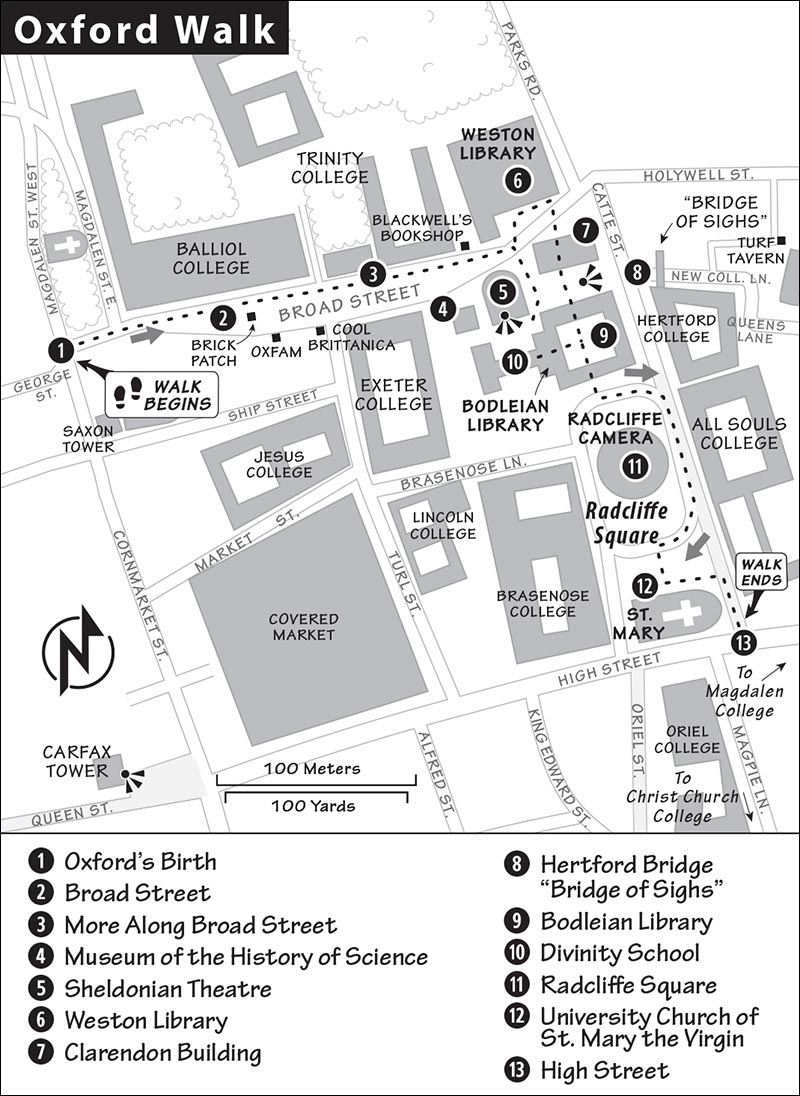
This stroll takes you through the heart of Oxford’s sprawling collection of colleges and university buildings. Budget about 2.5 hours to do the walk and go inside some of the sights along the way.
• Start at the intersection of Broad and Cornmarket streets.
1 Oxford’s Birth: Town and Gown
Gazing down pedestrian-only Cornmarket with its modern shops, you see the historic town of Oxford. Looking east down Broad Street, you see the realm of the university. It’s these two elements—“town and gown”—that combined to make the Oxford of today. Take a few steps down Cornmarket to see Oxford’s oldest building—the tall, stone Saxon Tower, from around AD 1000. The town began as a fortified trading post with a “corn market.” Then, in 1167, a university was founded—one of Europe’s first—bringing a new and sometimes troublesome element: students. The university expanded outside the old town walls, including what is now Broad Street.
• Walk east along Broad Street about 100 yards. Stop at a small patch of bricks embedded in the middle of the road.
2 Broad Street: Colleges
This street was originally the ditch that ran outside of the Anglo-Saxon town wall. By the 1200s, it was home to Oxford students. As the university grew, it became what you see today—a loose collection of university buildings mingled among shops and homes.
The brick patch, in the shape of a cross, marks the spot where three local bishops, known as the “Oxford Martyrs,” were burned at the stake for heresy in 1555-1556. Their crime: Protestantism. It’s a reminder that Oxford, as a center of intellectual thought, has always been a major ideological battleground. In Oxford, ideas matter.
For now, turn your attention to the first of the university buildings along our walk: Balliol College (on the left, with the cone-shaped turret). Founded in 1263, this is one of 38 colleges in the federation that composes Oxford University. Think of “colleges” as places where students live (eat, sleep, socialize, and get tutoring from faculty mentors) while they take classes in “university” buildings elsewhere in town. Each college is a self-contained community, with dorms, a dining hall, chapel, library, gardens, housing for faculty advisors, and a central quad. Each proudly has its own logo, colors, and reputation—the rich snobs, the partiers, the liberals. Balliol is known for producing politicians, but, like all colleges, it draws students from every major.
Most colleges allow visitors (for a small admission fee) to stroll the grounds and pop into a few select buildings. Just follow the map you’re given and don’t enter places specifically marked for students and staff only. At Balliol (£5), you pass through the gate (attended by the “porter”) and into the front quad—a golf-course-green lawn surrounded by atmospheric medieval-style buildings. You can enter the chapel with its stained glass and carved-wood pews where students attend services. Continuing into the larger garden quad, you can step inside the impressive dining hall (unless it’s mealtime) to see the long tables and place settings, and portraits of distinguished alumni.
3 More Along Broad Street
Broad Street is typical of most of the town, in that property is divided about evenly among three groups: the university, the colleges (which are independent entities), and private shops and homes.
At #17 (on the right) is an Oxfam shop. This tiny building is where the charitable organization Oxfam was founded in 1942 (by a Balliol grad) to feed starving victims of World War II. In 1947, they opened this Goodwill-type shop to sell donated items to fund more charitable work. From these humble beginnings, Oxfam has grown into a multimillion-dollar international nonprofit, with some 1,200 such shops, fueling the fight to feed the poor, needy, and oppressed around the world.
A few steps farther (on the left) is the entrance to Trinity College (which you could also tour, £4). Trinity and Balliol have been archrivals for centuries, competing in rowing, in out-pranking each other, and in an annual tortoise race. Exeter College (on the right) was where J. R. R. Tolkien lived while an undergrad. He studied Welsh and Finnish (which merged into fictional elvish) and went on to teach at Oxford.
At #48 (on the left), step into Blackwell’s Bookshop. Founded here in 1879, it has grown into a chain. This flagship store may not look that impressive initially, but make your way deep inside—beneath your feet in underground tunnels are an additional three miles of bookshelves in the 10,000-square-foot Norrington Room.
• Directly across the street is the...
4 Museum of the History of Science
One of Europe’s oldest museums, this place is worth ▲. It’s a concise and well-displayed exhibit of scientific bric-a-brac (including Einstein’s blackboard) that the scholars of Oxford used to change our world.
Cost and Hours: Free, £5 donation requested, book timed-entry ticket online; Tue-Sun 12:00-17:00, closed Mon; www.hsm.ox.ac.uk.
Visiting the Museum: As you explore, borrow descriptions keyed to exhibit numbers. Upstairs, you’ll find early globes, sundials, telescopes, and calculating machines. With a wedge-shaped quadrant, you could measure your position at sea in relation to the stars. A round astrolabe did the same but calculated the math for you.
In the basement, your eye will be drawn to a big crown. It adorns a huge lodestone—a natural magnet unearthed in the 1700s that could lift 160 pounds of iron. Exploring the other display cases, you’ll see lots of flasks (including equipment used in developing penicillin), Marconi’s early radios, and Lewis Carroll’s photo-developing kit.
The museum’s highlight is at the far end of the main room, hanging on the wall: Einstein’s blackboard. Einstein personally scrawled this equation in chalk (D = 1/c...) during a lecture he gave at Oxford in 1931. Using the distance to a certain galaxy (D) as his starting point, he calculated the entire universe’s density (p) and radius (P) in light years (“L.J.”) to prove that the universe is indeed expanding.
By the way, university scientists once had the right to use the bodies of all executed criminals—and the dissecting was done right here in the basement.
• We now begin diving into the university, starting with the big round Sheldonian Theatre next door.
5 Sheldonian Theatre
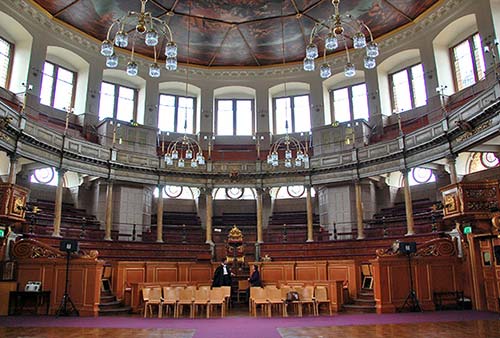
This ▲ venue for concerts and lectures is best known as the grand space for graduations and other important campus ceremonies. It was the first major building designed by Sir Christopher Wren—an Oxford graduate and astronomy professor. The theater was such a success that Wren went on to become England’s best-known architect, designing such grand structures as St. Paul’s Cathedral in London. Wren was inspired by ancient theaters—curved on one end—but he added a roof. Wren placed 13 classical-looking stone heads out front, nicknamed “the emperors.” (Some jokingly say they were carved to illustrate different styles of beards. Students occasionally prank them with funny hats or chalk lipstick.)
Cost and Hours: £4, hours posted on door but generally daily 10:00-17:00, last entry one hour before closing.
Visiting the Theater: Before entering the theater, make your way behind the Sheldonian (away from the street), to a Gothic-looking building with big windows and buttresses topped with prickly spires. This was the university’s first purpose-built classroom (1427) and is its oldest surviving building—the Divinity School (which we’ll visit later). Admire the elaborately carved doorway, which was added later (1669) by Wren. Traditionally, graduating students would gather inside here, then walk out the Wren doorway and proceed grandly into the Sheldonian Theatre for the main ceremony. For now, let’s go inside the Sheldonian Theatre (through the visitor’s entrance).
The interior is basically one big round room ringed with seats. The construction is largely wood painted in pleasing red, white, and gold, and lit by the clear-glass windows. It’s in this grand space that new students matriculate and graduates graduate. Picture the place on graduation day, filled with parents, with dignitaries seated at the end with the golden throne, and with students parading up to receive their degrees. Faculty members give speeches, the organ plays, and degrees are conferred in Latin. Think of the many famous grads over the years: Sir Walter Raleigh, Oscar Wilde, Stephen Hawking, Hugh Grant, and Bill Clinton.
The ceiling painting is made up of 32 separate panels, executed in the studio then pieced together with a grid of golden ropes. It depicts Truth—the radiant naked woman in the center—descending on a cloud to bless the university’s Arts and Sciences (the robed women bearing harps, pens, quadrants, and telescopes). Most importantly, Truth banishes Ignorance—the Medusa near the pipe organ who tumbles down dramatically in defeat. (Also near the organ, on the wall, is a portrait of Wren.) Wren’s domed ceiling was an engineering marvel, spanning a 70-by-80-foot hole. No beams were long enough to bridge that gap, so Wren had to construct a lattice of overlapping timbers.
You can climb 114 steps, walking among those big oak trusses, to a glass-covered cupola with great views. Looking southeast you’ll see the heart of the university (where we’ll soon be), with the spires of the Bodleian Library and the dome in Radcliffe Square. Everywhere, you’ll see why Oxford has been dubbed “the city of dreaming spires.”
• Exit the Sheldonian Theatre and cross Broad Street to the...
6 Weston Library
This building was constructed in the 1930s to house the overflow of books when the venerable Bodleian Library began running out of space. Today, the Weston (worth ▲) welcomes visitors to enjoy its free exhibits of an ever-changing selection of precious books, manuscripts, and letters from the vast collection. Nicknamed by locals “the best of the Bod,” this is a literary treasure chest celebrating the genius of Oxford over the centuries. The two exhibit rooms are straight ahead as you enter. Items rotate in and out: You may see a Shakespeare First Folio, a copy of the Magna Carta, handwritten scores by Handel, or even a sixth-century scrap of birch bark with a recipe in Sanskrit to remove wrinkles and gray hair.
Cost and Hours: Free, suggested £5 donation, Mon-Sat 10:00-17:00, Sun 11:00-16:00.
• Before you leave, check to see if the library sells tickets for the Divinity School, which we’ll visit later. You can also book a guided tour, which includes Duke Humfrey’s Library (see description later). Now you’re ready to enter the historic core of the university. From the Weston Library, cross Broad Street (keeping in mind there are miles of passages filled with books under your feet).
Walk through the stately four-columned facade into the...
7 Clarendon Building
This building originally housed Oxford University Press. Among the books printed here was the Lincoln Bible—used to inaugurate Presidents Lincoln and Obama. Exit the Clarendon out the other side.
Pause and look left for a glimpse of 8 Hertford Bridge, known as the “Bridge of Sighs,” after the one in Venice. This fanciful 19th-century skyway connects the two parts of Hertford College and has become a popular symbol of Oxford, seen in many films. (The recommended Turf Tavern is nearby.)
• Keep going straight ahead, into the next building. You emerge in an open-air courtyard, surrounded by medieval-looking walls. You’re in the center of the complex of buildings called the...
9 Bodleian Library
As the university’s main library (and one of the oldest in Europe), this is arguably the heart of Oxford’s academic life, and worth ▲▲. The collection of books dates back to medieval times, and, as it expanded, various buildings were constructed to accommodate both the books and the students who studied them. The Schools Quadrangle (where you’re standing) is the heart of the library, funded by Thomas Bodley in 1602. The statue in the courtyard honors William Pembroke, a friend of Shakespeare, founder of Pembroke College, and university chancellor when this part of the Bodleian was built. The doors branching off the courtyard led to the various university departments—the music school (Schola Musica), astronomy (Schola Astronomae), and so on—where classes were taught in Europe’s universal language, Latin.
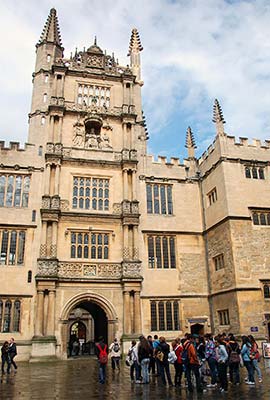
These days, the Bodleian is less about classrooms and more a research library for scholars. With some 11 million books and more than 100 miles of shelving in its underground stacks, “the Bod” is one of the world’s largest and most famous libraries. By law, it’s one of six “legal deposit” libraries in the UK—it must receive a copy of every book printed in the nation. The courtyard’s main tower is called the Tower of the Five Orders, because of the five types of columns: Tuscan, Doric, Ionic, Corinthian, and Composite. The statue of King James I (ruler when the Bodleian was built) shows him handing out, what else? Books.
• The Divinity School and Duke Humfrey’s Library are our next stop. The entrance to the Divinity School is near the Pembroke statue.
10 Divinity School
The Divinity School, rated ▲▲, was the university’s first purpose-built classroom—constructed in 1427 for teaching theology. The room, brilliantly lit by tall clear windows, is worth a look for its impressive fan-vaulted ceiling.
Cost and Hours: £2.50; Mon-Fri 9:00-17:00, Sat from 10:00, Sun from 11:00.
Tours: Tours for the Divinity School include Duke Humfrey’s Library and are offered once or twice daily (£10-30-minute tour, £15-one-hour tour; buy tickets online or check at Weston Library to see if same-day tickets are available; +44 1865 287 400, https://visit.bodleian.ox.ac.uk).
Visiting the School: The room’s ceiling is one of Britain’s most intricate. It takes the traditional fan-vaulting another step, adding small ribs connecting the larger ribs, creating a net-like effect. The 455 bosses where the ribs join sport monograms of major donors. The lantern-like sculptures hanging down at the ends of the fans are what anchor the complex engineering forces in place. The windows are classic Perpendicular style—that is, very vertical, rising “perpendicular” to the ground.
Often on display is Sir Thomas Bodley’s lockbox, with its intricate locking mechanism requiring several keys, turns, pushes, and pulls. Nearby, the chair is made of timbers from Sir Francis Drake’s globe-circumnavigating ship. At the far end, note the stage—students stood here while being grilled by their profs at oral exams.
At the height of the English Reformation (circa 1550), the room suffered damage from hardline Protestants. Notice the empty niche directly over the entry door where a crucifix once stood, and—just to the left—a defaced statue of St. Peter. The original colorful stained-glass windows were another casualty. And Protestants burned many of the university’s Catholic-oriented books...prompting Bodley to re-energize the collection.
These days, students gather here to put on their gowns before walking to their graduation ceremony at the theater next door. A photo near the entry shows the university’s first library. Before leaving, imagine hospital beds lining this hall...yes, it’s the infirmary from the Harry Potter films.
Duke Humfrey’s Library: Upstairs and only accessible on a guided tour, this historic library from 1488 is a world of musty, creaky old shelves of ancient-looking books, stacked neatly under a beautifully painted wooden ceiling. The tour shows you only a small section of the library, but tells much about its history and the huge stockpile of books below ground.
• Return to the Schools Quadrangle courtyard. Turn right and exit the courtyard through the passageway (between “Schola Musicae” and “Naturalis Philosophiae”). You emerge in a vast square dominated by a big round building. You’ve reached...
11 Radcliffe Square: The Historic Quad
The round, columned structure is Radcliffe Camera, probably Oxford’s most iconic building.
Radcliffe Camera was built in the 1730s by major donor John Radcliffe (no relation to the Harry Potter actor) as an annex to the Bodleian Library. The architect, James Gibbs, was strongly influenced by Wren. Originally housing medical books, the building is a reading “room” (or “camera”). Only students and staff with special credentials can enter. They request books from the vast collection (including the thousands shelved in tunnels beneath the square), and study them at desks under the spacious rotunda.
Circle around the left side of the Radcliffe Camera and grab the bars of the fancy ironwork gate for a peek into All Souls College. It’s named for the dead of the Hundred Years’ War that England fought with France in the 14th and 15th centuries. The college is notorious for having the toughest entrance exam and is nicknamed “the school with no students,” as its student body is composed entirely of research fellows. Famous alums include Lawrence of Arabia and Christopher Wren—who designed the ornate sundial on the far left.
• Just past Radcliffe Camera is the most important church in town.
12 University Church of St. Mary the Virgin
The University Church is where the university was born, and it remains the heart of Oxford’s sprawling campus. A thousand years ago, this church stood at the center of the small, walled town. (The tower—the oldest part of this much-renovated church—dates from 1270.) As the embryonic university formed, this church was its only building: where scholars prayed, lectured, kept their books, administered affairs, and received graduation degrees with pomp and circumstance. As the university expanded and secularized, scholastic activities gravitated outward—to the Divinity School, Bodleian Library, and so on. By the 1600s, even graduation ceremonies were deemed too inappropriate for a church and were moved to Wren’s new Sheldonian Theatre. But the University Church has always remained the place where the university’s community goes for spiritual sustenance. In 1942, a small group of Oxford citizens met here to help desperate WWII victims in Greece and founded what grew into the worldwide relief organization called Oxfam.
Cost and Hours: Free, £5 tower climb (127 steps) with great views; Mon-Sat 9:30-18:00, Sun from 12:00; visitors are welcome to join the Sunday Holy Eucharist (8:30) and Sung Eucharist (10:30); garden café, crypt.
Visiting the Church: The church interior reflects the delicate balance Oxford keeps between various religious ideologies: Protestants, Catholics, and secularists. Once ornately decorated for Catholic worship, the interior was cleaned out after the Reformation for Protestant-style worship. A plaque on the wall memorializes a century of local martyrs in the fight between Catholics and Protestants. The reformer John Wesley, who founded the Methodist Church, preached from this pulpit. And through all of the church’s history, the university chancellor has had a place—in the grand wood-carved stall at the far end of the nave.
There’s no better symbol of Oxford’s intellectual battles than “Cranmer’s pillar” (located across the nave from the pulpit, marked with a small plaque of Cranmer). In 1556, the Protestant Reformer Thomas Cranmer was imprisoned in Oxford and ordered to recant his Protestant beliefs. He signed the recantation and also agreed to make a full confession of his heresy in public. A stage was erected for him against this pillar (resulting in damage to the stone near the base). Cranmer mounted the stage, and shocked the crowd by disavowing his (forced) recantation, while proudly asserting his Protestant beliefs. Knowing he’d be burned at the stake, he swore the first thing that would burn would be “that unworthy hand” that had signed the recantation. On March 21, 1556, Cranmer was tied to the stake and burned (at the spot two previous “Oxford Martyrs” also died, marked by the brick cross on Broad Street we saw earlier).
• Circle around behind the church to...
13 High Street
The central axis of Oxford, High Street has more colleges to the left (east) and the city center to the right (west, beyond the church tower a couple of blocks away). Traditionally, there’s been tension between the privileged university population and the hardscrabble citizens of Oxford. In fact, it was a town-and-gown riot in 1209 that drove a group of professors and students out of Oxford to quieter Cambridge to found a rival university.
• Your walk is over, but several sights are nearby. To the right is the lively Covered Market, a huge collection of characteristic shops and eateries. To the left is a pleasant walk past several colleges to the delightful Magdalen College and the best place in town for a river trip on a punt (both described later, under “Sights in Oxford”).
Directly ahead is a lane leading to the most important college in town, Christ Church College (described next). Cross High Street, head down Magpie Lane, and pass Kybald Street with the back entrance to Bill Clinton’s school—University College. At the end of Magpie Lane, cross Merton street and go through a black iron gate, follow the hedge-lined lane, go through a kissing gate, and emerge in the vast Christ Church Meadows outside the city wall. Around to the right is the Meadow Gate, one of three entrances to Christ Church College.
Sights in Oxford
Note that some of the city’s worthwhile sights are covered earlier, in my “Oxford Walk.”
THE COLLEGES
You could spend a lot of time going from college to college here—but since they all have similar features, frankly, if you’ve seen a couple, that’s enough. Still, each is unique—like individual works of art mixing architecture, gardens, and heritage. I’ve described just my three favorites: The dominant Christ Church College and the more intimate and welcoming Magdalen and Exeter Colleges. The entrance to each college is easy to spot—just look for a doorway with crests and a flagpole on the top. Each entry has an office with a porter (live-in caretaker). Inquire there to find out which buildings are open to visitors, and if any plays, music, evensong services, or lectures are scheduled.
▲Christ Church College
Of Oxford’s colleges, Christ Church is the largest and most prestigious (and, some think, most pretentious). It’s also the most popular (and most expensive) for tourists to visit—partly thanks to its historic fame, but mostly because scenes in the Harry Potter movies were filmed here.
The college was founded by Henry VIII’s chancellor, Cardinal Thomas Wolsey, in 1524 on the site of an abbey dissolved by the king. The buildings survived the tumult of the Reformation because the abbey and its cathedral served as part of the king’s new Church of England. It still has a close connection to the royal family. While all colleges boast of their esteemed alumni, none has a list as esteemed as Christ Church College: 13 of the 27 Oxford-educated prime ministers were Christ Church alums. William Penn (founder of Pennsylvania), John Wesley (influential Methodist leader), John Locke (English Enlightenment thinker), and Charles Dodgson (a.k.a. Lewis Carroll) also studied here. Its grounds include a grand old dining hall, a giant quad, and an impressive chapel that doubles as a cathedral.
Cost and Hours: £16 for self-guided tour, buy online in advance, timed-entry tickets are released each Friday for the following week, book with a 30- or 60-minute guided tour of the college or cathedral for discounted admission; Mon-Sat 10:00-17:00, Sun from 14:00, last entry 45 minutes before closing; +44 1865 276 492, www.chch.ox.ac.uk.
Dining Hall Closure: Note that the dining hall—the prime attraction for Harry Potter fans—is closed to outsiders when students are eating. During the term, it’s generally open to visitors Mon-Fri 10:00-11:30 & 14:00-17:00, Sat-Sun 14:00-17:00—but it can close on short notice. Hours can vary during Christmas, Easter, and summer breaks. Call ahead or check the website and plan your visit accordingly.
Evensong: Most days in Christ Church Cathedral, an excellent choir of students (sometimes accompanied by angelic-if-fidgety little boys) sings along to the church’s pipe organ. This delightful service is open to anyone; linger after the service ends to hear the organist jam (free, Tue-Sun at 18:00, Mon service is spoken rather than sung, enter at Tom Tower, arrive 15-20 minutes early). For more on evensong, see here.
Getting There: The college is located on St. Aldate’s; follow Visitors’ Entrance signs (past the big tower and all the way to the end of the biggest building, toward the river). If visiting Christ Church after completing my self-guided walk, see the end of the walk for directions.
Visiting the College: On your way to enter the grounds through the Meadow Gate visitors’ entrance, you’ll pass through a bit of countryside spreading out to the river. This huge park is actually part of the college. Called Christ Church Meadow, it was the setting Lewis Carroll used for the croquet scenes in Alice’s Adventures in Wonderland (free, open dawn to dusk).
“Custodians” wearing bowler hats are posted around the college to answer questions. You’ll be sent along a one-way route with these main stops: dining hall, quadrangle, cathedral, and picture gallery.
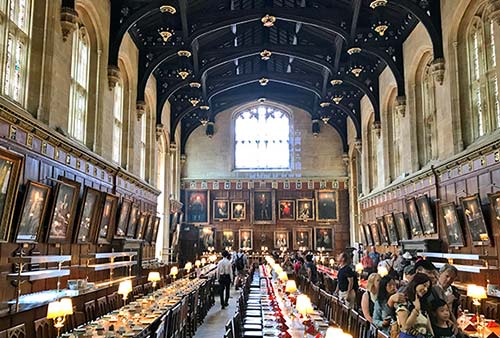
Dining Hall: There’s a commotion as you near the college’s famous dining hall (passing a small cloister and a grand staircase where some Harry Potter scenes were filmed). The grand hall—with its splendid Gothic, hammer-beam ceiling and portraits of esteemed alumni looking down on its oh-so-old-English tables—is an amazing scene. The primary sponsor of the college is centered above the high table—Henry VIII in his younger, slimmer days—who took over after he deposed Cardinal Wosley.
While Harry Potter scenes were filmed along the staircase with its fan-vaulted ceiling and mullion windows, the grand dining hall merely served as a model for set designers. Astute visitors immediately notice there are just three long rows of tables, not four as in Hogwarts.
Beyond the Harry Potter ties, there’s also a strong Lewis Carroll connection. Carroll, a math professor in the college, was inspired by the dean’s daughter Alice to create the adventures of Alice in Wonderland. The Alice in Wonderland window (above the fireplace, on the left) is rich with symbolic references to that book. In the upper half (on left in the yellow circle) is the real Alice (Alice Liddell) and opposite (on right in a similar circle) is the author.
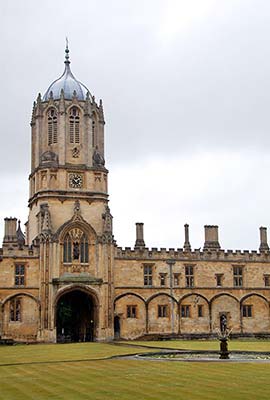
Quadrangle: Now enter Tom Quad, a grassy field surrounded by college buildings. In the middle is a small fishpond with a statue of Mercury. Notice the outlines of archways ringing the quad; the architect wanted to create a giant cloister here, but funding ran out. (You can imagine the effect had the cloister been finished.)
The tall tower, designed by Christopher Wren, holds a six-ton bell called Great Tom. According to tradition, every night at 21:05 the bell clangs out 101 times—each chime calling the curfew for the 101 students who first boarded here. This gives the students four-and-a-half minutes to get from the pub through the gate by the last ring. Why not on the hour? When the tradition began, time zones had yet to be standardized—and since Oxford was 60 miles or five minutes of longitude west of Greenwich, clocks here were set five minutes earlier. That means 21:05 Greenwich Mean Time was 21:00 on the dot Oxford time. Although the UK standardized its time zone in the 1850s, Christ Church College has insisted on keeping Oxford time. (And that explains why the White Rabbit in Alice in Wonderland is always late.)
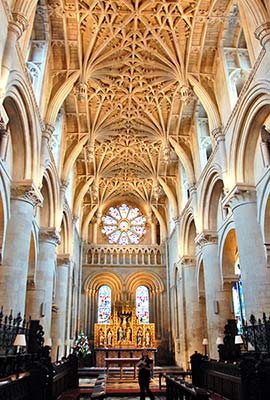
Cathedral: The college’s 800-year-old chapel also serves as Christ Church Cathedral (the seat of an Anglican bishop). Built in the 12th century, it’s one of oldest buildings in Oxford and one of England’s smallest cathedrals. For 400 years, this was a monastery church. With the Reformation, England’s monasteries were dissolved and most churches like this were destroyed, but this one survived. Through the centuries Bishop Berkeley (who inspired the founding of a great university in California) and John Wesley (who founded the Methodist Church) both preached from the pulpit here. The church’s highlights include a shrine to St. Frideswide—an obscure local saint who, in about the year 700, founded the first church in Oxford—in the northeast corner of Latin Chapel. Vibrant Pre-Raphaelite windows from 1858 by Edward Burne-Jones tell the saint’s story. In the south transept, a stained-glass window from 1320 shows the martyrdom of Thomas Becket (whose face was blanked out to help him survive the Reformation).
To exit, you’ll be steered through the Tom Quad again through Peckwater Quad (with not-very-humble student accommodations facing the library). Note the graffiti on the walls here. This is the only allowable graffiti in Oxford: When rowing teams win, they can chalk their victory on the wall for all to see and celebrate. (From March through June, only Picture Gallery ticket holders can enter Peckwater Quad. During those months, go through the cloister and exit the college the way you entered.)
Picture Gallery: The sleepy Christ Church Picture Gallery rotates its collection of drawings and sketches by Albrecht Dürer, Michelangelo, Leonardo da Vinci, Raphael, and other Old Masters. There’s also a permanent exhibit of oil paintings by the likes of Tintoretto, Veronese, Van Dyck, and Frans Hals (£6, £3 if you paid to enter the college; generally open Mon & Thu-Sat 11:00-17:00, Sun from 14:00, closed Tue-Wed. If visiting without touring the campus, enter at the Canterbury Gate, off Oriel Square).
Magdalen College
Sitting on the upper edge of town, this college (pronounced “maudlin”)—where C. S. Lewis taught for 25 years—gets my vote for the prettiest in Oxford. Pick up the self-guided walk brochure when you enter. Established in 1480, its cloister is a monastic-feeling square of stone and flowers, with narrow staircases leading to student rooms and gargoyles overhead—keeping an eye on things for more than 500 years. From the cloister, a sign for “Hall” directs you up some stairs to the dining hall (closed to public midday for student lunch). The chapel is gorgeous (with a fascinating black-and-white stained-glass window in the antechamber). Magdalen has the largest grounds of any of the Oxford colleges (big enough to include its own deer park, with actual deer browsing the grounds) and a peaceful café overlooking the sleepy river and lively punting scene.
Cost and Hours: £9.50; daily 10:00-18:30 or dusk—whichever is earlier; £13 guided tours sometimes offered in summer at 11:00 and 15:00—ask at visitor desk; High Street next to Magdalen Bridge, +44 1865 276 000, www.magd.ox.ac.uk.
Evensong: Evensong services in the exquisite chapel take place Tue-Sun at 18:00 (except July-Sept); while most days feature a mixed chorus of boys and men, Tuesday is generally the renowned boys choir, and Fridays is men only.
Exeter College
A smaller college, 700-year-old Exeter is centrally located, free to visit, and worth a peek. The highlight is its jewel-like Neo-Gothic chapel—oh-so Victorian from the 1860s and inspired by Paris’ Sainte-Chapelle. It features William Morris’ Adoration of the Magi tapestry (on the right). A bust of J. R. R. Tolkien, who studied here, is in the back.
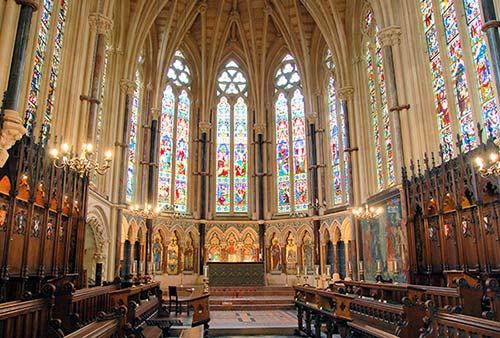
Cost and Hours: Free, usually open daily 14:00-17:00, ongoing restoration work may cause some closures, Turl Street, +44 1865 279 600.
OTHER SIGHTS
▲▲Ashmolean Museum of Art and Archaeology
In 1683, celebrated antiquary Elias Ashmole insisted his collection of curiosities deserved its own building. Half of his trove originated with an even-more-eccentric royal gardener, John Tradescant, who loved to seek out interesting items while traveling in search of plants. Since its founding, this eclectic museum has expanded its reach across art forms, cultures, and centuries. Thanks to ongoing support, the huge collection continues to grow all these years later.
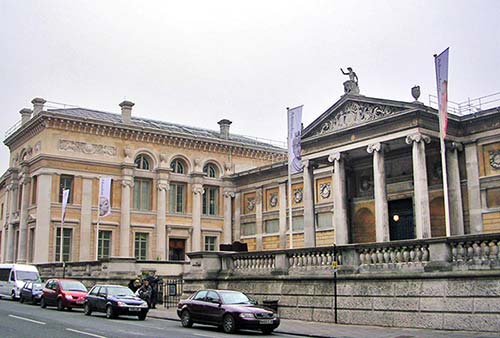
Cost and Hours: Free, suggested £5 donation, daily 10:00-17:00, basic café, rooftop restaurant open daily 12:00-18:00, Beaumont Street, +44 1865 278 000, www.ashmolean.org.
Visiting the Museum: While it doesn’t rank with the big-league museums of London, the Ashmolean’s vast holdings are impressive for a small city. You won’t see any particularly famous items, but you’ll find intriguing and offbeat bits and pieces (such as Lawrence of Arabia’s ceremonial dress, prehistoric Cycladic figurines from Greece, gorgeous Turkish and Middle Eastern tiles, and a Stradivarius violin). The sheer volume of objects can be overwhelming, so check the sign across from the info desk for daily activities and current exhibits to zero in on your interests.
The museum is loosely organized geographically, with excellent displays of Chinese, Middle Eastern, Indian, Mediterranean, and other regional art and artifacts.
For an engaging introduction, head for the basement and peruse the “Exploring the Past” themed exhibits, which bring together eras of history and corners of the globe while examining a particular topic (such as money, textiles, and conservation). For example, the reading and writing section investigates translations of fragments of cuneiform from the ancient Near East, Linear B (early Greek), Scandinavian runes, and Egyptian papyrus.
As you browse your way up the floors, find your own favorites (I enjoyed the paintings of royal elephants from India). The Egyptian galleries feature various mummies, including a priest, a two-year-old boy, a cat, and even a baby crocodile. The Randolph Sculpture Gallery, near the entrance, features Greek and Roman statues.
The museum’s fine painting gallery showcases lesser-known pieces by Degas, Pissarro, Van Gogh, and others. It’s fun to see artist J. M. W. Turner’s view down High Street in Oxford...then walk a block to see today’s version. If nothing else, the Ashmolean provides visitors to this university town a way to see a respectable range of English glass, Chinese porcelain, ancient sculpture, and tapestries without having to ride the train.
While we think of it as one big university, Oxford consists of 38 autonomous, self-funded colleges. Student life is centered around the particular college, where students eat, sleep, and make friends.
The college system really took off in 1167, when King Henry II banned English students from attending the University of Paris. The students—mostly poor peasant kids who’d been fortunate enough to be educated by monks—took refuge in Oxford. The teachers took them under their wing, renting out boarding houses and looking after them in an almost monastic environment. Each college had a particular focus—for example, for 300 years Jesus College was exclusively for Welsh students, to produce that tribe’s educated elite. Because colleges were behind walls, the townsfolk accused them of elitism, prompting “town-and-gown” clashes that occasionally turned violent. Nowadays, things are more relaxed. Each college may have a particular reputation (say, for science or literature), but students from any major can live there. Students must live there the first year, but might find accommodations elsewhere afterward. Even so, colleges are still very much their own world and many old traditions carry on for generations. Gowns (which used to be worn all the time) are still required for some formal dinners and functions.
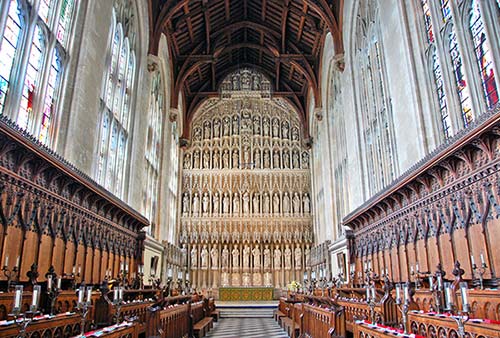
Today, some 22,000 students attend Oxford (including 12,000 undergraduates, nearly all British, and 10,000 graduate students—mostly foreigners—whose higher fees help fund the university). Tuition runs about £10,000 a year for UK and EU residents; non-EU students pay double. The university is very exclusive—about 1 in 10 who apply get in.
Students enter the college in October and spend their first year preparing for preliminary exams. Once that hurdle is cleared, they study for two more years preparing for their final exams. If you visit in June, you might see students on their way to their finals wearing traditional academic robes and carnations on their lapels: white on the first day, pink on the second day, and red on the final day. When students emerge from their final exam wearing a red carnation, they’re greeted by friends and family who douse them with flour, glitter, and champagne or beer (a tradition called “trashing”). There’s usually a happy ending: Among those who remain at Oxford all three years, the graduation rate is nearly 100 percent.
▲Oxford Castle
Originating as a classic Norman motte-and-bailey fort a millennium ago, Oxford’s castle gradually evolved into a mighty fortress that was mostly destroyed after the English Civil Wars. Its surviving St. George Tower was used as a royalist prison, and—a century-and-a-half later—was expanded into a Victorian-era county jail, specializing in demoralizing prisoners with exhausting and humiliating punishments. The facility held prisoners up until 1996. Since then, part of the complex was converted into a posh hotel, while the rest is now a tourist attraction. England has far bigger and better castles, but this is an entertaining and educational alternative to all of Oxford’s academic sights.
Cost and Hours: £17 includes mandatory one-hour tour, daily 10:30-16:30, tours run every 15 minutes—book online in advance to avoid waiting during peak times; open daily 10:00-17:00; 44 Oxford Castle, +44 1865 260 666, www.oxfordcastleandprison.co.uk.
Visiting the Castle: Although the surviving bits of the castle are small and sparse (basically, the original motte and bailey, one tall tower, and a few cells), this shell is brought to life by lively guides dressed in period garb.
The tour includes a climb to the top of the St. George Tower (for distant views over the town) and a visit to the crypt below, with an emphasis on grisly tales of prison life. You’ll learn of cruel and unusual punishments and see the deep, circular grooves in the floor where prisoners were forced to work eight-hour shifts trudging around a capstan wheel in silence. The tour provides a strong historical basis—spinning the true tales of Empress Matilda (the usurped queen who dramatically escaped from here and went on to support her son in his quest to become King Henry II), Geoffrey of Monmouth (who first penned tales of King Arthur and Merlin in the 12th century), and other important figures connected to the castle. You’ll also learn about everyday folks, like the two 17-year-old boys who served 21 days for stealing bread, and a 7-year-old girl, imprisoned for a week for borrowing a toy pram without permission. After the tour, you’ll be set free to explore exhibits about prison history. Admission also includes access to the original motte (hill), where you can wind up the path to the scant remains of the bailey (fort).
Punting
Long, flat boats can be rented for punting (pushing with a long pole) along the River Cherwell. Chauffeurs are available, while the do-it-yourself crowd tends to get a little wet. Punting looks easier than it is, and you’ll likely see first-timers creating log jams of incompetence. The guided ride includes a short lesson so you can actually learn how to do it right.
Cost and Hours: £30/hour per boat rental, £30 deposit if paying cash, leave ID with credit card; chauffeured punts-£40 per boat for 30 minutes and up to 4 people, higher prices for Sat-Sun; book ahead for weekends, rowboats and paddle boats available for the less adventurous, daily 9:30-dusk, closed Dec-Jan, Magdalen Bridge Boathouse, +44 1865 202 643, www.oxfordpunting.co.uk.
Sleeping in Oxford
Sleeping cheaply in Oxford is not easy—you’ll pay London-size prices for London-size rooms. The colleges and university own much of the town, so boarding space is at a premium. A few B&Bs line the main roads out of town, but they’re less convenient for sightseeing; in the town center (where I’ve focused my listings), you’ll find high-priced hotels and guesthouses in very old and poorly maintained buildings. Noise is an issue—mostly from students conversing or singing loudly in the streets on the way home from the pub. Try requesting a quiet room, but expect some noise regardless. Given the easy connections by train to the Cotswolds (Moreton-in-Marsh) and London, it’s possible to make Oxford a day trip and sleep elsewhere. But if you’re spending the night, here are some centrally located, reasonable options.
$$$ The Tower House—with tight spaces, low ceilings, and small, worn-but-sweet rooms—couldn’t be more central. Three of the eight rooms share a bathroom with a shower (no breakfast, no parking, request a quieter back room, 15 Ship Street, +44 1865 246 828, www.towerhouseoxford.co.uk, info@towerhouseoxford.co.uk).
$$$ The Bocardo offers modern lodgings along bustling George Street, between the train station and the town center. Rare in this creaky old town, the 11 rooms come with urban style and lots of amenities. It’s on a street with a string of nightclubs, so expect noise, and try asking for a quieter room (no breakfast, air-con, 24 George Street, +44 1865 591 234, www.thebocardo.co.uk, reservations@thebocardo.co.uk).
$$$ Bath Place Hotel is a family-run place renting 16 rooms in a cluster of 17th-century cottages tucked next to the bustling Turf Tavern courtyard. Rooms have been thoughtfully redecorated and are full of old-world charm, with exposed beams and pitched ceilings (family rooms available, modern en-suite bathrooms, laundry service, pay parking, off Holywell Street at 4 Bath Place, +44 1865 791 812, www.bathplace.co.uk, info@bathplace.co.uk).
$$$ University Rooms offers budget-friendly en-suite rooms, many in the historic college buildings right in the center of Oxford. Like Booking.com, you choose from what’s available based on your travel dates (family rooms available, some rooms do not include breakfast, better selection during school breaks, www.universityrooms.com).
$$ The Buttery Hotel, reached by climbing some steep steps, rents 16 good-value rooms. The “deluxe” rooms are larger and have big windows overlooking bustling Broad Street—nice for views but not for noise; the cheaper “standard” rooms are quieter (no breakfast, family room available, no parking, 11 Broad Street, +44 1865 811 950, www.thebutteryhotel.co.uk, enquiries@thebutteryhotel.co.uk, Sally).
¢ Hostel: A three-minute walk from the train station on the way to the town center is Central Backpackers Oxford, a Canadian- and Aussie-run place with dorm rooms set around an inviting covered patio. They offer daily activities such as movie nights, BBQs, and pub crawls (no breakfast, laundry service, 13 Park End Street, +44 1865 242 288, www.centralbackpackers.co.uk, oxford@centralbackpackers.co.uk). They’ll also store your bags if you’re day-tripping to Oxford.
Near Oxford: The charming 16th-century $$ The Coach & Horses Inn is located seven miles southeast of Oxford in Chislehampton, across the street from a bus stop that connects the two towns (free parking, pub, +44 1865 890 255, www.coachhorsesinn.co.uk, enquiries@coachhorsesinn.co.uk).
Eating in Oxford
PUBS
These pubs perfectly conform to what Americans imagine a British pub to be: a rambling series of cozy, well-worn rooms on sloping wooden floors filled with tight clusters of friends enjoying food and ale around ancient-feeling tables. The ones listed below generally serve lunch and dinner—and most stay open longer for drinks.
$$ The King’s Arms, across from the Clarendon Building, serves burgers and traditional English fare, including steak-and-ale pie and fish-and-chips in a convivial atmosphere (daily, 40 Holywell Street at corner of Parks Road, +44 1865 242 369).
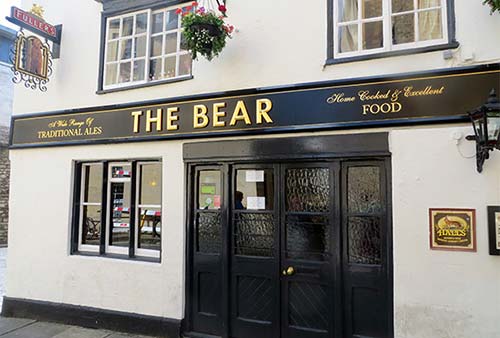
$$$ The Bear Inn, hidden down a side street near Christ Church Picture Gallery, is one of Oxford’s oldest and most charming pubs. This teensy place proudly sports no right angles (go ahead—check) since 1242. Peruse the framed collections of amputated clothing on the walls and hold on to your tie if you’re wearing one. If you’re coming for lunch, arrive before the rush at 13:00 (daily, Sun food until 18:00, 6 Alfred Street at corner of Blue Boar Street, +44 1865 728 164). There are a few picnic tables out back—leave through the pub’s side door to find them, or walk to the left as you’re facing the front.
$$$ The Turf Tavern—big, boisterous, and tucked into a short alley—is popular for its solid grub, outdoor beer garden, and warren of claustrophobic rooms nestled against the old city wall (daily, 4 Bath Place, +44 1865 243 235). Advertising “an education in intoxication,” this is reputedly the place where Bill Clinton didn’t inhale. To find it from Holywell Street or the Bridge of Sighs on Queen’s Lane, listen for the chatter of students enjoying a beer; otherwise, head for the gap marked St. Helen’s Passage.
$$ The White Horse is a small and intimate pub in a 16th-century building squeezed between two Blackwell’s shops. It’s an amusing place with a decent selection of ales and pub grub. Several scenes from the Inspector Morse British TV series were filmed here (daily, food served Tue-Sun until 16:00, 52 Broad Street, +44 1865 204 801).
$$ The Royal Blenheim only serves snacks but has a real passion for gin and locally brewed beer. Try their tasting flight of three ales (daily, 13 St. Ebbe’s Street, +44 1865 242 355).
EATING CHEAPLY
$ Taylors is a student favorite for affordable high-quality panini and other deli items. There are a few tables, but most people get food to go and find a scenic spot for a picnic (daily until 16:00, 19 High Street, +44 1865 790 757). Other Taylors locations are in the Covered Market, and a block from Magdalen College at 58 High Street.
$ Covered Market—a farmers market maze of shops, fruit stands, deli counters, and cafés—has a fine selection for breakfast, lunch, or a picnic (shops open Sun-Wed to 17:00, later Thu-Sat) between Market Street and High Street, near Carfax Tower). In particular, $ Alpha Bar, on the Market Street side, is known for its cheap but satisfying sandwich and salad offerings—the long lines at lunchtime speak for themselves (Mon-Sat 11:00-15:30).
Chain Restaurants and Groceries: On Cornmarket, you’ll find a slew of chain eateries with to-go food. George Street, which intersects Cornmarket on its way to the train station, has another string of reliable chains. For a picnic lunch, there’s a Marks & Spencer at 18 Queen Street (near Carfax Tower), and Sainsbury’s at 21 Westgate (in the mall), 1 St. Clement’s Street (at the end of Magdalen bridge), and 7 Magdalen Street (near the Ashmolean Museum).
OTHER EATERIES
$$$ No. 1 Ship Street, a modern British brasserie serving steak, lamb, and fish, as well as afternoon tea, is a nice break from the student mobs and chain eateries on nearby Cornmarket (closed Sun, 1 Ship Street, +44 1865 806 637).
$$$ Gee Restaurant and Bar, named after the renowned Gee family (this spot was their plant nursery in the 19th century), is in a quiet neighborhood a 15-minute walk north of the city center. They serve up Mediterranean-inspired dishes from a seasonal menu. Sit on their courtyard terrace or in the Victorian sunroom (daily, reservations smart, 61 Banbury Road, +44 1865 553 540, www.geesrestaurant.co.uk).
Afternoon Tea: $$$$ The Randolph Hotel is a swanky place where proud parents take their graduating students for a fancy afternoon tea (reservations smart, especially near the end of the term). You’ll enjoy impeccable service and classic English afternoon tea under high ceilings and chandeliers (tea served daily 12:00-17:00, Beaumont Street, directly opposite Ashmolean Museum, +44 344 879 9132, www.graduatehotels.com/oxford-uk). $$ The Rose, a more affordable, less crowded alternative, offers good scones in a nondescript, modern atmosphere (daily 8:00-18:00, tea served 12:00-18:00, 51 High Street, +44 1865 244 429).
Oxford Connections
From Oxford by Train to: London’s Paddington Station (2/hour direct, 1 hour), Bath (2/hour, 1.5 hours, transfer in Didcot), Moreton-in-Marsh (hourly, 30 minutes), Stratford-upon-Avon (every 2 hours, 1.5 hours, transfer in Leamington Spa), Salisbury (hourly, 2 hours, transfer in Basingstoke), Portsmouth (3/hour, 2.5 hours, 1-2 transfers), York (hourly, 3.5 hours, transfer in Birmingham). Train info: +44 345 748 4950, www.nationalrail.co.uk.
By Bus to London: The Oxford Tube bus runs every 10-20 minutes during peak times to London’s Notting Hill Gate, Marble Arch, and Victoria Coach Station (otherwise 2-3/hour, free Wi-Fi, +44 1865 772 250, www.oxfordtube.com [URL inactive]). The trip to London takes about 2 hours, and all buses depart from the Gloucester Green bus station—just show up and ask which bus is leaving first. National Express also runs buses to London (3/hour, 2 hours).
By Bus to Other Destinations: An independent bus service called The Airline shuttles students and visitors directly between Oxford and Heathrow Airport 24 hours a day (2-3/hour, 1.5 hours, £25) and to Gatwick Airport (hourly, 2.5 hours, £30; +44 1865 785 400, www.theairline.info).
For details on taking a public bus to Blenheim Palace, see the next section.
Blenheim Palace
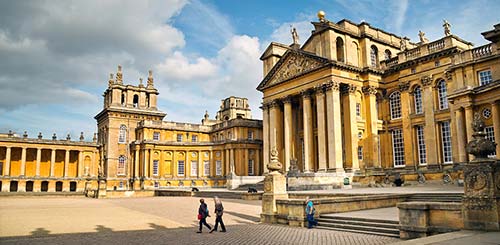
Just 30 minutes’ drive from Oxford (and convenient to combine with a drive through the Cotswolds), Blenheim Palace is one of England’s best—worth ▲▲▲. Too many palaces can send you into a furniture-wax coma, but as a sightseeing experience and in simple visual grandeur, this palace is among Europe’s finest. The Duke of Marlborough’s home—one of the largest in England—is still lived in, which is wonderfully obvious as you prowl through it. The 2,000-acre yard, well designed by Lancelot “Capability” Brown, is as majestic to some as the palace itself. Note: Americans who pronounce the place “blen-HEIM” are the butt of jokes. It’s “BLEN-em.”
John Churchill, first Duke of Marlborough, achieved Europe-wide renown with his stunning victory over Louis XIV of France’s armies at the Battle of Blenheim in 1704. This was a major turning point in the War of the Spanish Succession—one of Louis’ repeated attempts to gain hegemony over the continent. A thankful Queen Anne rewarded Churchill by building him this nice home, perhaps the finest Baroque building in England. Eleven dukes of Marlborough later, the palace is as impressive as ever. In 1874, a later John Churchill’s American daughter-in-law, Jennie Jerome, gave birth at Blenheim to another historic baby in that line...and named him Winston.
GETTING TO BLENHEIM PALACE
Blenheim Palace sits at the edge of the cute cobbled town of Woodstock. Public buses servicing the palace stop twice near the estate: at the “Blenheim Palace Gates” stop along the main road, about a half-mile walk to the palace itself; and at the “Woodstock/Marlborough Arms” stop at the start of the dedicated pedestrian approach to the palace in the village of Woodstock (handy if you want to poke around town before heading to the palace; this adds just a few more minutes’ walking). The Woodstock stop also offers the most spectacular view of the palace and lake.
From Oxford by Bus: Take bus #S3 or #S7 (each runs 2/hour, 30 minutes; +44 1865 772 250, www.stagecoachbus.com). Catch bus #S3 from the bus station at Gloucester Green, the train station, or on Magdalen Street in front of the Randolph Hotel.
If taking bus #S7, catch the bus on Magdalen Street in Oxford (also in front of the Randolph Hotel).
From the Cotswolds by Train: Your easiest train connection is from Moreton-in-Marsh to Hanborough—just 1.5 miles from the palace (£11.70, hourly, 30 minutes). From Hanborough station, walk up the main road, cross the street, and head right to take an Oxford-bound bus #S7 and use one of the palace stops (£2, buy on bus, 2/hour, 10 minutes, Mon-Sat only). On summer weekends, a shuttle bus operates between the train station and the palace (free, 2/hour). Taxis don’t wait at the station, but you can book one in advance (try A2B Taxis, +44 1844 208 125; or Cabs 4U, +44 7919 675 150).
By Car: Head for Woodstock (from the Cotswolds, follow signs for Oxford on the A-44); the palace is well signposted once in town, just off the main road. Buy your ticket at the gate, then drive up the long driveway to park near the palace.
ORIENTATION TO BLENHEIM PALACE
Cost: £35, buy ticket online in advance, includes audioguide; park and gardens only-£22.50; 30 percent discount when you travel to Blenheim via train, bus, bike, or electric car—discount code on website; tickets also available at TIs in surrounding towns—including Moreton-in-Marsh; family ticket available, £7 guidebook.
Hours: Daily 10:30-17:30, Oct-Dec until 16:30. Late in the afternoon the palace is relaxed and quiet (even on the busiest of days).
Visitor Center: At the palace entrance you’ll find the official shop, a handy café, fine WCs, and an information desk with a friendly and helpful staff who can help book a tour or plan your visit. A handful of free lockers are available (barely large enough to fit carry-on size bags, near the WCs, ask for a key).
Information: +44 199 381 0530, www.blenheimpalace.com.
Tours: Audioguides are available for the state rooms (included in admission). Guided tours are available for the duke’s private apartment or the servants’ quarters—a.k.a. the “Upstairs” and “Downstairs” tours (£5 for either, generally daily 11:00-15:00, 40-60 minutes), and the gardens—a.k.a “Buggy Tours of the Formal Gardens” (also £5, 4-5/day, about 45 minutes).
Eating and Sleeping near the Palace: The fancy $$$ Orangery Restaurant, serving afternoon tea and lunch, should be reserved in advance at the palace website. There’s also a $ café with lighter fare in the East Courtyard Visitors Center and a $ pizza café at the Walled Gardens.
In the pleasant, posh town of Woodstock just outside the palace gates, $ Hampers Deli is a good place to pick up provisions for a picnic on the palace grounds (31 Oxford Street, +44 1993 811 535, www.hampersfoodandwine.co.uk). If you need a bed, consider a room in the characteristic old half-timbered $$ Blenheim Buttery (7 Market Place, +44 1865 811 950, www.theblenheimbuttery.co.uk, info@theblenheimbuttery.co.uk).
VISITING THE PALACE
From the parking lot, you’ll enter through the Visitors Center. Pick up a free map, ask about the daily events, and consider signing up for tours of the private apartment (if you didn’t book a spot online in advance) and the gardens. Then head through the small courtyard. You’ll emerge into a grand courtyard in front of the palace’s columned yellow facade.
Facing the palace’s steps, consider your five options: the state rooms, the private apartment tour, the Churchill Exhibition, a skippable equine-focused exhibit called The Stables, and the gardens. The first two of these starts in the Great Hall, directly ahead. The palace state rooms and Churchill Exhibition are substantial and most important (allow 1.5 hours total for both). The private apartment tour, an excellent behind-the-scenes peek at the palace, requires a special ticket and meets in the corner of the courtyard to the left. The gardens, through the wing on the right, are simply enchanting. And The Stables exhibit is in the West Courtyard (farther to the right).
State Rooms: The state rooms are the fancy halls the dukes use to impress visiting dignitaries. These most sumptuous rooms in the palace are ornamented with fine porcelain, gilded ceilings, portraits of past dukes, photos of the present duke’s family, “chaperone” sofas designed to give courting couples just enough privacy...but not too much, and the room and bed in which Sir Winston was born in 1874 (prematurely...his mother suddenly went into labor while attending a party here).
Enjoy the series of 10 Brussels tapestries that commemorate military victories of the First Duke of Marlborough, including the Battle of Blenheim. After winning that pivotal conflict, he scrawled a quick note on the back of a tavern bill notifying the queen of his victory (you’ll see a replica in the First State Room, just after the Saloon). The tour offers insights into the quirky ways of England’s fading nobility—for example, in exchange for this fine palace, the duke still pays “rent” to the monarch in the form of one ornamental flag per year.
Finish with the remarkable Long Library—with its tiers of books and stuccoed ceilings—before exiting near the entrance to the gardens. Looping back around into the courtyard (to the right) you’ll find the entrances to the chapel (under the colonnade) and the Churchill Exhibition at the bottom of the staircase on your right.
Churchill Exhibition: This is a fascinating display of letters, paintings, and other artifacts tracing the origins and history of the great statesman who was born here. A highlight of your visit, the exhibit gives you an appreciation for this amazing leader and how blessed Britain was to have him when it did. (Winston Churchill fans can visit his tomb, just over a mile away to the south in the churchyard of St. Mary’s in Bladon—the church is faintly visible from inside the palace. Look for the footpath across from the White House pub.).
Private Apartment (“Upstairs” Tour): For a more extensive visit, book a spot to tour the duke’s private digs (see “Tours,” earlier). You’ll see the chummy billiards room, luxurious china, 18th-century Flemish tapestries, family photos, and the servants quarters with 47 bells—one for each room to call the servants, and so on.
The Stables: Under the gateway to the right as you face the main palace entrance (on the way to the gardens) is a small and unimportant exhibit celebrating Churchill’s love of horses. If you’ve ever wanted to try sitting in a side-saddle, this is your chance.
Gardens: The palace’s expansive gardens stretch nearly as far as the eye can see in every direction. From the main courtyard follow signs through a little door (to the right as you face the main palace entrance). You’ll emerge into the Water Terraces; from there, you can loop around to the left, behind the palace, to see (but not enter) the Italian Garden. Or, head down to the lake to walk along the waterfront trail; going left takes you to the rose gardens and arboretum, while turning right brings you to the Grand Bridge.
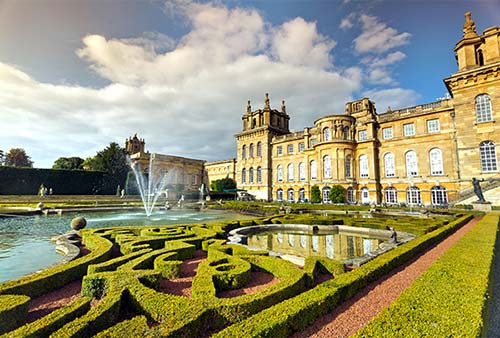
On the way out of the palace complex, stop in at the Walled Gardens, where a lush and humid greenhouse flutters with butterflies. A kid zone with the “world’s largest symbolic hedge maze” is worth a look if you haven’t seen one and want some exercise. If driving, you’ll pass these gardens on the way to the exit; otherwise, you can take the tiny train from the palace parking lot (2/hour).