BRIGHTON
South Downs Way and White Cliffs
BEACHY HEAD AND THE SEVEN SISTERS
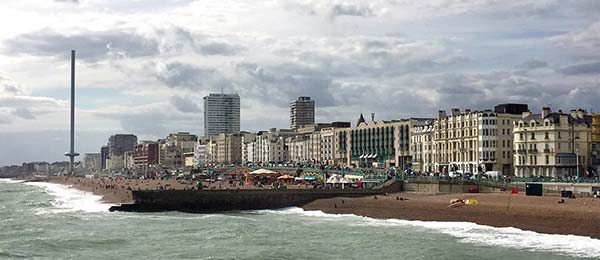
Brighton—brash and flamboyant, with a carnival flair—is refreshing if you’re suffering from an excess of doilies and museums. The city boasts a garish 19th-century Royal Pavilion, a loud and flashy pleasure pier, a proud heritage as England’s most thriving gay community, and a long stretch of pebbly beach. It’s no wonder that youthful bohemians and blue-collar Londoners alike make this town their holiday destination of choice.
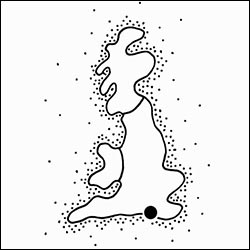
In the 1790s, with Napoleon’s armies running rampant on the Continent, aristocrats could no longer travel abroad on a traditional Grand Tour of Europe. Quiet seaside towns in England suddenly became fashionable. When George, Prince of Wales (later King George IV), chose Brighton to build a vacation palace for himself, his royal entourage followed, ushering in a frenzy of construction on the seashore. Soon this once-sleepy seaside village was transformed into an elegant resort town. With the rise of train travel, connections to London became quick and cheap, making Brighton an inviting getaway for working-class Londoners.
And just down the coast from Brighton—an easy add-on for drivers—are the finest white cliffs in England, at Beachy Head and the Seven Sisters.
PLANNING YOUR TIME
Brighton’s main experiences—its Royal Pavilion, beach, pleasure pier, and strollable, colorful streets—can be done in just a few hours, making this an easy day trip from London (just one hour by train). If you’ve got a full day and a car, spend the rest of your time at Beachy Head and the Seven Sisters cliffs.
Debating between Brighton and Portsmouth? Travelers interested in arts, shopping, and restaurants are more likely to enjoy lively Brighton, while those interested in maritime and WWII history might prefer traditional Portsmouth (see next chapter). Either destination works as a good day trip from London, but with more time, visiting both is a great plan—they complement each other well.
Orientation to Brighton
The city of “Brighton and Hove” (its official name) is big, with more than 275,000 people, about 35,000 of whom are students. It feels surprisingly urban for a seaside resort—like the Nice of England. The heart of the tourist’s Brighton is near the waterfront with the Brighton Pier, and, several blocks inland, the Royal Pavilion. Between these two landmarks twists the old center called The Lanes, jammed with restaurants and shops. North of The Lanes and past the Royal Pavilion is the bohemian North Laine neighborhood, with funky shopping streets, grungy eateries, and street performers. The handiest B&B zone begins a 10-minute walk east of The Lanes, within a block of the seafront, in the colorful Kemptown neighborhood.
TOURIST INFORMATION
Brighton has no brick-and-mortar TI, but volunteer-staffed points around town dispense maps and brochures. You’ll find one on the pier (look for the kiosk on the left, just before the first big arcade hall), one inside the Brighton Centre conference facility (on Kings Road), and another at the ticket desk of the Toy and Model Museum (near the train station). The Visit Brighton website (www.visitbrighton.com) provides up-to-date information on the city and what’s on.
ARRIVAL IN BRIGHTON
Trains arrive at Brighton Station, a 15-minute walk from the city center. Exiting the station, you’ll see bus stops in the little cul-de-sac straight ahead, at the top of Queens Road. If you’re staying at one of my recommended B&Bs in Kemptown, hop on bus #7 or #27 (every 10-20 minutes, 10-minute ride; get off at either St. James’s Street, Devonshire Place, or New Steine, depending on where you’re staying—see the “Brighton” map in this chapter).
Drivers on the A-23 enter town on London Road, which becomes the heavily congested, tree-lined Grand Parade going straight to the water (ending near Brighton Pier). Parking is tricky and very expensive: Signs lead to parking garages near the center, but if you’re staying the night, ask your hotelier for the best place to leave your car.
HELPFUL HINTS
Festivals (and Crowds): Brighton can overflow with visitors in summer and on weekends. The busiest times include the Brighton Festival (May, www.brightonfestival.org; the Fringe Festival runs at the same time—www.brightonfringe.org) and the Brighton and Hove Pride Festival (first or second week of Aug, www.brighton-pride.org).
Entertainment in Brighton: Brighton hosts many concerts and theatrical performances, and can be a more relaxed, less expensive place than London to get a dose of culture. Consider the offerings at the Theatre Royal (a classic venue with West End-style theatrical productions, www.theatreroyalbrighton.com); Brighton Dome (concerts and cultural events in three venues right next to the Royal Pavilion, www.brightondome.org); and Brighton Centre (big-name contemporary music acts in a modern venue on the west end of the seafront, www.brightoncentre.co.uk).
Laundry: St. James’s Laundry is in Kemptown, near my recommended accommodations (self-service, long hours daily, 53 St. James’s Street, +44 1273 672 395).
Bike Rental: Try Brighton Beach Bikes, on the water next to the Brighton Pier (daily, closed Nov-Easter and when raining, on the beach near the pier, +44 7917 753 794, www.brightonbeachbikes.co.uk).
Walking Tour: The Brighton Story is a casual yet informative 1.5-hour walk offered by Julian Clapp (price depends on number of people, +44 7941 256 148, www.brightoncitywalks.com, julian@brightoncitywalks.com). There’s also a Ghost Walk of the Lanes (£12, just show up outside Druid’s Head pub, Wed-Sat at 19:30, 75 minutes, www.ghostwalkbrighton.co.uk).
GETTING AROUND BRIGHTON
Brighton is easy to cover by foot, but its well-run bus system is handy, especially if you’re staying in one of the recommended guesthouses on Kemptown’s New Steine Street (around £2.50/ride depending on how far you’re going—ask driver, £5 CitySaver day pass, buy online or from driver, +44 1273 886 200, www.buses.co.uk).
Brighton City Walk
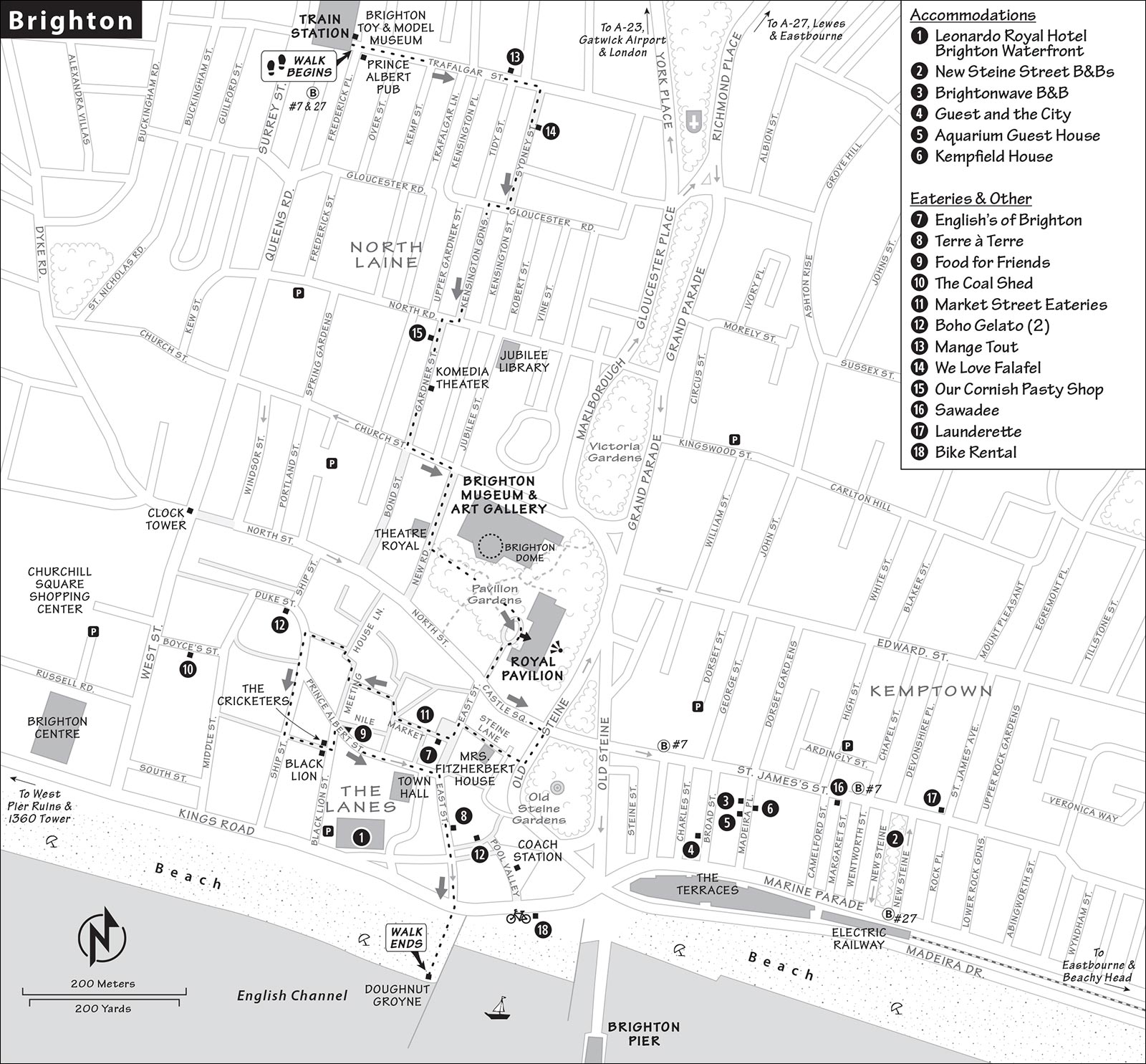
This walk introduces you to Brighton’s various personalities in about an hour and a half (without entering any sights). We’ll cover Brighton’s three distinct parts: contemporary Brighton; royal landmarks and the historic fishermen’s quarter; and the fun-loving seafront. The walk begins at the train station.
Contemporary Brighton
The first part of our Brighton walk takes you along streets filled with interesting shops, fun pubs, and good coffee shops. This area is lively during the day but sleepy after the shops close (around 18:00).
• To reach the start of the walk, exit the train station, turn right, and walk out to the road. Do a sharp U-turn to the left, taking the steep, downhill street beneath the train station.
Trafalgar Street: This road used to run past the main entrance of the train station. But when the tight curves required to reach the platforms became too challenging, Queens Road was built over your head. The brick structure on your left became warehouse space for the Bass brewery (founded in 1777). At the top of one of the arches is their red triangle logo—designed to be recognized even by illiterate drinkers.
Near the end of the underpass, on the left, is the Toy and Model Museum—a lovingly presented collection of historical toys from before the days of plastic (see listing later, under “Sights in Brighton”).
Kitty-corner from the museum, you can’t miss the vibrantly colorful Prince Albert pub. When a major music star dies, a graffiti portrait of the deceased is added to the huge mural along its right side. Stroll along here for a closer look. The painting of the two “bobbies” (policemen) kissing (at street level, under glass) is a well-known piece by the famous street artist Banksy. (This is a Banksy-endorsed replica; the pub sold the original to an art collector.)
Now head downhill on Trafalgar Street past neighborhood stores, colorful street art, and several top-end coffee shops. After a few short blocks, look for Trafalgar Lane on the right—a skinny alley slathered with more murals.
• A few short blocks beyond Trafalgar Lane, turn right down...
Sydney Street: From this upper part of town, shop-lined streets stairstep their way downhill to the seafront through an area called North Laine, with its “Soho by the Sea” vibe.
Browse down Sydney Street, passing boutiques, design shops, more coffee shops (the Aussie-owned Pelicano is good), street eats (including the recommended We Love Falafel), vintage stores, comics shops, bonsai tree vendors, and other all-around curiosities.
• At the bottom of Sydney Street, jog right one block, then left down the narrow, traffic-free...
Kensington Gardens: This street is an artery of mostly local, one-off boutiques. The Resident Music record store, on your left, features live performances by up-and-coming bands. The cosmetics shop Neal’s Yard Remedies at the bottom of the street represents a rare chain store along here. On Saturdays, Upper Gardner Street—one block over—hosts a thriving outdoor market.
• At the bottom of Kensington Gardens, turn right for a few steps, then head left at the wider...
Gardner Street: The quirky action continues along here (you’ll pass the recommended Our Cornish Pasty Shop on the right). The landmark Komedia Brighton theater, on the left, is a popular venue for comedy acts and movie screenings.
• At the bottom of Gardner Street, at busy Church Street, turn left for one block. Then turn right down the broad pedestrian New Road. You’ll pass the yellow Neoclassical colonnade of the local Unitarian church on your right, followed by the brick-red Theatre Royal (a popular venue for West End-type productions). Across from the theater is the entrance to the Pavilion Gardens and a taste of...
Historic Brighton
• Step into the Pavilion Gardens—the park surrounding the fanciful royal buildings of King George IV. Stand in the middle of the park—between the little café kiosk at the top of the garden, and the big Indian-style palace at the bottom.
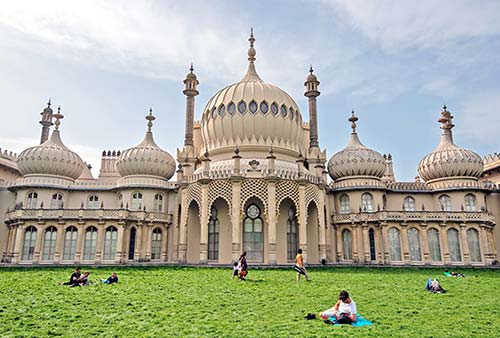
Pavilion Gardens: King George IV (r. 1820-1830) put Brighton on the map when he established a vacation home here when he was still just a prince. Drawn by the curative powers of the healthy sea air, he built the elaborate Royal Pavilion in a fanciful style that evoked royal Indian architecture. While George planned the palace as a holiday residence, he used it mainly as a lavish party pad to entertain guests. The interior is well worth visiting (and described under “Sights in Brighton,” later).
The building on your left (as you face the pavilion) was originally the royal stables. Today it holds the Brighton Museum and Art Gallery, a modest but eclectic collection that’s worth a peek (described later, under “Sights in Brighton”). Part of that building contains the performance halls of The Dome. This 200-year-old structure began as a stable for George’s horses, became a skating rink in Victorian times, and served as a WWI military hospital before being transformed into a performing arts venue. It was in this hall that ABBA performed “Waterloo” at the 1974 Eurovision Song Contest.
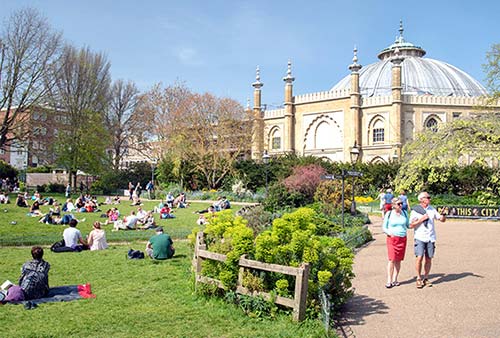
Explore the gardens, where commoners enjoy lounging on the generous lawn, and where some of Brighton’s top-notch street musicians often perform. For the best, unobstructed views of the king’s creation, circle around to the back of the pavilion.
• To continue our walk, make your way toward the pavilion’s entrance, under the canopy. Turn right, walk around the Indian-style gateway, and you’ll run into busy North Street—defining the northern edge of the historical center of town. Cross North Street and turn left along it, following it (as the street becomes Castle Square) toward the big parklike area. Bend right with the street, and pause at the bus stops around the corner. Face the park with the big fountain.
Old Steine: While today it’s just a grubby urban square, the Old Steine area has some interesting history. The name (pronounced “steen,” or occasionally “stine”) comes from old stones that were excavated here and were likely used for prehistoric Druid ceremonies. Back when Brighton was a humble fishing town in the 1500s, fishermen would fix their boats and mend their nets here, spreading them out to dry on rocks in the sun. When George first built his pavilion, this area was largely undeveloped, giving him access through parklike grounds to the seafront. But soon enough, other aristocrats sought their own royal vacations. With the construction of the train station in the 1840s, visitors flowed into town from London. The tall, skinny houses across the square popped up around this time. A few decades later, the row of grand hotels on your right was built.
With your back to the fountain, notice the grayish building with YMCA at the top. To the right of its door (you may have to walk closer to see it) is a plaque identifying this as the home of one Mrs. Fitzherbert, the ill-fated lover of George IV (she lived here from 1801 to 1837). Because she was Catholic, and he was obligated to marry a fellow Protestant, they could not officially be together. (They married in secret, but the union was eventually annulled; George was forced to sham-marry his cousin instead.) Even so, her residence here—a stone’s throw from the pavilion—suggests that they likely spent much time together.
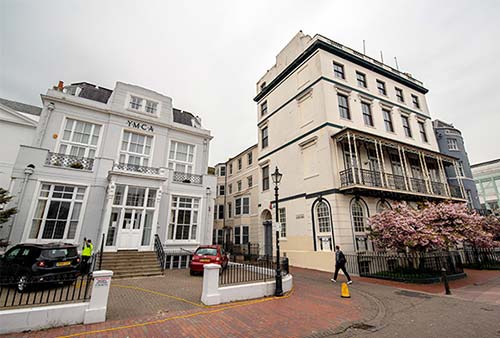
• Take the narrow Little Steine Lane on the right side of Mrs. Fitzherbert’s house. You’ll pop out at East Street. Turn left for a few steps, then veer right through the little square with restaurant tables. Take the narrow lane between the recommended English’s restaurant and the Sussex Arms pub. You’re entering...
The Lanes: This is Brighton’s historic core, with an incredibly twisty street plan. Centuries ago, this was a motley collection of fishermen’s cottages and their garden patches, woven together with meandering footpaths. While virtually none of those original buildings survive—most of them replaced as Brighton flourished in the 1800s—the street plan remains a spaghetti of narrow lanes.
Continuing on, you’ll pop out at an area called Market Street, with a variety of eateries. Keep going, bearing right at the Pump House, then following the first tight lane on your left, Meeting House Lane. Soon you’ll be surrounded by Brighton’s famous jewelry stores. Eavesdrop on young couples window-shopping for engagement rings.
Follow Meeting House Lane—under a comical number of jewelry store signs—until it dead-ends. Turn right, then immediately turn left (at The Lanes Armoury No. 26), bend right with the street, then take the next left on Union Street. When the lane opens out into the wider Ship Street, turn left and head a couple of blocks down Ship Street toward the water. Keep a close eye out, on the left, for Black Lion Lane, immediately before Ship Street Surgery. This is one of Brighton’s super-narrow lanes, called “twittens” (from the Saxon word “twixt,” meaning “between”). As you squeeze down the lane, notice (halfway down, on the right) three black-and-white houses. These are believed to be some of the oldest homes in Brighton (from the mid-1500s)—now rentable on Airbnb.
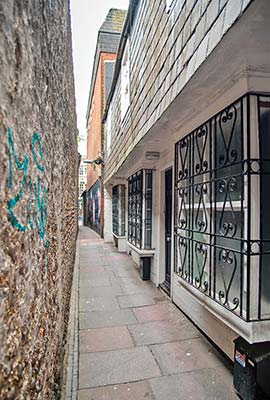
Continue all the way down the twitten, popping out ’twixt two pubs. Turn around to look at them: While The Black Lion on the left looks old, it’s actually faux-historic, dating from 1974. The side of the building is unique to Brighton, with cobbles from the seafront embedded in the outer walls. On the right, The Cricketers truly is historic, from 1547. The Greene Room upstairs is where author Graham Greene supposedly stayed while writing his 1938 novel Brighton Rock.
Turn away from the pubs and head straight, then bear right down Prince Albert Street. Partway down, on the right, are the cream-colored pillars of Brighton’s Town Hall—which should technically be a City Hall. Even though Brighton lacks a cathedral (a key requirement for being a “city”), Queen Elizabeth II granted the adjoining communities of Brighton and Hove (collectively) city status in 2000.
• Carry on along Prince Albert Street, passing Little East Street (with historic houses). Soon after, turn right down East Street and head to the water.
Before crossing the busy seafront road, pause on the corner and look straight ahead at the monument (just to the right of the yellow-and-green pavilion). Titled Kiss Wall, it depicts various types of relationships: straight, gay, lesbian, and so on. It’s a celebration of Brighton’s famously LGBTQ-friendly culture and comes with an interesting optical illusion. Because the images are created by letting light through the back side, it becomes harder to see—and eventually invisible—as you get closer to the wall.
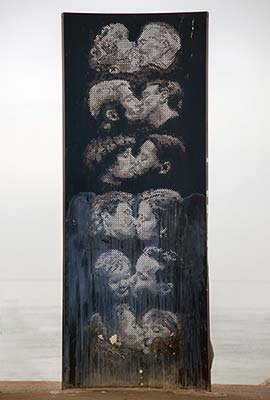
• Cross the street, head behind the Kiss Wall, and continue straight down the stairs onto the small concrete pier.
The Seafront
You’re standing on “Doughnut Groyne” (“groyne” is the term for the concrete piers that protect the shore from erosion). This giant doughnut sculpture supposedly represents the universe, but it’s never been a favorite of local residents. From this spot, do a quick spin and take in the scene—the pebbly beach, the pleasure pier, the weird silver tower, and the row of grand hotels facing the busy waterfront highway and promenade.
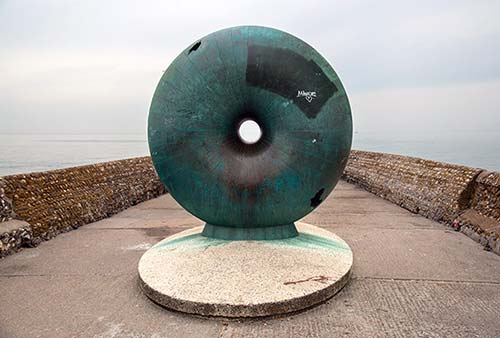
Seafront History: Brighton began as a humble fishing community (there’s a small fishing museum to the right, below the promenade, with a collection of old boats out front). Back then, rather than the road and promenade, a cliff separated Brighton from its waterfront.
Facing the town, look a bit to the right, and try to pick out the words Royal Albion on a hotel between here and the pier. This was once the location of Dr. Richard Russell’s surgery practice. Dr. Russell (1687-1759) was convinced that sipping Brighton’s seawater was an ideal treatment for glandular ailments. His patients would stay here, then walk across the cliffs to hike down to the seafront for a drink. It was this perception of Brighton as a health resort that first drew George IV here for treatment.
The holiday goers soon followed, but many Victorian London urbanites didn’t know how to swim, and they were very modest about being seen in their bathing clothes. The solution was wooden cabins on wheels (called “bathing machines”), where they could change in privacy before being wheeled out to the water. When it was time to bathe, they were escorted by a burly local who would hold on to them, sometimes even dipping them into the sea. These helpers were called “dippers” (or, for men, “bathers”).
Today’s Seafront: While the days of chugging seawater and being dipped are long gone, Brighton remains a thriving holiday destination—mostly among working-class Londoners, but increasingly attractive to international travelers. Take in the Brighton of today.
To your right is the Brighton Pier—lined with junk food, arcade games, carnival rides, and Brits on holiday. Stretching in both directions is Brighton’s beach. It’s not quite Hawaii, but it’s still enjoyable to walk along the large, flattened cobbles, called “shingles,” and get your feet wet. Slingback chairs are available for rent, and the promenade along the beach is a lively place to stroll, or to linger for a drink or snack.
Facing town and looking left, you’ll see two landmarks. First, out at sea, notice the skeleton of what was once the West Pier—a bookend to the surviving pleasure pier. It fell into disrepair, was damaged by a storm in the 1980s, and burned under uncertain circumstances in the early 2000s.
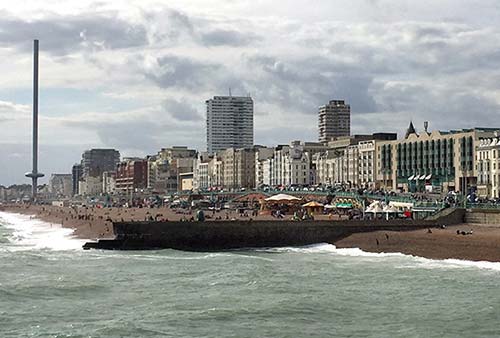
Just beyond that, the towering silver needle is the i360 Tower (designed by the architects of the London Eye). This observation tower lifts tourists up 450 feet in a doughnut-like elevator for a bird’s-eye view over Brighton. Ascending the tower is pricey and only worth considering on exceptionally clear days (£19.50, ride lasts about 20 minutes, www.britishairwaysi360.com).
Just inland from the tower is Brighton Centre, a large concert venue and convention center. In addition to being the venue where Bing Crosby and The Jam both played their final performances (not together), it also hosts political conventions—another reminder that Brighton is a vital contemporary British city...not just a seaside resort town.
Sights in Brighton
▲▲Brighton Royal Pavilion and Gardens
Famous for his scandalous secret marriage to Catholic widow Mrs. Fitzherbert, King George IV was lively, decadent, and trendsetting. He loved to vacation by the sea and host glamorous dinner parties at this palace. George was enamored of Asian cultures and styled his vacation home with exotic decorations from the East. The exterior is an extravagant interpretation of Indian style, with multiple domes and fanciful facade decorations. Inside, everything is Eastern, with a decor that is predominantly Chinese in style. Some regard the palace itself as a work of art, adorned with gilded dragons and carved palm trees. The result is colorful and exuberant...some would say gaudy. Like Brighton itself, the place smacks of faded elegance—but it’s still fun to tour.
Cost and Hours: £18; daily 9:30-17:45, Oct-March 10:00-17:15, last entry 45 minutes before closing; prebook online during peak periods; free audioguide app (bring earbuds); head up East Street from The Lanes, bus stop on Old Steine Road, +44 1273 071 273, www.brightonmuseums.org.uk [URL inactive].
Gardens: It’s free to enter the restored Regency gardens surrounding the pavilion; the best viewpoint for taking in the entire building is around back.
Visiting the Palace: Your palace visit traces a one-way route and hits the following highlights; follow along with the audioguide app.
Entering the palace, King George IV’s guests would be suitably greeted by the grand, pink-and-purple long gallery. Here and throughout the pavilion, examine the fine detail work—such as the faux-bamboo stairway that’s actually carved from wood.
If guests were impressed by the long gallery, they were blown away by the banqueting room. Take a moment to appreciate the Chinese-inspired decor. Known as chinoiserie, this European interpretation of Chinese culture (often exaggerated and distorted as if in a funhouse mirror) was the height of fashion in those days. Imagine England’s elite nibbling crumpets under the one-ton chandelier...with its dragons exhaling light through lotus-shaped shades. The ornate table is permanently set for the dessert course.
The elaborate kitchen was one of the most innovative of its time. Smoke from the fireplace rotated a huge rotisserie that could cook enough meat to feed a hundred hungry diners. The king was so particular about his food that he insisted his kitchen be attached to the dining room (unheard-of at the time). He also had a warming table built to keep food at the optimum temperature. Peruse the sample menu at the end of the kitchen, which represents an astonishing flaunting of culinary opulence. More than 100 courses were served to visiting aristocrats to symbolize British supremacy in Europe.
Head through the banqueting room gallery and two saloons into a room dedicated to George’s true passion: music. In the massive music room, which goes toe-to-toe with the banqueting room, the royal band serenaded guests. The room’s gilded, domed ceiling is made up of hundreds of plaster cockleshells, creating an illusion of height.
The private apartments were on the ground floor, to more easily accommodate the ailing king (who spent less and less time here near the end of his life). Note that this space is cozier and more intimate than the showpiece halls. (If you’re intrigued by all this, dip into the dry but informative nine-minute film about the pavilion’s history—which is partly a tour of areas that visitors don’t see.) Here and in some other areas of the palace, you’ll walk through austere tiled hallways where servants would scurry around, unseen, waiting on the royals.
Continuing upstairs, you’re directed through one of many exhibits on the pavilion’s ongoing renovation and upkeep regimen. A Chinese-wallpapered hall leads to the tearoom (where you can grab a bite on a terrace overlooking the park). Then, backtracking a bit, you’ll stroll through the restored Yellow Bow Rooms, then Queen Victoria’s apartments, where you’ll learn the epilogue to the story of George’s party palace. Queen Victoria first visited the Royal Pavilion in 1837 and felt it was a “strange, odd, Chinese place, both outside and inside.” Uncle George was a big spender and had piled up huge debts. No expense was spared. Queen Victoria, who took the throne seven years after George’s death, wanted more privacy than the pavilion provided and scorned the excesses in George’s court—so she quickly off-loaded the decadent pavilion to the local town council (which still owns it today). It was Queen Elizabeth II who brought the original furniture out of storage and loaned it to the pavilion.
Brighton Museum and Art Gallery
This museum—a sort of “every topic under one roof” collection—is worth a quick visit for its eclectic, thoughtfully presented exhibits on two concise floors. The core of the museum displays decorative arts with a heavy focus on 20th-century art and design.
Cost and Hours: £9; Tue-Sun 10:00-17:00, closed Mon except holidays; just north of the Royal Pavilion, +44 1273 071 273, www.brightonmuseums.org.uk [URL inactive].
Visiting the Museum: On the ground floor, head straight into the fine collection of furniture and design from the 20th century—including Frank Gehry’s Wiggle chair and the Dalí-inspired Mae West Lips Sofa. You’ll go back through time as you approach the end of the hall, where you’ll find somewhat out-of-place exhibits on Egyptology and archaeology.
The side wings feature a very good anthropology exhibit, featuring the stories and clothing of world cultures, and “Mr. Willett’s Popular Pottery,” the museum founder’s fun collection of colorful porcelain figurines.
Upstairs are a modest art gallery, an exhibit on town history, theatrical costumes and puppets, fashion, and good temporary exhibitions.
Brighton Pier
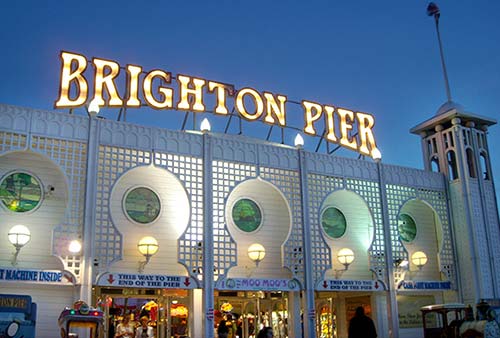
Glittering and shiny with amusement rides and carnival games, Brighton Pier is the place to go for a fix of “candy floss” (cotton candy), fortune tellers, slot machines, and tacky souvenirs. The pier, opened in 1899 and long known as Palace Pier, has gone in and out of fashion; in recent years, it’s come back to life, thanks to an expensive restoration.
Cost and Hours: Free entry to pier, Mon-Fri 10:00-20:00 (rides until 18:00), Sat-Sun 10:00-21:00 (rides until 19:30), shorter hours off-season, +44 1273 609 361, www.brightonpier.co.uk.
Visiting the Pier: The first stretch has stands selling candy floss, toffee apples, and slush drinks (plus a volunteer-staffed TI kiosk, on the left). The main pavilion is a 19th-century gem. If you ignore the garish arcade games, you may be able to imagine yourself as a Victorian Londoner out on holiday, seeing brilliant electric lights for the first time. From here, the pier continues, past doughnut, churro, and crêpe vendors, to the Palm Court restaurant, with its Sunset Garden out back.
Finally you’ll reach the Funfair at the end, with carnival rides, such as bumper cars, roller coasters, and a haunted house (some rides covered by a wristband, others require separate tickets). Or, to really throw away your money, try your hand at games of skill—kick the football into the net, or knock over the stack of cans—for the chance to win a cheap stuffed animal. Is it tacky? Who cares? Look at how much fun everyone’s having.
▲Brighton Toy and Model Museum
This joyful and endearing museum, located below the train station, proudly celebrates the golden age of toymaking, from the late 1800s until the 1950s. The extensive collection features hand-crafted and hand-painted toys of old, showing off rare or unique model railroads, toy planes and boats, Corgi brand matchbox cars, stuffed animals, miniature stoves and sewing machines that actually worked (to teach little girls housework), and much more. It’s nostalgic for folks who recall playing with toys like these, and interesting for anyone.
Cost and Hours: £8, kids—£5; Tue-Fri 10:00-17:00, Sat from 11:00, closed Sun-Mon; 52 Trafalgar Street, +44 1273 749 494, www.brightontoymuseum.co.uk.
Sleeping in Brighton
Brighton’s bohemian character is fun during the day, but the town can be a little rough-and-tumble at night. Prices jump on summer weekends, when noisy partygoers roam until dawn—it’s worth asking for a quieter room away from the street.
THE LANES
$$$ Leonardo Royal Hotel Brighton Waterfront, the only big hotel of my listings, is a worthwhile splurge for those who might not appreciate the idiosyncrasies of Brighton’s B&Bs and guesthouses. It’s perfectly located right in the middle of the seafront promenade, with The Lanes and its appealing restaurants right out the back door. With a snazzy atrium lobby, 210 cookie-cutter rooms, and business-class professionalism, it’s a restful refuge from colorful and quirky Brighton (air-con, elevator, Kings Road, +44 127 320 6700, www.leonardohotels.co.uk).
KEMPTOWN B&BS AND GUESTHOUSES
The eccentric Kemptown neighborhood is about a block from the beach and within a 10-minute walk of Brighton Pier and the Royal Pavilion. “Sea views” at guesthouses here are unimpressive and not worth the extra cost. None of these places have air-conditioning or elevators. Several face Kemptown’s New Steine Street—essentially a long square with a park in the middle.
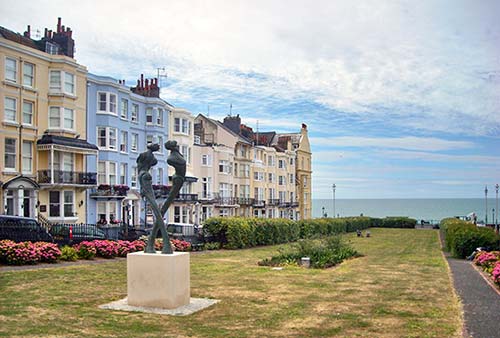
$$ Sea Spray has 16 fresh-feeling, stylish rooms and appealing, art-filled public spaces (some rooms with sea views, some with balconies, pricier suites including one with a private hot tub, 26 New Steine Street, +44 1273 680 332, www.seaspraybrighton.co.uk, seaspray@brighton.co.uk).
$$ Brightonwave B&B feels tasteful and grown-up, with eight comfortable rooms that are modern and well appointed (10 Madeira Place, +44 1273 676 794, www.brightonwave.com, info@brightonwave.co.uk).
$$ Guest and the City is a stylish yet comfortable seven-room B&B close to the pier; some of the front-facing rooms come with stained-glass windows and historic tiled fireplaces (2 Broad Street, +44 1273 698 289, www.guestandthecity.co.uk, info@guestandthecity.co.uk).
$$ Aquarium Guest House rents seven crisp, minimalist rooms with plenty of natural light. Scott and Helen don’t offer breakfast but provide fruit, snacks, coffee, and tea every morning (13 Madeira Place, +44 1273 605 761, www.aquarium-guesthouse.co.uk, info@aquarium-guesthouse.co.uk).
$$ Kempfield House is tastefully run in a Georgian townhouse. The 13 rooms are elegantly simple and nicely appointed, though it’s a lesser value than some (2-night minimum on weekends, 18 Madeira Place, +44 1273 567 521, www.kempfieldhouse.co.uk, info@kempfieldhouse.co.uk).
$$ Marine View has 22 well-worn rooms (family room, some rooms with sea and pier views, 2-night minimum on weekends, 24 New Steine Street, +44 1273 603 870, www.mvbrighton.co.uk, info@mvbrighton.co.uk).
$ Strawberry Fields Hotel is simple but efficient, renting 29 rooms with a fun strawberry theme; some rooms have shared bathrooms for lower rates (6 New Steine Street, +44 1273 681 576, www.strawberryfieldshotel.com, reservations@strawberryfieldshotel.com, Andrius and Amit). Skip their shabby sister property, Hamptons Hotel.
Eating in Brighton
You’ll find plenty of good, affordable restaurants around town, including many places offering vegetarian fare and global cuisine.
THE LANES
Just up from the seafront, The Lanes is Brighton’s historic old town, with the best concentration of both trendy and traditional restaurants. It’s smart to reserve at any of the first four listings.
$$$$ English’s of Brighton, hiding on the side of the little square on East Street, is a venerable local institution that’s been serving seafood specialties for more than 150 years to luminaries such as Charlie Chaplin and Laurence Olivier. The crisp, classy, white-tablecloth interior sprawls through several rooms on two floors, and there’s seating out on the square (daily, 29 East Street, +44 1273 327 980, www.englishs.co.uk).
$$$ Terre à Terre is a well-known, highly respected vegetarian restaurant. The eclectic menu is fun to peruse, and the food is top notch. While plain from the street, its interior is contemporary and welcoming, and the service is friendly (daily, Mon-Tue dinner only, closed Mon-Tue in winter, 71 East Street, +44 1273 729 051, https://terreaterre.co.uk).
$$$ Food for Friends, Brighton’s original vegetarian restaurant, is well regarded. Its menu of small and large plates, with an international bent, is designed to share (daily, 17 Prince Albert Street, +44 1273 202 310, www.foodforfriends.com).
$$$$ The Coal Shed is for carnivores who scoff at the previous two listings. This place is all about meat—high-quality steaks, a short list of other (meaty) main courses, and hearty sides in a fun, rustic-chic interior (daily, 8 Boyce’s Street, +44 1273 322 998, www.coalshed-restaurant.co.uk).
On Market Street: This bustling area—more a long, wide square than a “street”—is packed with affordable eateries. Take a spin around to choose your favorite, but check out $$ Giggling Squid, which serves up tasty Thai small plates in a simple, two-story interior (daily, at #11, +44 1273 737 373).
Sweets: Sugardough, on Market Street, is a trendy place to pick up pastries, pies, and breads for a seafront picnic (daily 8:00-18:00, at #18, +44 1273 739 973). Boho Gelato serves excellent homemade gelato at two locations in this area (daily 11:00-18:00, 6 Pool Valley and 31 Ship Street).
NORTH LAINE
Just north of The Lanes and the Royal Pavilion, this is Brighton’s trendiest quarter—with creative new restaurants and fun, quirky shops popping up all the time.
$$ Mange Tout (“Eat Everything”) is a classic hipster café up on Trafalgar Street, near the train station. The delectable menu features French dishes, great coffee, and good wines—all in a casual brasserie atmosphere with indoor and outdoor seating (breakfast and lunch daily, dinner Thu-Sat, 81 Trafalgar Street, +44 1273 607 270, www.mangetoutbrighton.co.uk).
$ We Love Falafel is ideal for a healthy, memorable lunch right in the heart of colorful Sydney Street. In addition to traditional falafel, they have several other veggie fritter options. Seating is limited and it’s often crowded, but the line moves fast and it’s well worth the wait (Mon-Sat until 17:30, Sun until 17:00, 37 Sydney Street, +44 1273 604 206).
$ Our Cornish Pasty Shop offers excellent versions of its namesake, including vegetarian and curry varieties. There are also delicious homemade desserts with gluten-free and vegan options (daily 10:00-17:00, 24 Gardner Street, +44 1273 688 063).
KEMPTOWN
To dine closer to home, simply wander the lively streets of Kemptown. St. James’s Street, running parallel to the seafront a block inland, is lined with all types of cuisine: cheap burgers, fish-and-chips, pizza, Mediterranean, pub grub, and more.
For Thai, try $$ Sawadee, a simple and welcoming family-run place on Kemptown’s main drag (Mon dinner only, closed Tue, 87 St. James’s Street, +44 7470 792 853).
Brighton Connections
Brighton is well connected to London and most coastal towns.
From Brighton by Train to: Gatwick Airport (6/hour, 30 minutes), London (Victoria Station, 2/hour direct, 1 hour; London Bridge Station, 4/hour direct, 1 hour; Blackfriars Station, 4/hour direct, 1.25 hours), Portsmouth (hourly direct, 1.5 hours, more with transfer), Hastings (hourly direct, 1.25 hours, more with transfer), Dover (at least hourly, 2.5 hours, 1-3 transfers), Canterbury (at least hourly, 2.5 hours, 1-3 transfers). Train info: +44 345 748 4950, NationalRail.co.uk.
By Bus: National Express (+44 871 781 8181, www.nationalexpress.com) runs buses to Gatwick Airport (hourly, 1 hour—train is better), Heathrow Airport (hourly, 2.25 hours), and London’s Victoria Coach Station (hourly, 3.5 hours). Stagecoach buses (www.stagecoachbus.com) go to Arundel (hourly, fewer on Sun, 2.5 hours; see here).
South Downs Way and White Cliffs
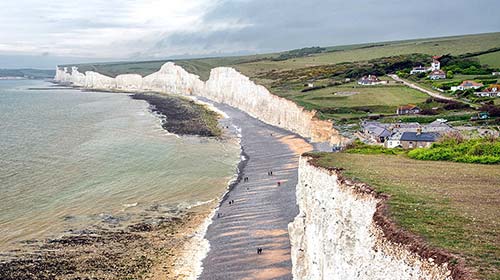
Stretching east of Brighton is a coastline fringed with broad, rolling green downs, or hills. These hills are an excellent place to practice a favorite sport of the English: walking. Paths, well tended by local walking clubs, weave through much of the English countryside, attracting weekend and holiday strollers, and anyone looking for fresh air and exercise. Here, the long-distance footpath called South Downs Way attracts walkers of all abilities (see the sidebar, later). The highlights are the dramatic chalk cliffs of the Seven Sisters and Beachy Head.
Planning Your Time: These sights make a good half-day side trip from Brighton, or you can visit them en route between Dover/Canterbury and Brighton (perhaps combined with Pevensey Castle and/or Battle Abbey, described in the previous chapter). The Beachy Head and Seven Sisters area can be enjoyed in about an hour—or longer if you take a hike.
BEACHY HEAD AND THE SEVEN SISTERS
Beachy Head and the Seven Sisters, worth ▲▲, is England’s best white-cliff experience and a highlight of any tour of England’s south coast. A vast grassy field, wild yet pure as a putting green, reaches up to a dramatic, white-chalk cliff that stretches for miles with the open sea beyond and the crashing surf 500 feet below. Along the horizon stretches a line of seven lower, undulating cliffs.
While Beachy Head is the biggest of the cliffs, its neighbors are a bit more famous. Long ago, they were dubbed “The Seven Sisters” by groggy sailors who gazed lustily through the mist from their ships and imagined a cancan of seven maidens lifting their petticoats. While the chalk may look like lace, it’s actually the shelly ooze of a seabed formed about 100 million years ago, lifted high with the slow-motion collision of continents. The entire impressive, natural coastline is part of the South Downs National Park.
Dramatic as Beachy Head is, it’s also a big draw for distraught people wanting to end their lives. About 20 people a year jump to their deaths from these cliffs, and you may see a comfort van in the parking lots with a chaplain at the ready, hoping to intervene.
Getting There: The area, just 25 miles east of Brighton, is easy to visit by car: Simply loop south off the coastal A-259 between Seaford and Eastbourne (just after Friston). If you don’t have a car, bus #13X runs three times daily between Brighton and Beachy Head from mid-June through August—but Sundays only off-season (www.buses.co.uk). If you’re in a pinch, the more frequent buses #12, #12A, and #12X travel along the main road and stop at East Dean, just over a one-mile hike from Birling Gap. Another option is to take a train to Eastbourne, the big city just beyond Beachy Head. From there, you can take a taxi to Beachy Head or walk to Eastbourne Pier and ride a hop-on, hop-off bus to the cliffs (April-Oct only, see www.ssbusandcoach.co.uk).
Beachy Head Hikes
If you have time for a walk, these three routes are worthwhile. These trails are fairly steep, and it’s important to watch your step: Long, windblown grass fields come to an abrupt end at the cliff edge, with no barrier between you and the sea crashing hundreds of feet below. For any hike in this area, get detailed advice locally before heading out. For more on Beachy Head hikes, see WalkingClub.org.uk.
For a clifftop walk with great sea views, but not the best vistas of the cliff face itself, hike between the Beachy Head Story visitors center and the Belle Tout Lighthouse.
For head-on views of the cliffs as you walk, begin in the town of Seaford (between Brighton and Beachy Head) and hike to Hope Gap. Drivers can park at the trailhead at the east end of Seaford’s waterfront. Or you can take the train to Seaford; from the train station, walk to the beach and turn left.
Another good option is to leave your car at Birling Gap and hike west along the top of the Seven Sisters. You can hike as far as the Cuckmere Valley, then return the way you came, or make your hike a loop by heading inland through the Friston Forest.
Beachy Head Drive
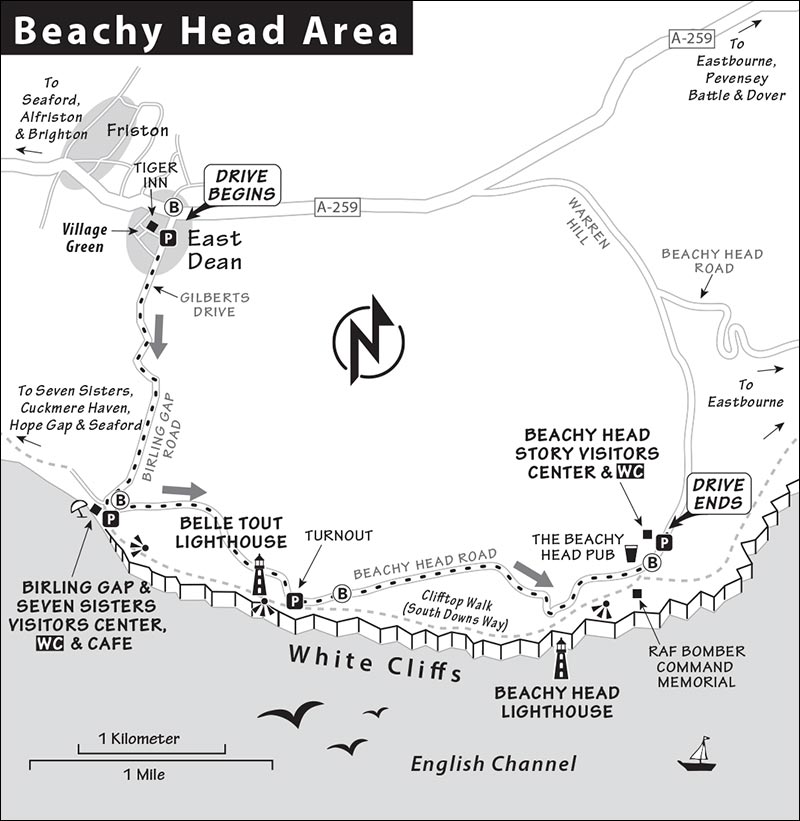
This four-mile drive provides a good taste of this area. It starts in the village of East Dean, stops at viewpoints along the coast, and ends at the bluff with a visitors center and pub. With time, you can try to fit in one of the hikes described earlier. You’ll find pay parking along the way. At the end of this drive, you can head back to Brighton or onward to the large town of Eastbourne (a mini-Brighton, with its own pleasure pier), then on to Pevensey or Battle.
• Take the A-259 coastal road east from Brighton, which leads to the following four sights. For the first stop, drive to the village of East Dean: About three miles after leaving the town of Seaford, be ready to turn off on the right for Birling Gap. Just after turning off onto this road, immediately on your right is the delightful East Dean village green (Village Green Lane, free parking).
East Dean: A mile from the bluff, this cute town is good for a meal or an overnight. Stone cottages made of flint, a fine church, and an inviting pub face the charming green. The Tiger Inn is the best place in the area for a reasonably priced meal and great for an overnight. It boasts a classic pub interior, rustic picnic tables on the green, popular burgers and fish-and-chips, and five comfy rooms for rent (+44 1323 423 878, www.beachyhead.org.uk/the-tiger-inn).
• From East Dean, continue south along the road toward Birling Gap (about a mile away).
Birling Gap (Viewpoint and Beach Access): This handy settlement has the only access to the beach, the best views of the Seven Sisters, a fine National Trust visitors center/shop/café (daily 10:00-17:00), and easy pay parking.
First head down to the beach. The stairway, built like an Erector set, fits the cliff now, but every few years, they have to move the entire thing closer to the ever-receding cliff. The staircase provides good views to the Seven Sisters and 51 steps down to the beach. As you stroll under the grand chalky walls, marvel at the otherworldly whiteness of the cliff and the stones underfoot. Pick up a chunk of chalk to feel how soft and crumbly it is—the constant sloughing off is why these cliffs are so steep, dramatic, and pearly white (signs warn you to stay away from the immediate base of the cliffs). Stretching to your right (as you face the sea) are the elegant Seven Sisters cliffs, offering chalky splendor as far as the eye can see. Hike along the beach as far as the weather—or your patience for walking slowly on monster pebbles—will allow. Walking along the base of England’s famed white cliffs feels epic...almost cinematic.
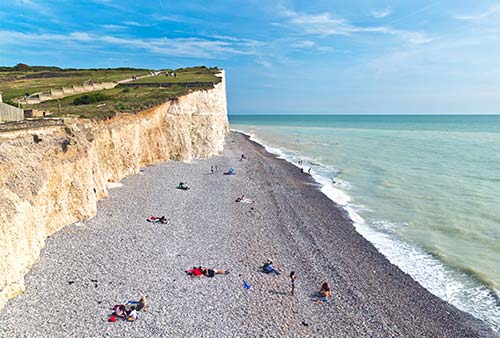
Back up top, the visitors center has great displays on the local wildlife and geology (including erosion), fossils, the RAF Friston WWII air base that’s nearby, and objects found in the many (at least 25) shipwrecks in this area. The staff enjoys giving advice on hiking from Birling Gap—a very good option. There are also WCs and a $ café serving light meals.
Before taking off, it’s worth hiking about five minutes up the bluff to the left (as you face the sea). Hike high enough that you can see the Belle Tout Lighthouse (described next), then look back for even better views of the Seven Sisters. Stay back from the edge; not only are surprise wind gusts dangerous, but the cliffs are constantly sloughing off.
• Back in the car, continue on the same road for about a mile. Just past the hill-capping Belle Tout Lighthouse is a small, skinny parking lot. Stop here if only for a quick photo.
Belle Tout Lighthouse Turnout: While there’s no beach access here, this is your easiest cliff access. Within a hundred yards of your car you’ll enjoy the best view around of Beachy Head, a good look at the red-and-white lighthouse at the base of the cliff (150 feet tall and built in 1832), and a chance to get as close as you dare to the staggering cliff. Be careful—there are no guard railings. It’s just putting green...and oblivion. From here you can hike in either or both directions: to the Belle Tout Lighthouse on the hill above (moved to its current location in 1999 to escape the cliffside erosion) or across the field, gradually up to Beachy Head itself.
• A short drive farther east takes you to the top of Beachy Head Bluff. Look for the big parking lot on the left, as the road summits.
Beachy Head Bluff: The physical high point of the road and the bluff is the main tourist stop (even though you can’t see the white cliffs from here). There are commanding coastal views, a WWII Bomber Command Memorial, nice trails, and a chance to see hang gliders enjoying the coveted Beachy Head updrafts. Just downhill, adjoining the parking lot, the Beachy Head Story visitors center features some good exhibits (free entry, daily 10:00-16:00, +44 1323 729 926). Next door, $$ The Beachy Head Pub has lots of cozy seating overlooking the South Downs and so-so food.
• If you continue along the same road past the bluff, you’ll hit a T-intersection. A left turn (toward Seaford/A-259) takes you back to Brighton. A right turn (marked Town Centre/Seafront) drops you down into Eastbourne.