CANTERBURY
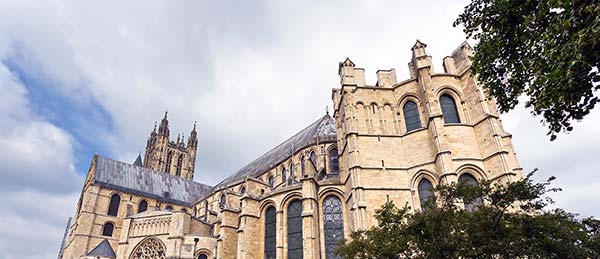
Canterbury has long been one of England’s most important religious destinations. For centuries, it welcomed crowds of pilgrims to its grand cathedral. While these days you’ll see tourists rather than pilgrims, the town is rich in history and architectural splendor.

Pleasant, walkable Canterbury, like many cities in southern England, was founded by Romans. By the time the Romans left in the early fifth century, Christianity was present in England, but with the Anglo-Saxon takeover, paganism returned. Then along came St. Augustine, sent by the pope in AD 597 to convert England’s King Ethelbert of Kent to Christianity. Ethelbert (who had a Christian wife) joined the Church and gave St. Augustine land to set up a monastery on the edge of town. As Christianity became more established in England, Canterbury became its center and the Archbishop of Canterbury emerged as one of the country’s most powerful men.
The famous pilgrimages to Canterbury increased in the 12th century, after the assassination of Archbishop Thomas Becket by followers of King Henry II. Becket was canonized as a martyr, rumors of miracles at the cathedral spread, and flocks of pilgrims showed up at its doorstep. Along the way, they’d stop off at inns and entertain each other with tales—sometimes bawdy and just for fun, sometimes devout and meaningful.
Today, the medieval city—heavily bombed during World War II—has been largely restored. The cathedral and surrounding streets are fairly well preserved. With its huge student population and bustling pedestrian-friendly zone in the center, Canterbury is a livable and fun-to-visit town. While the streets immediately surrounding the cathedral are quite touristy, beyond that core you’ll discover a real, thriving town, with areas both gritty and genteel. It’s a joy to simply wander the back streets, exploring fine gardens, sleepy canals, and student pubs. See the cathedral...then get lost in Canterbury.
PLANNING YOUR TIME
Because of its impressive cathedral, compact tourist zone, and relaxing ambience, Canterbury is an ideal day trip from London. With more time, it merits an overnight. (You could even come straight from the airport to Canterbury and sleep here for two nights, with a day of sightseeing.) If visiting for just a few hours, head straight for the cathedral, then spend the rest of your time strolling the town’s pleasant pedestrian core (following my self-guided Canterbury Walk). If the cathedral is crowded, do the walk first and circle back later—then stick around for evensong in the ornate choir.
Orientation to Canterbury
With about 40,000 inhabitants (plus another 30,000 when its four universities are in session), Canterbury is big enough to be lively but small enough to be manageable.
Historic Canterbury lies within the remains of a medieval wall, which itself was built on top of an ancient Roman wall (you’ll see fragments here and there, and the lone surviving gate is at the end of my Canterbury Walk). The old center, dominated by the towering cathedral, is cut down the middle by bustling High Street (which changes names to St. Peter’s Street at one end and St. George’s Street at the other). During the day, the action is on High Street and in the knot of medieval lanes surrounding the cathedral. At night, the city is quiet all around.
TOURIST INFORMATION
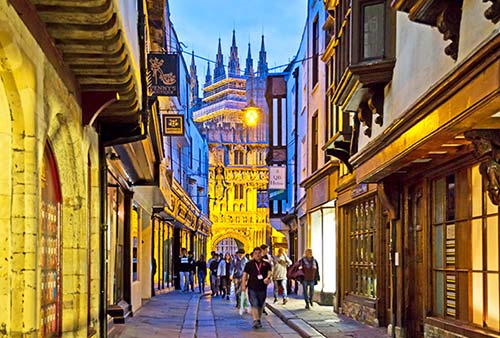
The TI is housed in the modern atrium at the back end of the Beaney House of Art and Knowledge. Pick up the free map and consider buying a ticket for their guided walk, described next (Mon-Sat 10:00-17:00, Thu until 18:00, Sun 11:00-16:00, 18 High Street—or enter directly around the corner on Best Lane, +44 1227 862 162, www.canterbury.co.uk).
Guided Walk: The 1.5-hour strolls with Canterbury Tourist Guides depart from Buttermarket, the square opposite the cathedral entrance. While there’s not a lot to see, there is a lot to talk about—and your guide is very good at that (£15, buy ticket at TI or book online; daily at 11:00, April-Oct and some winter weekends also at 14:00; +44 1227 459 779, www.canterburyguidedtours.com).
ARRIVAL IN CANTERBURY
Canterbury’s two train stations flank the town center. Trains from London’s Victoria Station arrive at East Station; trains from London’s St. Pancras and Charing Cross arrive at West Station. Both stations are about a 10-minute walk from the center; taxis are available (but since the town core is pedestrianized, a cab is worthwhile only if you are heading to a less central location). The bus station is at the end of the High Street pedestrian area, inside the city walls just past the big Whitefriars shopping center.
HELPFUL HINTS
Markets: A modest farmers market is held every day except Monday at The Goods Shed (Tue-Sat 9:00-19:00, Sun 10:00-16:00), just north of West Station.
Shopping: A Marks & Spencer department store, with a supermarket on the ground floor, is near the east end of High Street (daily). Beyond that is the vast Whitefriars Centre shopping complex—sprawling over several blocks (most shops open daily)—including a Tesco Metro grocery store.
Bike Rental: Find wheels and advice at Kent Cycle Hire, which rents bikes just two blocks off High Street on Castle Street (book online for best rates, one-way rental possible with pick-up or drop-off at their sister shop in Whitstable, daily, 81b Castle Street, +44 1227 388 058, https://kentcycles.uk). For a pleasant daylong ride in the countryside, ask for a map of the “Crab and Winkle Way,” a popular eight-mile biking trail from Canterbury to the charming fishing village of Whitstable.
Canterbury Punting Tours: For a leisurely, water-level view of Canterbury, consider a £10-20 cruise on the River Stour. Several fun-loving, student-run companies compete to propel you peacefully through the water in a flat-bottomed boat using the traditional single pole. All have roughly the same cost for the simple, 45-minute joyride up and down the shallow creek; departures generally leave with demand from 10:00 to 17:00 and sometimes later. Enjoy the sales pitches along the bridge near the Old Weavers House, or stop by the office of Canterbury Punting Company, which adds historical narration to its tours (just off Stour Street on Water Lane, +44 1227 464 797, www.canterburypunting.co.uk).
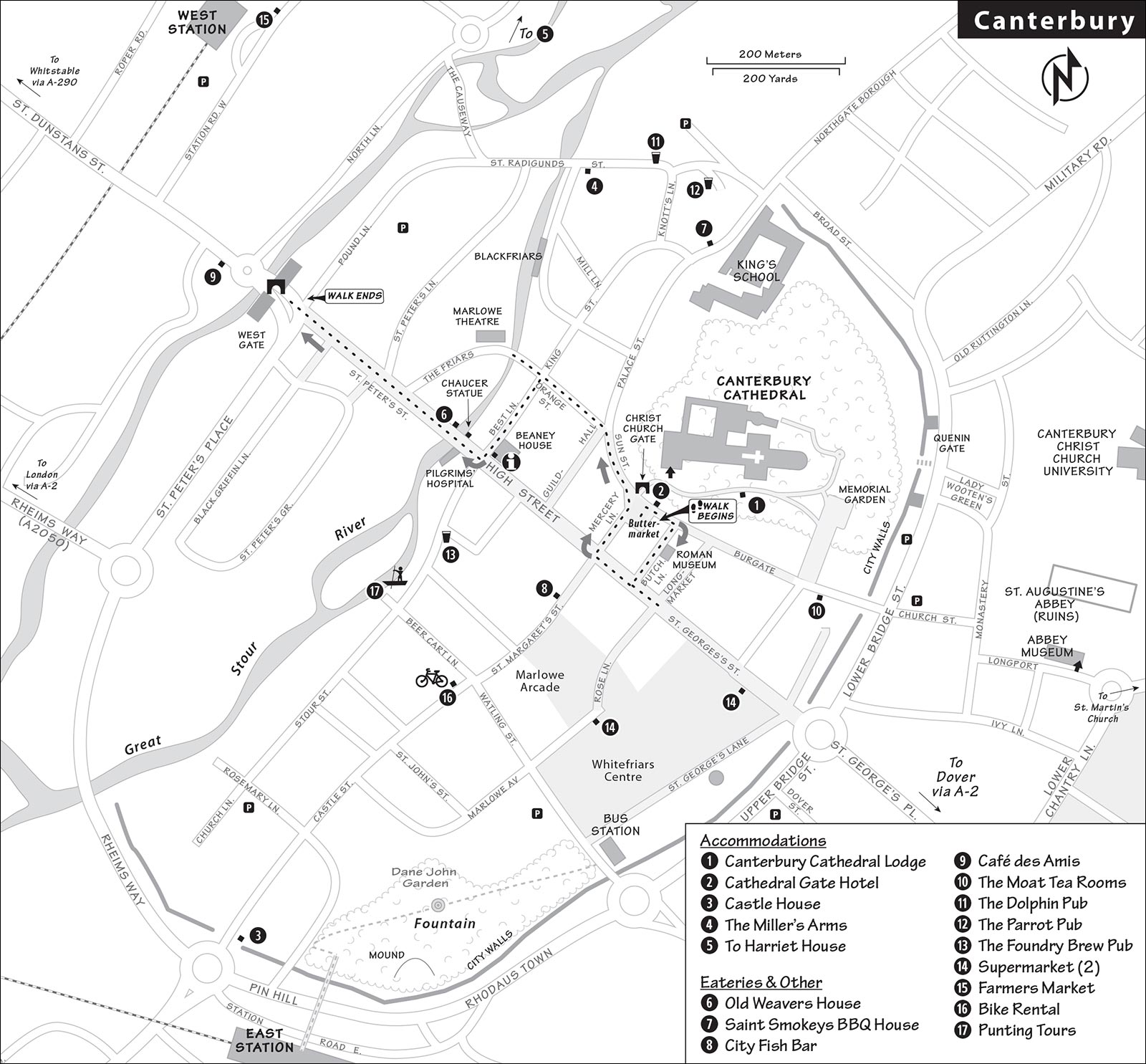
Theater: The Marlowe Theatre offers ballet performances, West End-style productions, speakers, and musicians in a modern space (book tickets online, by phone, or at the box office; The Friars, +44 1227 787 787, www.marlowetheatre.com).
Canterbury Walk
This self-guided walk orients you to the old town center in about an hour (not including sightseeing stops).
• Start just outside the cathedral gatehouse, at the square called...
Buttermarket
Originally the dairy market, Buttermarket was the center of medieval Canterbury. The buildings lining this charming square were built to house and feed pilgrims, whose business supported this town. When Archbishop Thomas Becket was brutally murdered inside his own cathedral in 1170 (see sidebar later in this chapter), this already-holy place gained even more importance. Visitors began to report miraculous healings and other wondrous occurrences. Before long, pilgrims were coming from all over Europe to pay their respects and pray for miracles. Geoffrey Chaucer immortalized these pilgrims—and the tales they told while on the road—in The Canterbury Tales (see sidebar later in this chapter).
The square’s centerpiece is a WWI memorial, ravaged by a century of weather. Like many such monuments around Britain, it was later amended to also honor the local dead of World War II. On the monument, notice the shield with three black birds (called choughs, related to the crow—taken from the personal coat of arms of Thomas Becket). This is the symbol of Canterbury—watch for it all over town.
• Face the entry to the cathedral grounds.
Christ Church Gate
This fancy gate is packed with coats of arms that recognize leading families for their contributions. Its construction began in 1504 to commemorate the marriage of Arthur, Prince of Wales (and heir to the English throne) to Catherine of Aragon. A year after their marriage, Arthur died before ever taking the throne, and Catherine went on to marry Arthur’s brother—becoming the first of Henry VIII’s six wives. It was Henry’s desire to divorce Catherine—and to marry her lady-in-waiting, Anne Boleyn—that caused the ecclesiastical split between England and Rome, which in turn changed Canterbury Cathedral’s status from being the most important Catholic church in England to becoming the principal seat of the Church of England’s archbishop.
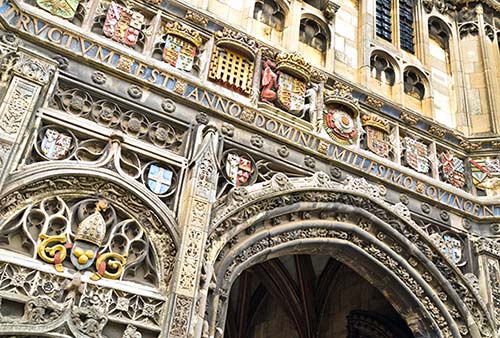
Examine the gate’s details. Above the high point of the arch are the royal Tudor coat of arms and the Tudor rose (the family seal of Arthur and Henry). To the right of the rose is the coat of arms of Catherine of Aragon (part of today’s Spain—notice the red and yellow stripes). A modern bronze statue of Jesus welcomes all who enter. The Puritans pulled down the original statue in the 17th century, and the niche remained empty until this replacement was installed in 1990. Higher up is a strip of shields with symbols representing various biblical tales.
• You can either tour Canterbury Cathedral now (see my self-guided tour under “Sights in Canterbury”) or come back later. If you tour the cathedral now, you can rejoin this walk afterward by exiting through the gift shop, which is across from our next stop, Butchery Lane. Otherwise, face the cathedral gate and walk a block to the right to reach...
Butchery Lane
Walking down this historic lane, notice how the buildings jut out on the upper levels. This was done to maximize usable square footage (and to reduce taxes) for each little plot of land. This lane is a reminder of how densely populated the town was within its protective walls. In later years it became fashionable to even out these old buildings with a flat front (though even then, these buildings often bulge with the original, top-heavy design in back).
Many such buildings were built as lodging for pilgrims. Walking down the lane, pause at the Happy Samurai restaurant (on the right). The passage just to its right leads into a courtyard. This was a classic coaching inn, designed to provide horse carriages with safe off-street parking.
Just beyond on the left, the giant faux columns mark the good Canterbury Roman Museum (see listing, later). Many of the museum’s fascinating artifacts were discovered after WWII bombs—which destroyed a third of the town—exposed the city’s ancient foundations. While this entire street appears historic, only the right side is original. The buildings on the left, badly damaged or destroyed, were hastily replaced with modern buildings. But by the 1990s, Canterbury tore those down and rebuilt them in the old style.
A few doors farther down, look up on the right for the bull’s head. Each street in a market town like Canterbury had a different specialty. Given its name, it’s no surprise that this street was the location of the slaughterhouse.
• Before moving on, look back for a fine view of the cathedral tower, framed by the houses along this street. Then carry on along Butchery Lane to where it opens up into...
High Street
It’s amazing to think that, until the 1960s, the A-2 highway ran through the center of town, bringing all the Dover-London traffic right down today’s delightfully pedestrianized High Street.
Turn left and walk a half-block to where the street becomes St. George’s Street (filled with market stalls on Wednesdays and Fridays). Modern architecture predominates here, as this part of town was hard-hit by WWII bombs. The modern Whitefriars shopping complex sprawls just beyond here and to the right. And St. George’s Tower—straight ahead—marks the (approximate) location of the city’s eastern St. George’s Gate. A 10-minute walk beyond here takes you to the St. Augustine’s Abbey complex, which put Canterbury on the map long before Becket or Chaucer (see listing, later).
• About-face and head back down High Street. Walk one block past Butchery Street to...
Canterbury’s Historic Main Intersection
This intersection marked the heart of the pilgrim’s Canterbury. Pilgrims would enter through the West Gate, at the far end of High Street. When they reached this point, they’d equip themselves with a pilgrim’s badge and little vials of holy water—essentials for completing their pilgrimage. Then they’d turn up Mercery Lane (to the right) to the Christ Church Gate. Before we follow their footsteps, look left, down St. Margaret’s Street. This is where archaeologists have discovered ruins of Roman baths (not open to the public).
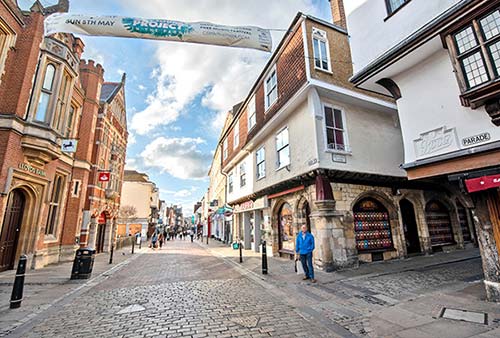
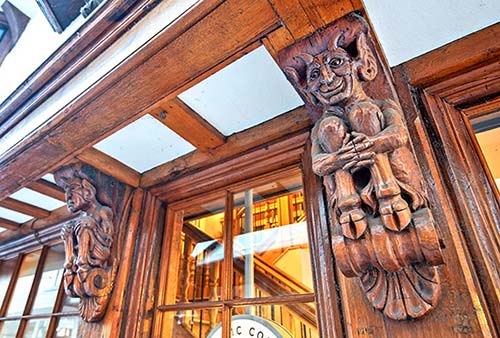
Now turn around and begin strolling up the narrow alley called Mercery Lane. “Mercery” refers to the place where cloth was sold. At the first house on the right, notice the gargoyles carved into the beams just overhead. This is likely an indication that plague victims died here; the gargoyles were meant to scare away evil spirits.
• Soon you’re back where we started, at Buttermarket. Facing the gate, turn left and follow the curve of Sun Street around the outside of the cathedral grounds for a stroll through...
Back-Streets Canterbury
Away from touristy High Street and the knot of souvenir shops near the cathedral, this area feels untrampled, historic, and very English.
Following Sun Street, on the left is the Sun Hotel—described by Charles Dickens in David Copperfield. Continuing a short block to the next intersection, look right down Palace Street—better known around here as King’s Street. This was where, after Thomas Becket’s assassination, King Henry II walked barefoot into town as an act of penance for his role in the accidental slaying. It’s lined with historic buildings, and it leads to some delightful pubs. At the start of King’s Street, on the right, look for Café Chambers. A plaque nearby identifies this as the place where the Pilgrims signed the papers to hire the Mayflower for their passage to the New World.
From this intersection, turn down Orange Street. In a few blocks, pause at the bridge over the River Stour to enjoy the picturesque canal. Looking right down the river, you can see the remains of what had been, in the Middle Ages, the domain of the Dominican Blackfriar order. The building sticking out over the canal (on the east side) was once a guest hall; on the opposite, west side is the friars’ refectory. But after Henry VIII suppressed the monks in 1538, the site was converted to a weaving factory.
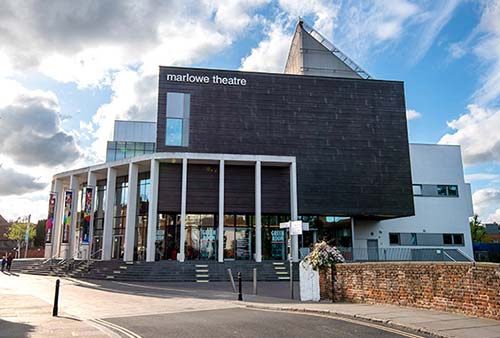
Just beyond the bridge is the massive Marlowe Theatre—a modern venue, named for Christopher Marlowe (Shakespeare’s famous rival and a Canterbury native; for theater performance details, see “Helpful Hints,” earlier). Just past the theater is a monument to Marlowe.
Backtrack across the river and a short half-block, then turn right up Best Lane. You’ll pass a classic Tudor home on the right (at #6), sided with roof shingles (in this case, painted white)—a typical architectural style in the county of Kent. Just beyond that, on the left, is the back door for the modern building that houses the TI, town library, and the free, worth-a-peek Beaney House museum (see listing, later).
• You’ll reach a square marking High Street and the last stretch of this walk.
High Street Redux
In the little square is a modern statue honoring Geoffrey Chaucer. Around the base of the monument are characters from The Canterbury Tales—each one a portrait of a present-day resident who paid for the privilege of being depicted (see the list of donors on the back). On the scroll in Chaucer’s hand are the opening lines of that work’s prologue in Middle English:
Whan that Aprille with his shoures soote
The droghte of Marche hath perced to the roote,
And bathed every veyne in swich licour,
Of which vertu engendred is the flour...
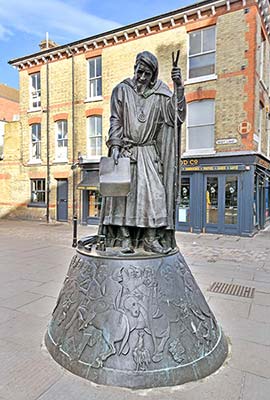
Translation: After the March drought, April showers bathe every vine in “sweet liquor” to bring about spring renewal. (Springtime was also the time for pilgrims to make their journey to Canterbury.)
Head right down High Street (on the stretch called St. Peter’s Street). On the left (at #25) is the 12th-century Pilgrims’ Hospital—in this case, meaning “hospitality.” This is where poor pilgrims could find free shelter in the undercroft. (Today, the Eastbridge charitable organization charges tourists to visit; history buffs enjoy it, but for most it’s skippable—www.eastbridgehospital.org.uk [URL inactive].)
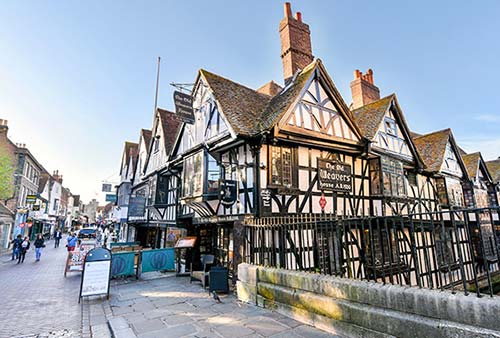
Just beyond that, on the right, you’ll get another look at the River Stour. The black-and-white, half-timbered Old Weavers House is the most evocative building in town, with its big windows for looms upstairs and its romantic setting over the river. Today it’s a pricey but atmospheric recommended pub. After the pilgrim trade dried up, Canterbury fell on hard times. But French Huguenots (fleeing oppression in France) and Walloons (from today’s Flanders, in Belgium) both settled here, importing a new skill: weaving.
Stationed here, you’ll likely see students hawking their boat tours (see “Helpful Hints,” earlier). Looking down the river, notice the kitschy ducking stool—used for dunking suspected witches in the river.
• From here, you could simply explore. Or stroll a few short blocks down a more lowbrow stretch to reach the...
West Gate
Canterbury is ringed by walls—originally Roman, then medieval. Of the seven gates once leading into the medieval city, this is the last survivor (from 1380). Arguably it was also the most important, as it led toward London and was where most pilgrims entered. To protect the town, gates were closed and locked after a certain time. Horseback pilgrims would pace themselves to get here just in time, prodding their horses at what they called a “Canterbury gallop”—also known as “cantering.”
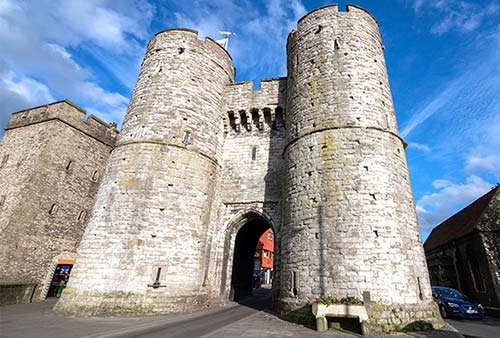
You can climb the gate’s tower to take in the views and visit a small museum (£4; Mon-Fri and Sun 12:00-15:45, closed Sat; www.onepoundlane.co.uk). Or just stroll around the gate, admiring its stout defenses (with slits for archers and square holes up high for cannons). Around the far side is a tranquil garden and a view of one of the river’s tributaries.
• Our walk is finished. From here, explore the area just outside the gate—called St. Dunstans, with some good eateries and the bustle of local life. Or backtrack through the gate and head up High Street. As you do, think of the many pilgrims who’ve gone before you—cementing Canterbury’s place in English history.
Sights in Canterbury
CANTERBURY CATHEDRAL
One of the most important churches in England, this cathedral, worth ▲▲▲, is the headquarters of the Anglican Church (that makes it akin to the English Vatican). There’s been a church here ever since St. Augustine, the cathedral’s first archbishop, broke ground in 597. In the 12th century, the cathedral’s archbishop, Thomas Becket, was murdered in front of the altar. Just over two years later he was sainted, and Canterbury became a prime destination for religious pilgrims. When Henry VIII broke with the Roman Catholic Church 400 years later, this cathedral became the Anglican version of St. Peter’s Basilica. A visit here leaves you impressed by the resilience of this spot—so holy to so many for so long.
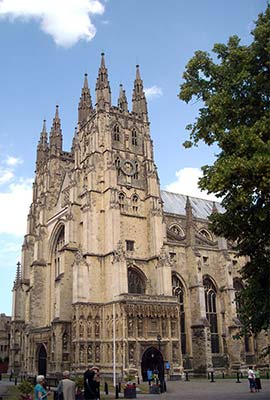
Cost and Hours: £17; Mon-Sat 9:00-17:00 (July-Aug until 18:00), Sun 12:30-17:00; shorter hours Nov-Easter, last admission one hour before closing.
Information: +44 1227 762 862, www.canterbury-cathedral.org.
Tours: A guided tour called the Inside Story introduces the cathedral and its history (£5, 1.25 hours, Mon-Sat at 10:30, 12:00, and 14:00; occasional tours on Sun). Stained glass tours are also offered but with less regularity (1 hour, generally Mon-Sat at 12:00—ask at the ticket office). In addition to my tour (next)—and some free mini talks offered throughout the day around the cathedral—there are two self-guided tour options: A £2.50 audioguide download is available, or borrow the £5 multimedia guide (available at the info stand inside the cathedral), which provides a more in-depth experience. Knowledgeable volunteer guides wearing gold sashes are posted throughout the cathedral to answer questions.
Evensong: The choral evensong is a beautiful opportunity to experience the church in action and filled with music—at no cost. Arrive 15 minutes early—you’ll be allowed through the gate for free when you say you’re there for the service. Pick up a program as you enter and take a seat in the choir—the intimate, central part of the church. The choral group (generally a local choir of men and boys, or a visiting choir in July and Aug) will then file in, and the 40-minute service begins. Stay afterward if the pipe organist is still playing (daily at 17:30, confirm weekend times as they can vary, +44 1227 762 862). For more on evensong, see here.
 Self-Guided Tour
It’s simple to wander through the cathedral on your own, using this tour for the basics. Take advantage of the volunteer guides to learn even more.
• Go through the gate into the courtyard that surrounds this massive church. A small café is to your right, beyond the cathedral gift shop and the exit.
Cathedral Exterior: Before entering the church, notice that it seems to be built in two parts—the west is Gothic and the east is in the older Norman (Romanesque) style. While it was built in fits and starts, most of what you see was constructed between 1100 and 1400.
In many ways it’s a French church: The architectural style originated in France; the craftsmen who created the precious 800-year-old stained-glass windows were French; and the stone was quarried in France and then shipped across the English Channel to this spot (more economical than getting stone from the nearest English quarry).
Circle around the left side of the cathedral to face its Great West Door. Look up at the life-size sculptures of English royalty, including Queen Victoria, Prince Albert, Queen Elizabeth II, and the Duke of Edinburgh.
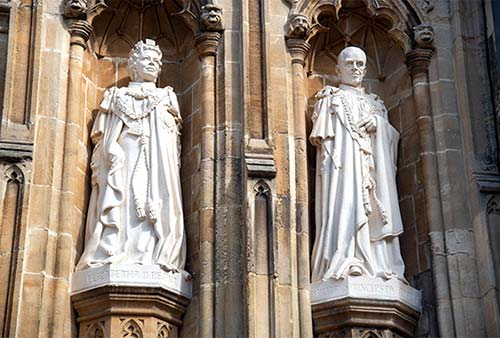
• Enter to the left of the Great West Door or just around the corner to the right (facing the gate you used to enter the cathedral grounds). Take a seat at the back of the nave.
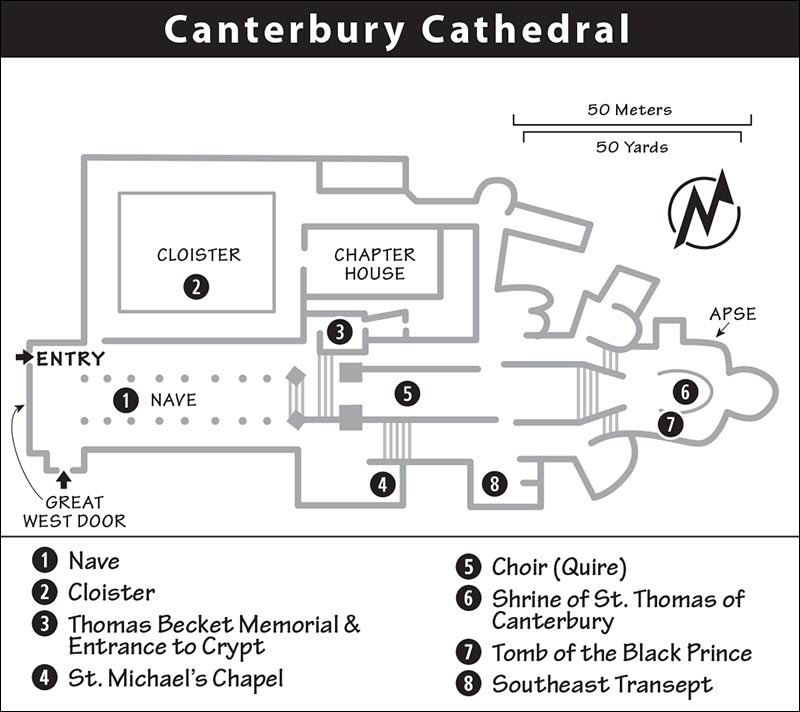
1 Nave: In the year 597, missionaries from Rome converted the king of Kent (this part of England) to Christianity. This was the king’s seat of power; since they had his protection, the missionaries established Canterbury as the leading Christian church here in England. Its importance grew as Christianity spread, but the church really boomed after the murder of Thomas Becket in 1170—and his ensuing sainthood—put it on the pilgrimage trail. To accommodate the steady stream of pilgrims (so important to Canterbury’s medieval economy), the church grew bigger and bigger.
When Henry VIII broke with the Catholic Church during the Protestant Reformation, he seized or destroyed the Becket relics and pilgrims stopped coming. But Henry made this cathedral the leading church of his independent Church of England. Today Canterbury Cathedral is the mother church of the worldwide Anglican Communion, and it remains the seat of its leading bishop, the Archbishop of Canterbury (a position currently held by the Most Reverend Justin Welby—number 105 in a very long line).
The church feels like two churches. The Gothic half (where you’re sitting) was for the common people, and the older Romanesque half (beyond the stone “screen” and the choir—or “quire” in British English), was reserved exclusively for the community of Benedictine monks and church VIPs who ran the place.
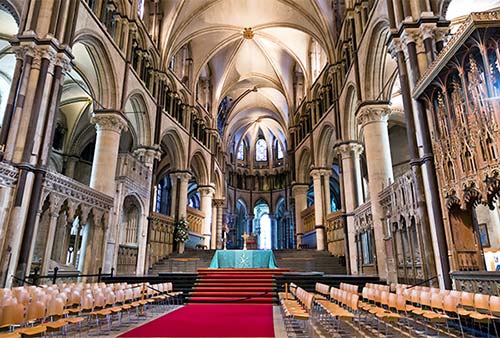
The nave was once slathered in Catholic ornamentation—lots of ornate chapels, painted walls, and more stained glass. But with Henry VIII and the Reformation, the church’s many chapels dedicated to various saints and wealthy families were cleared out. And then, after England’s Civil War in the 1640s, came the more extreme Puritans. They were against music, color, festivals—even Christmas. The Puritans made the building even sterner, whitewashing the paintings and purging the interior of its Gothic finery.
Behind you, notice the fine West Window portraying 13 of Christ’s ancestors. The bottom two rows are mostly original 12th-century stained glass. Looking ahead on the left side of the nave, notice also the Victorian pulpit carved and painted in the Gothic Revival style (1898). At the top of each hour a priest recites a welcome and a prayer from here, reminding all visitors that this is a holy, living place of worship.
All of this could have been lost during World War II. The city was heavily bombed on several occasions, but heroic fire watchers with long-handled shovels kept German incendiary bombs from destroying the building (like their counterparts on the rooftop of St. Paul’s in London). A round plaque in the floor (center rear of nave) remembers these heroic men.
• Exit the nave through the large wooden door to your left, and turn right into the...
2 Cloister: Although Henry VIII ended the Benedictine order in England in 1540, you can still get a good sense of the old monastery complex by strolling through the cloister. Notice the ceiling, speckled with 800 family crests. Just as today we put names on bricks to recognize private contributions to a building project, these shields thanked wealthy medieval families for helping fund this amazing edifice.
• Return to the nave and follow the visitor route marked with red arrows. Head up the left aisle. When you get to the choir (marked by a beautifully carved stone screen), go down the stairs to your left (signs point to The Martyrdom). Immediately to your right is the...
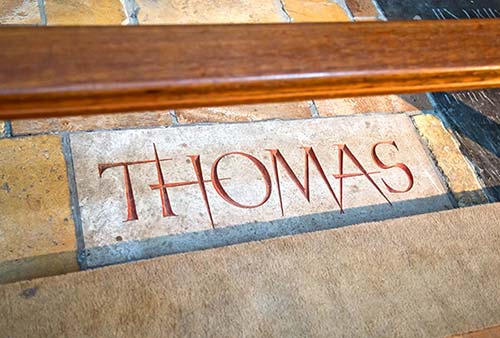
3 Thomas Becket Memorial: This is where Thomas Becket was martyred. You’ll see a humble plaque in the floor below a dramatic sculpture of two swords pointing to the place where he died (the shadows make it look like there are two more swords—fitting, since there were four murderers). In 1982 Pope John Paul II knelt at the place of Becket’s murder and prayed with the Archbishop of Canterbury—the first visit ever by a pope to England.
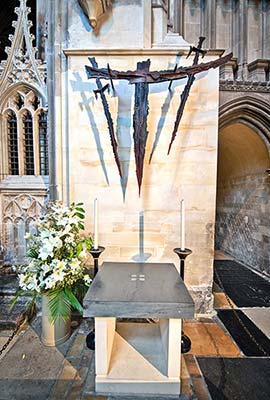
Notice the tunnel to your right. Built in the 15th century, this allowed the steady flow of pilgrims to go under the altar to visit the site of the martyrdom without disturbing the worship service above.
• Continue down the stairs between the memorial and the tunnel to enter the...
Crypt: Notice the heavy stone arches. This lower section was started by the Normans, who probably built on top of St. Augustine’s original wooden church from about AD 600. (If the door is open on the left, a ramp leads to a garden surrounded by the remains of the Benedictine monastic community and the sprawling green of King’s School, a private boarding school across the way.)
The far end of the crypt is newer; it’s Gothic rather than Romanesque, with higher ceilings and more light. Hanging from the ceiling is a modern statue—a body made of rusty nails from the church’s rooftop. Becket’s tomb rested in the crypt from 1170 until 1220, and the spot became famous as a place of many miracles.
• Continuing clockwise, circle back toward the stairway leading out of the crypt. Watch on the left for a small chapel marked Église Protestante Française.
Huguenot Chapel: This space is literally a church within a church. For hundreds of years this chapel has been used by the French (Huguenot) Protestant community, whose ancestors fled persecution in their homeland in the late 17th century for the more welcoming atmosphere in Protestant England. There’s a service in French every Sunday at 15:00. The plaque declares that providing refuge against religious oppression and tyranny is just as important in the 21st century as it was centuries ago.
In the 12th century, Canterbury Cathedral had already been a Christian church for more than 500 years. The king at the time, Henry II, was looking for a new archbishop, someone who would act as a yes-man and allow him to gain control of the Church (and its followers). He found a candidate in his drinking buddy and royal chancellor: Thomas Becket (also called Thomas à Becket). In 1162, the king had his friend made a priest one day and consecrated as archbishop the next.
But Becket respected his holy office—surprising the king, and maybe even himself. Inspired by his new position and wanting to be a true religious leader to his vast flock, he cleaned up his act, became dedicated to the religious tenets of the Church (dressing as a monk), and refused to bow to the king’s wishes.
In December 1170, as tensions grew, Henry wondered aloud, “Will no one rid me of this turbulent priest?” Four knights took his words seriously, and assassinated Becket, cutting off the top of his head with their swords during vespers in the cathedral. The act shocked the medieval world. As an act of pious penitence, a regretful King Henry later submitted to walking barefoot through town and a flogging by priests.
Soon after Becket’s death, word spread that miracles were occurring in the cathedral—prompting the pope to canonize Becket just over two years after his assassination. Soon the pilgrims came, hoping some of St. Thomas Becket’s steadfast goodness would rub off (perhaps they also wanted to see the world—just like travelers today).
• Facing this chapel, turn right, walk to the end of the crypt, and climb up the stairs. Turn left to find...
4 St. Michael’s Chapel: Also known as the Warrior’s Chapel, this was built by Lady Margaret Holland to house family tombs. (She died in 1439 and lies in the middle between two of her husbands.) The chapel is also associated with the Royal East Kent Regiment (“The Buffs”). Notice the fragile old military flags adorning the walls.
• Turning to the center of the church, climb the seven steps ahead of you and stand directly under the bell tower.
Bell Harry Tower: Built in 1503, this 190-foot tower is named for the church’s biggest bell, cast in the early 1600s. Bend back and look way, way up at the fine fan vaulting at the highest point. The white cross in the center is called a “hatch.” Five hundred years ago, above that hatch, a human-powered treadmill hoisted stones during construction. Spin 360 degrees and imagine the effort needed to build this fine stonework. Even though it was made of bricks rather than heavier stone, the columns supporting it weren’t strong enough. Around you are several “strainer arches” retrofitted to give the tower extra support.
5 Choir: Facing east, enjoy the impressive 15th-century choir screen—the finely carved wall that separated the public part of the church (behind you) from the monks’ zone (the intimate central choir, through the arched doorway). Statues of six kings decorate the screen. Flanking the door are King Ethelbert (left) with the church in his hand—a reminder that he gave the land for this church in 597; and Edward the Confessor (right)—who was both a saint and an English king. The stone chair to the right was for a guard who made sure the public stayed out of the monastic half.
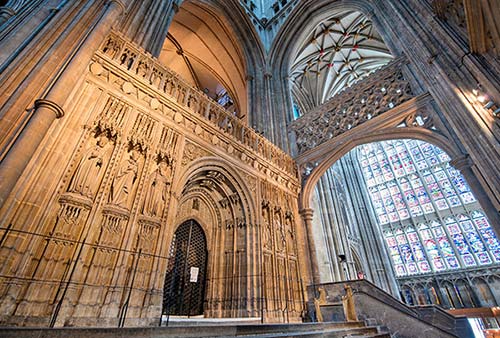
If the chair’s empty, step into the choir and the vast, older half of the church. Opening before you is the monk’s world. (You can sit in these venerable chairs to enjoy a musical evensong service; see “Evensong,” earlier.)
This part of the church is mostly Romanesque on the outside, but because a fire gutted the interior, the decoration you see is mostly Gothic. St. Augustine’s Chair, which sits like a throne beyond the high altar, dates from the 13th century. It’s a reminder that this church is the seat of the bishop—in fact, the leading bishop of all Anglican bishops.
• Walk toward the high altar. Leave the choir through a gate on the left and turn right. Continue up the stairs to the far end (apse) behind the high altar, where you’ll see a candle in the center of the floor. This was the site of the...
6 Shrine of St. Thomas of Canterbury: Beginning in the 12th century, hundreds of thousands of pilgrims came to worship the relics of Becket and to leave offerings. Originally, his tomb was in the crypt, but it was moved here in 1220 to improve access for the countless pilgrims. Imagine this site in the Middle Ages. You’re surrounded by humble, devout travelers who’ve trudged miles upon miles to reach this spot. Now that they’ve finally arrived, they’re hoping to soak up just a bit of the miraculous power that’s supposed to reside here.
Then came King Henry VIII, who broke away from the pope so he could run his affairs without the Church’s meddling. In 1538, he destroyed the original shrine. Dictatorial Henry—no fan of a priest so loved for standing up to a king—had Thomas Becket’s body removed. Legend says that to end the pilgrim traffic here, Henry had Becket’s bones burned and the ashes scattered. It worked.
The chapel at the far east end of the church once held another Becket relic—his head. The chapel is now dedicated to “saints and martyrs of our own time”—people who have given their lives for their Christian faith, from Martin Luther King Jr. to El Salvador’s Óscar Romero. Page through the binders on either side of the entrance to review the stories of these inspirational pillars of faith. If so moved, light a candle.
• Enjoy the 800-year-old windows—the best in the church—all around you. Then, follow the curve of the apse about 20 steps to a fancy tomb with a fancy set of armor (on your right).
7 Tomb of the Black Prince: Marked by a famous sculpture on his tomb, this is the final resting place of the Black Prince, Edward of Woodstock (d. 1376). The Prince of Wales and the eldest son of Edward III, the Black Prince was famous for his cunning in battle and his chivalry—the original “knight in shining armor.”
• Head downstairs, go straight, then turn left into the...
8 Southeast Transept: The stained-glass windows in the transept are refreshingly modern, created by Hungarian-born artist and refugee Ervin Bossányi, who was commissioned by the Dean of Canterbury to replace earlier windows damaged by WWII bombs. The themes are “Salvation” (left) and “Peace Among the Nations” (with Jesus blessing all different races, on the right).
• Our cathedral tour is finished. If you have time, you can explore the grounds.
Cathedral Precinct: Canterbury’s mammoth church lies within a walled “precinct,” a parklike complex of monastic buildings, church administration buildings, and a prestigious prep school. Past the apse end of the cathedral (look up to see how its crenellations make it resemble a giant crown), a gate leads into the Memorial Garden, where the ashes of VIPs are scattered. This garden is built along a well-preserved stretch of Canterbury’s city wall. Next, circle around the far/bottom side of the cathedral, where you’ll find the ruins of other buildings from the abbey complex (a sanatorium and a chapel). Going through the easy-to-miss gate in the wall near these, you’ll pop out into the quiet gardens and stately buildings that hide behind the giant structure. Much of this area belongs to the King’s School; watch for high-school students in their uniforms. Canterbury is very proud to have been home to Christopher Marlowe (1564-1593), who graduated from this school and later became a playwright who influenced his contemporary and rival, Shakespeare.
As you wrap up your visit, consider this: Even with all their power, wealth, and influence, two English kings were unable to successfully eradicate Thomas Becket’s influence. A man of conscience—who once stood up to the most powerful ruler in England—continues to inspire visitors, nearly a thousand years after his death.
MORE SIGHTS IN THE OLD TOWN
▲Canterbury Roman Museum
The colorful displays in this impressive little museum illustrate Canterbury’s Roman origins. The collection, which includes a helmet from Julius Caesar’s 54 BC invasion, makes vivid the power and sophistication of the Romans in Britain.
Cost and Hours: £10.50, daily 10:00-17:00, Butchery Lane, across from City Arms Inn, +44 1227 785 575, www.canterburymuseums.co.uk.
Visiting the Museum: The subterranean one-way exhibit transports you back to Roman Canterbury, with illustrations and life-size models that capture a sense of the town called Durovernum Cantiacorum, circa AD 150. Exhibits re-create the Roman-era baths, theater, and forum, with explanations of the vendors who would have sold their wares back then. You’ll see games (with replicas you can actually play), ancient glass, religious artifacts, and more. Near the end, you’ll walk past original underfloor heating, foundations, and mosaics—all displayed where they were found—plus a hands-on children’s area.
Beaney House of Art and Knowledge
This museum is in the oversize, ornate town library building (with a modern annex in back that houses the TI). A big local personality from the Victorian age, surgeon Jim Beaney gave his eclectic personal collection of butterflies, stuffed animals, local paintings, and old armor to the city in 1899. He wanted all to enjoy his curiosities at no charge, and it’s worth a quick visit. On the ground floor, the Garden Room displays paintings of bucolic country scenes and livestock by native son Thomas Sidney Cooper (1803-1902). The exhibit continues upstairs, with themed rooms covering explorers and collectors, as well as galleries devoted to paintings, decorative arts, and temporary exhibits.
Cost and Hours: Free; Tue-Sat 10:00-17:00, Sun 11:00-16:00, closed Mon; 18 High Street, +44 1227 862 162, www.canterburymuseums.co.uk/the-beaney.
EAST OF THE OLD TOWN
These two historically significant sights—about a 10-minute walk east of the old town center—are worth the trek for those interested in Canterbury’s early history or looking for an evocative place to picnic.
St. Augustine’s Abbey
The ruins of the original abbey—founded by St. Augustine himself—sit right on the edge of town. In 597, Pope Gregory sent Augustine to reintroduce Christianity to medieval England, which had embraced paganism after the Romans left and the Anglo-Saxons swept in. King Ethelbert, who ruled the region surrounding Canterbury, was a prime target not only because he was powerful but because his wife was already Christian. Perhaps influenced by his wife, Ethelbert converted soon after meeting Augustine, and he donated land for an abbey.
At its peak, the abbey was a hive of spiritual and cultural activity, with a large church, a cloister, and a cluster of service buildings for the monks. The abbey survived Viking raids in 1011 only to fall into ruin after King Henry VIII—jealous over the wealth and influence held by England’s monks—closed the abbey in 1538, nearly a millennium after its founding.
A modest museum sets up your visit, and virtual-reality headsets resurrect the site. Outside, you’ll see foundations and fragments of the original structures (including a standing stone from the Neolithic period) still visible in a grassy field. Pace the square of the cloister and imagine yourself as a monk in the early days of Christianity in England. On a sunny day, the grounds are a fine place for a picnic.
Cost and Hours: £8.50-11, includes 45-minute audioguide; daily 10:00-17:00, Nov-March Sat-Sun only 10:00-16:00; +44 1227 767 345, www.english-heritage.org.uk.
Getting There: Walk to the (southeast) end of St. George’s Street, where it hits the ring road. Continue straight through the underpass; after you emerge, bear left along Ivy Lane, then turn left at the parking lot.
St. Martin’s Church
Set in the center of an old, slanted graveyard, humble little St. Martin’s has the honor of being the oldest parish church in England. In continual use since 650, it sits on the foundations of a Roman temple and features an elegant Norman-era baptismal font (to the right of the entrance).
Cost and Hours: Free, donations welcome; generally open Wed-Sun 11:00-15:00 except closed 12:00-12:30 Thu for a service (which visitors are welcome to attend); churchyard always open; +44 1227 768 072, www.martinpaul.org.
Getting There: Continue east on the busy road 300 yards past St. Augustine’s Abbey and turn down the first real road to the left (North Holmes Road); you’ll see the churchyard’s wooden entry gate from the main road.
Sleeping in Canterbury
Canterbury has relatively few accommodations within the old walls, but I’ve listed my favorites. The roads heading out of town, particularly New Dover Road, have clusters of B&Bs that are slim on charm but suitable for tired drivers.
$$$ Canterbury Cathedral Lodge, actually within the cathedral grounds, is a modern, bright, and comfy facility with 34 rooms—most with unbeatable cathedral views. Its simple yet elegant accommodations were designed for church guests but are open to all (rates include cathedral entry fee, elevator, private garden terrace and grounds are all yours after hours, limited on-site parking, several value rooms and an apartment in an adjacent building without cathedral views, +44 1227 865 350, www.canterburycathedrallodge.org, stay@canterburycathedrallodge.org).
$$ Cathedral Gate Hotel, with 24 rooms spiraling through a treehouse floor plan, has old character (slanted floors) and modern amenities. It’s as central as can be, on Buttermarket, just outside the church’s gate (cheaper rooms with shared bath, 36 Burgate, +44 1227 464 381, www.cathgate.co.uk, cathedralgatehotel@btconnect.com).
$$ Castle House, an eight-minute walk from the cathedral, has 15 spacious rooms and feels like a classic old guesthouse. Facing a big roundabout next to the city walls, it comes with castle views and an enclosed garden (family rooms, limited free parking, 28 Castle Street, +44 1227 761 897, www.castlehousehotel.co.uk, info@castlehousehotel.co.uk).
$$ The Miller’s Arms, on a quiet street across from the River Stour, rents 11 comfy, modern rooms that are an afterthought to the cozy pub and restaurant (pay parking, 2 Mill Lane, +44 1227 456 057, www.millerscanterbury.co.uk, millersarms@shepherd-neame.co.uk).
$$ Harriet House offers six comfortable, bright, and modern rooms. It’s north of the center, a 15-minute walk along a scenic river footpath (book direct for RS%, minifridges, free parking, 3 Broad Oak Road, enter around back on Market Way, +44 1227 457 363, www.harriethouse.co.uk, enquiries@harriethouse.co.uk, Paul and Heidi).
Eating in Canterbury
As a student town, Canterbury is packed with eateries—especially along the pedestrianized shopping zone and around the cathedral.
$$$ Old Weavers House serves solid English food in a pleasant, historic building next to the river. Sit inside beneath sunny walls and creaky beams, or outside on their riverside patio under a leafy canopy. This is the most atmospheric of my listings, but it can feel touristy and gets very busy (long hours daily, 1 St. Peter’s Street, +44 1227 464 660).
$$ Saint Smokeys BBQ House grills up delicious jerk-style barbecue chicken and sides. It’s a short, pleasant walk away from the main tourist zone through a charming part of town where students and locals outnumber tourists. Order at the counter, then find a seat while your food is grilled to order (daily, Sun dinner only, 17 Borough, +44 1227 769 027).
$ City Fish Bar is your quintessential British chippy, serving several kinds of fried fish. Get yours for takeaway or grab a sidewalk table on this charming pedestrian street (Mon-Sat until 19:00, Sun until 17:00, 30 St. Margaret’s Street, +44 1227 760 873).
$$$ Café des Amis, just outside the West Gate, is a local fixture for Mexican and Mediterranean fare in a crowded, convivial space with a Parisian-meets-Mexican-cantina vibe. Reservations are wise (daily, 95 St. Dunstans Street, +44 1227 464 390, https://cafedez.com).
$$ The Moat Tea Rooms is good for a sweet lunch and afternoon tea in a charming 16th-century house. Sit inside or ask to be served in the secret garden. The freshly baked scones are a favorite and can be combined with a hot pot of tea and a good selection of cakes and sandwiches (daily until 17:00, 67 Burgate, +44 1227 784 514, www.moattearooms.co.uk).
PUBS WITH CHARACTER
These pubs are popular for their atmosphere. The first two have better food and are behind the cathedral in a quiet, cobbled canalside neighborhood. The third is in the center and famous for its many microbrews.
$$ The Dolphin Pub, a local favorite, is a homey and relaxing 1930s pub with carefully chosen ales. While traditional, the food is a cut above typical pub grub and burgers, with quality local ingredients and daily specials. Sit in the main bar, in the sunroom, or at a picnic table in the grassy garden. It’s easy to imagine local professors hanging out here (daily; 17 St. Radigunds Street, +44 1227 455 963).
$$ The Parrot Pub claims to be the oldest pub in town. It feels that way, with a creaky ground floor and a kingly dining hall upstairs under lumbering timbers (same menu and cost). You can also sit in their inviting backyard, and while this pub is less intimate and more formulaic than its neighbors, the food is highly regarded (daily, 1 Church Lane, +44 1227 454 170).
$$ The Foundry Brew Pub offers up to 14 home brews on tap. Bartenders happily pour samples, serve beer flights, and explain the inspiration behind the name of their signature draft, Torpedo. The beer-inspired dishes like steak-and-ale pie and BBQ beer ribs are forgettable; come here for the ale and the modern brewpub ambience (daily, 77 Stour Street, +44 1227 455 899).
Canterbury Connections
Canterbury has two train stations, East and West, each about a 10-minute walk from the center.
From Canterbury by Train to: London (hourly, 1 hour from Canterbury West Station to St. Pancras International Station; slower trains to Charing Cross station; also hourly, 1.5 hours from Canterbury East Station to Victoria Station), Dover (hourly, 30 minutes, from Canterbury East to Dover Priory), Rye (hourly, 1 hour, from Canterbury West, transfer at Ashford International), Hastings (hourly, 1.5 hours, from Canterbury West, transfer at Ashford International), Brighton (hourly, 3 hours, from Canterbury West, transfer at London’s St. Pancras International and London Bridge), Bath (hourly, 3.5 hours, from Canterbury West, transfer at London’s St. Pancras International and London Paddington). Train info: +44 3457 484 950, NationalRail.co.uk.
By Bus to: London’s Victoria Coach Station (about hourly, 2.5 hours; www.nationalexpress.com), Dover (2/hour, 35 minutes, #15, www.stagecoachbus.com).