APPENDIX
Holidays and Festivals
This list includes selected festivals in England plus national holidays observed throughout Britain. Many sights and banks close on national holidays—keep this in mind when planning your itinerary. Throughout Britain, hotels get booked up during Easter week; over the Early May, Spring, and Summer Bank Holidays; and during Christmas, Boxing Day, and New Year’s Day. On Christmas, virtually everything shuts down—even the Tube in London. Museums also generally close on December 24 and 26.
Many British towns have holiday festivals in late November and early December, with markets, music, and entertainment in the Christmas spirit (for instance, Keswick’s Victorian Fayre).
Before planning a trip around a festival, verify the dates with the festival website, the Visit Britain website (www.visitbritain.com), or my “Upcoming Holidays and Festivals in England” web page at RickSteves.com/europe/england/festivals.
| Jan 1 | New Year’s Day |
| Mid-Feb | London Fashion Week (https://londonfashionweek.co.uk) |
| Mid-Feb | Jorvik Viking Festival, York (costumed warriors, battles; https://jorvikvikingfestival.co.uk) |
| March/April | Easter Sunday-Monday: April 20-21, 2025; April 5-6, 2026 |
| May | Early May Bank Holiday: May 5, 2025; May 4, 2026 Spring Bank Holiday: May 26, 2025; May 25, 2026 |
| Early-mid-May | Jazz Festival, Keswick |
| Late May | Chelsea Flower Show, London (www.rhs.org.uk/chelsea) |
| Late May-early June | Bath Festival (https://bathfestivals.org.uk) |
| Late May-early June | Fringe Festival, Bath (alternative music, dance, and theater; www.bathfringe.co.uk) |
| Early June | Beer Festival, Keswick (music, shows; www.keswickbeerfestival.co.uk) |
| Early-mid June | Trooping the Colour, London (military bands and pageantry; www.kbp.army.mod.uk) |
| Mid-late June | Golowan (Midsummer) Festival, Penzance (www.golowanfestival.org) |
| Late June | Royal Ascot Horse Race, Ascot (near Windsor; www.ascot.co.uk) |
| Late June-mid-July | Wimbledon Tennis Championship, London (www.wimbledon.org) |
| Mid-July | Early Music Festival, York (www.ncem.co.uk) |
| Late July-early Aug | Cambridge Folk Festival (www.cambridgefolkfestival.co.uk) |
| Late Aug | Notting Hill Carnival, London (costumes, Caribbean music, www.thelondonnottinghillcarnival.com) |
| Late Aug | Bank Holiday: Aug 25, 2025; Aug 31, 2026 (England and Wales) |
| Sept-early Nov | Illuminations, Blackpool (waterfront light festival, www.visitblackpool.com/illuminations) |
| Mid-Sept | London Fashion Week (https://londonfashionweek.co.uk) |
| Late Sept | Jane Austen Festival, Bath (www.janeausten.co.uk) |
| Late Sept | York Food and Drink Festival (www.yorkfoodfestival.com) |
| Nov 5 | Bonfire Night (bonfires, fireworks, effigy burning of 1605 traitor Guy Fawkes) |
| Dec 24-26 | Christmas holidays |
Books and Films
To learn more about England past and present, check out a few of these books or films.
Nonfiction
All Creatures Great and Small (James Herriot, 1972). Herriot’s beloved semiautobiographical tales of life as a Yorkshire veterinarian were made into a long-running BBC series (1978-1990), with a new version that began on PBS beginning in 2020.
The Anglo Files: A Field Guide to the British (Sarah Lyall, 2008). A New York Times reporter in London wittily recounts the eccentricities of life in the UK.
Cider with Rosie (Laurie Lee, 1959). This semiautobiographical boyhood novel set in a Cotswolds village just after World War I has been adapted for TV three times, including once by the BBC in 2015.
Dead Wake (Erik Larson, 2015). Larson gives an evocative account of the doomed 1915 voyage of British luxury liner Lusitania, sunk by a German U-boat during World War I.
England: 1000 Things You Need to Know (Nicholas Hobbes, 2009). Hobbes presents a fun peek into the facts, fables, and foibles of English life.
Fever Pitch (Nick Hornby, 1992). Hornby’s memoir illuminates the British obsession with soccer.
A History of Britain (Simon Schama, 2000-2002). The respected historian presents a comprehensive, thoroughly readable three-volume collection.
A History of Modern Britain (Andrew Marr, 2007). This searching look at the transformations in British life over the last few decades accompanies a BBC documentary series of the same name.
How England Made the English: From Hedgerows to Heathrow (Harry Mount, 2012). Mount offers a witty, engaging look at the symbiotic relationship between the English landscape and English culture.
The Kingdom by the Sea: A Journey Around the Coast of Great Britain (Paul Theroux, 1983). After 11 years as an American expatriate in London, travel writer Theroux takes a witty tour of his adopted homeland.
A Land (Jacquetta Hawkes, 1951). This postwar best seller is a sweeping, poetic natural history of the British landscape and imagination.
The Last Lion (William Manchester, final book completed by Paul Reid; 1983, 1988, and 2012). This superb three-volume biography recounts the amazing life of Winston Churchill from 1874 to 1965.
Literary Trails (Christina Hardyment, 2000). Hardyment reunites famous authors with the environments that inspired them.
My Love Affair with England (Susan Allen Toth, 1992). Toth brings England vividly to life in a captivating traveler’s memoir recalling the country’s charms and eccentricities.
Notes from a Small Island (Bill Bryson, 1995). In this irreverent and delightful memoir, US expat Bryson writes about his travels through Britain—his home for two decades.
A Traveller’s History of England (Christopher Daniell, revised 2005). A British archaeologist and historian provides a comprehensive yet succinct overview of English history.
With Wings Like Eagles (Michael Korda, 2009). An English-born writer gives a historical analysis of Britain’s pivotal WWII air battles versus the German Luftwaffe.
Fiction
For the classics of British drama and fiction, read anything—and everything—by William Shakespeare, Charles Dickens, Jane Austen, and the Brontës.
Atonement (Ian McEwan, 2001). This disquieting family saga set in upper-class England at the start of World War II dramatizes the consequences of a childhood lie. The 2007 motion picture starring James McAvoy and Keira Knightley is also excellent.
Behind the Scenes at the Museum (Kate Atkinson, 1995). Starting at her conception, this book’s quirky narrator recounts the highs and lows of life in a middle-class English family.
Brideshead Revisited (Evelyn Waugh, 1945). This celebrated novel examines the intense entanglement of a young man with an aristocratic family.
Bridget Jones’s Diary (Helen Fielding, 1996). A year in the life of a single thirtysomething woman in London is humorously chronicled in diary form (also a motion picture, with several sequels).
The Edge of the Empire (Bronwen Riley, 2016). In AD 130, a Roman official embarks on an epic journey from Rome to Brittanica, visiting the capital of Londinium and the spa town of Aquae Sulis (Bath) on his way north to Hadrian’s Wall.
High Fidelity (Nick Hornby, 1995). This humorous novel traces the romantic misadventures and musical musings of a thirtysomething record-store owner. Another good read is Hornby’s 1998 coming-of-age story About a Boy. (Both books were also made into films.)
Macbeth (William Shakespeare, 1606). Shakespeare’s “Scottish Play” depicts a guilt-wracked general who assassinates the king to take the throne.
Mapp and Lucia (E. F. Benson, 1931). A rural village in the 1930s becomes a social battlefield. In Lucia in London (1927), the protagonist attempts social climbing in the big city.
A Morbid Taste for Bones (Ellis Peters, 1977). Brother Cadfael, a Benedictine monk-detective, tries to solve a murder in 12th-century Shropshire (first book in a series; also adapted for British TV in 1996).
The Murder at the Vicarage (Agatha Christie, 1930). The prolific mystery writer’s inquisitive Miss Marple character is first introduced in this book.
The Paying Guests (Sarah Waters, 2014). This realistic and suspenseful tale of love, obsession, and murder plays out amid the shifting culture of post-WWII upper-class London.
The Pillars of the Earth (Ken Follett, 1989). This epic set in a fictional town in 12th-century England chronicles the birth of Gothic architecture.
Rebecca (Daphne du Maurier, 1938). This mysterious tale set on the Cornish coast examines upper-class English lives and their secrets.
Restoration (Rose Tremain, 1989). This evocative historical novel takes readers to the heights and depths of 17th-century English society.
The Strange Case of Dr. Jekyll and Mr. Hyde (Robert Louis Stevenson, 1886). This famous Gothic yarn by a Scottish author chronicles a fearful case of transformation in London, exploring Victorian ideas about conflict between good and evil.
SS-GB (Len Deighton, 1978). In a Nazi-occupied Great Britain, a Scotland Yard detective finds there’s more to a murder than meets the eye.
A Study in Scarlet (Sir Arthur Conan Doyle, 1887). This mystery novel introduced the world to detective Sherlock Holmes and his trusty sidekick, Dr. Watson.
The Sunne in Splendour (Sharon Kay Penman, 1982). Penman’s big entertaining book paints King Richard III as a rather decent chap (one in a series of historical novels).
The Unlikely Pilgrimage of Harold Fry (Rachel Joyce, 2012). A man impetuously sets off on a walk across Britain to visit an old friend—and sees his country as never before.
The Warden (Anthony Trollope, 1855). The first novel in the “Chronicles of Barsetshire” series addresses moral dilemmas in the 19th-century Anglican church.
White Teeth (Zadie Smith, 2000). The postwar lives of two army buddies, a native Englishman and a Bengali Muslim, are chronicled in this acclaimed debut novel.
Wolf Hall (Hilary Mantel, 2009). At the intrigue-laced Tudor court of Henry VIII, Thomas Cromwell becomes the king’s right-hand man. The story continues in Bring Up the Bodies (2012) and concludes in The Mirror and the Light (2020).
Film and TV
Austin Powers: International Man of Mystery (1997). Mike Myers stars in this loony send-up of midcentury English culture, the first film in a three-part series.
Battle of Britain (1969). An all-star cast and marvelous aerial combat scenes tell the story of Britain’s “finest hour” of World War II.
Bend It Like Beckham (2003). A teenage girl of Punjabi descent plays soccer against her traditional parents’ wishes in this lighthearted comedy-drama.
Billy Elliot (2000). A young boy pursues his dream to dance ballet amid a coal miners’ strike in working-class northern England.
Blackadder (1983-1989). This wickedly funny BBC sitcom starring Rowan Atkinson skewers various periods of English history in the course of four series (also several TV specials).
Bridgerton (2020-). Lady Whistledown is the witty narrator of this swoon-worthy, Regency-era romance Netflix series based on the novels by Julia Quinn.
Call the Midwife (2012-). London’s poor East End comes to gritty, poignant life in this BBC drama tracing the lives of a team of nurse midwives in the late 1950s and early 1960s.
Chariots of Fire (1981). This Academy Award winner traces the lives of two British track stars competing in the 1924 Paris Olympics.
The Crown (2016-2023). The Netflix biographical drama explores the life of Elizabeth II—England’s longest-reigning queen.
Doc Martin (2004-2022). A brilliant but socially inept London surgeon finds new challenges and opportunities when he opens a practice in a seaside village in Cornwall.
Downton Abbey (2010-2015). This popular aristocratic soap opera follows the travails of the Crawley family and their servants in early-20th-century Yorkshire (shot at Highclere Castle, about 70 miles west of London).
Elizabeth (1998). Cate Blanchett portrays Queen Elizabeth I as she learns the royal ropes during the early years of her reign, and reprises her role in the sequel, Elizabeth: The Golden Age (2007).
Elizabeth I (2005). In this BBC/HBO miniseries, the inimitable Helen Mirren chronicles the queen’s later years with a focus on her court’s intrigue and her yearning for love.
Foyle’s War (2002-2015). This fine BBC series follows detective Christopher Foyle as he solves crimes in southern England during and shortly after World War II.
Goodbye, Mr. Chips (1939). The headmaster of a boys’ boarding school in Victorian-era England recalls his life in this romantic drama.
Gosford Park (2001). This intriguing film is part comedy, part murder mystery, and part critique of England’s class stratification in the 1930s.
A Hard Day’s Night (1964). The Beatles star in their debut film, a comedy depicting several days in the life of the band.
Hope and Glory (1987). John Boorman directed this semiautobiographical story of a boy growing up during World War II’s London blitz.
Howards End (1992). This Academy Award winner, based on the E. M. Forster novel, captures the stifling societal pressure underneath the gracious manners in turn-of-the-century England.
The Imitation Game (2014). Cryptanalyst Alan Turing (Benedict Cumberbatch) is recruited by British intelligence agency MI6 to help crack the Nazis’ Enigma code during World War II.
James Bond films (1962-). These classic films follow a dashing officer in Britain’s Secret Intelligence Service, who likes his martinis “shaken, not stirred.”
Jane Eyre (2011). Charlotte Brontë’s 1847 gothic romance has been made into a movie at least nine times, most recently this one starring Mia Wasikowska and Michael Fassbender.
The King’s Speech (2010). Colin Firth stars as the stuttering King George VI on the eve of World War II.
Lark Rise to Candleford (2008-2011). Based on Flora Thompson’s memoirs, this evocative series chronicles life in a poor Victorian-era hamlet and its neighboring, more hoity market town.
A Man for All Seasons (1966). Lord Chancellor Sir Thomas More incurs the wrath of Henry VIII when he refuses to help annul the king’s marriage to Catherine of Aragon.
Mr. Bean (1990-1995). Rubber-faced comedian Rowan Atkinson’s iconic character bumbles through life barely uttering a word in this zany sitcom (that also spawned two motion pictures).
Monty Python and the Holy Grail (1975). This surreal take on Arthurian legend is a classic of British comedy.
Notting Hill (1999). Hugh Grant and Julia Roberts star in this romantic comedy set in the London neighborhood of...you guessed it.
Persuasion (1995). Set in 19th-century England, this Jane Austen tale of status was partially filmed in Bath.
Poldark (2015-2019). In this hit BBC series, Ross Poldark returns to Cornwall after fighting in the Revolutionary War to find his estate, tin mines, and relationship in ruins.
Pride and Prejudice (1995). Of the many versions of Jane Austen’s classic, this BBC miniseries starring Colin Firth is the winner.
The Queen (2006). Helen Mirren expertly channels Elizabeth II at her Scottish Balmoral estate in the days after Princess Diana’s death. Its prequel, The Deal (2003), probes the relationship between Tony Blair and Gordon Brown.
The Remains of the Day (1993). Anthony Hopkins stars as a butler doggedly loyal to his misguided, politically naive master in 1930s England.
Sammy and Rosie Get Laid (1987). An unconventional middle-class couple’s promiscuous adventures expose racial tensions in multiethnic London.
Sense and Sensibility (1995). Star Emma Thompson wrote the screenplay for this adaptation of Jane Austen’s 1811 novel of the Dashwood sisters, who seek financial security through marriage.
Shakespeare in Love (1998). Tudor-era London comes to life in this clever, romantic film set in the original Globe Theatre.
Sherlock (2010-2017). Holmes (Benedict Cumberbatch) and Watson (Martin Freeman) are excellent in this BBC update of the detective’s story, set in present-day London.
Sherlock Holmes (2009). Robert Downey Jr. tackles the role of the world’s most famous detective.
Sweeney Todd (2007). Johnny Depp stars as a wrongfully imprisoned barber who seeks revenge in this gritty Victorian-era musical.
Tinker, Tailor, Soldier, Spy (2011). There’s a Soviet mole inside Britain’s MI6, and retired agent George Smiley is summoned to ferret him out in this adaptation of John le Carré’s 1974 espionage thriller.
To Sir, with Love (1967). Sidney Poitier grapples with social and racial issues in an inner-city school in London’s East End.
The Tudors (2007-2010). Showtime’s racy, lavish series is a gripping, loosely accurate chronicle of the marriages of Henry VIII.
Up (1964-). Documentary series following more than a dozen kids from varying economic and social backgrounds across England starting at age 7 and checking back in on their lives every seven years.
Upstairs, Downstairs (1971-1975). An aristocratic family and their servants make a new home at 165 Eaton Place in this TV series.
Waterloo Bridge (1940). This Academy Award-nominated romantic drama recalls the lost love between a ballerina (Vivien Leigh) and a WWI army officer.
Wolf Hall (2015). The exploits of Thomas Cromwell, the chief minister to King Henry VIII, are detailed in this excellent BBC historical miniseries.
Victoria (2017-2019). This PBS Masterpiece Theatre series chronicles the rise and reign of Queen Victoria (Jenna Coleman).
For Kids
A Bear Called Paddington (Michael Bond, 1958). A bear from Peru winds up in a London train station, where he’s found and adopted by a human family. The 2014 Paddington film is also fun viewing.
B is for Big Ben (Pamela Duncan Edwards, 2008). Explore England from A to Z with rhymes, trivia, and bright illustrations.
The Chronicles of Narnia books (C. S. Lewis, 1950-1956) and movies (2005-2010). Four siblings escape from WWII London into a magical world. Several of the books were also a BBC miniseries (1988-1990).
Harry Potter books (J. K. Rowling, 1997-2007) and films (2001-2011). After discovering he’s a wizard, a young boy in England gets whisked off to a magical world of witchcraft and wizardry. There, he finds great friendships as well as grave evils, which he alone can destroy.
A Little Princess (1995). In this film adaptation of the classic novel, a young girl’s fortunes fall and rise again in a Victorian London boarding school.
Mary Poppins (1964). Though filmed on a set in California, this beloved musical starring Julie Andrews and Dick Van Dyke is set in Edwardian London. In the sequel, Mary Poppins Returns (2018), the kids are grown and revisited by Mary (Emily Blunt) and her friend Jack (Lin-Manuel Miranda).
Peter Pan (1953). This classic film adapts the 1904 play Peter and Wendy, following a group of English children whisked away to Neverland.
Robin Hood and the Golden Arrow (Robert D. San Souci, 2010). This illustrated retelling is a good introduction for youngsters to the legend of Robin Hood and his merry men.
The Secret Garden (Frances Hodgson Burnett, 1911). Orphaned Mary discovers nature and love in a gloomy Yorkshire mansion on the edge of a moor in this beloved classic, which has been adapted for stage and screen.
Wallace & Gromit TV series and films (1989-2019). Absent-minded inventor Wallace and his dog, Gromit, may live in northwest England, but these unique characters are beloved by children around Great Britain and the rest of the world.
Winnie-the-Pooh and The House at Pooh Corner (A. A. Milne, 1926-1928). This two-volume classic children’s tale, set in England, revolves around a bear and his friends in the Hundred Acre Wood. The success of Milne’s books has led to numerous book, film, and TV adaptations.
Young Sherlock Holmes (1985). A young Sherlock and his sidekick, Watson, work to solve the mystery of a series of nonsensical suicides (some scenes may be frightening for younger children).
Conversions and Climate
Numbers and Stumblers
• Some British people write a few of their numbers differently than we do: 1 =  , 4 =
, 4 =  , 7 =
, 7 =  .
.
• In Europe, dates appear as day/month, so Christmas is 25/12.
• What Americans call the second floor of a building is the first floor in Britain.
• On escalators and moving sidewalks, Brits keep the left “lane” open for passing. Keep to the right.
• To avoid the British version of giving someone “the finger,” don’t hold up the first two fingers of your hand with your palm facing you. (It looks like a reversed victory sign.)
• And please...don’t call your waist pack a “fanny pack” (see the British-Yankee Vocabulary list at the end of this appendix).
Metric Conversions
Britain uses the metric system for nearly everything. Weight and volume are typically calculated in metrics: A kilogram is 2.2 pounds, and one liter is about a quart (almost four to a gallon). Temperatures are given in Celsius.
| 1 foot = 0.3 meter | 1 square yard = 0.8 square meter |
| 1 yard = 0.9 meter | 1 square mile = 2.6 square kilometers |
| 1 mile = 1.6 kilometers | 1 ounce = 28 grams |
| 1 centimeter = 0.4 inch | 1 quart = 0.95 liter |
| 1 meter = 39.4 inches | 1 kilogram = 2.2 pounds |
| 1 kilometer = 0.62 mile | 32°F = 0°C |
Imperial Weights and Measures
Britain hasn’t completely gone metric. Driving distances and speed limits are measured in miles. Beer is sold as pints (though milk can be measured in pints or liters), and a person’s weight is measured in stone (a 168-pound person weighs 12 stone).
1 stone = 14 pounds
1 British pint = 1.2 US pints
1 imperial gallon = 1.2 US gallons or about 4.5 liters
Clothing Sizes
When shopping for clothing, use these US-to-UK comparisons as general guidelines (but note that no conversion is perfect).
Women: For pants and dresses, add 4 (US 10 = UK 14). For blouses and sweaters, add 2. For shoes, subtract 2.5 (US size 8 = UK size 5.5).
Men: For clothing, US and UK sizes are the same. For shoes, subtract about 0.5 (US size 9 = UK size 8.5).
Children: Clothing is sized similarly to the US. UK kids’ shoe sizes are about one size smaller (US size 6 = UK size 5).
Britain’s Climate
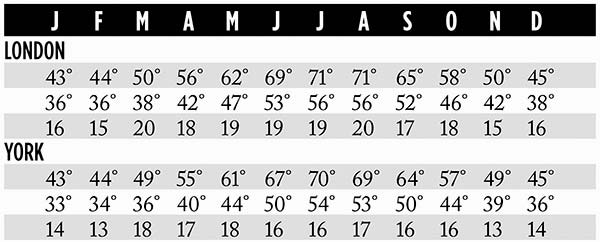
First line, average daily high; second line, average daily low; third line, average days without rain. For more detailed weather statistics for destinations in this book (as well as the rest of the world), check Wunderground.com.
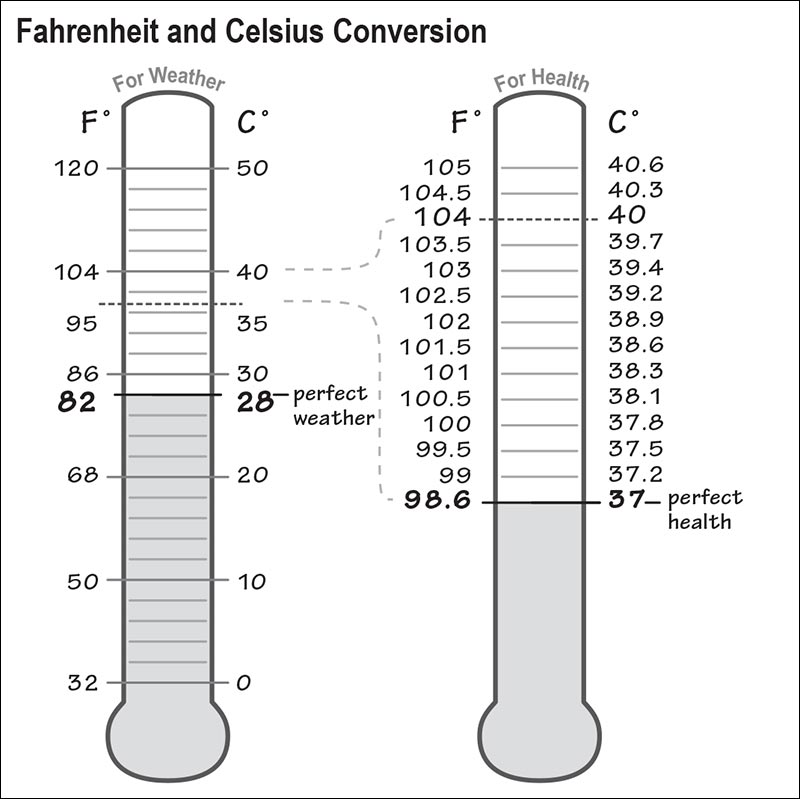
Europe takes its temperature using the Celsius scale, while we opt for Fahrenheit. For a rough conversion from Celsius to Fahrenheit, double the number and add 30. For weather, remember that 28°C is 82°F—perfect. For health, 37°C is just right. At a launderette, 30°C is cold, 40°C is warm (usually the default setting), 60°C is hot, and 95°C is boiling. Your air-conditioner should be set at about 20°C.
Whether you’re traveling for five days or five weeks, you won’t need more than this. Pack light to enjoy the sweet freedom of true mobility.
 5 shirts: long- & short-sleeve
2 pairs pants (or skirts/capris)
1 pair shorts
5 pairs underwear & socks
1 pair walking shoes
Sweater or warm layer
Rainproof jacket with hood
Tie, scarf, belt, and/or hat
Swimsuit
Sleepwear/loungewear
Debit card(s)
Credit card(s)
Hard cash (US $100-200)
Money belt
Passport
Other required ID: Vaccine card, entry visa, etc.
Driver’s license, student ID, hostel card, etc.
Tickets & confirmations: flights, hotels, trains, rail pass, car rental, sight entries
Photocopies of important documents
Insurance details
Guidebooks & maps
Mobile phone
Camera & related gear
Tablet/ebook reader/laptop
Headphones/earbuds
Chargers & batteries
Phone car charger & mount (or GPS device)
Plug adapters
Basics: soap, shampoo, toothbrush, toothpaste, floss, deodorant, sunscreen, brush/comb, etc.
Medicines & vitamins
First-aid kit
Glasses/contacts/sunglasses
Face masks & hand sanitizer
Sewing kit
Packet of tissues (for WC)
Earplugs
Day pack
Sealable plastic baggies
Laundry supplies: soap, laundry bag, clothesline, spot remover
Small umbrella
Travel alarm/watch
Notepad & pen
Journal
Second pair of shoes (flip-flops, sandals, tennis shoes, boots)
Travel hairdryer
Picnic supplies
Disinfecting wipes
Water bottle
Fold-up tote bag
Small flashlight
Mini binoculars
Small towel or washcloth
Inflatable pillow/neck rest
Tiny lock
Address list (to mail postcards)
Extra passport photos
British-Yankee Vocabulary
For a longer list, plus a dry-witted primer on British culture, see The Septic’s Companion (Chris Rae). Note that instead of asking, “Can I help you?” many Brits offer a more casual “You alright?” or “You OK there?”
advert: advertisement
afters: dessert
aubergine: eggplant
bangers and mash: sausage and mashed potatoes
bap: small roll, roll sandwich
biro: ballpoint pen
biscuit: cookie
black pudding: sausage made with onions, pork fat, oatmeal, and pig blood
bloody: damn
bobby, rozzer: policeman (“the Bill” is more common)
Bob’s your uncle: there you go, there you have it (with a shrug), naturally
boffin: nerd, geek
bollocks: all-purpose expletive (a figurative use of testicles)
bolshy: argumentative, aggressive
bonnet: car hood
boot: car trunk
braces: suspenders
bridle way: path for walkers, bikers, and horse riders
brilliant: cool, awesome
brolly: umbrella
bubble and squeak: cabbage and potatoes fried together
candy floss: cotton candy
caravan: trailer
car-boot sale: temporary flea market, often for charity
car park: parking lot
cashpoint: ATM
casualty, A&E: emergency room
cat’s eyes: road reflectors
ceilidh (KAY-lee): informal evening of song and folk fun (Scottish and Irish)
cheap and cheerful: budget but adequate
cheap and nasty: cheap and bad quality
cheers: goodbye or thanks; also a toast
chemist: pharmacist
chippy: fish-and-chips shop; carpenter
chips: French fries
chock-a-block: jam-packed
chuffed: pleased
clearway: road where you can’t stop
coach: long-distance bus
concession, concs: discounted admission
coronation chicken: curried chicken salad
cos: romaine lettuce
cot: baby crib
cotton buds: Q-tips
courgette: zucchini
craic (pronounced “crack”): fun, good conversation (Irish/Scottish and spreading to England)
crisps: potato chips
cuppa: cup of tea
dear: expensive
digestives: round graham cookies
dogsbody: menial worker, underappreciated staff
donkey’s years: ages, long time
draughts: checkers
draw: marijuana
dual carriageway: divided highway (four lanes)
dummy: pacifier
elevenses: coffee-and-biscuits break before lunch
face flannel: washcloth
faff: bumble (about)
fag: cigarette
faggot: fried meatball
fairy cake: cupcake
fancy: to like, to be attracted to (a person)
fanny: vagina
fiver: £5 bill
fixture: sports schedule
fizzy drink: pop or soda
flutter: a bet
football, footie: soccer
fortnight: two weeks (shortened from “fourteen nights”)
fringe: hair bangs
Frogs: French people
fruit machine: slot machine
full Monty: whole shebang, everything
gallery: balcony
gammon: ham; also an older person with right-wing views
gangway: aisle
gaol: jail (same pronunciation)
gateau (or gateaux): cake
gear lever: stick shift
geezer: “dude”
goods wagon: freight truck
gormless: stupid
goujons: breaded and fried fish or chicken sticks
green fingers: green thumbs
grotty: unpleasant, lousy
gutted: deeply disappointed
half eight: 8:30 (not 7:30)
hard cheese: bad luck
hen night (or hen do): bachelorette party
hoover: vacuum cleaner
ice lolly: Popsicle
interval: intermission
ironmonger: hardware store
jacket potato: baked potato
jelly: Jell-O
jiggery-pokery: nonsense, shenanigans
Joe Bloggs: John Q. Public
jumble (sale): rummage sale
jumper: sweater
just a tick: just a second
kipper: smoked herring
knackered: exhausted (Cockney: cream crackered)
knickers: ladies’ panties
knocking shop: brothel
ladybird: ladybug
lady fingers: flat, spongy cookie
lady’s finger: okra
left luggage: baggage check
lemonade: lemon-lime soda
lemon squash: lemonade, not fizzy
let: rent
lift: elevator
loo: toilet or bathroom
lorry: truck
mack: mackintosh raincoat
made redundant: laid off
mangetout: snow peas
marrow: summer squash
mate: buddy (boy or girl)
mean: stingy
mental: crazy, wild, memorable
moggie: cat
naff: tacky or trashy
nappy: diaper
natter: talk on and on
newsagent: corner store
nought: zero
noughts & crosses: tic-tac-toe
off-licence: liquor store
on the pull: on the prowl
OTT: over the top, excessive
panto, pantomime: silly but fun play performed at Christmas
pants: (noun) underwear, briefs; (adj.) terrible, ridiculous
pavement: sidewalk
pear-shaped: messed up, gone wrong
people mover: minivan
pensioner: senior citizen, retiree
petrol: gas
pillar box: mailbox
pissed (rude), bevvied, wellied, popped up, merry, trollied, ratted, rat-arsed, pissed as a newt: drunk
pitch: playing field
plaster: Band-Aid
prat: idiot
press-on towel: panty liner
public school: private “prep” school (e.g., Eton)
publican: pub owner
pudding: dessert
pukka: first-class
punter: customer, especially in gambling
quid: pound (£1)
randy: horny
rasher: slice of bacon
read: study, as a college major
return ticket: round-trip
revising; doing revisions: studying for exams
rocket: arugula
rubber: eraser
rubbish: bad
satnav: satellite navigation, GPS
Scotch egg: hard-boiled egg wrapped in sausage meat and fried
self-catering: accommodation with kitchen
Sellotape: Scotch tape
services: freeway rest area
serviette: napkin
setee: couch
shag: intercourse (cruder than in the US)
shambolic: chaotic
shandy: lager and 7-Up
silencer: car muffler
single ticket: one-way ticket
single track: country road, often one lane
skip: dumpster
sleeping policeman: speed bumps
smalls: underwear
snap: photo (snapshot)
snogging: kissing, necking, making out
sod: mildly offensive insult
sod it, sod off: screw it, screw off
sod’s law: Murphy’s law
soda: soda water (not pop)
soldiers: toast sticks for dipping
solicitor: lawyer
spanner: wrench
spend a penny: urinate
spotted dick: raisin cake with custard
stag night (or stag do): bachelor party
starkers: buck naked
starters: appetizers
state school: public school
stone: 14 pounds (weight)
stroppy: bad-tempered
subway: underground walkway
surgical spirit: rubbing alcohol
suspenders: garters
swede: rutabaga
ta: thank you
take the mickey/take the piss: tease
tatty: worn out or tacky
taxi rank: taxi stand
tenner: £10 bill
tick: check mark
tight as a fish’s bum: cheapskate (watertight)
tip: public dump
tipper lorry: dump truck
toad in the hole: sausage dipped in batter and fried
top hole: first rate
torch: flashlight
towpath: path along a river
trainers: sneakers
treacle: golden syrup
twee: quaint, cutesy
twitcher: bird-watcher
verge: grassy edge of road
verger: church official
wee (verb): urinate
Wellingtons, wellies: rubber boots
whacked: exhausted
whinge (rhymes with hinge): whine
wind up: tease, irritate
witter on: gab and gab
yob, chav, ned: hooligan
zebra crossing: crosswalk
zed: the letter Z