PORTUGAL: PAST & PRESENT
PREHISTORY TO ROME (2000 BC-AD 500)
MUSLIMS VS. CHRISTIANS, AND NATIONHOOD (711-1400)
THE AGE OF DISCOVERY, SLAVERY, AND INQUISITION (1400-1600)
DICTATORSHIP AND DEMOCRACY (1900-2000)
PORTUGAL TODAY: AUSTERITY AND CHALLENGE
Sitting on the fringe of Europe, facing the open Atlantic, Portugal has an epic history that’s shaped by the sea. Here’s a brief overview.
PREHISTORY TO ROME (2000 BC-AD 500)
Portugal’s indigenous race, the Lusiads, was a mix of peoples from many migrations and invasions—Neolithic stone builders (2000 BC), Phoenician traders (1200 BC), northern Celts (700 BC), Greek colonists (700 BC), and Carthaginian conquerors (500 BC).
By the time of Julius Caesar (50 BC), Rome had conquered rebellious Lusitania (Portugal), establishing major cities at Olissipo (Lisbon), Portus Cale (Porto), Conímbriga (near Coimbra), and Ebora (Évora). The Romans brought laws, wine, the Latin language, and Christianity. When Rome’s empire fell (AD 476), a northern Germanic tribe called the Sueves invaded (causing havoc in Conímbriga—evidence of which is still visible today), but they were later defeated by Christian Germanic Visigoths ruling distantly from their capital in Toledo.
MUSLIMS VS. CHRISTIANS, AND NATIONHOOD (711-1400)
North African Muslims invaded the Iberian Peninsula, settling in southern Portugal. The Christians retreated to the cold, mountainous north, leaving central Portugal as a buffer zone. During their long rule, the Moors made Iberia a beacon of enlightenment in Dark Age Europe.
But the Christians considered the Moors invaders and infidels, and the remnants of Christian armies in the Iberian Peninsula became the core of the Reconquista. They fought against the Moors, taking back one territory at a time, for eight centuries. Faro was the last Portuguese town to fall, in 1249. Afonso Henriques, a popular Christian noble who conquered much Muslim land, was proclaimed king of Portugal (1139), creating one of Europe’s first modern nation-states. João I (r. 1385-1433) solidified Portugal’s nationhood by repelling a Spanish invasion in 1385, and established his family—the House of Avis—as kings. (For more on the House of Avis dynasty, see here.) Romantics prefer the star-crossed tale of João’s father, Pedro the Just, and his mistress Inês (see here).
THE AGE OF DISCOVERY, SLAVERY, AND INQUISITION (1400-1600)
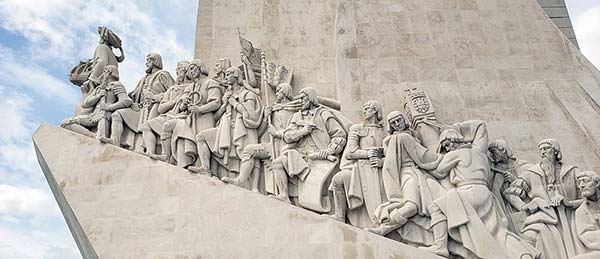
With royal backing, Portugal built a navy and began exploring the seas using technology the Arabs had left behind. These trips were motivated by spice-trade profit and a desire to Christianize Muslim lands in North Africa. From his base at Cape Sagres—at Portugal’s (and Europe’s) southwestern corner—Prince Henry the Navigator urged his sailors to go beyond what was then regarded as “the end of the world.” Thanks to new maritime inventions—such as the mariner’s astrolabe and the caravel—they finally did, slowly making their way down the coast of West Africa. In 1488, Bartolomeu Dias became the first European to sail around the tip of Africa—the Cape of Good Hope. Vasco da Gama followed the same route but continued farther, landing in India in 1498. Suddenly the wealth of all Asia opened up via a fast and cheap sea route. Much to the dismay of their competitors in Venice, Portugal’s new discoveries caused spice prices to drop to one-fifth of their former market value. For more on Prince Henry the Navigator, see here. For more on Portuguese explorations, including a map of notable Portuguese sea voyages, see here.
History comes to life when you visit a centuries-old church. Even if you wouldn’t know your apse from a hole in the ground, learning a few simple terms will enrich your experience. Note that not every church has every feature, and a “cathedral” isn’t a type of church architecture, but rather a designation for a church that’s a governing center for a local bishop.
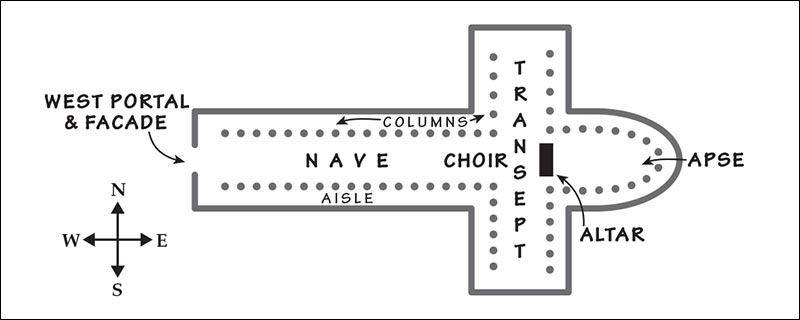
Aisles: Long, generally low-ceilinged arcades that flank the nave
Altar: Raised area with a ceremonial table (often adorned with candles or a crucifix), where the priest prepares and serves the bread and wine for Communion
Apse: Space behind the altar, sometimes bordered with small chapels
Barrel Vault: Continuous round-arched ceiling that resembles an extended upside-down U
Choir: Intimate space reserved for clergy and choir, located within the nave near the high altar and often screened off
Cloister: Covered hallways bordering a square or rectangular open-air courtyard, traditionally where monks and nuns got fresh air
Facade: Exterior of the church’s main (west) entrance, usually highly decorated
Groin Vault: Arched ceiling formed where two equal barrel vaults meet at right angles
Narthex: Area (portico or foyer) between the main entry and the nave
Nave: Long central section of the church (running west to east, from the entrance to the altar) where the congregation sits or stands during the service
Transept: One of the two parts forming the “arms” of the cross in a traditional cross-shaped floor plan; runs north-south, perpendicularly crossing the east-west nave
West Portal: Main entry to the church (on the west end, opposite the main altar)
Castles were fortified residences for medieval nobles. Castles come in all shapes and sizes, but knowing a few general terms will help you understand them.
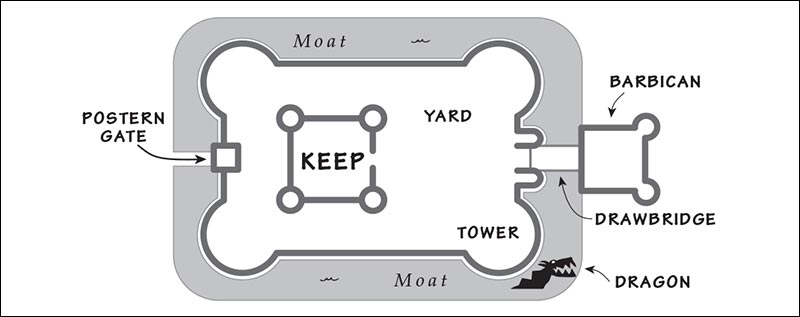
Barbican: Fortifed gatehouse, sometimes a standalone building located outside the main walls
Crenellation: Gap-toothed pattern of stones atop the parapet
Drawbridge: Bridge that could be raised or lowered using counterweights or a chain and winch
Great Hall: Largest room in the castle, serving as throne room, conference center, and dining hall
Hoardings (or Gallery or Brattice): Wooden huts built onto the upper parts of the stone walls; served as watchtowers, living quarters, and fighting platforms
Keep (or Donjon): High, strong stone tower in the center of the complex; the lord’s home and refuge of last resort
Loopholes (or Embrasures): Narrow wall slits through which soldiers could shoot arrows
Machicolation: Stone ledge jutting out from the wall, with holes through which soldiers could drop rocks or boiling oil onto wall-scaling enemies below
Moat: Ditch encircling the wall, sometimes filled with water
Parapet: Outer railing of the wall walk
Portcullis: Iron grille that could be lowered across the entrance
Postern Gate: Small, unfortified side or rear entrance; in wartime, became a sally port used to launch surprise attacks or as an escape route
Towers: Square or round structures with crenellated tops or conical roofs serving as lookouts, chapels, living quarters, or the dungeon
Turret: Small lookout tower rising from the top of the wall
Wall Walk (or Allure): Pathway atop the wall where guards could patrol and where soldiers stood to fire at the enemy
Yard (or Bailey): Open courtyard inside the castle walls
Another major event at this time was the European exploration of the coast of South America by Pedro Cabral (1500), who claimed Brazil for Portugal. Cabral was on his way to India, following Da Gama’s route, but he headed more southwest to bypass rough waters near the Gulf of Guinea. Historians have long debated whether his “discovery” was intentional or accidental, since some Portuguese sailors had previously reported spotting land on the other side of the Atlantic. In any case, Cabral’s voyage resulted in the colonization of Brazil—and more riches for Portugal.
Besides trading in spice and silk, the Portuguese also traded in human beings. The Portuguese were the first Europeans to sail to Africa, capture people living there, and bring them back to Europe for sale. In 1482, they built Elmina Castle on the coast of what is now Ghana—the first of many “slave factories” (slave trading posts) that Europeans established in western Africa. The slave trade soon shifted to the New World, where new sugar plantations created a huge demand for cheap labor. Portuguese settlements sprang up in both Guinea and Angola for slavery purposes. Ships would leave Lisbon for West Africa, pick up slaves, and then sail to Brazil, selling their captives to work on plantations and in mines. The ships would return to Portugal loaded with sugar—creating tremendous wealth for the sea captains, slave traders, and merchants.
The Portuguese had a slave-trade monopoly through the 16th century, but England and the Netherlands then began their own slave trade. Historians estimate that, before slavery ended, about 4 million captives were brought from Africa to Brazil—roughly 40 percent of all the slaves brought to the Americas.
Through trade, conquest, and, yes, slavery, tiny Portugal became one of Europe’s wealthiest and most powerful nations, with colonies stretching from Brazil to Africa to India to China. The easy money destroyed the traditional economy.
Around this same time, in 1536, the Church launched the Portuguese Inquisition. The main targets were converts of Judaism to Christianity who had been exiled from Spain. Thousands were tried and found guilty of still practicing Judaism and being heretics. Though most punishments ranged from whipping to imprisonment, many innocent people were publicly burned at the stake.
Official Name: República Portuguesa, but locals just say “Portugal.”
Size: 57,000 square miles, which include the Azores and Madeira, two island groups in the Atlantic. Population is nearly 11 million.
Geography: Portugal is 320 miles long and 135 miles wide (roughly the size and shape of Indiana). The region north of Lisbon is more mountainous, cool, and rainy. The south consists of rolling plains, where it’s hot and dry. Serra da Estrela (6,500 feet) is the highest point on the mainland, but Portugal’s highest peak is Mt. Pico (7,713 feet) in the Azores archipelago. Major rivers, most notably the Rio Tejo (or Tagus River, 600 miles long, spilling into the Atlantic at Lisbon) and the Douro (550 miles long, flowing through wine country, ending at Porto), run east-west from Spain. Portugal has 1,114 miles of coastline (including the Azores and Madeira), much of it sandy beaches.
Latitude and Longitude: 39˚N and 8˚W (similar latitude to Washington, DC, or San Francisco).
Biggest Cities: Lisbon (the capital, 550,000 in the core, with nearly 3 million in greater Lisbon), Porto (238,000 in the core, with 1.3 million total), and Coimbra and Braga (each with 144,000 in the core).
Economy: The Gross Domestic Product is about $314 billion, and the GDP per capita is around $30,500. Some major money makers for Portugal are fish (canned sardines), cork, budget clothes and shoes, port wine, and tourism. More than 25 percent of Portugal’s foreign trade is with Spain.
Government: The prime minister—currently the left-wing António Luis Santos da Costa—is the chief executive, having assumed power as the head of the leading vote-getting party in legislative elections. President Marcelo Rebelo de Sousa commands the military and can dissolve parliament when he sees fit. There are 230 legislators, elected to four-year terms, making up the single-house assembly. Regionally, Portugal is divided into 18 districts (Lisbon, Coimbra, Porto, etc.).
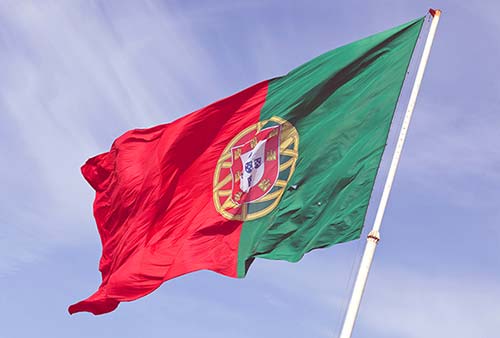
Flag: The flag is two-fifths green and three-fifths red, united by the Portuguese coat of arms—a shield atop a navigator’s armillary sphere.
Soccer: The three most popular teams are Sporting CP Lisbon, Benfica (also from Lisbon), and FC Porto.
SLOW FADE (1600-1900)
The “Spanish Captivity” (1580-1640) drained Portugal. Late in the 16th century, after the young Portuguese king, Sebastian (Dom Sebastião), died in battle without a direct heir, Portugal’s throne was up for grabs. After a short reign by Sebastian’s great-uncle (who died two years after assuming power), the Portuguese throne passed to another distant relative—the Spanish king, Philip II. Philip wanted the two countries to remain separate, and they did under his rule. But his son and grandson—who ruled after him—cared little about Portuguese autonomy, so they imposed new taxes on the Portuguese and forced Portugal’s armies to support the Spanish military agenda. After 60 years, the Portuguese nobility had had enough, and when Spanish troops were tied up in the Thirty Years’ War, the nobles launched an uprising. One of the leading nobles, the duke of Bragança, was proclaimed king, becoming João IV. Although it’s been nearly 400 years, Spain and Portugal continue to have a sibling rivalry—with Spain often acting as the arrogant older brother—though the conflicts now happen on the soccer field rather than the battlefield.
With a false economy, a rigid class system, and the gradual loss of its profitable colonies, Portugal was no match for the rising powers of Spain, England, Holland, and France. The earthquake of 1755 (see here) and Napoleon’s invasions during the Peninsular War (1808-1814) were devastating. Portugal was a traditional ally of England, and when Napoleon demanded that Portuguese merchants stop trading with England, they refused. Napoleon sent his army through Spain to invade Portugal, where his troops ravaged the countryside. A French coup then placed Napoleon’s brother on the Spanish throne, causing a revolt across the Iberian Peninsula. British troops retook Lisbon, and a six-year, back-and-forth struggle eventually ended in Napoleon’s defeat.
While the rest of Europe industrialized and democratized, Portugal lingered as an isolated, rural monarchy living off meager wealth from Brazilian gold and sugar. Eventually, the country lost its largest colony in 1822, when Brazil revolted (with the support of the son of the Portuguese king). But Portugal still had a string of colonies across Africa and Asia, including Portuguese Guinea, Angola, Mozambique, Goa, Macau, and Portuguese Timor.
DICTATORSHIP AND DEMOCRACY (1900-2000)
Republican rebels overthrew the king in 1910, founding a republic and abolishing the monarchy, but democracy was slow to establish itself in Portugal’s near-medieval class system. During World War I, Portugal joined the Allies, partly to protect its African colonies from the Germans.
The postwar years resulted in political turmoil. A series of military-backed democracies culminated in four decades of António de Oliveira Salazar’s “New State,” a right-wing regime benefiting the traditional upper classes. For 36 years, the former professor ruled Portugal under an authoritarian regime that banned political parties and independent labor unions. A fascist system of censorship, propaganda, and oppression kept society in order. When opposition arose, the secret police (a.k.a. PIDE—Polícia Internacional e de Defesa do Estado) imprisoned and tortured dissidents. (For more on Salazar, see here.)
According to Portuguese historians, Salazar didn’t trust Hitler and didn’t think the Germans could win World War II. He kept Portugal neutral, even allowing the British to use naval bases in the Azores under an old Anglo-Portuguese treaty. After the war, Portugal was a founding member of NATO—the only dictatorship allowed into the organization at its birth. Salazar wasn’t your typical corrupt dictator. As a young man, he considered becoming a priest; as Portugal’s leader he continued to be modest, pious, and celibate. Salazar—Europe’s longest-serving dictator—ran Portugal until 1968, when he had a stroke and later died.
Salazar’s repressive tactics and unpopular wars abroad (trying to hang on to Portugal’s colonial empire) sparked the Carnation Revolution of 1974. A little after midnight on April 25, army rebels rolled into Lisbon, and by sunrise the military had taken control from Salazar’s successors. They promised to restore citizens’ civil liberties and conduct general elections as soon as possible. The coup was nearly bloodless. Residents disobeyed commands to stay in their homes, and instead people flooded the streets in support of the rebels, placing carnations into the barrels of the soldiers’ guns as a sign of peace (hence the name “Carnation Revolution”; for more on this, see here).
The new regime worked quickly to free Portugal’s colonies. Within a few years, Guinea-Bissau, Mozambique, Cape Verde Islands, São Tomé and Principe, and Angola all became independent. After some initial political and economic chaos, Portugal finally adopted actual democracy. Imagine: In just a dozen years, Portugal went from the isolation of four decades of fascism (when the Salazar dictatorship slogan was “We are proudly alone”) to full membership in the European Union (in 1986).
PORTUGAL TODAY: AUSTERITY AND CHALLENGE
The early years of the 21st century were heady days for Portugal. The former backwater was suddenly booming—building superhighways, handing out lavish bonuses to workers, and buying fancy consumer goods from the rest of Europe. Scaffolding was everywhere as the Portuguese scrambled to finish projects funded in part by the European Union.
The EU has worked to bring relatively poor regions (like much of Portugal) up to par with more-developed parts of Europe through matching grants and cheap construction loans. As part of the EU, Portugal was considered a low-risk bet for lenders, keeping interest rates artificially low. But with the 2009 debt crisis, money became tight worldwide, and lenders began assessing each country on its individual merits. The risk of lending to Portugal shot up—and so did interest rates.
The economy was floundering, with unemployment skyrocketing, especially for those under 25 years old. Infrastructure projects such as a high-speed bullet train from Madrid to Lisbon, an additional runway for Lisbon airport, and superhighway expansion were put on indefinite hold while investment went into improving tourism services.
In 2011, the EU approved a €78 billion bailout package, but with it came the requirement for strict austerity measures. Road tolls rose, health care saw cutbacks, and new taxes were levied. The retirement age rose from 65 to 66, and rent control (a remnant of the Salazar period) came to an end. While necessary, this change spurred a huge spike in rents—causing financial stress for older people, pushing out small shops, and threatening to change the character of traditional neighborhoods.
The country successfully completed the bailout program in 2014. The result: a booming economy, with unemployment dropping to a manageable eight percent. During the lean times, thousands of highly trained young people left Portugal to seek opportunity elsewhere, but in recent years many have been tempted back home. Now it remains to be seen how Portugal will deal with the social and economic fallout of the coronavirus pandemic.
Even as Portugal struggles with its contemporary challenges, it remains open and warmly welcoming to outsiders. A visit to today’s Portugal lets you personally experience the latest chapter in an epic story.