PORTUGAL
Map: Portugal’s Top Destinations
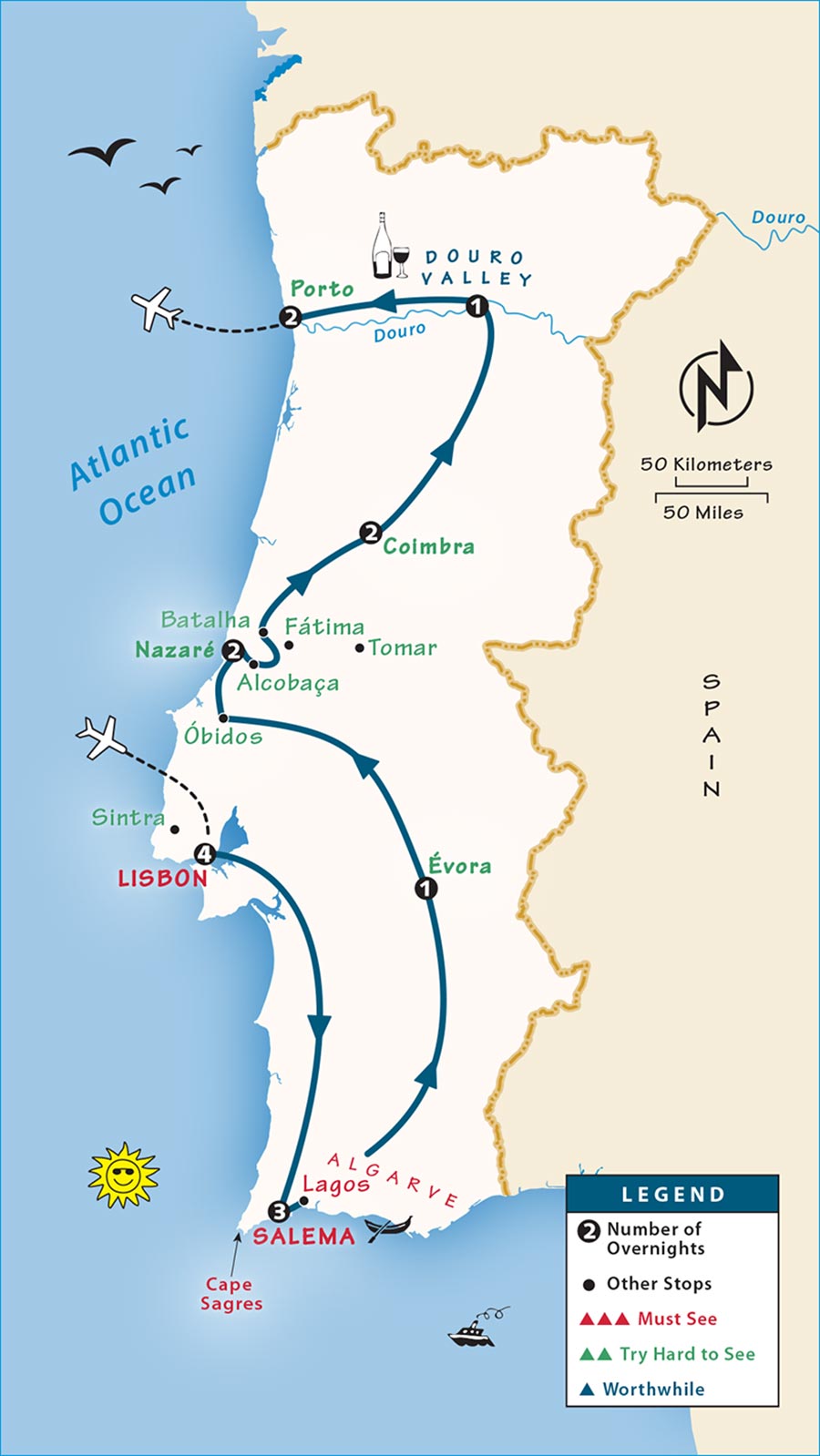
Map: Portugal’s Best Two-Week Trip by Car
The Atlantic was the source of Portugal’s seafaring wealth long ago, and remains the draw for tourists today. Buoyed by fresh seafood, hardworking fisher-folk, and miles of sunny coastline, the country’s maritime spirit lives on.
Perched on the Atlantic on the far edge of Europe, Portugal preserves a salty, traditional culture. Gnarled fishermen still mend their nets, and rustically clad women sell fish and produce in markets. Wherever you go, you’re never far from the sea.
But you’ll also experience modern, urban Portugal—with rejuvenated cityscapes, upscale boutiques, and a surging cuisine scene—especially in the culturally rich capital of Lisbon and the second city of Porto. The cities have a worldly buzz: You can munch barnacles bought from a street vendor on a breezy tiled square, or sit down with gastronomic pilgrims for a feast in foodie heaven.
Portugal seems somewhere just beyond Europe—and the pace of life is noticeably slower. While membership in the European Union has brought sweeping changes here, the traditional economy is still based on fishing, cork, wine, textiles, and tourism.
From a traveler’s perspective, Portugal is greater than the sum of its parts. The country has few blockbuster sights. Its cities—while increasingly revitalized—still come with rough edges. Even its ritziest coastal towns are humble, lacking major attractions. And yet the country offers a heady mix—of warmhearted people, vivid culture, dramatic viewpoints, terraced vineyards, and (of course) sun-drenched beaches—that makes traveling here a delight.
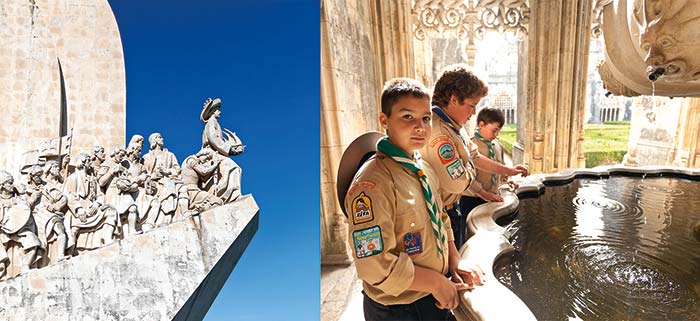
Celebrating history: Monument to the Discoveries (Lisbon) and Monastery of Santa Maria (Batalha)
Portugal is one of Europe’s first modern nation-states.
Long before Spain famously expelled its North African Muslim rulers in 1492, Portugal bucked the Moors, establishing its present-day borders (unchanged now for 800 years). Alonso Henriques, who helped chase out the Moors, was officially recognized as the country’s first king in 1179.
Several centuries later, Portugal became one of the world’s richest nations during its Age of Discovery (1400-1600). Explorers such as Vasco da Gama discovered new trade routes and lands to colonize. To this day, Portugal is ethnically diverse, inhabited by many people from its former colonies in Brazil, Africa, and Asia.
The bounty from Portugal’s colonies financed an explosion of the arts back home. The finest architecture from the country’s golden age is in Lisbon, represented by Belém’s tower and monastery (in a style called “Manueline,” after King Manuel I). Other great monasteries—with grand tombs and restful tiled cloisters—are north of Lisbon, in Batalha and Alcobaça. Portugal peaked with the wealth harvested from its colonies. As its empire faded, so did the country’s power and affluence.
Saudade—a deep, yearning nostalgia for something you love but that’s forever gone—is a characteristic emotion of the Portuguese people. These days, Portugal is small...“just us and the Atlantic Ocean,” they say. Poets and artists see saudade in melancholy people, well-worn yet still ornate buildings, lampposts, fado songs, and even in port wine.
Portuguese cuisine is sightseeing for your palate—flavored with ingredients and spices originally brought from countries spanning its 15th-century trade routes, including Africa, the Far East, India, and Brazil. One example is piri-piri sauce, made from crushed African chiles—equally delicious on chicken, shrimp, and pork.
You can eat well in mom-and-pop restaurants for about €10, especially outside Lisbon. Bars and cafés are handy for quick snacks. Note that appetizers brought to the table before you’ve ordered are not free—the mini buffet of olives, bread, and other tasty temptations are usually about €1 each. (If you don’t want them, ignore them. Later you can have them taken away.)
The Portuguese are among the world’s biggest seafood eaters.
Boiled gooseneck barnacles, called percebes, are a salty delicacy (fresh April-Sept). They’re sold on coastal town streets and in bars as munchies. To eat them, just twist, rip, and bite. They’re expensive because they’re so dangerous to harvest—they grow on rocky promontories in narrow inlets where the waves and currents are fierce.
Seek out fish soup (sopa de peixe), shellfish soup (sopa de mariscos), and bacalhau à Brás, a sort of cod frittata with potatoes, onions, and herbs. For a seafood blowout, look for cataplana (a feast from the sea, simmered in a copper pot). Or, simpler and cheaper, dine on grilled sardines (sardinhas grelhadas). For a mix of surf and turf, carne de porco à Alentejana is an interesting combination of pork and clams—and Portugal’s unique contribution to world cuisine. Bacalhau—codfish that’s dried, salted, and then rehydrated and served a reputed 365 different ways—is the national dish. It’s a soupy culture, and the standard is caldo verde—a tasty garlic-infused kale-and-potato soup usually topped with a slice of sausage.
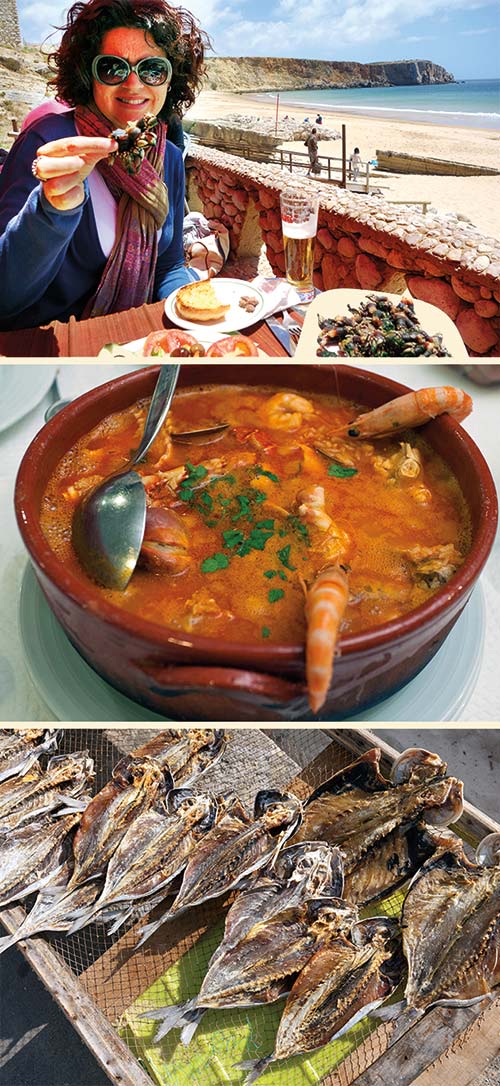
Sample the culinary pleasures of Portugal: barnacles (a bar snack good with beer), tasty seafood stew, and versatile cod. Codfish (bacalhau) is dried, then rehydrated, to make many different dishes.
Like their Spanish neighbors, the Portuguese use plenty of olive oil, produce delicious cheeses (such as the top-quality Serra da Estrela), and love presunto, their air-cured ham (porco preto—from black ibérico pigs in Alentejo—is tops).
Try regional specialties wherever you go. The Alentejo region (Évora) has a rustic, hearty cuisine heavy on pork and red wine. In Beira (Coimbra), specialties include suckling pig (leitão) and baby goat (cabrito). In Porto, a specialty to sample—or perhaps avoid—is tripas à moda do Porto, a thick stew of tripe, chicken, beans, and vegetables. Porto’s beloved gut-bomb, the francesinha sandwich, is stuffed with pork, sausages, and cheese, grilled, topped with more melted cheese and often a fried egg, then drenched with spicy sauces.
Pair your cuisine with regional wines, and for dessert seek out local pastries, such as a white-bean tart (pastel de feijão) in Nazaré, or a sweet, eggy pastry (pastel de Tentúgal) in Coimbra. A national favorite is the custard tart, pastel de nata (called pastel de Belém in Lisbon’s fancy suburb of the same name). You’ll also find heavenly concoctions made from egg yolk and sugar, such as barriga de freiras (nuns’ belly) and papo de anjo (angel’s double chin).
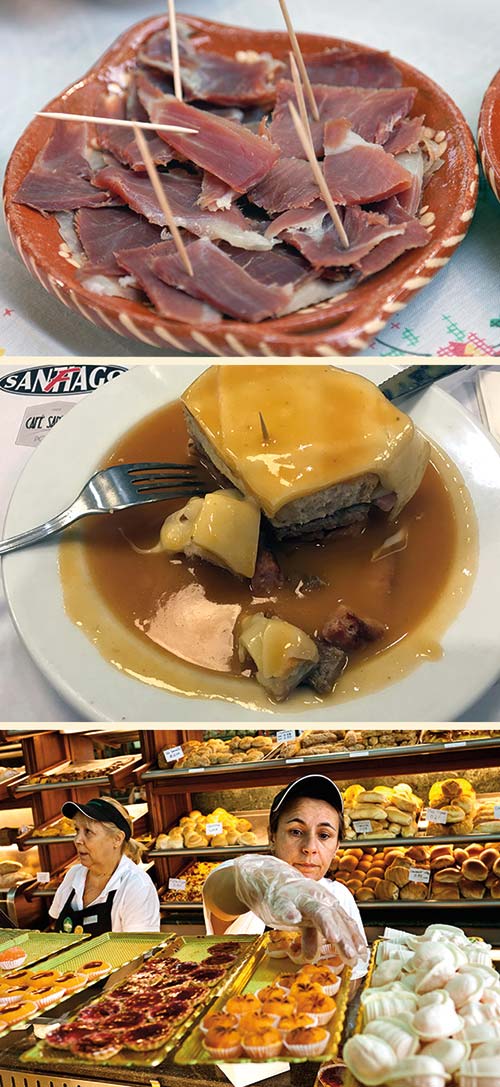
Portuguese enjoy the best air-cured ham, Porto’s gooey francesinha sandwiches, and Lisbon’s warm custard tarts, sprinkled with cinnamon and powdered sugar.
Along with Spain in the 20th century, Portugal suffered through fascist-style rule longer than the rest of Europe: From 1932 to 1974, Portugal endured the repressive regime of António de Oliveira Salazar and his successor Marcelo Caetano—the longest dictatorship in Western European history. This put the country in an economic hole from which it’s still struggling to emerge. When Portugal became part of the European Union (just 12 years after the end of the dictatorship), it was Western Europe’s poorest country.
The EU spurred great investment in Portugal, helping to bring its economy up to speed. But that money came with strings attached, and—especially following the Great Recession—Portugal found itself struggling to repay EU loans. It’s proved challenging to maintain generous social services, keep taxes reasonable, and reduce unemployment. Poverty still exists, particularly in rural areas, but overall, the country is more prosperous than a generation ago. Prices remain low—Portugal is one of the most affordable places to travel in
Western Europe.
For a small country, Portugal has many iconic symbols. Azulejos, the colorful, typically blue-hued tiles that seem to decorate every surface, are a Portuguese art form you’ll never tire of seeing. They are as practical in this hot climate (for their cooling properties) as they are beautiful. Only Portugal offers haunting fado music, capturing the sorrowful feeling of saudade in song. The country’s heartland—the arid Alentejo—cultivates cork trees to produce that famously versatile material.
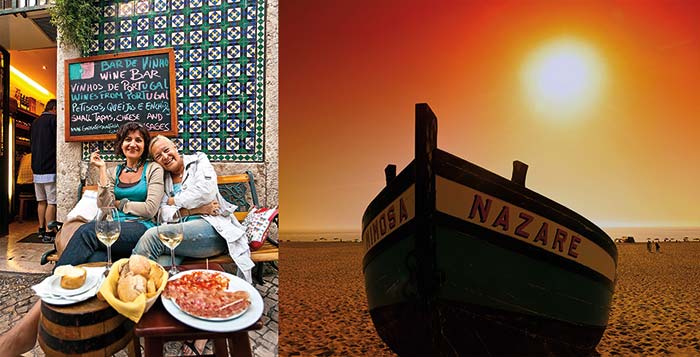
Enjoying a café stop (framed by azulejo tilework); a Nazaré sunset
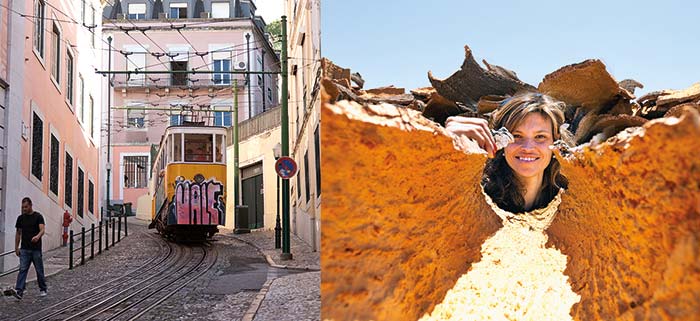
A trolley ride in Lisbon; a cork harvest in the Alentejo heartland
To make good use of all those corks, northern Portugal produces the fortified, aged wine called port. And lovably rickety old trolleys trundle footsore commuters and visitors up and down the hills of Lisbon and Porto. While seemingly clichéd, these are all authentic slices of Portuguese life—each with its own backstory, which proud locals love to tell.
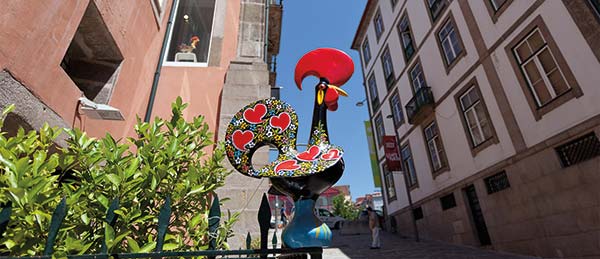
All over Portugal, you’ll see the country’s mascot: the Rooster of Barcelos, with colorful designs on his black body and a proud red pompadour. Inspired by the legend of a roo-ster who came back from the dead to prove the innocence of an unjustly accused man, it symbolizes justice and good luck—and is a souvenir-stand staple.
If your idea of good travel includes friendly locals (who generally speak English), a rich culture, affordable prices, a thriving urban scene, seaside resort towns, and fresh seafood with chilled white wine on a beach at sunset...you’ve chosen the right destination.
Portugal’s Top Destinations
There’s so much to see in Portugal and so little time. This overview categorizes the country’s top destinations into must-see places (to help first-time travelers plan their trip) and worth-it places (for those with extra time or special interests). I’ve also suggested a minimum number of days to allow per destination.
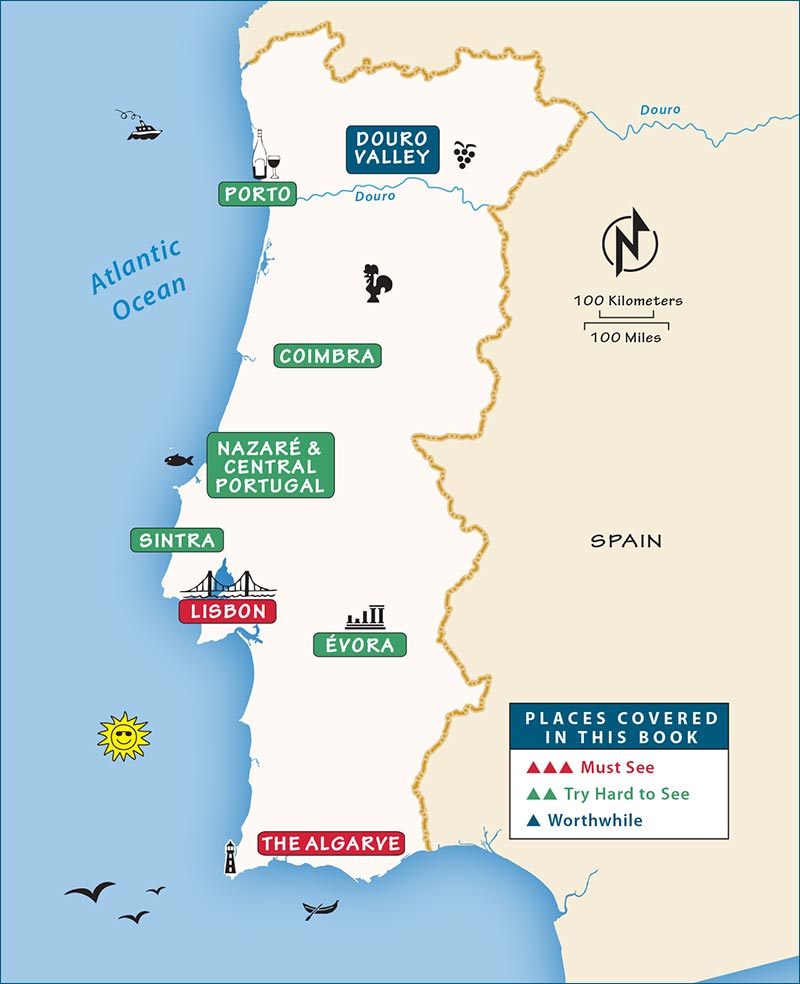
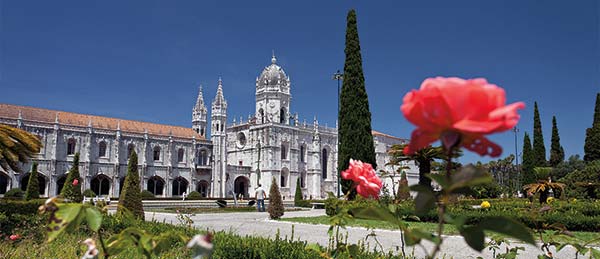
MUST-SEE DESTINATIONS
With limited time, prioritize Portugal’s biggest city and its southern coast. If you have just a week for Portugal, these destinations will fill your time wonderfully.
▲▲▲Lisbon (allow 2-3 days)
Portugal’s lively, hilly port and capital city has fascinating, distinctive neighborhoods: the flat downtown Baixa, flanked by the hill-topping Bairro Alto (with lots of cafés) and the castle-capping Alfama (the old sailors’ quarter, with Mediterranean views). The city’s neighborhoods—dotted with museums, inviting eateries, and squares grand and small—are connected by historic trolleys and mosaic sidewalks. The soundtrack of the night is a mix of happy eaters and soulful fado.
The nearby suburb of Belém, just a trolley ride away, is home to the 16th-century Monastery of Jerónimos, maritime and coach museums, the Monument to the Discoveries, and the namesake custard tarts—pastel de Belém.
▲▲▲The Algarve (2 days)
The country’s southern coast is strung with villages, historic sights, and sandy beaches with seascapes.
My favorite destination on the coast is the fishing village of Salema, with the region’s best beach and easygoing restaurant scene. Nearby is the historic “end of the road”—Cape Sagres—where Henry the Navigator founded his school and organized far-ranging expeditions.
The party town of Lagos is the transit hub of the coast, with beaches and boat tours. The river-straddling village of Tavira, with a fun beach island a boat ride away, makes a pleasant stop between Lagos and Spain.
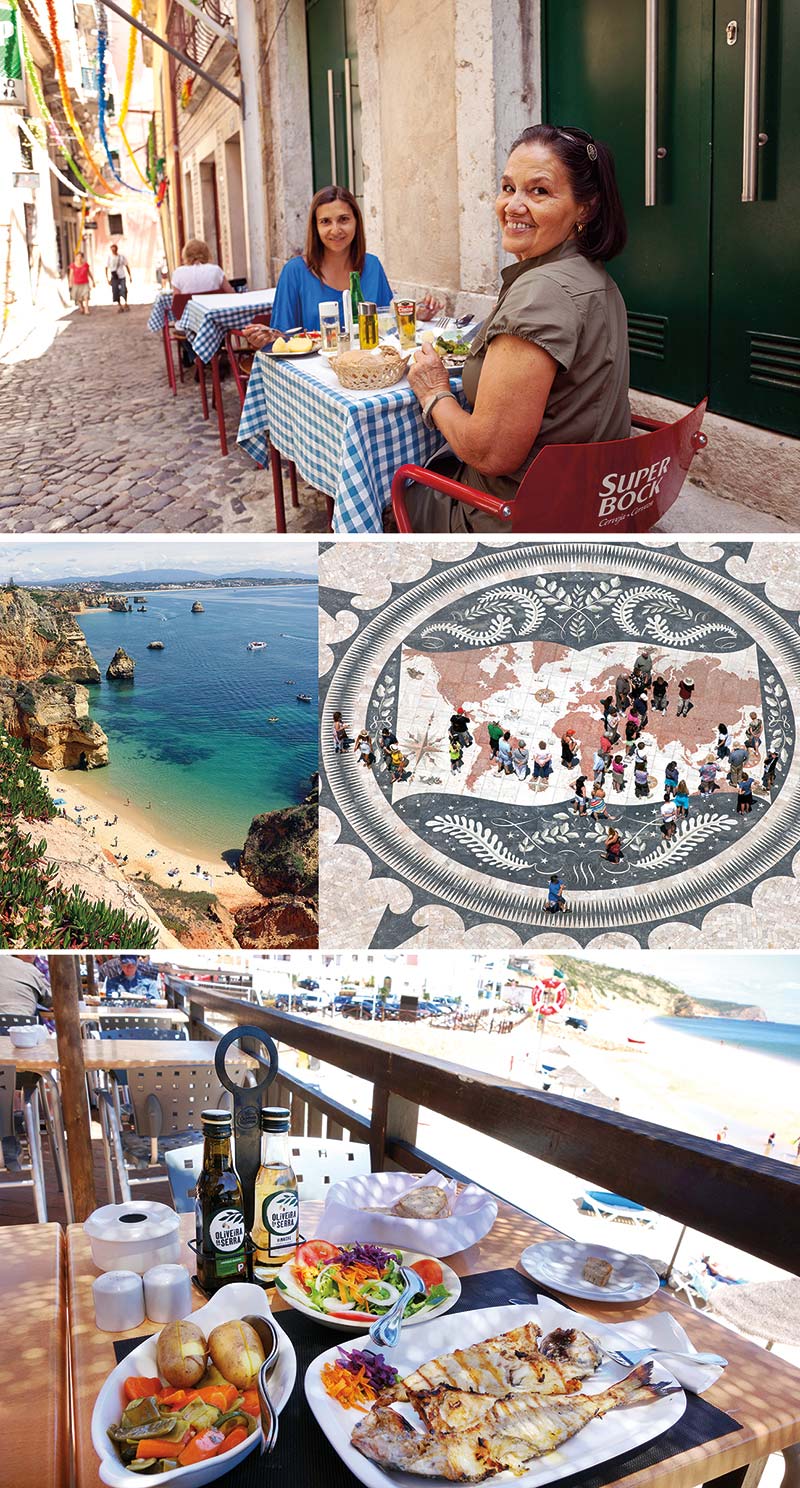
Monastery of Jerónimos (opposite); lunch in Lisbon’s Alfama; world map at Monument to the Discoveries; seafront dining in Salema; Algarve beach
WORTH-IT DESTINATIONS
You can weave any of these destinations—rated ▲ or ▲▲—into your itinerary. It’s easy to add some destinations based on proximity (if you’re going to Lisbon, Sintra is next door), but some out-of-the-way places can merit the journey, depending on your time and interests.
▲▲Sintra (half-day)
Formerly an aristocratic retreat, the town is famous for its fairy-tale castles dotting the hilly terrain. Sintra makes a great day trip by train from Lisbon.
▲▲Évora (1 day)
Encircled by medieval walls, this college town is riddled with history, from a prehistoric stone circle (nearby), ancient Roman temple, 12th-century cathedral, medieval chapel of bones, and 16th-century university, to a lively market street dating from Roman times.
▲▲Nazaré & Central Portugal (2 days)
Nazaré, a traditional fishing village turned small-town Atlantic resort, makes an ideal beach break. It’s also a jumping-off point for day trips to the monastery at Batalha, the Fátima pilgrimage site, Portugal’s largest church in Alcobaça, the Knights Templar complex in Tomar, and the cute, touristy walled town of Óbidos.
▲▲Coimbra (1 day)
Portugal’s Oxford bustles with students from its prestigious university; the historic section is open to visit. The Arab-flavored old town is fun to explore by day and the place to go at night, especially for fado, sung here by young men.
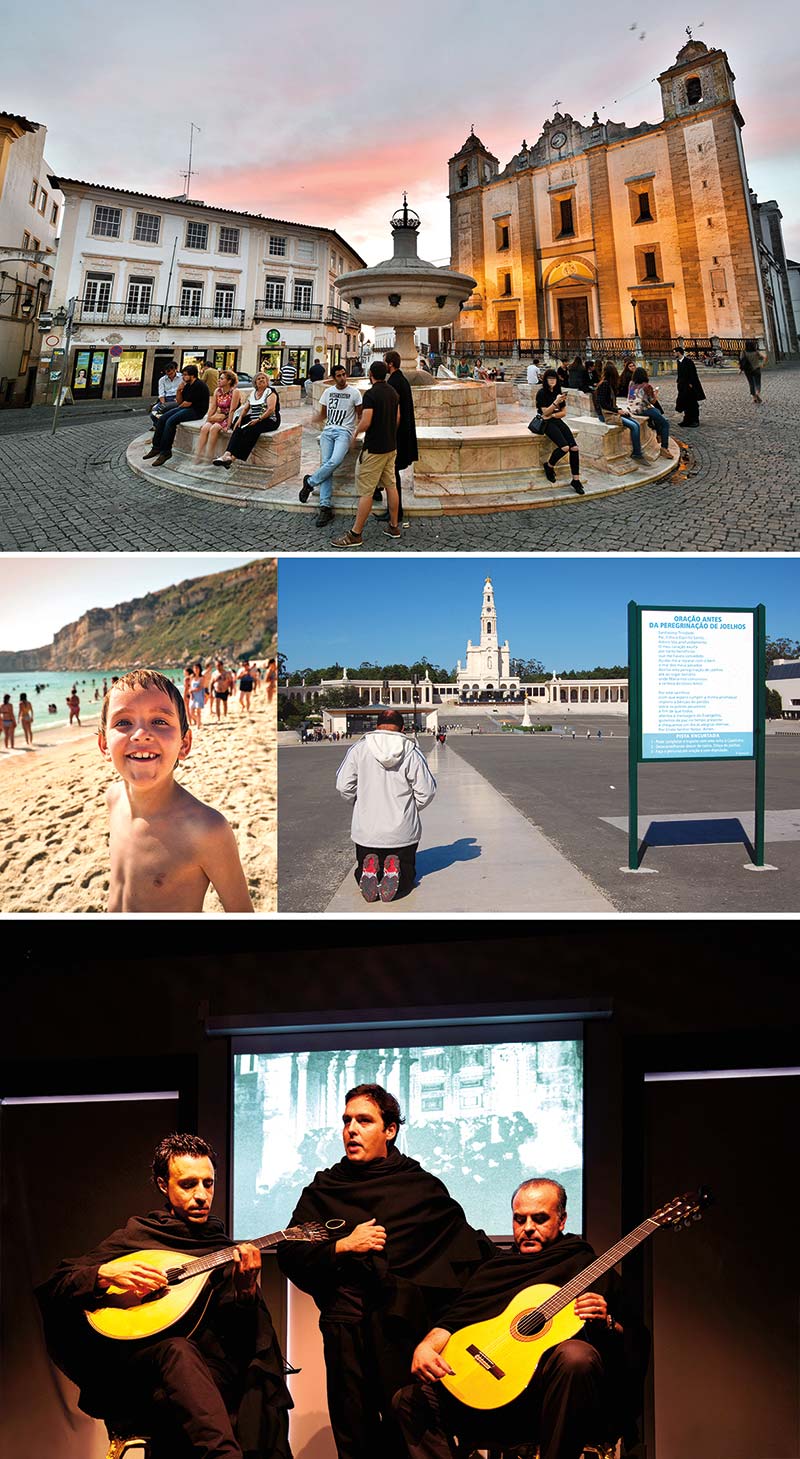
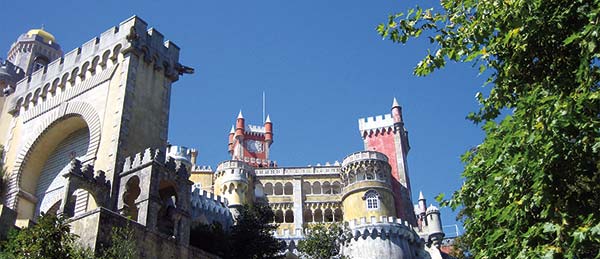
Sintra’s Pena Palace (opposite); Évora evening scene; pilgrim at Fátima; fado performance in Coimbra; Nazaré beach fun
▲▲Porto (1-2 days)
Portugal’s gritty but up-and-coming second city hosts steep and picturesque neighborhoods, a scenic riverfront, lively shopping streets, port-wine tastings, and boat tours of the Douro Valley.
▲Douro Valley (1 day)
The pretty terraced valley—the birthplace of port wine—is lined with ample countryside quintas (farms with vineyards), offering tastings and accommodations.
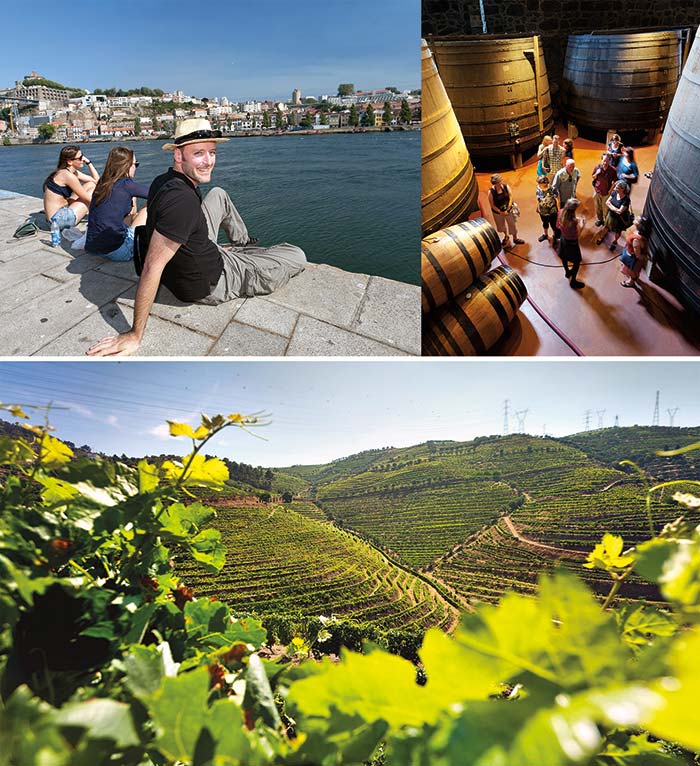
Riverfront perch in Porto; port wine tasting tour in Porto; the origin of port wine—terraced vineyards in the Douro Valley
Planning Your Trip
To plan your trip, you’ll need to design your itinerary—choosing where and when to go, how you’ll travel, and how many days to spend at each destination. For my best general advice on sightseeing, accommodations, restaurants, and more, see the Practicalities chapter.
DESIGNING AN ITINERARY
As you read this book and learn your options...
Choose your top destinations.
My recommended itinerary (see the sidebar on the next page) gives you an idea of how much you can reasonably see in two weeks, but you can adapt it to fit your own interests and time frame.
If you love what big cities have to offer—great sights and museums, lively neighborhoods, an enticing array of eateries, and ample nightlife—you could easily linger for a week in Lisbon. And several sights are within easy day-tripping distance of Lisbon: Sintra, Évora, and Óbidos.
Historians will find much to study in Portugal: ancient Roman ruins (Évora), medieval monasteries (Batalha and Alcobaça), knight sights (Tomar), castles and palaces (Sintra is tops), and remnants from the country’s Age of Discovery and golden age (in Belém and Cape Sagres). To witness a pilgrimage, visit Fátima when the pilgrims do (every 12th and 13th, May-Oct).
Art lovers are drawn to Lisbon’s Gulbenkian Museum. Connoisseurs of port savor Porto, the Douro Valley’s quintas, and Lisbon. For a youthful university vibe, visit Coimbra. Beach baskers happily unroll their towels in Salema or Nazaré—some never want to leave. Photographers want to go everywhere.
| Day | Plan | Sleep |
|---|---|---|
| 1 | Arrive in Lisbon | Lisbon |
| 2 | Sightsee Lisbon | Lisbon |
| 3 | Lisbon | Lisbon |
| 4 | Optional side trip to Sintra by train | Lisbon |
| 5 | Morning in Lisbon; in the afternoon, pick up car and drive to the Algarve (3 hours) | Salema |
| 6 | Beach day in Salema | Salema |
| 7 | Side trip to Cape Sagres and more beach time | Salema |
| 8 | To Lagos (30 minutes), then Évora (3 hours) | Évora |
| 9 | Morning in Évora; afternoon to Nazaré via Óbidos (3 hours) | Nazaré |
| 10 | Nazaré | Nazaré |
| 11 | To Coimbra (2 hours) with possible stops in Alcobaça, Batalha, Fátima, or Tomar | Coimbra |
| 12 | Coimbra | Coimbra |
| 13 | To Douro Valley (2.5 hours) | Douro Valley |
| 14 | To Porto (2 hours), drop off car | Porto |
| 15 | Porto | Porto |
| 16 | Fly home |
For Drivers: Driving times are estimates and could be longer in bad traffic. If you plan to fly home from Lisbon, park your car while in Porto, then drive to the Lisbon airport (about 3 hours) and drop it there.
By Bus and Train: Using public transportation, modify the itinerary as follows: From Lisbon, take the bus to Salema (change in Lagos). Take the bus or train to Évora (with transfers). From Évora, bus to Nazaré (changing in Lisbon). Using Nazaré as your home base, see your choice of nearby sights (Alcobaça, Batalha, and Fátima; add an extra night to fit in everything), or skip the sights as it’s less efficient without your own wheels. Or consider spending the night in far-flung Tomar before heading to Coimbra. From Nazaré, take the bus straight to Coimbra. From Coimbra, catch the train to Porto. Visit the Douro Valley on a daylong boat tour from Porto. Fly out of Porto or return to Lisbon by train for your flight out.
Decide when to go.
Spring and fall offer the best combination of good weather, light crowds, long days, and plenty of tourist and cultural activities.
Summer months are the most crowded and expensive in the coastal areas. Beach towns (such as Nazaré or along the Algarve) are packed with vacationers in July and especially in August—when rates go sky-high and it can be tough to find a room. Those same towns are a delight in shoulder season (mid-May-June and Oct), when the weather is nearly as good and the crowds subside—but they can be dreary and pretty lifeless in the winter.
In the off-season (roughly Nov-March), expect shorter hours, more lunchtime breaks at sights, and fewer activities; confirm your sightseeing plans locally.
For weather specifics, see the climate chart in the appendix.
Connect the dots.
Link your destinations into a logical route. For a Portugal-only trip, you’d likely fly into and out of Lisbon (although Porto has growing service from its international airport). For an Iberian trip, you could, say, fly into Barcelona and out of Lisbon. Begin your search for transatlantic flights at Kayak.com.
Decide if you’ll travel by car or public transportation, or a combination. A car gives you the freedom to stop whenever you want, but is useless in big cities (pick up the car after visiting Lisbon). Portugal is compact and well-connected by good roads; you’ll pay tolls to use the superhighways, but it’s worth it for the time saved.
If relying on public transportation, buses are usually your best bet, though some train routes are useful, particularly the Lisbon-Coimbra-Porto line. With more time, everything is doable without a car.
To determine approximate travel times between destinations, study the driving map in the Practicalities chapter or check Google Maps. The durations of bus and train journeys are given in this book (in the “Connections” sections of each chapter); as for schedules, confirm bus departures locally and see Bahn.com for trains. For travel beyond Portugal, check budget intra-European flights at Skyscanner.com.
Write out a day-by-day itinerary.
Figure out how many destinations you can comfortably fit in your time frame. Don’t overdo it—few travelers wish they’d hurried more. Allow enough days per stop (see estimates in “Portugal’s Top Destinations,” earlier). Minimize one-night stands. It can be worth taking an evening drive or bus ride to settle into a town for two consecutive nights—and gain a full uninterrupted day for sightseeing. Include sufficient time for transportation; major destinations are roughly two to three hours apart by car (a little longer by bus or train, especially when transfers are necessary).
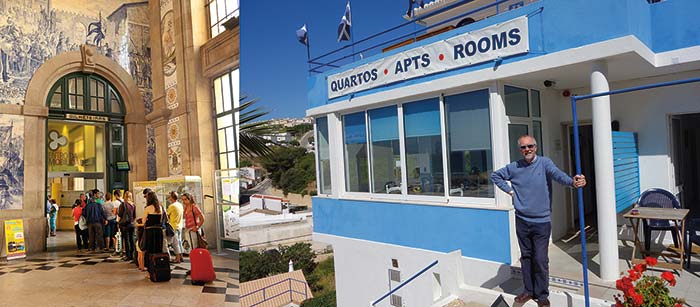
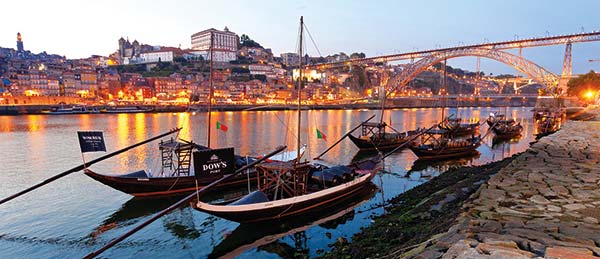
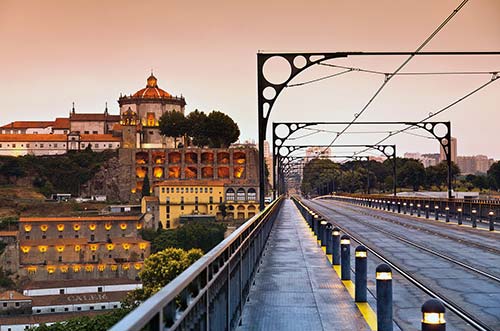
Ponte Luis I Bridge at sunset in Porto (opposite); Porto’s elegantly tiled São Bento train station; rooms for rent in Salema
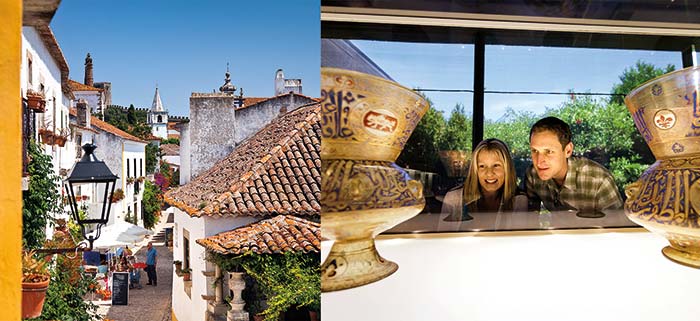
The adorable town of Óbidos; appreciating art in Lisbon’s Gulbenkian Museum
Staying in a home base (like Lisbon) and taking day trips can be more time-efficient than changing locations and hotels.
Take sight closures into account. Avoid visiting a town on the one day a week its must-see sights are closed; for example, give Lisbon and Porto a miss on Monday (or plan activities other than museums).
Check if any holidays or festivals fall during your trip—these attract crowds and can close sights (for the latest, visit Portugal’s tourist website, www.visitportugal.com). Note major sights where reservations are smart or a free Rick Steves audio tour is available.
Give yourself some slack. Every trip, and every traveler, needs downtime for doing laundry, picnic shopping, people-watching, and so on. Pace yourself. Assume you will return.
Run a reality check on your dream trip. You’ll have major transportation costs in addition to daily expenses.
Flight: A round-trip flight from the US to Lisbon costs about $900-1,500, depending on where you fly from and when.
Public Transportation: For a two-week trip, allow $300 for buses and second-class trains ($400 for first class).
Car Rental: Allow $350-500 per week (booked well in advance), not including tolls, gas, parking, and insurance.
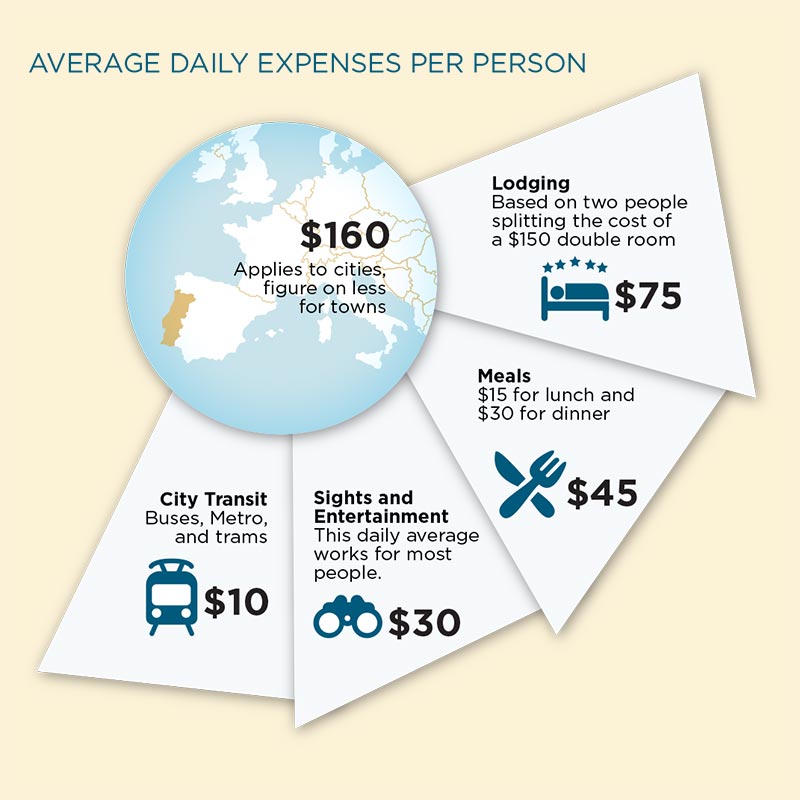
To cut your daily expenses, take advantage of the deals you’ll find throughout Portugal and mentioned in this book.
Buses are often more flexible and affordable than trains, and sometimes the only choice on certain routes. It’s economical to buy bus and train tickets as you go. Rail passes are a waste of money for a Portugal-only trip.
Some businesses—especially hotels and walking-tour companies—offer discounts to my readers (look for the RS% symbol in the listings in this book).
Reserve your rooms directly with the hotel. Some hotels offer a discount if you pay in cash and/or stay three or more nights (check online or ask).
Rooms can cost less outside of peak-season summer. In resort towns, consider quartos (a room in a private home) for a low-cost alternative to hotels. And even seniors can sleep cheap in hostels (most have private rooms) for about $30 per person. Or check Airbnb-type sites for deals.
It’s no hardship to eat inexpensively in Portugal. You can get tasty, affordable meals at cafés, bars, bakeries, and takeout shops. Cultivate the art of picnicking in atmospheric settings.
When you splurge, choose an experience you’ll always remember, such as a food-tasting tour or a fado concert. Minimize souvenir shopping; focus instead on collecting wonderful memories.
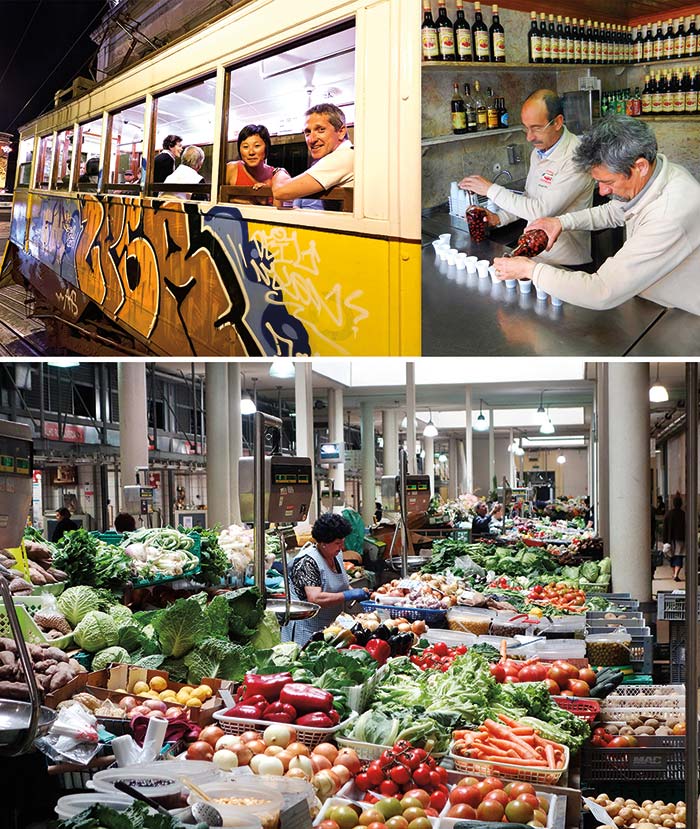
Trolley ride; ginjinha tasting at a Lisbon bar; market scene in Coimbra
BEFORE YOU GO
You’ll have a smoother trip if you tackle a few things ahead of time. For more details on these topics, see the Practicalities chapter and RickSteves.com, which has helpful travel-tip articles and videos.
Make sure your travel documents are valid. If your passport is due to expire within six months of your ticketed date of return, you need to renew it. Allow six weeks or more to renew or get a passport (www.travel.state.gov). Check for current Covid entry requirements, such as proof of vaccination or a negative Covid-19 test result.
Arrange your transportation. Book your international flights. Overall, Kayak.com is the best place to start searching for flights. Figure out your transportation options: If renting a car, reserve it before you go. (If relying on trains and buses, buy tickets in Portugal.) Drivers: Consider bringing an International Driving Permit (sold at AAA offices in the US, www.aaa.com) along with your license. If traveling beyond Portugal, book any cheap European flights you’ll need. (You can wing it once you’re there, but it may cost more.)
Book rooms well in advance, especially if your trip falls during peak season or any major holidays or festivals.
Reserve ahead for crowded sights. To save time in line, purchase tickets online for the Pena Palace (timed entry), Moorish Castle, and National Palace a few days before your visit. It’s also smart to reserve a timed-entry ticket for King João’s Library—the highlight of the university in Coimbra.
Hire local guides in advance. Reserve ahead by email; popular guides can get booked up.
Consider travel insurance. Compare the cost of insurance to the cost of your potential loss. Check whether your existing insurance (health, homeowners, or renters) covers you and your possessions overseas.
Call your bank. Alert your bank that you’ll be using your debit and credit cards in Europe. Ask about transaction fees, and, if you don’t already have one, get a “contactless” credit card (request your card PIN, too). You don’t need to bring euros for your trip; you can withdraw euros from cash machines in Europe.
Use your smartphone smartly. Sign up for an international service plan to reduce your costs, or rely on Wi-Fi in Europe instead. Download any apps you’ll want on the road, such as maps, translators, transit schedules, and Rick Steves Audio Europe (see sidebar).
Pack light. You’ll walk with your luggage more than you think. I travel for weeks with a single carry-on bag and a day pack. Use the packing checklist in the appendix as a guide.
Travel smarter with these free, fun resources:
Rick Steves Classroom Europe, a powerful tool for teachers, is also useful for travelers. This video library contains about 500 short clips excerpted from my public television series. Enjoy these videos as you sort through options for your trip and to better understand what you’ll see in Europe. Check it out at Classroom (just enter a topic to find everything I’ve filmed on a subject).

Rick Steves Audio Europe, a free app, makes it easy to download my audio tours and listen to them offline as you travel. For this book (look for the  ), my “Lisbon City Walk” audio tour covers sights and neighborhoods in Lisbon. The app also offers interviews (organized by country) from my public radio show with experts from Europe and around the globe. Find it in your app store or at RickSteves.com/AudioEurope.

Travel Smart
If you have a positive attitude, equip yourself with good information (this book), and expect to travel smart, you will.
Read—and reread—this book. To have an “A” trip, be an “A” student. Note opening hours of sights, closed days, and any crowd-beating tips. Check the latest at RickSteves.com/update.
Be your own tour guide. As you travel, get up-to-date info on sights, reserve tickets and tours, reconfirm hotels and travel arrangements, and check transit connections. Visit local tourist information offices (TIs). Upon arrival in a new town, lay the groundwork for a smooth departure; confirm the road, bus, or train you’ll take when you leave.
Outsmart thieves. Pickpockets abound in crowded places where tourists congregate (like Lisbon’s trolley cars). Treat commotions as smokescreens for theft. Keep your cash, credit cards, and passport secure in a money belt tucked under your clothes; carry only a day’s spending money in your front pocket or wallet. Don’t set valuable items down on counters or café tabletops, where they can be quickly stolen or easily forgotten.
Minimize potential loss. Keep expensive gear to a minimum. Bring copies or take photos of important documents (passport and cards) to aid in replacement if they’re lost or stolen. Back up photos and files frequently.
Beat the summer heat. If you wilt easily, choose a hotel with air-conditioning, start your day early, take a midday siesta, and resume your sightseeing later. Churches offer a cool haven. Take frequent breaks.
Guard your time and energy. Taking a taxi can be a good value if it saves you a long wait for a cheap bus or an exhausting walk across town. To avoid long lines, follow my crowd-beating tips, such as making reservations, or sightseeing early or late.
Be flexible. Even if you have a well-planned itinerary, expect changes, strikes, closures, sore feet, bad weather, and so on. Your Plan B could turn out to be even better.
Attempt the language. Many Portuguese—especially in the tourist trade and in cities—speak English, but if you learn some Portuguese, even just a few pleasantries, you’ll get more smiles and make more friends. Apps such as Google Translate work for on-the-go translation help, but you can get a head start by practicing the survival phrases near the end of this book, and even better, bring a phrase book.
Connect with the culture. Interacting with locals carbonates your experience. Enjoy the friendliness of the Portuguese people. Ask questions; most locals are happy to point you in their idea of the right direction. Set up your own quest for the best seafood, fado bar, viewpoint, or custard tart. When an opportunity pops up, make it a habit to say “yes.”
Portugal...here you come!