LISBON
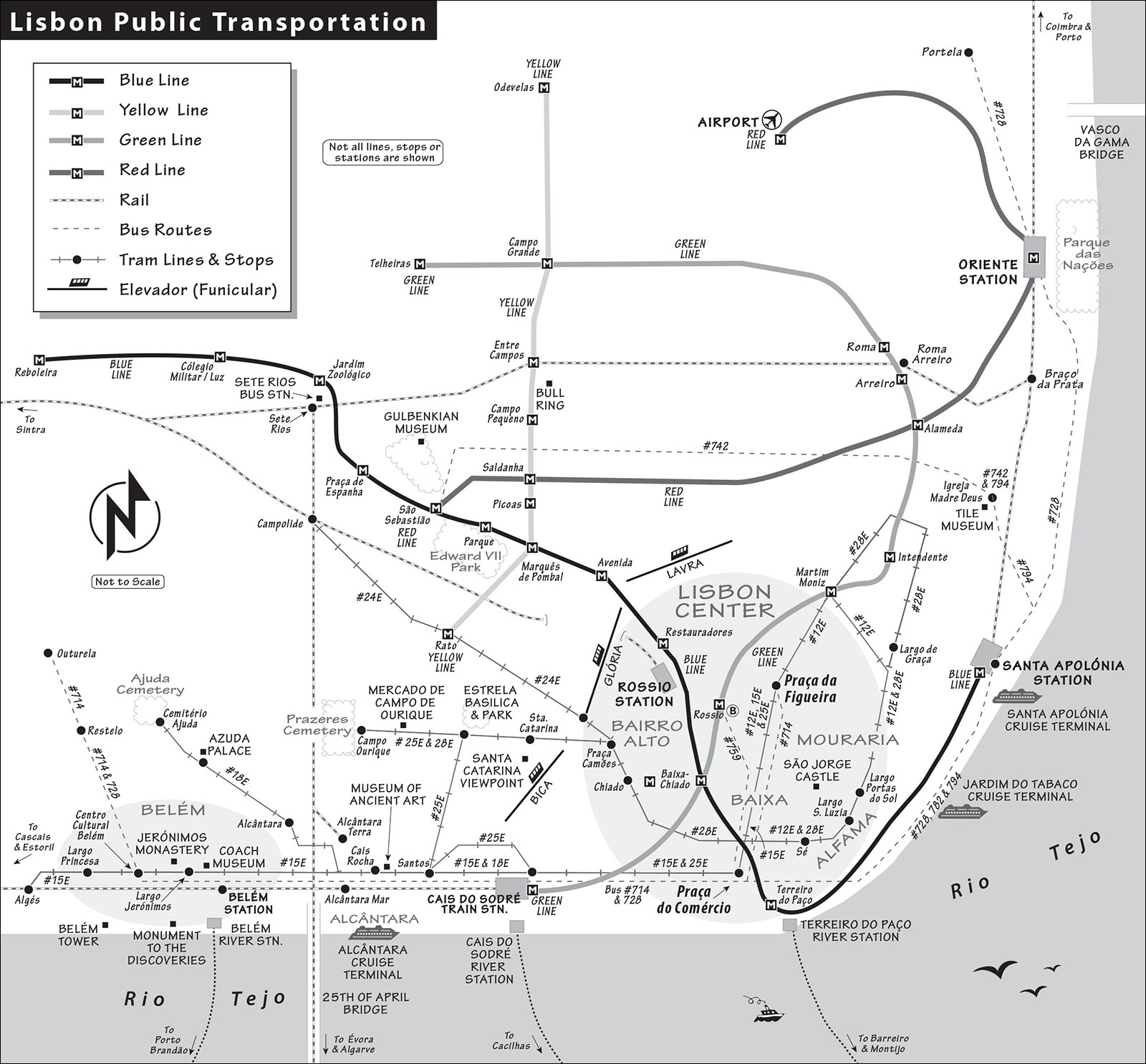
Map: Lisbon Public Transportation
Map: Bairro Alto & Chiado Stroll
Map: Portugal Explores the Sea
BULLFIGHTS, SOCCER, CONCERTS, AND MOVIES
Map: Lisbon’s Avenida da Liberdade
Map: Lisbon Center Restaurants
AVENIDA DI LIBERDADE AND NEARBY
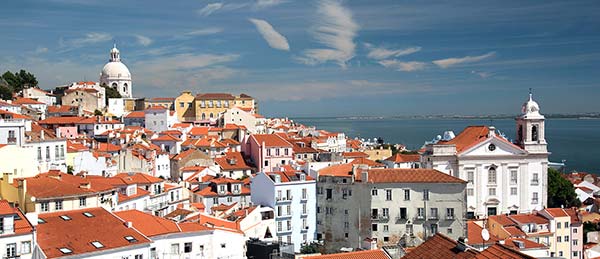
Lisbon is ramshackle, trendy, and charming all at once—an endearing mix of now and then. Vintage trolleys shiver up and down its hills, bird-stained statues mark grand squares, taxis rattle and screech through cobbled lanes, and Art Nouveau cafés are filled equally with well-worn and well-dressed locals—nursing their coffees side by side. It’s a city of proud ironwork balconies, multicolored tiles, and mosaic sidewalks; of bougainvillea and red-tiled roofs with antique TV antennas; and of foodie haunts and designer boutiques.
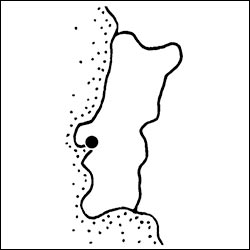
Lisbon, Portugal’s capital, is the country’s banking and manufacturing center. Residents call their city Lisboa (leezh-BOH-ah), which comes from the Phoenician Alis Ubbo, meaning “calm port.” A port city on the yawning mouth of the Rio Tejo (REE-oo TAY-zhoo—the Tagus River), Lisbon welcomes large ships to its waters and state-of-the-art dry docks. And more recently, it has become a popular stop with cruise ships.
Romans (2nd century BC) and Moors (8th century) were the earliest settlers in Lisbon, but the city’s glory days were in the 15th and 16th centuries, when explorers such as Vasco da Gama opened new trade routes around Africa to India, making Lisbon one of Europe’s richest cities. Portugal’s Age of Discovery fueled rapid economic growth, which sparked the flamboyant art boom called the Manueline period—named for King Manuel I (r. 1495-1521).
On the morning of All Saints’ Day in 1755, a tremendous offshore earthquake rocked Lisbon, followed by a devastating tsunami and days of fires. Chief Minister Marquês de Pombal rebuilt downtown Lisbon on a grid plan, with broad boulevards and generous squares. It’s this “Pombaline”-era neighborhood where you’ll spend much of your time, though remnants of Lisbon’s pre-earthquake charm survive in Belém, the Alfama, and the Bairro Alto district. The bulk of your sightseeing will likely be in these neighborhoods.
As the Paris of the Portuguese-speaking world, Lisbon (pop. 548,000 in the core) is the Old World capital of its former empire, which once had some 100 million people and stretched from Europe to Brazil, and Africa to China. Portugal remains on largely good terms with its former colonies—and immigrants from places such as Mozambique and Angola add diversity and flavor to the city; it’s likely that you’ll hear African music as much as Portuguese fado.
With its characteristic hills, trolleys, famous suspension bridge, and rolling fog, Lisbon has a San Francisco feel. Enjoy all that this world-class city has to offer: elegant outdoor cafés, exciting art, fun-to-browse shops, stunning vistas, delicious food, entertaining museums, and a salty sailors’ quarter with a hill-capping castle.
PLANNING YOUR TIME
Lisbon merits at least three days, including a day for a side trip to Sintra. If you have more time, there’s plenty to do.
Day 1
Get oriented to Lisbon’s three downtown neighborhoods (following my three self-guided walks): Alfama, Baixa, and Bairro Alto/Chiado. Start where the city did, at its castle (hop a taxi or Uber to get there at 9:00, before the crowds hit). After surveying the city from the highest viewpoint in town, walk downhill into the characteristic Alfama neighborhood and end at the Fado Museum. From there, zip over to the big main square (Praça do Comércio) to explore the Baixa, then ride up the Elevador da Glória funicular (or taxi) to begin the Bairro Alto and Chiado walk. Art lovers can then hop the Metro or a taxi to the Gulbenkian Museum (open until 18:00, closed Tue), while shoppers can browse the boutiques of the Chiado neighborhood and Príncipe Real. Consider dinner at a fado show in the Bairro Alto or the Alfama. For more evening options, see “Entertainment in Lisbon,” later.
Day 2
Trolley to Belém and tour the monastery, tower, and National Coach Museum. Have lunch in Belém, then tour the Museum of Ancient Art on your way back to Lisbon.
Day 3
Side-trip to Sintra to tour the Pena Palace and explore the ruined Moorish castle.
More Time
With extra days, slow down and relax—spreading the “Day 1” activities over two days. Or use the time to explore and window-shop characteristic neighborhoods and nurse drinks bought from kiosks on relaxing squares. You could also head to the Parque das Nações or take a food tour.
Monday Options
Many top sights are closed on Monday, particularly in Belém. That’d be a good day to visit the Gulbenkian Museum, take my self-guided neighborhood walks, day-trip to Sintra, go on a guided walking tour (see “Tours in Lisbon,” later), or head to Parque das Nações for a dose of modern Lisbon.
Orientation to Lisbon
LISBON: A VERBAL MAP
Greater Lisbon has close to three million people and intimidating sprawl. Most visitors spend virtually all their time in the old city center, a delightful series of parks, boulevards, and squares in a crusty, well-preserved architectural shell. But even on a brief visit, you’ll also want to venture to Belém, the riverfront suburb with many top sights.
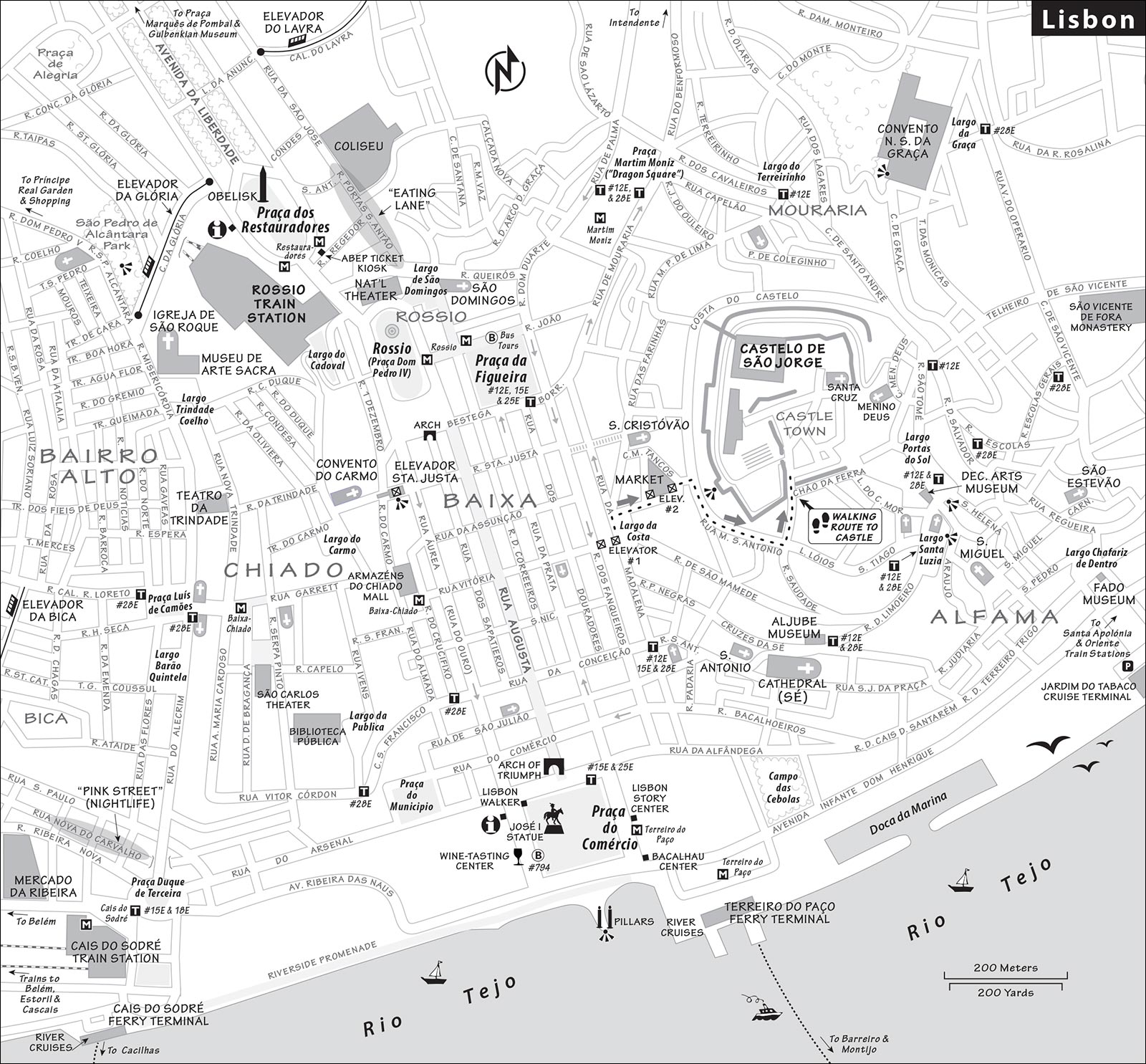
Here’s an overview of the city’s layout:
Baixa (Lower Town): Downtown Lisbon fills a valley flanked by two hills along the banks of the Rio Tejo. In that valley, the neighborhood called Baixa (BYE-shah) stretches from the main squares—Rossio (roh-SEE-oo) and Praça da Figueira (PRAH-sah dah fee-GAY-rah)—to the waterfront. The Baixa is a flat, pleasant shopping area of grid-patterned streets. As Lisbon’s main crossroads and transportation hub, touristy Baixa has lots of hotels, venerable cafés and pastry shops, and kitschy souvenir stands.
Alfama: The hill to the east of the Baixa is the Alfama (al-FAH-mah), a colorful tangle of medieval streets, topped by São Jorge Castle. The lower slopes of the Alfama are a spilled spaghetti of old sailors’ homes.
Mouraria: The old Muslim Quarter and the birthplace of fado, this district (next to the Alfama, between the castle and Praça Martim Moniz) is now the center of Lisbon’s international community and emerging as a fun and trendy place to explore.
Bairro Alto (High Town): The hill to the west of the Baixa is capped by the Bairro Alto (BYE-roh AHL-too), with a tight grid of steep, narrow, and characteristic lanes. Downhill toward the Baixa, the Bairro Alto fades into the trendy and inviting Chiado (shee-AH-doo), with linger-a-while squares, upmarket restaurants, and high-fashion stores.
Modern Lisbon: From the historic core, the modern city stretches north (sloping uphill) along wide Avenida da Liberdade and beyond (way beyond), where you find Edward VII Park, the Gulbenkian Museum, breezy botanical gardens, the bullring, and the airport.
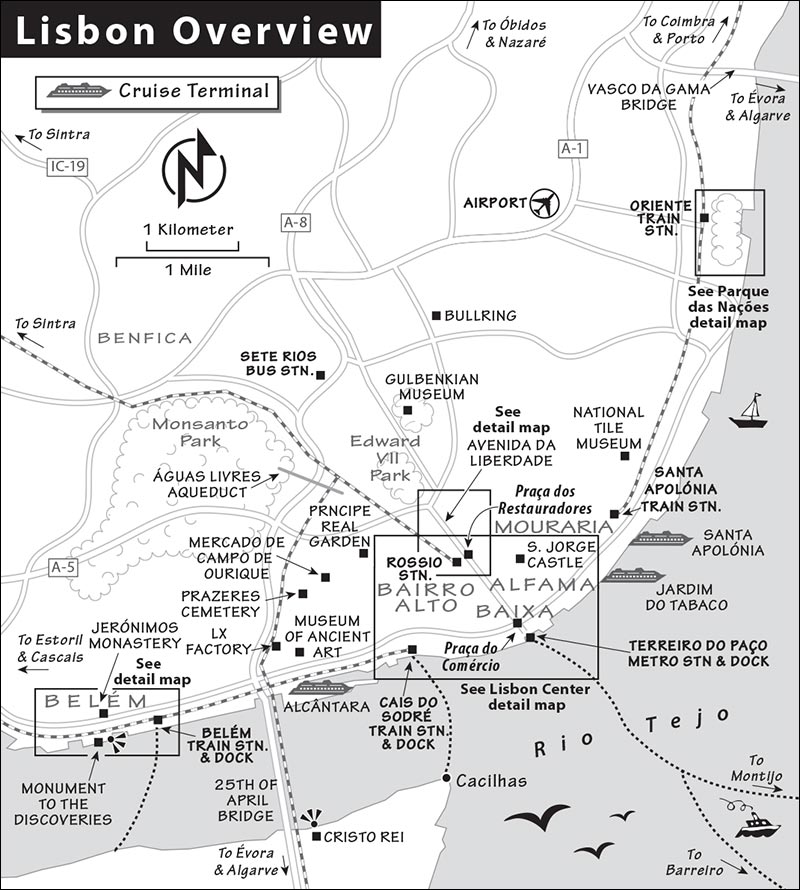
Away from the Center: Along the riverfront are several worthwhile areas. Three miles west of the center is the suburb of Belém (beh-LAYNG), home to much of Lisbon’s best sightseeing, with several Age of Discovery sights (particularly the Monastery of Jerónimos)—and you can visit the Museum of Ancient Art along the way. Five miles north of the center is Parque das Nações, site of the Expo ’98 world’s fair and now a modern shopping complex and riverfront promenade (the National Tile Museum is about halfway there). And across the Rio Tejo, Cacilhas (kah-SEE-lahsh) is a tiny and characteristic little port that few tourists visit (an easy ferry ride from the center; from there you can bus or taxi to the towering Cristo Rei statue).
TOURIST INFORMATION
Lisbon has several tourist offices—all branded “ask me Lisboa”—and additional information kiosks sprout around town during the busy summer months (www.visitlisboa.com). The main city TIs have the same hours (daily 10:00-20:00) and are located on Praça dos Restauradores at Palácio Foz (+351 213 463 314; national TI in same office) and on Praça do Comércio (two locations; +351 210 312 810). Another TI is at the airport (daily 7:00-24:00, +351 218 450 660).
Smaller TI kiosks—which can be less busy than the main TIs listed above—are at the bottom of Rossio; across the street from the monastery in Belém; at Parque das Nações, at the riverfront side of the Vasco da Gama mall; and inside Santa Apolónia train station (end of track 3). At any TI, you can buy a LisboaCard (see next) and pick up the free city map and information-packed Follow Me Lisboa booklet (monthly, cultural and museum listings—also available at www.visitlisboa.com, “Publications” tab).
LisboaCard: This card covers all public transportation (including trains to Sintra and Cascais) and free entry to many museums (including the Museum of Ancient Art, National Tile Museum, National Coach Museum, Monastery of Jerónimos, and Belém Tower). It also provides discounts on river cruises, my two recommended city tours, and many museums (including sights at Sintra). You can buy the card at Lisbon’s TIs (including the airport TI), but not at participating sights. If you plan to museum-hop, the card is a good value, particularly for a day in Belém, though it does not allow you to skip lines at busy monuments (like those in Belém). The card is unnecessary if you’re a student or senior, for whom most sights are free or half-price. Carry the LisboaCard booklet with you—some discounts require coupons contained inside (€21/24 hours, €35/48 hours, €44/72 hours, kids 5-11 nearly half-price, includes excellent explanatory guidebook, www.visitlisboa.com). Remember that many sights are closed on Monday—it’s best to buy the card when you can use it for consecutive days.
ARRIVAL IN LISBON
For complete information on arriving at or departing from Lisbon by plane, train, bus, car, or cruise ship, see “Lisbon Connections” at the end of this chapter.
HELPFUL HINTS
Free Days and Monday Closures: The Gulbenkian Museum is free every Sunday after 14:00 (and one of the few museums open on Monday). Many major sights are closed on Monday, including Lisbon’s Museum of Ancient Art, National Tile Museum, and Fado Museum, as well as Belém’s Monastery of Jerónimos, Coach Museum, and Belém Tower.
Theft Alert: Lisbon has piles of people doing illegal business on the street. Enjoy the sightseeing, but wear your money belt and keep your pack zipped up. Pickpockets target tourists at popular sights and on trolleys, elevators, and funiculars. Some thieves pose as tourists by wearing cameras and toting maps. Be on guard whenever you’re in a crush of people or jostled as you enter or leave a tram or bus. Beggars are often pickpockets. Teams of pickpockets create confusion and congestion.
Violence is very rare, and you’ll see lots of police stationed throughout town. While the city is generally safe, if you’re looking for trouble—especially after dark—you may find it.
Market Days: Tuesdays and Saturdays are flea- and food-market days in the Alfama’s Campo de Santa Clara. On Sundays, the LX Factory zone, in the shadow of the 25th of April Bridge, hosts a lively farmers market (9:30-16:00; for location, see the “Lisbon Overview” map, earlier).
Pedestrian Warnings: Lisbon’s unique black-and-white patterned tile pavement, while picturesque, can be very slippery. And trams can be quiet and sneak up on you if you’re not paying attention. Even some of the tuk-tuks are “eco” (electric) and can zip up behind you silently.
Laundry: Centrally located 5àSec Lavandaria can usually provide same-day service if you drop off early (Mon-Fri 8:00-20:00, Sat 9:00-13:00, closed Sun, next to the bottom level of the Armazéns do Chiado mall and lower entry to the Baixa-Chiado Metro stop at Rua do Crucifixo 99, +351 213 479 599). WashStation Baixa-Castelo is a small self-service launderette just up from Praça da Figueira (daily 8:00-22:00, Rua da Madalena 231, +351 919 772 701). For locations, see the “Lisbon Center Hotels” map on here.
Ticket Kiosk: The green ABEP kiosk at the bottom end of Praça dos Restauradores is a handy spot to buy a city transit pass, LisboaCard, and tickets to bullfights, soccer games, concerts, and other events (daily 9:00-20:00).
GETTING AROUND LISBON
By Public Transit
Lisbon is easy—even fun—to navigate by Metro, funicular, trolley, and bus. And one transit card covers them all.
Tickets
If you have a LisboaCard (see “Tourist Information,” earlier), you can use it to ride Lisbon’s public transit. Otherwise, buy a Viva Viagem card, which works on the Metro, funiculars, trolleys, buses, Santa Justa elevator, ferry to Cacilhas, and some short-distance trains (on some transit you can buy tickets from the driver, but that’s more expensive). For transit information, see www.carris.pt.
Viva Viagem Card: Transit tickets are issued on the scannable, reloadable Viva Viagem card (€0.50 for the card itself, not shareable—each rider needs one). You can buy or reload the card at ticket windows or machines in Metro stations (touch “without a reusable card” for first-time users, or “with a reusable card” to top up; bright yellow machines accept only credit cards). Keep your Viva Viagem card handy—you’ll need to place it on the magnetic pad when entering and leaving the system.
You can use the Viva Viagem in three ways:
A single-ride ticket costs €1.50 (good for one hour of travel within Zone 1). But if you’re taking even a few rides, “zapping” is a much better deal (see later).
A 24-hour pass costs €6.45 (this version does not cover trains). If taking five or more rides in a day, this is the best deal. If you’re side-tripping to Sintra or Cascais, consider the €10.70 version, which includes trains to those towns (but not the bus at Sintra). Skip the €9.60 version of the 24-hour pass, which adds the ferry to Cacilhas (it’s cheaper to buy that separately).
“Zapping” lets you preload the card with anywhere from €3 to €40 and lowers the per-ride cost to €1.35 for all forms of transit. Figure out how much you’ll need and load it up (estimate conservatively—you can always top up later, but leftover credit is nonrefundable). Unlike the 24-hour pass, zapping can be used for trains to Sintra and Cascais.
Without Viva Viagem: Although it’s possible to pay the driver as you board buses (€2), trolleys (€3—more than double the Viva Viagem price), funiculars (€3.80 for two trips), and the Santa Justa elevator (€5.30), only suckers do that. It’s much cheaper if you get comfortable zapping with Viva Viagem.
Metro
Lisbon’s simple, fast, and color-coded subway system is a delight to use (runs daily 6:30-1:00 in the morning). Though it’s not necessary for getting around the historic downtown, the Metro is handy for trips to or from Rossio (M: Rossio or Restauradores), Praça do Comércio (M: Terreiro do Paço), the Gulbenkian Museum (M: São Sebastião), the Chiado neighborhood (M: Baixa-Chiado), Parque das Nações and the Oriente train station (both at M: Oriente), Sete Rios bus and train stations (M: Jardim Zoológico), and the airport (M: Aeroporto). Metro stops are marked aboveground with a red “M.” Saída means “exit.” You can find a Metro map at any Metro stop, on most city maps, and at www.metrolisboa.pt.
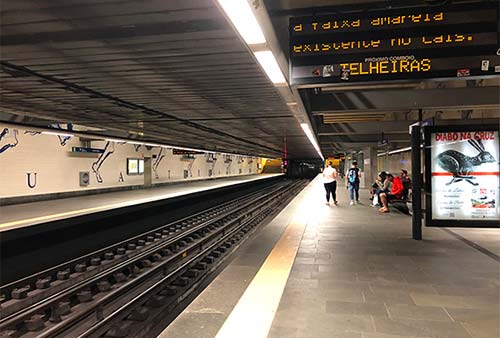
Sightseeing by Metro: To make your sightseeing commutes quicker and easier, link sights on the same Metro line. For example, Praça do Comércio, Rossio, and the Gulbenkian Museum can be laced together by Metro faster than via taxi. You can even sightsee as you travel: All Metro stations have wonderful, museum-worthy tile panels. The blue line between Parque and Colégio Militar/Luz has some of the best art; with a 24-hour transit pass, you can hop on and off and explore as many stations as you like.
Buses and Trolleys
Buses and trolleys usually share the same stops and routes. Signs for bus stops list the bus number, while signs for trolley stops include an E (for elétrico) before or after the route number. Though Lisbon’s buses are fine, for fun and practical public transportation, ride the trolleys (and funiculars—see later).
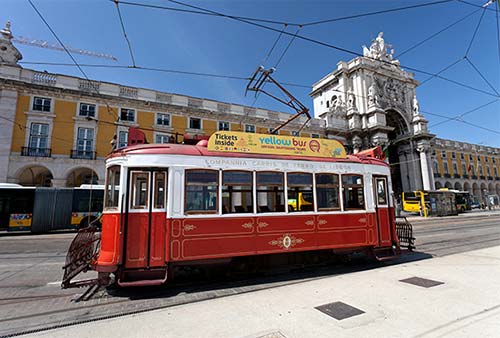
Like San Francisco, Lisbon sees its classic trolleys as part of its heritage, and has kept a few in use: Trolleys #12E (circling the Alfama), #18E (to Ajuda, north of Belém), #24E (to Campolide), #25E (to Campo de Ourique), and #28E (a scenic ride across the old town) use vintage cars; #15E (to Belém) uses a modern, air-conditioned version. Make sure you have a ticket or pass and that you validate your Viva Viagem card as you enter...or risk a big fine on the spot. Trolleys rattle by every 10 minutes or so (every 15-20 minutes after 19:00) and run until about 23:00. Most pickpocketing in Lisbon takes place on trolleys, so enjoy the ride, but keep an eye on your belongings.
While lines #28E and #12E seem made-to-order for tourist use, they are often unbearably crowded. If you can deal with the often-overwhelming crowds (see the tips, next), these trolleys can work as hop-on, hop-off do-it-yourself tours. For a stop-by-stop rundown, see “Touring Lisbon by Trolley” in the next section.
Crowd-Beating Tips: Lisbon’s trolleys are an absolute joy...if you’re sitting down and looking out the window with the wind in your face. But if you have to stand, you won’t be able to see out the (low) windows, and you’ll spend the jostling ride trying to steady yourself. At peak times, hordes of tourists wait at trolley stops (particularly at starting points) and pickpockets abound. To enjoy a trolley with fewer crowd frustrations, consider these strategies:
1. Rather than being determined to take a particular trolley at a particular time, keep an eye on trolleys as they roll by. If an empty trolley pulls up, hop on and take advantage of the open space.
2. Consider waking early and making a trolley ride your first experience of the day. Trolleys “open” before any museums, so if you arrive in the early morning you can beat the tourist crush, get a seat, and see the city wake up. Late departures (after dinner) also have fewer crowds.
3. Ride line #24E, which runs a less-touristy route and can be less crowded.
4. Take a private trolley tour (see “Tours in Lisbon,” later).
5. If you’ll be going to Porto, wait to enjoy a vintage trolley there: Porto’s trolleys are just as memorable as Lisbon’s and have fewer crowds.
Funiculars
Lisbon’s funiculars include the Elevador da Glória (linking Avenida da Liberdade to the Bairro Alto) and the Elevador da Bica (rising from Rua de São Paulo, near the river, to the Bairro Alto). Funiculars depart about every 10 minutes.
By Taxi or Uber
Lisbon is a great taxi town. Especially if you’re with a companion, Lisbon’s cabs are a cheap time-saver; groups of three or four should taxi everywhere. Rides start at under €4, and you can go anywhere in the center for around €6. Window decals clearly spell out all charges in English. Be sure your driver turns on the meter; it should start at €3.25 and be set to Tarifa 1 (Mon-Fri 6:00-21:00, including the airport) or Tarifa 2 (€3.90, a little more per kilometer; for nights, weekends, and holidays). More than one piece of luggage can be charged at €1.60 each. If the meter reads Tarifa 3, 4, or 5, simply ask the cabbie to change it, unless you’re going to Belém, which is considered outside the city limits.
Cabs are generally easy to hail on the street (green light means available, lit number on the roof indicates it’s taken). If you’re having a hard time flagging one down, it’s likely because you’re standing near but not quite at a taxi stand. Ask a passerby for the location of the nearest taxi stand: praça de taxi (PRAH-sah duh taxi). They’re all over the town center.
Lisbon is also an excellent Uber town. The ride-sharing app works here just like back home; it’s at least as affordable as a taxi (often cheaper, except during “surge” pricing); and the drivers and their cars are generally of great quality. If you’ve never tried Uber abroad, do it here. Sit in front and talk!
Tours in Lisbon
ON WHEELS
▲▲Touring Lisbon by Trolley
Lisbon’s trolleys—many of them vintage models from the 1920s—shake and shiver through the old parts of town, somehow safely weaving within inches of parked cars, climbing steep hills, and offering sightseers breezy views (rubberneck out the window and you die). You can use the following trolley lines as an inexpensive way to tour the city. As you board, swipe your Viva Viagem card or pay the driver, and take a seat (zapping tickets are good for an hour, and a 24-hour pass comes with unlimited hopping on and off).
Be aware that lines #28E and #12E are often jam-packed with tourists. Trolley #24E runs away from the central tourist zone and can be less crowded. For tips on riding the trolley, including avoiding crowds, see “Getting Around Lisbon,” earlier.
Trolley #28E
Trolley #28E is a San Francisco-style Lisbon joyride (runs about 5:45-23:30; after 21:15, service is limited to stops between Estrela and Graça). The following are notable stops from west to east:
Campo Ourique: The Prazeres Cemetery, at the western terminus of route #28E, is a vast parklike necropolis with good bridge views, dense with the mausoleums of leading Lisbon families and historic figures dating back to the 19th century (daily 9:00-17:00).
Igreja Sto. Condestável: The first stop after the cemetery is next to an angular modern church. Hiding just behind the church is the Mercado de Campo de Ourique, a 19th-century iron-and-glass market that’s now a trendy food circus (see here).
Estrela: Two stops later, the trolley pulls up in front of another large church (on the right). The 18th-century, late-Baroque Estrela Basilica has stairs winding up to the roof for a view both out and down into the church (€4, daily 10:00-18:00). Across the street is the gate into Estrela Park, a cozy neighborhood scene with exotic plants, a pond-side café, and a playground.
Assembleia da República: At the next stop, you’ll see a garden poking up on the left behind a high wall (which hides the prime minister’s residence). Next up is the huge, stately Assembly of the Republic building—home to Portugal’s parliament. Soon after, the trolley enters a relatively narrow street at the edge of the Bairro Alto.
Santa Catarina: A couple of stops into the Bairro Alto, this area is enjoyable for a stroll through characteristic streets downhill to the Miradouro de Santa Catarina, a view terrace with inviting cafés and bars.
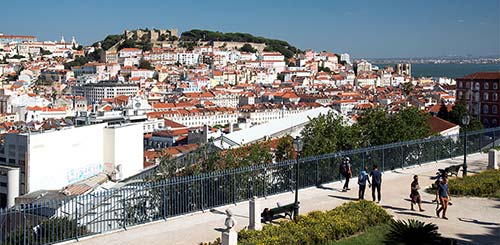
The first three viewpoints are included in the self-guided walks described in this chapter:
• Miradouro de São Pedro de Alcântara (view terrace in Bairro Alto, at top of Elevador da Glória funicular; see the “Bairro Alto and Chiado Stroll”)
• São Jorge Castle (on top of the Alfama; see photo above and the “Alfama Stroll and the Castle”)
• Miradouro das Portas do Sol (south slope of Alfama; see the “Alfama Stroll and the Castle”)
• Elevador de Santa Justa (in the Baixa, here)
• Cristo Rei (statue on hillside across the Rio Tejo, here)
• Edward VII Park (at north end of Avenida da Liberdade)
• Miradouro de Santa Catarina (near the top of the Elevador da Bica funicular)
• Miradouro da Graça and Miradouro da Senhora do Monte (same neighborhood overlooking the São Jorge Castle)
Bica: Keep an eye on the streets to your right. You’ll spot the top of the Elevador da Bica funicular, which drops steeply through a rough-and-tumble neighborhood to the riverfront.
City-Center Stops: From here, the downtown stops come fast and furious—Chiado (at Chiado’s main square, Lisbon’s café meeting-place); Baixa (on Rua da Conceição between Augusta and Prata); Sé (the cathedral); Miradouro das Portas do Sol (the Alfama viewpoint); Campo de Santa Clara (flea market on Tue and Sat); and the pleasant and untouristy Graça district (with two excellent viewpoints, one at Graça Church and another nearby at Nossa Senhora do Monte). The route finishes at Praça Martim Moniz.
Trolley #12E
For a colorful, 20-minute loop around the castle and the Alfama, catch trolley #12E on Praça da Figueira (departs every few minutes from the stop at corner of square closest to castle; runs about 8:00-20:45, shorter hours on Sat-Sun). The driver can tell you when to get out for the Miradouro das Portas do Sol viewpoint near the castle (about three-quarters of the way up the hill), or you can stay on the trolley and be dropped back where you started. Here’s what you’ll see on this circular loop ride:
Leaving Praça da Figueira, you enter Praça Martim Moniz—named for a knight who died heroically while using his body as a doorjamb to leave the castle gate open, allowing his Christian Portuguese comrades to get in and capture Lisbon from the Moors in 1147. These days, this gathering point is nicknamed “Dragon Square” for the modern sculpture erected in the middle by the local Chinese community to celebrate the Year of the Dragon.
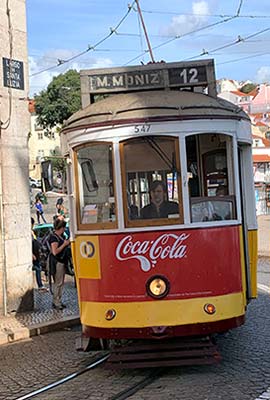
At the next stop, on the right, is the picturesque Centro Comercial da Mouraria, a marketplace filled with products and aromas from around the world. The big maroon building capping the hill on the left was a Jesuit monastery until 1769, when the dictatorial Marquês de Pombal booted the pesky order out of Portugal and turned the building into the Hospital São Jose. Today, this is an immigrant neighborhood with lots of cheap import shops.
Turning right onto Rua de Cavaleiros, you climb through the atmospheric Mouraria neighborhood on a street so narrow that a single trolley track is all that fits. Notice how the colorful mix of neighbors who fill the trolley all seem to know each other. If the trolley’s path is blocked and it can’t pass, lots of horn-honking and shouts from passengers ensue until your journey resumes. Look up the skinny side streets. Marvel at the creative parking and classic laundry scenes. This was the area given to the Moors after they were driven out of the castle and Alfama. Natives know it as the home of the legendary fado singer Maria Severa as well as modern-day singer Mariza. The majority of residents these days are immigrants from Asia, making this Lisbon’s most visible melting pot.
At the crest of the hill—at the square called Largo Rodrigues de Freitas—you can get out to explore, eat at a cheap restaurant (see “Eating in Lisbon,” later), or follow Rua de Santa Marinha to the Campo de Santa Clara flea market (Tue and Sat).
When you see the river, you’re at Largo das Portas do Sol (Gates of the Sun), where you’ll also see the remains of one of the seven old Moorish gates of Lisbon. The driver usually announces “castelo” (cahzh-TAY-loo) at this point. Hop out here if you want to visit the Museum and School of Portuguese Decorative Arts (see here), enjoy the most scenic cup of coffee in town, explore the Alfama, or tour the castle.
The trolley continues downhill. First you’ll pass (on the right) the stout building called Aljube—a prison built on a site dating from Roman times that, more recently, housed political opponents of Portugal’s fascist dictator Salazar (now housing a museum about that regime; see here). Just downhill is the fortress-like Lisbon Cathedral (on the left—see here). Finally you roll into the Baixa (grid-planned Pombaline city—get off at Praça do Comércio to take my self-guided Baixa walk). After a few blocks, you’re back where you started—Praça da Figueira.
Trolley #24E
Although it doesn’t go past many of my recommended sights, a 20-minute ride on line #24E can show you a nice slice of workaday Lisbon (runs about 7:00-20:00, shorter hours on Sat-Sun). Catch the trolley at Praça Luís de Camões (just uphill from Chiado); ride past Príncipe Real and its beautiful park, prime shopping, and good restaurants; the enormous cistern at the end of the aqueduct; and the Amoreiras mall, ending in Campolide. Hop off and hop on again right away, or wander over to Edward VII Park to stroll down the tree-lined Avenida da Liberdade to return to the city center.
Private Trolley Tours
Yellow Bus—the dominant local tour operator (see next)—operates a 1.5-hour hop-on, hop-off trolley tour that uses the same tracks and stops as the public trolleys described above. Though pricier and less frequent than public trolleys, Yellow Bus trolleys often have fewer crowds, come with recorded commentary, and allow you to hop on and off as often as you like for 24 hours. The Hills Tramcar Tour starts at Praça do Comércio and runs every 30 minutes (fewer off-season, €22, runs 10:00-19:00, 13 stops, red trolleys).
Hop-On, Hop-Off Bus Tours
Various companies operate hop-on, hop-off bus tours around Lisbon. While uninspiring and not cheap—and Lisbon’s sights are compact enough to easily see on your own—these tours can be handy and run daily year-round.
Yellow Bus (www.yellowbustours.com) and Gray Line (www.cityrama.pt) run multiple loops through town, targeting different sights; figure around €20 for 24 hours on one loop, or about €35 for 48-hour access to all loops. Each company also offers a dizzying array of combo-tickets (trolley tours, tuk-tuks, boat trips, Segway tours, museum discounts, and so on). Buses depart from Praça da Figueira (buy tickets from driver). When comparing your options, note that Yellow Bus tickets include some Lisbon city transit as well (public trolleys, buses, Elevador de Santa Justa, and funiculars, but not the Metro).
Tuk-Tuks
Goofy little tuk-tuks—Indian-style, three-wheel motorcycles—have invaded Lisbon. You’ll see them parked in front of tourist landmarks all over town. They have no meter—negotiate with the driver for a tour or hire one for a point-to-point ride. Tuk-tuks are most practical as a way to tailor your own private tour (€50/hour, €30 if demand is slow and the driver owns his own rig). The key is finding a likeable driver with good language skills and a little charm. A ride comes with light guiding, can get you into little back lanes, lets you hop on and off for quick visits and photo stops, and leaves you where you like.
BY BOAT
To get out on the Rio Tejo, take a sightseeing cruise or ride a public ferry. Either way, the main destination across the river is the port of Cacilhas.
Tourist Cruise: Yellow Boat—part of the big Yellow Bus tour company—offers a 1.5-hour loop that links Terreiro do Paço (near Praça do Comércio) to Belém. You can hop on and off, but there are just four boats per day in each direction (€20/24 hours, discounts and combo-tickets with their bus tours and other offerings, May-Oct only, details at www.yellowbustours.com).
Public Ferry Ride to Cacilhas: For a quick, cheap trip across the river with great city and bridge views in the company of Lisbon commuters rather than tourists, hop the ferry to Cacilhas from the Cais do Sodré terminal. See here for details.
ON FOOT
Two walking-tour companies—Lisbon Walker and Inside Lisbon—offer excellent, affordable tours led by young, top-notch guides with a passion for sharing insights about their hometown. Both have an easygoing style and small groups (generally 2-12 people); with either, you’ll likely feel you’ve made a friend in your guide. These tours can be time and money very well spent (both give my readers a discount).
Lisbon Walker
Standard tours include “Lisbon Revelation” (best 3-hour overview, with good coverage of Baixa, Rossio, Chiado, and Bairro Alto); “Old Town” (2.5-hour walk through Alfama that examines the origins of Lisbon with great viewpoints); and “City of Spies” (2.5 hours, centered on spy stories from World War II, when neutral Portugal provided the natural setting for conspiracy). Each tour includes a shot of ginjinha or a tasty pastel de nata—two edible icons of Lisbon (€20/person, RS%—€5 off with this book or when you use online promo code “Rick Steves Book”; tours run daily year-round—check schedule online; meet at northwest corner of Praça do Comércio near Rua do Arsenal, in front of the TI—see map on here, +351 963 575 635, www.lisbonwalker.com).
Inside Lisbon
Tours include the “Best of Lisbon Walk” (good 3-hour highlights tour of the main squares, Chiado, and Alfama; €18/person, €13 with this book; daily year-round at 10:00) and food and wine tours (see “Food Tours,” later). Most tours meet at the statue of Dom Pedro IV in the center of Rossio and last three to four hours (reserve a day ahead via website or phone, +351 968 412 612, www.insidelisbon.com). They also offer daily private tours and day trips by minivan (€85/person, RS%—€5 discount with this book or online with code “RICKLISBON”) to Sintra/Cascais (8 hours) and Obidos/Fátima (9 hours). You can organize a private city tour with them, or use their helpful website as a resource for seeing Lisbon on your own.
Lisbon Chill-Out Free Walking Tours
Many companies offer “free” tours, but most are led by expats who memorize a script and hit you up hard for a tip. But if you’re looking for a free tour, I’d choose Chill-Out. Your Chill-Out guide is a local who will share cultural insights as you walk through the Bairro Alto, across the Baixa, and into the Alfama. It’s refreshing to get a hometown perspective, and they are upfront about “it’s not really free—you tip what you like at the end.” Three-hour walks start in the Bairro Alto at the statue on Praça Luís de Camões (look for the guide wearing the yellow travel bag) daily at 10:00 and 15:00 (www.lisbonfreetour.blogspot.pt).
FOOD TOURS
Guided food tours are trendy these days. Several companies offer three-to-four-hour multistop tours that introduce you to lots of local food culture while filling your stomach. This is a quickly evolving scene, so it pays to do a little homework on the latest offerings. I’ve enjoyed tours by several good outfits, listed below. In each case, the groups are small, the teaching is good, and—when you figure in the cost of the meal—the tours are a solid value.
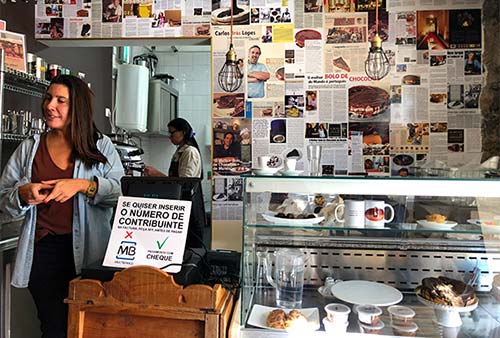
Inside Lisbon offers three food-related itineraries (RS%—€5 discount with this book): Their “Food and Wine Walk” makes five to six short, tasty, and memorable stand-up stops (€58/person, 3 hours, Mon-Sat at 16:30). And their “Lisbon Experience Walk” is a tour through the Mouraria neighborhood with some food stops mixed in, ending with a ferry to Cacilhas for a seafood lunch (€58/person, 4 hours, Mon-Sat at 10:30; www.insidelisbon.com).
Taste of Lisboa food tours, designed by Filipa Valete, connects you with a Lisboan guide and offers a fast-moving feast with lots of visits and lots of information. Their primary tour is the “Lisbon Roots, Food & Culture Walk” with seven stops (€85/person, 4 hours, Mon-Sat at 15:00, English only, sign up at www.tasteoflisboa.com). They offer several other cultural food experiences, all explained on their website.
Eat Drink Walk does a €105 “Tapas Downtown” walk (3-4 hours, 5-6 stops in the Baixa), as well as a €115 “Chiado Gourmet” walk (4-5 hours, www.eatdrinkwalk.pt). Both tours run Mon-Sat at 11:00 and are expertly led by Filomena or Duarte, both locals and pioneers in the food tour world of Lisbon.
LOCAL GUIDES
Hiring a private local guide in Lisbon can be a wonderful luxury: Your guide will meet you at your hotel and tailor a tour to your interests. Especially with a small group, this can be a fine value. Guides charge roughly the same rates (€150/half-day, €250/day; car and driver options are available).
Claudia da Costa, who appears on my Lisbon TV show, is an excellent guide (+351 965 560 216, claudiadacosta@hotmail.com).
Cristina Duarte knows Lisbon well, appears on my TV show, and, with her associate, leads private tours in Lisbon and its surroundings when not on the road leading Portugal tours for my company (+351 919 316 242, www.lisbonbeyond.pt, acrismduarte@gmail.com).
Teresa Ferreira works in Lisbon and the surrounding area (+351 966 139 564, www.borninlisbon.com, maria-te@live.com.pt).
Your Friend in Lisbon is a group of four guides who book private three-hour walks for €120 (price for 1 or 2 people, more for larger groups, daily at 10:00 or 15:00, +351 919 292 151, www.yourfriendinlisbon.com, alex@yourfriendinlisbon.com, run by Alex Almeida). They also have a minivan and driver (€400 for all-day, for up to six).
Neighborhood Walks in Lisbon
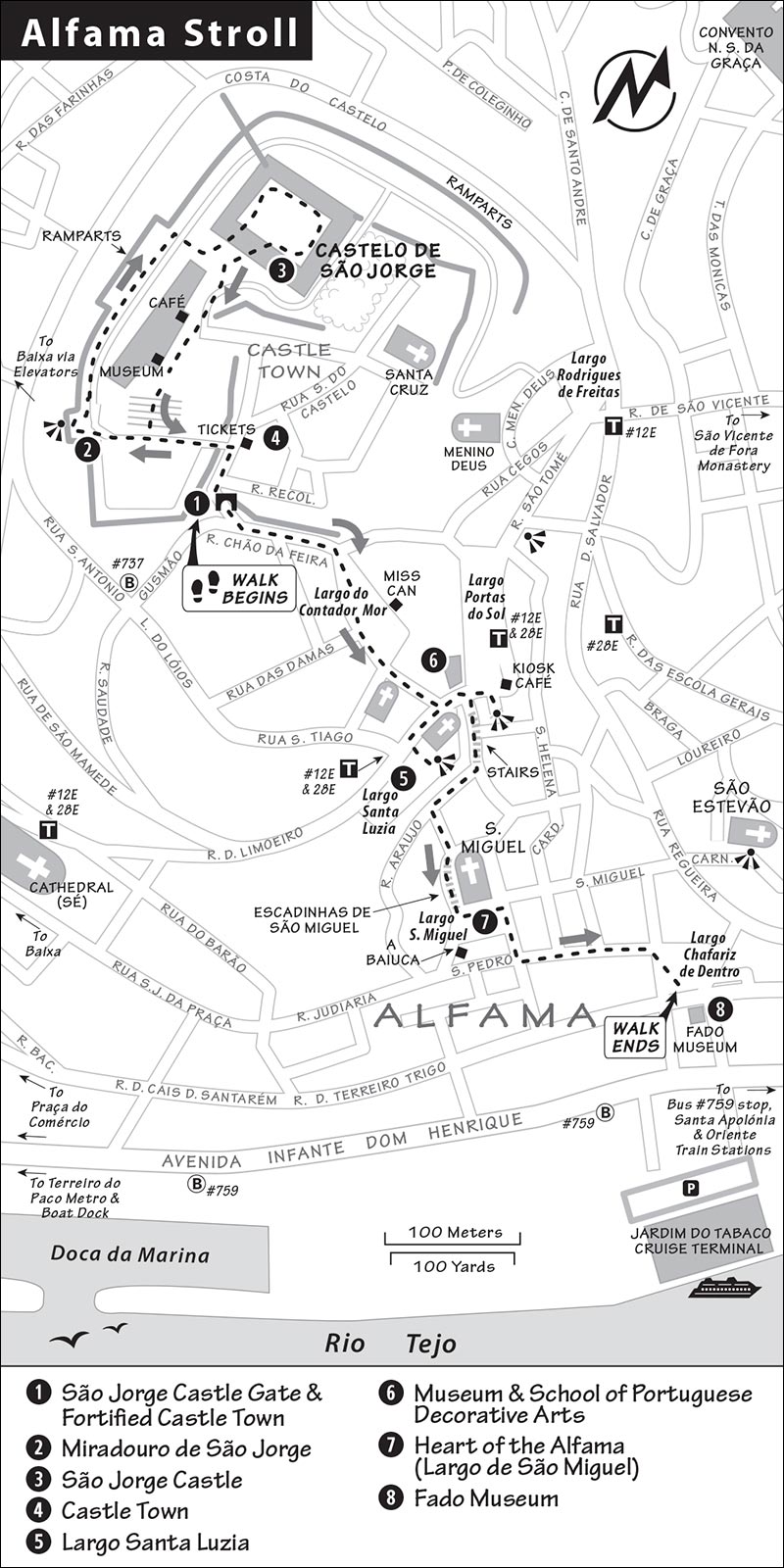
1 São Jorge Castle Gate and Fortified Castle Town
2 Miradouro de São Jorge (Viewpoint)
3 São Jorge Castle (Castelo de São Jorge)
6 Museum and School of Portuguese Decorative Arts
1 Praça do Comércio (Commerce Square)
5 Church of St. Nicholas (Igreja de São Nicolau)
6 Praça da Figueira (Fig Tree Square)
9 Liquid Sightseeing (Ginjinha Bars)
1 Miradouro de São Pedro de Alcântara (Viewpoint)
Map: Bairro Alto & Chiado Stroll
3 São Roque Church (Igreja de São Roque)
Exploring More of the Bairro Alto
The essential Lisbon is easily and enjoyably covered in three ▲▲▲ self-guided walking tours through three downtown neighborhoods: Alfama, Baixa, and Bairro Alto/Chiado. You can do them as individual walks, or lace them together into a single tour (allow a minimum of five hours for all three—or, for maximum lingering, spread it over two days). You can do the walks in any order, but starting with the Alfama gets you to the castle before the crowds hit, kicking things off with a grand city view from Lisbon’s fortified birthplace. And you’ll finish in the liveliest quarter for evening fun—the Bairro Alto/Chiado.
 My free Lisbon City Walk audio tour covers the same territory as the walks, from Praça do Comércio through the Baixa, and up through the highlights of the Bairro Alto (but not the Alfama or castle).
ALFAMA STROLL AND THE CASTLE
On this ▲▲▲ walk, you’ll explore the Alfama, the colorful sailors’ quarter that dates to the age of Visigoth occupation, from the sixth to eighth century AD. This was a bustling district during the Moorish period, and eventually became the home of Lisbon’s fishermen and mariners (and of the poet Luís de Camões, who wrote, “Our lips meet easily, high across the narrow street”). The Alfama’s tangled street plan, one of the few features of Lisbon to survive the 1755 earthquake, helps make the neighborhood a cobbled playground of Old World color. While much of the Alfama’s grittiness has been cleaned up in recent years, it remains one of Europe’s more photogenic neighborhoods.
When to Go: The best times to visit are during the busy midmorning market, or in the cooler late afternoon or early evening, when the streets teem with residents.
Getting There: This walk begins at the highest point in town, São Jorge Castle. Get to the castle gate by taxi; by minibus #737 from Praça da Figueira; or by two free elevator rides up from the Baixa and then a short uphill walk. To find the elevators, head to Rua dos Fanqueiros and go through the easy-to-miss door at #178 (for location, see the map on here; you’ll see faint, white lettering spelling out elevador castelo on the red rooftop—illuminated at night). Ride the elevator to the top floor and exit, angling left across the street and through the little square. Then head up Largo Chão do Loureiro, where you’ll see the second elevator (elevador castelo; handy supermarket at bottom, view café and fine panoramic terrace at top). When exiting the second elevator, simply follow brown Castelo de S. Jorge signs up to the castle (right, then hooking left; about 8 minutes uphill).
1 São Jorge Castle Gate and Fortified Castle Town
The formidable gate to the castle is part of a fortification that, these days, surrounds three things: the view terrace, the small town that stood within the walls, and the castle itself. The ticket office and the turnstile are situated so that those without a ticket are kept away from the view terrace and castle proper (castle entry-€10, daily 9:00-21:00, Nov-Feb until 18:00). Avoid lines by purchasing your ticket online at http://castelodesaojorge.pt.
If money is tight, the castle and view are skippable—the castle is just stark, rebuilt ruins from the Salazar era, and while the hill-capping park has a commanding view, there are other fine views coming up...just jump ahead to stop #4 on this walk.
• If you decide to go in, follow the cobbles uphill past the first lanes of old Lisbon to the yellow ticket office, and then into the...
2 Miradouro de São Jorge (Viewpoint)
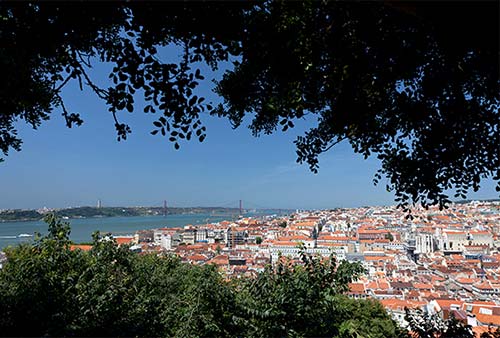
Enjoy the grand view. The Rio Tejo is one of five main rivers in Portugal, four of which come from Spain. (Only the Mondego River, which passes through Coimbra, originates inside Portuguese territory, in the Serra de Estrela.) While Portugal and Spain generally have very good relations, a major sore point is the control of all this water. From here, you have a good view of the Golden Gate-like 25th of April Bridge, which leads south to the Cristo Rei statue. Past the bridge, on a clear day, you can barely see the Monument to the Discoveries and the Belém Tower (under and past the bridge on north side).
Look up at the statue marking the center of this terrace. Afonso Henriques, a warlord with a strong personal army, was the founder of Portugal. In 1147, he besieged this former Moorish castle until the hungry, thirsty residents gave in. Every Portuguese schoolkid knows the story of this man—a Reconquista hero and their country’s first king.
Stroll inland along the ramparts for a more extensive view of Pombal’s Lisbon, described in a circa 1963, tiled panorama-chart (which lacks the big 25th of April Bridge—it was built in 1969). From Praça do Comércio on the water, the grid streets of the Baixa lead up to the tree-lined Avenida da Liberdade and the big Edward VII Park, on the far right. Locate city landmarks, such as the Elevador de Santa Justa (the Eiffel-style elevator in front of the ruined Convento do Carmo) and the sloping white roof of Rossio station.
• Continue walking along the viewpoint, passing several old cannons. Just after going under the second arch (just before the café terrace), take a right into the mostly ruined courtyard of...
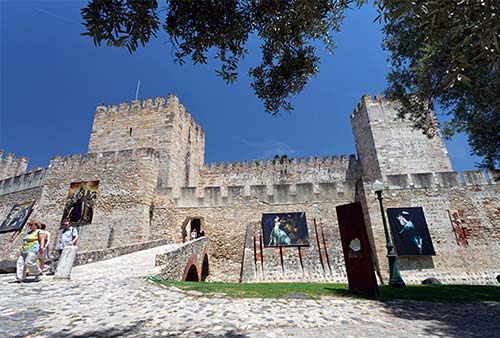
3 São Jorge Castle (Castelo de São Jorge)
While the first settlements here go back to the 7th century BC, this castle dates to the 11th century when Moors built it to house their army and provide a safe haven for their elites in times of siege. After Afonso Henriques took the castle in 1147, Portugal’s royalty lived here for several centuries. The sloping walls—typical of castles from this period—were designed to withstand 14th-century cannonballs. In the 16th century, the kings moved to their palace on Praça do Comércio, and the castle became a military garrison. Despite suffering major damage in the 1755 earthquake, the castle later served another stint as a military garrison. In the 20th century, it became a national monument.
The strolling peacocks remind visitors that exotic birds like these came to Lisbon originally as trophies of the great 16th-century voyages and discoveries. (Today the jaded birds ignore the tourists and cry as if to remember some long-forgotten castle captives.)
Bear left to find the inner castle—the boxy, crenelated fort in the middle. There’s little to see inside the empty shell, but it’s fun to climb up the steep stone steps to scramble around the top of the ramparts and towers, with ever-changing views of Lisbon, the Alfama, and the castle itself. (Up top, you’ll also find a thrillingly low-tech camera obscura, which is demonstrated twice hourly—times and languages posted.)
As you explore the castle’s inner sanctum, imagine it lined with simple wooden huts. The imposing part of the castle is the exterior. The builders’ strategy was to focus on making the castle appear so formidable that its very existence was enough to discourage any attack. If you know where to look, you can still see stones laid by ancient Romans, Visigoths, and Moors. The Portuguese made the most substantial contribution, with a wall reaching all the way to the river to withstand anticipated Spanish attacks.
When finished, head back out the inner castle gate, and continue straight ahead toward the castle’s entrance. On your right, you’ll pass the café, then the humble museum. This houses archaeological finds from the 7th century BC to the 18th century, with emphasis on the Moorish period in the 11th and 12th centuries. You’ll also see 18th-century tiles from an age when Portugal was flush with money from the gold, diamonds, and sugarcane of its colony Brazil. While simple, the museum has nice displays and descriptions.
• Leave the castle. Across the ramp from the castle entrance is a tidy little castle district, worth a wander for its peaceful lanes and a chance to enjoy the Manueline architecture.
4 Castle Town
Just outside the castle turnstile is the tiny neighborhood within the castle walls built to give Moorish elites refuge from sieges and, later, for Portuguese nobles to live close to their king. While it’s partly taken over by cute shops and cafés, if you wander up Rua de Santa Cruz do Castelo (to the left as you exit the castle) and stroll into its back lanes, you can enjoy a peaceful bit of Portugal’s past. (Make a big clockwise loop back to where you entered—you can’t get lost, as it’s within the walls and there’s only one way in or out.) Most of the houses date from the Middle Ages. Poking around, go on a cultural scavenger hunt. Look for: 1) clever, space-efficient, triangular contraptions for drying clothes (hint: see the glass bottle bottoms in the wall used to prop the sticks out when in use); 2) a Benfica soccer team flag (that’s the team favored by Lisbon’s working class—a hint that the upper class no longer chooses to live here); 3) short doors that were tall enough for people back when these houses were built; and 4) noble family crests over doors—dating to when important families wanted to be close to the king.
When you’re ready to leave, make your way back to where you started, and head down the ramp to return to the real world. On your way out, just before exiting the lower gate, notice the little statue in the niche on your right. This is the castle’s namesake: St. George (São Jorge; pronounced “sow ZHOR-zh”) hailed from Turkey and was known for fighting valiantly (he’s often portrayed slaying a dragon). When the Christian noble Afonso Henriques called for help to eliminate the Moors from his newly founded country of Portugal, the Crusaders who helped him prayed to St. George...and won.
• Exit the castle complex grounds through the large archway, follow the castle wall, then turn right down the second street, Travessa do Chão da Feira. Follow this striped lane downhill through Largo do Contador Mor. This small, car-clogged square has a Parisian ambience, some touristy outdoor restaurants serving grilled sardines, and the inviting little Miss Can shop and eatery—where traditional Portuguese canned fish gets a modern twist (for ideas on lunching here, see here).
Exit the square at the bottom, continue downhill 50 yards farther, pass the trolley tracks, and jog right around the little church to reach a superb Alfama viewpoint at...
5 Largo Santa Luzia
From this square (with a stop for trolleys #12E and #28E), admire the panoramic view from the small terrace, Miradouro de Santa Luzia, where old-timers play cards and Romeos strum their guitars amid lots of tiles.
In the distance to the left, the Vasco da Gama Bridge (opened in 1998) connects Lisbon with new, modern bedroom communities south of the river.
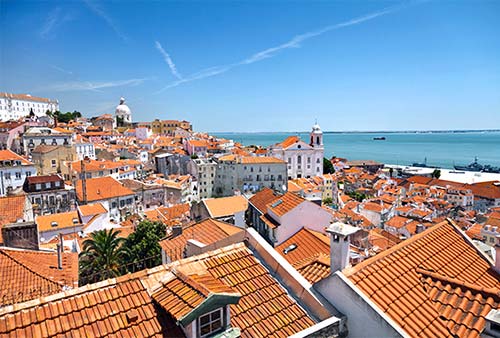
At your feet sprawls the Alfama neighborhood. We’ll head that way soon, to explore its twisty lanes. Where the Alfama hits the river, notice the recently built embankment. It reclaimed 100 yards of land from the river to make a modern port, used these days to accommodate Lisbon’s growing cruise ship industry.
On the wall of the church behind you, notice two 18th-century tile panels. The one on the left shows the preearthquake Praça do Comércio, with the royal palace (on the left). It was completely destroyed in the 1755 quake. The other tile (10 steps away, to the right) depicts the reconquest of Lisbon from the Moors by Afonso Henriques. You can see the Portuguese hero, Martim Moniz, who let himself be crushed in the castle door to hold it open for his comrades. Notice the panicky Moors inside realizing that their castle is about to be breached by invading Crusaders. It was a bad day for the Moors.
For an even better city view, hike back around the church and walk out to the seaside end of the Miradouro das Portas do Sol catwalk. The huge, frilly building dominating the ridge on the far left is the Monastery of São Vicente, constructed around 1600 by the Spanish king Philip II, who left his mark here with this tribute to St. Vincent. A few steps away, next to a statue of St. Vincent, is a kiosk café where you can enjoy perhaps the most scenic cup of coffee in town.
• Across the street from the café, you’ll find the...
6 Museum and School of Portuguese Decorative Arts
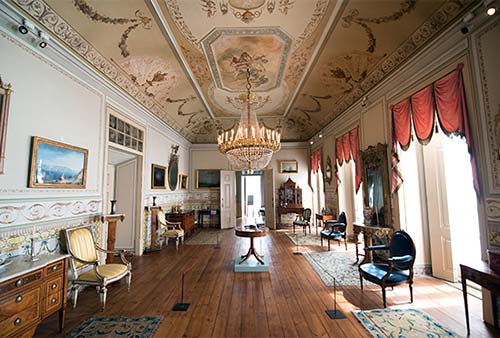
The Museum and School of Portuguese Decorative Arts (Museu Escola de Artes Decorativas Portuguesas) offers a stroll through a richly decorated, aristocratic household. The palace, filled with 15th-to-18th-century fine art, offers the best chance for visitors to experience what a noble home looked like during Lisbon’s glory days (€4, Wed-Mon 10:00-17:00, closed Tue, Largo das Portas do Sol 2, +351 218 814 640, www.fress.pt). Inside, a coach on the ground level is “Berlin style,” with a state-of-the-art suspension system, on leather straps. The grand stairway leads upstairs past 18th-century glazed tiles (Chinese-style blue-and-white was in vogue) into a world of colonial riches. Portuguese aristocrats had a special taste for “Indo-Portuguese” decorative arts: objects of exotic woods such as teak or rosewood, and inlaid with shell or ivory, made along the sea routes of the age.
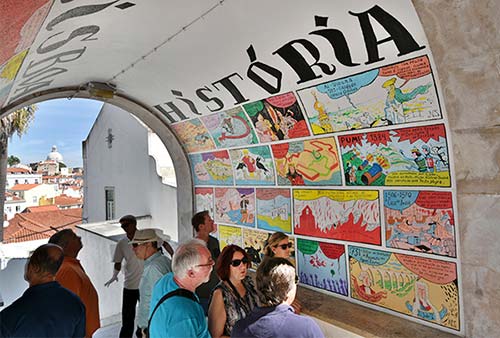
From here, it’s downhill all the way. From Largo das Portas do Sol (the plaza with the statue of local patron St. Vincent, near the kiosk café on the terrace), go down the loooong stairs (Rua Norberto de Araújo, between the church and the catwalk). A few steps down on the left, under the big arch, notice the public WCs and the fun, vivid cartoon mural illustrating Lisbon’s history (if you know the key dates, you can enjoy it even without understanding Portuguese).
The massive eighth-century fortified wall (on the right of the staircase) once marked the boundary of Moorish Lisbon. Consider that the great stones on your right were stacked here over a thousand years ago. At the bottom of the wall, continue downhill, then turn left at the railing...and go down more stairs.
• Explore downhill from here. The main thoroughfare, a concrete stepped lane called Escadinhas de São Miguel, funnels you to the Alfama’s main square.
7 Heart of the Alfama
This square, Largo de São Miguel, is the best place to observe a slice of Alfama life. When city leaders rebuilt the rest of Lisbon after the 1755 quake, this neighborhood was left out and consequently retains its tangled medieval streets.
If you’ve got the time, explore the Alfama from this central square. Its urban-jungle roads are squeezed into confusing alleys—the labyrinthine street plan was designed to frustrate invaders. What was defensive then is atmospheric now. Bent houses comfort each other in their romantic shabbiness, and the air drips with laundry and the smell of clams. Get lost. Poke aimlessly, peek through windows, buy a fish. Locals hang plastic water bags from windows in the summer to keep away the flies. Favorite saints decorate doors to protect families. St. Peter, protector of fishermen, is big in the Alfama. Churches are generally closed, since they share a priest. As children have very little usable land for a good soccer game, this square doubles as the neighborhood playground.
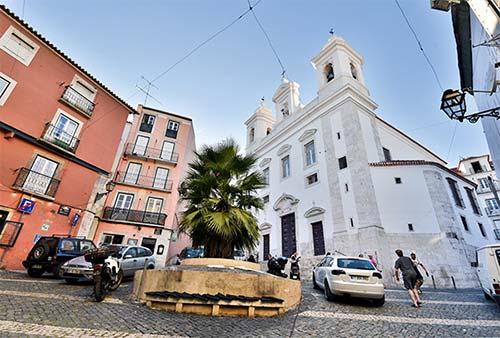
The tiny balconies were limited to “one-and-a-half hands” in width. A strictly enforced health initiative was designed to keep the town open and well-ventilated. If you see carpets hanging out to dry, it means a laundry is nearby. Because few homes have their own, every neighborhood has a public laundry and bathroom. Until recently, in the early morning hours, the streets were busy with residents in pajamas, heading for these public baths. Today, many younger people are choosing to live elsewhere, lured by modern conveniences unavailable here, and old flats with older residents are under the watchful eye of real estate developers. Many long-term residents have been evicted due to landlords claiming “necessary reforms,” only to sell the entire building for development as tourist housing. In just one generation, the Alfama is feeling the pressure of gentrification.
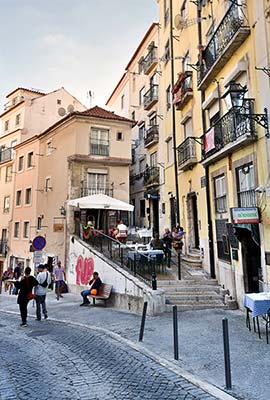
Traditionally the neighborhood here was tightly knit, with families routinely sitting down to communal dinners in the streets. Feuds, friendships, and gossip were all intense. Historically, when a woman’s husband died, she would wear black for the rest of her life—a tradition that’s just about gone.
The Alfama hosts Lisbon’s most popular outdoor party dedicated to St. Anthony (whose feast day is June 13, but the party goes on all month). Imagine tables set up everywhere, bands playing, bright plastic flowers strung across the squares, and all the grilled sardines (sardinhas grelhadas) you can eat. The rustic paintings of festive characters (with hints of Moorish style) remind locals of past parties, and strings and wires overhead await future festival dates when the neighborhood will again be festooned with colorful streamers.
While there are plenty of traditional festivals here, the most action on the Alfama calendar is the insane, annual mountain-bike street race from the castle to the sea (which you can see hurtle by in two minutes on YouTube; search “Lisboa downtown race”).
Continue exploring downhill from here. Just below the square you’ll see A Baiuca, a recommended amateur fado restaurant. Then, a few steps farther downhill, you’ll hit the cobbled pedestrian lane, Rua São Pedro. This darkest of the Alfama’s streets, in nearly perpetual shade, was the logical choice for the neighborhood’s fish market. Modern hygiene requirements (which forbid outdoor stalls) killed the market, but it’s still a characteristic lane to explore.
• Turn left and follow Rua São Pedro out of the Alfama to the square called Largo do Chafariz de Dentro and, across the street, to the...
8 Fado Museum
This ▲ museum tells the story of fado in English—with a great chance to hear these wailing fisherwomen’s blues. Three levels of wall murals show three generations of local fado stars, and the audioguide lets you listen to the Billie Holidays of Portugal (€5, Tue-Sun 10:00-18:00, closed Mon, Largo do Chafariz de Dentro, +351 218 823 470, www.museudofado.pt).
• This walk is over. To get back downtown (or to Praça do Comércio, where the next walk starts), walk a block to the main waterfront drag and cruise-ship terminal (facing the museum, go left around it) where busy Avenida Infante Dom Henrique leads back to Praça do Comércio (to the right). While it’s a 15-minute, pedestrian-paved walk or quick taxi ride to Praça do Comércio, just to the left is a bus stop; hop on any bus for two stops, and you’re there in moments. (Also, bus #759 goes on to Praça dos Restauradores.)
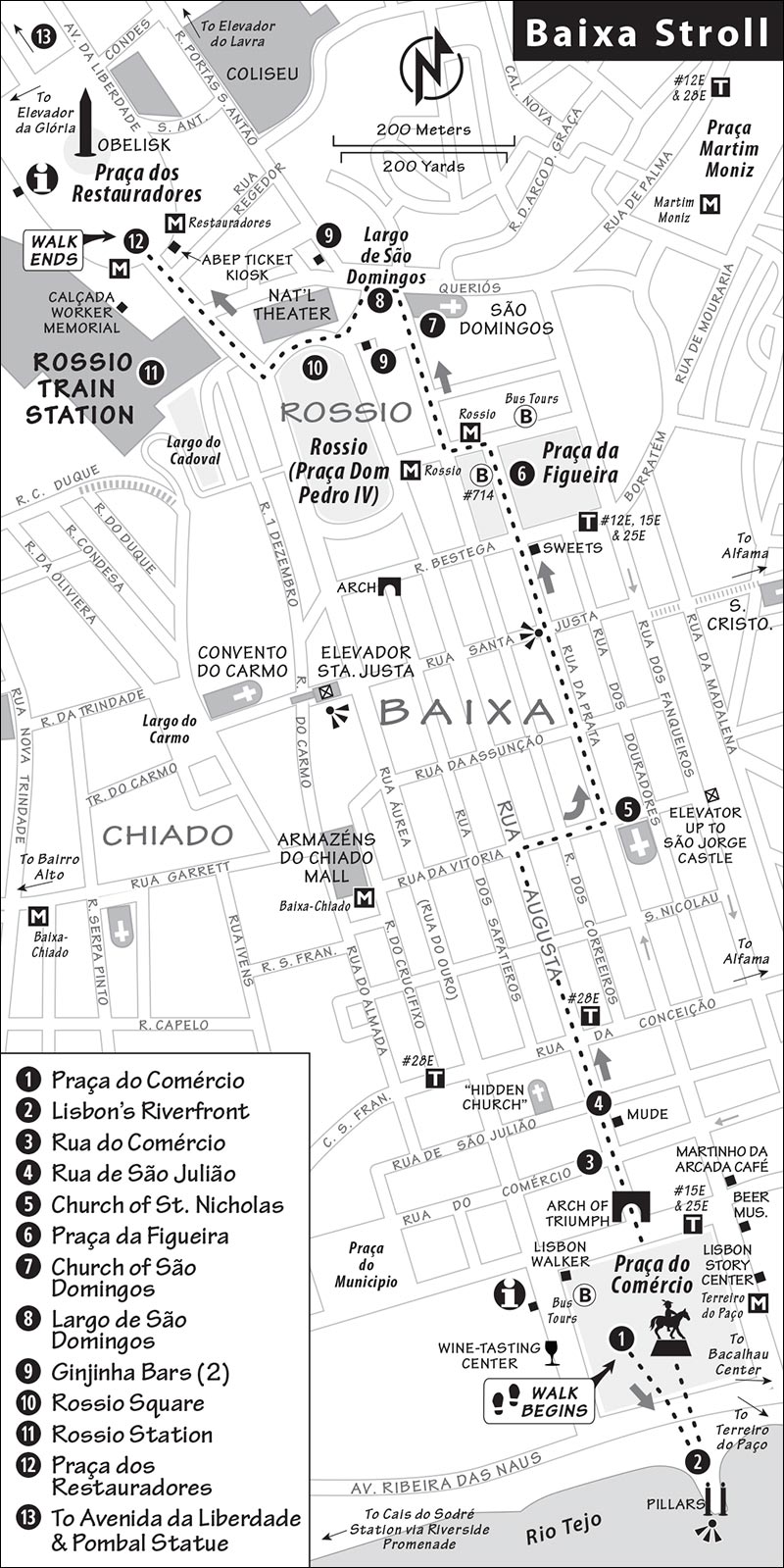
BAIXA STROLL
This ▲▲▲ walk covers the highlights of Lisbon’s historic downtown, the Baixa, which fills a flat valley between two hills. The district slopes gently from the waterfront up to Rossio, Praça dos Restauradores, Avenida da Liberdade, and the newer town. The walk starts at Praça do Comércio and ends at Praça dos Restauradores.
• Start your walk at the statue of King José I in the center of Praça do Comércio. Find a spot of shade in José’s shadow (or take cover under the arcades) and read a bit about the Baixa’s history.
Background: After the disastrous 1755 earthquake, the Baixa district was rebuilt on a grid street plan. The uniform and utilitarian Pombaline architecture (named after the Marquês de Pombal, the chief minister who rebuilt the city—see sidebar, earlier) feels almost military. That’s because it is. The Baixa was constructed by military engineers who had experience building garrison towns overseas. The new Lisbon featured the architecture of conquest—simple to assemble, economical, with all the pieces easy to ship. The 18th-century buildings you’d see in Mozambique and Brazil are interchangeable with those in Lisbon.
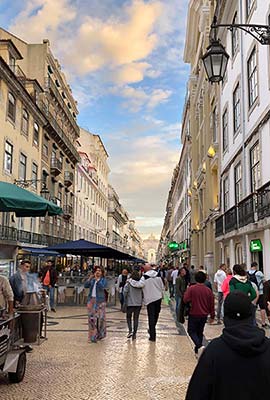
The buildings are all uniform, with the same number of floors and standard facades. They were designed to survive the next earthquake, with stone firewalls and wooden frameworks that had flexible crisscross beams. The priorities were to rebuild fast, cheap, and shake-proof.
If it had been left up to the people, who believed the earthquake was a punishment from God, they would have rebuilt their churches bigger and more impressive than ever. But Pombal was a practical military man with a budget, a timeline, and an awareness of his society’s limits. Large churches didn’t fit into the new, orderly grid. In those austere postearthquake days, Pombal got his way.
The Baixa has three squares—two preearthquake (Comércio and Rossio) and one added later (Figueira)—and three main streets: Prata (silver), Aurea (gold), and Augusta (relating the Portuguese king to a Roman emperor). The former maze of the Jewish quarter was eliminated, but the area has many streets named for the crafts and shops once found there.
The Baixa’s pedestrian streets, inviting cafés, bustling shops, and elegant old storefronts give the district a certain charm. City-government subsidies make sure the old businesses stay around, but modern ones find a way to creep in. I find myself doing laps up and down Rua Augusta in a people-watching stupor. Its delightful ambience is perfect for strolling.
• Now turn your attention to the square itself.
1 Praça do Comércio (Commerce Square)
At this riverfront square bordering the Baixa—along the gateway to Lisbon—ships used to dock and sell their goods. This was the site of Portugal’s royal palace for 200 preearthquake years, but after the 1755 earthquake/tsunami/fire, the jittery king fled to more stable Belém, never to return. These days, government ministries ring Praça do Comércio. It’s also the departure point for city bus and tram tours, and boats that cruise along the Rio Tejo. The area opposite the harbor was conceived as a residential neighborhood for the upper class, but they chose the suburbs. Today, the square has two names (“Palace Square” and “Commerce Square”) and little real life. Locals consider it just a big place to pass through.
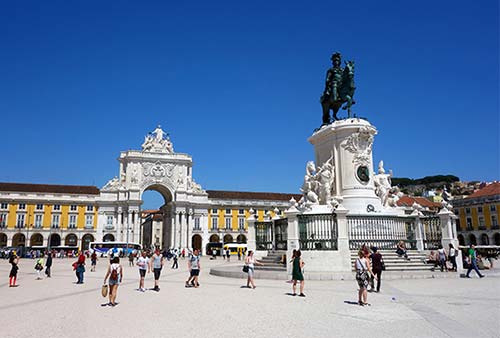
The statue is José I, the king who gave control of the government to his chief minister, the Marquês de Pombal. Built 20 years after the quake, it shows the king on his horse, with Pombal (on the medallion), looking at their port. The king on horseback strikes a heroic pose, bravely riding through the ground covered in snakes (a contrast to his actual behavior after the earthquake, refusing to sleep in a stone building ever again). The snakes actually hide support mechanisms for the heavy statue. Triumph and Fame toot the king’s arrival, while a horse represents Portugal’s European power and an elephant asserts the country’s dominance in Asia. In its glory days, this city was where east met west. The statue proved such a success that it jump-started sculptor Joaquim Machado de Castro’s career (see more at his museum in Coimbra).
The big arch marking the inland side of the square is Lisbon’s Arch of Triumph (with Vasco da Gama on the left and Pombal on the right). Disregarding his usual austerity, Pombal restored some of the city’s Parisian-style grandeur at this central approach into downtown.
Facing the Arch of Triumph, get oriented to a few landmarks on the square (moving from left to right):
At 9 o’clock is the cozy Wines of Portugal Tasting Room, a nonprofit wine-appreciation venue. About two dozen local wines are offered; English descriptions are above each tap, and a helpful attendant is happy to explain things. To taste, you buy a chip card (€3 minimum and €2 deposit for the card), take a glass, and serve yourself samples of Portuguese wines of every variety: white, red, green (vinho verde), and a few ports; custom flights of wines can be reserved for €10-25; Mon-Sat 11:00-19:00, closed Sun, http://winesofportugal.com).
At 10 o’clock is the TI.
At 1 o’clock, under the arcade just right of the arch, is Martinho da Arcada, a fine option for a coffee, pastry, or snack (Praça do Comércio 8, at the corner of Rua da Prata). It was founded in 1782—when the wealthy would come here to savor early ice cream made with mountain snow, lemon, and spices. While it has a fancy restaurant, I’d enjoy just a coffee and pastry in its café bar. This place was one of poet Fernando Pessoa’s old haunts (they display a few Pessoa artifacts, lots of old photos, and a shrine-like table that was his favorite). In the early 20th century, painters, writers, and dreamers shared revolutionary ideas here over coffee.
At 2 o’clock sits the skippable Beer Museum. At 3 o’clock is the much-promoted “Lisbon Story Center,” a childish exhibit with no artifacts—you pay €8 to stand for an hour looking at animated history on computer screens. Nearby is another branch of the TI (in case the first one is too crowded).
And at 5 o’clock is the Terreiro do Paço Metro stop (see the red M on a post) as well as the Bacalhau interpretive center, which traces the importance of codfish to Portugal. Finally, look up to see the tree-covered home to São Jorge Castle from the previous walk.
• Before moving on, use the crosswalk at the bottom of the big square for a quick look at...
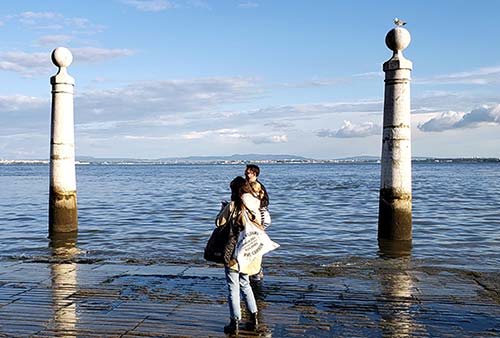
2 Lisbon’s Riverfront
An inviting balustrade and a pair of pillars—Lisbon’s gateway to the sea, an arrival and departure point for everyone from Philip II of Spain to dictator António de Oliveira Salazar—mark a little pier (called the Cais das Colunas) that offers a fine, water-level view of the Tejo riverscape. To your left is the busy Terreiro do Paço ferry terminal—one of many that connect commuters to the far side of the river. To your right are the 25th of April Bridge and Cristo Rei statue. Down here at water level, you can really see that the Tejo is a tidal river—the Atlantic is just around the bend (past the bridge). At low tide, the humble little rocky beach reveals worlds of sea life in rocky pools. Any tide poolers out today?
• Now, head back up through the square, cross the busy street, pass under the big arch, and walk down Rua Augusta into the Baixa district. (Skip the chance to pay to go to the top of the arch—it affords only a mediocre view from its empty rooftop.)
The first cross street you meet is...
3 Rua do Comércio
Look right to see the old cathedral with its Romanesque fortress-like crenellations (described later, under “Sights in Lisbon”). Notice that many of the surrounding buildings are in the austere architectural style adopted immediately after the earthquake. Exterior decoration was adopted here in Lisbon only in the 19th century, after the Portuguese in colonial Brazil found that the tiles protected against humidity.
The characteristic black-and-white cobbled sidewalk (calçada) is uniquely Portuguese. These mosaic limestone and basalt cobbles were first cut and laid by 19th-century prison laborers, but maintaining them has since developed into a skilled craft. To this day patterns are chosen from acceptable designs made from large, wooden stencils. One benefit of these sidewalks is that they move and flow with the earth; even as tree roots spread or the ground shifts, the asphalt does not crack. But as the stones can be slippery and require skilled labor, the city government is talking about replacing them with modern pavement. Locals are crying out to keep the tradition.
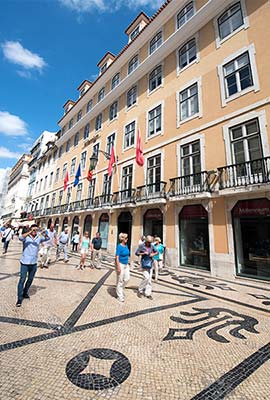
Across the street, on the right, you’ll pass the MUDE, Lisbon’s museum of 20th-century design and fashion, occupying a former bank building (likely closed for renovation).
• The next cross street is...
4 Rua de São Julião
Churches blend into the postearthquake Baixa. There’s one about 30 yards to the left down Rua de São Julião (hiding on right side of street; look for the triangular pediment over door). Churches were rebuilt to be better incorporated into the no-nonsense grid plan of the Baixa. Look up for evidence of how downtown Lisbon’s population is shrinking as more people move to the suburbs: The upper floors of many buildings are now mostly empty.
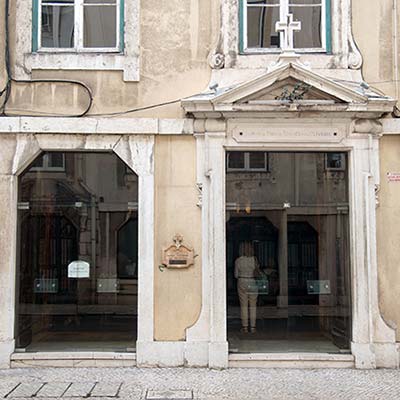
At the next block, Rua da Conceição, there’s a stop for the handy trolley #28E. Ahead on the right (in the windows of the Millennium Bank) are Roman artifacts—a reminder that Lisbon’s history goes way back.
• Go two more blocks to the intersection with Rua da Vitoria. Turn right and walk two blocks to Rua da Prata, where you’ll see the camouflaged...
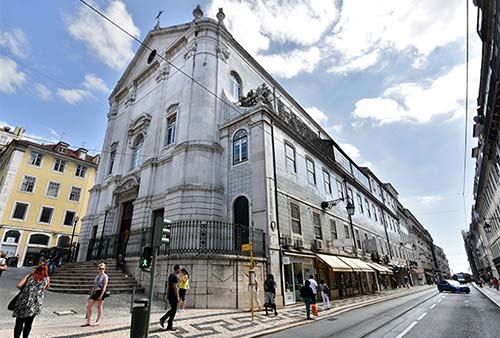
5 Church of St. Nicholas (Igreja de São Nicolau)
Notice how a typical church facade faces the square, but on the streetfront side, the entire exterior is covered with green tiles, as just another stretch of post-earthquake Baixa architecture. The church made extra income by leasing what is technically their property to the businesses on busy Rua da Prata. Several of the fine, tiled buildings near this square have been refurbished. In fact, the one at the very top of the square hides a free elevator that takes you partway up to the castle atop the Alfama.
• Head north down Rua da Prata toward the statue marking Praça da Figueira. At Rua de Santa Justa, look left for a good view of Elevador de Santa Justa before continuing straight to the square.
6 Praça da Figueira (Fig Tree Square)
This was the site of a huge hospital destroyed in the earthquake. With no money to replace the hospital, the space was left open until the late 1880s, when it was filled with a big iron-framed market (similar to Barcelona’s La Boqueria). That structure was torn down decades ago, leaving the square you see today.
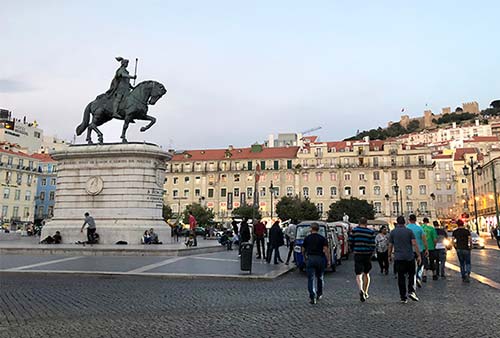
The big building on the left, likely covered in scaffolding, has been purchased in part by Spanish tennis star Rafael Nadal for a total of €62 million. It’s an example of the neighborhood being reinvigorated—though likely at the expense of long-time tenants.
The nearby Confeitaria Nacional shop (on the corner of the square, 20 yards to your left) is a venerable palace of sweets little changed since the 19th century. In the window is a display of “conventuel sweets”—special nun-made treats often consisting of sugar and egg yolks. (Historically, the nuns, who used the egg whites to starch their laundry, had an abundance of yolks.) Consider a light lunch in the recommended upstairs dining room.
The square is a transportation hub, with stops for minibus #737 to the castle; old trolleys #12E to the Alfama viewpoint and #25E to Campo Ourique; modern trolley #15E and bus #714 heading out to Belém; and hop-on, hop-off tour buses.
Walk to the far-left corner of the square, past skateboarders oblivious to its historical statue—Portugal’s King João I on a horse. Continue straight out of the square on Rua Dom Antão de Almada. This lane has several characteristic shops. Pop into the classic cod shop (on the left at #1C—you’ll smell it). Cod (bacalhau) is part of Portugal’s heritage as a nation of seafaring explorers: Salted cod could keep for a year on a ship. Just soak in water to rinse out the salt and enjoy. The adjacent ham counter serves pata negra (presunto ibérico) from acorn-fed pigs—the very best. Many say the alheira sausage, made with bread, game, and garlic instead of pork, was a favorite among Lisbon’s Jews back when they needed to fake being Christians (during the forced conversions of the Inquisition era). In reality, the sausage was a way to preserve other types of meat for long winter months.
• At the end of the lane stands a big church facing another square.
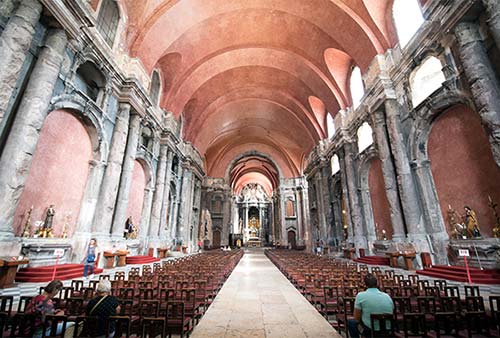
7 Church of São Domingos
A center of the Inquisition in the 1600s, this is now one of Lisbon’s most active churches (daily 7:30-19:00). The evocative interior—rebuilt from the ruins left by the 1755 earthquake—would continue to play an important role in local history due to its location so near Rossio. Two famous royal weddings were held here in the 1800s. But the current state of the church—with black soot on the walls and charred stonework at the altar—is due to a raging fire in 1959. Closed for decades, São Domingos finally reopened to the public in the 1990s, with all its scars still visible. Tabloid photos of fire damage can be seen at the exit. Our Lady of Fátima is Portugal’s most popular saint, and her chapel (in the left rear of the church) always has the most candles. Her statue is accompanied by two of the three children to whom she miraculously appeared (the third was still alive when this chapel was made and so is not shown in heaven with the saint).
• Step into the square just beyond the church.
8 Largo de São Domingos
This area was just outside the old town walls—long a place where people gathered to keep watering holes busy and enjoy bohemian entertainment. Today the square is home to classic old bars (like the ginjinha bar described next) and a busy “eating lane,” Rua das Portas de Santo Antão (kitty-corner from where you entered the square, to the right of the National Theater on the far side of the square).
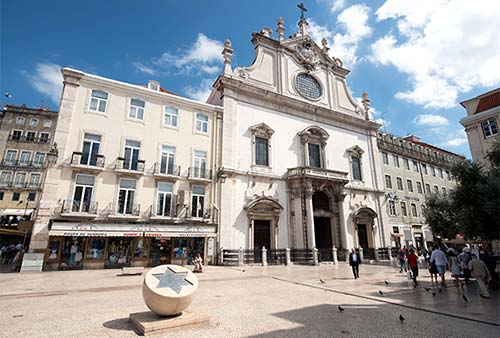
A stone monument on the square remembers the Jewish massacre of 1506. Many Jews expelled from Spain in 1492 took refuge in Portugal. But when a drought ravaged the country, Lisbonites killed several thousand of them on this square.
The city’s 16th-century slave market also took place here, but the square is now a meeting point for the city’s African community—immigrants from former Portuguese colonies such as Angola, Mozambique, and Portuguese Guinea. They hang out, trade news from home, and watch the tourists go by.
With that unfortunate heritage, the city today calls itself the “City of Tolerance,” evident in the mix of people who hang out in this area. Just beyond this square is a square called Praça Martim Moniz, the springboard for the tangled and characteristic Mouraria district, the immigrant neighborhood between here and the castle (described later, under “Sights in Lisbon”).
• Look toward the big adjoining square to find the colorful little tavern serving a traditional berry brandy.
9 Liquid Sightseeing (Ginjinha Bars)
Ginjinha (zheen-ZHEEN-yah) is a favorite Lisbon drink. While nuns baked sweets, the monks took care of quenching thirsts with this sweet liquor, made from the ginja berry (like a sour cherry), sugar, and brandy. It’s now sold for €1.40 a shot in funky old shops throughout downtown. Buy it with or without berries (com elas or sem elas—that’s “with them” or “without them”) and gelada (if you want it poured from a chilled bottle). In Portugal, when people are impressed by the taste of something, they say, “Sabe que nem ginjas”—literally “It tastes like ginja,” but meaning “finger-lickin’ good.”
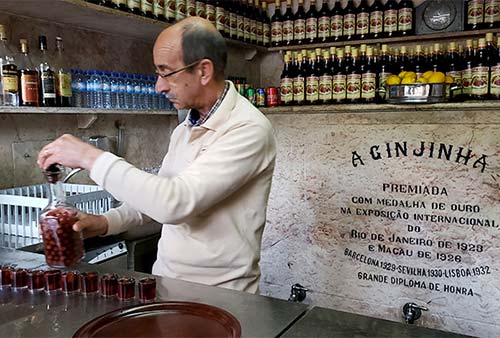
The oldest ginjinha joint in town is a hole-in-the-wall at Largo de São Domingos 8. If you hang around the bar long enough, you’ll see them refill the bottle from an enormous vat. (Another ginjinha bar, Ginjinha Sem Rival, serves the prized Eduardinho liqueur, considered the most authentic; it’s just across the square, at the start of the restaurant row—Rua das Portas de Santo Antão—at #7.)
• A big square is around the corner (fronting the National Theater). This is...
10 Rossio Square
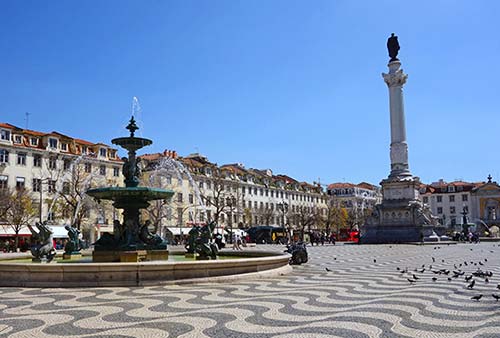
Lisbon’s historic center, Rossio, is still the city’s bustling cultural heart. Given its elongated shape, historians know it was a Roman racetrack 2,000 years ago; these days, cars circle the loop instead of chariots. It’s home to the colonnaded National Theater, American fast-food chains, and street vendors who can shine your shoes, laminate your documents, and sell you cheap watches, autumn chestnuts, and lottery tickets. The column in the square’s center honors Pedro IV—king of Portugal and emperor of Brazil. (Many maps refer to the square as Praça Dom Pedro IV, but residents always just call it Rossio, for the train station at one corner.)
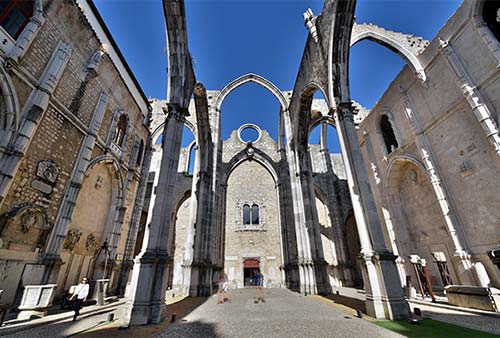
At 9:40 on Sunday, November 1—All Saints’ Day—an underwater earthquake estimated to be close to 9.0 in magnitude occurred off the southern Portuguese coast. Massive tremors rumbled through Lisbon, punctuated by three main jolts. The quake came midway through Mass, when devout locals filled the churches. Minutes later, thousands lay dead under the rubble.
Along the waterfront, shaken survivors scrambled aboard boats to sail to safety. They were met by a 20-foot wall of water, the first wave of a tsunami that rushed up the Rio Tejo. The ravaging water capsized ships, swept people off the docks, crested over the seawall, and crashed 800 feet inland.
The tremors were felt throughout Europe—as far away as Finland. Imagine a disaster similar to 2004’s Indian Ocean earthquake and tsunami, devastating Portugal’s capital city.
Fires turned the city into an inferno. The flames blazed for five days, ravaging the downtown from the Bairro Alto across Rossio to the castle atop the Alfama.
Of Lisbon’s 270,000 citizens, over 10,000 may have perished, and two-thirds of the city was leveled. The city’s biggest buildings—its churches, designed to connect earth with heaven—had simply collapsed, crushing the faithful. Understandably, the quake shook conservative Portugal’s moral and spiritual underpinnings. Had God punished Lisbon for the Inquisition killings carried out on nearby Praça do Comércio? To the people of the time, it must have felt like the Apocalypse.
King José I was so affected by the earthquake that he moved his entire court to an elaborate complex of tents in the foothills of Belém and resisted living indoors for the rest of his life. He left his energetic (and eventually dictatorial) second-in-command—his chief minister Marquês de Pombal—the task of rebuilding. For more on Pombal, see “Pombal’s Lisbon,” earlier.
The square once held a palace that functioned as the headquarters of the Inquisition. Damaged by the 1755 earthquake, it was demolished, and in an attempt to erase its memory, the National Theater was built in its place.
From here you can see the Elevador de Santa Justa and the ruined convent breaking the city skyline. Notice the fine stone patterns in the pavement—evoking waves encountered by the great explorers. (If you’re prone to seasickness, don’t look down as you cross the square.)
• Crossing the square in front of the National Theater, you see...
11 Rossio Station
The circa-1900 facade of Rossio station is Neo-Manueline. You can read the words “Estação Central” (central station) carved on its striking horseshoe arches. Find the empty niche where a statue of King Sebastian once stood in the center of two arches. Unfortunately, the original statue fell and broke into many pieces in 2016 when a tourist climbed the facade to take a selfie (I’m not kidding). What you see now is a replica. This romantic, dashing, and young soldier-king was lost in 1580 in an ill-fated crusade to Africa. As Sebastian left no direct heir, the crown ended up with Philip II of Spain, who became Philip I of Portugal. The Spanish king promised to give back the throne if Sebastian ever turned up—and ever since, the Portuguese have dreamed that Sebastian will return, restoring their national greatness. Even today, in a crisis, the Portuguese like to think that their Sebastian will save the day—he’s the symbol of being ridiculously hopeful.
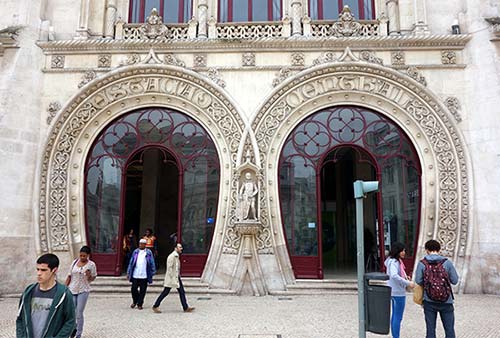
• Just uphill from Rossio station is Praça dos Restauradores, at the bottom of Lisbon’s long and grand Avenida da Liberdade. Between Rossio station and the square is Lisbon’s oldest hotel, the Avenida Palace. Built as a terminus hotel at the same time as Rossio station, it has a fun interior, with an elegant yet inviting oasis of a bar/lounge—popular with WWII spies in the 20th century, and tourists needing a little break in the 21st century (nice after this walk).
12 Praça dos Restauradores
This monumental square connects Rossio with Avenida da Liberdade. The obelisk at its centerpiece celebrates the restoration of Portuguese independence from Spain in 1640 (without any help from the still-missing Sebastian mentioned earlier).
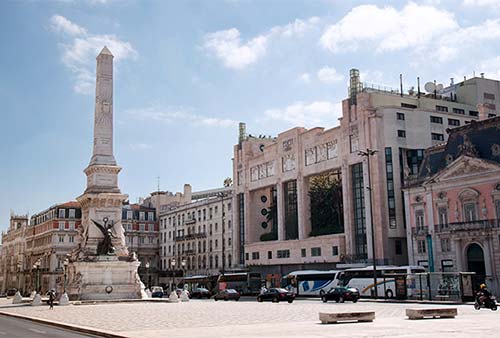
Looking uphill at the lower-left corner of the square, find a statue remembering the generations of laborers who made the city’s characteristic black-and-white calçada sidewalks. Lisboners love the patterns decorating their pavements throughout the town. Here, these bronze workers have made the symbol of the city: a ship, carrying the remains of St. Vincent, guarded by two ravens.
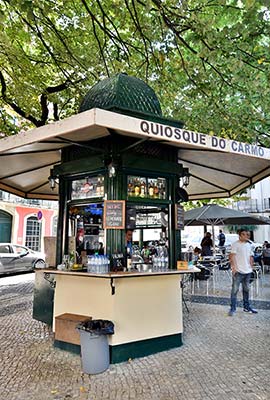
The kiosk—that’s quiosque in Portuguese—is a standard feature of squares and viewpoints all over town. These little pavilions got their start in the 19th century selling snacks and drinks. But they fell out of favor, with some being converted to newsstands or lottery sales points. Now they’re back, with outdoor cafés turning parks and squares into neighborhood hangouts and meeting points. Older kiosks have been restored, and new ones are being built all the time and can be quite trendy.
Overlooking the square is the 1930s Art Deco facade of the Eden Theater. About 100 yards farther up the boulevard (past a Metro station and TI, on the left) is the Elevador da Glória funicular that climbs to the Bairro Alto.
• While this walk ends here, you can stroll up Avenida da Liberdade for a good look at another facet of this fine city. The next walk (my Bairro Alto and Chiado Stroll) starts at the funicular just up the street on your left.
13 Avenida da Liberdade
This tree-lined grand boulevard, running north from Rossio, connects the old town (where most of the sightseeing action is) with the newer upper town. Before the great earthquake, this was the city’s royal promenade. After 1755, it was the grand boulevard of Pombal’s new Lisbon—originally limited to the aristocracy. The present street, built in the 1880s and inspired by Paris’ Champs-Elysées, is lined with hotels, high-fashion shopping, expensive office buildings...and eight lanes of traffic. The grand “rotunda”—as the roundabout formally known as Marquês de Pombal is called—tops off Avenida da Liberdade with a commanding statue of Pombal. Allegorical symbols of his impressive accomplishments decorate the statue. (An absent king and an iron-willed minister left in charge can do a lot in 27 years.) Beyond that lies the fine Edward VII Park. From the Rotunda (M: Marquês de Pombal), it’s an enjoyable 20-minute downhill walk along the mile-long avenue back to the Baixa.
Whether strolling uphill or down, one of the joys of modern Lisbon is to simply walk this grand boulevard, dotted with monuments, statues, and food kiosks with inviting seating—perfect for enjoying a drink or snack.
BAIRRO ALTO AND CHIADO STROLL
The Old World-feeling Bairro Alto (High Town) and trendy Chiado perch just above the busy Baixa. This walk (rated ▲▲▲) connects dramatic viewpoints, leafy parks with inviting kiosk cafés, skinny streets lined with fado clubs, a dramatic church, an earthquake-toppled convent, Chiado’s trendy dining and shopping scene, and a classic coffeehouse.
Getting There: Rise above the Baixa on the funicular called Elevador da Glória, located near the obelisk at Praça dos Restauradores (opposite the Hard Rock Café, €3.80 for two trips if you pay driver, €1.30 if zapping with Viva Viagem card, every 10 minutes); you can also hike up alongside the tracks.
• Leaving the funicular on top, turn right (go 100 yards, up into a park) to enjoy the city view from the...
1 Miradouro de São Pedro de Alcântara (Viewpoint)
A tile map guides you through the view, which stretches from the twin towers of the cathedral (on far right, near the river), to the ramparts of the castle birthplace of Lisbon (capping the hill, on right), to another quaint, tree-topped viewpoint in Graça (directly across, end of trolley #28E), to the skyscraper towers of the new city in the distance (far left). When you see a big old building in Lisbon, it’s often a former convent or monastery. With the dissolution of monastic religious orders in 1834, these buildings were nationalized, and they are now occupied by hospitals, museums, schools, or the military.
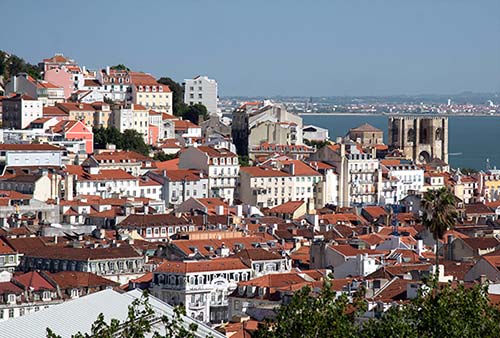
A bust in the park, hidden by a semipermanent beer garden, honors a 19th-century local journalist (founder of Lisbon’s first daily newspaper) and a barefooted delivery boy. This district is famous for its writers, poets, publishers, and bohemians.
• Directly across the street from where you got off the Elevador da Glória is Solar do Vinho do Porto, run by the Port Wine Institute—a good place to sample the famous fortified wine from northern Portugal. Step inside—or consider returning later for a do-it-yourself tasting (for a description, see here).
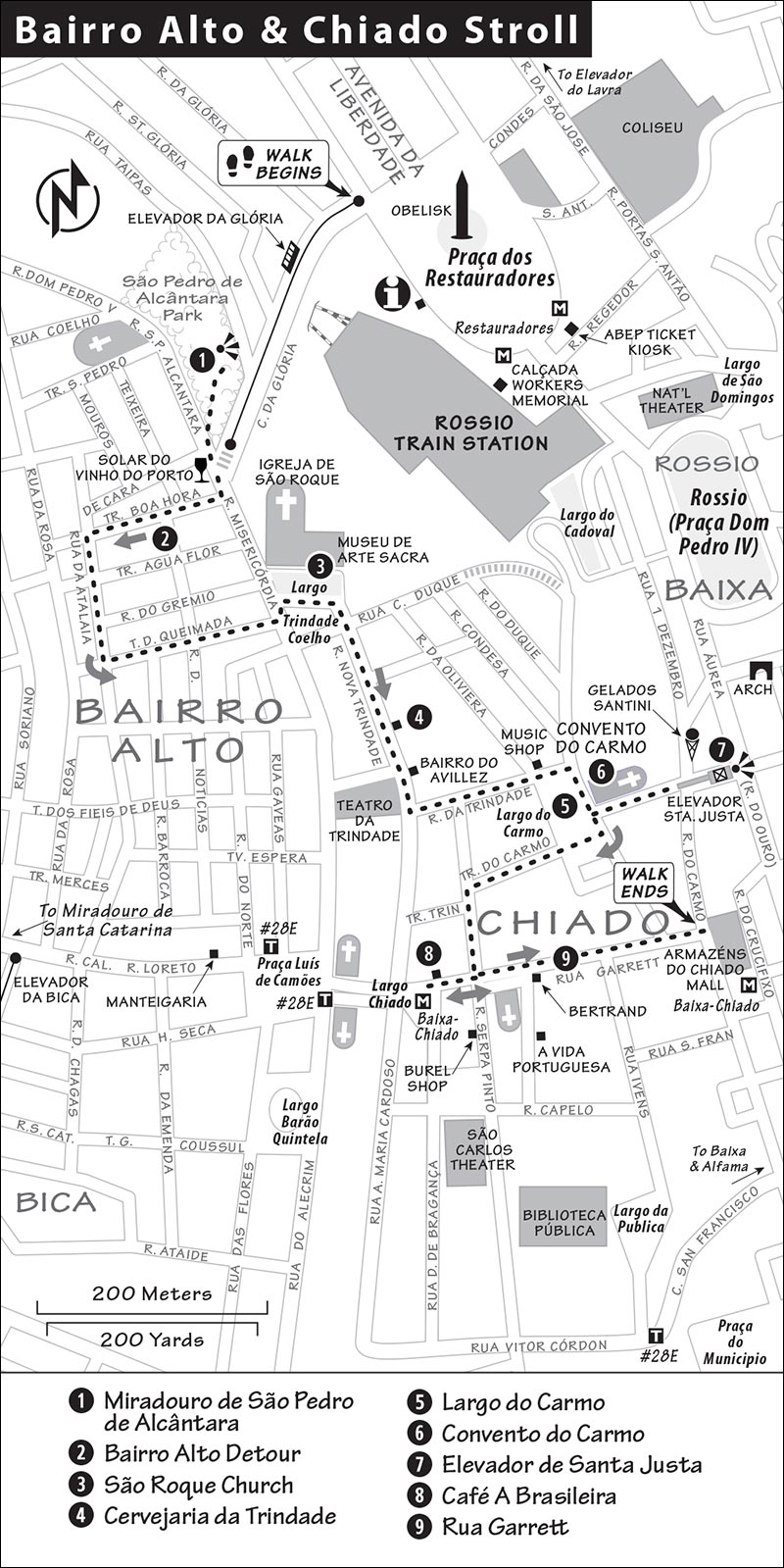
Next, walk directly across from the top of the funicular for a short detour into the old grid-plan streets of the Bairro Alto.
2 Bairro Alto Detour
The Bairro Alto is one of the most characteristic and appealing districts in Lisbon. Designed in the 16th century with a very modern (at the time) grid-plan layout, the district housed ship workers back when Portugal was a world power and its ships planted the Portuguese flag all around the globe. Today, the Bairro Alto is quiet in the morning but buzzes with a thriving restaurant scene in the evening and a rowdy bar scene later—much to the chagrin of elder residents.
While it’s fun to wander, follow this route for a good sampling: Go two blocks gently uphill on Travessa da Boa Hora, turn left on Rua da Atalaia, continue three blocks, and then head left down Travessa da Queimada until you cross the big street (leaving the Bairro Alto) and reach the small square, Largo Trindade Coelho.
• On Largo Trindade Coelho is the...
3 São Roque Church (Igreja de São Roque)
Step inside and sit in a pew in the middle to take it all in (free; Mon 14:00-18:00, Tue-Sun 9:00-18:00, Thu until 21:00). Built in the 16th century, the ▲ church of St. Roque—dedicated to the saint who protects the faithful from disease and plagues—is one of Portugal’s first Jesuit churches. The painted-wood, false-domed ceiling is perfectly flat. The acoustics here are top-notch, important in a Jesuit church, where the emphasis is on the sermon. The numbered panels on the floor were tombs, nameless because they were for lots of people. They’re empty now—the practice was stopped in the 19th century when parishioners didn’t want plague victims rotting under their feet.
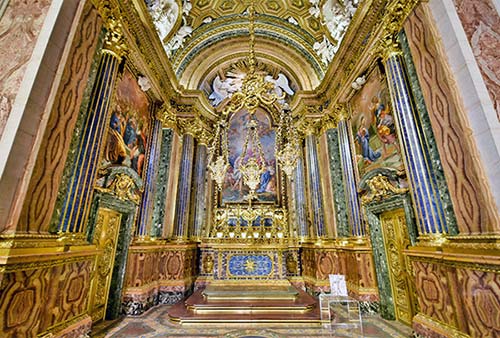
Survey the rich side chapels. The highlight is the Chapel of St. John the Baptist (left side of church, gold and blue lapis lazuli columns). It looks like it came right out of the Vatican...because it did. Made in Rome from precious materials, the chapel was the site of one papal Mass before it was disassembled and shipped to Lisbon. Per square inch, it was the most costly chapel ever constructed in Portugal. Notice the mosaic floor (with the spherical symbol of Portugal) and, on the walls, three intricate, beautiful mosaics—a Vatican specialty, designed to take the place of real paintings, which were vulnerable to damage from candle smoke and incense. Notice also the delicate “sliced marble” symmetry and imagine the labor involved in so artfully cutting that stone five centuries ago.
The chapel to the left of St. John the Baptist features a riot of babies. Individual chapels—each for a different noble family—seem to be in competition. Keep in mind that the tiles are considered as extravagant as the gold leaf and silver. To the left of the main altar, a glass case is filled with relics trying to grab your attention.
Between the Chapel of St. John the Baptist and the relics, find the sacristy, where, along with huge chests of drawers for vestments, you can see a series of 17th-century paintings illustrating scenes from the life of St. Francis Xavier—one of the founders of the Jesuit order along with St. Ignatius of Loyola and Peter Faber (irregular hours, only open when staffed).
On your way out, you might pop a coin into a rack of fake candles and power a prayer.
The São Roque Museum (Museu de Arte Sacra), to the left as you leave the church, is more interesting than your typical small church museum (€2.50, Tue-Sun 10:00-18:00, closed Mon). It’s filled with perhaps the best-presented collection of 16th- and 17th-century church art in town, and it’s well described in English. The church and this art, rare survivors of the 1755 earthquake, illustrate the religious passion that accompanied Portugal’s Age of Discovery, with themes including the mission of the Jesuits and their response to the Reformation; devotion to relics; and devotion to the Virgin.
• Back outside in the church square (WC underground), visit the statue of a friendly lottery-ticket salesman. Two lottery kiosks are nearby. Locals who buy into the Totoloto (which, like lotteries everywhere, is a form of taxation on gamblers that helps fund social outreach programs) rub the statue’s well-polished ticket for good luck.
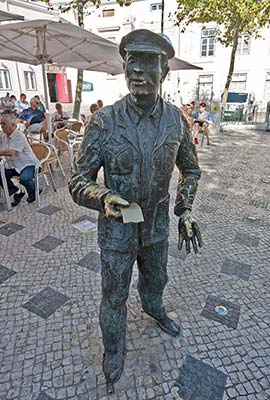
Continue (kitty-corner left across the square) downhill along Rua Nova da Trindade, following the tram tracks. At #20 (on the left), pop into...
4 Cervejaria da Trindade
The famous “oldest beer hall in Lisbon” is worth a visit for a look at its 19th-century tiles. The beautifully tiled main room, once a dining hall for monks, still holds the pulpit from which the Bible was read as the monks ate. After monastic orders were abolished in 1834, the monastery became a brewery—you’ll notice that while the oldest tiles have Christian themes, the later ones (from around 1860) are all about the beer. Among the Portuguese beers on tap are Sagres, the standard lager; Sagres Preta, a good dark beer (like a porter); and Bohemia, which is sweet, with more alcohol. At the bar in front you can get a snack and beer, while more expensive dining is in the back (see here).
• Continue down the hill. You’ll pass the recommended Bairro do Avillez building—home to three of more than a dozen Lisbon eateries owned by celebrity chef José Avillez, who is helping to bring traditional recipes (like the ones at the cervejaria we just left) into the 21st century.
Continue until the next intersection, where signs point left to the ruined Convento do Carmo. Follow the inside trolley tracks downhill and to the left. Just before you reach the square, notice (on the left) the well-stocked music shop—selling (among other instruments) the unique Portuguese guitars used to perform fado music.
You’ll wind up in the leafy, inviting square called...
5 Largo do Carmo
On this square decorated with an old fountain, lots of pigeons, and jacaranda trees from South America (with purple blossoms in June), police officers guard the headquarters of the National Guard. Famous among residents, this was the last refuge of the dictatorial Salazar regime. The Portuguese people won their freedom in 1974, in a peaceful uprising called the Carnation Revolution. The name came when revolutionaries placed flowers in the guns of the soldiers, making it clear it was time for democracy here. For more history, see the sidebar.
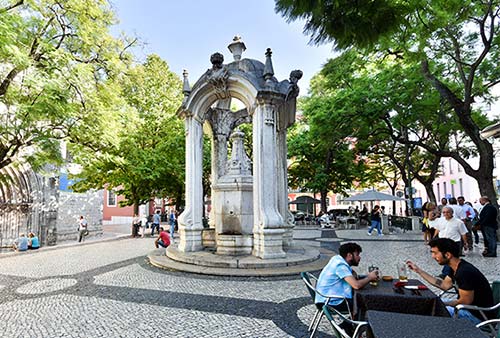
• On Largo do Carmo, check out the ruins of...
6 Convento do Carmo
After the convent was destroyed by the 1755 earthquake, the Marquês de Pombal directed that the delicate Gothic arches of its church be left standing—supporting nothing but open sky—as a permanent reminder of that disastrous event. If you pay to enter, you’ll see a fine memorial park in what was the nave, and (filling the former apse at the far end) a simple museum with Bronze Age and Roman artifacts, medieval royal sarcophagi, and a couple of Peruvian mummies—all explained in English (€5—cheapskates can do a deep knee-bend at the ticket desk, sneak a peek, and then crawl away; Mon-Sat 10:00-19:00, Oct-May until 18:00, closed Sun year-round).
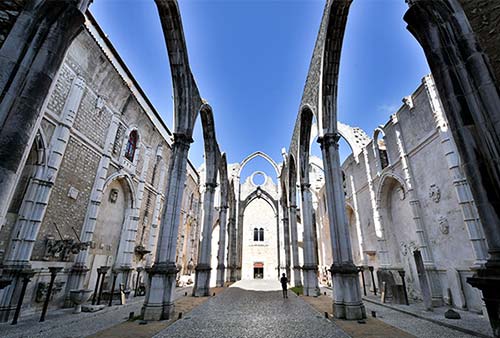
• Facing the convent, take the little lane that cuts around its right side. Head up the stairs to reach the gray, iron...
7 Elevador de Santa Justa
In 1902, an architect who had studied under Gustav Eiffel completed this 150-foot-tall iron elevator, connecting the lower and upper parts of town. The elevator’s Neo-Gothic motifs are an attempt to match the ruined church near its top. It’s free to peer through the railings from the entry-level ramp, but I’d spring for a ticket to climb the spiral stairs up to the top-floor lookout—with unobstructed views over the city (for details, see the sight listing on here).
Stroll around this celebration of the Industrial Age, enjoy the view, then retrace your steps to the square in front of the convent. (The nearby Leitaria Académica, a venerable little working-class eatery with tables spilling onto the delightful square, can be handy for a pricey snack or drink.)
• Continue straight up through Largo do Carmo, walking a block slightly uphill on Travessa do Carmo. At the next square, take a left on Rua Serpa Pinto, walking downhill to Rua Garrett, where—in the little pedestrian zone 50 yards uphill on the right—you’ll find a famous old café across from the Baixa-Chiado Metro stop.
8 Café A Brasileira
Slinky with Art Nouveau decor, this café is a 100-year-old institution for coffeehouse junkies. A Brasileira was originally a shop selling Brazilian products, a reminder that this has long been the city’s shopping zone. Drop in for a bica (Lisbon slang for espresso) or a pingado (with a dollop of steamed milk; either costs €1 at the bar). A pastel de nata custard tart costs just €1.30—but the best place in downtown for one is just a short walk away (see “Exploring More of the Bairro Alto,” later). WCs are down the stairs near the entrance.
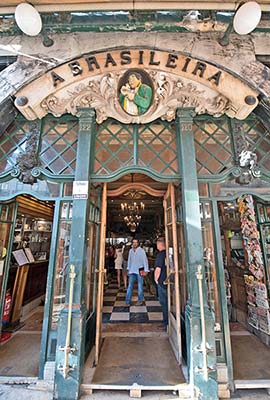
The statue out front is of the poet Fernando Pessoa, making him a perpetual regular at this café. He was the literary and creative soul of Lisbon in the 1920s and 1930s, when the country’s avant-garde poets, writers, and painters would hang out here.
At the neighboring Baixa-Chiado Metro stop, a slick series of escalators whisks people effortlessly between Chiado Square and the Baixa. It’s a free and fun way to survey a long, long line of Portuguese—but for now, we’ll stay in the Chiado neighborhood. (If you’ll be coming for fado in the evening—recommended places are nearby—consider getting here by zipping up the escalator.)
The Portuguese are justifiably proud of their two most famous poets, whose names, works, and memorials you may encounter in your travels.
Portugal’s most important poet, Luís de Camões (1524-1580), was a Renaissance-age equivalent of ancient Greece’s Homer. Camões’ masterpiece, The Lusiads (Os Lusíadas), tells the story of an explorer far from home. But instead of Odysseus, this epic poem describes the journey of Vasco da Gama, the man who found the route from Europe to India. Camões—who had sailed to Morocco to fight the Moors (where he lost an eye), to Goa (where he was imprisoned for debt), and to China (where he was shipwrecked)—was uniquely qualified to write about Portugal’s pursuit of empire on the high seas. For more on Camões, see here.
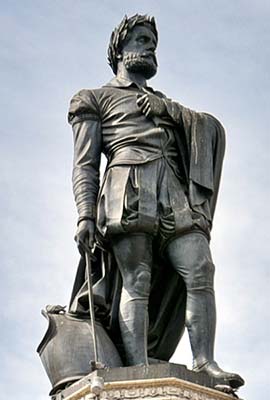
Fernando Pessoa (1888-1935) used multiple personas in his poetry. He’d take on the voice of a simple countryman and express his love of nature in free verse. Or he’d write as an erudite scholar, sharing philosophical thoughts in a more formal style. By varying his voice, he was able to more easily explore different viewpoints and truths. While Pessoa loved the classics—reading Milton, Byron, Shelley, and Poe—he was a true 20th-century bohemian at heart. Café A Brasileira, where he’d often meet with friends, has a statue of Pessoa outside. Today, fado musicians still remember Pessoa, paying homage to him by putting his poetry into the Portuguese version of the blues.
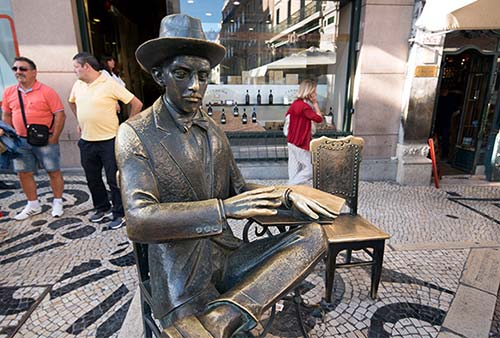
• The Chiado district is popular for its shopping and theaters. Browse downhill on...
9 Rua Garrett
As you stroll, notice the mosaic sidewalks, ironwork balconies, and fine shops. The streetlamps you see are decorated with the symbol of Lisbon: a ship, carrying the remains of St. Vincent, guarded by two ravens.
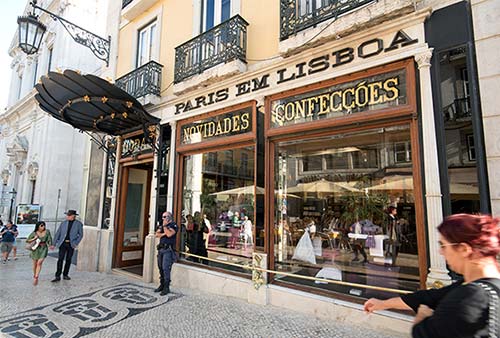
As you walk, peek into classy stores, such as the fabric lover’s paradise Paris em Lisboa—imagine how this would have been the ultimate in ooh là là fashion in the 19th century (at #77, on the right). The next cross street, Rua Serpa Pinto, leads (in one block) to the São Carlos Theater—Lisbon’s opera house. Celebrity chef José Avillez, whose eateries we passed earlier, and his culinary rivals have revitalized this sleepy quarter with several restaurants. (Avillez’s Belcanto has often appeared high on the list of the “50 Best Restaurants in the World.”) Between here and the theater is the recommended Burel Mountain Originals, selling traditional and modern Portuguese wool and flannel products (see “Shopping in Lisbon,” later).
Continuing along Rua Garrett, at the next corner (after the church, at #73) is the venerable Bertrand bookstore—according to Guinness, the oldest bookstore in continuous operation (since 1732)—with English books and a good guidebook selection. A Vida Portuguesa—my favorite shop for Portuguese gifts (quality textiles, soaps, home decor, sardines, wine, and so on) is at the end of the street behind the bookstore (Rua Anchieta 11).
Along the main drag, you’ll start to see more and more international chains before Rua Garrett ends abruptly at the entrance of the big Armazéns do Chiado mall. This grand, six-floor shopping center connects Lisbon’s lower and upper towns with a world of ways to spend money (including a handy food court on the sixth floor). For Italian-style gelato, locals like Santini, several steps downhill to the left as you face the mall (at #9).
• Our walk is over. Whether you leave the Bairro Alto or stay to explore, directions are below.
Leaving the Bairro Alto: To get from the mall to the Baixa—the lower town—take the elevator (press 1) down to the ground level. To get from the mall to the Metro, exit through the lowest floor of the mall, turn right, and walk 50 yards to the Baixa-Chiado Metro stop.
Or, if you have time and interest, consider...
Exploring More of the Bairro Alto
A short walk from the mall gives you a more complete look at this high-altitude neighborhood and a scenic viewpoint. Backtrack (heading west) up Rua Garrett to the square Praça Luís de Camões, where the great writer stands on a pillar, leaning on a sword—more warrior than poet.
Left of Camões, head uphill along Rua do Loreto. Just where the square and street meet, on the right at #2, notice the hubbub at the recommended Manteigaria, which serves downtown’s best pastel de nata custard tart. Even if it’s crowded, you’ll typically get served quickly (cashiers come along the line to take your order). Pastry in hand, shimmy down the narrow hall inside, where you can stand at the counter and watch the pastry chefs in action—perpetually cutting cross-sections of delicate dough, pressing it into little tins, filling the pastries with gooey custard, and popping big trays into the oven (at 750 degrees Fahrenheit, to get just the right amount of caramelizing on top). Be sure to sprinkle your piping-hot pastry with powdered sugar and cinnamon.
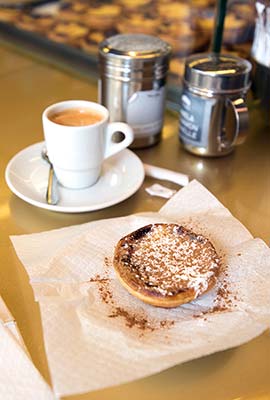
Continue three more blocks on Rua do Loreto, passing the picturesque Elevador da Bica funicular. Then, one block farther, turn left on Rua Marechal Saldanha to reach the Miradouro de Santa Catarina, a terrace—flanked by bars—that overlooks the city’s harbor and river. This is a popular hangout for the dreadlocked granola crowd on a balmy evening. You’ll see a monument to the Cape of Good Hope (a.k.a. the Cape of Torment) that personifies the cape as a monster. This mythic treatment was popularized by poet Camões’ The Lusiads, which celebrated and nearly deified the great explorers of Portugal’s Age of Discovery (such as Vasco da Gama, portrayed as Ulysses), who had to overcome such demons in their conquest of the sea.
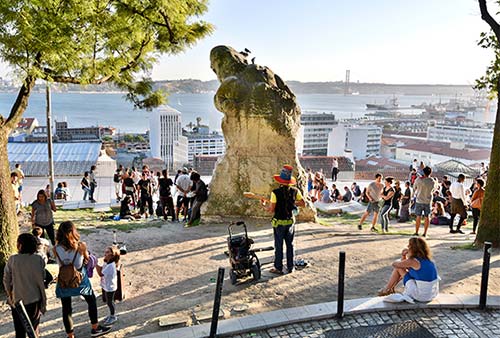
Sights in Lisbon
▲Lisbon Cathedral (Sé de Lisboa)
▲Aljube Museum of Resistance and Freedom (Museu do Aljube)
Elevador de Santa Justa (Santa Justa Elevator)
▲▲Gulbenkian Museum (Museu Calouste Gulbenkian)
▲▲Museum of Ancient Art (Museu Nacional de Arte Antiga)
▲▲National Coach Museum (Museu Nacional dos Coches)
▲▲▲Monastery of Jerónimos (Mosteiro dos Jerónimos)
▲Maritime Museum (Museu de Marinha)
▲Monument to the Discoveries (Padrão dos Descobrimentos)
Map: Portugal Explores the Sea
MODERN LISBON AT PARQUE DAS NAÇÕES
Oriente Train Station (Gare do Oriente)
Lisbon Oceanarium (Oceanário de Lisboa)
Vasco da Gama Bridge (Ponte Vasco da Gama)
▲National Tile Museum (Museu Nacional do Azulejo)
SOUTH OF LISBON, ACROSS THE RIVER
Ferry Ride and Visit to Cacilhas
▲25th of April Bridge (Ponte 25 de Abril)
Cristo Rei Statue (Christ the King)
CENTRAL LISBON
To get a full picture of the best of central Lisbon, follow my three neighborhood walks (covering the Bairro Alto, Alfama, and Baixa; see earlier). Several central Lisbon sights are described in detail in those self-guided walks: São Jorge Castle, the Museum and School of Portuguese Decorative Arts, and the Fado Museum (in “Alfama Stroll and the Castle”), and the São Roque Church and Museum (in “Bairro Alto and Chiado Stroll”).
▲Lisbon Cathedral (Sé de Lisboa)
The cathedral, just a few blocks east of Praça do Comércio, is not much on the inside, but its fortress-like exterior has been through as many refits as there are styles of architecture. The final remodel during the Salazar years turned the facade into a textbook example of the stark and powerful Romanesque “fortress of God.” Twin, castle-like, crenellated towers solidly frame an impressive rose window.
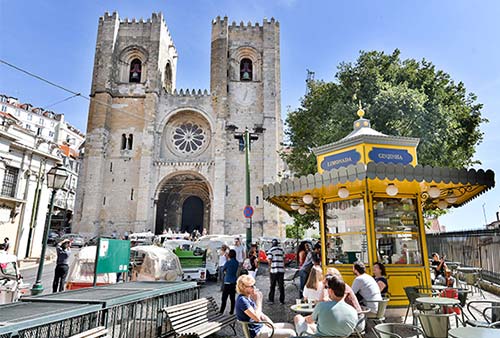
Cost and Hours: Free, Mon-Sat 9:30-19:00, Nov-May 10:00-18:00, closed Sun year-round. You can pay extra to visit the cloister and treasury (€5), but I’d skip them unless you dig archaeology or fancy gold monstrances. It’s on Largo da Sé, several blocks east of the Baixa—take Rua da Conceição east, which turns into Rua de Santo António da Sé. Trolleys #12E and #28E stop right out front, where the square is clogged with tuk-tuks offering tours around town.
Visiting the Church: Started in 1150, this was the first place of worship that Christians built after they retook Lisbon from the Moors. Located on the former site of a mosque, it made a powerful statement: The Reconquista was here to stay. The church is also the site of the 1195 baptism of St. Anthony—a favorite saint of Portugal (locals appeal to him for help in finding a parking spot, true love, and lost objects). Naturally for Portugal, tile panels around the baptismal font (in the back-left corner) portray St. Anthony preaching to the fish. Also, some of St. Vincent is buried here—legend has it that in the 12th century, his remains were brought to Lisbon on a ship guarded by two sacred black ravens, the symbol of the city. Take a stroll through the vast, dark interior—with rounded arches and a dim, windowless nave, it’s quintessentially Romanesque. Near the altar, the darkness gives way to a slightly lighter Baroque zone. Here you can pay to enter the ambulatory and peaceful cloister (an archaeological work-in-progress—they’re currently uncovering Roman ruins). The humble treasury, back near the entrance, is worth its fee only if you want to climb some stairs and see a silver box containing what’s left of St. Vincent.
▲Aljube Museum of Resistance and Freedom (Museu do Aljube)
This museum is the best place to learn about Portugal’s troubled mid-20th century. It fills a stern building called the Aljube (from a Moorish word meaning “waterless well”), immediately behind the cathedral. Once a Muslim prison, then a jail during the Inquisition (and on a site that dates back to Roman times), the Aljube later became the main political prison of Portugal’s fascist regime under António Salazar. Today, it houses a modern, well-presented, three-floor exhibit detailing Salazar’s rise to power, the creation of the Estado Novo, crimes against the Portuguese people, and the eventual end of the regime with the 1974 Carnation Revolution. Exhibits tell the story (in English) with photos and subtitled video clips, as well as some original documents and other artifacts. While often overshadowed by Franco in Spain and the communist regimes of eastern Europe, Salazar was hardly a Boy Scout—and this much-needed museum documents his abuses, filling a gap for those with an appetite for recent history.
Cost and Hours: €3, open Tue-Sun 10:00-18:00, closed Mon, Rua de Augusto Rosa 42, +351 218 172 400, www.museudoaljube.pt. The entrance is tucked under a tall staircase, on a little square with a stop for trolleys #12E and #28E, between the cathedral and the Alfama.
Elevador de Santa Justa (Santa Justa Elevator)
This 150-foot-tall iron tower, built in 1902, connects the flat Baixa district with the Bairro Alto/Chiado districts up above. One of the city’s main landmarks, it offers a sweat-free connection to the upper town, as well as a fine city view up top. You can climb to the rooftop lookout alone (and skip the elevator ride) if you’re already in the Bairro Alto/Chiado.
During busy times, the long line (which wraps up the stairs and around behind the elevator’s base) moves slowly. If it’s backed up, skip it or come back at a quieter time. Two much faster routes up to Chiado are nearby: the elevators inside Armazéns do Chiado mall, or the escalators inside the Baixa-Chiado Metro station (see the sidebar on here).
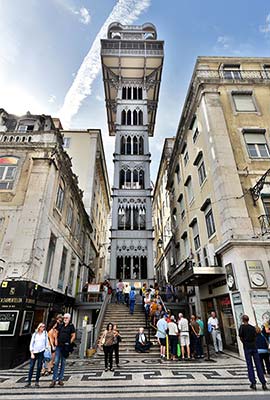
Cost and Hours: Elevator-€5.30 (round-trip tickets only), covered by 24-hour Viva Viagem card, or €1.90 with zapping; departures every 10 minutes, daily 7:30-20:30.
▲Mouraria District
The Mouraria stretches steeply from Praça Martim Moniz up to the back side of São Jorge Castle. This historic tangled quarter was where Muslim Moors were banished after the Christian Reconquista of Lisbon in 1147. And 500 years later it is still the Muslim quarter—shared with other immigrant communities. Portugal’s far-flung empire was given up in the last couple of generations; here in the old colonial capital you’ll see people from Brazil, Goa, Mozambique, Angola, and many other former Portuguese outposts.
Q: What do you get when you cross a lawyer, an economist, and a dictator?
A: António Salazar, who was all three—a dictator who ruled Portugal through harsh laws and a strict budget that hurt the poor.
Shortly after a 1926 military coup “saved” Portugal’s floundering democracy from itself, General Oscar Carmona appointed António de Oliveira Salazar (1889-1970) as finance minister. A former professor of economics and law at the University of Coimbra, Salazar balanced the budget and the interests of the country’s often-warring factions. His skill and his reputation as a clean-living, fair-minded patriot earned him a promotion. In 1932, he became prime minister, and he set about creating his New State (Estado Novo).
For nearly four decades, Salazar ruled a stable but isolated nation by harmonizing the traditional power blocs of the ruling class—the military, big business, large landowners, and the Catholic Church. He enforced his Christian fascism with the backing of the military—and his secret police.
As a person, Salazar was respected, but not loved. The son of a farm manager, he originally studied to be a priest before going on to become a scholar and writer. He never married. Quiet, low-key, and unassuming, he attended church regularly and lived a nonmaterialistic existence. But when faced with opposition, he was ruthless, and his secret police became an object of fear and hatred.
Salazar steered Portugal through the turmoil of Spain’s Civil War (1936-1939), remaining officially neutral while secretly supporting Franco’s fascists. He detested Nazi Germany’s “pagan” leaders, but respected Mussolini for reconciling with the pope. In World War II, Portugal was officially neutral, but was often friendly with longtime ally Britain and used as a base for espionage. After the war, Salazar’s regime benefited greatly from the United States’ Marshall Plan for economic recovery (which Spain missed out on during Franco’s rule). The country joined NATO in 1949.
Salazar distracted his poor and isolated masses with a cynical credo: “Fado, Fátima, and Futebol” (the three “Fs”). Salazar was undone by two factors: the liberal 1960s and the unpopular, draining wars Portugal fought abroad to try to keep its colonial empire intact. When Salazar died in 1970, the regime that followed became less and less credible, leading to the liberating events of the Carnation Revolution in 1974 (see “The Carnation Revolution” sidebar, earlier).
Visiting Mouraria: Young, edgy Martim Moniz square is the stage and living room of the roughly two dozen nationalities that call the Mouraria home: Many recent arrivals speak little or no Portuguese, and you’ll even see stylized Arabic script in the Martim Moniz Metro station.
Two giant department stores, Centro Comercial Mouraria and Centro Comercial Martim Moniz—one Chinese owned and the other Indian owned—flank the square. Women in traditional colorful garments watch children dance while Goans play cricket. Meanwhile, in the “fusion market” on and around the square, entrepreneurs run small stalls with spicy and multiethnic foods. A long line of tourists wait to catch the #28E trolley, while unemployed people just hang out.
Near the trolley stop, an escalator carries people high into Mouraria. Beyond the escalator is the small Chapel of Nossa Senhora da Saúde, dedicated to Our Lady of Good Health, recalling an era when the Black Death killed millions; it’s worth popping in to see its azulejos tiles (Rua da Mouraria 1). Look down at the unique calçada out front to find a full-scale outline of the chapel’s facade by op art guru Eduardo Nery. This marks the start of the main street of the community: Rua da Mouraria.
At #90 on Rua da Mouraria, Rua do Capelão leads uphill into the back lanes of this world. Considered unsafe just a few years ago, it’s now Lisbon’s new happening spot.
The guitar monument at the intersection is a reminder that this is considered the birthplace of fado. Today, the lanes are decorated with black-and-white photos on walls (with English descriptions) marking homes of famous local fado musicians, noisy street art, and playgrounds just being fun.
There are plenty of inviting little eateries. For lunch, consider Zé da Mouraria (lunch only, Rua João do Outeiro 24). It’s an amazing scene. For a moveable feast, consider taking one of the popular Mouraria food tours (see “Tours in Lisbon,” earlier).
The highest street, Rua das Farinhas, leads right to Largo São Cristóvão. You could continue around toward the castle, past a former five-floor market, Chão do Loureiro, where each floor is a “gallery” filled with works by one of the country’s top street artists (Calçada Marquês de Tancos 1). The top floor hides a café with a nice viewpoint. Or, from there, steps lead down past great street art to the edge of the Baixa (Rua da Madalena) and into the regular world once again.
NORTH LISBON
The main sight here is the Gulbenkian Museum, two miles north of the city center and just a few minutes’ ride on the Metro blue line. A visit here can be combined with sightseeing in Belém, a quick taxi ride away.
▲▲Gulbenkian Museum (Museu Calouste Gulbenkian)
This is the best of Lisbon’s 40 museums, and it’s worth the trip for art lovers. This wide-ranging collection, with nothing Portuguese, spans 5,000 years of European, Egyptian, Islamic, and Asian art. It offers the most purely enjoyable museum-going experience in Iberia—it’s both educational and just plain beautiful. The museum is cool, uncrowded, gorgeously lit, and easy to grasp, displaying only a few select and exquisite works from each epoch. Art Nouveau fans love the museum’s stunning Lalique jewelry collection. Walk through five millennia of human history, appreciating our ancestors by seeing objects they treasured.
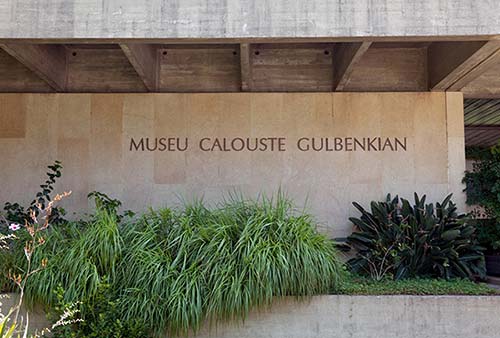
The museum is actually two museums—the main collection and the Gulbenkian Garden and Modern Collection (Coleção Moderna), a five-minute walk away through a delightful 18-acre lushly landscaped park. If walking from the main museum back to the Metro, the garden and Modern Collection are on the way (the museum’s info desk has a handy map of the entire site).
Cost and Hours: €10, includes main branch and Modern Collection (located across park), free on Sun after 14:00; open Wed-Mon 10:00-18:00, closed Tue; Berna 45, +351 217 823 000, www.gulbenkian.pt.
Getting There: From downtown, hop a cab or take the Metro to the São Sebastião stop; leave the platform by following Avenida de Aguiar (norte) signs. Then, to leave the station, follow signs to Avenida de Aguiar (nascente). Once at street level, it’s about a five-minute walk: Go a long block downhill on Avenida de Aguiar with the massive El Corte Inglés department store behind you. Just before the roundabout, you’ll see a small sign pointing right to the fundação—the museum entrance is up the stairs and straight ahead through this park, past a long concrete office building, about 100 yards away.
Cuisine Art: Cafeterias are in both museum buildings, though I like the one in the Modern Collection building much better.
Background: Calouste Gulbenkian (1869-1955), an Armenian oil tycoon, gave Portugal his art collection (or “harem,” as he called it) in gratitude for the hospitable asylum granted him in Lisbon during World War II (where he lived from 1942 until his death). The Portuguese consider Gulbenkian an inspirational model of how to be thoughtfully wealthy: He made a habit of “tithing for art,” spending 10 percent of his income on things of beauty, and his billion-dollar estate is still a vital arts foundation promoting culture in Portugal.
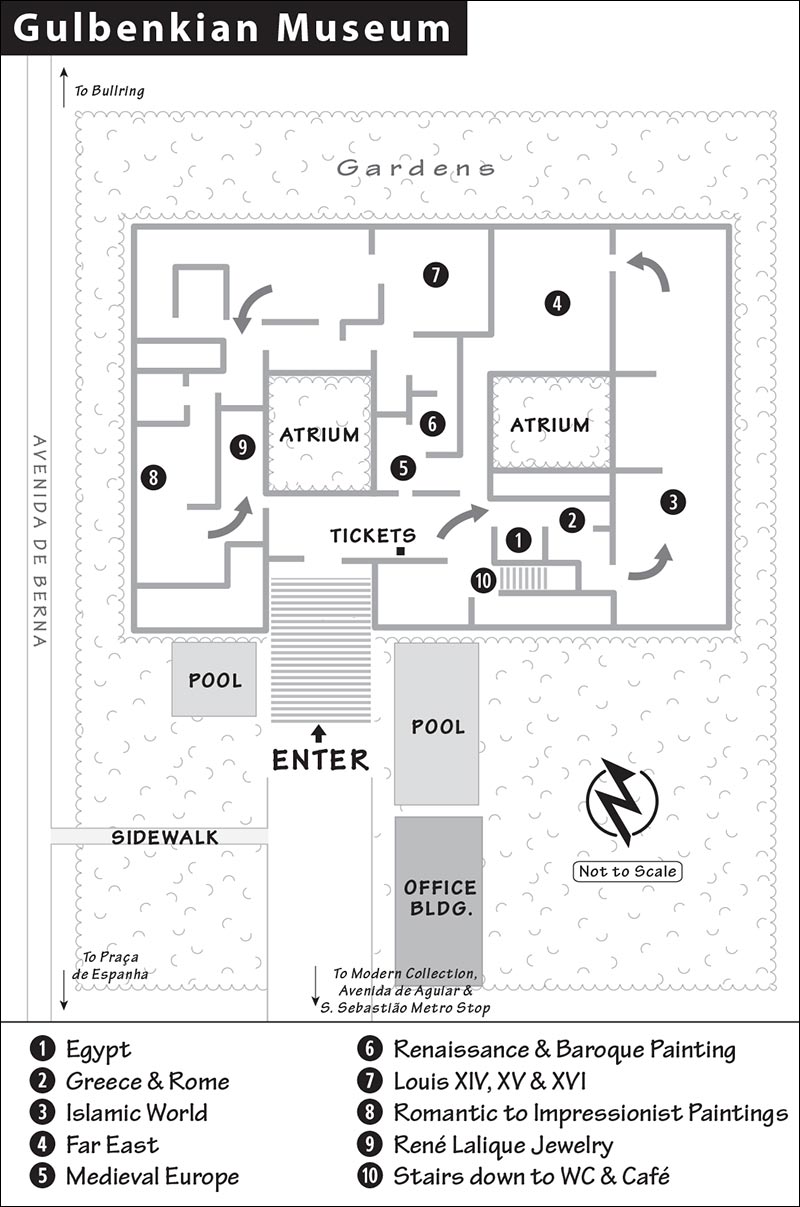
In short, Gulbenkian had all the money in the world, dedicated much of his life to collecting what he thought was the most beautiful art anywhere, built this fine building to show it off, and left it as a gift to posterity.
Visiting the Museum: From the entrance lobby, there are two wings on one floor: roughly pre-1500 and post-1500. Following the museum’s mostly chronological layout, you’ll pass through the following sections:
1 Egypt (2500-500 BC): If this room feels like a tomb, that’s intentional. Everything here was once the personal property of Egyptian kings and queens, including some pieces from King Tut—who died thinking you can take it with you. Ancient Egyptians, believing that life really began after death, carved statues to preserve the memory of the deceased, whether it be the head of a pharaoh carved out of “harder-than-stone” obsidian or a family pet. The cat statue nurses her kittens atop a coffin that once held the cat’s mummy, preserved for the afterlife. Egyptians honored cats—even giving them gold earrings (notice this statue’s ears are pierced). They believed cats helped the goddess Bastet keep watch over the household. Now, thousands of years later, we remember the Egyptians for these sturdy, dignified statues, built for eternity.
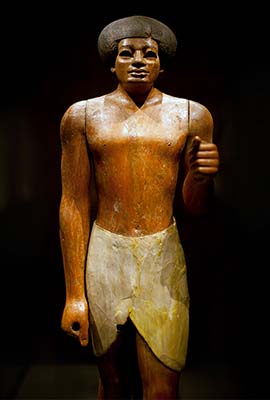
2 Greece and Rome (500 BC-AD 500): The black-and-red Greek vase (calyx-crater), decorated with scenes of half-human satyrs chasing human women, reminds us of the rational Greeks’ struggle to overcome their barbarian, animal-like urges as they invented Western civilization. Alexander the Great (r. 336-323 BC, seen on a series of gold medallions filling a glass case) used war to spread Greek culture throughout the Mediterranean, creating a cultural empire that would soon be taken over by Roman emperors. Gulbenkian loved collecting coins: The first treasure he acquired was a coin, purchased at age 11.
A carved stone on the wall near the exit brings you even further back in time to Mesopotamia (modern Iraq) and the very roots of civilization. The Assyrian relief of Ashurnasirpal II (884-859 BC) evokes this distant culture, which invented writing.
3 Islamic World (700-1500): The Muslims who lived in Portugal—as far west of Mecca as you could get back then—might have decorated their homes with furnishings from all over the Islamic world. Imagine a Moorish sultan, dressed in a shirt from Syria, sitting on a carpet from Persia in a courtyard with Moroccan tiles. By a bubbling fountain, he puffs on a hookah.
Glazed and painted ceramics are from 13th-century Syria—specifically from the region in and around Raqqa (in the news recently as the capital of ISIS).
The intricate patterns on the Eygptian gilded and enameled glass lamps from a 14th-century mosque (behind the partition on the left) are not only beautiful...they’re actually Arabic quotes from the Quran, such as “Allah is the light of the world, shining like a flame in a glass lamp, as bright as a star.” Explore this large and rich collection, and then head a few thousand miles east.
The carpets you’ll see were a passion for Gulbenkian (his family was long in the carpet trading business). He considered a carpet a garden you can bring inside your home.
4 Far East (1368-1644): For almost 300 years, the Ming dynasty ruled China, having reclaimed the country from Genghis Khan and his sons. When Portuguese traders reached the Orient, they brought back blue-and-white ceramics such as these. They became all the rage, inspiring the creation of both Portuguese tiles and Dutch Delftware. Writing utensils fill elaborately decorated boxes from Japan. Another type of box—a Japanese bento—was the ultimate picnic basket, perfect for an excursion to the Japanese countryside.
Crossing into the next wing, you enter the section on European art.
5 Medieval Europe (500-1500): While China was thriving and inventing, Europe was stuck in a thousand-year medieval funk (with the exception of Muslim Arab-ruled Iberia). Most Europeans from the “Age of Faith” channeled their spirituality into objects of Christian devotion. A priest on a business trip could pack a portable, collapsible altarpiece in his backpack, travel to a remote village that had no church, and deliver a sermon illustrated by scenes carved in ivory. In monasteries, the monks with the best penmanship laboriously copied books (illuminated manuscripts) and decorated them with scenes from the text—and left wacky doodles in the margins. These books are virtual time capsules, preserving the knowledge of Greece and Rome until it could emerge again, a thousand years later, in the Renaissance.
6 Renaissance and Baroque Painting (1500-1700): Around 1500, a cultural revolution was taking place—the birth of humanism. Painters saw God in the faces of ordinary people, whether in Domenico Ghirlandaio’s fresh-faced maiden, Frans Hals’ wrinkled old woman, or Rembrandt’s portrait of an old man, whose crease-lined hands tell the story of his life. Also in this section are exquisite works by Van der Weyden, Van Dyck, and Rubens.

Propelled by the Italian-born Renaissance, Europe’s focus shifted northward to the luxurious court of France, where a new secular culture was blossoming—as illustrated in sumptuous tapestries. The three-part series Playing Children (c. 1540) features Fishing, the Dance, and the Ball Game.
7 Louis XIV, XV, XVI (1700-1800): This furniture, once owned by French kings (and Marie-Antoinette and Madame de Pompadour), is a royal home show. Anything heavy, ornate, and gilded (or that includes curved legs and animal-clawed feet) is from the time of Louis XIV. The Louis XV style is lighter and daintier, with Asian motifs, while furniture from the Louis XVI era is stripped-down, straight-legged, tapered, and more modern.
8 Romantic to Impressionist Paintings (1700-2000): Europe ruled the world, and art was increasingly refined. Young British aristocrats (Thomas Gainsborough portrait) traveled Europe on the Grand Tour to see great sights like Venice. They would take home small, photo-realistic Venicescapes—such as an entire room of Guardi landscapes (c. 1780)—as souvenirs.
Follow the progression in styles from stormy Romanticism (J. M. W. Turner’s tumultuous shipwreck) to Realism’s breath-of-fresh-air simplicity (Manet’s bubble-blower, Degas’ portraits) to the glinting, shimmering Impressionism of Monet and Renoir. Statues by Rodin are Impressionism in stone.
9 René Lalique Jewelry: Finish your visit with the stunning, sumptuous Art Nouveau glasswork and jewelry of French designer René Lalique (1860-1945). Fragile beauty like this, from the elegant turn-of-the-century belle époque, was about to be shattered by the turbulent 20th century. Art Nouveau borrowed forms from nature and valued the organic and artisanal over the mass-produced. Ordinary dragonflies, orchids, and beetles become breathtaking when transformed into jewelry. Sarah Bernhardt wore Lalique—art you hang not on a wall but on your body. The work of Lalique—just another of Gulbenkian’s circle of friends—is a fitting finale to this museum of history and beauty.
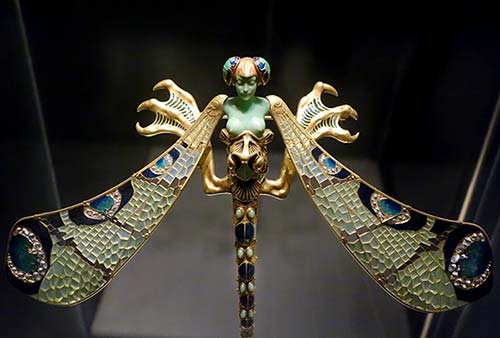
Modern Collection and Garden: Stimulating if you like contemporary and abstract art, the Modern Collection’s temporary exhibits offer a fun bit of whimsy if you have the energy and inclination. The classy modern building is set in a delightful garden—a favorite for locals enjoying a quiet or romantic moment—and often hosts classical music concerts in its auditoriums.
WEST LISBON
The Museum of Ancient Art, west of downtown, is halfway to Belém and can be combined with an excursion there.
▲▲Museum of Ancient Art (Museu Nacional de Arte Antiga)
Not “ancient” as in Roman and Greek—but “antique” as in Age of Discovery—this is Portugal’s finest museum for artwork from the time when the Portuguese ruled the seas: the 15th and 16th centuries. (Most of these works were gathered from Lisbon’s abbeys and convents after their dissolution in 1834.) You’ll also find a rich collection of furniture, as well as paintings by renowned European masters such as Hieronymus Bosch, Jan van Eyck, and Raphael—all in a grand palace that’s sleekly renovated and well presented.
Cost and Hours: €6, Tue-Sun 10:00-18:00, closed Mon; good cafeteria with shaded garden seating overlooking the river, Rua das Janeles Verdes 9, +351 213 912 800, www.museudearteantiga.pt.
Getting There: It’s about a mile west of downtown Lisbon. From Praça da Figueira take trolley #15E (from Cais Sodré take trolley #18E). Get off at Cais Rocha, cross the street, and walk up a lot of steps. To stop right in front, take bus #714 from either Praça da Figueira or Praça do Comércio. Note that trolley #15E and bus #714 both continue to the sights in Belém; consider stopping here at the end of your Belém day.
Visiting the Museum: Here are some of the museum’s highlights, starting on the top floor. From the ticket desk, turn right to find the elevator and press button 3.
Top Floor, Portuguese Painting and Sculpture: From the elevator, veer right through the atrium and find the big, red room at the far end. The Panels of St. Vincent are a multipart altarpiece by the late 15th-century master Nuno Gonçalves. A gang of 60 real people—everyone from royalty to sailors and beggars—surrounds Lisbon’s patron saint. Of note is the only recognized portrait of Prince Henry the Navigator, responsible for setting Portugal on the path to exploration. Find him on the third panel—an elder gentleman dressed in black with a wide-brimmed hat, hands together almost in prayer. Other masterworks by Gonçalves, painted just before the Age of Discovery, hang behind the panels. Also of note is a small but lifelike portrait of King João I, with hands clasped in prayer, by an unknown artist. This is the very first painting ever of a Portuguese monarch, winner of the Batalha battle and founder of a new dynasty.
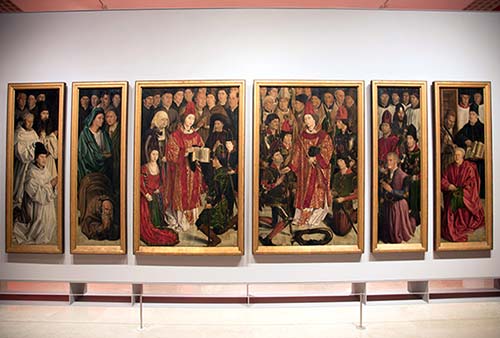
Explore the rest of the floor clockwise from the panels: Opposite the panels, find an exceptional portrait of the baby-faced King Sebastian—who died young when he led an incursion into Africa. The armor is typical of Iberia for the era, as is the royal jaw and pursed lips caused by inbreeding with many generations of Habsburgs from Spain. If you’ve visited the sights in Belém, you’ll recognize the Monastery of Jerónimos before it was fully decorated (1657 painting by Felipe Lobo).
Before you head down the stairs (in the middle of the atrium) to the next floor, notice the statue of a pregnant Mary (The Virgin of Expectation, c. 1340-1350). This unusual theme was common in rural parts of Portugal (such as the Alentejo, the close-to-the-ground region in the southeast), where the Virgin’s fertility was her most persuasive quality in recruiting local followers.
Middle Floor, Art from the Portuguese Discoveries: This floor collects items that Portuguese explorers brought home from their far-flung travels. Coming down the stairs, bear left, then right, to find the room with four large, enchanting Namban screen paintings (Namban, meaning “southern barbarians,” the catch-all term the Japanese applied to all foreigners). These show the Portuguese from a 16th-century Japanese perspective—with long noses, dark complexions, and great skill at climbing rigging, like acrobats. The Portuguese, the first Europeans to make contact with Japan, gave the Japanese guns, Catholicism (Nagasaki was founded by Portuguese Jesuits), and a new deep-frying technique we now know as tempura.
Now exit right and do a counterclockwise circle around this floor, stocked with furniture, large vases, ivory carvings, fine china, and ceramics. Imagine how astonishing these treasures must have seemed when the early explorers returned with them. Facing the atrium are some beautiful tiles from Damascus—a gift from Calouste Gulbenkian (founder of the Gulbenkian Museum). After a lot of ceramics, eventually you reach a treasury of gold and silver items. Look for the freestanding glass case with a gorgeous golden monstrance, with its carrying case displayed just behind it—the bejeweled Rococo Communion-host holder was made for Lisbon’s Bemposta Palace. Farther along is the smaller yet even more exquisite Monstrance of Belém, commissioned by Manuel I and made from East African tribute gold brought back by Vasco da Gama. Squint at the fine enamel creatures filling a tide pool on the base, the 12 apostles gathered around the glass case for the Communion wafer (the fancy top pops off), and the white dove hanging like a mobile under the all-powerful God bidding us peace on earth.
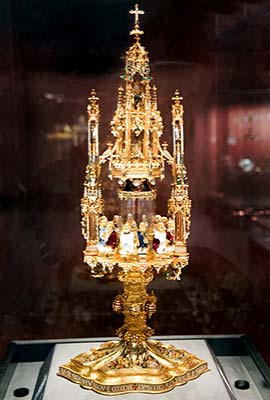
Heading back to the atrium, don’t miss the small, dimly lit room (on the left) displaying an impressive jewelry collection, including pieces decorated with the red cross of the affluent Order of Christ, whose members helped plan and fund Portuguese explorations.
Back in the atrium, before continuing downstairs, stop to admire a 17th-century painting of Lisbon before the 1755 earthquake. Notice the royal palace on Praça do Comércio, the shipyards next to the royal palace (now a public park), and the ship-clogged Rio Tejo.
Ground Floor, European Paintings: Pass through the gift shop, veer left, and follow the one-way route through paintings from all over Europe. A few rooms in, note the larger-than-life paintings of the 12 apostles by the Spanish master Zurburán. Continue to the end of the hall, then loop back around to find the room with Bosch’s Temptations of St. Anthony (a three-paneled altarpiece fantasy, c. 1500) and Albrecht Dürer’s St. Jerome. St. Jerome—you’ll see other portraits of him in this collection, always with a skull—is all-important to Lisbon as the primary figure behind the Monastery of Jerónimos in Belém. Finally, wander through the few remnants of the palace. Note the Pombal coat-of-arms that decorates the elaborate, Baroque doorway at the top of the staircase (find the star); the palace was originally purchased by the brother of the powerful Marquês de Pombal. Take a well-earned break at the museum cafeteria. Sit outside in the gardens, with wonderful river views, and watch all the boats go by.
BELÉM DISTRICT
About five miles west of downtown Lisbon, the Belém district is a stately pincushion of important sights from Portugal’s golden age, when Vasco da Gama and company turned the country into Europe’s wealthiest power. Belém was the sending-off point for voyages in the Age of Discovery. Before embarking, sailors would stay and pray at the Monastery of Jerónimos, and when they returned, the Belém Tower welcomed them home. The grand buildings of Belém survived the great 1755 earthquake, so this is the best place to experience the Manueline architectural style (for more on this style, see the sidebar on here). After the earthquake, safety-conscious (and rattled) royalty chose to live uphill from here—in tents rather than stone buildings. The modern-day president of Portugal calls Belém home.
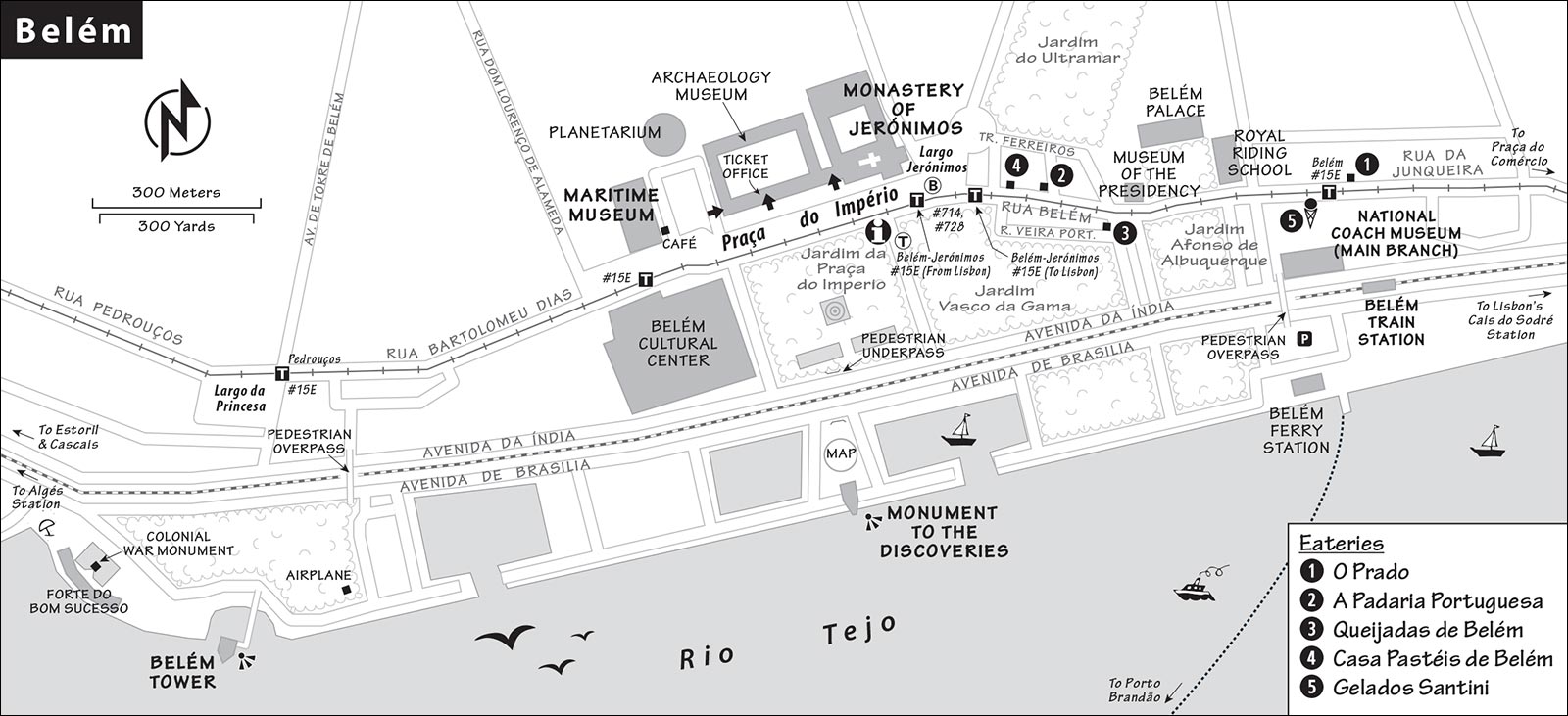
To celebrate a double anniversary (800 years since the founding of Portugal and 300 years of independence from Spain), a grand exhibition was held here in 1940, resulting in fine parks, fountains, and monuments.
Getting to Belém: You have multiple options. By taxi or Uber, figure no more than about 20 minutes and €10 from downtown. Buses #714 and #728 serve Belém, and the coastal train line running from Lisbon’s Cais do Sodré station gets you there in about 10 minutes.
When I have the time, I prefer riding the slower trolley #15E (30 minutes, catch at Praça da Figueira or Praça do Comércio). In Belém, the first trolley stop is at the National Coach Museum (stop is called simply “Belém”—you’ll see the brown sign for Museu dos Coches just before the stop); the second stop (Belém-Jerónimos) is at the Monastery of Jerónimos (it’s huge—you can’t miss it); and another (Pedrouços) is two stops farther, at a little square two blocks inland from the Belém Tower.
Planning Your Time: Nearly all of Belém’s museums are closed on Monday (though the Monument to the Discoveries is open Mon May-Sept). Consider doing Belém’s sights from east to west, in the order you’ll reach them from the tram or train: the National Coach Museum, pastry and coffee break, Monastery of Jerónimos, Maritime Museum and/or lunch at its cafeteria (public access, museum entry not required), Monument to the Discoveries, and Belém Tower. If arriving by taxi, you could start at Belém Tower—the farthest point—and do the recommended lineup in reverse, ending at the National Coach Museum (which has easier public transit connections than the tower). Belém also has a cultural center, a children’s museum, and a planetarium—not priorities for a quick visit. While walking between sights, be aware that train tracks to Cascais cut off access to the riverside from inland museums. Three pedestrian passes (an overpass at the Coach Museum, an underpass at the Monument to the Discoveries, and another overpass near Belém Tower) are the only ways to cross over. For recommended eateries in this area, see the sidebar in this section.
Crowd-Beating Tips: Belém’s sights are often crowded in the morning. In peak season, there can be long lines at the Belém Tower and at the monastery. If there is a line at the tower, I simply wouldn’t go in. There’s almost nothing inside to see (though the view is nice). At the monastery, crowds usually diminish after 16:00.
Returning to Downtown: When you’re through, hop on trolley #15E or bus #714 to return to Praça da Figueira or Praça do Comércio, or ride the coastal train back to Cais do Sodré. Note that there are two different end stops for the #15E listed clearly on the front of the tram: Praça da Figueira or Cais do Sodré; both take you to the city center. If you have time and energy left, you could hop off the trolley or bus to tour the Museum of Ancient Art on the way home. Bus #728 takes you to Santa Apolónia station, and continues to Parque das Nações and Oriente station.
Tourist Information: A little TI kiosk is directly across the street from the entrance to the monastery. They sell monastery tickets as well as the LisboaCard (sporadic hours but usually open Tue-Sat 10:00-13:00 & 14:00-18:00, closed Sun-Mon, +351 213 658 437).
▲▲National Coach Museum (Museu Nacional dos Coches)
In 1905, the last queen of Portugal saw that cars would soon obliterate horse-drawn carriages as a form of transportation. She decided to preserve her fine collection of royal coaches, which became today’s National Coach Museum. The impressive collection is split between two buildings, each with its own ticket. The main branch—in a huge, blocky, concrete building closer to the river—has the bulk of the collection, with 70 dazzling coaches, all described in English. The Royal Riding School, closer to the trolley tracks, is a historical space with a gorgeous interior but only about 10 coaches on display. If you want to really appreciate the coaches themselves, focus on the main branch. But to see regal spaces (which are rare in Lisbon), add on the Royal Riding School.
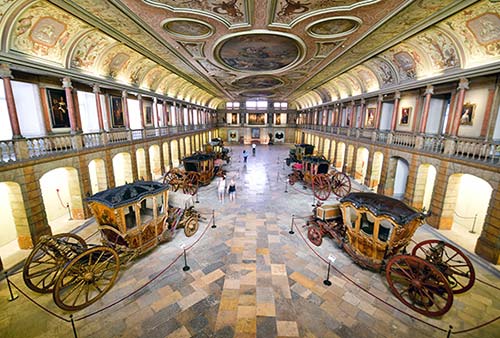
Cost and Hours: Main branch-€8, Royal Riding School-€4, €10 combo-ticket covers both; Tue-Sun 10:00-18:00, closed Mon; riding school also closed Tue; +351 213 610 850, http://museudoscoches.gov.pt.
Visiting the Main Branch: The museum is right across the street from the Belém tram stop (on one side) and the Belém train station (on the other). Find the ticket office under the building (opposite the museum entrance), then ride an elevator or take steps up to the collection, where you’ll loop through two long rooms.
The first coach dates from around 1600. This crude and simple vehicle was once used by Philip II, king of Spain and Portugal, to shuttle between Madrid and Lisbon. Notice that the coach has no driver’s seat—its drivers would actually ride the horses. You’ll have to trust me on this, but if you lift up the cushion from the passengers’ seat, you’ll find a potty hole—also handy for road sickness. Imagine how slow and rough the ride would be with bad roads and a crude leather-strap suspension.
From here, walk through the historical collection, displayed chronologically. Study the evolution of suspension technology, made in the 15th century in the Hungarian town of Kocs (pronounced “coach”—hence the name). By the 17th century—when this collection begins—coaches had caught on in a big way in Portugal, which was an early adopter. Trace the improvements made through the next century, noticing that as the decoration increases, so does the comfort. A Portuguese coat of arms indicates that a carriage was part of the royal fleet. Ornamentation often includes a folk festival of exotic faces from Portugal’s distant colonies.
In the middle of the hall shines the lumbering Oceans Coach, as ornate as it is long. At the stern, gold figures symbolize the Atlantic and Indian oceans holding hands, a reminder of Portugal’s mastery of the sea. The Oceans Coach is flanked by two equally stunning coaches with similar symbols of ocean exploration. These were part of a thematic convoy sent by King João V to Pope Clement XI in 1716.
Next you’ll see a pair of carriages from the royal couple ruling Portugal when the 1755 earthquake struck. King José I rode in a sumptuously carved Baroque masterpiece, while Queen Mariana Victoria opted for a more subdued ride. At the far end of the hall, peek inside the Table coach, which must have been a cozy place to hang out and wait for the exchange.
In the next room, you’ll mainly see “Berlins”—a new coach type (pioneered in that city, in the late 17th century) that suspended the main compartment on thick leather straps to improve the ride. You’ll see ecclesiastical coaches (suggesting the high status of clergy); single-horse chaise and cabriolet coaches (including some sleek, black leather, 19th-century, Sherlock Holmes-style ones); hunting vehicles; sedan chairs; scaled-down play carriages for kids who had everything; and mail coaches. You may see the “Landau of the Regicide”—the coach in which King Carlos I and his heir were shot and killed on February 1, 1908. You can still see the bullet holes. (This carriage is often out on loan.)
Royal Riding School: You’ll find this regal building along the trolley tracks through Belém, kitty-corner from the main museum. The elegant old riding room with its dramatically painted ceiling is as remarkable as the carriages. Under that ceiling, you’ll see a handful of fine specimens (but if you’ve already been to the main branch, this is a rerun). Firefighters will appreciate the second room, displaying a history of horse-drawn vehicles used to put out Lisbon blazes.
Nearby: Just past the Royal Riding School, on the landscaped hill behind the wall, is the stately, pink Belém Palace—the residence of Portugal’s president. If you’re fascinated by Portuguese history, you can drop in anytime at the modern little Museum of the Presidency of the Republic (Museu da Presidència da Repùblica). It offers a little lesson on each of Portugal’s democracy-era presidents (since 1910) and lots of state gifts (€2.50; Tue-Sun 10:00-18:00, Sat-Sun closes for lunch 13:00-14:00, closed Mon; look for entrance just west of Royal Riding School and palace gate).
▲Casa Pastéis de Belém
This café is the birthplace of the wonderful custard tart that’s called pastel de nata throughout Portugal, but here it’s dubbed pastel de Belém. You can explore this sprawling temple to Portugal’s beloved custard tart like a museum, with a peek at the bakery in the rear. Since 1837, residents have been coming to this café to get their tarts fresh. The café’s popularity stems mainly from the fact that its tart recipe is a closely guarded secret—supposedly only three people know the exact proportions of the ingredients. While the recipe is fine, my hunch is that the tarts’ undeniable goodness is simply because the café cranks out 20,000 or so a day—you get them fresh and crunchy, literally hot out of the oven. (Take one back to your hotel and eat it tonight and it’ll taste just like any other in town.) Sit down and enjoy one with a café com leite. Sprinkle on as much cinnamon and powdered sugar as you like.
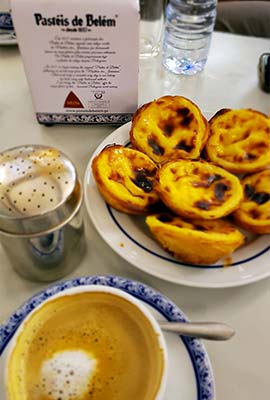
Tarts are €1.20 whether you eat in or carry out. There are two separate lines for takeaway; both move quickly (pay, then bring receipt to counter to claim your tart). If the lines are extremely long, table service inside the café may be faster (daily 8:00-21:00, Rua de Belém 84, +351 213 637 423).
▲▲▲Monastery of Jerónimos (Mosteiro dos Jerónimos)
This giant, white limestone church and monastery stretches for 300 impressive yards along the Belém waterfront. It was built over a hundred years and is basically a Gothic structure with Manueline ornamentation. King Manuel (who ruled from 1495) erected it as a “thank you” for the discoveries made by early Portuguese explorers (Vasco da Gama’s tomb is inside). This is a “Pepper Monument,” financed in part with “pepper money,” a 5 percent tax on spices brought back from India. Manuel built the church near the site of a humble chapel where sailors spent their last night ashore in prayer before embarking on frightening voyages.
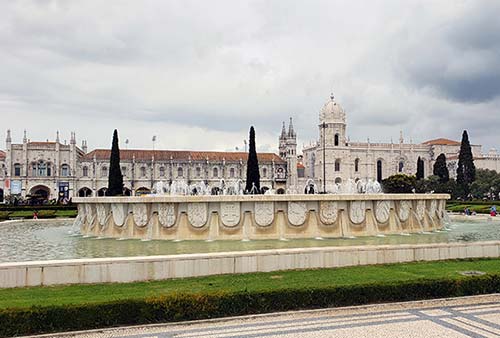
Cost and Hours: Church-free, cloister-€10, €12 combo-ticket with Torre de Belém; monastery open Tue-Sun 9:30-18:00, closed Mon year-round; www.mosteirojeronimos.pt.
Getting Tickets: Tickets are not sold at the monastery. It’s easy to buy your ticket online. Otherwise, you can buy one from a machine at the Archaeology Museum (to the left of the monastery). LisboaCard holders must get a voucher (at the Archaeology Museum ticket office or at the TI kiosk in the park across the street) before heading to the monastery.
Getting In: At the monastery, you’ll see two lines. The faster-moving right queue is for the church (free to enter); the line on the left is for the cloister. Even with a prepurchased online ticket, you cannot jump to the front of the queue.
Background: As you circle the complex, ponder the great history of this serene place. Monks often accompanied the sailor-pirates on their trading/pillaging trips, hoping to convert the heathens to Christianity. Many expeditions were financed by the Order of Christ, a brotherhood of soldier-monks. The monks who inhabited this cloister were Hieronymites—followers of St. Jerome, hence the monastery name of Jerónimos. (You’ll see several paintings of St. Jerome, living in a Holy Land desert in the fourth century, doing what he was best known for: translating the Bible into the Church’s official Latin version.)
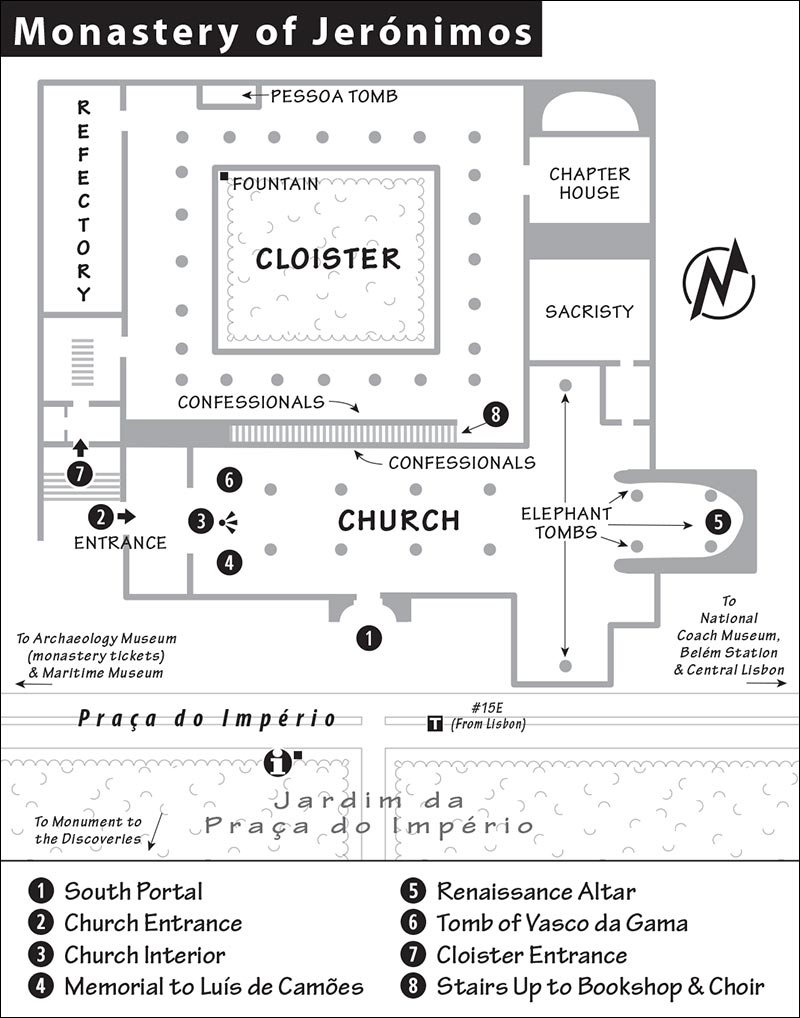
King Manuel, who did so much to promote exploration, was also the man who forcibly expelled all Jews from the country. (In 1497, the Spanish Reyes Católicos—Ferdinand and Isabel—allowed him to marry one of their daughters on the condition that he deport the Jews.) It was a time of extreme Christian faith. The sheer size of this religious complex is a testament to the religious motivation that—along with money—propelled the Age of Discovery.
 Self-Guided Tour: Start outside the monastery.
1 South Portal: The fancy portal, facing the street, is textbook Manueline. Henry the Navigator stands between the doors with the king’s patron saint, St. Jerome (above on the left, with the lion). Henry (Manuel’s uncle) built the original sailors’ chapel on this site. This door is only used when Mass lets out or for Saturday weddings. (The electronic snapping sound you hear is designed to keep the pigeons away.)
• To the left of the portal is the...
2 Church Entrance: As you approach the main entrance, the church is on your right and the cloister is straight ahead. Flanking the church door are kneeling statues of King Manuel I, the Fortunate (left of door, with St. Jerome), and his second Spanish wife, María (right, with John the Baptist).
3 Church Interior: The Manueline style is on the cusp of the Renaissance. The space is more open than earlier medieval churches. Slender, palm-tree-like columns don’t break the interior space (as Gothic columns would), and the ceiling is all one height. Motifs from the sea hide in the decor. The sea brought Portugal 16th-century wealth and power, making this art possible. You’ll see rope-like arches, ships, and monsters that evoke the mystery of undiscovered lands. Artichokes, eaten for their vitamin C to fend off scurvy, recall the hardships sailors faced at sea. Thankfully, except for the stained glass (which is 20th century), the church survived the 1755 quake.
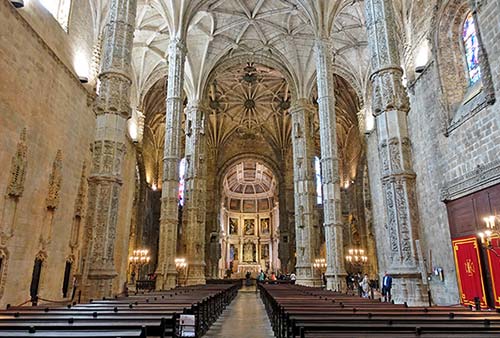
• On your right as you face the altar is the...
4 Memorial to Luís de Camões: Camões (kah-MOISH, 1524-1580) is Portugal’s Shakespeare and Casanova rolled into one, an adventurer and writer whose heroic poems, glorifying the nation’s sailing exploits, capture the spirit of the Portuguese people. It was Camões who described Portugal as the place “where land ends and the sea begins.”
After college at Coimbra, Camões was banished from the court (1546) for flirting with the noble lady Dona Caterina. He lost an eye soldiering in Morocco (he’s always portrayed squinting), served jail time for brawling with a bureaucrat, and then caught a ship to India and China, surviving a shipwreck on the way. While serving as a colonial administrator in India, he plugged away at the epic poem that would become his masterpiece. Returning to Portugal, he published The Lusiads (Os Lusíadas, 1572), winning minor recognition and a small pension.
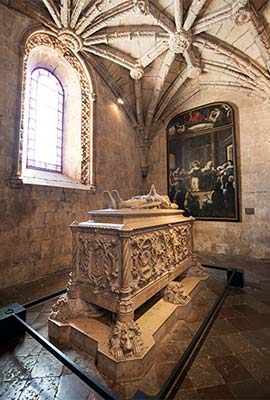
The long poem describes Vasco da Gama’s first voyage to India in heroic terms, on the scale of Homer’s Odyssey. The Lusiads begins:
Arms and the heroes, from Lisbon’s shore,
sailed through seas never dared before,
with awesome courage, forging their way
to the glorious kingdoms of the rising day.
The poem goes on to recite many events in Portuguese history, from the time of the Lusiads (the original pre-Roman natives) onward. Even today, Camões’ words are quoted by modern Portuguese politicians in search of a heroic sound bite. And Portugal’s national holiday, June 10, is known as Camões Day, remembering the day in 1580 when the great poet died. The stone monument here—with literary rather than maritime motifs—is an empty tomb (his actual burial spot is unknown).
• Now head up to the front of the church, and the...
5 Renaissance Altar: This is a rare, pre-1755 interior in Lisbon (except for the stained glass, which is from 1940). Here, under the 90-foot-wide towering main vault, are buried the royals of 16th-century Portugal. In the niches surrounding the main altar, elephants—a Far Eastern symbol of power, more powerful and kingly than the lion—support two kings and two queens (King Manuel I is front-left). Like many Portuguese churches (such as the cathedrals in downtown Lisbon and Évora), this was renovated in Renaissance and Baroque times, resulting in an odd mix of dark, older naves and pretty pastel altars.
Skip the sacristy (entrance in the corner), a single-columned room wrapped in paintings on wood featuring scenes from the life of St. Jerome (not worth the admission fee). Instead, do an about-face and head up the aisle on the right, back toward the entrance (noticing more elephants in the transept). You’ll pass seven wooden confessional doors (on your right). Notice the ornamental carving around the second one: a festival of faces from newly encountered corners of the world. Head back toward the entry.
• Under a ceiling that’s a veritable Boy Scout’s Handbook of rope and knots is the...
6 Tomb of Vasco da Gama: On the night of July 7, 1497, in the small chapel that once stood here, da Gama (1460-1524) prayed for a safe voyage. The next day, he set sail from Belém with four ships (see the caravel carved in the middle of the tomb’s side) and 150 men. He was armed with state-of-the-art maps and sailing technology, such as the carved armillary sphere (to the right of the caravel)—a globe surrounded by movable rings designed to determine the positions of the sun or other stars to help sailors track their location on earth. (Some say its diagonal slash is symbolic of the unwritten pact and ambition of Spain and Portugal to split the world evenly, but it actually represents the zodiac—the path of the planets as they move across the heavens.)
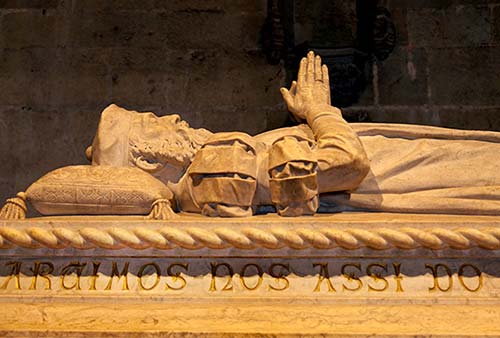
Da Gama’s mission? To confirm what earlier navigators had hypothesized—that the ocean recently discovered when Bartolomeu Dias rounded Africa’s Cape of Good Hope was the same one seen by overland travelers to India. Hopefully, da Gama would find a direct sea route to the vast, untapped wealth of Asia. The symbols on the tomb show the icons of the period—the cross (symbolizing the religious military order of the soldier-monks who funded these voyages), the caravel (representing the method of travel), and Portugal’s trading power around the globe (the result).
By Christmas, da Gama rounded the Cape of Good Hope. After battling hostile Arabs in Mozambique, he hired an Arab guide to pilot the ships to India, arriving on the southwest coast in Calicut (from which we get the word “calico”) in May 1498. He traded for spices, networked with the locals for future outposts, battled belligerent chiefs, and then headed back home. Da Gama and his crew arrived home to Lisbon in September 1499 (after two years and two months on the seas) and were greeted with all-out Vasco-mania. The few spices he’d returned with (many were lost in transit) were worth a staggering fortune. Portugal’s golden age was launched.
King Manuel dubbed da Gama “Admiral of the Sea of India” and sent him out again, this time to subdue the Indian people, establish more trade outposts, and again return home to wealth and honor. Da Gama died on Christmas Eve 1524, in India. His memory lives on due to the tribute of two men: Manuel, who built this large church, and Luís de Camões (honored opposite Vasco), who turned da Gama’s history-making voyage into an epic poem.
Before leaving, enjoy the big picture from a 500-years-ago perspective. It’s the full package for Portugal: the country’s finest church containing the great poet, the great explorer, and the royal family.
• Leave the church, get in line, show your monastery ticket, and enter the...
7 Cloister: This restored cloister is the architectural highlight of Belém. The lacy arcade is Manueline; the simpler diamond and decorative rose frieze above the top floor is Renaissance. Study the carvings, especially the gargoyles above the lower set of arches. Among these functioning rainspouts, find a monkey, a kitten, and a cricket.
Portugal’s unique decorative style (from its peak of power under King Manuel I, the Fortunate, r. 1495-1521) reflects the wealth of the times and the many cultural influences of the Age of Discovery. It is more an ornamental than a structural style, blending late-Gothic features with Mudejar (Moorish) elements. Craftsmen applied it equally to buildings with pointed Gothic or rounded Renaissance arches; you’ll see elaborate Manueline carved stonework particularly around windows and doors.
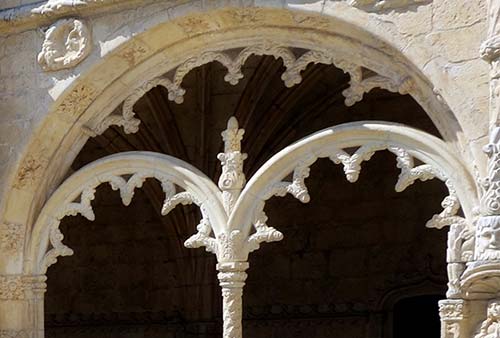
The Manueline aesthetic is ornate, elaborate, and intertwined, often featuring symbols from a family’s coat of arms (shields with castles, crosses, lions, banners, and crowns) or motifs from the sea (rope-like columns or borders, knots, shells, coral, anchors, and nets). Manuel’s personal symbol was the armillary sphere—a celestial globe—which was an indispensable navigational aid for sailors. You’ll also see imports of the age, from opium poppies to exotic animals.
Architecture students will recognize elements from Gothic’s elaborate tracery, the abstract designs of Moorish culture, similarities to Spain’s intricate Plateresque style (which dates from the same time), and the elongated excesses of Italian Mannerism.
Heads of state are often received in the cloister with a warm welcome. This is also the site of many important treaty signings, such as Portugal’s admittance to the European Union in 1986. Turn left and do a clockwise spin around this fine space.
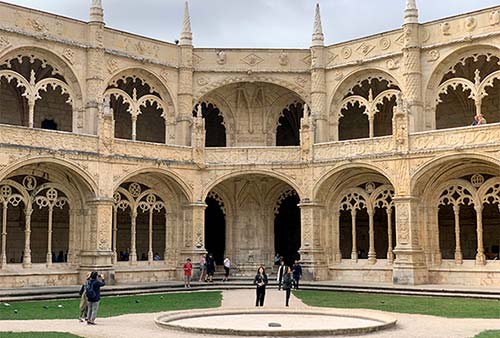
In the first corner, a small lion-topped basin (where the monks washed up before meals) marks the entrance to the refectory, or dining hall—today an occasional concert venue—lined with fine 18th-century tiles. The tiles are considered textbook Rococo, which ignores the parameters set by the architecture (unlike Baroque, which works within the structure).
Down the next stretch of cloister, on the left, is the burial spot of Portugal’s most revered modern poet, Fernando Pessoa (see sidebar on here).
Continuing around, the former chapter house contains the tomb of Alexandre Herculano, a Romantic 19th-century historian and poet. Quotes from Herculano adorn his tomb: “Sleep? Only the cold cadaver that doesn’t feel sleeps. The soul flies and wraps itself around the feet of the All-Powerful.”
• Continuing around the cloister, find the stairs and head up.
8 Upstairs: At the top of the stairs, on the left, step into the Upper Choir (above the main door)—peering down into the vast sanctuary, at the feet of a powerful crucifix.
Back out in the upper cloister, circle around to find a bookshop (and the exit). All the way around are great cloister views. At the far end of the cloister is an exhibition that juxtaposes the historical timeline of this monastery and Portugal with contemporaneous world events (but no real artifacts).
▲Maritime Museum (Museu de Marinha)
If you’re interested in Portugal’s historic ships and navigational tools, this museum, which fills the west wing of the Monastery of Jerónimos (listed above), is worth a look. It’s refreshingly uncrowded, and sailors love it.
Cost and Hours: €6.50, daily 10:00-18:00, Oct-April until 17:00, https://ccm.marinha.pt [URL inactive]. It’s at the far end of the long monastery building, facing the planetarium; the museum entrance is to your right, and its good $$ cafeteria (open to the public) is to your left.
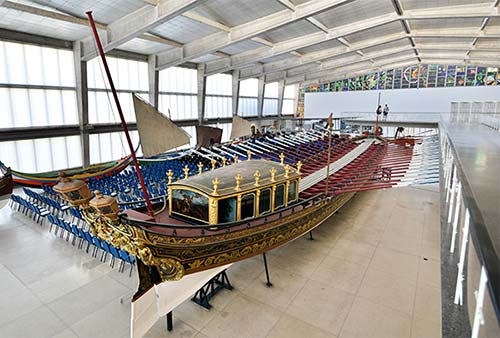
Visiting the Museum: You’ll enter past huge statues of great explorers, then follow the one-way route (with English explanations) through the sprawling collection, offering a well-presented recap of an age when Portugal ruled the waves. It’s loaded with artifacts and reproductions: nautical paintings, model ships, cannons, uniforms, and maps illustrating Portuguese explorations. The exhibit takes you right up to the present day, covering not just explorers and military vessels but also the fishing industry. You’ll see the reconstructed king’s and queen’s staterooms from aboard King Carlos I’s royal yacht Amélia. Then you’ll walk outside (under a connecting gallery) to reach a vast warehouse of actual boats—from rustic rabelos (see here) to yawls to ceremonial royal barges. The centerpiece is the massive barge of King João VI, with 38 oars pulled by some 80 oarsmen, and plush royal quarters at the stern.
▲Monument to the Discoveries (Padrão dos Descobrimentos)
In 1960, the city honored the 500th anniversary of the death of Prince Henry the Navigator by rebuilding this giant riverside monument, which had originally been constructed for a 1940 world’s fair. It takes the shape of a huge caravel ship, in full sail, with Henry at the helm and the great navigators, sailors, and explorers on board behind him. The elevator inside takes you up to the tiptop for a tingly vista—including a fine aerial view down over the mural in front.
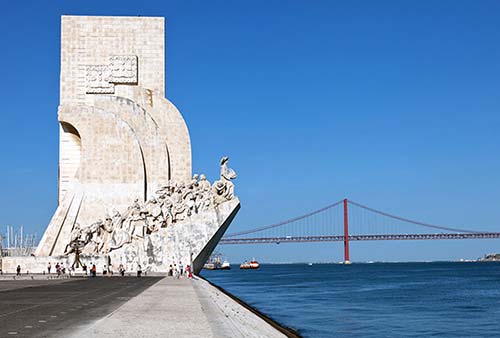
Cost and Hours: €5; daily 10:00-19:00; Oct-April Tue-Sun until 18:00, closed Mon; +351 213 031 950, www.padraodosdescobrimentos.pt.
Visiting the Monument: To get here, find the pedestrian tunnel under the busy boulevard, then walk around the huge monument. The 170-foot concrete structure shows that exploring the world was a team effort. The men who braved the unknown stand on the pointed, raised prow of a caravel, about to be launched into the Rio Tejo.
Leading the charge is Prince Henry the Navigator (for more about him, see here), holding a model of a caravel and a map, followed by kneeling kings and soldiers who Christianized foreign lands with the sword. Behind Henry (on the west side, away from bridge), find the men who financed the voyages (King Manuel I, holding an armillary sphere, his personal symbol), those who glorified it in poems and paintings (like Luís de Camões, holding his famous poem The Lusiads on a scroll), and at the very end, the only woman, Philippa of Lancaster, Henry’s British mother.
On the east side (closest to bridge—as you walk, notice the optical illusion of waves on the flat cobbled surface), Vasco da Gama stands with his eyes on the horizon and his hand on his sword. Magellan holds a circle, representing the round earth his ship circumnavigated, while in front of him, Pedro Cabral puts his hand to his heart, thankful to have (perhaps accidentally) arrived in Brazil. Various monks, navigators with maps, and crusaders with flags complete the crew. Check out the pillory, decorated with the Portuguese coat of arms and a cross, erected in each place “discovered” by the Portuguese—leaving no doubt as to which Europeans had arrived first.
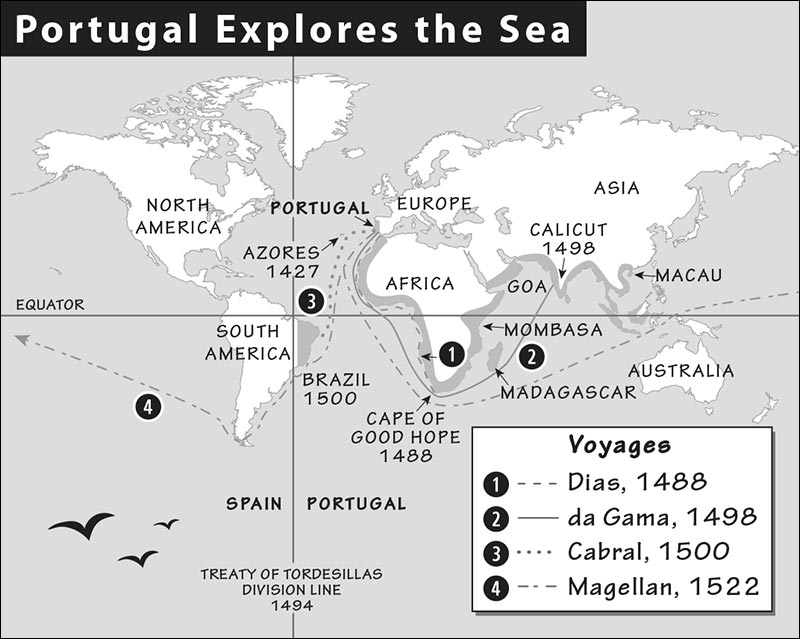
In the marble map in the pavement (a gift from South Africa) in front of the Monument to the Discoveries, follow Portugal’s explorers as they inched out into monster-infested waters at the edge of the world. From their tiny, isolated nation in Europe, the Portuguese first headed south to the coast of Morocco, conquering the Muslims of Ceuta in God’s name (1415) and trying to gain control of North African trade routes. They braved the open Atlantic to the west and southwest, stumbling on the Madeiras (1420), which Prince Henry planted with vineyards, and the remote Azore Islands (Açores, 1427).
Meanwhile, the Portuguese slowly moved southward, hugging the African coast, each voyage building on the knowledge from previous expeditions. They cleared the biggest psychological hump when Gil Eanes sailed around Cape Bojador (western Sahara, 1434)—the border of the known world—and into the equatorial seas where it was thought that sea monsters lurked, no winds blew, and ships would be incinerated in the hot sun. Eanes survived, returning home with 200 enslaved Africans, the first of what would become a lucrative, abhorrent commodity. Two generations later, Bartolomeu Dias rounded the southern tip of Africa (Cabo da Boa Esperança, 1488), discovering the sea route to Asia that Vasco da Gama (1498) and others would exploit to establish trade and outposts in India, Indonesia, Japan, and China (Macao in 1557, on the south coast).
In 1500, Pedro Cabral (along with Dias and 1,200 men) took a wi-i-i-ide right turn on the way down the African coast, hoping to avoid windless seas, and landed on the tip of Brazil. The country proved to be an agricultural treasure for Portugal, which profited from sugar plantations worked by enslaved Africans. Two hundred years later, gold and gemstones were discovered in Brazil, jump-starting the Portuguese economy again.
These easily maneuverable trading ships were fast, small (80 feet), and light (100 tons), with few guns and three triangular sails (called lateen-rigged sails) that could pivot quickly to catch the wind. They were ideal for sailing along coastlines. Many oceangoing caravels were also rigged with a square foresail for stability. (This photo shows the model held by Prince Henry on Belém’s Monument to the Discoveries.) Columbus’ Niña and Pinta were rerigged caravels.
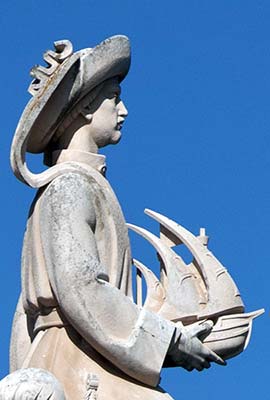
In 1520, Portuguese Ferdinand Magellan, although employed by Spain, sailed west with five ships and 270 men, broke for R&R in Rio, stopped in Patagonia, and continued through the straits that were later named for him (tip of South America); along the way he suffered through mutinies, scurvy, and dinners of sawdust and ship rats before touching land in Guam. Magellan was killed in battle in the Philippines, but one remaining ship continued west and arrived back in Europe, having circumnavigated the globe after 30 months at sea.
By 1560, Portugal’s global empire had peaked. Tiny-but-filthy-rich Portugal claimed (though it didn’t actually occupy) the entire coastline of Africa, Arabia, India, the Philippines, and south China—a continuous stretch from Lisbon to Macao—plus Brazil. The Treaty of Tordesillas (1494) with Spain had already divvied up the colonial world between the two nations, split at 45 degrees west longitude (bisecting South America—and explaining why Brazil speaks Portuguese and the rest of the continent speaks Spanish) and 135 degrees east longitude (bisecting the Philippines and Australia).
But all that wealth was wasted on Portugal’s ruling class, who neglected to reinvest it in the future. Easy money ruined the traditional economy and stunted industry, hurting the poor. Over the next four centuries, one by one, Portugal’s colonies were lost to other European nations or to local revolutions. Today, only the islands of the Azores and Madeiras remain from the once-global empire.
In 1560, you could sail from Lisbon to China without ever losing sight of land explored by Portugal. The riches of the world poured into the tiny nation—spices from India and Java (black pepper, cinnamon); ivory, diamonds, and enslaved people from Africa; sugarcane, gold, and diamonds from Brazil; and, from everywhere, knowledge of new plants, animals, and customs. How did tiny Portugal pull this off?
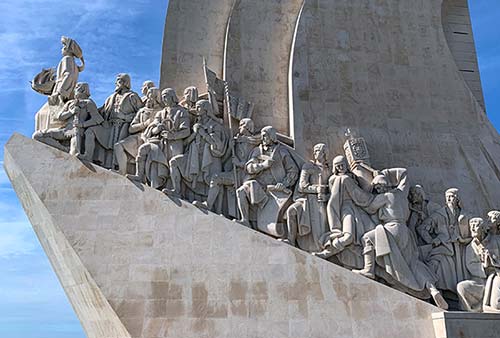
First, its people were motivated by greed, hoping to break the Arab and Venetian monopoly on Eastern luxury goods (the price of pepper was jacked up 1,000 percent by the time it reached European dinner tables). They pioneered—and profited from—the transatlantic slave trade, supplying enslaved Africans to Portuguese and Spanish colonies (all told Portugal ships are estimated to have transported over 4 million slaves to the New World).
They were also driven by a crusading Christian spirit, a love of science, and a spirit of adventure. An entire 15th-century generation was obsessed with finding the legendary kingdom of the fabulously wealthy Christian named “Prester John,” supposedly located in either India or Africa. (The legend may be based on a historical figure from around 1120 who visited the pope in Rome as “patriarch of India.”)
Portugal also had certain natural advantages. Its Atlantic location led to a strong maritime tradition. A unified nation-state (one of Europe’s first) financed and coordinated expeditions. And a core of technology-savvy men used and developed their expansive knowledge of navigational devices, astronomy, maps, shipbuilding, and languages.
▲Belém Tower (Torre de Belém)
Perhaps the purest Manueline building in Portugal (built 1515-1520), this white tower once protected Lisbon’s harbor. Today it celebrates the voyages that made Lisbon powerful, with carved stone representing ropes, Manuel’s coat of arms, armillary spheres, and shields with the cross of the Order of Christ, charged with spreading the faith in new territories. There’s often a very long line to get into this tower, but there’s nothing inside worth waiting very long to see.
Cost and Hours: €6, Tue-Sun 9:30-18:00, closed Mon; from the monument it’s a pretty, 15-minute waterfront walk, but be ready to detour around the big yacht marina; +351 213 620 034, www.torrebelem.pt.
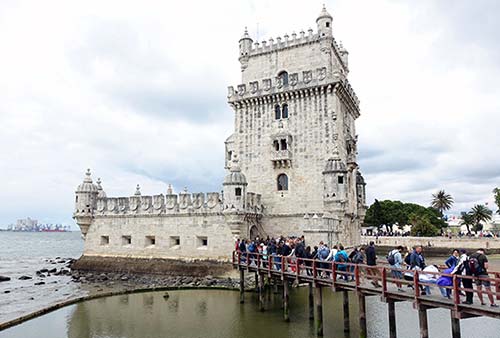
Visiting the Tower: This was the last sight sailors saw as they left their homeland, and the first as they returned, loaded with gold, spices, and social diseases. When the tower was built, the river went nearly to the walls of the monastery, and the tower was midriver. Its interior is pretty bare, but the views of the bridge, river, and Cristo Rei statue are nice (though I prefer the lookout from the Monument to the Discoveries, which has a better view of the monastery).
The floatplane on the grassy lawn is a monument to the first flight across the South Atlantic (Portugal to Brazil) in 1922. The original plane (which beat Charles Lindbergh’s Spirit of Saint Louis across the North Atlantic by five years) is in Belém’s Maritime Museum.