APPENDIX
Holidays and Festivals
This list includes selected festivals in major cities, plus national holidays observed throughout Portugal. Many sights and banks close on national holidays—keep this in mind when planning your itinerary. Before planning a trip around a festival, verify the dates with the festival website, the TI sites (www.visitportugal.com), or my “Upcoming Holidays and Festivals in Portugal” web page at RickSteves.com/europe/portugal/festivals. Note that Fátima receives an influx of pilgrims on every 13th from May until October (when the apparitions occurred in 1917). St. Anthony’s Day is June 13, but it’s celebrated during the entire month of June in Lisbon.
| Jan 1 | New Year’s Day |
| Feb/March | Carnival (Mardi Gras, a.k.a. Entrudo). Particularly vibrant in Lisbon and Algarve towns, some closures on Shrove Tuesday |
| March/April | Holy Week (Semana Santa, week before Easter). Religious processions, especially in Óbidos and Porto |
| March/April | Easter weekend (Good Friday-Easter Sunday): April 7-9, 2023; March 29-31, 2024 |
| Early April | Lisbon Fish & Flavors (Peixe em Lisboa, gourmet seafood festival) |
| April 25 | Liberty Day (parades, fireworks) |
| May 1 | Labor Day |
| Early May | Queima das Fitas, Coimbra (“burning of ribbons,” graduation festivities) |
| May 13 | Pilgrimage to Fátima (Peregrinação de Fátima) |
| May/June | Corpus Christi (religious festival): June 8 in 2023; May 30, 2024 |
| June | Festas de Lisboa, Lisbon (series of festivals with celebrations peaking on St. Anthony’s Day) |
| Late spring-early summer | Festival de Sintra (www.festivaldesintra.pt) |
| June 10 | Portuguese National Day (Dia de Camões) |
| June 13 | St. Anthony’s Day (Dia de Santo António), Lisbon (dancing, processions) |
| June 24 | St. John’s Day (Dia de São João), Porto (fireworks, dancing) |
| June 29 | St. Peter’s Day (Dia de São Pedro), Évora (dancing, processions) |
| Aug 15 | Assumption (religious festival) |
| Sept 8 | Our Lady of Nazaré Festival, Nazaré (procession, folk dancing, fairs) |
| Oct 5 | Republic Day |
| Oct 13 | Pilgrimage to Fátima (Peregrinação de Fátima) |
| Nov 1 | All Saints Day |
| Dec 1 | Restoration of Independence Day |
| Dec 8 | Feast of the Immaculate Conception |
| Dec 25 | Christmas |
| Dec 31 | New Year’s Eve |
Books and Films
To learn more about Portugal past and present, check out a few of these books or films.
Nonfiction
The Book of Disquiet (Fernando Pessoa, 1982). This collection of unpublished poetry and thoughts from the great Portuguese writer Fernando Pessoa was compiled after manuscripts were found in a trunk following his death.
The First Global Village (Martin Page, 2002). Page explores Portugal’s profound influence on the rest of the world.
The History of Portugal (James Anderson, 2000). Anderson provides a concise, readable overview of Portuguese history.
The Last Day: Wrath, Ruin, and Reason in the Great Lisbon Earthquake of 1755 (Nicholas Shrady, 2008). The earthquake that leveled Lisbon not only destroyed one of the leading European cities of the time but also had a lasting effect on the world at large.
Over the Edge of the World: Magellan’s Terrifying Circumnavigation of the Globe (Laurence Bergreen, 2003). Magellan’s fascinating tale of circumnavigating the globe is told through firsthand accounts.
Portugal: A Companion History (José Hermano Saraiva, 1997). This easily digestible primer on Portugal is accompanied by maps and illustrations.
The Portuguese: A Modern History (Barry Hatton, 2011). Hatton combines information on the country’s history, landscape, and culture with anecdotes from his own experience living in Portugal.
The Portuguese Empire, 1415-1808: A World on the Move (A.J.R. Russell-Wood, 1998). Russell-Wood explores the rise and fall of the Portuguese empire.
Prince Henry the Navigator: A Life (Peter Russell, 2000). This biography reveals the man who helped set into motion the Age of Discovery.
Unknown Seas: How Vasco da Gama Opened the East (Ronald Watkins, 2005). Reconstructing journeys from captains’ logs, this book explores the expansion of Portuguese trade routes.
Fiction
Baltasar and Blimunda (José Saramago, 1998). Saramago’s love story offers a surrealistic reflection on life in 18th-century Portugal.
The Crime of Father Amaro (Jose Maria de Eça de Queirós, 1875). Set in a provincial Portuguese town, this book by the great 19th-century Portuguese novelist highlights the dangers of fanaticism.
Distant Music (Lee Langley, 2003). Catholic Esperança and Jewish Emmanuel have an affair that lasts through six centuries and multiple incarnations; the book also delves into Portugal’s maritime empire, Sephardic Jews, and Portuguese immigrants in London.
The Last Kabbalist of Lisbon (Richard Zimler, 1996). The author illuminates the persecution of the Jews in Portugal in the early 1500s.
The Lusiads (Luís de Camões, 1572). Considered a national treasure, Camões’ great epic poems of the Renaissance immortalize Portugal’s voyages of discovery.
Night Train to Lisbon (Pascal Mercier, 2004). Mercier’s international bestseller-turned-2013-film follows the travels of a Swiss professor as he explores the life of a Portuguese doctor during Salazar’s dictatorship.
Pereira Declares: A Testimony (Antonio Tabucchi, 1997). Set in Portugal in 1938 during Salazar’s fascist government, Pereira Declares is the story of the moral resurrection of a newspaper’s cautious editor.
A Small Death in Lisbon (Robert Wilson, 2002). In this award-winning thriller, a contemporary police procedural is woven with an espionage story set during World War II, with Portugal’s 20th-century history as a backdrop.
Film and TV
Amália (2008). This film captures the life of Portugal’s beloved fado singer Amália Rodrigues, who rose from poverty to international fame. (If the film is hard to find, listen to a YouTube clip of her lovely singing.)
The Art of Amália (2000). Interviews with the diva are highlighted in this documentary chronicling her rise to fame.
Capitães de Abril (2000). The story of the 1974 coup that overthrew the right-wing Portuguese dictatorship is told from the perspective of two young army captains.
Glória (2021). The first Netflix series filmed and set in Portugal, this 10-episode Cold War thriller covers the period leading up to the 1974 Carnation Revolution.
Letters from Fontainhas (2010). This trio of short films follows three troubled lives in Lisbon.
Pereira Declares (1996). Marcello Mastroianni plays the namesake in this film inspired by the Tabucchi novel mentioned earlier.
The Strange Case of Angelica (2010). Manoel de Oliveira’s film about a photographer haunted by a deceased bride is set against the landscape of the Douro Valley.
Conversions and Climate
Numbers and Stumblers
• Europeans write a few of their numbers differently than we do. 1 =  , 4 =
, 4 =  , 7 =
, 7 =  .
.
• In Europe, dates appear as day/month/year, so Christmas 2023 is 25/12/24.
• Commas are decimal points and decimals commas. A dollar and a half is $1,50, one thousand is 1.000, and there are 5.280 feet in a mile.
• When counting with fingers, start with your thumb. If you hold up your first finger to request one item, you’ll probably get two.
• What Americans call the second floor of a building is the first floor in Europe.
• On escalators and moving sidewalks, Europeans keep the left “lane” open for passing. Keep to the right.
Metric Conversions
A kilogram equals 1,000 grams (about 2.2 pounds). One hundred grams (a common unit at markets) is about a quarter-pound. One liter is about a quart, or almost four to a gallon.
A kilometer is six-tenths of a mile. To convert kilometers to miles, cut the kilometers in half and add back 10 percent of the original (120 km: 60 + 12 = 72 miles). One meter is 39 inches—just over a yard.
| 1 foot = 0.3 meter | 1 square yard = 0.8 square meter |
| 1 yard = 0.9 meter | 1 square mile = 2.6 square kilometers |
| 1 mile = 1.6 kilometers | 1 ounce = 28 grams |
| 1 centimeter = 0.4 inch | 1 quart = 0.95 liter |
| 1 meter = 39.4 inches | 1 kilogram = 2.2 pounds |
| 1 kilometer = 0.62 mile | 32°F = 0°C |
Clothing Sizes
When shopping for clothing, use these US-to-European comparisons as general guidelines (but note that no conversion is perfect).
Women: For pants and dresses, add 32 in Portugal (US 10 = Portuguese 42). For blouses and sweaters, add 8 for most of Europe (US 32 = European 40). For shoes, add 30-31 (US 7 = European 37/38).
Men: For shirts, multiply by 2 and add about 8 (US 15 = European 38). For jackets and suits, add 10. For shoes, add 32-34.
Children: Clothing is sized by height—in centimeters (2.5 cm = 1 inch), so a US size 8 roughly equates to 132-140. For shoes up to size 13, add 16-18, and for sizes 1 and up, add 30-32.
Portugal’s Climate
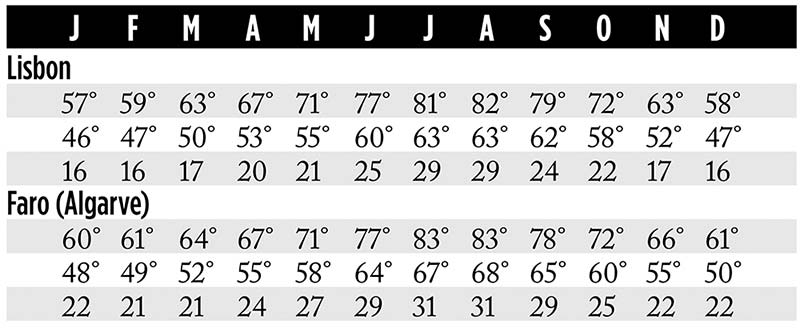
First line, average daily high; second line, average daily low; third line, average days with some rain. For more detailed weather statistics for destinations in this book (as well as the rest of the world), check Wunderground.com.
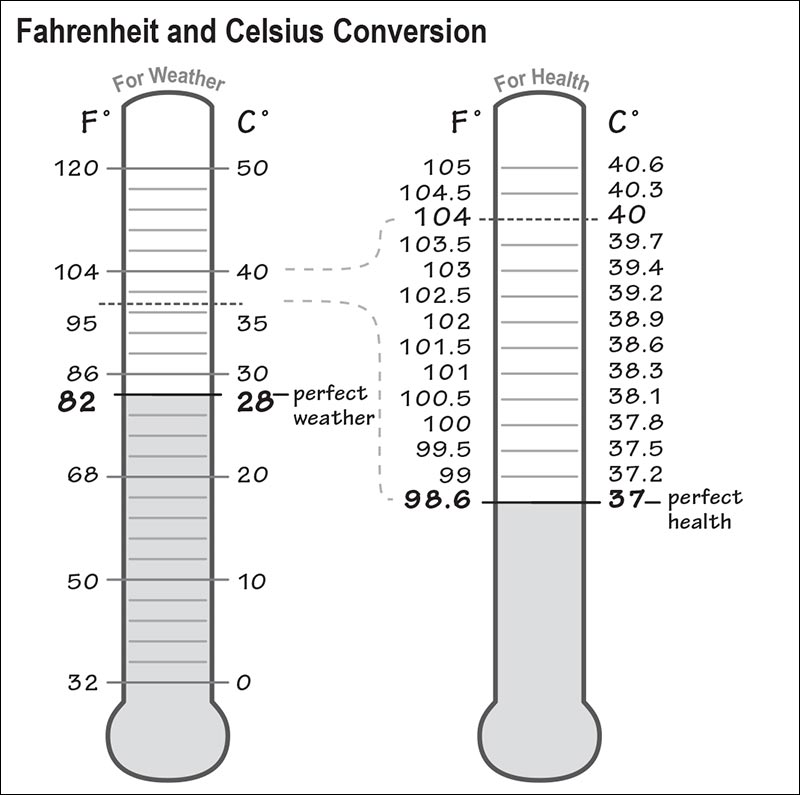
Europe takes its temperature using the Celsius scale, while we opt for Fahrenheit. For a rough conversion from Celsius to Fahrenheit, double the number and add 30. For weather, remember that 28°C is 82°F—perfect. For health, 37°C is just right. At a launderette, 30°C is cold, 40°C is warm (usually the default setting), 60°C is hot, and 95°C is boiling. Your air-conditioner should be set at about 20°C.
Whether you’re traveling for five days or five weeks, you won’t need more than this. Pack light to enjoy the sweet freedom of true mobility.
 5 shirts: long- & short-sleeve
2 pairs pants (or skirts/capris)
1 pair shorts
5 pairs underwear & socks
1 pair walking shoes
Sweater or warm layer
Rainproof jacket with hood
Tie, scarf, belt, and/or hat
Swimsuit
Sleepwear/loungewear
Debit card(s)
Credit card(s)
Hard cash (US $100-200)
Money belt
Passport
Other required ID: Vaccine card/Covid test, entry visa, etc.
Driver’s license, student ID, hostel card, etc.
Tickets & confirmations: flights, hotels, trains, rail pass, car rental, sight entries
Photocopies of important documents
Insurance details
Guidebooks & maps
Mobile phone
Camera & related gear
Tablet/ebook reader/laptop
Headphones/earbuds
Chargers & batteries
Phone car charger & mount (or GPS device)
Plug adapters
Basics: soap, shampoo, toothbrush, toothpaste, floss, deodorant, sunscreen, brush/comb, etc.
Medicines & vitamins
First-aid kit
Glasses/contacts/sunglasses
Face masks & hand sanitizer
Sewing kit
Packet of tissues (for WC)
Earplugs
Daypack
Sealable plastic baggies
Laundry supplies: soap, laundry bag, clothesline, spot remover
Small umbrella
Travel alarm/watch
Notepad & pen
Journal
Second pair of shoes (flip-flops, sandals, tennis shoes, boots)
Travel hairdryer
Picnic supplies
Disinfecting wipes
Water bottle
Fold-up tote bag
Small flashlight
Mini binoculars
Small towel or washcloth
Inflatable pillow/neck rest
Tiny lock
Address list (to mail postcards)
Portuguese Survival Phrases
In the phonetics, nasalized vowels are indicated by an underlined n or w. As you say the vowel, let its sound come through your nose as well as your mouth.
| Good day. | Bom dia. bohn dee-ah |
| Do you speak English? | Fala inglês? fah-lah een-glaysh |
| Yes. / No. | Sim. / Não. seeng / now |
| I (don’t) understand. | (Não) compreendo. (now) kohn-pree-ayn-doo |
| Please. | Por favor. poor fah-vor |
| Thank you. (said by male) | Obrigado. oo-bree-gah-doo |
| Thank you. (said by female) | Obrigada. oo-bree-gah-dah |
| I’m sorry. | Desculpe. dish-kool-peh |
| Excuse me (to pass). | Com licença. kohn lee-sehn-sah |
| No problem. | Não há problema. now ah proo-blay-mah |
| Good. | Bom. bohn |
| Goodbye. | Adeus. / Ciao. ah-deh-oosh / chow |
| one / two / three | um / dois / três oon / doysh / traysh |
| How much is it? | Quanto é? kwahn-too eh |
| Write it? | Escreva? ish-kray-vah |
| Is it free? | É gratis? eh grah-teesh |
| Is it included? | Está incluido? ish-tah een-kloo-ee-doo |
| Where can I find / buy...? | Onde posso encontrar / comprar...? ohn-deh paw-soo ayn-kohn-trar / kohn-prar |
| I’d like / We’d like... | Gostaria / Gostaríamos… goosh-tah-ree-ah / goosh-tah-ree-ah-moosh |
| ...a room. | ...um quarto. oon kwar-too |
| ...a ticket to ___. | ...um bilhete para ___. oon beel-yeh-teh pah-rah ___ |
| Is it possible? | É possível? eh poo-see-vehl |
| Where is...? | Onde é que é...? ohn-deh eh keh eh |
| ...the train station | ...a estação de comboio ah ish-tah-sow deh kohn-boy-yoo |
| ...the bus station | ...a terminal de autocarros ah tehr-mee-nahl deh ow-too-kah-roosh |
| ...the tourist information office | ...a posto de turismo ah poh-stoo deh too-reez-moo |
| ...the toilet | ...a casa de banho ah kah-zah deh bahn-yoo |
| men / women | homens / mulheres aw-maynsh / mool-yeh-rish |
| left / right | esquerda / direita ish-kehr-dah / dee-ray-tah |
| straight | em frente ayn frayn-teh |
| What time does this open / close? | As que horas é que abre / fecha? ahsh keh aw-rahsh eh keh ah-breh / feh-shah |
| At what time? | As que horas? ahsh keh aw-rahsh |
| Just a moment. | Um momento. oon moo-mayn-too |
| now / soon / later | agora / em breve / mais tarde ah-goh-rah/ ayn bray-veh / mīsh tar-deh |
| today / tomorrow | hoje / amanhã oh-zheh / ah-ming-yah |
In a Portuguese Restaurant
| I’d like / We’d like... | Gostaria / Gostaríamos… goosh-tah-ree-ah / goosh-tah-ree-ah-moosh |
| ...to reserve... | ...de reservar… deh reh-zehr-var |
| ...a table for one / two. | ...uma mesa para uma / duas. oo-mah may-zah pah-rah oo-mah / doo-ahsh |
| Is this table free? | Esta mesa está livre? ehsh-tah meh-zah ish-tah lee-vreh |
| The menu (in English), please. | A ementa (em inglês), por favor. ah eh-mayn-tah (ayn een-glaysh) poor fah-vor |
| service (not) included | serviço (não) incluído sehr-vee-soo (now) een-kloo-ee-doo |
| cover charge | coberto koh-behr-too |
| to go | para fora pah-rah foh-rah |
| with / without | com / sem kohn / sayn |
| and / or | e / ou eh / oh |
| breakfast / lunch / dinner | pequeno-almoço / almoço / jantar peh-kehn-ahl-moh-soh / ahl-moh-soh / zhahn-tahr |
| specialty of the house | especialidade da casa ish-peh-see-ah-lee-dah-deh dah kah-zah |
| half portion | meia dose may-ah doh-zeh |
| daily special | prato do dia prah-too doo dee-ah |
| tourist menu | ementa turística eh-mayn-tah too-reesh-tee-kah |
| appetizers | entradas ayn-trah-dahsh |
| bread / cheese | pão / queijo pow / kay-zhoo |
| sandwich | sandes sahn-desh |
| soup / salad | sopa / salada soh-pah / sah-lah-dah |
| meat / poultry | carne / aves kar-neh / ah-vish |
| fish / seafood | peixe / marisco pī-sheh / mah-reesh-koo |
| fruit / vegetables | fruta / legumes froo-tah / lay-goo-mish |
| dessert | sobremesa soo-breh-may-zah |
| tap water | água da torneira ah-gwah dah tor-nay-rah |
| mineral water | água mineral ah-gwah mee-neh-rahl |
| milk | leite lī-teh |
| (orange) juice | sumo (de laranja) soo-moo (deh lah-rahn-zhah) |
| coffee / tea | café / chá kah-feh / shah |
| wine | vinho veen-yoo |
| red / white | tinto / branco teen-too / brang-koo |
| glass / bottle | copo / garrafa koh-poo / gah-rah-fah |
| beer | cerveja sehr-vay-zhah |
| Cheers! | Saúde! sah-oo-deh |
| More. / Another. | Mais. / Outro. mīsh / oh-troo |
| The same. | O mesmo. oo mehsh-moo |
| The bill, please. | A conta, por favor. ah kohn-tah poor fah-vor |
| tip | gorjeta gor-zheh-tah |
| Delicious! | Delicioso! deh-lee-see-oh-zoo |
For more user-friendly Portuguese phrases, check out Rick Steves Portuguese Phrase Book & Dictionary.