COIMBRA
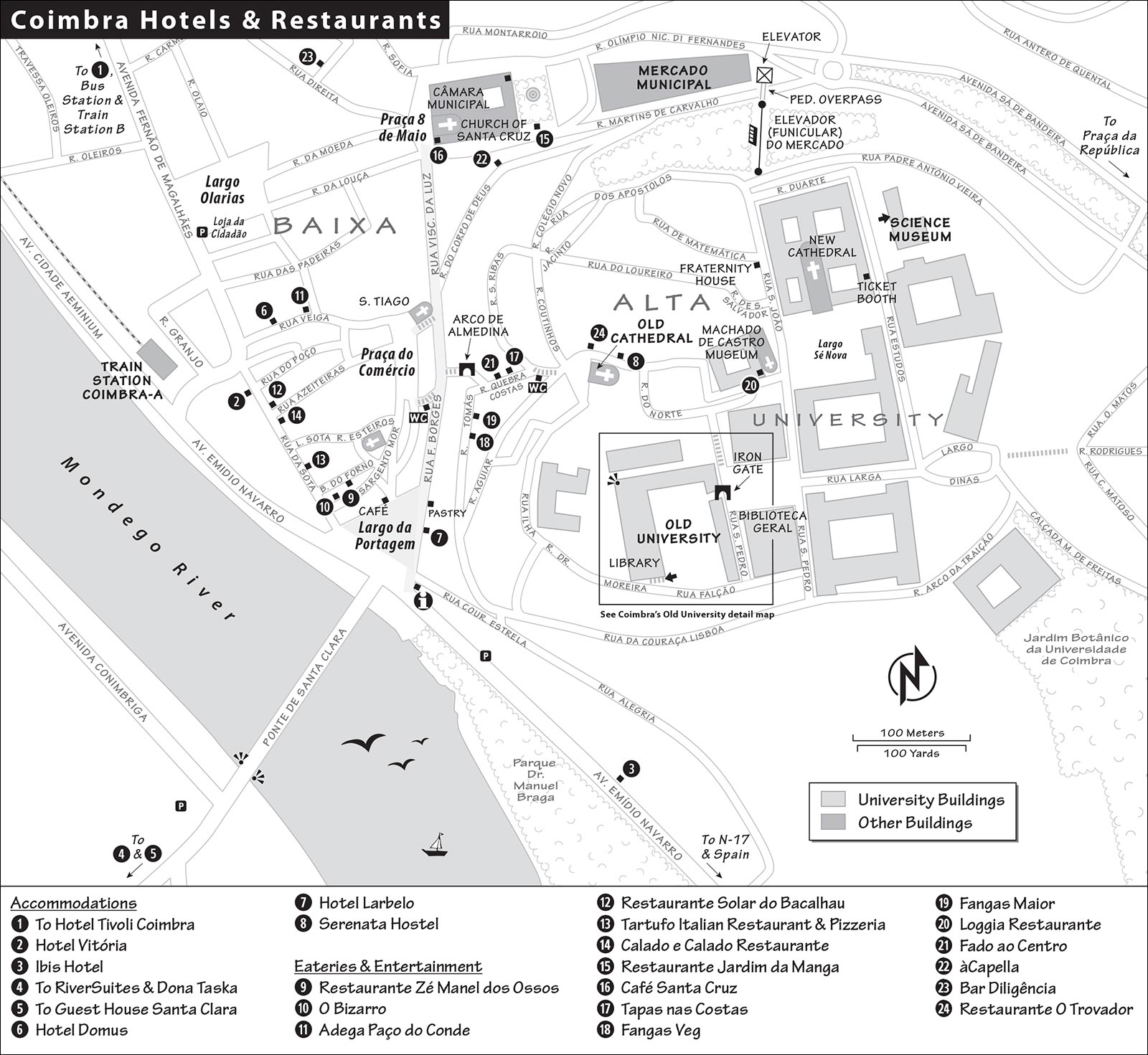
Map: Coimbra Hotels & Restaurants
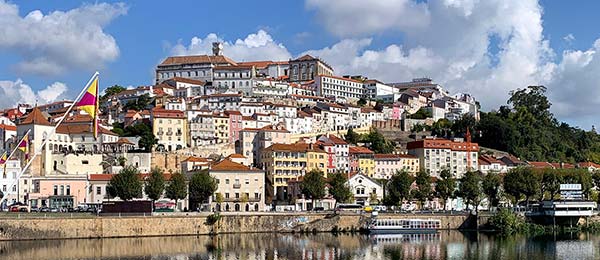
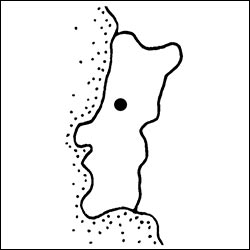
The college town of Coimbra—just two to three hours north of Lisbon by train, bus, or car—is Portugal’s Oxford, and the country’s easiest-to-enjoy city.
The earthquake that devastated Lisbon in 1755 spared Coimbra. The town’s “earthquake” came much later, in the form of the 20th-century dictator Salazar—who demolished much of the old center for his bombastic building projects.
Today, Coimbra (pop. 144,000) is home to the country’s oldest and most prestigious university (founded 1290). When school is in session, the town bustles with the spirited exuberance of youth—although many students go home on Friday, so weekend nights aren’t as crazy as you might expect. (Over the summer holidays, it’s almost sleepy.) During the school year, you’ll see bands of black-caped students hanging out, rushing to class, or gathered in little clusters on the street singing traditional songs—to each other as much as for tourists. Coimbra’s fado music also has its own special character: Here, it’s performed by college-age men rather than women (as in Lisbon).
Any time of year, Coimbra’s inviting Arab-flavored old town—a maze of people, narrow streets, and tiny tascas (restaurants with just a few tables)—awaits exploration. And its main drag—with glassy marbled stone underfoot, old-timey shops and bakeries winking their neon signs, and more locals than tourists—is a delight to simply wander. But for serious sightseeing, look no further than the historic university, capping the hill above town and offering a busy slate of cultural attractions. By the time you leave town, you’ll know why graduating students sing, “Coimbra tem mais encanto na hora da despedida” (Coimbra is most enchanting at the moment you say goodbye).
PLANNING YOUR TIME
On a two-week swing through Portugal, give Coimbra two nights and a full day. If you plan to visit King João’s Library, be sure to book a ticket in advance. You could spend the whole day simply following my self-guided walk and dipping into the various sights as you reach them, then wind down the afternoon and evening by strolling and exploring the town, enjoying a good meal, and taking in some fado (the Fado ao Centro show is an ideal introduction).
Orientation to Coimbra
Coimbra is a mini-Lisbon, with everything good about urban Portugal minus the intensity of a big metropolis. Skip Coimbra’s modern center and stick to the charming old town.
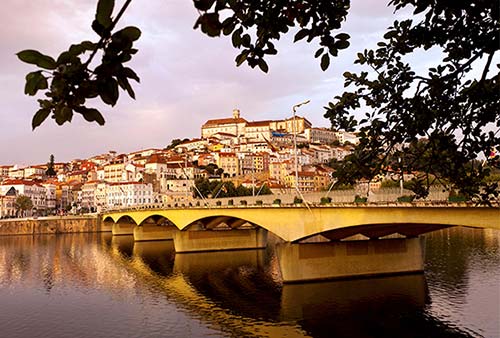
From Largo da Portagem, the main square by the river, everything is within a short (if occasionally steep) walk. Plenty of budget rooms are within several blocks of the train station. The best views are from Coimbra’s low and high points: looking up from the far end of Santa Clara Bridge (Ponte de Santa Clara) and looking down from the observation deck of the old university.
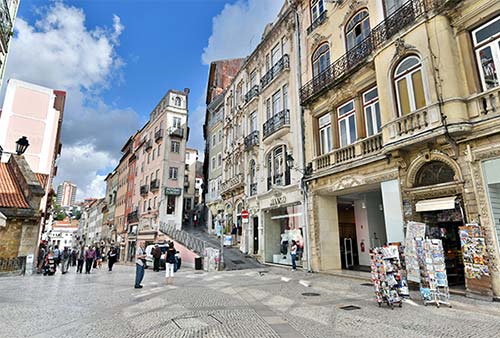
Coimbra’s old town—a maze of timeworn shops, houses, and stairways—has two parts: the lower (Baixa) and the upper (Alta). The dividing line is the main pedestrian street, named Visconde da Luz at one end and Rua de Ferreira Borges at the other. It runs from the Praça 8 de Maio to the Mondego River.
To get from this main pedestrian thoroughfare to the university, follow the streets that wind their way up the hillside. These little lanes meander like the alleyways of a Moroccan medina up to the city’s highest point, the old university. To save yourself some steep uphill climbing, use Coimbra’s elevator/funicular, take a taxi, or ride the little electric minibus.
TOURIST INFORMATION
The TI is a few steps off Largo da Portagem (daily, generally 9:00-17:00, entrance on Avenida Emídio Navarro—facing the bridge, +351 239 488 120, www.turismodocentro.pt). Ask for bus schedules here if needed.
ARRIVAL IN COIMBRA
By Train
There are two Coimbra train stations, Coimbra-B (Estação Velha, north of the center) and Coimbra-A (Estação Nova, more central; often written as just “Coimbra,” without the A). Think B for “big”: Nearly all major trains—such as those to and from Lisbon or Porto—stop only at Coimbra-B (some local trains stop at both). Any ticket to or from Coimbra includes a shuttle train that connects Coimbra-B with the more conveniently located Coimbra-A (5 minutes, 4/hour). To find a train to get you from B to A, check the electronic schedule boards or ask any station employee, “Para Coimbra-A (ah)?” Taxis wait across the tracks from Coimbra-B (figure about €5 to Coimbra-A or your hotel). Neither station has baggage storage.
Upon arrival at Coimbra-A, you’re within a 10-minute walk of most lower-town (Baixa) landmarks. Several recommended hotels are right outside the station.
By Bus
The bus station, on Avenida Fernão de Magalhães (+351 239 855 270), has ATMs and baggage storage (closed Sat-Sun). The station is a quick taxi ride or 15-minute walk from the center; exit the bus station to the right, and follow the busy street into town. There’s no need to make a special trip to the station to check schedules or buy tickets for your onward journey (both can be done online at www.rede-expressos.pt [URL inactive]). If you’re walking to the station to catch a bus to leave Coimbra, take Avenida Fernão de Magalhães almost to its intersection with Cabral, and look to the left—the Neptuno café is by the station’s subtle entrance.
By Car
From Lisbon, it’s an easy two-hour straight shot on the slick auto-estrada A-1 (toll road). You’ll pass convenient exits for Fátima and the Roman ruins of Conímbriga along the way. Leave the freeway on the easy-to-miss first Coimbra exit (Coimbra Sul), then follow the Centro signs. After 2.5 miles, you’ll cross the Mondego River. Take Avenida Fernão de Magalhães directly into town. Most recommended hotels are near the Coimbra-A train station and the Santa Clara Bridge. If you arrive from northern Portugal or central Spain, follow signs for Centro/Largo da Portagem.
A large lot on the south bank of the river offers parking (but it’s not guarded overnight—park at your own risk). In town, you’ll find several big, convenient, clearly marked pay garages. The largest is centrally located in the lower old town under the government office called Loja da Cidadão (on Avenida Fernão de Magalhães). Most hotels can provide advice on the best parking options, and many offer parking in city lots (about €5/day).
HELPFUL HINTS
Laundry: A modern, self-service Lavamais launderette is a 10-minute walk north of the main shopping street (daily 8:00-22:00, Rua Mário Pais 22, +351 914 376 001). Cafés within two nearby grocery stores—Continente and Pingo Doce—are handy for passing the time.
Local Guides: I’ve enjoyed working with several good private guides in Coimbra. Each can give you a private half-day tour in town (about €100) or around the region: Cristina Carvalho (+351 917 200 180, ccfb64@hotmail.com), Maria Jose Fernandes (+351 934 093 542, mariajf76@gmail.com), and Rosa Lopez (+351 966 103 277, mrosatoscano@gmail.com). Sara Cruz and her colleagues at Go! Walks Portugal lead a variety of cultural town walks, as well as excursions to out-of-town sights (+351 910 163 118, www.gowalksportugal.com).
GETTING AROUND COIMBRA
While most visitors do the entire city on foot, taxis are cheap (€5 for a short ride) and a good option if you’ve been up and down too many hills.
Most buses skip the old town, but a few run through the university. You can buy a ticket for €1.60 per ride; or pay €0.50 for a rechargeable Viagem ConVIDA card for cheaper fares (€1/ride; better-value 3-ride, 10-ride, and one-day passes available and shareable; all are sold at kiosks or the Loja SMTUC offices—one is at Santa Clara Bridge directly across from the TI and another is at the Elevador do Mercado, www.smtuc.pt). Bus passes are also valid for Coimbra’s elevator/funicular that runs between Mercado Municipal and the top of town (described on my “Coimbra Old Town Walk,” later), and for the electric minibus that shuttles between the lower and upper town (described next).
The cute little Blue Line electric minibus (nicknamed pantufinhas, or “grandma’s slipper”) is silent and easy, designed to get grandmas—and anyone else—up and down the steep hills of the old town. It makes a continuous 20-minute loop through the lower old town (Baixa) and around the upper old town (Alta), starting at Largo da Portagem, down the pedestrian shopping lane to Praça 8 de Maio, past the market and elevator/funicular, then circling up to the cathedral (the bus’ high point) before returning down to Largo da Portagem. There are just two regular stops at the beginning and end of the route—but you can wave down the bus anywhere you like, and the driver will let you off wherever you ask (€1.60, pay driver or use Viagem ConVIDA card). The loop route makes for a fun joyride. Also enjoyable is the Linha Botânica bus that starts on the opposite side of the river (in front of the recommended RiverSuites hotel) and winds uphill through the lush botanical gardens to the university campus (€1.60, pay driver or use Viagem ConVIDA card).
Coimbra Old Town Walk
1 Santa Clara Bridge (Ponte de Santa Clara)
Rua de Ferreira Borges to the Church
7 Church of Santa Cruz (Mosteiro de Santa Cruz)
8 Jardim da Manga (Garden of the Sleeve)
10 Elevador do Mercado to the University
Downhill Streets Through the Upper Town
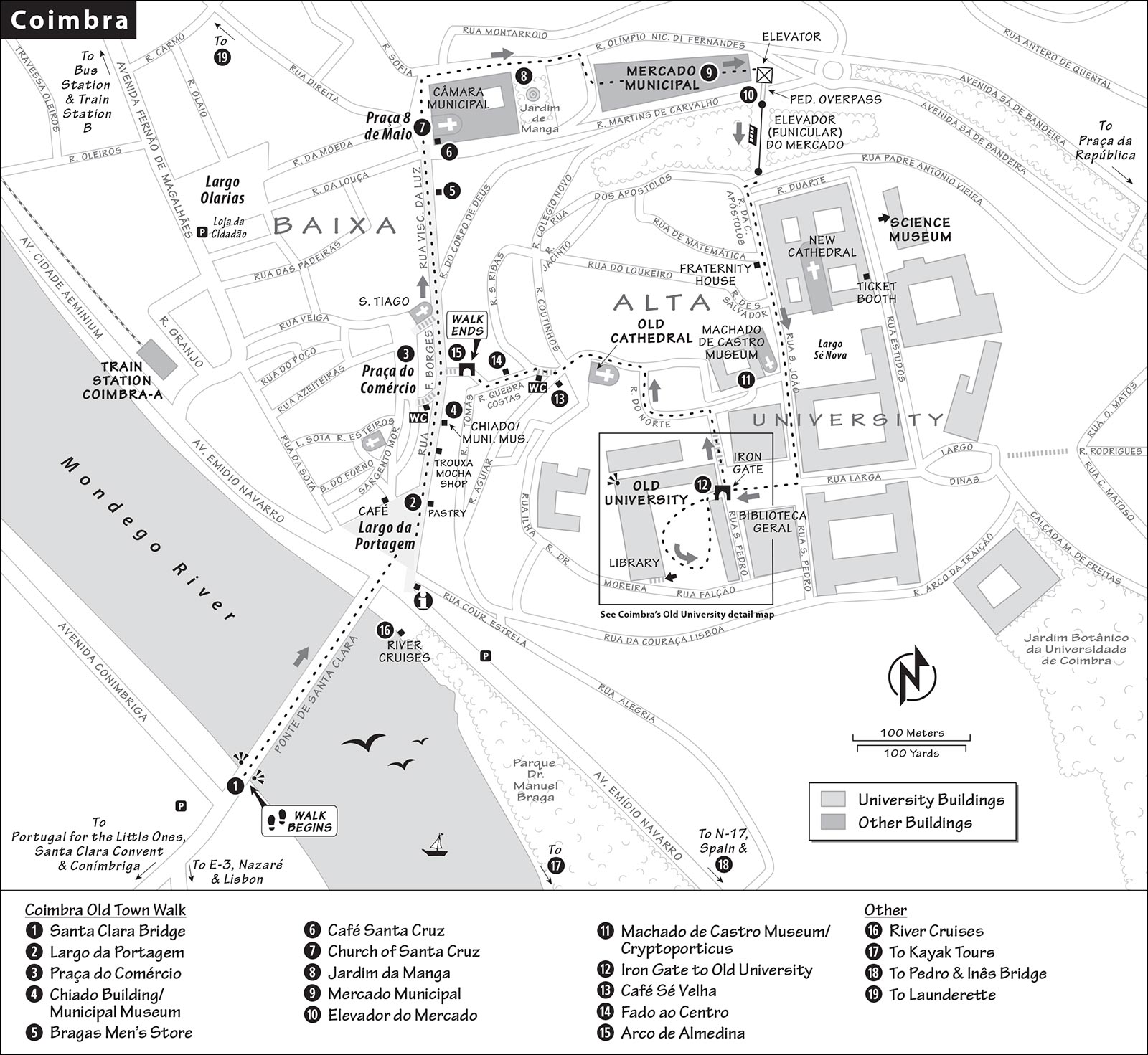
Coimbra is fun on foot, especially along its straight (formerly Roman) pedestrian-only main drag. This self-guided tour takes about an hour—but if you visit every sight en route, it could fill the better part of a day. Plan to arrive at the university in time for your entry slot at King João’s Library (reserve online in advance).
• Start your walk at the far end of the...
1 Santa Clara Bridge (Ponte de Santa Clara)
This bridge has been an important link across the Mondego River since Roman times. For centuries, it had a tollgate (portagem). The far end of the bridge offers a fine Coimbra view.
Until recently, Coimbra planned to redevelop its long-neglected riverside, but a flood washed away those dreams. Today it’s a simple park (on the right) leading to the pedestrian bridge named for Dom Pedro and Dona Inês (Portugal’s Romeo and Juliet).
• At the end of the Santa Clara Bridge on the Coimbra side is the parklike square called...
2 Largo da Portagem
In the center of the main square is a statue of the prime minister who, in 1834, shut down the city’s convents and monasteries, earning him the nickname “friar killer.” Portugal’s monasteries were the leading landowner in society and extremely powerful. They were seen as antiprogress and antimodernity, blocking the reforms that were sweeping Europe in the age of Napoleon and after the French Revolution. States or monarchs, wanting to run with the Industrial Revolution and new ideas—and wanting the Church’s land—“dissolved” the monasteries, opening the way to the march of modernity in Europe.
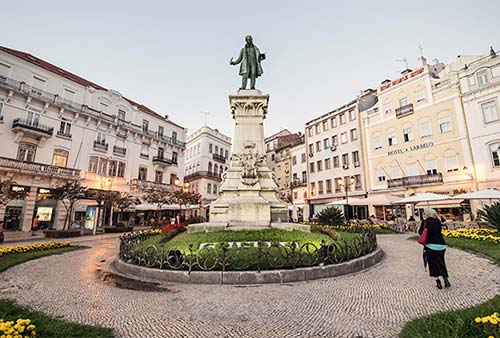
Much of the old center is ornamented with fin-de-siècle architecture (circa 1900) from a boom period; on the left side of the square, notice the fancy pink bank building and the exterior of Hotel Astória behind it.
This square is a great place for coffee or a pastry. The best goodies are at Pastelaria Briosa, at the start of the main drag; enjoy their creative window displays. The shop’s name, meaning “pure, proud, respectable,” is the nickname for the people of Coimbra (and their football team): Go Briosa! Another popular place is Café Montanha, with a big brass palm tree inside and delightful seating on the square. The town’s two special treats are pastel de Santa Clara (pastry made with almonds and marmalade) and pastel de Tentúgal (rolls of puff pastry filled with sweet custard and dusted with powdered sugar).
• Stroll down the delightfully pedestrianized Rua de Ferreira Borges. The Trouxa Mocha shop at #127 has appealing clothes (leather shoes, wool sweaters) and accessories with modern style, but rooted in Portuguese tradition. After about 200 yards, take the stairs (on your left, under the gigantic graffiti portrait of what looks like Sigmund Freud) leading to a terrace overlooking the square below (pay public WCs—sanitários—are in the stairwell).
3 Praça do Comércio
This pleasant square is, literally, the place of commerce. It was originally just outside the city walls—a kind of medieval duty-free zone where merchants could trade tax-free. The streets branching off the square were named for the type of product traditionally made or traded there (such as Rua das Azeiteiras, named for olive oil producers). Two churches bookending the square are a reminder that religious orders also set up just outside the city walls. Beyond Praça do Comércio stretches the old-fashioned shopping district used by locals in more recent years, before malls were built farther afield.
Look at your map. The circular street pattern outlines the wall used by Romans, Visigoths, Moors, and Christians to protect Coimbra. Historically, only the rich could afford to live within the protective city walls of the Alta, or high town.
This square and the district beyond it are all undergoing a sad change. Businesses are being pulled to the suburbs. And a rising tide of tourism is changing the character of this venerable downtown. While there are plenty of shops selling cork souvenirs, a few businesses catering to locals (the odd hair salon, housewares shop, shoe repair store, and small veggie stands) have managed to hang on. Take a few minutes to wander through these lanes and think about life bustling here back during the Salazar dictatorship.
• Return to the pedestrian street.
Rua de Ferreira Borges to the Church
Across the way, notice the balconied building trimmed with lacy red ironwork. This innovative iron structure, which opened as the 4Chiado department store in 1909, was big news in town when it was built. (Today it’s the Municipal Museum, with textiles and artwork; see “More Sights in Coimbra,” later.)
Next door is Casa da Sorte, a lottery shop—these are much loved in Portugal. Step inside and feel the energy of gamblers unwittingly letting the state take their money to fund social programs. What’s the total for the Euromilhões (European-wide “euro millions” lottery)? You may see circles of friends huddling here who’ve invested collectively in a gambling partnership. (If you like to send postcards, this shop is a convenient place to buy stamps.)
At the corner (on your right), steps lead up through an ancient arched gateway—Arco de Almedina—into the old city and to the old cathedral and university. Later, after visiting the university, we’ll finish this walk by going downhill through this arch.
A block farther along the pedestrian drag, stop at the picturesque corner (where the building comes to a triangular corner). The steep road to your right climbs into Coimbra’s historic former Jewish quarter.
Stick with the main drag and check out the newsstands, where the daily papers have mostly sport news fixated on football (soccer). The 5 Bragas men’s store (near the end of the street, on the right at #35), with hats and ties, is one of a shrinking number of old-time shops left on this street.
The pedestrian street ends at Praça 8 de Maio, with the 6 Café Santa Cruz. The building housing the coffeehouse was built as a church. It was abandoned with the dissolution of the monasteries in the 1830s, when the government took possession of many grand religious buildings and their surrounding land. As a café, this was the 19th-century haunt of the town’s intellectuals. The altar is now used for lectures, poetry readings, small concerts, and art exhibits (the women’s restroom is in a former confessional). They offer free fado performances many nights at 18:00 and 22:00.
• Next door to the café, facing Praça 8 de Maio, is the...
7 Church of Santa Cruz (Mosteiro de Santa Cruz)
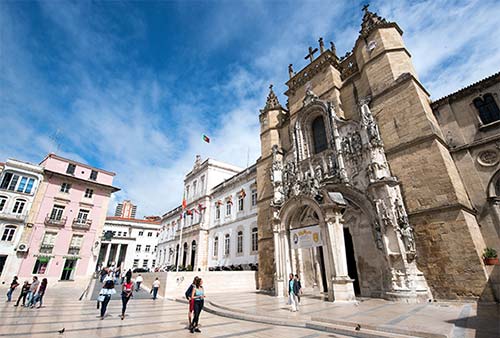
Enjoy this church’s grand facade. While almost invisible, wires on the statuary are electrified to keep pigeons from dumping their corrosive loads on the tender limestone. Go inside; it’s the most active religious spot in town.
Cost and Hours: Church-free, sacristy-€3; Mon-Sat 9:30-16:30, Sun 13:00-17:00; no access during Mass.
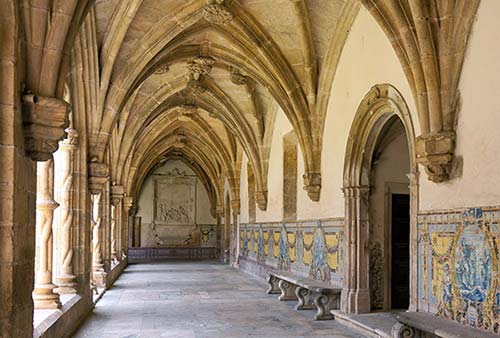
Visiting the Church: The musty church is lavishly decorated with 18th-century tiles that tell the stories of the discovery of the Holy Cross (by Roman Emperor Constantine’s mother, Saint Helena, on the left) and the life of St. Augustine (on the right; the church is of the Augustinian order).
Head up the nave, pausing at the side altar on the left (under the organ with horizontal trumpets). Here you see St. Anthony of Padua—known locally as St. Anthony of Lisbon (his birthplace)—dressed as an Augustinian monk. He studied in Coimbra as a young monk in the 13th century. Just beyond the chapel, the exquisitely carved pulpit is considered one of the finest pieces of Renaissance work in Portugal.
• From the sacristy (entrance to right of main altar), you can reach the treasures of the church, get a close-up look at some historic tombs, and pass through the impressive chapter room into the Manueline Cloister of Silence.
Sacristy: The first room is the actual sacristy, with “carpet tiles” blanketing the walls and huge banks of drawers for priests’ vestments.
Treasury: The room to the right has relics, including the skull of St. Teotonio, the first Portuguese saint. (St. Teotonio’s tomb is in the chapter room, described later.)
Tombs: Head behind the high altar for a close-up look at two fine 16th-century tombs. On the left lies the first Portuguese king, Afonso “The Conqueror” Henriques (1109-1185). Afonso reclaimed most of Portugal from the Moors, declared himself king, got the pope to approve the title, and settled down in his chosen capital—Coimbra. His wife Mafalda of Savoy (1125-1157) gave birth to young Sancho, who later became king. Sancho I (1154-1211, tomb on right) was known as “The Populator.” He saw the destruction that war had brought to the country, and set about rebuilding and repopulating, inviting northern European Crusaders (such as the Knights Templar) to occupy southern Portugal and giving trade privileges to border towns to strengthen his country’s economy.
These tombs are carved in the richly ornamented Manueline style. In the 16th century, while headed on a pilgrimage to Santiago de Compostela, King Manuel I dropped by this church and was underwhelmed by the two kings’ original tombs. He commissioned these beautifully carved replacements—much more fitting for royalty. Study the intimate faces. Notice how the kings seem only to be resting. (To make themselves more comfortable, they’ve “hung” their helmets and arm guards just behind them.)
Chapter Room and Cloister: In the chapter room, note the painting of the Augustinian monks. Imagining you are a fellow monk, step outside into the Cloister of Silence, with its fine Manueline arches and late-18th-century tiled scenes of Christ teaching the beatitudes. Walk pensively clockwise, hands folded, pondering worshipfully each parable from Matthew and Luke as a meditative monk would have in this space 200 years ago. Feel the tranquility. Notice that you are walking upon the tombs of the very monks who took this same stroll so long ago—and who chose to be buried so humbly. You’re in the city center, but here, in the Cloister of Silence, about the only sound is the gurgle of the fountain. From here, stairs lead to the sanctuary and choir.
• Exit the church. The square outside, once dubbed the Square of Samson, was renamed Praça 8 de Maio to mark May 8, 1833—the date when French Revolutionary ideas arrived in Portugal (a little behind the European trends, as usual for this country) and the state asserted its secular power over the Church.
Continue past the City Hall (Câmara Municipal). At the noisy street, turn right and go a block to find a park with a fountain.
8 Jardim da Manga (Garden of the Sleeve)
In the early 1500s this Renaissance garden decorated the cloister of the Santa Cruz monastery. It symbolizes the source of life in the middle of paradise (the garden) with four flowing rivers (the fountain) bringing life in all directions (the four cardinal points). Supposedly King João III drew his design for the fountain on his sleeve—hence the name. The cheap, handy, and recommended self-service restaurant Jardim da Manga is just behind the fountain.
• Keep going uphill along the busy Rua Olímpio Nicolau di Fernandes past the blocky former post office to the...
9 Mercado Municipal
This modern covered market is fun to explore and great for gathering picnic supplies (Mon-Sat 8:00-14:00, closed Sun, busiest Tue and Fri). It’s clean and hygienic, but maintains the colorful appeal of an old farmers market. See the “salt of the earth” in the faces of the women selling produce (their men are off in the fields...or in the bars—a.k.a. their beloved “little chapels”). These ladies aren’t shy about trying to sell their goods, even to tourists.
For about the cheapest meal in town, pop into the Bar do Mercado Requinte at the end of the ground floor (menu posted on wall, €8 meals for two, public WC around the corner). In the bar’s sit-down area, check out the photos of the old market on the wall. Then go upstairs for bread, more meat, and veggies. Follow your nose through the glass doors at the far end, with all the fresh fish and dried cod. The Portuguese are the world’s biggest cod eaters, but because cod is no longer found in nearby waters, the local favorite is imported from Norway. To the Portuguese, cod (bacalhau) tastes much better after having been dried, salted, and reconstituted than fresh. This section housed the original market—you can recognize the wrought-iron work from the photos you’ve just seen on the ground floor at the bar.
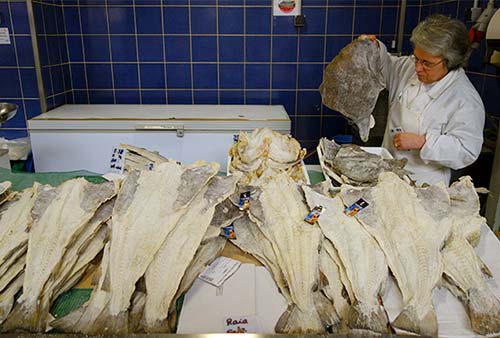
• Swim through the fish hall and head outside at the far end, where you’ll find the sleek city elevator/funicular.
10 Elevador do Mercado to the University
A combination elevator/funicular ride whisks you up the long, steep hill, offering commanding views of Coimbra en route (€1.60/trip, €1 with Viagem ConVIDA card, buy tickets from adjacent office or pay the attendant; Mon-Sat 7:30-21:00, Sun from 10:00).
You’ll start in an elevator, then stop midway to transfer to a funicular. At the top, jog right, then head straight uphill (on Rua da Couraça Apóstolos) toward the university buildings at the top of the hill. Fifty yards up this lane, at the first intersection, you’ll find a fraternity house called Real República Corsários das Ilhas (“Royal Commune of the Island Pirates”). Notice the faded skull-and-crossbones graffiti on the wall, linking McDonald’s and the G8 (group of the eight most powerful countries). Look around for other graffiti. These small university frat houses, called repúblicas, are communes that traditionally housed about a dozen students from the same region or provincial town. These days, repúblicas also gather according to passion or personal philosophy (feminists, nonconformists, internationalists, etc.). While some are highly cultured, the rowdier ones are often decorated with plunder from their pranks—stolen traffic signs and so on—giving rise to the local saying, “At night, many things happen in Coimbra.”
• Continue walking. Across the street and uphill, you’ll see the New Cathedral and some stark university buildings. Behind the cathedral is the Science Museum (you may want to detour and visit it first; it’s included in the university ticket and they may be able to book your library reservation).
On the right, you’ll pass the 11 Machado de Castro Museum (visit on your way back downhill at the end of this walk; they also have a handy lunch buffet; described on here).
Soon you pop out into the big, fascist-style university square (Praça da Porta Férrea). The Iron Gate entry to the old university is on your right.
12 University
Explore the university (described later, under “Sights in Coimbra”), and then continue this town walk.
• When you’re finished, leave the university: Pass back out through the Iron Gate, turn left down the stairs, and, if you like, visit the Machado de Castro Museum. Then follow the steep lanes toward the old cathedral and into the old town. (If you’ve visited the Roman substructure inside the museum, seeing these stout walls and steep slope helps you understand the need for a sturdy foundation to support a sprawling and level market square, or forum.) Farther down, look through the metal grates on your right to see the old Roman street and remains of ancient houses.
Downhill Streets Through the Upper Town
As you wander, notice the dark and abandoned buildings—many are victims of rent control (no profit for landlords resulting in no investment in the real estate) or inheritance squabbles where the actual ownership is in question so the building sits idle. If you notice white-paper squares and diamonds in the windows, these indicate that there’s a student room available for rent.
Continuing on, you’ll come to the old cathedral (Sé Velha, described later, under “Sights in Coimbra”). The colorful little 13 Café Sé Velha, below the cathedral and tiled with traditional Coimbran scenes, is a good place to sit and watch people climb up and down. From here, a very faded blue line on the cobbles marks the route of the electric minibus: If you happen to see the yellow minibus, hop on for the loop.
Take the steep stairway leading down (past the public WCs). This delightful quarter comes to musical life summer evenings with outdoor jazz. Next, you reach the Rua Quebra Costas, the “Street of Broken Ribs.” At one time, this lane had no steps, and literally was the street of broken ribs. During a strong rain, this becomes a river. The lane’s many tourist and gift shops show off the fine local blue-and-white ceramic work called faiança.
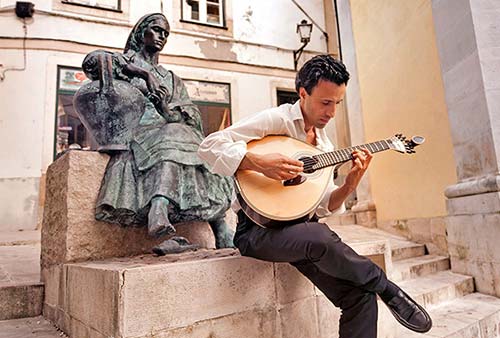
Descending farther, you emerge into a little square ringed by enticing al fresco cafés and funky shops catering to a mix of tourists and students. Notice the statue of Tricana (the term given for a local woman in traditional folk dress) resting after a trip to the well. She represents the usual target of fado love songs—and student Romeos. Local men from the lower town had a tough time competing for the Tricana of Coimbra with all the rich and witty students...not to mention the talented singers. Across the street from Tricana is the recommended 14 Fado ao Centro, my favorite place in town for getting a concise and appealing taste of Coimbra’s unique take on this Portuguese musical form—consider making a reservation now for a performance (see “Entertainment in Coimbra,” later, for details).
• Rua Quebra Costas ends at...
15 Arco de Almedina
This is the double set of arches (named “Gate to the Medina” in Arabic by the Moors) we saw earlier from the pedestrian street Rua de Ferreira Borges. Part of the old town wall, the arches act as a double gate with a 90-degree kink in the middle for easier defense. Pause at the gift shop between the gates to enjoy the lilting, nostalgic sound of fado and the 12-string Portuguese guitar. That’s sweet. But don’t linger too long because—look up: In times of attack, soldiers used those two square holes in the ceiling to pour down boiling oil, turning attacking Moors into fritters. The holes are rudely nicknamed mata-cães (dog killers).
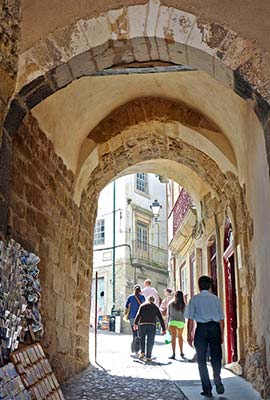
A few steps farther down, before the second gate, admire from all sides the monument to fado. Featuring the Coimbra-style Portuguese guitar, draped both with the cape of the male student and the shawl of the woman, this bronze statue celebrates how fado connected the all-male-at-the-time university world with the women of the town. Locals say a good musician plays his guitar with art and passion, as if loving a woman.
• Passing under the second arch, you’re back on the pedestrian street near where this walk began.
Sights in Coimbra
UNIVERSITY OF COIMBRA (UNIVERSIDADE DE COIMBRA)
St. Michael’s Chapel (Capela de São Miguel)
▲King João’s Library (Biblioteca Joanina)
▲Science Museum (Museum da Ciência)
▲▲Machado de Castro Museum and Cryptoporticus of Aeminium
Chiado Building/Municipal Museum (Edifício Chiado/Museu Municipal)
Portugal for the Little Ones (Portugal dos Pequenitos)
▲Conímbriga Roman Ruins (Conímbriga Ruínas)
UNIVERSITY OF COIMBRA (UNIVERSIDADE DE COIMBRA)
This venerable centuries-old university, founded in 1290 and worth ▲▲, was modeled after Bologna’s university (Europe’s first, founded in 1139). It occupies a stately three-winged former royal palace (from when Coimbra was Portugal’s capital), beautifully situated overlooking the city. At first, law, medicine, grammar, and logic were taught. Then, with the rise of seafaring in Portugal, astronomy and geometry were added. While Lisbon’s university is much larger, Coimbra’s university (with 25,000 students) is still the country’s most respected. For visitors, the university marks the top of the old town.
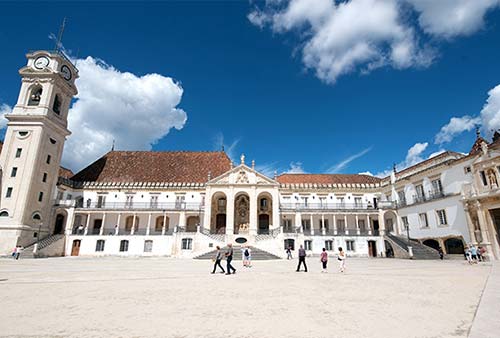
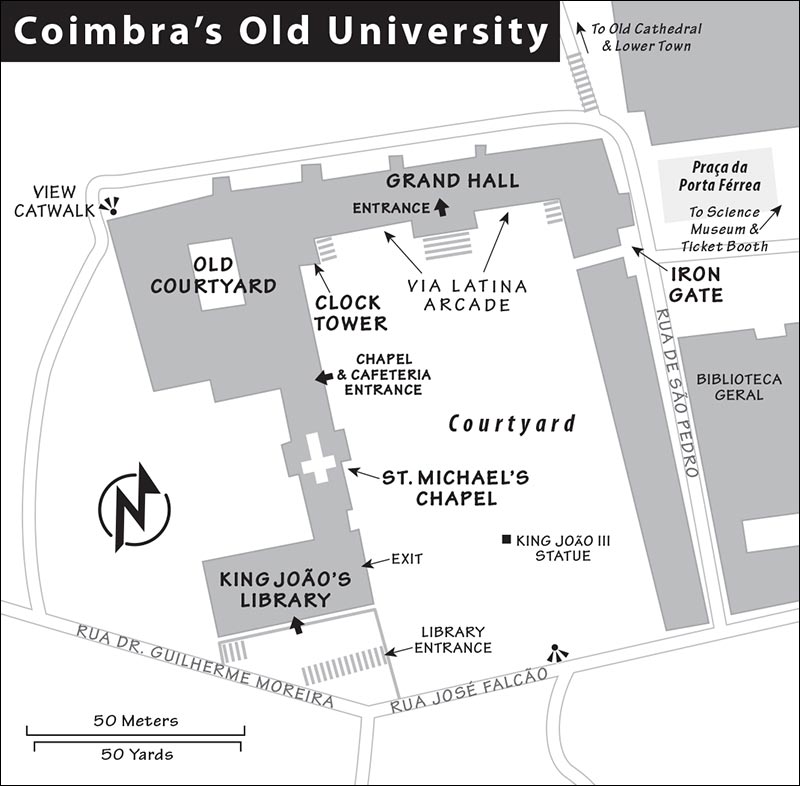
While most of it is mid-20th-century sprawl, the old core of the university (velha universidade—the palace section, with its Iron Gate, courtyard, fancy ceremonial halls, chapel, and library) makes for an interesting visit. It’s free to see the gate, courtyard, and a few halls, but you’ll need a ticket for the other sights, along with a timed entry for the best part—King João’s Library.
Cost: €12.50, €10 without library (mainly intended for those who arrive without advance library reservations), both tickets include nearby Science Museum, €2 extra for tower climb (I’d skip it).
Hours: Daily 9:00-19:00, Nov-March Mon-Fri 9:30-13:00 & 14:00-17:00, Sat-Sun 10:00-16:00.
Information: +351 239 242 745, http://visit.uc.pt/.
Advance Tickets: King João’s Library, the complex’s highlight, is accessible only via a timed-entry ticket. To be sure you get in to this popular sight, book a time in advance on their website, https://visit.uc.pt/en/space-list/joanina. Tickets are also sold inside the New Cathedral, across from the Science Museum. If you don’t have an advance ticket, arrive by 10:00 to buy your ticket in person, where there’s often no ticket-buying line—however, you won’t get in to the library if it’s already booked up.
Getting There: To reach the university, you could take my “Coimbra Old Town Walk” (described earlier), using the elevator/funicular from the Mercado Municipal to reach the top of the hill. Or take a taxi to the Iron Gate (on Praça da Porta Férrea), see the university, and then sightsee Coimbra on a downhill walk. For directions to the Science Museum from the Iron Gate, see here.
Planning Your Visit: The self-guided tour of the university takes less than an hour. Plan your visit around your timed-entry to King João’s Library. The university can be seen in any order, but go to the Science Museum either first or last—it’s farthest from the library (about a 10-minute walk) and also takes about an hour to see.
 Self-Guided Tour
• Begin your visit just outside the entrance to the old campus, at the...
Iron Gate (Porta Férrea)
Before entering the old campus, stand with your back to the Iron Gate and look across the stark, modern square at the fascist architecture of the new university. In the 1940s, in what’s considered one of the worst cultural crimes in Portuguese history, the dictator António Salazar tore down half of Coimbra’s old town to build these university halls. The grandiose ceremonial approach to the university, bombastic and utilitarian to fit fascist taste, is flanked by the faculties of letters, medicine, science, and a new library. The law school is behind you, inside the old campus.
Salazar, proud that Portugal was the last European power to hang onto its colonial empire, wanted a fittingly monumental university here. After all, Salazar—along with virtually everyone of political influence in Portugal—had been educated at Coimbra, where he studied law and then became an economics professor. If these bold buildings are reminiscent of Mussolini’s E.U.R. in Rome, perhaps it’s because they were built in part by Italian architects hired by Portugal’s “little Mussolini.”
OK, now turn and walk through the Iron Gate, noticing the bits of graduation robe in the grill, the remains of robes ripped by loved ones on that happy day. Traditionally, freshmen—proudly wearing their black capes for the first time—pass through the Iron Gate to enroll. Also traditionally, they had to pass through an Iron Gate gauntlet of butt kicks from upperclassmen to get out.
University Courtyard
The university’s most important sights all face this square: the Grand Hall (up the grand stairway on the right), St. Michael’s Chapel (straight ahead, through the door, then to the left), and King João’s Library (across the square, farthest door on left, flanked by columns, timed entry required).
The statue in the square is of King João III (1502-1557). While the university was established in 1290, it went back and forth between Lisbon and Coimbra (back then, university students were adults, privileged, and a pain to have in your town). In 1537, João III finally established the school permanently in Coimbra. Standing like a good humanist (posing hand on hip, much like we’re used to seeing his contemporary, England’s King Henry VIII), João modernized Portugal’s education system in the Renaissance style. But, unlike Henry, who broke the local power of the Church, João (grandson of the ultra-Catholic Queen Isabel of Spain) empowered the Church. He let the Jesuits—the guardians of orthodoxy—run this university, which became the center of Portugal’s Inquisition.
The black capes famously worn by local students originated with the capes worn by Jesuits and clergy during this period. Like the uniforms of students at American Catholic schools, standardized clothing removes the focus on power-dressing and equalizes people of all classes. To this day, standards of modesty prevail, keeping class divisions at a minimum among the students, and between students and professors. (Students, when wearing their gowns, are not allowed to show off by wearing gold.)
Survey the square with your back to the gate. The dreaded sound of the clock tower’s bell—named the “baby goat” for its nagging—calls students to class. On several occasions, the clapper has been stolen. (No bell...no class. No class...big party.) A larger bell (the “big goat”) rings only on important, formal occasions.
The arcaded passageway (on the right, up the stairs) between the Iron Gate and the clock tower is called Via Latina, from the days when only Latin was spoken in this part of the university.
• Now visit each of the university’s sights, beginning with the...
Grand Hall (Sala dos Capelos)
From the middle of the Via Latina, climb the tiled stairway. Follow the route through an ornate room, then trudge around a narrow hallway, where you can peek out from little balconies into the Grand Hall—the site of the university’s major academic ceremonies, such as oral exams and graduations. This regally red room was originally the throne room of the royal palace. Today, the rector’s green chair sits high like a throne in front. Students defend their Ph.D. thesis here, sitting all alone at a small table before a jury of professors. During ceremonies, students in their formal attire fill the benches, and teachers sit along the perimeter as gloomy portraits of Portuguese kings watch from above.
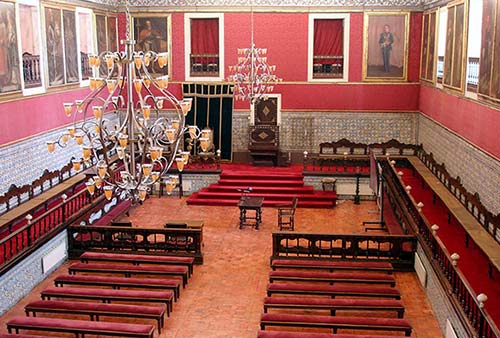
The fine, old, painted ceiling features “Indo-Portuguese” themes, reminding Portugal’s next generation of leaders of the global reach of their nation. There is no clapping during these formal rituals, but a brass band (on the wooden platform in the back) punctuates the ceremonies with solemn music.
Continue past the end of the Grand Hall, to an ornately decorated former royal stateroom (where, until recently, students took their oral exams as portraits of past university rectors looked on). The ceiling has medallions representing the old faculties. (Identify them: medicine, canon law, civil law, and theology.)
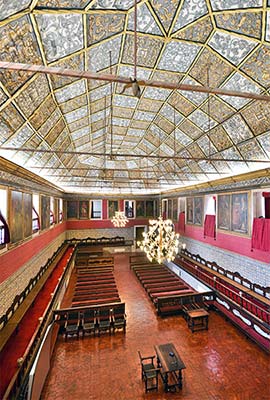
• Just past this room, a door leads to a narrow observation gallery offering the best views of Coimbra. If the door is closed, open it (it’s locked in bad weather).
View Catwalk (Varanda)
From the viewpoint, scan the old town from right to left. Remember, before Salazar’s extension of the university, this old town completely surrounded the university. The Baroque facade breaking the horizon is the “new” cathedral—from the 16th century. Below that, with the fine arcade and modern café terrace, is the Machado de Castro Museum, housed in the former bishop’s palace and located atop a Roman site (all described later). And below that, like an armadillo, sits the old cathedral with its tiled cupola.
Gaily painted yellow-and-blue windows mark república frat houses. If you visit during late October or November, you might see a student festival: Parades of rowdy students in funny costumes, draped in signs, dragging tin cans—these are all part of the traditional initiation rites marking the beginning of the school year. May provides the biggest spectacle, when new students receive—and graduating students burn—the small colored ribbons of their chosen major (see sidebar). Look beyond the houses to the Mondego River, the longest river that flows entirely in Portugal.
Over the bridge, beyond the university’s sports facilities, stretches the restored 17th-century Santa Clara Convent—at 590 feet, the longest building in Coimbra. It’s better known as the place where Inês (of Pedro and Inês fame) was murdered (for more on their tragic love story, see the sidebar on here).
• From here stairs lead down to the original heart of the university—an arcaded courtyard with a gathering of old classrooms.
Old University Courtyard
The university was not purpose built. It inhabited the 15th century royal palace and incorporated existing palace rooms into the plan according to the needs of the school in about 1600: The throne room became the Grand Hall, the prison became the prison, the guard room became the guard room, and this courtyard ringed by royal quarters became the heart of the school surrounded by the earliest classrooms.
Europe’s third-oldest university has long-standing traditions to match. If you’re lucky enough to be in Coimbra at the end of the academic year (early to mid-May), you’ll witness a big party.
The “Burning of Ribbons” (Queima das Fitas) began in the 1850s, when a group of students who passed their final fourth-year exams gathered outside the Iron Gate and marched together to the lower town. They burned their ribbons (which were used to bind and carry their books) in a small fire, representing their passage from student life to professional life. Eventually, that simple event evolved into the biggest academic festival of the year, complete with floats and parades.
Students entering their last year of studies as well as recent graduates (finalistas) participate in the party these days, but of course the graduates get the most attention. Women wear simple white shirts with black skirts and black stockings. Men dress more formally in a long black suit, university cape, wide sash with various badges, top hat, and cane.
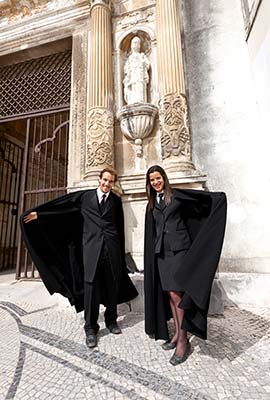
Different accent colors, proudly displayed on the top hats and canes, represent the different academic departments, indicating which degree the student earned (yellow for medicine, red for law, blue for science, and so on). For good luck after graduation, men take their canes and tap other students’ top hats three times. (The taps can get out of control, and lots of students end up losing the tops of their hats.)
Much drinking accompanies this rite of passage. Ribbon-burning parties are also celebrated in Porto, and to a lesser extent in Lisbon. Join the fun, and offer an appropriately colored flower to a new graduate. You may be invited to the party.
Imagine this courtyard in 1600, with its fine Renaissance columns and the buzz of its students. Then observe the scene today. It’s still the haunt of law students—taking a cigarette break, checking their phones, some working on the side as museum guards. Walk around. Peek into a classroom if possible. Inside, look high up in the corner of any room for a small balcony. This was used by the rector to spy down on professors. Anyone not sticking to the orthodoxy on the hot button issues of the day (climate change, civil liberties, corporate regulations, and women’s rights issues of the 17th century) would spend some time in the university prison.
• Stairs lead down to St. Michael’s Chapel and the student cafeteria. If you end up back on the square, the chapel is behind a 16th-century facade (enter through door to the right of facade)—once inside, knock on the door on the left marked capela.
St. Michael’s Chapel (Capela de São Miguel)
The architecture of the church interior is Manueline—notice the golden “rope” trimming the arch before the altar. The chapel was begun in 1517, but much of the decor is from a later time. The altar is 17th-century Mannerist, with steps unique to Portugal (and her South American colonies); based on Jacob’s Ladder, they symbolize the steps the faithful take on their journey to heaven. The carpet-style tiles covering the walls date from the 17th century and kept the chapel cool in the summer. Find the sleepy Adam and Eve, fully clothed, flanking the top of the arch—simple beauty from about 1600. The 2,100-pipe, 18th-century German-built organ is notable for its horizontal “trumpet” pipes. Found only in Iberia, these help the organist perform the allegorical fight between good and evil—with the horizontal pipes trumpeting the arrival of the good guys. The box seats for the royal family are high above the musicians’ loft in the rear. Students and alums enjoy the privilege of having their weddings here.
Student Cafeteria
In the corridor just outside the chapel, you’ll find WCs, the official university gift shop, and a cheap student-filled café (follow signs to bar). Visitors are perfectly welcome to eat here. During busy lunch times, every seat gets taken, people share tables, and you may find yourself sitting with law students and their professors.
• Back out on the square, as you face the statue of King João, you’ll see his descendant’s library poking out into the courtyard, at the end, on the right.
▲King João’s Library (Biblioteca Joanina)
In this elegant building, one of Europe’s best surviving Baroque libraries displays 40,000 books in 18th-century splendor. Visitors gather below (follow the arrows around and down a set of stairs). At each appointed time, 60 visitors are let in. Each visit is 20 minutes: 10 minutes for the academic prison (a few dreary rooms for those breaking the rules of the sternly-run school) and a floor of overflow book stacks under stout arches (not much to see), followed by 10 minutes in the library itself. Don’t delay entering the library when the door into this 300-year-old temple of thought finally opens for you.
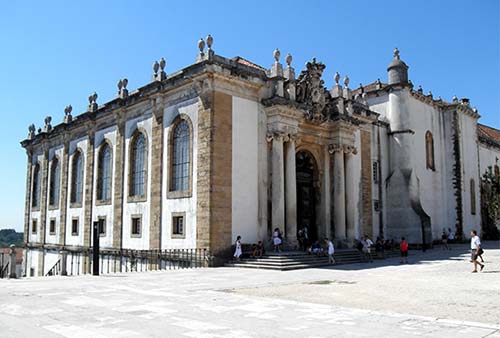
Inside, at the “high altar,” stands the library’s founder, the absolute monarch King João V (1698-1750), who considered France’s King Louis XIV an inspiration (and they have similar hairstyles).
The reading tables, inlaid with exotic South American woods (and ornamented with silver ink wells), and the precious wood shelves (with clever hideaway staircases) are reminders that Portugal’s wealth was great—and imported (mostly from Brazil). Built Baroque, the interior is all wood. Even the “marble” on the arches of triumph that divide the library into rooms is painted wood. (Real marble would add to the humidity.) The small doors with glass windows lead to professors’ tiny studies with big windows to read by. The resident bats—who live in the building, but not the library itself—are well cared for and appreciated. They eat insects, providing a chemical-free way of protecting the books, and alert the guard to changing weather with their “eee-eee” cry.
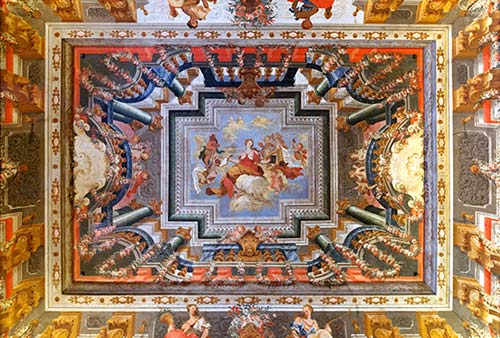
Look for the trompe l’oeil Baroque tricks on the painted ceiling. Gold leaf (from Brazil) is everywhere, and the Chinese themes are pleasantly reminiscent of Portugal’s once vast empire. The books, each dating from before 1755, are in Latin, Greek, and Hebrew. Imagine being a student in Coimbra centuries ago, when this temple of learning stored the world’s knowledge like a vast filing cabinet (and consider how readily accessible the world of information is to our age). The zealous doorkeeper opens the big front door sparingly to keep out humidity and only long enough to let you sneak quickly out.
• The final university sight is about a 10-minute walk away. Exit the courtyard through the Iron Gate, and walk to the end of the fascist-style square. After two blocks, at the rear of the big statue in the street, turn left and walk a couple of blocks along Rua Estudos. After the towering haunted hall of learning, you come to the last academic building on your right—marked Laboratório Chimico. It houses the...
▲Science Museum (Museum da Ciência)
This old-school museum provides a peek into a grand, Old World lecture hall with elegant wood details (across from entry hall) and a half-dozen venerable rooms filled with old science gear. English descriptions are good and attendants in the rooms are there to help answer your questions. The Cabinet of Physics (with dusty cases) displays 18th- and 19th-century models, and the Gallery of Zoology (with six rooms of stuffed animals and skeletons) includes a 65-foot-long whale skeleton and a herd of African ungulates, arranged by size. Many of these specimens date back 300 years or more, emphasizing the university’s rich academic heritage.
Cost and Hours: €8, covered by both university tickets, daily 10:00-13:00 & 14:00-19:00, Largo Marquês de Pombal, +351 239 242 744, www.museudaciencia.org. If you didn’t get your King João’s Library timed-entry ticket online in advance, you can buy one at the ticket office across the street inside the New Cathedral (if slots are still available).
MORE SIGHTS IN COIMBRA
▲▲Machado de Castro Museum and Cryptoporticus of Aeminium
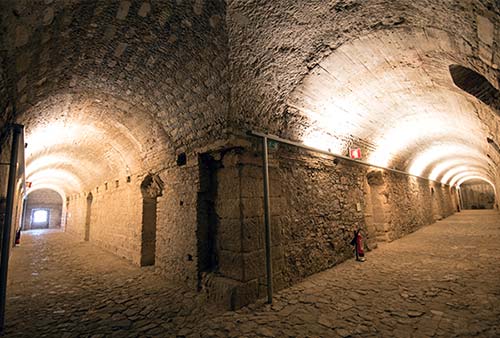
Housed in an elegant old bishop’s palace, the huge Machado de Castro Museum (Museu Nacional Machado de Castro) has two parts: the vast, barren understructure (Criptoportico de Aeminium) of the ancient Roman forum upon which the palace was built; and a fine collection of art through the ages, particularly strong on sculpture (including 14th- to 16th-century statues taken from dissolved monasteries). To save needless climbing, visit this sight before or after the old university (since both are at roughly the same altitude).
Cost and Hours: €6 for museum and Roman site, €3 for just the Roman site; Wed-Sun 10:00-18:00, Tue from 14:00, closed Mon; audioguide-€1.50, Largo Dr. José Rodrigues, +351 239 853 070.
Eating: At the entry level, you’ll find Loggia, a recommended restaurant on a terrace with a fine old-town view.
Visiting the Museum: Follow the one-way route through several levels of the sprawling museum. Attendants will keep you on track. Everything is described in English.
Begin by descending to the Roman ruins. Aeminium was the Roman city that became Coimbra. Two thousand years ago, its two main streets crossed here, marking the forum. Because the city was built on a slope, a vast understructure was required to provide a level place for the town square (like a modern “daylight basement”)—and that “cryptoporticus” is what survives today. Walking through the vast two-level maze of the stout, vaulted galleries, evocative and beautifully lit, will leave you marveling at what you can do with slave labor.
Back up on the main level, you’re routed through the extensive, chronologically displayed art collection, starting with Roman and Romanesque fragments—a 2,000-year-old rubble layer-cake of Coimbra’s past—and on to the museum’s strongest collection: statues from the 14th, 15th, and 16th centuries. Many of these are refugees from the dissolution of the monasteries (in the 1830s, following Portugal’s Civil War). The highlight is a powerfully realistic 14th-century Cristo Negro—an evocative, spindly armed, crucified Jesus—carved in wood. Until a decade ago, when this statue was cleaned (and the candle soot was removed), it was considered to be a portrait of a black Christ. If this dramatic statue has an impact on you today, imagine its power in the 14th century. Gothic lasted here long after the Renaissance hit Italy and France.
Just beyond that is the stately Renaissance Treasurer’s Chapel, moved here from a now-gone 16th-century monastery. Viewing this, consider how Coimbra with its university was Portugal’s center of humanism and the Renaissance. Coimbra helped lead the country into the modern age.
There’s much more to see, but (unless you have a special interest) it’s mostly skippable. As you explore, note how aspects of Moorish culture and design were absorbed into the Christian culture that threw them out. Downstairs on floor -1, you’ll find terra cotta sculpture, and on floor -2, 17th-century Portuguese sculpture. From there, an elevator zips you up to floor 1: northern European statues and paintings (a reminder of this country’s wealth in its Golden Age heyday), Portuguese paintings, precious metals (including some fine gold and silver sculptures), ceramics and tiles, and religious vestments. The finale is the treasury of Queen St. Isabel, who donated some of her finest possessions to Coimbra’s Santa Clara Monastery.
▲Old Cathedral (Sé Velha)
Same old story for the Iberian Peninsula: Christians build a church on a pre-Christian holy spot (Visigoths in sixth century), Moors destroy the church and build a mosque (eighth century), then Christians push out the Moors (1064), tear down their mosque, and build another church (consecrated in 1184).
If this structure reminds you of Lisbon’s cathedral, it should. As in Lisbon, this was essentially a church-fortress, built in the middle of the Reconquista and designed by the same French architect. Notice the crenellations along the roof of this Romanesque church; the Moors, though booted out, were still considered a risk.
Cost and Hours: Church and cloister-€2.50, Mon-Sat 10:00-18:00, Sun generally 11:00-17:00.
Visiting the Cathedral: Before entering, stand back and study the west portal (the main entrance, facing downhill). Notice how Moorish-style columns are decorated by neo-Byzantine capitals, but there are no Christian motifs. It is an unbreakable facade—fortified and practical, complete with arrow slits.
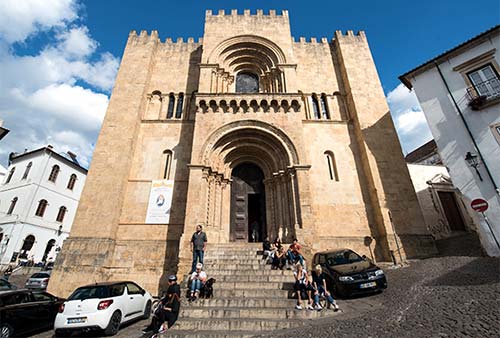
The north portal (around the left side) was added later, in Renaissance times. Made of soft limestone, it was cheap and easy to carve but hasn’t weathered very well.
Study the stone blocks of the main structure, set up in the 12th century. You can see mason’s marks and even some Arabic writing (on a block six rows up by the north portal), indicating that the conquered Moors worked within Christian society.
Now enter the interior. At the start of the nave, the giant holy-water font shells are a 19th-century gift from Indonesia. The walls are lined with some of the oldest tiles in the country—imported in the 16th century from Sevilla, Spain.
Head up the right aisle. At the altar just before the transept is a murky painting of Queen Isabel (St. Elizabeth) with a skirt full of roses. This 13th-century Hungarian princess—with family ties to Portugal—is a local favorite with a sweet legend. Against the wishes of the king, she always gave bread to the poor. One day, when he came home early from a trip, she was busy doling out bread from her skirt. She pulled the material up to hide the bread. When the king asked her what was inside (suspecting bread for the poor), the queen—unable to lie—lowered the material and, miraculously, the bread had turned to roses. For her astonishing kindness, she was canonized as a saint in 1625.
At the front of the church, the three altars are each worth a look. The main altar, a fine example of the late Flamboyant Gothic style, was made by Flemish artists (circa 1500). The 16th-century chapel to the right contains one of the best Renaissance altars in the country. The apostles all look to Jesus as he talks, while musical angels flank the holy host. Notice how the Renaissance passion for balance and proportion trumped fact—the composition had room for only 10 apostles. To the left of the main altar, the Chapel of St. Peter shows Peter being crucified upside down.
The peaceful cloister (entrance near back of church, near the ticket desk) is the oldest Gothic cloister in Portugal. Well maintained with an inviting lawn, the courtyard offers a fine, framed view of the cathedral’s dome. A tomb from 1064 in the cloister (middle of far side) belongs to Coimbra’s first Christian post-Reconquista governor.
Chiado Building/Municipal Museum (Edifício Chiado/Museu Municipal)
Originally the site of Coimbra’s first Chiado department store (a chain common throughout Portugal in the early 20th century), this refurbished building is notable for its construction—it was one of the first structures in Portugal to be built around an iron framework, like the then-revolutionary American skyscrapers. It now houses an eclectic assortment of artworks and textiles donated by local collector José Telo de Morais.
Cost and Hours: €2, Tue-Fri 10:00-18:00, Sat-Sun 10:00-13:00 & 14:00-18:00, closed Mon, Rue Ferreira Borges 85, +351 239 840 754.
Visiting the Museum: Take the elevator up to the top floor and walk your way down, noticing the exposed iron beams. The third floor has ceramics, drawings, and a collection of silverware. The second floor has 17th- and 18th-century furniture as well as religious paintings and objects. The first floor holds oil and pastel paintings from the 19th and early 20th centuries. The ground floor houses a free temporary exhibit, and the small (and also free) Galeria Almedina, which highlights emerging student artists.
Parque Dr. Manuel Braga
Coimbra’s pleasant riverside park sprawls upstream from the Santa Clara Bridge to the Pedro and Inês Bridge. While recent flooding blocked attempts to enliven this area with cafés and businesses, it’s still pleasant to walk through the park, over the pedestrian bridge, and back to town with views from the far side of the river.
River Cruise
To take advantage of Coimbra’s Mondego River, try a cruise: Basófias boats float up and down the river on a 50-minute joyride (€8, April-Sept Tue-Sun, a few departures each afternoon—ask at dock across from TI, no cruises Mon, no narration, +351 969 830 664, http://www.basofias.pt). Or you could just take a nap in the park—just as exciting...and free.
Portugal for the Little Ones (Portugal dos Pequenitos)
Across the Santa Clara Bridge is a children’s (or tourists’) look at the great buildings and monuments of Portugal and its former empire in miniature, scattered through a park a couple of blocks south of town. The first section displays typical building types and artifacts from each of Portugal’s former colonies (still part of the empire when this park was built). The next section merges bits and pieces of the most famous buildings in Portugal according to region—made mostly of stone. Wanting to boost national pride, Salazar commissioned architect Cassiano Branco to build these mini-replicas in 1940. If you’ve been through some of Portugal already, it’s fun to try to identify the buildings you’ve already seen. The final section recreates different regional styles of houses, mixed in with statues of famous historical figures. Some buildings contain modern toys (building blocks and tiny cars) for kids of all ages to play with.
Cost and Hours: €10, €6 for kids 3-13, free for kids under 3; daily June-mid-Sept 10:00-19:00, mid-Sept-Feb 10:00-17:00; Rossio de Santa Clara, +351 239 801 170, www.portugaldospequenitos.pt.
NEAR COIMBRA
▲Conímbriga Roman Ruins (Conímbriga Ruínas)
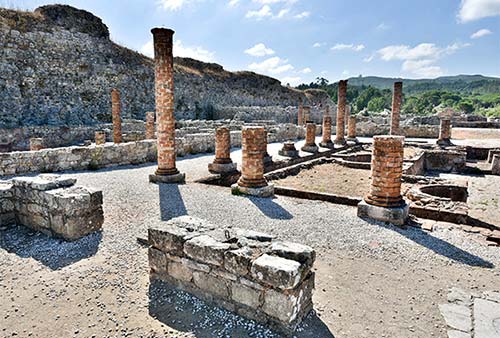
Portugal’s best Roman sight is impressive...unless you’ve been to Rome. What remains of the Roman city of Conímbriga is divided in two, in part because its inhabitants tore down buildings to erect a quick defensive wall against an expected barbarian attack. You’ll see what’s left of homes, shops, and baths from the second and third centuries AD (some remnants are even older), amazingly detailed mosaic floors, and peaceful gardens. Informative exhibits tell the city’s history with excavated artifacts at the on-site museum.
Cost and Hours: €4.50, covers ruins and museum, daily 10:00-19:00, ruins close at 17:30 in winter, last entry 45 minutes before closing, www.conimbriga.pt [URL inactive].
Getting There: The ruins are nine miles southwest of Coimbra, just outside the town of Condeixa-a-Nova on the road to Lisbon. Buses leave for the ruins across from Coimbra-A train station (€2.60; Mon-Sat at 9:30 and 12:30, Sun at 12:30; on the river side, look for the Transdev sign, 45-minute trip). Return buses leave from Conímbriga’s parking lot (Mon-Sat at 13:25 and 17:55; Sun at 13:55). Confirm the destination by asking, “Vai para Conímbriga?” Avoid the frequent buses to Condeixa (twice hourly) that stop a mile short of the ruins. Figure about €20 one-way for a taxi from Coimbra.
Drivers find that Conímbriga fits well on a trip between Coimbra and points south; the Conímbriga freeway exit is clearly marked from the A-1. To get there from the town center, cross the Santa Clara Bridge and go uphill, following signs to Condeixa. Continue straight through town, and you will see brown signs guiding you to the ruins.
Eating: The museum’s café is a fine spot to have lunch before catching the return bus to Coimbra. Or bring a picnic lunch—there’s a good picnic area between the museum and the ruins.
Visiting Conímbriga: Allow at least an hour to tour the site and museum. I prefer to visit the museum first and then see the ruins, but you may want to do it in the other order in summer, when the ruins can be blazing hot in the afternoon.
Purchase tickets at a counter located between the museum building and the ruins, and have a quick look at the scale model at the end of the ticket counter that shows the discoveries from decades of excavation. Next, head to the delightful museum, stepping into the patio first, designed to re-create a typical Roman house. Keep the layout of this space in mind when you visit the ruins to bring them to life.
Now check out the artifacts inside. The room to the left of the museum gift shop shows objects from daily life in Conímbriga. You’ll see coins, dinnerware, plumbing, and even grooming utensils (find the spoon-shaped ear cleaners)—all with good English descriptions. The opposite room contains a dazzling miniature replica of the forum, along with fine mosaics, statues, and a few tombstones. The best mosaic is of the mythological, bull-headed Minotaur—follow the maze from the center until you are safely out.
Head back outside and walk past the ticket counter to reach the ruins. Explore the remnants of the old town first, and save the mansion—under the protective modern roofing—for the grand finale. You’ll first see remains of different houses and shopping arcades, most with wonderful mosaics intact. Note how the columns are made of preformed wedges. When you’re a long way from Rome, imitation marble does the trick.
Dominating the site is a stout wall, which locals hastily built for their own protection...and it shows. Once the Roman Empire retreated from this area, invaders from northern Europe went on the offensive (beginning around AD 465). A Christian Germanic tribe—the Sueves, sometimes called the Suebi—conquered the city. Follow the wall to find a large public bath complex, then skirt the wall to see an early Christian basilica, with part of its structure incorporated into the defensive wall. Further out are the theater and what little remains of the forum.
Head back to the main entrance and the opening in the wall. Just to the left, you’ll see a reconstructed arch of an aqueduct. Finish your visit at the most important find (under a protective roof): The House of the Fountains (Casa dos Repuxos) is an entire dwelling, with most of its rooms and mosaics intact. Check out the cheap fountain show, which may seem lazy, but it’s one of the few houses outside of Rome with this 2,000-year-old touch of elegance. Continue on the catwalks and look down to enjoy the stories told in the mosaics. Simple portraits, horses, and numerous hunting scenes illustrate the daily routine in this town during Roman times.
Entertainment in Coimbra
▲▲Fado Music
Portugal’s unique, mournful traditional music—fado—is generally performed by women. But in Coimbra, young men sing fado. The best performers are probably at Fado ao Centro or àCapella. But you may get to enjoy an impromptu concert on the streets: Roving bands of male students—similar to the tuna bands in Spain’s Salamanca—serenade around town for tips and the admirers’ hearts.
Fado ao Centro is an all-male ensemble of current and former Coimbra university students who sing fado in the unique local style. The 50-minute shows, held in a cute little 50-seat hall, end with a glass of port and a little Q&A with the musicians (€12, daily at 18:00, occasionally also at 19:00). This is a nice alternative to late-night shows, but can be popular with tour groups; reservations are smart in summer. Call or drop in to reserve a seat (just uphill from the Arco de Almedina on Rua Quebra Costas 7, +351 239 837 060, www.fadoaocentro.com). Money raised here supports musicians and promotes local culture.
Café Santa Cruz offers free 45-minute fado performances most nights at 18:00 and 22:00 (no tickets, just drop in and buy a drink, April-Oct). While this is a bargain, the other venues listed here are more serious and worth the euros to experience the intensity of the genre.
àCapella, on the hill above the Church of Santa Cruz, offers an intimate fado nightclub experience. The chapel has been turned into a temple for Coimbra-style traditional music, and it’s fado almost every night all year long (musicians perform from 21:30 to about 22:30). Come for the music, the cool scene, the slick background videos adding context to each song, and the snacks and drinks (€5 minimum purchase/person, reservations wise; at the triangular corner midway down the main drag, climb the steep Rua do Corpo de Deus 100 yards until you see the old chapel on your left; +351 239 833 985, www.acapella.com.pt). Dinner is best elsewhere; go here for the music.
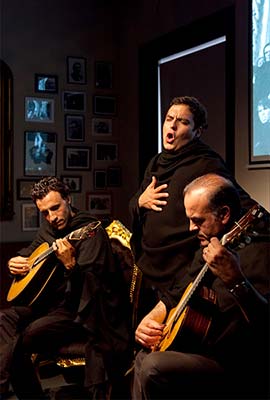
Bar Diligência has showcased fado since 1972 in a very informal way—locals join in with performers and sing along as well (guitar and voice). The cave-like setting feels like a neighborhood hangout, and owners Jorge and Patricia make everyone feel at home. A wide selection of petiscos (Portuguese tapas) make it easy to put a meal together during the show. Along with the occasional sing-along, up-and-coming groups often play here. If the music moves you, jump right in (no cover, kitchen opens at 20:00, shows Mon-Sat 23:00 until late, closed Sun; from Praça 8 de Maio, take Rua Sofia to your second left—Bar Diligência is 2 blocks up on your right at Rua Nova 30; +351 239 827 667).
More Fado: The mayor organizes Thursday street concerts that feature fado music through the summer. And Restaurante O Trovador offers fado with its dinner service on summer weekends (Largo Sé Velha 15, +351 239 825 475, www.restaurantetrovador.com).
Kayaks and Adventure Sports
Kayaking: O Pioneiro do Mondego buses you from Coimbra to Penacova (15 miles away), where you can kayak four hours down the Mondego River back into Coimbra (€27, +351 239 478 385, www.opioneirodomondego.com, Kristien and Jonas speak English). Most people stop to swim or picnic on the way back, so it often turns into an all-day journey. For the first 12.5 miles, you’ll go easily with the flow, but you’ll get your exercise paddling the remaining stretch. To avoid the workout (and the more boring part of the Mondego River), ask to be picked up 2.5 miles before Coimbra, at Portela do Mondego, where the river’s current slows down.
Adventure Sports: Located in the nearby town of Foz da Figueira, Capitão Dureza specializes in at-your-own-risk activities: rappelling, rafting, mountain biking, hiking, and canyoning (pickup and drop-off in Coimbra, +351 919 079 852, www.capitaodureza.com).
Sleeping in Coimbra
Coimbra’s hotels are cheap...in every sense. Don’t expect luxury here. These are basic, thin-walled, well-worn hotels where nighttime noise is par for the course. Most of these listings are just outside the central Coimbra-A station, within a few minutes’ walk of the main drag, Santa Clara Bridge, and most recommended restaurants and sights in the lower town.
$$$ Hotel Tivoli Coimbra, a classy, Houston-esque skyscraper, is Coimbra’s closest thing to contemporary luxury while still at a reasonable price. It rents 100 spacious (if faded) rooms with all the modern amenities, a 10-minute walk from Coimbra-A and the core (air-con, elevator, pay parking, Rua João Machado 4, +351 239 858 300, www.tivolicoimbra.com, htcoimbra@tivolihotels.com).
$ Hotel Vitória is a well-located hotel renting 21 modern rooms over a good restaurant, between Coimbra-A and the main drag. Some rooms have uphill views to the university. In terms of value, quality, and location, this is the most appealing option in town (air-con, elevator, a block from Coimbra-A at Rua da Sota 9, +351 239 824 049, www.hotelvitoria.pt, reservas@hotelvitoria.pt).
$ Ibis Hotel, a modern high-rise, has 110 orderly little rooms that come with all the comforts. Well located near the riverside Parque Dr. Manuel Braga, this impersonal but reliable chain hotel is three blocks past the Santa Clara Bridge and the old town (breakfast extra, air-con, elevator, easy pay parking, Avenida Emídio Navarro 70, +351 239 852 130, https://ibis.accorhotels.com, h1672@accor.com).
$ RiverSuites offers 26 rooms just across the Santa Clara Bridge, overlooking the Santa Clara Convent. The five-minute walk from the hotel across the bridge comes with fine views of Coimbra (family rooms, air-con, at the foot of the Santa Clara Bridge at Avenida João das Regras 82, +351 239 440 582, www.riversuites.pt, geral@riversuites.pt). They also offer two large, well-furnished $$$ apartments nearby.
$ Guest House Santa Clara pampers visitors in nine pink and pretty rooms inside a converted house across the Santa Clara Bridge. View rooms overlook the sprawling city but also come with a bit of street noise (free parking, Rua de Baixo 2, +351 936 961 479).
$ Hotel Domus, tucked away in a corner of a side street near Coimbra-A, has 15 cozy rooms with antique furniture, updated bathrooms, and thin windows (air-con, pay parking, Rua Adelino Veiga 62, +351 239 828 584, www.residencialdomus.com, hoteldomus@sapo.pt, Sra. and Sr. Santos).
¢ Hotel Larbelo, with Old World character, mixes frumpiness and former elegance in its 17 rooms. Its location couldn’t be handier—right on Largo da Portagem, where the main street hits the river. The old-fashioned staircase, classic reception rooms, and gentle non-English-speaking management take you to another age (no breakfast, air-con, Largo da Portagem 33, +351 239 829 092, residencial.larbelo@sapo.pt.
¢ Serenata Hostel, appealingly modern, offers private rooms and dorms with views. It fills a gorgeously restored historic maternity hospital and music conservatory on the often-noisy-with-students square behind the cathedral. The young-at-heart who don’t mind wearing earplugs (or request a quieter windowless interior room) may find this preferable to the similarly priced, dreary hotels near the station (cheaper rooms with shared bath, air-con, Largo Sé Velha 21, +351 239 853 130, www.serenatahostel.com [URL inactive]).
Eating in Coimbra
Specialties of this hilly Beira region include leitão (suckling pig), cabrito (baby male goat), chanfana (goat cooked in wine), Serra cheese, and rich, red Bairrada and Dão wines. For a sweet and herby digestivo, try Licor Beirão. The local pastries are pastel de Santa Clara (made with almonds and marmalade) and pastel de Tentúgal (flaky puff pastry filled with custard and dusted with powdered sugar). Be aware that many of these restaurants shut down—along with most of Coimbra—on Sunday.
IN THE LOWER TOWN (BAIXA)
Several enticing places—including many of my recommendations—are buried in the tight lanes between Hotel Astória and the main walking street. These first six listings are within a couple of blocks of each other.
$$ Restaurante Zé Manel dos Ossos is tiny, rustic, and authentic. Judging from the walls—caked with notes from happy eaters—and the line of smart eaters waiting hungrily in the alley, this place is a favorite. They serve a dozen good, typical Coimbran dishes. (The ossos—meaty bones of goat or wild pork cooked with veggies, mushrooms, and beans—are all popular here.) To order, I’d trust Mario, who speaks a lee-tle English (Mon-Fri 12:30-15:00 & 19:30-22:00, Sat 12:30-15:00 only, closed Sun and off-season; no reservations—arrive early or wait, as the line moves very slowly; Beco do Forno 12, +351 239 823 790).
$$ O Bizarro is a small, family-run, checkered-tablecloth hole-in-the-wall where Rafael and his mother serve up tasty Portuguese food at a good price. Chanfana (goat simmered in wine) is the house specialty. Mom takes the goat home to marinate overnight...it slides off the bone (great lunch special, lunch served Mon-Sat 12:00-15:00, dinner Mon-Thu 19:00-22:00, Rua Sargento Mor 44).
$ Adega Paço do Conde—humble but popular—knows how to grill, and Coimbra’s students love it. Choose your seafood or meat selection from the display case as you enter. They’ll pop it right on the grill and then bring it to your table. Students, travelers, families, and pigeons like this homey place that just seems right (big, splittable plates, Mon-Sat 11:30-15:00 & 19:00-22:00, closed Sun, Rua Paço do Conde 1—on the small square called Largo Paço do Conde, +351 239 825 605).
$$ Restaurante Solar do Bacalhau serves good Portuguese standards focusing on (what else?) cod and grilled meats, plus Italian favorites in a huge, contemporary, stony-chic dining room that feels fancier than its prices. It’s big, busy, and bright, and is deservedly popular with locals and tour groups alike (daily 12:00-15:00 & 19:00-24:00, Rua da Sota 12, +351 239 098 990).
$$ Tartufo Italian Restaurant & Pizzeria seems to have more eating energy than the rest of the town combined. The fun space with a bustling and open kitchen, an attractive outside terrace, and a busy pasta-making table in the center, is great for anyone needing a break from Portuguese cooking (daily 12:00-24:00, Rua da Sota 34, +351 239 820 546).
$$ Calado e Calado Restaurante is a big, plain diner with a laser focus on one thing: traditional Portuguese cuisine. It’s sunny, spacious, and happy, with a great €7.50 lunch deal and enticing €10 dinner plates (Sun-Fri 12:00-15:00 & 19:00-22:00, closed Sat, next to recommended Restaurante Solar do Bacalhau at Rua da Sota 14, +351 239 827 348).
$$ Restaurante Jardim da Manga is handy for a quick, cheap, self-service meal with locals. Sit indoors or outdoors next to a cool and peaceful fountain. It’s family-friendly and cheap enough to be a popular choice for children’s birthday parties. Just slide a tray down the counter and point to what you like (Sun-Fri 12:00-15:00 & 19:00-22:00, closed Sat, in the Jardim da Manga garden behind Church of Santa Cruz, +351 239 829 156).
$$ Dona Taska sits across the river with tables spilling out onto the busy sidewalk. Portuguese standards form part of the menu, but their specialty is Spanish cuisine. For a break from fish, try the “broken eggs” served with jamón over fried potatoes, or a sizzling grilled steak (Tue-Sat 12:00-15:00 & 19:00-24:00, Sun 12:00-15:00 only, closed Mon; call for reservations on weekends, Avenida João das Regras 86, +351 918 888 878).
$ Café Santa Cruz, next to the Church of Santa Cruz and filling one of its former buildings, is Old World elegant, but totally unpretentious. It has good, cheap coffee, simple toasted sandwiches, Wi-Fi, and outdoor tables offering great people-watching over Praça 8 de Maio. Their signature pastry crúzios (€1, named for the church’s friars) are inspired by nun-baked sweets (Mon-Sat 7:00-24:00, Sun 8:00-20:00 in summer, closed Sun off-season, +351 239 833 617, Victor). The café hosts free live fado most nights in season (see “Entertainment in Coimbra,” earlier).
IN THE UPPER TOWN (ALTA)
These restaurants sit on the slopes above the main drag.
$$ Tapas nas Costas invites you in with its stylish, modern ambience, friendly service, and an interesting mix of Portuguese classics and traditional Spanish favorites. Portions are splittable so order a couple to start, then ask for more if you’re still hungry (Tue-Fri 18:00-23:30, Sat from 12:30, Sun lunch only, closed Mon, Rua do Quebra Costas 19, +351 239 157 425).
$$$ Fangas Veg, my Coimbra favorite, is an intimate wine bar where English-speaking Luisa serves delightful, mainly vegetarian petiscos (Portuguese tapas) matched by a nice selection of quality Portuguese wines by the glass (3 or 4 tapas will fill 2 people, or try a sampler plate; cheeses are a winner; Thu-Mon 12:30-15:30 & 19:00-23:00, closed Tue-Wed, Rua Fernandes Tomás 45, reserve ahead, +351 934 093 636). A few steps away, their sister location, Fangas Maior, has the same menu and philosophy, but a bit less coziness—you’re more likely to get a table here, and that’s just fine (daily 12:30-15:30 & 19:00-23:30, same phone number, Rua Fernandes Tomás 29).
$$$ Loggia Restaurante is a dressy place at the Machado de Castro Museum with seating inside or outside on the view terrace overlooking the old town. It’s a convenient stop while sightseeing, as it’s next to the university, and there’s a good-value €9.50 weekday lunch buffet available 12:30-14:30 (€11.50 on weekends). If you don’t mind the long hike, it’s also a romantic and classy option for dinner—at higher prices than you’ll pay in town, but still reasonable (Tue and Sun open 10:00-18:00 for lunch, Wed-Sat open 10:00-22:30 with dinner from 19:30, closed Mon, +351 239 853 076).
Coimbra Connections
If you’re traveling by train, remember that Coimbra has two stations—A and B—but any ticket covers the five-minute shuttle train between stations (see here for details).
From Coimbra by Bus to: Alcobaça (2/day, 1.5 hours), Batalha (1/day, 1.5 hours, transfer in Leiria), Fátima (hourly, 1 hour), Nazaré (6/day, 1.5 hours, some with transfer in Leiria), Lisbon (hourly, 2.5 hours), Évora (1/day direct, 4.5 hours; otherwise almost hourly with transfer in Lisbon, 4.5 hours), Porto (almost hourly, 1.5 hours). Bus info: +351 239 855 270, www.rede-expressos.pt [URL inactive]. Frequency drops on weekends, especially Sunday.
By Train to: Nazaré/Valado (4/day direct, 2 hours; the bus is a better option—see above—because Nazaré/Valado train station is 3 miles outside Nazaré), Porto (hourly, 1.5 hour on Alfa Pendular line or Intercidades service, 2 hours on regional line; most long-distance trains end at Porto’s noncentral Campanhã station but include a transfer to the more central São Bento station), Lisbon (hourly on Alfa Pendular or Intercidades service, 2 hours; regional service equally frequent but takes 4 hours; for Lisbon center, get off at Santa Apolónia Station; for Lisbon airport, hop off at Oriente station and take the Metro to airport; all Coimbra/Porto trains stop at both Lisbon stations, 7 minutes apart). Train info: +351 218 050 653, www.cp.pt.