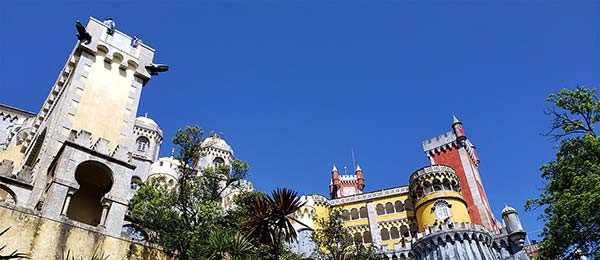
SINTRA
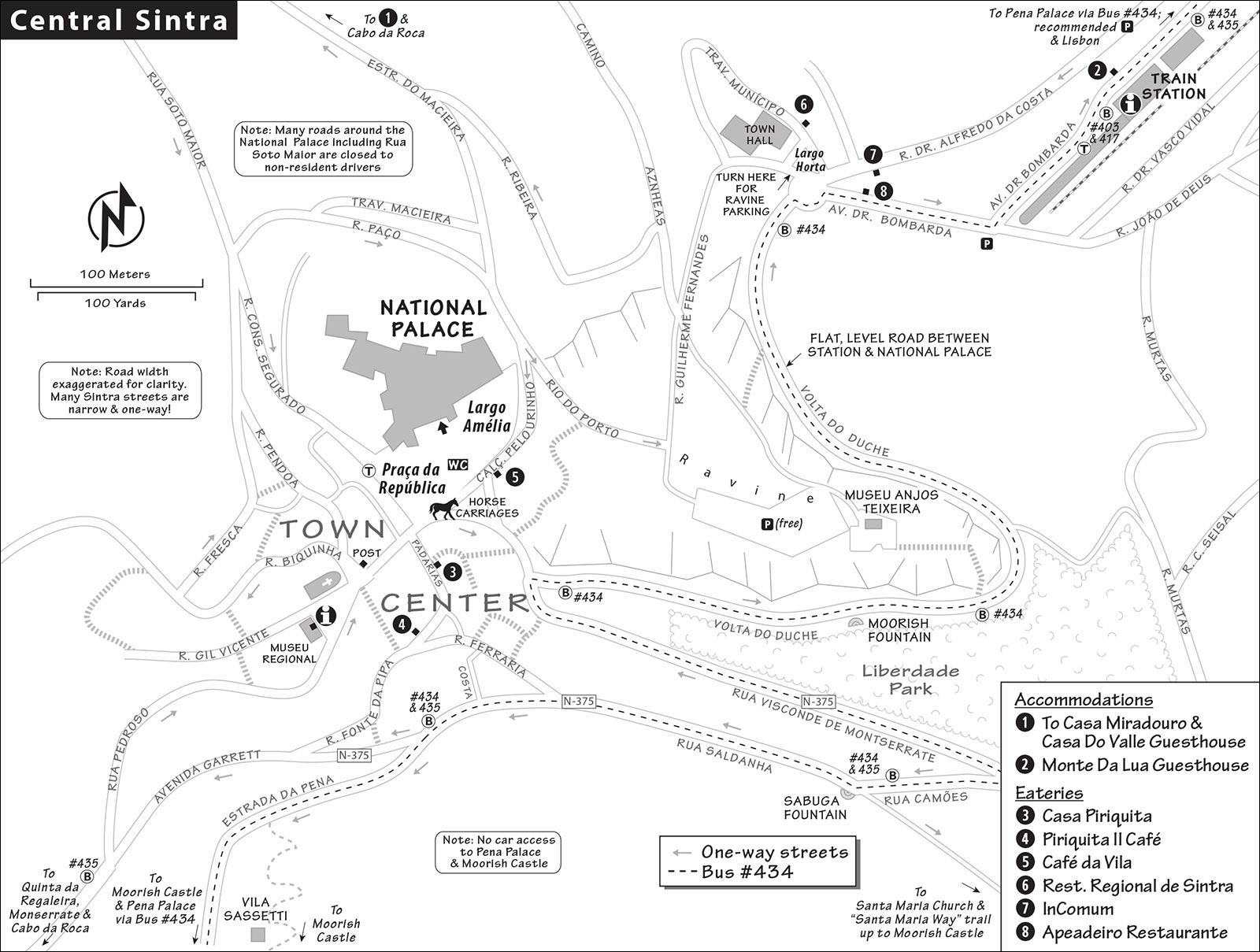
For centuries, Portugal’s aristocracy considered Sintra (SEEN-trah)—just 15 miles northwest of Lisbon—the perfect place to escape from city life. Now tourists do, too. Sintra is a mix of natural and man-made beauty: fantasy castles set amid exotic tropical plants, lush green valleys, and craggy hilltops with hazy views of the Atlantic and Lisbon. This was the summer getaway of Portugal’s kings. Those with money and a desire to be close to royalty built their palaces amid luxuriant gardens in the same neighborhood. Lord Byron called this bundle of royal fancies and aristocratic dreams a “glorious Eden,” and even though it’s mobbed with tourists today, it’s still magnificent.
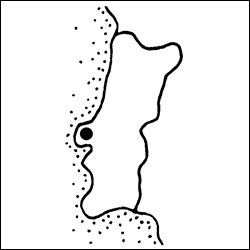
With extra time, explore the rugged and picturesque westernmost tip of Portugal at Cabo da Roca.
PLANNING YOUR TIME
Sintra makes a great day trip from Lisbon. Here you can romp along the ruined ramparts of a deserted Moorish castle, and climb through the Versailles of Portugal—the Pena Palace—on a neighboring hilltop.
It’s such an ideal side trip, in fact, that Sintra can be mobbed (especially July through Sept). Saturdays and Sundays are popular with the Portuguese, while foreign tourists clog the town on Mondays (when many Lisbon museums are closed, but all major Sintra sights are open). Crowds are a bit lighter on Tuesdays through Fridays. Sintra’s complicated landscape—with lots of hills and one-way roads between the big sights—adds to the challenge. A trip here requires patience and a flexible schedule. For the most stress-free visit possible, consider this good one-day plan:
Leave Lisbon around 8:30 to arrive in Sintra by 9:15 (most major sights are open by 9:30 or 10:00)—if you arrive much later, you’ll be hopelessly mired in crowds all day. Pick up a map at the TI in Sintra’s train station and catch bus #434 in front of the station to Pena Palace. Visit the palace, walk down to the Moorish Castle ruins, scramble over its ramparts, then hike about 45 minutes back down to town via Vila Sassetti (or take bus #434). Have lunch (unless you already had a picnic, or lunched at the Pena Palace’s café), explore the town, and—if you’re not exhausted yet—visit the National Palace (in town) or the Quinta da Regaleira (a 10-minute walk). Finally, catch the train back to Lisbon in time for dinner. This general plan also works well for drivers, who should leave their car in Lisbon (or park upon arrival in Sintra) and use public transportation to get between the sights.
Spending the night in Sintra lets you get an early start or visit the sights later in the day (the Moorish Castle is even better at closing time, with the sun low in the sky)—and lets you savor the small town after dark, when it’s quieter. Drivers in particular could consider overnighting in Sintra on the way to or from Lisbon.
GETTING TO SINTRA
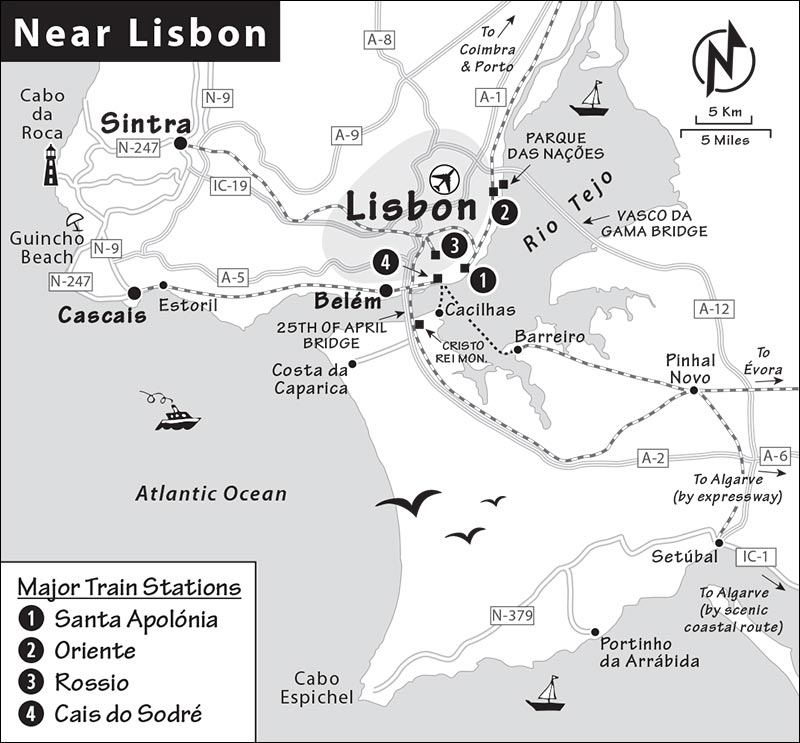
Catch the train to Sintra from Lisbon’s central Rossio station (direct, Mon-Fri 2/hour, Sat-Sun hourly, 40 minutes; also 6/hour from the less central Oriente station, 45 minutes). The trip is covered by the LisboaCard or the €10 version of Lisbon’s all-day transit pass; if “zapping” with a Viva Viagem card, it’s €2.30 each way (see here). Note that none of these passes work on local buses once you’re in Sintra. Without these cards or passes, you’ll have to pay an extra €0.50 for a Navegante card (only valid for interurban trains—including those to and from Sintra) at the station.
To avoid early-morning lines at the station in Lisbon, buy or charge up your card the night before (otherwise, buy it when you get to Rossio station—using the ticket machines or windows upstairs, at track level). During your ride, take in the views of the 18th-century aqueduct (on the left) and the workaday Lisbon suburbs. Relax...Sintra is at the end of the line.
Sintra is far easier by train than by car from Lisbon. Consider waiting until after you visit Sintra to pick up your rental car. If you do drive to Sintra, see “Route Tips” at the end of this chapter for advice.
Orientation to Sintra
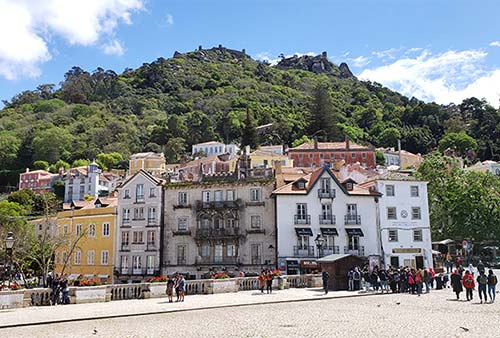
Sintra is small but vertically challenging. The town itself sprawls at the foot of a hill, an easy 10-minute walk (or quick bus ride) from the train station. The National Palace, with its unmistakable pair of cone-shaped chimneys, is in the center of the town, a block from the TI, and the Quinta da Regaleira is a 10-minute walk away. The other two main sights—Pena Palace and the Moorish Castle—hover on the hilltop above (you can see the castle’s serrated wall on the hilltop). Most people take the bus up, but avid hikers enjoy the walk (figure an hour steeply uphill; see “Hiking Between Sintra and the Castles,” later.)
TOURIST INFORMATION
Sintra has two TIs: a small one in the train station (daily 9:00-13:00 & 14:00-18:00, +351 211 932 545) and a larger one a block off the main square in the Museu Regional building (daily 10:00-18:30, +351 219 231 157, www.visitlisboa.com). At either TI you can pick up a free map with information on sights and a local Scotturb bus schedule. Hikers can also request a map of walking routes.
ARRIVAL IN SINTRA
By Train: To go by bus to the town center, hop on Scotturb #434 (exit the station to the right; buy a €5 two-ride ticket or an €11.50 24-hour pass from street vendors or from the driver, schedules posted at stop; for more bus info, see “Getting Around Sintra,” later). The bus stops in town first (near the National Palace) before heading up to the Moorish Castle and Pena Palace, then loops back down to the station and town.
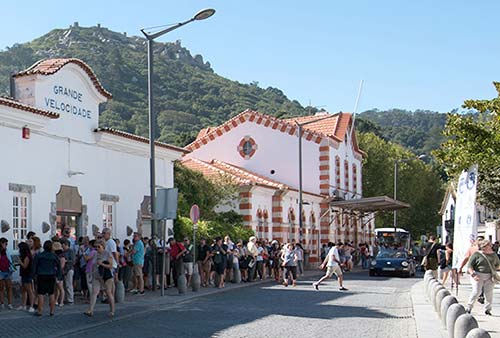
You can also reach the town center easily on foot (exit the station and go left, then turn left when you hit the turreted Town Hall)—it’s about a 10-minute walk along a mostly level road along the lip of a ravine. Along the way you’ll see modern “art” and hippies selling handmade trinkets.
By Car: Avoid driving here; many roads are closed to non-residents. See “Route Tips” at the end of this chapter for tips including where to park.
HELPFUL HINTS
Festivals: The lively Festival de Sintra music and dance festival runs from late May to early July (www.festivaldesintra.pt).
Money: You’ll find a few ATMs near the train station, another inside the main TI, and one on Rua das Padarias, just up the hill from the recommended Casa Piriquita.
WC: There’s a free WC near the small, central parking lot where horse carriages wait (Calçada do Pelourinho).
Bring a Picnic: To save a few euros, consider bringing a picnic from Lisbon—restaurants here can be pricey, though there is a very basic grocery store (see “Eating in Sintra,” later).
GETTING AROUND SINTRA
Roads near the National Palace and approaching the Pena Palace are closed to car traffic. All forms of public transportation use the same very congested, single-lane, one-way road that loops up the hill and passes the main monuments. Note that the town center may also be closed to traffic at busy times—confirm your stop with the driver.
By Bus: The best choice for most is Scotturb bus #434, which loops together all the important stops—the train station, the town center, the Moorish Castle ruins, and the Pena Palace—before heading back to town and the train station (4/hour, 30-minute circuit, subject to traffic; €5 two-ride ticket or €11.50 24-hour pass that covers all bus routes—buy from driver or street vendors at train station; first bus departs train station at 9:30, last bus leaves station at 18:20).
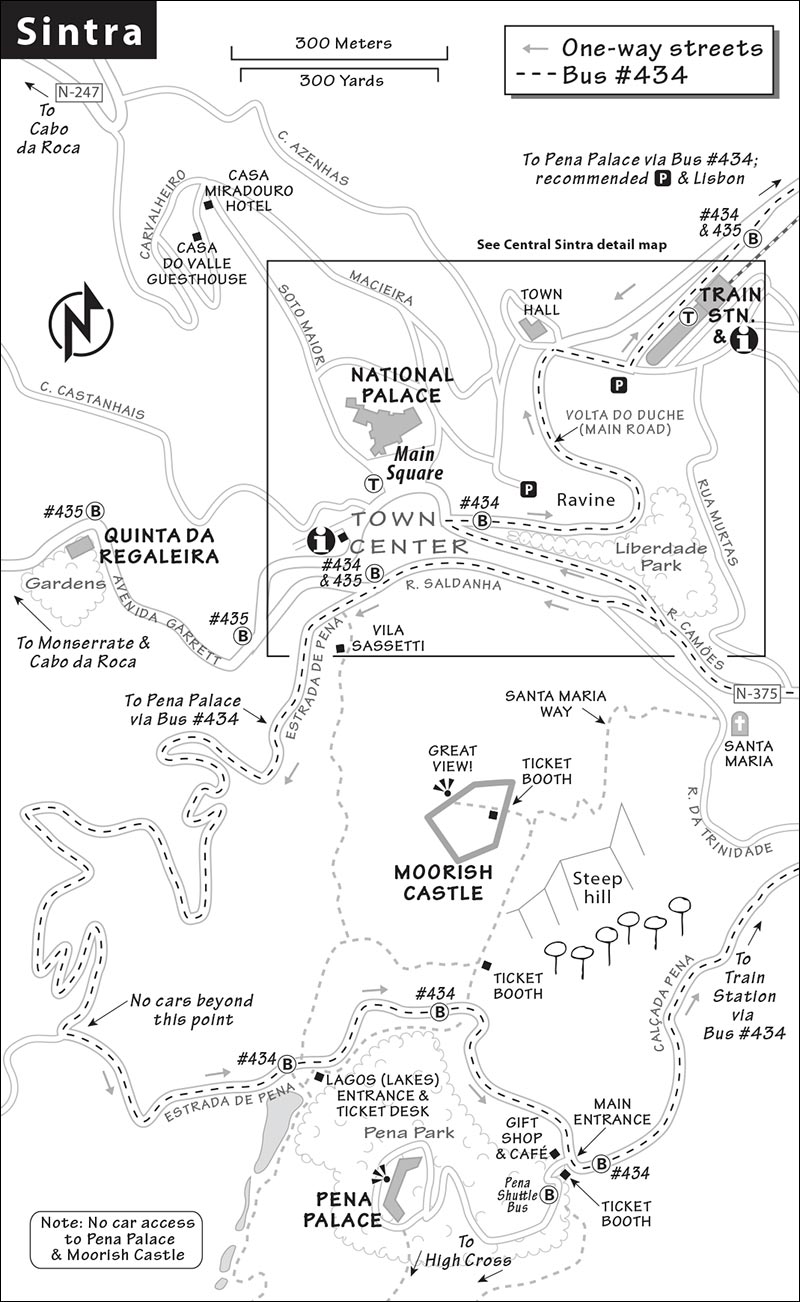
A different bus, #435, goes from the train station to Quinta da Regaleira and the Monserrate gardens (3/hour, same ticket options as above, not covered by bus #434 ticket).
Crowd-Beating Tips: Busy days bring very long lines at popular bus stops, and buses crammed with people. If there’s a long line at the train station bus stop, consider walking into town and catching the bus near the National Palace. When returning to town from the Pena Palace, consider walking about 10 minutes (mostly downhill) back along the road to the Moorish Castle bus stop, where there’s usually no line. Scotturb’s information office across from the train station is most crowded during morning hours.
By Tuk-Tuk: Noisy, bouncy, but fun tuk-tuks charge €5/person for a breezy ride from town or the station to the Moorish Castle, Pena Palace, or Quinta da Regaleira (you can also book tuk-tuks for a “guided tour” loop).
By Taxi: Figure €15 from the center up to any one of the sights.
By Carriage: Clip-clop horse carriages cost €75 for a ride to the top, but they can take you almost anywhere (reserve online at www.parquesdesintra.pt).
Sights in Sintra
Ticket Tips: For the Pena Palace, Moorish Castle, and National Palace, it’s smart and simple to buy single tickets online a few days in advance at www.parquesdesintra.pt. Buying online saves you a long, frustrating wait (usually 30 minutes or more) at ticket counters or ticket machines and tickets are often discounted about 5 percent. For the Pena Palace, you must select an entry time when you book online. Combo-tickets for these three sights offer similar cost savings but are not sold online. Unless you’re going to all three sights, and didn’t buy single tickets in advance, the combo deal is not worthwhile.
The LisboaCard gets you discounted entry at the Pena Palace, Moorish Castle, National Palace, and the Monserrate gardens (about 5 percent off, only valid onsite). Be sure to bring the LisboaCard booklet, which contains coupons required for some of the discounts.
The Quinta da Regaleira is run by a private organization, so is not a part of any palace or castle combo-ticket.
ON THE HILL ABOVE SINTRA
These sights cap the hill high above Sintra—connected by bus #434. If walking between them, figure 10 minutes between the Pena Palace main entrance and the Moorish Castle, and another 10 minutes to the Pena Palace’s lower “Lakes/Lagos” entrance. Be careful walking along the congested road, with its narrow shoulder and ankle-twisting cobbles.
▲▲Pena Palace (Palácio de Pena)
This magical hilltop palace sits high above Sintra, above the Moorish Castle ruins. In the 19th century, Portugal had a very romantic prince, the German-born Prince Ferdinand. A contemporary and cousin of Bavaria’s “Mad” King Ludwig (of Disneyesque Neuschwanstein Castle fame), Ferdinand was also a cousin of England’s Prince Albert (Queen Victoria’s husband). Flamboyant Ferdinand hired a German architect to build a fantasy castle, mixing elements of German and Portuguese style. He ended up with a crazy Neo-fortified casserole of Gothic towers, Renaissance domes, Moorish minarets, Manueline carvings, Disneyland playfulness, and an azulejo (tile) toilet for his wife.
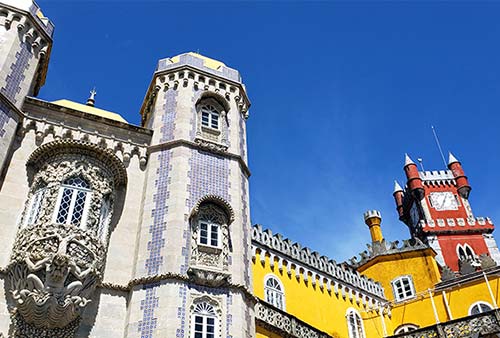
Cost and Hours: Palace and gardens—€14 timed-entry ticket, buy online in advance to avoid ticket-buying line; shuttle bus—€3 round-trip, not sold online; May-mid-Sept palace open daily 9:30-18:30, gardens 9:00-19:00, shorter hours off-season; +351 219 105 340, www.parquesdesintra.pt.
Getting There: Bus #434 stops near the two entrances to the castle grounds: the lower “Lakes/Lagos” entrance (at the bottom of the park), and the main entrance (just below the castle itself). It’s a 20-minute walk between these two (you’ll pass the Moorish Castle ticket booth between them). While the lower entrance is less crowded, it’s best to use the main entrance if possible, since it’s closer to the castle.
Getting In: At the main entrance, castle and shuttle bus tickets are sold at the small hut next to the gate (if there’s a long line, look for ticket machines just downhill—toward the Moorish Castle).
To avoid the 10-minute uphill climb from the main entrance to the palace (and enjoy a lift back down later), catch the green Pena shuttle bus, which departs about every 10 minutes from straight ahead as you enter (shuttle bus tickets sold at the ticket booth—not from driver). Lines for the shuttle bus can be longer than ticket lines. Peek inside the main gate to see how many people are in line for the shuttle, then decide if it’s worth the wait before buying a ticket. Shuttle bus tickets are not sold online in advance.
Visitor Info: Wherever you enter, be sure to pick up the Parques e Palácios map, with a helpful illustration of the castle on one side and a circular, 1.5-hour walking route of the park on the other.
Eating: The palace has an inexpensive $ view café and a pricier $$ restaurant. If you brought your lunch with you, enjoy it in the picnic-perfect gardens either before or after your visit—with views fit for a king.
 Self-Guided Tour: The palace, built in the mid- to late-1800s, is so well-preserved that it feels as if it’s the day after the royal family fled Portugal in 1910 (during a popular revolt that eventually made way for today’s modern republic). This gives the place an intimacy rarely seen in palaces.
• After you hop off the green shuttle bus, hike up the ramp and go through the Moorish archway with alligator decor. Cross the drawbridge that doesn’t draw and join a slack-jawed world of tourists frozen in deep knee-bends with their cameras cocked.
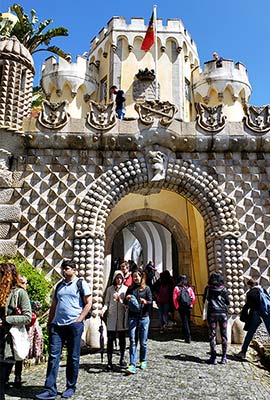
Palace Interior: Show your ticket again to enter the palace itself. Inside, at the base of the stairs, you’ll see a bust of King Ferdinand II, who built this castle from 1840 until his death in 1885. Though German, he was a romantic proponent of his adopted culture and did much to preserve Portugal’s architectural and artistic heritage.
• Next you’ll pop out into the...
Courtyard: The palace was built on the site of a 16th-century monastery; the courtyard was the former location of the cloister. In spite of its plushness, the palace retains the monkish coziness of several small rooms gathered in two levels around the cloister.
Like its big brother in Belém, the monastery housed followers of St. Jerome, the hermit monk. Like their namesake, the monks wanted to be isolated, and this was about as isolated as you could be around here 500 years ago. The spot was also a popular pilgrimage destination for its statue of “Our Lady of the Feathers” (pena means feather—hence the palace’s name). In 1498 King Manuel was up here enjoying the view when he spied Vasco da Gama sailing up the river, returning safely from his great voyage. To celebrate and give thanks, the king turned what was a humble wooden monastery into a fine stone palace.
• From here, follow the one-way route counterclockwise around the courtyard, dipping into a variety of rooms. These are especially worthy of attention.
Dining Room and Pantry: Stuck into a cozy corner, the monastery’s original refectory was decked out with the royal family’s finest tableware and ceiling tiles.
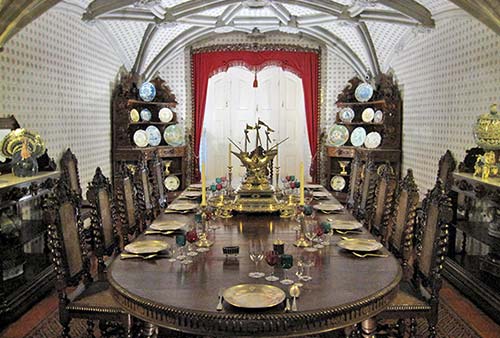
Atelier (Workshop) of King Carlos I: King Carlos was a talented artist and a great patron of the arts. He often found refuge in painting—specifically in the latest style, Art Nouveau. Unfinished paintings and sketches eerily predict the king’s unfinished rule.
King’s Bedroom and Bathroom: The king enjoyed cutting-edge comforts, including a shower/tub imported from England, and even a telephone to listen to the opera when he couldn’t face the Lisbon commute. The bedroom is decorated in classic Romantic style—dark, heavy, and crowded with knickknacks.
• Now head upstairs (gripping the funky dragon-like handrail). Circling around the courtyard, you’ll enter the wing called the Piano Nobile (“noble floor”). Go through a few daintily decorated rooms that belonged to ladies-in-waiting, and then enter the...
Queen’s Bedroom and Dressing Room: Study the melancholy photos of Queen Amelia (Amélie of Orléans), King Carlos, and their family in this room. The early 1900s were a rocky time for Portugal’s royal family. The king and his eldest son were assassinated in 1908. His youngest son, Manuel II, became king until he, his mother the queen, and other members of the royal family fled Portugal during the 1910 revolution.
As you shuffle through the palace, you’ll see state-of-the-art conveniences—such as the first flush toilets and hot shower in Portugal, and even a telephone room. The whole place is lovingly cluttered, typical of the Victorian horror of empty spaces.
• At the end of this floor, step out onto the...
Queen’s Terrace: Enjoy a sweeping view from Lisbon to the mouth of the Rio Tejo. Find the Cristo Rei statue and the 25th of April Bridge. The statue on the distant ridge honors the palace’s architect.
• Heading back inside, you’ll pass through some smaller rooms, then enter...
The New Wing: This spacious addition to the original series of rooms around the cloister includes the apartments of the last king, the smoking room (with a tiled ceiling), and the fantastically furnished Great Hall.
On your way down the spiral staircase, take a detour to see the Stag Room—with well-antlered walls and a dramatic dome supported by a stout, palm-tree-like column. From here, you’ll head down to see the abundant kitchen.
Just after, a view café conveniently welcomes us peasants. While many people take this as a sign to leave, we haven’t yet seen some of the most scenic parts of the castle.
• From the café, turn left and walk alongside the palace, then duck through one of the two huge, ornamental gateways on your left (the second one has a scowling Triton overhead). You’ll emerge into the...
Inner Patio: Take the stairs up to the pointed dome covered in green and white tiles (in front of the tallest red tower). This was the royal family’s sumptuous private chapel, decorated in a variety of styles. The structure is Manueline, reminiscent of the Monastery of Jerónimos in Belém.
• Heading back down into the patio, don’t miss the little door under the chapel marked...
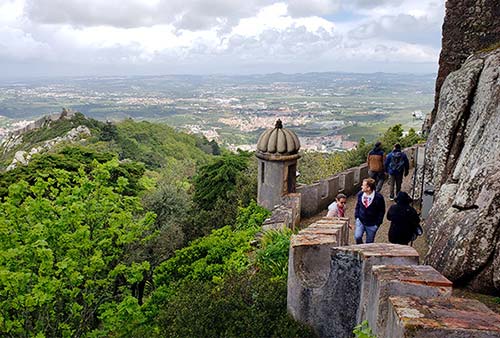
The Wall Walk: If you aren’t afraid of heights, follow this for a rampart ramble with great views—of the onion-domed balustrade, of the palace itself, and of the surrounding countryside—including the Moorish Castle on an adjacent hilltop. When the entire circuit is open, you’ll circle all the way around the outside of the palace, and wind up back at the entrance. Otherwise, walk back the way you came.
• From here, you can return directly to the main entrance (walk 10 minutes or catch the green shuttle bus), or detour for a self-guided tour of the park.
Pena Palace Park: The lush, captivating, and sprawling palace grounds—rated ▲—are dotted with romantic surprises and provide a refreshing break from Sintra’s crowds. Several landmarks within the park are signposted near the shuttle bus stop. Highlights include the High Cross (highest point around, with commanding views), chapels, a temple, giant sequoia trees, and exotic plants. To walk through the park after you tour the palace, take a 40-minute stroll downhill (following the map that came with your palace entry)—past greenhouses, pavilions, and a series of five man-made lakes—to the lower park gate, at the Lakes/Lagos entry, where you’ll find a bus stop and the Estrada de Pena loop road. From here, it’s a ten-minute hike uphill to the Moorish Castle, or a 20-minute hike back to the Pena Palace’s main entrance.
▲Moorish Castle (Castelo dos Mouros)
Sintra’s thousand-year-old ruins of a Moorish castle are lost in an enchanted forest and alive with winds of the past. They’re a castle lover’s dream come true, and a great place for a picnic with a panoramic Atlantic view. Though built by the Moors, the castle was taken by Christian forces in 1147. It’s one of the most classically perfect castles you’ll find anywhere, with two hills capped by hardy forts, connected by a crenellated wall walkway. (It’s so idealized because it was significantly restored in the 19th century.)
Cost and Hours: €8, daily 9:00-18:30, +351 219 237 300, www.parquesdesintra.pt.
Getting In: From the main ticket booth (just uphill from the bus stop) to the castle entrance, it’s an atmospheric 10-minute up-and-down stroll through a forested canyon, passing a few small exhibits and information plaques. If the main ticket booth is crowded, bypass it and simply continue to the castle itself, where there’s another ticket booth that rarely has a wait. Either way, be sure to pick up the well-illustrated map, which has lots of insightful information.
Visiting the Castle: You’ll enter the castle in a terraced area with a cafeteria, shop, and WCs, all sitting on top of a cistern. The castle walls and towers climb hills on either side of you. Do a hardy counterclockwise hike, conquering the lower one first, then heading up to the higher one. (Or, if you’re tired, just walk up the central staircase to enjoy a breathtaking view.)
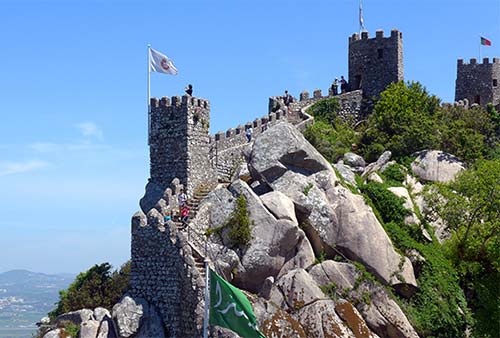
For the full experience, from where you entered, go right and take the stony stairs up to the keep. From the top tower, you can see how the wall twists and turns—following the contours of the land—as it connects over to the taller hilltop tower. Follow the crenellated path, with delirious views over Sintra down below and as far as the Atlantic. You’ll go down, then back up the other side, ascending higher and higher to the top of the Royal Tower. From the summit, you enjoy great views across to Pena Palace, perched on its adjacent hilltop. From this pinnacle, you can gingerly descend to the cafeteria and entrance—having conquered the castle.
Hiking Between Sintra and the Castles
It’s a steep one-hour hike from town up to the Moorish Castle and Pena Palace—challenging even for hardy hikers. But hiking back down to town after your hilltop visits (rather than cramming into an overstuffed bus) is an appealing 45-minute possibility for those with strong knees. Be sure to equip yourself with the TI’s invaluable Pedestrian Route map—and get their advice—before you set out (maps may also be available at Moorish Castle or Pena Palace ticket offices).
The best route is to take a terraced path directly below the Moorish Castle, which leads past the Vila Sassetti. You’ll find the trailhead at the end of the parking lot directly across from the Lakes/Lagos lower entrance of the Pena Palace grounds, and you’ll also find a trail connecting to it near the Moorish Castle main ticket booth (near the bus stop). From here, the trail curls around the bottom of the Moorish Castle’s rocky perch, then enters the grounds of the Vila Sassetti. Designed by theater set decorator Luigi Manini (who also did the Quinta da Regaleira, described later), the Vila Sassetti looks like an old Roman house with a terra cotta roof. You’ll hike down to the villa itself, then traipse through its lower gardens into Sintra. (If the Villa is closed, you can also drop down—on steep steps—to footpaths that run through the woods above the main road.)
Yet another option is to walk down on the “Santa Maria Way,” which forks off in the opposite direction from the Moorish Castle entrance. However, this trail is mostly through thick woods and less scenic.
IN TOWN
These sights are all within easy walking distance of the town center.
▲National Palace (Palácio Nacional)
While the palace dates back to Moorish times, most of what you’ll see is from the 15th-century reign of King João I, with later Manueline architectural ornamentation from the 16th century. This oldest surviving royal palace in Portugal is still used for official receptions. Having housed royalty for 500 years (until 1910), it’s fragrant with history.
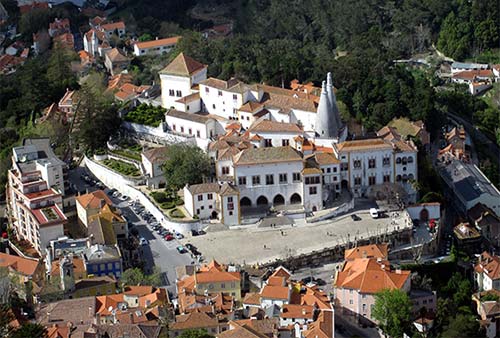
Cost and Hours: €10, daily 9:30-18:30; look for white, double-coned building in town center—a 10-minute walk from the train station; +351 219 237 300, www.parquesdesintra.pt.
Self-Guided Tour: The palace is a one-way romp with little information provided. If touring on your own, read the brief descriptions in each room, and tune into the following notable parts of the palace.
• Show your ticket, then head upstairs into the...
Swan Room: This first room is the palace’s banquet room. A king’s daughter—who loved swans—married into a royal house in Belgium. The king missed the princess so much that he decorated the ceiling with her favorite animal.
Central Patio: This was a fortified medieval palace, so rather than having fancy gardens outside, it has a stay-awhile courtyard within its protective walls. Notice the unique chimneys. They provide powerful suction that removes the smoke from the kitchen and also creates a marvelous open-domed feeling (as you’ll see at the end of your tour).
Magpie Room: The queen caught King João I being a little too friendly with a lady-in-waiting. Frustrated by his court—abuzz with gossip—João had this ceiling painted with magpies. But to defend his honor, he illustrated each magpie quoting the king’s slogan—Por bem, “For good.” The 15th-century Moorish tiles are from Spain, brought in before the development of the famous, ubiquitous Portuguese tiles, and are considered some of the finest Moorish-Spanish tiles in all of Iberia.
Bedchamber of King Sebastian (Dom Sebastião): The king portrayed on the wall (to the right of where you enter) is King Sebastian, a gung-ho, medieval-type monarch who went to battle in Africa, following the Moors even after they were chased out of Europe. He disappeared in 1578 at age 24 (although he was almost certainly killed in Morocco, “Sebastianists” awaited his mythical return into the 19th century). With the king missing, Portugal was left in unstable times with only Sebastian’s great uncle (King Henrique) as heir. The new king died within two years, and the throne passed to his great uncle, King Philip II of Spain, leading to 60 years of Spanish rule (1580-1640).
Note the ebony, silver, and painted copper headboard of the Italian Renaissance bed. The tiles in this room are considered the first Portuguese tiles—from the time of Manuel I. The corn-on-the-cob motif topping the tilework is a reminder of American discoveries.
More Main-Floor Rooms: From here, you’ll walk through the Julius Caesar Room, with a Flemish tapestry of the Roman general-turned-ruler; the Goddess Diana Courtyard; and up the stairs to the Galleon Room, whose ceiling is painted with ships flying the flags of the great nautical powers of the day. Step out onto the balcony for views of a forested hillside scattered with the villas of aristocrats—and capped by the serrated wall of the Moorish Castle. Then, head up the stairs to walk through some smaller, simpler apartments with a few original furnishings.
• Finally, you step into the glorious...
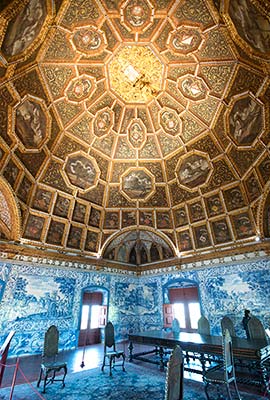
Blazons Hall (a.k.a. Coat of Arms Room): The most striking room in the palace—under a golden dome and slathered in blue tiles—honors Portugal’s loyal nobility. Study the richly decorated ceiling. The king’s coat of arms at the top is surrounded by the coats of arms of his children; below that is a ring of stags; and just below, “supporting” the king are the coats of arms of Portugal’s noble families. The Latin phrase circling the room reads, “Honoring all the noble families who’ve been loyal to the king.” The 18th-century tiles hang from the walls like tapestries and show more stag hunting scenes. Enjoy the view: a garden-like countryside dotted with mansions of nobility who clamored to be near their king, the hill-capping castle, and the wide-open Atlantic. You’re in the westernmost room of the westernmost palace on the European continent.
• Continue through the upper halls, peeking into the...
Bedchamber and Prison of Alfonso VI: This king suffered from a fever as a child that left him mentally unstable. After he became king, he was removed by his wife and his brother—who became King Pedro II, locked him in this room for the rest of his life, and married his queen.
Yet More Rooms: As you continue, you’ll pass through the Chinese Room (with an exquisite ivory-and-bone model of a Chinese pagoda). Downstairs, you can step out onto a private balcony and peer down into the Palatine Chapel, with a Mudejar wood-carved ceiling. Then you’ll pass through a room of coffers (literal treasure chests) and head downstairs to the Arab Room—decorated with Moorish tiles, and with a little fountain in the middle; this was the preferred bedroom of João I. From here, you’ll walk through a fancy guest room and into the kitchen. With all the latest in cooking technology, the palace chef could roast an entire cow on the spit, keep the king’s plates warm in the iron dish warmer (with drawers below for the charcoal), and get really dizzy by looking up and spinning around three times.
On your way out, as you step back into the big entry hall, be sure to detour left into the Manueline Room, with carved-stone ropes over the doors and a grand chandelier, and a handy WC in the corner. You’ll walk back through the Central Patio (peek into the blue-tiled Grotto of the Baths in the corner) and head for the exit. On your way out, watch for the easy-to-miss door on the right that lets you explore the manicured, terraced gardens surrounding the palace. Sit with a carved lion and enjoy views from one palace to another.
SOUTHWEST OF THE CENTER
These two sights line up on a road southwest of central Sintra. You can walk to Quinta da Regaleira, but Monserrate is quite a bit farther. Bus #435 stops at each one (see details earlier, under “Getting Around Sintra”), or you can take a tuk-tuk or taxi.
▲▲Quinta da Regaleira
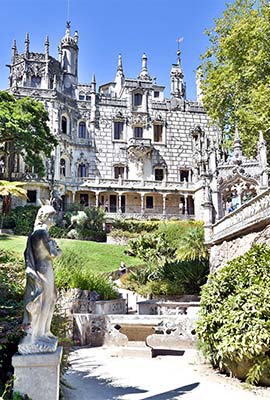
This Neo-Everything (Manueline/Gothic/Renaissance) 1912 mansion and garden has mystical and Masonic twists. It was designed by Italian opera-set designer Luigi Manini for a wealthy but disgruntled monarchist two years after the royal family was deposed. While the mansion—prickly with spires—is striking from the outside, its interior is nothing compared to the Pena Palace or National Palace. But the grounds are an utter delight to wander, with fanciful follies, secret underground passages, and lush landscaping. Many travelers (especially younger ones) find romping around these grounds more enjoyable than shuffling around the crowded interiors of the more famous palaces. Ask a local to pronounce “Regaleira” for you, and just try to repeat it.
Cost and Hours: €10, buy ticket online in advance at https://regaleira.byblueticket.pt; daily 10:00-18:30, closes earlier off-season, last entry one hour before closing; 10-minute walk from downtown Sintra, café, +351 219 106 650, www.regaleira.pt.
Tours: Excellent two-hour English tours fill up, so book ahead online or by phone (€18, includes entry, usually daily at 14:00 April-Sept, fewer off-season). The tour focuses on the garden, and can be longish unless you’re into quirky Masonic esoterica.
Visiting the Quinta: As you enter, be sure to pick up the superb illustrated map of both the house and the gardens.
The mansion itself is striking—as it was designed to be. (In fact, that was its sole purpose.) You’ll enter through the finest space, the Hunting Room, with an outrageously carved fireplace. From here you can explore three floors, filled mostly with well-presented exhibits on the design and construction of the place, and biographical sketches of the aristocrat and the architect who brought it to life. At the top floor, find the tight spiral stone staircase up to the view terrace.
The real highlight is the playful gardens, which stretch uphill from the mansion. Work your way up, past the elaborate private chapel, then to higher and higher crenellated viewpoints. Follow Waterfall signs to reach a refreshing artificial canyon with ponds and a cascade. Stepping stones lead across the main pond to the grottos that hide beneath, giving you a unique perspective. From the top of the waterfall, continue up to the “Portal of the Guardians”; inside, secret tunnels lead to the dramatic, spiral-staircase-wrapped well—burrowed 90 feet down into the hillside, and, like the rest of Quinta da Regaleira, more about showing off than about being functional. From here, more tunnels lead to other parts of the property; use your map to explore to your heart’s content.
Monserrate
About 2.5 miles outside of Sintra—on the road past the Quinta da Regaleira—are the wonderful gardens of Monserrate. If you like tropical plants and exotic landscaping, a visit is time well-spent, though many find that the gardens at Pena Palace or the Quinta da Regaleira are just as good as these more famous grounds.
Cost and Hours: €8, palace open daily 9:30-18:30, park 9:00-19:00, +351 219 237 300, www.parquesdesintra.pt.
WEST OF SINTRA, ON THE COAST
Cabo da Roca
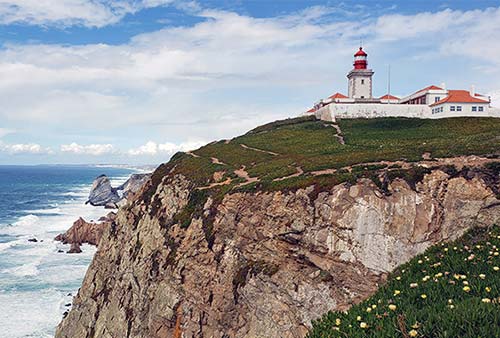
Wind-beaten, tourist-infested Cabo da Roca (KAH-boo dah ROH-kah) is the westernmost point in Europe, perhaps the inspiration for the Portuguese poet Luís de Camões’ line, “Onde a terra se acaba e o mar começa” (“Where land ends and the sea begins”). It has a little shop, a café, and a tiny TI that sells an expensive “proof of being here” certificate. Take a photo instead. Nearby, on the road south to Cascais, you’ll pass a good beach for wind, waves, sand, and the chance to be the last person in Europe to see the sun set. For a remote beach, drive to Praia Adraga (north of Cabo da Roca).
Sleeping in Sintra
Sintra works well as an overnight—allowing you to beat the crowds by tackling the sights early or late, and have the charming town to yourself after hours. To reach the first two places, head into town, turn right to pass in front of the National Palace, then continue steeply downhill on the road past Hotel Tivoli; they face each other at the very bottom of the street (free street parking, steep 10-minute hike back up to the town center). The final listing—cheaper and handier for train travelers—is directly across the street from the train station.
$$$ Casa Miradouro is a beautifully restored mansion from 1893, now run by Belgian expat Charlotte Lambregts. The creaky old house feels like a homey, upscale British B&B, with eight spacious, stylish rooms, an elegant lounge, castle and sea views, and a wonderful garden (good breakfast extra, Rua Sotto Major 55, mobile +351 914 292 203, reserve via Booking.com).
$$$ Casa Do Valle Guesthouse offers 11 comfortable, modern rooms on several levels in a peaceful hillside location. They have a lovely garden and large deck with valley and castle views, a swimming pool, and a shared kitchen (extra for continental breakfast in your room, reception open 9:30-18:30, behind Casa Miradouro at Rua da Paderna 5, +351 219 244 699, www.casadovalle.com, info@casadovalle.com).
$ Monte Da Lua Guesthouse has seven clean, simple rooms with shiny hardwood floors; some rooms face the train station, while others face a quieter ravine in the back (cheaper rooms with shared bath, no breakfast, Avenida Dr. Miguel Bombarda 51, +351 210 129 659, montedalua51@gmail.com).
Eating in Sintra
These listings are in the town of Sintra. To eat at the hilltop sights, there are cafés at both Pena Palace and the Moorish Palace, or you can pack a picnic.
LIGHT MEALS
Most of these (except Café da Vila) are on or near Rua das Padarias, the touristy little cobbled lane across the street from the National Palace. The sit-down restaurants in this zone are very pricey and touristy, but these are handy for a light, quick meal.
$ Casa Piriquita bills itself as “the” antiga fabrica de queijadas—historic maker of tiny, tasty tarts with a cheesy filling. It’s good for a sweet and a coffee or a simple lunch, such as toasted sandwiches. Take a seat in the café (up a few steps) to avoid groups who rush in for pastries to go, or do battle and grab a half-dozen for about €5 (daily 9:30-19:00, Rua das Padarias 1, +351 219 230 626).
$ Piriquita II, sister to Casa Piriquita, is a block farther up the lane and may have less commotion. It has a more extensive menu and a view terrace (daily 11:30-19:00, Rua das Padarias 18, +351 219 231 595).
$$ Café da Vila, a favorite of bus drivers and tour guides, offers generous portions of homemade-style soups and salads in a homey pub-like setting. It’s good for a quiet, inexpensive lunch, with a variety of fixed-price meal options (daily 12:00-24:00, facing the little bus-stop square in front of the National Palace at Calçada do Pelourinho 2, +351 219 241 174).
DINING
While there are plenty of tourist eateries in Sintra’s old center, for a serious meal I’d head a couple of blocks away to the station area.
$$ Restaurante Regional de Sintra, which feeds locals and tourists very well, is my favorite place for dinner in Sintra. Gentle Paulo speaks English and serves huge, splittable portions. Their arroz de tamboril (monkfish rice) is not to be missed (Tue-Thu 12:00-16:00 & 19:00-22:30, closed Wed, tucked to the right of the turreted Town Hall at Travessa do Municipio 2, +351 219 234 444).
$$$ InComum is working hard to bring a modern sensibility to traditional Portuguese cooking. The owners, who lived in Switzerland, pride themselves on serving Portuguese-inspired dishes with updated, international flair. The minimalist dining room is especially popular at lunchtime, when the weekday lunch special offers an affordable taste of their cooking (daily 12:00-23:00, Rua Dr. Alfredo da Costa 22, +351 219 243 719).
$$ Apeadeiro Restaurante, named for the platform along the track at the train station just a block away, is a quality eatery serving good food at good prices. Their daily specials can be split, allowing two to eat affordably (Fri-Wed 11:30-16:00 & 19:00-23:30, closed Thu, Avenida Dr. Miguel Bombarda 3, +351 219 231 804).
Sintra Connections
From Sintra by Train and Bus to: Lisbon (Mon-Fri 2 trains/hour to Rossio station, Sat-Sun hourly, 40 minutes; 6 trains/hour to Oriente station, 45 minutes), Cascais (bus #403 via Cabo da Roca, 45-60 minutes, 1-2/hour; express bus #417, 30 minutes, hourly; both buses fewer on weekends, catch either one at the Sintra train station).
ROUTE TIPS
Sintra Day Trip from Lisbon by Car
Be aware that cars are restricted from entering central Sintra from 8:00-19:00, and roads near the National Palace and hilltop castles are closed to nonresidents 24/7. Violators can be fined: Watch for signs to avoid an unpleasant bill.
If you insist on taking a car to Sintra, take the IC-19/A-37 freeway out of Lisbon (allow 30 minutes, not counting traffic delays). Arriving in Sintra, follow Centro Histórico signs, but before reaching the center, park your car at one of several outskirt parking lots (see locations at https://parking.sintra.pt). You can then catch a free shuttle (every 7 minutes, daily 9:00-20:00) to the train station. From there you can use bus #434 to get around.
Closer in, the Volta do Duche lot near the train station has some pay-and-display parking (4-hour maximum). Another lot is down in the ravine between the train station and the TI, and there is free parking on the road just behind the train station. These lots may be impractical or inaccessible from 8:00-19:00; it’s better to park outside of town.
It’s possible to make a 70-mile circular trip and drive to all the destinations near Lisbon within a day (Lisbon–Belém–Sintra–Cabo da Roca–Cascais–Lisbon), but traffic congestion around Sintra, especially on weekends and during rush hour, can slow you down.
Loop Trip by Public Transportation
If you’re bent on seeing sights west of Lisbon—Sintra, Cabo da Roca, and Cascais)—in a single long day, it can be done using public transportation. Start at the Sintra train station and buy a day pass good for all routes of the Scotturb bus (€11.50). Use the pass to take bus #434 to Sintra’s sights, then go to Cabo da Roca on bus #403. When you’re ready, catch the next bus #403 for the jaunt to Cascais and a seafood dinner on the waterfront (for more on Cascais, see here). To head from Sintra straight to Cascais—without the Cabo da Roca detour—take the faster bus #417.
From Cascais, returning to Lisbon is a snap—just buy a one-way train ticket to Lisbon at the train station (or use your Zapping card). You’ll get off at the last stop on the line (Cais de Sodré Station), a five-minute walk from Praça do Comércio in downtown Lisbon or a quick Metro ride to your hotel. To return to Sintra, just hop on bus #417.