ÉVORA
AT THE SOUTHERN END OF THE OLD TOWN
Map: Megalithic Sites near Évora
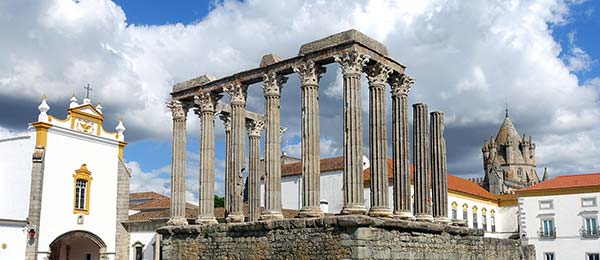
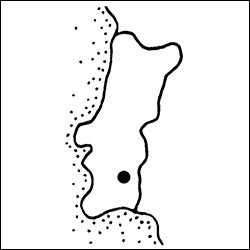
Deep in the heart of Portugal, in the sizzling, arid plains of the southern province of Alentejo, historic Évora (EH-voh-rah) has been a cultural oasis for 2,000 years. With an untouched provincial atmosphere, a fascinating whitewashed old town, museums, a cathedral, a chapel of bones, and even a Roman temple, Évora (pop. 57,000) stands proudly in a vast sea of cork groves and olive trees.
From Romans to Moors to Portuguese kings, this little town has a big history. Évora was once a Roman town (second century BC to fourth century AD), important because of its wealth of wheat and silver, as well as its location on a trade route to Rome. You’ll still see Roman sights, including several fragments of an aqueduct and the towering columns of a temple. But most of Évora’s Roman past is buried under the cityscape of today (often uncovered by accident when plumbing work needs to be done in basements).
The Moors ruled Évora from the 8th to the 12th century. Around the year 1000, Muslim nobles divided the caliphate into small city-states (like Lisbon), with Évora as this region’s capital. And during its glory years (15th-16th century), Évora was favored by Portuguese kings, often serving as the home of King João III (1502-1557, Manuel I’s son who presided over Portugal’s peak of power...and its first decline).
Évora—a traditional, conservative city with a small-town feel—reopened its historic university about 40 years ago. You’ll see plenty of black-caped students here, along with lots of retirees, but comparatively few 30- to 40-year olds. There’s not much to keep graduates around, and this generation gap gives the town an intriguing mix of old and new—strong traditions underlie its youthful bustle.
PLANNING YOUR TIME
With easy bus and train connections to Lisbon (hourly buses, 2 hours; five trains a day, 1.5 hours), Évora makes a decent day trip from Portugal’s capital city. Better yet, spend the night—ideally en route to or from the Algarve. Along the way, drivers can explore dusty droves of olive groves, scruffy seas of peeled cork trees, and some dramatic prehistoric monuments.
A day in Évora is enough to fully experience the town. Follow my self-guided walk in this chapter, have a quick lunch, see the remaining sights (cathedral, Chapel of Bones, university), and enjoy a leisurely, top-notch dinner. Late in the evening, stroll the back streets and ponder life, like the old-timers of Évora seem to do so expertly.
Orientation to Évora
Évora’s Old Town, contained within a medieval wall, is surrounded by the sprawling newer part of town. The walled center (where you’ll spend virtually all your time) is large and built on a substantial hill—it takes about 20 minutes to cross from one end of town to the other, on cobbled streets that are anything but straight. The major sights—the Roman Temple and the cathedral—crowd together at the Old Town’s highest point. A good rule of thumb is if you’re walking uphill, eventually the cathedral should come into sight; walk downhill and you’ll run into the city wall. A subtle yet still-powerful charm is contained within the medieval walls. Find it by losing yourself in the quiet lanes of Évora’s far corners.
TOURIST INFORMATION
Pick up a free map at the TI on the main square at Praça do Giraldo 73 (daily 9:00-19:00, until 18:00 off-season, +351 266 777 071, www.cm-evora.pt/en).
ARRIVAL IN ÉVORA
By Bus: The bus station is west of the center, on Avenida de São Sebastião. To reach the town center, take a short taxi ride (€5) or a 10-minute walk (exit station right, continue straight all the way into town, past the cemetery wall and through the city gates at the halfway point).
By Train: The train station is south of the center, on Avenida Dr. Barahona. To get to the center, take a taxi (€7), or walk a long 25 minutes up Avenida Dr. Barahona, continuing straight on Rua da República after you enter the city walls.
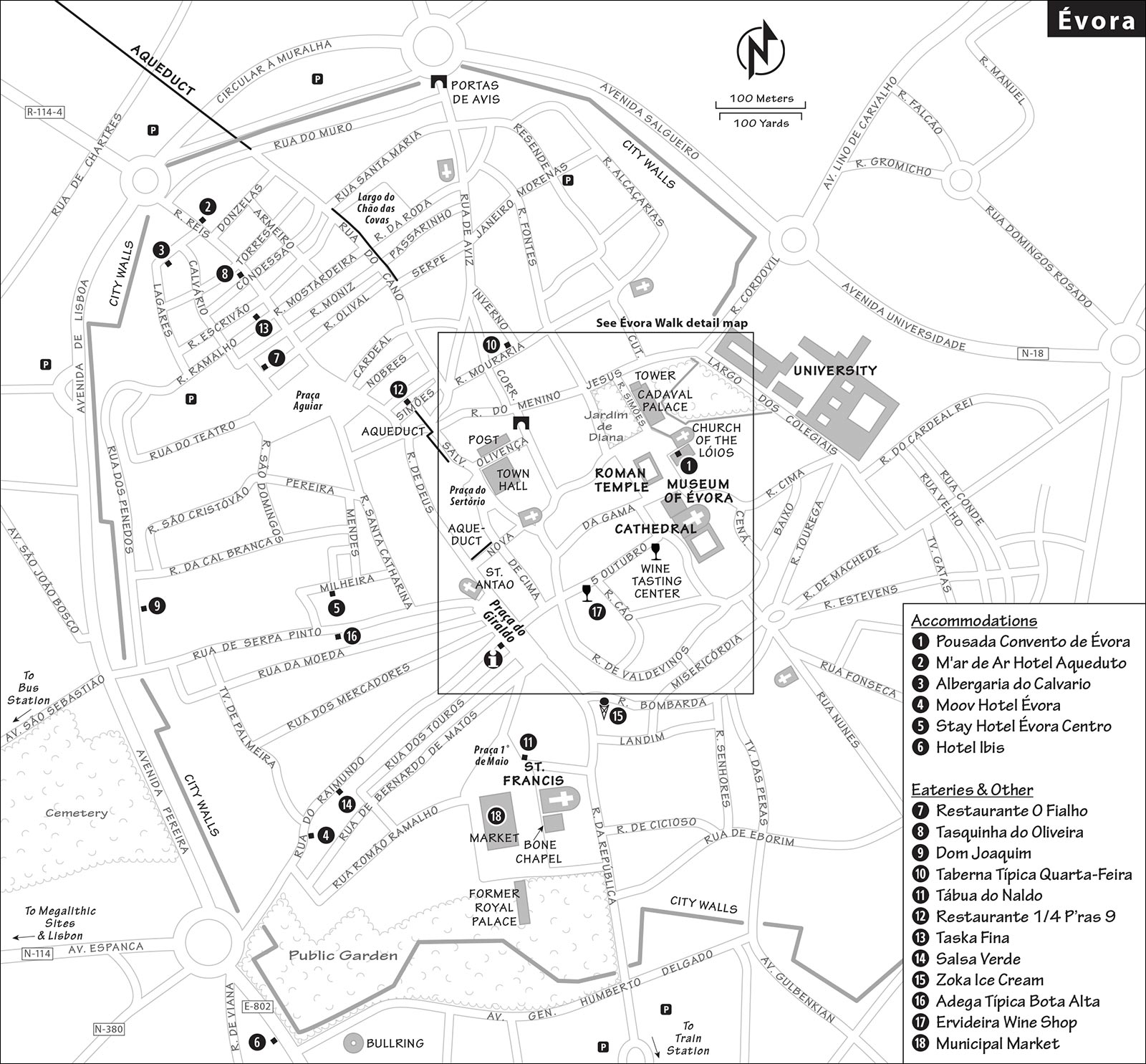
By Car: Drivers will find Évora’s Old Town frustrating because of its tiny one-way streets. Park in one of the big, free parking lots that circle the town just outside the walls (see the “Évora” map, later, for locations). The green-and-white Trevo shuttle bus (see below) serves the parking lots and gets you near most hotels, or—if you’re packing light—you can walk (though some streets can be steeper than maps suggest).
HELPFUL HINTS
Taxis: Cabs wait on the main square (€4 minimum for 2.5 miles—4 kilometers—likely the farthest you’d go in compact Évora).
Shuttle Bus: A faded, blue line on the streets mark the Linha Azul route of the green-and-white Trevo shuttle bus that circles through town, offering tourists easy transport to and from the parking lots outside the walls. Hop on for a city joyride (€1); they stop for anyone who waves (4/hour, Mon-Sat 8:00-20:00).
Tours in Évora
City Walking Tour
A group of local guides offers excellent two-hour city walks every morning, departing from the TI at 10:00 (€18, 2-person minimum, call ahead to confirm tour will run, mobile +351 963 702 392, info@alentejoguides.com). The tour hits the sights described in this chapter, but it’s also a great opportunity to connect with a local and enliven your visit. They are happy to schedule tours at other times (prices vary, 2-person minimum).
Bus Tours to Nearby Sights
A bus tour is a good option for seeing the prehistoric sights near Évora, since getting there by public transport is nearly impossible. Ebora Megalithica Guided Tours runs an interesting three-hour minivan tour led by archaeologist Mário to Cromeleque dos Almendres, the standing stone of Menhir dos Almendres, and the Zambujeiro burial mound (€30, Mon-Sat at 10:00 and 14:00, no tours Sun, groups of 3-7 people, reserve a day ahead, +351 964 808 337, www.eboramegalithica.com).
RSI offers several half-day bus and minivan tours into the surrounding countryside. Their “Megalithic Circuit Tour” visits the main prehistoric sights, including Cromeleque dos Almendres (departs daily at 9:30 and 14:30 from Praça do Giraldo, €30/half-day, 2-person minimum, discounts for larger groups, reserve a day ahead, +351 266 747 871, www.rsi-viagens.com).
Local Guides
Libânio Murteira Reis is passionate about his native Alentejo region and sharing it with others. He organizes town and regional tours; he’ll even take you around in his car (€150/half-day, €270/day for a family up to 4, transport—when required—and admission fees not included, +351 917 236 025, www.evora-mm.pt).
Maria José Pires does walking tours of Évora as well as car tours of the surrounding area (€130/half-day, €205/day, car tour price varies with distance, +351 917 232 147, m-jose-pires@hotmail.com).
Évora Walk
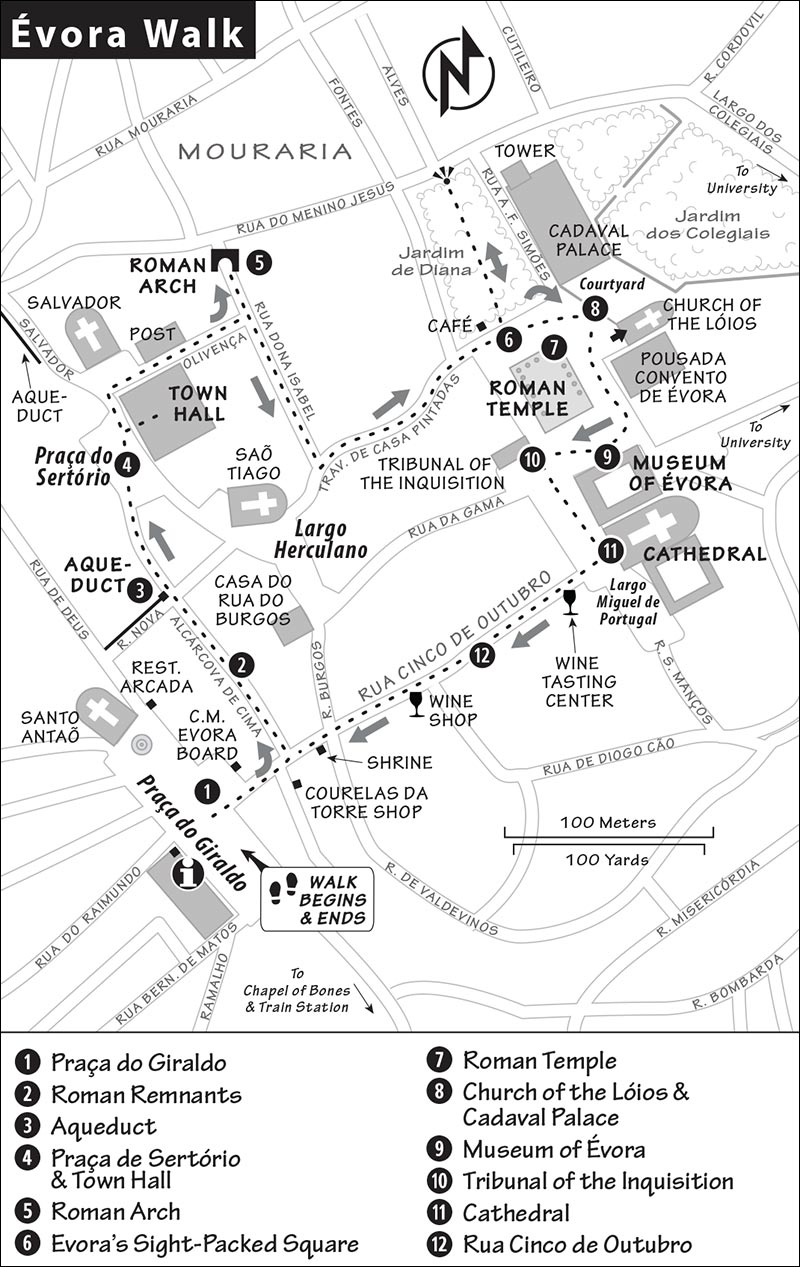
Évora’s walled city is compact, and its key sights are all within a five-minute walk of the main square, Praça do Giraldo (PRA-suh doo zhee-RAHL-doo). This self-guided walk takes about an hour (longer if you visit sights). If it’s going to be a hot day, go early in the morning.
• Start at Évora’s main square.
1 Praça do Giraldo
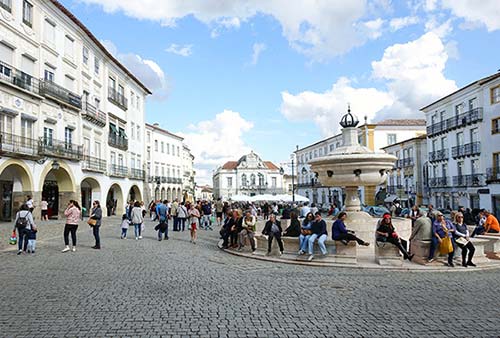
This square was the market during the Moorish period, and to this day, it remains a center of commerce and conviviality for country folk who come to Évora for their weekly shopping. Until recently, the square hosted a traditional cattle-and-produce market. While ranchers and farmers no longer gather in the square to make deals, old-timers still gravitate here out of habit.
Notice the C.M. Évora board (opposite the TI, near the start of Rua Cinco de Outubro), where people gather to see community notices. You’ll see the initials “C.M.E.”—Câmara Municipal de Évora (the official name of the Town Hall)—all over town, on everything from lampposts to manhole covers.
The square is named for Giraldo the Fearless, the Christian knight who led a surprise attack and retook Évora from the Moors in 1165. As thanks, Giraldo was made governor of the town, and he’s become the symbol of the city. (Évora’s coat of arms is a knight on a horse, usually walking over two beheaded Moors; see it crowning the lampposts.) On this square, all that’s left of several centuries of Moorish rule is their artistry, evidenced by the wrought-iron balconies of the buildings that ring the square. You’ll also spot the occasional, distinctive Mudejar “keyhole” window throughout the town.
King João III lived in Évora off and on for 30 years. The TI is inside the palace where the king’s guests used to stay, but others weren’t treated as royally. A fervent proponent of the Inquisition, João was king when its first victims were burned as heretics on this square in 1543.
Speaking of the Inquisition, until the 16th century, the area behind the TI was the Jewish quarter. At the time, it was believed that the Bible prohibited Christians from charging interest for loans. Jews did the moneylending instead, and the streets in the Jewish quarter still bear names related to finance, such as Rua da Moeda (Money Street) and Rua dos Mercadores (Merchants’ Street).
The characteristic arcades you see all around the square suit the weather, providing shelter in the winter and shade in the summer.
The Roman triumphal arch that once stood on this square was demolished in the 16th century to make way for the looming Church of Santo Antão. In front of the church is a 16th-century marble fountain—once an important water source for the town (fed by the end of the aqueduct we’ll see in a minute) and now a popular hangout for young and old.
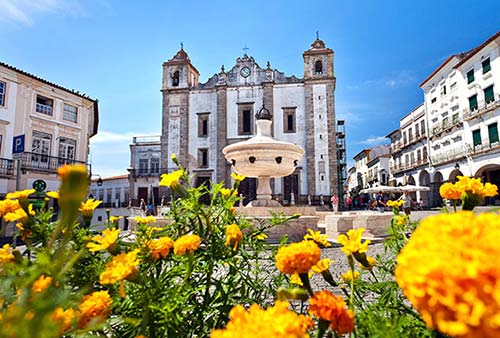
Radiating out from this town hub, in every direction, are traditionally decorated cobbled streets—centuries old and protected by law. Évora has strictly preserved the old center, and works hard to be people-friendly and inviting. The colors you see are traditional in Alentejo: Yellow trim is believed to repel evil spirits, and blue actually does keep away flies. Monster garbage cans hide under elegant smaller ones; at night, trucks lift entire hunks of sidewalk to empty them. Jacaranda trees—imported from Brazil 200 years ago—provide shade through the summer and purple flowers in the spring.
• Leave the square on Rua Cinco de Outubro (opposite the TI). At the first corner, a quick detour down the street to your right is Courelas da Torre, a good little shop for gifty gourmet goodies from the region (daily 10:30-19:00, on the left at #5). Outside, note how the back of the shop incorporates the old Roman-Arab wall. Return to the main drag, then continue past Mr. Pickwick’s Restaurante on Alcárcova de Cima. A few steps farther on, you’ll see another portion of a Roman wall built into the buildings on your right.
2 Roman Remnants
Looking through a series of modern windows, you see more of the Roman wall, which used to surround what is now the inner core of the town. Through the last window, look down to see the red paint of a Roman villa’s dining room built over by the wall. Behind the counter of the inviting pastry shop on the right is another exposed stretch of Roman wall. If you look at your town map, you’ll notice how the Roman wall, which surrounded the ancient city, left its footprint in the circle of streets defining the city core. The bulk of the wall that currently encircles Évora is from the 14th century, with a more modern stretch from Portugal’s 17th-century fight for independence from Spain.
Southeastern Portugal is very sunny and very dry. The rolling plains of the Alentejo (ah-len-TAY-zhoo) are dotted with large orchards and estates, Stone Age monoliths, Roman aqueducts, Moorish-looking whitewashed villages, and thick-walled, medieval Christian castles.
During the Christian reconquest of the country, Alentejo was the war zone. When Christian conquerors defeated the Muslims, they turned over huge tracts of recaptured land to the care of soldier-monks. These recipients came from various religious-military orders, including the Knights Templar and the Order of Christ (which Prince Henry the Navigator once headed). Évora was governed by the nearby House of Avis, which produced the kings of Portugal’s Age of Discovery.
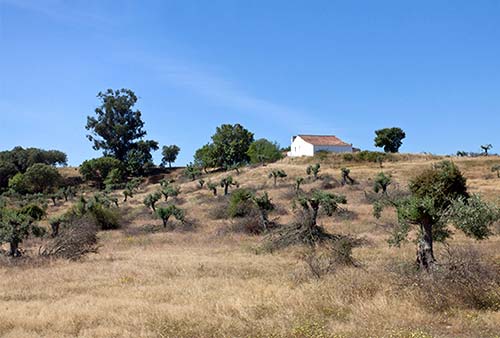
Despite its royal past, the Alentejo (the land “beyond the River Tejo”) is the unpretentious terrain of farmers. Irrigated since Roman and Moorish times, the region is a major producer of wheat, cattle, wine...and trees. You’ll see cork oak trees (green leaves, knotted trunks, red underbark of recently harvested trunks), other types of oak (native, once used to build explorers’ caravels), olive (dusty green-silver leaves, major export crop), and eucalyptus (tall, cough drop-smelling trees imported from Australia, grown for pulp).
Today, the Alentejo region is known for being extraordinarily traditional, and it is even considered backward by snooty Lisboans. The people of Alentejo don’t mind being the butt of jokes. My friend from Évora said it was the mark of a people’s character to be able to laugh at themselves. He asked me, “How can you tell a worker is done for the day in Alentejo?” I didn’t know. He said, “When he takes his hands out of his pockets.” He continued more philosophically: “In your land, time is money. Here in Alentejo, time is time. We take things slow and enjoy ourselves.” I’m impressed when a region that others are inclined to insult has a strong local pride.
• Walk straight. Cross the street (Rua Nova) and stop at the...
3 Aqueduct
This blunt granite-columned end of the town’s aqueduct is a relic from the 16th century. The Portuguese have such a fondness for their aqueduct reservoirs that they give them a special name—Mãe d’Agua (Mother of Water). Notice the abnormally high sidewalk just beyond the columns—it’s the aqueduct channel. (On the outskirts of town, the channel sits even higher, supported by stone pillars that kept the water flowing downhill.)
• Continue straight and keep walking along the aqueduct to the next square.
4 Praça de Sertório and Town Hall
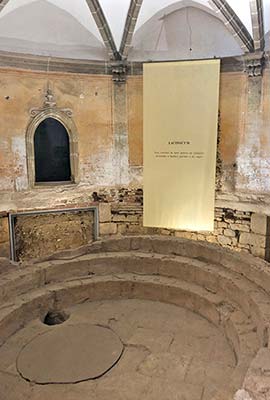
Until recently, this square was congested with parked cars—but it’s now a good example of how the town has become pedestrian-friendly. The tallest white building on the square is the Town Hall. They love visitors, so step inside. The lobby is often used to show off local projects the mayor wants to promote. In the corner on the right is a view of a Roman bath that was uncovered during a building repair.
Exiting the Town Hall, turn right. Look up to see a church and convent (one of about 20 in town—but this one is now a cultural center with interesting, free exhibits and a post office). Notice how the buildings are built right into a Roman tower (once part of the Roman wall you saw earlier). The grilled windows at the top of the tower enabled the cloistered sisters to enjoy looking at the busy town without being seen. Smile.
• Take a right turn and walk under the arcades past the post office (signed CTT) and take the first left, on Rua de Dona Isabel. You’ll immediately see a...
5 Roman Arch
This arch, the Porta de Dona Isabel, was once a main gate in the Roman wall. Below are some of the original Roman pavement stones, large and irregular in size and placement.
Beyond the arch is a neighborhood called Mouraria (“district of the Moors”). After Giraldo the Fearless retook Évora, the Moors were still allowed to live in the area, but on the other side of this gate, beyond the city walls. They were safe here for centuries...until the Inquisition expelled them in about 1500.
• Don’t go under that arch. Instead, turn around and head uphill one block. Turn left and continue further uphill on the stony little Travessa das Casas Pintadas, which leads to...
6 Évora’s Sight-Packed Square
Here, at the town’s high point (1,000 feet above sea level), you’ll see many of Évora’s main landmarks. There’s the Roman Temple, and the palace and the private chapel of the powerful local Cadaval clan (Cadaval Palace, on the left side of the square). Just beyond the Cadaval chapel is the recommended Pousada Convento de Évora, once a 15th-century Lóios monastery but now a luxurious hotel with small rooms (blame the monks). At the far end of the square (not visible from here, but we’ll go there soon) are the Museum of Évora and the headquarters of the Inquisition.
The fine little park facing the Roman Temple is the Jardim de Diana, named when the temple was (mistakenly) thought to be dedicated to Roman goddess Diana. And facing the temple is a delightful little café, the Jardim de Diana Quiosque, serving drinks and snacks in the shade.
• With the temple behind you, head to the viewpoint at the edge of the park to enjoy a commanding view. You’re standing upon what was the medieval wall. Find the tower to your right and look straight down. The higgledy-piggledy town stretching before you was the old Moorish Quarter (the Mouraria). In the Alentejo distance you can see vineyards and (at 10:00) the old aqueduct.
Back on the square are the stirring ruins of the...
7 Roman Temple
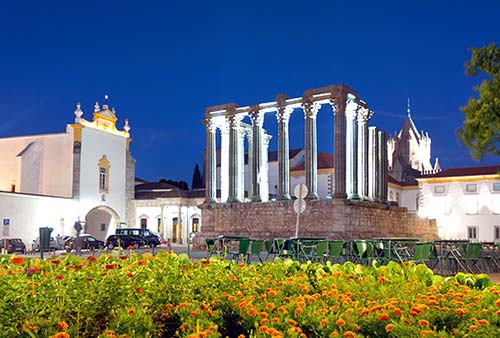
Imagine this spot 2,000 years ago: a fine colonnaded square with reflecting ponds on three sides of a grand temple dedicated to Rome’s emperors. Little is left today, beyond the 14 Corinthian columns and marble capitals (locally sourced from the Alentejo region). This temple was part of the Roman forum and the main square back in the first century AD. Today the town’s open-air concerts and events are staged here against an evocative ancient temple backdrop. It’s beautifully floodlit at night.
• Facing the Roman temple is the...
8 Church of the Lóios and Cadaval Palace (Palacio Cadaval)
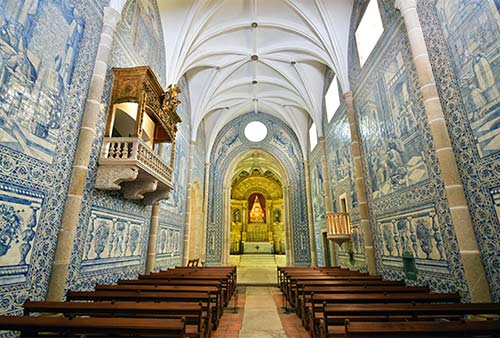
This is the palace and lavish mausoleum chapel of the noble Cadavals, who are still a big-time family today—which is why they charge a stiff entry price. If you’re on a budget, it’s skippable, but if you appreciate beautiful and serene churches, the impressive gold altarpiece is worth experiencing—as is being surrounded by heavenly blue-and-white tiles.
Cost and Hours: €7, includes church and palace, daily 10:00-18:00, on the square facing the Roman Temple, mobile +351 967 979 763, www.palaciocadaval.com.
Visiting the Church and Palace: Directly in front of the pousada, stairs lead down into the church. You’ll walk upon Cadaval tombstones throughout your visit; taped chants and liturgical music add to the ambience. Look for the two small trapdoors in the floor that flank the aisle, midway up the church. The one on the right opens up to a deep, dark well (the palace and its church sit upon the remains of a Moorish castle—this was its cistern); the one on the left reveals an ossuary stacked with bones, supposedly belonging to former monks. The noble box (middle of the church, high above the pews) is a reminder that the aristocratic family didn’t worship with commoners below. The tilework around the altar is from the 17th century—mere decoration with traditional yellow patterns. Along the nave, the tiles are 18th-century, with scenes illuminating Bible stories. The popularity of these tiles (inspired by the blue-and-white Delft tiles of the Netherlands) coincided with the flourishing of tapestries in France and Belgium that had the same teaching purpose.
The grilled windows allowed the Cadaval family to worship without being seen. The room to the right of the altar contains religious art, including a cleverly painted Crucifixion and rare Muslim tilework.
Your ticket includes a walk through the less exciting Cadaval Palace. Next to the church entrance, you’ll cross the inviting family courtyard (now filled by a restaurant they operate), and follow signs upstairs and around the courtyard to the palace interior. The rooms are filled with old furniture, portraits, handwritten documents, and other historic artifacts.
• Just south of the church and palace complex is the...
9 Museum of Évora
This ▲ museum stands where the Roman forum once sprawled. Housed in the old archbishop’s palace since 1929, the museum covers the city’s history beginning with prehistoric times. An excavated section of the forum is in the museum’s courtyard, surrounded by a delightful mix of Roman finds, medieval statuary, and 16th-century Portuguese, Flemish, Italian, and Spanish paintings. The highlights are 13 cathedral altar panels painted with exquisite detail (from Belgium, c. 1500). The museum also contains megalithic artifacts, including some found near Évora at the tomb known as the Anta Grande do Zambujeiro. The included audioguide does an earnest job taking the obscure works of art seriously and describing them well.
Cost and Hours: €3, Tue-Sun 9:30-13:00 & 14:00-17:30, closed Mon, Largo Conde de Vila Flor, +351 266 713 480, www.museudevora.pt [URL inactive].
• Across the square from the museum is a white building with the top windows trimmed in yellow. This was the...
10 Tribunal of the Inquisition
This building stands as a reminder of Évora’s notorious past as a tribunal site during Portugal’s Inquisition—a dark and violent period that holds lessons worth learning even today. This was the first of four such headquarters of fear and hatred in Portugal. Here, thousands of innocent people, many of them Jews, were tried by a tyranny of the majority and found guilty of crimes against faith. Punishment could be anything from whipping, imprisonment, banishment, slave labor, or, for the most unlucky, death by burning on the main square.
More recently, the structure has been converted into the Fundação Eugenio de Almeida—a contemporary art museum, with exhibits that change every four months. Art lovers can see what’s on and decide whether it’s worth the cost of entry.
• Directly across the square from the former Inquisition building, set on its own little leafy square, is the cathedral. (Note that Évora’s historic university is just a few blocks away and, while not on this walk, makes a convenient detour from this point. See the listing under “Sights in Évora,” later.)
11 Évora Cathedral (Sé de Évora)
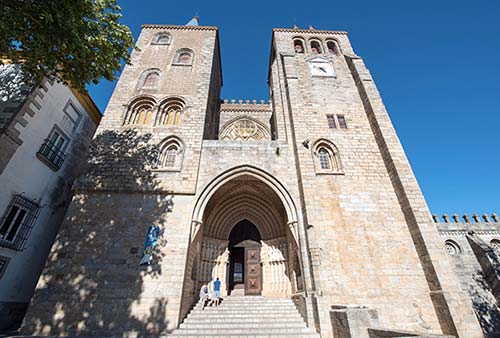
Portugal has three archbishops, and one resides here in Évora. This important cathedral of Santa Maria de Évora, worth ▲ and built in the late 12th century, is a transitional mix of Romanesque and Gothic styles. As happened throughout Iberia, this church was built upon a mosque after the Reconquista succeeded here. That mosque was built upon a Christian Visigothic chapel, proving that religious and military tit-for-tat is nothing new.
Cost: There’s a dizzying variety of tickets, combining the cathedral interior, the cloisters, the Museum of Sacred Art (treasury/tesouro), and the viewpoint (called both terrace/terraço and tower/torre). The easiest option is to purchase a ticket for the whole shebang at €4.50 and see it all.
Hours: Daily 9:00-18:00, off-season until 17:00, last entry to Museum of Sacred Art one hour before closing. There’s a WC in the cloister.
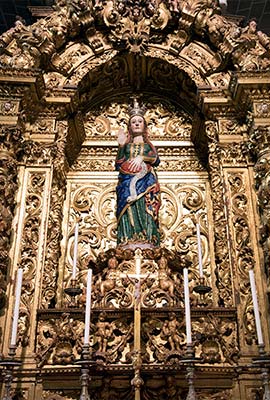
Visiting the Cathedral: Inside the cathedral, in a sumptuous Baroque chapel midway down the nave on the left, is a 15th-century painted marble statue of a pregnant Mary. It’s thought that the first priests, hoping to make converts out of Celtic pagans who worshipped mother goddesses, felt they’d have more success if they kept the focus on fertility. Throughout Alentejo, there’s a deeply felt affinity for this ready-to-produce-a-savior Mary. Loved ones of mothers giving birth pray to her for blessings during difficult deliveries. Across the aisle, a more realistic Renaissance Gabriel, added a century later, comes to tell Mary her baby won’t be just any child.
The 16th-century pipe organ still works. Step up close to the high altar to view the ornately decorated chapel filling the apse. The royal box (high on the right, covered in gold leaf) looks down on the space, which is decorated almost entirely with colored marble. Only the muscular, crucified Jesus is not marble—he’s carved in wood, yet matches the marble all around.
The Museum of Sacred Art (Museu de Arte Sacra) is to the right of the main altar. Signage is sparse, but make your way through the chapel reproduction at the entrance, go past the elevator, then turn right. You’ll enter a long series of rooms displaying ornaments and artifacts used in the cathedral over the centuries. The highlight (at the end) is a sparkling reliquary heavily laden with more than a thousand gems—diamonds, rubies, emeralds, and sapphires—and supposedly containing pieces of the True Cross (in a cross shape). Backtrack and go up a flight of steps to floor 2 to find an intricate 14th-century, French-made, puzzle-like ivory statue of Mary (Virgem do Paraiso). Her “insides” open up to reveal scenes of her life. A photo below shows Mary folded up and ready to travel. Not much else of interest is on this floor except perhaps Our Lady of Good Death—Nossa Senhora da Boa Morte—displayed toward the chapel.
Return to the church (scan your ticket again to leave the museum). The entrance to the Gothic cloister is past the ticket booth to the left. The cloister’s openness and orange trees make it a cool haven, even on the hottest of Alentejo afternoons. Carvings of the four evangelists decorate the corners. Near where you enter, a tight spiral stairway leads to the “roof,” with close-up views of the cathedral’s fortress-like crenellations and grand views of the Alentejo plains. This “fortress of God” design was typical of the Portuguese Romanesque style. Notice the small relief (carved in the wall to the right as you face the church) showing the local Christian hero Giraldo the Fearless with two severed Muslim heads. Back on ground level, a simple chapel niche (opposite the cloister entry) has a child-sized statue of another pregnant Virgin Mary (midway up wall on left).
For the best views of the surrounding plains, return to the ticket booth and climb even more stairs to reach the church’s rooftop terrace. Get up close to the church bells and the cathedral’s fine lantern tower. Baroque flaming vases provide an interesting foreground to the rolling hills.
• Head downhill on the little street opposite the cathedral’s entrance. You’re back on...
11 Rua Cinco de Outubro
This shopping street, which has served this same purpose since Roman times, connects Évora’s main sights with its main square. Its name celebrates October 5, 1910, when Portugal shook off royal rule and became a republic. The street is lined with products of the Alentejo region: cork (even used to make postcards), tile, leather, ironwork, and Arraiolos rugs (handmade with a distinctive weave, in the nearby town of the same name).
Feeling parched? Two wonderful opportunities to taste Alentejo wines are along this street. First, on the left at #88, is the modern Rota dos Vinhos do Alentejo Wine Tasting Center, which offers €5 tastings of four to six local wines, plus bottles for purchase (most are €5-20). Familiarize yourself with little-known Portuguese grape varietals (castas) as wines change weekly. The staff can give you details about the Alentejo wine route and schedule visits to nearby cellars (tasting center open Mon-Fri 10:00-17:30, Sat 11:00-15:00, closed Sun, +351 266 746 498, www.vinhosdoalentejo.pt).
To get to know a local producer, stop in at the Ervideira Wine Shop at #56 (also on the left). It sits in the old family home of the Count of Ervideira—look for the shrine remnants holding some of the oldest bottles from their nearby winery. They make crisp whites (even from the red tempranillo grape), earthy reds from a secret family recipe, rosés, and the occasional sparkling wine (€6 tasting fee for 4 wines, €10-20 guided tastings available—reserve ahead, open daily 11:00-19:00, www.ervideira.pt).
As you stumble down the shopping street after all that wine, stop to look left and up (at #28) to see a blue shrine protruding from the wall of a building. The town built it as thanks to God for sparing it from the 1755 earthquake that devastated much of Lisbon. The entire region is chock full of marble, which helped absorb much of the shockwave.
You’ve returned to the main square. The Chapel of Bones and town market are just a few blocks away on your left. But first, stop by the Restaurante Arcada, under the arcade to the right (across from the church). It’s the best pastry shop in town with good coffee and the local specialty: a fresh, sweet cheesecake-like tart (queijada, kay-ZHAH-duh).
Sights in Évora
Évora’s most central sights are covered on my town walk, but you’ll find several more worthwhile sights beyond the old town center. For locations, see the “Évora” map, earlier.
AT THE SOUTHERN END OF THE OLD TOWN
These sights are within a few steps of each other, about a five-minute walk south of the main square, off Praça 1º de Maio.
▲▲Church of St. Francis and the Chapel of Bones (Igreja de São Francisco/Capela dos Ossos)
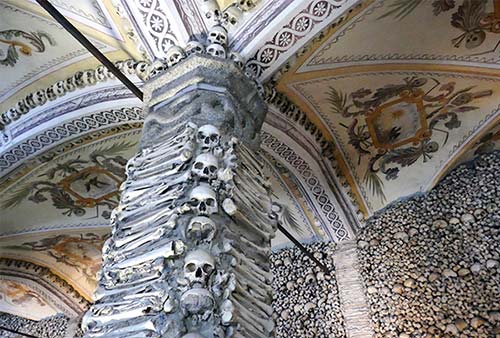
The Franciscan order arrived in Évora in 1224. In the 14th century, they built this Gothic church and a convent surrounding a fine cloister. The church and its Chapel of Bones are worth the stroll to the southern edge of the old town. The main attraction is the macabre chapel, with the skulls and bones of 5,000 monks tightly cemented to the walls, with barely a gap in sight.
Cost and Hours: Church-free, Chapel of Bones-€5, daily 9:00-18:30.
Visiting the Church and Chapel: Imagine the church in its original, pure style—simple, as St. Francis would have wanted it. It’s wide, with just a single nave lined by chapels. In the 18th century, it became popular for wealthy families to buy fancy chapels, resulting in today’s gold-leaf hodgepodge. The huge Baroque chapel to the left of the altar is dedicated to St. Francis and Claire—his partner in Christ-like simplicity. You’ll see them both flanking the altar, surrounded by anything but poverty. The chapel is slathered in gold leaf from Brazil. The fine 18th-century tiles tell stories of St. Francis’ life.
The entrance to the bone chapel (Capela dos Ossos) is outside, to the right of the church entrance. After buying your ticket, head to the right to find the macabre chapel. The message above the door translates: “We bones in here wait for yours to join us.” Inside, bones line the walls, and a chorus of skulls stares blankly from walls and arches. They were unearthed from various Évora churchyards. This was the work of three monks who were concerned about society’s values at the time. They thought this would provide Évora, a town noted for its wealth in the early 1600s, with a helpful place to meditate on the transience of material things in the undeniable presence of death. The bones of the three Franciscan monks who founded the church in the 13th century are in the small white coffin by the altar (at the far end of the bone chapel).
Your ticket also includes a few sights upstairs (entrance back near the ticket desk): a low-impact museum of ecclesiastical art, and a worthwhile collection of nativity scenes filling two corridors, separated by a view terrace. St. Francis famously “invented” the manger scene as a tool to teach the Christmas story. This exhibit displays just a fraction of the 2,600 pieces donated by a local collector who really, really liked nativity scenes. More than half are from Portugal, but those are joined by examples from around the world.
▲Municipal Market (Mercado Municipal)
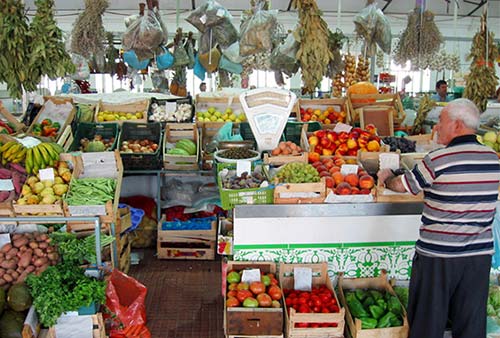
Across the square in front of the Church of St. Francis is a modernized yet still charming farmers market. The more fragrant fish section is a free-standing section out back. It’s busiest in the morning and on Saturday (Tue-Sun 7:00-18:00, generally closed Mon though a few rogue stands might be open). Wander around. It’s a great slice-of-life look at this community. People are proud of their produce. Stock up for a picnic, perhaps in the adjacent gardens. Don’t miss the corner ceramic store (facing the church) filled to the ceiling with colorful and affordable pottery made in the village of Corval, 27 miles away. There are also several good little eateries in the market and nearby.
▲Public Gardens (Jardim Público)
Take a refreshing break in the town’s public gardens (main entrance across from market, at the bottom of Praça 1º de Maio). Just inside the gate, Vasco da Gama looks on with excitement as he discovers a little kiosk café nearby selling sandwiches, freshly baked goodies, and drinks. For a quick little lunch, try an empada de galinha (tiny chicken pastry) and perhaps a queijada (sweet cheese tart—a local favorite). The gardens, bigger than they look, contain an overly restored hunk of the 16th-century Royal Palace (right of the entry gate). Behind the palace, look over the white concrete balustrade to see a kids’ playground and playfields.
NORTHEAST OF THE ROMAN TEMPLE
From Évora’s Roman Temple and cathedral, the university is about a five-minute walk.
▲University of Évora (Universidade de Évora)
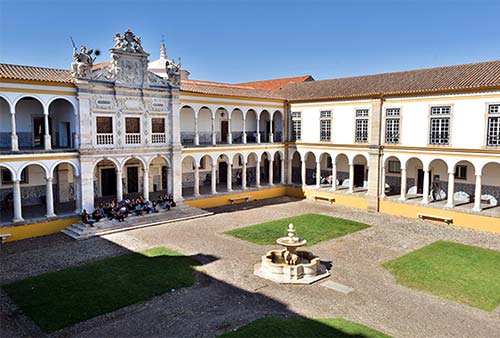
While far less monumental than Coimbra’s (see here), Évora’s historic university is worth exploring—especially during the school year, when it offers a chance to rub elbows with students filling its blue-tiled galleries.
Cost and Hours: €3, Mon-Sat 9:30-17:30, closed Sun, Largo dos Colegiais 2, +351 266 740 800, www.uevora.pt.
Background: First known as the College of the Holy Spirit, this institution was established as a Jesuit university in 1559 by Henrique, brother of King João III and the cathedral’s first archbishop (1512-1580). Henrique later became king himself after his great-nephew Sebastian (Sebastião, who had succeeded João III) died in a disastrous attempt to chase the Moors out of North Africa. Because Henrique was a cardinal—and therefore chaste—he left no direct descendants when he died only two years later. Portugal’s throne passed to Sebastian’s uncle, King Philip II of Spain, beginning 60 years of Spanish rule—and the start of Évora’s decline.
Two hundred years after the founding of the Jesuit university, Marquês de Pombal (see sidebar, here), the powerful minister of King José I, decided that the Jesuits had become too rich, too political, and—as the sole teachers of society—too closed to modern thinking. He abolished the Jesuit society in 1759, confiscated their wealth, and closed the university. Another 200 years later, in 1979, it reopened, but this time as a secular university. Injecting 7,000 students into this town of 57,000 people (with about 10,000 inside the walls) brought Évora a new vitality—and discos. Unlike an American-style centralized campus, the colleges are scattered throughout the town. But this building is its historic core, and the closest thing to a student union building.
Visiting the University: The university’s main entrance is the old courtyard on the ground level (downhill from the original Jesuit chapel—facing the grassy quad-like square). Enter the inner courtyard. Attractive blue-and-white tiles (one of the biggest and best-preserved collections south of Lisbon) ring the walls of the courtyard as well as the classrooms lining the courtyard arcades. Explore. If class is not in session, they usually leave the door open for curious tourists to peek in. The tiles within classrooms portray the subject originally taught in each room. Notice the now-ignored pulpits. (Originally, Jesuit priests were the teachers, and information coming from a pulpit was not to be questioned.)
Enter the ceremonial room directly across the courtyard from the entrance. Major university events are held here under the watchful eyes of Cardinal Henrique (the painting to the left) and young King Sebastian (to the right).
Sala 114, to the right of this room, gives you a great look at more tiles. In the 16th century, this was a classroom for students of astronomy—note the spheres and navigational instruments mingled with cupids and pastoral scenes. Imagine the class back then. Having few books, if any, the students (males only) took notes as the professor taught in Latin from the lectern in the back.
To find the university’s cafeteria, follow the passage to the right of Sala 114, which connects to a smaller courtyard. The cafeteria (marked bar) is in the far-right corner. In the alcove just outside, notice the big marble washbasin. The cafeteria thrives with students and offers anyone super-cheap meals (Mon-Fri 8:30-18:00, closed Sat-Sun, WC).
MEGALITHIC SITES NEAR ÉVORA
This region has been a historic crossroads for millennia—the three river basins that intersect here provided a rich, fertile area for prehistoric people to thrive. Human civilization’s long presence here on the plains of Alentejo is marked by megalithic sites—some of the most important such stony configurations in the Iberian Peninsula—dating from 5500-3000 BC.
Near Évora, you’ll find menhirs (solitary standing stones, near Nossa Senhora de Guadalupe and elsewhere), cromlechs (monolith circles, at Cromeleque dos Almendres), and dolmens (stone slabs such as the rock tombs of Anta Grande do Zambujeiro, near Valverde; and Anta Capela de São Brissos—which was later Christianized, capped with a terra cotta roof, and painted white and blue). The most interesting to visit are Cromeleque dos Almendres and the Anta Grande do Zambujeiro, described on the next page. Both of these sights are immersed in classic Alentejo scenery: cork-tree groves and a dusty, parched terrain.
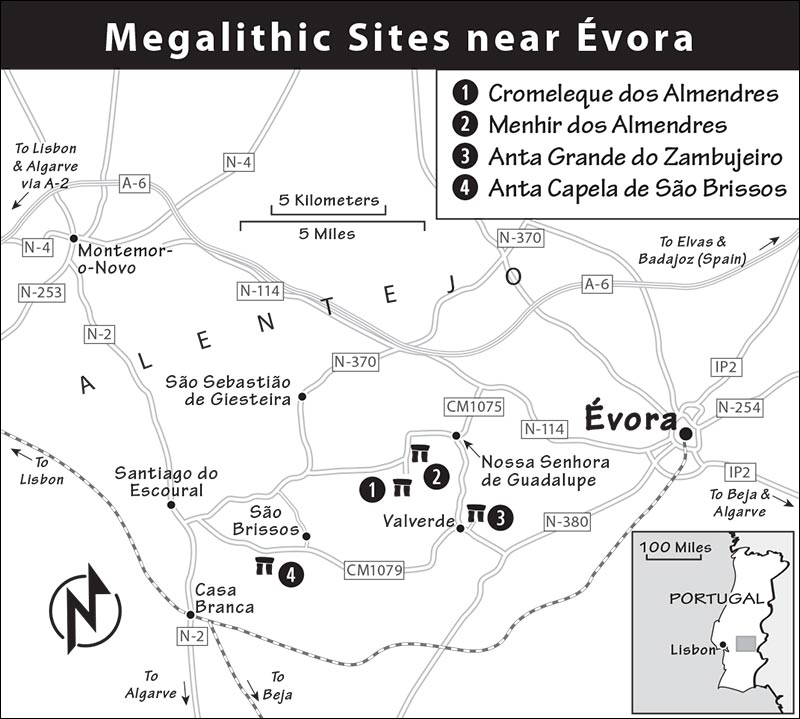
Depending on how much you want to see, you can do a 15- to 45-mile loop from Évora by bus tour or hire a guide with a car (see “Tours in Évora,” earlier), or rent a car to do the loop on your own (Évora’s TI has a list of rental-car agencies and a map of the sites).
▲Cromeleque dos Almendres
This Portuguese Stonehenge, dating from about 5500 BC, stands in the midst of cork trees down a dirt road.
Getting There: It’s five miles (20 minutes) west of Évora, down a dirt road that begins in the village of Nossa Senhora de Guadalupe (just south of where N-114 highway meets A-6 expressway). In the village, look for the brown Almendres signposts that lead you down a well-tended dirt road through cork trees. It’s a bit over a mile to the menhir, then another mile-plus to the cromlech.
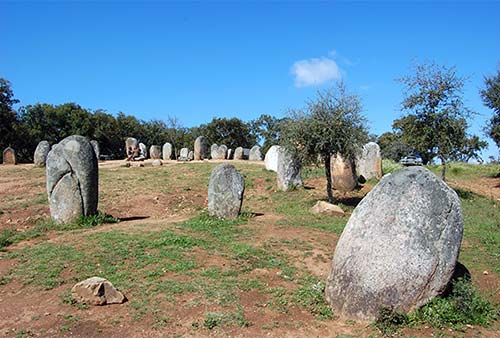
Visiting the Stones: Heading down the road, first you’ll pass the pullout for the less-interesting sight, a lone 10-foot menhir—it’s about a five-minute walk along a rutted dirt path from the parking pullout. This menhir lines up with the cromlech at sunrise on the summer solstice.
For a more dramatic site, continue to where the road ends, park, and walk a couple of dusty minutes to the cromlech (cromeleque, meaning “enclosure”)—95 rounded granite stones erected in the shape of an oval. It’s the largest megalithic monument in Iberia and one of the oldest in Europe, some 2,000 years older than Stonehenge. Discovered in the 1960s, it was carefully re-erected in its current position. Look closely at the stones; some have raised carvings, barely visible, of circles and shapes resembling a shepherd’s hook.
Some believe that Stone Age sun-worshippers gathered at this pagan sanctuary in search of harmony between the “micro” environment on earth and the “macro” environment of the entire cosmos. The stones functioned as a celestial calendar, with the far ends of the ellipse lining up with the rising and setting sun on each solstice. A posted description (in English) at the site tells more. Stop and comfort a peeled cork tree, or pet the sheep that are often grazing nearby.
▲Anta Grande do Zambujeiro
This large megalithic dolmen, a burial tomb, is one of the tallest of its kind and dates to 4000-3000 BC.
Getting There: The dolmen is located just outside the town of Valverde, a 20-minute drive southwest of Évora on N-380, and just a few minutes’ drive from Nossa Senhora de Guadalupe. In Valverde, carefully track the brown Zambujeiro signs, which lead through a little industrial zone, then along a poorly maintained dirt road. Drive until the road ends, park, walk over the footbridge, and stroll a few more minutes to the dolmen (easy to see thanks to its modern roof).

Visiting the Dolmen: When it was discovered in 1964, the tomb was completely covered by a large mound of dirt. Excavation left the structure exposed to the elements, and although now protected by a roofed enclosure, it’s believed the tomb will eventually collapse. Walk up behind the dolmen and look into the bare interior, which once contained one of the largest artifact caches ever found in Iberia. Weapons, ceramics, gold and ivory jewelry, as well as 30 male skeletons had all been buried here over several generations (some of these items are now on display at the Museum of Évora). Off to the side you can see the original capstone, which was blasted off with dynamite during excavation.
Entertainment in Évora
Bullfighting
Évora’s bullring (Arena d’Évora, just outside the southern city wall) has been turned into a multipurpose pavilion, and routinely draws crowds as a concert venue. While bullfights are still held here, they’re rare (about four per year), in contrast to nearby towns that advertise fights on Saturday and Sunday throughout the summer (details at TI). Female bullfighters are on the program now, perhaps to give a tired sport a little kick.
Fado Music Dinner Show
Although fado is not as popular here as it is in Lisbon or Coimbra, the Adega Típica Bota Alta restaurant has live fado music on Friday and Saturday evenings from about 22:00 until the wee hours. Esperança runs “her house” with a loving passion for the art of fado. Arrive no later than 20:30 to finish your meal in the charming eight-table eatery before the music starts at 22:00. If they’re full (or you’d rather just see the show without dinner), you can generally slip in after dinner for just a drink (€10 minimum, Rua de Serpa Pinto 93, mobile +351 968 655 166).
Sleeping in Évora
$$$$ Pousada Convento de Évora, formerly a 15th-century monastery, is now a luxury hotel renting 36 well-appointed cells. While the rooms are tiny, this hotel sprawls with fine (if somewhat faded) public spaces, courtyards, and a swimming pool in a peaceful garden (air-con, free parking, across from Roman Temple, +351 266 730 070, www.pousadas.pt).
$$$$ M’ar de Ar Hotel Aqueduto is the place if you want a modern, spa-like splurge inside the city walls, with the old Roman aqueduct literally running through its back garden. The hotel has 64 rooms, a spa, an outdoor swimming pool, generous grounds, sleek modern style, and a whiff of snobbery in this otherwise unpretentious town (air-con, elevator, free parking, Rua Cândido dos Reis 72, +351 266 740 700, www.mardearhotels.com).
$$$ Albergaria do Calvario is a stylish 22-room hotel on the site of a 16th-century olive mill. When you reserve a three-night stay directly and mention this book, they’ll throw in one load of free laundry service—and may offer an upgrade (confirmed on arrival) to their best available room (air-con, elevator, pay private parking, just inside the old town walls at the Porta Nova entrance, Travessa dos Lagares 3, +351 266 745 930, www.adcevora.com, hotel.adcalvario@unlockhotels.com).
$ Moov Hotel Évora is a great value: a minimalist oasis offering 80 small, professional, crisp rooms in a residential part of the walled city. The building incorporates part of the facade of Évora’s first bullring, and the decor is equestrian-inspired. An interior patio with a reflecting pool is relaxing even on the hottest of afternoons (expensive breakfast, elevator, secure pay garage, Rua do Raimundo 99, +351 266 240 340, www.hotelmoov.com, evora@hotelmoov.com).
$ Stay Hotel Évora Centro, renting 46 comfortable rooms on a quiet side street, is solid, professional, and tour-friendly. It has a sterile business-class vibe, but comes with a good location and price (breakfast extra, air-con, elevator, free parking, Travessa da Milheira 19, +351 266 704 141, http://www.stayhotels.pt, evora@stayhotels.pt).
$ Hotel Ibis, a cheap chain hotel, has 87 identical Motel 6-type rooms that are a 15-minute walk from the center, just outside the city walls. Simple to find and offering easy parking, it’s a cinch for drivers—but staying here is like eating at McDonald’s in Paris (family deals, breakfast extra, air-con, elevator, parking, Rua de Viana 18, +351 266 760 700, https://ibis.accorhotels.com, h1708@accor.com).
Eating in Évora
You’ll notice I list an unusual number of splurges in this otherwise budget-priced town. That’s because the Alentejo region has its own proud cuisine—rustic and hearty, with lots of pork and robust wines. (Think of it as the Tuscany of Portugal.) You can sleep and sightsee cheap here, but consider dining royally. Local dishes to look for include roasted lamb, anything that says porco preto (the prized black-footed pig), and açorda de marisco, a main-course stuffing with clams, shrimp and cilantro. Don’t order vinho verde or port here—Alentejo produces some of Portugal’s best wines, which are both full-bodied and fruity. A good local vinho licoroso (sweet dessert wine) is Mouchão.
These places can be pretty aggressive at pushing the pricey little appetizers. Nibble if you like, but remember that you’ll pay. Otherwise, let them be.
Finer Dining
$$$$ Restaurante O Fialho is expensive and enjoyably (almost comically) pretentious, with bowtied waiters serving Alentejo cuisine to Bogart-like locals. Enjoy the photos of VIP diners on the wall, or ask for a look at the photo album showing the restaurant’s great moments since it opened in 1948. For decades, this was virtually the only fine restaurant in town, and it arguably still offers Évora’s best food. Go all-local with your waiter’s recommendations. Reservations are generally necessary—they serve 90 people in four seatings: 12:30, 15:00, 19:30, and 22:00 (closed Mon, Travessa das Mascarenhas 16, +351 266 703 079, www.restaurantefialho.com).
The cork extracted from the bottle of wine you’re having with dinner is very local. The Alentejo region is known for its cork. (The wine you’re drinking is likely local, too—the Alentejo produces lots of wine as well.) Besides bottle-stoppers, cork is used for many things, from bulletin boards to floor tiles, and from car-engine gaskets to the center of a baseball. Cork is a remarkable substance—spongy and pliable but resistant to water.
Cork comes from the bark of the cork oak (Quercus suber), a 30-foot tree with a sprawling canopy and knotty trunk that grows well in dry heat and sandy soil. After 25 years, a tree is mature enough for harvest. The outer bark is stripped from the trunk, leaving a “wound” of red-colored “blushing” inner bark. It takes nine years for the bark to grow back, and then it’s harvested again. A cork tree keeps producing for more than 100 years. After harvesting, the bark is boiled to soften it up, then flattened. Machines cut the cork into desired shapes or punch out bottle stoppers.
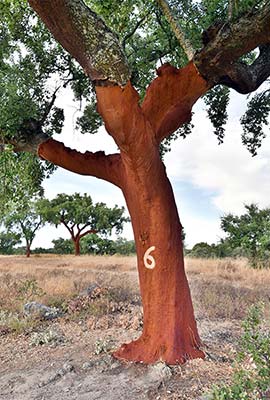
Portugal produces half the world’s supply of cork (with Spain and North African countries making much of the rest). These days, many wine stoppers are made from plastic, which could become a threat to cork production. So far the business remains strong, thanks to cork’s insulating and acoustical applications, but some fear that if cork eventually loses its economic value, the survival of the forests—and the special ecosystem they support—will be at risk.
$$$$ Tasquinha do Oliveira is where Manuel (who cooked for years at O Fialho) and his wife, Carolina, offer an intimate dining experience with all the quality of his mentor’s restaurant, but less pretense. In a tiny, 14-seat abode of cooking love, they work with a respect for Alentejo cuisine and heritage (Mon-Sat 12:30-15:00 & 19:30-22:00, closed Sun, reservations smart, Rua Cândido dos Reis 45, +351 266 744 841).
$$$ Dom Joaquim, which wins praise for its meat dishes like roasted lamb, is one of my favorite places to dine in Évora. Listen to your server’s suggestions, then study the extensive wine list—if you don’t finish the whole bottle, vested waiters can pack it to go (Tue-Sat 12:00-15:00 & 19:00-22:45, lunch only on Sun, closed Mon, Rua dos Penedos 6, +351 266 731 105).
$$$ Taberna Típica Quarta-Feira is a rustic 14-table tavern festooned with patriotic Portuguese decor, where Zé Dias and his family proudly cook and serve. Don’t expect to order from a menu—they usually just serve what they feel like cooking that day. Sit down and enjoy the “Trust Zé Special”—he’ll bring out the works, offering fun samples of whatever’s in season, including his house wine (there’s no wine list—just one decent house wine), fine desserts, dessert wine, and coffee. This is no place for vegetarians (Tue-Sat 12:30-14:30 & 19:30-21:30, closed Sun-Mon, hidden on a narrow street just north of Rua da Mouraria at Rua do Inverno 16, +351 266 707 530).
$$$ Tábua do Naldo has a playful and unique format: There’s no menu and no choice. For €20 you get “a trio of trios”: three courses of three small selections—all a creative take on traditions by chef Reginaldo Branco. You’ll eat in a spacious, modern setting that feels like a ceramic workshop. The chef is hands-on and the cod and pork cheeks are understandably popular (Wed-Mon 12:30-22:00, closed Tue, Praça 1º de Maio 20, mobile +351 967 776 461).
Simpler Eating
$$$ Restaurante ¼ P’ras 9 (“Quarter to Nine”) has a big, rustic dining room with an open kitchen that steams up with local families and tourists chowing down on traditional Alentejo cooking (Thu-Mon 12:30-15:00 & 19:30-22:00, Tue 12:30-15:00 only, closed Wed, some outdoor seating, Rua Pedro Simões 9A, near exposed kink in aqueduct off Rua do Menino Jesus, +351 266 706 774).
$$ Taska Fina is a classic little mom-and-pop eatery with a tight dining room, red-and-white tablecloths, bullfighting decor, and a little punch of modern style. The owners are friendly, the Alentejo classics are delicious, and the price is reasonable—attracting a local crowd along with the tourists (Wed-Mon 12:00-15:30 & 19:00-22:00, lunch only on Sun, closed Tue, Rua do Apóstolos 10, +351 266 707 070).
$$ Salsa Verde is an excellent self-service vegetarian place for a light, inexpensive lunch or dinner. They serve up flavorful salads and meatless versions of Alentejo classics in a crisp, clean, modern setting (Mon-Fri 11:00-15:30 & 18:00-21:30, Sat 11:00-15:30 only, closed Sun, Rua do Raimundo 93, +351 266 743 210).
Ice Cream: Zoka, a local favorite for ice cream, has tables on a quiet, inviting square just 100 yards off the main square (daily 9:00-22:00, off Largo de S. Vicente, Rua Miguel Bombarda 14, +351 266 703 133).
Évora Connections
From Évora by Bus to: Lisbon (hourly, 2 hours), Lagos (3/day direct in July-mid-Sept, otherwise transfer in Albufeira—confirm with driver, 5 hours), Coimbra (1/day direct, 4.5 hours; otherwise almost hourly with transfer in Lisbon, 4.5 hours), Madrid (in summer 3/day, 7 hours, stops at Estación Sur and continues to the T4 terminal at Barajas airport).
From Évora by Train to: Lisbon (5/day, 1.5 hours, arrives at Lisbon’s Oriente station), Coimbra (3/day, 4.5 hours, change in Lisbon Oriente), Lagos (3/day, 5 hours, change in Pinhal Novo and Tunes).