PORTO
NEAR THE STOCK EXCHANGE PALACE
Map: Porto Hotels & Restaurants
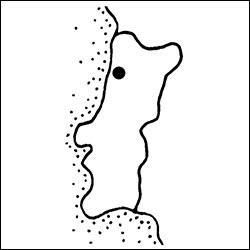
Porto (POR-too)—the capital of the north and Portugal’s second city—is fiercely proud of what distinguishes it from its rival, Lisbon. Yes, Porto’s a bit less polished. But block for block, it may be even more full of gritty, Old World charm. In many ways, a visit to Portugal isn’t complete without experiencing Porto.
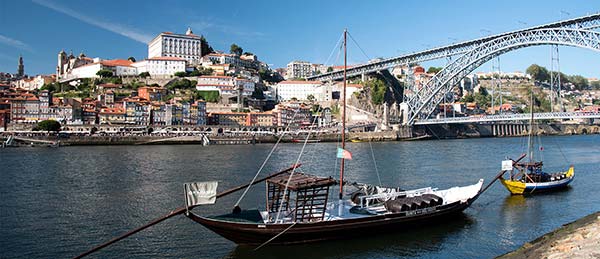
Spared by the 1755 earthquake that toppled Lisbon, Porto is appealingly well-preserved. Houses with red-tiled roofs tumble down the hills to the riverbank, prickly church towers dot the skyline, mosaic-patterned stones line streets, and flat-bottomed boats called rabelos ply the lazy river.
Internationally, the city is synonymous with the port wine that ages on its riverbanks. But the Portuguese think of Porto as a hardworking engine of industry, with an endearing warts-and-all character. It’s a solid city—it seems made entirely of granite—with equally solid people. The town’s two most famous foods—tripe stew and a beloved quadruple-decker, sauce-drenched, gut-bomb of a sandwich—say it all: This place is unpretentious. Locals claim they’re working too hard to worry about being pretty. As an oft-repeated saying goes, “Coimbra studies, Braga prays, Lisbon parties...and Porto works.”
Not long ago, Porto was a somewhat depressed industrial city, but it has enjoyed a cultural renaissance of late. European Union money has poured in, funding upgrades to the public transportation system and historical sites. Meanwhile, tourism has taken off in a big way (thanks largely to cheap flights to Porto’s international airport attracting weekend vacationers from Britain and the Continent). Locals are rising to the occasion, filling the characteristic streets with trendy eateries and boutiques.
Fun-to-visit Porto offers two high-impact sightseeing thrills: the postcard-perfect ambience of the riverfront Ribeira district, and the opportunity to learn more about (and taste) the port wine that ages across the river in Vila Nova de Gaia. (Aficionados of port—or of dramatic scenery—can use Porto as a springboard for visiting the Douro Valley, where grapes grow on dramatic stone terraces; see next chapter.) But you’ll discover that Porto also features many unexpected treats: sumptuous Baroque churches and civic buildings, a bustling market hall, atmospheric lanes of glorious tiled houses, a variety of good restaurants and appealing boutiques, and quirky but worthwhile museums.
Porto’s weather is always changing, blown in and out by the steady ocean breeze. You’re likely to get sun and rain at the same time—causing the locals to exclaim, “A widow’s going to remarry.”
PLANNING YOUR TIME
Porto offers one very busy day’s worth of sightseeing—or better yet, two relaxed days. Start your day in the market area (when it’s most thriving). Then head to the main boulevard, Avenida dos Aliados, and follow my self-guided Porto Walk through the rest of town. If time allows, the activities most worth considering along the way are climbing Clérigos Tower for a visual orientation, touring the Stock Exchange Palace, and visiting the glorious São Francisco Church and its spooky crypt. My walk ends on the Ribeira. You can continue another 15 scenic minutes across the bridge to the opposite riverbank to do some port wine tastings in Vila Nova de Gaia. Have dinner in the Ribeira (for touristy bustle) or up in the city center (for more interesting local eateries).
With a second day, slow down. Taste more port, visit the cathedral, cruise the river, ride a vintage trolley, and visit the Serralves Museum, the Art Deco mansion, or the plush park. Or just head to the Atlantic beaches at Foz to mellow out.
The only sight in town that requires a reserved, timed entry is the Stock Exchange Palace tour. Although tickets are available online, there is no way to select an English-language tour from the website. However, spots are readily available on-site and you can usually join a group with minimal wait.
If you’re renting a car for your trip and driving directly from Coimbra to Porto (skipping the Douro Valley), think again. You don’t need a car in either town and the 1.5-hour train ride is a delight.
Orientation to Porto
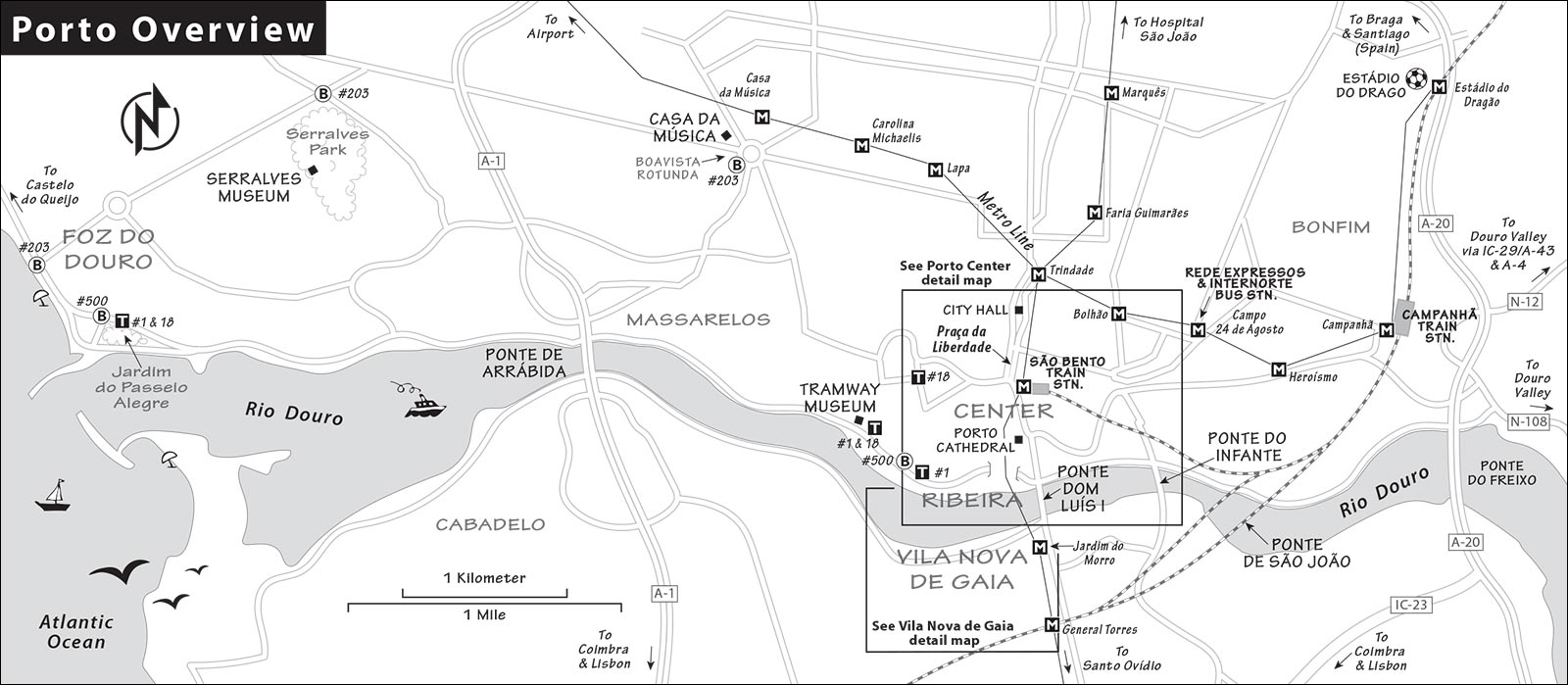
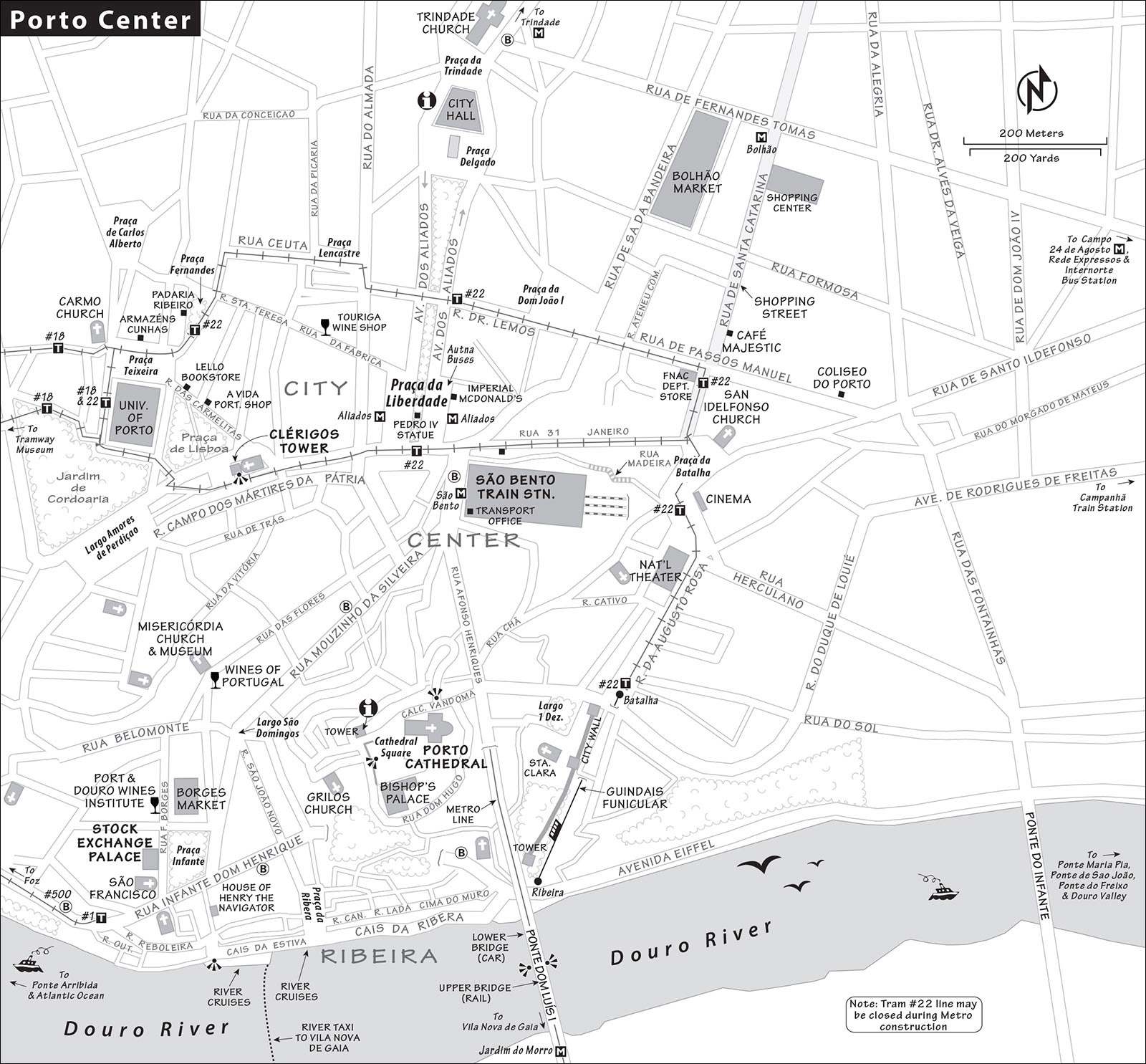
Porto (pop. 238,000, with a metro area sprawling to 1.7 million) blankets the hilly north bank of the Douro River, near where the river meets the Atlantic Ocean. The tourist’s Porto is fairly compact but hilly—and therefore tricky to navigate. Even though maps can be deceptive (given the variable terrain), get a good one and use it. Comfortable walking shoes are a must. And don’t hesitate to grab a taxi or Uber whenever you need a quick connection. Uber in particular is cheap, honest, fast, and will save you lots of climbing.
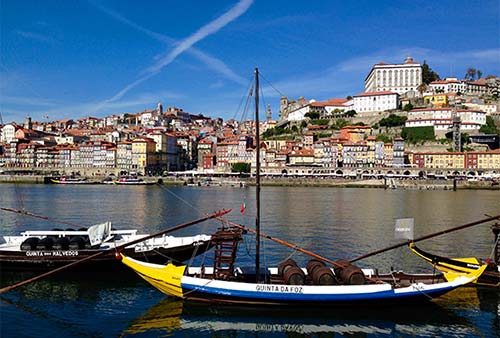
It helps to think of the tourist’s Porto in three parts.
Ribeira (ree-BAY-rah): Down along the river, the Ribeira neighborhood has narrow streets and oodles of tourists. Praça do Infante Dom Henrique (Henry the Navigator Square), two blocks above the Ribeira, hosts two intriguing sights: the Stock Exchange Palace and São Francisco Church.
City Center: Ramshackle old townhouses scramble steeply uphill toward the second part of town, the modern city center, which hovers above the Ribeira and surrounds the broad boulevard called Avenida dos Aliados (Avenue of the Allies). This area is the urban business center of Porto, packed with office buildings and shoppers, and peppered with hotels and enticing restaurants. You’ll also find a smattering of squares, monuments, and sights (including the market hall and cathedral). Clérigos Tower stands as the city’s most recognizable landmark.
Vila Nova de Gaia: Across the river shine the signs of Porto’s main tourist attraction, the port wine cellars (caves do vinho do porto) in Vila Nova de Gaia—technically a separate town.
The Douro is spanned by six bridges (two steel, four concrete). The only one you’re likely to cross is the monstrous steel Ponte Dom Luís I bridge (cars use lower level, Metro trains run along upper level; pedestrians can use either level).
Visitors venturing farther out find Porto to be a city of contrasts. Its outskirts boast bright, spacious, and prim residential neighborhoods, such as the areas surrounding the Boavista Rotunda and the Serralves Museum and park. The upscale Atlantic beach neighborhood, Foz, is a nice escape from the congested center and a great place to watch the sun set.
TOURIST INFORMATION
Porto’s TIs share a website: VisitPorto.travel. The two main TIs are in the city center across from City Hall (at the top of Avenida dos Aliados, Rua Clube dos Fenianos 25), and in the crenellated tower just below cathedral square (both open daily 9:00-19:00, until 18:00 off-season, +351 222 081 833). You’ll also find a TI kiosk near the Imperial McDonald’s on Avenida dos Aliados (daily 9:30-18:30). Additional TIs are at the Campanhã train station (June-Aug daily 9:30-18:00, closes for an hour at lunch break—timing varies) and the airport (daily 8:00-19:00, at the arrivals level). Vila Nova de Gaia has its own TI, as well (see here). Many tourist service and tourist info offices you’ll see around town are for-profit agencies in disguise; for an official TI, go to one of the locations mentioned here.
The TIs near City Hall and at the airport sell the useful Andante transit card (described later, under “Getting Around Porto”). Skip the Porto Card sold by all TIs; it’s rarely worth it.
ARRIVAL IN PORTO
By Train: Porto has two train stations. Regional trains, including those serving the Douro Valley, use the very central São Bento station (a sight in itself for its magnificent tiles). Facing the exit in the left corner is the helpful Loja da Mobilidade transport office, where you can purchase train tickets and the Andante transit card (+351 226 158 158, www.stcp.pt). Trains coming from farther away, including Lisbon and Coimbra, arrive at Campanhã station, on the east edge of town.
Get off at São Bento if your train stops there (closer to central hotels). If you arrive at Campanhã instead, hop on any train labeled São Bento to get downtown (trains leave every few minutes). The five-minute ride is included in your ticket.
By Bus: As each of Porto’s many bus companies operates its own garage, there’s no central bus station. All the bus garages are more or less in the city center. The main ones are Rede Expressos (to Lisbon and Coimbra; Campo 24 de Agosto 125, Metro: 24 de Agosto, +351 707 223 344, www.rede-expressos.pt [URL inactive]); Rodonorte (to points north; Rua Ateneu Comercial do Porto 19, +351 222 005 637, www.rodonorte.pt); and Internorte (to Spain, including Madrid; Campo 24 de Agosto 123, +351 707 200 512, www.internorte.pt). The Spanish bus company Autna runs buses that stop at the airport and the Casa da Música before heading to Vigo, Spain (with connections to Santiago; www.autna.com). Flixbus also runs a bus to Santiago via Vigo (www.flixbus.com).
By Car: Central Porto is a headache by car—the streets are confusing and congested, and parking is very expensive (over €30/day). Try to pick up your rental on your way out of town (or drop it off on the way in); otherwise, just stow it at your hotel. Approaching from Lisbon and Coimbra on the A-1 expressway, pay a toll and follow signs for Ponte da Arrábida. After crossing the bridge, take the first right and follow centro signs (or the little bull’s-eyes) into downtown.
By Plane: See “Porto Connections” at the end of this chapter.
HELPFUL HINTS
Thieves and Scams: In São Bento train station, keep one eye on the tiles and the other on your belongings. Porto cabbies are not above ripping off tourists—count your change carefully.
Closed Day: Most Porto museums are closed on Monday. Trendy or tourist-oriented stores stay open on weekends but many traditional shops close early on Saturday and all day Sunday.
Festivals: Porto’s big holiday is São João Day (for St. John the Baptist) on June 24. Festivities start the night of June 23 with partying and fireworks at Ponte Dom Luís I bridge and continue on the 24th with a rabelo regatta.
Laundry: A small full-service laundry hides almost underground at the west end of the Ribeira district (between São Francisco Church and the river at the top of Rua da Reboleira; Mon-Fri 9:00-13:00 & 14:00-17:00, closed Sat-Sun; +351 222 084 621). The self-service Lavanderia do Infante is just a couple of blocks uphill (daily 8:30-21:00, Rua do Comércio do Porto 43, +351 968 902 713). For locations see the “Porto Hotels & Restaurants” map, later in this chapter.
Best Views: There are fine views all along the Ribeira riverfront embankment, but they’re even better from across the river in Vila Nova de Gaia (looking back toward Porto)—especially from the cable car, Porto Cruz’s rooftop bar, or The Yeatman Hotel’s restaurant. You can also enjoy good views from the top of Clérigos Tower, from the terrace next to the cathedral, from the funicular, or from the picnic-friendly public gardens next to Mosteiro da Serra do Pilar (the monastery across the river, just above the big steel Ponte Dom Luís I bridge).
Oporto or Porto? The British—who’ve traded with the city for centuries—refer to the city as “Oporto” due to an old language misunderstanding. “O porto” in Portuguese means “the port,” exactly where Brits placed their interests. Although various guidebooks and postcards call it this, locals never do. And while we’re on the topic, Vila Nova de Gaia is simply called “Gaia” (GUY-uh) by locals.
Lisbon vs. Porto: Lisbon and Porto are proud rivals. Lisboners, known as alfacinhas, or “little lettuces,” drink an imperial (as a small glass is called) of Sagres beer while rooting for Benfica (the working-class soccer team) or Sporting (the upper-class rival). Meanwhile, the people of Porto, known as “tripe eaters,” drink a fino (small glass) of Super Bock beer while rooting for FC Porto. Differences extend to coffee breaks, too. When it’s time for a shot of espresso, Lisboners ask for a bica while in Porto they request a cimbalino.
GETTING AROUND PORTO
While steep, Porto is walkable. On a short visit, it’s possible you won’t take any public transportation (other than getting into town from Campanhã station or the airport)—unless you choose to go for a vintage trolley joyride.
The city’s public-transit network includes buses and the Metro. A few more interesting options—vintage trolleys, a funicular, and the cable car in Vila Nova de Gaia—are privately run and covered by separate tickets.
By City Transit
For public-transit info, see stcp.pt.
Andante Card: To ride the Metro or buses, you’ll pay €0.60 for a nonshareable, reloadable Andante card. You can load the card with as many one-hour trips (títulos) as you need. Virtually everything described in this chapter is within Zone 2 (€1.25 per trip).
The card is sold at ticket machines (English-speaking attendants are often available to answer questions), the TIs near City Hall, the Loja da Mobilidade transport office in São Bento station, and at some bus, Metro, and train ticket offices. To use the card, pass it over the scanner’s gray circle on the Metro or bus.
Buses: Buses #900, #901, and #906 go from São Bento station to the port wine lodges in Vila Nova de Gaia, across the river; bus #500 runs from the Ribeira to Foz; and bus #203 goes from the beach in Foz to the Serralves Museum. Service is generally speedy, but avoid buses during rush hour, when traffic slows to a crawl. Without an Andante card, you can pay the driver €2 for a ticket.
Metro: Five Metro lines run east-west along the same tracks in the city center (blue A, red B, green C, purple E, and orange F). One Metro line runs north-south (yellow D) and connects São Bento station to Vila Nova de Gaia across the river. All Metro lines converge at the Trindade stop, one block behind City Hall and Avenida dos Aliados. The purple E line connects the airport to the center and Campanhã station. To ride the Metro, you must have an Andante card. If you transfer Metro lines, you must validate your card again.
Construction of the new pink G line (to connect São Bento to the Casa da Música) will block major city center streets at Avenida dos Aliados and the Clérigos Tower until its projected completion in 2024. Expect interruptions to trolley and bus service.
By Vintage Trolley
Porto has three interconnecting trolley lines that seem made for tourists: #1, #18, and #22. These restored trolleys—privately run and just a little more expensive than a bus or Metro ride—are used primarily by tourists for the simple joy of rambling through this scenic old town. They are both fun and practical (€3.50/trip, €6 for two same-day trips, €10 two-day pass, not covered by Andante card, 2/hour, daily 9:00-20:00, www.portotramcitytour.pt). While Lisbon’s trolleys are overwhelmed with tourists and pickpockets, Porto’s are easy, safe, and rarely crowded.
Trolley #1 shudders along the Douro River from the Ribeira, past the Tramway Museum to the Jardim do Passeio Alegre, a 10-minute walk to the Foz district and the Atlantic Ocean.
Trolley #18 begins at Carmo Church and wobbles down along views of Vila Nova de Gaia, past the Tramway Museum to the Jardim do Passeio Alegre, a short walk to the Foz district and the Atlantic.
Trolley #22, which may be suspended during Metro construction, makes a loop through the city center, beginning and ending at Carmo Church and clattering past Avenida dos Aliados, São Bento Praça da Batalha, and the funicular.
By Funicular
A handy funicular (Funicular dos Guindais) connects the Ribeira district (at the base of the Ponte Dom Luís I bridge) to the top of the steep hill above (at the remains of the city wall, down the Rua de Augusto Rosa from Praça da Batalha, near the midway stop for trolley #22). This is the only public-transit option for saving yourself the steep hike between the Ribeira and the city center (€2.50, not covered by Andante card, every 10 minutes, daily 8:00-22:00 plus summer weekends until 24:00, Nov-April daily until 20:00).
By Cable Car
The overpriced Teleférico de Gaia cable car soars above Vila Nova de Gaia, connecting the riverfront with the Jardim do Morro, just under the Mosteiro da Serra do Pilar monastery and at the foot of the upper part of the Ponte Dom Luís I bridge. The five-minute ride offers a unique view and is handy for connecting the upper and lower parts of Vila Nova de Gaia (€6 one-way, €9 round-trip, daily 10:00-20:00, until 18:00 off-season, www.gaiacablecar.com).
By River Taxi
Douro River Taxi runs a shuttle service between the Ribeira and Vila Nova de Gaia. The ride takes less than 10 minutes—a quick and easy way to get across the river to your port wine tastings (€3, departures every 15 minutes, daily 10:00-19:00, https://dourorivertaxi.com/en/home-en).
By Taxi or Uber
Taxis are a good option in this hilly city. Most rides are fairly short and cost only around €6. For rides within the city limits, the meter should be on “T1” during the day (€2 drop charge) and “T2” at night (21:00-6:00, €2.50 drop charge). Each kilometer costs about €0.40. A luggage surcharge of €1.60 is legit (per ride, not per piece). It’s easy to find taxi stands—you’ll pay €1 more to call one (try Invicta, +351 225 076 400).
If you like Uber at home, you’ll love it here. Cars are clean, drivers speak English and are happy to chat, rates are about half the taxi rate, and you can generally get a car in three minutes. I like to sit in the front seat and interview my driver about life in Portugal (but that’s just me).
Tours in Porto
ON WHEELS
Hop-On, Hop-Off Bus Tours: Steep Porto with its spread-out sights is a good city for these bus tours. Three companies with different colored buses—red, blue, and yellow—do loops through town, connecting the city center, the Ribeira, Vila Nova de Gaia, and the Foz suburb. All have open-top buses, headphone commentary, and run twice per hour, and all offer bus-plus-river cruise combo-tickets. The companies are essentially interchangeable with an average price of €22.
Tourist Train: For a cheaper (and more humiliating) option, the “Magic Tour” tourist train does a loop around the town center and includes a stop at a port wine lodge across the river (€12, 2/hour, 1.25 hours, leaves from in front of cathedral).
Tuk-Tuks: You’ll see these little three-wheeled, three-seater taxis parked at touristy sights around town, especially in front of Clérigos Tower. Guided tours cost €15-60, depending on length, and rates can be soft. While a tuk-tuk ride can be noisy, smelly, and jostling, it can work well for a sweat-free tour around this very vertical city.
ON FOOT
A good local guide or tour can be well worth the expense.
Maria Jose Aleixo (+351 969 468 347, aleixo19@sapo.pt) and Margarida Falcao (+351 913 499 382, margaridafalcao.gio@gmail.com) are two excellent, English-speaking local guides who charge €120 per group for a half-day walk tailored to your interests.
The City Tailors Tours are led by Ricardo Brochado, who truly loves his work. He tailors half-day Porto experiences for groups of one to six for €85 per person (cheaper for larger groups, children free). This rate includes snacks, drinks, and a light meal along the way (+351 917 574 983, www.thecitytailors.com).
Taste Porto Food Tours is run with gusto by tour guide André, who has a contagious enthusiasm for good food and embracing life Portuguese-style. André and his team take groups (2-10 people) on a two-mile walk with six tasty stops that are fun, educational, relaxed, and delicious. Two 3.5-hour tours run Monday through Saturday: “Downtown” (€65, at 16:00, 6 stops) and “Vintage” (€75, at 10:00 and 15:00, 6 stops plus a port wine stop). If you’ve had enough wine—port or otherwise—consider exploring the booming craft beer scene with André (€59, Tue-Sat at 17:00, 11 small beers plus food). Book and pay in advance online (+351 920 503 302, www.tasteporto.com).
BY BOAT
The city’s well-promoted “Six Bridges” river cruises, worth ▲, leave from the waterfront in the Ribeira district (generally around €15, daily 10:00-12:00 & 14:00-18:30, until 17:00 off-season, 50 minutes, multilingual narration). For a longer cruise, consider a day trip along the Douro, with a boat ride to Peso da Régua or Pinhão and return trip by train, plus breakfast and/or lunch on board (figure €65-85 to Peso da Régua, €75-100 to Pinhão, price depends on what’s included, www.rotadodouro.pt; for details, see the next chapter).
Porto Walk
1 Avenida dos Aliados (Avenue of the Allies)
3 Praça Guilherme Gomes Fernandes
4 Praça de Gomes Teixeira and Praça de Parada Leitao
7 Clérigos Church and Tower (Igreja e Torre dos Clérigos)
LOWER PORTO—GRAND INTERIORS AND RIBEIRA WATERFRONT
8 São Bento Train Station (Estação São Bento)
10 Misericórdia Church and Museum
11 Henry the Navigator Square (Praça do Infante Dom Henrique)
12 The Ribeira, Porto’s Romantic Riverfront
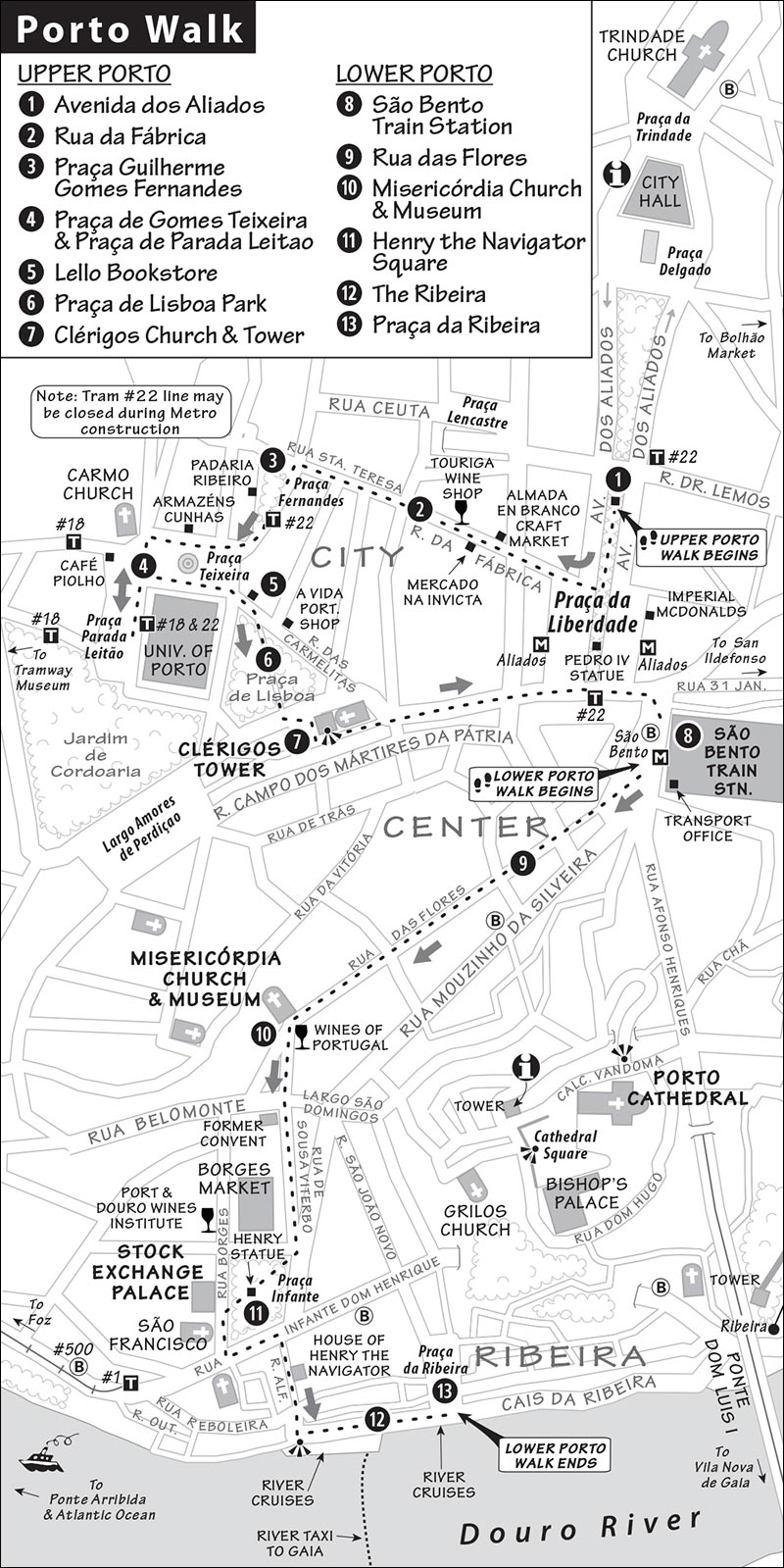
This two-part self-guided walk, worth ▲▲, links Porto’s top landmarks. The first part is a brief, uphill-downhill loop through the city center, connecting the main square with some relatively untouristed back streets and the city’s main landmark (Clérigos Tower). The second part begins at the São Bento train station and angles downhill to Porto’s finest interiors (Stock Exchange Palace and São Francisco Church) before ending in its characteristic waterfront zone, the Ribeira. Doing the entire walk gives you a great overview of the city’s charms and takes about two hours (one hour per part)—assuming you don’t stop to enter sights along the way.
Porto is decentralized, with important sights scattered on many levels. I’ll point out additional landmarks for possible detours, if you have the time and interest.
UPPER PORTO—THE CITY CENTER
• Begin at the statue of cherubs holding fruit that marks the middle of Porto’s main square/boulevard...
1 Avenida dos Aliados (Avenue of the Allies)
Worth ▲▲, this is the main urban drag of Porto, where Portugal’s hardworking second city goes to work. Porto—often invaded, never conquered—is known as cidade invicta, the “Invincible City.” It’s also called “The Granite City”—both for its stone-built cityscape and its sturdy, stubborn people (who like to say they have granite in their DNA). Rounding out the defiant symbolism is the dragon—the mascot of the locally beloved soccer team, FC Porto.
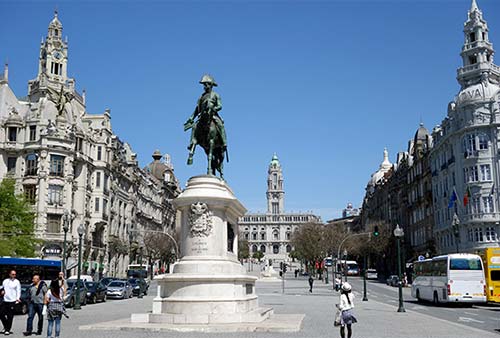
Avenida dos Aliados is named for the alliance created when Portugal joined the winning side during World War I. The wide boulevard, lined with elaborate examples of various architectural eras (mostly Art Nouveau and Art Deco) was inspired by early 20th-century Paris and is also reminiscent of Prague’s Wenceslas Square. The twin bank towers flanking the street midway up were designed by Portuguese architect Marques da Silva (c. 1920). And crowning the square is the huge City Hall (Câmara Municipal), built in 1957, with a balcony where VIPs are presented.
Although currently under construction to add a new Metro line, this esplanade is where locals gather for good times and bad times. For example, 600,000 people celebrated here when Porto won the 2018 national football championship.
Praça da Liberdade (Liberty Square) marks the bottom of the avenue. The statue honors King Pedro IV (1798-1834), a hero in the 1832 Civil War, who advocated for a limited constitutional monarchy in Portugal (while maintaining his title as Emperor of Brazil). King Pedro prevailed...and he’s holding the constitution to prove it. A true “people’s king,” he left his heart to the people of Porto—literally. (It’s buried in a local church.)
The square is a strong statement for a secular and modern Portugal: It’s topped not by a church, but by the City Hall (which blocks the view of Trindade Church—the namesake of the nearby station where all of Porto’s Metro lines converge). Throughout Porto, after the king dissolved the monasteries and confiscated church property in the 1830s, large tracts of land that had been the domain of the church became the domain of the people. Then, in the 1920s and 1930s (especially with the coming of the dictator António Salazar), Portugal demonstrated its national pride by razing many characteristic medieval quarters to modernize the country, building bigger squares and bigger buildings (as here). While this feels like a celebration of art, it’s the old financial center of Porto and these buildings are all about commerce.
“The Imperial McDonald’s” is directly to the right of King Pedro, hiding behind the trees. Filling what was once the Imperial Café, this is one of the fanciest McDonald’s in Europe. Check it out—and ponder the battle of cultural elegance against global economic efficiency. Portugal is the only country where McDonald’s serves soup. It’s a very soupy culture; even McDonald’s had to include it to gain locals’ acceptance.
Now stand at the very bottom of the square, along the busy street. Notice that nothing is level in Porto. Looking uphill, you’ll see the blue-tiled Church of San Ildefonso, and just downhill is São Bento station. This walk connects key landmarks, with a little uphill walking (at the start), then lots of downhill walking.
• Next, head one short block up Avenida dos Aliados to the over-the-top bank tower on the left side of the square (labeled Unic—indeed it is). Angle up the little street just in front of that building (Rua do Dr. Artur de Magalhães Basto). After one short block, continue up the same street, now called...
2 Rua da Fábrica
This street—named for the tobacco factories that once helped power local industry in this town—is one of many appealing shopping lanes in downtown Porto. The city has been transformed in recent years. Not long ago, streets like this were neglected and deserted. And while they may still be (artfully) seedy, like the derelict place on the left, life is fast returning—with clever boutiques and tempting eateries opening all the time. Pop into a few such shops as you climb to the top of this street.
Almada em Branco (at Rua do Almada #125, the first corner on the right), offers high-quality, locally handcrafted items: leather shoes, jewelry, cork products, sardines, and more.
At Mercado na Invicta (at #15 on the left), every table holds the work of a different artisan. Creative enterprises like these were born out of the economic crisis.
Touriga Wine Shop (at #32) offers tastings and shelves stocked with local wines (see the “Wine Tastings in Porto” sidebar near the end of this chapter).
• As you hike two steep blocks farther, notice the fine tiled facades. Keep going up Rua da Fábrica, huffing your way up three more short but steep blocks. You’ll pop out at a cute little triangular square called...
3 Praça Guilherme Gomes Fernandes
Firefighters take note: The square’s namesake—honored by a statue in the middle—led the fire brigade that contained an 1888 blaze, which otherwise might have devastated the city.
Guilherme is eyeing the main reason to linger on this cozy square: the recommended Padaria Ribeiro pastry shop, a local favorite. Step inside and take your pick from the extensive sweet and savory offerings. You can either order something to go or have them bring it out to you on the square. You’ve finished the uphill portion of this walk—now’s the time for a little pastry break with the bustle of Porto passing by.
• With the pastry shop at your back, turn right and follow the trolley tracks around the corner to the right. You’ll quickly emerge into a grand square.
4 Praça de Gomes Teixeira and Praça de Parada Leitao
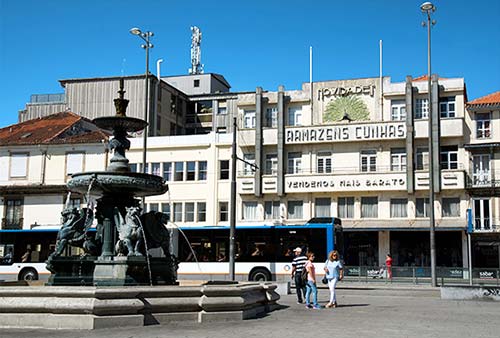
The centerpiece of Praça de Gomes Teixeira is the Fountain of Lions, and behind that is the main building of the University of Porto. U. Porto is a fairly young school (founded 1911), but the second-biggest in Portugal, with about 30,000 students who give this city—and this neighborhood (one of three main campuses)—a special energy. The square is named for its first rector and beloved math prof.
At the top of the square (facing the university), the Armazéns Cunhas department store demonstrates the sleek Art Deco style that took hold in Porto in the early 20th century—sprucing up a city of granite and azulejos. This neon facade, though now faded, might look more at home in Hollywood or Miami Beach. The peacock at the top trumpets the new fashions of the age, and neon announces novidades—vendemos mais barato (“new fashions—we sell cheaper!”).
Just past the end of the square, you can’t miss the brilliant blue azulejos on the side of Carmo Church, depicting the founding of the Carmelite Order. Circling around to the front, you’ll see this is two fine Rococo churches in one: On the right, Carmo Church; on the left, the Carmelite church, with a huge white convent that once housed an order of Carmelite friars. (Like other convents and monasteries, it was nationalized in 1834 and today serves as the headquarters of Portugal’s national guard.) These two churches were divided by what they like to call the “world’s narrowest house”—with the green gate and door. The house served as a secret meeting place for order members during wartime and as a temporary shelter (for people such as doctors who worked in the order’s hospital, artists who worked in the church, and the sacristan).
Stretching downhill from the church is the delightful cobbled square called Praça de Parada Leitao. At the top end is the venerable (and recommended) Café Piolho d’Ouro, beloved by the local “bats.” Over the years in Porto, students with their black capes and habit of coming out in flocks after dark earned the nickname, and this café is bat central. If you wander inside, you’ll see plaques on the walls celebrating decades of graduating classes.
Lately this entire neighborhood has become a lively zone of student cafés, bars, and hangouts. If you’re looking for some action after dinner, this neighborhood would be the top local recommendation.
In front of the café, notice the trolley stop for one of Porto’s historic lines. As in Lisbon, rickety trolleys have long been a part of Porto’s history, and the city is committed to bringing them back as an integral part of the public-transit system. In 1872 (40 years after being invented in the US), the first trolleys in Iberia began operating in Porto, pulled by horses and oxen. Dubbed americanos based on their origin, the trolley network was electrified in 1904. Essential for connecting suburbs with the city center, more than 100 trolley lines were still in use by the 1970s. However, buses and cars—the by-products of modern prosperity—almost eliminated this important part of the city’s heritage.
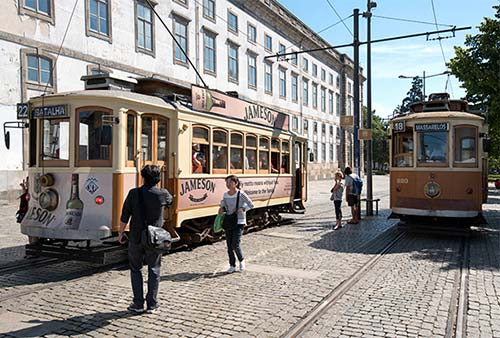
Today, a few lines survive as vintage trips appealing mainly to tourists, although some locals of an older generation use them as public transport. From here, trolley #18 rattles to the Tramway Museum, down to the river, and out to Foz (a short walk from the Atlantic Ocean).
• Walk back to the big square with the university building on your right. An elevated park sits just ahead. On the left side of the downhill street that runs along the park, you’ll see...
5 Lello Bookstore
Built in 1906, the shop boasts a lacy exterior bearing the original name, Lello & Irmão, and a fancy Art Nouveau interior. It looks like wood, but it’s mostly made of painted plaster with gold leaf. J. K. Rowling, who worked in Porto for a year, was reportedly inspired by this Harry Potter-esque shop. And sure enough, the interior feels like something you’d see on Diagon Alley.
The Harry Potter connection—which was attracting 2,000 Potterheads a day to ogle the interior—became too much for this fragile, little bookshop to handle. So now visitors must buy a voucher to enter. (Warning: Lines can be ridiculous and, while it’s charming, there’s really not a lot to see inside.) Once inside, follow the quaint tracks to the book trolley. Climb the sagging staircase to find the old cash register and admire the stained-glass ceiling and the slinky hanging lights.
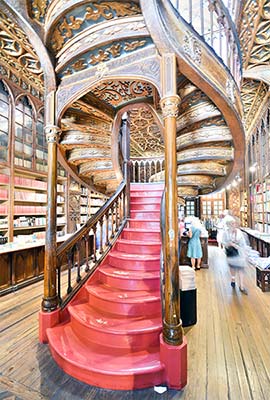
Cost and Hours: €5, can be applied toward any book purchase (good selection of books in English by leading Portuguese authors), daily 10:00-19:00, Rua das Carmelitas 144, www.livrarialello.pt. Buy tickets and check your bag at #166, four doors uphill, then join the queue at the bookstore’s front door.
• The cross street just downhill from the bookstore is Galeria de Paris, lined with characteristic shops and bars. On this corner is a branch of A Vida Portuguesa, the Lisbon-based shop for quality, authentic local souvenirs (Rua Galeria de Paris 20). Across the street, just uphill from the bookstore, is some brilliant city planning at...
6 Praça de Lisboa Park
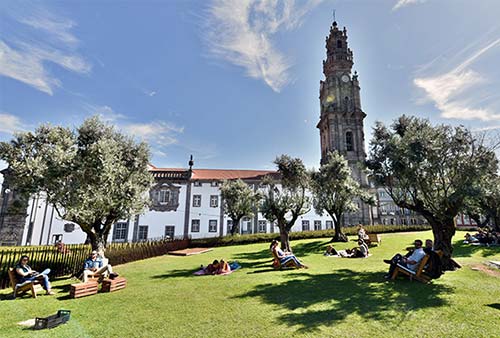
This innovative solution shows what smart urban planners can do to camouflage an ugly concrete parking garage in the historic heart of a city: build a park on top of it. The most direct way to our next stop—the church tower—is through the modern concrete mall, which tunnels past shops and cafés under the middle of the park. But I’d rather head up the stairs (just to the right of the mall) to walk across the park itself—a green respite dotted with inviting olive trees in the heart of a congested city. Up top, a hip bar called Base serves drinks, which you can enjoy at picnic tables or under one of the 50 gnarled olive trees. This is a great spot for a drink after dark.
• Make your way across the park—either down below or up top—to reach the can’t-miss-it...
7 Clérigos Church and Tower (Igreja e Torre dos Clérigos)
This church, which consumed three decades of Nicolau Nasoni’s life (1731-1763), shows the ambitious architect’s flair for theatrics and is worth ▲. He fit the structure into its hilltop location, putting the tower at the back on the highest ground, dramatically reinforcing its height. Nasoni worked in stages: first the church, then the hospital and the Chapter House (meeting room for priests and monks). He topped it all off with the outsized tower. You can go inside the church for free or pay to climb the tower (see listing later, under “Sights in Porto”).
• Take the atmospheric, traffic-free, trolley-track-lined lane to the right of the tower—an urban canyon of azulejos and funky shops. Heading downhill, you’ll find yourself back where you started—at the Avenida dos Aliados. This time, keep going straight, one more block. You’ll run right into São Bento train station.
The second part of our walk begins just inside the station. But if you’d like to explore one more part of Porto’s city center—the traditional market hall, bustling shopping street (Rua Santa Caterina), and azulejo-slathered church on Praça da Batalha—you can hike up the hill just to the left of the station (toward the pretty church you see perched on the hill). All of these are described under “Sights in Porto,” later.
LOWER PORTO—GRAND INTERIORS AND RIBEIRA WATERFRONT
• Begin inside the main entry hall of Porto’s stately...
8 São Bento Train Station (Estação São Bento)
The station, worth ▲, has a main entry hall that features some of Portugal’s finest azulejos—vivid, decorative hand-painted tiles that show historical and folk scenes from the Douro region. Originally a Benedictine convent, the land and building were nationalized and used to provide an ideal welcome for trains when they arrived in the 1870s. The distinctive tiles tell the story of Porto in a romanticized way, typical of that age. The trackside tiles celebrate the traditional economy, such as the transport of port wine.
Tiles: As you face the tracks, the large, blue, upper tiles on the left show medieval battles back when Spain and Portugal were at war. Victorious in their Reconquista over the Moors, the Portuguese had to settle on their borders with neighboring Castilla.
Tiles on the opposite wall (far right when facing the tracks) show a pivotal event from Porto’s past: the 1387 wedding of Portugal’s King João I and the English princess Philippa, which established the Portuguese-English alliance—the oldest in Europe.
Notice also the cathedral as it looked in the 14th century and the fine portrait of Philippa on her horse. She’s not happy with the arranged political marriage or her king’s concubine—the brightly lit woman behind him. But things eventually work out. Philippa left the king and went home to her native England. João then realized he loved her and begged her to return. She did so, and they had nine children who went on to be instrumental in starting the Golden Age of Portugal. Below is their most famous son, Prince Henry the Navigator, shown conquering Ceuta for Portugal in 1415. While humble Ceuta was just a small chip of Morocco (across from Gibraltar), it marked an important first step in the creation of a soon-to-be vast Portuguese empire.
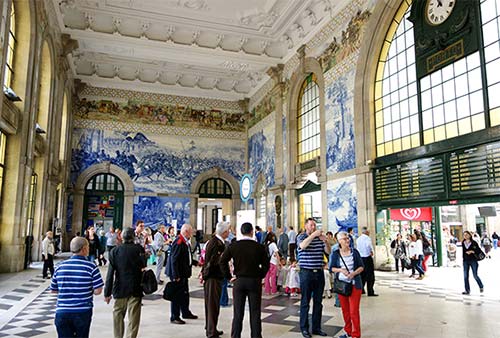
The multicolored tiles near the top show different modes of transportation, evolving from Roman chariots (next to the big clock), and progressing counterclockwise 360 degrees to the arrival of the first train (left corner above Philippa).
Notice the words Douro and Minho overhead. These are the major rivers in this part of Portugal, and the key regions linked by these trains (basically the north of the country). All this art seems old, but it’s really Portuguese revival art from the period just after World War I, celebrating the country’s heritage.
Nearby: Before continuing downhill to the Ribeira, stand in front of the station’s entrance to get oriented. Consider a detour to Porto’s cathedral and its viewpoint square. With the station to your back, you can see the cathedral’s serrated roofline on the ridge to the left—about a 10-minute walk away. Just beyond the cathedral is the upper level of the Luís I Bridge, which crosses scenically over the Douro to Vila Nova de Gaia and its port wine lodges. Buses to Vila Nova de Gaia leave across the street from the station’s entrance (the stop closest to the Metro entrance, buses #900, #901, or #906).
• To continue our walk downhill to the Ribeira waterfront, cross the street, turn left, then take the right street at the fork. This puts you on a delightful, mostly pedestrianized lane connecting the town center with the riverbank.
9 Rua das Flores
This traffic-free street is lined with iron railings, vivid azulejos, outdoor café tables, and enticing shops selling jewelry, antiques, chocolates, and other temptations. A decade ago, this was a deserted no-man’s-land; today, it’s a touristy main drag—and a great example of how Porto is blossoming. And yet, some funky graffiti (a Porto specialty) and ragtag housefronts still survive as reminders that Porto is a work in progress. Enjoy this strip for a few blocks downhill.
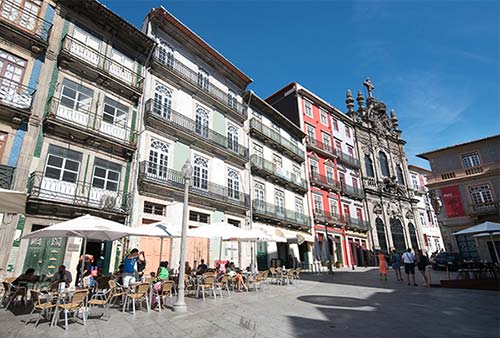
At #213, notice the flowers on the facade celebrating the street’s name. The protected sign, Ourivesaria, recalls a jewelry shop—one of many that have long lined the street. This was the end of the Jewish quarter and right up until 1496 was lined with silver, gold, and jewelry shops. That’s the year King Manuel I ordered all Jews to convert to Christianity—or be expelled. Beginning in 1497, the remaining Jews were forced to convert. Many became Christians in name but not in practice (as the secret synagogues found under these buildings attest). Meanwhile, the gold and silver shops stayed open and their heritage survives to this day. The ornate wrought-iron balconies were a way for wealthy aristocratic families to boast their status.
At #222, look down the narrow street and up at the four-story cat. Fun and surreal street art is an endearing dimension of Porto. While the city is constantly fighting graffiti (the wolf is a favorite tag of anti-government gangs), Porto gives fine art students opportunities to show their talent by decorating sections of streets and walls. You’ll notice the little electric boxes all along this street are painted with city-related themes by art students.
• Eventually you’ll reach some modern art spewing from a facade on the right. Symbolic of Christ’s blood connecting heaven and earth, this marks the...
10 Misericórdia Church and Museum
Porto’s Santa Casa da Misericórdia (Holy House of our Lady of Mercy) is a powerful church-run organization dedicated to helping people with both their physical and spiritual needs. Since the 16th century it’s been the city’s United Way and Gates Foundation rolled into one. The organization remains a huge and important landowner in Porto, operating hospitals, schools, and other social services.
This building was once a hospital. Today it’s an impressive little museum worth ▲ housing lots of artifacts (including early medical implements), paintings of leading benefactors of old, and treasures donated over the years, all well-described in English. Upon entering, head to the fourth floor and work your way back down, finishing in the dazzling, Mannerist-style church ornamented with fine azulejos. It was designed by Nicolau Nasoni, the prolific Baroque architect who left his mark all over the city (see sidebar earlier).
Cost and Hours: €5, daily 10:00-18:30, off-season until 17:30, Rua das Flores 15, +351 220 906 960, www.mmipo.pt.
• Across the street, at Rua das Flores 10, the Wines of Portugal tasting room offers a nice getaway from the crowds and an educational wine experience (details in the “Wine Tastings in Porto” sidebar later in this chapter).
The street ends at a former Dominican convent overlooking Largo de São Domingos. The big granite building is now filled with creative startups (part of a government-subsidized incubator program for entrepreneurs). Continue straight across the busy, cobbled street and head down Rua de Sousa Viterbo. Soon, on your right, you’ll pass the big, red Borges Market—now a popular nightclub. Just past the market, you’ll emerge at the top of...
11 Henry the Navigator Square (Praça do Infante Dom Henrique)
Head to the statue at the middle of the square. Arguably the most important Portuguese person of all time, Henry the Navigator put his country on the (figurative) map by putting many mysterious, faraway lands on the (literal) map. In this statue, Henry points from his hometown toward the sea. For more on Henry, see the sidebar on here.
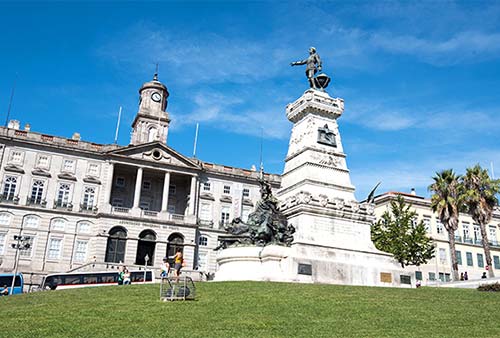
To Henry’s right, the Stock Exchange Palace (Palácio da Bolsa) dominates this square. This is the palatial home of the Commercial Association of Porto. Commerce came to define Porto as royalty defined Lisbon and religion defined Braga. The association even had its own system of courts and a representative to the king. In 1832, the monastery of the São Francisco Church next door burned down, and the queen offered the property to the Commercial Association. They seized the opportunity to show off, crafting a building that would demonstrate the considerable skill of Porto’s tradesmen. The interior—which you can visit only with a 45-minute guided tour (see listing later, under “Sights in Porto”)—is a proud showcase of decorative prowess. Finely carved granite, inlaid-wood floors, plaster painted to resemble carved wood, and other details adorn everything from the glorious glass-roofed atrium to the exactingly detailed Arabian Hall. Cross the square and drop in to see when the next tour is available (this walk ends nearby).
São Francisco Church is just to the left of the Stock Exchange Palace. This has the finest church interior in town, and its adjacent crypt is stacked with anonymously numbered tombs holding the remains of past parishioners (see listing later, under “Sights in Porto”; enter around the left side).
After you’ve admired the impressive buildings, consider an option for wine tasting near the square at the stately Port and Douro Wines Institute across from the red market hall on Rua Ferreira Borges (described in the sidebar later in this chapter).
• To continue our walk, turn left at the bottom of the square, then turn right to head down the little street directly downhill from Henry the Navigator (Rua Alfândega—the aptly named “Customs Street”). On the left, you’ll see the House of Henry the Navigator, where the great explorer is believed to have been born (the house has no Henry artifacts and is not worth a visit for most). From Henry’s pad it’s just a few more steps downhill to...
12 The Ribeira, Porto’s Romantic Riverfront
The riverfront Ribeira (ree-BAY-rah, meaning “riverbank”) district is the city’s most scenic and touristy quarter, with its highest concentration of restaurants and postcard racks. Narrow, higgledy-piggledy homes face the busy Douro River. Head down to the riverbank and scan the horizon from left to right.
The Ponte Dom Luís I bridge rises 150 feet above the river on your far left. In the 1880s, Teofilo Seyrig, a protégé of Gustave Eiffel, stretched this wrought-iron contraption across the 500-foot-wide Douro. The Eiffel Tower-sized bridge is growing fragile, so this Porto landmark is now open only to trams and pedestrians, and a new bridge for cars will be built further upstream. (Eiffel himself designed a bridge in Porto, the Ponte Dona Maria Pia, a bit upstream—barely visible from here.)
Vila Nova de Gaia (or just “Gaia”) is the port wine lodge district directly across the river. If you followed the Douro 60 miles upriver—beyond those bridges—you’d reach a wonderland of hand-built stone terraces where grapes enjoy a hardy existence. Port wine is harvested and stomped there, then floated downriver to age here. Historically, the wine could be legally called “port” only if it aged in Gaia, but deregulation now permits vintners to age their port where it’s grown. You’ll see the proud signs of 18 different company names marking their lodges here—each one inviting you in for a sample. (For more on the port-tasting scene in Gaia, see the sidebar near the end of this chapter.)
Look to your right and see how the river bends as it heads out toward the open Atlantic. To get out of the congested urban center, consider side-tripping out to the pleasant beach community of Foz, where the Douro meets the sea (see the “Sights Away from the Center” section, later).
Now turn around and face the skinny houses along the embankment (signed Cais da Estiva). Before tourism, the Ribeira was a working port. The city wall fortified Porto from the river, and (until the 20th-century embankment was built) the water came right up to the arches—many of which were loading zones for merchants. Imagine the busy harbor scene before the promenade was reclaimed from the river: cargo-laden riverboats lashed to the embankment, off-loading their wine and produce into 14th-century cellars (still visible). Today the old arcades lining the Ribeira promenade are jammed with hole-in-the-wall restaurants and souvenir shops. Behind the arcades are skinny, colorful houses draped with drying laundry fluttering like flags, while the locals who fly them stand gossiping on their little balconies. The contrast of bright tourism and vivid untouched neighborhoods within 30 yards of each other is amazing.
• From Cais da Estiva and with the river on your right, go for a stroll along the embankment known as the Cais da Ribeira, worth ▲▲.
As you walk, notice the various interchangeable companies along this embankment selling scenic “Six Bridges” cruises on the Douro, which take you past landmarks not visible from here (including Gustave Eiffel’s majestic steel Ponte Dona Maria Pia). If you’re interested, comparison-shop as you stroll.
Across the river, in Gaia, you’ll see some distinctive boats—called rabelos—moored along the embankment. These were once the only way to transport wine from the Douro Valley vineyards downriver to Porto. These boats have flat bottoms, big square sails, and very large rudders to help them navigate the rough, twisty course of the river. Modern tourist boats docked here copy this style on a larger scale (for more about these boats, see here).
• After about a block, you’ll pop out at the bottom of the neighborhood’s main square...
13 Praça da Ribeira
This vibrant, ragtag space was long the city’s front door. In the mid-18th century, city leaders attempted to clear it out and make a vast wasteland like Lisbon’s Praça do Comércio. But the proud people of Porto (who, remember, have granite in their DNA) asserted themselves—as they like to do—and that construction project was stopped. Today, this square is a thriving place of the people.
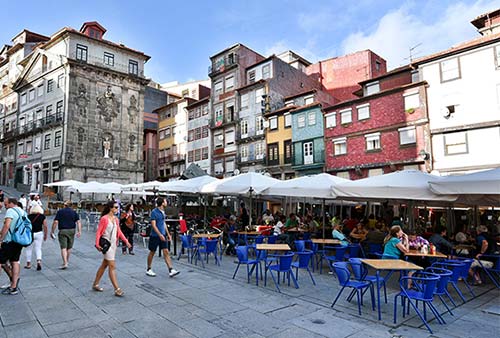
Stand on the riverfront and look inland: On the right is a classic line of Porto houses that survive (sometimes with old ladies looking out at the crowd from their windows). Check out the artwork in the square: the cube fountain and the statue of St. John the Baptist with his rough cloak, who overlooks the happy scene from above.
• Our Porto orientation walk is over. There’s a lot more of the Ribeira to see—just walk with the river on your right, following the rabelos. Or venture into the maze of distinctive, tiny lanes that climb up the hill from the water.
At the end of the embankment is the towering bridge; its lower level takes you efficiently to Vila Nova de Gaia for some port tasting. Or save your feet and make a little cruise out of the crossing by catching the Douro River river taxi that shuttles back and forth.
Or, to head back up to the cathedral area or Porto’s shopping neighborhood, ride the funicular—it departs from this side of the river, just past the bridge.
Sights in Porto
Praça da Batalha (Battle Square)
▲Clérigos Church and Tower (Igreja e Torre dos Clérigos)
▲Porto Cathedral (Sé do Porto)
JUST ABOVE THE RIBEIRA, ON HENRY THE NAVIGATOR SQUARE
▲▲Stock Exchange Palace (Palácio da Bolsa)
House of Henry the Navigator (Casa do Infante)
PORT WINE LODGES IN VILA NOVA DE GAIA
Tramway Museum (Museu do Carro Eléctrico)
▲Serralves Foundation Contemporary Art Museum and Park (Fundação de Serralves)
House of Music (Casa da Música)
Many of Porto’s top sights are connected by my self-guided walk, earlier.
PORTO’S SHOPPING NEIGHBORHOOD
Porto’s bustling, local-feeling shopping district is a wonderful place to people-watch. Most of the action occurs along Rua de Santa Catarina, which runs roughly parallel to Avenida dos Aliados a few blocks east. Begin at Praça da Batalha (just up Rua 31 de Janeiro from São Bento station) and follow this route to the Bolhão Market.
Praça da Batalha (Battle Square)
This square has a fine tiled church (San Ildefonso), the 19th-century National Theater (originally the Opera House), and the impressive (but closed) Art Deco Cinema Batalha. The church’s azulejo tiles, reminiscent of Delft blue-and-white ceramics, were all the rage in Baroque Portugal. But these tiles, depicting scenes from the life of the church’s patron saint, aren’t Baroque. Like the tiles at the train station, they were fitted into the walls of the church during the early 1930s, an era that celebrated Portuguese heritage.
This square, while a bit seedy, has benches where old-timers hang out. If you’d like a classic little hot dog with the local gang, drop by the recommended Cervejaria Gazela (just to the right of the National Theater).
• At the north end of the square, branching off to the left of the blue-tiled church, is...
▲Rua de Santa Catarina
Porto’s main shopping street is busy and (mostly) traffic-free by day, and quiet by night. A stroll along here gives you a sense of today’s Porto—as well as yesterday’s.
Peek into the venerable Art Nouveau Café Majestic, the circa-1900 hangout for the local intelligentsia (a block down on your right). It’s extremely touristy...understandably. (While I wouldn’t eat a serious meal here, it’s nice for breakfast or for a late-night dessert of its famous rabanadas—a special French toast with an unforgettable syrup.) Kitty-corner from Café Majestic is the FNAC department store—handy for whatever you might need.
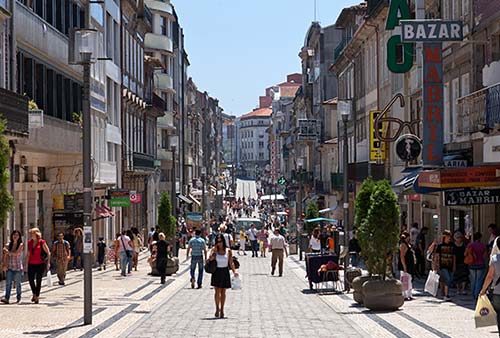
The Rua de Santa Catarina sidewalk is a good example of calçada portuguesa, Portugal’s unique limestone and basalt mosaic work. It’s handmade and high-maintenance...but apparently worth the effort and expense to locals. Notice all the shoe stores. Along with wine, textile and shoe factories power northern Portugal’s industry. (My Eccos are made right here.)
At #326, a modern shopping center hides behind an outlandish art installation covering the entire facade. The top floor is a food court designed to look like an old-time harborfront—a kitschy but popular place for pensioners to hang out. Across the street is a bakery that cranks out beloved pastel de nata custard pies.
• Keep walking up Rua de Santa Catarina until you hit Rua de Fernandes Tomas. A block to the left is the...
▲Bolhão Market
Porto’s historic market hall recently reopened after a years-long renovation. This is a great place to wander—especially in the morning—and take in the sights, sounds, and smells of real-world Porto (Mon-Fri 8:00-20:00, Sat until 18:00, closed Sun, +351 22 332 6024, https://mercadobolhao.pt).
IN THE CITY CENTER
▲Clérigos Church and Tower (Igreja e Torre dos Clérigos)
This oval-shaped church with a disproportionately tall tower is one of the best-known masterworks of Baroque architect Nicolau Nasoni. There are free, 30-minute organ concerts here daily at noon, preceded by the carillon ringing from the tower.
Cost and Hours: Church-free, tower and exhibits-€6, daily 9:00-19:00, Rua São Filipe de Nery, +351 220 145 489. You can also climb the tower after dark (€5, daily in season 19:00-23:00).
Visiting the Church and Tower: The church facade displays Nasoni’s characteristic frills, garlands, and exuberant cornices. Notice how Nasoni built the tower in six sections, each one more elaborate than the last, topped with a round dome and spiked with pinnacles.
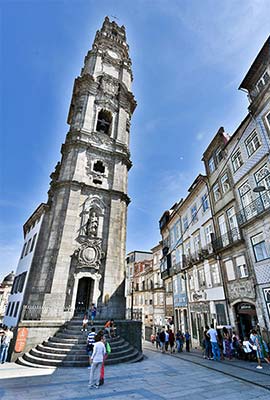
The interior is an oval-shaped Baroque nave built out of granite and pink marble but covered with ornate carvings (c. 1725). Look for the high altar—a wedding-cake structure with Mary on top. It’s thought to be the tomb of Nasoni, who asked to be buried here. Statues of the eight patron saints of Portugal circle the nave.
The main attraction is climbing 225 steps to the top of the 250-foot tower—one of Porto’s icons. (On busy days, you may have to kill time waiting for your turn on the upper stairs—ask before you buy your ticket.) On the way up, you’ll peek into the assembly rooms, walk along upper galleries offering views into the church interior from above, and check out the “Christus Collection,” with depictions of Jesus from all over Portugal and around the world (many brought home by Portuguese explorers). Reaching the top, you get a close-up look at the carillon and commanding views of the city with its jumble of tightly packed red roofs.
▲Porto Cathedral (Sé do Porto)
This hulking, fortress-like, 12th-century Romanesque cathedral, while graced with fine granite stonework typical of northern Portugal and lavish 18th-century Baroque altars, feels gloomy and stark inside. But its history is palpable. Henry the Navigator was baptized here and it was the scene of many royal weddings (including that of Henry’s parents, João I and Philippa).
Cost and Hours: Cathedral-free, cloister and sacristy-€3; open daily 9:00-18:30, closes earlier in winter; cloister closed Sun morning year-round; Terreiro da Sé, +351 222 059 028.
Visiting the Cathedral: The main altarpiece sums up the exuberance of Porto in the 1720s, when the city was booming, the local bishop was temporarily away in Lisbon, and Italian Baroque was sweeping through town. On the side walls flanking the altar are faded faux-architecture paintings by Nicolau Nasoni, the Italian who came to Porto to paint the cathedral’s sacristy and soon became the city’s most influential architect.
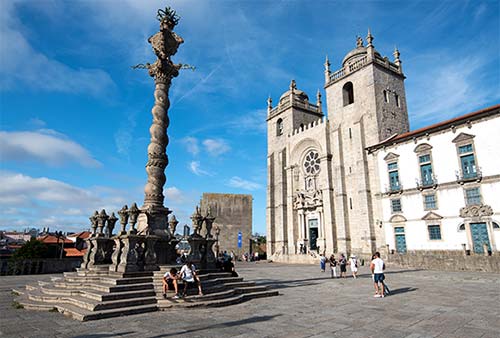
Look at the chapel just left of the high altar. Inside is a dreamy, carved-and-painted limestone statue of the Lady of Vendôme, brought to Porto in the 14th century by monks from France. It originally stood at one of the fortified gates of the city and remains close to the hearts of the townsfolk.
Just left of the Lady of Vendôme is the Silver Altar of the Holy Sacrament (c. 1700)—made with 1,500 pounds of silver. When French troops under Napoleon pillaged Porto, the church guards plastered over the altar to hide it.
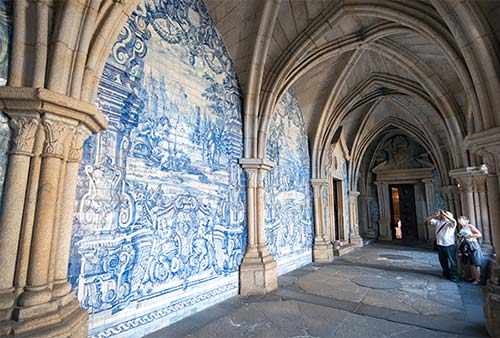
The cloister and its adjacent rooms are worth the time and entrance fee. The cloister’s walls are decorated with elaborate azulejos (tiles) illustrating the amorous poetry of the Bible’s “Song of Songs.” (The inexpensive pamphlet is skimpy, but the €5 English guidebook explains it all, including the text that inspired the azulejos.) Entering, turn right and go for a counterclockwise stroll. The adjacent Chapel of St. Vincent, with 17th-century painted carvings of Bible scenes, has a trapdoor into a crypt, where centuries of bishops’ bones were ultimately tossed. Up the Nasoni staircase, the richly ornamented chapter room is where the bishop and his gang met in the 17th century to wield their religious and secular power. Note the holy figures depicted on the ceiling and the fine city views from the windows. There’s also a typical treasury, with vestments and monstrances.
Cathedral Square
From the cathedral’s small square—until the 1920s a congested medieval quarter—you’ll get a great view of the old town. The Baroque spiral pillory (20th-century copy) is a reminder of the harsh justice once doled out here. Dominating the square (and the skyline of Porto) is the massive Bishop’s Palace, still the home of the bishop and his offices; the immensity of this 18th-century building reflects the bishop’s past power. The crenellated tower just down the stairs from the cathedral square houses a TI.
Facing the cathedral, walk around to the left to the statue of Vímara Peres, a Christian warrior who reconquered this region from the Moors in 868. (It was lost again within two generations and remained under Muslim control until the final reconquest in about 1100.) Step into the portico on the side of the cathedral to admire the original 18th-century blue tiles.
From the viewpoint banister to the left of Vímara Peres, survey the city and find the church with the blue facade in the middle ground. São Bento station is just to its right, and the green copper dome and steeple of the City Hall breaks the skyline above it. Below you spreads the seedy district called Sé (meaning “cathedral,” it refers to the Seat of the Catholic Church). This neighborhood, the oldest in town, was famously run-down and depopulating. Things are changing, as the government is encouraging people to move in by offering economic incentives. The streets beyond the medieval gate—once a ratatouille of drug users and prostitutes, but now touristy—twist their way down into the Ribeira district.
Hidden Church and City Wall
A segment of the restored city wall is visible near the top of the funicular. To get there, walk past the top of the Ponte Dom Luís I bridge (behind the cathedral) and up Rua de Saraiva de Carvalho to the leafy square called Largo Primeiro de Dezembro. Through the arched doorway hides the Santa Clara Church—think of this as a free version of São Francisco Church (see listing later), with an equally impressive, if musty, Baroque interior decorated with carved wood and lots of gold leaf (Mon-Fri 10:00-12:30 & 14:30-17:00, Sat 10:00-12:30, closed Sun, may be closed for renovation).
Walk back to the main street, then take a right to find a small portion of the former city wall. The funicular that departs for the Ribeira riverfront is just across the street (Funicular dos Guindais, station below ground).
JUST ABOVE THE RIBEIRA, ON HENRY THE NAVIGATOR SQUARE
These sights are on or near Praça do Infante Dom Henrique, a steep block uphill from the Ribeira district.
▲▲Stock Exchange Palace (Palácio da Bolsa)
This bold building is neither a stock exchange nor a palace, but the headquarters of the Commercial Association of Porto (Associação Comercial do Porto). Built over 70 years, it’s a breathtaking monument to civic and commercial pride, with some of the most lavishly decorated rooms in Portugal. The building—with its finely-carved granite rooms—celebrates Porto’s renowned work ethic and dedication to international trade. For more on the history of the building, see “Porto Walk,” earlier.
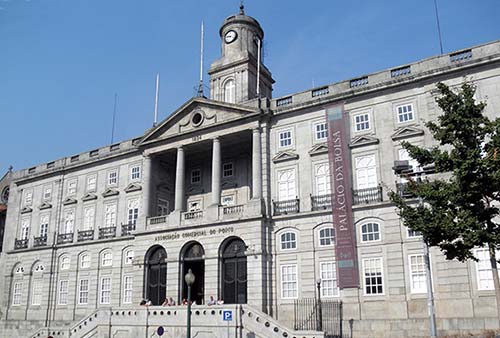
Cost and Tours: The interior can only be visited on a 45-minute guided tour (€10). Tours leave every 30 minutes in various languages (with only about six a day in English). To avoid the wait, call to ask when the next English tour departs—or, if you’re nearby, drop in and check at the ticket counter or on screens in the lobby. It’s smart to pay for and reserve a spot on an English-language tour in person (while tickets are sold online, you can’t reserve an English-language tour time). Up to 50 people can join a tour; you might visit other nearby sites if you have a wait.
Hours: Daily 9:00-18:30, Nov-March 9:00-13:00 & 14:00-17:30; these are last tour times.
Information: Located in big building marked Associação Comercial do Porto on Rua Ferreira Borges, +351 223 399 013, www.palaciodabolsa.com. Note that the building still houses the offices of the Chamber of Commerce, and often closes when rented out for events.
Visiting the Stock Exchange: You’ll tour several rooms, big and small. You’ll begin in the dramatic main hall—decorated with the coats of arms of 20 international trading partners—then climb the grand staircase to tour a variety of fine rooms. The place is rife with symbolism and intricate, time-consuming craftsmanship: the complex patterned floors, carefully pieced together with Brazilian and African wood (from Portugal’s colonies); an incredibly detailed inlaid table, created over three years using wood scraps from those same floors; and a room that looks like it’s made of finely carved woodwork and bronze—until you realize it’s all painted plaster and gold leaf.
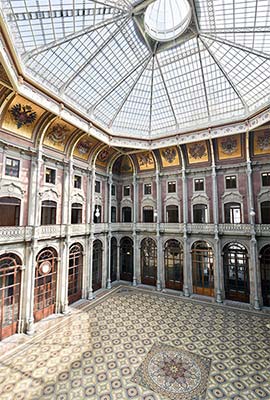
The knock-your-socks-off finale is the sumptuous Arabian Hall. This grand space—inspired by Granada’s Alhambra and 18 years in the making—was painstakingly decorated in the Moorish style with wood, plaster, and gold leaf.
▲São Francisco Church
This is Porto’s only church in the Gothic style—complete with a rose window, stair-step buttresses, and a statue of St. Francis of Assisi on the front. Today, a visit comes in two parts: the extravagantly decorated church and its jam-packed catacombs.
Cost and Hours: €8, daily 9:00-20:00, Oct-Feb until 17:30, inexpensive guidebooklet, Rua do Infante Dom Henrique.
Visiting the Church: Buy your ticket at the office across from the church entrance. Although the church was ravaged by Napoleon and by the Portuguese during their 19th-century civil war, the interior remains stunning, with lavish chestnut carvings slathered in gold leaf. Wander down the main aisle like a bewildered 18th-century peasant. The first big, ornate altar on the right shows how Franciscans weren’t always warmly received—at the top they are being cruelly tortured and crucified by Japanese (portrayed with Arabic features), and at the bottom they are being beheaded by Moors. Still, in the center, St. Francis encourages his followers on. A few steps forward and to the left, find the extremely fertile Tree of Jesse (1718), which is a very literal interpretation of the family tree of Jesus, resting upon a sleeping Jesse. Below that, Mary lies in a boat as Our Lady of Good Voyage, a patron saint of navigators. Note the wooden boards on the floor—once graves of parishioners. These graves are now empty, but you can see the bones in the crypt.
To get there, cross back over to the ticket desk. You’ll walk through another large but more modern chapel and a modest museum, then head down the steps to the church’s crypt—its walls and floors neatly lined with tombs. The remains of former parishioners eventually end up in an inglorious bone heap or ossuary. Peer down through the trapdoor near #32 (look for signs to the ossário) to see their final refuge.
House of Henry the Navigator (Casa do Infante)
Six hundred years ago, Porto’s favorite son was supposedly born in this granite mansion (once the largest house in town, and later the main customs house and even minted coins for the city). Modern exhibits offer a look at Henry and the explorations he promoted, but there are few actual artifacts. You’ll see a model of city in Henry’s day, a few bits of broken pottery, and wonder “Where’s the beef?” Still, if you’re in a seafaring mood, it’s a good reminder of all the new ground (well, water) that Portuguese explorers covered over the centuries.
Cost and Hours: €4, Tue-Sun 10:00-17:30, closed Mon, Rua da Alfândega 10, +351 222 060 423.
PORT WINE LODGES IN VILA NOVA DE GAIA
Just across the river from Porto, the town of Vila Nova de Gaia—or just Gaia (GUY-yuh)—is where much of the world’s port wine comes to mature. Port wine grapes are grown, and a young port is produced, about 60 miles upstream in the Douro Valley. Then, after sitting for the winter in silos, the wine is shipped downstream to Vila Nova de Gaia to age for years in lodges on this cool, north-facing riverbank. Over a dozen companies run these lodges, holding down the port fort and offering tours and tastings. There are also several independent tasting rooms. For wine connoisseurs, touring a port wine lodge (cave do vinho do porto) and sampling the product is a ▲▲▲ attraction; for those with a casual interest, dropping into one or two is fun, educational, and worth ▲.
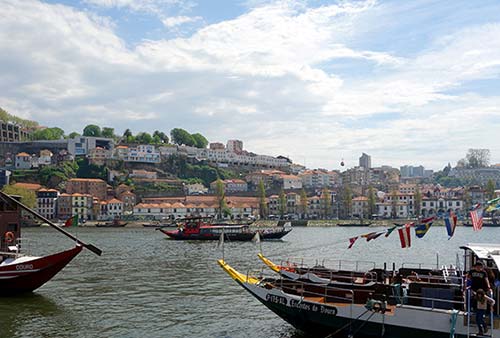
Gaia is technically a separate town from Porto, even though it’s just across the river and feels like part of the city. Venturing here is well worth the trip. But if you’re very tight on time, consider just dropping into one of the wine tastings on the Porto side of the river (see here).
Getting There: From the city center, take bus #900, #901, or #906 to get to the waterfront, with a stop at Cálem lodge, where you can then walk along the river. Buses #901 or #906 then continue uphill to Taylor’s wine lodge (every 30 minutes, stop across from São Bento station near the Metro entrance). From the Ribeira district, walk (or catch a cab or Uber) across the Ponte Dom Luís I bridge or take a river taxi (see “Getting Around Porto,” earlier).
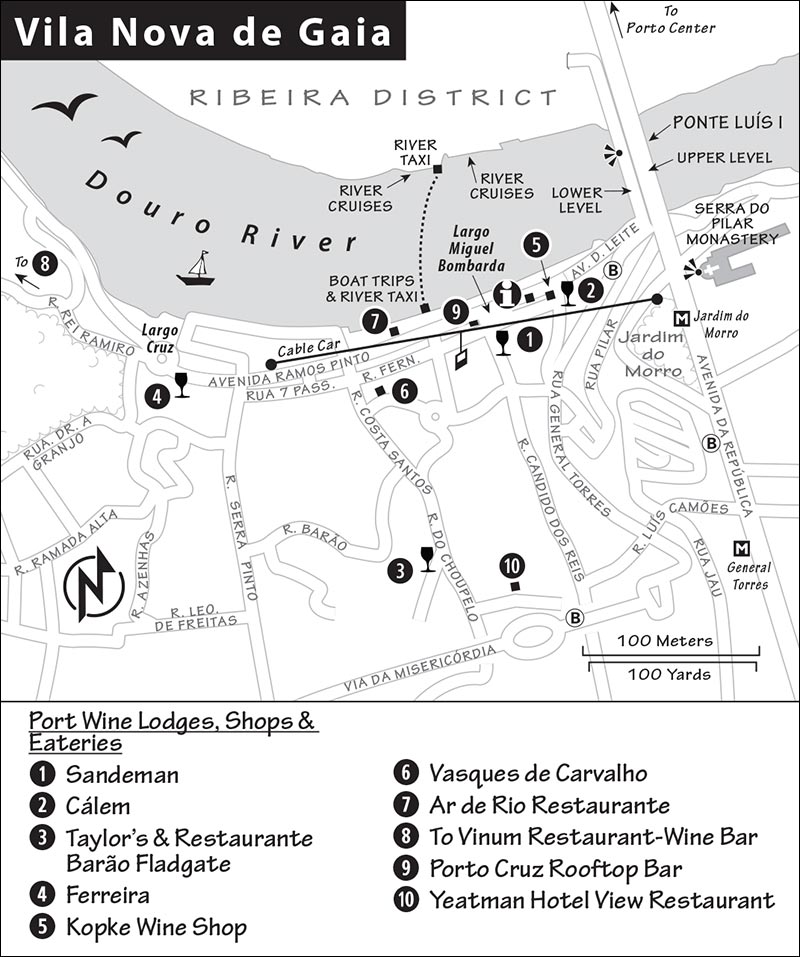
Services: Vila Nova de Gaia operates its own handy TI with information about the lodges (daily 10:00-18:00, longer hours in summer, on the riverbank at Avenida Diogo Leite 135, +351 223 758 288, www.cm-gaia.pt). Drinks-with-a-view options are available all along the waterfront. A pricey cable car links the riverfront with the hilltop Jardim do Morro, at the foot of the Ponte Dom Luís I bridge.
▲▲▲Tours and Tastings
Port tasting is a subjective business, and no single lodge is necessarily the best. If you’re a port enthusiast, you probably already have a favorite (or can quickly decide on one, with a little enjoyable research). Although more serious European visitors choose one lodge to visit, American tourists are known to hop between three or four in a single day...before stumbling back to their hotels.
Port is a medium-sweet wine (around 20 percent alcohol), usually taken as a digestif after dinner. The wine is fortified at a ratio of about 4:1 with aguardente, a grappa-like brandy distilled from the same grapes. The brandy is introduced before fermentation is complete—and kills the remaining yeast—which leaves more sugar in the port (standard wines ferment for 10-12 days; port for only 2-3 days). After the brandy is added, the wine ages for at least two years.
For most people, “port” means a tawny port aged 10-20 years—the most common type. But there’s a whole spectrum of port, using more than 40 varieties of grapes. The two broad categories are wood ports (aged in wooden barrels or vats) and vintage ports (aged in bottles). Here’s a rundown:
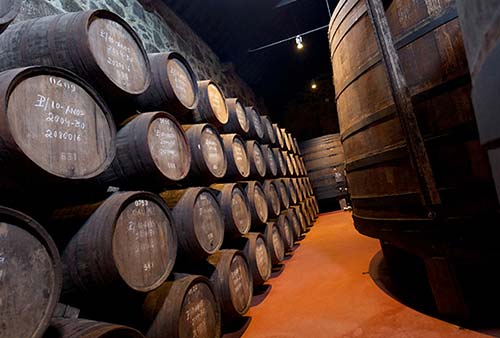
Tawny, the wood port with a leathery color, is the most typical version. It’s older, lighter, mellower, and more complex than L.B.V. (described later). It’s aged in smaller barrels, maximizing exposure to wood and giving it a nuttier flavor. Tawny port stays in the barrel for 10, 20, 30, or 40 years. But to enhance the complexity of the flavor, any tawny is actually a blend of several vintages (for example, a “30-year-old tawny” is predominantly 30 years old, but also has components that are 10 or 20 years old). Once blended, the various ports “marry” in the bottle for about eight months.
Inexpensive ruby port ages in oak vats for only three years, and then it’s bottled. It’s deep red, fruity, and has a strong, fiery taste of grape and pepper.
Vintage port—the most expensive—is a ruby that comes from a single harvest. Only wine from the very best vintages is selected (typically two or three per decade; 2011 was a great year, and 2000 was one of the best ever). After two years of aging in wooden casks, potential vintage port must be tested by the authorities. If they reject it, the wine stays in the casks longer to become L.B.V. (see next). If they give it the go-ahead, it’s bottled and aged another 10-30 years (or more). Sediment is common, so bottles must be decanted. And if a bottle is really old, the cork may deteriorate—so the top of the bottle is heated up with a pair of red-hot tongs, then cold water is poured over it to break it off cleanly.
Late Bottle Vintage (L.B.V.) was invented after World War II, when British wine lovers couldn’t afford true vintage port. L.B.V. is a blend of wines from a single year, which age together in huge wooden vats for four to six years. The size of the vats means less exposure to wood, which makes it age more quickly, but without losing its fruitiness and color. It’s bottled after five years (later than a vintage port, which ages for only two years—hence the name). This more-affordable alternative saved the port wine industry.
You’ll also see white ports, which are young, robust, and typically consumed before dinner as an aperitif. Most are dry (similar to Spain’s fino sherries); for a sweet version, look for lágrima on the label. Aging the white ports has become trendy and produces a darker wine with some characteristics of a tawny. More recently, some vintners have experimented with rosé ports. And Douro table wines are becoming a popular and respected secondary business for many producers.
Port’s stodgy image makes it unpopular among young Portuguese. Lodges have not escaped the multinational conglomerate game, but new owners often retain the brand name to keep loyal customers even as they market aggressively to attract new ones. For some, port is an acquired taste—but it’s one worth cultivating. As I always say, “Any port in a storm...”
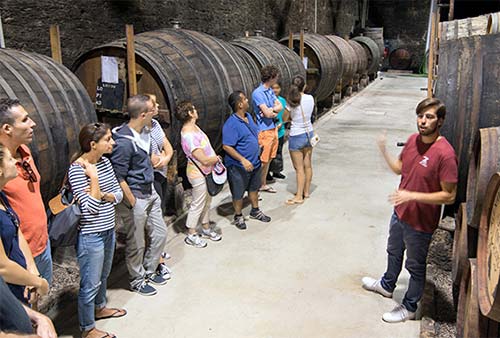
Visiting a Port Wine Lodge: At any lodge, the procedure is similar. Individual travelers simply show up and ask for a tour; if it’s busy, they may assign you a time. Pass any wait time by browsing the small on-site museum or watching a video, or simply get started on the tasting. A standard tour/tasting costs €12 and takes about 30 minutes. Tours generally come with a walk through the warehouse (with wooden barrels and vats); a 5- to 10-minute video produced by that label giving you a quick peek at their process and the scenic Douro Valley; sometimes a small museum; and, finally, two or three tastings. Tours at fancier lodges (like Taylor’s) take longer and cost more. At any lodge, serious students may opt for more involved tours, offering tastings of finer wines (generally €20, with smaller groups, 5 tastings, book in advance if possible). Before you go (or while you’re waiting for your tour), you can read about the “Port Wine Crash Course” (in this chapter), “Brits on the Douro” (here), and “Growing—and Stomping—Grapes in the Douro Valley” (here).
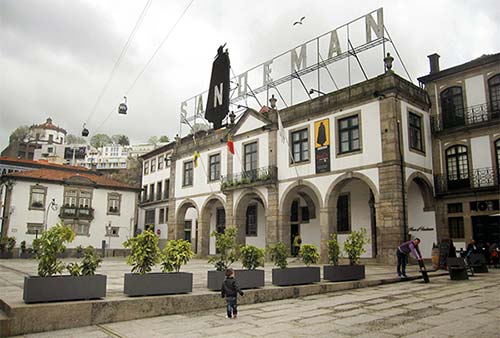
Sandeman, the most high-profile company, is the Budweiser of port. They were the first port producer to create a logo, which you’ll see everywhere: a mysterious man wearing a black cloak (representing a Portuguese student’s cape) and a rakish Shadow hat (worn by Spanish horse-riders, symbolizing the sherry that Sandeman makes in Jerez). Sandeman provides the most corporate, mainstream, accessible experience for first-timers—with a short walk led by a caped guide, a 10-minute video, and two tastings. It’s also the most crowded, often giving times for you to return or sending you to their sister manufacturers. It’s exciting to think that the entire Portuguese production of Sandeman Port ages right in this building (€17 basic visit, €25 for 1.5-hour tour with 5 tastes; daily 10:00-13:00 & 14:00-18:00; faces its own little square with tables and bar service along the riverfront at Largo Miguel Bombarda 3, +351 223 740 533, www.sandeman.com).
Cálem, the first place you see after crossing the bridge, offers a fine tour wandering among its huge oak casks (€14 includes 2 samples, 25-minute tours in English depart about every hour, April-Oct daily 10:00-19:00, off-season fewer tours and closes at 18:00, +351 916 113 451, www.calem.pt). They also offer 45-minute fado shows that include a port tasting (€23, daily at 19:00, reservations required)—a handy and entertaining alternative if you show up just after most of the lodges have closed.
Taylor’s—near the top of the hill—is a good choice for more discriminating tastes. It’s classy and more time-consuming than the options down on the riverbank and comes with stunning views back on Porto. You’ll follow a one-hour audioguide through the sprawling complex, including modern museum exhibits, and end with two tastings—which you can enjoy with the grand views (€15, daily 12:00-20:00, high up but worth the hike at Rua do Choupelo 250, +351 223 772 973, www.taylor.pt). Their splurge restaurant, $$$$ Barão Fladgate, offers lunchtime views along with an opportunity to recharge for more tastings. Many consider it among the best dining spots in Porto (reservations smart, daily 12:30-15:00 & 19:00-22:00, +351 223 772 951, www.baraofladgate.com).
Ferreira’s lodge comes with classical music “to help age the wine.” It’s an interesting tour and shows off some fine museum artifacts (€17 includes 3 tastings, daily 10:00-12:30 & 14:00-18:00, look for big sign at the end of the riverfront promenade at Avenida Ramos Pinto 70, +351 223 746 107).
Wine Shops: Several producers have tasting rooms separate from their lodges. Kopke is recognized as one of the best in the business because they were the first. Unfortunately, their lodge doesn’t receive visitors, but their shop along the waterfront allows people to experience—one delightful sip at a time—what they’ve been doing well since 1638. The staff offers concise explanations and some fine ports by the glass in an elegant upstairs tasting room far from the crowds outside (€4-7/glass, flights start at €25—decide and pay before going upstairs, excellent opportunity to try their red and white wines also produced in the Douro Valley; daily 10:00-19:00, Nov-April until 18:00; next to Cálem at Avenida Diogo Leite 312, +351 915 848 484, http://kopke1638.com).
Vasques de Carvalho may be the new kid on the block, but their wines are anything but. The Carvalhos began making port in 1880. In the 1970s, the matriarch increased production, and son António has now entered the very competitive market with a bang. Their intimate and stylish tasting venue has four different areas (flights starting at €15 or taste by the glass, Mon-Sat 15:00-19:00, closed Sun, Rua de Santa Marinha 19, +351 223 710 445, www.vasquesdecarvalho.com).
SIGHTS AWAY FROM THE CENTER
Tramway Museum (Museu do Carro Eléctrico)
This clever museum-in-a-warehouse displays beautifully restored examples of trolleys from different eras, including 1950s buses and a brand-new hydrogen-powered city bus. You can climb aboard many for a fun, Rice-A-Roni-style experience...just ding the bell.
Cost and Hours: €8, discount with all-day trolley pass; Mon 14:00-18:00, Tue-Sun 10:00-13:00 & 14:00-18:00; Alameda Basílio Teles 51, +351 226 158 185, www.museudocarroelectrico.pt.
Getting There: The most atmospheric way to arrive at the museum is via trolley #1 or #18. Sit on restored leather seats and see a little of workaday Porto, plus some river views from up above.
Foz do Douro
Foz do Douro (or simply “Foz”) is one of Porto’s trendiest, greenest, wealthiest, and most relaxing quarters, situated where the river meets the Atlantic. There’s no real destination in Foz; simply wander through the park (Jardim do Passeio Alegre, with miniature golf, a fancy old WC pavilion, and a nondescript café), ponder the sea, and smell the seaweed. Walk out to either of the lighthouses to watch fishermen mending their nets and see where the Douro River ends. If you have the time and good weather, take a boardwalk stroll to the Praia dos Ingleses beach and its fancy pergola. With more time, walk all the way to the Castelo do Queijo fortress...no, it isn’t made of cheese. But the rugged rock formations apparently look like cheese to some people. Foz is a relaxing break from the busy downtown area, and sunset can be romantic on warm days.
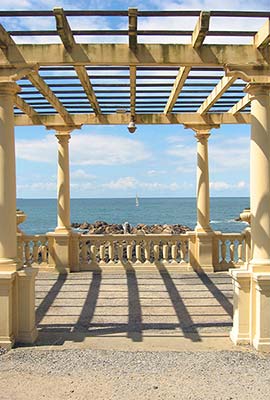
Getting There: Vintage trolleys (lines #1 and #18) scenically rattle their way from the Ribeira district along the Douro River and to the Jardim do Passeio Alegre, a 10-minute walk to the center of the Foz district. From the trolley stop, you can stroll at leisure or catch bus #500 for an Atlantic coast ride. Alternately, bypass the trolley by taking bus #500 from the Ribeira all the way to Foz (catch trolley or bus in front of São Francisco Church or in front of the Convento do Carmo, departures roughly every 20 minutes, fewer after 19:00, 20-minute trip).
Nearby: You can combine a trip to Foz with a visit to the Serralves Museum. From Foz, either catch bus #203—it runs near the beach on Rua de Dui—or take a taxi or Uber.
▲Serralves Foundation Contemporary Art Museum and Park (Fundação de Serralves)
Porto’s contemporary art museum, surrounding park, and unique Art Deco mansion are an enjoyable half-day excursion for art lovers—and worthwhile for anyone looking to relax in a lush green space.
Cost and Hours: €12 each for park, villa, or museum separately; €20 for access to all spaces; Mon-Fri 10:00-19:00, Sat-Sun until 20:00, closes one hour earlier Oct-March; +351 226 156 500, www.serralves.pt.
Eating: The museum’s $$ restaurant serves a lunch buffet, and coffee and snacks are available until park closing time.
Getting There: The complex is about 1.5 miles west of the city center in a wealthy residential neighborhood at Rua Dom João de Castro 210, just south of the busy Avenida da Boavista. From the center, you can reach it most easily via taxi, Uber, or on a hop-on, hop-off bus tour. Public bus service isn’t great, but you can take bus #203 to the Serralves stop (less convenient from downtown—the most central place to catch it is at the big Boavista Rotunda near Casa da Música).
Background: The Serralves Foundation was formed in 1989 with two goals: the advancement of contemporary art and the appreciation of landscape and environment as an artistic concept. These goals, symbolized by the huge red hand shovel near the front gate, drive the layout of the complex: a gigantic contemporary art facility on the edge of a carefully planned park. The whole thing is based around the Art Deco villa of a count who lived here in the 1930s.
Visiting the Museum and Park: The museum presents temporary exhibits by Portuguese and global artists. The enormous, blocky U-shaped building was designed by prominent Portuguese architect Álvaro Siza, who was greatly inspired by the existing mansion.
The park around the museum has been designed very carefully to compartmentalize each section; when you’re in one part of the grounds, you can’t see the rest. This is a very peaceful, romantic place to wander. Hiding in here are a tree-top walk, pleasant rose garden, a tea house overlooking a former tennis court, a lake, a small farm with animals, a gardening school, and Casa de Serralves itself.
The villa (Casa de Serralves) is, for many, the most interesting part of the whole experience: a huge pink Art Deco mansion that looks like the home of an Old Hollywood star. On two sides, long manicured hedges and fountains stretch to the horizon. Look for the private chapel in back—also pink Art Deco. You can usually go inside the villa to check out the cavernous interior. Ponder how the design of this place is reflected in the museum. The best part is upstairs: the mirrored, pink-marbled bathroom, dramatically overlooking the grounds.
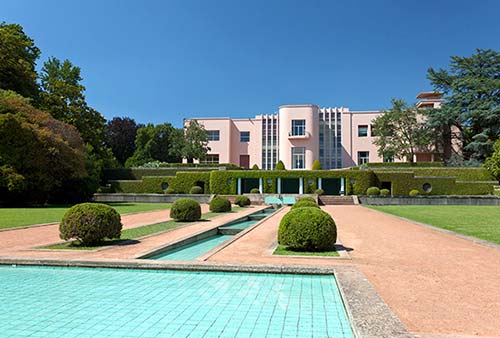
House of Music (Casa da Música)
This landmark 1,200-seat concert hall opened in 2005. The angular, white concrete building with rippling glass windows was designed by the firm of Dutch architect Rem Koolhaas (OMA), which also built Seattle’s Central Library. Contemporary-architecture fans will find it at the big Boavista Rotunda northwest of the city center (Metro: Casa da Música). Guided tours take you through the interior, or you can attend an affordable concert of anything from world music to classical to jazz to fado.
Cost and Hours: One-hour tours focused on the concert hall’s unique architecture run daily in English at 11:00 and 16:00 (€10, info/reservation +351 220 120 210, www.casadamusica.com).
Nightlife in Porto
The best after-dinner fun in Porto is to prowl the streets between the Clérigos Tower and the University of Porto, which are lively with student bars and often feature live music. Another good option is the street scene along Rua de Cândido dos Reis (one block from the Lello bookstore). Pick one of the bars here to try a local cocktail invention, the “Porto Tonic”: one part white port and two parts tonic water.
Fado—a blues-like Portuguese music popular with tourists—is not really a Porto thing, but if you really want to hear it, try the recommended Café-Restaurante Guarany (free fado Wed, Thu, and Sat from 21:30-23:00, Avenida dos Aliados 85, +351 223 321 272). The House of Music (described earlier) offers classical, jazz, fado, and more, as does the centrally located Coliseu do Porto theater (Passos Manuel 137, uphill around the corner from Café Majestic, +351 223 294 940, www.coliseu.pt).
Sleeping in Porto
You’ll pay more to be in the scenic, atmospheric, and very touristy Ribeira district; or you can save a bit (and be closer to more interesting restaurants and local life) by sleeping higher on the hill, in the city center. The Stock Exchange Palace area offers a nice mix. You’ll almost always have to climb a few stairs to get to the elevator, if they have one.
SPLURGES IN THE RIBEIRA
$$$$ Guest House Douro is nestled right in the heart of the Ribeira bustle, overseen by owners Carmen and João, who are generous with local advice. It has eight small but cozy and tastefully decorated rooms with all the modern comforts (including much-needed soundproofing), and the generous breakfast is a great way to start your day (air-con, elevator, curfew—1:00 in the morning, closed Jan-Feb, near House of Henry the Navigator at Rua Fonte Taurina 99, +351 222 015 135, www.guesthousedouro.com, guesthousedouro@sapo.pt).
$$$$ 1872 River House is a classy B&B at the far end of the Ribeira embankment. It fills old river houses with industrial-mod finishes, eight compact, stone-walled rooms (half facing the river), and gorgeous shared public spaces including a cozy riverview lounge (Rua do Infante Dom Henrique 133, +351 961 172 805, www.1872riverhouse.com).
$$$$ Pestana Porto Hotel is a stylish, overpriced, and slightly snobby top-end place, filling several colorful old townhouse buildings right along the embankment and main square with 109 plush rooms (air-con, elevator, Praça de Ribeira 1, +351 223 402 300, www.pestana.com, guest@pestana.com).
$$$$ Carrís Hoteles Porto Ribeira sits on the back side of the Ribeira, occupying four conjoined former warehouses. Its 159 business-like rooms offer all the basic comforts plus double-paned glass to keep out street noise. Large lounges with exposed stone let you see the history of these buildings (air-con, elevator, Rua do Infante Dom Henrique 1, +351 220 965 786, www.carrishoteles.com).
NEAR THE STOCK EXCHANGE PALACE
$$$$ A.S. 1829 Hotel is a splurge that owns a wonderfully central location, overlooking the base of thriving Rua das Flores, a long and steep block above the Stock Exchange Palace. The public spaces and 41 rooms are decorated with both a sense of style and respect for tradition (air-con, Largo de São Domingos 45, +351 223 402 740, www.as1829hotel.pt).
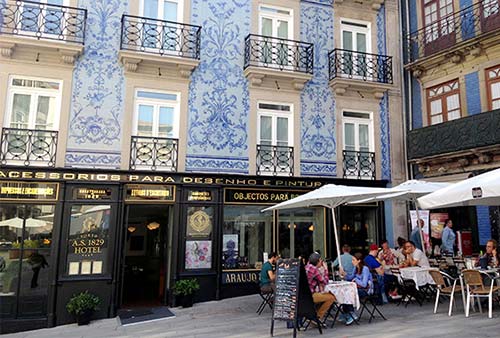
$$$ InPátio Guest House, tucked down a tiny alley just above the Ribeira scene, provides a quiet, secluded oasis of comfort away from the crowds. Five beautiful, sleek, well-priced rooms with modern interiors and unique bathrooms hide inside a renovated 19th-century building. Fernando and Olga make you feel very welcome (air-con, luggage elevator, Pátio de São Salvador 22, +351 934 323 448, www.inpatio.pt, info@inpatio.pt).
$$ Hotel da Bolsa, a few blocks above the Ribeira scene, is a straightforward business hotel with a great location and 36 fine but aging rooms—some with views (air-con, elevator, Rua Ferreira Borges 101, +351 222 026 768, www.hoteldabolsa.com, reservas@hoteldabolsa.com).
IN THE CITY CENTER
On and near Praça da Batalha
This appealing location—on a borderline-seedy square capped by the beautiful azulejo-covered Church of San Ildefonso—is close to Porto’s market and shopping zone, and just uphill from São Bento station, the cathedral, the bridge to Vila Nova de Gaia, and the funicular down to the Ribeira.
$$$$ NH Collection Porto Batalha has converted an elegant old post office into a sleek and inviting top-end hotel. It has an open-concept lobby, 107 well-equipped rooms, and a subtle but clever postal theme (air-con, elevator, Praça da Batalha 62, +351 227 660 600, www.nh-hotels.com, nhcollectionportobatalha@nh-hotels.com). Two other (less elegant) business-class hotels share the same square and are worth considering if you can score a deal: $$$ Legendary Porto Hotel (at #130, +351 223 392 300, www.legendaryportohotel.com) and $$$ Mercure Porto Centro Santa Catarina Hotel (at #116, +351 222 043 300, www.mercure.com).
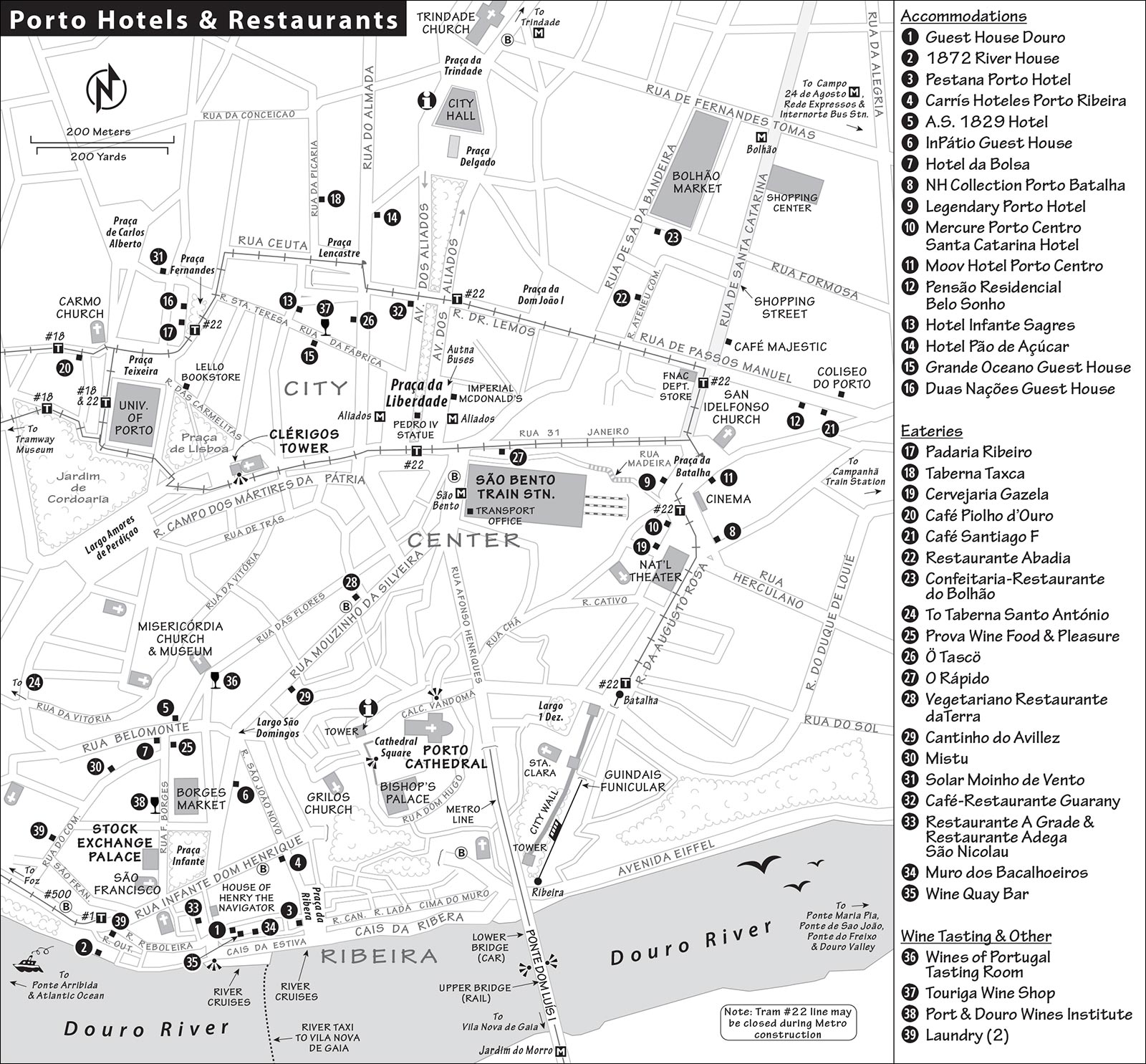
$ Moov Hotel Porto Centro has 125 sleek, modern rooms occupying a remodeled movie theater. Black-and-white photos of movie stars decorate the walls in tribute to its former life. It’s temptingly affordable and nice for the price, with no frills and a handy location (family rooms, breakfast extra, air-con, elevator, parking, quiet back patio, Praça da Batalha 32, +351 220 407 000, www.hotelmoov.com, porto@hotelmoov.com).
¢ Pensão Residencial Belo Sonho is a well-maintained, family-run (no English spoken) budget throwback, just around the corner from Praça da Batalha. Its 15 rooms are an excellent value if you don’t mind the language barrier (noisy on Fri and Sat nights, no breakfast, Rua Passos Manuel 186, +351 222 003 389).
West of Avenida dos Aliados
These choices are on the steep streets just west of Avenida dos Aliados, mixed among some tempting eateries.
$$$$ Hotel Infante Sagres showcases Portugal’s luxurious, mid-20th-century style with an elegant stained-glass-lined staircase and proper breakfast room. Recently updated rooms spoil guests, and warm service complements on-site amenities such as a wading pool, sundeck, and the Vogue café-bar (air-con, elevator, Praça D. Filipa de Lencastre 62, +351 223 398 500, www.infantesagres.com).
$$$ Hotel Pão de Açúcar treats guests to a vintage experience. A stunning spiral staircase and fun retro decor (bumper cars, anyone?) make its public spaces and large rooms fun and friendly. The terrace has great views of the City Hall clock tower (air-con, elevator, Rua do Almada 262, +351 222 002 425, http://www.paodeacucarhotel.pt).
$ Grande Oceano Guest House, a good value in a central location, is a steep walk-up with shiplap floors. It has 15 clean, basic rooms on four floors—all but two have private baths and air-con (family rooms, no breakfast, no elevator, Rua da Fábrica 45, +351 222 038 770, www.grandeoceano.net [URL inactive], geral@pensaograndeoceano.com).
¢ Duas Nações Guest House is a well-run backpacker place with 16 simple but colorful rooms—as comfy as such a cheap place can be. It overlooks a square straight up Rua da Fábrica, a few blocks from Avenida dos Aliados. The “two nations” are Portugal and Brazil, still friends after all these years (private rooms available, cash only—or prepay on Booking.com, breakfast extra, Praça Guilherme Gomes Fernandes 59, +351 222 081 616, www.duasnacoes.com.pt, duasnacoes@sapo.pt). They also rent several apartments—all remodeled with small kitchens, washing machines, air-con, and double-paned windows.
Eating in Porto
Porto is famous for its tripe. Legend has it that when Porto’s favorite son, Prince Henry the Navigator, set out for his explorations, the city slaughtered all of its mature livestock to send along with his crew—keeping only the guts for themselves. Porto’s cooks then devised many ingenious ways of preparing innards. The tradition stuck, and to this day, people from Porto are known as tripeiros. These days, tripe plays a subtler role. You’ll most typically see it prepared “Porto-style” (tripas à moda do Porto): barely present in a thick stew, with beans, sausage, chicken, and scant vegetables.
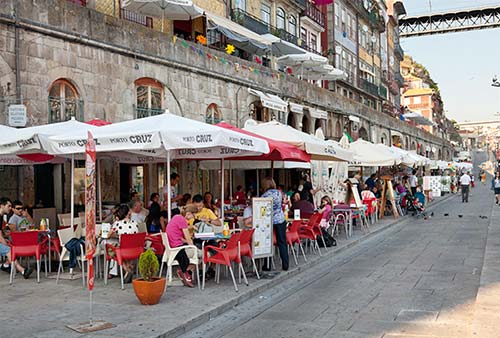
For something easier to stomach, try a bifana—shredded pork cooked slowly in spicy sauce on a bun. And locals love their soup, especially caldo verde—a tasty broth thickened with potatoes and thinly chopped kale.
For a quick meal, locals slog through a monster patty-melt called a francesinha (“little French girl”). The standard francesinha wedges pork cutlets, sliced sausages, and gooey Swiss cheese between two (or more) thick slices of dense bread. The whole thing is grilled and topped with melted cheese and an optional fried egg, then finally drenched with a slightly spicy beer-based sauce. This gut bomb easily feeds two (some places charge a euro to split).
Super Bock is the local favorite beer, available almost everywhere on tap.
Food Tours: To maximize your eating experience, consider Taste Porto Food and Wine Tours (see “Tours in Porto” near the beginning of this chapter).
IN THE CITY CENTER
Bars, Cafés, and Basic Eateries in the City Center
Good, cheap restaurants are scattered all around the city center. You’ll see hand-written menus with €1 soups and €5 plates. Remember that most coffee and pastry shops do double duty as lunch spots, so wander around and see what people are having.
$ Padaria Ribeiro is a bright, happy bakery handy for a breakfast, light lunch, or snack. They serve savory and sweet pastries, sandwiches, and popular cookies. Mini almond tarts are a good choice, but chocolate lovers can get their fix with a brigadeiro: butter, condensed milk, and chocolate rolled into a gooey ball and covered with chocolate sprinkles. You can get your treat to go, or order inside and have them bring it to you at the small seating area or at a table on the square (daily 8:00-20:00, Praça Guilherme Gomes Fernandes 21, +351 222 005 067).
$ Taberna Taxca is a concrete man cave offering up beer, soup, and sandwiches. The menu is cheap and extremely basic. They serve two soups (great caldo verde and the much heavier papas—made with shredded pork, gravy, and cumin) and sandwiches that celebrate simplicity: smoked ham with fried egg, meat from black crockpots of cooked pork (rojão), or spicy shredded pork (bifana). I like to sit under the hanging hams at the bar to enjoy the scene. They serve a few salads, kept secret in the lower window. While you’re safe ordering a salad, if you order water, they’ll ring the cowbell of shame—try it (Mon-Sat 12:00-22:30, longer weekend hours, closed Sun, Rua da Picaria 26, +351 222 011 807).
$ Cervejaria Gazela, a gritty little hole-in-the-wall just off Praça da Batalha, is beloved among locals for its “little hot dogs” or Cachorro Especial. Sit down at the bar, order one and a beer, and watch the staff lovingly lay the sausage and cheese on the fresh buns and then grill these little snacks just right (Mon-Fri 12:00-22:30, Sat until 17:00, closed Sun, facing National Theater just to the right at #3, +351 222 054 869).
$ Café Piolho d’Ouro is a venerable student diner/café/bar with fun seating both inside and out on a big square. Plaques lining the walls celebrate decades of graduating classes (Mon-Sat 8:00-24:00, closed Sun, Praça de Parada Leitao 41, +351 222 003 749).
$ Café Santiago F is just a basic diner, long and skinny with a classic bar, that famously serves what many consider Porto’s best signature sandwich, the hearty francesinha. While its tables are often full, the bar has a great energy. The sandwiches easily feed two—they charge €1 for an extra plate. Go a little early to avoid the lines (Mon-Sat 12:00-22:30, closed Sun, Rua Passos Manuel 198, another location just up the street at #226, +351 222 055 797).
Restaurants in the City Center
$$ Restaurante Abadia is a big, bright, old-school place with two floors of customers dining on large splittable portions of straightforward Portuguese cuisine. It’s a touristy place with no stress, spacious seating, and formal waiters. Popular dishes are grilled cod, wild boar, Porto-style tripe (split a half-portion with your partner), and a sizzling hibachi of roasted chicken and potatoes (Mon-Sat 12:00-15:30 & 18:30-23:00, closed Sun, head one block east of Sá da Badeira to side street Rua do Ateneu Comercial do Porto 22, +351 222 008 757).
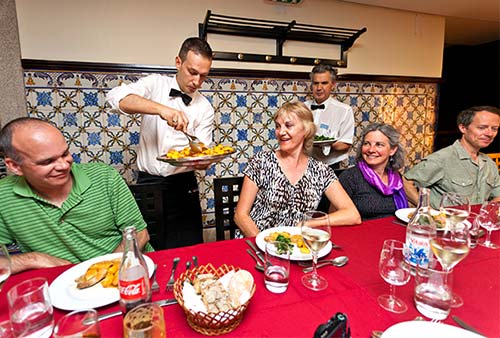
$ Confeitaria-Restaurante do Bolhão has been pleasing local shoppers since 1896—and feels like it. This bustling bakery/brasserie offers enticing takeout items in front and an inviting old-time dining hall in the rear (the more elegant basement is less lively and soulful). You’ll find cheap lunch deals, daily specials, fresh-baked goods, omelets, and fish. And don’t miss the fun selection of mini pastries, just waiting to be experienced (Mon-Sat 7:00-20:00, closed Sun, facing the Bolhão Market entrance at Rua Formosa 339, +351 223 395 220).
$$ Taberna Santo António is a convivial, hole-in-the-wall place—the quintessence of a family-run, neighborhood favorite. There’s a tight dining room and a few prime seats at the bar where eaters choose from six traditional stews, marvel at the homemade desserts, and joke with the waitstaff (Tue-Sun 12:00-15:00 & 19:00-22:00, Rua das Virtudes 32, +351 222 055 306).
$$$ Prova Wine Food & Pleasure is a lounge-y little wine bar with a relaxing jazz ambience. It’s the passion of sommelier Diogo, who speaks English and enjoys coaching visitors through his list of Portuguese wines (including ports) and then matching it with his selection of fine meats and cheeses (Thu-Mon 17:00-24:00, closed Tue-Wed, near the Stock Exchange Palace at Rua Ferreira Borges 86, +351 916 499 121).
$$ Ö Tascö serves traditional Portuguese food with a youthful spirit in a trendy space. The menu mixes old and new, featuring petiscos—small plates designed to be eaten family-style. The smart-aleck waiters have a fun shtick (daily 19:00-23:00, Rua do Almada 151, +351 222 010 763).
$$ O Rápido surprises not for its namesake speediness, but because it serves quality Portuguese classics with white-tablecloth flair on a rather unimpressive street alongside the São Bento train station. Staff know all the regulars but also make you feel welcome (Mon-Sat 12:00-15:00 & 19:30-22:00, closed Sun, Rua da Madeira 194, +351 222 054 847, reservations smart via thefork.pt).
$ Vegetariano Restaurante daTerra, the place for a meatless meal, is sleek and modern with a self-serve all-you-can-eat buffet of tasty dishes. Charging €7.50 for lunch and €10 for dinner, it’s a great value. While you can go back for seconds, you’ll pay extra for drinks and dessert (daily 12:00-15:30 & 19:00-22:30, Rua Mouzinho do Silveira 249, +351 223 199 257).
Fancier Dining in the City Center
$$$ Cantinho do Avillez, a colorful, upscale-casual space, is the Porto outpost of Lisbon-based celebrity chef José Avillez (see here). The enticing menu focuses on modern Portuguese cooking: traditional dishes with an international twist inspired by the chef’s travels. If tables are full, it’s fun to eat at the bar (reservations a must, weekday lunch specials, daily 12:30-15:00 & 19:00-23:00, Rua de Mouzinho da Silveira 166, +351 223 227 879, www.cantinhodoavillez.pt).
$$$ Mistu is a mod, dressy place with high ceilings, sexy art, and a smart clientele. The name refers to mixing cultures—fusion with a Portuguese base. The menu is divided between cold and hot plates designed to share (three plates fill two people). While the upper level is quieter, I much prefer the lower level and would reserve a table there (daily 19:30-24:00, Rua do Comércio do Porto 161, +351 926 682 620, http://mistu.pt).
$$$ Solar Moinho de Vento, on a small plaza just above Praça Guilherme Gomes Fernandes, offers proper-but-friendly service and Portuguese cuisine in a tile-covered dining room upstairs. Their version of bacalhau à brás, a salted cod dish, draws raves, as does the tender octopus rice (Mon-Sat 12:00-15:30 & 19:00-22:00, Sun 12:00-15:30, Rua de Sá Noronha 81, +351 222 051 158, www.solarmoinhodevento.com).
$$$ Café-Restaurante Guarany is a dressy and sprawling café facing Porto’s main boulevard. It feels like it must have been the place to see and be seen back in 1933 when it opened. It’s been the musicians’ coffee shop for generations and is now popular with tourists. You’ll enjoy Art Deco elegance with a Brazilian flair (read the brochure for the story of the murals) and crisp-yet-friendly service. They also have seating out on Avenida dos Aliados (good meat and fish plates, daily specials, daily 9:00-23:30, Avenida dos Aliados 85, +351 223 321 272, www.cafeguarany.com). There’s no extra charge for the live music starting at 21:30—some nights fado, other nights piano.
ON THE RIBEIRA RIVERFRONT
Dining options in the Ribeira have predictable tourist-trap quality and prices accompanying the fine views and fun scene. Strolling along the waterfront and following your nose is a good option. You can also try wandering the back lanes, trading river views for lower prices and local color. The seafood’s fresh, except on Mondays (since fishermen don’t go out on Sundays).
$$ Restaurante A Grade is a small mom-and-pop restaurant on a delightful alley just off the Ribeira. Ferreira serves while wife Helena cooks good, home-style Portuguese food. The baked octopus is a favorite among regulars (big, splittable portions of seafood and meat dishes; Mon-Sat 12:00-16:00 & 18:00-22:30, closed Sun, Rua de São Nicolau 9, +351 223 321 130, https://a-grade-restaurant.negocio.site; reservations smart).
$$ Restaurante Adega São Nicolau, just above Restaurante A Grade, is homey, small, and sparkling, with a few outside tables and a tight interior under a shiplap vault. While touristy, this spot is great for tasty, traditional cuisine with lots of fish (Mon-Sat 12:30-23:00, closed Sun, Rua São Nicolau 1, +351 222 008 232).
Muro dos Bacalhoeiros is a narrow lane over the harbor with a handful of $$ restaurants, each with a single line of little tables outside capturing the riverfront scene. I wouldn’t eat inside here—pick a place where you can sit out and enjoy the view.
$$$ Wine Quay Bar is all about vinho, paired with high-quality petiscos (plates of Portuguese cured meats, cheeses, olives, and other munchies; no cooked dishes). While they have inside seating, I’d come here for a spot at their banister facing the river (Mon-Thu 15:00-22:00, Fri-Sat 16:00-23:00, closed Sun, Muro dos Bacalhoeiros 111).
IN VILA NOVA DE GAIA
Eating across the river in Vila Nova de Gaia, just a 10-minute scenic stroll over the bridge from the Ribeira, is a fine option. It’s basically as touristy as the Ribeira, so don’t expect great quality or values—except at the port wine lodges—but the views over to Porto are marvelous. The last port lodges finish their tasting tours at 19:00, so working a dinner here into your sightseeing schedule is easy. Gaia rolls up the sidewalks early, so don’t expect much activity after dinner. For locations see the “Vila Nova de Gaia” map, earlier.
$$$ Ar de Rio Restaurante, where modern design meets traditional Portuguese cuisine, is in a park right on the river. Their €10 francesinha (a local super-grilled meaty sandwich that makes a triple cheeseburger seem like health food) is considered one of the best in town. You can eat inside or out on the deck (daily 12:30-23:30, modern steel-and-glass “box” along the embankment at Avenida Diogo Leite 5, +351 223 701 797). Consider a drink from their bar while enjoying a lounge chair on the riverbank here.
$$$$ Vinum Restaurant-Wine Bar delivers on their mission statement: to marry their port wines with locally sourced products. Located within the cellar of the Graham’s port wine lodge (past the end of the Gaia boardwalk), their elegant, white-tablecloth dining room sits alongside barrels of aging port. They also have terrace view seating...a worthy splurge (daily 12:30-23:00, Rua do Agro 141, +351 220 930 417, www.vinumatgrahams.com, reservations smart).
Scenic Drinks: With a delightful rooftop bar, Porto Cruz has a great view over both the bustle of the Gaia embankment and Porto across the river (lunches and light snacks, Tue-Sat 10:00-23:30, Sun until 19:00, closed Mon and in bad weather, just past Sandeman at Largo Miguel Bombarda 23). Higher up, the restaurant at the swanky Yeatman Hotel offers even more commanding views...and prices (Rua do Choupelo, +351 220 133 100, www.the-yeatman-hotel.com).
Picnic Perfect: The Vila Nova de Gaia mayor is determined to make his city (which is actually bigger than Porto) visitor-friendly. A sign of that is the inviting waterfront, welcoming picnickers with picnic tables, grass, rockery, piers, and the best views in town. A higher option is the park at Jardim do Morro at the top of the cable car and the upper level of the Dom Luís I bridge. Grab snacks at a local supermarket, then snack and watch the sunset fall over Porto.
Porto Connections
BY PLANE
Porto’s small and speedy Francisco Sá Carneiro airport is 11 miles north of downtown (airport code: OPO, +351 229 432 400, www.aeroportoporto.pt). It’s an international airport with connections beyond Iberia.
Getting Between the Airport and Downtown: Connecting the city center and the airport is easy. Figure €20-25 and 30-40 minutes by taxi or Uber. Or hop on the purple E line Metro with an Andante card to get to multiple stops in the city center (€2, 3/hour, 40 minutes, zone 4). Screens in the baggage claim area offer upcoming departure times. If you are running short on time or won’t be using a transport card during the remainder of your time in Porto, a contactless Visa credit card can be used for quick payment (look for dedicated terminals) without purchasing an Andante card (E line only).
BY TRAIN
Regional trains use the more central São Bento station; long-distance trains use Campanhã station on the east edge of town. The two stations are connected by frequent commuter trains (see “Arrival in Porto,” earlier). All trains leaving São Bento also stop at Campanhã (the next station). Some trains only depart from Campanhã station, so check the schedule carefully.
From Porto’s São Bento Train Station to: Peso da Régua (3/day direct, 2 hours; many more with change in Caide, 2-2.5 hours), Pinhão (5/day, 2.5-3 hours, direct at 9:00, others transfer at Campanhã station or Peso da Régua).
From Campanhã Train Station: Fast Alfa Pendular and Intercidades trains (both require reservation, buy online) go to Coimbra (hourly, 1 hour on Alfa Pendular line or Intercidades service) and Lisbon (hourly, 3 hours). Note that Alfa Pendular and Intercidades trains are similarly speedy, but Alfa trains cost more.
To reach Santiago de Compostela, Spain, it’s faster to go by bus (see next page), but you can also take a train (2/day, 5 hours, departs around 8:15 and 19:15, change in Vigo).
BY BUS
Remember, each bus company has its own station; there’s no single bus terminal except a few that share a garage on Campo 24 de Agosto (for addresses and telephone numbers, see “Arrival in Porto,” earlier). Various companies compete on the same route (for example, three companies go to Lisbon). Ask at the TI about the handiest bus for your itinerary. Don’t bother trying to get to the Douro Valley (Peso da Régua or Pinhão) by bus; it takes twice as long as the train.
From Porto by Bus to: Coimbra (operated by Rede Expressos, Rodonorte, and others; best is Rede Expressos—almost hourly, 1.5 hours), Lisbon (best via Rede Expressos, at least hourly, 3 hours), Santiago de Compostela, Spain (Alsa buses leave from bus terminal on Rua do Capitão Henrique Galvão near Casa da Música Metro station, daily at 12:45, 4 hours, additional runs in summer, Spanish tel. +34 902 422 242, www.alsa.es); also check Flixbus (www.flixbus.com).