NAZARÉ & CENTRAL PORTUGAL
Nazaré • Batalha • Fátima • Tomar • Alcobaça • Óbidos
Map: Batalha’s Monastery of Santa Maria
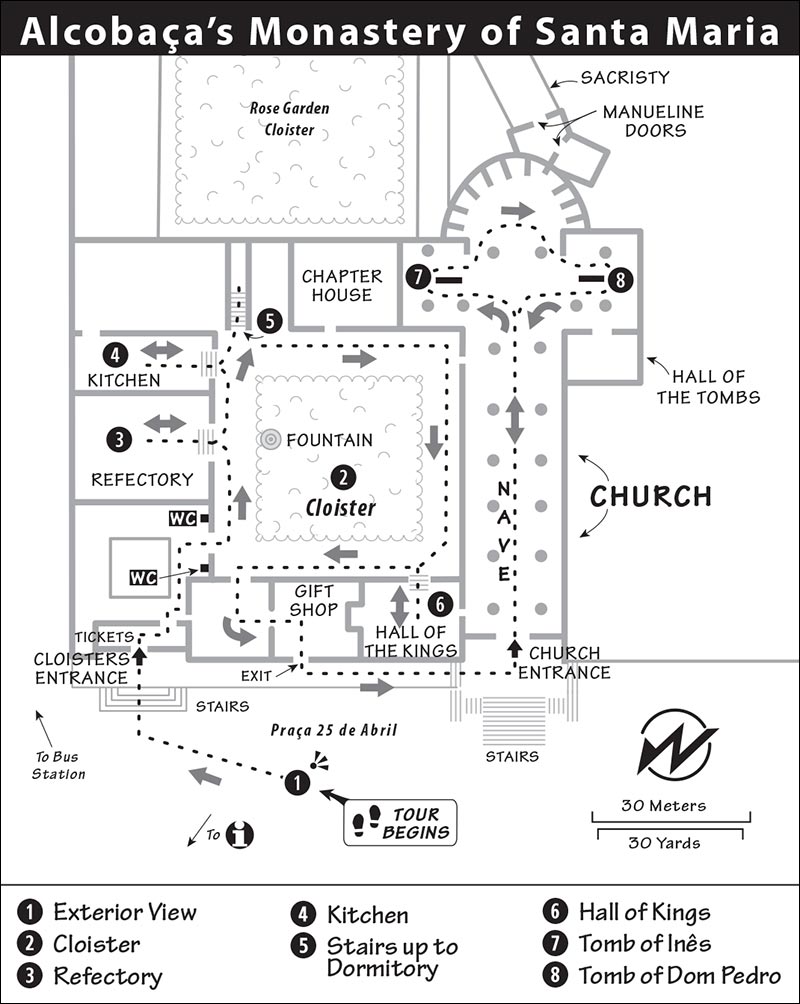
Map: Alcobaça’s Monastery of Santa Maria
Nazaré (nah-zah-RAY), an Atlantic-coast fishing town turned resort, is both black-shawl traditional and beach-friendly. The beach town is just the start of the region called “Centro Portugal.” Several worthy sights are within easy day-trip distance: Drop by Batalha to see its monastery, the patriotic pride and architectural joy of Portugal. If the spirit moves you, the pilgrimage site at Fátima is nearby. Alcobaça has Portugal’s largest church (and saddest romance). Portugal’s incredibly (almost artificially) cute walled town of Óbidos is just down the road. And Tomar delivers workaday charm under a castle filled with Knights Templar mystique. (The most interesting city in central Portugal, Coimbra, is covered in its own chapter.)
PLANNING YOUR TIME
While the far north of Portugal has considerable charm, those with limited time can enjoy maximum travel thrills here—in its “Midwest.” This area is an ideal stop if you’re interested in a small, resort-town side trip north from Lisbon. Expect crowds in July and August, particularly on weekends. Pilgrims flock to Fátima on the 13th of every month between May and October, so expect multitudes then.
On a two-week trip through Portugal, Nazaré merits a day. Another day’s worth of sightseeing is in Alcobaça, Batalha, and Fátima (which I’d prioritize in that order). Tomar is also worth a day. Óbidos is a light palate-cleanser, if you can squeeze it in on the way to or from Lisbon.
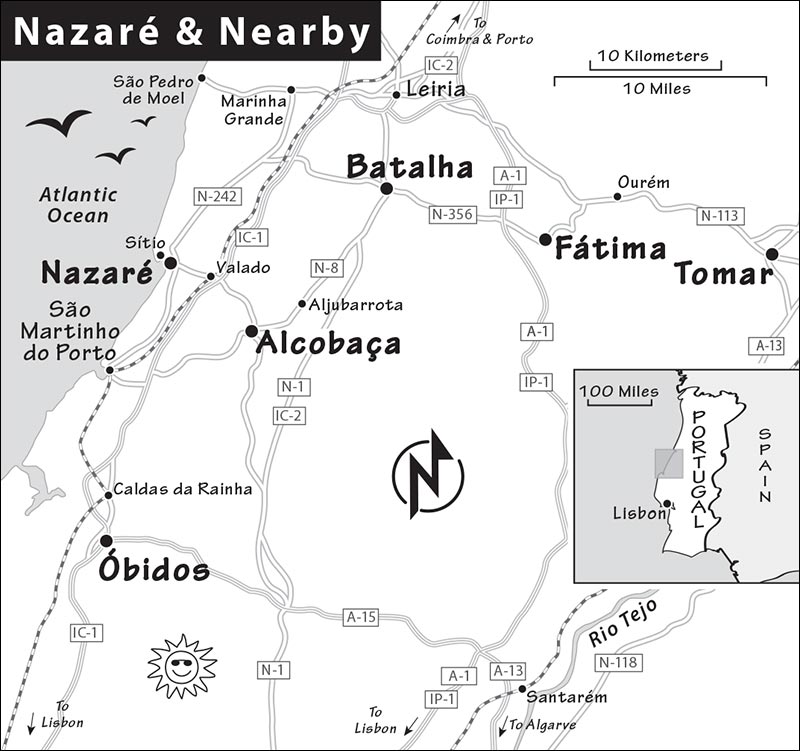
Day-Tripping from Nazaré by Bus: If you’re traveling by bus, you can see both Alcobaça and Batalha in one day (but not on Sunday, when bus service is sparse). Alcobaça is easy to visit on the way to or from Batalha (and both are connected by bus with Óbidos). Ask at the bus station or TI for schedule information, and be flexible. Tomar and Fátima have few connections and are farthest away. Without a car, Fátima is not worth the trouble for most, but if you’re heading by bus to Coimbra, you can go via Fátima. Tomar has the fewest connections of all, but there is extra service from July to September that connects all these dots twice a day. A taxi from Nazaré to Alcobaça costs a little more than €15; agree on the price before leaving town.
Nazaré
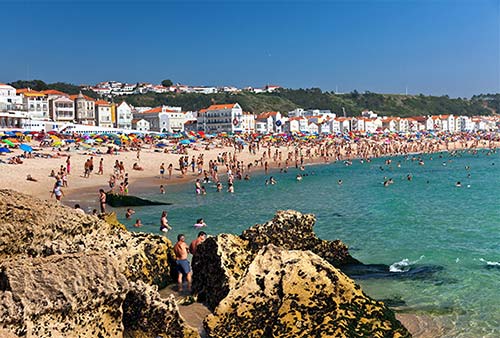
Nazaré is an ideal place for a summertime Portuguese beach break (especially if you’re not making the trip south to the Algarve). It falls somewhere between a real-life, narrow-laned fishing village and a busy resort with a beach littered with frolicking families. You’ll be greeted by the energetic applause of the surf, widows with rooms to rent, and big plates of percebes (barnacles). Relax in the Portuguese sun in a land of eucalyptus and pine trees, ladies in petticoats, and men who stow cigarettes and fishhooks in their stocking caps.
It seems that most of the town’s 15,000 inhabitants are in the tourist trade, but it’s not at all hard to find pockets of vivid and authentic culture. Somehow Nazaré traditions survive, and the townspeople go about their old-school ways. Stroll through the market for some ideal people-watching. Wander the back streets for a fine look at Portuguese family-in-the-street life. Laundry flaps in the wind, kids play soccer, and fish sizzle over tiny curbside hibachis. Squadrons of sun-dried and salted fish are crucified on nets pulled tightly around wooden frames and left under the midday sun. Off-season Nazaré is almost empty of tourists—chilly, inexpensive, colorful, and relaxed, with enough salty fishing-village atmosphere to make you pucker.
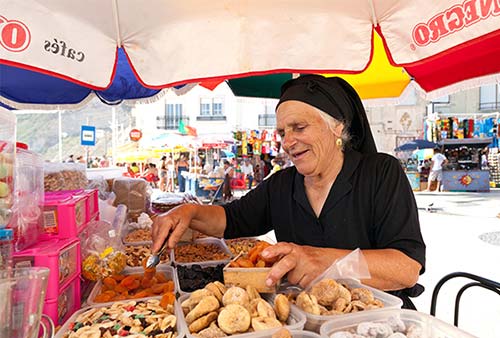
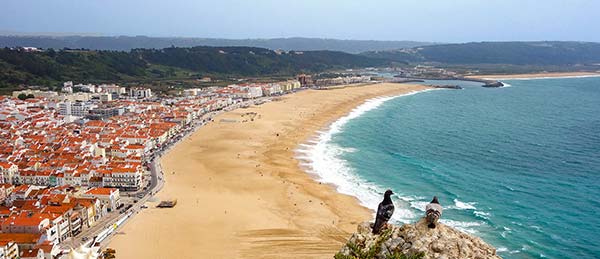
Nazaré doesn’t have any real “sights.” The beach, tasty seafood, and the funicular ride up to the Sítio headland (for a great coastal view) are the bright lights of my lazy Nazaré memories.
Plan some summer beach time here. Sharing a bottle of chilled vinho verde on the beach at sundown is a good way to wrap up the day.
Orientation to Nazaré
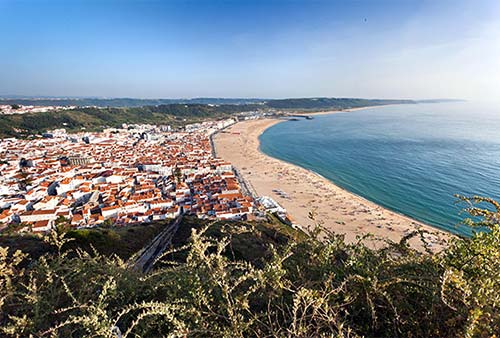
Nazaré is simple: super-skinny streets with three- to five-story apartment blocks stretching away from an extra-long and extra-wide beach. Rua Sub-Vila cuts through all those narrow streets midway through town and has a lot of local vibe. The beach sweeps between the new harbor in the south and the cliffs on the north, which are capped by the old town of Sítio (SEE-tee-oo).
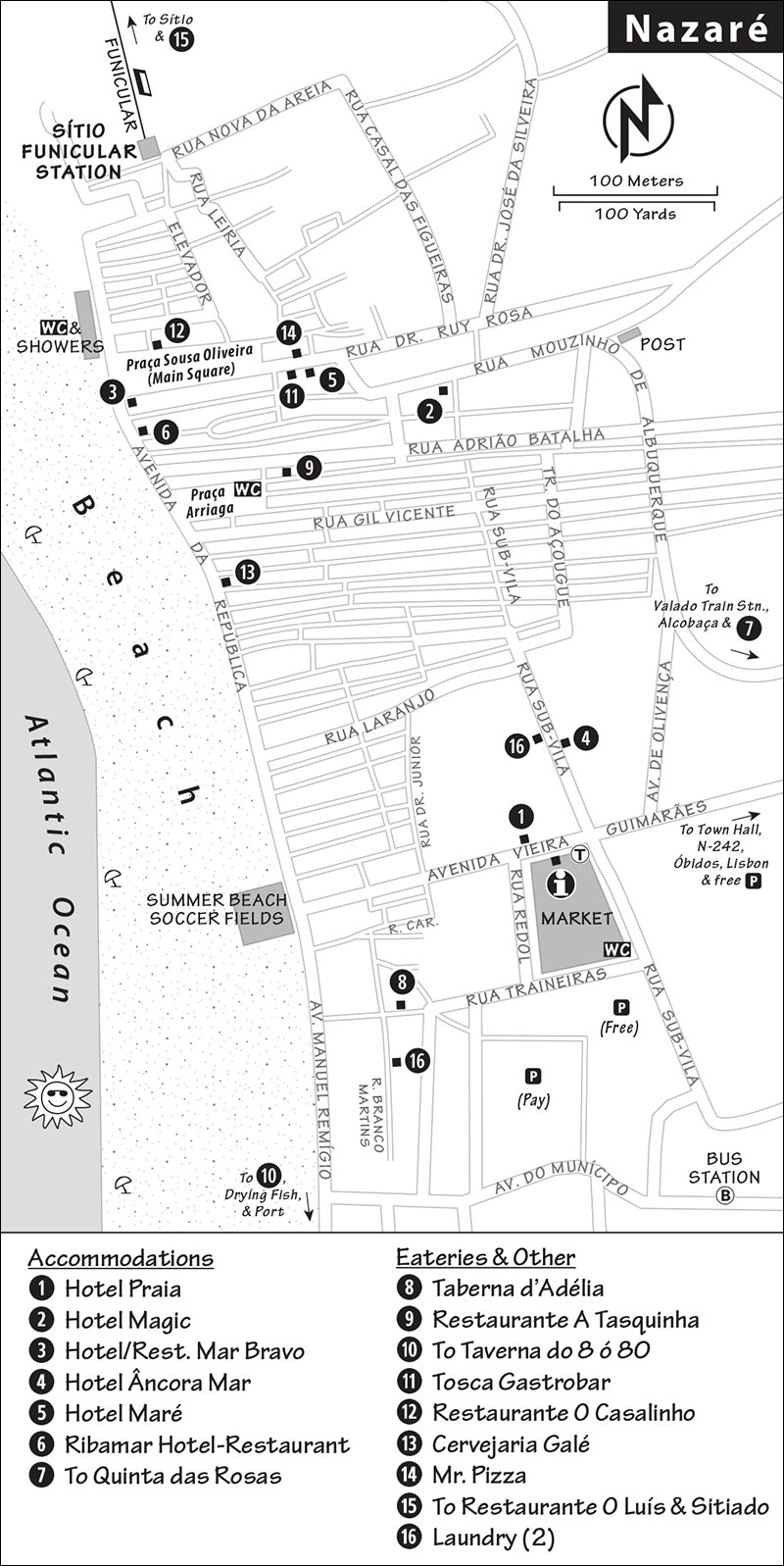
To get your bearings, survey the town from anywhere along the main beachfront drag, Avenida da República. Scan the cliffs. The funicular climbs to Sítio, which boasts breathtaking views over the entire town and its beach. Just below those cliffs, notice the road kinking inland, marked by the yellow balconies of Ribamar Hotel. This street marks the main square, Praça Sousa Oliveira (with ATMs). Many of my recommended hotels and restaurants are near this square.
Nazaré is famous for its women who wear skirts with seven petticoats (one for each day, or for the seven colors of the rainbow, or...make up your own legend). While this is partially just a creation for the tourists, there is some element of truth to the tradition. In the old days, women would sit on the beach waiting for their fishermen to sail home. To keep warm in the face of a cold sea wind while staying modestly covered, they’d wear several petticoats so they could fold layers over their heads, backs, and legs.
Even today, older and more traditional women wear short skirts made bulky by several—but not seven—petticoats. The ensemble is completed with loudly patterned stockings and house slippers, an apron (hand-embroidered by the wearer), a small woolen cape, a head scarf—handy when the wind whips up—and flamboyant jewelry, including chunky gold earrings (often passed down from generation to generation).
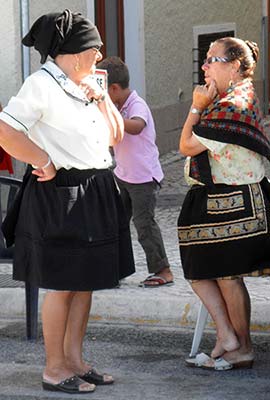
You’ll see some women wearing black, a sign of mourning. Traditionally, if your spouse died, you wore black for the rest of your life. While this tradition is still observed, mourning just ain’t what it used to be—in the last generation, widows began remarrying.
TOURIST INFORMATION
The TI is next to the entrance to the market hall, a long block off the beach (daily July-Aug 9:00-20:00, Sept-June 9:30-13:00 & 14:30-18:00, Avenida Vieira Guimarães, +351 262 561 194, www.centerofportugal.com).
ARRIVAL IN NAZARÉ
The town lacks an official bus station, but buses arrive along Avenida do Município, a few blocks up from the beach. Drivers can pay to park along the beachfront in street-side spots, or in the big lot just south of the market. For free parking, use the unmonitored lot at the top of town (between the market and the library, near Avenida Vieira Guimarães); you can also park for free on town streets that aren’t along the beachfront, but check signs to confirm that your spot is legal. Most hotels have their own parking or a deal with a nearby garage.
HELPFUL HINTS
Laundry: At Lavanderia Nazaré, Fátima will wash, dry, and fold your laundry for pickup the next day (Mon-Fri 9:00-13:00 & 15:00-19:00—open all day July-Aug, Sat 9:00-13:00, closed Sun, Rua Branco Martins 17, +351 262 552 761). There’s also a self-service launderette a half-block from the market and TI, just up from the beach (daily 7:30-22:00, attendants around from 9:30-17:30, Rua Sub-Vila 50, mobile +351 914 439 436).
Regional Guide: Helpful Manuela Rainho, who works out of Alcobaça, can assist anyone interested in seeing this part of Portugal (€200/day, mobile +351 968 076 302, manuelarainho@gmail.com).
Sights in Nazaré
▲▲Nazaré’s Beach
Nazaré’s broad and generous beach is the domain of the summertime tents (barracas)—a tradition in Portugal. The tents are run as a cooperative by the old women you’ll see sitting in the shade ready to collect around €10 a day. The beach is groomed and guarded, and in the evening, piped music is played. Flags indicate danger level: red (no one allowed in the water), yellow (wading is safe), and green (no problem). The area closest to the cliffs has rougher surf and is marked off for surfers. There’s a world of fun water activities—jet skiing, stand-up paddleboarding, dolphin-seeking boat rides, and more. You’ll see sales and rental shacks around the beach, or drop by the TI for details on your options.
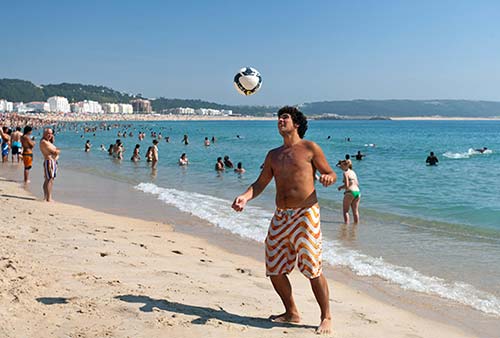
If you see a mass of children parading through town to the beach, they’re likely from a huge dorm, where poorer kids from inland areas are put up for a summer break. Plentiful modern benches along the boardwalk allow tourists and locals to sit and listen to the waves. In summer months, soccer areas (pro and not-so-pro) are set up where the busy Avenida Vieira Guimarães meets the boardwalk.
Boats used to line the beach in summer and fill the squares in winter, but they moved to a big, purpose-built harbor just south of town a few decades ago.
If you stroll south along the promenade toward the harbor, you’ll come to a few restored traditional boats (each with different functions, English descriptions) in the sand, with high prows to cut through the surf. Try to imagine the beach littered with boats like these, with old men mending their nets. Oxen (and later, tractors) hauled the boats out each day. Across the street is the town’s Cultural Center—located in the former fish market—with interesting exhibits that explain Nazaré’s fishing heritage and exactly how to dry all those fish (free, Mon-Fri 9:30-13:00 & 14:00-17:30, Sat-Sun 15:00-18:00).
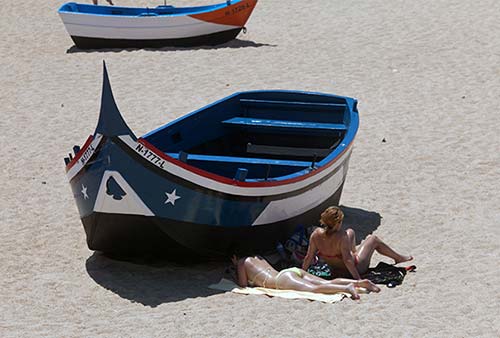
Near the boats is a mackerel crucifixion zone—where ladies still sun-dry their mackerel, sardines, and other goodies from the sea. (They may try to sell them to you, but the fish need to be cooked again before eating.) Preparing and selling fish is the lot of Nazaré women married to fishermen. Stroll to people-watch. Traditions survive even among younger women.
The buildings beyond this point are new. While it may seem that most locals are older than most of the buildings, the town is a Portuguese Coney Island—thriving with young people who flock here for fun-in-the-sun on the beach.
Head back into town. Just under the bluff (near the funicular to Sítio) is the oldest square in Nazaré, Praça Sousa Oliveira. This main square is lined with the oldest buildings in the lower town.
▲Market (Mercado Municipal)
Filling a rusting old industrial hall with slices upon slices of Nazaré life, the town market sits just one long block up from the busy beach (daily 8:00-13:00 except closed Mon Oct-May; at the intersection of Rua Sub-Vila and Avenida Vieira Guimarães, in the green building near a taxi stand). While you’ll see traditionally clad locals scattered around town, the market is one-stop shopping for people-watching (and, if you like, assembling a picnic). Most of the main floor has produce, with dried fruits and nuts, butchers, and bakers off to the left. Up a few stairs in the back is the fragrant fish market.
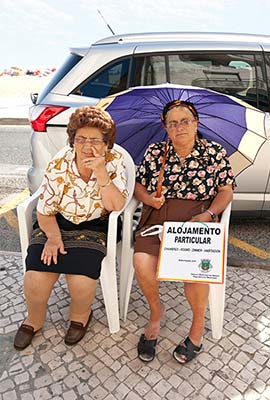
For another slice of local life, on the main street in front of the market (and near the bus station), look for petticoat-wearing women holding quartos signs—advertising rooms in private homes. They line the street coming into town, hit up tourists on the beachfront promenade, and meet each bus as it pulls into the station. You may enjoy dropping by for the commotion as the grannies fight over the tourists.
Flea Market: A flea market often pops up alongside the public library, except in August (9:00-13:00, longer hours Sat-Sun).
IN SÍTIO
Sitting quietly atop its cliff, the Sítio neighborhood used to be a totally separate village. Its people don’t fish; they farm. But in 1912 the entire area had grown so much that Sítio merged with a neighboring village (Perderneira) and the beach folks (Praia) to make Nazaré. Take the funicular up to the top for a spectacular view and the exquisitely decorated village church.
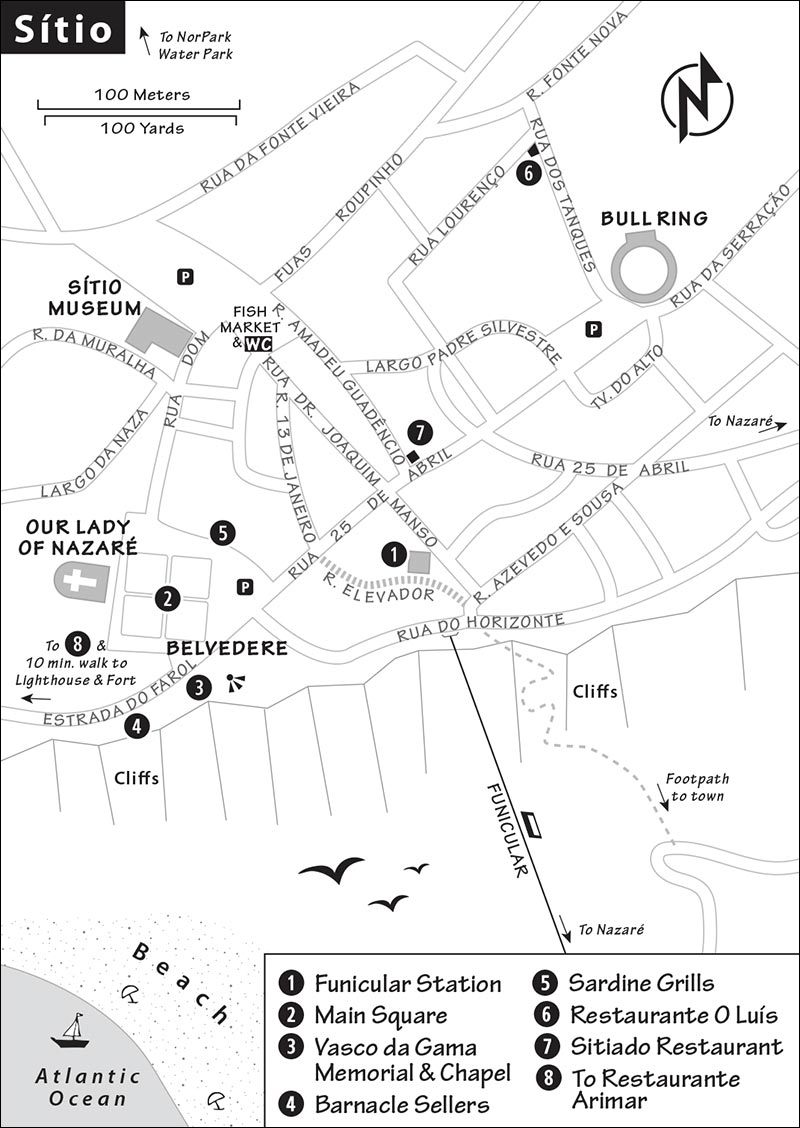
Getting There: The handy Sítio funicular was originally built in 1889—the same year as the Eiffel Tower—by the same disciple of Eiffel who built the much-loved Elevador de Santa Justa in Lisbon. The equipment and stations, however, have been modernized. To get to the lift, follow signs to ascensor; it goes every 15 minutes (€2.50 one-way, €4 round-trip, June-Sept 7:30-24:00, Oct-May until 20:30, WCs at each station). Off-season, buses replace funicular service after 20:30, but run only about twice hourly. If dining in Sítio off-season, check bus times at the funicular station before you eat (funicular round-trip ticket also valid for bus ride down). Notice the monitor above the turnstile at the top: It shows video clips of Nazaré’s monster wintertime waves being conquered by daredevil surfers.
Upon arrival at the top, exit straight ahead, walk downhill, and turn left to reach the main square and the promontory.
Walking Down: If the funicular stops running or you’d like to descend with even more views, walk up the steps behind the funicular station to another viewpoint at Rua do Horizonte. A series of wide, cobblestone steps zigzag down the cliffside, ending at the upper part of town. Follow the road, now paved, through an upscale residential neighborhood until reaching Rua Dr. Ruy Rosa. Turn right and you’ll be almost at the main square, Praça Sousa Oliveira. The walk takes less than 15 minutes.
Sítio’s Main Square
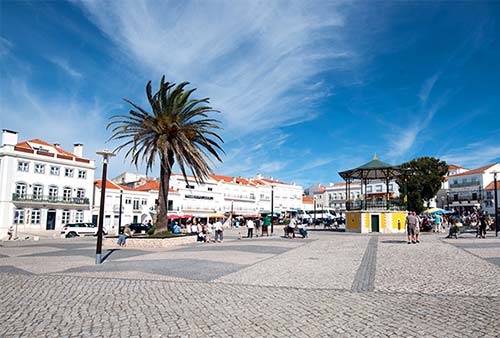
Historic Sítio gathers around its dominant square. The bandstand marking the center of the square is a reminder that this is the main venue for the town’s busy festival schedule. In the summer, smoke rises from the many outdoor grills, and the savory fragrance entices you to sit down for a plate of sardines.
• At the top of the square, check out the...
▲Church of Our Lady of Nazaré
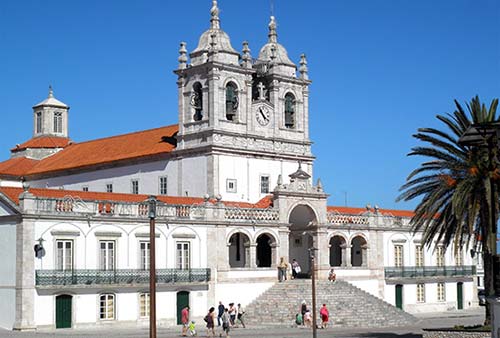
The neighborhood’s main church, built in the late 16th century and proudly restored by small local donations, contains what was the most important religious discovery in Portugal until the Miracle of Fátima. The faithful circulate behind the main altar and then go up to venerate the Black Madonna, brought here by the last Visigothic king in AD 714 before invading Muslims took over the entire Iberian peninsula. Supposedly the image originally came from Jesus’ hometown of Nazareth (hence the name of this town: Nazaré). The Madonna, hidden in nearby rocks throughout the Muslim Moorish rule, was rediscovered after 468 years of being hidden...by a miracle.
On the left side of the nave at the entrance, a large painting shows the story you’ll find all over town: Dom Fuas Roupinho, a nobleman from the area, was hunting deer and became so absorbed in the chase that he didn’t realize he was about to go over a cliff. The Virgin Mary appeared suddenly and stopped him, saving his life. The unfortunate deer didn’t see Mary in time. As locals came to venerate the spot where the noble’s life was saved, they found the Black Madonna hidden in the rocks. Today the church, with its gilded Baroque-Neoclassical interior and 17th-century Delft tiles (from the Netherlands), is popular for weddings and other family religious occasions (which is why it has lots of flowers). If you’d like to pay your respects to the Black Madonna, you’ll first have to pay €1 to the left of the altar (daily April-Sept 9:00-19:00, off-season until 18:00).
• In front of the church, admire the view from...
▲▲▲The Belvedere: Views, Petticoats, and Barnacles
The Vast View: From the edge of the bluff you can survey Nazaré and its golden beach stretching all the way to the town harbor. In the distance are the mostly uninhabited Berlenga Islands. The pillar on the belvedere (“beautiful view”) is a stone memorial for Vasco da Gama, erected in 1497 after he stopped here before leaving Europe for India. The tiny chapel next to the monument sits on the spot where the Black Madonna hid in the rocks for 400 years, as if waiting for the Moors to leave and for the Christians to return.
Seven-Petticoat Fisherwomen: Several women (mostly from the same family, but competitive nevertheless) camp out here in their over-the-top traditional fashions, selling munchies, barnacles, and Nazaré knickknacks.
Barnacles: This is a fine opportunity to buy percebes—boiled, addictively tasty, and ready-to-eat barnacles (€4 for 100 grams, that’s the size of their tiny wooden box). If you’ve yet to try them, this is the cheapest and best way to enjoy one of my favorite treats anywhere in Portugal. Grab the barnacles one at a time, hold the hard shell or beak, gently break off the leathery neck where it meets the shell and slide it away revealing the long slinky neck (which is what you eat; merchants have a finger bowl for rinsing).
The Lighthouse and Monster Waves
From the belvedere, it’s a 10-minute walk to the end of the road at the lighthouse (farol), where you can enjoy panoramic views of the north beach (praia norte). In the winter, this bluff will be filled with gawking spectators witnessing one of the great surfing spectacles of our planet: little watercraft towing adrenaline-junkie, world-class surfers out to catch 80-foot waves. Surfers around the world regard Nazaré as the home of the ultimate thrill. (For a peek at the action, search “Nazaré surfing” on YouTube.)
• If you cross back over the square, then head up the street past the church, soon you’ll reach the...
Sítio Museum (Museu Dr. Joaquim Manso—Museu da Nazaré)
Dedicated to Dr. Joaquim Manso, this museum is the only place in Nazaré where you can see artifacts of the colorful traditional fishing culture—boats, rustic tools, costumes, historic photos, miniature models of Nazaré’s distinctive boats, and so on (but without a word of English).
Cost and Hours: Free, Tue-Sun 10:00-12:30 & 14:00-18:00, slightly shorter hours Oct-June, closed Mon year-round, one block inland from Sítio’s main square, Rua Dom Fuas Roupinho, +351 262 562 801, http://mdjm-nazare.blogspot.com.
Activities in Sítio
Sítio stages Portuguese-style bullfights on Saturday nights in summer (typically mid-July-Aug, get schedule at TI, tickets at kiosk in Praça Sousa Oliveira). Sítio’s NorPark is a family-friendly water park with a pool, slides, and hot tub (open only mid-June-mid-Sept, get details at TI, free shuttle bus if you call ahead, +351 262 562 282).
Restaurante Arimar, on the left along the way to the lighthouse, is a good place to take in the sunset with drinks or dinner (avoid windy days). For more dining suggestions, see “Eating in Nazaré,” later.
Sleeping in Nazaré
You should have no problem finding a room, except in August, when the crowds, temperatures, and prices are all at their highest (particularly during the Nazaré Beach Party in mid-Aug). Anywhere you stay in Nazaré, lower your expectations—this is a ragtag beach town, not a glitzy resort. And count on noise—from passing cars, from karaoke-belting revelers, and from your neighbors (since most buildings in town are cheaply constructed, with thin walls and doors). Bring earplugs and be on vacation.
Prices vary wildly with the season. The price ranges in my listings are based on the cost of a standard double room with no view in medium-high season (approximately June-mid-July and Sept). Expect to pay about 50 percent more from mid-July through mid-August, and much less off-season. For locations, see the “Nazaré” map, earlier.
$$$ Hotel Praia feels big and muscular, filling two buildings across from the market hall. It’s along the main road into town and an easy walk from the beachfront. Its 80 rooms are spacious, if a bit well-worn, with a bright and beachy color scheme. It comes with a rooftop terrace with a pool and its own attached parking garage—free for those who book direct (air-con, elevator, Avenida Vieira Guimarães 39, +351 262 569 200, www.hotelpraia.com, geral@hotelpraia.com).
$$ Hotel Magic, the most stylish choice near Nazaré’s beach, is a short walk up from the main square. It has 19 sleek, white, minimalist, well-equipped rooms with splashes of color, as well as an inviting ground-floor lounge with old movie posters. For those more swayed by contemporary chic than Old World kitsch, this “art hotel” is the place to stay (air-con, elevator, Rua Mouzinho de Albuquerque 58, +351 262 569 040, www.hotelmagic.pt, info@hotelmagic.pt).
$$ Hotel Mar Bravo is on the main square and the waterfront. Its 16 comfy rooms are modern, bright, fresh—and they come with balconies, nearly all of them with views (RS%, double-paned windows, air-con, elevator, view breakfast room, recommended restaurant serves good seafood with a sea view, Praça Sousa Oliveira 71, +351 262 569 160, www.marbravo.com, info@marbravo.com, owner Fátima). Parking for the Mar Bravo is several blocks away, at Hotel Praia on Avenida Vieira Guimarães.
$$ Hotel Âncora Mar is a big, modern, almost institutional place, with 27 spacious, bright, and functional rooms and a generous roof terrace with a pool. It’s on a quiet street a block from the market hall, and a relatively short walk from the beach (air-con, elevator, limited free parking, Rua Sub-Vila 49, +351 262 569 010, www.ancoramar.com, info@ancoramar.com).
$$ Hotel Maré, just off the main square, is a big, modern, American-style hotel with 43 straightforward rooms (all with balconies), some tour groups, and a rooftop terrace (family deals, double-paned windows, air-con, elevator, pay parking 500 yards away, Rua Mouzinho de Albuquerque 10, +351 262 550 180, www.hotelmare.pt, reservas@hotelmare.pt).
$$ Ribamar Hotel-Restaurant, at the lower end of this price range, has a rare Old World atmosphere and 25 small rooms with dark wood. While it feels like a throwback (no air-con, no elevator), you’re paying for the prime waterfront location. To spot the hotel from along the beach, just look for its yellow balconies (four rooms have balconies, good attached restaurant downstairs, pay parking; Rua Gomes Freire 9, +351 262 551 158, www.ribamarnazare.com, reservas@ribmarnazare.com).
$ Quartos: Private rooms for rent—called quartos—are a Nazaré specialty, but most can’t be booked in advance. If you’re willing to travel without reservations, you can just show up and ask around to find a cheap but modern, comfortable room. Sometimes quartos hosts find you first—if you stand around near the bus station with your luggage, you may be approached by a petticoat-clad local with a quartos sign. For more on this option, see the “Sleeping” section in the Practicalities chapter.
A TRANQUIL QUINTA OVERLOOKING NAZARÉ
$$ Quinta das Rosas, perched high above the congestion and chaos of Nazaré (but still just a few minutes’ drive away), is a restful retreat thoughtfully run by a Portuguese-Canadian mother-and-daughter team—Anna Maria and Anna. It’s a working farm with resident chickens and fine views over Nazaré and its beach. The five rooms are comfortable and country-classy (most with balconies, some with views), the breakfast includes farm-fresh eggs and Algarve-fresh OJ, and your hosts are generous with travel advice (Caminho Real, Pederneira, +351 262 562 706, www.quintadasrosas.com, reservations@quintadarosas.com). Driving up out of Nazaré, head toward the marina, then drive through the village of Pederneira, following signs for Miramar Hotel (the quinta is just before the hotel—watch for the gate on the right). They also have three family-friendly apartments with kitchens—called $$ Seashell Apartments—in a well-soundproofed building right along the beach in Nazaré.
Eating in Nazaré
Nazaré is a fishing town, so don’t order hamburguesas. Fresh seafood is tasty all over town, more expensive (but plenty affordable) along the waterfront, and cheaper farther inland.
In this fishing village, even the snacks come from the sea. Percebes are boiled barnacles; in season they’re sold as munchies in bars and on the street (described earlier). Sardines are yummy any time of year but amazing when in season—May to September, but best in July and August.
Try Portugal’s light, young wine, vinho verde, which pairs well with shellfish. Amêndoa amarga is the local amaretto. For a tasty pastry, try a pastel de feijão (fay-ZHOW) from any café. This small tart with a puff-pastry shell has a filling similar to pecan pie, but made of white beans.
Unless otherwise noted, for locations see the “Nazaré” map, earlier.
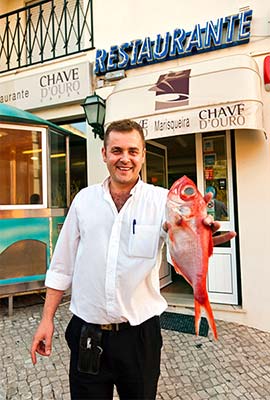
$$$ Taberna d’Adélia is a family-run restaurante típico popular with Portuguese visitors for its honest service, fresh fish, and unpretentious jovial ambience. Marco and his family pride themselves on respecting the customer (daily 12:00-15:30 & 19:00-22:30, reservations smart in summer, one block off the beach at Rua das Traineiras 12, +351 262 552 134).
$$ Restaurante A Tasquinha dishes up authentic Portuguese cuisine with a cozy blue-and-white-tile, picnic-bench ambience. Friendly, hardworking Carlos, his son Carlos II, and family serve their fish with the best bread in town and a special sauce that’s good on just about everything. This is a fine place for cataplana (Wed-Sun 12:15-15:15 & 19:15-21:45, closed Mon-Tue, Rua Adrião Batalha 54, +351 262 551 945). Any traveler with this book gets a free glass of port wine for dessert (just ask).
$$$ Taverna do 8 ó 80—with a stylish, modern, wine-and-tapas-bar setting—defies Nazaré’s fishing heritage with a menu heavy on beef and pork dishes. The main attraction is the wine list: With hundreds of bottles of wine on-site and lots available by the glass, it’s a short course in Portuguese enology. Sidewalk tables let you watch the tide roll in (Wed-Mon 12:00-15:30 & 19:00-22:30, closed Tue, a 5-minute walk along the beachfront south of the colorful boats at Edifício Atlântico, Loja 8, +351 262 560 490).
$$$ Tosca Gastrobar is a foodie option just above the main square. The mod, appealing menu (with both seafood and land food) combines Portuguese and international flavors with artful presentation. This is great for people who need a break from sardines and pork (Thu-Tue 12:00-15:00 & 19:00-22:00, closed Wed, Rua Mouzinho de Albuquerque 4, +351 262 562 261).
Main Square with a Beach View: Competitive, pricey restaurants ring the main square. These two offer decent value: $$$ Mar Bravo’s friendly staff serves fresh seafood at on-square tables overlooking the beach. Their dining room is inviting and modern (RS%—10 percent with this book, no outside seating, daily 12:00-23:00, inside hotel of same name, Praça Sousa Oliveira 71, +351 262 569 160). $$$ Restaurante O Casalinho has good outdoor seating, plain decor, and a solid reputation (daily 12:00-22:00, Praça Sousa Oliveira 7, +351 262 551 328).
Along the Waterfront: If you just want a nice meal with a view of the sea, there’s a strip of fine eateries along the beach with lots of great options. $ Cervejaria Galé (Avenida da República 30), run by António Brígido Afonso, is the last fisherman’s dive on the strip with lots of shellfish and salty options to go with your beer.
Public Market for a Picnic: To experience the colorful market, buy a picnic there and enjoy it on the beach (see description earlier, under “Sights in Nazaré,” market open daily 8:00-13:00, closed Mon Oct-May, a long block up from the beach on Avenida Vieira Guimarães). Other to-go and picnic options can be found in any number of mini markets along Rua Sub-Vila. And Mr. Pizza (top of main square, across from Hotel Maré) has pies to go for a pizza party on the beach.
In Sítio
Remember that off-season, the funicular stops running at 20:30—before settling in for dinner, check the schedule for the bus back down to Nazaré. For locations, see the “Sítio” map, earlier.
$$ Restaurante O Luís serves excellent seafood and regional cuisine to an enthusiastic crowd in a cheery, air-conditioned atmosphere. While few tourists go here, the friendly white-coated waiters make you feel welcome. This place is worth the funicular ride if you want to eat well (Fri-Wed 12:00-15:30 & 19:00-22:00, closed Thu, reserve on weekends, Rua dos Tanques 7, +351 262 551 826, David speaks English).
$$ Sitiado, just off the main square, is a bit trendier but retains a respect for tradition, with delicious petiscos (Portuguese tapas, designed to share family-style) served on earthenware plates in a casual bar setting. As it’s both good and very small, reservations are smart (Wed-Mon 12:00-15:00 & 19:00-23:00, closed Tue, Rua Amadeu Guadêncio 2, +351 262 087 512, run by Wilson).
Nazaré Connections
BY BUS
Nazaré has no real bus station, but there is a ticket office in a small portable building behind the library on Avenida do Município, a few blocks inland from the Cultural Center and beach. Buses merely stop along the avenue. Service is reduced on weekends (especially Sun), so verify schedules beforehand online or at the TI. Two bus companies serve Nazaré: Rede Expressos, which covers most of Portugal (+351 707 223 344, www.rede-expressos.pt [URL inactive]) and RodoTejo, which focuses on central Portugal (+351 262 767 676, www.rodotejo.pt). To know your options, check both sites.
If you’re heading to Lisbon, buses are faster and more direct than trains. You will arrive at Lisbon’s Sete Rios bus station, a Metro (or taxi) ride away from the center.
Nazaré by Bus to: Alcobaça (stopping at Valado, almost hourly, 20 minutes), Batalha (5/day, 1 hour), Óbidos (3/day, 1 hour, Rápida service is direct, others transfer in Caldas da Rainha), Fátima (4/day, 1.5 hours), Tomar (3/day, 2 hours), Coimbra (6/day, 2 hours), Lisbon (8/day, 2 hours). Buses are scarce on Sunday.
BY TRAIN
The nearest train station is at Valado dos Frades (3 miles toward Alcobaça, connected by semiregular buses and reasonable, easy-to-share €10 taxis). The train to Lisbon requires a bus or taxi ride from Nazaré to the station in Valado, then several transfers—not worth the hassle. To avoid this train-station headache, consider using intercity buses instead of trains.
From Nazaré/Valado by Train to: Coimbra (4/day direct, 2 hours, bus is easier), Lisbon (7/day, 3-4 hours, involves transfers in Caldas da Rainha, Cacém, or Coimbra-B; bus is better). Train info: +351 218 050 653.
Batalha
The town of Batalha (bah-TAHL-yah) is worth a stop only to see its great Monastery of Santa Maria (also known as the Monastery of Batalha), considered Portugal’s finest architectural achievement. It celebrates a dramatic medieval battlefield victory (hence the town’s name, “Battle”).
On August 14, 1385, two armies faced off on the rolling plains here to decide Portugal’s future—independence or rule by foreign kings? Self-proclaimed King João I of Portugal ordered his 6,500 men to block the road to Lisbon. The Castilian king, with 31,000 soldiers and 16 modern cannons, ordered his men to hold their fire. But when the Portuguese knights dismounted from their horses to form a defensive line, some hotheaded Castilians—enraged by such a display of unsportsmanlike conduct by supposedly chivalrous knights—attacked.
Shoop! From the side came 400 arrows from English archers fighting for Portugal. The confused Castilians sounded the retreat, and the Portuguese chased them, literally, all the way back to Castile. A mere hour (and several hundred deaths) after it began, the Battle of Aljubarrota was won. King João I claimed the Portuguese crown and thanked the Virgin Mary with a new church and monastery.
Tourist Information: The TI is behind the monastery by the unfinished chapels (daily 10:00-13:00 & 14:00-18:00, Praça Mouzinho de Albuquerque, +351 244 765 180, www.centerofportugal.com). Batalha’s market is Monday morning (200 yards behind monastery).
Arrival in Batalha: If you take the bus to Batalha, you’ll be dropped off a block behind the monastery, near an Intermarché supermarket. There’s no official luggage storage, but you may be able to leave luggage at the TI if you ask nicely. If you’re driving, follow the signs to Batalha. Once in town, you’ll loop around the back end of the huge monastery complex (the Unfinished Chapels), then park in the big, free lot behind the church.
Monastery of Santa Maria
This ▲▲▲ monastery, the symbol of Portugal’s national pride, was built by King João I after winning the Battle of Aljubarrota. Construction stretched over two centuries (1388-1533), but the result was an original take on Gothic style and Manueline decoration. Today, a highway runs directly in front of the monastery, which is now behind a sound-deadening concrete wall covered with plants.
ORIENTATION TO THE MONASTERY
Cost: Church-free; worthwhile Founders’ Chapel, Unfinished Chapels, and cloisters-€6; combo-ticket with Monastery of Santa Maria in Alcobaça and the Convent of Christ in Tomar-€15.
Hours: Daily 9:00-18:30, Oct-March until 18:00.
Information: +351 244 765 497, www.mosteirobatalha.gov.pt.
Changing of the Guard: See it at the top of each hour in the Chapter Room.
 SELF-GUIDED TOUR
• Start by surveying the...
1 Exterior: The Church of Our Lady of Victory is a fancy Flamboyant Gothic (pointed-arch) structure decorated with lacy tracery—stained-glass windows, gargoyles, railings, and pinnacles representing the flickering flames of the Holy Spirit. (Inside, we’ll see even more elaborate Manueline-style ornamentation, added toward the end of its construction.) The church’s limestone has mellowed over time into a warm, rosy, golden color.
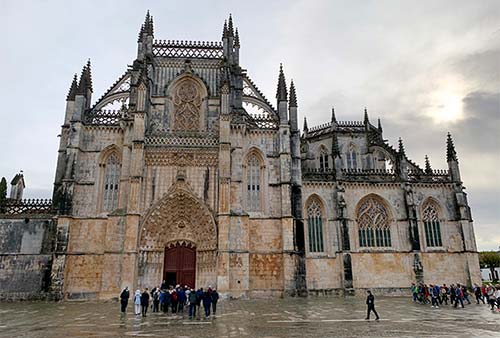
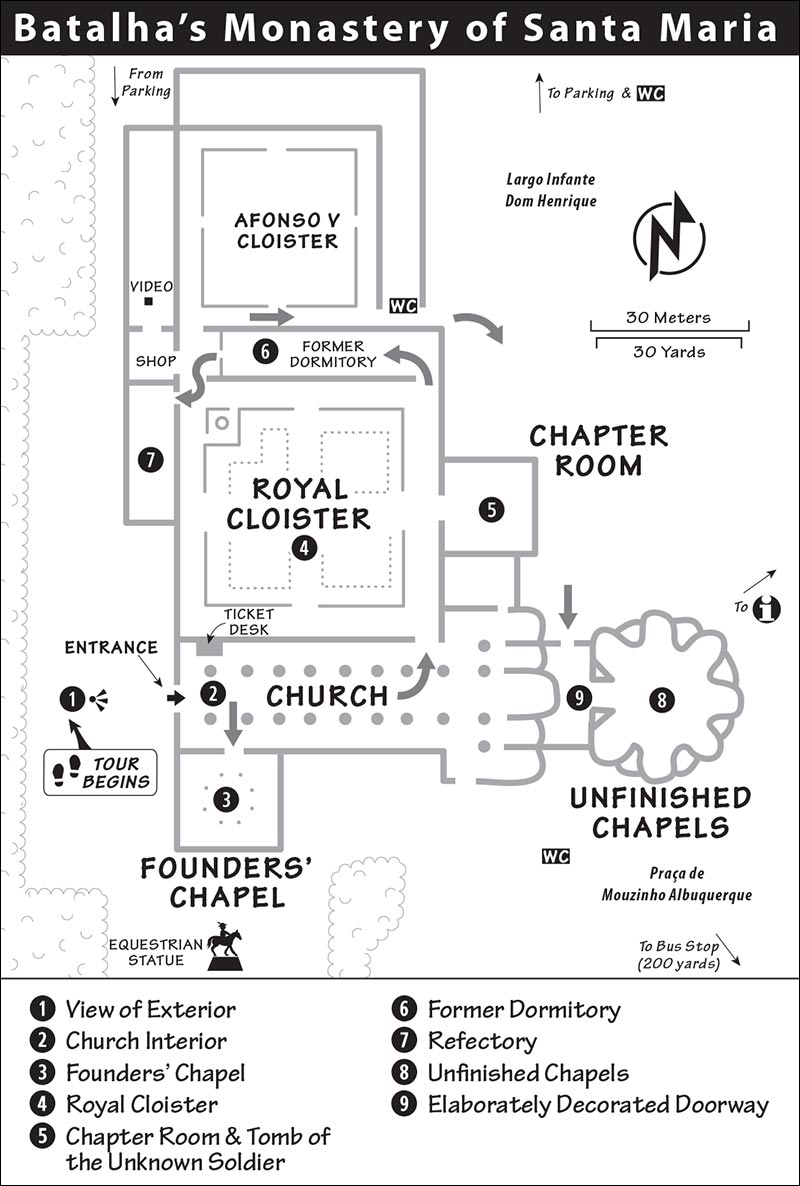
The equestrian statue outside the church is of Nuno Álvares Pereira, who commanded the Portuguese in the battle and masterminded the victory over Castile.
Before entering the church, study the carvings on the main entrance (much restored after serious damage in the 1755 earthquake). Notice the six lanes of heavenly traffic in the archway over the entrance: inside track—angels with their modesty wings; second track—the angel band with different instruments, including a hillbilly washboard; third—evangelists (those holding scrolls are from the Old Testament, those holding books are from the New Testament); fourth—Biblical kings and secular kings (those with globes in their hands); fifth—doctors of the Church with symbols of their martyrdom; and the express lane—female saints. Overseeing all this traffic is Jesus with the four evangelists in the tympanum. And the 12 apostles provide a foundation for it all. The statues are 19th-century copies of 14th-century originals. At the top of the pointed arch are two small coats of arms: Portugal’s on the right and the House of Lancaster’s on the left (a reminder of the marriage of João I and Philippa that cemented centuries of friendship between Portugal and England).
• Enter the church.
2 Church Interior: The tall pillars leading your eye up to the “praying hands” of pointed arches, the warm light from stained-glass windows, the air of sober simplicity—this is classic Gothic, from Europe’s Age of Faith. The church’s lack of ornamentation reflects the vision of the project’s first architect, Afonso Domingues (worked 1388-1402). Compared with Alcobaça’s monastery (described later), this interior is dimmer and feels more somber, though the stained glass more dramatically colors the floors and columns (only the glass around the altar is original).
• Buy a ticket for the cloisters and chapels (at the ticket counter on your immediate left as you enter). You’ll need it to enter the rest of the sights described here. The first chapel on the right—directly across from the ticket desk—is the...
3 Founders’ Chapel (Capela do Fundador): Center-stage is the double sarcophagus (that’s English-style) of King João I and his English queen, Philippa. The tomb statues lie together on their backs, holding hands for eternity. This husband-and-wife team ushered in Portugal’s two centuries of greatness.
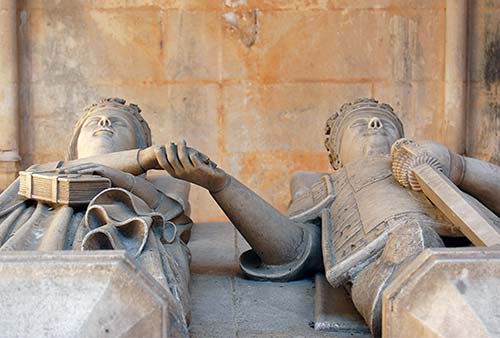
João I (born 1357, ruled 1385-1433), the bastard son of King Pedro I (see the “Pedro and Inês” sidebar later in this chapter), repelled the Castilian invaders, claimed the throne, consolidated his power by confiscating enemies’ land to reward his friends, gave Lisbon’s craftsmen a voice in government, and launched Portugal’s expansion overseas. His five-decade reign greatly benefited Portugal. João’s motto, “Por bem” (“For good”), is carved on his tomb. He established the House of Avis (see the coat of arms carved in the tomb) that would rule Portugal through the Golden Age. João’s descendants—through both the Avis and Bragança lines—would rule Portugal until the last king, in 1910.
João, indebted to English soldiers for their help in the battle, signed the friendship Treaty of Windsor with England (1386). To seal the deal, he was asked to marry Philippa of Lancaster, the granddaughter of England’s king. You can see their respective coats of arms carved at the head of the tomb.
Philippa (c. 1360-1415)—intelligent, educated, and moral—had already been rejected in marriage by two kings. João was also reluctant, reminding the English of his vow of celibacy as Grand Master of the Order of the Cross. He retreated to a monastery (with his mistress) before finally agreeing to marry Philippa (1387). Exceeding expectations, Philippa won João’s admiration by overseeing domestic policy, boosting trade with England, reconciling Christians and Jews, and spearheading the invasion of Ceuta (1415) that launched the Age of Discovery.
At home, she used her wide knowledge (she was trained personally by Geoffrey Chaucer and John Wycliffe) to inspire her children to greatness. She banished João’s mistress to a distant convent, but raised his bastard children almost as her own, thus sparking the rise of the Bragança line that would compete for the throne.
João and Philippa produced a slew of talented sons, some of whom rest in tombs along the nearby wall. These are the golden youth of the Age of Discovery that the Portuguese poet Luís de Camões dubbed “The Marvelous Generation” (Ínclita Geração).
“Henrique” (in niche directly opposite the entry, wearing a church for a hat) is Prince Henry the Navigator (1394-1460, see sidebar on here). When Philippa was on her deathbed with the plague, she summoned her son Henry to her side and made him swear he would dedicate his life to finding the legendary kingdom of Prester John—sending Henry on his own journey to explore the unknown.
Fernando (in the corner, left of Henry), Henry’s kid brother, attacked the Muslims at Tangier (1437) and was captured. When his family refused to pay the ransom (which would have meant returning the city of Ceuta), he died in captivity. Son Pedro (tomb on far right), a voracious traveler and student of history, ruled Portugal as regent while his six-year-old nephew Afonso grew to manhood (Afonso’s father, Duarte—João and Philippa’s eldest—died of the plague after ruling for only five years).
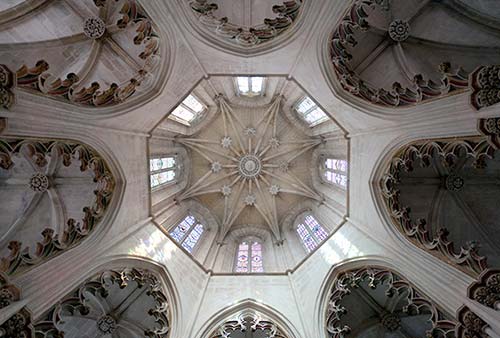
The Founders’ Chapel is a square room with an octagonal dome. Gaze up (like João and Philippa) at the ceiling, an eight-pointed star of crisscrossing pointed arches—a masterpiece of the Flamboyant Gothic style—that glow with light from stained glass. The central keystone (with João’s coat of arms) holds all the arches-within-arches in place. Remember this finished chapel—a lantern roof atop tombs in an octagonal space—when you visit the Unfinished Chapels later. Notice that some of the tracery in the arches still have their original red-and-green paint job.
• Go back into the main part of the church, cross the nave, and bear right to find the entrance to the adjoining...
4 Royal Cloister (Claustro Real): Architecturally, this open courtyard exemplifies Batalha’s essence: Gothic construction from about 1400 (the pointed arches surrounding the courtyard) filled in with Manueline decoration from about 1500. The tracery in the arches features the cross of the Order of Christ (headed at one time by Prince Henry the Navigator) and armillary spheres—skeletal “globes” that showed what was then considered the center of the universe: planet Earth. The tracery is supported by delicate columns with shells, pearls, and coils of rope, plus artichokes and lotus flowers from the recently explored Orient.
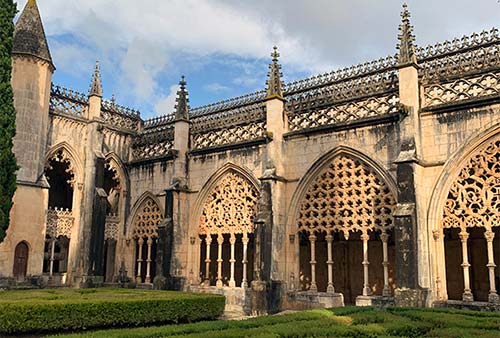
Stop here and picture Dominican monks in white robes, blue capes, and tonsured haircuts (shaved crown) meditating as they slowly circled this garden courtyard.
• Circle the courtyard counterclockwise, dipping into the...
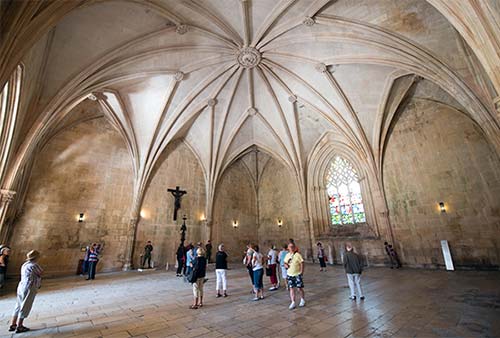
5 Chapter Room: The self-supporting star-vaulted ceiling spans 60 feet, an engineering tour-de-force by Master Huguet, a Frenchman who became chief architect in 1402. Huguet brought Flamboyant Gothic decoration to the church’s sober style. The ceiling was considered so dangerous to build (it collapsed twice) that only prisoners condemned to death were allowed to work on it. (Today, unknowing tourists are allowed to wander under it.) The architect who helped Huguet come up with the strong-enough, interlocking, spider-web design for this vast vault supposedly silenced skeptics by personally spending the night in this room. (It even survived the 1755 earthquake.) He’s remembered with a little portrait figurine supporting the column in the far-right corner of the room. Besides this ceiling, Huguet designed the Founders’ Chapel and the initial work on the Unfinished Chapels.
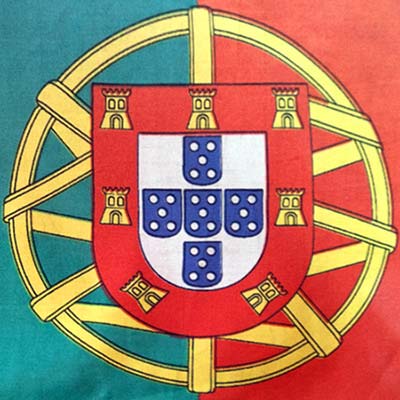
Seen on monuments at Belém, Batalha, Sagres, and even on the modern Portuguese flag, the Avis coat of arms is a symbol of the glorious Age of Discovery, when Portugal was ruled by kings of the Avis family.
In the center of the shield are five smaller shields arranged in the form of a cross. (One theory says that, after several generations of battle, the family shield—passed down from father to son—got beaten up, and the cross ripped apart into five pieces, held there by nails—the dots on the coat of arms.) Around the border are castles, representing Muslim cities conquered by Portugal’s Christian kings. (Some versions have fleurs-de-lis and personal emblems of successive kings.)
João I (r. 1385-1433): The bastard son of Pedro I, he protected Portugal from a Castilian takeover and launched overseas expansion.
Manuel I (r. 1495-1521): Ruler when all the overseas expansion began to pay off financially. He built the Monastery of Jerónimos at Belém, decorated in the ornamental style that bears his name (see architecture sidebar on here).
João III (r. 1521-1557): Ruler during Portugal’s peak of power...and at the beginning of its decline.
Sebastian (r. 1557-1578): Because he died in battle without an heir, the nation had to rewind the family tree, ending up with a Spanish king, Philip II.
Portugal’s Tomb of the Unknown Soldier sits under a mutilated crucifix called Christ of the Trenches, which accompanied Portuguese soldiers into battle on the western front of World War I. The three small soldiers under the flame—which burns Portuguese olive oil—are dressed to represent the three most valiant chapters in Portuguese military history: fighting Moors in the 12th century, Spaniards in the 14th century, and Germans in the 20th century. At the top of each hour, soldiers goose-step into the room to clear a path for a modest changing of the guard ceremony.
• Leaving the Chapter Room, turn right and enter the 6 former dormitory through the archway. Occasionally this space holds a history exhibit. Continue around the cloister to the big fountain in the corner. The monks would stop to wash their hands at the washbasin before stepping into the adjoining refectory (dining hall) for a meal.
7 The refectory contains a gift shop and a collection of all the offerings from various countries to the Portuguese unknown soldier. Of particular interest is a photograph taken in the WWI trenches of the mutilated crucifix (to right as you enter on the wall; the crucifix itself is the one displayed in the Chapter Room you just visited).
• To leave the gift shop, look for an arch on the left that leads to the Alfonso V Cloister, where there’s a video about Portugal (there’s also a WC at the exit). Once outside, head right to the...
8 Unfinished Chapels (Capelas Imperfeitas): The grand-yet-unfinished room behind the main altar was intended as an octagonal room with seven niches for tombs, topped with a rotunda ceiling (similar to the Founders’ Chapel). But only the walls, support pillars for the ceiling, and a double tomb were completed.
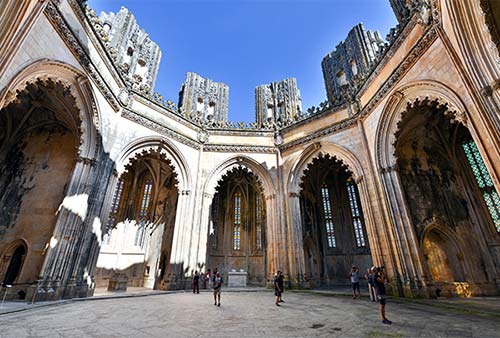
King Duarte and his wife, Leonor, lie hand-in-hand on their backs, watching the clouds pass by, blissfully unaware of the work left undone. Duarte (1391-1438), the oldest of João and Philippa’s sons, was the golden boy of the charmed family. He wrote a how-to book on courtly manners. When, at age 42, he became king (1433), he called a cortes (parliament) to enact much needed legal reforms. He financed and encouraged his brother Prince Henry’s initial overseas explorations. And he began work on these chapels, hoping to make a glorious family burial place. But Duarte died young of the plague, leaving behind an unfinished chapel, a stunned nation, and his six-year-old son, Afonso, as the new king.
Leonor became the regent while Afonso grew up, but she proved unpopular as a ruler, being both Spanish and female. Duarte’s brother Pedro then ruled as regent before being banished by rivals.
In 1509, Duarte’s grandson, King Manuel I, added the elaborately decorated 9 doorway (by Mateus Fernandes), a masterpiece of the Manueline style. The series of ever larger arches that frame the door are carved in stone so detailed that they look like stucco. See carved coils of rope with knots, some snails along the bottom, artichokes (used to fend off scurvy), corn (from American discoveries), and Indian-inspired motifs (from the land of pepper). Manuel’s tomb was destined to be in this section, but he abandoned the chapel after Vasco da Gama’s triumphant return from India, channeling Portugal’s money and energy instead to building a monument to the Age of Discovery launched by the Avis family—the Jerónimos Monastery in Belém (where both Manuel and da Gama were ultimately buried).
Sleeping in Batalha
If you spend the night, don’t count on nightlife—this town shuts down early.
$$ Hotel Villa Batalha is a big, American-style hotel offering 93 modern rooms with high-class comfort, complete with an in-house spa and swimming pool (air-con, elevator, Rua D. Duarte I 248, +351 244 240 400, www.hotelvillabatalha.pt, geral@hotelvillabatalha.pt). It’s unromantically situated amid distant parking lots: With the monastery behind you, walk left on Rua Dona Filippa de Lencastre, continue straight through the roundabout, and you’ll see the hotel.
Batalha Connections
From Batalha by Bus to: Nazaré (4/day, 1 hour), Alcobaça (4/day, 30 minutes), Fátima (3/day—or 4/day in summer, 30 minutes), Tomar (1/day, 1 hour), Coimbra (3/day, 2 hours, transfer in Leiria), Porto (6/day, 3 hours, transfer in Leiria and Coimbra), and Lisbon (2/day, 2 hours). Expect fewer buses on weekends (www.rodotejo.pt or www.rede-expressos.pt [URL inactive]). Buy bus tickets for long trips online but for short rides (an hour or so and less), buy tickets from the driver.
By Car: Batalha is an easy 10-mile drive from Fátima.
Fátima
On May 13, 1917, three children were tending sheep when the sky lit up and a woman—Mary, the mother of Christ, “a lady brighter than the sun”—appeared standing in an oak tree (where a small, modern chapel is now located). In the midst of bloody World War I, and with the rise of an atheistic regime in Russia, she brought a message that peace was coming. The war raged on, so on the 13th day of each of the next five months, Mary dropped in again to call for peace and to give three messages. Word spread, bringing many curious pilgrims. The three kids—Lúcia, Francisco, and Jacinta—were grilled mercilessly by authorities trying to debunk their preposterous visions and were even briefly imprisoned. But the children remained convinced of what they’d seen.
Finally, on October 13, 70,000 people assembled near the oak tree. They were drenched in a rainstorm when suddenly, the sun came out, grew blindingly bright, danced around the sky (writing “God’s fiery signature”), then plunged to the earth—spreading fragrant flower petals everywhere. When the crowd came to its senses, the sun was shining and the rain had dried.
In 1930, the Vatican recognized the Virgin of Fátima as legit. And today, thousands of believers gather here to rejoice in this modern miracle. Many walk from as far away as Lisbon. Depending on the time of year you visit, you may see scores of pilgrims with reflective vests walking along the smaller highways. Fátima, Lourdes (in France), and Međugorje (in Bosnia-Herzegovina) are the three big Mary sights in Europe.
For Roman Catholic visitors, the Fátima experience is a religious highlight. For non-Catholics, whether Christian or not, it can be easy to approach such a place of pilgrimage with a negative attitude. I believe our challenge as travelers—whether visiting a mosque in Cairo, the venerated tomb of a saint in Rome, a temple in Sri Lanka, a shrine in Japan, a chapel in Wittenberg, or the wall of a long-destroyed temple in Jerusalem—is not to judge but to marvel at the deep-seated need for humans to get close to their heavenly maker. Since I’ve learned to respect how centuries of tradition and heritage have taken that quest in so many directions, my visits to places like Fátima have been filled, no longer with cynicism, but with wonder.
Orientation to Fátima
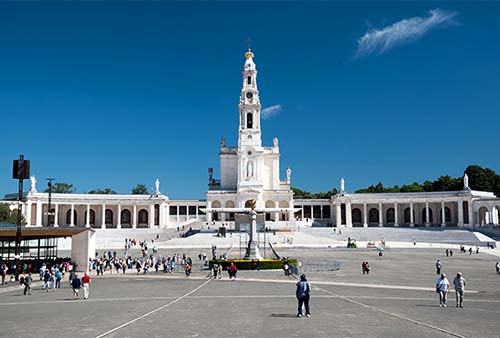
The pilgrim-friendly, modern Fátima (FAH-tee-mah) is a huge complex, with two big churches bookending a vast esplanade, adjacent to a practical commercial center. Wandering through the religious and commercial zones, you see the 21st-century equivalent of a medieval pilgrimage center: lots of beds, cheap eateries, fields of picnic tables and parking lots, and countless religious souvenir stands—all ready for the mobs of people who inundate the place on the 13th day of each month from May through October. Any other day, it’s just big and empty.
At the start of the commercial zone, browse through the horseshoe-shaped mall of stalls selling religious trinkets—wax body parts, serene statuettes of Mary, rosaries (which pilgrims get blessed after attending Mass here), and so on.
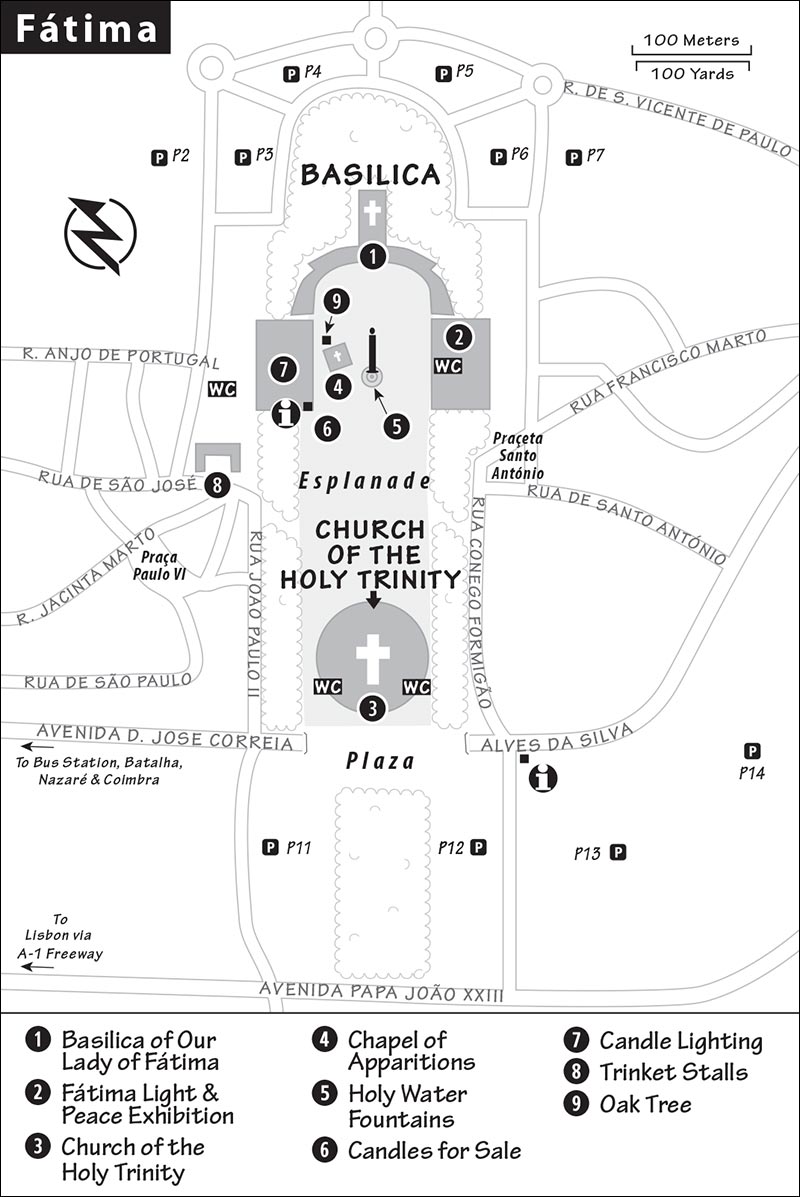
Arrival in Fátima: From the bus station, follow the main road to the right, and in about five minutes you’ll hit the back of the big, circular Church of the Holy Trinity (at the bottom of the esplanade). Drivers come to a big roundabout, where exits are marked for individual, numbered parking lots. All parking is free; a green GRATIS on the directional signs means they have spaces available. The handiest lots are P3, P4, P5, and P6, which cluster just behind the basilica; others are farther out (see the “Fátima” map, earlier).
Tourist Information: The town TI is in a glassy modern kiosk behind the Church of the Holy Trinity (daily 9:00-13:00 & 14:00-17:00, Avenida José Alves Correia da Silva 213, +351 249 531 139, www.centerofportugal.com). For information on the religious sites and the schedule of today’s services, check in at the shrine TI at the western side of the esplanade, near the candles (daily 9:00-18:30, slightly shorter hours off-season, +351 249 539 600, www.fatima.pt).
Sights in Fátima
Esplanade
The huge assembly ground facing the basilica is impressive even without the fanfare of a festival day. Small fountains in the middle provide holy water for pilgrims to take home. You’ll see the information center; the oak tree and Chapel of the Apparitions marking the spot where Mary appeared; a place for lighting and leaving candles (with an inferno below where the wax melts into a trench and flows into a vat to be resurrected as new candles—the shrine TI is right near here); and a long, smooth route on the pavement for pilgrims to approach the chapel on their knees.
A variety of tacky and overpriced for-profit “museums”—each within a couple of blocks of the esplanade—compete for your euros by trying to re-create the story of the visions. The steep admission fees (not one dime of which go to a good cause) make these perhaps the worst sightseeing values in Portugal.
Basilica of Our Lady of Fátima
The towering Neoclassical basilica (1928-1953) has a 200-foot spire with a golden crown and crystal cross-shaped beacon on top. The facade features Mary of the Rosary, flanked by mosaics in the porticoes of the 14 Stations of the Cross (under the statues of the four Portuguese saints). Built into the grand staircase is a covered stage with an open-air altar, cathedra (bishop’s chair), and pulpit—all awaiting the next 13th of the month, when the masses will enjoy an outdoor Mass.
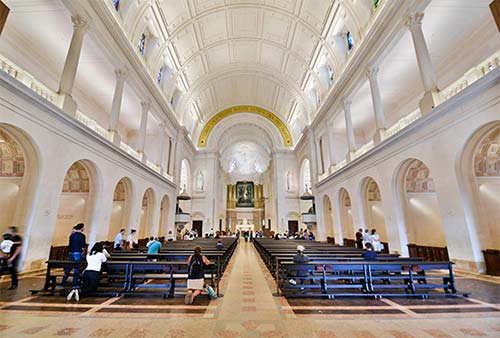
Cost and Hours: Free, daily 7:00-21:00.
Visiting the Basilica: Inside, giant letters arc across the ceiling above the altar, offering up a request for Mary in Latin, “Queen of the Holy Rosary of Fátima, pray for us.” A huge painting depicting the vision is flanked by chapels dedicated to the Stations of the Cross and the tombs of the children who saw the vision. Two of the three died in the flu epidemic that swept the world shortly after the visions. Francisco’s tomb (died 1919) is to the right of the altar. Jacinta (died 1920) and Lúcia rest in a chapel to the left of the altar. Lúcia (the only one with whom Mary actually conversed) passed away at the age of 97 in 2005. She lived as a Carmelite nun near Coimbra for most of her life.
The basilica is busy with many Masses throughout each day. During a visit by Pope Francis in May 2017—on the 100th anniversary of the first apparition—he made the two younger children, Francisco and Jacinta, saints. Lúcia will likely be named a saint soon.
Nearby: Filling a basement of a hall to the right of the basilica (as you face it) is the Fátima Light and Peace Exhibition, a serious exhibit sponsored by the Church to enhance your visit (free, daily 9:00-12:00 & 14:30-17:30). An inexpensive booklet explains the context of the exhibit (in English). The 15-minute movie, while not in English, is still worth watching. Explore several rooms of cases filled with gifts given to Our Lady of Fátima. It’s here that you can see the crown of the Virgin that now holds one of the bullets that hit St. John Paul II when he was pope. The sisters who run the exhibit are sweet and helpful.
Church of the Holy Trinity (Igreja da Santíssima Trindade)
Construction of this grand church began in 2004 with its foundation stone, a fragment from St. Peter’s actual tomb in the Vatican, given by Pope John Paul II. Completed in late 2007, the church can hold 9,000 devotees, 10 times the capacity of the older basilica. The striking architecture and decoration is intentionally multinational—the architect was Greek; the large orange iron crucifix in front is German; the dazzling, golden mosaic mural inside (the left side depicts Mary with the three children she visited and all the people who witnessed her in the last apparition in October 1917) is Slovenian; and the crucifix at the altar (with the strikingly different Jesus) is Irish. The church is circular, symbolizing the world. Each of its 12 doors is named for an apostle. Outside, statues of two popes kneel facing the esplanade (Paul VI, who was here on the 50th anniversary in 1967, and John Paul II, who had a special place in his heart for Fátima and visited three times). The long, smooth approach for pilgrims making their way to the Chapel of Apparitions on their knees starts here, with a pilgrims’ prayer posted.
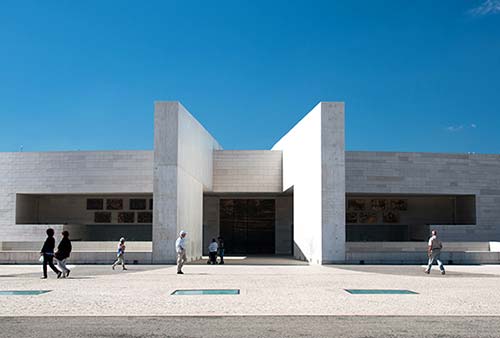
Cost and Hours: Free, daily 9:00-19:00.
Chapel of Apparitions
This marks the spot where Mary appeared to the three children (located outside the church, next to the big old oak tree, beneath a canopy). Services take place all day long in a variety of languages; check the posted schedule for English.
Pilgrimage
On the 13th of each month from May through October, and on August 19 (another day the children reported seeing Mary), up to 100,000 pilgrims come to Fátima. Some shuffle on their knees, traversing the mega-huge, park-lined esplanade (which is more than 160,000 square feet) leading to the church. Torch-lit processions occur on two nights (usually the 12th and 13th). In 2017, on the 100th anniversary of the miracle, a half-million pilgrims—including Pope Francis—gathered here.
Fátima Connections
From Fátima by Bus to: Batalha (3/day—or 4/day in summer, 30 minutes), Alcobaça (2/day, 1 hour), Coimbra (hourly, 1 hour), Nazaré (2/day, 1.5 hours), Tomar (2/day, 1 hour) and Lisbon (hourly, 1.5-2.5 hours, depending on route); service drops on Sunday. Note that the stop closest to the basilica is listed on bus schedules as Cova de Iria, not Fátima. Baggage storage is available at the bus station (€2.50/day).
Tomar
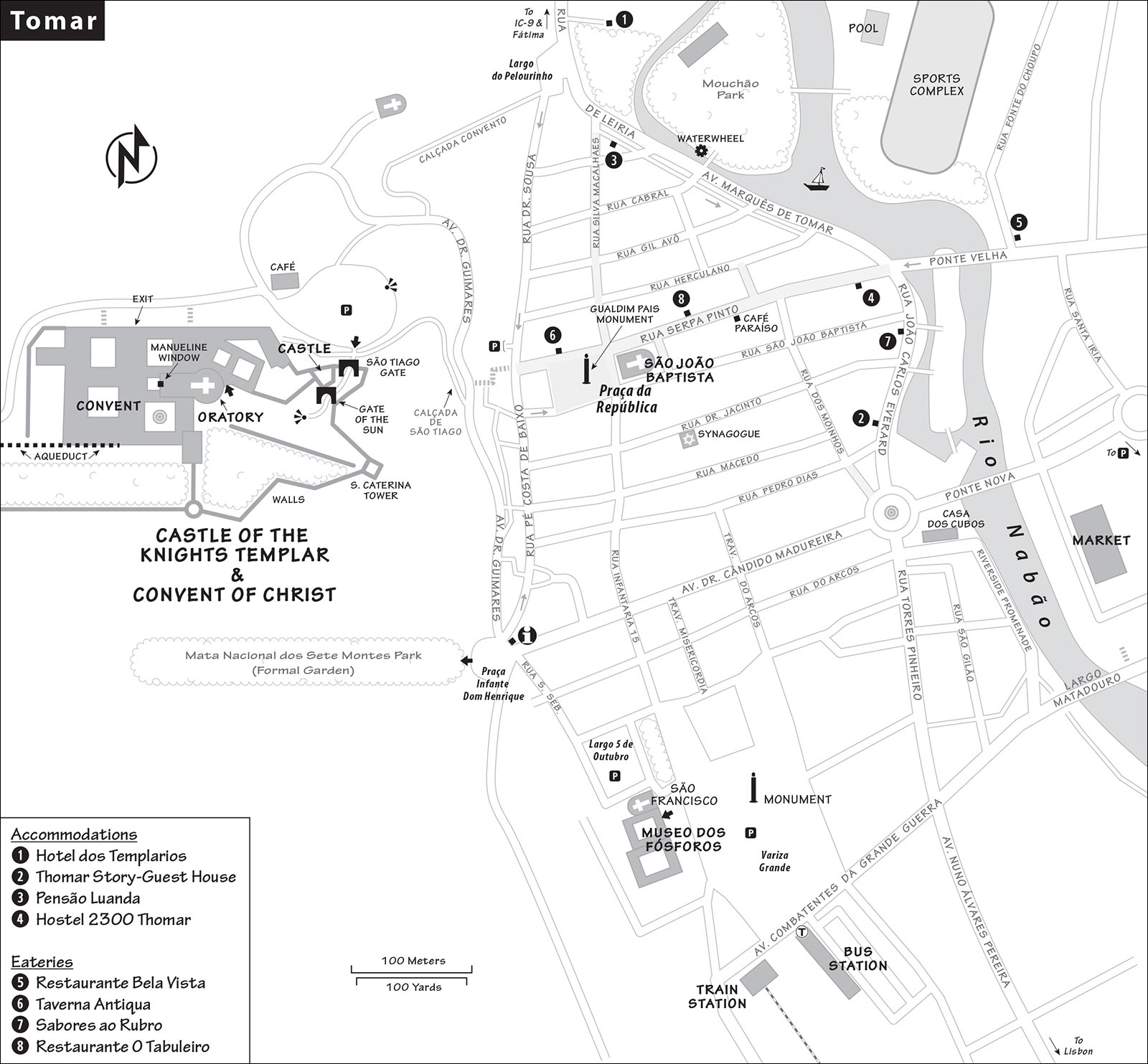
Lush, green Tomar is a quaint little town set under a fortified complex of great historic and artistic importance. Just a 30-minute drive east of Fátima, the town is remarkably untouristed and well worth a stop. Tomar is divided by the Nabão River running north to south, with its sights and pedestrian streets on the west bank (the east bank is modern and less interesting). The São João Baptista church, Town Hall, and several cafés crowd around the main square, Praça da República. A steep walk uphill from there leads to a medieval masterpiece looking out over Tomar: the Castle of the Knights Templar and Convent of Christ (Convento de Cristo).
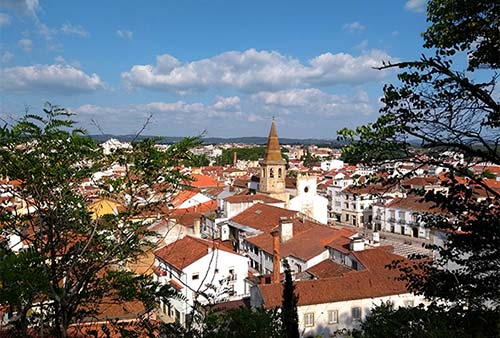
Tourist Information: The helpful TI occupies a quaint former residence, just across from the Mata Nacional dos Sete Montes Park entrance (daily 9:30-18:00, Oct-March 10:00-17:00, Avenida Dr. Cândido Madureira, +351 249 329 8, www.visit-tomar.com, turismo@cm-tomar.pt).
Local Guides: Fátima Bugarin (who also guides for my company) runs Share Portugal. She or one of her team can take you through her hometown of Tomar on a half-day food tour, lead you on a Templar crusade, or guide you on a full-day tour of all the sights in Tomar, nearby Fátima, and Nazaré (contact for rates, +351 913 240 704, shareportugalwithfatima@gmail.com).
Arrival in Tomar: From the bus or train station (they’re next to each other), it’s a 10-minute walk to the city center. Head right down the wide Avenida Combatentes da Grande Guerra until you reach busy Rua Torres Pinheiro. Take a left and continue straight through the roundabout (with a bridge to the right), until you reach the foot of a second bridge. The pedestrian section of town is just to your left. Taxi stands outside both stations and are handy for day-trippers heading straight to the castle. Drivers coming from Fátima will hop on IC-9. Follow signs for Tomar and enter town via Rua de Leiria. Parking is located on the east bank of the Nabão River along Rua Santa Iria.
Sights in Tomar
Tomar Town
While there was a settlement here in Roman times, Tomar’s importance started in the 12th century with the construction of the castle that still caps its hill. With 20,000 residents now in the old town, it’s a place with lots of local ambience.
Stroll its riverside. The tiny Nabão River is all Tomar’s—it starts nearby and flows just a few miles before emptying into the Tagus River outside of town. In mid-river look for a peaceful island with a pleasant park and a rebuilt medieval waterwheel, showing off what must have been impressive technology in its day.
The old bridge, Ponte Velha, faces Rua Serpa Pinto which leads directly through the old grid center to the heart of town, Praça da República. This grid plan is a reminder that Tomar was a garrison town built to support the castle of the Knights Templar and their Christian mission.
Praça da República is one of those main squares where you just want to nurse a drink at a café and enjoy the relaxed tempo of local life. Children on bikes test their training wheels, pigeons strut as if they own the place, old timers shake their heads at today’s fashions, and tuk-tuk drivers hustle business (negotiating short town tours for a few euros). There are plenty of inviting spots to grab a bite or a drink. The classic old Café Paraíso (at Rua Serpa Pinto 127) is a time warp, retaining the humble vibe of Salazar days.
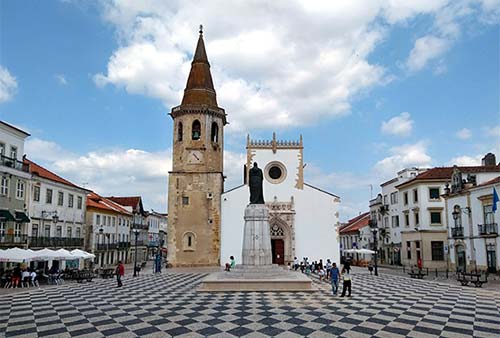
A statue of Gualdim Pais (1118-1195) overlooks the scene. The Grand Master of the Knights Templar and founder of the city, he put Tomar on the map, building the castle on the hilltop with architectural skills and techniques picked up in the Holy Land Crusades.
A large Spanish Jewish community lived in Tomar after Spain drove many of its Jews out of their country—and before Portugal decided to expel its Jews as well (1496)—adding to the city’s economic and ethnic vitality. Today, you can visit the oldest synagogue in Portugal (15th century) a couple of blocks off the main square at Rua Dr. Jacinto (free, ask for the English info sheet at the entrance, daily 10:00-13:00 & 14:00-18:00, shorter hours Oct-March).
Castle of the Knights Templar and Convent of Christ
Towering above Tomar is its castle with an Oz-like circular church (or “oratory”) built 800 years ago by the Knights Templar. The church (modeled after the Dome of the Rock and the Church of the Holy Sepulchre in Jerusalem) is where knights would go, often on horseback, to be blessed before battle as they defended Portugal against the Moors, protected pilgrims heading for the Holy Land, or just empowered Portugal in the Age of Discovery.
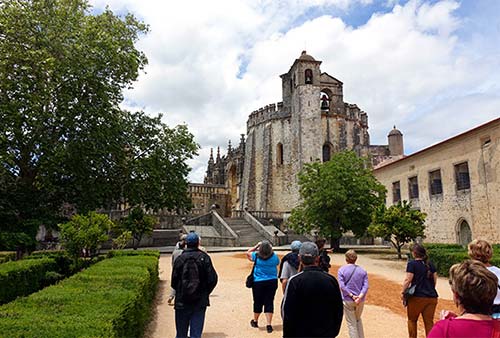
Cost and Hours: €6, €15 combo-ticket also covers Monastery of Santa Maria in Batalha and Monastery of Santa Maria in Alcobaça; daily 9:00-18:30, Oct-May until 17:30.
Getting There: From Praça da República, it’s a steep but pleasant 10-minute walk to the castle. Just walk behind the São João Baptista church and find the stairs up to a path that offers great views back to the town as you wind your way up. Day-trippers on a targeted visit can take a taxi from the train or bus station.
Background: The Knights Templar was a rich organization—both a popular Christian charity and Europe’s first great bankers. People deposited their money with the Templars here in the West, were given a “check” (safer than cash to travel with), and could make withdrawals along their pilgrimage as they ventured East. If they died, which was common, the Templars kept their estate. (When banking, always read the fine print.) The Templars—you could call them the first multinational corporation—built and managed about a thousand forts to aid Christian pilgrims stretching from Portugal all the way to Jerusalem.
The Order of the Knights Templar was dissolved in the early 1300s in Europe, but here in Portugal the order just changed names, morphing into the Order of Christ, and carried on. Henry the Navigator was the Grand Master—the first governor of the Order of Christ—and lived here for several years. Later, King Manuel I (who became Grand Master in 1484) ordered much of the building you’ll see within the castle walls. Under his leadership, the stout early medieval castle was decorated in exquisite Manueline style.
In 1834 the Portuguese king dissolved all religious orders in Portugal (they had too much power and were very conservative—seen as an impediment to the liberal direction Europe was heading after the French Revolution) and this became property of the Portuguese state.
Visiting the Castle: The husky castle and the wonderous round (actually eight-sided) oratory date from the 12th century. Most of the other buildings here date from the 15th and 16th centuries. The knights built a four-mile-long aqueduct with 180 arches, which snakes through the countryside leading to Tomar, to bring water to this castle and convent. The fine tile work is generally 17th century.
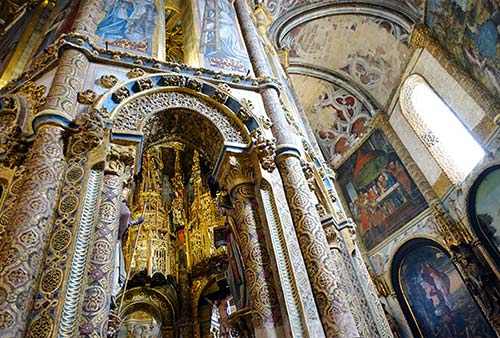
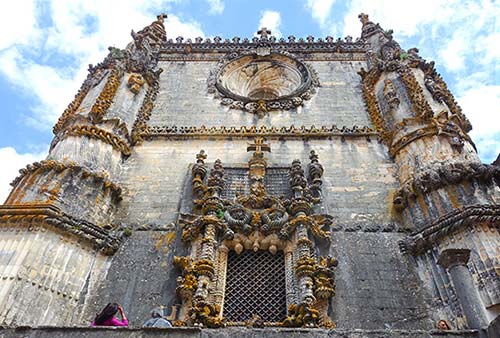
Standing in the oratory, imagine it in the 12th century—without the big entrance of today. There was one small entry/exit facing Jerusalem (the door with the window today). This was inspired by churches in Jerusalem where the order had its mother church. The original castle and oratory were built when such impressive architecture was new in Europe—inspired by stone work and architecture seen by the Crusaders in the Holy Land. The oratory was designed so even horses (important in the Knights Templar success on the battlefield) could be ridden in and blessed. Later, with the building projects of Manuel I, a big conventional church was added, and the oratory’s wall was cut open to connect (with the grand triumphal arch you walk through today) the church and the circular oratory.
The Convent of Christ complex built around the oratory (which you are free to explore) is mostly 16th-century construction. You’ll see various cloisters, a grand dormitory (with 40 cells), the refectory (dining hall), and jaw-dropping Manueline dressing on the older architecture. Fanciful sea motifs decorate the partially-hidden side windows, but the jaw-dropper is the back window, visible from the top floor of the cloister: a cross of the Order of Christ surrounded by representations of armillary spheres (navigational devices), barnacles galore, ropes, and coral.
Museo dos Fósforos
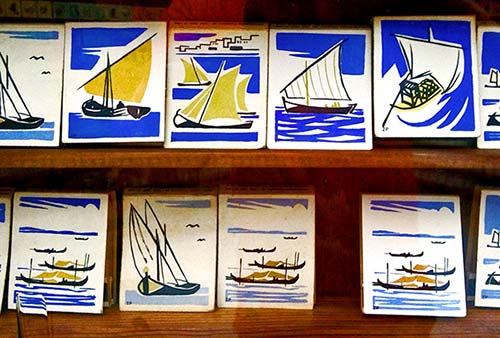
This quirky museum makes for a worthwhile stop if you’ve got time to kill. Housed in one section of the former São Francisco convent, the museum boasts a collection of 80,000 matchboxes on display—organized into 127 countries. Donated by a local resident in 1980, the collection keeps growing. Walk through arched doorways to the very last room, dedicated to Portuguese matchboxes; the oldest is from the 1820s (free, Tue-Sun 10:00-13:00 & 14:00-18:00, closed Mon, Avenida General Bernardo Faria, +351 249 329 814).
Sleeping in Tomar
$$$ Hotel dos Templarios, located just north of the pedestrian zone, is Tomar’s top hotel. This behemoth sports two pools and 171 spacious rooms—consider this an affordable splurge as mass tourism hasn’t yet hit Tomar (air-con, elevator, free parking, Largo Cândido dos Reis 1, +351 249 310 100, www.hoteldostemplarios.com, geral@hoteldostemplarios.pt).
$ Thomar Story-Guest House has 12 rooms, each with clever local themes and different color schemes. Its crisp, modern design comes with minimal street noise at the edge of the pedestrian zone (no elevator, air-con, Rua João Carlos Everard 53, +351 249 327 268, www.thomarstory.pt, thomarstory@gmail.com).
$ Pensão Luanda feels like a visit to grandma’s house, with traditional decor, a nearby park, and friendly owners Mario and Vera. Its 12 rooms aren’t fancy but very clean and comfortable (air-con, Avenida Marquês de Tomar 15, +351 249 323 200, www.residencialuanda.com, pensaoluanda@gmail.com).
¢ Hostel 2300 Thomar is smack dab on the main pedestrian street, with four double rooms and five dorm rooms. Portuguese motifs run through this budget option (air-con, common kitchen, Rua Serpa Pinto 43, mobile +351 249 324 256, www.hostel2300thomar.com, geral@hostel2300thomar.com).
Eating in Tomar
Since Tomar is inland, pork and beef are staples on any menu here. All over town you’ll see loaves of bread stacked into a very tall “crown,” decorated with flowers—women carry these trays on their heads in a festival every four years, incorporating pagan and harvest rituals into Catholicism (the next Festa dos Tabuleiros is in late July 2023). Expect some very good bread with your meal.
$$ Restaurante Bela Vista certainly has a “beautiful view” as its name suggests, with a romantic, lilac-covered terrace just across the riverbank. Traditional Portuguese fare is the specialty with an emphasis on grilled meat. Sip a glass of local Ribatejo wine or try a Portuguese craft beer (Wed-Sun 12:00-15:00 & 19:00-22:30, closed Mon evening and all day Tue, Rua Marquês de Pombal 77, +351 249 312 870).
$$ Taverna Antiqua has cozy terrace seating ideal for an afternoon drink, but return at night for a unique experience: dining completely by candlelight. Guests are placed at long communal tables with lots of candles, in a setting that plays on Tomar’s medieval history. Don’t expect a gourmet meal, but it’s a fun way to end the day, especially after a visit to the Convent of Christ (Tue-Sun 12:00-15:00 & 19:00-23:00, closed Mon, Praça da República 23, +351 249 311 236).
$ Sabores ao Rubro is popular with locals who want a family-friendly place and good value. Hand-written daily specials are posted at the entrance, and the jovial spirit inside makes for a fun experience. Everything tastes like a Portuguese mom is in the kitchen (Fri-Wed 12:00-15:00 & 19:00-22:30, closed Sun evening and all day Thu, Rua João Carlos Everard 91, mobile +351 969 579 755).
$ Restaurante O Tabuleiro has a family-owned-yet-modern vibe and serves a wide variety of meat dishes. Half portions (meia dose) are reasonably priced. Try for a streetside table to enjoy the small-town vibe (Mon-Sat 12:00-15:00 & 19:00-22:00, closed Sun, Rua Serpa Pinto 140, +351 249 312 771).
Tomar Connections
From Tomar by Bus to: Lisbon (4/day, 2 hours), Nazaré (2/day, 2 hours), Batalha (2/day, 1 hour), Fátima (6/day, 1 hour), and Coimbra (1/day, 2 hours). On weekends, buy tickets directly from the driver if the bus station ticket counter is closed. A special summer bus service (July-Sept) adds two more departures per day from Tomar to Fátima, Batalha, Alcobaça, and Nazaré.
From Tomar by Train to: Lisbon (hourly, 2 hours), Coimbra (almost hourly, 2-3 hours) and Porto (almost hourly, 4 hours).
Alcobaça
This pleasant little town is famous for its monastery, one of the most interesting in Portugal. For its small-town atmosphere, I find Alcobaça (ahl-koh-BAH-sah) a better stop than Batalha if you have to choose.
Tourist Information: The TI is in the shopping district, between the monastery and the market (daily 9:00-12:30 & 14:00-17:30, Rua Araújo Guimarães, +351 924 032 615, www.centerofportugal.com).
Arrival in Alcobaça: If you arrive by bus, it’s a five-minute walk to the town center and monastery. Exit right from the station (on Avenida Manuel da Silva Carolino), walk a half-block uphill (car parking lot visible in distance), take the first right, and continue straight (on Rua Dom Pedro V). Hang a left just after passing a small plaza, and you are in the main square.
If you’re arriving by car, follow the Mosteiro signs. For free parking, use the lot just uphill from the bus station (estação rodoviário signs). But it’s easiest to simply park on the streets alongside the monastery, where the parking is cheap.
Sweets: Across from the entrance to the monastery, Pastelaria Alcôa wins awards for their traditional convent pastries, including the best pastel de nata in all of Portugal. See if you like it better than the famous version in Belém or buy a mixed box (caixa) to sample several (daily 8:30-19:30, Praça 25 de Abril 44, +351 262 597 474).
Sights in Alcobaça
▲▲Monastery of Santa Maria (Mosteiro de Santa Maria)
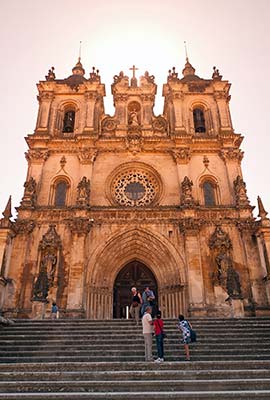
This Cistercian abbey church, despite its mainly Baroque facade, represents the finest Gothic building in Portugal. It’s also the country’s largest church, and a clean and bright break from the heavier Iberian norm. Afonso Henriques began construction in 1178 after taking the nearby town of Santarém from the Moors.
The first Cistercian monks arrived in 1228 and proceeded to make this one of the most powerful abbeys of the Cistercian Order and a cultural center of 13th-century Portugal. This simple abbey was designed to be filled with hard work, prayer, and total silence. With finely preserved old dormitories and dining halls, it’s the easiest place in Portugal to really envision the life monastic.
Cost and Hours: Church and tombs-free, cloisters-€6, combo-ticket with Monastery of Santa Maria in Batalha and the Convent of Christ in Tomar-€15; daily 9:00-19:00, Oct-March until 18:00, +351 262 505 128, www.mosteiroalcobaca.gov.pt.
Self-Guided Tour: As you view the 1 church exterior from the expansive square facing it, you can sense its former importance. The wings stretching to the right and left from the facade housed monks and pilgrims. As was generally the case, the monastery was an industrial engine (making ceramics and other products), and by the 16th century a town had grown around the abbey. When the abbey was dissolved in 1834, the town declined, too.
• Purchase your ticket, then step inside the grand world of cloistered Cistercian monks.
2 Cloister: Cistercian monks built the abbey in 40 years, starting in 1178. They inhabited it until 1834 (when the Portuguese king disbanded all monasteries). The monks spent most of their lives in silence and were allowed to speak only when given permission by the abbot. To enjoy this cloister like the monks did: Meditate, pray, exercise, and connect with nature. As you multitask, circle clockwise to reach the fountain—where the monks washed up before eating.
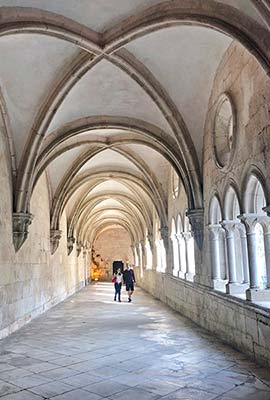
• Traditionally, in any cloister, the fountain marks the entry (on your left) to the...
3 Refectory (Dining Hall): Imagine this hall filled with monks eating in silence as one reads from the Bible atop the “Readers’ Pulpit.” Food was prepared next door.
• Continue around the cloister and into the next room, the...
4 Kitchen: The 18th-century kitchen’s giant three-part oven could roast seven oxen simultaneously. Survey the place: big sinks, wonderful hard surfaces, serious venting (look up the chimney). The industrious monks rerouted part of the Alcoa River to bring in running water. This kitchen fed huge numbers: The population of monks averaged about 450, and peasants who worked the church-owned land were rewarded with meals made here.
• Head back out into the cloister, turn left, and take the stairs up to the bare...
5 Dormitory: Enjoy the beautiful austerity of the clean Gothic vaulting and pillars. In the hall where the monks slept, you can peer down on the transept of the church where Inês and Pedro lie buried. On this floor, there is also a terrace overlooking the adjacent cloister, with a rose garden. Monasteries generally had a medicinal herb garden (they were early leaders in herbal medicine) and grew their own produce.
• Spiral down the staircase that exits back into the kitchen, then continue around the cloister until you reach the...
6 Hall of Kings: This hall features terra-cotta ceramic statues of most of Portugal’s kings. The last king portrayed is Joseph (above the exit door), who ruled when the earthquake hit in 1755. Since then there has been no money for fancy statues. The next empty pedestal (to the left of Joseph) is wider than the rest—in anticipation of the reign of Portugal’s first queen, Mary I, and her big fancy dress. The walls feature 18th-century tiles telling the story of the 12th-century conquest of the Moors and the building of the monastery (each with Latin supertitles and Portuguese subtitles). In the last scene (two scenes left of exit door), the first king lays the monastery’s first stone.
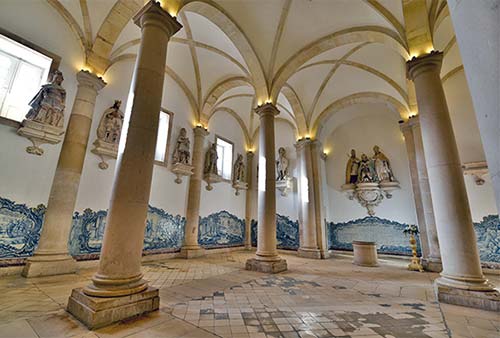
The biggest sculpture—in its own niche, facing the entrance—features a fantastical image of Afonso Henriques, first king of Portugal and founder of this monastery, being crowned by Pope Innocent III and St. Bernard.
• Follow signs to exit through the gift shop. As you exit the shop, head left to enter the...
Church: Stepping inside, you find a suitably grand yet austere house of prayer—just straight Gothic lines. The only decor is organic (such as leafy capitals).
• The long and narrow central nave leads to a pair of finely carved tombs that flank the main altar.
7 Tombs of Inês and 8 Dom Pedro: These 1360 Gothic tombs belong to Portugal’s most tragic romantic couple, Dona Inês de Castro (c. 1323-1355, on the left) and Dom Pedro (King Pedro I, 1320-1367, on the right). They rest feet-to-feet in each transept, so that on Judgment Day they’ll rise and immediately see one another again. Pedro, heir to the Portuguese throne, was hopelessly in love with the Spanish aristocrat Inês (see sidebar, here).
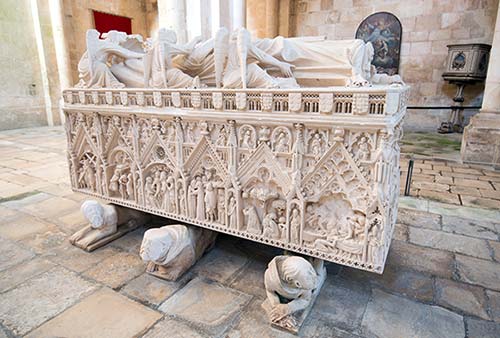
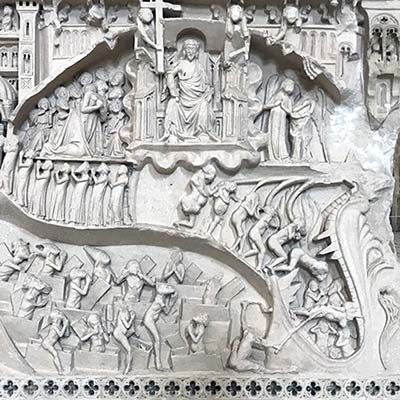
Start on the left with the tomb of Inês, which is supported by the lowly scum who murdered her...one holding a monkey, a symbol of evil. Inês’ tomb features vivid scenes from the life of Christ, and the relief at her feet features Heaven up above, the dragon mouth of Hell (see photo), and jack-in-the-box coffins on Judgment Day. Napoleon’s troops vandalized the tombs (that’s why so many heads are missing).
Now check out Pedro’s tomb (on the right) and examine the exquisite carvings. Like religious alarm clocks, the attending angels are poised to wake the couple on Judgment Day. Pedro will lie here (as inscribed on the tomb) “Até ao fim do mundo”—until the end of the world, when he and Inês are reunited. The “Wheel of Life” below Pedro’s finely combed head features the king on the throne at the top and the king in his tomb at the bottom, with the good things in life on the left and the bad things (including Inês’ beheading) on the right.
Scenes from the life of St. Bartholomew—famous for being skinned alive (Pedro’s patron saint, reflecting his life of sacrifice)—circle the tomb. The martyrdom of St. Bartholomew is depicted on a relief directly below the king’s head on his left side—along with the creepy aftermath. Pedro’s tomb is supported by lions, a symbol of royalty.
Twenty-year-old Prince Pedro met 17-year-old Inês, a Galician noblewoman, at his wedding to Inês’ cousin Constance. The politically motivated marriage was arranged by Pedro’s father, the king. Pedro dutifully fathered his son, the future king Fernando, with Constance in Lisbon, while seeing Inês on the side in Coimbra. When Constance died, Pedro settled in with Inês. Concerned about Spanish influence, Pedro’s father, Afonso IV, forbade their marriage. You guessed it—they were married secretly, and the couple had four children. When King Afonso, fearing rivals to his (“legitimate”) grandson’s kingship, had Inês murdered, Prince Pedro went ballistic. He staged an armed uprising (1355) against his father, only settled after much bloodshed.
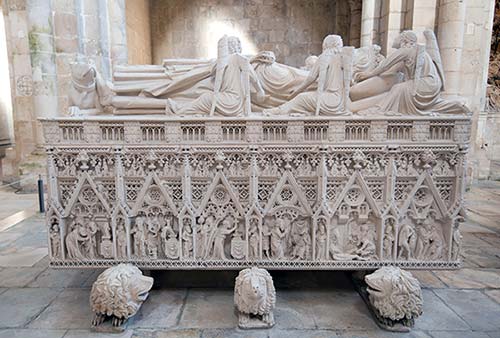
Once he was crowned King Pedro I the Just (1357), the much-embellished legend begins. Pedro summoned his enemies, exhumed Inês’ body, dressed it in a bridal gown, and put it on the throne, making the murderers kneel and kiss its putrid rotting hand. (The legend continues...) Pedro then executed Inês’ two murderers—personally—by ripping out their hearts, eating them, and washing them down, it is said, with a fine vinho verde. Now that’s amor.
Stroll through the ambulatory (behind the altar) to the sacristy entrance. The two Manueline doors, courtesy of King Manuel I, add a touch of grandeur (think of Lisbon’s Monastery of Jerónimos) to the rather plain but elegant church.
• Exit back through the church (where you entered).
▲Mercado Municipal
An Old World version of Safeway is housed happily here under huge steel-and-fiberglass arches. Inside the covered market, black-clad dried-apple-faced women choose fish, uncaged and feisty chickens, ducks, and rabbits from their respective death rows. Wander among figs, melons, bushels of grain, and nuts (Mon and Sat 9:00-13:00, minimal activity other weekdays, closed Sun). Imagine having a lifelong relationship with the person who grows your produce. Women from Nazaré—with their distinctive dress—sell fish in a separate room. The market is a five-minute walk from the TI (just down the block from the bus station); ask a local, “Mercado municipal?” Also, a flea market happens Mondays by the Alcoa River.
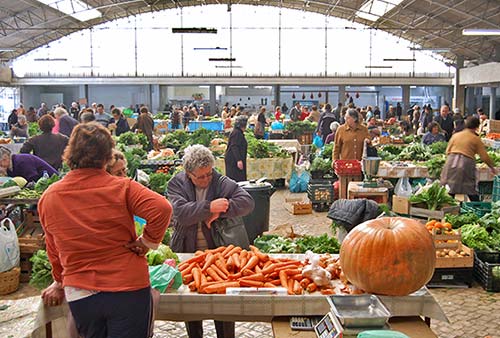
Alcobaça Connections
From Alcobaça by Bus to: Lisbon (6/day, 2 hours, some with transfer in Caldas da Rainha), Nazaré (2/hour, 20 minutes, stops at Valado), Batalha (3/day, 30 minutes), Fátima (3/day, 1 hour, more frequent with transfer in Batalha), Óbidos (5/day, 2 hours), Coimbra (2/day, 1.5 hours). Buses are much less frequent on weekends, especially Sunday. A taxi to the Nazaré/Valado train station costs about €15; to Nazaré, a little over €15. Bus info: +351 217 524 524.
Óbidos
Postcard-perfect Óbidos (OH-bee-doosh) sits atop a hill, its 14th-century wall (45 feet tall) corralling a bouquet of narrow lanes and flower-bedecked whitewashed houses. Its name, dating from ancient Roman times, means—appropriately enough—“walled town.” The 16th-century aqueduct connecting it like an umbilical cord to a nearby spring is a reminder of the town’s importance during Portugal’s boom century. Óbidos—now protected by the government from modern development—is ideal for photographers who want to make Portugal look as pretty as possible.
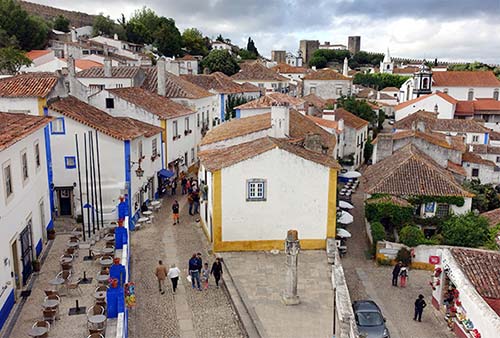
Founded by Celts (c. 300 BC), then ruled by Romans, Visigoths, and Moors, Óbidos was known as Portugal’s “wedding city.” In 1282, when King Dinis brought his bride Isabel here, she liked the town so much he gave it to her. (Whatta guy.) Later kings carried on the tradition—the perfect gift for a king to give to a queen who has everything. (Beats a toaster.) Today, this medieval walled town is popular for lowly commoners’ weddings. Preserved in its entirety as a national monument since 1951, it survives on tourism. And in 2015, it was named a “City of Literature”—you’ll notice a book theme around town, and Óbidos is very proud of its annual literary festival.
Óbidos may well be Portugal’s prettiest little town—but it’s also one of its most touristy...and least authentic. For this reason, a quick visit outside of peak times is ideal. Every summer morning at 9:30, the tour groups flush into town (in August, it’s absolutely packed). Ideally, arrive late one day and leave early the next, enjoying the town as you would a beautiful painted tile.
Tourist Information: The TI is at Óbidos’ main pay parking lot, just outside the main gate (Mon-Fri 9:30-17:30, Sat-Sun 9:30-13:00 & 14:00-17:30, +351 262 959 231, https://turismo.obidos.pt).
Arrival in Óbidos: If you arrive at the train station, you’re faced with a 20-minute uphill hike into town. The bus drops you off much closer, right outside the main gate (upon arrival, go up the steps and through the archway on the right). If leaving by train, you can catch a taxi to the station in the lot outside the main gate (about €10). There’s no official place to store luggage in town, so it’s smart to travel light.
If you arrive by car, don’t drive into tiny, cobbled Óbidos. Ample tourist parking is provided just outside the main gate. The closest lot—right outside the main gate, near all the tour buses, the TI, and a public WC—is pay-and-display. The huge lot across the street (lined by the 16th-century aqueduct) is usually free, but they may charge during busy times or special events. If you’re staying inside the town walls and want to park near your hotel, get details beforehand. Some hotels inside the walls have one or two spots, but it’s generally easier to park outside the walls.
Óbidos Walk
There’s not much to see in Óbidos—the main attraction is the town itself—but this walk covers it. In about 30 minutes, it goes from one end of town (the main gate) to the other (castle-turned-pousada).
• From the parking lot or bus stop, enter Óbidos’ 14th-century wall through the...
Main Gate: Inside the gate, pause to gaze up at the scenes related to the town’s history—depicting centuries of battles and religion in blue-and-white tiles. Tiles like these covered the entire face of the walls here until the 1755 quake shook them down.
Step into the town, and like Dorothy entering a medieval Oz, you’re confronted by two wonderful cobbled lanes. The top lane is the town’s main drag, littered with tourists shopping and leading straight through Óbidos to its castle (ahead, you can see its square tower, where this walk finishes). We’ll start out on the quieter, restaurant-lined lower street. But first, let’s get an aerial view over town.
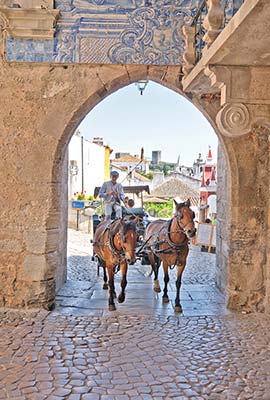
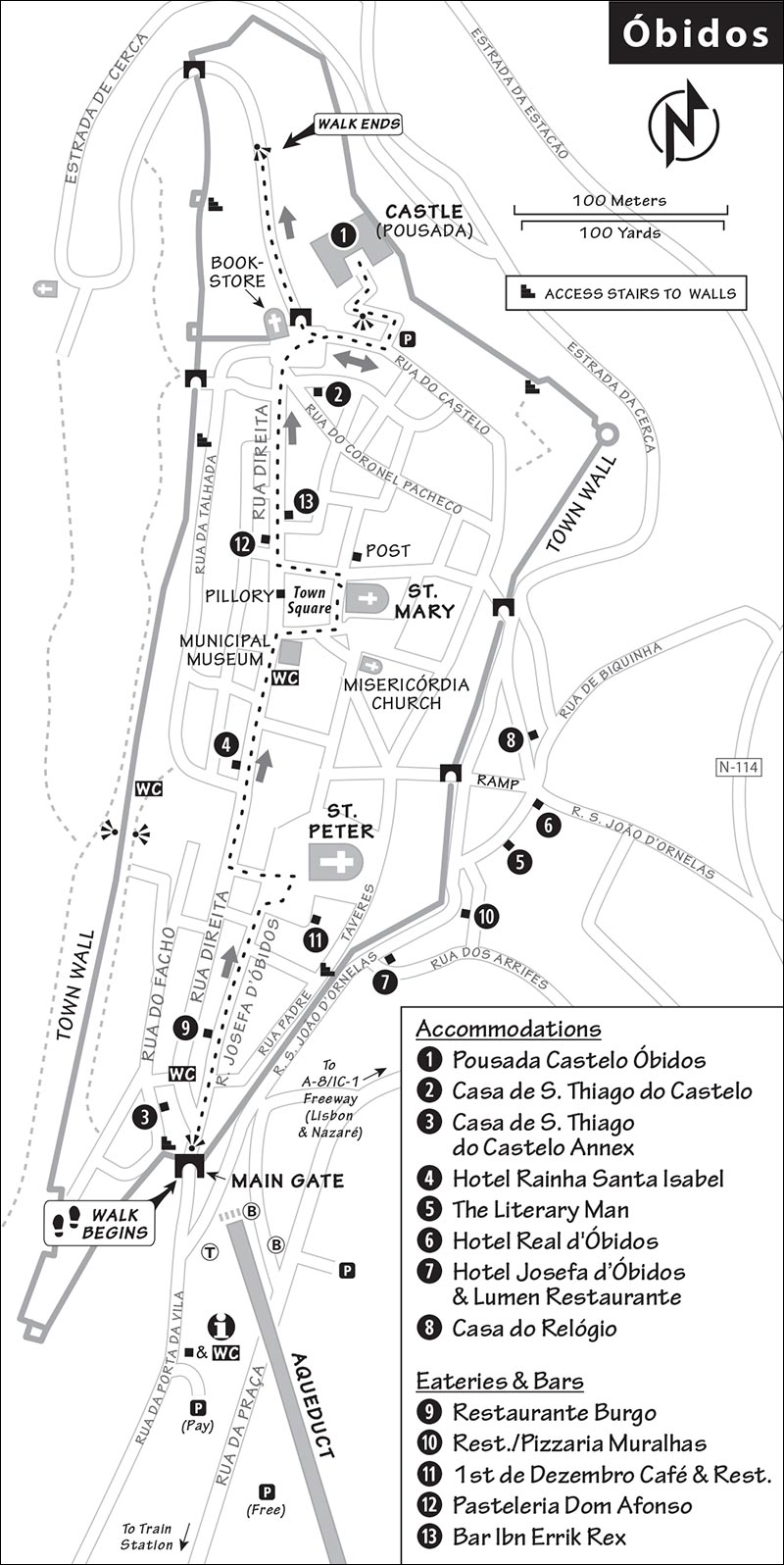
• From where you walked through the gate, you’ll see steep stairs on your left. Hike up for a view from atop the...
Town Wall: Enjoy the panoramas of the city and surrounding countryside from the 45-foot-high walls. This is one of several access points for the scenic sentry path along the wall (other options are near the castle/pousada, and uphill from the main church). The west (uphill) wall is best, letting you look over the town’s white buildings with red roofs and blue or yellow trim. You can almost gaze all the way to the Atlantic, six miles away. Until the 1100s, when the bay silted up, the ocean was half as far away, making this a hilltop citadel guarding a natural port. The aqueduct is from the 16th century.
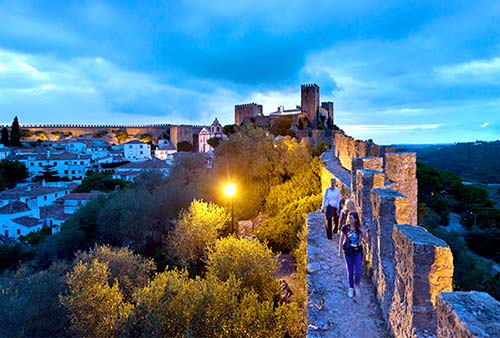
• At the end of our walk, you can stroll along the top of the walls all the way back to this point. But for now, descend the staircase and head into town. At the fork, follow the right/downhill of the two streets...
Rua Josefa d’Óbidos: Along this restaurant row, notice the whitewash that keeps things cool; the bright blue-and-yellow trims, traditionally designed to define property lines; and the potted geraniums, which bloom most of the year and survive the summer sun well.
The Church of St. Peter has a fine, restored Baroque altar covered with Brazilian gold leaf. The Maltese-type crosses carved into the rock throughout the church are a constant reminder that this fine building was “brought to you by your friends in the Order of Christ.”
• After peeking in, exit the church and climb uphill to the main tourist drag, where you’ll turn right on...
Rua Direita: Walking toward the castle on this main shopping drag, you’ll pass typical shops, a public WC, and the small Municipal Museum, not worth the admission fee unless you enjoy stairs, religious art, and Portuguese descriptions (€1.50, Tue-Sun 9:30-13:00 & 14:00-17:30, closed Mon).
As you stroll, you’ll see stands selling €1 shots of ginjinha—Óbidos’ famous cherry liqueur. The tiny shots are served in edible chocolate cups (you’ll pay a bit more for a shot in a glass, which can fit more booze). This custom, while gimmicky, is practically obligatory. (If you’d rather try one at a particularly atmospheric indoor spot, I’ve listed a favorite bar later in this walk.)
This is the town’s most touristy street. But as you stroll, peek up to your left to notice a lonesome pastel-colored world, draped with flowers, and without a tourist in sight. Consider returning to the main gate (after this walk) on this picturesque upper lane, which is a photographer’s delight.
• Continue on and enter the...
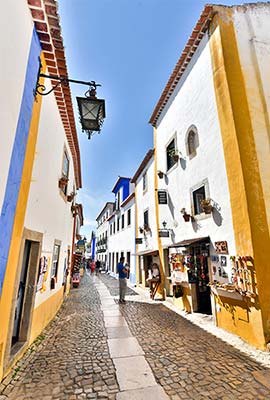
Town Square: The lone column at the side of the road (opposite the church) is the 16th-century pillory. Bad boys were tied to this to endure whatever punishment was deemed appropriate. Studying it closely, you’ll notice it’s capped by Queen Leonor’s crown. On the side facing the castle, the carved hanging shrimp net represents how fishermen found the body of 16-year-old Afonso, son of Manuel I and Leonor, in the Tejo River after a tragic and mysterious death. The net eventually became part of the queen’s coat of arms. The huge pots you see beneath the tile-roofed porch overlooking the square on the left were once in the central market and held olive oil instead of flowers.
• At the bottom of the square, enter the...
Church of St. Mary of Óbidos: Grab a seat on a front pew, surrounded by classic 17th-century tiles. Notice the fine painted-wood ceiling over each of the three naves. To the left of the altar is a niche with a delicate Portuguese Renaissance tomb, featuring a pietà carved out of local limestone. To the right of the altar are three paintings, including The Mystical Marriage of St. Catherine, all by Óbidos’ most famous artist, the nun Josefa d’Óbidos (1634-1684).
To peek into another church, exit left and head a few steps down (behind the terrace bar). Look for Our Lady of Mercy sculpted in blue and white ceramic above the entrance. The Misericórdia church was built as part of the queen’s charity institution, hence the royal coat-of-arms painted on the ceiling. It’s lined with 16th-century “carpet tiles.” To the right of the altar you can see one of the “religious floats” and a cross that’s carried through town during Holy Week festivities.
• Return to the main shopping drag and turn right for the...
Final Stretch to the Castle: On the left, pop into the Pasteleria Dom Afonso (#113). This welcoming little coffee bar, dominated by a big old grape press, serves good pastries and sandwiches. Try the local version of pastel de nata, with chocolate or with the sour-cherry-like berries that go into ginjinha (open daily 8:00-19:00).
A few steps farther down the street, Bar Ibn Errik Rex (#100, on the right) is the most characteristic indoor spot to sip ginjinha. Bruno will take good care of you, with a backdrop of his dad’s extensive collection of old liquor bottles. Rather than serve the liqueur in a chocolate cup, he’ll give you a more generous (and pricey) pour in a shot glass for €3 (Wed-Mon 11:00-24:00, closed Tue most of the year).
The main drag ends at a big, white church—but it’s not a church anymore. Step inside to find a huge and inviting bookstore (a branch of the famous Lisbon shop Ler Devagar) with giant shelves filling the nave and apse, and a good selection of books in English. This deconsecrated church was repurposed after Óbidos was named a “City of Literature” (daily 10:00-13:00 & 14:00-19:00).
• Facing the big, white church/bookstore, you have a couple of choices: Stairs on the left lead up to the top of the town wall. But for now, instead turn right and follow pousada signs. You’ll pass the pousada’s sweet little garden (an inviting spot for a coffee or drink), then continue up the curving stairs to the left and a view terrace (with a telescope) just in front of the former castle.
Castle/Pousada: Óbidos’ onetime castle is now a fancy hotel. Looking out over these grand views, consider this history: On January 11, 1148, Afonso Henriques (Portugal’s first king) led a two-pronged attack to liberate Óbidos from the Moors. Afonso attacked the main gate at the other end of town (where tourists enter), while the Moorish ruler huddled here in his castle. Meanwhile, a band of Afonso’s men, disguised as cherry trees, snuck up the steep hillside behind the castle. The doomed Moor ignored his daughter when she turned from the window and asked him, “Daddy, do trees walk?”
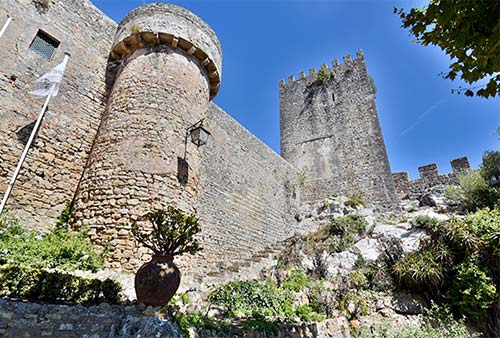
After savoring the view, go back down toward the top of Rua Direita and enter the archway to your right. Walk uphill for a minute until you see the town wall. Turn around for a spectacular view of the castle—it’s yours for the taking...even if you don’t have a cherry-tree costume.
• You can return to your starting point three ways: hiking along the upper town wall, exploring photogenic side lanes, or shopping and drinking your way back down the main drag.
Sleeping in Óbidos
To enjoy Óbidos without tourists, spend the night. There are reasonable values in this overpriced toy of a town. In the first three weeks in August, prices spike up well above those indicted by these price ranges.
INSIDE THE OLD WALLS
$$$$ Pousada Castelo Óbidos, within the castle itself, is now an upscale hotel with nine modern rooms, classy public spaces, and great views of the castle courtyard and town (restaurant and bar, +351 210 407 630, www.pousadas.pt).
$$ Casa de S. Thiago do Castelo, a fancy and characteristic little guesthouse at the base of the pousada/castle, rents eight elegantly appointed rooms around a chirpy Better Homes and Tiles patio. Lower levels offer three different, welcoming salons to relax in, including one with a classy billiards table (free parking, Largo de S. Thiago, +351 262 959 587, https://www.casasthiagodocastelo.com/, reservas@casasthiagodocastelo.com, Alice speaks English). They also have an annex near the main gate, where they book overflow guests in six rooms (without breakfast or parking) at busy times.
$ Hotel Rainha Santa Isabel is an old-school hotel marked by flags on the main drag in the center of the old town. It has 20 traditional but updated rooms and a big lounge with comfy leather chairs (air-con, elevator, Wi-Fi in public areas only, minimal breakfast, some street noise, Rua Direita 63, +351 262 959 323, www.obidoshotel.com, history@obidoshotel.pt). If you’re driving, call first to let them know you’re approaching, stop long enough to drop your bags and get a parking permit, and drive on to the town square to park. If no one’s at the front desk, the staff at the Doce Rainha café next door can help.
JUST BELOW THE OLD WALLS
While still in a cute, cobbled zone, these accommodations sit just below the actual walls—so they have easier car access and fewer tourist throngs. All have free, public street parking nearby.
$$ The Literary Man was built as a convent, but now it celebrates Óbidos’ proud literary status. Its 30 rooms come in two types: classic, old-fashioned tiled rooms, and sleek new postmodern rooms with concrete and warm wood. The public spaces—including a funky and delightful breakfast room/bar with books stacked under stout vaults—have books, books, everywhere. Dinner at the $$ restaurant comes with showmanship flair (air-con, Rua Dom João d’Ornelas, +351 262 959 217, www.theliteraryman.pt, bookme@theliteraryman.pt).
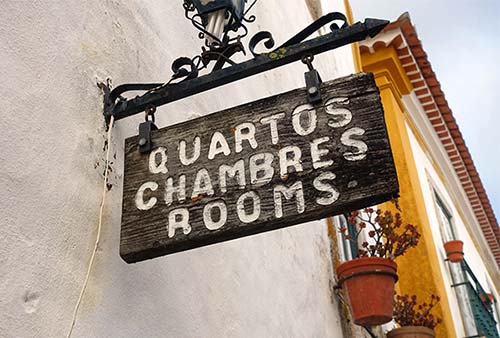
$$ Hotel Real d’Óbidos takes guests back to medieval times with suits of armor, tapestries, and staff dressed in period costume. Don’t worry; the tasteful rooms have modern conveniences, and there is a small swimming pool. Ask the front desk if you need help figuring out how to work your key, large enough to open any castle gate (air-con, Rua Dom João d’Ornelas, +351 262 955 090, www.hotelrealdobidos.com, reservas@hotelrealdobidos.com).
$ Hotel Josefa d’Óbidos, located just outside the town walls, is a great value, with 30 well-appointed, modern rooms and a sense of style rare in this price range (air-con, Rua Dom João d’Ornelas, +351 262 955 010, www.josefadobidoshotel.com, geral@josefadobidoshotel.pt). The attached $$$ Lumen Restaurante serves nice fish and meat dishes and offers vegetarian options.
$ Casa do Relógio is a rustic eight-room place at the downhill end of town, just outside the wall. It’s friendly and easygoing, providing no-stress parking and great comfort for the price. English-speaking Sara offers a big sun terrace (cash preferred, Rua Porta do Vale 2, +351 262 959 282, www.casadorelogio.com, info@casadorelogio.com).
Eating in Óbidos
Óbidos is tough on the average tourist’s food budget. Consider a picnic or one of the many cafés that offer cheap, basic meals.
$$$ Restaurante Burgo, just inside the main gate on the lower road, is a lively place with good seating in the small, stony dining room, or out on the cobbled street (daily 12:00-15:30 & 18:00-22:30, good ice cream, Rua Josefa d’Óbidos 11).
$$ Restaurante/Pizzaria Muralhas serves traditional Portuguese and Italian cuisine outside the city wall. Dine indoors, or on the back patio (Thu-Mon 12:00-15:00 & 19:00-22:00, closed Tue-Wed, Rua Dom João d’Ornelas 6, +351 262 958 550).
$$ 1st de Dezembro Café & Restaurante, tucked on a little square next to the Church of St. Peter, serves inexpensive pizza, salads, and omelets (Mon-Sat 8:30-23:00, closed Sun, Largo de San Pedro, +351 262 959 298).
Óbidos Connections
By Bus from Óbidos to: Nazaré (3/day, 1 hour, Rápida service is direct, most transfer in Caldas da Rainha), Alcobaça (3/day, 1 hour). Far fewer buses run on weekends; be sure to check schedules at the TI or online.
By Bus or Train to Lisbon: The bus (hourly, 1 hour, rodoviariadooeste.pt) is a much better option than the train (8/day to Lisbon Rossio, 2.5 hours, transfer in Cacém or Mira Sintra-Melecas; also 3/day to Lisbon Oriente, 2.5 hours, transfer in Sete Rios).
By Car to Lisbon: From Óbidos, the tollway zips you directly into Lisbon in about an hour.