THE ALGARVE
Salema • Cape Sagres • Lagos • Tavira
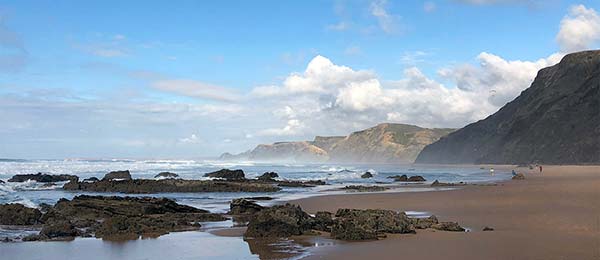
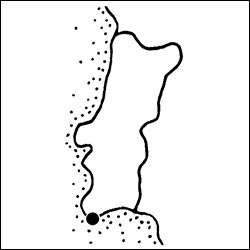
The Algarve—Portugal’s warm and dry south coast, stretching for some 100 miles—was once known as Europe’s last uncharted tourist frontier. Today’s Algarve is far from undiscovered—and in some places can be miserably crowded and overdeveloped—but it still holds some gems ideal for a relaxing beach break.
You won’t be the first one seeking the sun here. When the Moors ruled Portugal, they chose not to live in the rainy north, but here—where warm, sandy beaches framed by jagged rocks give way to rolling green hills dotted with orchards. They called this land Al-Gharb Al-Andalus (“to the west of Andalucía”) and made it the westernmost fringe of the huge Islamic world at the time. Today, perceptive visitors notice echoes of Muslim culture all along the Algarve: groves of almond and orange trees, white-domed buildings with blue trim, traditional azulejos (tiles), and pointy chimneys reflecting the region’s minaret heritage.
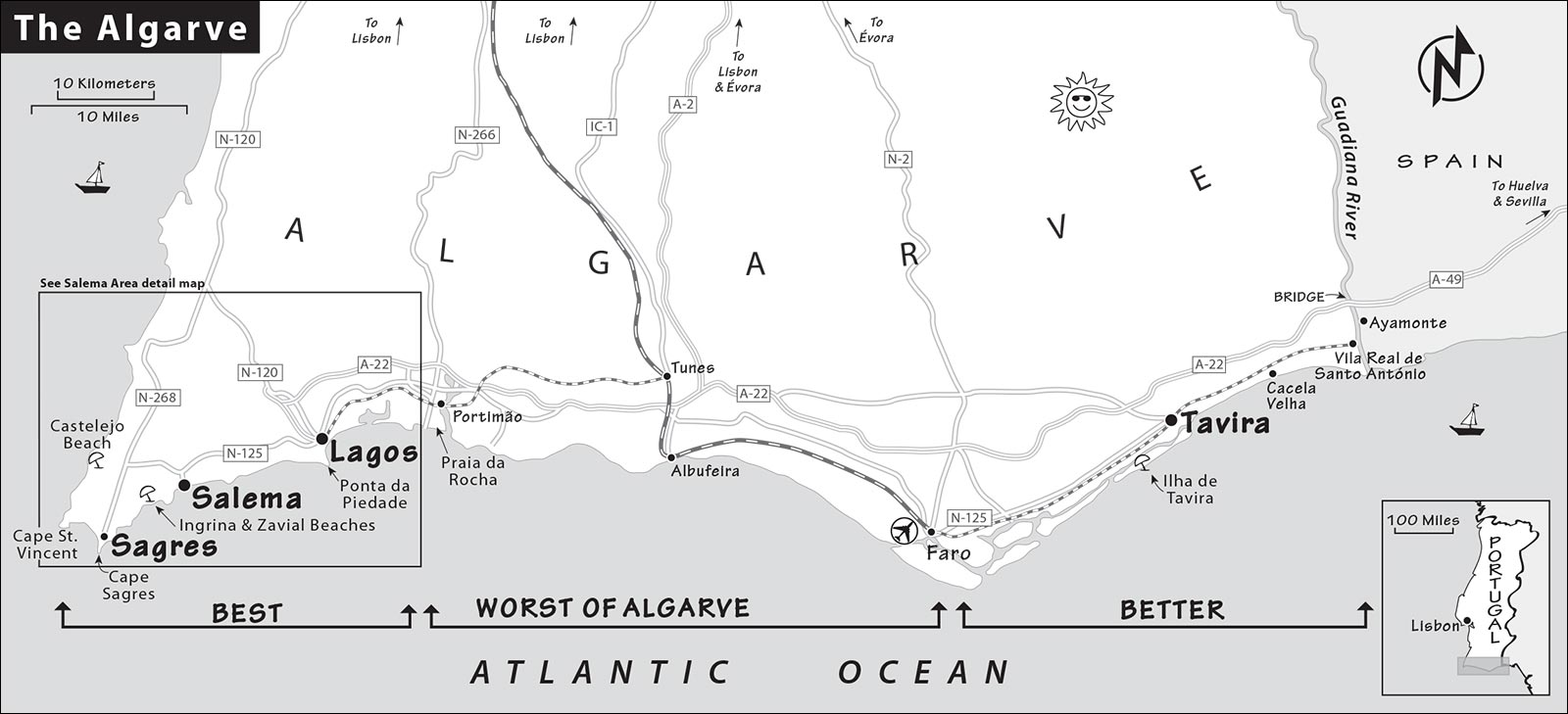
Choose your home base carefully. If you go to the places featured in tour brochures (the middle stretch, roughly between Faro and Lagos), you’ll find it much like Spain’s Costa del Sol: paved, packed, and pretty stressful. Two worthwhile, midsize resort towns offer a better experience: In the west is Lagos, an urban resort with a vibrant old town, a youthful surfing buzz, and dramatically scenic beaches. And in the east—amid lagoon estuaries, just this side of Spain—is pleasant Tavira, a whitewashed town with a real soul, a fun-to-explore cobbled townscape, and boats to an island-beach getaway.
But even Lagos and Tavira are secondary to this region’s best destination: the laid-back beach village of Salema. For some rigorous rest and intensive relaxation, make Salema your Algarve hideaway. Here the tourists and the fishermen sport the same stubble. Except in peak summer, it’ll just be you, a beach with weathered fishing boats, no must-see attractions, and a few other globe-trotting experts in lethargy. Nearby is Cape Sagres, Europe’s “Land’s End” and home of the scant remains of Henry the Navigator’s famous navigation school. But unless you’re out for the extra credit, you could just stick around sleepy Salema...work on a tan and see how slow your pulse can get. If not now, when? If not you, who?
PLANNING YOUR TIME
The Algarve is your vacation from your vacation. How much time does it deserve? It depends upon how much time you have, and how much time you need to recharge your solar batteries. On a two-week trip of Portugal, I’d give it three nights and two days. After a full day of sightseeing in Lisbon (or Sevilla, if you’re arriving from Spain—each is just three hours away by car), I’d push it by driving to Salema around dinnertime to gain an entirely free beach day. With two full days, I’d spend one enjoying side trips to Cape Sagres and Lagos, and another just lingering in Salema. The only other Algarve stop to consider is Tavira, farther to the east and most logical on the way to or from Spain. (If you’re visiting in winter, Tavira—which is lively year-round—makes a better stop than tiny Salema, which hibernates in the off-season.)
GETTING AROUND THE ALGARVE
Trains and buses connect the main towns along the south coast (skimpy service on weekends and off-season). Buses take you west from Lagos, where trains don’t go. The freeway crossing the Algarve from Lagos to the Spanish border (and on to Sevilla, Spain) makes driving quick and easy. (See “Route Tips for Drivers,” at the end of this chapter.)
Salema
One bit of old Algarve magic still glitters quietly in the sun: Salema. Fronting a fine sandy beach, it’s at the end of a small road just off the main drag between the big city of Lagos and the rugged southwest tip of Europe, Cape Sagres.
Salema (sah-LAY-mah) is changing but remains charming. The fishermen are fading into the past, the younger generation is moving to the big city, and the economy is evolving. Salema now draws visitors from nearby gated resorts and golfing clubs seeking local character and atmospheric restaurants. Yet Salema is still a place that will reward you with a great beach-town experience.
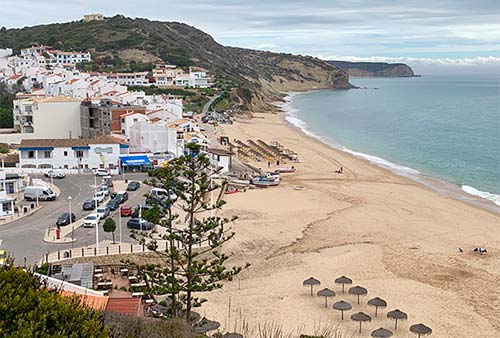
This simple fishing village has three beachside streets, a dozen or so restaurants, a few hotels and bars, time-share condos up the road, a paved promenade, and endless summer sun. Most important, it has a long, broad, gorgeous beach—luxurious with powder-fine sand, framed off by steep vivid-yellow cliffs, and relatively untrampled by rowdy tourists. For my money, it may be the most purely enjoyable beach in all of Europe.
Orientation to Salema
Tiny Salema meets the water at the parking-lot square called Largo da Liberdade. Most of my recommended accommodations and restaurants are within a few minutes’ walk of here; a few are a steep but scenic walk above town.
TOURIST INFORMATION
Salema lacks a real TI, but people in its bars, restaurants, and pensions have heard all the questions and are happy to provide answers. Isabel (with Vibeltaxis), Romeu (at the Salema Market), and Daniel (look for his kayak rental shop where the road hits the beach) speak English and are good sources of advice. TIs in nearby Sagres or Lagos can also offer limited info on Salema.
ARRIVAL IN SALEMA
By Train and Bus: To get to Salema, you’ll arrive first at Lagos, the western Algarve’s transportation hub (with the closest train and bus stations; see “Lagos Connections,” later in this chapter). From there, Vamus buses go every hour or two between Lagos and Sagres—Salema is about halfway between the two (bus #47, 7/day, fewer on weekends, 30-minute ride, last bus departs Lagos at 18:30, schedules at www.vamusalgarve.pt). During high season, hop on board at the Lagos bus station. If the bus gets full, drivers will not pick up more passengers at other Lagos bus stops.
About half the buses conveniently go right into the village of Salema. Confirm with the driver by asking: “Você vai à praia de Salema?” (voh-say vah-ee ah pry-ah deh sah-LAY-muh).
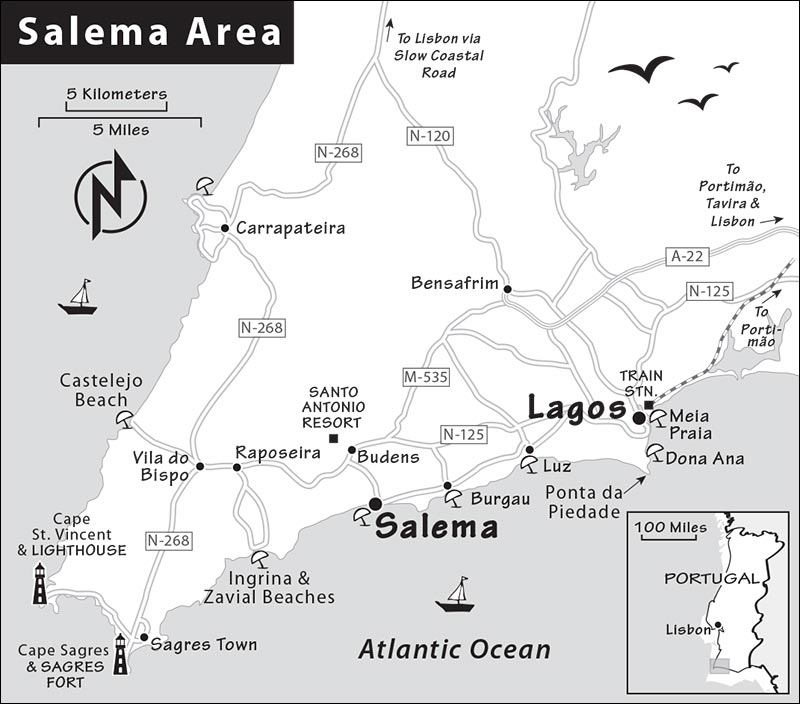
The rest of the buses—marked with a cross (“X”) in the schedule—stop at the top of the road, a 20-minute downhill walk into town. If you’re on one of these buses, it’s better to stay on and get off at the next stop, Figueira. From there you can backtrack 20 yards, then follow the sign for Salema. It’s the same distance as the first downhill walk, but there’s a sidewalk, so it’s safer and easier.
By Car: From the A-22 freeway that parallels the coast, take the Lagos exit (marked Lagos/Vila do Bispo/Sagres), then follow Sagres/Vila do Bispo signs. The Salema turnoff is at the roundabout after Budens and before Figueira. In Salema, parking is free just about everywhere. There are several handy spots on the main square, steps above the beach, and a larger overflow gravel lot over the little bridge on the inland side of town.
To stop in Lagos before continuing to Salema, take the exit marked Lagos/Vila do Bispo/Sagres, but follow signs to Lagos centro. When ready to continue to Salema, leave Lagos on Avenida dos Descobrimentos, and follow signs to Sagres/Vila do Bispo.
By Taxi: A cab from Lagos to Salema takes 20 minutes and costs about €35 (metered—but ask for an estimate first).
HELPFUL HINTS
Money: Although credit cards may be accepted (ask before making any purchase or ordering a meal), many places here appreciate cash—stock up before you arrive. If you need to withdraw cash in Salema, there’s an Orange ATM to the right of The Way Tours office on the town square. Avoid the privately run Euronet machines scattered around town—they have rip-off rates.
WCs: You’ll find free public WCs in the little white municipal building at the top of the main square/parking lot. The fountain in front of the building is a reminder of the old days. When water to the village was cut off, this was always running.
Laundry: Located up the hill at the Salema Beach Club, Vilalaia Laundry offers next-day wash-and-dry service (€8.50, no self-service, Mon-Fri 9:00-17:30, Sat 9:00-13:00, closed Sun, next to the Salema Market, +351 915 229 993).
Taxi: Your hotel can arrange a taxi, but I’d rather work directly with a local family-owned company called Vibeltaxis. Run by former tour guide Isabel Vitorino and her sons, their taxis have room for four to eight passengers. Rates vary with the number of people—try to split the cost (about €30-35 to Lagos; €40-45/hour for guided tours of Cape Sagres; €500 to Sevilla, Évora, or Lisbon). Reserve in advance by phone, text, or email (mobile +351 919 422 061, www.vibeltaxis.com, vibeltaxis@icloud.com). Isabel and her sons all speak English and are happy to answer your questions about the area. Isabel can also help organize transfers and tours.
The Way Tours: Entrepreneurial Daniel runs a wonderful tourist activities desk in the town center. He rents kayaks, paddleboards, water bikes, and sports gear; he also runs tours. Water-based tours include kayaking to secluded beaches for snorkeling and visiting dinosaur footprints, as well as boat trips to Benagil and Ponta da Piedade. Land-based tours focus on the countryside, local food and wine, plus a secret sunset location. If you can’t decide, ask about a tour that combines both land and sea. Daniel also offers minivan transport to local destinations. Drop by to talk with him and review your options (RS%, +351 962 896 026, thewaytours@hotmail.com, www.thewaytours.pt).
Sights in Salema
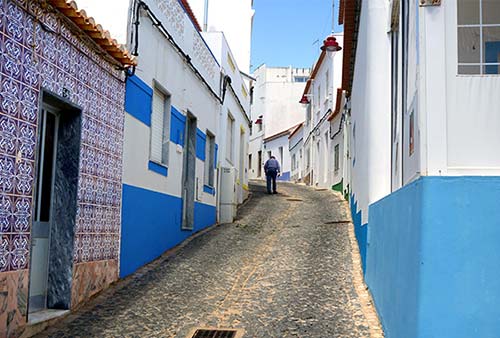
Salema has a split personality: The whitewashed Old Town is for locals, and the other half was built for tourists. Both groups pursue a policy of peaceful coexistence. Tourists laze in the sun, while locals grab the shade. You’ll hardly see the snowbirds in the fancy gated community at the top of the hill.
It’s a small town where everyone seems connected in one way or another. (As the saying goes, “When you kick one person, everyone limps.”) A good percentage of the population has the surname Duarte, and people have nicknames like Cucumber Ze and Bread Roll Paulo. Several local men married visiting German women back in the 1980s, demonstrating the town’s knack for making tourists feel welcome.
Fishing Scene
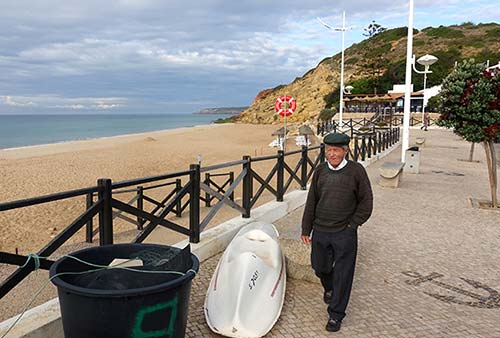
Salema is still a fishing village—but just barely. There are six or eight working boats, but it’s a far cry from the days—just a generation ago—when the town’s main drag, Rua dos Pescadores, was, as its name suggests, literally the street of the fishermen. (Locals now buy their fish from a fish truck that pulls into town tooting its horn each morning.) While the fishermen’s hut no longer hosts a fish auction, you’ll still see the community-subsidized tractor they use to pull the boats ashore in the winter, with a few buckets of fish and old-timers enjoying its shade on rickety old plastic chairs. (In the days before tractors, boat-hauling was a 10-person communal heave-ho.) In the calm of the summer, boats are left out on buoys. Oblivious to tourists, the old salts mend their nets and reminisce about the good ol’ days when life was “only fish and hunger.” To get permission before taking their photo, ask “uma foto, por favor?” (oo-mah foh-too poor fah-vor).
At night you’ll see evenly spaced lights bobbing on the horizon: These are fishing boats out in search of squid, sardines, and the main catch—octopuses. The pottery jars stacked everywhere are traps; owners take care to keep them clean because octopuses prefer smooth, barnacle-free pots. Unwritten tradition allocates different chunks of undersea territory to each Salema family. The traps are tied about 15 feet apart in long lines and dropped offshore. Octopuses, thinking these jars would make a cozy place to set an ambush, climb in and get ambushed themselves. (Octopuses also take refuge in pots during a storm.) When the fishermen hoist them in, the octopuses hang on—unaware they’ve made their final mistake. The fishermen mace them out of their pots with a squirt of bleach. The octopuses flop angrily into the boat, bound for the market and—who knows—maybe onto your dinner plate.
Beach Scene
Sunbathers enjoy the beach May through early October. Knowing their tourist-based economy sits on a foundation of sand, locals hope and pray that the sand returns after being washed away each winter (some winters leave the beach just a pile of rocks).
A walk along the length of the beach, tracing the edge of the wet sand from the rocks in the west to the rocks in the east, is a peaceful experience. Doing it early or late is a fine way to start or finish your day.
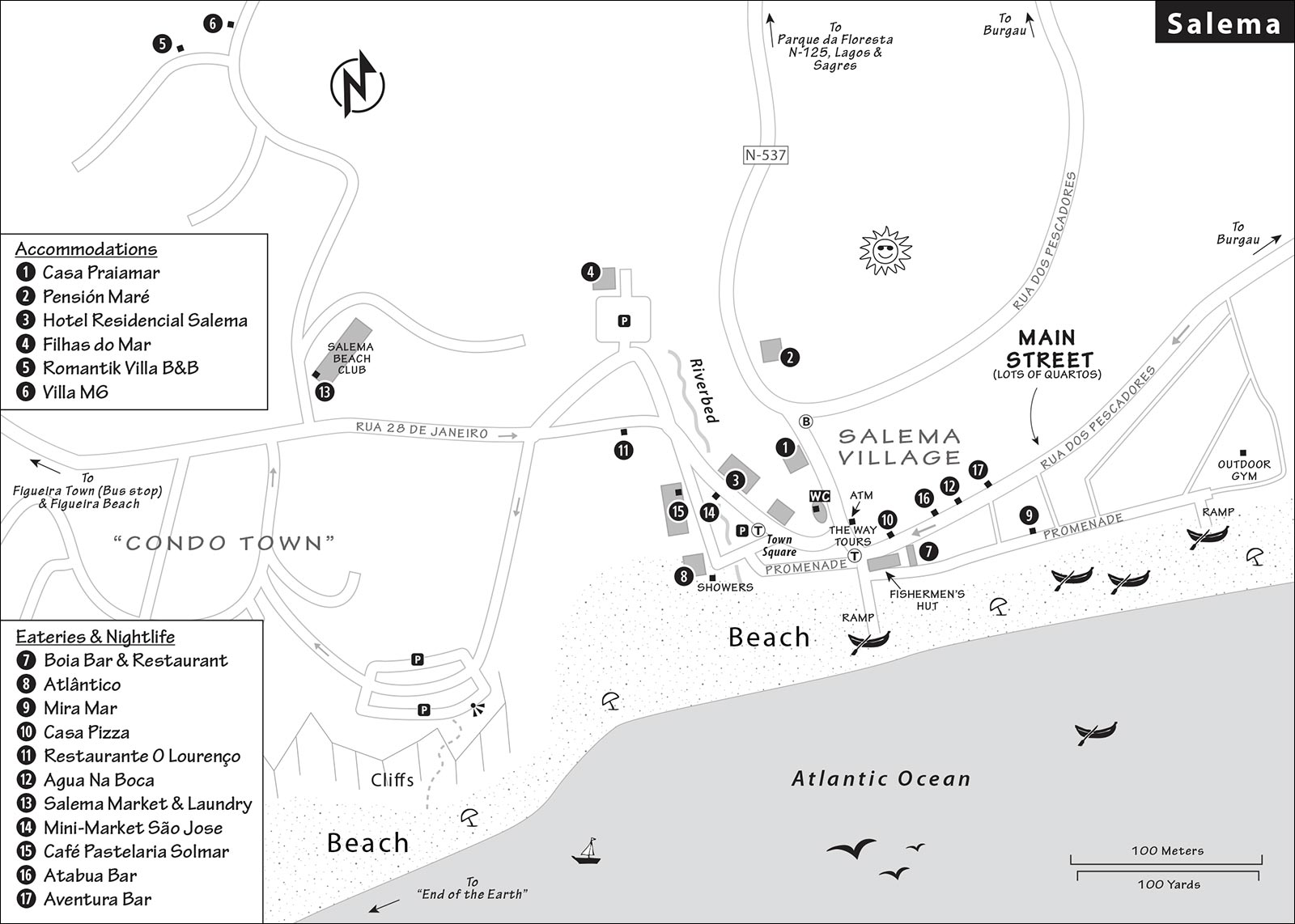
Locals claim the ocean is safe for swimming—and in summer a lifeguard is often on duty (marked by signs)—but the water is rarely really warm. The flag indicates the swimming conditions: Green is good, yellow means the current merits extra caution, and red means no swimming. You can rent beach items just below Atlântico restaurant (1 or 2 lounge chairs with umbrella, drink service, Wi-Fi, and showers-€12/day), or in front of Boia Bar (2 lounge chairs and bamboo sunshade-€10/day).
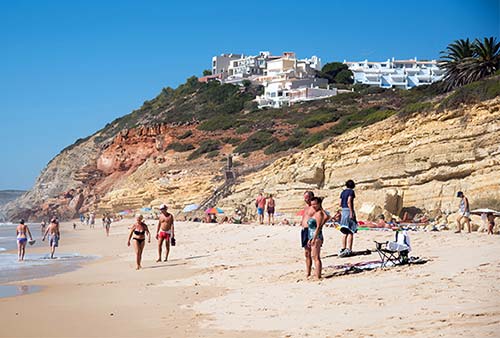
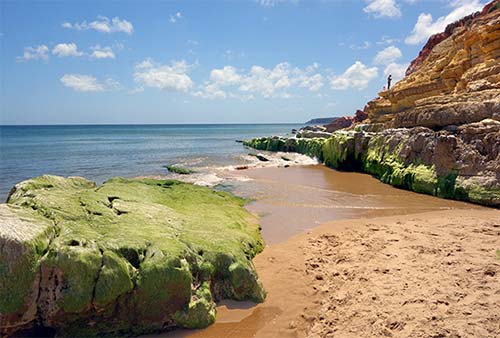
On the west end of the beach, at low tide, you may be able to climb over the rocks past tiny tide pools to secluded Figueira Beach. (But be aware of when the tide comes in, or your route back will have to be over land.) While the old days of black-clad widows chasing topless Nordic women off the beach are gone, topless bathing is still considered somewhat risqué: Northern European sun worshippers do so with discretion, sometimes tucking in at the end of the beach among the rocks.
To complement your beach time with a little workout, use the outdoor gym-with-a-view at the east end of town. (The big shot who built the mansion above it ignored local regulations but gave the town this gym as a consolation quid pro quo.)
Showers for Rick Steves Readers: Oddly, Salema (which survives on its beach-loving visitors) does not provide a public shower. My friends at the Atlântico restaurant have come to the rescue: If you show this book, even if you’re not paying to use their beach lounges, you can use their shower for free (inside, just off the beach, immediately under the restaurant).
Hiking
From Salema, several beautiful hikes go along the beach and through the countryside out to neighboring villages such as Figueira. For routes, ask at your hotel.
Near Salema
The whole peninsula (west of Lagos) has been declared a natural park, and further development close to the beach is forbidden. But the village of Salema is becoming less and less ramshackle as it’s gradually bought up by northern Europeans for vacation or retirement homes. Salema will live with past mistakes, such as the huge hotel in the town center that pulled some mysterious strings to go two stories over code. Up the street is a sprawling community of condos and Club Med-type vacationers who rarely leave their air-conditioned bars and swimming pools.
Across the highway and two miles inland is a big golf resort, Santo Antonio at Parque da Floresta, where several well-known European soccer players have snapped up holiday homes. Visitors can pay a daily rate to use the spa, gym, outdoor pool, golf course, and tennis courts (spa +351 282 690 000, www.saresorts.com; golf +351 282 690 054, parquedaflorestagolfclub.com).
Sleeping in Salema
Salema has a limited number of hotels; you’ll feel the pinch in the busy summer months of July through mid-September (August is horribly packed). Prices jump in July and especially in August. Many Salema accommodations lack air-conditioning—locals insist they don’t need it, thanks to stiff, cooling Atlantic winds that blow through most evenings. Salema is partially closed down in winter, when just a couple of restaurants stay open.
IN OR NEAR THE TOWN CENTER
$$$ Casa Praiamar—in a newer building just above the main square, with a pool and Astroturf—feels fresh and slick by Salema standards. It rents 10 modern rooms, most with kitchens and half with sea views and balconies (RS%, air-con, family rooms, no breakfast, +351 962 619 037, www.casapraiamarsalema.com, casapraiamar@gmail.com).
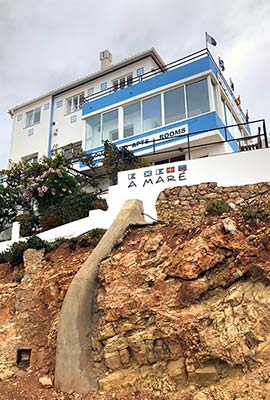
$$ Pensión Maré, a blue-and-white building overlooking the village along the main road into town, is the best hotel value in Salema. It’s managed by friendly Daniela, who offers four comfortable rooms, two studios, and three fully equipped apartments. Eat breakfast on the inviting terrace or have it delivered to your room (RS%, air-con, laundry service, +351 282 695 165, www.the-mare.com, daniela@the-mare.com).
$$ Hotel Residencial Salema rents basic, comfortable rooms handy to the beach and all the best restaurants. Their 32 rooms have air-conditioning, balconies, and partial views (RS%, elevator, usually closed Nov-Easter, +351 282 695 328, www.hotelsalema.com, info@hotelsalema.com, Andrea).
$$ Filhas do Mar, run by Dutch transplant Pieter, has four big, multiroom apartments and two studios in a modern building tucked at the back end of town. While the location is more practical than romantic, this is a decent option if the others are full (air-con, some rooms have modest views, no breakfast, cash deposit required at check-in, +351 282 695 943, reserve through Booking.com).
$ Quartos: For economy, the experience, and an opportunity to practice your Portuguese, you can stay in a quarto (private room for rent). If you’re brave, show up without a reservation and ask around for a room—these typically can’t be reserved ahead. (Romeu at the Salema Market is a good person to ask; +351 917 379 088, romeusalema@gmail.com). Most options line the main residential street, Rua dos Pescadores. For general info on staying at a quarto, see the “Sleeping” section in the Practicalities chapter.
ABOVE TOWN
These two places perch on the bluff overlooking town, a steep 10-to 15-minute walk. To get here on foot, head up from the beach past Restaurante O Lourenço, take a right just after the Salema Beach Club sign, and carry on steeply uphill (with the white condos on your left). When you reach a fork at the big, rounded, white wall (and Villa Oceanis sign), bear left to find Romantik Villa or right to find Villa M6.
One-way streets take drivers on a slightly different route: Take the first left past Restaurante O Lourenço, and loop around past the parking lot over the beach; when you get back to the main road at the stop sign, turn right (back downhill) for a few yards, then take the first left. From there, follow the directions earlier.
$$$ Romantik Villa B&B is a chic, artsy house on top of the hill with five suites (most with some ocean view, kitchenettes, and shared terraces), one luxurious loft (with a private terrace and full kitchen plus a panoramic ocean view), a beautiful garden, and a heated swimming pool. Conscientiously run with an eco-focus by warm French expat Olivier and his team, it’s a tastefully decorated, serene retreat and a great option for those who don’t mind the steep walk up from town (apartments have a 3-night minimum, first morning breakfast included, cleaning for an extra charge, self-service laundry; +351 912 116 532, www.romantikvilla.com, contact@romantikvilla.com).
$$ Villa M6 is a simpler, no-frills alternative just around the corner. Heiwi (from Germany) rents four rooms, each with a refrigerator and access to a shared kitchen plus a fine swimming-pool terrace with sea views (cheaper rooms with shared bath, some rooms with view, +351 919 531 653, www.algarve-salema.de).
Eating in Salema
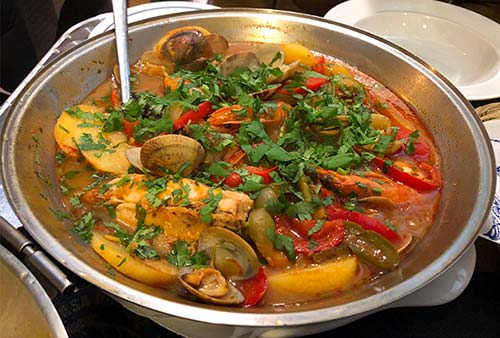
Eat fresh seafood here. The local specialty is cataplana—fish, tomatoes, potatoes, onions, and whatever else is available—cooked a long time in a traditional copper pot (somewhere between a pressure cooker and a steamer). Costing around €25, a single cataplana is enough food for two. Also look for grilled golden bream (dourada grelhada) and giant prawns (camarões). For wine, try vinho verde (a refreshing young white wine).
For such a small town, Salema seems to specialize in good restaurants. You have fun choices: foodie, yacht club, fisherman’s family, Italian, or German beach bum. Dinner with a view is tempting here; Boia Bar, Atlântico, and Casa Pizza all have modern glass fronts so you can be both comfortable and seaside in cold weather. The Mira Mar is right on the beach and can be chilly at dinnertime (they have blankets). For a memorable last course at any of these places, consider taking your dessert drink or coffee to the beach for some stardust with your surf.
$$ Boia Bar and Restaurant, at the base of the Rua dos Pescadores residential street, has a classy beachfront setting (Tue-Sun 9:30-23:30, closed Mon, +351 282 695 382; Anibal, Rui, and Carla).
$$$ Atlântico—big, busy, and right on the beach—has long dominated the Salema scene and comes with a fun energy. It’s known for tasty fish (see the daily board), friendly service, and a swanky beachside terrace (daily 10:00-23:00, +351 282 695 142, Cristiano and his sister Sandra run the place).
$$$ Mira Mar, easily accessed from the beach promenade, has outdoor tables on a covered patio facing the water. Dieter (a German who adopted Salema as his hometown decades ago) offers a creative rotating menu for those venturing away from seafood. He serves hearty salads and always has a vegetarian option (Sun-Fri 15:00-22:00, closed Sat, cash only, no reservations—arrive early to nab a table).
$$ Casa Pizza, across the street from the Boia Bar, isn’t on the beach, but its upper deck has a great view. They serve a variety of tasty pizzas, salads, and fresh fish, as well as meat and pasta dishes (Wed-Mon 12:00-22:00, closed Tue, Rua dos Pescadores 100, +351 282 697 968; Stelios, Mariana, and George).
$$$ Restaurante O Lourenço, a block up the hill, has no beach view (choose between the classic dining room or the vine-covered terrace across the street) but offers good-value meals and is popular with both locals and tourists for its freshest of fish. This is truly a family-run, fisherman’s restaurant: Father Paulo fishes, mother Aldina cooks, and son João serves. A fish dinner for two here will cost around €40 (Tue-Sun 12:00-22:00, closed Mon, Rua 28 de Janeiro 11, cash only, +351 282 698 622).
$$$$ Agua Na Boca (“Mouth Watering”) is sophisticated, romantic, and the closest thing to a gourmet restaurant in town. Run by Paulo and his wife-and-chef Irene, they serve upmarket local cuisine complemented by an extensive wine list. It’s popular, especially with the fancy golf-club crowd, so reserve ahead. Dishes are innovative—more than the standard grilled fish—and their special plates are huge and splittable. For about €50 you can enjoy a three-course meal for two people (Tue-Sun 17:30-24:00, closed Mon and Jan-Feb, on Rua dos Pescadores 82, +351 282 695 651).
Picnics on the Beach
Two minimarkets have everything you need for a beach picnic in Salema or at the harbor in Cape Sagres. Look for fresh fruit, veggies, bread, sheep’s cheese, sausage, and vinho verde. The Salema Market is up the hill at the Salema Beach Club (daily 8:30-19:00, sometimes later in summer, Nov-April closes 13:00-15:00, Romeu). Mini-Market São Jose is on the strip facing Hotel Residencial Salema (daily 9:00-19:00, closes Sun at 13:00). Two pizzerias (including Casa Pizza, mentioned earlier) do a thriving to-go business serving pizzas in a box for easy export.
Breakfast in Salema
Quartos and some hotels don’t serve breakfast. To save money, go shopping and put your room’s kitchenette to work by making your own. Or consider Salema’s two good breakfast options—both on the main square:
$$ Boia Bar and Restaurant serves a hearty €8 breakfast all day. They have a big menu of breakfast items and plenty of tables with glorious ocean views (see details, earlier).
$ Café Pastelaria Solmar, where locals go to start their day with a cigarette, is another place for breakfast—serving toasties (grilled ham-and-cheese sandwiches), juice, coffee, and pastries. It’s less pretty—designed for people who need no ocean view—but it’s a good basic hangout all day (Fri-Wed 8:30-16:00, closed Thu, on the strip facing Hotel Residencial Salema).
Nightlife in Salema
Salema has two late-night bars, side-by-side on the main street. Each has a different vibe and both are worth a visit to sample local drinks. Armarguinha (ar-mar-GWEEN-yah) is a sweet, likeable almond liqueur. Licor beirão (LIK-kor bay-ROW, rhymes with “cow”) is Portuguese amaretto, a “double distillation of diverse plants and aromatic seeds in accordance with a secret old formula.” Caipirinha (kay-peer-EEN-yah), tasty and powerful, is made of fermented Brazilian sugarcane with lime, sugar, and crushed ice. And moscatel is the local sweet dessert wine.
Atabua Bar is a gin bar but also serves a popular sangria set to mellow music. It feels a bit younger and more local and has been run by Guilherme (William) since 1984 (open from 17:00).
Aventura Bar, the place for “curious cocktails,” offers an intimate, laid-back atmosphere for sipping drinks whipped up by Karl and Zoe, an English couple who prefer the Eagles to hip-hop (from 18:00).
DIY Beach Bar: I enjoy capping my dinner by taking a drink from any beachside restaurant and grabbing a bench on the promenade or a place on the beach to peacefully ponder the moon and the waves.
Cape Sagres
In the days before Columbus, when the world was presumed to be flat, this rugged southwestern tip of Portugal was the spot closest to the edge of the Earth. Prince Henry the Navigator, determined to broaden Europe’s horizons and spread Catholicism, founded his navigators’ school here and sent sailors ever farther into the unknown. Shipwrecked and frustrated explorers were carefully debriefed as they washed ashore.
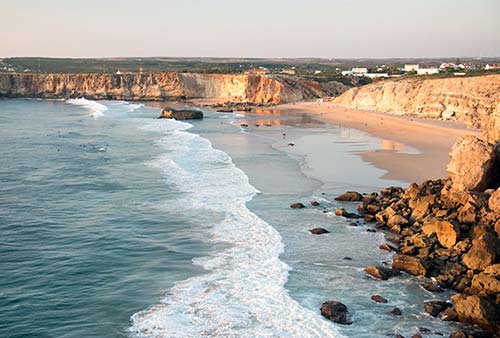
Today, Cape Sagres is popular among two sets of travelers: those who want photographic evidence that they’ve been to the “end of Europe” (before retreating to the comfort of their concrete resorts); and a young, international crowd drawn by the strong surf, who settle into humble guesthouses in the town of Sagres (SAH-gresh) and keep its many bars hopping. While the Henry the Navigator sights are worth a quick visit, and some of the surrounding sea cliffs are dramatic, the town itself is scrappy, humble, and visually underwhelming. It smells like sea spray, surfer B.O., and sweet wafts of marijuana...making it nirvana for some, and a hold-your-nose pass-through for others.
Orientation to Cape Sagres
Portugal’s end of the road is two distinct capes. Cape Sagres (Ponta de Sagres), with its old fort and Henry the Navigator lore, is the more historic cape of the two. Windy Cape St. Vincent (Cabo de São Vicente) is actually the most southwestern tip. At either cape, look for daredevil windsurfers and fishermen casting from the cliffs.
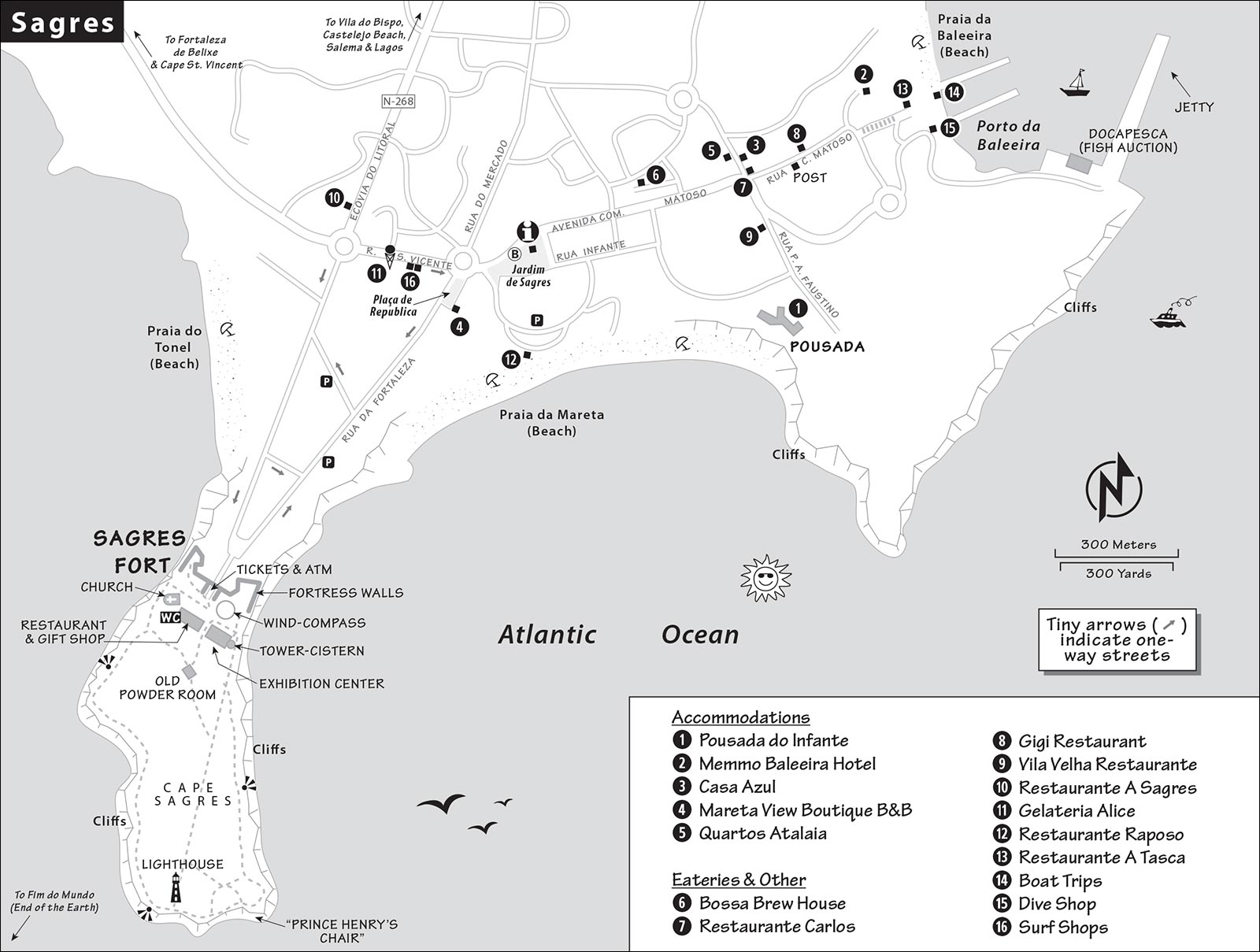
Lashed tightly to the windswept landscape is the salty town of Sagres, above a harbor of fishing boats. Sagres (pop. 1,900)—which really does feel like the last town in Europe—is basically a scruffy main street (Avenida Comandante Matoso) with plenty of places to eat and sleep. The main square is a broad expanse called Jardim de Sagres, with the TI, a statue of Henry the Navigator wearing a rakish hat, and bus stops. The square—and the town—sits on a bluff above the shoreline, with cliffs on the horizon in all directions. At one end of town is Cape Sagres, and at the other is a hardworking fishing port with an auction (Docapesca, described later) and a few leisure boats. Running beneath the town is a fine crescent beach with a good beachside restaurant.
No swashbuckling sailor, Infante Dom Henrique (as the Portuguese call him) was a quiet scholar, an organizer, a religious man, and the brains behind Portugal’s daring sea voyages. The middle child of King João I of Portugal and Queen Philippa of England, he was one of what was dubbed “The Marvelous Generation” (Ínclita Geração) that drove the Age of Discovery. While his brothers and nephews became Portugal’s kings, he worked behind the scenes.
At age 21, he planned the logistics for the large-scale ship invasion of the Muslim city of Ceuta (1415) on the north coast of Morocco, taking the city and winning knightly honors. Awed by the wealth of the city—a terminus of the caravan route—and intrigued by the high-quality maps he found there, Henry decided to organize expeditions to explore the Muslim world. He hoped to spread Christianity, contain Islam, tap Muslim wealth, and find Prester John’s legendary Christian kingdom, said to exist somewhere in Africa or Asia.
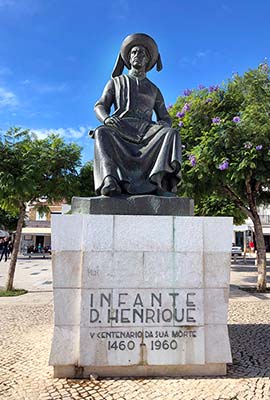
As head of the Order of Christ—a powerful brotherhood of soldier-monks based in Tomar—Henry used their money to found a maritime school at Sagres. While Henry stayed home to update maps, debrief returning sailors, order supplies, and sign paychecks, brave seamen traveled off under Henry’s strict orders not to return until they’d explored what was known as the “Sea of Darkness.”
They discovered the Madeira Islands (1420), which Henry planted with vineyards, and the Azores (1427), which Henry colonized. But the next expeditions returned empty-handed, having run into a barrier—both a psychological and physical one. Cape Bojador (at the southwest corner of modern Morocco), with its reefs and currents, was seen as the end of the world. Beyond that, sea serpents roamed while the hot equatorial sun melted ships, made the sea boil, and turned white men black.
Henry ordered scared, superstitious sailors to press on. After 14 unsuccessful voyages, Gil Eanes’ crew returned (1437), unharmed, with new knowledge that was added to corporate Portugal’s map library.
Henry gained a reputation as an intelligent, devout, celibate monk. In later years, he spent less time at court in Lisbon and more in desolate Sagres, where he died in 1460. (He’s buried in Batalha; see here.) Henry died before finding a sea route to Asia and just before his voyages really started paying off commercially. A generation later, Vasco da Gama would sail to India, kicking off Portugal’s Golden Age.
Arrival in Sagres: If arriving by bus, hop off at the main square, near the TI. Drivers pass through tacky low-rise concrete sprawl before reaching the roundabout at the start of town. Here you have three choices: right for Cape St. Vincent; straight to Cape Sagres and the fortress (fortaleza); or left onto the main drag, which passes the main square (with free street parking), then goes through the middle of town before ending at the twisty road down to the port.
Tourist Information: The TI is on the main street (hours flex with demand, generally Mon-Fri 9:30-13:00 & 14:00-17:30, closed Sat-Sun, +351 282 624 873).
Getting Around: Without your own transportation, a trip with Tuk Tuk Sagres makes sense here where distances are long and shade trees are sparse. One- or two-hour tours connect all recommended sites and three beaches. They also offer a romantic sunset trip (€25-45, at TI when buses arrive, +351 914 011 230, www.tuktuksagres.com).
Sights in Cape Sagres
Tourism here is all about surfing. When the surf’s up, things are busy and there’s a hip and youthful vibe. In low season, it feels pretty dead.
Docapesca
Sagres harbor hosts the biggest fish auction west of Lagos (which is actually saying very little, Mon-Fri at 7:30 and 15:00). Snack Bar A Sereia is perched above the auction; from its big windows, you can watch the fishy action as restaurateurs fill the two-dozen chairs above the conveyor belt and bid against each other for the best fish.
▲Cape Sagres Fort (Fortaleza de Sagres)
The former “end of the world” is a craggy, windswept, wedge-shaped point that juts into the Atlantic (a short drive or 15-minute walk from Sagres; follow brown signs for fortaleza). In 1420, Prince Henry the Navigator used his order’s funds to establish a school here for navigators. It was devastated by the 1755 earthquake (which also destroyed Lisbon), the center of which was 50 miles offshore from here. Today, little remains of Henry’s school except the site of buildings replaced by a few more modern structures. An 18th-century fortress, built on the school’s original battlements and whitewashed in the 20th century, dominates the entrance to the point.
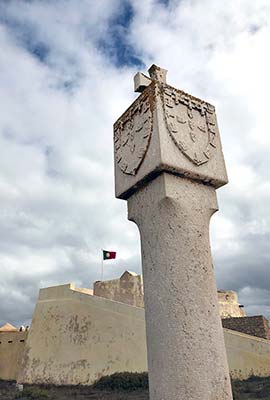
Cost and Hours: €3, daily 9:30-20:00, Oct-April until 17:30, +351 282 620 140, www.monumentosdoalgarve.pt. Parking is free.
Visiting the Fort: After entering through the 18th-century battlements, turn back and look above the entry arch. Find the carved stone plaque that honors Henry. The ship in the plaque is a caravel, one of the small, light craft that was constantly being reinvented by Sagres’ shipbuilding grad students. The astrolabe, a compact instrument that uses the stars for navigation, emphasizes Henry’s role in the exploration process.
Head a few more steps into the complex and look right. The stone column capped with a cross honors Henry, who died here in 1460 (erected on the 500th anniversary of his death). The top is a replica of the stone used by Portugal’s great mariners to claim new territory.
Poke around...though there’s not a lot to see here. Sagres’ most intriguing sight—a circle on the ground, 100 feet across and outlined by round pebbles—is a mystery. Some think it was a large wind-compass (rosa-dos-ventos). A flag flying from the center could immediately announce the wind’s direction. Others speculate it’s a large sundial. A pole in the center pointing toward the North Star (at a 37-degree angle, Sagres’ latitude) would cast a shadow on the dial showing the time of day.
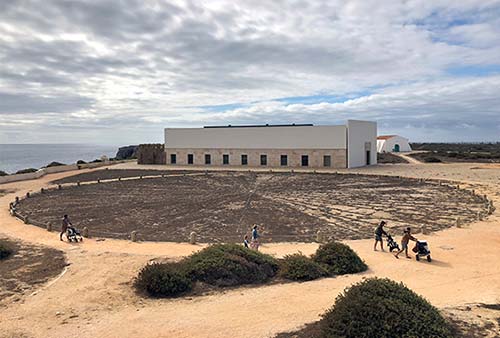
The row of buildings beyond the wind-compass is where Henry’s school once was. Today these modern buildings house the shop, cafeteria, and a planned exhibition (though a long-delayed renovation means any or all of these may be closed for your visit). At the far-left end, the tower-cistern is part of the original dorms. You can climb it for the view. At the far-right end, the small, whitewashed Church of Our Lady of Grace (with St. Vincent and St. Francis flanking its humble altar) replaced Henry’s church. The windbreak wall dates from Henry’s time but is largely rebuilt.
For a better view of the complex, climb up the ramps to the rooftop of the fortress. Look out to sea and consider the epic history of this strategic location: The Sagres school taught mapmaking, shipbuilding, sailing, astronomy, and mathematics (for navigating), plus botany, zoology, anthropology, languages, and salesmanship for mingling with the locals. The school welcomed Italians, Scandinavians, and Germans and included Christians, Muslims, and Jews. Captured Africans gave guest lectures. (The next 15 generations of Africans passing through Portugal were not so lucky, being sold into slavery by the tens of thousands.)
Besides being a school, Sagres was Mission Control for the explorers. Returning sailors brought spices, gold, diamonds, silk, and ivory, plus new animals, plants, peoples, customs, communicable diseases, and knowledge of the routes that were added to the maps. Henry ordered every sailor to keep a travel journal that could be studied.
Shipbuilding was a big industry in the Algarve in the 15th and 16th centuries. And it was here that ship designs were analyzed and tweaked, resulting in the square-sailed, oceangoing caravels that replaced earlier, less-nimble coast-hugging ships.
It’s said that Ferdinand Magellan (circumnavigator), Vasco da Gama (found sea route to India), Pedro Cabral (discovered Brazil), and Bartolomeu Dias (Africa-rounder) all studied at Sagres (though after Henry’s time). In May of 1476, the young Italian Christopher Columbus washed ashore here after being shipwrecked by pirates. He went on to study and sail with the Portuguese (and marry a Portuguese woman) before beginning his American voyage. When Portugal denied Columbus’ request to sail west, Spain accepted. The rest is history.
Beyond the buildings, the granite point itself is windswept, eroded, and largely barren, except for hardy, coarse vegetation admired by botanists. This is a popular stop for birds on their migration south (and a popular spot for bird-watchers, too). Walk on level paths around the edge of the bluff (a 40-minute round-trip walk), where locals cast lines and tourists squint into the wind. You’ll get great seascape views of Cape St. Vincent, with its modern lighthouse on the site of an old convent (described next). At the far end of the Sagres bluff are a naval radio station, a natural cave, and a promontory called “Prince Henry’s Chair.”
Sit on the point and gaze across the “Sea of Darkness,” where monsters roam. Long before Henry’s time, Romans dubbed it Promontorium Sacrum—Sacred (“Sagres”) Promontory. Pilgrims who came to visit this awe-inducing place were prohibited from spending the night here—it was for the gods alone.
In Portugal’s seafaring lore, capes, promontories, and land’s ends are metaphors for the edge of the old and the start of the unknown voyage. Sagres is the greatest of these.
Cape St. Vincent (Cabo de São Vicente)
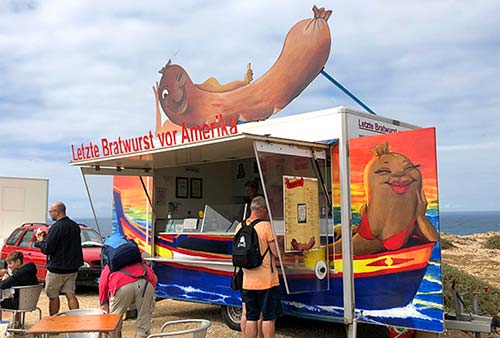
About a 10-minute drive past Cape Sagres, this spit of land is the actual southwestern tip of Europe. It has a desolate lighthouse that marks what was thought of even in prehistoric times as “the end of the world.” Today it’s an impossibly tacky tourist trap, with a parking lot jammed with salt-of-the-earth merchants selling seaworthy sweaters and a stand boasting the “Letzte Bratwurst vor Amerika” (last hot dog before America).
The cape’s tip is marked by the St. Vincent Lighthouse. Stepping through the gate of the complex (Tue-Sun 10:00-18:00, until 17:00 Oct-March, closed Mon), on your right you’ll see the entrance to a humble little museum, which is worth a few minutes and the modest admission. Its exhibits focus on ship technology, ancient legends, celestial navigation, the evolution of Portuguese lighthouses, and the history of this lighthouse. In 1846, you could see the light of the oil lamp from six miles away. Now the beam is one of the strongest in Europe, said to reach 60 miles.
To visit the lantern, wait for a while at the door marked Privado Staff Only (directly across from the museum’s gift shop)—the lighthouse keeper may eventually show up to take you on a free little tour. He’s formally scheduled to lead tours on Wednesdays from 14:00-17:00 but seems happy to do it at other times, too (for a tip). The “tour” is a 20-minute romp (with limited English) around the lighthouse, climbing steep stairs and briefly sharing the tranquility enjoyed by the couple of families who live here maintaining the now-automatic beacon. (If it’s quiet and you want to make sure that a tour is possible, ask at the little gift shop downstairs, near the WCs). Also in the courtyard are a salty café and wild views of the often-stormy coastline and the adjacent jagged cliffs.
Just off the road—about a half-mile before the lighthouse—you’ll see Fortaleza de Belixe, the eroded remains of a 16th-century castle hanging precariously on a bluff over the sea. It was used as a kind of headquarters by the English pirate “sir” Francis Drake. Drake, who pillaged with the queen’s blessing, waited here for his Mediterranean-bound victims.
Beaches
In the town of Sagres itself, Mareta Beach (Praia da Mareta), just below the town center, has rental gear and showers in the summer and the fun little recommended Restaurante Raposo.
Drivers can visit many beaches tucked away on the drive between Salema and Cape Sagres. Most of them require a short walk after you stop along N-125. In some cases, you leave your car on access roads or cross private property to reach the beach—make sure no valuables are visible in your vehicle and be considerate as you walk. Furnas Beach is fully accessible by car. You can access Ingrina and Zavial beaches by turning south in the village of Raposeira. Many beaches have bars (the one at Ingrina beach is famous for its spicy garlic prawns—camarão piri-piri).
The best secluded beach in the region is Castelejo Beach (Praia do Castelejo), north of Cape Sagres (from the town of Vila do Bispo, drive west to the ocean, following the signs for 15 minutes). If you have a car and didn’t grow up in Fiji, this really is worth the drive. Overlooking the deserted beach is $$$ Castelejo Restaurante, which specializes in octopus dishes, percebes (barnacles), and cataplana, the hearty seafood stew (Fri-Wed 12:00-20:00, closed Thu, 7.5 miles from Salema at Praia do Castelejo, +351 282 639 777). While beaches between Salema and Sagres offer more of a seaside landscape, beaches north of São Vicente are more rugged and wild because they’re exposed to ocean wind and weather. If there’s no sand in Castelejo when you visit, blame it on nature and enjoy the rock formations instead.
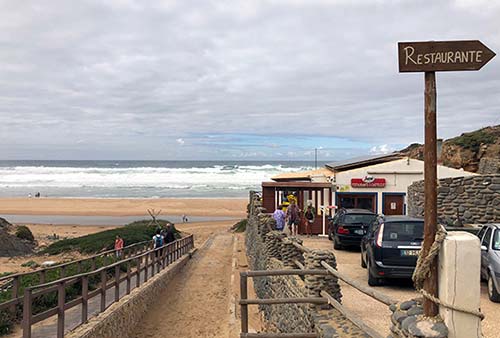
For a resort beach, consider Luz (the first town west of Lagos), which feels like a Portuguese Riviera playground with a fine promenade and all the trappings of a beach-vacation destination.
Activities
There’s no shortage of options for beach fun in Sagres. Several outfitters (renting surfboards, organizing excursions, and so on) line the streets of town, particularly at the end near the TI. Down at the port, you’ll find boat excursions and the diving school.
Boat Trips: Two competitive outfits with storefronts at the port sell tourist boat excursions into the waters near Sagres. Popular options include a dolphin-watching cruise (€40/1.5 hours), a seabird-watching tour (€55/2.5 hours—they toss in chum so you can observe the spectacle), a straightforward sightseeing cruise to Cape St. Vincent and back (€30/1.5 hours), fishing trips, and more. Comparison-shop at Cape Cruiser (+351 919 751 175, www.capecruiser.pt) and Mar Ilimitado (+351 916 832 625, www.marilimitado.com).
Diving: At the port, Divers Cape Sagres is a diving school offering classes and excursions (+351 965 559 073, www.diverscape.net).
Surfing: Near the entrance to town (between the two main roundabouts, on Rua São Vicente), two companies offer surfing gear and lessons: Sagres Natura Sport (+351 282 624 134, www.sagresnatura.com) and Pure Surf Camps (+44 1273 93 1460, www.puresurfcamps.com).
Sleeping in Sagres
$$$$ Pousada do Infante, with 51 rooms on a bluff overlooking the sea, provides a touch of elegance in Sagres. Like other pousadas (historic inns), it’s staid, stuffy, and a bit dated—but worth it for the magnificent setting. At breakfast, you can sip coffee and enjoy the buffet while gazing out to sea (air-con, elevator, +351 282 620 240, www.pousadas.pt, recepcao.infante@pousadas.pt).
$$$ Memmo Baleeira Hotel, with views over the port of Sagres, is your big hotel option—a 144-room resort that caters to groups. While large, it remains chic and minimalist, with pure white bedrooms—most with sea views (air-con, elevator, beautiful swimming pool terrace, +351 282 624 212, www.memmohotels.com, baleeira@memmohotels.com).
$$$ Casa Azul—youthful and cheery—feels like an upgraded old guesthouse on an urban street, with 11 vivid rooms (each a different color, most with a small private balcony) and four apartments (air-con, just up the street next to the Spar supermarket, Rua Dom Sebastião, +351 282 624 856, www.casaazulsagres.com [URL inactive]).
$$ Mareta View Boutique B&B, a delightful and stylish refuge on a quieter back street, is perched on a bluff at the edge of town. Its 18 modern rooms have access to a fine garden and a seaview hot tub (air-con, Beco D. Henrique, +351 282 620 000, www.maretaview.com, reservations@sagresholidays.com). Its sister hotel, Mareta Beach (a block closer to town), is bigger, less tranquil, and less appealing.
$ Quartos Atalaia, run by English-speaking Jorge, is your budget option with seven basic rooms and four huge apartments on a workaday corner in the center of town (family rooms, no breakfast, across the street from Caza Azul—see earlier, +351 282 624 681, mobile +351 911 046 068, https://atalaia.tripcombined.com, apart.atalaia@gmail.com).
Eating in Sagres
ON OR NEAR THE MAIN DRAG
Sagres feels designed to feed visitors, with lots of inviting little eateries along its main drag, Avenida Comandante Matoso.
$$ Bossa Brew House serves tasty international cuisine and craft beers in a converted stable (daily 16:00-22:30, closed Sun off-season, tucked down a little pedestrian lane behind the row of bars that includes Paü de Pita and Dromadário, +351 918 624 566).
$$ Restaurante Carlos offers good Portuguese standards—such as a stellar cataplana—for reasonable prices and with friendly service (Wed-Mon 12:00-15:30 & 18:30-23:00, closed Tue, Avenida Comandante Matoso, +351 262 624 228).
$$ Gigi Restaurant is a big modern place with happy eaters spilling out onto a covered terrace. They have a passion for traditional Portuguese dishes and fish (daily 12:00-15:00 & 19:00-22:30, Avenida Comandante Matoso, +351 282 624 316).
$$$$ Vila Velha Restaurante, the pricey top-end option in town, offers wonderful meals—especially their rabbit stew (Thu-Tue 18:30-22:00, closed Wed, reservations smart, a block above the main drag on Rua Patrão Antonio Faustino—on the way up to the pousada, +351 282 624 788, www.vilavelha-sagres.com).
$$$ Restaurante A Sagres, owned by João Pedro with his wife Paula running the kitchen, has a homey, nautical feel and dishes up everything fresh from the market. Buttery clams and seafood stew are local favorites (Thu-Tue 13:00-23:00, closed Wed, near the roundabout heading into town on Ecovia do Litoral, +351 282 624 171).
Ice Cream: Look for interesting flavors at Gelateria Alice, with a small selection of freshly made, top-quality gelato on the little street between the two roundabouts at the start of town (daily 9:00-21:00, Rua São Vicente).
WITH A VIEW
$$$ Restaurante Raposo (“Fox”) is right on the pristine, sandy, and picturesque Mareta Beach. It’s a fun spot for snacks (try percebes—barnacles), drinks, or a serious meal, inside or outside on a terrace. Have a dip in the sea right after your meal (meals served daily 11:00-20:00, +351 282 624 168).
$$$ Restaurante A Tasca, known for good seafood, has dressy indoor seating with an open kitchen and a huge, sunny terrace overlooking the harbor. It sits like a yacht club at the far (port) end of town (Thu-Tue 12:30-15:00 & 18:30-22:00, closed Wed, Porto da Baleeira, +351 282 624 177).
Cape Sagres Connections
From Salema, Sagres is a 20-minute drive or a 30-minute bus trip (runs every 1-2 hours, Sagres bus stop is at the edge of town—near the big park and TI, just after the roundabout with the giant anchor). A handful of buses continue to Cape St. Vincent (Cabo de São Vicente). You can check bus times online at www.vamusalgarve.pt.
A taxi ride from Salema to Sagres costs about €35 (see “Helpful Hints” in Salema, earlier in this chapter).
Lagos
With a beach-party old town and a jet-ski marina, Lagos (LAH-goosh) is as enjoyable as a city resort can be. This major town on the west end of the Algarve was the region’s capital in the 13th and 14th centuries. The first great Portuguese maritime expeditions embarked from here, and the first African slave market in Europe was held here—a past Portugal is just starting to acknowledge.
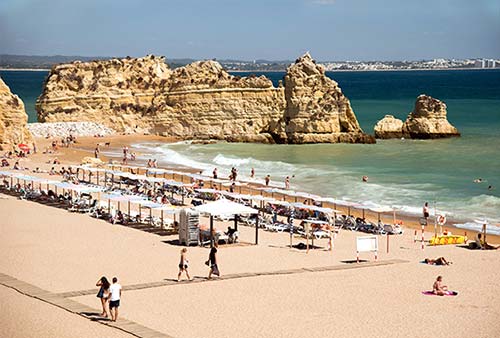
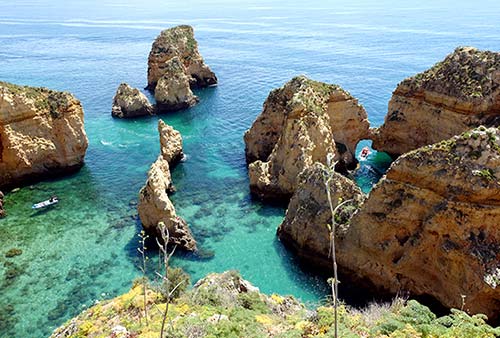
Today Lagos is just a purely enjoyable little bit of urban Algarve. In some ways, big-city Lagos is the yin to sleepy Salema’s yang. While Salema is far more relaxing, even sedate, Lagos attracts a younger and rowdier crowd. The big draw here is Lagos’ stunning beaches, which are framed by jagged sandstone-colored sea stacks that poke up, like serrated teeth, from the aquamarine deep. While little Salema’s streets are lined with take-your-time fish restaurants and napping cats, Lagos is jammed with funky cafés, hard-partying bars and nightclubs, and sales kiosks hawking all manner of boat, kayak, scuba diving, and other excursions.
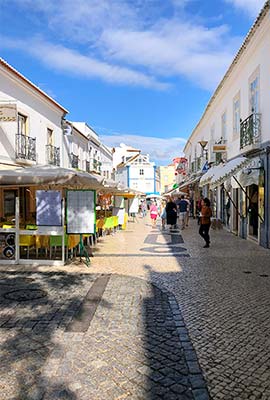
Lagos is a whitewashed jumble of pedestrian streets, bars, hippie craft shops, outdoor restaurants, mod fountains and sculptures, and sunburned tourists. Except for a stroll among the rocks on the beach, there are no major sights—though to get your bearings, the town walk (described later) makes for a delightful morning or afternoon. Search out the designs laid in the pavement—some of the sea creatures shown will probably be on your plate at dinner.
Orientation to Lagos
Most visitors to Lagos (pop. 27,000) focus on the old town. Defined by its medieval walls, old Lagos stretches between the main square (Praça Gil Eanes) and the fort. Across the Benasfrim River and just upstream are a colorful marina, excursion boats, and the train station.
The beaches with the exotic rock formations begin just past the fort, with easy access on foot via boardwalks and higher trails, or by local buses, taxis, and a tourist train. While the Praia da Batata, next to the old fort, is walkable from the center and perfectly good for a short visit, serious beachgoers may want to head farther out along the point to the south of the old town. This road is lined with scenic beaches (Dona Ana is best), culminating at the Ponta da Piedade viewpoint.
TOURIST INFORMATION
The TI, which covers the entire Algarve, is in the former City Hall on the south side of Praça Gil Eanes (daily 9:30-13:00 & 14:00-17:30, shorter hours and closed Sun off-season, +351 282 763 031, www.visitalgarve.pt).
ARRIVAL IN LAGOS
By Train or Bus: The train and bus stations are a five-minute walk apart, separated by the marina and a ramped pedestrian bridge over the river. Neither station has baggage storage.
By Car: From the A-22 freeway, exit at Lagos and follow signs to centro. On your way into town, the road forks: turn left (white centro signs) to the town center or carry on straight (brown praia signs) for the farther-flung scenic beaches (each is individually signposted).
In town, the most convenient free parking lot is just outside the old city wall off Rua Infante de Sagres. More central (and still affordable) is the large underground parking garage on Avenida dos Descobrimentos, near Praça do Infante Dom Henrique. Another pay lot is near the marina. For a short visit, you can pay-and-display anywhere along the harborfront promenade.
HELPFUL HINTS
Laundry: Awash in a bright blue sea theme, Mermaid Laundry offers large capacity, self-service machines with detergent included (daily, 8:00-23:00, change machine available, Rua Cidade de Torres Vedras 86 Loja 15, +351 960 499 469).
Car Rental: English-speaking Nuno at Lagorent Rent-a-Car can set you up with four wheels for around €45 a day (3-day minimum, daily, Rua dos Celeiros Bloco 2 Loja 2, +351 917 892 619, www.lagorent.com, info@lagorent.com).
Local Guide: Licensed guide Carla Andrez de Sousa lives in Lagos and does a good two-hour private tour (€100 for up to four people, €10 per extra person, longer tours available, +351 964 670 661, carlasousa64@gmail.com).
Lagos Town Walk
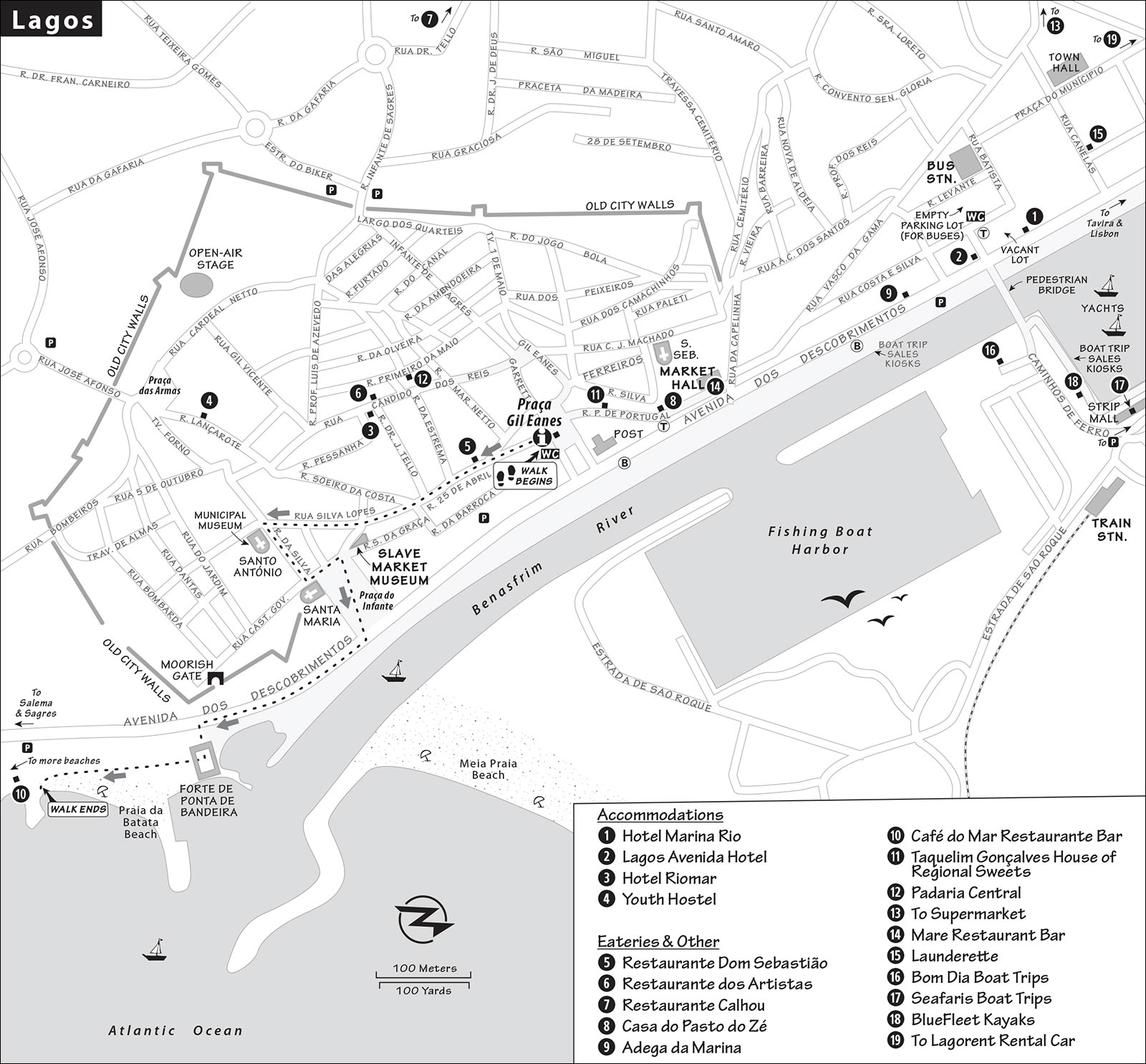
While the actual sights of Lagos are humble, the town itself has an endearing charm that is best experienced by strolling. This simple self-guided walk, worth ▲▲, takes about an hour (allow more time if you enter the sights along the way) and covers the essence of the city. It starts on the main square, cuts straight up the main street to the town museum, and then down to the sobering Slave Market Museum and harborfront, where you can walk the promenade and/or hike the exotic beaches.
Praça Gil Eanes
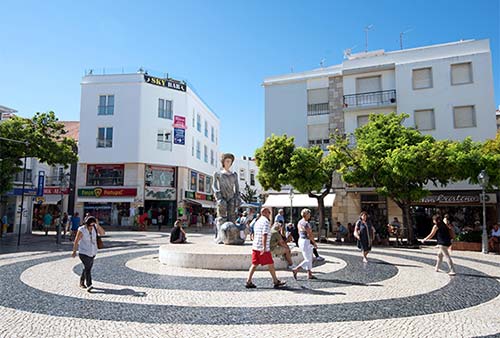
This city’s inviting cobbled pedestrian streets seem to converge in this square around the playful statue of King Sebastian (Sebastião). The big, yellow building housing the TI is the former City Hall. The local hippie community provides street music, and the cafés are tempting. While Lagos was a regional power from 1578 to 1756—in fact, the capital of the Algarve—today it feels like the capital of sun-starved tourists.
A playful statue commemorates the romantic King Sebastian, the young Portuguese ruler who ventured into Africa to Christianize “the Dark Continent”...and was killed. With his death, Spanish royalty came to power here and Portugal entered into a kind of Spanish-dominated Dark Age (1580-1640). And the Portuguese have never given up hope that somehow, their lost king will return. Sebastian is symbolic of ridiculous hopefulness. When he returns, so will the good times. This statue is particularly poignant because it was inaugurated in 1973, the year before the Carnation Revolution—when the people of Portugal were hungry to toss out their dictator and win their freedom.
• From the square, head down Lagos’ main drag. It’s just behind Sebastian, leading to the left.
April 25 Street (Rua 25 de Abril)
Força Portugal, a patriotic soccer gear shop, is a good example of how Portugal takes its soccer very seriously. Throughout the world when people (who know nothing else about this country) say Ronaldo, they think Portugal; he’s the Portuguese superstar who now plays for the Premier League club Manchester United as well as for his national team. The next shop features another icon of Portugal: cork. South Portugal produces 50 percent of the world’s cork. Good quality cork can be like leather but softer.
This marks the start of April 25 Street—named for the date of the 1974 military coup. Follow the street through Lagos’ restaurant row. Enjoy the colorful tiles on building fronts. This was the town’s finest street, and home to its noble families in the 19th century. The crest of the hill marks the start of the most popular night spots, with boisterous bars and popular discos (after hours, the streets just uphill from here are packed).
• Stroll the street for several blocks, toward a bell tower in the distance. Eventually you’ll run into the...
▲Church of St. Anthony (Santo António) and Municipal Museum
Tourists enter the Church of St. Anthony through the Municipal Museum (around the right side). Lagos’ little museum, named after native son and archaeologist Dr. José Formosinho, has some fascinating exhibits with good English descriptions (€1.50; Tue-Sun 10:00-13:00 & 14:00-18:00, closed Mon; https://museu.cm-lagos.pt).
In the museum, look for ancient Roman mosaics, amphorae, and busts, models of traditional boats, octopus jugs, and other fishing gear. The chimneys, so characteristic of those you see all over the Algarve, are nicknamed “chimneys of the new Christians.” According to legend, while Muslim Moors forced to convert in the 13th century became nominal Christians, they worshipped privately under chimneys like these, which were inspired by and reminiscent of the minarets of their destroyed mosques.
The Church of St. Anthony was first constructed in the 16th century, then rebuilt in the decades following the 1755 earthquake that devastated so much of Portugal (and led to Lagos’ decline). Considered one of the finest Baroque/Rococo churches in Portugal, it’s dedicated to the patron saint of the military. The altar (from 1719, before the big earthquake) is the oldest surviving artifact from the original church and is shiny with Brazilian gold leaf. Paintings show the miracles of St. Anthony (each described in English); the ceiling is a festival of 3-D; and the exuberant cupids are all very expressive.
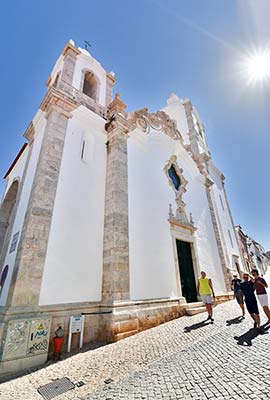
• Work your way downhill to a big square facing the harbor. Facing that square is the next church, Santa Maria. After being rebuilt many times, it’s more modern and vibrant.
Across the square, with the low-profile, double-arched arcade, is the...
▲Slave Market Museum (Mercado de Escravos)
This modern museum, located on the site of the original Lagos slave market, documents the grim history of slavery in the region, which began at this very spot in 1444. Although information is scant, this museum takes an important first step in addressing the most reprehensible aspect of the Portuguese Age of Discovery.
Cost and Hours: May close for renovation in 2023—check at the TI or the city museums website; when open likely €1.50, Tue-Sun 10:00-12:30 & 14:00-17:30, closed Mon; +351 282 762 301, https://museu.cm-lagos.pt.
Visiting the Museum: Displays include 15th-century coins, African ceramics and beads, and a skeleton—one of several sadly found in a nearby rubbish dump. In the small portico outside, chained men, women, and children were paraded around to be bid on. From 1444 until the mid-1700s, over 100,000 individual people were sold into slavery under these arches. In the early days of Portuguese exploration, the king made a rule that ships needed to bring back dirt, plants, and people from “discovered” lands. Upon arrival here, enslaved people were quarantined for 40 days. Those who survived were cleaned up and sold, adding to Portugal’s wealth at a terrible cost. Under the ceiling are navigational charts showing the slave-trade routes.
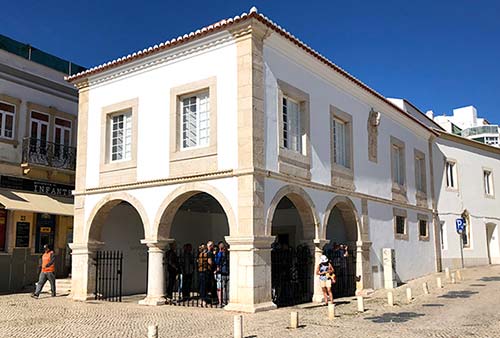
The exhibit continues around the corner uphill, where staff check your ticket and give you a tablet to use with a few interactive displays.
• The square between the Slave Market Museum and Santa Maria Church is...
Praça do Infante Dom Henrique
This square honors its namesake, Henry the Navigator, with a statue (erected along with the city’s fine harborfront promenade in 1960 to celebrate the 500th anniversary of his death; he died just down the coast in Sagres in 1460).
Portugal’s Age of Discovery started in 1415 in Lagos under Prince Henry (before he earned his nickname “the Navigator”). Up to 400 ships would depart on huge royal-sponsored expeditions from this port. The glory days of Lagos lasted through the 1400s, but by 1500 the action shifted to Lisbon. The slave trade enriched the city in the 15th and 16th centuries. Later, Lagos was a tuna-fishing center and the military capital of the Algarve. But the 1755 earthquake/tsunami devastated the city, spelling the end of its importance.
• From the square, turn right and walk between the church and the water along the old city walls toward the striking fortress on the harbor. The walls of Lagos, measuring nearly two miles, are the longest in the Algarve. Pause at the fortified Moorish gate, with its stout twin crenelated towers. The first wall here dates from the ninth century—another indication of the strategic importance of Lagos’ location throughout history. Across the street is the...
Fort Ponta da Bandeira
Fort Ponta da Bandeira, while cute today, was state-of-the-art defense back in the 17th century, built to protect the city against pirates and Spaniards. Notice how, with the advent of cannon fire, castles became low and stout. Today the fort offers the visitor only stony ramparts and harbor views (€2, Tue-Sun 10:00-12:30 & 14:00-17:30, closed Mon).
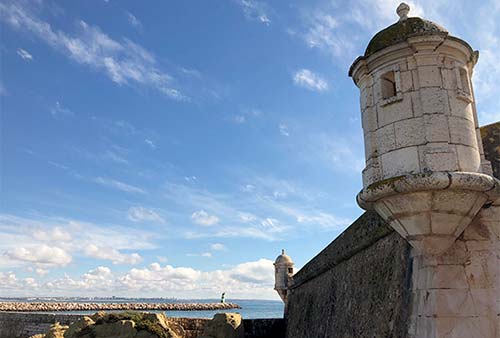
• Continue walking beyond the fort, passing kayak rental stands, a public WC, and a boardwalk across the sand leading to...
Praia da Batata
“Potato Beach” is the most accessible of Lagos’ many fine beaches and a popular student hangout. At low tide, you can enjoy a fascinating beach walk through exotic rocks and tunnels for nearly a mile. (But be careful, as the tide can come in quickly.) At high tide, a stepped and paved path takes you along the beach but higher up, with fine views of remote, photogenic little beaches with striking rock formations.
• From Praia da Batata, stairs lead up to the street. Up to the left, crowning the bluff, is the recommended Café do Mar, with wonderful outdoor tables overlooking the harbor and sea.
Activities in Lagos
Lagos Market Hall
The slick and modern market hall faces the harbor as if waiting for the fishermen to unload their catch (as they do almost daily at 8:00 and 11:00; hall open Mon-Sat 9:00-13:00, closed Sun). The Algarve’s third-biggest fish market welcomes visitors to peruse an impressive array of fish, all netted within a few miles of town. Upstairs are fresh fruits and vegetables, dried figs, and nuts. You’ll also see fun, gifty local products like spicy homemade piri-piri sauce and “flower of salt” from Tavira’s renowned salt beds. Snails (caracois), which come out after rain, are sold by merchants, but their prices are generally undercut by street vendors. If you climb to the rooftop, you’ll find the Mare Restaurant Bar (fun menu, not cheap but tasty, daily until 23:00).
▲Lagos’ Promenade
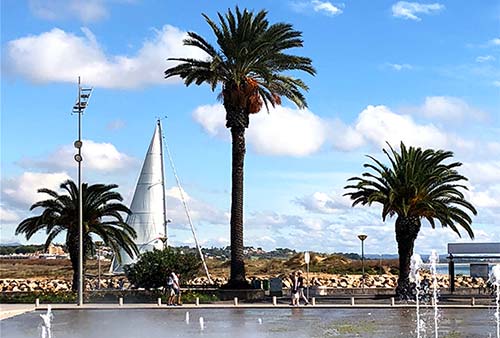
This pedestrian avenue stretches about a mile from the fort to the marina. It’s a joy to stroll along the black-and-white patterned cobbles (Portugal’s unique calçada stonework), with views of palm trees and busy little boats, the occasional sailboat heading out to sea, a soundtrack of gulls and hawkers of various sea activities, and the smell of “the perfume of the Atlantic.” Some pleasant cafés are in the pink-and-white strip mall—sip a sumo de laranja (fresh orange juice) while observing the comings-and-goings of the yachts.
Coastal Boat Tours
All over town, you’ll be hustled to take a sightseeing cruise. There’s plenty of creativity and competition among the 15 or so companies in town, giving you lots of options. Old fishermen (“who know the nickname of each rock along the coast”) sit at anchor on board, while salespeople on the promenade pitch their services. Everyone offers the same basic excursions at the same price: nearby grotto tours (€20), dolphin watching (€40), and half-day cruises (€55). Specialized trips such as kayak tours, RIB (high-speed rigid inflatable boat) tours, snorkeling, fishing, and more are also available.
To comparison-shop, you’ll find the highest concentration of vendors (and sales pitches) in two places: along the promenade and lining the marina between the pedestrian bridge and the strip mall. It’s enjoyable to stroll over the bridge and around the marina to consider your choices. Tours are similar and prices are not negotiable, so choose your excursion after reviewing your options.
Bom Dia has been offering trips since 1980 and is one of the more respected companies in Lagos (+351 282 087 587, www.bomdiaboattrips.com). Seafaris also has a stellar reputation (+351 282 798 727, www.seafaris.net). BlueFleet offers kayaking with small groups and good customer care (+351 911 963 309, www.bluefleet.pt).
▲▲Scenic Beaches and Viewpoints
The beaches near Lagos are famed for their dramatic scenery. The soft sandstone was carved out and artfully shaped by centuries of pounding surf, creating steep stratified cliffs and stunning formations just offshore.
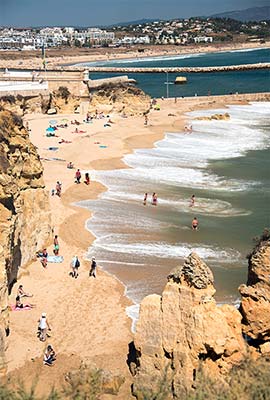
Praia da Batata is the easiest choice—giving you a taste of this scenery close to the center, just beyond the fort in the heart of town (described at the end of the “Lagos Town Walk,” earlier). While smaller and often more crowded, Batata—a few minutes’ walk from the town center—is the handiest for nondrivers.
Praia Dona Ana, a few minutes’ drive south of town, offers the best combination of scenery (jagged sea stacks) and services (rentable chairs and umbrellas, and a basic restaurant). While it feels (relatively) secluded once you’re there, it’s tucked below a sprawling resort area with high-rise hotels. From the big free parking lot (pay WC), a wooden staircase takes you down to the beach. In the summer, parking is very tight as the beach is packed. But the handy bus connection (and tourist train) makes getting there easy; see info below.
Praia do Camilo, the next beach along the coastal road, is less busy and less developed—BYO blankets, chairs, and umbrellas. While there are no services on the beach, the restaurant by the parking area high above has a shower.
Ponta da Piedade Viewpoint: If you take the beach road to its far end, you’ll reach a dusty parking lot at a lighthouse with a tacky café. This popular spot offers no beach but great views down on the dramatic rock formations offshore. Wander (carefully) around the top of the bluff to discover various perspectives on those postcard vistas, which are far more dramatic than the “end of Europe” views from Cape St. Vincent near Sagres. Stairs lead down closer to water level, and “grotto cruise” boat trips offer an even more intimate look at the formations.
Getting to the Beaches: From Lagos, drivers follow brown praias signs, then track individual beaches (turnoffs individually labeled). Nondrivers can hop on the bus. Local blue line #2 departs hourly from along the old town’s riverfront embankment (catch it in front of the fish market, at the post office just toward the river from the TI, or just below Henry the Navigator Square) and stops near several beaches (€1.20, buy ticket on board, runs hourly, http://aonda.pt). The tourist train departs from near the old town and loops to the beaches (€4/trip, €5.50 day pass, departs hourly, www.touristtrainlagos.com).
Sleeping in Lagos
Lagos is enjoyable for a resort its size, but it feels very touristy and can be rowdy with young partiers after hours. If that’s not your scene—or if you prefer a mellow village experience with even easier beach access (but fewer big-city amenities)—remember that Salema is a short drive, taxi, or bus ride away. My heart lies in Salema, but Lagos can be a good choice for some travelers.
$$$ Hotel Marina Rio is big, stylish, and comfortable, facing the marina and the busy main street immediately in front of the bus station. Its 36 modern and updated rooms have all the amenities. Pricier marina views come with noise; somewhat quieter rooms face the bus station in the back. All rooms have twin beds (air-con, elevator, small heated rooftop pool and sun terrace, Avenida dos Descobrimentos, +351 282 780 830, www.marinario.com, marinario@net.vodafone.pt).
$$$$ Lagos Avenida Hotel sits just across from Hotel Marina Rio, on the main avenue and facing the marina. As the newest hotel in town, its 47 rooms are worth the splurge if you want chic accommodations—a rarity in Lagos (air-con, elevator, rooftop pool/bar with marina views, Avenida dos Descobrimentos 53, +351 282 780 090, www.sonelhotels.com, avenida@sonelhotels.com).
$ Hotel Riomar, popular with tour groups, is a budget option offering 42 rooms in a blocky, 1960s-feeling building. Front-facing rooms come with little balconies but bar noise, while the courtyard-facing rooms are quieter (family rooms, air-con, elevator, Rua Candido dos Reis 83, +351 282 770 130, reserve through Booking.com).
The ¢ youth hostel is well-run and nicely located, a couple of blocks above the main drag and near a busy nightlife zone. It offers some budget-priced private rooms and a sunny interior courtyard (Rua Lançarote de Freitas 50, +351 282 761 970, www.pousadasjuventude.pt, lagos@movijovem.pt).
Eating in Lagos
You’ll find a variety of lively choices for dinner branching out in all directions from Praça Gil Eanes—especially along Rua 25 de Abril. Most offer a similar sampling of grilled fish with plenty of vegetables, but other options range from Italian to Indian. Home-style cooking is likely better closer to the market.
$$$ Restaurante Dom Sebastião feels like a venerable establishment hiding in a tangle of tourist joints. With quality cuisine and a huge wine cellar, it’s busy with expats and tourists. Antonio runs his restaurant in a hands-on way, with thoughtful touches. While the people-watching is great from the outside tables, I like the energy in the more-dressy interior. Portions are big and splittable. When shared (OK if the second person buys a small dish—soup, salad, etc.), the cataplana becomes a great value (daily 12:00-22:30, reservations smart, Rua 25 de Abril 20, +351 282 780 480, www.restaurantedonsebastiao.com).
$$$ Restaurante dos Artistas offers a refreshing, plant-filled oasis from the crowds with elegantly presented international dishes and professional service. The €35 tasting menus are a good option, especially if you can’t decide what to order. As one of the fancier places to dine in Lagos, reservations are smart (Mon-Sat 12:00-14:00 & 18:30-22:00, closed Sun, Rua Cândido dos Reis 68, +351 282 760 659, www.artistasrestaurant.com).
$$ Restaurante Calhou is a warm, family-style tavern tucked into a residential neighborhood just outside the city walls. Popular with locals and tourists alike, both meat and fish dishes come from the kitchen with care (Tue-Fri 12:00-15:00 & 18:00-23:00, Sat-Sun dinner only, closed Mon, Rua Dr. António Guerreiro Telo 10, +351 282 769 237).
$$ Casa do Pasto do Zé is a very traditional, family-run diner facing the harbor next to the market. It’s just right if you want to feel like a temporary local and write a poem (daily 12:00-22:00, Rua Portas de Portugal 65, +351 282 762 038).
$$ Adega da Marina is a sprawling, simple eatery buzzing with energy and soccer scarves overhead. Fish is always super fresh but be aware it’s priced by the kilo. Snails in season (caracois, May-Sept) are a popular starter (daily 12:00-23:00, Avenida dos Descobrimentos 35, +351 282 764 284).
$$ Café do Mar Restaurante Bar is perched on a bluff overlooking the sea and the city, just above the first of the exotic beaches. It’s at the end of my town walk and is good for a drink or a bite. Along with cocktails, there are affordable sandwiches, salads, and omelets. They serve a burgers-and-salads beach menu (last order at 18:00) during the day and then switch to a more serious and expensive menu for the evening. Choose between great outdoor tables or the fresh, stylish interior (daily, kitchen open 10:00-24:00, just above and beyond the fortress overlooking Praia da Batata, +351 282 788 006).
Dessert: A local favorite since 1935, Taquelim Gonçalves House of Regional Sweets has fresh-baked pastries, ice cream, and coffee. It offers a fine vantage point for enjoying the scene on the square. Their almond torta and marzipan are hits (daily 8:00-24:00, Rua da Porta de Portugal 27, +351 282 762 882).
Crowds gather for takeaway coffee and more at Padaria Central, where sweet and savory pastries have been impressing the public since 1926. Grab some mini quiche and other snacks for your beach picnic (Mon-Sat 7:00-21:00, closed Sun, Rua Primeiro de Maio 23, +351 282 763 994).
Picnics: Find a wide selection at Pingo Doce supermarket (daily 7:30-21:30, off Avenida da República behind the bus station and very modern câmara municipal Town Hall).
Lagos Connections
From Lagos by Train and Bus to: Lisbon (6 trains/day, 4 hours, transfer in Tunes; hourly direct buses, 4 hours), Évora (3 trains/day, 5 hours, transfer in Tunes and Pinhal Novo; 2 buses/day with 1 direct July-mid-Sept, otherwise transfer in Albufeira, 5 hours), Tavira (8 trains/day, 2.5 hours, all stop in Faro and some change there; 7 buses/day, 4 hours, transfer in Albufeira). Confirm all times and transfers locally. Train info: +351 218 050 653, www.cp.pt. Bus info: +351 217 524 524 for www.rede-expressos.pt [URL inactive].
From Lagos to Salema: Take a bus (7/day, every 1-2 hours, fewer on weekends, 30 minutes) or a taxi (€30, 20 minutes). In Lagos, to get from the train station to the bus station, exit the station toward the pink-and-white shopping mall. Turn left just before the mall and follow the pleasant pedestrian promenade along the marina, then cross the pedestrian drawbridge. Once across the bridge, jog right to find the bus station. Before heading to Salema, pick up return bus schedules and train schedules for your next destination.
Connecting Lagos and Sevilla, Spain, by Bus: There are five buses per day in each direction (about 5.5 hours from Lagos bus station to Sevilla’s Plaza de Armas bus station or Santa Justa train station). Check www.rede-expressos.pt [URL inactive] or www.alsa.es for the latest international schedules. In summer (May-Oct), it’s important to book your ticket a day or two in advance. Note that Spanish time is one hour ahead of Portuguese time, so the time you arrive in Lagos is about 4.5 hours after you depart Sevilla, and the time you arrive in Sevilla is about 6.5 hours after departing Lagos. This bus also stops in Tavira en route—a pleasant town and a nice midway point.
Tavira
Straddling a river, with a lively park, chatty locals, and boats that share its waterfront center, Tavira (tah-VEE-rah) is a low-rise, easygoing alternative—and a refreshing break—from the more aggressive Algarve resorts. That’s because Tavira is a real, living town. Whitewashed, red-roofed, and cobbled, it feels close to Morocco...because it is. More than a glitzy beach town, Tavira is a mini-Évora, with real culture that runs deeper than its beaches.
Because Tavira has good connections by bus and train (it’s on the trans-Algarve train line, with frequent departures both east and west), the town is more accessible than Salema. If you’re driving from Sevilla to Salema, it’s the perfect midway stop on the four-hour trip (just 2 miles off the freeway). You can also get to Tavira by bus from Sevilla or Lagos.
You’ll see many churches and fine bits of Renaissance architecture sprinkled throughout the town. These clues are evidence that 500 years ago, Tavira was the largest town on the Algarve (with 1,500 dwellings according to a 1530 census) and an important base for Portuguese adventurers in Africa. The silting up of its harbor, a plague in 1645, the 1755 earthquake, and the shifting away of its once-lucrative tuna industry left Tavira in a long decline. Today, the town has a wistful charm and lives off its tourists.
Orientation to Tavira
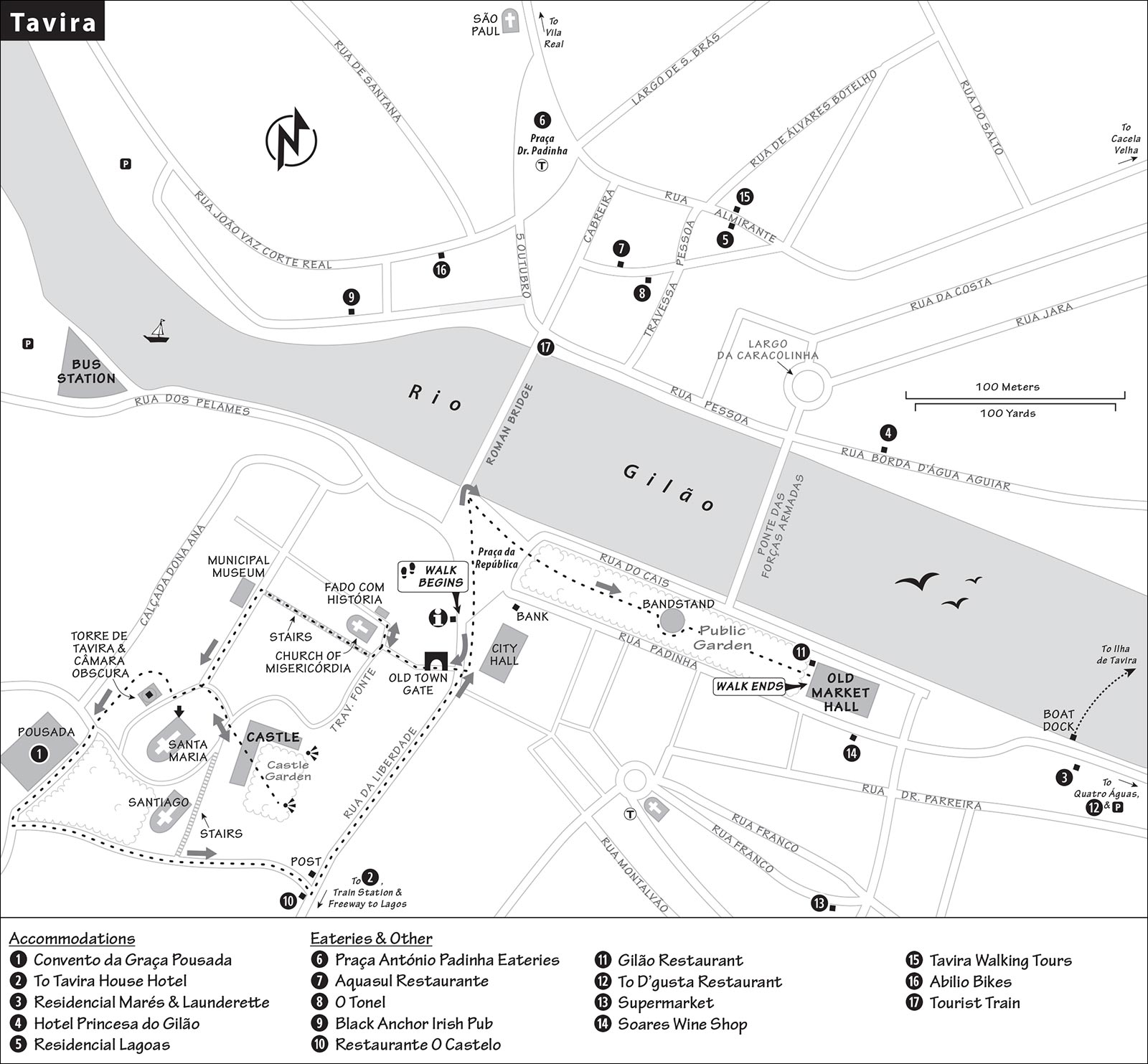
Tavira (pop. 26,000) straddles the Rio Gilão two miles from the Atlantic. Everything of sightseeing and transportation importance is on the south bank. A clump of historic sights—the ruined castle and main church—fills its tiny fortified hill and tangled Moorish lanes. But today, the action is outside the old fortifications along the riverside Praça da República square and the adjacent, shaded, bench-filled park (with the old market hall at the park’s far end). Just beyond that is the boat to Tavira’s beach island.
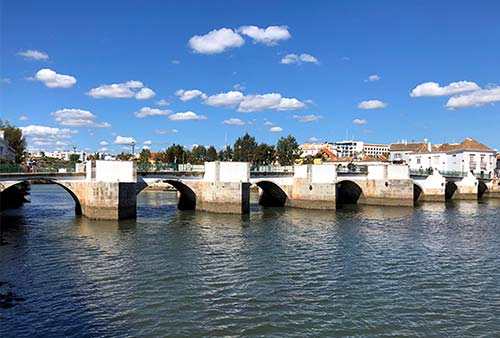
Tavira’s old pedestrian-only Roman Bridge leads from Praça da República to the more local-feeling north bank (with most of the evening and restaurant action). With the exception of a fun, fascinating camera obscura show, the town’s sights are pretty nondescript.
TOURIST INFORMATION
The TI is on the main square, Praça da República, right across from City Hall. It offers a helpful town brochure (Mon-Fri 9:00-17:00, closed Sat-Sun, Praça da República 5, +351 281 322 511).
ARRIVAL IN TAVIRA
By Train: The train station is a 15-minute walk from the town center. Leave the station via the roundabout and follow the signpost to centro (center). Follow this road downhill to the river and Praça da República (or take a cab from the station for around €4).
By Bus: The riverside bus station is three blocks from the town center; simply follow the river into town.
By Car: Drivers can park on the street in much of the old town. It’s pay-and-display for up to two hours (€0.40/hour, Mon-Fri 9:00-19:00, Sat until 14:00, Sun free, look for zona pago signs, pay at blue boxes marked caixa, change required). Free parking is available farther from the center, including some large lots at the western end of town (just beyond the bus station) and in the east (go past the old market hall and look for free lots on either side of the big car bridge).
HELPFUL HINTS
Bike Rental: For a great selection of electric and road bikes, check with Abilio Bikes, which also runs bike tours (basic bike-€10/day, “comfort bike” with fancy suspension-€15/day; open Mon-Fri 9:00-13:00 & 15:00-19:00, Sat mornings only, closed Sun; across the Roman Bridge at Rua João Vaz Corte Real 23A, +351 281 323 467, www.abiliobikes.com). Rental prices include helmet, lock, biking map, and emergency kit. They can give you lots of tips on nature, birdwatching, and bike-friendly towns nearby.
Taxi: A taxi stand is across the Roman Bridge on Praça Dr. António Padinha; another is in the town center, near the old cinema.
Shopping Tip: The strip facing the river behind the old market hall is lined with enticing shops. The Soares Wine Shop has a good selection of port wine and other Portuguese drinks (daily 10:00-19:00, shorter hours off-season, facing market hall at Rua José Pires Padinha 67).
Launderette: The well-designed, totally automated Lava & Leve self-service laundry comes with free Wi-Fi (daily 7:00-24:00, across from the boat to the beach at Rua José Pires Padinha 168).
Tours in Tavira
Tavira Walking Tours, run by Filipe, offers private one-hour town walks for €25 (contact them to book the time you like). On their “Farms and Watermills Country Walk,” you ride a van to the starting point for a five-mile, 3.5-hour, guided rural experience (€25/person). They also offer tuk-tuk tours and other creative activities (Rua Almirante Cândido dos Reis 43, +351 913 352 830).
The Abilio Bikes rental shop offers various guided and non-guided “bike hikes” with an English-speaking guide. The most popular is a full-day excursion to Castro Marim and back. It winds through a mix of park and towns near the coast, half on bike lanes, to a castle near the border with Spain (65 km total, €70/person, 2-person minimum, available Mon-Sat). For contact info, see “Helpful Hints,” earlier.
The tourist train does an hour-long loop tour of Tavira’s highlights (one loop-€3, all-day ticket-€6, departs from across the Roman Bridge, details at TI, www.delgaturis.com).
Tavira Walk
Praça da República
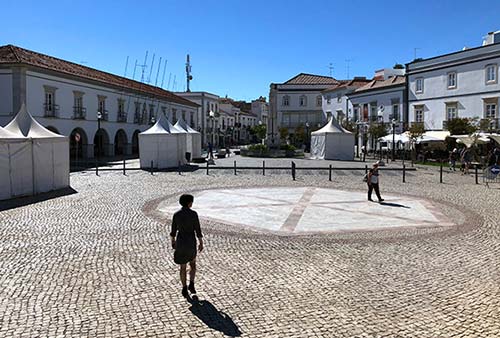
Tavira gets good use out of its main square. The arena built into the square is popular for open-air concerts and gatherings during Tavira’s various festivals. Notice the stern WWI monument with the eternal flame carved on top. This Art Deco memorial to local soldiers who never returned was dedicated in 1933 during a visit by President Óscar Carmona. Facing the square is the TI and, next door, a small museum with artifacts from the Moorish period.
• To the left of the TI is an...
Old Town Gate
This unimpressive gate is one of the few sections left from Tavira’s medieval wall. Check out the gate’s crown and spheres—meant to remind visitors that they are in the kingdom of Portugal—and the holes for bars that once locked the door. Tavira was long a strategic town worth fortifying. For centuries a Moorish port with an imposing castle, it was reconquered from the Moors in 1242 and granted city status by King Manuel in the 16th century.
• At the top of the lane, above the gate, stands a church.
Church of Misericórdia
Tavira has 21 churches but only a couple of active priests. Many of its churches—including this one—are open primarily as tourist attractions. Dating from 1541, this church’s Renaissance facade is considered the finest in the Algarve. Inside, you’ll see an over-the-top, gold-plated altar and a multitude of blue-and-white tile panels that illustrate how to lead a good Christian life. Throughout the year, the church transforms into a beautiful concert venue and fado performance space (see next). Ask the attendant if any performances are scheduled during your visit. You can climb the belltower for a view.
Cost and Hours: €3, enter on the left side, generally Mon-Sat 9:00-12:30 & 14:00-17:30, longer hours in summer, closed Sun.
• Around the right side of the gate is...
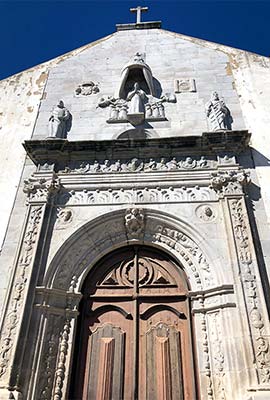
Fado com História
This humble but endearing fado show, in a tasteful little theater, is the brainchild of local fadistas who grew tired of performing for unappreciative crowds in local restaurants. Their goal is to share the history and beauty of fado with tourists, with a little explanation (in English) before each song. Three times a day, they show an insightful 10-minute film about the history of fado, then perform for about 20 minutes (two guitarists and a singer). While the fado shows in Lisbon and Coimbra may be of better quality, this is worth considering if it’s your only chance to sample Portugal’s most beloved musical form.
Cost and Hours: €10; Thu and Sat at 17:00 at their venue, Rua Damião de Brito Vasconcelos 4; Mon-Fri at 19:00 plus Thu and Sat at 15:15 inside the Church of Misericórdia; closed Sun and Aug, +351 966 620 877, www.fadocomhistoria.com).
• Crossing back in front of the church, head up the stepped lane on its left side. At the top of the stairs is the...
Municipal Museum
This 17th-century Baroque palace is the biggest private mansion in town and houses an exhibition center, open to the public, with rotating themes: contemporary art or Tavira’s maritime history. Even if you don’t go into the museum itself, pop inside the door to see some Phoenician ritual pits, visible through glass covers on the foyer floor (€2, Tue-Sat 10:30-13:00 & 14:00-19:00, closed Sun-Mon).
• From the palace, continue climbing uphill to the big Church of Santa Maria. Before visiting there, look to your left, where you can go through a door in what’s left of the castle. Detour here if you’d like to visit.
Castle Garden
The base of the castle wall is supposedly Neolithic, while later inhabitants added their own layers—the Phoenicians in the eighth century BC, the Moors in the eighth century AD (as they pushed the Christians north), and the Portuguese in the 13th century (as they pushed the Moors south). The castle grounds are now a fragrant garden.
Cost and Hours: Free, Mon-Fri 8:00-17:00, Sat-Sun from 10:00, daily until 19:00 in July-Sept.
Visiting the Garden: Climb the stubby tower at the far end for a fine city view. Overlooking the city, notice Tavira’s unique “treasury” rooftops—a little roof for each room of a building. Locals have two explanations for this: The small roofs were inspired by visions brought home from Asia by Portuguese explorers. Or they are the result of this region having a shortage of big trees and therefore using small timbers for beams. (Portugal has long been short on timbers, naming its major colony “Brazil,” the Portuguese word for a very valuable type of wood—apparently the colonists were particularly excited about that raw material.) Or perhaps it just helps with the ventilation.
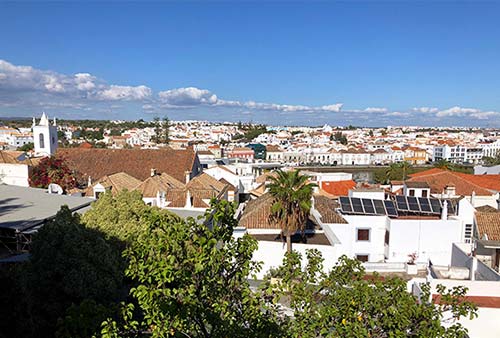
Gaze to the right and see tower-wall remnants sprouting up between houses. In the distance, along with the open Atlantic, you’ll see salt flats and two red-brick chimneys marking old tuna processing plants. Salt (evaporated from the sea in big shallow pools) and tuna were the town’s main industries in the 19th century.
• Now backtrack to visit the church that dominates the square out front. You’ll find the small tourist entrance on the right side, as you face the church.
Church of Santa Maria
Once a mosque, this church was transformed in the 13th century. Buy a ticket and head inside to enjoy relatively crude but lovingly made art that shows a knack for faking 3-D scenes on 2-D painted surfaces. On the left side of the nave are two inset chapels. One—with blue and yellow tiles—is the only part of the church to survive the 1755 earthquake. The other chapel has fine pink columns. The “marble” is actually painted wood, since there was no marble in the Algarve and no money to bring it from the Alentejo. Immediately to the right of the main altar, notice the little row of seven red crosses on the right side of the apse (inaccessible to the public). These mark the remains of seven near-legendary Reconquista heroes who were ambushed and killed by Moorish forces during a truce—inspiring the Portuguese forces to take up arms and conquer Tavira. Your church ticket also includes a small museum and the bell tower.
Cost and Hours: €3, Mon-Fri 10:00-13:00 & 14:00-17:00, closed Sat-Sun (English Mass on Sun at 11:00).
• Next to the church, you can’t miss the tall, white water tower, which has an interesting new use.
▲Camera Obscura in the Tavira Tower (Torre de Tavira and Câmara Obscura)
This 1931 water tower has been converted into an elevator-accessible viewpoint, with a darkroom designed to accommodate an early optical device called a camera obscura. This centuries-old technology uses nothing more than a pinhole of light, mirrors, and a well-calibrated lens (from 1899) to project a huge, live image of the town onto a circular canvas. Clive, the British owner, narrates an entertaining and informative 15-minute, 360-degree view of Tavira—a delightful orientation to the entire town, from the comfort of a cool dark room. With his levers and pulleys, Clive masterfully zooms in and out on live images of people walking across the Roman Bridge or boats plying the river. It’s not “rain or shine”—without the sun, there’s no image.
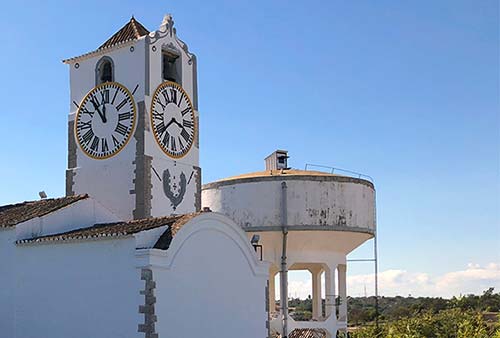
Cost and Hours: €5, Mon-Fri 11:00-15:00, closed Sat-Sun, +351 281 322 527, www.cameraobscuratavira.com.
From the Pousada Back to the Main Square,
Just beyond the camera obscura is the recommended convent-turned-pousada (Convento da Graça), built upon what was the Jewish Quarter until the Jews were expelled. Go downhill on the cobbled lane directly in front of the pousada.
Notice the big white Santiago Church facade with the painted banner. The Emblem of St. James shows the saint killing Muslims with his sword raised high. Below that is the blue-and-gold scallop shell sign indicating that this is the pilgrim’s trail to Santiago. (Tavira is actually the starting point of Portugal’s Eastern Camino de Santiago.)
The lane dead-ends on Rua da Liberdade—Tavira’s main street. It’s named for the liberty people won in 1974 with their “Carnation Revolution” (when they ended the Salazar regime). The festival of sporty color a few doors to the left is a football (soccer) team store, a reminder of how powerful elites use sports as a kind of opiate to placate unhappy masses. Like Roman emperors were sure to give their people “bread and circuses,” the dictator Salazar was careful to give his people what he called “the three Fs”: Fado, Football, and Fátima.
• Follow Rua da Liberdade back to the main square and TI, where we started this walk. Continue to the pedestrian bridge.
Roman Bridge
The “Roman Bridge” may not actually be Roman, but at least it was here when the Moors came. And it’s seen some action. A memorial plaque (on the right at the start of the bridge) recalls the 1383 battle when Portugal stopped a Castilian incursion on this bridge. The current structure is from 1657, with parts rebuilt after it was knocked over in a 1989 flood. Since it was replaced, it’s been a pedestrians-only option for crossing between the two parts of town.
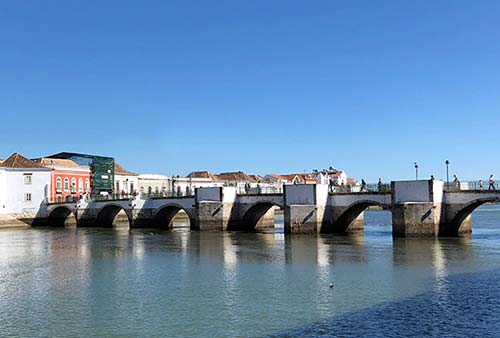
• But don’t cross the bridge. Alongside the south side of the river, an inviting park stretches along the riverbank.
Riverside Park and Old Market Hall
This is where old folks gossip and children play. Walk past the bandstand to the old market hall. Once a noisy, colorful fish and produce market, the hall now has gift shops, cafés, and eateries with riverside seating.
Beyond the market hall are a few fishing boats. Fishermen have mostly moved to larger ports nearby. For a sticky local sweet (perhaps an almond cake) perfect with a galão (milky coffee), you could drop by any café facing the park.
Sights near Tavira
▲Tavira’s Beach Island (Ilha de Tavira)
A hit with visitors, Ilha de Tavira is an almost treeless, six-mile-long sandbar with a campground, several restaurants, and a sprawling beach. It’s an enjoyable boat trip even if you just go round-trip without getting off.
Getting There: In summer, it’s easiest to hop on a shuttle boat for the 20-minute ride (€2.20 round-trip, June-Sept about hourly 9:00-19:30, timetable at TI, departs from dock just past the old market hall). Water taxis are generally standing by to make the trip in less time for more money (€15-€20). A third option—also year-round—is to take the Quatro Águas ferry. It’s a longer riverside stroll: Keep going past the market hall and first boat dock, then take the series of causeways past the salt pans and fish farms (about a mile altogether, no shade) out to Quatro Águas, where you’ll also find the recommended D’gusta Restaurant. From Quatro Águas, a five-minute ferry ride shuttles sunbathers to the beach island (€1.70 round-trip, daily 9:00-19:30, runs constantly year-round with demand).
If you’re not up for the walk, you can get to Quatro Águas by car (there’s parking nearby), bus, taxi, bike, or on the cheesy tourist train.
More Beach Options
Barril Beach, a fine beach resort worth ▲, is about three miles from Tavira. Walk, rent a bike, or take a city bus to Pedras del Rei, and then catch the little train (usually runs year-round), or walk 10 minutes through Ria Formosa Natural Park to the beach.
Santa Luzia, just a few minutes’ drive out of Tavira, is an adorable little fishing town with a line of seafood joints facing its long harbor and a ferry to its beach (€2). Nicknamed “the octopus town” for its wonderful seafood, it’s a lazy and inviting place.
Island Beach Hike: For a nice long walk on the sand, take the ferry to Ilha de Tavira and stroll six kilometers or so along the treeless sandbar. Enjoy the Atlantic surf and breeze on the way to the more built-up Barril Beach, and walk from there to Santa Luzia via a drawbridge and trail. Get details at the TI.
Cacela Velha
This tiny village lies through the orange groves about eight miles east of Tavira (half-mile off the main road and the bus route). It’s the most popular destination for those renting bikes in Tavira (see “Helpful Hints,” earlier). Cacela Velha sits happily ignored on a hill with its fort, church, a few quartos and apartments, and a beach with the open sea just over the sandbar a short row across its lagoon.
$$ Casa De Igreja—the best of Cacela Velha’s two restaurants—serves sausages (chouricos) and cheese (queijo) specialties fried at your table, along with local oysters and vinho verde (daily July-Sept 16:30-22:00, March-June weekends only, closed Oct-Feb, +351 281 952 126, Patricio speaks English). If you’re driving, swing by, if only to enjoy the coastal view and to imagine how nice the Algarve would be if people like you and I had never discovered it.
Sleeping in Tavira
In Tavira, prices usually shoot up in August.
$$$$ Convento da Graça is a pousada (government-sponsored historic inn) with 36 elegantly appointed rooms inside a renovated Augustine convent. The cloister is perfect for relaxing, and there’s even a pool if you can’t tear yourself away to go to the beach. It’s at the top of the old town, near the castle ruins and camera obscura, a five-minute walk above the main square (air-con, elevator, Rua D. Paio Peres Correia, +351 210 407 680, www.pousadas.pt, recepcao.conventograca@pestana.com).
$$$ Tavira House Hotel is a classy nine-room boutique B&B filling a lovingly renovated army officer’s house from 1860. Manager Kerry has given the place splashes of bright color—especially on the inviting roof terrace. It’s out of the busy central area, but just a five-minute walk away (air-con, Rua Miguel Bombardo 47, +351 281 370 307, www.hoteisfind.com/tavira-house).
$$ Residencial Marés, on the busy side of the river amid all the strolling and café ambience, is an endearing throwback. Dated but well-maintained, with a dark-wood-and-earth-tone-tile decor, it has 24 good rooms, a friendly reception, and an inviting rooftop terrace with lounge chairs. Some rooms have balconies overlooking the river, but also come with a little noise from cafés immediately below (air-con, Rua José Pires Padinha 134/140—just beyond old market hall, +351 281 325 815, www.residencialmares.com, mail@residencialmares.com, Paulo and Dulce).
$$ Hotel Princesa do Gilão overlooks the river across from the town center and rents 24 simple and modern rooms. Choose between riverfront or quiet rooms on the back with a terrace (family rooms, air-con, elevator, Rua Borda de Agua de Aguiar 10, cross Roman Bridge and turn right along river, +351 281 325 171, reserve through Booking.com).
$ Residencial Lagoas is homey, colorful, and a block off the river. Friendly Claudia and Miquel offer 17 rooms, a communal refrigerator, and a rooftop patio with a view made for wine and candles (RS%, cash only, most rooms with air-con, cheaper rooms with shared bath, no breakfast, lots of stairs, Rua Almirante Candido dos Reis 24, +351 281 328 243, www.lagoasresidencial.pt, al.lagoas@hotmail.com).
Eating in Tavira
Tavira is filled with reasonable restaurants. Most places on the south bank are more touristy; several lively places face the riverbank just beyond the old market hall. Some good bets lie just across the river and inland a couple of blocks. It’s fun to walk around and scout out your options; while the ones I recommend are a good start, the choices are ample and locals love to give tips.
NORTH BANK OF THE RIVER
Praça António Padinha is a pleasant square ringed by small restaurants and petiscos (tapas) bars. Among them, $$ Aquasul—mod, bright, cheery, and open only for dinner—serves a modern fusion of Italian, Mediterranean, and international dishes, including nightly vegetarian specials, good pizzas out of the wood oven, and tasty homemade desserts. The vibe is happy and it’s understandably popular—reservations are smart (Tue-Sat 18:30-22:30, closed Sun-Mon, tucked down an easy-to-miss paved lane at Rua Dr. A. S. Carvalho 13, +351 281 325 166).
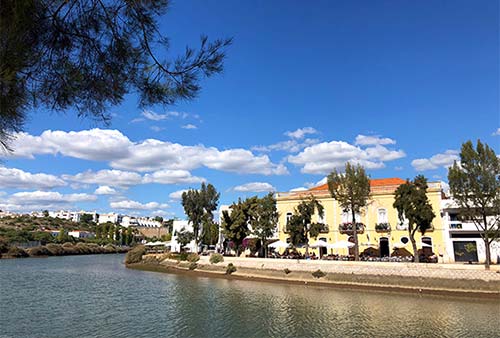
If Aquasul is full or doesn’t do it for you, check out several other appealing places spilling out onto the same street; $$ O Tonel is popular (at #6).
Also on this side of the river, Black Anchor Irish Pub is clearly “Tavira’s happiest place at night,” where you’re likely to find singing and live music along with your beer and a river view.
CENTRAL TAVIRA/SOUTH BANK OF THE RIVER
$$ Restaurante O Castelo, with rustic seating inside and tables outside on a pleasant square, has a fun menu and is a popular place for steaks. There’s often live guitar music and singing (dinner daily from 19:00, Avenida da Liberdade 72, +351 915 087 614).
$$ Gilão Restaurant is a good basic standby in the riverside marketplace for fish, cataplanas, and Mediterranean cuisine. They have seating inside and on the square (Tue-Sun 12:00-24:00, closed Mon, +351 281 322 050).
With a new riverfront location near the Quatro Águas ferry dock, longtime local favorite $$$ D’gusta Restaurant serves creative petiscos (3 family-style plates will fill 2 diners) and famous desserts. Run by what feels like a gang of friends, there’s no pretense here, just good food, good service, and fun energy. Order with a spirit of adventure (Tue-Sun 18:00-late, closed Mon, Estr. Das 4 Águas, +351 281 326 089, reservations smart).
Supermarket: Centrally located Minipreço has all the groceries you’ll need for a good picnic. It’s a few blocks inland from the market hall (daily 9:00-21:00, Rua D. Marcelino Franco 40).
Tavira Connections
From Tavira by Train and Bus to: Lisbon (5 trains/day, 4.5 hours, transfer in Faro, arrive at Oriente; almost hourly direct buses daily, 4 hours), Lagos (8 trains/day, 2.5 hours, all stop in Faro and some change there; 7 buses/day, 4 hours, change in Albufeira), Sevilla (5 buses/day in summer, 3 hours, check www.rede-expressos.pt [URL inactive] or www.alsa.es to verify schedules, buy ticket a day or two in advance May-Oct, note that Spain is an hour ahead when calculating arrival times). Luggage storage is not available. Train info: +351 218 050 653, www.cp.pt. Bus info: toll +351 300 074 830, www.vamusalgarve.pt.
ROUTE TIPS FOR DRIVERS
Lisbon to the Algarve (185 miles, 3.5 hours): A modern freeway, light traffic, and the glory of waking up on the Algarve make doing this drive in the evening after a full day in Lisbon a good option.
Following the blue Sul Ponte signs from central Lisbon, drive south over Lisbon’s 25th of April Bridge. A short detour just over the bridge takes you to the giant concrete statue of Cristo Rei (Christ the King). Stay on the A-2 expressway as it heads east toward Alentejo, then bends south toward the Algarve. You’ll pass through cork groves, and finally—about 1.5 hours after leaving Lisbon—you’ll run into the A-22 expressway (which runs east-west, parallel to the coast). At the A-22 junction, you can choose to head west to Lagos (and beyond it, Salema and Sagres) or east to Tavira and, eventually, Spain (signed for Espanha).
If heading to Salema, stay on A-22 to the Lagos/Vila do Bispo exit, and follow signs to Vila do Bispo and Sagres. Pay close attention to spot the turnoff for Salema before Vila do Bispo.
Algarve (Lagos) to Sevilla, Spain (175 miles, 3 hours): It’s a 1.5-hour drive east from Salema to Tavira, with some hills crowned by rotting windmills and others by mobile-phone towers. From Lagos, hit the freeway (A-22, direction: Lisboa/Faro, then Espanha) to Tavira. Leaving Tavira, follow the signs to Espanha. You’ll cross the bridge into Spain (where it’s one hour later) and glide effortlessly (1.5 hours on the A-49 freeway) into Sevilla.
Be aware that there’s an electronic tolling system on the A-22 highway from Lagos to the Spanish border. Just pop in a credit card—your receipt explains that you’ve opened an account that will be billed every time you pass a toll station on the highway in Portugal. (For details, see the “Driving” section of the Practicalities chapter.)