Shopping in Berlin
Shops all over town stock the typical array of souvenirs (T-shirts, posters, bottle openers, etc.) emblazoned with icons of Berlin: Brandenburg Gate, TV Tower, Berlin Wall, bears (the namesake and official mascot of “Bear-lin”), and so on.
One big draw is communist kitsch. Gift shops at museums (such as the DDR Museum or the Museum of the Wall at Checkpoint Charlie) sell a variety of “East Berlin” paraphernalia: circa-1968 city maps that mysteriously leave out West Berlin, postcards and posters of DDR propaganda or famous Wall escapes, miniature Trabis, old DDR military armbands and medals, and defunct communist currency. For authentic communist artifacts, head to the flea market by the Ostbahnhof (Sun mornings, described later).
Maybe the top communist-kitsch souvenir is something—anything—with the image of the Ampelmann (traffic-light man), the DDR-era crossing-guard symbol that’s become Berlin’s unofficial mascot. The best selection is at the local chain of Ampelmann shops, with locations all over the city. The flagship store—with a hunk of Berlin Wall autographed by David Hasselhoff (no joke)—is along Unter den Linden at #35 (at the corner with Friedrichstrasse).
One communist-era souvenir to avoid is an “authentic” chunk of the Berlin Wall—enough of which have been sold since 1989 to encircle all of Germany. Don’t trust any vendor who swears they chipped it off the Wall themselves. (And, because the few remaining stretches of Wall are now protected monuments, it’s bad form to chisel off your own souvenir.)
Berlin’s true forte is design. In this city of stylish young urbanites, the streets are lined with hipster gift shops that sell ironic T-shirts, clever kitchen or desk gadgets, snarky books and postcards, and so on.
Flea Markets and Farmers Markets
In such an outdoorsy city, some of the most enjoyable “shopping” experiences aren’t in shopping malls or hole-in-the-wall boutiques, but at sprawling outdoor markets.
Flea Markets (Flohmarkt)
Virtually every Berlin neighborhood hosts a regular flea market.
Prenzlauer Berg: The Sunday rummage market in the Mauerpark isn’t just about buying and selling—it’s an excuse for a big, weekly, community-wide party. If it’s nice out, people come here simply to chill, drink, barbecue, and socialize. You’ll find lots of inventive snack stalls and, in the afternoon, karaoke in the park’s amphitheater (Sun 10:00-18:00, U2: Eberswalder Strasse, www.flohmarktimmauerpark.de). On Sundays there’s also a lively “junk market” (Trödelmarkt) several blocks south on Arkonaplatz (10:00-16:00, U8: Bernauer Strasse or a 10-minute walk from Mauerpark).
Old Jewish Quarter: Just across the Spree from Monbijoupark, the riverbank facing the Bode Museum hosts a weekend antique-and-book market (Sat-Sun 11:00-17:00, tram #M1 or #12 to Am Kupfergraben or a 10-minute walk from Hackescher Markt or Friedrichstrasse S-Bahn stations, www.antik-buchmarkt.de). Nearby, Hackescher Markt hosts a twice-weekly market with an odd variety of produce, clothes, trinkets, jewelry, hats, and food stalls; while smaller, more touristy, and less funky than the best Berlin markets, it’s conveniently located (Thu and Sat 9:00-18:00).
Kreuzberg: Along the south bank of Landwehr Canal, the twice-weekly Turkish street market is a very local place to shop for everything from clothes and fabrics to basic housewares to produce and meat. The clientele is a mix of Turkish and Middle Eastern immigrants, Kreuzberg punks, and a smattering of tourists. I’d come here more for the people-watching than for souvenirs (Tue and Fri 11:00-18:30, U8: Schönleinstrasse).
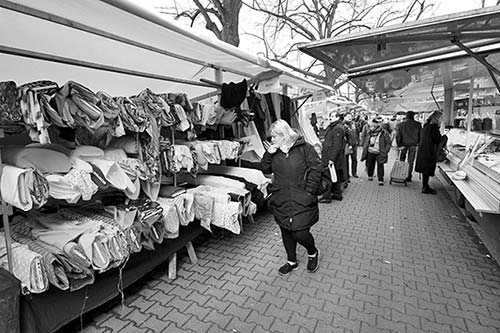
Friedrichshain: The swiftly gentrifying square Boxhagener Platz (affectionately called “Boxi” by locals) hosts a lively flea market on Sundays (10:00-18:00, U5: Samariterstrasse or major U- and S-Bahn hub Warschauer Strasse; also a Sat farmers market). On Sunday mornings, the Antikmarkt Ostbahnhof (9:00-17:00, on the north side of the Ostbahnhof S-Bahn station) is the place to pick through the Cold War knickknacks that keep turning up in the basements of former East Berliners.
Near Tiergarten Park: One of Berlin’s largest flea markets is right next to Tiergarten Park on Strasse des 17 Juni, with great antiques, more than 200 stalls, collector-savvy merchants, and fun German fast-food stands (Sat-Sun 10:00-17:00, S-Bahn: Tiergarten, www.berlinertroedelmarkt.com).
Food and Farmers Markets
The city’s best food market is Kreuzberg’s Markthalle Neun, with a variety of vendors and even more activity during the thrice-weekly farmers market and on “Street Food Thursdays.” Another local favorite is on Boxhagener Platz in Friedrichshain (farmers market Sat 9:00-15:30, see also Sunday flea market). Prenzlauer Berg also has options: Kollwitzplatz (Thu 12:00-19:00 and Sat 9:00-16:00) and in the courtyard of the Kulturbrauerei (Sun 12:00-18:00).
Browsing Areas
Prenzlauer Berg
My favorite hotel and dining neighborhood is also an enjoyable place to window-shop. It’s a delight to simply wander colorful Kastanienallee between Eberswalder Strasse (with a U-Bahn station) and Weinbergspark.
The Kulturbrauerei brewery-turned-cultural center (described on here) has a smattering of little shops, including Green Living (with environmentally friendly housewares and home decor). The Kollwitzkiez (a few blocks east) is mostly residential, but you’ll also find some pleasant shops here. For locally produced goods, stop by Brandenburgerie, with a variety of mostly edible products (meat, cheese, chocolate, juices, schnapps) made in the Brandenburg region that surrounds Berlin (closed Sun-Mon, Sredzkistrasse 36).
Rosenthaler Strasse
The otherwise nondescript street that connects the Hackescher Markt and Rosenthaler Platz areas (along the handy tram #M1 route) attracts those interested in Berlin’s fashion and design scene. Most shops along here are pop-up spaces, giving you a glimpse at what local designers are up to right now. A couple of permanent fixtures are worth checking out: Kauf Dich Glücklich, a ramshackle Berlin café famous for its waffles (see here, but which has since moved into fashion (at #17, www.kaufdichgluecklich-shop.de); and Schee, with appealing handmade items, including prints and textiles (at #15, www.schee.net).
Hackesche Höfe
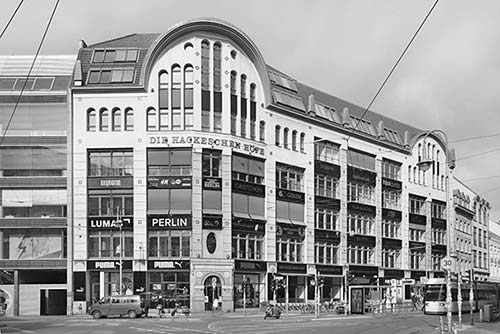
This delightfully restored old series of eight interlocking shopping courtyards sits in the heart of the old Jewish quarter. While not cheap, it’s a convenient and tempting place to window-shop for everything from locally made porcelain to artisanal local foods to fashion (shops typically open Mon-Sat from 10:00 or 11:00 until 19:00, closed Sun, Rosenthaler Strasse 40, www.hackesche-hoefe.com).
Chocolate Shops on Gendarmenmarkt
The delightful square called Gendarmenmarkt—a short detour south of Unter den Linden—has two very different chocolate shops that are fun to browse: one bourgeois, and the other proletarian. For locations, see the “Historic Core Hotels & Restaurants” map.
Rausch claims to be Europe’s biggest chocolate store. After 150 years of chocolatemaking, this family-owned business proudly displays its sweet delights—250 different kinds—on a 55-foot-long buffet. Truffles are picked at your direction by white-gloved maidens (it’s fun to compose the fancy little eight-piece box of your dreams). Upstairs is an elegant café with fine views (Mon-Sat 10:00-20:00, Sun from 12:00, corner of Mohrenstrasse at Charlottenstrasse 60—look for green awnings directly behind German Cathedral, +49 30 757 882 440).
If you’re a choco-populist, head to the opposite end of Gendarmenmarkt, near the French Cathedral, for the Volkswagen of candy. Ritter Sport Bunte Schokowelt is home to the flagship store of Rittersport, the famous chocolate company—“quadratisch, praktisch, gut” (“square, practical, good”). This is basically Germany’s answer to the M&M’s store (Mon-Sat 10:00-18:00, closed Sun, Französische Strasse 24, www.ritter-sport.com/de/berlin).
Big, Glitzy Department Stores
Central Berlin: Unter den Linden is lined with some high-end shops, but for a wider selection, head a few blocks south. The French department store Galeries Lafayette has a large outpost here with several floors of high-end goods under a glass dome (top-quality basement food court; Mon-Sat 11:00-19:00, closed Sun, Französische Strasse 23).
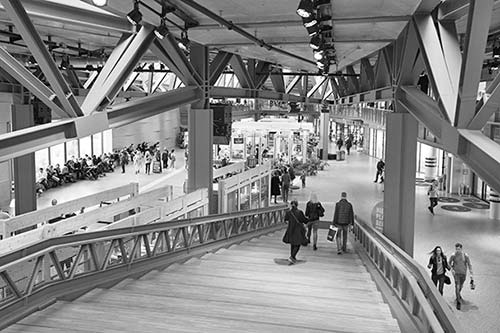
Several blocks west is the massive, recently opened, state-of-the-art Mall of Berlin, with 270 shops surrounding a cavernous glass-covered passageway (Mon-Sat 10:00-21:00, closed Sun, Vossstrasse 35, www.mallofberlin.de). Nearby, Potsdamer Platz and Sony Center have additional shops.
City West: Several swanky shops line Kurfürstendamm, the area’s main boulevard. The trendy Bikini Berlin shopping center faces the Europa Center on one side and the Berlin Zoo on the other. This “concept mall” has a mix of international chains, artisan boutiques, temporary art exhibits, food stalls, a small Edeka supermarket, and “pop-up boxes” highlighting Berlin vendors (plus a free glimpse of the zoo’s monkeys; Mon-Sat 10:00-20:00, closed Sun, Budapester Strasse 38, www.bikiniberlin.de).
City West’s most venerable shopping is a couple blocks east (near the Wittenbergplatz U-Bahn), at KaDeWe—one of Europe’s fanciest department stores, in business since 1907 and a worthwhile sight in itself (for more, see here).
Sleeping in Berlin
Choosing the right neighborhood in Berlin is as important as choosing the right hotel. I’ve focused my recommendations in safe, colorful areas convenient to sightseeing. In northern Berlin, Prenzlauer Berg—my favorite area to sleep—offers a local neighborhood vibe, easy transit connections, and an excellent selection of eateries; the old Jewish quarter, also with good restaurants, is closer to the sights but more impersonal than Prenzlauer Berg. Farther out, City West—the heart of the former West Berlin—is an upscale, residential neighborhood. For some travelers, short-term, Airbnb-type rentals can be a good alternative; search for places in my recommended hotel neighborhoods.
A few notes about hotels in Berlin:
• Berlin charges a daily tourist tax (5 percent of the room rate). This may be included in the room price or may appear as an extra charge on your bill.
• Most hotels offer an optional breakfast buffet for about €15-20 per person, though it’s often not included in their quoted rates (you can choose whether to add breakfast when booking). Light eaters and budget travelers can opt out of the hotel breakfast and get coffee and a pastry at a neighborhood café for less.
• Air-conditioning is relatively rare (I’ve noted hotels that have it in all rooms). If it’s important to you, ask about it when you book.
• Some hotels offer bike rentals to guests (usually €10-12/day).
I rank accommodations from $ budget to $$$$ splurge. For the best deal, contact family-run hotels directly by phone or email. When you book direct, the owner avoids a commission and may be able to offer a discount. Book well in advance for peak season or if your trip coincides with a major holiday or festival (see the appendix). Rooms can be in especially short supply when big trade shows are in town (including Green Week in mid-January and the ITB travel show in mid-March).
For details on reservations, short-term rentals, and more, see the “Sleeping” section in the Practicalities chapter.
PRENZLAUER BERG
My favorite Berlin neighborhood to call home, Prenzlauer Berg offers easy transit connections to sightseeing; diverse eateries, coffeehouses, and nightspots; and a welcoming personality. A onetime hipster mecca, this area is now gentrified and more sedate—yet it still retains a bit of its alternative edge (think of all that graffiti as just some people’s way of saying they care).
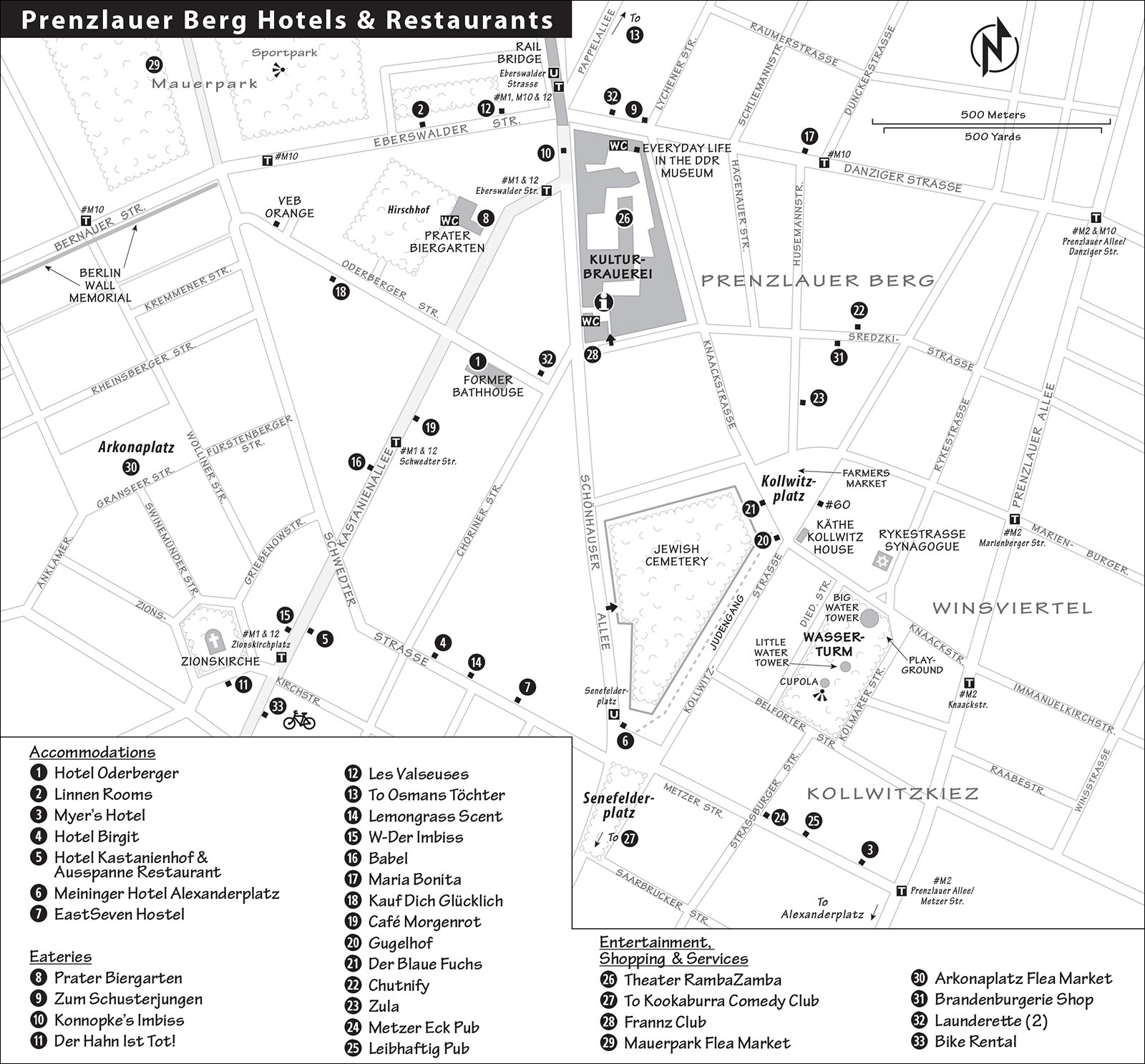
Most of my recommended hotels are between Kastanienallee and Prenzlauer Allee. The area’s transit hub is the Eberswalder Strasse U-Bahn station (U2 line). Trams also serve this neighborhood: The #M1 and #12 run up and down Kastanienallee, connecting to the Rosenthaler Platz U-Bahn (#M1 continues all the way to the Hackescher Markt S-Bahn station), while the #M10 heads west from Eberswalder Strasse along Bernauer Strasse to the Berlin Wall Memorial and eventually to the Hauptbahnhof.
$$$$ Hotel Oderberger has 70 modern rooms filling part of a Neo-Renaissance bathhouse complex (originally opened in 1902, renovated and reopened in 2016). From the reception, you can peek into the elegant old swimming pool area. It’s a fine choice, with its understated elegance, historic aura, and good location, tucked away on a quiet side street near the most happening stretch of Kastanienallee (elevator, guest discount for swimming pool, Oderberger Strasse 57, +49 30 780 089 760, www.hotel-oderberger.berlin, info@hotel-oderberger.berlin).
$$$ Linnen rents five rooms above a cozy and characteristic café, along a busy street between the Eberswalder Strasse U-Bahn station and Mauerpark. Linnen stays true to its motto, “more home, less hotel”—the vibe is casual, and the spacious, stylishly decorated rooms feel homey. This place pleases well-heeled hipsters (Eberswalder Strasse 35, +49 30 4737 2440, www.linnenberlin.com, booking@linnenberlin.com).
$$$ Myer’s Hotel rents 56 comfortable rooms decorated with lots of bold colors and gold accents. Located on a tranquil, tree-lined street, and overlooking a sleepy courtyard, Myer’s is closer to charming Kollwitzplatz than to the Kastanienallee action. Staying at this peaceful hub, you’ll find it hard to believe you’re in the heart of a capital city. The gorgeous public spaces, including an art-filled patio and garden, host frequent cultural events (air-con, elevator, sauna, Metzer Strasse 26—midway between U2: Senefelderplatz and #M2 tram: Prenzlauer Allee/Metzer Strasse, #M2 goes to/from Alexanderplatz, +49 30 440 140, www.myershotel.de, info@myershotel.de).
$$ Hotel Birgit, with 53 rooms, is a pleasant and endearingly quirky place on a peaceful street. If you want a calm atmosphere in a comfortable and quality building, more German guests than tourists, your own peaceful back garden, and a very friendly staff, this is my choice (breakfast extra, elevator, pay parking—reserve ahead, Schwedter Strasse 15, 5-minute walk to #M1: Zionskirchplatz or U2: Senefelderplatz, +49 30 443 2990, https://berlin.hotelbirgit.com, hello@hotelbirgit.com).
$$ Hotel Kastanienhof feels less urban-classy and more like a traditional small-town German hotel. It’s wonderfully located on the Kastanienallee #M1 tram line, with easy access to the Prenzlauer Berg bustle (but since trams run all night, ask for a room in the back). Its 44 rooms come with helpful service (breakfast extra, deluxe top-floor rooms offer air-con and/or balcony, elevator, wheelchair-accessible room, pay parking, 20 yards from #M1: Zionskirchplatz at Kastanienallee 65, +49 30 443 050, www.kastanienhof.berlin, info@kastanienhof.berlin). The hotel’s recommended Ausspanne restaurant serves excellent German dishes with a modern twist.
¢ Hostels: A convenient branch of the hostel/budget hotel Meininger is at Senefelderplatz; for details, see here. EastSeven Hostel rents 100 of the best cheap beds in Prenzlauer Berg. Modern and conscientiously run, it offers all the hostel services plus an inviting lounge, guest kitchen, and backyard terrace. Children are welcome. Easygoing people of any age are comfortable here (private rooms available, no curfew, 100 yards from U2: Senefelderplatz at Schwedter Strasse 7, +49 30 9362 2240, www.eastseven.de, info@eastseven.de).
OLD JEWISH QUARTER
The old Jewish quarter, south of Prenzlauer Berg, makes for a fine home base thanks to its good location (close to public transportation and easy walking distance to the center) and traveler-friendly offerings, including cozy restaurants, independent shops, the delightful Monbijoupark, and a few interesting sights. It’s closer to the historic core than Prenzlauer Berg but feels less residential, and the hotels here are bigger and less personable.
Near Rosenthaler Platz
Rosenthaler Platz is halfway between Hackescher Markt and the heart of the Prenzlauer Berg scene (on Kastanienallee). Though bustling and congested, it makes a good base for getting around the city thanks to its U-Bahn stop (U8: Rosenthaler Platz) and tram service (#M1 heads north to Kastanienallee/Eberswalder Strasse and south to the Hackescher Markt S-Bahn hub; #M8 connects to the Hauptbahnhof).
$$$ The Circus Hotel is fun, comfortable, and a good value. The achingly hip lobby has a café serving delicious (optional) breakfasts, and the 60 rooms are straightforward and colorful. Run by the same folks who manage the popular Circus Hostel (listed below), it’s service oriented, with a friendly and “green” vibe, and special events for guests. As the hotel overlooks a busy intersection, ask for a quieter back room (breakfast extra, elevator, Rosenthaler Strasse 1, +49 30 2000 3939, www.circus-berlin.de, info@circus-berlin.de). The Circus also offers spacious, modern $$$ apartments within the hotel and two blocks away at Choriner Strasse 84.
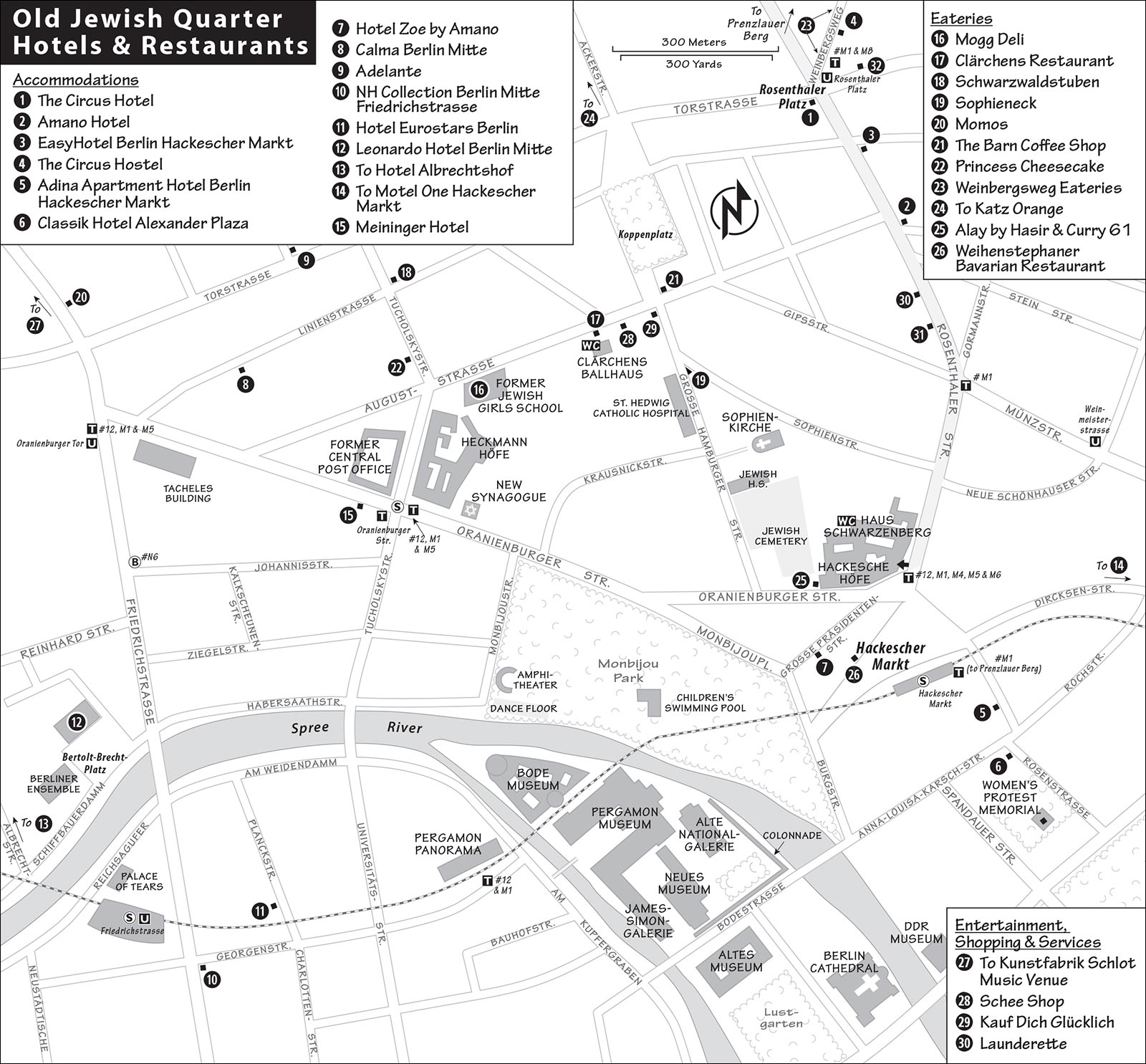
$$ Amano Hotel, while big (164 rooms) and impersonal, is well priced for what you get: chic contemporary design and all the little amenities you don’t need but appreciate nonetheless (breakfast extra, air-con, elevator, pay parking, Auguststrasse 43, +49 30 809 4150, www.amanogroup.de, amano@amanogroup.de).
$ EasyHotel Berlin Hackescher Markt is part of an unapologetically cheap, Europe-wide chain where you pay for exactly what you use—nothing more, nothing less. You’re charged a low base rate, then pay à la carte for each service you add (housekeeping, etc.). The 125 orange-and-gray rooms are very small, basic, and feel popped out of a plastic mold (no breakfast, elevator, call to request a quieter back room after booking online, Rosenthaler Strasse 69, +49 30 4000 6550, www.easyhotel-berlin.de, enquiries@berlinhm.easyhotel.com).
¢ The Circus Hostel is a brightly colored, well-run place with 280 beds, plenty of social networking, and a trendy lounge and microbrewery. It has typical hostel dorms as well as some hotel-like private rooms; for a few big steps up in comfort, consider the Circus Hotel, listed earlier (no curfew, elevator, Weinbergsweg 1A, +49 30 2000 3939, www.circus-berlin.de, info@circus-berlin.de).
By Hackescher Markt
Lively Hackescher Markt, just north of the river, is brimming with people, eateries, and, on some days, an open-air market. It’s also home to an S-Bahn station and is connected to Prenzlauer Berg by tram #M1. Unfortunately, there’s a dearth of recommendable hotels in this area; all three listed here are bigger than they are charming. Apartment sites such as Airbnb may be a better bet.
$$$ Adina Apartment Hotel Berlin Hackescher Markt has 134 studio and one-bedroom apartments with kitchenettes, though breakfast is available for an extra fee (air-con, elevator, pay parking, An der Spandauer Brücke 11, +49 30 209 6980, www.adinahotels.com, berlinhm@adina.eu).
$$$ Classik Hotel Alexander Plaza offers 94 brightly appointed, business-style rooms (breakfast extra, elevator, pay parking, Rosenstrasse 1, +49 30 240 010, https://classik-hotel-collection.com, reception.bap@classik-hotel-collection.com).
$$ Hotel Zoe by Amano, with 108 rooms and a pleasant rooftop bar, is a trendy and slightly more upscale branch of the Amano Hotel listed earlier (breakfast extra, air-con, elevator, Grosse Präsidentenstrasse 6, +49 30 2130 0150, www.amanogroup.de, zoe@amanogroup.de).
On or near Auguststrasse
These good-value hotels are close to fun, art gallery-lined Auguststrasse, in an area that feels more characteristic than my other listings in the old Jewish quarter. They’re located near the Oranienburger Strasse S-Bahn (S1/S2) and Oranienburger Tor U-Bahn (U6), and tram #M1 is nearby.
$$ Calma Berlin Mitte, part of a small local chain, has 46 straightforward but comfortable, modern rooms tucked away on a tranquil courtyard, just steps from the lively Oranienburger Strasse scene (breakfast extra, elevator, Linienstrasse 139, +49 30 9153 9333, www.lindemannhotels.de, calma@lindemannhotels.de).
$$ Adelante is an unpretentious boutique hotel with 30 rooms. It won’t win any style awards, but it’s a reliable mid-range choice. Because it’s close to the action on Torstrasse, light sleepers may prefer to pay more for a room facing the courtyard (breakfast extra, elevator, small gym, Borsigstrasse 1, +49 30 2009 5060, www.adelanteboutiquehotel.de, hello@adelanteboutiquehotel.de).
Near Friedrichstrasse Station
Straddling the Spree River, this area—between the transit stations Oranienburger Tor (U6) and Friedrichstrasse (U6 and several S-Bahn lines)—feels big and sterile, with little personality. But hotels here have plenty of beds and are easy walking distance to both Unter den Linden and the old Jewish quarter. NH Collection and Eurostars are south of the river and closer to Friedrichstrasse station; both are plush, high-end, and belong to international Spanish chains. Leonardo and Albrechtshof are north of the river and a bit simpler, but still comfortable.
$$$ NH Collection Berlin Mitte Friedrichstrasse feels upscale and professional. Its 268 rooms come with sleek hardwood floors, high ceilings, and red accents (breakfast extra, air-con, elevator, gym, sauna, Friedrichstrasse 96, +49 30 206 2660, www.nh-collection.com, nhcollectionberlinfriedrich@nh-hotels.com).
$$$ Hotel Eurostars Berlin is a classy hotel with 221 spacious, rich wood rooms towering over the everyday hustle and bustle. As it faces train tracks, ask for a quieter room—several face into the lobby atrium (breakfast extra, air-con, elevator, gym, spa, Friedrichstrasse 99, +49 307 017 360, www.eurostarsberlin.com, info@eurostarsberlin.com).
$$ Leonardo Hotel Berlin Mitte occupies a modern building set back on a little park overlooking the river. It features retro public spaces and a mazelike floor plan leading to 309 tight, tidy, stylish rooms (breakfast extra, air-con, elevator, gym, sauna, limited pay parking, Bertolt-Brecht-Platz 4, +49 30 374 405 000, www.leonardo-hotels.com, info.berlinmitte@leonardo-hotels.com).
$$ Hotel Albrechtshof is a bit scruffy but still a good choice. It has the most personality of the hotels in this area. The 98 rooms come with a similar design, friendly staff, a peaceful courtyard, and weekly chapel services. Martin Luther King Jr. once stayed here and attended one (breakfast extra, elevator, Albrechtstrasse 8, +49 30 308 860, www.hotel-albrechtshof.de, albrechtshof@albrechtshof-hotel.de).
CITY WEST
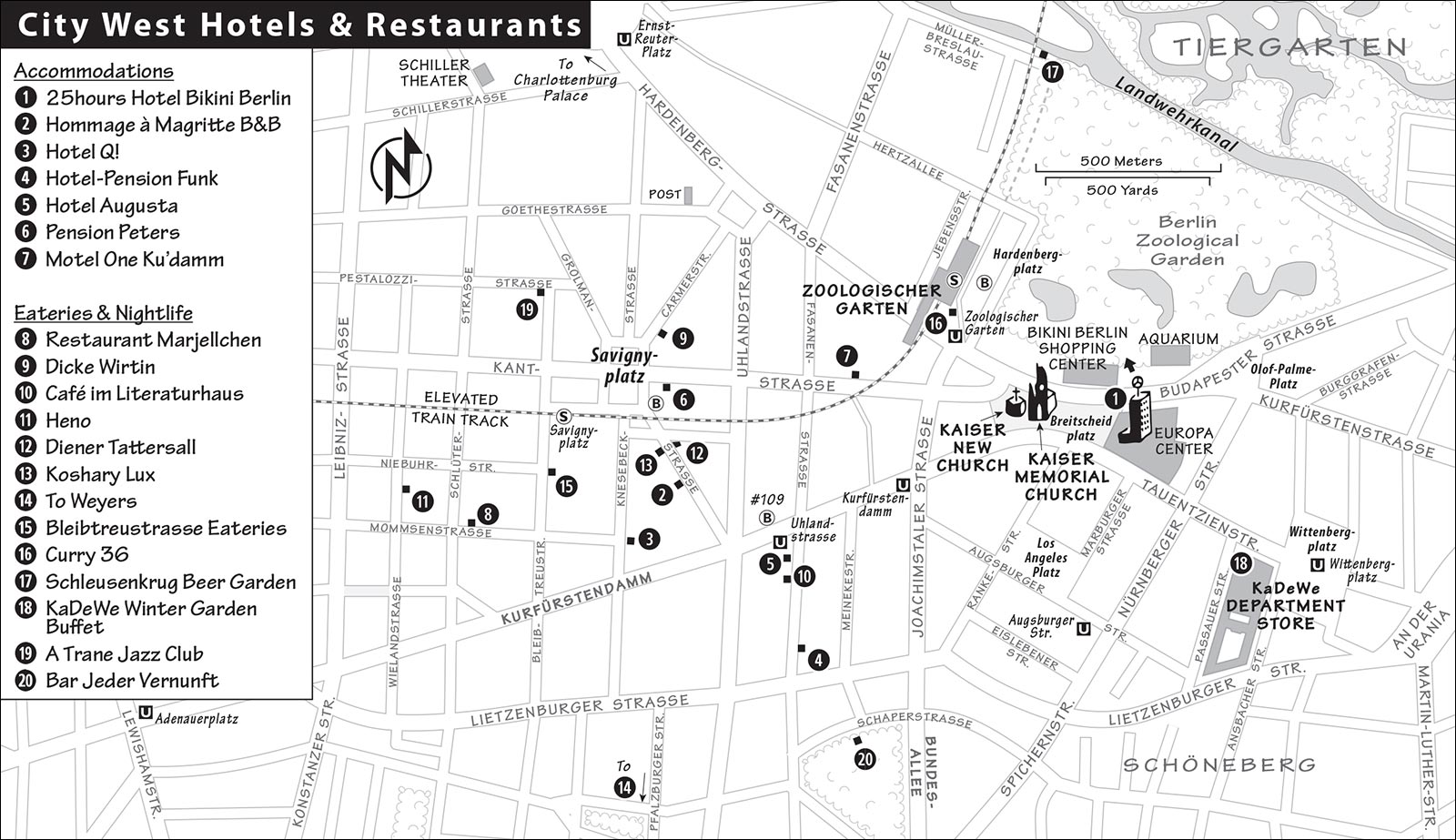
City West—the heart of the former West Berlin—is a pleasant, upscale, low-impact residential neighborhood. While most travelers prefer to sleep closer to the center, City West can be an ideal home base if you don’t mind a longer commute to sightseeing. The area retains an artsy aura, going back to the cabaret days of the 1920s, when it was the center of Berlin’s gay scene. Today, City West feels sedate and posh (if quite touristy along Ku’damm). Travelers sleeping in City West have several transit options: Bus #100 is slow but scenic, while the S-Bahn zips much faster from Savignyplatz or Zoologischer Garten to the center.
Near Europa Center
$$$ 25hours Hotel Bikini Berlin is your trendy hotel option overlooking Europa Center in the busiest and buzziest part of City West. Filling a high-rise adjacent to the Berlin Zoo and the Bikini Berlin shopping mall, it has 149 plywood-and-concrete rooms and public spaces with an industrial-zoo ambience. This is where trendsetters sleep in City West (breakfast extra, air-con, elevator, Budapester Strasse 40, +49 30 120 2210, www.25hours-hotels.com, bikini@25hours-hotels.com).
Around Savignyplatz
These listings huddle around the delightful, tree-lined Savignyplatz, which has a neighborhood charm and an abundance of simple, small, friendly places to sleep and eat. Hommage à Magrittel, Hotel Q!, and Pension Peters are located between Savignyplatz and Ku’damm: Ride the S-Bahn directly to Savignyplatz, or get off at Zoologischer Garten (with more connections) and walk about 10 minutes. The others are close to the Uhlandstrasse U-Bahn station (U1).
$$ Hommage à Magritte is a spiffy, tidy B&B in a classic old apartment building on a quiet street, overseen by raconteur Roman. Its 17 good-value rooms come with an artistic touch, inspired by its namesake, the Belgian Surrealist painter René Magritte (Grolmanstrasse 32, +49 30 8956 7087, www.hommage-a-magritte.com, info@hommage-a-magritte.com).
$$ Hotel Q! is a bit more design-forward than my other listings in the neighborhood. Its 77 mostly smallish rooms are all curvy lines and crimson colors, with the added quirk of bathtubs integrated into the sleeping area. For all its self-conscious cool, prices are quite reasonable (breakfast extra, elevator, sauna, gym, Knesebeckstrasse 67, +49 30 810 0660, www.hotel-q.com, contact@hotel-q.com).
$$ Hotel-Pension Funk, the former home of a 1920s silent-movie star, is a delightfully quirky, only-in-Berlin time warp. Kind manager Herr Michael Pfundt offers 15 elegant old rooms with rich Art Nouveau furnishings and hardly any modern trappings. Most guests adore it; some are put off by its old-fashioned feel. Figure out which you’ll be before you book (cheaper rooms with shared bath, cash preferred, no TVs, a long block south of Ku’damm at Fasanenstrasse 69, +49 30 882 7193, www.hotel-pensionfunk.de, berlin@hotel-pensionfunk.de).
$$ Hotel Augusta, run by mother-and-daughter team Julia and Danuta—and their staff—fills an early-20th-century building with 45 smartly decorated rooms, most with hints of the building’s Jugendstil origins. Superior rooms come with coffee makers and air-con, while others have balconies overlooking Ku’damm (breakfast extra, elevator, Fasanenstrasse 22, +49 30 883 5028, www.hotel-augusta.de, info@hotel-augusta.de).
$ Pension Peters is sunny and central, with a cheery breakfast room and super-friendly staff who go out of their way to help guests. With modest Scandinavian decor and 33 rooms, it’s a good, affordable choice. Some ground floor rooms facing the back courtyard are a bit dark and cheaper. If street noise bothers you, request a quiet room. Sisters Johanna and Olga run the show, after taking over from their parents—this family has been welcoming my readers for decades (breakfast extra, RS%, family rooms, 10 yards off Savignyplatz at Kantstrasse 146, +49 30 312 2278, www.pension-peters-berlin.de, info@pension-peters-berlin.de).
OTHER SLEEPING OPTIONS
Business Hotels in the Historic Core
Berlin’s historic core is handy to sightseeing, but pretty dull. Locals who don’t work in this area rarely venture here, making it sleepy at night. But these large, business-oriented hotels are worth considering if you’re looking to sleep in the very center of town and can score a deal. Breakfasts here are expensive add-ons. For locations, see the “Historic Core Hotels & Restaurants” map, later.
$$$$ Hotel de Rome, holding court on Frederick the Great’s showpiece Bebelplatz and facing Unter den Linden, is the Berlin splurge, with 146 rooms and all the luxurious little extras. If money is no object, this is a tempting choice for your Berlin address (air-con, elevator, Behrenstrasse 37, +49 30 460 6090, www.roccofortehotels.com, info.derome@roccofortehotels.com).
$$ NH Collection Berlin Mitte am Checkpoint Charlie is an elegant chain hotel on a busy street a short walk from Gendarmenmarkt, with nearly 400 fresh, interchangeable rooms at reasonable rates (air-con, elevator, Leipziger Strasse 106, U2: Stadtmitte, +49 30 203 760, www.nh-hotels.com, nhcollectionberlinmitte@nh-hotels.com).
In Eastern Berlin’s Friedrichshain
$$ Michelberger Hotel, right across from the Warschauer Strasse S-Bahn station, is a good choice if you want to be close to the trendy Friedrichshain neighborhood. The hotel is so artsy and self-consciously hip that it’d all be just too much...if it weren’t for its helpful staff. Its 143 bright rooms are reasonably priced, and its common spaces—a bar/lounge and a breezy all-organic courtyard restaurant—are welcoming (breakfast extra, family rooms, elevator; from atop Warschauer Strasse S-Bahn station, turn left to cross the bridge—it’s across from the U-Bahn station and #M10 tram stop at Warschauer Strasse 39; +49 30 2977 8590, www.michelbergerhotel.com, reservations@michelbergerhotel.com).
Good-Value Chain Hotels
$ Motel One has multiple locations across Berlin; all have the same aqua-and-brown decor and posh-feeling but small rooms. The four most convenient locations are between Hackescher Markt and Alexanderplatz (Dircksenstrasse 36—see the “Old Jewish Quarter Hotels & Restaurants” map, +49 30 2005 4080, berlin-hackeschermarkt@motel-one.com); near the Zoologischer Garten station (Kantstrasse 10—see the “City West Hotels & Restaurants” map, +49 30 3151 7360, berlin-kudamm@motel-one.com); just behind the Hauptbahnhof (Invalidenstrasse 54, +49 30 3641 0050, berlin-hauptbahnhof@motel-one.com); and a few blocks east of Gendarmenmarkt (Leipziger Strasse 50, U2: Spittelmarkt, +49 30 2014 3630, berlin-spittelmarkt@motel-one.com). For the last two locations, see the “Historic Core Hotels & Restaurants” map.
Meininger is a Europe-wide budget-hotel chain with several locations in Berlin. With both ¢ cheap dorm beds and $$ comfortable, hotelesque private rooms, Meininger is basic but lively, modern, and generally a solid budget option, even for nonhostelers. They have several branches, of which three are centrally located: in Prenzlauer Berg (“Alexanderplatz” branch, actually at Schönhauser Allee 19 on Senefelderplatz—see the “Prenzlauer Berg Hotels & Restaurants” map); in the old Jewish quarter (Mitte “Humboldthaus” branch at Oranienburger Strasse 67—see the “Old Jewish Quarter Hotels & Restaurants” map); and near the Hauptbahnhof at Ella-Trebe-Strasse 9—see the “Historic Core Hotels & Restaurants” map (all locations have elevator and 24-hour reception, pay parking at some, www.meininger-hostels.com).
Eating in Berlin
Berlin hosts a world of ever-changing restaurants. While the city abounds with traditional German eateries, Berliners consider this cuisine old-school; when they eat out, they’re usually not looking for traditional local fare. Nouveau German is California cuisine with scant memories of wurst, kraut, and pumpernickel.
Berlin is also a place to venture beyond German cuisine. As one of Europe’s primary melting pots, it offers sushi, Turkish, Italian, Peruvian, Cuban, Thai, Georgian, Indian, Argentinian, and lots of Vietnamese—usually done quite well. In recent years, Michelin-star restaurants and fancy steak houses have attracted attention from celebrities and travelers who appreciate finer dining. The result: From simple to sophisticated, Berlin’s cuisine scene has something for every taste bud—and budget.
I rank eateries from $ budget to $$$$ splurge. For more advice on eating in Germany, including ordering, tipping, and typical cuisine and beverages, see the “Eating” section of the Practicalities chapter.
EATING TIPS
Berlin has far more quality restaurants than could fit in any guidebook—and the scene changes so fast, anything in print is already dated. It’s hard to go wrong by just browsing a neighborhood until you find something that strikes your fancy.
Berlin Specialties: Don’t be too determined to eat “Berlin-style.” The city is best known for its street food—Currywurst and kebabs (see the “Berliner Street Food” sidebar).
But if you do eat German food in Berlin, popular dishes include Buletten and Königsberger Klopse (both meatball dishes), plus other meaty plates, such as Schnitzel Holstein (veal cutlet with egg), Eisbein (boiled ham hock), Leber Berliner Art (veal liver), Kassler (or Kasseler; smoked pork), and Mett (or Hackepeter; minced pork). Also popular are Aal grün (boiled eel), Rollmops (pickled herring), and Senfeier (hard-boiled eggs with potatoes). As for sweets, Berliner Pfannkuchen is the local jelly doughnut, and Berliner Luft is a popular dessert. These dishes are described in more detail in the Practicalities chapter (under “Traditional German Fare,” starting on here).
HISTORIC CORE
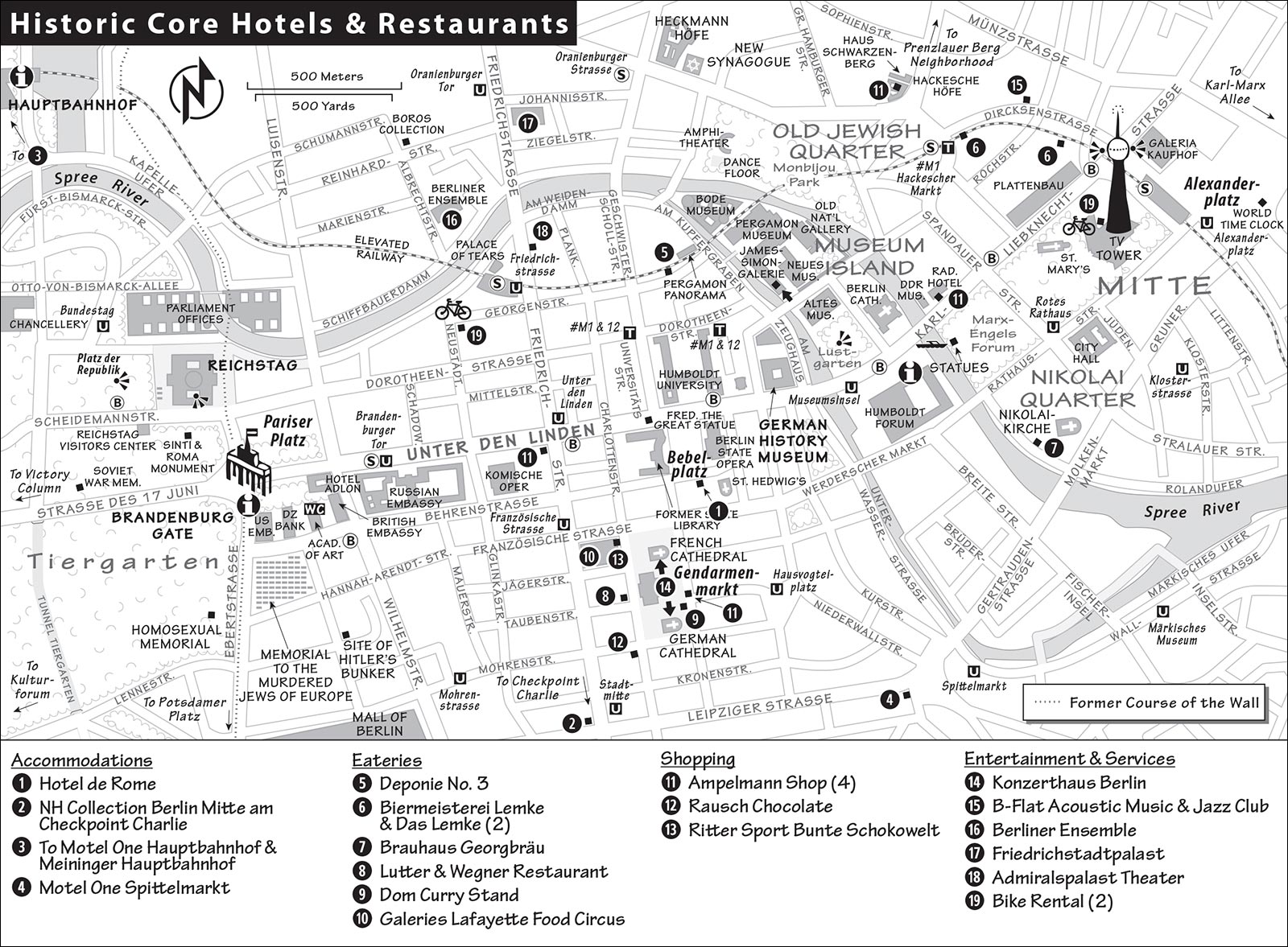
While this government/commercial area is hardly a hotspot for eateries, I’ve listed a few places handy for your sightseeing, all a short walk from Unter den Linden. See the “Historic Core Hotels & Restaurants” map on the next page for locations.
On and near Museum Island
The Altes, Neues, and Bode museums all have simple cafés. A solid museum restaurant is in the Humboldt Forum. And the streets around Hackescher Markt, a 10-minute walk away in the old Jewish quarter, hold plenty of options (see that neighborhood description, later in this chapter).
$$ Deponie No. 3 is a rustic if touristy Berlin Kneipe (pub). Garden seating in the back is nice but comes with the noise of the S-Bahn passing directly above. The bar interior is cozy and woody with several inviting spaces. They serve basic salads, traditional Berlin dishes, and hearty daily specials (Tue-Sat 16:00-22:00, closed Sun-Mon, S-Bahn arch #187 at Georgenstrasse 5, +49 30 2016 5740).
Near the TV Tower: Lemke craft brewery has two locations between Hackescher Markt and Alexanderplatz. $$$ Biermeisterei Lemke is a big, lively beer hall (modern but still in its 1970s DDR shell) that boasts grill and barbecue items, as well as vegetarian options (Mon-Sat 17:00-22:00, closed Sun, tucked a bit back from the street at Karl-Liebknecht-Strasse 13, +49 30 3087 8989). $$$ Das Lemke offers a menu of Berliner specialties and Bavarian dishes (Mon-Thu 16:00-22:00, Fri-Sun from 13:00, just off Hackescher Markt, under the S-Bahn arch at Dircksenstrasse 143, +49 30 2472 8727). Both serve a six-beer sampler board.
Nikolai Quarter: A short walk from Museum Island and Karl-Liebknecht-Strasse, Berlin’s rebuilt “old town” (the Nikolai Quarter) feels pretty soulless by day but is a popular restaurant zone at night. $$$ Brauhaus Georgbräu, a thriving beer hall teeming with German tourists, serves homemade suds on a picturesque courtyard overlooking the Spree River. Eat in the lively and woody but mod-feeling, hops-infused interior, or outdoors with fun riverside seating. It’s a good place to try Eisbein (boiled ham hock) with sauerkraut and mashed peas with bacon, a typical Berlin dish. Their statue of St. George once stood in the courtyard of Berlin’s old castle—until the Nazis deemed it not “German” enough (daily 13:00-22:00, 2 blocks south of Berlin Cathedral and across the river at Spreeufer 4, +49 30 242 4244).
Near Gendarmenmarkt
South of Unter den Linden, Gendarmenmarkt, with its twin churches, is a delightful place for an al fresco meal. Here you’ll find business-lunch-type places that offer midday specials, though they’re pricey at night. For more options, browse the eateries along Charlottenstrasse.
$$$$ Lutter & Wegner Restaurant is a Berlin institution respected for its Austrian cuisine (Schnitzel and Sauerbraten). Popular with businesspeople, it’s dressy, with fun sidewalk seating or a dark and elegant interior. Weekday €9 lunch specials are an affordable way to sample their cooking (daily 12:00-24:00, Charlottenstrasse 56, +49 30 202 9515).
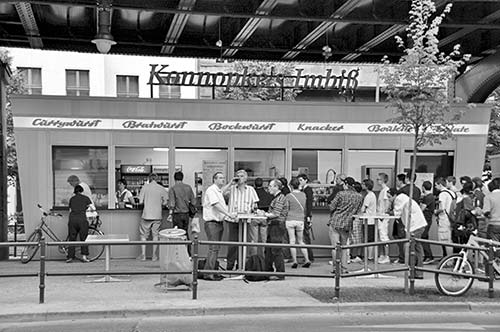
Sausage stands are everywhere—including the reigning local favorites, Konnopke’s Imbiss and Curry 36. You may even see portable human hot-dog stands—cooks in clever harnesses that let them grill and sell hot dogs from under an umbrella.
Most sausage stands specialize in Currywurst, created in Berlin after World War II, when a fast-food cook got her hands on some curry and Worcestershire sauce from British troops stationed here. It’s basically a grilled pork sausage smothered with curry sauce. Currywurst comes either mit Darm (with casing) or ohne Darm (without casing). If the casing is left on to grill, it gives the sausage a smokier flavor. (Berliner Art—“Berlin-style”—means that the sausage is boiled ohne Darm, then grilled.)
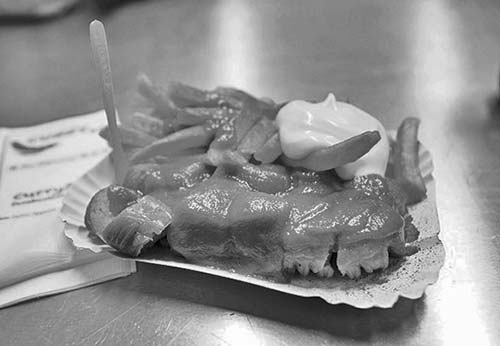
Either way, the grilled sausage is then chopped into small pieces or cut in half (East Berlin style) and topped with sauce. While some places simply use ketchup and sprinkle on some curry powder, real Currywurst joints use a proper Currysauce: tomato paste, Worcestershire sauce, and curry. With your wurst comes either a toothpick or small wooden fork; you’ll usually get a plate of fries as well, but rarely a roll.
The other big Berlin street food is fast Turkish and Middle Eastern food. Schwarma and falafel joints are cheap and tasty. And the kebab—either döner kebab (Turkish-style skewered meat slow-roasted and served in pita bread) or the recently trendy, healthier, vegetarian alternative, Gemüse kebab (with lots of veggies, and sometimes falafel)—is a quick way to fill up for a couple euros. Other variations include the döner teller (on a plate instead of in bread) and döner dürüm (in a thin flatbread wrap, also called dürüm kebab or yufka). Just as Americans drop by a taco truck for a quick bite, Germans find a kebab stand.
$ Dom Curry, behind the German Cathedral, is a Currywurst stand that works for a quick bite out on the square (daily 12:00-20:00, cash only).
$$ Galeries Lafayette Food Circus is a French festival of fun eateries surrounding the glass atrium in the basement of the landmark department store—ideal for a quality lunch. You’ll find sandwiches, savory crêpes, quiches, sushi bar, oyster bar, les macarons, and so on. Eat in or take advantage of their handy to-go items (Mon-Sat 11:00-19:00, closed Sun, Friedrichstrasse 76, U6: Französische Strasse, +49 30 209 480).
PRENZLAUER BERG
Prenzlauer Berg is bursting with excellent restaurants, serving up every cuisine imaginable. Even if you’re not staying in this area, it’s worth venturing here for dinner. Before choosing a restaurant, I’d spend at least a half-hour strolling and browsing through this bohemian wonderland of creative eateries. Or consider one of my recommendations (for locations, see the “Prenzlauer Berg Hotels & Restaurants” map on here).
The epicenter of this neighborhood is Kastanienallee (between the Eberswalder Strasse U-Bahn station and Zionskirche), and surrounding streets. It’s a youthful and trendy place to eat and drink. I’ve organized my recommendations in four categories: German cuisine, international options, places for a drink or snack, and options in the gentrified Kollwitzkiez area, near a pleasant park.
German Food
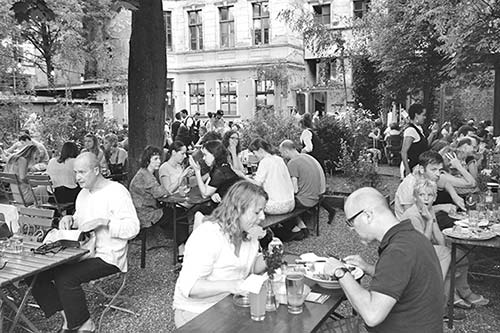
$ Prater Biergarten has been in business since 1837—back when Prenzlauer Berg was a forested hill—and is Berlin’s oldest beer garden. It’s a classic Gemütlichkeit (cozy and convivial) scene—mellow, shaded, and super-cheap—with a family-friendly outdoor area, including a playground (no table service, order food at one counter, beer at the other). They serve just basic pub grub, but the price is right and there’s a wide range of beers. Prater’s rustic indoor restaurant (more expensive, with table service) serves well-executed German classics with proper veal schnitzel and good salads. Both sections proudly pour Prater’s own microbrew (restaurant open Mon-Sat 18:00-24:00, Sun from 12:00; beer garden open daily in good weather 12:00-24:00, closed in winter; Kastanienallee 7, +49 30 448 5688).
$$ Zum Schusterjungen (“The Cobbler’s Apprentice”) is a classic, old-school, German-with-attitude eatery that retains its circa-1986 DDR decor. Famous for its filling meals (including various types of schnitzel and Berlin specialties such as pork knuckle), it’s a no-frills place with quality ingredients and a strong local following. It serves the needs of those Berliners lamenting the disappearance of solid, traditional German cooking amid the flood of ethnic eateries (small 40-seat dining hall plus outdoor tables, daily 12:00-24:00, cash only, corner of Lychener Strasse and Danziger Strasse 9, +49 30 442 7654).
$ Konnopke’s Imbiss, a super-cheap German-style sausage stand with a small section of covered picnic tables underneath the ever-rumbling U2 train tracks, has been a Berlin institution since 1930. It was family-owned even during DDR times. Loyal Berliners say Konnopke’s cooks up some of the city’s best Currywurst; they also serve a wide variety of other wurst specialties (Mon-Fri 11:00-18:00, Sat 12:00-19:00, closed Sun; Schönhauser Allee 44A—underneath elevated train tracks where Kastanienallee dead-ends, +49 30 442 7765). If you’d rather have very cheap, finger-licking-good, halal fried chicken, head across the street and join all the kids at Risa’s.
$$$ Ausspanne looks like a traditional, uninspired hotel restaurant. But the small, always fresh menu boldly elevates German classics with surprising flourishes—such as a puff of habanero foam with duck breast and red cabbage. It offers an interesting and reasonably priced take on modern German cooking (Tue-Sat 17:00-22:00, closed Sun-Mon, in recommended Hotel Kastanienhof at Kastanienallee 65, +49 30 4430 5199).
$$$ Der Hahn Ist Tot! (“The Rooster Is Dead!”) has whimsical style and cozy outdoor tables facing the Zionskirche, on a pleasant Prenzlauer Berg square. They serve only four-course, €30 dinners. The small menu is a thoughtful combination of rustic German and French dishes (always a fish, meat, and vegetarian option), and prices are decent. It’s as tiny as it is popular—book ahead (Tue-Sun 17:30-22:30, closed Mon, cash only, Zionskirchstrasse 40, +49 30 6570 6756).
International Eateries
$$$ Les Valseuses is a hole-in-the-wall French bistro with an open kitchen. Everything is simple and unpretentious, from the subway tile-clad exterior to the cozy, stripped-down interior, to the short menu (fish, meat, or vegetarian). Reserve ahead (daily 18:30-23:00, Eberswalder Strasse 28, +49 30 7552 2032).
$$$ Osmans Töchter (“Ottoman Daughters”), run by sisters from Istanbul, is a fun mash-up of industrial-mod interior and modern Turkish cuisine. Although the service can be a bit full of itself, this popular restaurant is the most appealing place in Prenzlauer Berg to sample well-executed Turkish dishes. Reservations are smart (daily 17:30-24:00, Pappelallee 15, +49 30 3266 3388, www.osmanstoechter.de).
$ Lemongrass Scent is a hardworking little spot on a quiet street serving fresh and tasty Asian dishes for a great price. It’s fast, friendly, and has a comfy interior and tables with benches on the street (daily 12:00-23:00, cash only, Schwedter Strasse 12, +49 30 4057 6985).
$ W-Der Imbiss couldn’t be more “Berlin.” It dishes out “Indian-Mexican-Californian-Italian street food fusion” (think naan pizzas and roti burgers), crammed into a loud, crowded, tiki-themed space the size of a postage stamp (daily 12:00-22:00, cash only, Kastanienallee 49, +49 30 4435 2206).
$$ Babel is a Lebanese restaurant popular with locals for its generous portions of shawarma, falafel, and kafta served at flower-bedecked sidewalk tables. Their mix-and-match lunch plates and two-person platters are an especially good value (daily 11:00-24:00, Kastanienallee 33, +49 30 4403 1318).
$ Maria Bonita is a tiny American-run Mexican bistro on a busy street offering some of the most authentic tacos in Berlin (daily 12:00-21:00, equidistant from Kollwitzplatz and Eberswalder Strasse U-Bahn stations at Danziger Strasse 33, +49 30 2025 5338).
Browsing Kastanienallee: For other international options, simply wander down Kastanienallee from the Eberswalder Strasse trestle. In just a few blocks, you’ll see Italian, Vietnamese, falafel, Gemüse kebab, along with burgers, funky cafés, colorful Kneipen, and much more.
Waffles or a Hippy Bar in the Center of Prenzlauer Berg
The following places are good for lingering over a drink and/or snack, ideally at an outdoor table where you can soak up the essence of Prenzlauer Berg.
Kauf Dich Glücklich makes a great capper to a Prenzlauer Berg dinner. It serves an enticing array of sweet Belgian waffles and homemade ice cream in an inviting candy-sprinkled, bohemian lounge and a garden-like front terrace on a great street (or get your dessert to go, daily 10:00-23:00, Oderberger Strasse 44, +49 30 4862 3292).
Café Morgenrot (“Red Dawn”) is actually a bar. This Prenzlauer Berg classic, a holdover from the neighborhood’s squatter days, brings together the community—gay, straight, local, foreign—and is still run by an artists’ collective (Tue-Sun 11:00-24:00, closed Mon, vegan options, Kastanienallee 85, +49 30 4431 7844).
Kollwitzkiez Area
This small neighborhood, a few blocks east of Kastanienallee, is Prenzlauer Berg’s gentrified heart—quieter and more residential. Hip parents bring their hip kids to the hip leafy playground park at its center, Kollwitzplatz. There are dozens of good eateries within a stone’s throw; some offer takeaway, if you want to grab a bite and then sit and people-watch on this prime square.
$$$$ Gugelhof is famous for its Alsatian German cuisine—French quality with German proportions. It has a kids’ menu, a selection of Flammkuchen (Alsatian pizzas), fun fixed-price meals, and professional service. A smart local clientele fills its minimalist yet classy interior; in good weather, outdoor seating sprawls along its sidewalk (Mon-Fri 17:00-23:00, Sat-Sun from 12:00, reservations smart, where Knaackstrasse meets Kollwitzplatz, +49 30 442 9229, https://gugelhof.eatbu.com).
$$$ Der Blaue Fuchs is one of Berlin’s most popular Georgian restaurants. The murals of nature’s bounty on the walls reflect the abundance of this increasingly popular cuisine. Be sure to try some classic dishes like nigvziani badrijani (grilled eggplants filled with walnut paste), khinkali dumplings, and khachapuri cheese bread (Tue-Fri 16:00-24:00, Sat-Sun from 12:00, closed Mon, Knaackstrasse 43, +49 30 2607 4244).
$$ Chutnify offers a modern take on Indian street food. You can get a dosa (southern India’s version of a burrito, with various fillings), a thali (mixed platter), or a curry, either to eat in the cozy interior or dine with the neighborhood street-side (daily 12:00-15:00 & 18:00-22:00, Sredzkistrasse 43, +49 30 4401 0795).
$ Zula is handy for cheap hummus wraps to enjoy at an outside table on one of Prenzlauer Berg’s finest streets, or take to Kollwitzplatz, just down the way (daily 12:00-22:00, Husemannstrasse 10, +49 30 4171 5100).
Pubs near Senefelderplatz: Two options—a few blocks south of Kollwitzplatz, handy to the Senefelderplatz U-Bahn—are good choices for beer with grub. $ Metzer Eck is a time-warp Kneipe with cozy charm, loyal locals, and a family tradition dating to 1913. It serves cheap, basic, old-fashioned Berlin grub with five beers on tap (Mon-Fri 16:00-24:00, Sat from 18:00, closed Sun, Metzer Strasse 33, on the corner with Strassburger Strasse, +49 30 442 7656). $$ Leibhaftig is the modern yin to Metzer’s yang, serving their own brews and Bavarian tapas—small plates of nouveau German cuisine, with plenty of vegetarian options (Tue-Sat 18:00-23:00, closed Sun-Mon, Metzer Strasse 30, +49 30 5481 5039).
OLD JEWISH QUARTER
Of Berlin’s trendy dining zones, this is the closest to the main sightseeing core. Most of these places are a reasonable walk from Unter den Linden and within 10 minutes of the Hackescher Markt S-Bahn station. For locations, see the “Old Jewish Quarter Hotels & Restaurants” map on here.
On and near Auguststrasse
The best place to find good eateries in the old Jewish quarter is along or near Auguststrasse, Berlin’s “art gallery row” (close to the New Synagogue). Though the Hackescher Markt places are easier to reach, Auguststrasse has attracted a fun cross-section of creative chefs and is worth the short detour. The nearby and much bigger Oranienburger Strasse and Torstrasse are jammed with take-your-pick restaurants serving most any cuisine you can think of.
$$ Mogg Deli is a foodie favorite, serving a short but thoughtful menu of soups, salads, and sandwiches. While dishing up international cuisine, it’s inspired by a New York deli. They’re known for their home-cured pastrami, especially their monster, designed-to-be-shared Reuben (daily 11:00-23:00, inside the huge red-brick former Jewish girls school at Auguststrasse 11, +49 176 6496 1344).
$$ Clärchens Restaurant fills the courtyard in front of Clärchens Ballhaus (a classic old Berlin ballroom) with twinkle lights, ramshackle furniture, and a bohemian-chic atmosphere—especially nice on a balmy evening. They serve German dishes, including brats, meatballs, and Flammkuchen. You can also eat in the dance hall or in a garden out back. After 21:00 on Fridays, the DJ cranks up the music in the ground-floor dance hall, creating a fun, high-energy yet neighborly scene (Tue-Fri 12:00-23:00, Sat-Sun from 14:00, closed Mon, Auguststrasse 24, +49 30 555 785 440).
$$$ Schwarzwaldstuben is a Black Forest-themed pub—which explains the antlers, cuckoo clocks, and painting of a thick forest on the wall. It’s friendly, with good service, food, and prices. The staff chooses the music (often rock or jazz), and the ambience is warm and welcoming. If they’re full, you can eat at the long bar (Mon-Fri 12:00-21:00, Sat-Sun from 9:00, cash only, Tucholskystrasse 48, +49 157 7072 2973).
$$ Sophieneck upholds its Kneipe roots as the neighborhood’s ersatz living room, serving hearty Berliner specialties like Buletten and Eisbein on a breezy corner to a happy mix of locals and tourists (Tue-Fri 18:00-22:00, Sat-Sun from 12:00, closed Mon, Grosse Hamburger Strasse 37, +49 30 283 4065).
$ Momos is all about vegetarian and vegan dumplings, with creative fillings like “cheeky chickpea” or “spicy seitan.” Just one of the many inventive international joints in this neighborhood, it’s a solid choice for a quick lunch or a light dinner (Mon-Sat 12:00-21:30, closed Sun, Chausseestrasse 2, +49 160 268 8177).
Coffee: At The Barn, curt baristas serve up some of Berlin’s best gourmet coffee with an extra shot of pretense. Hipster coffee snobs will be satisfied (Mon-Fri 8:00-18:00, Sat-Sun from 10:00, Auguststrasse 58).
Dessert: For your afternoon Kaffee und Kuchen, stop at Princess Cheesecake, beloved by locals and selling several varieties of cheesecake (daily 10:00-20:00, Tucholskystrasse 37, +49 30 2809 2760).
Rosenthaler Platz Area
This busy neighborhood thrives with millennials and the youth hostel crowd and has some enticing options. It’s roughly between the old Jewish quarter and Prenzlauer Berg, near the U8: Rosenthaler Platz station, and on the tram #M1 line that runs between Kastanienallee and the Hackescher Markt S-Bahn station.
Eclectic Eats on Weinbergsweg: Don’t miss the first block of Weinbergsweg, the narrower, tram track-lined lane that heads north to Prenzlauer Berg. In just one block, you’ll find cafés, bakeries, superfoods and organic juice, Gemüse kebab, döner kebab, an Italian deli, Mexican street food, Russian, Korean barbecue, a French bistro, Chinese dumplings, and gelato.
$$$$ Katz Orange is a mecca for foodies, and feels regal from the moment you enter its intimate courtyard. It’s surprisingly affordable and delightfully cozy-chic. The menu is small and sharp, known for its “candy on the bone” slow-cooked meat, and changes with the season (daily 18:00-24:00, reservations recommended, Bergstrasse 22, +49 30 9832 08430, www.katzorange.com).
Hackescher Markt Area
$$$ Alay by Hasir is an upscale, somewhat stuffy opportunity to splurge on Turkish and Anatolian specialties. While a bit old-fashioned and with hit-or-miss service, this place remains respected and enjoys a handy location (large and splittable portions, daily 16:00-24:00, a block from the Hackescher Markt S-Bahn station at Oranienburger Strasse 4, +49 30 2804 1616).
$$$ Weihenstephaner Bavarian Restaurant serves traditional Bavarian food in an air-conditioned traditional-yet-sleek interior, down in an atmospheric cellar, on an inner courtyard, or on a busy people-watching terrace facing the delightful Hackescher Markt square; and, of course, it has excellent beer. If you want to eat right on Hackescher Markt, this is your best bet (Tue-Sun 12:00-24:00, closed Mon, Neue Promenade 5 at Hackescher Markt, +49 30 8471 0760).
$ Curry 61 serves up what is for many the best Currywurst in Berlin; vegetarians and vegans appreciate good options too. Eat in or grab a €5 meal to eat on a bench at the fine Monbijoupark across the street (daily, long hours, Oranienburger Strasse 6).
KREUZBERG
To dig into Berlin’s up-and-coming food scene, head to Kreuzberg. This southern Berlin neighborhood—historically known for its large immigrant community and counterculture squatters—has taken off as the place for upwardly mobile young Berliners to eat out. As this is a very trendy destination, it’s smart to reserve ahead at most of my listings—especially on weekends—or avoid prime meal times.
Markthalle Neun
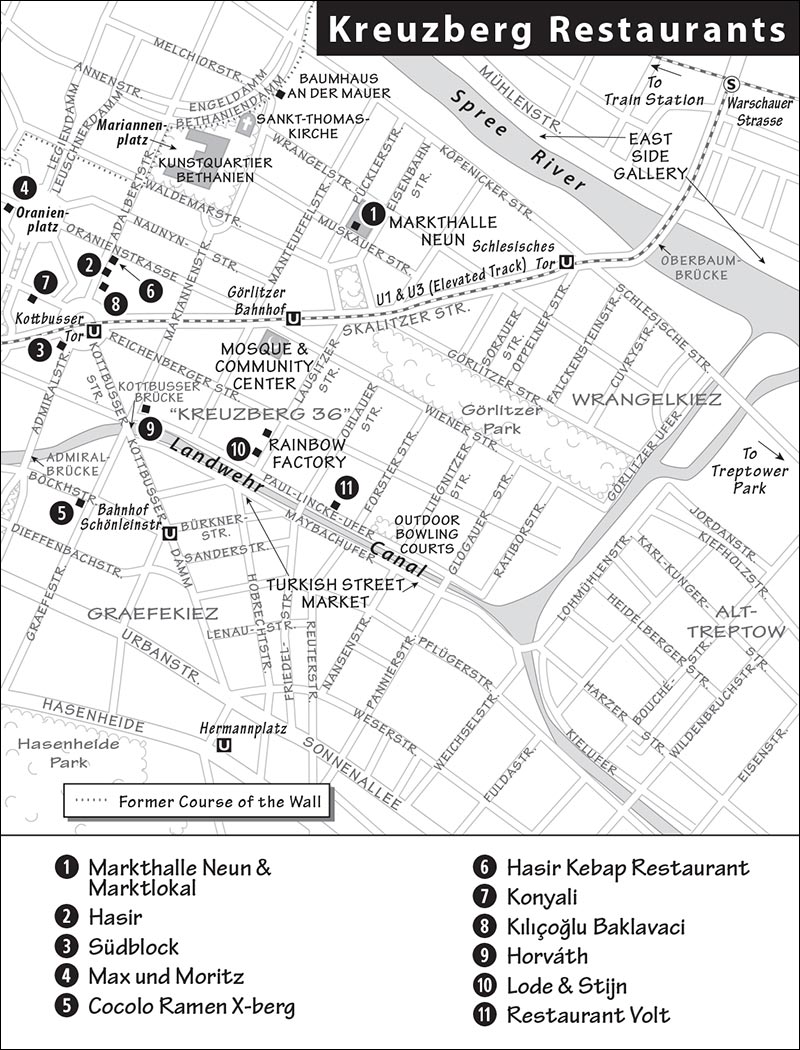
Kreuzberg’s best foodie destination is this refurbished 19th-century market hall, filled with local producers and fun food stalls. You’ll find gourmet butchers, wine shops, tapas, Berlin meatballs (Buletten), tofu sandwiches, fair-trade spices, Turkish dishes, and a supermarket. It’s most worthwhile on “Street Food Thursdays,” when extra eateries open from 17:00 to 22:00 (most vendors open Tue-Fri 12:00-18:00, Sat from 10:00, closed Sun-Mon; Eisenbahnstrasse 42, U1: Görlitzer Bahnhof, www.markthalleneun.de). Attached to the market is the $$$$ Marktlokal restaurant, serving upscale German fare in a posh Kneipe setting, with its own beer brewed in the market cellar (Tue-Fri 18:00-23:00, Sat from 12:00, closed Sun-Mon; Pücklerstrasse 34, +49 30 2866 5121, www.marktlokal.berlin). Note: The Görlitzer Bahnhof area can feel seedy, especially at night.
Near Kottbusser Tor U-Bahn Station and Oranienstrasse
$$$ Hasir is a big, clean, and unstressful place tourists appreciate for high-quality Turkish cuisine at high prices. It’s well run, dressy, and spacious, with great energy and a big open kitchen (daily 12:00-24:00, Adalbertstrasse 10 at corner of Oranienstrasse, +49 30 6165 9222, www.hasir.de).
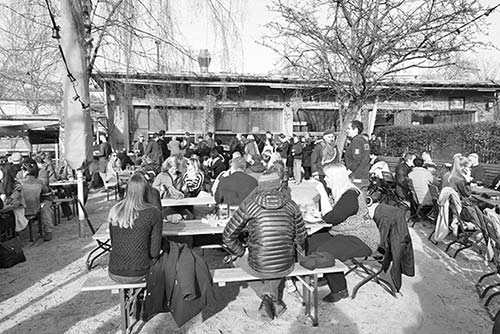
$ Südblock, Kreuzberg’s take on a beer garden, brings together all walks of local life: Turk, Berliner, gay, straight, and tourist. It’s a convivial vibe, best when balmy, with shared tables filling a corner plaza under trees and umbrellas or inside with cramped seating under disco balls (the DJ turns up the music most nights at 21:00). The menu includes German standards, stuffed baked potatoes, Tex-Mex, Flammkuchen, vegan, and lots of booze (daily from 17:00, where Admiralstrasse hits Kottbusser Tor, +49 30 6094 1853, www.suedblock.org).
$$$ Max und Moritz is an old-time Wirtshaus half a block from Oranienplatz. They pride themselves on doing traditional Berlin food the right way—with equal amounts respect for the origins, and disregard for anyone who might not like it that way (Wed-Sun 18:00-23:00, closed Mon-Tue, cash only, reservations smart, Oranienstrasse 162, +49 30 6951 5911, www.maxundmoritzberlin.de).
Cheap Turkish-Style Eats: Two doors down from Hasir, $ Hasir Kebap Restaurant, at Adalbertstrasse 12, is a bit more casual and has more kebab options (daily until late). $ Konyali, a cheap kebab joint just off Kottbusser Tor, offers the closest thing to an Istanbul vibe and crowd, with great prices and solid Turkish cuisine and fun seating outside (Reichenberger Strasse 10, +49 30 6900 4567). For dessert, head down to the Kılıçoğlu Baklavaci bakery for enticing honey-soaked sweets sold by weight (daily until late, Adalbertstrasse 9).
South of the Canal: $$ Cocolo Ramen X-berg, a wildly popular outpost of a highend Japanese restaurant, ladles out slurpy noodle bowls (Mon-Sat 12:00-21:00, closed Sun, reservations not accepted, Graefestrasse 11, +49 30 9833 9073).
High-End Foodie Splurges on and near Paul-Lincke-Ufer
The Paul-Lincke-Ufer strip along the north bank of the Landwehr Canal (across from the Turkish market) is home to several top-tier Berlin eateries (U8: Schönleinstrasse). I’ve listed these in the order you reach them, heading east from Kottbusser Brücke.
$$$$ Horváth, a Michelin-star restaurant, serves elevated Austrian/international-fusion fare (Wed-Sun 18:30-22:00, closed Mon-Tue, #44a, +49 30 6128 9992, www.restaurant-horvath.de).
$$$$ Lode & Stijn features the eclectic high-end cooking (without pretense) of two talented Dutch-transplant chefs (Wed-Sat 19:00-22:00, closed Sun-Tue, Lausitzer Strasse 25, +49 30 6521 4507, www.lode-stijn.de).
$$$ Restaurant Volt serves upscale international dishes in a former power station (Tue-Sat 18:00-23:00, closed Sun-Mon, #21, +49 30 338 402 320, www.restaurant-volt.de).
CITY WEST
I’ve listed these eateries primarily for travelers sleeping here. (In other words, they are not worth traveling across Berlin to enjoy.) For locations, see the “City West Hotels & Restaurants” map on here.
Near Savignyplatz
Many good restaurants are on or within 100 yards of Savignyplatz, near my recommended hotels. Savignyplatz is lined with attractive, relaxed, mostly Mediterranean-style places. Take a walk and survey the places I list here; continue your stroll along Bleibtreustrasse to discover many trendier, creative little eateries.
$$$ Restaurant Marjellchen is a trip to East Prussia, with big portions of hearty, delicious German/Polish cuisine. Dine in cozily cluttered elegance in one of two six-table rooms. While it doesn’t have to be expensive, plan to go the whole nine yards here, as this can be a great experience, with caring service. The menu is inviting, and the place family-run—all the recipes were brought to Berlin by the owner’s East Prussian mother after World War II. Reservations are smart (daily 17:00-22:30, Mommsenstrasse 9, +49 30 883 2676, www.restaurant-marjellchen-berlin.de).
$$ Dicke Wirtin (“Fat Landlady”) has a traditional old-Berlin Kneipe atmosphere, several good beers on tap (including Andechs from Bavaria), and solid home cooking at reasonable prices—such as their famously cheap Gulaschsuppe. Their interior is fun and pubby, with soccer on the TV; their streetside tables are also inviting. Pickled eggs are on the bar—ask about how these can help you avoid a hangover (Wed-Mon 11:00-23:00, closed Tue, dinner served from 18:00, just off Savignyplatz at Carmerstrasse 9, +49 30 312 4952).
$$$$ Café im Literaturhaus sits above a rare-books shop on a delightfully tranquil garden courtyard, facing the Käthe Kollwitz Museum. It has the ambience of an Old World villa, with classy gold Art Deco accents—perfect for their evening poetry and other literary readings. While the full menu is quite pricey, you can enjoy the place far more affordably with a sandwich or coffee and cake (daily 9:00-24:00, reservations smart, Fasanenstrasse 23, +49 30 882 5414, http://cafe-im-literaturhaus.de).
$ Heno is a very popular Japanese hole-in-the-wall, serving a variety of rice bowls, noodle dishes, and soups (but no sushi) in a long, sleek, minimalist space (Mon-Fri 12:00-22:00, Sat from 13:00, closed Sun, Wielandstrasse 37, +49 30 6630 7370).
$ Diener Tattersall is a neighborhood favorite Kneipe with a complicated history. The building started as a horse riding school, later became a casino, and was eventually bought by the German heavyweight champion Franz Diener, who attracted an eclectic clientele of boxers and artists to his Kneipe. Today it’s known for the affordable menu, specializing in homemade liver sausage (Mon-Sat from 18:00, closed Sun, Grolmanstrasse 47, +49 30 881 5329).
$ Koshary Lux serves refined (hence “lux”) street food dishes from around the Arab world. Prices are good, service is friendly, and their takes on classics from Egypt (such as koshary, made of lentils, pasta, rice, and tomato sauce), Morocco, Lebanon, and elsewhere have won them fans (Mon-Sat 17:30-22:30, closed Sun, Grolmanstrasse 27, +49 30 8140 6190).
$$$ Weyers offers modern German cuisine in a simple, elegant setting, with dining tables spilling out into the idyllic neighborhood park in the summer (daily 8:00-24:00, Pariser Strasse 16—facing Ludwigkirchplatz at intersection with Pfalzburger Strasse, +49 30 881 9378).
On Bleibtreustrasse: On the stretch just south of the Savignyplatz S-Bahn tracks, Bleibtreustrasse is lined with an eclectic array of dining options, including these cheap and cheerful options: $ Ali Baba, with pizzas and outdoor seating (#45); $ Repke Spätzlerei (Flamkuchen, spaetzle, and buttery dumplings, #46); and Nibs Cacao (churros and chocolate, also at #46).
Near Zoologischer Garten Station
In addition to a beer garden and department-store cafeteria, there’s plenty of fast food near the Zoologischer Garten station and on Ku’damm.
$ Curry 36—the locally beloved Currywurst vendor from Kreuzberg—has a handy outpost just outside the station.
$$ Schleusenkrug beer garden is hidden in the park overlooking a canal between the Zoologischer Garten and Tiergarten stations. Choose from an ever-changing self-service menu of huge salads, pasta, and some German dishes (food served daily 12:00-21:00, shorter hours and more basic menu off-season, cash only; from Zoologischer Garten station it’s a 5-minute walk following the path into the park between the zoo and train tracks; +49 30 313 9909).
KaDeWe: The top floor of this famous department store holds the $$ Winter Garden Buffet cafeteria, while its sixth-floor deli/food department is a picnicker’s nirvana. Its arterials are clogged with more than 1,000 kinds of sausage and 1,500 types of cheese (Mon-Sat 10:00-20:00, closed Sun, U1/U2/U3: Wittenbergplatz, +49 30 1681 8408).
Berlin Connections
BY PLANE
Berlin Brandenburg International Airport (formerly Schönefeld Airport)
The state-of-the-art Berlin Brandenberg International Airport (code: BER, www.berlin-airport.de), 11 miles south of central Berlin, has three terminals: T1 and T2 are the main terminals, located in a new building; T5 is the former Schönefeld airport terminal. The two terminal buildings are connected by frequent S-Bahn trains and buses. You’ll find a TI in Terminal 1, level E0.
Connecting the Airport and Downtown Berlin: The airport’s train station (Flughafen BER) sits directly under the new terminal and connects the airport with downtown Berlin plus regional and international destinations. Options include Airport Express trains (FEX) to Berlin’s Hauptbahnhof, as well as S-Bahn and regional trains to the city center.
The S9 S-Bahn line is handy for Prenzlauer Berg and old Jewish quarter hotels. Take it to the Hackescher Markt station; from there, tram #M1 runs north along Kastanienallee for Prenzlauer Berg, and tram #M5 runs west along Oranienburger Strasse for the old Jewish quarter.
You can also take the Airport Express FEX train to the Hauptbahnhof (4/hour, 30 minutes). From there, buses, trains, and trams fan out across the city (see the “By Train—Getting Into Town” section later for specifics). RE and RB trains run to Ostbahnhof, Alexanderplatz, Friedrichstrasse (near some old Jewish quarter hotels), Hauptbahnhof, and Zoologischer Garten (handy for City West hotels; several per hour, direction: Nauen or Dessau). All trains are covered by an ABC transit ticket (€3.80, buy at machine and validate before boarding). Check connections when you arrive to get the most current information.
A taxi to the city center costs about €60.
BY TRAIN
Berlin Hauptbahnhof
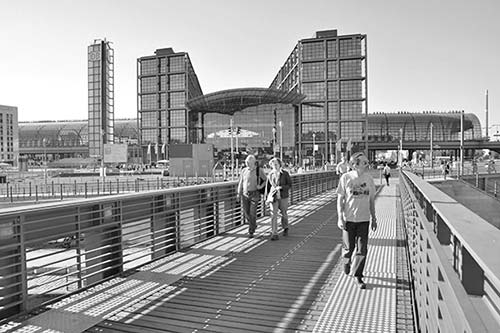
Virtually all long-distance trains pass through the Berlin Hauptbahnhof (“Berlin Hbf” on schedules)—a massive, state-of-the-art temple of railroad travel in the heart of the city. This mostly underground train station is where the national train system meets Berlin’s S-Bahn—unique for the way its major lines come in at right angles. Note that many arriving trains (especially regional ones) stop at multiple Berlin stations, one of which may be more convenient to your hotel than the Hauptbahnhof. Before you arrive, figure out which station is best for you.
Orientation: The gigantic station has five floors, but its open layout makes it easy to navigate...once you understand the signage. The main floor, at street level, is labeled “EG” (for Erdgeschoss), or level 0. Below that are UG1 (level -1) and UG2 (level -2), while above it are OG1 (level +1) and OG2 (level +2). Tracks 1-8 are on UG2, while tracks 11-16 and the S-Bahn are on OG2. Shops and services are on the three middle levels. Enter and exit the station on level EG: The Washingtonplatz entrance faces south (toward the Reichstag and downtown, with a taxi stand). The north entrance is marked Europaplatz.
Services: On the main floor (EG), you’ll find the TI (just inside the north/Europaplatz entrance) and the “Rail & Fresh WC” facility (public pay toilets, near the food court, follow gold signs). Up one level (OG1) are a 24-hour pharmacy and lockers (directly under track 14 on the east side). Car rental offices are down one level (UG1), near platforms 7-8.
Train Information and Tickets: The Deutsche Bahn Reisezentrum information center is up one level (OG1), between tracks 12 and 13 (on the west side; open long hours daily).
EurAide is an English-speaking information desk with answers to your questions about train travel around Europe. It’s located at counter 12 inside the Reisezentrum on the first upper level (OG1). It’s American-run, so communication is simple. This is an especially good place to make fast-train and couchette reservations (generally open Mon-Fri 11:00-19:00, closed Sat-Sun and in winter, check www.euraide.com for specific hours).
Shopping: The Hauptbahnhof is home to 80 shops with long hours—some locals call the station a “shopping mall with trains” (many stores open Sun). The REWE City supermarket (UG1, follow signs for tracks 1-2) is handy for assembling a picnic for your train ride.
Getting into Town: Taxis and buses wait outside the station on the Washingtonplatz side, but the S-Bahn is probably your best bet for connecting to most hotels. It’s simple: S-Bahn trains are on tracks 15 and 16 at the top of the station (level OG2). Trains on track 15 go east, stopping at Friedrichstrasse, Hackescher Markt, Alexanderplatz, and Ostbahnhof; trains on track 16 go west, toward Zoologischer Garten and Savignyplatz (best for City West hotels). Your train ticket to Berlin covers any connecting S-Bahn ride (but for the U-Bahn, trams, or buses, you’ll need an additional ticket).
To reach most hotels in northern Berlin’s Prenzlauer Berg neighborhood, it’s fastest to take any train on track 15 two stops to Hackescher Markt. Once there, follow signs to Hackescher Markt down the stairs, then exit to Spandauer Strasse and cross the tracks to the tram stop. Here you’ll catch tram #M1 north (direction: Schillerstrasse), which trundles north through Rosenthaler Platz and up Kastanienallee to Eberswalder Strasse. (For Rosenthaler Platz hotels, it’s even more direct to hop on tram #M8, which leaves from in front of the Hauptbahnhof’s Europaplatz entrance.)
For old Jewish quarter hotels, you’ll also take the S-Bahn from track 15. Some of these hotels are closer to the Friedrichstrasse station (first stop), while others are closer to Hackescher Markt (second stop).
To reach City West hotels, catch any train on track 16 to Savignyplatz, where you’re within a five-minute walk of most recommended hotels.
The U5 U-Bahn line connects the Hauptbahnhof, Reichstag, and strategic stops along the city’s main sightseeing spine: Brandenburger Tor, Unter den Linden (near Bebelplatz), Museumsinsel (Museum Island), Rotes Rathaus (City Hall, near the Nikolai Quarter), and Alexanderplatz.
Airport Express trains (FEX) connect the Hauptbahnhof with the Berlin Brandenburg airport (4/hour, 30 minutes), and are covered by an ABC transit ticket (€3.80, buy at machine and validate before boarding).
From Berlin by Train to: Potsdam (2/hour, 30 minutes on RE1 train; or take S-Bahn from other points in Berlin, S7 direct, S1 with a change at Wannsee, at least 4/hour, 30-50 minutes—see next chapter), Oranienburg and Sachsenhausen Memorial and Museum (hourly, 25 minutes on the RE5; or take the S1 line from Friedrichstrasse or other stops in town, 3/hour, 50 minutes), Wittenberg (a.k.a. Lutherstadt Wittenberg, hourly on ICE, 40 minutes), Dresden (hourly direct, 2 hours; more with a transfer in Leipzig, 3 hours), Leipzig (hourly, 1.5 hours), Erfurt (1-2/hour, 2 hours), Eisenach and Wartburg Castle (every 2 hours direct, 2.5 hours; more with transfer in Erfurt), Hamburg (1-2/hour, 2 hours), Frankfurt (at least hourly, 4 hours), Bacharach (every 2 hours with transfer in Frankfurt, 5.5 hours; more with 2-3 changes), Würzburg (hourly, 4 hours, transfer points vary), Rothenburg (hourly, 5.5 hours, 3 changes), Nürnberg (1-2/hour, 3.5 hours), Munich (1-2/hour, 4.5 hours, longer night train possible), Cologne (hourly, 4.5 hours), Amsterdam (every 2 hours direct, 6.5 hours; more with change in Hannover; wise to reserve in advance), Brussels (8/day, 7 hours with transfer in Cologne, some require reservations), Budapest (1/day direct, more with transfer in Prague, 11 hours, via Czech Republic and Slovakia; if your rail pass doesn’t cover these countries, consider a longer route via Nürnberg), Copenhagen (2/day, 8 hours, reservation required in summer, change in Hamburg; 1 direct bus 4/week at 11:30, daily in summer, accepts rail pass), London (4-6/day, 10 hours, 2 changes, reservations required), Paris (9/day, 8 hours with 1 transfer, reservations required in France), Zürich (hourly, 8-9 hours, transfer in Hannover or Basel; 1 direct 12-hour night train), Prague (6/day direct, 4 hours, wise to reserve in advance), Warsaw (4-6/day, 6.5 hours, reservations required), Kraków (transfer in Warsaw, 9 hours; 1 bus/day direct, accepts rail pass, 8 hours), Vienna (7/day, 8 hours via Nürnberg or 9 hours via Prague; night train possible; others with 2 changes; trains with a change in Nürnberg or Munich avoid Czech Republic—useful if it’s not covered by your rail pass).
Night trains run from Berlin to Munich, Basel, Zürich, and Vienna. A Liegeplatz, a.k.a. couchette berth (€15-36), is a great deal; inquire at EurAide at the Hauptbahnhof for details. Beds generally cost the same whether you have a first- or second-class ticket or rail pass. Trains are often full, so reserve your couchette a few days in advance from any travel agency or major train station in Europe.
BY BUS
The city’s bus station, ZOB (Zentraler Omnibusbahnhof), is west of Zoologischer Garten (Berlin Zoo), in Charlottenburg (Masurenallee 4, U2: Kaiserdamm or S41/S42: Messe Nord, www.zob.berlin). FlixBus, MeinFern, and Eurolines all operate from here to locations around Germany and Europe.
BY CRUISE SHIP AT THE PORT OF WARNEMÜNDE
Many cruise lines advertise a stop in “Berlin,” but ships actually put in at the Baltic seaside town of Warnemünde—a whopping 150 miles north of downtown Berlin. By train, by tour bus, or by Porsche on the autobahn, plan on at least six hours of travel time round-trip between Warnemünde and Berlin. The easiest option is to book a package excursion from your cruise line. You can also book a tour with a local Berlin-based operator such as Original Berlin Walks; see contact information on here. Otherwise, several train connections run each day from Warnemünde’s train station to Berlin (roughly every 2 hours, 3 hours, transfer in Rostock).
For more details on visiting Berlin while on a cruise, pick up the Rick Steves Scandinavian & Northern European Cruise Ports guidebook.