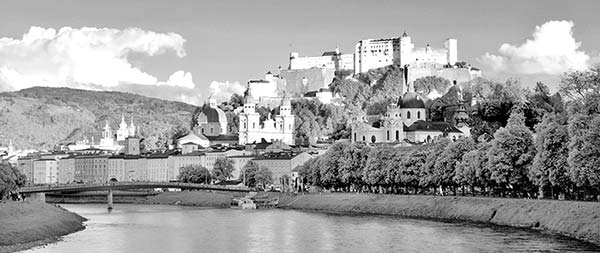
SALZBURG, AUSTRIA
Salzburg • Berchtesgaden, Germany
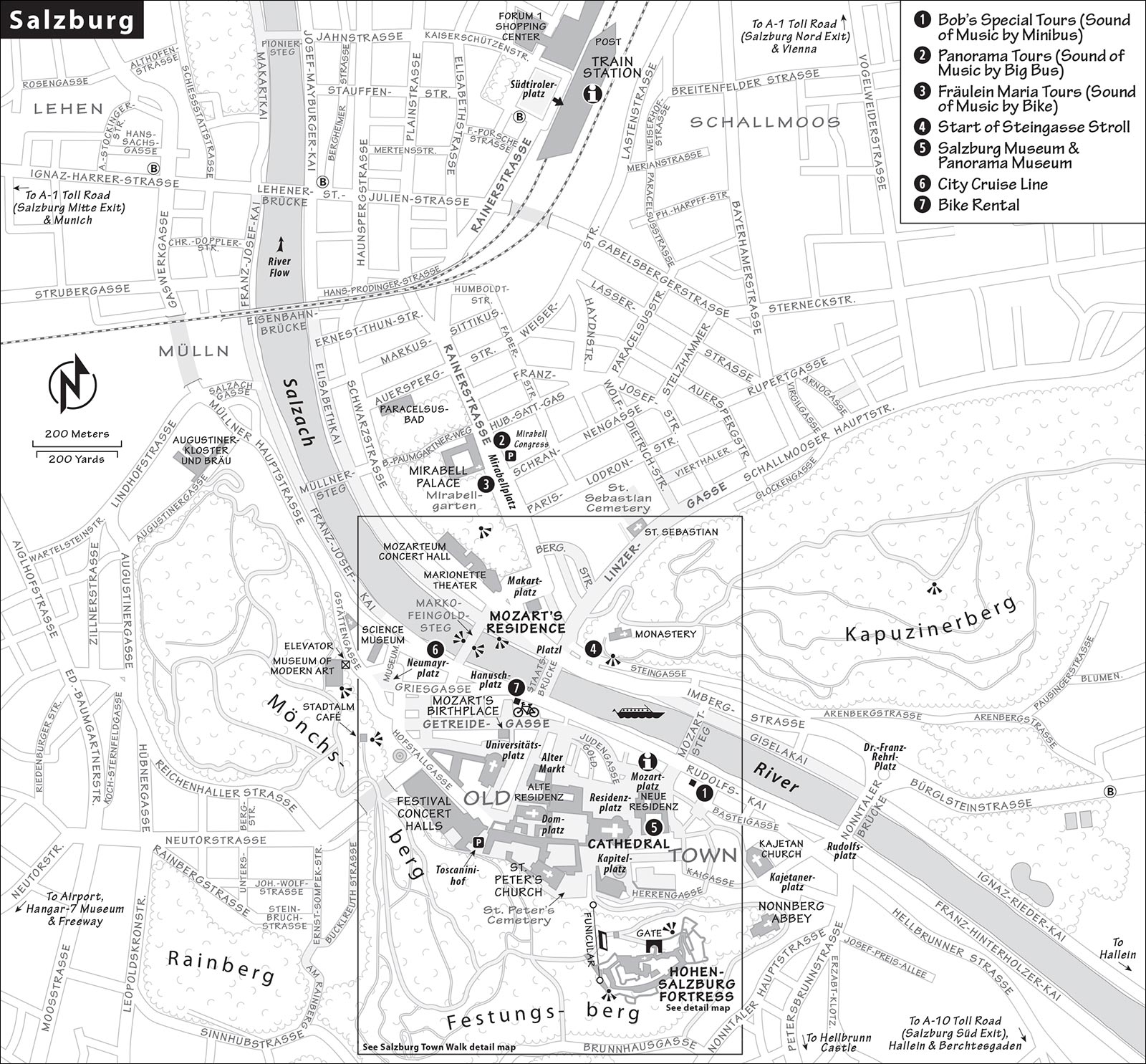
Map: Berchtesgaden & Greater Salzburg
Salzburg, just over the Austrian border from Munich, makes a fun day trip (1.5 hours by direct train). Thanks to its charmingly preserved Old Town, splendid gardens, Baroque churches, and one of Europe’s largest intact medieval fortresses, Salzburg feels made for tourism. As a musical mecca, the city puts on a huge annual festival, as well as constant concerts. Salzburgers are forever smiling to the tunes of Mozart and The Sound of Music. It’s a city with class. Vagabonds visiting here wish they had nicer clothes.
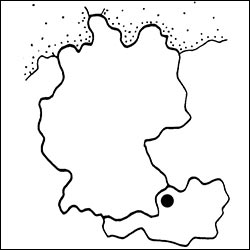
In the mountains just outside Salzburg is Berchtesgaden, a German alpine town that was once a favorite of Adolf Hitler but today thrills a better class of nature lover.
PLANNING YOUR TIME
While Salzburg doesn’t have blockbuster museums, the town itself is a Baroque showpiece of cobbled streets and elegant buildings—a touristy stroller’s delight. If you’re a fan of the movie, allow half a day for the Sound of Music tour, which kills a nest of sightseeing birds with one ticket (city overview, S.O.M. sights, and a fine drive into the countryside by idyllic lakes).
You’d probably enjoy at least two nights in Salzburg—with one evening in an atmospheric beer garden and another to attend a concert in a Baroque hall or chapel. Seriously consider one of Salzburg’s many musical events, even if you’re not normally a concertgoer (some are free).
When the weather’s good, take advantage of the city’s proximity to alpine splendor. Bike down the river or hike across the Mönchsberg, Salzburg’s mini mountain. Or consider visiting scenic Berchtesgaden, just 15 miles away, in Germany (also the site of Hitler’s Eagle’s Nest; see the end of this chapter).
A day trip from Salzburg to Hallstatt (the small-town highlight of the Salzkammergut Lake District) is doable by car (1.5 hours each way) but makes for a very long day by public transit (five hours round-trip). An overnight in Hallstatt is better (or take a bus tour; see here).
Salzburg, Austria
Today, eight million tourists crawl Salzburg’s cobbles each year. That’s a lot of Mozart balls—and all that popularity has led to a glut of businesses hoping to catch the tourist dollar. Still, Salzburg is both a must and a joy.
Even without Mozart and the Von Trapps, Salzburg is steeped in history. In about AD 700, a Bavarian duke summoned Bishop Rupert (later St. Rupert) to help Christianize the area, and it was Rupert who founded Salzburg and its first church/monastery. For centuries, Salzburg remained an independent city-state, ruled by prince-archbishops—a cross between a king and a pope, but less powerful than either one. Salzburg’s mighty fortress—looming protectively over the city—helped deter invaders.
At its peak, Salzburg controlled a sizable autonomous state. Its power was funded by salt—the “white gold” of the day. It’s said one barrel of salt was worth the cost of one house.
Salzburgers enjoy throwing around the names of their obscure prince-archbishops (who built various fanciful palaces and elegant squares), but only one is worth remembering: Wolf Dietrich von Raitenau (1559-1617). It was his vision of making Salzburg a mini Rome north of the Alps that gave the city an Italian flair and created much of what tourists enjoy today.
Napoleon finally put an end to Salzburg’s independence in 1803 (they handed him the keys to the fortress without putting up a fight). Then, after the fall of Napoleon, Salzburg became part of Austria and was ruled by Vienna.
Thanks in part to its formidable fortress, Salzburg managed to avoid the ravages of war for 1,200 years...until World War II. Allied bombing destroyed much of the city (especially around the train station), but the historic Old Town survived.
Music lovers adore Salzburg, where you can shell out for classy performances...or are just as likely to hear musicians practicing through an open window. The city also has a beautiful setting, wrapped in alpine wonder; a stout castle with great panoramas over a meadow ringed with dramatic alpine slopes; a tidy—almost sterile—Old Town of interlocking squares and Baroque domes, giving it a nearly Italian feel; some engaging museums; and, overall, the most accessible taste of Austria you’ll find anywhere.
Orientation to Salzburg
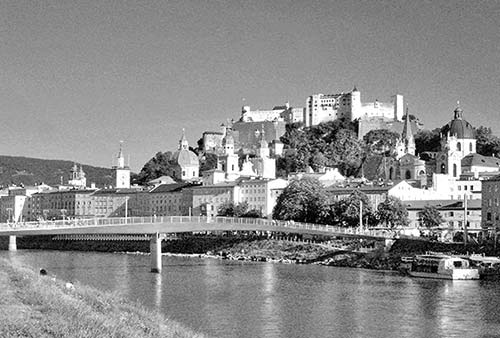
Salzburg, a city of 150,000 (Austria’s fourth largest), is divided in half by the Salzach River. The Old Town (Altstadt), between the river and the little Mönchsberg mountain, holds nearly all the charm and most of the tourists. The New Town (Neustadt) has the train station, a few sights and museums, and some good accommodations.
TOURIST INFORMATION
Salzburg’s TI (+43 662 889 870, www.salzburg.info) has two helpful branches: at the train station (daily 9:00-17:00, until 18:00 in summer) and on Mozartplatz in the old center (daily 9:00-18:00, July-Aug often until 19:00, closed Sun in winter).
At either TI, you can pick up a free city map (ask for the one with broader coverage if biking out of town), a free bus map (Liniennetz), and an events guide. Inside the Mozartplatz TI is the privately run Salzburg Ticket Service counter, where you can book concert tickets.
Salzburg Card: Hotels and TIs sell the Salzburg Card, which covers all public transportation (including the Mönchsberg elevator and funicular to the fortress) and admission to all the city sights (including Hellbrunn Palace and a river cruise). As Salzburg’s sights are pricey, the card can be a money saver, and it’s also a convenience. Do the math on the places you want to visit; the card makes financial sense if you’ll be seeing two major sights on a single day, or three sights over two days. You can also buy the card online before your trip (€30/24 hours, €39/48 hours, €45/72 hours, cheaper off-season, half-price for kids ages 6-15, www.salzburg.info).
ARRIVAL IN SALZBURG
By Train
The Salzburg station has tourist information, luggage lockers, a pay WC (by platform 5), and a handy Spar supermarket. Ticket counters and ticket machines for both the Austrian and German railways are off the main hall. To find the TI, follow the green-and-white information signs (the blue-and-white ones lead to a railway “InfoPoint”). Next to the train station is Forum 1, a sizable shopping mall.
Getting downtown from the station is a snap. Simply step outside, find bus platform C (labeled Zentrum-Altstadt), and buy a ticket from the machine (€2.20 Stundenkarte). Buses #1, #3, #5, and #6 all do the same route into the city center before diverging. Bus #25 (from platform B) follows the same path to the center and continues to Hellbrunn Palace. For most sights and Old Town hotels, get off just after the bridge (either Rathaus or Hanuschplatz, depending on the bus). For my recommended New Town hotels, get off at Makartplatz, just before the bridge.
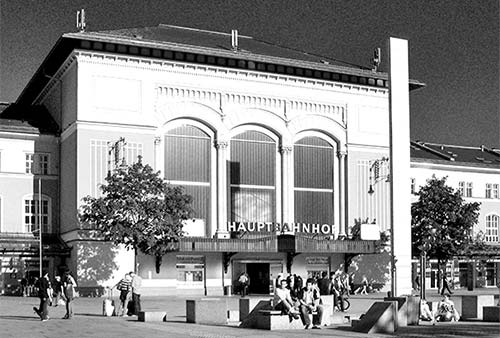
A taxi from the station to most hotels is about €8.
To walk downtown (15 minutes), turn left as you leave the station, and walk straight down Rainerstrasse, which leads under the tracks past Mirabellplatz, turning into Dreifaltigkeitsgasse. From here, you can turn left onto Linzer Gasse for many of my recommended New Town hotels, or cross the river to the Old Town. For a slightly longer but more dramatic approach, leave the station the same way but follow the tracks to the river, turn left, and walk the riverside path toward the hilltop fortress.
By Car
Mozart never drove in Salzburg’s Old Town, and neither should you. Carefully heed the Rising Bollards signs at the entrances to pedestrian zones—they mean business. (The hydraulic bollards are designed to destroy the car of anyone who tries to sneak through the gates behind a car with permission.)
Park-and-Ride with a Vignette: With an Austrian toll sticker (vignette), the best place to park is the park-and-ride lot at the Alpensiedlung bus stop, near the Salzburg Süd autobahn exit. Get off the A-10 expressway at Salzburg-Süd and follow road 150 in the direction of Anif. Stay straight for about 2.5 miles, following P+R signs, to arrive at the park-and-ride (€6/24 hours, see map on here). From the adjacent bus stop, catch bus #3 or #8 into town (buy bus tickets from machines at the stop; for ticket info, see “Getting Around Salzburg,” later). Groups of three or more on a quick visit save by buying a €15 combo-ticket from the parking lot attendant, which covers 24 hours of parking plus a 24-hour group transit pass (anyone who splits off from the group will need to pay for transport separately).
Park-and-Ride without a Vignette: Consider the big park-and-ride lot at the Messe (convention center), along the stretch of expressway on the north side of the city where the vignette isn’t required. This lot also works well during the Salzburg Festival. For information, see Salzburg.info and search for “P+R Messe.”
Central Parking: The easiest, cheapest, most central parking lot is the 1,300-car Altstadtgarage, in the tunnel under the Mönchsberg (€22/day, note your slot number and which of the twin lots you’re in). Your hotel may provide discounted parking passes. If staying in Salzburg’s New Town, the Mirabell-Congress garage makes more sense (see here for directions).
By Plane
Salzburg’s airport sits close to the city center, on the other side of the Mönchsberg mountain (code: SZG, +43 662 85800, www.salzburg-airport.com). An info center there provides basic tourist information and sells the Salzburg Card.
A taxi into town runs about €15. To take a bus, cross the parking lot to the row of bus stops: Bus #10 goes to the Old Town (20 minutes); bus #2 goes to the train station, then terminates at Mirabellplatz (near several of my New Town accommodations; about 30 minutes). For either bus, buy a €2.20 Stundenkarte ticket at the machine, or pay the driver €3 (each bus runs every 10 minutes, less frequent on Sun).
HELPFUL HINTS
Driving in Austria: Austria requires a vignette toll sticker for using its expressways; for details, see “Route Tips for Drivers” on here.
Festivals: The Salzburg Festival runs each year from mid-July to the end of August (for more details on this and other big annual musical events, see here). In mid-September, the St. Rupert’s Fair (Ruperti-Kirtag), celebrating Salzburg’s favorite saint, fills the sky with fireworks and Salzburg’s Old Town with music and food stands (www.rupertikirtag.at). And from mid-November throughout Advent, Salzburg boasts a handful of Christmas markets—the biggest sprawling across Domplatz and Residenzplatz (www.christkindlmarkt.co.at), with smaller ones up at the fortress (mostly just Fri-Sun), on Mirabellplatz (daily) and elsewhere around town (www.weihnachtsmarkt-salzburg.at).
Laundry: A dry cleaner with a few self-serve laundry machines, Norge Exquisit is at Paris-Lodron-Strasse 16, at the corner of Wolf-Dietrich-Strasse, near my recommended Linzer Gasse hotels—take bus #2, #4, or #21 to the Wolf-Dietrich-Strasse stop (self-service or same-day full-service, Mon-Fri 7:30-18:00, Sat 8:00-12:00, closed Sun, +43 662 876 381). If they’re closed, head for My Laundry, three stops from the train station on the #1 or #2 bus; board from platform D at station, get off at the Gaswerkgasse stop (daily 6:00-22:00, Ignaz-Harrer-Strasse 32, +43 664 437 2492). See the map on here for locations.
Market Days: Pop-up farmers markets are a fun local tradition and ideal for picking up picnic supplies or artisan trinkets. The Grünmarkt at Universitätsplatz in the Old Town runs Monday-Friday (7:00-19:00) and is bigger, expanding onto Wiener-Philharmoniker Gasse, on Saturday (7:00-13:00). Around the Andräkirche and Mirabellplatz in the New Town on Thursday (6:00-14:00) is the huge Schrannenmarkt, selling regional gifty products and produce. Salzburg’s longest-running market, dating from 1906, this is a fun and worthwhile scene. The Salzach Galerien, with arts-and-crafts booths and food, stretches along the south side of the river between Makartsteg and Müllnersteg bridges on most summer weekends (10:00-20:00).
Walk of Modern Art: About 20 years ago, intending to “bring art to the public,” Salzburg invited 13 artists from around the world to create pieces for Salzburg’s public spaces. The result: 13 fun and stimulating modern art displays that form a circuit through the Old and New towns. The TI has more details and a map.
Morning Joggers: Salzburg is a great place for jogging. Within minutes you can be huffing and puffing “The hills are alive...” in green meadows outside of town. The obvious best bets in town are through the Mirabell Gardens along its riverbank pedestrian lanes. Mönchsberg, the hill above town, is a wooded delight laced with lanes and trails for joggers.
Public Swimming Pool: The city-run, open-air Freibad Leopoldskron complex, a 10-minute ride from Hanuschplatz on bus #23, sits across the lake from Leopoldskron Palace (of Sound of Music fame). It’s a first-class place for a swim while surrounded by nature, and it’s on the hop-on, hop-off bus route because of the palace’s connection to the movie (€5, May-mid-Sept daily 9:00-19:00, can close Sun in bad weather, Leopoldskronstrasse 50, +43 662 829 265, www.salzburg.info). The Paracelsusbad is an indoor pool and sauna in the New Town, near Mirabellplatz (open daily, Auerspergstrasse 2, www.paracelsusbad.at).
GETTING AROUND SALZBURG
By Bus: Most Salzburg sights I list are within the Kernzone (core zone) of the city’s extensive bus system. Buy bus tickets before boarding at a Tabak/Trafik shop or ticket machine (at major stops such as Hanuschplatz and the train station). Your main options are a one-hour ticket good for unlimited transfers (Stundenkarte, €2.20); a 24-hour pass which pays for itself with the third ride (Tageskarte, €4.50); and a weekly pass good for seven calendar days (Wochenkarte, €19). Remember to validate your ticket by inserting it in the machine on board.
Get oriented using the widely available, free bus map (Liniennetz). Many lines converge at Hanuschplatz, on the Old Town side of the river, between the Makartsteg and Staatsbrücke bridges. To get from the Old Town to the train station, catch bus #1 from the inland side of Hanuschplatz. From the other side of the river, find the Makartplatz/Theatergasse stop and catch bus #1, #3, #5, or #6. Busy stops like Hanuschplatz and Mirabellplatz have several bus shelters; look for your bus number.
For more information, visit Salzburg-Verkehr.at, call +43 662 632 900 (answered 24/7), or visit the transit info office downstairs from bus platform C in front of the train station (Mon-Fri 7:00-17:00, closed Sat-Sun).
By Bike: Salzburg is great fun for cyclists. A’Velo Radladen rents bikes on the Old Town side of the Staatsbrücke (the main bridge) (€14/4 hours, €20/24 hours, more for electric or mountain bikes, RS%—10 percent off with this book; daily 9:30-18:00, possibly later in summer, closed Nov-March and in bad weather; passport number for security deposit, +43 676 435 5950, www.avelo.at, run by George). Some of my recommended hotels and pensions also rent or loan bikes to guests.
By Funicular and Elevator: The Old Town is connected to the top of the Mönchsberg mountain (and great views) via funicular and elevator. The funicular (Festungsbahn) whisks you up into the imposing Hohensalzburg Fortress (included in castle admission, goes every few minutes). The elevator (Mönchsbergaufzug) on the west side of the Old Town lifts you to the recommended Stadtalm Café, the Museum of Modern Art and its chic café, wooded paths, and more great views (for details on both options, see here).
By Buggy: The horse buggies (Fiaker) that congregate at Residenzplatz charge €52 for a 25-minute trot around the Old Town (www.salzburg.info, search for “Carriage Rides”).
Tours in Salzburg
IN SALZBURG
Walking Tours
Any day of the week, you can take a one-hour, informative guided walk of the Old Town without a reservation—just show up at the TI on Mozartplatz at the tour time and pay the guide (€10, daily at 12:15 and sometimes at 14:00, +43 664 340 1757, Frau Schneeweiss).
To save money (and probably learn more), use this chapter’s self-guided walk or  download my free Salzburg Town Walk audio tour.
Local Guides
Salzburg has many good guides (for a list, see www.salzburgguides.at). Four I have worked with and enjoyed:
Gertraud Kamml (€170/3 hours, €220/4 hours, +43 664 352 6329, www.kunstschreibwerkstatt.com, gertraud@kamml.eu).
Sabine Rath (€175/2 hours, €260/4 hours, €400/8 hours, +43 664 201 6492, www.tourguide-salzburg.com, info@tourguide-salzburg.com).
Anna Stellnberger (€160/2 hours, €240/4 hours, €350/8 hours, +43 664 787 5177, anna.stellnberger@aon.at).
Michaela Muhr does walks and private three-hour food tours that include tastings that vary by season (€230 for 2-10 people plus €35/person for five tastings, +43 699 1882 0001, info@salzburg-experience.at).
Boat Tours
City Cruise Line (a.k.a. Stadt Schiff-Fahrt) runs a basic 40-minute round-trip river cruise with recorded commentary (€16, 3-4/day April-Oct, no boats Nov-March). For a longer cruise, ride to Hellbrunn (€18 one-way, €38 includes palace admission and a ride back to the Old Town on a double-decker bus; April-Oct most days at 14:00, 40 minutes one-way). Boats leave from the Old Town side of the river just downstream of the Makartsteg bridge (+43 662 825 858, www.salzburghighlights.at).
Hop-On, Hop-Off Bus
While most of Salzburg’s top sights are concentrated in its walkable Old Town, several are scattered around the city—making a hop-on, hop-off bus tour practical here. This one stretches into the outskirts, hitting Hellbrunn Palace and several Sound of Music sights (€25/1 day, €30/2 days; includes all-day transit pass for city buses, 1-2 buses/hour, buy tickets and start tour at Mirabellplatz 2, +43 662 881 616, www.salzburg-sightseeingtours.at).
Segway Tours
This can be an efficient, fun way to cover a lot of ground. Choose a 1.5-hour version that combines a city tour with a trip up the Mönchsberg mountain (€49), or the two-hour version that also heads into the nearby countryside (€65). Reserve ahead (April-Oct Wed-Sun 3/day, Nov-March Wed-Sat 1/day depending on weather; office near recommended New Town hotels at Wolf-Dietrich-Strasse 3, +43 676 674 4425, www.segway-salzburg.at).
▲▲The Sound of Music Tours
Salzburg is the joyful setting of The Sound of Music. The Broadway musical and 1965 movie tell the story of a stern captain who hires a governess for his unruly children and ends up marrying her. Though the movie took plenty of Hollywood liberties (see “The Sound of Music: Fact and Fiction” sidebar), it’s based on the actual Von Trapp family from Austria. They really did come from Salzburg. Maria really was a governess who became the captain’s wife. They did sing in the Festival Hall, they did escape from the Nazis, and they ended up after the war in Vermont, where Maria passed away in 1987. The movie screens nightly at the recommended International Youth Hostel (nonguests welcome; details on here).
Salzburg has a number of Sound of Music sights—mostly locations where the movie was shot, but also some places associated with the real Von Trapps:
• Mirabell Gardens, with its arbor and Pegasus statue, where the kids sing “Do-Re-Mi.”
• Festival Hall, where the real-life Von Trapps performed, and where (in the movie) they sing “Edelweiss” after nervously waiting in the Toscaninihof courtyard.
• St. Peter’s Cemetery, the inspiration for the scene where the family hides from Nazi guards (it was actually filmed on a Hollywood set).
• Nonnberg Abbey, where the nuns sing “How Do You Solve a Problem like Maria?”
• Leopoldskron Palace, which serves as the Von Trapps’ idyllic lakeside home in the movie (though it wasn’t their actual home).
• The iconic arcaded stage of the Felsenreitschule concert hall, the setting for the Von Trapp family’s final public performance in the movie.
• Hellbrunn Palace gardens, now home to the famous gazebo where Liesl, the Von Trapp’s oldest daughter, sings the words, “I am sixteen going on seventeen.”
There are many more sights—the horse pond, the wedding church in Mondsee, the fountain in Residenzplatz. Since they’re scattered throughout greater Salzburg, taking a tour is the best way to see them efficiently.
Rather than visit the real-life sights from the life of Maria von Trapp and family, most tourists want to see the places where Hollywood chose to film this fanciful story. Local guides are happy not to burst any S.O.M. pilgrim’s bubble, but keep these points in mind:
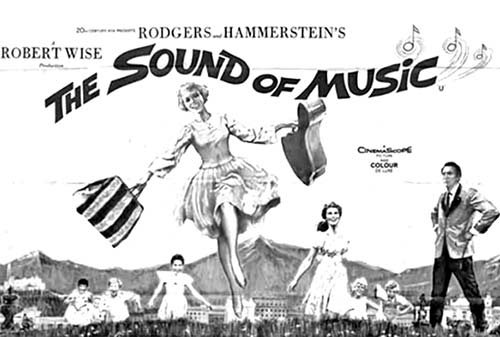
“Edelweiss”: The song is not a cherished Austrian folk tune or national anthem. Like all the “Austrian” music in S.O.M., it was composed for Broadway by Rodgers and Hammerstein.
Religious Calling: S.O.M. implies that Maria was devoutly religious throughout her life, but Maria’s foster parents raised her as a socialist and atheist. Maria discovered her religious calling while studying to be a teacher. After completing school, she entered the convent as a novitiate.
Job Description: Maria’s position was not as governess to all the children, but specifically as governess and teacher for the Captain von Trapp’s second-oldest daughter, also called Maria, who was bedridden with rheumatic fever.
Whistling: The captain didn’t run a tight domestic ship—but he did use a whistle to call his children—each kid was trained to respond to a certain pitch.
Name Changes: Though the Von Trapp family did have seven children, the show changed all their names and even their genders. As an adult, Rupert, the eldest child, responded to the often-asked question, “Which one are you?” with “I’m Liesl!” Maria and the captain later had three more children together.
Escape: The family didn’t escape by hiking to Switzerland (which is a five-hour drive away). Rather, they pretended to go on one of their frequent mountain hikes. With only the possessions in their backpacks, they “hiked” all the way to the station at the edge of their estate and took a train to Italy. The movie scene showing them climbing into Switzerland was filmed near Berchtesgaden, Germany...home to Hitler’s Eagle’s Nest, and certainly not a smart place to flee to.
Family Home: The actual Von Trapp house exists...but it’s not the one in the film. The mansion in the movie is actually two different buildings—one used for the front, the other for the back. The interiors were filmed on Hollywood sets. And the much-vaunted “Sixteen Going on Seventeen” gazebo you’ll see at Hellbrunn Palace was built just for the movie, then moved twice to reach its current location.
Set Shots: For the film, Boris Levin designed a reproduction of the Nonnberg Abbey courtyard so faithful to the original (down to its cobblestones and stained-glass windows) that many still believe the cloister scenes were really shot at the abbey. And no matter what you hear in Salzburg, the graveyard scene (in which the Von Trapps hide from the Nazis) was also filmed on the Fox lot.
Swindled!: In 1956, a German film producer offered Maria $9,000 cash for the rights to her book. Because it was more money than the family had seen in all their years of singing, she accepted the deal. The agent claimed that German law forbids film companies from paying royalties to foreigners (Maria had by then become a US citizen). She agreed to the contract and unknowingly signed away all film rights to her story. Later, she discovered the agent had swindled the family—no such law existed.
Restitution: Rodgers, Hammerstein, and other producers gave the Von Trapps a percentage of the royalties, even though they weren’t required to—but it was a fraction of what they otherwise would have earned. But Maria wasn’t bitter. She said, “The great good the film and the play are doing to individual lives is far beyond money.”
I took a S.O.M. tour skeptically (as part of my research)—and enjoyed it. The bus tour version includes a quick general city tour, hits the S.O.M. spots, and shows you a lovely stretch of the Salzkammergut Lake District. Warning: Many think rolling through the Austrian countryside with 30 Americans singing “Doe, a deer...” is pretty schmaltzy. Locals don’t understand all the commotion (many have never seen the movie). Guides are professional but can be (understandably) jaded.
Taking a Tour: Two companies do S.O.M. tours by bus (Bob’s and Panorama), while a third company does a bike version. It’s best to reserve ahead. Note: Your hotel will be eager to call to reserve for you—to get their commission—but you won’t get the discount I’ve negotiated.
By Minibus: Most of Bob’s Special Tours use an eight-seat minibus (and occasionally a 16-seat bus) and therefore promote a more laid-back camaraderie with your fellow S.O.M. pilgrims, and waste less time loading and unloading. Online bookings close three days prior to the tour date—after that, email, call, or stop by the office to reserve (€55 for adults; RS%—student price with this book if you pay cash and book directly, €50 for kids 7-21 and students with ID, €45 for kids 6 and under—includes required car seat but must reserve in advance; daily at 9:00 and 14:00 year-round, tours leave from Bob’s office along the river just east of Mozartplatz at Rudolfskai 38, +43 662 849 511, www.bobstours.com, office@bobstours.com).
By Big Bus: Panorama Tours uses larger buses that depart from their smart kiosk at Mirabellplatz daily at 9:15 and 14:00 year-round (€50, RS%—€5 discount for S.O.M. tours if you pay in cash and book by phone or in person, book by calling +43 662 874 029 or +43 662 883 2110, www.panoramatours.com). While they lack the personal touch of Bob’s, Panorama’s big buses have a higher vantage point, and the guides have a more polished (some might say too polished) spiel.
By Bike: Fräulein Maria’s Bicycle Tour offers some exercise—and much better access to the in-town sights, which are skipped or viewed from afar on the bus tours. Meet your guide (more likely a Herr than a Fräulein) at the Mirabell Gardens (at Mirabellplatz 4, 50 yards to the left of palace entry). The main attractions of the eight-mile pedal include the Mirabell Gardens, the horse pond, St. Peter’s Cemetery, Nonnberg Abbey, Leopoldskron Palace, and, of course, the gazebo. The tour is very family-friendly, and there’ll be lots of stops for goofy photo ops (€40 includes bike, €25 for kids 13-18, €20 for kids under 13, RS%—€2 discount with this book; daily April-Oct at 9:30, June-Aug also at 16:30, allow 3.5 hours, reservations required, +43 650 342 6297, www.mariasbicycletours.com).
BEYOND SALZBURG
Both Bob’s and Panorama Tours offer day trips from Salzburg (such as Berchtesgaden/Eagle’s Nest, salt mines, Hallstatt, and Salzkammergut lakes and mountains). One efficient tour worth considering is Bob’s full-day Sound of Music/Hallstatt Tour, which first covers everything in the standard four-hour S.O.M. tour, then continues for a four-hour look at the scenic, lake-speckled Salzkammergut, with free time to explore charming Hallstatt (€110, RS%—student price with this book if you pay cash and book directly; doesn’t include entrance fees to optional Hallstatt activities such as boat ride; departs daily at 9:00; Rudolfskai 38, +43 662 849 511, www.bobstours.com, office@bobstours.com).
Salzburg Town Walk
4 Residenz
6 Salzburg Cathedral (Salzburger Dom)
8 Waterwheel (Wasserrad) and the Alm River Canal (Almkanal)
9 St. Peter’s Cemetery (Petersfriedhof)
10 St. Peter’s Abbey and Church
11 Toscaninihof
16 Alter Markt
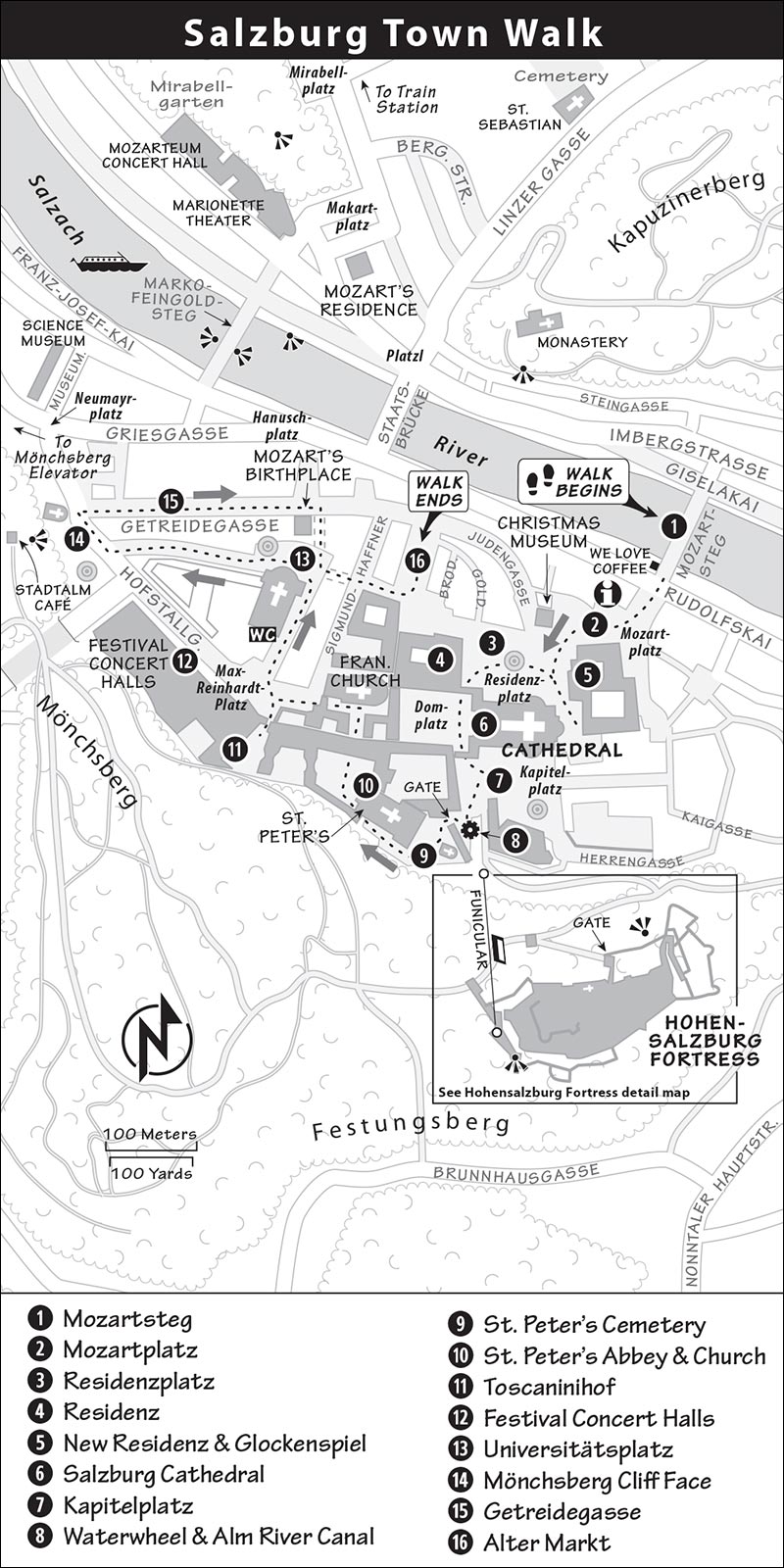
I’ve linked the best sights in the Old Town into this handy self-guided orientation walk (rated ▲▲▲). Allow about two hours.
Download my free Salzburg Town Walk audio tour if you’d like me to join you on this fascinating stroll.
• Begin at the Mozartsteg, the wrought-iron, Art Nouveau pedestrian bridge built in 1903 over the Salzach River.
1 Mozartsteg
Get your bearings: The milky green Salzach River thunders under your feet. On the north bank is the New Town. The south side is the Old Town, dominated by a castle on a hill.
Take in the charming, well-preserved, historic core of Salzburg’s Old Town. The skyline bristles with Baroque steeples and green copper domes. Salzburg has 38 Catholic churches, plus two Protestant churches and a synagogue. The biggest green dome is the cathedral, which we’ll visit shortly. Overlooking it all is the castle called Hohensalzburg Fortress—beefed up with the threats that came with the Thirty Years’ War in the 17th century. Far to the right of the fortress, find the Museum of Modern Art—a blocky modern building atop the hill. The castle-like structure behind it is a water reservoir.
The Salzach is called “salt river” not because it’s salty, but because of the precious cargo it once carried. The salt mines of Hallein are 12 miles upstream. For 2,000 years, barges carried salt from here to the wider world—to the Danube, the Black Sea, and on to the Mediterranean. As barges passed through, they had to pay a toll on their salt. The city was made great from the trading of salt (Salz) defended by a castle (Burg)—“Salz-burg.”
The embankments and roads were built when the river was regulated in the 1850s. Before that, the Salzach was much wider and slower moving. Houses opposite the Old Town fronted the river with docks and boathouses.
Looking upstream, notice the peak with the TV tower. This stands atop the 4,220-foot-high Gaisberg hill. The summit is a favorite destination for local nature lovers, strong bikers, and parasailers.
By the way, the bridge’s tollhouse is now We Love Coffee, the smallest coffee shop in town, enthusiastically run by Jane (pronounced YEA-nuh).
• Now let’s plunge into Salzburg’s Old Town. From the bridge, walk one block toward the hill-capping castle into the Old Town.
Leaving the bridge, notice the remains of the 17th-century town wall—called Michaelstor (with gun holes). It was built in 1620 when Salzburg cleverly barricaded itself with a wall and neutrality to avoid the tumult of the Thirty Years’ War (Catholics vs. Protestants, 1618-1648, which left an estimated third of Germany dead).
• Pass the traffic barriers (that keep this quiet town free of too much traffic) and turn right into a big square, called...
2 Mozartplatz
This square is named for the man honored by the central statue—Wolfgang Amadeus Mozart. The great composer was born a few blocks from here and spent most of his first 25 years (1756-1781) in Salzburg. He and his father both served Salzburg’s rulers before Wolfgang went on to seek his fortune in Vienna. The statue (considered a poor likeness) was erected in 1842, just after the 50th anniversary of Mozart’s death. This date could be considered the start of the cult of Mozart, as a group of enthusiasts (including his widow, Constanze) founded the Salzburg Mozarteum Foundation at about that time, with a mission to popularize and perform his music. A music festival in 1856, on the 100th anniversary of Mozart’s birth, planted the seed for what would become the world-renowned Salzburg Festival. Soon, Salzburg would be a stop on the romantic Grand Tour of Europe.
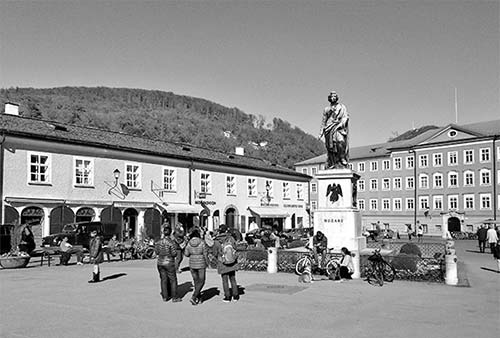
Mozart stands atop the spot where the first Salzburgers settled. Two thousand years ago, the Romans had a salt-trading town here called Juvavum. In the year 800, Salzburg—by then Christian and home to an important abbey—joined Charlemagne’s Holy Roman Empire as an independent city. The first market was on this square and the city developed from here. The Church of St. Michael (whose pastel tower overlooks the square) dates from that time. It’s Salzburg’s oldest, if not biggest, parish church.
Facing the square is the Salzburg Christmas Museum, which traces Christmas traditions from 1840 to 1940 (described on here).
As you dodge the traditional horse-drawn carriages, it’s fun to remember that they were the standard mode of transportation in Mozart’s day—in fact, until the advent of cars.
• Before moving on, note the TI (which also sells concert tickets). The entrance to the Salzburg Museum is across the square (described on here). Now walk toward the cathedral and into the big square with the huge fountain.
3 Residenzplatz
As Salzburg’s governing center, this square has long been ringed with important buildings. The cathedral dominates. The Residenz—the former palace of Salzburg’s rulers—is to the right (as you face the cathedral). To the left is the New Residenz, with its bell tower.
In the 1600s, this square got a makeover in the then-fashionable Italian Baroque style. The rebuilding started under energetic Prince-Archbishop Wolf Dietrich, who ruled from 1587 to 1612. Dietrich had been raised in Rome. He counted the Medicis as his cousins and had grandiose Italian ambitions for Salzburg. Conveniently for him, the existing cathedral burned down in 1598. Dietrich set about rebuilding it as part of his grand vision to make Salzburg the “Rome of the North.”
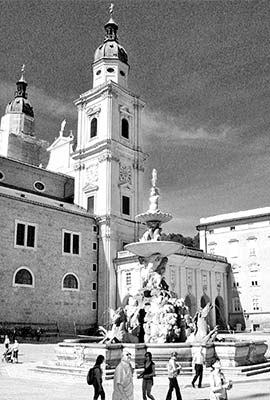
The fountain is as Italian as can be, an over-the-top version of Bernini’s famous Triton Fountain in Rome. Triton, on top, blows his conch-shell horn as water cascades down the basins and sprays playfully in the wind.
Notice that Salzburg’s buildings are made from three distinctly different types of stone. Most common is the chunky gray conglomerate rock (like the cathedral’s side walls) quarried from the nearby cliffs. There’s also white marble (like the cathedral’s towers and windows) and red marble (best seen in monuments inside buildings), both from the Alps near Berchtesgaden.
• Turn your attention to the building on the right, the...
4 Residenz
This was the palace of Salzburg’s powerful ruler, the prince-archbishop—a ruler with both the political powers of a prince and the religious authority of an archbishop. The ornate Baroque entrance (with the prince-archbishop’s proud coat of arms) attests to the connections these rulers had with Rome. You can step inside the Residenz courtyard to get a glimpse of the impressive digs (to see the fancy interior with state rooms and an impressive collection of paintings, you must buy a DomQuartier ticket—see here).
Notice the white-stone skyway connecting the Residenz with the cathedral, providing a physical reminder of how the prince-archbishop had both religious and secular power. This passageway gave the prince-archbishops an easy commute to church and a chance to worship while avoiding the public.
• At the opposite end of Residenzplatz from the Residenz is the...
5 New (Neue) Residenz
In the days of the prince-archbishops, this building hosted parties in its lavish rooms. Today, the New Residenz houses both the Salzburg Museum and the Panorama Museum (see “Sights in Salzburg”). It’s also home to the Heimatwerk, a fine shop showing off top-quality traditional dirndls, sweaters, and more.
The New Residenz bell tower has a hard-working glockenspiel. This 18th-century carillon has 35 bells (cast in Antwerp) and chimes daily at 7:00, 11:00, and 18:00. It also plays little tunes appropriate to the season. The mechanism is a big barrel with adjustable tabs that turns like a giant music box, pulling the right bells in the right rhythm. (Twice-weekly German-language tours let you get up close to watch the glockenspiel action: €4.50, April-Oct Thu at 17:30 and Fri at 10:30, no tours Nov-March, register by phone or email, +43 662 620 808 723, kunstvermittlung@salzbergmuseum.at; tours meet at Panorama Museum, ask for English handout.)
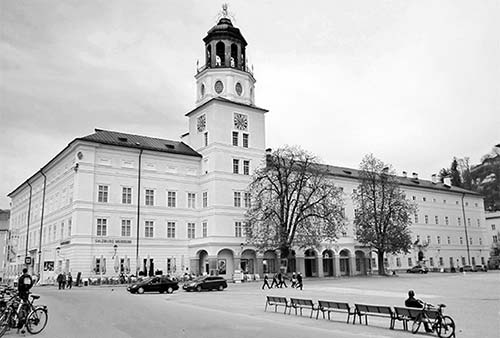
Notice the tower’s ornamental top: an upside-down heart in flames surrounds the solar system, representing how God loves all of creation.
Residenzplatz sets the tone for the whole town. From here, a series of interconnecting squares make a grand procession through the Old Town. Everywhere you go, you’ll see similar Italianate architecture.
As you walk from square to square, notice how easily you slip from noisy and commercial to peaceful and reflective. But it wasn’t always so charming and peaceful. On Residenzplatz in 1938, a huge crowd—responding to the promise of jobs and the scapegoating of immigrants and minorities—welcomed Hitler’s Nazi takeover and celebrated the Anschluss (the “unification” of Germany and Austria).
• Exit the square by walking under the prince-archbishop’s skyway. You’ll step into Domplatz (Cathedral Square). For a good place to view the cathedral facade, walk to the far end of the square.
6 Salzburg Cathedral (Salzburger Dom)
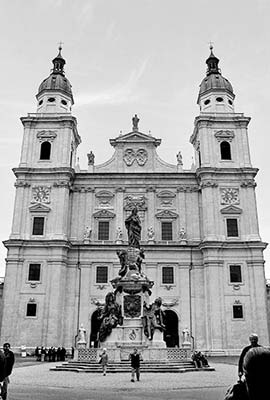
Salzburg’s cathedral (rated ▲▲) was one of the first Italian Baroque buildings north of the Alps, built thanks to a 10 percent tax on all salt traded here. The dome stands 230 feet high, and two domed towers flank the very Italianesque entrance.
The church was consecrated in 1628. As it dates from the years of Catholic-Protestant warfare, it may have been meant to emphasize Salzburg’s commitment to the Roman Catholic cause. Or it may have represented a peaceful alternative to the religious strife. Regardless, Salzburg’s archbishop was the top papal official north of the Alps, and the city was the pope’s northern outpost. With its rich salt production, Salzburg had enough money to stay out of the conflict and earn the nickname “The Fortified Island of Peace.”
The cathedral was the center of power for the prince-archbishop in his religious role, and the government buildings surrounding it served his needs as a secular prince.
Cost and Hours: €5, Mon-Sat 9:00-18:00, Sun from 13:00, audioguide-€3, www.salzburger-dom.at [URL inactive]. If the Jedermann theater production is underway (July and Aug), you’ll find a 1,500-seat temporary theater filling the cathedral square, changing or closing the entry to the church for some hours.
Tours and Concerts: Cathedral tours are offered in English daily at 14:00 for €5 and 30-minute organ concerts are held daily at noon for €6. Tickets include admission to the church—so if you’re going to visit the church anyway, they are nearly free.
Visiting the Cathedral: Before entering the cathedral, step back to admire the facade. Notice the play on perspective that occurs when you line up the statue of Mary (in the center of the square) with the two angels (on the center of the facade): They can be seen as crowning her as the queen of heaven. In fact, for a fun photo op, find the exact spot where the gilded crown sits atop your head too.
Now that you’re properly crowned, read the facade like a Bible of stone: Jesus is on top, Moses and Elijah—representing the Old Testament—are next (with the coats of arms of two prince-archbishops in between). Below that are the four evangelists (Matthew, Mark, Luke, and John) and at the bottom are the fathers of the Salzburg church mixing it up with the fathers of St. Peter’s Basilica in Rome (left to right): St. Rupert (with his salt cask), Peter (with his keys), Paul (with his sword), and St. Virgil (with a model of Salzburg’s first cathedral from 774).
As you approach the church, pause at the iron gates. The dates on the doors are milestones in the church’s history. In the year 774, the first church, built in Romanesque style, was consecrated by St. Virgil, an Irish monk who became Salzburg’s bishop. It was destroyed by fire in 1167, rebuilt, and then burned again in 1598. It was replaced in 1628 by the one you see today. The year 1959 marks the completion of repairs after a WWII bomb severely damaged the dome.
Because it was built in just 14 years (from 1614 to 1628), the church boasts an unusually harmonious Baroque architecture. And it’s big—330 feet long, 230 feet tall—built with sturdy pillars and broad arches. When Pope John Paul II visited in 1998, some 5,000 people packed the place.
As you enter, imagine being part of a sacred procession. You’d pass from the relatively dim entrance to the bright altar with its painting of Christ’s resurrection, bathed in light from the dome overhead. The church never had stained glass, just clear windows to let maximum light power the message.
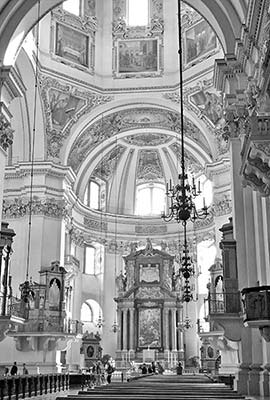
Under the soaring dome, look up and admire the exceptional stucco work, by an artist from Milan. It’s molded into elaborate garlands, angels, and picture frames, some of it brightly painted. You’re surrounded by the tombs (and portraits) of 10 archbishops.
You’re also surrounded by four organs. (Actually, five—counting the biggest organ, over the entrance.) Mozart served as organist here for two years, and he composed several Masses that are still played today. Salzburg’s prince-archbishops were great patrons of music, with a personal orchestra that played religious music in the cathedral and dinner music in the Residenz. The tradition of music continues today. Sunday Mass here can be a musical spectacle—with all five organs playing and balconies filled with singers and musicians, creating glorious surround-sound. Think of the altar in Baroque terms, as the center of a stage, with sunrays serving as spotlights in this dramatic and sacred theater.
Directly under the dome, Roman-numeral plaques commemorate the visits here by Pope John Paul II in 1988 and 1998 (notice the extra X). At the high altar, a reliquary box of black wood, encrusted with silver trim, contains relics of St. Virgil and St. Rupert (who founded the first abbey in town).
In the left transept, descend the stairs into the crypt (and the 8th-century street level). Here, among the remains of the Romanesque cathedral that preceded today’s church, is the resting place of centuries of archbishops and prince-archbishops.
Work your way back to the entrance via the left aisle. In the chapel in the far corner find a dark bronze baptismal font. It dates from 1320—a rare survivor from the medieval-era cathedral (the lid is from 1959). The lions that hold the basin are older yet, from the 12th century—back when this part of Europe didn’t really know what lions looked like. In 1756, little Wolfgang Amadeus Mozart was baptized here. For the next 25 years, this would be his home church. Amadeus, by the way, means “beloved by God.”
Finally, at the collection box by the back pew, black-and-white photos show the bomb damage of October 16, 1944, which left a gaping hole where the dome once was.
Other Cathedral Sights: To learn more about the church, you can visit the Cathedral Museum as part of the DomQuartier Museums tour (see here). In summer, the Cathedral Excavations Museum (Domgrabungsmuseum, outside the church on Residenzplatz and down the stairs) shows off the church’s medieval foundations and a few Roman mosaics—worthwhile only for Roman-iacs (€3.50, daily 9:00-17:00, closed Sept-June, www.salzburgmuseum.at).
• As you leave the cathedral, check out the concert and Mass schedules posted near the entrance. Exiting the cathedral, turn left, heading in the direction of the distant fortress on the hill. You’ll soon reach a spacious square with a golden orb.
7 Kapitelplatz
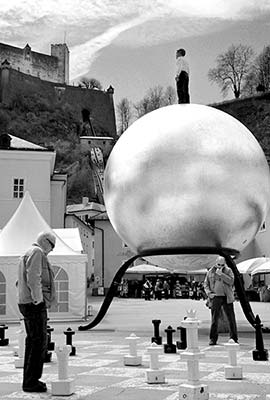
Kapitelplatz is a pleasant square—notice the giant chessboard that often draws a crowd. The playful modern sculpture of a man atop a golden orb is part of Salzburg’s Walk of Modern Art, a project with a mission to bring art to the people—which it certainly does (see here).
Follow the orb-man’s gaze up the hill to Hohensalzburg Fortress. Construction of the fortress began in 1077. Salzburg made it powerful in hopes of not getting caught up in struggles between the German Holy Roman Emperor and the pope. Over the centuries, the small castle grew into a mighty, whitewashed fortress—so impressive that no army even tried attacking for over 800 years. Inside, it housed a virtual village. It was built before the advent of cannon—when defense was stronger than offense—and so needed to be prepared to survive a siege. Its main weakness was that it had no water other than what rain the cistern could collect. (But it did have a huge wine cellar.) These days, you can tour the castle grounds, visit some interior rooms and museums, and enjoy incredible views (for details, see here). The castle’s earliest funicular dates back to the 1500s, when animals pulled cargo up its tracks; today’s funicular is electric, from 1910.
Now walk across the square to the pond surrounded by a balustrade and adorned with a Trevi-fountain-like statue of Neptune. The god of the sea, under another fine coat of arms, rides his seahorse, flanked by tritons. The pond was built as an 18th-century horse-and-buggy wash—like an old-time car wash. Notice the gold lettering above Neptune. It reads, “Leopold the Prince Built Me.” But the artist added a clever twist. The inscription uses the letters “LLDVI,” and so on. Those are also Roman numerals—add ’em up: L is 50, D is 500, and so on. It all adds up to 1732—the year the pond was built.
This square hosts many free events and concerts (including videos of great Salzburg Festival performances on a jumbo screen).
• With your back to the cathedral, leave the square, exiting through the gate in the far-right corner.
8 Waterwheel (Wasserrad) and the Alm River Canal (Almkanal)
The waterwheel is part of a clever, still-functioning canal system built in the 12th century to bring water to Salzburg from the foothills of the Alps, 10 miles away in Bavaria. Where the stream reached Salzburg, a channel was cut through the mountain and divided into five smaller canals for the citizens’ use. The rushing water was harnessed to waterwheels, which powered factories. Salzburg had a hundred watermill-powered firms as late as the 19th century. Residents also used the water to fight fires and, once a week, to flush the streets clean. Hygienic Salzburg never suffered from a plague...it’s probably the only major town in Austria with no plague monument. For more on the canal system, you can visit the nearby Alm River Canal exhibit.
This particular waterwheel (actually, it’s a modern replacement) once ground grain into flour to make bread for the monks of St. Peter’s Abbey. Nowadays, you can pop into the adjacent bakery—fragrant and traditional—and buy a fresh-baked roll for about a euro (most days 8:00-17:30).
• You’ve entered the borders of the former St. Peter’s Abbey, a monastic complex of churches, courtyards, businesses (like the bakery), and a cemetery. Find the Katakomben sign and step through the wrought-iron gates into a lovely cemetery (free, open daily 6:30-20:00, Oct-March until 18:00, silence requested).
9 St. Peter’s Cemetery (Petersfriedhof)
This collection of lovingly tended graves abuts the sheer rock face of the Mönchsberg. Tended by descendants of the deceased, today St. Peter’s Cemetery is calm and filled with love as families visit and little memory gardens blossom with seasonal flowers.
In Austria (and many European countries), gravesites are rented, not owned. Rent bills are sent out every 10 years. If no one cares enough to make the payment, your tombstone is removed. Note the well, used to fill the watering cans for the family members who keep these flowery graves so pretty. At Christmas, candles are lit and families gather to sing carols and be close to lost loved ones.
Walk in about 50 yards past the well to a junction of lanes in the middle of the cemetery. (Stop at the round stone ball on the right—perfect for stretching that stiff back.) You’re surrounded by three churches, each founded in the early Middle Ages atop a pagan Celtic holy site. The biggest church, St. Peter’s, sticking its big Romanesque apse into the cemetery, is our next stop. Notice the fancy tombstones lining the church’s wall.
The cemetery played a role in The Sound of Music. The Captain and his large family were well known in Salzburg for their musical talents. But when Nazi Germany annexed Austria in 1938, the Von Trapps decided to flee so that the father would not be pressed into service again. In the movie, they hid here as they made their daring escape. The scene was actually filmed on a Hollywood set inspired by St. Peter’s Cemetery.
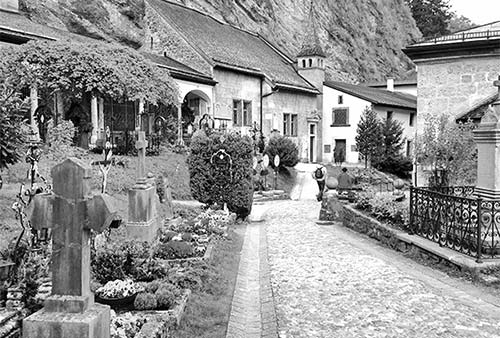
Look up the cliff, which has a few buildings attached—called (not quite accurately) “catacombs.” Legendary hermit-monks are said to have lived in the hillside here 1500 years ago. For a small fee, you can enter the Katakomben and climb lots of steps to see a few old caves, a chapel, and some fine city views (entrance at the base of the cliff, under the arcade—look for #LIV over the arch; €2, visit takes 10 minutes; daily 10:00-12:30 & 13:00-18:00, Oct-April until 17:00).
Explore the arcade at the base of the cliff with its various burial chapels. Alcove #XXI has the tomb of the cathedral architect Santino Solari—forever facing his creation. At the catacombs entry (#LIV) are two interesting tombs marked by plaques on the floor. “Marianne” is Mozart’s sister, nicknamed “Nannerl.” As children, Mozart and his sister performed together on grand tours of Europe’s palaces. Michael Haydn was the brother of Joseph Haydn. He succeeded Mozart as church cathedral organist.
• Exit the cemetery through the green door at the opposite end. Just outside, you enter a large courtyard anchored by...
10 St. Peter’s Abbey and Church
You’re standing at the birthplace of Christianity in Salzburg. St. Peter’s Abbey—the monastery that surrounds this courtyard—was founded in 696, barely two centuries after the fall of Rome. About 20 monks and their abbot still pray and work (ora et labora) here as Benedictines have for over a millennium.
The St. Peter Stiftskulinarium restaurant on the left (known these days for its Mozart Dinner Concert) brags that Charlemagne ate here in the year 803, making it (perhaps) the oldest restaurant in Europe. Opposite the restaurant is the monastery shop with monk-made gifts from around Austria (Klosterladen St. Peter, open 10:00-18:00, closed Sun).
Cost and Hours: Visiting the church is free, daily 8:00-21:00, Nov-March until 19:00, www.stift-stpeter.at.
Visiting the Church: St. Peter’s Church dates from 1147. As you enter, pause in the atrium to admire the Romanesque tympanum (from 1250) over the inner doorway. Jesus sits on a rainbow, flanked by Peter and Paul. Beneath them is a stylized Tree of Life, and overhead, a Latin inscription reading, “I am the door to life, and only through me can you find eternal life.”
Entering the nave, you can understand why this is a popular wedding church in Salzburg. The once purely Romanesque interior (you may find a few surviving bits of faded 13th-century frescoes) now lies hidden under a sugary Rococo finish. It’s Salzburg’s only Rococo interior—all whitewashed, with highlights of pastel green, gold, and red. In the 18th century, the roof was raised and clear windows added for light.
If it feels Bavarian, it’s because it was done by Bavarian artists. The ceiling paintings feature St. Peter receiving the keys from Christ (center painting), walking on water, and joining the angels in heaven.
The monastery was founded by St. Rupert (c. 650-718). Find his statue at the main altar—he’s the second gold statue from the left. Rupert arrived as a Christian missionary in what was then a largely pagan land. He preached the gospel, reopened the Roman salt mines, and established the city. It was he who named it “Salzburg.”
Rupert’s tomb is midway up the right aisle. It’s adorned with a painting of him praying for his city. Beneath him is a depiction of Salzburg circa 1750 (when this was painted): one bridge, salt ships sailing the river, and angels hoisting barrels of salt to heaven.
• Leave the abbey square opposite where you entered. You’ll walk through a similar second square (which now houses a dormitory for theology students) with architectural features from the 1920s. Passing through that square you reach Toscanini square.
11 Toscaninihof
In this small courtyard, you get a peek at the back end of the large Festival Hall complex. The Festival Hall has three theaters and seats 5,000 people (see photo on the wall).
The tunnel leads to the actual concert hall. It’s generally closed, but you might be able to look through nearby doorways and see carpenters building stage sets or hear performers practicing for an upcoming show.
The Von Trapp family performed here in the Festival Hall. In the movie, this backstage courtyard is where Captain von Trapp nervously waited before walking onstage to sing “Edelweiss.” Then the family slipped away to begin their escape from the Nazis.
This square is named for Arturo Toscanini, who was musical director of the Salzburg Festival in the 1930s. He fled to New York in 1937, the year before the Von Trapp family escaped (Toscanini had an easier time).
The Toscaninihof also has the entrance to the city’s huge, 1,500-space, inside-the-mountain parking lot. It originated in 1944 as the Mönchsberg air raid shelter—an underground system that offered 18,000 locals refuge from WWII bombs. The stone stairway in the courtyard leads a few flights up to a panoramic view.
Find the “Woman in the Rock” (looking like a Gothic Madonna in her red dress, above the tunnel). She’s the partner of the little man on the golden orb a few squares back.
• From here, we’ll head across Max-Reinhardt-Platz. But first look to your left, toward the Festival District, with the concert halls that host the annual summer music event.
12 Festival Concert Halls
The Salzburg Festival was started in the austere 1920s, after World War I. As Salzburg couldn’t afford a new concert hall, they remodeled what were once the prince-archbishop’s stables and riding school into music venues. You can still see the arched features of the original riding-school building.
• Continue straight along the right side of the big church, passing the recommended Triangel Restaurant, popular sausage stands, and a public WC, then enter...
13 Universitätsplatz
This square, home to the huge Baroque Kollegienkirche (University Church), also hosts Salzburg’s liveliest open-air produce market (and a lot of touristy food stands). It generally runs mornings, Monday through Saturday. It’s at its best early Saturday morning, when the farmers are in town. The fancy yellow facade overlooking the square marks the back end of Mozart’s Birthplace, which we’ll see (from the other side) shortly.
Find the fountain at the far end of the market (it’s about 50 yards past the church). As with public marketplaces elsewhere, it’s for washing fruit and vegetables. This fountain—though modern in design—is still part of a medieval-era water system. The water plummets down a hole and on to the river. The sundial over the water hole shows both the time and the date.
• Continue toward the end of the long, tapering square. Along the way, you’ll pass several nicely arcaded medieval passageways (on the right), which lead to Salzburg’s old main street, Getreidegasse—where we’ll end this tour shortly. When you reach the traffic-control bollards, you’re looking at the...
14 Mönchsberg Cliff Face
Rising some 1,700 feet above you is the Mönchsberg, Salzburg’s mountain. Today you see the remains of an aborted attempt in the 1600s to cut through it. It proved too big a job, and the project was abandoned. The stones cut did serve as a quarry for the city’s 17th-century growth spurt—the bulk of the cathedral, for example, is built of this economical and local conglomerate rock.
Early one morning in 1669, a huge landslide killed more than 200 townspeople who lived close to where the elevator is now (to the right). Since then, the cliffs have been carefully checked each spring and fall. Even today, you might see crews on the cliff, monitoring its stability.
Walk to the base of the cliff, where you’ll see what was the giant horse trough for the prince-archbishops’ stables. Paintings show the various breeds and temperaments of horses in the stable. Like Vienna, Salzburg had a passion for the equestrian arts.
• Walk a block toward the river. Opposite the church, turn right onto the long pedestrian street called...
15 Getreidegasse
Old Salzburg’s colorful main drag, Getreidegasse (rated ▲▲) has been a center of trade since Roman times. Check out all the old wrought-iron signs that advertise what’s sold inside. This was the Salzburg of prosperous medieval burghers (businessmen). These days it bustles with the tourist trade. Dating mainly from the 15th century, the buildings are tall and narrow because this was prime real estate, and there was nowhere to build but up. Space was always tight, as the town was squeezed between the river and the mountain, and lots of land was set aside for the church. The architecture lining this street still looks much as it did in Mozart’s day—though many of the buildings themselves are now inhabited by chain outlets.
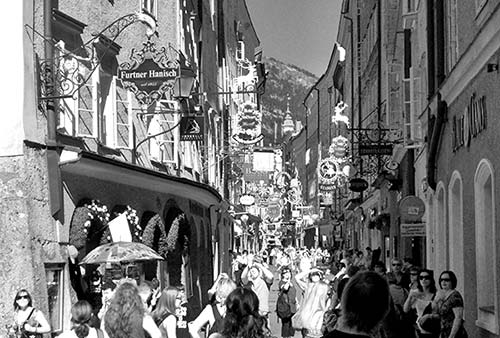
Enjoy the traditional signs and try to guess what they sold. There are signs advertising spirits, a book maker, and a horn indicating a place for the postal coach. A brewery has a star for the name of the beer, “Sternbräu.” There’s a window maker, a key maker, a pastry shop, a tailor, a pretzel maker, a pharmacy, a hat maker, and...ye olde hamburger shoppe, McDonald’s.
On the right at #39, Sporer pours homemade spirits (about €4/shot, Mon-Fri 10:00-19:00, Sat 9:00-17:00, closed Sun). This has been a family-run show for a century—fun-loving, proud, and English-speaking. Nuss is nut, Marille is apricot (typical of Austria), the Kletzen cocktail is like a super-thick Baileys with pear, and Edle Brande is the stronger schnapps. The many homemade firewaters are in jugs at the end of the bar.
After noticing building #39’s old doorbells—one per floor—continue down Getreidegasse. On the left at #40, Eisgrotte serves good ice cream. Across from Eisgrotte, a tunnel leads to the recommended Balkan Grill (sign reads Bosna Grill), the local choice for the very best wurst in town. Down the tunnel at #28 (a blacksmith shop since the 1400s), Herr Wieber, an ironworker and locksmith, welcomes the curious. Next door, McDonald’s is required to keep its arches Baroque and low-key.
At #18, a grate in the pavement gives a peek at the Bavarian water rushing through to the river as it’s done for 800 years—keeping the city fresh and clean and with healthy water.
At Getreidegasse #9, the knot of excited tourists marks the childhood home of Salzburg’s most famous resident. Mozart was born here in 1756. It was here that he composed most of his boy-genius works. Inside you see paintings of his family, letters, personal items (a lock of his hair, a clavichord he may have played), all trying to bring life to the Mozart story (see the description on here).
• A bit farther along, at Getreidegasse #3, turn right, into the passageway. You’ll walk under a whale bone (likely symbolizing the wares of an exotic import shop) and reach the Old World time-capsule café called Schatz Konditorei (worth a stop for coffee and pastry). At Schatz Konditorei, turn left through the tunnel-like passage. When you reach Sigmund-Haffner-Gasse, glance to the left (for a nice view of the city hall tower), then turn right. Walk along Sigmund-Haffner-Gasse and take your first left to reach a square called...
16 Alter Markt
This is Salzburg’s old marketplace. Here you’ll find a sausage stand, a fine old chocolate shop, and the venerable Café Tomaselli.
• Our walk is over. If you’re up for more sightseeing, most everything’s a short walk from here. The Old Town has several museums, or you can head up to the Hohensalzburg Fortress. To visit sights across the river in the New Town, cross the pedestrian bridge nearby.
Sights in Salzburg
▲DomQuartier Museums (including the Residenz)
Christmas Museum (Weihnachtsmuseum)
▲▲Mozart’s Birthplace (Geburtshaus)
Salzburg Festival Concert Halls
Science Museum (Haus der Natur)
ATOP THE CLIFFS ABOVE THE OLD TOWN
▲▲Hohensalzburg Fortress (Festung)
Museum of Modern Art (Museum der Moderne Salzburg)
IN THE NEW TOWN, NORTH OF THE RIVER
▲Mirabell Gardens and Palace (Mirabellgarten und Schloss)
▲Mozart’s Residence (Wohnhaus)
SIGHTS OUTSIDE THE CITY CENTER
▲▲Hellbrunn Palace and Gardens
▲▲Riverside or Meadow Bike Ride
▲Hallein Salt Mine (Salzwelten)
IN THE OLD TOWN
▲DomQuartier Museums (including the Residenz)
The interconnected museums of the DomQuartier, ringing the Domplatz, focus on religious art and the history of Salzburg’s prince-archbishops. Your DomQuartier ticket admits you to a circular, indoor route through the Residenz (the ornate former palace), the cathedral (which you view from the organ loft), and a couple of adjoining buildings. You’ll see lavish apartments, a fine collection of paintings, and enjoy the chance to walk across the gallery to the organ loft and peer into the cavernous cathedral.
Cost and Hours: €13, includes good audioguide, Wed-Mon 10:00-17:00, closed Tue, last entry one hour before closing, Residenzplatz 1, +43 662 8042 2109, www.domquartier.at [URL inactive].
Visiting the DomQuartier Museums: Entering at the Residenz, signs will guide you along the following circuit:
The Residenz State Rooms—once Salzburg’s center of power—were the home of the prince-archbishop. Walking through these 15 chandeliered, stuccoed, tapestried, and frescoed “stately rooms” (Prunkräume), you’ll see elements of Renaissance, Baroque, and Classicist styles—200 years of let-them-eat-cake splendor.
The Residenz Gallery, Salzburg’s top collection of paintings (one floor up), is small, with no famous works, but it’s top quality, well displayed, and well described by the fine and included audioguide. The strength of the collection is Baroque paintings (Flemish, Italian, and Austrian)—not surprising in this bastion of Catholicism. Look for these highlights: Rubens’ Allegory on Charles V shows the pope’s great champion with a sword in one hand and a scepter in the other. Rembrandt’s teeny-tiny Old Woman Praying glows, despite her wrinkled face and broken teeth (the model was probably his mother). Federico Barocci’s intense Self-Portrait, Bernardo Strozzi’s Sleeping Child, and Boucher’s rosy-cheeked Dreaming Shepherdess. Austria is represented by F. G. Waldmüller’s cheery, sun-drenched Children at the Window, Salzburg’s own Hans Makart’s honest portrait of his first wife Amalie, and lots of Romantic alpine landscapes.
Next you cross over to the cathedral atop the prince-archbishop’s covered passageway. Though you don’t actually tour the cathedral interior, you do glance down on the nave from high above. Stop and enjoy the view. Just after the cathedral loft is the Cathedral Museum, with the permanent collection of rich religious objects from the cathedral’s long history.
The Cabinet of Curiosities comes next. Like bluebloods all over Europe, this was a show-off collection of wonders, natural oddities, and freak-show exoticism, designed to wow guests.
The Museum of St. Peter’s Abbey, your final stop, introduces you to work and life at the abbey (which claims to be the oldest monastery north of the Alps), with treasures ranging from Gothic to Baroque.
▲▲Salzburg Museum
This is your best look at the art and cultural history of Salzburg. As the building was once the prince-archbishop’s New Residence, many exhibits are in the lavish rooms where Salzburg’s rulers entertained.
Cost and Hours: €9, €10 combo-ticket with Panorama Museum, includes multimedia guide, Tue-Sun 9:00-17:00, closed Mon, café, on Residenzplatz, +43 662 620 8080, www.salzburgmuseum.at.
Visiting the Museum: The first floor and the Kunsthalle in the basement house temporary exhibits. But the centerpiece of the museum is the permanent Salzburg Myth exhibit on the second floor. You’ll learn how the town’s physical beauty—nestled among the Alps, near a river—attracted 19th-century Romantics who made it one of Europe’s first tourist destinations, an “Alpine Arcadia.” Visitors are challenged to consider how people then—as today—filtered out certain harsh realities (like poor living conditions) in favor of romanticized images of the places they visited.
Room 2.01 displays lots of gauzy, remarkably recognizable landscapes of Salzburg from this era (and earlier).
A celebration of Salzburg’s music scene fills a side room with wonderful interactive exhibits, musical instruments, and plentiful audio samples. You’ll learn how the arrival of the music festival in the 1920s spurred Salzburg’s status still more, drawing high-class visitors from across the globe. The exhibit includes strings, woodwinds, and keyboards dating back as far as the 1600s. Highlights include the enormous bassoon-like Grossbass Pommer, the single-stringed tromba marina (nicknamed “the nun’s violin,” its buzz resembles a trumpet), and the tiny pochette (pocket-sized violin).
After that prelude, several rooms address the notion of tourism in the context of city development, and the conflict of modernization versus conservation. The exhibit then focuses mostly on the glory days of the prince-archbishops (1500-1800), with displays housed in impressive ceremonial rooms.
As you wander, be sure to enjoy the ornate Renaissance ceilings: a vivid reminder of how this was a palace 500 years ago. Portraits of the prince-archbishops (in Room 2.07) show them to be cultured men, with sensitive eyes and soft hands, who carry books. But they were also powerful secular rulers of an independent state that extended far beyond today’s Salzburg (see the map in Room 2.08).
Room 2.09 displays Daniel Miller’s paintings from 1635 of the city as seen from Kapuzinerberg and from Mönchsberg. Almost everything in them is still identifiable. Notice how they cleverly give you two grand views of the city; small info boards identify nearly every building. In a neighboring room, your dinner is about to be served.
The heart of the exhibit is Room 2.11, the big, colorful hall where the Salzburg Diet (the legislature) met. The elaborate painted relief ceiling depicts heroic Romans who sacrificed for their country. There’s a grab-bag of interesting displays, including old guns, rock crystals, and coins.
A portrait shows the prince-archbishop who sums up Salzburg’s golden age—Wolf Dietrich von Raitenau (1559-1617). Here he is at age 28, having just assumed power. Educated, well-traveled, a military strategist, and fluent in several languages, Wolf Dietrich epitomized the kind of Renaissance man who could lead both church and state. He largely created the city we see today—the rebuilt cathedral, Residenz, Residenzplatz, and Mirabell Palace—done in the Italian Baroque style. Interactive screens describe the strict ordinances issued by this notable archbishop, including the Mandate of Religion (1588), which ordered all non-Catholics to leave the city. Today, about 95 percent of Salzburg is (nominally) Catholic, and there’s only one Lutheran church.
In Room 2.12, find the oldest known painted view of Salzburg (1599) and a portrait of the Italian architect Vincenzo Scamozzi, who contributed to the city’s Baroque appearance during Wolf Dietrich’s tenure.
Nearby, in tiny Room 2.13, exhibits flesh out Wolf Dietrich the man and his associates. You’ll also see a portrait of Salome Alt, Wolf Dietrich’s mistress, a merchant’s daughter with whom he shared 15 children and a retreat outside the city walls (which was later rebuilt as Mirabell Palace). This liaison prevented Wolf Dietrich’s promotion to cardinal, but the couple’s love never faltered. After her man’s death, Alt dressed as a widow for the rest of her life.
▲Panorama Museum
Located in the New Residence, the Panorama Museum displays a wrap-around painting of the city, giving a 360-degree look at Salzburg in the year 1829.
Cost and Hours: €4.50 includes Panorama and temporary exhibits, €10 combo-ticket with Salzburg Museum, daily 9:00-17:00, Residenzplatz 9, +43 662 620 808 730, www.salzburgmuseum.at.
Visiting the Museum: From the Salzburg Museum entryway, find the underground “Panorama Passage” that leads to this unique exhibit. The passage itself is lined with archaeological finds (Roman and early medieval), helping set the stage for the Salzburg you’re about to see. (Or you can enter from just behind the cathedral, next to the post office.)
In the early 19th century, before the advent of photography, 360-degree panorama paintings of great cities or events were popular. When this one was created, the 1815 Treaty of Vienna had just divvied up post-Napoleonic Europe, and Salzburg had become part of the Habsburg realm. This photo-realistic painting served as a town portrait done at the emperor’s request.
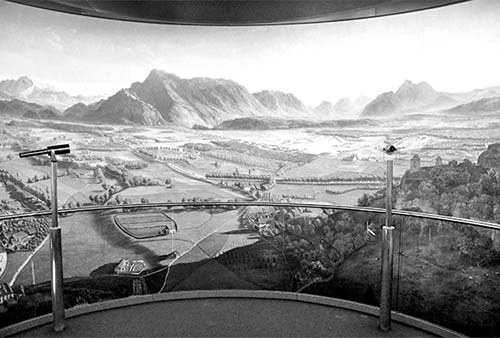
Painted by Johann Michael Sattler, the view shows the city as seen from the top of its castle. It took Sattler four years to complete (1825-29), after which the painting spent 10 years touring the great cities of Europe, showing off Salzburg’s breathtaking setting. Donated to the city by Sattler’s son in 1870, it was displayed at Mirabell Palace until 1937 and then stored in Salzburg fortress. Today, the exquisitely restored painting, hung in a circular room, offers a fascinating look at the city as it was in the early 19th century. The river was slower and had beaches, but the Old Town looks essentially as it does today.
Christmas Museum (Weihnachtsmuseum)
Here you can trace the way Austrians celebrated Christmas from 1840 to 1940. This delightful little museum gives insight into Advent, Christmas markets, St. Nicholas and Krampus, and cozy family holiday traditions. While descriptions are in German only, each room has an English intro (€6, Wed-Sun 10:00-18:00, closed Mon-Tue and Feb-mid-March, opposite the cathedral at Mozartplatz 2, +43 662 843 523, www.salzburger-weihnachtsmuseum.at [URL inactive]).
▲▲Mozart’s Birthplace (Geburtshaus)
In 1747, Leopold Mozart—a musician in the prince-archbishop’s band—moved into this small rental unit with his new bride. Soon they had a baby girl (Nannerl), and in 1756, a little boy was born—Wolfgang Amadeus Mozart. It was here that Mozart learned to play piano and violin, and composed his first boy-genius works. Even after the family gained fame, touring Europe’s palaces and becoming the toast of Salzburg, they continued living in this rather cramped, typical 18th-century apartment until 1773, when they finally moved to bigger digs across the river (see here).
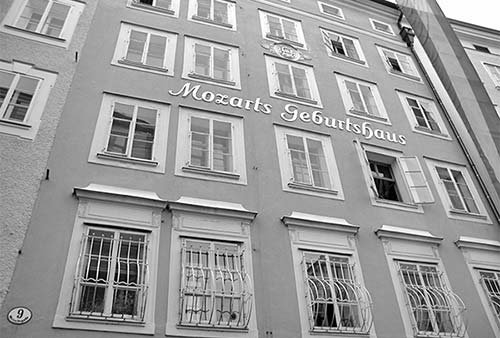
Today this is the most popular Mozart sight in town—for fans, it’s almost a pilgrimage. Shuffling through with the crowds, you’ll peruse three floors of rooms displaying paintings, letters, personal items, and lots of context, all bringing life to the Mozart story.
Cost and Hours: €12, €18.50 combo-ticket with Mozart’s Residence, daily July-Aug 8:30-19:30, Sept-June 9:00-17:30, Getreidegasse 9, +43 662 844 313, www.mozarteum.at. Avoid shoulder-to-shoulder crowds by visiting early or late.
Visiting Mozart’s Birthplace: You’ll begin on the top floor in the actual apartment—five small rooms, including the kitchen and the bedroom where Mozart was born. The rooms are bare of any furnishings. Instead, you’ll see detailed biographies and portraits of the famous family, and some memorabilia: Mozart’s childhood viola, some (possible) locks of his hair, buttons from his jacket, and a letter to his wife, whom he calls his “little rascal, pussy-pussy.” Snippets of correspondence between Mozart’s family members (beneath the portraits) are filled with warmth and humor, revealing their individual personalities. A tiny oval portrait is considered the most accurate likeness of Wolfgang ever painted.
The museum portion begins with an exhibition on Mozart’s life after he left Salzburg for Vienna: He jams with Haydn and wows the Viennese with electrifying concerts and new compositions. Despite his fame, Mozart fell on hard times, and died young and in debt. But, as the museum shows, his legacy lived on. Using computers, you can hear his music while following along on his handwritten scores.
Downstairs, the Mozart und Oper room examines the operas he wrote (Don Giovanni, The Magic Flute, The Marriage of Figaro), with historic stage sets and video clips in fun little sound booths. The prize piece is an old clavichord on which Mozart supposedly composed his final work—the Requiem, which was played for his own funeral. (A predecessor of the more complicated piano, the clavichord’s keys hit the strings with a simple teeter-totter motion that allows you to play very softly—ideal for composers living in tight apartment quarters.)
The lower-floor Wunderkind Mozart exhibit takes you on the road with the child prodigy, and gives a slice-of-life portrait of what it was like to live and travel in the 1700s. Mozart spent a third of his life journeying throughout Europe (like me)—during a time when it took 29 hours to travel just from Salzburg to Munich (not like me—two hours). Look at the map that shows the cities he performed in and imagine: 17 trips from 1762 to 1791, endless hours in a carriage, 3,700 days on the road starting at age six. The restful, oval-shaped listening room allows you to take a break from the crowds and be immersed in beautiful music and perfect acoustics.
Salzburg was Mozart’s home for the first 25 years of his brief, 35-year life. He was born on Getreidegasse and baptized in the cathedral. He played his first big concert, at age six, at the Residenz. He was the organist for the cathedral, conducted the prince-archbishop’s orchestra, and dined at (what’s now called) Café Tomaselli. It was from Salzburg that he gained Europe-wide fame, touring the continent with his talented performing family. At age 17, Mozart and his family moved into lavish digs at (today’s) Mozart’s Residence.
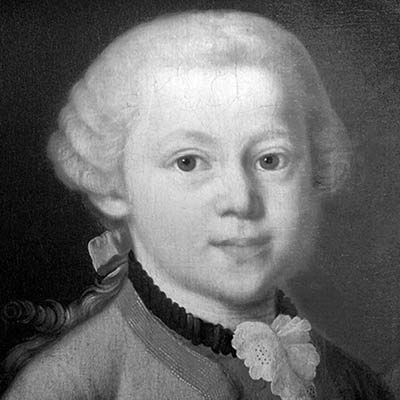
As his fame and ambitions grew, Mozart eventually left Salzburg to pursue his dreams in Vienna. His departure from Salzburg’s royal court in 1781 is the stuff of legend. Mozart, full of himself, announced that he was quitting. The prince-archbishop essentially said, “You can’t quit; you’re fired!” and as Mozart walked out, he was literally kicked in the ass.
Mozart Sights in Salzburg: Both Mozart sights in Salzburg—the Birthplace and the Residence—are expensive and worthwhile. If I had to choose, I’d go with the Birthplace as the best overall introduction (though it’s more crowded) and consider the Residence extra credit. If you’re truly interested in Mozart and his times, buy the combo-ticket and see both.
Salzburg Festival Concert Halls
When the Salzburg Festival was founded in the 1920s, there was no money to build a new concert hall. Festival organizers, led by Austrian-American theater director Max Reinhardt, looked instead to existing structures in town. They settled on the summer riding school, or Felsenreitschule, established in 1683 by Prince-Archbishop Johann Ernst von Thun, and its massive stables next door. The riding school was first used as a festival venue in 1926; later, the stables gave way for construction of the Great Festival Hall (Grosses Festspielhaus). The newest venue is the Haus für Mozart—House for Mozart.
Guided tours of the festival venues show you their architecture, artwork, and theatrical and technical capabilities. Fans will recognize the iconic arcaded stage of the Felsenreitschule as the setting for the Von Trapp family’s final public performance in The Sound of Music.
Cost and Hours: Visit possible only with guided tour, €7, tours run daily at 14:00, mid-July-Aug also at 9:30 & 15:30, closed during performances or rehearsals, buy ticket at concert hall entrance marked Felsenreitschule at least 15 minutes in advance (Hofstallgasse 1, www.salzburgerfestspiele.at/guided-tours).
Science Museum (Haus der Natur)
A good rainy-day destination for kids, a highlight here is the Science Center, three floors of hands-on gadgets and experiments. The rest of the museum—spread over several creatively linked buildings—focuses on natural history, with an aquarium, exhibits on topics such as climate, dinosaurs, and the Salzach River, and dated displays of butterflies and stuffed fauna. Most exhibits are in English.
Cost and Hours: €9.50, family deals, daily 9:00-17:00, café, Museumplatz 5, +43 662 84 2653, www.hausdernatur.at.
ATOP THE CLIFFS ABOVE THE OLD TOWN
Atop the Mönchsberg, the mini mountain that rises behind the Old Town, are a tangle of paved walking paths with great views, a couple of cafés (one cheap, one expensive, both with million-dollar views), a modern art museum, a neighborhood of very fancy homes, and one major sight: Hohensalzburg Fortress (perched on the Festungsberg, the Mönchsberg’s southern arm).
Getting There: There are three ways to get up to the cliffs: climb, take an elevator, or ride the funicular. A round-trip ticket bought at the elevator allows you to descend via the funicular, and vice versa. Generally, though, you can’t take the funicular unless you’re also visiting the fortress.
The climb up or down is steep but quick and saves a few euros. Paths or stairs lead up from the Augustiner Bräustübl beer hall/garden, Toscaninihof (near the Salzburg Festival concert halls), and Festungsgasse (at the base of the fortress).
The Mönchsberg elevator (Aufzug) starts where Gstättengasse and Griesgasse meet, on the west side of the Old Town—look for the Museum of Modern Art entry (€2.80 one-way, €4.10 round-trip, normally Tue-Sun 8:00-21:00, Mon until 19:00, July-Aug daily until 23:00).
The funicular starts from Festungsgasse (just off Kapitelplatz, by the cathedral) and comes up inside the fortress complex.
Planning Your Time: If you plan to do it all, the fortress, modern art museum, elevator, and funicular are covered by the Salzburg Card (described under “Tourist Information,” earlier). I’d visit in this order: Take the funicular to the fortress in the morning (to potentially avoid the worst crowds), take the Mönchsberg Walk over to the museum, and then take the elevator down to the Old Town.
Eating Up Top: You can eat at the view cafés in the fortress; at the chic, expensive Mönchsberg 32 café/bar/restaurant at the top of the elevator, in the same building as the modern art museum; or five minutes from the elevator at the rustic, more highly recommended Stadtalm Café, with wooden picnic tables and a one-with-nature allure. Or bring a packed lunch.
▲▲Hohensalzburg Fortress (Festung)
Hohensalzburg Fortress is one of Europe’s mightiest castles, dominating Salzburg’s skyline and offering impressive views in both directions, cafés, and a handful of mediocre museums. It’s a pleasant place to grab an ice-cream cone, wander the whitewashed maze of buildings, and soak up some medieval ambience.
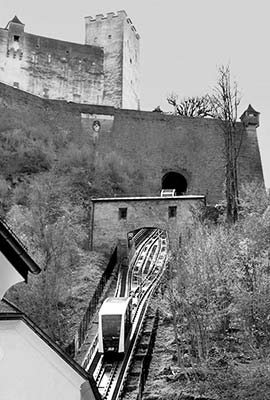
Archbishop Gebhard of Salzburg started work on the fortress in the 11th century as a show of the Catholic Church’s power (see sidebar on here). Built on a rock 400 feet above the Salzach River, the fortress was never really used. That was the idea. It was a good investment—so foreboding, nobody attacked the town for over 800 years. The city was never taken by force, but when Napoleon stopped by, Salzburg wisely surrendered. After a stint as a military barracks, the fortress was opened to the public in the 1860s by Habsburg Emperor Franz Josef.
Cost: Don’t get bogged down in the many ticket variations; the basic choices are whether to walk or ride the funicular up, and whether you want to add on the finest rooms. The walk up, though short, is steep, and most visitors opt for the one-minute trip on the funicular (Festungsbahn). The museums are less interesting than the fortress itself, so for most, it’s wise to pay for the minimum necessary (if you decide you want to see more museums after all, you can pay a surcharge up top). The fortress grounds, including the church and the keep, are open to all ticket holders. If you’re up at the fortress at 9:30 or 19:00, you can take a 30-minute guided tour for no extra charge, starting at the fortress InfoPoint.
The basic ticket (€13.30 by funicular, €10.30 by foot) lets you into most of the museums: the Panorama exhibit about the fortress, including a tower-top view (shown as A on the map); and the main Fortress Museum, including the military-oriented Rainer Regiment exhibit and the Marionette exhibit (B).
The all-inclusive ticket (€16.60 by funicular, €12.60 by foot) covers everything in the basic ticket plus entry to the well-presented State Rooms (C, sometimes called the Regency Rooms or Princely Chambers) and the Magical Theater. Even with a basic ticket, you can pay €3.50 at the door to enter the worthwhile State Rooms.
The budget-minded panorama ticket (€11 by funicular, €8.50 by foot) admits you only to the Panorama exhibit and tower view (A). This option is enough to satisfy many tourists, but it’s only available May-Sept 8:30-10:00 and 18:00-20:00.
Hours: The museums are open daily 8:30-20:00, Oct-April 9:30-17:00.
Information: +43 662 8424 3011, www.salzburg-burgen.at.
Avoiding Crowds: Visit early in the morning or late in the day. Avoid waits for the funicular ascent with the Salzburg Card (which lets you skip to the head of the line) or by walking up. Or buy your ticket online before you visit.
Concerts: The fortress serves as a venue for evening concerts (the Festungskonzerte), which are held in the old banquet rooms on the upper floor of the palace museum. Concerts take place 300 nights a year and are a good way to see the fortress without crowds. For concert details, see here.
Eating: The $$ café and restaurant complex to either side of the upper funicular station is a great place to linger while taking in the jaw-dropping view (daily 10:00-22:00, food served about 11:30-20:30, closed Jan-Feb).
 Self-Guided Tour: The fortress is an eight-acre complex of some 50 buildings, with multiple courtyards and multiple rings of protective walls.
• At the top of the funicular, turn right, head downstairs, then up to the panoramic terrace, and bask in the view toward the Alps. Continue up through the fortress gates—two defensive rings for double protection. Emerging into the light, go left (uphill) to find the entrance to the...
InfoPoint and Panorama Exhibition (A): Enter here for a light introduction to the history of Salzburg and a tower climb. Follow the one-way route to the base of the Reckturm tower, which once held prison cells. One of the most esteemed prisoners held in the fortress was Prince-Archbishop Wolf Dietrich, who lost favor with the pope, was captured by a Bavarian duke, and spent his last seven years in Hohensalzburg. It’s a complicated story—basically, the pope counted on Salzburg to hold the line against the Protestants for several generations following the Reformation. Wolf Dietrich was a good Catholic, as were most Salzburgers. But the town’s important businessmen and the region’s salt miners were Protestant, and for Salzburg’s financial good, Wolf Dietrich dealt with them in a tolerant and pragmatic way. Eventually the pope—who allowed zero tolerance for Protestants in those heady Counter-Reformation days—had Wolf Dietrich locked up and replaced.
Salzburg was on the frontline of a medieval power struggle between the Roman Catholic Church and the Holy Roman Emperors. The town’s mighty Hohensalzburg Fortress—a symbol of the Church’s determination to assert its power here—was built around 1077, just as the conflict was heating up.
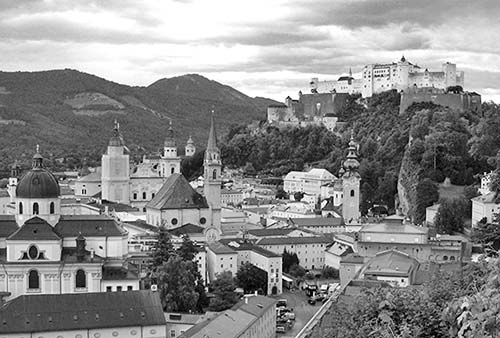
The argument was a classic tug-of-war between papal and imperial power. The prize: the right to appoint (or “invest”) church officials. Such appointments traditionally came from the Church, but in the early Middle Ages, rulers began picking bishops and abbots themselves (which Rome more or less rubber-stamped). These appointed bishops and abbots were then under considerable obligation to support their king, both spiritually and materially.
For a while, Rome put up with this turned-around system, but things came to a head under Pope Gregory VII. To remind the uppity kings of their place below God and pope, he prohibited investiture by secular (“lay”) rulers in 1074. But Holy Roman Emperor Henry IV bucked the system, continuing to appoint his own church leaders and boldly renouncing Gregory VII as pope. In retaliation, Gregory excommunicated both Henry and the bishops he’d appointed.
Salzburg’s Archbishop Gebhard took the pope’s side against Henry. As a visible sign of ecclesiastical strength, he started construction of the massive Hohensalzburg Fortress. Henry hit back by expelling Gebhard from Salzburg in 1085. Undeterred, Gebhard spent a decade in exile mustering support for the pope and raising forces against Henry.
Gebhard eventually returned to Salzburg and resumed his position as archbishop. But the investiture back-and-forth continued until 1122, when the next pope and emperor finally reached a power-sharing accord.
Next, climb a spiral staircase to the top of the Reckturm and a commanding view. Jockey your way to the railing at the upper platform and survey the scene. (If it’s too crowded up here, you can enjoy nearly-as-good views from bigger terraces lower down.) To the north is the city. To the south are Salzburg’s suburbs in a flat valley, from which rises the majestic 6,000-foot Untersberg massif of the Berchtesgaden Alps. To the east, you can look down into the castle complex to see the palace where the prince-archbishops lived.
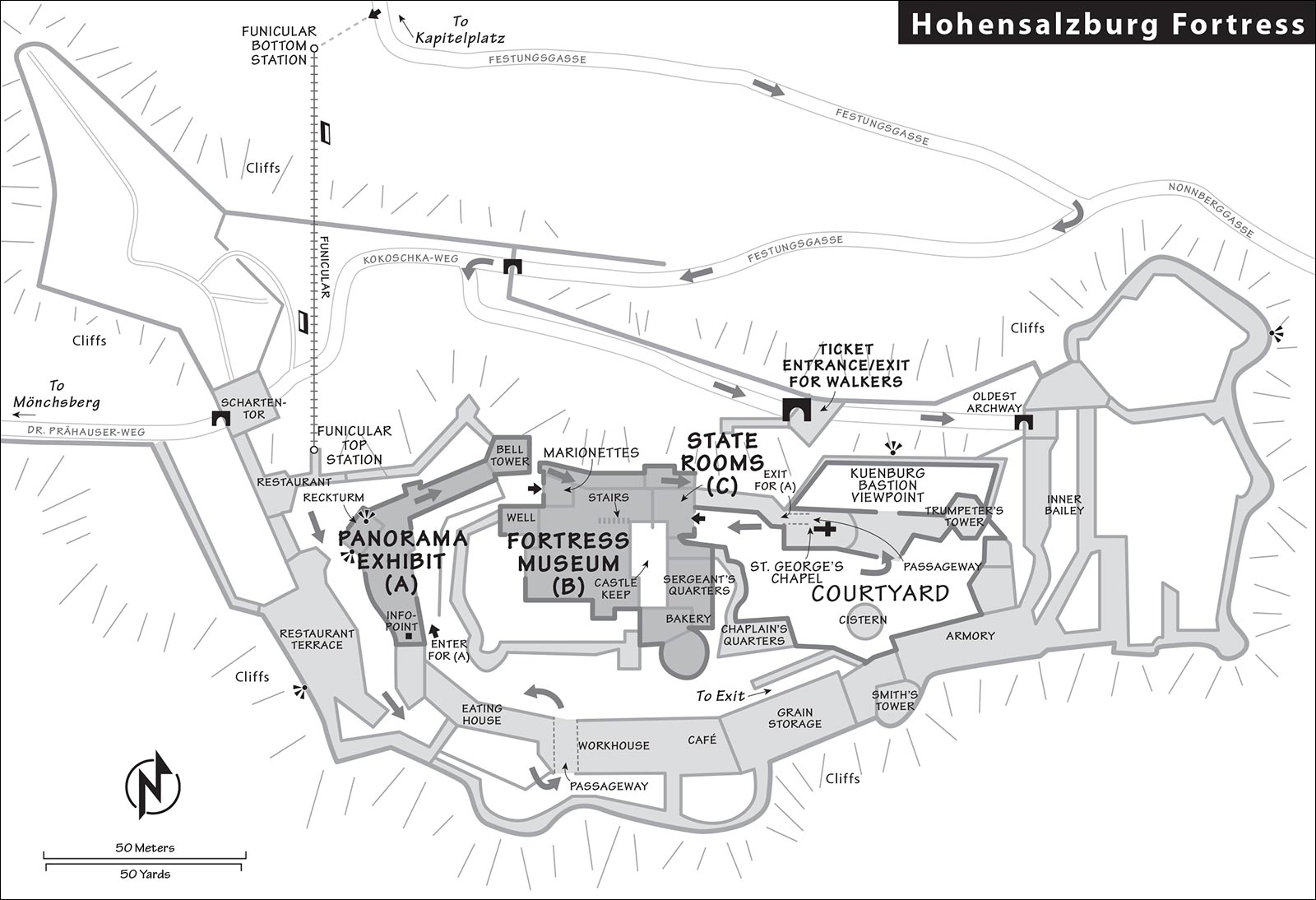
Descend from the tower, and go through the long battlement walkway. At the end, pause at the “Salzburger Bull”—a mechanical barrel organ used to wake the citizens every morning.
• Exit down the stairs into the...
Fortress Courtyard: The courtyard was the main square for the medieval fortress’s 1,000-some residents, who could be self-sufficient when necessary. The square was ringed by the shops of craftsmen, blacksmiths, bakers, and so on. The well dipped into a rain-fed cistern. Find the door to the church—it’s dedicated to St. George, the protector of horses (logical for an army church). Look inside—fine red marble reliefs (1512) decorate the walls. Behind the church is the top of the old lift (still in use) that helped supply the fortress. Under the archway next to it are the steps that lead back into the city, or to the paths across the Mönchsberg.
• On the other side of the lift rails, go through the archway that leads to a balcony with a view of Salzburg.
Kuenburg Bastion: Survey Salzburg from here and think about fortifying an important city by using nature. The fortress sits atop a ridgeline with sheer cliffs on three sides, giving it a huge defensive advantage. Meanwhile, the town of Salzburg sits between the natural defenses of the Salzach River and the ridge. (The ridgeline consists of the Mönchsberg, the cliffs to the left, and Festungsberg, the little mountain you’re on.) The fortress itself has three concentric rings of defense: the original keep in the center (where the museums we’re about to visit are located), the vast whitewashed walls (near you), and still more beefed-up fortifications (on the hillside below you, added against an expected Ottoman invasion). With all these defenses, the city only required a few more touches: The New Town across the river needed a bit of a wall arcing from the river to its hill. Back then, only one bridge crossed the Salzach into town, and it had a fortified gate. Cradled amid the security of its defenses—both natural and man-made—independent Salzburg thrived for nearly a thousand years.
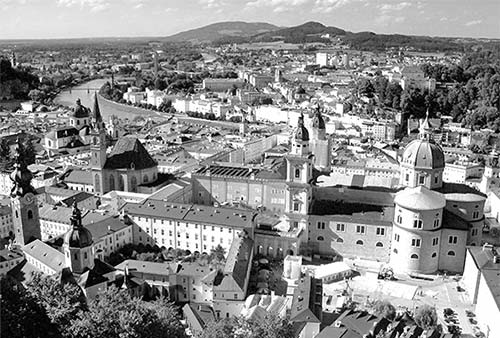
• Back in the main courtyard, with the church on your right, head uphill through the stone gate into the Hoher Stock (castle keep). To your right, detour up a short stairway to look at the remains of the fortress’s first, oldest chapel. Then, if you’ve paid for the main museum, go straight ahead up the stairs. At the very top of the long staircase is the entrance to the...
Fortress Museum (Festungsmuseum, B): The first part of this extensive museum covers the history of the fortress, including a great town model and smaller models illustrating how the castle was constructed, and military artifacts. Follow the one-way route, exploring the exhibits on this floor, then head one floor up.
• At this level, you have the chance to enter the State Rooms (if you have the all-inclusive ticket or want to pay extra).
State Rooms (Fürstenzimmer, C): These recently restored rooms are the most beautiful in the palace, with richly painted and gilded woodwork. You’ll begin by viewing the “Magical Theater,” a fun seven-minute video presentation/puppet show setting the historical context for when the prince-archbishop built these rooms around the year 1500—the High Middle Ages. Then you’ll see the Golden Hall, where evening concerts are held, and the Royal Apartment, consisting of two rooms—one with a colorfully painted tile stove in the corner, and the other featuring a toilet with a several-hundred-foot drop.
• Leaving the State Rooms, you’ll loop right back to the point where you left the Fortress Museum.
The Fortress Museum continues with an exhibit on the Rainer Regiment, a division of the imperial Austrian army that fought mountain-to-mountain on the Italian front during World War I. Heading downstairs, you’ll find a 16th-century kitchen and modest, minimalist exhibits on Paracelsus (an early physician), music, weaponry, and life and play in the Middle Ages.
• Pass through the gift shop and exit the museum. Head back down the long staircase, then hook a U-turn at the bottom to find the...
Marionette Exhibit: Marionette shows are a Salzburg tradition (think of the “Lonely Goatherd” scene in The Sound of Music). Two fun rooms show off various puppets and scenery backdrops. Videos show glimpses of the Marionette Theater performances of Mozart classics (see here).
• Our tour is over. To walk—either down to Salzburg or across the Mönchsberg (see “Mönchsberg Walk,” next)—you can take any trail downhill. Eventually you’ll pass through the ticket checkpoint and come to a T-intersection. Head right (downhill) to return to the Old Town (following Altstadt signs); or turn left (uphill), and go under the funicular tracks to make your way across Mönchsberg (following Museum der Moderne signs).
To reach the funicular, backtrack to the station between the two cafés. At the bottom of the lift, spend a minute or two at the fine little Alm River Canal exhibit, which focuses on how the river powered the city before steam took over.
▲Mönchsberg Walk
The paved, wooded walking path along the narrow ridgeline between the Mönchsberg elevator and the fortress is less than a mile long and makes for a great quiet and shady 30-minute hike. There’s some up and down, but the total elevation gain is about equal in either direction.
Frequent signposts direct you between all the key points, so it’s hard to get lost. (Festung Hohensalzburg and Museum der Moderne Salzburg refer to the fortress and elevator ends of the mountain, respectively; the spots where you can go down the stairs into town are signed Altstadt.) Along the way, you’ll see stunning views of Salzburg, rustic homes, a few unique little castle-like homes to ogle, a modern art museum (and occasional modern art sculptures in yards), a couple of places to eat or enjoy a scenic drink, the sheer cliff face with its layers of sediment, and parts of the medieval wall. You can also pause to read information plaques about Salzburg’s first settlers and the quarrying of the cliffs. At one point, the route forks to either a paved road or a footpath. Either works, as they converge later on.
The recommended Augustiner Bräustübl beer hall/garden is 10 minutes downhill past the Museum of Modern Art (follow signs for Mülln; see description on here).
Museum of Modern Art (Museum der Moderne Salzburg)
This stark concrete-and-glass exhibition space features artworks from the 19th and 20th centuries to the present day, with a particular emphasis on photography and graphic arts. It’s located right at the top of the Mönchsberg elevator. Next to the museum is the Sky Space, a cylindrical stone tower intended to let you contemplate the sky.
Cost and Hours: €10, elevator not included, Tue-Sun 10:00-18:00, Wed until 20:00, closed Mon except during festival, +43 662 842 220, www.museumdermoderne.at [URL inactive].
IN THE NEW TOWN, NORTH OF THE RIVER
The following sights are across the river from the Old Town. I’ve connected them with walking instructions (for locations, see map on here).
• Begin at the padlock-encrusted pedestrian bridge. Formerly named Makartsteg, this bridge was renamed Marko-Feingold-Steg for a local Jewish leader and Holocaust survivor who died in 2019 at the age of 107. Here you can enjoy the...
Salzach River View
Scan the cityscape and notice all the churches. Salzburg has 40 of them, justifying its nickname as the “Rome of the North.” The grand buildings just across the bridge (with their elegant promenades and cafés) were built on reclaimed land in the late 19th century. Find the five streams gushing out of the embankment and into the river. These date from the 13th century, when the river was split into five canals running through the town to power its mills. Facing upstream, the Hotel Stein (just left of next bridge) has a popular roof-terrace restaurant (see “Steinterrasse,” later). Also upstream on the left, between here and the next bridge, is the recommended Café Bazar (a fine place for a drink with a view). Downstream, high overhead on the left, atop the Mönchsberg, notice the Museum of Modern Art (with a view restaurant) and a faux castle (actually a water reservoir). The Romanesque bell tower with the green copper dome in the distance is the Augustine church, site of the best beer hall in town (the recommended Augustiner Bräustübl).
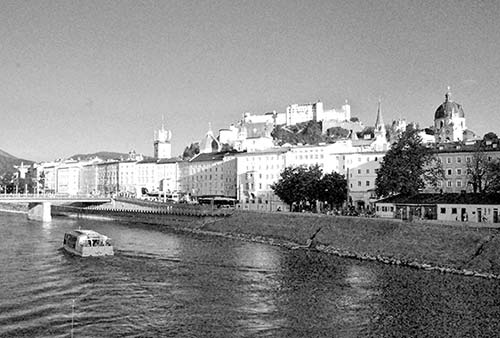
• Cross the bridge, walk two blocks inland, and take a left past the heroic statues into...
▲Mirabell Gardens and Palace (Mirabellgarten und Schloss)
These bubbly gardens, laid out in 1730 for the prince-archbishop, have been open to the public since 1850 (thanks to Emperor Franz Josef, who was rattled by the popular revolutions of 1848). The statues and the arbor (far left) were featured in The Sound of Music. The palace is worth a peek inside to see the Marble Hall (the prince-archbishop’s former ballroom, now a popular wedding venue) and the ornate Angel’s Staircase.
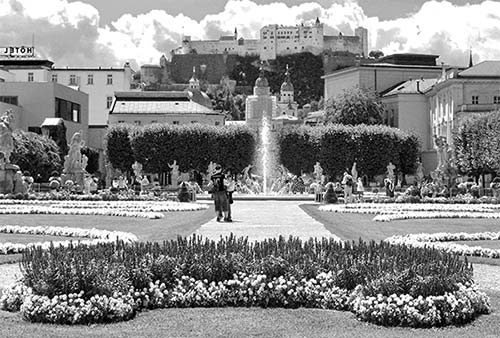
Cost and Hours: The gardens and palace are free to enter. Gardens—open until dusk; palace—open Mon-Fri 8:00-18:00 and during concerts, otherwise closed Sat-Sun.
Visiting the Gardens: Walk through the gardens toward the palace and find the statue of the horse (on the river side of the palace). Look back, enjoy the garden/cathedral/castle view, and imagine how the prince-archbishop must have reveled in a vista that reminded him of all his secular and religious power.
The rearing Pegasus statue is the site of a famous Sound of Music scene where the kids all danced before lining up on the stairs with Maria (30 yards farther along). The steps lead to a small mound in the park (made of rubble from a former theater). Notice that Pegasus is missing what locals call “his best part.” (They claim it made the prince feel less impressive, so he had it removed.)
Nearest the horse, stairs lead between two lions to a pair of tough gnomes welcoming you to Salzburg’s Dwarf Park. Cross the elevated walk (noticing the city’s fortified walls) to meet whimsical marble statues modeled after a dozen dwarfs who served in the court of the prince-archbishop in the 17th century.
There’s plenty of music here, both in the park and in the palace. A brass band plays free park concerts (May-Aug Sun at 10:30 and Wed at 20:30). To properly enjoy the lavish Mirabell Palace—once the prince-archbishop’s summer palace and now the seat of the mayor—get a ticket to a Schlosskonzerte (my favorite venue for a classical concert—see here).
• Backtrack out of the park the way you came in, into the park-like square called Makartplatz (with the big-domed church at the top of the square). Across the square—opposite the big and bright Hotel Bristol—you’ll find...
▲Mozart’s Residence (Wohnhaus)
In the fall of 1773, when Wolfgang was 17—and his family was flush with money from years of touring—the Mozarts moved here from their cramped apartment on Getreidegasse. Aimed toward the Mozart connoisseur, the exhibits feature original Mozart family instruments, a good introductory video, and includes an informative audioguide. The building itself, bombed in World War II, is a reconstruction.
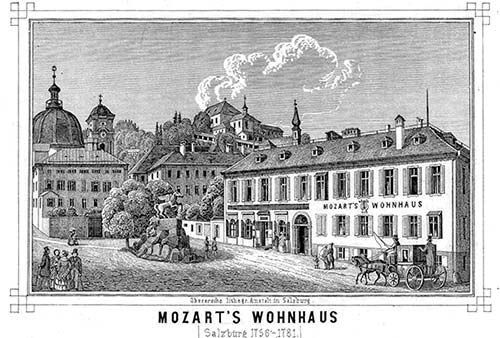
Cost and Hours: €12, €18.50 combo-ticket with Mozart’s Birthplace, daily July-Aug 8:30-19:00, Sept-June 9:00-17:30, Makartplatz 8, +43 662 8742 2740, www.mozarteum.at.
Visiting Mozart’s Residence: The exhibit—seven rooms on one floor—starts in the main hall, which was used by the Mozarts to entertain Salzburg’s high society. Here, you can see Mozart’s pianoforte from 1782, as well as his violin. The family portrait on the wall (from around 1780) shows Mozart with his sister Nannerl at the piano, their father on violin, and their mother—who’d died two years earlier in Paris. You’ll also see three circular targets high on the wall, and—in the glass case nearby—the air rifle that Mozart and his family used to shoot at them.
Room 2 trumpets the successes the Mozart family enjoyed while living here: portraits of Salzburg bigwigs they hung out with, letters from Mozart bragging about his musical successes.
Room 3 is dedicated to father Leopold—Kapellmeister of the prince—a member of the archbishop’s orchestra, musician, and composer in his own right. Was Leopold a loving nurturer of young Wolfgang or an exploiting Svengali?
Room 4 stars “Nannerl” (Maria Anna), Mozart’s sister, who was five years older. Though both were child prodigies, playing four-hand showpieces for Europe’s crowned heads, Nannerl went on to lead a stable life as a wife and mother.
Room 5 boasts letters and music books from the nearby Mozarteum library, Wolfgang’s violin, and a listening lounge.
• Leaving the museum, hook left around the corner and walk a few short blocks back to the main bridge (Staatsbrücke), where you’ll find the Platzl, a square once used as a hay market. Pause to enjoy the kid-pleasing little fountain. Look up handsome Linzer Gasse, with its attractive small shops (we’ll go there later). Just past the fountain (with your back to the river), Steingasse leads darkly to the right.
▲Steingasse Stroll
Heading up dim, narrow Steingasse, you get a rare glimpse of medieval Salzburg. It’s not the Church’s Salzburg of grand squares and Baroque facades, but the people’s Salzburg, of cramped quarters and humble cobbled lanes. In fact, this road dates to Roman times. If you dug down, you’d find groves in the pavement stones the standard width of an ancient carriage. For centuries buffer stones have protected the buildings from passing traffic. Today, inviting cocktail bars along here come alive at night (see “Steingasse Pub Crawl” on here).
Stop at #9 (which sticks out into the lane) and look across the river into the Old Town; the city’s original bridge once connected Salzburg’s two halves right here. According to town lore, this building is where Joseph Mohr, who wrote the words to “Silent Night,” was born—poor and illegitimate—in 1792. The popular Christmas carol was composed and first sung just outside Salzburg, in the village of Oberndorf, in 1818. Stairs lead from near here up to a 17th-century Capuchin monastery.
On the next corner, the wall is gouged out. This scar was left even after the building was restored, to serve as a reminder of the American GI who tried to get a tank down this road during a visit to the town brothel—two blocks farther up Steingasse. Within steps of here is the art cinema (showing movies in their original language, schedule in window) and three recommended bars (described on here).
Go deeper. At #19 (on the left), find the carvings on the old door. Some say these are notices from beggars to the begging community (more numerous after post-Reformation religious wars, which forced many people out of their homes and towns)—a kind of “hobo code” indicating whether the residents would give or not. Trace the wires of the old-fashioned doorbells to the highest floors.
Farther on, you step through the old fortified gate (at #20) and find a commanding Salzburg view across the river. Under the fortress and to the left, notice the red dome marking Nonnberg Abbey, with the oldest nunnery in the German-speaking world (established in 712). The real Maria, who inspired The Sound of Music, taught in this nunnery’s school. In 1927, she and Captain von Trapp were married in the abbey’s church. He was 47. She was 22.
From here, look back above the arch you just passed through, and up at part of the town’s medieval fortification. The coat of arms on the arch is of the prince-archbishop who paid Bavaria a huge ransom to stay out of the Thirty Years’ War (smart move). He then built the castle and its fortifications (in 1634) in anticipation of rampaging armies from both sides.
Today, this street is for making love, not war. The Maison de Plaisir (a few doors down on the right, at #24) has for centuries been a Salzburg brothel. But the climax of this walk is more touristic.
• My Salzburg Town Walk starts on the cute pedestrian bridge a few minutes beyond this point. Or, for a grand view, retrace your steps from here back to the Platzl and the Staatsbücke bridge, enter the Hotel Stein (left corner, overlooking the river), and ride the elevator to the...
Steinterrasse Rooftop Terrace
This $$$ restaurant-lounge offers one of the best views in town. Hidden from the tourist crush, it’s a trendy, professional, local scene. You can discreetly peek at the view, enjoy a drink or meal, or come back later to gaze into the eyes of your travel partner as you sip a nightcap (reservations smart for outdoor seating, food served daily until 22:00, +43 662 877 277, www.steinterrasse.com).
• Back at the Platzl and the bridge, you can head straight up...
Linzer Gasse
The old road leading out of Salzburg toward Linz (and, beyond that, Vienna) is refreshingly traffic-free. It’s lined with good hotels, shops, and eateries, and is a delight to stroll. In recent years it has become more lively, and today it feels almost like an unglitzy, workaday Getreidegasse. Just above Steingasse, at #14, is the gateway leading up to Kapuzinerberg (described later).
• Higher up on Linzer Gasse you’ll reach the...
▲St. Sebastian Cemetery
This wonderfully evocative cemetery dates from around 1600, when, after picking up modern ideas while studying in Rome, Prince-Archbishop Wolf Dietrich emptied the cathedral square of its tombs and established this more modern (and Italian-feeling) place of burial. People didn’t like the move, though, and to help popularize it, Wolf Dietrich had his own mausoleum built as the cemetery’s centerpiece.
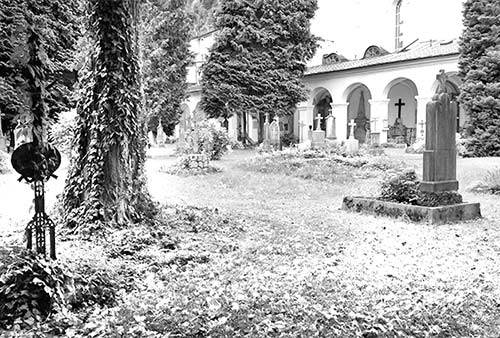
Cost and Hours: Free, daily 9:00-18:00, Nov-March until 16:00, entry at Linzer Gasse 43 in summer; in off-season go through the arch at #37 and around the building to the doorway under the blue seal.
Visiting the Cemetery: Wander through this quiet oasis. While regular citizens are buried in the middle, the arcade is lined with the fine tombs of fine families. Stroll the entire square, enjoying the art of the dead. Mozart is buried in Vienna, his mom’s in Paris, and his sister is in Salzburg’s Old Town (St. Peter’s)—but Wolfgang’s wife Constanze (“Constantia”) and his father, Leopold, are buried here (from the black iron gate entrance on Linzer Gasse, walk 19 paces and look left). Continue straight past the Mozart tomb to the circular building that is Wolf Dietrich’s mausoleum. Peek inside to enjoy the late Renaissance space.
• If you’re ready for a bite, the cemetery is within a few steps of several good eateries (see here). For a grand finale to your New Town explorations, head back down Linzer Gasse to #14 and the trailhead up to...
Kapuzinerberg City View
Kapuzinerberg, a small mountain, rises from the river opposite Salzburg’s castle. From Linzer Gasse 14, a lane and steps lead past 12 Stations of the Cross to a Capuchin monastery (the mountain’s namesake) and a commanding city viewpoint. Once an alp used by the town’s farmers for grazing animals, today Kapuzinerberg is a peaceful, park-like escape. To get to the scenic viewpoint over the river and across from the castle, follow the shorter loop, circling right (find the viewpoint on the left, just before the trail descends to Steingasse and the river).
SIGHTS OUTSIDE THE CITY CENTER
The following sights and activities take you outside the city center for easy side trips.
▲▲Hellbrunn Palace and Gardens
In about 1610, Prince-Archbishop Markus Sittikus decided he needed a lavish palace with a vast and ornate garden purely for pleasure. He built this summer palace and hunting lodge, and just loved inviting his VIP guests from throughout Europe to have some fun with his trick fountains. Today, Hellbrunn is a popular side trip. While the formal garden may be one of the oldest in Europe (with a gazebo made famous by The Sound of Music), it’s nothing special. The real draws here are those amazing fountains and the surprisingly engaging exhibits inside the palace. Perhaps most of all, Hellbrunn provides an ideal excuse to get out of the city.
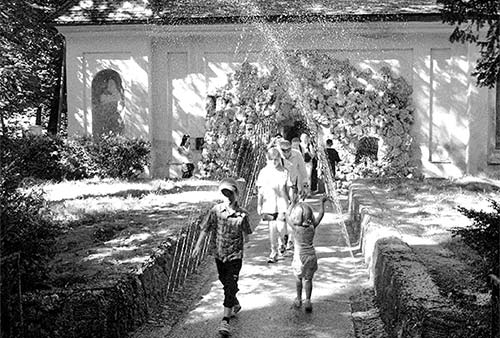
Cost and Hours: Grounds—free, open daily 6:30-21:00; palace—€13.50 ticket includes fountains and palace audioguide, daily 9:00-17:30, July-Aug until 18:00, April and Oct until 16:30, these are last-tour times, closed Nov-March; +43 662 820 3720, www.hellbrunn.at.
Getting There: Hellbrunn is nearly four miles south of the city center. Take bus #25 from the train station or from the Rathaus stop by the Staatsbrücke bridge, and get off at the Schloss Hellbrunn stop (3-4/hour, 20 minutes from station). In good weather, the trip out to Hellbrunn is a delightful 30-minute bike excursion (see “Riverside or Meadow Bike Ride,” later, and ask for a map when you rent your bike).
Visiting the Palace: Upon arrival, buy your ticket and get an entry time for the fountains (generally on the half-hour—if there’s a wait until your fountain visit starts, you can see the palace first). The 45-minute palace audioguide takes you through a series of amazing 17th-century garden settings with lots of splashy fun. You’ll see ponds, grottoes, canals, fountains, and lots of little mechanical figures—all of them (quite remarkably) powered by 17th-century hydraulic engineering.
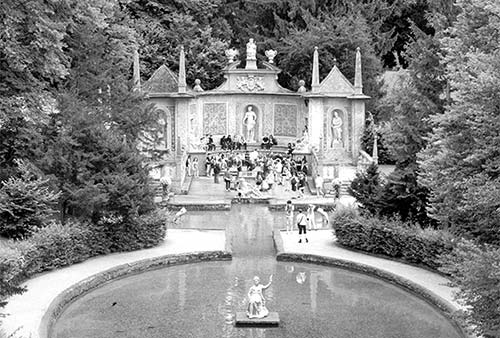
The palace was built in a style inspired by the Venetian architect Palladio, who was particularly popular around 1600, and it quickly became a cultural destination (enjoy the sounds of shrieking, fountain-taunted tourists below). This was the era when the aristocratic ritual was to go hunting in the morning (hence the wildlife-themed decor) and enjoy an opera in the evening. The first opera north of the Alps, imported from Italy, was performed here. The decor is Mannerist (between Renaissance and Baroque), with faux antiquities and lots of surprising moments—intentional irregularities were in vogue after the strict logic, balance, and Greek-inspired symmetry of the Renaissance.
Today, those old rooms are filled with modern, creative exhibits that help put the palace into historical context: the emerging Age of Reason, when man was determined to conquer nature (such as harnessing hydropower to soak visiting VIPs). The eclectic exhibit includes palace models and architectural drawings, a statue of Sittikus at age three (when the dream of soaking visitors was just a twinkle in his demented little eye), a stuffed unicorn, a frescoed ballroom (where you can sit on a giant turntable for a very lazy tour), and a good exhibit on how all those fountains work—including an original pipe made out of a hollowed-out larchwood log. You’ll also see a wrap-around animated film reenacting the wild Carnival celebrations of Salzburg circa 1618.
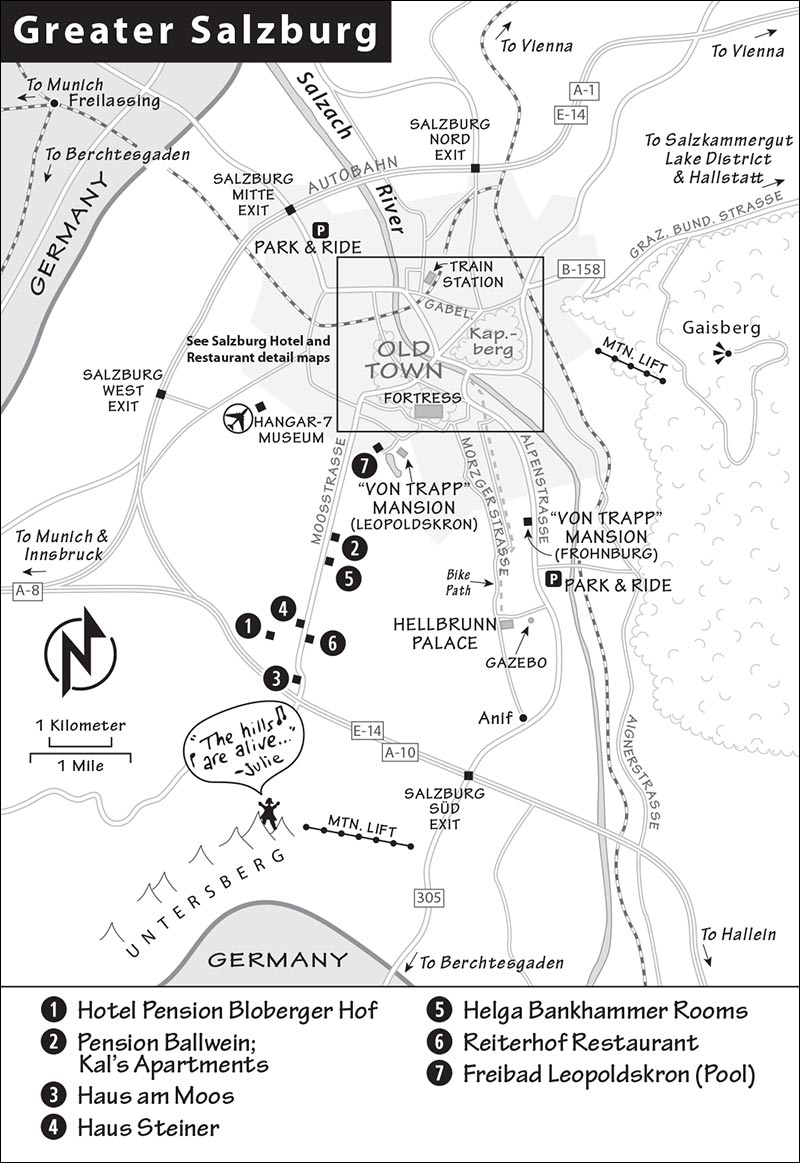
Grounds: At any point, you’re free to wander the delightful garden and see the gazebo made famous by the song “Sixteen Going on Seventeen” from The Sound of Music (from the palace, head up the long, yellow-walled gravel road, then look right for Sound-of-Music Pavilion signs). Local families picnic in the park.
▲▲Riverside or Meadow Bike Ride
The Salzach River has smooth, flat, and scenic bike lanes along each side (thanks to medieval tow paths—cargo boats would float downstream and be dragged back up by horses). On a sunny day, I can think of no more shout-worthy escape from the city. Rent a bike for an hour, pedal all the way up one side of the river to the outskirts, cross over, and pedal back. Even a quickie ride across town is a great Salzburg experience. In the evening, the riverbanks are a world of floodlit spires. For bike-rental information, see here.
For a longer trip, consider the pristine, meadow-filled farm-country path along Hellbrunner Allee. It’s an easy four-mile ride with a worthy destination—Hellbrunn Palace: From the middle of town, head along the river on Rudolfskai, with the river on your left and the fortress on your right. After passing the last bridge at the edge of the Old Town (Nonntaler Brücke), cut inland along Petersbrunnstrasse until you reach the university and Akademiestrasse. Beyond it find the start of Freisaalweg, which becomes the delightful Hellbrunner Allee bike path...which leads directly to the palace (paralleling Morzgerstrasse; see map on previous page). To make the trip a loop, you can come back along the river: Head out on Fürstenweg (past the S.O.M. gazebo), and follow it—carefully crossing road 150—until you hit the river just south of the Hellbrunner Bridge. From here, you can turn left and follow the riverside path three miles back into town.
For a nine-mile ride, continue from Hellbrunn on to Hallein (where you can tour a salt mine—see next listing). If heading to Hallein directly from Salzburg, head out from the north bank of the river—the New Town side—which is more scenic.
▲Hallein Salt Mine (Salzwelten)
Of the many different salt-mine excursions from Salzburg, this one (in Bad Dürrnberg, just below the town of Hallein, 12 miles from Salzburg) is a good choice. Wearing white overalls and sliding down sleek wooden chutes, you’ll cross underground from Austria into Germany while learning about the old-time salt-mining process. The tour entails lots of time on your feet as you walk from cavern to cavern, learning the history of the mine by watching a series of video skits with an actor channeling Prince-Archbishop Wolf Dietrich. The visit also includes a “Celtic Village” open-air museum.
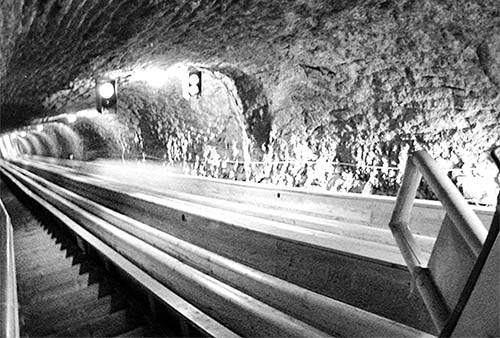
Cost and Hours: €30, daily 9:00-17:00, Nov-mid-March 10:00-15:00, these are last-tour times, closed Jan, allow 2 hours for the visit, English-speaking guides—but let your linguistic needs be known loud and clear, +43 6132 200 8511, www.salzwelten.at.
Getting There: Ride the S-3 suburban train from Salzburg to Hallein (2/hour, 25 minutes), where you catch Postbus #41 to the Bad Dürrnberg Salzbergwerk (runs hourly, 10 minutes). Check the website Tickets.oebb.at to find exact departure times.
Hangar-7
This hangar at the Salzburg airport (across the runways from the terminal) houses the car and aircraft collection of Dietrich Mateschitz, the flamboyant founder of the Red Bull energy-drink empire. Under the hangar’s modern steel-and-glass dome are 20 or so glittering planes, helicopters, and racecars, plus three eateries designed to brandish the Red Bull “culture.” For gearheads, this rates ▲▲▲; for anyone else, it’s a worthwhile curiosity if you have a little extra time on your way into or out of town. Mateschitz (now nearing 80) remains Salzburg’s big personality: He has a mansion at the edge of town, sponsors the local Red Bull soccer and hockey teams, owns several chic Salzburg eateries and cocktail bars, and employs hundreds of mostly good-looking Salzburgers. He seems much like the energy drink that made him rich and powerful—a high-energy, anything’s-possible cultural Terminator.
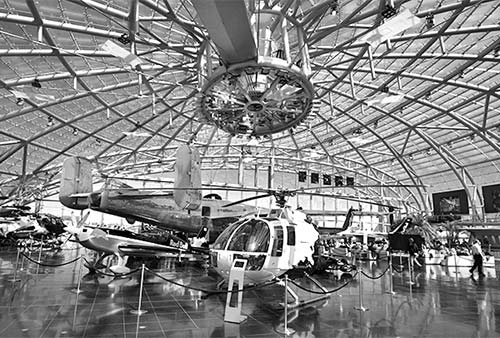
Cost and Hours: Free, Tue-Wed and Fri-Sun 9:00-22:00, Mon and Thu until 19:30, bus #10 from Hanuschplatz to the Pressezentrum/Kuglhof stop—don’t get off at the airport terminal, Wilhelm-Spazier-Strasse 7a, +43 662 2197, www.hangar-7.com.
Eating: Two floors up, the $$$ Mayday Bar has light meals and an experimental menu; in good weather, they close the bar and open an outdoor grill restaurant with similar prices. On the first floor, you’ll probably want to skip the $$$$ Ikarus Restaurant (with a €225 fixed-price meal). By the entrance is the $$ Carpe Diem café, serving €30 breakfasts and €20 lunch plates (daily 9:00-17:00).
Music in Salzburg
Music lovers come to Salzburg in late July and August for the Salzburg Festival, but there are also smaller, less expensive festivals at other times. And all year long, you can enjoy pleasant, if touristy, concerts held in historic venues around town—or a musical Mass on Sunday morning. Pick up the free events calendar brochure at the TI or check Salzburg.info (under “Events,” click on “Classical Music”). I’ve never planned in advance, and I’ve enjoyed great concerts with every visit.
DAILY MUSICAL EVENTS
The following concerts are mostly geared to tourists and can have a crank-’em-out feel, but they still provide good value, especially outside festival times. Or consider Salzburg’s much-loved marionette theater, with nearly daily performances.
Concerts at Hohensalzburg Fortress (Festungskonzerte)
Nearly nightly concerts—Mozart’s greatest hits for beginners—are held in the “prince’s chamber” of the fortress atop the hill, featuring small chamber groups (assigned seat in first six rows-€46, open seating farther back-€38, funicular ride included if you come within an hour of the concert; at 20:00 or 20:30; doors open 30 minutes early, can combine with three-course dinner beforehand, reserve at +43 662 825 858 or via www.salzburghighlights.at, pick up tickets at the door). The medieval-feeling chamber has windows overlooking the city, and the concert gives you a chance to enjoy the grand city view and a stroll through the castle courtyard. Purists may object to hearing Baroque music in an incongruously Gothic space.
Concerts at the Mirabell Palace (Schlosskonzerte)
The nearly nightly chamber music concerts at the Mirabell Palace are performed in the lavishly Baroque Marble Hall. They come with more sophisticated programs and better musicians than the fortress concerts...and Baroque music flying around a Baroque hall is a happy bird in the right cage (assigned seat in first five rows-€42, open seating farther back-€36; RS%—10 percent discount, use code “RICK10”; usually at 20:00 but check website for times, doors open one hour ahead, +43 662 904 700, www.salzburg-palace-concerts.com).
Mozart Dinner Concert
The elegant St. Peter Stiftskulinarium restaurant (see here) offers a traditional candlelit meal with Mozart’s greatest hits performed by a string quintet and singers in historic costumes gavotting among the tables. In this sophisticated Baroque setting, tourists clap between movements and get three courses of food (from Mozart-era recipes) mixed with three 20-minute courses of crowd-pleasing music—structured much as such evenings were in Baroque-era times. The dinner and concert costs €74, €84, or €98, depending on where you sit. It’s a small room and everyone gets the same food and show. Paying more gets you a smaller table up close. Cheaper tickets may have you sharing in the back at an eight-seat table (nightly at 19:30 except fewer nights in Feb, arrive 30 minutes before start time, dress is “smart casual,” to reserve email office@skg.co.at or call +43 662 902 900, www.mozart-dinner-concert-salzburg.com).
Residenzkonzerte
On most afternoons at 17:00, you can catch a 45-minute concert of Mozart violin sonatas at the Residenz (€22, discount with Salzburg Card or DomQuartier ticket, tickets available online or 30 minutes before performance, +43 664 423 5645, www.agenturorpheus.at).
Marionette Theater
Spellbinding marionettes star in these operas performed to recorded music. A troupe of 10 puppeteers—actors themselves—brings to life the artfully created puppets at the end of their five-foot strings. The 180 performances a year alternate between The Sound of Music and various German-language operas (with handy superscripts in English). While the 300-plus-seat venue is forgettable, the art of the marionettes enchants adults and children alike. For a sneak preview, check out the videos on their website.
Cost and Hours: €25-40, kids-€15, June-Aug and Oct nearly nightly at 19:30 plus matinees on some days, fewer shows off-season, near Mozart’s Residence at Schwarzstrasse 24, +43 662 872 406, www.marionetten.at.
WEEKLY MUSICAL EVENTS
Mozart Piano Sonatas (Klaviersonaten)
These short (45-minute) and fairly inexpensive weekend concerts in a period room at an Old Town hotel are ideal for families (€22, €11 for kids, €55 for a family of four, Sat at 19:00 year-round, in the Renaissance Room of the Radisson hotel at Judengasse 15, +43 664 423 5645, www.agenturorpheus.at).
Free Brass Band Concerts
Sponsored by the city of Salzburg, traditional brass bands play one-hour concerts in the Mirabell Gardens on Sundays and Wednesdays (May-Aug Sun at 10:30 and Wed at 20:30, may be canceled in bad weather).
Music at Sunday Mass
Each Sunday morning, three great churches offer a Mass, generally with glorious music. Each has clear listings posted online and at their door. The Salzburg Cathedral is likely your best bet for fine music to worship by. The 10:00 service generally features a Mass written by a well-known composer performed by choir, organist, or other musicians. The worship service is often followed at 11:30 by a free organ concert (music program at www.kirchen.net/dommusik). Nearby (just outside Domplatz, with the pointy green spire), the Franciscan Church is the locals’ choice and holds musical Masses (at 9:00, www.franziskanerkirche-salzburg.at—click on “Programm”). St. Peter’s Church sometimes has music (often at 10:15, www.stift-stpeter.at—under “Kultur,” click on “Kirchenmusik,” then on “Programm”).
ANNUAL MUSIC FESTIVALS
Salzburg Festival (Salzburger Festspiele)
Each summer from mid-July to the end of August Salzburg hosts its famous Salzburg Festival, founded in the 1920s to employ Vienna’s musicians in the summer. Lately, it’s had more contemporary offerings that temper its stuffy and formal image. This fun and festive time is crowded—as many as 200,000 tickets are sold to festival events annually—but there are usually plenty of beds available (except for a few August weekends). Main events take place primarily in three big halls: the Great Festival Hall, the Haus für Mozart, and the Felsenreitschule (opera and orchestra venues); subtitled German-language plays are performed in the Landestheater. The schedule is announced in November, tickets go online in January, and most seats are sold out by March. (Prices range from €20 to €450.) Many “go to the Salzburg Festival” by seeing smaller, nonfestival events that spill out all over town, many with a more youthful and accessible focus. For these unofficial events, same-day tickets are normally available—ask at the TI for details. For specifics on the festival schedule and tickets, visit www.salzburgerfestspiele.at.
Music lovers in town during the festival who don’t have tickets (or money) can still enjoy Festival Nights, a free series of videos of previous years’ festival performances, projected on a big screen on Kapitelplatz (behind the cathedral). It’s a fun scene, with plenty of folding chairs and a food circus of temporary eateries. For info and schedules, go to Salzburg.info and search for “Festival Nights.”
Other Annual Musical Festivals
The Salzburg Festival stages a week of Baroque concerts over the Whitsunday holiday weekend in early June (a school holiday in Austria and Bavaria). Offerings and prices are similar to those in July and August (www.salzburgerfestspiele.at).
Mozart Week (Mozartwoche) is a high-quality, more affordable option held each year in late January. It features up to three daily performances of works by both the great composer and his contemporaries (www.mozarteum.at, click on “Mozart Week” for details). Then comes the Easter Music Festival (Osterfestspiele), with reasonably priced concerts and operas (www.osterfestspiele.at). The series of concerts and plays held during October’s Culture Days (Kulturtage) are also designed to give locals a chance to take in some high culture at a low price (www.kulturvereinigung.com). Also in October, Jazz & the City offers free concerts scattered throughout dozens of venues in the city (www.salzburgjazz.com).
Sleeping in Salzburg
Peak season is May through October, with rates rising significantly during the summer music festival, during the four Advent weeks leading up to Christmas (when street markets are at full blast), and around Easter. Breakfast is optional at many of my Salzburg listings—if you don’t need a big breakfast, skipping it saves about €10 per person.
IN THE NEW TOWN, NORTH OF THE RIVER
Near Linzer Gasse
These listings cluster around Linzer Gasse, a lively pedestrian shopping street a 15-minute walk or quick bus ride from the train station (for directions, see “Arrival in Salzburg”) and a 10-minute walk to the Old Town. If you’re coming from the Old Town, cross the main bridge (Staatsbrücke), and Linzer Gasse is straight ahead. If driving, exit the highway at Salzburg-Nord, follow Vogelweiderstrasse straight to its end, and turn right. Parking is easy at the nearby Mirabell-Congress garage (€30/24 hours, your hotel may be able to get you a discount, enter from Mirabellplatz).
$$$$ Altstadthotel Wolf-Dietrich, around the corner from Linzer Gasse on pedestrian-only Wolf-Dietrich-Strasse, has 38 well-located, tastefully plush rooms. Eight overlook St. Sebastian Cemetery; some are in an annex across the street (RS%, family rooms, elevator, air-con, nice pool and sauna, fitness room, Wolf-Dietrich-Strasse 7, +43 662 871 275, www.salzburg-hotel.at, office@wolf-dietrich.at).
$$ Cityhotel Trumer Stube, well located three blocks from the river just off Linzer Gasse, is a cozy, welcoming home base with 20 comfortable and attractive rooms (RS%, elevator, fans, look for the flower boxes at Bergstrasse 6, +43 662 874 776, www.trumer-stube.at, info@trumer-stube.at, Stefanie and Christopher).
$$ Gästehaus im Priesterseminar Salzburg occupies part of the Salzburg Seminary, where three floors have been turned into a comfortable, superbly located hotel with 60 high-ceilinged rooms and six apartments. Each room has a Bible and a cross (and no TV), but guests are not required to be in a contemplative frame of mind. There’s also a little guests’ chapel, which looks down into the big church where Mozart used to play the organ. This is a rare place that charges only a little extra during the Salzburg Festival—but for those dates you have to book by phone or email (family rooms, bike rental, elevator, common kitchen and TV room, laundry facilities, reception closes at 16:00, or 18:00 July-Aug—arrange ahead if arriving later; Dreifaltigkeitsgasse 14, +43 662 8774 9510, www.gaestehaus-priesterseminar-salzburg.at, phs.rezeption@eds.at).
$$ Hotel Krone 1512, about five blocks from the river, offers 24 decent, simply furnished rooms in a building that dates to medieval times. Back-facing rooms are quieter than the streetside ones (earplugs smart as nearby church bells ring from 7:00-22:00). Cheapskates can save by requesting the nearly windowless “student” double. Stay awhile in their pleasant cliffside garden (RS%, reserve by email for discount, family rooms, elevator, Linzer Gasse 48, +43 662 872 300, www.krone1512.at, hotel@krone1512.at, run by Ukrainian-Austrian-Canadian Niko).
$ Hotel Schwarzes Rössl is a university dorm that becomes a student-run hotel for the months of July, August, and September. The location couldn’t be handier, and its 56 rooms, while a bit spartan, are comfortable (family rooms, cheaper singles with shared bath, reserve by email, no breakfast, just off Linzer Gasse at Priesterhausgasse 6, July-Sept +43 662 874 426, otherwise +43 1401 7655, www.academiahotels.at, salzburg@academiahotels.at).
$ Institute St. Sebastian is in a somewhat sterile but clean historic building next to St. Sebastian Cemetery. From October through June, it houses students but also rents 60 beds for travelers. From July through September, the students are gone, and they rent all 118 beds (including 20 twin rooms) to travelers. The building has spacious public areas, a roof garden, and a piano. The immaculate doubles come with modern baths and head-to-toe twin beds (family rooms, cheaper rooms with shared bath, elevator, self-service laundry, pay parking—request when you reserve; reception closes at 16:00—or 18:00 July-Aug; Linzer Gasse 41—enter through arch at #37, +43 662 871 386, www.st-sebastian-salzburg.at, office@st-sebastian-salzburg.at). Students like the ¢ dorms.
On Rupertgasse
These two well-run hotels are about five blocks farther from the river on Rupertgasse—a breeze for drivers, but with more street noise than the places on Linzer Gasse. They’re good values if you don’t mind being a 15- to 20-minute walk or quick bus ride from the Old Town. From the station, take bus #2 to the Bayerhamerstrasse stop; from Hanuschplatz, take #4 to Grillparzerstrasse.
$$ Bergland Hotel is charming, classy, and a great value, renting 18 comfortable rooms with an oddly stylish leather-wicker-beach theme. Solar panels make the hotel energy-efficient, and the vegetarian owners serve meat-free breakfasts (elevator, pay parking, Rupertgasse 15, +43 662 872 318, www.berglandhotel.at, office@berglandhotel.at, Kuhn family).
$$ Hotel Jedermann is tastefully quirky and stylishly minimalist, with an artsy painted-concrete ambience (look for the owner’s street-art mural), a backyard garden, and 50 rooms (air-con, elevator, pay parking—reserve, Rupertgasse 25, +43 662 873 2410, www.hotel-jedermann.com, office@hotel-jedermann.com, Herr und Frau Gmachl).
Near the Train Station
$$ Motel One Salzburg-Mirabell is a big chain hotel right along the river. Its 121 cookie-cutter rooms are small, but the staff is helpful, the decor is fun, and the lounge is inviting. It’s six blocks (or a two-stop bus ride) from the train station, and a 15-minute riverside walk or short bus ride from the Old Town (air-con, elevator, pay parking, Elisabethkai 58, bus #1 or #2 from platform D at station to St.-Julien-Strasse—use underpass to cross road safely, +43 662 885 200, www.motel-one.com, salzburg-mirabell@motel-one.com).
¢ International Youth Hostel, a.k.a. the “Yo-Ho,” is a youthful, easygoing 200-bed backpacker haven with cheap meals, lockers, a lively bar, and showings of The Sound of Music every evening at 20:00 (nonguests are welcome). They welcome adult guests of any age—if you don’t mind the noisy atmosphere. It’s a 10-minute walk from the train station (use the back exit by track 9) and 15 minutes from the Old Town (private rooms available, family rooms, laundry facilities, Paracelsusstrasse 9, +43 662 879 649, www.yoho.at, office@yoho.at).
IN THE OLD TOWN
These pricier hotels are nicely located in the heart of the Old Town. Cars are restricted in this area, so ask your hotel for instructions on how to drive in to unload and where to park—they typically have discount agreements with the Altstadtgarage.
$$$$ Boutique Hotel am Dom, on the narrow Goldgasse pedestrian street, offers 15 chic, upscale, boldly decorated (read: borderline gaudy) rooms, some with original wood-beam ceilings (family rooms, air-con, elevator, Goldgasse 17, +43 662 842 765, www.hotelamdom.at, office@hotelamdom.at).
$$$ Arthotel Blaue Gans, at the start of Getreidegasse, comes with class and polish. Its 35 spacious and bright rooms mix minimalist modernity with old beams and bare wood. While pricey, it’s worth considering if you can score a deal (family rooms, air-con, elevator, Getreidegasse 41, +43 662 842 491, www.blauegans.at, office@blauegans.at).
$$$ Hotel Weisse Taube has 30 rooms—some straightforward and comfortable, some modern and chic—all in a quiet, 14th-century building with a cozy breakfast room. It’s well located about a block off Mozartplatz (RS%, family rooms, fans, elevator, +43 662 842 404, Kaigasse 9, www.weissetaube.at, hotel@weissetaube.at).
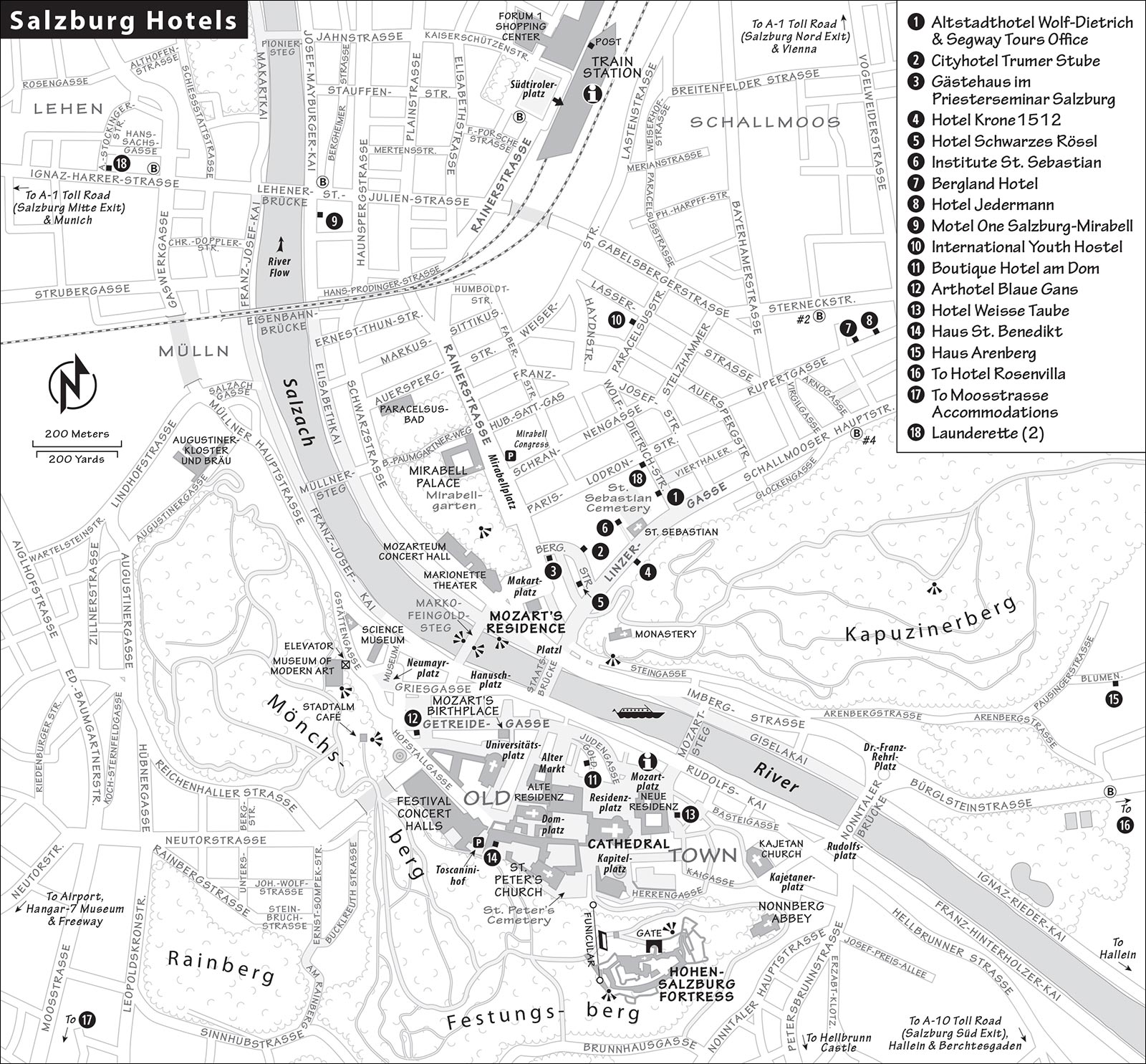
$$$ Haus St. Benedikt, run by the Benedictine order, rents 30 immaculate, modern rooms right in St. Peter’s Abbey. Each room has a Bible and cross, but no TV, though there is Wi-Fi. The reception is open daily 8:00-11:00 and 16:00-18:00—you can’t check in after that (cash only, elevator, Toscaninihof 1, +43 662 841 619 400, www.haus-st-benedikt.at, office@haus-st-benedikt.at).
HOTELS IN RESIDENTIAL NEIGHBORHOODS
These two modern hotels are worth considering for drivers in need of no-stress comfort. They come with a bit more space and free parking, but are a longish walk or short bus ride from the Old Town. Get detailed driving instructions from your hosts.
$$$ Haus Arenberg rents nine big, breezy rooms and five apartments—most with generous balconies—in a modern, ranch-style mansion with a quiet garden and mountain views. Though in a tony neighborhood with Porsches lining the narrow hillside lanes, it’s relaxed and unpretentious. Figure a 15-minute downhill walk to the center of town (along atmospheric Steingasse) and 20 minutes back up, or take bus #6, #7, or #10 to the Volksgarten stop and hike five minutes uphill (family room, fans, no elevator, library, free parking, Blumensteinstrasse 8, +43 662 640 097, www.arenberg-salzburg.at, info@arenberg-salzburg.at, Leobacher family).
$$$ Hotel Rosenvilla, simpler and farther out than Haus Arenberg, offers 14 colorful rooms surrounded by a leafy garden, around the corner from a stop for the bus into town (RS%, family rooms, fans, no elevator, free parking if you book direct, Höfelgasse 4—take bus #7 from Hanuschplatz to the Finanzamt stop, +43 662 621 765, www.rosenvilla.com, hotel@rosenvilla.com, Stefanie and Christopher).
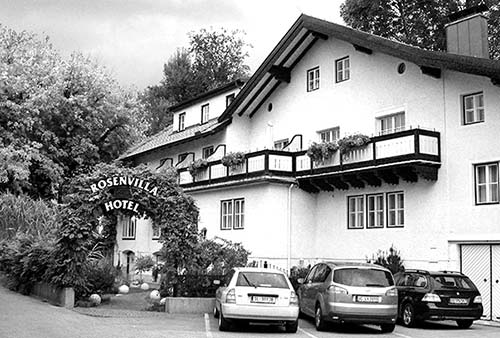
PENSIONS ON MOOSSTRASSE
Tucked behind Salzburg’s mountain, Moosstrasse was laid out a century ago through marshland that was reclaimed for farms, some of which are still there. Today the street is also dotted with great-value pensions that offer a roomy, comfortable alternative to pricey in-town hotels. Each one comes with free parking, farm-fresh scents, and mountains in the distance, and most offer a good breakfast. With easy and frequent buses zipping into town in 15 minutes, the location shouldn’t keep you away, and it works well for drivers. Some places charge about 10 percent extra for one-night stays. For locations, see the map on here.
Handy bus #21 connects Moosstrasse to the center frequently (Mon-Fri 4/hour until 18:30, Sat 3/hour until 20:00, evenings and Sun 2/hour, last bus leaves downtown around 23:00). To get to these pensions from the train station, take any bus heading toward the center to Makartplatz, where you’ll change to #21. If you’re coming from the Old Town, catch bus #21 from Hanuschplatz, just downstream of the Staatsbrücke bridge, by the Fisch Krieg Restaurant. When traveling to your pension, the bus stops only when requested—so press the button as soon as your stop is announced.
If you’re driving from the center, go through the tunnel, continue straight on Neutorstrasse, and take the fourth left onto Moosstrasse. From Germany, approach Moosstrasse from the Salzburg-West exit to avoid the Austrian expressway toll.
$$ Hotel Pension Bloberger Hof, the most hotelesque of these options, is comfortable and friendly, with a peaceful location and 20 farmer-plush, good-value rooms—including some bigger and pricier rooms (RS%, some rooms with balcony, family rooms, family apartment with kitchen, dinner for guests available Mon-Sat 18:00-21:00, elevator, free loaner bikes, free airport pickup if staying 3 nights, Hammerauer Strasse 4, bus stop: Hammerauer Strasse then head left, +43 662 830 227, www.blobergerhof.at, office@blobergerhof.at, Inge and daughter Sylvia).
$$ Pension Ballwein offers 11 polished, modern rooms (with air-con) and four apartments (without). It’s fresh and roomy, and each room has a balcony (family rooms, elevator, pay laundry, Moosstrasse 69a, bus stop: Gsengerweg then cross street, +43 664 222 5396, www.pension-ballwein.at, pension-ballwein@a1.net, Simon and Daniela).
$ Kal’s Apartments has four rooms with kitchenettes—the ground-floor ones have a small yard and the upper-floor ones have nice views (no breakfast, Moosstrasse 63b, bus stop: Volksschule Moos then cross street, +43 650 552 1116, www.kalssalzburg.at, office@kalssalzburg.at, Brigitte).
$ Haus am Moos has nine good rooms filled with antiques and artwork, all in a relaxed country atmosphere. It comes with a garden, swimming pool, breakfast buffet with mountain views, and a tiny private chapel (kitchen, Moosstrasse 186a, bus stop: Lehrbauhof then head right, +43 662 824 921, www.ammoos.at, ammoos186a@yahoo.de, Strasser family).
$ Haus Steiner’s four rooms—some with great views—are straightforward and quiet, with older modern furnishings and kitchenettes; there’s a minimum two-night stay (family rooms, Moosstrasse 156c, bus stop: Hammerauer Strasse then head right, +43 662 830 031, www.haussteiner.com, info@haussteiner.com, Rosemarie Steiner).
$ Helga Bankhammer rents two inexpensive, nondescript rooms in a big farmhouse, with a real dairy farm out back (pay laundry, Moosstrasse 77, bus stop: Marienbad then cross street and turn right, +43 662 830 067, www.haus-bankhammer.at, bankhammer@aon.at).
Eating on Moosstrasse: $$ Reiterhof, by the Hammerauer Strasse bus stop, is a popular restaurant near these listings. They have a cozy, woody dining room that looks down into a horse-training area (Thu-Sun 17:00-21:30, also serves lunch on Sun, closed Mon-Wed, Moosstrasse 151, +43 662 825 024).
Eating in Salzburg
Many restaurants and cafés are open longer hours and extra days during the Salzburg Festival. On the flip side, when business is slow, eateries may close early—no matter what hours they post.
On menus, look for a local dessert specialty called Salzburger Nockerl. This soufflé is made to resemble mountain peaks—including a snowy dusting of powdered sugar on top. Sometimes served with raspberry sauce, this rich dessert is designed to share.
IN THE OLD TOWN
Traditional Eateries
$$ Gasthaus Wilder Mann is a good bet in bad weather for traditional dishes. For a quick lunch, get the Bauernschmaus, a mountain of dumplings, kraut, and peasant’s meats. Notice the century-old flood photos on the wall. While they have a few outdoor tables, the atmosphere is all indoors, and the menu is more geared to cold weather (kitchen open Mon-Sat 11:00-21:00, closed Sun, 2 minutes from Mozart’s Birthplace, in passageway from Getreidegasse 20 to Griesgasse 17, +43 662 841 787, www.wildermann.co.at; Robert and Reinhold).
$$ St. Paul Stubm Beer Garden is tucked away under the fortress with a lederhosen-clad waitstaff and a decidedly untouristy atmosphere. The food is better than at beer halls, and a young, bohemian-chic clientele fills its two troll-like rooms and its idyllic tree-shaded garden. Kasnock’n is a tasty dish of spaetzle with cheese served in an iron pan—hearty enough for two. Reservations are smart (Tue-Sat 17:00-22:00, open later for drinks only, closed Sun-Mon, Herrengasse 16, +43 662 843 220, www.paul-stube.at, Bernard).
$$ Café Tomaselli has long been Salzburg’s top place for lingering and people-watching. Tomaselli serves a couple of light meals and lots of drinks and cakes (peruse the glass cases before ordering). The café keeps long hours and has fine seating on the square (diagonally across the way), a view terrace upstairs, and indoor tables. Despite its fancy wood paneling, 19th-century portraits, and chandeliers, it’s surprisingly low-key (daily 7:00-19:00, Alter Markt 9, +43 662 844 488).
Fine Dining
$$$$ Blaue Gans (The Blue Goose) offers great food and the most romantic ambiance I’ve found in the old center. With three dining areas (cozy under a medieval vault, modern minimalist cocktail bar, and a terrace outside facing the concert halls), it has a long history and claims to be the oldest inn in town (from the 1300s). The menu is traditional Austrian sprinkled with a splash of the Adriatic—Italy meets the Alps. The house wine is aptly named Goosebumps (Mon-Sat 12:00-22:00, closed Sun, Getreidegasse 41, +43 662 8424 9154, Andreas).
$$$ Restaurant Triangel, facing the main Salzburg Festival concert halls, is popular with performers and concertgoers for its cozy, candlelit atmosphere, mellow acoustics, attentive service, and great traditional menu. Its woody dining area, while old-style, comes with modern art and celeb photos (daily 11:30-22:00, closed Sun-Mon in off-season, Wiener-Philharmonker-Gasse 7, +43 662 842 229, Franziska and family).
$$$$ St. Peter Stiftskulinarium, in business since for more than 1,000 years, was mentioned in the biography of Charlemagne. This fixture in the Salzburg restaurant scene has managed to acquire a hard-to-say name, sprinkle in some mod decor, and offer a confusing mix of menus. While they have a small gourmet zone (one small room, over €100 for multicourse tasting menu), I’d stick with the casual menu (Austrian/Mediterranean, €20-30 plates). It’s high-end touristy, serving traditional Austrian cuisine. While indoor seating is nice, the “outdoor” section—carved into the mountain—is my favorite (daily 12:00-22:00, next to St. Peter’s Church at foot of Mönchsberg, +43 662 841 268, www.stpeter.at). They host the recommended Mozart Dinner Concert described on here.
Kaiviertel Quarter: Modern, Eclectic, Hip, and Funky
A commotion of contemporary, international restaurants and shops mixed in with a few old standards is tucked just behind the Salzburg Museum in the Kaiviertel Quarter (around the intersection of Kaigasse and Chiemseegasse). Among the offerings—all just a block or so off Mozartplatz, yet seemingly a world away from the tourism—are Polish, Irish, and Mexican cuisine. $ Wokman is a good little Vietnamese noodle soup and curry joint (Kapitelgasse 11). Icezeit serves ice cream in exotic flavors and has vegan options (Chiemseegasse 1). And there are twin pub-like options run by the same people, both serving traditional Austrian standards (schnitzel, goulash, spaetzle with kraut) and both starting with Z:
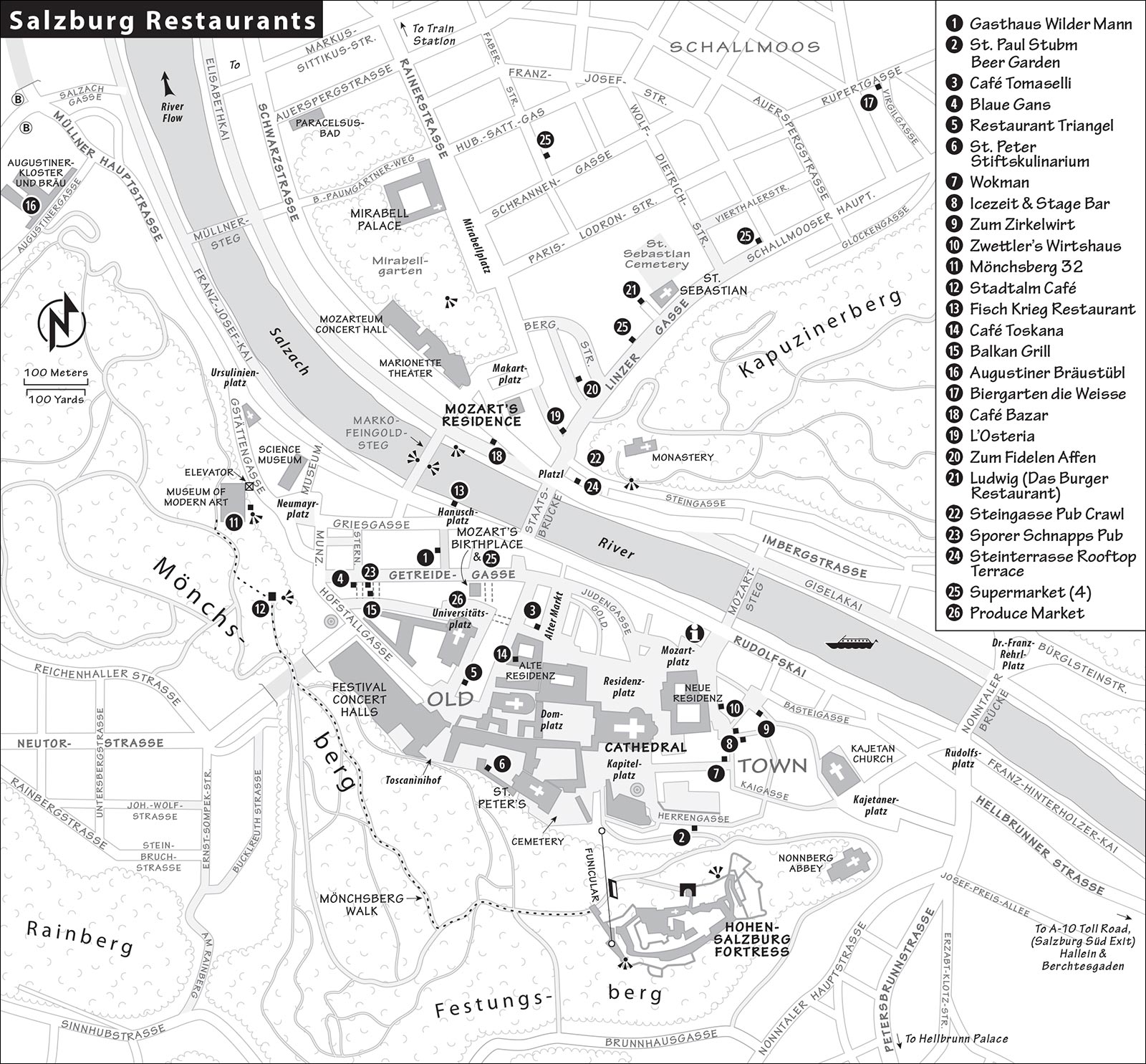
$$ Zum Zirkelwirt serves in an updated Gasthaus dining room and exotic plant-screened terrace (also has vegetarian plates and big salads, daily 11:30-22:00, Pfeifergasse 14, +43 662 842 796).
$$ Zwettler’s Wirtshaus feels like a thriving old English pub gone Austrian. Along with the traditional dishes they offer “innovative beer culture” with a good dose of youth (good seating inside and out, daily 11:30-22:00, Kaigasse 3, +43 662 274 018).
Nightlife in the Kaiviertel Quarter: A good option for live music, Stage Bar always has something going on—from karaoke to open-mic jams and local bands (Tue-Sat 19:00-late, closed Sun-Mon, Chiemseegasse 2, +43 650 453 0547).
On the Cliffs Above the Old Town
Riding the Mönchsberg elevator from the west end of the Old Town up to the clifftop deposits you near two very different eateries, but each has commanding city views.
$$$$ Mönchsberg 32 is a sleek, modern café/bar/restaurant overlooking Salzburg from the top of the Mönchsberg elevator. Even if you’re not hiking anywhere, this makes for a great place to enjoy a €5 coffee and the view. Or settle in for a pricey but high-quality meal (€17 weekday lunch specials, Tue-Sun 9:00-23:00, closed Mon, popular €19-24 breakfasts served until 11:30, buy a one-way elevator ticket—they give customers a free pass to descend, +43 662 841 000, www.m32.at).
$$ Stadtalm Café sits high above the Old Town on the edge of the cliff, with good traditional food and great views. It’s next to the remnants of the old city wall. If hiking across the Mönchsberg, make this a stop (cliff-side garden seating or cozy-mountain-hut indoor seating, generally Mon-Fri 9:00-18:00, Sat-Sun until 19:00, closes later in summer, earlier off-season and in bad weather, 5 minutes from top of Mönchsberg elevator, also reachable by stairs from Toscaninihof, Mönchsberg 19c, +43 662 841 729, www.stadtalm.at, Peter).
Eating Cheaply in the Old Town
Sausage stands (Würstelstände) serve the town’s favorite fast food. The best stands (like those on Universitätsplatz) use the same boiling water all day, which gives the weenies more flavor. For a list of helpful terms, see here.
$ Fisch Krieg Restaurant, on the river where the fishermen used to sell their catch, is a great value, serving fast, fresh, and inexpensive fish. Get your fishwich to go, or order from the cafeteria counter (fish soup, daily specials) to enjoy the casual dining room—where a big tree grows through the ceiling—or great riverside seating (Tue-Fri 9:00-18:00, Sat until 14:00, closed Sun-Mon, Hanuschplatz 4, +43 662 843 732).
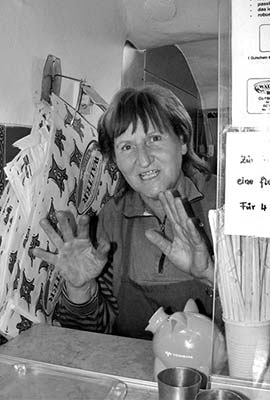
$ Café Toskana is the university self-service lunch canteen, very basic but fast and cheap, with indoor seating and a peaceful campus courtyard for good weather. Choose from daily soups, main-course specials, and vegetarian options (generally Mon-Fri 10:00-17:00, hot meals served 11:30-13:30 only, closed Sat-Sun, behind the Residenz in the courtyard opposite Sigmund-Haffner-Gasse 16, +43 662 8044 6909).
$ Balkan Grill has been a Salzburg institution since 1950, selling just one type of spicy sausage—Bosna—with your choice of toppings (choose one of the numbered options; takeout only, steady and sturdy local crowd, daily 11:00-18:30, hiding down the tunnel at Getreidegasse 33 across from Eisgrotte).
Picnics: Picnickers will appreciate the well-stocked Billa supermarket at Griesgasse 19a, across from the Hanuschplatz bus stop (Mon-Fri 7:40-20:00, Sat until 18:00, Sun 11:00-15:00). The bustling morning Grünmarkt produce market (closed Sun) on Universitätsplatz, behind Mozart’s Birthplace, is fun but very expensive.
AWAY FROM THE CENTER
$$ Augustiner Bräustübl, a huge 1,000-seat beer garden within a monk-run brewery in the Kloster Mülln, is rustic and rollicking. On balmy evenings, it’s like a Renoir painting outdoors under chestnut trees—but with beer breath and cigarette smoke. Local students mix with tourists eating hearty slabs of grilled meat with their fingers, while children frolic on the playground kegs. When it’s cool outside, eat indoors in one of the historic, beer-sloshed and smoke-stained halls. On busy nights, it’s like a Munich beer hall with no music but the volume turned up.
For your beer: decide what you want and pay the cashier (Schank means self-serve price, Bedienung is the price with waiter service); pick up a half-liter or full-liter mug; give Mr. Keg your receipt and empty mug, and you will be made happy. When you’re done, just leave your mug on the table (there’s no deposit). Waiters only bring beer; for food, go up the stairs, grab a tray, and assemble your meal from the deli counters (or, as long as you buy a drink, you can bring in a picnic—many do). Classic pretzels from the bakery and spiraled, salty radishes make great beer even better. Locals agree that the hot food here is not as good as the beer. Stick with the freshly cooked meat dishes: I made the mistake of choosing schnitzel, which was reheated in the microwave. For dessert—after a visit to the strudel kiosk—enjoy the incomparable floodlit view of old Salzburg from the nearby Müllnersteg pedestrian bridge and a riverside stroll home (daily 15:00-23:00, Augustinergasse 4, +43 662 431 246).
Getting There: It’s about a 15-minute walk along the river (with the river on your right) from the Old Town side of the Staatsbrücke bridge. After passing the Müllnersteg pedestrian bridge, just after Café am Kai, follow the stairs up to a busy street, and cross it. From here, either continue up more stairs into the trees and around the small church (for a scenic approach to the monastery), or stick to the sidewalk as it curves around to Augustinergasse. Either way, your goal is the huge yellow building. Don’t be fooled by second-rate gardens serving the same beer nearby. You can also take a bus from Hanuschplatz (#4, #7, #9, #21, #24, #27, or #28) two stops to the Landeskrankenhaus stop, almost in front of the beer garden. Or you can walk down from Mönchsberg (follow signs for Mülln; see “Mönchsberg Walk” on here).
NORTH OF THE RIVER
Restaurants near Linzer Gasse Hotels
$$ Biergarten die Weisse, close to the hotels on Rupertgasse and away from the tourists, is a longtime hit with the natives. If a beer hall can be happening, this one—modern yet with antlers—is it. Their famously good beer is made right there; favorites include fizzy wheat beer (Die Weisse Original) as well as seasonal beers (ask what’s on offer). Enjoy the beer with their traditional food in the great garden setting or in the wide variety of indoor rooms—sports bar, young and noisy, or older and more elegant (Mon-Sat 10:00-24:00, closed Sun, Rupertgasse 10, bus #2 to Bayerhamerstrasse or #4 to Grillparzerstrasse, +43 662 872 246).
$$ Café Bazar overlooks the river between the Mirabell Gardens and the Staatsbrücke bridge. Its dressy interior comes with 1880s Art Nouveau nostalgia and is as close as you’ll get to a Viennese coffeehouse in Salzburg. With formal service, their outdoor terrace is a venerable spot for a classy drink with an Old Town and castle view. While it’s a local favorite for breakfast, after that the menu gets very basic—soup, salad, toast, and a daily special (Mon-Sat 7:30-19:30, Sun 9:00-18:00, July-Aug daily until 23:00 or later, Schwarzstrasse 3, +43 662 874 278).
$$ L’Osteria, a local standby for Italian, has a fun energy, a youthful interior, and plenty of outside tables. It’s a hit with locals (and families) for its pizza and weekly specials, and is one of the livelier hangouts for after-hours drinks when most of the town is closed (pastas and salads, noisy acoustics, daily 11:00-24:00, Dreifaltigkeitsgasse 10, +43 662 8706 5810).
$$ Zum Fidelen Affen (“The Funky Monkey”) is a reliable neighborhood eatery serving mostly traditional Austrian dishes and a few international items (pastas, big salads). The wood interior is cozy, but the big draw is the outdoor seating, which sprawls through an inviting people zone (Tue-Sat 17:00-24:00, closed Sun-Mon, Priesterhausgasse 8, +43 662 877 361).
$$ Ludwig (Das Burger Restaurant) is a good example of how hamburgers have gone global in a modern high-cuisine way. This family-friendly, fresh, mod eatery serves organic local meat (and vegetarian facsimiles) with a fun energy and attentive service. The interior is inviting, and so is the cobbled courtyard on a hot day (Tue-Sun 11:00-22:00, down the lane from Linzer Gasse 39, +43 662 872 500).
Groceries: The Spar supermarket has multiple locations around the New Town (Mon-Sat generally 7:30-18:00, closed Sun).
Steingasse Pub Crawl
For a fun post-concert activity, drop in on a couple of atmospheric bars at the Linzer Gasse end of Steingasse (the historic lane described on here). These dark bars, each inviting yet with a different vibe, are all within about 100 yards of each other (all open until the wee hours). They don’t serve food, but $ Reyna, a convenient four-table pizzeria and döner kebab shop (at #3), stays open late.
Pepe Cocktail Bar, with Mexican decor, a long list of cocktails, and the youngest crowd, can be a mosh pit of drunken joy (Wed-Sat 19:00 until late, closed Sun-Tue, live DJs on Sat, Steingasse 3, +43 662 873 662).
Saiten Sprung wins the “Best Atmosphere” award for its hellish interior—lots of stone and red decor, with mountains of melted wax beneath age-old candlesticks and an ambience of classic ’70s and ’80s music. For more than three decades Stelios, who speaks English with Greek charm, has served cocktails and good wine (Wed-Sat 21:00-late, closed Sun-Tue, Steingasse 11, +43 662 881 377).
Fridrich is an intimate little place under an 11th-century vault with lots of mirrors and a warm gin-and-tonic welcome. Eduardo, nearly 80, is the oldest bartender in Salzburg (Thu-Sat from 19:00, closed Sun-Wed except during festivals and Dec, Steingasse 15, +43 662 876 218).
Salzburg Connections
BY TRAIN
By train, Salzburg is the first stop over the German-Austrian border. This means that if Salzburg is your only stop in Austria, and you’re using a rail pass that covers Germany (including the Bayern-Ticket day pass for Bavaria) but not Austria, you don’t have to pay extra or add Austria to your pass to get here. Deutsche Bahn ticket machines at the Salzburg train station make it easy to buy tickets to German destinations.
From Salzburg by Train to: Munich (2/hour, 1.5 hours on fast trains, 2 hours on slower trains covered with Bayern-Ticket day pass), Munich Airport (2.5 hours, take Munich-bound train and change to S-8 suburban train at München Ost), Nürnberg (change in Munich, 3 hours on expensive fast trains, 5 hours on slower trains covered by Bayern-Ticket day pass), Füssen (change in Munich and Buchloe or Kaufbeuren, 4.5 hours), Reutte (roughly hourly, 5 hours, change in Munich and Garmisch-Partenkirchen, Bayern-Ticket day pass valid on the Austrian stretch), Hallstatt (at least hourly, 2.5-3 hours with a change in Attnang-Puchheim, last connection leaves Salzburg in mid-afternoon; also works by bus—see later), Innsbruck (hourly, 2 hours), Vienna (3/hour, 2.5-3 hours, choose either public ÖBB or private Westbahn trains), Melk (2.5 hours, transfer in Amstetten or St. Pölten), Ljubljana (2/day, 4.5 hours, one direct, one with change in Villach), Prague (simplest with change in Vienna or Munich, 7-8 hours), Venice (3/day, 6 hours, change in Villach, short night train option). Austrian train info: www.oebb.at; German train info: www.bahn.com.
BY BUS
To reach Berchtesgaden, bus #840 is easier than the train (for details see next page).
To Hallstatt, taking the bus via Bad Ischl is faster, more scenic (with views of the Wolfgangsee), and at €15, usually cheaper than the train via Attnang-Puchheim—but the bus trip isn’t covered by rail passes. Buses occasionally fill up, so it’s safest to board at Salzburg train station, where the bus originates: Find platform F outside the station, and take bus #150 to Bad Ischl (2/hour, 75 minutes, also stops at Mirabellplatz and Hofwirt, www.postbus.at). At Bad Ischl station, change to the train—20-minute ride to Hallstatt, then ride the boat across the lake. Or continue by bus from Bad Ischl to the Lahn section of Hallstatt (bus #542, then change in Gosaumühle to bus #543). Plan your journey and buy tickets at www.oebb.at.
ROUTE TIPS FOR DRIVERS
To drive on expressways in Austria, you need a toll sticker called a vignette (€9.60/10 days, buy at the border, gas stations, car-rental agencies, Tabak shops, or online at www.asfinag.at). You can skip the sticker if you stay off the expressway system. As well, the A-1 expressway between the German border and the Salzburg-Nord exit is exempt from the sticker requirement, giving those coming from Germany toll-free access to the city. But the sticker is required on the A-10 expressway that runs around the south side of Salzburg.
Here are some tips for driving from Germany to Salzburg and Hallstatt without having to pay tolls.
From Germany to Salzburg: As you come into Austria on Germany’s A8 autobahn, follow signs for the Austrian A-1 expressway to avoid the toll; exit the A-1 at Salzburg-West, Salzburg-Messe, or Salzburg-Nord.
From Salzburg to Hallstatt: To avoid tolls, stick to the B-158 via St. Gilgen, which is the quickest and most direct route in any case. Even if you have a toll sticker and can take the A-1 Salzburg-Vienna expressway, it doesn’t speed up the trip. Between Salzburg and Hallstatt, the B-158 passes a luge ride and the towns of St. Gilgen (pleasant but touristy) and Bad Ischl (the center of the Salzkammergut, with a spa and a Habsburg summer palace, www.badischl.at).
Berchtesgaden
This alpine ski region, in a finger of German territory that pokes south into Austria, is famous for its fjord-like lake and its mountaintop Nazi retreat. Long before its association with Hitler, Berchtesgaden (BERKH-tess-gah-den) was one of the classic Romantic corners of Germany. In fact, Hitler’s propagandists capitalized on the führer’s love of this region to establish the notion that the native Austrian was “truly” German at heart.
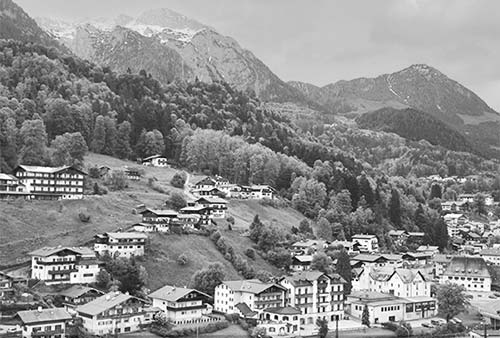
Today as ever, the Berchtesgaden area exerts a powerful pull on visitors. World War II buffs come here to see a top-notch documentation center, the remains of the Nazis’ elaborate last-ditch bunkers, and Hitler’s mountain retreat. Nature lovers enjoy the pristine alpine setting, cruising up the romantic Königssee or going for a hike along a secluded gorge to a high waterfall. And if you have yet to do a salt-mine tour, Berchtesgaden has a good one.
Berchtesgaden can be inundated with Germans during peak season, when you may find yourself in a traffic jam of tourists. Plan your time carefully to avoid getting stuck in lines and crowds (more tips later).
GETTING THERE
Berchtesgaden is 15 miles from Salzburg, and easily connected by bus #840 (runs Mon-Fri almost hourly from 8:15, Sat-Sun 8/day from 9:15, usually at :15 past each hour, 50 minutes). Buy a Tageskarte day ticket from the driver (€11, zone 5); this costs about the same as a round-trip ticket to Berchtesgaden, but also covers local buses there—except special bus #849 up to the Eagle’s Nest. Check schedules and ticket information at Salzburg-Verkehr.at.
While bus #840 originates at Salzburg’s main train station (at platform J—across the street, in front of the Forum 1 building), for many travelers it’s easiest to catch it at Mirabellplatz (near many recommended New Town hotels) or in Salzburg’s Old Town (on Rudolfskai, near Mozartplatz). The last bus #840 back to Salzburg from Berchtesgaden departs at 18:15. If you miss the last bus, you can catch a train (until 22:00). Trains run between Salzburg and Berchtesgaden (via Freilassing)—but it takes twice as long and isn’t as scenic.
PLANNING YOUR TIME
Berchtesgaden’s sights are excellent, but especially packed during the summer months from June through September (sunny weekends attract huge crowds). The following instructions assume you’ll be arriving by public transportation from Salzburg.
If your priority is the Nazi sites, plan your day around David and Christine Harper’s half-day tour (see “Tours in Berchtesgaden,” later). Take the bus from Salzburg at 10:15, and then, at 11:15, the #838 bus from Berchtesgaden up to Obersalzberg (15-minute trip), where the tour starts at 13:00. Eat at the Berggasthof Obersalzberg restaurant while you’re waiting for the tour to start, or bring a packed lunch. The tour ends in time for the 16:55 bus down from Obersalzberg to Berchtesgaden, and the bus from Berchtesgaden back to Salzburg at 17:15.
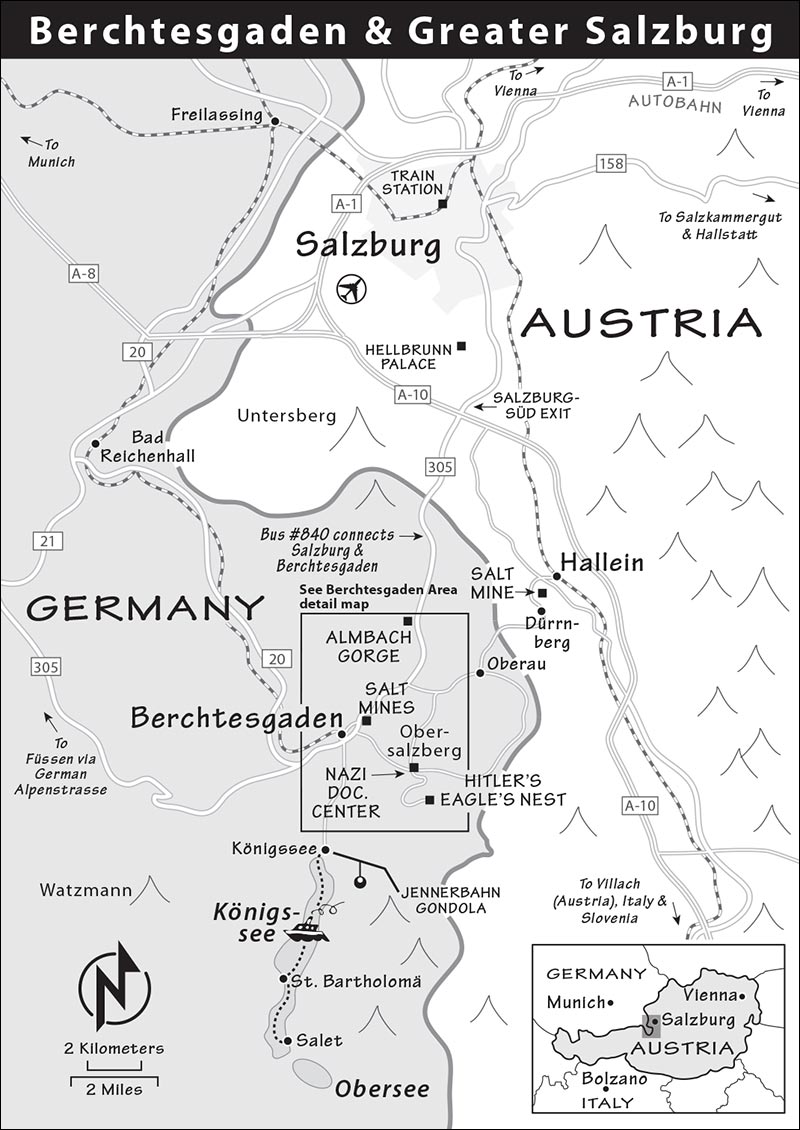
If you want to focus on the mountains (or the salt mines), leave Salzburg as early as you can (Mon-Fri at 8:15, Sat-Sun at 9:15). Head directly for the salt mines, Königssee (boat trip or mountain gondola), or the Almbach Gorge (hiking; closed in winter)—the early start avoids the worst of the crowds. Bus #840 stops at both the salt mines and the gorge on the way into town; to reach Königssee, you’ll have to change buses at the Berchtesgaden station. After lunch, you can visit one more of these three destinations, or see one or two of the Nazi sites on your own.
Having a car here is helpful, and allows combining the Nazi sites tour with the area’s natural attractions.
Note that the Eagle’s Nest is open mid-May to mid-October (confirm at www.kehlsteinhaus.de). Even if it’s closed, it’s still worthwhile to tour the excellent Obersalzberg Documentation Center and visit the area’s other sights.
Orientation to Berchtesgaden
The area’s major sights are all a few minutes’ drive outside Berchtesgaden (pop. 7,500). The town itself is spread out—the hub of activity is the train station and bus terminal, which face a huge roundabout that spans the confluence of two rivers. From here, buses fan out to the various outlying sights. To the north (along the road to Salzburg) are the salt mine and the Almbach Gorge. In the hills to the east is Obersalzberg, with the documentation center and the remains of some Hitler-era bunkers; high on an adjacent mountaintop (called Kehlstein in German) is the Eagle’s Nest. To the south is the long, skinny Königssee, which cuts deep into alpine peaks. The old center of Berchtesgaden, bypassed by most tourists, is up the hill behind the station (use the underground passage below the train tracks and cross the parking lot to reach a footpath to the old center). There are several eateries and supermarkets around the station.
ARRIVAL IN BERCHTESGADEN
By Bus and Train: Berchtesgaden’s central bus terminal (ZOB) is just in front of the train station. Buses to outlying sights leave from here. You’ll find baggage lockers (along the train platform), free WCs (near the Burger King), art (check out the mural in the station’s main hall encouraging tourists to visit the salt mines), and history (study the 1937 Nazi-era architecture). The oversized station was built to accommodate (and intimidate) the hordes of Hitler fans who flocked here in hopes of seeing the führer. The building next to the station, just beyond the round tower, was Hitler’s own V.I.P. reception area.
By Car: All the outlying sights have their own parking. There’s a pay lot at the train station if you want to stop there.
GETTING AROUND BERCHTESGADEN
All buses (except #849) leave from the train station, run about hourly, and are covered by the Tageskarte day ticket from Salzburg. Check timetables at www.dbregiobus-bayern.de, or call +49 8652 94480.
Bus #840 connects Berchtesgaden to Salzburg, also stopping at the salt mine (Salzbergwerk stop, 7 minutes from Berchtesgaden) and the Almbach Gorge (Kugelmühle stop, 12 minutes)—allowing you to hop off at either sight on your way into or out of town. For more on this bus, see “Getting There,” earlier.
Buses #837 and #848 also go to the salt mine.
Bus #838 goes to the Obersalzberg Documentation Center and Bunker (Obersalzberg stop, 15 minutes).
Bus #841 goes to the Königssee (Königssee stop, 8 minutes) and then the Jennerbahn lift (one stop farther).
Bus #849 is the only way to reach the Eagle’s Nest, connecting from the Obersalzberg Documentation Center (for details, see the “Eagle’s Nest” listing, later).
In a pinch, taxis are standing by at the train station (figure €9 to the salt mine, €14 to the Königssee or Obersalzberg).
Tours in Berchtesgaden
Eagle’s Nest Historical Tours
Since 1990, David and Christine Harper—who rightly consider this visit more an educational opportunity than simple sightseeing—have organized thoughtful tours of the Hitler-related sites near Berchtesgaden. Their bus tours, usually led by native English speakers, depart from the restaurant (Berggasthof Obersalzberg) near the Obersalzberg Documentation Center. Tours start by driving through the remains of the Nazis’ Obersalzberg complex, then visit the bunkers underneath the documentation center, and end with a guided visit to the Eagle’s Nest (€67/person, RS%—€1 discount with this book, includes admissions, daily at 13:00 mid-May-late Oct, 3.5 hours, 30 people maximum, reservations strongly recommended, private tours available, +49 8652 62172, www.eagles-nest-tours.com, info@eagles-nest-tours.com). Near the beginning or end of the season, tours are canceled if it’s snowing at the Eagle’s Nest.
David and Christine also do half-day private tours, which are more flexible and tailored to your interests (€300 for up to 6 people); they also do great Sound of Music tours to Salzburg that begin in Berchtesgaden.
Bus Tours from Salzburg
While Salzburg-based tour companies (including Bob’s Special Tours, www.bobstours.com, and Panorama tours, www.panoramatours.com) offer half- and full-day tours to Berchtesgaden, I don’t recommend them except as a last resort. They take you to (but not into) the sights described here—meaning that you pay the tour price for the same transport that you can buy yourself for €11 from Salzburg. Even on the full-day tours, you cannot see both the Eagle’s Nest and the Obersalzberg Documentation Center—you must choose one. Instead, take David and Christine Harper’s tour, or visit the documentation center and Eagle’s Nest on your own by bus.
Sights near Berchtesgaden
NAZI SITES
Early in his career as a wannabe tyrant, Adolf Hitler had a radical friend who liked to vacation in Berchtesgaden, and through him Hitler came to know and love this dramatic corner of Bavaria. Berchtesgaden’s part-Bavarian, part-Austrian character held a special appeal to the Austrian-German Hitler. In the 1920s, just out of prison, he checked into an alpine hotel in Obersalzberg, three miles uphill from Berchtesgaden, to finish work on his memoir and Nazi primer, Mein Kampf. Because it was here that he claimed to be inspired and laid out his vision, some call Obersalzberg the “cradle of the Third Reich.”
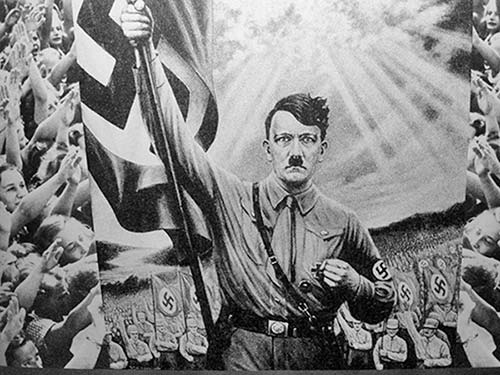
In the 1930s, after becoming the German chancellor, Hitler chose Obersalzberg as the place to build his mountain retreat, a supersized alpine farmhouse called the Berghof—the Nazis’ answer to Camp David. His handlers crafted Hitler’s image here—surrounded by nature, gently receiving alpine flowers from adoring little children, lounging around with farmers in lederhosen...no modern arms industry, no big-time industrialists, no ugly extermination camps. In reality, Obersalzberg was home to much more than Hitler’s alpine chalet. It was a huge compound of 80 buildings—fenced off from the public after 1936, and connected by extensive bunkers—where the major decisions leading up to World War II were hatched. Hitler himself spent about a third of his time at the Berghof, hosted world leaders in the compound, and later had it prepared for his last stand.
Some mistakenly call the entire area “Hitler’s Eagle’s Nest.” That name actually belongs only to the Kehlsteinhaus, a small mountaintop chalet on a 6,000-foot peak that juts up two miles south of Obersalzberg. (A visiting diplomat humorously dubbed it the “Eagle’s Nest,” and the name stuck.) In April 1945, Britain’s Royal Air Force bombed the Obersalzberg compound nearly flat, but missed the difficult-to-target Eagle’s Nest entirely. Before the Allies turned the site over to the German government in 1952, they blew up most of what had survived the bombing, wanting to leave nothing to attract future neo-Nazi pilgrims. The most extensive surviving remains are of the Nazis’ bunker system, intended as a last resort for the regime as the Allies closed in. In the 1990s, a museum—the Obersalzberg Documentation Center—was built on top of one of the bunkers.
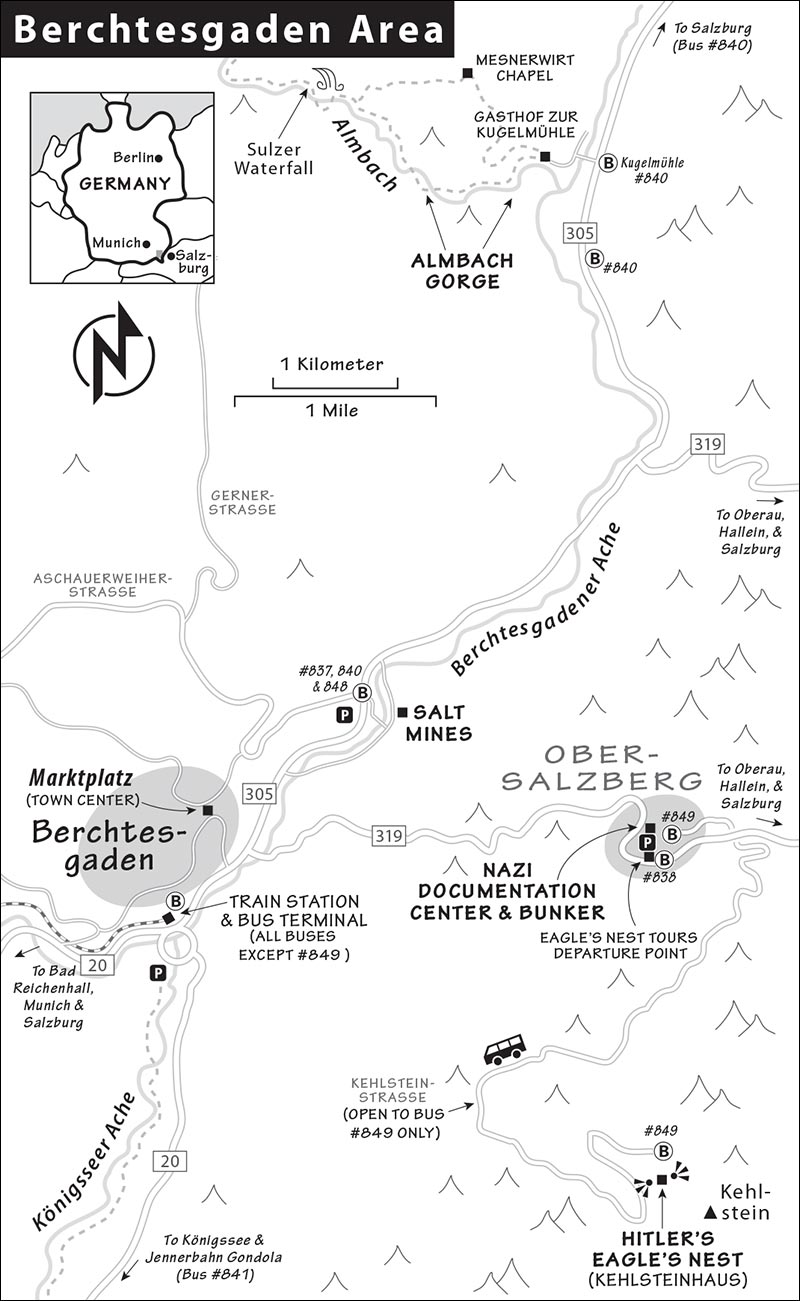
▲▲▲Obersalzberg Documentation Center and Bunker
With a fine museum and the chance to walk through a network of bunkers (all that survives from Hitler’s original Berghof complex), this site provides an informative and sobering look at Nazi history. The documentation center’s new building should be open by the time you visit; expect changes to the exhibits.
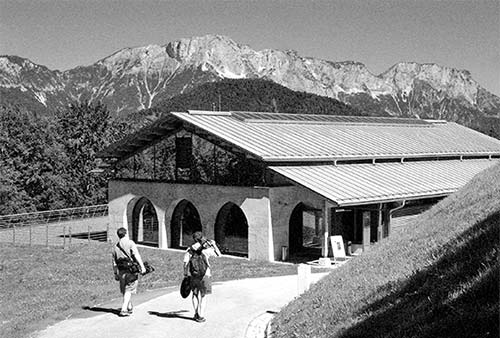
Cost and Hours: €3 covers both museum and bunker, daily 9:00-17:00, Nov-March Tue-Sun 10:00-15:00, closed Mon, last entry one hour before closing, allow 1.5 hours for visit, +49 8652 947 960, www.obersalzberg.de.
Getting There: Hop on bus #838 from Berchtesgaden’s train station to the Obersalzberg stop—it’s a 5-minute walk to the center from there. Drivers follow signs for Obersalzberg and Kehlstein, then park at the documentation center (€3, cash only, lot P1 is near the Eagle’s Nest bus stop; lot P2 is closer to the museum and bunker).
Visiting the Museum and Bunker: From the parking lot or bus stop, walk down past the big restaurant to reach the entrance.
The well-presented museum has few actual artifacts but does a fine job of explaining the history of the site and offers a concise and powerful overview of Nazi history. If you’re visiting other documentation centers on your trip (in Nürnberg or Berlin, for example), this is a rerun. If not, it’s well worth your time.
First find the exhibits about this notorious site, including the propagandists based here who cultivated a gauzy cult of personality around their mountain-loving führer. Take a look at the Nazi state and its crimes: you’ll see profiles of key players, from Himmler to Goebbels to Göring; the Volksgemeinschaft propaganda that convinced everyday Germans of their ethnic purity; and the Nazis’ methods of terror, from the SS to concentration camps. A children’s book is filled with anti-Semitic stereotypes, and a map of the concentration camp network illustrates how all roads led to Auschwitz.
On your way to the bunkers, you’ll pass a series of exhibits on World War II, demonstrating how this place was Hitler’s “second center of power” after Berlin.
Finally, you enter the vast and complex Platterhof bunker system. Construction began in 1943, after the Battle of Stalingrad ended the Nazi aura of invincibility. This is a professionally engineered underground town, which held meeting rooms, offices, archives for the government, and lavish living quarters for Hitler—all connected by four miles of tunnels cut through solid rock by slave labor. You can’t visit all of it, and what you can see was stripped and looted bare after the war. (Look for graffiti from French soldiers, Italian forced laborers, and American GIs.) But enough is left that you can wander among the concrete and marvel at megalomania gone mad.
▲▲▲Eagle’s Nest (Kehlsteinhaus)
The Kehlsteinhaus chalet was built in 1938 as the capstone of Hitler’s mountain complex. While a fortune (and several workers’ lives) was spent building this perch and the road up to it, Hitler, who was afraid of heights, visited only about a dozen times. Hitler’s mistress, Eva Braun, though, liked to hike up to the Eagle’s Nest to sunbathe.
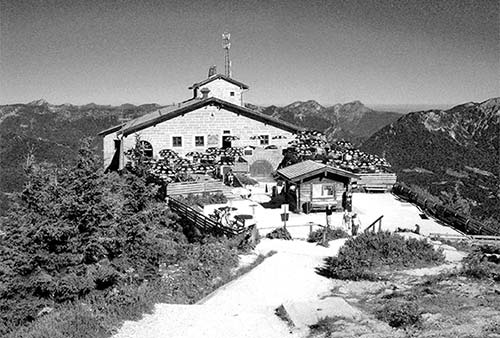
Today, the chalet that Hitler ignored is basically a three-room, reasonably priced restaurant with a scenic terrace, 100 yards below the summit of a mountain. You could say it’s like any alpine hiking hut, just more massively built. On a nice day, the views are magnificent (but it’s often fogged in). Bring a jacket, and go early or late in the day to avoid crowds in summer.
Cost and Hours: Free (but you pay for the bus up), open about mid-May-late Oct, snowfall can sometimes force a later opening or earlier closing—check website, first bus up at 8:30, last bus up at 16:00, last bus down at 16:50, fewer buses in late Sept and Oct, +49 8652 2969, www.kehlsteinhaus.de.
Getting There: The only way to reach the Eagle’s Nest—even if you have your own car—is by specially equipped bus #849, which leaves from near the Obersalzberg Documentation Center and climbs steeply up the one-way, private road—Germany’s highest (every 25 minutes, 15-minute ride, €28 round-trip, Tageskarte day passes not valid, look for Kehlstein Busabfahrt signs, buy ticket from bus depot window, bus info +49 8652 2029, www.dbregiobus-bayern.de, €3 parking at documentation center).
Visiting the Center: From the upper bus stop, a finely crafted tunnel leads to the original polished-brass elevator, which takes you the last 400 feet up to the Eagle’s Nest. Wander into the fancy back dining room (the best preserved from Hitler’s time), where you can see the once-sleek marble fireplace chipped up by souvenir-seeking troops in 1945.
OTHER SIGHTS NEAR BERCHTESGADEN
▲Salt Mines (Salzbergwerk Berchtesgaden)
At the Berchtesgaden salt mines, you put on traditional miners’ outfits, get on funny little trains, and zip deep into the mountain. On the 1.5-hour tour (which includes time to get into and back out of your miner’s gear), you’ll cruise subterranean lakes; slide speedily down two long, slick, wooden banisters; and learn how locals mined salt so long ago. Tours are in German, but English speakers get audioguides.
Cost and Hours: €21—book online to see available tour times and avoid waiting in line, daily 9:00-17:00, Nov-April 11:00-15:00—these are last-entry times, +49 8652 600 20, www.salzbergwerk.de.
Getting There: Reach the mines from Berchtesgaden with a 20-minute walk along the river or a quick bus ride (#837, #840, or #848—see “Getting Around Berchtesgaden,” earlier, get off at Salzbergwerk stop). If you walk along the river, cross it over the bridge at Bergwerkstrasse. If you have extra time, you can take the interesting 35-minute walking route from the station to the mines through Berchtesgaden’s Old Town. Drivers look for the Salzbergwerk and P signs at the northern edge of town (on the Salzburg road). Park in the pay lot, then walk five minutes to the mine (follow signs through the pedestrian underpass and over the river).
▲Königssee
Three miles south of Berchtesgaden, the idyllic Königssee stretches like a fjord through pristine mountain scenery to the dramatically situated Church of St. Bartholomä and beyond. This is a stunner on a nice day (less so when it’s socked in). If you plan to sail the Königssee, allow at least two hours round-trip to St. Bartholomä and three hours round-trip to Salet. Another option here is the Jennerbahn, a mountain lift.
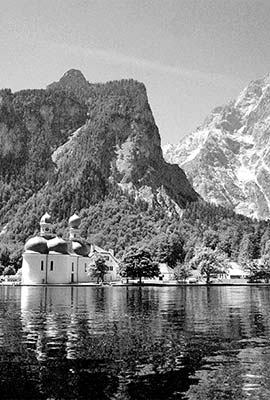
Getting There: Bus #841 goes from the Berchtesgaden train station to Königssee. Walkers can take the scenically woodsy, reasonably flat 1.5-hour walk (well-signed). From the pay parking lot and bus stop (with WCs, ATMs, and a TI), a brick path leads five minutes downhill to the lakeshore through a thicket of souvenir stores selling marmot-fat ointment, quartz chunks, carved birdhouses, lederhosen, dirndls, and “superpretzels.”
Boat Trips: The big draw at Königssee is the scenic boat trips. Most visitors simply go as far as St. Bartholomä, poke around the church there, eat some smoked fish, then take the boat back (€20 round-trip, 35 minutes each way). You can stay on the boat 15 minutes longer to Salet, which is less crowded and offers a fine 15-minute hike to the smaller lake called Obersee (€25 round-trip). Boats, going at a sedate Bavarian speed, are filled with Germans chuckling at the captain’s commentary. For the best view, sit on the right going out, and on the left heading back. At a rock cliff midway through the journey, your captain stops, and the first mate pulls out a trumpet to demonstrate the fine echo. Boats leave with demand; you’ll get a departure time when you buy your ticket (generally 2-4/hour, first boat between 8:00 and 9:00, last boat back from St. Bartholomä at 17:30 or 18:00, depending on season, runs late April-mid-Oct, no boats off-season, +49 8652 96360, www.seenschifffahrt.de). Boats fill up in nice weather (especially in July-Aug between 10:00 and 11:00). Later in the day, return boats (especially from St. Bartholomä) can be packed; if you’re rushing to get back to town, keep an eye on queues for the return boats.
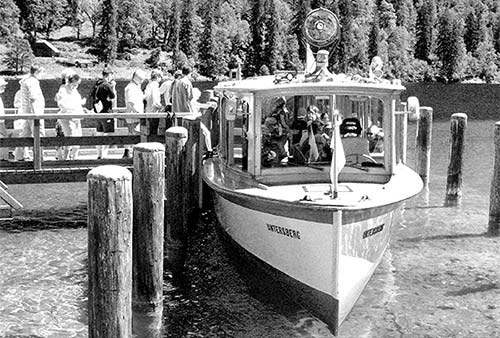
St. Bartholomä: The remote, red-onion-domed Church of St. Bartholomä sits on a little peninsula (once also the home of a monastery, then a hunting lodge of the Bavarian royal family). It’s surrounded by a fine beer garden, rustic fishermen’s pub, and inviting lakeside trails. The family next to St. Bartholomä’s lives in the middle of this national park and has a license to fish—so very fresh, caught-and-smoked-today trout is the lunchtime favorite. (Look for the Fischerei, where you can get a filet on a baguette to go.) For a heartier meal, there’s also an outpost of the Hofbräuhaus. Just up from the boat-dock area is a cluster of houses with a national park center (small German-only exhibit). Here you can get advice for hikes, which are well signposted. The Eiskapelle “glacier” is about 1.25 hours one-way; for an easier hike, go only partway, to the river called Eisgraben. Or follow the easy 30-minute St. Bartholomä-Rundweg loop along the lakeshore.
Jennerbahn Mountain Lift: The Jennerbahn gondola whisks passengers up in 20 minutes to the 6,148-foot Jenner peak, where a restaurant and panoramic views await. Hiking trails fan out from the lift’s middle station (€38 round-trip, daily 9:00-17:00, lift station is walkable from the Königssee parking lot or one stop farther on bus #841, +49 8652 95810, www.jennerbahn.de).
Almbach Gorge (Almbachklamm)
This short, popular hike is a good option for nature lovers who come to see Berchtesgaden’s Nazi sites, then want to fill up the rest of the day hiking along a stream-filled gorge. Though not a world-class attraction, it is an enjoyable way to spend two or three hours. Most visitors do it as a roughly four-mile round-trip, though you can go farther if you wish. It’s not suitable for small children.
Getting There: Take bus #840 to the Kugelmühle stop (12 minutes toward Salzburg from Berchtesgaden) and check the next bus times—two hours between buses is enough for a quick visit, three hours for a leisurely one. (This bus stop is closer than the one actually named “Almbachklamm.”) Walk five minutes along Kugelmühlweg (following the Almbachklamm signs) to the trailhead. Drivers simply turn off the Salzburg road at Almbachklamm signs and turn left along Kugelmühlweg to reach the free parking lot. In your GPS, use the address Kugemühlweg 18 in Marktschellenberg.
Cost and Hours: €6 (cash only), daily May-Oct 9:00-18:00, gorge closed off-season, +49 8650 988 830, www.berchtesgaden.de, then search for “Almbachklamm.”
Visiting the Gorge: First you’ll see the $$ Gasthaus zur Kugelmühle, which serves meals and drinks in a pleasant setting (cash only, Mon-Thu 11:00-17:00, Sat-Sun until 19:00, closed Fri, +49 8650 461, www.gasthaus-kugelmuehle.de). In front of the restaurant is an old wooden apparatus for shaping marble blocks into round toy spheres (hence the name—Kugel means ball, Mühle means mill).
Just beyond is a gate where you pay to enter the gorge; pick up a map and get hiking advice here. A rushing stream cascades through the gorge, which the trail crosses and recrosses on numbered steel bridges. The trail is well maintained and exciting, and accessible to anyone who is reasonably fit, sure-footed, and wearing sturdy shoes. It’s not recommended for young children because the path has some steep, unguarded drop-offs. Expect some narrow and slippery parts. The high Sulzer waterfall by bridge #19 is a traditional turnaround point. The walk there and back can be done in two hours at a good clip, but allowing three hours makes for a more pleasant visit. To gain some altitude, on the way back, at bridge #17, hike up to the Mesnerwirt Chapel.