TRIER
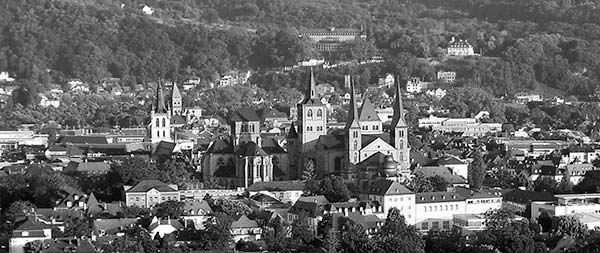
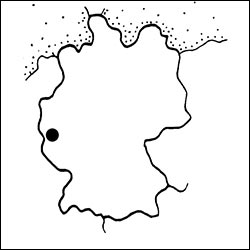
Germany’s oldest city lies at the head of the scenic Mosel Valley, near the border with Luxembourg. An ancient Roman capital, Trier brags that it was inhabited by Celts for 1,300 years before Rome even existed. Today, Trier (rhymes with clear) is thriving and feels very young. A short stop here offers you a look at Germany’s oldest Christian church, one of its most enjoyable market squares, and its best Roman ruins.
Founded by Augustus in 16 BC, Trier was a Roman town called Augusta Treverorum for 400 years. When Emperor Diocletian (who ruled AD 285-305) divided his overextended Roman Empire into four sectors, he made Trier the capital of the west: roughly modern-day Germany, France, Spain, and England. For most of the fourth century, this city of 80,000—with a four-mile wall, four great gates, and 47 round towers—was a favored residence of Roman emperors. Emperor Constantine lived here, spending lavishly on urban projects. As a military town in a godforsaken corner of the empire, Trier received lots of perks from Rome to make it livable for those assigned here. But when the last emperor checked out in AD 395, the money dried up, and that was the end of Trier’s ancient glory days. In the late 400s, when Rome fell to the barbarians, so did Trier.
Roman Trier was much bigger than medieval Trier. The pedestrian center of town—containing nearly all of your sightseeing and browsing—is defined by the medieval wall (which encloses only half the area the Roman wall did). Trier’s Roman sights include the huge city gate (Porta Nigra), basilica, baths, and amphitheater.
Trier’s main draw is the chance to experience Germany’s Roman and early Christian history, which deserve at least a full day to appreciate. Poli-sci junkies should try to visit Karl Marx’s House. If you’re more interested in wine tasting and scenery, stay elsewhere on the Mosel River (see previous chapter).
Orientation to Trier
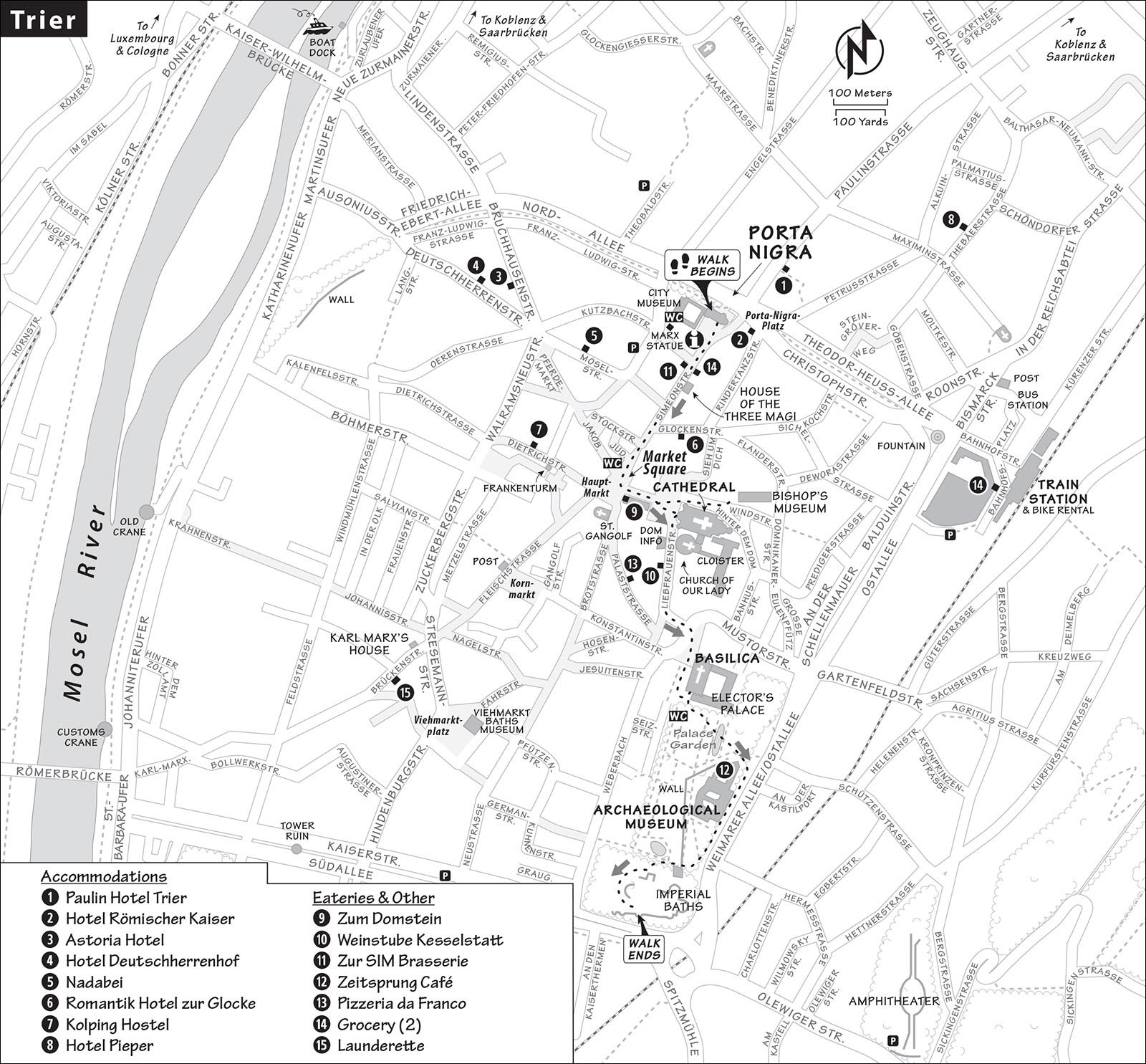
The midsize city of Trier, with more than 100,000 people, has a broad, rectangular footprint hemmed in by the Mosel River and gentle hills. Many visitors never even see the river, and stick to the city’s central core: From the landmark Porta Nigra, the main drag (Simeonstrasse) runs south to the Market Square (Hauptmarkt) and beyond. Most sights—including the cathedral and its museum, the Basilica/Imperial Throne Room, and the Archaeological Museum—are within a five-minute walk of this artery. The train station is about a 10-minute walk east of the Porta Nigra.
TOURIST INFORMATION
Trier’s cramped and busy TI is just through the Porta Nigra (Mon-Sat 9:30-18:00, Sun 10:00-17:00, shorter hours off-season, +49 651 978 080, www.trier-info.de). The TI sells a useful little city guide called Trier: History and Monuments. Also consider the booklet Trier in One Day, which has little information on sights but a great map and suggested walking routes (Roman, medieval, Jewish, rainy day). The TI also offers tours—see “Tours in Trier,” later.
ARRIVAL IN TRIER
By Train: The Reisezentrum at the train station can answer your train-schedule questions and book tickets (long hours daily). The station also has lockers, a pay WC (coins only), and bike rental (see “Helpful Hints,” below). To reach the town center from the train station, walk 10 boring minutes and four blocks up Theodor-Heuss-Allee to the big black Roman gate (Porta Nigra), and turn left under the gate to find the TI. From here, the main pedestrian mall (Simeonstrasse) leads right to the sights: Market Square and the cathedral (a five-minute walk), and the basilica (five more minutes).
By Car: There are several city-run garages near the Porta Nigra and TI, and around the main Roman sights (generally €15/24 hours, less on Sun, www.trier-info.de).
HELPFUL HINTS
Sightseeing Passes: The Antique Card, available at the TI and participating sights, can save you a few euros. The €12 version covers the Archaeological Museum and any two of Trier’s four paid Roman sights (Porta Nigra, Imperial Baths, Viehmarkt Baths Museum, and amphitheater); for €18 you get all four Roman sights. The Trier Card, which includes free use of city buses and sightseeing discounts, is not worth it if you’re staying in the center of this small, walkable city.
Laundry: A well-maintained self-service launderette is just beyond Karl Marx’s House (daily 8:00-21:00, last load at 19:30, instructions in English, Brückenstrasse 19).
Bike Rental: The Fahrradstation rents bikes at the train station, just off track 11 (€13/day for basic bikes, spiffy 27-gear bikes-€15, ID required; daily 9:00-18:00, shorter hours and closed Sun in off-season; +49 651 9998 9058, www.fahrradstation-trier.de).
Tours in Trier
Walking Tours
The TI offers an €11, informative 1.5-hour walking tour in English on Saturdays at 13:00—check to see if it’s running on other days of the week (April-Oct only). They can also put you in touch with local guides who do private tours (€130/2 hours, +49 651 978 080).
Hop-On, Hop-Off Bus Tour
The hop-on, hop-off Citytour bus leaves Porta Nigra every 30 minutes. The 50-minute route has seven stops—including the amphitheater, Basilica/Imperial Throne Room, and Karl Marx’s House—and takes you as far as Petrisberg, a recreational area with great views over the city and the Mosel Valley. Tickets are valid for 24 hours; buy them onboard, at any stop, or at the TI (€12, April-Oct daily 2/hour 10:00-17:00, recorded commentary in 8 languages, www.citytour-trier.de).
Tourist Train
I’d skip the expensive, hokey red-and-yellow tourist train, which does a pointless 45-minute loop of Trier’s major old-town sights (€10, recorded narration in English, departs from TI, www.roemer-express.de).
Sights in Trier
I’ve laced together the historic city’s top sights on this self-guided walk, offering a taste of Trier old, new, and in-between.
▲Porta Nigra
Roman Trier was built as a capital. Its architecture mirrored the grandeur of the empire. Of the four-mile town wall’s four huge gates, only this northern gate survives. This is the most impressive Roman fortification in Germany, and it was built without mortar—only iron pegs hold the sandstone blocks together. While the other three gates were destroyed by medieval metal-and-stone scavengers, this “black gate” (originally lighter sandstone, but darkened by time) survived because it became a church. St. Simeon—a pious Greek recluse—lived inside the gate for seven years. After his death in 1035, the St. Simeon monastery was established, and the Roman gate was made into a two-story church—lay church on the bottom, monastery church on top. The 12th-century Romanesque apse—the round part at the east end—survives. You can climb around inside the gate, but there’s little to see other than a fine town view. As you go in, look for pictures of how the gate looked during various eras, including its church phase.
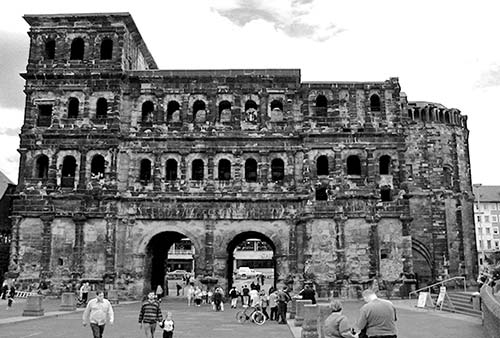
Cost and Hours: €4; daily 9:00-18:00, shorter hours off-season; videoguide-€2 or free download to smartphone from within building, www.zentrum-der-antike.de, then look under “Monuments.”
Nearby: The remaining arcaded courtyard and buildings of the monastery of St. Simeon, next to the Porta Nigra, are now home to the City Museum (Stadtmuseum Simeonstift). The museum’s mildly interesting collection seems to be largely made up of anything old that turned up in townspeople’s basements. The third level, however, holds a fascinating model—painstakingly constructed over 19 years—of Trier as it looked in 1800. Families will appreciate the entertaining audioguide designed especially for children—there’s one for adults, too (€5.50, includes audioguide, Tue-Sun 10:00-17:00, closed Mon, Simeonstrasse 60, +49 651 718 1459, www.museum-trier.de).
The busy road beyond the Porta Nigra follows what was a dry moat outside the Roman wall. In the 19th century, Trier’s wealthy built their mansions along this belle époque promenade. Today, it’s a people’s park lined with fine old buildings, interrupted by newer construction where WWII bombs hit.
• Trier’s main pedestrian drag, which leads from the gate into the town center, is named for St. Simeon. As you walk to Market Square, you’ll follow the main north-south axis of the grid-planned Roman town.
Before heading toward the square, look left to the small pink house (at #8, by the bus stop) where Karl Marx lived from age one until he left for college at 17—nearly his entire childhood. (Don’t confuse it with his birthplace on Brückenstrasse—now a museum for Marx enthusiasts, described later.) Next, detour (or just look) right, immediately after the TI, to see a large and highly controversial statue of Marx gifted to Trier by China in 2018 to commemorate Marx’s 200th birthday (an event that drew local protests).
• Continue down Simeonstrasse. On your left, at #19, is the...
House of the Three Magi (Dreikönigenhaus)
Now home to a coffee shop and café, this colorful Venetian-style building was constructed in the 13th century as a keep. Before the age of safe banking, rich men hoarded their gold and silver inside their homes...and everyone knew it. Understandably paranoid, they needed fortified houses like this one. Look for the floating door a story above the present-day entrance. A wooden staircase to this door—once the only way in or out—could be pulled up when necessary.
• Continue down the pedestrian street. As you walk, look away from street-level storefronts—instead, gaze up to appreciate the variety and richness of the city’s architecture. Eventually you’ll reach the...
▲▲Market Square (Hauptmarkt)
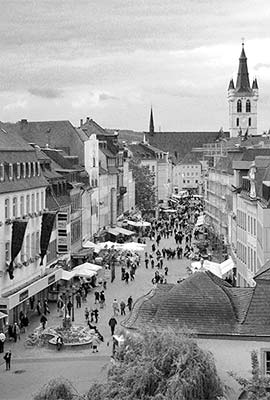
Trier’s Hauptmarkt is a people-filled swirl of fruit stands, flowers, painted facades, and fountains (plus stairs down to a handy public WC). This is one of Germany’s most in-love-with-life market squares.
For an orientation to the sights, go to the square’s centerpiece, a market cross, and stand on the side of the cross closest to the big gray-stone cathedral a block away. This cathedral (which we’ll visit in a bit) was the seat of the archbishop. In medieval times, the cathedral was its own walled city, and the archbishop of Trier was one of the seven German electors who chose the Holy Roman Emperor. This gave the archbishop tremendous political, as well as spiritual, power.
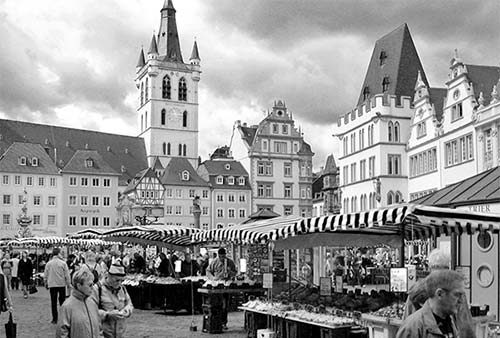
The pink-and-white building (now a DM drugstore) on the corner of the lane leading to the cathedral was a palace for the archbishop. Notice the seal above the door: a crown flanked by a crosier (representing the bishop’s ecclesiastical power) and a sword (demonstrating his political might). This did not sit well with the townspeople of Trier. The square you’re standing in was the symbolic battlefield of a centuries-long conflict between Trier’s citizens and its archbishop.
The stone market cross (a replica of the AD 958 original, now in the City Museum) was the archbishop’s way of bragging about the trading rights granted to him by King Otto the Great. This was a slap in the face to Trier’s townspeople. They’d wanted Trier to be designated a “free imperial city,” with full trading rights and beholden only to the Holy Roman Emperor, not a local prince or archbishop.
Look across the square. Facing the cathedral is the 15th-century Town Hall (Steipe). The people of Trier wanted a town hall, but the archbishop wouldn’t allow it—so they built this “assembly hall” instead, with a knight on each second-story corner. The knight on the left, facing Market Square, has his mask up, watching over his people. The other knight, facing the cathedral and the archbishop, has his mask down and his hand on his sword, ready for battle.
Just below the knights are four brightly painted 16th-century statues of Christian figures nestled between the arches (right to left): St. Paul, with his sword, was the patron saint of Trier’s university in the 15th century. St. Peter, with his bushy beard and key, is the patron saint of Trier. St. Helena, Emperor Constantine’s mom and a devout Christian, lived in Trier and brought many super relics here from the Holy Land, giving the town lasting importance. And St. James, with his staff and scallop shell, is the patron saint of pilgrims—a reminder that Trier was the staging point for northern European pilgrims heading south on the spiritual trek to Santiago de Compostela (in northwest Spain).
Elsewhere on the square are more indications of tension between the archbishop and the townsfolk. Look to the left, at the tall white steeple with yellow trim. This is the Gothic tower of the Church of St. Gangolf, the medieval townspeople’s church and fire-watchman’s post. (From medieval times until the present day, a bell has rung nightly at 22:00, reminding drunks to go home. When the automatic bell-ringer broke a few years back, concerned locals flooded the mayor with calls.) In 1507, Trier’s mayor built this new Gothic tower to make the people’s church higher than the cathedral. A Bible verse in Latin adorns the top in gold letters: “Stay awake and pray.” In retaliation, the archbishop raised one tower of his cathedral (all he could afford). He topped it with a threatening message of his own, continuing the Town Hall’s verse: “For you never know the hour when the Lord will come.”
Look farther to the left, to the Renaissance St. Peter’s Fountain (1595). This fountain symbolizes thoughtful city government, with allegorical statues of justice (sword and scale), fortitude (broken column), temperance (wine and water), and prudence (a snake and, formerly, a mirror—but since the mirror was stolen long ago, she’s now empty-handed). The ladies represent idealized cardinal virtues—but notice the rude monkeys hiding on the column behind them, showing the naughty way things are really done. The recommended Zum Domstein restaurant is next to the fountain.
The rest of the square is a textbook of architectural styles. Look for the Art Deco hotel that now houses a McDonald’s (forced to keep its presence low-key). The half-timbered houses at the north end of the square (toward the Porta Nigra) mark Trier’s 14th-century Jewish ghetto. Judengasse (“Jews’ Alley”) led under these facades into a gated ghetto where 60 families earned enough from moneylending to buy protection from the archbishop. But the protection only went so far—in 1418, Trier’s Jews were expelled. (They tried to collect interest owed them by the prince, but rather than pay up, he sent them packing.) The buildings lining Judengasse today, while quaint, date only from the 18th century.
• From the square, head down Sternstrasse to the...
▲▲Cathedral (Dom)
This is the oldest Christian church in Germany. After Emperor Constantine legalized Christianity in the Roman Empire in AD 312, his mother, Helena (now a saint), allowed part of her palace in Trier to be used as the first church on this spot. In AD 326, to celebrate the 20th anniversary of his reign, Constantine began the construction of two great churches: St. Peter’s in Rome and this huge cathedral in Trier—also called St. Peter’s.
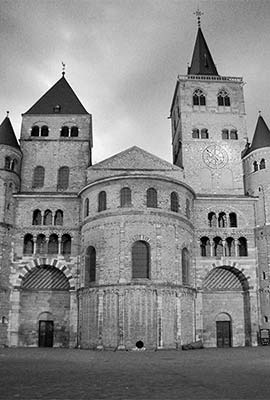
Cost and Hours: Cathedral—free, daily 6:30-18:00, Nov-March until 17:30, no visits during Mass. Treasury—€1.50, Mon-Sat 11:00-17:00, Sun from 12:30, shorter hours off-season.
Information: The Dom Information Office (on the square facing the church) runs a gift shop and has a pay WC (Mon-Sat 10:30-17:15, Sun 12:00-15:00, shorter hours and closed Sun in off-season; Liebfrauenstrasse 12, +49 651 979 0790, www.dominformation.de). Fill your bottle from the free water fountain at the street corner.
Visiting the Cathedral: Begin your visit in the cathedral’s large front courtyard. As you face the cathedral, look in the corner behind you and to your left (in front of the pink palace); you’ll see a large patch of light-colored bricks in an L shape in the ground. The original Roman cathedral was more than four times its present size; these light-colored bricks mark one corner of this massive “double cathedral.” (The opposite corner was at the back of the smaller Church of Our Lady, waaay across the courtyard.) The plaque by the corner shows the floor plan of the original Roman cathedral (from AD 380).
The cathedral’s mighty facade is 12th-century Romanesque. To the right is the more delicate 13th-century Gothic facade of the Church of Our Lady, which we’ll visit later.
As you walk toward the cathedral entrance, you’ll pass an evocative bit of Roman scrap stone (just outside the door on the left). This was part of a 60-ton ancient granite column quarried near Frankfurt—one of four columns used in the fourth-century Roman church.
Enter the cathedral (English info brochure in racks on right). The many altars lining the nave are dedicated not to saints, but to bishops. These ornate funeral altars were a fashionable way for the powerful archbishop-electors to memorialize themselves. Even the elaborate black-and-white altar at the back of the church (above where you entered) is not a religious shrine, but a memorial for a single rich archbishop. (His black 1354 tomb dominates the center of that chapel.)
The “pilgrim’s walk” (the stairway to the right of the altar) leads to the chapel at the far east end of the church that holds the cathedral’s most important relic: the supposed Holy Robe of Christ, thought to have been found by St. Helena on a pilgrimage to Jerusalem (rarely on view, but you can see its reliquary; look for photos of the robe itself as you approach, after the first flight of stairs).
Midway along the “pilgrim’s walk,” you’ll find the entrance to the treasury (Schatzkammer), displaying huge bishops’ rings, medieval Bibles, St. Andrew’s sandal (in a box topped with a golden foot), and a holy nail supposedly from the Crucifixion. At the base of the steps below the treasury, pause and look back up at the statues of St. Helena and Emperor Constantine.
Back down the stairs, the door on your immediate left marked Kreuzgang leads to the peaceful 12th-century Domkreuzgang cloister between the Dom and the Church of Our Lady.
When you’re ready to leave the cathedral, head back toward the main door, where you’ll see two controversially modern (1972) paintings at the back of the church, representing the Alpha (Paradise/Creation, to the left) and the Omega (the Last Judgment, to the right). The archbishop pushed this artwork through, arguing that a living church needs contemporary art, and overriding objections from the congregation’s conservative old guard.
Once outside the cathedral, go left to find the entrance to the adjoining Church of Our Lady (Liebfrauenkirche), which dates from 1235 and claims to be the oldest Gothic church in Germany. This church was built when Gothic was in vogue, so French architects were brought in—and paid with money borrowed from the bishop of Cologne when funds ran dry. Pop in to see the fine interior, filled with colorful, modern stained glass.
Exit the Church of Our Lady and go right, passing the cathedral entrance, and then turn down the first street on your right (Windstrasse). As you walk with the cathedral on your right, you’ll be able to see the different eras of its construction. The big red cube that makes up the back half of the present-day cathedral is all that remains of the enormous, original fourth-century Roman construction (at one time twice as tall as what you see here). Arched bricks in the facade show the original position of Roman windows and doors. Around this Roman nucleus, chunks were grafted on over a millennium and a half of architectural styles: the front half of the cathedral facing the big courtyard, added in the 11th century; the choir on the back, from the 12th century; and the transept and round Baroque shrine on the far back, from the 18th century.
If you look at the original Roman construction squarely, you’ll see that it’s not perfectly vertical. Locks were built along the Mosel River in the 1960s, depleting groundwater—which was the only thing preserving the church’s original wooden foundation. When dry, the foundation disintegrated, and the walls began to settle. Architects competed to find a way to prevent the cathedral from collapsing. The winning solution: a huge steel bracket above the main nave, holding the walls up with cables.
• Just past the cathedral on Windstrasse (to the left) is the...
▲Bishop’s Museum (Museum am Dom)
This museum focuses on the history of the cathedral. Its highlight is the pieced-together remains of exquisite ceiling frescoes from St. Helena’s palace. The vivid reds, greens, and blues of the restored works depict frolicking cupids, bejeweled women, and a philosopher clutching his scroll. The 15 panels are displayed in such a way that you feel mysteriously transported back to when they were made, in AD 320. The frescoes were discovered in 50,000 pieces while cleaning up from WWII bombs. Incredibly, with the help of computers (and using patterns from the wattle-and-daub work on the back sides of the pieces), the jigsaw puzzle was put back together. There are no English descriptions, but you can—and should—borrow the book in English that explains the frescoes and their restoration (or you can buy a copy). Elsewhere in this small, modern museum, you’ll see an interesting model of the original Roman church, stone capitals, gold chalices, vestments, and icons.
Cost and Hours: €5; Tue-Sat 9:00-17:00, Sun from 13:00, closed Mon; audioguide-€1, Bischof-Stein-Platz 1, +49 651 710 5255, www.museum-am-dom-trier.de.
• Return to the front of the cathedral and head two blocks south (passing the Church of Our Lady, under an arch capped by a Crucifixion scene—indicating that you’re leaving the archbishop’s walled ecclesiastical city). Bear left on An der Meerkatz, to the 200-foot-by-100-foot...
▲▲Basilica/Imperial Throne Room (Konstantin Basilika)
This building is the largest intact Roman structure outside Rome. It’s best known as a basilica, but it actually started out as a throne room. The last emperor moved out in AD 395, and petty kings set up camp in the building throughout the Middle Ages. By the 12th century, the archbishops had taken it over, using the nave as a courtyard and converting the apse into a five-story palace. The building became a Lutheran church in 1856, and it remains the leading Protestant church in Trier. It was badly damaged by WWII bombs (as illustrated by photographs at the cashier’s desk), and later restored.
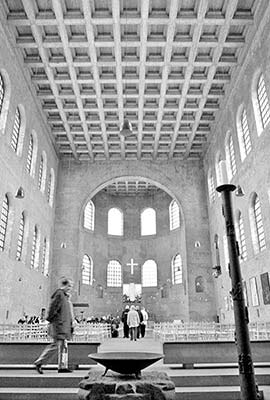
Cost and Hours: Free; Mon-Sat 10:00-18:00, Sun from 14:00; Nov-March Tue-Sat 10:00-12:00 & 14:00-16:00, Sun 14:00-16:00, closed Mon; Constantine Basilica booklet (€3) brings the near-empty shell to life; +49 651 9949 1200, www.evangelisch-trier.de.
Visiting the Basilica: Standing inside the vast structure, you see the genius of Roman engineering. Notice the 65-foot-wide round arch over the apse. The small rectangular holes between the windows were chimneys, which vented the hot air that circulated below the floor, heating the place. It’s a huge expanse to span without columns. Each of the squares in the ceiling above you measures 10 feet by 10 feet—as big as your hotel room. While today’s roof cheats, using concrete girders, the Roman original was all wood, relying on triangular trusses above the flat ceiling. Today’s windows match the Roman originals—small frosted panes held in place by a wooden frame. The place is enormous—so big that the Porta Nigra could fit comfortably inside.
Picture this throne room in ancient times, decorated with golden mosaics, rich marble, colorful stucco, and busts of Constantine and his family filling the seven niches. The emperor sat in majesty under a canopy on his altar-like throne. The windows in the apse around him were smaller than the ones along the side walls, making his throne seem even bigger.
When you turn around, face the wall where you entered and check out the huge new organ with 6,006 pipes. It’s located in the same spot as the basilica’s original organ, which was destroyed in World War II. Building the new €3.4 million organ was the final step in the decades-long reconstruction of the basilica, finished in 2014. (See website for listings of organ recitals.)
Nearby: A pink Rococo wing, the Elector’s Palace, was added to the basilica in the 18th century to house the archbishop-elector; today, it holds local government offices (closed to the public).
• The Rococo wing faces a fragrant, picnic-rific garden. Beyond the garden are three more sights: the Archaeological Museum (with a handy lunch spot, the recommended Zeitsprung Café), the remains of a Roman bath, and a 16,000-seat Roman amphitheater. Cut across the garden, heading toward Weimarer Allee (the main street in the distance), and veer right to pass through the medieval city wall to the entrance of the...
▲▲Archaeological Museum (Rheinisches Landesmuseum)
Trier’s top museum has arguably the best collection of Roman art in Germany. The museum tells the town’s story from prehistoric times to today. The best pieces are all from the Roman period, including funeral art, mosaics, coins, and a fine model of Roman Trier.
Cost and Hours: €8, Tue-Sun 10:00-17:00, closed Mon, +49 651 97740, www.landesmuseum-trier.de. Get a map as you enter and a free English audioguide.
Visiting the Museum: Rundgang signs guide you through the museum’s 19 exhibition rooms in a logical order. I’ll focus just on the museum’s most important collections. Brief English overviews are posted in each room.
Start by walking down the round staircase to the basement level. Head through three rooms of displays on prehistoric Trier, then back up and through two rooms on the Romanization of the area’s Celtic population.
Find the rich collection of funerary art (in Room 6, a big room at the back of the courtyard). Originally these were all painted in vibrant colors. For pagan Roman big shots, the closest thing to eternal life was to be remembered after they died. Consequently, those who could afford it erected big memorials to their own lives and accomplishments along the road leading into Trier. When Roman Trier went Christian in AD 320, these pagan ideals were no longer respected. The memorials were scavenged for their stones, which were then used as a foundation for a nearby fortress and forgotten. In 1890, a resident of the modern village sitting on the ruins of that Roman fortress dug up one of these stones, the museum paid a handsome price for it, and everyone in the village went wild digging up old Roman stones to cash in.
Browse around, finding glimpses of everyday Roman life: the tax collector at work, the boys with their Latin teacher, a woman visiting a beauty salon, and a ship laden with barrels of Mosel wine. Behind the wine ship, a wall painting shows how the mausoleum-lined road into Roman Trier might have looked. Archaeologists have learned a lot about life in this corner of the Roman Empire by studying these artifacts.
Another highlight are the Roman mosaics (in Room 8, just beyond the wine ship). On the right wall is a mosaic of four horses surrounding the superstar charioteer Polydus, discovered intact at the Imperial Baths. Mosaic floors were the Sports Illustrated covers of the Roman world.
Leave the room on your left, cross the next two rooms, and find the stairs on the far right. Room 11 displays a map showing Trier’s position in the Roman Empire. You can see how Gaul (Gallia, roughly modern France) was divided into three parts, with Trier (Treveri) in the northern (“Belgian”) section. Roads led from Trier south toward Rome via modern-day Lyon (Lugdunum) and Marseille (Massilia).
Upstairs, in Room 12, don’t miss the huge model of Roman Trier—a thriving city of 80,000. Notice the grid street plan, and pick out the sights you’re visiting today: Porta Nigra, the cathedral, basilica, baths, and amphitheater.
Back down a flight, in the small, darkened Room 13, is an exhibit of coins through the centuries of Roman rule. In 1993, some Trier construction workers dug up a bag holding 2,600 golden Roman coins; the coins are in the central display case. Experts used the emperor’s face on each coin to date the finds. Look closely and you can follow the steady progression of emperors and their coins from Nero (AD 54) to Septimius Severus (AD 211). It’s impressive that over 150 years of coinage were in circulation when this bag was lost.
Finally, Rooms 15-16 show how medieval Trier was built on the ruins of the Roman town. A model (in Room 15) lets you see how the Porta Nigra looked as a church.
• Exit the Archaeological Museum, walk right (paralleling the main Weimarer Allee through the trees), then follow the Tourist Route signs through the archway in the wall to the modern, red-brick entry arcade of the...
Imperial Baths (Kaiserthermen)
Built by Constantine, these were destined to be the biggest of Trier’s three Roman baths and the most intricate baths of the Roman world. Trier’s cold northern climate, the size of the complex, and the enormity of Constantine’s ego meant that these Imperial Baths required a two-story subterranean complex of pipes, furnaces, and slave galleys to keep the water at a perfect 47 degrees Celsius (120 degrees Fahrenheit). But the grandiose vision was never finished. When Constantine left Trier in AD 316, the huge and already costly project was scuttled. Later the site was used as a military barracks. The giant courtyard—originally for exercising and lounging—became a parade ground for the Praetorian Guard.
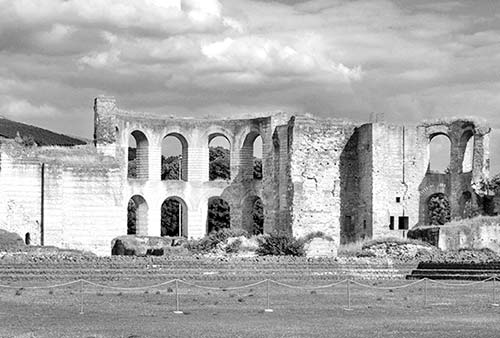
Stepping into the unfinished building section, you can imagine the intended pools (cold, tepid, and hot) and the heated floor. Thirty years of construction left nearly a mile of underground tunnels and foundation work, which are fun to explore. Imagine the engineering, slave labor, and wood that would have been necessary to make all this work, if it had ever been completed. A literal river of water was planned to flow into the baths via an aqueduct. And the surrounding land would ultimately have been deforested as it supplied enough wood to keep the ovens going to heat the water.
Cost and Hours: €4; daily 9:00-18:00, shorter hours off-season; videoguide-€2, good €2.50 English booklet, +49 651 436 2550, www.zentrum-der-antike.de, then look under “Monuments.”
• To finish your tour of Trier’s Roman sights, hike from the baths about 10 minutes east to the amphitheater. Or you can skip it (just look at amphitheater photos in shop postcard racks), head back to Market Square, and enjoy the town.
To reach the amphitheater, backtrack through the arch in the wall, follow the signs through the pedestrian underpass, then follow Hermesstrasse as it curves up the hill, and turn left on Olewiger Strasse.
Amphitheater
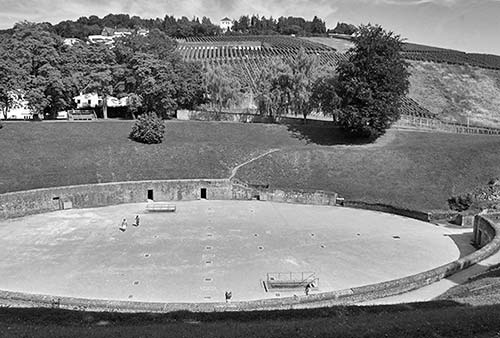
Roman Trier’s amphitheater, built around AD 200, seated at least 16,000. The city was largely inhabited by Celts who learned Latin and wanted to adopt the Roman lifestyle. And any self-respecting Roman town needed an amphitheater. While Trier’s amphitheater had some gore, it didn’t usually feature Roman degenerates egging on gladiators—it was more often used for less bloody spectacles, assemblies, and religious festivals.
Cost and Hours: €4; daily 9:00-18:00, shorter hours off-season; Olewiger Strasse 25, +49 651 73010, www.zentrum-der-antike.de, then look under “Monuments.” It’s OK to picnic discreetly in the amphitheater grounds (free WC inside entrance).
Visiting the Amphitheater: You’ll enter where grand processions did. Pick up the free map when you buy your ticket, and go left up the stairs to a handy illustrated diagram of ancient Trier that helps put the amphitheater into context with the city. After enjoying this high vantage point, continue along the left side of the amphitheater for 20 yards, then turn left on the downhill path. Enter the amphitheater through one of its grand entries (called vomitoria, these were named for the way crowds could spew out quickly after events). Then descend a staircase in the center of the amphitheater into the cellar, where gear for the spectacles was kept (it’s below the water table, so it’s always wet). After Rome fell, the amphitheater was used as a refuge from barbarian attacks, a quarry, and a vineyard.
SIGHTS NEAR VIEHMARKTPLATZ
▲Karl Marx’s House
Communists can lick their wounds at Karl Marx’s birthplace, an 18th-century house with three floors of exhibits spanning the influential economist/philosopher’s life and the impact his ideas still have today. The museum was completely overhauled to celebrate Marx’s 200th birthday in 2018, and is now a vibrant and thoughtful exploration of Marx and his historical legacy.
Cost and Hours: €5, includes audioguide and brochure, daily 10:00-18:00 except no entry 13:00-13:30, from Market Square follow signs for 10 minutes to Brückenstrasse 10, +49 651 970 680, www.fes.de/museum-karl-marx-haus.
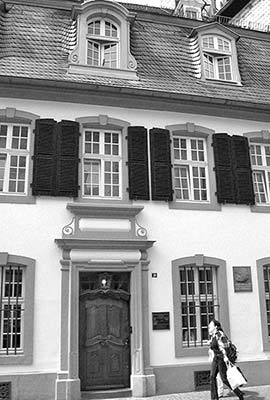
Visiting the Museum: You’ll see a mix of historical artifacts, colorful illustrations, contemporary art, and interactive displays, with good English explanations. Start with the video just past the ticket office, which traces the building’s history as it changed hands from Marx’s family to the German Social Democratic Party (SPD) to the Nazi party and back to the SPD, eventually becoming a museum. It’s interesting that the museum is owned and run by a foundation connected to the mainstream, center-left SPD (the party of German chancellor Olaf Scholz), and not by radical revolutionaries.
The museum details Marx’s life chronologically, but focuses largely on the lingering effects of his ideas long after his death, from revolutions against communism to skepticism of capitalism, demonstrating how societies around the world have interpreted his beliefs differently to fit their own agenda. On the third floor, a color-coded world map shows the range of socialist and communist governments in the 1980s and the “spheres of influence” attributed to Marxist beliefs.
The house spans two sections divided by a courtyard. Inside the courtyard you’ll find a large Marx head sculpted by his grandson. Also explore the garden in back, with some interesting Marx-related art.
Viehmarkt Baths Museum
A beautiful modern glass building covers the ruins of a Roman bath, mixed with stone monastery foundations and medieval waste-wells. It’s certainly historic, but almost meaningless unless you have a good guide and a freakish interest in Roman stones. You can see nearly everything without paying just by looking in from the entry and through the many windows. The best thing about going here is walking down Fahrstrasse to the museum—a block away, you’ll pass a cool fountain showing Trier craftsmen at work.
Cost and Hours: €4, Tue-Sun 11:00-17:00, closed Mon, Viehmarktplatz 2, +49 651 977 4214, www.zentrum-der-antike.de, then look under “Monuments.”
Sleeping in Trier
NEAR THE PORTA NIGRA
$$ Paulin Hotel Trier, 200 yards north of the Porta Nigra, offers 22 rooms in two wings. In warm weather, ask for a quiet room in the newer wing, next to the courtyard; in cooler seasons, when you can keep the windows closed, the cheaper “guesthouse” rooms along the busy street are fine. In a few rooms the Wi-Fi is weak—mention while booking if that’s important to you (elevator, pay parking in courtyard, Paulinstrasse 13, +49 651 147 400, www.hotel-paulin-trier.de, hotelpaulin@aol.com).
$$ Hotel Römischer Kaiser, which rents 43 rooms above a polished lobby just three doors from the Porta Nigra, is convenient but corporate, and overall a lesser value (family rooms, elevator, free parking, Am Porta-Nigra-Platz 6, +49 651 977 0100, www.friedrich-hotels.de, rezeption@friedrich-hotels.de).
WEST OF THE CENTER
These three small, family-run places (each with three upstairs floors and no elevator) are slightly west of the pedestrian zone, in a quiet area just beyond the tourist crowds. It’s walkable from the train station, but if you’re hauling much luggage, spring for the €10 taxi ride.
$ At Astoria Hotel, the lobby and 15 rooms are colorfully decorated, and a rose-filled terrace beckons outside the light and cheery breakfast room (no elevator, pay parking, champagne at breakfast, Bruchhausenstrasse 4, +49 651 978 350, www.astoria-hotel.de, info@astoria-hotel.de). American-born Paula and her husband Sudhir like to offer guests a choice of welcome drinks on arrival.
$ Hotel Deutschherrenhof, a classic German small hotel, offers 13 straightforward rooms and a solid breakfast (family rooms, fans, no elevator, pay parking, Deutschherrenstrasse 32, tel. +49 651 605 5001, www.hotel-deutschherrenhof-trier.de, hdhhotel@online.de, energetic Stephanie Schmitz).
$ Nadabei is a 10-room guesthouse cleverly knitted together from two small, adjacent buildings around a central courtyard. The owner, a carpenter, studied in Japan and has added many Asian touches (family room, guest kitchen, no elevator, pay parking, call to arrange check-in, Moselstrasse 9, +49 152 3366 3673, www.nadabei.com, kontakt@nadabei.de).
NEAR MARKET SQUARE
$$$ Romantik Hotel zur Glocke, with 18 rooms just steps off the main pedestrian street, offers luxury, charm, and character to those willing to pay a bit extra (family rooms, air-con in most rooms, elevator to some rooms, Glockenstrasse 12, +49 651 999 8800, www.romantikhotel-zur-glocke.de, info@romantikhotel-zur-glocke.de, Brommenschenkel family).
¢-$ Kolping Hostel, run by a Catholic foundation and its dedicated staff, is a clean, simple hostel and budget hotel two blocks from Market Square. It has 14 rooms with 4-6 beds each, as well as 21 singles and a couple of doubles; showers are always down the hall. This is your best value for cheap sleeps in town (breakfast extra, no elevator, laundry service, limited courtyard pay parking—reserve ahead, Dietrichstrasse 42, +49 651 975 250, www.kolping-hostel.de, info@kolping-hostel.de).
NEAR THE TRAIN STATION
$ Hotel Pieper, a good value, is run by the friendly Becker family. They rent 20 comfortable rooms, some with air-conditioning (family rooms, no elevator, pay parking; 8-minute walk from station, 2 blocks off main drag at Thebäerstrasse 39; +49 651 23008, www.hotel-pieper.com, info@hotel-pieper-trier.de).
Eating in Trier
$$ Zum Domstein, right on Market Square, serves standard German fare at decent prices and also has a special, pricier menu of dishes based on ancient Roman recipes (complete with a Latin translation). The Roman menu was inspired during renovations, when the owner discovered a Roman column in her cellar. (In Trier, you can’t put a rec room in your basement without tripping over Roman ruins.) Ask to see the finished cellar dining room, which incorporates the column, plus a mini museum of Roman crockery (daily 11:00-22:00, last orders at 20:30, Am Hauptmarkt 5, +49 651 74490).
$$ Weinstube Kesselstatt, a wine tavern in a historic building across from the cathedral entrance, has pleasant garden seating and a menu with both light fare and a few hot dishes (including fish). You’ll order at the counter; first check the chalkboard for specials (daily 10:00-24:00, Liebfrauenstrasse 10, +49 651 41178, Dieter Hilgers).
$$$ Zur SIM Brasserie, right at the Porta Nigra, has a big, meaty menu including affordable schnitzel and Flammkuchen (as well as more expensive dishes). The outdoor patio, with a huge sunshade sail, has a great view of the Porta Nigra and the street scene (daily 11:00-24:00, Simeonstrasse 59, +49 651 436 9343).
$$ Zeitsprung Café, run by enthusiastic and friendly Anja, is at the rear of the Archaeological Museum building and is very popular with locals. It offers good-value lunches and salads in a pretty setting overlooking the Elector’s Palace and fountain—they do breakfast too (Tue-Sun 9:00-18:00, closed Mon, outdoor seating available, Weimarer Allee 1, +49 651 994 5820).
$$ Pizzeria da Franco is steps off Market Square, with a wood-fired oven, fair prices, outdoor seating, and a comfy and nicely decorated dining room (takeout possible, Tue-Sat 11:45-14:30 & 18:00-22:00, Sun 17:30-21:30, closed Mon, Palaststrasse 7, +49 651 41324).
Groceries: The REWE by the Porta Nigra, at Simeonstrasse 15, is big enough for most needs. There’s a full-size Kaufland in the Alleen Center mall next to the train station (both open long hours Mon-Sat, closed Sun).
Trier Connections
From Trier by Train to: Cochem (2/hour, 45-60 minutes), Cologne (at least hourly, 2.5 hours, most change in Koblenz), St. Goar/Bacharach (hourly, 2-2.5 hours, change in Koblenz), Frankfurt Airport (hourly, 3-4 hours, 1-2 changes including Koblenz or Saarbrücken), Paris (quickest routings change in Saarbrücken, 3/day, 3.5 hours, reservation required for France section). Train info: www.bahn.com.