WÜRZBURG
PLACES FOR A MEMORABLE SNACK OR DRINK
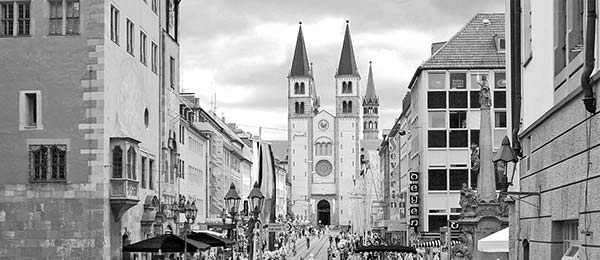
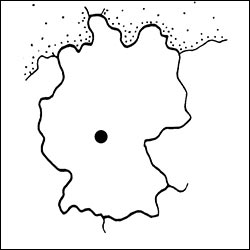
Würzburg (VEWRTS-boorg), a historic midsize city, is worth a stop to see its stately prince-bishop’s Residenz and the palace’s sculpted gardens. Surrounded by vineyards and filled with atmospheric Weinstuben (wine bars), this tourist-friendly town is easy to navigate by foot or streetcar. Today, 25,000 of its 130,000 residents are students—making Würzburg feel young and very alive. It’s also popular both with bike tourists (who enjoy the four-day pedal between Bamberg and here) and with river cruises.
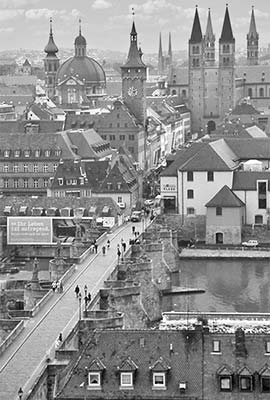
While the town isn’t all that charming (thanks to its unmistakable post-WWII-rebuild vibe), its quiet and appealing old center is scenically surrounded by vineyard-laced hills, with a stout fortress looming overhead. At one end of town is Würzburg’s palace, among the most enjoyable to tour in Germany. On the other end is its atmospheric old bridge, lined by stone statues that make it reminiscent of Prague’s famous Charles Bridge.
PLANNING YOUR TIME
Würzburg has a few hours’ worth of sightseeing. Begin by touring the Residenz (prince-bishop’s palace), then take my self-guided walk through town to the Old Main Bridge. With more time, cross the bridge and hike up to the hilltop Marienberg Fortress. If you’re overnighting here, be sure to stroll the bridge at sunset, when you can join the friendly local crowd that gathers there in good weather for a glass of wine and mellow mingling.
Orientation to Würzburg
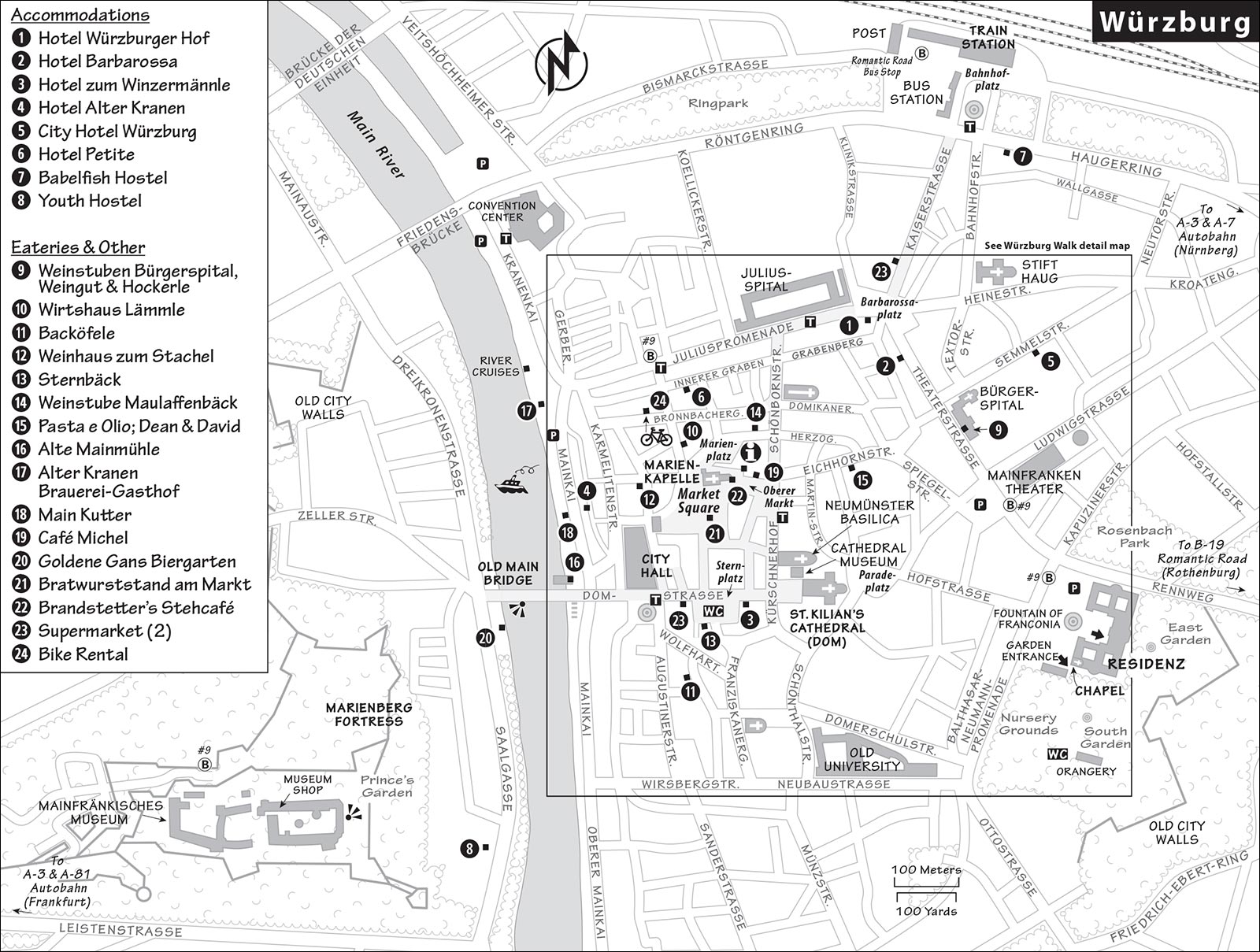
Würzburg’s old town core huddles along the bank of the Main (pronounced “mine”) River. The tourists’ Würzburg is bookended by the opulent Residenz (at the east end of downtown) and the hill-capping Marienberg Fortress (at the west end, across the river). You can walk from the Residenz to the river (below the fortress) in about 15 minutes; the train station is a 15-minute walk to the north.
TOURIST INFORMATION
Würzburg’s helpful TI is in the yellow Rococo-style Falken Haus on Market Square (Tue-Fri 10:00-16:00, Sat until 14:00, closed Sun-Mon; Market Square, +49 931 372 335, www.wuerzburg.de). If you’re continuing on the Romantic Road (see previous chapter), the TI has information on routes and accommodations along the Romantische Strasse, including a very helpful route plan. The TI also has tips about biking along the Main River.
Sightseeing Passes: The Würzburg Welcome Card offers minimal discounts on a few sights and restaurants—you’ll have to visit at least four sights to make it pay off (€3, valid 3 days, sold at TI). Würzburg’s Residenz and Marienberg Fortress are covered by Bavaria’s 14-day Mehrtagesticket (sold at participating sights; details on here).
ARRIVAL IN WÜRZBURG
By Train: Würzburg’s train station is user-friendly and filled with services, including pay lockers and a handy Reisezentrum office that sells tickets (long hours daily). Walk out of the train station to the small square in front. By the tram tracks (ahead and on the right) is a good city map showing the easiest walking route between the station and the Residenz (and to other sights in town). Farther right are the post office and the Romantic Road bus stop (usually platform 12).
From the tram cul-de-sac in front of the station, tram #1, #2, #3, #4, or #5 will take you one stop to the Juliuspromenade stop, near most recommended hotels (easily walkable). Trams #1, #3, #4, and #5 continue into town: The next stop (Dom) is close to Market Square, the TI, and the recommended Hotel zum Winzermännle. After that is the Rathaus stop, near the river and the recommended Hotel Alter Kranen.
To walk toward town (and some recommended hotels), cross over the busy Röntgenring and head up the shop-lined Kaiserstrasse. To reach the Residenz, it’s simplest to walk (15 minutes), but you can get part of the way by taking tram #1, #3, #4, or #5 to the Dom stop.
By Car: Drivers entering Würzburg can keep it simple by following signs to the Residenz and parking in the vast cobbled square that faces the palace. Cheaper parking is available in garages on the east bank of the river, just north of the old bridge.
HELPFUL HINTS
Festivals: Würzburg—always clever when it comes to trade—tightly schedules its biggest festivals in summer: Mozart (late May-June, with concerts in the Residenz, www.mozartfest.de), wine (late May-early June, www.weindorf-wuerzburg.de), African music and dance (also late May-early June, www.africafestival.org), and the Kiliani Volksfest (first three weeks in July, www.wuerzburg.de/kiliani).
Supermarket: Centrally located Kupsch/Edeka is at Domstrasse 10, just a few doors from City Hall (Mon-Sat 7:00-20:00, closed Sun). Another branch is on Kaiserstrasse, near the train station and recommended hotels.
Bike Rental: Find Ludwig Körner right in the old town, a five-minute walk north of Market Square (€12/24 hours; best to call beforehand but generally open Mon-Fri 9:00-18:00, Sat until 14:00, closed Sun; Bronnbachergasse 3, +49 931 52340).
Taxi: Call +49 931 19410.
Local Guide: Based in Würzburg, Martin Kamphans can guide you in and around the city as well as to destinations on the Romantic Road (+49 1577 0220 513, www.stadtfuehrung-wuerzburg.com, kamphans@posteo.de).
GETTING AROUND WÜRZBURG
You can easily walk to everything except the hilltop Marienberg Fortress (doable, but a steep hike). For public transit, the same tickets work on all city bus and tram lines (including the bus up to the fortress). Your options include a €1.40 short-trip ticket (Kurzstrecke Eins +4, good for up to four stops; this is all you need to get to my recommended hotels), a €2.60 single ticket (Einzelfahrschein, good for 1.5 hours in one direction with transfers), or a €4.40 day pass (Tageskarte Solo, also valid Sun if purchased on Sat). You can buy tickets at streetside machines near tram stops (marked Fahrausweise). Most tickets come prestamped; if not, use the little box inside the tram or bus to validate it. Once on board, listen for the cute “next stop” transit announcements recorded by local children. Transit info: +49 931 362 320, www.vvm-info.de.
Residenz Tour
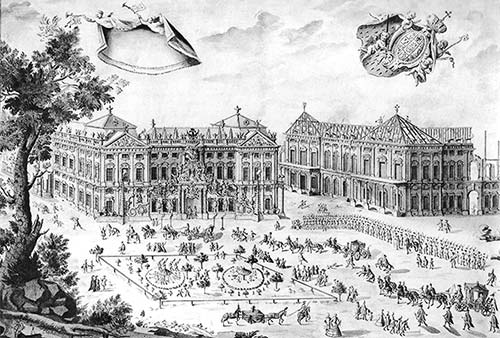
In the early 18th century, Würzburg’s powerful prince-bishop decided to relocate from his hilltop residence at Marienberg, across the river, into new digs down in the city. His opulent, custom-built, 360-room palace (rated ▲▲) and its associated sights—the chapel (Hofkirche; also worth ▲▲) and garden—are the main tourist attractions of today’s Würzburg. This Franconian Versailles features grand rooms, 3-D art, and a massive fresco by Giovanni Battista Tiepolo. The palace has three sections: the central main rooms, the North Wing, and the South Wing (with the dazzling Mirror Cabinet). The Residenz is impressive, yet quickly taken in; it’s less overwhelming to visit than many other European royal palaces. Don’t confuse the Residenz with Würzburg’s Marienberg Fortress (on the hilltop across the river). The Residenz is the far more important sight to visit.
GETTING THERE
The Residenz is a 15-minute walk southeast of the train station. Easy parking is available in front of the Residenz (open daily 24 hours, get ticket as you enter, €1.70/hour for first 3 hours, €1.20/each additional hour, pay at machine marked Kasse before leaving). Enter the palace through the main door at the middle of the sprawling complex (directly behind the big fountain).
ORIENTATION TO THE RESIDENZ
Cost and Hours: Palace—€9, includes guided tour, daily April-Oct 9:00-18:00, Nov-March 10:00-16:30, last entry an hour before closing; chapel—free, same hours as palace; gardens—free, daily until dusk (20:00 at the latest); +49 931 355 170, www.residenz-wuerzburg.de.
Sightseeing Strategies and Tours: A guided tour is included with your ticket and covers the main rooms (vestibule, Tiepolo fresco, White Hall, Imperial Hall—tours last 45-60 minutes; English tours usually at 11:00 and 15:00 but check website for schedule). The English tour, while good, isn’t worth planning your day around; you can see everything worthwhile in the Residenz on your own, relying on my self-guided tour and posted English explanations in the rooms.
Services: You’ll find free WCs and self-service lockers (bags must be checked) on the right as you exit the ticket office. In the garden, WCs are to the right as you come in the main entrance, next to the orangery.
 SELF-GUIDED TOUR
This commentary gives you the basics to appreciate the palace (whether visiting on your own or with a tour), as well as an overview of the chapel and gardens.
Residenz Palace
• Begin at the entrance.
Vestibule and Garden Hall: This indoor area functioned as a grand circular driveway, exclusively for special occasions—just right for six-horse carriages to drop off their guests at the base of the stairs. This area is relatively dark and serves as a good springboard for the dazzling palace that awaits.
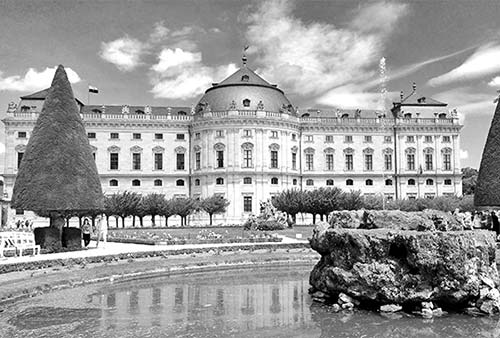
Before climbing the formal staircase, pop into the adjacent Garden Hall. This lovely, airy space is where the garden and the palace meet. The ceiling was painted by Johann Zick in 1750. Notice how he portrays his subjects without Greek-style idealism; they’re shown realistically and in high contrast—quite edgy for the time.
• Now picture yourself dressed up in your fanciest finery...and prepare to ascend the stairs.
Grand Staircase: The elegant stairway comes with low steps, enabling high-class ladies to glide up gracefully, heads tilted back to enjoy Europe’s largest and grandest fresco opening up above them. Hold your partner’s hand high and get into the ascending rhythm. Enjoy the climb.
• As you reach the top of the stairs, look up at the...
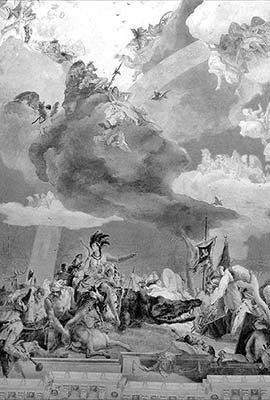
Tiepolo Fresco: In 1752, the Venetian master Giovanni Battista Tiepolo was instructed to make a grand fresco illustrating the greatness of Europe, Würzburg, and the prince-bishop. And he did—completing the world’s largest fresco (more than 7,000 square feet) in only 13 months. (The prince-bishop was in a rush to finish furnishing his new home in time for a visit from Habsburg Empress Maria Theresa.) Tiepolo was a master of three-dimensional illusion—and here, he employs one of his favorite tricks, with actual 3-D feet and other features breaking the frame of his faux 3-D frescoes.
The ceiling celebrates the esteemed prince-bishop, who smirks in the medallion with a red, ermine-trimmed cape. This guy had a healthy ego. The ceiling features Apollo (in the sunburst) and a host of Greek gods, all paying homage to the P-B. Ringing the room are the four continents, each symbolized by a woman on an animal and pointing to the prince-bishop. Walk the perimeter of the room to study and enjoy the symbolism of each continent one by one:
America—desperately uncivilized—sits naked with feathers in her hair on an alligator among severed heads. (Notice the cannibal BBQ going on just to the right. Eeew.) She’s being served hot chocolate, a favorite import and nearly a drug for Europeans back then. The black cloud hovering ominously above her head symbolizes (with great subtlety) how unenlightened Europeans of the time considered this savage continent to be.
Africa sits on a camel in a land of trade (notice the blue vase, the ivory tusk, and the kneeling servant with wafting frankincense) and fantasy animals (based on secondhand reports, and therefore inaccurate—the ostrich has human-horse-like legs). Father Nile, with his blue cloak, represents the river by pouring water from a jug.
Asia rides her elephant (with the backward ear) in the birthplace of Christianity (notice the crosses on the hill) and the alphabet (carved into the block beneath the obelisk).
Europe, who rides a bull, is shown as the center of high culture. And here, Lady Culture points her brush not at Rome, but at Würzburg. A few portraits are hiding out in this area. The big dog is sniffing the purple-clad architect of the Residenz building. And Tiepolo includes a self-portrait as well: Find the burgundy-clad fellow in the corner just to the left, between the heads of the two white statues.
• Next, you’ll visit the ...
White Hall: This hall—with four big paintings portraying various prince-bishops—is actually gray (to provide better contrast) and was kept plain to punctuate the colorful rooms on either side. Also completed at a breakneck pace to meet the Maria Theresa deadline, it’s a Rococo-stucco fantasy. (The word “Rococo” comes from the Portuguese word for the frilly rocaille shell.) The stucco decorations (particularly in the corners) have an armor-and-weapons theme, as this marked the entrance to the prince-bishop’s private apartments—which had to be carefully guarded. Even the cloth-like yellow decorations above those weapons, draped high in the corners, are made of painted stucco. As you observe the stucco, dripping with symbolism that celebrates the prince-bishop, notice how the Rococo style is free from the strict symmetry of the Baroque. Also notice the stove, which heated the room. There’s one in each room, all stoked from service hallways behind. The four gold cupids symbolize the seasons.
• Straight ahead is the palace gift shop, which leads to a few other interesting rooms. Instead, from the White Hall, continue to your left, following signs for Rundgang/Circuit.
Imperial Hall: Enjoy the artistic ensemble of this fine room in its entirety and feel its liveliness. This glorious hall—which was smartly restored—is the ultimate example of Baroque: harmony, symmetry, illusion, and the bizarre; lots of light and mirrors facing windows; and all with a foundation of absolutism (absolute power vested in one ruler, inspired by Louis XIV). Take a moment to marvel at all the 3-D tricks in the ceiling. Here’s another trick: As you enter the room, look left and check out the dog in the fresco (at the top of the pillar). When you get to the window, have another look...notice that he has gotten older and fatter while you were crossing the hall.
The room features three scenes: On the ceiling, find Father Main (the local river—I call him “Dirty Old Man River”) amusing himself with a nymph, whose blue shroud breaks the frame as it flows and flutters down the wall (subtly shifting from 3-D illusion to three actual dimensions). The two walls recount more history. On one (to the right as you enter), Wurzburg’s bishop presides over the marriage (in 1156, but with more modern dress) of a happy Holy Roman Emperor Frederick Barbarossa (whose bride, Beatrice, Countess of Burgundy, was actually 12 years old—unlike the woman in the painting, who looks considerably older). The bishop’s power is demonstrated through his oversized fingers (giving the benediction) and through the details of his miter (tall hat), which—unlike his face—is not shown in profile, to allow you to see his coat of arms. Opposite that (left wall as you enter) is the payoff: Barbarossa gives the bishop Franconia and the secular title of prince. Notice the bishop touching Barbarossa’s scepter with two fingers, performing an oath of fealty. From this point onward, the prince-bishop rules. Also in the Imperial Hall, the balcony offers a great vantage point for surveying the Italian section of the garden.
• Follow the Rundgang signs into the...
North Wing (Northern Imperial Apartments): This wing is a string of lavish rooms—evolving from fancy Baroque to fancier Rococo—used for the prince-bishop’s VIP guests. It’s a straight shot, with short descriptions in each room, to the Green Lacquered Room in the far corner. This room is named for its silver-leaf walls, painted green. The Escher-esque inlaid floor was painstakingly restored after WWII bombings. Have fun multiplying in the mirrors before leaving.
Keep going through a few more rooms, which serve as a gallery for paintings, and then step out into the hallway. In this area, look for the little four-foot-tall doors that were used by tiny servants who kept the stoves burning, unseen from inside the walls. Throughout these rooms you’ll see photos of the building’s destruction in the 1945 firebombing of Würzburg, and its subsequent restoration. While about three-quarters of the Residenz was destroyed during World War II, the most precious parts—the first rooms on this tour, including the Tiepolo frescoes—were unscathed, partly because these important halls were located in a stout stone structure rather than a more fragile wooden one. A temporary roof saved the palace from total ruin, but it was not until the late 1970s that it was returned to more or less its original condition.
• Continue through several opulent rooms, more neo-Classical in style and “silvered,” in contrast to the gold-plated Baroque and Rococo we saw earlier. Loop back into the Imperial Hall, then enter the...
South Wing: The dark and woody South Wing feels more masculine than the North Wing. In this wing’s string of rooms, you’ll first come to the waiting room (antechamber), the audience chamber/throne room (with circa-1700 Belgian tapestries showing scenes from the life of Alexander the Great), and the Venetian Room (which was a bedroom; note the three tapestries, made around 1740 in Würzburg). The rooms become progressively more ornate until you reach the South Wing’s climax: the Mirror Cabinet.
The 18th-century Mirror Cabinet was where the prince-bishop showed off his amazing wealth. It features six lavish pounds of gold leaf, lots of Asian influence, an allegory of one of the four continents in each corner, and painted figures on the reverse side of glass. Because it couldn’t be removed, it was destroyed by WWII bombing raids in 1945. The doors in this room are original, but everything else was restored in the 1980s based on photos taken by the Nazis, who knew that regardless of how the war turned out, Germany would be rebuilding.
The Art Gallery room is next, with portraits of different prince-bishops who ruled until the early 1800s, when Napoleon said, “Enough of this nonsense” and secularized politics in places like Franconia.
Next, a few rooms provide more information on the destruction and restoration of the palace. Your visit ends with the history exhibit, including Napoleonic-age furniture and a carousel where children competed to lop off papier-mâché heads and noses—illustrating violent kids’ games long before the advent of videogames. This route eventually leads to the gift shop.
• Finish your tour of the Residenz at the Court Chapel. To get there, head back down the stairs, past the ticket office and through the locker room. Follow signs to the southern wing of the big complex. An arch leads left into a courtyard, from which a humble door leads toward the ornate chapel. Follow signs to Court Chapel/Hofkirche.
Court Chapel (Hofkirche)
This sumptuous chapel was for the exclusive use of the prince-bishop (private altar upstairs with direct entrance to his residence) and his court (ground floor). The decor and design are textbook Baroque. Architect Johann Balthasar Neumann was stuck with the existing walls. His challenge was to bring in light and create symmetry—essential to any Baroque work. He did it with mirrors and hidden windows. All the gold is real—if paper-thin—gold leaf. The columns are “manufactured marble,” which isn’t marble at all but marbled plaster. This method was popular because it was uniform, and the color could be controlled. Pigment was mixed into plaster, which was then rolled onto the stone or timber core of the column. This half-inch veneer was then polished. You can tell if a “marble” column is real or fake by resting your hand on it. If it warms up, it’s not marble.
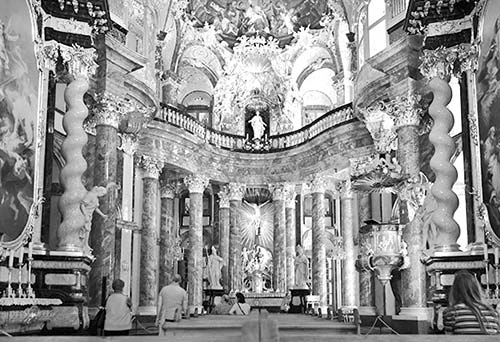
The faded painting in the dome high above the altar shows three guys in gold robes losing their heads (for more on these martyred Irish monks, see the “Würzburg’s Beginnings” sidebar, earlier). The two side paintings are by the great fresco artist Tiepolo. Since the fresco plaster wouldn’t dry in the winter, Tiepolo spent his downtime painting with oil.
• To reach the garden, enter through the gate at the right of the Residenz building.
Residenz Garden
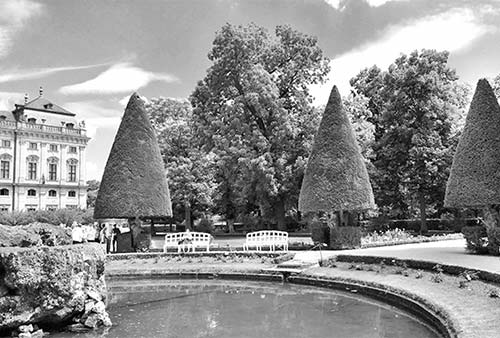
One of Germany’s finest Baroque gardens is a delightful park cradling the palace. It has three sections: the East Garden, the South Garden, and the nursery grounds. The South Garden, just inside the gate, features statues of Greek gods (with lots of kidnapping action); carefully trimmed, remarkably conical, 18th-century yew trees; and an orangery (at the far back). The nursery grounds (to the right) is like a rough park. The East Garden, directly behind the palace around to the left, is grand—à la Versailles—but uses terraces to create the illusion of spaciousness (since it was originally hemmed in by the town wall). Behind the orangery is the replanted palace kitchen garden.
Würzburg Walk
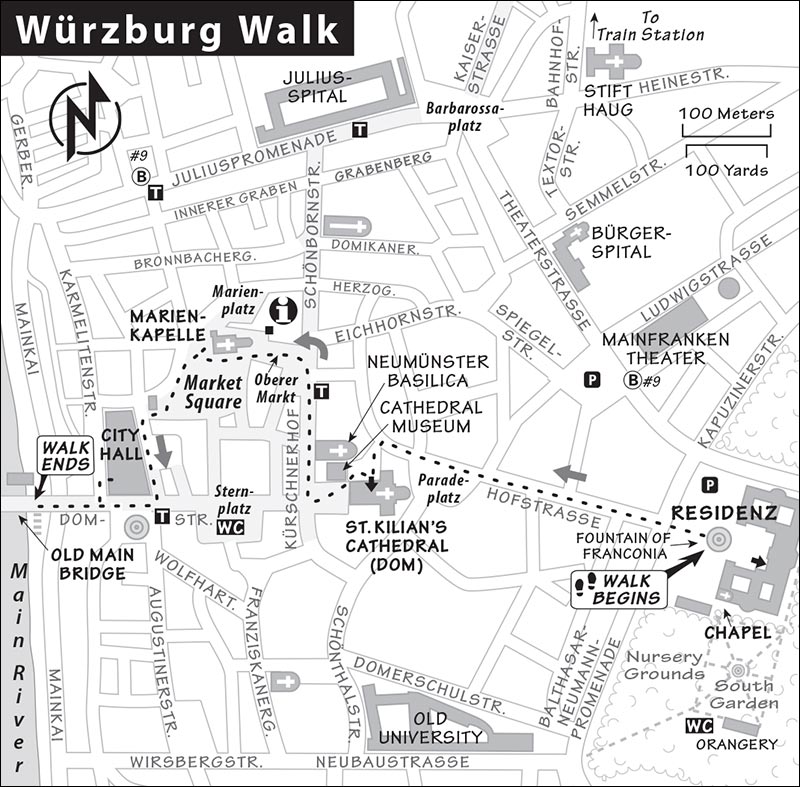
This one-hour self-guided walk takes you from the Residenz (which you may want to tour first) to the Old Main Bridge (Alte Mainbrücke) via the key old-town sights. (If you’re not touring the Residenz before taking this walk, you can start at St. Kilian’s Cathedral.)
• Begin at the fountain in front of the Residenz palace.
Fountain of Franconia
In 1814, the prince-bishop got the boot, and the region of Franconia was secularized and given to the Bavarian Wittelsbach dynasty. Technically, Franconia is a part of Bavaria, but calling a Franconian a Bavarian is something like calling a Scot an Englishman. This statue—a gift from the townspeople to their then-new royal family—turns its back to the palace and faces the town. Its central figure celebrates the spirit of Franconia, and below her, the region’s artistic and intellectual genius is represented by statues of three great hometown boys (the medieval bard Walther von der Vogelweide, the woodcarver Tilman Riemenschneider, and the Renaissance painter Matthias Grünewald).
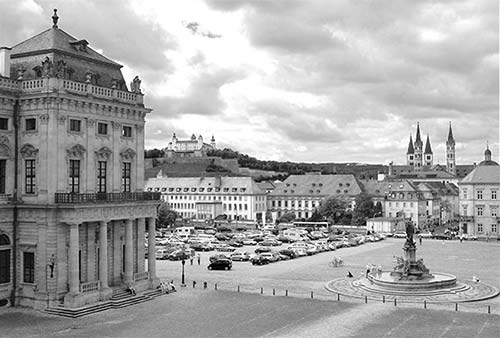
• If Franconia hopped down and ran 300 yards ahead on Hofstrasse, she’d hit the twin-spired cathedral. Meet her there. As you walk, think about how the city was essentially destroyed in 1945 and later rebuilt. At the cathedral, circle around the right, and enter the church through its heavy bronze side door (before the underground passage and across from the modern cathedral museum).
St. Kilian’s Cathedral (Dom)
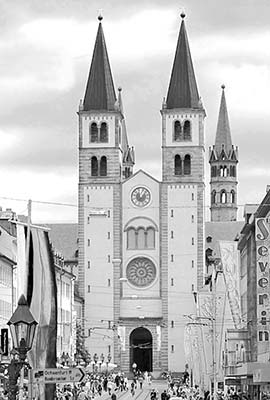
This building’s core is Romanesque (1040-1188), with Gothic spires and Baroque additions to the transepts. It was built as a Catholic church and stayed that way after the Reformation.
Cost and Hours: Free, Mon-Sat generally 9:30-17:30, Sun may only be open for Mass, daily Easter-Oct closes midday for brief services, +49 931 3866 2900, www.dom-wuerzburg.de.
Visiting the Church: The cathedral was destroyed in World War II and rebuilt in the 1960s with a passion for mixing historic and modern styles. Before 1945, the entire church was slathered in Baroque stucco decor, as the apse is today. The nave has a cohesive design, progressing from the menorah (representing the Old Testament) in the back, past tombstones of centuries of prince-bishops and a crucified Jesus (above the high altar), to the apse, where a resurrected Christ, riding a golden disc, welcomes you into a hopeful future. The skulls of Würzburg’s three favorite saints—those Irish monks martyred in the seventh century—lie in a box within the altar (see “Würzburg’s Beginnings” sidebar, earlier).
Halfway along the nave (on the left side, as you face the altar) is a fine memorial to the 15th-century Prince-Bishop Rudolf von Scherenberg, whose name means “scissors mountain” (see his coat of arms). Scherenberg ruled until he was 94 years old. Carved by Tilman Riemenschneider, this tombstone is an example of late-Gothic realism. Back then, it was outrageous to portray an old bishop as...an old bishop (looking at the tombstone, you can tell he needs dentures). The next prince-bishop, whose tomb is to the right of Scherenberg’s, saw how realistic his predecessor’s was and insisted on having an idealized portrait (also by Riemenschneider) done to his satisfaction before he died. (He’s looking implausibly dashing.)
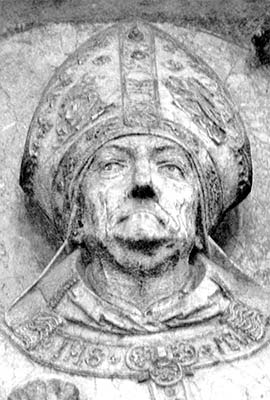
• Leave the church the way you entered. Outside, look up at the three martyrs (before they were beheaded), high on the building opposite. Walk a few steps downhill (to the left) and notice, embedded in the cathedral wall, the tomb of the great local artist Riemenschneider, placed here after the church’s cemetery was moved. If you’re interested in a fresh take on religious art, go into the modern Cathedral Museum across the way. Otherwise, skip ahead and continue downhill through the tunnel on your way to the basilica.
Cathedral Museum (Museum am Dom)
This museum features a refreshing, poignant juxtaposition of old and new religious art, managing to be provocative in a constructive way. It pairs 11th- to 18th-century works with modern interpretations, sprinkles it all with a Christian theme, and wraps it in a shiny modern building. With an emphasis on more cutting-edge contemporary works, it does an impressive job of respecting “religious art” for both its artistic and spiritual qualities.
Cost and Hours: €4, Tue-Sun 12:00-17:00, closed Mon, +49 931 3866 5600, www.museum-am-dom.de.
• Upon leaving the museum, hook right through a tunnel, which emerges on a delightful urban scene. Straight ahead, Domstrasse leads down to the spire of the City Hall and the Old Main Bridge (where this walk ends). But we’re looping right. Go a block up Kürschnerhof, where a staircase leads into the...
Neumünster Basilica
Like the cathedral, this church has a Romanesque body with a Baroque face. Climb the stairs to take a look inside, appreciating the church’s rounded Romanesque nave decorated (like the outside) with bubbly Baroque stucco.
Return to Kürschnerhof and continue up the street, noticing the vineyards in the distance. Appreciate the relative quiet here in the heart of town. Locals wouldn’t have it any other way—electric trolleys, bikes, and pedestrians share a thriving and car-free commercial zone.
• Enter the square on the left (with the lacy, two-tone church).
Upper Market Square (Oberer Markt)
Imagine this square during the wine fest in June—with 75 vintners showing off their best wines—or during the Christmas market, when the square is full of quaint stalls selling holiday goodies. The fancy yellow-and-white, Rococo-designed Falken Haus (House of the Falcon) dates from 1751, when the landlady gave a wandering band of stucco artists a chance to show their stuff (inside are the TI and library).
• Continue past the Falken Haus, passing the church on your right, into...
Market Square (Marktplatz)
Würzburg’s Marktplatz is a great scene. The obelisk at its center, built in 1805, has a relief showing romantic maidens selling fruits, a hare, and other wares. To this day, the square is host to a bustling produce and flower market four days a week. Under the glass-roofed pavilion, find a fountain with the modern statue nicknamed “Market Barbara” (Markt Bärbel), which recalls a traditional merchant woman. From there, a line often leads to the Bratwurststand am Markt (under the yellow-and-white awning, near the covered walkway), where cheap sausage sandwiches are made and sold to eager locals. Watch the wiener-folding action through the side window, or grab a wurst yourself (let them know whether you want yours “mit”—with mustard—or “ohne”—without). Beyond that, anchored like a Hansel-and-Gretel barnacle to the foot of the church, is Brandstetter’s Stehcafé, a venerable choice for a coffee-and-cake break while you stand and watch the crowds.
Marienkapelle
The two-tone late-Gothic church was the merchants’ answer to the prince-bishop’s cathedral. Since Rome didn’t bankroll the place, it’s ringed with “swallow shops” (like swallows’ nests cuddled up against a house)—enabling the church to run little businesses. The sandstone statues (in the small alcoves partway up the columns; they’re replicas of Riemenschneider originals) depict the 12 apostles and Jesus. The famous Adam and Eve statues (flanking the side entrance to the church) show off Riemenschneider’s mastery of the human body. Continue around the church to the west portal, where the carved Last Judgment (above the main doors) shows kings, ladies, and bishops—some going to heaven, others making up the chain gang bound for hell, via the monster’s mouth. (This was commissioned by those feisty town merchants tired of snooty bluebloods.) Continue around to the next entry (which faces a Biergarten under chestnut trees) to see the Annunciation, with a cute angel Gabriel telling Mary (the lilies symbolize her virginity) the good news. Notice how God whispers through a speaking tube as Baby Jesus slips down and into her ear.
• Go back around to the market (Adam-and-Eve side) and leave—passing the obelisk—in the direction of the yellow-and-white building with the Grohganz sign. Follow Schustergasse, a pedestrian lane lined with shops that leads back to Domstrasse (with tram tracks). The cathedral is on your left, while the City Hall and Old Main Bridge are to the right. Head right to the City Hall’s tower.
City Hall (Rathaus)
Würzburg’s City Hall is relatively humble because of the power of the prince-bishop. As you face the building, go around the left side to find the Gedenkraum 16 März 1945 memorial (free, always open). This commemorates the 20-minute Allied bombing raid on March 16, 1945, and the resulting firestorm that destroyed—and demoralized—Würzburg six weeks before the end of World War II. The damage was almost as bad as in Dresden: Nearly every downtown building was reduced to a shell, with roofs, floors, and windows gone. Most residents survived in bomb shelters, but 5,000 died—largely women and children. Check out the model of the devastated town, and read the interesting panels about the rise of Nazism and the brutality of war and the hope brought by a spirit of reconciliation.
• As you leave City Hall, notice the horizontal lines cut into the inside of the archway on your right. These mark the floodwaters (Hochstand des Maines) of the years 1342, 1682, and 1784. Now, find the bridge.
Old Main Bridge (Alte Mainbrücke)
This isn’t the town’s “main” (as in primary) bridge; rather, it spans the Main (pronounced “mine”) River, which flows through Frankfurt and into the Rhine.
The bridge, from 1133, is the second-oldest in Germany. The 12 statues lining the bridge are Würzburg saints and prince-bishops. Walk to the St. Kilian statue (with the golden sword)—one of the three monks who are shown being beheaded in the Residenz Palace’s chapel. Squint up at Kilian, still with his head on, pointing to God. This is a great spot to linger with the locals as you drink in the view and perhaps a glass of the local wine.
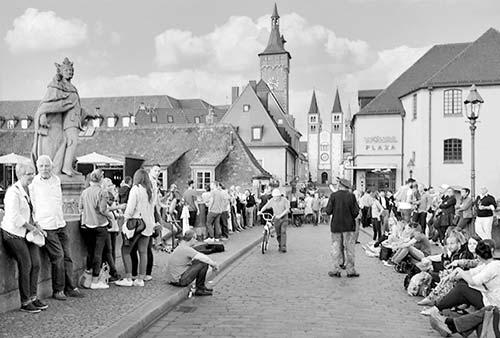
Beyond Kilian you may see river cruise ships moored by the next bridge. The popularity of river cruising (from Amsterdam to Budapest) brings lots of crowds and business to towns like Würzburg.
High above the city, capping the hill beyond the bridge, is the Marienberg Fortress (described at the end of this walk). And downstream are three stacks marking a power plant. Between here and there find the old crane, built in 1770 to further the city’s desirability as a river trading port. The bridge and embankment host several popular eating and drinking spots, a fun fish-and-chips boat—and lots of people picnicking (described later, under “Eating in Würzburg”).
The hillside beyond the crane is blanketed with grapevines destined to become the fine Stein Franconian wine. Goethe, the great German writer, ordered 900 liters of this vintage annually. A friend once asked Goethe what he thought were the three most important things in life. He said, “Wine, women, and song.” The friend then asked, “If you had to give one up, which would it be?” Without hesitating, Goethe answered “Song.” Then, when asked what he would choose if he had to give up a second item, Goethe paused and said, “It depends on the vintage.”
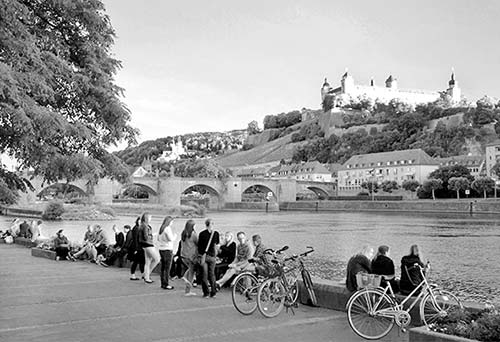
• Consider stopping here and having lunch at the recommended Alte Mainmühle restaurant, with a terrace overlooking the bridge (at the near end). On warm summer evenings, the restaurant sets up a little wine stand at the start of the bridge—worth returning to at sunset to buy a glass of wine to sip while you do laps around the bridge. For now, you can continue on to the fortress on the hill above you.
Marienberg Fortress (Festung Marienberg)
This 13th-century fortified retreat was the original residence of Würzburg’s prince-bishops (before the opulent Residenz across the river was built). After being stormed by the Swedish army during the 17th-century Thirty Years’ War, the fortress was expanded in Baroque style.
Cost and Hours: Fortress grounds—free, daily 9:00-18:00, Nov-March 10:00-16:00, +49 931 355 1750, www.schloesser.bayern.de; Mainfränkisches Museum—€5, Tue-Sun 10:00-17:00, Nov-March until 16:00, closed Mon year-round, +49 931 205 940, www.museum-franken.de.
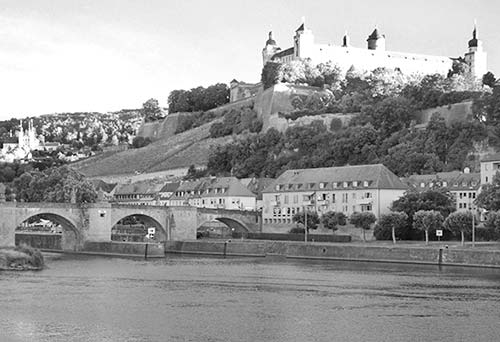
Tours: Ask at the fortress ticket office in the inner courtyard about the €7 fortress tour and museum combo-ticket, which includes an English-language tour. Note these only provide commentary on the exterior areas and get you into the church, so they’re of limited interest.
Getting There: To walk there, cross the Old Main Bridge and follow small Festung Marienberg signs to the right uphill for a heart-thumping 20 minutes. Or take infrequent bus #9 (direction: Festung) from the middle of town—not the bridge—to the last stop (Schönborntor) and walk through the tunnel to enter the fortress (runs every 30 minutes daily 9:30-18:00, times listed at stops, departs from Residenzplatz and Juliuspromenade). Consider taking the bus up and walking down (follow Fussweg zur Altstadt signs). Taxis wait near the Old Main Bridge (around €10 to fortress).
Visitor Information: The inexpensive Marienberg Castle booklet, sold throughout the fortress, is well written and has basic information if you want to learn more about the history.
Visiting the Fortress: The fortress grounds provide fine city views and a good place for a picnic. You can wander freely through the fortress courtyards and peek into the bottom of the original keep (tower stronghold at the center of the complex) and the round church, where carved relief monuments to former bishops decorate the stone floor. For the best views of the town, go through the archway off the inner courtyard (next to church entrance) into the Prince’s Garden—look for the Fürstengarten sign.
You’ll find the Mainfränkisches Museum in the red-and-white building at the back of the fortress, near the bus stop. Its hodge-podge of exhibits, in mildly historic rooms, is unlikely to thrill you. Out of all the porcelain, furniture, weapons, and paintings, the standout is the sculpture work of Tilman Riemenschneider, Germany’s top woodcarver and onetime mayor of Würzburg. There’s a smattering of English descriptions throughout. Riemenschneider fans will also find his work in Würzburg’s many churches (such as the cathedral).
Sleeping in Würzburg
Würzburg’s hotels and hostels are a stress-free option for a first or last night when flying into or out of Frankfurt. Trains run at least hourly between Würzburg and Frankfurt’s airport; the journey takes 1.5 hours. Hotels tend to discount the prices listed during slow months—November to April, and sometimes in August as well.
As Würzburg is a convention town, it has ample chain hotels that can be a great value in slow times—consider searching online for the dates you’re in town. My listings are smaller places with more personality and rates that are less likely to fluctuate. In these hotels, quieter rooms are in back, front rooms have street noise, and all rooms are entertained by church bells.
Most of these listings are less than a 10-minute walk from the train station and perfectly situated for sightseeing. To reach nearly all of them, head up Kaiserstrasse from the station to Barbarossaplatz (with the circular awning) or take the tram one stop to Juliuspromenade. Hotel zum Winzermännle and Hotel Alter Kranen are closer to the river; consider riding a tram to the Dom or the Rathaus stops, respectively. If you’re driving, you’ll likely have to park in a garage near your hotel (about €8/day) as street parking is scarce.
$$$ Hotel Würzburger Hof has an elegant little lobby and 34 Baroque rooms right at the Juliuspromenade tram stop. They have two types of rooms: smaller but perfectly fine “standard” rooms and larger “superior” rooms (elevator, good windows that dampen street noise, Barbarossaplatz 2, +49 931 53814, www.hotel-wuerzburgerhof.de, info@hotel-wuerzburgerhof.de).
$$ Hotel Barbarossa, tucked away on top of a tall medical-office building above the busy Barbarossaplatz intersection, feels more like a B&B than the others listed here. Its 18 rooms are quirky and homey (RS%, rooftop terrace, elevator, Theaterstrasse 2, fourth floor, +49 931 3291 9091, www.hotelbarbarossa-wuerzburg.de, info@hotelbarbarossa-wuerzburg.de, run by hardworking Christine).
$$ Hotel zum Winzermännle has 22 bright rooms along a busy pedestrian street in the city center, but its double-paned windows keep things quiet. The atmosphere is simple: a bit anonymous, though comfortable (elevator, reception up one floor from street, Domstrasse 32, +49 931 54156, http://winzermaennle.de, kontakt@winzermaennle.de).
$$$ Hotel Alter Kranen has 17 standard rooms with a tidy, business-class vibe right along the river (not all rooms have views—try requesting one when you reserve). This hotel is farther from the train station than the others listed here, but a bit handier to the Market Square/Old Main Bridge action (air-con in top-floor rooms only, elevator, Kärrnergasse 11, +49 931 35180, www.hotel-alter-kranen.de, mail@hotel-alter-kranen.de).
$$ City Hotel Würzburg is friendly and efficient, with 40 tight but comfortable rooms on a street with a pleasant neighborhood feel (no elevator; from Barbarossaplatz follow Theaterstrasse and take your first left onto Semmelstrasse, Semmelstrasse 28, +49 931 780 0990, www.cityhotel-wuerzburg.de, info@cityhotel-wuerzburg.de, Ulrich Kölbel).
$$ Hotel Petite lives up to its name, a comfy and cozy place on a back street. Some of its 13 bright rooms come with little balconies (elevator; from train station, turn right onto Juliuspromenade, then jog left a block onto Innerer Graben, Innerer Graben 22, +49 176 3636 4502, www.city-hotel-petite.de, info@city-hotel-petite.de).
¢ Babelfish Hostel, across the street from the station, welcomes travelers of all ages to its 18 colorful rooms. This laid-back place is eco-friendly, modern, and feels safe (private rooms available—some with kitchenettes, breakfast extra, roof deck, wheelchair-accessible, reception on second floor, Haugering 2, +49 931 304 0430, www.babelfish-hostel.de, info@babelfish-hostel.de).
¢ Würzburg’s official youth hostel (Jugendherberge) is across the river in a former women’s prison (private and family rooms; requires membership; 20-minute walk from station: cross Old Main Bridge and turn left on Saalgasse to Fred-Joseph-Platz 2; or take tram #3 or #5 to Löwenbrücke stop, then follow Jugendherberge signs; +49 931/4677-860, http://wuerzburg.jugendherberge.de, wuerzburg@jugendherberge.de).
Eating in Würzburg
IN THE CENTER
The Bürgerspital is a grand Baroque complex that once housed one of the city’s medieval charity hospices. Back then, rich Würzburgers created charitable foundations to support the city’s elderly and poor. They began making and selling wine to fund their charity work, and this tradition continues today. Still occupying grand Baroque complexes, the foundations have restaurants, wine shops, and extensive wine cellars. These are no longer basic soup kitchens but well-respected, quite elegant eateries that also happen to support a good cause. The Bürgerspital—the oldest and best-known of these foundations—now cares for about a hundred local seniors and also provides two eating options:
$$$$ Weinstuben Bürgerspital is a candlelit but not-too-formal restaurant that serves beautifully presented Franconian specialties. Depending on the weather, you can dine outside in a fine old courtyard or indoors in traditional or modern rooms (daily 11:00-24:00, enter at Theaterstrasse 19, +49 931 352 880).
$$ Weingut Bürgerspital, an unintimidating wine shop/tasting room on a busy corner, serves up small dishes in a contemporary setting. The staff is happy to educate you on the basics of Franconian wine (flights available, Tue-Sat 9:00-24:00, Sun-Mon 11:00-18:00, Theaterstrasse 19, +49 931 350 3403).
The Bürgerspital’s fun, drinks-only place, Hockerle, is described later, under “Places for a Memorable Snack or Drink.”
Other Central Options
$$ Wirtshaus Lämmle is just right for a wine garden serving traditional Franconian dishes under chestnut trees with a view of the back side of the Marienkapelle (Mon-Sat 11:00-22:00, closed Sun, Marienplatz 5, +49 931 54748).
$$$ Backöfele is a fun hole-in-the-wall (literally, though it’s quite big once you enter). Named “The Oven” for its entryway, this place is a hit with Germans, offering a rustic menu full of traditional meat and fish dishes. You can sit inside or in the delightful, glassed-in, cobbled courtyard (Mon-Fri 17:00-23:00, Sat-Sun from 12:00, reservations smart; a couple of blocks beyond City Hall, Ursulinergasse 2; +49 931 59059, www.backoefele.de).
$$$ Weinhaus zum Stachel originated as the town’s tithe barn, where people deposited 10 percent of their produce as tax. In 1413, it began preparing that produce and selling wine, making it Würzburg’s oldest Weinhaus. Today, its stone-and-ivy courtyard is one of the city’s most elegant settings for enjoying fresh fish and gourmet Franconian meals. In bad weather, you’ll eat in the woody medieval dining room, where the ceiling depicts a Stachel (mace) in deadly action (Tue-Sat 11:30-24:00, closed Sun-Mon, reservations smart, Gressengasse 1, +49 931 52770, www.weinhaus-stachel.de).
$$ Sternbäck is an inviting Kneipe (pub) with rickety tables spilling onto a busy square. This is where locals from all walks of life gather for a drink and cheap eats. The hip, friendly staff can recommend something that will satisfy you, including Franconian classics and curries (daily 11:00-late, Sternplatz 4, +49 931 54056).
$ Weinstube Maulaffenbäck, hidden in an alley near Market Square with a few outdoor tables, is a characteristic place for cheap Franconian meals and good wine. In accordance with a unique Würzburger tradition, if you order wine at lunch between 10:00 and 12:00, you’re welcome to bring your own cold cuts and bread (the butcher next door is open until 18:00)—they’ll provide the plate and fork (Tue-Sat 11:00-23:00, closed Sun-Mon, Maulhardgasse 9, +49 931 4677 8700).
$ Pasta e Olio, a couple of blocks east of Market Square, may look like an anonymous fast-food stand, but its pasta is made fresh daily by the same family that’s been running the place for three generations. The limited menu usually includes a pasta dish, lasagna, a vegetarian option, and mixed antipasti. Place your order cafeteria style, then eat standing at one of the tables (Mon-Sat 11:00-20:00, Sun 14:30-21:00, no WC, Eichhornstrasse 6, +49 931 16699).
$ Dean & David, part of a national chain, is deservedly a favorite for a fast, inexpensive, and healthy meal. They have a pleasant modern interior and tables on the square (super-fresh salads, veggie dishes, curries, soups, wok plates, sandwiches, smoothies, Mon-Sat 10:00-20:00, Sun until 18:00, Eichhornstrasse 2b, +49 931 4522 8303).
ON THE RIVERFRONT
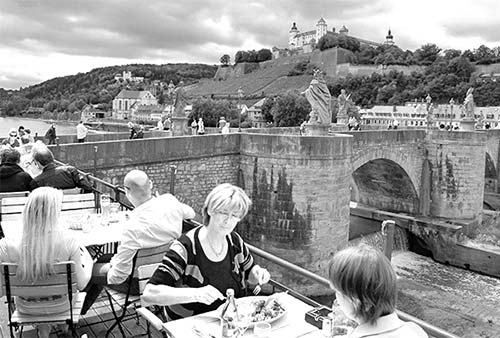
$$$ Alte Mainmühle, on the bridge in a converted mill, is a great place to end your walking tour or enjoy a sunset. On a warm day, nothing beats a cold beer on their deck, which overlooks the river and the fortress—choose from the sunny top-floor terrace or the shade below. (They also run a wine stand on the Old Main Bridge on warm evenings.) If dining inside, I’d sit upstairs rather than on the lower level. Look for fresh fish specials and traditional fare with a Franconian twist. Their homemade sourdough bread (Natursauerteigbrot) is a delicious nod to their milling history (daily 11:00-23:00, reservations smart, Mainkai 1, +49 931 16777, www.alte-mainmuehle.de).
$$ Alter Kranen Brauerei-Gasthof is a youthful eatery with a big beer hall interior, outdoor tables around the old crane overlooking the river, and indifferent service (try the local brew—Würzburger Hofbraü, table service only, daily 12:00-23:00, a couple of blocks down from the Old Main Bridge at Kranenkai 1, +49 931 9913 1545).
$ Main Kutter, a fun-loving little fish-and-chips boat, is tied up a bit downstream from the Old Main Bridge. With a commotion of funky tables and lots of riverside park benches nearby, it caters to a youthful crowd and is the cheapest meal on the water. They serve local fish—trout, pike-perch, and carp—with English-style malt vinegar and sea salt. Place your order at the counter onboard. You’ll have to fetch your own beer and stay aboard to drink if you’re ordering beer or wine (likely daily 12:00-20:00 or later in summer, closed in bad weather and Nov-April, +49 150 393 9388).
Riverfront Picnic: A parklike stretch of riverbank from the Old Main Bridge to the crane is made-to-order for picnicking. There are plenty of benches and a long, inviting concrete embankment to spread out your meal. The scene comes with beer-drinking students, the down-and-out collecting their bottles, and great views of the river, bridge, and castle.
PLACES FOR A MEMORABLE SNACK OR DRINK
$ Café Michel, right on Upper Market Square and next to the TI, is a family-oriented bakery and teahouse with quiet indoor seating and tables on the square. They offer soups, sandwiches, and an impressive selection of cakes and strudels (Mon-Sat 9:00-18:00, closed Sun, Marktplatz 11).
$ Goldene Gans Biergarten is a sloppy riverside beer garden on the west side of the river, with wooden benches, shaded views of the Old Main Bridge, forgettable food, and good beer (daily 11:00-23:00—weather permitting; closed off-season; to the left about a block after you cross the Old Main Bridge).
Hockerle, a funky little time warp, is a pub tucked away right next to Weingut Bürgerspital (listed earlier). It serves wine on tap to locals and outgoing tourists who bring in their own food. The regulars start drinking early (no food, wines listed on blackboard, Mon-Fri 9:00-18:00, Sat until 15:00, closed Sun).
Würzburg Connections
From Würzburg by Train to: Rothenburg (hourly, 70 minutes, transfer in Steinach; 45 minutes to Steinach, then 15 minutes to Rothenburg; tiny Steinach-Rothenburg train leaves usually from track 5 shortly after the Würzburg train arrives), Frankfurt Airport (1-2/hour, 1.5 hours), Frankfurt (1-2/hour, 70 minutes, or 2 hours on cheaper RE trains), Nürnberg (2-3/hour, 1 hour), Munich (1-2/hour, 2 hours), Cologne (hourly, 2.5 hours by ICE; also 3/day by IC, 4 hours), Leipzig (hourly, 3 hours, some transfer in Fulda or Bamburg), Berlin (hourly, 4 hours, change points vary). Train info: www.bahn.com.