APPENDIX
Holidays and Festivals
This list includes selected festivals in major cities, plus national holidays observed throughout Germany. Many sights and banks close on national holidays—keep this in mind when planning your itinerary. Before planning a trip around a festival, verify the dates with the festival website, the Germany tourist office (www.germany.travel), or my “Upcoming Holidays and Festivals in Germany” web page at RickSteves.com/europe/germany/festivals. Austria’s Salzburg has music festivals nearly every month (see the Salzburg chapter for more details).
| Jan 1 | New Year’s Day |
| Jan 6 | Epiphany (Heilige Drei Könige) |
| Early Jan | Perchtenlaufen; Tirol, Austria (winter festival, parades) |
| Feb/March | Fasching (carnival season—parties, parades leading up to Ash Wednesday): Feb 16-22 in 2023, Feb 8-14 in 2024 |
| Spring | Thuringian Bach Weeks, Erfurt (3 weeks) |
| March/April | Easter weekend (Good Friday-Easter Monday): April 7-10, 2023; March 29-April 1, 2024 |
| Mid-April-early May | Spring Festival, Munich (Frühlingsfest, the “little sister of Oktoberfest”) and Nürnberg |
| May 1 | May Day, throughout Germany and Austria (maypole dances) |
| Mid-May | International Dixieland Festival, Dresden (www.dixielandfestival-dresden.com) |
| May | Ascension: May 18 in 2023, May 9 in 2024 |
| Late May-early June | Weindorf wine festival and Mozartfest, Würzburg |
| Late May-early June | Fressgass’ Fest, Frankfurt |
| Late May-early June (Pentecost weekend) | Carnival of Cultures (www.karneval.berlin), Berlin; Meistertrunk Show (play and market, medieval costumes, Biergarten parties, www.meistertrunk.de), Rothenburg |
| Mid-June | Luther’s Wedding festival, Wittenberg |
| Mid-June | Stadtteilfest Bunte Republik Neustadt, Dresden (counterculture block party, www.brn-dresden.de) |
| May/June | Corpus Christi (Fronleichnam), southern and western Germany: June 8, 2023; May 30, 2024 |
| Mid-June-mid-July | Tollwood, Munich (art, concerts, street theater, www.tollwood.de) |
| Late June | City Festival (www.elbhangfest.de), Dresden; Oberlindenhock (street food, beer and wine, live music), Freiburg; Midsummer Eve Celebrations, Austria |
| July | Kiliani Volksfest, Würzburg (county fair-type folk festival) |
| July | Open Air Festival, Berlin (music on Gendarmenmarkt, www.classicopenair.de) |
| Mid-July | Kinderzeche Festival, Dinkelsbühl (www.kinderzeche.de) |
| Mid-July | Lichter Festival, Cologne (fireworks and music, www.koelner-lichter.de) |
| Late July-early Aug | Schlossbergfest, Freiburg (music festival on Schlossberg mountain) |
| Late July-early Aug | Klassik Open Air, Nürnberg (fireworks and classical music, www.klassikopenair.de); Bardentreffen Nürnberg (world music, www.bardentreffen.de) |
| Early Aug | International Beer Festival, Berlin (www.bierfestival-berlin.de) |
| Aug 15 | Assumption (Mariä Himmelfahrt) |
| Mid-Aug | Weindorf wine festival, Rothenburg |
| Late Aug | Museum Riverbank Festival, Frankfurt; wine festival, Cochem |
| Late Aug-early Sept | Rheingau Wine Festival, Frankfurt |
| Sept | International Literature Festival, Berlin (www.literaturfestival.com) |
| Early Sept | Reichsstadt Festival, Rothenburg (fireworks) |
| Sept-Oct | Oktoberfest, Munich (www.oktoberfest.de) |
| Oct 3 | German Unity Day (Tag der Deutschen Einheit), throughout Germany; party along Unter den Linden in Berlin |
| Mid-Oct | Festival of Lights, Berlin (landmark buildings artistically lit, www.festival-of-lights.de) |
| Oct 31 | Reformation Day celebration, Wittenberg |
| Nov | Jazzfest Berlin (www.berlinerfestspiele.de) |
| Nov 1 | All Saints’ Day (Allerheiligen), southern and western Germany |
| Nov 11 | St. Martin’s Day (Martinstag, feasts) |
| Dec | Christmas markets throughout Germany, good ones in Nürnberg, Munich, Rothenburg, and Freiburg |
| Dec 6 | St. Nikolaus Day (parades), throughout Germany |
| Dec 24 | Christmas Eve (Heiliger Abend; when Germans celebrate Christmas) |
| Dec 25 | Christmas |
| Dec 31 | New Year’s Eve (“Silvester”; especially lively in Berlin) |
Books and Films
To learn more about Germany past and present, check out a few of these books or films.
Nonfiction
Berlin Diary: The Journal of a Foreign Correspondent (William Shirer, 1941). Stationed in Berlin from 1934 until 1940, CBS radio broadcaster Shirer delivers a vivid and harrowing day-by-day account of the rise of Nazi Germany.
Berlin Now—The City After the Wall (Peter Schneider, 2014). A long-time resident and journalist explores aspects of Berlin since 1989, including the Stasi legacy, the debate about how to preserve sections of the Wall, the city’s frenetic club scene, thorny urban planning issues, and the Brandenburg Airport debacle.
Berlin—Portrait of a City Through the Centuries (Rory MacLean, 2014). MacLean’s colorful look at this pivotal and resilient city focuses on the people (from Frederick the Great to JFK to David Bowie) who were instrumental to its narrative—and its unique soul.
Boys in the Boat (Daniel James Brown, 2013). The true story of the University of Washington men’s rowing team that defied the odds to win gold at Hitler’s 1936 Berlin Olympics.
Culture Shock! Germany (Richard Lord, 2008). Lord provides cultural insights on German customs and etiquette.
Here I Stand: A Life of Martin Luther (Roland Bainton, 1950). Bainton delivers an authoritative biography of the man who initiated the Reformation.
In the Garden of Beasts (Erik Larson, 2011). Larson captures Berlin during the rise of the Nazis, as seen through the eyes of a reserved US ambassador to Germany and his socialite daughter.
Inside the Third Reich (Albert Speer, 1970). Based on 1,200 manuscript pages, this authoritative account of the years 1933-1945 was written by Hitler’s chief architect and eventual armaments minister.
Martin Luther: A Life (Martin E. Marty, 2004). Marty offers a short, vivid biography of the irascible German reformer who transformed Western Christianity.
Night (Elie Wiesel, 1960). The Holocaust survivor and Nobel Peace Prize winner gives a candid and horrific account of existence in a Nazi concentration camp.
Peeling the Onion (Günter Grass, 2007). The Nobel Prize-winning author’s memoir recounts his childhood in Danzig and his experiences as a soldier in the Nazi Waffen SS.
Stasiland: Stories from Behind the Berlin Wall (Anna Funder, 2002). Funder delivers a powerful account about the secrets of the Stasi, and how it affected the citizens of East Germany.
When in Germany, Do as the Germans Do (Hyde Flippo, 2002). Want to fit in? This lighthearted and helpful guide details the dos and don’ts of being German.
A Woman in Berlin: Eight Weeks in the Conquered City (Anonymous, 2006). This translated diary of a young German woman is a frank recounting of the post-surrender occupation of Berlin by Russian forces.
Fiction
Address Unknown (Kathrine Kressmann Taylor, 1939). Published before World War II and banished in Nazi Germany, this book warns of the terrors yet to come via a series of letters between a Jewish art dealer living in San Francisco and his former business partner.
All Quiet on the Western Front (Erich Maria Remarque, 1929). Young German classmates enlist in the German Army of World War I, only to find that war is not about glory and pride.
Berlin Noir (Philip Kerr, 1993). An ex-policeman turned detective struggles with secrets and crime in 1930s and ’40s Berlin.
The Berlin Stories: The Last of Mr. Norris and Goodbye to Berlin (Christopher Isherwood, 1945). Composed of two novellas published in the 1930s, these stories capture the freewheeling early ’30s Berlin and inspired the Broadway musical/motion picture Cabaret.
The Book Thief (Markus Zusak, 2007). This award-winning novel about a German girl who learns to read and then steals books the Nazis want to destroy is also a 2013 motion picture.
Floating in My Mother’s Palm (Ursula Hegi, 1990). This best-selling novel follows the life of a young girl growing up in 1950s Burgdorf, a small German town on the Rhine. Hegi also wrote Stones from the River, based in the same small town.
The Magic Mountain (Thomas Mann, 1924). One of Germany’s most influential and celebrated works of the 20th century takes place in a sanatorium in the Swiss Alps before and during World War I.
Marrying Mozart (Stephanie Cowell, 2008). Cowell’s novel reveals a more intimate side of the famous composer.
Narcissus and Goldmund (Hermann Hesse, 1930). Hesse tells the story about two medieval men, one choosing life in a monastery and the other traveling the world. Also by the German-born Hesse is the popular Siddhartha, about a young man leaving his family.
The Reader (Bernhard Schlink, 1995). Told by a sympathetic narrator, this book challenges readers to ponder, “What if my loved ones had been Nazis?”
Saints and Villains (Denise Giardina, 1999). The author draws on the writings of Dietrich Bonhoeffer in this fictionalized account of the Protestant theologian who protested Hitler’s rise.
The Silent Angel (Heinrich Böll, 1994). Soldier Hans Schnitzler returns from World War II unknowingly secreting a will that will change his life. Also by Böll: Group Portrait with Lady, about a war widow’s attempt to save her Cologne apartment building from demolition.
The Spy Who Came in From the Cold (John le Carré, 1963). A weary British spy posing as a defector is sent into East Germany, ostensibly to bring down a powerful communist intelligence officer, in le Carré’s seminal Cold War thriller (also a movie starring Richard Burton).
The Tin Drum (Günter Grass, 1959). Grass’ acclaimed novel tells the tale of a young boy who stands defiant against the Nazis, armed with only a drum and a piercing scream.
Winter (Len Deighton, 1987). Deighton’s engrossing historical novel traces the lives of a German family from 1899 to 1945. The book also serves as a prequel to Deighton’s masterful nine-part Cold War spy series, which kicks off with Berlin Game (1983).
Film and TV
The Baader Meinhof Complex (2008). Lightly fictionalized account of terrorism committed by radicalized Germans in 1967, rocking the still-fragile German democracy.
Babylon Berlin (2017-). Detective Gereon Rath and his plucky assistant Charlotte investigate the gritty underworld of Weimar Berlin in this German noir series.
Cabaret (1972). The multiple-Oscar-winning classic musical about 1930s Berlin, when Hitler and anti-Semitism was on the rise, and the only refuge was the cabaret.
The Counterfeiters (2007). This Oscar-winning film tells the story of Sachsenhausen Concentration Camp inmates forced to run a counterfeiting ring to undermine the British pound.
Das Boot (1981). Wolfgang Peterson’s gritty film sinks any notion that war is glorious as it sails with the crew of a U-boat hunting Allied shipping during World War II.
Downfall (2004). Bruno Ganz delivers a frightening performance as Hitler in this story of Der Führer’s final days in his Berlin bunker.
Good Bye, Lenin! (2003). In this funny, poignant film, a son struggles to re-create a pre-unification Berlin for his ailing communist mother.
Hannah Arendt (2012). This biographical drama examines the life of the German-Jewish philosopher who reported on Adolf Eichmann’s 1961 Nazi war crimes trial for the New Yorker.
Head On (2004). Two mismatched Turkish-German lovers struggle with their heritage and personal issues in this culture-clash drama.
The Lives of Others (2006). In this gripping, Oscar-winning drama, a member of East Germany’s secret police becomes too close to those whose lives he surveils.
Lore (2012). As the Allies swarm Germany at the end of World War II, a girl must lead her siblings to safety following their parents’ disappearance.
The Marriage of Maria Braun (1979). Rainer Fassbinder’s gritty meditation on post-WWII Germany is seen through the romantic woes of a young woman.
Mephisto (1981). This Oscar winner tells the tale of an actor who abandons his conscience and embraces the Nazis in order to further his career and standing. Bad move.
Metropolis (1927). Fritz Lang’s landmark sci-fi epic (and silent film) is set in a futuristic city where the wealthy rule from high-rises while the underclass lives and toils underground.
The Miracle of Bern (2008). This popular film sets a moving father-son story against the backdrop of the West German soccer team’s unexpected win in the 1954 World Cup in Bern, Switzerland.
North Face (2008). Gripping and grim, this historical drama set in 1936 centers on a pair of German mountain climbers attempting to be the first to conquer the deadly north face of the Eiger in the Swiss Alps.
Nowhere in Africa (2001). In this Academy Award winner, a Jewish family flees Germany in the 1930s and settles in Kenya.
Schindler’s List (1993). Steven Spielberg’s unflinching, Oscar-winning drama recounts a Nazi factory owner’s inspirational efforts to save his Jewish employees from deportation to concentration camps.
Shoah (1985). This 9.5-hour Holocaust documentary includes no wartime footage, only interviews with those who lived through it.
Sophie Scholl: The Final Days (2005). This drama delivers a beautiful, devastating account of a German student who defied Hitler and paid with her life.
The Tin Drum (1979). This Academy Award-winning film is based on Günter Grass’ seminal novel.
Triumph of the Will (1935). Leni Riefenstahl’s infamous Nazi propaganda film shot during the 1934 Nazi Party rally in Nürnberg is notable for its groundbreaking cinematography.
Two Lives (2012). Bouncing between Norway and Germany, this film explores the struggle of children fathered by German soldiers in Norway during the Occupation.
Valkyrie (2008). This historical thriller chronicling the July 20, 1944, attempt to assassinate Hitler includes scenes shot on location in Berlin’s Bendlerblock, the nerve center of the failed coup and now a memorial to the resistance effort.
The Wave (2008). Students at a high school quickly learn how easy it is to give in to the same social forces that enabled Nazi Germany (based on a real-life classroom experiment from 1967).
The White Ribbon (2009). A remote village in early-20th-century Germany, plagued by disturbing events, becomes a study in the roots of evil.
The White Rose (1982). This historical drama follows a group of Munich university students who form a resistance cell in defiance of the Nazis in 1942.
Wings of Desire (1987). Set in the former West Berlin, Wim Wenders’ romantic fantasy tells the story of an angel who falls in love with a human. The story concludes in Wenders’ 1993 sequel, Faraway, So Close.
Conversions and Climate
Numbers and Stumblers
• Europeans write a few of their numbers differently than we do. 1 =  , 4 =
, 4 =  , 7 =
, 7 =  .
.
• In Europe, dates appear as day/month/year, so Christmas 2024 is 25/12/24.
• Commas are decimal points and decimals are commas. A dollar and a half is 1,50, one thousand is 1.000, and there are 5.280 feet in a mile.
• When counting with fingers, start with your thumb. If you hold up your first finger to request one item, you’ll probably get two.
• What Americans call the second floor of a building is the first floor in Europe.
• On escalators and moving sidewalks, Europeans keep the left “lane” open for passing. Keep to the right.
Metric Conversions
A kilogram equals 1,000 grams (about 2.2 pounds). One hundred grams (a common unit at markets) is about a quarter-pound. One liter is about a quart, or almost four to a gallon.
A kilometer is six-tenths of a mile. To convert kilometers to miles, cut the kilometers in half and add back 10 percent of the original (120 km: 60 + 12 = 72 miles). One meter is 39 inches—just over a yard.
| 1 foot = 0.3 meter | 1 square yard = 0.8 square meter |
| 1 yard = 0.9 meter | 1 square mile = 2.6 square kilometers |
| 1 mile = 1.6 kilometers | 1 ounce = 28 grams |
| 1 centimeter = 0.4 inch | 1 quart = 0.95 liter |
| 1 meter = 39.4 inches | 1 kilogram = 2.2 pounds |
| 1 kilometer = 0.62 mile | 32°F = 0°C |
Clothing Sizes
When shopping for clothing, use these US-to-European comparisons as general guidelines (but note that no conversion is perfect).
Women: For pants and dresses, add 30 in Germany (US 10 = German 40). For blouses and sweaters, add 8 for most of Europe (US 32 = European 40). For shoes, add 30-31 (US 7 = European 37/38).
Men: For shirts, multiply by 2 and add about 8 (US 15 = European 38). For jackets and suits, add 10. For shoes, add 32-34.
Children: Clothing is sized by height—in centimeters (2.5 cm = 1 inch), so a US size 8 roughly equates to 132-140. For shoes up to size 13, add 16-18, and for sizes 1 and up, add 30-32.
Germany’s Climate
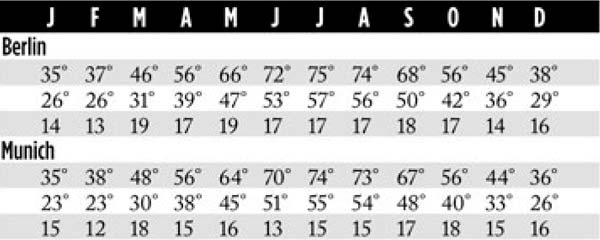
First line, average daily high; second line, average daily low; third line, average days without rain. For more detailed weather statistics for destinations in this book (as well as the rest of the world), check Wunderground.com.
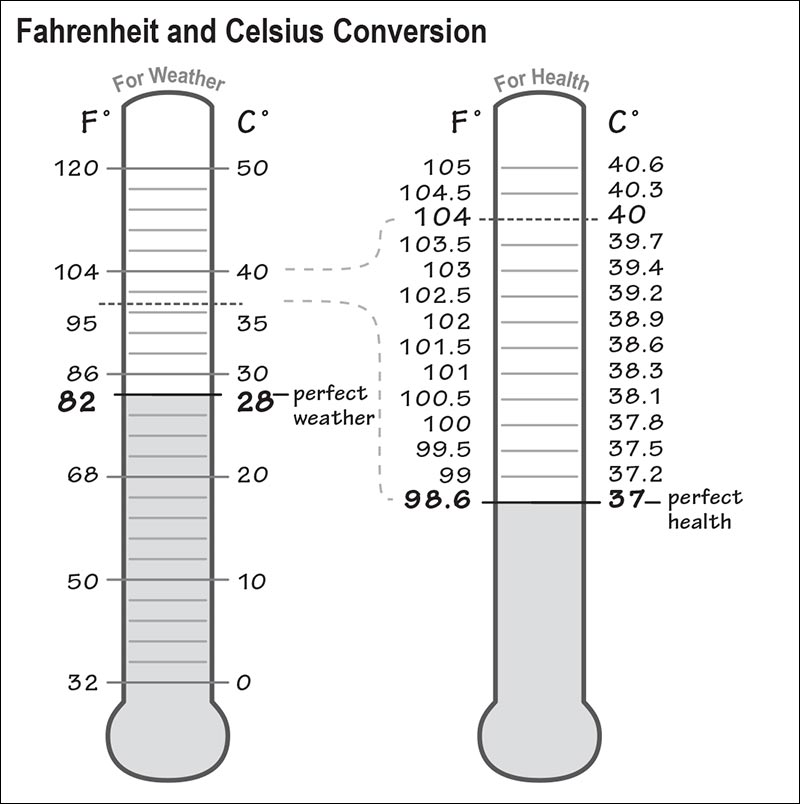
Europe takes its temperature using the Celsius scale, while we opt for Fahrenheit. For a rough conversion from Celsius to Fahrenheit, double the number and add 30. For weather, remember that 28°C is 82°F—perfect. For health, 37°C is just right. At a launderette, 30°C is cold, 40°C is warm (usually the default setting), 60°C is hot, and 95°C is boiling. Your air-conditioner should be set at about 20°C.
Whether you’re traveling for five days or five weeks, you won’t need more than this. Pack light to enjoy the sweet freedom of true mobility.
 5 shirts: long- & short-sleeve
2 pairs pants (or skirts/capris)
1 pair shorts
5 pairs underwear & socks
1 pair walking shoes
Sweater or warm layer
Rainproof jacket with hood
Tie, scarf, belt, and/or hat
Swimsuit
Sleepwear/loungewear
Debit card(s)
Credit card(s)
Hard cash (US $100-200)
Money belt
Passport
Other required ID: Vaccine card/Covid test, entry visa, etc.
Driver’s license, student ID, hostel card, etc.
Tickets & confirmations: flights, hotels, trains, rail pass, car rental, sight entries
Photocopies of important documents
Insurance details
Guidebooks & maps
Mobile phone
Camera & related gear
Tablet/ebook reader/laptop
Headphones/earbuds
Chargers & batteries
Phone car charger & mount (or GPS device)
Plug adapters
Basics: soap, shampoo, toothbrush, toothpaste, floss, deodorant, sunscreen, brush/comb, etc.
Medicines & vitamins
First-aid kit
Glasses/contacts/sunglasses
Face masks & hand sanitizer
Sewing kit
Packet of tissues (for WC)
Earplugs
Daypack
Sealable plastic baggies
Laundry supplies: soap, laundry bag, clothesline, spot remover
Small umbrella
Travel alarm/watch
Notepad & pen
Journal
Second pair of shoes (flip-flops, sandals, tennis shoes, boots)
Travel hairdryer
Picnic supplies
Disinfecting wipes
Water bottle
Fold-up tote bag
Small flashlight
Mini binoculars
Small towel or washcloth
Inflatable pillow/neck rest
Tiny lock
Address list (to mail postcards)
Extra passport photos
German Survival Phrases
In the phonetics, ī sounds like the long i in “light,” and bolded syllables are stressed.
| Hello. | Hallo. hah-loh |
| Good day. | Guten Tag. goo-tehn tahg |
| Do you speak English? | Sprechen Sie Englisch? shprehkh-ehn zee ehng-lish |
| Yes. / No. | Ja. / Nein. yah / nīn |
| I (don’t) understand. | Ich verstehe (nicht). ikh fehr-shtay-heh (nikht) |
| Please. | Bitte. bit-teh |
| Thank you. | Danke. dahng-keh |
| I’m sorry. | Es tut mir leid. ehs toot meer līt |
| Excuse me. | Entschuldigung. ehnt-shool-dig-oong |
| No problem. | Kein Problem. kīn proh-blaym |
| (Very) good. | (Sehr) gut. (zehr) goot |
| Goodbye. | Auf Wiedersehen. owf vee-der-zayn |
| one / two / three | eins / zwei / drei īns / tsvī / drī |
| four / five / six | vier / fünf / sechs feer /fewnf / zehkhs |
| seven / eight | sieben / acht zee-behn / ahkht |
| nine / ten | neun / zehn noyn / tsayn |
| How much is it? | Wieviel kostet das? vee-feel kohs-teht dahs |
| Write it down? | Aufschreiben? owf-shrī-behn |
| Is it free? | Ist es umsonst? ist ehs oom-zohnst |
| Included? | Inklusive? in-kloo-zee-veh |
| Where can I buy / find…? | Wo kann ich kaufen / finden...? voh kahn ikh kow-fehn / fin-dehn |
| I’d like / We’d like... | Ich hätte gern / Wir hätten gern… ikh heh-teh gehrn / veer heh-tehn gehrn |
| ...a room. | ...ein Zimmer. īn tsim-mer |
| ...a ticket to ____. | ...eine Fahrkarte nach ____. ī-neh far-kar-teh nahkh ____ |
| Is it possible? | Ist es möglich? ist ehs mur-glikh |
| Where is...? | Wo ist…? voh ist |
| ...the train station | ...der Bahnhof dehr bahn-hohf |
| …the bus station | ...der Busbahnhof dehr boos-bahn-hohf |
| ...tourist information | ...das Touristen-informations-büro dahs too-ris-tehn-in-for-maht-see-ohns-bew-roh |
| ...the toilet | ...die Toilette dee toh-leh-teh |
| men / women | Herren / Damen hehr-rehn / dah-mehn |
| left / right | links / rechts links / rehkhts |
| straight | geradeaus geh-rah-deh-ows |
| What time does this open / close? | Um wieviel Uhr wird hier geöffnet / geschlossen? oom vee-feel oor veerd heer geh-urf-neht / geh-shloh-sehn |
| At what time? | Um wieviel Uhr? oom vee-feel oor |
| Just a moment. | Moment. moh-mehnt |
| now / soon / later | jetzt / bald / später yehtst / bahld / shpay-ter |
| today / tomorrow | heute / morgen hoy-teh / mor-gehn |
In a German Restaurant
| I’d like / We’d like... | Ich hätte gern / Wir hätten gern… ikh heh-teh gehrn / veer heh-tehn gehrn |
| …a reservation for… | ...eine Reservierung für... ī-neh reh-zer-feer-oong fewr |
| …a table for one / two. | ...einen Tisch für eine Person / zwei Personen. ī-nehn tish fewr ī-neh pehr-zohn / tsvī pehr-zoh-nehn |
| ...the menu (in English). | ...die Speisekarte (auf Englisch), bitte. dee shpī-zeh-kar-teh (owf ehng-lish) bit-teh |
| Non-smoking. | Nichtraucher. nikht-rowkh-er |
| Is this seat free? | Ist hier frei? ist heer frī |
| service (not) included | Trinkgeld (nicht) inklusive trink-gehlt (nikht) in-kloo-zee-veh |
| cover charge | Eintritt īn-trit |
| to go | zum Mitnehmen tsoom mit-nay-mehn |
| with / without | mit / ohne mit / oh-neh |
| and / or | und / oder oont / oh-der |
| menu (of the day) | (Tages-) Karte (tah-gehs-) kar-teh |
| set meal for tourists | Touristenmenü too-ris-tehn-meh-new |
| specialty of the house | Spezialität des Hauses shpayt-see-ah-lee-tayt dehs how-zehs |
| breakfast / lunch / dinner | Frühstück / Mittagessen / Abendessen frew-shtuhk / mit-ah-geh-sehn / ah-behn-deh-sehn |
| appetizers | Vorspeise for-shpī-zeh |
| bread / cheese | Brot / Käse broht / kay-zeh |
| sandwich | Sandwich zahnd-vich |
| soup / salad | Suppe / Salat zup-peh / zah-laht |
| meat / poultry | Fleisch / Geflügel flīsh / geh-flew-gehl |
| fish / seafood | Fisch / Meeresfrüchte fish / mee-rehs-froysh-teh |
| fruit / vegetables | Obst / Gemüse ohpst / geh-mew-zeh |
| dessert | Nachspeise nahkh-shpī-zeh |
| tap water | Leitungswasser lī-toongs-vah-ser |
| mineral water | Mineralwasser meen-eh-rahl-vah-ser |
| milk | Milch milsh |
| (orange) juice | (Orangen-) Saft (oh-rahn-zhehn-) zahft |
| coffee / tea | Kaffee / Tee kah-fay / tay |
| wine / beer | Wein / Bier vīn / beer |
| red / white | rot / weiss roht / vīs |
| glass / bottle | Glas / Flasche glahs / flah-sheh |
| Cheers! | Prost! prohst |
| More. / Another. | Mehr. / Noch eins. mehr / nohkh īns |
| The same. | Das gleiche. dahs glīkh-eh |
| The bill, please. | Rechnung, bitte. rehkh-noong bit-teh |
| tip | Trinkgeld trink-gehlt |
| Delicious! | Lecker! lehk-er |
For more user-friendly German phrases, check out Rick Steves German Phrase Book.