NÜRNBERG
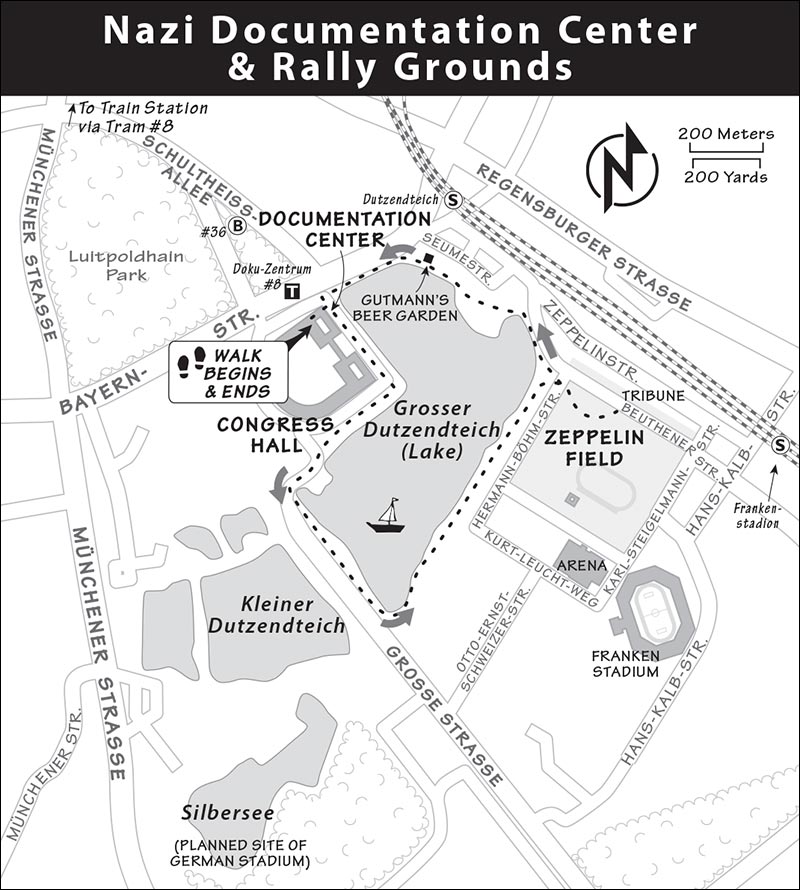
Map: Nazi Documentation Center & Rally Grounds
NEAR THE KÖNIGSTOR, ON KÖNIGSTRASSE
NEAR THE KÖNIGSTOR, ON LUITPOLDSTRASSE
SOUTH OF THE RIVER, NEAR THE STATION
Map: Central Nürnberg Restaurants
NORTH OF THE RIVER, NEAR THE CASTLE
Nürnberg (“Nuremberg” in English), Bavaria’s second city, is known for its glorious medieval architecture, important Germanic history museum, haunting Nazi past, famous Christmas market (Germany’s biggest), and little bratwurst (Germany’s tiniest and perhaps most beloved).
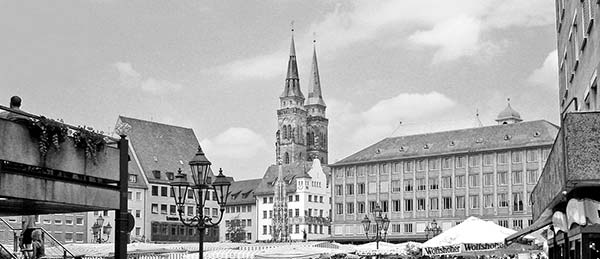
Nürnberg (NEWRN-behrg) was one of Europe’s leading cities around 1500, and its large Imperial Castle marked it as a stronghold of the Holy Roman Empire. Today, though Nürnberg has a half-million residents, the charming Old Town—with its red-sandstone Gothic buildings—makes visitors feel like they are in a far smaller city. Thanks to an enlightened city-planning vision that rebuilt the town in a modern yet people-friendly style after the war, and policies that ensured that lots of residents chose to live in the center, Nürnberg’s downtown is lively and inviting day and night.
PLANNING YOUR TIME
Nürnberg is an easy add-on to any itinerary that includes Munich, Würzburg, or Rothenburg (each about an hour away by frequent trains), and a handy stop on the way to Frankfurt, Berlin, or Dresden. Keep in mind that nearly all its museums (except those relating to World War II) are closed on Monday.
For the sightseer, Nürnberg is a city of the First Reich (Holy Roman Empire sites in the Old Town) and the Third Reich (Nazi-period sites outside the town center).
If you’re staying just one night (or day-tripping), follow my self-guided walk from the train station through the Old Town up to the castle, then visit the farther-flung Nazi sites. If you have two days (most worthwhile if you have a serious interest in German history, especially the Nazi years), spend one day at the Nazi Documentation Center and the nearby Rally Grounds, and the other in the Old Town, with time for the outstanding Germanic National Museum.
Orientation to Nürnberg
Nürnberg’s Old Town is surrounded by a three-mile-long wall and moat, with a ring road beyond that. At the southeast corner of the ring is the train station; across the street, just inside the ring, is the medieval Königstor gate. Sights cluster along Königstrasse downhill from the Königstor to the small Pegnitz River, then back uphill through the main market square (Hauptmarkt) to the Imperial Castle (Kaiserburg). The former Nazi Rally Grounds are southeast of the center (easily reached by tram or bus).
TOURIST INFORMATION
Nürnberg’s handy and helpful TI is on the Hauptmarkt (daily 9:30-17:00, Hauptmarkt 18, +49 911 23360, www.tourismus.nuernberg.de). Pick up the free See and Enjoy city-guide booklet (with updated sights, hours, and prices) and get information about bus and walking tours. The TI also sells transit passes and the Nürnberg Card.
Sightseeing Passes: When you buy a ticket at any of Nürnberg’s city-run museums—including the Nazi Documentation Center, Nürnberg Trials Courtroom, Albrecht Dürer House, Toy Museum, and the City Museum—you can pay an additional €3 for a Discount Day Pass that lets you visit all the others free of charge on the same day (www.museen.nuernberg.de).
If you’re staying two days, the Nürnberg Card is a good value and gets you into a wider range of sights (€33/48 hours, sold at TI and most hotels, covers local public transit and admission to the Germanic National Museum, Imperial Castle, DB Railway Museum, and others, plus a discount for the Historic Art Bunker tours; www.tourismus.nuernberg.de).
ARRIVAL IN NÜRNBERG
By Train: Nürnberg’s stately old Hauptbahnhof—with a contemporary interior—is conveniently located just outside the old city walls and ring road. The busy station has WCs, lockers, ATMs, and lots of shops. You can get train information and buy tickets at the travel desk (Reisezentrum) in the main hall (center of building, long hours daily) or at handy Fahrkarten machines throughout the station.
To reach the Königstor (the medieval city’s southern gate)—near most recommended hotels and the starting point for exploring the Old Town—follow signs for Ausgang/City down the escalator, then signs to Altstadt in the underpass. When you emerge, the Königstor tower (Königstorturm) is on your left.
To go directly from the station by tram to the Nazi Documentation Center and the former Nazi Rally Grounds, follow pink Tram signs in the underpass and head up the escalators to the stop in front of the Postbank Center. Get your ticket from the red vending machine (marked VGN Fahrausweise, near the stairwell for the U-Bahn) and catch tram #8 (see “Getting to the Nazi Documentation Center and Rally Grounds” on here).
By Long-Distance Bus: Long-distance buses arrive at the central bus terminal (ZOB) at Bahnhofstrasse 11, just east of the train station and a five-minute walk from the Königstor.
By Car: A handful of public garages are located within the city walls (most around €18/day and well-signed); cheaper on-street parking is available in the neighborhoods that lie a 5- to 10-minute walk from the city walls.
By Plane: Nürnberg’s small airport is just 3 miles north of the city center (code: NUE, +49 911 93700, www.airport-nuernberg.de). The U-Bahn subway line #2 makes the 12-minute trip to the central train station every 10 minutes (€3.20). A taxi between the airport and the center costs around €22.
GETTING AROUND NÜRNBERG
Most of Nürnberg’s sights are in the strollable Old Town, but you’ll need to use public transit to reach the Nazi Rally Grounds and the Nürnberg Trials Courtroom, which are far beyond walking distance. Nürnberg has the typical German lineup of trams, buses, U-Bahns (subways), and S-Bahns (faster suburban trains). All work on the same tickets, which you can buy at vending machines (marked VGN Fahrausweise) on the tram platform or before entering the U- or S-Bahns, or on board (buses only). Everything in this chapter is within Zone (Preisstufe) A.
A single ticket (Einzelfahrkarte, €3.20) is good for 1.5 hours of travel in one direction, including transfers. The four-trip ticket (4er-Ticket; €11) has the same restrictions and is shareable; stamp one strip per person per trip. The short-stretch ticket (Kurzstreckefahrkarte, €1.70) is a cheaper option for a trip no more than three stops away. The day ticket (TagesTicket Solo, €8.30) is good for one calendar day (or both Sat and Sun; €12.30 TagesTicket Plus covers two adults and up to four children; day tickets also sold at TI). Vending machines time-stamp single and day tickets, so you don’t need to validate them separately. For more information, see www.vgn.de.
HELPFUL HINTS
Festivals: Summer music festivals cater to different crowds in late July and early August. Klassik Open Air is a series of free classical concerts and fireworks at Luitpoldhain park, near the Nazi Documentation Center (www.klassikopenair.de), and Bardentreffen Nürnberg (also free) hosts all kinds of world-music acts right in the city center (www.bardentreffen.de). On the first Saturday in May, Nürnbergers stay out all night for Die Blaue Nacht (“The Blue Night”), which celebrates art and music with museum open houses, outdoor video projections, and much more (www.blauenacht.nuernberg.de). Two city fairs happen every spring and fall, also at Luitpoldhain park, with rides, traditional costumes, and the works (www.volksfest-nuernberg.de). The annual Christmas market (Christkindlesmarkt), with more than two million annual visitors, engulfs the Hauptmarkt (starts the Fri before the first Sun in Advent, www.christkindlesmarkt.de).
Laundry: A Schnell & Sauber self-service launderette is at Allersberger Strasse 89 (daily 6:00-22:00, English instructions, near Schweiggerstrasse stop for tram #8, two stops from train station in same direction as Nazi Documentation Center; from tram stop, head 200 yards away from downtown along Allersberger Strasse to find launderette on left).
Tours in Nürnberg
Walking Tours
English-language tours of Nürnberg’s Old Town leave daily at 14:00 in peak season from the TI (€13, kids under 14 free, 2 hours, buy ticket from TI, www.nuernberg-tours.de).
Historic Art Bunker and Underground Tours
Several other walking tours explore intriguing underground Nürnberg. The “Historic Art Bunker” tour takes you deep into the sandstone cellars under Castle Hill to learn how the city protected its art treasures (plus some plundered from elsewhere in Europe) from World War II’s most devastating bomb attacks. The underground bunkers are largely empty now, except for photos posted at each stop of the tour. You’ll get some background on the pieces that were kept here and hear a lot about the air raids and the citywide rebuilding process that followed. While most live guides give the tour only in German, the good included audioguide is in English. Even with the audioguide, stick close to the live guide so they can lock the doors as the group exits (€9.50, daily at 14:00, one hour).
The cellars themselves are the focus of the “Defensive Corridors and Secret Passages Under the Castle” tour, which takes you through more than a half-acre of passages burrowed right under the city streets (about a tenth of the city’s vast network). Originally dug in the Middle Ages to store beer, these cellars sheltered people, not art, during the WWII air raids (€9.50, daily at 14:30; all tours in German but English audioguide available, one hour). Tickets for any underground itinerary can be purchased online (www.felsengaenge-nuernberg.de), at a pay machine at Obere Schmiedgasse 52 (where tours begin, near the Tiergärtnertorplatz), at the shop in the Albrecht Dürer House, or at the TI. It’s worth reserving in advance during high season.
Bus Tours
Nürnberg has a standard hop-on, hop-off bus tour with canned commentary in English. The main departure point is by the glassy “cultural information center” across from the train station by the Königstor. Stops include the town center and the Nazi Documentation Center and Rally Grounds (€15, buy ticket online or on bus, generally runs hourly May-Sept and Dec, 2 hours, +49 9107 997 979, www.nuernberg-stadtrundfahrt.de).
Tourist Train
A goofy little tourist train makes the rounds in the Old Town (€9, 40 minutes, audio narration in English, schedule posted at the Beautiful Fountain; leaves from Hauptmarkt near the fountain about hourly 10:30-17:15 in May-Oct, shorter hours in off-season; also runs daily during the Christmas market from the Old Granary; www.city-tour.info).
Private Guides
For a good and charming local guide who covers Nürnberg and Bamberg, call Doris Ritter (€150/2 hours, +49 176 2421 5863, www.nuernberg-city-tours.de, nuernberg-city-tours@gmx.de). The Geschichte für Alle (“History for All”) association can set you up with a good private guide who is enthusiastic about the town’s history (reserve via email, +49 911 307 360, www.geschichte-fuer-alle.de [URL inactive], info@geschichte-fuer-alle.de). Guides can also be booked through the TI (+49 911 233 6123, fuehrung@ctz-nuernberg.de).
Nürnberg Old Town Walk
1 Königstor and the Königstorturm
2 Craftsmen’s Courtyard (Handwerkerhof)
4 Monument to German WWII Refugees
6 St. Lawrence Church (Lorenzkirche)
8 Holy Ghost Hospital (Heilig-Geist-Spital)
9 Hauptmarkt (Main Market Square)
10 City Museum (Stadtmuseum Fembohaus)
11 Imperial Castle (Kaiserburg)
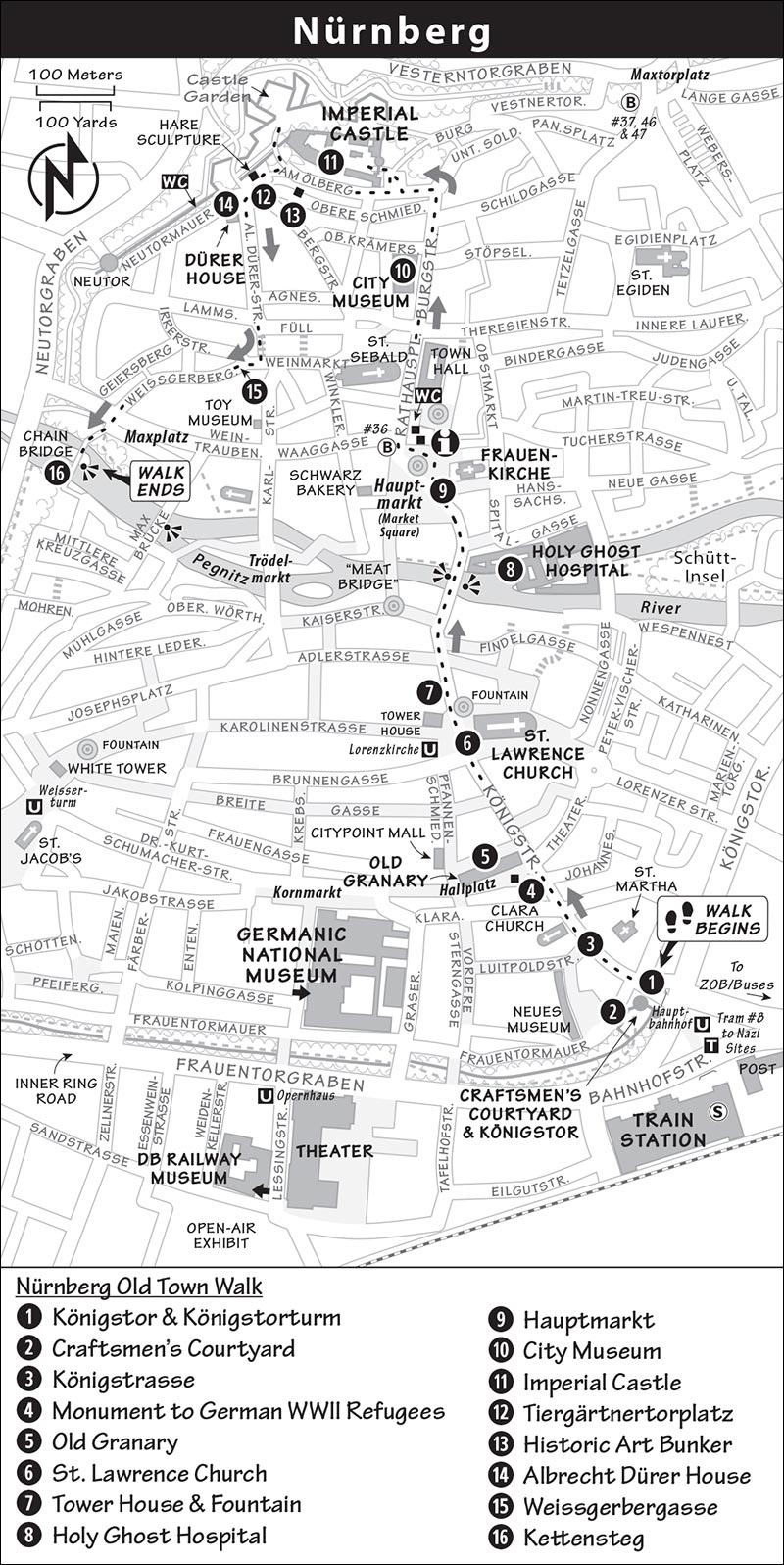
Many of Nürnberg’s top sights are conveniently clustered along a straight-line thoroughfare connecting the train station (Hauptbahnhof) with the main market square (Hauptmarkt) and the Imperial Castle (Kaiserburg). For a good orientation, take the following self-guided stroll, worth ▲▲. Plan on an hour, not including stops. Use the “Nürnberg” map, earlier, to trace this route.
• Begin at the Königstor (where you emerge from the Hauptbahnhof underpass).
1 Königstor and the Königstorturm
This tower (turm) guards one of the four main medieval entrances (tor means door, gate, or portal) to Nürnberg’s Old Town. Of the three miles of wall that once surrounded the city, 90 percent survives. The sandstone was quarried locally, and you can still see the little dimples made by the construction tongs as they hoisted the stones into place. Many Central European cities tore down their walls to make way for expansion in the 1800s, and Nürnberg nearly did the same. Now the city is glad it didn’t: It’s better for tourism.
• Between the walls just next to the gate, you’ll see the entrance to the...
2 Craftsmen’s Courtyard (Handwerkerhof)
This hokey collection of half-timbered houses was built in 1971 to celebrate craftsmanship and to honor the 500th birthday of Nürnberg’s favorite son, Albrecht Dürer. Nürnberg didn’t have abundant natural resources or a navigable waterway, so its citizens made their living through trade and crafts (such as making scientific instruments, weapons, and armor). Dürer, arguably Germany’s best painter, was considered the ultimate craftsman.
While a bit kitschy, this courtyard—originally a holding zone for carriages waiting to enter the “free imperial city”—is good for picking up a medieval vibe as you enter the Old Town. It’s packed with replicas of medieval shops, where artisans actually make—and, of course, sell—leather, pottery, and brass goods. In the Middle Ages, this area between the walls was not a medieval mall but a Passkontrolle—a customs and security checkpoint zone where all visitors had to register before they could enter the town.
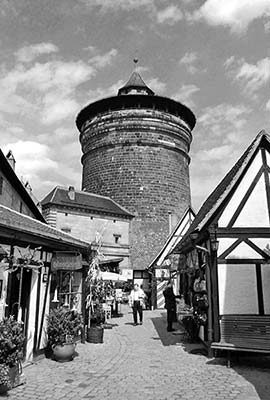
At the back of the courtyard, step through the old gate and out onto a bridge over what was once the moat. This was one of four major entries into the medieval town. Admire the double eagle over the entry—a reminder to all who approached that this was a free city subject only to the authority of the Holy Roman Emperors. Look over at the mighty, round Königstorturm (King’s Gate Tower). It was originally square, but as better cannons were developed, the tower was given a round casing (so cannon balls would glance off). Imagine cannons lined up under the eaves of the tower, set to defend the city.
• When you’re finished poking around the courtyard, head into town (with the train station at your back) along...
3 Königstrasse
Though it had always been one of the four primary entrances to Nürnberg, this street became the city’s main drag only after the train station was built in the early 20th century. It’s lined with key sights, several recommended hotels and restaurants, and some wonderful Gothic and Neo-Gothic architecture.
Nürnberg hit its peak in the 14th century. In 1356 Emperor Charles IV issued a decree from Nürnberg called the Golden Bull, which regularized many aspects of imperial government. From then on, throughout the Middle Ages, German emperors were supposed to be elected in Frankfurt, crowned in Aachen, and hold their first Imperial Diet (a gathering of German nobles and VIPs) right here in Nürnberg, though not all bothered to follow through on those stipulations.
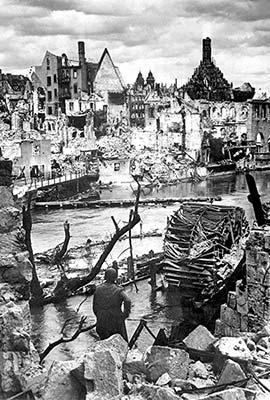
Nürnberg’s low point came during World War II. By the end of the war, 90 percent of the Old Town was destroyed. Damaged buildings were repaired in the original Gothic style, but some structures were beyond repair. Instead of replicating these exactly as they had been, or replacing them with modern-style buildings, postwar Nürnberg architects compromised. Look 50 yards down the street to #71, on the right. This is a good example of the city’s “traditional modern” ethic of rebuilding in a modern style while preserving the medieval city’s footprint and using traditional materials (such as native sandstone). The blemishes on the older sandstone buildings all around are patched bullet scars from 1945.
Ahead, on the left, is the small Clara Church (Klarakirche). Step inside—first into a candlelit spiritual decompression chamber, and then into the modern and peaceful nave. The rear door leads to the old cloister area—a tranquil oasis and another good example of how the city rebuilt with respect for its history. In the Middle Ages, Nürnberg had nine monasteries like this one. When the Reformation hit, Nürnberg turned Lutheran, and most of its monasteries were converted into practical municipal buildings such as hospitals and homes for the poor. As the monasteries fell, so did Nürnberg’s importance: The city was now Lutheran, but the emperors were still Catholic. They moved the increasingly frequent Imperial Diet meetings—once Nürnberg’s claim to fame—to more Catholic-friendly Regensburg. (Today, this church is an “ecumenical free church”—meaning it’s neither Lutheran nor Catholic and welcomes worshippers of all stripes.)
Just after the church, above the recommended Bosporus Restaurant, look for Mary on the second-story corner. Statues like this grace houses all over Nürnberg.
• Continue down Königstrasse to Hallplatz, where the pedestrian stretch begins, and stop at the modern metal arch on the left. This is the...
4 Monument to German WWII Refugees
This minimalist metal doorway, erected in 1999, remembers the German refugees of World War II and the hospitality of the Bavarians who took them in. Walk through the doorway and find a metal plaque in the pavement 30 steps beyond. It lists regions to the east once populated by Germans. In the years after the war, nearly a third of Bavaria’s population was made up of German citizens who had fled west—or who’d been expelled from lands lost in the east. As each new generation of Germans comes into its own, memorials like this reflect a delicate challenge: to remember those who suffered in the war without forgetting that Germany was the aggressor.
• To visit the excellent Germanic National Museum now (see “More Sights in Nürnberg,” later), detour left at Hallplatz (with the monument to your back) and walk 200 yards. Otherwise, continue down the main drag and look left to check out the...
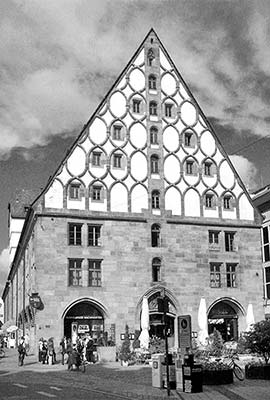
5 Old Granary (Mauthalle)
Medieval Nürnberg had 11 of these huge granaries to ensure that residents would have enough food in case of famine or siege. The grain was stored up above in the attic (behind all those little dormer windows, which provided ventilation). Imagine the wealth and resources this imperial town must have had to erect such a massive structure. Today, the cellar is home to a lively beer hall, Mautkeller. There are better places to eat in town, but pop in for a look or a drink.
Continue down pedestrian-only Königstrasse. Check out the Brezen Kolb stand, which sells pretzels local-style: as sandwiches with butter and cold cuts—never with mustard.
Look ahead to the street just beyond and across from the big church, notice another fine example of “traditional modern” architecture, and feel the energy of this healthy urban center. This drag used to have more cars and trams than any other street in town. But when the U-Bahn came in the 1970s, this part of the street became traffic-free.
• After another two blocks, you’ll see...
6 St. Lawrence Church (Lorenzkirche)
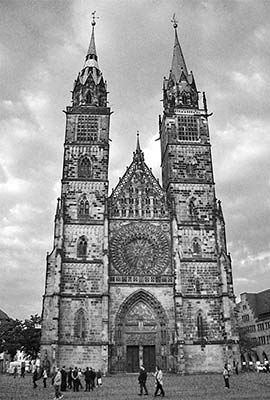
This once-Catholic, now-Protestant church is a massive house of worship, worth ▲▲. It was never a cathedral because Nürnberg never had a bishop (a fact locals were very proud of—a bishop would have threatened their prized independence). The name Königstrasse (“King Street”)—where you’ve been walking—is a misnomer. When royals came to town, they actually preferred to enter through the west gate, so they could approach this church’s magnificent Gothic facade head-on.
Cost and Hours: €2 donation requested, Mon-Sat 9:00-17:30, Sun 10:00-15:30, www.lorenzkirche.de.
 Self-Guided Tour: Stand in front of St. Lawrence’s west portal, its main door. Flip around and imagine the Holy Roman Emperor parading—right past Starbucks up the street—toward this tremendous Oz-like church.
Study the 260-foot-tall facade (completed c. 1360). Adam and Eve flank the doors (looking for a sweater). In the first row above the left door are two scenes: an intimate take on Jesus’ birth on top, and the visit from the Magi on the bottom (with the Star of Bethlehem shining from above). Over the right door are the slaughter of the innocents (with a baby skewered by a Roman sword—classic medieval subtlety), and below that the presentation of Jesus in the temple and the flight to Egypt. Above those scenes is the Passion story (from left to right: trial, scourging, carrying the cross, Crucifixion, deposition, entombment, Resurrection, and, above that row, people rising from their graves). In the next row up, the saved (Peter—with his huge key—and company) stand on the left, while the sorry chain gang of the damned (including some kings and bishops) is shuttled off literally into the jaws of hell on the right. Above it all stands the triumphant resurrected Christ, with the sun and moon at his feet, flanked by angels tooting horns to announce Judgment Day.
• Step inside (enter around right side).
The interior wasn’t completely furnished until more than a century after the church was built—just in time for the Reformation (so the Catholic decor adorned a now-Lutheran church). Most of the decorations inside were donated by wealthy Nürnbergers trying to cut down on their time in purgatory. Through the centuries, this art survived three separate threats: the iconoclasm of the Reformation, the whitewashing of the Baroque age, and the bombing of World War II. While Nürnberg was the first “free imperial city” to break with the Catholic Church and become Lutheran, locals didn’t go wild (like Swiss Protestants did) in tearing down the rich, Mary-oriented decor of their fine churches. Luther (who, despite some flaws, was still very cool for his time) told the iconoclasts, “Tear the idols out of your heart, and you’ll understand that these statues are only pieces of wood.”
Suspended above the altar, the sculptural Annunciation is by a Nürnberg citizen and one of Central Europe’s best woodcarvers, Veit Stoss. Carved in 1517, the 360-degree piece shows the angel Gabriel telling Mary that she’ll be giving birth to the Messiah. Startled, she drops her prayer book. This is quite Catholic (notice the rosary frame with beads, and a circle of roses—one for each Hail Mary, and with a medallion depicting the “Joys of Mary”). A dove sits on Mary’s head, and God the Father—looking as powerful as a Holy Roman Emperor—looks down. The figures are carved from the wood of linden trees. The piece survived the Reformation covered in a sack, revealed only on special occasions. Around back, enjoy more details—Mary’s cascading hair and the sun and the moon. Nearby, the painting at the very front of the church (behind the altar) shows Mary and baby Jesus sitting with the city of Nürnberg in 1483 in the background (before the city’s square towers were made round).
To the left of the altar, the frilly tabernacle tower is the “house of sacraments” that stored the consecrated Communion wafer. After the Mass, leftovers needed a worthy—even heavenly—home, and this was it. The cupboard behind the gold grate was the appropriate receptacle for what Catholics considered literally “the body of Christ.” The theme of the whole sculpture is the Passion. The scenes ascend in chronological order: Last Supper, Judas’ kiss, arrest, Crucifixion, and so on. Everything is carved of stone except for the risen Christ (way up high). He was living, and so was this—it’s made of wood.
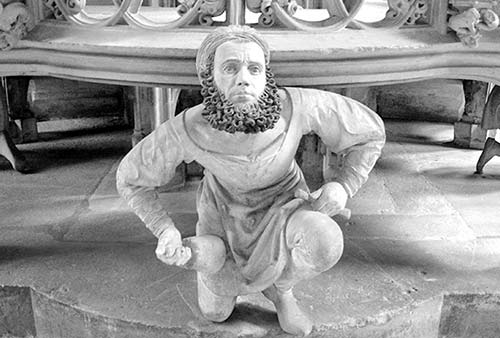
The man holding the tabernacle on his shoulders is the artist who created it, Adam Kraft (with his curly black beard, chisel in hand). In the Middle Ages, artists were faceless artisans, no more important than a blacksmith or a stonemason. But in the 1490s, when this was made, the Renaissance was in the air, and artists like Kraft began putting themselves into their works. Kraft’s contemporary, the painter Albrecht Dürer, actually signed his works—an incredible act in Germany at that time (for more on Dürer, see the “Albrecht Dürer House,” later on this walk). In anticipation of the Allied bombs of World War II, this precious work was encased in protective concrete, except for the top 22 feet—which was the only part destroyed when the church was hit.
Look slightly above and to the left of Kraft’s likeness to find the church’s namesake—St. Lawrence—cradling the grill on which he was barbequed alive (as punishment for distributing treasures to the poor instead of handing them over to a greedy Roman official). Legend says the martyr’s last brave words to the Romans were, “I’m done on this side. Turn me over!”
Following Adam Kraft’s gaze, turn around and look up to a plaque honoring American philanthropist brothers Samuel and Rush Kress, who donated nearly a million Deutschmarks in 1950 to help rebuild the church. The bottom half of the plaque is in English, but it’s hard to read, as it’s written in an old-style black-letter font. Though the church was devastated by WWII bombs, everything movable had been hidden away in bunkers right here in Nürnberg (which we’ll pass later), including the stained glass you see today.
• Wander slowly to the rear of the church.
As you walk, notice the various side chapels tucked under the windows, each a private chapel for a leading Nürnberg family. Also note the wooden booths with finely carved symbols representing various trades and craft guilds. After Mass, these were manned by a leading master of that trade who shamed parishioners into donating to needy widows and others in his organization. In a society without government-organized welfare, this was a way to cope.
In the last chapel on your right, an interactive screen features a digital copy of an illuminated (illustrated) handwritten manuscript, the Das Gänsebüch (The Geesebook, 1510). Named for one of its satirically provocative drawings, the book chronicles the entire Mass liturgy. Take a few moments to browse the “pages” of the manuscript, looking at close-ups of the ornate, often quirky illuminations. Put on the headphones and play one of the chorale, then face the nave and imagine yourself as a faithful parishioner listening to your local church choir.
At the rear of the church are photos of WWII destruction and postwar reconstruction.
• Head back outside.
7 Tower House and Fountain
As you exit the church, look for the castle-like building on the corner across from the main church facade. This is the only remaining tower house in Nürnberg. When it was built, in 1200, there was no city wall, and locals had to defend their own homes. It’s basically a one-family castle. The ornate Gothic structure (an oriel window) protruding halfway up the wall is a reminder that while rich families could afford their own chapel, not even the very wealthy could live above God. Their personal chapels had to be “outside” the house. The house also sports two sundials. While they only bother to show daylight hours, they still work (as long as you adjust for the fact that there was no Daylight Saving Time back then).
• Walk downhill, toward the river.
American moralists might shield their eyes from the kinky 16th-century Fountain of the Seven Virtues (Tugendbrunnen). Otherwise, play a game: Circle the sprightly fountain and try to identify the classic virtues by the symbolism: justice (on top), faith, love, hope (anchor), courage (lion), moderation, patience. Are any birds sipping? Notice that, aside from faith’s cross, there’s no religious symbolism here, as this fountain was made during the Renaissance, when artists celebrated humanism and secular values.
• Continue down the street toward the river. On your left, you’ll pass Kaiserstrasse—the most expensive shopping street in town (with a little shop filled with insanely expensive Steiff teddy bears). When you get to the bridge, look to the right to see the...
8 Holy Ghost Hospital (Heilig-Geist-Spital)
This river-spanning hospital was donated to Nürnberg in the 14th century by the city’s richest resident, eager to do his part to help the poor—and hopefully skip purgatory altogether. (A modern statue of this donor hangs out on the second-story corner of the Spital Apotheke, the first building after the bridge.) He funded this very scenic hospital to care for ill, disabled, and elderly Nürnbergers. The wing over the river dates from the 16th century. The dove beneath the middle window under the turret represents the Holy Ghost, the hospital’s namesake.
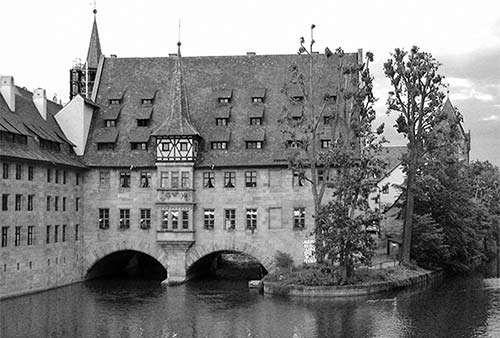
Cross to the other side of the bridge, and look at the next bridge over (the Fleischbrücke—“Meat Bridge”). This is the narrowest point of the river. When it was built in 1596, this was considered the most high-tech bridge in Central Europe, an engineering feat inspired by Venice’s single-span Rialto Bridge (though with a much flatter profile to accommodate carriage traffic, which Venice, of course, didn’t have). Flooding along the river was a big concern until a fix was constructed after World War II.
There’s a handy lunch spot in the arcade between the two bridges (see “Eating in Nürnberg,” later). The arrival of a big Starbucks, just beyond the Meat Bridge, is credited with cleaning up what had been a dodgy part of the riverbank. (In this land of cake-and-coffee, the Dunkin’ Donuts and Starbucks chains—wildly popular among younger Germans—are shaking up tradition.)
Continue across the bridge and study the monument depicting characters from a 15th-century satire called The Ship of Fools (Das Narrenschiff). It’s adapted to follies that plague modern society: violence, technology, and apathy. Hey, how about the quiet, people-friendly ambience created by making this big city traffic-free in the center? Do a slow 360-degree spin and imagine this back home.
• Continue ahead another 50 yards and enter the...
9 Hauptmarkt (Main Market Square)
When Nürnberg began booming in the 13th century, it consisted of two distinct walled towns separated by the river. As the towns grew, they merged and the middle wall came down. This square, built by Holy Roman Emperor Charles IV and worth ▲▲, became the center of the newly united city. Though Charles is more often associated with Prague (he’s the namesake for the Charles Bridge and Charles University), he also loved Nürnberg—and visited 60 times during his reign.
The Gothic-style Frauenkirche on the square is located on the site of a former synagogue. When Nürnberg’s towns were separate, Jewish residents were required to live in this swampy area close to the river and outside the walls. When the towns merged and the land occupied by the Jewish quarter became valuable, Charles IV allowed his subjects to force out the Jews. In the process, 562 were killed—a somber reminder that anti-Semitism predated the Nazis. (Inside the church, there’s a Star of David on the floor, behind the main altar. In the apse, below the medieval altar, is a tabernacle that’s reminiscent of a Torah scroll.) Charles IV, the most powerful man in Europe in his time, oversees the square from a perch high on the church facade. He’s waiting for noon, when the electors dance around him.
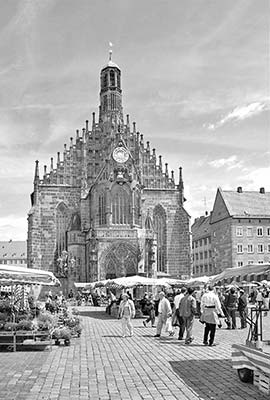
Year-round, the Hauptmarkt is lively every day but Sunday with fruit, flower, and souvenir stands. For a few weeks before Christmas, it hosts Germany’s largest Christmas market. You’ll also find the TI here.
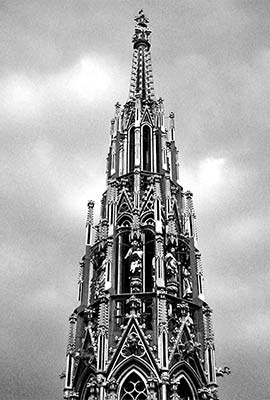
Walk across the square to the pointy gold Beautiful Fountain (Schöner Brunnen). Medieval tanneries, slaughterhouses, and the hospital you just saw dumped their by-products into the river. So this fountain brought clean drinking water into the square. Of course, it’s packed with allegorical meaning. Step up to the iron railing. The outermost figures ringing the bottom represent the earthly arts (such as philosophy, music, and astronomy). On the pillars sitting behind each of these characters are the four church fathers and the four evangelists, showing that religion is higher than the arts. On the column itself, the lowest figures are the seven electors of the Holy Roman Emperor and nine heroes: three Christian (including King Arthur and Charlemagne); three Jewish (such as King David); and three heathen (such as Julius Caesar). At the very top are eight prophets, hovering above—but granting legitimacy to—worldly power. On the side of the fountain facing the McDonald’s, you’ll probably see tourists fussing over a gold ring. If you believe in such silly tour-guide tales, spinning this ring three times brings good luck...OK, go ahead and spin it.
While there are plenty of grilled sausage vendors on the square during market times, connoisseurs will want to take a short side trip from here: Head a block down Waaggasse (the street leading left, away from the Beautiful Fountain) and take a quick left on Winklerstrasse to find the recommended Schwarz Bakery one block down, at the corner of Winklerstrasse and Tuchgasse. This is paradise for lovers of sausage and dark bread (that is, Nürnbergers). Step in and inhale. This old-school place, open since 1923 and still family-run, selects the best wursts and breads from producers in the surrounding countryside, and brings the bounty into the city. They can make the German sandwich of your dreams. When Franconians travel, what they miss most is their homeland’s dark bread and variety of high-quality sausages.
• Return to the fountain on the Hauptmarkt. (Note that bus #36, which goes directly to the Nazi Documentation Center, departs from a stop in front of the recommended Sorat Hotel Saxx.) Now climb uphill, heading for the Imperial Castle. After a block, you’ll pass the Bratwursthäusle (on the left), a recommended sausage restaurant. Step inside to grab three sausages in a bun.
Hiking farther uphill, you’ll pass St. Sebald (Sebaldkirche), Nürnberg’s second great Gothic church. The imposing Renaissance building on your right is Nürnberg’s Town Hall (Rathaus), which was partially designed and decorated by Albrecht Dürer. About 100 yards farther up the hill, on the left, you’ll see the...
10 City Museum (Stadtmuseum Fembohaus)
This somewhat sleepy museum, with a few interesting artifacts, fills a former Dutch silk merchant’s house dating from the late Renaissance.
Cost and Hours: €6, Tue-Fri 10:00-17:00, Sat-Sun until 18:00, closed Mon, downloadable audioguide, Burgstrasse 15, +49 911 231 2595, www.museen.nuernberg.de.
Visiting the Museum: Start on the top floor—where you’ll get an overview of the town’s history as an important trading center. An overview of another kind comes from several historical town models (including one dating back to the 1500s). Farther on, you’ll see the surprisingly humble Holy Roman Emperor’s throne (from 1520) and other reminders of Nürnberg’s privileged history as an imperial city and market town.
At the far end of the second floor is a thought-provoking painting titled The Peace Banquet of 1649, which documents the pan-European negotiations that took place in Nürnberg the year after the Thirty Years’ War finally ended. Find headsets on the bench and listen to an emotional nine-minute account of the peace conference—the fictional narrator is the man wearing a blue cape in the painting on the opposite wall. Many of the people of his era had only known hunger, sickness, misery, and war. This historic meeting of political and diplomatic minds in Nürnberg was a sign of hope.
On the first floor, check out the maps drawn here when cartographer Johann Baptist Homann turned this merchant home into a publishing house. His heirs continued the family business for 150 years, publishing more than 3 million maps. In the Music Room, take a moment to enjoy works by Johann Pachelbel and other Nürnberger composers from the 1500s through the 1700s. A neighboring room has photographs of pre- and postwar Nürnberg that are are worth a quick peek.
• Now hike the rest of the way up to the Imperial Castle. The cobbled path forks at the castle’s base. The right fork leads to the castle garden and youth hostel. The left fork leads to the courtyard (with its big, round tower) of the...
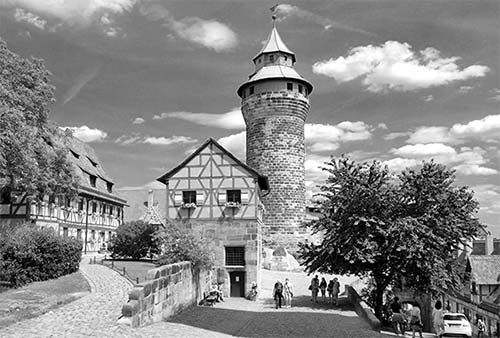
11 Imperial Castle (Kaiserburg)
In the Middle Ages, Holy Roman Emperors stayed here when they were in town, and the imperial regalia, including the imperial cross, imperial sword, and crown, were stored here from 1424 until 1796. While this huge complex (worth ▲) has 45 buildings, only a few are open to the public. The part on the right, which housed the stables and stockpiles of grain, is now a youth hostel. The audioguide is useful because some rooms have no text in English.
Cost and Hours: €5.50 for castle only, €3.50 for Deep Well and Sinwell Tower, €7 combo-ticket; daily 9:00-18:00, Oct-March 10:00-16:00; €2 audioguide, +49 911 244 6590, www.kaiserburg-nuernberg.de.
Visiting the Castle: From the ticket office, the museum entrance is across the interior courtyard. For a no-way-to-get-lost, one-way route, just follow the Rundgang signs. If you don’t see a sign, give the closest door a nudge; it’ll likely lead you to the next room.
The Lower Hall is empty of furniture because, in the 12th century, the imperial court was mobile. Royal roadies would arrive and set things up before the emperor got there. If you happen to be here at :20 or :40 past the hour, you can watch a cutesy toy parade of the emperor and his entourage complete with an elephant, several feet above eye level. Through the door at the end of the hall, find the Romanesque church—one of few buildings that wasn’t destroyed during World War II. It has a triple-decker design: lower nobility on the lower floor, upper nobility above that, and the emperor worshipping from the topmost balcony.
The Upper Hall (also called the Imperial Hall) is most interesting, with interactive screens and artifacts that show what the heck the Holy Roman Empire actually was. Then comes a series of creaky-floored former living quarters, with painted ceilings (many dismantled and stored in bunkers during the war—they’re that precious), and a copy of the imperial crown (the original is in Vienna). The final exhibit is on old weapons.
After leaving the main exhibit area you can visit a few more parts of the castle; the most interesting are the castle well and gardens (separate or combo-ticket required for Deep Well and Sinwell Tower).
The Deep Well is indeed deep—165 feet (that’s more than half a football field). Visits are simple, fun, and only possible with a guide (tours at least hourly in German; ask about English). You’ll see water poured way, waaay down—into an incredible hole dug in the 14th century. Then the guide lowers down small candles until they almost disappear into the water table. Video monitors track its progress. A climb up the Sinwell Tower offers only a higher city view and lots of exercise—113 steps.
When you’re finished, walk out around the round tower to enjoy a commanding city view from the rampart just behind it. Then exit the complex the way you came in; at the small Burgwächter restaurant, go right down two short sets of stairs to the street signed Am Ölberg. Follow it slightly uphill, then keep right at the fork, which leads to the fine castle garden (Burggarten). Wrapped around the back of the castle, the garden offers great views of the town’s 16th-century fortifications and former moat.
• Head back out the way you came. Take the stairs immediately to your right, just outside the garden, and follow the switchback downhill. On the right and directly below you, about a block away, is a lively cobbled square called...
12 Tiergärtnertorplatz
Near the top of the square, inspect the giant rabbit. While it looks like roadkill with mice gnawing at it, it’s actually a modern interpretation of The Hare, one of the best-known paintings by medieval Nürnberg artist Albrecht Dürer. (The original painting is in Vienna.) This square is Nürnberg’s de facto living room throughout the day and kicks into high gear on good-weather evenings. When the nearby restaurant and café tables are full, people find plenty of space to sit and mingle on the ground. At the bottom of the square, Der Senfladen (The Mustard Store) sells really good mustard, which they’ll happily slather onto one of their freshly grilled Nürnberger sausage sandwiches.
• About 20 yards beyond the well on the square, at Obere Schmiedgasse 52, is the...
13 Historic Art Bunker
Behind these doors, a series of cellars worth ▲▲ are buried deep inside the rock of Castle Hill. This is where precious artworks were carefully safeguarded from the WWII air raids that devastated the city. The only way to visit the bunker is with a tour (see “Tours in Nürnberg,” earlier).
Nürnberg was bombed relatively late in the war, which allowed its citizens time (and experience gained from already-bombed cities to the north) to prepare for the aerial attack they knew would be coming. While many other cities sent their most important works away from the urban centers (obvious targets), Nürnberg was able to safely shelter everything right here. The art wasn’t just stashed in the bunker, but carefully battened up inside wooden crates and padded with sandbags, safeguarded in a climate-controlled environment behind layer upon layer of thick fireproof doors.
Rich in art, Nürnberg had long been known as the “treasure chest of the German Empire.” The pieces stored here included regalia of the Holy Roman Empire and the city’s own treasures, evacuated from nearby buildings (such as the tabernacle in St. Lawrence Church, as well as all of that church’s stained glass). Other pieces had been plundered by the Nazis from conquered lands, such as the Veit Stoss Altar from Kraków, Poland (later recovered by the “Monuments Men,” as described in Robert Edsel’s 2009 book and the 2014 movie based on it).
• Turning back to the rabbit statue on the square, notice that it faces a half-timbered building (at the square’s bottom). That’s the...
14 Albrecht Dürer House
Nürnberg’s most famous resident lived in this house, worth ▲, for the last 20 years of his life. Albrecht Dürer (1471-1528), a contemporary of Michelangelo, studied in Venice and brought the Renaissance to stodgy medieval Germany. He did things that were unthinkable to other northern European artists of his time—such as signing his works and painting things like rabbits simply for study (not on commission). As a painter of exquisite detail, Dürer’s patrons included Emperors Maximilian I and Charles V as well as King Christian II of Denmark, but he gained his steady income and international fame from the “mass production” of his prints.
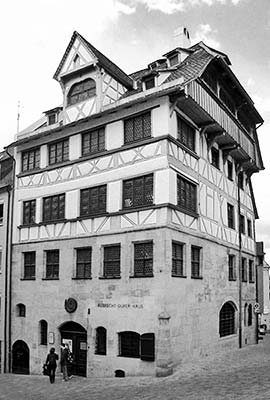
Nothing in the museum is original (except the house itself, which survived WWII bombs)—all the paintings are replicas; the only Dürer originals in Nürnberg are in the Germanic National Museum (described later). But the museum does a fine job of capturing the way Dürer actually lived, and it includes a replica of the workshop, with a working printing press, where he painted and printed his woodcuts and metal engravings. Another room is a gallery with copies of Dürer’s most famous paintings and woodcuts.
Cost and Hours: €6, includes detailed audioguide; Tue-Fri 10:00-17:00, Sat-Sun until 18:00, closed Mon; “Agnes” (Mrs. Dürer) leads one-hour tours in English on Sat at 14:00 for €3; ask about daily art demonstrations, Albrecht-Dürer-Strasse 39, +49 911 231 2568, www.museums.nuremberg.de [URL inactive].
• With Albrecht’s Haus on your right, head down Albrecht-Dürer-Strasse. When the street bends to the left, continue straight down the stairs, cross the street at the recommended Restaurant Sebald, and veer right onto cobblestoned...
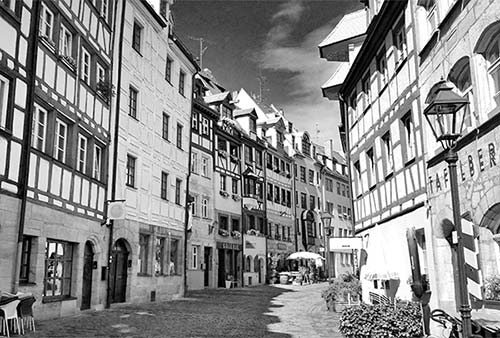
15 Weissgerbergasse
“Tanners’ Lane” is lined with Nürnberg’s finest collection of half-timbered houses to survive the war. Such well-crafted homes, several stories tall and many with their own wells and gardens, attest to medieval Nürnberg’s considerable prosperity. What’s that dark-red color so common in the painted beams of houses like these? Ox blood, which helped prevent rot and termite damage. Stop at #35 and turn around for one of the city’s best photo ops. On this end of the lane, note the many small bars that turn this quiet street into a busy nightlife zone after dark.
• Cross the wider, busy Am Hallertor to the...
16 Kettensteg (Chain Bridge)
This iron footbridge—the oldest on the Continent—comes with a great river view. Notice the mix of medieval fortification and Industrial Age brickwork around here. This wasn’t always considered such a picturesque quarter—it was the industrialized, downstream end of town, where you’d find watermills, stinky industries (like the tanneries we just passed on Weissgerbergasse), and graphite factories. (In Germany, Nürnberg is famous for its pencils.)
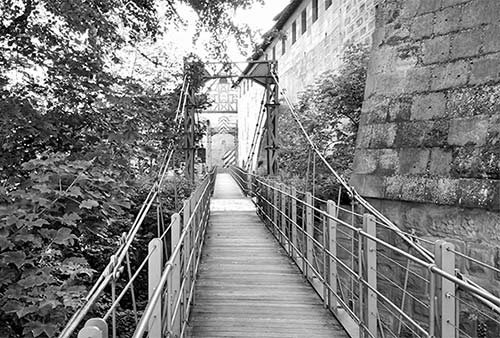
• Our tour is over. To return to the heart of town, continue across the bridge, then head left toward the green twin towers in the distance, which mark St. Lawrence Church. Once you hit Königstrasse, it’s a short walk (left) to the Hauptmarkt, with its convenient bus #36 to the Nazi sites (stops around the corner from the Beautiful Fountain).
Or, for more sightseeing in the city center, consider a visit to one or more of the museums listed in the next section.
More Sights in Nürnberg
IN AND NEAR THE OLD TOWN
▲▲▲Germanic National Museum (Germanisches Nationalmuseum)
This sprawling, sweeping museum is dedicated to the cultural history of the German-speaking world. It’s gorgeously presented, nicely lit, and well described by its audioguide. You could spend an entire day here, if you’ve got the interest and stamina. For German history buffs, this museum alone makes a visit to Nürnberg worthwhile. It occupies an interconnected maze of buildings, old and new, in the southern part of the Old Town, near the station and recommended hotels. Approaching the museum along Kartäusergasse, you’ll walk along the “Way of Human Rights.” Designed by an Israeli artist, its pillars trumpet the provisions of the United Nations’ Universal Declaration of Human Rights, each in a different language.
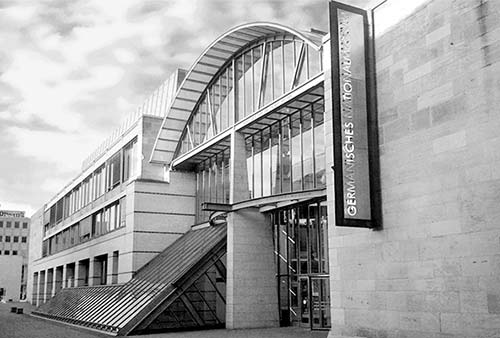
Cost and Hours: €8; Tue-Sun 10:00-18:00, closed Mon; worthwhile online audioguide, check website for occasional English tours, two blocks west of Königstrasse at Kartäusergasse 1, enter through the modern glass lobby in middle of street, +49 911 13310, www.gnm.de.
Eating: The lower-level cafeteria, while pricey, is top quality, with elegant and artfully presented dishes.
Visiting the Museum: To avoid feeling overwhelmed by this vast museum, pick up the English floor plan/brochure and use it to choose things you’re particularly interested in. I’d go more or less chronologically, starting on the ground floor with the Holy Roman Empire and Middle Ages artifacts, then to the first floor’s Renaissance/Baroque collection of German art and gadgets.
The entry hall is dominated by a wall displaying street signs from East Germany—complete with a little politically motivated spray paint—dating from the time when the Soviets had renamed the main drag in many towns Strasse der Befreiung (“Street of the Liberation” from the Nazis and capitalism).
Facing the signs wall, enter the museum wing to your left for a glimpse at some evocative medieval artifacts, including a gilded reliquary shrine and a series of stunning tapestries depicting courtly love.
As you turn to head up to the first floor, Germania—a 19th-century painting of the motherland incarnate—proudly greets you, as if she can’t wait for you to see what’s next. The museum’s star attraction is its German art collection in the Renaissance/Baroque exhibit. Starting in Room 114, you’ll find Albrecht Dürer’s meticulously detailed paintings (the only originals in town) of Charlemagne, Emperor Sigismund, and Dürer’s mother. Look for the delicate wooden Nürnberg Madonna (1515). This intimate, anonymous carving was largely overlooked until being popularized as a symbol of the city during the 19th-century Romantic Age. Farther on, you’ll find Lucas Cranach the Younger’s heart-shaped altarpiece from 1584 (Room 110)—the shape alludes to the love of Christ—as well as his father’s saucy depiction of an Ill-Matched Pair (Room 111). Works on display by woodcarver Tilman Riemenschneider hint at the skills he used to make masterpieces such as the Altar of the Holy Blood at Rothenburg’s St. Jacob’s Church.
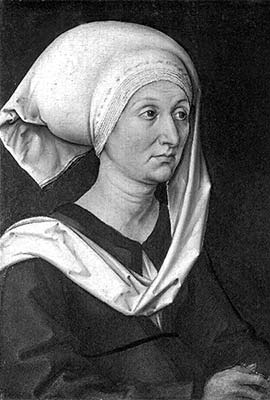
Another highlight is the oldest surviving globe in the world, crafted by Nürnberg’s own Martin Behaim (since it dates from 1492, the Americas are conspicuously missing; Room 103a). For those interested in the Reformation, there’s a wonderful Martin Luther section (Room 117). One non-German painting of note is of—and by—the young Rembrandt. Only recently did experts determine that this is a true self-portrait by the Dutch artist and not a copy, as originally believed (Room 123).
Return downstairs to see the historic core of the museum building, an old monastery filled with original statues salvaged from Nürnberg churches and fountains bombed during World War II. The rest of this huge museum covers a vast spectrum of German culture, from fine arts to prehistory to science to musical instruments.
▲▲DB Railway Museum
Just outside the city walls is the Deutsche Bahn’s German Railway (DB) Museum. Visitors walk through 150 years of railway history, admiring old locomotives and original railcars, including those of Ludwig II of Bavaria and Otto von Bismarck. There’s a section devoted to model railways, a kids’ exhibit, and an outdoor display where you can explore an old station platform and more authentic vehicles.
Cost and Hours: €7; Tue-Fri 9:00-17:00, Sat-Sun 10:00-18:00, closed Mon; reasonably priced café, near the Germanic National Museum at Lessingstrasse 6; +49 800 326 87386, www.dbmuseum.de.
Visiting the Museum: Pick up the free English booklet as you enter and ask about the model train demo (runs hourly). The online audioguide is essential for the ground floor, where no English descriptions are posted.
Start on the ground floor, where you’ll discover the modest origins of Germany’s now impressive rail system and learn about the railways’ influence on German history. Don’t miss the original trains, including the replica of the Adler—the first steam-powered locomotive in Germany (the original debuted in Nürnberg in 1835 and had a cruising speed of 35 kilometers per hour). It’s displayed side-by-side with an Inter-City Express train (which tops out at 300 kilometers per hour). It’s fun to ponder how far train technology has come in less than 200 years. You’ll also see “Mad” King Ludwig’s crown-topped Salonwagen—practically a palace on wheels. Like his equally grandiose Neuschwanstein Castle, this train was barely used by Ludwig, who preferred to travel incognito.
For more exhibits, go through a set of glass doors, cross the street, go through a tunnel, and you’ll come to a display hall just to your right. Here you’ll find handcarts and other railway contraptions, with additional historic locomotives and wagons in an open-air area.
Back in the main building, look for the 1933-1945 section of the historical exhibition, which explains the role of the rail system during the Nazi regime. Head up one floor for an exhibit on the evolution of rail travel and the massive and fascinating-to-watch model railway demonstration.
The top floor hosts the Kibala Kids’ Railwayland, where young visitors can play dress-up, try out simulators, and ride a five-gauge minitrain. Another wing covers the story of human communication with lots of activities that are both kid- and adult-friendly: Write a letter with a quill, see the evolution of telephony, play postman with pneumatic tubes, and watch some German TV.
Neues Museum
Nürnberg’s “new museum” of contemporary art fills a striking glass building right by the town wall (near the train station), with two quiet, bright, and air-conditioned floors that showcase fine art and sleek design pieces from the 1950s until the present.
Cost and Hours: €7, €1 on Sun, additional fees for special exhibits; Tue-Sun 10:00-18:00, Thu until 20:00, closed Mon; behind recommended Hotel Victoria on Klarissenplatz, +49 911 240 2069, www.nmn.de.
Toy Museum (Spielzeugmuseum)
This museum’s chronological/thematic display makes for a breezy and nostalgic history lesson, starting from the wooden toys on the ground floor that exemplify German woodworking traditions, and culminating with the corporate-branded toys three floors up (the top floor has a play zone). For many, the highlight is the miniature replica of the Omaha (Nebraska) train station (third floor up), while others are fascinated, or perplexed, by the display of pro-Nazi toys.
Cost and Hours: €6, €1.50 for kids; Tue-Fri 10:00-17:00, Sat-Sun until 18:00, closed Mon; the €1 audioguide is worth it, Karlstrasse 13, near Albrecht Dürer House, +49 911 231 3164, www.museen.nuernberg.de/spielzeugmuseum.
NAZI SITES
Though Nürnberg tries to present itself as the “City of Human Rights,” its reputation as Hitler’s favorite place for a really big party is hard to shake. To understand the city’s place in the Nazi era, visit Hitler’s vast Nazi Party Rally Grounds (Reichsparteitagsgelände). The Nazi Documentation Center museum, set amid the mute remains of the Third Reich, is under reconstruction until 2024, but visiting the site is still unsettlingly powerful.
The courtroom where the Nürnberg Trials were held is across town from the Documentation Center and Rally Grounds and has much less to offer visitors.
Planning Your Time: Visiting the Documentation Center’s temporary exhibit and walking the grounds (including the courtyard of the Congress Hall and the Zeppelin Field) can take two to three hours. The map in this book is enough to guide you around the site, but there’s also a good, free online guide for your walk (look for a QR code posted on maps near the museum entrance). For lunch, try the excellent Gutmann’s beer garden at the lake (midway between the museum and Zeppelin Field).
If you opt to also visit the courtroom and its exhibit, allow another two hours, including travel time from the train station.
Getting to the Nazi Documentation Center and Rally Grounds: The sprawling complex is wrapped around a lake called Dutzendteich, southeast of the Old Town. Take tram #8, which leaves from the front of the Postbank Center next to the train station (Hauptbahnhof) and takes you right to the Documentation Center (direction: Doku-Zentrum, 10-minute trip). Alternatively, you can hop on bus #36 from the Hauptmarkt (around the corner from the fountain, on Waaggasse) or Rathaus (City Hall) to the Luitpoldhain stop, a 10-minute walk from the Documentation Center. Both options go about every 10 minutes. For ticket options, see “Getting Around Nürnberg,” earlier.
Nazi Documentation Center (Dokumentationszentrum)
Visitors to Europe’s Nazi and Holocaust sites inevitably ask the same question: How could this happen? This superb museum—worth ▲▲▲—does its best to provide an answer. Though closed for renovation until 2024, it is still worth a visit to see the building and possibly drop in on the temporary exhibit. This is not a WWII or Holocaust museum; those events are almost an afterthought. Instead, the Documentation Center traces the evolution of the National Socialist movement (focusing on how it both energized and terrified the German people); looks at Nürnberg’s role in the Nazi movement, including the construction and use of the Rally Grounds, where Hitler’s largest demonstrations took place; and frankly analyzes the Nazi phenomenon to understand how it happened—and to prevent it from happening again.
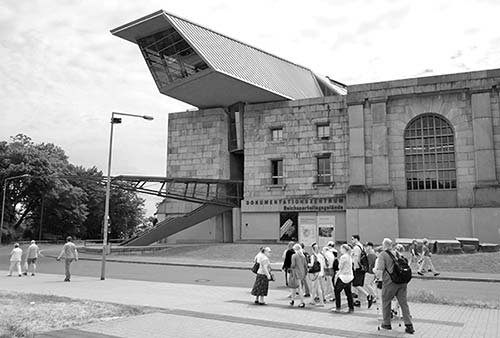
Cost and Hours: €6 for temporary exhibit, daily 10:00-18:00, Bayernstrasse 110, +49 911 231 7538, www.museums.nuernberg.de/documentation-center [URL inactive].
The Building: The museum is housed in one small wing of Hitler’s cavernous, unfinished Congress Hall—the largest surviving example of Nazi architecture. The building was planned to host the mammoth annual Nazi Party gatherings. Today, it has been symbolically cut open by its modern entryway—exposing the guts and brains of the Nazi movement.
The museum’s purpose-built structure is sometimes called “a spear through Speer”—it’s a jolt of glassy, modern construction that slices through the original Albert Speer-designed building. (Just as post-WWII doctors didn’t want to take advantage of medical knowledge gained through Nazi torture, modern architects who designed the museum didn’t want to utilize anything the Nazis had built.)
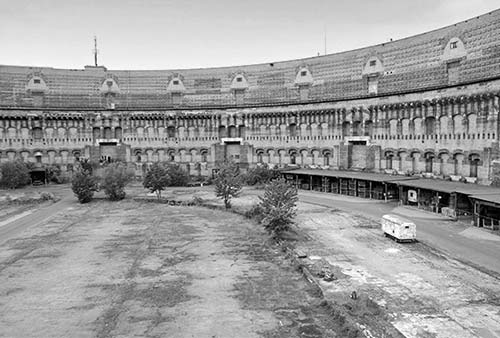
In addition to housing a museum, the Documentation Center has an important function in a society determined to underscore and learn from the horrible deeds of its dark past. For example, students at police and military academies are required to attend special programs taught in classrooms on this site.
Temporary Exhibit: While the museum is under renovation, a small interim display provides a cursory overview of both the rise of Nazism and Nürnberg’s role in Hitler’s regime. It’s accompanied by a free, fairly dry online audioguide (separate from the more useful guide to the Rally Grounds). After covering far-right agitation in the Weimar Republic in the 1920s, the exhibit focuses on the period from 1933-1939 when Hitler consolidated power. During these years Nürnberg became the stage set for massive Nazi rallies—held on this very spot, and famously captured by Leni Riefenstahl in her propaganda film Triumph of the Will. In the war years that followed, the area was used as a camp for prisoners of war, a scene of suffering rather than orgiastic nationalism. The exhibit concludes with a look at the years since 1945, including how the site has been reused, including for concerts and music festivals.
▲Rally Grounds (Reichsparteitagsgelände)
The Rally Grounds occupy four square miles, and you can view them without going to the museum. Albert Speer designed this immense complex of buildings for the Nazi rallies. Not many of Hitler’s ambitious plans were completed, but you can visit the courtyard of the Congress Hall, Zeppelin Field (where Hitler addressed his followers), and a few other remains. The easiest way to see them is to follow the circular route around the lake that’s shown on the “Nazi Documentation Center & Rally Grounds” map in this chapter and on the museum’s free bilingual area plan (Geländeplan). The numbers on the plan correspond to the information pillars that you’ll find on-site.
Figure a 1.5-hour round-trip from the Documentation Center for the full circuit. If you have less time, just look into the courtyard of the Congress Hall from the perch at the end of your museum visit and consider walking the short way around the lake directly to Zeppelin Field and back.
Self-Guided Walk: I’ve listed the main sites here in the order you reach them while circling the lake.
Congress Hall (Kongresshalle): This huge building—big enough for an audience of 50,000—was originally intended to be topped with a roof and skylight. The Nazi Documentation Center occupies part of the hall. To see the vast, Colosseum-like courtyard (now a parking lot), turn right as you leave the Documentation Center, and walk along the side of the building. Dip through the archway into the courtyard to appreciate its dimensions. Notice the stacked stones still awaiting further construction, untouched since the 1930s. Part of the hall is now used by the Nürnberg symphony orchestra.
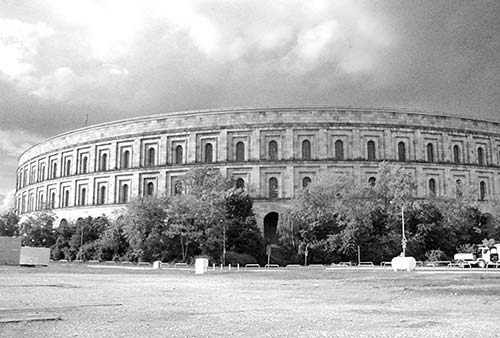
• Turn around and return to the lakeside path and continue walking with the Congress Hall on your right. Just after you round the first corner to the right, look left across the lake. The lights you see in the distance hover above Franken Stadium (a 1928 soccer field before Hitler used it for Nazi rallies and, more recently, a venue of the 2006 World Cup).
Continue past the end of the building, and then turn left along the lakeside path onto the...
Great Road (Grosse Strasse): At 200 feet wide, the Great Road was big enough to be used as a runway by the Allies after the war. Now it’s a parking lot for trucks serving the nearby conference center. The road points toward Nürnberg’s Imperial Castle—Hitler’s symbolic connection to the Holy Roman Empire (the First Reich).
Ahead and to the right was to be the site of the German Stadium (Deutsches Stadion)—the biggest in the world (with 400,000 seats). They got as far as digging a foundation before funding was redirected to the war effort. Today, the site is a park surrounding a lake, Silbersee—which filled the hole for the never-built stadium’s foundation. Even farther ahead, where you can see the rooflines of a nearby suburb, the Nazis had a campground filled with 400 huge tents holding up to 100,000 rally participants. The campers bonded through a regimented communal experience that emphasized military discipline.
• From here, follow the (main) Dutzendteich lakeshore to the left for about 15 minutes until you hit a parking lot. Past the parking lot on your right is the huge...
Zeppelin Field (Zeppelinwiese): This was the site of the Nazis’ biggest rallies, including those (in)famously filmed by Leni Riefenstahl. You can climb up on the decaying grandstand and stand on the platform in front of the Zeppelin Tribune, where Hitler stood to survey the masses (up to 150,000 people at a time). The Tribune is based on the design of the ancient Greek Pergamon Altar (now in Berlin’s Pergamon Museum); it was originally topped by a towering swastika (which was blown up by the Allies at the end of the war) and flanked on either side by massive colonnades. For nighttime rallies Speer created a dramatic “Cathedral of Light”—with 130 searchlights surrounding the field pointed skyward. Warning: Clowning around on the speaking platform with any Nazi gestures is illegal and taken seriously by the police.
It makes sense that Nürnberg appealed to Hitler. Nürnberg is centrally located in Germany, making it a handy meeting point for Nazi supporters. Hitler had a friend here, Julius Streicher (a.k.a. the “Franconian führer”), who fanned the flames of Nazism and anti-Semitism with his inflammatory newspaper Der Stürmer (The Storm Trooper).
More importantly, Nürnberg was steeped in German history. Long before Nazism, the city—once home to Albrecht Dürer and the Holy Roman Emperor, and packed with buildings in the German Gothic style—was nicknamed the “most German of German cities.” As one of the most important cities of medieval Europe, Nürnberg appealed to Hitler as a way to legitimize his Third Reich by invoking Germany’s glorious past. Hitler loved the idea of staging rallies within sight of the Imperial Castle, a symbol of the “First Reich” (the Holy Roman Empire).
When Hitler took power in 1933, he made Nürnberg the site of his Reichsparteitage—Nazi Party Rallies. Increasingly elaborate celebrations of Nazi culture, ideology, and power took place here annually for the next six years. The chilling images from Leni Riefenstahl’s documentary Triumph of the Will were filmed at the 1934 rallies and then shown in every theater and schoolroom in the country. At the 1935 rallies, the Nazis devised the first laws—which came to be known as the Nürnberg Laws—that legally defined Jews as second-class citizens.
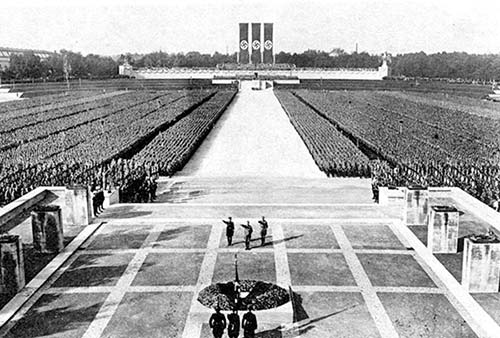
Hitler and his favorite architect, Albert Speer, designed massive buildings (such as a stadium seating 400,000 spectators) to host the proceedings. Only a few were completed before World War II broke out. Today, it’s possible to walk around the still-unfinished remains of the megalomaniacal super-structures. The Rally Grounds were the ultimate example of Hitler’s preferred architecture style: stark, huge, and Neoclassical. (Historians are hesitant to use the term “Nazi architecture,” as much of it was stolen from other styles and simply enlarged. For example, Hitler adored the Roman Colosseum so he had his Congress Hall built at double the scale.)
Near war’s end, the world puzzled over what to do with the Nazis who had overseen some of the most gruesome atrocities in the history of humankind. It was finally decided that they should be tried as war criminals by an international tribunal (spearheaded by the US and based on the Anglo-American code of law). These trials took place in the Nürnberg Trials Courtroom. The Nürnberg Trials—the first international war-crimes tribunal—brought about a new concept of international law, which continues today in The Hague, Netherlands.
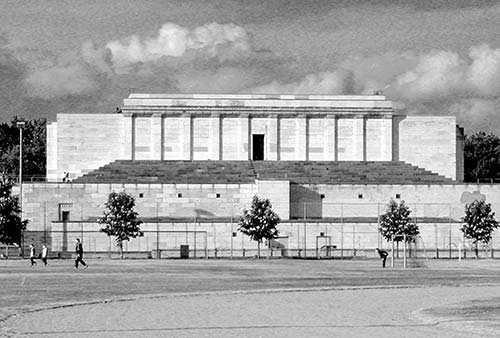
• From Zeppelin Field, continue the rest of the way around the lake, past Gutmann’s beer garden (a good lunch option), and back to the Documentation Center.
Nürnberg Trials Courtroom and Museum (Memorium Nürnberger Prozesse)
Across town from the Documentation Center and Rally Grounds is the courtroom where the Nürnberg Trials were held.
In 1945, in Room 600 of Nürnberg’s Palace of Justice, 21 Nazi war criminals stood trial before an international tribunal of judges appointed by the four victorious countries. It was during these trials that the world learned of the full scale of the Holocaust and heard firsthand accounts from victims and perpetrators alike. The trials were also legally novel, setting a precedent for international law that has since been followed in a number of post-atrocity tribunals (think South Africa, Rwanda, Bosnia). Before the Nürnberg Trials, there was no such legal concept as a “crime against humanity.”
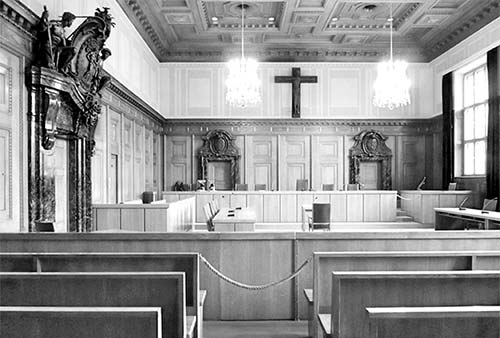
After a year of trials and deliberations, 12 Nazis were sentenced to death by hanging, 3 were acquitted, and the rest were sent to prison. One of the death sentences was for Hitler’s right-hand man, Hermann Göring. He asked to be shot by firing squad—a proper military execution—but his request was denied. Instead, two hours before his scheduled hanging, Göring committed suicide with poison he had smuggled into his cell, infuriating many who thought that this death was too easy for him.
Cost and Hours: €6, includes audioguide; Wed-Mon 9:00-18:00 except Sat-Sun from 10:00, closed Tue, last entry one hour before closing; +49 911 3217 9372, www.museums.nuernberg.de/memorium-nuremberg-trials [URL inactive].
Getting There: The building is a five-stop subway ride from the Hauptbahnhof: Take the U-1 subway line (direction: Fürth Hardhöhe) to Bärenschanze, exit the station following signs for Memorium Nürnberger Prozesse, and continue 200 yards along the main street (Fürther Strasse) to the huge court building, turning right at the corner with the tall signs showing the four national flags. It’s at Bärenschanzstrasse 72.
Visiting the Courtroom and Museum: There are two parts to the experience here: the courtroom (upstairs from the entrance) and the museum (farther up on the top floor). You can usually enter the courtroom itself, but as it’s still in occasional use, you could find it closed, especially if you come on a weekday. You’re pretty much assured of getting to see the courtroom on a Saturday or Sunday. If it’s important to you, call the museum (no more than a week in advance) to ask about the court schedule.
Unfortunately, the museum displays are almost all in German, and there’s little here in the way of artifacts. The outrageously long-winded audioguide gives exact translations of the printed information.
Sleeping in Nürnberg
Prices spike during major conventions in the spring and fall, and in December—when the Christmas market brings visitors from around the world. Nürnberg gets a lot of business travelers, so some hotels drop their rates on weekends. July and August are generally low season and come with the lowest prices.
NEAR THE KÖNIGSTOR, ON KÖNIGSTRASSE
These hotels, clustered along Königstrasse—just inside the Königstor and the city walls—are convenient to both the train station and city sightseeing. From the station, you can roll your luggage here in five minutes without a single stair.
$$ Hotel Drei Raben is an artsy and fun splurge, with a stylish lobby, 22 comfortable rooms, a huge breakfast buffet (eggs and cappuccino by request), and lots of elegant and whimsical touches. Friendly Ralf and his staff offer free wine tastings and music nightly. In this “theme hotel,” you might get the Dürer room, the soccer room (equipped with a foosball table), the toys room, or even the graffiti room (family rooms, nearby apartment, air-con, elevator, pay valet parking, Königstrasse 63, +49 911 274 380, www.hoteldreiraben.de, info@hoteldreiraben.de).
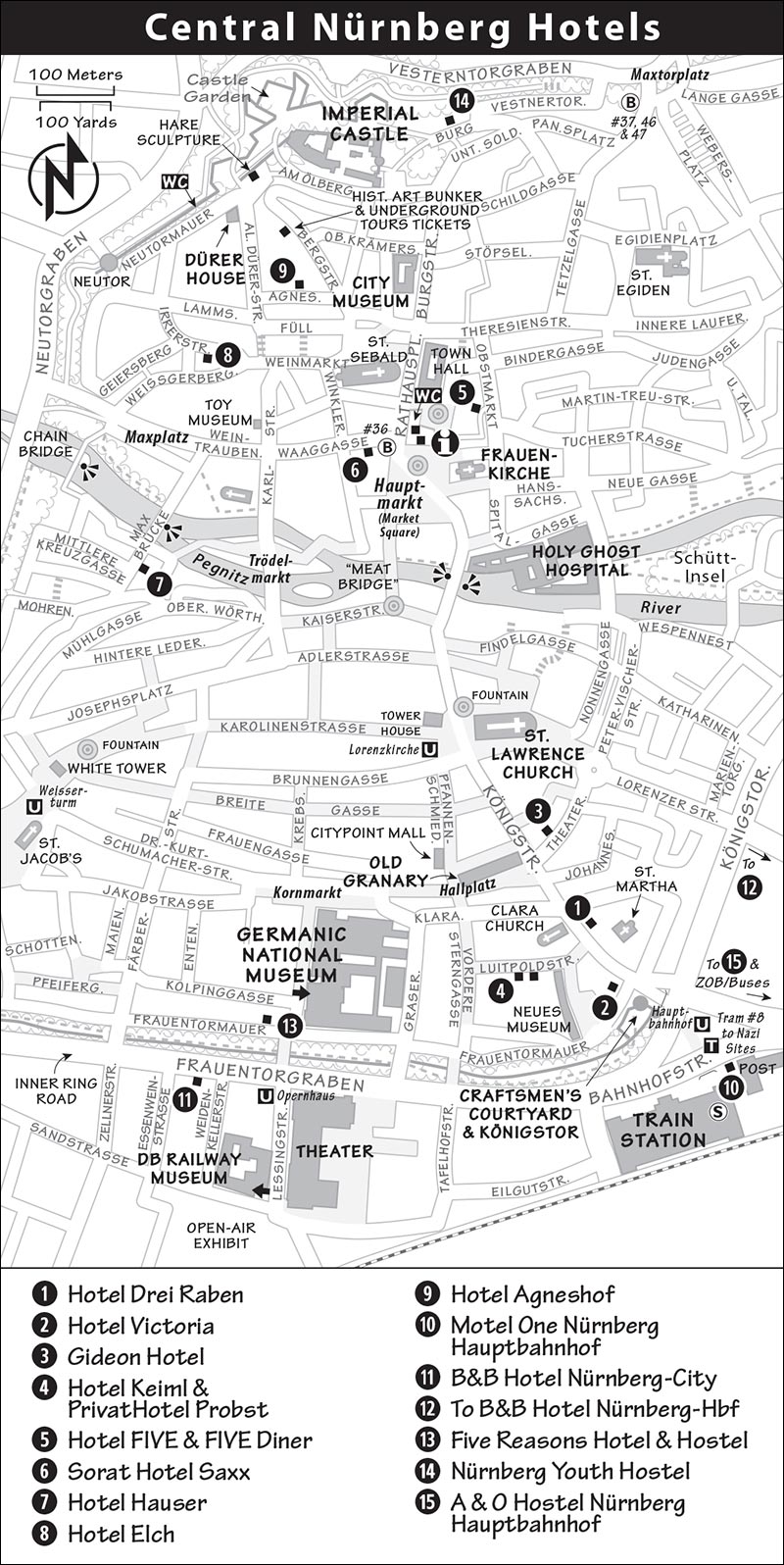
$$ Hotel Victoria is polished and efficient, with 65 fresh, new-feeling rooms behind its historic 1896 facade just inside the Königstor. The standard rooms are a better value than the slightly bigger business rooms (rooms with air-con extra, elevator, indulgent breakfast, pay parking garage, Königstrasse 80, +49 911 24050, www.hotelvictoria.de, book@hotelvictoria.de).
$ Gideon Hotel, overlooking the main pedestrian drag, has somewhat less personality than the Drei Raben but plenty of style. Its 27 rooms, many quite spacious, are decked out in a chic black, white, and red decor and can often be had at a good value. In nice weather, breakfast is served on the lovely rooftop terrace (air-con, elevator, pay parking at Parkhaus Katharinenhof, Grasersgasse 25 but enter around the corner on Theatergasse, +49 911 660 0970, www.gideonhotels.de, info@gideonhotels.de, friendly Nadine).
NEAR THE KÖNIGSTOR, ON LUITPOLDSTRASSE
These affordable, family-run hotels are next door to each other, around the corner from the ones just described, set amidst a harmless sprinkling of casinos and sex shops. Either hotel will do just fine if you’re watching your budget. Neither place is slick or upscale; they’re spartan but comfortable, and the Probst has an elevator. To avoid street noise, ask for a room on the back side (especially for Fri-Sat nights).
$ Hotel Keiml is run by gracious and tiny Frau Keiml, who has been welcoming guests here since 1975. This place is old school in every sense, with 22 bright and basic rooms up two long, smoky flights of stairs (no elevator) in a former apartment building (worth paying extra for breakfast, Luitpoldstrasse 7, +49 911 226 240, www.hotel-keiml.de, garni@hotel-keiml.de).
$ PrivatHotel Probst has been run for more than 70 years by the hardworking Probst family on floors 2-4 of an 18th-century apartment building. They rent 29 decent rooms, some more recently renovated than others. The family’s been updating the space and now there’s a modern breakfast room and some artistic touches (breakfast extra, no air-con but fans on request, cheaper rooms with shared bath, elevator to third floor, Luitpoldstrasse 9, +49 911 203 433, www.probst.bayern, privathotel@probst.bayern).
CLOSER TO THE CASTLE
These places are closer to the castle at the far side of the Old Town. Getting here is a €10 taxi ride or a long hike from the station. You can get partway by taking the U-Bahn (line #1) to Lorenzkirche and exiting toward Kaiserstrasse or bus #36 to Rathaus.
$$$ Hotel FIVE, above a trendy burger bar on the ground floor, also skews cool, with a natural wood-and-earth tone aesthetic. Its 16 rooms are somewhat overpriced but relatively spacious, and some come with a balcony and fold-out couch bed (Obstmarkt 5, +49 911 223 395, www.hotelfive.de, info@hotelfive.de).
$$ Sorat Hotel Saxx is professionally run, from its sleek lobby to its 103 rooms. Most aren’t terribly big, but they’re fresh, often reasonably priced, and in the middle of town, right on the Hauptmarkt (breakfast extra, family room, elevator, pay parking, at Hauptmarkt 17 but enter at Waaggasse 7, +49 911 242 700, www.sorat-hotels.com, info@saxx-nuernberg.de).
$$ Hotel Hauser offers 21 stylish yet comfortable rooms bedecked in green-and-purple velvet. Located on a charming square on the west side of town, it’s a quiet oasis with boutique elegance at a good price (pay parking, Unschittplatz 7, +49 911 214 6690, www.hotel-hauser.com, info@hotel-hauser.com).
$ Hotel Elch, the oldest hotel in town (with 500-year-old exposed beams adding to its classic elk-friendly woodiness), is buried deep in the Old Town near the castle. It rents charming and well-equipped modern rooms: 12 in its original 1342 half-timbered “History” building; 16 bigger, swankier rooms in its “Boutique” wing next door; and two apartments nearby (pay parking, near St. Sebald Church at Irrerstrasse 9, +49 911 249 2980, www.hotel-elch.com, info@hotel-elch.com).
$ Hotel Agneshof is tastefully casual with 74 no-frills, clean rooms. I’d spring for the slightly more expensive fourth-floor castle-view rooms (family rooms, limited pay parking, Agnesgasse 10, +49 911 214 440, www.sorat-hotels.com, agneshof-nuernberg@sorat-hotels.com).
JUST BEYOND THE CITY WALLS
$ Motel One Nürnberg Hauptbahnhof is part of a German chain offering cookie-cutter style and virtually no amenities. Despite its location with train tracks on one side and a busy street on the other, only a few travelers will need earplugs. It’s low-cost modern, an easy walk to the city center, and generally less crowded on weekends (breakfast extra, no air-con, pay parking, Bahnhofsplatz 1, +49 911 477 1340, www.motel-one.com, nuernberg-city@motel-one.com).
$ B&B Hotel Nürnberg-City isn’t a B&B by any stretch, but its 135 pleasant rooms are a solid value. Though it feels more like an IKEA catalogue than most hotels, its accommodations are a few steps above most hostels’ private rooms (on a busy street, breakfast extra, air-con, elevator, family rooms, wheelchair-accessible room, limited pay parking, across from city walls at Frauentorgraben 37, from station take U-2 one stop to Opernhaus, +49 911 378 510, www.hotelbb.de, nuernberg-city@hotelbb.com). Their second location, B&B Hotel Nürnberg-Hbf, with the same rates, is about 500 yards from the station at Marienstrasse 10 (+49 911 367 760, nuernberg-hbf@hotelbb.com).
HOSTELS
Budget travelers beyond traditional backpacker age should consider private rooms offered by the Five Reasons Hostel, where those of any age will feel comfortable.
¢ Five Reasons Hotel & Hostel is the best kind of budget accommodation: clean, bright, centrally located, and run with care. None of the rooms here has its own bath, but the shared bathrooms are some of the swankiest hostel bathrooms I’ve seen (breakfast extra, private rooms available, family apartments, elevator, pleasant terrace, pay parking, facing the town walls around the corner from the Germanic National Museum at Frauentormauer 42, +49 911 9928 6625, www.five-reasons.de, booking@five-reasons.de).
¢ Nürnberg Youth Hostel—once the imperial stables and granary—is romantically situated at the top of the Old Town inside the castle complex (at the far right as you face it). It’s scenic but expensive for a hostel, and can be crowded with school groups in the summer. For the best views, request an eighth- or ninth-floor tower room (private rooms available, family rooms, lunch/dinner available, elevator, Burg 2, +49 911 230 9360, www.nuernberg.jugendherberge.de, nuernberg@jugendherberge.de). To reach the hostel from the train station, take the U-3 subway three stops to Maxfeld, then walk (level, 12 minutes) or take the #37, #46, or #47 bus two stops back to Maxtor.
¢ A&O Hostel Nürnberg Hauptbahnhof, just outside the medieval city center on busy Bahnhofstrasse, is vast and institutional. The hostel caters to a wide range of travelers, from backpackers to families. To avoid street noise, ask for a room facing the courtyard (breakfast extra, private rooms available, fans for rent but no air-con, bar and lounge in lobby, some pay parking, Bahnhofstrasse 13, +49 911 309 168 4400, www.aohostels.com, booking@aohostels.com).
Eating in Nürnberg
SOUTH OF THE RIVER, NEAR THE STATION
Königstrasse, the main pedestrian boulevard leading from the train station into the old center, is lined with enticing places to eat. All along this street you’ll find efficient department store cafeterias, popular restaurant chains, and memorable one-offs. The following places are my favorites on or just off Königstrasse, working from the station to the center.
$$ Bosporus Restaurant, across from the recommended Hotel Drei Raben, is a local standby for Turkish food, in part for its late-night hours and great outdoor seating for people-watching. It does competent versions of all the classics, including döner kebabs and fresh ayran yogurt drinks (daily 9:00-24:00, air-con on upper floor, Königstrasse 60, +49 911 2536 2231).
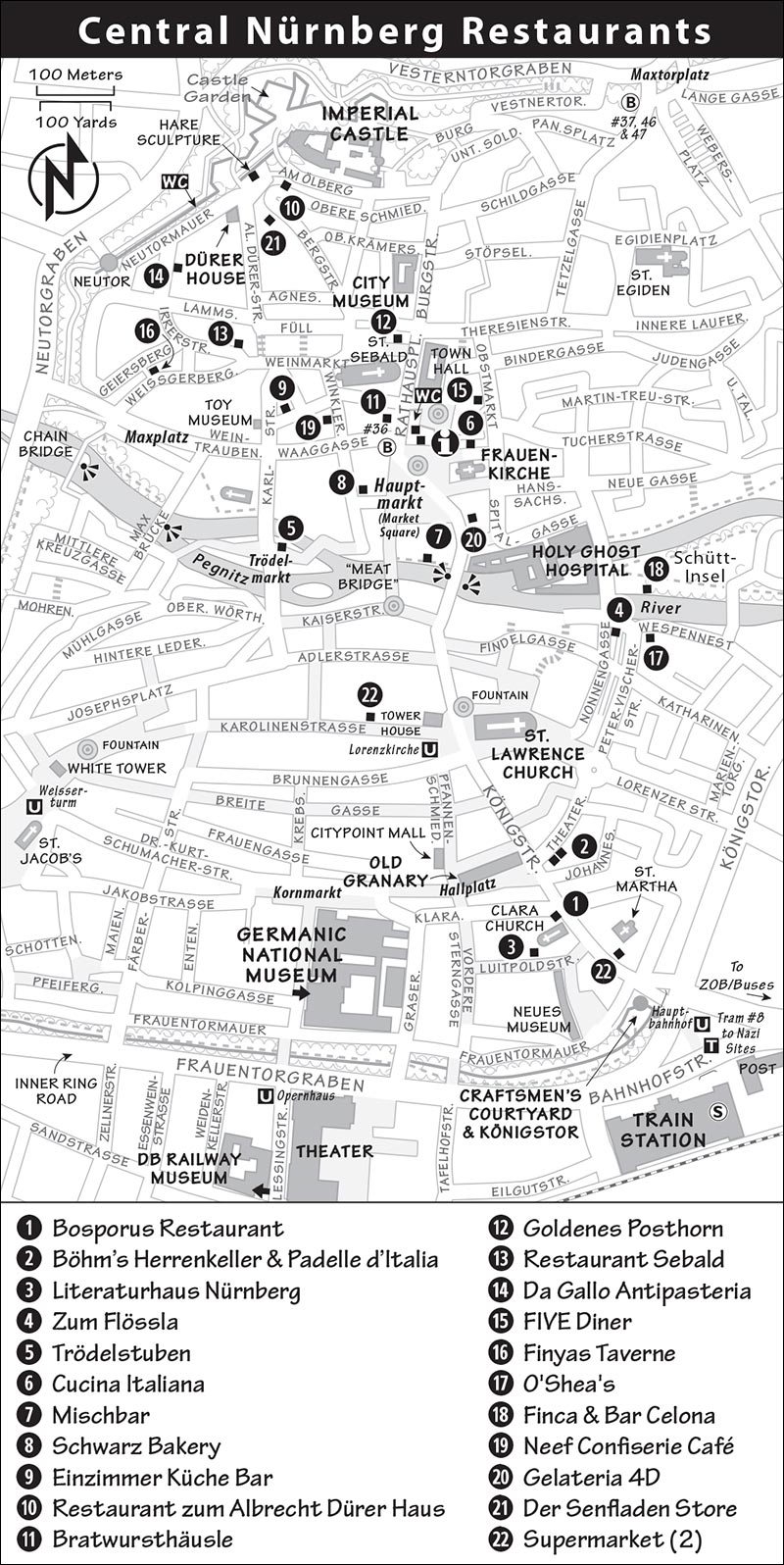
$$$ Böhm’s Herrenkeller is cozy, with a hunting-room ambience. It’s proudly traditional but not kitschy, serving classic Franconian standards at good prices. Try the Schweineschäufele (oven-roasted pork shoulder with dumplings and salad) or the fixed-price meals, which are a fine value (Mon-Sat 11:30-15:00 & 17:30-22:00, closed Sun, a block off Königstrasse across from the Old Granary at Theatergasse 9, +49 911 224 465).
$$ Padelle d’Italia serves up reasonably priced and tasty pizza and pasta in a cozy and lively setting. Their sizable classic Italian dishes and daily seasonal specials are splittable, but seafood here is pricey. Reserve ahead for dinner (Mon-Sat 11:30-14:30 & 17:30-23:00, closed Sun, near Böhm’s Herrenkeller at Theatergasse 17, +49 911 274 2130, www.padelleditalia.de).
$$ Literaturhaus Nürnberg is a casual Parisian-style café run by the local book club and popular for readings. It serves theme breakfasts (daily until 15:00) and creative international dishes. Locals like to order several varied plates, tapas-style, or just enjoy its bookish café ambience for drinks and desserts (Mon-Sat until 23:00, Sun until 18:00, 2 blocks from Königstor just off Königstrasse at Luitpoldstrasse 6, +49 911 234 2658).
ALONG AND NEAR THE RIVER
$$$ Zum Flössla is packed with locals who like heavy German meals with an international flair. It’s got a “been around” ambience with rustic, red-and-white-checked decor. With tables shoehorned into a tight space and elbow room at a premium, it can get warm (Tue-Sat 16:30-22:30, closed Sun-Mon, Unterer Bergauerplatz 12, +49 911 227 495).
$$ Trödelstuben is chock-full of kitschy and intriguing knick-knacks (trödel means “stuff” or “junk”) and serves up basic, hearty Franconian dishes that go well with their selection of local beers and wines (daily 11:00-23:00, Trödelmarkt 30, +49 911 3677 2767).
$$ Cucina Italiana is a low-key Italian restaurant with splittable pizzas (plenty for two), fresh pastas, and sidewalk seating on the corner of the Hauptmarkt (daily 11:30-23:00, Obstmarkt, +49 911 3785 1956).
Quick Lunches near the River: A covered arcade between Museum Bridge and Meat Bridge has several little places in a row near a Starbucks, with good seating inside, out back, or overlooking the river. One solid option is $ Mischbar, where “everything’s mixed” (salads, curries, soups, smoothies, fresh-squeezed juices). Also nearby, $ Schwarz Bakery serves traditional dark breads and sausages in a family-run setting (Mon-Fri 8:30-18:00, Sat until 16:00, closed Sun; Winklerstrasse 10, entrance on Tuchgasse, see description on here).
Picnicking in the Center: The Aldi supermarket on Königstrasse is near recommended hotels (Mon-Sat 8:00-20:00, closed Sun). There’s a more upscale supermarket in the subbasement of the Karstadt department store at the Lorenzkirche U-Bahn entrance (enter store at Karolinenstrasse 6 and take the escalators down two flights, Mon-Sat 9:30-20:00, closed Sun). The farmers market on the Hauptmarkt is another smart option (Mon-Sat 7:00-18:00, no market Sun).
NORTH OF THE RIVER, NEAR THE CASTLE
$$$ Einzimmer Küche Bar is my choice for a romantic splurge in a cozy interior where House & Garden meets Architectural Digest. Chef-owner Tim makes modern German dishes with locally sourced ingredients in a trendy open kitchen. Order à la carte or opt wisely for the four- or five-course fixed-price meal; there’s also a smaller lunch menu (Tue-Sat 18:00-22:00, also open Thu-Sat for lunch, closed Sun-Mon, evening reservations required, Schustergasse 10, +49 911 6646 3875, www.einzimmerkuechebar.de).
At $$ Restaurant zum Albrecht Dürer Haus, you can dine with a view of half-timbered buildings and town-wall towers at a reasonable price. The dark-wood interior has three floors, and there are also outside tables. The menu is updated Franconian. Try the Augustiner Bierschmankerl—selections of traditional small plates served alongside beer (Tue-Sun 12:00-22:00, closed Mon, Obere Schmiedgasse 58, +49 911 2114 4940).
$ Bratwursthäusle is a high-energy, woody place with a leafy terrace and enjoyable people-watching. Its cozy interior—small, crowded, and touristy—feels like a big farmhouse with tables gathered around an open grill. The menu is very limited, with little more than bratwurst, sides (pretzels, tasty potato salad, kraut), and some nasty pickled animal parts. Come here for the best bratwurst in town—all made in-house by the Häusle’s own butcher, cooked on a beechwood grill, and dished up with efficient service (Mon-Sat 11:00-22:00, Sun until 20:00, midway between the Hauptmarkt and castle on the main drag, Rathausplatz 1, +49 911 227 695). For a bratwurst sandwich to go, head inside, pay €3.50 at the half-door on your right, take your receipt to the grill...and in seconds, you’ll be on your way with Nürnberg’s “Little Mac” (three Nürnberger in a fresh roll). Their nearby sister restaurant, Goldenes Posthorn, has the same to-go deal, a more varied sit-down menu, vegetarian options, and fewer tourists (daily 11:00-23:00, Glöckleinsgasse 2 at Sebalderplatz, +49 911 225 153).
$$$$ Restaurant Sebald is ideal for an elegant meal without sausage or dumplings. They serve excellent modern German dishes in a classy interior, with tables outside under the trees (Tue-Thu 17:30-24:00, Fri-Sat 12:00-24:00, closed Sun-Mon, a block west of St. Sebald Church at Weinmarkt 14, +49 911 381 303, www.restaurant-sebald.de).
$ Da Gallo Antipasteria is a treat for pasta lovers, who enjoy generous portions amid a welcoming atmosphere stoked by enthusiastic owner Giovanni (who serves everyone himself). Fun photos and a perpetual showing of classic Italian comedies make it feel like a tiny slice of Italy tucked between the river and Castle Hill (Tue-Sat 17:00-23:00, closed Sun-Mon, reservations smart for this small space, Radbrunnengasse 2, +49 911 238 8538, www.dagallo-antipasteria.de).
$ FIVE Diner, at the recommended FIVE Hotel, might be too trendy for its own good, but it’s got a fun vibe and tasty eats. The menu includes gourmet burgers, veggie alternatives, and “bio”-friendly options. American-style breakfast is served until 15:00 (daily 8:00-23:00, Obstmarkt 5, +49 911 223 375).
Drinks and Pub Grub: Likely the town’s most atmospheric drinking hole, $ Finyas Taverne has a medieval feel—from the animal-pelt seats to the music, food, drink (mead), even the waitstaff’s attire—yet doesn’t quite cross the kitsch line. The upstairs communal tables are popular nightly with tabletop board-game players and collectible card traders (geeks of the world, unite!). You can eat a full meal here (build-your-own Flammkuchen and cheap stews), but I wouldn’t (cash only, Wed-Sat 17:00-late, closed Sun-Tue, Weissgerbergasse 18, +49 911 2373 5122).
Two more places better for drinks than food are along the river, with pleasant outdoor seating when the weather cooperates. $ O’Shea’s is your standard Irish pub (Mon-Thu 16:00-24:00, Fri-Sun from 14:00, Wespennest 6, +49 911 232 895). $$ Finca & Bar Celona does tapas plus pub grub (daily 9:00-22:00, Vordere Insel Schütt 4, +49 911 2373 9144).
Sweets: The Neef Confiserie Café is the Nürnberger’s go-to spot for an afternoon coffee-and-cake break. You can even get a marzipan version of the town’s famous three-sausages-in-a-bun (Mon-Sat 8:00-17:30, closed Sun, Winklerstrasse 29, +49 911 225 179).
Of the many Eiscafés in town, Gelateria 4D is the most likely to have locals lined up at the counter for a scoop (just off the Hauptmarkt on the corner of Königstrasse and Spitalgasse, long hours daily).
Nürnberg Connections
From Nürnberg by Train to: Rothenburg (hourly, 1.5 hours, transfer in Ansbach and Steinach), Würzburg (2-3/hour, 1 hour), Munich (2/hour, 1 hour on fast train), Frankfurt (1-2/hour, 2 hours), Frankfurt Airport (1-2/hour, 2.5 hours), Dresden (hourly, 3.5 hours hours, transfer points vary), Erfurt (hourly, 1.5 hours), Leipzig (hourly, 2 hours, half with transfer in Erfurt), Berlin (hourly, 3.5 hours), Salzburg (hourly with change in Munich, 3 hours), Prague (3 slow trains/day, 5 hours with connections; better to take express bus, nearly hourly, 4 hours, covered by rail passes, leaves from front door of train station). Train info: www.bahn.com.