COLOGNE & THE UNROMANTIC RHINE
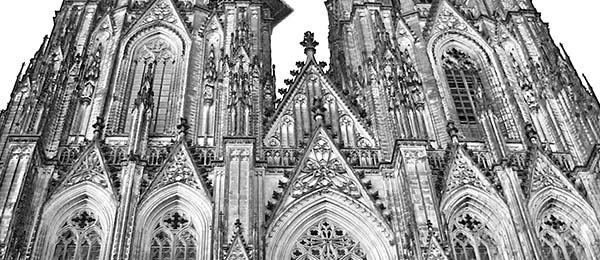
Romance isn’t everything. Cologne (Köln—pronounced “kurln”—in German) is an urban Jacuzzi that keeps the Rhine churning. It’s home to Germany’s greatest Gothic cathedral, one of the country’s best collections of Roman artifacts, a world-class art museum, and a healthy dose of German urban playfulness.
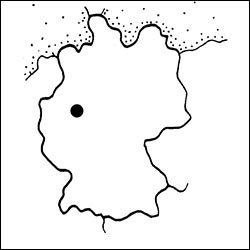
Peaceful Bonn, which offers good people-watching and fun pedestrian streets, used to be the capital of West Germany. The small town of Remagen had a bridge that helped defeat Hitler in World War II, and unassuming Aachen, near the Belgian border, was once the capital of Europe.
Cologne
Germany’s fourth-largest city, Cologne has a compact, lively center. The Rhine was the northern boundary of the Roman Empire, and, 1,700 years ago, Constantine—the first Christian emperor—made what was then called “Colonia” the seat of a bishopric. (Five hundred years later, under Charlemagne, Cologne became the seat of an archbishopric.) With 40,000 people within its walls, Cologne was the largest German city and an important cultural and religious center throughout the Middle Ages. Today, the city is most famous for its toilet water: Eau de Cologne was first made here by an Italian chemist in 1709.
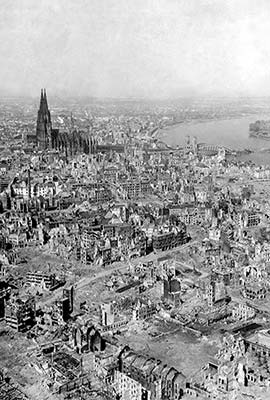
During World War II, bombs destroyed 95 percent of Cologne—driving its population from 800,000 down to an estimated 30,000 at its lowest ebb. But with the end of the war, the city immediately began putting itself back together (the population rebounded to about 400,000 by Christmas 1945). Today, it’s a bustling commercial and cultural center that still respects its rich past.
PLANNING YOUR TIME
Cologne makes an ideal on-the-way stop; it’s a major rail junction, and its top sights are clustered near the train station. With a couple of hours, you can toss your bag in a locker, take my self-guided town walk, zip through the cathedral, and make it back to the station for your train. If you’re planning that short a stop, make sure you’ll be here when the whole church is open (in between its services—see the sight listing for times). More time (or an overnight) allows you to delve into a few of the city’s fine museums and take in an old-time beer pub.
Orientation to Cologne
Cologne’s core was bombed out, then rebuilt in mostly modern style with a sprinkling of quaint. The city has two areas that matter to visitors: One is the section right around the train station and cathedral. Here you’ll find most sights and most of my recommended hotels, plus the TI and plenty of eateries and services. Hohe Strasse, a pedestrian shopping street, begins near the cathedral. The other area—called the “old town”—is between the river and the Alter Markt, a few blocks to the south. After the war, this section was rebuilt in the old style, and today pubs and music clubs pack the restored buildings.
TOURIST INFORMATION
Cologne’s energetic TI is opposite the cathedral entrance (Mon-Sat 9:00-19:00, closed Sun, Kardinal-Höffner-Platz 1, +49 221 346 430, www.cologne-tourism.com). For information on Cologne’s museums, visit www.museenkoeln.de.
Bus Tours: CityTour Köln’s hop-on, hop-off buses leave from the TI (€18, departs every half-hour 10:00-17:00, 1.5-hour tour, recorded commentary in German and English, buy tickets from TI, driver, or online, www.citytour.de).
ARRIVAL IN COLOGNE
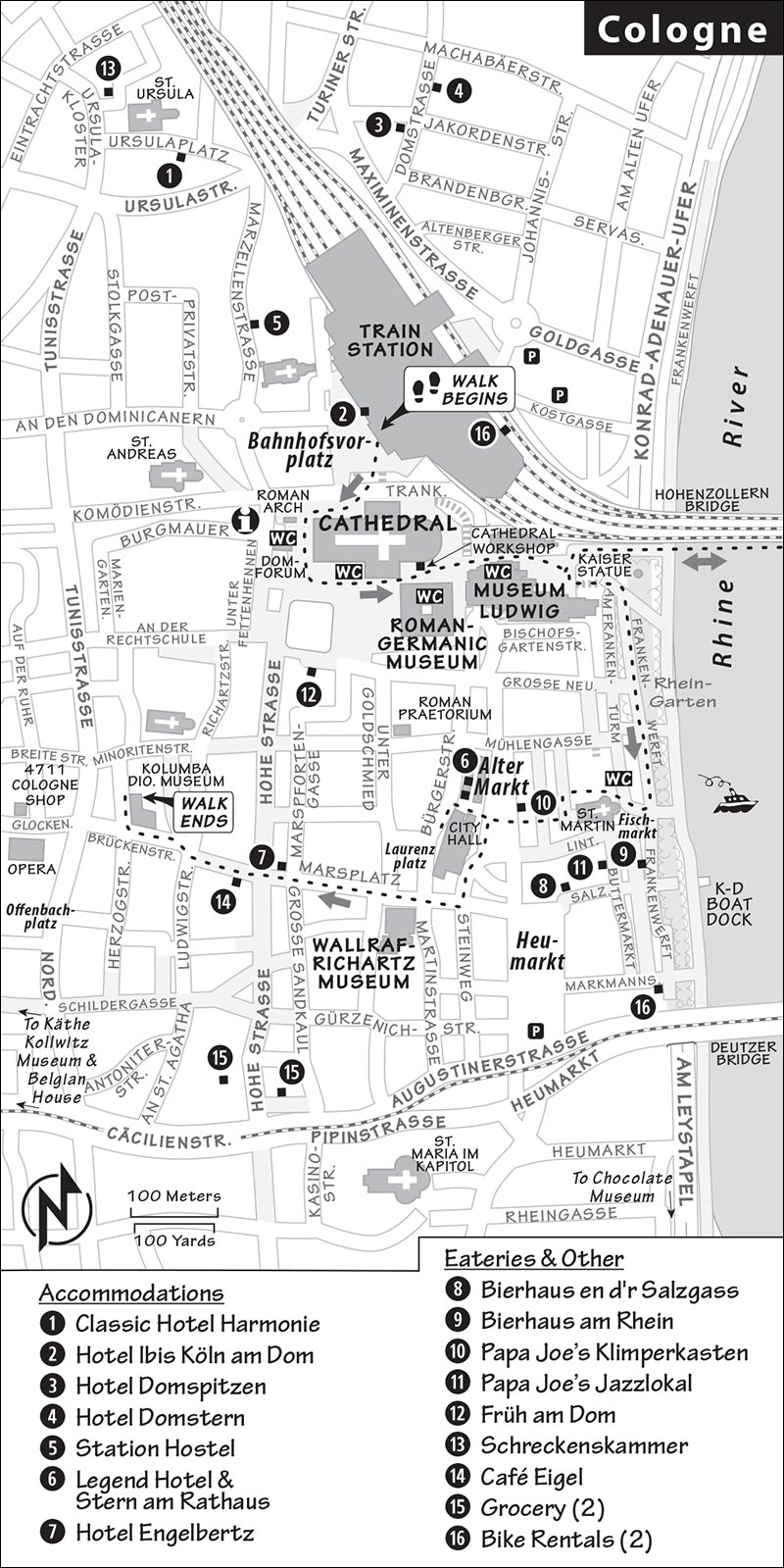
Cologne couldn’t be easier to visit—its three important sights cluster within two blocks of the TI and train station. This super pedestrian zone is a constant carnival of people.
By Train: Cologne’s busy train station has everything you need: drugstore, bookstore, food court, juice bar, grocery store, pricey 24-hour “McClean” pay WC with showers, travel center (Reisezentrum, long hours daily), and high-tech lockers (next to Reisezentrum; insert coins or bills and wait for door to open; your luggage—up to four pieces—is transferred to storage via an underground conveyor belt and retrieved when you reinsert your ticket). Exiting the front of the station (the end near track 1), you’ll find yourself smack-dab in the shadow of the cathedral. Up the steps and to the right is the cathedral’s main entrance (TI across street).
By Car: Drivers should set their GPS to Kurt-Hackenberg-Platz 2 for the huge Parkhaus am Dom garage under the cathedral (€2.40/hour, €24/day). Your hotel may be able to get you a discounted rate of around €15/day—ask.
By Boat: If you’re arriving on a K-D Line boat, exit the boat to the right, then walk along the waterside park until just before the train bridge, when the cathedral comes into view on the left.
HELPFUL HINTS
Closed Day: Note that most museums are closed on Monday (though the cathedral remains open), while the Kolumba Diocesan Museum and the Roman-Germanic Museum’s temporary site are closed Tuesday. The cathedral is off-limits to sightseers during services.
Sightseeing Cards: The MuseumsCard is valid for two consecutive days (or a Sun and Tue, as museums close Mon). It covers all local public transit on the first day and includes the Roman-Germanic Museum, Museum Ludwig, and Wallraf-Richartz Museum, plus several lesser city-run museums (but not the cathedral sights). If you’re visiting all three museums, this card will save you money (€18/person, €30 family pass includes 2 adults and 2 kids under 18, sold at participating museums, www.museenkoeln.de). Skip the KölnCard; its small discounts aren’t worth it.
Festivals: Though Carnival is celebrated all over Germany, Cologne’s celebration is famously exuberant. Join the locals as they dress up, feast, and exchange Bützje—innocent pursed-lip kisses. Festivities start on the Thursday before Ash Wednesday and culminate with a huge parade on the following Monday (“Rose Monday,” or Rosenmontag). The parade draws musicians from all over Germany, and families line the parade route to grab pieces of candy tossed off the floats (www.koelnerkarneval.de). Cologne’s annual Kölner Lichter festival lights up the sky on a mid-July weekend, with fireworks, music, and lots of boats on the river (www.koelner-lichter.de). It’s part of the Rhein in Flammen regional festival (see here).
Bike Rentals and Tours: Convenient bike rental is available at two branches of the friendly Radstation (€7/3 hours, €14/day, +49 221 139 7190, www.radstationkoeln.de). One branch is tucked under the train-track arcade (long hours daily, ID and €50 deposit required; from the station, exit out the back by track 11 to Breslauer Platz, turn right, cross the street, and look toward the train tracks). The other is along the river a 10-minute walk from the station, on Markmannsgasse (daily April-Oct 10:00-18:00, leave photo ID as security deposit, 100 yards upstream from the K-D Line dock). Consider biking the path along the Rhine River up past the convention center (Messe) to the Rheinpark for a picnic.
Radstation also offers German/English guided city tours by bike (€26, 3 hours, April-Oct daily at 13:30, must reserve ahead, about 10 people per guide).
Cologne Walk
Cologne lends itself to a fine orientation walk, worth ▲▲. The old town, towering cathedral, and most of the sights cluster near the train station. Starting at the train station, this self-guided walk takes less than an hour and provides a good introduction. The main indoor sights along this walk—the cathedral, Roman-Germanic Museum, Museum Ludwig, Wallraf-Richartz Museum, and Kolumba Diocesan Museum—are described in more detail later, under “Sights in Cologne.”
Bahnhofsvorplatz: Stepping out of the train station, you’re confronted with a modern hodgepodge of post-WWII architecture and the towering icon of Cologne, its cathedral. The city feels rebuilt—because it was. The Allies bombed Cologne hard in retaliation for Germany’s bombing of London. Your gaze is grabbed by the cathedral. While it was built according to the original 13th-century plans, and the left (east) part was completed in the 13th century, the right half wasn’t built until after German unification, in the 1880s.
• Climb the steps and circle right, to the people-filled square in front of the cathedral entrance. Have a seat on the benches under the trees next to the stone arch.
In centuries past, a clutter of half-timbered huts crowded around the cathedral. They were cleared out in the late 1800s so the great building would have a suitable approach; in the late 1960s the plaza was pedestrianized.
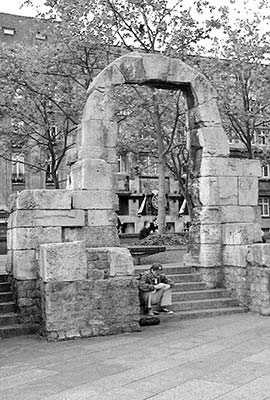
This has been a busy commercial zone since ancient times. The Roman arch was discovered nearby and set up here as a reminder of the town’s Roman roots. This north gate of the Roman city, from AD 50, marks the start of Cologne’s nearly 2,000-year-old main shopping street, Hohe Strasse.
Look for the life-size replica tip of a spire. The real thing is 515 feet above you. The cathedral facade, while finished in the 1880s, is exactly what was envisioned by the original church planners in 1280.
• Continue around the right side of the church, passing modern buildings and public spaces. Step up to the window of the Roman-Germanic Museum for a free peek at a...
Roman Mosaic: Take a look at the museum’s prize piece—a fine mosaic floor. (The museum is closed for renovation until about 2026, but some of its Roman relics are on view at another location—see here.) Once the dining-room floor of a rich Roman merchant, the mosaic has never been moved (the museum was built around it). It shows scenes from the life of Dionysus...wine, women, and song, Roman-style. The mosaic is quite sexy, with several scenes showing a satyr seducing and ultimately disrobing a half-goddess, half-human maenad. First he offers her grapes, then he turns on the music. After further wining and dining—all with an agenda—the horny satyr finally scores. The cupid on a lion’s back symbolizes the triumph of physical love.
The mosaic is at the original Roman street level. The tall monument above and left of the mosaic is the mausoleum of a first-century Roman army officer. Directly across from you (at eye level, beyond the mosaic) are beautifully carved stone reliefs—an indication of what a fine city Roman Cologne must have been.
• Walk 20 steps beyond the mosaic farther along the cathedral and look down to see the...
Cathedral Workshop: Any church of this size is a work in progress, requiring constant renovation, repair, and care. Sandstone blocks are stacked and waiting to be shaped and plugged in wherever needed. The buttresses above are the church’s showiest, because they face the bishop’s palace, city center, and original entrance (south transept). For 500 years, the church was left unfinished, simply capped off midway. You’re facing the functional part of the church, where services were held from the 1300s until the late 1800s.
• Keep walking in the same direction, past the red-brick Museum Ludwig building, and onto the...
Hohenzollern Bridge (Hohenzollernbrücke): This busy railway bridge carries 30 trains an hour all day long. A classic Industrial Age design from around 1900, the bridge was destroyed in World War II and later rebuilt in its original style. These days, the bridge is one of the many adorned with “love locks”—couples come here, mark a little padlock with their names and the date, chain it to the bridge railing, and throw away the key as proof of their everlasting love.
• Walk back in the direction of Museum Ludwig, then head down the stairs toward the people-friendly riverside park.
Riverfront: The statue (above and to your left) honors Kaiser Wilhelm II, who paid for the Hohenzollernbrücke (named after his family). This is urban planning from the 1970s—real and forward-looking. The riverside, once a noisy highway, is now a peaceful park. All that traffic still courses through the city, but flows unnoticed below you in a tunnel. A bike-and-pedestrian path follows the riverside in each direction, and families let their children frolic in the fountain.
Turn right, and walk away from the bridge for a few blocks along the Frankenwerft, Cologne’s riverside restaurant district, until you are even with the tower of the Romanesque church, Great St. Martin. (Cologne’s famous chocolate museum is a five-minute walk farther downstream.)
Notice a strip of sockets for a metal flood wall (on the inland side of the grassy stretch; an eight-foot-high structure can be erected here when needed). Locals see a definite climate change: They say that “floods of the century” now happen every decade, thunderstorms are 10 times more prevalent, and for the first time, this part of Europe has witnessed small tornadoes.
• At the foot of the church, stand in the tiny Fischmarkt square.
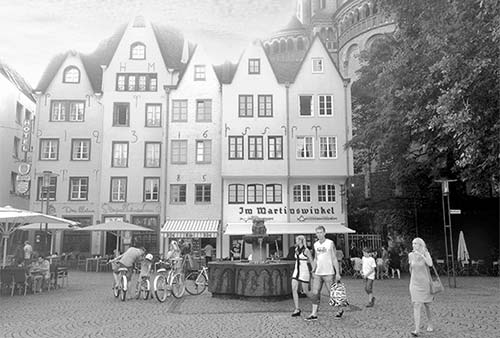
Fischmarkt and “Old Town”: Right below Great St. Martin Church, this little square—once the fish market—faces the river. It’s ringed by medieval-looking buildings from the 1930s. In the early 20th century, Cologne’s entire old town was a scruffy, half-timbered slum where prostitutes and their clients mingled. To the disgusted Nazis, prostitutes were human dirt. Their vision for old towns all over Germany: Clear out the clutter, boot the riffraff, and rebuild in the clean, tidy, stone-and-stucco style you see here. After World War II, Cologne decided to rebuild in a faux-medieval style to approximate what had once been. This square and the streets around the church are from that period.
• Walk inland, circling up a stairway around the right (downstream) side of the church. From the church’s front door, a passageway leads away from the river directly to the Alter Markt (Old Market Square).
Alter Markt and City Hall: You’ll emerge into the square facing the ornate City Hall tower, which symbolized civic spirit standing strong against the power of the bishops in the 15th century. Cross the square and walk up the stairs on the right side of the tower, then go around to the left to see the City Hall’s fine Renaissance porch—the only historic facade left standing after the 1945 bombings. Its carvings stress civic independence. The busts of emperors bring to mind Cologne’s strong Roman past; the lions symbolize the evil aspect of church authority. If it’s viewable, look above the door to see the mayor killing the lion (thus establishing independence from church government for his city). This scene is flanked by biblical parallels: the angel saving Daniel from the lions (on right), and Samson fighting lions (on left).
In front of you, an archaeological site has uncovered both Roman ruins and the remains of Cologne’s old Jewish quarter.
• Head back down the steps and turn right to walk around the modern side of the building, looking out for flying rice—the City Hall is often busy with civil wedding parties. Turn right again, passing the Wallraf-Richartz Museum. Continue up Marsplatz until you reach Hohe Strasse.
Shopping, Church Art, and Eau de Cologne: Look left and right to see the hustle and bustle of the town’s oldest pedestrian shopping street. Hohe Strasse thrived during the Middle Ages, when Cologne was a major player in the heavyweight Hanseatic League of northern European merchant towns. The street was rebuilt after its complete destruction in World War II. Today it’s a rather soulless, narrow string of chain stores—most interesting for its hordes of shoppers. (There’s more shopping action on the nearby Schildergasse and Breite Strasse.)
Continue straight ahead on Brückenstrasse to the modern white building, set atop the ruins of a bombed-out Gothic church. This is the Kolumba Diocesan Museum. Inside, from the corner, you can grab a free peek at what was the church interior.
Across busy Tunisstrasse stands Cologne’s circa-1960s Opera House (a big deal in Germany when built). And across the street from that, on the right, is a historic building at Glockengasse 4. When Cologne’s houses were renumbered in a single series during the Napoleonic era in 1796, this building was given the number 4711—which the perfume-making firm based here later adopted as its trademark. A perfume shop is on the ground floor with Cologne water running in a fountain by the stairway—sample this year’s new fragrances for free at the counter. A small, free exhibit is upstairs (closed Sun, +49 221 2709 9911, www.4711.com).
Sights in Cologne
▲▲Roman-Germanic Museum (Römisch-Germanisches Museum)
▲Imhoff Chocolate Museum (Schokoladenmuseum)
▲▲▲COLOGNE CATHEDRAL (DOM)
The Gothic Dom—Germany’s most exciting church—looms immediately up from the train station in one of the country’s starkest juxtapositions of the modern and the medieval. The church is so big and so important that it has its own information office, the Domforum, in a separate building across the street (described later).
Cost and Hours: Free, generally open to visitors Mon-Sat 10:00-17:00, Sun 13:00-16:00; opens earlier (from 6:00) and later (until 20:00) for those attending Mass, confirm Mass times at Domforum office or at www.koelner-dom.de.
Tours: The 45-minute English-only tours are reliably excellent (€10, daily at 15:00 but confirm times in advance, meet at Domforum across from cathedral, +49 221 9258 4730).
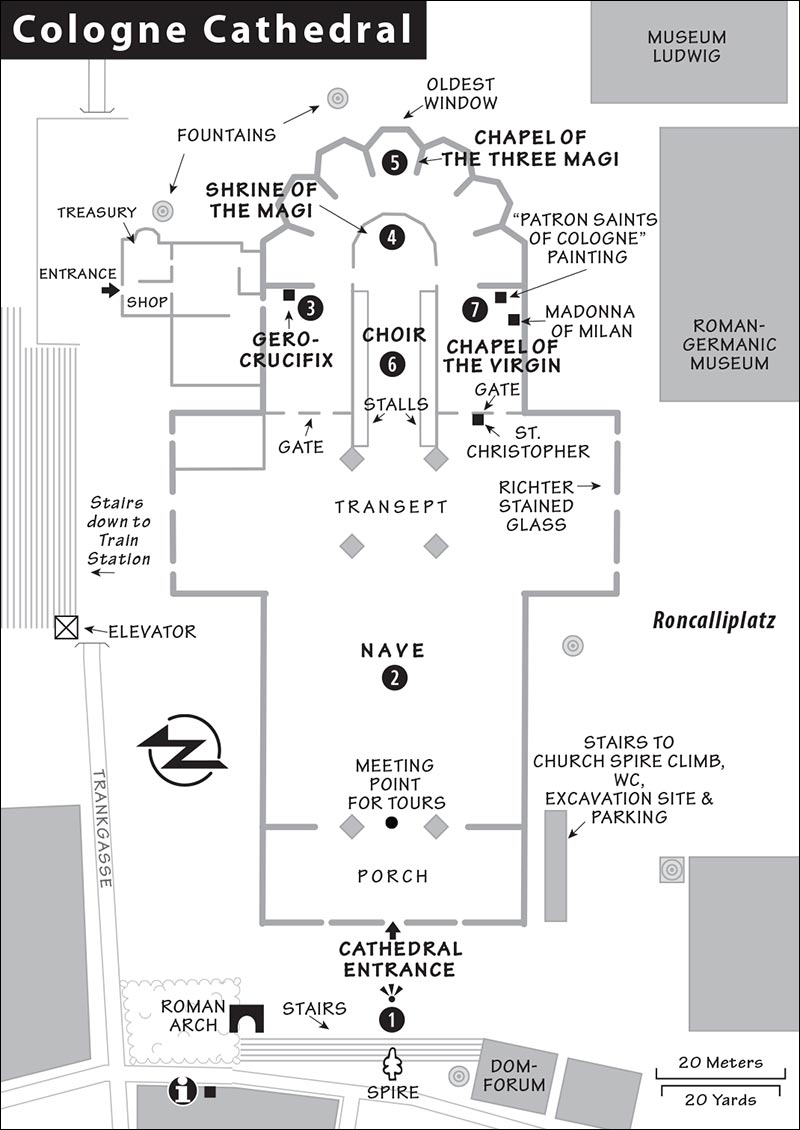
 Self-Guided Tour: If you don’t take the guided tour, follow this tour during the church’s regular opening hours (note that on Saturdays, stops 3-7 are closed off during confession from 14:00 to 18:00).
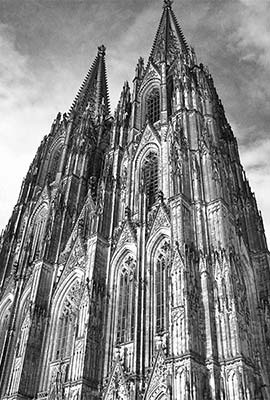
1 Cathedral Exterior: The cathedral—the most ambitious Gothic building project north of France in the 13th century—was stalled in the Middle Ages and not finished until 1880. Even though most of it was built in the 19th century, it’s still technically a Gothic church (not “Neo-Gothic”) because it was finished according to its original plans.
• Step inside the church. Grab a pew in the center of the nave.
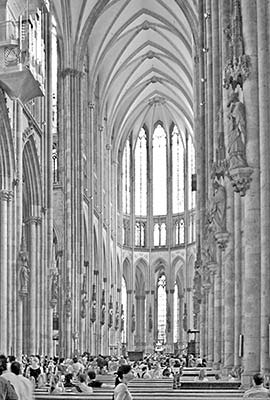
2 Nave: If you feel small, that’s because you’re supposed to. The 140-foot-tall ceiling reminds us of our place in the vast scheme of things. Lots of stained glass—enough to cover three football fields—fills the church with light, which represents God.
The church was begun in 1248. The choir—the lofty area from the center altar to the far end ahead of you—was inaugurated in 1322. Later, during the tumultuous wars of religious reformation, Catholic pilgrims stopped coming. This dried up funds, and eventually construction stopped. For 300 years, the finished end of the church was walled off and functioned as a church, while the unfinished nave (where you now sit) waited. For centuries, the symbol of Cologne’s skyline was a huge crane that sat atop the unfinished west spire.
With the rise of German patriotism in the early 1800s, Cologne became a symbol of German unity. And the Prussians—the movers and shakers behind German unity—mistakenly considered Gothic (which originated in France) a German style. They paid for the speedy completion of this gloriously Gothic German church. With nearly 700 workers going at full speed, the church was finished in just 38 years (1842-1880). The great train station was built in the shadow of the cathedral’s towering spire.
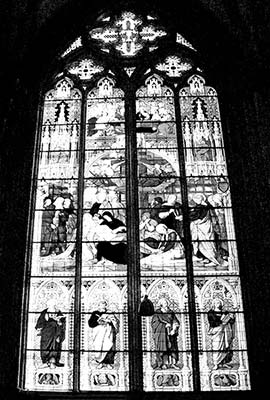
The glass windows at the east end of the church (in the chapels and high above) are medieval. The glass surrounding you in the nave is not as old, but it’s precious nevertheless. The glass on the left is early Renaissance. Notice the many coats of arms, which depict the lineage of the donors. One of these windows would have cost as much as two large townhouses. The glass on the right—a gift from Ludwig I, grandfather of the “Mad” King Ludwig who built the fairy-tale castles—is 19th-century Bavarian. Compare both the colors and the realism of the faces between the windows to see how techniques advanced and tastes changed over the centuries.
While 95 percent of Cologne was destroyed by WWII bombs, the cathedral held up fairly well. (It was hit by 14 bombs, but remained standing.) In anticipation of the bombing, the glass and art treasures were taken to shelters and saved.
The “swallow’s nest” organ above you was installed to celebrate the cathedral’s 750th birthday in 1998. Attaching it to the wall would have compromised the cathedral’s architectural integrity, so the organ is actually suspended from precarious-looking steel wires.
The guys in the red robes are cathedral cops, called Schweizer (after the Swiss guard at the Vatican); if a service is getting ready to start, they hustle tourists out (if you’d like, you can stay for the service if you’re already inside).
• Leave the nave to the left and step through the gate at the far end (beside the transept), into the oldest part of the church.
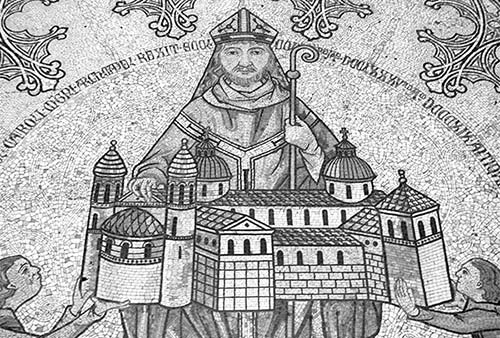
As you enter, look down at the 19th-century mosaic showing a saint holding the Carolingian Cathedral, which stood on this spot for several centuries before this one was built. Ahead of you on the left is the...
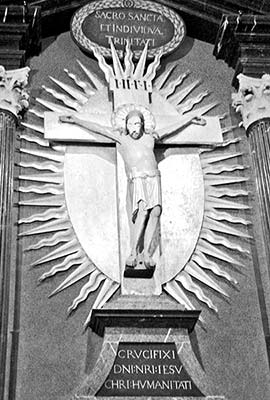
3 Gero-Crucifix: The Chapel of the Cross features the oldest surviving monumental crucifix north of the Alps. Carved in the 970s with a sensitivity 300 years ahead of its time, it shows Jesus not suffering and not triumphant—but with eyes closed...dead. He paid the price for our sins. It’s quite a twofer: great art and powerful theology in one. The cathedral has three big pilgrim stops: this crucifix, the Shrine of the Magi, and the Madonna of Milan.
• Continue to the front end of the church, stopping to look at the big golden reliquary in the glass case behind the high altar.
4 Shrine of the Magi: Relics were a big deal in the Middle Ages. Cologne’s acquisition of what was said to be the bones of the Three Kings in the 12th century put it on the pilgrimage map and brought in enough money to justify the construction of this magnificent place. By some stretch of medieval Christian logic, these relics also justified the secular power of the German king. This reliquary, made in about 1200 of gilded silver, jewels, and enamel, is the biggest and most splendid I’ve seen. On the long sides, Old Testament prophets line the bottom, and 12 New Testament apostles—with a wingless angel in the center—line the top. The front looks like three stacked coffins, showing scenes of Christ’s flagellation, Crucifixion, and Resurrection.
Inside are three skulls with golden crowns—supposedly the bones of the Magi. So what’s the big deal about these three kings (of Christmas-carol fame)? They were the first to recognize Jesus as the Savior and the first to come as pilgrims to worship him—inspiring medieval pilgrims and countless pilgrims since. For a thousand years, a theme of this cathedral has been that life is a pilgrimage...a search for God.
• Opposite the shrine, at the far-east end of the church, is the...
5 Chapel of the Three Magi: The center chapel, at the church’s far end, is the oldest. It also features the church’s oldest window (center, from 1265). The design is typical: a strip of Old Testament scenes on the left with a parallel strip of New Testament scenes on the right that matches theologically and visually (such as, on bottom panels: to the left, the birth of Eve; to the right, the birth of Mary with her mother Anne on the bed).
Later glass windows (which you saw lining the nave) were made from panes of clear glass that were painted and glazed. This medieval window, however, is actually colored glass, which is assembled like a mosaic. It was very expensive. The size was limited to what pilgrim donations could support. Notice the plain, budget design higher up.
• Peek into the center zone between the high altar and the carved wooden central stalls. (You can’t usually get inside, unless you take the tour.)
6 Choir: The choir is surrounded by 13th- and 14th-century art with carved oak stalls, frescoed walls, statues painted as they would have been, and original stained glass high above. Study the fanciful oak carvings. The woman cutting the man’s hair is a Samson-and-Delilah warning to the sexist men of the early Church.
• The nearby chapel holds one of the most precious paintings of the important Gothic School of Cologne.
7 Chapel of the Virgin: The Patron Saints of Cologne was painted around 1440, probably by Stefan Lochner. Notice the photographic realism and believable depth. There are literally dozens of identifiable herbs in the grassy foreground. During the 19th century, the city fought to move the painting to a museum. The Church went to court to keep it. The judge ruled that it could stay in the cathedral—as long as a Mass was said before it every day. For more than a hundred years, that happened at 18:30. Now, 21st-century comfort has trumped 19th-century law: In winter, services take place in the warmer Sacrament Chapel instead. (If you like this painting, you’ll enjoy the many other fine works from the School of Cologne at the Wallraf-Richartz Museum.)
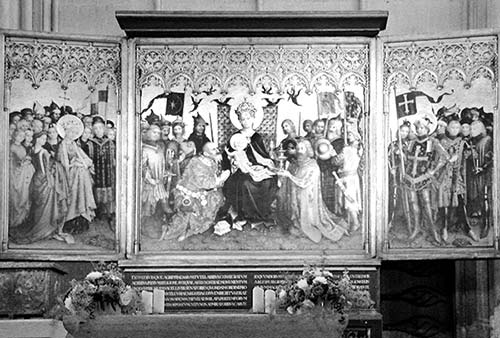
Overlooking the same chapel (between the windows), the delicate Madonna of Milan sculpture (1290), associated with miracles, was a focus of pilgrims for centuries. Its colors, scepter, and crown were likely added during a restoration in 1900. The reclining medieval knight in the cage at the back of the chapel (just before the gate) is a wealthy but childless patron who donated his entire county to the cathedral.
Pass through the gate and look back above the tomb with the cage to find the statue of St. Christopher (with Jesus on his shoulder and the pilgrim’s staff). He’s facing the original south transept entry to the church. Since 1470, pilgrims and travelers have looked up at him and taken solace in the hope that their patron saint is looking out for them.
As you head for the exit, look into the transept on your left. The stained-glass windows above you are a random and abstract pattern of 80 colors, “sampled” from the church’s more-historic windows. The local artist Gerhard Richter designed these windows to create a “harmony of colors” in 2007.
• Go in peace.
More Cathedral Sights
Church Spire Climb (Dom-Turm)
An exterior entry (down the stairs to the right of the church as you face the west facade) takes you into a modern excavation site, where you can see an arch and the foundations from the cathedral’s predecessor (free), and pay to climb the cathedral’s dizzying south tower. For a workout of 509 steps, you can enjoy a fine city view. From the belfry (Glockenstube; only 400 steps up), you can see the Dom’s nine huge bells, including Dicke Peter (24-ton Fat Peter), claimed to be the largest free-swinging church bell in the world.
Cost and Hours: €6, €9 combo-ticket with treasury, daily 9:00-18:00, closes earlier off-season.
Treasury (Domschatzkammer)
The treasury sits outside the cathedral’s left transept (when you exit through the front door, turn right and continue right around the building to the boxy black structure marked Domschatzkammer). The six dim, hushed rooms are housed in the cathedral’s 13th-century stone cellar vaults. Spotlights shine on black cases filled with gilded chalices and crosses, medieval reliquaries (bits of chain, bone, cross, and cloth in gold-crusted glass capsules), and plenty of fancy bishop garb: intricately embroidered miters and vestments, rings with fat gemstones, and six-foot gold crosiers. Displays come with brief English descriptions; the little Cologne Cathedral book sold inside the adjacent cathedral shop (Domladen) provides extra information.
Cost and Hours: €6, €9 combo-ticket with spire climb, daily 10:00-18:00, +49 221 1794 0530.
Domforum
This helpful visitors center, across from the cathedral’s entrance, is a good place to take a break from the crowds. The staff offers plenty of cathedral info, and the welcoming lounge has inexpensive coffee and water. Downstairs, the English “multivision” video about the church starts slow but gets a little better.
Cost and Hours: Visitors center-free, 20-minute video-€2, Mon-Sat 9:30-17:30, Sun 13:00-17:00, may close for special events, +49 221 9258 4720, www.domforum.de.
Kolumba Diocesan Museum
This museum contains some of the cathedral’s finest art. Built around the Madonna in the Ruins church, the museum is conceived as a place of reflection. There are no tours or information or noise. It’s just you and the art in a modern building erected upon the rubble of World War II. The daring modernist rebuild is a statement: We lost the war. Just accept it.
Cost and Hours: €8, Wed-Mon 12:00-17:00, closed Tue; at #4 on Kolumbastrasse, which runs between Minoritenstrasse and Brückenstrasse, a few blocks southwest of the cathedral; +49 221 933 1930, www.kolumba.de.
NEAR THE CATHEDRAL
▲▲Roman-Germanic Museum (Römisch-Germanisches Museum)
One of Germany’s top Roman museums, with an elegant and fascinating display of Roman artifacts, is closed for several years of renovation (reopening around 2026—check their website for the latest). Two highlights of the museum are the original, reassembled arched gate to the Roman city with the Roman initials for the town, CCAA, still legible, and an original Roman-mosaic floor (described on here of my self-guided walk). Even while closed, you can still see the floor through the museum’s large window facing west onto Roncalliplatz.
The Roman Praetorium on Kleine Budengasse, an outpost of the museum, is also closed for renovation.
Temporary Exhibit: During the museum’s renovation, a basic exhibition on Roman Cologne, with some of the museum’s most important movable artifacts, is in a temporary location at Belgian House (about 15 minutes from the center). The pieces on display there are evidence of Cologne’s status as an important site of civilization long before the cathedral was ever imagined. A highlight is the fine glassware that Roman Cologne was famous for producing (€6; Sun-Wed 10:00-18:00, first Thu of month until 22:00, closed Tue; temporary exhibition is at Cäcilienstrasse 46 in the Belgian House (Maison Belge/Belgisch Huis); from the Dom station, it’s two stops on U-Bahn line #16 or #18 to Neumarkt, or a 15-minute walk; +49 221 2212 8094, www.roemisch-germanisches-museum.de).
▲▲Museum Ludwig
Next door to the Roman-Germanic Museum, this enjoyable museum—in a slick and modern building—offers a stimulating trip through the art of the last century, including American Pop and post-WWII art.
Cost and Hours: €12; Tue-Sun 10:00-18:00, first Thu of month until 22:00, closed Mon; audioguide-€3 or download free app, pricey $$$$ restaurant, Heinrich-Böll-Platz, +49 221 2212 6165, www.museum-ludwig.de.
Visiting the Museum: The lower level is mostly contemporary and abstract paintings. Upstairs is the highlight—the Haubrich collection. Josef Haubrich managed to keep his impressive collection of German Expressionist art out of Nazi hands (they considered it “decadent art”) and eventually gave it to the city. The collection includes works by the great German Expressionists Max Beckmann, Otto Dix, and Ernst Ludwig Kirchner. Their paintings capture the loss of idealism and innocence following World War I and helped take art into the no-holds-barred modern world. Also upstairs is a Picasso collection spanning the artist’s entire career.
FARTHER FROM THE CATHEDRAL
These museums are several blocks south of the cathedral.
▲▲Wallraf-Richartz Museum
Housed in a cinderblock of a building near the City Hall, this minimalist museum—Cologne’s oldest—features a world-class collection of Old Masters, from medieval to northern Baroque and Impressionist. You’ll see the best collection anywhere of Gothic School of Cologne paintings (1300-1550), offering an intimate peek into those times. Also included are German, Dutch, Flemish, and French works by masters such as Albrecht Dürer, Peter Paul Rubens, Rembrandt, Frans Hals, Jan Steen, Vincent van Gogh, Pierre-Auguste Renoir, Claude Monet, Edvard Munch, and Paul Cézanne.
Cost and Hours: €8, sometimes more depending on special exhibits; Tue-Sun 10:00-18:00, first and third Thu until 22:00, closed Mon; on Obenmarspforten, +49 221 2212 1119, www.wallraf.museum.
▲Imhoff Chocolate Museum (Schokoladenmuseum)
Chocoholics love this place, which used to bill itself as the “MMMuseum.” Three levels of displays follow the cocoa bean from its origin to the finished product. Local historians, noting the “dumbing-down” of this generation of tourists, complain that this museum gets more visitors than all of Cologne’s other museums combined—in fact, it’s the only sight in Cologne worth booking in advance. You’ll see displays on the history, culture, and business of chocolate from the Aztecs onward, step into a hot and muggy greenhouse to watch the beans grow, and follow sweet little treats as they trundle down the conveyor belt in the functioning chocolate factory, the museum’s highlight. The top-floor exhibit on chocolate advertising is fun. Some find that the museum takes chocolate too seriously, and wish the free samples weren’t so meager—you’ll have to do your indulging in the fragrant gift shop.
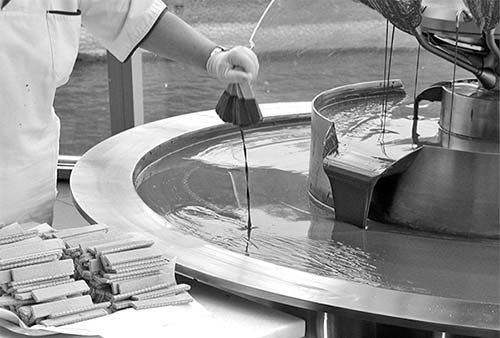
Cost and Hours: €13.50, €14.50 on weekends; Tue-Sun 10:00-18:00, closed Mon, last entry one hour before closing; book online in advance as lines—though fast-moving—can be long in high season; Am Schokoladenmuseum 1a, +49 221 931 8880, www.schokoladenmuseum.de. It’s a pleasant 15-minute walk south from the cathedral along the riverfront, between the Deutzer and Severins bridges.
Käthe Kollwitz Museum
This museum contains the largest collection of the artist’s powerful Expressionist art, welling from her experiences living in Berlin during the tumultuous first half of the 20th century.
Cost and Hours: €5; Tue-Sun 11:00-18:00, closed Mon; Neumarkt 18, +49 221 227 2899, www.kollwitz.de. From Hohe Strasse, walk west on Schildergasse for about 10 minutes to Neumarkt; go past the Neumarkt Galerie shopping center to Neumarkt Passage, enter Neumarkt Passage, and walk to the glass-domed center courtyard, where you’ll take the glass elevator to the fifth floor.
Sleeping in Cologne
Cologne is the convention town in Germany. Consequently, hotels are either jam-packed (rates double or even triple), or they’re empty and hungry for guests. An updated list of convention dates at the city’s main center is posted at www.koelnmesse.de (choose English, then “Dates”). Unlisted smaller conventions, and big conventions in nearby Düsseldorf, can also fill rooms and raise rates in Cologne. Prices are soft outside of convention times, so ask the hotel for its best offer. Note that hotels here charge a 5 percent city tax, which usually isn’t advertised.
All the options listed here are an easy roll from the train station with your luggage.
NEAR THE STATION
$$$ Classic Hotel Harmonie’s 106 business-class rooms include some very small, nicely priced singles as well as luxurious “superior” rooms, which have hardwoods and swanky bathrooms. It’s plenty pricey during conventions, but becomes affordable on weekends and is a downright steal when business is slow (more expensive rooms have air-con, elevator, limited pay parking, Ursulaplatz 13, +49 221 16570, www.classic-hotel-harmonie.de, info@classic-hotel-harmonie.com). It’s a five-minute walk northwest of the station: Exit by track 1 and walk straight to the roundabout, then go right on Marzellenstrasse and bear left on Ursulaplatz, toward the church.
$$ Hotel Ibis Köln am Dom, a 71-room chain hotel, offers predictability and tidiness, and you can’t beat the location—inside the station building—though it lacks personality (breakfast extra, air-con, elevator, Bahnhofsvorplatz, entry across from station’s Reisezentrum, +49 221 912 8580, www.ibis.com, h0739@accor.com).
$$ Hotel Domspitzen is the 30-room sister hotel to the Domstern (listed next). Its convenient location, whimsical wallpapered rooms, and sun terrace with a peek-a-boo view of the cathedral make it a good value (elevator, pay parking; from the train station, take the Breslauer Platz exit by track 11 and walk a half-block up Domstrasse to #23; +49 221 998 930, www.hotel-domspitzen.de, info@hotel-domspitzen.de).
$$ Hotel Domstern is a 16-room boutique hotel with fresh, pleasant rooms above a colorful lobby with funky furniture, located in a fine townhouse just steps from the station. The reception and breakfast are six doors away at Hotel Domspitzen, run by the same folks (elevator, pay parking; from the train station, take the Breslauer Platz exit by track 11 and walk two blocks up Domstrasse to #26; +49 221 168 0080, www.hotel-domstern.de, info@hotel-domstern.de).
¢ Station Hostel, with 200 beds, is a five-minute walk from the train station and has a clean and welcoming vibe. Rooms sleep a maximum of six, and there are no bunk beds (private rooms available, breakfast extra, elevator, restaurant with courtyard seating, laundry facilities, no curfew, +49 221 912 5301; exit station on cathedral side, walk along right side of the church one block, turn right on Marzellenstrasse to #44; www.hostel-cologne.de, station@hostel-cologne.de).
NEAR ALTER MARKT
While these hotels are within walking distance of the train station, those wheeling luggage can consider taking U-Bahn line #5 one stop to the Rathaus station (direction: Heumarkt) to cut out most of the cobblestones.
$$$$ Legend Hotel has 20 impressive rooms with luxurious fittings and a fashionable dark color scheme; some rooms have views over the nearby cityscape (family rooms, air-con, elevator, Bürgerstrasse 2, +49 221 2228 8777, www.legendhotel.de, info@legendhotel.de).
$$$ Stern am Rathaus has nine stylish rooms on three floors in a quiet location just around the corner from Alter Markt and the City Hall. The staff and breakfast room are equally cheery (family rooms, air-con, no elevator, pay parking; Bürgerstrasse 6, +49 221 2225 1750, www.stern-am-rathaus.com, hotelstern@mailbox.org).
$$$ Hotel Engelbertz is a fine 40-room enterprise. Though the design feels dated, it’s clean, simple, and in a good location a seven-minute walk from the train station (RS%, elevator, some rooms with street noise, public pay parking; just off Hohe Strasse at Obenmarspforten 1, coming from station turn left at Hohe Strasse 96; +49 221 257 8994, www.hotel-engelbertz.de, engelbertz@novum-hotels.com).
Eating in Cologne
The city’s distinct type of beer, called Kölsch, is pale, hoppy, and fermented in a way more typical of wheat-based beers, lending it a slight sweetness. Beer halls tend to have similar menus but distinguish themselves by which brand of beer they serve (usually Gaffel, Päffgen, Peters, or Früh). Beers come in delicate glasses (by Bavarian standards) and are shuttled around in small wreath-like trays (Bierkränze). Cologne’s waiters, called Köbes, have a reputation for grumpiness, and some beer halls have a sloppy, sticky-tabled feeling, but others have helpful and attentive service and attractive interiors. This is the place to satisfy your cravings for blood sausage (Blutwurst) and kidneys (Nierchen)...or, for something a little more mainstream, look for the tasty Rheinischer Sauerbraten with Klössen (dumplings) and applesauce. Pub after pub advertises yard-high beer glasses and yard-long bratwursts.
BEER HALLS NEAR ALTER MARKT
The area around Alter Markt, a square a few blocks from the cathedral, is home to dozens of beer halls, most with both outdoor and indoor seating. Wander from Alter Markt through Heumarkt (an adjacent square) and down Salzgasse to Frankenwerft (along the river) to catch the flavor. All of these are open daily until late.
$$$ Bierhaus en d’r Salzgass, convivial, a bit cavernous, and decorated with historical photos of the city, is a classic beer hall where locals have been coming since the 19th century. Today it belongs to Päffgen brewery and serves authentic German dishes (Salzgasse 5, +49 221 800 1900). Päffgen’s nearby $$$ Bierhaus am Rhein has the same menu and is one of many places with great outdoor seating along the Rhine riverfront (Frankenwerft 27, +49 221 800 1902).
$$ Papa Joe’s Klimperkasten is a dark pub packed with music memorabilia—the walls are crammed with photos, there’s a player piano and other vintage gadgets, plus a full menu (Gaffel on tap, occasional live jazz piano, Alter Markt 50, +49 221 258 2132). If you’re more interested in live bands and beer than in food, a couple of minutes’ walk away is its rowdier sibling, Papa Joe’s Jazzlokal (live music Tue-Sat from 20:30, no cover, cash only, no food, Buttermarkt 37, +49 221 257 7931, www.papajoes.de for jazz schedule—American jazz and Dixieland have a big following in Germany).
ELSEWHERE IN THE CENTER
$$ Früh am Dom, near the cathedral, is the closest beer hall to the train station. Popular with both locals and tourists, it offers three floors of traditional German drinking and dining options. In the adjoining delicatessen on the left, check out a painting of what the city looked like in 1531 (daily until 24:00, Am Hof 12, +49 221 261 3211).
$$ Schreckenskammer is a down-home joint and might be the least touristy beer hall in central Cologne. It’s located just behind the St. Ursula church, near the recommended Harmonie hotel. The sand on the floor, swept out and replaced each morning, buffs the hardwood and also keeps it clean. The kammer is small and cozy, so be prepared to share a table and make new friends over a Kölsch or two. Most meals (choose from the Tageskarte, or daily specials) start with a complimentary cup of Brühe (broth). Don’t mistake this as an act of hospitality—it only serves to make you thirstier. This eatery is popular, so arrive early or make a reservation (Tue-Thu 16:00-23:00, Fri-Sat 11:00-14:00 & 16:30-24:00, closed Sun-Mon, Ursulagartenstrasse 11, +49 221 132 581, www.schreckenskammer.com).
$ Café Eigel, just off Hohe Strasse near the recommended Hotel Engelbertz, is a good option for Kaffee und Kuchen (afternoon cake and coffee) or for a light lunch (including salads and omelets). In the same location for many years, it’s been remodeled in a fresh, sleek, modern style. Enjoy delicious pastries in the airy atrium, and be sure to pick up some homemade chocolates. Order your Kuchen at the counter first, then find a table and a server will take the rest of your order (Mon-Fri 9:00-18:30, Sat until 18:00, closed Sun, Brückenstrasse 1, +49 221 257 5858).
Groceries: There’s a smallish REWE at the end of the pedestrian drag (Mon-Sat 7:00-20:00, closed Sun, Hohe Strasse 30, enter around corner on Cäcilienstrasse). Another supermarket is a few doors away in the basement of the Galeria Kaufhof department store (Hohe Strasse 41).
Cologne Connections
On some routes, trains mostly use Cologne’s Köln-Messe-Deutz station—a two-minute trip across the river by S-Bahn from the main station.
From Cologne by Train to: Bonn (5/hour, 30 minutes, or 20 minutes on more expensive trains), Remagen (2-3/hour, 50 minutes), Aachen (2-3/hour, 1 hour), Frankfurt (direct ICE trains at least hourly, mostly from Köln-Messe-Deutz, 1.25 hours; slower, cheaper routes along the Rhine let you enjoy scenery, 2.5-3.5 hours), Frankfurt Airport (2-3/hour, 50-60 minutes, some leave from Köln-Messe-Deutz, can also take slower trains along Rhine), Bacharach/St. Goar (hourly direct, 2 hours; more with change in Koblenz), Cochem (at least hourly, 2 hours; most change in Koblenz), Trier (at least hourly, 2.5 hours, most change in Koblenz), Würzburg (hourly direct, 3.5 hours, faster from Köln-Messe-Deutz), Hamburg (hourly direct, 4 hours), Munich (every 2 hours direct, 4.5 hours, more with changes), Berlin (hourly, 4.5 hours), Paris (3-4/day direct, 3.5 hours, Thalys train—requires seat reservation), Amsterdam (8/day direct, 3.5 hours). Train info: www.bahn.com.
The Unromantic Rhine
▲Bonn
Bonn was chosen for its sleepy, cultured, and peaceful nature as a good place to plant West Germany’s first post-Hitler government. Since the two Germanys became one again in 1989, Berlin has taken back its position as the capital.
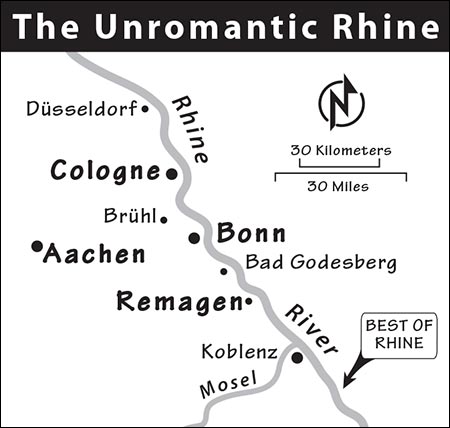
Today, Bonn is sleek, modern, and, by big-city standards, remarkably pleasant and easygoing. The pedestrian-only old town stretching out from the station will make you wonder why the US can’t restrict urban-center traffic for more people-friendly cities. The market square and Münsterplatz—filled with street musicians—are a joy. People-watching doesn’t get much better, though the actual sights are disappointing.
The TI is a five-minute walk from the station (Mon-Fri 10:00-18:00, shorter hours Sat-Sun, Windeckstrasse 1, +49 228 775 000, www.bonn.de).
If you’re a classical-music fan, you can stop by Beethoven’s birthplace, the Beethoven-Haus (www.beethoven.de).
▲Remagen
Midway between Koblenz and Cologne are the scant remains of the Bridge at Remagen, of WWII (and movie) fame. But the memorial and the bridge stubs are enough to stir the emotions of Americans who remember when, in 1945, it was the only bridge still standing on the Rhine, allowing the Allies to pour across the river and race toward Berlin. The bridge was built during World War I to help supply the German forces on the Western Front. (Ironically, one war later, General Eisenhower said the bridge was worth its weight in gold for its service against Germany.) An American unit captured the bridge on March 7, 1945, just after two failed attempts to demolish it (Hitler executed four generals for this failure). Ten days after US forces arrived, the bridge did collapse, killing 28 American soldiers. Today you can pay your respects here and visit the Peace Museum, which tells the bridge’s fascinating story (www.bruecke-remagen.de). Remagen TI: +49 2642 20187.
▲Aachen (Charlemagne’s Capital)
This city was the capital of Europe in AD 800, when Charles the Great (Charlemagne) called it Aix-la-Chapelle. The remains of his rule include an impressive Byzantine- and Ravenna-inspired church, with his sarcophagus and throne. Enjoy the town’s charming historic pedestrian center and festive Christmas market. See the headliner newspaper museum and great fountains, including a clever arrange-’em-yourself version.